
Tag Archive for: Natasha Crain

By Natasha Crain 

Aside from feeling the fatigue of quarantine in general, I am feeling the fatigue of people arguing about the quarantine. This includes Christians fighting with other Christians, Christians fighting with non-believers, and non-believers fighting with non-believers.

If you spend any time on social media, you know exactly what I’m talking about.

Our culture has largely lost the ability to disagree well. I’ve experienced this for years when discussing worldview issues with both Christians and skeptics. But because these worldview conversations tend to take place in online pockets, the nature of those disagreements isn’t always front and center in public life. The universal experience of COVID-19 right now, however, has shone a light on just how poorly many people conduct disagreements—for all to see. And what I see happening in COVID-19 disagreements is the same thing I’ve so often seen happen in worldview disagreements:

People don’t know how to have disagreements at the right level.

Let me explain.

Facts, Interpretations of Facts, and Applications of Interpretations (the FIA Pyramid)

A simple example will demonstrate the problem with many disagreements, as well as the power of using what I’m going to call the FIA thought pyramid: Facts, Interpretations of Facts, and Applications (both personal and policy).

FIA Pyramid

Let’s say I came downstairs this morning and found stuffing from my puppy’s bed all over the floor. There are holes in her bed, and a little stuffing hanging from the corner of her mouth. Those are facts (and a true story!).

I then interpret this to mean that my puppy made a hole in the bed and pulled stuffing out. I didn’t actually see it happen, but I’ve inferred from the facts that this was the case.

Based on this interpretation, I’m upset with her and decide something must change (a personal application).

I then make a new rule (a policy application) that she is not allowed to have a bed of this kind until she has outgrown her puppy months.

Now, imagine that I’ve cleaned all this up before my kids have even opened their eyes for the day. When they eventually make it downstairs, they see I’ve taken the puppy’s bed away. Here’s how they process the situation:

  • Fact: Mommy took the puppy’s bed away.
  • Interpretation: Mommy is mean.
  • Personal application: I’m mad at mommy.
  • Policy application: The new rule is unfair.

This situation could lead to a giant tug of war between my kids and me if we chose to argue over the policy application (the fairness of the new bed rule):

Them: “It’s so unfair! She needs her bed!”

Me: “It’s perfectly fair. She isn’t old enough to have one like this.”

But the central disagreement here isn’t over the rule. It’s over the facts. In this case, the kids have a missing fact. They didn’t know that the puppy destroyed her bed this morning. Yes, we could all agree that mommy took the bed away (one fact), but the additional fact that she destroyed her bed and was harmfully eating stuffing was missing. If I shared with the kids what happened, so they now had that additional information, their new thought pyramid could quickly change to this:

  • Fact: Mommy took the puppy’s bed away because she was eating from it and could hurt herself.
  • Interpretation: Mommy is trying to protect the puppy.
  • Personal application: Mommy can be trusted to make good decisions for the puppy.
  • Policy application: The new rule is fair.

In this example, there was initially disagreement at the top of the pyramid (policy application) because the kids were working from an incomplete set of facts. (This isn’t the only kind of fact problem in the real world, of course; people can have different sets of facts, different types of facts, different numbers of facts, and inaccurate “facts” spread throughout their working knowledge of something.) Because of this, it would be pointless to debate the new rule in and of itself. We needed to work backward in the pyramid to see where the real disagreement was and have a conversation at that level.

Now that we’ve seen a simple example let’s look at disagreement at various places on the pyramid with COVID-19.

Disagreement Over Facts

When it comes to COVID-19, it’s fair to say that NO ONE knows all the facts because it’s a new virus. Most of us, as non-specialists in epidemiology, glean what we know from a variety of sources online, and those sources vary in credibility. Oftentimes what we believe is a fact is really an interpretation of other facts. With the massive amount of new data available, and different people trusting different sources, we are bound to have significant disagreements with one another at the fact level. Yet, most arguments I see happen are at the policy level: continued lockdown or no continued lockdown.

This is a hopeless argument if you haven’t taken the time to consider the FIA thought pyramid.

Imagine, for example, that person one is working from this pyramid:

  • Fact: The number of deaths to date this year is no different than the number of deaths to date in prior years.
  • Interpretation: COVID-19 is no different from the flu.
  • Personal application: Not worried about catching COVID-19.
  • Policy application: Lockdowns aren’t warranted and are destroying the economy.

Now imagine that person two is working from this pyramid:

  • Fact: The number of deaths to date this year significantly exceeds the number of deaths to date in prior years.
  • Interpretation: COVID-19 is responsible for most of those additional deaths.
  • Personal application: COVID-19 is something we should all be very concerned about.
  • Policy application: Lockdowns are necessary to save lives.

These two people could angrily argue over whether lockdowns are necessary, but it would be a waste of breath (or typing). They are working from different assumed facts, and likely won’t agree on policy applications because of it. It’s entirely possible that if they agreed on the facts, they would agree on the policy as well and wouldn’t even be having the discussion. That said, there’s not a direct path from facts to policy, either. In the middle, we have to consider interpretations of facts.

Disagreement Over Interpretation of Facts

Let’s say now that these two people are working from the same set of assumed facts, but they’re still arguing over lockdown vs. no lockdown. It’s possible they disagree at the level of interpretation.

Perhaps the person one is working from this thought pyramid:

  • Fact: The number of deaths to date this year significantly exceeds the number of deaths to this date in prior years.
  • Interpretation: The additional deaths still aren’t extreme.
  • Personal application: Not very worried about catching COVID-19.
  • Policy application: Lockdowns aren’t warranted and are destroying the economy.

And perhaps person two is working from this thought pyramid:

  • Fact: Ditto person 1.
  • Interpretation: COVID-19 is responsible for a tragic increase in death worldwide.
  • Personal application: COVID-19 is something that we should all be very concerned about.
  • Policy application: Lockdowns are necessary to save lives.

In this case, our two people could agree that there are more deaths this year (and even that they’re due to COVID-19), but interpret the severity of that increase very differently. One person might see a 20% increase in deaths as minimal, whereas another might see it as devastating. That interpretation can make all the difference in how one views policy decisions.

Disagreement Over Applications of the Interpretations

Let’s say now that these two people are working from the same set of assumed facts and interpretations, but they’re still arguing over lockdown vs. no lockdown. It’s possible they disagree at the level of applications (personal and/or policy).

Now person one is working from this thought pyramid:

  • Fact: The number of deaths to date this year significantly exceeds the number of deaths to this date in prior years.
  • Interpretation: The additional deaths still aren’t extreme.
  • Personal application: Has major underlying risk factors and is very concerned about any COVID-19 exposure.
  • Policy application: Doesn’t believe lockdowns are warranted for everyone (will take personal measures to protect him/herself but thinks lockdowns overall are destroying the economy).

Meanwhile, person two is working from this thought pyramid:

  • Fact: Ditto person 1.
  • Interpretation:Ditto person 1.
  • Personal application: Ditto person 1.
  • Policy application: Believes lockdowns are warranted for everyone to save lives.

In this example, the two people could both personally be at risk and feel very concerned about their own well-being, but have very different opinions on how that relates to policy for everyone else. You could also have a person two who doesn’t have risk factors and isn’t personally concerned (personal application level), but believes lockdowns are the most compassionate policy for people like person 1—even though person one him/herself disagrees! Personal and policy applications don’t always go hand-in-hand.

How to Disagree Better in 3 Easy Steps

So, where does this leave us? We can disagree better in three “easy” steps.

  1. Ask good questions to determine where the disagreement lies.

When you disagree with someone, remember this FIA pyramid (Facts, Interpretations, and Applications). There’s a really good chance that if you’re arguing about policies or politics in general, you have a disagreement at a more fundamental level. Ask the other person to clarify exactly what they’re advocating for, why they’re advocating for it, and what led them to the conclusion that they should advocate for it. Then compare that to your own FIA pyramid (do some soul searching to figure out what that looks like!) and identify where the departure in the agreement is.

  1. Engage in the appropriate conversation for the level where the disagreement lies.

If you realize the disagreement is over facts, responding with how you interpret the facts you’re using is typically not going to move the conversation forward. You should instead be discussing data sources, whom to trust, why to trust them, and so on.

Or, if you find that you agree on facts and interpretations but have a difference of opinion on policy application, then you should be discussing things like desired policy outcomes and why there’s good reason to believe a given policy leads to those outcomes. In other words, it’s not enough to identify where the disagreement lies; the ensuing conversation should reflect that level as well.

  1. Don’t be a jerk.

Wherever you and another person are disagreeing on the FIA pyramid, there’s just never a reason to treat someone else poorly. This should be obvious. Question facts, interpretations, and applications—don’t attack people or groups of people who have a thought pyramid different than your own. Seek understanding and respond with love and humility.

Recommended resources related to the topic:

Tactics: A Game Plan for Discussing Your Christian Convictions by Greg Koukl (Book)

Practical Apologetics in Worldview Training by Hank Hanegraaff (Mp3)

The Great Apologetics Adventure by Lee Strobel (Mp3)

Defending the Faith on Campus by Frank Turek (DVD Set, mp4 Download set and Complete Package)

So the Next Generation will Know by J. Warner Wallace (Book and Participant’s Guide)

Reaching Atheists for Christ by Greg Koukl (Mp3)

Living Loud: Defending Your Faith by Norman Geisler (Book)

Fearless Faith by Mike Adams, Frank Turek and J. Warner Wallace (Complete DVD Series)


Natasha Crain is a blogger, author, and national speaker who is passionate about equipping Christian parents to raise their kids with an understanding of how to make a case for and defend their faith in an increasingly secular world. She is the author of two apologetics books for parents: Talking with Your Kids about God (2017) and Keeping Your Kids on God’s Side (2016). Natasha has an MBA in marketing and statistics from UCLA and a certificate in Christian apologetics from Biola University. A former marketing executive and adjunct professor, she lives in Southern California with her husband and three children.

Original Blog Source: https://bit.ly/2Bd8xMn 

By Natasha Crain 

This is going to be a very long post, so I’ll cut to the chase:

My husband and I decided back in January that we were going to begin homeschooling our twins for middle school this fall…weeks before we had any idea that the coronavirus existed and that it would lead to everyone schooling at home this spring!

I guess we were unintentionally ahead of the “curve” on this. (Get it? Curve? Coronavirus? Hello?)

This decision was the product of a long period of consideration, during which I did a ton of research, thinking, and learning about educational choices. I came to the conclusion that far more Christian parents should consider homeschooling if they would be able to do it.

Note that I said consider. This is not a black and white subject, and there are many, many family-specific factors involved in an educational choice. I do not think homeschooling is the best for every family. I also realize many parents are not in a position to do it due to health, finances, or other issues. But if it’s at least a possibility, I think every Christian parent should give thought to it.

With the pandemic suddenly sending your kids home, there’s no time like the present to spend time thinking about your educational choices before the fall. Many families will decide to continue homeschooling, and if it’s a possibility for you, I hope this post will provide helpful points to ponder. (If you’re not interested in my personal decision, just skip the first two sections.)

My Family’s Educational Backstory

When it was time for my twins to attend preschool, I spent many hours researching all the programs in the area to find the one I thought sounded “best” based on a host of factors I had researched. It turned out to be a fine little program, but by the end of the year, I felt like there was so much more I wanted them to learn before they went to Kindergarten. I decided to homeschool them for pre-K in order to give them a better academic boost.

For a year, we had a wonderful time of flexible days filled with fun learning experiences and rapid learning. We finished Kindergarten, first grade, and second-grade reading curricula in just a few months—while schooling very minimally each day and leaving much more time for play than in traditional school.

I loved it.

They loved it.

Yet, it never occurred to me to consider homeschooling for their “real” learning years (I saw pre-K as totally different since it was optional). After all, traditional school was what I believed to be “normal.” It was what I knew. It was what I experienced growing up. Most importantly, it was what I expected their lives to look like.

We enrolled the twins in a local private Christian school that was warm and inviting, known for solid academics, and taught from a distinctly Christian worldview. They have now attended that school for six years, and we have genuinely cherished our experience there.

At the same time, as they entered 5th grade this year, I was struck by the realization that they would be starting middle school next year—and this milestone made me really reflect on our educational choices to date and for the future.

Looking back on their elementary years, which are quickly coming to a close, I felt a certain sadness. At first, I thought those feelings were the normal feelings of a mom seeing her kids close a sweet chapter in their lives.

But the more I thought about it, the more I realized that I lamented a certain loss of time with them.

Every day, my kids have spent 6+ hours at school, where someone else was getting to see them bloom in their understanding of the world and who they were becoming as people. Sure, I had them in the morning briefly and then from 3 PM until bedtime (8:30 PM), but that amounted to about half of their weekday lives being spent somewhere else. Once they started sports, we were driving around in the evenings to baseball and soccer fields, and we had even less time together. I’m an extremely intentional parent, and I’ve always been cognizant of making the most of our togetherness, but when the opportunities for togetherness became the nooks and crannies of the average day rather than the focus, something in my thinking began to shift.

More specifically, I felt regret that I hadn’t given more consideration to homeschooling from the beginning.

Note that I didn’t say I regretted not homeschooling. There have been many wonderful things about my kids’ educational experience at their private school—some of which would not have been replicated if I had homeschooled. But I wondered if I would have chosen a different path had I not so simply seen traditional school as the default option when there wasn’t some kind of special reason to do something else.

This realization made me decide that I would give serious thought to both continued private school and homeschooling as my twins approached a natural transition point with middle school—I didn’t want the same kind of regret in 3 years. And after months of very deep consideration, I decided in January that I would become a homeschooler this fall.

Be Mindful of What You Default To

Perhaps my most important take away from months of research, talking with other parents, and thinking about educational choices is that many Christian parents—myself included until now—don’t give enough consideration to the decision of public school vs. private school vs. homeschool. We tend to have our “default” path in mind and go with it. But there are a lot of reasons why our default idea may not be what’s best for our kids.

For me personally, some of the top reasons I’m choosing homeschool over private Christian school (aside from regaining precious time with my kids) include:

  • I want to optimize my kids’ academic pace: One of my twins longs to move faster in school and is continually bored by the pace. The other gets things very quickly when I explain it but gets distracted easily in the classroom setting. I am confident both of them will flourish when I set the pace for their individual needs.
  • I want to pick the curricula best for my kids’ learning: There are SO MANY curriculum options for homeschoolers. It’s overwhelming, but at the same time, it’s a beautiful thing to have this kind of freedom to customize your child’s learning experience. Additionally, you can choose curricula produced from a Christian worldview where desired.
  • I want my son to regain a love of learning: My son, frankly, has come to hate school. At the same time, he loves to learn at home when it’s something he cares about. This is very common with boys, especially, from what I’ve read. With homeschool, we can tailor his projects to areas of his passion so he can love learning again (an outcome that’s hugely important to me) without the “baggage” of what he hated about school.
  • I want to reclaim my kids’ free time: Homeschooling takes less time than traditional schooling because so many of the classroom inefficiencies are removed (in middle school, that’s often 2+ hours per day less than in traditional school). If you reclaim 2 hours per day for your child to enjoy play and pursuits of passion, that’s 10 hours per week and 520 hours per year! That’s a meaningful difference in a child’s life.
  • I want to pour into my kids spiritually throughout the school day: With homeschool, you can easily integrate a Christian worldview throughout all of your child’s subjects, and at a far deeper level than happens in Christian schools. I’ve created my own subject that my twins and I have named BLAW: Bible, Logic, Apologetics, and Worldview. Each day we’ll focus on one letter from the acronym. (I’m super excited to use Talking with Your Kids about Jesus for our first apologetics curriculum!) Yes, our family has had these conversations for years before our homeschool decision. But the opportunity to make this part of their whole education delights me.

There are many other benefits of homeschooling that I’m not listing here. These are simply the ones that have driven my own decision. But it’s not just the benefits of homeschooling that lead me to say other Christian parents should at least give it great thought. It’s also concerns around both public and private schools. The following are four of the most significant ones I see for each.

4 Considerations for Public Schools Families

  1. Living in a “great school district” means little.

This is perhaps the most common reason I’ve seen Christian parents give for keeping kids in public school. I’ve heard it from friends who have left our private school (we live in one of those “great” school districts), and I’ve seen it in many online conversations between parents. But here’s the question we need to ask: What, exactly, makes a public school district “great”? And are those factors the ones that should drive our educational choices?

For most parents, the “great school district” factor means that there are strong academics, typically as measured by test scores, as well as abundant additional offerings (music, art, etc.). But this doesn’t take into account the daily impact of a secular curriculum.

Make no mistake: Curriculum is rarely worldview neutral.

Chances are, you’ll find the math curriculum to not have overtones of any particular worldview (though I’ve seen examples where a math book has questionable word problems).

But history? Here in California, the history books are literally being rewritten to frame the past in terms of the progressive agenda. This is happening across the country as well. Your child’s whole view of history will look different than what you might expect. Here’s a picture from a 1st grade history book in California. [Of course, there is no critical thinking about the definition of rights, where rights ultimately would come from, why we should celebrate these rights but not the rights of people to marry multiple partners, etc. It’s all just assumed.]

Science? The naturalistic assumptions of an undirected, purposeless universe flow through to every science subject (Earth science, astronomy, life sciences, and physical sciences).

Literature? Most schools are replacing the classics with reading material aimed at indoctrinating kids in a progressive agenda. The recommended reading lists are often filled with books you would never choose for your own kids if you had the opportunity to read them—profanity, adult themes, and progressive views are commonplace. Yes, you could see that as a teaching opportunity to some degree, but that requires you to read everything your kids read and set aside the time to have those conversations consistently. Most parents I know don’t do that. And if you don’t, your child will just hear whatever the teacher and other students say.

Health? I’ll talk about this in my next point.

I could write a whole book on all the ways the secular curriculum teaches a child every day to see the universe differently than you do as a Christian family. These are just a few quick points. If your child remains in public school, it is crucial to be HIGHLY involved in reading what your kids read so you can proactively have conversations about a Christian worldview relative to what they are learning.

  1. The problems are not just with sex ed, and therefore, you can’t just opt-out of subjects you don’t want your kids to hear about.

It’s a giant misconception that the only thing Christian parents really need to battle in a public school is the sex-ed program, as should be clear from my prior point. But let’s talk about the sex stuff specifically. Many parents think they can just opt out of the graphic sexual education happening at younger and younger ages in schools, and their kids won’t be exposed to it. While there may be parts you can opt-out of, schools have strategically moved much content into the “health” subject, which is required. It’s the ultimate switcheroo! If schools can’t force all they want into the optional subject, they’ll just move it into a related required one. And what they are teaching at each age is frankly shocking.

One parent shared the following in a group of concerned families I’m part of online (edited for typos):

My daughter is in 7th grade and she is attending a health class which is one of required classes at school. I expected that she could learn basic reproductive body system, symptoms, signs of adolescent, and important health issues thru the health class. However, I was so shocked after listening to my daughter regarding the health class. The health class includes sex education and several guest speakers were invited and teaching the students. The guest speakers are still visiting the health class. My daughter asked me, “Mom, what is oral sex?” I got shocked…the guest speaker explained that oral sex is mouth to penis, mouth to vagina, but my daughter could not imagine or understand why the words “mouth” and “penis” are connected. And, the guest speaker brought some strange stuff. It looks like rubber latex, and then the speaker explained that sex partners put the latex into their private parts and then they can kiss or lick it…and the latex has flavor and scent to make their sex more excited. One of male students asked the speaker, “If I am allergic to the flavor, what can I do?” The guest speaker replied, “You can get other flavors, such as at Target. There are many different kinds flavors there.

The guest speaker went on to say that there is no age limit to get an abortion, so if any students want one, they can get a pill to do it without a parent’s consent.

Again, there would be NO WAY to opt-out of this. The parents weren’t even informed in advance. Similar stories happen every day throughout the US.

  1. Making educational choices based on experiences with individual teachers or schools is not a good long term strategy.

When I’ve had conversations with people about the impact of the curriculum in public schools, one common reply is that they are lucky because the teachers at their school are Christians, or that their teachers would never teach this stuff, or that their school hasn’t gone off the deep end. This is not a good reason to stay where you are. Teachers and administrators turn over all the time, and you could easily end up with someone who won’t be the buffer you hoped would be there. Additionally, a Christian teacher teaching a secular curriculum with the types of issues I already outlined can only do so much to compensate.

  1. Chances are, your kids are not able to be the “salt and light” you would hope them to be.

Many families feel that if all Christians pull out of public schools, there won’t be anyone left to be “salt and light.” Given the breadth and depth of challenges, however, I personally think it’s unreasonable to think that any kid can publicly counter the secular thinking pervasive across subjects. Sure, they can invite friends to church, share the Gospel, and behave in a way that glorifies God, …and those things are all very important. But every family must weigh the reality and extent of those opportunities happening with the reality of how the curricula and peer influences are affecting them.

4 Considerations for Private Christian School Families

Given all that I just said about public school issues for Christians, it would be tempting to suggest that everyone should run to a Christian school if they can afford it. But I wouldn’t necessarily say that. Here are four things to consider.

  1. Christian schools vary greatly in quality, both academically and spiritually.

Just as two people who both call themselves Christians can have very different understandings of what that means, two schools that call themselves Christian can as well. There are Christian schools that are weak academically but strong in teaching the Christian worldview. There are others that are strong academically but could hardly be called Christian. Some are weak in both areas, and some are strong in both areas.

Never pick a Christian school just because it’s an alternative to public school.

It’s critical to really evaluate what the school offers to see if it’s strong both academically and spiritually. If you find a good one that you can afford, you may avoid some of the most serious issues around public schools, and that is absolutely worth doing. (Read on for why I say may avoid.)

  1. Many Christian schools use a secular curriculum.

In many Christian schools, the “Christian” part reflects the fact that teachers sign a statement of faith, there is a weekly chapel, teachers pray with the kids, and there’s a Bible class. Teachers also work to make “faith connections” to the subjects taught. These are all very wonderful things, and I’ve appreciated every aspect of them while having our kids at a Christian school. But parents should be aware of the curriculum choices a Christian school makes, especially for middle and high school. In many cases, they use secular textbooks and expect teachers to compensate in the class by talking about the subject from a Christian perspective. Many teachers are simply not equipped themselves with this kind of understanding in order to fully counter what secular curricula teaches. You end up with a tug of war between worldviews of the text and teacher. This could be beneficial to the student if done very well, but that completely depends on the teacher’s knowledge and motivation.

If you’re considering a Christian school, ask many questions about curriculum choices at the various grade levels.

  1. Teachers vary greatly in how they incorporate faith into the classroom.

We’ve had teachers who prayed multiple times with the kids throughout the day and teachers who didn’t at all. We’ve had teachers who naturally brought up great connections to the Bible across subjects and some who only talked about faith during Bible time. We’ve had teachers who explained the historical and literary context of monthly Bible verses and some who just asked the kids to come up with a skit for whatever they thought it meant. You get the idea. In most Christian schools, there is little standardization across the classrooms because the teachers all come from such different places in their own spiritual life (even if they’re all Christians, they’ve been Christians for different amounts of time and are at different places in their knowledge and walk).

In short, if you send your kids to a Christian school, don’t think for a minute that that education will replace what you should be doing for discipleship. It won’t, and it shouldn’t.

  1. Kids at Christian schools are often not that different from kids at public schools.  

Sometimes parents think that they’ll get rid of the worst peer influences from public school if they go private, and sometimes that is correct. But it’s important to know that people send their kids to a Christian school for all kinds of reasons, and it’s often not because they’re passionate about their kids having a Christian worldview. Sometimes they just want a smaller class size. Sometimes their kids had trouble socially in one school and needed an alternative. Sometimes it’s just the closest school. The kids in Christian schools won’t all be committed Christians because the families won’t all be. But even if the families were, kids will be kids. There will be plenty of mean kids, cliques, kids who watch stuff you wouldn’t allow, and so on. Don’t assume private school is a catch-all solution for negative peer influences.

While I think homeschool is a vastly under-considered choice for Christian parents, there are many families for whom public or Christian school will be the best decision. My purpose here was certainly not to convince everyone to homeschool. But whatever you decide for the fall, be thoughtful about it. Don’t default. Our kids’ education is too important to just do whatever we assumed we always would. The world has changed too much.

Recommended resources related to the topic:

Talking with Your Kids about God: 30 Conversations Every Christian Parent Must Have by Natasha Crain (Book)

Keeping Your Kids on God’s Side: 40 Conversations to Help Them Build a Lasting Faith by Natasha Crain (Book)

Courageous Parenting by Jack and Deb Graham (Book)

Proverbs: Making Your Paths Straight Complete 9-part Series by Frank Turek DVD and Download

Forensic Faith for Kids by J. Warner Wallace and Susie Wallace (Book)

God’s Crime Scene for Kids by J. Warner Wallace and Susie Wallace (Book)


Natasha Crain is a blogger, author, and national speaker who is passionate about equipping Christian parents to raise their kids with an understanding of how to make a case for and defend their faith in an increasingly secular world. She is the author of two apologetics books for parents: Talking with Your Kids about God (2017) and Keeping Your Kids on God’s Side (2016). Natasha has an MBA in marketing and statistics from UCLA and a certificate in Christian apologetics from Biola University. A former marketing executive and adjunct professor, she lives in Southern California with her husband and three children.

Original Blog Source: https://bit.ly/2SO0iwa 

Jesus of Nazareth is not only the most influential human being in history but God incarnate.  Do you know how to talk with your kids about Him?  You will after you hear this podcast because author and apologist Natasha Crain is Frank’s guest.  Natasha and Frank discuss:

  • Is Jesus God?
  • If Jesus is God, how could He die?
  • Did ancient people believe in miracles because they were more gullible?
  • What did Jesus teach about Hell?
  • Didn’t Jesus tell us not to judge?  If so, how are we to make any decisions?
  • What did Jesus teach about love?  Is it approval?
  • What did the death of Jesus accomplish?
  • Why does it matter if Jesus resurrected?
  • Did the disciples lie about the resurrection story?
  • How is the Christian view of God different?

Subscribe on iTunes: http://bit.ly/CrossExamined_Podcast Rate and review! Thanks!!!

Subscribe on Google Play: http://bit.ly/CE_Podcast_Google

Subscribe on Spotify: http://bit.ly/CrossExaminedOfficial_Podcast

Subscribe on Stitcher: http://bit.ly/CE_Podcast_Stitcher

By Natasha Crain 

If you’ve read my books or followed my blog for a while, you know that the focus of my writing is to equip parents with an understanding of how to make a case for and defend the truth of Christianity so they can pass that knowledge on to their kids. This is my passion and focus, but it certainly doesn’t represent ALL that kids need to know and experience in their faith.

It’s not enough to KNOW what’s true if that truth doesn’t transform us.

For years now, I’ve followed blogger and author Kristen Welch at her blog; We Are THAT Family. She is someone I hugely admire for living a life transformed by truth through her work to serve others around the world, and today I want to introduce you to her ministry if you don’t already know about it.

In 2010, she and her family started Mercy House Global to “engage, empower, and disciple women around the globe in Jesus’ name.” They rescue pregnant teens in Kenya and provide a home for them. They empower these young moms and women around the world by providing dignified jobs through partnerships and sustainable, fair trade product development. They also disciple these women to be lifelong followers of Jesus Christ. You can read more about their values and see a statement of faith here.

As part of the ministry, Mercy House has several “Fair Trade Friday” clubs that support their mission. Our family belongs to the bracelet club. For just $14.99 each month, we receive a beautiful bracelet made by a woman in an impoverished country. My two daughters love getting the package in the mail each month and reading more about who made each bracelet and where it came from. It’s led to wonderful conversations about what fair trade means, why it matters, and the kinds of needs people have in other countries. I highly encourage you to check out what they offer and consider supporting Mercy House through one of these clubs.

The reason I’m writing about this today, in particular, is that Kristen has a new book out that I want to recommend to you as well: Made to Move Mountains: How God Uses Our Dreams and Disasters to Accomplish the ImpossibleIn this book, Kristen shares very honestly about what it’s been like to deal with the “impossible” challenges of running an often heartbreaking ministry like this…and how God has met their needs. It’s also a very personal book, as she talks about the toll serving has taken on her family and her marriage, and how God has brought them through even when it’s felt overwhelming. There’s no tidy ending, which I love because life rarely has tidy endings. It will convict you, move you, encourage you, and help you think in fresh ways about the mountains of dreams and disasters in your own life.

Kristen has provided the following excerpt from the book to share here. I hope you’ll enjoy her insights and I highly recommend getting a copy.

Excerpt from Made to Move Mountains:

When I think of someone who was more fearful than brave—but with a measure of faith—and who definitely didn’t boast of his abilities, I think of Gideon. When I was in Israel, one of our stops was at Ein Harod, the spring of Gideon, written about in Judges 7. I love this story. It is an important one for us to consider, and it has been incredibly encouraging.

Gideon was a military leader who was also a prophet and a judge. In verse 2, God says to Gideon, “You have too many men. I cannot deliver Midian into their hands, or Israel would boast against me, ‘My own strength has saved me.’” God whittled away twenty-two thousand of Gideon’s army, but in verse 4, the Lord says to him, “There are still too many men.” God tells Gideon to separate the remaining men based on how they drink water from the spring in the desert. As we heard the gurgling water and stood at the small natural spring where Gideon obediently separated his men and was left with only three hundred, the story came alive in a new way.

Gideon was prepared for the battle. He had gathered his resources, used his expertise, and led an enormous army into enemy territory. But we see very clearly in chapter 7 that God did not want Gideon’s expertise or his battle plan; God wanted his trust. God wants us to trust him so much that we will do what he tells us, even when it goes against what feels right. God wants our obedience because he fights battles in a way that brings glory to him instead of to us. Gideon had to lay down his faith in his military experience and trust a miracle-working God to fight the battle.

One of the reasons I love the story of Gideon is because I can identify with his fear and his courage. Gideon continued to obey God but with fear and doubt every step of the way. He was taking a brave step forward and doubting with every step backward. Nevertheless, God used him to defeat the enemy and help set Israel free, but not without discomfort and risk for Gideon. God had a plan and removed what Gideon thought was necessary for victory. We can’t always see or understand why God asks certain things of us or allows us to experience suffering; we don’t have a bird’s-eye view of the big picture. We can see only the temporary, not the eternal, and we have to trust that the discomfort and uncertainty he is allowing is not only for our good but also for his glory. In this tension, miracles happen.

Kristen Welch, a blogger at We are THAT family, is a bestselling author and founder of Mercy House GlobalMade to Move Mountains released March 3, 2020.

Recommended resources related to the topic:

If God, Why Evil? (DVD Set), (MP3 Set), and (mp4 Download Set) by Frank Turek 

If God Why Evil. Why Natural Disasters (PowerPoint download) by Frank Turek

Why Doesn’t God Intervene More? (DVD Set), (MP3 Set), and (mp4 Download Set) by Frank Turek

Why does God allow Bad Things to Happen to Good People? (DVD) and (mp4 Download) by Frank Turek 


Natasha Crain is a blogger, author, and national speaker who is passionate about equipping Christian parents to raise their kids with an understanding of how to make a case for and defend their faith in an increasingly secular world. She is the author of two apologetics books for parents: Talking with Your Kids about God (2017) and Keeping Your Kids on God’s Side (2016). Natasha has an MBA in marketing and statistics from UCLA and a certificate in Christian apologetics from Biola University. A former marketing executive and adjunct professor, she lives in Southern California with her husband and three children.

Original Blog Source: https://bit.ly/3eaBrf4 

By Natasha Crain

I saw the following post in a Christian Facebook group:

My daughter is starting her second semester of college tomorrow. She got ahold of her syllabus and found the following quote from the professor.

“Except to one whose reason is blinded by unquestioning adherence to fundamentalist doctrine of creation, the evidence of the fossil record, with that of anatomy, embryology, biochemistry and genetics, compels a single conclusion: evolution is a fact.”

Any suggestions on how she should approach this?

If this is his daughter’s first time hearing about evolution (or at least secular views of it), it’s going to be a tough semester. Any suggestions on how she should “approach this” are at least a couple of years late.

I hear or see questions like this all the time. Unfortunately, in my experience, many (if not most) Christian parents aren’t tackling the topic of evolution at home. I know some would love to but are overwhelmed by the subject and don’t know where to start. I wrote 8 of 40 chapters in my book on the topics of creation and evolution views to help parents who feel this way (I also posted a giant resource page last week).

However, far more parents are simply disinterested in the topic and, consequently, have a limited understanding of why evolution is such a big deal. They have a general idea that evolution is a challenge to Christian faith, but don’t necessarily know the particulars of why. At one end of the spectrum, there are parents who don’t care to know because they think it’s enough to teach their kids that “evolution is wrong and the Bible is right.” At the other end of the spectrum, there are parents who don’t care to know because they think evolution and Christianity can seamlessly fit together.

Both of these approaches trivialize the impact that studying evolution can have on a child’s faith.    

Here’s why.

(Please note: There are many different uses of the term evolution. When I say evolution in this post, I’m talking about modern (“neo-Darwinian”) evolutionary theory in which all life descended from a single primitive species via natural selection acting on random DNA mutations. For more background on basics to understand about evolution, please see my post, 4 Key Points Christian Kids Need to Understand About Evolution.)

The Compelling Evidence for Evolution: Not Simple to Throw Out

When your kids first have the chance to hear the scientific case for evolution, it will likely be very convincing to them. Kids whose parents simply emphasize that evolution is wrong because it’s “not what the Bible says” (without further discussion) may well be left in a faith crisis when they eventually engage with the subject in depth. That’s exactly what happened to me. Here’s an excerpt from my chapter on the evidence for evolution, in which I share my own experience:

I didn’t learn about the evidence for evolution until I was in my 30s. When I did, it rocked my lifelong faith in a matter of hours.

When I was growing up, evolution wasn’t yet a subject taught in most public schools; I never encountered it academically. The only time I heard it mentioned was when my church youth group leader once laughed it off, saying, “Yeah, like we all really came from apes!”  I remember thinking that was a pretty far-fetched idea. In college, I studied economics, so I came no closer to evolutionary theory as a young adult. It was very much off my radar until I had kids and decided I should learn about it for their sake.

I started studying evolution by reading an online series of introductory articles published by Biologos.org.  After studying just eight lessons one day, I numbly shut down my computer, pulled a blanket over my head, and felt years of faith sheepishly slink into the shadows of my newfound knowledge. The evidence was shockingly vast—far more extensive than I had ever imagined. The details were fascinating and compelling. This wasn’t some half-baked idea about how fossils fit together, as I had previously imagined. This was… completely scientific. As scientific as any other science I had ever studied and assumed to be valid. It was hardly a leap to ask myself, Why shouldn’t I accept this science if I accept all other science I’ve been taught? I felt like I couldn’t breathe for hours as I lay pondering what life would look like without the God I had always believed in.

It’s important to know that this one night when evolution floored me came after I had attended church for 30-plus years, served as a youth group leader, taken numerous Sunday school classes, read the Bible regularly, and engaged in an active prayer life. None of those things prepared me to figure out what I should do with the evidence for evolution. If evolution was true, I had no idea how Christianity could be true at the same time. If evolution was not true, I had no idea how there could be so much evidence for it.

It was devastating.

How much more is learning about the evidence for evolution potentially devastating to young people with a relatively inexperienced faith? How much more will they “have no idea what to do with” compelling information that immediately seems to contradict the Bible? Recall from the introduction that we actually know that answer: At least 60 percent of young adults are turning away from Christianity today, and the evidence for evolution is one of the biggest reasons.

[End excerpt]

If your kids hear all this scientific evidence in school and say, “Meh. Unimpressive…” then their faith may not be challenged. But that’s an unlikely reaction for most. Clearly, kids need to engage with their parents on the complexity of these issues. Trivializing the subject is not the answer.

Five Ways Evolution Can Challenge Christian Faith

At the other end of the spectrum are parents who don’t care what their kids believe about evolution because they assume Christianity and evolution can fit seamlessly together. Indeed, the acceptance of evolution, in and of itself, does not necessitate atheism. God theoretically could have created the universe and planned for life to unfold via an evolutionary process (this idea is called theistic evolution).  However, that doesn’t mean Christianity and evolution go together without some significant challenges. There are several big reasons why many people end up rejecting their faith after accepting evolution (again, not a necessary outcome, but a very possible one given these questions):

First, if a deity did create the world via evolution, it raises the question of whether He would still be active in it.

Most theistic evolutionists believe that God acted directly in creating the universe, but in doing so ensured that nature would require no additional guidance from that point on. If God is so “passive” in our natural history, why should we believe he’s so engaged in salvation history as told by the Bible (making covenants with people and nations, performing miracles, entering history as Jesus, and so on)?

Of course, there’s no logical reason God couldn’t act differently in these histories, but the contrast does give many people pause.

Second, if evolution is true, it’s hard to see how humans are different from animals, as the Bible claims.

The Bible is very clear that humans were made in the image of God. Although there is considerable scholarly debate over what precisely that means, at the very least it means humans have the cognitive and moral faculties necessary to have a relationship with God…and that animals don’t. The Bible presents humans as very different creatures who are uniquely accountable to our Creator, with eternal implications. According to modern evolutionary theory, however, humans are just another kind of animal. We all descend from the same species.

Theistic evolutionists usually believe that, at some point in time, God chose certain creatures to receive His image and become fully human (there’s no consensus on when or how that happened). Again, while logically possible, evolution certainly raises significant questions about the supposedly special status of mankind.

Third, if naturalistic (atheistic) evolution is true, it’s easier to account for the problem of suffering in the world.

One of the most difficult theological questions is why there is so much suffering in the world if an all-powerful and all-good God exists. While many Christians have offered answers throughout history, naturalistic evolution (at first) seems to explain suffering more readily than theism. If there’s no God, and the history of life is just a giant snowball of continuous DNA mutations rolling through time, genetic errors leading to suffering and disease are to be expected.

Fourth, if evolution is true, it raises serious questions about the reliability of the Bible.

There are quite a few things Christians disagree on when it comes to interpreting parts of the Bible, often boiling down to the meaning of a few specific verses. But there are more than a few verses that are in question if one believes evolution is true. Most obvious is the creation account in Genesis. If the Bible really is God’s Word, why wouldn’t God have informed the biblical writers that He created life via evolution…or, at the very least, remained silent on the topic and not given them an account that at face value contradicts reality? Those were the immediate questions that came to my own mind when I first learned about the evidence for evolution.

Additionally, many verses reference the creation account throughout the Bible, and, importantly, treat Adam as a historical figure (see, for example, Luke 3:38; Romans 5:12-21; 1 Corinthians 15:22, 45; 1 Timothy 2:13, 14; Jude 1:14). However, evolutionists conclude that we do not descend from an original set of two parents; they believe we descend from a group of at least 10,000. If Adam is not a historical person, it clearly challenges several more verses in the Bible than the creation account itself. (Theistic evolutionists have addressed this challenge and the next in a variety of ways beyond the scope of this post).

Fifth, if evolution is true, it raises serious questions about Christian theology.

There are also a lot of theological implications if there wasn’t a historical Adam or a historical “fall.” In the traditional Christian view, salvation is the result of God working to restore a fallen mankind to a right relationship with Him through Jesus. If there wasn’t a real Adam and there wasn’t a historical fall, it naturally raises the question of why there had to be a savior. Theistic evolutionists have offered answers to this, but there’s no question that it’s far more difficult to reconcile Christian theology without a historical Adam.

As I wrap this up, I want to return to the father’s question at the beginning of this post. When you realize how many scientific and scriptural considerations there are on this topic, you can see how difficult it will be for a young adult to go into a class where naturalistic (atheistic) evolution is taught as fact. Don’t let your child’s eventual college professor have the first (and possibly final) word on what your child believes. Take accountability and engage with your kids long before then.

If you’re not sure how to talk about these issues with your children, please check out my book. I explain young-Earth creationism, old-Earth creationism, naturalistic evolution, and intelligent design for parents with no background in these topics (without advocating any one position).

Recommended resources related to the topic:

Talking with Your Kids about God: 30 Conversations Every Christian Parent Must Have by Natasha Crain (Book)

Keeping Your Kids on God’s Side: 40 Conversations to Help Them Build a Lasting Faith by Natasha Crain (Book)

Courageous Parenting by Jack and Deb Graham (Book)

Proverbs: Making Your Paths Straight Complete 9-part Series by Frank Turek DVD and Download

Forensic Faith for Kids by J. Warner Wallace and Susie Wallace (Book)

God’s Crime Scene for Kids by J. Warner Wallace and Susie Wallace (Book)


Natasha Crain is a blogger, author, and national speaker who is passionate about equipping Christian parents to raise their kids with an understanding of how to make a case for and defend their faith in an increasingly secular world. She is the author of two apologetics books for parents: Talking with Your Kids about God (2017) and Keeping Your Kids on God’s Side (2016). Natasha has an MBA in marketing and statistics from UCLA and a certificate in Christian apologetics from Biola University. A former marketing executive and adjunct professor, she lives in Southern California with her husband and three children.

Original Blog Source: http://bit.ly/2VSTqzY

By Natasha Crain

My 5-year-old and I were playing the game Connect Four the other day and, for the first time ever, she was in a position to beat me. I absolutely won’t let my kids win a game for the sake of winning, but when I see that they’ve gotten into a position to win on their own, I’m willing to point it out (yes, I am that generous).

All my daughter had to do was put her checker in a specific spot and it would guarantee a win on her next turn.

I excitedly explained, “You’re going to win! You did it on your own! I didn’t let you win at all! Look. If you play right here, you are going to win on your next turn no matter where I play next.”

She looked at it a minute and realized I was right. A guaranteed win if she played where I showed her.

Then she played somewhere else.

I was flabbergasted that my little girl, who has long been desperate to beat me at Connect Four, didn’t take the guaranteed road to victory. I literally couldn’t understand it.

I blurted out, “What are you doing?! You FINALLY could have really beaten mommy! WHY didn’t you play where I showed you?”

She shrugged, then replied, “Because I wanted to play over here.”

Reminder: Our Kids Aren’t Purely Rational Creatures

My daughter’s response was positively maddening because it was so illogical. Why give up the win just because you “want” to play somewhere else? It didn’t make sense.

But it made me reflect on the fact that humans are not purely rational creatures. There are all kinds of reasons why we make the decisions we make, and that includes the decisions we make about our spiritual life.

This is precisely why, no matter what we do, our kids may become atheists.

If you’ve been reading my blog for a while, you know I’m passionate about equipping Christian parents with an understanding of secular challenges and helping them address these with their kids. I strongly believe that if we aren’t intentional in how we disciple kids today, we are failing them in the most important area of their lives. So does it sound contradictory that I’m now saying no matter what we do, our kids may become atheists?

It shouldn’t.

It’s simply an acknowledgment that even when we line up the checkers of truth and point clearly to how our kids can “win” spiritually, they may choose to do something else.

Dr. Gary Habermas has offered a framework that further illuminates this reality. He suggests there are three kinds of spiritual doubt that people deal with in determining their faith:

  • Intellectual doubt is doubt about the facts of Christianity. It’s when you question the information you have and/or are presented with new information that makes you question it. The intellectual challenges to faith are everywhere today, having been brought to the public’s attention by vocal atheists like Richard Dawkins.
  • Emotional doubt is doubt created by subjective feelings that aren’t necessarily tied to the facts. For example, your child may understand 1 million important facts about the truth of Christianity, but after he or she loses a friend to a terrible disease, none of those facts may matter. The looming emotional question of why God could allow such a thing may be beyond the reach of all the intellectual reasoning in the world (at least for a period of time).
  • Volitional doubt is choosing to doubt even when one doesn’t have apparently reasonable cause to do so. It’s analogous to my daughter choosing to play in the wrong place just because that’s what she wanted to do. Pride is a significant factor here.

Research shows that the exodus of youth from Christianity today is primarily due to intellectual barriers to faith (see David Kinnaman’s You Lost Me, for example). Kids are leaving home unprepared with basic facts and information about why there is good reason to believe Christianity is true and are subsequently losing their faith when they are presented with compelling information that challenges what they previously believed.

There is no excuse for Christian parents allowing their kids to leave home subject to so many intellectual doubts.

First Peter 3:15 tells us that we should all be prepared to give a reason for the hope we have. Not just people who happen to have a Master’s degree in Theology or Apologetics. Not just people who happen to have some time and energy left over after taking their kids to their 13th extra-curricular activity for the week. All of us.

My book, Keeping Your Kids on God’s Side: 40 Conversations to Help Them Build a Lasting Faith, is written explicitly for that purpose: to give parents the critical information they need to equip their kids with so their kids can encounter intellectual challenges with confidence.

Does that mean our kids won’t become atheists, as long as we give them enough information? Of course not. Remember, there are still emotional and volitional doubts that are part of the picture (as well as intellectual doubts that some will continue to have). We can help them build a lasting faith, but ultimately their faith is not in our control.

That said, we should never be discouraged away from putting all we can into our kids’ spiritual development. Here’s why.

(The following is an excerpt from the final paragraphs of my book.)

The time and consideration we give to our kids’ faith development is an investment, not a purchase.

With a purchase, a person gives with the expectation of a certain and specific return.

With an investment, a person makes contributions, knowing that there is also a risk of that investment not resulting in the desired outcome.

Make no mistake: It’s an investment of our training efforts that God has asked us to make with our kids (Deuteronomy 6:6-7). There are no guaranteed outcomes, as with a purchase. For a long time, I didn’t fully grasp that difference. I envisioned certain outcomes for my children based on the effort I was putting into their spiritual development. When they didn’t live up to my expectations, it resulted in my frustration and even anger. It made me not want to do anything more because it didn’t seem worth it.

Then I realized one day that I was pursuing results as if I could purchase those outcomes with the currency of my efforts. I was immediately convicted of the error in that thinking and realized I needed to become an investor. I felt liberated—newly free to do the job God has given me without the burden and illusion of control.

So go be an investor. Put in all you’ve got. Then pray that God will take that and make it grow, all for His glory.

Recommended resources related to the topic:

Talking with Your Kids about God: 30 Conversations Every Christian Parent Must Have by Natasha Crain (Book)

Keeping Your Kids on God’s Side: 40 Conversations to Help Them Build a Lasting Faith by Natasha Crain (Book)

Courageous Parenting by Jack and Deb Graham (Book)

Proverbs: Making Your Paths Straight Complete 9-part Series by Frank Turek DVD and Download

Forensic Faith for Kids by J. Warner Wallace and Susie Wallace (Book)

God’s Crime Scene for Kids by J. Warner Wallace and Susie Wallace (Book)


Natasha Crain is a blogger, author, and national speaker who is passionate about equipping Christian parents to raise their kids with an understanding of how to make a case for and defend their faith in an increasingly secular world. She is the author of two apologetics books for parents: Talking with Your Kids about God (2017) and Keeping Your Kids on God’s Side (2016). Natasha has an MBA in marketing and statistics from UCLA and a certificate in Christian apologetics from Biola University. A former marketing executive and adjunct professor, she lives in Southern California with her husband and three children.

Original Blog Source: http://bit.ly/2SHzvls

By Natasha Crain

A couple of weeks ago, I had the opportunity to speak to four groups of parents during the Apologetics Canada conference (incidentally, if you live in the Long Branch, NJ, area, I’ll be speaking at the No Pat Answers conference on April 9). I ended up speaking with a lot of parents after these talks and heard some variant of one particular question repeatedly:

“I’d love to have deeper conversations about faith with my kids, but how do I get them more interested in sitting down and having those discussions?”

To answer that, I gave several of these parents a snippet of advice from my marketing background.

Every day you probably see or hear some kind of advertisement for buying a new car. If you aren’t currently interested in buying a new car, however, do you notice those ads? Can you even remember the most recent one you saw or heard? Probably not. But let’s say you’re suddenly in the market for a car. Do you pay attention to those ads now? Absolutely. You notice the cars around you on the road, you pay attention to the ads on the radio, and you start keeping an eye out for sales in your mail.

There are some people who just love cars and pay attention to car-related ads all the time. But for most people, car ads become relevant only when they’re in the market for a car. This is called situational relevance.

Similarly, there are some kids who are naturally interested in spiritual matters. But for many, we have to find ways of making faith situationally relevant based on whatever else is going on in their mental life at a given time.

So how do you do that? Here are ten ideas. Note that not all of these will work for all kids. Situational relevance is all about understanding where your kids are mentally right now and working with that. These are simply thought starters.

  1. Before doing anything else, be sure to untangle God-interest from church-interest.

It’s extremely important to keep in mind that increasing your kids’ interest in God is NOT the same as increasing their interest in church. Those are two separate issues. Theoretically, your kids could be very interested in matters of faith but not like going to church for one reason or another. They won’t necessarily have processed that fact themselves, so you need to ask the questions necessary to differentiate the two. You may well find that your kids would enjoy talking about God with YOU even if they fight the trip to church every week.

Alternatively, your kids could love the experience of church but not be all that interested in God. Beware of having a false sense of confidence that your kids are actively developing their faith just because they like church. Atheists have churches now too. The real question is whether or not your kids are interested in engaging with you on the subject of faith at home.

  1. If your kids are young, implement a scheduled family spiritual development time ASAP.

I strongly believe every family should be setting aside weekly, if not daily, time to engage together in spiritual development (studying the Bible, having conversations about faith, praying, etc.). That said, if your kids are at a certain age and you haven’t already set the precedent of doing this, it can be difficult to implement immediately. To drive their interest, you’ll probably have to work up to it using one of the other tips in this post.

For those with younger kids who are still happy to sit down with their parents at a given time, however, there’s nothing better you can do to develop their interest in faith from the very beginning; you can effectively create a natural interest by making faith an integral part of their lives from a young age. We’ve been doing this several times per week since our twins were 3. They now expect that discussions of faith are part of our everyday lives, and they (now 7) choose to read the Bible and their own devotionals without any prompting. The more they read, the more it leads to questions and conversations of interest to them. When you start early, you can create a snowball of interest.

  1. Ask them what they believe about God, Jesus, and the Bible.

Parents spend a lot of time either telling their kids about Christianity or having other adults (e.g., at church) tell their kids about Christianity. But how often do we stop and flat-out ask our kids what they believe? How often do we take inventory of how they are actually processing all this information? When you find out what they think about God, Jesus, and the Bible, you’ll quickly see what topics they may be most interested in discussing. For example, you might ask, “Do you believe in God? Why?” If they do, press on to ask, “On a scale of 1 to 100, how sure are you that He exists?” If you find that the number isn’t as high as you would have imagined, it’s a perfect opportunity to have relevant discussions in this area. Or, if they don’t have very good reasons for why they believe (even with strong certainty), you can pique their interest in that area.

  1. Consider what is of interest to them right now.

One parent, I spoke with at the conference told me how her teenage daughter lost all interest in her faith after something terrible happened to a friend of hers. She was wondering what she could do to get her daughter interested again. I asked if her daughter still believed in God, and she said yes, but that she’s mad at how His world works. The obvious subject of interest for this girl right now (the one most situationally relevant) is the problem of evil and suffering. It wouldn’t make sense to try to get her interested in some random study on the fruits of the Spirit at this particular time. Meet her where she is. Sit and listen to her talk about the questions this event raised for her. Express your own sadness and questions. Tell her you’d like to learn more about it too. Then get a book on the subject to read together or read one on your own and use your knowledge to facilitate relevant conversations.

  1. Find a quote from a favorite actor or musician about faith and discuss.

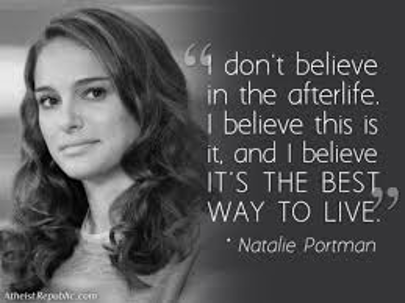
If your kids have a favorite actor or musician, it’s a situationally relevant opportunity to talk about that celebrity’s views on religion. You can Google the person’s name with the word “religion” to find quotes to discuss. If the celebrity you’re looking for doesn’t happen to have said something interesting about faith, Google “atheist celebrity quotes” or “atheist celebrity memes” and click on the image results. You’ll find many of them from people older kids will know, and it can make for a great discussion. Once you’ve opened some discussion that they find interesting, you can follow up with similar conversations.

Incidentally, here’s a great one from Natalie Portman (discuss what determines the best way to live).

Imagen1

  1. Print out and discuss song lyrics from your kids’ favorite artists.

Most kids give the lyrics of songs they listen to no thought. Yet, those lyrics can offer all kinds of opportunities for relevant discussion, given that so many conflicts with a Christian worldview. It shouldn’t be a time to preach at them about how bad the stuff is that they’re listening to (if that is indeed a problem). If you do that, you’ll be closing future doors of conversation with older kids. But it can be a time to objectively look at the lyrics and talk about the worldview presented.

  1. Pretend to be an atheist and have your kids try to convince you that Christianity is true.

If you really want to get your kids thinking, ask them if they want to take the “atheist challenge.” Tell them you’re going to pretend to be an atheist, and they’ll have to try to convince you that Christianity is true. The novelty of seeing parents take an opposing viewpoint can naturally drive interest in further discussion. Alternatively, the parents can take the “atheist challenge,” and the kids can pretend to not believe in God. You then have to convince your kids Christianity is true. You can bring up all kinds of interesting points they’ve never thought about (see how sneaky/brilliant that is?). (My book has 40 different subjects you could bring up in this context, with all kinds of quotes and examples from atheists!)

  1. Play “What would you say if…”.

Certain personality types love intellectual challenges. My daughter, for example, loves open-ended questions that she can try to answer in the best way possible. If you have a child like that, you can facilitate conversations in a game format by asking, “What would you say if…” Here are a few examples:

What would you say if your friend’s mom said God doesn’t exist? What would you say if someone told you the Bible is 2,000 years old, so it’s not relevant for our lives today? What would you say if someone told you Christians are hypocrites, so they never want to be a Christian? What would you say if someone told you they believe in science, not God? What would you say if someone said they believe in God because their parents do? What would you say if someone said they don’t believe Jesus came back to life because we know that dead people stay dead?

  1. Watch a video on space or biology from both atheist and Christian perspectives.

Older teens who are encountering issues of faith and science will appreciate your willingness to watch two different perspectives, particularly if they are struggling with faith doubts. They may not otherwise be willing to talk about faith matters, but would be interested to see your take when you watch an opposing viewpoint. That can then open the door for further discussion that wouldn’t have otherwise happened.

A great science DVD series from a Christian perspective is The Intelligent Design Collection – Darwin’s Dilemma, The Privileged Planet, Unlocking the Mystery of Life.

  1. Visit a church of another religion.

Kids are very experientially-oriented. While they may be bored to tears if you try to talk them through the differences between Buddhism and Christianity, many would take an interest in learning about Buddhism after actually visiting a Buddhist temple. Take them to see one, and you can bet there will be a lot of questions to talk about. If they develop an interest in learning more about other religions, it’s a perfect opportunity to point the conversations toward understanding how we know Christianity is true.

Recommended resources related to the topic:

Talking with Your Kids about God: 30 Conversations Every Christian Parent Must Have by Natasha Crain (Book)

Keeping Your Kids on God’s Side: 40 Conversations to Help Them Build a Lasting Faith by Natasha Crain (Book)

Courageous Parenting by Jack and Deb Graham (Book)

Proverbs: Making Your Paths Straight Complete 9-part Series by Frank Turek DVD and Download

Forensic Faith for Kids by J. Warner Wallace and Susie Wallace (Book)

God’s Crime Scene for Kids by J. Warner Wallace and Susie Wallace (Book)


Natasha Crain is a blogger, author, and national speaker who is passionate about equipping Christian parents to raise their kids with an understanding of how to make a case for and defend their faith in an increasingly secular world. She is the author of two apologetics books for parents: Talking with Your Kids about God (2017) and Keeping Your Kids on God’s Side (2016). Natasha has an MBA in marketing and statistics from UCLA and a certificate in Christian apologetics from Biola University. A former marketing executive and adjunct professor, she lives in Southern California with her husband and three children.

Original Blog Source: http://bit.ly/2tdB299

By Natasha Crain 

Last Sunday, our church did its annual multilingual service, with three congregations—Mandarin-speaking, Spanish-speaking, and English-speaking—all coming together for worship. We had readings in multiple languages, and a sermon was given in Spanish with an English translator. There was no Sunday school this week, so kids joined their parents in adult church.

When we informed our kids Sunday morning of what would be happening, there was a collective and passionate, “NOOOOOOOOOOOO!” (Honestly, I should have typed more o’s to reflect the true level of protest.)

“PLEASE, let us stay home! We can do home church! Please, not THAT service! It’s SO BORING!”

Apparently, they remembered it well from the prior year. We dragged them into the car in spite of the whining and endured their pleas all the way there.

I’d be lying if I said this was a rare occurrence of my kids not wanting to go to church. The nature of this service perhaps made them complain more loudly than normal, but there are plenty of typical Sundays when our kids ask, “Do we have to go?” I’d bet a lot of money that you’ve been asked the same.

The question of what to do when kids don’t want to go to church has been one of the most frequent ones I’ve received over the years from readers, and it’s one of the most commonly discussed questions in various Christian parenting forums (you can join my own Christian parenting group on Facebook by clicking here).

The running theme of kids’ complaints is usually that church is boring, and they don’t want to go because of it. Parents tend to assume it’s their job to convince their kids that church isn’t boring and are looking for ways to do so.

But that’s a really bad assumption.

I think there are actually quite a few legitimate reasons why so many kids are bored by the church and/or Sunday school. In other words, kids aren’t always just making up random excuses to not go; a lot of times, their avoidance reflects a genuine problem.

Here are several “legit” reasons for boredom at church that parents should consider.

  1. There’s too much emphasis on fun at Sunday school.

This probably sounds counterintuitive. After all, if Sunday school is a lot of fun, then kids should want to go, right? No, no, and no. Now, if Sunday school truly was some kind of incredible amusement park-like experience, that could be the case (and kids would choose to go for the wrong reasons). But Sunday school “fun” usually consists of relatively mild amusement like crafts, foosbal, or maybe an indoor relay race using spoons and M&Ms.

This kind of “fun” can never compete with your child’s idea of fun at home, where they can do anything they want.

Of course, they will want to stay home; church fun is boring compared to home fun. When a Sunday school program focuses on entertainment, this is the natural apples-to-apples comparison a kid’s going to make. Who can blame them?

If most of what your kid takes away from church is that there’s a little lesson with a lot of social time, you’re going to have a hard time convincing them that “church” isn’t boring (when “church” is Sunday school entertainment in their mind).

  1. “Adult” church is beyond their current grasp.

Parents sometimes try to get around the lack of substance found in many Sunday school programs by keeping their kids with them in “adult” church each week. This can work really well for some kids. My 11-year-old daughter has recently been opting out of Sunday school to come with us to adult church because she’s able to follow along and says she learns much more than in class. When my 9-year-old daughter saw that her sister was doing this, she wanted to come too. But when she did, she spent most of the service with her head on my shoulder trying to sleep—she just doesn’t have the interest or attention span yet that my older daughter does. When she told me after church that day that it was boring, I told her, “Of course it was! You chose to sleep!”

For kids like my older daughter, who want to attend adult church in lieu of Sunday school, this can be a great choice. But for those like my younger one who aren’t ready to track with what’s being taught and instead spend the time doodling in a bulletin or daydreaming, boredom will be the inevitable outcome. That doesn’t necessarily mean that kids’ Sunday school will be seen as less boring, but rather that adult church isn’t always the answer.

  1. Their family attends church sporadically.

Every pastor I know laments the fact that families are attending church with less regularity than they used to, for all kinds of reasons (Sunday morning sports being a big one). A “regular” attender is now someone attending once per month.

I know this is going to rub some people the wrong way, but it’s important to say: A church could have the best Sunday school program in the world, but if a family only attends sporadically, it’s natural that a child will find it boring—they’re not really connected to what’s going on or what’s being taught. You can’t blame a kid for mentally checking out at that point.

  1. Faith in their family is mostly about going to church on Sundays.

Even if your family attends church every week, if you’re not regularly praying together, studying the Bible together, and having conversations about faith at home, your kids will rightly wonder why they should bother going to church. Church will come to be seen as just one more thing they have to do each week, without any meaningful connection to their daily lives. In other words, it will become an unnecessary time burden in their minds because it’s irrelevant for the rest of the week.

  1. They regularly engage in deep faith conversations at home.

Here’s another counterintuitive point, but I’ve seen it happen in a lot of families that are very committed to their faith. If your family consistently has deep faith conversations (the kinds I write about in my books, Keeping Your Kids on God’s Side and Talking with Your Kids about God), in all likelihood your kids are gaining a far more intellectually robust faith than they’ll get from the average Sunday school—and Sunday school will seem extremely boring in comparison. A telltale sign that this is the problem is when your kids complain they aren’t “learning anything” or say that it’s the “same stories over and over.”

Though parents often assume there’s some kind of problem with their kids’ spiritual development when they don’t want to attend Sunday school, it can mean the opposite in this case; kids may simply have much higher expectations for what should be discussed in a Sunday school environment and be bored by the 600th telling of Noah’s ark followed by popcorn.

  1. They have doubts about God or the truth of Christianity.

It should be obvious, but I’m surprised how many parents never consider this possibility: If kids have stopped believing in God or in the truth of Christianity, they’re going to find church boring.

Imagine for a moment that you had to attend a church (or other group) you didn’t agree with every single week, and someone expected you to take interest. They study a book you think is fiction but apply it as truth in their lives and think you should too. Chances are, you’d find that boring because you don’t believe what they do. Why study a fictional book so deeply each week?

In the same way, kids who no longer hold a faith in Jesus are going to get tired of hearing about Him every Sunday. It’s outside the scope of this post to weigh the pros and cons of making such kids attend church, but there are two points for our current purpose to take away here:

  • If your kids find church boring and/or fight you on going, have a conversation with them about what they currently believe regarding God, Jesus, and the Bible. You may be surprised by what you learn.
  • If you discover that their boredom with the church is rooted in unbelief, your greater concern (by far) should be to discuss their doubts and to have conversations about the evidence for the truth of Christianity.
  1. They’re human.

On the drive to the church service I described at the beginning of this post, I turned to the kids in the back of the car and said, “Hey guys. I have something surprising to tell you.” They got quiet, and I continued.

“I don’t feel like going to church today either. I don’t really enjoy this particular service. I would rather be at home this morning.”

They looked at me with wide eyes, anticipating we might go home.

“But I’m going anyway. You see, as humans, it’s often easiest and very tempting to stay home from church on Sunday mornings. That’s a totally normal feeling, and adults have it too sometimes. But we make it a priority to go in spite of those occasional feelings for several reasons: 1) It’s one way of putting God first in our lives (by committing to church each Sunday morning); 2) Church isn’t only about learning—it’s also about worship, and worship transforms our relationship with God; and 3) It’s important to develop relationships with other believers and be in community (Hebrews 10:25). I’m not going to church this morning because I can’t think of anything else I’d like to be doing, but rather because I love the Lord, and this is one way I put him first.”

In other words, I explained to them why their boredom shouldn’t be the deciding factor in attending church.

didn’t try to convince them that they shouldn’t ever think the church is boring.

This is a critical distinction for kids to understand because as I’ve hopefully shown in this post, there are many legitimate reasons why kids may find church boring at times. When they understand why church matters even when they find it boring, it can lead to far more productive conversations than just ramming heads every Sunday morning.

Stay tuned for next week’s blog post, when I’ll do a cover reveal with the table of contents for my new book coming in March! I’m so excited to share it with you! Also, I’m running a giveaway of four of my books on my blog’s Facebook page through December 5. If you don’t follow me there already or haven’t seen it, click over!

Recommended resources related to the topic:

Talking with Your Kids about God: 30 Conversations Every Christian Parent Must Have by Natasha Crain (Book)

Keeping Your Kids on God’s Side: 40 Conversations to Help Them Build a Lasting Faith by Natasha Crain (Book)

Courageous Parenting by Jack and Deb Graham (Book)

Proverbs: Making Your Paths Straight Complete 9-part Series by Frank Turek DVD and Download

Forensic Faith for Kids by J. Warner Wallace and Susie Wallace (Book)

God’s Crime Scene for Kids by J. Warner Wallace and Susie Wallace (Book)


Natasha Crain is a blogger, author, and national speaker who is passionate about equipping Christian parents to raise their kids with an understanding of how to make a case for and defend their faith in an increasingly secular world. She is the author of two apologetics books for parents: Talking with Your Kids about God (2017) and Keeping Your Kids on God’s Side (2016). Natasha has an MBA in marketing and statistics from UCLA and a certificate in Christian apologetics from Biola University. A former marketing executive and adjunct professor, she lives in Southern California with her husband and three children.

Original Blog Source: http://bit.ly/2PzKxGO

By Natasha Crain

News broke yesterday that popular Christian comedian and YouTuber John Crist has come forth with an admission of ongoing “sexual sin and addiction struggles” after multiple women exposed years of his sexually immoral behavior.

Honestly, my heart sank when I saw this. I love Crist’s videos. We watch them with our kids. In fact, our family had just watched one of his most popular ones, “Church Hunters,” this week! If you’re not familiar with Crist, he pokes fun at evangelical culture through his videos, and in a way that you can typically nod along with because they (unfortunately and humorously) hit close to home. Church Hunters, for example, is a parody that features a couple searching for a new church, but they’re considering all the wrong criteria…something all too common today. The video actually made for a great discussion with our kids about how people DO look at the wrong things, and what is most important when considering a church home.

You can read a detailed article with the accusations and Crist’s own statement here. In that article and some common responses, I’ve seen to it on social media, I’ve noticed three areas of serious confusion that both Christians and nonbelievers sometimes have about this kind of news:

Confusion 1: Thinking popular Christians are more immune to sin than others.

Honestly, I feel this point is so obvious that it’s embarrassingly uninsightful to point out. But consider this statement in the article from one of the women who says she was emotionally devastated by her encounters with Crist:

“I was truly blinded by his celebrity status…There were a few moments I thought, ‘Hey, this is kind of weird,’ but the same phrase kept playing through my head that stopped me from leaving: ‘It’s OK. He’s a Christian. He won’t do anything inappropriate.’”

The naivety of that last statement is mind-blowing. A Christian wouldn’t do anything inappropriate? May we all be mindful of the following biblical truth:

All have sinned and fall short of the glory of God (Romans 3:23).

All.

While we may feel disappointed when we learn of the moral failings of Christians we appreciate, admire, or learn from, we should never be shocked. Christians are able to sin just as nonbelievers are. The Bible never claims that we become perfected in this life—only that when we put our trust in Jesus for the forgiveness of our sins, we will someday stand before the Lord clothed in his righteousness (2 Corinthians 5:21). Of course, saving faith doesn’t see that as a license to sin—we should never sin so that “grace may abound” (Romans 6:1).

Confusion 2: Assuming that popular Christians should be seen as church leaders.

Social media is buzzing with commentary on Crist, and a good number of people are referring to him as a fallen Christian “leader.”

There’s an important distinction to be made here: John Crist is a popular Christian, but that doesn’t mean anyone should consider him to be a Christian leader.

Equating the two things has become a real problem in our culture. Given the nature of social media, anyone can build a platform and influence others. But just because a person identifies as a “Christian” doesn’t mean they teach biblically sound doctrine or faithfully attempt to represent Jesus in their everyday lives. Leaders in the local church, however, are held to specific biblical standards in order to qualify as worthy of shepherding the flock (see Titus 1:5-9, for example).

One example of the confusion in this area is the following comment made by a woman on Facebook: “Crist’s exploitation of women was well-known for the past 7 years…The question is, WHY were there no consequences, and his career was allowed to flourish?”

Unless you’re confused about the difference between popular Christians and Christian church leaders, the answer to this is clear. Who would have the authority and ability to issue “consequences” and stop his career from “flourishing” if his work is outside the context of a church or church organization? People are free to enjoy social media content, however, they want. Crist was in no church position to step down from.

Do I wish that every Christian would be above reproach, whether in a position of formal church leadership or not? Yes, of course. But to think every popular Christian naturally has the same kind of accountability structures as actual leaders in the church is misguided and problematic. It results in people placing a critical light on an ambiguous notion of “the church” rather than on individual choices.

Confusion 3: Believing the failures of Christians are indicative of whether or not Christianity is true.

The article reports that “Crist’s use of his Christian reputation to gain trust contributed to at least two women—Nora and Lindsey—losing trust in Christianity altogether. Neither affiliates as a Christian today.”

Lindsey says, “I haven’t been to church in years…It’s hard. It’s hard to go into a place where you know that people know things that are going on, and they never do anything about it because they just list it as ‘bad behavior’ or something that someone can just be forgiven of and then it’s fine. It’s not fine. Even when you forgive someone, it’s important to go back and make restitution and to change your ways and change your behavior. It’s really hard to even consider participating in a community, in a body of believers, that would allow such behavior to unfold unchecked, and give it a platform. No, I don’t consider myself a Christian anymore. … I have no ill will toward the church. I don’t have bitterness there. I think a lot of people are really earnest in what they believe, and I respect that. But I want to be able to respect it more.”

Based on this statement, it seems that Lindsey doesn’t consider herself a Christian due to her disappointment in a particular Christian and the perceived lack of moral concern from the Christian masses, resulting in her inability to “respect” Christianity.

Unfortunately, this demonstrates the lack of critical thinking about worldview that is prevalent in the church today. It’s yet another example of why teaching kids apologetics (how to make a case for and defend the truth of Christianity) is absolutely critical.

Christianity does not become more or less “respectable,” depending on whether your favorite Christian comedian lives consistently within his stated beliefs—even when it affects you personally.

It also doesn’t become more or less respectable, depending on how many people have heard about his moral failings and have rallied to collectively bring them to light.

There is just one question that should determine if you should be a Christian:

Is Christianity true?

That’s it.

End of story.

If Christ hasn’t been raised, your faith is in vain (1 Corinthians 15:14). That’s the truth test, and nothing else.

You may be hurt by other Christians; you may be hurt by someone in your local church, you may be disenchanted with leaders who presume to represent Christianity but do so poorly, you may not like what the Bible says on some matters, you may wish the world were different…but none of this should logically substitute for an objective investigation of the evidence for the truth of Christianity (see these books for help having these conversations with your kids).

If Christianity is true, we should be Christians in spite of bad experiences. The question isn’t whether John Crist is trustworthy; it’s whether Jesus is. That’s not to minimize the hurt done in the name of Christ (a subject outside of my scope here), but rather to refocus our kids on the objective questions that matter most.

I hope that John Crist’s statement of repentance is sincere and that he emerges from this experience as a more committed follower of Christ. In the meantime, let’s recognize this as nothing more than what it is: a popular Christian has admitted a long pattern of immoral behavior and needs to address it personally, with those he hurt, and with the Lord.

Let’s pray that good will come from this, so Crist can better use his influence in the future for the glory of God.

Recommended resources related to the topic:

So the Next Generation will Know by J. Warner Wallace (Book and Participant’s Guide)

Talking with Your Kids about God: 30 Conversations Every Christian Parent Must Have by Natasha Crain (Book)

Keeping Your Kids on God’s Side: 40 Conversations to Help Them Build a Lasting Faith by Natasha Crain (Book)

Courageous Parenting by Jack and Deb Graham (Book)

Proverbs: Making Your Paths Straight Complete 9-part Series by Frank Turek DVD and Download

Forensic Faith for Kids by J. Warner Wallace and Susie Wallace (Book)

God’s Crime Scene for Kids by J. Warner Wallace and Susie Wallace (Book)


Natasha Crain is a blogger, author, and national speaker who is passionate about equipping Christian parents to raise their kids with an understanding of how to make a case for and defend their faith in an increasingly secular world. She is the author of two apologetics books for parents: Talking with Your Kids about God (2017) and Keeping Your Kids on God’s Side (2016). Natasha has an MBA in marketing and statistics from UCLA and a certificate in Christian apologetics from Biola University. A former marketing executive and adjunct professor, she lives in Southern California with her husband and three children.

Original Blog Source: http://bit.ly/2XqLx3B

By Natasha Crain

As Christians, we have all kinds of pithy sayings that make their way through churches and establish themselves as generally accepted truths. Some end up on bumper stickers, some on wall decals, and some just get repeated so many times that people think they’re actually in the Bible.

There’s a popular one among parents that I keep hearing lately, and each time I hear it, I cringe. Not only is it false, but it’s particularly damaging to the discipleship of the next generation.

It’s the idea that “Faith is caught, not taught.”

When people say this, they’re usually trying to emphasize that faith is a matter of the heart, not a cold belief in a set of facts that someone has taught them. And of course, there’s truth to that sentiment. But nine times out of ten that someone relays this saying to me, there’s an implication that our kids’ spiritual development has little to do with the “intellectual stuff” of apologetics, but rather everything to do with how well we live our faith in front of them (apologetics is the study of why there’s good reason to believe Christianity is true).

This belief is desperately wrong. At best, it results in a passive approach to discipleship. At worst, it’s an excuse for intellectual laziness.

Let’s look at why.

First, we have to clearly understand what faith is.

Faith, in its most basic sense, is trust.

A blind faith is a trust that has little or no justification. For example, imagine that I claimed there’s an invisible unicorn living outside my house. When you ask me what reasons I have for that belief, I tell you, “I don’t need reasons. I just have faith.” In this case, I would be acknowledging that I hold a blind faith in my invisible unicorn—it’s a faith without reason.

At the other end of the faith, spectrum is a person trusting in something they have good reason to believe is true. For example, I’m willing to get on an airplane because I have faith that it will safely get me to where I need to be. I can’t be certain, but I know there is a good reason to place my trust in the process.

Importantly, this means that faith is not a way of knowing something. It’s how you respond to what you know. This is such an important distinction. Atheists often suggest that faith is inferior to science as a way of knowing about the world, but faith isn’t a way of knowing about the world at all. It’s trust that we place in Jesus in response to what we know about the world (and that knowledge comes from many sources).

In short, biblical faith is not blind faith. Biblical faith is trusting in what we have good reason to believe is true, based on the extensive evidence God has given us.

Now that we’ve established an accurate understanding of what faith is, we can see two major problems with the idea that “faith is caught, not taught.”

  1. It emphasizes passing on our trust rather than the reasons for our trust.

If faith is trust, then what this saying effectively states is that our trust is something that should rub off on our kids as they see how we live our lives.

Our trust in Jesus may or may not rub off on our kids, but regardless, that shouldn’t be our primary goal in discipleship.

Instead, we need to pass on the good reasons that should lead to our kids’ trust in Jesus. Otherwise, they’re just borrowing our own trust without knowing the justification for it. That’s a faith that’s waiting to crumble as soon as it’s significantly challenged.

It’s worth a side note here that parents shouldn’t assume a well-lived Christian faith is even desirable to their kids. There are numerous kids who grow up in loving Christian homes, with parents who truly “walk the walk,” but abandon their faith. Why? Those kids might admire the sincerity of their parents’ convictions but feel no desire to “catch” that same faith because they don’t believe it’s built on good reason. Once again, this points back to the need to pass on the reasons for the hope we have (1 Peter 3:15), not simply our own trust.

  1. A deep understanding of the reasons for faith is not something that’s simply “caught.”

Even if we restate the saying as “Reasons for faith are caught, not taught,” it still doesn’t work.

Here are just a few major concepts that will never be passively caught based on how you live out your Christian faith:

What objective evidence is there for the existence of God?

Do science and God contradict one another?

Can all religions point to the same truth?

What historical evidence is there for the resurrection?

Was Christianity copied from pagan religions?

How do we know that the Gospels are based on reliable eye witness testimony?

How do we know that the Bible we have today hasn’t been corrupted in the copying process over hundreds of years?

How can a good God permit so much evil and suffering?

Between my two books, I cover 70 of these critical questions that kids need to understand today. My new book, coming in March, focuses on 30 more questions specifically about Jesus (Talking with Your Kids about Jesus: 30 Conversations Every Christian Parent Must Have). That’s one hundred important questions kids need to understand given the challenges today…and that’s one hundred important questions they won’t grasp deeply just by watching how you live your faith.

These things are taught.

And the need to proactively teach is woven throughout Scripture:

“Only be careful, and watch yourselves closely so that you do not forget the things your eyes have seen or let them fade from your heart as long as you live. Teach them to your children and to their children after them” (Deuteronomy 4:9).

“…he commanded our ancestors to teach their children, so the next generation would know them, even the children yet to be born, and they, in turn, would tell their children” (Psalm 78:5-6).

“Listen, my son, to your father’s instruction and do not forsake your mother’s teaching” (Proverbs 1:8).

“Fathers, do not exasperate your children; instead, bring them up in the training and instruction of the Lord” (Ephesians 6:4).

There’s good reason the Bible tells us to teach and train and not just keep walking with the Lord while kids look on. Those eyes can’t physically see all that needs to be mentally learned. And as long as Christian parents think all they need to do is model what it looks like to put their trust in Jesus, kids will keep struggling when challenged on the justification for such a life.

Does passing on an understanding of all the good reasons for faith means a child will necessarily follow Jesus? Not at all. But when we’re obedient in our calling to be teachers (not just walkers!), we can be confident that we have given our kids the opportunity to develop their own trust in Jesus and didn’t simply encourage them to borrow our convictions.

A borrowed faith is readily handed back.

Recommended resources related to the topic:

Talking with Your Kids about God: 30 Conversations Every Christian Parent Must Have by Natasha Crain (Book)

Keeping Your Kids on God’s Side: 40 Conversations to Help Them Build a Lasting Faith by Natasha Crain (Book)

Courageous Parenting by Jack and Deb Graham (Book)

Proverbs: Making Your Paths Straight Complete 9-part Series by Frank Turek DVD and Download

Forensic Faith for Kids by J. Warner Wallace and Susie Wallace (Book)

God’s Crime Scene for Kids by J. Warner Wallace and Susie Wallace (Book)


Natasha Crain is a blogger, author, and national speaker who is passionate about equipping Christian parents to raise their kids with an understanding of how to make a case for and defend their faith in an increasingly secular world. She is the author of two apologetics books for parents: Talking with Your Kids about God (2017) and Keeping Your Kids on God’s Side (2016). Natasha has an MBA in marketing and statistics from UCLA and a certificate in Christian apologetics from Biola University. A former marketing executive and adjunct professor, she lives in Southern California with her husband and three children.

Original Blog Source: http://bit.ly/35ASDpQ