Tag Archive for: Gospel

As Christians, developing critical thinking skills and maintaining an informed understanding of our faith is crucial. The world is full of misinformation and uncertainty, making it difficult to distinguish truth from falsehood. It is not enough for Christians to blindly adhere to whatever traditions or practices they have inherited from the past. They should critically evaluate and discern the relevance and validity of these traditions in their present context.

With so many different worldviews competing for our attention, staying engaged and equipped with our beliefs is essential. Without the intellectual stamina to navigate these opposing views, we risk becoming uninformed and ill-prepared to face the challenges of contemporary society.

The Age of Competing Ideas

In a recent interview with John Stonestreet, president of the Colson Center, I asked him why so many Christians lack the ability to think critically. His initial response was that many Christians lack the proper training in biblical doctrine and have not been catechized in the basic categories of reality. John added,

“We live in a world where we are bombarded with a lot of information, most of which is not objective or neutral. This makes it difficult to determine what to believe and whom to trust. Therefore, this era is better called ‘The Age of Competing Ideas,’ which leads to ‘The Age of Competing Authority.’”

I have seen firsthand how a lack of critical thinking about one’s faith can leave a Christian susceptible to false teachings or worldly philosophies. Paul warned in Colossians 2:8, “Don’t let anyone capture you with empty philosophies and high-sounding nonsense that come from human thinking and from the spiritual powers of this world, rather than from Christ” (NLT).

We are exhorted by the apostle Paul to “Test everything; hold fast what is good” (1 Thessalonians 5:21). Christianity is not about unquestioningly accepting things without using reasoning and intellect. Instead, it is about having faith while also engaging your mind.

Not Just Belief, but Informed Belief

Therefore, we must recognize the role of informed beliefs in Christianity and draw on the biblical foundations of critical thinking to equip ourselves with the knowledge necessary to distinguish truth from falsehood.

Critical thinking is a systematic skill that involves analyzing and assessing a particular belief, idea, argument, or issue in an unbiased manner. After thoroughly examining the subject matter, the individual arrives at a conclusion that makes the most sense of and aligns with reality. In Christianity, possessing a biblical worldview means approaching life matters with an understanding of the Word of God and proper discernment that aligns with biblical doctrine.

I like what David Dockery says about the quality of Christians possessing a robust worldview in his book What Does It Mean to Be a Thoughtful Christian?. Dockery writes,

“A Christian worldview is not escapism but an energizing motivation for godly and faithful thinking and living in the here-and-now. In the midst of life’s challenges and struggles, a Christian worldview provides confidence and hope for the future while helping to stabilize life, serving as an anchor to link us to God’s faithfulness and steadfastness.”

Three Critical Thinking Skills

Applying these three foundational tips in your daily life is an excellent start for developing the art and skill of critical thinking.

  1. Know and pursue truth wisely: Truth is an objective reality that corresponds with, rather than contradicts, the actual state of things. By analyzing, observing, and submitting to objective truth, you will become more aware of the facts that support your Christian beliefs. Proverbs 4:7 advises, “The beginning of wisdom is this: Get wisdom, and whatever you get, get insight.” Solomon emphasizes the importance of pursuing wisdom as you acquire knowledge and understanding to overcome life’s challenges as a Christian.
  2. Stay grounded in God’s Word: Sadly, less than 20% of self-proclaimed Christians read the Bible daily. Of those who do, the majority only read one verse a day. Reading portions of the Bible daily will enhance your knowledge of Scripture, provide moral fortitude, give insight into wise decision-making, and help you resist temptations.
  3. Embrace questions and objections: Christians should be the last to shy away from people who object to or challenge their faith. Peter directly speaks to this when he affirms, “But in your hearts honor Christ the Lord as holy, always being prepared to make a defense to anyone who asks you for a reason for the hope that is in you; yet do it with gentleness and respect” (1 Peter 3:15). Don’t be afraid when someone asks you tough questions about your beliefs. Be prepared to explain why you believe in what you do. If you don’t know the answer to a question, make an effort to research and understand the material. Studying and understanding the material thoroughly will enable you to communicate effectively with others. Lastly, remember always to be respectful towards others, even if their beliefs differ from yours.


I hope you have been challenged to continue developing your critical thinking skills. This will not only keep you informed and prevent you from being deceived, but it will also increase your passion for God’s truth and enable you to become a great defender of the Christian faith. We need more defenders of the faith, and I believe you have the potential to become one!

Recommended Resources On This Topic

I Don’t Have Enough Faith to Be an Atheist (Paperback), and (Sermon) by Norman Geisler and Frank Turek

Can All Religions Be True? mp3 by Frank Turek

How Philosophy Can Help Your Theology by Richard Howe (DVD Set, Mp3, and Mp4

Another Gospel? by Alisa Childers (book)


Jason Jimenez is President of STAND STRONG Ministries and author of Challenging Conversations: A Practical Guide to Discuss Controversial Topics in the church. For more info, check out www.standstrongministries.org

Originally posted at: Critical Thinking: The Secret Weapon of Confident Christians — Stand Strong Ministries


The world defines truth as relative and subjective: “You have your truth, I have my truth.” It is customizable to one’s preferences and lifestyle. Definitive or absolute truth is considered offensive to the culture at large. This confusion over truth is further fueled by social media. Liking, sharing, retweeting, and posting happen with the click of a button. To promote and defend “your truth,” all you have to do is open an app on your phone. Though some may suggest that our culture is more unified based on the controversial matters of our day, I would argue that we are walking in greater disunity than ever before.

Can’t We All Just Coexist?

The Coexist bumper stickers often seen on the back of vehicles advertise that all religions are equal with a mutually unifying end. To argue against this can be considered hate speech in some spaces. The irony in this pop-culture view of truth, however, is that the major world religions have some profound differences that mutually exclude the other. It does not take very long to find contradictions between Mormonism and Islam.

Furthermore, there are particular instances of absolute truth that no logical person could deny. Gravitational pull or mathematical equations are proven true with singular explanations and sums. Your trash pick-up being on Monday is a fact. If you decide to put your garbage can at the curb on Tuesday because that is your truth, you will be disappointed to find overflowing trash the next day. Yet, the larger issues in life take on a whole different meaning to the word “truth”.

Scriptural Definition of the Truth

In John 14, Jesus names himself to be the way, the truth, and the life. The familiar passage goes on to say that no one accesses the Father except through Christ. Anyone claiming another means to heaven apart from Jesus the Messiah is promoting a lie.

“Jesus answered, ‘I am the way and the truth and the life. No one comes to the Father except through me.’”
John 14:6

Upon the trial and accusation of Christ, just before his crucifixion, Pontius Pilate asked the question “What is truth?” (John 18:38). The question is still being asked centuries later, and the answer remains. Jesus, being God himself was, is, and always will be the truth. Our triune God displays the reality of truth. The Holy Spirit leads the Christian into all truth (John 16:13). God the Father never lies, He fulfills all His promises (Numbers 23:19). Jesus the Messiah is the only true path to restoration and eternal life (John 3:16).

Why Truth Matters

In 2022, I prepared for an unmedicated birth. Among many things, I conducted research and read books about the goals I had for labor. I found myself needing to carefully filter content that included New Age and witchcraft practices. Much of what I came across revolved around feelings of empowerment and self-expression. However, bringing a new baby into the world is a complete act of surrender to the Creator of the universe. It is emptying oneself to rely solely on Christ. It is for the glory of God that none may boast.

Satan strives to keep us in a feelings-based mindset. He convinces us that life is about us and the benefits we can receive. Faith in Christ must extend beyond feelings to facts. Otherwise, we blend in with the culture around us. It was invaluable to study the creation account in Genesis and to spend time prayerfully considering the heart of God as our due date neared. In Scripture, we unfold the truth of Christ and are changed to reflect him. We exist for the singular purpose of glorifying Jesus our Lord.

To distinguish truth as absolute and to follow Christ with wholehearted devotion is the greatest threat to Satan. He is unbothered by “his truth” and “her truth.” He is, however, thrown off his high horse when a people boldly stand for and confidently share the truth.

Living Transformed by the Truth

As said in Matthew 7, there is one path to heaven, and it is indeed narrow (Matt 7:13-14). To say that Jesus is the only way may feel a bit too exclusive and limited to an on-looking unbeliever. Therefore, it is deemed best to reject singularly defined truth. As Christians, we are to take up our cross, forgoing anything within us that does not align with the will of God by bringing his name glory. The word “cross” in Matthew 16:24 means only one thing. In the first century, a cross represented death by crucifixion. Though the emblem of the cross is undoubtedly viewed through a lens of agape love, it very much signifies death. The Christ follower is to die to themselves and the sin that so easily entangles. Though actions based upon one’s personally determined truth are appealing for a time, there will inevitably be an ongoing search for more apart from an intimate relationship with Christ the King.

Subjective Truth is Unloving

Affirming the idea of truth being subjective is one of the most un-loving things we can do. If Jesus is the only way to the Father, and therefore eternal life, we have the tremendous responsibility of shutting down every other notion besides the inspired Word of God. Speaking the truth means that we know the truth. In Philippians 4, Paul the Apostle provides a beautiful list of things to think about in combating anxiousness (Phil 4:16-17). From a prison cell in Rome, he tells the church to remember that which is true. In doing so, we remember the very nature of God. All that God is, he is truly. He is true love, true kindness, true mercy, true forgiveness, true hope, true life, true light, true grace, true rest, true wisdom, and the list goes on. When we think about the trueness of God, anxiety and fear diminish. How profound and contradictory to the rest of society when a person chooses to humbly submit to the revelation of God as the only means to authentic understanding and perfect clarity.

The Truth is Transformative

A belief in the one truth that exists is transformative. We are brought to life upon our confession of faith and trust in Christ. Manifestation says, “Believe in me and my ability”, but transformation says, “Believe in Jesus and his sovereignty.” Jesus being the truth means that we acknowledge our limitations and humbly submit to the Lord who has none. John 8:31-32 says, “So Jesus said to the Jews who had believed him, “If you abide in my word, you are truly my disciples, and you will know the truth, and the truth will set you free.” Believing and abiding in the infallible, inerrant, and inspired Word of God is the most freeing thing a person can do. The shackles we were once bound by are broken by belief in Jesus Christ. This is the good news of the Gospel, and it is available for all people, everywhere. Sharing the truth in boldness is a radical act of love.

Our world measures truth based on personal preference and ideology. It is ever-changing and regularly modified to best please mankind. Freedom is miraged by temporary happiness and affirming acceptance. Freedom in its truest form is found in one place; it exists in one person. His name is Jesus, and it is in his presence that we walk in perfect clarity. His presence abides in us, and we have the unique privilege of inviting others to dwell with Christ who is our peace. There is no greater combat against division than Divine intervention.

God is not the author of chaos or confusion. We do not have to question right from wrong or good from bad. His Word makes it clear. In both our belief and our obedience, we are blessed beyond our comprehension by the Lord of Hosts.  The truth found in Scripture is both life-giving and life-changing. Second Timothy reminds us that the entirety of the Bible is useful for teaching and training us to look more like Christ (2 Timothy 3:16-17). All sixty-six books hold tremendous weight and power in our lives still today. As we learn it on an individual basis, we are drawn closer to the heart of God, and our belief is confirmed time and time again. Let God’s truth transform you because it is the only thing that will.

Recommended resources related to the topic:

Counter Culture Christian: Is the Bible True? by Frank Turek (Mp3), (Mp4), and (DVD)   

Can All Religions Be True? mp3 by Frank Turek

How Can Jesus be the Only Way? Mp4, Mp3, and DVD by Frank Turek

Is Morality Absolute or Relative? by Frank Turek (Mp3/ Mp4)


_____________________________________________________________________________________________________________________________________

Annie Brown has joined us as Content Coordinator working with the Truth That Matters team. In this role, Annie will be creating written content meant to edify and equip lay learners and scheduling content channels as needed. In addition to being a student at SES, Annie has a B.S. in Family & Child Development from Liberty University. “I am grateful for the opportunity to serve on the Truth That Matters Team at SES. Using my passion of writing to prayerfully bless others excites me, and I look forward to what the Lord has in store.”

Originally posted at: https://ses.edu/truth-matters/

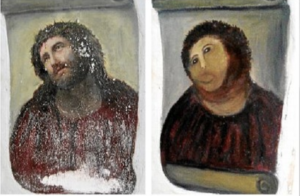
Have you ever heard the tale of the elderly woman who wanted to restore an old painting and… well, didn’t?

Meet Potato Jesus. The woman’s intentions were noble. I certainly respect her heart. But that doesn’t change the fact that she is not an artist and did not restore Martinez’s work. Just because she intended to do something and thought she was able, that didn’t turn her into an artist. Desire and good intentions aren’t enough.

[1]

Nowadays, anyone can set up a page and identify as whatever they want. But taking a name for ourselves doesn’t make us that thing. We still have to be it or become it.

Two Ways to Identify

We can identify ourselves in two ways: “I’m x, and by that, I mean this,” and “I’m x, and I think this word accurately fits or describes x.” Too often, people identify as something because they think that’s how they are supposed to identify, and then they try to describe it. I think a better way would be to figure out who and what we are, then figure out what best names or describes that. This will prevent us from accidentally using words that don’t really fit.

I’m a human. I am a member of the human species, so human is an accurate word to describe me. But I’m also a hobbit. I’m kind of short, round, a little hairy, and I love food and books. I’m also part Scottish but don’t identify as Scottish: I am not a Scotsman. I have some lineage through some ancestor, but I’m not from Scotland, I don’t speak Scottish or Gaelic (or any other dialect/language from there), I don’t wear kilts, I’ve never been there, neither of my parents have ever been there (I think?). So, it would be true to say I have a Scottish history, but not that I am Scottish. Calling me Scottish would give more incorrect information about me than correct information.

Let’s move from regular descriptions to something more controversial: religion.

Religious Identity

The word “Muslim” means “submission” or “submission to God.” I don’t, however, follow Muhammad or Allah of the Qur’an. So even though the definition, “submission to God,” is technically a fitting description of me, “Muslim” would not be a good description of me, nor do I feel it would be respectful to Muslims for me to use that term.

But Christian is a good description of me. Why? What’s different? That requires a little history:

The word Christian comes from the Greek word christos, or maschiach in Hebrew, meaning the “Messiah” or “the anointed one.” The Messiah refers to the character foretold by the prophecies given by Israelite poets and prophets found in the Jewish Tanakh, or Old Testament. As a Christian, I believe Jesus fulfilled those prophecies and is the Anointed One, the Jewish Messiah. That’s why I call myself a Christian, a follower of Jesus the Christ who fulfilled those prophecies.

That’s why I believe using the word Christian to describe me is appropriate.

Why do you identify as a Christian?

If you identify as a Christian, why? What about your beliefs or life makes you think, “Christian is a good description of what I believe and do”? Let’s take a few example answers to see why this is important:

  • I read my Bible. As a Christian, I’m glad you do! But I already read Harry Potter, and that doesn’t make me a wizard. While some things would be so much easier with a little accio, that’s not quite how this works.
  • I go to church on Sundays. Okay, but what about that is different from a social club? Is there any other difference in your life? If we took out that one hour and just looked at the rest of your life, would “Christian” still describe you?
  • I raised my hand and prayed a prayer. A marathon is 26.2 miles long, named in honor of a messenger’s run after the battle of Marathon. To qualify as having run a marathon, someone has to do two things: 1) stay within the race course and 2) finish the race. Are you still running?

Let’s try some harder questions:

  • I believe in Jesus’ teachings about love. Okay, but so do Muslims. And so do some Hindus; Gandhi is famously quoted with, “I like your Jesus but not your Christians.” Even many atheists like Jesus’s teachings about love.
  • I welcome everyone just like Jesus. So do Buddhists. So do telemarketers.
  • I give to the poor. So do Muslims. And so do atheists.

What about those (and so many similar answers) is best, or accurately, described by the word Christian? Any?

Let’s try something different: I trust Jesus with my life. Okay, now we’re getting somewhere.

So, if those answers won’t work, what will? Let’s see what the earliest historical records about Jesus talked about:

  • Jesus’ identity: which Jesus are you following? The Jewish Messiah as prophesied by the God of the Old Testament? Or just a good man who said some nice things?
  • Jesus’ activity: the first Christian creed recorded specifies not Jesus’ charity but His crucifixion. We don’t identify as followers of Bill Gates or Gandhi for giving to the poor; what did Jesus do that merits His name?
  • Jesus’ exclusivity: Jesus very clearly taught one path, one way to the Father; either you’re on that path, or you aren’t on the path of Jesus.

So, Why do you identify as a Christian?

Editor’s Note: If you have read this far, and now you’re not sure what it means to be a Christian or if you’re a Christian, then there’s no time like the present to make it right. You can trust in the Biblical Jesus to forgive you, to save you, and lead you. “Salvation is found in no one else, for there is no other name under heaven given to mankind by which we must be saved” (Acts 4:12). You can also go here to find out more: “A Simple Explanation of How to Be Saved”. Trusting your life in Jesus’s hands is like a gateway into a whole new world, complete with a new outlook on life, a new way to live, and a new hope for the future. Please make sure, today, that you are right with God

Footnotes: 

[1] Image Source: ABCNews

Recommended resources related to the topic:

Jesus, You and the Essentials of Christianity by Frank Turek (INSTRUCTOR Study Guide), (STUDENT Study Guide), and (DVD)      

How to Interpret Your Bible by Dr. Frank Turek DVD Complete Series, INSTRUCTOR Study Guide, and STUDENT Study Guide

Can All Religions Be True? mp3 by Frank Turek

How Can Jesus be the Only Way? Mp4, Mp3, and DVD by Frank Turek

Another Gospel? by Alisa Childers (book)


__________________________________________________________________________________________________________________________________________________

As a Christian apologist, David Wolcott has contributed research to Mama Bear Apologetics, Alisa Childers, Natasha Crain, Crossexamined, and more. Focusing on primary-source research of Progressive Christianity and understanding the Bible in the original cultural contexts, he is on a four-year plan to learn how to read eight languages, including biblical Hebrew and koine Greek. David is an avid reader of all kinds of books, and is passionate about helping Christians learn to apply the wisdom shared through many excellent books via his Academy at thedavidwolcott.com.


Is God really there for me? God, do you see? Do you hear my prayer? Experiences such as job loss, broken relationships, mental illness, or any unyielding pain can stir up questions of doubt. Doubt is standing at your door desiring to chip away at your faith. During these seasons of sorrow and pain, many days can be filled with questions like: Why are you silent? Why didn’t you save them? Why won’t you show them they are wrong? Will you resolve the situation? When you feel as if there is no answer, doubt festers. Is what I believe true? Lest someone think that non-religious persons are different, C.S. Lewis’s personal comment is very instructive.

“Now that I am a Christian, I do have moods in which the whole thing looks very improbable, but when I was an atheist, I had moods in which Christianity looked terribly probable.”[1]

Evidence can aid in dismantling doubts, and though far from being exhaustive, this article will highlight three reassurances that can start the process of dismantling those doubts about Christianity.

Evidence Reassures

When you doubt, remember you are not alone. Recall John the Baptist who appears to be wrestling with doubt while he is in prison. Although he had baptized Christ, he is later taken to prison and questions if Jesus is the Messiah. Matthew writes, “Now when John, while imprisoned, heard of the works of Christ, he sent word by his disciples and said to Him, “Are You the Expected One, or shall we look for someone else?” (Matt 11:2-3; NASB). We don’t know exactly what John was thinking, but we do know he is seemingly doubting. Jesus lovingly responds without rebuke and instead sends word of the miracles. Matthew writes, “Jesus answered and said to them, “Go and report to John what you hear and see: the blind receive sight and the lame walk, the lepers are cleansed, and the deaf hear, the dead are raised up, and the poor have the gospel preached to them” (Matt 11:4-5). The miracles are delivered as signs of comfort to reassure, strengthen, and dismantle the doubt John is experiencing.

Evidence Reminds

Now you might be wondering, where is my miracle to solve my pain and sorrow? It’s possible John the Baptist could have asked the same question. C. S. Lewis notes it seems easy to believe when you are not the patient, but suppose you are in surgery with a good surgeon with wholly good intentions. Lewis writes, “If he yielded to your entreaties if he stopped before the operation was complete, all the pain up to that point would have been useless.[2] God reminds

us in pain that he is with us and doing something, just like he was with Joseph in the Old Testament (Acts 7:9; 2 Cor 4:16-18; Rom 5:3-5). Remember when Job was suffering, and his wife wanted him to curse God? He asked a significant question, “Shall we indeed accept good from God and not accept adversity” (Job 2:10)?

In times of questioning and doubt, who is Jesus? He is the Son of Man who came to serve and to give His life as a ransom for many (Matt 20:28). His life reminds us of his love for us. The eyewitness accounts remind us that Jesus, too, suffered for a little while, but ultimately, He conquered death. 1 Corinthians 15:3-7 spotlights the eyewitness accounts of Jesus’ death, burial, and resurrection. Paul writes to remind the believer that Cephas, James, the Twelve, and more than five hundred brothers, and sisters witnessed Christ overcoming death.

Evidence Transforms

The disciples in 1 Corinthians 15:3-7 are the same disciples who had earlier abandoned Jesus during his trial before his crucifixion. The ones that lacked the courage to stand with Jesus possibly due to their doubts or uncertainty. What changed? Jesus’s disciples and Paul were transformed after their encounter with the risen Jesus. They became bold witnesses willing to die for Christ. Paul changed from persecuting Christians to sharing the gospel with the world. Why would anyone be willing to face persecution or die for something that is untrue? Sean McDowell attests regarding the Apostles of Christ historically “The evidence shows that some really died as martyrs, and that none recanted.”[3]

Transformation for people happens all the time; what is different about the disciples? They were eyewitnesses; they did not believe in a tradition. They believed what they saw firsthand. Too, these transformational encounters with the risen Jesus provide hope for us in our doubt. John is providing encouragement to the followers of Jesus stating, “These things I have written to you who believe in the name of the Son of God, so that you may know that you have eternal life” (1 John 5:13). It is so we may know and believe. This is encouragement for all believers.

Summing it all up

In conclusion, please note this is not a one-stop article that erases all doubt or pain, but it is a reminder that you are not alone in your doubt, and contemplating the evidence can reassure, remind, and transform our hearts through the work of the Holy Spirit. God is there for you and uses human agents in the Church to encourage us as we wrestle with doubt. People have wrestled with the ways of God throughout the Psalms and many other pages of the Bible. But hopefully, as you work through your doubts, this evidence can play a role in strengthening the weary traveler. The disciples testify to the risen Lord. He will one day establish a government with perfect justice and love. He will wipe away every tear, and suffering will be no more; doubt will be gone. Until then, don’t lose heart in your doubts; wrestle through them and ask God to dismantle doubts by reassuring, reminding, and transforming you to see with his eyes and heart.


Footnotes

[1] C. S. Lewis, Mere Christianity (New York: The Macmillan Company, 1952), p. 123.

[2] C. S. Lewis, A Grief Observed (New York, NY: Harper One, 1961), 43.

[3] Sean McDowell, The Fate of the Apostles (Burlington, VA: Ashgate Publishing, 2015), 260.


Recommended resources related to the topic:

I Don’t Have Enough Faith to Be an Atheist (Paperback), and (Sermon) by Norman Geisler and Frank Turek

The New Testament: Too Embarrassing to Be False by Frank Turek (DVD, Mp3, and Mp4)

Why We Know the New Testament Writers Told the Truth by Frank Turek (DVD, Mp3 and Mp4)

When Reason Isn’t the Reason for Unbelief by Dr. Frank Turek DVD and Mp4

Oh, Why Didn’t I Say That? The Hiddenness of God: Why Isn’t God More Obvious? by Dr. Frank Turek DVD, Mp3, and Mp4 Download


_____________________________________________________________________________________________________________________________________________________

Deanna Huff is a wife and mother. She has been teaching and training for the last twenty years equipping people to know their Christian faith and share it with others. She has led many seminars for the Baptist General Convention of Oklahoma, Oklahoma Ladies Retreat, and the State Evangelism Conference. She taught high school students for ten years at Christian Heritage Academy, in Bible, Universal History, Apologetics and Philosophy. Deanna is a Ph.D. candidate in Apologetics and Theology at Liberty University. She holds a Master of Theology in Apologetics and Worldview from Southern Baptist Theological Seminary, a Master of Divinity with Biblical Languages from Southwestern Baptist Theological Seminary and a Bachelor of Arts from the University of Oklahoma.

Originally posted at: https://bellatorchristi.com/2024/02/04/dismantling-doubt/

Last year, I wrote an article called “7 Problems with the He Gets Us Campaign,” in which I critically responded to the $100 million advertising campaign featuring a website, billboards in major cities, a book, and ads that have been viewed more than 300 million times. Perhaps most visibly, the campaign’s ads were featured in last year’s Super Bowl. When thousands of people went searching for more information on it, my article came up, and it went viral—actually pulling down my site at one point! Clearly, a lot of people are interested in knowing more about the nature of these ads.

Fast forward to 2024. Super Bowl Sunday was on February 11. And He Gets Us once again ran ads generating widespread curiosity. Given the reach of the campaign and high interest level, I wanted to do an updated evaluation of what He Gets Us is doing today. To that end, I’m going to answer four questions:

  1. Does the He Gets Us Campaign get skeptics interested in Jesus?
  2. Does the He Gets Us Campaign get skeptics interested in the rightJesus?
  3. Do the He Gets Us campaign reading plans take people to the next level of understanding Jesus (beyond the slick website and TV ads)?
  4. Does the He Gets Us campaign direct people to theologically solid churches for continuing their search for truth?

There are three things that will inform my answers. First is my professional background in marketing (I have an MBA in marketing and am a former adjunct marketing professor). Since this is a campaign aimed at “marketing” Jesus, that background is particularly relevant. Second is my evaluation of the publicly available He Gets Us content (the website and YouVersion reading plans). I have not read the He Gets Us book, so that isn’t part of what I’m responding to. Third is a recent interview campaign consultant Ed Stetzer did with Biola professors Scott Rae and Sean McDowell on Biola’s “Think Biblically” podcast (Stetzer is the Dean of Biola’s Talbot School of Theology). While Stetzer says he is not a spokesman for the campaign, he has been closely involved, so his comments are helpful for an insider view of the goals and strategies.

1. Does the He Gets Us Campaign get skeptics interested in Jesus?

Stetzer says that the people who eventually started the campaign had become concerned “that the perception of Christianity had suffered and people weren’t necessarily considering who Jesus was. And they would like for people to consider who he was, who he is.” They then brought in market researchers who found that skeptics were open to considering who Jesus was (I’d love to know more about that, but no further information was noted). Stetzer emphasized repeatedly in the interview that the very narrow goal of the campaign is to reach those skeptics. Ultimately, He Gets Us wants to build a bridge from people seeing the ads to learning more by going to the website and ultimately signing up for a Bible reading plan and/or asking to be connected to a church.

So, in short, the goal is very specifically to get skeptics interested in Jesus. That’s a very worthy goal, especially if you have millions of dollars to do it with. My first question is, does the campaign successfully meet that objective?

While I don’t know the statistics on how many people have visited the He Gets Us website as a result of the ads, Stetzer says over 600,000 people have signed up for the reading plans and “hundreds of thousands” have been referred to churches. So, as a surface-level answer to the question, it certainly seems reasonable to say that yes, the campaign has generated interest. If the goal was to get people to one of those two action points—signing up for the Bible reading plan and/or asking for a church referral—then marketers have achieved at least some success. (Whether the numbers justify the money spent is a different question that I’m not evaluating here.)

2. Does the He Gets Us Campaign get skeptics interested in the right Jesus?

From a marketing perspective, there is a predictable funnel that people go through before taking action (e.g., making a purchase). It starts with becoming awareof something, which then sometimes converts to interest, which then sometimes converts to desire for action, which then sometimes converts to action. Marketers know that if you want people to take action—to get to the bottom of the funnel—you have to first take them through those stages, and those stages have to be tailored toward the action you want.

In this case, if you are marketing in order to generate interest in Jesus, you want to be sure you’re generating interest in the right Jesus (a correct portrayal) if you want that to lead to the action you desire. This is where I believe the campaign fails in a serious way.

As I said in last year’s article, the Jesus of this campaign is nothing more than an inspiring human who relates to our problems and cares a whole lot about a culturally palatable version of social justice (the exception to this is in parts of the reading plan, which I’ll address in the next point). This has not changed since I last wrote. My points then remain true now: The fact that Jesus “gets us,” stripped from the context of His identity, is meaningless; Jesus is presented as an example, not a Savior; The campaign reinforces the problematic idea that Jesus’s followers have Jesus all wrong; And the campaign reinforces what culture wants to believe about Jesus while leaving out what culture doesn’t want to believe. I won’t expand on these points here since you can read my prior article for that analysis.

But I do want to say more this time about who the campaign is clearly targeting. Stetzer mentioned that it’s “skeptics,” but a close evaluation (or even not so close evaluation) of the campaign makes it clear it’s not all skeptics they have in mind. This is crucial to understand. It’s a very specific segment of skeptics—it’s progressives who primarily view the world through a lens of social justice (and specifically the critical theory model of social justice, which places everyone in oppressor/oppressed buckets).

5 Signs Your Church Might Be Heading Toward Progressive Christianity

If you’ve never immersed yourself in the world of this viewpoint, you might not recognize how laden the content is with language and framing designed to appeal very specifically to this group. If they were targeting just any skeptic, you wouldn’t see such a specific framing of Jesus in progressive terminology; there are plenty of skeptics who aren’t beholden to progressive social justice thinking.

For example, they use hashtags with words that have a specific connotation to a progressive audience, even if the campaign isn’t necessarily using them in the same way (on the home page, you see #inclusive #activist #struggle #refugee #justice #outrage #bias #judgment). They also frame their content in terms that are commonly used in progressive social critiques. For example, the words “religious leaders” or “religious people” are often used with a negative connotation, which serves to reinforce the notion that it’s bad to be “religious.” That was never Jesus’s claim (see my podcast with Alisa Childers). There are recurring references to concepts like lived experience, power dynamics, oppression, racial conflict, toxic systems, corruption, and political conflict—all progressive focal points. That’s not to say that none of these things are actually problems, but rather that it’s clear they’re focusing on progressives given their obvious focus on progressive concerns.

So why is this a concern? I have no concern at all with choosing progressives as your target audience. But I have a lot of concern with the nature of the campaign given this target and what they are likely to take from it. Here are three key reasons why.

First, the campaign will likely lead many progressives to conclude that they (still) like Jesus and (still) hate Christians. To be honest, I’m not very convinced that we even have a problem with Jesus’s reputation in culture. People tend to like Jesus because they don’t understand all that He taught. As far as the average person is concerned, Jesus was a loving guy who hated “the system” and can serve as a good moral example—and that’s exactly how the He Gets Us website portrays Him. People, however, tend to have disdain for Christians when we present the fullness of what the Bible teaches, particularly on moral subjects. So, if a progressive sees this content and never gets to a Bible reading plan or church connection, they’ve taken away that Jesus was the great guy they thought He was and that all those Christians today who talk about things they don’t like are still the problem.

Second, the campaign will solidify the idea in progressives’s minds that their social justice lens of the world is the lens through which Jesus sees it, too. It would be one thing if marketers used progressive language to present a full picture of Jesus. But when you just use progressive language without presenting the full picture, it leaves the impression that their language—representing a whole underlying worldview structure built on critical theory—is correct. Those who don’t get to the desired Bible or church action points will simply come away thinking that Jesus was a social justice warrior just like they are (with all that implies to them).

It would be one thing if marketers used progressive language to present a full picture of Jesus. But when you just use progressive language without presenting the full picture, it leaves the impression that [Progressive Christianity] is correct.

Is that really a big problem? Yes, yes it is. It is this model of oppressed/oppressor thinking that leads progressives to claim the gender binary is oppressive, that white people are inherently racist, that abortion is a form of justice for women, that heterosexuality is an oppressive norm, and that we need to abolish the nuclear family. If this campaign even inadvertently suggests through a social justice veneer that this is the lens through which Jesus would have seen the world, that is a disastrous consequence.

It is this model of oppressed/oppressor thinking that leads progressives to claim the gender binary is oppressive, that white people are inherently racist, that abortion is a form of justice for women, that heterosexuality is an oppressive norm, and that we need to abolish the nuclear family

Third, the campaign can easily be construed to affirm theologically progressive Christianity. In my last two points, I was speaking specifically of progressives who don’t identify as Christians. There are, however, many who hold to the same social justice ideology and do identify as Christians. They are typically focused on a human Jesus who merely cares about a social gospel, and they reject the authority of the Bible. These Christians would heartily affirm everything on the He Gets Us site. Given that the site portrays a fully human Jesus and at the same time claims to be presented by “Christians,” there’s no reason to think someone wouldn’t come away thinking they can be a Christian and not believe all the “baggage” about things like the Bible being God’s Word.

It’s worth noting this statement on the site: “He Gets Us is a diverse group of Jesus followers with a wide variety of faith journeys and lived experiences. Our work represents the input from Christians who believe that Jesus is the son of God.” All of this looks good so far. But they continue saying, “as well as many others who, though not Christians, share a deep admiration for the man that Jesus was, and we are deeply inspired and curious to explore his story.” It’s pretty clear theologically progressive Christians, who deny the deity of Christ, have been part of the team.

So, my answer to the question, “Does the He Gets Us Campaign get skeptics interested in the right Jesus?” is a resounding no. It’s not just an incomplete picture of Jesus. It’s an inaccurate one. And because it will just confirm what the target audience already thinks, many if not most will jump out of the marketing funnel before they get to the desire to learn more. If you don’t challenge people’s thinking, what would they need to learn more about?

3. Do the He Gets Us campaign reading plans take people to the next level of understanding Jesus (beyond the slick website and TV ads)?

While I clearly have significant concerns about the people who imbibe ideas about Jesus and Christians from the He Gets Us web and TV content alone—never getting to the Bible or a church from this campaign—what about those who do actually get to the Bible reading plans? Are they designed well to take people to the next level of understanding—to an accurate one?

There are 7 plans on YouVersion, ranging from 4 to 9 days of content. I read all 43 days of the plans. If you’re interested in the details, I’ve documented below. If not, you can jump to the bottom line after I list the plans.

Plan 1: “He Gets Us” (7 days)
This plan continues the model of using progressive language and framing. The devotionals make comments like these:

  • “[Jesus’s enemies] feared him because he challenged the norm.” In progressive contexts, norms are typically seen as bad and need to be overturned.
  • “The way Jesus called out the toxic religious and political systems turned history upside down.” In progressive contexts, religion—especially Christianity—is toxic, as are political systems, so this makes Jesus appear to favor that view.
  • “[Jesus] made friends with people just as they are and let himself be known just as he was, too. Authentic. Trust-worthy. The kind of friend we all long for.” It’s true that Jesus made friends with people as they are, but most progressives are likely to read this as, “Jesus accepts you for whoever you want to be, so be your authentic self.” That’s not what it says, but if you have cultural awareness of the claims and debates today, it’s fairly obvious that’s something progressives would take from it without realizing the distinction between being friends with someone and approving of their identity/behavior.
  • “The Samaritan stopped and cared for the Jew, at his own expense just like he would a neighbor—unlike the racist, religious men who stepped over the beat-up guy on their way to worship, of all things.” Again, this plays into the progressive hatred for the “religious”; yes, the men were religious, but that wasn’t the problem. Jesus never scolded people for being too religious; He scolded them for being self-righteous and hypocritical.
  • “Yes, it’s true. The one who stood bravely against the strongest, most corrupt system of the day, was on his face in fear.” And yet again, this plays into the progressive view of systems being inherently corrupt.

In short, plan 1 is more of the same from the ad/web campaign and, far from redeeming the nature of that content, simply doubles down on the equivocation and misunderstandings.

Plan 2: “Diving Deeper” (7 days)
I thought that, given the title, this is where we would get deeper into a theologically accurate portrayal and reading of Jesus, but that’s not what I found. This one had fewer problematic statements than plan 1, but the content overall gets no closer to teaching people about the true Jesus (while continuing with occasional progressive framing along the way, such as casting Jesus’s infant trip to Egypt as a “refugee” situation).

On day 1, it says, “The best way to discover his actual purpose, regardless of the centuries between us, is to look at his life. Sure, plenty of books have been written about what he taught, but let’s look at his private side, the side you see when you walk with someone side by side down a new road.” The subsequent days go on to have subjects like “He grieves with us,” “He understands us,” “He’s vulnerable like us,” “He loves us,” “He faced hardship like us,” and “He is for us.” Do the actions leading to these statements really reveal Jesus’s “actual purpose” as indicated on day 1? Jesus’s purpose was to give His life as a ransom for many (Mark 10:45). But to understand that would require an understanding of the nature of God, the nature of man, the divine nature of Jesus, and the problem of sin—none of which He Gets Us had addressed by this point. Instead, they offer people yet again more confirmation that Jesus simply gets us.

Plan 3: “Questions Jesus Asked” (7 days)
This plan seems disconnected from the other plans, rather than being on some kind of trajectory like “digging even deeper.” It features a set of questions Jesus asked people, with answers showing His character (no, still not his divine nature). There’s again a dig at “religious leaders” saying, “The cancel campaign began in Jerusalem where the jealous, paranoid religious leaders set a plot in motion to kill Jesus and they wouldn’t quit until he hung dead on a cross.”

Notably, this is the first plan where the verses themselves start referring to Jesus as something more than a human (John 6:66-69). It’s also the first time the devotional content casually references Jesus doing something supernatural (day 5 talks about Him walking on water). There is, however, zero explanatory transition from human Jesus to Jesus as God here. Someone who didn’t know that the Bible teaches Jesus is God could be forgiven for scratching their heads at how this human was now walking on water!

Despite this strange jump, I thought they were going to bring home the good news when they said, “But Jesus offers love, not because we measure up, but because of who he is. On that day, She chose to believe Jesus was who he said he was.” And, somewhat inexplicably, they don’t go on to say who Jesus said He was. Not only that, but they don’t get to it until the plan after the next one.

Plan 4: “Who Did Jesus Love?” (9 days)
Plans 4 and 5 are so different from everything else in the He Gets Us campaign that it seems like they hired a committed Christian to insert this content to make the well-meaning funders (who want people to know about the true Jesus) happy. I realize that sounds cynical, but it’s a jarring difference.

In plan 4, we read verses where Jesus is proclaiming the gospel of the kingdom and healing every disease—a clearly supernatural Jesus. Day 2 says, “The person we despise, he loved. And not for anything they did to deserve it but because of who he was,” and that comes with verses about salvation and how the Son of Man came to seek and save the lost. We read that Mary knew Jesus’s birth was far from “natural.” We see a doubting Thomas who wanted to personally experience the fact that Jesus was raised from the dead. And we read the gospel in John 3:16.

So, if people see an ad, go to the site, sign up for a Bible reading plan and make it to plan 4, they will find a supernatural Savior. (Granted, you could theoretically start with plan 4, but I’m guessing most people start with plan 1.)

Plan 5: “Who Did Jesus Say He Was?” (9 days)
This is the plan that really brings home what they should have been bringing home all along. Day 1 says, “Not only does he get us. He wants us to get him.” Yes! At long last, they make this connection. They go on to teach the full Jesus in this plan. Again, it’s so different in nature and even in language, that it really feels like they brought in someone to insert the “theological” content after the progressive Christians on staff developed everything else. Day 7 in particular brings the whole message home, laying out the Gospel and exclusivity of Jesus, and encourages people to pray.

Plan 6: “Jesus & Joy” (4 days)
This is a short plan focused on the subject of joy. There’s little here of interest other than another passing criticism of religious leaders (“Religious guys seemed to love following Jesus around town. Could you imagine being the popular guy in a town that stirred up the kind of noise that very religious people hated? That was Jesus”).

Plan 7: “What Jesus Gave Up” (6 days)
This one focuses on how Jesus was “after a different way of living.” Unfortunately, the plan reverts to a primarily human Jesus. For example, it lists four ways Jesus spent His life on earth and changed history: Jesus taught another way, He served, He forgave (the description of this only includes his human forgiveness of others, not His divine forgiveness), and He loved. It leaves out the most important reason why He changed history—He was God incarnate. On the final day, titled, “He Gave Up Vengeance,” it says, “The reality of what was happening was not lost on him. And nothing about it surprised him. Jesus was determined to accomplish what he came to do. And he did.” That’s the end, with no explanation about what He accomplished. (To be clear, they explained that in plan 5, but the plans seem to be written independently of one another, so a reader wouldn’t necessarily have been through plan 5 to know what they’re talking about.)

So, the bottom line is that the plans range from problematic (more social justice framing) to some basic Bible content (e.g., on joy) to some actual theological meat on what was left out of everything else on who Jesus is (plans 4 and 5). If someone actually makes it to plans 4 and 5, they’ll hear the gospel.

4. Does the He Gets Us campaign direct people to theologically solid churches for continuing their search for truth?

When people become interested in learning more about Jesus, they’re directed to a “Connect” page. One of my most significant concerns with the campaign last year was that there was no clear theological vetting of churches to which people were being sent. I do not see any updates or information on the current site as to the criteria they’re using to select church prospects.

[Editor’s Note] On the “Connect Locally” page, people are invited to join a local Alpha Course Small Group where they can discuss their questions in a church-based small-group setting.

As I explain in Faithfully Different, 65% of Americans identify as Christian while only about 6% have a worldview consistent with what the Bible teaches, and a dismal percent of pastors have a biblical worldview. If you have no theological criteria for where you’re sending people, you’re actually more likely than not—based on statistics—to be sending them to a church whose teachings don’t line up with those of the Bible. In other words, you’re sending unsuspecting truth seekers to places where they won’t hear truth.

Perhaps they have tightened up their criteria but aren’t explicitly saying that on the site. I’ll be happy to update my comments here if someone from the campaign wants to reach out and contact me.

Closing Thoughts

In conclusion, I want to say I’m sure there is good that will come from the campaign. I hope there is much good that comes from it. And I know God can make good come from anything He chooses. But those aren’t reasons to not critique something and offer discernment. I find it highly discouraging that when there is so much money being poured into a campaign, it’s being used to further the perception that Jesus is the same Jesus people already believe in rather than the one they need to believe in. Promoting a social justice Jesus can actually make talking about the real Jesus more difficult, because He Gets Us has placed one more data point in people’s minds that it’s His followers who talk about all that “unpopular stuff” who don’t get it. They’ll come away knowing Jesus gets them, but they won’t get Him.

Let’s hope a lot of people get to Bible reading plans 4 and 5.

Recommended resources related to the topic:

Jesus, You and the Essentials of Christianity by Frank Turek (INSTRUCTOR Study Guide), (STUDENT Study Guide), and (DVD)     

Was Jesus Intolerant? by Frank Turek (DVD and Mp4)

Correct not Politically Correct: About Same-Sex Marriage and Transgenderism by Frank Turek (Book, MP4)

Jesus vs. The Culture by Dr. Frank Turek DVD, Mp4 Download, and Mp3

Another Gospel? by Alisa Childers (book)


___________________________________________________________________________________________________________________________________________________

Natasha Crain is a blogger, author, and national speaker who is passionate about equipping Christian parents to raise their kids with an understanding of how to make a case for and defend their faith in an increasingly secular world. She is the author of two apologetics books for parents: Talking with Your Kids about God (2017) and Keeping Your Kids on God’s Side (2016). Natasha has an MBA in marketing and statistics from UCLA and a certificate in Christian apologetics from Biola University. A former marketing executive and adjunct professor, she lives in Southern California with her husband and three children.

Original Blog Source: https://natashacrain.com/here-comes-the-he-gets-us-campaign-again-why-its-portrayal-of-jesus-is-still-a-problem/


Over the years in my work as a public apologist, I have spoken with many dozens of ex-Christians who have renounced their faith and become atheists, as well as numerous individuals who still consider themselves believers but nonetheless are struggling seriously with intellectual doubts concerning the veracity of the Christian faith. In addition, I have watched literally hundreds of YouTube videos wherein a testimony is given of one’s journey out of the Christian faith towards atheism. Through listening to countless people in this situation, I have come to realize how difficult it is for believers to express to members of their church or Christian community that they are struggling with doubts (presumably because to express that one struggles with doubt carries a negative stigma in many churches today).

Struggling with Doubt?

God has therefore placed a burden on my heart for Christians who wrestle with doubts, and I have for several years offered a free service for Christians who wrestle with intellectual doubts. There is a form on my website people can fill out and I endeavor to set up a meeting (normally online) with them to discuss their doubts in confidence.

One of the things I try to do when counseling someone who is walking through doubt is to help them to develop a protocol for managing doubt in an intellectually responsible way and to make them aware of intellectual pitfalls that can ensnare the unwary. In this and future articles, I want to unpack some of those common pitfalls.

Needing Closure?

There is a phenomenon in psychology, which can be an impediment to sound critical thinking. That is, the need for cognitive closure. Wikipedia defines it this way:

Closure or need for closure (NFC) (used interchangeably with need for cognitive closure (NFCC)) are social psychological terms that describe an individual’s desire for a firm answer to a question and an aversion toward ambiguity. The term “need” denotes a motivated tendency to seek out information.

Different people have varying levels of tolerance for mystery and ambiguity. Individuals with a high need for cognitive closure are more prone to walk away from the Christian faith than individuals with a lower need. For some people, in order to be content within one’s worldview, satisfactory answers must exist to all possible questions and objections that might be raised against it.

It is important, however, that we do not become too fixated on the objections to Christianity that we miss the forest for the trees, losing sight of the avalanche of positive confirmatory evidence that cumulatively demonstrates that Christianity is true. Because we have such robust reasons to think Christianity is true, we can justifiably say,

“I don’t know why God permits so much suffering in the world. But I have enough reasons to believe in the God of the Bible and that He is good that I am willing to trust that there is some morally sufficient explanation for why there is so much suffering, even if I do not yet know what that explanation is.”

Does the problem of evil, by itself, discredit Christianity? 

Indeed, the argument from evil, especially natural evil, has been wielded as a cumulative counter-case that competes with the case offered in confirmation of Christianity. An important point to bear in mind when dealing with this subject, however, is that successive pieces of evidence are dependent rather than independent. To see this, suppose that we were to make a long list of specific cases of human and animal suffering for which we do not see any obvious purpose. Let us call them E1, E2, …, En. If we were to take one of them (say, E1) and ask how it affects the probabilities of theism (T) and atheism (~T), then we might say P(E1|~T)/P(E1|T) = k, where k >>1. For the sake of argument, let us suppose that k = 100. That is to say, the probability of E1 is 100 times greater given the falsehood of theism than given its being true. In order to make the cumulative case, we need to bring in additional pieces of evidence. But do they have the same epistemic force as the first one did? This is not at all clear. After all, if God were to have, however unexpectedly, some morally sufficient reason for permitting E1, then it is quite reasonable to expect that God might well have a similar reason for permitting E2, and so forth. The pieces of evidence are all fundamentally similar, all being instances of the suffering of conscious beings. But if God has a morally sufficient reason for one, that same justification may well also explain a host of other similar cases. Now contrast this to the cumulative case for the truth of theism and indeed Christianity. Not only is it extensive, but it is also varied in kind. It is therefore much more difficult to conceive of there being a single alternative explanation for a widely varied evidence that would all be expected if the hypothesis in question were true. It is for this reason that I submit that counter-evidence such as the problem of evil be considered not in isolation but within the broader context of the overall evidence taken as a whole.

What about Evidence Doesn’t Seem to Fit?

Scientific theories often have evidence both supporting and conflicting with it. But anomalous data should not automatically overhaul a well-supported theory, even if a satisfactory explanation of the anomalous data has not yet been proposed. Likewise, I would argue, the strength and varied nature of the positive evidence for Christianity should cause us to expect that explanations of the anomalous data, for which we do not yet have a satisfactory account within the framework of the Christian worldview, in fact exists — even though we do not yet know what that explanation is.

The English rhetorician, logician, economist, academic, and theologian Richard Whately (1787-1863) put it this way:

“Similar to this case is that which may be called the Fallacy of objections; i.e. showing that there are objections against some plan, theory, or system, and thence inferring that it should be rejected; when that which ought to have been proved is, that there are more, or stronger objections, against the receiving than the rejecting of it. This is the main, and almost universal Fallacy of anti-christians; and is that of which a young Christian should be first and principally warned. They find numerous ‘objections’ against various parts of Scripture; to some of which no satisfactory answer can be given; and the incautious hearer is apt, while his attention is fixed on these, to forget that there are infinitely more, and stronger objections against the supposition, that the Christian Religion is of human origin; and that where we cannot answer all objections, we are bound, in reason and in candour, to adopt the hypothesis which labours under the least. 


That the case is as I have stated, I am authorized to assume, from this circumstance,—that no complete and consistent account has ever been given of the manner in which the Christian Religion, supposing it a human contrivance, could have arisen and prevailed as it did. And yet this may obviously be demanded with the utmost fairness of those who deny its divine origin. The Religion exists; that is the phenomenon. Those who will not allow it to have come from God, are bound to solve the phenomenon on some other hypothesis less open to objections. They are not, indeed, called on to prove that it actually did arise in this or that way; but to suggest (consistently with acknowledged facts) some probable way in which it may have arisen, reconcilable with all the circumstances of the case. That infidels have never done this, though they have had 1800 years to try, amounts to a confession, that no such hypothesis can be devised, which will not be open to greater objections than lie against Christianity.” [i]

Indeed, there is no shame for a Christian in having unanswered questions. The question is not “are there questions about Christianity for which there are no satisfactory answers?” Rather, the question is, “are there more numerous and more substantive objections to believing the gospel or to disbelieving the gospel?” Every worldview has its share of unanswered questions. Rejecting Christianity because there are unanswered questions in favor of an alternative worldview that raises even more numerous and more substantive unanswered questions does not resolve the problem.

Every worldview has its share of unanswered questions.

That’s a Good Question!

I recently received an email from someone who was struggling with doubt over the question of why God creates people whom He knows for sure will choose to reject Him and will therefore end up estranged from God’s favorable presence in the hereafter. This is a very good question, and I do not believe anyone really knows the answer since we lack complete information about the relationship between divine sovereignty, divine foreknowledge, and human free will, etc. If Christianity is true, however, we would not be expected to have answers to most questions like this. So, the fact that we do not, in fact, have answers to such questions does not, I would argue, really count as a serious blow against Christianity.

Note that saying we wouldn’t be expected to have answers is quite different from saying that the questions are unanswerable. That is why many Christians get drawn into a speculative response (i.e. “perhaps it is because…”). There is nothing wrong with such responses per se. But precisely because we do not know, we should not get too invested in such speculations. Nor should we treat their failure as signifying something grave.

“Help My Kid is Deconstructing!” [CE Podcast]

Difficult questions about God’s sovereignty and salvation program must always be accompanied by a consideration of the plausibility that there is some answer to those questions that has not been disclosed to us, is beyond our finite ability to comprehend, or simply has not occurred to us. In other words, is it a problem that overhauls the vast confirmatory evidence for Christianity and thereby warrants rejection of the Christian faith, or is it a question with which we can live contentedly in the absence of an answer? An unanswered question is not the same thing as an epistemic warrant for rejection of Christianity.

The atheist so frequently assumes the high ground when it comes to epistemic humility. When pressed on where the Universe or life came from the atheist typically responds “I don’t know.” They are content with not knowing. Why, then, should the same luxury not be extended to the Christian when it comes to why God has done things this or that way? We need to be willing to accept an element of mystery when it comes to divine action. Unlike God, we do not have the box top, as it were, of the jig saw, which reveals how all of the pieces are meant to fit together.

Therefore, we just ought to trust God that he knows what He is doing. As the Proverb states, “Trust in the Lord with all your heart, and do not lean on your own understanding. In all your ways acknowledge him, and he will make straight your paths” (Proverbs 3:5-6).


Footnotes:

[i] Richard Whately, Elements of Logic, 9th ed. (London: Longmans, Green, Reader, & Dyer, 1870), pp. 144-45.

Recommended resources related to the topic:

Why Is God Ignoring Me? (DVD), and (mp4 Download) by Gary Habermas

When Reason Isn’t the Reason for Unbelief by Dr. Frank Turek DVD and Mp4

Oh, Why Didn’t I Say That? The Hiddenness of God: Why Isn’t God More Obvious? by Dr. Frank Turek DVD, Mp3, and Mp4 Download

I Don’t Have Enough Faith to Be an Atheist (Paperback), and (Sermon) by Norman Geisler and Frank Turek

Why Science Needs God by Dr. Frank Turek (DVD and Mp4)


___________________________________________________________________________________________________________________________________________________

Dr. Jonathan McLatchie is a Christian writer, international speaker, and debater. He holds a Bachelor’s degree (with Honors) in forensic biology, a Masters’s (M.Res) degree in evolutionary biology, a second Master’s degree in medical and molecular bioscience, and a Ph.D. in evolutionary biology. Currently, he is an assistant professor of biology at Sattler College in Boston, Massachusetts. Dr. McLatchie is a contributor to various apologetics websites and is the founder of the Apologetics Academy (Apologetics-Academy.org), a ministry that seeks to equip and train Christians to persuasively defend the faith through regular online webinars, as well as assist Christians who are wrestling with doubts. Dr. McLatchie has participated in more than thirty moderated debates around the world with representatives of atheism, Islam, and other alternative worldview perspectives. He has spoken internationally in Europe, North America, and South Africa promoting an intelligent, reflective, and evidence-based Christian faith.

Originally published at: https://jonathanmclatchie.com/the-need-for-cognitive-closure-in-dealing-with-doubts/

“Avast yer jabberin, ya bunch a bilge rats!” The voice sounded strange as it reached into the hallway. The speaker was apparently trying to make a point. “Yer division a booty must be… “ he paused to consider his words, “more equitable if ye be wanting to sail with me.”

He had my attention. I was at a work conference in a hotel, wandering the halls during a break, when I happened across this conference room. I peeked inside. It could have been a scene from the latest Pirates movie. Men of various ages with lots of facial hair, many dressed in striped pants, with the occasional peg leg and hook hand. Yes, I had stumbled across a pirates’ convention, the 350th annual, it seemed, from the schedule which I found posted outside.

Pirate Ethics

The speaker’s topic was ethics. He went on to explain what an equitable share of booty amounted to, in his view, using a very modern looking PowerPoint presentation to punctuate his points.

I caught up with him at the break and asked if he had time for a few questions. He seemed a bit suspicious, what with my business casual attire, but nonetheless willing.

“Seriously,” I began. “Ethics for pirates? I mean, for centuries you guys have been boarding and capturing and enslaving people without much regard for ethics. You’ve been known to rape, pillage and plunder, and your personal hygiene is … not the best.” I quickly ended, seeing that I was crossing a line.

A hurt look crossed his face. “Yer words be stingin,” he began, but my words were nothing compared to his breath. I took a step back and tried not to stare at the parrot on his shoulder. “I don’t suppose ye know bout all the good that we do. Why ar ann’l ball raises thousands for the widows n’orphns fund, and we do lots of behind the scenes work ye never be aware of. Last year alone, we returned almost 30 percent of our captured booty to charitable organizations.”

“Is that a fact?” I asked. “I had no idea. But,” I persisted, “this is stuff that you’re stealing.”

Who’re the REAL Thieves?

“We make no excuses for that, m’lad. But we’ve been pretty transparent about that from the beginning, ain’t we? After all, ye had no trouble spotting us for who we are. If ye want the real thievin’ ones, it’s the bankers and lawyers ye want to be houndin…” He pointed down the hall to the lawyers’ convention I had been attending.

Yes, of course I’m making this up. But I think there is a valid point here to be made. Human beings have an amazing capacity to judge themselves on a curve. Pirates no doubt convince themselves that they are somehow justified in doing what they do. They may think of harm they suffered when younger, or may feel that life dealt them the hand that they play. And they no doubt have a set of ethics that they follow, however uncivilized it may seem to us. And many, if pressed, would seek to justify their behavior by reference to all the things they don’t do. “Sure, we kill on occasion. But only those who don’t surrender, or those who for whatever reason need killing.” This is the human condition, whether in a high school, at the office, on a pirate ship, or in a prison. We don’t seem to have the capacity to see ourselves for what we truly are.

I’m Good Enough to Go to Heaven, right?

What does any of this have to do with Christian apologetics? Just this: the number one response of nonbelievers as to why they don’t worry about the afterlife goes something like this. “I don’t know if there is a God, but if there is, he will see all the good that I do and accept me. So, I’m not worried. A good God will see that I am living a good life.”

But holding this view is not that different than the pirates in the analogy above. Compared to others of that ilk, an individual pirate might seem like a good guy. But that hardly would qualify him for life in a peaceful and civilized society. His problem isn’t how he compares to his fellows, but how he measures up to the place he’s trying to get to. He may think himself “good” when in an objective sense he is anything but. Similarly, many people today believe they have a proper sense of what “good” human behavior is, but how can they know for sure when they are mired in the corruption of their nature? And more importantly, have they given any thought to what “perfect” behavior requires? What a perfect being might use to measure admission to His realm?

We’re Not As Good As We Think We Are

It’s easy for us to pat ourselves on the back for our goodness. But perhaps we are a bit too smug. Our persistent feelings of guilt serve as a guide – a reminder – that all is not well. They serve to call us to account to the One who left us here, and who expects something of us if we are to be in relationship with Him. These feelings of guilt provide the backdrop of bad news, the kind of news from which we naturally shy away. The kind of bad news that sets the stage for the ultimate Good News of the gospel.

So, next time you encounter this response, you might suggest that the nonbeliever consider his frame of reference. Immersed in a sinful culture, inhabiting flesh and blood bodies whose weakness overcomes the willingness of the spirit, we may be as unable to see ourselves for what we truly are as the fictional pirates above would be. In short, we may not be in the best position to know if we are as “good” as we pretend.

We Need a Savior

Fortunately, there is a better answer, one that does not require us to earn our way back to God’s presence. But until we see our need for a Savior, we’re not likely to find the answer that is waiting to set us free.

The righteousness of God is through faith in Jesus Christ to all who believe, since there is no distinction. 23 For all have sinned and fall short of the glory of God; 24 they are justified freely by his grace through the redemption that is in Christ Jesus.
Romans 3:22-24 (HCSB)


Recommended resources related to the topic:

Is Morality Absolute or Relative? by Frank Turek (Mp3/ Mp4)

Jesus vs. The Culture by Dr. Frank Turek DVD, Mp4 Download, and Mp3

Hell? The Truth about Eternity (MP3 Set), (DVD Set), and (Mp4 Download Set) by Dr. Frank Turek 

Old Testament vs. New Testament God: Anger vs. Love? (MP3 Set) (DVD Set) (mp4 Download Set) by Dr. Frank Turek 


__________________________________________________________________________________________________________________________

Al Serrato earned his law degree from the University of California at Berkeley in 1985. He began his career as an FBI special agent before becoming a prosecutor in California, where he worked for 33 years. An introduction to CS Lewis’ works sparked his interest in apologetics, which he has pursued for the past three decades. He got his start writing Apologetics with J. Warner Wallace and Pleaseconvinceme.com

[/et_pb_text][/et_pb_column][/et_pb_row][/et_pb_section]

Be assured that when the knock comes at your door, it will be unannounced, it will be warrantless, and it will come at the most inconvenient time.

The social service worker will be polite, but cool and business-like. Despite your confusion, fear, and even anger, you dare not lose your poise because that will ultimately be used against you. You will learn in short order that your refusal to cooperate will be futile; the social worker will just return with whatever government force is needed to remove your children from your home.

They’re Coming for Your Children…

After initial pleasantries, your children will be sent to a separate area where they will be questioned individually outside of your presence. You will not be told who made the accusation, only that an anonymous report has been made and the worker is compelled to do a “welfare check” on your children.

Make no mistake, the social worker will have the power to place your children in a government-approved foster care facility to “protect” them from the harmful effects that they are exposed to in your home. Then the investigation will begin in earnest with court hearings and public exposure to the “problems” created by your care of the children.

For the Crime of Christianity… 

You may wonder what crime could trigger such a harsh result. Potential sexual or physical abuse? Neglect of the children’s health, medical, or nutritional needs? No. The time soon may come in America where this scenario occurs simply because you are teaching your children Christian values instead of what the secular culture and government want them to learn.

This whole picture may seem repugnant to you, and it should. It also may seem somewhat far-fetched to you, but it shouldn’t. The groundwork for this scenario is already in place. Until recently, it has been used mostly for good to address the issues of child abuse and neglect. But just as once-trusted institutions like the FBI and the Justice Department have abused their power for political purposes, it appears that the Department of Child Services in the state of Indiana has now been weaponized against conscientious Christian parents.

According to a report from the Indiana Family Institute (IFI), the Indiana DCS removed their gender-confused child out of the home of Mary and Jeremy Cox in June 2021 because of their biblically-based beliefs about sex and gender. Apparently, they were also not referring to their son with his preferred cross-gender name and pronouns, nor were they endorsing his self-identification as a girl because of their Christian faith. The overzealous case workers rationalized their demonic behavior by saying:

“We just feel that at this point in time, this child needs to be in a home that’s not going to teach her that trans, like everything about transgender … tell her how she should think and how she should feel. However, she should be in a home where she is [accepted] for who she is.” (Emphasis added)

In a moronic ruling, the family trial court in Indiana agreed with the DCS position and removed their son from the home and even went so far as to bar the parents from speaking to their son about the topic of sex and gender. This Christian mother and father then asked the Indiana Supreme Court to consider the case, but it declined.

How Will the Supreme Court Rule?

Now, they have petitioned for a Writ of Certiorari to the United States Supreme Court to review the wrongful removal of their son from their home and SCOTUS is set to hear arguments about the matter probably in their April term. Their filed petition concludes with this language:

“No other fit parent should lose custody of their child or face a government muzzle on their deeply held religious beliefs and best judgment. M.C. and J.C. have exhausted every other remedy and are gravely concerned that the state of Indiana will come for their other children. This Court’s intervention is needed.”

Indeed, unless God intervenes, SCOTUS intervention is ultimately necessary if the basic framework of the nuclear family in America is to survive. This, then, becomes one of the most crucial cases to come before our highest court in recent times including those involving abortion and same-sex “marriage.” All God-fearing eyes should be turned intently to see the ruling from SCOTUS when it is ultimately entered.

As for the Cox family, unfortunately, their confused son aged out in the “wonderful” world of Indiana foster childcare and is now an adult. Yet they continue to pursue this case to protect the rest of their children as well as your children and grandchildren and all Bible-believing families all across this nation.

KGB/Gestapo Tactics

The stark reality is that these Gestapo/KGB tactics are not confined solely to attacks on the teaching of the truths of the Christian faith. Nevertheless, it should be painfully obvious to all true Christians that our American culture is not friendly to the Bible’s message of sin, redemption, and transcendent morality. Our ruling elites do not want biblical truths passed on to the next generation because it interferes with their godless culture’s embrace of hedonistic excess.

What better way to accomplish this goal than through penetrating the minds of our innocent children with false history and false concepts of self-fulfillment while suppressing true critical thinking and logic. Their ultimate goal is an unthinking population that depends on the government for everything by creating generations who simply do what they are told and who lack the ability to evaluate real truth much less biblical truth.

This is why our vulnerable children come under attack beginning as early as preschool. Our would-be masters want to completely eradicate any thought of Christian concepts from our children’s minds before they can crystallize into true belief. Thus, they have engineered a swiftly eroding quality of our public education system along with a headlong attack against the entire family structure, beginning in the home.

We Didn’t Get Here Overnight

To be certain we did not get to this precipice overnight. Nevertheless, it is not too late for Christians to awaken from their slumber and realize that we are in a pitched battle with forces beyond our comprehension; and at stake are the precious, eternal lives of our own children and grandchildren.

As believers, we are well aware of the admonition of Paul in Ephesians 6:12, where he says:

“For we do not wrestle against flesh and blood, but against principalities, against powers, against the rulers of the darkness of this age, against spiritual hosts of wickedness in the heavenly places.”

By the same token, we also know that these times in which we are living in our nation are too challenging; they are too grave for us to sit idly on the sidelines any longer. We are not advocating a fanatical response, but if the very lives of our precious children are at stake, then the fainthearted need not apply. How long will we allow our cherished offspring to be sacrificed on the altars of demonic absurdity?

Our Greatest Mission Field

Simply put, true Christians need to be committed to singularly focused, prayer-filled efforts to raise our children in a godly and biblically based manner, regardless of the personal cost. Our children are the greatest mission field. The spiritual upbringing of these next generations of our children and grandchildren in the only truth that matters is essential both to the survival of America and to the eternal destiny of these treasured little ones as well. The gospel of Jesus Christ is so crucial that it is a hill upon which we will stand and die if necessary. Our children – are they not worth a new revolution if that is what it takes? If we say that we really love them, isn’t it time we started acting like it?


Recommended resources related to the topic:

Correct not Politically Correct: About Same-Sex Marriage and Transgenderism by Frank Turek (Book, MP4)

Legislating Morality: Is it Wise? Is it Legal? Is it Possible? by Frank Turek (Book, DVD, Mp3, Mp4, PowerPoint download, PowerPoint CD)

The Case for Christian Activism (MP3 Set), (DVD Set), and (mp4 Download Set) by Frank Turek


___________________________________________________________________________________________________________________________________________________

Judge Phil Ginn began the role of President of Southern Evangelical Seminary in April 2021. After a distinguished career as both a lawyer and a judge, Judge Ginn retired as the Senior Resident Superior Court Judge for the 24th Judicial District in North Carolina. Over the course of his 22-year judicial career, he was privileged to hold court in almost 50% of the county seats in North Carolina. Upon retirement at the end of 2014, using his experience from four decades as an attorney and judge, Judge Ginn purchased a struggling horizontal pump company in Tulsa, Oklahoma. Over the next 3 years, he turned the business into one of the largest privately owned horizontal pump companies in the U.S. before selling the company in 2018. Besides his current role as president of Southern Evangelical Seminary, he also works in real estate development, consulting, mediation, and as counsel on a variety of cases. Judge Ginn has been married to his wife, Lynn, for over 42 years. Together they have 4 daughters, 3 sons-in-law, and 5 wonderful grandchildren (he has pictures). He holds a B.A. from Appalachian State University, a J.D. from the University of North Carolina at Chapel Hill, and a Doctor of Ministry from Southern Evangelical Seminary in Charlotte, NC.

Originally posted at: American Family News.

By Jonathan McLatchie

The ear is responsible for two of our most fundamental senses — hearing and equilibrium — the receptors for which are all found inside the inner ear. For an incredible animation of how hearing works, I recommend this YouTube video.

Here, I will describe the anatomy of the ear and the biological basis of the sense of hearing. The information below can be found in any good anatomy and physiology textbook. You can also find a good discussion of this subject in Chapter 11 of Your Designed Body, by Steve Laufmann and Howard Glicksman. It might be helpful to refer to the illustration of the ear below as you read the description that follows. [1]

The Outer Ear

The outer ear is comprised of the auricle and ear canal. The auricle is composed of skin-covered cartilage. In dogs (who have movable ears), the auricle can serve as a funnel for sound waves. In humans, on the other hand, its absence would not negatively affect our hearing.

Skin containing ceruminous glands lines the ear canal (also called the external auditory meatus). The ear canal is a tube-like structure that extends from the outer ear to the middle ear. It is responsible for directing sound waves into the ear, which then travel through the ear canal and arrive at the eardrum (tympanic membrane) in the middle ear. The eardrum vibrates in response to these sound waves, and these vibrations are transmitted to the middle ear bones.

The Middle Ear

The middle ear is a cavity in the temporal bone that is filled with air. The tympanic membrane (popularly called the eardrum) is a thin, flexible membrane that separates the outer ear from the middle ear, and is stretched across the end of the ear canal. When sound waves enter the ear canal, they strike the eardrum, causing it to vibrate. Behind the eardrum, there are three small bones known as the ossicles — namely, the malleus (hammer), incus (anvil), and stapes (stirrup). The ossicles form a chain and are connected to each other. When the eardrum vibrates in response to waves, it causes the malleus to move, which, in turn, moves the incus and stapes. This mechanical linkage helps amplify the vibrations and transmits them from the eardrum to the inner ear.

The middle ear is also connected to the nasopharynx (back of the throat) through a tube called the eustachian tube. This tube helps to equalize air pressure on both sides of the eardrum. This is essential to maintain equilibrium of air pressure between the middle ear and external atmospheric pressure, to allow the eardrum to properly vibrate.

The Inner Ear

The inner ear is also a cavity within the temporal bone, and is also called the bony labyrinth. It is lined with a membrane called the membranous labyrinth. Between the bone and membrane is a fluid called perilymph, and within the membranous structures of the inner ear is a fluid called endolymph. Three of these structures (the utricle, saccule, and semicircular canals) are concerned with equilibrium. The other (the cochlea) relates to hearing.

The cochlea’s appearance is like the shell of a snail. The inside of the cochlea is partitioned into three canals, filled with fluid. The uppermost canal is called the scala vestibuli, and it is filled with perilymph (a fluid similar to cerebrospinal fluid). Sound vibrations travel through the cochlea and arrive at the scala tympani. The middle canal is called the scala media (otherwise known as the cochlear duct), and it is separated from the scala vestibuli by Reissner’s membrane, and from the scala tympani by the basilar membrane. The scala media contains endolymph and is where the sensory cells of the cochlea (known as hair cells) are located. These hair cells are of course not in fact hair, but, rather, are specialized microvilli that are responsible for converting sound vibrations into electrical signals that can be interpreted by the brain. Situated above the hair cells is the tectorial membrane which, as we shall see, is crucial for hearing.

The Sense of Hearing

The process of hearing begins with the production of sound waves, which are pressure fluctuations that are propagated through air. These waves are funneled into the ear canal by the pinna (the external part of the ear). The ear canal carries the sound waves to the eardrum (tympanic membrane), which causes it to vibrate. These vibrations are then transmitted to the malleus, incus, and stapes, which amplify the vibrations. The stapes is connected to the oval window, a membrane-covered opening to the inner ear. Vibration of the stapes bone against the oval window creates pressure waves in the fluid-filled cochlea. As the pressure waves pass through the fluid in the cochlea, they cause vibration of the basilar membrane. This results in the bending of hair cells against the tectorial membrane, which in turn triggers the release of neurotransmitters that convert mechanical vibrations into electrical signals. These electrical signals are transmitted to the brain by the auditory nerve, where they are interpreted as sound by the auditory areas in the temporal lobes of the cerebral cortex.

The auditory nerve fibers carrying information from one ear partially cross to the opposite side at a structure in the brainstem, known as the trapezoid body. This means that signals from both ears are sent to both sides of the brain. This plays an important role in sound localization and spatial processing, allowing the brain to compare the timing and intensity of signals from both ears, helping us to determine the direction of a source of sound. Impulses arriving from each inner ear are counted and compared by the auditory areas, to determine the direction of a sound. If there are more impulses coming from the right cochlea than from the left one, the brain projects the sound to the right, and vice versa.

The neurons of the auditory cortex are organized in a manner similar to a piano keyboard — being arranged from low to high pitch. The brain is also able to detect volume, rhythm, and tempo, as well as timbre, which is a quality of tone (a guitar playing a middle C and a piano playing the same note at the same volume will sound different due to the unique timbre of each instrument).

A Masterpiece of Engineering

The anatomy of hearing described above is of course the system found in humans and other terrestrial mammals. Many other organisms have less advanced hearing systems. For example, fish lack external ears and have structures called otoliths that detect vibrations and changes in water pressure. Reptiles, birds, and amphibians also often lack an external ear and have a single middle ear bone instead of the three found in mammals. And most invertebrates (such as crustaceans and mollusks) lack ears and a sense of hearing altogether. Typically, claims that the sense of hearing evolved by natural selection focus on these as intermediate stages. The incus, malleus, and stapes are thought to have arisen from three reptilian bones associated with the jaw — the quadrate bone, articular bone, and columella respectively.

However, the vertebrate sense of hearing involves several fundamental anatomical features that are common to all vertebrate hearing systems and cannot be removed without severely compromising (or completely eliminating) the ability to hear. For example, the cochlea (which contains the hair cells) is a critical component for transducing sound vibrations into electrical signals that the brain can interpret. Indeed, the leading cause of hearing loss is damage to the hair cells. Furthermore, the auditory nerve, which carries electrical signals from the hair cells in the cochlea to the brain, is crucial for transmitting auditory information to the central nervous system. In injuries or infections (such as meningitis) where the auditory nerve is damaged, the result can be a complete and permanent loss of hearing in that ear. The eardrum (tympanic membrane), which vibrates in response to sound waves, transmitting these vibrations to the middle ear ossicles, is also an essential aspect of the sense of hearing. If the eardrum is damaged or perforated, the consequence can be deafness. A minimum of one middle ear ossicle appears to be essential for hearing as well. Another crucial feature of the auditory system is the oval window, the membrane-covered opening between the middle and inner ear, located at the base of the stapes bone. Vibrations transmitted by the ossicles are transferred to the fluid within the cochlea through the oval window.

Thus, several different structural components are necessary for the vertebrate sense of hearing. It strains credulity to suppose that an unguided process of random variation sifted by natural selection could assemble such a delicately arranged system. It instead points to a cause with foresight.

Footnotes: 

[1] Image credit: Blausen.com staff (2014). “Medical gallery of Blausen Medical 2014”. WikiJournal of Medicine 1 (2). DOI:10.15347/wjm/2014.010. ISSN 2002-4436., CC BY 3.0 https://creativecommons.org/licenses/by/3.0, via Wikimedia Commons.


Recommended resources related to the topic:

Science Doesn’t Say Anything, Scientists Do by Dr. Frank Turek (DVD, Mp3 and Mp4)

Oh, Why Didn’t I Say That? Does Science Disprove God? by Dr. Frank Turek (DVD and Mp4)

Stealing From God by Dr. Frank Turek (Book, 10-Part DVD Set, STUDENT Study Guide, TEACHER Study Guide

Why Science Needs God by Dr. Frank Turek (DVD and Mp4)

___________________________________________________________________________________________________________________________________________________

Dr. Jonathan McLatchie is a Christian writer, international speaker, and debater. He holds a Bachelor’s degree (with Honors) in forensic biology, a Masters’s (M.Res) degree in evolutionary biology, a second Master’s degree in medical and molecular bioscience, and a Ph.D. in evolutionary biology. Currently, he is an assistant professor of biology at Sattler College in Boston, Massachusetts. Dr. McLatchie is a contributor to various apologetics websites and is the founder of the Apologetics Academy (Apologetics-Academy.org), a ministry that seeks to equip and train Christians to persuasively defend the faith through regular online webinars, as well as assist Christians who are wrestling with doubts. Dr. McLatchie has participated in more than thirty moderated debates around the world with representatives of atheism, Islam, and other alternative worldview perspectives. He has spoken internationally in Europe, North America, and South Africa promoting an intelligent, reflective, and evidence-based Christian faith.

Originally posted at: Evolution News & Science Today


Introduction

Human origins is a fascinating area of research today. With all the different models for the origins of humanity being proposed, I see an increase in the discussions, both scientific and theological. For everyone reading this post, this area of research should be of utmost interest for you as well. Two critical ideas about humanity are at stake depending on which model (or family of models) is true: intrinsic and equal human dignity and value, and the sinfulness of humanity.

The age-old debate about God’s existence has great implications on this area of the debate about human origins. The Judeo-Christian claim that all humans are created in God’s Image and that humans possess a sin nature that will cause them to tend toward the immoral. These paradoxical doctrines together explain both the greatness and wretchedness of humanity that we see everyday, throughout history, and expect in the future.

The Image of God

If we are created in the image of God that means that all humans possess intrinsic and equal human dignity and value. If this is false, then humans are not valuable in virtue of their being human but in virtue of a myriad of other characteristics and stati that change in fashionability with the culture. One moment a human can be valuable and the next moment they are not. If humans do not have value at any point, that gives justification for their expendability (murder) at the hands of those who have power over them at that point. If humans are not created in the image of God, then there is nothing wrong with humans abusing their power against other humans. Any model of human origins that does not allow for the Image of God in humans places the very lives of every human at risk.

Human Sinfulness

Genesis also records that Adam and Eve sinned against God and with that action brought the sin nature into all future humans. Humans are not born good or even neutral. This means that the abuse of power described above is not just possible but inevitable. Any model of human origins that does not allow for the Fall or for the transfer of the sin nature (whether through the biological, spiritual, or some combination) denies this element of human psychology, sociology, and history. 

Denying Both?

Any model that does not allow for one or the other already makes human lives less worthy of protection because either it is not worth protecting or there is nothing to necessarily protect against. But if a model denies both, then that is a recipe for disaster. This means that the debate about human origins is not just a scientific question but also a philosophical one, even for the atheist or naturalist. An interesting analysis of the implications of these two characteristics is provided in Os Guinness’ book “The Magna Carta of Humanity” which I highly recommend, particularly for those involved in human origins discussions and debates. It provides a renewed urgency for the importance of the debate about human origins.

Should Theology Judge Science?

I often hear the claim that many Christians allow their theology to determine their interpretation (and maybe even rejection) of the scientific data. The implication is that we should not allow any knowledge discipline (or at least, theology) other than science in developing our model or that we should at least give precedence to science.

It is important to recognize at this point the distinction between “science” and “data of nature.” The data that is discovered is the raw information that must be accommodated in any model, whereas “science” is the interpretation (which is fallible, but not necessarily false) of that data. Because multiple sources of truth (philosophical and historical as described above, and not just the natural data) exist about humans, the data of each must be recognized and accommodated in any model of human origins that claims to accurately reflect the natural history of human origins (what really happened). Just as the data of nature can judge our interpretation of the data of history and Scripture, the data of history and the data of Scripture can judge our interpretation of the data of nature in virtue of their being true.

We cannot allow an epistemic (knowledge) posture of strong or even weak scientism to prevent our discovery of the correct model of human origins. To do so, would be dangerous.

Conclusion

With the work in the field of human origins being done at numerous Christian organizations, the number of possible models and level of detail may seem confusing to many yet exciting to others. But they are important for all of us. I encourage these organizations to continue (or begin) working together to gather all the data that each emphasize in their respective models and adjust those models to reflect the data provided by others. We need to be careful and respectful of any accusations of heresy- ensure that our accusations are demonstrably reflective of the model not the Christian, and that we address such accusations with or adjust our models based on the biblical data and logic. It is important that even though we may disagree on details that we present a united front that is based on the data and sound reasoning from that data, not only for the future of humanity, but as a demonstration of the unity and love that Christ prayed for and told us that unbelievers will see. We need to not only demonstrate the truth of these important Christian doctrines (ones that are often under attack and used as excuses to reject Christ) but we need to emphasize our love, respect, cooperation, and dedication to truth that unbelievers often overlook.

Recommended resources related to the topic:

Science Doesn’t Say Anything, Scientists Do by Dr. Frank Turek (DVD, Mp3 and Mp4)

Oh, Why Didn’t I Say That? Does Science Disprove God? by Dr. Frank Turek (DVD and Mp4)

Is Original Sin Unfair? by Frank Turek (DVD, Mp3, and Mp4)

Stealing From God by Dr. Frank Turek (Book, 10-Part DVD Set, STUDENT Study Guide, TEACHER Study Guide


___________________________________________________________________________________________________________________________________________________

Luke Nix holds a bachelor’s degree in Computer Science and works as a Desktop Support Manager for a local precious metal exchange company in Oklahoma.

Original Blog Source: https://bit.ly/49DBeNf