Tag Archive for: Gospel

By Brian Chilton

On this episode of the Bellator Christi Podcast, Brian Chilton discusses what needs to be in a person’s message as one shares the gospel to those who know very little about God, Jesus, or the Bible. Join us today as we delve into Paul’s message to the Athenians delivered at the Areopagus in Athens, Greece from Acts 17:22-34.

Securing a Seat in a Secular Society

Acts 17:22-34

  1. Paul’s secured message included a discussion of their CONNECTION (17:22-23).
  2. Paul’s secured message included a discussion of the CREATOR (17:24-29).
    1. The Creator’s ATTRIBUTES (17:24-26, 28).
    2. The Creator’s ACCEPTANCE (17:27, 29).
  3. Paul’s secured message included a discussion of the CONDITIONS (17:30).
    1. Condition of SIN.
    2. Condition of SALVATION.
  4. Paul’s secured message included a discussion of COGNITION (17:31-34).

Hear:


Brian G. Chilton is the founder of BellatorChristi.com and is the host of The Bellator Christi Podcast. He received his Master of Divinity in Theology from Liberty University (with high distinction); his Bachelor of Science in Religious Studies and Philosophy from Gardner-Webb University (with honors); and received certification in Christian Apologetics from Biola University. Brian is currently in the Ph.D. program in Theology and Apologetics at Liberty University. Brian has been in the ministry for over 15 years and serves in northwestern North Carolina.

Original Blog Source: http://bit.ly/2Od72jj

By Brian Chilton

Let’s be honest. We in the Christian world are inundated with bad news. We are bombarded with news about how the Millennial Generation is far more unbelieving than Generation X. In full disclosure, I was born at the end of what would make me a Gen-Xer. Nevertheless, pastors especially are concerned with lower numbers of people in their pews, statistics that show that giving is much lower than in times past, and denominational numbers that are dismal. I am identified as a Southern Baptist. I have heard reports that the SBC baptismal rates are the lowest they have been for quite some time.

Hearing these numbers cause great concern. As one who loves peace and security, I find myself asking some questions that are noble, like—”Will the next generation know about Christ? Will there be an evangelical presence in a future generation?”, And some questions that are admittedly more selfish, like—“Do I have job security as a pastor? Will I have enough time in ministry to retire? What will I do if I lose my position?”. Be honest. If you are in ministry, you have probably asked similar questions.

However, I have had a statement that the apostle Paul gave the Romans on my mind a lot here lately. Paul wrote, perhaps his magnum opus, to the church in Rome. Roman Christians were facing uncertain days as they were often met with persecution. In AD 49, Emperor Claudius had ordered all Jews to leave Rome. The Christian Jews were met with strife over their trust in Christ by fellow Jews. For the Christians left in Rome, they were Gentiles who were bombarded by various other competing worldviews. In the midst of this turmoil, Paul encourages them by saying, “Do not be conquered by evil, but conquer evil with good” (Rom. 12:21).[1] How can these words apply to our situation? First, let’s look at the reactions that people often have when met with opposition.

  1. Reactions to Negative Statistics.

            As an observer of people, I have noticed three negative reactions and one positive to the problems facing the church. We’ll call the three negative reactions the denying mule, the withdrawn ostrich, and the whipped pup, while the positive reaction is noted as the conquering lion.

            The Denying Mule. A mule can be a stubborn animal. If it is content to not do something, it is difficult, if not downright impossible, to get the animal to that thing. In like manner, some Christians will hear the negative statistics that are given and will deny that things are as bad as the statistics portray. Why? It is because the person is content to keep things as they are and is unwilling to change ministerial practices regardless of what may come. This is an unhealthy practice.

            The Withdrawn Ostrich. Ostriches are classically portrayed as sticking their heads in the sand when concerned. I have been told that ostriches do not actually do such a thing. However, for our analogy, we will use the famous scene. For some Christians, they are overly concerned with the bleak news, but they are unwilling are perhaps too afraid to meet the challenges that lie ahead. Therefore, instead of facing the challenges, they withdraw themselves to people like themselves and ignore the outside world. Again, this is an unhealthy practice for the evangelical Christian.

            The Whipped Pup. The third practice is that of a whipped pup. This is likened to an unfortunate puppy who has been met with horrid treatment by even worse people. We have taken in pets before that attach themselves to us, because we treat them well, but are afraid of anyone or anything else. Some Christians are like this whipped pup. They feel defeated and think that there is no hope. They feel anxious and concerned, but do not know how to improve the situation at hand. This too is an unhealthy practice.

            The Conquering Lion. The healthy response is likened to a conquering lion. This animal has confidence and faces any circumstance with the attitude and trust that he can make a difference and can see positive things take place. The conquering lion is the attitude the modern Christian needs to have. It may surprise you to know that even the United States has met times where Christianity wasn’t as strong as it was at other times. God would raise up individuals to bring change. Examples include John Wesley, George Whitefield, D. L. Moody, and more recently Billy Graham.

           2.  Ways to Overcome Negative Statistics.

            So, how do we overcome the statistics? Rather than placing an unhealthy focus on the statistics, I suggest that we take four attitudes moving forward.

            Power of Prayer. First, we need to remember that there is great power in prayer. Do you think that the power of prayer has ceased? Has God changed? Remember, God does not change, he is the same God that he has always been (Heb. 13:8; Rom. 11:29; and Num. 23:19). God hears our prayers (1 Jn. 5:14). So, if God has not changed and he still hears our prayers, why are we not praying more, asking that God does something great in our lives and in the church to change the direction that we’re going?

            Gospel Focus. We cannot ignore the statistics. However, I do not think we should make statistics our primary focus. Our primary focus should be on Christ and on fulfilling his Great Commission. We cannot control what other people do. However, we can control where we place our focus. What if every Christian and every church took the gospel seriously and tried to share their faith by both their actions and words? Why we might see another Great Awakening sooner than we thought.

            Divine Trust. Also, we must not be consumed by the negativity all around us. We must trust God in all things and understand that he does have a great plan for us and for all of history. It’s also in Romans that Paul notes that “all things work together for the good of those who love God, who are called according to his purpose” (Rom. 8:28). Trust in God and in his direction.

            Genuine Love. Finally, we must not lose the focus we should all have on love. Do we really love the lost? That is a serious question we must ask ourselves. Jesus said, “By this everyone will know that you are my disciples if you love one another” (Jn. 13:35). Can people see Christ in us by the love we have? If not, we need to first have a revival within ourselves.

 Conclusion

Statistics are important. They serve as a gauge to illustrate the spiritual condition of our time. However, we cannot be consumed by the negative statistics we read and hear. For us to have a revival, no amount of human tactics will do any good. Rather, to have a true revival, God must move. He must move within us as we are the hands and feet of Jesus. So, to borrow Paul’s statement in Romans 12:21: Don’t be overcome by statistics, but overcome statistics with the gospel of Jesus Christ!

Notes 

[1] Unless otherwise noted, all quoted Scripture comes from the Christian Standard Bible (Nashville: Holman, 2017).


Brian G. Chilton is the founder of BellatorChristi.com and is the host of The Bellator Christi Podcast. He received his Master of Divinity in Theology from Liberty University (with high distinction); his Bachelor of Science in Religious Studies and Philosophy from Gardner-Webb University (with honors); and received certification in Christian Apologetics from Biola University. Brian is currently in the Ph.D. program in Theology and Apologetics at Liberty University. Brian has been in the ministry for over 15 years and serves as the pastor of Huntsville Baptist Church in Yadkinville, North Carolina.

Original Blog Source: http://bit.ly/2tirl5l

by Evan Minton

This is part 6 in a blog post series on the evidence for the historicity of Jesus’ resurrection. The Minimal Facts Case for the resurrection of Jesus is what I’ve been defending the past 5 articles, and in part 2, I explained what a minimal facts approach is. Part of a minimal facts approach is a two-step process: (1) establishing 5 historical facts through the use of “the criteria of authenticity” and (2) discerning what the best explanation is for those 5 facts. In part 3, we saw that the historical evidence that Jesus died by Romans crucifixion is overwhelming, establishing the first of the five minimal facts. In part 4, we examined several pieces of evidence that Jesus’ tomb was found empty by a group of his women followers the following Sunday after His crucifixion. In the previous blog post, we saw that the historical evidence is strong that Jesus’ twelve disciples had visual experiences of Jesus after His death.

There are 5 minimal facts that undergird the inference to the resurrection

1: Jesus died by crucifixion.

2: Jesus’ tomb was empty the following Sunday.

3: The disciples experienced postmortem appearances.

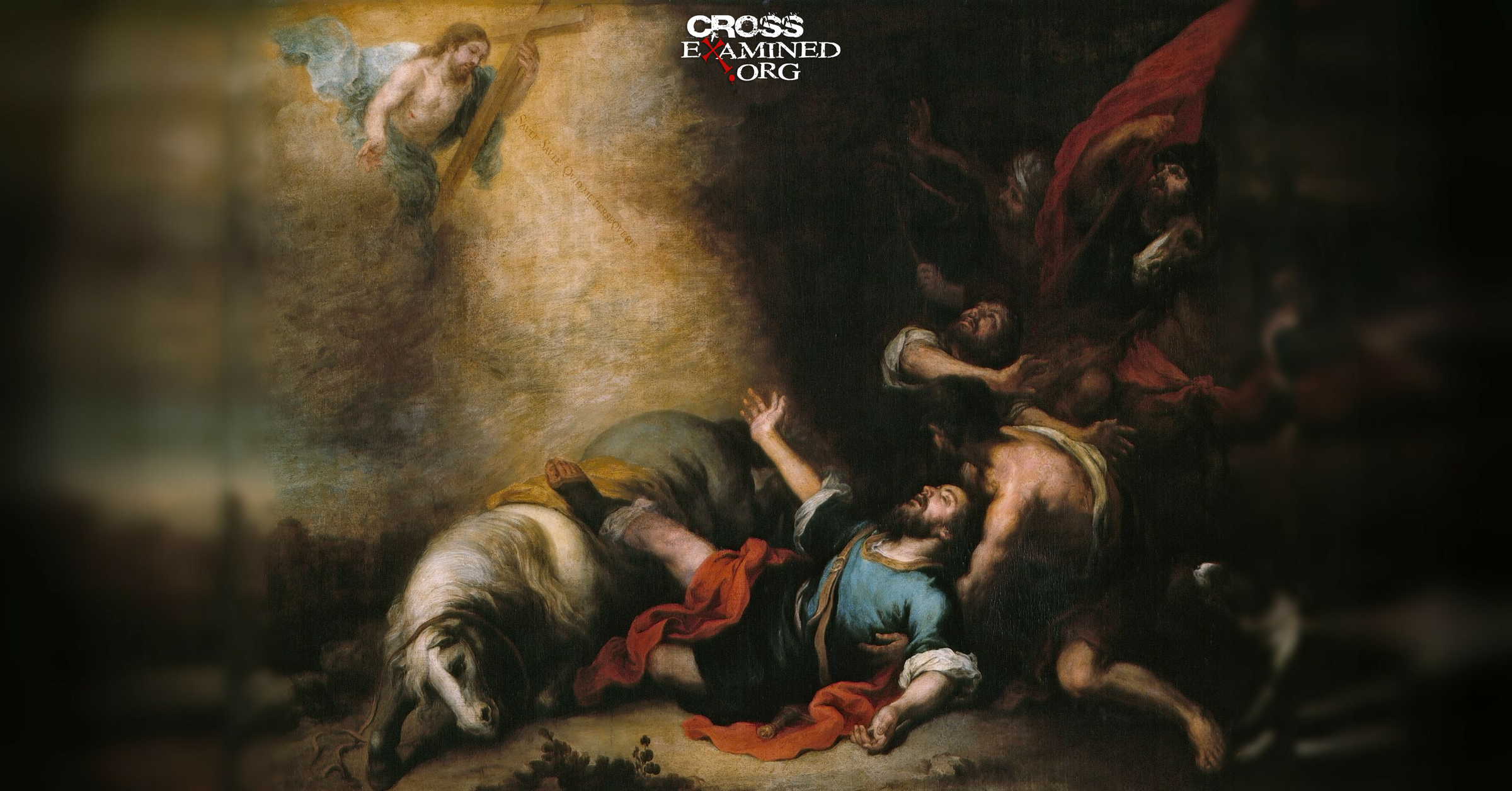
4: A church persecutor named Paul converted to Christianity on the basis of what he perceived to be an appearance of the risen Jesus.

5: The skeptic James converted on the basis of what he perceived as a postmortem appearance.
In this blog post, we shall look at the evidence for those last two minimal facts, and then we’ll move on to figuring out what the best explanation of these 5 facts are.

The Church Persecutor Paul

It’s pretty obvious that Paul claimed to be an eyewitness of the resurrection. In 1 Corinthians 15:8, immediately after citing the early resurrection creed, he said: “last of all, as to one untimely born, he appeared to me also.” Earlier in that same letter, he asked rhetorically “Am I not free? Am I not an apostle? Have I not seen our Lord?” (1 Corinthians 9:1). So, from Paul’s own pen he tells us that he had a postmortem appearance experience.
However, some skeptics may balk and say “Yeah, he said he saw Jesus raised from the dead. But anyone can claim anything. I can claim I saw Santa Claus leaving toys under my Christmas tree last December. That doesn’t make it true. How do we know Paul isn’t just lying?” This is a fair question. This is why in prior writings, instead of merely pointing to where Paul says he saw Jesus, I made an inferential case for his postmortem appearance. There are several historical facts about Paul which, if you ask me, only make sense if Paul actually had a postmortem appearance experience.

*Before Paul Was A Christian, He Was A Persecutor Of The Church

We have good historical evidence that prior to becoming a Christian, Paul was a persecutor of Christians. How do we know? Because in his epistles, he says he was. In 1 Corinthians 15:9, after citing the creed to the Corinthians, Paul said “For I am the least of the apostles and do not deserve even to be called an apostle because I persecuted the church of God”, likewise in Galatians 1:13-14, Paul said “For you have heard of my previous way of life in Judaism, how intensely I persecuted the church of God and tried to destroy it. I was advancing in Judaism beyond many of my own age among my people and was extremely zealous for the traditions of my fathers.” In 1 Timothy 1:13, Paul said: “Even though I was once a blasphemer and a persecutor and a violent man, I was shown mercy because I acted in ignorance and unbelief.”
Now, I am inclined to believe that Paul is telling the truth here on the basis of three reasons.

1: The Principle of Embarrassment. The principle of embarrassment states that if an author mentions something that is embarrassing to himself, embarrassing to someone he cares about, hurts an argument he’s trying to make, or is in any way detrimental to him, yet he mentions it anyway, it’s very likely not to be made up. People make up lies to make themselves look good; they don’t makeup lies to make themselves look bad. Paul is mentioning details about himself that cast him in a pretty bad light.

Think it about it for a moment; if you were writing a letter to someone, would you lie about having a drug abuse problem that you don’t actually have? If you were writing a letter to some friends, would you make up lies about how you terrorized your local neighborhood? “Dear Todd, I’m doing well here in my new home in North Carolina. By the way, I became a Christian, but prior to doing so, I went into churches and cut Christians’ heads off en masse. From, Bobby.” Are you going to just make stuff like that up? I don’t think so! You probably wouldn’t even admit something like that even if it were true! But you especially wouldn’t say that if were not true. People don’t makeup lies that make themselves look bad! Paul would never say that he was a persecutor of the church if it wasn’t true. Paul would never say that he purposefully went around terrorizing people if that didn’t actually reflect reality.
2: The Principle Of Multiple Attestation. Not only does Paul say that he was a persecutor of the church, but Luke mentions it as well in the book of Acts (8:1-4, 9:1-2). Paul and Luke are independent sources, and therefore, there are multiple attestations to Paul being a persecutor. It is highly unlikely that both Paul and Luke independently fabricated the same lie. On the basis of the principle of multiple attestations, we have good reason to believe that Paul persecuted the church.

3: Paul Had A Reputation

Let’s keep something in mind here: in all of the epistles, Paul is writing to someone. And in Galatians 1:13, Paul said “For you have heard of my previous way of life in Judaism, how intensely I persecuted the church of God and tried to destroy it.” (emphasis mine). Paul says that he had a reputation for being a persecutor of the church, and tells his readers that they knew of that reputation. Now, if Paul wasn’t really a persecutor of the church, his readers would have immediately called him out for lying. You don’t say “You know about that bad stuff I did. You’ve heard about it.” to someone unless you did the thing you’re talking about.

*Paul Became A Christian, And Then Suffered And Died For Preaching The Gospel

Paul obviously became a Christian himself sometime after persecuting Christians. Like with the disciples, we know that Paul actually believed the message he was preaching because he endured terrible suffering throughout his life for the sake of the gospel, and was eventually killed for his Christian faith. Seven Independent sources attest to Paul’s suffering and martyrdom.

Paul himself recounts instances of his suffering. “Five times I received from the Jews the forty lashes minus one. Three times I was beaten with rods, once I was pelted with stones, three times I was shipwrecked, I spent a night and a day in the open sea, I have constantly been on the move. I have been in danger from rivers, in danger from bandits, in danger from my fellow Jews, in danger from Gentiles; in danger in the city, in danger in the country, in danger at sea; and in danger from false believers. I have labored and toiled and have often gone without sleep; I have known hunger and thirst and have often gone without food; I have been cold and naked. Besides everything else, I face daily the pressure of my concern for all the churches.” – 2 Corinthians 11:24-28

Some of the specific sufferings mentioned by Paul in 2 Corinthians are also reported by Luke. One of the shipwrecks was recorded in Acts 27:14-44, Paul was stoned in Acts 14:19, and Acts 16:22-24 records an instance of Paul being scourged. The book of Acts records several other hardships Paul endured for being a Christian, but I won’t mention them here.
Clement of Rome[1], Tertullian[2], and Dionysius of Corinth[3] (cited by Eusebius) mention his martyrdom. Polycarp[4] and Origen[5] record it as well. Paul was beheaded during the harsh persecution of Emperor Nero in the A.D 60s.

In all, we have 7 independent sources that testify that Paul suffered and died for preaching the gospel. On the basis of the principle of multiple attestations, we, therefore, have good grounds for affirming that Paul actually did suffer and died for the gospel.

*The Best Explanation: Paul Actually Saw Jesus 

Now, how do we account for Paul’s radical, sudden change from Christian destroyer to Christian leader? From someone who caused martyrs deaths to someone who died a martyr’s death himself? I can think of no other explanation than the one Paul himself gave, “Then he appeared to me also, as to one untimely born.” (1 Corinthians 15:8). I think this is the only logical way to explain why Paul would go from terrorizing Christians to trying to persuade people to become Christians (even to the point of horrid suffering). Again, you can try to explain away Paul’s postmortem appearance experience if you want to, but you have no grounds to deny it altogether.

The Skeptic James 

We now come to our fifth and final minimal fact: the conversion of the skeptic James. The Gospels tell us that Jesus had several siblings. Jesus’ siblings included James, Jude, Simon, plus some sisters whose names were never given. Most skeptics I’ve conversed with love to go after this minimal fact because they say it has the least amount of evidence for it. After all, it’s not mentioned anywhere except in one line, and that line is in the creed cited by Paul in 1 Corinthians 15.

Nevertheless, I still think we have good grounds for affirming that this appearance occurred. First of all, as I said in the previous blog post, we have good reason to believe Paul got the creed from James himself. Secondly, the creed is extremely early (just 5 years after the death of Jesus) so had James not really experienced a postmortem appearance, he could have publically rebuked Paul for lying. The severe earliness of the creedal tradition and the probability that Paul got the creed from James has to count for something, right?
However, I think that just as with Paul, we can make an inferential argument for the postmortem appearance to James.

*James Was A Skeptic During Jesus’ Lifetime 

James and his other brothers, we are told, were not believers during Jesus’ lifetime. We know this based on:

1: The Principle Of Embarrassment

It was embarrassing for a rabbi’s family to not accept him back in those days. It was embarrassing for a rabbi’s family to be opposed to him in some way or another back in those days. So this isn’t very flattering for Jesus, but it gets worse! In fact, Mark 3:20-35 tells us that Jesus’ family thought he was crazy and that they had come to seize him and take him home! This doesn’t paint Jesus or His family in a very good light, given the stigmatism back then. Therefore, it’s highly unlikely that the gospel writers would have invented skepticism on the part of Jesus’ brother James.

In fact, John 7 recounts a rather nasty story where Jesus’ brothers try to goad him into a death trap by showing himself publicly at a feast when they knew that the Jewish leaders were trying to kill him! Jesus’ brothers were trying to sabotage him! Why in the world would John place Jesus’ brothers in such an ugly light if such an event never took place?

2: The Principle Of Multiple Attestation 

Not only does Mark mention it (chapter 3), but John mentions it as well (chapter 7). Mark and John are independent sources, and therefore, James’ skepticism is multiply attested. So, we’ve established that James was a skeptic.

*Just A Short Time After Jesus’ Death, James Came To Believe That Jesus Had Risen From The Dead. 

Even though James was a skeptic, we know that later in the early church, James emerges as one of the pillars of the New Testament church, and one of the leaders of the church.

Moreover, he was eventually martyred.

Multiple Attestation

This is mentioned in both the book of Acts (21:17-20) as well as by Paul in his letter to the Galatians (2:9). Again, Paul and Luke are independently reporting this. Thus, we know this on the principle of multiple attestations.

*James Was Martyred For His Christian Faith

Multiple Attestation 

We have the testimony of Flavius Josephus, Hegesippus, and Clement Of Alexandria[6] that James was martyred for his belief in his brother as the risen Christ. James’ martyrdom is multiply attested in these three sources.

*The Most Likely Explanation For Why James Went From Being A Skeptic To Being A Believer Virtually Overnight Is That The Risen Jesus Appeared To Him As 1 Corinthians 5:7 says. 

I think the best explanation for James’ rapid conversion is that he believed the risen Jesus appeared to him.

New Testament critic Reginald H. Fuller says “Even if there were not an appearance to James mentioned by Paul, we should have to invent one to explain the transformation that occurred in James between the time of his unbelieving days when Jesus was alive and his time of leadership in the early church”[7]

That’s exactly the argument I’m making here. 1 Corinthians 15:7 aside, we have historically established that James was (1) a skeptic prior to Jesus’ death, (2) shortly became a Christian following Jesus’ death, and was willing to die for his Christian faith. How can we explain James’ overnight transformation if not that James had an experience which he perceived to be a visitation of the risen Jesus? I don’t think we can.

Conclusion 
We have come to the end of the first step. We have historically established 5 facts which will undergird our inference to Jesus’ resurrection.

The 5 minimal facts that undergird the inference to the resurrection are:
1: Jesus died by crucifixion.

2: Jesus’ tomb was empty the following Sunday.

3: The disciples experienced postmortem appearances.

4: A church persecutor named Paul converted to Christianity on the basis of what he perceived to be an appearance of the risen Jesus.

5: The skeptic James converted on the basis of what he perceived as a postmortem appearance.

In the next blog post, we’ll see what is the best explanation of these 5 facts. At face value, it seems like The Resurrection Hypothesis is how we should explain them. However, perhaps we should examine other alternatives before we appeal to the supernatural.

Notes 

[1] Clement Of Rome, 1 Clement 5:2-7

[2] Scorpiace, 15, in Roberts, Donaldson, and Coxe, eds. and trans., The Ante-Nicene Fathers.

[3] H.E. 2.26;

[4] Polycarp, “To The Philippians,” 9.2

[5] Origen, as cited by Eusebius in Ecclesiastical History

[6] Josephus, Antiquities Book 20, Chapter 9, Hegesippus as cited in “Eusebius. Church History Book II Chapter 23. The Martyrdom of James, who was called the Brother of the Lord”, Clement Of Alexandria, also cited by Eusebius in ibid.

[7] Reginald H. Fuller, The Formation of the Resurrection Narratives (New York: Macmillan, 1980), 10.


Original Blog Source: http://bit.ly/2GgcRam

By Michael Sherrard

For I am not ashamed of the gospel, for it is the power of God for salvation to everyone who believes, to the Jew first and also to the Greek. —ROMANS 1:16

As an apologist, let me encourage you to trust in the power of the gospel. Do not be ashamed to freely speak about the goodness of God’s mercy and kindness. I have said before that most people reject God because of emotional and volitional issues. Intellect merely hides these issues. Though we talk about evidence and logic and arguments, apologists must remember that the reason many people will not submit to God is their heart. But the loving-kindness of God’s grace can soften a hardened heart and will draw many to Him.

All people recognize two things: there is a God, and they have broken a standard of morality for which they should be judged (Rom. 1:18–2:16). All people struggle with guilt, and guilt is a powerful force that causes many people to run from God rather than to Him. Guilt often manifests itself in pride and the attempt to either rationalize sin or personally atone for it. Guilt sometimes results in depression, feelings of inadequacy, and the belief that no one should love them. Whatever it looks like, guilt is an obstacle to repentance.

But God is greater than our sin. His love is more powerful than our guilt. And His kindness will draw many to repentance. Don’t place your hope in logic, history, science, and argumentation. Trust in the beauty of the gospel and God’s mercy. Do not be ashamed of the gospel because it is the power of God for salvation (Rom. 1:16). Share it as often as you can.

The most overlooked part of apologetics is the gospel. Apologists tend never to get that far in conversations with nonbelievers. We sometimes think that people won’t believe in the foolishness of the cross. So we resort to talking only about that which seems reasonable. But do not shy away from preaching what this world will consider foolish. Remember that apologetics is a servant of the gospel, and sometimes the servant just needs to get out of the master’s way.

Apologists, share the gospel with others and tell them how God’s grace has transformed you. You can offer the hope of a changed life. Tell your story. Explain what it’s like to be forgiven. Talk about your anticipation of heaven. And joyfully speak about the peace of God that now fills your life.

Invite skeptics to meet God and enjoy all that comes from life in Christ. Feel the freedom to tell them you know Him, that you’ve experienced Him, and they can too. There is value in your experience and personal knowledge of God. Talk about it. Some people say that you cannot argue with a changed life, but you can; I argue with the good and changed Mormons all the time. But there is value in your conversion, in the reality that God can be known and experienced. So tell people your story and invite them to enter into one for themselves.


Michael C. Sherrard is a pastor, author of Relational Apologetics, and the Director of Ratio Christi College Prep. RCCP is an organization that seeks to equip the church for effective evangelism by teaching high school students apologetics, fundamental Christian doctrine, and biblical evangelism.

Original Blog Source: http://bit.ly/2GSm1z2

By Brian Chilton

For the past few weeks, we have investigated the authors of the Gospels and the book of Acts. In this article, we examine the evidence for the Gospel of John. Who wrote the Fourth Gospel? As we have in previous articles, this article will look at the proposed author, the internal and external evidences for authorship, the dating, and the location and intended audience for the Fourth Gospel.

Proposed Author by Tradition:       Church tradition claims that John the apostle wrote the Fourth Gospel while pastoring as an aged man in Ephesus. Does the evidence back up this assumption?

Internal Evidence:    Internally, as the other Gospels, the author is unnamed. However, a clear reading of the Fourth Gospel denotes that the one named the beloved disciple, or the disciple whom Jesus loved, is also the author of the book. The phrase “the disciple whom Jesus loved” appears 5 times in the Fourth Gospel. This disciple holds a prominent role even to the point that Peter asks about the beloved disciple’s ministry in John 21., son of Zebedee, meets this criterion as well as James, the brother of John. We know that James, son of Zebedee, died in the 40s AD (Acts 12:1-5). The beloved Jesus appears with Peter in 13:23-24; 18:15-16; 20:2-9; and in chapter 21. John is also found with Peter in Luke 22:8; Acts 1:13; 3-4; 8:14-25; and Galatians 2:9. So, only John meets the criteria needed for the Fourth Gospel’s authorship. The question of Peter in John 21 indicates that the author was aged and reflecting back on his life with Jesus and the apostles.

External Evidence:   Referencing the Fourth Gospel’s author, early church father Irenaeus (c. 130-202 AD) writes,

Further, they teach that John, the disciple of the Lord, indicated the first Ogdoad, expressing themselves in these words: John, the disciple of the Lord, wishing to set forth the origin of all things, so as to explain how the Father produced the whole, lays down a certain principle,—that, namely, which was first-begotten by God, which Being he has termed both the only-begotten Son and God, in whom the Father, after a seminal manner, brought forth all things. [1] 

Clement of Alexandria (c. 150-215 AD), as quoted by the church historian Eusebius of Caesarea (c. 263-339 AD) denotes the following:

Again, in the same books Clement has set down a tradition which he had received from the elders before him, in regard to the order of the Gospels, to the following effect. He says that the Gospels containing the genealogies were written first, and that the Gospel according to Mark was composed in the following circumstances:—

Peter having preached the word publicly at Rome, and by the Spirit proclaimed the Gospel, those who were present, who were numerous, entreated Mark, inasmuch as he had attended him from an early period, and remembered what had been said, to write down what had been spoken. On his composing the Gospel, he handed it to those who had made the request to him; which coming to Peter’s knowledge, he neither hindered nor encouraged. But John, the last of all, seeing that what was corporeal was set forth in the Gospels, on the entreaty of his intimate friends, and inspired by the Spirit, composed a spiritual Gospel.[2]

Ignatius of Antioch (c. 35-108 AD) quotes John’s Gospel quite frequently as he writes an epistle to the Antiochians. Ignatius’s quotation of the Fourth Gospel illustrates that the book was viewed in a positive light and authoritative. Ignatius is noted as a disciple of John the apostle along with Polycarp. The Marytrdom of St. Ignatius notes the following:

Wherefore, with great alacrity and joy, through his desire to suffer, he came down from Antioch to Seleucia, from which place he set sail. And after a great deal of suffering he came to Smyrna, where he disembarked with great joy, and hastened to see the holy Polycarp, [formerly] his fellow-disciple, and [now] bishop of Smyrna. For they had both, in old times, been disciples of St. John the Apostle. Being then brought to him, and having communicated to him some spiritual gifts, and glorying in his bonds, he entreated of him to labour along with him for the fulfilment of his desire; earnestly indeed asking this of the whole Church (for the cities and Churches of Asia had welcomed6 the holy man through their bishops, and presbyters, and deacons, all hastening to meet him, if by any means they might receive from him some spiritual gift), but above all, the holy Polycarp, that, by means of the wild beasts, he soon disappearing from this world, might be manifested before the face of Christ.[3]

Much more could be given as far as external evidence. However, the presented information should suffice for our purposes.

Date:   Evidence suggests that John’s Gospel was the last to be written at some point after 70 AD. It appears that John may have been written in the mid-80s to early 90s as he may have served as pastor of the church of Ephesus.

Location and Audience:       John’s testimony is preserved while serving in Ephesus in Asia Minor. Thus, he writes to the people of that area, but also to the future generations of the church. Perhaps this is why Clement of Alexandria calls it a “spiritual gospel.”

Conclusion:    I believe that John the apostle authored the Gospel by dictation. That is to say, John most likely provided the material to an amanuensis. The amanuensis documented the aged apostle’s words and added the addendum to the Fourth Gospel and the title “the disciple whom Jesus loved” in reference to the apostle. I think the evidence is quite strong for John the son of Zebedee authoring the Fourth Gospel. Claims to the contrary[4] bring more questions than answers. Such as, why do the other Gospels not elevate the other suggested candidates to a higher light? How is it that John is an inner circle disciple in the other Gospels and is missing in prestige in the Fourth Gospel if John is not the author?[5] To reiterate, I believe an amanuensis was employed in the Gospel’s formation. But the use of an amanuensis does not negate the apostle’s hand in writing. So, for those who erroneously claim that the apostle could not have formed a document such as this, such an argument is dispelled if an amanuensis is employed. It is still quite possible with the knowledge obtained by Jesus and his earlier employment that John, son of Zebedee, could have written the entire Gospel by hand. But, I prefer to think that an amanuensis was employed.

Notes

[1] Irenaeus of Lyons, “Irenæus against Heresies, 1.8.5.” in The Apostolic Fathers with Justin Martyr and Irenaeus, ed. Alexander Roberts, James Donaldson, and A. Cleveland Coxe, vol. 1, The Ante-Nicene Fathers (Buffalo, NY: Christian Literature Company, 1885), 328.

[2] Clement of Alexandria, “Fragments of Clemens Alexandrinus,” in Fathers of the Second Century: Hermas, Tatian, Athenagoras, Theophilus, and Clement of Alexandria (Entire), ed. Alexander Roberts, James Donaldson, and A. Cleveland Coxe, trans. William Wilson, vol. 2, The Ante-Nicene Fathers (Buffalo, NY: Christian Literature Company, 1885), 580.

[3] Alexander Roberts, James Donaldson, and A. Cleveland Coxe, eds., “The Martyrdom of Ignatius,” in The Apostolic Fathers with Justin Martyr and Irenaeus, vol. 1, The Ante-Nicene Fathers (Buffalo, NY: Christian Literature Company, 1885), 130.

[4] Ben Witherington, III holds that Lazarus was the author of the Fourth Gospel.

[5] For instance, it seems clear that the beloved disciple was one who was prominently known. John the apostle holds such a status.

About the Author:

Brian Chilton is the founder of BellatorChristi.com and is the host of The Bellator Christi Podcast. He received his Master of Divinity in Theology from Liberty University (with high distinction); his Bachelor of Science in Religious Studies and Philosophy from Gardner-Webb University (with honors); and received certification in Christian Apologetics from Biola University. Brian is currently working on his Ph.D. in Theology and Apologetics at Liberty University. Brian is a full member of the International Society of Christian Apologetics and the Christian Apologetics Alliance. Brian has been in the ministry for over 14 years and serves as the pastor of Huntsville Baptist Church in Yadkinville, North Carolina.

Original Blog Source: http://bit.ly/2wVQNSb


By Brian Chilton

Last week, we began a series on the authorship of the New Testament documents as we discussed the Gospel of Matthew. This week, we continue our series as we consider the authorship of the Gospel of Mark. We will consider the internal and external evidences, as well as the date of the composition, and the area where Mark was located.

Proposed Author by Tradition:       John Mark, who transcribed the teachings of Simon Peter, is traditionally held to be the author of the Second Gospel. John Mark was the son of a widow woman named Mary (Acts 12:12-17). The disciples met in Mary’s home. Her home may have even served as the location of the Last Supper. John Mark was also the cousin of Barnabas (Colossians 4:10). John Mark accompanied Paul and Barnabas on their missionary journeys. He was, however, scolded by Paul and was disallowed to continue after Mark left the missionaries for unknown reasons (Acts 13:13). Paul and Mark later reconciled. Paul added that Mark was useful for the ministry (Colossians 4:10).

Internal Evidence:    Internally, there isn’t much to mark the author of the Gospel. The Second Gospel does hold several traits to be considered. First, the Second Gospel is fast-paced. The author uses the term “immediately” often. Second, the Second Gospel focuses on the humanity of Jesus of Nazareth often discussing his emotions. Third, the author writes with a Latin audience in mind as he explained Jewish customs and used Latin terms. Some example of the author’s usage of Latinisms include the terms census (Mark 12:14), centurion (15:39, 44, 45), denarius (a Roman coin, 12:15), among others.[1] Fourth, the author describes the man who carried Jesus’s cross as Simon of Cyrene who is identified as the father of Alexander and Rufus. Alexander and Rufus were known to the believers in Rome.[2] Fifth, the Second Gospel focuses upon the life of Simon Peter quite a bit. One of the highlights of the Second Gospel is Peter’s declaration that Jesus was the Messiah (8:27-9:1). Sixth, the author emphasizes the Messianic Secret.[3] Seventh and finally, the author describes a man who is unknown except for a bizarre instance in the Garden of Gethsemane where the unknown man is caught as Jesus is arrested, only to escape the clutches of the Roman guard losing his clothing in the process (Mark 14:51-52). Many have postulated that this unknown man is in fact the author.

While the clues are not conclusive, they do point to a man writing to a Roman audience; who directly, or indirectly, knew Simon Peter; who knew the members of the Roman church. Of the possible candidates, John Mark fits best.

External Evidence: Like the other three Gospels, the early church was unanimous in their acceptance that John Mark was the writer of the Second Gospel and that he documented the teachings of Simon Peter. Papias provides the earliest account. Papias of Hierapolis (A.D. 60-130) writes,

“And the presbyter said this. Mark having become the interpreter of Peter, wrote down accurately whatsoever he remembered. It was not, however, in exact order that he related the sayings or deeds of Christ. For he neither heard the Lord nor accompanied Him. But afterwards, as I said, he accompanied Peter, who accommodated his instructions to the necessities [of his hearers], but with no intention of giving a regular narrative of the Lord’s sayings. Wherefore Mark made no mistake in thus writing some things as he remembered them. For of one thing he took especial care, not to omit anything he had heard, and not to put anything fictitious into the statements.”[4]

Papias confirms John Mark as the writer of the Second Gospel. Irenaeus (A.D. 130-200) also writes, “After their departure, Mark, the disciple and interpreter of Peter, did also hand down to us in writing what had been preached by Peter.”[5] Thus, the early church unanimously concurred that John Mark was the author of the Second Gospel. John Mark would make for an odd candidate unless he were in fact the author.

Date:   If one holds that Irenaeus’s reference to Peter’s “departure” indicates Peter’s execution, then Mark was written in the mid to late 60s. If, however, “departure” indicates Peter’s establishment of the Roman church, then the date is much earlier. It seems that Irenaeus addresses Peter’s martyrdom. However, he is writing after having received the Gospel when Mark moved to Alexandria, Egypt. Thus, the Gospel could have been written much earlier than Mark’s distribution of the work to the Alexandrians. Most scholars hold that Mark was written first, while others hold that Matthew was the first to be written. Good evidence suggests a date for Mark’s Gospel at some time in the 50s, with some even suggesting a date to the late 40s. Personally, I am comfortable with a mid-50s date.

Location and Audience: It is clear that John Mark wrote his Gospel while still in Rome. Mark writes primarily for a Roman Gentile audience. Mark could have written in Rome at any point. I hold that Irenaeus indicates merely that his community received the Gospel after Peter’s death. However, this is not a point which I strongly hold.

Conclusion:

From the evidences considered, John Mark is the only clear candidate for the Second Gospel. While John Mark was not a primary witness of the life of Jesus of Nazareth and while he does not necessarily record the events of Jesus’s life in chronological order, he does act as a scribe, or amanuensis, to Peter whom Jesus knew and selected to be an inner circle disciple. We have a great testimony preserved for us in the Second Gospel. I believe we truly have the eyewitness accounts of Simon Peter documented for us by his good friend John Mark.

Notes

[1] For a full list of Mark’s Latinisms, see Rod Decker, “Latinisms in Mark’s Gospel,” NT Resources (May 28, 2011), retrieved June 12, 2017, http://ntresources.com/blog/?p=1205.

[2] “Introduction to Mark,” CSB Study Bible (Nashville: Holman, 2017), 1556.

[3] That is, Jesus telling the disciples to keep his identity a secret.

[4] Papias, “Fragments of Papias,” in The Apostolic Fathers with Justin Martyr and Irenaeus, ed. Alexander Roberts, James Donaldson, and A. Cleveland Coxe, vol. 1, The Ante-Nicene Fathers (Buffalo, NY: Christian Literature Company, 1885), 154–155.

[5] Irenaeus of Lyons, “Irenæus against Heresies,” in The Apostolic Fathers with Justin Martyr and Irenaeus, ed. Alexander Roberts, James Donaldson, and A. Cleveland Coxe, vol. 1, The Ante-Nicene Fathers (Buffalo, NY: Christian Literature Company, 1885), 414.

Original Blog Source: http://bit.ly/2syW4fy


By Brian Chilton

Over the course of the new few weeks, we will discuss the reasons for accepting the traditional viewpoints for New Testament authorship. We will begin with the Gospel of Matthew today and will then move towards the other three Gospels before looking at some of the letters in Revelation.

The New Testament begins with the Gospel of Matthew. But, what do we know about the origin of the First Gospel? In a world where traditional scholarship is often questioned and too often disregarded, several theories exist as to whom the author of the First Gospel may be. Traditionally, the church has ascribed the First Gospel to the apostle known as Matthew. But, what evidence do we find about the author of the first book in the New Testament?

Internal Evidence

When we discuss internal evidence, we are speaking of the evidence that we find within the book in question. What clues do we find about the author of the First Gospel from the text? Like the other three Gospels, the First Gospel is anonymous.

First, we find that the author of the First Gospel is thoroughly entrenched in Judaism. The author often quotes the Hebrew Bible (otherwise known as the Old Testament). He parallels the life of Jesus with the great prophets of Judaism. Additionally, he makes every effort to show that Jesus is the fulfillment of messianic prophecy. In many ways, the author of the First Gospel focuses on the Jewish aspects of the faith, even describing some areas such as Jesus’s exclusion clause for divorce. The writer of the First Gospel also focuses quite a bit more on Jesus’s messages than do some of the other Gospel writers.

Second, the author focuses on Jesus’s work within Galilee and does not so much focus on Jesus’s work with Gentiles as does Luke. Thus, the evangelist is mostly concerned with Jesus’s ministry to the Jews.

Finally, the author of the First Gospel adds financial details only found in the First Gospel. For instance, only the First Gospel records the incidence where those who collected the temple tax “approached Peter and said, “Doesn’t your teacher pay the temple tax” (Matthew 17:24)?[1]

From all the details considered with the internal evidence (one who is thoroughly Jewish in scope of the messages presented by Jesus, one who focuses on the prophetic fulfillment of Jesus, one who focuses on the ministry of Jesus to Jews, and one who focuses on financial matters especially in the area of taxes), Matthew best fits as the author of the First Gospel. Matthew was a tax collector before accepting Jesus as Savior and his role as an apostle. Thus, Matthew’s knowledge of shorthand to take notes as well as finances would far excel most others.

External Evidence

When we speak of external evidence, we are addressing information we have about a document’s authorship from outside the document. What do others say about the author of the First Gospel?

The early church is unanimous in their acceptance of Matthew as the writer of the First Gospel. Papias, Irenaeus, Pantaenus, and Origen all report Matthew as the writer of the First Gospel. Papias (c. AD 60-130) writes, “Matthew put together the oracles [of the Lord] in the Hebrew language, and each one interpreted them as best he could.”[2] While we do not have a Hebrew or Aramaic edition of Matthew’s Gospel, there are reports that one may have existed in the early church.[3] Regardless, one should not be surprised that Matthew, who would need to have great knowledge of Greek in the business world, originally wrote his Gospel in Hebrew or Aramaic, only to revise the Gospel in Greek. Even if his Gospel were written in Greek by another, even say an amanuensis,[4] this would not negate Matthew’s authorship. Craig Evans recently recorded a video where he claims that Matthew may have come about in phases.[5]

Pantaenus also confirmed that Matthew was the author of the First Gospel. The great church historian, Eusebius of Caesarea, writes that Pantaenus, a church leader in the late 2nd to possibly early 3rd century, came across the Hebrew version of Matthew’s Gospel. Eusebius notes that Pantaenus was “a man highly distinguished for his learning, had charge of the school of the faithful in Alexandria.[6] The following is Eusebius’s report of Pantaenus’s encounter with the Hebrew edition of Matthew’s Gospel:

“It is reported that among persons there who knew of Christ, he found the Gospel according to Matthew, which had anticipated his own arrival. For Bartholomew, one of the apostles, had preached to them, and left with them the writing of Matthew in the Hebrew language,6 which they had preserved till that time.”[7]

With the addition of Origen and Irenaeus’s acceptance of Matthew writing the First Gospel, one is hard-pressed to dismiss their claims.

In addition, scholars acknowledge that Matthew’s name was associated with the First Gospel from the earliest times. The writers of the CSB Study Bible denote that “the title that ascribes this Gospel to Matthew appears in the earliest manuscripts and is possibly original. Titles became necessary to distinguish one Gospel from another when the four Gospels began to circulate as a single collection.”[8]

Date and Location of Writing

It is certainly reasonable to accept that Matthew was written in the 50s due to the reasonable assumption that Acts was finished before AD 64, with Luke coming before Acts, and Matthew writing his Gospel before Luke’s. Scholars generally hold that Matthew composed his Gospel in or around Antioch of Syria.

Conclusion

Some may argue that a disciple like Matthew would not borrow material from Mark, if in fact it is true that Matthew did borrow material from Mark’s Gospel. However, when one considers that Matthew followed Jesus long after most of the apostles, and that Matthew was not an inner-circle disciple, then it stands to reason that Matthew would borrow material from Mark’s Gospel if it is true that Mark relayed information from Simon Peter—who was both an early apostle and inner-circle disciple.

While some will still disagree, it seems strange to me to ascribe the First Gospel to Matthew of all people, especially when the First Gospel was used as a church manual in many cases. Matthew was a tax-collector. Tax-collectors were held in slightly higher esteem than pond scum…but not by much. So, why ascribe the First Gospel to a tax-collector unless there was at least some merit to the claim?

In my humble opinion, I believe the First Gospel came to us in three phases. First, the apostle Matthew wrote the teachings of Jesus in Aramaic. Then, Matthew added the miracles and deeds of Jesus to his Aramaic and/or Hebrew edition of his Gospel adding his eyewitness testimony and the testimony of Simon Peter as found in Mark’s Gospel. Finally, either Matthew himself or a highly trained scribe translated the Gospel in Greek.

Notes

[1] Unless otherwise noted, all quoted Scripture comes from the Christian Standard Bible (Nashville: Holman, 2017).

[2] Papias, “Fragments of Papias,” in The Apostolic Fathers with Justin Martyr and Irenaeus, ed. Alexander Roberts, James Donaldson, and A. Cleveland Coxe, vol. 1, The Ante-Nicene Fathers (Buffalo, NY: Christian Literature Company, 1885), 155.

[3] I believe it is Jerome who reports seeing a Hebraic Gospel of Matthew. But is this the same? We cannot know for sure.

[4] That is, a scribe who writes down the words that are dictated to oneself. Some amanuenses were given freedom to add their own expressions to a degree.

[5] Video recorded for Faith Life. I could not find the link. I will post the link if I am able to find it.

[6] Eusebius of Caesaria, “The Church History of Eusebius,” in Eusebius: Church History, Life of Constantine the Great, and Oration in Praise of Constantine, ed. Philip Schaff and Henry Wace, trans. Arthur Cushman McGiffert, vol. 1, A Select Library of the Nicene and Post-Nicene Fathers of the Christian Church, Second Series (New York: Christian Literature Company, 1890), 224.

[7] Eusebius of Caesaria, “The Church History of Eusebius,” in Eusebius: Church History, Life of Constantine the Great, and Oration in Praise of Constantine, ed. Philip Schaff and Henry Wace, trans. Arthur Cushman McGiffert, vol. 1, A Select Library of the Nicene and Post-Nicene Fathers of the Christian Church, Second Series (New York: Christian Literature Company, 1890), 225.

[8] “Introduction to Matthew,” CSB Study Bible (Nashville: Holman, 2017), 1494.

Original Blog Source: http://bit.ly/2rapy3W


By Michael C Sherrard

It is good to acknowledge the appropriateness of ones anger in the midst of evil and pain. It is right to be angry over injustice. It is right to be sick at crimes against children. It is good for you to feel a hole in your stomach as you look upon the devastation and loss of life caused by a natural disaster. It is right to think, “This is not how life is supposed to be.” The key is for anger to be directed rightly whereupon your steps follow the right path of action.

Acknowledging an individual’s sense of justice can lead them to repentance. When we are angry at evil, we are acknowledging that life has purpose. We are recognizing that there is a difference between good and bad. We are affirming that bad should be punished. But what does that mean for my bad actions? And from where did my sense of justice come in the first place?

If life is the result of an accident, how can life have a purpose? And if life has no purpose, why am I angry at what I think is unfair? My sense of oughtness is an indication that I believe in a standard of life. But what standard, an arbitrary one set by changing cultures driven by natural selection or a transcendent one that never changes even though societies might? Mankind’s sense of justice can point them to the good Judge. Affirm their outrage and direct it properly.

If you take people down this road, you will see how mankind’s universal sense of justice is to the gospel’s advantage. There is only one worldview that provides a justification for belief in inherent human value and thereby true morality. It is theism. A transcendent creator is needed for our sense of justice to have any value. Existence must have been intentional for life to have intrinsic and objective worth. And simply, when we look at the world and say, “That is wrong!” there has to be an eternally fixed “right” for our moral indignation to have any value. Leverage this understanding that all naturally possess and direct them toward the One who is not only the standard of life, but its very essence.

This blog was originally published at MichaelCSherrard.com


How do we fix a world filled with murder, rape, betrayal, adultery, fraud, theft, sexual exploitation, pornography, bullying, abortion, terrorism, cheating, lying, child abuse, racism, assault, drugs, robbery, and countless other evils?

There will be no solutions unless we are honest about their underlying causes. Although we don’t want to admit it, the truth is that every one of those world problems can be traced back to a problem with the human heart.

No one knows that better than an honest cop. My friend Jim Wallace is a cold-case homicide detective in California. He’s been featured four times on Dateline for solving crimes that are decades old. He’s noticed that every crime he has ever solved can be traced back to one or more of these three motives: financial greed, relational lust, or the pursuit of power (money, sex and power). We want these things so much that we are willing to use immoral means to get them.

In other words, the sick condition of our world is preceded and caused by the sick condition of our hearts.  That’s why we won’t improve the external world until we first improve our internal worlds.

You might think that this doesn’t really apply to you. After all, you may be congratulating yourself because you haven’t committed any of the crimes listed at the top of this column.

“Well, not most of them anyway,” you say. “Who hasn’t lied or stolen something?   But I’m better than most people!”

Maybe so. But your very act of self-justification proves the point—instead of admitting our faults, our natural inclination is to minimize them or cover them up while claiming moral superiority.

We don’t want to admit this because it hurts our pride, which is also a heart issue. “Don’t tell me I’m wrong! You’re offending me! You’re hurting my feelings!”

It’s no wonder free speech is under attack in the culture and on campus. To channel Jack Nicholson, we “can’t handle the truth” because the truth exposes the fact that we are not really as good as we claim we are. We can’t bear the fact that we are broken, narcissistic creatures who find it much easier and more natural to be selfish rather than selfless.

This affects even people who deny real right and wrong. For example, leading atheist Richard Dawkins has declared, “The universe we observe has precisely the properties we should expect if there is at the bottom, no design, no purpose, no evil and no good. Nothing but blind pitiless indifference… DNA neither knows nor cares. DNA just is, and we dance to its music.”

But Dawkins doesn’t act like he actually believes that. He recently insisted that a woman has the right to choose an abortion and asserted that it would be “immoral” to give birth to a baby with Down syndrome. According to Dawkins, the “right to choose” is a good thing and giving birth to Down syndrome children is a bad thing.

Well, which is it? Is there really good and evil, or are we just moist robots dancing to the music of our DNA? If there is no objective morality, then there is no “right” to anything, whether it is abortion or the right to life.

And if there is no objective morality, then why does everyone, including atheists, try to justify their own immoral behavior? As C.S. Lewis observed, “If we do not believe in decent behavior, why should we be so anxious to make excuses for not having behaved decently? The truth is, we believe in decency so much—we feel the Rule or Law pressing on us so— that we cannot bear to face the fact that we are breaking it, and consequently we try to shift the responsibility.”

Ironically, when we try to shift the responsibility for our immoral actions, we often appeal to other moral principles to justify ourselves:

  • I used my expense account for personal items because I work harder than what they pay me, and it’s unjust that my boss makes so much more than me.
  • I ran off with my assistant because she really loves me, unlike my wife who doesn’t give me the attention I deserve.
  • I don’t have time for my kids because I’m too busy working hard to provide for their future.
  • I had an abortion because it’s immoral to give birth to a Down syndrome child.

Even our excuses show that we really, deep down, believe in objective morality. We often deceive ourselves into believing that something immoral is really moral (like abortion), but, as Thomas Jefferson famously declared, certain universal moral truths are “self evident.” All rational people know this. Unfortunately, our tendency for moral self-deception is also universal. We know what’s right, but we make excuses for doing wrong by trying to appeal to what is right!

Where does all this leave us?

There is hope. Regardless of what you believe about the Bible, what can’t be denied is that the Bible nails the truth about human nature and our deceptive human hearts. The book of Genesis admits that “every intent of the thoughts of [mankind’s] heart was only evil continually.” Jeremiah wrote, “The heart is deceitful and wicked, who can know it?” Jesus declared, that people “love darkness rather than light.” And Paul observed that we “suppress the truth in unrighteousness” in order to continue in our sins.

But the Bible doesn’t just accurately state the problem; it also reveals the only possible solution. Because of our moral failings, God’s infinite love compelled Him to add humanity over his Deity and come to earth in the person of Jesus that first Christmas. The incarnation was necessary because an infinitely just Being cannot allow sin to go unpunished. Instead of punishing us, God found in Jesus an innocent human substitute to voluntarily take the punishment for us.

Our pride tells us that we can rescue ourselves, but we can’t. No matter how much we try to justify ourselves or pledge to do better in the future, we can’t escape the fact that we’re guilty for what we’ve already done.

So it’s important to ask this Christmas season, “Have you accepted the pardon Jesus came to offer you? And have you asked Him into your life to help heal your self-centered heart?” If not, why not? He’s the only true solution to the world’s evils and the heart problem that afflicts each one of us.

When I hear Christians saying we ought not get involved in politics but just “preach the Gospel,” I show them this satellite picture of the Korean peninsula.  Here we see a homogenous population of mostly Koreans separated by a well-fortified border.  South Korea is full of freedom, food and productivity—it’s one of the most Christianized countries in the world.  North Korea is a concentration camp.   They have no freedom, no food, and very little Christianity.

What’s the primary reason for the stark difference between these two countries? Politics. The South politically allows freedom, while the North does not.

Ironically, Christians who shun politics to supposedly advance the Gospel are actually allowing others to stop the Gospel.  How so?  Because politics and law affects one’s ability to preach the Gospel!  If you think otherwise, visit some of the countries I have visited—Iran, Saudi Arabia and China.  You cannot legally “preach the Gospel” in those countries—or practice other aspects of your religion freely—because politically they’ve ruled it out as they have in North Korea.

In fact, politics affects virtually every area of your life through the laws made by government.  So if you care about your family, business, church, school, children, money, property, home, security, healthcare, safety, freedom, and your ability to “preach the Gospel,” then you should care about politics.

Politics affects everything, which is why leaders throughout the Bible—including Joseph, Moses, Daniel, Nehemiah, Mordecai, Esther, John the Baptist, and Paul— “went political” to influence civil governments to govern morally.  Even Jesus himself got involved in politics when he publically chastised the Pharisees—the religious and political leaders of Israel—for neglecting “the more important matters of the law.”

Unfortunately, our lawmakers today are doing the same thing.   They use the force of law tell us what light bulbs to use and what the school lunch menu should be, but neglect to put any restrictions on the taking of human life by abortion!  What could be more important than life? The right to life is the right to all other rights.  If you don’t have life, you don’t have anything.

But what can Christians do?  After all, we can’t legislate morality, can we?  News flash: All laws legislate morality!  Morality is about right and wrong and all laws declare one behavior right and the opposite behavior wrong. So the question is not whether we can legislate morality, but “Whose morality will we legislate?”

The answer our Founding Fathers gave was the “self-evident” morality given to us by our Creator—the same Moral Law that the apostle Paul said that all people have “written on their hearts.” In other words, not my morality or your morality, but the morality—the one we inherited not the one we invented.  (This doesn’t mean that every moral or political issue has clear right and wrong answers.  It only means that “the more important matters of the law” – life, marriage and religious freedom for example—do have clear answers that we should heed.)

Notice our Founders did not have to establish a particular denomination or force religious practice in order to legislate a moral code.  Our country justifies moral rights with theism, but does not require its citizens to acknowledge or practice theism. That’s why Chris Matthews and other liberals are wrong when they charge that Christians are trying to impose a “theocracy” or violate the “separation of Church and State.”  They fail to distinguish between religion and morality.

Broadly defined, religion involves our duty to God while morality involves our duty to one another. Our lawmakers are not telling people how, when, or if to go to church—that would be legislating religion. But lawmakers cannot avoid telling people how they should treat one another— that is legislating morality, and that is what all laws do.

Opposition to abortion or same-sex marriage, for example, does not entail the establishment of a “theocracy.” Churches and the Bible also teach that murder, theft, and child abuse are wrong, but no one says laws prohibiting such acts establish a theocracy or are a violation of the “separation of church and state.” In fact, if the government could not pass laws consistent with church or biblical teachings, then all criminal laws would have to be overturned because they are all in some way consistent with at least one of the Ten Commandments.

Second, there are churches on both sides of these issues. In other words, some liberal churches, contrary to scripture, actually support abortion and same-sex marriage. So if church-supported positions could not be put into law, then we could not have laws either way on abortion or same-sex marriage.  Absurd.

Finally, most proponents of same-sex marriage argue as if they have some kind of moral right to having their relationships endorsed by the state. They claim that they don’t have “equal rights” or that they are being “discriminated” against.  Likewise, abortion advocates claim they have a moral “right” to choose an abortion.  None of these claims are true, as I have explained elsewhere.  Nevertheless, their arguments, while flawed, expose the fact that independent of religion they seek to legislate their morality rather than the morality.

If you have a problem with the morality, don’t blame me. I didn’t make it up. I didn’t make up the fact that abortion is wrong, that men are not designed for other men, or that natural marriage is the foundation of a civilized society. Those unchangeable objective truths about reality are examples of the “Laws of Nature” from “Nature’s God,” as the Declaration of Independence puts it, and we only hurt others and ourselves by suppressing those truths and legislating immoral laws.

When we fail to legislate morally, others impose immorality.  For example, totalitarian political correctness is already imposed in states such as Massachusetts where the implications of same-sex marriage override the religious liberties of businesses, charities and even parents.  As documented here and illustrated here, same sex marriage prevents you from running your business, educating your children, or practicing your religion in accord with your Conscience.  And soon, as is the case in Canada, you may not be able to merely speak Biblically about homosexual behavior. That is because those who say they are fighting for “tolerance” are often the most intolerant.

Unless Christians begin to influence politics and the culture more significantly, we will continue to lose the very freedoms that enable us to live according to our beliefs and spread the Gospel all over the world.  That’s why you should not vote for candidates because of their race or religion, but because they will govern morally on the more important matters of the law—life, marriage and religious freedom. (To see where all the major candidates stand visit the non-partisan website http://www.ontheissues.org.)

If you are a pastor who is worried about your tax-exempt status: 1) you have more freedom than you think to speak on political and moral issues from the pulpit; 2) if you do not speak up for truth now, you will soon lose your freedom to speak for anything, including the Gospel; and 3) you are called to be salt and light, not tax-exempt.