Tag Archive for: Gospel

Recently, someone asked me to comment on an article, published in 2017, by John Danaher, a lecturer in the Law School at the University of Galway, Ireland. He is widely published on legal and moral philosophy, as well as philosophy of religion. In his article, Danaher alleges that proponents of intelligent design (ID) are religiously motivated. He also asserts that the argument for ID from irreducible complexity has conceptual problems, and that systems that we deem to be irreducibly complex can be adequately explained by co-optation of components performing other roles in the cell. In two articles, I will address his concerns about our supposed religious motives, and then tackle his specific objections to irreducible complexity.

Do We Have Religious Motives?

Danaher opens his essay by reminiscing about his days as a student when he first encountered ID.

When I was a student, well over a decade ago now, intelligent design was all the rage. It was the latest religiously-inspired threat to Darwinism (though it tried to hide its religious origins). It argued that Darwinism could never account for certain forms of adaptation that we see in the natural world.

What made intelligent design different from its forebears was its seeming scientific sophistication. Proponents of intelligent design were often well-qualified scientists and mathematicians, and they dressed up their arguments with the latest findings from microbiology and abstruse applications of probability theory. My sense is that the fad for intelligent design has faded in the intervening years, though I have no doubt that it still has its proponents.

These paragraphs betray the fact that the author is quite out of touch with the literature on ID.

Stronger than Ever

First, ID has come a long way since the early 2000s. Far from having faded, it is now stronger than ever, having more academic proponents (and many more peer-reviewed publications) than at any time in its history. Its arguments are far more developed and sophisticated than in the early 2000s and this trend is likely to continue.

Second, it is unclear in what sense Danaher refers to the “religious origins” of ID. It is certainly true that having a religious perspective, predisposing one towards theism, creates a plausibility structure that opens one’s mind to the possibility of there being measurable evidence of design in the universe, including in living organisms. Thus, being independently persuaded of the truth of a theistic religion (in my case, Christianity) is positively relevant to one’s assessment of the prior probability (or, intrinsic plausibility) of ID. However, even if one is not persuaded of theistic religion, the evidence of design in the natural world is, in my opinion, sufficient to overwhelm even a very low prior. Indeed, the cosmological evidence that our universe has a finite history; the fine-tuning of the laws and constants of our universe; the prior environmental fitness of nature for complex life; the optimization of the universe for scientific discovery and technology; and the biological evidence of design all point univocally and convergently in the direction of a cosmic creator. Thus, ID has attracted support from scholars who are not themselves adherents of any religion, including Michael Denton, David Berlinski, and Steve Fuller. Paleontologist and frequent Evolution News contributor Günter Bechly, though a Christian believer now, was not sympathetic to Christianity when he first came to be persuaded of ID.

Misguided on Many Levels

Later in the essay, Danaher further remarks,

The claim is not that God must have created the bacterial flagellum but, rather, that an intelligent designer did. For tactical reasons, proponents of intelligent design liked to hide their religious motivations, trying to claim that their theory was scientific, not religious in nature. This was largely done in order to get around certain legal prohibitions on the teaching of religion under US constitutional law. I’m not too interested in that here though. I view the intelligent design movement as a religious one, and hence the arguments they proffer as on a par with pretty much all design arguments.

These comments are misguided on many levels.

First, the claim that we ID proponents are not clear about our personal religious persuasions is patently false. Speaking for myself, I have been very clear that I am a Christian theist, though my grounds for being persuaded of that conclusion are wholly independent of the science of ID. And I am by no means unusual. Virtually every leading ID proponent — from Michael Behe to William Dembski to Stephen Meyer to Phillip Johnson to David Klinghoffer to Casey Luskin to Brian Miller to Ann Gauger and many others — has been totally open about his or her personal religious beliefs. In the world of intelligent design, no one is hiding anything about religious beliefs, including those who lack religious beliefs.

Second, ID is a scientific argument, and when evaluating a scientific argument, the motives of its proponents are irrelevant. As Casey Luskin writes,

[I]n science, the motives or personal religious beliefs of scientists don’t matter; only the evidence matters. For example, the great scientists Johannes Kepler and Isaac Newton were inspired to their scientific work by their religious convictions that God would create an orderly, rational universe with comprehensible physical laws that governed the motion of the planets. They turned out to be right — not because of their religious beliefs — but because the scientific evidence validated their hypotheses. (At least, Newton was thought to be right until Einstein came along.) Their personal religious beliefs, motives, or affiliations did nothing to change the fact that their scientific theories had inestimable scientific merit that helped form the foundation for modern science.

To attack an idea because of the alleged religious motives of its proponents is to commit the genetic fallacy, and that is exactly what Danaher has done here.

Third, ID is not a religious argument. Though ID provides strong evidence for a broadly theistic perspective, the argument itself is grounded in the scientific method. ID does not aid in evaluating the merits of one particular religious tradition over another. ID does not even technically commit one to theism, though I would contend that God is the best candidate for the identity of the designer (as Stephen Meyer argues in his recent book, Return of the God Hypothesis). Thus, ID rightly attracts people of all religious persuasions and none (including Orthodox Jews, Muslims, and agnostics). This is important because it shows that ID is not about supporting one particular religion. We, therefore, strive to be honest about the limitations of ID while being careful not to overstate what the scientific evidence alone can tell us.

What About Evolution?

Finally, if Danaher wants to scrutinize the religious motives of ID proponents, we have to consider what such a line of attack would do to evolution. Casey Luskin has documented (see here or here) the extensive anti-religious beliefs, motives, and affiliations of many leading evolution-advocates. While I (and Luskin) would maintain that evolution is science, one must ask what would happen to evolution if the religious (or anti-religious) beliefs of its proponents suddenly became relevant to assessing its merits.

“Teach the Controversy”

Danaher’s statement that the claim that ID is scientific and not religious “was largely done in order to get around certain legal prohibitions on the teaching of religion under US constitutional law” is historically incorrect. Discovery Institute (the leading organization funding research into, and promoting the public understanding of, ID) does not support attempts to legally protect the teaching of ID in public schools. In fact, since Discovery Institute’s earliest involvement in major public education debates in the U.S. (in Ohio in 2002), it has not supported mandating the teaching of ID in public schools. This is not because we feel that ID is unconstitutional. ID, much like the Big Bang in cosmology, may be friendly to a broadly theistic perspective. However, this does not make the idea itself a religious one, just as the Big Bang theory is not a religious idea. Thus, there is nothing intrinsic to ID that would render it unconstitutional under the First Amendment (see here or here for legal discussions). However, attempts to legislatively protect the teaching of ID tend to politicize the theory, and we believe that the merits of ID ought to be debated in the scientific journals, not in the courtroom. Rather, Discovery Institute advocates a “teach the controversy” model, where the strengths and weaknesses of scientific theories (including evolution) are presented and discussed. All of this is stated clearly and openly on our Science Education Policy page:

As a matter of public policy, Discovery Institute opposes any effort to require the teaching of intelligent design by school districts or state boards of education. Attempts to require teaching about intelligent design only politicize the theory and will hinder fair and open discussion of the merits of the theory among scholars and within the scientific community. Furthermore, most teachers at the present time do not know enough about intelligent design to teach about it accurately and objectively.       


Instead of recommending teaching about intelligent design in public K-12 schools, Discovery Institute seeks to increase the coverage of evolution in curriculum. It believes that evolution should be fully and completely presented to students, and they should learn more about evolutionary theory, including its unresolved issues. In other words, evolution should be taught as a scientific theory that is open to critical scrutiny, not as a sacred dogma that can’t be questioned.

Thus, Danaher is ill-informed about Discovery Institute’s long-standing education policy. In a second article, I shall address his specific concerns regarding the argument from irreducible complexity.

Recommended Resources:

Science Doesn’t Say Anything, Scientists Do by Dr. Frank Turek (DVD, Mp3 and Mp4)

Oh, Why Didn’t I Say That? Does Science Disprove God? by Dr. Frank Turek (DVD and Mp4)

Stealing From God by Dr. Frank Turek (Book, 10-Part DVD Set, STUDENT Study Guide, TEACHER Study Guide)

Macro Evolution? I Don’t Have Enough Faith to be a Darwinist (DVD Set), (MP3 Set) and (mp4 Download Set) by Dr. Frank Turek


Dr. Jonathan McLatchie is a Christian writer, international speaker, and debater. He holds a Bachelor’s degree (with Honors) in forensic biology, a Masters’s (M.Res) degree in evolutionary biology, a second Master’s degree in medical and molecular bioscience, and a Ph.D. in evolutionary biology. Currently, he is an assistant professor of biology at Sattler College in Boston, Massachusetts. Dr. McLatchie is a contributor to various apologetics websites and is the founder of the Apologetics Academy (Apologetics-Academy.org), a ministry that seeks to equip and train Christians to persuasively defend the faith through regular online webinars, as well as assist Christians who are wrestling with doubts. Dr. McLatchie has participated in more than thirty moderated debates around the world with representatives of atheism, Islam, and other alternative worldview perspectives. He has spoken internationally in Europe, North America, and South Africa promoting an intelligent, reflective, and evidence-based Christian faith.

Originally published here: https://bit.ly/3zZJM4R

Progressive Christian blogger and author John Pavlovitz wrote,  “We believe that social justice is the heart of the Gospel…” Is he right? And what exactly is social justice?

I recently posted an article in which I described Progressive Christian churches as swapping out the gospel for social justice. I got a lot of pushback on this point, but I believe that most of this pushback comes down to a misunderstanding of words.

Some are quick to say, “Social justice is good!” or “Social justice is bad!” without giving any nuanced thought to what the phrase actually means. Recently, I listened to a Mortification of Spin podcast episode called “Hijacking Social Justice,” that brilliantly dove into the history and meaning of the phrase and how it interacts with the gospel. It inspired this article, and I highly recommend listening to it.

What is Social Justice? 

Justice is a strong and consistent theme throughout Scripture, both in the Old and New Testaments. It’s clear that God loves justice, and we ought to care about it too. But what is social justice? American philosopher and novelist Michael Novak wrote:

Social justice is one of the terms most often used in ethical and political discourse. It is also a term used with the least care. I have searched in vain for definitions of it. In its fuzziness and warmth, everyone wants to cuddle it. But virtually no one will give you a forthright definition of it.

A little history….. 

In ancient Greece, Aristotle defined “justice” simply as giving each person his due. In times of crisis, war, and political upheaval, this concept became more complicated. A more general type of justice had to be thought through when it just wasn’t possible to give each individual person their due. Echoing Aristotle, St. Augustine described the task of justice “to see that to each is given what belongs to each.”(1)

​Today, the term is more vague than it was historically and leans toward being associated with more liberal values, rather than justice in general. For example, “social justice” tends to be applied to issues like women’s rights, immigration, and gay rights, while generally not being applied to the millions of babies killed by abortion each year, or the plight of the most persecuted group in the world—Christians.

It would seem that there is an extraordinarily selective use of the term in our current culture. 

Social Justice: a meaningful phrase—or just a cliche? 

“Social Justice” has, in some ways, become a cliche—a catch-all phrase that can mean anything from a call for government action to simply being a good neighbor. Because of this, it’s very difficult to figure out how the term applies to the mission of the Church. In her classic essay, Augustine on Justice, Philosopher Mary T. Clark described St. Augustine’s view like this:

Rightly related to God, man is properly related within himself and to the external world of people and things. 

Augustine believed that it was impossible for people to be “just” in their relation with each other unless their relationship with God was first rightly ordered within themselves.

Justice begins in the hearts of people, not in government programs.  Westminster Seminary Church History professor Dr. Carl Trueman said,

Justice, traditionally and historically, is a function of a virtuous citizenry.  You cannot ultimately legislate justice in the truest sense of the word. You have to produce a citizenry, a society of people, who are virtuously just. You can riot on as many streets as you want. You join as many lobby groups as you want. You can sign as many petitions as you want. But the problem of justice is much deeper than the symptomatic issue of racism (or something like that,) that people are addressing head-on. What we’re really seeing in the vacuous way social justice is being used as a term now, is the vacuous nature of moral society…..There is no agreed moral content that allows us to give any meaningful content to the term “social justice” whatsoever.

Without a commonly agreed-upon definition of morality, “social justice” becomes an entirely subjective term. What’s the best way to promote a virtuous citizenry with a common morality? By the transformation of the hearts of people by the gospel.

What did Jesus say about social justice?

​Jesus said that the most important command is to love God with all our heart, soul, mind, and strength. After that, to love our neighbor as ourselves. (Matthew 22:36-40) In a sense, this is a call for a meaningful definition of social justice, not a twitter hashtag version. In fact, Jesus commanded that we help the needy and do our giving in secret (Matthew 6:3-4).

When defined Jesus’ way, the “loving our neighbor as ourselves” part of our faith is an outworking of our faith, not the saving part—and other people don’t always know about it.

What is the gospel? 

When defined biblically, there is no contradiction between social justice and the gospel, but it’s very important to understand both terms and how they interact with each other. Now that we’ve defined social justice, let’s define the gospel. In his book, The Story of Reality, Greg Koukl lays out the gospel in four parts: Creation, Fall, Redemption, and Restoration.

To put it very simply, God created the world and everything in it and called it good. Humans fell from God’s grace by rebelling against Him (in other words, we messed it all up, and became separated from God.) God stepped into His creation to redeem the people He created, lived a sinless life, and paid for our rebellion (sin) with His death. He defeated death by resurrecting Himself from the dead and has made a way for us to be in His presence forever if we accept His free gift of salvation and put our trust in Him.

Of course, there is a lot of stuff in between all of that, but this is the basic outline. (For an excellent 5-minute presentation of the gospel, watch this video from James White…. seriously—watch it!)

With this definition of the gospel, Jesus sent His followers out to “make disciples of all nations” in Matthew 28. This is exactly the gospel Peter preached on the day of Pentecost, converting 3,000 people in Acts chapter 2.

Is Social Justice Hijacking the gospel? 

As citizens in a free society, it’s perfectly appropriate for Christians to speak to public officials and to utilize their right to vote. There’s a place for a pastor to speak against injustice and oppression in a sermon from the Word of God. But we need the core gospel as our foundation for going out into the world to be salt and light.

We don’t always get to see true social justice on this side of heaven, but this is why the gospel is so beautiful and freeing. Through our mission to bring the gospel into the whole world, freedom is birthed into the hearts of men and women, and often, true social justice will follow. (For example, the work of abolitionists such as William Wilberforce and John Wesley was an outworking of their deep faith in Christ… and a fruitful one!)

When social justice is divorced from its biblical context, it can become, at best, a distraction from the heart of the gospel, and at worst, an unbiblical agenda covered with a Christian veneer.  

In some circles, social justice is hijacking the gospel. But as long as we are clear on what the true definitions of “gospel” and “social justice” are, we won’t be in danger of confusing the two.

Recommended Resources: 

Another Gospel? by Alisa Childers (book)

Legislating Morality: Is it Wise? Is it Legal? Is it Possible? by Frank Turek (Book, DVD, Mp3, Mp4, PowerPoint download, PowerPoint CD)

Jesus vs. The Culture by Dr. Frank Turek DVD, Mp4 Download, and Mp3

Does Jesus Trump Your Politics by Dr. Frank Turek (mp4 download and DVD)


Alisa Childers is a wife, a mom, an author, a blogger, a speaker, and a worship leader. She was a member of the award-winning CCM recording group ZOEgirl. Author of Another Gospel (2020), Live Your Truth, and Other Lies (2022), and most recently coauthored The Deconstruction of Christianity (2024), Alisa has become a popular speaker at apologetics and Christian worldview conferences, including ReThink, Unshaken, and Fearless Faith. She has also published at The Gospel Coalition, Crosswalk, the Stream, For Every Mom, Decision magazine, and The Christian Post. You can find out more about her writing and recording ministry at alisachilders.com.

Originally posted at: https://bit.ly/3VNNMxy

Do we have a genuine promise of immortality? This is a question that impacts all of us. When I was growing up as a kid, I wanted to be taken seriously. Therefore, I could not wait to grow up to have a seat at the intellectual table. It seemed like it took forever to get out of grade school and high school. My wise grandmother told me, “Don’t rush your life away. The older you get; the faster time passes.” She was absolutely right! Because it seems like life is passing by at light speed, especially the closer I get to 50.

As we age, we begin to contemplate our own mortality, and rightfully so. The older we get, the closer we get to the time of our death. Our mortality leads us to philosophical contemplation as we ask the big questions of life. Is there an afterlife? What happens when we die?

Nearly everyone asks these kinds of questions, even scientists and futurists. With the advent of artificial intelligence (AI), many pundits claim that AI could lengthen life, and potentially bring a sense of immortality. Michio Kaku notes that “immortality does not violate the law of physics. There is nothing in the Second Law that forbids a life-form from living forever, as long as energy flows in from the outside. In our case that energy is sunlight.”[i] Proponents of quantum computers and its integration with ChatGPT hold great hope for the advent of quantum computing. It seems to me, however, that there is a deeply flawed philosophical underpinning to this concept.

Promise of Genuine Immortality: Can Genuine Immortality Come to this World?

Let’s suppose for a moment that Kaku and physicist futurists are right in their assessments in that quantum computing, with its theoretical computational power, can bring scientific advancements that would greatly extend life on earth. Let’s go a step further and say that life could be extended to a near immortal status. Could a human exist forever in that state? The answer is simply no for at least a couple of reasons.

Eternal Life in the Present World is Not Sustainable.

Life in the present state is not eternally sustainable. Suppose for a moment that a human being could become immortal in the present state. The present state does not eliminate the reality that the world and the universe will eventually end. Granted, Kaku and others hold great hope that if enough information can be ascertained, then problems with the world’s ecosystem could be corrected. Nonetheless, that does not override the reality that the Sun will not last forever. Eventually, the Sun will run out of energy and will either explode as a supernova or implode to create a dwarf star or a black hole. Simply put, the Sun cannot burn for more than 100 billion years.[ii]

Astronomers estimate that the Sun only has about 5 billion years remaining.[iii] While 5 billion years is still a long time off, human life on the planet will come to an undeniable end by that time. But what if space travel is available by that time? Could we not travel to another planet? Granted, that is possible. However, even the universe’s timeline is limited. As the universe continues to expand at an increased rate, the production of proteins – essential for life – will cease. Ross declares that “all physical life must come to an end—not just on Earth but everywhere in the cosmos.”[iv] In other words, the extenuation of life induced by AI only delays the inevitable. Furthermore, what kind of existence would be found by an AI-induced eternal state?

The Present World Cannot Sustain a Population of Immortal, Reproductive Beings.

The present physical world cannot sustain immortal physical beings with continued population growth. Another problem needs to be considered. Earlier in his book, Kaku explained that cancer comes when a cell forgets how to die. In essence, it becomes immortal. The cancer cell’s immortality leads to the death of its host as the cells continue to reproduce but refuse to sacrifice themselves to permit the development of other cells.[v]

In a sense, Kaku’s description of cancer looms eerily reminiscent of his depiction of human immortality on earth. I get it. We love our lives. We love our planet. But we were never intended to live here forever. Our planet simply cannot sustain immortal physical humans who require food and drink for the continuity of life along with new life coming from reproduction. This will lead to overpopulation the likes of which has never been seen. Food supplies will deplete, leading to wars, crime, and hostile takeovers. While fanciful and fun to consider, AI and quantum computing cannot override the logic of Earthbound space, unless a way can be found to safely travel to another planet. Even then, there are no guarantees that life could be sustained in that state forever.

The Promise of Genuine Immortality: Where is Genuine Immortality Found?

In a panel discussion on AI, the panelists noted that at the root of the discussion behind AI and technological advancements is a deeply-rooted philosophy.

Materialistic Philosophy

On the one hand, the philosophy of materialism fervently desires to hang onto the present world with all its devices. Because for the materialist, the present world is all that exists and all that can be known for sure. This mindset, while not necessarily materialistic, can even be found in some of the contemplations of modern writers and theologians.[vi]

Heavenly Philosophy

Yet, on the other hand, believers throughout the ages have held that a better, more perfect realm, exists beyond the scope of the material world. That is not to say that the present world is not good, and it does not demean any effort to make the world a better place. Even still, the promised hope is not found in this world. It is not found in our possessions, accolades, or hobbies. Rather, our promised hope is found in the relationship we have with God and the eternity that only God can offer.

In my book Conversations about Heaven, I speak of the new body that we will receive at the return of Christ. Paul calls this body a pneumatikos soma—a spiritual body.[vii] Yes, the body will have some of the traits found in the present body. But it would be a mistake to think that the spiritual body is exactly like the physical one. Just like it would be a massive mistake to think that the new creation will be identical to the present locale. No, the glorified state will be far better and superior! All that being said, the genuine promised hope of immortality is not found in our gadgetry or human ingenuity. Rather, the promised hope of immortality is found in God, the Author of life.

Conclusion

Kaku said something profound about this in Quantum Supremacy. He asserted that it is possible for immortality to exist “as long as energy flows in from the outside.”[viii] The energy that currently keeps life flowing in the naturalistic state is sunlight.[ix] However, what if the energy flowing through the person came from the Eternal God rather than a mid-sized star? Then, in that case, immortality is a piece of cake. The writer of Hebrews is correct in that it is appointed once for all people to die in this present state (Heb. 9:27).

Hope Not Found in This World

Christian philosophy has always held that the promised hope is not of this world. As Paul teaches, “If in Christ we have hope in this life only, we are of all people to be pitied” (1 Cor. 15:19, ESV). Paul also acknowledges that:

“[we] do not lose heart. Though our outer self is wasting away, our inner self is being renewed day by day. For this light momentary affliction is preparing us for an eternal weight of glory beyond all comparison, as we look not to the things that are seen but to the things that are unseen. For the things that are seen are transient, but the things that are unseen are eternal” (2 Cor. 4:16-18, ESV).

Assuredly, incorporating quantum computing into AI will bring a great deal of benefits to humanity as it could offer solutions to many medical problems afflicting us, cancer and other medical afflictions being at the top of the list. On that, I wholeheartedly agree with Kaku and other contemporary pundits. Nonetheless, we cannot place our hope in technological advances to overcome what God has already accomplished through Christ. Death is scary. Even still, if near-death experiences are genuine – which I hold them to be – then, an eternity with God is greater than the present world.

Consider the Butterfly

The butterfly is much more advanced than the caterpillar from which it came. It is highly doubtful that the butterfly ever wishes that he could go back to his earlier state—a time when he could not fly, could not move very quickly, and was easy prey for predators. Likewise, I greatly doubt that any of us will wish for our current bodies once we are empowered by the resurrected, glorified bodies promised to us by God. Our hope is found in God, and God alone. Nothing and no one could ever assure us of immortality other than the One Who is Immortal and Eternal.

Footnotes:

[i] Michio Kaku, Quantum Supremacy: How the Quantum Computer Revolution Will Change Everything (New York: Doubleday, 2023), 203.

[ii] Hugh Ross, Why the Universe Is the Way It Is (Grand Rapids, MI: Baker, 2008), 99.

[iii] JoAnna Wendel, “When will the sun die?,” Space.com (March 6, 2024), https://www.space.com/14732-sun-burns-star-death.html, accessed on May 4, 2024.

[iv] Ross, Why the Universe Is the Way It Is, 102.

[v] Kaku, Quantum Supremacy, 162.

[vi] While an excellent book, author Karen Swallow Prior unfortunately adopts the anti-dispensational thinking of the present age in her book Evangelical Imagination. She conjectures that “being caught up” in 1 Thess. 4:16–17 suggests an immediate transformation of people on Earth instead of being carried away with Christ. Space does not permit us to consider the evidence for the term parousia and its indication that believers would be called away with Christ. Nonetheless, it is quite clear from the vernacular of Peter and John in Revelation that God will replace this world with a “New Heaven and a New Earth” (2 Pet. 3:10–13; Rev. 21:1–2; 22:1–21). Revelation guarantees that there would be a “new heaven and a new earth; for the first heaven and the first earth had passed away, and the sea was no more” (Rev. 21:1, CSB). See Karen Swallow Prior, The Evangelical Imagination: How Stories, Images & Metaphors Created a Culture in Crisis (Grand Rapids, MI: Brazos, 2023), 256; N. T. Wright, “Farewell to the Rapture,” Bible Review (August 2011), https://ntwrightpage.com/2016/07/12/farewell-to-the-rapture, accessed May 4, 2024. In all fairness, Wright later acknowledges that the NT envisions a recreation of heaven and earth. Nonetheless, the idea that the present world will continue ad infinitum is foreign to the pages of Scripture.

[vii] Brian G. Chilton, Conversations about Heaven: Difficult Questions about Our Eternal Home (Eugene, OR: Resource, 2023), 38–43.

[viii] Kaku, Quantum Supremacy, 203.

[ix] Ibid.


Recommended resources related to the topic:

Oh, Why Didn’t I Say That? Does Science Disprove God? by Dr. Frank Turek (DVD and Mp4)

The Great Book of Romans by Dr. Frank Turek (Mp4, Mp3, DVD Complete series, STUDENT & INSTRUCTOR Study Guide, COMPLETE Instructor Set)

Jesus, You and the Essentials of Christianity by Frank Turek (INSTRUCTOR Study Guide), (STUDENT Study Guide), and (DVD)      

Macro Evolution? I Don’t Have Enough Faith to be a Darwinist (DVD Set), (MP3 Set) and (mp4 Download Set) by Dr. Frank Turek


Brian G. Chilton earned his Ph.D. in the Theology and Apologetics at Liberty University (with high distinction). He is the host of The Bellator Christi Podcast and the founder of Bellator Christi. Brian received his Master of Divinity in Theology from Liberty University (with high distinction); his Bachelor of Science in Religious Studies and Philosophy from Gardner-Webb University (with honors); earned a Certificate in Christian Apologetics from Biola University, and plans to purse philosophical studies in the near future. He is also enrolled in Clinical Pastoral Education to better learn how to empower those around him. Brian is a member of the Evangelical Theological Society and the Evangelical Philosophical Society. Brian has served in ministry for over 20 years and currently serves as a clinical hospice chaplain as well as a pastor.

Originally posted at: https://bit.ly/46gNx1y

“The more I make my life, my well-being, my enlightenment, and my success primary, the farther I step from reality. Thus the hell-bound do not travel downward; they travel inward, cocooning themselves behind a mass of vanity, personal rights, religiosity, and defensiveness. Obsession with self is the defining mark of a disintegrating soul (italics mine)”

Jeff cook.[1]

There’s this moment, you know, when suddenly it hits you that your kids are actually “growing up.” It’s like someone flipped a switch and bam! Your once adorable little munchkin, blissfully oblivious to the craziness and danger in the world, gives you a sneak peek of “maturity.” It’s a mix of thrilling and terrifying.

As for me, picture this: a Christian homeschooling dad, doing his best to raise two little girls into future women of God, embracing a biblical worldview. Well, the day arrived not long ago when my eldest waltzed in for our homeschool session with her mom’s old smartphone snug in her back pocket. Oh, the joys of parenthood!

  • Who is this?
  • When did my little girl start acting like a “grownup?”
  • Where did this come from?
  • How did this happen?

These were questions racing through my mind as I stared at the phone hanging out of her little pocket. The next thought that surfaced was, I don’t like this!

Some of these feelings were no doubt the result of reading Jonathan Haidt’s recent book, The Anxious Generation, in which he contends a great “rewiring” of childhood that began in 2010 is the primary culprit for the rise in mental illness amongst children.

Who is Jonathan Haidt?
I’ve made it a habit of recent to always do some research on the authors I’m reading. I find it helps me better understand their perspective, bias, beliefs, etc. In his own words, Jonathan Haidt is “a social psychologist at New York University’s Stern School of Business. [His] mission is to use research on moral psychology to help people understand each other and to help important social institutions work better.[ii] I also discovered in reading his book that he’s an atheist and believes in evolution. He is married to Jayne and has two children, a son and a daughter.

Haidt’s thesis is that “two trends – overprotection in the real world and underprotection in the virtual world – are the major reasons why children born after 1995 became the anxious generation.[iii] This essay is a one-part summary of the book and one part about how Christian parents might use that data to be proactive in raising little ones who want to become grownups living out a biblical worldview.[iv] I begin with a detailed summary of the book, followed by what critics have said regarding Haidt’s research. I then finish with what I’ve learned and my advice for Christian parents raising children in the 21st century.

“The task of the Christian is not to whine about the moment in which he or she lives but to understand its problems and respond appropriately to them”
Carl Trueman.[v]

Also, note that my essay is quite detailed, with graphs, charts, and illustrations from the book. The text is nearly 400 pages, including over 60 pages of notes and references (not counting additional data available online). I’m presenting my highlights, notes, and comments here so that you don’t have to read the book, but nonetheless, I still highly recommend getting the book for yourself.

One of the initial aspects I appreciate about this book is Haidt’s approach of revealing essential pieces of advice early on, as opposed to withholding them until the conclusion, as some authors tend to do. In the opening pages, he presents four recommendations derived from his research. These recommendations encompass:

  1. No smartphones before high school.
  2. No social media before 16.
  3. Phone free schools.
  4. Far more unsupervised play and childhood independence.

The valuable aspect of these recommendations, as indicated by Haidt, is their minimal cost, and their effectiveness regardless of the support from elected officials. As a parent, particularly if you are a homeschool parent, you can implement all four of these suggestions with minimal effort. Even if your children attend government or privately operated schools, 1, 2, and 4 are still “free,” although they may not be as straightforward to execute.

Kids Just Want to Fit In

Think about what nearly all K-12 children desire, especially those attending school outside of the home. As someone who went to both private and public schools growing up in the 70s and 80s all I desired was to “fit in.” Like most kids still to this day, I wanted to “blend in” with the crowd. The desire to fit in shouldn’t be surprising since most forms of education seek to create conformity to a specified standard (i.e., fit in).

Alexis Spence supports this belief as she explained to Haidt why she was so eager to get an Instagram account in sixth grade despite her parents being against the idea.

“What made it so addictive was that I just wanted to fit in with my peers. didn’t want to miss anything, because if I missed anything, then was out of the loop, and if was out of the loop, then kids would laugh at me or make fun of me for not understanding what was going on, and I didn’t want to be left out (bold mine).”
Alex Spence in interview with Jonathan Haidt.[vi]

The excerpt also highlights another challenge faced by parents of the Internet generation. It’s notable how often Alexis refers to herself (e.g., use of “I”). Social media is arguably contributing to the creation of a more narcissistic global population with an obsession with self.

Furthermore, John Taylor Gatto provides some additional insights into the challenges of education in his book, Dumbing us Down. Gatto, a prestigious 26-year public school teacher in New York (honored as the New York City Teacher of the Year in 1989, 1990, and 1991, and New York State Teacher of the Year in 1991), resigned abruptly in 1991 via an op-ed in the Wall Street Journal. Gatto succinctly articulates a related challenge stating, “Schools are intended to produce, through the application of formulas, formulaic human beings whose behavior can be predicted and controlled.[vii] One could argue that most teachers aspire to cultivate classrooms of well-behaved children whose conduct aligns with a predictable standard. Who doesn’t want to teach in a classroom full of obedient children?

I mention this at the onset of my summary because children are being trained to conform – to look like one another – to meet an expectation that isn’t only academic but also social. The training is both deliberate and formal (e.g., in the classroom) and informal and social (e.g., relationships and observation of other children outside the classroom).

Imagine a child, better yet, your child, at school where everyone else has a smartphone and is on social media except her. How would this make your child feel? Words that come to mind are isolatedexcludedsegregatedremoved, and detached (i.e., just like Alex Spence described). I would argue the “solutions” Haidt lobbies for with (non-homeschooled) children creates a far greater challenge.

In a way I’m suggesting homeschool is a better approach, but that’s not the point of this essay. I want simply to suggest if your children are not homeschooled expect the smartphone war to be a series of battles with your children as they grow older and are surrounded by other kids staring at a screen.

Book Contents

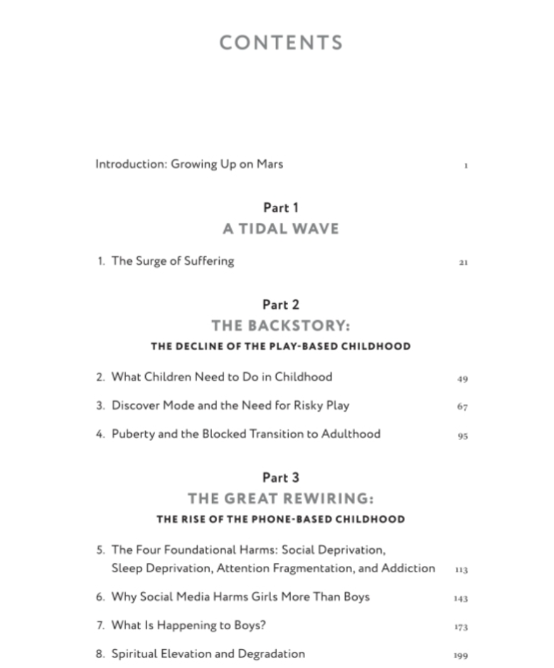
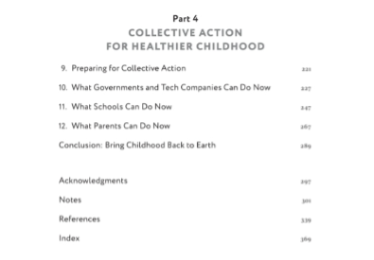
The table of contents below illustrates the layout of the text. The author describes the contents as an explanation for the mental health trends in adolescents since 2010 (part 1); the nature of childhood and how we messed it up (part 2); the harms that result from the smartphone-based childhood (part 3); and what needs to be done to reverse the damage in families, schools, and society (part 4).

Note: Haidt provides all the documents (table of contents, figures, illustrations, etc.), data, helpful guides, chapter supplements, etc. here: https://www.anxiousgeneration.com/research
 

Part 1 | A Tidal Wave of Despair

Haidt begins by making a case for the connection between the decline in the mental well-being of teenagers coming of age in the 2000s, emphasizing a noticeable change in the data from 2010 onwards. Figure 1.1 demonstrates the increase in cases of major depression among adolescents. A significant shift began in 2010.
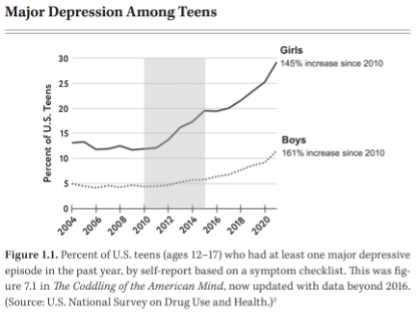
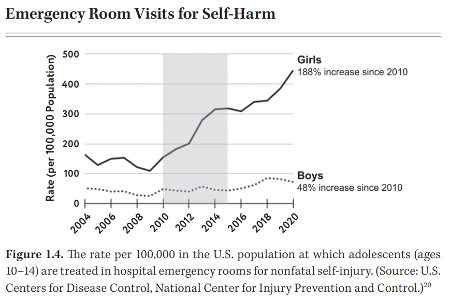
The above data, however, are “self-reported,” which can be less accurate since teens are assessing themselves. Nevertheless, a similar increase in self-harm by teens, something not as easily misreported or faked, also started to rise in 2009, as shown in Figure 1.4.
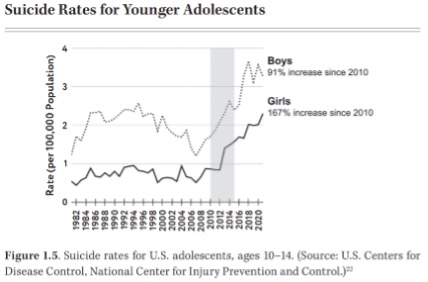
Moreover, suicide rates also rose sharply starting in 2007 (see Figure 1.5). I find the data for 10-14 year old children extremely disturbing. These are kids in 4th to 8th grade – middle schoolers. It’s mind blowing to think that a 10-year-old child could be in such a state of despair that they believe the only thing they can do is end their life.
Despair begins as a battle in the mind. The struggle can often lead a person to be unable to see beyond the present situation. I would argue that many children today lack hope. Hope is the opposite of despair. Hope is about expectation of what is yet to come. How you experience the present is dictated by your belief about the future.

This is often where a deep contrast between a secular and biblical worldview becomes quite evident as it relates to hope about the future. For the atheist (i.e., secular worldview) there is no hope. Life on earth is as good as it gets.

Alternatively, for the follower of Christ, this earthly life is the worst it will be. Everything in the future will be better than it is today. Hope is at the center of a Christian’s life, whereas for the atheist, hope lies in the present and a twofold “purpose” (I put this word in quotes because if life ends at death it has no purpose beyond the atheist’s imagination) to minimize personal pain and maximize personal pleasure. This is not, “Your best life now.”[viii]

“He will wipe away every tear from their eyes, and death shall be no more, neither shall there be mourning, nor crying, nor pain anymore, for the former things have passed away.”
Revelation 21:4

So, what happened around 2010? Why the sharp increases? Haidt argues, it was the introduction of the smartphone in 2007 that changed the lives of many people, especially for Generation Z (those born 1997-2012).

The Internet had been around for over a decade by 2010, and even social media (Facebook started in 2004), but what really changed was not that teens were online, but that now with a smartphone in their pocket they could be online all the time. Haidt reports that by 2016 79% of teens owned a smartphone and 28% of children 8-12 years old also had one.

Furthermore, Haidt cites Pew Research that found one of every four teens in 2015 were online “almost constantly,” and by 2022 the number had increased to 46%.[ix] Also worth noting in 2010 Apple’s iPhone 4 introduced us to the self-facing camera, the ultimate self-promoting technology of the 21st century.

Haidt concludes,

“. . . I refer to the period from 2010 to 2015 as the Great Rewiring of Childhood. Social patterns, role models, emotions, physical activity, and even sleep patterns were fundamentally reset, for adolescents, over the course of just five years. The daily life, consciousness, and social relationships of 13-year-olds with iPhones in 2013 (who were born in 2000) were profoundly different from those of 13-year-olds with flip phones in 2007 (who were born in 1994).[x]

In summary, a significant rewiring began, and we are now reaping the consequences.

Part 2 | The End of Free Play & Discover Mode

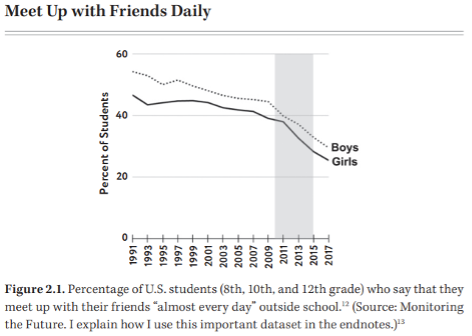
Childhood in the 21st century has definitely changed, and as Haidt argues in part two, it has changed for the worse. One of the most significant changes is illustrated in Figure 2.1. Kids are spending less time with other kids. In 1991, around half of children hung out with their friends every day. Nearly 30 years later, however, the number is down to a third meeting each day. In a sense, kids are getting less social despite the rise in social media use.
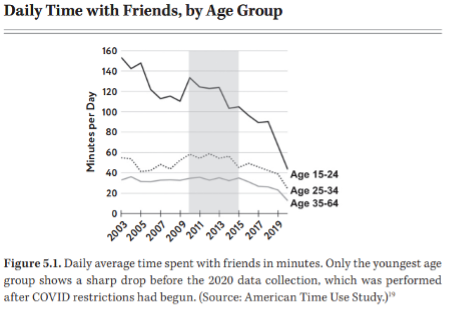
Moreover, when looking at the data in minutes per day (see Figure 5.1), a similar trend occurred, with a dramatic downward shift beginning in 2010. Nearly twenty years ago, 15 – 24-year-olds were spending almost two hours hanging out with friends every day, but in 2019, that time was less than half of what it was in 2003.
Haidt argues that kids are missing out on “free play,” a play that is freely chosen and directed by children with no specific goal. I can remember this type of play being central to my childhood—getting on my bike with no destination in mind, picking up a football and heading to the park, etc. The author suggests that today, parents, teachers, and coaches are too involved in kids’ playing. They can’t stop themselves from taking control and directing the kids.

I’m guilty of this, and you probably are as well if you’ve ever told your children, “Be careful,” “Don’t do that,” “Put that down,” etc. As Haidt suggests, “Experience, not information, is the key to emotional development. It is unsupervised, child-led play where children best learn to tolerate bruises, handle their emotions, read other children’s emotions, take turns, resolve conflicts, and play fair.[xi] A simple way to apply this advice is to tell your children to “work it out” the next time they get into a disagreement.

Chronic social comparison is also something Haidt highlights that is adding to the rewiring of childhood. This is even a problem for children who don’t post anything on social media. They are still prone to comparing themselves to other children. Moreover, this plays a part in “social learning,” by copying others whom children follow online.

Again, this is the natural yearning for most children: they just want to conform (i.e., fit in) to the crowd. When I was growing up, we would refer to this as “peer pressure.” Once more, this furthers the argument that children educated in government or privately run schools could face more significant pressure to conform. As a homeschool dad, this perhaps is one of the greatest arguments for teaching at home – you are the greatest “influencer” in their life simply because you spend more time with them than anyone else.

“A disciple is not above his teacher, but everyone when he is fully trained will be like his teacher.” Luke 6:40

Moreover, as Haidt writes,

Social media platforms are, therefore, the most efficient conformity engines ever invented. They can shape an adolescent’s mental models of acceptable behavior in a matter of hours, whereas parents can struggle unsuccessfully for years to get their children to sit up straight or stop whining. Parents don’t get to use the power of conformity bias, so they are often no match for the socializing power of social media.[xii]

This, however, assumes that all or most social media influences are negative, which is obviously not always true. It does, however, point out that positive social media influencers could be a good thing for older children (e.g., 16+ years old) who are ready to responsibly handle social media.

Central to Haidt’s argument for not allowing younger children to have smartphones or partake in social media is that their brains are developing. Therefore, “Healthy brain development depends on getting the right experiences at the right age and in the right order.[xiii] He cites research that suggests the worst years for using social media is 11 to 13 for girls, and 14 to 15 for boys, thus suggesting 13 (the legal age in the US) is too young for creating a social media account.

I resonate with Haidt’s two mindsets to which children have access based on how they are parented and treated by leaders in school. The mindset that is prevalent today, according to the author, is the “defend mode” mindset. Figure 3.1 outlines this mindset, something consistent with “helicopter parenting” (i.e., never letting your children do anything on their own).

Haidt argues, and this is one of his four leading suggestions, is that parents and educators need to take a step back and let kids live in “discover mode” more often. This is a possible reason why Gen Z often struggles when facing a difficult situation. Haidt writes, “Children who are routinely exposed to small risks grow up to become adults who can handle much larger risks without panicking. . . small mistakes promote growth and learning.[xiv] When parents coddle their children too much it can have a negative effect on them in adulthood. This could be one of the reasons why so many college freshman saw an increase in psych disorders since 2010 as illustrated in Figure 3.2.
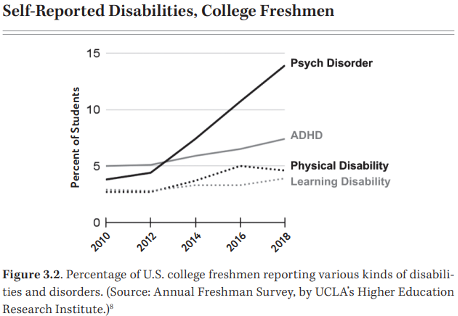
Section two closes with the author pushing for less “safetyism,” which he argues is an experience blocker. When parents and school leaders are focused on keeping kids safe from every little harm, they could be blocking them from learning experiences. Too many rules (e.g., illustrated by “tag rules” in Figure 3.10 from a public school in Berkley, CA) can lead to less experiences where children have to learn to deal with stress and anxiety. They can also strip away the creative abilities children should be developing. A few guardrails are a good idea, but too many lead to children who become coddled adults unable to handle even the smallest of challenges they will face in the grown-up world.

Haid finishes the section by arguing, “Smartphones are a second kind of experience blocker [safetyism is the first]. Once they enter a child’s life, they push out or reduce all other forms of non-phone-based experience, which is the kind that their experience-expectant brains most need.[xv] Between 2010 and 2015, a significant rewiring occurred, and much of it was due to a shift from a discover mode to a defender mode mindset. Haidt argues that the coddling of the American mind had begun, and this was not the children’s fault, but of their parents.

Part 3 | The Rise of a Phone-Based Childhood

Part three centers on evidence of harm from the significant rewiring. Haidt argues there are four foundational harms that have been birthed out of the phone-based childhood. These harms include:

  1. Social deprivation
  2. Sleep deprivation
  3. Attention fragmentation
  4. Addiction

Most people, whether parents or not, can see the truth in these four problems. People, whether children or adults, who spend too much time on social media are going to be deprived socially, sleep less, be less attentive, and in extreme cases, become addicted (this is especially true regarding porn).

Anecdotes can be helpful, but data is still king, and Haidt brings the receipts in this section of the book with plenty of evidence to back up what most of us already know.

“In God we trust, all others must bring data.”
Source unknown, but often attributed to W. Edwards Deming

In this part of the book, Haidt lays out a series of characteristics that I found helpful in defining social media. They include user profiles, user-generated content, networking (e.g., becoming “friends” with others), and interactivity (e.g., likes, shares, and comments). These descriptors fit platforms such as Facebook, Instagram, X, Snapchat, TikTok, Reddit, and LinkedIn. He also includes YouTube; however, YouTube is seen more as a video library site and less for its social features.

Haidt suggests something changed around 2010 when Facebook introduced the “like” button, and Twitter allowed users to “retweet” posts. He argues, “These innovations quantified the success of every post and incentivized users to craft each post for maximum spread.” The author goes on to write, “At the same time, Facebook began using algorithmically curated news feeds. . .[to] curate content that would most successfully hook users.[xvi]

For example, this is why you’re never likely to see anything positive about President Biden if you like Trump positive posts and vice versa. The algorithm furthers your belief and bias toward what you like and believe to be true. You never get “fed” alternative opinions so yours remains the same. One could argue this is one reason we are such a polarized nation.

“A fool takes no pleasure in understanding, but only in expressing his opinion.”
Proverbs 18:2

Suggestion: What Facebook and other social media sites that “feed” your bias need is a “balanced view” feature users can turn on to get alternative opinions on topics, especially controversial topics such as politics, abortion, LGBTQ issuses, religion, etc.

I’m often quick to point out that the most valuable thing God has blessed each of us with is not money or even family. The most valuable thing is time. We all have 24 hours each day, regardless of whether we have wealth and/or family. Time equates to opportunity, and opportunity can be lost if we don’t use it well. Haidt points this out in staggering terms as it relates to social media.

For example, preteens spend around 40 hours a week looking at screens for leisure activities (i.e., non-educational). Teens spend nearly 50 hours. Pew Research reports that a third of teens say they’re on one of the major social media sites “almost constantly.” Doing the math that equates to 16 hours a day – 112 hours per week. That’s what I’d call a major lost opportunity!

“The cost of a thing is the amount of . . . life which is required to be exchanged for it, immediately or in the long run” Henry David Thoreau.[xvii]

Two words that describe this phenomenon are “social labor.” Haidt discusses why so much time is spent online. It’s FOMO, “fear of missing out.” He writes, “The work is often joyless, yet many feel compelled to do it, lest they ‘miss out’ on something or be excluded. Eventually, for many, it becomes a mindless habit, something they turn to dozens of times each day.[xviii] A mindless habit. This is so true. Children and adults with smartphones are too often caught in a mindless habit – a habit that requires no thinking and frequently leads to little learning.

Additionally, Haidt cites research that states the numbers vary by social class and race, which I found surprising. Lower-income families spend more time online, and Black and Latinos are online more than Asians and White families. This is also true of LGBTQ youth, which could be a reason why over 20% of Gen Z identify as LGBTQ, especially those who identify as transgender – something one prominent author describes as a “social contagion.”

“How do we consume as much of your time and conscious attention as possible? Sean Parker, first president of Facebook in 2017 interview.[xix]

What’s the harm? The first harm Haidt points out is something I’ve already discussed above – social deprivation. Kids are spending far less time with other kids. Social media, argues Haidt, is creating more social distance between children. He points to research done by Jean Twenge, which shows that teens who spend time in person with other teens (e.g., playing sports or in religious communities) have better mental health than those spending lots of time on social media.

The second harm is that kids are getting less sleep than they did before smartphones came into existence. Figure 5.2 shows a sharp uptick in teens with less than 7 hours of sleep. This lack of sleep, combined with critical brain development, is a toxic mix that can lead to several problems.
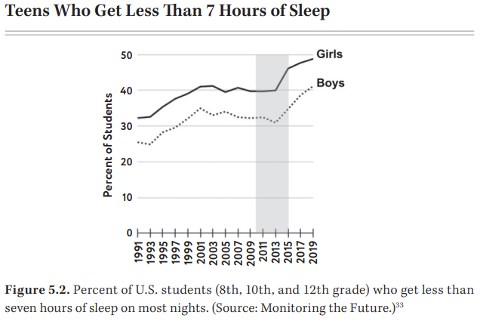
Furthermore, research shows that children (and adults) need adequate sleep to maintain good attention, which leads to the third harm created by social media: attention fragmentation. Haidt writes, “Smartphones are kryptonite for attention.[xx]

Finally, addiction is the fourth and most serious harm caused by smartphones and social media. Research on animals is conclusive that rewarding them based on a “variable-ratio schedule” (i.e., providing rewards on a schedule that is not predictable) leads to the strongest and most persistent behavior. This behavior can be seen by anyone who posts to social media and constantly checks for “likes” and “shares.” We, children and adults, similar to animals, like (no pun intended) rewards, and will keep checking for them when they’re not automatically coming our way.

Girls, Boys, and Social Media
As the father of two girls, I found chapter six of particular interest. The title of this chapter is, Why Social Media Harms Girls More Than Boys. Haidt writes, “There is a clear, consistent, and sizable link between heavy social media use and mental illness for girls, but that relationship gets buried or minimized in studies and literature reviews that look at all digital activities for all teens.[xxi] Later I’ll share what the critics say about Haidt’s claim, but for now look at Figure 6.2 that followed 19,000 children born in 2000 as they matured into adolescence.
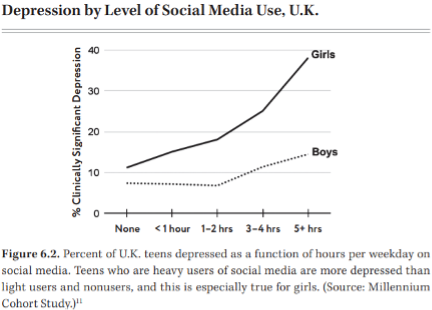
There is a more significant relationship between time spent on social media and the likelihood of depression for girls. Those girls who spend five plus hours on social media are three times as likely to be depressed than those who reported they spend no time on social media.

Furthermore, girls are more likely to become social media “super-users.” Haidt reports that by 2015, one in seven girls had reached this level of social media usage.
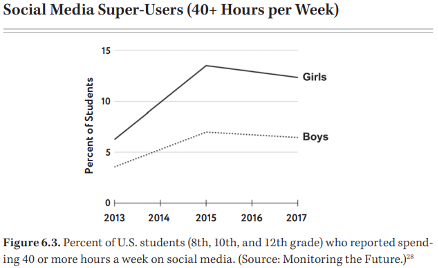
For adolescent girls social standing is often tied to their beauty and sex appeal. As you can see in Figure 6.4, what you see online is not a true representation of reality.
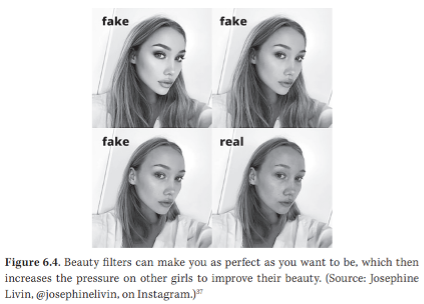
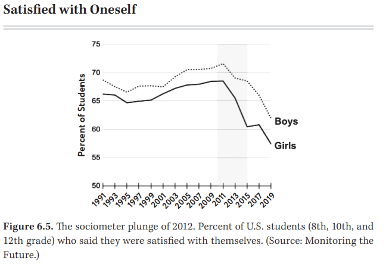
The problems with spending massive amounts of time on social media negatively affect not only girls but also boys. Neither are as satisfied with themselves as they were before the great rewiring in 2010, as illustrated in Figure 6.5.
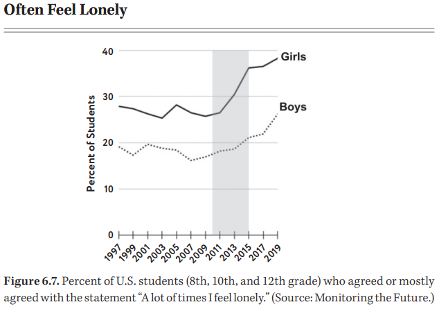
Furthermore, both boys and girls feel lonely more than they ever have, as shown in Figure 6.7.
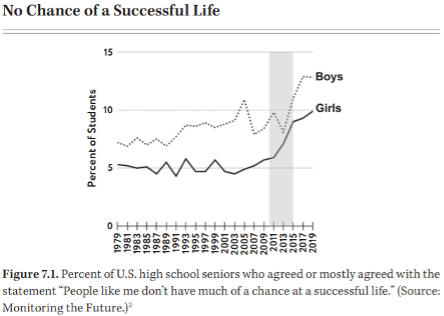
This leads to a not-so-surprising conclusion that neither boys nor girls feel they have a chance for a successful life, as displayed in Figure 7.1.
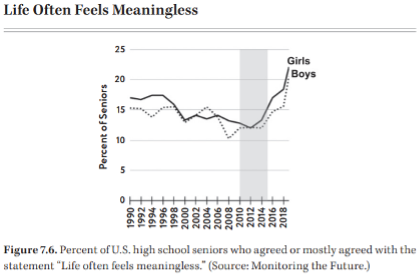
Finally, nearly one in five girls and boys feel that life is meaningless. I’ll discuss this more in the final section of this essay, but in essence it would appear many children see no meaning in life, hence it is meaningless. I will later argue this has much to do with the worldview of most children.
Finally, before I end this section, I want to share my thoughts on the chapter I was most looking forward to reading. This chapter Haidt titled, Spiritual Elevation and Degradation. The author begins by writing, “The phone-based life produces spiritual degradation, not just in adolescents, but in all of us.[xxii] This leads to the question – what does “spiritual” mean?

Spiritual is a word that’s been redefined recently, and Haidt suggests spiritual means to live a life of morality. He suggests that Christians should ask, “What would Jesus do?” Secular people should create their own “moral” example. This is where he also points out that he’s an atheist. He writes, “I am an atheist, but I find that I sometimes need words and concepts from religion to understand the experience of life as a human being.[xxiii] I find this statement so telling about the weakness of atheism. What atheists such as Haidt are actually saying is they cannot make sense of the world (this is what a worldview does) without “stealing” words and concepts from other worldviews (e.g., Christianity).

In other words, atheism has nothing to offer in making sense of the world. If atheism is true, then there’s no point in attempting to make sense of the world because life has no meaning, value, or purpose. We’re born, we die and are quickly forgotten. If you don’t believe this take a second to think about your great great great grandfather. What was his name? Where did he live? What did he do for a living? If you’re like most people, myself included, you can’t even answer the first question. In just a few generations we will all mostly be forgotten. All that we do will have little to no impact on those who follow us. As philosopher and apologist William Lane Craig points out, life is just a purposeless rush toward oblivion, if God does not exist.

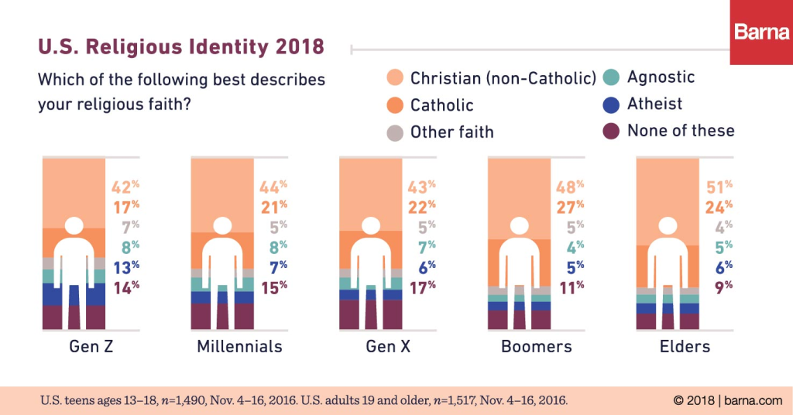
Moreover, the data suggesting life often feels meaningless (Figure 7.6) didn’t surprise me because more young people are identifying as atheist, and if atheism is true, life IS meaningless.

Barna describes Gen Z as, “The first truly ‘post-Christian’ generation.[xxiv] They report the percentage of Gen Z’ers who identify as atheists is double the US adult population (13% vs. 6%).
Summarizing this chapter, Haidt “draws on wisdom from ancient traditions and modern psychology to try to make sense of how the phone-based life affects people spiritually by blocking or counteracting . . . spiritual practices.”[xxv] His argument points to research suggesting that certain spiritual practices improve well-being and that smartphones and social media interfere with these benefits.

Part 4 | Now what?

The final section of the book is where rubber meets the road with practical ideas to address the problem defined in the first three sections. I noted the four recommendations at the beginning of this essay, but as a reminder here they are once again.

  1. No smartphones before high school.
  2. No social media before 16.
  3. Phone free schools.
  4. Far more unsupervised play and childhood independence.

Before he dives into the recommendations he makes a valid point, especially if your children are educated in government or privately run institutions. Haidt argues for “collective action” as a premise to implementing the four recommendations.

Parents need to work with other parents to reduce the problem with fitting in previously discussed. The only way your child will not feel left out is if the children around them are holding to the recommendations Haidt provides. This, I would argue, will be incredibly difficult, especially in larger schools. If you’ve ever tried to organize anything that involves parents and children doing the same thing you’ll know just how challenging this could be.

Furthermore, Haidt suggests government intervention to raise the age (it’s now 13) to create a social media account. More robust validation systems are also needed to determine whether the person signing up for the account is truly of age. As of now, anyone can say they are old enough, and no real validation is done. Haidt argues the minimum age of “Internet adulthood” should be 16.

Next, he lobbies for phone-free schools, where children lock their phones away during the school day to prevent them from distracting them in the classroom. This, again, would require major intervention by school officials and even overprotective parents who say they want to be in constant contact with their children.

Finally, he recommends kids be given more free play to do as they want (within reason) with minimal supervision. Earlier in the book he suggests this is one of the reasons why we’re facing such a big problem with smartphones and social media. Parents need to take two steps back and allow their children to learn, make mistakes, get a boo-boo or two, and work things out amongst themselves when conflict arises.

The Critics | Correlation is NOT Causation

The more popular you are, the more likely critics will emerge and take aim at your work, and Haidt’s writing is no exception. A recent WSJ article summarizes some of the pushback Haidt has received. Much of the criticism is related to the research Haidt uses to come to his conclusion that smartphones and social media are to blame for the problems. In short, the critics point out that correlation does not mean causation. For you non-statistic types, this simply means just because two or more things go up or down together (e.g., social media use and depression) doesn’t mean one is caused by the other (for example).

In a recent podcast discussion, Haidt emphasized the importance of distinguishing between studies that show correlation and those that show causation. Aaron Brown, a former Wall Street trader who currently teaches statistics and math at several universities, disagreed with Haidt during a debate on “The Reason” podcast. Brown pointed out that out of the 476 studies in Haidt’s book, only 22 include data on significant social media use or adolescent mental health issues, and none of them cover both aspects.

Candice L. Odgers, a psychology professor and associate dean for research at the University of California, Irvine, provided a critique of “The Anxious Generation” in the academic journal, Nature. Odgers expressed that the book’s emphasis on digital technologies rewiring children’s brains and causing mental illness is not supported by science. She suggested that the focus on social media as the cause of the mental-health crisis in young people might divert attention from the real underlying factors, such as genetic and environmental influences like gun violence and economic hardship.

I’m an expert in statistical analysis, but not having access to the raw data, it’s hard for me to determine the validity of these claims. However, regardless of the r-squared values, p-values, and correlation coefficients, one can hardly deny that looking at Facebook posts and TikTok videos on a smartphone for 40 – 100 hours a week is not helpful to developing minds.

Parting Thoughts | The Only Influencer to Follow

I conclude this essay with my final thoughts on the book and the problems our children face growing up in the 21st century. It’s been said that, “A problem well stated is half solved.[xxvi] I’ll work to first define what I will argue is the problem before moving on to the causes and solutions; however, first, I need to ask you a question:

What should be the number one goal for parents, especially Christian parents?
Some might say, “Raising good children.” At first glance, I would agree that I want to have “good” children. However, I’d rather have children who become “great” adults. Parents need to start with the end in mind. Children won’t be children forever, so fathers and mothers need to focus on what they can do in the brief time of childhood that will have a lasting impact on adulthood.

“Train up a child in the way he should go; even when he is old he will not depart from it” Proverbs 22:6.

However, a few shocking numbers need to be reviewed before we dive into how to do this. Barna research reports less than 1% of 13 – 14 year olds have a biblical worldview (see Footnote 1 for definition of biblical worldview), and by the age of 13 a person’s worldview is mainly set. This statistic leads to another from the Cultural Research Center at Arizona Christian University that reports two out of every three adults under the age of 40 (67%) say they are still trying to figure out the meaning and purpose in their lives. Children who struggle with life’s meaning (see Figure 7.6 above) become adults who also struggle.

Haidt writes about this struggle.[xxvii] He references French philosopher Blaise Pascal who wrote (loosely paraphrased), “There is a God-shaped hole in every human heart.[xxviii] This is another way of saying many people yearn for something beyond themselves; we have a natural desire to seek God, and when we don’t, something in our lives is missing.

Atheist turned Christian apologist C.S. Lewis summarizes this desire quite well: “If we find ourselves with a desire that nothing in this world can satisfy, the most probable explanation is that we were made for another world.[xxix]

Furthermore, I would argue that the older one gets, the more this “hole” becomes apparent if it’s not correctly filled. Haidt writes, “There is a hole, an emptiness in us all, that we strive to fill. If it doesn’t get filled with something noble and elevated, modern society will quickly pump it full of garbage.[xxx] This truism is ever so true regarding our children. They are going to “follow” and be “influenced” by someone. You, as a parent, play a key role in who these people will be.

So, the question is, are you, parent, ready to take action in helping determine who your children are influenced by and whom they follow? This seems like an obvious and easy “yes,” but I would argue many parents are struggling with the same problem as their children – a selfish nature driven by our own desires to put what we want in life ahead of all others.

One of the greatest lessons I’ve learned as a parent is how selfish I am. This selfishness becomes apparent early on when your child, especially the first child, can do nothing for themselves. They have to come first or they won’t survive! However, as they get older and can do things for themselves it’s easy to move back into a selfish mode of life.

Don’t get me wrong—some good can come from this in that children begin to learn how to be increasingly self-sufficient. However, it’s all too easy to shove a screen in your child’s face when you want to do what you want to do. I’ve been there and done that.

As Haidt suggests, “Social media keeps the focus on the self, self-presentation, branding, and social standing. It is almost perfectly designed to prevent self-transcendence [rising above the self and relating to that which is greater than self].”[xxxi] This phenomena is why social media is such a perfect match for who we naturally are – selfish, ego-driven, conceited beings.

The good news is that once we come to terms with who we truly are, we can take action to change. Furthermore, we can also help our children do the same. Now, going back to my initial question to you regarding our goal as Christian parents, a more complete and accurate answer is that we are to become disciples and make disciples.

“Fathers, do not provoke your children to anger, but bring them up in the discipline and instruction of the Lord” Ephesians 6:4.

Christ Jesus may not have been clear on all that he said (e.g., Jesus rarely gave a “yes” or “no” answer to any question—one, if not the only, Christ-like characteristic contemporary politicians possess). But one thing he clearly described for us is what makes one a disciple of his. Each of the synoptic gospels records Christ’s description of a disciple.

“Then Jesus told his disciples, “If anyone would come after me, let him deny himself and take up his cross and follow me” Matthew 16:24 (see also, Mark 8:34; Luke 9:23)

Do you see the three criteria to become a disciple in Scripture? If Jesus were giving a PowerPoint presentation on becoming a disciple he could sum it up in three bullet points:

  • Deny yourself
  • Take up your cross
  • Follow me

I’ll finish this essay with a quick look at each of these disciple traits and how you can live them out and help your children to do the same. In doing so you will be taking the first step in helping your children move from “me-ology” to “theology.” This is the answer to transforming the Anxious Generation into the Christ-Centered Generation.

“Theology is the study of God. It is the examination of his attributes and abilities, his goodness and faithfulness, who he is and what he has done. Theology is substantial, true, and life-giving. Feasting here will allow us to grow stronger and more into the image of him who made us. Me-ology is frail, precarious, and dependent on you and me who grow tired and weary and make mistakes. Meology is only as good as we are. And we never feel quite smart enough, or disciplined enough, or pretty enough, or energetic enough, or whatever enough. Me-ology prizes you and me. Theology prizes the God of the universe who holds everything together” Jen Oshman.[xxxii]

  1. Deny Yourself
    To deny yourself means you don’t take top priority in your life, Christ does. This is what it means to make Jesus Christ Lord of your life. We naturally want to rule our own lives; do what we want to do; and make our own decisions. The great news is God has given us free will to do all of these. The bad news is we often make mistakes because our sinful natures often want the opposite of what God wants for us until we make a decision to follow Christ and pledge our allegiance toward him and become a new creation (2 Cor. 5:17). To deny yourself means you identify Christ Jesus your first and foremost “Influencer.“
  2. Take up Your Cross
    When you deny yourself and commit your allegiance to Christ, he knows it will lead to persecution; this is what is meant by taking up your cross. The cross was a torture device, and those who heard Jesus speak about it knew he was telling them they should expect to be persecuted. We have good evidence that many of the apostles died excruciating deaths for taking up their cross. Praise God, we are blessed today in the USA that no crosses are being setup (not yet anyway) to hang Christians from.

However, I can say with near certainty if you take a stand against any of the social ills (e.g., abortion, same-sex “marriage”, LGBTQ topics, etc.) plaguing society and the Church today and bring the name of Christ into the conversation you can expect to be persecuted, if not physically most certainly verbally.

  1. Follow Me
    There is only one person you need to be “following,” the man Christ Jesus. And if you follow Christ and live out his commands in your daily life, your children will take notice. They will be following you, and this is where the “creating disciples” process begins. As the popular adage goes, “More is caught than taught.

If you’re looking for a Scripture to remind you of what you need to do in following Christ, consider 1 John 2:4-6,

Whoever says ‘I know him’ but does not keep his commandments is a liar, and the truth is not in him, but whoever keeps his word, in him truly the love of God is perfected. By this we may know that we are in him: whoever says he abides in him ought to walk in the same way in which he walked.

Walk daily with and like Christ and there is a good chance your children will too.

One final thought. First, I highly recommend Haidt’s book. His writing is insightful, balanced, and thought provoking. Below I’ve also included some links to helpful documents he’s provided to help parents raising children during these anxious times.

Additionally, I’d suggest reading George Barna’s book, Raising Spiritual Champions that makes for an excellent Christian complementary text to Haidt’s book. I’ll leave you with Barna’s challenging, yet truthful advice for Christian parents in the 21st century.

“Backbone required. . .The solution is for you [parents] to step up and take control of the media [social media, TV, etc.] that gets exposure in your house. If you fail to do so, three decades-worth of data persuasively argue that you will fail in your hope of raising a spiritual champion [disciple of Christ]. You will be inviting the reigning culture to raise your child for you” George Barna.[xxxiii]

In other words, if you don’t do it, someone else will.

Some helpful links to additional information from the author.


References:

[1] Jeff V. Cook, Seven: The Deadly Sins and the Beatitudes (Grand Rapids, MI: Zondervan, 2008), 34.

[ii] https://jonathanhaidt.com/bio/

[iii] Jonathan Haidt, The Anxious Generation (New York: Example Press, 2023), 9.

[iv] I use George Barna’s definition of a biblical worldview as consisting of believing 1) there is one God. He created the world, 2) All of us have sinned and we need to repent, 3) Jesus’ death pays for our sins, 4) The Bible is true, 5) God defines what is true, 6) LIfe’s purpose is to know, love, and serve God, and 7) Success in life is consistent obedience to God.

[v] Carl Trueman, The Rise and Triumph of the Modern Self: Cultural Amnesia, Expressive Individualism, and the Road to Sexual Revolution (Wheaton, IL: Crossway, 2020), 30.

[vi] Ibid., 222

[vii] John Taylor Gatto, Dumbing Us Down: The Hidden Curriculum of Compulsory Schooling, 25th Anniversary ed. (Gabriola Island, BC: New Society Publishers, 2017), 22.

[viii] Joel Osteen, Your Best Life Now (Nashville: Faithwords, 2015).

[ix] https://www.pewresearch.org/internet/2022/08/10/teens-social-media-and-technology-2022/

[x] Ibid., 35-36.

[xi] Ibid., 53.

[xii] Ibid., 59.

[xiii] Ibid., 62.

[xiv] Ibid., 81-82.

[xv] Ibid., 109.

[xvi] Ibid., 117.

[xvii] Henry David Thoreau, Walden; or, Life in the Woods (Boston: Ticknor and Fields, 1854), 39.

[xviii] Ibid., 58.

[xix] https://www.axios.com/2017/12/15/sean-parker-facebook-was-designed-to-exploit-human-vulnerability-1513306782

[xx] Ibid., 140.

[xxi] Ibid., 146.

[xxii] Ibid., 199.

[xxiii] Ibid., 201.

[xxiv] https://www.barna.com/research/atheism-doubles-among-generation-z/

[xxv] Ibid., 202.

[xxvi] This quote is often attributed to Charles Kettering, who was head of research at General Motors from 1920 to 1947.

[xxvii] Although Haidt writes about a “God-shaped hole,” he wrongly attributes the hole to evolution, suggesting that “Natural selection might have carved out [the] hole.” However, he suggests that his “religious” friends attribute the hole to a longing for a Creator. While I disagree with his evolutionary/atheist assessment I do applaud him on his balanced approach to writing on the topic.

[xxviii] Blaise Pascal, Pensées, trans. A. J. Krailsheimer (London: Penguin Books, 1995), 75.

[xxix] C.S. Lewis, Mere Christianity (New York: HarperOne, 2001), 136.

[xxx] Ibid., 216.

[xxxi] Ibid., 217.

[xxxii] https://www.crossway.org/articles/make-a-change-from-me-ology-to-theology/

[xxxiii] George Barna, Raising Spiritual Giants: Parenting Kids with Purpose, Passion, and Power (Ventura, CA: Regal Books, 2003), 180.


Recommended Resources:

Jesus vs. The Culture by Dr. Frank Turek DVD, Mp4 Download, and Mp3

Counter Culture Christian: Is the Bible True? by Frank Turek (Mp3), (Mp4), and (DVD)        

If God, Why Evil? (DVD Set), (MP3 Set), and (mp4 Download Set) by Frank Turek 

Your Most Important Thinking Skill by Dr. Frank Turek DVD, (mp4) download


Scott Thor is a disciple of Christ, a dedicated husband, and a homeschooling father of two daughters. He is passionate about educating Christians to defend their faith with gentleness and respect, as encouraged in 1 Peter 3:15. Currently, Scott is pursuing a master’s degree in Christian Apologetics at Biola University. Prior to becoming a full-time homeschool dad, he spent 20 years in various roles as an engineer, manager, and executive vice president, consulting for several Fortune 500 clients, including Boeing, Chevron, and Harley Davidson. Despite initially struggling academically—having flunked the 7th grade—Scott discovered the value and purpose in learning, ultimately earning a doctoral degree in management from George Fox University, an MBA from the University of Sioux Falls, and a BS from the University of Nebraska.

Originally posted at: https://bit.ly/46lWVBk

 

How should we live?
How should we think?
How should we vote?

Are these questions with objectively right or wrong answers? That is to say, is it true — apart from human opinion — that humanity ought to live, think, and even vote in a certain manner?

Some Questions that Need Answering

If it is not objectively right or wrong to live, think, or vote in a certain manner, then does anything really matter? Moreover, if it is objectively wrong to live, think, and vote in a certain manner — how would we know? After all, is how we ought to vote determined by the majority vote? That doesn’t seem right. Are these things merely based on your emotions or “how it makes you feel?”

That doesn’t seem right either because, as Ben Shapiro often says “Facts don’t care about your feelings.” One might not have warm feelings toward Ben Shapiro, but it is quite hard to disagree with his mantra. In fact, it is impossible to argue against it without proving his point (since one would have to appeal to facts to argue against the importance of facts).

Ultimately, the answer to these questions boils down to the ontological question: “Does God exist?” More specifically: “Is Christianity true?”

I will soon explain why the existence or non-existence of God is bedrock. But if how we ought to live, think, and vote are based upon this bigger ontological question, the epistemological  questions are raised once again: “How would we know?”

How would we know if God exists — or not? And if God does exist, how would we know if Christianity is true? After all, perhaps Islam, Judaism, or some form of deism is true? How would we know? Can we know?

Before we answer that question, we need ask one more question: “What does it mean to know?” What is knowledge? The late Dallas Willard (my first lecturing professor at Biola University) provides a working definition of knowledge:

[block quote] “We have knowledge of something when we are representing it as it actually is, on an appropriate basis of thought and experience.”[1]

Willard shares that we have knowledge of something when we have proper justification or warrant for our beliefs and that our beliefs regarding it conform to reality. Socrates referred to this justification as a tether to reality.”

A statement is true when it corresponds to reality and reality is the way things are. Knowledge, therefore, must align with truth (based on evidence or insight) and it must be “tethered” to reality. That is to say, knowledge is not based upon luck.

An Illustration from Math Class

To put it in simple terms, consider three students in a math class. The teacher gives the students a multiple-choice quiz to see if they KNOW how to solve a story problem. The first student does not understand the problem at all, but luckily happens to guess the correct answer.

He circles the correct answer on the paper. . . but does he KNOW the answer – does he possess KNOWLEDGE?

The next student does not understand the problem either, but he cheats and looks on his neighbor’s quiz, hoping she got it right. And he circles one of the alternative options, the same one his neighbor circled.

The answer happens to be correct, but does he KNOW the answer?

Finally, the last student not only understands the problem just fine, but she shows her work leading to the correct answer. The fact that she “showed her work” is the “tether” that demonstrates to her teacher, and to herself, that she possesses KNOWLEDGE of reality.

Now, one may happen to possess true beliefs. If, however, he does not possess a proper justification,  a “tether” for a specific belief, and his true beliefs are simply based on “luck,” his belief does not qualify as a knowledge claim (even if it happens to be true).

Willard notes that rational people are those who base their lives upon knowledge. It is not required to know something is true with absolute 100 percent certainty. It simply requires a commitment to a way of life and thought based upon evidence and a justified trust in God through knowledge.

A Tether to Reality

Let us return to the BIG question: Can we have real knowledge of God? A cumulative case of evidence appealing to logic, science, and history pointing toward God’s existence and the truth of Christianity says we can. Consider a few of these multiple “tethers”:

These evidences provide the justification required for the knowledge of God, but what view of God is true? After all, we have the “final four” from which to choose:

  1. Christianity
  2. Judaism
  3. Islam
  4. Deism

This all comes down to the “tether” or historical evidence of the resurrection of Jesus Christ. Since Judaism, Islam, and deism all deny the resurrection of Jesus, and Christianity affirms it, if there is evidence based upon the historical method that Jesus actually rose from the dead, then Christianity would provide the BEST explanation of all the data. Guess what . . . we have that evidence:

  1. The Historical Argument for the Resurrection of Jesus (The Facts)
  2. The Historical Argument for the Resurrection of Jesus (The Explanation)

It is also vital to note that Christianity enjoys the “Ring of Truth” when compared and contrasted against other contenders. Moreover, we can also have knowledge of God through a personal and experiential relationship with Him through the inner witness of the Holy Spirit — but this is also supported by all the evidence previously mentioned.

With a cumulative case of logical arguments in mind, a Christian should be a person of faith . . . because he or she is primarily a person of knowledge. Christians put their trust in what they know is probably true. This is what William Lane Craig refers to as “reasonable faith.”

What I’m NOT Saying

Please hear me: I am not proposing that we can know Christian theism is true with 100 percent certainty — if we had that it would not be “faith.” We can, however, gain knowledge of God with a high degrees of certainty. This includes not only knowledge of a powerful and personal Creator of the universe, but also knowledge of the particular truth of Christianity through evidential and spiritual means.

If God exists and Christianity is true, then it would follow that humanity was created to live a certain way and created to think in a certain manner. That is to say, there would be some objective “shoulds” to how humans ought to live and how we ought to think. It logically follows that this would even include how we ought to vote and think about cultural and political issues (See “The Great Commission Is Racist” as an example).

Now, many people think that we should not mix politics and religion. Is that true?  Are they right? Why think a thing like that?

A Tether to Political Reality

It would be absurd not to have one’s worldview (religion) influence their politics. In fact, one’s worldview ought to do at least that much (and not the other way around). That is to say, if one truly believes that God exists, created humanity on purpose and for a specific purpose, and that Jesus revealed how we ought to live, then the laws of politicians will either approximate the “law above the law” (ultimate reality) or not.

If this is the case, then politicians can actually pass “illegal laws” that “We The People” ought to resist and rebel against.

If God does not exist, however, then humanity was not created on purpose or for any specific purpose. Thus, we would be mere accidents if atheism is true. If humanity is nothing but accidents then politics is objectively meaningless (along with everything else) as there would be no objective purpose in the existence of humanity (if this is the case, say goodbye to objective or unalienable human rights).

Thus, on atheism, it would not really be wrong (objectively speaking) if Obama, Trump, Hitler, or Stalin were calling the shots. It is simply one’s irrelevant subjective opinion (which is merely causally determined by physics and chemistry).

If God exists and Christianity is true, however, then one’s subjective political opinions can be objectively right or objectively wrong.

A Tether Between Politics & Gospel

It is often asserted — even by some Christians — that they do not want their “politics and religion mixed.” This is a good indicator that they probably do not understand their own religion for at least two reasons: (1) Jesus got involved in politics, and (2) we are commanded to love all people and to share the gospel with the world.

First, consider the fact that Jesus constantly interacted with the Pharisees in the New Testament. The Pharisees were the religious and political rulers of Israel. Matthew 23:23-24 provides a good example (note that Jesus was not always “nice”):

23 “Woe to you, teachers of the law and Pharisees, you hypocrites! You give a tenth of your spices—mint, dill and cumin. But you have neglected the more important matters of the law—justice, mercy and faithfulness. You should have practiced the latter, without neglecting the former. 24 You blind guides! You strain out a gnat but swallow a camel.”

Frank Turek points out the following in Does Abortion Trump Everything Else? (I encourage all to listen to this podcast in its entirety):

“Not all moral laws are of equal weight. Jesus spoke of weightier matters of the law in Matthew 23:23. And the least of these, Matthew 5:19. And the greatest commandment, Matthew 22:36. He told Pilot that Judas had committed the greater sin, John 19:11.”

Think about the weightier or “more important matters of the law” and modern-day America. Politicians today are more concerned about the consequences of using plastic drinking straws than placing restrictions on abortion (killing millions of innocent human beings) and actually advocate for it in many cases. What do you think Jesus would say to these politicians or those who vote for them? Based on His reaction to the political leaders of Israel, do you think Jesus would worry about hurting the feelings of modern-day politicians or those who vote for them?

Indeed, I believe Jesus would say “facts don’t care about your feelings.” We must not disregard the “more important matters of the law.”

Second, if a Christian does not take politics seriously, then he or she probably does not take evangelism seriously. Turek shows a satellite image of the Korean peninsula to make this point (See Why Christians Should Be Involved In Politics).

Notice the stark contrast between the north and south. South Korea is filled with light, activity, and productivity. According to Turek, “it is one of the most Christianized countries in the world.” North Korea, on the other hand, stands in polar contrast to their neighbors south of the border. North Korea is dark and seemingly “dead.” Turek accurately describes it as a big “concentration camp.” What is the difference between North and South Korea? One word: POLITICS! We can clarify: Communism!

Many South Koreans have heard the gospel of Jesus Christ because there is political freedom to share the gospel. The communist government of North Korea, on the other hand, does not allow the gospel to be shared — it is a communist dictatorship based upon Marxism which is an ideology that makes Hitler’s Nazism look like a summer picnic. Indeed, we must treat the “hammer and sickle” in the same manner in which we treat the swastika.

If the gospel message is true (and we have good reason to believe it is true) then this is the most important information a person could ever have access to or possess. If we truly love all people — as Jesus commanded — then we must desire the people who have never heard the gospel to have access to this eternally vital information.

Since Marxist policies (politics) are keeping millions of souls from hearing the gospel, if we truly love and care for all humans, then we ought to care about politics and vote in a certain manner. We ought to be “Anti-Ma” (anti-Marxism). To not care about politics is to not care about people.

The Lesser of Two Evils

If Christianity is true, then we must “mix” it with politics — at least if you are striving to love God with all of your mind and live a consistent Christian life striving to love all people. After all, if Christianity corresponds to reality, then the politicians you support and vote for should advance policies that correspond to reality too. Of course, no politician will do this perfectly, but some political views and policies approximate to reality (and the nature of God) more than others.

Unless Jesus Christ is running for office, all elections are a vote between the lesser of two evils. As Turek notes, if Billy Graham was running against Hitler, it would still be a vote between the lesser of two evils. Obviously, one who strives to be an objectively good person would do anything possible to keep Hitler — because of his politics — out of office (even if Hitler happened to be “nicer” than the other candidate). That would include “mixing” politics with religion and sharing his or her views with as many voters as possible.

Bottom line:  Understanding ultimate reality by way of apologetics, philosophy, and logical theology places humanity in a position to know how we ought to live, think, and even how we ought to vote in an objective sense. Indeed, understanding ultimate reality provides an expertise allowing one to intelligently provide insight into things that fall under the umbrella of ultimate reality — like some political issues — as an expert too. That is to say, political opinions can be informed from knowledge of reality.

If one’s religion is true and their political view is also objectively good or right, then one’s religion and politics must be “mixed” . . . independent if they realize it or not. Moreover, if there is an objective manner in which we ought to live and think, then one’s vote will be objectively right or objectively wrong. Choose wisely and stay reasonable (Isaiah 1:18).

References:

[1] Dallas Willard, Knowing Christ Today: Why We Can Trust Spiritual Knowledge, Harper Collins, New York, NY, 2009.

Recommended resources related to the topic:

Legislating Morality: Is it Wise? Is it Legal? Is it Possible? by Frank Turek (Book, DVD, Mp3, Mp4, PowerPoint download, PowerPoint CD)

Reflecting Jesus into a Dark World by Dr. Frank Turek – DVD Complete Series, Video mp4 DOWNLOAD Complete Series, and mp3 audio DOWNLOAD Complete Series

Correct not Politically Correct: About Same-Sex Marriage and Transgenderism by Frank Turek (Book, MP4)

Jesus vs. The Culture by Dr. Frank Turek DVD, Mp4 Download, and Mp3


Timothy A. Stratton (PhD, North-West University) is a professor at Trinity College of the Bible and Theological Seminary. As a former youth pastor, he is now devoted to answering deep theological and philosophical questions he first encountered from inquisitive teens in his church youth group. Stratton is founder and president of FreeThinking Ministries, a web-based apologetics ministry. Stratton speaks on church and college campuses around the country and offers regular videos on FreeThinking Ministries’ YouTube channel.

Originally posted at: https://bit.ly/3KL9SdU


Over the last several years, I’ve spoken on the subject of apologetics to many groups of parents at churches and conferences. Although none of my talks deal with the topic of sexuality, I can hardly think of a time when I wasn’t asked a question about it either in the Q & A or in private conversation afterward with an individual parent. In particular, parents always want to know what they should say to their kids about homosexuality and transgender questions. These are undoubtedly the most top of mind questions parents have today.

Not the Sex Question Again!

While I can appreciate that these specific questions are front and center in culture, I always feel a bit disappointed when I get them. Frankly, I feel like we’ve really missed the boat if this is the “big” question people have after a much broader talk on apologetics. I say that for two reasons.

First, kids won’t care what the Bible says about homosexuality and transgender questions if they don’t view the Bible as authoritative. That’s why my answer to parents always begins the same: “Can you tell me first what your child believes about the Bible? Does he/she believe it’s the authoritative Word of God?” I’d say that out of 10 people who ask the question, a solid 7 of them will say, “I’m not sure.” It’s deeply problematic that many Christian parents have come to believe that our biggest conversation challenge in today’s culture is how to answer controversial questions about sexuality . . . even though they often aren’t sure what their kids believe about the Bible itself! If we spent as much time teaching kids why there’s good reason to believe the Bible is true as we did addressing subjects that today’s culture happens to bring to the forefront, we would be in a much more natural position to address difficult topics.

Second, there is so much more than homosexuality and transgender questions that our kids need to understand about a biblical view of sexuality. That’s why I’m thrilled about Sean McDowell’s new book, Chasing Love: Sex, Love, and Relationships in a Confused Culture. It’s a book for teens that provides a comprehensive biblical look at sex, love, and relationships–the best resource I’ve seen on the subject!

Sean took the time to answer several questions I sent him on how to talk with teens about sex and love. Enjoy the following interview, and if you have kids in this age range, you must get this book.

An Interview with Sean McDowell

Natasha: Sean, when Christian parents think about conversations they need to have with their kids about sex, they’re often thinking about two basic things: 1) How do I teach my kids (and convince them!) that it’s biblically right and best to wait for marriage? and 2) How do I talk about the hot cultural topics of homosexuality and gender identity from a biblical perspective? But, as your book shows, these questions only scratch the surface of a whole framework kids need to have for thinking about love and sex from a biblical worldview. Can you explain why this approach is so important, and give some examples of subjects you cover outside of what parents typically think about?

Sean: After working with thousands of young people for a couple decades, I am convinced that the vast majority of Christian kids are far more secular in their thinking than we realize. Studies by the Barna Group support this observation. Thus, it’s not enough to simply teach biblical principles to our kids–we have to first deconstruct their secular ideas about love, freedom, and happiness, and then biblical teaching will make sense.

I was speaking at a conference in early 2020 and a teenager came up to me and said, “Thanks for your talk on pornography. I have been told my whole life why porn is wrong, but I never understood why.” Being told what to believe is not enough today. Kids need to know why the Bible gives the teaching that it gives. In my experience, when kids get the “why” behind the “what,” they are empowered to live out a Christian sexual ethic.

Once kids understand the positive reasons for the biblical teaching on sex, love and relationships, then they are in a much better position to discuss some of the “thornier” topics today including pornography, sex abuse, LGBTQ issues, and so on. That’s why I arranged the book in three main sections: (1) Clearing away faulty ideas from our culture, (2) explaining the biblical view of sex, love, and marriage, and then (3) “hot topics.”

Natasha: Christians are often known for what we’re “against” when it comes to topics of love and sex, and that perception easily gets passed on to teens. What are some things Christian parents do that inadvertently solidifies this view in their kids’ minds?

Sean: One trap Christian parents can fall into is being entirely critical of how non-Christians tend to approach sex and relationships. While there is undoubtedly a time and place to criticize how our world approaches sex, I try to help students find redeeming truths underneath the surface. Let’s lead with common ground, and then we can get to our differences.

For instance, consider the topic of cohabitation. As I document in Chasing Love, the research shows that living together before marriage puts a future marriage at a serious disadvantage. Students need to know why cohabitation is a bad idea. But we also need them to realize that many people live together first because they actually think it will help them in their future marriage. Many have seen their parents go through a divorce and they don’t want to make the same mistake. So, underneath the bad idea of living together is often a good desire to have healthy relationships.

Rather than leading with criticism, let’s lead with what we have in common with others. In this case, it’s the desire for lasting relationships. Then we can get to our differences. In my view, this approach is biblical, charitable, and often more effective (see Proverbs 24:3).

Natasha: What are some of the big things you want teens to understand Christians are “for” in the areas of love and sex?

Sean: One of the main takeaways I hope students get is that the commands of Jesus are for our good. In one of the early chapters, I ask students to imagine what the world would be like if everyone followed the sexual ethic of Jesus. There would be no sexually transmitted diseases, crude sexual humor, sex abuse, pornography, abortion, or deadbeat dads. My goal is for students to realize that the teachings of Jesus are for individual flourishing and for societal good. God’s commands are not to harm us, as our society proclaims, but are actually for our good.

In sum, God is for marriage. God is for love. God is for commitment. God is for meaningful relationships. God is for sex. But He has given us guidelines about how to experience these in a way that shows love to Him and to others.

Natasha: You speak to and teach a lot of kids in the age range this book is written for. In your experience, what do they most misunderstand about what the Bible teaches on these subjects?

Sean: In my experience, students are deeply confused about the nature of freedom. Many young Christians think that freedom is doing whatever they want without restraint. But this freedom from is only half the story. There is also freedom for. Think about it this way: Just like a car that has been designed by its creator to operate in a certain fashion, and is only “free” when used accordingly, humans have been created for a greater purpose and experience freedom when they discover and live that purpose. The free person not only has the capacity of choice (freedom from) but orients his or her life to God’s design (freedom for).

So, what have we been made for? Scripture says we are made to love God and love other people. In other words, we are only free when we are in healthy, intimate relationships with others. Here is how I put it in Chasing Love: “According to the Christian worldview, true freedom is not a matter of doing what you want without restraint, but cultivating the right wants and living in obedience to God’s will. In other words, freedom results when our wants align with the will of God.”

Students tend to believe that God’s commands limit their freedom. What we must help them see is that God’s commands actually set them free. That’s why David rejoiced in the law of the Lord (Psalm 119). And that’s why Moses said that God’s commands were for the good of the Israelites (Deuteronomy 10:13).

Natasha: Let’s be honest—a lot of parents are pretty uncomfortable talking about sex-related subjects with their kids. For some parents, it may even be hard to hand their kids a book like Chasing Love! Can you share some ideas for how to break the ice and not feel completely awkward handing your teen a book on these subjects? And what might a parent say to get their child interested in reading this if they don’t necessarily want to read another “Christian” book from mom and dad?

Sean: I told my 12-year-old daughter that if she read the book and was willing to simply talk with me about it, I would buy her some new shoes. This strategy may not work with all kids, but it did with her. She agreed to read it entirely and then go to the local coffee shop with me and simply discuss it (no lectures!). I asked her what she learned, what stories stood out to her, and if there was anything she disagreed with. And then we went together to buy the shoes (for the record, she talked me into buying two pairs at the outlet since they’re the price of one pair elsewhere!).

If you haven’t talked with your kids about sex, I would encourage you to take your son or daughter out for a meal or coffee and just share your story. Don’t lecture your son or daughter, but just share your experience with relationships and some lessons you’ve learned along the way. And then you can give the book as a follow up that expresses your heart for your son or daughter.

Natasha: If you could give parents one piece of advice on using your book effectively in their kids’ lives, what would it be?

Sean: Find a way to motivate your son or daughter to read it. And consider reading it alongside them. Students will benefit from reading it alone, but they will benefit immensely from discussing it with you. Studies show that worldviews are best passed through relationships. Simply discussing these issues with your kids, even if you don’t have all the answers, is a “win” for them. I realize these conversations can be awkward, but if we don’t talk with our kids, they will almost assuredly take their cues about sex, love, and relationships from the wider culture.

Recommended resources related to the topic:

Sex and Your Commanding Officer (DVD) (Mp4 Download) by Dr. Frank Turek

4 P’s & 4 Q’s: Quick Case FOR Natural Marriage & AGAINST Same-Sex Marriage (DVD) by Dr. Frank Turek 

Correct not Politically Correct: About Same-Sex Marriage and Transgenderism by Frank Turek (Book, MP4)

Jesus vs. The Culture by Dr. Frank Turek DVD, Mp4 Download, and Mp3


Natasha Crain is a blogger, author, and national speaker who is passionate about equipping Christian parents to raise their kids with an understanding of how to make a case for and defend their faith in an increasingly secular world. She is the author of two apologetics books for parents: Talking with Your Kids about God (2017) and Keeping Your Kids on God’s Side (2016). Natasha has an MBA in marketing and statistics from UCLA and a certificate in Christian apologetics from Biola University. A former marketing executive and adjunct professor, she lives in Southern California with her husband and three children.

Original Blog Source: https://bit.ly/45rXVDj

Some time has passed since controversial advice resurfaced from popular preacher Alistair Begg on his radio program, “Truth for Life.” The controversy revolves around Pastor Begg shocking a grandmother with the advice to not only attend her grandson’s transgender wedding but also to buy them a gift.

To reinforce the grandmother attending the trans wedding, pastor Begg prefaced it by saying, “Well, here’s the thing: your love for them may catch them off guard, but your absence will simply reinforce the fact that they said, ‘These people are what I always thought: judgmental, critical, unprepared to countenance anything.'”

Days following the backlash Begg and his ministry received, a spokesman for “Truth for Life” published this statement: “Alistair’s advice to the inquirer was that of a grandfather [Mr. Begg] seeking to help a believing grandmother maintain a relationship with her unbelieving [grandchild] and was in no way an endorsement of the unbiblical ceremony.”

Before delving into my thoughts on Alistair Begg’s troubling advice, I want to express my deep appreciation for him. Pastor Begg is undoubtedly one of our era’s most humble and thought-provoking preachers. His profound biblical teachings have significantly nurtured my faith and honed my pastoral skills. My forthcoming comments are solely in response to his controversial remarks. They should not be misconstrued as a critique of his admirable character, his unwavering love for the Bible, or his impactful public ministry.

Against this background, I will present three areas of biblical doctrine that will act as direct confirmation to pastor Begg that his advice is inconsistent with what he believes doctrinally and reveals a compromise that caters to the sexual revolution currently undermining Christian ethics.

Compromise #1: Attending an LGBT wedding overlooks God’s identity of male and female

Before Begg shared his insights, he inquired if the grandmother had made it clear to her grandson that attending a trans wedding does not necessarily mean endorsing LGBT ideology. While this is an important consideration, it still leaves an unresolved issue that Begg overlooks – what exactly is being celebrated at an LGBT wedding?

Answer: A gay couple’s sexuality. A trans person believing they are a different gender than what God gave them at birth.

Let us now compare that with what the Bible says about humanity. From the beginning, God made humans with two biological sexes, male and female. God did not make male and female “according to their own kind” but in the likeness of Himself—making the two fit together in a complementary (suitable) way for each other (Genesis 2:18-20).

Although God made us sexual creatures, our sexuality, however, is not our identity. It is not what defines us. Sexuality merely explains an aspect of our identity. It is not who we are but how we are. Anything that runs contrary to God’s design is dishonorable to Him and is not (in any way) to be excused, ignored, or celebrated.

Just to be clear, Begg wholeheartedly affirms the Bible and never in any of his preaching condones homosexuality or transgenderism. In fact, in 2022, Pastor Begg preached a sermon at Parkside Church from the very contentious Romans 1:26-27 passage, in which he said, “Why would I ever come here and do verses 26 and 27 unless I absolutely believed that the Bible is God’s Word that it is unerring, and it speaks truth, even on a Sunday morning like this in 2022. We’re not at liberty to rewrite the Bible to accommodate godless perspectives on abortion, on euthanasia, on same-sex marriage, on transgenderism, and more. We’re not.”

That is why it is even more troubling to hear Begg advocating for Christians to attend an LGBT wedding.

How is the presence of a Christian attending a wedding an act of love when the couple at the altar is a public display of the sexualized revolution that vehemently opposes God’s creational order?

How does this demonstrate the Christian’s respect for God, others, and their personal beliefs?

Christians are duty-bound to uphold God’s standards for what it means to be a man and what it means to be a woman.

Compromise #2: Attending an LGBT wedding undermines God’s definition of marriage between a man and a woman

According to the Word of God, marriage is a sacred union intended to be shared between a man and a woman. It reflects the desire for intimacy that God instilled in men and women. Faithfully being married and sharing in sexual intimacy is considered one of the most rewarding relationships created by God.

For this reason, Begg’s comments are more than a “agree-to-disagree” matter between Christians. Striving to be a practitioner, Begg exaggerated the perception that not attending is a sign of rejection rather than acknowledging the mandate to “take no part in the unfruitful works of darkness” (Ephesians 5:8).

Attending an LGBT wedding or any other ceremony that goes against biblical teachings raises the question of whether we should ignore Jesus’s teachings for the sake of our witness. According to Jesus (see Matthew 19:4-9), divorcing and remarrying without biblical grounds is considered adultery. So, do we apply Begg’s same reasoning to attending such a wedding?

Again, this flawed reasoning contradicts what we read in Scripture. The answer lies in understanding the Bible’s teachings about marriage and human sexuality. Hebrews 13:4 states, “Let marriage be held in honor among all, and let the marriage bed be undefiled, for God will judge the sexually immoral and adulterous.” Here, the writer of Hebrews maintains the sacredness of sexual intimacy within the marriage bond while, at the same time, warning of God’s judgment on those who commit sexual immorality and adultery.

While it is essential to love and show respect to all individuals, any “marriage” that goes against God’s standards is not something Christians should support. Otherwise, they may be perceived to support a union that deviates from God’s divine design and, therefore, be judged for passively allowing people to celebrate their sin.

Compromise #3: Attending an LGBT wedding actually weakens a Christian’s witness

In his final comments about attending an LGBT wedding, Begg concluded, “We’re going to have to take that risk a lot more if we want to build bridges into the hearts and lives of those who don’t understand Jesus and don’t understand that he is a King.”

What exactly does Begg mean when he says Christians are ‘going to have to take that risk a lot more’?

Is Begg suggesting that Christians should attend a “gay” wedding for the gospel’s sake? Yes, I think that is the real motivation behind Begg’s advice. The potential harm this could cause a Christian is far more significant, however, than he implies.

It is false to say that attending an LGBT wedding is a sign of true love and “building bridges.” If anything, the Christian who attends an LGBT wedding is risking their witness before God and man. Not the reverse. This does not mean that Christians should act in judgment or condemnation towards those with different beliefs or lifestyles. It is important, however, to consider how our actions may be perceived by others while remaining true to our convictions.

Let us not sugarcoat it. Your presence as a Christian speaks volumes at an LGBT wedding, but not because the gay-affirming wedding party is blown away by your showing up. Instead, your presence signifies that they have persuaded another Christian to (in some small way) embrace inclusivity despite any pressures or convictions.

Do you remain silent when the Wedding Officiant asks if anyone objects to this marriage? If you do, are you indicating your approval to the couple and everyone in attendance? When the couple kiss and are announced married, do you smile and cheer? When everyone raises a glass to the couple, do you raise yours in solidarity?

In his thoughtful article, “Should Christians Attend Gay Weddings? Does It Matter Whether They’re Religious or Secular?” Randy Alcorn clears things up by writing,

“When you attend a gay person’s birthday party, you’re joining in celebrating their birthday, right? That’s great. When you invite your gay or lesbian friend over for dinner, you’re celebrating friendship and life—no problem. When you toast to good health, great. But when you raise your glass and toast to a wedding that you are convinced dishonors God, or is not a true wedding at all, isn’t that radically different?”

Attending an LGBT wedding can be seen as giving a blessing to the gay or trans couple. This is not a risk any Christian should be willing to take in order to stand as a witness for Christ.

As a follower of Jesus Christ, your ultimate goal is to obey His commandments and fulfill His purpose for your life. The primary commandment is to love the Lord with all your heart, soul, mind, and strength (Matthew 22:36-40). As a devout Christian, your priority is not primarily focused on making and maintaining friendships. Instead, you are called to dedicate yourself to serving God rather than pleasing others. In his letter to the Galatians, Paul questions whether he seeks approval from man or God. He emphasizes that seeking favor from man alone would make him inadequate as a “servant of Christ” (Galatians 1:10).

A loving relationship should not be limited to whether you attend a gay wedding. You can show love for your gay or trans friend or family member by respectfully declining to attend their wedding. Let them know how much you love and care for them but that your relationship with Jesus comes first, and you hope they can respect that about you. You can still love your gay or trans friend or family member in other ways. You can support and show love for your LGBT community by communicating openly, being friendly, and valuing their worth as individuals created in God’s image.

Pastor Begg and I may not see eye-to-eye when it comes to attending an LGBT wedding, but despite our disagreement, I pray for him and his ministry. I hope that one day, he will change his heart on this issue. Until then, I will remain hopeful and seek to preserve the unity in the body of Christ.

Recommended Resources On This Topic

Correct, Not Politically Correct: About Same-Sex Marriage and Transgenderism 2023 Edition by Dr. Frank Turek Book 

You Can’t NOT Legislate Morality mp3 by Frank Turek

Does Love and Tolerance Equal Affirmation? (DVD) (Mp4)  by Dr. Frank Turek

4 P’s & 4 Q’s: Quick Case FOR Natural Marriage & AGAINST Same-Sex Marriage (DVD) by Dr. Frank Turek 


Jason Jimenez is President of STAND STRONG Ministries and author of Challenging Conversations: A Practical Guide to Discuss Controversial Topics in the church. For more info, check out www.standstrongministries.org

Originally Posted at: https://bit.ly/3Xgh8pB


Many Christians believe that philosophy is a pagan discipline practiced either by ivory tower professors or Starbucks hippies. This belief has led some to object to the relevance of philosophy, as either they believe only a few can do it, or that it deals with such weird and abstract issues that it is a waste of time. Many Christian theologians object that philosophy is rooted in paganism, and thus has no place in Christian theology. After explaining what philosophy is, it should become clear that not only do these objections fail, but philosophy is unavoidable.

For the Love of Wisdom…

‘Philosophy’ literally means “love (phil) of wisdom (sophia).” It is the quest for knowledge, truth, and how to live the good (moral) life.

Fields of Philosophy

There are several branches of philosophy. One, and the most foundational, is metaphysics. Metaphysics is the study of being, or what it means to be real. While biologists study life insofar as things are living, and mathematicians study being as quantified, and physicists study being that is physical or in motion, the metaphysician studies what it means to “be” in general. They ask questions like, what is the difference between Snoopy and a beagle one can take for a walk?

Another branch of philosophy is epistemology, which is the study of knowledge. Epistemologists ask questions like, “How can knowledge be attained,” “What is knowledge,” and “Is there a difference between knowledge and belief?”

Moral philosophy seeks to know what it means to be good in the moral sense. Where does goodness come from, and what makes something good?

Logic studies right reasoning and the mistakes (fallacies) that are sometimes made when trying to make a rational argument.

Aesthetics studies the nature of beauty, and asks “What does it mean to be beautiful? Is beauty objective?” And so on.

From these categories there are any number of other philosophical fields. The philosophy of math deals with the nature of numbers, and asks if numbers are real (e.g. does the number 4 actually exist). In other words, it deals with the nature of math. Philosophy of science deals with the nature of science. The philosophy of history deals with the nature of history and historical knowledge. My area is philosophy of religion, which deals with issues like God’s existence, nature, how we talk about him, the problem of evil, and the nature of miracles.

Is Everyone a Philosopher?

When you say something that purports to be true, you are talking about reality, and are claiming to know something. You are also making a logical claim. Further, you are assuming (explicitly or implicitly) a certain view of how language works (philosophy of language). Even if you are just talking about the tree in your front yard, you are saying something about the tree’s existence and nature. I am not saying that everyone is a “philosopher” in the strict, academic sense. What I am saying, is that it is not possible to make statements about the world, God, or the Bible without taking philosophical positions, regardless of if you are aware of them or not.

Theology Can’t Avoid Philosophy

The same holds true for theology and biblical studies/interpretation. We cannot make theological claims without using philosophy. For example, when we talk about Jesus taking on a human nature, we must understand what a “nature” is. This is a philosophical category. When a scholar says that biblical interpreters cannot be objective due to their biases, this is a philosophical statement about the nature of objectivity, bias, the knower, and the knowing process.

Far from this being a pagan practice, it is how God made us. He made us rational beings. This is what makes us different from other animals. Philosophy is useful and unavoidable. Instead of trying to avoid it, we should try to become better philosophers, and worship God with our minds.

“Teacher, which is the greatest commandment in the Law?”
Jesus replied: “‘Love the Lord your God with all your heart and with all your soul and with all your mind.’ This is the first and greatest commandment.”
Matthew 22:36-38

Recommended resources related to the topic:

How Philosophy Can Help Your Theology by Richard Howe (MP3 Set), (mp4 Download Set), and (DVD Set)

Your Most Important Thinking Skill by Dr. Frank Turek DVD, (mp4) download

Counter Culture Christian: Is the Bible True? by Frank Turek (Mp3), (Mp4), and (DVD)

When Reason Isn’t the Reason for Unbelief by Dr. Frank Turek DVD and Mp4


J. Brian Huffling, PH.D. have a BA in History from Lee University, an MA in (3 majors) Apologetics, Philosophy, and Biblical Studies from Southern Evangelical Seminary (SES), and a Ph.D. in Philosophy of Religion from SES. He is the Director of the Ph.D. Program and Associate Professor of Philosophy and Theology at SES. He also teaches courses for Apologia Online Academy. He has previously taught at The Art Institute of Charlotte. He has served in the Marines, Navy, and is currently a reserve chaplain in the Air Force at Maxwell Air Force Base. His hobbies include golf, backyard astronomy, martial arts, and guitar.

Original Blog Source: Brian Huffling


In the following piece, I will discuss the ongoing controversies surrounding Andy Stanley and the recent Unconditional Conference held at North Point Church — outlining clear departures from the scriptural teachings found in the Bible.

I will spotlight three key concerns to illustrate how Andy Stanley promotes an approach and an ideology contradicting New Testament teachings on homosexuality.

Say it Ain’t So!

As followers of Christ, we strive to align our lives with God’s Word, maintaining unwavering faith in times of discord. It is disheartening to see influential Christian figures like Andy Stanley, who command extensive ministry recognition, endorsing views contrary to biblical Christianity.

Even as I profoundly disagree with the path Andy Stanley and his church are taking, I remain hopeful for him to reconsider his wayward stance as a fellow Christian. My intention is not to provoke empty quarrels or breed negativity but to bring clarity and guidance in navigating through these contentious subjects. I endeavor to deal with this sensitive topic with grace and respect, promoting unity among believers (see Romans 12:16-18; 1 Peter 3:8).

The Apostle Paul, however, cautions the body of Christ, that is, the Church, to “avoid those who instigate division and trigger obstacles against the teachings we follow” (Romans 16:17). Thus, we must engage in these tough conversations, pushing ourselves to think critically and delve deeper into scriptural truths about our identity in Christ and what the Bible teaches about sexual sin.

First, An Unbiblical Presumption About LGBTQ+

Taking this warning to heart, let me address my first concern about what Andy Stanley and several of his leaders within North Point espouse. According to Greg and Lynn McDonald — founders of Embracing the Journey, and the couple who put on the Unconditional Conference at North Point — they don’t declare a theological stance on LGBTQ+ matters. That assessment, however, is not entirely accurate. In fact, they hold to a very unbiblical presumption. These proponents (McDonalds, Andy Stanley, Justin Lee, David Gushee) argue that Christians viewing homosexuality as sinful are misinterpreting biblical text, causing profound harm to LGBTQ+ individuals. Behind this presumption is a deviation from Jesus’s clear teachings on human gender (it’s binary) and marriage (it’s a union only between a man and a woman). See Matthew 19:3-6 and Genesis 2:18-25.

Second, Entangling Alliances

The second entanglement is the invitation and alliance afforded by North Point Church to platform activists, such as David Gushee, a progressive Christian who advocates for same-sex “marriage.” In his book, “Changing Our Mind: A Landmark Call for Inclusion of LGBT Christians,” Gushee boldly declares an error of perspective by early Christians on the moral dimension of homosexuality. He alludes that salvation calls on all, regardless of sexual identity or orientation. This perspective also resonates in the narratives of “gay-Christian” men like Justin Lee and Brian Nietzel (both in same-sex “marriages”), who have been frequent guest speakers at North Point.

Third, Andy Stanley’s Own Teaching

Third, it’s troubling to conceive the teachings from Andy Stanley himself. Stanley loves to say he and his church, North Point, are all about the gospel and sharing the love of Jesus with those far from God. But what does the gospel actually mean if homosexuality and transgenderism, and same-sex “marriage” are not considered a sin? If we can hijack what Jesus taught and throw out whatever we disagree with–the end product is a different gospel altogether.

In a way, Andy Stanley is modifying God’s love to embrace all walks of life, no matter the person’s sexual orientation or gender identity.

In his advocacy for LGBT rights within the church, Andy adopts a practice-oriented perspective. He often shares pastoral anecdotes where he counseled families with sons or daughters who identify as LGBTQ+. As Andy stated in his “I Love My Church” sermon at North Point, “Jesus drew big circles in his ministry.” Suggesting that not loving and affirming LGBTQ+ individuals for who they are is not expressing love in the same capacity that Jesus did.

Compassionate Error Is Still Error

No matter how eloquent or compassionate Andy Stanley tries to make it sound, what God calls sin, is still sin (Romans 1:26-27). We have no right or authority to override the commands of God written down in the Bible. John, the apostle, distinctly writes, “This is how we know that we love the children of God: by loving God and carrying out his commands” (1 John 5:2).

As the church, sanctified, washed, and justified in the Name of the Lord Jesus Christ (1 Corinthians 6:11), we are not to give ourselves over to sinful desires that defile our bodies and bring enmity between us and God. Instead, we are to offer our bodies as members of righteousness. That, my friends, is true love.

Recommended Resources On This Topic

Correct, Not Politically Correct: About Same-Sex Marriage and Transgenderism 2023 Edition by Dr. Frank Turek Book 

You Can’t NOT Legislate Morality mp3 by Frank Turek

Does Love and Tolerance Equal Affirmation? (DVD) (Mp4)  by Dr. Frank Turek

4 P’s & 4 Q’s: Quick Case FOR Natural Marriage & AGAINST Same-Sex Marriage (DVD) by Dr. Frank Turek 


Jason Jimenez is President of STAND STRONG Ministries and author of Challenging Conversations: A Practical Guide to Discuss Controversial Topics in the church. For more info, check out www.standstrongministries.org


Gospel-centered churches are as important as ever, with powerful worldly forces at work actively competing with Christ for the souls of men.[1]

The world buys our attention and convinces us that purpose exists in tangibles, accolades, relationships, drugs, fame, and money. In the Bible, the book of Romans tells us that all of mankind has sinned and fallen short of the glory of God (Rom 3:23). There is no one exempt from this reality.

At the root, we have a soul problem. The world and all that is within it will never fill the deep void that every human being is born with. Romans goes on to say that the wages for sin is death, but the free gift is eternal life in Christ (Rom 6:23). The only way ultimately to escape the snare of death and darkness is to believe in Jesus as Lord.

May God Increase Our Numbers

If we just focused on Increasing mere church attendance, that doesn’t amount to true revival or changed-lives. An isolated altar call at the end of every worship service is not enough. The Gospel still must be preached. And it’s important for pastors to create space for reflection and response to that message. But the church-body must be devoted to discipleship and spiritual counsel for those who do accept Jesus.

The church has both the opportunity and responsibility to proclaim the Gospel to those around us. As stated, Jesus alone offers abundant life, and he wishes that none should perish. Helping a person see their depravity before Christ is not done by shaming or condemning. Rather, we love someone in word and deed. As trust builds, the floor for gospel conversations greatly expands.

Rather than growing in comfortability, may we grow in boldness. There is nothing more energizing than seeing a person come to saving faith in Christ. Save a seat for your neighbor at church. Seek out your co-worker struggling with loss and pain. Get to know the waiter at your favorite restaurant. Pray that the Lord would give you opportunities to share his Gospel with the people near and far from you.

May God Send More Laborers

Scripture says that the harvest is plentiful, but the laborers are few. Laboring for the gospel means that we will meet persecution. In Matthew chapter ten, Jesus told his disciples that they are sent out as sheep among wolves (Matt 10:16). Satan loves to use the fear of man as a tactic to hold us back from proclaiming Jesus.

The Holy Spirit is our wonderful Helper and Advocate. He gives us wisdom and words to say in moments of sharing with others. Though we will be met with obstacles and even judgment along the way, our confidence rises as our dependence on the Lord deepens.

The Great Commission to share the Gospel is not assigned to a certain group of religious leaders, pastors, or apologists. All believers share in the responsibility to speak truth over a lost and broken world (Matt 28:18-20).

Many Christians say that they feel unprepared to share with someone. Oftentimes, the fear of rejection or unknown outcomes holds us back from simply beginning a conversation. Though it is rarely easy or comfortable, God is incredibly faithful to use our obedience for his glory.

Rather than feeling pressed to have all the answers, a beautiful starting point may be to share your story. Sharing what the Lord has done for you makes it personal and real. Scripture says that there is power in our testimony. The woman at the well is a wonderful example of this (John 4:1-42). She believed that Jesus was the true Messiah because he knew her story and loved her anyway. Shame could no longer hold her back, and her brokenness was being graciously turned to beauty. She immediately left to tell everyone the news!

We will be mocked and made fun of for our belief. Being a Christian is to be in the minority in today’s age. Second Timothy chapter one reminds us to be unashamed for Christ (2 Tim 1:8). The Lord knew we would be afraid at times, and he gave us many passages of scripture to hold onto. He promises to be with us and will never leave nor forsake his children.

May God Make Us One Flock

Romans chapter twelve reminds us that we are many in Christ but one body. The passage goes on to say that we all have different gifts to use because of the grace we have received from God (Rom 12:3-8).

Lasting unity builds and thrives in Christ alone. God uses all different types of people with diverse backgrounds to reach the lost. The church on earth should resemble heaven. We must be unified in our goal to make the name of Jesus known.

Socioeconomic status, gender, occupation, titles, race, and prestige do not have an impact on how the Lord moves. Yet, these issues can lead to great areas of division if we are not careful. Too often, God’s sheep make more noise about their differences than the most important thing they have in common: Jesus.

We often hear stories about people leaving their faith behind because of a horrible incident that took place at church or involving Christian leaders. Though devastating, humans hurt humans, and church can become very messy at times. The moment our worship gatherings and ministry become about anything other than the Gospel of Jesus Christ, pride and sin grows exponentially.

As a body of believers, we see tremendous unity when we focus on Jesus alone. In service projects, ministry events, and worship gatherings, the family of God is enjoyed because of God himself. The moment our eyes and hearts drift, we become chaotic people with misaligned priorities. Being one flock means we focus on the Good Shepherd for wisdom, provision, clarity, and guidance.

There is no one holier than thou. May we serve the Lord in mutual humility and gratitude. Our differences pale in comparison to the tremendous joy of collective reverence to King Jesus. The essential matters of our faith can be the unifying factor for denominations and believers. Even in disagreements on these things, the message of Christ will always be love. Though we may not accept or condone certain belief systems, we must extend love.

Spiritual gifts are a beautiful marker of God’s grace in our lives. Though he does not need us, he chooses to use us in accomplishing his purposes. Unity among the church is experienced as members walk in their individual giftedness.

Acknowledging that where you are weak someone else is strong provides further opportunity for impact. Teamwork in the family of God is a remarkable sight. Prayerfully consider your spiritual gifts according to 1 Corinthians chapter twelve.

Ask the Lord to show you where he would like to use you within the church and within your community. Link arms with those who have similar passions and have gone before you. Seek wisdom from the leaders in your life and grow in amazement as you see God work. He is faithful to do immeasurably more than we could think or imagine as we seek to walk in humble submission to do his will (Eph 3:20). Stay lowly, passionate, and united, Christ followers.

References:

[1] Editor’s note.

Recommended resources related to the topic:

Jesus vs. The Culture by Dr. Frank Turek DVD, Mp4 Download, and Mp3

Reflecting Jesus into a Dark World by Dr. Frank Turek – DVD Complete Series, Video mp4 DOWNLOAD Complete Series, and mp3 audio DOWNLOAD Complete Series

Jesus, You and the Essentials of Christianity by Frank Turek (INSTRUCTOR Study Guide), (STUDENT Study Guide), and (DVD)      

Woman to Woman: Preparing Yourself to Mentor (Book) by Edna Ellison & Tricia Scribner


Annie Brown has joined us as Content Coordinator working with the Truth That Matters team. In this role, Annie will be creating written content meant to edify and equip lay learners and scheduling content channels as needed. In addition to being a student at SES, Annie has a B.S. in Family & Child Development from Liberty University. “I am grateful for the opportunity to serve on the Truth That Matters Team at SES. Using my passion of writing to prayerfully bless others excites me, and I look forward to what the Lord has in store.”

Original posted at: https://bit.ly/3KdACU9