Podcast: Play in new window
Subscribe: Apple Podcasts | Spotify | Amazon Music | Android | iHeartRadio | Email | TuneIn |
By Steve Williams
“I can see the fingerprints of God when I look at you I can see the fingerprints of God and I know its true you’re a masterpiece that all creation quietly applauds and you’re covered with the fingerprints of God”
~from Fingerprints of God, by Stephen Curtis Chapman
The common scientific view of the “hardware of life” (that is, the physical components of living systems) is, as Biologist Richard Dawkins puts it, “the study of complicated things that give the appearance of having been designed for a purpose.” (The Blind Watchmaker, 1986).
Unfortunately, Dawkins (like many others in his field) has succumbed to a logically fallacious assumption that a supernatural explanation is not within the “pool of live options” to explain this appearance of design. Why not? Well, to summarize the common opinions of materialists like Dawkins, it’s “not science”. But what is “Science”?
Louis Pasteur once said “Religions, philosophies, atheism, materialism, or its opposite–none of these is relevant to the matter…I might even add that, scientifically speaking, I am indifferent to them all. The question is purely one of fact”. In other words, science should be “the un-biased search for truth” without philosophical preconceptions. That definition was always the ancient understanding of the term.
Since the so-called “Enlightenment” that swept through Europe in the 1700’s, and especially since the proposal of Darwin’s Theory of Evolution in 1859, however, intellectual activists have been trying to add the qualifying concept of “within naturalistic explanations” to the definition. What that means, in effect, is the addition of a bias to the search for truth.
This bias first “got its legs” from the writings of an apparently bitter atheistic Scottish philosopher named David Hume in the 1700’s. Hume proposed a set of reasons why the supernatural should be ruled be ruled out of consideration as an explanatory mechanism. Not long afterwards, these reasons were shown to be fallacious (we’ll examine this in a later chapter), but at the time, it was as if Europe was eager to unfetter itself from religion, and atheism blossomed somewhat throughout the continent.
Most modern philosophers (even agnostic ones) find Hume’s arguments to be almost laughably illogical, but many atheists unknowingly cite him today as if he was “the Christ” of their belief system. For a full-length treatment of this subject, see John Earman’s book Hume’s Abject Failure, but suffice it to say for the moment that modern humankind has nowhere near a broad enough scope of reality to eliminate the possibility of the supernatural. To the contrary, there are many things in our experience that defy naturalistic explanations.
The philosophical name of the most common scientific form of atheism is “Materialism”, and it claims that not only is there no God, but that there is nothing even like God in the universe. Although it has taken root within the Biological sciences, it has done so to a much lesser extent within Astronomy, Philosophy, and Physics. Many Americans would probably be surprised to know that polls show that the percentage of PhD’ed scientists overall who identify themselves as Christians and who go to church is roughly the same as the percentage in the population at large. Unfortunately, the small minority who identify themselves as atheists is much louder and more aggressive though, so they exert a disproportionate influence on the media, academic standards committees and the like.
Luckily for all who respect unbiased inquiry, many Philosophers who are experts in logic by definition (logic being a subset of Philosophy), have objected vociferously, especially in the past 40 years, to this effort, and have recognized that the scientific method is at stake. As I wrote before, it seems that the key element that catalyzed this mindset since the late 1800’s is Charles Darwin’s Theory of Evolution. Biologists became so enamored with it over the years that they invested heavily in deepening and entrenching their paradigms based on that assumption, and are not willing to consider that major problems have developed within it. Pride in Biology, and a reluctance to admit being wrong might be a factor. One has to wonder if there are spiritual and carnal reasons that admitting the mere possibility of the existence of the metaphysical is so daunting to some. Since Darwinian Evolution seems to be the lynchpin of this type of thinking, let’s take a hard look at it.
The concept of life arising from non-life by random chance is called “abiogenesis”. This concept is the “creation story” of Darwinian Evolution. But what are the odds of the building blocks of life coming together by random chance in a way to provide even the possibility of life? Harold Morowitz, an agnostic Yale University physicist, created mathematical models by imagining broths of living bacteria that were superheated until all the complex chemicals were broken down into basic building blocks. After cooling the mixtures, Morowitz used physics calculations to conclude that the odds of a single bacterium reassembling by chance is one in 10100,000,000,000. (1) Wow! How can we grasp such a large statistic? Well, it’s more likely that one would win the state lottery every week for a million years by purchasing just one ticket each week!
In response to the probabilities calculated by Morowitz, Robert Shapiro, author of Origins – A Skeptic’s Guide to the Creation of Life on Earth, wrote:
The improbability involved in generating even one bacterium is so large that it reduces all considerations of time and space to nothingness. Given such odds, the time until the black holes evaporate and the space to the ends of the universe would make no difference at all. If we were to wait, we would truly be waiting for a miracle. (2)
Sir Frederick Hoyle compared the probability of life arising by chance to lining up 1050 (ten with fifty zeros after it) blind people, giving each one a scrambled Rubik’s Cube, and finding that they all solve the cube at the same moment!
Biological “Hardware” (Complex Structure) Argument
- According to a leading Darwinist, the odds of component parts in close proximity assembling into a single-celled creature are 1 in 10100,000,000,000.
- According to probability theorists, anything with lower odds than 1 in 1050is mathematically impossible.
- Therefore, the spontaneous generation of life is mathematically impossible.
Regarding the origin of life, Francis Crick, winner of the Nobel Prize in biology for his work with the DNA molecule, stated in 1982:
An honest man, armed with all the knowledge available to us now, could only state that in some sense, the origin of life appears at the moment to be almost a miracle, so many are the conditions which would have had to have been satisfied to get it going. (3)
Crick’s assessment of the hopelessness of the spontaneous generation of life on earth led him to subsequently postulate a theory called “Directed Panspermia”, which held that space aliens “seeded” life on earth. As Philip Johnson observed, “When a scientist of Crick’s caliber feels he has to invoke undetectable spaceman, it is time to consider whether the field of prebiological evolution has come to a dead end.” (4)
Ever since the discovery of DNA in 1953, the Darwinian Theory of Evolution has faced increasing challenges yearly as more and more evidence for the complexity of the cell has been discovered. In 1996, Dr. Michael Behe (professor of Biochemistry at Lehigh University) released a book entitled “Darwins’ Black Box”, which detailed an argument against Darwinian Evolution known as the “irreducible complexity” of biological structures and systems. In the 11 years since the publication of the book, it has been attacked from every angle by atheistic scientists, yet its central thesis has only gained strength, as the debate has exposed the weakness of Darwinian counter-arguments, and the naturalistic (atheistic) philosophical biases that lurk behind them.
Have you ever wondered if Charles Darwin himself would still believe in Darwinian Evolution (or macro-evolution) if he knew all of the evidence that has accumulated for and against it up to this time? Well, there is an interesting quote in which Darwin stated his own minimum standard for assessing whether or not his theory would withstand the tests of time:
If it could be demonstrated that any complex organ existed, which could not possibly have been formed by numerous, successive, slight modifications, my theory would absolutely break down. (5)
In Darwin’s day, it was assumed that cells were very simple. In the last half of the 20th century, however, it has come to light that inside each living cell are vastly complex molecular machines made up of various protein parts. Organs, which are made up of these complex cells, have also been shown to be much more complex than previously believed.
The blueprints for assembling the protein parts for cells and organs in correct timing and order are encoded into our DNA, which is similar to binary computer code, although it is quaternary (having 4 letters instead of 2). The density of the information encoded into DNA staggers the imagination; there is enough information-storing space in a half-teaspoon of DNA to store all of the assembly instructions for every creature ever made, and room left over to include every book ever written!
In addition to the incredible information-storing capacity in DNA, there are machines and systems in biology which vastly exceed mankind’s creative capacity in terms of their complexity. For example, the blood-clotting mechanism requires a sequence of 20 different proteins (each of which has an average chance of 1 in 8.03 x 10 to the 59th power of forming by random chance!) triggering one another like dominoes falling in order, until a fibrin mesh scaffolding is formed for the clot itself.
If you subtract any one single protein (regardless of where in the sequence of 20), this scaffolding fails to form, and no blood clot is possible. Without clotting, any creature with a circulatory system would bleed to death from a tiny wound, similarly to what happens to hemophiliacs.
Now think about how this compares to Darwin’s criterion for his own theory. Macro-evolution requires a mutation for every step, each of which needs to confer an advantage in surviving or creating offspring to be retained by natural selection. Even if we grant the creation of proteins by random chance (which is extremely unlikely), at steps 1, 2 ,3, 4, etc. on up to and through step 19, there is no advantage conferred toward the production of a blood clot until step 20 is completed! If you reduce the complexity by any single component (regardless of where in the sequence the single component is), the system doesn’t work, and has no reason to be retained by natural selection. This is Irreducible Complexity.
Let’s look at another example. The Bacterial Flagellum is a tail-like protein propeller attached to one end of a bacterium that propels the organism through its environment via rapid rotations (like a miniature outboard motor driving a whip in circular motion). It has components that are remarkably similar to a man-made outboard motor, such as a rotor, a U-joint, a stator, a driveshaft, a propeller, bushings, and O-rings.
There are at least 40 different protein parts required for the assembly of a flagellum. Many of the flagellar proteins control the construction process, switching the building phases on and off with chemical triggers at just the right times, and setting up construction in the proper sequence. It is an engineering marvel. If you deduct 1% of the parts, you don’t have a 99% functional bacterial flagellum; it becomes completely dysfunctional, and you have nothing but a hindrance (probably fatal) to any organism attached to it. The following picture hints at its complexity…
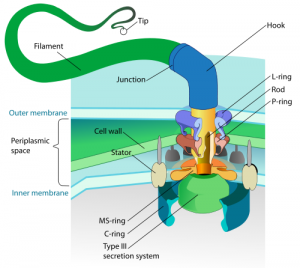
Consider the fact that it is conservatively calculated that the odds of this incredible structure forming by random chance is 1 in 10 to the 1170th power. (6) According to probability theorists, anything with a chance lower than 1 in 10 to the 50th power is mathematically impossible, so it doesn’t matter how much time you give it—it simply won’t occur by chance alone.
Just recently, a vastly more complex gear-driven, seven-engine, magnetic-guided flagellar bundle was discovered. Here is an piece on it from www.evolutionnews.org:
Souped-Up Hyperdrive Flagellum Discovered
Evolution News & Views December 3, 2012 5:05 AM
Get a load of this — a bacterium that packs a gear-driven, seven-engine, magnetic-guided flagellar bundle that gets 0 to 300 micrometers in one second, ten times faster than E. coli.
If you thought the standard bacterial flagellum made the case for intelligent design, wait till you hear the specs on MO-1, a marine bacterium described by Japanese researchers in the Proceedings of the National Academy of Sciences. Edited by Howard Berg, Harvard’s mastermind of flagellum reverse engineering, this paper describes the Ferrari of flagella.
Instead of being a simple helically wound propeller driven by a rotary motor, it is a complex organelle consisting of 7 flagella and 24 fibrils that form a tight bundle enveloped by a glycoprotein sheath…. the flagella of MO-1 must rotate individually, and yet the entire bundle functions as a unit to comprise a motility organelle.
To feel the Wow! factor, jump ahead to Figure 6 in the paper. It shows seven engines in one, arranged in a hexagonal array, stylized by the authors in a cross-sectional model that shows them all as gears interacting with 24 smaller gears between them. The flagella rotate one way, and the smaller gears rotate the opposite way to maximize torque while minimizing friction. Download the movie from the Supplemental Information page to see the gears in action.
Electron micrographs included in the paper show that the model is not unrealistic. These flagella really are tightly packed in a sheath, suggesting that the bundle acts like a gear-driven hyperdrive.
Here we have used electron cryotomography to visualize the 3D architecture of the sheathed flagella. The seven filaments are enveloped with 24 fibrils in the sheath, and their basal bodies are arranged in an intertwined hexagonal array similar to the thick and thin filaments of vertebrate skeletal muscles. This complex and exquisite architecture strongly suggests that the fibrils counter-rotate between flagella in direct contact to minimize the friction of high-speed rotation of individual flagella in the tight bundle within the sheath to enable MO-1 cells to swim at about 300 µm/s. (Emphasis added.)
At microbial level, that’s more than 10 body lengths per second. The authors were clearly excited by this engine, sounding like young men checking out high-performance cars, talking thrust, gear ratios and torque.
MO-1 is a magnetotactic bacterium capable of orienting its cell body along the geomagnetic field lines by using magnetosomes. The MO-1 cell has a flagellar apparatus with two lophotrichous [containing numerous flagella in] bundles. In contrast to peritrichously [flagella all over the cell] flagellated bacteria, MO-1 cells swim constantly in a helical trajectory toward magnetic north, and the trajectory changes from right-handed to left-handed without changes in velocity or direction. The cells are able to swim as fast as 300 μm/s, which is nearly 10-fold faster than E. coli and Salmonella. Although the flagella of the other types of bacteria usually work individually or by forming a loose bundle to produce thrust, the flagellar apparatus of MO-1 is a tight bundle of seven flagella enveloped in a sheath made of glycoproteins. This unique architecture appears to be essential for the smooth and high-speed swimming of MO-1.
They can’t see actual gears, of course, but physics demands that the mechanism of rotation must have something like it:
We hypothesize that, whereas each of the seven flagella has its torque-generating motor, the 24 fibrils counter rotate between the flagellar filaments to minimize the friction that would be generated if the flagella were directly packed together in a tight bundle. A schematic diagram representing our hypothesis is presented in Fig. 6. The flagella are represented as large brown gears and the fibrils are represented as small blue-green gears. The flagella and fibrils rotate counterclockwise and clockwise, respectively, as indicated by the arrows, to minimize friction (Movie S1). Although there is no direct evidence that the fibrils can rotate freely in the opposite direction as the flagellar filaments with which they are in direct contact, we think this is the simplest interpretation to explain the superior function afforded by the complex architecture of the MO-1 flagellar apparatus.
Considering the very tight packing of the 7 flagella and 24 fibrils that are in direct physical contact within the sheath, there appears to be no other way for the flagella to rotate at high speed without the counter rotation of the intervening fibrils. Although the fibrils and the surrounding sheath are in direct contact, the friction between them would be small because of the stocking-like flexibility of the sheath. This design must be playing an essential role in the fast, smooth rotation of the flagellar apparatus that allows the rapid swimming of MO-1.
With powerful evidence of design like this, did the researchers become converts to intelligent design? We can’t know, but would PNAS have printed such a paper without an obligatory tribute to unguided materialistic evolution? Evolution is not mentioned until the last paragraph:
Taken together, these features of the MO-1 flagellar apparatus represent an advanced level of evolution of a motility apparatus. It is also intriguing that the same pattern of an intertwined hexagonal array in two evolutionary distant systems: the basal bodies of flagella and fibrils of the MO-1 flagellar apparatus, and the thick and thin filaments in vertebrate skeletal muscle. Similar architectures of filamentous structures presumably evolved independently in prokaryotes and eukaryotes to fulfill the requirements for two very distinct mechanisms to generate motion: counter rotation and axial sliding.
OK, so the Darwinists got their offering, but it leaves a bad aftertaste: now, they have to believe that advanced mechanisms for generating motion evolved not just once, but twice — completely independent of each other. Thanks a lot, guys. Wait till the intelligent-design movement hears about this.
Oops, too late.
(http://www.evolutionnews.org/2012/12/souped-up_flage066921.html).
Going back to our previous subject, what if we just ignored the previously mentioned problems of forming the first cell, and assume that we’re starting the Darwinian process from the bacterial level and advancing to the human level? On page 153 of the book Who Was Adam?, Fazale Rana and Hugh Ross cite one of the world’s most prominent evolutionists, Dr. Francisco Ayala of UC Irvine, as calculating the minimal odds of human beings evolving from the bacterial level to be 1 in 10 to the 1 millionth power. Three physicists, John Barrow, Brandon Carter and Frank Tipler, did roughly the same calculation but included some important factors that Ayala overlooked, and came up with the number 1 in 10 to the 24 millionth power. Again, according to probability theorists, any event with lower odds than 1 in 10 to the 50th power is mathematically impossible. Therefore unguided Darwinian evolution is mathematically impossible!
Reduced to a propositional argument, it might go like this:
Biological “Hardware” (Complex Structure) Argument
- According to leading Darwinists, odds of humans evolving from a single-celled creature are 1 in 1024,000,000.
- According to probability theorists, anything with lower odds than 1 in 1050is mathematically impossible.
- Therefore, Darwinian evolution of human beings is mathematically impossible.
Now, these two sets of odds (totaling to 1 in 10100,024,000,000) seem overwhelming to say the least; why would scientists insist that creations like these could have come about by evolution? To re-iterate, it seems that biological science has become dominated by atheistic philosophers. Science is “a search for truth”, but the oligarchy in control in this day and age is trying to change that to “a search for truth by naturalistic (atheistic) means”. To them, the idea of God is unacceptable, so science cannot consider even the possibility that God created this universe and all that is in it.
Take a look at the following quote by prominent Darwinist Richard Lewontin, and consider whether his viewpoint is logically sound. Unfortunately, this quote seems to be representative of how many Darwinists think, and how they want everyone else to think:
Our willingness to accept scientific claims that are against common sense is the key to an understanding of the real struggle between science and the supernatural. We take the side of science in spite of the patent absurdity of some of its constructs, in spite of its failure to fulfill many of its extravagant promises of health and life, in spite of the tolerance of the scientific community for unsubstantiated just-so stories, because we have a prior commitment, a commitment to materialism. It is not that the methods and institutions of science somehow compel us to accept a material explanation of the phenomenal world, but, on the contrary, that we are forced by our a priori adherence to material causes to create an apparatus of investigation and a set of concepts that produce material explanations, no matter how counter-intuitive, no matter how mystifying to the uninitiated. Moreover, that materialism is absolute, for we cannot allow a Divine Foot in the door. (7)
One wonders why such a concerted effort is made to deny the metaphysical into the pool of live options. Perhaps the following quote by another prominent Darwinist named Aldous Huxley provides some insight:
I had motives for not wanting the world to have meaning; consequently assumed that it had none, and was able without any difficulty to find satisfying reasons for this assumption … For myself, as no doubt, for most of my contemporaries, the philosophy of meaninglessness was essentially an instrument of liberation. The liberation we desired was simultaneous liberation from a certain political and economic system, and liberation from a certain system of morality. We objected to the morality because it interfered with our sexual freedom. (8)
Now, just for fun, look at the following Bible passage, and think about how it relates to the quotes above:
For since the creation of the world His invisible attributes, His eternal power and divine nature, have been clearly seen, being understood through what has been made, so that they are without excuse.
For even though they knew God, they did not honor Him as God or give thanks, but they became futile in their speculations, and their foolish heart was darkened. Professing to be wise, they became fools. –Romans 1:20-22.
Perhaps this is a good place to ponder a quote from Nobel-Prize winning organic chemist Christian de Duve:
If you equate the probability of the birth of a bacteria cell to chance assembly of its atoms, eternity will not suffice to produce one… Faced with the enormous sum of lucky draws behind the success of the evolutionary game, one may legitimately wonder to what extent this success is actually written into the fabric of the universe. (9)
God has indeed left His signature in nature in its irreducible complexity and fine-tuning. Darwinism has failed repeatedly when tested as an explanation for the existence of life. Hundreds of scientists have recognized this and have signed a document called the “Dissent from Darwinism” (http://www.dissentfromdarwin.org/) to express their disagreement with philosophical naturalism dominating science through Darwinism. We simply need to “have eyes to see, and ears to hear”, and stop listening to atheistic philosophers disguised as scientists, who try to insist that the supernatural or metaphysical is off-limits for science. “Reasonable faith” is going in the same direction to which the evidence is pointing. The teachings of the Bible, understood properly, merge perfectly with science.
This article is chapter 3 From What Your Atheist Professor Doesn’t know (But Should), by Steve Williams
Original Blog Source: http://bit.ly/2Ch6MsY

The “Hardware” of Life Argument
2. Does God Exist?, Theology and Christian ApologeticsPodcast: Play in new window
Subscribe: Apple Podcasts | Spotify | Amazon Music | Android | iHeartRadio | Email | TuneIn | RSS
By Steve Williams
“I can see the fingerprints of God when I look at you I can see the fingerprints of God and I know its true you’re a masterpiece that all creation quietly applauds and you’re covered with the fingerprints of God”
~from Fingerprints of God, by Stephen Curtis Chapman
The common scientific view of the “hardware of life” (that is, the physical components of living systems) is, as Biologist Richard Dawkins puts it, “the study of complicated things that give the appearance of having been designed for a purpose.” (The Blind Watchmaker, 1986).
Unfortunately, Dawkins (like many others in his field) has succumbed to a logically fallacious assumption that a supernatural explanation is not within the “pool of live options” to explain this appearance of design. Why not? Well, to summarize the common opinions of materialists like Dawkins, it’s “not science”. But what is “Science”?
Louis Pasteur once said “Religions, philosophies, atheism, materialism, or its opposite–none of these is relevant to the matter…I might even add that, scientifically speaking, I am indifferent to them all. The question is purely one of fact”. In other words, science should be “the un-biased search for truth” without philosophical preconceptions. That definition was always the ancient understanding of the term.
Since the so-called “Enlightenment” that swept through Europe in the 1700’s, and especially since the proposal of Darwin’s Theory of Evolution in 1859, however, intellectual activists have been trying to add the qualifying concept of “within naturalistic explanations” to the definition. What that means, in effect, is the addition of a bias to the search for truth.
This bias first “got its legs” from the writings of an apparently bitter atheistic Scottish philosopher named David Hume in the 1700’s. Hume proposed a set of reasons why the supernatural should be ruled be ruled out of consideration as an explanatory mechanism. Not long afterwards, these reasons were shown to be fallacious (we’ll examine this in a later chapter), but at the time, it was as if Europe was eager to unfetter itself from religion, and atheism blossomed somewhat throughout the continent.
Most modern philosophers (even agnostic ones) find Hume’s arguments to be almost laughably illogical, but many atheists unknowingly cite him today as if he was “the Christ” of their belief system. For a full-length treatment of this subject, see John Earman’s book Hume’s Abject Failure, but suffice it to say for the moment that modern humankind has nowhere near a broad enough scope of reality to eliminate the possibility of the supernatural. To the contrary, there are many things in our experience that defy naturalistic explanations.
The philosophical name of the most common scientific form of atheism is “Materialism”, and it claims that not only is there no God, but that there is nothing even like God in the universe. Although it has taken root within the Biological sciences, it has done so to a much lesser extent within Astronomy, Philosophy, and Physics. Many Americans would probably be surprised to know that polls show that the percentage of PhD’ed scientists overall who identify themselves as Christians and who go to church is roughly the same as the percentage in the population at large. Unfortunately, the small minority who identify themselves as atheists is much louder and more aggressive though, so they exert a disproportionate influence on the media, academic standards committees and the like.
Luckily for all who respect unbiased inquiry, many Philosophers who are experts in logic by definition (logic being a subset of Philosophy), have objected vociferously, especially in the past 40 years, to this effort, and have recognized that the scientific method is at stake. As I wrote before, it seems that the key element that catalyzed this mindset since the late 1800’s is Charles Darwin’s Theory of Evolution. Biologists became so enamored with it over the years that they invested heavily in deepening and entrenching their paradigms based on that assumption, and are not willing to consider that major problems have developed within it. Pride in Biology, and a reluctance to admit being wrong might be a factor. One has to wonder if there are spiritual and carnal reasons that admitting the mere possibility of the existence of the metaphysical is so daunting to some. Since Darwinian Evolution seems to be the lynchpin of this type of thinking, let’s take a hard look at it.
The concept of life arising from non-life by random chance is called “abiogenesis”. This concept is the “creation story” of Darwinian Evolution. But what are the odds of the building blocks of life coming together by random chance in a way to provide even the possibility of life? Harold Morowitz, an agnostic Yale University physicist, created mathematical models by imagining broths of living bacteria that were superheated until all the complex chemicals were broken down into basic building blocks. After cooling the mixtures, Morowitz used physics calculations to conclude that the odds of a single bacterium reassembling by chance is one in 10100,000,000,000. (1) Wow! How can we grasp such a large statistic? Well, it’s more likely that one would win the state lottery every week for a million years by purchasing just one ticket each week!
In response to the probabilities calculated by Morowitz, Robert Shapiro, author of Origins – A Skeptic’s Guide to the Creation of Life on Earth, wrote:
The improbability involved in generating even one bacterium is so large that it reduces all considerations of time and space to nothingness. Given such odds, the time until the black holes evaporate and the space to the ends of the universe would make no difference at all. If we were to wait, we would truly be waiting for a miracle. (2)
Sir Frederick Hoyle compared the probability of life arising by chance to lining up 1050 (ten with fifty zeros after it) blind people, giving each one a scrambled Rubik’s Cube, and finding that they all solve the cube at the same moment!
Biological “Hardware” (Complex Structure) Argument
Regarding the origin of life, Francis Crick, winner of the Nobel Prize in biology for his work with the DNA molecule, stated in 1982:
An honest man, armed with all the knowledge available to us now, could only state that in some sense, the origin of life appears at the moment to be almost a miracle, so many are the conditions which would have had to have been satisfied to get it going. (3)
Crick’s assessment of the hopelessness of the spontaneous generation of life on earth led him to subsequently postulate a theory called “Directed Panspermia”, which held that space aliens “seeded” life on earth. As Philip Johnson observed, “When a scientist of Crick’s caliber feels he has to invoke undetectable spaceman, it is time to consider whether the field of prebiological evolution has come to a dead end.” (4)
Ever since the discovery of DNA in 1953, the Darwinian Theory of Evolution has faced increasing challenges yearly as more and more evidence for the complexity of the cell has been discovered. In 1996, Dr. Michael Behe (professor of Biochemistry at Lehigh University) released a book entitled “Darwins’ Black Box”, which detailed an argument against Darwinian Evolution known as the “irreducible complexity” of biological structures and systems. In the 11 years since the publication of the book, it has been attacked from every angle by atheistic scientists, yet its central thesis has only gained strength, as the debate has exposed the weakness of Darwinian counter-arguments, and the naturalistic (atheistic) philosophical biases that lurk behind them.
Have you ever wondered if Charles Darwin himself would still believe in Darwinian Evolution (or macro-evolution) if he knew all of the evidence that has accumulated for and against it up to this time? Well, there is an interesting quote in which Darwin stated his own minimum standard for assessing whether or not his theory would withstand the tests of time:
If it could be demonstrated that any complex organ existed, which could not possibly have been formed by numerous, successive, slight modifications, my theory would absolutely break down. (5)
In Darwin’s day, it was assumed that cells were very simple. In the last half of the 20th century, however, it has come to light that inside each living cell are vastly complex molecular machines made up of various protein parts. Organs, which are made up of these complex cells, have also been shown to be much more complex than previously believed.
The blueprints for assembling the protein parts for cells and organs in correct timing and order are encoded into our DNA, which is similar to binary computer code, although it is quaternary (having 4 letters instead of 2). The density of the information encoded into DNA staggers the imagination; there is enough information-storing space in a half-teaspoon of DNA to store all of the assembly instructions for every creature ever made, and room left over to include every book ever written!
In addition to the incredible information-storing capacity in DNA, there are machines and systems in biology which vastly exceed mankind’s creative capacity in terms of their complexity. For example, the blood-clotting mechanism requires a sequence of 20 different proteins (each of which has an average chance of 1 in 8.03 x 10 to the 59th power of forming by random chance!) triggering one another like dominoes falling in order, until a fibrin mesh scaffolding is formed for the clot itself.
If you subtract any one single protein (regardless of where in the sequence of 20), this scaffolding fails to form, and no blood clot is possible. Without clotting, any creature with a circulatory system would bleed to death from a tiny wound, similarly to what happens to hemophiliacs.
Now think about how this compares to Darwin’s criterion for his own theory. Macro-evolution requires a mutation for every step, each of which needs to confer an advantage in surviving or creating offspring to be retained by natural selection. Even if we grant the creation of proteins by random chance (which is extremely unlikely), at steps 1, 2 ,3, 4, etc. on up to and through step 19, there is no advantage conferred toward the production of a blood clot until step 20 is completed! If you reduce the complexity by any single component (regardless of where in the sequence the single component is), the system doesn’t work, and has no reason to be retained by natural selection. This is Irreducible Complexity.
Let’s look at another example. The Bacterial Flagellum is a tail-like protein propeller attached to one end of a bacterium that propels the organism through its environment via rapid rotations (like a miniature outboard motor driving a whip in circular motion). It has components that are remarkably similar to a man-made outboard motor, such as a rotor, a U-joint, a stator, a driveshaft, a propeller, bushings, and O-rings.
There are at least 40 different protein parts required for the assembly of a flagellum. Many of the flagellar proteins control the construction process, switching the building phases on and off with chemical triggers at just the right times, and setting up construction in the proper sequence. It is an engineering marvel. If you deduct 1% of the parts, you don’t have a 99% functional bacterial flagellum; it becomes completely dysfunctional, and you have nothing but a hindrance (probably fatal) to any organism attached to it. The following picture hints at its complexity…
Consider the fact that it is conservatively calculated that the odds of this incredible structure forming by random chance is 1 in 10 to the 1170th power. (6) According to probability theorists, anything with a chance lower than 1 in 10 to the 50th power is mathematically impossible, so it doesn’t matter how much time you give it—it simply won’t occur by chance alone.
Just recently, a vastly more complex gear-driven, seven-engine, magnetic-guided flagellar bundle was discovered. Here is an piece on it from www.evolutionnews.org:
Souped-Up Hyperdrive Flagellum Discovered
Evolution News & Views December 3, 2012 5:05 AM
Get a load of this — a bacterium that packs a gear-driven, seven-engine, magnetic-guided flagellar bundle that gets 0 to 300 micrometers in one second, ten times faster than E. coli.
If you thought the standard bacterial flagellum made the case for intelligent design, wait till you hear the specs on MO-1, a marine bacterium described by Japanese researchers in the Proceedings of the National Academy of Sciences. Edited by Howard Berg, Harvard’s mastermind of flagellum reverse engineering, this paper describes the Ferrari of flagella.
Instead of being a simple helically wound propeller driven by a rotary motor, it is a complex organelle consisting of 7 flagella and 24 fibrils that form a tight bundle enveloped by a glycoprotein sheath…. the flagella of MO-1 must rotate individually, and yet the entire bundle functions as a unit to comprise a motility organelle.
To feel the Wow! factor, jump ahead to Figure 6 in the paper. It shows seven engines in one, arranged in a hexagonal array, stylized by the authors in a cross-sectional model that shows them all as gears interacting with 24 smaller gears between them. The flagella rotate one way, and the smaller gears rotate the opposite way to maximize torque while minimizing friction. Download the movie from the Supplemental Information page to see the gears in action.
Electron micrographs included in the paper show that the model is not unrealistic. These flagella really are tightly packed in a sheath, suggesting that the bundle acts like a gear-driven hyperdrive.
Here we have used electron cryotomography to visualize the 3D architecture of the sheathed flagella. The seven filaments are enveloped with 24 fibrils in the sheath, and their basal bodies are arranged in an intertwined hexagonal array similar to the thick and thin filaments of vertebrate skeletal muscles. This complex and exquisite architecture strongly suggests that the fibrils counter-rotate between flagella in direct contact to minimize the friction of high-speed rotation of individual flagella in the tight bundle within the sheath to enable MO-1 cells to swim at about 300 µm/s. (Emphasis added.)
At microbial level, that’s more than 10 body lengths per second. The authors were clearly excited by this engine, sounding like young men checking out high-performance cars, talking thrust, gear ratios and torque.
MO-1 is a magnetotactic bacterium capable of orienting its cell body along the geomagnetic field lines by using magnetosomes. The MO-1 cell has a flagellar apparatus with two lophotrichous [containing numerous flagella in] bundles. In contrast to peritrichously [flagella all over the cell] flagellated bacteria, MO-1 cells swim constantly in a helical trajectory toward magnetic north, and the trajectory changes from right-handed to left-handed without changes in velocity or direction. The cells are able to swim as fast as 300 μm/s, which is nearly 10-fold faster than E. coli and Salmonella. Although the flagella of the other types of bacteria usually work individually or by forming a loose bundle to produce thrust, the flagellar apparatus of MO-1 is a tight bundle of seven flagella enveloped in a sheath made of glycoproteins. This unique architecture appears to be essential for the smooth and high-speed swimming of MO-1.
They can’t see actual gears, of course, but physics demands that the mechanism of rotation must have something like it:
We hypothesize that, whereas each of the seven flagella has its torque-generating motor, the 24 fibrils counter rotate between the flagellar filaments to minimize the friction that would be generated if the flagella were directly packed together in a tight bundle. A schematic diagram representing our hypothesis is presented in Fig. 6. The flagella are represented as large brown gears and the fibrils are represented as small blue-green gears. The flagella and fibrils rotate counterclockwise and clockwise, respectively, as indicated by the arrows, to minimize friction (Movie S1). Although there is no direct evidence that the fibrils can rotate freely in the opposite direction as the flagellar filaments with which they are in direct contact, we think this is the simplest interpretation to explain the superior function afforded by the complex architecture of the MO-1 flagellar apparatus.
Considering the very tight packing of the 7 flagella and 24 fibrils that are in direct physical contact within the sheath, there appears to be no other way for the flagella to rotate at high speed without the counter rotation of the intervening fibrils. Although the fibrils and the surrounding sheath are in direct contact, the friction between them would be small because of the stocking-like flexibility of the sheath. This design must be playing an essential role in the fast, smooth rotation of the flagellar apparatus that allows the rapid swimming of MO-1.
With powerful evidence of design like this, did the researchers become converts to intelligent design? We can’t know, but would PNAS have printed such a paper without an obligatory tribute to unguided materialistic evolution? Evolution is not mentioned until the last paragraph:
Taken together, these features of the MO-1 flagellar apparatus represent an advanced level of evolution of a motility apparatus. It is also intriguing that the same pattern of an intertwined hexagonal array in two evolutionary distant systems: the basal bodies of flagella and fibrils of the MO-1 flagellar apparatus, and the thick and thin filaments in vertebrate skeletal muscle. Similar architectures of filamentous structures presumably evolved independently in prokaryotes and eukaryotes to fulfill the requirements for two very distinct mechanisms to generate motion: counter rotation and axial sliding.
OK, so the Darwinists got their offering, but it leaves a bad aftertaste: now, they have to believe that advanced mechanisms for generating motion evolved not just once, but twice — completely independent of each other. Thanks a lot, guys. Wait till the intelligent-design movement hears about this.
Oops, too late.
(http://www.evolutionnews.org/2012/12/souped-up_flage066921.html).
Going back to our previous subject, what if we just ignored the previously mentioned problems of forming the first cell, and assume that we’re starting the Darwinian process from the bacterial level and advancing to the human level? On page 153 of the book Who Was Adam?, Fazale Rana and Hugh Ross cite one of the world’s most prominent evolutionists, Dr. Francisco Ayala of UC Irvine, as calculating the minimal odds of human beings evolving from the bacterial level to be 1 in 10 to the 1 millionth power. Three physicists, John Barrow, Brandon Carter and Frank Tipler, did roughly the same calculation but included some important factors that Ayala overlooked, and came up with the number 1 in 10 to the 24 millionth power. Again, according to probability theorists, any event with lower odds than 1 in 10 to the 50th power is mathematically impossible. Therefore unguided Darwinian evolution is mathematically impossible!
Reduced to a propositional argument, it might go like this:
Biological “Hardware” (Complex Structure) Argument
Now, these two sets of odds (totaling to 1 in 10100,024,000,000) seem overwhelming to say the least; why would scientists insist that creations like these could have come about by evolution? To re-iterate, it seems that biological science has become dominated by atheistic philosophers. Science is “a search for truth”, but the oligarchy in control in this day and age is trying to change that to “a search for truth by naturalistic (atheistic) means”. To them, the idea of God is unacceptable, so science cannot consider even the possibility that God created this universe and all that is in it.
Take a look at the following quote by prominent Darwinist Richard Lewontin, and consider whether his viewpoint is logically sound. Unfortunately, this quote seems to be representative of how many Darwinists think, and how they want everyone else to think:
Our willingness to accept scientific claims that are against common sense is the key to an understanding of the real struggle between science and the supernatural. We take the side of science in spite of the patent absurdity of some of its constructs, in spite of its failure to fulfill many of its extravagant promises of health and life, in spite of the tolerance of the scientific community for unsubstantiated just-so stories, because we have a prior commitment, a commitment to materialism. It is not that the methods and institutions of science somehow compel us to accept a material explanation of the phenomenal world, but, on the contrary, that we are forced by our a priori adherence to material causes to create an apparatus of investigation and a set of concepts that produce material explanations, no matter how counter-intuitive, no matter how mystifying to the uninitiated. Moreover, that materialism is absolute, for we cannot allow a Divine Foot in the door. (7)
One wonders why such a concerted effort is made to deny the metaphysical into the pool of live options. Perhaps the following quote by another prominent Darwinist named Aldous Huxley provides some insight:
I had motives for not wanting the world to have meaning; consequently assumed that it had none, and was able without any difficulty to find satisfying reasons for this assumption … For myself, as no doubt, for most of my contemporaries, the philosophy of meaninglessness was essentially an instrument of liberation. The liberation we desired was simultaneous liberation from a certain political and economic system, and liberation from a certain system of morality. We objected to the morality because it interfered with our sexual freedom. (8)
Now, just for fun, look at the following Bible passage, and think about how it relates to the quotes above:
For since the creation of the world His invisible attributes, His eternal power and divine nature, have been clearly seen, being understood through what has been made, so that they are without excuse.
For even though they knew God, they did not honor Him as God or give thanks, but they became futile in their speculations, and their foolish heart was darkened. Professing to be wise, they became fools. –Romans 1:20-22.
Perhaps this is a good place to ponder a quote from Nobel-Prize winning organic chemist Christian de Duve:
If you equate the probability of the birth of a bacteria cell to chance assembly of its atoms, eternity will not suffice to produce one… Faced with the enormous sum of lucky draws behind the success of the evolutionary game, one may legitimately wonder to what extent this success is actually written into the fabric of the universe. (9)
God has indeed left His signature in nature in its irreducible complexity and fine-tuning. Darwinism has failed repeatedly when tested as an explanation for the existence of life. Hundreds of scientists have recognized this and have signed a document called the “Dissent from Darwinism” (http://www.dissentfromdarwin.org/) to express their disagreement with philosophical naturalism dominating science through Darwinism. We simply need to “have eyes to see, and ears to hear”, and stop listening to atheistic philosophers disguised as scientists, who try to insist that the supernatural or metaphysical is off-limits for science. “Reasonable faith” is going in the same direction to which the evidence is pointing. The teachings of the Bible, understood properly, merge perfectly with science.
This article is chapter 3 From What Your Atheist Professor Doesn’t know (But Should), by Steve Williams
Original Blog Source: http://bit.ly/2Ch6MsY
Why Science Needs God
Atheism, Theology and Christian ApologeticsAtheists are fond of asserting that religion and science are at war, and that science supports atheism. Upon closer review, however, “science” doesn’t support atheism or anything else. Why not? Because science doesn’t say anything—scientists do!
Science is a method that people use to discover cause and effect relationships. Science doesn’t gather and interpret data, scientists do. Unfortunately, some scientists allow their atheistic worldview to dictate how they interpret the evidence. Since they’ve ruled out intelligence in advance, there’s no way they will ever interpret the data to conclude an Intelligence such as God was involved. They don’t seem to realize that science needs someone like God.
How so?
In order for us to do science, natural laws must be orderly and consistent. We couldn’t do science if natural laws weren’t held constant or nature behaved in a completely random manner. But where do natural laws come from and why are they so consistent? And why do all physical things change, but not the natural laws that govern them?
In all our experience, laws always come from lawgivers. That’s why the best explanation for the orderly and consistent natural laws that make science possible is a rational Law Giver who created and sustains the universe—the same spaceless, timeless, and immaterial Being that created and fine-tuned the universe at the Big Bang. So even if atheists succeed in demonstrating that natural laws can and do explain cause and effect inside the universe, they still have to rely on God for the existence and persistence of those laws.
Atheistic materialism can’t account for those laws or the orderliness of nature. But a rational Creator and Sustainer powerfully explains the unchanging laws that make science possible. Thus, the war is not between science and religion, but between science and atheism.
Want the details including answers to objections? They are in the book and the new Stealing From God online course I’m hosting that beings January 15 (you can start the self-paced version any time after that too). The course includes ten hours of video, and several live video conferences where I’ll be answering questions. Since we limit the size of the live classes to ensure every student has an opportunity to ask questions, you’ll want to sign up soon if you want to be a part of this
In addition to the details on that link, I’ll be discussing some of the course content right here on this page in the few weeks leading up to the course. So keep checking back here for more.
Five Proofs of the Existence of God with Dr. Ed Feser
PodcastA fantastic interview with prolific writer and professor of philosophy, Dr. Edward Feser. Called by National Review “one of the best contemporary writers on philosophy.” Feser gives a brief exposition and defense in this podcast of five of the historically most important (but in recent years largely neglected) philosophical proofs of God’s existence: the Aristotelian, the Neo-Platonic, the Augustinian, the Thomistic, and the Rationalist. This is one of the best podcasts of the year, don’t miss it!
Learn More: http://bit.ly/5Proofs_Book
Why Atheism Makes Reason Impossible
Atheism, Theology and Christian ApologeticsHow many times have you read or heard atheists claim to be champions of reason? They even organize “reason” rallies and call themselves “free thinkers.” There’s just one problem: there is no “free” and there is no “thinking” going on if atheism is true. Atheism makes free rational thought impossible.
How so?
If we are just molecules in motion as atheists assert, then every thought we have is the result of the non-rational laws of physics. We don’t have minds just brains, which means that we are nothing more than moist robots. But, of course, robots are not “free thinkers.” If materialistic atheism is true, then we have no grounds to believe anything the atheist thinks or says, including his thoughts about atheism!
Without an ability to think freely, science is lost too. As C. S. Lewis put it, “Unless human reasoning is valid no science can be true,” which would include the science of prominent atheists, Sam Harris, Lawrence Krauss, Richard Dawkins, and everyone else. Yet logic, reason and our scientific ability to understand the orderly world are well explained by a theistic God whose very nature is rational—“in the beginning was the Word” (or rationality) as the opening line of John’s gospel declares.
The bottom line is that atheism cannot be shown to be true in principle. It has destroyed all the tools necessary to do the job. In order to construct any valid argument for atheism, the atheist has to steal tools from God’s universe because no such tools exist in the world of atheism. Atheists must steal from the very Being who makes reason and science possible in the first place.
Want the details including answers to objections? They are in the book and the new Stealing From God online course I’m hosting that beings January 15 (you can start the self-paced version any time after that too). The course includes ten hours of video, and several live video conferences where I’ll be answering questions. Since we limit the size of the live classes to ensure every student has an opportunity to ask questions, you’ll want to sign up soon if you want to be a part of this.
In addition to the details on that link, I’ll be discussing some of the course content right here on this page in the few weeks leading up to the course. So keep checking back here for more.
Is The Doctrine Of The Incarnation Coherent?
Jesus Christ, Theology and Christian ApologeticsBy Evan Minton
Reasons’ Greetings, everyone! Merry Christmas! I thought now would be a good time to write a blog post on what this holiday is all about: The incarnation of God Almighty. Christmas is the time we celebrate the birth of the God-Man Jesus.
The Bible says “In the beginning was the Word, and the Word was with God, and the Word was God. He was with God in the beginning. Through him all things were made; without him nothing was made that has been made. ….The Word became flesh and made his dwelling among us. We have seen his glory, the glory of the one and only Son, who came from the Father, full of grace and truth.” (John 1:1-3, 14). John’s gospel opens up with The Word (Logos in Greek) existing prior to the origin of the universe, then creating all of matter, energy, space, and time, and he says that The Logos (who he says is God) took on human flesh and lived among the human race. This is the doctrine of the incarnation. But is this doctrine logically coherent? Many non-Christians, especially Muslims, would say no. They would say that a “God Man” is like a square circle or a married bachelor. Muslims will say that Jesus can be God or Jesus can be a human being, but not both.
Why do they say this? Well, there are conflicts between Jesus as God and Jesus as human, at least on a prima facie level. For example, The Bible teaches that God is omnipresent (Psalm 139:7-12, Joshua 1:9), yet Jesus couldn’t be in Jerusalem and Tokyo Japan at the same time. That’s why he traveled around. God is omniscient (see Job 34:21, 1 John 3:20, Proverbs 15:3, Psalm 147:5, Psalm 139:1-4), yet Jesus “grew in wisdom and stature” (Luke 2:52) and did not know the time of His second coming (Mark 13:32). If Jesus is God, aren’t we forced to say that Jesus is both A and non-A? That Jesus is omnipresent and not omnipresent? That Jesus is all knowing yet doesn’t know some things? Contradictions cannot be true. A and Non-A cannot both be true at the same time and in the same sense.
The incarnation is an essential doctrine of Christianity, much like the Trinity and the resurrection. It’s not a debatable issue like the age of the Earth or how many people Jesus died for. If the incarnation falls, Christianity goes with it. How do we answer our Muslim and Atheist friends who say that the doctrine of the incarnation is logically incoherent? Is celebrating Christmas irrational?
I would say no. There is a logically possible way for Jesus to be both God and man. Now, at points, it may seem like I’m speculating (especially with my third point), but this shouldn’t throw you off. What I’m doing is posting a possibility. If the model of the incarnation I’m about to propose is nothing more than simply a logical possibility than it proves that the incarnation is not an inherently incoherent concept. In order for something to be a contradiction, there has to be 0 possible ways for it to be true. There are 0 possible ways for a bachelor to be married. However, even if there’s only 1 way for X to be true, then it shows that X is not logically impossible.
I will be defending a model of the incarnation that Christian Philosopher and Apologist Dr. William Lane Craig proposes in his book Philosophical Foundations For A Christian Worldview and in hisDefenders class. Dr. William Lane Craig presents us with a 3 plank model.
1: We affirm two natures combined in a single individual (i.e Jesus).
2: The Logos was the rational soul of Jesus.
3: The divine aspects of Jesus are subliminal.
Let’s take a look at each of these 3 planks.
Plank 1: We Affirm Two Natures Combined In A Single Individual
By “Nature”, I mean the essence of a thing. A thing has a certain essence to it which makes it what it is. For example, the essence of a house cat is to be a 4 legged mammal of the feline genus and has the potential to be tamed. If it were a bipedal creature belonging to the homo genus and could not be tamed, it would not be a house cat. There are also attributes a house cat can have which aren’t essential to it being a house cat. For example, my cat Jellybean are the colors black and light grey. That is a property that she has. However, this not an essential property that she has. It’s an accidental property. That is to say, she could be white or orange and still be a house cat. Being black and grey is not an essential part to make a house cat a house cat. This is what philosophers distinguish as “Essential Properties” and “Accidental Properties”. The former is a set of properties (A, B, C, D,.) which are required for X to be X. If X does not possess properties those 4 properties than it isn’t an X. It’s something else. The latter is a set of properties that X just happens to possess but could lack and we could still consider it an X. Click here to learn more.
In this discussion, I would say that there are essential properties that make God, God, and essential properties that make a human being a human being. This is what it means to possess the “nature” of something. To possess a “divine nature”, one must be omnipotent, omniscient, omnipresent, moral perfection, etc. To be a human being, one must be a rational, free will, bipedal hominid with a sense of morality. These are non-exhaustive lists of the essential properties of the divine nature and the human nature.
In the incarnation, both sets of essential properties came together in a single individual named Jesus of Nazareth. Jesus is one person with two natures.
Now, sometimes when I talk about “Jesus’ human nature” and “Jesus’ divine nature”, I’ll get in trouble with some of my fellow Christians. Why? Well, they think I’m advocating the heresy of Nestorianism. Nestorianism says that there is a human mind and a divine mind in Jesus, that Jesus possessed two minds. Nestorianism says that there are two persons we’re talking about here; a divine person and a human person. But that’s NOT what I’m advocating for at all. Jesus is ONE person with TWO natures. There’s only one mind. There’s only one person. But this one person possesses two natures.
If you don’t like “natures” you can substitute it for the claim “property”. Jesus is one person who possesses the property of divinity and the property of humanity. He is one individual possesses the attribute of divinity and the attribute of humanity.
If you still don’t see the point, think of this analogy: A motorhome or RV is one entity that possesses two natures. It possesses the nature of a house and the nature of a truck. It possesses the nature of a house in that it has a couch inside, a sink, a bathroom, a table at which to eat, and a bed or two. It possesses the nature of a truck in that it has wheels, an engine, a steering wheel, a dashboard, gas and break pedals. This gives you the ability to drive it. But clearly, there aren’t two entities here. There’s only one entity, but this one entity possesses two properties. Two properties came together in one entity.
Plank 2: The Logos Was The Rational Soul Of Jesus
This plank unites the two natures into a single person. This one is the more controversial of the planks. It’s controversial because it brings in Apollonarius’ view that the soul of Jesus was the divine Logos. Apollonarius was condemned by his fellow church fathers because they felt that Apollonarius’ view entailed that Jesus did not have a complete human nature. Jesus had a fully human body, but if the Logos is the mind of Jesus, then He didn’t have a fully human mind. Therefore, what we have on Appolonarius’ view is a sort of truncated view of humanity. Jesus is only 80% human, so to speak. They also thought that he undercut the work of Christ because if Christ did not have a human mind, then the human mind would not be saved – that which is not assumed is not saved. Jesus had to assume a human nature in order to save it.
The church fathers thought Appolonarius’ view dovetailed into what’s known as “Monophysitism”. Monophysitism asserts that Jesus had a mixture of divinity and humanity, but He wasn’t fully one or the other. He was basically a hybrid creature. Part God, Part Man.
The reason that council considered Monothelitism[1] unorthodox is, as Craig says in this article, is that they thought it logically entailed monoPHYSITism. But I agree with Craig that their fears of monothelitism collapsing into monophysitism were unfounded. So long as a person affirms two natures in Christ (a divine nature and a human nature), I wouldn’t consider them a heretic. And I don’t think, as the council that condemned Apollonianarius did, that monothelitism entails that Christ didn’t have a truly human mind and ergo not a fully human nature. You can affirm a single faculty of will and yet still say Jesus had a complete divine nature and a complete human nature.
This is because Jesus’ divine mind already had all of the essential properties needed to make a human mind (rationalty, free will, a knowledge of right and wrong). These are properties humans have and it’s what makes up the image of God (Genesis 1:26-27). Jesus, actually being God (John 1:1-3), already had these properties as pure deity. These properties simply needed to be added to the rest of the essential properties that make a man, a man in order to make Christ a full human being. The properties of rationality, free will, and a moral compass that The Logos possessed needed to be attached to a bi-pedal hominid body in order for Jesus to have 100% of the attributes that make up the human nature.
Plank 3: The Divine Aspects Of Jesus Are Subliminal
The third plank of Dr. Craig’s incarnational model posits that the divine aspects of Jesus are subliminal. This would explain how Jesus seems to have the human limitations that He does despite being God.
Craig postulates that Jesus’ divine attributes are subliminal. For example, Jesus’ knowledge of everything is confined to His subconscience. This would explain instances like Mark 13:32 where Jesus doesn’t know the time of His second coming, why we don’t have the picture of a baby Jesus speaking full blown Hebrew in the manger scene while being the omniscient God, and it would explain how Jesus “grew in wisdom” (Luke 2:52). His knowledge was limited in His conscious life, but His vast knowledge of everything from auto mechanics to quantum mechanics was tucked away into His subconscious. In this sense, Jesus could both know and not know something at the same time.
Back in 2015, I heard a song that I learned at vacation Bible school when I was 3 years old. I hadn’t thought of that song in over a decade. Yet when it started playing on my television, I immediately recognized it and was able to sing along. I knew the song, and I knew the words, but the knowledge was tucked away in my subconscious and therefore, I didn’t know that I knew the song. I can imagine that much of the human Jesus’ divine knowledge was tucked away in a similar fashion.
On this model, Jesus was less than omniscient in His conscious mind, but He was omniscient in His subconscious mind. Jesus knows all there is to know in (B) His subconscious mind, but not (A) His conscious mind.
Craig explains that “We have a very interesting analogy of how this works from hypnosis. As Charles Harris explains, a person who is under hypnosis can be instructed to be informed of certain facts and then to forget about them when he is awakened from the trance, so that he knows them and yet he doesn’t know them! He says,
‘the knowledge is truly in his mind, and shows itself in unmistakable ways, especially by causing him to perform . . . certain actions, which, but for the possession of this knowledge, he would not have performed.’
So he has the knowledge, but he is not aware of it because he is under hypnosis. He goes on to say,
\What is still more extraordinary, a sensitive hypnotic subject may be made both to see and not to see the same object at the same moment. For example, he may be told not to see a lamp-post, whereupon he becomes (in the ordinary sense) quite unable to see it. Nevertheless, he does see it, because he avoids it and cannot be induced to precipitate himself against it. …. He actually does have a kind of blind sight of it.’
This sort of a model, I think, provides a very satisfying account of Jesus as we see him in the Gospels. In his conscious experience, Jesus grew in wisdom and in knowledge, just as a human child does. … In his conscious experience, Jesus grows and increases in knowledge as he grows older.”[2]
Okay, well, this provides a plausible reconciliation regarding the omniscience of the Logos and the ignorance of Jesus of Nazareth. But what about The Logos’ other divine attributes such as omnipotence, omnipresence, eternality, etc. Well, The subconscious is in the realm of the mind so I wouldn’t say that attributes like omnipotence, omnipresence, etc. are located in the back of Jesus’ mind. That said, I do think that some of the essential properties that He possesses in his divine nature, he does not possess in his human nature. For example, in his divine nature, Jesus (the Logos) is omnipresent, but Jesus’ human body is spatially located. That’s how we can talk about Jesus “coming back”. Well, in His divinity, he never left, but the hominid body He animated did. In His divine nature, He will be with us always, even to the end of the age (Matthew 28:20), in his human nature, we don’t have him with us (Matthew 26:11). Regarding omnipotence, I would say that Jesus gave up the use of this attribute in the sense of choosing not to use it. This may explain why Jesus felt true temptation when Satan told him to break his fast by turning stone into bread (Matthew 4). In His divine nature, Jesus is beginningless (John 1:1), in His human nature, Jesus was born (John 1:14).
Conclusion
I think these 3 planks taken together present us with a logically coherent model of the doctrine of the incarnation. Celebrating Christmas is not irrational. When Mary kissed her little baby, she indeed kissed the face of God. Merry Christmas, everyone!
For further reading, check out William Lane Craig’s treatment of this in Defenders 2, The Doctrine Of Christ.
Footnotes
[1] “What is Monotheletism? It is the doctrine that the incarnate Christ has a single faculty of will. By contrast Dyotheletism teaches that the incarnate Christ has two faculties of will, one associated with his human nature (his human will) and one associated with his divine nature (his divine will).” – Bill Craig, from http://www.reasonablefaith.org/monotheletism
[2] William Lane Craig, Defenders 2, The Doctrine Of Christ Part 7, http://www.reasonablefaith.org/defenders-2-podcast/transcript/s6-7
Original Blog Source: http://bit.ly/2BQRZWJ
When and What Time Was Jesus Born?
Jesus Christ, Theology and Christian ApologeticsBy Brian Chilton
This past Sunday, I received a wonderful question from a young man in our church. Matthew Cleary was in Sunday school and asked his teacher, who in turn asked me, “What time of night was Jesus born? Was it at midnight?” To be honest, I had never really thought about the question. While it is impossible to provide a detailed time of Christ’s birth with great certainty, certain clues provide us hints at the time and date of Jesus’s birth. The time of Jesus’s birth is intricately tied to the date of his birth. While Scripture does not grant us a large amount of information of the day and time, it does offer a few clues.
Clue 1: Details of Jesus’s Birth Point to an Autumn Birthday
In Luke’s account of Jesus’s birth, the Evangelist notes that when Jesus was born, “shepherds were staying out in the fields and keeping watch at night over their flock” (Lk. 2:8).[1] The sheep that were used for temple sacrifices in Jerusalem were often kept in Bethlehem.[2] December 25th does not mesh with this aspect of the birth story. First, the sheep would have been taken to Jerusalem by December. In addition, December 25th would have been too cold for the shepherds and the sheep to have been staying in the fields at this time. However, the sheep and shepherds would have been in the fields in autumn, especially around the time of the Feast of Trumpets.
Clue 2: Details of the Star of Bethlehem and the Magi’s Appearance
This may disappoint many who read these words, but the Magi (wise men) were not at the stable when Jesus was born. In fact, it is possible that Jesus would have been one or two years old by the time they made it to Bethlehem. Matthew describes the Magi following a star which led them to the Christ child. The star could have been one individual star, or it may have been an astronomical configuration. Nevertheless, the Magi were filled with joy (Mt. 2:10) and entered “the house, they saw the child with Mary his mother, and falling to their knees, they worshiped him” (Mt. 2:11). The Star of Bethlehem guided the Magi to the Christ child after the child was born. The timing of the star is subsequent to the time of Jesus’s birth. The star could have presented a December visitation of the Magi, but since this was later than the birth of Christ, then the birth would have preceded this event.
Clue 3: Details from the Astrological Data in Revelation 12
Another passage of Scripture is linked with Jesus’s birth, one that may surprise you. Revelation 12:1-5 depicts a vision John received on the Isle of Patmos, which may provide additional clues to the time of Jesus’s birth. The text reads:
“A great sign appeared in heaven: a woman clothed with the sun, with the moon under her feet and a crown of twelve stars on her head. She was pregnant and cried out in labor and agony as she was about to give birth. Then another sign appeared in heaven: There was a great fiery red dragon having seven heads and ten horns, and on its heads were seven crowns. Its tail swept away a third of the stars in heaven and hurled them to the earth. And the dragon stood in front of the woman who was about to give birth so that when she did give birth it might devour her child. She gave birth to a Son, a male who is going to rule all nations with an iron rod. Her child was caught up to God and to his throne” (Rev. 12:1-5).
Joseph Dumond argues that Revelation 12 describes a constellation that took place at a certain time in history. Dumond claims that the constellation Virgo (e.g., “virgin”) appeared for a few hours in Bethlehem near Leo—representing the “lion of Judah”—with the sun clothing the woman, with the 12 visible stars surrounding her head. [3]This arrangement would only be visible from 6:15 pm (sunset) to 7:45 pm (moonset).[4] According to the Stellarium Astronomy software database (available at http://stellarium.org/), this astrological alignment was visible from Bethlehem on the evening of Wednesday, September 11, 3 BC.
Conclusion
The growing body of evidence seems to suggest that Jesus was born sometime between 6:15 pm to 7:45 pm on September 11, 3 BC. While September 11th holds bad memories for individuals in the United States, it would have been a day of celebration in ancient Israel. For it would have been the beginning of the Feast of Trumpets, a feast associated with the Messiah and his return. The Feast of Trumpets called for national repentance and also marked the start of a new agricultural year.[5] The blast from a shofar would announce the beginning of the feast. Yom Kippur (the Day of Atonement) would follow the Feast of Trumpets. Yom Kippur is the holiest day of the year for the Israelite. It is the day when the high priest enters the holy of holies and offers sacrifices for the nation’s sins. Sukkot is also one of Israel’s primary holidays. It recalls Israel’s wilderness wanderings and God’s saving action that brought them out of bondage and into salvation. Sukkot follows Yom Kippur and celebrates God’s deliverance of his people. Thus, Rosh Hashanah (Trumpets) calls for repentance (which would be the time when Jesus was born if this theory holds); Yom Kippur (Day of Atonement) seeks redemption, and Sukkot (Tabernacles) celebrates the fulfillment of God’s redemption. Wouldn’t it be just like God to provide a HUGE sign that he was about to save the world from its sins by having his Son to be born at the beginning of these festivities?
. . . but wait . . . what about December 25th?
If this theory is true in that Jesus was born on September 11th, does December 25th hold any importance? Yes, it does. It is quite possible that the angel Gabriel appeared to Mary on December 25th. Thus, the date may serve as the time when Mary was impregnated with Jesus by the empowerment of the Holy Spirit by miraculous means. December 25th may also be the date when the Magi visited the Christ Child after following the star. Astronomical data points to this time which is beyond the scope of this article. So, while Jesus may not have been born on December 25th, the date still holds tremendous value and should ultimately remind us of the greatest gift that God has ever given any of us—that is, his Son Jesus.
Notes
[1] Unless otherwise noted, all quoted Scripture comes from the Christian Standard Bible (Nashville: Holman, 2017).
[2] CSB Study Bible (Nashville: Holman, 2017), 1605, footnote 2:8.
[3] Joseph Dumond, cited in Joseph Farah, “Was Jesus Born Sept. 11, 3 B.C.?,” WND.com (8/23/2013), retrieved December 19, 2017, http://www.wnd.com/2013/08/was-jesus-born-sept-11-3-b-c/.
[4] Ibid.
[5] John T. Swann, “Feasts and Festivals of Israel,” ed. John D. Barry et al., The Lexham Bible Dictionary (Bellingham, WA: Lexham Press, 2016).
About the Author
Brian Chilton is the founder of BellatorChristi.com and is the host of The Bellator Christi Podcast. He received his Master of Divinity in Theology from Liberty University (with high distinction); his Bachelor of Science in Religious Studies and Philosophy from Gardner-Webb University (with honors); and received certification in Christian Apologetics from Biola University. Brian is currently a student of the Ph.D. program in Theology and Apologetics at Liberty University. Brian is a full member of the International Society of Christian Apologetics and the Christian Apologetics Alliance. Brian has been in the ministry for over 14 years and serves as the pastor of Huntsville Baptist Church in Yadkinville, North Carolina.
Original Blog Source: http://bit.ly/2kP9Aq3
Five Reasons You Can Trust the Story of Christmas Is True (Free Bible Insert)
4. Is the NT True?Detectives create lists. As a cold-case detective, I’m no different. When investigating an event in the distant past (in my case, an unsolved murder), I collect evidence, make lists and do my best to reach the most reasonable inference. When I began to investigate Christianity at the age of thirty-five, I approached the gospels the same way I approached my cold-case files. Lists were an important part of the process. One New Testament claim was particularly interesting to me: the conception and birth of Jesus. When I first read through the gospels, the birth narratives seemed incredible and unreasonable. I’m not the only person to express such a concern. In an article posted in the Herald Scotland, Reverend Andrew Frater called the Nativity story a “fanciful, fairy tale” and called on Christians to “disentangle the truth from the tinsel”. Frater is a minister and a believer, and even he doesn’t believe in the virgin conception of Jesus. As an atheist, I was even more skeptical. I rejected supernatural claims altogether, and the first Biblical claim about Jesus was a supernatural one. But as I collected the evidence and formed my lists, I found there were many good reasons to trust the story of Christmas. I’ve assembled them here with links to longer treatments of each topic:
Reason 1:
The Supernatural Nature of the Virgin Conception Shouldn’t Disqualify It
When I began to investigate the virgin conception, I was actually investigating my own philosophical naturalism. I was, in essence, asking the following questions: “Is the natural world all that exists?” “Is there anything beyond the physical, material world we measure with our five senses?” “Are supernatural events possible or even reasonable?” In asking these questions, I was putting naturalism to the test. It would have been unfair, therefore, to begin by presupposing nothing supernatural could ever exist or occur. If we want to be fair about assessing the virgin conception or any other supernatural aspect of the nativity story, we cannot exclude the very possibility of the supernatural in the first place. Our presupposition against the supernatural would unfairly taint our examination of the claim.
Reason 2:
The Claim of the Virgin Conception Appears Incredibly Early in Christian History
It’s always easier to tell a lie once everyone who was alive to know the difference has already died. But if you’re going to make a claim early in an area where people are still available to debunk your claim, be prepared to have a difficult time getting away with misrepresentations. The virgin conception of Jesus is one of the earliest claims in Christian history. The students of the gospel authors cited the virgin conception as a true claim about Jesus. Ignatius, the student of John (an Apostle who chose not to write about the birth of Jesus in his own gospel), included it in his early writings to local churches. Other Church leaders repeated the claim through the earliest years of the Church, and the doctrine also appears in the most ancient Church creeds. Even early non-canonical documents include the virgin conception of Jesus.
Reason 3:
The Birth Narratives in Luke and Matthew Are Not Late Additions
Critics, in an effort to argue the birth narratives in Luke and Matthew are not reliable, point to stylistic differences and “content shifting” within the gospels. Critics claim that the Greek language used in the birth narrative section of Luke’s gospel is far more Semitic than other sections. But the fact that this section of the gospel is stylistically or linguistically different than other sections does not mean it was a late addition. Luke told us he compiled the information for his gospel from a number of divergent sources (Luke 1:1-4). As a result, we should expect stylistic and linguistic differences within the gospel of Luke. In addition, any claim related to the late addition of the birth narratives defies all the manuscript evidence available to us; there is absolutely no evidence that the gospel of Matthew and Luke ever existed without the birth narratives. All manuscripts, translations, early Church documents and references to the gospels, along with every historic, reliable witness testifies to the fact that the birth narratives are ancient and part of the original record.
Reason 4:
The Virgin Conception Was Not An Invention of Early Christians
Some critics of the virgin conception argue that the earliest Christian authors inserted it in an effort to give Jesus a “heroic” birth consistent with other Old Testament heroes. But, not every Jewish hero from the Old Testament had an unusual birth story. Joshua, King David, and King Solomon are just three of the more obvious examples of powerful Old Testament heroes whose birth stories were less than surprising or unusual. In addition, there is no other character from the Old Testament who was born of a virgin through the miraculous conception of the Holy Spirit. This characteristic of Jesus’ conception is unique to Jesus and follows no pre-existing Old Testament pattern.
Reason 5:
The Virgin Conception Wasn’t Borrowed from Another Source
Skeptics also attempt to discredit the virgin conception of Jesus by claiming it was borrowed from prior pagan mythologies such as those of Mithras or Horus. But any fair examination of pagan mythological birth narratives revels the dramatic differences between the virgin conception of Jesus and stories about the supernatural emergence of mythological gods. While “borrowing” may have occurred between belief systems, the weak resemblances between the Biblical account and pagan mythologies are far more likely the result of the Judeo-Christian influence rather than contamination from a pagan source. It’s irrational to believe the early Jewish readers of the gospels would embrace any part of paganism in the story of Jesus’ conception as continuous with the Jewish narrative from the Old Testament. In addition, early Christian converts were repeatedly called to a new life in Christ, told they were merely travelers passing through this mortal (and pagan) world, called to live a life that was free of worldly influences, and told to reject the foolish philosophies and stories of men. This group, in particular, would be the last to turn to pre-existing pagan stories and superstitions.
If there exists a supernatural Being capable of bringing all space, time and matter into existence from nothing, such a Being could certainly accomplish the virgin conception of Jesus, the Resurrection of Christ, or any of the other “lesser” miracles described on the pages of the New Testament. In addition, there is no historically, textually or philosophically necessary reason to reject the claims of the New Testament authors. If you’re a Christian this Christmas season, celebrate the birth of Jesus with confidence and certainty. The virgin conception is not a fanciful, fairy tale. It is a true story. In fact, there are five good reasons to trust the story of Christmas is factual, reliable and true.
To download a FREE, printable, Bible-sized insert summarizing these five reasons, visit the homepage at www.ColdCaseChristianity.com and click the link in the right column.
J. Warner Wallace is a Cold-Case Detective, Christian Case Maker, Senior Fellow at the Colson Center for Christian Worldview, and the author of Cold-Case Christianity, Cold-Case Christianity for Kids, God’s Crime Scene, God’s Crime Scene for Kids, and Forensic Faith.
Comment or Subscribe to J. Warner’s Daily Email
How the Ontological Argument Proves the Existence of God
2. Does God Exist?, CrossExamined, Theology and Christian ApologeticsBy Al Serrato
The fool has said in his heart, “There is no God.” If this passage from Psalms is correct, then many people today are fools, for they insist that God does not exist. But the ranks of non-believers include many scientifically minded and highly intelligent people, not the sort we would normally consider as foolish. So, what makes such a person a “fool,” and not merely someone with whom we disagree?
Well, let’s begin with a look at the definition of “fool,” which includes “a person who has been tricked or deceived into appearing or acting silly or stupid.” Now, sometimes we trick ourselves, and thereby make fools of ourselves. And other times we are misled. But either way most would agree that someone who holds contradictory views has deceived himself. Imagine a person proudly proclaiming that the prime rib he is about to eat is an important part of his vegetarian diet. Or the person who says that the only medicine that can save him is the one with no ingredients.
But sometimes contradictions aren’t as obvious. Why, then, is it a contradiction to insist there is no God? It doesn’t appear to be contradictory – at first glance anyway. For the answer to that question, we are indebted to St. Anselm of Canterbury, who lived and pondered these questions some ten centuries ago. I can’t do justice to Anselm’s argument in this brief piece, but perhaps some concepts borrowed from Anselm may help make the point.
The first requires consideration of just what the mind does. Anyone who has seen a baby develop realizes that the human mind comes preprogrammed with an “operating system” of sorts. This allows us to acquire language, to reason, to recognize concepts such as fairness and truth and beauty, and other intangible things, and to make use of imagination. This ability for abstract thought lends itself to “got it” moments when a problem that has been puzzling us all of a sudden makes sense. We all use these systems intuitively; of course, there is no other way, since we could never use reason, for instance, to prove the validity or usefulness of reason.
One aspect of this ability for abstract thought is the ability to conceptualize. Food, for instance, can encompass a million different things, but to qualify it must be edible and serve to nourish, and not poison, us. We can call an ashtray “food”, but the underlying thing is not a matter of what we call it, but of what it consists.
So, with this observation in view, consider for a moment not what a definition of God might be, but what the conception of God is. What is it that we are struggling to grasp when we use that term? Anselm’s definition was simply this – God is that being a greater than which cannot be conceived. Whatever attributes God would have – omnipotence, omnipresence, perfect goodness, etc. – if you can conceive of a being with all those attributes plus an additional one, then the latter would be God. So, imagine two beings then – each with exhaustive, infinite powers. One of the two has the attribute of necessary existence, while the other may or may not exist. Clearly, the former – the one with necessary existence – would be the greater. Consequently, to fully conceive of God, we must be conceiving of a Being who can’t not exist, whose existence must always have been and will always continue to be. Anything else simply cannot fit the conception of God.
So, what does that prove? Maybe this conception of God is imaginary. Not so, Anselm would contend. And here’s why: the mind is not capable of conceptualizing something that does not correspond to something real. Now, this premise is a bit harder to get one’s mind around. The normal response to this part of the argument is that we create imaginary things all the time, from unicorns to tooth fairies to Jedi Knights. But each of these things, while imaginary, is the combining of things that are real: a horse and a horn; a person with wings and unusual powers; a warrior with special abilities and unusual weapons. And, moreover, neither a unicorn nor a tooth fairy nor a Jedi Knight would possess the attribute of necessary existence. If a unicorn did exist, it would have to consist of a horse with a single horn in its head; but its existence could have occurred briefly in the distant past, or could arise in the distant future or could not occur at all. We can fully conceptualize such a creature without the need that the creature itself actually exist because the conceptualization does not require necessary existence.
This concept of “necessary” existence is not easily grasped at first. Many skeptics will contend that “existence” is not an attribute at all. Imaginary things don’t actually exist, they will say, so they consist of nothing. This line of argument can quickly devolve into an argument over definitions, with the skeptic insisting that it is nonsensical to consider a thing which does not exist. This assumption allows them to defeat Anselm’s argument – they write “necessary existence” out of the set of characteristics of God – but a moment’s reflection should reveal that this comes at too high a price. I can conceive in my mind of many past historical figures whose attributes I can describe in detail but who do not presently exist, for they have passed away. More importantly, every scientific discovery or invention must first begin in the mind of a person who sees the attributes of the thing before it actually takes form. The automobile, for instance, did not create itself; it first appeared in the mind of an inventor who could see what it would consist of if it did exist and then set about adding “existence” to its attributes.
Letting our minds approach the concept of what “God” must be, the only way to conceptualize Him, is as a necessarily existent being. If we are not seeing Him that way – if we are insisting that there may be a God, but then again maybe not, then we are not yet thinking about God, but about something else, something less than God.
This foray into philosophy can be difficult. Fortunately, there are many other proofs for God’s existence, ones much easier with which to grapple, but this one stands out for its elegance. For if it has merit, then God has embedded within us the means to find Him in the one place we have exclusive and special access to our very minds.
If Anselm is right, then the fool who denies God is saying something like “I believe that the Being who must necessarily exist does not exist.” A rather foolish thing to say, when you see it clearly.
The Bible says that God has written his law on our heart. Perhaps if we probe a bit deeper still, we can also begin to see in its depths the first faint scratching of His signature.
Original Blog Source: http://bit.ly/2klEgzC
Resolving Christmas Conundrums
Jesus Christ, Theology and Christian ApologeticsBy Evan Minton
Christmas is one of my favorite holidays and has been for as long as I’ve walked this Earth. As a kid, it was because I got a boatload of toys on Christmas morning that I got to play with as Mom and Dad prepared Christmas dinner for us and the rest of my family. As someone who is now a born-again Christian, my primary reason has shifted from getting gifts to praising God for taking on human flesh to begin His mission of redeeming fallen humanity. We all know the story: of how Gabriel appeared to Mary, told her she would become miraculously pregnant with Jesus, how Mary and Joseph traveled to Bethlehem where Jesus would then be born, etc. However, those of us who witness to non-believers will encounter some objections about the reliability of the Christmas narrative.
It is the point of this blog post to wrestle with these challenges to the gospels’ reliability.
1: The Census
Luke 2:1-3 says “In those days Caesar Augustus issued a decree that a census should be taken of the entire Roman world. (This was the first census that took place while Quirinius was governor of Syria.) And everyone went to their own town to register.”
The Bible is clear that Jesus was born when Herod The Great was in power and when Quirinius was governor, but (A) Flavius Josephus says Herod died in A.D 4 and (B) secular history attests that Quirinius didn’t become governor until A.D 6? Did The Bible get it wrong?
First of all, I think we should give Luke the benefit of the doubt. In The Book Of Acts In The Setting Of Hellenistic History, the classic scholar Dr. Collin J. Hemer shows that archeology proves that the book of Acts got it right in 84 incidental details. The first chapter of Luke and the first chapter of Acts both give us clues that these books are written by the same author (Luke), such as the fact that they’re both addressed to a man named Theophilus and in Acts, the writer alludes “to my former work” (Acts 1:1). This is one piece of internal evidence that Luke and Acts had the same author. Now, if Acts gets it right in 84 different places, then is it really reasonable to suspect that this same writer would be so sloppy in his previous work? In fact, the famed scholar and archeologist Sir William Ramsay once said: “Luke is a historian of the first rank; not merely are his statements of fact trustworthy, he is possessed of the true historic sense…in short, this author should be placed along with the greatest of historians.”[1] Click here to read about some of the things Luke got right in both of his books.
Secondly, there are proposed solutions which could resolve the issue. One proposed solution has been that there were two different men named Quirinius governing on two different occasions. That possibility isn’t entirely out of the question. After all, we’ve had more than one president whose first name is George. The two-Quirinius explanation would be analogous to George Bush’ presidency in the 90s and George W. Bush’ presidency in the 2000s.
Another proposal is that the Qurinius reigned on two different occasions. As Daryl E Witmer of ChristianAnswers.net explains: “There is good reason to believe that Quirinius was actually twice in a position of command (the Greek expression hegemoneuo in Luke 2:2 which is often translated ‘governor’ really just means ‘to be leading’ or ‘in charge of’) over the province of Syria, which included Judea as a political subdivision. The first time would have been when he was leading military action against the Homonadensians during the period between 12 and 2 B.C. His title may even have been ‘military governor.’ “[2]
Either of these proposals would solve the timing of Quirinius’ governorship. Either there were two governors by this name, or, as seems most likely, Quirinius was the governor on two separate occasions. This latter view is the one that archeologist William Ramsay endorsed.[3]
But what about the census itself? Was this really a practice that the Roman government did?
Here’s a quote from an official governmental order dated AD 104. Gaius Vibius Maximus, Prefect of Egypt [says]:
“Seeing that the time has come for the house to house census, it is necessary to compel all those who for any cause whatsoever are residing out of their provinces to return to their own homes, that they may both carry out the regular order of the census and may also attend diligently to the cultivation of their allotments.”[4]
As you can see, that practice is confirmed by this document. And another papyrus from AD 48 implies that the entire family was involved in the census. Moreover, there have been scholars who argued that Romans were known to occasionally allow a census to be taken according to local customs in order to avoid ticking off the population.
According to ancient Semitic culture, what this means is that Mary and Joseph would have had to trek to the home of their ancestors.
2: The Christmas Star
In Matthew 2:2, the magi appear before King Herod and ask him where the baby Jesus is. They said“Where is the one who has been born king of the Jews? We saw his star when it rose and have come to worship him.” The Magi knew how to get to the town Jesus was born because a huge shining star in the sky acted like a celestial GPS system. This incident of the star that guided the magi has baffled historians and astronomers for years. What kind of event could this be? What astronomical phenomenon could have occurred in the universe to have caused a star to shine noticeably bright for the duration of the magis’ journey?
Some Christians have responded to this challenge by asking why it even has to be a literal star at all? Why can’t it just be a supernatural light caused by God? Or why couldn’t it be supernatural light given off by an angel? The problem is that the text specifically calls it a star, or at least some kind of celestial body in this universe. The Greek Word translated as “star” is aster, and according to Hugh Ross, this Greek word can indicate a number of different astronomical bodies, including a star, planet, comet, asteroid, or meteor. If we’re to read the plain meaning of scripture, we should probably conclude that this is a star, planet, meteor, or some other astronomical body rather than an angel or a miracle light. This would be to stick to the hermeneutical principle that The Bible should be interpreted literally unless good reasons can be given to take a term metaphorically.
The astrophysicist Hugh Ross once argued that the star was a recurring nova. He wrote “The brighter novae are rare enough that they could catch the attention of the Magi (who, it seems, were waiting for a sign), yet also dim enough to escape the notice of other observers. And, unlike supernovae, a few novae actually can erupt several times.”[5]
However, he himself said there was “a snag” in this explanation. He said that all the recurring novae that astronomers had observed had a recurrence rate of 10 years or even a century! Nevertheless, Dr. Ross said that believed it was possible for a nova to recur in less than two years. In 2014, new scientific evidence came to light to vindicate Ross. Ross wrote about these findings, saying “Astronomers observed nova M31N 2008-12a recurring within a period of only one year. Following this discovery, a team of four astronomers demonstrated that a certain kind of white dwarf star could exhibit recurring nova eruptions with a period as short as two months. Such a white dwarf star’s rotation rate would need to be close to zero and its mass would need to be 1.38 times the Sun’s mass. It also would need to be accreting mass from a companion star at a rate of 0.00000036 solar masses per year. The team also showed that a one-year nova eruption period requires a white dwarf with a mass = 1.30 solar masses and an accretion rate = 0.00000015 solar masses per year.”[6]
Dr. Ross says that this is a rare occurrence in the Milky Way Galaxy, but that nevertheless, these kinds of white dwarfs exist in a sufficient enough number to make the account of the star of Bethlehem credible.
3: Herod’s Slaughter Of Innocent Babies
Matthew 2 records that King Herod sought to kill all of the babies in Bethlehem who were 2 years old or younger because he believed the prophecies in The Old Testament about the coming of the Messiah (the giant star talked about in the previous subheader being a sign that he had arrived). Historians and scholars of ancient history have doubted whether this incident ever really occurred. Why? Because the only place it’s recorded is in the gospel of Matthew. Surely a person of such prominence as King Herod committing an act as heinous as murdering all of Bethelem’s infants would have been talked about by more people than Matthew, right?. You would expect Josephus or Tacitus to have at least made a passing reference to this event, right?
What are we to do about this objection? Did King Herod’s genocide not occur? Did Matthew make the whole thing up? Lee Strobel brought this objection up in his interview with Archeologist John McCray in his book The Case For Christ. In that interview, McCray responds with the following:
“‘You have to put yourself back in the first century and keep a few things in mind. First, Bethlehem was probably no bigger than Nazareth, so how many babies of that age would there be in a village of five hundred or six hundred people? Not thousands, not hundreds, although certainly a few. ‘Second, Herod the Great was a bloodthirsty king: he killed members of his own family; he executed lots of people who he thought might challenge him. So the fact that he killed some babies in Bethlehem is not going to captivate the attention of people in the Roman world. And third, there was no television, no radio, no newspapers. It would have taken a long time for word of this to get out, especially from such a minor village way in the back hills of nowhere, and historians had much bigger stories to write about.”[7]
So, in other words, Bethelem was extremely tiny so the slaughter wouldn’t have been a major holocaust. Secondly, Herod was known for heinous acts (see the writings of Josephus), and thirdly, it would have taken a long time for this to have circulated. Given the second point, it wouldn’t have probably been of much interest to people outside of Bethelem.
I would add to McRay’s points by pointing out that much of ancient writings have been lost in the sands of time, decayed away. Sometimes portions of these writings survive as citations in other works, such as Thallus’ mention of the darkness at Jesus’ crucifixion quoted in a work by Julius Africanus which was itself quoted by a historian named George Syncellus[8]. Both Thallus’ and Africanus’ works are lost, but both partially survive in Syncellus’ work. That’s one way we know that they didn’t survive; because historians see these authors quoted yet the quoted works are nowhere to be found. So, it may be the case that some other historians did make mention of it, but their works either haven’t been found yet or none of the manuscripts survived to the present day. We just don’t know.
Conclusion
Archeology and astronomy have helped to shed light on these Christmas Conundrums. We have reason to believe that Matthew and Luke accurately recorded the story of Jesus’ birth.
Notes
[1] Sir William M. Ramsey, The Bearing of Recent Discovery on the Trustworthiness of the New Testament, Hodder & Stoughton, 1915.
[2] Daryl E. Witmer, “When Did The Luke 2 Census Occur?”, https://christiananswers.net/q-aiia/census-luke2.html
[3] John McRay, Archaeology and the New Testament (Grand Rapids: Baker, 1991), 155, emphasis added.
[4] William Mitchell Ramsay, The Bearing of Recent Discovery on the Trustworthiness of the New Testament (London: Forgotten Books, 2012, reprint of 1909 edition), 277.
[5] Hugh Ross, “Astronomy Sheds New Light On The Christmas Star”, December 1, 2014, http://reasons.org/explore/blogs/todays-new-reason-to-believe/read/tnrtb/2014/12/01/astronomy-sheds-new-light-on-the-christmas-star
[6] Ibid.
[7] Strobel, Lee; Strobel, Lee. Case for Christ Movie Edition: Solving the Biggest Mystery of All Time (Case for … Series) (Kindle Locations 2256-2263). Zondervan. Kindle Edition.
[8] George Syncellus, quoting Julius Africanus, “History Of The World, Book 3”.
Original Blog Source: http://bit.ly/2B4LwGg
Crazy College Courses and the Religion of Sex
College Events, Legislating Morality, Culture & PoliticsJust when you thought the state of higher education couldn’t get any lower, the Young America’s Foundation surveyed fifty major colleges to see what courses they are offering as legitimate “higher education” in the 2017-18 academic year. As is evident from a reading of the complete survey, the new religion in America— “the religion of sex”— has taken over part of the academy and made it its temple. Here’s just a small sampling of the crazy courses now being offered:
Up at Northwestern University there’s a course that typifies many being offered at campuses all over the country. It’s called Beyond the Binary: Transgender and Race.Apparently, after thousands of years of human civilization and scientific advancement, college professors have abandoned biology and just discovered that gender and race have no scientific basis. They’re teaching all this can be changed on a whim. And this is from the crowd who just ten minutes ago were asserting that sexual feelings are fixed just as race is, because “we’re born this way.”
True to the current fad, Medieval Sexuality, also offered at Northwestern, investigates the “fluidity of sex and gender roles in an age before ‘sexual orientation’; impact of and resistance to Christian theology’s negative assessment of sexuality; the cult of chastity.” Well, who could disagree with that? I mean, if only people would be less chaste in our society, then things would really get better. Right?
Indiana University is offering Topics In Gender Studies (We’re All A Little Crazy: Gender, Madness, & Popular Culture). (I wish I could tell you what this college course is about. Well, no, I don’t. The description is too profane to print.)
Not to be outclassed by Indiana, the University of Michigan is finally offering Rednecks, Queers, and Country Music. Parents have been demanding it for years! They’re also offering Drag in America (which is now a laudable way to dress up a degree).
Amherst College has constructed The Cross-Cultural Construction of Gender. Apparently this comes without correction from the biology department.
Wellesley College offers the ever-necessary Rainbow Cowboys (and Girls): Gender, Race, Class, and Sexuality in Westerns. A course like that might even earn a blush from Wellesley alum Hillary Clinton as she rides out of town.
Over at Swarthmore College you can participate in Queering God: Feminist and Queer Theology. “Key themes include: gender; embodiment; masculinity; liberation; sexuality; feminist and queer theory.” If that’s not “queer” enough for you, don’t miss Queering the Bible. Its stated goal? “By reading the Bible with the methods of queer and trans* theoretical approaches, this class destabilizes long held assumptions about what the bible – and religion – says about gender and sexuality.”
The University of Maryland offers Homophobia in the U.S. Society in the New Millennium. The stated goal is not to educate, but to activate students to take up a political crusade. Its purpose is to “focus on students’ powers and responsibilities within struggles to end discrimination based on sexuality.”
Davidson College offers Oppression & Education (which ironically is not a commentary on higher education). They also list Marriage in the Age of Trump, which has nothing to do with the kind of marriage that has perpetuated and stabilized civilization since, well, it created civilization. Instead the course examines “meanings of marriage for same-sex couples, including marriage as material right, marriage as protest, and marriage as validation.”
At the University of Georgia you’ll be asked to swallow Gendered Politics of Food and adopt a completely new method of learning by taking Feminist Research Methods.
At Ole Miss, there’s this golden oldie: Sex, Gender and the Bible. Now, there’s an obvious staple of higher learning for you!(Grandma, don’t you remember taking that course while Grandpa was overseas saving civilization from the Nazis?)
Down in Sweet Home Alabama, the University of Alabama has a course called Contemporary In(queer)ies. It’s about as bad as their football team is good. The allegedly more conservative Texas A&M calls a similar course Alternative Genders (whoop, whoop).
At University of Kentucky you can take — and I’m not making this up — Vampires: Evolution of a Sexy Monster. “This course answers the following questions: What is a vampire? Where do they come from? Why do we have an obsession with the walking dead, especially with fanged monsters?” (What employer couldn’t use a graduate with the answers to those puzzling questions?)
DePaul University answers another question puzzling society with Are We Still Fabulous?: Queer Identity in Contemporary Drama. Meanwhile, over at Providence College students with less pigmentation in their skin will learn that they are guilty for any perceived social inequality, when they take The Power of Whiteness.
The Ivy League’s Brown University is apparently proud to offer Prostitutes, Mothers, + Midwives: Women in Pre-modern Europe and North America. Or a Brown student could take Feminist Theory for a Heated Planetwhich, according to the description, has something to do with “the eruption of Gaia.”
Columbia University advocates personal and political action with its course on Queer Practice, That’s only to be outdone by another course at Cornell University called Nightlife, which appears to study what might or should happen at gay nightclubs.
Dartmouth is teaching The United States of Queer as well as Radical Sexuality: Of Color, Wildness and Fabulosity. (In other news, leftist sociologists remain baffled by the current wave of sexual harassment charges. What could possibly give sexual deviants justification to radically and wildly ignore traditional sexual boundaries?)
The “Women’s Gender, and Sexuality Studies Department” at Yale University is peddling Globalizing Gender and Sexuality. And the once great Harvard University (founded by John Harvard to train pastors) now offers such biblically edifying courses as Gender, Religion and Scripture and Leaning In, Hooking Up. The course will “critique ideological formations of gender, particularly as bounded by race, class, and sexuality.” Indeed, it offers “new models for sexuality” that, apparently, were beyond the provincial mind of Jesus.
And that’s only a small sample of what’s being taught at just fifty schools; it’s actually worse and more widespread than that.
The Religion of Sex
Do you think these courses sound like elements of a quality education or more like the weekly worship services of the religion of sex? Sure, they have the ruse of education. But they are really promoting a dogmatic secularism with a kind of religious fervor intent on urging students to abandon reality and live in their own sexual fantasy world.
And the culture they help justify demands that the rest of us live in their sexual fantasy world too. Their worshippers will preach “inclusion, tolerance and diversity.” But if you fail to celebrate their fantasy they’ll immediately brand you a heretic and exclude you for being “intolerant” enough to believe that there actually is a reality outside of your mind.
While conservatives believe in changing their behavior to fit reality, today’s new liberals seem hell-bent on changing reality to fit their behavior. That will not end well for them personally or our country.
The professors who teach these courses may have the best of intentions. They may think that what they are doing is right and true (all the while declaring that truth and gender are relative). But you don’t have to support their dogmatic delusions. Parents and alumni: If you love your kids (and civilization) more than your football and basketball tickets, then stop giving these schools your children and your money.