Tag Archive for: John Ferrer

Thousands of amateur investigators across the interwebs are scouring the Charlie Kirk assassination case. That’s not necessarily a bad thing. Many of them pose sincere questions and innocent curiosity. There should be no problem with a healthy exercise of free speech, free inquiry, and the marketplace of ideas. Mainstream narratives deserve a fair share of testing since they can’t all be trusted. But being popular, mainstream, or conventional never made anything false. Sometimes the truth is so widely recognized it becomes the majority view. Truth isn’t always sensationalistic. Sometimes it’s boring and predictable. Truth doesn’t care to entertain anyone. It just is what it is.

But not every question is a fair question either. Sometimes questions are cloaked accusation, mean-spirited insinuation, manipulative suggestion, and trick questions designed not to reveal truth but to reinforce one’s bias, or worse, they are catty attempts to flex one’s “mean girl” credentials in a veritable coupe de tat against a prettier rival. Of course, the analogy of feminine aggression in the school yard is just an analogy here, but it does point out that we cannot safely assume that everyone who’s asking questions is “just asking questions.” We can’t assume everyone posing as a sincere investigator is acting in good faith.

Apart from thoughtful questions and good faith debate, there’s this other level of questioning. It’s not “just” questions, but more like manipulative inquisition. It’s riddled with gossip, reckless conjecture, cynicism, mean-spirited guess-work, paranoid conspiracies, and even exploitation. This manipulative posture does not reflect the grace, sincerity, love, humility, or restraint we should expect from Christians engaged in sincere investigation. Rather it operates more opportunistically, seizing upon crises as a chance to vault oneself into new levels of influence, authority, popularity, power, or to just get rich at someone else’s expense.

Christians do well to stay above the fray where possible. And if we must weigh in, we need to be gracious, discerning, truth-seekers with an eye for redeeming situations as far as we are able. That takes a lot of love and a lot of wisdom. If you’re short on wisdom and lacking love right now, then you might not be in the right head space to delve into the Candace Owens situation. Jesus summarized the right disposition as “shrewd as snakes and innocent as doves” (Matthew 10:16). That’s a good goal to aim for.

Rather than address Candace Owens directly, we can address the evidence for Tyler Robinson. If he is indeed the shooter then 99% of Candace Owen’s most popular conspiracy claims evaporate.

Regarding Tyler Robinson, when you stack up the evidence, it’s pretty impressive. Nevertheless, a lot of people have been tainted with reckless conjecture, cynicism, conspiricism, or they just enjoy gossipy guesswork a bit too much. Setting all that aside, the evidence available to the public is pretty strong on it’s own.

From some of the reports I’ve read, Tyler Robinson’s DNA was found on the purported murder weapon. The weapon was owned by Tyler’s grandfather, so Tyler had access to it and might have practiced shooting with it before. It had been fired recently. It uses reduced recoil 30-06 ammunition because of the age of the rifle and gun restrictions for Tyler’s age. That type of round would be consistent with a shot at about 150 yards, with or without an exit wound. Multiple witnesses testify to a single, and very loud, gunshot (suggesting it wasn’t from a mile away, for example, but was fairly nearby). The shot was within range to where a relatively amateur shooter could have made that shot. The shooter’s actions in staking out a spot, staging the shot, and his escape route – all visible to several cameras – is consisted with an amateur shooter and not very consistent with a professional assassin. Tyler had a known motive for murder – assassinating one of the most influential conservative figures in the country for preaching alleged “transphobia” to millions of people. Tyler confessed to the shooting. He confessed not just once, but at least twice, and to different people. His own family believed he was suspicious and/or guilty enough to where they turned him in, even negotiating with the police for a peaceful surrender so Tyler wouldn’t get harmed in the process. Video footage shows the approximate location of the shooter at the time of firing. Footage places Tyler at the scene, and along the escape path fleeing from the rooftop and into the woods. Video footage, police officers, and police dogs have retraced his approximate ‘escape’ route and his actions for the next 1-2 hours after the shooting including his vehicle, clothing, shoes, lunch, and where he stashed the weapon. To my knowledge there is no reported exit wound, so the bullet would have likely been recovered in the autopsy. If it matches the weapon then this seems to be an open and shut case. If there are any legal experts or experienced criminal investigators out there who care to comment I’d be interested to hear your opinions in the comments below.

There’s an additional question of whether Tyler was working alone or had help. Either way, if he pulled the trigger he is still guilty so the case against him remains relatively unchanged. Then the question is whether there is enough evidence to convict anyone else as an accomplice – when said “accomplice” has the same presumption of innocence that Tyler has in this case. If some reddit trolls egged him on, or someone said they’d help stash his gun, that sort of “accomplice” wouldn’t substantially change the single shooter narrative. Ockham’s Razor suggests that a single shooter, with the weapon, motive, and multiple confessions, is a sufficient explanation for what happened that fateful day.

I pray that justice wins out, and the gossipy conspiracists are humble enough and self-aware enough to let the truth win in the end, whether it’s boring or sensationalistic, mundane and predictable, or entertaining and surprising. We need no bias for or against Tyler Robinson to take a stand for truth. We can however pray for everyone involved. I know at least one grieving widow and some orphans who need our prayers. Scripture says in this regard,

“Do not take advantage of the widow or the fatherless. If you do and they cry out to me, I will certainly hear their cry” Exodus 22:22-23.

There are also some opportunistic evil-doers hoping to sow chaos and confusion now that one of the gate keepers of the conservative movement has been shot down. That gate, arguably, remains unmanned. So, it’s no surprise to see eager ideological arsonists sneaking in trying to set fire to the powder keg that is US politics. It never took very much effort to ignite it, setting the country ablaze. And for those who expect a woke left or woke right Phoenix to rise from the ashes, they are liable to set it all ablaze on purpose believing (against all reason) that the key to improving the country is to tear it to the ground first. We do well to pray against opportunistic evil-doers from whichever direction they may come. We need a lot of God-fearing, Jesus-loving, Spirit-led prayer followed-up with level-headed wisdom if we’re going to avoid reactionary and alarmist errors amidst the fog of ideological war.

Even Tyler Robinson could use some prayer right now. We can pray for justice to be served and for everyone involved in that awful day to come to a saving faith in Jesus Christ.

Let truth and love ring out louder than all the gossip, conspiracies, and rage-bait.

Recommended Resources: 

If God, Why Evil? (DVD Set), (MP3 Set), and (mp4 Download Set) by Frank Turek 

Correct not Politically Correct: About Same-Sex Marriage and Transgenderism by Frank Turek (Book, MP4, )

Stealing From God by Dr. Frank Turek (Book, 10-Part DVD Set, STUDENT Study Guide, TEACHER Study Guide)

Jesus vs. The Culture by Dr. Frank Turek DVD, Mp4 Download, and Mp3


Dr. John D. Ferrer is a speaker and content creator with Crossexamined. He’s also a graduate from the very first class of Crossexamined Instructors Academy. Having earned degrees from Southern Evangelical Seminary (MDiv) and Southwestern Baptist Theological Seminary (ThM, PhD), he’s now active in the pro-life community and in his home church in Pella Iowa. When he’s not helping his wife Hillary Ferrer with her ministry Mama Bear Apologetics, you can usually find John writing, researching, and teaching cultural apologetics.

[Editor’s Note: This article first appeared in 2011 in Christian Research Journal, vol. 34, no. 6, and reprinted online in 2014 at: https://www.equip.org/articles/ambiguous-islam/. Any additions are in [brackets]].

Usama Bin Laden was a moderate. Right?   

Was he not a tragic peace-loving hero with a grand vision for a democratic Afghanistan? Like a photograph overexposed, zeal overcame him, his greatness o’er shadowed by bright dots of violence. Seal Team Six made sure his violence met violence and his vision was ended. We might expect that portrayal from Afghan extremists or Hamas radicals. But that’s also the Bin Laden you find in the short-lived May 4 press release from moderate group Muslim American Society (MAS). They say of him, “I do not believe that any human being relished the terror and the loss of blood that came with his death.” [1] Cooler heads prevailed and MAS retracted this press release six days later. Smart move. This statement does not officially reflect MAS. But this press release does show that MAS either has a bad jokester in its midst, or there are sympathies for UBL [Usama Bin Laden] among its members. MAS has already raised concern elsewhere for, apparently, serving as a public front to the political-Islam group the Muslim Brotherhood.[2] Bear in mind that MAS is the largest official Muslim advocacy group in America.

Consider another case. The popular U.S. based group CAIR, the Council of American Islamic Relations, lost in court when accused of financial ties to (Palestinian terrorist group) Hamas. CAIR has yet to call Hamas or the Lebanon-based Hezbollah “terrorist organizations.”[3] Having headquarters in Washington DC and branches in twenty US states, CAIR is a major player. CAIR and MAS are two of the biggest, most respectable Muslim organizations in America, and even they cannot shake the burrs of extremism. These two groups illustrate Islam’s often-futile effort to be moderate. To many of us, “moderate Islam” looks oddly plastic, like fake food. Many try to cook up a “moderate Islam,” palatable to the world and authentic to Muslim tastes, but MAS, CAIR, and others have already spit in the soup. Consider some of the following attempted recipes.

AVERAGES

“Moderate Islam” could mean the majority of world Muslims caught straddling non-Islam and fundamentalist Islam. They don’t speak Arabic, live under sharia law, or promote religious violence.[4] Otherwise they may be poster-children for Islam. This is moderation by averages.

The problem with this definition is that if a person qualifies as Muslim, his religion must qualify as Islam. But Islam isn’t defined by how some Muslims happen to act, but by texts, traditions, and Muhammad’s example. The Islamic world could stray from orthodox Islam and yet there would remain, in texts and traditions, a way to tell Islam from imitations. A self-proclaimed Muslim may claim nonviolence, but claims count little if he’s also a “hardened secular” (i.e., Tarek Fatah).[5] Unless one’s religion is Islam, he hardly counts for moderate Islam.

NONVIOLENCE

Others aren’t “average,” they just reject violence while supporting most everything else of radical Islam. These questionable “moderates” may advocate worldwide Muslim expansion so long as it’s nonmilitant; forcing nations into sharia law, so long as it’s nonmilitant; and attacking Judeo-Christian influence in the western world, so long as it’s nonmilitant.

However, people may be peaceable themselves, but dangerous in other ways. They may justify Islam’s bloody history of militant expansionism. They may support Sharia law, anti-Semitism, or suppression of women. This sense of “moderate” isn’t helpful. Such “moderates” stretch the term beyond credulity.

Equally guilty are those who stoke and those who light the flames. One supposed bridge builder, Muslim Abid Ullah Jan, swears off Islamic violence in one turn, but in the next employs the same rhetoric typical of jihadists. He says Islam was not behind the 2006 terrorist plots in Toronto and London and then proceeds to list (purported) beliefs he shares with terrorists: “9/11 was an inside job” and “[George W.] Bush and [Tony] Blair are neck deep in the blood of innocent Muslims”; Israel is an “illegitimate racist state”; “the present world order is unjust”; “aggression and oppression” such as American “colonial fascism…should be resisted”; and “Muslims…should struggle to live by Islam, free from colonial interference.”[6] He does reject murdering “innocent civilians.”[7] But in distributing guilt so broadly, no innocents remain. Now, I’m not attempting to justify the present world order, and Jan does well in saying it’s wrong to murder innocent civilians, but his words serve to inflame and aggravate while he indicts all of America and all of Israel as guilty. Does that justify the murder of Americans and Jews? The silence is deafening.[8]

Jan’s “moderation” is more dangerous than helpful. He translates “jihadism” into “freedom fighting” and “the American way” into “terrorism.” Yes, he rebukes violence against “innocent civilians,” but American military aren’t civilians, so they can be killed justifiably, whether or not they are on duty. American causes, by his thought, are borne out of oppressive colonialism, so American causes deserve violent opposition. Jan goes farther than modest critique, stretching his anti-Americanism to cover most every American cause that can be named. His “moderate” positioning dissolves to nothing. Jan’s rhetoric is dangerously immodest and hardly “moderate.” Relabeled dynamite is no less explosive. If Jan does not want to start more fires, he should speak with more light and less heat.

MODERATELY MUSLIM

Still others see “moderate” as a compromise, like “halfhearted” or “nominal.” Turkey’s prime minister, [Recep] Erdogan, explains, “The term ‘Moderate Islam’ is ugly and offensive; There is no moderate Islam; Islam is Islam.”[9]

Despite objections, the lingo has stuck. The public has appropriated the term. Plus, Erdogan is arguably Islamist himself (depending on one’s definition), representing a far more fundamentalist and Islamocentric Turkey than the prior (modern) heritage of [Mustafa Kemal] Ataturk.[10] “Moderate” may be offensive to him, but apt for other Muslims who distrust Hamas more than he does or who prefer the “old” Turkey.

While some take offense at the term, perhaps it need not offend. “Moderate” is relative to whatever it divides. It need not divide committed Muslims from noncommitted Muslims. A Muslim may be committed and willing to die for the faith but would never kill for the faith. One may be extreme about learning Arabic but moderate about sharia or jihad. The elephant in the living room is not “extremely faithful” or “extremely peaceful.” The elephant is terrorism; that’s the extreme.

IS “MODERATE” ISLAM REAL?          

Admitting the elephant in the living room, and that it’s wearing a bomb vest, it’s evident we probably wouldn’t be debating this phrase if not for jihadism. At minimum, “moderate” means peaceable, broadly nonviolent in word and deed. This person opposes forced conversion and militant expansion, and allows violence only for self-defense or for [restrained] police and military [measures]. Still, we must ask, Is “Moderate Islam” a Muslim category or is it more diplomacy obscuring danger with thin veneers of misinformation?[11] Scholarly talk persists, often to legitimize “moderate” Islam, but rarely does it drown out the militant minority that has hijacked the conversation.

Surely the extremists aren’t all of Islam; that’s evident. But they are some of Islam. So the suspicion remains. Perhaps the “moderate” category is a foreign intrusion, not a native distinction. Even with the important contributions of Islam in world culture, those would seem to be the attractive face splattered in blood after centuries of violence.[12] Were such violence a medieval memory, this question would be outdated. But hostilities are hot. The search for a moderate Islam is as important as ever.

Scholars such as Muqtedar Khan (Debating Moderate Islam) and Daniel Pipes (Militant Islam Reaches America) say moderate Islam is possible, and Islam can trade its masked militancy for enlightened lenses. Zuhdi Jasser (the film Third Jihad), a Muslim, actively campaigns against jihadism. Yet others, such as Wafa Sultan (A God Who Heals) and Ayaan Hirsi Ali (Infidel and Submission), living under threat of death for leaving Islam, argue that Islam is fundamentally violent, peaceable only in its compromised forms. While it’s true that at least one (small, lonely, but encouraging) Muslim organization openly rebukes jihadism (Free Muslim Coalition[13]). Islam does not seem reformed enough in width or depth to escape that reputation. Whatever innovations Islam has had, a dogged contingency of fundamentalist militant Islam persists, linking it back to terrorism.

IS MILITANCY HERETICAL?

Were that militancy a baseless offshoot then we could slough it off as cult aberration—like Christianity rejecting Mormon polygamy. That practice does not fall within historic Christianity.

But jihad is Islamic. It is an Arabic term with a well-known dual meaning of greater jihad (inner struggle of self-discipline) and lower jihad (militancy against former and non-Muslims). Its roots run deep in the Qur’an and Hadith.[14] Historically there’s a rich tradition of Islam spreading the faith coercively in threats and warfare. Today, numerous bomb attempts and hijackings often begin with shouts of “Allahu Akbar.” Border violence, like in Chechnya, is often jihadist. Iran’s aggression is hardly a secret. Militancy in Al Qaeda and the Muslim Brotherhood in Egypt, Syria, and Libya is well known. The newly reopened Gaza Strip [as of 2011] promises anti-Israel violence.[15] Pakistan arose from violent Islamic independence movements. Nigeria is torn over sharia courts. Recent riots in France were by largely disenfranchised Muslim youth who saw France’s ban on head wraps as “just cause” for violence (see Surah 17:33).

These scenes on the world stage are diplomatic nightmares and to even begin understanding them, we must understand the doctrine of jihad. Islam traditionally teaches (1) land claims by Islam cannot be revoked;[16] (2) Islam will spread and conquer the world;[17] and (3) God uses His followers to advance His kingdom through warfare.[18]

POINTING FINGERS   

One may try to justify immoderate violence as the backlash from American or colonial abuses. But Islam is older than these. Abu Ghraib, Guantanamo Bay, Operation Desert Storm, Operation Iraqi Freedom, Operation Enduring Freedom (Afghanistan)—these are historical newborns. Islam was violently engaged with its neighbors before Columbus set sail and many centuries before modern Israel was formed. Jihadist roots are centuries deep before the Declaration of Independence was a glimmer in our founding father’s eyes. Of course, superpowers get no free pass, but neither should their supposed victims be allowed free rein for destructive responses. Even if America needs housecleaning, jihadism, with blood spattered throughout its own house, is in no condition to condemn the structures built by others. Jihadism must justify itself as an independent entity, not as a fruitless visceral reaction with cures more brutal than any disease.

Violence is the native history of Islam no matter its neighbors. The Prophet Muhammad himself, living by the sword as much as the word, led seventy-four raids, expeditions, and battles.[19] Sure the Qur’an has peaceable passages (4:36; 5:32), but Muslim scholarship widely admits they are trumped or “abrogated” with militancy by the later Medinan verses.[20] After Muhammad, Islam continued its militant spread through his successors. Though Islam is not supposed to force conversion (2:256), countless people have faced the trilemma: (1) pay the jizya (subjugation tax ransoming one’s life), (2) convert to Islam, or (3) die. Moreover, I know of no widespread reformation where Islam outgrew its old warring ways. Whenever a peaceable Muslim seedling sprouts, roots movements, like weeds, sprout up to choke back its growth.

So we see that militancy is a common ingredient in historic Islam. There may be a strand of nonviolent, moderate Islam but there is good reason to doubt its claim over all Muslims given Islam’s bloody text and traditions. Islam needs real reformation if the world is going to take seriously its claims of peace and moderation.

REFERENCES:

[1] [Editor’s Note: “The quote, ‘I do not believe that any human being relished the terror and the loss of blood that came with his death,” is part of a retracted press release issued by the Muslim American Society (MAS) on May 4, 2011, following the death of Usama Bin Laden. The press release was later withdrawn by the organization.” Source: Google AI.]

[2] Noreen S. Amed-Ullah, Sam Roe, and Laurie Cohen, “A Rare Look at Secret Brotherhood in America,” Chicago Tribune (online), 19 September 2004. Accessed 22 October 2011 at: http://www.chicagotribune.com/news/watchdog/chi-0409190261sep19,0,3008717.story.

[3] CAIR has become known, of late, as a front organization for Hamas, according to testimony from FBI Agent Lara Burns in a juried trial on anti-Israeli terrorism (Jason Trahan, “FBI: CAIR is a Front group, and Holy Land Foundation Tapped Hamas Clerics for Fundraisers,’” Dallas Morning News (online), October 2008; http://crimeblog.dallasnews.com/archives/2008/10/fbi-cair-is-a-front-group-and.html, (Accessed October 29, 2011). For more discussion of CAIR as a front organization for Hamas and its unwillingness to call Hamas and Hezbollah “terrorist organizations” see the website www.anticair-net.org.

[4] Dr. Wafa Sultan suggests Islam is fundamentally Arabic in its culture and language; yet ninety-five percent of Islamic teaching remains untranslated in the Arabic (Dr. Wafa Sultan and Dr. Daniel Pipes, “Moderate Islam: Western Ally or Western Myth?” [debate], December 1, 2009, FORA.tv.; http://fora.tv/2009/12/01Moderate_Islam_ Western_Myth [accessed December 20, 2010]). She estimates eighty percent of world Muslims are non-Arabic in descent, language, and location and so have only a compromised sense of Islam (ibid.). It’s well known that many Muslims do not read or speak Arabic. That language barrier enables theological compromise. “Arabic unified the Muslim countries as it spread to every land that embraced Islam.…Muslim societies that are ignorant of Arabic are in general less knowledgeable about Islam…[and] more prone to stray from the straight path.” (Fatima Barkatullah, “Arabic: The Key to Understanding the Qur’an,” Islamic Network [UK], n.d.; http://www.islaam.net/main/display.php?id=503&category=2 [accessed December 20, 2010]).

[5] Tarek Fatah, “From an Ex-Muslim True Islamophobia,” National Post, March 12, 2010, http://network.nationalpost.com/NP/blogs/ fullcomment/archive/2010/03/12/tarek-fatahfroman-ex-muslim-true-islamophobia.aspx (accessed December 20, 2010).

[6] Abid Ullah Jan, “Why the Terrorist Plots Are False,” Media Monitors, August 13, 2006; http://usa.mediamonitors.net/content/view/full/34172 (accessed December 1, 2010).

[7] Ibid.

[8] Ibid. Jan’s words might be read in a moderate way, except his overall tone is blatantly inflammatory. Moreover, this tactic of qualifying people and civilians with “innocent” (as opposed to guilty people or civilians) has been exposed already with CAIR. CAIR coordinated a fatwa stating, “Islam strictly condemns religious extremism and the use of violence against innocent lives. There is no justification in Islam for extremism or terrorism. Targeting civilians’ life and property through suicide bombings or any other method of attack is haram or forbidden – and those who commit these barbaric acts are criminals, not martyrs.” (CAIR, “25 Facts about CAIR,” CAIR.com;  http://www.cair.com/AboutUS/ 25FactsAboutCAIR.aspx (accessed October 22, 2011). This language sounds innocent enough until it is shown that CAIR has refused to call Hezbollah and Hamas terrorist organizations. Those two groups have claimed responsibility for dozens of known terrorist attacks. But, apparently, CAIR refuses to consider those activities as “extremism” or “criminal.”

[9] Recep Tayyip Erdogan, interview (Milliyet, Turkey: Kanal D, August 21, 2007); http://www.thememriblog.org/turkey/blog_personal/en/2595.htm (accessed December 1, 2010).

[10] Mustafa Kemal Ataturk, president of Turkey from 1923–1938, modernized Turkey. Despite his influence, Turkey has become Islamocentric under Erdogan through his Hamas affiliations and sympathy for sharia law (Dr. Muhammad Shamsaddin Megalomattis, “Why Westernized, Secular and Democratic Turks Voted for Erdogan,” American Chronicle, July 23, 2007, http://www.americanchronicle.com/articles/view/32902. See also, “Turkey’s Erdogan Bears Responsibility In Flotilla Fiasco” (editorial), Washington Post, June 5, 2010, http://www.washingtonpost.com/wp-dyn/content/article/2010/06/04/AR2010060404806.html).

[11] See Ibn Warraq,“The Dogmatic Islamophilia of Western Islamologists,” New English Review (April 2010); http://www.newenglishreview.org/custpage.cfm/frm/61227/ sec_id/61227 (accessed December 22, 2010).

[12] The Muslim Renaissance is a case in point.

[13] http://www.freemuslims.org/. See also the YouTube video at http://www.youtube.com/watch?v=VQHYbguJkKM.

[14] Jihad, abrogation, and interpretation are much debated. Nevertheless, there are allegedly 164 verses from the Qur’an (not counting the Hadith) that support militant jihad. See Yoel Natan’s lists at http://www.answering-islam.org/Quran/Themes/jihad_passages.html. Examples include: Surah 2:190–191: “Fight in the cause of Allah those who fight you…191 and slay them wherever you catch them, and turn them out from where they have turned you out.” (Qur’anic quotes are from the Yusuf Ali translation [2001] unless otherwise noted.) Surah 2:216: “Fighting is prescribed for you.” Surah 9:5: “Fight and slay the Pagans wherever you find them, and seize them, beleaguer them and lie in wait for them in every stratagem (of war).” Surah 9:14: “Fight them [unbelievers] and Allah will punish them by your hands.”

[15] [Editor’s Note: The October 7, 2023 war in Gaza confirms that suspicion]

[16] Surah 9:39. “Agreed are the Salaf, the Pious Predecessors [early Caliphate], all people of understanding, and the Muhaditheen that in all ages of Islam: ‘That if a piece of Muslim land the size of a hand span is infringed on, then jihad becomes Fard Ayn (global obligation) on every Muslim male and female.” Shaheed Abdullah Azzam, “Defence of the Muslim Lands” (Brothers in Ribatt translation), n.d.; http://www.kalamullah.com/ Books/defence.pdf (accessed December 26, 2010).

[17] Surahs 61:9, 48:28, and 9:33.

[18] Surah 9:14.

[19] James Arlandson, “The Truth about Islamic Crusades and Imperialism,” American Thinker, http://www.americanthinker.com/2005/11/ the_truth_about_ islamic_crusad.html (November 27, 2005).

[20] Surah 2:106, 16:101, 13:39. Arthur Jeffery, Islam: Muhammad and His Religion (Indianapolis: The Bobbs-Merrill Company, 1958), 66.

Recommended Resources:

Answering Islam by Dr. Frank Turek (DVD Set, Mp4 and Mp3)

Counter Culture Christian: Is the Bible True? by Frank Turek (Mp3), (Mp4), and (DVD)        

Jesus, You and the Essentials of Christianity by Frank Turek (INSTRUCTOR Study Guide), (STUDENT Study Guide), and (DVD)      

How Can Jesus be the Only Way? Mp4, Mp3, and DVD by Frank Turek


Dr. John D. Ferrer is a speaker and content creator with Crossexamined. He’s also a graduate from the very first class of Crossexamined Instructors Academy. Having earned degrees from Southern Evangelical Seminary (MDiv) and Southwestern Baptist Theological Seminary (ThM, PhD), he’s now active in the pro-life community and in his home church in Pella Iowa. When he’s not helping his wife Hillary Ferrer with her ministry Mama Bear Apologetics, you can usually find John writing, researching, and teaching cultural apologetics.

Originally posted at: https://bit.ly/4oiQHJH

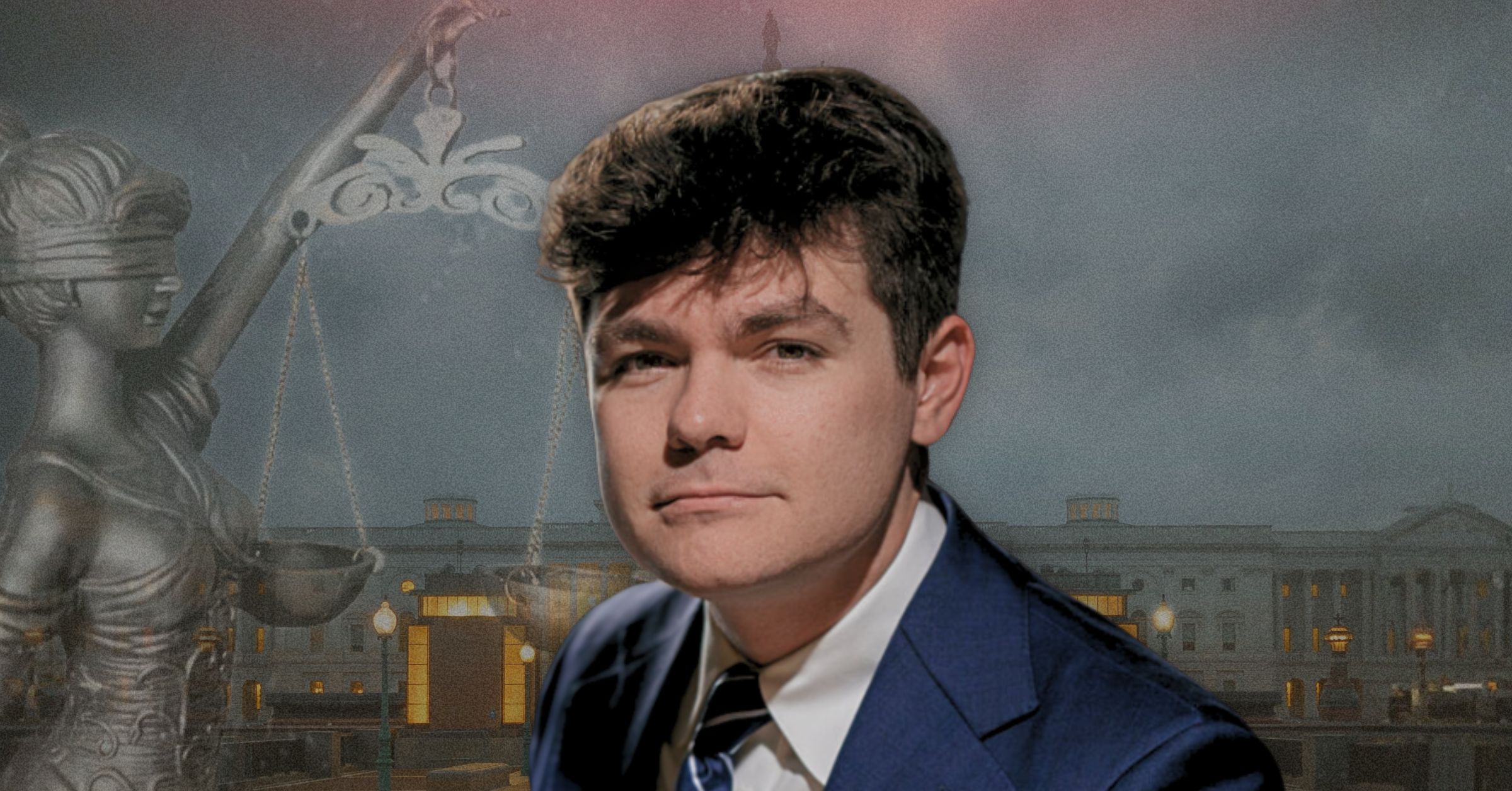
With the interview on Tucker Carlson followed by Ben Shapiro’s scathing response, and the failed diplomatic intervention of Heritage Foundation president Kevin Roberts, Nick Fuentes ias no longer under the radar. I guess we have to talk about this guy. I should have some comments to share soon. But in the mean time, it will be good to hear Nick Fuentes in his own words.

As much as possible I linked to his own, original clips. In a few cases they’re paraphrases. The effort is to let him speak for himself. For people who aren’t familiar with his rhetoric, they are liable to think his critics are exaggerating or treating him unfairly. I get it. So, this is a chance to see him, for yourself without spin doctors in the way.

Not a Deep Dive, Just a Baggage Check

Now this is not a comprehensive survey or deep dive into Fuentes’s politics and practice. I’ll try to do that later. For now, it’s just an introduction to the kind of “baggage” he’s carrying. But, be warned. He has a knack for rage-baiting, aggravating, and triggering people. Remember to keep your testimony. Pray for him and even love him (Matthew 5:43-48). He needs to repent and get right with God. He may call himself a Christian, but he’s not exactly known by his love (John 13:35). So, I’m personally praying that he feels the tension between his claimed Christianity and the person he’s becoming, and turns to Jesus in confession and repentance.

In the meantime, take a look for yourself at what he has to say, in his own words. Each quote is linked so you can see where and how he says it, just in case you want to see if his words are getting twisted.

Nick Fuentes in his own Words *Language Warning*


Praise for Dictators/Dictatorships/Fascism

  1. “I’m a big fan of Joseph Stalin.”
  2. “When you do confession it doesn’t say ‘thou shalt not admire Stalin’!”
  3. He refuses to denounce Hitler or even call him a “bad guy”
  4. “If I was in a room with Hitler and that [black guy who littered], me and Hitler would team up and f*ck that guy up! We would kill that guy! … And we’d high-five at the end.”
  5. “The white population is being genocided”
  6. “Hitler was awesome”
  7. “Hitler was right.”
  8. “It’s Hitler Friday. It is Heil Hitler Friday n*gga. Heil Hitler all my n*ggas.”
  9. “If antifa . . . were saying ‘Catholic fascism now!’ I’d be joining them.”
  10. “if antifa was marching down the street and waving the flag of Benito Mussolini or Francisco Franco [lefist authoritarian Marxists] I’d be joining them.”
  11. “We’re okay with authoritarianism.”
  12. “We need to take control of the media, take control of the government, and force people to believe what we believe, or force them to play by our rules.”

Holocaust Denial

  1. “The holocaust didn’t happen.”
  2. Downplays holocaust numbers
  3. The Holocaust is a “fantastical Hollywood story of a gas chamber that looks like a shower.”

Antisemitism and Anti-Jewish Conspiracism

  1. “You don’t think it’s a little bit weird that we can’t criticize Jews?”
  2. Participated in the Unite the Right protest saying ‘Jews will not replace us’”
  3. Calls Dave Rubin “Jewy Jewstein”
  4. Asked if he’s hurt in his daily existence by Jews, he says “I told you yes, absolutely.”
  5. Matt Walsh is a “race traitor” because he “works for Jews”
  6. “Being gay is popular, being feminist is popular. And you can thank the Jewish media for that.”
  7. “Jews are running our society”
  8. “There is an occult element at the highest level of society and specifically among the Jews . . . they are evil doers. . . they must be absolutely annihilated when we take power.”
  9. “There are basically two things that are going on: white genocide and Jewish subversion.”
  10. “We are in a holy war [with the Jews]”

Weirdly Violent and Cultish Statements

  1. “I am not a republican I am a trump cultist. . . if Donald Trump ordered me to do an extrajudicial killing, I would perform it.”
  2. “But if Donald Trump called me up and said, look, we need to capture my political enemies and torture them, you’re OK with that, right? . . . If he called me up and told me to do it, I would. I would be like, sir, yes — I wouldn’t even say, yes, Mr. President. I would say it will be done.”
  3. Performing an oath ceremony “Raise your right hand. Repeat after me. I will kill, rape, and die for Nicholas J. Fuentes.”
  4. Sees himself killing his future wife.
  5. “Time to kill the globalists.”
  6. “I want the people that run CNN to be arrested, deported, or hanged.”
  7. “All I want is revenge against my enemies and a total Aryan victory.”
  8. ”We will make them [Jews] die in a holy war.”

Racism and White Supremacism

  1. “Jim crow was better for them [black people] too”
  2. “Jim crow was better for us, better for them [black people], better for everyone.”
  3. Downplays/dismisses the effects of segregation and Jim Crow on black people
  4. Black men are “degenerate”
  5. “White people are every bit justified in being racists to the extent that that means avoiding black people.”
  6. “Around blacks, don’t relax”
  7. Opposes interracial marriage
  8. “I’m against race-mixing. I would never do that.”
  9. “It’s cucked and bluepilled to disavow white supremacy, and very wrong.”
  10. “Matt Walsh is a total f*ggot p*ssy . . . shabos goy” for denouncing white violence and white supremacism.

White Nationalism

  1. “I’m a white board nationalist. . . I hate blackboards.”
  2. Dinesh D’souza should “go to hell” for objecting to racism.
  3. Agrees with alt-right [white nationalism] but doesn’t use their label because it’s the “worst political brand in the country”
  4. Agrees with alt-right Richard spencer on racial identitarian ‘white nationalism’
  5. Endorsed by alt-right Richard Spencer in regards to his white nationalism
  6. Trump is “cucked and bluepilled” for denouncing white nationalism.
  7. ”I’m a white nationalist”
  8. ”America should be a white country”

Sexism and Misogyny

  1. “I will continue my crusade against women in politics”
  2. “[Rape] is just so not a big deal”
  3. Women “shouldn’t be making political decisions”
  4. Advocates for repealing the 19th amendment – Women’s right to vote.
  5. “I’m a misogynist”
  6. “Women need to shut-up”
  7. “Your body, our choice”
  8. “Hey b*tches, we control your bodies.”
  9. “Your body, my choice. Forever”
  10. “I will never accept for one solitary moment that we would ever have any women in politics.”

Bashing Charlie Kirk

  1. Called for escalated protests and obstruction of Charlie Kirk before his death.
  2. Charlie Kirk was “artificial, phoney, and fake.”
  3. “I took TurningPointUSA and I f***ed it. I took your organization. I took your baby, TurningPointUSA and I f***ed it. And I’ve been f***ing it. And that’s why it’s filled with Groypers [Nick Fuentes followers].”
  4. “Charlie Kirk is not the patriot that he says he is. . . he’s just some retarded idiot. . . a b*tch . . . a totally unexceptional human being. . . a fake Christian. . . he’s anti-white.”
  5. “[Referring to women in politics] I’m not attacking women, I’m attacking whores. I’m attacking sluts. I’m attacking stupid dirty b*tches.”

Recommended Resources:

Correct not Politically Correct: About Same-Sex Marriage and Transgenderism by Frank Turek (Book, MP4, )

If God, Why Evil? (DVD Set), (MP3 Set), and (mp4 Download Set) by Frank Turek 

Legislating Morality: Is it Wise? Is it Legal? Is it Possible? by Frank Turek (Book, DVD, Mp3, Mp4, PowerPoint download, PowerPoint CD)

Jesus, You and the Essentials of Christianity by Frank Turek (INSTRUCTOR Study Guide), (STUDENT Study Guide), and (DVD)      


Dr. John D. Ferrer is a speaker and content creator with Crossexamined. He’s also a graduate from the very first class of Crossexamined Instructors Academy. Having earned degrees from Southern Evangelical Seminary (MDiv) and Southwestern Baptist Theological Seminary (ThM, PhD), he’s now active in the pro-life community and in his home church in Pella Iowa. When he’s not helping his wife Hillary Ferrer with her ministry Mama Bear Apologetics, you can usually find John writing, researching, and teaching cultural apologetics.

It’s often said that “You shouldn’t legislate morality!” But, as Frank Turek argues ably, “all laws legislate morality.” He’s got a point. Legislating morality is inevitable. The question isn’t whether to legislate morality, but whose morality to legislate.[1] This predicament sets the stage for a genuine power struggle. Whose moral vision should win that tug-of-war? The outcome has yet to be determined on this side of eternity.

Legislating morality is unavoidable. Legislating religion, however, remains undecided.

Historically, the United States has been a majority Christian nation, informed by broadly Christian values, ethics, and worldview. The laws of this land, unsurprisingly, have often reflected a judicious and humanitarian outlook rooted in biblical Christianity. That means a growing recognition of sanctity of human life, the presumption of innocence, and freedom of religion.[2] The first amendment, for example, has firmly protected against forced religion, while fortifying freedom of religion and freedom of conscience, all while preventing any national religion.[3] America was founded, in part, because people rejected force-fed religion. With this in mind, we can readily admit that the United States has had a majority Christian worldview influencing its founding and maturation, without committing to a heavy-handed Church-state merger forcing Christianity on its citizens at the federal level, or confusing the two institutions for each other. Furthermore, that description seems to be the primary meaning of the phrase “Christian Nation.” At minimum, that’s what I’ve always meant by “America is a Christian Nation.” This country has a Christian heritage, lots of Christian citizens, and Christianity has been instrumental in the founding and fortification of this country.

What about Legislating Religion?    

That concept of a “Christian nation,” however, has been variously understood and misunderstood over the years especially under the banner of “Christian Nationalism.” At this point another question arises, “What about legislating religion?”

The Majority Left      

On the left side of the political spectrum it’s pretty common to hear fear-baiting rhetoric about a forceable Christian takeover. Christians, apparently, are trying to force their religion on people through religiously charged anti-abortion laws (“Keep your rosaries off my ovaries!”), converting public schools into Christian churches with school prayer, and imposing the Bible on courtrooms and congress (through congressional prayer and displaying the Ten Commandments). In this vein, the common phrase, “Christian nationalism”, is thrown around as a left-wing slur indistinguishable from “white nationalism,” “fascism,” or even “neo-nazism.”

For the majority left, especially in legacy media, “Christian Nationalism” isn’t a precise term. Nor was it meant to be. Mudslinging isn’t a precision sport. It’s just meant to smear, degrade, deride, and dismiss the victim. Aiming isn’t important when you’re making a mess. The force of this phrase, “Christian nationalism” is primarily emotive – it feels like theocracy, forced-religion, and heavy-handed Christians trying to “take back America” for rich white men, and their domestic slaves (jobless wives, dependent children, and employees). Of course, that’s a deeply uncharitable understanding of “Christian nationalism.” But, if the goal isn’t truth but power, and the aim isn’t precision but political posturing, then the label “Christian nationalist”, for the majority left, works well as a sweeping generalization lumping every conservative Christian patriot or politician under the same blanketing libel as the most hard-core theocrat, as if Christians generally want to replace the constitution with the Bible so we can start exiling non-believers, stoning gay people, and banning inter-cultural marriage.

It bears repeating that, coming from the majority left, the phrase “Christian Nationalism” is a libelous term meant to disqualify people. It sounds, to them (and to many moderates), like a substitute word for “white nationalism,” “white supremacism,” or even “neo-naziism.” So, anyone who embraces the phrase “Christian Nationalist” is liable to be dismissed and ignored before they have a chance to explain what they mean. The Christian Nationalist can try explain how they aren’t talking about forced religion like the Spanish Inquisition, apartheid-South Africa, or the Salem Witch Trials. But by the end of the explanation, there’s no one left in the lecture hall. The people dispersed as soon as he said he’s a “Christian Nationalist.” That’s the risk Christians run if they toy around with the phrase “Christian Nationalism” without realizing the enormous baggage it carries. Yes, we can encourage Christians to get more involved in politics and encourage politicians to bring Christian values and ethics with them to congress. But to call that “Christian nationalism” is about as naïve as calling people “gay” because they’re happy. People don’t hear that innocent intent when they hear such loaded words.[4]

The Radical Right      

On the fringe right wing, however, the phrase “Christian Nationalism” is gaining fashion. Leaving the majority of Christian conservatives in the dust, there is a faction of people who openly promote Christian Nationalism in a more or less “theocratic” sense of the phrase.[5] Doug Wilson, for example, argues that Christianity should be the national religion, as well as the framing worldview and reference point for government.[6] For people to hold public office they would have to be Christian.[7] And certain Old Testament and 1st Century cultural laws would be reinstituted such as repealing women’s right to vote, and reinstituting legal bans on homosexual practice.[8] Some Christian nationalists, in this vein, would go so far as to say that the Constitution should be replaced with the Bible.

From this fringe right wing perspective, one could argue that legislating religion is just as inevitable as legislating morality. In their view, religion is unavoidable and the only question is whole religion to legislate.

Three of the main contenders for that “inevitable religion” status are Christianity, Islam, and what some have called the “Woke Cult” or more charitably, “Progressivism.”[9] History has plenty of examples of Christian Theocracies and Islamic Theocracies, but the third category – Progressivism – might not seem as obvious.[10] Progressivism, might not seem like a “religion” at first. But the word “religion” does not simply refer to a formally established historically rooted belief-system with rituals, worship, theology, and so forth. Rather the first amendment sense of “freedom of religion” has always covered ideology, freedom of thought, and freedom of conscience. In this regard, progressive ideology certainly qualifies. Without parsing out “progressivism” too narrowly, it can include a range of left-wing ideologies including Critical Race Theory (CRT), Diversity Equity and Inclusion teachings (DEI), Anti-normativity and Queer theory, and more. Note, this is not just a question of ethics, but a wider ideology underneath those ethics. Progressivism is a religion in this broad, first amendment sense.

It is not clear, however, that the government will inevitably legislate religion. Ethically charged activity is unavoidable. Religiously charged policy, however, doesn’t have to happen. Sure, progressive ideology can sneak through sometimes, just as Christian, Jewish, libertarian, or conservative ideology, can sneak through too. But it’s still a stretch to call those religious and ideological influences “legislated religion.” The founding fathers never forbid such influence, but rather than giving special preference where one religion could be imposed on the general populace, they wisely installed a restrained sense of natural law. It has only a broad reference to “nature’s God,” and no particular religious trappings (prayer, worship, theology, rituals, etc.). Strictly speaking, a person could interpret “nature’s god” in terms of theism, polytheism, agnosticism, deism, pantheism, panentheism, or even atheism, where “nature’s god” is a personified reference to the mysterious machinations of primordial nature. We cannot safely assume that the Federal Government will necessarily impose a religion on the masses, nor can we use that fear to force Christianity on people under the banner of “Christian Nationalism.”

The Majority Right    

The Majority of Christians on the political right-wing are somewhere in between those extremes. They don’t agree with Doug Wilson or any theocratic brands of Christian Nationalism. They might be open to some nuanced sense of “Christian nationalism” but, not if it means granting the libelous use of “Christian Nationalism,” on the left, where any given Christian patriot is labeled a hardline theocrat and lumped in with a motley crew of Conquistadors, Crusaders, and Witch Hunters. This group has the hard job of charting a path forward that avoids extremist errors on both ends. We probably shouldn’t replace the constitution with the Bible, or install a bunch of Old Testament laws in place of the bill of rights. But there is a lot of room to discuss repealing abortion-choice laws, reevaluating the Obergfell decision, and allowing prayer in schools. These ideas can be debated, case by case, without having to jump to any extremist conclusions. There is foolish excess on every side of the political spectrum. It is not enough to guard against “left-wing” errors with no concern for right-wing errors.

Charting a Way Forward       

Surely there has to be another option. Right?

Vested parties probably need to have serious public discussion about the intricacies of “Christian Nationalism.” We can initiate this effort at the local level by simply asking, “What do you mean by ‘Christian nationalism’?” We cannot safely assume that everyone is using the phrase in more or less the same way. We need to identify looming errors, uses and misuses, and carefully carve out different senses of the phrase to avoid confusion, especially where people want to exploit that confusion for political purposes. People use smoke grenades only when they’re sneaking something past you. People use blurry confusing language for the same reason, to sneak something past you.

People use smoke grenades only when they’re sneaking something past you. People use blurry confusing language for the same reason, to sneak something past you.

That’s why we need to clarify terms. There might be a time, in the future, when the phrase is redeemed enough to where it’s more helpful than hurtful in public discourse. At present, however, the best way to maintain spiritual integrity and political sensibility, moving forward, is probably to avoid the phrase “Christian National/ism/ist.” Perhaps the phrase can one day be rescued from its baggage on the majority left and extreme right. Maybe one day it will no longer be a trap phrase that gets patriotic Christians to unwittingly imply they’re white supremacists. But as it stands now, the phrase is probably more trouble than it’s worth.

Patriotic Christians, of course, can still celebrate and be thankful for their country. They can assert American Exceptionalism. They can engage in politics, join political action committees, vote, petition, teach, speak, and run for office. They can even affirm Nationalism in the sense of an “America-first” agenda for the nation. In essence, Christians can affirm all sorts of political objectives without adopting the label of “Christian Nationalist.” For 95% of Christians, they lose nothing by shunning or shedding that label. Strategically, shedding the baggage of that phrase is all gain and no loss.

Meanwhile, the phrase “Christian Nationalism” already has a range of popular meanings that many people aren’t aware of, aren’t prepared for, nor are they ready to distinguish between them. “Christian Nationalism” can mean “patriotic Christian,” “a Christian who is a nationalist,” “Christian-influenced government,” “Church-State blurring,” “Church-State Fusion,” “Forced Religion,” “White-Nationalism,” “Anti-1st Amendment,” “European Cultural Christian Theocracy,” “Old Testament Theocracy,” and of course, “Handmaid’s Tale Theocracy.”

Finally, Christian conservatives should be wary against big tent partnerships with self-identified Christian nationalists. I’m not saying it should never happen. But they should weigh the costs involved, recognizing that not everyone who identifies as a “Christian Conservative” is aiming at the same target. Whatever foolishness and evil we might be seeing on the political left, we should be humbly self-aware that human depravity isn’t partisan. There’s foolishness to be found on every political extreme, and even in the center. We need to be independently principled as Christians, not mindless partisans or reactionary populists.

“Do not be overrighteous,
neither be overwise—
why destroy yourself?
Do not be overwicked,
and do not be a fool—
why die before your time?
It is good to grasp the one
and not let go of the other.
Whoever fears God will avoid all extremes”
Ecclesiastes 7:16-18

References: 

[1] This is the general thesis of Frank Turek’s Legislating Morality (Eugene, OR: Wipf & Stock, 2003).

[2] Turek 2003, throughout.

[3] Before the first amendment, as many as 11 of the 13 colonies had a state religion even as they had different degrees of tolerance for other denominations and religions. Today, in light of the 1st amendment (at the Federal Level) and the case history over “separation of church state,” no American states have a state religion anymore. See also, Turek 2003.

[4] It would also be like saying, “I’m not that kind of Nazi. I’m the good kind of Nazi.” Good luck with that one. You could be some other kind of Nationalist Socialist – and that’s the literal etymology of Na-Zi – and have nothing to do with the Third Reich, racial supremacism, antisemitism, eugenics, imperialism, or Germany. But as long as you adopt the same ruinous terminology, you’ll be considered discredited from the start. For the record, I think socialism is a bad idea too, whether nationalist or otherwise.

[5] There are several different ways to define “theocracy,” but the common theme between them seems to be “forced religion.” Weak forms of “forced religion,” would be disqualifying people from certain privileges and opportunities – like voting, citizenship, public schooling, public office, etc. – unless they convert to Christianity. Strong forms of “forced religion” would be explicitly punishing (prison, fines/taxes, exile, torture, killing) people unless they convert to Christianity. In the United States, where the first amendment prevents any strict identity between Church and State, it would be a theocratic, or at least potentially theocratic to eliminate the “separation of church and state.” When the institutions of “church” and “state” become so intertwined it’s difficult to tell where “church” ends and “state” begins, the state would be able to do, as Church’s do, and deny people different privileges and opportunities based on their religion. For churches, that would mean denying church leadership denying membership, or refusing to hire non-Christians. For the state, that would (or could) mean denying people voting rights, citizenship rights, or public office, based solely on their not being Christian.

[6] Doug Wilson, Frequently Shouted Questions About Christian Nationalism (Canon Press, 2025). See also, https://midamerica.edu/articles/41/doug-wilson-christian-nationalism-and-the-theonomic-debate, https://www.perplexity.ai/search/outline-douglas-wilson-s-chris-aL7PdXSBQe..ktOVtg5mjA

[7] Ibid.

[8] Ibid.

[9] Islam is a historically and traditionally theocratic religion. Christianity has some theocracy, on a case by case basis, but theocratic unions of Church-State have been less common since about 1500AD. The protestant reformation was a major turn away from heavy-handed Christian statism.

[10] Christianity and Islam are contenders as they are the two largest world religions, and both have a history of imposing religion through governmental means – even if Christian theocracy has been waning since at least around 1500AD, around the start of the Protestant Reformation.

Recommended Resources: 

Correct not Politically Correct: About Same-Sex Marriage and Transgenderism by Frank Turek (Book, MP4, )

Legislating Morality: Is it Wise? Is it Legal? Is it Possible? by Frank Turek (Book, DVD, Mp3, Mp4, PowerPoint download, PowerPoint CD)

Is Morality Absolute or Relative? by Frank Turek (Mp3/ Mp4)

Legislating Morality (mp4 download),  (DVD Set), (MP3 Set), (PowerPoint download), and (PowerPoint CD) by Frank Turek


Dr. John D. Ferrer is an educator, writer, and graduate of CrossExamined Instructors Academy. Having earned degrees from Southern Evangelical Seminary and Southwestern Baptist Theological Seminary, he’s now active in the pro-life community and in his home church in Pella Iowa. When he’s not helping his wife Hillary Ferrer with her ministry Mama Bear Apologetics, you can usually find John writing, researching, and teaching cultural apologetics.

If you’ve followed the problem of evil at the popular or academic level, then there’s a good chance you’ve come across the rather interesting objection from Stephen Law which he terms the “Evil God challenge.”

In essence he contends that skeptics can reverse any efforts from theists to explain God’s goodness in spite of the facts of evil in the world. The conventional problem of evil claims that God doesn’t exist or probably doesn’t exist given the facts of evil (gratuitous evil, animal suffering, moral evil, etc.) in the world. While theists typically appeal to things like free and sublime unknown divine purposes to explain away these evils, the skeptic can counter that these evils are equally good evidence that there exists a maximally evil God. Free will is the accommodation that this maximally evil God permits since deterministic evils aren’t as evil as freely chosen evils. And that supreme Satan wants the worst evils.

I consider Stephen Law’s “Evil God Challenge” to be one of the smarter objections within the Problem of Evil (PoE) debate. That said, his argument does have some limitations.

Independent Evidence          

As Bill Craig rightly notes, and Law unwisely dismisses, there could exist independent reasons for believing in God’s existence (such as the Cosmological, Teleological, and Moral Arguments), wherein a cumulative case could assimilate the Free will theodicy but would rebut the Evil God Challenge. Considered together these arguments point to a tremendously powerful, intelligent, and good creator God. The evil god hypothesis doesn’t fit theological picture from these arguments.

The Moral Argument

The Moral Argument is stronger than how Law treats it. Only some versions/elements of the Moral Argument submit to his “evil God” recasting. I’d suggest that we have preliminary knowledge of at least some moral facts whereby some things are good and some things are bad even if a whole society were to legalize that evil or prohibit that good. Yet the existence of moral facts (i.e., a category of truth) requires a moral truthmaker. Nature seems wholly incapable, in itself, of mustering the requisite teleology for enabling the referential relation needed for any such “truth” to exist. In other words, there’s nothing nature that could make a moral truth “true.” (i.e., “Raping women is evil. As such we ought not do it. But nature never mustered a single ‘ought.’ Therefore, that “oughtness” originates from outside of nature). So, I take the moral argument to be strong evidence of a morally good God.[i]

Fallenness

Brute theism doesn’t predict the Fall of Man (Gen. 3), but more specific brands of theism in the Abrahamic tradition predict the Fall of Man, the Angelic Fall, heaven, hell, and the subsequent problems in nature. I don’t pretend to have a ready answer here for the many and sordi problems related to animal suffering, pre-adamic pain, hell, etc. But, it’s worth noting that Christian theism does not predict that this earth would be heavenly. It’s atheists who think that Christianity should predict a heavenly/morally perfect created order. Christianity instead predicts that this earth would look like perfection tainted, goodness flawed, like a cracked looking glass for gazing at greater things.

Law and other atheists often present the problem of evil like the fact of evil in the fallen world are supposed to scandalize us Christians as if we had no biblical-Christian reasons to expect such things. Instead, I’d suggest the existence of any moral facts whatsoever should scandalize atheists for whom nature’s red tooth and claw is as much the “moral law” as anything–if nature were all that exists.

Law is smart enough to use his ‘evil god’ hypothesis as a kind of argument by analogy. He’s not directly refuting the free will theodicy. He’s using the free will theodicy to prove an objectionable conclusion. If the facts of free will and evil equally predict an evil god as a good God, then they are not (together) strong unique evidence for either. Law has a smart argument here.

And the doctrine of fallenness doesn’t directly address the core of Law’s argument. The fact of fallenness, however, is still part of the biblical Christian explanatory package. And it would be scandalous to Christian theists if the world looked like what atheists think theism should look like. There’s an underlying disconnect between Biblical-Christian theism and the atheists conception of what such a ‘god’ would look like. In this way, Law’s ‘evil god’ might not be a strong or helpful analogue to the biblical God. Law’s evil god might be only a symmetrical foil for the abstraction that atheists label “god.” But this “god” – as conceived among atheists – is acaricature compared to the nuanced personal God of historic Christian theism.

Privation Definition of Evil    

Given the evidence of the Cosmological, Teleological, and Moral arguments, we have sufficient independent evidence for thinking that God is the more ultimate reality, beyond even nature itself. And this God is the metaphysical grounding for moral goodness. An interesting implication of this conception of moral goodness is that goodness and evil aren’t ontological parallels. Goodness has independent substantial existence whereas evil has only dependent insubstantial existence as a privation of goodness. They don’t share the same metaphysical spectrum, rather evil exists only as a descriptor for the lack of  goodness. Evil needs goodness, but goodness doesn’t need evil. Goodness is the metaphysical substance and evil is just the description for the lack of whatever goodness that should exist, but doesn’t. Rocks are blind, but that’s not “evil” since rocks aren’t supposed to have sight. Blind infants are an example of ontological evil. It’s somehow wrong that they are blind since infants are supposed to be able to see. Evil is still real, but it’s a real lack of metaphysical goodness. This idea is called the privation definition of evil, and is attributed to St. Augustine in his 4th-5th century address of the problem of evil. I agree with Augustine on this because every single evil I’ve yet encountered or imagined appears to be a corruption of a metaphysically prior goodness. Rape is a corruption of sexual love. Death is a corruption of life. Any brokenness is a disordering of proper form or function. Divorce is a corruption of marriage. Diseases is a corruption of health. Etc. etc.

The impossibility of “maximal evil” 

Following from the last point, a privative sense of evil prohibits the “existence” of a maximally evil being. Maximal privation is literally nothingness. If we took the whole bag of all coherent, possible, actual, necessary or contingent goods and started subtracting each one of them–that’s what privation is, it’s the substraction of something–we would not end up with some maximally evil “thing.” No, we’d have literal nothingness, a wholly privated remainer wherein nothing whatsoever exists. The very notion of “maximal evil” is incoherent, and intrinsically self-defeating (not in the logically self-defeating sense, but in the metaphysical sense of depriving itself till it can no longer exist). A parasite without a host is lives no long in this world.

The Euthyphro Dilemma       

William Lane Craig makes an interesting use of the Euthyphro Dilemma to rebut Law’s “evil god.” Skeptics are familiar with the euthyphro dilemma as a way to object to traditional forms of theism, whereby God is either “beneath” goodness answering to some external objective moral standard or God is “above” goodness arbitrarily choosing what is “good” or “bad” and mandating those standards for his creation. Conventional responses have suggested that this is a false dilemma since God, instead of being beneath or above goodness, could be identical with goodness. God is good. He does not have goodness from some external source, or invent goodness as an arbitrary creation. He just is good. Craig takes this classic dilemma and applies it to Law’s “evil god” to interesting effect.

Suppose we concede for the sake of argument that an evil Creator/Designer exists. Since this being is evil, that implies that he fails to discharge his moral obligations. But where do those come from? How can this evil god have duties to perform which he is violating? Who forbids him to do the wrong things that he does? Immediately, we see that such an evil being cannot be supreme: there must be a being who is even higher than this evil god and is the source of the moral obligations which he chooses to flout, a being which is absolute goodness Himself. In other words, if Law’s evil god exists, then God exists.

Craig doesn’t mention how theists escape the problem, but he allows Law to get trapped in it. Augustinians like myself, can admit that evil is a privation. It’s a wholly contingent entity that cannot exist without being hosted by a good substrate. Evil can’t exist without goodness, but goodness can exist without evil. A good God can split the horns of euthyphro’s dilemma, but an evil God could not. One is left to wonder what is the more basic moral substrate that enables the existence of that god’s evil. Does that god derive evil from some higher moral standard, perhaps a Good God whom this demigod (Satan?) has rebelled against? Or does this evil god first encounter ‘evil’ as an arbitrary creation though he himself isn’t good or evil, right or wrong? Either of these options leave Law’s argument handicapped. And because the nature of privative evil doesn’t allow a maximally evil independent god, then Law’s god cannot split the dilemma. He’s gored on either horn.

Conclusion

Summarizing the course of argument so far, Law has a clever rebuttal to the Free Will Theodicy, but it can only stand by conceiving of evil substantially (as opposed to a privation), and only then if there do not exist other independent reasons for expectng God to be Good instead of evil. In this way, the cumulative case method and the moral argument specifically reinforced the conventional Free Will Theodicy to the exclusion of Law’s ‘evil god.’ The Problem of Evil is a serious philosophical objection to classical theism, but Stephen law’s “evil god challenge” has only limited value in reinforcing that avenue of anti-theism.


Additional Resources

References: 

[i] Some atheists agree that nature cannot produce (or be known to produce) what’s required for objective morality (moral realism) but instead of granting the moral argument for God’s existence, they appeal to some mysterious third option between nature and supernature. G.E. Moore calls this occult realm “non-naturalism.” The most famous proponent of the non-natural, non-theistic, moral realism is Erik Weilenberg. Non-naturalism has it’s own problems (see, the critique of his position in Philosophia Christi). Stephen Law’s position, however, doesn’t appeal to non-naturalism. So, his use of ethics falls well within the conventional critiques of naturalistic evolutionary ethics (namely, nature is “at bottom, blind pitiless and indifferent” rendering human ethics relativistic at best, and illusory nonsense at worst. See my “Nature is a Jerk” blog or presentation). Law has not allowed himself the liberty of appealing to immaterial brute moral facts as the truthmakers for his moral system.

Recommended Resources: 

Was Jesus Intolerant? by Frank Turek (DVD and Mp4)

Stealing From God by Dr. Frank Turek (Book, 10-Part DVD Set, STUDENT Study Guide, TEACHER Study Guide)

Reflecting Jesus into a Dark World by Dr. Frank Turek – DVD Complete Series, Video mp4 DOWNLOAD Complete Series, and mp3 audio DOWNLOAD Complete Series

Is Morality Absolute or Relative? by Frank Turek (Mp3/ Mp4)


Dr. John D. Ferrer is a speaker and content creator with Crossexamined. He’s also a graduate from the very first class of Crossexamined Instructors Academy. Having earned degrees from Southern Evangelical Seminary (MDiv) and Southwestern Baptist Theological Seminary (ThM, PhD), he’s now active in the pro-life community and in his home church in Pella Iowa. When he’s not helping his wife Hillary Ferrer with her ministry Mama Bear Apologetics, you can usually find John writing, researching, and teaching cultural apologetics.

Originally posted at: https://bit.ly/4lJkxFQ

[Editor’s Note: This blog was originally posted in 2014. While the general argument is still as relevant as ever, a lot has changed in the cultural landscape since then, most notably the 2022 Dobbs decision overturning Roe v. Wade. Plus, time-sensitive statistics are relative to 2014.]

The right to privacy just might be the most widely touted justification for abortion today. Implied within the right to life and to liberty, the concept of “privacy” demarcates the sacred domain of self-possession (my body), autonomy (my choice), and liberty (my freedom). Without at least some form of the right to privacy, one cannot defend against forced marriage, coercive medical procedures, physical abuse, slavery, forced labor or any other forms of coercion. And of course, abortion isn’t a “right” unless a mother can do what she wants with her body. One mantra, long circulated under the right to privacy is: “My Body, my right.” The (illicit) presumption is that bodily autonomy guarantees women of the right to abortion. But when these words are pressed, and the idea inside squeezes out, there might not be much pro-choice power left.

History of “My Body My Choice”     

The right to privacy has legal roots in the 1927 Olmstead v. United States decision where the letter of dissent, penned by Justice Louis Brandeis, articulated this previously unstated right. The case concerned Olmstead’s suspected smuggle and sale of alcohol. The “privacy” issue regarded how authorities gathered evidence against him. Brandeis argued that our founding fathers had “conferred against the government, the right to be let alone – the most comprehensive of rights and the right most favored by civilized men.” Olmstead was convicted, by a 5-4 decision, on covert wire-tapping evidence, gained without a warrant. Brandeis’ dissent letter, however, proved pivotal forty years later in the 1967 Katz v. U.S. case which overturned the Olmstead ruling.

In between these events was the 1965 Griswold vs. Connecticut ruling where the right to privacy was applied to sexual ethics, thus bringing that conversation closer to the abortion debate of today.

In Griswold v. Connecticut the issue was contraception, specifically within marriage. The ruling found in favor of the Executive Director of Planned Parenthood, Estelle Griswold, who advocated for the free use of contraception (at least) within marriage. The predominate justification for their case? Privacy. Married couples have the right of privacy whereby they can choose for themselves whether to direct their sexual relations toward pregnancy or not.

Following the Griswold case, Eisenstadt v. Baird (1972) would extend the right of contraceptive access to unmarried couples as well. In that case, the right to privacy joined with the equal protection clause to give unmarried couples the same access to contraception as married couples. While the Eisenstadt case is important, the Griswold case is widely considered to be the more groundbreaking decision leading up to Roe v. Wade (1973).

In Roe v. Wade (1973), the right to privacy was one of the main justifications for the ruling, in favor of Jane Roe (Norma McCorvey), granting a qualified right of abortion access. Together with the concurrent Doe v. Bolton case (verdict rendered the same day, January 22, as Roe v Wade) abortion access was granted to U.S. women on an unprecedented scale. The privacy argument refers to a woman’s right to manage her body how she sees fit, with minimal intrusion from others. Her contraceptive practices are primarily her choice to make, in part, because she bears the greatest responsibility for what happens to her body be it pregnancy, sexually transmitted diseases, child-birth, or subsequent motherhood.

Roe v. Wade proved to be a controversial ruling, having been disputed ever since. Some sense of the “right to privacy”, however, has never been disputed, since it is understood that the federal and state government should generally respect individual citizen’s rights to conduct their private affairs privately, and to manage their own bodies with general freedom from interference. It is this special right (a.k.a., sacred right) that is implied when people say things like, “the government should stay out of my bedroom” or “you can’t tell me how to raise my child” or, more crassly, “keep your rosaries off my ovaries.” Pro-choice and pro-life advocates can all agree that there is some sort of privacy right implied in the basic legal and human rights of U.S. citizens. The terminology is not explicitly stated in our founding documents yet some sense of it has always been understood therein.

[Editor’s Note: The watershed case of Dobbs v. Jackson (2022) overturned Roe v. Wade (1973) Doe v. Bolton (1973) and Casey v. Planned Parenthood (1992). The decision confirmed that there was no explicit “right to privacy” mentioned in the Constitution, although, the concept still applies in regarding people’s general rights against spying, theft, illegal search and seizure, contraception, etc. Dobbs did not overturn Griswold or the Eisenstadt decisions, so those applications of “privacy rights” are maintained, even abortion is no longer included as a constitutional right]

But how far does that right to privacy extend? When pressed, it seems like there are some important qualifications that can be pitted against a blanketing sense of “privacy.”

1) Certain public health issues restrict the right to privacy

In some states, an HIV-carrier can be criminally tried for willfully spreading HIV if they don’t reveal their HIV status to their partner. Though his or her disease may, in some sense be “his body,” and “his own business,” it becomes a public issue when, under false pretense, he infects others. Similarly, a smoker may be allowed to smoke at home, but not necessarily at public restaurants or at work. It may be one’s personal right to smoke a cigarette, but since that private behavior has public consequences there is no universal right to smoke just anywhere one wants.

Furthermore, there are certain behaviors that are illegal even among consenting adults who, regarding their right to privacy, have no personal objections. Illegal drug use and prostitution are considered such pressing public health issues that we have governing prohibitions in place.

It might be exaggerating things a bit to call abortion a “public health crisis,” but that assessment has merit. In a brutally literal sense, medical abortion, among preventable causes, is by far the single leading killer for human beings of any age or race.


[1]* According to CDC reports for 2011, abortion claimed the lives of 1,058,490 children in utero, meanwhile malnutrition claimed 3,009 lives, various accidents (firearms or otherwise) claimed 126,438, suicides and homicide claimed 55,756.

[Editor’s Note: the current total, is now around 66,000,000 abortions from 1973-2025. And the yearly average is, again, around 1,000,000.]  

Doubtless, there are preventable cases of heart disease and Type II diabetes that could be added to those numbers, but it should be clear that the million plus deaths annually from abortion easily tips the scales when compared against other preventable deaths. Were there more than a million deaths from salmonella poisoning, or malnutrition, or suicide, or drug trafficking, or medical malpractice, then hardly a politician in Washington would fail to join the campaign against such preventable fatalities. Those numbers would easily count as a public health crisis in any other field. Even when a basic right to privacy is granted, public health crises present a plausible boundary line for personal autonomy. People might have a general right to do what they want with their bodies, but not necessarily if their actions constitute a public health crisis and especially not if their behavior extends that health crisis into killing other human beings.

2) There is no privacy right regarding child-abuse.

It is widely granted that parents have a right to raise their (minor) children how they see fit. Their home is a private bastion of liberty where they can talk, think, feel, hope, believe, and generally act as they see fit. This includes child-rearing, discipline, character formation, and even naming one’s children with most any name one sees fit. This domain of freedom has also been touted in justifying home schooling and personal choice of religious or non-religious education. Yet in spite of all that liberty at home, there is no “privacy right” allowing sexual, physical, or gross verbal abuse. The children are still individual human beings with their own rights even if their status as minors nuances their legal autonomy. In these circumstances, the general right to privacy for parents is bounded by a more basic right of the child’s right to life, liberty, and his/her pursuit of happiness. Phrased ethically, the parents have a moral responsibility to care for and support their children towards health and well-being and not treat them like slaves, robots, sex partners, or punching bags.

Regarding the subject of abortion it is common parlance to refer to a pregnant woman as a “mother” and to refer to her gestating human fetus as her “child,” i.e., “mother and child.” There is legal precedence for referring to the preborn human being as a “child-in-utero” and to the pregnant woman as “mother” (see, The Unborn Victim of Violence Act, 2004). To be fair, she may prefer not to be a mother, she may scorn motherhood, or otherwise dislike being called a mother, but biologically she has begun motherhood as soon as another human being has begun inside of her. She does indeed have great and rightful freedom to conduct herself how she sees fit, but now that another human being is involved – and biologically there’s no dispute over whether the child-in-utero is a genetically distinct homo sapien – she is a mother and any abusive acts on that human inside of her is literally child abuse. Admittedly, the legal system, via the Unborn Victims of Violence Act, does not deem assaults on children-in-utero as “abuse” unless the child is harmed by an aggressor besides the mother.[2]

The child’s physiological status, however, is the same regardless of whether the child is killed by an assailant or by an abortion doctor; whether the child is wanted or not. He or she is still an abused child in terms of the malicious and fatal harm inflicted on them. He or she is no less harmed regardless of who is doing the abusing, or what their intentions might be.

3) There are competing responsibilities of parenthood

Similar to the last point, it should be noted that parental behavior regarding their own bodies can still harm their children. While parents have a general right to privacy regarding their own bodies, their bodies, nonetheless, are part of their person so that gross negligence of their own bodies or abandonment are unethical and sometimes illegal.

If a single parent says, “It’s my body, and I want my body to be in California” but their 5 year-old child is in Maryland, then that parent’s autonomy is competing with his or her legal responsibility as a parent. To leave that child unaccompanied in Maryland is child abandonment. Moreover, if that parent participates in illegal drug activity, prostitution, or otherwise extremely risky behavior the state can rightly take that child away from that parent for his or her gross negligence. One could even be ethically and legally culpable for willfully self-destructive behavior like suicide attempts, morbid obesity, abusing over-the-counter drugs, or any number of behaviors that leave children with a dangerously unreliable parent. That parent’s right of privacy infringes on his or her responsibility as a parent, and in some cases that parent’s behavior is both criminal and unethical.

Regarding abortion, a woman might not want to think of her preborn child as a “parasite” or wish any harm on it, but she does want it out of her body to let “nature take its course.” In that sense, she may seek a more gentler characterization of the abortion process so that her behavior is construed passively, selflessly, or in otherwise nicer tones. In that way an abortive mother may try to baptize her intentions so that she’s not willing any harm, or she is aiming for the “greater good.” These efforts have some ethical value, but do not necessarily counterbalance the fact that a mother’s children have some rightful expectations that she will not deliberately destroy herself or harm them through her body.

For example, it is unethical for a smoking mother to give her prenatal child cancer or birth defects, or for her to use illicit drugs and deliver a crack baby, or to acquire HIV and knowingly confer it to her pre-born child. These acts are not just done to one’s self, but directly affect someone else. It is no longer a strictly “private” issue now that someone else is involved. Abortion, as such, is not just an act on the mother’s body but also harms the child. For example, some abortificients (abortion medications) are known to reduce the mucosal lining in the uterine wall where the embryo would otherwise implant. This leaves the embryo with nowhere to go, it is expelled from the womb. The pill was an action of the mother, affecting her own body, but its effects did not rest with the mother. The effect was a silentabortion, where another human life was taken. In this way, abortion can be ethically similar to other actions of mothers that harm their babies–even if the action was intended to be of a different sort, like smoking for pleasure, or drinking for fun, or taking recreational drugs to hide from the world. These acts might have different ethical weight themselves, but all of them also carry the ethical weight of child-abuse when they harm the child-in-utero.

4) There are competing responsibilities of citizenship

Some minimal responsibilities are expected in exchange for the many rights and privileges of citizenship. For example, one is not at liberty to plot treason against one’s president nor to attempt to assassinate the president, even if one is only “planning” such a thing without yet acting. It is illegal to even conspire to do such anti-government activities. It does not matter if one’s activities are all contained within personal journals with the materials kept in one’s home. One may have a right to bear arms, but not to bear the schematics for an assassination attempt. Frankly, a person might even be “joking” yet if the threat looks real enough, that behavior could be grounds for criminal charges. The right to privacy does not grant unqualified liberty to mobilize one’s private domain for public harm, as that is no longer a merely private matter.

Ever since Roe v. Wade pre-born children are not considered legal persons and therefore do not have the rights of citizenship. [Editor’s Note: And while the Dobbs decision overturned Roe, it did not establish federal “personhood” status for children-in-utero. Abortion policy reverted to the states, along with any related “personhood” amendments.] The mother, presumably, would still have that right of citizenship qualifying her for special privileges granted to U.S. citizens like miranda rights or voting rights in U.S. elections. She would also be subject to the laws of the land, and so she has laws which prevent her from child abandonment and child abuse, and of course child mutilation, and serial murder of children. Her privacy is already infringed upon regarding her motherhood, such that she has civil duties as a mother.

[Editor’s Note: All these duties apply to fathers as well, as bodily autonomy and the right of privacy do not, normally, entail any “license to kill” innocent human beings, especially one’s own child. Abortion-choice policy, of course, remains the lone legal exception to that humanitarian basic.]

The preborn child is at least analogous to the born child such that it’s no stretch of the imagination to think a real mother should act like a real mother, even if she’s only pregnant right now. Also, if any further legal precedents are established that raise the relative legal status of the child-in-utero, then they might come closer in status to “citizens” and be a more rightful boundary on the “right of privacy.”

5) It is illegal to use one’s body to injure or kill other people without other overriding justifications

It is illegal in many cases, and unethical in more cases, to use one’s body to harm others. A person has the right to go skydiving, but not to willfully land on another person killing them. In that case, both parties are killed. Two evils have been done – both being a kind of homicide. Of course, successful suicides can’t be prosecuted, but it’s still a criminal act, and there’s little dispute about whether it’s generally evil to kill oneself, especially if someone else is killed too.

On a lesser scale, a person might jokingly fall all over people at a party receiving bumps and bruises and giving them as well. The person might be amusing, but he’s still harming other people by use of his body. One’s right to privacy is restricted by the general principle of non-malfeasance: that is, do no harm to others. Even if one’s own very body becomes the instrument of harm, it is still unethical and in many cases illegal, to harm other human beings with one’s body. Abortion involves a mother’s instrumental use of her body, by a doctor’s assistance, to create a hostile environment for the child-in-utero. To use one’s body for harm is still unethical, and not a natural privilege within the “right of privacy.”

6) Rights to privacy can be abdicated

In the case of Bowe Bergdahl American audiences were scandalized, in part, by his reported treachery, as his “right to privacy” did not include the privilege to endanger his fellow soldiers. Bergdahl, a soldier for the U.S. Army, who legally swore allegiance to the U.S. Army, and allegedly betrayed his fellow soldiers abandoning his post, going AWOL, with intent to ally with the enemy. If those reports are validated and Bergdahl is found guilty, he will not have a strong “right to privacy” defense in his favor.

[Editor’s Note: Bergdahl He was held captive by the Taliban from 2009-2014 despite his alleged efforts ally with the enemy. He was court martialed and found guilty in 2017, fined, and dishonorably discharged. In 2023 his case was appealed and his conviction overturned].

By swearing allegiance and signing his respective contracts he made a substantial commitment to the United States of America to loyally serve as long as he is able and allowed. He retains his freedom of conscience throughout (he could agree with the enemy if he wants). He retains some freedom of speech (he can say what he wants in his journals). He retains freedom of religion (he can worship or not worship however he sees fit). But his body is not fully his own, since he abdicated certain privileges of free citizenship for the sake of becoming a soldier.

Bergdahl is not unique here either. Most every working man or women abdicates some degree of personal freedom and privilege for the sake of conforming to a work environment. That’s the price people pay so they can bring home a paycheck. People can exercise their right to privacy by not working in those jobs. If they don’t want to agree to their terms they don’t have to work for that business. Fashion and film industry can have rigorous expectations of their employees, “You must dye your hair,” or “You have to be willing to do nude scenes,” or “you cannot let your body weight exceed 115 pounds.” People may also abdicate certain privacy rights as legal punishment. Some criminals are forced to wear trackers monitoring their location in the event of trespassing on a restraining order. One of the paradoxes of the right to privacy is that as a facet of bodily autonomy, people can exercise their bodily autonomy by sacrificing certain aspects of privacy.

Regarding abortion, a parent’s right to privacy might be restricted by parental duties but that very privilege to choose to get pregnant or raise a child is itself a rightful exercise of one’s privacy. Even if the pregnancy was forced on the woman, through violent rape, molestation, or incest, those horrific evils don’t implicate the child. It’s not like the child-in-utero did anything deserve a death-sentence. The mother’s right to privacy and bodily autonomy are grounds for prosecuting the rapist, not for punishing the child.

Parenthood has always been a normal constraint on one’s privacy. It’s a heavy blessing people assume when they are willing to invest some of their freedom as a sacrifice for the benefit of children. Reluctant parents may have a harder time coping with the lifestyle change, but that doesn’t change the fact that they are parents and parenthood naturally constrains our privacy. Those who do not want that constraint would do well to avoid parenthood. Killing one’s child, however is not “avoiding parenthood,” since parenthood has already begun at conception. That is more like willful failure as a parent.

So, What’s Left of ‘My Body My right’?       

Bringing all these different qualifications together, a stiff critique emerges against certain liberal uses of the “right to privacy.” We can, and should, grant a qualified sense of the right to privacy without assuming that that right includes the license to kill innocent human beings by way of abortion.

References:

[1] The CDC reports the total deaths for the U.S. population as ranging between 1.9 million and 2.5 million between 1970 and 2011 per year not including abortions. In that same time frame, abortion rates ranged from 0.74 to 1.3 million abortions. In 2011, those reports estimate that there were 2,515,458 deaths (not counting abortions) and 1,058,490 abortions, making abortions about 1/3 of all fatalities in the U.S. Yet even these numbers are skewed because natural abortion (miscarriages) are not counted whereas natural deaths that occur as complications from old age are counted. Abortions might be better compared to preventable circumstances like workplace accidents, traffic fatalities, or preventable diseases like Type-II diabetes.

[2] One could argue that our legislation is due for updating since 1973. Some things that have since been legalized in the name of abortion create inconsistences for established laws, precedents, and ideals within our legal system. For example, mutilating a human corpse for the sake shipping purposes is illegal, but if it’s in utero then that is standard practice of dilation and curettage abortions. Likewise, a pregnant mother who is woefully derelict of her maternal duties cannot be legally tried for all the negligence and abuse inflicted on her preborn-child, yet if it’s a “wanted” baby that would seem to make her the aggressor against the child as in the “Lacy and Connor Law” so that if she kills the baby through drug and alcohol abuse, she could be tried for negligent homicide, manslaughter, or at least child abuse. Likewise, if a pregnant woman is assaulted on the way to the abortion clinic, intending to get an abortion, and miraculously the thief forgets to take her wallet but does push her down, killing the child on impact–he actually saved her time, and money by killing the baby in a much shorter fashion. He can be criminally charged for killing the child, for assault,  and for theft, yet the thief was only incidentally involved in an abortion procedure intended by the mother. The mother’s “intentions” did not change the nature of that child any more than it changed the ethical status of that assault.

Recommended Resources:

Correct, NOT Politically Correct: How Same-Sex Marriage Hurts Everyone (Updated/Expanded) Book, DVD Set, Mp4 Download by Frank Turek

Sex and Your Commanding Officer (DVD) (Mp4 Download) by Dr. Frank Turek

Legislating Morality (DVD Set), (PowerPoint download), (PowerPoint CD), (MP3 Set) and (DVD mp4 Download Set

Does Jesus Trump Your Politics by Dr. Frank Turek (mp4 download and DVD)


Dr. John D. Ferrer is a speaker and content creator with Crossexamined. He’s also a graduate from the very first class of Crossexamined Instructors Academy. Having earned degrees from Southern Evangelical Seminary (MDiv) and Southwestern Baptist Theological Seminary (ThM, PhD), he’s now active in the pro-life community and in his home church in Pella Iowa. When he’s not helping his wife Hillary Ferrer with her ministry Mama Bear Apologetics, you can usually find John writing, researching, and teaching cultural apologetics.

Originally posted at: https://bit.ly/4mBhosw

If you are a pro-life man, like me, then you’ve heard a hundred times that men need to shut up about abortion. Apparently, we men have no right to talk about abortion unless, perhaps, we’re voicing pro-choice solidarity. #girlpower.


Why should men be silent? – The “No Womb, No Say” Position   

Just being honest here, some men probably do need to shut their pie hole, but that’s because they’re lying, manipulative, idiot, blowhards. I’m sure you’ve met a few of those. Fortunately, that’s not every man. Some men have a word worth hearing. They can even have a timely word of protest against abortion. Sadly, a lot of people still believe that men have no right to protest abortion. This is the “no womb, no say” position.

Now “no womb, no say” is all sorts of wrong, but it’s not entirely wrong. We have to admit a kernel of truth to this popular maneuver. According to Captain Obvious, “Men can’t get pregnant.” Men don’t know what it feels like to be pregnant, carry a child to term, or have an abortion. We’ll never squirt out a seven-pound chunk of living flesh unless we have an organ removed. Abortion directly impacts women in the most intimate way. But, for men, it’s always indirect and it’s never as intimate.

There’s also a history of sexism getting in the way of things. Even today, it’s not hard, to find dark alleys, studios, and industries where women are treated terribly. Liberals and conservatives can debate about the extent of that problem, but we can all agree that there have been many cases of genuine sexism against women. We can also agree that one of the key reasons for the Roe v. Wade (1973) ruling was an attempt at equalizing rights for women. Today, most all of us can agree, across political aisles and in every sector of society, that women have (or should have) an equal or greater voice on the subject of abortion.

But no one, in good conscience, should grant that women have the only voice on abortion. Given the scale of abortion (66 million in the U.S., 1.7 billion globally), and it’s profound and lasting effects on families, communities, nations, and the whole world, it is unconscionable to exclude fully half society from that pregnant conversation. Here are…

59 Reasons Why Men Need To Speak Out About Abortion

  1. If men can make abortion-choice policy they can unmake it – seven old white guys legalized it nationally in Roe v. Wade (1973), and four white guys and one black guy helped overturn it.[1] If the men on the Supreme Court were to refuse to comment on abortion in pertinent cases, that would amount to a miscarriage of justice and dereliction of duty.
  2. Men played a huge role in creating abortion-culture, we owe it to society to clean up our mess – Men have been known to support abortion policy, coerce women into abortion, abuse women, abandon families, and do various things that pressure women into having an abortion. Not all men are doing this, but all men should be working to undo the mess we’ve made.
  3. Men can protest abortion just as non-slaves can protest slavery, and white people can protest racism– if we don’t have to be black or a slave to oppose racism and slavery, then we don’t have to be women to oppose abortion. Bear in mind, abortion-choice policy currently permits race-based and gender-based abortion. So, abortion is not just analogous to racism and sexism, abortion policy is racist and sexist. And everyone should oppose those things.
  4. Men can support the pro-life cause just like they supported women’s suffrage (voting) – Early feminists (A.K.A., First Wave), were committed to women’s suffrage and openly rejected abortion. They argued that it would lead to exploitation and violence against women. Men can unite with the better parts of feminism by agreeing with voting rights, and opposing abortion, just like they did.
  5. For men to comply with abortion-choice policy is suspiciously self-serving – Man-boy syndrome is real folks, and abortion is a factor. The latest numbers on marriage show our marriage rate is declining. Traditional marriages haven’t been faring too well since the sexual revolution, and definitely not since Roe v. Wade (1973). Yet across world history, the most effective means for civilizing males on large scale is with marriage and fatherhood. Abortion-choice culture makes it easier to avoid both. In the old days, unplanned pregnancy led to a shotgun wedding. That’s not the best way to do things, but at least no one died from it. Now, abortion-choice interrupts the ceremony, “Stop the Wedding! She’s not pregnant!” Plus, abortion-choice is also portrayed as liberation for women, like it’s some great equalizer, empowering women to be on level ground with men in society. In reality, abortion standardized a roving “masculine” sexuality that never served well for women’s flourishing. Women have been lamenting ever since 1973 how much harder it is to find a good man who’s willing to settle down and start a family. Why on earth would a man settle down and start a family when his aggressive, roving, independent nature yearns to spread his seed wherever he can and virtually nothing in society discourages him from doing so? It’s not like he needs to procreate a boy child to inherit his kingdom, or have a gaggle of kiddos to help him run the farm. Abortion did not dignify the feminine distinctives of child-birth and motherhood. Instead, it weaponized maternity, aiming the kill shot at their own child-in-utero. Meanwhile, non-committal man-boys can slink into the night without even a paternity suit to reel them back in. Abortion-choice works like a “get out of jail free” card for all the immature, predatory, and boyish males who think marriage and fatherhood are prison.
  6. Abortion is not just a women’s issue – the fallout from abortion isn’t limited to women, so it’s not just a “women’s issue.” It’s an “everyone issue.”
  7. Abortion kills males too (in utero) – Its effects aren’t limited to women
  8. Abortion impacts family court and paternity rights – Its effects really aren’t limited to women.
  9. Abortion hurts boyfriends, lovers, and male friends – It still isn’t limited to women.
  10. Abortion can traumatize fathers and grandfathers too – Did I mention it’s not limited to women.
  11. Abortion can traumatize brothers, sons, and extended male family – Yup, it’s not limited to women.
  12. Abortion can traumatize male medical professionals – Yet again, if you haven’t gotten the picture yet, its effects aren’t limited to women.
  13. Abortion can hurt marriages and families – Oh yeah, the effects aren’t limited to women.
  14. Abortion can harm churches, neighborhoods, and communities – Ditto.
  15. Abortion can damage the moral health of culture, society, and whole nations – Ditto times two.
  16. Some abortion survivors are men – Ditto times three. It would be patently absurd to claim that a man who has been maimed by a botched abortion, like Nik Hoot, has no right to speak against abortion. People who’ve been harmed by abortion have a vested personal interest in trying to protect others from abortion.
  17. As long as abortion is about human rights then all humans have a rightful voice on the matter – Abortion is about women’s rights, but it’s also about human rights broadly since it presses the question about when exactly do developing humans in utero acquire human rights.
  18. Female-led Organizations like Live Action , Eagle Forum, and Silent No More, encourage men to speak up on the issue – There is no unified voice, from women, telling men to shut up about abortion. Quite the opposite, females who are mobilized vocal and influential can be found encouraging pro-life men to speak up.
  19. Many other women don’t want men to be silent on abortion – Feminists are divided on several issues, including this one. Some women are happy to let a gentleman open their door, carry their groceries, and speak out against abortion. Often these women are quite liberated, empowered, and flourishing without any concern whatsoever about patriarchal oppression or toxic masculinity. They are too busy enjoying their family and exercising their freedom to be bothered with p*ssy hats and progressive politics. Maternal feminists, like Christina Hoff Sommers, typically appreciate the role of active, vocal, and even protective men in their lives, especially when it comes to issues as big as abortion.
  20. Medical experts, on abortion, are often men – Silencing them amounts to willful ignorance. They are worth hearing.
  21. Legal experts, on abortion, are often men – Ignorance is bad. Male experts are worth hearing.
  22. Scientific experts, on abortion, are often men – Ignorance is still bad. And male experts are still worth hearing.
  23. It’s an overreach – Neither women nor men have the right or the authority to demand each other to collectively shut up about anything.
  24. Men can offer relational and emotional support – When a pregnant woman wants to choose life so long as she can find some encouragement from a trusted male friend or family member, in that case, the “no womb, no say” position muffles those men, leaving that woman less support in their time of need. Women often see trusted male friends as allies, not enemies. So, they welcome a male perspective as words from a trusted friend.
  25. If men can help a woman have an abortion, then they should at least be able to help her not have one – Demanding that men show support or stay out of it, even at the expense of their conscience, is to demand that they be cowards, immoral, or both. Civilized society should not wish for men to be immoral cowards.

***Stay Tuned for part 2  with reasons number 26-59 on “Why Men Need to Speak up!” ***

References:

[1] Dobbs v. Jackson (2022) overturned abortion-choice policy at the federal level, finding that there is no constitutional protection for abortion. This ruling overturned Roe v. Wade (1973), Doe v. Bolton (1973) and subsequent cases built on those rulings like Casey vs. Planned Parenthood (1992). The Dobbs decision did not however overturn abortion-choice policy at the state level. States still have the legal right install, regulate, or ban abortion-choice at the state level.

Recommended Resources:

The Case for Christian Activism (MP3 Set), (DVD Set), and (mp4 Download Set) by Frank Turek 

Is Morality Absolute or Relative? by Dr. Frank Turek DVD, Mp3 and Mp4

Legislating Morality (mp4 download),  (DVD Set), (MP3 Set), (PowerPoint download), and (PowerPoint CD) by Frank Turek

Defending Absolutes in a Relativistic World (Mp3) by Frank Turek


Dr. John D. Ferrer is a speaker and content creator with Crossexamined. He’s also a graduate from the very first class of Crossexamined Instructors Academy. Having earned degrees from Southern Evangelical Seminary (MDiv) and Southwestern Baptist Theological Seminary (ThM, PhD), he’s now active in the pro-life community and in his home church in Pella Iowa. When he’s not helping his wife Hillary Ferrer with her ministry Mama Bear Apologetics, you can usually find John writing, researching, and teaching cultural apologetics.

Originally posted at: https://bit.ly/4lO8jwi

Jesus Of Nazareth Is the most disputed character in history. Most of the world’s religions incorporate him into their teaching, whether as a morally perfect prophet (Islam), a divine manifestation (Baha’i), or a reincarnated god (Hinduism). Buddhists believe he is a grace-giving demigod or even a Buddha. Christian cults like the Jehovah’s Witnesses and the Mormon Church readily incorporate Jesus as a partial divine, more than man but less than the full deity of Father God. Almost all of Judaism rejects Jesus as a false prophet, a mere mortal, and a failed messiah.[1] Meanwhile Atheists and skeptics tend to see Jesus as a liar or a lunatic. Mythicists debate his very existence with skeptical weapons set on eleven.


Clearly, Jesus of Nazareth is a contentious character. So we should not be surprised that Christian history has held many theological battles in the theatre of Christology (theology about Jesus). The church has fought hard to answer, “Who is Jesus?” If He is, indeed, “the way the truth and the life” and “salvation is found in no other name” then we should make sure we aren’t dealing with a distorted pseudo-Jesus (John 14:6; Acts 4:12). Theological integrity is a matter of ultimate importance here. Heresies about Jesus (a.k.a., christological heresies) make for an important study because Jesus is the most important person there is.

What is a Heresy?

First, we may ask, what is a heresy? The short answer is, “aberrant teaching.” A heresy is some teaching which departs from core Christian teaching.  But that definition is a little unclear. It doesn’t really help quell the human habit of exaggerated accusations – where people are liable to call most anything heresy, even if it’s just a different option within historic Christianity. Nor does that definition help distinguish between denominational versus heretical disagreements.

Often people throw around the term “heresy” with little concern for the implications of this imposing term. Heresy is a libelous term and shouldn’t be used lightly. For our purposes here, we need to see what really qualifies as heresy. But to do this, we need to know, “what is orthodoxy?”

Orthodoxy (Lat., “right doctrine/teaching”) refers to the established, agreed-upon, and time-tested theology of the historic Christian faith (incl., Catholics, Protestants, and Eastern Orthodox). A similar concept is orthopraxy (Lat. “right practice”). Sometimes these notions, right-practice and right-teaching, are fused under the parent-term orthodoxy. We’re just looking at teachings about Jesus Christ, what theologians call “Christology.” So, we don’t need to address orthopraxy here.

There is a lot of gray area in the notion of “orthodoxy,” and there are many disputes over particular teachings and whether they count as heresy, such as “open theism,” or “baptismal regeneration.” But we have an imperfect yet reliable way to identify what is probably orthodox and what is probably not.

  1. Does it pass the test of Apostolicity (it is affirmed implicitly or explicitly by the teachings of the prophets and apostles in biblical times)?
  2. Does it pass the test of Scripture/Canonicity (it aligns fairly and completely with the Canon Scripture)?
  3. Does it pass the test of Creedal History (it is affirmed within the history of church creeds and councils)?
  4. Does it pass the test of Catholicity (it has universal or near universal acceptance by the church)?
  5. Does it pass the test of History (it is affirmed within the collective teachings and traditions of the church over it’s history)?
  6. Does it pass the test of the Church Fathers (it is affirmed within the teachings of the Church Fathers)?

These tests are the various ways the church has been checking ideas for theological integrity over the whole course of church history. You can skim any of the Ecumenical Church councils and see each of these criteria in action. These tests aren’t implemented equally by all denominations, nor are these tests collectively used by each Christian faith tradition. But together these tests constitute a good approximation for how to discern orthodoxy. This rubric is imperfect in that some orthodox ideas only satisfy a few of these tests. But this rubric is reliable in that there’s no orthodox idea which fails all of these tests.

Deviations from orthodoxy are called heterodoxy. Not all heterodox teachings would count as heresy because something could lie outside of orthodox teaching, but it’s not important enough, it doesn’t carry enough consequence, or it’s too much of a terminological dispute (just haggling over word choice, without any other significance underneath). For example, it would be heterodox to teach that Jesus’s favorite number was 9, or that all church buildings should be cross shaped, or that women and men have to partake of communion on different days of the week, or that church services will be meeting only on ground that’s been blessed by a saint.

Compared to orthodoxy, the term “heresy” is referring to some teaching or practice which deviates in a contradictory way from orthodoxy. That is, heresy deviates from the established and agreed-upon central teachings in historic Christianity.

What is Historic Christianity?           

By “historic christianity” is meant the church universal over the course of it’s history. That includes, Catholics, Protestants, and Eastern Orthodox. there is a continuum of development–as the church refines it’s teaching and practices over time. And there are denominational differences between and within these schools of thought. But the changes are not heresy unless (1) they step outside of the agreed-upon theological options vetted across church history (such as the 7 ecumenical councils, Vatican II, the test of Scripture, Apostle’s creed, etc.), and (2) they address a central teaching of the church, such as a creedal statement or a salvation teaching. For example, many of the teachings of the 2nd century Church Father Origen were not considered heresy at the time, but were later deemed heretical. There is grace for him, however, since the collective wisdom of the church had not yet aligned on the finer points of theology which he transgressed. Like the rest of us, Origen was responsible for what he was able to know, not for what he was couldn’t have known at the time.

What then is the orthodox teaching about Jesus Christ?

Getting Christ Right: Orthodox Christology

Orthodoxy: Jesus is revealed in the Bible as the promised and prophesied Messiah, fully God,
fully man, born of a virgin yet eternal and unborn, equal deity with the Father and with the Holy Spirit, sinless and miracle worker, second person of the Trinity, who died by crucifixion, was buried, who rose bodily the third day, into the same but glorified body, having died for the sins of the world, such that faith in Him as God and savior is the only means of salvation, by grace and not by the works of other men, and He will return to judge all people and He reigns forevermore.

Christological Heresies

Ebionism: Originated in the1st-2nd cent. Jesus was only man, not God. *Heresy of the Ebionites.*From the Hebrew word “ebyon,” meaning “poor” which was the name chosen by an early and self-debasing Jewish sect for which this heresy is named. *They focused on Jesus’ teaching, “blessed are the poor in spirit.” *Deny Deity of Christ. *Deny virgin birth. Deny Jesus’ preexistence (before being born on earth). *Condemned in the Council of Nicea in 325AD.

Docetism: Orig., 3rd cent. Jesus was only God, not man *AKA: Illusionism. *From the Greek “Doketai” meaning “to seem.” *Jesus only seemed to be human but was in reality only God. *First mentioned in the early 3rd century but was found in various views including Marcionism and Gnosticism. *Some assert that another person died in Jesus’ place on the cross. *Condemned in the Council of Chalcedon 451.

Adoptionism: Orig., 2nd cent. Jesus was man who became Christ or God by adoption. *AKA: Dynamic Monarchianism. *Jesus was a righteous man who became the Son of God by adoption. *The adoption was at baptism where the Spirit or “Christ” descended on Him. *Some think He became “God” at the Resurrection. *Earliest expression of this view was in the Shepherd of Hermas. *Also affirmed by Theodotus. *Rejected by the church in the 2nd and 8th centuries. *Compatible with Arianism. *Condemned in 325 at the Council of Nicea.

Arianism: Orig., 4th cent. Jesus was a demigod, between God and man. *Jesus was less than God but more than man. *Jesus was created, finite, and could sin. *Similar to ebionism and compatible with adoptionism. *Advanced by 4th Century Bishop Arius. *It took 18 church councils to resolve the issue, most of them elaborating on the Nicene Council. *Condemned in 325 at the Council of Nicea.

Apollinarianism: Orig., 4th cent. Jesus had no human mind. *Jesus lacked a human mind/soul, having instead a divine mind. *Jesus had all the other parts of a human however: spirit, body, and animal soul (the animating force but not the intellect or spirit). *Espoused by Apollinarius in the 4th century. *Condemned in the 4th century, in 381 at the First Council of Constantinople.

*see a review of this article “Not My Jesus, Part 1” by William Lane Craig at Reasonable Faith*

Monophysitism: Orig., 5th cent. Jesus had only one divine nature and no human nature. *AKA: Eutychianism, named after its founder Eutychus. *Jesus had only one nature the divine nature which absorbed and nullified any human nature. *Affirms that Jesus is both divine and human, but not “fully” human. *Slightly different from Apollinarianism. This view asserts that Jesus had one nature, while Apol. asserts Jesus had one soul. *Condemned at the Council of Chalcedon 451.

Nestorianism: Orig., 5th cent. Jesus has two unmixed, unrelated, natures. *Jesus is two distinct natures, and only one, the human nature, was birthed by Mary. *Nestorius (5th cent.) vigorously opposed the phrase “[Mary] Mother of God” (Theotokos), preferring the phrase “Mother of Christ” (Kristotokos). *The human and divine natures are separate and distinct. *Condemned at the Council of Ephesus in 431AD.

Monothelitism: Orig.: 7th cent. Jesus lacked a human will. *Originally taught in 633AD in Armenia and Syria by Vigilius and Pope Honorius. *Affirmed Jesus’s human and divine natures, but denied that Jesus had two wills. *Jesus’s divine will meant he would not/could not have conflicted desires. *Condemned in the Third Council of Constantinople, 680-681AD

Mythicism: Orig., 19th cent. Jesus was only a mythical character. *Originally taught by Charles Francois Dupuis (1742-1809). There are two-major variations. Strong mythicism teaches that there was no historical Jesus, a.k.a., Jesus of Nazareth. Weak Mythicism teaches that the “Jesus of faith” is radically different from the Jesus of history who was, instead, either a mere mortal subject to evolving myth and legend or he is an amalgam of characters and events fused together in the course of legendary accrual.

References:

[1] Judaism overwhelmingly rejects Jesus as the Messiah. This majority includes almost all Jewish denominations or sects including Orthodox/Rabbinic, Conservative, Reform, Karaite, Samaritan, Reconstructionist, Secular, Sephardic, and Hasidic Judaism. All broadly unite in the rejection of Jesus as Divine and as Messiah. The exception is Messianic Judaism, sometimes called “Fulfilled” Judaism, which is typically categorized as a Christian denomination instead of a Jewish sect properly. The conventional categories, however, are subject to debate since Messianic Jews, arguably, are an authentic hybrid of Jewish and Christianity identity–truly Jewish and truly Christian–with no theological compromise or revision on either front. This unique and uncompromised status would be in contrast to other alleged “hybrids” like Sikhism (supposedly hybridizing Islam and Hinduism), or Nation of Islam (supposedly Islamic plus Black Theology).

Recommended Resources:

Jesus, You and the Essentials of Christianity by Frank Turek (INSTRUCTOR Study Guide), (STUDENT Study Guide), and (DVD)      

How to Interpret Your Bible by Dr. Frank Turek DVD Complete Series, INSTRUCTOR Study Guide, and STUDENT Study Guide

Can All Religions Be True? mp3 by Frank Turek

How Can Jesus be the Only Way? Mp4, Mp3, and DVD by Frank Turek


Dr. John D. Ferrer is a speaker and content creator with Crossexamined. He’s also a graduate from the very first class of Crossexamined Instructors Academy. Having earned degrees from Southern Evangelical Seminary (MDiv) and Southwestern Baptist Theological Seminary (ThM, PhD), he’s now active in the pro-life community and in his home church in Pella Iowa. When he’s not helping his wife Hillary Ferrer with her ministry Mama Bear Apologetics, you can usually find John writing, researching, and teaching cultural apologetics.

Originally posted at: https://bit.ly/3TAWiy6


Ladies and gentlemen, we are witnessing something unprecedented in American history! This week, we’ll explore how President Donald Trump is using the “shock and awe” strategy to shake up the political landscape – and more importantly, how Christians should navigate this new era without becoming complacent or too comfortable with the changing leadership.

With the recent transfer of political power, how has the current administration managed to accomplish so much in such a short time? And are these rapid changes more beneficial or more detrimental to the American people? Jorge Gil and John Ferrer temporarily take over the ‘I Don’t Have Enough Faith to Be an Atheist’ podcast to examine Trump’s bold political moves from a nuanced, biblical perspective, tackling key questions such as:

  • What is the “shock and awe” strategy, and how is Trump using it to reshape the political landscape?
  • How has the political left and legacy media lost the trust of the American people, and why have they failed to regain it?
  • What were Trump’s three biggest campaign promises, and has he followed through on them?
  • Is Trump acting like a dictator, or have the attacks against him only strengthened his influence?
  • What has Elon Musk and DOGE uncovered about government waste and corruption?
  • Why shouldn’t Christians put too much trust in the Trump Administration or any political party?

It’s a fascinating—and at times overwhelming—political climate, but in this conversation, Jorge and John will encourage Christians to stay engaged, keep up with current events, and analyze it all through a biblical lense. Tune in to learn how Christians can stand as beacons of light, restore civil discourse, and foster courage and hope in America. You won’t want to miss this fast-paced, thought-provoking episode!

If you enjoyed this podcast episode PLEASE HELP US SPREAD THE TRUTH OF CHRISTIANITY BY SUPPORTING OUR MINISTRY HERE. 100% of your donation goes to ministry, 0% to buildings!

Resources mentioned during the episode:

Department of Government Efficiency: https://doge.gov/
2025 Donald J. Trump Executive Orders: https://bit.ly/4hN3gL2
24 Things Donald Trump Is Promising To Do: https://bit.ly/4hYdNCs


Download Transcript


Can we be pro-life personally but pro-choice politically? The quick answer to this loaded question is: No, we can’t really be pro-life personally if we are pro-choice politically. That’s because pro-lifers recognize that the child-in-utero is a human being, so the decision to abort isn’t a strictly personal decision at all, it’s an interpersonal decision. In that sense, it’s not a “private” decision (for just one person to decide). It’s a public decision (where at least 2 people are involved). Since abortion is an interpersonal act, it bears upon society and politics. Some people might not want to have an abortion, for themselves, but that does not qualify anyone as pro-life. Pro-choicers themselves recognize a “freedom to choose,” even when that includes choosing against abortion. In summary, if you are only “personally” pro-life, then you aren’t really pro-life.

What does “personally pro-life politically pro-choice” even mean?

The good news is that if you are “personally pro-life” that means you would never go through with an abortion. Congratulations! That’s an important and heroic stance. We can disagree and argue over the “politically pro-choice” part, but if you have taken any stand against abortion, then I commend you. Perhaps if more abortion-choice advocates were to go at least as far as “personally pro-life” then we’d have even fewer abortions than we currently do. Saving baby’s lives is worthwhile, no matter who is doing it. I would rather have someone personally pro-life than totally pro-choice. Most of what follows is aimed at the “politically pro-choice” part. If it’s not clear later, then let me make it clear now, I celebrate, encourage, and wholeheartedly support the fact that some pro-choice people have let the pro-life cause take root in their personal convictions. If they are “personally” pro-life, then they are a step closer to being fully pro-life (personally and politically). My whole effort in this article is to help extend that conviction further, beyond merely personal conviction, and into a fully formed pro-life outlook.

It’s Code Language for “Pro-choice”

Just to be clear, pro-lifers typically identify as anti-abortion both on a personal and public/political level. They can say, “I would never have an abortion and abortion should be generally banned.”[i] So when people try to drop the second half of that, wanting to blend pro-life and pro-choice, they are typically trying to sample the best of both worlds. Unfortunately, this hybrid, usually means they have a pro-choice perspective overall. To say you are only “personally” pro-life is often code language for, “I won’t go as far as the most radical pro-choicers, celebrating abortion or acting like it’s no big deal, but in point of fact, I’m still entrenched in the middle of the pro-choice camp.”

Most pro-choicers, by the way, admit that abortion is “bad.” They are not “pro-abortion.” Only the most radical/extreme pro-choice figureheads will act like abortion is commendable. Pro-choice advocates, generally, aren’t trying to promote more abortions or celebrate abortions.[ii] Most everyone on all sides admits that any given abortion is regrettable. So, it’s not terribly impressive when a pro-choicer says that abortions are gross, ugly, bad, or traumatic, they just think – contrary to pro-lifers – that abortion is a “necessary evil.” Abortion is not “good” but, so they say, it is good for women to have that choice.

Often, people don the hybrid position because they are pro-life at heart, but they are politically progressive and there just aren’t any solid pro-life platforms within the Democrat party (or Libertarian, or Green, or Socialist parties for that matter). In other words, they’d support a pro-life candidate if there was ever one campaigning within their party, but when left to choose between their pro-life convictions and their political party they are too allied to the Democrat party (for example) to stop fighting in the pro-choice army. Their pro-life convictions are burdensome and expendable. With the slightest threat of turbulence, they can throw their pro-life sentiments overboard for the sake of political expediency.

If you lean pro-life but can’t find a political candidate you’d support in your party, instead of sacrificing the pro-life cause for political expediency, I encourage you to let your candidates know how you feel! Press and pressure them to hear your voice. And withhold your vote till your party can offer a pro-life candidate worthy of your support. Abortion is a big enough issue to where it deserves to be a deal-breaker like that.

It’s Confused Compassion

To be sure, this hybrid position can flow from noble motives. People may don the hybrid position as an effort to balance compassion for both the child and the mother. Conventional pro-lifers often focus attention on the child-in-utero and don’t clarify just how much compassion and concern they have for the mother. Pro-choicers often focus attention on the mother while dehumanizing and delegitimizing her child-in-utero. Both of these extremes are problematic.

With the hybrid position, however, one may be trying to draw attention to both the child and the mother. This hybrid may sound like any of the following:

“I’m personally pro-life, but I vote pro-choice”
“I would never have an abortion, but I’m politically pro-choice.”
“Abortion is wrong for me, but we shouldn’t tell women what to do with their bodies.”

Notice the word “but” in between each of these clauses. The hybrid position tries to merge two camps, bridging a hostile divide. It has the tone of a strategic compromise. Indeed, this hybrid position is amenable to almost every stripe of pro-choice politics, except perhaps for the most radical population-control advocate. But pro-lifers, cannot, in good conscience, relegate abortion to the realm of merely “personal choice.”

The hybrid position treats abortion like an entirely private personal decision, so only the pregnant mother has moral standing in deciding the fate of her child-in-utero. This line of thinking suggests that we individuals can pick and choose whether abortion is right for us, but we should not try to tell anyone else that abortion is wrong for them. Supposedly, we all decide our own ethics of abortion. And abortion is such a personal decision that even if we conclude that it’s a terrible, horrible, very bad, no good practice – what we really mean is “it’s wrong for me.” It may be “right” for someone else in a different situation, or with different needs and interests. If this smells like relativism to you, I smell it too.

Compassionate motives are great, and we should celebrate compassionate concerns for mother and child alike. But no amount of good motivations are safe from spoilage in a cauldron of relativistic ethics. Apply this kind of logic to something that we can all agree is wrong, and you’ll see how this relativistic framework is shaky. For example, “I would never own a slave, but I would never tell someone else what they can or can’t do with their property [slaves].” If we start treating the most basic human rights like they aren’t absolute, then we end up with moral absurdities like say abolishing slavery is, “True for me, but not for you,” or “murdering gay people is, bad for our society, but is good for some other society.”

It’s Emotionally Pro-life but Intellectually Pro-choice

Another reason people may choose the hybrid position is because deep down they feel abortion is wrong but for whatever reason they believe that pro-choice is still a rationally sound position because of women’s privacy rights. The loss of a little baby is awful, but abortion isn’t bad enough to deserve civil abolition – like we’ve done with murder, slavery, rape, and a host of other evils. At a heart level, they sympathize with the pro-life position, but they know too many objections and defenses for the pro-choice position, and they still care about struggling mothers, so they hold steady to pro-choice politics.

One might say this person is emotionally pro-life but intellectually pro-choice. When they look at the facts of abortion, and weigh their own conscience on the matter, they see that abortion is wicked awful stuff. And they can’t comfortably support that action. But, when they look away and trust the commercials, the articles, and word-of-mouth they’ve gathered from liberal intellectual friends, professors, and authorities on TV, they find the pro-choice position compelling.

I’d suggest that usually when people hold this position they don’t understand the pro-life side very well and they’ve been duped by pro-choice rhetoric. They may have been pro-life in their younger days but the only arguments and evidence they’ve seriously considered have been from pro-choice professors, or political advocates, or both–politically partisan academics who aren’t interested in giving the pro-life position a responsible treatment. Sadly, if you formed your current views on abortion at college or graduate school there’s a good chance that your exposure to the abortion debate has been one-sided in favor of abortion-choice. Gallup Polls have shown that the longer you spend in college, the higher the chances you’ll declare yourself pro-choice.

If you aren’t sure about the solid ground supporting the pro-life position, I commend to you: Abort73.comAbortionFacts, Lozier Institute, LiveAction, Equal Rights Institute, AbortionHistoryMuseum, TheAbortionMuseum. Having spent most of life in pro-life apologetics, I’m convinced that the only way people can reject the pro-life position is (1) they didn’t know it’s true, or (2) they don’t want it to be true. Getting informed can help solve the first part. Getting God in your life can help with the second.

“the only way people can reject the pro-life position is (1) they didn’t know it’s true, or (2) they don’t want it to be true. Getting informed can help solve the first part. Getting God in your life can help with the second.”

It’s the Muddy Middle

Other times, I find people adopt a hybrid position because they see themselves as “moderates,” trying to find the golden mean between extremes. These same people often avoid “labels,” and don’t like to be lumped into “categories” These middlers can boast that they aren’t extremists. And they may try to mitigate and avoid conflict by finding compromise positions in every debate. Abortion is a live debate in bioethics, politics, and society. So, it’s no surprise to find some conflict-avoiders mediating the debate with a compromise position trying to affirm the dignity of mother and child, dignifying the importance of life and liberty, and equally valuing both pro-life and pro-choice positions. There’s a general wisdom in seeking moderation, balance, and middle-ground where possible.

Unfortunately, the middle isn’t always a safe place to camp. Some battles don’t permit any neutral “sideline,” so everyone is already on the battlefield presently affected by the socio-political fallout of abortion-choice policy. Permitting some rhetorical flourish, those committed to both sides are entrenched in the middle of an open battle, subject to crossfire from both sides. Having meandered into and encamped in the middle of an active battle, they are torn between two allegiances. Effectively, they are casualties waiting to happen. The hybrid position is not a friend to both parties, it’s an enemy to everyone. In a battle of ideas, playing both the pro-life and the pro-choice position is akin to a turncoat, a double-agent, an enemy in the gates committed ultimately to an irrational contradiction, at best, or a dangerous compromise, at worst. Now, that person can save the life of her own child – and that heroism deserves praise – but she betrays her efforts by refusing to intervene and protect other imperiled human beings in utero.

This warfare analogy might sound harsh, extreme, or misleading but imagine someone trying to play the moderate position regarding sex-slavery: “I would never own a sex-slave, but I’m in no position to tell someone else what they can or cannot do with their sexual property.” Clearly, that “moderate” position has granted too much to the pro-slavers because they grant that human beings can be treated, ethically, like property. Pro-choicers, similarly, treat living human beings in-utero, like property that can be disposed at the will of his or her owner. Obviously, slavery is very different from abortion, but both should teach us that human beings aren’t property and should not be treated as such.

Or imagine a moderate position on the holocaust: “I would never gas a Jew, but who am I tell tell people from a different country, in a different culture, what they can and cannot do with their citizens.” The moderate has assumed that mass slaughter of unwanted human beings is not a crime against humanity, and it could be ethical in one society but unethical in another. This “moderate” position isn’t moderate at all. Unfortunately, it’s not uncommon either – moral relativism is quite popular in many circles. Yet moral relativism betrays the very notion of human rights, and has historically played a major role in the holocaust, slavery, and in recent times, abortion.

These ugly examples demonstrate that the middle ground between two politically charged positions is not always a golden mean. Sometimes, it’s a horrific compromise. The real “moderate” position should not be between pro-life (anti-abortion) and pro-choice (abortion-on-demand), but rather between which exceptional cases of abortion should be legal–ex., rape pregnancies, or imperiled pregnancies (threatening the mother’s life).

Remember that if abortion is a moral right of women, the pro-choicers are justified in fighting adamantly for it. If abortion is morally wrong, however, then pro-lifers are justified even moreso, as the scope of this evil is deadlier than any other act of violence in world history. Abortion in the United States has already claimed far more lives, in far less time, than the entire North American slave trade ever claimed. Yet slavery had no chance of abolition if “enlightened” northerners were committed to both slavery and abolition. Slavery was too entrenched of an evil for the abolitionists to play the moderate position as if slave ownership was an excusable “necessary evil.” In the Civil War, there was no strategic advantage in trying to say that slavery deserves to be abolished and yet it shouldn’t be abolished. That position is not only a logical contradiction, it’s morally unsound and politically foolish.

This same muddy middle makes no more sense when applied to apartheid South Africa. It would be equally foolish to say, “I personally oppose apartheid, but I’m not in any position to judge whether South Africa should or should not have apartheid. That’s for South Africa to decide for itself.”

Or we could apply it to infanticide and readily see the same contradiction: “I personally oppose murdering one’s newborn baby, but who am I to judge a struggling mother who feels like she needs to smother her inconvenient little baby for squirming too much. It’s her baby, so it’s her right to kill it if she wants.”

It’s Relativism

This hybrid position also carries a tone of moral relativism. As we saw above, the hybrid position easily retreats into individual or cultural relativism where some moral principle is only as authoritative as a group vote (cultural relativism), or a personal preference (subjectivism). For one person abortion is unethical, for the next person it’s ethical, for another person it’s sometimes ethical sometimes not. There would be no factual wrongness about abortion except with respect to one’s own personal standards of right and wrong. This brand of easily slips into “might makes right” ethics, committing the “popular appeal fallacy,” and it cannot distinguish consistently between “legal” and “moral.” In cultural relativism, slavery was ethical–as long as it was the legal convention of the time.

But truth isn’t decided by vote. And evil is still evil, even when it’s popular.

There are lots of problems with relativism. But I’ll just note one more important objection here. Abortion bears upon human rights, and human rights are not the kind of thing that qualify for relativism. If women have a human right to full autonomy over their own body, up to and including abortion, then abortion is ethically permitted – and that would be an objective moral fact, regardless of what any given women should “feel,” “think,” “believe,” or “prefer” within her own subjective or conventional ethics. Now that’s a pro-choice rebuttal to relativism.

The pro-life rebuttal runs even deeper. Beneath the right of autonomy, exists the right to life, as in:

“We hold these truths to be self-evident that all men are created equal. . . endowed by their creator with certain unalienable rights . . . life, liberty, and the pursuit of happiness.”
Preamble to the Declaration of Independence, 1776

Notice the right to “life” appears before the rights of liberty and the pursuit of happiness. This order is sensible because only living individuals have liberty, and only living individuals with some measure of liberty can pursue happiness as they see it. These three rights do not necessarily exhaust all our fundamental human rights, but they are sufficient to show how the rights of life and liberty relate. Pro-lifers have a strong, principled, and historic case that the most basic of all human rights is the right to life. I would argue that the abortion-choice camp hasn’t even come close to satisfying their burden of proof here. They have not yet shown that the mother’s claim of liberty (i.e., personal sovereignty, privacy, autonomy) gets deep enough to undermine and nullify the child’s potential, alleged, or possible right to life.

Furthermore, since killing a human being is an irreversible, final, and permanent act against a fellow member of the species, it should never be doled out for trivial reasons or in the presence of reasonable doubt.

In summary, abortion bears heavily upon human rights, human rights are too foundational to surrender to the flight and fancy of relativistic ethics, and so, abortion is a poor fit for relativism. Subjectivism and conventionalism just aren’t serious enough among the schools of ethics to account for the moral weight of that child’s life.

It’s Pragmatism

This hybrid “logic” could also sound persuasive if you understand pro-life policy to be too impractical to work for society. Many abortion-choice advocates will use the threat of “coathanger abortions” to intimidate people into agreement. The threat is something like, “If you ban even the safe abortions, then women will be forced to get unsafe abortions.”

There’s a cold logic to this. Pro-life advocates as well abortion-choice advocates all have to weigh the practical implications of their ideals. Anyone making society-wide policy needs to consider practicality. The abortion debate is not merely moral, it’s also a judicial and political debate. It’s a legal matter, and legality is bound on all sides by practical issues of enforcement.

Real-world policies, however, should not be measured against utopia either. Banning abortion won’t stop all abortions, nor will legalizing abortion stop all coat-hanger abortions. Practical concerns pull both ways, tempering both the pro-life and abortion-choice positions. Legalizing abortion hasn’t stopped illegal and unsafe abortionists from finding scared imperiled women to prey on. We know of prolific mass murderers like Dr. Kermit Gosnell, whose abortion-mill generated hundreds and thousands of illegal abortions, post-birth abortions (infanticides), and subjected patients to unsanitary, injurious, and even fatal conditions. But besides just his case, we could cite many more clinics, doctors, and nurses who prove that the abortion-industry is intrinsically unsafe, and many of its worst offenders operate with little to no regulatory oversight regulation due in part to the knotted political landscape of abortion.

We also know, from history, that legalizing abortion at a state level in the late 1960’s and then nationwide in 1973 radically multiplied the number of abortions. Restated, that means, the prior ban on abortions radically reduced the number of abortions. That fact points out that banning abortion would greatly serve women’s health interests since the very nature of abortion is medically and psychologically dangerous for women.

Even legal and relatively “safe” abortion is inherently risky for the mother. In 98-99% of cases the abortion is not protecting the mother’s life so it’s medically unnecessary. Being medically unnecessary, all of its inherent risks of its inherent risks are unnecessary risks. The physical risks are many including cuts, punctures, bruising, heavy bleeding, disfigurement, drug interactions, incomplete abortions (leaving parts of the deceased child behind), and all the subsequent side effects that may occur with those problems including infection, sepsis, fever, headaches, dizziness, nausea, scarring, blood clots, coma, heart attack, and even death.

Possible long-term side effects and complications are often disputed but are thought to include sterility, pre-term birth, miscarriage, malfunctioning cervix, menstrual irregularities, and correlation with breast cancer. There are also a range of psychological risks – even for “safe” and “legal” abortions–which have been demonstrated in multiple studies. Pro-choicers tend to focus on the short-term sense of relief reported by abortion patients, but in long-term studies abortion patients report post-traumatic stress disorder, depression, anxiety, thoughts and attempts at suicide, broken relationships, drug and alcohol abuse, divorce, broken relationships, self-destructive behaviors, and a constellation of problems correlated with serious emotional trauma. Of course, the abortion-choice industry has tried to dispute all these claims about the dangers of abortion, but it’s medically naive to think of abortion as medically inert. And, even if child-birth were just as risky or riskier, the dangers are heavily mitigated by the birth of live child. Abortion isn’t safer than childbirth. It’s not safe for the mother. And it’s just not safe.

We should also consider how the abortion industry influences our sexual choices. First wave feminists at the turn of the 20th century, for example, decried abortion as a mode of exploiting women. Instead of reigning in men and calling them to take responsibility for the women and children in their lives, abortion is one more legal excuse for males to treat women like sex objects; love ’em and leave ’em. Given the preponderance of illicit sex, sex-trafficking and pornography, combined with the declining rate of marriage there is a strong case to be made that abortion-choice policy hasn’t been very “practical” at all. It set up countless women for exploitation, loneliness, and trauma, while setting the heaviest and fatal consequence on defenseless children-in-utero.

We have more than enough reasons, therefore, to think that pro-life policy would serve women’s health fare better than pro-choice policy has. Pro-life policy is practical.

It’s Cowardice

Other people may take the “personally pro-life” position because they aren’t terribly pro-life in the first place. No abortion choice advocate wants to be seen as a barbarian or a villain. And donning some of the terminology and tone of a pro-lifer may lend a sense of tolerance and compassion. Wearing the facade of an outspoken pro-life advocate doesn’t take a lot of courage, but it does take some courage. And some people just don’t have enough courage to take a consistent pro-life stand. Perhaps they lack the conviction or the knowledge. But whatever the cause they are too timid to fully align with the pro-life position. They may still think abortion is bad but they lack the fortitude to take a firm stand against it.

It’s easy to understand why people would be timid when they aren’t well-informed on the issue. If knowledge is power, then ignorance is crippling. Courage turns to cowardice when we don’t understand the issue well enough to have an informed opinion on it. In that event, a “moderate” pro-lifer or pro-choicer may be scared to explain or defend their pro-life position. By default, they gravitate toward the muddy middle, imagining it safer to appease both camps and avoid having to state, explain, or defend their position beyond a few shallow talking points.

Many pro-lifers and pro-choicers, in my experience, stay fairly moderate on the issue and aren’t terribly informed about the risks involved in abortion, or about the size and scope of abortion, or about the wider effects of abortion on society, or the history of abortion in America. Often, they don’t even know what an abortion looks like, or what the developing child looks like in a first-term abortion. It is no surprise that people may claim to be “pro-life” but, for fear of offending a pro-choice friend or family member, they immediately buttress that position with a fatal concession to pro-choice policy. They are “personally pro-life” – which is politically neutral, and wholly non-threatening to anyone else – but they are tolerant towards anyone else’s pro-choice politics or policies. They won’t even stand against abortion-choice legislation because their “pro-life” stance is effectively hidden from the world, squirreled away in the private recesses of their personal preference within their own bedroom at home.

In other words, to be “personally pro-life” is often ignorance-fueled cowardice. Now, I don’t say that lightly, but neither do I intend this as a mean-spirited insult. All of us have something to learn about this issue, and to the extent that we don’t understand or we just don’t know the specifics we can be crippled in our convictions and prone to cowardice. The simple solution then is to get informed. Study a bit. Guard our claims, saying what we know, admitting what we don’t know, and allowing ourselves to learn in the process. We can grow in our convictions and our courage as we learn. And through it all, we should maintain an attitude of humility, grace, and love.

It’s Ignorance

Ignorance poses another problem here besides inspiring cowardice. Sometimes people simply don’t realize how incompatible are the two camps. They may ascribe to the hybrid position because they believe that being “pro-life” is nothing more than saying, “I find abortion distasteful.” But since many pro-choice advocates find abortion distasteful, then that’s hardly a defining feature. That limp and flimsy form of “pro-life” may be due to ignorance.

A more troubling trend is when people affirm the hybrid position because they really don’t want to know what is involved in abortion. They may regret that some people choose abortion, but they don’t want to get informed enough to get involved in any solution. For them “ignorance is bliss.” Ignorance is an evasive maneuver, so they don’t have to take any responsibility. Just as good samaritan laws obligate competent bystanders to help people in dire situations, a person may be morally obligated to help a pregnant friend or neighbor choose life. But they are only responsible if they are competent to help. If they don’t know enough to help, then they aren’t morally responsible to help.

The straightforward solution for ignorance is knowledge, but of course, that’s a difficult task whenever it’s willful ignorance. There’s no knowledge so penetrating that people will receive it against their will.

It’s Political Confusion

Few issues have been as politicized as abortion. So, in many people’s eyes “abortion” is just another political issue. Some people may claim to be only “personally pro-life” but not politically because the political law of the land is pro-choice and they don’t want to fight about it. In their eyes it’s expedient or even ethical, to be “tolerant,” and “open-minded” on the issue. They don’t like arguing about politics or religion, so they don’t say anything is wrong with abortion-choice policy.

There’s some cold logic to this position, as it’s part pragmatism, and it can swirl in elements of “compassion,” and “tolerance” (i.e., often in the form of relativism). For people who are wishy-washy in their politics, or they aren’t willing to disagree with flawed party platform, then the hybrid option may sound very appealing.

There is, however, nothing intrinsically political about abortion, Democrats can and have been pro-life. Republicans can and have been pro-choice. Ideally, all major parties could agree that killing one’s own innocent defenseless family members is unethical and should be banned. But, unfortunately, the political lines have been drawn and the rhetoric has been loaded like artillery so that any democrats will be fired upon like an enemy spy plane if they dare question the value of Planned Parenthood or if they suggest that abortion is barbaric. Political liberals, in this way, would do well to distinguish themselves from the Democrat establishment so they are never pressured and pulled into a party platform that they can’t support in good conscience. Likewise for political conservatives, they shouldn’t be so married to the republican party that they cannot stiff-arm any foolish unethical policies popular within the establishment. Republicans may, generally, have a better record on pro-life policies, but they have not always sided with life, especially when it’s unpopular.

I should add, that even though Democrats should accommodate the pro-life position I don’t think Republicans should be open to abortion-choice policy. Republicans should be no more open to abortion-choice than they should be open to reinstating slavery. I know that’s a touchy comparison, but policies which treat human beings like objects that can be used and disposed at will are intrinsically wrong at the level of human rights, regardless of one’s politics. We don’t even need to haggle over the definition of “person” or when “consciousness” begins. Abortion kills biological human beings as if those humans were some disposable property. Objectifying humans is wrong, whether by slavery or abortion. Just as no self-respecting democrat would support slave laws that allow for the objectification of human beings, they should likewise be able to renounce their party platform and stand on the side of life.

Abortion is the single deadliest act, institution, or event in world history.

Also, we do well to remember that we are talking about the single deadliest act, institution, or event in world history. In this way, abortion is a bigger issue than party politics. Democrats would do well to take the pro-life platform more seriously, especially since they missed the boat 150 years ago when the Democrat party sided with the biggest human rights crime of that era too. I don’t care to defend or promote republicanism or democrat politics here. All political parties have a mixed history on human rights issues. Democrats aren’t all wrong, and Republicans aren’t all right. Pro-lifers, unfortunately, have few voting options on the Democratic side these days. When it comes to the anti-abortion position, the Republican party has a better record–though not by much.

A Final Word on Being “Personally Pro-life”

Clearly, there are some glaring problems when people attempt to straddle the fence on the abortion issue. We have plenty of reasons to broadly reject the hybrid position. But it’s still better to be personally pro-life than totally pro-choice. If you personally would never go through with an abortion, I applaud you! If you refrained from an abortion because you are generally pro-choice but personally pro-life, then you still saved a life. Choosing life merits celebration every time! It is better to have a political pro-choicer personally abstain from abortion than to have a pro-lifer who betrays their conscience and aborts their unborn child. When all the smoke settles, we each still have to answer for the decisions we make in our own lives, regardless of our ideologies.

If you are “personally pro-life” but “politically pro-choice” then I encourage you to consider going the whole way and just be pro-life. Abortion is too devastating, too deadly, too violent, too harmful to women. It doesn’t even deserve half-hearted support. We all do well to consider and commit to a genuine pro-life stance. The pro-life cause goes beyond just personal opinions, preferences, or relativistic ethics. “Pro-life” refers to a fundamental recognition that the child-in-utero deserves protection; not just your child or my child, but every child. If you are only “personally” pro-life then I plead with you, don’t let your compassion stop with your own family planning prospects. Care for all the women and children imperiled by abortion. If we don’t speak for the voiceless, they will never be heard.

References: 

[i] By “generally banned,” I mean the banning of convenience abortions where the mother’s life is not in danger. Other mitigating circumstances might include cases of “rape” or “severe deformity.” Pro-lifers usually, however, oppose abortion even in these exceptional cases of rape and fetal deformity, although most consider abortion justified as “life-saving” if pregnancy imperils the mother’s life.

[ii] While most pro-choice advocates do not knowingly support an increase of abortions, it’s a well known fact of groups like Planned Parenthood that abortions are a major source of revenue, and more abortions spells more profits. In this way, clinics may encourage higher numbers of abortions–but not because of any belief that “more abortions is morally better,” but merely because of profit incentive. This profit-incentive is the substance behind allegations of “abortion quotas” at Planned Parenthood clinics. Former Planned Parenthood clinic directors have attested to the quotas, but these claims have been disputed by opponents.

Recommended Resources: 

Correct not Politically Correct: About Same-Sex Marriage and Transgenderism by Frank Turek (Book, MP4, )

Does Jesus Trump Your Politics by Dr. Frank Turek (mp4 download and DVD)

The Case for Christian Activism (MP3 Set), (DVD Set), and (mp4 Download Set) by Frank Turek 

Legislating Morality: Is it Wise? Is it Legal? Is it Possible? by Frank Turek (Book, DVD, Mp3, Mp4, PowerPoint download, PowerPoint CD)


Dr. John D. Ferrer is a speaker and content creator with CrossExamined. He’s also a graduate from the very first class of CrossExamined Instructors Academy. Having earned degrees from Southern Evangelical Seminary (MDiv) and Southwestern Baptist Theological Seminary (ThM, PhD), he’s now active in the pro-life community and in his home church in Pella Iowa. When he’s not helping his wife Hillary Ferrer with her ministry Mama Bear Apologetics, you can usually find John writing, researching, and teaching cultural apologetics.

Originally posted at: https://bit.ly/48dVzcJ