
Defining Atheism: Belief in No God or No Belief in God
Is Atheism the absence of God-belief or the present belief that there is no God? Traditionally, “atheism” refers to the belief that there is no God. But in the last 20-30 years, it’s become popular to treat the term as a kind of agnosticism, “having no belief in God” or simply, “lacking God-belief.” Who’s right? And what does it matter?
Atheos
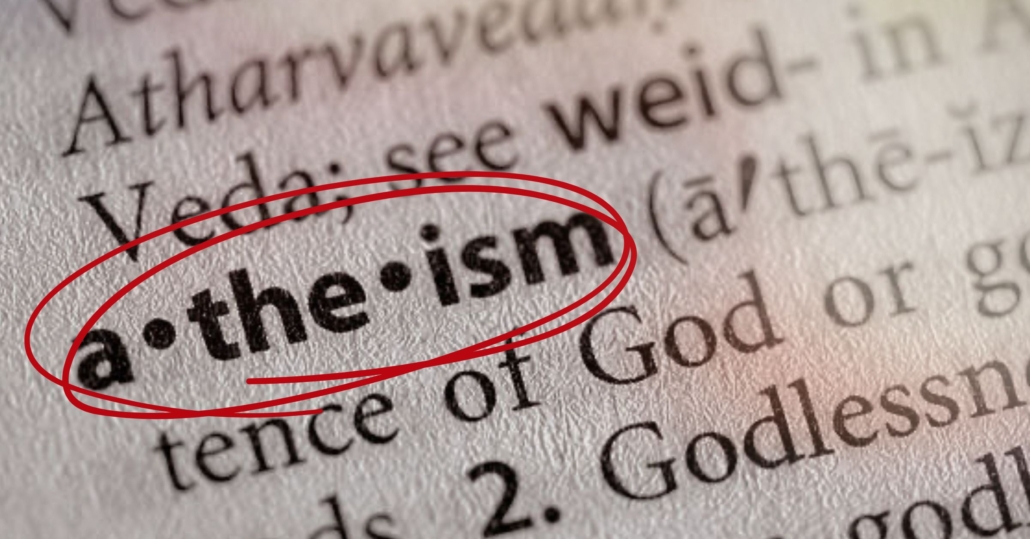
Let’s go back to the Greek word from which we get our word “atheism.” “Atheist” is a translation of the Greek: atheos using the alpha privative “a” – which translates as “un-/non-/dis-/not/no,“ and the term “theos” (God). It literally translates as “No God”. Note, it’s not a merger between the alpha privative and the english term “theist” or “theism.” Rather “atheist” as a whole word is a translation of the whole word “atheos.” The alpha privative negates theos, as in, “no God”, or “godless.” as opposed to negating theism which would be “no God-belief.” As it stands with atheism, if the original meaning were drawn entirely from etymology it would mean simply “godless,” “ungodly,” or “without God.” And this indeed is one of the definitions we find for the term in its Ancient sources. In that time, it also had the primary definition of “denying God/gods” which followed by implication from the notion of “godless;” if a person truly believed in a grand judge over all the universe he would not live/teach/think as if no such being existed.
The idea, however, of withholding/refraining-from belief about some God, though present in ancient Greece and Rome, tended to be subsumed under terms like “skepticism” (gk: skepticos) or “materialism” or “atomism” (a form of materialism). Atheos however was used to describe a different phenomenon. Thus the effective meaning of atheos is something like, “[immorally] godless” or “disbelief in God.”
Were someone to translate ancient and classical uses of atheos into “no belief in God” they would do an injustice to the text since that is simply not how Greeks and Romans were normally using the term when they first coined it, nor when they continued using it over the years. Etymology (study of word origins, and composite meaning from word parts) is only one way that words take on meaning. When we apply etymology to the English word “atheism,” we have “athe” (from atheos “no God/Godless”) + “-ism” (belief). Belief then characterizes the “no God” hence we have, “Belief in no God.” And the alpha privative, as always, characterizes the word to which it’s affixed. So, the belief is positive, the object of belief is negative. It is “belief in no God” or “belief in Godless[ness].” For etymology to achieve the negative definition of atheism, a popular definition today, from the term would have to be something like, “theos-a-ism” or, “No belief [in a] God.” The etymology argument then is not a friend but a foe of the negative definition of atheism.
Christian Atheists?
In ancient Rome we find the positive form of atheism exercised when Christians were being persecuted and martyred for being “atheists.” Of course, they still believed in God but because they rejected the Greco-Roman pantheon of Gods, they were slandered as “atheists” by comparison. They did not simply “lack belief” in the Roman Gods, rather they consciously rejected those God’s. They denied the existence of the Greco-Roman Gods (Zeus, Aphrodite, Hermes, etc.). The “lack of belief in God” was already covered under the concept of “skepticos,” (skepticism), namely it was a theological skepticism. That’s a disposition of distrust, doubt, or non-belief regarding God’s existence. The term Atheos was not a good fit for that concept. Atheism was a somewhat non-skeptical position for it took a position, making a claim that “no God exists.”
Compared to the plethora of Gods in the Greco-Roman pantheon, rejecting all but one is practically equivalent to atheism. So, despite it’s misapplication, the term “atheism” stuck. Even ambivalence could have been tolerated among the Romans as they did with many agnostic philosophers (though the term “agnostic” had not been invented yet). But conscious rejection of the Roman Gods was seen as an intolerable affront to the state. As we can expect from ideas that are deeply rooted in human nature and the human psyche, the idea of “atheism” survived for centuries with both connotations intact: “godless” and “disbelief in God.”
In recent times, however, the definition has come under question by atheist themselves. Three motivating factors can be identified.
Strategic Advantage
First, in debates it is generally the better strategy to rebut the opponent’s case rather than to have to be pre-occupied defending one’s own case. A softened definition of atheism allows for this. With negative atheism, the atheist doesn’t carry any burden of proof since that burden is on the participant/s making a positive case of some sort: “God exists” or “God does not exists.” But to claim, “I have no belief about God” is not a positive case. Therefore it requires no defense.
Presumption of Atheism
Second, Antony Flew’s important article “The Presumption of Atheism” (1972) argues that the default or neutral position for humanity is atheism. Building on the point just made, Flew argues that the burden of proof is on the theist to demonstrate that “belief in God” is reasonable. Essentially, Flew is arguing that negative/soft/weak atheism is man’s natural disposition, or if it is not, it is the intellectually justified default position. It is up to the theist to make a positive case for theism.
Logical Positivism
A third factor which might have played a part in this redefinition is the onset of British positivism, like that of A.J. Ayer. Ayer, among others, suggested that claims must be empirically verifiable or analytically (by-definition) true if they are to be linguistically meaningful.[1] Theology, for Ayer, is not true, but neither is it false. It is without meaning since its reference to God lacks analytic veracity and empirical testability so the notion cannot even be entertained as a proposition. It is like trying to argue “I believe in ‘ouch’” or “I don’t believe in ‘um’.” These terms “ouch” and “um” are emotive/gibberish terms that defy cognitive belief or disbelief. “Truth” and “falsity” do not apply to them, and, according to Ayer, nor does it apply to any God-talk. Ayer’s positivism was all the rage for a while, but today, few people are conscious advocates of this “logical positivism,” even though its scope and influence is incredibly widespread. Ayer’s positivism ultimately proved self-defeating since every attempt to say the theory of positivism, failed to satisfy it’s own criteria for meaningfulness.
Understanding these three possible influences together: 1) The strategic advantage of negative atheism (“no belief in a God”), 2) combined with “The Presumption of Atheism,” and 3) a positivistic disposition–it makes complete sense why many contemporary atheists want to define their own camp in negative terms as “without theism, no belief in a God” instead of the historic and traditional use of the term (“disbelief in God),.” But does this view not overlap with agnosticism?
The Complicating Landscape of Non-Theism
Antony Flew and A.J. Ayer are 20th century figures, who emerged from the secularizing influence of German rationalism, the Enlightenment, the French Revolution, the Freedom of Religion in the West, evolutionary theory with Darwin’s Origin of The Species. The landscape of non-theism was vast and complicated in the late 19th and early 20th century. To help organize the ideological furniture in the growing domain of disbelief, Thomas Henry Huxley coined the term “agnostic” in 1889. He used this term to describe his own conviction that knowledge about God’s existence or non-existence is impossible. He did not consider himself an atheist, but found himself being called one. He was not a positive atheist–for he was not denying God’s existence. Nor was he a theist–since he wasn’t affirming God’s existence either. Neither was he simply a theological skeptic–since he believed that knowledge of God was not yet (or perhaps ever) possible. His agnosticism is practically indistinguishable from the modern category of “negative atheism” which also lacks belief in God, and also allows that God’s existence could prove unknowable even if He/she/it really existed.
Not surprisingly, the borders between “atheism” and “agnosticism” are often blurry or invisible. So, for atheism to be distinct, defensible, and publicly viable, it needs the help of some categorical distinctions since atheists are widely diverse and do not necessarily hold a party line when they don the moniker “atheist.” Somewhere in the Modern era there seems to have been a division then in both Agnosticism and Atheism, rendering four categories from the previous two.
- Negative/Weak/Soft Atheism–”no belief in God”
- Positive/Strong/Hard Atheism–”belief in no God”
- Weak Agnosticism–”knowledge of God does not exist”
- Strong Agnosticism–”knowledge of God is impossible.”
And another catch-all term can be added to these:
- Theological Skepticism–distrust, disbelief, or doubt regarding theological objects
I’m borrowing these categories from Michael Martin, Antony Flew, and William Rowe as they’re quite helpful in clarifying some of the subtleties that arise in these debates. These are not, however, standardized, and do not necessarily reflect the long history or widescale contemporary usage of “agnostic” and “atheist.” I recommend these categories for clarity of usage, but we should be careful not to follow, thoughtlessly, the contemporary popular usage of “atheist” and “atheism” as being weak atheism or weak agnosticism. Etymology, history, and many contemporary standard sources defy that definition. Don’t believe me? Check some of the sources listed below.
At this point you may be wondering why all this matters? What difference does it make? At minimum, clear thinking and precise language are generally good. We should be clear and precise where we can. Besides that general benefit I give, in a different article, nine reasons why this definitional problem with atheism is important.
Positive Atheism is the majority sense of the term “Atheism” according to its historic usage
- Emmanuel Haldeman-Julius, “The Meaning of Atheism,” Little Blue Book 1597, box 24. Self-Published under Haldeman-Julius Publishing, 1931, accessed 13 April 2026 at: https://infidels.org/library/historical/e-haldeman-julius-meaning-of-atheism/
- (1942) Ferm, Vergilius. “Atheism” in Dictionary of Philosophy. Edited by Dagobert D. Runes (New Jersey: Littlefield, Adams & Co. Philosophical Library, 1942, republished 1951).
- “Atheism,” Webster’s New World Dictionary, Vol. 1. (Cleveland and New York: World Publishing Company, 1960).
- Paul, Edwards, “Atheism,” in The Encyclopedia of Philosophy, Vol. 1. (London, Collier-MacMillan, 1967).
- Paul Edwards, ed., “Atheism” The Encyclopedia of Philosophy (New York: Routledge, 1973).
- “Atheism,” Webster’s 9th New Collegiate Dictionary (Springfield, MA, 1984).
- “Atheism,” Webster’s 3rd International Dictionary Unabridged (Springfield, MA 1993).
- William L. Rowe, “Atheism,” Routledge Encyclopedia of Philosophy. Edited by Edward Craig. Routledge, 1998.
- Kai Nielsen, “Atheism,” Encyclopædia Britannica (2009).
Positive atheism is also the primary or exclusive definition for “atheism” in the following current sources:
- Oxford Compact Dictionary, “Atheism,” com (23 May 2015) at: http://www.oxforddictionaries.com/us/definition/american_english/atheism
- Oxford Learners Dictionary, “Atheism,” com (23 May 2015), at: http://www.oxforddictionaries.com/us/definition/learner/atheism
- Cambridge Academic Content Dictionary, “Atheism,” cambridge.org (23 May 2015), http://dictionary.cambridge.org/us/dictionary/american-english/atheism
- Merriam-Webster Dictionary, “Atheism,” Merriam-Webster.com (23 May 2015) at: http://www.merriam-webster.com/dictionary/atheism
- Random House Dictionary, “Atheism,” com, at: http://dictionary.reference.com/browse/atheism (23 May 2015).
- Simon Blackburn, Interview, Philosophy Now: A Magazine of Ideas99 (June/July 2015), accessed 23 May 2015 at: https://philosophynow.org/issues/99/Simon_Blackburn.
Blackburn answers the question “what do you personally mean by ‘atheism’” by saying, “Actually I prefer the label ‘infidel’ to that of ‘atheist’. I suppose an atheist thinks there is a definite, intelligible question to which the answer is ‘no’, and agnostics also think there is such a question, and that the right answer is ‘don’t know’. But I doubt that there is a definite intelligible question about ‘the existence of God’.”–See below, (2008) Simon Blackburn
Representing Modern trends to normalize negative atheism as the standard sense of “atheism” are the following sources:
- Dan Barker, Losing Faith in Faith: From Preacher to Atheist, Freedom From Religion Foundation, 1992, pg. 99
- Michael Martin, Atheism: A Philosophical Justification Temple Univ. Press, 1990, pg. 463
- Simon Blackburn, Oxford Dictionary of Philosophy 2d rev. ed. Oxford: Oxford, 2008. [Blackburn is an atheist].
- American Atheists Society, “What is Atheism,” org (2015) at: http://atheists.org/activism/resources/what-is-atheism?
- org, “Definitions,” Infidels.org (includes extensive referencing and quotations of original sources) at: http://infidels.org/library/modern/mathew/sn-definitions.html
Notes:
[1] The seminal text for “logical positivism” is A.J. Ayer, Language Truth and Logic (New York: Penguin, 1936).
Recommended Resources:
Debate: What Best Explains Reality: Atheism or Theism? by Frank Turek DVD, Mp4, and Mp3
I Don’t Have Enough Faith to Be an Atheist (Paperback), and (Sermon) by Norman Geisler and Frank Turek
Stealing From God by Dr. Frank Turek (Book, 10-Part DVD Set, STUDENT Study Guide, TEACHER Study Guide)
Dr. John D. Ferrer is an educator, writer, and graduate of CrossExamined Instructors Academy. Having earned degrees from Southern Evangelical Seminary and Southwestern Baptist Theological Seminary, he’s now active in the pro-life community and in his home church in Pella, Iowa. When he’s not helping his wife, Hillary Ferrer, with her ministry, Mama Bear Apologetics, you can usually find John writing, researching, and teaching cultural apologetics.
This blog is adapted from the original version at: https://bit.ly/defining-atheism