By David L. Rogers
Part I: A Book, an Illustration of Governments.
Part II: The Christian and the World.
-
God and the three institutions:
Founded on the belief that the Bible possesses total authority as the Word of God, being inspired by His Holy Spirit, it is important to recognize that He has established three institutions, which are absolutely crucial to the proper operation of man’s life and society. It is like the illustration at the beginning of this study: the binding of a book that binds together all the loose pages, and thus forms a cohesive whole. The three institutions are:
- The Family –it is a “cornerstone” for society, which is to reflect the order of the Godhead (see I Corinthians 11:3 compared with Ephesians 5:21-32, and also Genesis 1:26-28). Through the family, God established the function of personal and individual order. The family is responsible for passing on to children the standards of life that God the Master Designer instilled in man by his conscience and morality. Later, God established another institution.
- Government is a cornerstone which performs another function , a function which is clearly NOT IN THE HANDS OF THE FAMILY TO PERFORM, and that is to maintain order, protect the citizen, and punish the lawbreaker (in Genesis 9:5-7; Romans 13:1-7). Through government, God sets the standard of man’s responsibility toward his fellow man.
- The Church — this last institution was established by God in a very different way than government and the family. In this case, He Himself formed it through the price paid by the shed blood of His own Son, Jesus Christ. This institution deals with an entirely different area, as well, than the other two. Its function is to share order in the spiritual and personal realm, in the context of a living body empowered by the same Holy Spirit. (Matthew 16:15-18; Acts 2; Hebrews 8:6-13)
So, these three institutions, designed and forged by the Lord Himself, each serve a different purpose and function that is interrelated, but NOT necessarily dependent or subject to the other. In a sense, each institution that God formed was built on the weakness of the institution that preceded it. Furthermore, there is also a very important distinction between each of these three institutions. It is knowing where to distinguish and how to separate each one that is difficult for the believer in Christ. This is the challenge that now confronts us.
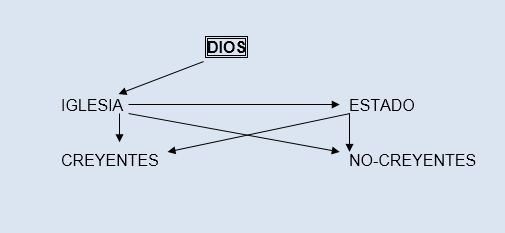
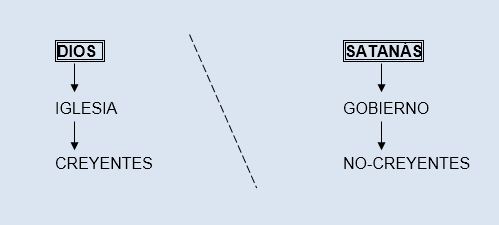
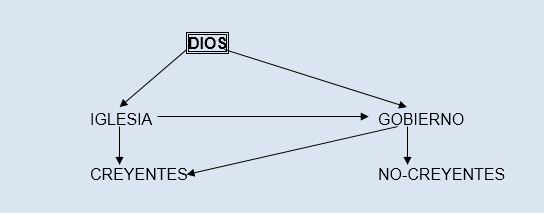
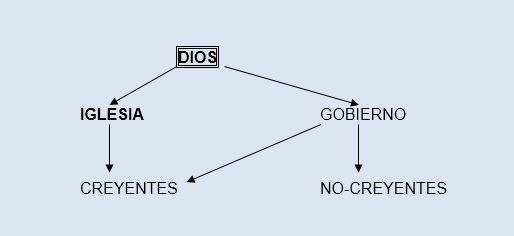
There are basically four perspectives on the TWO KINGDOMS concept throughout the history of Christianity . The arrows indicate authority and power over the respective groups of people indicated. The line also indicates an established hierarchy based on the source of their authority.
1. The Roman Catholic Concept:
Pope Boniface VIII, in 1302, declared the following pattern:
2. The Anabaptist Concept: (17th Century)
3. The Calvin Concept:
4. The Lutheran Concept:
5. An Evangelical Model for Today:
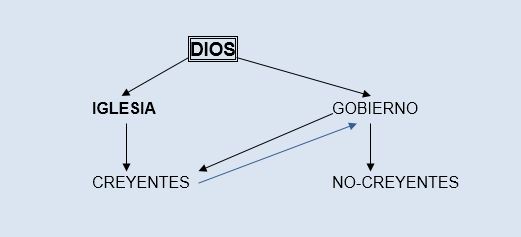
The traditional models of government from the Middle Ages onward have their modern adherents in various parts of the world. Only in some cases there are those who take the place of God, believing themselves to be the ultimate national and final authority when they try to force everyone to abide by their “inspired” precepts. The first of these, the Roman Catholic concept, is distinguished by the idea that God does not control the world of the state except through the church, and therefore the church is “in charge” of the world of the unsaved, with or without its blessing. This model represents a unilateral and exclusive authority over all human beings.
The Anabaptist model, founded primarily on Colossians 1:12-13, separates the world and society into two large groups: the group of those who are “of the kingdom of darkness” and the kingdom of the glorious Son of God. The two kingdoms cannot, and should not, intermingle. Historically, and in practice, this has been the position of Pentecostals and ultraconservatives in democratic countries.
The model of John Calvin is particularly strict in that its vital sign is related to the direction of human government by the church, since the Church represents divine interests, and the state fulfills its desires and designs. This model places in the hands of ecclesiastical authorities the ultimate responsibility for ensuring the good of society, just as the church of Christ does.
Martin Luther had a thought that advocated more distance between church and state, but not in a categorical way, since God reigns over both. This model operates within a “secular” state and a Church “separated” from the state. There can be collaboration between the two, but not an obligation or a demand from one to the other. Historically, this model was the one that was most adapted by the founders of the democratic experiment in the United States originally.
Finally, this author’s model is called “an evangelical model for today” in reference to three realities. First, it does not ignore and, indeed, highlights the sovereignty of God over both church and state, regardless of whether it is a democratic state or not. God “sets up kings and removes kings” (Daniel 2:21) in all the nations of this world. Second, of particular importance is the belief that the local or national church is not the entity that God uses to direct or restrain the state. The church exists for the edification of the believer, the evangelization of the unsaved, and the exaltation of the Lord of lords, Jesus Christ Himself. The state does not operate around these ends. And, third, this is a model that promotes the believer’s responsibility to serve other people as an instrument of justice in a wicked world through positive, proactive, and holy interaction and influence through politics and community, state, federal, and military efforts.
Related Texts : Titus 3:1; 1 Tim. 2:1-2; Romans 13:1-7; 1 Peter 2:11-17. The last chart differs from the preceding ones in the emphasis given to the believer’s duty to exercise a godly, God-fearing influence over human institutions. Being a part of the Kingdom of Heaven does not excuse the believer from the privilege (or duty) of being a citizen of a particular nation or country. In the words of the famous ancient author: “A good man must do nothing and wickedness will reign.”
How it applies to modern politics:
Being a believer today has inherent and unavoidable risks. There has always been a degree of danger. Danger, however, is no justified cause for avoiding the field of politics as a way for believers to exert a positive influence on society. Being a citizen of heaven does not take away from the duty of being a moral and upright representative of heaven on earth. The Scriptures bear this out, and so does history!
Second, we recognize that the Bible never excuses a believer from giving testimony of his faith even in high places of government. Examples mentioned in the Old Testament support this truth. Joshua rescued the nation of Egypt from the sad situation of a famine. Daniel led the most powerful king of the Eastern world to prepare for inevitable changes. Nehemiah was God’s instrument first in the court of an Asian king followed by the most outstanding reconstruction work in ancient history! Each of them had a crucial voice and example in God’s plan for the nations. Today, too, God places men and women in strategic places to give testimony of Him in “pagan” and secularized governments.
Finally, it is through the way of forming an influence in politics that many more will come to know God. We must not think that the primary work of the church is to save society or the reigning power. But it is a secondary necessity to pray for the authorities (1 Timothy 2:1-3) and also to collaborate with them in the government of the country by offering them the light of the Gospel. While it is true, the dishonesty and corruption so prevalent in the political world today is not far from the same sad conditions of financial banking, medicine, education, production and industry or any other work field. With a firm focus on the sovereign God, the Christian today can glorify Christ through a good academic and professional preparation and thus serve his people or nation. When God works through him or her, in the political field many will see that following Christ opens doors for them in every career and every aspect of life.
Avoiding the political world only leaves you to your own blind human deliberations, which will eventually end up closing off opportunities to serve God by glorifying Him in the world of politics. For this reason, we go toward a holy influence in an area where power and money corrupt, but doing so with the conviction that God is greater than kings, and that even there He will provide us with the determination, intelligence, strength and clarity to see how to implement laws, regulations and projects that advocate for the sanctity of life and for the name of truth.
In conclusion, consider how Christ Himself intervened in and responded to the government of His day:
“In short, Jesus rejected the idea of the state as an absolute, but neither did he wage war against it. To those who wished to make the state the absolute authority, he reminded them that they must render to God what is God’s. To those who wished to revolt against the state, he required that they render to Caesar what belonged to him. Jesus acted both as subject to the general authority of the state while living above it in fulfilling his mission and ministry. The teaching of Christ and the function of the state intersected at those points where Jesus’ moral teaching served to indict those in power, and at those points where he interacted with the politically and socially untouchables in order to meet their needs…” (Fienberg and Fienberg, 1993, p. 389).
The challenge facing a believer and follower of Christ is to live by the same pattern today.
Literature
Eidsmore, John, God and Caesar: Christian Faith and Political Action (Crossway Books, Westchester, 1984 ).
Feinberg, JS, & Feinberg, PD, Ethics for a Brave New World ( Westchester , IL: Crossway Books, 1993).
MacArthur, John, Think Bible-Wise, (Portavoz Publishing, Grand Rapids, 2004.)
Pearcy, Nancy R., Whole Truth: Freeing Christianity from its Bondage to Culture (YWAM Press, Tyler, Texas, 2014).
Sproul, R. C. Following Christ . (Wheaton, IL: Tyndale House Publishers, 1996.)
Whitehead, John W., An American Dream (Crossway Books, Westchester, 1987, Un Sueño Americano ).
David L. Rogers, a missionary and teacher in Chile for 35 years, is a graduate of Clarks Summit University, Clarks Summit, Pennsylvania (1980, BRE) and Moody Theological Seminary, Chicago (1997, M.A.). David and his wife of 39 years, Ruth Ann, and their four children have served in Santiago planting three churches, and founded a Chilean publishing house that for 14 years has published books, resources, and original studies in Spanish. His passion is training local leaders capable of guiding God’s work with love, humility, and spiritual skill. Apologetics is also a priority for David, and he is currently in his second year of a Masters of Arts in Apologetics program at Houston Baptist University. David and Ruth Ann have four precious grandchildren who live in the United States with their parents.

Molinismo, identidad y mundos posibles
EspañolBy Randy Everist
Is Molinism really compatible with the idea of people in other possible worlds? Can it really be possible that there is a counterfactual truth about me such as “If I had been born in the 18th century, would I have sided with the American colonists against the British”?
So, here, a lot depends on one’s theory of personal identity, as to what counts in discerning modal truths. I personally hold at least a basic account of Plantinga’s theory of creaturely essences, where there is an abstraction that is “made up of” all and only essential properties, including properties indexed to a world [1] (of course, this is an abstract account; my concrete theory of personal identity is that we are immaterial souls). So, Socrates in our world is the concrete instantiation of the abstraction that had this “maximal property”—call it “Socraiety”—and he had these properties de dicto (“about what is said”) because of the abstraction, but de re (“about the thing”) because of his own decisions. This includes counterfactuals .
Now consider that there is a truth to the matter of the following counterfactual (at least if it is not counterpossible):
(S) If Socrates had been born in 20th century Athens, then he would not have been killed.
Now, what if someone argues for a kind of origin essentialism, which is the doctrine that teaches that one’s origin cannot be significantly different from what it was in order to preserve personal identity (I use “preserve” in a colloquial sense, since no thing loses its identity in favor of something else)? Is S still possibly true? Origin essentialist explanations always or almost always depend on the idea of physical transmission of genetic material, and so depend on one’s parents being the same. If this is true, the claim can go, then such a counterfactual about Socrates is a counterpossible, and has nontrivial truth value. While I’m not sure about origin essentialism, I think we can admit it and still achieve the original desired result. After all, God presumably could have made it the case that Socrates’ parents were a special creation, made up of the appropriately relevant genetic material and information—or whatever Socrates himself was.
But if this is so, then it follows that all sorts of counterfactuals about Socrates are true, both in our world and in many other worlds. But then it follows that there are many indexical properties of the world that correspond to these true counterfactuals, and these indexical properties of the world together help (with all the other essential properties of Socrates) to constitute Socraness. So then it follows that if such counterfactuals were descriptive of actual situations (or states of affairs), then Socrates would be who he is.
I also think that we should be interpreted as saying something like, “It is possible that the set of true counterfactuals could have turned out such that _______________ (fill in the counterfactual under consideration).” It may or may not be part of the set of true counterfactuals; we have no way of knowing. However, most people take the real modal logical possibility to mean cases where the concept or situation (or state of affairs) under consideration is articulated without self-contradiction or violation of a necessary truth to rule it out. There doesn’t seem to be anything about the example provided that is self-contradictory, and I think the above suggests that we don’t have a sufficient necessary truth to rule it out. So while, for all we know, S is a false counterfactual, the set of true counterfactuals could have turned out to be different than it did, and in those related worlds (presumably not like Lewis’s nearby worlds, at least not close enough)—worlds where a different set of counterfactuals is true—such a counterfactual as S can be true. This also suggests that it is at least possible, for all we know, for one to exist in worlds sufficiently removed from the true set of counterfactuals (not exactly hard); this sense of existence is in an abstract, not a concrete, sense.
Plantinga does believe that we are immaterial souls; this is the concrete particular of abstraction that is creaturely essence. I dare call them universals, only because this raises the potentially controversial problem of multiple instantiation.
It seems at least possible that Socraiety, for example, has as part of its set the property of being killed in 21st century Athens at time t in world M-146. This could be either on the A-theory or the B-theory. On the B-theory, time is a block, and so located at that particular point in the particular block belonging to world M-146 could potentially be that counterfactual. On an A-theory, that property can be sustained, since it does not seem to be something that excludes the mere possibility of world M-146 (its feasibility is another matter entirely). And if this is the case, then Socraiety can include time-indexed counterfactual properties (properties we have about counterfactual scenarios), where the times are radically different. And I mean “can” in the mere sense of logical possibility, which is of course not the same as feasibility.
So my conclusion is that Molinism will work with potentially true counterfactuals about individual persons in various worlds that differ even radically from this one.
Grades
[1] Properties indexed to a world are defined by reference to one or more possible worlds, as (to maximum extent) unrestricted, because in modal logic S5 the properties of one world can affect those of others. (FC editor’s note)
About the Author: Randy Everist is very interested in philosophy and theology. He is working on his PhD in philosophy. He loves hockey, Jesus, his wife Jodi, and his little boy, Titus!
Please take some time to read all of Randy’s work on Possible Worlds
Original Blog http://bit.ly/3474MBc
Translated by Allan Sanchez
No, it’s not wrong to argue for God’s existence.
2. Does God Exist?, Theology and Christian ApologeticsBy Erik Manning
There are dozens of arguments for the existence of God. To rattle off just a few: there’s the moral argument, ontological, religious experience, miracles, consciousness, reason, desire, and the families of cosmological arguments and design arguments.
Some Christians say that while these arguments are good for building up the faithful, they’re useless for apologetics and evangelism. After all, we’re not trying to make generic theists. Even the demons believe in God, but that doesn’t give them a saving relationship with Him! (James 2:20) Apologists using these arguments in conversations or debates are barking up the wrong tree at best, and at worst, are being unfaithful to God.
To make the point, these critics will often point to the case of Antony Flew. Flew was a notable philosopher of religion who argued against the existence of God for decades. Near the end of his life, Flew changed his tune. He became a believer in God because of the philosophical and scientific arguments for God. He even wrote a book about it. Here’s a quote that sums up Flew’s conversion:
Flew’s turnabout sent shockwaves through academic circles and a lot of Christian apologists claimed it as a victory for scientific and philosophical apologetics.
Here’s the rub: Flew never became a Christian. He declared himself to be a deist. Deists, if you don’t know, reject direct revelation and miracles. If this is what successful apologetics looks like, then what’s the point?
Here’s the thing though — For every Antony Flew, you have dozens of people like me. Quick background story: During my teenage years, I was an atheist. But along the course of time, I gradually became convinced God existed. But I wasn’t satisfied with the idea of deism or a generic God. Why?
There are a couple of reasons for that: If God exists, it would be weird if God never communicated with us. And if God was going to communicate with us, he’s not probably going to do it only privately.
The problem with Deism and mysticism
Let’s think about it for a second: Why would a Supreme Being create intelligent beings with the ability for communication and then never speak to them? Not even a ”howdy”? Wouldn’t we expect this God to offer a few words of advice or the occasional helping hand? Deism might explain why there’s a cosmos, consciousness, or the moral law. But it doesn’t offer much of an explanation of God’s silence.
There’s also the problem of God speaking only through private revelation. Anyone could claim that God’s speaking to them, how do we parse that out and see who’s right? It would be spiritual anarchy.
As human beings, we all have the same basic needs and problems in life. It would make more practical sense for God to speak to us about these things publicly and collectively. An all-wise being would talk to us a way that anyone could access and understand. Scripture, or something like it, makes a lot of sense.
It’s this commonsense reasoning that led me to dig up a Bible and start reading. Even though I had issues with the idea of miracles at first, I eventually had an experience with the Holy Spirit and became a Christian. You might say this is just anecdotal, but I’m not the only person to make the jump from ‘generic theism’ to Christianity.
How Natural theology helped lead three former atheists to Jesus
A philosopher’s Journey
Ed Feser taught philosophy of religion for years as a college professor. After going through the arguments semester after semester, he eventually became a philosophical theist. Says Feser:
Edward C. Feser is an American philosopher. He is an Associate Professor of Philosophy at Pasadena City College in Pasadena, California
But that’s not where the story ends. Feser eventually became a Christian. He didn’t remain a mere philosophical theist. Not content merely knowing that the God of the philosophers existed, Feser continued his journey and eventually met Jesus.
A scientist’s story
Physicist Frank Tipler is another example of someone who became a Christian after looking at different proofs for God. While Feser was impressed with the philosophical reasons for the existence of God, Tipler became a believer based on the evidence from cosmology and physics, his specialty. While many atheists argue that science and reason will lead someone to reject faith, Tipler found the opposite was true. In the intro of his book The Physics of Immortality, he wrote:
Frank Tipler is a mathematical physicist and cosmologist, holding a joint appointment in the Departments of Mathematics and Physics at Tulane University.
So obviously Tipler didn’t stay in the camp of belief in a deistic or generic deity. His discovery left him wanting to know who this Creator and Designer was.
An Oxford Student’s testimony
I could multiply examples, but for the sake of space, I’ll offer just one more. Sarah-Irving Stonebraker is a history professor in Australia. In an article entitled, ‘How Oxford and Peter Singer Drove Me From Atheism to Jesus‘, Sarah outlines her journey.
Dr. Sarah Irving-Stonebraker is Senior Lecturer (in Australia, this is a tenured professor position) in Modern European History at Western Sydney University in Australia, where she teaches in the History and Political Thought major.
So after learning that God existed through the moral argument, Irving-Stonebraker didn’t stop there. She wasn’t content knowing that a generic God existed. The moral argument made her want to find just who this Moral Lawgiver is.
Arguing for God’s existence isn’t fruitless
So what’s my point?
While Antony Flew’s non-conversion might feel like a failure, there are many people like Feser, Tipler, Irving-Stonebraker, and myself who didn’t stop at generic theism. And the writer of Hebrews tells us that belief in God is a necessary precondition to pleasing God. (Hebrews 11:6) The next part is seeking Him. So when someone like William Lane Craig argues for the existence of God, they’re laying some foundational groundwork and we’re wrong to think little of that.
Once you become convinced God is real, then unless you’re apathetic, you’ll want to get to know him personally. And it’s not as if Craig or others like him stop after offering the arguments for God, they almost always then argue for the resurrection.
And as I said before, intuition and common sense tell us that if God exists, he’s not going to remain silent and stand aloof. And if he’s as smart as design arguments show, he’s going to communicate with us in an accessible way. God can and has used these arguments to get past someone’s intellectual hang-ups or blind spots and to take a step towards him. How could that possibly be a bad thing?
Recommended resources related to the topic:
So the Next Generation will Know by J. Warner Wallace (Book and Participant’s Guide)
Reaching Atheists for Christ by Greg Koukl (Mp3)
Living Loud: Defending Your Faith by Norman Geisler (Book)
Fearless Faith by Mike Adams, Frank Turek and J. Warner Wallace (Complete DVD Series)
Defending the Faith on Campus by Frank Turek (DVD Set, mp4 Download set and Complete Package)
Can All Religions Be True? mp3 by Frank Turek
Counter Culture Christian: Is There Truth in Religion? (DVD) by Frank Turek
Erik Manning is a former atheist turned Christian after an experience with the Holy Spirit. He’s a former freelance baseball writer and digital marketing specialist who is passionate about the intersection of evangelism and apologetics.
Original Blog Source: http://bit.ly/2JrVQOU
Major Moral Argument Mistakes (Part 3)
PodcastPodcast: Play in new window
Subscribe: Apple Podcasts | Spotify | Amazon Music | Android | iHeartRadio | Email | TuneIn | RSS
Frank continues his detailed response to a retired attorney who objects to the moral argument. People often find this the most personally relevant argument for God, and that’s perhaps why atheists often object to it the most. However, Frank points out, their objections are often due to misunderstandings or misapplication of evolutionary theory to morality. Listen to this and the first two parts to make sure you’re ready to give a reason for the hope that you have (1 Pet. 3:15).
If you want to send us a question for the show, please email us at Hello@CrossExamined.org.
Subscribe on iTunes: http://bit.ly/CrossExamined_Podcast rate and review! Thanks!!!
Subscribe on Google Play: http://bit.ly/CE_Podcast_Google
Subscribe on Spotify: http://bit.ly/CrossExaminedOfficial_Podcast
Subscribe on Stitcher: http://bit.ly/CE_Podcast_Stitcher
Yes, We Do Need to Put God in A Box
Theology and Christian ApologeticsBy Bob Perry
“You can’t put God in a box.” It’s a popular saying within the Christian community. And it seems reasonable to say. After all, God can do anything He wants to do. Who would question that? I submit that every thinking Christian should question that … because it’s not true. God’s character does put him in a box. And our failure to recognize that creates a false — and therefore dangerous — picture of God. There is a box God needs to be in. And his character defines it.
God Cannot Do Whatever He Wants
God cannot do whatever he wants to do. If you think that sounds sacrilegious, you first have to understand that God cannot do things that are contrary to his nature. Before we can determine if God can do anything he wants to do, we have to first understand what that nature is. There are several elements to God’s nature but here are a few to consider.
God is Logical
God made an orderly universe. He built the laws of logic into our world and made it predictable. This is why we can communicate with one another. It’s the reason we can use science to understand how the world works. If God made the universe that way, it means that he must also be logical. It means that logic is an extension of his character. And that means God cannot do illogical things.
He can’t make a square circle, a married bachelor, or “a rock so big he can’t lift it.” This is an important point to understand as it relates to the rest of his character traits.
God is Omnipotent
God is all-powerful. But having supreme power doesn’t mean God can do anything. It means he can do anything that power can do. Being immeasurably powerful is what allows God to do miracles or create a universe as immense and complex as the one we see around us. But power does not allow God to do illogical, sinful, hateful, or unjust things. That’s an important distinction to make.
God is Goodness
God is pure goodness. He is “the final standard of good and all that God is and does is worthy of approval.” Because he is good, God is willing and able to demonstrate love in all its forms through mercy, patience, and grace. God loves everything he created. And since human beings are the pinnacle of that creation, God loves humanity in a way that we are incapable of comprehending.
God is Just
Justice occurs when someone gets exactly what they deserve. This can be positive or negative. We know that good acts deserve a reward and evil acts deserve punishment. And we know this intuitively. No one had to teach this to us. Even little babies demonstrate that they know it. All of us inherently value — and seek — justice. God is the source and embodiment of that idea. His character demands it. And since his character is morally perfect, any act of rebellion against that moral perfection — no matter how small — deserves to be punished.
God is Eternal and Self-Existent
God is not the type of being who needs a cause for His existence. The fact that anything exists at all means there must be a permanent, unmovable foundation that sustains it. That’s God. He is the foundation of all being. This is why the question, “Who made God?” is such a silly one. God isn’t the type of thing that you make. He upholds all reality at every instant but does not need to be upheld himself.
God is Omnipresent
The fact that God upholds all reality at every instant means that he is present everywhere. Always. He is not limited by time or space. Don’t get this confused with the ideas that God is everything. That’s pantheism. God’s omnipresence means that he is present everywhere in his creation but also distinct from it.
Putting Them All Together
There are plenty of other character traits that theologians use to describe God. If you are interested in digging more deeply into these kinds of topics, I suggest investing in a book on Systematic Theology. But considering the definitions I’ve briefly mentioned here, I doubt that anyone who takes God seriously would find them to be controversial in themselves. Our problems arise when we forget that God exhibits all these character traits simultaneously. All facets of his nature have to work together. He can’t exercise one if it violates another.
Theological Inconsistencies
Focusing on one aspect of God while ignoring another invites us to accept a false view of him. And many Christians unwittingly do this all the time.
“God showed up!”
When they have an emotional experience in worship, it is common to hear some proclaim that “God showed up today!” But God doesn’t “show up” anywhere. He is always everywhere. Don’t confuse the issue. God doesn’t need our praise to show himself. We need to praise him to remind ourselves of our dependence on him.
“God is so good!”
This is a common refrain to hear from someone who has just received good news of some kind. And while it’s great to acknowledge God’s blessings, it’s wrong-thinking to acknowledge them only when things are going our way. God is good regardless of our personal circumstances. It’s easy to express our love for him when things are good. But it’s imperative that we do the same when things are bad.
“Where was God when …?”
On the flip side, we seem to think God has gone missing when catastrophes occur. We assume that God’s omnipotence means he can and should destroy evil forever. But God made the loving decision to create us as free-will beings. He willingly limits his own power to give us the freedom to choose to follow him. And that means that no matter how powerful he is, God has created a world that allows us to make bad choices. The moral evil we witness all around us depends on our actions, not on God’s absence.
“God is love”
This idea is absolutely true. But contrary to the claims of the universalists and inclusivists among us, God is not just love. The idea that “God is love” is true as far as it goes, but there is more to the story. Ultimate goodness and love are different ways of describing God’s moral perfection. Being pure love and goodness means he cannot sin and he cannot lie. And that means he cannot allow moral imperfection into his presence. When our actions violate his moral law, his justice requires that there be consequences for our decisions. God’s character won’t allow him to accept whatever moral choices we make. This is a reality that often gets ignored by those who insist that a loving God would never allow us to be separated from him. The fact that God loves us does not mean he condones anything we do.
The Box God Needs to Be In
These are just a few examples of how our failure to keep God in the proper box leads not only to theological inconsistencies but to a corrupted view of reality itself. That’s what I mean when I say that we have to put God in a box. It’s a box defined by the sum total of all the elements of his character. Isolating our favorite trait is a bad idea because it doesn’t tell the whole story. And, as is always the case, accepting bad ideas leads to bad real-world consequences.
It turns out that we better keep God in a box. And we better understand how that box is defined. It helps us avoid most of the silly, false, and even dangerous ideas that have become all too common among Christians these days. It’s not always an easy thing to do. But being clear-thinking Christian demands that we acknowledge that God puts himself in a box. And we would do well to keep him there.
Recommended resources related to the topic:
What is God Really Like? A View from the Parables by Dr. Frank Turek (DVD, Mp3, and Mp4)
What is God Like? Look to the Heavens by Dr. Frank Turek (DVD and Mp4)
How Philosophy Can Help Your Theology by Richard Howe (DVD Set, Mp3, and Mp4)
Bob Perry is a Christian apologetics writer, teacher, and speaker who blogs about Christianity and the culture at truehorizon.org. He is a Contributing Writer for the Christian Research Journal and has also been published in Touchstone, and Salvo. Bob is a professional aviator with 37 years of military and commercial flying experience. He has a B.S., Aerospace Engineering from the U. S. Naval Academy, and an M.A., Christian Apologetics from Biola University. He has been married to his high school sweetheart since 1985. They have five grown sons.
Original Blog Source: http://bit.ly/3694taO
The Gospel Authors Knew Palestinian Geography
4. Is the NT True?, Theology and Christian ApologeticsBy Ryan Leasure
We’re told by skeptics that eye-witnesses didn’t write the Gospels. Not only that, they say the authors wrote from distant lands like Rome, Egypt, Asia Minor, or Greece. They merely heard the stories of Jesus from others who heard the stories of Jesus from others who heard the stories of Jesus — much like the game telephone.
And as so often happens in the game of telephone, the stories got mixed up along the way. So by the time the writers penned the Gospels, they had a distorted view of Jesus, and thus we can’t know what the real Jesus said or did. Or so the argument goes.
But is that really what happened? A little thought experiment might help us answer this question. Pretend you were given the task of writing a biography on a traveling woman from Bolivia named Carla. Yet you weren’t allowed to visit Bolivia. Furthermore, you couldn’t use the internet, encyclopedias, or maps for research. Your resources would be a couple of Americans who had never met Carla themselves but had heard stories about her travels.
As you undertake this project, how accurately do you think you could convey the geography and landscape of her travels? Would you really be able to give precise locations and distances? Would you know which towns had higher or lower elevations? How accurately could you describe the bodies of water she encountered? Chances are, you’d make a lot of mistakes with these details.
Well, as we think about these so-called authors from distant lands, they wouldn’t have had access to sources that could give them specific details of the Israeli landscape. So as they wrote their stories about Jesus, we would expect them to make lots of geographic blunders, much like your story on Carla. But this isn’t what we find.
Geography of Towns and Regions
The Gospel writers display an incredible familiarity with Palestinian geography. And they don’t just get most of the geography right; they get it all right. This would be truly remarkable if they lived in faraway regions and had only heard of Jesus through secondary sources. But it would be expected for eye-witnesses who followed Jesus from town to town.
Consider this list of towns the Gospel writers mention:1
In total, the Gospel authors list twenty-six different towns. Some are prominent like Jerusalem, while others are obscure like Cana.
Not only do the Gospels include towns, they reference general regions as well. Consider this list:2
In total, the Gospels list thirteen different regions. Compare these lists with some of the apocryphal Gospels, which give us almost no geographical details.
The Gospel of Thomas, for example, mentions Judaea once and no other locations. The Gospel of Judas doesn’t even list a single location, and The Gospel of Philip names just Jerusalem, Nazareth, and Jordan.
Of course, the lack of geographical detail is to be expected in these apocryphal works. After all, non-eye-witnesses wrote them from distant regions some 150 years after Jesus. Naturally, people would have heard of Jerusalem (the capital of Israel), Nazareth (Jesus’ hometown), and Jordan (the river where Jesus was baptized). One wouldn’t need to be an eye-witness to have knowledge of these regions. But Cana, Bethany, and Salim? One would have to have special knowledge to know about these places.
Geography of Bodies of Water
Since the writers had an in-depth knowledge of the towns and regions, it should come as no surprise to learn they also knew about the bodies of water. Consider this list:3
It’s interesting to note the numerous references to “the Sea” of Galilee. For a body of water that’s a mere thirteen miles long, it’s odd that an Egyptian or Roman author would call it “the sea.” For them, the Mediterranean qualifies as a sea, not this tiny body of water that’s less than 1/300th the size of Lake Michigan.
Yet we would expect Galilean fishermen — who spent their entire careers on the body of water — to call it “the sea.” What’s even more interesting is that while the three Jewish authors of the Gospels refer to it as “the sea,” the one non-Jewish author (Luke) does not. Instead, he refers to it as “the lake” (Lk. 5:1, 2; 8:22, 23, 33). This makes sense because from a broader gentile perspective, “lake” was a more accurate description.
The authors also know that Bethsaida and Capernaum are close by the Sea of Galilee and that you can go directly from the Sea of Galilee into the hill country. Furthermore, John knew of a small stream called the Kidron and of two pools in Jerusalem. One pool he describes as having five colonnades, which has been verified by archeological evidence. Again, all of these details would be quite remarkable coming from non-eye-witnesses in distant regions.
Geography of Roads
In the parable of the Good Samaritan, Jesus tells the story of a man “going down” from Jerusalem (750 meters above sea level) to Jericho (250 meters below sea level). This was a descent of approximately one kilometer. The writer knew enough to know both Jerusalem and Jericho’s elevations. In fact, all four Gospels describe people “going up” to Jerusalem and “going down” as they left Jerusalem.
In John 2 and 4, leaving Cana (200 meters above sea level) for Capernaum (200 meters below sea level) is described as “going down.” Similarly, Luke describes the travel from Nazareth (350 meters above sea level) to Capernaum (200 meters below sea level) as “going down.”
More impressively, the authors knew the location of a tiny village called Chorazin. In Luke 10:13-15, Jesus chides Chorazin along with Bethsaida and Capernaum for their lack of belief. According to New Testament scholar Peter Williams,
The little-known village of Chorazin is, in fact, on the road to Bethsaida and just a couple of miles north of Capernaum. As far as we know, there was not a single literary source that could have provided this information to a Gospel author.4
The authors also knew that multiple routes existed between Judaea and Galilee — one to avoid Samaria and one right through it. Furthermore, they knew it was short travel from the small villages of Bethany and Bethphage to Jerusalem.
Who Could Know All These Geographical Details?
How could one get all of these obscure details correct? If it’s as the skeptics say, and non-eye-witnesses wrote these accounts from distant places, they got extremely lucky. A more reasonable conclusion, however, is that the writers received detailed information from eye-witnesses or were eye-witnesses themselves. As Peter Williams concludes,
*For more on this topic, check out Peter Williams’ book Can We Trust the Gospels?
Recommended resources related to the topic:
The New Testament: Too Embarrassing to Be False by Frank Turek (DVD, Mp3, and Mp4)
Why We Know the New Testament Writers Told the Truth by Frank Turek (DVD, Mp3 and Mp4)
The Top Ten Reasons We Know the NT Writers Told the Truth by Frank Turek (Mp3)
Counter Culture Christian: Is the Bible True? by Frank Turek (DVD)
Cold-Case Christianity: A Homicide Detective Investigates the Claims of the Gospels by J. Warner Wallace (Book)
Ryan Leasure holds a Master of Arts from Furman University and a Masters of Divinity from the Southern Baptist Theological Seminary. He currently serves as a pastor at Grace Bible Church in Moore, SC.
Original Blog Source: http://bit.ly/31MPuzV
La participación del creyente en el proceso político, parte III
EspañolBy David L. Rogers
Part I: A Book, an Illustration of Governments.
Part II: The Christian and the World.
God and the three institutions:
Founded on the belief that the Bible possesses total authority as the Word of God, being inspired by His Holy Spirit, it is important to recognize that He has established three institutions, which are absolutely crucial to the proper operation of man’s life and society. It is like the illustration at the beginning of this study: the binding of a book that binds together all the loose pages, and thus forms a cohesive whole. The three institutions are:
So, these three institutions, designed and forged by the Lord Himself, each serve a different purpose and function that is interrelated, but NOT necessarily dependent or subject to the other. In a sense, each institution that God formed was built on the weakness of the institution that preceded it. Furthermore, there is also a very important distinction between each of these three institutions. It is knowing where to distinguish and how to separate each one that is difficult for the believer in Christ. This is the challenge that now confronts us.
There are basically four perspectives on the TWO KINGDOMS concept throughout the history of Christianity . The arrows indicate authority and power over the respective groups of people indicated. The line also indicates an established hierarchy based on the source of their authority.
1. The Roman Catholic Concept:
Pope Boniface VIII, in 1302, declared the following pattern:
2. The Anabaptist Concept: (17th Century)
3. The Calvin Concept:
4. The Lutheran Concept:
5. An Evangelical Model for Today:
The traditional models of government from the Middle Ages onward have their modern adherents in various parts of the world. Only in some cases there are those who take the place of God, believing themselves to be the ultimate national and final authority when they try to force everyone to abide by their “inspired” precepts. The first of these, the Roman Catholic concept, is distinguished by the idea that God does not control the world of the state except through the church, and therefore the church is “in charge” of the world of the unsaved, with or without its blessing. This model represents a unilateral and exclusive authority over all human beings.
The Anabaptist model, founded primarily on Colossians 1:12-13, separates the world and society into two large groups: the group of those who are “of the kingdom of darkness” and the kingdom of the glorious Son of God. The two kingdoms cannot, and should not, intermingle. Historically, and in practice, this has been the position of Pentecostals and ultraconservatives in democratic countries.
The model of John Calvin is particularly strict in that its vital sign is related to the direction of human government by the church, since the Church represents divine interests, and the state fulfills its desires and designs. This model places in the hands of ecclesiastical authorities the ultimate responsibility for ensuring the good of society, just as the church of Christ does.
Martin Luther had a thought that advocated more distance between church and state, but not in a categorical way, since God reigns over both. This model operates within a “secular” state and a Church “separated” from the state. There can be collaboration between the two, but not an obligation or a demand from one to the other. Historically, this model was the one that was most adapted by the founders of the democratic experiment in the United States originally.
Finally, this author’s model is called “an evangelical model for today” in reference to three realities. First, it does not ignore and, indeed, highlights the sovereignty of God over both church and state, regardless of whether it is a democratic state or not. God “sets up kings and removes kings” (Daniel 2:21) in all the nations of this world. Second, of particular importance is the belief that the local or national church is not the entity that God uses to direct or restrain the state. The church exists for the edification of the believer, the evangelization of the unsaved, and the exaltation of the Lord of lords, Jesus Christ Himself. The state does not operate around these ends. And, third, this is a model that promotes the believer’s responsibility to serve other people as an instrument of justice in a wicked world through positive, proactive, and holy interaction and influence through politics and community, state, federal, and military efforts.
Related Texts : Titus 3:1; 1 Tim. 2:1-2; Romans 13:1-7; 1 Peter 2:11-17. The last chart differs from the preceding ones in the emphasis given to the believer’s duty to exercise a godly, God-fearing influence over human institutions. Being a part of the Kingdom of Heaven does not excuse the believer from the privilege (or duty) of being a citizen of a particular nation or country. In the words of the famous ancient author: “A good man must do nothing and wickedness will reign.”
How it applies to modern politics:
Being a believer today has inherent and unavoidable risks. There has always been a degree of danger. Danger, however, is no justified cause for avoiding the field of politics as a way for believers to exert a positive influence on society. Being a citizen of heaven does not take away from the duty of being a moral and upright representative of heaven on earth. The Scriptures bear this out, and so does history!
Second, we recognize that the Bible never excuses a believer from giving testimony of his faith even in high places of government. Examples mentioned in the Old Testament support this truth. Joshua rescued the nation of Egypt from the sad situation of a famine. Daniel led the most powerful king of the Eastern world to prepare for inevitable changes. Nehemiah was God’s instrument first in the court of an Asian king followed by the most outstanding reconstruction work in ancient history! Each of them had a crucial voice and example in God’s plan for the nations. Today, too, God places men and women in strategic places to give testimony of Him in “pagan” and secularized governments.
Finally, it is through the way of forming an influence in politics that many more will come to know God. We must not think that the primary work of the church is to save society or the reigning power. But it is a secondary necessity to pray for the authorities (1 Timothy 2:1-3) and also to collaborate with them in the government of the country by offering them the light of the Gospel. While it is true, the dishonesty and corruption so prevalent in the political world today is not far from the same sad conditions of financial banking, medicine, education, production and industry or any other work field. With a firm focus on the sovereign God, the Christian today can glorify Christ through a good academic and professional preparation and thus serve his people or nation. When God works through him or her, in the political field many will see that following Christ opens doors for them in every career and every aspect of life.
Avoiding the political world only leaves you to your own blind human deliberations, which will eventually end up closing off opportunities to serve God by glorifying Him in the world of politics. For this reason, we go toward a holy influence in an area where power and money corrupt, but doing so with the conviction that God is greater than kings, and that even there He will provide us with the determination, intelligence, strength and clarity to see how to implement laws, regulations and projects that advocate for the sanctity of life and for the name of truth.
In conclusion, consider how Christ Himself intervened in and responded to the government of His day:
“In short, Jesus rejected the idea of the state as an absolute, but neither did he wage war against it. To those who wished to make the state the absolute authority, he reminded them that they must render to God what is God’s. To those who wished to revolt against the state, he required that they render to Caesar what belonged to him. Jesus acted both as subject to the general authority of the state while living above it in fulfilling his mission and ministry. The teaching of Christ and the function of the state intersected at those points where Jesus’ moral teaching served to indict those in power, and at those points where he interacted with the politically and socially untouchables in order to meet their needs…” (Fienberg and Fienberg, 1993, p. 389).
The challenge facing a believer and follower of Christ is to live by the same pattern today.
Literature
Eidsmore, John, God and Caesar: Christian Faith and Political Action (Crossway Books, Westchester, 1984 ).
Feinberg, JS, & Feinberg, PD, Ethics for a Brave New World ( Westchester , IL: Crossway Books, 1993).
MacArthur, John, Think Bible-Wise, (Portavoz Publishing, Grand Rapids, 2004.)
Pearcy, Nancy R., Whole Truth: Freeing Christianity from its Bondage to Culture (YWAM Press, Tyler, Texas, 2014).
Sproul, R. C. Following Christ . (Wheaton, IL: Tyndale House Publishers, 1996.)
Whitehead, John W., An American Dream (Crossway Books, Westchester, 1987, Un Sueño Americano ).
David L. Rogers, a missionary and teacher in Chile for 35 years, is a graduate of Clarks Summit University, Clarks Summit, Pennsylvania (1980, BRE) and Moody Theological Seminary, Chicago (1997, M.A.). David and his wife of 39 years, Ruth Ann, and their four children have served in Santiago planting three churches, and founded a Chilean publishing house that for 14 years has published books, resources, and original studies in Spanish. His passion is training local leaders capable of guiding God’s work with love, humility, and spiritual skill. Apologetics is also a priority for David, and he is currently in his second year of a Masters of Arts in Apologetics program at Houston Baptist University. David and Ruth Ann have four precious grandchildren who live in the United States with their parents.
The Action Lab y el Argumento de la Intencionalidad
EspañolAlvin Plantinga desarrolló un argumento en contra del materialismo que puedes encontrar aquí. Pero si quieres una versión algo más fácil de digerir, puedes leer la versión de Craig aquí (solo inglés). Recomiendo leer ambos recursos para un mayor entendimiento del argumento en general de que la existencia de los estados intencionales (o la consciencia) son evidencia de que Dios existe. Para los propósitos de este artículo, simplemente citaré la exposición de Craig sobre este argumento en el debate de Rosenberg:
Ahora, muchos detractores del argumento señalarán que se comete (entre otras) una falacia de petición de principio, ya que simplemente el argumento presupone la existencia de Dios. Pero como el Dr. Craig señala, ¡el Dr. Rosenberg cree que la premisa (1) del argumento es verdadera! Así que no parece una afirmación exclusiva del teísta que, en un mundo natural (sin ninguna clase de ser espiritual como Dios o los ángeles) los estados de consciencia no existen. Pero ¿existe algún otro no teísta aparte de Rosenberg que crea que la premisa (1) es verdad? Al parecer sí, y no de un parte de un filósofo, sino de un científico, me refiero al autor del canal de YouTube The Action Lab.
Dejaré el video aquí mismo para que veas las conclusiones a las que llega el autor sobre la consciencia basándose en los experimentos de Libet (que suelen citar los naturalistas para demostrar que el libre albedrío y la consciencia inmaterial no existen, nada más lejos de la realidad[i]). Pero si no quieres ver todo el video ni los divertidos experimentos que realiza o tu inglés no es lo suficientemente bueno para entenderlo, no te preocupes, puedes saltarte el video e ir directamente a la traducción que he realizado para este artículo.
Esto es lo que The Action Lab explica a partir del minuto 6:51 sobre los experimentos realizados:
Desconozco si The Action Lab se ha pronunciado alguna vez como ateo o agnóstico, pero es claro por todo lo que acabas de leer que no es algún tipo de teísta. Pero observen que él ofrece las mismas razones que el Dr. Craig y el Dr. Rosenberg sobre por qué parece imposible que los estados intencionales existan en un mundo puramente material. Y, lo más interesante, son las conclusiones distintas a las que llegan los no teístas: Rosenberg se aferra a su cosmovisión ateísta y decide creer que los estados intencionales no existen, ¡una postura bastante radical con tal de evitar la conclusión de que Dios existe! En cambio, The Action Lab termina sosteniendo una postura más débil y que a pocos ateos les agradará: los estados intencionales no pueden y probablemente nunca puedan ser explicados por la metodología científica. Por supuesto, él no admite que Dios sea la mejor explicación debido a su compromiso científico; pero tampoco cree que sea irrazonable postular causas sobrenaturales, al menos no en este terreno sobre la consciencia.
NOTAS
[i] Para una discusión teísta sobre estos experimentos: https://es.reasonablefaith.org/question-answer/P230/el-experimento-de-libet-y-el-determinismo
Jairo Izquierdo es miembro del equipo de Social Media y autor para la organización cristiana Cross Examined. Estudia filosofía y teología, siendo su actual foco de estudio la lógica clásica, epistemología, doctrinas cristianas y filosofía del lenguaje. Es cofundador de Filósofo Cristiano. Es miembro en la Christian Apologetics Alliance y director de alabanza en la iglesia cristiana bautista Cristo es la Respuesta en Puebla, México.
I’m not a Jehovah’s Witness for the same reason I’m not a global warming alarmist
Theology and Christian ApologeticsBy Wintery Knight
In the summer, a couple of Jehovah’s Witness ladies were going door-to-door, and they stopped by my house while I was out mowing. I decided to talk to them. They asked me why I was an evangelical Protestant rather than a JW. Rather than go into a lot of theology about the Trinity and the Watchtower translation, I decided to just tell them about the false predictions their group has made.
So, let’s just quickly review that using this article from Watchman fellowship, which quotes JW publications:
Clearly, the world did not end in 1914, and it did not end at subsequent JW predictions, either, e.g., 1925, 1975.
So, as the title of the post says that I can’t be a global warming alarmist for the same reason, I can’t be a Jehovah’s Witness: failed predictions.
Here’s an excellent article from Daily Signal by famous black economist Walter Williams, who explains the connection:
Williams concludes:
Today’s wild predictions about climate doom are likely to be just as true as yesteryear’s. The major difference is today’s Americans are far more gullible and more likely to spend trillions fighting global warming. And the only result is that we’ll be much poorer and less free.
We have known for decades that the Earth’s temperatures were much warmer during the “Medieval Warming Period,” hundreds of years ago. But some people are just having irrational fears about overpopulation, resource shortages, etc. and so they will promote nonsense to try to scare people into doing what they want. World history is full of pious-sounding attention-seeking hoaxsters who try to scare the gullible masses into giving them money and/or power. It’s not new.
Recommended resources related to the topic:
Jehovah’s Witnesses & the Trinity (mp3) by Ed Havaich
Science Doesn’t Say Anything, Scientists Do by Dr. Frank Turek (DVD, Mp3, and Mp4)
Can All Religions Be True? mp3 by Frank Turek
Original Blog Source: http://bit.ly/369mx4H
Major Moral Argument Mistakes (Part 2)
PodcastPodcast: Play in new window
Subscribe: Apple Podcasts | Spotify | Amazon Music | Android | iHeartRadio | Email | TuneIn | RSS
How good is the moral argument? A retired attorney wrote Frank asserting that we don’t need God for objective morality. Some of his challenges can be summarized in the following questions:
Join Frank as he continues his response to these challenges.
If you want to send us a question for the show, please email us at Hello@CrossExamined.org.
Subscribe on iTunes: http://bit.ly/CrossExamined_Podcast rate and review! Thanks!!!
Subscribe on Google Play: http://bit.ly/CE_Podcast_Google
Subscribe on Spotify: http://bit.ly/CrossExaminedOfficial_Podcast
Subscribe on Stitcher: http://bit.ly/CE_Podcast_Stitcher
Ambassador at Work – Faith, Vocation, and Apologetics
Theology and Christian ApologeticsBy Mikel Del Rosario
How do people see you at work? I’ve been thinking about the relationship of your vocational work to spiritual conversations, especially as I reflect on collaborative events I’ve participated in over years, like the National Faith and Work Association Meeting. And here’s the thing: Our apologetic arguments aren’t heard in a vacuum. They’re wrapped in a special packaging called “your life.” In other words, our spiritual conversations are heard in the context of our who we are at work.
Think about it: We spend most of our time at work. And that’s where most of us interact with people who see Christianity differently. Each week, you have the opportunity to break down emotional barriers to the Gospel by the way you work and the way you treat people at work.
In this post, I’ll share two ways your time at work can begin to break down barriers to spiritual conversations with people you see the most. First, your work provides opportunities for building relationships. Second, your job provides opportunities to love your neighbors.
Real Relationships
Building relationships with your co-workers and clients is a great way to break down emotional barriers to spiritual conversations. Part of earning the right to be heard includes doing good work in our vocation. Again, our spiritual conversations, apologetic arguments, and evangelism don’t take place in a vacuum. They are wrapped up in the kind of person you are in the workplace. Walt Larimore, who wrote Workplace Grace along with Bill Peel, says:
But it’s a lot more than job performance that counts. It’s how you treat people, too.
Neighborly Love
Honoring God with our life includes viewing our work as a ministry—a service to both God and neighbor. This goes beyond the things that we might do outside of our work responsibilities. Although praying for people or leading bible studies after office hours may honor God, we shouldn’t forget that our daily, professional work itself is also a part of our service to the Lord. I like how Greg Forster says that work is “how we serve our neighbors in our everyday activities,” and it “is one of the main ways we reflect the character of Christ” (Theology That Works, 10).
Both competence and character are important traits of a Christian ambassador at work. It’s no surprise that thoughtful acts of kindness—like sharing the recognition for corporate victories with our staff or verbally appreciating our coworkers for their contributions—can play an important part in representing the Gospel. The Lord is pleased by Christian ambassadors who do good, honest work while obeying the Second Greatest Commandant: to love our neighbors as ourselves.
Loving your neighbor often paves the way for open spiritual conversations. In a video series on Workplace Grace, Bill Peel explains:
So, when someone realizes that we have their best in mind, they may find it easier to open the door to honest conversations about some of the most important things in life. As ambassadors, we must begin to develop a biblical perspective on our work. One of the results of doing so is a better witness for Christ at our places of employment.
At the end of the day, our spiritual conversations are always heard in the context of our lives, including our lives at work. As Christian ambassadors, we need to see the value God sees in our work and the opportunities he’s has placed for us to represent Him well in our places of employment.
Take this week to intentionally build relationships with your coworkers, supervisors, customers, and clients, genuinely loving them through your work. By God’s grace, these simple acts of kindness can help open the door to spiritual conversations and even break down emotional barriers to the Gospel.
Mikel Del Rosario helps Christians explain their faith with courage and compassion. He is a doctoral student in the New Testament department at Dallas Theological Seminary. Mikel teaches Christian Apologetics and World Religion at William Jessup University. He is the author of Accessible Apologetics and has published over 20 journal articles on apologetics and cultural engagement with his mentor, Dr. Darrell Bock. Mikel holds an M.A. in Christian Apologetics with highest honors from Biola University and a Master of Theology (Th.M) from Dallas Theological Seminary, where he serves as Cultural Engagement Manager at the Hendricks Center and a host of the Table Podcast. Visit his Web site at ApologeticsGuy.com.
Original Blog Source: http://bit.ly/35ver66