Los cuatro evangelios hablan de Jesús, el Cristo. Juntos nos hablan de la vida de Jesús de diferentes formas. Nos hablan de su nacimiento virginal, sus argumentos con líderes religiosos, sus enseñanzas, sus milagros y mucho más. Destacan su crucifixión en una cruz romana y su resurrección de entre los muertos. Pero, ¿qué vamos a hacer con todo esto? ¿Son estas narrativas simplemente falsas por autores que fueron o engañados o lo arreglaron? ¿Hay un caso para la fiabilidad de los Evangelios?
Este ensayo destaca un numero de razones por la que todos deberían creer que los Evangelios con confiables. Esto no implica que sean 100% verdaderos, perfectos, o algo parecido. En cambio, los evangelios son algo en lo que debemos confiar, y si podemos confiar en ellos, entonces podríamos tener que repensar lo que creemos acerca de Jesús de Nazaret.
Fuentes no cristianas
Supongamos que no tenemos los cuatro Evangelios en absoluto. ¿Qué podemos saber acerca de Jesús de Nazaret? Analizaremos una serie de fuentes no cristianas para encontrar esta respuesta.
Cornelio Tacito
Tácito nació poco después de que Jesús fuera crucificado. Ocupó una serie de oficinas romanas, pero hoy es más famoso por sus escritos. Mientras habla del incendio en Roma en el año 64 d.C., Tácito menciona una serie de hechos relevantes. Nerón culpó a un grupo de personas llamados Chrestians (una ortografía temprana común de los cristianos). Menciona a un Christus, el fundador del nombre. Este Cristo fue ejecutado durante el reinado de Tiberio por la sentencia de Poncio Pilato. La enfermedad (de los cristianos) comenzó en Judea, que pronto se extendió a Roma.
Hay dos razones principales para confiar en que esta parte de sus Anales proviene de Tácito[1]. En primer lugar, los escribas durante la Edad Media copiaron fielmente la literatura religiosa de los griegos y romanos que difería de la suya. Si eran copistas fieles de esta manera, necesitamos buenas razones para no confiar en ellos en otros casos, especialmente cuando tenemos confirmación basada en hallazgos anteriores de la literatura pertinente. En segundo lugar, el estilo de Tácito se conoce como latín plateado (Literatura Latina en la Edad de Plata). Por lo tanto, preservar este estilo cuando el latín era un lenguaje en constante evolución habría sido casi imposible.
Plinio el Joven
Plinio nació poco después de que Jesús fuera crucificado. Mientras gobernaba Bitinia y Ponto de alrededor de 109-111, escribió una serie de cartas al emperador Trajano. En una de las cartas más famosas, pide consejo sobre cómo se supone que debe tratar con los cristianos. Curiosamente, también tenemos la respuesta de Trajano. Podemos reunir una serie de puntos de esta correspondencia. A ninguno le gustaban los cristianos. También era a menudo difícil ser cristiano. Plinio también sugiere que había un gran número de cristianos al hablar sobre el número de personas en peligro por los juicios, que esto incluiría a muchas personas de todas las edades, rangos y sexos, y que el contagio cristiano no se limita a las ciudades, sino que se ha extendido a los pueblos y distritos rurales también. Él dice que los templos estaban casi desiertos y la demanda de carne de sacrificio se había estancado.
Los cristianos también creen en un solo Dios mientras cantan a Cristo “como a un dios”. Dado que la mera adoración a los dioses romanos significaba que el adorador estaba negando el cristianismo, Jesús es visto aquí como el único Dios de los cristianos.
Flavio Josefo
Josefo es invaluable en la comprensión de la Palestina del siglo I. Puesto que hay un debate considerable sobre uno de los pasajes de sus obras que menciona a Jesús, sólo nos centraremos en el otro pasaje. Este pasaje relata la muerte de Santiago, el hermano de Jesús. Así, se muestra que Jesús tiene un hermano, como dicen los Evangelios. Según Hechos y Gálatas, Santiago era el líder de los cristianos en Jerusalén, así que esto explicaría por qué el sumo sacerdote Ananías estaba involucrado en su muerte. La acusación es que eran violadores de la ley judía, tal como Jesús había sido acusado ante ellos. Josefo también nos dice la valiosa información de que los miembros de la familia de Jesús estuvieron involucrados en su movimiento de Jesús durante varias décadas después de su muerte. Dada la muerte de Santiago, un pariente de Jesús debe haber creído realmente que el judío crucificado de Nazaret era realmente el Mesías Judío. Este conocimiento de Jesús y su papel en la iglesia hacen improbables las nuevas enseñanzas importantes que surgen dentro de la iglesia.
Resumen
Sólo de fuentes no cristianas, entonces, podemos aprender los siguientes hechos: (1) confirmación de hechos básicos de los Evangelios como la muerte de Jesús bajo Pilato; (2) Jesús fue adorado como Dios desde el principio; (3) Los seguidores de Jesús a menudo experimentaban persecución; (4) El cristianismo se extendió ampliamente y rápidamente; y (5) algunos líderes cristianos tempranos habrían sabido de los orígenes familiares de Jesús.[2]
A continuación, veremos lo que son los cuatro Evangelios.
Lo que son los cuatro Evangelios
Contrariamente a algunas creencias populares, los cuatro evangelios no son el resultado de alguna conspiración de la iglesia. En cambio, son los cuatro primeros relatos extendidos sobre la vida de Jesús. Ya a prin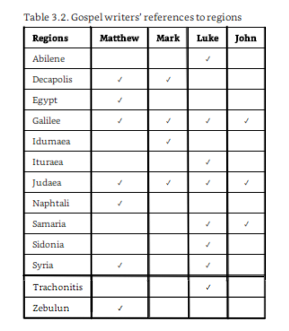 cipios del siglo III tenemos un testimonio sobre los cuatro Evangelios que son especiales de Egipto (Papyrus 45 en la Biblioteca Chester Beatty), Francia (Irenaeus) y Siria (Tatian). Como Williams dice, “Estos cuatro libros fueron tratados juntos como la mejor fuente de información sobre Jesús mucho antes de que cualquier ciudad central, grupo o individuo en el cristianismo poseyera suficiente poder para imponer la colección a otras personas”[3].
Los cuatro evangelios son algo así como una anomalía en la antigüedad. La cercanía a la vida de Jesús, cuán cerca están nuestras copias cronológicamente de cuando se compuso el original, y la atestación manuscrita son asombrosas. La comparación de estos y otros hechos con nuestras fuentes sobre el emperador Tiberio muestra que tenemos buena información sobre Jesús en relación con una figura bien conocida de la antigüedad.
Los autores del Evangelio sabían sus cosas
Esto es lo que quiero que hagas. Sin ninguna ayuda externa, llega a algunos lugares y nombres para una obra establecida en el estado nación de Alemania en 1850. Détente ahí hasta que hayas hecho eso, aunque sólo sea en tu cabeza.
Bueno, veamos como lo hiciste. Aquí está la primera cosa: no había ningún estado nación de Alemania en 1850 (Pero si sabías esto y se te ocurrió lugares, y nombres, entonces no dudes en ver si tu puede comprobar tus conjeturas). El punto es que tratar de encontrar lugares ficticios y nombres para un lugar que no conocemos bien, es extremadamente difícil. Esto es así a pesar de que tenemos internet en la punta de nuestros dedos. Este es el caso, aunque muchos de nosotros probablemente aprendimos en algún momento que Alemania no se convirtió en un estado nación hasta 1871. Así que veamos qué pasa cuando aplicamos esta prueba a los autores evangélicos.
Geografía
Aquí están algunas tablas de Williams:[4]
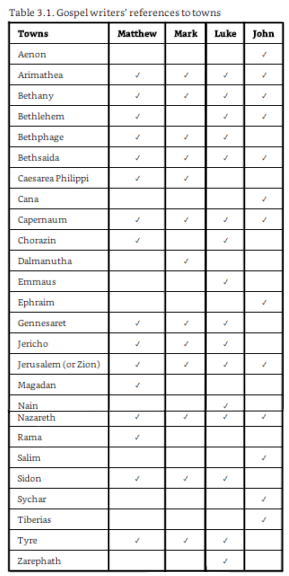
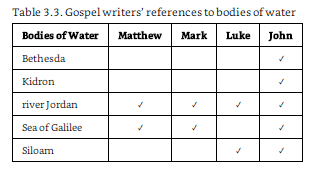
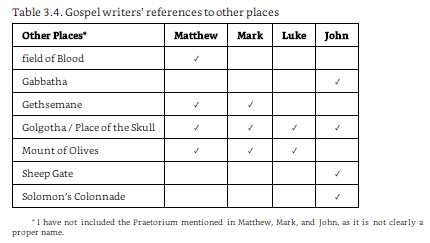
Estas tablas muestran tres cosas: (1) los escritores tienen conocimiento sobre un guardabosques de localidades bien conocidas a recónditas; (2) ningún escritor evangélico obtiene todo su conocimiento de otro, porque todos tienen información única; y (3) los escritores muestran conocimientos sobre una variedad de información geográfica. Todo esto es extremadamente sorprendente si están escritos bien después del hecho en algún lugar a las fueras de Palestina. Como dice Williams, “Los cuatro Evangelios demuestran familiaridad con la geografía de los lugares sobre los que escriben”.[5]
Ellos deben haber recibido su información de la experiencia o a través de la escucha de cerca a aquellos que tenían ese conocimiento.
Cuando Williams se da cuenta de la frecuencia de las referencias geográficas, los resultados son aún más sorprendentes. Las ubicaciones mencionadas por 1.000 palabras son las siguientes: Mateo 4.905; Marcos 5.404; Lucas 5.087; y Juan 4.921. [6]. Con ingenio, ” La distribución uniforme de los nombres de lugares en los cuatro evangelios es improbable que sea el resultado de cada uno de los cuatro escritores haciendo un esfuerzo deliberado para difundir nombres, pero es exactamente el tipo de patrón que podría ocurrir a través de un comportamiento inconsciente, registrando lugares naturalmente cuando es relevante para sus historias”.[7]
Williams entonces mira cuerpos de agua, carreteras de viaje, jardines y más. Demuestra que no sólo los autores evangélicos son exactos, sino que los Evangelios mismos son una valiosa fuente de información geográfica. Esto es especialmente obvio cuando se comparan los cuatro Evangelios con los Evangelios posteriores. Simplemente no hay comparación.
Nombres
Sé que te gustan las tablas, así que aquí están unas cuantas más de Williams, basado en el trabajo de Richard Bauckham: [8].
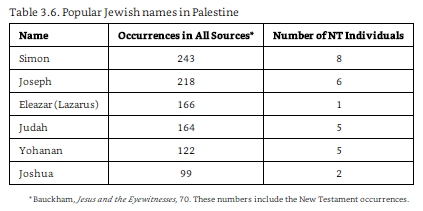
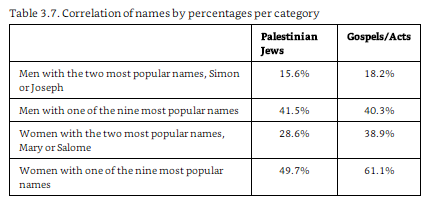
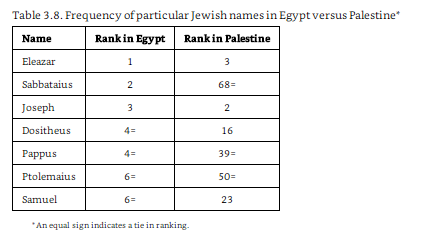
En pocas palabras, no se podía vivir en otra parte del Imperio Romano y mágicamente llegar a nombres que encajarían en Palestina durante la época de Jesús. Hay confirmación adicional aquí. Cuando un número de personas comparten el mismo nombre, una referencia puede ser ambigua. Esta es la razón por la que la gente toma apodos o se agrega un descriptor como “Mike de contabilidad.” Lo que vemos cuando estudiamos los evangelios es que los desambiguadores se utilizan para los nombres más comunes, pero no para los menos comunes. Vimos que los patrones de nomenclatura se ajustan a Palestina durante el primer siglo. No sólo eso, “sin embargo los patrones de desambiguación son los que serían necesarios en Palestina, pero no en otros lugares“. [9]. Una vez más, encontramos más evidencia en la forma en que el narrador y los personajes en la narrativa se distinguen por su uso de nombres y desambiguadores y el hecho de que el nombre de Jesús a veces necesita un identificador adicional. Por lo tanto, “el conocimiento de los nombres locales refuerza este patrón de familiaridad local”.[10]
Otras señales
La judería de los Evangelios también sirve como evidencia para su testimonio temprano. Estos son algunos ejemplos interesantes. Cuando Jesús está siendo tentado en el desierto, una cuestión de disputa es la lectura correcta del Salmo 91. A través del descubrimiento de los Rollos del Mar Muerto (11Q11, específicamente), nos enteramos de que este salmo fue utilizado para exorcizar demonios. [11] Además, la oración de Jesús en Lucas 23:46 es una cita directa del Salmo 31:5, “la tradicional oración en el lecho de muerte de un judío observador”.[12] Esto contrasta con los Evangelios posteriores. Dada la división entre el judaísmo y los seguidores de Jesús, el judaísmo generalizado favorece una fecha anterior. Los términos botánicos, las finanzas, las lenguas locales y las costumbres inusuales sirven como evidencia adicional sobre lo que los autores evangélicos sabían.
Conclusión
En pocas palabras, los autores evangélicos conocían sus cosas. Tenían conocimientos detallados o acerca de los nombres de lugares, los nombres de las personas, Judaísmo, los términos botánicos, las finanzas, los idiomas y las costumbres. Esto no es simplemente un conocimiento menor, sino una profundidad que es bastante sorprendente. Para nosotros, puede ser difícil entender lo difícil que sería tratar de hacer que esto encaje en un momento y lugar con el que no estás familiarizado. Con Internet al alcance de la mano, creemos que una tarea así es fácil.
Sin embargo, es difícil incluso con Internet, ya que se puede discernir si se mira en el proceso de escritura de alguien como Thomas Pynchon. Dado que este proceso ya es difícil y que los autores evangélicos no tenían Internet ni los recursos que tenemos, se trata de argumentos firmes a favor de que los Evangelios estén conectados con alguien que realmente conocía la Palestina del siglo I durante la época de Jesús. Este es un argumento sólido para la fiabilidad.
Coincidencias no diseñadas
María y Marta
Toma Lucas 10:38-42. Allí vemos a Marta como la que está ocupada en el trabajo mientras María se sienta y es más contemplativa. Ahora considera cuando Jesús va a resucitar a Lázaro de entre los muertos. Bueno, Marta está en la tarea de dar la bienvenida y hablar con Jesús mientras María se sienta.
Una vez que ella va a ver a Jesús, cayó a sus pies, tal como ella estaba sentada a sus pies en Lucas. En Lucas, Marta se preocupa por las necesidades prácticas: ella necesita ayuda. Así que no es de extrañar que cuando Jesús dice que se retire la piedra de la tumba de Lázaro para levantarlo de entre los muertos, Marta está preocupada por las preocupaciones prácticas: va a apestar.
En términos de contenido, las narrativas son muy diferentes porque están hablando de diferentes situaciones. Sin embargo, en términos de representación del personaje, las dos se alinean sin ningún problemas. No hay razón para pensar que esto se debe al esfuerzo deliberado de uno de los autores. Williams explica coincidencias no diseñadas como esta: “En una coincidencia no diseñada, los escritores muestran un acuerdo de un tipo que es difícil imaginar como deliberadamente inventado por cualquiera de los autores para hacer que la historia parezca auténtica”.[13] Así que uno podría imaginar que esto es de alguna manera deliberadamente inventado, pero el resultado es que “entonces te imaginas que están entre los más brillantes de todos los autores antiguos”.[14] La mejor explicación es que los autores son confiables.
Y para que no pienses que este es solo es un incidente aislado, daré otros ejemplos más.
Hijos del Trueno
En Marcos 3, Jesús se refiere a Santiago y Juan como hijos de trueno. No se dice nada más sobre esto. Sin embargo, en Lucas 9 aprendemos que querían derribar fuego del cielo en una aldea samaritana. Eso ciertamente se ajusta al personaje que uno deduciría de su apodo.
Alimentación de los 5.000
Un ejemplo muy interesante es la alimentación de los 5.000. Tanto Marcos como Juan hacen una nota sobre la hierba, pero no hacen nada más con ella. Marcos dice que se retiraron a un lugar más desolado porque muchas personas se estaban moviendo, sin embargo, él no hace más de esto. Sólo Juan añade que el milagro tuvo lugar cuando se acercaba la Pascua. El no hace mención sobre las multitudes moviéndose, sino que simplemente menciona la próxima Pascua. Cuando Jesús ve a la gran multitud, le pregunta a Felipe dónde se supone que van a conseguir pan. ¿Por qué le pregunta a Felipe específicamente? Además, Andrés es el que responde. ¿Por qué responde? Juan no da ninguna razón.
Sin embargo, hay una pista. Antes Juan escribió que Felipe era de Betsaida, la ciudad de Andrés y Pedro. Adivina dónde Lucas localiza este milagro. Lo tienes, cerca de Betsaida. Así que tenemos todas estas cuentas entrelazantes que se están explicando unas a otras.
Williams lo expresa así: “Así que en esta narrativa, Juan explica a las muchas personas que viajan en Marcos, y Lucas explica el diálogo en Juan. Incluso el pequeño detalle en Juan de que el niño tiene panes de cebada (Juan 6:9) encaja muy bien con la cercanía de la Pascua, que inmediatamente sigue a la cosecha de cebada.”[15]. Pero, para fusionar las descripciones de Marcos y Juan, ¿qué pasa con la abundancia de hierba verde? Basado en los registros de precipitación de las cercanas Tiberias y el rango calendárico en el que la Pascua tendría que caer, la descripción de una abundancia de hierba verde encaja perfectamente.
No obstante, todas estas coincidencias no diseñadas rodean un milagro: la alimentación de los 5.000. Para subestimar el punto, es un poco extraño pensar que los escritores evangélicos preservaron los detalles tan bien y de alguna manera el evento principal fue corrompido. Es difícil ver esto como cualquier cosa menos a un alegato especial.
Los Evangelios y Josefo
Una última coincidencia no diseñada viene de la mirada en los Evangelios y Josefo. En Antiguedades de los Judíos, el pueblo vincula la muerte de Juan el Bautista con la derrota del ejército de Herodes. No hay una explicación clara de por qué es esto. Josefo nos informa que la causa de la contención entre Herodes Antipas y Aretas fue que Herodes se casó con la hija de Aretas y luego se divorció de ella más tarde para casarse con Herodías. Sin embargo, los Evangelios nos dicen que Juan se opuso al nuevo matrimonio de Herodes y esta fue la causa de su arresto y muerte final. Williams muestra cómo estas diversas fuentes se explican entre sí: “los judíos conectaron la destrucción del ejército de Herodes con su ejecución de Juan el Bautista precisamente porque la ejecución de Juan había sido para oponerse públicamente al nuevo matrimonio que fue la causa principal de la conflicto”.[16]
Conclusión
Esto es sólo para rascar la superficie de coincidencias no diseñadas. No obstante, estas son impresionantes. Citando el libro de Lydia McGrew sobre este tema, Williams señala que “en nueve ocasiones los Evangelios Sinópticos [Mateo, Marcos y Lucas] explican a Juan, en seis ocasiones Juan explica los Sinópticos, y en cuatro ocasiones los Sinópticos se explican unos a otros”.[17] Ahora, tu podrías idear todo tipo de explicaciones para cada una de ellas, pero cada explicación adicional agrega complejidad. La mejor explicación es que estamos tratando con registros veraces.
¿Las Palabras de Jesús?
La forma en que citamos a las personas no puede ser leída de nuevo en los Evangelios. Toma algunas de las citas de este post. Probablemente esperas que use las palabras exactas citadas. Si hago omisiones, esperas que lo indique con puntos suspensivos. Si agrego palabras, esto se hace con corchetes. Sin embargo, no podemos volver a leer esto en los Evangelios para averiguar si tenemos las palabras de Jesús.
Por lo tanto, cuando miramos los Evangelios y vemos que tienen a Jesús diciendo palabras diferentes en el mismo incidente, eso no implica que no tengamos las palabras de Jesús. La distinción clásica aquí es entre tener la ipsissima verba (las mismas palabras) y el ipsissima vox (la misma voz). Para utilizar un ejemplo moderno, nuestra comprensión moderna de la cita directa se centra en las mismas palabras. Cuando parafraseamos los pensamientos de alguien o lo ponemos en nuestras propias palabras, nos centramos en la voz misma.
Entonces, ¿tenemos la misma voz de Jesús en los Evangelios? Veamos algunas de las pruebas.
Preparando el escenario
Si los autores evangélicos estuvieran poniendo palabras en la boca de Jesús, un poco del texto es sorprendente. En la iglesia primitiva, el papel de la circuncisión fue enormemente debatido. ¿Por qué los autores de los evangélios no harían que Jesús hablara sobre este tema?
Genialidad
Todos conocemos la Regla de Oro: “cualquier cosa que desees que los demás te hagan, hazla también a ellos” (Mateo 7:12) y “como quieras que los demás te hagan, hazlo con ellos”. (Lucas 6:31) Si esta es la primera articulación de la forma positiva de este mandamiento, trazarla a alguna forma que Jesús sabría que es difícil. Puesto que es más sencillo pensar que una persona se le ocurrió en lugar de Mateo y Lucas que lo inventaban de forma independiente o postula una tercera fuente desconocida que entonces se supone que influye en los dos de una manera que los hace ponerlo en los labios de Jesús , esto es una indicación de que tenemos las palabras de Jesús.
Parábolas
Jesús habla en historias cortas. Jesús cuenta más de 40 parábolas en los Evangelios. Estas son algunas razones para suponer que Jesús realmente las dijo: (1) Hay pocas o ninguna parábola en la literatura judía anterior (el Antiguo Testamento, los Rollos del Mar Muerto y los apócrifos) y pocas utilizadas por los primeros cristianos fuera del Nuevo Testamento; (2) si queremos negar que Jesús los dijo, entonces tenemos que multiplicar a los inventores y así hacer la explicación más complicada (especialmente una vez que observamos que esencialmente murieron después de los Evangelios); y (3) parábolas como la del sembrador, el buen samaritano y otros son vistos como la obra del genio y así se explican mejor por tener una fuente singular.[18] Se observa más confirmación en el hecho de que las parábolas de Jesús a menudo incluyen elementos tradicionales (un rey, siervos, un banquete, por ejemplo) con el fin de llegar a una conclusión sorprendente. Así que un escenario en la Palestina del siglo I tiene mucho sentido.
El hijo del hombre
Este es otro factor que parece irrupción con Jesús y luego desaparece. La frase “Hijo del Hombre” se encuentra en los labios de Jesús a menudo. Sin embargo, rara vez se encuentra en el resto del Nuevo Testamento y está ampliamente ausente del resto de la literatura cristiana primitiva. Puesto que la frase se encuentra en los cuatro evangelios y en todos los tipos diferentes de material, lo mejor es ver esto como volver a Jesús.
¿Qué hay de Juan?
Para sacudir primero nuestras expectativas, quiero que pensemos en nuestra experiencia normal. Considérese a sí mismo y a las personas que conoce. ¿Normalmente sólo hablas en breves declaraciones y parábolas? O, en cambio, a menudo hablas en formas más largas de discurso, tal vez hablando durante 5-10 minutos seguidos, si no más una vez que incluimos algunas interjecciones por otros. Lo más probable es que seamos mucho más pesados en las formas más largas del discurso. Basándose en eso, la forma de discurso en Juan parece más probable que provenga de alguien sobre las breves y piadosas declaraciones y parábolas de los Sinópticos (Mateo, Marcos y Lucas). Así que el hecho de que Juan es como Juan, no debe ser sorprendente en absoluto.
Sin embargo, Williams también cita algunas razones para pensar que John y los Sinópticos se basan en material común.[19] En primer lugar, destaca lo que se conoce como el rayo Johannine. Aquí es de Mateo 11:25-27, “En ese momento Jesús declaró: ‘Te agradezco, Padre, Señor de los cielos y de la tierra, que has ocultado estas cosas de los sabios y del entendimiento y las has revelado a los niños pequeños; Sí, Padre, por tal fue tu gentil voluntad. Todas las cosas me han sido entregadas por mi Padre, y nadie conoce al Hijo excepto el Padre, y nadie conoce al Padre excepto al Hijo y a cualquiera a quien el Hijo elija revelarlo’. Ahora, tal vez no hayas leído los Evangelios para tener un sentido de su lenguaje y escritura. Sin embargo, si este pasaje no se encuentra en ninguno de los Evangelios, alguien lo compuso, y luego pidieron a los eruditos que averiguaran en qué Evangelio encajaría mejor, la respuesta clara sería Juan. Por lo tanto, cuando Juan tiene largas secciones sobre Jesús hablando de Dios como su padre y de sí mismo como el Hijo, esto encuentra confirmación en la Sinóptica.
Segundo, consideren el uso del Hijo del Hombre en los cuatro Evangelios. Si bien hay un debate considerable sobre la frase, Daniel 7 está ciertamente en el fondo en cierto sentido. Allí se recogen dos temas comunes en los puntos: (1) llegada y (2) autoridad. Sin embargo, son exactamente estos temas los que se encuentran detrás del uso del Hijo del Hombre en Juan. Esto encaja bien con volver a un orador común, Jesús.
Tercero, considere las apariciones de resurrección en Mateo y Juan. Ambos tienen a la mujer o a las mujeres aferrándose a Jesús. Ambos tienen a Jesús diciéndoles lo que tienen que hacer. Ambos tienen a Jesús refiriéndose a sus seguidores como “mis hermanos”. Así que hay una gran superposición aquí en lo que es más detalles menores. Por otro ejemplo, Juan no registra la oración en el jardín de Getsemaní acerca de quitar la copa, pero en su arresto Juan tiene a Jesús refiriéndose a su sufrimiento venidero con la palabra copa (Juan 18:11).
Aquí tampoco debemos olvidar las coincidencias no diseñadas discutidas anteriormente. Para refrescar la memoria, vuelva a visitar la sección sobre la alimentación de los 5.000.
¿Y el arameo?
El primer punto a hacer es que incluso si Jesús habló principalmente en arameo, entonces esto no significa que no tengamos la voz misma de Jesús en el texto griego. Si bien no hay una traducción perfecta, eso está muy lejos de decir que ha habido traducción errónea. Aun así, se debate el conocimiento linguístico de Jesús: “la idea todavía popular de que Palestina era un dominio exclusivamente arameo probablemente debe más al romance de la idea que a cualquier evidencia histórica dura”.[20]
Aquí hay un dato interesante que aprendí sobre este asunto. El consejo gobernante de Jerusalén fue llamado el Sanedrín. La mayoría de nosotros con cierta familiaridad con los Evangelios probablemente lo sabemos. Así que aquí está la parte interesante: Sanedrín es un nombre griego. Así que la influencia de la lengua griega claramente se extendió bastante.
Jesús creció en Nazaret, que estaba cerca de Séforis. Dada la ocupación de José y Jesús, es probable que hubieran participado en proyectos de construcción en Séforis y por lo tanto tuvieron contacto con la lengua griega. Más atestación se encuentra en las interacciones de Jesús con los griegos en Juan 12:23, el centurión en Mateo 8:5-13, la mujer griega en Marcos 7:26, y tal vez los herodianos en Marcos 12:13.[21]
Nada de esto significa que Jesús sólo hablaba griego. Sin embargo, todo esto pone en duda a Jesús sólo conocía el arameo. La compleja interacción entre diferentes culturas e idiomas se está sucediendo claramente en la Palestina del siglo I. Por lo tanto, no es sorprendente que Jesús supiera, y a veces enseñaba en griego. No importa el veredicto, nada de esto debería llevar a dudas sobre la fiabilidad de los Evangelios.
Conclusión
Hemos cubierto una serie de razones para pensar que tenemos las palabras de Jesús. Si bien esto no debe tomarse en el sentido moderno de las citas exactas, el hecho de que Jesús no se dirija a la circuncisión, el genio de los dichos, las parábolas y la frase Hijo del Hombre todos apoyan que tenemos confiablemente las palabras de Jesús. Juan no pone en duda esto debido al acuerdo en material. También es digno de mención que en Juan parece un mejor ajuste para la forma en que la gente habla sobre los dichos más cortos de los Sinópticos. Finalmente, mientras se debate el alcance del conocimiento de Jesús sobre diversas lenguas, nada de esto pone en duda la fiabilidad de los Evangelios.
¿Un texto corrompido?
Williams aborda esta pregunta mirando como el trabajo de Erasmo de Róterdam. El produjo la primera edición publicada e impresa del Nuevo Testamento griego. Sólo tenía dos manuscritos disponibles para su obra sobre los Evangelios. Además, ambos manuscritos provinieron del siglo XII. Así que Erasmo, estaba trabajando desde una base de texto muy pequeña y con manuscritos separados de los Evangelios por más de un milenio. Si la copia del escriba es pobre, entonces esperaríamos todo tipo de errores en el Nuevo Testamento griego de Erasmo.
Ahora tenemos un par de miles de manuscritos griegos para los Evangelios. También tenemos dos manuscritos de los cuatro Evangelios que son del 350 d.C.-Codex Vaticano y del Codex Sinaiticus. Además de esto, algunos fragmentos y copias tempranas pueden incluso venir del siglo II. La base del texto se ha ampliado considerablemente, mientras que la distancia cronológica se ha reducido masivamente. Entonces, ¿qué encontramos cuando comparamos las ediciones críticas modernas con el Nuevo Testamento griego de Erasmo?
Hay dos grandes diferencias. En primer lugar, está el final más largo de Marcos, el texto que viene después de Marcos 16:8. Segundo, hay doce versículos en Juan, Juan 7:53-8:11. Lo interesante aquí es que Erasmo habría conocido estas posibilidades. Uno de sus dos manuscritos le contó acerca de la incertidumbre sobre el final más largo de Marcos y omitió los versículos de Juan. Como escribe Williams: “En otras palabras, el hombre más sabio de la tierra en el siglo XVI no se habría sorprendido por ningún descubrimiento en los últimos cinco siglos que haya puesto en duda estos versículos”.[22] La duda de estos versículos muestra en realidad que no había ninguna autoridad general que imponga uniformidad en el texto.
Poco después de Erasmo surgió un hombre llamado Robert Estienne, también conocido como Stephanus. Es famoso por introducir números de verso en 1551. Además de los dos bloques más largos de texto que acabamos de mencionar, una comparación del Nuevo Testamento griego de Erasmo, una edición crítica moderna trae a la luz del día que hay once versos que no se encuentran en las ediciones modernas (por ejemplo, Mateo en la versión estándar en inglés saltos de 18:10 a 18:12.De estos once versos, Erasmo conocía la incertidumbre para tres de ellos. Así que cuando se suma la diferencia de versos entre la edición de Erasmus y la nuestra de hoy, Erasmo conocía la incertidumbre durante al menos 27 de los 35 versos. ¡Eso es 77%!
Todavía hay algunos casos en los que los eruditos modernos piensan que nuestras versiones actuales tienen demasiado texto. Esos versículos son Mateo 16:2b-3, Lucas 22:43-44 y Lucas 23:34a. Esto es sólo unos cuatro versículos de alrededor de 3.750 versículos en los Evangelios. En otras palabras, alrededor del 0,1%.
Pero, ¿qué pasa antes de las primeras copias que tenemos? Algunas consideraciones apuntan en contra de esto. En primer lugar, no hay razón para pensar que los primeros textos estaban en un estado de flujo. De hecho, sobre la base de la información cubierta anteriormente, tenemos todas las razones para pensar lo contrario. Dada la rápida difusión del cristianismo y, por lo tanto, de sus escritos, la idea de que el texto más antiguo se perdiera de alguna manera es extremadamente improbable. Finalmente, dado que los escribas en el mundo antiguo no eran autores, sino que eran, bueno, escribas, tienen todas las razones para transmitir fielmente el texto.
Contradicciones
El propósito no es disipar toda supuesta contradicción. Por un ejemplo, aunque haya contradicciones que no signifiquen que los Evangelios no sean fiables. El argumento es que los Evangelios son fiables y dignos de confianza, no que son inerrantes.
El enfoque de William es un enfoque de rotonda. En lugar de disipar las contradicciones más comúnmente citadas o las más difíciles, quiere que pensemos más profundamente en el tema. Para ello, destaca las “contradicciones formales deliberadas” en el Evangelio de Juan mismo y con 1 Juan, un libro que guarda similitudes estilísticas con el Evangelio de Juan.
El da seis ejemplos: (1) Dios ama al mundo (Juan 3:16) y no se supone que amemos al mundo (1 Juan 2:15); (2) las personas creyeron cuando vieron las señales de Jesús (Juan 2:23) y no creyeron (Juan 12:37); (3) conocen a Jesús y de dónde vino (Juan 7:28) y no lo conocen ni de dónde vino (Juan 8:14, 19); (4) si Jesús da testimonio de sí mismo, su testimonio no es verdadero (Juan 5:31) y lo contrario (Juan 8:13-14); (5) Jesús no juzga a nadie (Juan 8:15) y tiene mucho que juzgar (Juan 8:16, 26); y (6) Jesús no vino a juzgar (Juan 3:17; 12:47) y vino a juzgar (Juan 9:39).
Estas “contradicciones” son deliberadas. Nos hacen pensar más profundamente en las palabras y el tema en cuestión. Así que si sólo tenemos una familiaridad pasajera con el Evangelio de Juan y estamos buscando contradicciones, en realidad nos perderemos las sutilezas que tenemos a mano.
Teniendo en cuenta ese trasfondo, Williams analiza una cita de Bart Ehrman. En la cita, Ehrman destaca una contradicción en el Discurso de despedida (Juan 13-17) que se perdió durante años. Subraya que Pedro pregunta a dónde va Jesús (Juan 13:36), al igual que Tomás (Juan 14:5), pero luego en la misma comida y unos minutos más tarde Jesús pregunta por qué ninguno de ellos le pregunta a dónde va (Juan 16:5). Ehrman concluye que debe haber diferentes fuentes detrás de estos capítulos que den lugar a la contradicción.
Pero los puntos destacados anteriormente deberían atemperar tal conclusión. Después de todo, esto significa que el autor final creó una obra que (1) de alguna manera reunió varias fuentes tan bien que se perdieron durante 1900 años todavía (2) y contiene una contradicción flagrante a los pocos minutos de la lectura. Esa es toda una hazaña. En cambio, dada la naturaleza del Evangelio de Juan, parece más probable que Ehrman se haya perdido la ironía: Jesús va a la cruz y luego a su Padre, pero los discípulos se preguntan sobre asuntos más mundanos como dónde está caminando a continuación. El problema es que probar o disipar contradicciones se ha convertido en un asunto de puntuación de puntos.
El Evangelio de Juan, entonces, utiliza lo que parece contradicciones formales para hacer que el lector piense más profundamente. Para usar un ejemplo personal, encuentro que a menudo cuando estoy interactuando con personas que quiero decir lo contrario de lo que dicen, incluso si estoy de acuerdo formalmente con su declaración. Esto se refleja en el viejo adagio, una media verdad es toda una mentira. Empujar en una (incluso verdadera) dirección puede terminar distorsionando el todo.
Nada de esto implica que no haya contradicciones en los Evangelios. Esperamos que esto reoriente la forma en que abordamos estos asuntos. Por poner otro ejemplo, no podemos suponer que diferentes autores usaran la misma palabra de la misma manera. Tendemos a entender esto en la vida cotidiana, pero es fácil para todos nosotros olvidar cuando comenzamos a leer los Evangelios. No importa lo que uno termine concluyendo sobre este asunto, las meras contradicciones no prueban que los Evangelios no sean confiables. Si las contradicciones con otras obras literarias resultaran algo poco confiable, no habría una obra literaria confiable.
Cerrando
Por supuesto, se pueden dar explicaciones para todos estos hechos que todavía dejan los Evangelios poco fiables. Pero para llegar a estas explicaciones y luego apilarlas juntas es extremadamente improbable. Por lo tanto, las pruebas llevan a la conclusión de que los Evangelios son fiables. Sin embargo, esos milagros difíciles quedan. Aparte de los milagros, la mayoría de la gente probablemente no tendría mucho problema con que los Evangelios sean confiables. ¿Y qué hay de ellos? Bueno, las objeciones filosóficas no se deshacen del terreno. Si asumes que los milagros no pueden ocurrir, eso es simplemente una petición de principio. La idea de que los milagros rompen las leyes de la física simplemente asume que Dios no puede trabajar en el mundo. Y si uno quiere suponer que son tan improbables de tal manera que uno nunca puede creer racionalmente en milagros, así que simplemente no se lleva a cabo Probabilísticamente. Lo más que se podría decir es que ningún milagro ha superado el umbral necesario, pero eso no se puede no suele ser petición de principio.
Sin embargo, hay buena evidencia para un milagro. Aquí Williams se centra en la resurrección. Hemos tratado sobre este tema en Capturing Christianity antes, así que no dude en echar un vistazo a estos enlaces. Así que incluso los milagros pueden ser de confianza.
Los Evangelios no sólo son fiables para la historia, sino también para el mensaje. Una vez más, los humanos son ingeniosos y pueden llegar a un millón de explicaciones. Pero debemos dar un paso atrás y preguntar cuál es la mejor explicación de todo esto. Si toda la historia se cierne sobre Jesús, entonces se explica tanto: la historicidad de los Evangelios, la resurrección, la correspondencia entre el Antiguo Testamento y la vida de Jesús, el genio de Jesús, su carácter y más. Esto, sin embargo, es una suposición que implica algo más que un simple consentimiento cognitivo. No se trata simplemente de pedir que uno firme algunos hechos. Si esto es cierto, Jesús es verdaderamente señor. Lo único que Jesús no puede ser es moderadamente importante.
Como caso introductorio sobre la fiabilidad de los Evangelios, ¿Podemos confiar en los Evangelios de Peter Williams? es un sobresaliente. Es un libro que se puede leer fácilmente en pocos días, sin embargo, si esta revisión muestra algo, es un tesoro de información. ¿Podemos confiar en los Evangelios? De seguro. Jesús habla hoy mientras habla a sus primeros seguidores: “Sígueme“.
Notas
[1] Peter S. Williams, Can We Trust the Gospels?, loc. 193ff.
[2] Ibid., loc. 400ff.
[3] Ibid., loc. 500.
[4] Ibid., loc. 754ff.
[5] Ibid., loc. 888.
[6] Ibid., table 3.5.
[7] Ibid., loc. 936; emphasis original.
[8] Ibid., loc. 1058ff.
[9] Ibid., loc. 1140; emphasis original.
[10] Ibid., loc. 1259.
[11] Ibid., loc. 1300.
[12] Ibid., loc. 1308; citing R. Steven Notley.
[13] Ibid., loc. 1527.
[14] Ibid., loc. 1529.
[15] Ibid., loc. 1606ff.
[16] Ibid., loc. 1644.
[17] Ibid., loc. 1574.
[18] Ibid., loc. 1730ff.
[19] Ibid., loc. 1763ff.
[20] Ibid., loc. 1809.
[21] Ibid., loc. 1853.
[22] Ibid., loc. 1938.
Brett Lunn está realizando una Maestría en Teología en el ministerio cristiano, a través del Seminario Teológico Bautista del Sureste. Está interesado en los estudios bíblicos, la teología, la filosofía y más. Blogs en brettlunn.wordpress.com.
Blog Original: http://bit.ly/2Rv3efU
Traducido por Ricardo Flores.

Judaism 101 with Dr. Michael Brown
PodcastPodcast: Play in new window
Subscribe: Apple Podcasts | Spotify | Amazon Music | Android | iHeartRadio | Email | TuneIn | RSS
Here is our list of questions (we might not get to them all, but we will try to give people an overview of what Jews believe today and how we can best reach them for Jesus).
Subscribe on iTunes: http://bit.ly/CrossExamined_Podcast rate and review! Thanks!!!
Subscribe on Google Play: http://bit.ly/CE_Podcast_Google
Subscribe on Spotify: http://bit.ly/CrossExaminedOfficial_Podcast
Subscribe on Stitcher: http://bit.ly/CE_Podcast_Stitcher
Apologetics and a Different Kind of Persuasion
Theology and Christian ApologeticsBy Mikel Del Rosario
A Different Kind of Persuasion
Have you ever found yourself “in debate mode” while talking to a skeptical friend about Christianity? Perhaps this is because many of us have been equipped with apologetic content (arguments for God’s existence, the reliability of the Gospels, etc.) with less of a focus on an apologetic method for use in everyday conversations.
Sometimes, we can get so concerned about winning or making a certain point, that we lose the credibility that an ambassador of Christ should have. Others you don’t notice may be watching and listening to your conversation. If the exchange gets heated, some may be thinking, “I don’t care if Christianity is true if it’s not good.” So, is there a different kind of persuasion to employ?
At the Hendricks Center, Darrell Bock and I invited John Dickson, the Founding Director of the Centre for Public Christianity, to join us in discussing what persuasion and apologetics can look like when Christians function as cultural minorities in a society.
In this post, I share three quick tips I learned from his visit on how to use a different kind of persuasion in our apologetic encounters:
Give ’em Pause
Instead of walking into a conversation in “debate mode,” Christians should seek to persuade others by provoking two things: Reflection and a longing for the truth of the gospel. On an episode of the Table Podcast called “Keys to Effective Cultural Engagement,” Bock talked about what he calls “a different kind of persuasion.” He says:
Instead of relying on a more forceful kind of attempt at persuasion, he suggests an approach that communicates something like, “What I’m putting out on the table for you is a helpful way to think about how humans should interact and live with one another…” He says, “There’s certain effectiveness of living that’s being represented. I want to give them pause so they’ll start to think.”
Dickson agrees. He explains how this applies not just in conversations, but even in televised public debate situations:
Have Conversations, not Debates
You probably won’t yourself defending the faith on TV or in a literal academic debate. But even in everyday conversations, other people may be watching you interact with someone who sees Christianity differently. How do you compose yourself? Rather than being consumed with winning the debate, let’s engage in a real conversation. Remind yourself, “I’m in a conversation, not a debate.” Bock elaborates:
Show Truth and Goodness
Today, many people are wondering not if Christianity is true, but if Christianity is even good. They reason, “If it’s not good, then should I, why to care if it’s true?” Don’t forget that persuasion is always person-relative. While you may not be able to help someone consider the truth of a certain Christian truth claim, you may be able to show them by the tone of your conversation and the way you treat them that Christianity is good.
Dickson notes that this was the approach of C.S. Lewis:
He goes on to say:
I agree. Our skeptical friends and neighbors are more likely to give Christianity a fresh hearing if we can, through our actions, show them that Christianity is good. I like how Dickson describes goodness as “morally credible, loving, generous, compassionate, humble—things that flow out of the gospel.” Sometimes, just getting someone to want that goodness, to long for that goodness, is a step in the right direction—even if they are not fully persuaded of its truth just yet. As Christian ambassadors, we need to help people see the beauty and goodness of Christianity, in addition to the truthfulness of its claims.
Reflection and Persuasion
I enjoyed putting this episode of the Table Podcast together and getting Bock and Dickson together to discuss a different kind of persuasion. These insights are applicable to both personal discussions and square public conversations. Rather than being primarily concerned about winning a debate, let’s focus on getting people to pause and reflect on the effectiveness of living God’s way. Yes, we should defend the faith with confidence. But let’s also be mindful of our demeanor and the way it affects those who may be watching and listening.
The next time you find yourself operating in “debate mode,” take a step back. Consider these tips and try using a different kind of persuasion.
Recommended resources related to the topic:
Tactics: A Game Plan for Discussing Your Christian Convictions by Greg Koukl (Book)
Practical Apologetics in Worldview Training by Hank Hanegraaff (Mp3)
The Great Apologetics Adventure by Lee Strobel (Mp3)
Defending the Faith on Campus by Frank Turek (DVD Set, mp4 Download set and Complete Package)
So the Next Generation will Know by J. Warner Wallace (Book and Participant’s Guide)
Reaching Atheists for Christ by Greg Koukl (Mp3)
Living Loud: Defending Your Faith by Norman Geisler (Book)
Fearless Faith by Mike Adams, Frank Turek and J. Warner Wallace (Complete DVD Series)
Mikel Del Rosario helps Christians explain their faith with courage and compassion. He is a doctoral student in the New Testament department at Dallas Theological Seminary. Mikel teaches Christian Apologetics and World Religion at William Jessup University. He is the author of Accessible Apologetics and has published over 20 journal articles on apologetics and cultural engagement with his mentor, Dr. Darrell Bock. Mikel holds an M.A. in Christian Apologetics with highest honors from Biola University and a Master of Theology (Th.M) from Dallas Theological Seminary where he serves as Cultural Engagement Manager at the Hendricks Center and a host of the Table Podcast. Visit his Web site at ApologeticsGuy.com.
Original Blog Source: http://bit.ly/2TvHG5f
Natural-ly There Is A Problem With Evil
Atheism, Theology and Christian ApologeticsBy Alex McElroy
One of the most difficult issues to reconcile in life is the presence of evil. This is the case whether one has a theistic, agnostic or atheistic worldview. The existence of evil is undeniable both in our witness and experience but is evil objective in nature or merely an apparition. Even atheist J.L. Mackie recognized a dilemma. In one book, he writes, “There are no objective values.”[1] Elsewhere, he writes, “We might well argue…that objective, intrinsically prescriptive features, supervenient upon natural ones, constitute so odd a cluster of qualities and relations that they are most unlikely to have arisen in the ordinary course of events, without an all-powerful god to create them.”[2]
This poses a problem for the naturalist or the atheist because whatever evil does exist in people cannot be attributed to anything other than misfiring neurons. Well, known atheist Richard Dawkins has stated, “DNA neither cares nor knows. DNA just is. And we dance to its music.”[3] However, if we are just dancing to our DNA, then no one can ultimately be held responsible for any actions, and evil becomes a term without an ontic point of reference. Ravi Zacharias wrote, “Atheists often blunder into the right by borrowing from assumptions that are not logically deduced from their own worldview. But their opinion is so strong that they straddle the two worlds and make up a bridge because they have reached an unbridgeable chasm, given their starting point.”[4] That starting point of random, unguided natural processes is hardly the building blocks for a moral framework.
Sam Harris, an atheist who is both a philosopher and neuroscientist, has much to say on how humans can arrive at life-sustaining moral standards simply through biological evolution. He writes, “Many people imagine that the theory of evolution entails selfishness as a biological imperative. This popular misconception has been harmful to the reputation of science. In truth, human cooperation and its attendant moral emotions are fully compatible with biological evolution.”[5] First, it should be noted that many scientists, most notably Biochemist Michael Behe, have shown a flaw in the premise being proposed by Mr. Harris in regard to the selfishness of biological evolution. With regard to the underlying theory contained within Harris’ assertion, Behe writes, in Darwin Devolves, about two groups of extended evolutionary synthesis scientists who propose a similar theory:
The first speculates that once master genes and their regulatory networks of connections were in place, perhaps novel complex features could be developed mostly by random changes that accidentally form new signature sequences near various genes….The second group…emphasizes the ease of deploying an array of machinery to different locations, which, like ectopic fly eyes, would generate a lot of variation much more easily than Darwin might have imagined. Maybe that would give selection more to choose from. If all that sounds distressingly vague, I’m afraid that is the gist of the argument…The unanticipated discovery of layers of control – master switches and the stunningly sophisticated genetic regulatory networks they activate – does not make the putative undirected development of life any easier to explain, evo-devo (Evolutionary developmental biology) enthusiasts seem to imagine. It makes it harder. The need for a foreman and subcontractors to coordinate construction does not make it easier to explain how unintelligent processes could make a building out of bricks and wood and pipes and wiring. It shows it to be impossible.[6]
Behe is indicating that an external infusion of sorts, in fact, a number of external infusions would be required in order to advance biological evolution. Who or what could that provide that infusion? If not God, it seems unlikely that unintelligent and unguided natural forces could be responsible for natural evolution, not to mention moral evolution. Additionally, Sam Harris simply assumes that “human cooperation and its attendant moral emotions” would be natural outgrowths of a macroevolutionary process. But that’s a large assumption considering that one component of Darwinian evolutionary theory is survival of the fittest, not survival of the most cooperative.
Mr. Harris goes on to write, “The work of evolutionary biologist Robert Trivers on reciprocal altruism has gone a long way toward explaining cooperation among unrelated friends and strangers…Because moral virtue is attractive to both sexes, it might function as a kind of peacock’s tail: costly to produce and maintain, but beneficial to one’s genes in the end.”[7] Even if we accept Harris’ premise that moral virtue is attractive or beneficial, it still does not allow us to assign an objective value to what morality is in its essence. How are we to know if what we are attracted to in another is being accurately perceived as high moral character? What standard are we comparing their moral virtue to in order to determine where they measure up? How do we define what is most beneficial to us or to humanity at large? These are metaphysical questions that cannot simply be reduced to physical or naturalistic foundations.
In reviewing the works of C.S. Lewis, David Bagget noted, “Moral language today is so peculiar, in fact, that Lewis suggests that this is why many people try to explain it away. Some attempt to reduce moral impropriety to an instrumental matter – as we do with a tree, for our purposes, does not shade us well and is, for this reason, and in this sense, a ‘bad tree.’”[8] Terms such as good, bad, or evil simply lose all substantive value in a purely naturalistic worldview. This does not mean that an atheist cannot be a good person. Of course they can and most of them are morally upright. The issue is not that you cannot be good or do good things if you do not believe in God or the God of the Bible. The issue is that such a thing as good cannot objectively exist if God does not exist. If evil exists, good exists, and if good exists, God exists.
Notes
[1] J.L. Mackie, Ethics: Inventing Right and Wrong. (Middlesex, England: Penguin Books, 1977), 15.
[2] Ravi Zacharias & Vince Vitale, Why Suffering: Finding Meaning and Comfort When Life Doesn’t Make Sense. (New York, NY: Hatchette Book Group, 2014)142.
[3] Richard Dawkins, River Out of Eden: A Darwinian View of Life. (New York, NY: Basic Books, 1995)133.
[4] Turek, Stealing From God, ix.
[5] Sam Harris, The Moral Landscape: How Science Can Determine Human Values. (New York, NY: Free Press, 2010), 56.
[6] Michael Behe, Darwin Devolves: The New Science About DNA That Challenges Evolution. (New York, NY: Harper Collins, 2019)118.
[7] Harris, The Moral Landscape, 56.
[8] Gregory Bassham, C.S. Lewis’s Christian Apologetics: Pro and Con. (Leiden, Netherlands: Brill, 2015), 127-28.
Recommended resources related to the topic:
If God, Why Evil? (DVD Set), (MP3 Set), and (mp4 Download Set) by Frank Turek
If God Why Evil. Why Natural Disasters (PowerPoint download) by Frank Turek
Why Doesn’t God Intervene More? (DVD Set), (MP3 Set), and (mp4 Download Set) by Frank Turek
Why does God allow Bad Things to Happen to Good People? (DVD) and (mp4 Download) by Frank Turek
Alex McElroy is an international speaker, apologist, leadership advisor, author of the book “Blueprint for Bible Basics” and writer for the blog “Relentless Pursuit of Purpose.” He is one of the founding Pastor of at Engage Community Church and formerly the Pastor of Education at New Life Covenant Southeast Church, led by Pastor John F. Hannah with 20,000 members. For over 14 years, Alex has served in both youth and adult teaching ministries. Alex has also trained hundreds of teachers and ministers, so they are equipped to deliver lessons in Biblical study, purpose, leadership, and Apologetics in order to maximize their effectiveness in and for the Kingdom of God. He is a firm believer that everyone is born on purpose with a purpose. He teaches people all over the world to find the purpose God has placed inside of them and to deliver it to the world.
How to Respond to People who Mock Christianity
PodcastPodcast: Play in new window
Subscribe: Apple Podcasts | Spotify | Amazon Music | Android | iHeartRadio | Email | TuneIn | RSS
How would you answer these questions?
These are questions sent in by listeners that Frank answers on this show.
While Frank can’t get to all of them if you have a question you can submit it to Hello@Crossexamined.org. Also, check out these resources: the CrossExamined YouTube channel has answers to hundreds of questions, and several others are answered on the CrossExamined app and CrossExamined website.
Subscribe on iTunes: http://bit.ly/CrossExamined_Podcast rate and review! Thanks!!!
Subscribe on Google Play: http://bit.ly/CE_Podcast_Google
Subscribe on Spotify: http://bit.ly/CrossExaminedOfficial_Podcast
Subscribe on Stitcher: http://bit.ly/CE_Podcast_Stitcher
¿Por qué todos deberían creer que los Evangelios son confiables?
EspañolLos cuatro evangelios hablan de Jesús, el Cristo. Juntos nos hablan de la vida de Jesús de diferentes formas. Nos hablan de su nacimiento virginal, sus argumentos con líderes religiosos, sus enseñanzas, sus milagros y mucho más. Destacan su crucifixión en una cruz romana y su resurrección de entre los muertos. Pero, ¿qué vamos a hacer con todo esto? ¿Son estas narrativas simplemente falsas por autores que fueron o engañados o lo arreglaron? ¿Hay un caso para la fiabilidad de los Evangelios?
Este ensayo destaca un numero de razones por la que todos deberían creer que los Evangelios con confiables. Esto no implica que sean 100% verdaderos, perfectos, o algo parecido. En cambio, los evangelios son algo en lo que debemos confiar, y si podemos confiar en ellos, entonces podríamos tener que repensar lo que creemos acerca de Jesús de Nazaret.
Fuentes no cristianas
Supongamos que no tenemos los cuatro Evangelios en absoluto. ¿Qué podemos saber acerca de Jesús de Nazaret? Analizaremos una serie de fuentes no cristianas para encontrar esta respuesta.
Cornelio Tacito
Tácito nació poco después de que Jesús fuera crucificado. Ocupó una serie de oficinas romanas, pero hoy es más famoso por sus escritos. Mientras habla del incendio en Roma en el año 64 d.C., Tácito menciona una serie de hechos relevantes. Nerón culpó a un grupo de personas llamados Chrestians (una ortografía temprana común de los cristianos). Menciona a un Christus, el fundador del nombre. Este Cristo fue ejecutado durante el reinado de Tiberio por la sentencia de Poncio Pilato. La enfermedad (de los cristianos) comenzó en Judea, que pronto se extendió a Roma.
Hay dos razones principales para confiar en que esta parte de sus Anales proviene de Tácito[1]. En primer lugar, los escribas durante la Edad Media copiaron fielmente la literatura religiosa de los griegos y romanos que difería de la suya. Si eran copistas fieles de esta manera, necesitamos buenas razones para no confiar en ellos en otros casos, especialmente cuando tenemos confirmación basada en hallazgos anteriores de la literatura pertinente. En segundo lugar, el estilo de Tácito se conoce como latín plateado (Literatura Latina en la Edad de Plata). Por lo tanto, preservar este estilo cuando el latín era un lenguaje en constante evolución habría sido casi imposible.
Plinio el Joven
Plinio nació poco después de que Jesús fuera crucificado. Mientras gobernaba Bitinia y Ponto de alrededor de 109-111, escribió una serie de cartas al emperador Trajano. En una de las cartas más famosas, pide consejo sobre cómo se supone que debe tratar con los cristianos. Curiosamente, también tenemos la respuesta de Trajano. Podemos reunir una serie de puntos de esta correspondencia. A ninguno le gustaban los cristianos. También era a menudo difícil ser cristiano. Plinio también sugiere que había un gran número de cristianos al hablar sobre el número de personas en peligro por los juicios, que esto incluiría a muchas personas de todas las edades, rangos y sexos, y que el contagio cristiano no se limita a las ciudades, sino que se ha extendido a los pueblos y distritos rurales también. Él dice que los templos estaban casi desiertos y la demanda de carne de sacrificio se había estancado.
Los cristianos también creen en un solo Dios mientras cantan a Cristo “como a un dios”. Dado que la mera adoración a los dioses romanos significaba que el adorador estaba negando el cristianismo, Jesús es visto aquí como el único Dios de los cristianos.
Flavio Josefo
Josefo es invaluable en la comprensión de la Palestina del siglo I. Puesto que hay un debate considerable sobre uno de los pasajes de sus obras que menciona a Jesús, sólo nos centraremos en el otro pasaje. Este pasaje relata la muerte de Santiago, el hermano de Jesús. Así, se muestra que Jesús tiene un hermano, como dicen los Evangelios. Según Hechos y Gálatas, Santiago era el líder de los cristianos en Jerusalén, así que esto explicaría por qué el sumo sacerdote Ananías estaba involucrado en su muerte. La acusación es que eran violadores de la ley judía, tal como Jesús había sido acusado ante ellos. Josefo también nos dice la valiosa información de que los miembros de la familia de Jesús estuvieron involucrados en su movimiento de Jesús durante varias décadas después de su muerte. Dada la muerte de Santiago, un pariente de Jesús debe haber creído realmente que el judío crucificado de Nazaret era realmente el Mesías Judío. Este conocimiento de Jesús y su papel en la iglesia hacen improbables las nuevas enseñanzas importantes que surgen dentro de la iglesia.
Resumen
Sólo de fuentes no cristianas, entonces, podemos aprender los siguientes hechos: (1) confirmación de hechos básicos de los Evangelios como la muerte de Jesús bajo Pilato; (2) Jesús fue adorado como Dios desde el principio; (3) Los seguidores de Jesús a menudo experimentaban persecución; (4) El cristianismo se extendió ampliamente y rápidamente; y (5) algunos líderes cristianos tempranos habrían sabido de los orígenes familiares de Jesús.[2]
A continuación, veremos lo que son los cuatro Evangelios.
Lo que son los cuatro Evangelios
Contrariamente a algunas creencias populares, los cuatro evangelios no son el resultado de alguna conspiración de la iglesia. En cambio, son los cuatro primeros relatos extendidos sobre la vida de Jesús. Ya a prin cipios del siglo III tenemos un testimonio sobre los cuatro Evangelios que son especiales de Egipto (Papyrus 45 en la Biblioteca Chester Beatty), Francia (Irenaeus) y Siria (Tatian). Como Williams dice, “Estos cuatro libros fueron tratados juntos como la mejor fuente de información sobre Jesús mucho antes de que cualquier ciudad central, grupo o individuo en el cristianismo poseyera suficiente poder para imponer la colección a otras personas”[3].
Los cuatro evangelios son algo así como una anomalía en la antigüedad. La cercanía a la vida de Jesús, cuán cerca están nuestras copias cronológicamente de cuando se compuso el original, y la atestación manuscrita son asombrosas. La comparación de estos y otros hechos con nuestras fuentes sobre el emperador Tiberio muestra que tenemos buena información sobre Jesús en relación con una figura bien conocida de la antigüedad.
Los autores del Evangelio sabían sus cosas
Esto es lo que quiero que hagas. Sin ninguna ayuda externa, llega a algunos lugares y nombres para una obra establecida en el estado nación de Alemania en 1850. Détente ahí hasta que hayas hecho eso, aunque sólo sea en tu cabeza.
Bueno, veamos como lo hiciste. Aquí está la primera cosa: no había ningún estado nación de Alemania en 1850 (Pero si sabías esto y se te ocurrió lugares, y nombres, entonces no dudes en ver si tu puede comprobar tus conjeturas). El punto es que tratar de encontrar lugares ficticios y nombres para un lugar que no conocemos bien, es extremadamente difícil. Esto es así a pesar de que tenemos internet en la punta de nuestros dedos. Este es el caso, aunque muchos de nosotros probablemente aprendimos en algún momento que Alemania no se convirtió en un estado nación hasta 1871. Así que veamos qué pasa cuando aplicamos esta prueba a los autores evangélicos.
Geografía
Aquí están algunas tablas de Williams:[4]
Estas tablas muestran tres cosas: (1) los escritores tienen conocimiento sobre un guardabosques de localidades bien conocidas a recónditas; (2) ningún escritor evangélico obtiene todo su conocimiento de otro, porque todos tienen información única; y (3) los escritores muestran conocimientos sobre una variedad de información geográfica. Todo esto es extremadamente sorprendente si están escritos bien después del hecho en algún lugar a las fueras de Palestina. Como dice Williams, “Los cuatro Evangelios demuestran familiaridad con la geografía de los lugares sobre los que escriben”.[5]
Ellos deben haber recibido su información de la experiencia o a través de la escucha de cerca a aquellos que tenían ese conocimiento.
Cuando Williams se da cuenta de la frecuencia de las referencias geográficas, los resultados son aún más sorprendentes. Las ubicaciones mencionadas por 1.000 palabras son las siguientes: Mateo 4.905; Marcos 5.404; Lucas 5.087; y Juan 4.921. [6]. Con ingenio, ” La distribución uniforme de los nombres de lugares en los cuatro evangelios es improbable que sea el resultado de cada uno de los cuatro escritores haciendo un esfuerzo deliberado para difundir nombres, pero es exactamente el tipo de patrón que podría ocurrir a través de un comportamiento inconsciente, registrando lugares naturalmente cuando es relevante para sus historias”.[7]
Williams entonces mira cuerpos de agua, carreteras de viaje, jardines y más. Demuestra que no sólo los autores evangélicos son exactos, sino que los Evangelios mismos son una valiosa fuente de información geográfica. Esto es especialmente obvio cuando se comparan los cuatro Evangelios con los Evangelios posteriores. Simplemente no hay comparación.
Nombres
Sé que te gustan las tablas, así que aquí están unas cuantas más de Williams, basado en el trabajo de Richard Bauckham: [8].
En pocas palabras, no se podía vivir en otra parte del Imperio Romano y mágicamente llegar a nombres que encajarían en Palestina durante la época de Jesús. Hay confirmación adicional aquí. Cuando un número de personas comparten el mismo nombre, una referencia puede ser ambigua. Esta es la razón por la que la gente toma apodos o se agrega un descriptor como “Mike de contabilidad.” Lo que vemos cuando estudiamos los evangelios es que los desambiguadores se utilizan para los nombres más comunes, pero no para los menos comunes. Vimos que los patrones de nomenclatura se ajustan a Palestina durante el primer siglo. No sólo eso, “sin embargo los patrones de desambiguación son los que serían necesarios en Palestina, pero no en otros lugares“. [9]. Una vez más, encontramos más evidencia en la forma en que el narrador y los personajes en la narrativa se distinguen por su uso de nombres y desambiguadores y el hecho de que el nombre de Jesús a veces necesita un identificador adicional. Por lo tanto, “el conocimiento de los nombres locales refuerza este patrón de familiaridad local”.[10]
Otras señales
La judería de los Evangelios también sirve como evidencia para su testimonio temprano. Estos son algunos ejemplos interesantes. Cuando Jesús está siendo tentado en el desierto, una cuestión de disputa es la lectura correcta del Salmo 91. A través del descubrimiento de los Rollos del Mar Muerto (11Q11, específicamente), nos enteramos de que este salmo fue utilizado para exorcizar demonios. [11] Además, la oración de Jesús en Lucas 23:46 es una cita directa del Salmo 31:5, “la tradicional oración en el lecho de muerte de un judío observador”.[12] Esto contrasta con los Evangelios posteriores. Dada la división entre el judaísmo y los seguidores de Jesús, el judaísmo generalizado favorece una fecha anterior. Los términos botánicos, las finanzas, las lenguas locales y las costumbres inusuales sirven como evidencia adicional sobre lo que los autores evangélicos sabían.
Conclusión
En pocas palabras, los autores evangélicos conocían sus cosas. Tenían conocimientos detallados o acerca de los nombres de lugares, los nombres de las personas, Judaísmo, los términos botánicos, las finanzas, los idiomas y las costumbres. Esto no es simplemente un conocimiento menor, sino una profundidad que es bastante sorprendente. Para nosotros, puede ser difícil entender lo difícil que sería tratar de hacer que esto encaje en un momento y lugar con el que no estás familiarizado. Con Internet al alcance de la mano, creemos que una tarea así es fácil.
Sin embargo, es difícil incluso con Internet, ya que se puede discernir si se mira en el proceso de escritura de alguien como Thomas Pynchon. Dado que este proceso ya es difícil y que los autores evangélicos no tenían Internet ni los recursos que tenemos, se trata de argumentos firmes a favor de que los Evangelios estén conectados con alguien que realmente conocía la Palestina del siglo I durante la época de Jesús. Este es un argumento sólido para la fiabilidad.
Coincidencias no diseñadas
María y Marta
Toma Lucas 10:38-42. Allí vemos a Marta como la que está ocupada en el trabajo mientras María se sienta y es más contemplativa. Ahora considera cuando Jesús va a resucitar a Lázaro de entre los muertos. Bueno, Marta está en la tarea de dar la bienvenida y hablar con Jesús mientras María se sienta.
Una vez que ella va a ver a Jesús, cayó a sus pies, tal como ella estaba sentada a sus pies en Lucas. En Lucas, Marta se preocupa por las necesidades prácticas: ella necesita ayuda. Así que no es de extrañar que cuando Jesús dice que se retire la piedra de la tumba de Lázaro para levantarlo de entre los muertos, Marta está preocupada por las preocupaciones prácticas: va a apestar.
En términos de contenido, las narrativas son muy diferentes porque están hablando de diferentes situaciones. Sin embargo, en términos de representación del personaje, las dos se alinean sin ningún problemas. No hay razón para pensar que esto se debe al esfuerzo deliberado de uno de los autores. Williams explica coincidencias no diseñadas como esta: “En una coincidencia no diseñada, los escritores muestran un acuerdo de un tipo que es difícil imaginar como deliberadamente inventado por cualquiera de los autores para hacer que la historia parezca auténtica”.[13] Así que uno podría imaginar que esto es de alguna manera deliberadamente inventado, pero el resultado es que “entonces te imaginas que están entre los más brillantes de todos los autores antiguos”.[14] La mejor explicación es que los autores son confiables.
Y para que no pienses que este es solo es un incidente aislado, daré otros ejemplos más.
Hijos del Trueno
En Marcos 3, Jesús se refiere a Santiago y Juan como hijos de trueno. No se dice nada más sobre esto. Sin embargo, en Lucas 9 aprendemos que querían derribar fuego del cielo en una aldea samaritana. Eso ciertamente se ajusta al personaje que uno deduciría de su apodo.
Alimentación de los 5.000
Un ejemplo muy interesante es la alimentación de los 5.000. Tanto Marcos como Juan hacen una nota sobre la hierba, pero no hacen nada más con ella. Marcos dice que se retiraron a un lugar más desolado porque muchas personas se estaban moviendo, sin embargo, él no hace más de esto. Sólo Juan añade que el milagro tuvo lugar cuando se acercaba la Pascua. El no hace mención sobre las multitudes moviéndose, sino que simplemente menciona la próxima Pascua. Cuando Jesús ve a la gran multitud, le pregunta a Felipe dónde se supone que van a conseguir pan. ¿Por qué le pregunta a Felipe específicamente? Además, Andrés es el que responde. ¿Por qué responde? Juan no da ninguna razón.
Sin embargo, hay una pista. Antes Juan escribió que Felipe era de Betsaida, la ciudad de Andrés y Pedro. Adivina dónde Lucas localiza este milagro. Lo tienes, cerca de Betsaida. Así que tenemos todas estas cuentas entrelazantes que se están explicando unas a otras.
Williams lo expresa así: “Así que en esta narrativa, Juan explica a las muchas personas que viajan en Marcos, y Lucas explica el diálogo en Juan. Incluso el pequeño detalle en Juan de que el niño tiene panes de cebada (Juan 6:9) encaja muy bien con la cercanía de la Pascua, que inmediatamente sigue a la cosecha de cebada.”[15]. Pero, para fusionar las descripciones de Marcos y Juan, ¿qué pasa con la abundancia de hierba verde? Basado en los registros de precipitación de las cercanas Tiberias y el rango calendárico en el que la Pascua tendría que caer, la descripción de una abundancia de hierba verde encaja perfectamente.
No obstante, todas estas coincidencias no diseñadas rodean un milagro: la alimentación de los 5.000. Para subestimar el punto, es un poco extraño pensar que los escritores evangélicos preservaron los detalles tan bien y de alguna manera el evento principal fue corrompido. Es difícil ver esto como cualquier cosa menos a un alegato especial.
Los Evangelios y Josefo
Una última coincidencia no diseñada viene de la mirada en los Evangelios y Josefo. En Antiguedades de los Judíos, el pueblo vincula la muerte de Juan el Bautista con la derrota del ejército de Herodes. No hay una explicación clara de por qué es esto. Josefo nos informa que la causa de la contención entre Herodes Antipas y Aretas fue que Herodes se casó con la hija de Aretas y luego se divorció de ella más tarde para casarse con Herodías. Sin embargo, los Evangelios nos dicen que Juan se opuso al nuevo matrimonio de Herodes y esta fue la causa de su arresto y muerte final. Williams muestra cómo estas diversas fuentes se explican entre sí: “los judíos conectaron la destrucción del ejército de Herodes con su ejecución de Juan el Bautista precisamente porque la ejecución de Juan había sido para oponerse públicamente al nuevo matrimonio que fue la causa principal de la conflicto”.[16]
Conclusión
Esto es sólo para rascar la superficie de coincidencias no diseñadas. No obstante, estas son impresionantes. Citando el libro de Lydia McGrew sobre este tema, Williams señala que “en nueve ocasiones los Evangelios Sinópticos [Mateo, Marcos y Lucas] explican a Juan, en seis ocasiones Juan explica los Sinópticos, y en cuatro ocasiones los Sinópticos se explican unos a otros”.[17] Ahora, tu podrías idear todo tipo de explicaciones para cada una de ellas, pero cada explicación adicional agrega complejidad. La mejor explicación es que estamos tratando con registros veraces.
¿Las Palabras de Jesús?
La forma en que citamos a las personas no puede ser leída de nuevo en los Evangelios. Toma algunas de las citas de este post. Probablemente esperas que use las palabras exactas citadas. Si hago omisiones, esperas que lo indique con puntos suspensivos. Si agrego palabras, esto se hace con corchetes. Sin embargo, no podemos volver a leer esto en los Evangelios para averiguar si tenemos las palabras de Jesús.
Por lo tanto, cuando miramos los Evangelios y vemos que tienen a Jesús diciendo palabras diferentes en el mismo incidente, eso no implica que no tengamos las palabras de Jesús. La distinción clásica aquí es entre tener la ipsissima verba (las mismas palabras) y el ipsissima vox (la misma voz). Para utilizar un ejemplo moderno, nuestra comprensión moderna de la cita directa se centra en las mismas palabras. Cuando parafraseamos los pensamientos de alguien o lo ponemos en nuestras propias palabras, nos centramos en la voz misma.
Entonces, ¿tenemos la misma voz de Jesús en los Evangelios? Veamos algunas de las pruebas.
Preparando el escenario
Si los autores evangélicos estuvieran poniendo palabras en la boca de Jesús, un poco del texto es sorprendente. En la iglesia primitiva, el papel de la circuncisión fue enormemente debatido. ¿Por qué los autores de los evangélios no harían que Jesús hablara sobre este tema?
Genialidad
Todos conocemos la Regla de Oro: “cualquier cosa que desees que los demás te hagan, hazla también a ellos” (Mateo 7:12) y “como quieras que los demás te hagan, hazlo con ellos”. (Lucas 6:31) Si esta es la primera articulación de la forma positiva de este mandamiento, trazarla a alguna forma que Jesús sabría que es difícil. Puesto que es más sencillo pensar que una persona se le ocurrió en lugar de Mateo y Lucas que lo inventaban de forma independiente o postula una tercera fuente desconocida que entonces se supone que influye en los dos de una manera que los hace ponerlo en los labios de Jesús , esto es una indicación de que tenemos las palabras de Jesús.
Parábolas
Jesús habla en historias cortas. Jesús cuenta más de 40 parábolas en los Evangelios. Estas son algunas razones para suponer que Jesús realmente las dijo: (1) Hay pocas o ninguna parábola en la literatura judía anterior (el Antiguo Testamento, los Rollos del Mar Muerto y los apócrifos) y pocas utilizadas por los primeros cristianos fuera del Nuevo Testamento; (2) si queremos negar que Jesús los dijo, entonces tenemos que multiplicar a los inventores y así hacer la explicación más complicada (especialmente una vez que observamos que esencialmente murieron después de los Evangelios); y (3) parábolas como la del sembrador, el buen samaritano y otros son vistos como la obra del genio y así se explican mejor por tener una fuente singular.[18] Se observa más confirmación en el hecho de que las parábolas de Jesús a menudo incluyen elementos tradicionales (un rey, siervos, un banquete, por ejemplo) con el fin de llegar a una conclusión sorprendente. Así que un escenario en la Palestina del siglo I tiene mucho sentido.
El hijo del hombre
Este es otro factor que parece irrupción con Jesús y luego desaparece. La frase “Hijo del Hombre” se encuentra en los labios de Jesús a menudo. Sin embargo, rara vez se encuentra en el resto del Nuevo Testamento y está ampliamente ausente del resto de la literatura cristiana primitiva. Puesto que la frase se encuentra en los cuatro evangelios y en todos los tipos diferentes de material, lo mejor es ver esto como volver a Jesús.
¿Qué hay de Juan?
Para sacudir primero nuestras expectativas, quiero que pensemos en nuestra experiencia normal. Considérese a sí mismo y a las personas que conoce. ¿Normalmente sólo hablas en breves declaraciones y parábolas? O, en cambio, a menudo hablas en formas más largas de discurso, tal vez hablando durante 5-10 minutos seguidos, si no más una vez que incluimos algunas interjecciones por otros. Lo más probable es que seamos mucho más pesados en las formas más largas del discurso. Basándose en eso, la forma de discurso en Juan parece más probable que provenga de alguien sobre las breves y piadosas declaraciones y parábolas de los Sinópticos (Mateo, Marcos y Lucas). Así que el hecho de que Juan es como Juan, no debe ser sorprendente en absoluto.
Sin embargo, Williams también cita algunas razones para pensar que John y los Sinópticos se basan en material común.[19] En primer lugar, destaca lo que se conoce como el rayo Johannine. Aquí es de Mateo 11:25-27, “En ese momento Jesús declaró: ‘Te agradezco, Padre, Señor de los cielos y de la tierra, que has ocultado estas cosas de los sabios y del entendimiento y las has revelado a los niños pequeños; Sí, Padre, por tal fue tu gentil voluntad. Todas las cosas me han sido entregadas por mi Padre, y nadie conoce al Hijo excepto el Padre, y nadie conoce al Padre excepto al Hijo y a cualquiera a quien el Hijo elija revelarlo’. Ahora, tal vez no hayas leído los Evangelios para tener un sentido de su lenguaje y escritura. Sin embargo, si este pasaje no se encuentra en ninguno de los Evangelios, alguien lo compuso, y luego pidieron a los eruditos que averiguaran en qué Evangelio encajaría mejor, la respuesta clara sería Juan. Por lo tanto, cuando Juan tiene largas secciones sobre Jesús hablando de Dios como su padre y de sí mismo como el Hijo, esto encuentra confirmación en la Sinóptica.
Segundo, consideren el uso del Hijo del Hombre en los cuatro Evangelios. Si bien hay un debate considerable sobre la frase, Daniel 7 está ciertamente en el fondo en cierto sentido. Allí se recogen dos temas comunes en los puntos: (1) llegada y (2) autoridad. Sin embargo, son exactamente estos temas los que se encuentran detrás del uso del Hijo del Hombre en Juan. Esto encaja bien con volver a un orador común, Jesús.
Tercero, considere las apariciones de resurrección en Mateo y Juan. Ambos tienen a la mujer o a las mujeres aferrándose a Jesús. Ambos tienen a Jesús diciéndoles lo que tienen que hacer. Ambos tienen a Jesús refiriéndose a sus seguidores como “mis hermanos”. Así que hay una gran superposición aquí en lo que es más detalles menores. Por otro ejemplo, Juan no registra la oración en el jardín de Getsemaní acerca de quitar la copa, pero en su arresto Juan tiene a Jesús refiriéndose a su sufrimiento venidero con la palabra copa (Juan 18:11).
Aquí tampoco debemos olvidar las coincidencias no diseñadas discutidas anteriormente. Para refrescar la memoria, vuelva a visitar la sección sobre la alimentación de los 5.000.
¿Y el arameo?
El primer punto a hacer es que incluso si Jesús habló principalmente en arameo, entonces esto no significa que no tengamos la voz misma de Jesús en el texto griego. Si bien no hay una traducción perfecta, eso está muy lejos de decir que ha habido traducción errónea. Aun así, se debate el conocimiento linguístico de Jesús: “la idea todavía popular de que Palestina era un dominio exclusivamente arameo probablemente debe más al romance de la idea que a cualquier evidencia histórica dura”.[20]
Aquí hay un dato interesante que aprendí sobre este asunto. El consejo gobernante de Jerusalén fue llamado el Sanedrín. La mayoría de nosotros con cierta familiaridad con los Evangelios probablemente lo sabemos. Así que aquí está la parte interesante: Sanedrín es un nombre griego. Así que la influencia de la lengua griega claramente se extendió bastante.
Jesús creció en Nazaret, que estaba cerca de Séforis. Dada la ocupación de José y Jesús, es probable que hubieran participado en proyectos de construcción en Séforis y por lo tanto tuvieron contacto con la lengua griega. Más atestación se encuentra en las interacciones de Jesús con los griegos en Juan 12:23, el centurión en Mateo 8:5-13, la mujer griega en Marcos 7:26, y tal vez los herodianos en Marcos 12:13.[21]
Nada de esto significa que Jesús sólo hablaba griego. Sin embargo, todo esto pone en duda a Jesús sólo conocía el arameo. La compleja interacción entre diferentes culturas e idiomas se está sucediendo claramente en la Palestina del siglo I. Por lo tanto, no es sorprendente que Jesús supiera, y a veces enseñaba en griego. No importa el veredicto, nada de esto debería llevar a dudas sobre la fiabilidad de los Evangelios.
Conclusión
Hemos cubierto una serie de razones para pensar que tenemos las palabras de Jesús. Si bien esto no debe tomarse en el sentido moderno de las citas exactas, el hecho de que Jesús no se dirija a la circuncisión, el genio de los dichos, las parábolas y la frase Hijo del Hombre todos apoyan que tenemos confiablemente las palabras de Jesús. Juan no pone en duda esto debido al acuerdo en material. También es digno de mención que en Juan parece un mejor ajuste para la forma en que la gente habla sobre los dichos más cortos de los Sinópticos. Finalmente, mientras se debate el alcance del conocimiento de Jesús sobre diversas lenguas, nada de esto pone en duda la fiabilidad de los Evangelios.
¿Un texto corrompido?
Williams aborda esta pregunta mirando como el trabajo de Erasmo de Róterdam. El produjo la primera edición publicada e impresa del Nuevo Testamento griego. Sólo tenía dos manuscritos disponibles para su obra sobre los Evangelios. Además, ambos manuscritos provinieron del siglo XII. Así que Erasmo, estaba trabajando desde una base de texto muy pequeña y con manuscritos separados de los Evangelios por más de un milenio. Si la copia del escriba es pobre, entonces esperaríamos todo tipo de errores en el Nuevo Testamento griego de Erasmo.
Ahora tenemos un par de miles de manuscritos griegos para los Evangelios. También tenemos dos manuscritos de los cuatro Evangelios que son del 350 d.C.-Codex Vaticano y del Codex Sinaiticus. Además de esto, algunos fragmentos y copias tempranas pueden incluso venir del siglo II. La base del texto se ha ampliado considerablemente, mientras que la distancia cronológica se ha reducido masivamente. Entonces, ¿qué encontramos cuando comparamos las ediciones críticas modernas con el Nuevo Testamento griego de Erasmo?
Hay dos grandes diferencias. En primer lugar, está el final más largo de Marcos, el texto que viene después de Marcos 16:8. Segundo, hay doce versículos en Juan, Juan 7:53-8:11. Lo interesante aquí es que Erasmo habría conocido estas posibilidades. Uno de sus dos manuscritos le contó acerca de la incertidumbre sobre el final más largo de Marcos y omitió los versículos de Juan. Como escribe Williams: “En otras palabras, el hombre más sabio de la tierra en el siglo XVI no se habría sorprendido por ningún descubrimiento en los últimos cinco siglos que haya puesto en duda estos versículos”.[22] La duda de estos versículos muestra en realidad que no había ninguna autoridad general que imponga uniformidad en el texto.
Poco después de Erasmo surgió un hombre llamado Robert Estienne, también conocido como Stephanus. Es famoso por introducir números de verso en 1551. Además de los dos bloques más largos de texto que acabamos de mencionar, una comparación del Nuevo Testamento griego de Erasmo, una edición crítica moderna trae a la luz del día que hay once versos que no se encuentran en las ediciones modernas (por ejemplo, Mateo en la versión estándar en inglés saltos de 18:10 a 18:12.De estos once versos, Erasmo conocía la incertidumbre para tres de ellos. Así que cuando se suma la diferencia de versos entre la edición de Erasmus y la nuestra de hoy, Erasmo conocía la incertidumbre durante al menos 27 de los 35 versos. ¡Eso es 77%!
Todavía hay algunos casos en los que los eruditos modernos piensan que nuestras versiones actuales tienen demasiado texto. Esos versículos son Mateo 16:2b-3, Lucas 22:43-44 y Lucas 23:34a. Esto es sólo unos cuatro versículos de alrededor de 3.750 versículos en los Evangelios. En otras palabras, alrededor del 0,1%.
Pero, ¿qué pasa antes de las primeras copias que tenemos? Algunas consideraciones apuntan en contra de esto. En primer lugar, no hay razón para pensar que los primeros textos estaban en un estado de flujo. De hecho, sobre la base de la información cubierta anteriormente, tenemos todas las razones para pensar lo contrario. Dada la rápida difusión del cristianismo y, por lo tanto, de sus escritos, la idea de que el texto más antiguo se perdiera de alguna manera es extremadamente improbable. Finalmente, dado que los escribas en el mundo antiguo no eran autores, sino que eran, bueno, escribas, tienen todas las razones para transmitir fielmente el texto.
Contradicciones
El propósito no es disipar toda supuesta contradicción. Por un ejemplo, aunque haya contradicciones que no signifiquen que los Evangelios no sean fiables. El argumento es que los Evangelios son fiables y dignos de confianza, no que son inerrantes.
El enfoque de William es un enfoque de rotonda. En lugar de disipar las contradicciones más comúnmente citadas o las más difíciles, quiere que pensemos más profundamente en el tema. Para ello, destaca las “contradicciones formales deliberadas” en el Evangelio de Juan mismo y con 1 Juan, un libro que guarda similitudes estilísticas con el Evangelio de Juan.
El da seis ejemplos: (1) Dios ama al mundo (Juan 3:16) y no se supone que amemos al mundo (1 Juan 2:15); (2) las personas creyeron cuando vieron las señales de Jesús (Juan 2:23) y no creyeron (Juan 12:37); (3) conocen a Jesús y de dónde vino (Juan 7:28) y no lo conocen ni de dónde vino (Juan 8:14, 19); (4) si Jesús da testimonio de sí mismo, su testimonio no es verdadero (Juan 5:31) y lo contrario (Juan 8:13-14); (5) Jesús no juzga a nadie (Juan 8:15) y tiene mucho que juzgar (Juan 8:16, 26); y (6) Jesús no vino a juzgar (Juan 3:17; 12:47) y vino a juzgar (Juan 9:39).
Estas “contradicciones” son deliberadas. Nos hacen pensar más profundamente en las palabras y el tema en cuestión. Así que si sólo tenemos una familiaridad pasajera con el Evangelio de Juan y estamos buscando contradicciones, en realidad nos perderemos las sutilezas que tenemos a mano.
Teniendo en cuenta ese trasfondo, Williams analiza una cita de Bart Ehrman. En la cita, Ehrman destaca una contradicción en el Discurso de despedida (Juan 13-17) que se perdió durante años. Subraya que Pedro pregunta a dónde va Jesús (Juan 13:36), al igual que Tomás (Juan 14:5), pero luego en la misma comida y unos minutos más tarde Jesús pregunta por qué ninguno de ellos le pregunta a dónde va (Juan 16:5). Ehrman concluye que debe haber diferentes fuentes detrás de estos capítulos que den lugar a la contradicción.
Pero los puntos destacados anteriormente deberían atemperar tal conclusión. Después de todo, esto significa que el autor final creó una obra que (1) de alguna manera reunió varias fuentes tan bien que se perdieron durante 1900 años todavía (2) y contiene una contradicción flagrante a los pocos minutos de la lectura. Esa es toda una hazaña. En cambio, dada la naturaleza del Evangelio de Juan, parece más probable que Ehrman se haya perdido la ironía: Jesús va a la cruz y luego a su Padre, pero los discípulos se preguntan sobre asuntos más mundanos como dónde está caminando a continuación. El problema es que probar o disipar contradicciones se ha convertido en un asunto de puntuación de puntos.
El Evangelio de Juan, entonces, utiliza lo que parece contradicciones formales para hacer que el lector piense más profundamente. Para usar un ejemplo personal, encuentro que a menudo cuando estoy interactuando con personas que quiero decir lo contrario de lo que dicen, incluso si estoy de acuerdo formalmente con su declaración. Esto se refleja en el viejo adagio, una media verdad es toda una mentira. Empujar en una (incluso verdadera) dirección puede terminar distorsionando el todo.
Nada de esto implica que no haya contradicciones en los Evangelios. Esperamos que esto reoriente la forma en que abordamos estos asuntos. Por poner otro ejemplo, no podemos suponer que diferentes autores usaran la misma palabra de la misma manera. Tendemos a entender esto en la vida cotidiana, pero es fácil para todos nosotros olvidar cuando comenzamos a leer los Evangelios. No importa lo que uno termine concluyendo sobre este asunto, las meras contradicciones no prueban que los Evangelios no sean confiables. Si las contradicciones con otras obras literarias resultaran algo poco confiable, no habría una obra literaria confiable.
Cerrando
Por supuesto, se pueden dar explicaciones para todos estos hechos que todavía dejan los Evangelios poco fiables. Pero para llegar a estas explicaciones y luego apilarlas juntas es extremadamente improbable. Por lo tanto, las pruebas llevan a la conclusión de que los Evangelios son fiables. Sin embargo, esos milagros difíciles quedan. Aparte de los milagros, la mayoría de la gente probablemente no tendría mucho problema con que los Evangelios sean confiables. ¿Y qué hay de ellos? Bueno, las objeciones filosóficas no se deshacen del terreno. Si asumes que los milagros no pueden ocurrir, eso es simplemente una petición de principio. La idea de que los milagros rompen las leyes de la física simplemente asume que Dios no puede trabajar en el mundo. Y si uno quiere suponer que son tan improbables de tal manera que uno nunca puede creer racionalmente en milagros, así que simplemente no se lleva a cabo Probabilísticamente. Lo más que se podría decir es que ningún milagro ha superado el umbral necesario, pero eso no se puede no suele ser petición de principio.
Sin embargo, hay buena evidencia para un milagro. Aquí Williams se centra en la resurrección. Hemos tratado sobre este tema en Capturing Christianity antes, así que no dude en echar un vistazo a estos enlaces. Así que incluso los milagros pueden ser de confianza.
Los Evangelios no sólo son fiables para la historia, sino también para el mensaje. Una vez más, los humanos son ingeniosos y pueden llegar a un millón de explicaciones. Pero debemos dar un paso atrás y preguntar cuál es la mejor explicación de todo esto. Si toda la historia se cierne sobre Jesús, entonces se explica tanto: la historicidad de los Evangelios, la resurrección, la correspondencia entre el Antiguo Testamento y la vida de Jesús, el genio de Jesús, su carácter y más. Esto, sin embargo, es una suposición que implica algo más que un simple consentimiento cognitivo. No se trata simplemente de pedir que uno firme algunos hechos. Si esto es cierto, Jesús es verdaderamente señor. Lo único que Jesús no puede ser es moderadamente importante.
Como caso introductorio sobre la fiabilidad de los Evangelios, ¿Podemos confiar en los Evangelios de Peter Williams? es un sobresaliente. Es un libro que se puede leer fácilmente en pocos días, sin embargo, si esta revisión muestra algo, es un tesoro de información. ¿Podemos confiar en los Evangelios? De seguro. Jesús habla hoy mientras habla a sus primeros seguidores: “Sígueme“.
Notas
[1] Peter S. Williams, Can We Trust the Gospels?, loc. 193ff.
[2] Ibid., loc. 400ff.
[3] Ibid., loc. 500.
[4] Ibid., loc. 754ff.
[5] Ibid., loc. 888.
[6] Ibid., table 3.5.
[7] Ibid., loc. 936; emphasis original.
[8] Ibid., loc. 1058ff.
[9] Ibid., loc. 1140; emphasis original.
[10] Ibid., loc. 1259.
[11] Ibid., loc. 1300.
[12] Ibid., loc. 1308; citing R. Steven Notley.
[13] Ibid., loc. 1527.
[14] Ibid., loc. 1529.
[15] Ibid., loc. 1606ff.
[16] Ibid., loc. 1644.
[17] Ibid., loc. 1574.
[18] Ibid., loc. 1730ff.
[19] Ibid., loc. 1763ff.
[20] Ibid., loc. 1809.
[21] Ibid., loc. 1853.
[22] Ibid., loc. 1938.
Brett Lunn está realizando una Maestría en Teología en el ministerio cristiano, a través del Seminario Teológico Bautista del Sureste. Está interesado en los estudios bíblicos, la teología, la filosofía y más. Blogs en brettlunn.wordpress.com.
Blog Original: http://bit.ly/2Rv3efU
Traducido por Ricardo Flores.
Putting God on Trial
Theology and Christian ApologeticsBy Al Serrato
Have you encountered this challenge? Most anyone who has tried to defend the Christian worldview surely has. The person bringing this challenge will often claim to be atheist, but when you dig in a bit this challenger is more often someone who knows there is a creator but who is deeply offended by the world, and angry at the God who set all this – the carnage, the anguish, the pain – in motion.
In my last post, I restated the traditional Christian response to this problem of evil. God did not create the evil that surrounds us because evil is not a thing. Evil is a departure- a deviation- from the good which God did create, and which God defines. This answer serves a particular purpose: it shows that the Christian belief system is internally coherent. For if God did create evil, he could not be the God described in the Bible because an all-powerful, all-good, and all-loving God could not be the creator of evil.
But, the atheist insists, even if I grant that God did not create evil, He created this universe and everything in it. Isn’t He, therefore, still responsible for all the evil that we see around us? In other words, if God isn’t guilty of the crime of actually creating evil, is He not still liable as an aider and abettor?
C.S. Lewis wrote about those who put God “in the dock.” It seems a natural human tendency to find fault with the way others have acted or decisions they have made. As a criminal prosecutor, I found that I would often slip into this kind of thinking too, silently building a case against God, accusing Him in my inner thoughts of not doing things the way He should have, the way I would have. The created order is filled with so much beauty, so much elegance, so much to admire and to be awed by….yet, we know that something is also very much amiss. Every beautiful thing God has created has been marred in some way. Out of every good in the world, there springs forth, weed-like, much that is bad, much that is evil. Why has God allowed this?
By satisfying the demands of logic, the traditional explanation of the nature of evil helps to make sense of our faith. But notice what it does not attempt to do: it does not seek to defend God, which is, in essence, what this challenge is asking us to take on. Nor does it provide an emotionally satisfying explanation to the one who is suffering, no easy answer to make it all quickly better.
What, then, can the Christian to say in response to this challenge?
Perhaps the answer should begin with the recognition that we need not – that indeed we cannot – defend God. Yes, God is responsible, ultimately. It is His creation, His universe, His set of rules to which both conform. For reasons that make sense to Him, He endowed us with free will, knowing that we would use it in inappropriate ways, in ways that displeased Him and would cause harm to others. True, this answer is not satisfying emotionally. It is instead a logical answer, and while logic has its place, we are not strictly logical beings. We feel, and when we experience evil, we suffer. As beings who love, we grieve when we see those whom we love suffer.
The challenger may argue that a God who allows suffering cannot be loving but is it not the case that suffering may serve a purpose. We grasp this intuitively: we know that hard work can often lead to much gain; we see that the cure of the physician or surgeon may at first be quite painful; we note the agony of labor that precedes the birth of a child. Everywhere in nature, we see the source of the expression “no pain, no gain.” We also know, at a more profound level, that none of this, neither the pain nor the glory, lasts forever. We are on the road to …somewhere…and there are indeed many obstacles, many pitfalls, along the way.
And yet, are we really in a place to put God on trial? With what arrogance would the pot stand in the well to accuse the potter of poor workmanship? How would the robot, constructed to complete a particular job, rightly complain that the tasks to which it is put are not just? That it should instead rule the world into which it was placed.
At present, we see through darkened and distorted lenses. Free will and suffering. These concepts will never make complete sense to us. But as the created and not the creator, perhaps all we can do is remember that they make sense to Him.
Recommended resources related to the topic:
If God, Why Evil? (DVD Set), (MP3 Set), and (mp4 Download Set) by Frank Turek
If God Why Evil. Why Natural Disasters (PowerPoint download) by Frank Turek
Why Doesn’t God Intervene More? (DVD Set), (MP3 Set), and (mp4 Download Set) by Frank Turek
Why does God allow Bad Things to Happen to Good People? (DVD) and (mp4 Download) by Frank Turek
How I Got into Apologetics (And How You Can Too!)
Theology and Christian ApologeticsBy Erik Manning
I am often asked, “how did you get into apologetics?” For some believers, they’ll get interested in apologetics because of a crisis of faith. They’ll have intellectual hurdles that come up that they have to overcome. For me, I never was plagued with doubts. While I spent several years of my life as an atheist, I had a powerful encounter with the Holy Spirit. As I walked with God, the inner witness of the Holy Spirit was a real and regular experience.
After coming to faith, I felt burdened to share my faith. I would share my testimony with anyone who would give me the time of day and led several of my friends to Christ. (And even a handful of strangers.) I felt, for the most part, confident when it came to evangelism.
Failing Forward
That all changed several years later when I met Ian and Chris.
Ian and Chris were co-worker friends of mine. They were both were more educated than I was, and both were very bright. One day, during our break time the conversation shifted to spiritual things. So I took the opportunity to try and share.
They shot me to shreds.
Ian was very scientifically-minded and thought modern science, and the Bible were incompatible. Chris was an ex-Christian and the son of missionaries. He grew up in church and lived on the mission field overseas. He later renounced his faith in favor of Buddhism.
They raised a host of issues that I couldn’t answer. I felt helpless and felt that I had failed not only them but my own Savior. So, I set out on a quest. I didn’t know much about Christian apologetics. I had read Mere Christianity by C.S. Lewis years ago, and that was about the extent of my knowledge.
So, I started Googling away. My search led me to a host of great materials. I found dozens of debates. A legion of lectures. A plethora of podcasts. A bonanza of books. Free college courses through seminaries and colleges.
The Problem: Info Overload
There was only one problem: There was too much information. It felt daunting and overwhelming. I sensed a call to do more with apologetics but didn’t understand where to begin or how to begin.
So, I prayed and asked for help. And God answered by way of a philosophy professor. I had joined a group on Facebook called the Christian Apologetics Alliance. In the group, I shared my frustration with sensing a call in this area. I had neither the time or money to go back to college.
A guy by the name of Tim McGrew replied. If you don’t know, Dr. McGrew is a philosophy professor at Western Michigan University. He’s a walking encyclopedia when it comes to the argument from miracles and historical apologetics. He’s debated some atheistic heavyweights like Bart Ehrman (Misquoting Jesus, Jesus, Interrupted) and Peter Boghossian. (A Manual for Creating Atheists)
Tim graciously provided me with a bibliography to get started. This list of books helped me get the knowledge that I needed to get seriously get going.
Starting Where I Was At
These sources provided me the ability to have something to say in the main areas of apologetics. Defensive apologetics as well as offensive apologetics. In other words, I could have something to say about the main objections to God’s existence or the Bible.
Answering these questions is defensive apologetics.
I also learned how to make a positive case for God’s existence and the resurrection of Jesus. (Positive apologetics) Paul tells us in 1 Corinthians 15, the resurrection is the lynchpin of Christianity. Without it, nothing else matters. So making that case is indispensable.
Setting the Right Goals
The goal wasn’t to master everything. But I did have something to say to the main objections against the faith. Tim also encouraged me to master one argument for God’s existence to start out. Now, this did involve work and commitment. And it required that I stretch my mind and make my brain work.
But if eternal destinies are at stake, this was something I had to take seriously. Plus, as a father, I didn’t want to pass onto my children a brittle “don’t think, only believe” type of faith.
It still meant I still had to invest time and money. However, it didn’t lead thousands of dollars of college debt. Furthermore, it didn’t call for me spending hours burning the midnight oil studying. I only needed to spend an hour or so per day reading.
As a result, the increase of knowledge led to an increase in confidence. Instead of being intimidated by tough objections, I felt like I could handle them. My conversations in these areas became more “in control” rather than me getting flustered and defensive.
“Bringing Out of His Treasure What Is New and What Is Old”
So, without further ado, I want to pass on the list of books that Tim gave me. The good news is that some of them are older works that you can read free online because they are public domain.
Don’t assume old means “out of date.” It’s tempting to fall into the chronological snobbery fallacy. But these older works have arguments that hold up today. When it came to reading older books, C.S. Lewis once advised:
Lewis went on to say:
Here’s my experience: Lewis is right. I learned more about defending the argument from miracles from reading old books. I’d say the same for defending the Gospels. He also gave me some other supplemental books and references that I’ve linked here.
I’ve added a few more books to supplement the list that I found helpful.
B = Beginner
I = Intermediate
DR. TIM MCGREW’S READING LIST
CONVERSATIONAL APOLOGETICS:
BASIC REASONING SKILLS:
DEFENSIVE GENERAL APOLOGETICS:
THE PROBLEM OF EVIL
THE CHALLENGE OF SCIENCE
THE INCREDIBILITY OF MIRACLES
POSITIVE GENERAL APOLOGETICS:
(Note: I focused on the Moral Argument. Other arguments are featured in these recommendations. Again, for a complete recommendation list, go here.)
POSITIVE BIBLICAL APOLOGETICS:
DEFENSIVE BIBLICAL APOLOGETICS:
WHAT IF I’M ON A SERIOUS BUDGET?
You could load up on all the freebies still, and that would keep you reading for months. But if you had about $100 and just want to get started as easily as possible while covering all the main topics, I’d recommend:
Recommended resources related to the topic:
Tactics: A Game Plan for Discussing Your Christian Convictions by Greg Koukl (Book)
Practical Apologetics in Worldview Training by Hank Hanegraaff (Mp3)
The Great Apologetics Adventure by Lee Strobel (Mp3)
Defending the Faith on Campus by Frank Turek (DVD Set, mp4 Download set and Complete Package)
So the Next Generation will Know by J. Warner Wallace (Book and Participant’s Guide)
Reaching Atheists for Christ by Greg Koukl (Mp3)
Living Loud: Defending Your Faith by Norman Geisler (Book)
Fearless Faith by Mike Adams, Frank Turek and J. Warner Wallace (Complete DVD Series)
Erik is the creative force behind the YouTube channel Testify, which is an educational channel built to help inspire people’s confidence in the text of the New Testament and the truth of the Christian faith.
Original Blog Source: http://bit.ly/30bgni8
Jesus: The Greater Moses
Jesus Christ, Theology and Christian ApologeticsBy Ryan Leasure
An untrained eye might miss it, but the Old Testament, properly read, points to Jesus. From Genesis forward, we see reference after reference to a coming Messiah who would one day crush the head of the serpent (Gen. 3:15).
Certainly the covenants with both Abraham (Gen. 12, 15, 17) and David (2 Sam. 7) point to a coming Messiah, but it’s another covenant mediator I want to draw our attention to — Moses. Outside of Abraham, Moses is probably the most significant figure in the Old Testament, because it was through Moses that God gave his Law to the nation of Israel.
As special as Moses was, though, God promised Israel that he would send another prophet who was going to be just as, if not more, significant than Moses himself.
The Promise of A Future Prophet Like Moses
As Israel approached the end of its forty years in the wilderness, God made a promise to them about a future prophet to come. We read Moses’ words in Deuteronomy 18:
I can only imagine that at this moment, Israel was fearful of what they were going to do after Moses departed. After all, the people relied on Moses to hear from God as they didn’t dare approach Him themselves. But what would a prophet like Moses look like? Numbers 12:6-8 gives us a clue. The text reads:
Notice the LORD’s words here in response to Miram and Aaron’s complaints about Moses. The LORD says that Moses is not only a prophet; he’s an exulted prophet. Other prophets only get dreams or visions from God. But Moses can see God and speak with him face to face.
Did the Future Prophet Come?
Before we can answer this question, I need to address Mosaic authorship briefly. I realize several folks reject that Moses wrote the Pentateuch, but I am not one of them. After all, it seems as if Jesus was persuaded of Mosaic authorship (Jn. 5:46-47; Mk. 10:3-5; 7:10; 12:26; Mt. 8:4; Lk. 16:29).
Nobody, however, disputes that someone else wrote the end of the Pentateuch which describes Moses’ death. While the dating of the end of the Pentateuch isn’t clear cut, most commentators lean toward the post-exilic era (between 500-400 BC). Meaning, whoever wrote the ending did so about 1,000 years after Moses. We know it wasn’t soon after Moses because the author tells us that no one even knows where Moses’ body is buried (Deuteronomy. 34:6).
I raise this authorship and dating issue because the person who penned Deuteronomy 34 wasn’t convinced that the prophet like Moses had come yet. Verses 10-12 state:
As far as the author of Deuteronomy 34 goes, the prophet promised in Deuteronomy 18 had yet to come. Even great prophets like Elijah, Elisha, or Isaiah didn’t make the cut. No, Israel still waited patiently for the prophet who would communicate with God face to face, speak the very words of God, and perform public miracles. Certain prophets had met some of the criteria, but none had met all of them.
Jesus: The Prophet Like Moses
It’s no wonder that so many first-century Jews expected the Messiah to be the great Prophet. After Jesus fed the 5,000, we read in John 6:14, “After the people saw the sign Jesus performed, they began to say, “Surely this is the Prophet who is to come into the world.” In other words, these people recognized that the author of Deuteronomy 34 was correct. A prophet like Moses had yet to come at that point. But he’s here now!
Peter makes the connection abundantly clear in Acts 3. While preaching to a crowd in Jerusalem, Peter proclaimed:
Of course, this Jewish audience would have been familiar with Deuteronomy 18. Peter emphatically tells the crowd that the great Prophet like Moses has finally come. It’s Jesus of Nazareth.
After all, Jesus meets all the criteria. As the Son of God, he’s the only one who had communicated with God face-to-face. As John 1:18 tells us, “No one has ever seen God, but the one and only Son, who is himself God and is in closest relationship to the Father.” Furthermore, he not only communicated the very words of God; he was the Word of God incarnate (Jn. 1). And, of course, his public miracles are well documented.
Similarities Between Jesus And Moses
The prophecy of Deuteronomy 18 states that the coming prophet would be like Moses. But in what sense? Consider some of the similarities now:
Both were born under death decree (Ex. 1-2; Mt. 2:16-18).
Both escape into the heart of Egypt (Ex. 2; Mt. 2:13-15).
Both are described in detail in four books, beginning with their births and ending with their deaths (Exodus—Deuteronomy; Matthew—John).
Both were covenant mediators (Moses of the Old, Jesus of the New).
Both gave or received instruction on a mountain (Ex. 20; Mt. 5-7)
Both are transfigured on a mountain (Ex. 34:29-35; Mk. 9:2-13)
Both are isolated for 40 days without food or water (Ex. 34:28; Mt. 4:2)
Both are rebelled against by Israelites (Num. 16; Lk. 22-23).
Truly, Jesus was the prophet like Moses.
Differences Between Jesus And Moses
Despite their similarities, it’s their differences that matter the most. Consider these two:
First, like any prophet, Moses repeatedly said, “thus saith the LORD.” The LORD had communicated to him in some form or fashion, and he then communicated those same words to the people.
Jesus, on the other hand, never used the phrase “thus saith the LORD.” Instead, he said something radical — “truly, truly, I say unto you.” In other words, Jesus didn’t need to receive a word from the LORD because he was the LORD himself! Jesus spoke with authority, unlike any other prophet — including Moses.
Second, God accepted Jesus’ atoning sacrifice but not Moses’. In Exodus 32, after Israel sinned by worshipping the golden calf, God was going to consume them. Moses, however, sought to spare the people by offering up himself as an atoning sacrifice. We read in verses 30-33:
Even at this early stage, Moses recognized atonement must be made for Israel’s sins, and thus he offers up himself! But God rejected his offer. After all, Moses himself was just a man — a sinful one at that. He couldn’t possibly atone for the people’s sins.
But Jesus could. Being divine and sinless, Jesus could bear the sins of the world. And unlike Moses, God accepted Jesus’ sacrifice and demonstrated his acceptance by raising him from the dead.
So, while Jesus was a prophet like Moses, he was certainly greater.
Jesus Is Greater Than Moses
The author of Hebrews saw this comparison and didn’t hesitate to elevate Jesus above Moses. His words seem an appropriate ending to this article:
Recommended resources related to the topic:
The Jesus of the Old Testament in the Gospel of John mp3 by Thomas Howe
Jesus, You and the Essentials of Christianity – Episode 14 Video DOWNLOAD by Frank Turek (DVD)
How Can Jesus be the Only Way? (mp4 Download) by Frank Turek
World Religions: What Makes Jesus Unique? mp3 by Ron Carlson
Historical Evidences for the Resurrection (Mp3) by Gary Habermas
Ryan Leasure holds a Master of Arts from Furman University and a Masters of Divinity from the Southern Baptist Theological Seminary. He currently serves as a pastor at Grace Bible Church in Moore, SC.
Original Blog Source: http://bit.ly/30b2ccw
Did Jesus Really Claim to Be God?
PodcastPodcast: Play in new window
Subscribe: Apple Podcasts | Spotify | Amazon Music | Android | iHeartRadio | Email | TuneIn | RSS
Sometimes you’ll hear Muslim apologists and other skeptics of Christianity ask, “Where does Jesus say, ‘I am God, worship me’”? You won’t find Jesus using those words anywhere in the New Testament documents. Instead, we read Jesus kept calling Himself “The Son of Man.” On the face of it, that sounds more human than divine. Is that right? Did Jesus really claim to be God in words and actions other than “I am God, worship me”? And if He did claim to be God, why wasn’t He more overt about it? Why not just come out and say it plainly?
Frank invites Crossexamined.org board member, and budding apologist, Ryan Crews to the show to answer those questions and more. Join them for a fascinating discussion about the self-identity of Jesus, and how to answer objections to the divinity of Jesus.
Subscribe on iTunes: http://bit.ly/CrossExamined_Podcast rate and review! Thanks!!!
Subscribe on Google Play: http://bit.ly/CE_Podcast_Google
Subscribe on Spotify: http://bit.ly/CrossExaminedOfficial_Podcast
Subscribe on Stitcher: http://bit.ly/CE_Podcast_Stitcher
Tomar el tiempo en serio para diferenciar el pasado y el futuro: una respuesta a Wes Morriston
EspañolPor William Lane Craig
I
Según Wes Morriston, el corazón de su paper[i] se refiere a dos afirmaciones:
(i.) que una serie interminable de eventos es meramente un potencial infinito.
y
(ii.) que esto establece una distinción relevante entre el pasado sin comienzo (que supuestamente es imposible) y un futuro sin fin (que es claramente posible).
Nos dice que “argumentaré que no se ha establecido una distinción relevante”. La declaración de Morriston hace evidente que su crítica se dirigirá a la segunda afirmación expuesta arriba. Para tener éxito, tal crítica debe otorgar (i), al menos por el bien del argumento. Morriston debe mostrar que incluso si una serie interminable de eventos es meramente potencial, en lugar de actualmente infinita, entonces no se ha establecido una distinción relevante entre las dos series.
Una lectura cuidadosa del artículo de Morriston revela, sin embargo, que fracasa en su objetivo, a mitad de su trabajo, comenzando en la sección titulada “¿Un infinito meramente potencial?”, Morriston pasa a atacar (i) en lugar de concederlo. El éxito de su argumento viene a depender de rechazar la caracterización de (i) como una serie infinita de eventos siendo un infinito potencial. Resulta que, según su propio análisis, es de vital importancia si la serie de eventos es potencial a diferencia de actualmente infinita. Si es razonable mantener que una serie infinita de eventos es potencialmente infinita, mientras que una serie sin comienzo es en actualmente infinita, entonces se ha establecido una distinción relevante para cualquier persona que piense que un infinito actual no puede existir.
El ataque de Morriston a la infinitud potencial de una serie interminable de eventos es, por lo tanto, de un interés mucho más amplio que las preocupaciones de la teología natural, ya que virtualmente todos los filósofos que defienden una teoría del tiempo dinámica o A, sostienen que la serie de sucesivamente ordenada e isócrona de eventos posteriores a algún evento denominado es potencialmente infinita.
II
El argumento de Morriston, antes del cambio crucial mencionado anteriormente, es fatalmente ambiguo.[ii] Hay dos formas en que una serie temporal de eventos isócronos que tiene un comienzo puede ser interminable: (i) podría ser actualmente infinita, es decir, compuesta de un número infinito actual de eventos; (ii) podría ser potencialmente infinita, es decir, compuesto por un finito, pero siempre creciente número de eventos con el infinito como límite. La segunda respuesta implica una teoría A del tiempo según la cual el devenir temporal es una característica objetiva de la realidad, mientras que la primera respuesta está asociada, naturalmente, con una teoría B según la cual todos los eventos en el tiempo están a la par de los factores ontológicos.
Entonces, con respecto a la ilustración de Morriston de dos ángeles que comienzan a alabar a Dios para siempre, un teórico A coincidirá de todo corazón con su afirmación: “Si preguntas: ‘¿Cuántas alabanzas se expresarán?’, la única respuesta sensata es infinitamente muchas”—es decir, muchas, pero potencialmente infinitas. Si esta respuesta es permitida por el teórico A, entonces los argumentos supuestamente paralelos de Morriston colapsan. Dios podría haber dejado espacio para un número infinito de alabanzas potencialmente infinitas por parte de un tercer ángel, en cuyo caso se “agregarán” infinitamente muchas alabanzas, y las alabanzas de los tres ángeles se dirán en la misma cantidad de tiempo potencialmente infinita. No hay absurdo allí, ya que el número de alabanzas dichas por los ángeles siempre será finito, aunque aumente hacia el infinito como límite. O, de nuevo, si Dios determinó que los ángeles se detuvieran después de la cuarta alabanza o si un ángel fuese silenciado, se podrían evitar muchas alabanzas infinitas potencialmente, pero en un caso solo expresarán cuatro alabanzas mientras que en la otra se dirán infinitas potencialmente. De nuevo, no hay absurdo, ya que el infinito es simplemente potencial. No se puede decir nada paralelo de una serie de eventos sin principio, ya que, dada la asimetría de lo temporal, el pasado no puede ser potencialmente infinito, porque entonces tendría que ser finito, pero creciendo en una dirección hacia atrás.
Si se permite tal respuesta, el teórico A—como debe ser si Morriston tiene éxito en demostrar que interpretar una serie interminable de eventos como potencialmente infinitos no es relevante para el argumento—está claro que los casos de Morriston no están completamente paralelos a una serie de eventos sin principio. A medida que se aclara aún más en los argumentos del kalam para la finitud del pasado basada en la imposibilidad de formar un infinito actual mediante una adición sucesiva,[iii] la asimetría del tiempo marca una enorme diferencia metafísica entre el pasado y el futuro en una teoría A del tiempo. Quizás la oración más reveladora en el artículo de Morriston sea su desconcertada pregunta: “¿Qué diferencia podría hacer un simple cambio de tiempo?”
III
Al darse cuenta de que el teórico A insistirá en que una serie interminable de eventos es propiamente un potencial en lugar de un infinito actual, Morriston, en la segunda parte de su artículo, recurre, en contra de su propósito declarado, a desafiar la afirmación de que una serie interminable de eventos es simplemente potencialmente infinita. Él pregunta: “¿Está claro que la serie interminable de alabanzas futuras previstas es un potencial, en lugar de un infinito actual?” “Dada la realidad del devenir temporal, ¿deberíamos decir que la serie interminable de eventos que he previsto es un infinito meramente potencial?”
Para justificar una respuesta negativa a esas preguntas, Morriston malinterpreta el punto de vista del teórico A de una manera perversa pero interesante. Cuando el Teórico A expresa la afirmación (i) arriba antes mencionada, la serie interminable de eventos de la que está hablando es la serie actual de eventos que han ocurrido. Pero como Morriston deja en claro, está hablando de una serie que, en la teoría A, no existe en ningún sentido, es decir, la serie de eventos que aún no han sucedido. Así que Morriston dice:
Esto golpeará a un teórico A como una extraña ontología, al menos a la que el teórico A no está comprometido de ninguna manera. No existe una serie como la que Morriston imagina, como tampoco existe una serie de eventos que se previnieron, que aumenta constantemente a medida que pasa el tiempo. Morriston no ha demostrado que la afirmación (i) sea falsa con respecto a la serie que el teórico A tiene en mente, porque el referente de la frase “una serie interminable de eventos” y “un futuro sin fin” en las afirmaciones (i) y (ii) es una serie diferente de la serie que Morriston está considerando.
Morriston niega que esté hablando de ontología. Él dice que podría reformular su afirmación de que la colección de verdades temporales futuras sobre las alabanzas de los ángeles está perdiendo miembros. Pero luego está hablando de ontología, ya que tal reformulación parece presuponer que las verdades son objetos abstractos, lo que no ha sido justificado. Morriston necesita encontrar algo que sea parte de la realidad que sea actualmente infinita en cantidad para hacer una analogía con una serie sin comienzo de eventos pasados. Morriston luego vuelve a su sugerencia de que, en lugar de eventos futuros, que en una teoría A del tiempo no son parte de la realidad, consideramos verdades temporales en el futuro o hechos temporales correspondientes. Pero este movimiento hace dos suposiciones injustificadas: primero, el platonismo con respecto a las proposiciones y, segundo, la infinitud actual de proposiciones o hechos. Si aceptamos estas suposiciones, no hay necesidad de apelar a verdades temporales en el futuro para designar una infinitud actual de proposiciones, ya que para cada proposición p existe la proposición adicional de que Tp, o que es verdad que p. El finitista, por lo tanto, negará el platonismo con respecto a las proposiciones, considerándolas como ficciones útiles, o negará que haya un número infinito de proposiciones, ya que, dado que el conocimiento de Dios no es proposicional, las proposiciones son el subproducto de la intelección humana y, por lo tanto, potencialmente infinitas en número, ya que llegamos a expresar de manera proposicional lo que Dios sabe de una manera no proposicional.
Morriston reitera su intuición de que el número de alabanzas angelicales que se dirán en una serie interminable es actualmente infinito. Pero las únicas alabanzas que son actuales son las que se dicen, y siempre serán finitas en número. No se dirá un número actualmente infinito de alabanzas. Considere los ejemplos más familiares del potencial infinito en la división espacial y la suma. Hay una enorme diferencia entre tomar una línea espacial como una composición de puntos densamente ordenada y tomarla como no compuesta de puntos, sino potencial e infinitamente divisible. En la segunda postura, se puede continuar dividiendo una línea sin fin, pero no se puede hacer un número actualmente infinito de divisiones. Estas son posturas completamente distintas de la naturaleza del espacio, y una no puede colapsarse en la otra. O, de nuevo, si el universo es finito (debido a que el espacio tiene una curvatura positiva) pero se expande sin cesar, el volumen del universo es potencialmente infinito, pero no se volverá actualmente infinito. Hay un mundo de diferencia entre los modelos del universo en los que el espacio es actualmente infinito en extensión y los modelos en los que el espacio se expande constantemente pero siempre es finito.
Del mismo modo, en las ilustraciones de Morriston, lo que es real o actual siempre es finito. Entonces, en respuesta a la pregunta de Morriston, “¿Cuántas alabanzas se dirán?”, Debemos responder, “Potencialmente infinitas,” y distinguir esto de la pregunta, “¿Cuál es el número de alabanzas en la serie de alabanzas futuras?”, la respuesta a la cual es “Ninguno”.
Morriston insiste en que, en una teoría A del tiempo, los eventos pasados tampoco existen, por lo que la no existencia de eventos futuros no hace ninguna diferencia real. Pero a pesar de confesar un poco de perplejidad sobre el concepto del potencial infinito como límite,[iv] Morriston parece preparado para admitir que la serie de eventos que han sucedido es solo potencialmente infinita en la dirección después que (later than). Además, está claro que nada paralelo puede decirse con sinceridad sobre la serie de eventos que han sucedido en la dirección antes que (earlier than). El número de eventos que ocurrieron antes que cualquier evento dado, por lo tanto, solo puede ser finito o actualmente infinito. En una teoría A del tiempo, la serie temporal de eventos comprende todo lo que ha sucedido y nada más. Note bien el uso del tiempo pretérito perfecto en esta caracterización. El tiempo verbal pretérito perfecto de “ha sucedido” cubre cada vez hasta el presente y, por lo tanto, incluye cada evento pasado y presente. Todo lo que ha sucedido se ha actualizado. Como lo expresaron los medievales, estos eventos han salido de sus causas y, por lo tanto, ya no tienen potencial. El mundo actual incluye tanto lo que existe como lo que existió. Pero los eventos que aún no han tenido lugar, siendo pura potencialidad, no son, en una visión dinámica del tiempo, parte del mundo actual.[v]
La distinción ontológica entre el pasado y el presente, por un lado, y el futuro, por el otro, es especialmente evidente en los puntos de vista “bloque creciente” del tiempo, como el enunciado por el medio (middle) C. D. Broad y defendido por el colega de Morriston, Michael Tooley. Un defensor del argumento kalam que acepta la visión de bloque creciente no tiene dificultad en diferenciar la actualidad del pasado de la potencialidad del futuro. Mi afirmación es que la existencia sin tiempo del bloque pasado de eventos no es una condición necesaria de la actualidad del pasado. Incluso si los eventos pasados no existen, siguen siendo parte del mundo real de una manera que los eventos futuros no lo son, ya que el mundo real comprende todo lo que ha sucedido.
IV
En conclusión, parece claro que Morriston no ha tenido éxito en el propósito central de su artículo, a saber, mostrar que incluso si una serie interminable de eventos es solo potencialmente infinita, ese hecho no establece una distinción relevante entre el pasado sin principio y un futuro sin fin. En cambio, se vio obligado a pasar a argumentar que una serie interminable de eventos no puede considerarse potencialmente infinita. Pero su argumento malinterpretó seriamente la Teoría A del tiempo, sustituyendo una serie imaginaria de eventos por la serie de eventos en curso que realmente han sucedido.
Notas:
[i] Wes Morriston, “Beginningless Past, Endless Future, and the Actual Infinite,” Faith and Philosophy.
[ii] Aunque no estoy completamente contento con la reconstrucción de Morriston de mi argumento a favor del finitismo, lo dejé pasar. En lugar de hablar de mundos alternativos posibles, debería hablar en términos de condicionales contrafácticos. Si todos los demás huéspedes en el Hotel Hilbert se fueran, ¿cuántos quedarían? El experimento mental no depende de la verdad del antecedente. Creo que hay contrafácticos no trivialmente verdaderos con antecedentes imposibles, por ejemplo, “Si Dios no existiera, el universo no existiría”.
[iii] La diferencia entre la potencialidad del futuro y la actualidad del pasado emerge con especial claridad en los argumentos del Kalam para el comienzo del universo, basados en la imposibilidad de formar un infinito actual mediante sumas sucesivas. Por ejemplo, al-Ghazali nos invita a suponer que Júpiter y Saturno orbitan alrededor del Sol de tal manera que por cada órbita que Saturno completa, Júpiter completa dos. Cuanto más orbitan, más se queda atrás Saturno. Si continúan orbitando para siempre, se acercarán a un límite en el que Saturno está infinitamente lejos de Júpiter. Por supuesto, nunca llegarán a este límite. Pero ahora cambie la historia: suponga que Júpiter y Saturno han estado orbitando el Sol desde la eternidad pasada. ¿Cuál habrá completado la mayor cantidad de órbitas? La respuesta es que el número de sus órbitas es exactamente el mismo, es decir, ¡infinito! Eso puede parecer absurdo, pero parece ser el resultado inevitable de la actualidad del pasado en oposición a la potencialidad del futuro.
[iv] Los límites juegan un papel esencial en el proceso matemático de diferenciación, uno de los pilares del cálculo. El límite de una determinada función f (x) es el valor de esa función cuando x se acerca a un número dado. Esto está escrito:
lim f (x) = L
x → a
que se lee, “A medida que x se acerca a a, el límite de f (x) es L.” A veces uno está interesado en encontrar el límite de una función a medida que el valor de a aumenta indefinidamente, en cuyo caso se sustituye a por el signo del potencial infinito “∞”:
lim f (x) = L
x → ∞
En tales casos, se dice que estamos determinando el límite “al” infinito. A veces, el valor de una función aumenta indefinidamente a medida que las entradas se acercan a un cierto número, en cuyo caso el límite de la función es infinito:
lim f (x) = ∞
x → a
En ninguno de los casos el infinito es un número, como lo es ℵ0. En las ilustraciones de Morriston, tanto el valor de a como el límite de la función f (x) son ∞. Entonces, por ejemplo, si por cada alabanza pronunciada por un ángel hay dos pronunciadas por el otro,
lim f (x) = 2x = ∞
x → ∞
A medida que x se aproxima al infinito, también lo hace la salida de la función 2x. Significativamente, el valor de la función f (a) no tiene relación alguna con el valor o incluso con la existencia de un límite a medida que x se acerca a a, es decir, “a” a. Por lo tanto, en la ilustración de Morriston no estamos hablando del valor f (∞). El infinito es simplemente acercado, no alcanzado. Entonces, si comparamos el número de alabanzas ofrecidas por los ángeles, encontramos que cada vez más divergen:
lim g (x) = 2x – x = ∞
x → ∞
Pero ahora contrasta el caso de dos ángeles que alaban a Dios en una proporción de 2: 1 desde la eternidad pasada. En este caso, como en el caso de Saturno y Júpiter en la ilustración de al-Ghazali mencionada en la nota 3, se ha alcanzado el infinito; se ha pronunciado un número actualmente infinito de alabanzas. En este caso, de hecho, nos preocupa el valor f (a), y solo puede ser 2⋅ℵ0 = ℵ0.
[v] La lección de la paradoja de McTaggart es que, si nos tomamos el tiempo en serio, no puede haber una descripción máxima de la realidad como se imagina en la semántica de los mundos posibles, que proporcionan descripciones puramente atemporales de cómo podría ser el mundo. Para un intento de introducir el tiempo en la semántica de mundos posibles, ver William Lane Craig, The Tensed Theory of Time: A Critical Examination, Synthese Library 293 (Dordrecht: Kluwer Academic Publishers, 2000), pp. 208-10.
William Lane Craig es un filósofo analítico y teólogo cristiano bautista estadounidense. El trabajo filosófico de Craig se enfoca en la filosofía de la religión, la metafísica y la filosofía del tiempo. Su interés teológico se encuentra en los estudios del Jesús histórico y en la teología filosófica.
Blog Original: http://bit.ly/2Tbzwid
Traducido por Jairo Izquierdo