Tag Archive for: Old Testament

By (Josh Klein)

If God is so good, why did he command the Israelites to utterly destroy everyone and everything in the Old Testament?

Is God a moral monster?[i] Particularly in the conquest of the land of Canaan?  God calls for the complete and utter destruction of men, women, and children (as well as animals) multiple times[ii].  How could a moral God do this?  Is that not genocidal malevolence? Would we not condemn a national leader today if they said “God told me to do murder thousands of children and women in His name” as a lunatic and a monster?

I believe these are important questions.

The question is a thoughtful one.  When asked honestly, it takes seriously the biblical claims of God’s goodness, righteousness, love, and grace. The question, better asked, is like this:  If God is who the rest of scripture says he is then how could he act in such a manner here?  If God’s morality is inconsistent, then he really is not a god at all is he?

How we answer this question says a lot about who we believe God to be and what we believe scripture to be.

When I was in seminary, I took a class on Old Testament theology.  I enjoyed the class because it came from a different perspective than I was used to.  The professor in the class insisted that much of the narrative was mythological and/or allegorical in a way that was intended to set up Judaism’s religious structure and, ultimately, their need for a Messiah. He went so far as to say that Israel was likely a people that “emerged” from within the land of Canaan only to create a mythological origin story at a later date. In other words, the inerrancy of scripture is dubious at best.

One of the main issues brought to bear during the class was the violence in the Old Testament scriptures, particularly in the Israelite conquest of Canaan.  I remember responding to the question with this statement: “If God is the author of life and death can’t God remove life at his will, and it be just?  Especially considering man’s sin nature?”

This response alone fails to take the question seriously.  The question is not about God’s power or his creative authority. It is about God’s consistency and biblical inherency.  Why would God, out of one side of his mouth, condemn the Canaanite people to death, and then out of the other side of his mouth say things like “pray for those who persecute you?”

If God is not consistent then he is not moral.  If God is not moral then he is not good, and if God is not good then he is not God.

Another unhelpful response is to use Romans 9[iii] as a justification in and of itself to proclaim that God creates some people to be killed for something they had no choice in doing.  This sort of Exhaustive Divine Determinism[iv] unwittingly plays into the question’s premise.  If God is creating people merely to smite them with his chosen people, then God seems to be a sadist.  And while we can argue for God’s divine authority to do so until we are blue in the face, it does not, in fact, address the argument. Nor does it bring the skeptic closer to understanding God.

There are many responses to this question that are biblically and philosophically sound, and I cannot articulate all of them at length in this space.  However, I believe we can provide a short answer that both takes the question seriously and remains faithful the biblical text without having to become an expert on ancient middle eastern civilizations.

For more on this objection check these out: Tim Stratton,[v] John Piper,[vi] William Lane Craig[vii]

To be clear, this is not an argument for the existence of God.  The argument only follows once God’s existence has been established.  This is also not an answer to the Euthyphro[viii] or Epicurean[ix] dilemmas. Perhaps I will tackle those another time, but I find them pedantic and shallow and easily refuted.

This is an argument for the consistency of the Judeo-Christian God, and a defense of his ethical consistency relying on the very thing he used to reveal himself: scripture.

To understand why God is a good God even (and perhaps especially!) within the context of the conquest of Canaan we need to go back to the very beginning to understand God’s relationship with creation in a post-fall world. I do not endeavor to provide a comprehensive breakdown in the limited space available here.  Suffice it to say that entire books have been, and still could be, written on the topic and each line of thinking through the scriptures that I will provide could be expounded on ten-fold.

The foundation of God’s morality in this issue stems from a theology of sin that is introduced in the early part of Genesis.  We find the penalty for sin, in general, is death[x]. However, we also find that the judge of the matter is God[xi] not man.  The first human death recorded in scripture does not come from the hands of God, but from the hands of one brother to another. Cain feels slighted by Abel because his offerings to God are taken seriously while Cain’s are not.  Cain’s response is to murder his brother in a fit of jealous rage. What Cain thought was justice we find to be injustice, and thus, punishable.  The ethical keys to using death as discipline are only ever in the hands of God.  Unless God proclaims death as consequence, death ought not be a consequence.  We see this as well in God’s handling of Cain after the fact.  It is God’s choice to allow Cain to live, despite the murder of his brother, and to give him a mark to indicate that this judgement is final and cannot be undone by human hands. Divine justice, from the hands of God is wielded for specific reasons upon specific people and we find this to be true throughout the scriptures.

Fast forward to the story of Noah[xii] and we find that God’s declaration of death upon all creation is due to the fall in the beginning of Genesis. While many will focus on the unfathomable act of judgement that occurs with a global flood in Genesis 6-11, one aspect that is often overlooked is God’s patience in the matter.  A common theme throughout scripture is God’s patience with evil over time but swift rendering of justice when it reaches its fullness.  God waits until “every intent of the thoughts of their (humanity’s) hearts was only evil continually” before he enacts divine justice through death with the global flood.

In the first 11 chapters of the Bible, we are reminded that God is just, loving, gracious, and merciful with his creation and God’s character in that regard does not shift in the time of the conquest of Canaan.  Nor has it shifted since.  Someday, the Lord will return with the keys to the second death, the real penalty for sin[xiii], and his judgement will be swift, righteous, and eternal!

But what make’s God’s judgement of humankind just? Using scripture as the barometer we find that humanity is corrupt from birth.  We are not sinners because we sin, we sin because we are constituted sinners.[xiv] Thus, all of humanity is deserving of death from the moment we are born.  Living any part of life is a gift. God then, can take human life at his will because it is perfect and just for him to do so.  The beginning of Genesis teaches us this. Every person that dies is experiencing judgement from the first sin, and every person that lives experiences grace.

But what about when God uses other humans as his tool for judgement?  Up until now we have seen only instances of God’s divine intervention.  However, soon, in biblical history, we are introduced to God’s use of human vessels to enact his judgement on the sins of humanity.

God’s judgement is just when it comes to taking human life, and God can and will take human life by utilizing human actors.  Innocence cannot be claimed to the divine by a fallen being.  The taking of “innocent” human life then, must be ordained by God as judgement for a wicked and theocratic people.

As Cardinal Manning once remarked, “all human conflict is ultimately theological.”  So it is with biblical history between nations.  Starting with the nation of Egypt at the end of Genesis and into the opening chapters of Exodus, we find that nearly every nation God’s chosen people interact with is a theocratic nation.  Thus, God’s judgement on those nations reflects their devotion to a god that does not exist.  They must be punished as a group, not merely as individuals lest they lead the nation of Israel astray into a different theocracy. We find this to be true with the flood[xv], Sodom and Gomorrah[xvi] the plagues of Egypt[xvii],  and so it is with the conquest of Canaan. God waits until sin has reached its apex to blot it out and he erases demonic deities in the process.

We find this convergence between God’s divine patience and his need to exact justice on nations that worship non-deities in Genesis 15:16 when God says, “…the sin of the Amorites has not yet reached its full measure.”

God’s patience is such that he will note strike against an entire nation of people unless their wickedness has been made complete.  At this point in time, he will hand them over to their sin and punish them accordingly[xviii]. At the time that Israel is poised to enter the promised land we find that the wickedness of the Canaanite peoples in the land were at a fever pitch.

But God’s grace still abounds, prior to Israel’s arrival God promises to drive people from the land himself, “little by little” to make the conquest of Canaan easier for the Israelites but also because of his righteous judgement.[xix]

What constitutes completed wickedness? Why was God’s patience running out upon the entrance into the land of Canaan?  Believe it or not, God’s law, specifically in the books of Leviticus and Deuteronomy gives us an answer.

God is very clear in Deuteronomy 9 that he is using Israel as a vessel for judgement.  That the land is not a reward for Israel, but the conquest is a punishment for the wicked nations inhabiting the land.

We find that the nations in Canaan were engaged in all sorts of abhorrent, deviant, and evil behaviors. Incest, rape, child sacrifice, temple prostitution, homosexuality, bestiality, witchcraft, and profane violence to name only a few[xx].  After listing all of these behaviors as unlawful and worthy of the death penalty in Leviticus 18 God goes on to say this about the nations inhabiting Canaan at that time, “Do not defile yourselves by any of these things, for by all these the nations I am casting out before you have become defiled,” and again in Leviticus 20:23, “Moreover, you shall not follow the customs of the nation which I will drive out before you, for they did all these things, and therefore I have abhorred them.”

There are many extra-biblical accounts of the evil practices of the Canaanite theocratic city-states  as well.  Particularly found in the Archaeological record (Archaeology and the Old Testament)[xxi] (Moloch and Canaanite Worship).[xxii]

The judgement that God foretold in Genesis 15 came to fruition through the Israelites in the conquest of Canaan.  God’s judgement on a theocratic people was swift and severe lest the “gods” of the Canaanites be said to have “saved” select people to maintain the faith.  And we know that this happens because the Israelites ultimately fail to live up to the billing and allow Canaanite religions not only to remain, but to thrive in their midst. Likewise, the violent judgement of Israel foretold by Yahweh in Deuteronomy[xxiii] came true with the conquest of the Assyrians, Babylonians, and Persians.

We find that Joshua did all that he was told at the beginning of the book, but the Israelites failed to carry that mantle after his death.  There is a common misconception by some that this means either Joshua used hyperbole to indicate he accomplished his task or that God was using hyperbole when he commanded Joshua to utterly destroy certain Canaanite cities.  I believe neither viewpoint to be accurate.

It is clear from the beginning of the book of Joshua that he and the Israelites took very seriously God’s command. Otherwise Achan would not have been destroyed along with his family for violating the commandment after the Israelite defeat at Ai.[xxiv]

A careful reading of God’s rules for engagement in Deuteronomy 7 indicates that God anticipates survivors and even makes it clear to the Israelites that these survivors must not be allowed to prosper.[xxv] Elsewhere, in Deuteronomy 20, we find that there are other options for cities not placed under the “ban”.  Israel was to first offer terms of peace, and if peace was rejected then they were to only destroy the men.[xxvi] Thus, the conquest of Canaan was primarily a judgement upon the kings of Canaan for their wicked and perverse structures.

God’s character remains the same in each of these events, and will remain the same in the consummation of time when God deals once and for all with sin and death. What does this mean?  It means that the conquest of Canaan is no different than the flood story or the judgement of the world at the end of time.  God’s divine ethic remains unwavering, and while it can seem unsettling for us to engage, we must understand the curse of Genesis 3 is what leads to the conquest in Joshua and the seat of judgement in Revelation.

Finally, while the divine ethic does not change, how that ethic is accomplished on earth does shift as God’s sovereign story continues to unfold.  Just as God promised to never judge the world by a flood in Genesis[xxvii], he likewise shifts the focus of judgement from temporal to eternal through the establishment of his church through Jesus Christ. Could God still use nations to rain judgment down on each other?  Absolutely, the heart of every human conflict is theological and current wars are no different.  However, the time that God articulates a judgement on a people through the conquest of another people has long since passed.  Not because it was wrong for God to do so, but because his choice in displaying his justice to the world now simply looks different.

God has released his final Word in the world and judgement rests on what the world does with Him[xxviii]. Thus, the idea that a current nation could legitimately use the idea that God is using them as a tool for judgement is refuted in scripture itself.  But that’s another topic for another time.

In the end, the divine ethic survives severe scrutiny when placed within the framework of the biblical text. The Canaanite cultures were among the most abusive and evil cultures to have ever been established on the earth and God’s judgement of them was certainly just.  The conquest is certainly unpalatable to our western minds, and for good reason.  What matters most in this instance is not whether or not it makes us feel uneasy but whether or not this action is consistent with the character of God throughout history and scripture.  I believe, that even in this short treatment we have found this to be right and true.

Footnotes:

[i] https://www.christianbook.com/moral-monster-making-sense-old-testament/paul-copan/9780801072758/pd/072758?event=ERRCER1

[ii] Deuteronomy 2:34, 3:6, 20:17; Joshua 6:21, 8:26, 10:28

[iii] Romans 9

[iv] https://freethinkingministries.com/3-reasons-why-exhaustive-divine-determinism-edd-is-not-redundant/

[v] https://freethinkingministries.com/ten-problems-with-the-canaanite-objection/?fbclid=IwAR1exRdFZkfyooD9VdxxgClonAsPVnkcNZzBuBv2tY_TNZ1XFN37tlxD2MI

[vi] https://www.desiringgod.org/messages/the-conquest-of-canaan

[vii] https://www.reasonablefaith.org/writings/question-answer/slaughter-of-the-canaanites

[viii] https://www.rationalrealm.com/philosophy/ethics/morality-objective-without-god-page5.html

[ix] https://epicurus.today/the-epicurean-paradox/

[x] Genesis 3, Romans 3:23

[xi] Genesis 4:1-16

[xii] Genesis 6-9

[xiii] Romans 3-4

[xiv] Romans 5

[xv] Genesis 6-9

[xvi] Genesis 19

[xvii] Each plague refutes an Egyptian god including the taking of Pharoah’s son – Exodus 9

[xviii] Romans 1:23-30

[xix] Exodus 23:30; Deuteronomy 7:21-23

[xx]  Leviticus 18-20

[xxi] https://www.amazon.com/Archaeology-Old-Testament-Merrill-Unger/dp/0310333911

[xxii] https://allthatsinteresting.com/moloch

[xxiii] Deuteronomy 28-30

[xxiv] Joshua 7-8

[xxv] Deuteronomy 7:2-6

[xxvi] Deuteronomy 20:10-15

[xxvii] Genesis 9:11

[xxviii] Hebrews 1

Recommended resources related to the topic:

Legislating Morality: Is it Wise? Is it Legal? Is it Possible? by Frank Turek (Book, DVD, Mp3, Mp4, PowerPoint download, PowerPoint CD)

Is Morality Absolute or Relative? by Frank Turek (DVD/ Mp3/ Mp4)

____________________________________________________________________________________________________________________________________________________

Josh Klein is a Pastor from Omaha, Nebraska with over a decade of ministry experience. He graduated with an MDiv from Sioux Falls Seminary and spends his spare time reading and engaging with current and past theological and cultural issues. He has been married for 12 years to Sharalee Klein and they have three young children.

Original Blog Source: https://bit.ly/3G6x44M

 

By Jonathan McLatchie

The principle of undesignedness was first identified by the famed Christian philosopher William Paley (1743-1805), in his book Horae Paulinae. Therein, he highlighted example after example of undesigned integrations between the epistles of Paul and the Acts of the Apostles. The principle of undesignedness refers to cases where two or more sources dovetail with each other in a manner that cannot be attributed to the design of the author. In 1850, J.J. Blunt published his book Undesigned Scriptural Coincidences, in which he took Paley’s argument further, documenting examples in the Old Testament, as well as between the gospels, and between the gospels, Acts, and Josephus. The principle of undesignedness is a forgotten but brilliant argument which can be used to corroborate Biblical history. In this article, I want to consider a few examples of undesigned coincidences in the Old Testament. In a subsequent article, I will discuss examples of undesigned coincidences in the New Testament.

Why Does Ahithophel Turn on David?

2 Samuel 15 details the story of King David’s son Absalom conspiring against his own Father. In verses 7-12, we read,

And at the end of four years Absalom said to the king, “Please let me go and pay my vow, which I have vowed to the Lord, in Hebron. For your servant vowed a vow while I lived at Geshur in Aram, saying, ‘If the Lord will indeed bring me back to Jerusalem, then I will offer worship to the Lord.’” The king said to him, “Go in peace.” So he arose and went to Hebron. But Absalom sent secret messengers throughout all the tribes of Israel, saying, “As soon as you hear the sound of the trumpet, then say, ‘Absalom is king at Hebron!’” With Absalom went two hundred men from Jerusalem who were invited guests, and they went in their innocence and knew nothing. And while Absalom was offering the sacrifices, he sent for Ahithophel the Gilonite, David’s counselor, from his city Giloh. And the conspiracy grew strong, and the people with Absalom kept increasing.

In verse 12, Absalom sends for Ahithophel, David’s counselor. Who is this man, Ahithophel? According to 2 Samuel 16:23:

Now in those days the counsel that Ahithophel gave was as if one consulted the word of God; so was all the counsel of Ahithophel esteemed, both by David and by Absalom.

Ahithophel, then, was the most trusted adviser to King David. Why, then, did Absalom count on Ahithophel to join him in conspiring against the King?

In 2 Samuel 23, in a completely unrelated part of the text, we have an important clue. Verses 24-39 list the thirty-seven body guards of King David. In verse 39, we have a familiar name – Uriah the Hittite, the husband of Bathsheba. Another individual mentioned is Eliam the son of Ahithophel the Gilonite (verse 34). This means that Ahithophel’s son was a colleague of Uriah the Hittite.

It gets even more interesting when we look over at 2 Samuel 11, in which we read of David’s adultery with Bathsheba and his murder of her husband, Uriah the Hittite. Here is what we read in verses 2-3:

It happened, late one afternoon, when David arose from his couch and was walking on the roof of the king’s house, that he saw from the roof a woman bathing; and the woman was very beautiful. And David sent and inquired about the woman. And one said, “Is not this Bathsheba, the daughter of Eliam, the wife of Uriah the Hittite?

Thus, it appears that Bathsheba was the granddaughter of Ahithophel, David’s counselor, and her father Eliam himself was among the King’s body guards along with Bathsheba’s husband Uriah. This then explains why Absalom in chapter 15 expected Ahithophel to be ready to conspire against King David and why Ahithophel joined Absalom’s rebellion. He wanted revenge on David for what he had done to Bathsheba and Uriah.

But it gets even more interesting. Flip over to chapter 16 and verses 20-22:

Then Absalom said to Ahithophel, “Give your counsel. What shall we do?” Ahithophel said to Absalom, “Go in to your father’s concubines, whom he has left to keep the house, and all Israel will hear that you have made yourself a stench to your father, and the hands of all who are with you will be strengthened.” So they pitched a tent for Absalom on the roof. And Absalom went in to his father’s concubines in the sight of all Israel.

Why do they pitch a tent for Absalom on the roof so that he can sleep with his father’s concubines? It was on the roof that David’s eye first caught Bathsheba bathing, resulting in his adulterous affair and his murder of her husband Uriah. Her grandfather Ahithophel then seeks revenge, and so encourages Absalom to sleep with his father’s concubines on the roof of the palace.

Now, note that it was only by putting together different, seemingly unrelated, parts of the text that we were able to arrive at these explanations. Nowhere in Scripture is it explicitly spelled out that Ahithophel was the grandfather of Bathsheba. Rather, one has to do detective work in order to see beneath the surface what exactly is going on here.

This is not the sort of pattern that one might expect in stories of myth and legend. Rather, it is the hallmark of truth.

Example #2: Hezekiah’s Treasury

For our second example, turn over to Isaiah 38, in which we read of King Hezekiah’s illness and recovery. In Isaiah 39, we have an account of envoys coming from Babylon to congratulate King Hezekiah on his recovery. There is a parallel account of those events in 2 Kings 20 which appear to be textually dependent on Isaiah (or vice versa). Here is the account in Isaiah 39:1-2:

At that time Merodach-baladan the son of Baladan, king of Babylon, sent envoys with letters and a present to Hezekiah, for he heard that he had been sick and had recovered. And Hezekiah welcomed them gladly. And he showed them his treasure house, the silver, the gold, the spices, the precious oil, his whole armory, all that was found in his storehouses. There was nothing in his house or in all his realm that Hezekiah did not show them.

Thus, we learn, King Hezekiah proudly showed the Babylonian envoys his great riches in his treasure house. Hezekiah’s pride brings upon him a prophecy of judgment. In verses 3-7, we read:

Then Isaiah the prophet came to King Hezekiah, and said to him, “What did these men say? And from where did they come to you?” Hezekiah said, “They have come to me from a far country, from Babylon.” He said, “What have they seen in your house?” Hezekiah answered, “They have seen all that is in my house. There is nothing in my storehouses that I did not show them.” Then Isaiah said to Hezekiah, “Hear the word of the Lord of hosts: Behold, the days are coming, when all that is in your house, and that which your fathers have stored up till this day, shall be carried to Babylon. Nothing shall be left, says the Lord. And some of your own sons, who will come from you, whom you will father, shall be taken away, and they shall be eunuchs in the palace of the king of Babylon.

King Hezekiah selfishly is relieved at the prophecy, thinking to himself that at least “There will be peace and security in my days” (verse 8).

Both the account of this event that we read in Isaiah and that in 2 Kings imply that Hezekiah fell ill at the time of the invasion by Sennacherib of Judah and before the outcome of that invasion. In both accounts, God promises Hezekiah that he will live and that God will deliver the city from the Assyrians (Isaiah 38:6; 2 Kings 20:6). Thus, the envoys arrived from Babylon after his recovery, and after the danger from Assyria had been averted.

Now let’s consider another text in 2 Kings 18:13-16:

In the fourteenth year of King Hezekiah, Sennacherib king of Assyria came up against all the fortified cities of Judah and took them. And Hezekiah king of Judah sent to the king of Assyria at Lachish, saying, “I have done wrong; withdraw from me. Whatever you impose on me I will bear.” And the king of Assyria required of Hezekiah king of Judah three hundred talents of silver and thirty talents of gold. And Hezekiah gave him all the silver that was found in the house of the Lord and in the treasuries of the king’s house. At that time Hezekiah stripped the gold from the doors of the temple of the Lord and from the doorposts that Hezekiah king of Judah had overlaid and gave it to the king of Assyria.

Wait a minute. So Hezekiah has just made this humiliating tribute to the king of Assyria, having had to offer him “all of the silver that was found in the house of the Lord and in the treasures of the king’s house” and even being reduced to stripping the gold from the doors of the temple and from the doorposts. How then was he able not long after this humiliation to show all of his riches of his treasury to the Babylonian envoys? One could write it off as a contradiction, or we could dig deeper to find the solution – and in so-doing uncover another remarkable undesigned coincidence.

For the solution, let us now turn to 2 Chronicles. 2 Chronicles contains the account of the destruction of Sennacherib’s army by the miraculous intervention of the angel of the Lord (which is also found in Isaiah and 2 Kings albeit in different wording and terminology from the account in 2 Chronicles). After these events, 2 Chronicles throws in a unique detail in 32:23:

And many brought gifts to the Lord to Jerusalem and precious things to Hezekiah king of Judah, so that he was exalted in the sight of all nations from that time onward.

Therein lies our answer. This explains how Hezekiah came to have a full treasury to show off to the Babylonian envoys by the time the Babylonians learned of his recovery. No mention is made of the humiliating tribute to the Assyrians in 2 Chronicles. 2 Kings does mention the humiliating tribute and him showing off his treasury shortly thereafter to the Babylonian envoys, but makes no mention of the gifts that replenished the treasury. Isaiah makes no mention of the tribute or the gifts but mentions his display of his great wealth.

This undesigned coincidence corroborates the historical veracity of these events and also strongly suggests that one of our authors (i.e. either Isaiah or the author of 2 Kings) had access to the court of Hezekiah, and thus knew about the visit of the Babylonian envoys.

Example #3: The Uniformity of Expressive Silence

Another sort of undesignedness can sometimes arise when we examine cases where information is assumed by the author although not explicitly spelled out – this may be called the uniformity of expressive silence – repeated omissions that have a meaning. Here, I give an example of this from the book of Genesis.

Genesis 24 narrates the story of Abraham’s servant’s journey to the city of Nahor in Mesopotamia in search of a wife for Isaac. He encounters “Rebekah, who was born to Bethuel the son of Milcah, the wife of Nahor, Abraham’s brother,” who “came out with her water jar on her shoulder.” Abraham’s servant requests a drink of water from the jar. Rebekah gives him some water and also some for his camels to drink. In verses 22-28, we read what happened next:

When the camels had finished drinking, the man took a gold ring weighing a half shekel, and two bracelets for her arms weighing ten gold shekels, and said, “Please tell me whose daughter you are. Is there room in your father’s house for us to spend the night?” She said to him, “I am the daughter of Bethuel the son of Milcah, whom she bore to Nahor.” She added, “We have plenty of both straw and fodder, and room to spend the night.” The man bowed his head and worshiped the Lord and said, “Blessed be the Lord, the God of my master Abraham, who has not forsaken his steadfast love and his faithfulness toward my master. As for me, the Lord has led me in the way to the house of my master’s kinsmen.” Then the young woman ran and told her mother’s household about these things.

The point to which I wish to draw attention is the consistent insignificance of Bethuel throughout the narrative. Bethuel was the father of Rebekah, and thus it is reasonable to expect that the terms of a marriage contract would be stipulated by him. Indeed, in the case of Laban in Genesis 29 in regards to his disposing of a daughter in marriage – a daughter who, like Rebecca, had brothers (see Genesis 31:1) – the active party throughout the account is the father, Laban.

Contrast this with the case of Bethuel in our current text in Genesis 24. Abraham’s servant had asked her, “Please tell me whose daughter you are. Is there room in your father’s house for us to spend the night?” (verse 23). We are then told, however, that “the young woman ran and told her mother’s household about these things,” (Genesis 24:28). Notice we are not told that she ran to her father’s household (as Rachel did in Genesis 29:12 after meeting Jacob), but rather she ran to her mother’s household. Verse 29 further informs us, “Rebekah had a brother whose name was Laban. Laban ran out toward the man, to the spring.”

After having been invited into the house by Laban, the servant explains the purpose of his visit (verses 34-49). In verse 50, we read, “Then Laban and Bethuel answered and said…” The mention of Bethuel constitutes the only proof that he was alive at the time of this incident. It is agreed that the servant may “take her and go, and let her be the wife of your master’s son, as the Lord has spoken” (verse 51).

The servant then gives gifts, we are told, “to Rebekah” and “to her brother and to her mother,” (verse 53). Curiously, no gifts are given to Bethuel, it would seem. In verse 55, we read, “Her brother and her mother said, ‘Let the young woman remain with us a while, at least ten days; after that she may go.’” It would seem expected that such a proposal would be made by her father. Instead, it is made by her mother and brother. After inquiring of Rebekah, it is decided that she would leave with the servant after all (verses 58-61).

Abraham’s son Isaac marries Rebekah, and together they have a son called Jacob (Genesis 25:26). After Jacob deceives his father Isaac into blessing him rather than Esau, the eldest (Genesis 27), Rebekah counsels Jacob to flee because Esau planned to kill him,  Along his journey, he encounters some shepherds and asks them “Do you know Laban the son of Nahor?” (Genesis 29:5). This is strange, because Laban was the son of Bethuel and only the grandson of Nahor. Yet, again, we see Bethuel passed over as an individual considered of no importance among his own family. Bethuel’s own son, therefore, is identified by the name of his grandfather rather than his father.

We cannot state the specific circumstances surrounding Bethuel or explain exactly why he was a man considered of no note. Who knows? Perhaps he was considered incapable of managing his own affairs due to age or imbecility. Whatever the reason, Scripture does not tell us. However, the lack of concurrence in a positive fact but silent presumption of that same fact suggests that the author knew something more than we do about the circumstances than he discloses in his account thereof. It is the sort of pattern we expect in real history, but not the sort of pattern we should expect from works of fiction.

Conclusion

Many further examples could be given in the Old Testament, but I hope that these three examples suffice to show how this argument can be wielded to corroborate Biblical history. In part 2, we will consider examples of undesigned coincidences in the New Testament.

Recommended resources related to the topic:

Stealing From God by Dr. Frank Turek (Book, 10-Part DVD Set, STUDENT Study Guide, TEACHER Study Guide)

How Philosophy Can Help Your Theology by Richard Howe (DVD Set, Mp3, and Mp4)   

_____________________________________________________________________________________________________________________________________________________

Dr. Jonathan McLatchie is a Christian writer, international speaker, and debater. He holds a Bachelor’s degree (with Honors) in forensic biology, a Masters’s (M.Res) degree in evolutionary biology, a second Master’s degree in medical and molecular bioscience, and a Ph.D. in evolutionary biology. Currently, he is an assistant professor of biology at Sattler College in Boston, Massachusetts. Dr. McLatchie is a contributor to various apologetics websites and is the founder of the Apologetics Academy (Apologetics-Academy.org), a ministry that seeks to equip and train Christians to persuasively defend the faith through regular online webinars, as well as assist Christians who are wrestling with doubts. Dr. McLatchie has participated in more than thirty moderated debates around the world with representatives of atheism, Islam, and other alternative worldview perspectives. He has spoken internationally in Europe, North America, and South Africa promoting an intelligent, reflective, and evidence-based Christian faith.

Original Blog Source: https://bit.ly/3PRQqMQ

By Josh Klein

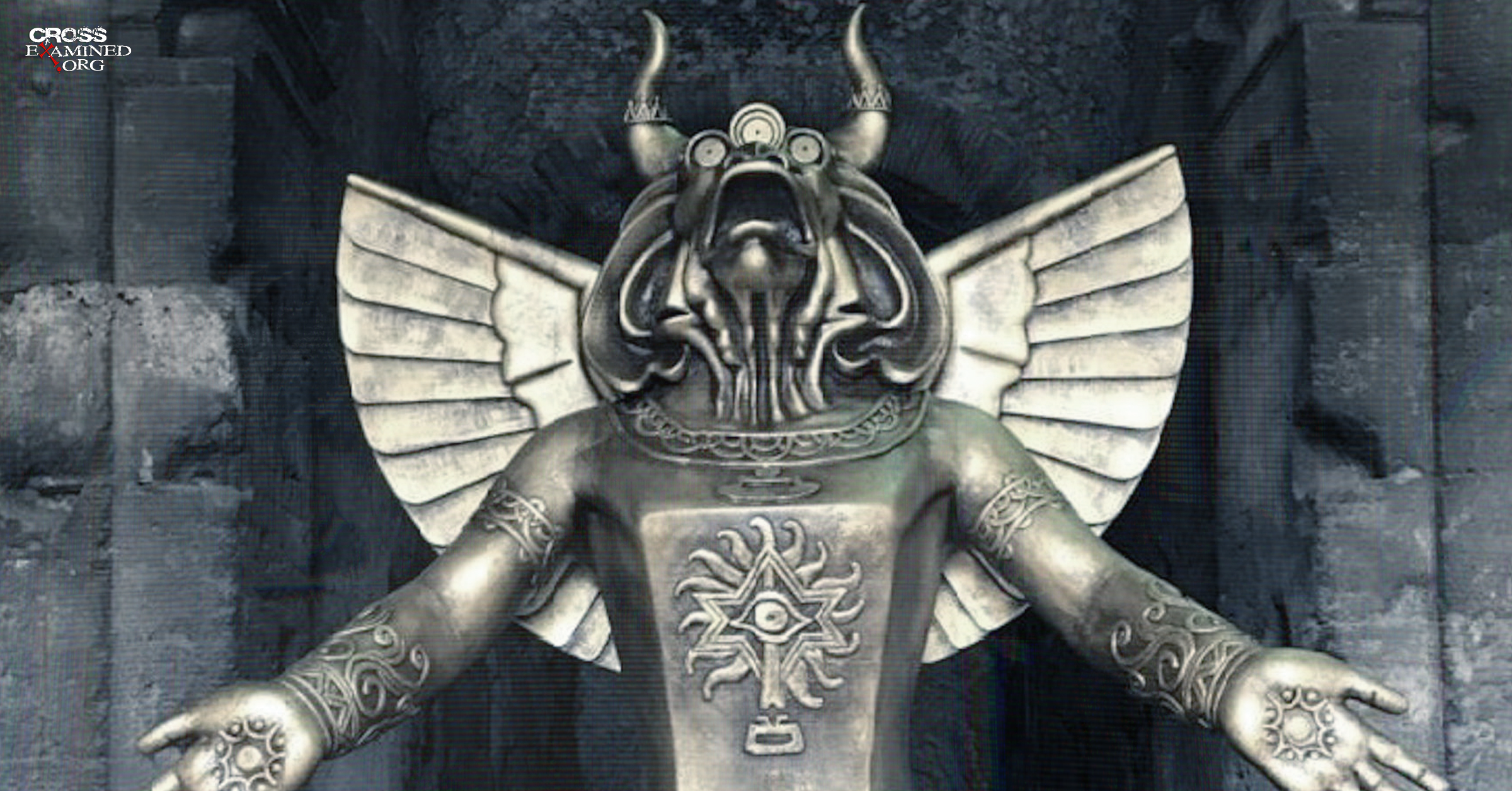
For decades our country has been mired by a decision that enshrined the sacrifice of human babies to the god of Moloch (also known as Molech). You might know this practice by its current moniker, abortion, but the practice is essentially the same. Sacrificing our children on the altar of prosperity is a tail as old as human civilization. Instead of molten hands the altar is often a Planned Parenthood operating table.

We have chosen, as a nation, to ignore the obvious humanity of the infant in utero and have embraced the lie that sex is a right but having children as a result is anathema.  That is, unless you want the baby.

In 1973, possibly the worst decision in the history of the Supreme Court was handed down in Roe v. Wade. I do not mean worst in merely the moral sense, though it is that, but also the legal sense.  Finding the right to an abortion in the constitution took mental and philosophical gymnastics that would make Simone Biles jealous.[1] If you don’t believe me, perhaps you would believe Ruth Bader Ginsberg, not exactly a bastion of conservatism, when she said of the decision in 1992, “Doctrinal limbs too quickly shaped… may prove unstable.”[2]

This decision enshrined the murder of innocent children and the racially motivated eugenics of Margaret Sanger,[3] the founder of Planned Parenthood. If there is a social justice issue worth fighting, it is this one.  Abortion effects minority communities more than any other in our society, in fact, over 40% of all abortions since 1973 were people of color.[4]

For decades this decision has meant the belittling of pre-born life, the slaughter of millions of babies, and the attempted genocide of the African American people.  It is, in my opinion, one of the most corrupt and heinous failings in our country’s history. The decision to abort has been called a “woman’s right to choose.”  Representative Ilhan Omar tweeted that “the Republican party supports forcing women to give birth against their will,” on May 3rd 2022.

The euphemistic language is by design, sure a woman might give birth against her will (unless the sex was consensual), but the baby is killed against his/her will every time. Which is worse?  Saying the reality engenders discomfort.  In reality “women’s reproductive rights” is simply a cover for worship of self and a desire for prosperity by sacrificing a life on the altar of convenience.  The ease of life was always the goal of sacrifice to Moloch, abundant harvests were promised as the babies were laid on the glowing hot hands of the idol.  “Give us prosperity because we give you our first-born children” has turned to “give us prosperity as we suck my preborn child lifelessly from the womb.”[5] Life will be easier for everyone if this child does not exist.  Interestingly enough, I notice the child never has a say.

When pro-abortion advocates feel they are losing ground they often use extreme examples like rape or incest to insist that abortion must be kept legal if only for these cases. Only 1% of abortion cases are because of rape and even fewer are because of incest[6]. This Red Herring has proven effective, but it should not be. When granted the exception, it becomes obvious that limiting abortion to only cases of rape and incest would never be acceptable.  The goal of this objection is to get the pro-life advocate to admit that the baby is not a real baby.  If you are willing to allow a pre-born child to be killed due to a crime, then what is the point of limiting the act to only those that are victims of a crime. A life is a life is it not?  In this argument they concede the point, not the other way around. However, murdering an innocent because he/she reminds you of a horrific crime you suffered is not moral.  Committing a second evil does not negate the first evil committed. But most pro-lifers are willing to grant the exception.  Why?  It is not because they believe the personhood changes based on the condition of conception, but because when faced with the prospect that such a compromise might save 99% of babies that would otherwise be killed we say this, “It is not perfect, but it is a start.”

Other objections are similarly shallow.  “Why force a woman who already has children to carry another child and make her life harder?” Perhaps because murder is never an excuse to make life easier, and then we pretend like adoption is not an option.  Or, “wouldn’t it be better to have never been born than for a child to be born in abject poverty?” This is assuming the child will never amount to anything and, logically, we might as well exterminate all drug addicts and homeless people then because… wouldn’t it be better for them in the long run to simply be dead? All of these are Red Herrings, and houses of cars that easily crumble under slight scrutiny, but they are not meant to stand, they are meant to obfuscate by putting the pro-life person on the defense having to explain the position.  And we often fall for it.

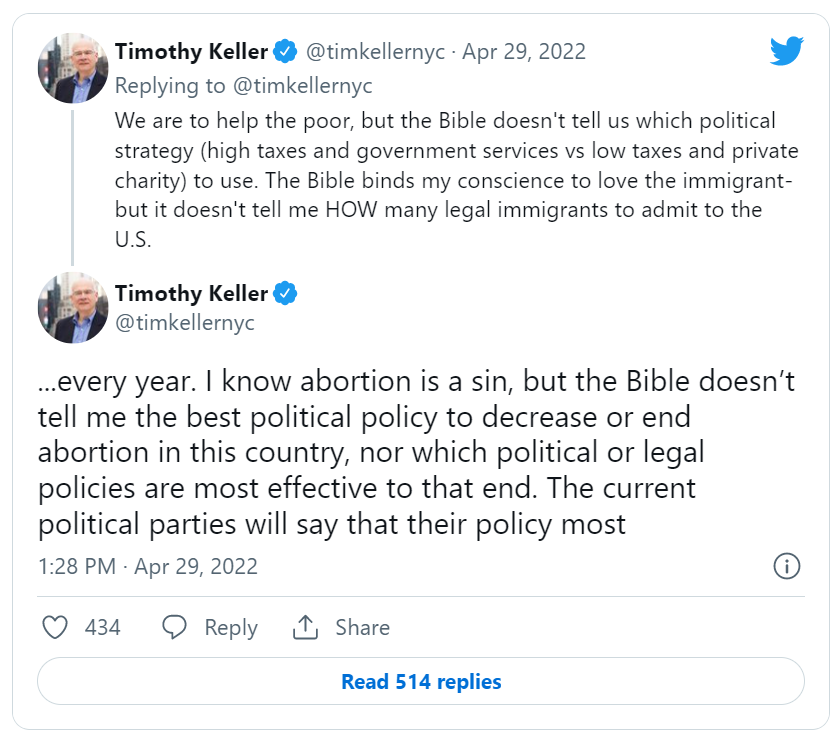
For many years overturning Roe v. Wade seemed like a political pipe dream.  Something always talked about but never coming to fruition.  Recently, notable theologian and pastor Tim Keller exemplified this thought with a twitter thread that seemed to indicate such a position:

While I disagree with Keller on many of his points here, I believe his position is one that took into account the pipe dream that was Roe v. Wade being overturned.

But now, all of that has changed.  An unprecedented leak of a drafted Supreme Court decision to Politico[7] has forced many to recognize the pipe dream might become reality.  But what does the accomplishment of this pipe dream do?

Well, contrary to popular belief on the left, the decision would not make abortion illegal on a federal level. Though, to be honest, I wish it did. All it will do is remove abortion as a “right” enumerated by the constitution under the guise of privacy. This would send the decision on whether to make abortion legal or not to individual states. All in all, it would only make it a little harder to get an abortion.  Some states would maintain their laws while others would make abortion illegal. States already have the purview to put limitations on abortion after the first trimester.

However, this is a necessary first step in ending the idolatry of self and sex without consequences in our society.  But, when the god of Moloch is challenge, his worshippers fight back.  Death threats are sure to make their way to the Supreme Court in an attempt to dissuade the justices from maintaining their ruling.  Let us hope that threat is where it stops.  Regardless, the clear objective of the leak is to effect the decision of the courts in more than one way.

Clearly, this leak is an effort to pressure the House and Senate to do something the left has wanted them to do for some time now: end the filibuster, and pack the supreme court and codify Roe as law. This leak makes that desire more urgent and puts pressure on middle of the road Democrats like Joe Manchin and Kyrsten Sinema to toe the party line and get the deal done.  This is a delicate time in our nation’s history, and, in particular, our Republic. As of this writing members of congress are already setting the stage:

We would be mistaken, as believers, to think that this is a death knell to the abhorrent practice of abortion even if the decision comes out as the leak indicates it will. Abortion will still be practiced in many states and that, unfortunately, will not change.

While abortion has been made into a political and human rights issue (and it is), it is so much more than that to the Christian.  While abortion is a clear evil in our society, and in culture at large, it is representative of a larger issue in society – the worship of self.

Self-actualization, self-identity, self-care, self-improvement, self-indulgence. Self, self, self, self, self.

We are a me-oriented society and thus, the idea that a person cannot choose for herself whether or not to kill another human being to ease the burdens of life is anathema. This is not simply about a culture war, this is a war concerning the gospel.  Our battle is not against flesh and blood but against the rulers of this day and the worshippers of Moloch will not relinquish their grip easily.[8]

Plenty of states will harden their hearts and continue to come down with extreme legislation allowing abortion up to and possibly after birth[9]. This is not the end of the war, it is only a battle.

If we view this issue as primarily political, we miss the forest for the trees.  We ought to be engaged in politics (see: Separation of Church and State Deception), but we must not make politics an end unto themselves.  This has always been and will always be about the gospel, about being salt and light!  What we will see in the coming days will be tantamount to spiritual revolution for the ardent Molochites. We ought not wilt in the periphery but stand on the hill.  The truth, and life, is on our side.  Compromising on murder for the sake of peace is not progress, it is surrender.

The worshippers of Moloch did not go quietly in the night during Israel’s time and the 21st century version will not go quietly into the night either.

To be clear, not everyone who is pro-choice is serving Moloch, but make no mistake, for the passionate abortion-at-all-costs radicals this is more about worship than it is about supposed rights.  But don’t take my word for it:

“The right to an abortion is sacred.”  This is sacramental language.  And this avenue of worship has taken many forms throughout history, from Moloch, to Baal, to Baphomet, to the cult of self, whatever the Enemy can offer as a counterfeit to the real worship of God almighty in a given culture he will. Different times, different cultures, same methodology.  Why fix what isn’t broken?  The schemes of the devil are simple yet effective.

The promise is alluring, the worship is self-gratifying, and the outrage is intoxicating. But the end, as always, is death and misery, but most do not even recognize they are participating in the worship of darkness.  They think they are enlightened humanists and many do not believe in the spiritual at all and that is just the way the Enemy wants it. Not many would knowingly bend a knee to Satan but if he can get them to worship the created rather than the creator it is just as well.

So what do we do?

Pray – A lot.

Keep the five justices of the Supreme Court and, in particular, members of Congress in your prayers continuously. Specifically pray for Brett Kavanaugh, Amy Coney Barrett, Neil Gorsuch, Clarence Thomas, and Samuel Alito to remain safe and pray for the hearts and minds of the dissenting justices to be softened.  Pray also for safety in our nation.  Pray for an opportunity for the gospel to be heard.  Pray that pro-life people, such as myself, will stand for life but also for the care of each person in the name of Christ.  Pray that pastors and theologians, such as Tim Keller and many others, with a wide reach will find confidence and courage. This could be an inflection point in our nation’s history, pray that it is not squandered.

Do not fight the lies of Satan with half-truths and do not give ground. Be courageous.  The darkness always hates the light but its power is fraudulent and without substance.

And finally, stay heartened, faithful, and committed to the cause of Christ!

[1] https://scholarship.law.missouri.edu/cgi/viewcontent.cgi?referer=&httpsredir=1&article=3681&context=mlr

[2] https://www.nytimes.com/2020/09/21/us/ruth-bader-ginsburg-roe-v-wade.html

[3] https://www.frc.org/op-eds/margaret-sanger-racist-eugenicist-extraordinaire

[4] https://www.bostonherald.com/2022/01/28/franks-high-abortion-rate-strikes-blow-at-black-community/

[5] https://allthatsinteresting.com/moloch

[6]https://www.usatoday.com/story/news/nation/2019/05/24/rape-and-incest-account-few-abortions-so-why-all-attention/1211175001/

[7] https://www.politico.com/news/2022/05/02/supreme-court-abortion-draft-opinion-00029473

[8] Ephesians 6:12

[9] https://www.cnn.com/2019/01/31/politics/ralph-northam-third-trimester-abortion/index.html

Recommended resources related to the topic:

The Case for Christian Activism (MP3 Set), (DVD Set), and (mp4 Download Set) by Frank Turek

Legislating Morality: Is it Wise? Is it Legal? Is it Possible? by Frank Turek (Book)

Defending Absolutes in a Relativistic World (Mp3) by Frank Turek

_____________________________________________________________________________________________________________________________________________________

Josh Klein is a Pastor from Omaha, Nebraska with over a decade of ministry experience. He graduated with an MDiv from Sioux Falls Seminary and spends his spare time reading and engaging with current and past theological and cultural issues. He has been married for 12 years to Sharalee Klein and they have three young children.

Original blog post: https://bit.ly/3FvkIBd


By Ryan Leasure

This is the second in a series of  nine posts addressing the question of how we got our Bible. Last post dealt with the question of inspiration and inerrancy. This week we turn our attention to the formation of the Old Testament.

Introductory Matters

In the late second century, Tertullian coined the term “Old Testament” to distinguish the Hebrew from the Greek Scriptures. The word “testament” simply means “covenant.” The Old Testament, in its current form, consists of thirty-nine books and was written by dozens of authors over the course of one thousand years.

In the earliest times, biblical authors used a variety of different writing surfaces. They etched into stone (Exod 34:1; Josh 8:32), inscribed on plaster (Deut 27:2-3), engraved on metal (Exod 28:36), and scratched on waxed tablets (Isa 30:8; Hab 2:2). In order to engrave on these surfaces, they used iron pens (Job 19:24; Jer 17:1) and other styluses.

Thankfully, the Egyptians had already invented a paper-like product using papyrus plants long before Moses wrote the law. Biblical authors adopted this writing technology for practical purposes (Jer 36:23). When papyrus wasn’t available, authors would write on stretched and dried animal skins called parchments. Writers used thin-stemmed reeds (Jer 8:8) that they dipped in ink which was usually a mixture of soot and tree sap or oil. Scribes would often wear ink cases around their belts (Ezek 9:2-3).

The First Scripture

Fittingly, God himself wrote the very first Scriptural text. We read in Exodus 31:18, “And he gave to Moses, when he had finished speaking with him on Mount Sinai, the two tablets of the testimony, tablets of stone, written with the finger of God.” Those same tablets were then stored in the Ark of the Covenant along with a jar of manna and Aaron’s staff (Deut 10:5; Heb 9:4).

Moses would later compile God’s writings into the Pentateuch along with his other writings. We have indications that Moses wrote the Pentateuch in stages and not all at one time. Exodus 24:4 reads, “And Moses wrote down all the words of the LORD.” Exodus 17:14 notes, “Then the LORD said to Moses, ‘Write this as a memorial in a book and recite it in the ears of Joshua, that I will utterly blot out the memory of Amalak from under heaven.’”

Scholars debate how Moses learned the contents of Genesis. Some suggest he learned them at Mount Sinai through divine revelation. Others believe it was passed down through oral tradition. And others believe it was a combination of the two.

Stages of Writing

As was previously noted, the Old Testament was not written at one time but over the course of a thousand years. It may be helpful to think of the development of the Old Testament in four stages.

The first stage was at Mount Sinai when Moses wrote the Law. Early on, the Pentateuch functioned like the Jewish canon of Scripture. In fact, Moses commands “You shall not add to the word that I command you, nor take from it, that you may keep the commandments of the LORD your God that I command you” (Deut 4:2). Over the course of hundreds of years, other books were written, but their inclusion into the canon took some time. The Books of Moses, however, were authoritative from the get go.

The second stage of revelation deposits came during the transition from the theocracy to the monarchy. During that era, authors wrote several historical books (Joshua, Judges, Ruth, Samuels), poetry (Psalms), and wisdom literature (Proverbs, Ecclesiastes, Song of Solomon).

The third stage was the time surrounding the Babylonian Exile. Several prophets wrote during this time period (Isaiah, Micah, Hosea, Jonah, Amos, Joel, etc.).

The fourth and final stage was the return from exile. More prophets continued to write (Zechariah and Malachi) as did historians (Chronicles, Ezra, Nehemiah, Esther).

Quoting the Law

Because the Old Testament developed in stages, later Old Testament writers often referred back to the Books of Moses. Perhaps the most quoted text from Moses is Exodus 34:6. The text declares, “The LORD, the LORD, a God merciful and gracious, slow to anger, and abounding in steadfast love and faithfulness.”

Consider how these later Old Testament texts quote Moses:

But your are a God ready to forgive, gracious and merciful, slow to anger and abounding in steadfast love (Neh 9:17).

But you, O Lord, are a God merciful and gracious, slow to anger and abounding in steadfast love and faithfulness” (Psalm 86:15).

That is why I made haste to flee to Tarshish; for I knew that you are a gracious God and merciful, slow to anger and abounding in steadfast love, and relenting from disaster” (Jonah 4:2).

Submitting to the Law

Not only did later Old Testament writers quote from Moses, they explicitly affirmed his authority.

Only be strong and very courageous, being careful to do according to all the law that Moses my servant commanded you. Do not turn from into the right hand or to the left, that you may have good success wherever you go. This Book of the Law shall not depart from your mouth, but you shall meditate on it day and night, so that you may be careful to do according to all that is written in it (Josh 1:7-8).

When David’s time to die drew near, he commanded Solomon his son, saying, I am about to go the way of all the earth. Be strong, and show yourself a man, and keep the charge of the LORD your God, walking in his ways and keeping his statutes, his commandments, his rules, and his testimonies, as it is written in the Law of Moses (1 Kings 2:1-3).

They told Ezra the scribe to bring the Book of the Law of Moses that the LORD had commanded Israel. . . . And he read from it . . . in the presence of the men and the women and those who could understand. And the ears of all the people were attentive to the Book of the Law” (Neh 8:1-3).

The Prophets Use of Prophets

Because the Pentateuch was authoritative from the beginning, we find far more references to Moses than any other Old Testament author. That said, the prophets still recognized the authority of other prophets who lived closer to their time. Consider Daniels words:

“In the first year of his reign, I, Daniel, perceived in the books the number of years that, according to the word of the LORD to Jeremiah the prophet, must pass before the end of the desolations of Jerusalem, namely seventy years” (Dan 9:2).

Even though Jeremiah wrote only a few decades prior, Daniel still recognized his divine authority.

Zechariah also recognizes the divine authority of his prophetic predecessors. He writes:

Then the word of the LORD of hosts came to me: Say to all the people of the land and the priests, When you fasted and mourned in the fifth month and in the seventh, for these seventy years, was it not for me that you fasted? . . . Were not these the words that the LORD proclaimed by the former prophets, when Jerusalem was inhabited and prosperous? (Zech 7:4-7).

Authors and Dates

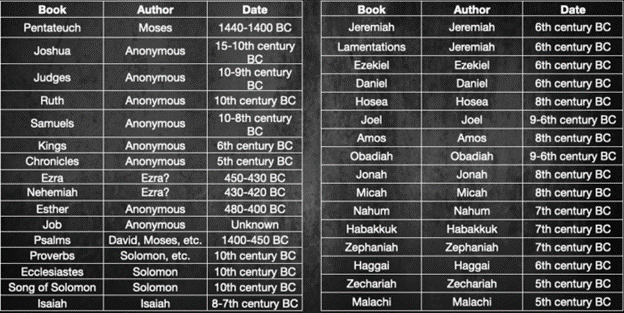
Admittedly, we cannot be too precise on some of the authors and dates of the Old Testament books, especially some of the historical works. That said, consider the following chart which details the authors and dates of each Old Testament book.[1]

Bible Blog

Use of Sources

Inspiration does not imply mechanical dictation. While biblical authors did dictate God’s word from time to time, they also employed other methods such as researching historical sources. Consider the following examples:

Therefore it is said in the Book of the Wars of the Lord (Num 21:14).

And the sun stood still, and the moon stopped, until the nation took vengeance on their enemies. Is this not written in the Book of Jashar? (Josh 10:13).

Now the rest of the acts of Solomon, and all that he did, and his wisdom, are they not written in the Book of the Acts of Solomon? (1 Kings 11:41).

Now the rest of the acts of Joram, and all that he did, are they not written in the Book of Chronicles of the Kings of Judah? (2 Kings 8:20).

What these texts demonstrate is that the biblical authors didn’t invent this stuff. They did careful research before compiling their works.

Editors

Inspiration does not preclude editing. In other words, God not only inspired authors, he inspired editors to modify and rearrange the text. Without exception, the New Testament writers, and even Jesus himself, affirm Mosaic authorship of the Pentateuch (Matt 8:4; 19:8; Mark 7:10; 12:26; Luke 16:31; 20:37; 24:44; Acts 3:22; 15:1; 26:22; 28:23; 1 Cor 9:9; Heb 9:19). That said, we have clear indications of later editing by Jewish scribes. Consider the following texts:

Now the man Moses was very meek, more than all people who were on the face of the earth (Num 12:3).

So Moses the servant of the LORD died there in the land of Moab, according to the word of the LORD, and he buried him in the valley in the land of Moab opposite Beth-peor; but no one knows the place of his burial to this day (Deut 34:5-6).

And there has not arisen a prophet since in Israel like Moses, whom the LORD knew face to face (Deut 34:10).

Did Moses call himself the meekest person on the earth and report his own death and burial? And following his death, did he report that no such prophet has arisen since the time of Moses? Doesn’t that last statement assume that some time has passed since his death? In short, while Moses penned the Pentateuch, later scribes edited his work into their present form.

Preservation

Knowing that it took a thousand years to write the Old Testament (1400-400 BC), how confident can we be in its preservation? After all, we know that there was a period of time when it seems like the text had been lost and out of use (2 Kings 22-23).

Apparently, “clans of scribes” existed during the Old Testament era to copy and preserve the Hebrew Bible (1 Chron 2:55). Since then, Jewish scribes have meticulously copied texts for the same purposes. Perhaps the most famous of these scribes are the Masoretes and the Ben Asher family from the fifth century AD. These professional copyists counted the number of words on every page and knew the number of words in every book as well as the exact middle word and letter of every book to ensure that they copied accurately.

Additionally, the Masoretes added vowel markings to the otherwise vowel-less text. Up until the 1940s, the earliest Hebrew texts in our possession were Masoretic texts dating to the 9th and 10th centuries.

Dead Sea Scrolls

In 1947, a shepherd by the name of Muhammed edh-Dhib was out looking for some of his sheep along the coast of the Dead Sea. As he passed by a cave, he tossed a rock inside hoping to hear the bleating of sheep. Instead, he heard pottery shattering. That shattered jar led to one of the most significant archaeological finds of the twentieth century. 

Archaeologists have since uncovered over a thousand ancient Jewish documents from dozens of nearby caves dating from 250 BC to AD 65. These texts belonged to the Qumran community otherwise known as the Essenes. These people functioned much like Jewish monks, isolated from much of society. The Qumran community most likely stashed their sacred texts in these caves during the war with Rome (AD 68-70) hoping to return to them once the dust settled. Unfortunately, they all died during the war, so their texts remained hidden for two thousand years.

Among these documents are every book of the Old Testament except for Esther. Perhaps the most significant text is a complete Isaiah scroll, consisting of twenty-seven sheets of parchment sewn end-to-end. It measures twenty-three feet in length. The scroll dates to 120 BC—a thousand years older than the previous oldest text. Most significantly, the Isaiah scroll hardly differs from the Masoretic text from the tenth century, demonstrating that Jewish scribes carefully preserved the original text.

Old Testament Canon

The next post will consider the Septuagint, the apocrypha, and the Old Testament Canon.

*For more on this topic, read Timothy Paul Jone’s helpful book How We Got the Bible.

References:

[1] This chart is modified from Timothy Paul Jones, How We Got the Bible, 31-33.

Recommended resources related to the topic:

Oh, Why Didn’t I Say That? Does Science Disprove God? by Dr. Frank Turek (DVD and Mp4)

Two Miracles You Take With You Everywhere You Go by Frank Turek DVD, Mp3 and Mp4)

Why We Know the New Testament Writers Told the Truth by Frank Turek (DVD, Mp3 and Mp4)

__________________________________________________________________________________________________________________________________________________

Ryan Leasure holds a Master of Arts from Furman University and a Masters of Divinity from the Southern Baptist Theological Seminary. Currently, he’s a Doctor of Ministry candidate at the Southern Baptist Theological Seminary. He also serves as a pastor at Grace Bible Church in Moore, SC.

Original Blog Source: https://bit.ly/30ACsei


By Ryan Leasure

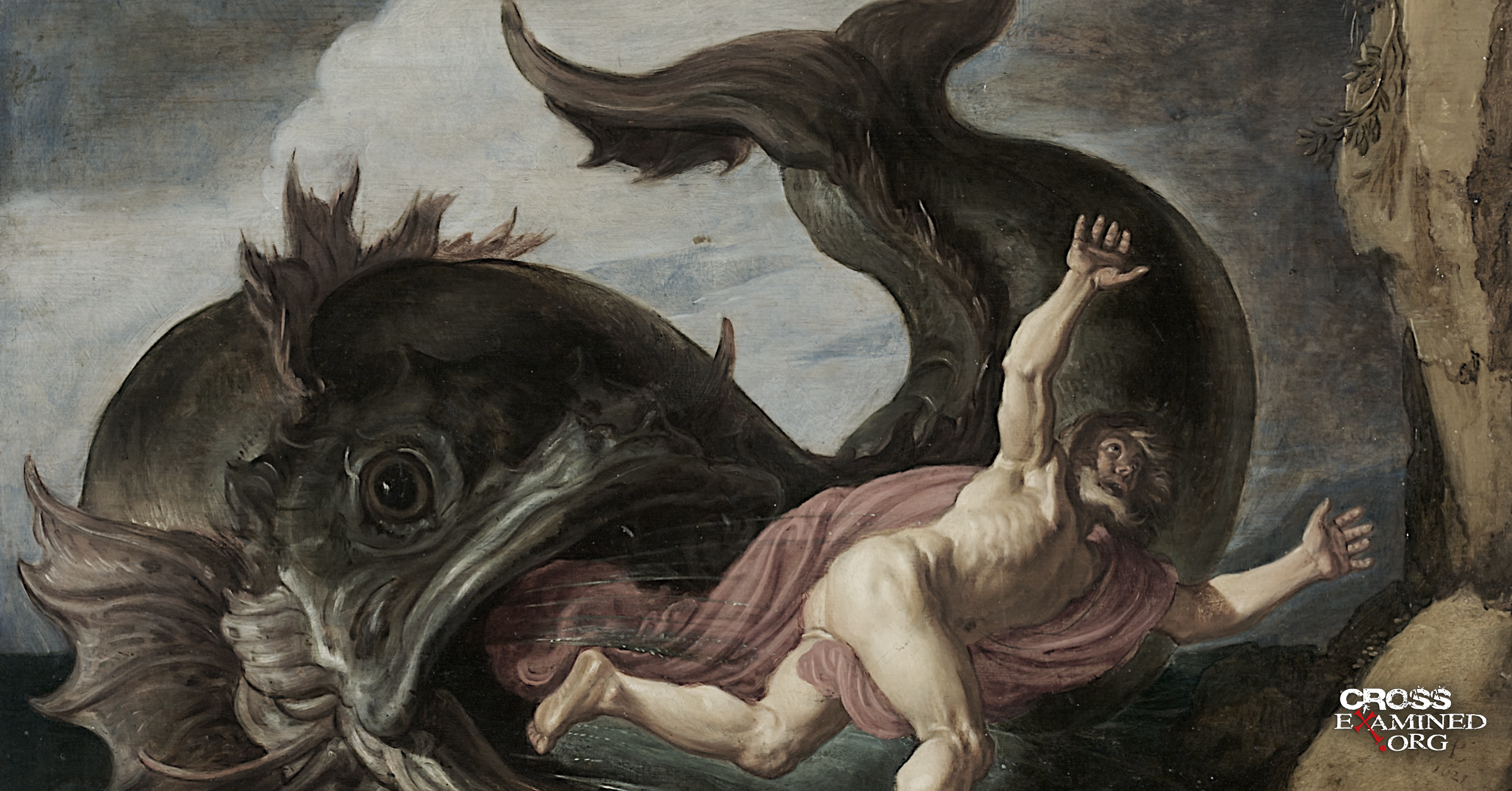
It’s not uncommon for Christians to throw shade on the Old Testament. These Christians say they love Jesus, but they could do without those primitive Jewish texts. In fact, many Christians suggest that much of the Old Testament is ahistorical. Events such as the flood, Jonah being swallowed by a big fish, or the fiery judgment of Sodom and Gomorra never happened. And then there’s the infamous quote that Christians simply need to “unhitch themselves from the Old Testament” because much of it is embarrassing or difficult to understand. Why can’t we just focus on Jesus instead?

We can certainly sympathize with these sentiments. After all, the flood and Sodom’s judgment seem pretty incredible and kind of harsh to boot! Wouldn’t it just be easier to disregard this ancient corpus? This position seems reasonable until one realizes that the same Jesus these Christians adore also happens to hold the Old Testament in high regard. Not only does he affirm the Old Testament’s inspiration, he also affirms its historicity and authority.

The Old Testament is Inspired

Historically, Christians have affirmed the verbal plenary inspiration of the Bible. That is to say, they recognize that every word of Scripture is “God-breathed” (2 Tim 3:16-17). At the same time, God spoke through human agency. Therefore, Scripture not only has a divine author, it has human authors as well.

Jesus affirmed the human authors of the Old Testament. Repeatedly, he recognizes that Moses is the one who gave the Law (Matt 8:4; 19:8; Mark 1:44; 7:10; Luke 5:14; 20:37; John 5:46; 7:19). He’ll say things like “do what Moses commanded” (Mark 1:44). Or “Moses said, Honor your father and your mother” (Mark 7:10). With respect to other Old Testament authors, Jesus declares, “Well did Isaiah prophesy . . .” (Mark 7:6). Also, “David himself, in the Holy Spirit, declared . . .” (Mark 12:36). And “So when you see the abomination of desolation spoken of by the prophet Daniel . . .”(Matt 24:15). It’s worth noting that just about all critical scholars call into question the authorship of these individuals in clear contradiction to Jesus.

At the same time, Jesus affirms that these individuals wrote divinely inspired Scripture. As was just alluded to, Jesus noted in Mark 12:36, “David himself, in the Holy Spirit, declared, . . .” In other words, David wrote, but his writings were the result of the Holy Spirit’s work (2 Pet 1:20-21). He also declared “Well did Isaiah prophesy . . .” (Mark 7:6). The mere mention of prophecy suggests that Isaiah wrote from God. Prophecy, after all, is by definition “a word from God.” The same could be said for Matthew 24:15 when Jesus refers to Daniel as “the prophet.” Moreover, when speaking to the scribes and Pharisees, Jesus asserts, “You leave the commandment of God and hold to the tradition of men” (Mark 7:8). He then goes on to clarify that the commandment of God was what Moses wrote in Exodus 20.

As John Wenhan notes, “To [Jesus], Moses, the prophets, David and the other Scripture-writers were truly inspired men with a message given by the Spirit of God.”1

The Old Testament is Historically Accurate

While many are willing to grant the Old Testament’s inspiration, many of these same individuals deny that it’s historically accurate at every point. They might affirm its historical nature in general (God created the world, called Abraham and the Jewish people, the Jews were exiled, etc.), but they balk at some of the more challenging texts (the flood, Sodom, Jonah, etc.). That said, Jesus has no qualms about affirming the historical nature of the Old Testament—even the most difficult texts to believe. Here are a few examples:

He believed that Cain killed Abel (Luke 11:51), that God sent a flood but spared Noah in the ark (Matt 24:37-39), and that God destroyed Sodom because of their wickedness (Matt 11:23-24). He even adds, “Remember Lot’s wife” (Luke 17:32). Additionally, Jesus believed that God sent down manna from heaven (John 6:31), the Israelites were healed by looking at the serpent (John 3:14), and that Jonah was swallowed by a big fish only to be regurgitated three days later (Matt 12:39-41).

The last text about Jonah is especially significant because it demonstrates that Jesus didn’t simply view these events figuratively. For the end of the text reads, “The men of Nineveh will rise up at the judgment with this generation and condemn it, for they repented at the preaching of Jonah, and behold, something greater than Jonah is here” (Matt 12:41). It’s hard to imagine how Jesus could assert that Ninevah would rise up in the final judgment against the people who rejected him if they were make-believe. The same could be said for Jesus’ statement in Matthew 24:37: “For as were the days of Noah, so will be the coming of the Son of Man.” In other words, just as God’s judgment was poured out in the days of Noah, so it will be again in the final judgment.

Again, Wenham remarks, “It is evident that [Jesus] was familiar with most of our Old Testament and that he treated it all equally as history.”2

The Old Testament is Authoritative

Because Jesus believed the Old Testament was divinely-inspired, he also affirmed its full authority. He demonstrated this authority by appealing to the scriptures dozens of times.

When asked what were the greatest commandments, he declares that “You shall love the Lord your God with all your heart with all your soul and with all your mind. . . And the second is like it: You shall love your neighbor as yourself” (Matt 22:37-39). Jesus said that these two commands (Deut 6:4-6; Lev 19:18) sum up the totality of the Old Testament and are the guide to all ethical matters.

When facing temptation, Jesus appealed to the authority of Scripture to do battle against Satan. He repeatedly declares, “it is written, it is written, it is written” (Matt 4:1-11). Even as he was facing death, the final words on his lips were words from the Old Testament (Psalm 22:1; 31:5).

Jesus appeals to Genesis 1-2 when speaking about marriage and divorce. He asks, “Have you not read that he who created them from the beginning made them male and female, and said, ‘Therefore a man shall leave his father and his mother and hold fast to his wife, and the two shall become one flesh?’ So they are no longer two but one flesh. What therefore God has joined together, let no man separate” (Matt 19:4-6). By alluding to Genesis 1-2 here, Jesus asserts that his position on marriage and divorce is rooted in the authority of the Old Testament text. By contrast, Jesus’ opponents rooted their position in different Rabbis (Shammai and Hillel).

When disputing with the Sadducess about the resurrection, Jesus scolds them, “You are wrong, because you know neither the Scriptures nor the power of God” (Matt 22:29). In other words, the Scriptures give us the definitive, authoritative word about the resurrection. Jesus goes on to question them, “Have you not read what was said to you by God, I am the God of Abraham . . .?” (Matt 31-32) Again, Jesus appeals to the Old Testament text to assert God’s power over the resurrection.

Jesus goes so far as to state that “Scripture cannot be broken” (John 10:35). For Jesus, Scripture is so powerful, nothing can undo it.

Jesus and the Old Testament

All the evidence taken together suggests that Jesus held a high view of the Old Testament. Those who claim to hold Jesus in high regard but reject some of the Old Testament’s teachings are being inconsistent. If you hold Jesus in high regard, you must hold the Old Testament in high regard as well. As John Wenham notes:

“To Christ the Old Testament was true, authoritative, inspired. To him the God of the Old Testament was the living God, and the teaching of the Old Testament was the teaching of the living God. To him, what Scripture said, God said.” 3

*For more on this topic, see John Wenham’s book Christ and the Bible.

Recommended resources related to the topic:

Old Testament vs. New Testament God: Anger vs. Love? (MP3 Set) (DVD Set) (mp4 Download Set) by Dr. Frank Turek 

Jesus, You and the Essentials of Christianity by Frank Turek (INSTRUCTOR Study Guide), (STUDENT Study Guide), and (DVD)      


__________________________________________________________________________________________________________________________________________________

Ryan Leasure is a pastor at Grace Bible Church in Moore, SC. For more on his background and interests, click here.

Original Blog Source: https://cutt.ly/rQYMyUQ


Bart Ehrman is a professor of religious studies at UNC-Chapel Hill in North Carolina. He is well known for his best-selling popular-level books that are critical of the core tenets of evangelical Christianity and in particular the reliability of the New Testament sources. Frequent readers of my articles will already know that Ehrman is not the most careful scholar when it comes to his utilization of ancient sources. A few days ago, Ehrman published two blog posts (here and here) on his website, claiming that the idea that Jesus is Himself Yahweh is a recent doctrinal innovation, completely foreign to the New Testament and the ancient church. Ehrman even goes so far as to say that this is the view of only “some conservative evangelical Christians” and that “I’ve never even heard the claim (let alone a discussion of it) until very recently.” Furthermore, Ehrman adds,

I, frankly, had never even heard of such a thing until six years ago.  Maybe I wasn’t listening in Sunday School, or maybe I was sleeping through those particular lectures at Moody Bible Institute; or maybe …  Nah, I don’t think so.  If someone knows differently, please let me know.  But I can’t think of any ancient Christian source that talks about Jesus as Yahweh himself.  Jesus is the son of Yahweh.

Ehrman asserts that,

The first time I heard someone authoritatively say that Jesus was Yahweh and that this was standard Christian teaching was in a debate I had with Justin Bass in 2015 – you can listen to it on Youtube.  I can’t remember when in the debate he said it but he made some comment about Jesus being Yahweh, and I was floored.  I thought: theologians have never called Jesus Yahweh!

For a scholar of Ehrman’s stature to be uninformed regarding Christian orthodox teaching on such a fundamental matter is absolutely astounding. In this article, I respond to Ehrman’s articles and show that he is profoundly mistaken about the teaching of the New Testament and the ancient church.

Early Christian Theologians

Ehrman wonders “if there are any early Christian theologians who have this view.” Yes, there are plenty. For example, Justin Martyr (~100-165), in his dialogue with Trypho the Jew, wrote[1],

…now you will permit me first to recount the prophecies, which I wish to do in order to prove that Christ is called both God and Lord of hosts…

I do not know how one can get much clearer than that. Irenaeus (~130-202) likewise states[2],

For I have shown from the Scriptures, that no one of the sons of Adam is as to everything, and absolutely, called God, or named Lord. But that He is Himself in His own right, beyond all men who ever lived, God, and Lord, and King Eternal, and the Incarnate Word, proclaimed by all the prophets, the apostles, and by the Spirit Himself, may be seen by all who have attained to even a small portion of the truth.

Ignatius of Antioch (~50-108) also affirmed Christ’s full deity. For example, in his epistle to the Ephesians, he wrote[3],

We have also as a Physician the Lord our God, Jesus the Christ, the only begotten Son and Word, before time began, but who afterwards became also man, of Mary the virgin. 

I could continue to quote early church fathers for quite some time, but this should suffice to show that the view that Jesus is Yahweh, the eternal God, is not a new idea but rather goes back to the ancient church. I will now turn to Ehrman’s comments on the New Testament.

Is the Name Yahweh Found in the New Testament?

Ehrman states that, 

Of course, the name Yahweh is not found in the NT at all, since it is a Hebrew word, and the NT is written in Greek.  The NT does not give God a personal name.

This is obviously true since the New Testament was written in Greek, not in Hebrew. However, the New Testament does use an equivalent word — indeed, the word that is substituted for the Hebrew tetragrammaton YHWH in the Greek Septuagint translation of the Hebrew Bible. This word is κύριος, which is translated “Lord” in our English Bibles. Of course, it is true that this word had a broader range of meaning than simply denoting Yahweh (for example, Paul uses it of earthly masters — see Eph 6:5). However, the meaning of Greek words, as intended by the original author, can be shaved down through an examination of context. For example, Hebrews 1:10-12 quotes from Psalm 102:25-27:

You, Lord, laid the foundation of the earth in the beginning, and the heavens are the work of your hands; 11 they will perish, but you remain; they will all wear out like a garment, 12 like a robe you will roll them up, like a garment they will be changed. But you are the same, and your years will have no end.

Verse 10 uses the word κύριος, which evidently (given the fact that the author is quoting an Old Testament Psalm concerning the Lord God) is intended to denote Yahweh. What makes this text especially noteworthy for our purposes here is that the author of Hebrews applies the words of this Psalm to Jesus. Indeed, this Hebrew Biblical text is one of several applied to Jesus in Hebrews 1, as the author compares and contrasts the exaltation of the Son with that of the angelic beings.

To take another example, consider Paul’s quotation of Joel 2:32 in Romans 10:13: “For ‘everyone who calls on the name of the Lord will be saved.’” Again, this alludes to an Old Testament text that concerns Yahweh. But Paul introduces this text only a few verses after Paul declared that “if you confess with your mouth that Jesus is Lord and believe in your heart that God raised him from the dead, you will be saved” (Rom 10:9). The implication here is that the κύριος of verse 9 is the same referent as in verse 13 — namely, Jesus. In other words, Jesus is the Yahweh of Joel 2:32, on whose name we are to call. This point is drawn out even more explicitly by Paul in 1 Corinthians 1:2: “To the church of God that is in Corinth, to those sanctified in Christ Jesus, called to be saints together with all those who in every place call upon the name of our Lord Jesus Christ, both their Lord and ours.” This text again clearly alludes to Joel 2:32, except the Lord (κύριος) upon which we are to call is none other than Jesus Christ.

Another example is found in 1 Peter 2:2-4:

2 Like newborn infants, long for the pure spiritual milk, that by it you may grow up into salvation— 3 if indeed you have tasted that the Lord is good. 4 As you come to him, a living stone rejected by men but in the sight of God chosen and precious…

Verse 3 quotes from Psalm 34:8 (“Oh, taste and see that the LORD [Yahweh] is good!”). However, verse 4 identifies the κύριος of Psalm 34:8 as none other than Jesus Himself (the nearest antecedent of the pronoun “him” in verse 4 is “the Lord” from verse 3). This implies that Jesus is the Yahweh of Psalm 34:8.

Yet a further example can be found in 1 Peter 3:14-15:

14 But even if you should suffer for righteousness’ sake, you will be blessed. Have no fear of them, nor be troubled, 15 but in your hearts honor Christ the Lord as holy The Holy…

Admittedly, there exists some level of ambiguity about the original reading of verse 15, since the majority of later manuscripts read θεόν (“God”) instead of Χριστόν (“Christ”). However, Bruce Metzger notes that[4],

The reading Χριστόν, however, is strongly supported by early and diversified external evidence…as well as by transcriptional probability, the more familiar expression (κύριον τὸν θεόν) replacing the less usual expression (κύριον τὸν Χριστόν). The omission of τὸν Χριστόν in the patristic treatise de Promissionibus attributed to Quodvultdeus must be due to accidental oversight on the part of either translator or copyist.

If (as seems likely) the original reading is indeed “Christ the Lord”, then we have another example of an Old Testament text that concerns Yahweh being applied to Jesus. Compare 1 Peter 3:14-15, above, with Isaiah 8:12-13:

12 “Do not call conspiracy all that this people calls conspiracy, and do not fear what they fear, nor be in dread. 13 But the LORD of hosts, him you shall honor as holy.

Isaiah 8:12 is quoted by 1 Peter 3:14. Isaiah 8:13 is quoted by 1 Peter 3:15, except instead of calling his readers to honor the Lord of hosts as holy (as Isaiah did), Peter implores his readers to honor Christ the Lord as holy. Thus, we have yet another instance of the title κύριος (which is properly interpreted here as a substitute for the Hebrew tetragrammaton) being applied to Jesus.

I could continue in a similar vein for a considerable time. However, I trust that this is sufficient to dispel Ehrman’s contention that the New Testament does not use the name Yahweh and therefore never calls Jesus Yahweh.

Does Psalm 110 Preclude Jesus from Being Yahweh?

Ehrman continues,

When Christians wanted to find another divine being in the OT to identify as Christ, they went to passages like Psalm 110: “The LORD said to my Lord, sit at my right hand until I make your enemies your footstool.”  Based on what I said in my previous post, you can reconstruct who is talking to whom here (notice the first LORD is in caps and the second not): “YHWH said to Adonai….” 

Ehrman’s entire argument here implicitly presupposes Unitarianism. If the doctrine of the Trinity is true, then there is no problem with persons within the being or essence of Yahweh being distinguished from one another and even participating in conversation with each other. Nor is there a problem with the Father exalting the Son, since the Son had previously voluntarily humbled Himself through His incarnation and death on the cross. No Trinitarian is identifying the Son with the Father. Rather, the Father, Son and Holy Spirit are each distinctive persons who together totally share the essence of Yahweh, each possessing the divine attributes fully and completely.

Ehrman’s representation of the words used in Psalm 110:1 is not quite accurate, since it does not say that “YHWH said to Adonai…” but rather “YHWH said to Adoni.” This difference make look trivial (especially as these two words are distinguished only by a difference in Masoretic vowel pointing) but it is actually important. The title “Adonai” is exclusively used as a divine title (essentially as a synonym for YHWH). In fact, the ancient Hebrews would, instead of pronouncing the divine name, say “Adonai” instead. The word “Adoni”, by contrast, is simply the possessive form of the Hebrew word “Adon”, which means “Lord” or “Master” (the Hebrew equivalent of the Greek word κύριος). The word can be used of Yahweh, depending on the context, but it is not exclusively reserved for Yahweh. The upshot of this is that, though many Christians have used this text to argue for a plurality of divine persons (and, indeed, the deity of Christ), the reality is that any such argument based on this text is going to require more work and nuance than it often receives. I do not believe this text to be as conclusive as the previous texts discussed in the foregoing. However, it is, I would argue, certainly suggestive as we shall see. The context sheds some light on the intended referent of verse 1. In verse 5-7 of Psalm 110, we read,

The Lord is at your right hand; he will crush kings on the day of his wrath. He will judge the nations, heaping up the dead and crushing the rulers of the whole earth. He will drink from a brook along the way, and so he will lift his head high.

In the Hebrew, verse 5 does indeed identify the one seated at Yahweh’s right hand as none other than Adonai, a word used only ever of deity. Thus, Psalm 110 implies a plurality of divine persons within the Godhead. One possible reply to this is that Psalm 110:5 is merely the reversal of Psalm 110:1. Just as David’s Lord sits at the right hand of Yahweh, so also Yahweh is at the right hand of David’s Lord. For instance, in Psalm 109:31, Yahweh is at the right hand of the needy one, and in Psalm 16:8, Yahweh is at the right hand of the Psalmist David. The problem with this argument is that if one continues reading Psalm 110, it is clear that the “He’s” of verses 5-7 all refer back to Adonai, and in verse 7 this individual is said to drink from a brook — a human function. Thus, the individual seated at Yahweh’s right hand in Psalm 110 appears to be a divine-human person.

Furthermore, Jesus Himself Jesus makes the argument that “David himself calls him ‘Lord.’ How then can he be his son?” (Mk 12:37). The point Jesus is making is that none of David’s descendants could be greater than David. This, then, cannot be referring to an ordinary human descendent of David. The question is thus raised as to what sort of Lord this could possibly be referring to. But we can go even further than that. David’s Lord also cannot be any human king, since in Psalm 2:10-12 all kings are to be subject to David, and Psalm 89:26-27 tells us that,

I will appoint him [David] to be my firstborn, the most exalted of the kings of the earth.

It also cannot be a mere angelic creature since angels serve God’s elect and are servants themselves (c.f. Heb 1:7, 14; Rev 19:10 and 22:8-9). Who, then, is left? God.

The Angel of the Lord

Ehrman notes that Christians (such as Justin Martyr in the second century) have often identified the angel of Yahweh, in the Hebrew Bible, as a pre-incarnate manifestation of Christ. He writes,

I wonder if the confusion among some evangelicals about the Christian understanding of Christ (when they say he is Yahweh) is because the “Angel” of the LORD is so fully representative of YHWH himself that he is sometimes called YHWH after he is clearly identified NOT as YHWH but his angel.  Why would he be called YHWH if he was YHWH’s messenger?   It would be kind of like if a messenger of the king comes to you and orders you to do something, you tell your neighbors that the “king” has told you to do something.  Well, actually, his messenger did, but he was so fully representative of the king that his words were the king’s.

This interpretation, however, fails to account for the fact that various people throughout the Hebrew Bible marvel at the fact that they have seen the angel of Yahweh and yet their lives have been spared (people aren’t supposed to be able to see Yahweh and live — Exodus 33:20). For example, consider the words of Jacob after having wrestled with a man in Genesis 32, one who is identified in Hosea 12:4 as the angel of Yahweh: “So Jacob called the name of the place Peniel, saying, ‘For I have seen God face to face, and yet my life has been delivered.’” Further support for the individual with whom Jacob wrestled being the angel of Yahweh comes from the parallel between Genesis 32:29 and Judges 13:18, in which the man and the angel of Yahweh respectively say, upon being asked for their name, “Why do you ask my name?” 

Another occurrence of this is in Judges 6 where we read of Gideon’s encounter with the angel of Yahweh. In verses 22-24, we read, 

22 Then Gideon perceived that he was the angel of the LORD. And Gideon said, “Alas, O LORD God! For now I have seen the angel of the Lord face to face.” 23 But the Lord said to him, “Peace be to you. Do not fear; you shall not die.” 24 Then Gideon built an altar there to the LORD and called it, The LORD Is Peace. To this day it still stands at Ophrah, which belongs to the Abiezrites. 

Yet a further instance occurs in Judges 13, which records the appearance of the angel of Yahweh to Manoah and his wife to announce the birth of Samson. In verse 21-22, we read, 

21 The angel of the Lord appeared no more to Manoah and to his wife. Then Manoah knew that he was the angel of the Lord. 22 And Manoah said to his wife, “We shall surely die, for we have seen God.” 

Thus, we see that numerous texts (and there are plenty that I have not mentioned) bear witness to the deity of the angel of Yahweh. While Ehrman is correct to note that many of these texts also distinguish the angel of Yahweh from God, this is very consistent with a Trinitarian paradigm that views the messenger of God to be Yahweh and yet in another sense somehow distinct from Yahweh.

Ehrman’s interpretation of the angel of the Lord passages also fails to account for the parallelism observed in Genesis 48:15-16, in which we read of Jacob’s blessing of the sons of Joseph. He said,

15 “The God before whom my fathers Abraham and Isaac walked, the God who has been my shepherd all my life long to this day, 16 the angel who has redeemed me from all evil, may he bless the boys…”

Here, we see a poetic parallelism where the angel is identified as God. In fact, in the Hebrew, verse 16b uses the singular pronoun, “may he bless the boys”, implying that the angel and God are one and the same.

I discuss the subject of the angel of the Lord in much more detail here and here.

The Carmen Christi

Ehrman next turns his attention to the Christ poem in Philippians 2:5-11. He writes,

When Christ is exalted after his death, God gives him “the name that is above every name” so that all creation will worship and confess him.  That is a reference to Isaiah 45 where Yahweh alone has the name above every name so that all worship and confess him alone. 

Possibly these modern Christians are thinking that Christ, therefore, must have been given the name YHWH, and therefore he *is* YHWH.  But the passage doesn’t seem to mean that.  The ultimate LORD of all, YHWH, is the one who *gives* Jesus the name that is above all others.   It’s worth noting that in this very passage, when God gives Jesus his “name,” it does not mean that he’s made a name switch for Jesus.  On the contrary, the passage says that the name to which everyone will bow in worship and confess is *Jesus*!  (Not YHWH): “That at the name of Jesus every knee shall bow, and every tongue confess.”  Jesus’ own name is exalted.

This, however, is not the argument at all. I do not interpret the “name” of verse 9 to be a personal name. Rather, this in my opinion is best understood as referring to Christ’s reputation that He received as a consequence of His humiliation and death upon the cross.

There are at least three mutually supporting arguments for Christ’s deity that may be adduced from this text. First, this text is chiefly concerned with Christ’s humility, since “though he was in the form of God, did not count equality with God a thing to be grasped” (Phil 2:6). This only makes sense if Christ is equal in status to God, since one is not commended for humility for not exalting oneself to a higher status than one had a right to. If I refrain from overthrowing the monarchy and exalting myself as king, I am not due praise for my humility in so restraining myself. The text, then, is best understood if Christ voluntarily laid aside the divine privilege that was rightfully His. This reading is also supported by the Greek. Indeed, the construction is known as a double accusative of object-complement. Daniel Wallace explains that[5],

An object-complement double accusative is a construction in which one accusative substantive is the direct object of the verb and the other accusative (either noun, adjective, participle, or infinitive) complements the object in that it predicates something about it.

In this case, the verb is οὐχ ἡγήσατο (“did not count”), the direct object is τὸ εἶναι ἴσα θεῷ (“equality with God”) and the object complement is ἁρπαγμὸν (“a thing to be grasped”). Thus, the relationship between the direct object and the object complement is rather like an equal’s sign. In other words, Jesus did not count equality with God to be a thing to be grasped (ἁρπαγμὸν). Furthermore, Roy Hoover has argued that this is in fact an idiomatic expression, which “refers to something already present and at one’s disposal. The question… [is] whether or not one chooses to exploit something.”[6] Hoover observes that in every instance where this noun ἁρπαγμός is the object compliment in a construction such as this (where the verb is one of regarding or seeing or consideration), it always means something like an exploitable advantage. Thus, argues Hoover, one could reasonably translate this text to be saying that Christ did not regard being equal with God as something to take advantage of.

A second consideration is that Paul uses the Greek word μορφῇ in verse 6 to describe Christ being in the form of God and uses this exact same word in verse 7 to describe Christ taking the form of a servant. This implies that Christ was in the form of God in the same sense as He took upon Himself the form of a servant. Since Christ was very literally a servant, “being born in the likeness of men” (v. 7b), it follows that Christ was also literally God.

Third, Ehrman rightly points out that verses 10-11 allude to Isaiah 45:23, in which we read, “To me [that is, Yahweh] every knee shall bow, every tongue shall swear allegiance.” However, in the context of Philippians 2:10-11, every knee is bowing and every tongue swearing allegiance to Jesus. Indeed, that is what is meant by confessing that Jesus Christ is Lord (κύριος), which literally means master.

Conclusion

To conclude, contrary to Ehrman’s assertions, the view that Jesus is Yahweh has been the orthodox Christian position for nearly two millennia, and it is taught in the New Testament. Ehrman claims that the name Yahweh is never used in the New Testament and so could not be applied by the New Testament authors to Jesus. However, the New Testament does use the equivalent Greek term κύριος. Although this word is also used to describe earthly masters, the word is often used to denote Yahweh when the New Testament quotes the Old Testament, and often these texts are explicitly applied to the person of Jesus. Ehrman’s argument from the New Testament’s usage of Psalm 110 presupposes a Unitarian paradigm. Though Ehrman argues that the angel of the Lord in the Hebrew Bible is only the agent of Yahweh who is invested with divine authority, this argument collapses on the basis of the various exclamations of surprise, following an encounter with the angel of the Lord, that one has survived despite having seen God face-to-face. Finally, Ehrman is mistaken about Philippians 2:5-11, which is best read as indicating that Christ voluntarily laid aside the divine privilege that was rightfully His in order to take upon Himself the form of a servant.

Footnotes

[1] Justin Martyr, “Dialogue of Justin with Trypho, a Jew,” in The Apostolic Fathers with Justin Martyr and Irenaeus, ed. Alexander Roberts, James Donaldson, and A. Cleveland Coxe, vol. 1, The Ante-Nicene Fathers (Buffalo, NY: Christian Literature Company, 1885), 212.

[2] Irenaeus of Lyons, “Irenæus against Heresies,” in The Apostolic Fathers with Justin Martyr and Irenaeus, ed. Alexander Roberts, James Donaldson, and A. Cleveland Coxe, vol. 1, The Ante-Nicene Fathers (Buffalo, NY: Christian Literature Company, 1885), 449.

[3] Ignatius of Antioch, “The Epistle of Ignatius to the Ephesians,” in The Apostolic Fathers with Justin Martyr and Irenaeus, ed. Alexander Roberts, James Donaldson, and A. Cleveland Coxe, vol. 1, The Ante-Nicene Fathers (Buffalo, NY: Christian Literature Company, 1885), 52–200.

[4] Bruce Manning Metzger, United Bible Societies, A Textual Commentary on the Greek New Testament, Second Edition a Companion Volume to the United Bible Societies’ Greek New Testament (4th Rev. Ed.) (London; New York: United Bible Societies, 1994), 621–622.

[5] Daniel B. Wallace, Greek Grammar beyond the Basics: An Exegetical Syntax of the New Testament (Grand Rapids, MI: Zondervan, 1996), 182.

[6] Roy W. Hoover, “The Harpagmos Enigma,” Harvard Theological Review 64 (1971).

Recommended resources related to the topic:

How Can Jesus Be the Only Way? (mp4 Download) by Frank Turek

Cold Case Resurrection Set by J. Warner Wallace (books)

Jesus, You and the Essentials of Christianity – Episode 14 Video DOWNLOAD by Frank Turek (DVD)


__________________________________________________________________________________________________________________________________________________

Dr. Jonathan McLatchie is a Christian writer, international speaker, and debater. He holds a Bachelor’s degree (with Honors) in forensic biology, a Masters’s (M.Res) degree in evolutionary biology, a second Master’s degree in medical and molecular bioscience, and a Ph.D. in evolutionary biology. Currently, he is an assistant professor of biology at Sattler College in Boston, Massachusetts. Dr. McLatchie is a contributor to various apologetics websites and is the founder of the Apologetics Academy (Apologetics-Academy.org), a ministry that seeks to equip and train Christians to persuasively defend the faith through regular online webinars, as well as assist Christians who are wrestling with doubts. Dr. McLatchie has participated in more than thirty moderated debates around the world with representatives of atheism, Islam, and other alternative worldview perspectives. He has spoken internationally in Europe, North America, and South Africa promoting an intelligent, reflective, and evidence-based Christian faith.

Original Blog Source: https://cutt.ly/vbGeYgn


By Ryan Leasure

Perhaps the most scathing statement ever made about the God of the Old Testament came from the pen of Richard Dawkins. He famously snarled:

The God of the Old Testament is arguably the most unpleasant character in all fiction: jealous and proud of it; a petty, unjust, unforgiving control-freak; a vindictive, bloodthirsty ethnic cleanser; a misogynistic, homophobic, racist, infanticidal, genocidal, filicidal, pestilential, megalomaniacal, sadomasochistic, capriciously malevolent bully.”[1]

Dawkins and his fellow New Atheists have successfully persuaded the masses into believing that God is a moral monster.

Sadly, Christians have not been immune to these attacks either. Dating back to the second-century heretic Marcion, people within the church have succumbed to the notion that the God of the Old Testament is radically different from Jesus in the New. Commenting on Marcion’s views, Michael Kruger notes that his “theology was shaped by what he regarded as an insurmountable problem with the Old Testament. He viewed the God of the Old Testament as vengeful and wrathful; and viewed the God of Jesus, as described in the writings of Paul, as peaceable, merciful, and loving.”[2]

Among other complaints, one of the more powerful critiques leveled against the God of the Old Testament is that he is anti-women. Some go so far to suggest that God places women on par with chattel. This critique is especially powerful considering the contemporary feminist movement. But is this critique warranted? Does the Old Testament portray God as negatively as some would like us to believe?

In this article, I will argue that a close examination of the Old Testament vindicates God’s morality with respect to women. I will substantiate this claim in two steps. First, I will demonstrate that the skeptic’s objections are largely based on poor hermeneutics. And second, I will examine some of the most popular “problem” texts used to advance the false narrative that God is misogynistic and establish that they do not portray God in a negative light.

Hermeneutical Principles

A surface reading of a few Old Testament texts may lead some to believe that God thinks women are inferior to men. One reason detractors have reached this conclusion is because they fail to use basic hermeneutical principles when interpreting biblical text. Specifically, critics ignore historical context, overlook the distinction between case laws and God’s ideals, and assume a mere description of an event means God’s prescription of it.

Historical Context

“The first stage in serious Bible study,” notes Grant Osborne, “is to consider the larger context within which a passage is found.”[3] He goes on to note, “Since Christianity is a historical religion, the interpreter must recognize that an understanding of the history and culture within which the passage was produced is an indispensable tool for uncovering the meaning of that passage.”[4] Osborne’s advice is especially pertinent considering the wide chasm that exists between the Ancient Near East (ANE) and twenty-first century America.

If we are to understand what Moses meant in the Penteteuch, we must have some understanding of his millieu. Moreoever, we must remember that Israel was birthed out of the ANE where partriarchy, primogeniture, polygamy, and slavery were accepted norms.[5] That is to say, Israel did not exist in a vacuum, isolated from its neighboring nations. This close proximity explains why many of those less than ideal structures existed in ancient Israel.

With this context established, one readily observes that God does not endorse the broken structures of patriarchy, polygamy, slavery and so forth. Rather, we observe that God worked within those already existing structures, seeking to make incremental moral improvements on established practices.[6] This strategy is not too different from a new pastor who aims to take his church in a new direction, but he does so gradually lest he leave others behind.

A good example of this approach comes from Jesus when talking about divorce. He notes in Matthew 19:8, “Because of your hardness of heart Moses allowed you to divorce your wives, but from the beginning it was not so.” In other words, divorce was not God’s ideal. As Jesus mentions, “from the beginning it was not so.” However, Israel existed in a fallen context where people abused their marriages. In an attempt to mitigate against divorcing one’s spouse for any reason or not being able to get a divorce even though the spouse was habitually unfaithful, Moses permitted it under certain circumstances. In this way, God’s aim was to move the needle closer towards his ideals outlined in Genesis 1-2.

Case Laws vs. God’s Ideals

Detractors also make a mistake by confusing case laws with God’s universal ideals. Unlike God’s ideals, case laws were not universal in scope. Rather, they were given in the Mosaic Law to address specific situations where people had disregarded God’s ideals. One can spot a case law because it usually begins with the words “if” or “when” and goes on to describe a certain less than ideal situation with some concluding judgments or provisions.[7]

A clear example of a case law is found in Exodus 22:1. The law states, “If a man steals an ox or a sheep, and kills it or sells it, he shall repay five oxen for an ox, and four sheep for a sheep.” Notice that this case law does not endorse theft. Instead, it recognizes that moral concessions have been made against God’s ideals (Exod 20:15). As a result, this law aimed to make the best out of a bad situation by prescribing the appropriate amount of restitution for stolen property.

With respect to women, consider Exodus 21:7-11. This case law states:

When a man sells his daughter as a slave, she shall not go out as the male slaves do. If she does not please her master, who has designated her for himself, then he shall let her be redeemed. He shall have no right to sell her to a foreign people, since he has broken faith with her. If he designates her for his son, he shall deal with her as with a daughter. If he takes another wife to himself, he shall not diminish her food, her clothing, or her marital rights. And if he does not do these three things for her, she shall go out for nothing, without payment of money.

Notice that the text begins with the word “when,” indicating that God is not prescribing slavery or misogamy. Rather, this case law assumes that the described situation is less than ideal. In this particular case, a father attempts to arrange for his daughter to marry a man with means, thus providing long-term security for her. The difficulty with the text revolves around why a man would want to buy a woman who functioned as both a servant and a wife at the same time.

What we can discern from this text is that the master had been previously married, given that he has a son. And since the son is of marriageable age, the master must be older. Therefore, the most likely explanation is that he is a widower, although divorce is a possibility. Therefore, in an attempt to protect the inheritance for his existing children from his first wife, he makes a special agreement with the woman’s family in what amounts to an ancient prenuptial agreement.

With the special considerations aside, the man was still to treat this woman as his legal wife. Biblical scholar Douglas Stuart remarks, “The original Hebrew text brings out that a woman whose service contract is purchased along with her bride price is still a real wife, with all the protections that would accrue to anyone’s daughter given in marriage in Israel under the provisions of the covenant.”[8] Meaning, if the man married the woman, he had to protect her and love her as his own wife.

The text goes on to provide additional provisions for the woman. First, if the master did not follow through with marriage, then the woman could be redeemed. This provision implies that the original agreement assumed marriage, not simply servitude. He cannot, however, sell her to foreigners.

Another viable option was that the woman could marry the master’s son. If this situation were to transpire, then the father must treat her like his own daughter.

But, if the son marries someone else, and no other suitor redeems the woman, then the father is to provide for her as if she had married into the family. Because most women could not provide for themselves in the patriarchal world of the Ancient Near East (ANE), women relied on marriage as a means of survival. Again, this sample case law does not provide a universal norm. It merely seeks to make the best out of a less than ideal situation.

God’s ideals, on the other hand, refer to his heart on the matter and are universal in scope. Meaning, God’s ideals are his desires for all people at all times. And a quick examination of these ideals reveals that God is actually for not against women. Consider Genesis 1:27 which claims, “So God created man in his own image, in the image of God he created him; male and female he created them.” As a result of being made in God’s image, both men and women are equally valuable to him.

Also consider Genesis 2:24 which asserts, “a man shall leave his father and mother, and be joined to his wife; and they shall become one flesh.” According to biblical scholar Gordon Wenham, it is easy for us to miss the significance of this transition in relationships. He remarks, “In modern Western societies where filial duties are often ignored, this may seem a minor point to make, but in traditional societies like Israel where honoring parents is the highest human obligation next to honoring God, this remark about forsaking them is very striking.”[9] In other words, God placed such a high value on the new wife, that he commanded man to make her his highest priority, even higher than his parents.

In these two passages alone, we discover God’s heart for women. He values them just as much as he values men.

Prescriptive vs. Descriptive

A third hermeneutical principle critics ignore is the distinction between prescriptive and descriptive texts. Prescriptive texts are clear commands or prohibitions from Scripture. For example, God forbids murder (Exod 20:13). At the same time, Scripture describes murder (Gen 4:8). What should be plainly obvious is that Scripture’s description of an event does not imply God’s approval of it. Certainly, God did not approve of how the men treated the concubine in Judges 19 despite Scripture’s description of the horrific event.

If someone fails to grasp these hermeneutical principles, they will misinterpret the Old Testament.

“Problem” Texts

In this section, we will consider three types of texts that skeptics claim portray God as misogynistic. Specifically, we will consider texts dealing with polygamy, the bride-price, and women POWs.

Polygamy

The practice of polygamy is well established in the Old Testament. Be that as it may, God never prescribes polygamy. On the contrary, he asserts that a man should “be joined to his wife; and they shall become one flesh” (Gen 2:24). Moreover, Leviticus 18:18 forbids polygamy when it declares, “And you shall not take a woman as a rival wife to her sister, uncovering her nakedness while her sister is still alive.” While some argue that this text-only forbids incestuous relationships, a good case can be made that it forbids polygamy altogether. As Paul Copan argues, “This phrase ‘a woman to her sister’ and its counterpart, ‘a man to his brother,’ are used twenty times in the Hebrew Scriptures, and never do they refer to a literal sister or brother.”[10] Finally, God specifically forbade the kings of Israel to take multiple wives (Deut 17:17).

At the same time, the Old Testament describes several polygamous situations. One thinks of David and Solomon who disregarded God’s prescribed ideal (Deut 17:17). When it came to Israel’s rulers, however, taking multiple wives and concubines was typically for political purposes, not sexual advances.[11] But again, a mere description of polygamy in no way suggests that God endorsed it. In fact, where polygamy is described, discord and strife quickly follow.[12]

Consider the case law found in Deuteronomy 21:15-17. It reads:

If a man has two wives, the one loved and the other unloved, and both the loved and the unloved have borne him children, and if the firstborn son belongs to the unloved, then on the day when he assigns his possessions as an inheritance to his sons, he may not treat the son of the loved as the firstborn in preference to the son of the unloved, who is the firstborn, but he shall acknowledge the firstborn, the son of the unloved, by giving him a double portion of all that he has, for he is the firstfruits of his strength. The right of the firstborn is his.

This case law refers to a polygamous situation which is already under way—a clear violation of God’s ideals (Gen 2:24). Now that the deed is done, how should the Israelites make the best out of this messy situation?

Some might be tempted to think that the man should divorce one of his wives. But taking that route would actually do more harm than good. After all, it was extremely difficult for a non-virgin woman to get married in that culture. More than that, women had difficulty fending for themselves and relied heavily on men. For these reasons, the law does not encourage divorce.

Moreover, polygamy is not even the point of the law. As Eugene Merrell notes, “The matter of law that is pertinent here is the proper bestowal of inheritance rights.”[13] In other words, this law ensured that the husband followed the proper customs by giving the firstborn son the inheritance, irrespective of who his mother was. Yes, the case law assumes polygamy occurred; but that is a far cry from God’s endorsement.

Bride-Price

In addition to polygamy, many of the same skeptics suggest that bride-price laws treated women like chattel. A closer examination of the law, however, reveals that it existed to protect woman and express the solemnity of the marriage covenant. As Paul Copan notes, “the bride-price was the way a man showed his serious intentions toward his bride-to-be, and it was a way of bringing two families together to discuss a serious, holy, and lifelong matter.”[14]

The bride-price also provided compensation to the woman’s father for the work she would have otherwise contributed to her family and served as a financial safety net for the women in the case of divorce or the husband’s early death.[15]

Consider Exodus 22:16-17. This case law reads, “If a man seduces a virgin who is not betrothed and lies with her, he shall give the bride-price for her and make her his wife. If her father utterly refuses to give her to him, he shall pay money equal to the bride-price for virgins.”

In this particular case, a man seduced a virgin whom he had no intentions of marrying. His act showed complete disregard for the value of the woman, jeopardizing her future prospects of marriage. Therefore, in an attempt to hold him accountable for his sexual advances, the law mandates that he pay the bride-price and marry the woman, provided that her father agrees. Douglas Stuart suggests, “Since it would be much harder to marry her to someone else once she had been sexually compromised, [the father] was still owed the bride price for her, lest no bride price ever be paid in the case that she was never, in fact, married thereafter.”[16]

While the arrangement may not find its way into a Hallmark movie, it presents the best-case scenario for the woman in ancient Israel. It protected her from unwanted sexual advances, and it provided her with long-term financial security. At the same time, though, the father of the woman had the right to refuse the suitor while simultaneously keeping the bride-price. One can assume that the father and the daughter usually made a joint-decision in situations like this one (Gen 24).

In sum, the bride-price protected women against sexual advances, expressed the seriousness of the marriage covenant, strengthened relations between the two families, and offered financial security for the woman. It did not imply that women were mere property.

Women POWs

Finally, critics also claim that Israelite men were allowed to capture and rape foreign woman POWs. Yet, a closer examination of key texts refutes this assertion. Deuteronomy 21:10-14 declares:

When you go out to war against your enemies, and the LORD your God gives them into your hand and you take them captive, and you see among the captives a beautiful woman, and you desire to take her to be your wife, and you bring her home to your house, she shall shave her head and pare her nails. And she shall take off the clothes in which she was captured and shall remain in your house and lament her father and her mother a full month. After that you may go in to her and be her husband, and she shall be your wife. But if you no longer delight in her, you shall let her go where she wants. But you shall not sell her for money, nor shall you treat her as a slave, since you have humiliated her. 

Notice how this case law actually offers protection for women. Instead of instantly raping the women—which was normal procedure among other ANE cultures[17]—the law ordered Israelite men to wait at least a month before getting married and engaging sexually with the woman.

This waiting period served multiple purposes. First, it prevented the Israelite soldier from entering into marriage too hastily in uncontrolled lust like one might see in Las Vegas. In fact, we can assume that this allotted time period prevented scores of unhappy marriages since the law assumes that Israelite soldiers often lost desire for the woman after the month’s end. If this change in feeling occurred, the soldier was to let the woman go. In no circumstances was her allowed to treat her as a slave.

A second reason for the waiting period was to allow the woman time to mourn her family and reflect on the prospect of integrating into the Israelite community. As Eugene Merrill argues, “The idea behind all these procedures seems to be that of cutting off all ties to the former life in order to enter fully and unreservedly into the new one. This presupposes a degree of willingness on the part of the maiden to forsake the past and to embrace a new and different way of life, for one can hardly conceive of all this taking place coercively.”[18]

In the end, this law forbade rape of any kind by prescribing a one-month waiting period for women POWs. At month’s end, the Israelite soldier could choose to marry the woman (if she acquiesced) and then have sexual relations with her.

Another difficult text related to women POWs is Numbers 31:17-18. When referring to the Midianite women, Moses ordered the Israelite officers to “kill every woman who has known man by lying with him. But all the young girls who have not known man by lying with him keep alive for yourselves.” Admittedly, this text looks damning on the surface. The context, however, provides explanation.

In Numbers 25 we read that the Midianite women seduced the Israelite men and compelled them to worship Baal. Baal worship, it must be noted, was not simply bowing to an idol. Rather, it included temple prostitution, bestiality, and a whole littany of other sexual sins. This pagan worship involving sexual immorality was the motivation behind God’s command to destroy the Midianite women while sparing the virgins.

The virgins, after all, had not seduced the Israelite men. It was the non-virgin women who participated with the Israelite men in pagan sexual immorality.[19] And lest we think God did not hold the men accountable for their action, Numbers 25 tells us that God sent a plague and wiped out twenty-four thousand of them for their sin. After sparing the virgins, then, the Israelite men would have then followed protocal from Deuteronomy 21:10-14, waiting at least one month before marrying the virgin and engaging sexually with her.

Conclusion

As this article indicates, a close examination of the Old Testament vindicates God’s morality with respect to women. I substantiated this claim in two steps. First, I established that most critics reach their negative conclusions using faulty hermeneutics. And second, I examined several “problem” texts and demonstrated that they do not portray a misogynistic attitude on God’s part.

Certainly, the ancient patriarchal society was far from ideal. But Israel’s treatment of women was a vast improvement over their Canaanite neighbors. And while we might wish that the Israelites had progressed, even more, they laid the groundwork for even more female advancement in the New Testament. Eventually, it was the church, following the example of Jesus, who dramatically raised the status of woman worldwide. Therefore, it is not an exaggeration to state that modern-day feminists have Christians to thank for the advancement of women in our society.

Footnotes

[1] Richard Dawkins, The God Delusion (New York: Houghton Mifflin, 2006), 51.

[2] Michael J. Kruger, Christianity at the Crossroads: How the Second Century Shaped the Future of the Church (Downers Grove, IL: IVP Press, 2018), 117.

[3] Grant R. Osborne, The Hermeneutical Spiral: A Comprehensive Introduction to Biblical Interpretation (Downers Grove, IVP Press, 2006), 37.

[4] Grant R. Osborne, The Hermeneutical Spiral, 158.

[5] Paul Copan, Is God a Moral Monster? Making Sense of The Old Testament God (Grand Rapids: Baker Books, 2011), 60.

[6] Paul Copan, Is God a Moral Monster? 61.

[7] Christopher J. H. Wright, Old Testament Ethics for the People of God (Downers Grove, IL: IVP Press, 2004), 292.

[8] Douglas K. Stuart, Exodus, The New American Commentary (Nashville, B&H Publishing, 2006), 483.

[9] Gordon J. Wenham, Genesis 1-15: Word Biblical Commentary (Mexico City: Thomas Nelson, 1987), 71.

[10] Paul Copan, Is God a Moral Monster? Making Sense of The Old Testament God (Grand Rapids: Baker, 2011), 113.

[11] Christopher J. H. Wright, Old Testament Ethics for the People of God, 330.

[12] Christopher J. H. Wright, Old Testament Ethics for the People of God, 331.

[13] Eugene H. Merrill, Deuteronomy: The New American Commentary (Nashville, B&H Publishing, 1994), 292.

[14] Paul Copan, Is God a Moral Monster? 117.

[15] Paul Copan, Is God a Moral Monster? 117.

[16] Douglas K. Stuart, Exodus, 510.

[17] Paul Copan, Is God a Moral Monster? 120.

[18] Eugene H. Merrill, Deuteronomy, 291.

[19] Gordon J. Wenham, Numbers: An Introduction and Commentary (Downers Grove, IL: IVP Press, 1981), 211.

Recommended resources related to the topic:

LifeGivers Apologetics: Women Designed and Equipped to Share Reasons for the Hope Within (Book/ Study Guide – Teacher’s Version and Student’s Version) by Tricia Scribner

Major Truths from the Minor Prophets (Book) by Edna Ellison, Kimberly Sowell & Tricia Scribner 

Woman to Woman: Preparing Yourself to Mentor (Book) by Edna Ellison & Tricia Scribner


________________________________________________________________________________________________________________________________________________

Ryan Leasure holds a Master of Arts from Furman University and a Master of Divinity from the Southern Baptist Theological Seminary. Currently, he’s a Doctor of Ministry candidate at the Southern Baptist Theological Seminary. He also serves as a pastor at Grace Bible Church in Moore, SC.

Original Blog Source: https://cutt.ly/9xZOg9j


Passages in the Old Testament mention buying “slaves” or servants.  One even states “If a man sells his daughter as a female slave (Ex. 21:7) ….”  What?  Buying and selling slaves?  Selling your daughter?  This is crazy and obviously immoral!   But are we understanding the passages correctly?  Are people really considered property in the OT?   Was “slavery” in the OT the kind of institution we had in America up to the Civil War?   No.  Dr. Paul Copan, author of Is God a Moral Monster? joins Frank and sets the record straight.  They cover many of the objections that skeptics raise in Frank’s answer to the slavery question in this short video from the University of Nebraska.

If you want to send us a question for the show, please email us at Hello@CrossExamined.org.

Subscribe on iTunes: http://bit.ly/CrossExamined_Podcast rate and review! Thanks!!!

Subscribe on Google Play: http://bit.ly/CE_Podcast_Google

Subscribe on Spotify: http://bit.ly/CrossExaminedOfficial_Podcast

Subscribe on Stitcher: http://bit.ly/CE_Podcast_Stitcher

Anyone who has spent considerable time studying the gospels can tell that they are literally saturated with Old Testament fulfilment and allusions. Indeed, the early church used two primary lines of argument to establish the Messianic credentials of Jesus of Nazareth — the resurrection of Jesus from the dead and Messianic prophecy. How useful is fulfilment of the Messianic prophecy in the person of Jesus to the purposes of contemporary, twenty-first-century apologists? In this article, I explore a way to frame the argument in a robust and objective way. First, I will summarise my argument, and then I will dig into the details.

A Summary of the Basic Argument

When it comes to the origins of the gospel narratives, there are three contending hypotheses for explaining their origin. These are:

(1) The gospel authors deliberately fabricated the events that they narrate.

(2) The gospel authors were honestly mistaken in their reporting of the events that they narrate.

(3) The gospel authors faithfully recorded actual events.

Of course, those options could in principle, be correct either individually or in combination with one another. When we discover striking correlations between the gospel narratives and the Old Testament texts (on a level that is unlikely by mere coincidence), then we have evidence against the hypothesis that the gospel authors were honestly mistaken — that is to say, we have positive evidence for design, either on the part of the human authors manipulating the story to impose conformity to the Hebrew Scriptures or on the part of God supernaturally orchestrating the history. The question then becomes, what is the locus of the design?

The first of the above hypotheses — that is, that the gospel authors deliberately fabricated the events that they narrate is significantly undermined when we discover points of historical confirmation of the gospels (a subject that I have written, lectured and debated extensively about elsewhere). I have contended publicly elsewhere that numerous historical points in the gospels can be historically verified and confirmed (e.g., here). This gives rise to an inductive argument for treating the gospel documents as a whole as trustworthy. The numerous points of historical confirmation in the book of Acts, moreover, build us a picture of the pedigree of its author Luke (who also happens to be the author of the third gospel), and thus offers us additional reason to trust what he writes in his gospel. I (and others) have developed that case extensively in various venues, and to argue this is not the primary purpose of the present article.

Having shown the first two of the three options to be improbable, therefore, it is possible to provide evidential support for the third contending hypothesis, namely, that the gospel authors faithfully recorded actual events, and the locus of the design is supernatural divine orchestration of the events to result in convergence between events in Jesus the Messiah’s life and foreshadows written of in the Hebrew Bible. In syllogistic form, this argument can be presented as follows:

Premise 1: The correlation between events recorded in the gospels and Hebrew Scripture is either the product of human design or divine design.

Premise 2: It is not the product of human design.

Conclusion: Therefore, it is the product of divine design.

One can, of course, make the inductive argument I just described for taking the gospels as a whole to be highly reliable. The case, however, is lent even greater force when we can point to specific instances of details in the gospels that are subject to historical confirmation, which also correlates with the Hebrew Bible in some way. We can model this argument probabilistically using Bayesian analysis.

Probabilistic Modelling

The equation given below represents the odds form of Bayes theorem, which is used in developing cumulative cases. Translated, it states that the posterior probability of your hypothesis (H) given the available evidence (E) is equal to the prior probability (given the background information) of the hypothesis being true (expressed as a ratio) multiplied by the ratio of the evidence given the hypothesis against the probability of the evidence given the antithesis.

Imagen1jonathan

Dividing the probability of the evidence given the hypothesis by the probability of the evidence given the antithesis gives you what is referred to in probability theory as the Bayes Factor. The Bayes Factor is a measure of the strength of the evidence and indicates how many times more likely it is that you will observe this evidence given that your hypothesis is true than if it were false. For instance, a Bayes Factor of one hundred indicates that your evidence is one hundred times more likely if your hypothesis is true than if it were false.

This form of reasoning is used routinely in the discipline of forensic science. For instance, the presence of a defendant’s fingerprints on the murder weapon may be taken as evidence for the hypothesis of guilt over the hypothesis of non-guilt because the probability of the defendant’s fingerprints being on the murder weapon is much higher on the hypothesis that the defendant is guilty than on the hypothesis that he is not guilty. This is the very same mode of reasoning that I use when evaluating the evidence for the existence of God and for the truth of the Christian gospel. As we examine the data, I will be using to construct this argument; we will assign each a plausible Bayes factor as a way of modeling our cumulative case. We will then be able to more readily see the strength of the argument as a whole. Please note that there is a degree of subjectivity in these assignments, but I have tried as best as I can to err on the side of caution, and I do not think my estimates are unreasonable. In any case, the reader is invited to plug in his or her own numbers and conduct their own analysis. My goal here is to show how an argument of this sort can be mounted.

The Data

I will now consider several instances where we have specific historical confirmations of details in the gospel that, given the Old Testament backdrop, seems to be a bit too striking to be coincidental.

Example #1: Jesus’ Death at Passover

One historical detail that can scarcely be denied is that Jesus died at the time of Passover. This is a detail attested by all four gospels and implied by Paul in 1 Corinthians 5:7. This is not a detail that the gospel authors (or their sources) plausibly misremembered. So many details in the gospels are connected to Jesus’ death being at the time of Passover (e.g., see John 18:28). It is also supported by the next example we will discuss shortly. I will not here get into the discussion of whether John and the synoptic gospels contradict each other on the precise day on which Jesus is crucified (I have already addressed that here). It is clear that the New Testament authors unanimously considered Jesus to be the ultimate fulfilment of the Passover lamb (see John 1:29; John 1:36; 1 Corinthians 5:7; 1 Peter 1:18-19; Revelation 7:14; and Revelation 12:11). The correspondence, therefore, seems too neat to be the result of coincidence. Christ’s execution by the Romans at the time of Passover is a remarkable ‘coincidence’ that would have been difficult for an impostor to engineer.

One caveat to consider is that there are also other days throughout the year, such as the day of atonement, to which we might attach some special significance if Jesus’ death had landed on those days. I will, therefore, assign a conservative Bayes factor of 50 for this correspondence. Remember, this means that the correlation is 50 times more probable on the hypothesis of design than on the hypothesis of coincidence.

Example #2: Selection of the Passover Lamb

There is an additional interesting connection, not wholly independent of the one just discussed but nonetheless certainly worthy of attention. This has to do with Jesus’ entrance into Jerusalem five days before the Passover on which He died. Consider John 12:1-2,12-13:

Six days before the Passover, Jesus, therefore, came to Bethany, where Lazarus was, whom Jesus had raised from the dead. 2 So they gave a dinner for him there. Martha served, and Lazarus was one of those reclining with him at the table…12 The next day the large crowd that had come to the feast heard that Jesus was coming to Jerusalem. 13 So they took branches of palm trees and went out to meet him, crying out, “Hosanna! Blessed is he who comes in the name of the Lord, even the King of Israel!”

John here has given us a very specific extraneous detail (which none of the other gospels gives us): Jesus arrived at Bethany six days before the Passover, and the following day rode into Jerusalem on the back of a donkey (which would have been five days before the Passover).

Can we confirm John’s accuracy on this? Yes, we can.

Turn over to Mark 11:1-11, which parallels the arrival at Bethany (although Mark does not give us the time-stamp that John provides):

Now when they drew near to Jerusalem, to Bethphage and Bethany, at the Mount of Olives, Jesus sent two of his disciples 2 and said to them, “Go into the village in front of you, and immediately as you enter it you will find a colt tied, on which no one has ever sat. Untie it and bring it…7 And they brought the colt to Jesus and threw their cloaks on it, and he sat on it. 8 And many spread their cloaks on the road, and others spread leafy branches that they had cut from the fields. 9 And those who went before and those who followed were shouting, “Hosanna! Blessed is he who comes in the name of the Lord! 10 Blessed is the coming kingdom of our father, David! Hosanna in the highest!” 11 And he entered Jerusalem and went into the temple. And when he had looked around at everything, as it was already late, he went out to Bethany with the twelve.

Mark does not tell us that Jesus approached Bethany six days before the Passover, nor that it was the following day that Jesus rode into Jerusalem. However, it appears implicit that they fetched the colt early in the morning — since the disciples fetch the colt, there is the triumphal entry and Jesus and the disciples entered the temple and “looked around at everything” (which was presumably a whole day’s activities). If then, we assume that Jesus entered Jerusalem five days before Passover, then we can begin counting off the days narrated in Mark’s gospel, to see if the narrative synchronizes with that of John.

Verses 12-14 narrate the cursing of the fig tree, which according to verse 12, happened “the following day” (i.e., four days before the Passover, assuming John’s chronology to be correct). Jesus then cleansed the temple, and according to verse 19, “when evening came, they went out of the city.” In verse 20, we read, “As they passed by in the morning, they saw the fig tree withered away to its roots.” We are now, therefore at three days before the Passover. In Mark 13, we read of the Olivet discourse on the Mount of Olives. This we can assume took place in the evening, since the Mount of Olives was mid-way between the temple in Jerusalem and Bethany where Jesus and the disciples were staying. This, then, marks the end of three days before the Passover. When we turn over to Mark 14, we read in verse 1, “It was now two days before the Passover.” Mark and John thus calibrate perfectly, thereby corroborating the time-stamp given to us by John.

Having confirmed that Jesus really did enter Jerusalem five days before the Passover, let us now look to the Old Testament to see if we have any point of striking correlation. Passover itself falls on the fifteenth day of the month of Nisan. That means that five days before the Passover falls on the 10th day of Nisan. Now let us turn over to Exodus 12, where God gives instructions to the people of Israel concerning the first Passover. In verse 3, God says to Moses and Aaron,

Tell all the congregation of Israel that on the tenth day of this month [i.e., Nisan] every man shall take a lamb according to their fathers’ houses, a lamb for a household.

Thus, the Passover lamb was to be selected and taken into the household of the men of Israel on the tenth day of the month of Nisan. Given the oft-repeated New Testament imagery of Jesus being the Passover lamb (e.g., 1 Corinthians 5:7), it is thus quite striking that Jesus’ triumphal entrance into Jerusalem and reception by the people happens to fall on the 10th of Nisan, five days before Passover.

How probable is this correlation on the hypothesis that the connection is coincidental? It must be borne in mind that this coincidence is not wholly independent of the previous one since Jesus coming into Jerusalem on Nisan 10 would not matter at all if it weren’t for the fact that he then died subsequently at least around that time. If we take his entry into Jerusalem on Nisan 10 to be significant, we must be assuming that he died right around that time, which means that that one entails the other. The question we can ask, however, is how much additional evidence it provides that Jesus also entered Jerusalem on Nisan 10. Another factor for us to consider is that Passover is a particularly likely time for a Jew to enter Jerusalem and also a time when he could count on ministering to a large crowd of people who had made their pilgrimage to Judea for the feast.

One may object here that a possible explanation of this coincidence is that Jesus Himself, seeing Himself as the fulfilment of the Passover lamb, deliberately entered Jerusalem on Nisan 10th. However, to this, I offer two responses. First, if Jesus saw falsely Himself as Messianic it is far more likely that he would have perceived Himself to be a military leader like Simon Bar Giora, who would lead a revolt against the Roman occupiers, not suffer a humiliating death by crucifixion. Second, the appropriate issue to concern ourselves with is the striking coincidence that it was precisely on the year on which Jesus entered Jerusalem five days before Passover that His death by crucifixion coincidentally took place on the day of Passover.

To be conservative, therefore, I will only assign a Bayes factor of 2 to this fact. Thus far, our cumulative Bayes factor from the two examples we have considered is 50 x 2 = 100.

Example #3: Jesus the First Fruits

In 1 Corinthians 15:20, Paul says of Christ that he is “the firstfruits of those who have fallen asleep.”

What is being alluded to here? For the answer, we turn to Leviticus 23:9-14, in which we read of the feast of first fruits.

9 And the Lord spoke to Moses, saying, 10 “Speak to the people of Israel and say to them, When you come into the land that I give you and reap its harvest, you shall bring the sheaf of the firstfruits of your harvest to the priest, 11 And he shall wave the sheaf before the Lord, so that you may be accepted. On the day after the Sabbath, the priest shall wave it. 12 And on the day when you wave the sheaf, you shall offer a male lamb a year old without blemish as a burnt offering to the Lord. 13 And the grain offering with it shall be two-tenths of an ephah of fine flour mixed with oil, a food offering to the Lord with a pleasing aroma, and the drink offering with it shall be of wine, a fourth of a hin. 14 And you shall eat neither bread nor grain parched or fresh until this same day until you have brought the offering of your God: it is a statute forever throughout your generations in all your dwellings.

The feast of firstfruits is the next Jewish feast following the feasts of Passover and unleavened bread and had to do with the barley harvest, which preceded the slightly later wheat harvest (the former arrived in March / April; the latter around May, according to our calendars). The latter of those was associated with the feast of Weeks (Pentecost). God, therefore, instructed the people of Israel that prior to reaping the barley harvest they were to wave before the Lord a sheaf of the first grain. This would symbolize that the sheaf was representative of the whole crop. It represented their trust that the God who had given them the firstfruits would also bless the rest of the harvest.

How, then, does Paul, in 1 Corinthians 15:20, link Jesus to the feast of first fruits? Christ was the first fruits of the resurrection, having been raised prior to the general resurrection at the end of time. Although previous people (e.g., Lazarus, Jairus’ daughter) had been raised from death, those individuals were not raised to glory and immortality. Eventually, they would die again. Jesus, by contrast, was the first person in all of history to be raised to glory and immortality, with a body transformed such that it was no longer subject to decay or death. Thus, he is the ‘sheaf’ that is waved before the Lord, the first fruits of the harvest.

Now, what is particularly striking is the day on which the feast of first fruits was to take place. According to Leviticus 23:11b, it was to happen “the day after the Sabbath” following Passover. That would be Sunday! It can thus hardly be a coincidence that Christ was raised on the Sunday following the Passover. When we consider the day that Jesus was claimed to be raised as first fruit from among the dead (the Sunday following Passover), we have yet another striking coincidence.

It is largely taken for granted among scholars that the disciples had experiences following Jesus’ death, which they interpreted to be the raised Christ — scholars are largely in agreement that the disciples did not deliberately lie about having seen Jesus raised from the dead. We also have strong evidence that the claim was that Jesus rose from the dead on the Sunday following His crucifixion — not only is it reported in all four gospels (Matthew 28:1, Mark 16:2, Luke 24:1, John 20:1), but there is also the widespread switch from observing the Sabbath to observance of the Lord’s day (Sunday) in the first century. One might object that the gospels only report the discovery of the empty tomb and the appearances taking place on the Sunday but do not tell us when exactly Jesus was raised. However, Jesus repeatedly states that His resurrection will take place “on the third day,” which would have to be the Sunday since His death was on a Friday. Further evidence that the earliest apostolic proclamation was that Jesus had been raised on the Sunday following His death is the allusion in 1 Corinthians 15:4 to Jesus being “raised on the third day in accordance with the Scriptures.” Indeed, Paul’s allusion in verse 20 of the same chapter to Christ being the firstfruits from among the dead may indicate what Paul means by Christ’s resurrection on the third day being “in accordance with the Scriptures.”

It must be stated at this point that the exact interpretation of Leviticus 23:11b was disputed by first-century Jewish interpreters. Most Pharisees took this day to be the day after the annual Sabbath, rather than the weekly Sabbath — that is, the day after the 15th of Nisan, on which fell the feast of unleavened bread (the Jews were not permitted to work on this day according to Leviticus 23:7). They would thus observe the firstfruits offering on the 16th of Nisan, irrespective of the day of the week. Here is what the first-century Jewish historian Flavius Josephus tells us [Antiquities 3:10:5-6]:

But on the second day of unleavened bread, which is the sixteenth day of the month, they first partake of the fruits of the earth, for before that day, they do not touch them.

A minority of Pharisees, and the Sadducees, however, maintained that the offering of first-fruits was to take place the day after the weekly Sabbath which falls during the feast of unleavened bread. According to this view, the firstfruits offering always took place on a Sunday. This view makes more sense to me Biblically because Leviticus 23:15-16 gives the following instruction about when the feast of firstfruits is to be observed:

15 “You shall count seven full weeks from the day after the Sabbath, from the day that you brought the sheaf of the wave offering. 16 You shall count fifty days to the day after the seventh Sabbath. Then you shall present a grain offering of new grain to the Lord.

For the day after the seventh Sabbath to equal exactly 50 days, one has to begin counting from the day after the weekly Sabbath.

Furthermore, according to the gospels, the day following Jesus’ death was itself a weekly Sabbath. For example, in John 19:31, we are told,

Since it was the day of Preparation, and so that the bodies would not remain on the cross on the Sabbath (for that Sabbath was a high day), the Jews asked Pilate that their legs might be broken and that they might be taken away.

Likewise, Mark 15:42-43 tells us,

42 And when evening had come, since it was the day of Preparation, that is, the day before the Sabbath, 43 Joseph of Arimathea, a respected member of the council, who was also himself looking for the kingdom of God, took courage and went to Pilate and asked for the body of Jesus.

The festival of first fruits, therefore, would have to have been celebrated the day following the Sabbath (given the Jewish regulations about what could or could not be performed on the Sabbath). This entails that the Sunday on which Jesus was raised is indeed the feast of first fruits.

Moreover, as long as the second temple stood (i.e., prior to A.D. 70) and the Sadducees were in charge, their interpretation prevailed, and the feast of firstfruits was recognized the day following the first weekly Sabbath after Passover.

Further evidence that the gospel authors understood Jesus to be fulfilling the first fruits comes from Acts 2, where we read that the Holy Spirit comes upon the disciples at the time of Pentecost, which fulfils further symbolism relating to the feast of Pentecost that is outlined in Leviticus 23 (which I will not dwell upon here).

What Bayes factor might we assign to this piece of evidence? Of course, this piece of evidence is not wholly independent of the fact that Jesus’ death takes place at the time of Passover. There are also only seven days in the week. For these reasons, I assign a conservative Bayes factor of 5. So far, our cumulative Bayes factor is 50 x 2 x 5 = 500.

Example #4: The Crucifixion

Psalm 22 contains a remarkable text which, centuries before crucifixion was even invented, contains a description of the Messiah’s sufferings that strikingly resemble a crucifixion scene. Consider this excerpt from verses 12-18:

12 Many bulls encompass me; strong bulls of Bashan surround me; 13, they open wide their mouths at me, like a ravening and roaring lion. 14 I am poured out like water, and all my bones are out of joint; my heart is like wax; it is melted within my breast; 15 my strength is dried up like a potsherd, and my tongue sticks to my jaws; you lay me in the dust of death. 16 For dogs encompass me; a company of evildoers encircles me; they have pierced my hands and feet— 17 I can count all my bones— they stare and gloat over me; 18 they divide my garments among them, and for my clothing they cast lots.

Dislocation of bones, heart failure, lack of strength, dehydration, and the piercing of the hands and feet are all apt descriptions of a crucifixion scene, not to mention the dividing of his garments and the casting of lots — crucifixion victims would be stripped naked as part of their humiliation. This execution also appears to be public since people stare and gloat over him. For a much more detailed description of the evidence for the Messianic nature of this text, I refer interested readers to Mike Winger’s video on the subject of Psalm 22, or this discussion between Dr. James White and Dr. Michael Brown on the topic. The Messianic interpretation of Psalm 22 is also not a Christian invention but can be found in early Jewish sources (for documentation, see this article).

For this fact, I think it is fair to assign a conservative Bayes factor of 1000 (for justification of this Bayes factor, see McGrew, L. (2013) Probabilistic Issues Concerning Jesus of Nazareth and Messianic Death Prophecies. Philosophia Christi 15:311-328.

Thus far, our cumulative Bayes factor is 50 x 2 x 5 x 1000 = 500,000

Example #5: The Name Jesus

The name Jesus is itself very significant. The reason for calling him Jesus is given in Matthew 1:21:

…you shall call his name Jesus, for he will save his people from their sins.

Fittingly, Jesus’ name (the same name as Joshua) means “Yahweh is salvation.” Already, this is a striking coincidence.

A second reason why the name Jesus is significant is that a certain Joshua in the Old Testament replaces Moses in leading God’s people into the promised land. Moses represents the embodiment of the law. The law (embodied by Moses) was unable to lead God’s people into the promised land and so was replaced by Joshua.

A third correspondence is to another Joshua in the book of Zechariah and chapter 6. In Zechariah 6:9-13, we read,

9 And the word of the Lord came to me: 10 “Take from the exiles Heldai, Tobijah, and Jedaiah, who have arrived from Babylon, and go the same day to the house of Josiah, the son of Zephaniah. 11 Take from them silver and gold, and make a crown, and set it on the head of Joshua, the son of Jehozadak, the high priest. 12 And say to him, ‘Thus says the Lord of hosts, “Behold, the man whose name is the Branch: for he shall branch out from his place, and he shall build the temple of the Lord. 13 It is he who shall build the temple of the Lord and shall bear royal honor and shall sit and rule on his throne. And there shall be a priest on his throne, and the counsel of peace shall be between them both.”’

This individual is described as “the man whose name is the Branch,” which is a Messianic title used elsewhere (e.g., Zechariah 3:8; Isaiah 11:1; Jeremiah 23:5; Jeremiah 33:15). He is also given the office of both priest and king, a dual office which the Messiah is also said to fulfil (e.g., Psalm 110:4) whereas others were not permitted to occupy both offices.

In a study of 2625 male Jewish names from first-century Palestine (from documentary sources and ossuaries), 99 are reported to bear the name Jesus/Joshua (it being the sixth most popular name). That is approximately 3.77% of the Jewish male population. I will conservatively assign a Bayes factor to this piece of evidence of 2, taking our cumulative Bayes factor to 50 x 2 x 5 x 1000 x 2 = 1000,000.

Example 6

Yet another striking coincidence is the fact that Christianity became the dominant international world religion that it became. Until 313 A.D., the Christian church was the persecuted minority, and powerful rulers and officials attempted to stamp out the Christian religion, destroy its Scriptures and its people. There was a high price to pay for being a follower of Jesus, and your fate could include being nailed to a cross, burned alive, or fed to wild animals. The probability that Christianity would become a dominant global religion was, therefore, vanishingly small. However, this is exactly what was predicted in various passages throughout the Old Testament, namely, that the Messiah would bring representatives of all nations to a recognition and worship of the God of Israel.

As an example, consider Isaiah 49:6:

He says: “It is too light a thing that you should be my servant to raise up the tribes of Jacob and to bring back the preserved of Israel; I will make you as a light for the nations, that my salvation may reach to the end of the earth.”

Therefore, on the hypothesis that a given individual is the promised Messiah, the probability that they would bring representatives of all nations of the world to worship the God of Israel is approximately equal to one, whereas on the hypothesis that Jesus is not the Messiah, the probability is vanishingly small. In all history, only Jesus has accomplished this fete. I will assign a conservative Bayes factor of 1000.

At this point, our cumulative Bayes factor is 50 x 2 x 5 x 1000 x 2 x 1000 = 1000,000,000

Conclusion

Various other examples could be given, but I will stop the present analysis at this point. The point of this article was simply to show how a cumulative case can be constructed for the truth of Christianity based upon these striking instances of convergence between the life of Jesus and Old Testament texts in a manner that seems to point towards the conclusion of design rather than coincidence. Since the examples given above enjoy strong historical corroboration, we can safely rule out the human design as being responsible for these correspondences. We, therefore, have good evidence for divine design, and therefore the truth of Christianity.

Of course, it is necessary when doing a Bayesian analysis to give an estimate of the prior probability. Prior probability relates to the intrinsic plausibility of a proposition before the evidence is considered. Normally the prior probability will be somewhere between zero and one. A prior probability of one means that the conclusion is certain. For instance, the fact that two added to two is equal to four has a prior probability of one. It is true by definition. A prior probability of zero, conversely, means that the hypothesis entails some sort of logical contradiction (such as the concept of a married bachelor) and thus cannot be overcome by any amount of evidence. Priors can be established on the basis of past information. For example, suppose we want to know the odds that a particular individual won last week’s Mega Millions jackpot in the United States. The prior probability would be set at 1 in 302.6 million since those are the odds that any individual lottery participant, chosen at random, would win the Mega Millions jackpot. That is a low prior probability, but it could be overcome if the supposed winner were to subsequently quit his job and start routinely investing in private jets, sports cars, and expensive vacations. Perhaps he could even show us his bank statement or the documentary evidence of his winnings. Those different pieces of evidence, taken together, would stack up to provide powerful confirmatory evidence sufficient to overcome a very small prior probability to yield a high posterior probability that the individual did indeed win the Mega Millions jackpot. In other situations, setting an objective prior is more tricky, and in those cases, priors may be determined by a more subjective assessment.

If we suppose for argument’s sake that the prior probability of God sovereignly orchestrating the history is as low as 1 in 10,000,000, this leads us to a posterior probability of 0.99 of the hypothesis being true. Of course, this figure will be highly dependent on the Bayes Factors we have assigned to each piece of evidence. This is, of course, only a mathematical tool for modelling how a cumulative case can provide powerful evidence for our hypothesis, and we haven’t even considered all of the relevant data. I invite readers to plug in their own numbers and see what conclusion they arrive at.

Recommended resources related to the topic:

The Jesus of the Old Testament in the Gospel of John mp3 by Thomas Howe

How Can Jesus be the Only Way? (mp4 Download) by Frank Turek

Cold Case Resurrection Set by J. Warner Wallace (books)

World Religions: What Makes Jesus Unique? mp3 by Ron Carlson

The Bodily Nature of Jesus’ Resurrection CD by Gary Habermas 

Historical Evidences for the Resurrection (Mp3) by Gary Habermas

How to Interpret Your Bible by Dr. Frank Turek DVD Complete Series, INSTRUCTOR Study Guide, and STUDENT Study Guide


Dr. Jonathan McLatchie is a Christian writer, international speaker, and debater. He holds a Bachelor’s degree (with Honors) in forensic biology, a Master’s (M.Res) degree in evolutionary biology, a second Master’s degree in medical and molecular bioscience, and a Ph.D. in evolutionary biology. Currently, he is an assistant professor of biology at Sattler College in Boston, Massachusetts. Dr. McLatchie is a contributor to various apologetics websites and is the founder of the Apologetics Academy (Apologetics-Academy.org), a ministry that seeks to equip and train Christians to persuasively defend the faith through regular online webinars, as well as assist Christians who are wrestling with doubts. Dr. McLatchie has participated in more than thirty moderated debates around the world with representatives of atheism, Islam, and other alternative worldview perspectives. He has spoken internationally in Europe, North America and South Africa promoting an intelligent, reflective and evidence-based Christian faith.

By Ryan Leasure

An untrained eye might miss it, but the Old Testament, properly read, points to Jesus. From Genesis forward, we see reference after reference to a coming Messiah who would one day crush the head of the serpent (Gen. 3:15).

Certainly the covenants with both Abraham (Gen. 12, 15, 17) and David (2 Sam. 7) point to a coming Messiah, but it’s another covenant mediator I want to draw our attention to — Moses. Outside of Abraham, Moses is probably the most significant figure in the Old Testament, because it was through Moses that God gave his Law to the nation of Israel.

As special as Moses was, though, God promised Israel that he would send another prophet who was going to be just as, if not more, significant than Moses himself.

The Promise of A Future Prophet Like Moses

As Israel approached the end of its forty years in the wilderness, God made a promise to them about a future prophet to come. We read Moses’ words in Deuteronomy 18:

The LORD your God will raise up for you a prophet like me from among you, from your fellow Israelites. You must listen to him… The LORD said to me: “I will raise up for them a prophet like you from among their fellow Israelites, and I will put my words in his mouth. He will tell them everything I command him” (v. 15-18).

I can only imagine that at this moment, Israel was fearful of what they were going to do after Moses departed. After all, the people relied on Moses to hear from God as they didn’t dare approach Him themselves. But what would a prophet like Moses look like? Numbers 12:6-8 gives us a clue. The text reads:

Listen to my words: “When there is a prophet among you, I, the LORD, reveal myself to them in visions, I speak to them in dreams. But this is not true of my servant Moses; he is faithful in all my house. With him, I speak face to face, clearly and not in riddles; he sees the form of the LORD.”

Notice the LORD’s words here in response to Miram and Aaron’s complaints about Moses. The LORD says that Moses is not only a prophet; he’s an exulted prophet. Other prophets only get dreams or visions from God. But Moses can see God and speak with him face to face.

Did the Future Prophet Come?

Before we can answer this question, I need to address Mosaic authorship briefly. I realize several folks reject that Moses wrote the Pentateuch, but I am not one of them. After all, it seems as if Jesus was persuaded of Mosaic authorship (Jn. 5:46-47; Mk. 10:3-5; 7:10; 12:26; Mt. 8:4; Lk. 16:29).

Nobody, however, disputes that someone else wrote the end of the Pentateuch which describes Moses’ death. While the dating of the end of the Pentateuch isn’t clear cut, most commentators lean toward the post-exilic era (between 500-400 BC). Meaning, whoever wrote the ending did so about 1,000 years after Moses. We know it wasn’t soon after Moses because the author tells us that no one even knows where Moses’ body is buried (Deuteronomy. 34:6).

I raise this authorship and dating issue because the person who penned Deuteronomy 34 wasn’t convinced that the prophet like Moses had come yet. Verses 10-12 state:

Since then (the time of Moses), no prophet has risen in Israel like Moses, whom the LORD knew face to face, who did all those signs and wonders the LORD sent him to do in Egypt — to Pharaoh and to all his officials and to his whole land. For no one has ever shown the mighty power or performed the awesome deeds that Moses did in the sight of Israel.

As far as the author of Deuteronomy 34 goes, the prophet promised in Deuteronomy 18 had yet to come. Even great prophets like Elijah, Elisha, or Isaiah didn’t make the cut. No, Israel still waited patiently for the prophet who would communicate with God face to face, speak the very words of God, and perform public miracles. Certain prophets had met some of the criteria, but none had met all of them.

Jesus: The Prophet Like Moses

It’s no wonder that so many first-century Jews expected the Messiah to be the great Prophet. After Jesus fed the 5,000, we read in John 6:14, “After the people saw the sign Jesus performed, they began to say, “Surely this is the Prophet who is to come into the world.” In other words, these people recognized that the author of Deuteronomy 34 was correct. A prophet like Moses had yet to come at that point. But he’s here now!

Peter makes the connection abundantly clear in Acts 3. While preaching to a crowd in Jerusalem, Peter proclaimed:

Now, fellow Israelites, I know that you acted in ignorance, as did your leaders. But this is how God fulfilled what he had foretold through all the prophets, saying that his Messiah would suffer. Repent, then, and turn to God so that your sins may be wiped out, that times of refreshing may come from the Lord…and that he may send the Messiah, who has been appointed for you—even Jesus. For Moses said, The Lord, your God will raise up for you a prophet like me from among your own people; you must listen to everything he tells you.

Of course, this Jewish audience would have been familiar with Deuteronomy 18. Peter emphatically tells the crowd that the great Prophet like Moses has finally come. It’s Jesus of Nazareth.

After all, Jesus meets all the criteria. As the Son of God, he’s the only one who had communicated with God face-to-face. As John 1:18 tells us, “No one has ever seen God, but the one and only Son, who is himself God and is in closest relationship to the Father.” Furthermore, he not only communicated the very words of God; he was the Word of God incarnate (Jn. 1). And, of course, his public miracles are well documented.

Similarities Between Jesus And Moses

The prophecy of Deuteronomy 18 states that the coming prophet would be like Moses. But in what sense? Consider some of the similarities now:

Both were born under death decree (Ex. 1-2; Mt. 2:16-18).

Both escape into the heart of Egypt (Ex. 2; Mt. 2:13-15).

Both are described in detail in four books, beginning with their births and ending with their deaths (Exodus—Deuteronomy; Matthew—John).

Both were covenant mediators (Moses of the Old, Jesus of the New).

Both gave or received instruction on a mountain (Ex. 20; Mt. 5-7)

Both are transfigured on a mountain (Ex. 34:29-35; Mk. 9:2-13)

Both are isolated for 40 days without food or water (Ex. 34:28; Mt. 4:2)

Both are rebelled against by Israelites (Num. 16; Lk. 22-23).

Truly, Jesus was the prophet like Moses.

Differences Between Jesus And Moses

Despite their similarities, it’s their differences that matter the most. Consider these two:

First, like any prophet, Moses repeatedly said, “thus saith the LORD.” The LORD had communicated to him in some form or fashion, and he then communicated those same words to the people.

Jesus, on the other hand, never used the phrase “thus saith the LORD.” Instead, he said something radical — “truly, truly, I say unto you.” In other words, Jesus didn’t need to receive a word from the LORD because he was the LORD himself! Jesus spoke with authority, unlike any other prophet — including Moses.

Second, God accepted Jesus’ atoning sacrifice but not Moses’. In Exodus 32, after Israel sinned by worshipping the golden calf, God was going to consume them. Moses, however, sought to spare the people by offering up himself as an atoning sacrifice. We read in verses 30-33:

The next day Moses said to the people, You have sinned a great sin. And now I will go up to the LORD; perhaps I can make atonement for your sin. So Moses returned to the LORD and said, Alas, this people has sinned a great sin. They have made for themselves gods of gold. But now, if you will forgive their sin — but if not, please blot me out of your book that you have written. But the LORD said to Moses, Whoever has sinned against me, I will blot out of my book.

Even at this early stage, Moses recognized atonement must be made for Israel’s sins, and thus he offers up himself! But God rejected his offer. After all, Moses himself was just a man — a sinful one at that. He couldn’t possibly atone for the people’s sins.

But Jesus could. Being divine and sinless, Jesus could bear the sins of the world. And unlike Moses, God accepted Jesus’ sacrifice and demonstrated his acceptance by raising him from the dead.

So, while Jesus was a prophet like Moses, he was certainly greater.

Jesus Is Greater Than Moses

The author of Hebrews saw this comparison and didn’t hesitate to elevate Jesus above Moses. His words seem an appropriate ending to this article:

Therefore, holy brothers and sisters, who share in the heavenly calling, fix your thoughts on Jesus, whom we acknowledge as our apostle and high priest. He was faithful to the one who appointed him, just as Moses was faithful in all God’s house. Jesus has been found worthy of greater honor than Moses, just as the builder of a house has greater honor than the house itself. For every house is built by someone, but God is the builder of everything. “Moses was faithful as a servant in all God’s house,” bearing witness to what would be spoken by God in the future. But Christ is faithful as the Son over God’s house (Heb. 3:1-5).

Recommended resources related to the topic:

The Jesus of the Old Testament in the Gospel of John mp3 by Thomas Howe

Jesus, You and the Essentials of Christianity – Episode 14 Video DOWNLOAD by Frank Turek (DVD)

How Can Jesus be the Only Way? (mp4 Download) by Frank Turek

World Religions: What Makes Jesus Unique? mp3 by Ron Carlson

Historical Evidences for the Resurrection (Mp3) by Gary Habermas


Ryan Leasure holds a Master of Arts from Furman University and a Masters of Divinity from the Southern Baptist Theological Seminary. He currently serves as a pastor at Grace Bible Church in Moore, SC.

Original Blog Source: http://bit.ly/30b2ccw