Tag Archive for: Gospel

A Twitter post caught my eye a while back from a brother in Christ who was fed up with his church’s take on biblical manhood. Manhood, it was implied, was a burly trinity of plaid, football, and Clint Eastwood. As if the lost 11th commandment was: Thine beard shall be like Jesus, and thou shalt give John the Baptist a run for his money with thine outdoorsman skills! 

I know a lot of guys who would have no problem with this definition of manhood. But our guy on Twitter felt out of place, at church and even with his own manly identity.

Mamas, our boys have been fed a line or two about what it means to be a man. Just like our girls (read about women your girls should know here), boys have been handed a superficial view as a way to stand firm against the feminization and vilification of men. Both of which are a huge problem.

But we can’t help them understand true manhood if our go-to move is dressing our little guys up like they’re the Brawny paper towels mascot.

Manhood is more than knowing what a 2-point conversion is. (That’s an evangelistic strategy, right?) And it certainly isn’t lost if they’d rather contribute to the bake sale than go on yet another camping retreat.

True biblical manhood is the act of submitting oneself to God while loving those around us like Christ. No beards required. To get your boy on the right path, let’s look at a few men in the Bible who model what it means to be a man.

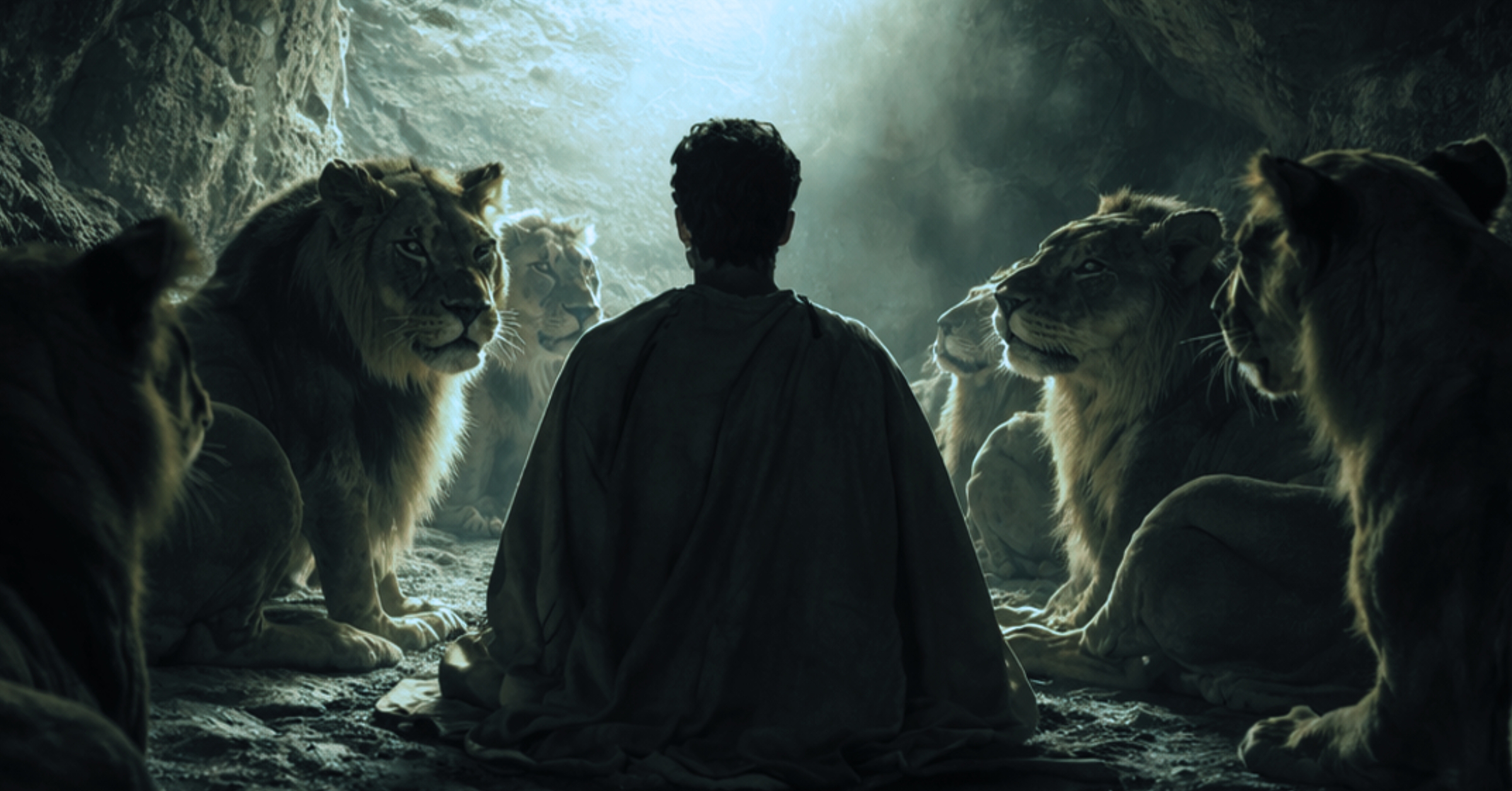
Daniel: Men Stand Firm

Our first bearer of biblical manhood would probably have been the most popular. Wealthy, good-looking, and royally well-connected. Honestly, the only thing that Daniel lacked was a town free of political turmoil. When Jerusalem was raided by the Babylonian army, he and his three buddies were handpicked to compete in Nebuchadnezzar’s version of Next Top Servant.

For three years, Israel’s best and brightest went through the most elaborate indoctrination camp the world had ever seen.[1] In the end, none of the forced converts of Israel were more impressive than Daniel and his pals. And they did it all without compromising their faith in God.

If you have a little Daniel running around your house, he’s probably friends with everyone in his class. He also has no problem standing his ground when other kiddos want to get into mischief. While the early years will come easy, he’s headed for a world that looks more like ancient Babylon with every passing moment. And boy does it look tempting!

To help him stand firm like Daniel, equip him by studying theology, apologetics, and philosophy. Each will help him to better know God and recognize the weakness of worldly arguments. If he’s anything like our man Daniel, he’ll learn to resist compromising his faith with firmness and grace (Daniel 1:8-21).

Joseph: Men have Self-Control  

If Daniel was Mr. Popularity, then Joseph was the pesky little brother of the group. This daddy’s boy had a tendency to rat out his older brothers and talk about how he was going to be the greatest in the family. A personality trait that earned him a one-way ticket to servanthood in Potiphar’s household.

No, he wasn’t perfect, but what’s impressive about Joseph was his faithfulness to God during the ultimate sensual temptation.

You see, Potiphar’s wife wanted this handsome hunk of man-meat to sleep with her. Joseph could have easily given in, but he wasn’t like most guys. He had a fruit of the spirit that’s integral to biblical manhood: self-control.

If you have a little Joseph in the mix, he might be quick to tattle, especially when his brothers are playing with Legos rather than cleaning their room. But this adorable little nark holds himself to those same strict standards.

A time is coming, however, when those standards will be put to the test. And one skill every boy needs to be a true man is self-control.

Encourage your little Joseph by helping him recognize the beauty and design of things that require self-control (Genesis 39:9). Ask what would happen if people did what brought them pleasure all the time? Then discuss accountability skills you both can implement in your lives to help practice self-control. It isn’t always easy, but the outcome is worth the effort.

Jacob: Men Nurture  

If ever there was a guy that seemed to lack the proverbial man card, it was probably Jacob. He was the antithesis of his womb-mate, Esau. Esau hunted, he looked like Chewbacca, and I’m willing to bet his first word was “steak.” Esau was the stereotypical ‘boy,’ and his dad, Isaac, loved him for it.

Jacob, however, wasn’t having any of that. Soft-spoken by nature, he liked cooking with mom rather than field-dressing a deer.[2] And you know what? He was no less a man for it.

Most people (including the church at times) only look at the exterior when it comes to manhood, but God looks at the heart (1 Samuel 16:7). Jacob showed that manhood can be just as gentle and quiet as it is hunting and beards. But we can miss that when we’ve bought into the lie that boys have to be pint-sized Vikings to be worthy of their gender.

If you have a little Jacob in your house, he’s a sweetie. He likes to help mom and can go the entire day without making a mess of himself. But watch out, those adorable smiles might be used to hide some sneaky behavior.

What your boy needs to know is that manhood isn’t measured by how often he shops at Bass Pro Shop. It’s having a heart for the Lord. Part of this is demonstrated in the gentle nurturing of his family. Praise his loving heart while still including him in a range of activities. Remember: even though Jacob was quiet, he wrestled like an Olympian when the situation called for it (Genesis 32:22-32). So don’t underestimate the fierce spirit behind that soft-spoken nature.

Joseph: Men Protect 

We don’t have many backstory details of our New Testament Bob Villa, but what we do have is a beautiful example of our next biblical manhood trait: protecting.

Joseph the carpenter was your average tradesman. He was getting ready to start his family when he got some startling news: his betrothed, Mary, was expecting.

Joseph could have had Mary publicly disgraced, but because he was righteous, he protected her by seeking a private divorce.[3] Then God sent Gabriel with some impressive news: Joseph would be the adoptive earthly father to the King of Kings. All at once, everything changed. Joseph stepped up and provided for Jesus as if He were his own. He then left everything behind to flee to Egypt to keep them safe from Herod’s attack.

If you have a Joseph in your house, he doesn’t mind when little ones come over. He’ll get right down and play and even share a snack. Help reinforce the beauty of babies and the importance of the family by nurturing this God-given protective nature (Philippians 2:4Genesis 2:24Psalms 82:4).

Society suffers when it hinders a man’s inborn desire to protect. As he gets older, help him protect the most vulnerable by recognizing the faulty logic of modern feminist and pro-choice arguments.[4] This will not only help him understand God’s design for children and family, but it emboldens him to reclaim his voice in a culture that desperately wants him to be silent.

Jason: Men Defend   

I’m willing to bet that you had no idea there was a ‘Jason’ in the Bible, but this guy’s story is too exciting to go unnoticed. It also illustrates our last point that goes hand-in-hand with protecting: men defend.

In Act 17, we find Paul and Silas were staying with our man Jason during a preaching pit-stop in Thessalonica. They had spent three days reasoning in the local synagogue that Christ was the Messiah, and the Jews were less than thrilled about their sermon series. So, they gathered up the roughest guys they could find and sent them to capture to apostles.

When they couldn’t find Paul and Silas, these wackadoos dragged Jason into court. But Jason wasn’t going to give up the apostles no matter how much he was threatened. Once Jason was released, he snuck over to where they were hiding and helped smuggle Paul and Silas off to Berea and out of harm’s way.

If you have a Jason in your house, he will defend his pals to the bitter end. Sometimes this can be less righteously motivated and more ‘snitches get stitches’ in nature. Especially when they reach middle school. Trust me on that one.

Being a defender is an important aspect of biblical manhood, but it’s also a skill that needs training for it to be channeled properly. To help them learn the difference between defending the needy and aiding and abetting, read Acts 17:1-10 and discuss what it means to defend one another.

To round out the lesson, hop over to 2 Samuel 12 and read about how Nathan confronts David in his wrongdoing. This two-person combo will help show your boy that accountability is a vital part of being a good defender.

Final Thoughts:      

Being a boy mom is an amazing blessing and a cherished responsibility. I pray that these biblical men will inspire your boys to be fearless for God.

References:

[1] The best food, clothes, and teachers that royal money could buy! They even got new names to round out their new Babylonian identity change.

[2] But what Jacob lacked in brawn he more than made up for in brains. He was a natural businessman. His diligence not only earned him great wealth but the love of his life. And his relentless persistence led to a blessing from the Lord.

[3] Some might argue that if he really wanted to protect Mary, he wouldn’t have tried to divorce her at all. Fair point, but this doesn’t take culture into account. Today, being an unwed teen mom gets you a reality show on Lifetime. Back then they were an outcast of society that could have been killed. When Joseph sought a private divorce, he was protecting her from gossip and public disgrace as much as he could. Which kept this a matter within Mary’s family and not the whole town.

[4] Especially the challenge that his views don’t matter because he doesn’t have a uterus. *Hint: If his views don’t matter because he lacks a uterus, then what about the views of the men who passed Roe v. Wade? Shouldn’t theirs’ not matter, too?

Recommended Resources: 

How to Interpret Your Bible by Dr. Frank Turek DVD Complete Series, INSTRUCTOR Study Guide, and STUDENT Study Guide

The Great Book of Romans by Dr. Frank Turek (Mp4, Mp3, DVD Complete series, STUDENT & INSTRUCTOR Study Guide, COMPLETE Instructor Set)

Jesus vs. The Culture by Dr. Frank Turek DVD, Mp4 Download, and Mp3

Hollywood Heroes: How Your Favorite Movies Reveal God by Frank Turek & Zach Turek (Book)


Amy Davison is a former Air Force veteran turned Mama Bear Apologist. She graduated from Southwestern Baptist Theological Seminary with an MA in Christian Apologetics. She and her husband Michael (also former Air Force) have been married for over 17 years and have 4 kids. Amy is the Mama Bear resident expert on sex and sexuality, and she’s especially hoping to have that listed on her Mama Bear business card.

Originally posted at: https://bit.ly/3O3bV2g

There is a very common type of fallacious reasoning that I have termed arguing from the extremes. Once you see this, you’ll notice that it’s everywhere in our society and especially political discourse. Roughly speaking it’s the idea that one or an extremely small number of counter examples disproves a whole theory. This is simply not how to do good reasoning. If you see x follow y 1,000 times you will rightly conclude that there is some type of causal link between x and y. If on try 1,001, x does not follow y, that should give you pause, but it shouldn’t prompt you to conclude that your established theory (x follows y) needs to be completely thrown out.[1] That would be stupid. But a lot of people do reason like this.

So, for example, it has been widely demonstrated in social science data that children with both a mother and a father present in the home do better in life. The fallacious example of arguing from the extremes would be to counter that this cannot be true because you know a person raised by both a mother and father who turned out to be a con-artist, and you also know a man raised by a single mother who founded and runs a multi-million-dollar company. This is a fallacious objection because it is treating the theory as if it were a deductive argument. One genuine counter example proves that something is wrong with a deductive argument. Conversely, theories are much more akin to inductive arguments which simply say what is likely to be true, or what is true more often than not. As Nicholas Rescher says, “our acceptance policy is based on considerations of overall best-fit, where the fit at issue is one of consonance and coordination with our prevailing commitments.”[2]

So, if I argue that far more often than not it is better for children to be raised by both a mother and a father, a few counter examples do not in any way undermine that argument. Or the existence of seemingly genuinely intersexed people does not undermine a theory of gender that says that human beings are male or female.[3] Estimates of the number of people who claim to be transgender vary, but seem to fall between a high of 0.7% and a low of 0.39%. Even assuming that all the reported instances of transgenderism are accurate (none of the people involved are confused, lying, suffering from mental problems, etc) which seems very unlikely, that still gives us a more than 99% correlation between biological sex and gender.[4] If the correlation was this high for anything else we would call people insane and stupid for challenging it. And yet this is only the people who make the trans-claim. The number of actually intersexed people is significantly smaller still.[5] Reasonable people can disagree about how big a number would be a genuine challenge, but it certainly needs to be higher than 1%. Nonetheless many people make this fallacious appeal and claim that we need to throw out the traditional and historical understanding of human beings as male or female. An anomaly or error factor of less than 1% does not establish this. This is simply bad reasoning, as Timothy McGrew illustrates with an example from the philosophy of science, “This point tells against a naive form of falsificationism according to which even the slightest mismatch between theory and evidence suffices to overturn a theory. But it is a grave exaggeration to claim, as some social constructivists have done, that the existence of an interpretive dimension to scientific inference undermines the objectivity of science.”[6]

No reasonable and serious thinker would or should attempt to argue that because there are children born with birth defects such as missing limbs that we should then conclude that it is normal, fine, and even good for a person to have missing limbs. Likewise, just because there are some people who are born seemingly genuinely intersexed it does not follow that this is normal or good.

And this type of bad reasoning is everywhere in our society. Someone proposes a new law, system or idea that will help people or address a problem. Opponents do an analysis of it and find out that it will ignore or even hurt a small amount of people. They then claim that the whole thing is a terrible idea because it will hurt a small amount of people. But virtually everything that human societies do will ignore or hurt at least a small amount of people. For example, I use the VA health care system. Reworking the VA likely would cause problems for me and other veterans; however, it might also cause it to run better and more effectively. The balance of problems vs effectiveness is an empirical question that can be answered, but it’s quite likely that even if on balance reworking the VA is a good thing, it will still cause problems for me and other veterans. It doesn’t follow that we shouldn’t do it just because of those problems. Perhaps the good of the reworking outweighs those problems.

People do this all the time with abortion as well wherein they point to very rare and extreme examples to justify their positions. This is done because those examples are so extreme that they invoke emotional responses that cloud judgement and make it harder to see the error. Anti-war protesters often do the same thing. They find an emotionally heartbreaking example of a civilian (usually a child) who was killed in the fighting and start harping on about how the whole war is terrible.

War is terrible, but depending on who is fighting and why, peace might be even worse. Further are the civilians being deliberately targeted? Did the military forces act negligently? Or is the civilian’s death a rare thing and reasonable steps were taken to avoid it? If it’s the latter, this is arguing from an extreme. It’s just naive and stupid reasoning to argue, “some civilians/children died, therefore the war must be abandoned.”

Sometimes, but not always, young earth creationists will do this too. They will point to the rare instances wherein a dating method gave odd, contradictory, or clearly false results and then argue the whole method must be flawed. But this is the same style of bad reasoning as it ignores the numerous other times the method worked.

So, here’s the point. You have a theory or idea that has met a fairly high standard. Say it seems to work 999 out of 1,000 times. Someone doesn’t like your idea and starts harping on and whining about the 1 out of a 1,000 saying, “See this proves it doesn’t work.” No, it doesn’t. Almost nothing humans do works 100% of the time. An error factor of 1 out of 1,000 is astonishingly good. That’s arguing from the extremes and it’s stupid reasoning that’s usually covered up by highly provocative and emotional examples. So, watch out for people doing this and don’t do it yourself.[7]

References: 

[1] I know David Hume claimed that that one time over a thousand proved induction doesn’t work. But Hume was wrong and foolish as he contradicted himself regularly and rejecting induction is a standard that even Hume admitted he could not live up to.

[2] Nicholas Rescher, “Philosophy as Rational Systematization,” in “The Cambridge Companion to Philosophical Methodology,” eds. Søren Overgaard and Giuseppina D’Oro. (Cambridge, UK: Cambridge University Press, 2017), 37.

[3] Here I mean people who have something off with their genetics and/or body such that they display the standard traits of both male and female. It’s quite rare, but it does happen. This is distinct from transpeople who claim to be the other a gender other than what their body manifests.

[4] Ian T Nolan, Christopher J. Kuhner, and Gelani W. Dy. “Demographic and temporal trends in transgender identities and gender confirming surgery,” Translational Andrology and Urology 8, no. 3 (Jun 2019), 184-190. Since this source is from seven years ago it’s possible the number is higher now, but the point still stands.

[5] Editor’s Note: The estimated numbers of intersex conditions can vary widely because there’s some dispute, within the relevant circles, about what conditions should be included as “intersex.” The numbers can also be affected by some blurring between Transgenderism and intersex, as “LGBTQIA+” activists have been known to try to envelope both of those groups for political purposes. Strictly speaking, transgenderism and intersex conditions merit careful distinction from each other. Transgenderism entails some combination cross-gender trans-ideology and trans-practice. That ideology distinguishes gender from biological sex, and interprets gender as a separable, subjective, and fluid social construct. Meanwhile, intersex is a biologically rooted phenomenon referring to a range of physical conditions affecting sex-differences (anatomy, genetics, hormones, neuro-chemistry, etc.). The term “intersex” itself is disputed as conservative and liberal interpreters disagree over what conditions qualify. For example, gynecomastia is extremely common yet labeling it as an “intersex” condition can radically swell the reported numbers of “intersex” conditions, potentially increasing the numbers of any larger-group attempting to claim intersex people as their own (Trans-activists, LGBTQIA+, Sex-positive activists, etc.). In reality, gynecomastic is often a negligible/innocuous conditions where males manifest some breast tissue that’s often unnoticeable. Other disorders affecting “cis-gendered” people can inhibit or exaggerated hormones, and those conditions are often quite treatable except in states that ban “conversation therapy” and uncharitably envelope treatments for intersex conditions. In that way, a “cis-gender” biological female, with suppressed estrogren production because of an intersex condition, might not be able to get critical medical treatment in her home state because her physicians could be sued for performing “gender-conservation” therapy on a trans-male.

[6] Timothy McGrew, “Evidence” in The Routledge Companion to Epistemology, eds. Sven Bernecker and Duncan Pritchard, 58-67, (New York: Routledge, 2011), 63.

[7] Some of this article was taken from essays I’ve presented at both the Evangelical Philosophical Society and the Society for Pentecostal Studies.

Recommended Resources: 

Can All Religions Be True? mp3 by Frank Turek

How Can Jesus be the Only Way? Mp4, Mp3, and DVD by Frank Turek

Debate: What Best Explains Reality: Atheism or Theism? by Frank Turek DVD, Mp4, and Mp3 

How Philosophy Can Help Your Theology by Richard Howe (DVD Set, Mp3, and Mp4)   


Phil Kallberg Host of “The Examined Life” podcast is a proud follower of Christ, Phil Kallberg has an MA in Philosophy from Holy Apostles College and Seminary where he wrote a thesis on the Modal Ontological Argument for God’s existence. He greatly enjoys a good story, follows politics far more than is warranted, and makes use of a PlayStation for breaks from all the work of raising children and doing philosophy. Before studying philosophy Phil spent time in the military, worked several jobs in different fields, and thanks to his love of stories got a bachelor’s degree in English. Phil lives in Missouri with his wife, son and daughter. He may be reached for comment at theexaminedlifewithphil@gmail.com

Originally posted at: https://bit.ly/4mbENBM

Most people expect others to tell the truth, and we can witness this expectation in many spheres. In law, truth is taken so seriously that people must be sworn in by raising their right hand and making an oath to tell the truth. In football, referees are accountable for making calls based on the truth. In business, people are expected to be truthful employees. Yet it seems that our society is confused about what truth is. We witness this when we hear statements like, “that can be true for you, but it’s not true for me,” or “that’s just your perspective.” These statements often stump people when they encounter someone with a contradictory view. Let’s clear up the conversation by unpacking what truth is and preparing ourselves to promote truth in our spheres.

Truth Reflects Reality

In our postmodern, or some would say our “post-church”, society, many people claim that truth is a matter of perspective or feelings. The individual might advocate that truth is constructed through individuals, communities, and language. Often, they are living what is called a pragmatic theory of truth, a belief that “it works for them” in their lives. But this belief falls short because it not only leads to relativism, but it is also self-defeating.

Relativism holds that truth is shaped culturally and that objective truth does not exist. This can be true if it is a subjective truth, which is an opinion or preference of an individual. For example, if a person says, “Chocolate is the best flavor of ice cream.” This is true for that subject or individual. These truths are an individual’s preference. But if societies lived by relativism, then objective truth could not exist, and each leader and community would regulate laws according to the ebb and flow of their passions.

Relativism is also self-defeating. Imagine two people who believe two contradictory statements. For example, one claims, “a girl can be a boy,” and one claims, “a girl cannot be a boy.” Can both be true? The pragmatic theory of truth would say, “If it works for you, then it is true.” But both cannot be true; that would be self-defeating. Biologically, a boy cannot ever have a baby because a boy is not born with the biological makeup to have a baby.

Truth is what corresponds to reality. Truth must reflect what is real; it is what matches the way things truly are. If a person were to say, “The Earth is flat.” It would not match the reality of what has been discovered beyond the Earth. People have traveled outside of the Earth to discover that it is an oblate spheroid. Truth is not what works; instead, truth mirrors reality. If someone were to say “George Washington was not the first president,” that would not match reality because records reveal that George Washington was the first president. It is not a personal preference or how we feel, but it is outside of us. Truth reflects reality.

Truth Is Universal [1]

Truth can be true even if others deny it because truth is outside of us. If truth is outside of us, where does it reside? What is the reference point for truth? Many people claim to have the truth. Buddhism says it’s revealed by the Buddha, Islam says it is revealed by Allah, Hinduism says it’s Brahman, and Christianity says it resides in God, Jesus Christ, revealed through the pages of the Bible. These religions contradict one another, so which one is true? C. S. Lewis contended, “There were really only two answers possible: either in Hinduism or Christianity. Whatever you could find elsewhere, you could find better in one of these.”[2] However, Hinduism falls short due to the absence of historical evidence, among other things. Christianity provides the historical evidence to support the reliability of the Bible.

From manuscripts to archaeology, the Bible is affirmed as being reliable. Historical biographies emphasize the importance of truth and historical accuracy, as seen in the book of Luke 1:1-4:

Inasmuch as many have undertaken to compile a narrative of the things that have been accomplished among us, just as those who from the beginning were eyewitnesses and ministers of the word have delivered them to us, it seemed good to me also, having followed all things closely for some time past, to write an orderly account for you, most excellent Theophilus, that you may have certainty concerning the things you have been taught.

Not only are there historical biographies attesting to the truth in the Bible, but it also claims to bear the truth.

  • John 17:17 – Sanctify them in the truth; your word is truth.”
  • John 8:31-32 – “So Jesus said to the Jews who had believed him, ‘If you abide in my word, you are truly my disciples, and you will know the truth, and the truth will set you free.’”
  • John 17:8 – “For I have given them the words that you gave me, and they have received them and have come to know in truth that I came from you; and they have believed that you sent me.”

The Bible reveals God’s testimony to mankind of the truth. In reading it, the reader can discover that God is truth. Jesus Christ, who is God in the flesh, came to testify to the truth in John 18:37 and that He, being God in the flesh, is the truth in John 14:6. God is truth, and the Bible is the reference point of truth. The Bible is the reference point that reveals universal truths.

Promoting Truth in Society   

People in our culture often make judgments based on what works for them or how they feel rather than on what is true. As Christians, we must be familiar with the truths of the Bible over pragmatism and feelings. If truth were relative and feelings oriented, people would lack a standard of morality. Societies would have no standard for right and wrong. Cultures would be unable to criticize other cultures that practice evil. But there is a standard of truth in the Bible. God has given us truths for all peoples, in all places, for all times.

It is the truths of the Bible that build good societies. People do not like it when others steal from them, nor do they like it when people lie to them.

“God, who is outside us, above us, and beyond us, reveals that lying and stealing are wrong because God is truth, and justice is right because God is just. Hatred is wrong because God is love. Forgiveness is right because God is merciful. Sexual immorality is wrong because God is faithful and pure. These things are right or wrong, not because society or even the church agrees with them or frowns on them, but because they are either contrary to or consistent with the nature and character of God.” [3]

These are the truths that Christians can promote in societies because it is good for all people in all places at all times.

Conclusion

We have learned that truth reflects reality, God is truth, and truth is revealed through the Bible for all of humanity. Universal truths build good societies. They teach us to love our neighbor as ourselves. As Christians, we should promote truth to extinguish evil and be a redemptive force in our world.

Notes

[1]

[2]

[1] Editor’s Note: Truth is “universal” in the sense that it’s true for everyone, i.e., universally. If 2+2=4, then that’s not just “True for you but not for me,” because every instance of 2+2 that has ever occurred anywhere has always equaled 4. The universality of truth also means it’s “outside” of us in the sense that the Pythagorean theorem is true independently of you or me. It is still true even if we disagreed with it, didn’t know about it, misunderstood or even if we genuinely believed we had disproven it.

[2] C. S. Lewis, Surprised by Joy, Signature Classics Edition (London, UK: William Collins, 1955), 273.

[3] Sean McDowell, The Beauty of Intolerance (Uhrichsville, Ohio: Shiloh Run Press, 2016), 188.

Recommended Resources:

Jesus, You and the Essentials of Christianity by Frank Turek (INSTRUCTOR Study Guide), (STUDENT Study Guide), and (DVD)      

Is Morality Absolute or Relative? by Dr. Frank Turek DVD, Mp3 and Mp4

When Reason Isn’t the Reason for Unbelief by Dr. Frank Turek DVD and Mp4

How Can Jesus be the Only Way? Mp4, Mp3, and DVD by Frank Turek


Deanna Huff is a wife and mother. She is passionate about teaching others to share and defend their faith, drawing on 25 years of experience in the field. Her publications include The Prophets’ Use of the Shepherd Motif and Its Contribution to Their Presentation of the Character of God, and she has contributed chapters to Why Creationism Still Matters and Strong Faith.

She is also a speaker who has led seminars for the Baptist General Convention of Oklahoma, the Oklahoma Ladies Retreat, and the State Evangelism Conference. In addition, she taught high school students for ten years at Christian Heritage Academy, covering subjects such as Bible, Universal History, Apologetics and Philosophy.

Deanna earned a Ph.D. in Theology and Apologetics at Liberty University. She holds a Master of Theology in Apologetics and Worldview from Southern Baptist Theological Seminary, a Master of Divinity with Biblical Languages from Southwestern Baptist Theological Seminary, and a Bachelor of Arts from the University of Oklahoma.

Deanna is an active member of Capitol Hill Baptist Church, where she co-hosted a podcast called The Analysis with Pastor Mark DeMoss. She also co-hosted a podcast with her daughter, Ellie Huff, called but why should i care. She and her husband teach an adult Sunday school class, discipling others in the faith.

Originally posted at: https://bit.ly/4v2pn6W

Rabbi Tovia Singer is an orthodox Jewish rabbi and the founder and director of Outreach Judaism. He is widely known for his counter-missionary polemics and his criticism of the New Testament presentation of Jesus as the Hebrew Messiah (see his two volume set, Let’s Get Biblical: Why doesn’t Judaism accept the Christian Messiah?.[1] In a video published this week, provocatively titled “Why Would Paul Willingly Die for His Belief? Another Church Lie!”, Rabbi Singer makes a number of bizarre claims. One such statement is that “the notion that Paul was beheaded by Rome is complete nonsense. It’s an invention of the church, and it’s mentioned nowhere in the Christian Bible.” Singer notes further that “the book of Acts — which is devoted to Paul — ends with Paul being freed from prison.” Singer gives a date for Acts, which he claims is very conservative, of 85 A.D., and remarks at how surprising it is that the author of Acts did not think it worthy of mention that Paul had suffered a violent death at the hands of the emperor Nero.

There is so much wrong with this argument that one barely knows where to begin. First, a date of 85 A.D. for Acts is hardly “very conservative.” Indeed, the most common scholarly view as to the dating of Acts places it between 70 and 85 A.D., with a date in the 60’s A.D. being perhaps the second most popular. Second, the most popular argument for dating Acts to the early 60’s is precisely because Acts ends on a cliffhanger, with Paul being placed under house arrest, and makes no mention of his trial or execution. This, according to many scholars, is strong grounds on which to date Acts prior to Paul’s death. This argument is admittedly not conclusive. For example, Craig Keener (who inclines towards a date in the 80’s) notes,

An argument from the abrupt ending in Acts need not mean that Luke knew no more about Paul, any more than Mark’s abrupt ending (Mark 16:8) means that Mark knew no more about Jesus’s resurrection appearances (cf. 1 Cor 15:5–8). Some ancient writers criticized historians who ended their accounts prematurely, but these very criticisms confirm that the practice was known. No less renowned a historian than Thucydides, who lived to see the conclusion of the twenty-seven-year Peloponnesian War, ends his account of the war five years before its conclusion. Valerius Maximus ends his work abruptly with no genuine conclusion (Val. Max. 9.15.ext. 2). Herodian ends his history suddenly at the accession of Gordian III (Hist. 8.8.8), but he does not leave off at this point simply because he is writing then; what he writes he would not have dared write until after Gordian’s fall. Second Maccabees, though written after 1 Maccabees, both starts and ends at a period earlier than 1 Maccabees (and ends on a happy note); clearly, it did not bring events up to its author’s day. [2]

For this reason, one should be cautious about placing too much weight on this argument, since it is an argument from silence, though I would argue that it is a stronger argument from silence than many of its cousins. Luke spends an entire eight chapters discussing Paul’s legal challenges — and his ending, as it stands, leaves these challenges unresolved. As Jonathan Bernier explains, “Either Acts was completed ca. 62, when the Acts narrative ends with Paul in Rome, or Luke’s aims in these last chapters remain opaque.”[3] There is, furthermore, other evidence that is suggestive of a pre-70 date for Acts. These include the sparing use of the noun Χριστιανόι; the use of μάρτυς in the literal sense of “witness” rather than in the modern sense of “martyr”; the use of “Simon” (Σίμων) for Peter; and the comparatively primitive use of the term ἐκκλησία. Though these arguments are also not entirely conclusive, they do cumulatively point to an earlier rather than a later date. Given that a pre-70 date of Acts is at least plausible (if not probable), Singer’s argument against Paul having died as a martyr collapses. Even if we humor Singer and suppose a date of 85 A.D., however, the plethora of counter-examples cited by Keener above significantly undermine his argument.

Singer claims that “This stuff is all made up. It’s not in the New Testament.” Singer complains that neither Peter’s nor Paul’s death is spoken of in the New Testament. But why should we limit ourselves to the New Testament? The earliest reference to Paul’s martyrdom is Clement of Rome’s epistle to the Corinthian church (known as 1 Clement, composed most likely around 96 A.D.). According to 1 Clement 5, “Paul also obtained the reward of patient endurance, after being seven times thrown into captivity, compelled to flee, and stoned. After preaching both in the east and west, he gained the illustrious reputation due to his faith, having taught righteousness to the whole world, and come to the extreme limit of the west, and suffered martyrdom under the prefects. Thus was he removed from the world, and went into the holy place, having proved himself a striking example of patience.”[4] Ignatius of Antioch, writing at the beginning of the second century, also writes in Ephesians, “Ye are initiated into the mysteries of the Gospel with Paul, the holy, the martyred, the deservedly most happy, at whose feet may I be found, when I shall attain to God; who in all his Epistles makes mention of you in Christ Jesus.”[5]  Clement also makes reference to the martyrdom of Peter: “Peter, through unrighteous envy, endured not one or two, but numerous labors; and when he had at length suffered martyrdom, departed to the place of glory due to him,” (1 Clement 5).[6]

Clement and Ignatius were both very probably connected personally with the apostles. Indeed, Irenaeus says of Clement, “This man, as he had seen the blessed apostles, and had been conversant with them, might be said to have the preaching of the apostles still echoing [in his ears], and their traditions before his eyes. Nor was he alone [in this], for there were many still remaining who had received instructions from the apostles,” (Against Heresies 3.3.3).[7] It is quite plausible that the Clement mentioned by Paul in Philippians 4:3 is this same Clement, since Paul was at this time in Rome (where Clement would later become bishop). Ignatius, by virtue of being a companion of Polycarp — who was instructed by the apostles according to Irenaeus (Against Heresies 3.3.4) — was also very plausibly in a position to know of Paul’s fate. Clement and Ignatius are certainly much closer up to the facts than we are today.

Singer is also not quite correct that the New Testament has nothing to say about Peter’s and Paul’s martyrdom. In the case of Peter, John 21:18-19 tells us the words of Jesus to Peter following Jesus’ resurrection: “Truly, truly, I say to you, when you were young, you used to dress yourself and walk wherever you wanted, but when you are old, you will stretch out your hands, and another will dress you and carry you where you do not want to go.” (This he said to show by what kind of death he was to glorify God.)” Given the authorial explanation “This he said to show by what kind of death he was to glorify God” is strongly indicative of martyrdom. If the scholarly consensus is correct (as seems plausible to me) that John’s gospel was composed between 90 and 95 A.D., then it seems likely that the readers of John are intended to recognize this prophecy as having been fulfilled in Peter’s martyrdom. There is another brief reference in 2 Peter 1:14-15: “…since I know that the putting off of my body will be soon, as our Lord Jesus Christ made clear to me. And I will make every effort so that after my departure you may be able at any time to recall these things.” If Peter wrote this letter, it certainly looks like he was in prison awaiting his execution. If one maintains that Peter did not write this epistle, it may nonetheless be viewed as an early testimony to Peter’s martyrdom. Paul also appears to be anticipating his impending martyrdom in 2 Timothy 4:6-8: “For I am already being poured out as a drink offering, and the time of my departure has come. I have fought the good fight, I have finished the race, I have kept the faith. Henceforth there is laid up for me the crown of righteousness, which the Lord, the righteous judge, will award to me on that day, and not only to me but also to all who have loved his appearing.” I will not reprise here the numerous evidences that the pastoral epistles were composed by Paul, but I take this to be very firmly established (as I discuss in detail here).

Tovia Singer maintains that the claim of Paul and Peter having been martyred is a Roman Catholic tradition and that Protestants are being inconsistent in giving lip service to Sola Scriptura and yet utilizing church tradition when convenient. This, however, is a gross misunderstanding of Sola Scriptura. The reformed doctrine of Sola Scriptura asserts that the Scriptures are the sole rule of faith. This does not deny that other historical sources may be of historical value in illuminating and clarifying Scripture, or in, as in the present case, supplying additional information about church history.

Singer concludes his video with the most bizarre argument of all. He claims that Christians frequently assert that the persecution and suffering of the Jewish people across the ages demonstrates God’s judgment against them for rejecting Jesus. I have never, in all my twenty-seven years of being a Christian, encountered this argument, nor is it a sound one. Singer charges Christians with employing double standards. He asks, “Why is it that the death and suffering of Christian followers of Jesus demonstrates the truthfulness of the cause, but the death and suffering of Jews at the hands of Christians…demonstrates the wrongfulness of Judaism. I rest my case.” This is to fundamentally misunderstand the argument under review. The argument emphatically is not that the willingness of Christians — even early Christians — to die for their belief proves the veracity of their religion. Rather, it is specifically the willingness to die of those who were purportedly eyewitnesses of Jesus’ resurrection that provides evidence confirming their sincerity — since multi-party conspiracies, when life or liberty are at stake, invariably break down. This in itself would not necessarily justify belief in the resurrection, since the willingness of anyone to die for a belief or cause only demonstrates their probable sincerity. For this reason, such argumentation must be coupled with additional evidence to show that those individuals were not plausibly honestly mistaken in their belief. What makes the comparison to Jewish martyrs disanalogous is that these Christian martyrs were in a unique position to know whether what they were saying is true or not, since they claimed to have been witnesses to the event itself (rather than it being handed down to them through tradition).

It is also worth noting that the argument does not rest particularly upon the contention that the apostles were martyred for their faith per se. Of the original eleven disciples, I am confident in the martyrdom of Peter and James the son of Zebedee, but we know little if anything about what became of the other nine. Outside of the twelve, I am confident about the martyrdom of Paul and James the brother of Jesus. What we can say, however, with tremendous confidence, is that persecution against Christians seems to go back quite early, since the earliest church endured persecution by the Jews first, according to the book of Acts as well as Paul’s own testimony. Paul testifies that he himself persecuted the early Christians, imprisoning them and putting them to death (1 Cor 15:9; Gal 1:23; Phil 3:6). Paul also gives us his own eyewitness testimony of persecution by Jews against himself following his conversion (2 Cor 11:16-33; 2 Tim 3:10-11). The book of Acts itself speaks of the intense persecution endured by the early Christians, including the martyrdom of James the son of Zebedee (Acts 12:2), the imprisonment of Peter (Acts 12:3-5), the beating of Peter and John (Acts 5:40), and the many sufferings of the apostle Paul for the name of Christ. What we can therefore say with confidence is that, as William Paley puts it so eloquently, the “apostles passed their lives in labors, dangers, and sufferings, voluntarily undergone in attestation of the accounts which they delivered, and solely in consequence of their belief of those accounts; and that they also submitted, from the same motives, to new rules of conduct.”[8] Since this fact is more probable on the hypothesis that the apostles were sincere than on the falsehood of that hypothesis, it may be taken as evidence confirming the sincerity of the apostles in their proclamation to have encountered the risen Christ. This more modest expression of the argument is more defensible than the claim that all of the disciples, save for John the son of Zebedee, died as martyrs, and it is assuredly evidence that favors the contention that the apostles sincerely believed that they had had an encounter with the risen Christ — a premise that is epistemically relevant to the case for Jesus’ resurrection.

In summary, Tovia Singer is very much mistaken in his assessment that the martyrdoms of Peter & Paul is a later church invention, and seems to be ill-acquainted with Christian argument from martyrdom, and what it purports to establish.

References:

[1] Tovia Singer, Let’s Get Biblical! Why Doesn’t Judaism Accept the Christian Messiah? Volume 1 (RMBN Publishers, 2014).

[2] Craig S. Keener, Acts: An Exegetical Commentary & 2: Introduction and 1:1–14:28, vol. 1 (Grand Rapids, MI: Baker Academic, 2012–2013), 385.

[3] Jonathan Bernier, Rethinking the Dates of the New Testament: The Evidence for Early Composition (Grand Rapids, MI: Baker Academic: A Division of Baker Publishing Group, 2022), 62.

[4] Clement of Rome, “The First Epistle of Clement to the Corinthians,” in The Apostolic Fathers with Justin Martyr and Irenaeus, ed. Alexander Roberts, James Donaldson, and A. Cleveland Coxe, vol. 1, The Ante-Nicene Fathers (Buffalo, NY: Christian Literature Company, 1885), 6.

[5] Ignatius of Antioch, “The Epistle of Ignatius to the Ephesians,” in The Apostolic Fathers with Justin Martyr and Irenaeus, ed. Alexander Roberts, James Donaldson, and A. Cleveland Coxe, vol. 1, The Ante-Nicene Fathers (Buffalo, NY: Christian Literature Company, 1885), 55.

[6] Clement of Rome, “The First Epistle of Clement to the Corinthians,” in The Apostolic Fathers with Justin Martyr and Irenaeus, ed. Alexander Roberts, James Donaldson, and A. Cleveland Coxe, vol. 1, The Ante-Nicene Fathers (Buffalo, NY: Christian Literature Company, 1885), 6.

[7] Irenaeus of Lyons, “Irenæus against Heresies,” in The Apostolic Fathers with Justin Martyr and Irenaeus, ed. Alexander Roberts, James Donaldson, and A. Cleveland Coxe, vol. 1, The Ante-Nicene Fathers (Buffalo, NY: Christian Literature Company, 1885), 416.

[8] William Paley, A View of the Evidences of Christianity: Volume 1, Reissue Edition (Cambridge: Cambridge University Press, 2009), 15.

Recommended Resources:

Why We Know the New Testament Writers Told the Truth by Frank Turek (mp4 Download)

The Top Ten Reasons We Know the NT Writers Told the Truth mp3 by Frank Turek

The New Testament: Too Embarrassing to Be False by Frank Turek (DVD, Mp3, and Mp4)

The Footsteps of the Apostle Paul (mp4 Download), (DVD) by Dr. Frank Turek


Dr. Jonathan McLatchie is a Christian writer, international speaker, and debater. He holds a Bachelor’s degree (with Honors) in forensic biology, a Masters’s (M.Res) degree in evolutionary biology, a second Master’s degree in medical and molecular bioscience, and a Ph.D. in evolutionary biology. Currently, he is an assistant professor of biology at Sattler College in Boston, Massachusetts. Dr. McLatchie is a contributor to various apologetics websites and is the founder of the Apologetics Academy (Apologetics-Academy.org), a ministry that seeks to equip and train Christians to persuasively defend the faith through regular online webinars, as well as assist Christians who are wrestling with doubts. Dr. McLatchie has participated in more than thirty moderated debates around the world with representatives of atheism, Islam, and other alternative worldview perspectives. He has spoken internationally in Europe, North America, and South Africa promoting an intelligent, reflective, and evidence-based Christian faith.

Originally posted at: https://bit.ly/48hAijs

When it comes to the fate of Jesus and determining if he rose from the dead, a historian employs a two-step or stage process to uncover the relevant historical facts surrounding the fate of Jesus and then sifts through the various live explanations to determine the best explanation.  It is somewhat like being a detective. A detective gathers the clues (the established historical facts) and then solves the case (provides the best explanation for the historical facts).

ESTABLISHING THE HISTORICAL FACTS

There are four established historical facts or truths concerning the fate of Jesus that are widely accepted by critical scholars today.  Here is a quick acronym to remember these four historical truths: BEAT.


B = Burial

E = Empty Tomb

A = Appearances of Christ

T = Transformation of the Disciples


Dr. Craig quickly covers these historical facts in this short clip. Analyzing what historical facts or truths exist must be done first before determining the best explanation or one will get ahead of themselves.

Death

  • The Medical JAMA journal published an article titled “On the Physical Death of Jesus” which, no surprise, concluded that Jesus certainly died before he was removed from the cross.
  • Roman soldiers are experts at killing and putting them to death.


Burial

After Jesus died he was buried by Joseph of Arimathea in his tomb. On this point, see how William Lane Craig examines [and defends] the Christian claim that Jesus died and was buried.

  • Recorded in the early sources of 1 Corinthians 15:3-5
  • The burial story is part of the early source material of Mark, which is the oldest gospel.
  • Joseph of Arimathea is not likely to be an invention by the earliest accounts.
  • The burial story is simple and not embellished, thus unlikely to be a fabrication.

Empty Tomb

Jesus’ tomb was found empty [editors note: And the tomb remains empty today, and it’s location is widely agreed upon by friendly and critical scholars alike, namely, at the Church of the Holy Sepulchre]

  • Found in the early sources of Paul and Mark
  • The narrative is simple and lacks legendary embellishment
  • Women found the tomb empty and not men, who wrote down the event
  • Even the earliest opponents of Christianity admitted the tomb was empty by stating the tomb was empty because the disciples stole the body of Jesus

On this point see, “The Historicity of the Empty Tomb of Jesus” by William Lane Craig.

Appearances of Christ

On multiple occasions and under various circumstances different individuals and groups of people experienced appearances of Jesus alive from the dead. This historical fact is NOT stating that the appearances of Christ occurred because he rose from the dead, but that the people (both believers and unbelievers, individuals and groups of people) had some type of experience which they took as Jesus alive from the dead.  The fact is not saying that Jesus did rise from the dead, but they had some type of experience.  It could have been a resurrection, vision, hallucination, or bereavement experience.  Whatever the case the experience is historically certain which even skeptics of the resurrection like Gerd Ludemann even accept. Additionally, the appearance narratives are early and from multiple sources:

  • appearance to Peter recorded by Luke and Paul
  • appearance to the twelve recorded by Luke, John, and Paul
  • appearance to the woman is attested by Matthew and John
  • appearance to the 500 in Galilee recorded in Mark, Matthew, and John

In this video Dr. Peter Williams, the Warden of Tyndale House in Cambridge, lists the variety of appearances of Jesus after his death. And here is Craig addressing the historicity of the appearances.

Transformation of the Disciples       

The disciples suddenly and sincerely came to believe that Jesus has risen from the dead despite every predisposition to the contrary. Here is what the disciples faced following Jesus’ crucifixion:

  • Their leader is dead (political defeat)
  • Their leader is a heretic (religious defeat)
  • They are not expecting him to rise from the dead, because they are hiding (eschatological defeat)

Nevertheless, the disciples suddenly came to believe that God raised Jesus from the dead they were willing to die for that belief. This does not prove that Jesus rose from the dead, only that the disciples believed he did and were sincere in that belief. Here is Craig again on what happened to the disciples that transformed them into avid witnesses for Christ: “What Happened to the Disciples that Transformed Them Into Avid Witnesses for Christ?”

THE BEST EXPLANATION

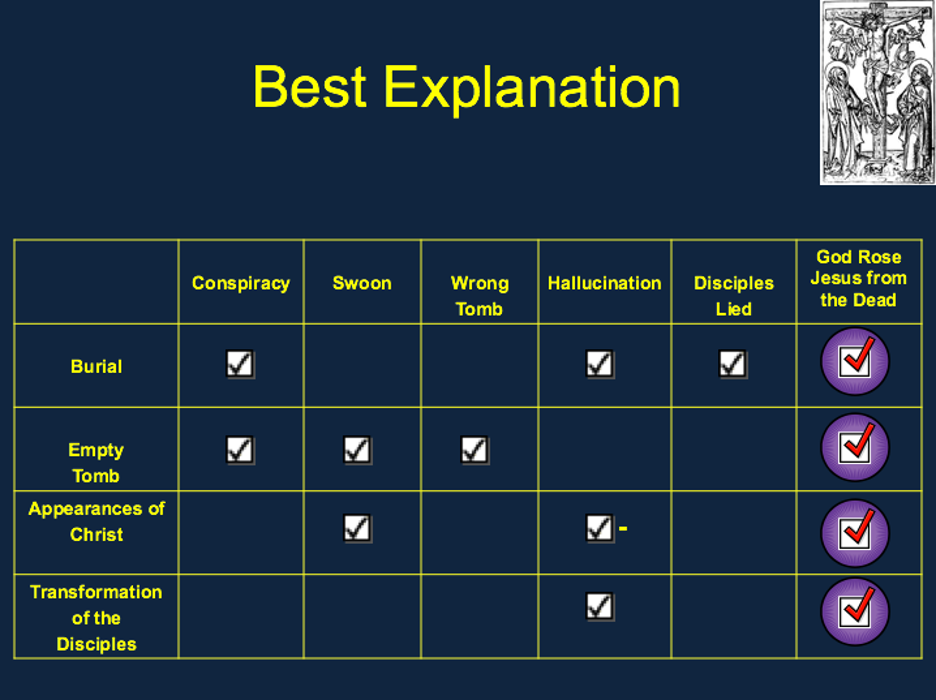
While there might be several explanations possible, we are looking for the best explanation. The best explanation will meet two conditions: explanatory scope and explanatory power. With explanatory scope, it must explain all the facts, not just one or some or the majority. With explanatory power: It must explain each fact adequately, not just superficially or in an ad hoc (i.e.-contrived) manner. Some possible explanations for the four historical facts of the burial, the empty tomb, the appearances of Christ, and the transformation of the disciples could be:

  1. “Conspiracy” – The disciples stole the body

Problem – The transformation of the disciples?


  1. “Lied” – The disciples lied about the resurrection

Problem – who would die for a lie they knew was a lie?


  1. “Hallucination” – The disciples hallucinated the resurrection

Problem – The empty tomb?


  1. “Wrong Tomb” – The women went to the wrong tomb

Problem – The tomb of Joseph of Arimathea?


  1. “Resuscitation/Swoon” – Jesus survived the crucifixion

Problem – The fatal torment?
Notice that each of these explanations (#1-5) lacks either explanatory scope or explanatory power, but there is one more explanation:


  1. “God Raised Jesus From the Dead”

Solution – This explanation admits and explains each fact and each fact adequately.
It has both explanatory scope and explanatory power.  Therefore, it is the best explanation.  Below is a chart detailing what facts are explained (with a check mark) and which facts are not explained (empty):

Resources

Articles/Books:

Videos

Impact 360 Institute released this slick animated video explaining the facts and the best explanation of those facts

Dr. Craig on the John Ankerberg Show summaries the four facts and the best explanation of those facts to demonstrate that God is the best explanation for the life, death, and resurrection of Jesus:\

Reasonable Faith’s two-part video on the facts and the best explanation of the question “Did Jesus Rise from the Dead?”

Recommended Resources:


Why We Know the New Testament Writers Told the Truth by Frank Turek (mp4 Download)

The Top Ten Reasons We Know the NT Writers Told the Truth mp3 by Frank Turek

Counter Culture Christian: Is the Bible True? by Frank Turek (Mp3), (Mp4), and (DVD)       

The New Testament: Too Embarrassing to Be False by Frank Turek (DVD, Mp3, and Mp4)


J. Steve Lee has taught Apologetics for over two and a half decades at Prestonwood Christian Academy.  He also has taught World Religions and Philosophy at Mountain View College in Dallas and Collin College in Plano.  With a degree in history and education from the University of North Texas, Steve continued his formal studies at Southwestern Baptist Theological Seminary with a M.A. in philosophy of religion and has pursued doctoral studies at the University of Texas at Dallas and is finishing his dissertation at South African Theological Seminary.  He has published several articles for the Apologetics Study Bible for Students as well as articles and book reviews in various periodicals including Philosophia Christi, Hope’s Reason: A Journal of Apologetics, and the Areopagus Journal.  Having an abiding love for fantasy fiction, Steve has contributed chapters to two books on literary criticism of Harry Potter: Harry Potter for Nerds and Teaching with Harry Potter.  He even appeared as a guest on the podcast MuggleNet Academia (“Lesson 23: There and Back Again-Chiasmus, Alchemy, and Ring Composition in Harry Potter”).  He is married to his lovely wife, Angela, and has two grown boys, Ethan and Josh.

Originally posted at: https://bit.ly/4m4mxuf

Each and every sermon we listen to, every teacher we hear, every Bible verse we read, and even the article you’re reading right now has only so much effect. We can listen and agree with what is being said. We can agree that the words we read hold truth. But then what? Do we give our “Amen” in agreement and swiftly move on? Do we skip the prayer and application process, hoping it will fill and meet our needs? Are we simply only hearing the Word? If we say we are faithful followers of Jesus Christ, are we living out that truth every day, or are we just listening?

But be doers of the word, and not hearers only, deceiving yourselves. (James 1:22 NKJV)

When we truly trust in God, it doesn’t mean we are only listening to God’s Word. To have a genuine trusting faith is to act on what the Word says. As we listen to a sermon or read the Bible, it’s through faith that we accept the Word and agree within our hearts and minds. We take time to hear, study, and understand the truth that is being put forth. We take to heart what is said in the Word and act on it—praying over God’s Word and applying it to our lives by doing God’s will for our lives. That’s action, that’s a doer of the Word.

Simple listening isn’t enough; faith takes action. Faith doesn’t save us. Works won’t save us either. The blood of Jesus saves us through faith. Faith is the delivery method by which we come to Christ. Once saved, genuine faith will produce good works – faith in action. We read or listen to the Word and apply it to our lives through acting on our faith.

Faith by itself, if it does not have works, is dead. (James 2:17)     

Having knowledge isn’t the same as trust or faith. We can agree on all the facts surrounding Christ. His life, death, resurrection, and His ascension; however, simply agreeing on the facts won’t save us. The demons believe and tremble. We all agree on this. We say “Amen,” but this simple belief or trust requires no action. It requires no response from us. “Yes,” I agree, “Amen,” next chapter please.

To be saved by faith, through Christ, is active. It is transformative within our lives. By acting on faith, we live a life through faith that changes our direction. We make new choices that draw us closer to Him. By doing so, we begin to show action through good works.

By no means am I saying that salvation requires good works, and neither is James. When we obey our Heavenly Father and place our complete trust and faith in Him, it’s our faith and love that produce action. Again, we are saved by Christ, through faith. It’s that faith that will produce good works. Having trust or faith without action or works shows a lack of true faith.

Faith in action means we are doers of the Word and not hearers only. Where would we get with “The Great Commission” if we only read or listen to it? We see the truth and hear the truth, but are we doing what Jesus speaks? Are we hearers of the word or doers? Is our faith in action, being obedient to His commandment? Growing up and going to school, all of us learned about verbs. When reading Matthew 28:18-20, we see action verbs. We read the words of Jesus Christ and know that action must be taken. Merely nodding our heads or saying “Amen” in agreement isn’t enough. We apply “The Great Commission” to our lives by doing.

And Jesus came and spoke to them, saying, “All authority has been given to Me in heaven and on earth. Go therefore and make disciples of all the nations, baptizing them in the name of the Father and of the Son and of the Holy Spirit,  teaching them to observe all things that I have commanded you; and lo, I am with you always, even to the end of the age.” Amen. (Matt. 28:18-20) To “go” requires action. To “make” requires action. “Baptizing” requires action. “Teaching” requires action. What we “do” is a direct result of what we truly believe. The commandment from Jesus was and is to “Go.” Christ’s own words required action. Claiming to have faith is ultimately meaningless; therefore, true faith results in action. But someone will say, “You have faith, and I have works.” Show me your faith without works, and I will show you my faith by my works. (James 2:18) How can one show you evidence of their faith without any works or action? When a person truly believes something, they will act on it. A faith that doesn’t cause a person to produce action is a dead faith. We are only saved by Christ through faith; however, this faith is much more than a simple agreement. Those who are saved will demonstrate good works. They will live out their faith through actions. Let no one despise your youth, but be an example to the believers in word, in conduct, in love, in spirit, in faith, in purity. (1 Tim. 4:12).

Paul is instructing Timothy to be faithful and prepared. He is also showing him the importance of a good, steadfast, and spiritual life. His response to the false teaching surrounding him was to live out his faith and be an example to those who believed. To be an example in word, conduct, love, spirit, faith, and purity, we must take action. Timothy put his faith into action because of Whom he believed.

The actions or works we do are never intended for self-glorification or recognition. Christians are to work from their souls, demonstrating passion and honoring God. To live for God is to live out your faith in a way that honors Him, not men.

For by grace you have been saved through faith, and that not of yourselves; it is a gift of God, not of works, lest anyone should boast. (Eph. 2:8-9)        

Salvation’s source is the grace of God, and the means is faith. It’s by faith we believe to be saved. Works do not save. Salvation is a gift from God that we truly don’t deserve. By grace through faith, we become a new creation in Jesus for good works. We turn away from our old lives and start living a life for Him. Our actions or works will reflect this change. These works will not and do not give us salvation; they are a direct result of salvation.

For if anyone is a hearer of the word and not a doer, he is like a man observing his natural face in a mirror; for he observes himself, goes away, and immediately forgets what kind of man he was. (James 1:23-24)  

It’s absurd to think that a man can look into a mirror and ignore what he sees. To be unable to recognize our own face. It is equally ridiculous to believe that one who states they are a follower of Jesus Christ can read and listen to the Holy Word of God and ignore what it says. Belief and faith are shown through action. This demonstrates trust in Him by obeying Him and His Word. Those who choose not to follow, do they really have faith and trust in Him completely? True faith will produce good works. When we think we are good enough to listen, we are only deceiving ourselves.

The life of the Apostle Paul serves as a testament to faith in action and to the transformative power of Jesus Christ, wholly dedicated to serving Christ. He faced hardships and persecution but remained steadfast in his calling—a life of faith in action with no alternative but obedience. Paul’s life continues to be a personal example and model for Christian living, often illustrating Christian principles of faith and conduct.

Throughout all of Paul’s writing, we see faith in action. Romans explains many aspects of faith and concludes with the application. Believers are called to live their lives differently from the world. In 1 Corinthians, he instructs the church in Corinth to resist the ungodly practices of the surrounding culture. He continues to provide direction for marriage and spirituality, and in 2 Corinthians, the church heeded his instructions. In Galatians, we see Paul defending himself and the true gospel. In Ephesians, he lays out spiritual truths and how to apply them to a believer’s life. Philippians emphasizes how Christians think and what attitude they have, and how this affects the way they live out their faith. In Colossians, we see discussions of Christian conduct, and Paul addresses the Christian household and how a Christian should speak. 1 Thessalonians, Paul urges the church in Thessalonica to live a life that pleases the Lord. 2 Thessalonians, we see a warning against idleness. Paul’s life is meant to be an example of hard work and meeting the needs of others. In 1 Timothy, Paul is advising on the form and function of church leadership. He instructs church leaders on how to prioritize their time. 2 Timothy, Timothy was to be faithful in his work, to continue in sound doctrine, and preach the Word. We see encouragement towards Timothy to stand firm in his faith. In Titus, the Christians in Crete are addressed on proper behavior and how to treat people. In Philemon, we see Paul’s gentleness.

Action!

From Paul preaching the Word to those receiving his instructions, there’s action. The church then and the church today could say, “Amen” and move on. But would that show true faith in Christ by not following instructions? A faith that is transforming will be demonstrated through our actions. Receiving instructions and changing so that we live a life pleasing to God requires action. Show me Scripture where faith doesn’t call for action. Faith calls for action. It requires a Christian to be a “doer” of the Word and not just a “hearer.” Put your faith into action and be a doer of the Word!

Recommended Resources:

The Great Book of Romans by Dr. Frank Turek (Mp4, Mp3, DVD Complete series, STUDENT & INSTRUCTOR Study Guide, COMPLETE Instructor Set)

Jesus, You and the Essentials of Christianity by Frank Turek (INSTRUCTOR Study Guide), (STUDENT Study Guide), and (DVD)      

How to Interpret Your Bible by Dr. Frank Turek DVD Complete Series, INSTRUCTOR Study Guide, and STUDENT Study Guide

Was Jesus Intolerant? by Frank Turek (DVD and Mp4)


Tim Woods lives in West Frankfort, Illinois, where he serves as Director of Student Ministries at First Christian Church and Jr. High/High School Teacher and Chaplain for New Covenant Christian School. Woods earned his B.Min. in Discipleship and M.Min. in Biblical Studies from Veritas Theological Seminary and is currently working toward a D.Min. He is the author of the forthcoming (2025) book, Battle for Souls (Illative House Press).

Originally posted at: https://bit.ly/4bga69y

Hollywood is built on the promise of fame, money, and influence. But if that’s the “dream,” why does the glitz and glamour leave so many icons feeling hopeless and empty inside?

You’ve seen Rob Schneider on SNL and in box-office hits like 50 First Dates, but you’ve never seen him like this. From his journey to faith, to his front-row seat to the “cancel culture” wars, Rob is pulling back the curtain on what it’s like to be a Christian in an industry that’s increasingly hostile to the Gospel. You’re going to laugh (it’s Rob Schneider, after all!), but you’ll also be challenged to think deeply about the cultural moment we’re living in right now. Together, Frank and Rob answer questions like:

  • How did Rob get started in comedy and who was his biggest inspiration?
  • How did he become a Christian?
  • Is using foul language forgivable?
  • What are some of the psychological challenges of being a comedian?
  • How does comedy help people understand truth better than a straightforward lecture?
  • What happens in Hollywood when you become a Christian and come out as a conservative?
  • Why does fame and fortune often fail to deliver actual fulfillment?
  • How have brave voices like Charlie Kirk, Peter Boghossian, and Ayaan Hirsi Ali inspired Rob to speak up?
  • Why is Rob such a history buff and what are his thoughts on the current war in Iran?
  • What does progressivism REALLY mean?
  • What surprising project is Rob working on right now?
  • What unexpected event happened at the 50th anniversary of SNL?

In addition to his comedy tour, Rob is the author of ‘You Can Do It! Speak Your Mind America‘. Stay tuned for a special LIVE event with Frank and Rob coming up next month near Charlotte, NC on MON. 4/27 at 7:30 PM ET!

If you enjoyed this podcast episode PLEASE HELP US SPREAD THE TRUTH OF CHRISTIANITY BY SUPPORTING OUR MINISTRY USING THE LINK BELOW. 100% of your donation goes to ministry, 0% to buildings!

Resources mentioned during the episode:

Donate to CrossExamined
You Can Do It! Speak Your Mind America by Rob Schneider

Download Transcript

[Editor’s Note: this blog series was originally posted as a single blog. The section “Introduction to the Kalam” is repeated here in both entries, for context, for the reader.]

Introduction to the Kalam

The Kalam Cosmological Argument (KCA) is one of the most widely discussed arguments for the existence of God in contemporary philosophy and apologetics. It goes like this:

  1. Whatever begins to exist has a cause.
  2. The universe began to exist.
  3. Therefore, the universe has a cause.

Though it sounds simple, the implications are profound. If the universe had a beginning—and beginnings require causes—then something (or Someone) beyond time, space, and matter must have brought it into being. The Kalam has sparked conversations among scientists, philosophers, theologians, and skeptics alike, making it a cornerstone of modern theistic argumentation.

This post brings together over 80 carefully curated resources—from beginner-friendly explainers and historical texts to scholarly journal articles, courses, and public debates. Whether you’re a curious newcomer or a seasoned thinker in apologetics or philosophy, this guide will give you a comprehensive, well-organized entry point into one of the most powerful arguments for God’s existence. It’s also a valuable resource for influencers and educators looking to explore, share, or teach the Kalam with clarity and depth.

Books

This section features the most influential and insightful books on the Kalam Cosmological Argument—ranging from historical surveys and philosophical explorations to scientific defenses and academic volumes. Whether you’re a newcomer building your library or a thought leader looking for rigorous material, these books belong on your shelf.

Advanced Scholarship (Peer‑Reviewed)

This section features rigorous academic articles, journal exchanges, and scholarly critiques that shape the forefront of Kalam-related discourse. These works are best suited for readers with a background in philosophy, theology, or cosmology—or those looking to dive deep into technical and high-level debates.

William Lane Craig vs Wesley Morriston

These articles represent one of the most well-known scholarly back-and-forths on the Kalam:

William Lane Craig vs Graham Oppy

Graham Oppy has written some of the most sustained academic critiques of Kalam:

Other Peer-Reviewed & Academic Contributions

Beyond the headline debates, a wealth of rigorous scholarship continues to refine, expand, or critique the Kalam argument from diverse angles—metaphysics, cosmology, logic, and philosophy of time. These peer-reviewed papers and encyclopedia entries offer depth, nuance, and fresh perspectives for those looking to explore the broader academic conversation.

Practical Tools & Courses

If you want to take the next step—by teaching, debating, or studying the Kalam Cosmological Argument more systematically—this section is for you. These tools and courses range from structured learning environments to interactive platforms that help you map, test, and communicate your ideas more effectively.

  • Apologetics 201: The Kalam Cosmological Argument – Equip FREE Course
    A structured course that breaks down the logic and application of the Kalam in apologetics, including assignments and video lectures.
  • Kialo Edu (structured debate & argument mapping platform) FREE
    A powerful tool for visually mapping arguments and objections. Perfect for classroom use or personal exploration of Kalam’s structure.
  • HyperWrite Debate Assistant (AI argument generator) PAID
    An advanced writing assistant that helps generate and refine arguments from both sides of an issue. Can be used to simulate objections and test your responses to Kalam.

What to Do with All This

With over 80 curated resources, you now have everything you need to explore the Kalam Cosmological Argument from every angle—philosophical, scientific, theological, and practical. If this guide helped you, pass it on. Share it with your small group, your skeptical friend, your favorite apologist, or your online audience. Every click spreads clarity in a world full of noise Don’t keep it to yourself—someone out there is one good argument away from rethinking everything.

Did I miss something?

Know a blog post, video, paper, or podcast that should be on this list? Drop it in the comments—I might just add it.

References:

Why Science Needs God by Dr. Frank Turek (DVD and Mp4)

Science Doesn’t Say Anything, Scientists Do by Dr. Frank Turek (DVD, Mp3 and Mp4)

Oh, Why Didn’t I Say That? Does Science Disprove God? by Dr. Frank Turek (DVD and Mp4)

Stealing From God by Dr. Frank Turek (Book, 10-Part DVD Set, STUDENT Study Guide, TEACHER Study Guide)


Miguel Rodriguez is the founder of Smart Faith, a platform dedicated to helping Christians defend their faith with clarity and confidence. After experiencing a miraculous healing at 14, he developed a passion for knowing God through study and teaching. He now serves as the Director of Christian Education and a Bible teacher at his local church while also working as a freelance email marketer. Living in Orlando, Florida, with his wife and two daughters, Miguel seeks to equip believers with practical and intellectual tools to strengthen their faith. Through Smart Faith, he provides apologetics and self-improvement content to help Christians live with wisdom and integrity.

Originally posted at: https://bit.ly/3OUC2IM

Introduction to the Kalam    

The Kalam Cosmological Argument (KCA) is one of the most widely discussed arguments for the existence of God in contemporary philosophy and apologetics. It goes like this:

  1. Whatever begins to exist has a cause.
  2. The universe began to exist.
  3. Therefore, the universe has a cause.

Though it sounds simple, the implications are profound. If the universe had a beginning—and beginnings require causes—then something (or Someone) beyond time, space, and matter must have brought it into being. The Kalam has sparked conversations among scientists, philosophers, theologians, and skeptics alike, making it a cornerstone of modern theistic argumentation.

This post brings together over 80 carefully curated resources—from beginner-friendly explainers and historical texts to scholarly journal articles, courses, and public debates. Whether you’re a curious newcomer or a seasoned thinker in apologetics or philosophy, this guide will give you a comprehensive, well-organized entry point into one of the most powerful arguments for God’s existence. It’s also a valuable resource for influencers and educators looking to explore, share, or teach the Kalam with clarity and depth.

Foundational Overviews (General Primers)

This section includes easy-to-understand introductions to the Kalam Cosmological Argument. These resources are perfect for readers who are completely new to the argument and want a clear, jargon-free explanation of its structure and significance.

Most Common Objections Answered    

The Kalam argument has its critics—and rightly so. A good argument invites challenge. In this section, you’ll find accessible responses to the most frequent objections raised against the Kalam Cosmological Argument, including misunderstandings about causality, the multiverse, and the nature of God. Whether you’re sharpening your own understanding or preparing to teach or debate, these resources will help you engage with clarity and confidence.

Classic and Contemporary Debates 

Some of the most memorable moments in apologetics happen when world-class thinkers go head-to-head. This section collects major debates and responses surrounding the Kalam Cosmological Argument. These exchanges cover everything from cosmology and quantum mechanics to metaphysics and philosophy of time. Whether you’re a student, teacher, or influencer, these are essential for sharpening your understanding and seeing the argument tested under pressure.

Dialogues & Deep Dives

Not every idea needs a textbook—sometimes the best insights come from a good conversation. This section features interviews, discussions, conference panels, and informal debates that bring the Kalam Cosmological Argument to life. Whether it’s philosophers hashing out disagreements or apologists breaking down complex ideas in plain English, these dialogues make the argument more accessible—and more human.

FAQs

Even after understanding the core structure of the Kalam Cosmological Argument, many people still have tough follow-up questions. This section tackles the most common philosophical and scientific pushbacks—about time, causality, infinity, and the nature of God. Each entry provides a focused, accessible explanation or rebuttal that you can reference, share, or use to deepen your own understanding.

. . . . Did I miss something?   

Know a blog post, video, paper, or podcast that should be on this list? Drop it in the comments—I might just add it.

Recommended Resources: 

Why Science Needs God by Dr. Frank Turek (DVD and Mp4)

Science Doesn’t Say Anything, Scientists Do by Dr. Frank Turek (DVD, Mp3 and Mp4)

Oh, Why Didn’t I Say That? Does Science Disprove God? by Dr. Frank Turek (DVD and Mp4)

Stealing From God by Dr. Frank Turek (Book, 10-Part DVD Set, STUDENT Study Guide, TEACHER Study Guide)


Miguel Rodriguez is the founder of Smart Faith, a platform dedicated to helping Christians defend their faith with clarity and confidence. After experiencing a miraculous healing at 14, he developed a passion for knowing God through study and teaching. He now serves as the Director of Christian Education and a Bible teacher at his local church while also working as a freelance email marketer. Living in Orlando, Florida, with his wife and two daughters, Miguel seeks to equip believers with practical and intellectual tools to strengthen their faith. Through Smart Faith, he provides apologetics and self-improvement content to help Christians live with wisdom and integrity.

Originally posted at: https://bit.ly/4uy8C3w

Social media can be one of the darkest places in the world. People comment with cruel disregard for whoever is on the other side of the screen. Yet, Christians have a responsibility to be the light of Christ in everything, including our social media message.

Twenty years ago, many of us couldn’t imagine social media existing much less consuming large portions of our lives. But, it has become how most people get news and interact with the global community on a daily basis. I don’t know the exact statistics, but most people check social media first thing each morning.

On June 30, 2010 people celebrated the first World Social Media Day, which is around the time I joined the ranks of smart phone users and began to dip my toe into this new Facebook thing that was replacing MySpace.

And I’ve come to embrace it in many forms. I’m on Facebook, LinkedIn, Twitter, Pinterest, Instagram, and StumbleUpon, and a few more, but haven’t bitten the SnapChat or WhatsApp bullet yet. But one thing I try to do no matter which site I’m on is portray a consistent Christ-centered message. Whether on my personal page or Heaven not Harvard accounts, nothing matters more to me than being as genuine a witness for my faith as I can be in every aspect of my social media use.

But social media is hard! People are emboldened behind their keyboards to share every thought and emotion, often without much thought to how their words reflect on them as people or affect others.

Our social media message should be centered on a Kingdom-mindset and Christ focus.

Honestly, I could write a book about Christian social media usage, but today, I want to focus on how we interact with our friends primarily. Because it’s easy to see that social media is destructive and divisive within marriages and friendships. So, we need to make sure we don’t miss the opportunity to be a light for Christ on social media among our friends. Be the Light in the Darkness of Social Media

So why use social media at all?        

As a veteran wife, I live in a transient community. Social media allows us to stay in touch with people who have moved away and stay close through interacting with each other online. Also, we live far from all our family. Social media allows us to feel more connected to family: cousins, aunts and grandparents, even those on the other side of the country or even world. Even in the civilian sector, social media allows us to befriend and communicate with people around the globe. I’ve made real friendships with people in other states and walks of life and even on other continents.

BUT . . . We need to be careful to keep Christ the center of all areas of our lives. Our words have more weight than ever, and words without the benefit of tone of voice or facial expressions. Only our words must stand and reflect the heart we had when we posted an article or comment. I write this not as one who has mastered my online words or social media message, but as one contending for righteousness in this arena.

“I tell you, on the day of judgment people will give account for every careless word they speak” Matthew 12:36 (ESV)

It is not a stretch to assume that God will also hold us accountable for the words we type, as well. Recently, I shared a favorite post about service and the importance of focusing less on what I’m getting, more on how I’m loving others.

Focusing on how I love has also changed how I interact online. Recently, a socially liberal, atheist friend and I were on opposite sides of an emotional issue in a Facebook thread. No matter how I explained my thoughts, he didn’t see it my way. While tempted to use snarky wit to drive home my point, my goal in the conversation surpassed this one issue. Ultimately, my Kingdom-minded goal was to love my friend by demonstrating the love of Christ who lives in me. At the end of the day, even this delicate and difficult topic was not as important as reaching my friend for Christ.

At the end of the day, being right isn’t as important as reaching people with the Gospel and loving them like Christ. #ChristianWoman #Christian #Gospel #SocialMedia Share on X

I prayed before reading each of his replies. Again, I prayed before replying. I typed replies and then prayed and revised. In the end, I was able to address HIM not his position or his ideas, but reach out as a friend. “Hey, our friendship is more important than our agreement here.” Doing so reflected Christ more than convincing him of my Christian position on this issue ever would have.

I struggle with this issue everyday since I’m fairly political. And I do believe part of God’s calling in my life has been to righteously contend for His truths. I feel very strongly, however, that I should err on the side of invitation and grace in how I interact on social media. When I account for my words, I want to be able to say that everything I said was done in my very human attempt to be a light for Christ in one of the darkest places in the world – the internet. So, what about you? Is Christ the focus in your social media message?

References:

Counter Culture Christian: Is the Bible True? by Frank Turek (Mp3), (Mp4), and (DVD)        

How Can Jesus be the Only Way? Mp4, Mp3, and DVD by Frank Turek

If God, Why Evil? (DVD Set), (MP3 Set), and (mp4 Download Set) by Frank Turek 

Person of Interest: Why Jesus Still Matters in a World that Rejects the Bible by J. Warner Wallace (Paperback), (Investigator’s Guide).


Jennifer DeFrates is a former English and Social Studies teacher turned homeschool mom and Christian blogger at Heavennotharvard.com and theMamapologist.com. Jennifer is a 2x CIA graduate (the Cross-Examined Instructors Academy) and volunteers with Mama Bear Apologetics. She has a passion for discipleship through apologetics. Her action figure would come with coffee and a stack of books. She is also the reluctant ringleader of a small menagerie in rural Alabama.

Originally posted at: https://bit.ly/40SRsQh