
Tag Archive for: Gospel

When reflecting on over forty years of pastoral ministry carried out in numerous forms and contexts, two recurring realities emerge as most prominent in my experience. First, people are often profoundly troubled and deeply hurting amid the moral chaos and cultural decay of a sin-stricken world, resulting in a brokenness that reaches the deepest recesses of the human mind and heart.

Second, the gospel—the hopeful proclamation of the now-and-not-yet kingdom of God as manifested in the deity, death, and resurrection of Jesus Christ—is the greatest source of healing for individuals, families, churches, and cultures.[i]

“The gospel—the hopeful proclamation of the now-and-not-yet kingdom of God as manifested in the deity, death, and resurrection of Jesus Christ—is the greatest source of healing for individuals, families, churches, and cultures.”

In a word, the world is profoundly out of sorts and only Jesus can set it to rights. It is the concomitance of these two concerns that provides much of the context and content of what has become a focus in my ministry, namely biblically based, gospel-centric pastoral counseling.

H.O.P.E.

Bearing this in mind, the following is a brief introduction to a model of pastoral counseling I developed utilizing the acrostic HOPE (Hear the Pain; Optimize Passional Reason: Proclaim the Gospel; Emphasize the Resurrection). Of particular significance for this model is that it gives central place to the resurrection in the caregiving process.

My goal is to demonstrate the HOPE model through a notional scenario derived from real counseling experiences, thereby highlighting how the resurrection provides a key component in helping broken people experience transformation and lasting wholeness.

H: Hear the Pain

Scenario: Randy walked into the pastor’s office with a look of consternation on his face and a certain slowness in his step. The appointment was scheduled the prior Sunday after Randy asked for prayer at the conclusion of the service. The pastor had heard a certain familiar pain in Randy’s voice, so he offered to not only pray that day, but to meet in person for a follow-up counseling discussion. Randy was happy to accept the offer, and now he stood in the office.

“Sit down, Randy,” said the pastor, “and tell me what’s on your mind.” Randy sat opposite the pastor’s desk and, after an opening prayer by the pastor, began to share his story. Moment by moment, hurt by hurt, Randy recounted his experience with Post Traumatic Stress precipitated by several tours of combat in Iraq.

The pastor listened intently, careful not to interrupt and trying to avoid anything like a leading question; his concern was to give Randy ample space and time to tell his story, and it was quite a story.

At one point the emotion in Randy’s voice heightened and he burst into tears as he recounted the loss of dear friends during a combat operation gone awry. It was clear that Randy was hurting, and the pastor was glad Randy was able to get the hurt out into the open in the safety of a counseling session.

Discussion: All counseling begins with listening, or at least it should.[ii] It is when the pastor listens without leading or stifling responses, that the counselee can paint the picture of the problem that brought them to seek help.

As the counselor listens, there are two goals: 1) establish with the counselee that the pastor wants to hear before responding, to listen before counseling; and 2) to give the pastor a sense of the depth of the pain involved in the situation and what related matters may need to be addressed later and/or may justify a referral to caregivers with relevant expertise.

Further, hearing the person’s pain may involve more than one session where the counselor offers little input, opting to show support by listening intently and for as long as it takes to get the counselee to the place where their burden is sufficiently expressed and understood.[iii] Again, counseling begins with listening, with hearing the pain.

O: Optimize Passional Reason

Scenario: After talking for nearly an hour without interruption, Randy began to quiet himself, finally coming to a point of asking, “Pastor, what can I do to get through this pain?” After a thoughtful pause before answering, the pastor replied with a question of his own. “Randy, what do you think would help you?” Seeming a bit frustrated, Randy responded, “I’m not sure. That’s why I’m talking to you, pastor. I need your help.”

After another pause, the pastor stated, “Randy, thank you for trusting me with your pain. What I heard as you recounted losing your friends was two things.

First, your emotions are up and down, high and low, and I suspect you are unable to find a balance most of the time. Second, there are a few areas in your explanation and evaluation of what you are going through that are a bit out of sorts with what is true.” Randy looked intently at the pastor, nodding slightly.

The pastor continued, “Randy, getting to the place of wholeness involves both how you think and how you feel—not one or the other, but both. My goal is to help you think and feel your way through this issue. I want you to learn to check your feelings with your reason, and to allow your reason to be properly informed by your feelings.”

Discussion: Much of what constitutes a counselee’s burden is a mismatch between facts and feelings, between reason and emotions. However, the counselor must not assume that feelings are always wrong, or that the answer to the counselee’s problem is simply a matter of clearer thinking.

It is imperative to recall that humans form beliefs based on a combination of reason and emotion, with both coming together and each informing the other so that the whole person comes to a particular conviction or position with their head and their heart. This confluence of reason and emotions in relation to forming beliefs is called passional reason, and counselors who learn to optimize it in the counseling process are more likely to see holistic transformation encompassing noetic and affective capacities in the counselee.[iv] Thus, when a counselor begins to engage the counselee’s story, he should look for instances of misshapen thoughts and feelings and explain to the counselee that both areas will be addressed during the counseling process.

Lest this point seem to call for some type of specialized knowledge on the part of the pastor, consider that with or without the nomenclature of passional reason there is an intuitive sense that thinking and feeling are fundamental aspects of being human. Thus, optimizing passional reason is simply another way of inviting the counselee to experience wholeness as a “whole” person, beginning with their thoughts and feelings.

P: Proclaim the Gospel

Scenario: Randy sat for a moment, then asked, “So what you’re saying, pastor, is that my head and my heart need healing?” “Correct,” replied the pastor, “and that healing begins with hearing one more time something I know you already believe with all your mind and heart.” After sitting quietly for another moment, Randy replied, “What do I need to hear, pastor?”

Looking intently at Randy, the pastor spoke with passion and clarity, “Randy, Jesus is Lord. He died and rose again. He loves you, and because he rose again and overcame death, he can and will help you overcome your pain and grief.” After letting those words of the gospel settle onto Randy for a moment, the pastor continued, “Randy, am I right? Do you believe the gospel with all your heart and mind? Do you believe that Jesus is Lord, and that he died for you, rose again for you, and is right now at his Father’s right hand, praying for you?”

With tears in his eyes, his voice breaking, Randy replied, “Yes, pastor, I do believe those things.” “Good, Randy,” replied the pastor, “because the Jesus’ resurrection is essential to your wholeness and healing.”

Discussion: What makes Christian counseling unique is not method but focus. The Christian counselor’s ultimate point of reference from beginning to end of the caregiving process is the message of the gospel.[v] While the pastor’s counsel may include more than the gospel, it certainly should never leave out the gospel.

“What makes Christian counseling unique is not method but focus. The Christian counselor’s ultimate point of reference from beginning to end of the caregiving process is the message of the gospel.”

In this sense, pastoral counseling is evangelical counseling, which is to say that it is counseling through the lens of the evangel, the good news, the gospel. Thus, in the notional scenario the pastor has laid the groundwork by hearing the pain of the counselee and optimizing passional reason as the epistemic pathway to wholeness.

Now enters the gospel, which encapsulates all the hope the counselee seeks. While there may be varied approaches to proclaiming the gospel and different points of emphasis by its proclaimers, what is fundamental to the Christian path to remedy is the declaration of the deity, death, and resurrection of King Jesus.

It is not enough to assume that because counseling is Christian that the gospel is clear. Rather, the pastor has the privilege and necessity to proclaim the gospel to his counselee, thereby giving center place to the lordship of Jesus over death and the grave as his resurrection is highlighted as the ultimate demonstration of victory in place of defeat.

E: Emphasize the Resurrection

Scenario: Randy continued to listen as he leaned forward in his chair and drew a bead on the pastor with his eyes. The pastor continued, “Randy, the healing you seek in your mind and heart will take time, but it is possible because of Jesus’ victory over the grave. What we will do going forward is sort of like taking a tube of antibiotic cream and applying and reapplying it to an open wound, except in this instance the wound is your Post Traumatic Stress, and the antibiotic cream is the resurrection.”

Randy thought for a moment, then asked, “Pastor, exactly how does that work? I mean, how do I apply the resurrection to my situation?” After a pause, the pastor replied, “Think of it like this. You told me that lately you struggle most with a feeling of hopelessness when you think of how your heart seems to know only an aching sense of despair. You wonder if it is possible to ever get past the hurt and loss.”

Romans 8:11
Randy nodded in agreement. “Your homework is to write down on a card that you will carry with you at all times the following: ‘But if the Spirit of Him who raised Jesus from the dead dwells in you, He who raised Christ from the dead will also give life to your mortal bodies through His Spirit who dwells in you.’ That is Romans 8:11, and it is a powerful reminder that the Spirit is at work in you giving you the life—the same life—that brought Jesus from the dead.

His resurrection is your victory, and as often as you find yourself struggling with the thoughts of despair you must apply the hope of the gospel to your situation. Over time you will come to experience a change in your outlook as your mind learns that the hopeless thought is a trigger to the hope of the resurrection. This is how you can do what Paul said later in Romans 12:2, ‘be transformed by the renewing of your mind.’”

A smile came to Randy’s face, the first one the pastor had seen since the session began. “Pastor,” Randy said with confidence, “I know I have a long way to go, but I’m starting to think and feel like I can get there with your help…with Jesus’ help. His resurrection is my hope.” “You are right, Randy, there is hope because of Jesus’ resurrection.”

Discussion: As an example of the blending of methods from cognitive behavioral therapy and the hope of the Christian gospel that flows from the resurrection, what the pastor offers is an approach to healing the mind and emotions with the truth of Scripture that capitalizes on neuroplasticity and trigger thoughts/words.[vi]

Again, just as with passional reason, so with this aspect of pastoral counseling there is no need for the pastor to be an expert in various counseling modalities. Rather, through a simple and consistent process of learning to correct thoughts and feelings with the hope of the resurrection, the pastor can lead the counselee along the path of a renewed mind and heart.

In the notional scenario discussed here, the pastor would continue to help Randy apply the truths of God’s Word, and especially the message of Jesus’ resurrection to the thoughts and feelings that are out of sync with the Spirit’s work in sanctification. This would happen over numerous counseling sessions and periodic checkups thereafter.

Conclusion: Hope Lives Because Jesus Arose

By utilizing the HOPE acrostic, the notional scenario illustrates how a Christian counselor may combine elements of cognitive behavior therapy with the gospel message of the deity, death, and resurrection of Jesus. The counselor hears the counselee’s pain, optimizes passional reason, proclaims the gospel, and emphasizes the resurrection in ways that help the counselee apply the truth of Jesus’ victory over death to their struggles and shortcomings. Indeed, because of the resurrection hope lives in a tangible and powerful way through the work of pastoral counseling.

References:

[i] Cf. 1 Cor. 15:3-4. Unless otherwise noted, all Scripture quotes are from The Holy Bible: New King James Version (Nashville: Thomas Nelson, 1982).

[ii] For a discussion of the importance of listening to the counselee, see Harry Shields and Gary Bredfeldt, Caring for Souls: Counseling Under the Authority of Scripture (Chicago: Moody, 2001), 179-180.

[iii] Charles Allen Kollar, Solution-Focused Pastoral Counseling: An Effective Short-Term Approach for Getting People Back on Track, 2nd ed. (Grand Rapids: Zondervan, 2011), 79-88.

[iv] William J. Wainwright, Reason and the Heart: A Prolegomenon to a Critique of Passional Reason (Ithaca, NY: Cornell University Press, 1995), 1-6.

[v] Gary R. Collins, The Biblical Basis of Christian Counseling for People Helpers: Relating the Basic Teachings of Scripture to People’s Problems (Colorado Springs: NavPress, 2001), 3-11.

[vi] Shields and Bredfeldt, Caring for Souls, 193-223.

Recommended Resources: 

If God, Why Evil? (DVD Set), (MP3 Set), and (mp4 Download Set) by Frank Turek 

Reflecting Jesus into a Dark World by Dr. Frank Turek – DVD Complete Series, Video mp4 DOWNLOAD Complete Series, and mp3 audio DOWNLOAD Complete Series

Why does God allow Bad Things to Happen to Good People? (DVD) and (mp4 Download) by Frank Turek 

Relief From the Worst Pain You’ll Ever Experience (DVD) (MP3) (Mp4 Download) by Gary Habermas


Dr. Thomas J. Gentry II (aka T. J. Gentry) serves as the Senior Pastor of First Christian Church of West Frankfort, Illinois, the Assistant Vice President of Publishing and Communications, and the Assistant Editor of Bellator Christi Ministries. He formerly served as the Executive Editor of MoralApologetics.com. Dr. Gentry earned his Ph.D. in Theology and Apologetics (Liberty University); Ph.D. in Theology with Missiology (North-West University, South Africa); and Ph.D. in Biblical Studies, Ph.D. in Leadership, and D.Min. in Pastoral Counseling (Carolina University). Additionally, he is the President of Illative House Press (illativehousepress.com), having previously published Pulpit Apologist: The Vital Link between Preaching and Apologetics (Wipf and Stock, 2020) and Absent from the Body, Present with the Lord: Biblical, Theological, and Rational Arguments against Purgatory (Wipf and Stock, 2019). Additionally, Dr. Gentry proudly served his country, both enlisted and officer, in the United States Army Chaplain Corps, and he has taught martial arts as a Christian ministry platform since the late 1990s. He is an adjunct professor at Carolina University (carolinau.edu). He and his wife are blessed with five children and two grandchildren. His daily Bible teaching and devotions can be heard at tjgentry.net.

Originally posted at: https://bit.ly/3Z9VanC 

If you would consider to dare to know Jesus, I invite you to give Him some serious thought today.

Whether you’re a Christian or not, you probably claim to know Jesus, at least in broad strokes.

In fact, worldwide, no one person has influenced history more than Jesus. The way we even measure history has been using His birth since A.D. 532. While using “BC” (Before Christ) has become less politically correct, the era still changes approximately at His birth.

But which Jesus do you know?

There is only one historical Jesus in reality. But how He is painted, described, even taught can vary wildly.

And sadly, not every person who describes herself as a Christian even knows the real Jesus.

We live in a culture of busy. We don’t have the time to research everything that comes across our screens, so we take for granted (too often) that we can trust the source has done careful, objective research from objective, intelligent sources.

But it’s hard to be objective about Jesus.

He turns everything upside down and asks you to see things His way. His way is generally not the natural way we want to see things. So, meeting Jesus is something we each need to do personally.

No matter where you are, I would love to invite you to take a few minutes thinking about this Jesus fellow in a new way, as a historical person who really lived, was really crucified.

Maybe you’ve heard that Jesus never really existed. This is called the Jesus Myth. 

But a significant majority of experts in ancient history, both atheists and believers, believe Jesus lived and died. We have quite a bit of scholarly evidence to attest to both.

And his body was never found by some people who really, really wanted Him to be dead and stay dead.

That His disciples (who didn’t know his body was missing) could have managed to get past armed guards and roll the stone away without being killed seems highly unlikely.

And the way their lives radically changed following the Resurrection certainly lends credence to their stories of seeing the risen Jesus.

Jesus claimed to be God.

“I and the Father are one” (John 10:30 ESV).

While some of those claims are subtle, His audience would have understood what he was saying.

”Jesus said to them, “Truly, truly, I say to you, before Abraham was, I am” (John 8:58)

Which is a reference to a passage in Exodus.

“God said to Moses, ‘I am who I am.’ And he said, ‘Say this to the people of Israel, “I am has sent me to you”’” (Exodus 3:14).

Jesus claimed to be the only way to the Father.

”Jesus said to him, ‘I am the way, and the truth, and the life. No one comes to the Father except through me’” (John 14:6 ).

A pretty audacious claim. As Josh McDowell challenged, He was either a Liar, a Lunatic, or Lord.

Jay Payleitner in The Jesus Dare asks us to consider He was who he said He is. And let that transform us.

If you’ve never considered Jesus, The Jesus Dare is a great place to start as is the Gospel of John.

John is beautifully written and contains a clear picture of the true nature of Jesus.

If you’re not quite ready to dive into the Bible, The Jesus Dare is a good, quick read that clearly walks through who Jesus is and the core messages He preached. The book is designed to introduce seekers to the real Jesus, step by step with a few apologetics concepts thrown in.

Jay Payleitner writes with a sense of humor and a heart for people. He also manages to condense a lot of spiritual guidance and wisdom in a brief text. In some ways, this makes an excellent Christianity 101 for new believers as well as those who are curious about Christ.[1]

And if you’ve spent too much time listening to what other people say about Him, maybe it’s time to know Jesus for yourself.

I had spent too much time just knowing the Sunday school answers. I even had a decent handle on mainstream theology. But it was no good knowing the book without knowing the author.

It’s no good knowing the book if you don’t know the author when it comes to the Bible and Jesus. Will you dare to have a relationship with Him? Click To Tweet

Knowing Bible stories is not the same thing as surrendering my entire life to God and inviting Him into my life, heart, and mind to change me from the inside out.

When you take the risk of really knowing Jesus, you risk never being the same again.

And following Jesus is like taking the road less traveled, it will make all the difference.

Are you curious?

If you’ve never had a moment that everything went from black and white to color, the scales fell from your eyes, and you could see and know God’s love, you’re missing out on a great adventure.

I no longer struggle to fill the gaping void in my soul. Confident in my identity in Christ, I live the truth of how He has transformed me everyday.

Now, I have purpose and passion for people. Before I came to Christ, I was broken, angry, bitter, unable to love.

I couldn’t give away what I didn’t have. But now I am loved, cherished, forgiven, accepted. And can love others with the love of Christ.

Isn’t that worth daring to know Jesus?

References: 

[1] You can also carry The Jesus Dare to offer to those who would dare to know Jesus! If you already know Jesus, I would recommend this book as one to carry in your purse or pocket to share with seeking people you encounter in daily life. It’s a great place to start for anyone curious about who Jesus is and what Christians believe.

Recommended Resources: 

Jesus, You and the Essentials of Christianity by Frank Turek (INSTRUCTOR Study Guide), (STUDENT Study Guide), and (DVD)     

Can All Religions Be True? mp3 by Frank Turek

Counter Culture Christian: Is the Bible True? by Frank Turek (Mp3), (Mp4), and (DVD)        

How Can Jesus be the Only Way? Mp4, Mp3, and DVD by Frank Turek


Jennifer DeFrates is a former English and Social Studies teacher turned homeschool mom and Christian blogger at Heavennotharvard.com and theMamapologist.com. Jennifer is a 2x CIA graduate (the Cross-Examined Instructors Academy) and volunteers with Mama Bear Apologetics. She has a passion for discipleship through apologetics. Her action figure would come with coffee and a stack of books. She is also the reluctant ringleader of a small menagerie in rural Alabama.

Originally posted at: https://bit.ly/3CEunIu

Are you dreading the upcoming holiday dinners where you’ll be in close proximity with friends, family, and loved-ones who aren’t Christians? Let’s face it—holiday gatherings with friends and family who don’t share your worldview can feel awkward. But they’re also incredible opportunities to share the Gospel! If you’re in search of some practical tips to make faith conversations a little less painful this Thanksgiving and Christmas, listen up!

In this week’s podcast, Frank shares 10 practical strategies to help you navigate holiday faith conversations with confidence and without making a scene. He’ll answer questions like:

  • Are you setting realistic goals for sharing your faith?
  • Why is listening often more impactful than debating?
  • What role should prayer play when evangelizing?
  • What are 3 tactical questions that you can ask and what common objections should you anticipate?
  • How can you combat scientism and logical fallacies when they arise? And how should you respond if politics comes up?

As tempting as it may be, don’t be a homebody this year! Use the upcoming holidays to plant seeds and help others think critically about life’s most important questions. If you need backup, download the CrossExamined app for quick access to helpful resources! And from the CrossExamined family to yours: Happy Thanksgiving and happy seed-planting!

Did you enjoy this episode? HELP US SPREAD THE TRUTH OF CHRISTIANITY BY SUPPORTING THE PODCAST HERE.

Resources mentioned during the episode:

CrossExamined App: https://crossexamined.org/app/
Tactics: https://a.co/d/3k19L4e
The Four-Point Case for Christianity: https://bit.ly/416ovSi
Hollywood Heroes: https://bit.ly/3Or82Ax
Online Christian Courses: https://www.onlinechristiancourses.com/
Books and DVD sets: https://impactapologetics.com/
How to Avoid Political Turmoil with Your Relatives This Thanksgiving: https://bit.ly/3ZmwqcZ
Top Ten Ways to Advance the Gospel at Holiday Dinners: https://bit.ly/40JrsWO

Download Transcript

In the mid-1990’s a Theology professor at Duke Divinity School, named Richard Hayes, wrote a book called The Moral Vision of the New Testament: Community, Cross, New Creation, A Contemporary Introduction to New Testament Ethics. It made waves in the Evangelical world because it was the first time a relatively liberal theological scholar took a definitive stance on the biblical sexual ethic. For decades conservative Christian scholars and pastors have cited Hays’s work in this book as evidence that scripture speaks clearly on issues concerning human sexuality and morality.

There were other, more conservative, names that had come to the same conclusions as Hays prior to and after his book was published. However, the very fact that someone of his pedigree, hailing from such a scholarly institution as Duke University, so unequivocally stood on the orthodox understanding of scriptures concerning sexuality was seen as a sort of ace in the hole against the arguments of affirmation theology.

In his 1996 book Hays said this:

“Thus, in view of the considerable uncertainty surrounding the scientific and experiential evidence, in view of our culture’s present swirling confusion about gender roles, in view of our propensity for self-deception, I think it prudent and necessary to let the univocal testimony of Scripture and the Christian tradition order the life of the church on this painfully controversial matter. We must affirm that the New Testament tells us the truth about ourselves as sinners and as God’s sexual creatures: marriage between man and woman is the normative form for human sexual fulfillment, and homosexuality is one among many tragic signs that we are a broken people, alienated from God’s loving purpose.” (The Moral Vision, pgs. 399-400)

But Wait, There’s More

Recently, however, Richard and his son Christopher, a professor at Fuller Seminary, published a book called The Widening of God’s Mercy: Sexuality within the biblical story. In it, Richard and Christopher lay out an argument for repudiating Richard’s previous work and leaning into affirmation theology. This seismic shift was heralded as a possible inflection point in the Evangelical Church’s defense of the biblical sexual ethic.

The book’s premise relies on understanding that God changes his mind throughout the history of scripture:

“Although these stories (OT stories, particularly Moses) are told as if God is ‘learning on the job,’ the portrait they create is consistent with a recurring image of God throughout the Bible. Even where judgment seems to narrow the scope of blessing, there are signs of the wideness of God’s mercy. God’s plan for the world is broader than some think.” (pg. 48)

God’s changing of mind and widening of his circle of inclusion is used throughout the book to support the claim that the next step in this widening work is through the full inclusion of LGBTQ+ people and their lifestyles:

“Those who do not conform to traditional expectations for sexual orientation should be the next to be explicitly included, as an extension of this ancient and traditional process.” (pg. 4)

In this book review, I will look at what it seems Richard and Cristopher intended to accomplish, the arguments in the book, and, as always, what the book does well and what it does poorly.

Purpose of the Book

Some might believe that the purpose of this book is to change conservative minds, but this is not the case. Richard and his son seek not to change staunch conservatives but to give hope to those in the middle or to the left on the issue of sexual identity and Christianity. The book is also meant to serve as a salve on the wounds of those who have felt alienated by the church’s traditional position on human sexuality. Thus, this is not an academic book, unlike Richard’s first work in 1996, but is, instead, a book focused on empathy, shifting the narrative in the conversation, and extending an olive branch to people either firmly in the affirmation camp or those that are on the fence.

At the outset, Richard and Christopher do not hide the ball as far as that is concerned:

“The reader will find few footnotes” (pg. 4).

“This book also starts from the recognition of the harm that modern conservative Christianity has done by fighting battles that God doesn’t call us to fight” (pg. 5).

“… after I suggested we write this book, he asked me, “who is the intended audience?” And I said, “Maddie.” That’s my daughter, whom we have raised to appreciate the strength that comes from diversity and who can see very clearly that the future will have no patience with debates over human rights for those whose sexual orientation does not conform to ‘traditional’ standards” (pg. 16).

Clearly, this book is not intended to convince me. And it did not, as that was not its aim.

What this book does well

Care for the LGBTQ+ Community to Come to Jesus

The book strikes a tone of love and care for people in the LGBTQ+ community. It shows a care for their eternal souls and is seemingly meant to serve as an apologetic for them to come to faith in Jesus Christ even if they have been hurt by the theology and/or actions of the Church in the past.

“…but the book is also for those who are already convinced that LGBTQ people are just as good as straight people but who are unsure about God and Christianity… To them -perhaps to you- we say: You’re not crazy to think you and yours are created equal and loved equally by God” (pg. 16).

I appreciate the heart of two individuals who desire to see all come to faith in Jesus Christ and seek to remove any unnecessary obstacles from their path. The question becomes though, what is necessary and unnecessary for the gospel? I have often said that homosexuality and LGBTQ lifestyles are the one sin the church has often told people they need to solve prior to coming to the cross of Christ. This is wrong and harmful. In that much, I agree, but going the extra step to affirm certain lifestyles because otherwise it would cost too much for people to follow Jesus, that is a bridge too far.

Jesus himself said we need to count the cost (Luke 14:28-33), so it is not readily apparent that the obstacles of a biblical sexual ethic should be glossed over. That being said, I believe Christopher and Richard’s heart for people not of the faith is on full display throughout the book. They have clearly been impacted by the stories of pain told to them by people in those communities and I resonate with that.

“A gay acquaintance tells the story of when he was first coming to grips with his sexuality as a grade-schooler, and his Sunday school teacher gave the class a coloring sheet with a little messy kid on it and the words, ‘God don’t make no junk.’ Most of the sheets probably wound up in the trash fairly soon, but he hid his under his bed. He would take it out occasionally, when we needed a reminder that he had been created as he was, and he’s never forgotten it. No one forgets when the church manifests the love and joy that God feels toward creation; nor do they forget when it doesn’t” (pg. 36).

“My own experience of participating in a church where gay and lesbian members were a vital part of the congregation’s life and ministry has caused me to stop and reconsider what I wrote before” (pg. 10).

“The more we have listened to friends, to our fellow Christians, and to respected voices in the culture more broadly, the more we have been compelled to recognize a tidal wave of evidence that same-sex attraction and partnering is, for some people, hardwired into their identity. And, at the same time, we recognize that the gifts and graces of the Holy Spirit are abundantly present among our LGBTQ friends. That being so, we find ourselves compelled to say, along with Peter, “Who are we that we can block God” (pg. 213-14).

These personal experiences (Christopher shares, at length, multiple experiences of students at Fuller early in the book) seem to be the impetus for such a change of mind. Experience is of seminal importance throughout the book, and reading scripture through the lens of experience seems to be the preferred method. The desire is admirable, the empathy understandable, but the theology and methodology is flawed.

Unity of the Church

Another thing that seems to bother both Christopher and Richard is the division over this issue. In multiple spaces throughout the book, both authors indicate a desire to move beyond these debates and to the more important matters of the law of Christ. They see the fracturing within the church, rightly, as a bad thing. The divisiveness over such issues seems paltry and unnecessary to them.

Ultimately, it seems one of the goals of their book is to encourage people to let go of division and arguments so we can move forward much like the early church did with food sacrificed to idols.

“The repetitive arguments about the same set of verses, and the meaning of specific words, have reached an impasse; they are superficial and boring” (pg. 2).

They find exegetical arguments counterproductive to the unity of the church on these issues and thus, they do not make many, if any, throughout the book:

“We believe that this debate should no longer focus on the endlessly repeated exegetical arguments about half a dozen isolated texts that forbid or disapprove of same-sex relations. (The regularly cited texts are Gen 19:1-9, Lev 18:22, 20:13, 1 Cor. 6:9-11, 1 Tim. 1:10, and Rom 1:18-32). In this book we have not revisited them. It is relatively clear that these texts view homosexual sex negatively, even if they do not envisage covenanted same-sex partnerships as we know them today. But drawing conclusions based only on these passages would be like basing a biblical theology of slavery on Exod. 21:2 (which assumes one can buy a slave) and 1 Pet 2:18 (which tells slaves to be subject to their masters), or a theology of immigration on Ezek 44:9’s exclusion of foreigners from the sanctuary” (pg. 206-207).

“As a practical matter, it is difficult to see how strong differences over same-sex marriages could be maintained within an individual congregation, or even in some cases within an individual denomination. But it is not impossible to imagine that different Christian congregations might hold different norms and practices on this question while still acknowledging one another as members of the one body of Christ – just as Catholic and Protestant churches already do with respect to their different standards on clerical celibacy and women’s ordination” (pg. 216).

While there are certainly issues with these assertions, and certainly I do not agree that exegetical arguments concerning what is and is not a sin are pedantic in any way, I can appreciate the heart for unity behind the words. But unity in sin should not be the goal. This leads us to what this book does poorly.

What this Book does poorly

The entire argument is incredibly flawed

The most glaring issue with this book is that the argument is blatantly flawed. In fact, in arguing for the widening of God’s mercy to be extended to a certain group both Hays men fail in properly defining the word mercy and why mercy is needed in the first place. Not only that, but both men indicate that the passages of scripture outlawing such sexual activity do, in fact, say and mean what Richard claimed they did in 1996.

At one point Richard Hays quotes long passages from his previous work and then concludes said section with this statement:

“As a judgment about what these very few biblical texts say, that statement still seems to me to be correct” (pg. 8).

So, it is not that the interpretation of said scriptures are incorrect, but that God has simply changed his mind and widened his mercy beyond these passages. In other words, because of God’s ever-expanding mercy these passages no longer carry moral weight for how we view sexuality.

How do we know this to be true? Well, basically, because it seems to be true according to Richard and Christopher Hays and that if it isn’t true then our position is “harming” people:

“This book also starts from the recognition of the harm that modern conservative Christianity has done by fighting battles that God doesn’t call us to fight” (pg. 5).

“Any religious tradition that makes its peace with harming people is to be feared” (pg. 5).

These statements of seeming theological fact are devoid of scripture and devoid of clarification. For instance, who is to say that fighting the battle against sexual sin is a battle that God doesn’t call us to fight either personally or societally?

If the passages themselves retain their meaning (as Richard seems to believe) then it would be paramount to explain how 1 Corinthians 6:18 or 2 Timothy 2:22 mesh with this perspective as well as Ephesians 5:1-13. It certainly seems, from these and other scriptures, that the declaration that Christians ought not fight battles against sexual immorality of this kind is not based in proper hermeneutics.

Adding to that is the question of harm. What does it mean for a religious tradition to “harm people?” How has conservatism done so? Could it not also be the case that affirmation into sin could harm people even if said affirmation feels good and freeing to them in the moment? These are questions that Richard and Christopher never ask.

As for proper exegesis of specific texts, it seems that both Hays see these academic exercises as unnecessary. There is a “deeper logic” of the biblical story in their minds, but this logic is based on nothing other than experience and emotion as far as I can tell and makes leaps based on how one perceives certain threads of scripture and God’s changing of mind through the Old and New Testaments.

“Exegetical debates can become red herrings and distract us from the character of God” (pg. 12).

This is a particularly troubling quote as it assumes that one can adequately understand the character of God without proper exegesis. How do we KNOW God’s character at all without debating the proper exegesis of certain passages? It would seem we can import our idea of what God SHOULD be like, but we may never arrive at who he truly is without it.

For an answer to how God moves in history according to the Hays men a quote from the middle of the book will help the reader:

“Paradoxically, such conservatism proceeds as if God were dead, or were at least done with the world. If God were done with us, then we could simply add up the sum of the texts and arrive at the right answer, once and for all. (This, I’m afraid, is not too far from what Moral Vision did in regard to homosexuality, although it seems to me that my father was always uneasy about the answers” (pg. 92).

Many assumptions are made in this text. One, that conservatism proceeds as if God were dead. Nothing could be further from the truth. To understand what they mean by this, one has to grasp their argument that God changes and widens his scope of acceptance throughout history.

“The idea that God does not foresee and control everything, and feels pity and regret even concerning his past judgments, is troubling for some theological views, but if we take the Bible seriously, it is hard to deny” (pg. 86).

I may agree this seems to be a problem if one embraces [classical theism], but it is not a problem if one embraces middle knowledge or even open theism.[1] Whether the Hays duo are Open Theists I do not know (though much of their argumentation hints that this may be the case). I believe a robust understanding of God’s middle knowledge makes sense of the passages alluding to God’s changing of mind. Also, even if one is a theological determinist there are certain exegetical tools at one’s disposal to explain how an unchanging God might seem to “change his mind.”

Of course, it is ridiculous to say conservatism proceeds as if God were dead. Conservatism proceeds as if God were actively conforming us and others to his good, pleasing and perfect will (Romans 12).

There are many literary devices one might use to explain God’s interaction with humanity over time. For instance, when Jonah finally agrees to preach to Ninevah and the people repent God relents of his promised destruction. The question: did God really change his mind; it seems as if he did.

But the lesson of Jonah is that God is perfectly consistent. He will relent from deserving punishment if repentance occurs regardless of who the people are and how we feel about them (Jonah 4:2). God WOULD have destroyed Ninevah had they not repented but he relented because they repented. Since God knows all things then he knew they would repent but for them to repent they must hear of God’s impending judgement, thus, God sends Jonah. Does this point to fickleness on God’s part or a change of heart or character? No, exactly the opposite. God knows how we will respond based on his foreknowledge of our decisions and he knows how he would have responded if we had done otherwise.

But no such robust discussion on God’s character occurs in this book. The underlying assumption of the book is that human sexuality is as innate as race and thus “sexual minorities” are just as relevant to the expanding of God’s inclusion as the inclusion of Samaritans and gentiles:

[Block quote] “A reader working through the whole book of Isaiah has heard earlier that ‘[The LORD] will assemble the outcasts of Israel’ (11:12). Now, God is going to gather more – not just the outcasts of Israel, but other nations as well. God is going to enlarge the tent. Those who were once forcibly excluded from it are now meant to be ushered in” (pg.105).

“It bears repeating: Scripture reflects that God’s grace and mercy towards the whole world was always broader than one might expect. It also says that God may change his mind and his approaches to the world to broaden it further. So, faithfulness to God means sometimes doing the same” (pg. 108).

“A constant theme of these stories is that Jesus does not reject Israel’s scriptures; instead, like the prophets before him, he insists on reinterpreting them in light of the conviction that love and mercy lie at the root of God’s purposes . . . Here we should pause to reflect: Should this contrast of perspectives inform the church’s present conflicts over sexuality?” (pg. 151).

The theological gymnastics employed to reach these conclusions throughout the book are phenomenal. At one point they state that human sexuality has become a Romans 14 issue:

“The ‘strong’ ones today are the liberated advocates of unconditional affirmation of same-sex unions; they are tempted to ‘despise’ the ‘weak,’ narrow-minded, rule-following conservatives who would impose limits on their freedom. And the ‘weak’ ones today are the devout, strict followers of what they understand to be God’s law given in scripture; they are tempted to ‘pass judgment’ on the sinful laxity of the ‘strong’ who condone same-sex unions” (pg. 200).

What is their basis for this? Well, it is their reading of the “stories of scripture” through the lens of emotional harm rather than fleshly and spiritual harm.

Logical Leaps in Correlation

“The stories we’ve summarized in the foregoing chapters disclose a deeper logic, a narrative pattern in which God’s grace and mercy regularly overflow the prohibitions and restrictions that exclude and condemn fixed classes of human beings – even when those prohibitions were explicitly attributed to God in earlier biblical texts” (pg. 207).

One of the most damaging aspects of the book are logical leaps made without argument. The Hays duo consistently make claims of harm without defining what it means to harm someone with theology and how affirming uncomfortable or upsetting truth could be harmful even if upsetting.

“To say it one more time, our vision is this: The biblical narratives throughout the Old Testament and the New trace a trajectory of mercy that leads us to welcome sexual minorities no longer as ‘strangers and aliens’ but as “fellow citizens with the saints and also members of the household of God.’ Full stop” (pg. 207).

But this trajectory of mercy does not include affirmation of sinful behaviors in any sense. There is no acceptance of the worship of idols, there is no acceptance of fornication, of theft, of bearing false witness or greed. In fact, where mercy is extended in scripture, by Jesus or otherwise, with it comes an expectation of life change and repentance. From the story of the woman caught in adultery (John 8) to the Jerusalem Council (Acts 15) there is not a single example of God’s mercy widening so far as to include explicitly listed sins against God such as sexual immorality, something that Richard Hays even indicates is still considered sin if one simply reads scripture for what it says:

“It is relatively clear that these texts view homosexual sex negatively, even if they do not envisage covenanted same-sex partnerships as we know them today” (pg. 206).

The idea that Christians overcame slavery despite its supposed affirmation in scripture is leaned on as proof in the book as well:

“We could fill a whole book with discussion of such examples, but the general point is clear: Christians across time have found the Spirit-led freedom to set aside biblical laws and teachings they deem unjust, irrelevant, or inconsistent with the broader divine will. It is not hard to see how the prohibition of same-sex relations could fall into the same category” (pg. 212-213).

But even if that were the case, this is not a story of the broadening of mercy but of the restricting of behavior based on a better understanding of God’s ultimately revealed character in the scriptures and the Imago Dei held by each human through exegesis. Time and again the same leaps in reasoning are used to justify the newly held position.

God opening up worship to Eunuchs – embracing “sexual minorities”

God including gentiles in the promise – embracing “sexual minorities”

God embracing Samaritans in the covenantal promise of Christ – embracing “sexual minorities”

On this last example they do not go into detail on John 4 when Jesus does open up the plan of inclusion to Samaria but at the same time tells the woman at the well that the Samaritans are wrong, that she is in sin, and that future worshipers will worship in spirit and TRUTH.

[Block quote] “There is a powerful analogy, a metaphorical correspondence, between the embrace of LGBTQ people and God’s previously unexpected embrace of foreigners, eunuchs, “tax collectors and sinners,” gentiles, and people with conflicting convictions about food laws and calendrical observances” (pg 214).

But the issue with the above quote is that being a foreigner and eunuch is not inherently sinful and that God does not embrace “tax collectors and sinners” without changing them. Zacchaeus changes his lifestyle (Luke 19), so does the woman caught in adultery. The embrace of mercy is not without the expectation of shedding the shackles of sin even if it is a sin that we hold closely within our own constructed identity. It seems the Hays men confuse conversion with sanctification.

Unnecessary Political digs at conservatives throughout

A more minor issue with the book is the random and sudden inclusion of progressive political stances strewn throughout. Gun control, immigration and other politically conservative positions receive unnecessary blows as the arguments are made:

“These deaths, he says (Garry Wills) are an ‘offering, out of devotion to our Moloch, our god. The gun is our Moloch. We sacrifice children to him daily.’ Most people are capable of understanding the statistics about gun deaths, and the many things we could do to reduce them, but alas, they are sure that the Second Amendment means free access to all sorts of firearms. When we grit our teeth in the face of the death of children, we sacrifice them to false gods” (pg. 67).

Perhaps the above quote might be correct even if I disagree, but it is either tone-deaf, disingenuous, or both to include something about Moloch and guns without touching on abortion even once. This would be enough to make one think that perhaps this is simply an ideological work rather than a theological one. This is just one example.

There is no limiting principle

The final issue I want to highlight with this book is that even if the argument worked for same-sex relationships it does not seem that Richard and Christopher are content to stop there. They seem to employ a sort of Motte and Bailey technique of argumentation as they argue for same-sex unions specifically on occasions but then incorporate the entire gambit of sexual ideology (LGBTQ) throughout the book as well.

“Does Luke’s account of the Jerusalem Council offer a model for how the church today might address controversial issues concerning inclusion of sexual minorities?… If the church today looks to the council as a pattern – and if it decides that same-sex unions are no longer to be automatically classified as ‘porneia’ – we would need to ask what analogous transformative guidance the church would offer to its members of differing sexual orientations. . .  One reasonable suggestion is that same-sex relationships should aspire to the same standard of monogamous covenant fidelity that the church has long commended and prescribed for heterosexual marriage. And, at the same time, the church should be no less careful to uphold the same standard consistently for its members of heterosexual orientation” (pgs. 186-87).

To argue simply for same-sex inclusion might be one thing (though, I still believe their argument fails). But it seems they have their sights set not simply on this but on the entire progressive sexuality gambit. The constant use of terms like sexual minorities and LGBTQ leaves no guard rails to sexual behavior. Would pedophilia be off limits? Bestiality? Incest? One is left to wonder. Exactly how far does God’s mercy widen in this arena?

“As for the rest of us, when it comes to respecting other people, it’s not plausible to hold our nose at something as important as who people love most and still present ourselves as their friend, or their ‘brother (or sister) in Christ.’ Most people are not interested in that kind of grudging acceptance” (pg. 11, emphasis mine).

Would Richard and Christopher Hays really say it is never plausible to do this? If that is the case, then I suppose we must be open to polyamory, pedophilia and more? After all, who are we to “hold our nose at something as important as who people love most and present ourselves as their friend?” There is no limiting principle offered throughout the book. Only, the continuous and seemingly never-ending widening of God’s mercy in acceptance of previously outlined sin so long as the sin can be seen as an identity marker for a minority group.

“We believe that welcoming people of different sexualities is an act of faithfulness to God’s merciful purposes. Let’s not make God’s offer of grace a lie” (pg. 220-21, emphasis mine).

Conservative Christians would agree with the above statement, but Hays and Hays intimate that welcoming equals affirming. Of course, God’s grace is not a lie. Of course, it extends to all people regardless of their sexual past or their proclivities, but it does not follow then that these sexual sins are not sins and it does not follow that they are worthy of full acceptance and affirmation. Finally, what exactly is meant by “different sexualities”? This is not simply a call for including homosexual “marriage” but opens the door to a wide variety of sexual aberrations. Where does it end?

Conclusion

As the authors say:

“This book is therefore not just an argument about the meaning of the Bible in the past, but an invitation to readers to make new meaning in the present by listening to the Spirit and joining God now in saying, ‘I will gather others to them/besides those already gathered’ (Isa 56:8)” (pg. 221).

Clearly, this book is not about what the Bible means but simply what Christopher and Richard Hays believe God’s character SHOULD be based on their own experiences and feelings:

“The more we have listened to friends, to our fellow Christians, and to respected voices in the culture more broadly, the more we have been compelled to recognize a tidal wave of evidence that same-sex attraction and partnering is, for some people, hardwired into their identity. And, at the same time, we recognize that the gifts and graces of the Holy Spirit are abundantly present among our LGBTQ friends. That being so, we find ourselves compelled to say, along with Peter, ‘Who are we that we can block God’ (pg. 213-14).

Because they have been influenced by people whom they love, who live sexually impure lifestyles, they seem to embrace the conclusion they desire and read the scripture through that. There is a reason exegesis is ignored in this book because, to come to the conclusion they desired, they could not practice it. Instead, they practice eisegetical approaches to narratives throughout scripture.

This book fails in academics, fails in rhetoric, and fails in discipleship. It is a net negative for the church and while the arguments should be understood, the book as a whole should be rejected as it is unreasonable, unbiblical, and illogical. I give this book a 4 out of 10.

References: 

[1] Editor’s Note: The author said, “theological determinism” here. But, the deeper more robust contrast here is with Classical Theism as that (traditionally understood) contrasts with both (1) Molinism and middle knowledge as well as (2) Open Theism. Classical theists can vary in how they relate to the doctrine of “theological determinism,” though they all agree that God foreordains everything in some sense, even if they can disagree about whether that is “compatible” with human free will.

Recommended Resources: 

Does Love and Tolerance Equal Affirmation? (DVD) (Mp4)  by Dr. Frank Turek

Another Gospel? by Alisa Childers (book)

Correct, NOT Politically Correct: How Same-Sex Marriage Hurts Everyone (Updated/Expanded) Book, DVD Set, Mp4 Download by Frank Turek

4 P’s & 4 Q’s: Quick Case FOR Natural Marriage & AGAINST Same-Sex Marriage (DVD) by Dr. Frank Turek


Josh Klein is a Pastor from Omaha, Nebraska with over a decade of ministry experience. He graduated with an MDiv from Sioux Falls Seminary and spends his spare time reading and engaging with current and past theological and cultural issues. He has been married for 12 years to Sharalee Klein and they have three young children.

Originally posted at: https://bit.ly/3YTS3zM

One of the questions that people ask when they read through the Old Testament is “did those little statues that people worshipped actually have any power behind them?” Many scholars agree that people believed that the idols themselves did not hold power but instead represented the pagan gods. The Old Testament itself has two major views on idolatry, one located in the prophets and another located in Deuteronomy.

Idolatry in the Prophets

The prophets identify idolatry as a major issue within both Israel and Judah during their time and argue that idolatry is worthless.[i] For example, in Isaiah 41, Isaiah 44, and Jeremiah 10, the prophets make it clear that idolatry is useless and meaningless. It holds no power because the idols themselves are created and the gods that they represent were also created by mankind. The gods cannot deliver the nations, cannot create, cannot predict the future, and therefore, should not be worshipped. Thus, if you only had the prophets, one would probably assume that there was no actual spiritual or supernatural power behind the idols or their gods.

Idolatry in Deuteronomy

The Book of Deuteronomy, however, lays out a different argument when it comes to idolatry. Deuteronomy 32:17 states, “They sacrificed to demons, not to God, to gods they did not know, to new gods, new arrivals that your fathers did not fear.” (NKJV) Paul similarly made this argument in 1 Corinthians 10:20 when he wrote, “Rather, that the things which the Gentiles sacrifice they sacrifice to demons and not to God, and I do not want you to have fellowship with demons.” (NKJV) From this perspective it seems that the idols and their gods were not simply worthless creations of mankind but were instead powered by demons and Satanic forces.

How Do We Reconcile These Two Views?

The question then becomes “Were the idols and their gods worthless creations of mankind or supernatural beings empowered by Satan and his demonic horde?” The answer seems to lie somewhere in the middle. It is true that the idols, at least to some extent, did have some type of supernatural force behind them. The people of the ancient world called these supernatural powers gods, whereas the Bible calls them instead demons. Indeed, it is unlikely that the ancients would have worshipped idols for generations if there was not some kind of supernatural power behind them, probably coming from the demonic realm to trick people into worshipping these gods as divine. A possible example of this can be seen in the story of the Exodus, when Pharaoh’s magicians can replicate some of the supernatural abilities of Moses and Aaron, at least with the first few plagues, even if their power was limited and they could not duplicate any of the plagues after the plague of frogs.

The prophets, however, were also correct in their arguments that these false gods were not equal to YHWH.[ii] Demons are created beings that are fallen angels. They are not co-equal to YHWH and therefore are inferior to Him. While the prophets may have downplayed the supernatural elements that the idols could have exhibited, they were correct in arguing that these pagan gods were not comparable to YHWH. Michael Heiser said it well when he wrote, “No. These ‘denial statements’ do not deny that other elohim exist. Rather, they deny that any elohim compares to Yahweh.” [iii]

Therefore, the answer to the question did the Old Testament gods have power is yes, they did seem to have some type of supernatural power through the power of Satan and his demons. Nonetheless, this does not mean that they were equal to YHWH and deserved to be worshipped and trusted as true gods. Only YHWH is the one true God, incomparable within creation. Isaiah 44:8 clarifies this well, “Do not fear, nor be afraid; Have I not told you from that time, and declared it? You are My witnesses. Is there a God besides Me? Indeed there is no other Rock; I know not one.”

References:

[i] [Editor’s Note: He’s referring to the divided Kingdom, when Israel split into two kingdoms – the 10 tribes of the Northern Kingdom (Israel). versus the 2 Tribes of the Southern Kingdom (Judah). This split began with Solomon’s successor Rehoboam.]

[ii] [Editor’s Note: Yahweh is infinitely superior to the false gods, of course. But, more than that, the idolatrous statues and superstitutious icons of those false religious are also totally impotent. So, as the Prophets say in Isaiah 41, Isaiah 44, and Jeremiah 10, those idols have no power to harm or help people, just like any other lump of wood, stone or metal would be a helpless and harmless inanimate object.]

[iii] Michael S. Heiser, “Does Divine Plurality in the Hebrew Bible Demonstrate an Evolution from Polytheism to Monotheism in Israelite Religion?,” Journal for the Evangelical Study of the Old Testament 1, no. 1 (2012): 8-9.

Recommended Resources: 

Counter Culture Christian: Is the Bible True? by Frank Turek (Mp3), (Mp4), and (DVD)        

Jesus, You and the Essentials of Christianity by Frank Turek (INSTRUCTOR Study Guide), (STUDENT Study Guide), and (DVD)     

Jesus vs. The Culture by Dr. Frank Turek DVD, Mp4 Download, and Mp3

Can All Religions Be True? mp3 by Frank Turek


Daniel Sloan is an Assistant Professor at Liberty University. He was mentored by the late Dr. Ed Hindson. After Dr. Hindson’s untimely passing, Dr. Sloan was allowed to teach some of Dr. Hindson’s classes. In addition to his teaching duties, Dr. Sloan serves as an Associate Pastor at Safe Harbor Community Church in Lynchburg, Virginia. Daniel graduated with his PhD in Theology and Apologetics from Liberty University. His research and expertise is in Old Testament studies. He and his wife, Natalie, live in Lynchburg, Virginia. Along with his extensive knowledge of the Bible, Daniel is an avid sports fan.

Originally posted at: https://bit.ly/3Aw0l9a

By Brian Chilton

In a Patristic Exegesis class at Liberty University, Dr. Ken Cleaver was discussing the average-sized heights of individuals in first-century Israel. For the most part, the average height of most individuals was around 5’ 2”. It is quite likely that Jesus would have been much shorter than what most Americans would have expected. Even if Jesus were taller among the people of his day, he would have been around 5’ 8” or 5’ 10”. But he wouldn’t have been what most modern people would consider tall.

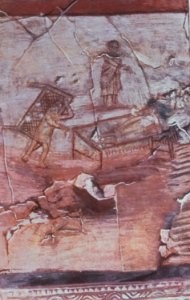
One of my classmates mentioned that the first painting of Jesus to date was found in a church in Syria. The portrait depicts Jesus healing a paralytic who was brought to him. Jesus is physically portrayed as a beardless, dark-skinned, short-haired man, who is also short in stature. The painting dates to around 235 and is among the earliest paintings of Jesus to date. The Shroud of Turin, if authentic, portrays Jesus as a long-haired, bearded man. Which depiction is accurate? Furthermore, does it really matter?

This exercise hBrianChilton261119as forced me to consider how much we seek to make Jesus into our own image. For a southern, Caucasian, American; one would feel comfortable seeing Jesus as a camouflage wearing, gun-toting, bandana adorning, Patriotic citizen. For a northern, black, American; one would feel comfortable a Jesus who was a civilized, pacifist, progressive defender of human rights. But the question is, do we make Jesus into our image ,or are we willing to be made into the image of Christ? Would we still love Jesus if he holds different perspectives than we do? Would we still love Jesus if he looked very different than us? As people, we like things that are like us.

The very nature of Jesus is far and away different from all of us. Remember, Jesus was perfect. We are not. No matter how he looked physically, he was the incarnate God and we are not. Paul notes that those whom God “foreknew he also predestined to be conformed into the image of his Son, so that he would be the firstborn among many brothers and sisters” (Rom. 8:29, CSB). Our goal is to be made into the image of Christ and not to make Christ into our image. No matter whether Jesus was over six feet tall and light-skinned or five feet tall and dark-skinned, he is the Logos incarnate—God who came in flesh. Athanasius of Alexandria (AD 296–373), a man who was named the “black dwarf,” noted that the Logos of God

“accommodated himself to our nature and showed himself empty of all [his divine qualities] in the face of the anxiety of the threatening onslaught of his trials … [Christ] became Man that we might be made God: and He manifested Himself through the body that we might take cognizance of the invisible Father: and He underwent insult at the hands of men that we might inherit immortality” (Athanasius of Alexandria, On the Incarnation of the Word of God 54).

Isaiah reminds us that the Messiah did not come with an impressive form. The Messiah did not possess any “majesty that we should look at him, no appearance that we should desire him” (Isa. 53:2, CSB). In other words, Jesus did not come as a fashion model or bodybuilder that you would be impressed with his physical form. What made Jesus special was that he was the incarnate God who came to save us from our plight of sin.

It makes no difference whether Jesus was light-skinned or dark-skinned, tall or short, bearded or beardless, short-haired or long-haired. What matters is that Jesus was thoroughly perfect in his morality, impeccable in his character, and powerful in his theology. He was God who came in flesh. Thus, we should seek to be made into Christ’s image rather than seeking to make Jesus into our own image. No one has a handle on Jesus. No one ever could. As such, Jesus is far more impressive and far more challenging than you ever thought him to be.

Recommended resources related to the topic:

What is God Really Like? A View from the Parables by Dr. Frank Turek (DVD, Mp3, and Mp4)

What is God Like? Look to the Heavens by Dr. Frank Turek (DVD and Mp4)

Jesus, You and the Essentials of Christianity – Episode 14 Video DOWNLOAD by Frank Turek (DVD)


Brian G. Chilton is the founder of BellatorChristi.com, the host of The Bellator Christi Podcast, and the author of the soon to be released book The Layman’s Manual on Christian Apologetics. He received his Master of Divinity in Theology from Liberty University (with high distinction); his Bachelor of Science in Religious Studies and Philosophy from Gardner-Webb University (with honors); and received certification in Christian Apologetics from Biola University. Brian is currently enrolled in the Ph.D. program in Theology and Apologetics at Liberty University and is a member of the Evangelical Theological Society and the Evangelical Philosophical Society. Brian has been in the ministry for nearly 20 years and serves as the Senior Pastor of Westfield Baptist Church in northwestern North Carolina.

Original Blog Source: http://bit.ly/37Bnunj

A clip from Skillet frontman John Cooper has recently been making the rounds on social media. In it, Cooper is heard saying that “it is time to declare war on this idolatrous deconstruction Christian movement.”

And just like that, the Christian community split.

One set of people claims that Cooper is causing further harm to Christians who are already struggling with their faith. The other set of people is praising Cooper for taking a stand against the so-called “Christian deconstruction movement.” So which is it?

What Do We Mean By The Deconstruction Movement?

The process of deconstruction usually goes like this: an influential, self-proclaimed Christian announces to their thousands/millions of fans that they no longer believe in the faith on which their careers were built. Through the process of “deconstruction,” they now realize that X, Y, and Z questions have no good answers (usually things that theologians have been discussing for hundreds of years). [i] Due to this perceived lack of answers (and usually accompanied by stories of “harm” they have seen within the church), they can no longer call themselves Christian or trust the Bible. [ii] They are all about some Jesus, but they feel the need to apologize to all the people they may have hurt back when they adhered to biblical principles. [iii]

There’s another word for this phenomenon. It’s called apostasy or deconversion, and it’s not a new thing. [iv] Since the beginning of Christianity, we’ve seen some people who have apostatized (i.e., walked away) from the faith. The Early Church was dealing with this within the first generation of Christianity (2 Timothy 4:12 Peter 2:20-221 John 2:19, and more…).

But we are talking about more than a process here; we are talking about a genuine movement. If I were to break it down, I’d say a movement consists of 1) a group of people who are 2) journeying together 3) for a common purpose and 4) gaining adherents. The new category “Christian deconstruction” fits all the criteria.

Not only are people questioning the tenets of the faith, but they are finding community with others doing the same thing. That’s the whole point of adopting the label: it gives them a group to belong to.

Sometimes they see themselves as the only ones bold enough to question traditional Christian teachings. And when they meet others who are questioning like themselves, they lock arms and buckle down together. And like any movement, those who most fervently embrace the label are trying to get others to join them on the quest — in this case, by vocal and public “deconstruction” announcements intended to evangelize listeners into the club.

What are deconstructionists really questioning?

A lot of this comes down to the problem of word choice and linguistic theft. Classically, deconstruction involves a postmodern view of language. It denies that a text has any objective meaning, or if it does, that the meaning can be objectively known (see chapter 8 in Mama Bear Apologetics). This translates directly into how a person reads the Bible.

Once you doubt that you can even know what the Bible really says, very few people are willing to take the time to “reconstruct” their faith according to what the Bible teaches. It’s a catch-22.

The people who adopt the banner of deconstruction often deny (at least at first) that they are undergoing classic deconstructionism. They claim that their end goal is a purer faith, one which has stripped away the “traditions of men” that Jesus denounced in Mark 7:8. [v] They are like the reformers, or as reformers are called now, the “original deconstructionist.”

Mama Bears, this is not true (or even possible), and here’s why. First, anything which assumes that the Bible has original meaning to which we should return is by definition the opposite of deconstructionism. Deconstructionist philosophy claims that meaning and the text are separate and subjective.

Second, claiming to “reject” classic deconstructionism while redefining the word deconstructionist to include reformation is itself a classic deconstructionist move! It treats the meanings of words as moldable to a person’s subjective whims. This is literally the first step in the classic, postmodern, Jacques Derrida-style deconstructionist movement that they are trying to distance themselves from. A person may not know that’s the road they are walking down, but they are. And the end of that road is relativism, friends, not a “purer faith.”

Why We Need To Be Careful How We Identify

The words we use matter. The identities that we speak over ourselves matter. I understand why some people were offended by John Cooper’s comments. As one of my sweet friends put it:

“When someone says they are declaring *war* on a movement, the people who compose that movement or are considering ideas from that movement are reasonably likely to feel like they are perceived as the enemy.”

There is a very simple solution to this problem, and we shouldn’t be afraid of saying it: don’t claim to be a part of a movement that has always (until just recently) been associated with deconversion, apostasy, and rebellion against God. It will not go well for you.

Be a struggling Christian. Be a questioning Christian. Be a wounded sheep if that’s what you are. But when you start marching under the identity “deconstructing Christian,” you are taking on all the weighted baggage that comes with that word. It would be like saying, “I’m a wolf, and by wolf, I mean I’m a struggling Christian who needs care and compassion.” Just because you have changed the definition doesn’t mean that everyone else is now required to use a different word to denounce wolves. Or that the Bible is causing harm by warning Christians against wolves! (Luke 10:3Acts 20:29)

How Do You Approach A Child Who Thinks They Are “Deconstructing” Their Faith?

We want to be loving toward those who are struggling in the faith, and we should actively be involved in helping to “snatch them from the fire” (Jude 1:22-23). So, what can we do as parents?

1. DO allow for verbal processing (the good, the bad, and the ugly).

The first thing to do is ask them questions and then just listen — without judgment. This means they may say things that are nonsense. Let them say nonsensical things. As verbal processors know, sometimes you need to get out a whole lot of things that aren’t really the issue to finally uncover the actual issue. If you keep stopping them in this process to address factual errors, neither they nor you will ever get to the bottom of what’s actually going on in their heart.

2. DON’T stop at the brain-dump conversation phase.

As I mentioned above, often people aren’t even sure what the real problem is. And who knows how long it’ll take to uncover the actual issue? A kid may list out everything they heard on some podcast as their “reasons” before you finally uncover the root problem, like how rejected they feel by their peers at youth group. Or how hurt they are over a parental divorce. Or how angry they are at an unanswered prayer request.

3. DO follow up with clarifying questions (after brain dump).

At some point, the nonsensical things will need to be addressed. The initial brain dump isn’t the time. After they start feeling some relief at being able to express their doubts, then you can start gently asking more clarifying questions (remember, 1 Peter 3:15 doesn’t just say give a defense…it says to do so with gentleness and respect).

4. DON’T agree with their faulty definitions or new identity.

If they say they are deconstructing, it is perfectly okay to ask them what they mean by that. If they are just questioning, then remind them, “It sounds like you just have questions. Do you mind if we use the word ‘questioning’ to refer to what is going on so that you don’t accidentally lump yourself in with a word that has a lot of baggage?” Or maybe they are a “wounded sheep.” Or maybe they are a struggling Christian who is having difficulty submitting their desires to God’s authority. Whatever the issue, how they choose to identify themselves matters.

The truth is words are not meaningless. Jesus Himself is called “the WORD made flesh.” Our enemy is like a roaring lion, seeing whom he can devour. He would absolutely love for us to assume a new identity and to march under his banner, even if we don’t know what we are doing. The more your child identifies him or herself as “deconstructing,” the more they will entertain the conclusions that other deconstructionists have concluded.

We can’t answer all their questions for them. But we can at least prevent them from assuming an identity which, in most cases, serves to woo them away from the faith. And even more, we can help protect them from feeling attacked when Christians speak out against the evils of deconstruction.

References: 

[i] See Marty Sampson’s deconstruction story.

[ii] Such are the stories from people like Marty Sampson (a former worship leader of Hillsong Church), Joshua Harris (author of I Kissed Dating Goodbye), Rhett and Link (comedians and popular YouTubers), and Jon Steingard (former frontman of the Christian band, Hawk Nelson).

[iii] For an example, see Joshua Harris’s deconversion story.

[iv] [Editor’s note: While people sometimes use these terms – “deconstruction and deconversion” – as synonyms, there aren’t always interchangeable. A person could be in a doubting phase that they describe as “deconstruction,” but they are haven’t rejected Christianity. Deconstruction and deconversion, however, are often so deeply interrelated that they overlap, or even become indistinguishable in practice.]

[v] There are a few stories of individuals who claim to have “deconstructed” their faith and rebuilt it into something stronger. I would still say that they are using the wrong word, however. True deconstruction does not leave room for reconstruction.

Recommended Resources:

I Don’t Have Enough Faith to Be an Atheist’ [FOUR unique curriculum levels for 2nd grade through to adult] by Frank Turek👉📱https://bit.ly/3ZqepsR 

Stealing From God by Dr. Frank Turek: Book👉📱https://cutt.ly/II4j464, 10 part DVD Set👉📱https://cutt.ly/FI4krhS, STUDENT Study Guide👉📱https://cutt.ly/jI4kp03, TEACHER Study Guide👉📱https://cutt.ly/5I4kjdA

Jesus vs. The Culture by Dr. Frank Turek 👉📱https://bit.ly/3nUJYsP 

Correct, Not Politically Correct: About Same-Sex Marriage and Transgenderism 2023 Edition by Dr. Frank Turek Book👉📱https://bit.ly/3qws2ZL  


Hillary Morgan Ferrer is the founder of Mama Bear Apologetics. She is the chief author and editor of Mama Bear Apologetics: Empowering Your Kids to Challenge Cultural Lies and Mama Bear Apologetics Guide to Sexuality: Empowering Your Kids to Understand and Live Out God’s Design. Hillary has her masters in Biology and has been married to her husband, Dr. John D. Ferrer, for 17 years. Don’t let her cook for you. She’ll burn your house straight to the ground. Image source: Hillary-Morgan-Ferrer-Square-2.jpg (1500×1500)

Originally posted at: https://bit.ly/4fhL7n6


Sean McDowell, professor of Christian Apologetics at Biola University, on his blog, lists the top ten apologetic books for beginners with short descriptions of each.

He includes:

  1. Mere Christianity, by C.S. Lewis
  2. More Than a Carpenter, by Sean and Josh McDowell
  3. The Reason for God, by Tim Keller
  4. The Case for Christ, by Lee Strobel
  5. Cold-Case Christianity, by J. Warner Wallace
  6. Tactics: A Game Plan for Discussing Your Christian Convictions, by Greg Koukl
  7. Love Thy Body: Answering Hard Questions about Life and Sexualityby Nancy Pearcey
  8. On Guard: Defending Your Faith with Reason and Precision, by William Lane Craig
  9. Confronting Christianity: 12 Hard Questions for the World’s Largest Religion, by Rebecca McLaughlin
  10. Evidence that Demands a Verdict, by Sean and Josh McDowell

I would add the following books to the list:

  1. I Don’t Have Enough Faith to be an Atheist by Norman Geisler and Frank Turek – One of the best complete introductions to apologetics that covers truth, God’s existence, reliability of the Bible, miracles, and the resurrection.
  2. Can We Trust the Gospels? by Peter J. Williams – A focused, but accessible small book on the trustworthiness of the Gospels.

Plus a Series of Books by Paul Copan

  1. True For You, But Not For Me: Deflating the Slogans That Leave Christians Speechless by Paul Copan
  2. That’s Just Your Interpretation: Responding to Skeptics Who Challenge Your Faith by Paul Copan
  3. How Do You Know You’re Not Wrong? Responding to Objections That Leave Christians Speechless, Paul Copan
  4. When God Goes to Starbucks: A Guide to Everyday Apologetics by Paul Copan

And of course, let’s not forget Sean McDowell co-authored work with Jonathan Morrow:

  1. Is God Just a Human Invention? And Seventeen Other Questions Raised by the New Atheists by Sean McDowell  (Author), Jonathan Morrow

[Editor’s note: Another Bestselling apologetics book, that’s been introducing people to apologetics (and I can vouch for it myself, JDF) is . . .

  1. Mama Bear Apologetics: Empowering Your Kids to Challenge Cultural Lies by Hillary Ferrer

Recommended Resources: 

I Don’t Have Enough Faith to Be an Atheist (Paperback), and (Sermon) by Norman Geisler and Frank Turek 

Stealing From God by Dr. Frank Turek (Book, 10-Part DVD Set, STUDENT Study Guide, TEACHER Study Guide)

Tactics: A Game Plan for Discussing Your Christian Convictions by Greg Koukl (Book)

Jesus, You and the Essentials of Christianity by Frank Turek (INSTRUCTOR Study Guide), (STUDENT Study Guide), and (DVD)      


J. Steve Lee has taught Apologetics for over two and a half decades at Prestonwood Christian Academy.  He also has taught World Religions and Philosophy at Mountain View College in Dallas and Collin College in Plano.  With a degree in history and education from the University of North Texas, Steve continued his formal studies at Southwestern Baptist Theological Seminary with a M.A. in philosophy of religion and has pursued doctoral studies at the University of Texas at Dallas and is finishing his dissertation at South African Theological Seminary.  He has published several articles for the Apologetics Study Bible for Students as well as articles and book reviews in various periodicals including Philosophia ChristiHope’s Reason: A Journal of Apologetics, and the Areopagus Journal.  Having an abiding love for fantasy fiction, Steve has contributed chapters to two books on literary criticism of Harry Potter: Harry Potter for Nerds and Teaching with Harry Potter.  He even appeared as a guest on the podcast MuggleNet Academia (“Lesson 23: There and Back Again-Chiasmus, Alchemy, and Ring Composition in Harry Potter”).  He is married to his lovely wife, Angela, and has two grown boys, Ethan and Josh.

Originally posted at: https://bit.ly/3UwH3ag

The DNA replisome is one of the most remarkable molecular machines, involving a complex of different proteins, each of which is very specifically crafted to fulfill its role in the process of replicating the genome in preparation for cell division. The rate of DNA replication has been measured at a whopping 749 nucleotides per second[1] and the error rate for accurate polymerases is believed to be in the range of 10-7 and 10-7, based on studies of E. coli and bacteriophage DNA replication.[2]

One of the best animations of this incredible process is this one by Australian animator Drew Berry. It is difficult to look at an animation such as this (which is drastically over-simplified) and not come away with the strong intuition that such an intricately choreographed machine is the product of masterful engineering. Stable and functional protein structures are astronomically rare in combinatorial sequence space, and DNA replication requires many of them. But not just any old stably folding proteins will do. These proteins have to be crafted very particularly in order to perform their respective jobs. Indeed, when one focuses on specific proteins, it takes the design intuition to new heights. For example, see these beautiful animations of topoisomerasehelicase, and DNA polymerase. One paper summarizes the engineering prowess of DNA replication thus [3]:

Synthesis of all genomic DNA involves the highly coordinated action of multiple polypeptides. These proteins assemble two new DNA chains at a remarkable pace, approaching 1000 nucleotides (nt) per second in E. coli. If the DNA duplex were 1 m in diameter, then the following statements would roughly describe E. coli replication. The fork would move at approximately 600km/hr (375 mph), and the replication machinery would be about the size of a FedEx delivery truck. Replicating the E. coli genome would be a 40 min, 400 km (250 mile) trip for two such machines, which would, on average make an error only once every 170 km (106 miles). The mechanical prowess of this complex is even more impressive given that it synthesizes two chains simultaneously as it moves. Although one strand is synthesized in the same direction as the fork is moving, the other chain (the lagging strand) is synthesized in a piecemeal fashion (as Okazaki fragments) and in the opposite direction of overall fork movement. As a result, about once a second one delivery person (i.e. polymerase active site) associated with the truck must take a detour, coming off and then rejoining its template DNA strand, to synthesize the 0.2km (0.13 mile) fragments.[3]

Irreducible Complexity on Steroids

DNA replication is an example of what we might call “irreducible complexity on steroids.” Genome duplication is a prerequisite of differential survival, which is necessary for the process of natural selection to even work. Thus, one can hardly appeal to natural selection to account for the origins of DNA replication without assuming the existence of the very thing one is attempting to explain. It is difficult to envision a viable replication system that is simpler than the DNA replisome shown in the animation above. Though the RNA world scenario (which maintains that RNA-based life predates life based on DNA and proteins) is a popular hypothesis, problems abound for this scenario, as has been discussed many times in various other publications (e.g., Meyer, Signature in the Cell, Ch. 14). For example, one of the foremost challenges is the inherent instability of RNA (being single-stranded, and possessing an additional 2’ OH group, rendering it prone to hydrolysis). RNA polymers are therefore extremely unlikely to have survived in the early earth environment for long enough to be of much value. Second, when RNA forms complementary base pairs to fold back on itself, part of the molecule no longer presents an exposed strand that can serve as a template for copying. Thus, there is a physical limitation on the capability of RNA to self-replicate.

A further reason why the DNA replication machinery exhibits irreducible complexity on steroids is that, by being so primitive, it is far more difficult to envision any kind of co-optation scenario than it would be for a system that arose much later, such as bacterial flagella. With the flagellum, one can at least point to alternative functions that might be performed by a number of the flagellar components (such as the Type-III Secretion System). However, with DNA replication, it is unclear what other systems any of the components might be co-opted from – since any other system would need to have arisen after the origins of DNA replication.

An even more striking enigma is that, across the three domains of life, the key enzymes (in particular, the replicative polymerases) are not homologous, which has led to the suggestion that DNA replication may have arisen more than once independently.[4] This observation sits more comfortably on a design paradigm than on one committed to naturalism.

Which Components Are Essential for DNA Replication?

What protein components that are involved in DNA replication are indispensable for function? First, there is the DNA polymerase that actually performs the copying of each strand. Without it, no replication would take place at all. But, the DNA polymerase is unable to begin replication without the presence of a free 3’ OH (hydroxyl) group. Thus, another enzyme — a form of RNA polymerase called a primase — creates a short RNA fragment (called a primer) from which the DNA polymerase can extend (unlike DNA polymerase, the primase does not require the presence of a free 3’ OH group). Thus, in the absence of the primase enzyme, no RNA primers would be laid down on either the leading or lagging strand, and DNA replication would be unable to commence. Furthermore, the DNA polymerase itself has to be attached to the DNA by a ring-shaped protein known as a sliding clamp (which prevents it from falling off the DNA template strand). But, the sliding clamp cannot directly attach to the DNA on its own. Instead, a protein complex called the clamp loader mediates the loading of the sliding clamp onto the DNA at the replication fork, utilizing the energy from ATP hydrolysis to open the sliding clamp ring and load it onto the DNA. In the absence of the sliding clamp or clamp loader, the DNA polymerase would frequently fall off the DNA template, rendering it extremely inefficient.

Of course, the replication process cannot begin unless the DNA double helix is unzipped, and this is accomplished by the enzyme helicase, which breaks the hydrogen bonds along the DNA molecule, thereby opening up and exposing the two strands for replication by the polymerase. In its absence, the DNA polymerase will stall, unable to separate the strands that lie ahead.

Even with the helicase enzyme separating the two strands, the strands are likely to reanneal during the copying process. Enter the single-stranded binding proteins which bind to the exposed DNA strands, preventing them from re-annealing during copying. Without them, the DNA strands would bind together again before they were able to be copied.

The topoisomerase enzymes are necessary for removing supercoils that are induced by the torsional stress. They do so by cutting one strand, passing the other strand through the gap, and then resealing the break. In the absence of the topoisomerase enzymes, the DNA would eventually break, thereby hindering the DNA replication process.

Because of the anti-parallel nature of DNA (and the fact that the DNA polymerase can only replicate in a 5’ to 3’ direction), one strand, the lagging strand, has to be replicated backwards (in order for the replication fork to move in a single direction). This is done discontinuously in small sections. RNA primers are laid down by primase, and from those are synthesized short fragments of DNA known as Okazaki fragments. The RNA primers are then removed and replaced with DNA, and the Okazaki fragments are stitched together by the enzyme ligase. We have already discussed the necessity of the primase enzyme for synthesizing RNA primers. It may be added that, in the absence of the RNA excision enzymes (which remove the RNA primers), the RNA fragments would remain covalently attached to the newly replicated fragments of DNA. Moreover, in the absence of ligase (which links the Okazaki fragments together), the newly replicated strands would remain as fragments.

If the removal of any of the aforementioned components would render the DNA replication machinery non-functional, how could such a system come about through an undirected Darwinian step-wise pathway, preserving selective utility at every step along the way? Whatever process produced the DNA replisome had to know where the target was. Such a cause would have to be teleological in nature.

A Paradigm of Design

The DNA replication machinery represents one of the most extraordinary examples of nanotechnology found in the cell. In any other realm of experience, such a complex and delicate arrangement of parts would be immediately recognized as reflecting conscious intent — that is, as being the product of a mind. Why should such an inference be disallowed when examining biological systems? For more detail on this fascinating molecular machine, see my interview on it from last summer on ID the Future. I also published an earlier series (more than a decade ago) exploring the various protein components in more detail. You can find these here:

If you enjoyed the animation by Drew Berry linked at the beginning of this article, here is a more detailed animation, produced by Oxford University Press. Here is a second animation which reveals how the DNA polymerases are coupled so that they can move in the same direction.

References: 

[1] McCarthy D, Minner C, Bernstein H, Bernstein C. DNA elongation rates and growing point distributions of wild-type phage T4 and a DNA-delay amber mutant. J Mol Biol. 1976 Oct 5;106(4):963-81.

[2] Schaaper RM. Base selection, proofreading, and mismatch repair during DNA replication in Escherichia coli. J Biol Chem.1993 Nov 15;268(32):23762-5.

[3] Baker TA, Bell SP. Polymerases and the replisome: machines within machines. Cell. 1998 Feb 6;92(3):295-305.

[4] Leipe DD, Aravind L, Koonin EV. Did DNA replication evolve twice independently? Nucleic Acids Res. 1999 Sep 1;27(17):3389-401; and Brown JR, Doolittle WF. Archaea and the prokaryote-to-eukaryote transition. Microbiol Mol Biol Rev. 1997 Dec;61(4):456-502.

Recommended Resources:

Why Science Needs God by Dr. Frank Turek (DVD and Mp4)

Science Doesn’t Say Anything, Scientists Do by Dr. Frank Turek (DVD, Mp3, and Mp4)

Oh, Why Didn’t I Say That? Does Science Disprove God? by Dr. Frank Turek (DVD and Mp4)

I Don’t Have Enough Faith to Be an Atheist (Paperback), and (Sermon) by Norman Geisler and Frank Turek


Dr. Jonathan McLatchie is a Christian writer, international speaker, and debater. He holds a Bachelor’s degree (with Honors) in forensic biology, a Masters’s (M.Res) degree in evolutionary biology, a second Master’s degree in medical and molecular bioscience, and a Ph.D. in evolutionary biology. Currently, he is an assistant professor of biology at Sattler College in Boston, Massachusetts. Dr. McLatchie is a contributor to various apologetics websites and is the founder of the Apologetics Academy (Apologetics-Academy.org), a ministry that seeks to equip and train Christians to persuasively defend the faith through regular online webinars, as well as assist Christians who are wrestling with doubts. Dr. McLatchie has participated in more than thirty moderated debates around the world with representatives of atheism, Islam, and other alternative worldview perspectives. He has spoken internationally in Europe, North America, and South Africa promoting an intelligent, reflective, and evidence-based Christian faith.

This article was originally published on March 21st, 2024, at Evolution News & Science Today.

And republished at: https://bit.ly/4f6pp5q

You have probably heard it said, “You have to prove that scientifically.” Or even in news reports that “studies have shown . . . ”  Or maybe you have heard that science is the final or ultimate source of knowledge. Behind these sentiments may lie a belief called “scientism.”  This mentality has even been put simply: “If I can’t see it, hear it, or feel it, it doesn’t exist.”[i]

What is Scientism?

This belief elevates science to a place of religious devotion and is known as “scientism.” Scientism is the idea that we should believe only what can be proven scientifically. That is, science is the sole source of knowledge and truth.

No doubt, science is a wonderful means of finding out truths about the world and a means of knowledge about the natural world, but science is not the final arbiter of truth. Nevertheless, some claim (or even act as if) science is the only means of knowledge and truth. Here are some examples of people asserting scientism:

  • “Whatever knowledge is attainable must be attained by scientific methods; and what science cannot discover, mankind cannot know” – (Bertrand Russell Religion and Science, 243).
  • “Traditionally, these are questions for philosophy, but philosophy is dead. Philosophy has not kept up with modern developments in science, particularly physics. Scientists have become the bearers of the torch of discovery in our quest for knowledge” – (Stephen Hawking The Grand Design, 13).
  • “Science, as the only begetter of truth” – (Richard Lewontin, The New York Review of Books1/9/97).
  • “We trust science as the only way to acquire knowledge. That is why we are so confident about atheism” – (Alex Rosenberg The Atheist’s Guide to Reality, 20).

Problems with Scientism

Despite all the acclaim, there are several problems with scientism:

Scientism is too restrictive. If science were the only source and final arbitrator of knowledge and truth, then whole fields of knowledge and truth would have to be abandoned, which most of us consider legitimate truths and knowledge claims.  For example, if science is the only source of truth, we would have to abandon mathematical truths, historical knowledge, logical, moral, and aesthetic truths.  Any theory of knowledge (such as scientism) that excludes these obvious avenues of truth must be abandoned before you abandon these truths.

Scientism is self-refuting – If the only source of knowledge and truth is science, then the claim that “the only source of knowledge and truth is science” is not knowable or true. Why? Because the claim is not true “because of science” or” known through science,” and if science is not known by science, you shouldn’t believe that only science leads to truth and knowledge.

Science is a great and noble discipline. We gain much knowledge and truth through it and will continue to gain knowledge and truth through science. But let’s not come with the mistaken belief that science is the best or only means of truth and knowledge. The attitude that only science can lead to knowledge and truth is unwarranted, misleading, and self-contradictory.

Scientism has been Thoroughly Discredited

In his excellent work Love Your God With All Your Mind, J. P. Moreland shares why we should reject scientism:

“What I do reject is the idea that science and science alone can claim to give us knowledge. This assertion—known as scientism—is patently false and, in fact, not even a claim of science but rather a philosophical view about science.”[ii]

William Lane Craig dismantles the claim that Peter Atkins, a professor at Oxford University, makes that science accounts for everything: [Video]. See also, “Is Scientism Self-Refuting?” Reasonable Faith, Mar 21, 2011

J.P. Moreland, the author of Scientism and Secularism, discusses this issue of scientism in this video. See also, Scientism and Secularism: Learning to Respond to a Dangerous Ideology(Crossway: 2018)

J. Warner Wallace refutes it in “The Dangers of ‘Scientism’ and an Over-Reliance on Science”Cold-Case Christianity (8 Sept. 2023).

Edward Feser also discredits this theory in “Blinded by Scientism” Public Discourse (9 March 2010).

For more Scientific Apologetics from Steve Lee see:

References:

[i] Editor’s Note: Scientism is often paired with empiricism, which is the idea that knowledge/truth can only be accessed through one’s empirical senses (touch, taste, sight, etc.).

[ii] J.P. Moreland, Love God with All Your Mind (Colorado Springs: NavPress, 1997), p. 33-34.

Recommended Resources:

Why Science Needs God by Dr. Frank Turek (DVD and Mp4)

Science Doesn’t Say Anything, Scientists Do by Dr. Frank Turek (DVD, Mp3, and Mp4)

Oh, Why Didn’t I Say That? Does Science Disprove God? by Dr. Frank Turek (DVD and Mp4)

Stealing From God by Dr. Frank Turek (Book, 10-Part DVD Set, STUDENT Study Guide, TEACHER Study Guide)


J. Steve Lee has taught Apologetics for over two and a half decades at Prestonwood Christian Academy.  He also has taught World Religions and Philosophy at Mountain View College in Dallas and Collin College in Plano.  With a degree in history and education from the University of North Texas, Steve continued his formal studies at Southwestern Baptist Theological Seminary with a M.A. in philosophy of religion and has pursued doctoral studies at the University of Texas at Dallas and is finishing his dissertation at South African Theological Seminary.  He has published several articles for the Apologetics Study Bible for Students as well as articles and book reviews in various periodicals including Philosophia ChristiHope’s Reason: A Journal of Apologetics, and the Areopagus Journal.  Having an abiding love for fantasy fiction, Steve has contributed chapters to two books on literary criticism of Harry Potter: Harry Potter for Nerds and Teaching with Harry Potter.  He even appeared as a guest on the podcast MuggleNet Academia (“Lesson 23: There and Back Again-Chiasmus, Alchemy, and Ring Composition in Harry Potter”).  He is married to his lovely wife, Angela, and has two grown boys, Ethan and Josh.

Originally posted at: https://bit.ly/4fELbgL