
Tag Archive for: Gospel

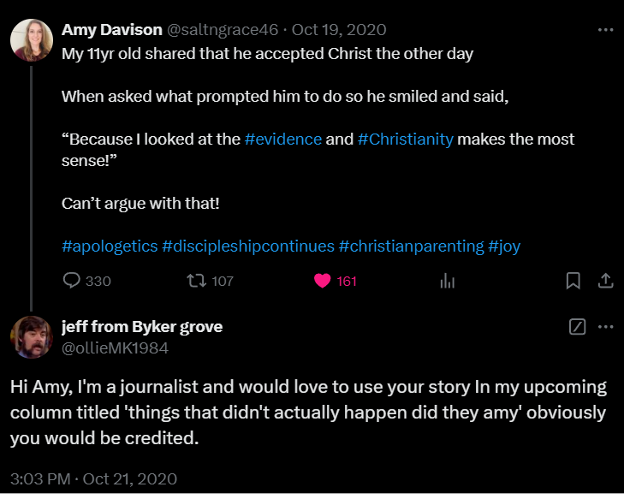
For almost a week in late 2020, my 11-year-old son practically went viral on the Internet, and he doesn’t even know it. Let me tell you why. You see, he had walked out onto our back deck and, cool as a cucumber, announced to my husband and me that he had accepted Jesus as his Savior. Needless to say, we were pleasantly caught off guard.

“Oh? When did this happen?” I asked.

“The other night. Yup,” he nodded in a very Young Sheldon-esq way, “I looked at the evidence and Christianity makes the most sense.” Then, away he went to build a new Lego creation.

We had a good chuckle over his matter-of-fact confession. I thought my apologetics friends would, too, so I hopped on Twitter and shared the amusing scene. I didn’t think it would make much of a blip on the social network but mamas. . .  Twitter. Lost. Its. Mind.

In just hours, my tweet had 100,000+ views and a torrent of comments. I thought my phone was busted because it wouldn’t stop dinging. The majority of people interacting were split between being furious that he accepted Christ or denying that this even happened.

Here are a couple of examples:
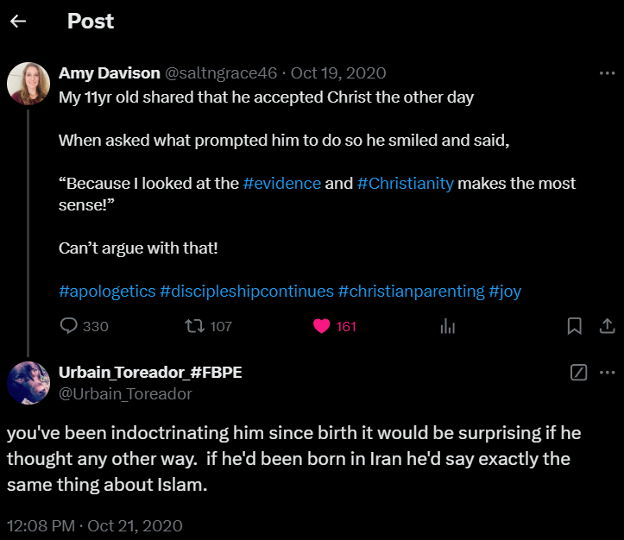
The tweet was even nominated for a “Didn’t Happen In Real Life” Twitter award which, hilariously, is actually a thing. [i]

For those few days, we waffled between amusement and sadness. People weren’t just skeptical, some were downright vile. When Christ said we will be hated because of our belief, He wasn’t kidding.

Making Sense of the Twitter Minefield

As I sorted through the comments, I noticed that most of the hatred revolved around a few main challenges toward Christian parenting. Each have their own valid concern and, sadly, their own wound. Most parents will be accused of at least one of these, but let me encourage you, each can easily be debunked. Ready?

  1. “Your child isn’t mature enough.”
    The first big reason I saw floating amidst the tweets was the claim that kids can’t make a decision about their faith because their brains haven’t fully matured. Had my son said he was pro-choice, anti-Trump, atheist, or identifed as a different gender, these same critics probably wouldn’t have had a problem. [ii] But believe in Jesus? Not a chance.

Had my son said he was pro-choice, anti-Trump, atheist, or identifed as a different gender, these same critics probably wouldn’t have had a problemClick To Tweet

They’re right that children’s brains aren’t fully developed, but they kinda shoot themselves in the foot, too. The human brain isn’t fully formed until around the age of 25. Yet, it continues to develop and sharpen critical reasoning skills for the duration of a person’s life. [iii] When then, is the cognitive finish line? At the very least, this argument would mean that we couldn’t discuss Christianity ’til our kids are middle aged and starting families of their own. Talk about ridiculous.

Secondly, just because a person has reached the age where their brain is developmentally mature, it doesn’t guarantee they’ll make informed sound decisions. I mean, have you been on a college campus lately?! If we’re going to implement standards on when a person is capable of making important decisions like faith, age won’t always cut it.

With this in mind, I agree with the critics to an extent. I get a bit nervous when some adorable little moppet needs water wings to enter the baptismal. Sure, their confession warms the heart, but sometimes I wonder how much they really understand about walking in the Christian faith. Will they stand firm in their youth like Timothy? Or end up like the adult waiting behind them to be rebaptized because they didn’t know what they were getting into at such a young age? It’s not for me to say. What I can say is that the Holy Spirit can move in the young just as much as the old and in-betweens. A child is more than capable of understanding the basics of theology, logic, apologetics, and worldviews to make their own personal informed decision. Sometimes we don’t give the littlest among us enough credit.

  1. “You’re obviously indoctrinating them.”
    Every time I see someone toss out the word indoctrination, my inner Inigo Montoya thinks, “You keep using that word. I do not think it means what you think it means.”And for the most part, Montoya is dead on. Indoctrination means that ideas are taught to be accepted uncritically. You don the robe, drink the Kool-Aid, and don’t you dare ask what’s in it. [iv]

The sad part is that a lot of adults wanting to slam Christians with indoctrination charges are reacting from their own or another’s bad experiences, not because they’ve seen how you run your household. They may have had a parent who would throw a fit if they asked a question. Perhaps a pastor accused them of being sinful for having doubts. Some felt that their family’s love depended on them accepting their parent’s faith. Is it any wonder why they’d be skeptical?

Here’s the thing: just because some kids have been bullied into the faith, doesn’t mean all of them have. If kids are allowed to interact with other worldviews, practice critical thinking, explore challenges to the faith, and decided for themselves if they want to accept Christianity, then they are not being indoctrinated, they’re being educated.

If kids are allowed to interact with other worldviews, practice critical thinking, explore challenges to the faith, and decided for themselves, then they are not being indoctrinated, they’re being educated.Click To Tweet

  1. “Only atheists are critical thinkers.”
    This argument trails closely behind the indoctrination challenge and goes something like this: Only atheists are critical thinkers. Why? Because they’re atheists. Christians couldn’t be critical thinkers because if they were, they would be atheists. If this sounds a bit circular to you, that’s because it is.

A lot of the problem stems from the false belief that to think critically, you have to abide by the rules of naturalism. If any evidence is outside of nature (which is where we get the term supernatural) or if evidence points to God, then it has to be tossed aside because you can’t think critically by using it. [v] Talk about linguistic theft!

Folks, if someone thinks that Christians can’t be critical thinkers simply because they accepted Christianity, then they need to acquaint themselves with the real definition of critical thinking and a few people like Robert Boyle, Isaac Newton, and George Washington Carver. All were great critical thinkers, scientists, and engineers. And all of them were *spoiler alert* Christians!

  1. “They’re only Christians because you are.”
    Let’s cut to the chase. When someone says that a kid is only a Christian because their parents are, they’re committing what’s called the genetic fallacy. Under the genetic fallacy, a belief can be tossed aside based on where it came from.  Remember when Nathanael in John 1:46 asked if anything good can come from Nazareth? Yeah, his “if it’s from Nazareth it’s bad,” mindset is an example of a genetic fallacy.

Toss in challenge #3, and your kids couldn’t be Christians because of the working of the Holy Spirit, being taught how to evaluate arguments, seeing the philosophical implications of varying worldviews, or evaluating the evidence for and against God. The only reason your kids are Christians is because you are, and that’s bad . . . . bad logic that is.

If kids are only Christians because their parents are, then there wouldn’t be any Christian parents with Muslim kids or atheist parents with Christian kids. Ironically, when the atheist who tweeted this shared that they had Christian parents, they debunked their own argument. [vi] All parents, regardless of their beliefs, shape their child’s worldview. Ultimately, it’s up to the child what they choose to believe.

The Real Issue

For the grand finale, we welcome Captain Obvious to the stage. The biggest reason folks get their boxers in a bunch over a child’s declaration of faith is because *drumroll please* . . . . they picked Christianity. Mamas, this is no mystery. Jesus said that we will be hated because of His name (Matthew 10:22). This includes our children. Sure, the Twitter haters will use the above challenges to dismiss your child’s confession of faith, but deep down, the real issue is that they hate Christianity. Maybe they’ve been hurt in the past, maybe they’ve bought into our culture’s current view that paints Christians as synonymous with Stalin. Regardless of the reason, if your child is a Christian, they will be seen as either a victim or an enemy. Both for which you are to blame.

Like most Twitter trends, the ruckus over my guy’s confession of faith eventually died down. I didn’t engage with the mob much mainly because arguing on Twitter is a lot like getting into a shouting match with your mailbox. Sure, what you’re saying may be true. But to everyone watching, you look like an idiot. When it comes to social media, you gotta know when it’s pointless to cast your pearls. I write this post to encourage you, mamas and papas, out there to carry on your God-commanded duty to be faithful witnesses to your children. The world may hate you for it, but take heart, you were never meant for this world anyway.

I didn’t engage with the mob much mainly because arguing on Twitter is a lot like getting into a shouting match with your mailbox. Sure, what you’re saying may be true. But to everyone watching, you look like an idiot.Click To Tweet

Ps. If you’re interested in what Tweet caused all the fuss, you can find it on my Twitter page, @saltngrace46. It was posted on October 19, 2020.

References:

[i] I didn’t win (I lost to Britney Spears!), which is kind of a bummer because I was looking forward to wearing a dress made from print outs from the comments section. Just kidding. Kinda.

[ii] I mention these examples because they were actually brought up by people in the comments section.

[iii] A few quick links: https://bigthink.com/videos/what-age-is-brain-fully-developedhttps://www.youtube.com/watch?v=OJ_zEaun-as, https://www.businessinsider.com/age-brain-matures-at-everything-2017-11

[iv] Brainwashing kicks things up a notch by throwing some force into the mix. Think The Manchurian Candidate or Peeta from The Hunger Games.

[v] Another big beef the critics had was that my son couldn’t possibly have looked at all the evidence for the faith. They’re right, he didn’t. Neither have I, or you, or them. There’s just too much of it. However, that doesn’t mean you can’t make a rational decision based on what you have.

[vi] There were also some that would proudly claim how their children were fellow atheists while totally missing that they couldn’t stand up to their own charges.

Recommended Resources:

Was Jesus Intolerant? (DVD) and (Mp4 Download) by Dr. Frank Turek 

Jesus vs. The Culture by Dr. Frank Turek DVD, Mp4 Download, and Mp3

Can All Religions Be True? mp3 by Frank Turek

How Can Jesus be the Only Way? Mp4, Mp3, and DVD by Frank Turek


Amy Davison is a former Air Force veteran turned Mama Bear Apologist. She graduated from Southwestern Baptist Theological Seminary with an MA in Christian Apologetics. She and her husband Michael (also former Air Force) have been married for over 17 years and have 4 kids. Amy is the Mama Bear resident expert on sex and sexuality, and she’s especially hoping to have that listed on her Mama Bear business card.

Originally posted at: https://bit.ly/4a5exTV

In presenting apologetics there are certain points I focus on in order to systematically examine the evidence for the truth of Christianity.  While there are many other areas of interest and concern for the apologist, these areas are essential in determining the veracity of the Christian religion.


These main features of Christianity include:

  1. The existence of God
  2. The reliability of the Bible
  3. The divine claims of Jesus
  4. the evidence for the resurrection of Jesus.

I organize these four points in the form of a question, which can possibly be answered yes or no, in order to be objective in the analysis. I’d like to focus on point #1 by asking the question: “Does God Exist?”

Does God Exist?

Obviously, if God doesn’t exist then Christianity cannot be true.  It is pretty fundamental. There are dozens and dozens of arguments for God’s existence, but there are three powerful arguments for theism that are the most popular.  If you can just remember GOD’s name you can remember these three arguments:

G = Good and evil

O = Origins of the universe

D = Design of the universe

The ‘g’ in God’s name stands for good and evil.  The fact that there exists objective moral truth is evidence for God.  Check out this video titled “The Moral Argument” for a quick introduction.  The ‘o’ in God’s name stands origins of the universe.  This video, titled “The Kalam Cosmological Argument” provides evidence for the origins of the universe that deduces that existence of God.  There are many versions of the cosmological argument, but the kalam version argues from the beginning of the universe to the existence of God.  The ‘d’ in God’s name stands for design of the universe.  This video shows how design is the best explanation for the fine-tuning for life in the universe.

Good and Evil

The first of these arguments for God is from morality. The Moral Argument (or the argument from good and evil) can be summarized as such:

P1: If God doesn’t exist, objective moral truth does not exist.

P2: Objective moral truths does exist.

C: So, God exists.

Origins of the Universe

The second argument is from the first cause of the universe. The Kalam Cosmological Argument (or the argument from the origins of the universe) can be summarized:

P1: Whatever begins to exist has a cause.

P2: The universe began to exist.

C: So, the universe has a cause

Design of the Universe

The third of these arguments deals with the amazing design we see in the universe. The Fine-tuning Argument (or the argument from the design of the universe) can be summarized:

P1: The fine-tuning for life in the universe is either due to chance, necessity, or design.

P2: It is not due to chance or necessity.

C: So, it is due to design.

Check out this page for a complete presentation of these three arguments for God’s existence which provides a summary of each argument along with links to other articles and videos for the existence of God.

Recommended Resources:

I Don’t Have Enough Faith to Be an Atheist (Paperback), and (Sermon) by Norman Geisler and Frank Turek 

Macro Evolution? I Don’t Have Enough Faith to be a Darwinist (DVD Set), (MP3 Set) and (mp4 Download Set) by Dr. Frank Turek

Oh, Why Didn’t I Say That? Does Science Disprove God? by Dr. Frank Turek (DVD and Mp4)

Stealing From God by Dr. Frank Turek (Book, 10-Part DVD Set, STUDENT Study Guide, TEACHER Study Guide)


Steve Lee has taught Apologetics for over two and a half decades at Prestonwood Christian Academy.  He also has taught World Religions and Philosophy at Mountain View College in Dallas and Collin College in Plano.  With a degree in history and education from the University of North Texas, Steve continued his formal studies at Southwestern Baptist Theological Seminary with a M.A. in philosophy of religion and has pursued doctoral studies at the University of Texas at Dallas and is finishing his dissertation at South African Theological Seminary.  He has published several articles for the Apologetics Study Bible for Students as well as articles and book reviews in various periodicals including Philosophia Christi, Hope’s Reason: A Journal of Apologetics, and the Areopagus Journal.  Having an abiding love for fantasy fiction, Steve has contributed chapters to two books on literary criticism of Harry Potter: Harry Potter for Nerds and Teaching with Harry Potter.  He even appeared as a guest on the podcast MuggleNet Academia (“Lesson 23: There and Back Again-Chiasmus, Alchemy, and Ring Composition in Harry Potter”).  He is married to his lovely wife, Angela, and has two grown boys, Ethan and Josh.

Originally Posted Here: https://bit.ly/3VSB3cO

I used to think I knew how to talk with kids about Jesus to help them establish a lasting faith. It seemed simple enough. Read the Bible. And absolutely, the Bible is where we should begin. Reading the Bible together regularly is the best way to open a dialogue with your kids about Jesus. Everything about Jesus must begin with the Bible because that is how God chose to reveal His truths to us about Himself, the world, and Jesus.

But, that isn’t as simple as it used to be. My parents taught me that the Bible was truth, and that was that, until college, where I first faced atheism as the predominant worldview. (And my faith was shaken – but more on that later). But we didn’t have the internet. I know, I’m ancient.

Kids Today. . .

Today, children are confronted with atheist perspectives at younger and younger ages. In an information age, we must contend for the faith of our children in new ways. Holding fast to the accuracy and inerrancy of the Bible isn’t as simple as because I said so anymore. Starting to talk with kids about Jesus has to begin with why we believe the Bible is the word of God. We have to start to talk with kids about Jesus by establishing the Bible as a credible source.

Establishing the Bible as a credible source proves our faith is based on truth. Without that foundation, religion is simply a preference, as of little importance as a favorite flavor of ice cream. By teaching our children the Bible is a reliable historical document inspired by God, we prepare them to live a life built on the solid rock of Christ. And they will be able to answer many common atheist objections for themselves and others.

Quick Responses on the Reliability of the Bible

The Old Testament is reliable because it was copied carefully and contains accurate predictions. The discovery of the Dead Sea Scrolls verifies that the Bible we have today matches the ancient documents from thousands of years ago.

We also know that Jesus believed the Old Testament was reliable. He quoted from it often in His teaching. So, if the New Testament accounts about Jesus are reliable, the OT is as well.

But is the New Testament really reliable?

Yes! And you don’t have to spend years studying apologetics to be able to demonstrate the reliability of the New Testament to your children.

Many Christian scholars have already done the heavy lifting for you! Just a few of the MANY worth following (click names for NT related content) are Gary HabermasNatasha CrainJ. Warner Wallace of Cold Case ChristianitySean McDowellGreg Koukl and Stand to Reason, and MamaBear Apologetics.

We have to establish that the New Testament is reliable because it is through the text we come to know the real, historical Jesus.

And that brings us back to the Bible. We have to teach our children sound doctrine and theology. It’s not helpful to ask WWJD (What would Jesus do?) if we don’t know what He would do! As Christians and parents, we have to know what Jesus did and said and how that relates to what we believe.

So, as you read the Bible together, talk to kids about Jesus by using some critical reading skills.

  • What did Jesus do here?
  • Is there any religious or historical context we need to understand for this passage?
  • What did Jesus say?
  • Who was His audience?
  • What did Jesus mean by what he said? How can we know that?
  • What did the disciples think or ask about the situation?
  • Are there other Bible passages that relate to this topic?
  • Does Jesus appear in the Old Testament? If so, where? (Spoiler alert – He totally does!)

What if you don’t feel prepared to talk to kids about Jesus? It’s okay to learn alongside your kids! You don’t have to be an expert to get them thinking. You just have to be one step ahead to help someone follow along. And there are so many great resources available to you!

Books can be great resources to open conversations or to explain complicated concepts.

Any parent can be prepared to answer most of the primary questions about Jesus or the main atheist objections to Jesus with one easy to use resource, Talking with Your Kids about Jesus by Natasha Crain.

I was on the launch team for this book and it is AMAZING! I’ve already seen my daughter’s faith grow through the conversations we’ve had while reading this book.

Talking With Your Kids About Jesus

First, Talking with Your Kids About Jesus is like an apologetics 101. If you’ve never even dipped a toe into the waters of apologetics, this is where to start. While all about Jesus, the way Natasha explains each subject, she addresses many basic defenses for Christianity as a whole as well. It really is a great entry into learning how to defend our faith from the world’s skepticism.

The book is broken into 30 brief chapters. I can easily read one or two sitting in the doctor’s waiting room.

Some of the topics Natasha covers are:

  • Is Jesus real?
  • Was Jesus the Jewish Messiah?
  • Is Jesus God? Did he claim to be?
  • Is Jesus the only way to salvation?
  • Is Hell real?
  • Why did Jesus have to die and what was the purpose of His death?
  • What evidence do we have for the empty tomb and Resurrection?

Each chapter begins with a relatable situation that identifies the main question she will answer. Then she gives a basic survey of the evidence and information we have on that topic. The information is well-organized so it is easy for busy parents to digest. I love how each chapter ends with real examples showing ways to talk with your kids.

Natasha’s writing style is totally relatable as a woman and mom. Her funny and poignant anecdotes make the lessons very accessible.

I only wish I had this book years ago for my own faith! TWYKAJ truly covers almost every objection to Jesus I’ve ever heard and clarifies the primary beliefs of the Christian faith.

I would recommend TWYKAJ for anyone, but the conversations are going to be the most impactful if your children are old enough to understand the concepts, ages 7 and up would be my best estimate. My daughter is 9 and grasps the basics of each chapter. Make sure to tailor your resources to the age of your kiddos.

Your Kids Can Handle More Than You Realize

But don’t underestimate them. They spend all week at school being taught complicated history lessons and challenging math or science concepts, but are coloring pictures in Sunday School, singing songs about the Arky Arky.

Our kids can handle much more than we expect. Plus, there are amazing resources available for any age level.

A couple years ago, I started my daughter’s apologetic’s journey with a set of picture books. They use fictional stories to explain the creation of the universe, objective morality, and the resurrection of Christ.

And she loves the Cold Case Christianity for Kids books. God’s Crime Scene for Kids is all about the creation and fine-tuning of the universe, while Cold Case Christianity for Kids focuses on examining Jesus like a detective.

How important is it to talk with kids about Jesus? Crucial. Remember how I first encountered real atheism in college? I heard objections to Christianity that I’d never heard before. And because I had never heard them, they sounded very damning of Christianity.

When I learned there are more discrepancies between copies of the New Testament than there are words, I didn’t know how to keep believing it was true. So I walked away from living like it was true for most of the next two decades. But God never let me go. He kept coming after me until I turned my heart back to Him.

Thankfully, it was then I found apologetics and discovered answers for all my questions. I learned those text discrepancies can be accounted for through copy errors. We can easily reconstruct the original text from the thousands of copies we have. Not a single error affects any important Christian belief or doctrine. Apologetics totally rebuilt the foundation of my faith.

But, I don’t want my daughter to spend time lost in the wilderness of rebellion like I did. I want her to have the answers to all the questions now. And know that we have answers for almost every question.

She doesn’t need to doubt God’s love or Jesus’s existence like I did. She can know Jesus clearly and deeply from the beginning. She’ll still have to choose to follow Him for herself, but she will have a solid foundation.

If you want your children to have a real faith that will withstand the challenges of life and atheist objections, you need to have these kinds of conversations with your kids about Jesus. And you might be surprised at how much they will inform and bolster your faith as well.

Recommended Resources: 

Counter Culture Christian: Is the Bible True? by Frank Turek (Mp3), (Mp4), and (DVD)        

How Can Jesus be the Only Way? Mp4, Mp3, and DVD by Frank Turek

Defending Absolutes in a Relativistic World (Mp3) by Frank Turek

Another Gospel? by Alisa Childers (book)


Jennifer DeFrates is a former English and Social Studies teacher turned homeschool mom and Christian blogger at Heavennotharvard.com and theMamapologist.com. Jennifer is a 2x CIA graduate (the Cross-Examined Instructors Academy) and volunteers with Mama Bear Apologetics. She has a passion for discipleship through apologetics. Her action figure would come with coffee and a stack of books. She is also the reluctant ringleader of a small menagerie in rural Alabama.

Originally posted at: https://bit.ly/49PVw7w


“When we see Jesus as he is, we must turn away or else shamelessly adore him. That must be kept in mind for any authentic understanding of the power of Christian faith.”


This quote, from Dallas Willard’s book, “The Divine Conspiracy,” challenged me the moment I read it this week. There is no better time to remind ourselves of what it means to shamelessly adore Jesus than at Christmas. I’m convicted this week that shameless adoration becomes most possible when we truly grasp what our lives would be like if He had not yet been born. 5 minutes before His birth, the world was completely different.

5 minutes before His birth, the world was completely different.

It’s so easy to forget this, because all we know living in the second millennium AD is a post-Jesus world. But just a few minutes before the event we celebrate this week, the world looked very different.
How Jesus’ birth changed the world is a highly relevant and topical discussion to have with your kids this Christmas. Here’s a good (and simple!) analogy you can use to help them understand the deeper meaning of Jesus’ birth.

Ask your kids how things look different when they put on a pair of 3D glasses to look at a picture.

Here are some talking points for relating this to a basic understanding of how Jesus’ birth changed the world.

3D glasses change how you see because…

1. Important parts of the picture come forward and less important parts of the picture fall to the back.

This is the first thing you notice when you put on a pair of 3D glasses. In a flat picture, it’s up to the viewer to decide what’s most important. 3D glasses translate the flat picture into one that emphasizes some parts and de-emphasizes others.

Before Jesus was born, the religious experts of the time, the Pharisees, had a lot of things wrong. They had added a lot of their own rules and interpretations to the laws God had given hundreds of years before.

But after Jesus was born, we gained the witness of His life to tell us what is important and what is not. Jesus, being God Himself, was uniquely able to set the Pharisees – and ultimately us – straight. Living a life that glorifies God comes “forward” in our view while the material world falls to the background. Not only do we now know that glorifying God is most important in life, we now know what glorifies God and what does not.

2. They give the picture richer details.

3D glasses transform a flat picture into one with depth. The details are richer, and the picture becomes alive!

Before Jesus was born, God had not fully revealed His plan for salvation of all people. The world only had part of the picture of who God is and how He relates to people.

But after Jesus was born, we were given some new and critical details that give our lives their fuller meaning. Now we know that God offers salvation to anyone who believes in Jesus as their Savior (this is a good chance to read John 3:16)!

3. They make the picture more tangible.

In the Captain EO 3D film at Disneyland, there is a little furry creature who jumps out so realistically, everyone in the audience starts petting him in the air. If you lift your glasses and see him on the flat screen, you would never think to reach out and touch him. The glasses bring him close.

Before Jesus was born, following God meant following the Law – a set of very strict rules related to worship.

But after Jesus was born, God came close. Through Jesus, we have been given the opportunity to enter into a relationship with God that wasn’t possible before. But just as you have to put on the right glasses for the little furry guy to come close to you during Captain EO, you have to build a relationship with Jesus through prayer and worship for Him to become tangible in your life. Christmas made that possible.

Merry Christmas to you and your families! May we all teach our children to shamelessly adore Jesus throughout the year.

Recommended Resources: 

Why We Know the New Testament Writers Told the Truth by Frank Turek (mp4 Download)

The Top Ten Reasons We Know the NT Writers Told the Truth mp3 by Frank Turek

Miracles: The Evidence by Frank Turek DVD and Mp4

Jesus, You and the Essentials of Christianity by Frank Turek (INSTRUCTOR Study Guide), (STUDENT Study Guide), and (DVD)      


Natasha Crain is a blogger, author, and national speaker who is passionate about equipping Christian parents to raise their kids with an understanding of how to make a case for and defend their faith in an increasingly secular world. She is the author of two apologetics books for parents: Talking with Your Kids about God (2017) and Keeping Your Kids on God’s Side (2016). Natasha has an MBA in marketing and statistics from UCLA and a certificate in Christian apologetics from Biola University. A former marketing executive and adjunct professor, she lives in Southern California with her husband and three children.

Originally posted at: https://bit.ly/4fAcsjV 

There are a lot of things that are true but are hard to believe, but the fact that the Creator of our universe has pooped in a diaper is a big one. I mean, really think about that. And if your first reaction is to think that the opening line of this post sounds crass (which is a natural reaction given Who we are talking about), you are only reinforcing the point I’m about to make:

Our all-powerful almighty God entered into this broken and dangerous world as a helpless baby. The One we worship above all else fed at His mother’s breasts and, yes, even pooped in His diaper. Although the song “Away in a Manger” suggests our Savior didn’t cry, I just don’t buy it. He was fully human. He cried, and His earthly parents most assuredly had sleepless nights just like you and I. The Creator who hung all the stars and planets into the cosmos endured the messy and painful experience of birth and just eight days later, circumcision! Our sovereign God chose to be born to a regular family in the small and insignificant town of Bethlehem. What greater example of humility could we ever even conceive of? Humbly our Lord, Creator of all things, became a man.

What exactly do we mean by “humble”?

Humility is a culturally-approved trait. For the most part, we all agree that to be humble is a good thing, and to be arrogant is a bad thing. Naturally, this provides a fantastic opportunity for the enemy to step in and engage in a little “linguistic Grinching,” (normally known as “linguistic theft” during non-holiday seasons). This is a sneaky little tactic in which a word is covertly stolen to be used with a new meaning to make the new meaning more acceptable. Since humility is a character trait that Christians are to emulate (Colossians 3:12), we mustn’t become deceived into accepting a different meaning. Let’s first seek a biblical definition of “humble” and then we can take a look at how the word has been redefined.

The words “humble” and “humility” are littered all over the pages of Scripture. While the Bible doesn’t give us an explicit dictionary definition, it does give us plenty of context to present what humility looks like. Some examples are:

We should also examine what character traits directly oppose “humility”:

Humbling ourselves involves gaining a more accurate view of ourselves. We must recognize our own sinfulness and submit ourselves to God for purification.Click To Tweet

And we must follow God and learn from Him. We must not be haughty or conceited. We must not be confident in our own righteousness nor try to exalt ourselves above others. This is what it means to be humble according to God’s Word. But I am seeing an unrelenting attempt to redefine the word and much of that attempt seems to be coming from leaders within the Progressive Christian movement.

How the Linguistic Grinch Stole “Humble”

Be on the lookout for using “humility” to replace or imply “uncertainty.” When the word “humble” is misused, those who wish to emulate humility could become misguided. Let’s take a look at three examples of linguistic theft where either the word “humble” has become synonymous with the word “uncertain,” or the word “arrogance” has become synonymous with “certainty.” And as is the Mama Bear way, with each quote we will need to “chew and spit” and discern truth from the lies.

Exhibit #1:

“Pilgrimage is a metaphor for humility. Pilgrimage encourages us to let go of the need to have final certainty on how we understand the Bible and be less prone to put up walls of division because we are more willing to discuss, explore, and change rather than proclaim, conquer, and defend.” ― Peter Enns

The idea here is that the uncertainty of our beliefs allows us the freedom to journey through our faith with an open mind, which in turn promotes unity rather than division. This pits absolute certainty (which is seen as divisive) against uncertainty (which is seen as humble). I have experienced the process of letting go of false beliefs and allowing God to give me a new worldview. And there are those who, in their pride, are too stubborn to thoughtfully consider a challenge to their firmly held beliefs. So, learning and growing are good things that we can affirm! But does that mean that we are to wander aimlessly changing our beliefs in any direction for our entire lives to remain humble? If in our experience certainty increases with learning, does that necessarily mean we are becoming increasingly prideful and arrogant?

“Merely having an open mind is nothing. The object of opening the mind, as of opening the mouth, is to shut it again on something solid.” ― G.K. Chesterton

Exhibit #2:

“If whatever communities we find ourselves in, we refuse the notion of “I’m right and you’re wrong,” and we come with a posture of humility and healing is our end goal, it changes everything.” ― Esther Joy Goetz

Here, we need to look at the difference between the “notion” of being right or wrong with the haughty attitude of someone who wants to be seen as “right” and humiliate those who they deem are “wrong.” How can anyone discuss or debate anything if they rid themselves of the “notion” of being right or wrong? How could truth vs. falsities ever be established? What we can affirm, though, is the rebuke against anyone who approaches others with arrogance. Having a “posture of humility” should be about one’s heart, not about their beliefs.

Exhibit #3:

“But, certainty is not what we should seek as Christians. It is comforting but diametrically opposed to faith. Certainty is merely hubris and arrogance masquerading as discernment.” ― Ashley Darling (Red Letter Christians)

In this quote, I want to focus on the word “arrogance” because it is pitted against certainty. Since arrogance is the opposite of humility, this is another way the enemy tempts us to embrace uncertainty as somehow virtuous. This quote requires some “chewing and spitting” especially when read in the context of the full article. The reason is that there are some good points made within the article, and we Mama Bears need to be careful not to reject the good along with the bad if we are to use proper discernment. That being said, for this post, I want to bring our attention to the blanket statement that Christians are not to seek certainty.

According to Hebrews 11:1 “Now faith is the assurance of things hoped for, the conviction of things not seen.” If assurance and conviction are words that biblically define “faith,” it seems obvious to me that God’s Word directly opposes the idea that certainty is “diametrically opposed to faith.” I don’t know about you, but I’m going to go with God on this one.

Why the Linguistic Grinch stole “Humble”

It’s one thing to know what tactics the enemy uses against us. It is another to understand why he uses them and why they are so effective. We need to understand what happens when we uncritically accept new definitions of biblical words, whether due to ignorance, pride, or apathy. Here is why I think linguistic theft of the word “humble” is very dangerous:

Suppose you can convince someone that it is arrogant to become too certain about their theology or beliefs and that it is humble and virtuous to remain uncertain. In that case, that person will likely live with a vague and confused sense of who God is and what he commands of us.

Mama bears, we don’t want that for ourselves or our children. We know that God does not want that for us either. He is a good Father, and He wants us to know Him and to live in peace, not confusion.

Our humble Savior’s gift of certainty

As we celebrate the birth of our Savior, we worship the God who entered our world in perfect humility. God did not have to do it this way. If He truly wanted His creation to journey through mystical spiritualism where questions mattered more than answers, then He could have remained in the spirit realm. Instead, what did He do? The Word became flesh, entering into world history, and providing His people the means to verify His claims objectively. Jesus embodies the Word of God, shows us the way, gives us life, and provides us with objective truth. We can be grounded in the certainty of His love because we can be certain of His claims. And as we draw near to Him, His Spirit transforms our hearts to conform us to His humble image. This is a certainty that does not bring pride and division, but peace and unity to those who love Him. Joy to the world, the Lord is come. Let Earth receive her King!

Recommended Resources:

How to Interpret Your Bible by Dr. Frank Turek DVD Complete Series, INSTRUCTOR Study Guide, and STUDENT Study Guide

Miracles: The Evidence by Frank Turek DVD and Mp4

Jesus, You and the Essentials of Christianity by Frank Turek (INSTRUCTOR Study Guide), (STUDENT Study Guide), and (DVD)      

Oh, Why Didn’t I Say That? Is the Bible Historically Reliable? by Dr. Frank Turek DVD, Mp4, Mp3 Download.


Alexa Cramer is a Blog and Podcast Contributor and Video Content Creator with MamaBearApologetics.com. She’s also a homeschool mom of two. She became obsessed with apologetics after a season of doubt that nearly stole her faith. Alexa has a background in film and video and will willingly fight anyone who doesn’t agree that DC Talk is the best band that ever graced the earth.

Originally posted at: https://bit.ly/3OOBhxz

“Historians are biased and choose what they report. As such, history can’t be known.” That’s a typical objection to the ability to know history. If such objections prove that we can’t know history, then we can’t know that Christianity is true since it is known through history and historical claims.

In his prologue, Luke says,

“Inasmuch as many have undertaken to compile a narrative of the things that have been accomplished among us, just as those who from the beginning were eyewitnesses and ministers of the word have delivered them to us, it seemed good to me also, having followed all things closely for some time past, to write an orderly account for you, most excellent Theophilus, that you may have certainty concerning the things you have been taught” (Luke 1:1-4).

The above passage demonstrates that Luke was writing as an historian. Words such as the ones underlined show his desire to write the truth of the events he wanted to convey. So, if history can’t be known, then we can’t know that Christianity is true. Let’s look at a typical objection.

The Most Popular Objection

Bias is probably the most popular objection to knowing history. It is claimed by some that historians are biased. It is not always clear what the objection is really getting at, but usually it is something like the historian holds certain views that in some way make his reporting subjective or unfair. For example, an historian may be writing about a religious issue and if he is part of that religion he is likely going to be accused of being biased. The disciples are often said to be biased regarding the events of the life of Jesus, particularly his resurrection. Since they knew him and had a vested interest they must have made up the claims of the resurrection.

Ironically, there are many assumptions (i.e. biases) about the nature of bias. It is more often than not used in a negative way and is equated with subjectivity and falsity. But why should this be the case? Why should the notion of either bias or subjectivity be equated with something being false? People could be biased because of evidence. If the disciples really did see Jesus alive after he was dead, then the reason they were biased was because of evidence and proof. But this bias would not be based on any subjectivity since their knowledge was based on objective and empirical evidence. Further, someone could have a subjective view of something and still be correct. There is nothing about being biased or subjective that guarantees that the belief is false. Such is an assumption in itself.

A Wrench in the Works

Consider this popular argument against objectivity:

  1.  To be objective one must be free from bias.
  2.  No one is free from bias.
  3.  Therefore, no one is objective.


This is a valid argument, meaning that the conclusion follows from the premises. But is it sound (i.e. is the argument valid and the premises and conclusion true)? Well, if no one is free from bias that means the one making this argument is not free from bias. But statements like “No one is . . .” is a universal statement that applies to everyone everywhere. But aren’t universal statements objective? What else would ‘objective’ mean other than something that is universal and not simply limited to the subjective beliefs of an individual? This whole line of argument is self-defeating. In other words, when using the argument’s criteria, the very argument itself fails. The objector in this case is objective in trying to argue that no one is free from bias and that no one is objective. However, the only way to make such universal statements is for the objector to make objective statements. If they were subjective, then they wouldn’t necessarily be universal. If they weren’t universal, then maybe some people aren’t biased. But this contradicts the argument. Assuming the argument holds water, because no one really denies that people are biased, it shows that one can be biased and objective. (Note, it is not guaranteed that one is going to be objective and biased, just that it’s logically possible. The objection is thus deflated.)

What do you mean “Objective”?

This raises another question that is rarely asked and usually assumed: What does it mean for something to be ‘objective’? By now it should be clear that it can’t mean free from bias since we’ve just seen that a person can be both biased and objective. So being free from bias is not necessary to be objective (in fact I would agree that everyone is biased in a general sense). So what does it mean? Most people think that it means being detached from a given circumstance so that one can see it as an objective outsider. In his fascinating work Jesus and the Eyewitnesses: The Gospels as Eyewitness Testimony, drawing on other work on this topic (such as Samuel Byrskog’s Story as History—History as Story: The Gospel Tradition in the Context of Ancient Oral History), Richard Bauckham makes the surprising and unfashionable statement:

“A very important point that . . . for Greek and Roman historians, the ideal eyewitness was not the dispassionate observer but one who, as a participant, had been closest to the events and whose direct experience enabled him to understand and interpret the significance of what he had seen” (page 9).

He further notes that many historians wanted someone who was involved in the events in question because that person would have a vested interest. They wanted someone who was involved and really there.

This counters the usual desire or assumed need for detatchment, but it does not say what objectivity is. Objectivity is arriving at conclusions that are based on evidence and principles that have their foundation in external reality. Everyone can use and measure truth claims based on external (objective) reality. Put negatively, it is the opposite of one making conclusions that arise simply out of one’s subjective mind. Such evidence based on reality and the principles that follow is mind-independent. Since reality is objective, that is, everyone can know it (as long as their faculties are working properly), the conclusions based on reality can also be objective. When one uses universal (objective) principles to ascertain the truth of a conclusion, one can be objective. Such principles are the laws of logic (or being). One such law is the law of non-contradiction. It declares that if two statements are mutually exclusive one must be true and the other must be false. For example, Christianity teaches that Jesus died. Islam counters that Jesus did not die. These statements are mutually exclusive—one must be true and the other false since there is no third option. Thus, they are contradictory. (This is contrasted with statements that can both logically be false, such as “Buddhism is true” and “Atheism is true.” Such statements that can both be false are called ‘contrary’.) Regarding this principle and its application to historical objectivity, Maurice Mandelbaum says,

“Our knowledge is objective if, and only if, it is the case that when two persons make contradictory statements concerning the same subject matter, at least one of them must be mistaken” (The Anatomy of Historical Knowledge [Baltimore, MD: Johns Hopkins, 2019] 150).

The law of non-contradiction is based in the nature of reality. It is not just a principle of thought, but of being. A tree cannot exist and not exist at the same time in the same sense. That would be a contradiction. Such first principles of thought and being arise out of the nature of reality since something can’t simultaneously be and not be. It is not simply a made up principle. In fact it is undeniable since to deny it would require using it.

Thus, if one’s conclusions are based on external and objective reality and evidence, and the principles from such reality, those conclusions can be objective. There is, in a sense, an objective apparatus giving us the possibility of being objective. Again, this is contrasted with something arising only from one’s (subjective) mind rather than from external (objective )reality. There is, therefore, nothing about biases that preclude one from making objective historical statements. Biases do not guarantee subjectivity or falsity.

The Benefit of Bias

Back to Bauckham’s point regarding bias, it is often the case that people are indeed biased, but biased because of the evidence. They have seen so much evidence, that they are convinced that what they are saying is true. This, however, is not subjective bias or assumption, but rather the careful examination of objective reality and the evidence that all can investigate.

When looking at historical questions, such as the resurrection, one should not base his conclusions on notions such as the alleged bias of the ones making claims. Rather, one should examine the evidence for the claims to discover their veracity. We can recognize bias in every area and by all people. However, that alone is not enough to show that a person’s claim is false. To be good and responsible historians and investigators, we must follow the evidence.

(I would like to thank Norman L. Geisler for his direction regarding my MA thesis topic which was on this issue, as well as Thomas A. Howe to whom my thoughts and work are indebted greatly.)

Recommended Resources: 

Why We Know the New Testament Writers Told the Truth by Frank Turek (mp4 Download)

The Top Ten Reasons We Know the NT Writers Told the Truth mp3 by Frank Turek

Counter Culture Christian: Is the Bible True? by Frank Turek (Mp3), (Mp4), and (DVD) 

The New Testament: Too Embarrassing to Be False by Frank Turek (DVD, Mp3, and Mp4)


J. Brian Huffling, PH.D. have a BA in History from Lee University, an MA in (3 majors) Apologetics, Philosophy, and Biblical Studies from Southern Evangelical Seminary (SES), and a Ph.D. in Philosophy of Religion from SES. He is the Director of the Ph.D. Program and Associate Professor of Philosophy and Theology at SES. He also teaches courses for Apologia Online Academy. He has previously taught at The Art Institute of Charlotte. He has served in the Marines, Navy, and is currently a reserve chaplain in the Air Force at Maxwell Air Force Base. His hobbies include golf, backyard astronomy, martial arts, and guitar.

“It doesn’t really matter if Jesus was conceived by the Holy Spirit or by Joseph’s seed. What matters is that Jesus came to earth, died, and was resurrected.”

This is more or less what was said in a conversation I had several years ago with a now self-proclaimed progressive Christian. At the time, he was trying to work out his theology. Today, his words ring with expectancy to be answered. Was Jesus born of a virgin? Does it matter in regard to our faith if He was?

Virgin Birth: Negotiable or Not?

The virgin birth of Jesus Christ has always been considered a non-negotiable core doctrine of Christianity and is mentioned in the earliest creeds. Among Christians, this doctrine wasn’t broadly questioned until a period of history referred to as “the Enlightenment”. Sometimes called “the Age of Reason,” the Enlightenment was an intellectual movement that took place primarily in the 18th century. It has had an incalculable impact on Western culture, profoundly affecting the way people think about philosophy, politics, religion, and science.

As science was given precedent over religion, one of the trends to emerge during the Enlightenment was skepticism towards anything miraculous or supernatural. In other words, believing in the miracles recorded in the Bible such as the virgin birth is superstitious and unscientific, so they must be mythological. This seems to be a popular view among progressive Christians today.

​Does the Bible teach that Jesus was actually born of a virgin? 

The prediction, 700 hundred years before Christ (Isaiah 7:14):

Therefore the Lord himself will give you a sign: the virgin will be with child and will give birth to a son, and will call him Immanuel.

The fulfillment (Matthew 1:22-23):

Now all this took place to fulfill what was spoken by the Lord through the prophet: The virgin will be with child and will give birth to a son, and they will call him Immanuel.

Seems pretty simple, right? Isaiah predicted the Virgin Birth and Matthew records that prediction coming true. Not so fast.

A common claim among skeptics is that the word translated “virgin” really just means “young woman” or “maiden,” and there is no reason to assume that Mary was a virgin.

Young Lady, Virgin, or Both?

This reasoning might make sense if we were only reading these Scriptures with a Western, American mindset. With any Scripture, however, we have to look at it through the lens of the culture in which it was written. The Hebrew word in question is almah, which does mean “young woman” or “maiden.” However, in ancient Hebrew culture, all young women of marriageable age were considered to be virgins. Strong’s Online Concordance notes:

There is no instance where it can be proved that this word designates a young woman who is not a virgin.

There is another Hebrew word that specifically means “virgin” (bethulah), but it’s likely that Isaiah preferred almah because he wanted to communicate that the virgin would also be young. Long before the virgin birth was an established doctrine, 70 Hebrew scholars must have agreed, because when they began translating the Hebrew Scriptures into Greek, they translated almah as parthenos, the Greek word for “virgin.” Apparently, they understood exactly what that word meant in context.

Mary herself clearly stated that she was a virgin in Luke 1:34. When the angel told her she would conceive a child, she was perplexed and asked, “But how can this be, since I have not been intimate with a man?”

Does it matter if Jesus was born of a virgin?

As with most core doctrines, the case for the virgin birth of Jesus doesn’t just come down to one or two Bible verses. Scripture teaches that Jesus is fully God and fully human. He literally has two natures. It was necessary for Him to be born of a woman, to fulfill the promise God made to Eve in Genesis 3:15. If Jesus had not been born of a woman, He would not be fully human, and could not have been the promised Messiah.

As I’ve written previously, Scripture teaches that humans inherited a “sin nature” from Adam, and it would seem that sin nature gets passed down through the line of the father (Rom. 5:12, 17, 19). According to Hebrews 7:26, Jesus did not have a sin nature. Also, it’s important to note that Jeremiah prophesied that there would never be a king of Israel who was a descendant of King Jeconiah (Jer. 22:28-30). Matthew 1:12-16 tells us that Joseph was in fact, a descendant of Jeconiah.

If Jesus had been conceived by the seed of Joseph instead of by the Holy Spirit, He would have received a sin nature, and would not be fully God. As a descendant of Jeconiah, He would not have had a right to the throne of Israel, and He could not have been the promised Messiah.

Prophesied by Isaiah and fulfilled by Jesus, the virgin birth allowed for Jesus to be both fully God and fully human, unstained by sin, and God Incarnate. The doctrine of the virgin birth matters because it must be true for salvation to even be possible.

Recommended Resources:

Another Gospel? by Alisa Childers (book)

Why We Know the New Testament Writers Told the Truth by Frank Turek (DVD, Mp3 and Mp4)

Jesus, You and the Essentials of Christianity by Frank Turek (INSTRUCTOR Study Guide), (STUDENT Study Guide), and (DVD)      

Reflecting Jesus into a Dark World by Dr. Frank Turek – DVD Complete Series, Video mp4 DOWNLOAD Complete Series, and mp3 audio DOWNLOAD Complete Series


Alisa Childers is an American singer and songwriter, best known for being in the all-female Christian music group ZOEgirl. She has had a string of top ten radio singles, four studio releases, and received the Dove Award during her time with ZOEgirl. In later years, Alisa found her life-long faith deeply challenged when she started attending what would later identify as a Progressive Christian church. This challenge pushed Alisa toward Christian Apologetics. Today you can read, listen and watch Alisa’s work online as well as purchase her recently published book on Progressive Christianity titled Another Gospel.

Originally posted at: https://bit.ly/4f3rRZP

For many years, the Council of Nicaea has been the subject of much confusion among laypeople. The misapprehensions which have come to be associated with the council of Nicaea have, in part, been fueled by popular fictional novels such as Dan Brown’s notorious The Da Vinci Code. No matter what group you are dealing with in your apologetic exploits (including atheists, Muslims, Jehovah’s Witnesses and Unitarians), you are almost guaranteed to encounter some of these misconceptions. For this reason, it is important for Christians to study and learn church history, so that they might correct common myths and falsehoods.

Did Constantine Invent the Bible and the Deity of Christ?

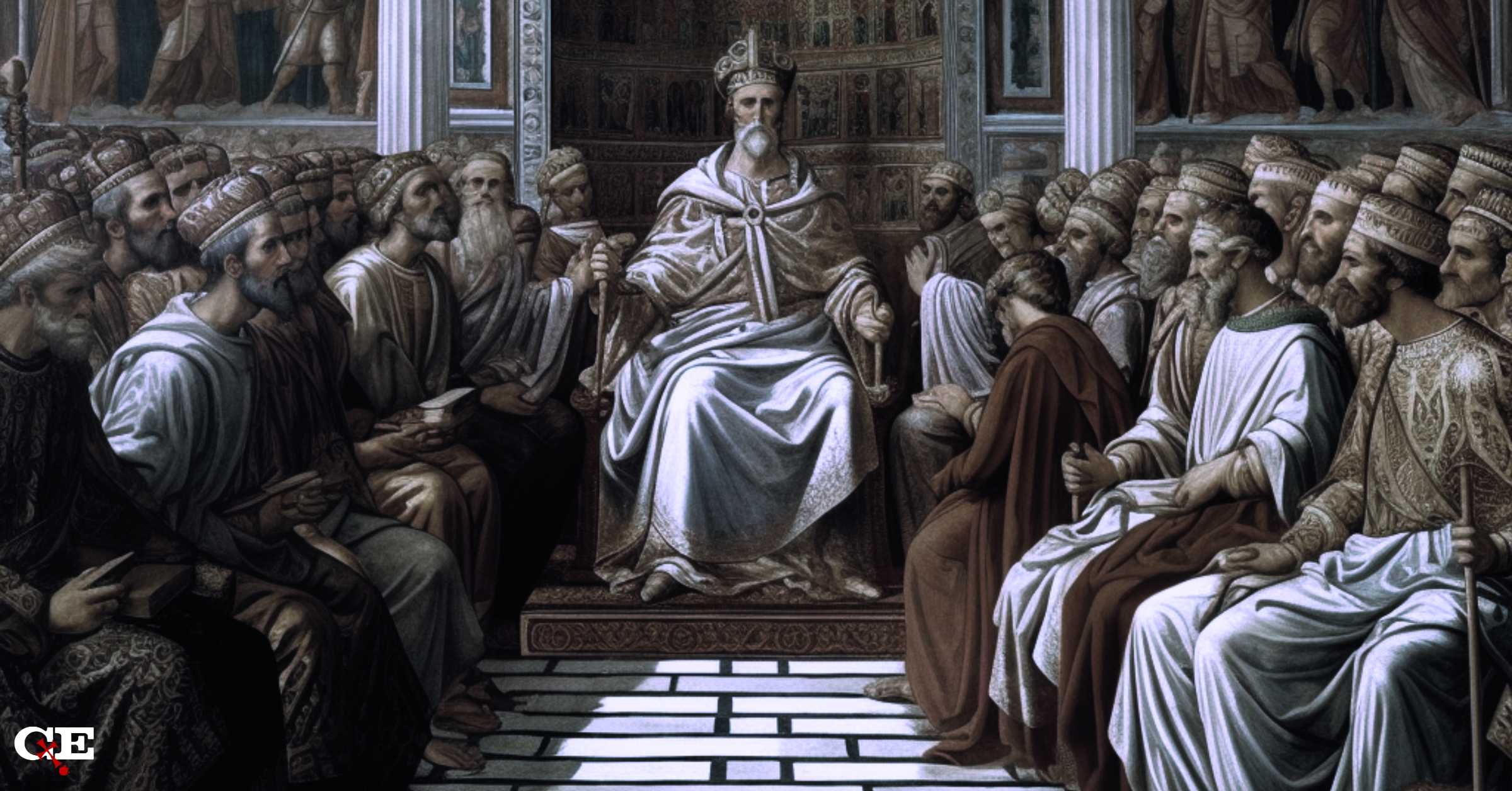
The Council of Nicaea was famously convened on May 20, 325 AD, at the request of Emperor Constantine (pictured above). What did the council of bishops meet to discuss? Contrary to common misconception (popularized particularly in Muslim circles) that has been widely circulated via the internet, the Council of Nicaea did not meet to discuss the canon of Scripture — that is, the decision about which books should make up the New Testament. In fact, there is not a shred of evidence that the canon of Scripture was even brought up at Nicaea. Another misconception is that the council of Nicaea, at the encouragement of Constantine, “invented” the deity of Christ or, at the very least, that the bishops in attendance at Nicaea were significantly divided on the issue, the matter being decided with a vote. This too, however, is completely inaccurate. In 325 AD, when the bishops convened at Nicaea, the deity of Christ had been affirmed almost unanimously by the Christian movement for close to three hundred years!

The bishops who met at Nicaea had just come out of an extremely challenging time of intense persecution by the Romans, having lived through the cruelty of the Emperors Diocletian (ruling 284-305) and Maximian (ruling 286-305). One of the bishops present at Nicaea, Paphnutius, had even lost his right eye and been given a limp in his left leg as a consequence of his profession of faith. According to one ancient writer, Theodoret (393-457),

“Paul, bishop of Neo-Cæsarea, a fortress situated on the banks of the Euphrates, had suffered from the frantic rage of Licinius. He had been deprived of the use of both hands by the application of a red-hot iron, by which the nerves which give motion to the muscles had been contracted and rendered dead. Some had had the right eye dug out, others had lost the right arm. Among these was Paphnutius of Egypt. In short, the Council looked like an assembled army of martyrs.” [Ecclesiastical History, 1.7.5]

It strikes me as odd, therefore, that one would suppose that the early Christian movement, having come out of such difficult times as those, would capitulate so easily to the emperor Constantine’s demands with respect to defining the very fundamentals of their faith!

It Was About the Aryan Heresy

The story of the Nicaean council begins in Alexandria in northwest Egypt. The archbishop of Alexandria was a man by the name of Alexander. A member of his senior clergy, called Arius, took issue with Alexander’s view of Jesus’s divine nature, insisting that the Son is, in fact, himself a created being. In similar fashion to modern Jehovah’s Witnesses, Arius maintained that Jesus was like the Father inasmuch as they both existed before creation, played a role in creation and were exalted above it. But the Son, according to the theology of Arius, was the first of God’s creations and was commissioned by the Father to create the world.

On this point, Alexander strongly disagreed, and publicly challenged Arius’s heretical teachings. In 318 AD, Alexander called together a hundred or so bishops to talk over the matter and to defrock Arius. Arius, however, went to Nicomedia in Asia Minor and rallied his supporters, including Eusebius of Nicomedia, who was a relative by marriage to Constantine the emperor, and a theologian in the imperial court. Eusebius and Arius wrote to many bishops who had not been involved in the defrocking of Arius. The effect was the creation of divisions among the bishops. Embarrassed by such bickering, the emperor Constantine convened the ecumenical council of Nicaea in 325.

Constantine’s primary concern was imperial unity rather than theological accuracy, and he desired a decision that would be supported by the greatest number of bishops, regardless of what conclusion was reached. His theological advisor, Hosius, served to get the emperor up to speed before the arrival of the bishops. Since Arius was not a bishop, he was not invited to sit on the council. However, his supporter Eusebius of Nicomedia acted on Arius’s behalf and presented his point of view.

Arius’s position regarding the finite nature of the Son was not popular with the bishops. It became clear, however, that a formal statement concerning the nature of the Son and his relationship to the Father was needed. The real issue at the Council of Nicaea was thus how, and not if, Jesus was divine.

The Deity of Christ was Never In Question
A formal statement was eventually put together and signed by the bishops. Those who declined to sign the statement were stripped of their rank of bishop. The few who supported Arius insisted that only language found in Scripture should feature in the statement, whereas Arius’s critics insisted that only non-Biblical language was adequate to fully unpack the implications of the language found in the Bible. It was Constantine who eventually suggested that the Father and Son be said to be of the “same substance” (homoousios in Greek). Although Constantine hoped that this statement would keep all parties happy (implying the complete deity of Jesus without going much further), the supporters of Arius insisted that this language suggested that the Father and Son were equal but didn’t explain how this was compatible with the central tenet of monotheism (i.e. the belief in only one deity).

Nonetheless, the Nicaean creed did indeed incorporate this language. It stated,

“We believe in one God, the Father almighty, maker of all things, visible and invisible; And in one Lord Jesus Christ, the Son of God, begotten from the Father, only-begotten, that is, from the substance of the Father, God from God, light from light, true God from true God, begotten not made, of one substance with the Father, through Whom all things came into being, things in heaven and things on earth, Who because of us men and because of our salvation came down and became incarnate, becoming man, suffered and rose again on the third day, ascended to the heavens, and will come to judge the living and the dead; And in the Holy Spirit. But as for those who say, ‘There was when He was not, and, Before being born He was not, and that He came into existence out of nothing, or who assert that the Son of God is from a different hypostasis or substance, or is created, or is subject to alteration or change — these the Catholic Church anathematizes.”

Aryanism Denounced by not Defeated

With just two exceptions (Secundus of Ptolemais and Theonas of Marmarcia), the creed was signed by all the bishops, numbering more than 300. Arius’s supporters had been overwhelmingly defeated.

Arius’s supporters, however, managed to find some wiggle room. A single letter “i” (iota), changes the meaning of homo (“same”) to “like” (homoi). The latter could be exploited by Arius and his followers to describe a created Christ. Moreover, it was argued, the creed could be interpreted as supporting Sabellianism, an ancient heresy which fails to discriminate between persons of the godhead. It was this in-house squabbling between bishops that ultimately led to the Council of Constantinople in 381.

Unity, But at What Cost?

A company of bishops started to campaign for the formal re-instatement of Arius as a presbyter in Alexandria. Constantine yielded to their petition and, in 332, re-instated Arius as a presbyter. Athenasius, who had recently succeeded his mentor Alexander as bishop of Alexandria, was instructed to accept Arius into the church once again. Needless to say, Athenasius did not comply with this order. The consequence was exile. Constantine had little interest in the precision of his theology — rather, it was the struggle for imperial unity that was his motivation.

In conclusion, although popular misconceptions about the Council of Nicaea are rampant, the idea that the Council of Nicaea determined which books comprised the New Testament or that it invented the deity of Christ to comply with the demands of Constantine are myths. Indeed, correct theology was of little concern to Constantine, who cared much more about imperial unity. Christians must make a serious effort to study and learn church history, so that when we encounter such claims in the media and in our personal evangelism, we may know how to present an accurate account of our history.

Recommended Resources:

How Can Jesus be the Only Way? Mp4, Mp3, and DVD by Frank Turek

Why We Know the New Testament Writers Told the Truth by Frank Turek (mp4 Download)

The Top Ten Reasons We Know the NT Writers Told the Truth mp3 by Frank Turek

Jesus, You and the Essentials of Christianity by Frank Turek (INSTRUCTOR Study Guide), (STUDENT Study Guide), and (DVD)      


Dr. Jonathan McLatchie is a Christian writer, international speaker, and debater. He holds a Bachelor’s degree (with Honors) in forensic biology, a Masters’s (M.Res) degree in evolutionary biology, a second Master’s degree in medical and molecular bioscience, and a Ph.D. in evolutionary biology. Currently, he is an assistant professor of biology at Sattler College in Boston, Massachusetts. Dr. McLatchie is a contributor to various apologetics websites and is the founder of the Apologetics Academy (Apologetics-Academy.org), a ministry that seeks to equip and train Christians to persuasively defend the faith through regular online webinars, as well as assist Christians who are wrestling with doubts. Dr. McLatchie has participated in more than thirty moderated debates around the world with representatives of atheism, Islam, and other alternative worldview perspectives. He has spoken internationally in Europe, North America, and South Africa promoting an intelligent, reflective, and evidence-based Christian faith.

Originally posted at: https://bit.ly/4isqk2b


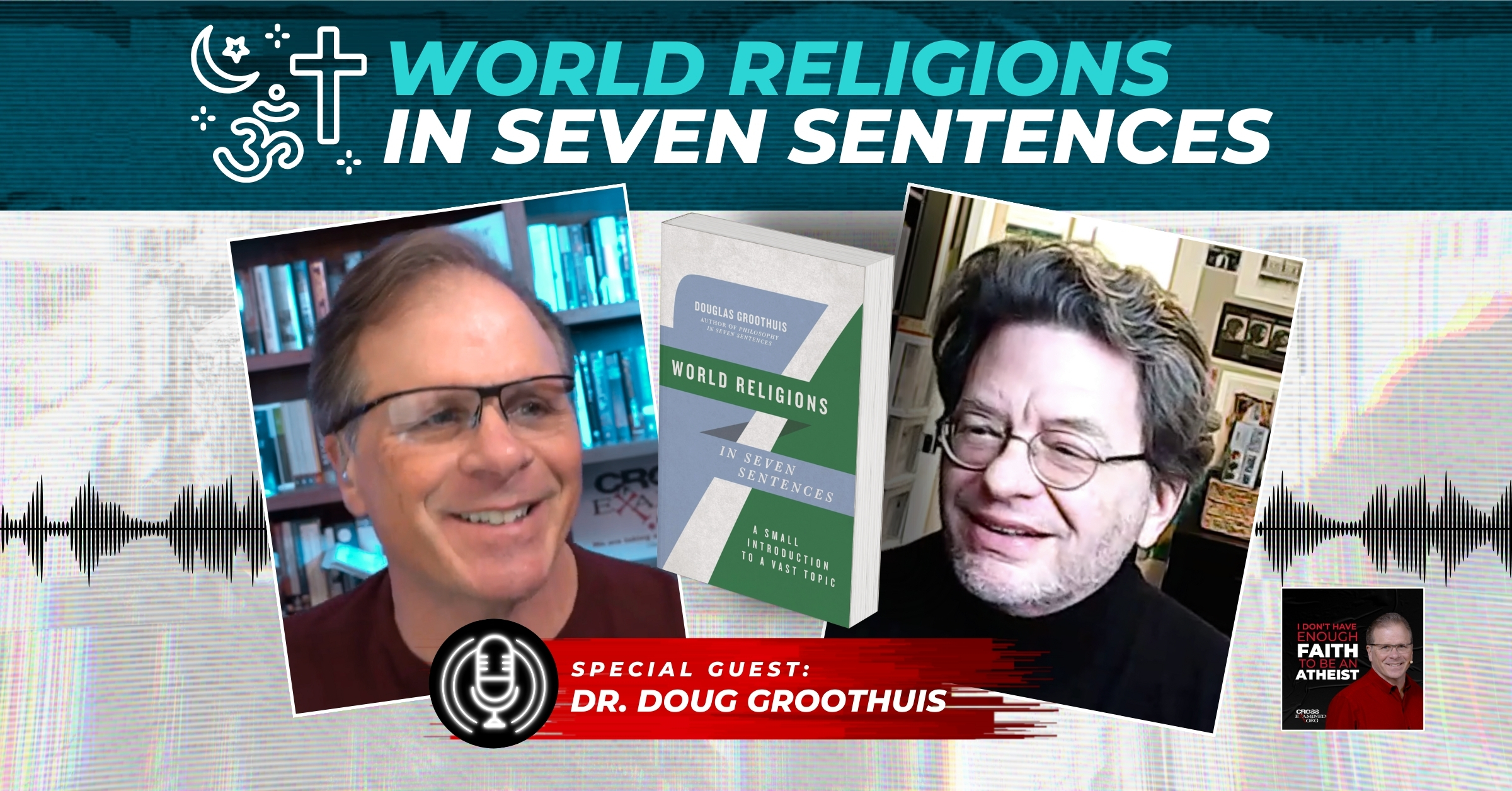
How much do you know about the major world religions? Whether it’s atheism, Christianity, Judaism, Islam, or one of the many Eastern religions, humanity holds a wide array of beliefs about who God is and if He even exists at all. But what if more Christians dedicated time to learning about other religions? How could this strengthen our faith along with our ability to share the Gospel?

We’re kicking off December with renowned Christian apologist and philosopher, Dr. Doug Groothuis, professor at Cornerstone University in Grand Rapids, MI and the author of 20+ books, including his latest work, ‘World Religions in Seven Sentences: A Small Introduction to a Vast Topic‘. In this episode, Frank and Doug discuss the inspiration behind the book and unpack some of the core beliefs of today’s major world religions—one sentence at a time. Together, they’ll tackle questions like:

  • What are the seven sentences that represent each world religion and why did Doug choose them?
  • What makes Friedrich Nietzsche the “quintessential atheist”?
  • Should atheism be classified as a religion? And what typically happens when atheism and Marxism collide?
  • What are some of the key differences between Hinduism and Buddhism?
  • What’s the connection between Nietzsche, Pol Pot, Ted Bundy, and human depravity?
  • Why do some people choose to be atheists?
  • What happened when Doug encountered a Hinda guru at the age of 18?
  • How do Judaism and Islam differ in their relationship to Christianity?

If exploring diverse faith systems seems overwhelming, ‘World Religions in Seven Sentences‘ is the perfect guide to get started. Tune in as Frank and Doug reveal how false religions often lead to human suffering and why Christianity alone is the solution to the problem of evil in the world. Be sure to grab your copy of Doug’s book and subscribe to his Truth Tribe podcast for even more great content!

Did you enjoy this episode? HELP US SPREAD THE TRUTH OF CHRISTIANITY BY SUPPORTING THE PODCAST HERE.

Resources mentioned during the episode:

‘World Religions in 7 Sentences’: https://a.co/d/gExzxhz
Doug’s Website: https://www.douglasgroothuis.com/
Doug’s Podcast: https://www.douglasgroothuis.com/podcast-1


Download Transcript


It’s common for atheists to be a “Grinch” over the Holidays and exclaim that Jesus is just a “Santa Claus for adults!” When I hear that claim, I immediately respond with a question: “What do you mean by that?”

If one means that children often believe in fictional fairy tales and adults believe in fact-based evidence, then I agree – Jesus is for adults (and actually people of all ages)! But I don’t think that’s the intent behind this claim. I believe the intent of the atheist (“Grinch”) is to convey that little kids believe in a fictional Santa Clause and many adults believe in fiction too – Christianity.

How the Grinch Stole Christ out of Christmas

Well, why think a thing like that, Mr. Grinch? Is belief in Jesus — or belief in God — really no different than belief in Santa? To answer this question, we must first ask if we have any good reason to believe in Santa. What good reasons are there that would lead us to logically conclude, “Therefore, Santa exists”?

Now, I’m not emotionally opposed to the existence of Santa Claus, and my life would not really have to change if Santa really exists, so if there were any evidence pointing to a jolly fat man in the North Pole who flies around with Rudolph giving gifts made by the elves, then I would happily follow that evidence wherever it leads. Even if there were logic-based arguments concluding that Santa PROBABLY exists, I would be very open to the existence of Santa. Come to think of it, Santa Claus would save me a ton of money on Christmas presents! Be that as it may, there is no evidence or any logic-based arguments concluding that Santa Claus exists — or even PROBABLY exists. So, although I am willing to be persuaded, there just doesn’t seem to be any evidence or logical reasons to believe in Santa Claus (sorry kids).

Now perhaps, Mr. Grinch, you’re saying to yourself: “That’s right! There’s no evidence for Santa Claus AND there is no evidence of God or Jesus either! That’s why it’s ridiculous to believe in Santa Claus or God!”

A False Equivalence

But is that true? Is the evidence — or lack thereof — for Santa Claus and the evidence for God really the same?

Well, if Santa does exist, we would know what to look for: A big, jolly, white-bearded, fat man in a red suit flying around in a sleigh being pulled by flying reindeer delivering presents to children on Christmas Eve. We would look for his factory full of elves at the North Pole too! So far (as far as I know), this evidence for Santa has never been detected. That in and of itself is not PROOF that Santa does not exist, but once we add to the fact that we have no other positive reasons to believe that Santa exists, then we can safely say that Santa does not exist.

But what about God? If God does exist, what would we expect to find? Do you even know what evidence you should start looking for?

Before stating that there is no evidence for something, Mr. Grinch, make sure you know what kind of evidence there should be if that thing does exist. If the God of the Bible exists, for example, he is not the kind of being you would see flying around in the clouds. He would not be some “sky daddy,” as many internet atheists seem to think. No, if the God of the Bible exists, He would not be some humanoid “Zeus-like being.” God (if He exists) is an immaterial unembodied mind – a “spirit” (John 4:24).

How Christ Saves Christmas, from the Grinch

So, what should we expect to find if Christian theism is true? We would expect to find scientific evidence for the beginning of the space-time universe. We have that! We would expect to find evidence for the fine-tuning of the initial conditions of the big bang so that intelligent life – not to mention matter itself – could exist. We have that! We would expect to have historical data showing that Jesus of Nazareth was a real person of history who was executed by the Roman government. We have that!

In fact, we would expect to be able to make a strong case — via the historical method alone – that Jesus actually rose from the dead. Historians have demonstrated that the resurrection of Jesus is the inference to the best explanation after examining all of the historical facts!

So, the things we would expect to find if Santa exists, do not exist. However, the things we would expect to find if the God of the Bible exists, those things DO exist!

After taking everything into consideration, although it would be irrational to believe in Santa Claus, one is quite coherent believing in the God Jesus revealed. That is to say, we have good reason to celebrate Christmas.

So, the next time Mr. Grinch compares Jesus to Santa Claus, just show him the evidence pointing to the reason for the season.

Have a reasonable (Isaiah 1:18) and Merry Christmas,

Dr. Tim Stratton

Recommended Resources: 

Jesus, You and the Essentials of Christianity by Frank Turek (INSTRUCTOR Study Guide), (STUDENT Study Guide), and (DVD)      

Stealing From God by Dr. Frank Turek (Book, 10-Part DVD Set, STUDENT Study Guide, TEACHER Study Guide)

Reflecting Jesus into a Dark World by Dr. Frank Turek – DVD Complete Series, Video mp4 DOWNLOAD Complete Series, and mp3 audio DOWNLOAD Complete Series

How Can Jesus Be the Only Way? (mp4 Download) by Frank Turek


Tim Stratton (The FreeThinking Theist) pursued his undergraduate studies at the University of Nebraska-Kearney (B.A. 1997) and after working in full-time ministry for several years went on to attain his graduate degree from Biola University (M.A. 2014). Tim was recently accepted at North West University to pursue his Ph.D. in systematic theology with a focus on metaphysics.

Originally posted at: https://bit.ly/49fAu1O