Tag Archive for: atheism

Ex-muslim turned Christian, Ridvan Aydemir aka “Apostate Prophet”, returns to the program to continue his conversation with Frank about theological problems with Islam and his recent conversion from atheism to Christianity. Together they answer questions like:

  • What role did David Wood play in his conversion from atheism to Christianity?
  • As an ex-Muslim, how did visiting Jerusalem change his point of view on Judaism?
  • Why is the resurrection of Jesus essential to the truth of Christianity?
  • Do we need 100% certainty to believe that anything is true?
  • Why is living a Christian life more fulfilling than any other worldview?
  • What inspirational words did Charlie Kirk share with Ridvan shortly before his death?
  • What advice would Ridvan give to Christians who want to evangelize to Muslims?

There’s even more important insights to share, so be sure to stay tuned for a future episode with the Apostate Prophet where he shares even more advice on evangelizing Muslims, the Hamas-Israel conflict, misunderstandings between Muslims and Christians, and why radical Islam has no place in the West!

If you enjoyed this podcast episode PLEASE HELP US SPREAD THE TRUTH OF CHRISTIANITY BY SUPPORTING OUR MINISTRY USING THE LINK BELOW. 100% of your donation goes to ministry, 0% to buildings!

Resources mentioned during the episode:

Donate to CrossExamined
Ex-Muslim Tells Americans The Truth About Islam
How God Destroyed My Atheism with David Wood
Charlie Kirk and Apostate Prophet on Islam
ApostateProphet.com
The Apostate Prophet YouTube Channel
Follow the Apostate Prophet on X

Download Transcript

How does a former militant atheist and horror filmmaker end up creating a documentary that raises the bar for Christian apologetics films for the foreseeable future? After giving a brief update on the latest Charlie Kirk conspiracy theories, Frank sits down with filmmaker Michael Ray Lewis, whose transformation from hardened skeptic to Christian apologist is as unexpected as it is compelling.

Michael’s new film, ‘Universe Designed‘, premieres on SAT. 12/13 and blends cinematic storytelling with scientific and historical evidence for Christianity, offering skeptics an invitation to investigate Christianity for themselves while also giving believers a fresh tool for evangelism by exposing them to resources that most Christians aren’t even aware of. Together they answer questions like:

  • What finally broke through Michael’s skepticism and led him to place his faith in Christ?
  • Which objections kept him from believing and how did he overcome those objections?
  • What compelled him to move from horror films to apologetics-focused documentaries?
  • Why do many Christian films fail to persuade skeptics, and how does ‘Universe Designed’ avoid those pitfalls?
  • How can scientific and historical evidence reshape the way Christians share their faith?
  • What top Christian apologists make an appearance in the film?
  • Why is relying solely on personal testimonies sometimes ineffective in reaching non-Christians?
  • Do people really go to Hell simply for not believing in Jesus?

Condensing more than 36 hours of expert interviews into a focused 90-minute feature, ‘Universe Designed‘ presents a scientific, philosophical, and historical case for Christianity unlike most films in the genre. Available on Amazon Prime and other major streaming platforms, this innovative, self-funded $150K project showcases the kind of thoughtful, high-quality filmmaking many Christians have been waiting for!

If you enjoyed this podcast episode PLEASE HELP US SPREAD THE TRUTH OF CHRISTIANITY BY SUPPORTING OUR MINISTRY USING THE LINK BELOW. 100% of your donation goes to ministry, 0% to buildings!

Resources mentioned during the episode:

Donate to CrossExamined.org
Mikey McCoy Video
Universe Designed Trailer Video
UniverseDesigned.com

Download Transcript

Ever feel like talking to your atheist friend about faith is like hitting your head against a brick wall? You’ve tried explaining, debating, carefully exegeting Bible verses, but they just don’t get it after repeated corrections. You’re starting to wonder if they ever will. Sound familiar? You’re probably thinking, “Why do they keep twisting what faith really means?” It’s like they’re stuck in this loop, misrepresenting faith as some blind leap without evidence. You’ve been patient, clear, and respectful, but nothing seems to change. It’s enough to make anyone want to throw their hands up and walk away.


But hang tight. There’s a reason for their stubbornness, and it’s not just about being argumentative. The truth is, atheists often fall into hidden fallacies that keep them from truly understanding faith. To be fair, it’s not their fault entirely.

But here’s the good news: knowing what these fallacies are can help you break through and bring clarity to your conversations. Ready to know why your atheist friend just can’t see eye to eye on faith? Let’s get started.

The Origin of Misconception: Where Did This Definition Comes From?

“We may define ‘faith’ as a firm belief in something for which there is no evidence. Where there is evidence, no one speaks of ‘faith.’ We do not speak of faith that two and two are four or that the earth is round. We only speak of faith when we wish to substitute emotion for evidence. And the substitution of emotion for evidence is apt to lead to strife, since different groups substitute different emotions.”
Bertrand Russell. Human Society in Ethics and Politics (1954), Ch. VII: Can Religion Cure Our Troubles? p. 213

Here’s a fun fact: You know what your friend and Bertrand have in common? They both didn’t consult a theological or philosophical dictionary for this definition of faith. If your friend has a similar definition, “believing something without evidence or in spite of,” let’s challenge it with seven key points:

  1. The majority of people who define faith as believing something without evidence are popular atheists.
  2. Virtually no well-informed Christian holds this view.
  3. No ecumenical council has endorsed this definition.
  4. The vast majority of renowned theologians and philosophers, historically or currently, do not teach it.
  5. Atheists trained in philosophy don’t use this definition.
  6. No theological dictionary or encyclopedia defines the Christian faith this way.
  7. The etymological roots of the word “faith” don’t support this definition.

So, where does this definition come from? Certainly not from Christianity in general. Yet, many popular atheists assume that every religion shares this definition and paint all believers with the same broad brush.

Now, to be fair, there was (and still is with very few adherents) a school of thought called fideism. The Stanford Encyclopedia of Philosophy defines fideism as:

“[I]n some sense independent of, if not outright adversarial toward, reason. In contrast to the more rationalistic tradition of natural theology, with its arguments for the existence of God, fideism holds – or at any rate appears to hold . . . that reason is unnecessary and inappropriate for the exercise and justification of religious belief.”

One of the famous church fathers who is said to be a fideist was Tertullian. Per the article, there’s currently just a handful of Christian philosophers who are trying to (re)habilitate the position, like C. Stephen Evans, John Bishop, and Duncan Pritchard. I bet that your atheist friend doesn’t know them by name, much less their work. Even if they do know these philosophers and their work, to take this minority, minimally influential position and show it to others as the main position in Christianity is not honest.

No matter where these atheists took this definition, the best way to go is to research what is the most well-held and robust definition used by the religion and then critique it fairly. Now, here’s the twist: If faith is believing something is true without any evidence or in spite of evidence, then what is the evidence that faith is believing without evidence or in spite of it?

If your atheist friend doesn’t have evidence for this definition, then by his own logic, he’s taking it on faith. Many atheists are unaware of this self-defeating aspect of their definition. For some, showing this self-defeating outcome will be enough to change their minds. But others are more stubborn.

How Atheists Turns Faith into a Punching Bag

Atheists often trip over the strawman fallacy when discussing faith. They misrepresent it (knowingly or unknowingly), making it seem weaker than it actually is. They beat up faith like a punching bag with adjectives like irrational, illogical, unreasonable, and even immoral.

This is where the frustration kicks in for Christians. You’ve likely thought, “That’s not what faith is at all!”Christian faith is not about blind belief. The Bible defines faith as “confidence in what we hope for and assurance about what we do not see” (Hebrews 11:1). Key words here are “confidence” and “assurance”.

J. Warner Wallace gives a great insight into faith in his commentary about Hebrews 11.1.

“Is the author saying, ‘Now faith is the assurance of things hoped for, when the evidence is unseen?’ No, he’s saying just the opposite. When considering chapter 10 prior to interpreting verse 11:1, it’s clear that the author is encouraging his readers to endure those times when God seems absent; those times when trials and tribulations cause us to question God’s existence. Where is God in these difficult situations? Why can’t we see Him? Why can’t we see His activity in our lives? In verse 11:1, the author of Hebrews says that we can trust that God’s salvation, protection and provision are still there for us, even though they may appear to be ‘things not seen.’ In spite of their apparent absence, we are told to trust that they exist. Why? On what basis? On the basis of what we can see.’”

It’s about trust, grounded in reason and experience, even when we can’t see everything clearly. Imagine trusting you father to catch you in a trust fall. You believe they’ll catch you not because you’ve closed your eyes to reality, but because you’ve seen them do it before. You’ve experienced his reliability. This is exactly what the Christian believes when they speak about faith.

Think about historical evidence, philosophical arguments, scientific evidence, personal experiences that underpin Christian faith.

  • Historical Evidence: Like the reliability of the Bible, or the historical accounts of Jesus’ life, death, and resurrection, gives us a foundation.
  • Philosophical Arguments: Such as the cosmological argument or the moral argument, provide rational support.
  • Scientific Arguments: Such as the teleological argument, providing scientific support from astrophysics and biology.
  • Personal Experiences: Like answered prayers or moments of peace and guidance in extreme persecution or dangerous situations, reinforce this trust.

So, when atheists dismiss faith as irrational or baseless, they’re attacking a strawman. They’re not engaging with the real, robust concept of faith that Christians hold. This misrepresentation feels like you’re speaking different languages. But this isn’t the only fallacy atheists fall into. There’s another subtle yet pervasive error that compounds the misunderstanding.

Demanding the Impossible: Why Atheists’ Requests for Material Proof Fall Flat

Here’s the other stumbling block: the category mistake. The word “evidence” in their definition is a very specific kind of evidence. Atheists often demand material evidence for a non-material entity like God. They want physical proof, something they can see, touch, or measure. But this demand is like asking for the weight of love. It just doesn’t fit.

We all accept many non-material realities without physical evidence. Think about love, justice, numbers, the reality of the past or consciousness. You can’t weigh these things or capture them in a test tube, yet they’re undeniably real and impactful. Similarly, God, as a non-material being, doesn’t conform to the constraints of the physical realm. Different types of evidence support different kinds of realities.

  • Empirical Evidence: Works great for physical phenomena. You can see gravity’s effects, measure it, and predict it.
  • Philosophical Arguments: Can demonstrate the necessity of a first cause, the existence of objective moral values, or the existence of abstract objects (like forms and numbers).
  • Historical Evidence: Like the resurrection of Jesus, can be scrutinized and debated but remains rooted in strongly reliable circumstantial case.
  • Experiential Evidence: Personal encounters and transformations provide a compelling, if subjective, form of proof.

Yet, atheists often miss this distinction. They insist on material evidence, not realizing they’re committing a category mistake. That’s like asking for proof of a sound’s color. The category doesn’t apply. This narrow view limits their understanding, keeping them stuck in a loop of disbelief.

Locked in Their Own World: How Atheists’ Limited View Blocks Real Understanding

Now, let’s talk about the personal incredulity fallacy. This one’s a biggie. If your friend’s worldview is materialismnaturalism, or even scientism, his worldview won’t leave room for anything beyond the physical, the material, the natural, or the scientific. It’s like trying to explain a smartphone to someone who’s only communicated through a keyer (the code morse machine). They just can’t wrap their heads around it.

This incredulity stems from a strict ontology of the world (what makes the world be like it is), like naturalism, or a strict epistemology of knowledge (how knowledge is acquired), like scientism. If something can’t be explained by the laws of nature, measured, or observed in a lab, it’s dismissed.

But think about the vastness of our universe, the complexity of human consciousness, the depth of love and morality. Not everything that’s real fits neatly into the scientific method or under a microscope.

Here’s where the frustration really ramps up. You’re explaining faith, using philosophical reasoning, historical proofs, scientific evidence, and personal experience. Yet, your atheist friend keeps shaking their head, saying, “I just can’t see it. If there’s evidence, there’s no need for faith. You can’t call that faith.”

It’s like they’ve put up a wall, and no amount of reasonable arguments will make a hole. This fallacy blocks openness to other ways of knowing. In science, we trust empirical evidence. In history, we rely on documented events and testimonies. In philosophy, we use logical reasoning. And in personal life, we trust experiences and relationships. Each of these ways of knowing offers a different lens. When atheists cling only to empirical evidence, they miss out on the fuller picture.

Think about it like this: You wouldn’t use a thermometer to measure happiness, right? Similarly, insisting on material evidence for everything limits understanding. Personal incredulity keeps the door shut to knowledge and experience that faith draws upon. When your arguments don’t seem to make a dent, it’s time to try a different approach.

Still Unconvinced? Here’s What to Do When Arguments Hit a Wall

So, what do you do when all this falls on deaf ears? When, despite your best efforts, your atheist friend still won’t budge? Here’s where patience come into play. It’s frustrating, sure. But it’s also an opportunity to reflect Christ’s love and patience.

  • Recognize the Limits: Not every conversation will lead to a grand epiphany. And that’s okay. Sometimes, it’s enough to plant a seed, to offer a perspective they hadn’t considered before. It’s about the long game, not quick wins.
  • Continue the Relationship: Keep the dialogue open. Respect their views, even if they don’t respect yours. Show that you value them as a person, not just as a potential convert. Your actions, your love, and your patience can speak volumes. Often, it’s these quiet, consistent demonstrations of faith that make the biggest impact over time.
  • Pray for Them: This isn’t about manipulation. It’s about genuinely seeking their good, asking for God’s guidance and wisdom in your interactions. Trust that the Holy Spirit works in ways we can’t always see or understand. Sometimes, the most powerful conversations happen when we step back and let God do His work.
  • Reflect on Your Own Journey: Recall how long it took you to recognize your error and your need for a Lord and Savior. Show some grace. Remember that faith isn’t just about convincing others through argumentation; it’s about living out your beliefs authentically and joyfully. Be the kind of person whose life reflects the love, hope, and peace of Christ. This witness, more than any argument, can draw others to consider faith in a new light.

In the end, it’s about more than just winning debates. It’s about building bridges, fostering understanding, and showing the love of Christ in every interaction. Your atheist friend might not change their mind overnight—or ever. But your faithful witness and loving presence can make a difference in ways you might never fully see. And that’s a God honoring mission worth pursuing.

Wrapping Up: Keeping the Faith in Every Conversation

It’s tough. I know. Especially when your friend is someone you sincerely and genuinely love. You’ve been there—spending hours, maybe even years, trying to explain faith to your atheist friend, only to be met with skepticism or outright dismissal. It feels like you’re running in circles, repeating the same arguments, and still hitting a wall. Discouraging, right?

You’re not alone. So many Christians are in the same boat, feeling that sting of misunderstanding. You’re pouring out your heart, trying to share something deeply personal and important, and it feels like it’s falling on deaf ears. You might be thinking, “Why even bother? Is it worth all this effort?”

Absolutely, it is. Every conversation, every patient explanation, is a seed planted. The insights from this article equip you with the understanding of those hidden fallacies that trip up your atheist friends. You now know why they misunderstand faith and how to steer the conversation towards clarity.

Think about it—understanding the strawman fallacy, the categorical error, and the personal incredulity trap puts you miles ahead. It gives you the tools to navigate these tricky waters with grace and wisdom. But here’s the kicker: It’s not just about winning debates or changing minds. It’s about embodying the love and patience of Christ. It’s about showing that even when the conversation hits a wall, your love and respect for your friend remain unshaken.

That’s powerful. That’s transformative. Remember, you’re not alone in this journey. Many have walked this path and found that persistence, patience, and prayer can work wonders. So, take heart! Each interaction, no matter how small, is a step forward. Your steadfastness and faithfulness are not in vain. So, go out there and keep those conversations going. Keep planting those seeds. Let your faith shine through your words and actions. And trust that, in time, even the hardest hearts can soften. Keep the faith, stay strong, and let God do His thing. You are making a difference, one conversation at a time.

Recommended Resources:

I Don’t Have Enough Faith to Be an Atheist (Paperback), and (Sermon) by Norman Geisler and Frank Turek 

Stealing From God by Dr. Frank Turek (Book, 10-Part DVD Set, STUDENT Study Guide, TEACHER Study Guide)

Macro Evolution? I Don’t Have Enough Faith to be a Darwinist (DVD Set), (MP3 Set) and (mp4 Download Set) by Dr. Frank Turek

Debate: Does God Exist? Turek vs. Hitchens (DVD), (mp4 Download) (MP3)


Miguel Rodriguez is the founder of Smart Faith, a platform dedicated to helping Christians defend their faith with clarity and confidence. After experiencing a miraculous healing at 14, he developed a passion for knowing God through study and teaching. He now serves as the Director of Christian Education and a Bible teacher at his local church while also working as a freelance email marketer. Living in Orlando, Florida, with his wife and two daughters, Miguel seeks to equip believers with practical and intellectual tools to strengthen their faith. Through Smart Faith, he provides apologetics and self-improvement content to help Christians live with wisdom and integrity.

Originally posted at: https://bit.ly/4krU0fD

How do you spend 20 years talking to some of the world’s most well-known atheists and still remain a committed Christian? Is it possible that belief in God actually makes sense?

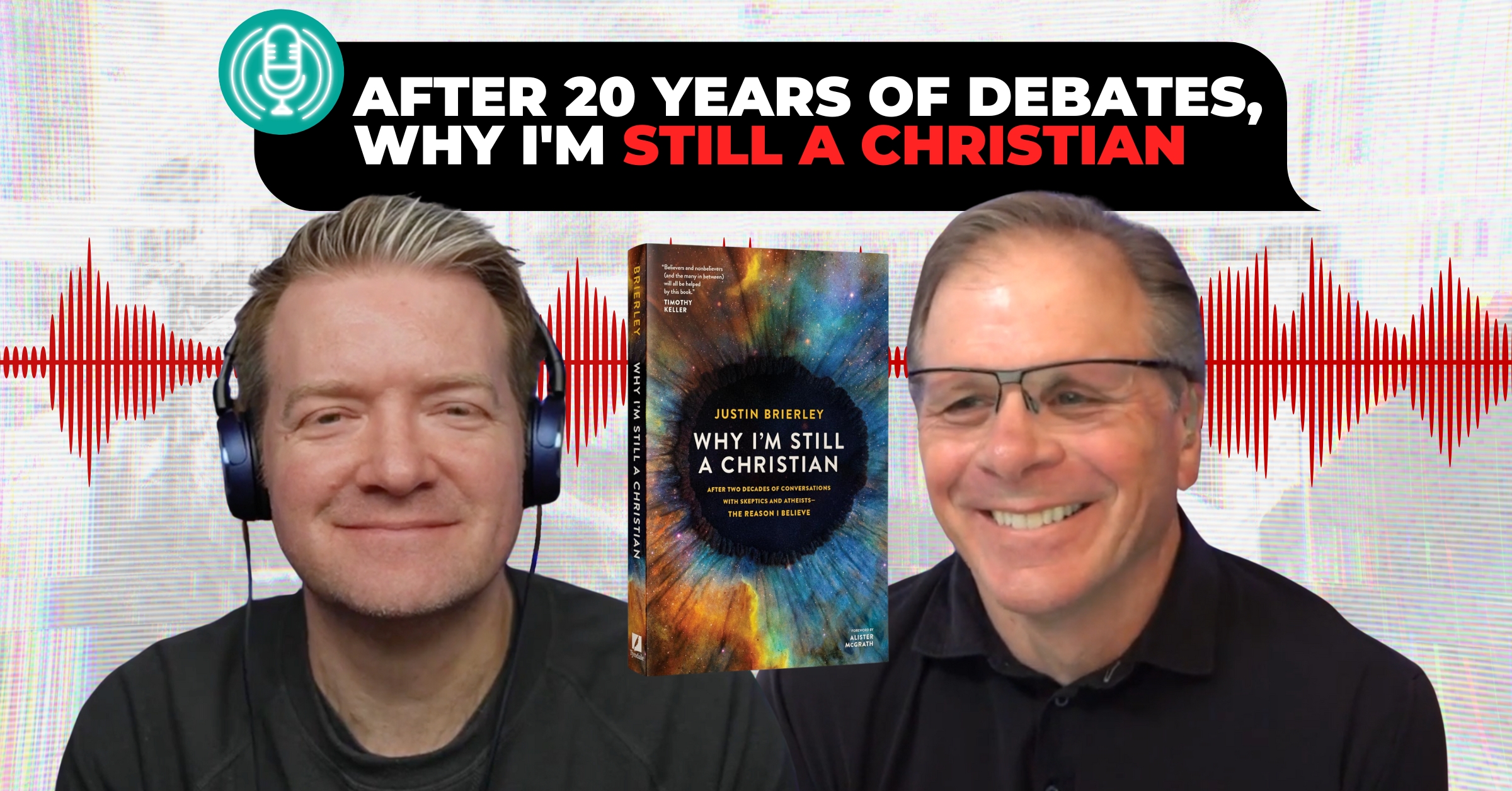
Popular radio host and podcaster Justin Brierly has been creating and facilitating constructive conversations about faith for more than two decades, and has had a ringside seat as believers and nonbelievers have debated Christianity. This week on the podcast, Justin joins Frank to discuss his upcoming book, ‘Why I’m Still a Christian: After Two Decades of Conversations with Skeptics and Atheists–The Reason I Believe‘ and shares how he kept his faith intact while engaging with skeptics from around the world. Together, he and Frank answer big questions like:

  • What led Justin to write this book, and what ultimately convinces him that Christianity is true?
  • Is Christianity intellectually defensible in a secular age?
  • What are the strongest arguments for (and against) the existence of God?
  • Why are some leading atheists reconsidering their skepticism?
  • Has science truly made belief in God obsolete?
  • How can Christians engage skeptics without losing their own faith?
  • What advice does Justin have for people who may be “deconstructing” their faith?

Be among the first to read Justin’s new book and preorder ‘Why I’m Still a Christian‘ before its official release on 4/22! This book is the culmination of Justin’s years of dialogue with atheists, investigating the most compelling evidence that keeps him firmly rooted in Christ. Don’t miss this eye-opening discussion, and be sure to secure your copy to support Justin’s important work in Christian apologetics!

If you enjoyed this podcast episode PLEASE HELP US SPREAD THE TRUTH OF CHRISTIANITY BY SUPPORTING OUR MINISTRY HERE. 100% of your donation goes to ministry, 0% to buildings!

Resources mentioned during the episode:

How a Dice Can Show That God Exists – https://youtu.be/yy6kaDaeDT8

Pre-Order Justin’s new book – https://www.amazon.com/dp/1496466934

Justn’s podcast – The Surprising Rebirth of Belief in God


Download Transcript


Generation Z is the generation born from 1999 to 2015. They are the successors of Gen X (born 1965-1980) and Gen Y, also known as Millennials (b. 1981-1998). The dates are approximations and arbitrary creations of sociologists and scholars studying generational trends. The Barna Group alongside the ministry Impact360 has conducted as study of Gen Z’ers called “Who Is Gen Z.” A short introductory video of their study can be viewed here.


Jonathan Morrow, director of Cultural Engagement at Impact360, wrote an article titled “Why Gen Z Is Not Prepared To Follow Jesus In A Post-Everything World” and revealed that only 4% of Gen Z has a Biblical Worldview while atheism is on the rise amongst this generation.

Gen Z and Atheism

One of the things that has come to light in the Barna study is that, “Atheism Doubles Among Generation Z.” As the Barna report reveals:

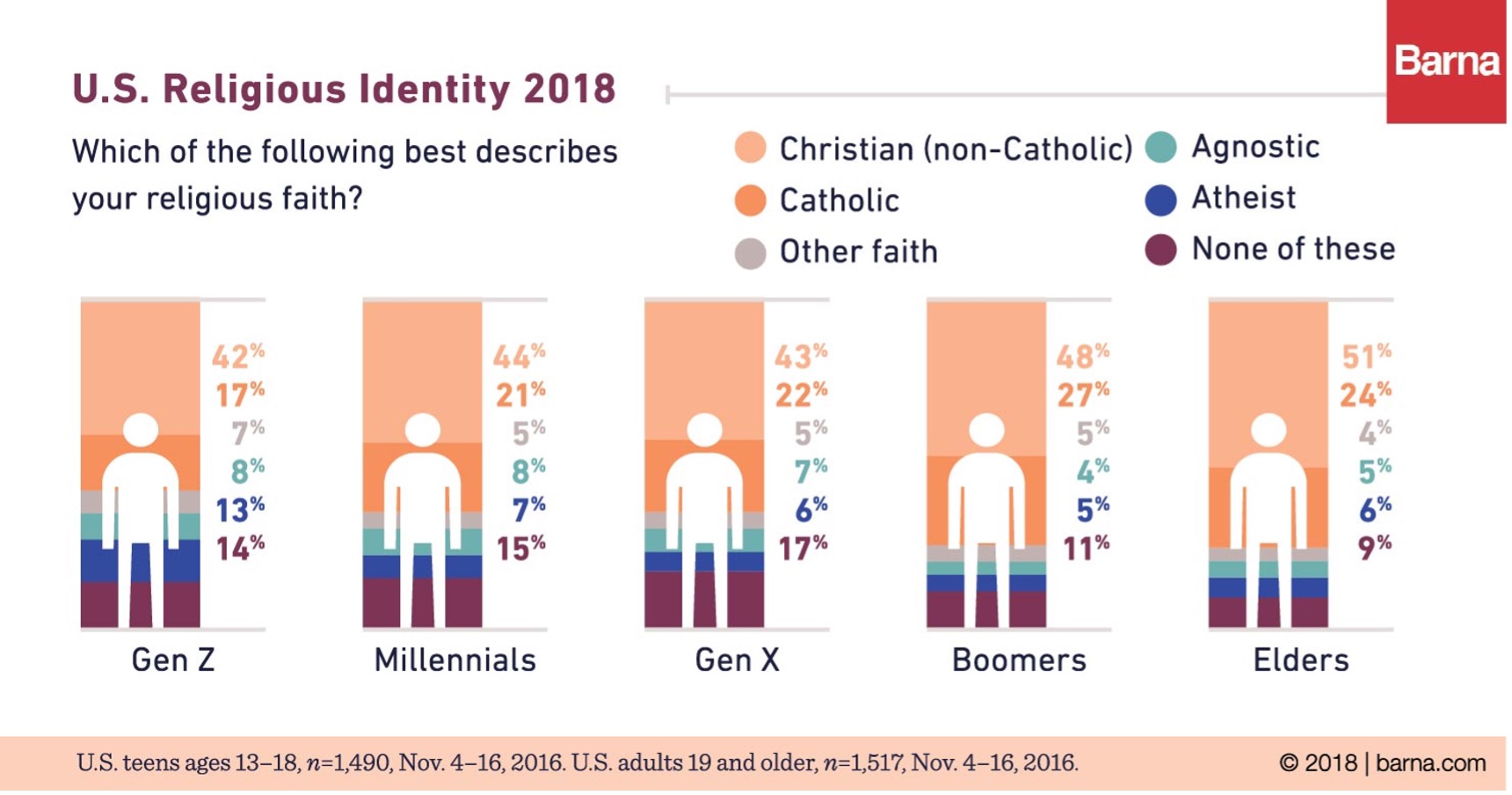
Enter Generation Z: Born between 1999 and 2015, they are the first truly “post-Christian” generation. More than any other generation before them, Gen Z does not assert a religious identity. They might be drawn to things spiritual, but with a vastly different starting point from previous generations, many of whom received a basic education on the Bible and Christianity. And it shows: The percentage of Gen Z that identifies as atheist is double that of the U.S. adult population.

The percentage of Gen Z’ers to be atheist has more than doubled previous generations: 13% of Generation Z compared to 6% of adults:


Image source: Barna “Atheism Doubles Among Generation Z” (4 Jan 2018)

Gen Z and The Problem of Evil

Why is Gen Z more likely to be atheistic?  Well, Barna asked and they answered:

Teens, along with young adults, are more likely than older Americans to say the problem of evil and suffering is a deal breaker for them. It appears that today’s youth, like so many throughout history, struggle to find a compelling argument for the existence of both evil and a good and loving God.

The problem of evil isn’t a new objection, however. It’s an ancient objection dating all the way back to the Greek philosopher Epicurus who formulated the problem as such:

“Either God wants to abolish evil, and cannot; or he can, but does not want to; or he cannot and does not want to. If he wants to, but cannot, he is not all powerful. If he can, and he does not want to, he is wicked. But, if God both can and wants to abolish evil, then how comes evil in the world?” [1]

The Problem of Evil and Apologetics

Notice, this is an intellectual objection to the truth of Christianity. Oddly, Christian philosophers, theologians, and apologists have answered this intellectual objection. In fact, they have answered it so convincingly that even professional atheists have admitted that there is not a logical problem of evil that has successfully demonstrated that God doesn’t exist. The late atheist philosopher William Rowe, stated that “Some philosophers have contended that the existence of evil is logically inconsistent with the existence of a theistic God. No one, I think, has succeeded in establishing such an extravagant claim.” [2] Consider Paul Draper, agnostic philosopher of religion at Purdue: “I do not see how it is possible to construct a convincing logical argument from evil against theism.” [3]

Christian scholars have gone on to differentiate between two types of intellectual problems of evil: the logical problem (as commented on by Rowe and Draper above) and the evidential problem of evil. I won’t address the difference here (see the videos by Reasonable Faith below as well as the other resources), but just seeing the categorization by Christian scholars shows how extensively they have thought and contemplated the issue of evil.

Intellectual vs. Emotional Evil

While Rowe and Draper are referring to the intellectual problem of evil, evil and suffering has another side: emotional. This is an important distinction we need to make. While one can provide answers to the intellectual problem of evil, it doesn’t mean that we won’t experience evil personally. We still have to grapple and suffer through evil and pain. Some of it is quite horrific. But the emotional experience of pain and suffering is not an argument, but a personal struggle. It is a struggle that the Christian worldview can offer satisfying resources and comfort for someone who is suffering pain and evil. Christianity can speak of the patience and mercy of God. It can mention the future perfection that awaits all who trust in Christ. It can offer the comfort that a redemptive God is working to cause all things to work together for good to those who love Him and are called according to His purpose. It has a “good news” of hope for a broken world. The atheistic worldview denies these luxuries.

Apologetics and the Christian worldview has the intellectual and emotional resources for Gen Z. It just needs to be communicated: which Christian apologetics does. Not just intellectual answers, but deeply personal, psychological, and spiritual answers.

Resources

Books:

Primary Videos:

Other videos:

References:

[1] Attributed to Epicurus in David Hume, Dialogues Concerning Natural Religion (1779), part 10.

[2] William Rowe, “The Problem of Evil and Some Varieties of Atheism,” American Philosophical Quarterly 16, no. 4 (1979), pg. 335, ftnt 1, reposted at: https://ia803006.us.archive.org/32/items/RoweTheProblemOfEvil/Rowe_The_Problem_of_Evil.pdf

[3] Paul Draper, “The Argument from Evil,” in Philosophy of Religion: Classic and Contemporary Issues, ed. Paul Copan and Chad Meister (Malden, MA: Blackwell, 2008), 146.

Recommended Resources: 

If God, Why Evil? (DVD Set), (MP3 Set), and (mp4 Download Set) by Frank Turek 

Why Doesn’t God Intervene More? (DVD Set), (MP3 Set), and (mp4 Download Set) by Frank Turek

Why does God allow Bad Things to Happen to Good People? (DVD) and (mp4 Download) by Frank Turek 

Relief From the Worst Pain You’ll Ever Experience (DVD) (MP3) (Mp4 Download) by Gary Habermas 


J. Steve Lee has taught Apologetics for over two and a half decades at Prestonwood Christian Academy.  He also has taught World Religions and Philosophy at Mountain View College in Dallas and Collin College in Plano.  With a degree in history and education from the University of North Texas, Steve continued his formal studies at Southwestern Baptist Theological Seminary with a M.A. in philosophy of religion and has pursued doctoral studies at the University of Texas at Dallas and is finishing his dissertation at South African Theological Seminary.  He has published several articles for the Apologetics Study Bible for Students as well as articles and book reviews in various periodicals including Philosophia Christi, Hope’s Reason: A Journal of Apologetics, and the Areopagus Journal.  Having an abiding love for fantasy fiction, Steve has contributed chapters to two books on literary criticism of Harry Potter: Harry Potter for Nerds and Teaching with Harry Potter.  He even appeared as a guest on the podcast MuggleNet Academia (“Lesson 23: There and Back Again-Chiasmus, Alchemy, and Ring Composition in Harry Potter”).  He is married to his lovely wife, Angela, and has two grown boys, Ethan and Josh.

Originally posted at: https://bit.ly/4i1f1gM

It’s common for atheists to be a “Grinch” over the Holidays and exclaim that Jesus is just a “Santa Claus for adults!” When I hear that claim, I immediately respond with a question: “What do you mean by that?”

If one means that children often believe in fictional fairy tales and adults believe in fact-based evidence, then I agree – Jesus is for adults (and actually people of all ages)! But I don’t think that’s the intent behind this claim. I believe the intent of the atheist (“Grinch”) is to convey that little kids believe in a fictional Santa Clause and many adults believe in fiction too – Christianity.

How the Grinch Stole Christ out of Christmas

Well, why think a thing like that, Mr. Grinch? Is belief in Jesus — or belief in God — really no different than belief in Santa? To answer this question, we must first ask if we have any good reason to believe in Santa. What good reasons are there that would lead us to logically conclude, “Therefore, Santa exists”?

Now, I’m not emotionally opposed to the existence of Santa Claus, and my life would not really have to change if Santa really exists, so if there were any evidence pointing to a jolly fat man in the North Pole who flies around with Rudolph giving gifts made by the elves, then I would happily follow that evidence wherever it leads. Even if there were logic-based arguments concluding that Santa PROBABLY exists, I would be very open to the existence of Santa. Come to think of it, Santa Claus would save me a ton of money on Christmas presents! Be that as it may, there is no evidence or any logic-based arguments concluding that Santa Claus exists — or even PROBABLY exists. So, although I am willing to be persuaded, there just doesn’t seem to be any evidence or logical reasons to believe in Santa Claus (sorry kids).

Now perhaps, Mr. Grinch, you’re saying to yourself: “That’s right! There’s no evidence for Santa Claus AND there is no evidence of God or Jesus either! That’s why it’s ridiculous to believe in Santa Claus or God!”

A False Equivalence

But is that true? Is the evidence — or lack thereof — for Santa Claus and the evidence for God really the same?

Well, if Santa does exist, we would know what to look for: A big, jolly, white-bearded, fat man in a red suit flying around in a sleigh being pulled by flying reindeer delivering presents to children on Christmas Eve. We would look for his factory full of elves at the North Pole too! So far (as far as I know), this evidence for Santa has never been detected. That in and of itself is not PROOF that Santa does not exist, but once we add to the fact that we have no other positive reasons to believe that Santa exists, then we can safely say that Santa does not exist.

But what about God? If God does exist, what would we expect to find? Do you even know what evidence you should start looking for?

Before stating that there is no evidence for something, Mr. Grinch, make sure you know what kind of evidence there should be if that thing does exist. If the God of the Bible exists, for example, he is not the kind of being you would see flying around in the clouds. He would not be some “sky daddy,” as many internet atheists seem to think. No, if the God of the Bible exists, He would not be some humanoid “Zeus-like being.” God (if He exists) is an immaterial unembodied mind – a “spirit” (John 4:24).

How Christ Saves Christmas, from the Grinch

So, what should we expect to find if Christian theism is true? We would expect to find scientific evidence for the beginning of the space-time universe. We have that! We would expect to find evidence for the fine-tuning of the initial conditions of the big bang so that intelligent life – not to mention matter itself – could exist. We have that! We would expect to have historical data showing that Jesus of Nazareth was a real person of history who was executed by the Roman government. We have that!

In fact, we would expect to be able to make a strong case — via the historical method alone – that Jesus actually rose from the dead. Historians have demonstrated that the resurrection of Jesus is the inference to the best explanation after examining all of the historical facts!

So, the things we would expect to find if Santa exists, do not exist. However, the things we would expect to find if the God of the Bible exists, those things DO exist!

After taking everything into consideration, although it would be irrational to believe in Santa Claus, one is quite coherent believing in the God Jesus revealed. That is to say, we have good reason to celebrate Christmas.

So, the next time Mr. Grinch compares Jesus to Santa Claus, just show him the evidence pointing to the reason for the season.

Have a reasonable (Isaiah 1:18) and Merry Christmas,

Dr. Tim Stratton

Recommended Resources: 

Jesus, You and the Essentials of Christianity by Frank Turek (INSTRUCTOR Study Guide), (STUDENT Study Guide), and (DVD)      

Stealing From God by Dr. Frank Turek (Book, 10-Part DVD Set, STUDENT Study Guide, TEACHER Study Guide)

Reflecting Jesus into a Dark World by Dr. Frank Turek – DVD Complete Series, Video mp4 DOWNLOAD Complete Series, and mp3 audio DOWNLOAD Complete Series

How Can Jesus Be the Only Way? (mp4 Download) by Frank Turek


Tim Stratton (The FreeThinking Theist) pursued his undergraduate studies at the University of Nebraska-Kearney (B.A. 1997) and after working in full-time ministry for several years went on to attain his graduate degree from Biola University (M.A. 2014). Tim was recently accepted at North West University to pursue his Ph.D. in systematic theology with a focus on metaphysics.

Originally posted at: https://bit.ly/49fAu1O

Most atheists I have encountered demonstrate an amazing “faith” in the power of science. They will often accuse believers of wishful thinking – or outright foolishness – when believers conclude that an intelligent being is the only reasonable inference to draw from the evidence of design that surrounds us. They do this because they have come to believe that only through “science” can anything be known, and that science will someday answer all of life’s mysteries. That is what’s called “scientism.” There is no need for a God, they assure themselves, because “science” has not provided for one.

Is Science the Only Way to Know?

The flaw in this thinking is the assumption that science is the only way one can know something. This is flawed on many levels. Science, broadly speaking, is a method of examining and assessing the physical world around us, using instrumentation and methodology to achieve repeatable results so as to confirm or negate a hypothesis. It is, therefore, an endless process of knowledge acquisition, but only in the physical realm. We employ it because we are first convinced that reality is fixed, and that repeatability is possible. But that is a philosophical belief, not something that science has itself proven.[1] If we didn’t already “know” this there would be no point in attempting to conduct experiments in the first place.

Can Science Handle Moral Values?

Moreover, science does not attempt to provide knowledge as to good and evil, for it is simply incapable of doing so. After all, Nazi scientists were making use of science, but we would hardly accept that what they were doing was good. Indeed, we would not look to the scientific method at all for answers to such questions.

Can Science Address Anything Besides Physical Nature?

Finally, since science is limited to the physical realm, it cannot be used to assess the transcendent. What existed before “time” began can no more be measured by science than can the morality of a decision to use science to achieve a particular end.

What Other Options Do we have?

There are other ways to obtain knowledge besides experimental science, especially in areas where testing and repeatability are not possible. We do this all the time in the study of history, or when we make use of abductive reasoning to arrive at the best explanation from the available evidence. One example often used in courtrooms involves rain: clothing gets wet when we walk in the rain, and we rightly infer that it is raining outside when someone walks into a building wearing a raincoat that is dripping wet. We use abductive reasoning intuitively and we take as a given that our sense of reasoning operates correctly to allow us to reach valid conclusions. This is so even though we cannot use reason (or science) to prove the validity of reason. Simply put, if I try to use reason to prove that reason is valid, I have to presuppose the validity of the very thing – reason – that I am trying to prove. No, reason is a starting point, a given that we must all utilize if we are to discuss – to think – at all.

Christians are not imagining a creator when they look at the evidence of the universe. Quite the contrary: modern science is unlocking more and more of the secrets of the universe and finding that it is incredibly fined tuned to support the existence of life. Mathematical formulae can model what is occurring in nature with remarkable precision, amounting to a “language” scientists use to understand reality. Medical science has peered into the complexity of life, and the billions of lines of a computer-like code – found in DNA – that directs the building of proteins and ultimately structures that allow the vast variety of life we see on Earth. Whenever we see signs of something that is designed and operating according to a finely tuned set of instructions, we quite properly infer that there is an intelligence behind it. For something as massive and breathtaking as this universe, populated as it is with intelligent life, that something must itself be immensely intelligent and immensely powerful. Science certainly addresses this physical domain; it seeks to answer the question how things occur? And science performs a valuable function. But science as a tool for discovering processes cannot explain what first set in motion the forces that it is examining; what the designer sought to accomplish with the laws of nature; and what the ultimate meaning and purpose of life really is. Science addresses the “how” of whatever already exists, but not the “why.”

If Nature were a Note

Consider: imagine a scientist examining the mail he receives every day. Over time, he learns everything there is to know about the type of paper that is used, how the paper was formed, the type of ink, its place of manufacture and its ingredients. Imagine further that he determines how the letters are grouped to form words. Seeking knowledge of this type is laudable. But if the scientist concludes that since he knows all there is to know about ink and letters and envelopes, that there is no need for a letter-sender, then he has done something worse than making a blind leap of faith – he has closed his mind to the obvious reality of what he is examining. Indeed, the only way the scientist can learn the point of it all, the meaning of the message, is to read what was written, for in it is embedded information, something that simply cannot arise through random or blind processes.

As Christians, we bear witness to a personal God, not because we are grasping at myths, but because we believe the evidence of Jesus’s life, death and resurrection are sufficient for us to know him in a personal way. In other words, we personalize the source of what physicists describe as the creation event not by myth or wishful thinking but by a combination of abductive reasoning – a creator is the best explanation – and specific revelation – he is the God described in the Bible.

In the end, science and the Christian worldview are not in conflict. It is the one who insists despite the evidence that there is no God – and ultimately no one to whom we will one day be called to answer – that is persisting in ignorance.

References: 

[1] Editors Note: The fixity, repeatability, and knowability of nature are preconditions for science. One can’t do science without them. That is, one must assume such a framework before one can use the scientific method to discover facts about the natural world. Since these sorts of things have to be assumed beforehand they are, properly speaking, the domain of philosophy, namely philosophy of science.

Recommended resources related to the topic:

Why Science Needs God by Dr. Frank Turek (DVD and Mp4)

Science Doesn’t Say Anything, Scientists Do by Dr. Frank Turek (DVD, Mp3, and Mp4)

Oh, Why Didn’t I Say That? Does Science Disprove God? by Dr. Frank Turek (DVD and Mp4)

Stealing From God by Dr. Frank Turek (Book, 10-Part DVD Set, STUDENT Study Guide, TEACHER Study Guide)


Al Serrato earned his law degree from the University of California at Berkeley in 1985. He began his career as an FBI special agent before becoming a prosecutor in California, where he worked for 33 years. An introduction to CS Lewis’ works sparked his interest in Apologetics, which he has pursued for the past three decades. He got his start writing Apologetics with J. Warner Wallace and Pleaseconvinceme.com.


Apatheism was a term coined by the late philosopher Robert Nash.[1] It’s meant to describe the indifference or apathy some people have toward the question of whether God or gods exist. To be an apatheist is to be spiritually indifferent about the subject matter of God altogether. So much so, that adherents are uninterested in broaching a conversation regarding God’s existence. For them, it’s a moot point. Not worth entertaining. It’s as if there’s nothing to be gained since you can’t prove God’s existence in such a way as to make an ultimate difference. So, the apatheist reasons, “Why bother?”

Apathy and ET

An apatheist stance is equivalent to people uninterested in talking about whether extra-terrestrial life exists on other planets. Why concern yourself? We can’t know. It’s a fool’s errand. Not surprisingly then, you won’t find the apatheist pondering the divine in search of life’s meaning. No, this is a closed mindset, limited by the observable world for matters of meaning. As a result, apatheists are left looking inward to make the most of life and to make moral sense of the choices confronting them.

Is It an Attitude or a Belief?

Ironically, adherents to this ideology like to think their outlook is more of an attitude than a belief. But herein lies the problem. As much as apatheists may want to evade belief-status by calling it an attitude, that’s not so easy. While hesitant to call it a belief, apatheism is a belief, in that apatheists (1) believe God isn’t worth the search. Apatheism is (2) the belief that God can’t or doesn’t make a difference in their life. It is (3) the belief that God has no say on moral matters. And beliefs such as these cause apatheists to have the attitude they do about all things divine.

That said, the next time you find yourself in a conversation with an apatheist who readily flaunts his commitment to apatheism, don’t let him fool you into thinking he is bereft of belief. While it may be a convenient smokescreen for adherents to circumvent conversations about God, it is also a contradictory attitude which can render them stuck in deception. Apatheists don’t just have an attitude that the topic of God doesn’t matter, they believe the topic of God doesn’t matter, which in turn forms their apathy.

Belief Shapes Attitude

The apatheist isn’t alone. Beliefs shape all our attitudes, be it the agnostic, atheist, pantheist, theist, or apatheist. You can’t have a set of beliefs, which in turn form your attitude, and then lop off the beliefs that determined your attitude by simply claiming, “Only my attitude remains.” Talk about self-deception. Don’t let the apatheist fool you. Instead, point out the futility of trying to separate one’s beliefs from one’s attitude.

Having clarified that, hopefully you can enter the real discussion over which of the various beliefs under consideration are true. That’s not a matter of indifference. It’s a belief which can make all the difference. But to do so, the apatheist needs a change of attitude about his attitude. That his attitude about God has been shaped by his beliefs. With one crack at life, apathy toward our Creator is an unwise move.

Plugging one’s ears doesn’t erase the noise.
It just makes the person dull to it.
Ephphatha, “Be opened!”


Endnotes

[1] Robert J. Nash, Religious Pluralism in the Academy: Opening The Dialogue (New York: P. Lang, 2001), 27.

Other Recommended Resources On This Topic

I Don’t Have Enough Faith to Be an Atheist (Paperback), and (Sermon) by Norman Geisler and Frank Turek
Debate: What Best Explains Reality: Atheism or Theism? by Frank Turek DVD, Mp4, and Mp3
If God, Why Evil? (DVD Set), (MP3 Set), and (mp4 Download Set) by Frank Turek
Why Doesn’t God Intervene More? (DVD Set), (MP3 Set), and (mp4 Download Set) by Frank Turek
How Can Jesus Be the Only Way? (mp4 Download) by Frank Turek
Person of Interest: Why Jesus Still Matters in a World that Rejects the Bible by J. Warner Wallace (Paperback), (Investigator’s Guide).


Bobby serves as lead pastor of Image Church in Charlotte, North Carolina, and is well known for his YouTube ministry called, One Minute Apologist, which now goes by the name Christianity Still Makes Sense. He also serves as the Co-Host of Pastors’ Perspective, a nationally syndicated call-in radio show on KWVE in Southern California. Bobby earned his Master of Theology degree from Dallas Theological Seminary, his Doctor of Ministry in Apologetics from Southern Evangelical Seminary, and his Ph.D. in Philosophy of Religion from the University of Birmingham (England) where he was supervised under David Cheetham and Yujin Nagasawa. Bobby’s also written several books including: The Fifth Gospel, Doubting Toward Faith, Does God Exist, and Fifty-One other Questions About God and the Bible and the forthcoming Christianity Still Makes Sense to be published by Tyndale in April 2024. He’s married to his lovely wife Heather and together they have two grown kids: Haley and Dawson.


By Bobby Conway

Have you ever found yourself in a conversation with a skeptic only to be asked in gotcha fashion, “Well, who made God?” Asking the question, “Who made God?” is like asking, “How did Beethoven’s Moonlight Sonata taste?” It just doesn’t fit. The question is a classic category mistake. God wasn’t made and Beethoven’s Moonlight Sonata can’t be tasted. Adding to this blunder, the famed atheist Bertrand Russell notoriously said, “If everything must have a cause, then God must have a cause.” Yet, it’s not true that everything must have a cause. Only that which begins to exist must have a cause. And herein God is perched up in a category all His own.

God is the uncreated Creator.

He is the beginning-less Beginner.

He is the uncaused Cause of all that began to exist.

Think about it. Everything that had a beginning had a cause. And every beginning had a Beginner. And every product has a Producer. And every initiative must have an Initiator. If there is an origin, there must be an Originator. And since there is a genesis, there is a Generator.

That generator my friend is, well, you guessed it.

God.

The Scriptures exclaim from the very first verse, “In the beginning, God created the heavens and the earth” (Genesis 1:1). Far from being made, God is the maker of all things made.

Again, note the distinction. The difference between God and everything else that exists is everything else began to exist whereas God just exists. Do you remember what God said to Moses when He appeared to him in the burning bush? Moses said,

“If I come to the people of Israel and say to them, ‘The God of your fathers has sent me to you,’ and they ask me, ‘What is his name?’ what shall I say to them?” God said to Moses, “I am who I am.” And he said, “Say this to the people of Israel, ‘I am has sent me to you’” (Exodus 3:13-14).

What was God saying to Moses? He was revealing Himself to Moses as the self-existent one. As the one who wasn’t made. God was saying, “Moses, go tell them that the One who never began to exist sent you. The unmade One.”

Unlike us, God is what philosophers refers to as a necessary being, an independent being. And each of us, unlike God, are contingent beings and, therefore, dependent. The universe is also contingent because God spoke it into existence. This means that all things that began to exist are dependent on God for existence.

It turns out there is a problem with the question, “Who made God?” The word made can’t be said of God. For God is the unmade Maker. As expected, he’s in a league of his own.

Recommended resources related to the topic:

Why Science Needs God by Dr. Frank Turek (DVD and Mp4)

Oh, Why Didn’t I Say That? Does Science Disprove God? by Dr. Frank Turek (DVD and Mp4)


____________________________________________________________________________________________________________________________________________________

Bobby serves as lead pastor of Image Church in Charlotte, North Carolina, and is well known for his YouTube ministry called, One Minute Apologist, which now goes by the name Christianity Still Makes Sense. He also serves as the Co-Host of Pastors’ Perspective, a nationally syndicated call-in radio show on KWVE in Southern California. Bobby earned his Master of Theology degree from Dallas Theological Seminary, his Doctor of Ministry in Apologetics from Southern Evangelical Seminary, and his Ph.D. in Philosophy of Religion from the University of Birmingham (England) where he was supervised under David Cheetham and Yujin Nagasawa. Bobby’s also written several books including: The Fifth Gospel, Doubting Toward Faith, Does God Exist, and Fifty-One other Questions About God and the Bible and the forthcoming Christianity Still Makes Sense to be published by Tyndale in April 2024. He’s married to his lovely wife Heather and together they have two grown kids: Haley and Dawson.


By Bob Perry

St. Francis of Assisi may have died 800 years ago, but his influence still looms. He was a man who venerated nature and lived a life of great sacrifice in service to God and his church. But within the Christian ecosystem, he has become most famous for an adage that strikes a chord with anyone who is serious about sharing their faith:

Preach the Gospel always. If necessary, use words.

The modern interpretation of Assisi’s exhortation is clear. Our charge is to love people into the kingdom, not argue them there. If you’ve bought into that mindset it may surprise you to learn that it’s not accurate. And it may surprise you even more to learn that it flies in the face of an atheist’s call to make our case.

Here’s why.

A Gospel Without Words?

On one level there is no denying that, “who you are speaks so loudly that no one can hear what you say.” We certainly don’t want the life we live to deny everything about the faith we claim to represent. But is the Franciscan inversion of this exhortation also true? Can we proclaim the message through our actions alone?

The problem here is that the Gospel makes propositional truth claims about the nature of the world, the nature of man, and the remedy for man’s rebellion against God. It’s a story about reality. And it’s only “good news” if it’s actually true. So, how can we share the propositional truth claims of such a message and explain their implications without using words or giving answers?

I contend that we can’t. Furthermore, the attitude that says we can is not only harmful, but it also does violence to the Gospel it claims to love. This contention is not my own. A rabid atheist will back me up.

The Gift of a Bible

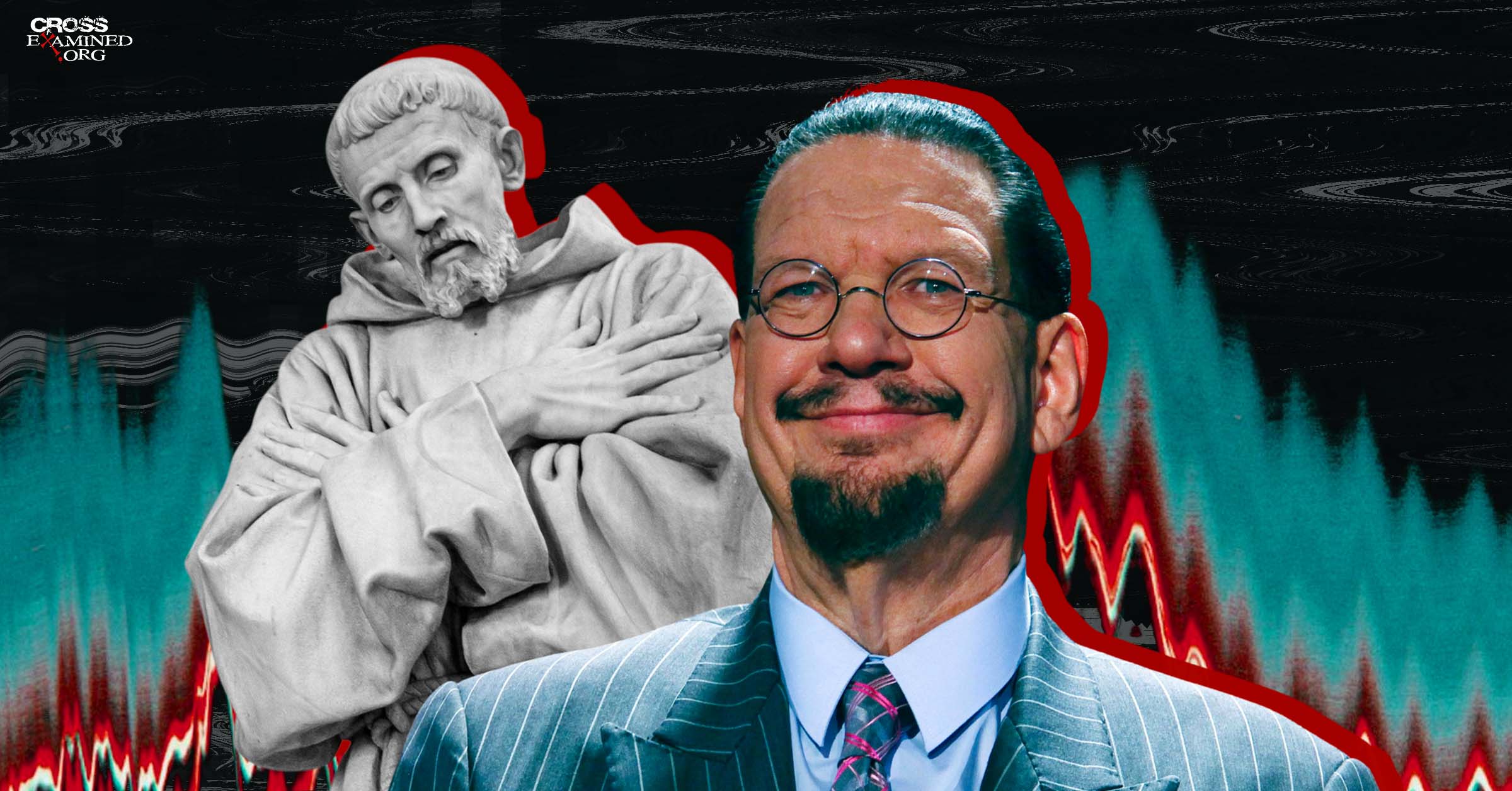
Penn Jillette and his partner, Raymond Teller, have been entertaining Las Vegas audiences for years. Their mixture of magic, music, and commentary – the Penn & Teller show – is the longest-running show at the same hotel in Las Vegas history. Jillette is a magician, actor, and inventor. He is also a hard-core atheist – so adamant about his denial of God’s existence that at one point in his life he is said to have owned three cars with vanity license plates that read: “atheist,” “nogod,” and “godless.”[i] “Strangely enough,” says Jillette, “they wouldn’t give me ‘infidel.’ He was also a happy participant in YouTube’s viral “blasphemy challenge,” in which participants publicly mock and denounce the Holy Spirit.

Penn Jillette is no friend of Christianity. But he has a message that every Christian should take to heart.

In July 2010, Jillette posted a video online[ii] in which he shared the story of a man who approached him after one of his performances. The man was extremely complimentary of the Penn & Teller show. He said he enjoyed Jillette’s honesty, his use of language, and his talent. The man was polite and humble. And he came bearing a gift.

“I was here last night,” said the man, “I brought this for you.” The man handed Jillette a pocket Bible containing the New Testament and the book of Psalms. Penn Jillette was genuinely humbled and impressed by the actions and attitude of this kind Christian man. And he is quite direct about how he received the gesture.

I don’t respect people who don’t proselytize. If you believe there’s a heaven and hell … and if you believe that people could be going to hell, or not getting eternal life … and you think that it’s not worth telling them this because it would make it socially awkward … How much do you have to hate somebody to not proselytize? How much do you have to hate somebody to believe that everlasting life is possible and not tell them that? If I believed beyond the shadow of a doubt that a truck was bearing down on you and you didn’t believe it, there’s a certain point where I tackle you. And this is more important than that (emphasis mine).

Misquoting Assisi

Most of us don’t have a lot in common with a rabid atheist Las Vegas showman who mocks the Holy Spirit. But every Christian would do well to take seriously Penn Jillette’s reflection. Not only does it fly in the face of the just-love-them-into-the-kingdom mindset, but it also comports with what Assisi actually said … and with what he did.

It turns out the legendary quote attributed to St. Francis is nothing but a modern corruption of the words he actually wrote in 1221 AD:

Let none of the brothers preach contrary to the form and institution of the church … Nevertheless, let all the brothers preach by their works.

Notice that Francis did not render preaching the gospel a contingent option. Instead, he linked words and actions directly together.

Francis of Assisi devoted himself to the kind of life for which he is now known after being convicted by a sermon he heard in 1209. He took a vow of poverty, felt connected to nature and the beauty of the creation, and demonstrated empathy for others. But he was also known for the powerful sermons he delivered. He lived out the Gospel, and he was happy to tell others about it.

Words Are Always Necessary

Arguments and evidence are far from arrogant intellectual add-ons to the Gospel.[iii] They are integral to it. God saturated our world with truths that could never be adequately expressed through our actions alone. There are plenty of examples of militant atheists who have turned to God after hearing about them. C. S. Lewis, Antony Flew, Lee Strobel, and J. Warner Wallace[iv] come to mind. Penn Jillette isn’t on that list – yet. That’s his choice, not ours. Don’t hate him for it. Be winsome and kind. But by all means, don’t be silent.

Footnotes

[i] https://en.wikipedia.org/wiki/Penn_Jillette

[ii] https://www.youtube.com/watch?v=6md638smQd8

[iii] https://truehorizon.org/the-gospel-requires-us-to-give-answers/

[iv] https://salvomag.com/article/salvo24/the-evidentialist

Recommended resources related to the topic:

Jesus, You and the Essentials of Christianity by Frank Turek (INSTRUCTOR Study Guide), (STUDENT Study Guide), and (DVD)      

How to Interpret Your Bible by Dr. Frank Turek DVD Complete Series, INSTRUCTOR Study Guide, and STUDENT Study Guide

_____________________________________________________________________________________________________________________________________________________

Bob Perry is a Christian apologetics writer, teacher, and speaker who blogs about Christianity and the culture at truehorizon.org. He is a Contributing Writer for the Christian Research Journal and has also been published in Touchstone, and Salvo. Bob is a professional aviator with 37 years of military and commercial flying experience. He has a B.S., Aerospace Engineering from the U. S. Naval Academy, and an M.A., Christian Apologetics from Biola University. He has been married to his high school sweetheart since 1985. They have five grown sons.

Original Blog Source: https://bit.ly/3UxOXgU