Tag Archive for: apologetics

By Julie Hannah

In Article 1, “The arising of our universe: design or chance?” I discussed evidence for the design behind our finely-tuned universe, which has convinced some mainstream scientists of the existence of a transcendent Creator. Article 2, “Can living cells arise randomly from non-living chemicals?” presented recent research findings that call into question the theory that living cells could have arisen from random operations on non-living chemicals. This article considers challenges to reductionist aspects of neo-Darwinian theories of evolution.

How does science account for the range of complex life forms? According to the deterministic neo-Darwinian Modern Synthesis model, random errors in DNA-copying cause mutations, and only some of the resulting forms survive the environmental process of natural selection. It is generally agreed that these gene-driven processes can account for some aspects of development, but many scientists are questioning whether they can fully explain the complexity of all life forms. Eugene Koonin, an evolutionary biologist at the National Center for Biotechnology Information makes this blunt observation: “The summary of the state of affairs on the 150th anniversary of the Origin is somewhat shocking: in the post-genomic era, all major tenets of the Modern Synthesis are, if not outright overturned, replaced by a new and incomparably more complex vision of the key aspects of evolution. So, not to mince words, the Modern Synthesis is gone” (“Origin at 150,” 474–75).

Standard evolutionary theory is being challenged in the following three major areas.

Challenge 1: Only small, continuous changes?

Microevolution involves minor genetic mutations and natural selection. But according to geneticists Baguñà and Garcia-Fernàndez, repeated microevolution does not explain major evolutionary transitions, and as a result, “even to the most unbounded optimist, we are still far from understanding morphological diversity and evolution” (“Evo-Devo,” 706). Evolutionary biologist Stephen Jay Gould argued that there was a fundamental difference between minor adaptations and the formation of new species, an opinion that is also expressed by paleobiologist Douglas Erwin of the Smithsonian Institute in his article, “Macroevolution is More Than Repeated Rounds of Microevolution.” Anthropologist Jeffrey Schwartz points out that some major groups “appear in the fossil record as Athena did from the head of Zeus—full-blown and raring to go, in contradiction to Darwin’s depiction of evolution as resulting from the gradual accumulation of countless infinitesimally minute variations” (Sudden Origins, 3). And Eugene Koonin concludes that “the idea of evolution being driven primarily by infinitesimal heritable changes in the Darwinian tradition has become untenable” (“Origin at 150,” 474).

Challenge 2: Only random variations and natural selection?

Some scientists are questioning the purely random nature of evolutionary change. For example, molecular geneticist James Shapiro makes this observation: “It is difficult (if not impossible) to find a genome change operator that is truly random in its action within the DNA of the cell where it works. All careful studies of mutagenesis find statistically significant non-random patterns of change” (Evolution, 82). Gerd Müller, Head of the Department of Theoretical Biology at the University of Vienna, argues that developmental systems seem to have innate tendencies towards certain solutions, and these tendencies have as strong an influence on development as random DNA variations (“Extended Evolutionary Synthesis,” 4, 7). Professor of evolutionary biology Kevin Laland agrees that “much variation is not random because developmental processes generate certain forms more readily than others” (“Does evolutionary theory need a rethink?” 162).

The theory of random variations also presents unresolved problems. According to genetic biologists Thornton and DeSalle, “It remains a mystery how the undirected process of mutation, combined with natural selection, has resulted in the creation of thousands of new proteins with extraordinarily diverse and well optimized functions. This problem is particularly acute for tightly integrated molecular systems that consist of many interacting parts . . . It is not clear how a new function for any protein might be selected for unless the other members of the complex are already present, creating a molecular version of the ancient evolutionary riddle of the chicken and the egg” (“Gene Family Evolution,” 64).

Simon Conway Morris, who holds the Chair in Evolutionary Paleobiology at Cambridge, also argues that adaptation is not an undirected, random walk through all possibilities. For example, when muscle tissue develops into organs that produce electricity, the process requires very precise amino acid replacements at specific sites, together with accelerated evolution of the new function, and Conway Morris concludes that “there is little doubt that these changes are very far from random” (Runes of Evolution, 38). He therefore argues that while the underlying principles of Darwinian evolution are correct, they do not provide a complete explanation of development, and a more comprehensive theory of evolution is required.

Gould also pointed out that many evolutionists now doubt the exclusive role of natural selection in genetic change (“New and General Theory of Evolution,” 12). And Andras Pellionisz, an expert in genome informatics, suggests that the theory of natural selection should be extended to include goal-directed aspects (“Principle of Recursive Genome Function,” 349).

Challenge 3: What about the complex genetic code?

It is generally accepted that the modern genetic code evolved from a simpler form, but there is no agreement about when or how this initial code evolved. In their article, “Chance and Necessity Do Not Explain the Origin of Life,” microbiologist Jack Trevors and cyberneticist David Abel explain why they believe natural selection could not be the primary mechanism for developing DNA coding (“Chance and Necessity,” 734 – 35):

  • “Without the machinery and protein workers, the [DNA] message cannot be received and understood. And without genetic instruction, the machinery cannot be assembled . . . It is not reasonable to expect hundreds to thousands of random sequence polymers to all cooperatively selforganize into an amazingly efficient holistic metabolic network.”
  • “Natural processes, mechanisms, and chemical catalyses do not explain any of these emergent conceptual phenomena. . . . Even ‘meaningful’ RNA or DNA inserted into a lifeless physical world such as the ancient Earth, would not be ‘readable.’ It could not communicate its coded message for protein synthesis unless a language (operating system) context already existed.”
  • “Contentions that offer nothing more than long periods of time offer no mechanism of explanation for the derivation of genetic programming. No new information is provided by such tautologies. The argument simply says it happened. As such, it is nothing more than blind belief.” In other words, “time made it happen” might be science’s version of “God made it happen.”

Atheist biologist Richard Dawkins insists there is only an “illusion of design in the living world” (God Delusion, 25), and he claims that “cumulative selection, by slow and gradual degrees, is the explanation, the only workable explanation that has ever been proposed, for the existence of life’s complex design” (Blind Watchmaker, 317, original emphasis). However, atheist geneticist and evolutionist Richard Lewontin disagrees, pointing out that Dawkins’s adamant assertion ignores an enormous amount of recent research. He writes: “Dawkins’s vulgarizations of Darwinism speak of nothing in evolution but an inexorable ascendancy of genes that are selectively superior, while the entire body of technical advance in experimental and theoretical evolutionary genetics of the last fifty years has moved in the direction of emphasizing non-selective forces in evolution” (“Billions of Demons,” 29).

Computational physiologist Denis Noble argues that the highly reductionist and deterministic worldview of neo-Darwinism is not a necessary conclusion from the scientific evidence. He expresses the desire of many biologists to “distance [themselves] from the biased conceptual scheme that neo-Darwinism has brought to biology, made more problematic by the fact that it has been presented as literal truth” (“Evolution Beyond neo-Darwinism,” 12). And as Gerd Müller points out, this is not the view of only a handful of fringe scientists because an increasing number of publications call for a major revision of standard evolutionary theory (“Extended Evolutionary Synthesis,” 2).

The more recent approach to evolutionary development is not deterministic or gene-driven. Instead, it argues that there are complex non-random processes at work. However, Laland et al. point out that there is passionate resistance to the newer Extended Evolutionary Synthesis (EES): “The number of biologists calling for change in how evolution is conceptualized is growing rapidly . . .  Yet the mere mention of the EES often evokes an emotional, even hos­tile, reaction among evolutionary biologists . . . This is no storm in an academic tearoom, it is a struggle for the very soul of the discipline” (“Evolutionary Theory,” 162).

Marcos Eberlin, a winner of the Thomson Medal in Chemistry, summarized a wide range of recent scientific findings in his 2019 book Foresight: How the Chemistry of Life Reveals Planning and Purpose, which is endorsed by three winners of Nobel Prizes in science. Eberlin reaches this conclusion about the evidence regarding the development of life on Earth: it “seems to point beyond any blind evolutionary process to the workings of an attribute unique to minds—foresight. And yes, I know: We’re told that it’s out of bounds for science to go there… [but] I urge you to inspect the evidence” (Foresight, 13–14). 

Note

Adapted from A Skeptic’s Investigation into Jesus, J P Hannah.

https://www.amazon.com/Skeptics-Investigation-into-Jesus/dp/1532674619

Used with kind permission from Wipf and Stock Publishers: www.wipfandstock.com.

References

Baguñà, Jaume, and Jordi García -Fernàndez. “Evo-Devo: the Long and Winding Road.” The International Journal of Developmental Biology 47 (2003) 705–13.

https://www.researchgate.net/publication/8892395_Evo-Devo_The_Long_and_Winding_Road

Conway Morris, Simon. The Runes of Evolution: How the Universe Became Self-Aware. West Conshohocken, PA: Templeton, 2005.

Eberlin, Marcos. Foresight: How the Chemistry of Life Reveals Planning and Purpose. Seattle: Discovery Institute, 2019.

Erwin, Douglas H. “Macroevolution is more than repeated rounds of microevolution.” Evolution and Development 2 (2000) 78–84.

https://onlinelibrary.wiley.com/doi/full/10.1046/j.1525-142x.2000.00045.x

Gould, Stephen Jay. “Is a new and general theory of evolution emerging?” Paleobiology 6 (1980) 119–30.

http://www.somosbacteriasyvirus.com/gould.pdf

Koonin Eugene V. “The Origin at 150: Is a New Evolutionary Synthesis in Sight?” Trends in Genetics 25  (2009) 473–75. doi:10.1016/j.tig.2009.09.007.

https://www.ncbi.nlm.nih.gov/pmc/articles/PMC2784144/

Laland Kevin N., et al. “Does evolutionary theory need a rethink?” Nature 514 (2014) 161–64.

https://www.researchgate.net/profile/Gerd_Mueller/publication/278258986_Does_evolutionary_theory_need_a_rethink_-_POINT_Yes_urgently/links/55cd2f8708aebd6b88e05e5f/Does-evolutionary-theory-need-a-rethink-POINT-Yes-urgently.pdf?origin=publication_detail

Lewontin, Richard. “Billions and Billions of Demons: A Review of The Demon-Haunted World, by Carl Sagan.” New York Review of Books 44 (1997) 28–30.

http://www.drjbloom.com/Public%20files/Lewontin_Review.htm

Müller, Gerd B. “Why an extended evolutionary synthesis is necessary.” Interface Focus 7: 20170015.

https://royalsocietypublishing.org/doi/pdf/10.1098/rsfs.2017.0015

Noble, Denis. “Evolution beyond neo-darwinism: a new conceptual framework.” The Journal of Experimental Biology 218 (2015) 7–13. 

http://jeb.biologists.org/content/jexbio/218/1/7.full.pdf

Pellionisz, Andras J. “The Principle of Recursive Genome Function.” Cerebellum 7 (2008) 348–59. http://ww.junkdna.com/pellionisz_principle_of_recursive_genome_function.pdf

Schwartz, Jeffrey H. Sudden Origins: Fossils, Genes, and the Emergence of Species. New York: Wiley, 1999.

Shapiro, James, A. Evolution: A View from the 21st Century. Upper Saddle River, NJ: Pearson, 2011.

Thornton, Joseph W., and Rob DeSalle. “Gene Family Evolution and Homology: Genomics Meets Phylogenetics.” Annual Review of Genomics and Human Genetics 1 (2000) 41–73.

https://www.math.auckland.ac.nz/~nicholls/BIOSCI743/thorntonanddesalle.pdf

Trevors, Jack T., and David L. Abel. “Chance and necessity do not explain the origin of life.” Cell Biology International 28 (2004) 729–39.

https://www.webpages.uidaho.edu/~stevel/565/literature/Chance%20and%20necessity%20do%20not%20explain%20the%20origin%20of%20life.pdf

Recommended resources related to the topic:

Why Science Needs God by Dr. Frank Turek (DVD and Mp4)

Science Doesn’t Say Anything, Scientists Do by Dr. Frank Turek (DVD, Mp3, and Mp4)

Oh, Why Didn’t I Say That? Does Science Disprove God? by Dr. Frank Turek (DVD and Mp4)

Stealing From God by Dr. Frank Turek (Book)

Macro Evolution? I Don’t Have Enough Faith to be a Darwinist (DVD Set), (MP3 Set) and (mp4 Download Set) by Dr. Frank Turek

Answering Stephen Hawking & Other Atheists MP3 and DVD by Dr. Frank Turek 


Julie Hannah is a Mathematics lecturer (recently retired) with a passionate interest in the human condition. As an agnostic, she spent over a decade researching science and the scriptures of various faiths, and the cumulative evidence finally brought her to Christ. She has published her findings in “A Skeptic’s Investigation into Jesus” (Wipf and Stock).

There is a far deeper problem than atheism infecting the church. Alisa Childers, a Christian singer with ZOEgirl, almost got infected herself. She was challenged to renounce the true gospel and adopt another gospel—that of progressive Christianity. She joins Frank to tell her story and discuss her fabulous new book “Another Gospel,” which is part autobiographical and part apologetics.

Among the issues they cover:

  • How did your pastor try to convert away from the true Gospel?
  • What is progressive and Christian about progressive Christianity?
  • What are the basic beliefs of progressive Christianity?
  • What the signs of a person or church-going in that direction?
  • Why do people become progressive Christians?
  • How is progressive Christianity more intolerant than true Christianity?
  • What are its racist and Marxist roots?  
  • What evidence do we have that the early Christians were conservative, not progressive?
  • How do you reach out to those who consider themselves progressive Christians?

Get the book! Here’s Frank’s endorsement: “I love this book! Alisa Childers takes you on a captivating journey from her unreflective conservative Christian faith to the cliff of another gospel and then back home to the true Jesus. Along the way, she deconstructs progressive Christianity with wit, insight, and easy-to-remember evidence. Another Gospel? will inoculate you from a temptation far more seductive than atheism. And it’s an enjoyable read too!”

If you want to send us a question for the show, please email us at Hello@CrossExamined.org.

Subscribe on iTunes: http://bit.ly/CrossExamined_Podcast Rate and review! Thanks!!!
Subscribe on Google Play: http://bit.ly/CE_Podcast_Google
Subscribe on Spotify: http://bit.ly/CrossExaminedOfficial_Podcast
Subscribe on Stitcher: http://bit.ly/CE_Podcast_Stitcher

By Julie Hannah

In Article 1, “The arising of our universe: design or chance?” I discussed evidence for the design behind our finely-tuned universe, which has convinced some mainstream scientists of the existence of a transcendent Creator. In this article, I present recent findings related to the theory that living cells arose through random operations on abiotic (non-living) chemicals.

In 1953, scientists Miller and Urey sent sparks through a mixture of gases to produce amino acids, which are the building blocks of proteins. This seemed to support the theory that life arose on Earth when non-living chemicals randomly combined to form organic compounds, which then spontaneously developed the ability to replicate. However, this process of abiogenesis has been difficult to confirm and model for the following reasons.

Problem 1: Many steps are still not understood

Atheist biologist Richard Dawkins admits that “nobody knows how it happened but, somehow, without violating the laws of physics and chemistry, a molecule arose that just happened to have the property of self-copying” (Climbing Mount Improbable, 259). George Whitesides, who was awarded the Priestley Medal for Chemistry in 2007, also frankly expresses uncertainty: “Most chemists believe, as do I, that life emerged spontaneously from mixtures of molecules in the prebiotic Earth. How? I have no idea” (“Revolutions in Chemistry,” 15). As recently as 2018, geoscientists Kitadai and Maruyama published an extensive review of research results in abiogenesis and were forced to conclude that several steps in the process are still unconfirmed and remain highly hypothetical (“Origins of Building Blocks of Life: A Review,” 1117, 1142).

Problem 2: The first self-replicating molecule has still not been identified

The replication of living cells requires the presence of both protein and DNA (deoxyribonucleic acid). But this poses a chicken-or-egg problem because DNA holds the genetic code for building proteins, but this information can only be accessed if proteins are already present. Philosopher of science Karl Popper explained the problem: “The genetic code is without any biological function unless it is translated; that is unless it leads to the synthesis of the proteins whose structure is laid down by the code. But . . . the code cannot be translated except by using certain products of its translation. This constitutes a really baffling circle” (“Scientific Reduction,” 270). Microbiologist Jack Trevors and cyberneticist David Abel point out that this DNA-protein problem has still not been solved and remains a scientific enigma (“Chance and Necessity,” 734).

To avoid this dilemma, scientists are trying to identify a molecule that arose before DNA, which could have performed both roles: providing genetic information and also promoting self-replication. This might be RNA (ribonucleic acid), but there are some uncertainties: “The most promising candidate is RNA if a mechanism existed on the primitive Earth for the formation of oligoribonucleotides, and if some of these polymers acquired, by chance, the ability to copy their sequences” (Kitadai and Maruyama, “Origins,” 1138, emphasis added). In Whitesides’s opinion, the proposed RNA world “is so far removed in its complexity from dilute solutions of mixtures of simple molecules in a hot, reducing ocean under a high pressure of CO2 that I don’t know how to connect the two” (“Revolutions in Chemistry,” 15). Kitadai and Maruyama explain that many problems remain unresolved regarding the spontaneous arising of RNA (“Origins,” 1141). And molecular scientists Robertson and Joyce express this opinion: “The myth of a small RNA molecule that arises de novo and can replicate efficiently and with high fidelity under plausible prebiotic conditions . . . [is] unrealistic in light of current understanding of prebiotic chemistry” (“Origins of RNA World,” 7). Nobel-winning biochemist Christian de Duve agrees: “Contrary to what is sometimes intimated, the idea of a few RNA molecules coming together by some chance combination of circumstances and henceforth being reproduced and amplified by replication simply is not tenable” (“Beginnings of Life,” 432).  Research chemist Leslie Orgel comments: “It is possible that all of these, and many other difficulties, will one day be overcome and that a convincing prebiotic synthesis of RNA will become available. However, many researchers in the field, myself included, think that this is unlikely” (“Prebiotic Chemistry,” 114).

As a result, some scientists are now looking for an even simpler molecule that preceded RNA. However, this precursor has still not been identified. And in any case, as Robertson and Joyce point out, “all of the arguments concerning the relationship between the fidelity of replication and the maximum allowable genome length would still apply to this earlier genetic system” (“Origins of RNA World,” 9).

Professor of chemistry Robert Shapiro also pointed out that there is still no explanation for how the first self-replicating molecule could have been formed (“Small Molecule Interactions,” 106). It cannot have arisen through natural selection because this process can only operate on an existing self-replicating system, which results in another chicken-or-egg problem.

Problem 3: Laboratory experiments might not replicate conditions on early Earth

When scientists synthesize living molecules in the laboratory, they might be using processes that could not have occurred on the primitive Earth. For example, it is not known whether ribozymes (a type of RNA molecule) could have developed from materials that would have been abundant on early Earth (see Robertson and Joyce, “Origins of RNA World,” 12). Kolomiytsev and Poddubnaya reach this conclusion: “No one has found conditions as yet that could result in the formation of ribonucleotides on the primitive Earth. . . Darwin’s ‘warm little pond’ as well as a pond filled with self-copying RNA molecules and concentrated solutions of all the biochemical precursors of RNA could scarcely exist” (“Diffuse Organism,” 69–70).Kitadai and Maruyama write: “Various sites for the origin of life have been proposed, including transient melt zones in a frozen ocean, hydrothermal systems within volcanos, and subterranean lithic zones. Although each setting has advantages in some stages of chemical evolution, unsolved problems also remain” (“Origins,” 1121, emphasis added).

Problem 4: Probabilities are low

The proposed evolution of living molecules from abiotic chemicals is extremely complex and requires at least eight different reaction conditions (see Kitadai and Maruyama “Origins,” 1117). Regarding one hypothetical process for the random arising of adenine (a nucleobase of DNA), Robert Shapiro remarks: “While no single reaction or location in this sequence violates the possibilities of chemistry or geology, the need for them to occur in an exact order creates an implausibility comparable to that involved in generating a particular English sentence by hitting word processor keys at random” (“Small Molecule Interactions,” 110). George Whitesides, therefore, makes this admission about the random arising of living molecules: “Perhaps it was by the spontaneous emergence of ‘simple’ autocatalytic cycles and then by their combination. On the basis of all the chemistry that I know, it seems to me astonishingly improbable” (“Revolutions in Chemistry,” 15).

Nobel Prize-winning chemist Ilya Prigogineexpressed a similar opinion: “The probability that at ordinary temperatures a macroscopic number of molecules is assembled to give rise to the highly ordered structures and to the coordinated functions characterizing living organisms is vanishingly small. The idea of spontaneous genesis of life in its present form is therefore highly improbable, even on the scale of the billions of years during which prebiotic evolution occurred” (“Thermodynamics of Evolution,” 23). In other words, the popular claim that random processes could convert chemicals into living cells over sufficient time is not supported by science.

In short,after more than seventy years of heavily funded international research into abiogenesis, there is still “no plausible scenario that can explain all the stages of the origin of life” (Kitadai and Maruyama, “Origins,” 1121), and there remains an “insuperable gap between pre biological chemistry and the first living systems” (Kolomiytsev and Poddubnaya, “Diffuse Organism,” 76). A clear route from prebiotic chemicals to nucleotides and living cells remains, in Orgel’s terms, “the Molecular Biologist’s Dream” (“Prebiotic Chemistry,” 119). As a result, some scientists now suggest that organic molecules must have been formed somewhere else in the universe and been carried to Earth on meteors to provide the biological basis for life. However, this merely transfers the problem of life’s origins to a different location.

Notes

Adapted from A Skeptic’s Investigation into Jesus, J P Hannah.

https://www.amazon.com/Skeptics-Investigation-into-Jesus/dp/1532674619

Used with kind permission from Wipf and Stock Publishers: www.wipfandstock.com.

References

Dawkins, Richard. Climbing Mount Improbable. Penguin: London, 1996.

———. The God Delusion. New York: Mariner, 2008.

de Duve, Christian. “The Beginnings of Life on Earth.” American Scientist 83 (1995) 428–37.

http://www2.nau.edu/~gaud/bio372/class/readings/beglifeerth.htm

Kitadai, Norio, and Shigenori Maruyama. “Origins of building blocks of life: A review.” Geoscience Frontiers 9 (2018) 1117–153.

https://www.sciencedirect.com/sdfe/reader/pii/S1674987117301305/pdf

Kittel, Charles, and Herbert Kroemer. Thermal Physics. 2nd ed. San Francisco: Freeman, 1980.

Kolomiytsev, Nikolay P., and Nadezhda Ya Poddubnaya. “The Diffuse Organism as the First Biological System.” Biological Theory 5 (2010) 67–78.  

https://www.researchgate.net/publication/237937058_The_Diffuse_Organism_as_the_First_Biological_System

Orgel, Leslie E. “The Implausibility of Metabolic Cycles on the Prebiotic Earth.” PLOS Biology 6 (2008) 5–13.

———. “Prebiotic Chemistry and the Origin of the RNA World. Critical Reviews in Biochemistry and Molecular Biology 39 (2004) 99–123.

Popper, Karl R. “Scientific Reduction and the Essential Incompleteness of All Science.” In Studies in the Philosophy of Biology: Reduction and Related Problems, edited by F. J. Ayala, and T. Dobzhansky, 259–84. Berkeley: University of California Press, 1974.

Prigogine, Ilya, et al. “Thermodynamics of Evolution.” Physics Today 25 (1972) 23–28. 

Robertson, Michael P., and Gerald F. Joyce. “The Origins of the RNA World.” Cold Spring Harbor Perspectives in Biology 4.5 (2012) a003608.

https://cshperspectives.cshlp.org/content/4/5/a003608.full.pdf+html

Shapiro, Robert. “Small molecule interactions were central to the origin of life.” The Quarterly Review of  Biology 81 (2006) 105–26.

https://pdfs.semanticscholar.org/fd8a/8ef0c136dd80fa2365332fe409c9f0d35475.pdf?_ga=2.155355579.1445154396.1565957529-266559242.1550312466

Trevors, Jack T., and David L. Abel. “Chance and necessity do not explain the origin of life.” Cell Biology International 28 (2004) 729–39.

https://www.webpages.uidaho.edu/~stevel/565/literature/Chance%20and%20necessity%20do%20not%20explain%20the%20origin%20of%20life.pdf

Whitesides, George M. “Revolutions In Chemistry: Priestley Medalist George M. Whitesides’ Address.” Chemical and Engineering News 85 (2007) 12–17.

https://cen.acs.org/articles/85/i13/Revolutions-Chemistry.html

Recommended resources related to the topic:

Science Doesn’t Say Anything, Scientists Do by Dr. Frank Turek (DVD, Mp3, and Mp4)

Oh, Why Didn’t I Say That? Does Science Disprove God? by Dr. Frank Turek (DVD and Mp4)

Stealing From God by Dr. Frank Turek (Book)

Macro Evolution? I Don’t Have Enough Faith to be a Darwinist (DVD Set), (MP3 Set) and (mp4 Download Set) by Dr. Frank Turek

Answering Stephen Hawking & Other Atheists MP3 and DVD by Dr. Frank Turek 

God’s Crime Scene: Cold-Case…Evidence for a Divinely Created Universe (Paperback), (Mp4 Download), and (DVD Set) by J. Warner Wallace

God’s Crime Scene: The Case for God’s Existence from the Appearance of Design (mp4 Download Set) by J. Warner Wallace 

God’s Crime Scene: The Case for God’s Existence from the Appearance of Design in Biology DVD Set by J. Warner Wallace


Julie Hannah is a Mathematics lecturer (recently retired) with a passionate interest in the human condition. As an agnostic, she spent over a decade researching science and the scriptures of various faiths, and the cumulative evidence finally brought her to Christ. She has published her findings in “A Skeptic’s Investigation into Jesus” (Wipf and Stock).
By Al Serrato

It is difficult to overstate the importance of the discovery of the Big Bang. After all, even without sophisticated philosophical arguments, most people intuitively recognize that all things that come into existence must have some preceding cause sufficient to the task. But when science, or more specifically physics, supports the Christian worldview by affirming the need for a creator, one would think that many skeptics would begin to accept that Christianity is not the enemy of science.  Instead, the atheist will sometimes resort to ridicule to challenge the reasonableness of believing in an omnipotent creator. For example, one skeptic compared belief in God to the thinking of primitive Norsemen attributing thunderbolts to the “god” Thor. Not understanding how thunderstorms formed, and in search of an explanation, such men came up with a mythical character to fill the role. Can’t we see, the skeptic will argue, that positing God as the creator of the universe is no different – we’re just substituting one fictitious being for another, aren’t we? Why not just admit that we just don’t know what preceded the Big Bang and wait for science to solve the problem?

This argument is clever because it puts the believer on the defensive. The implied critique goes something like this: people in earlier times with no knowledge of weather science resorted to something they could understand when they assumed that a personal agent directly caused the lightning they were seeing. In the same way, modern believers who likewise lack knowledge of as yet undiscovered scientific theories are also guilty of ignorance when they rush to assume that a personal agent – here, God – is the explanation. As in past times, they contend, resorting to this “god of the gaps” is just filler until science comes up with the correct answer.

But a moment’s reflection will demonstrate that this line of argument misses the point. Sometimes events occur as the result of purely impersonal natural laws, such as when lightning triggers a forest fire. Other times, by contrast, personal agents cause events, like when someone intentionally or inadvertently sets a fire. In either setting, science may provide the explanation for why combustion occurred, but this does not address whether a personal agent was the original cause. To do that, we must use reason to assess the available evidence to reach a logical conclusion as to what in the particular instance set the events into motion.

Since primitive human beings had no scientific knowledge, it is understandable that they might attribute a powerful event like a thunderstorm to a personal source. Not comprehending that a thunderstorm arises in response to predictable conditions in the atmosphere, and how the resulting movement of air masses generates electrical energy, their minds naturally sought a reason. And since thunderstorms are frightening events, it was natural for them to conclude that someone very powerful was perhaps expressing anger or displeasure. But Christians are not imagining a creator when they consider the explanation necessary to make sense of the evidence we have for the cause of the universe. This evidence includes not just that the universe came into existence from absolute nothingness at a specific point in the past, as science demonstrates, but also the characteristics of the universe: the exquisite fine-tuning and order we see and more importantly the fact that from this mix of matter and energy life, consciousness and intelligence emerged. Using reason, it is indeed quite proper, and quite supportable, to infer that something immensely intelligent and immensely powerful set these things into motion. That the Creator used natural laws to run things is why we have science in the first place; using our senses and our ability to reason, we use the scientific method to learn about these laws. But developing increased understanding of the laws of nature does not eliminate the need to find the source of these laws.

What, then, of the skeptic’s challenge that because we cannot show how God created the universe – what precise steps he took – it is illegitimate to infer that He in fact did so? Why not accept the argument that there is never a need to resort to the “god of the gaps” to explain things, that we should instead simply wait for further scientific discoveries? I submit the answer is because for many things we find around us, the relevant question is not exactly how something works, but is instead by whom was it made? Did it come into being by the work of impersonal forces, such as the contours of the walls of the Grand Canyon, or was it chiseled into existence by an intelligence source, such as the sculptor who gave us Mr. Rushmore? I cannot begin to imagine how that artist could “see” the faces that eventually emerged from his chiseling, but I am right to conclude that time and random chance did not make those changes.

There are countless other examples. I am using a computer to write this essay, yet I know next to nothing about how programming, hard drives and BIOS’s work. This lack of knowledge is completely irrelevant to the question of whether the computer came about on its own, through strictly impersonal laws, or is instead the manifestation of the work of some intelligence. If I see alphabet cereal strewn about the kitchen table, the conclusion I draw as to how that happened will be different if I see groupings that spell out a particular message to me. Again, while I may lack an answer as to how the letters came to be arranged in that particular location at that time, I can indeed conclude that an intelligent, personal source was behind it. This insistence then that attributing a personal source to the origin of the universe is fallacious “god of the gaps” thinking is itself an illogical move. It simply does not take complete knowledge of the “how” to ascertain with adequate reliability that there was indeed a “who” behind it.

As Christians, we unapologetically call that Creator by the name he provided for us. Jesus isn’t a mythical figure from the ancient past. He isn’t a creation of the imagination trotted out to explain physical laws of nature. No, he was a real man who walked the earth, who lived at a particular time and place in history and so impacted the lives of those around him that some sought to kill him and others, a small but growing group of followers with adherents twenty centuries later, changed the trajectory of world history. We need not rely solely upon reason to conclude that an intelligent personal source brought the universe into existence, because first through the prophets and then through the life and teaching of Jesus of Nazareth, He took the time to tell us about himself.
In the end, science and the Christian worldview are not in conflict. It is the one who insists despite the evidence that there is no God – and ultimately no one to whom we will one day be called to account – that is persisting in ignorance. 

Recommended resources related to the topic:

How Old is the Universe? (DVD), (Mp3), and (Mp4 Download) by Dr. Frank Turek 

God’s Crime Scene: Cold-Case…Evidence for a Divinely Created Universe (Paperback), (Mp4 Download), and (DVD Set) by J. Warner Wallace

God’s Crime Scene: The Case for God’s Existence from the Appearance of Design (mp4 Download Set) by J. Warner Wallace 

God’s Crime Scene: The Case for God’s Existence from the Appearance of Design in Biology DVD Set by J. Warner Wallace 

What is God Like? Look to the Heavens by Dr. Frank Turek (DVD and Mp4

I Don’t Have Enough Faith to Be an Atheist (Paperback), and (Sermon) by Norman Geisler and Frank Turek 


Al Serrato earned his law degree from the University of California at Berkeley in 1985. He began his career as an FBI special agent before becoming a prosecutor in California, where he continues to work. An introduction to CS Lewis’ works sparked his interest in Apologetics, which he has pursued for the past three decades. He got his start writing Apologetics with J. Warner Wallace and Pleaseconvinceme.com.

By Ryan Leasure

One of the more challenging texts in the Gospels is Luke’s reference to the census. We read in Luke 2:1-5:

In those days a decree went out from Caesar Augustus that all the world should be registered. This was the first registration when Quirinius was governor of Syria. And all went to be registered, each to his own town. And Joseph also went up from Galilee, from the town of Nazareth to Judea, to the city of David, which was called Bethlehem, because he was of the house and lineage of David, to be registered with Mary, his betrothed, who was with child.

So, why is this text difficult? It’s difficult because Luke places Quirinius’ census at the time of Jesus’ birth prior to King Herod’s death in 4 BC (Mt 2:1; Lk 1:5). Historical records, however, date Quirinius’ Syrian governorship from AD 6-9. This alleged historical discrepancy has led to objections of various kinds. These objections can be summarized into five main points:[1]

  1. Nothing is known of an empire-wide census during Augustus.
  2. No census would require Joseph to travel to Bethlehem.
  3. No census would have happened in Palestine during the reign of King Herod.
  4. Josephus only knows of Quirinius’ census in AD 6.
  5. Quirinius was not the governor of Syria during the time of Jesus’ birth.

Do these five objections prove that Luke was wrong about the census? Let’s consider each of them in turn.

Nothing is known of an empire-wide census during Augustus

This claim simply isn’t true. According to historical records, Augustus instituted at least three censuses.[2] We also know of other cyclical censuses that transpired across in the empire during this time period in places such as Syria, Gaul, and Spain.[3] If this is true, why couldn’t Augustus issue a census in Palestine for taxation purposes?

No Census would Require Joseph to Travel to Bethlehem

This objection assumes that Rome did not allow local regions to operate according to their own customs. We know, however, that Rome often allowed Israel to operate according to their own customs provided they didn’t cause too trouble for the Romans. For example, they were allowed to observe the Sabbath, maintain their temple, and opt-out of activities that violated their Jewish consciences.[4] With this in mind, it seems perfectly reasonable to think that Rome would allow the Jewish people to conduct an ancestral census per their customs (2 Sam 24).

Additionally, Joseph’s journey to Bethlehem coincides with the time period of Herod the Great’s reign. For if this census occurred in AD 6, Joseph never would have left Herod Antipas’ territory (Nazareth) to Archelaus’ territory (Bethlehem). A journey from Nazareth to Bethlehem for registration purposes only makes sense during an era when both towns were part of one jurisdiction. After Herod died, these territories were split up.

No Census would have happened in Palestine during the Reign of King Herod

This claim overexaggerates Herod’s power. After all, Herod was a puppet king for the Romans. Yes, he’s historically referred to as King Herod the Great, but let’s not forget that Caesar could have deposed him at any moment. Herod simply rose to power through some politically calculated moves on his part.

Furthermore, The Romans frequently conducted censuses in vassal kingdoms across the empire.[5] Palestine wouldn’t have been any different.

We also know that after Herod’s death, Roman taxes were slashed by 25% in Samaria under the rule of Archelaus, indicating that regular taxes existed in Palestine during the time of Jesus’ birth.

Josephus only knows of Quirinius’ census in AD 6

Josephus dates the Quirinian census to thirty-seven years after Octavian defeated Mark Antony at Actium in 31 BC. Thirty-seven years later places the census in AD 6.[6] Josephus also tells us that this census caused a significant revolt. Those who deny that a census took place during the birth of Jesus suggest that the AD 6 revolt was due to the fact that Rome had never conducted a census in Palestine such as this. But as has already been discussed, we have good reasons to reject that view.

Others suggest that the revolt occurred because Rome ignored the Jewish customs during the AD 6 census. Meaning, previous censuses were conducted in a way that satisfied the Jewish people. If this hypothesis is true, Josephus would have and no reason to comment on the Luke 2 census since it occurred without controversy. As with most historians, Josephus only writes about “newsworthy” events.

We must also note that just because Luke is the only one who testifies to this earlier census doesn’t mean that it didn’t occur. We have thousands of singularly attested events in ancient literature. Additional sources would certainly give us more confidence that those events occurred, but not having additional sources in no way proves those events didn’t happen. Let’s also bear in mind that Luke has proven himself to be meticulously accurate in his handling of facts that can be checked.[7]

Quirinius was not the Governor of Syria During the Time of Jesus’ Birth

If Jesus was born in 4 BC, and Quirinius wasn’t governor of Syria until AD 6, how can Luke be right about the timing of the census? Three solutions have been offered to this challenging objection.

First, many have suggested that Quirinius served as the Syrian governor twice. In fact, historical data leaves a governorship gap between 4-1 BC. Which means, we don’t know who served as governor of Syria during that time. The challenge with this particular view is that even if Quirinius filled the historical gap, his rule most likely would have come after Herod’s death. Yet this explanation could still work. Censuses were known to take several years. If the census began while Herod still reigned over Judea, the results might not have emerged until Quirinius’ reign so that his name was attached to the census.

Second, others argue that Quirinius was not the governor Syria during the Luke 2 census. Rather, he served in some administrative capacity – perhaps an overseer for the Syrian census. After all, Luke does not use the technical Greek word for “governor” in the text. Rather, he uses a verb which means “to rule, command, or lead.” In other words, Luke indicates that Quirinius was ruling in some kind of leadership capacity during this census. And since a census was a big job, it makes sense that someone would be appointed to oversee the project.

Third, some have proposed a different solution altogether. Instead of arguing from history, many have gone down the textual route by suggesting that the Greek word prote should not be translated “first” but “before.” If this is true, Luke is saying that the census took place before Quirinius was governor of Syria. But without getting too technical, this view is a stretch. It also seems odd for Luke to tell us that this event occurred before someone was governor. Why not tell us who the governor was at the time? Most scholars agree that “first” is the better translation.

Solution

Based on the above discussion, we don’t need to adopt the view that Luke committed a historical blunder on the Luke 2 census. We know that Rome conducted censuses somewhat frequently, and Jewish customs would have required Joseph to return to his native homeland.

Luke also indicates in Luke 2 that this was the “first” census. Meaning, he knew of a later census. And it just so happens he refers to that later census from AD 6 in Acts 5:31 – the one which led to a Jewish revolt.

But how do we reconcile a census during the rule of both Herod and Quirinius? It seems to me that the best explanation is that Quirinius was appointed as administrator of this earlier census. After all, Luke did not indicate that Quirinius was the “governor” of Syria, despite our English translations. He merely indicated that he “ruled” at that time. We know that he later became the official governor of Syria in AD 6. But as is the case with most people in political power, they usually have other positions along the way as they climb their way up the ladder.

While we can’t be historically certain on this hypothesis, we don’t need adopt the view that Luke made a mistake.

Notes

[1] Darrell Bock, Luke 1:1-9:50. Baker Exegetical Commentary on the New Testament (Grand Rapids: Baker, 1994), 903.

[2] Tacitus, Annals 1.11; Dio Cassius, Roman History 53.30.2

[3] Bock, Luke 1:1-9:50. 904.

[4] Josephus, Antiquities. 14.10.6, 20.

[5] Hoehner, H. W., Chronological Aspects of the Life of Christ cites 16 examples. Tacitus, Annals 2.42; 6.41

[6] Josephus, Antiquities. 17.13.5; 18.1.1.

[7] See Colin Hemer, The Book of Acts in the Setting of Hellenistic History.

Recommended resources related to the topic:

How Can Jesus be the Only Way? (mp4 Download) by Frank Turek

Jesus, You and the Essentials of Christianity – Episode 14 Video DOWNLOAD by Frank Turek (DVD)

Cold-Case Christianity: A Homicide Detective Investigates the Claims of the Gospels by J. Warner Wallace (Book)

The New Testament: Too Embarrassing to Be False by Frank Turek (MP3) and (DVD)

Why We Know the New Testament Writers Told the Truth by Frank Turek (mp4 Download)

The Top Ten Reasons We Know the NT Writers Told the Truth mp3 by Frank Turek

Counter Culture Christian: Is the Bible True? by Frank Turek (DVD)


Ryan Leasure holds a Master of Arts from Furman University and a Masters of Divinity from the Southern Baptist Theological Seminary. Currently, he’s a Doctor of Ministry candidate at the Southern Baptist Theological Seminary. He also serves as a pastor at Grace Bible Church in Moore, SC.

By Julie Hannah

How likely is it that our universe is the result of random physical operations? Scientists point out that shaping the universe into its present form required a very precise balance of many finely-tuned physical constants such as these:

  • Gravitational attraction—This had to be in perfect balance with the rate of expansion to enable structures to form.
  • The ratio of gravitational force to electromagnetic force—A slightly different ratio would have created stars that were either white dwarfs or blue giants, neither of which can support complex life.
  • The electrical charge of electrons—If this were even slightly different, stars would not be able to burn hydrogen and helium, or would not explode to distribute heavy elements.
  • The strong nuclear force—A slightly weaker force would have prevented the formation of heavy elements, but a slightly stronger force would have converted all hydrogen into other elements, resulting in no water and no fuel for stars to burn.
  • Formation of carbon—Stars are only able to produce carbon from helium because the carbon nucleus has very specific values of spin and resonance energy.
  • Initial entropy (disorder)—The entropy of our universe continues to increase, but it is still not at its maximum. Its initial value must therefore have been exceptionally small, with an extremely low probability of 1 out of 10^(10^123 ). This ridiculously large number has more zeros than the total number of protons and neutrons in the entire universe!

For carbon-based life such as ours to be possible, approximately twenty-six such physical properties had to have extremely precise and statistically improbable values. In addition, pairs of matter-antimatter particles annihilate each other, and matter only exists because one extra matter particle somehow came to be formed for every billion pairs. Scientists still do not understand how this imbalance could have arisen.

What about the theory of an infinite number of universes?

To avoid the implication of design, some scientists propose that there is an infinite number of universes with different physical laws. In that case, it is to be expected that ours could arise by chance with the specific properties necessary for human life. But there are problems with this theory.

  • Paul Davies writes: “It flies in the face of Occam’s razor, by introducing vast (indeed infinite) complexity to explain the regularities of just one universe. I find this ‘blunderbuss’ approach to explain the specialness of our universe scientifically questionable” (Mind of God, 218–19). (According to the principle of Occam’s Razor, the most likely explanation should have the least number of assumptions and conditions.)
  • The multiverse theory cannot be scientifically proven because it does not provide testable predictions. In the opinion of physicist Peter Woit, the theory, therefore, does not lie within the domain of science: “Maybe we really live in a ‘multiverse’ of different possible universes . . . [But] this way of thinking about physics does not seem to lead to any falsifiable predictions, and so is one that physicists have traditionally considered to be unscientific” (Not Even Wrong, xi).
  • Cosmologist George Ellis, co-author with Stephen Hawking, is critical of the theory. He argues that universes which actually exist, rather than merely being theoretically possible, would still require specific laws and would probably share a common causal connection. (See “Multiverses and Physical Cosmology.”)
  • Any inflationary universe must have a beginning in time, which would still need an explanation. (See Borde and Vilenkin, “Eternal Inflation,” 1.)
  • There are serious difficulties with trying to apply the mathematical concept of infinity to a physical situation. As mathematician David Hilbert pointed out, “The infinite is nowhere to be found in reality” (“On the Infinite,” 151). George Ellis and others argue that an infinite collection of universes is highly problematic and does not solve the problem of origins. He and his co-researchers ask: “Can there really be an infinite set of really existing universes? We suggest that, on the basis of well-known philosophical arguments, the answer is no. The common perception that this is possible arises from not taking seriously enough the difficulties associated with this profoundly difficult concept. . . Many universes in the ensemble may themselves have infinite spatial extent and contain an infinite amount of matter, with the paradoxical conclusions that entails . . . The phrase ‘everything that can exist, exists’ implies such an infinitude, but glosses over all the profound difficulties implied.” As Ellis points out, “Existence of the hypothesized ensemble remains a matter of faith rather than proof. Furthermore, in the end, it simply represents a regress of causation. Ultimate questions remain” (“Multiverses and Physical Cosmology,” 921; 927–28; 935).

In general, there is a problem with the popular belief that infinity renders anything possible. For example, monkeys typing for an infinite length of time are supposed to eventually type out any given text, but if there are 50 keys, the probability of producing just one given five-letter word is

Julie Hannah equation

This is a tremendously low probability, and it decreases exponentially when letters are added. A computer program that simulated random typing once produced nineteen consecutive letters and characters that appear in a line of a Shakespearean play, but this result took 42,162,500,000 billion years to achieve! (See Wershler-Henry’s History of Typewriting.) According to scientists Kittel and Kroemer, the probability of randomly typing out Hamlet is, therefore, zero in any operational sense (Thermal Physics, 53).

Against this background, what is the probability that all the universe’s required physical constants arose by chance? The improbability of this fine-tuning has led some scientists to argue that random operations are not sufficient. Below are some examples.

Paul Davies: There is “powerful evidence that there is something going on behind it all…It seems as though somebody has fine-tuned nature’s numbers to make the Universe…The impression of design is overwhelming” (Cosmic Blueprint, 203). “I belong to the group of scientists who do not subscribe to a conventional religion but nevertheless deny that the universe is a purposeless accident” (Mind of God, 16).

Physicist Frank Wilczek: “It is logically possible that parameters determined uniquely by abstract theoretical principles just happen to exhibit all the apparent fine-tunings required to produce, by a lucky coincidence, a Universe containing complex condensed structures. But that, I think, really strains credulity” (“Absolute Units,” 10–11).

Fred Hoyle, atheist astrophysicist: “A common-sense interpretation of the facts suggests that a superintellect has monkeyed with physics, as well as with chemistry and biology and that there are no blind forces worth speaking about in nature” (“The Universe,” 12).

Freeman Dyson, theoretical physicist: “The more I examine the Universe and study the details of its architecture, the more evidence I find that the Universe in some sense must have known we were coming” (Disturbing the Universe, 250).

Stephen Hawking (in his forties): “The initial state of the Universe must have been very carefully chosen indeed if the hot big bang model was correct right back to the beginning of time. It would be very difficult to explain why the Universe should have begun in just this way, except as the act of a God who intended to create beings like us” (Brief History of Time, 133–34).

Allan Sandage, a prominent cosmologist who converted to Christianity: “The world is too complicated in all its parts and interconnections to be due to chance alone” (“A Scientist Reflects on Religious Belief,” 57).

Even an atheist professor of astronomy, George Greenstein, makes this admission about the fine-tuning of the universe: “The more I read the more I became convinced that such ‘coincidences’ could hardly have happened by chance”; “As we survey all the evidence, the thought insistently arises that some supernatural agency—or, rather, Agency—must be involved.” However, he passionately rejects this implication: “As this conviction grew, something else grew as well . . . It was intense revulsion, and at times it was almost physical in nature”; “I will have nothing to do with it. My conviction is that the world obeys laws, the laws of nature and that nothing can ever occur that stands outside those laws” (Symbiotic Universe, 27, 24, 87). Greenstein speaks for many people who are offended by suggestions of any influence beyond blind physical laws, but evidence from cosmology and physics strongly suggests that the existence of our universe cannot be explained as the result of purely random events.

It is therefore not intellectually weak, scientifically ignorant, or logically unsound to consider the possibility of a directing Intelligence at work behind the physical laws of the universe.

References

Borde, Arvind, and Alexander Vilenkin. “Eternal inflation and the initial singularity.” Physics Review Letters 72 (1994) 3305–309.  https://arxiv.org/pdf/gr-qc/9312022.pdf

Davies, Paul. The Cosmic Blueprint: New Discoveries in Nature’s Creative Ability To Order the Universe. New York: Simon and Schuster, 1988.

———. The Mind of God: Science and the Search for Ultimate Meaning. London: Penguin, 1992.

Dyson, Freeman J.  Disturbing the Universe. New York: Harper and Row, 1979.  

Ellis, George F. R., U. Kirchner, W. R. Stoeger. “Multiverses and Physical Cosmology.” Monthly Notices of the Royal Astronomical Society 347 (2004) 921–36. https://doi.org/10.1111/j.1365-2966.2004.07261.x

Greenstein, George. The Symbiotic Universe: Life and Mind in the Cosmos. New York: William Morrow, 1988.

Hawking, Stephen W. A Brief History of Time: From the Big Bang to Black Holes. New York: Bantam, 1989.

Hilbert, David. “On the Infinite.” Translated by Ema Putnam, and Gerald J. Massey. 1925. In Philosophy of Mathematics: Selected Readings, edited by Paul Benacerraf and Hilary Putnam, 134–51. Englewood Cliffs, NJ: Prentice-Hall, 1964.

Hoyle, Fred. “The Universe: Past and Present Reflections.” Engineering and Science 45 (1981) 8–12.

Sandage, Allan. “A scientist reflects on religious belief.” Truth: An Interdisciplinary Journal of Christian Thought 1 (1985) 56–57. http://www.leaderu.com/truth/1truth15.html 

Wilczek, Frank. “On Absolute Units, III: Absolutely Not?” Physics Today 59 (2006) 11.  http://ctpweb.lns.mit.edu/physics_today/phystoday/Abs_limits400.pdf

Woit, Peter. Not Even Wrong: The Failure of String Theory and the Search for Unity in Physical Law. New York: Basic, 2006.

Recommended resources related to the topic:

Science Doesn’t Say Anything, Scientists Do by Dr. Frank Turek (DVD, Mp3, and Mp4)

Oh, Why Didn’t I Say That? Does Science Disprove God? by Dr. Frank Turek (DVD and Mp4)

Stealing From God by Dr. Frank Turek (Book)

Macro Evolution? I Don’t Have Enough Faith to be a Darwinist (DVD Set), (MP3 Set) and (mp4 Download Set) by Dr. Frank Turek

Answering Stephen Hawking & Other Atheists MP3 and DVD by Dr. Frank Turek 


Julie Hannah is a Mathematics lecturer (recently retired) with a passionate interest in the human condition. As an agnostic, she spent over a decade researching science and the scriptures of various faiths, and the cumulative evidence finally brought her to Christ. She has published her findings in “A Skeptic’s Investigation into Jesus” (Wipf and Stock).
By Luke Nix

Warnings To A Godless Society

Earlier this year, I highlighted the warnings of rejecting God, coming from the mouth of an atheist. Richard Dawkins saw the moral degradation of world society and couldn’t help to understand that the world’s rejection of God’s existence (that he, no doubt, helped catalyze) has led us here. He warned that it would continue, and in recent months, America has certainly seen Dawkins’ warnings come true. 

With the rejection of God comes the rejection of two important concepts that keep civilized society together: the existence of objective moral obligations and duties, and the existence of intrinsic human value that is grounded in our being created in the Image of God

With the rejection of the first, there is no objective “right” or “wrong,” all thoughts, actions, and behaviors just are- they have no moral value whatsoever, and none can be correctly judged as “evil” or “good.” Every evil act, from the “eugenics” promoted by Planned Parenthood’s founder Margaret Sanger to domestic and international child sex trafficking, have become common in our world. Politicians, the media, and even everyday citizens often turn a blind eye to these acts because “who is to say that these acts are ‘evil’?”

With the rejection of the second, there is no reason to think that humans have intrinsic value and should not be used; however, we wish towards our goals. A human’s value is wholly constituted in their ability to contribute to an arbitrary purpose set by someone in power over them. In the event that a person has a goal of achieving career development or sexual pleasure, that means that if a child must be murdered or raped in order to achieve that goal, the rape and murder are not wrong because that child possesses no intrinsic value and, of course, the rape and murder are not evil because there is no objective “right” or “wrong,” “good” or “evil” by which to properly categorize the rape or murder (or torture, or theft, etc.). 

What Have We Become? 

As a result of this rejection of God, people understand that they are now permitted to act however they wish to whomever they wish to get whatever they wish. While not new to them or their time in history, Frank Turek and Norman Geisler made this observation several years ago in their book “Legislating Morality: Is It Wise, Is It Legal, Is It Possible“:

This rejection of God and the resultant moral turmoil in America has led to numerous evils; three of the most recent murders have been those of George Floyd, Cannon Hinnants, and Jacob Blake. Americans know that murder is objectively morally wrong. Because of this knowledge, we are horrified and desire swift justice. Unfortunately, many have used these murders as justification to act in ways that rational citizens and leaders would normally not tolerate, much less encourage. 

Objective moral values and duties do exist, as evidenced by Americans’ reaction to the murders, and we must adhere to them no matter how tempting it is to rationalize their usage toward some “righteous” end. Yes, evil and injustice (properly defined) exist in this world, but repaying evil with evil will not fix the problem. 

Rational and moral people understand that when we use evil to fight the evil that we betray a satisfaction with trading one evil for another evil. And in reality, when we fight evil with evil, we are not removing evil but multiplying its existence. We are taken less seriously because we have not taken the time to reason through our chosen methods for seeking justice (properly defined) to see the dire implications of such choices. Such knee-jerk reactions are completely emotive, devoid of any reason or morality. They are more about getting revenge (evil) rather than getting justice (good). Rational and moral people know that it is better to address the original evil with morally good means in order to accomplish a morally good end of justice (again, properly defined). 

The Struggle For Power

But there is one major hurdle to overcome. As I mentioned, objective moral values and duties exist. This basic knowledge is written on the heart of every human being. But objective moral values and duties cannot exist unless God exists to be an objective foundation for them. 

In America, it seems that so many on the various political sides (liberal, conservative, libertarian, etc.) are attempting to get along without recognizing the existence of the Moral Law-Giver. 

Without the recognition of such an objective standard by which to judge what is truly a moral evil and what is truly a morally good method to resolve the moral evil, then everything is up for grabs, even within the various political parties (as we can see by the wide range of views even within the two main political parties in America). 

If God does not exist, what is “right” ultimately comes down to a power struggle. Whichever side forces those who disagree into submission (no matter how) will ultimately determine what is right and what is wrong with nothing else to challenge them except for a stronger force that comes in later to turn everything upside down yet again. See this video from Reasonable Faith on God’s existence and moral values and duties: 

In recent months, we have seen one side looting and rioting in an attempt to demonstrate their power and strike fear into the citizens in order to force what they want on those who disagree. Unfortunately, we have seen many in leadership, influential, and governmental positions in America encourage these actions for political gain. 

What Will We Become? 

Without the objective standard of God, we have no choice but to allow aberrant behaviors. For our distaste of them is merely that: taste. Without God, our aversion to the desires of those rioting, looting, and murdering (along with the actions themselves) is only an opinion that is no more valid or reflective of reality than the rioters’, looters’, and murders’ opinions. But Americans know differently. They know that objective morality exists. For this knowledge to be possible, God must exist, and unless Americans are prepared to recognize that reality and defend it, there is zero chance that order and freedom can be restored to our country on a long-term basis. 

If Americans wish to get control of their country back and restore rational action across their cities, they are going to have to recognize the reality of God’s existence. Not merely paying lip service to His existence like so many politicians (and many Americans) do, but seriously commit to what His existence and objective moral standard means for each individual’s responsibility as American citizens. We have to put our pride in check (which is not something that Americans are keen on doing) and recognize our sinful condition and our tendency to try to correct past and current sins by committing even more sins and consciously choose the moral high ground and vote for those who also will choose the moral high ground.

It is only in our recognition of this common, sinful trait among all people (of all colors, nationalities, social/economic statuses, etc.) that we can find common ground to move forward. And it is only through the recognition of the need for forgiveness through Christ that we can stop pointing fingers and progress together towards reconciliation and being “one nation, under God” again. If God is removed from the American equation, the only result will be an irrecoverable loss of freedom for all. 

Recommended resources related to the topic:

Counter Culture Christian: Is the Bible True? by Frank Turek (DVD)

Stealing From God by Dr. Frank Turek (Book, 10-Part DVD Set, STUDENT Study Guide, TEACHER Study Guide)

Legislating Morality: Is it Wise? Is it Legal? Is it Possible? by Frank Turek (Book, DVD, Mp3, Mp4, PowerPoint download, PowerPoint CD)

Luke Nix holds a bachelor’s degree in Computer Science and works as a Desktop Support Manager for a local precious metal exchange company in Oklahoma.

Original Blog Source: https://bit.ly/3hVvT8Q

By Ry Leasure

If you’ve read through the gospels, you’ve probably noticed that they share much in common. In some places, the wording is exactly the same. In other places, they’re so different it looks like they might contradict. These similarities and differences are often dubbed the synoptic problem. The word synoptic means “to see together.” The synoptic problem has led scholars to ask, why are there similarities in the gospels? And also, why are there differences?

The prevailing theory amongst scholars is that the similarities in the synoptic gospels (Matthew, Mark, and Luke) can be explained by the authors’ use of the same sources. Most believe Mark wrote his gospel first, and that both Matthew and Luke used Mark to compile their gospels. They’ve reached this conclusion because roughly 90% of Mark is found in Matthew, and about 60% is contained in Luke. Additionally, both Matthew and Luke shared another common source known as a “Q” – taken from the German word Quelle, meaning “source.” This sayings source explains Matthew and Luke’s common material not found in Mark. And then, both Matthew and Luke had their separate individual sources – sometimes referred to as M and L – which explains their own unique material. Luke’s prologue gives us a bit of a sneak peek into this process (Lk. 1:1-4).

In sum, these different sources explain both the similarities as well as the differences. Some, however, have tripped up over the differences. In fact, many go so far as to suggest that the gospels contradict one another. One such example is found in Jesus’ genealogies, to which we now turn our attention.

Jesus’ Genealogies

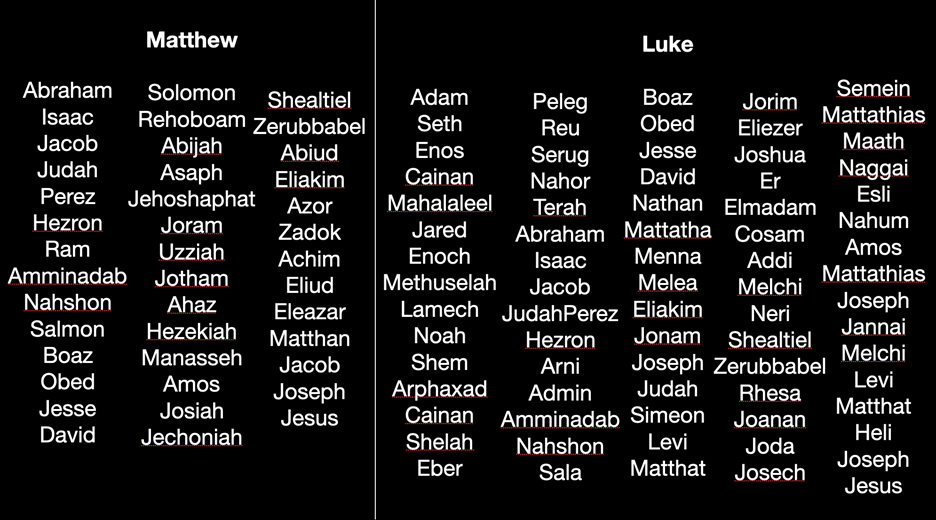
Only Matthew and Luke contain Jesus’ genealogy. And one side-by-side comparison reveals that the genealogies are radically different. So much so, that skeptics believe they’re irreconcilable. I’ve listed the genealogies from Matthew 1:1-18 and Luke 3:23-38 below for your convenience. Take a quick look at them so you can better understand the skeptic’s complaint:

Jesus’ Genealogies

At first glance, one glaring difference exists – Luke’s genealogy is much longer than Matthew’s. The reason? Luke traces Jesus’ genealogy all the way back to Adam while Matthew stops at Abraham. In both genealogies, the line from Abraham to David is roughly the same. But once we move past David, the genealogies diverge. Matthew traces Jesus’ genealogy through David’s son Solomon, while Luke traces the line through David’s son Nathan. Also, notice that Joseph has a different father in each account – Jacob in Matthew, Heli in Luke. How can we reconcile these differences? Lest we be tempted to think this is anything new, the church has dealt with this issue for almost two thousand years. And throughout that time, three different explanations have been given to explain the differences.

Option 1: Joseph vs. Mary’s Genealogy

One of the more popular explanations for the differences is to suggest that Matthew traces Joseph’s genealogy while Luke traces Mary’s. If this is true, the difference in genealogies makes sense. Think about your own genealogy for a moment. If you were to trace your father’s line and your mother’s line, you would get radically different family trees. Your father’s father and your mother’s father have different names. In Jesus’ case, his father’s father is Jacob while his mother’s father is Heli.

The reason some take this approach is because Matthew focuses his attention on Joseph in the birth narratives while Luke focuses more on Mary. In Luke, he describes Gabriel’s conversation with Mary, Mary’s Magnificat, and Mary’s visit to her cousin Elizabeth. Moreover, even though Luke doesn’t mention Mary in the genealogy, he couches Jesus’ sonship to Joseph by saying “as it was supposed” (Lk. 3:23). Each of these clues indicates that Luke didn’t intend to give us Joseph’s ancestry but Mary’s. 

Option 2: Royal vs. Biological Genealogy

Another explanation for the differences is that Matthew traces Jesus’ royal line with an emphasis on his Messianic claim to the throne while Luke traces Jesus’ biological line. According to this view, Matthew gives us several clues to suggest that he’s giving us a theological genealogy with an emphasis on King David, not a strict biological line. 

For starters, Matthew begins the genealogy by stating, “The book of the genealogy of Jesus Christ, the son of David, the son of Abraham” (Mt. 1:1). It’s well-known that Matthew writes to a primarily Jewish-Christian audience who would have understood the expectation that the Messiah would come through the line of David (2 Sam. 7:12-16; Isa. 9:6-7; 11:1-5; Jer. 23:5-6). Therefore, from the outset, he tips off his readers to where he’s going with this genealogy. 

Second, the mention of “Christ” alongside the name of Jesus in verse 1 also indicates Matthew’s intentions. While many may think of “Christ” as Jesus’ last name, it’s actually a title. It’s the Greek title for the Messiah. So, when Matthew prefaces his genealogy by stating that it’s the genealogy of Jesus Christ, he’s giving further evidence to his readers that his intention is to demonstrate that Jesus comes in the kingly line of David.

A third indicator that Matthew isn’t giving us a biological line but a royal one is his breakdown of the genealogy into groups of fourteen. In verse 17 we read, “So all the generations from Abraham to David were fourteen generations, and from David to the deportation to Babylon fourteen generations, and from the deportation to Babylon to the Christ fourteen generations.” 

A couple of points are worth noting here. Biblical scholars agree that the refrain “father of” or “son of” in genealogies don’t necessarily mean one generation after the next. Often times, genealogies will skip several generations. The language simply means that one is the ancestor of the next person in the line. Another point worth noting is the significance of the number fourteen and the Hebrew concept of Gematria. Gematria was the practice of ascribing a numerical number to a Hebrew letter – the first letter of the Hebrew alphabet (Aleph) has the numeral value of one and so on. Interestingly, the numerical value of David is fourteen. D(4) V(6) D(4) – 4 + 6 + 4 = 14.

It’s as if Matthew has a giant neon sign flashing “Son of David!” Luke doesn’t use any of these literary devices. He simply records the biological line of Jesus. And while Americans may be unfamiliar with the concept of royal lines, our British friends know that the line doesn’t always pass down neatly from father to son. In fact, the current queen of England inherited the throne from her father who inherited it from his brother. And the next king will probably be the queen’s grandson. All that to say, the royal line often diverges from the biological line.

Option 3: Levirate Marriage

A third explanation for the differences is the use of Levirate marriage. Levirate marriage is detailed in Deuteronomy 25:5-10 and states that if a married man dies without a male heir, his brother or closest relative must marry and seek to propagate with the widow in order to carry on the name of his deceased brother. This practice explains the Sadducees’ question to Jesus about which man would be a woman’s husband in heaven after going through seven brothers who all died (Mt. 22:24-28). 

On this theory, something like the following scenario plays out: Jacob (Joseph’s father in Matthew’s genealogy) died before producing a male heir with his wife. Then, in order to fulfill the Levirate laws, Heli (a close relative of Jacob’s), marries Jacob’s widow and then conceives with his new wife which brings about Joseph. If this type of scenario played out, Joseph would be the legal son of Jacob and the biological son of Heli. Then Matthew traces Jacob’s line backwards to Abraham while Luke traces Heli’s line back to Adam. Scholars have listed several of these scenarios where something like this happened.

What’s the Best Explanation?

As I consider the three options, one of the options seems the least tenable. And that is option 1. While many have employed this option to explain the differences, Luke specifically states Joseph as the next person in Jesus’ genealogy, not Mary. He couches this relationship by stating “as it was supposed” because of his knowledge of the virgin birth. More than that, ancient Jewish genealogies always passed through the male’s line, not the female’s. Luke would have understood Jesus as Joseph’s adopted son.

This leaves options 2 and 3 as viable explanations, and my personal opinion is that a combination of the two best explains the differences in genealogies. Matthew clearly isn’t trying to give us a strict chronology with how he groups the names into lists of fourteen. Moreover, by tracing the line through king Solomon instead of Nathan like Luke, Matthew seeks to emphasize the royal nature of Jesus’ line. The levirate marriages could also help explain why different names exist in the genealogy as well.

In the end, we can’t be entirely certain which option is right. But one thing is for certain: we have viable explanations for why the genealogies are different in Matthew and Luke. 

Recommended resources related to the topic:

The New Testament: Too Embarrassing to Be False by Frank Turek (DVD, Mp3, and Mp4)

Why We Know the New Testament Writers Told the Truth by Frank Turek (DVD, Mp3 and Mp4)


Ryan Leasure holds a Master of Arts from Furman University and a Masters of Divinity from the Southern Baptist Theological Seminary. Currently, he’s a Doctor of Ministry candidate at the Southern Baptist Theological Seminary. He also serves as a pastor at Grace Bible Church in Moore, SC.

Are you having trouble reaching your children—elementary school through college—with the truth of Christianity?  If so, maybe it’s because you haven’t considered what really motivates Gen Z.  Dr. Sean McDowell joins Frank to discuss How to Reach and Equip Gen Z, which is also the title of Sean’s brand new online course starting this week (go to Crossexamined.org and click “Online Courses).   Among the questions they discuss on this show:  

  • Who is Gen Z?
  • Why did you write a book about reaching them?
  • What are some misconceptions about this generation?
  • What is the defining factor of Gen Z?
  • What is their emotional state?
  • How does technology shape the way they think?
  • How is social media affecting them, especially on sexual issues? 
  • What are the biggest questions being asked by young people today?
  • Do students care about the truth?
  • What is one thing parents can do to better reach them? 

If you want to send us a question for the show, please email us at Hello@CrossExamined.org.

Subscribe on iTunes: http://bit.ly/CrossExamined_Podcast rate and review! Thanks!!!
Subscribe on Google Play: http://bit.ly/CE_Podcast_Google
Subscribe on Spotify: http://bit.ly/CrossExaminedOfficial_Podcast
Subscribe on Stitcher: http://bit.ly/CE_Podcast_Stitcher


By Brian Huffling

What do these questions have in common: Does God exist? Can God change? Does God know our future? How can a good God allow evil? How do humans know? What does it mean to know? What does it mean to be good? Can we objectively interpret the Bible? The answer: all of these questions are inherently philosophical.

With the recent decision by a very prominent evangelical institution to remove their philosophy department, why should anyone at all care about philosophy? Some would argue that Christians shouldn’t care about philosophy because, as Luther so colorfully put it, philosophy “is the devil’s whore.” In other words, man’s (autonomous) reason cannot be trusted. We only need to preach the gospel and not worry about worldly philosophy. Many in our culture argue that philosophy is mere opinion, worthless, impractical, and a waste of time. The study of philosophy is often seen as useless and a waste of a good education that could have otherwise been helpful in finding a good-paying job. Ironically, the reasons given for such positions are necessarily philosophical. Why? Because philosophy is unavoidable.

I personally found this out when I enrolled at Southern Evangelical Seminary in the fall of 2004. I initially enrolled at SES to study apologetics. I had no idea the impact philosophy would have on me. My first three courses were Intro to Apologetics, Old Testament Survey, and Hamartiology, and Soteriology (Sin and Salvation). None of these courses were inherently philosophical, at least so I thought. Dr. Tom Howe taught Old Testament Survey, and Dr. Norman Geisler taught the other two courses. As it turned out, all these courses were loaded with philosophy.

For example, Dr. Howe demonstrated the role philosophical presuppositions play in arguments marshalled against Mosaic authorship of the Pentateuch (the first five books of the Old Testament). Such presuppositions were the product of rationalist thinkers like Descartes, Spinoza, and Hume. Dr. Geisler demonstrated the role philosophy plays in talking about the nature of truth, God’s existence, and miracles. He even showed how our philosophy of man determines our view of the soul and its relationship to the body (which is important for sin and salvation). Later, Dr. Howe demonstrated how integral philosophy is to hermeneutics (interpreting and understanding a text).

I found out that a philosophy course called Metaphysics (the study of being as such) was being offered in January of 2005. I asked Dr. Doug Potter, the SES Registrar if I should take that class. “Yes,” he said, “it’s the foundation of all that we do.” I really didn’t know what that meant, but I took it. As it turns out, from a philosophical standpoint, it really is the foundation for all that we do, whether in biblical studies, language studies, hermeneutics, etc. Philosophy really is unavoidable.

Recommended resources related to the topic:

How Philosophy Can Help Your Theology by Richard Howe (DVD Set, Mp3, and Mp4)   


Dr. Brian Huffling’s research interests include Philosophy of Religion, Philosophical Theology, Philosophical Hermeneutics, and general issues in Apologetics and Biblical studies. 

Original Blog Source: https://bit.ly/2DHtfWo