
Did Jesus Rise from the Dead?
When it comes to the fate of Jesus and determining if he rose from the dead, a historian employs a two-step or stage process to uncover the relevant historical facts surrounding the fate of Jesus and then sifts through the various live explanations to determine the best explanation. It is somewhat like being a detective. A detective gathers the clues (the established historical facts) and then solves the case (provides the best explanation for the historical facts).
ESTABLISHING THE HISTORICAL FACTS
There are four established historical facts or truths concerning the fate of Jesus that are widely accepted by critical scholars today. Here is a quick acronym to remember these four historical truths: BEAT.
B = Burial
E = Empty Tomb
A = Appearances of Christ
T = Transformation of the Disciples
Dr. Craig quickly covers these historical facts in this short clip. Analyzing what historical facts or truths exist must be done first before determining the best explanation or one will get ahead of themselves.
Death
- The Medical JAMA journal published an article titled “On the Physical Death of Jesus” which, no surprise, concluded that Jesus certainly died before he was removed from the cross.
- Roman soldiers are experts at killing and putting them to death.
Burial
After Jesus died he was buried by Joseph of Arimathea in his tomb. On this point, see how William Lane Craig examines [and defends] the Christian claim that Jesus died and was buried.
- Recorded in the early sources of 1 Corinthians 15:3-5
- The burial story is part of the early source material of Mark, which is the oldest gospel.
- Joseph of Arimathea is not likely to be an invention by the earliest accounts.
- The burial story is simple and not embellished, thus unlikely to be a fabrication.
Empty Tomb
Jesus’ tomb was found empty [editors note: And the tomb remains empty today, and it’s location is widely agreed upon by friendly and critical scholars alike, namely, at the Church of the Holy Sepulchre]
- Found in the early sources of Paul and Mark
- The narrative is simple and lacks legendary embellishment
- Women found the tomb empty and not men, who wrote down the event
- Even the earliest opponents of Christianity admitted the tomb was empty by stating the tomb was empty because the disciples stole the body of Jesus
On this point see, “The Historicity of the Empty Tomb of Jesus” by William Lane Craig.
Appearances of Christ
On multiple occasions and under various circumstances different individuals and groups of people experienced appearances of Jesus alive from the dead. This historical fact is NOT stating that the appearances of Christ occurred because he rose from the dead, but that the people (both believers and unbelievers, individuals and groups of people) had some type of experience which they took as Jesus alive from the dead. The fact is not saying that Jesus did rise from the dead, but they had some type of experience. It could have been a resurrection, vision, hallucination, or bereavement experience. Whatever the case the experience is historically certain which even skeptics of the resurrection like Gerd Ludemann even accept. Additionally, the appearance narratives are early and from multiple sources:
- appearance to Peter recorded by Luke and Paul
- appearance to the twelve recorded by Luke, John, and Paul
- appearance to the woman is attested by Matthew and John
- appearance to the 500 in Galilee recorded in Mark, Matthew, and John
In this video Dr. Peter Williams, the Warden of Tyndale House in Cambridge, lists the variety of appearances of Jesus after his death. And here is Craig addressing the historicity of the appearances.
Transformation of the Disciples
The disciples suddenly and sincerely came to believe that Jesus has risen from the dead despite every predisposition to the contrary. Here is what the disciples faced following Jesus’ crucifixion:
- Their leader is dead (political defeat)
- Their leader is a heretic (religious defeat)
- They are not expecting him to rise from the dead, because they are hiding (eschatological defeat)
Nevertheless, the disciples suddenly came to believe that God raised Jesus from the dead they were willing to die for that belief. This does not prove that Jesus rose from the dead, only that the disciples believed he did and were sincere in that belief. Here is Craig again on what happened to the disciples that transformed them into avid witnesses for Christ: “What Happened to the Disciples that Transformed Them Into Avid Witnesses for Christ?”
THE BEST EXPLANATION
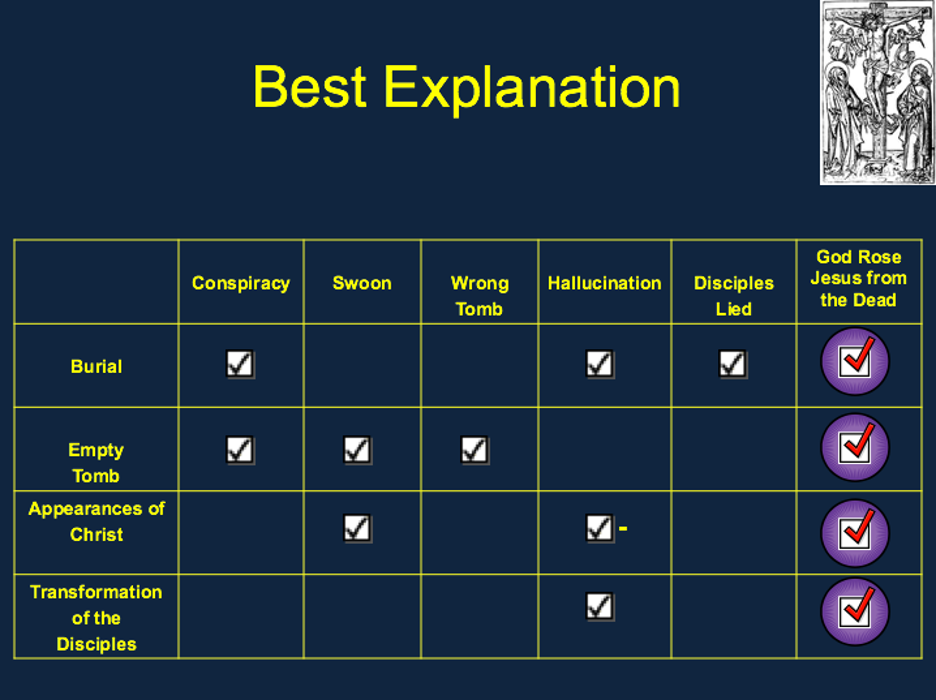
While there might be several explanations possible, we are looking for the best explanation. The best explanation will meet two conditions: explanatory scope and explanatory power. With explanatory scope, it must explain all the facts, not just one or some or the majority. With explanatory power: It must explain each fact adequately, not just superficially or in an ad hoc (i.e.-contrived) manner. Some possible explanations for the four historical facts of the burial, the empty tomb, the appearances of Christ, and the transformation of the disciples could be:
- “Conspiracy” – The disciples stole the body
Problem – The transformation of the disciples?
- “Lied” – The disciples lied about the resurrection
Problem – who would die for a lie they knew was a lie?
- “Hallucination” – The disciples hallucinated the resurrection
Problem – The empty tomb?
- “Wrong Tomb” – The women went to the wrong tomb
Problem – The tomb of Joseph of Arimathea?
- “Resuscitation/Swoon” – Jesus survived the crucifixion
Problem – The fatal torment?
Notice that each of these explanations (#1-5) lacks either explanatory scope or explanatory power, but there is one more explanation:
- “God Raised Jesus From the Dead”
Solution – This explanation admits and explains each fact and each fact adequately.
It has both explanatory scope and explanatory power. Therefore, it is the best explanation. Below is a chart detailing what facts are explained (with a check mark) and which facts are not explained (empty):
Resources
Articles/Books:
- “Jesus’ Resurrection” by William Lane Craig at org
- “The Case for Christ’s Resurrection” by Gary Habermas in To Everyone an Answer
- “The Resurrection of Jesus” by William Lane Craig at org
- Did Jesus Rise from the Dead? William Lane Craig (Impact 360 Institute, 2014)
- The Resurrection of Jesus: A New Historiographical Approach, Michael R. Licona (IVP Academic, 2010)
- The Case for the Resurrection of Jesus, by Gary R. Habermas and Michael R. Licona (Kregel, 2004)
- The Resurrection of God Incarnate, Richard Swinburne (Oxford Univ. Press, 2003)
- The Resurrection of the Son of God, N. T. Wright (Fortress Press, 2003)
Videos
- “Is Jesus God?” – Reasonable Faith
Here is a clip that uses what has come to be called “the minimal facts approach” originated by Gary Habermas and developed by Michael Licona - “Did Jesus Rise from the Dead?” – Impact 360
Impact 360 Institute released this slick animated video explaining the facts and the best explanation of those facts
- “God is the Best Explanation of the Historical Facts Concerning Jesus of Nazareth” – Reasonable Faith and the John Ankerberg Show
Dr. Craig on the John Ankerberg Show summaries the four facts and the best explanation of those facts to demonstrate that God is the best explanation for the life, death, and resurrection of Jesus:\
- “Part 1: did Jesus Rise from the Dead” – Reasonable Faith
“Part 2: Did Jesus Rise from the Dead” – Reasonable Faith
Reasonable Faith’s two-part video on the facts and the best explanation of the question “Did Jesus Rise from the Dead?”
Recommended Resources:
Why We Know the New Testament Writers Told the Truth by Frank Turek (mp4 Download)
The Top Ten Reasons We Know the NT Writers Told the Truth mp3 by Frank Turek
Counter Culture Christian: Is the Bible True? by Frank Turek (Mp3), (Mp4), and (DVD)
The New Testament: Too Embarrassing to Be False by Frank Turek (DVD, Mp3, and Mp4)
J. Steve Lee has taught Apologetics for over two and a half decades at Prestonwood Christian Academy. He also has taught World Religions and Philosophy at Mountain View College in Dallas and Collin College in Plano. With a degree in history and education from the University of North Texas, Steve continued his formal studies at Southwestern Baptist Theological Seminary with a M.A. in philosophy of religion and has pursued doctoral studies at the University of Texas at Dallas and is finishing his dissertation at South African Theological Seminary. He has published several articles for the Apologetics Study Bible for Students as well as articles and book reviews in various periodicals including Philosophia Christi, Hope’s Reason: A Journal of Apologetics, and the Areopagus Journal. Having an abiding love for fantasy fiction, Steve has contributed chapters to two books on literary criticism of Harry Potter: Harry Potter for Nerds and Teaching with Harry Potter. He even appeared as a guest on the podcast MuggleNet Academia (“Lesson 23: There and Back Again-Chiasmus, Alchemy, and Ring Composition in Harry Potter”). He is married to his lovely wife, Angela, and has two grown boys, Ethan and Josh.
Originally posted at: https://bit.ly/4m4mxuf