
Tag Archive for: Sean Redfearn

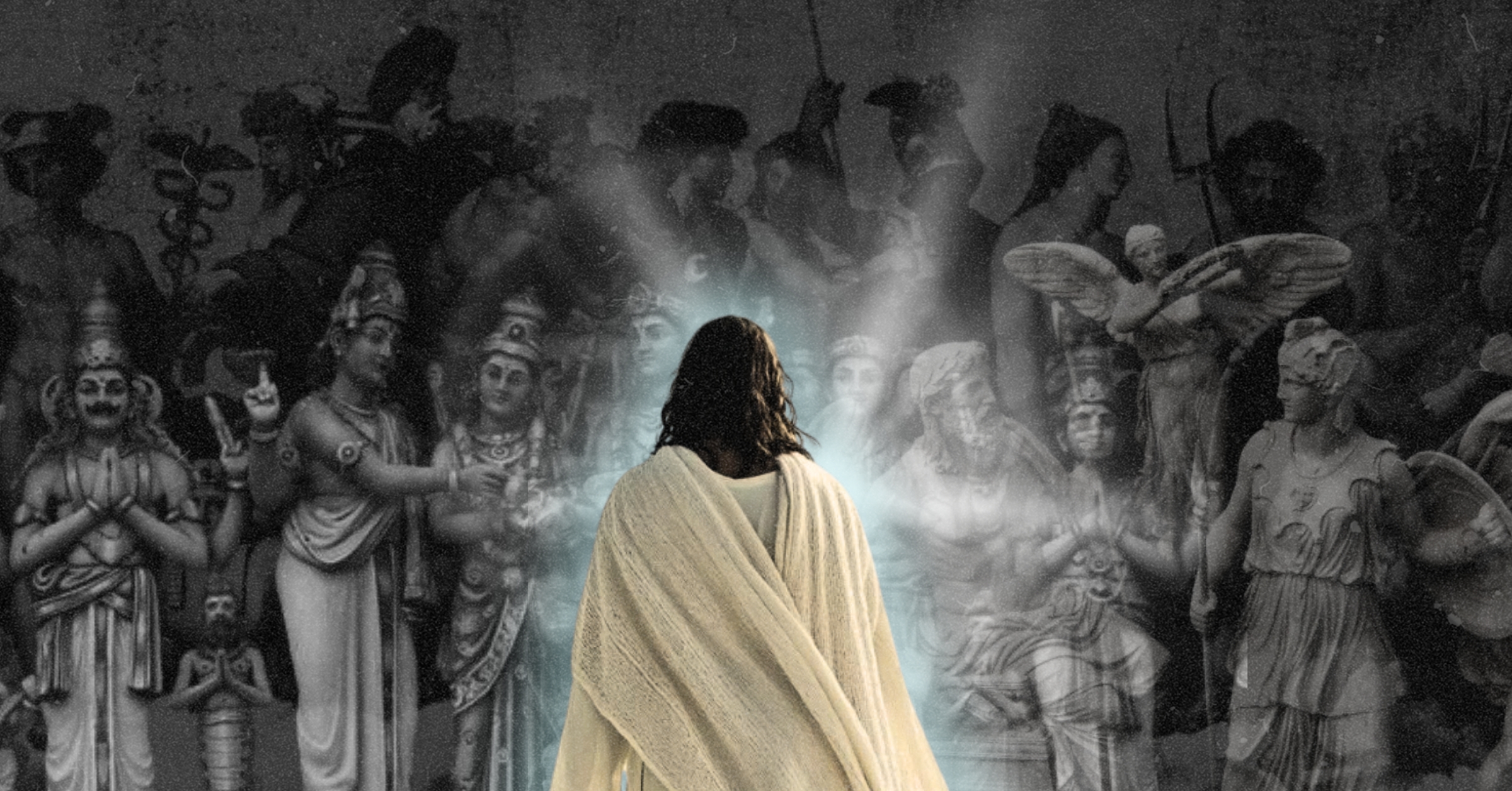
When I went to university, I encountered the biggest intellectual doubt I’ve ever faced as a Christian: How can I be sure that Christianity is true? Here was my thinking: “Can I really claim that I have the right religion when there are 3,000 others to choose from?” You might have come across a form of this argument via the atheist comedian Ricky Gervais.

As I went to university, I knew that I couldn’t keep my faith, nor share it with any real conviction, unless I knew that Christianity was true (1 Cor 15:14). I had to know which God was the correct one. Ultimately, philosophy was the primary force that drove the cementation of my Christian faith.[i]

Categories of Theism

As I wrestled with this doubt, I discovered that I didn’t have to lucky-dip my way through 3,000 religions until I found the correct one. There’s actually a much simpler way. It turns out that every single and particular religion can be grouped into one of five metaphysical categories, which are:

  1. Atheism, which holds that there is no God beyond the universe.
  2. Polytheism, which believes in many gods.
  3. Pantheism (and its cousin panentheism), which essentially teaches that God and the universe are the same thing.[ii]
  4. Deism, which claims that God created the universe but then left it alone.
  5. Monotheism, which believes in one supreme, personal, and active God.[iii]

To this day I am unaware of a sixth possible option for a way the world could work (though I am open to being corrected).[iv] I explicitly note here that “agnosticism” is not a category of worldview. It’s just a placeholder label for indecision. Agnosticism doesn’t affirm anything metaphysical about the universe.

Can you see how, suddenly, the 3,000 problem looks very different? Philosophical reasoning helped me to realize that the question is not, which God of 3,000? The question can be swiftly pruned to become, which of these five?

Putting Each Worldview to the Test

And then, after such an exercise, the gods can be put to the test. Each of these five categories needs to be scrutinized, and it is my contention that only monotheism stands up to the test.

  1. Atheism arguably demands the most blind faith of all. It requires the belief that there is nothing beyond the universe, and that everything came from nothing.[v] But there’s a more thorny problem than this: if our minds are nothing more than chemical compositions of atoms fizzing around in our brains, then we cannot trust ourselves to arrive at the truth, including the supposed truth that atheism is true. In turn, the Problem of Evil is similarly reduced to the natural course of the universe’s atomic rhythm. I cannot commit to a category that is self-defeating in the pursuit of truth and denies the meaningfulness of evil.
  2. Polytheism runs into a different kind of logical problem. A truly infinite being cannot share its infinity with any other, because if two beings differ in any way, then one must lack something the other has, and yet an infinite being lacks nothing. Moreover, even the ability to judge and distinguish between multiple gods requires an outside standard by which to judge said gods.[vi] But polytheism doesn’t appeal to an outside and greater standard, which thereby also paralyses it from denouncing evil.[vii]
  3. Pantheism (and its cousin panentheism) says that the universe shares in the ontological nature of God – and so faces two serious obstacles. First, we know that the universe had a beginning, and yet God is eternal, so there must be a distinction between God and the universe.[viii] Second, if God and the universe were identical, then evil would of necessity share in God’s nature and therefore lose its moral repugnance, which doesn’t sit well with anyone who has experienced suffering.
  4. Deism pictures a God who created the universe but then left it alone. Deism therefore, like atheism, requires the rejection of every single claim throughout history that God has acted miraculously. But, more than that, deism cannot explain why we exist right now, because the universe is entirely dependent on being sustained in its existence every single second. Likewise, deism has to reject that there is a Problem of Evil, because such evil can only be appealed to if there is a universal moral law by which to judge it, and such a universal law requires being sustained in existence every single second.

One Option Remains

None of the first four categories provided me with a satisfactory explanation for how the universe works. Hence, by a process of elimination, I was left with monotheism, which actually fulfills the problems with the other categories. Monotheism provides an explanation for how we got something from nothing and how we can reason to truth (contra atheism), it accounts for one infinite being as the universal standard for all things (contra polytheism), it distinguishes created reality from the uncreated (contra pantheism and panentheism), and it supplies an explanation for the sustained existence of the universe and the moral law within it through a God who has revealed himself (contra deism).

More than that; all of the major philosophical arguments for God’s existence (fine-tuning, cosmological, moral, contingency, transcendental) are tailored to monotheism, so I also found positive arguments for a monotheistic God’s existence, on top of the negative arguments against the alternatives.

As Norman Geisler and Frank Turek put it, monotheism gives the “true box top” – the picture that makes everything else make sense.

“This discovery helps us to see not only what [reality] looks like, but what it cannot look like. Since the opposite of true is false, we know that any non-[mono]theistic worldview must be false. Or, to put it another way, of the major world religions, only one of the [mono]theistic religions – Judaism, Christianity, or Islam – could be true. All other major world religions cannot be true, because they are non-[mono]theistic. This may seem like a grandiose claim – to deny the truth of so many world religions . . . but by simple logic . . . mutually exclusive religions cannot be true. Just as certain football players are rightfully cut from the roster of possible players because they lack necessary abilities, certain world religions are rightfully cut from the roster of possible true religions because they lack necessary qualifications.”[ix]

Narrowing the Field

More needs to be said about how religions within the metaphysical category of monotheism account for the Problem of Evil. There is not enough space to address that here. More also needs to be said about which is the true religion within the category of monotheism. Monotheism (unlike deism) requires a knowable God who has revealed himself.

The only three religions within monotheism which proffer a knowable God are Judaism, Christianity, and Islam. Therefore, by deploying sound reasoning to this question within the Philosophy of Religion, the inquirer is no longer left to choose between 3,000 options; nor even five, once atheism, polytheism, pantheism, and deism have all been ruled out.

The inquirer is left with just three: Judaism, Christianity, or Islam.[1] One of these has to be true.

References:

[1] Let it be noted that these three religions collectively house over half of the world’s population.

[i] “Good philosophy must exist, if for no other reason, because bad philosophy needs to be answered.” C.S. Lewis, “Learning in War-Time,” in The Weight of Glory and other addresses (New York: HarperCollins, 1949, repr., 2001), 58.

[ii] Editor’s note: Panentheism affirms that all the universe is “in” God somehow. For example, the universe is God’s body and “God” – as spirit – is really just the divine soul that inhabits this universal body.

[iii] [Editor’s Note: Some distinguish monotheism from “finite Godism”, wherein God is somehow less than the greatest possible being. That’s the conclusion of Harold Kushner in When Bad things Happen to Good People? (1981). And it’s implicit with some unorthodox schools of Christian thought such as open theism (Greg Boyd). Nevertheless, these can also be seen as varieties of monotheism as they affirm that only one God exists. The point is that, even if the majority view within monotheism is tied to “maximal being ontology” (Anselm’s “that than which none greater can be conceived”), as long as it’s only one-God in view, that can be loosely understood as “monotheism.”

[iv] Ibid.

[v] If an atheist wishes to claim otherwise, then he is no longer appealing to atheism but to some other category of theism.

[vi] Polytheism puts “into the universe a third thing in addition to the two powers: some law or standard or rule of good which one of the powers conforms to and the other fails to conform to. But since the two powers are judged by this standard, then this standard, or the Being who made this standard, is farther back and higher up than either of them, and He will be the real God.” C.S. Lewis, “The Invasion,” in Mere Christianity (ProQuest Ebook Central: HarperCollins Publishers), 48. Accessed 10 April 2026.

[vii] The explanation for evil on polytheism is chalked up to the existence of some ‘evil’ god or gods.

[viii] Pantheism would have me believe that I am God. But that would require me to go from a state of not knowing that I am God to a state of realising that I am, in fact, God. Such a change is impossible for an infinite being.

[ix] Norman Geisler and Frank Turek, “Miracles: Signs of Gullibility or God,” in I Don’t Have Enough Faith to be an Atheist (Wheaton, Illinois: Crossway, 2004), 198-199.

Recommended Resources:

The Great Book of Romans by Dr. Frank Turek (Mp4, Mp3, DVD Complete series, STUDENT & INSTRUCTOR Study Guide, COMPLETE Instructor Set)

Jesus, You and the Essentials of Christianity by Frank Turek (INSTRUCTOR Study Guide), (STUDENT Study Guide), and (DVD)     

Early Evidence for the Resurrection by Dr. Gary Habermas (DVD), (Mp3) and (Mp4)

Can All Religions Be True? mp3 by Frank Turek


Sean Redfearn is a former Community Youth Worker who now works for Christian Concern in Central London, UK. He completed an MA in Religion at King’s College London, is in the process of completing the MA Philosophy program at Southern Evangelical Seminary, and is a 2022 CrossExamined Instructor Academy graduate. Passionate about Jesus, he is grateful for the impact that apologetics has had on his faith.


Bart Ehrman (see timestamp 12:51 – 17:46) and Alex O’Connor (see timestamp 1:12:40 – 1:14:32) have both tried to undermine the eyewitness argument for Jesus’s resurrection by comparing it to the eyewitness testimony for Mormonism’s golden plates. Both Alex and Bart challenge Christian apologists with this question:

“Why do apologists reject the eyewitness testimony of Mormonism when their reasons for believing in Christianity are founded on the eyewitness testimony of the apostles?”

Are they right that this is a double standard? After all, Mormonism has a total of twelve eyewitnesses for its key claim about the golden plates. In addition to Joseph Smith’s testimony, eight witnesses say they saw the golden plates, plus three more witnesses say that an angel showed them the plates. There are a few simple points of response to this specific challenge.

  1. Christianity “Got There First”
    Christianity is privileged over Mormonism because it ‘got there first’. Just like Islam, Mormonism tries to build upon the historic Christian message.[1] And just like Islam, Mormonism is birthed from a supposed angelic appearance. But the apostle Paul writes all the way back in c.50 A.D.:

“But even if we or an angel from heaven should preach to you a gospel contrary to the one we preached to you, let him be accursed” (Galatians 1:8 ESV).

He also writes in 2 Corinthians 11:12-15 (ESV) that Satan disguises himself as an angel of light, whose servants likewise disguise themselves as servants of righteousness. Moreover, the Bible ‘signs off’, as it were, with a warning for all future generations. Jesus says in Revelation 22:18 (ESV):

“I warn everyone who hears the words of the prophecy of this book: if anyone adds to them, God will add to him the plagues described in this book…” 

And yet the Book of Mormon comes along in the 19th century and church authorities say in its introduction:

“The Book of Mormon was the most correct of any book on earth, and the keystone of our religion, and a man would get nearer to God by abiding by its precepts, than by any other book.”

The reality is that Christianity’s eyewitness testimony trumps Mormonism’s by the rule: first-come-first-served. Christianity is smart; it safeguards itself against specific alterations of its message, and that is the privilege it gets for being first on the scene. It beats Mormonism by 1800 years.

  1. For Mormonism, eyewitness testimony is unstable.
    Mormonism’s eyewitness testimony is unstable in comparison to the testimony of the apostles. The apostles’ eyewitness testimony is unified and doesn’t carry the stain of eventual scandal, faction, and dissension.

Mormonism’s witness history is much more stained. With the Church of Jesus Christ of Latter-Day Saints’ own official website, we learn that each of the three witnesses – who claimed to see an angel – later fell out with Joseph Smith and never reconciled with him. We also learn that some of the eight witnesses (who were mostly made up of two families) eventually became estranged from the LDS church.

In apostolic Christianity, there is no falling out between any of the key figures such that a key eyewitness like Paul, Peter, James, or John walks away from the church or is excommunicated from the church.

An important principle from Detective J. Warner Wallace is that we can learn a lot by observing the lives of eyewitnesses. Disunity stains the record of Mormon witnesses in their relationships with either the LDS church or with Joseph Smith, adding doubt to key elements of their testimony about the golden plates.

  1. Only One of These has a Support Structure
    Christianity’s testimony has a supporting structure; Mormonism’s doesn’t. To acknowledge Bart and Alex’s challenge; Christianity’s eyewitness testimony certainly has important evidential value. The apostles were willing to go to their deaths for what they believed, and it is difficult to pin them down for a false motive if they merely invented Christianity for personal gain.

But apostolic eyewitness testimony is only one piece of a broader cumulative case for Christianity.[2] The apostles proclaimed Jesus’s resurrection not only because they were convinced that they saw him alive, but they did so at personal cost and while appealing to the greater metaphysical story of the Old Testament (see for example Peter’s speeches in Acts 2-3, or Paul’s creed in 1 Corinthians 15:3-4).

And we also have non-Christian sources, written within 100 years of Jesus’s lifetime, from which we can verify and reconstruct the apostolic claim of the resurrection.[3] Notwithstanding the argument for biblical reliability, Christianity can still make a case for the resurrection even without the Bible.

Not so on Mormonism. Mormonism’s claim to the golden plates is isolated and does not locate itself within a greater plausibility structure (for instance, nowhere are the plates prophesied about in the Bible). And Mormonism cannot appeal outside of itself – neither to non-Mormon sources nor to archaeology – to verify its eyewitness claims about the golden plates.

In summary   

Christians are not guilty of a double standard for affirming the eyewitness testimony of apostolic Christianity but rejecting the eyewitness testimony of Mormonism. Mormonism’s eyewitness testimony can be criticised for three reasons:

  1. First, for claiming to have scriptural revelation in addition to the Bible, even though the Bible explicitly warns against this.
  2. Second, for disunity amongst its witnesses.
  3. Third, for its isolated claim without a greater plausibility structure.

By contrast, Jesus’s apostles warned of future false prophets altering their message, they remained committed to unity of faith until their deaths, and they plugged their eyewitness testimony into both history and an overarching structure of scriptural fulfilment and Messianic expectation.

Eyewitness testimony is only one part of a broader cumulative case for God’s existence and Jesus’s resurrection. But Mormonism solely appeals to taking 12 witnesses at their word in an isolated claim. Mormonism’s eyewitness testimony is not the same as Christianity’s.

References:


[1] [Editor’s Note: Latter Day Saints, also known as Mormons, commonly identify as a denomination of Christianity. From the perspective of historic Christianity that label however is mistaken since historic Christianity contradicts Mormon doctrine by affirming Trinitarian monotheism, rejecting polytheism, denying any “Heavenly Wife” of Father God, and more. The theological differences between Mormonism and historic Christianity are not just “denominational” disagreements but rather heretical divergence. In this way, Mormonism is better understood as a cult offshoot departing from Christianity rather than a denomination within Christianity. In this blog, “Christianity” refers to historic/orthodox Christianity (i.e., Catholicism, Protestantism, and Eastern Orthodox) in distinction from Mormonism/Latter Day Saints.]

[2] See for example Frank Turek’s 6 Es for the reliability of the New Testament; See also J Warner Wallace: The Cumulative Case For Christianity: Death By A 1,000 Paper Cuts. Incidentally, Wallace has plenty of work on the differences between Mormonism and Christianity on his YouTube channel.

[3] Besides archaeology, the two main non-Christian sources which testify to the apostles’ claims are Roman-source Tacitus (Annals 15.44) and Jewish-source Josephus (Antiquities 18.63–4). For more on the authenticity of Josephus’s passage, see T C Schmidt’s ground-breaking 2025 book “Josephus and Jesus: New Evidence for the One Called Christ.” A helpful chapter on external corroboration of the New Testament can be read in J. Warner Wallace, “Chapter 12: Were They Corroborated?” in Cold-Case Christianity: Updated and Expanded Edition (Colorado Springs, David C Cook Publishers: 2023).

Recommended Resources: 

Another Gospel? by Alisa Childers (book)

Early Evidence for the Resurrection by Dr. Gary Habermas (DVD), (Mp3) and (Mp4)

Why We Know the New Testament Writers Told the Truth by Frank Turek (mp4 Download)

The Top Ten Reasons We Know the NT Writers Told the Truth mp3 by Frank Turek


Sean Redfearn is a former Community Youth Worker who now works for Christian Concern in Central London, UK. He completed an MA in Religion at King’s College London, is in the process of completing the MA Philosophy program at Southern Evangelical Seminary, and is a 2022 CrossExamined Instructor Academy graduate. Passionate about Jesus, he is grateful for the impact that apologetics has had on his faith.

Paul met the Lord on a road (Acts 9:1-9), Peter fell down before him by the sea (Luke 5:1-11), the Ethiopian eunuch came to him after having the scriptures explained to him (Acts 8:26-40), and the man possessed by a legion of demons believed after experiencing a liberating miracle on his life (Mark 5:1-20). The same gospel which unites us reaches us in different ways.

Many people encounter Jesus and come to faith immediately when the Bible is preached and explained to them. Becket Cook is an example that immediately springs to my mind. Others encounter Jesus after a long and detailed analysis of the evidence, and after having their friends engage them with the evidence for Christianity. Nabeel Qureshi is a big example here. Still others encounter Jesus after seeing him in a dream or witnessing a miracle.

Humans are complex beings made in the image of the infinite God (Genesis 1:27), and the gospel draws in and unifies a host of people from all sorts of different backgrounds. The way we receive the gospel isn’t uniform, programmed, and mechanical. The unifying factor is the gospel we receive (1 Cor 15:3-8), not the way we receive it.

Evangelism Is Helped By Social Intelligence 

As we evangelise, we do well to have social awareness in understanding that people respond to the gospel in different ways.

Some people may need to witness a miracle before receiving the gospel, others may need to have the evidence for Christianity explained to them, and others may simply need the Bible preached to them plainly.

Some may need all three or a combination thereof!

This should be an obvious thing to say. But I’ve recently and repeatedly heard the absurd claim that apologetics is not necessary for the gospel, because the supposed key to every single human heart, and the only way to do evangelism, is by preaching the Bible and only the Bible to every unbeliever we encounter. . . without any need, ever, for apologetics.

Now of course, preaching the Bible is an eternally wonderful thing, and the Bible really does have all the answers to life’s most important questions. And there is no question that some people convert immediately when the Bible is simply preached to them. Charles Spurgeon is an example of such a person.

The Bible is a source of never-ending wisdom and insight that is a greater treasure than all the money in the world, and apologetics itself is empty without it, because without the Bible, apologetics leads nowhere. Christians who are privileged enough to own a Bible need to be reading it daily.

There is no dispute, regardless of theological conviction, that the Holy Spirit softens people’s hearts as they read and hear God’s word. But how can anyone who’s socially aware of the unbelieving world say that apologetics isn’t ever necessary . . . especially when the Bible itself tells us to use it?

The Bible Tells Us To Use Apologetics          

Peter (in 1 Peter 3:15) says that we always need to be ready to give a ‘defense’ for the hope that we have (‘apologia’ in Greek – the word from which we get the English word ‘apologetics’). Apologetics isn’t a random modern Christian word. Apologetics is a biblical word.

Paul – who uses apologetics in Athens (see Acts 17) – uses the same Greek word ‘apologia’ in writing that God has placed him to ‘defend’ the gospel in Philippians 1:16 (see also 1:7).

Are Peter and Paul wrong? Do they just need to understand that all we need to do is preach the Bible to each and every non-believer, without ever giving a reasoned defense for the Christian faith?

Paul also writes that if Jesus has not been raised then Christianity is false (1 Corinthians 15:14, 17). How are we to investigate whether Jesus has been raised? Are we only allowed to investigate that question by looking at what the Bible says?

“The Bible says Jesus was raised; therefore, Jesus was raised.” Is this really sufficient evangelism that will convince every single unbeliever in the world?

The “Bible-only, ever” method is inconsistent        

And there’s something awkward that needs to be pointed out:

Does the “Bible-only, ever” evangelist realise that they first have to use their philosophical, linguistic, and reasoning faculties to decide which part of the Bible to open up for every evangelistic conversation with an unbeliever?

It’s the “Bible-only” evangelist’s own philosophical and linguistic reasoning which directs them to show their non-believing counterpart John 20, say, and not Song of Songs 5:3.

So, if I were to grant that we should only use the Bible to evangelise and nothing else – never engaging in philosophy or apologetics with the unbeliever – then I’d be committing myself to an inconsistent epistemology and self-defeat. That should never be the case for the people of God who belong to the Truth!

Jesus himself isn’t a “Bible-only, ever” evangelist  

We must remember that Jesus himself demonstrates social awareness when, for example, he uses two different evangelistic methods in two different situations after his resurrection.

In John 20, Jesus convinces Thomas not by the scriptures but by the evidence of his broken body. Yet over in Luke 24, Jesus convinces the two disciples on the road to Emmaus not by his broken body but by unpacking the scriptures!

Here is my point:

With the Holy Spirit’s help, we need the social awareness and intelligence to understand the needs of the unbeliever in front of us.

Some will need apologetics. Some will need miracles. Some will just need straight preaching. Ask people “How did you come to faith?” and you’ll get a range of answers, appealing to different lines of evidence, apologetics included.

Recommended Resources: 

I Don’t Have Enough Faith to Be an Atheist (Paperback), and (Sermon) by Norman Geisler and Frank Turek 

Stealing From God by Dr. Frank Turek (Book, 10-Part DVD Set, STUDENT Study Guide,TEACHER Study Guide)

Tactics: A Game Plan for Discussing Your Christian Convictions by Greg Koukl (Book)

Can All Religions Be True? mp3 by Frank Turek


Sean Redfearn is a former Community Youth Worker who now works for Christian Concern in Central London, UK. He completed an MA in Religion at King’s College London, is in the process of completing the MA Philosophy program at Southern Evangelical Seminary, and is a 2022 CrossExamined Instructor Academy graduate. Passionate about Jesus, he is grateful for the impact that apologetics has had on his faith.

A key argument in Alex O’Connor’s debate with David Wood is the distinction Alex draws (in his first rebuttal) between “proskuneo” (Gk: προσκυνέω) worship and “latreuo” (Gk: λατρεύω) worship.

Both proskuneo worship and latreuo worship are biblical terms used to describe worship or service to God, but they carry different shades of meaning. Proskuneo means to physically bow down, or prostrate oneself in order to show reverence. Latreuo means to serve or honour in a religious or sacrificial sense. In Romans 12:1 for example, Paul tells us to offer our bodies as a living sacrifice as latreuo to God).

The crux of Alex’s argument is that, on these two senses of worship, Jesus never receives latreuo worship in the way that only God does, and there is nothing special about the fact that the worship Jesus does receive is proskuneo; because other mortals also received proskuneo in the Greek Old Testament, or example, Esau from Jacob in Genesis 33, and Joseph from his brothers in Genesis 42.[1]

In his second rebuttal, Alex explains that this distinction argument is supported by James D.G Dunn, who writes:

It is noticeable that in each case the object of the verb [latreuo], the one who is (to be) served/worshipped, is God. Apart from one or two references to false worship (Acts 7:42; Rom 1:25), the reference is always to the cultic service/worship of God (Luke 1:74, 2:37; Acts 7:7, 42; 24:14; 26:7; 27:23; Rom. 1:9; Phil. 3:3; 2 Tim. 1:3; Heb. 8:5; 9:9; 9:14; 10:2 and 12:28, 13:10; Rev. 7:15; and 22:3). In no case in the New Testament is there talk of offering cultic worship [latreuo/λατρεύω] to Jesus.[2]

And so, Alex’s argument is that Jesus only receives the proskuneo kind of “worship” and not latreuo kind. This is a problem because proskuneo worship doesn’t determine whether Jesus thought of himself as God or whether he claimed to be God.

Two disclaimers

What Alex doesn’t mention in the debate is what Dunn writes in the same section: “more typically in the New Testament, [proskuneo] is used of the worship (prostration) due to God, and to God alone.”[3]

So at least according to Dunn, proskuneo as directed towards Jesus in the New Testament carries weight in determining whether Jesus thought of himself as God or whether he claimed to be God.

Further, it might be helpful to note that Dunn lists other Greek words for worship or reverence in the New Testament, which might be applied to either God alone, or to God as well as Jesus of Nazareth.[4] Proskuneo and Latreuo are not the only ones.

Two points in response to Alex

There are two points of response which show that Alex’s argument about the distinction between proskuneo and latreuo is underwhelming.

  1. It shouldn’t surprise us that Jesus of Nazareth received proskuneo (and not latreuo), because he was in physical form. Latreuo worship is sacrificially offered to the non-physical God, but Jesus of Nazareth was physically God-incarnate (as David argued in this debate!). With Jesus standing right before them, of course the disciples offered proskuneo When I finally see the God-man face-to-face one day, I already know that I’m going to fall before him in proskuneo worship.
  2. You’ve got to read in context. As Dunn states, proskuneo worship in the New Testament is typically “due to God, and to God alone.”[5] In fact, in Rev. 22:8, an angel rejects proskuneo worship from John and tells him to offer it to God. A simple, face-value reading of the New Testament, and even of the gospels alone, reveals that the authors thought that Jesus was God. Proskuneo worship of Jesus doesn’t detract from this, rather, it adds to it. Once again, as Dunn says, proskuneo is typically given to God alone in the New Testament (see Rev. 22:9; also see in the gospels in John 4:23-24 and Matt. 4:10/Luke 4:8). So, as Jesus of Nazareth receives proskuneo worship, the reader is drawn to see his ontology as more-than-human.

Review Alex O’Connor’s Argument

In summary, Alex’s leveraging of James Dunn’s argument has three faults. First, Alex cherry-picks from Dunn for his own purposes, and doesn’t expound on what Dunn says about proskuneo.

Second, it is of absolutely no surprise that the physical God-man receives proskuneo, because falling on your knees before Jesus is an appropriate act of worship.

Thirdly, the New Testament has a particular reverence for the word proskuneo, even if the Old Testament applies it more loosely. And so Jesus receiving the proskuneo of worship does not detract from his ontological divine nature, but rather points to it.

Let’s continue to pray that Alex would see Jesus for who he reality is. Pray that Alex would put Jesus in his rightful place.

References: 

[1] [Editor’s note: The Greek Old Testament is known as the Septuagint or LXX for short.]

[2] James D.G. Dunn, Did the First Christians Worship Jesus? The New Testament Evidence (Louisville, Kentucky: Westminster John Knox Press, 2010), 13.

[3] Ibid., 10.

[4] These additional words are Sebomai/σέβομαι and Epikaleo/ἐπικαλέω. See Dunn, 15-17.

[5] See footnote 2.

Recommended Resources: 

Early Evidence for the Resurrection by Dr. Gary Habermas (DVD), (Mp3) and (Mp4)

When Reason Isn’t the Reason for Unbelief by Dr. Frank Turek DVD and Mp4

Another Gospel? by Alisa Childers (book)

How Can Jesus Be the Only Way? (mp4 Download) by Frank Turek


Sean Redfearn is a former Community Youth Worker who now works for Christian Concern in Central London, UK. He completed an MA in Religion at King’s College London, is in the process of completing the MA Philosophy program at Southern Evangelical Seminary, and is a 2022 CrossExamined Instructor Academy graduate. Passionate about Jesus, he is grateful for the impact that apologetics has had on his faith.

Polling sometimes suggests that the UK public is in favor of ‘assisted dying.’ This is an illusion, caused in many cases by people not knowing what ‘assisted dying is.’ A recent poll showed that only 42% of the public understood what ‘assisted dying’ refers to, with 10% thinking it meant hospice-type care and 42% believing it meant stopping treatment.

There is no legal or ethical mandate that a terminally ill person must be kept alive “at all costs.” There is, however, a major difference between withdrawing medical treatment and thereby allowing a patient to die of his or her own medical condition and intentionally ending a patient’s life.

What Is Euthanasia?

Euthanasia (as well as assisted suicide) is most basically understood as the lethal dose of drugs to deliberately end a life. Here is what euthanasia is not:

  • Turning off life support or withdrawing treatment.[1]
  • Providing drugs that reduce a patient’s discomfort at the end of their life.
  • Making a ‘do not resuscitate’ CPR request

But as well as the simple misunderstandings people have about what ‘assisted dying’ is – there are some often repeated arguments for euthanasia that don’t stand up to scrutiny.

Three bad arguments for euthanasia

Reason #1: We euthanize our pets. The precise reason that we might euthanize a pet but not a human is because a human is not a pet! Once we reduce human beings to mere animals, a host of horrendous evils are bound to follow. Have you ever heard of the saying “treated like animals”? Human beings are a unique category of being, and so it is a dangerous category error to argue for human beings to be euthanized based on how we treat our pets. Human beings are not pets.

Reason #2: A patient can become a heavy financial strain. A price tag cannot be placed on human life – we cannot argue that life must be taken in order to save money. A human being’s value is not determined by their medical bill but by the fact that they are a human being. Human dignity is levelled across the scope of the entire human race, and those of us who are ill and inhibited are no less human than those of us who are not. Can you imagine the upheaval if it were argued that poor people are less valuable than rich people because they are more of a burden on the state? “Financial strain” is an unethical reason to end a human life.

Reason #3: People need the autonomy to choose to die in peace. Euthanasia is not necessary to satisfy this reason. The benefits of modern medicine mean that terminally ill people can generally choose to die in peace with effective use of palliative care (i.e., hospice). For people whose illness is no longer curable, palliative care supports quality of life and pain-management enabling patients to enjoy their final moments in peace—without killing themselves. Modern medicine makes available sufficient treatment to ethically treat patients without killing them, and thus the call for euthanasia (based off reason #3) is obsolete.

Euthanasia advocates do not have the moral high ground.

To appear convincing, pro-euthanasia arguments (see above) have to (Reason 1) de-escalate human dignity to the value of animals, (Reason 2) place a price-cap on human worth, and (Reason 3) argue that suicide is a good option in some circumstances.

No such position which advocates for these three things can be said to be taking the ethical high ground. And here is the major ethical problem that surfaces once euthanasia is legalized: The legalization of euthanasia sends the message that you can justifiably determine that your life is not worth living.

What message would the legalization of euthanasia send to someone who has depression? The whole issue with depressed people who go on to commit suicide is that they are mentally convinced that they are stuck with a terminal condition from which they will never be able to escape, unless they end their lives.

How can we promote positive mental health for people who struggle with depression, and strive to see them pursue life; if we have another sub-set of the population whom we deem worthy of ending their life over their suffering?

The legalization of euthanasia, for a sub-set of the population, sets an extremely dangerous precedent for other vulnerable members of society. Innocent lives are not ours to take. We are morally obligated not to kill ourselves or others. Euthanasia is always in some form of homicide, and so ethically, it should be prohibited.

A Christian view of suffering

Much can be learned through suffering. Pro-euthanasia arguments, perhaps understandably, tend to emphasize avoiding of suffering, even at the cost of one’s life. But this is not a Christian view of suffering. James 1:2-4 (ESV) says, “Consider it pure joy, my brothers and sisters, whenever you face trials of many kinds, because you know that the testing of your faith produces perseverance. Let perseverance finish its work so that you may be mature and complete, not lacking anything.”

And Romans 5:3-4 (ESV) says, “Not only so, but we also glory in our sufferings, because we know that suffering produces perseverance; perseverance, character; and character, hope.”

You can read more on what the Bible says about euthanasia here.

Far from being an evil to be avoided at all costs, suffering can be a time for refinement, and character building, no matter how old we are.

References: 

[1] [Editor’s note: A distinction can be drawn here between (1) “life-support” and (2) “assisted living.” Life-support refers to technological measures which artificially sustain someone’s life when, otherwise, their heart, lungs, brain, (etc.) would not be able to do it. A ventilator would be an example – since it “breathes” for them, doing the work that lungs should be doing. Meanwhile, Assisted living refers to the use of different measures, technological or not, to help sustain someone’s basic needs even though their organs can sustain life. For example, an oxygen tube, intravenous hydration, or a feeding tube. When life support is removed the person dies of natural causes. When assisted living is terminated the individual starves or suffocates to death.

Recommended Resources:

Stealing From God by Dr. Frank Turek (Book, 10-Part DVD Set, STUDENT Study Guide, TEACHER Study Guide)

Jesus, You and the Essentials of Christianity by Frank Turek (INSTRUCTOR Study Guide), (STUDENT Study Guide), and (DVD)   

Legislating Morality: Is it Wise? Is it Legal? Is it Possible? by Frank Turek (Book, DVD, Mp3, Mp4, PowerPoint download, PowerPoint CD)

Reflecting Jesus into a Dark World by Dr. Frank Turek – DVD Complete Series, Video mp4 DOWNLOAD Complete Series, and mp3 audio DOWNLOAD Complete Series


Sean Redfearn is a former Community Youth Worker who now works for Christian Concern in Central London, UK. He completed an MA in Religion at King’s College London, is in the process of completing the MA Philosophy program at Southern Evangelical Seminary, and is a 2022 CrossExamined Instructor Academy graduate. Passionate about Jesus, he is grateful for the impact that apologetics has had on his faith.

Originally posted at: https://bit.ly/3XCfbSL

When you encounter Jesus in the gospels, it’s not hard to see why the world would be a better place if everyone was more like him. And in the gospels, Jesus is pro-life. In fact, life is the issue for Jesus. ‘Life’ is why Jesus came into the world.

The Bible is About Life

The Bible’s most famous verse even says:

“For God so loved the world that he gave his one and only Son, that whoever believes in him shall not perish but have eternal life.” (John 3:16 NIV)

Humans weren’t originally created to face death (Romans 5:12), and Jesus hates death – that’s why he conquered it (Romans 6:9; 2 Timothy 1:10). Jesus’ mission is to bring dead people to life (Mark 10:45; John 5:24; 1 Timothy 1:15) – that’s why he came.

So when our world, and our leaders, say that it’s actually better for some innocent people to be killed and moved from life-to-death rather than from death-to-life, we can know that they are not in agreement with the most loving person in history.

Most people want Jesus on their side. But, as Greg Koukl writes:

“What we cannot do, though, is reject the Gospel accounts out of hand and then advance our own personal opinion of the Jesus of the Gospels, since there will be no Jesus left to have a personal opinion about” (para. 17).

So, here is what the gospels say about Jesus, and the beginning and end of life.

Jesus, the Gospels, and the Beginning of Life

In the gospels, we are chronologically introduced to Jesus when the angel Gabriel appears to Mary to tell her that she will miraculously conceive (Luke 1:26-38).

Then we see an example of an unborn baby (John the Baptist – about 22-24 weeks gestation) alive and leaping in the womb (Luke 1:41-44), because of the news that Jesus is going to be born.

Mary is also called “mother” by Elizabeth (Luke 1:43) before Jesus is even born, which presumes the existence of a human being for Mary to be the mother of.

The infancy narrative of Luke’s gospel affirms life in the womb.

In addition, we have a couple of verses in the gospels where Jesus himself (now all grown-up) specifically mentions scenarios of pregnant women.

Speaking about future difficulty, Jesus says: “How dreadful it will be in those days for pregnant women and nursing mothers!” (Mark 13:17 NIV)

Jesus sympathizes with the hardship that comes with pregnancy and motherhood, particularly during difficult times, and we know how accommodating Jesus is of the women who follow him and listen to his teaching.[i]

Jesus champions women in the gospels. But Jesus is also a champion of the birth of human beings. He says, “When a woman is giving birth, she has sorrow because her hour has come, but when she has delivered the baby, she no longer remembers the anguish, for joy that a human being has been born into the world.” (John 16:21 ESV)

Jesus recognizes the pain that comes with pregnancy, but he also says that the joy of a human being born into the world is greater than this agonizing pain – to the point that the anguish of pregnancy is not even remembered when measured against the birth of a new human being into the world.

Jesus’ statement in John 16:21 is non-particular and absolute. He is saying that there is joy when any human being, made in God’s image (Genesis 1:27), is born into the world. Jesus views human life too highly for us to say that he is anything other than pro-life.

And Jesus is also clear that testing circumstances and the inevitability of suffering is no reason not to live (John 16:33). In fact, the meek life Jesus himself chose to live demonstrates this (just read Isaiah 52:13-53:12 and Philippians 2:6-8). Life in-and-of-itself is precious to Jesus and not to be discarded.

The only time Jesus says someone would be “better off” not to be born is when he speaks about Judas (Mark 14:21) – someone who is not innocent, and someone of whom Jesus is foreknowingly aware of the consequences for his betrayal.

Jesus, the Gospels, and the End of Life

Jesus’ mission is to bring dead people to life, and this is patterned in the gospels when Jesus raises a little girl (Mark 5:41-42), a young man (Luke 7:14-15), and a weak-and-ill grown man (John 11:43-44) from the dead.

In our culture, we hear the argument that some (weaker) people are better off dead because the suffering that they will continue to face in their lives is ‘intolerable’. The argument presents death as the best, and even the only, ‘solution’.

Those whom Jesus healed all eventually died again. But he never treated death as the ‘solution’ for their situations.

Jesus admits that life will be hard: “In this world you will have trouble. But take heart! I have overcome the world” (John 16:33 NIV). But “take heart” connotes perseverance, endurance, and trust in God – the opposite of opting for death.

Opting for death as the solution to life’s sufferings is not on Jesus’ radar. In fact, Jesus is the only (truly) innocent person who needed to face physical death to fix the problem of suffering. And even in his story, life triumphs over death.

The gospel message in its most basic form is that Jesus came to save us from death and give us life. But those who champion death as a solution want the reverse: they want death to ‘save’ someone from life.

Such an attitude is an affront to the love of Jesus, because it runs completely counter to the power of the gospel message. Jesus came that people may have life (John 10:10), which you can’t have if you opt for death as a solution.

Societies that Pursue Jesus Flourish the Most

‘Life’ is not a peripheral issue for Jesus. If ‘life’ matters to history’s greatest person, it should matter to us. Peoples and nations who have followed the principles that matter to Jesus have succeeded in history. Pray that Jesus would be placed at the heart of our society. Apart from him, we are told by the God-man himself that we can do nothing (John 15:5). Pray that our nation would value life. Life matters.

“In him was life, and that life was the light of all mankind.” (John 1:4 NIV)

References:

[i] For more on this see, Rebecca Mclaughlin, Jesus Through the Eyes of Women (Austin, TX: Gospel Coalition, 2022).

Recommended Resources:

Counter Culture Christian: Is the Bible True? by Frank Turek (Mp3), (Mp4), and (DVD)        

Correct not Politically Correct: About Same-Sex Marriage and Transgenderism by Frank Turek (Book, MP4, )

Stealing From God by Dr. Frank Turek (Book, 10-Part DVD Set, STUDENT Study Guide, TEACHER Study Guide)

Legislating Morality: Is it Wise? Is it Legal? Is it Possible? by Frank Turek (Book, DVD, Mp3, Mp4, PowerPoint download, PowerPoint CD)


Sean Redfearn is a former Community Youth Worker who now works for Christian Concern in Central London, UK. He completed an MA in Religion at King’s College London, is in the process of completing the MA Philosophy program at Southern Evangelical Seminary, and is a 2022 CrossExamined Instructor Academy graduate. Passionate about Jesus, he is grateful for the impact that apologetics has had on his faith.

Original Blog Source: https://bit.ly/4dzGX9y