
Which God When There are 3,000 to Choose From?
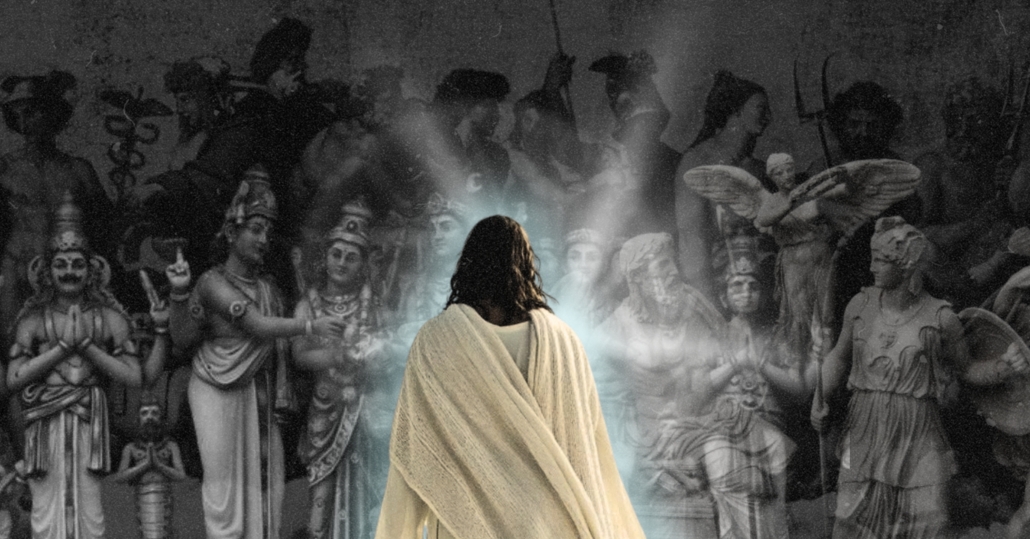
When I went to university, I encountered the biggest intellectual doubt I’ve ever faced as a Christian: How can I be sure that Christianity is true? Here was my thinking: “Can I really claim that I have the right religion when there are 3,000 others to choose from?” You might have come across a form of this argument via the atheist comedian Ricky Gervais.
As I went to university, I knew that I couldn’t keep my faith, nor share it with any real conviction, unless I knew that Christianity was true (1 Cor 15:14). I had to know which God was the correct one. Ultimately, philosophy was the primary force that drove the cementation of my Christian faith.[i]
Categories of Theism
As I wrestled with this doubt, I discovered that I didn’t have to lucky-dip my way through 3,000 religions until I found the correct one. There’s actually a much simpler way. It turns out that every single and particular religion can be grouped into one of five metaphysical categories, which are:
- Atheism, which holds that there is no God beyond the universe.
- Polytheism, which believes in many gods.
- Pantheism (and its cousin panentheism), which essentially teaches that God and the universe are the same thing.[ii]
- Deism, which claims that God created the universe but then left it alone.
- Monotheism, which believes in one supreme, personal, and active God.[iii]
To this day I am unaware of a sixth possible option for a way the world could work (though I am open to being corrected).[iv] I explicitly note here that “agnosticism” is not a category of worldview. It’s just a placeholder label for indecision. Agnosticism doesn’t affirm anything metaphysical about the universe.
Can you see how, suddenly, the 3,000 problem looks very different? Philosophical reasoning helped me to realize that the question is not, which God of 3,000? The question can be swiftly pruned to become, which of these five?
Putting Each Worldview to the Test
And then, after such an exercise, the gods can be put to the test. Each of these five categories needs to be scrutinized, and it is my contention that only monotheism stands up to the test.
- Atheism arguably demands the most blind faith of all. It requires the belief that there is nothing beyond the universe, and that everything came from nothing.[v] But there’s a more thorny problem than this: if our minds are nothing more than chemical compositions of atoms fizzing around in our brains, then we cannot trust ourselves to arrive at the truth, including the supposed truth that atheism is true. In turn, the Problem of Evil is similarly reduced to the natural course of the universe’s atomic rhythm. I cannot commit to a category that is self-defeating in the pursuit of truth and denies the meaningfulness of evil.
- Polytheism runs into a different kind of logical problem. A truly infinite being cannot share its infinity with any other, because if two beings differ in any way, then one must lack something the other has, and yet an infinite being lacks nothing. Moreover, even the ability to judge and distinguish between multiple gods requires an outside standard by which to judge said gods.[vi] But polytheism doesn’t appeal to an outside and greater standard, which thereby also paralyses it from denouncing evil.[vii]
- Pantheism (and its cousin panentheism) says that the universe shares in the ontological nature of God – and so faces two serious obstacles. First, we know that the universe had a beginning, and yet God is eternal, so there must be a distinction between God and the universe.[viii] Second, if God and the universe were identical, then evil would of necessity share in God’s nature and therefore lose its moral repugnance, which doesn’t sit well with anyone who has experienced suffering.
- Deism pictures a God who created the universe but then left it alone. Deism therefore, like atheism, requires the rejection of every single claim throughout history that God has acted miraculously. But, more than that, deism cannot explain why we exist right now, because the universe is entirely dependent on being sustained in its existence every single second. Likewise, deism has to reject that there is a Problem of Evil, because such evil can only be appealed to if there is a universal moral law by which to judge it, and such a universal law requires being sustained in existence every single second.
One Option Remains
None of the first four categories provided me with a satisfactory explanation for how the universe works. Hence, by a process of elimination, I was left with monotheism, which actually fulfills the problems with the other categories. Monotheism provides an explanation for how we got something from nothing and how we can reason to truth (contra atheism), it accounts for one infinite being as the universal standard for all things (contra polytheism), it distinguishes created reality from the uncreated (contra pantheism and panentheism), and it supplies an explanation for the sustained existence of the universe and the moral law within it through a God who has revealed himself (contra deism).
More than that; all of the major philosophical arguments for God’s existence (fine-tuning, cosmological, moral, contingency, transcendental) are tailored to monotheism, so I also found positive arguments for a monotheistic God’s existence, on top of the negative arguments against the alternatives.
As Norman Geisler and Frank Turek put it, monotheism gives the “true box top” – the picture that makes everything else make sense.
“This discovery helps us to see not only what [reality] looks like, but what it cannot look like. Since the opposite of true is false, we know that any non-[mono]theistic worldview must be false. Or, to put it another way, of the major world religions, only one of the [mono]theistic religions – Judaism, Christianity, or Islam – could be true. All other major world religions cannot be true, because they are non-[mono]theistic. This may seem like a grandiose claim – to deny the truth of so many world religions . . . but by simple logic . . . mutually exclusive religions cannot be true. Just as certain football players are rightfully cut from the roster of possible players because they lack necessary abilities, certain world religions are rightfully cut from the roster of possible true religions because they lack necessary qualifications.”[ix]
Narrowing the Field
More needs to be said about how religions within the metaphysical category of monotheism account for the Problem of Evil. There is not enough space to address that here. More also needs to be said about which is the true religion within the category of monotheism. Monotheism (unlike deism) requires a knowable God who has revealed himself.
The only three religions within monotheism which proffer a knowable God are Judaism, Christianity, and Islam. Therefore, by deploying sound reasoning to this question within the Philosophy of Religion, the inquirer is no longer left to choose between 3,000 options; nor even five, once atheism, polytheism, pantheism, and deism have all been ruled out.
The inquirer is left with just three: Judaism, Christianity, or Islam.[1] One of these has to be true.
References:
[1] Let it be noted that these three religions collectively house over half of the world’s population.
[i] “Good philosophy must exist, if for no other reason, because bad philosophy needs to be answered.” C.S. Lewis, “Learning in War-Time,” in The Weight of Glory and other addresses (New York: HarperCollins, 1949, repr., 2001), 58.
[ii] Editor’s note: Panentheism affirms that all the universe is “in” God somehow. For example, the universe is God’s body and “God” – as spirit – is really just the divine soul that inhabits this universal body.
[iii] [Editor’s Note: Some distinguish monotheism from “finite Godism”, wherein God is somehow less than the greatest possible being. That’s the conclusion of Harold Kushner in When Bad things Happen to Good People? (1981). And it’s implicit with some unorthodox schools of Christian thought such as open theism (Greg Boyd). Nevertheless, these can also be seen as varieties of monotheism as they affirm that only one God exists. The point is that, even if the majority view within monotheism is tied to “maximal being ontology” (Anselm’s “that than which none greater can be conceived”), as long as it’s only one-God in view, that can be loosely understood as “monotheism.”
[iv] Ibid.
[v] If an atheist wishes to claim otherwise, then he is no longer appealing to atheism but to some other category of theism.
[vi] Polytheism puts “into the universe a third thing in addition to the two powers: some law or standard or rule of good which one of the powers conforms to and the other fails to conform to. But since the two powers are judged by this standard, then this standard, or the Being who made this standard, is farther back and higher up than either of them, and He will be the real God.” C.S. Lewis, “The Invasion,” in Mere Christianity (ProQuest Ebook Central: HarperCollins Publishers), 48. Accessed 10 April 2026.
[vii] The explanation for evil on polytheism is chalked up to the existence of some ‘evil’ god or gods.
[viii] Pantheism would have me believe that I am God. But that would require me to go from a state of not knowing that I am God to a state of realising that I am, in fact, God. Such a change is impossible for an infinite being.
[ix] Norman Geisler and Frank Turek, “Miracles: Signs of Gullibility or God,” in I Don’t Have Enough Faith to be an Atheist (Wheaton, Illinois: Crossway, 2004), 198-199.
Recommended Resources:
The Great Book of Romans by Dr. Frank Turek (Mp4, Mp3, DVD Complete series, STUDENT & INSTRUCTOR Study Guide, COMPLETE Instructor Set)
Jesus, You and the Essentials of Christianity by Frank Turek (INSTRUCTOR Study Guide), (STUDENT Study Guide), and (DVD)
Early Evidence for the Resurrection by Dr. Gary Habermas (DVD), (Mp3) and (Mp4)
Can All Religions Be True? mp3 by Frank Turek
Sean Redfearn is a former Community Youth Worker who now works for Christian Concern in Central London, UK. He completed an MA in Religion at King’s College London, is in the process of completing the MA Philosophy program at Southern Evangelical Seminary, and is a 2022 CrossExamined Instructor Academy graduate. Passionate about Jesus, he is grateful for the impact that apologetics has had on his faith.