Tag Archive for: history

By Tim Stratton

As a pastor who spends a lot of time on the college campus, I hear the following challenges quite often from young skeptics: “There is no good evidence to think that Jesus ever existed,” or “Christianity has pagan roots!” One might put these common challenges as two questions: (1) Did Jesus of Nazareth really exist? (2) Are the gospel records of this man merely fictional mythology?

In this essay, I want to explore several lines of evidence that will show that the answer to the first question is a clear “Yes!” and to the second “No!”

      i. Did Jesus of Nazareth really exist?

Though there are many “street atheists,” or “internet infidels” who espouse their unqualified views and who in the process influence many impressionable young minds, it should be pointed out that there are very few (if any) scholars and historians who would argue that Jesus never existed. There is just too much evidence to the contrary.

Space does not permit a thorough list of primary sources for Jesus’ historical existence outside of the New Testament, but the following will demonstrate that Jesus indeed lived. Further, the evidence cited will show that extra-biblical sources do not contradict the historical accounts in the Gospels. Indeed, they complement that history.[1]

The ancient sources[2] will be arranged in two ways: (1) Sources that specifically use the name “Jesus” or “Christ;” and (2) Sources that specifically reference events associated with Jesus.

  1. Sources that specifically use the name “Jesus” or “Christ.”   

a) Letter of Mara Bar-Serapion

This letter—written sometime later than A.D. 73—was sent by a Syrian named Mara Bar-Serapion to his son Serapion to encourage him in the pursuit of wisdom and pointed out that those who persecuted wise men were overtaken by misfortune.

What advantage did the Athenians gain from putting Socrates to death? Famine and plague came upon them as a judgment for their crime. What advantage did the men of Samos gain from burning Pythagoras? In a moment their land was covered with sand. What advantage did the Jews gain from executing their wise King? It was just after that that their kingdom was abolished…. But Socrates did not die for good; he lived on in the teaching of Plato. Pythagoras did not die for good; he lived on in the statue of Hera. Nor did the wise King die for good; He lived on in the teaching which He had given.[3]

This ancient document corroborates Jesus’ death, death by the Jews, and that His teaching obviously had continued on (i.e., He had followers who were spreading His teachings).

b) Flavius Josephus

Josephus, a Jewish historian, wrote toward the end of the first century AD. There are three valuable references for the historicity of Jesus. One (Antiquities xviii. 5) describes John the Baptist just as the New Testament Gospels do. The second (Antiquities xx. 9) describes the death of James:

(Ananus [Ananias]) convened the judges of the Sanhedrin and brought before them a man named James, the brother of Jesus, who was called the Christ, and certain others. He accused them of having transgressed the law and delivered them up to be stoned.

The reference to Jesus being the brother of James fits the New Testament data, but that Jesus is further identified as the Christ is remarkable in light of the following quotation from Josephus.[4]

Now there was about this time Jesus, a wise man, if it be lawful to call him a man, for he was a doer of wonderful works, a teacher of such men as receive the truth with pleasure. He drew over to him both many of the Jews, and many of the Gentiles. He was the Christ, and when Pilate, at the suggestion of the principal men among us, had condemned him to the cross, those that loved him at the first did not forsake him; for he appeared to them alive again the third day; as the divine prophets had foretold these and ten thousand other wonderful things concerning him. And the tribe of Christians so named from him are not extinct at this day.” (Antiquities xviii. 33)[5]

The value of these words of Josephus—though some words are controversial—can not be overstated. The Jesus of the New Testament documents is called a wise “man,” did wonderful works, was a great teacher, was the Messiah, was condemned and crucified by Pilate, reportedly arose from dead on the third day (in fulfillment of the Old Testament), and a movement of “Christians” continued at the time of Josephus’ writing.

c) Plinius Secundus, or Pliny the Younger: Governor of Bithynia in Asia Minor (A.D. 112)

The following is a letter he wrote to the emperor Trajan seeking counsel as to how to treat Christians:

In the case of those who were denounced to me as Christians, I have observed the following procedure: I interrogated these as to whether they were Christians; those who confessed I interrogated a second and a third time, threatening them with punishment; those who persisted I ordered executed…. Those who denied that they were or had been Christians, when they invoked the gods in words dictated by me, offered prayer with incense and wine to your image… and moreover cursed Christ—none of which those who are really Christians, it is said, can be forced to do—these I thought should be discharged…. They asserted, however, that the sum and substance of their fault or error had been that they were accustomed to meet on a fixed day before dawn[6], and sing responsively a hymn to Christ as to a god, and to bind themselves by oath, not to some crime, but not to commit fraud, theft, or adultery, not falsify their trust, nor to refuse to return a trust when called upon to do so. When this was over, it was their custom to depart and to assemble again to partake of food—but ordinary and innocent food. Even this, they affirmed, they had ceased to do after my edict by which, in accordance with your instructions, I had forbidden political associations. Accordingly, I judged it all the more necessary to find out what the truth was by torturing two female slaves who were called deaconesses. But I discovered nothing else but depraved, excessive superstition…. For the contagion of this superstition has spread not only to the cities but also to the villages and farms. (Epistles X. 96)

The governor identifies Jesus as “Christ” and says his followers consider him “a god.” Their fault in his judgment is their “superstition” (Jesus’ resurrection?).

d) Cornelius Tacitus (A.D. 55-120)

But not all the relief that could come from man, not all the bounties that the prince could bestow, nor all the atonements which could be presented to the gods, availed to relieve Nero from the infamy of being believed to have ordered the conflagration, the fire of Rome. Hence to suppress the rumor, he falsely charged with the guilt, and punished with the most exquisite tortures, the persons commonly called Christians, who were hated for their enormities. Christus, the founder of the name, was put to death by Pontius Pilate,[7] procurator of Judea in the reign of Tiberius; but the pernicious superstition,[8] repressed for a time broke out again, not only through Judea, where the mischief originated, but through the city of Rome also.” (Annals XV. 44)

These are the chief references to Jesus outside of the 27 individual accounts comprised in the New Testament. A number of other sources are cited (here) on the FreeThinking Ministries website.

  1. Sources that specifically reference events associated with Jesus.

a) Thallus, the Samaritan-born historian (A.D. 52)

Thallus wrote a history of the Eastern Mediterranean from the time of the Trojan War to his own time. Though his writings have disappeared, we only know of them from fragments cited by other writers. The citation below is from Julius Africanus, who is alluding to Thallus’ reference to the darkness that covered the earth from noon to 3:00 p.m. during Jesus’ crucifixion:

Thallus, in the third book of his histories, explains away this darkness as an eclipse of the sun-unreasonably, as it seems to me….[9]

It was “unreasonable,” of course because a solar eclipse could not take place at the time of the full moon, and it was at the season of the Paschal full moon that Christ died.

b) Phlegon of Tralles, Chronicles (2nd century).

Though he is known to have written several works, his history—Chronicles—has disappeared. He, however, is quoted by several ancient writers.

During the time of Tiberius Caesar, an eclipse of the sun from the sixth hour to the ninth occurred during the full moon.[10]

Phlegon is also noted by Origen:

“But,” continues Celsus… “although we are able to show the striking and miraculous character of the events which befell Him, yet from what other source can we furnish an answer than from the Gospel narratives, which state that “there was an earthquake, and that the rocks were split asunder, and the tombs opened, and the veil of the temple rent in twain from top to bottom, and that darkness prevailed in the day-time, the sun failing to give light?”

Answer: “With regard to the eclipse in the time of Tiberius Caesar, in whose reign Jesus appears to have been crucified, and the great earthquakes which then took place, Phlegon too, I think, has written in the thirteenth or fourteenth book of his Chronicles” (Origen, Against Celsus, 2.33)…. He (Celsus) imagines also that both the earthquake and the darkness were an invention; but regarding these, we have in the preceding pages, made our defense, according to our ability, adducing the testimony of Phlegon, who relates that these events took place at the time when our Saviour suffered. (Origen, Against Celsus 2.59)[11]

From these references to Phelgon’s history, we see that the gospel account of the darkness (three hours long), which fell upon the land during Christ’s crucifixion and very possibly the earthquake were well-known. Origen’s account is especially helpful because he is responding to an antagonist who questions the New Testament record.

There are numerous other sources that corroborate events associated with Jesus’ life and death, some of which can be found by clicking here.

No reference in the above citations has been made to the New Testament documents, though we must not dismiss them as merely “religious books.” They are primary documents[12] and should be viewed as reliable history unless they fail to meet the muster of other ancient documents. Further, it is apparent in other places in the New Testament that the history of Jesus, as recorded in the Gospels, was commonly affirmed. The Apostle Paul in his first letter to the church at Corinth (15:3-5) gives a creed current in his day (prior to his death in AD 64) which states that Jesus was crucified to pay for our sins; that He died, was buried, and rose from the dead on the third day; and that He was seen by eyewitnesses.

Click here for more information regarding this creed.

     ii. Are the gospel records of this man merely fictional mythology?

Though a strong case can be and has been made for the historicity of Jesus of Nazareth, this has not stopped many young skeptics from espousing popular bumper sticker slogans like “Christianity has pagan roots.” I personally have been challenged with the accusation that the story of Jesus being the Son of God and rising from the dead is plagiarism from Egyptian mythological pagan “gods” such as Adonis, Mithras, Osiris, Attis, and Horus, to name a few.

But careful analysis shows that such charges fail for several reasons. First of all, there are far more differences between Christianity and these mysterious stories of pagan religions than any similarities offered. For instance, it is purported that the pagan god Osiris was a dying and rising god, and that Christianity is a “copy cat” religion based on Osiris’ resurrection from the dead.[13] At first glance this appears to be troublesome, but when examining these stories with more scrutiny, the differences become glaring.

Osiris, so the account states, was murdered by his brother, and then his body was torn into fourteen pieces and scattered all across Egypt. Then his wife, Isis, found thirteen of the fourteen pieces of his body, revived him (quite different than a resurrection), and then went on to make him “god of the underworld.” This is nothing like the historical story that Jesus voluntarily went to the cross, which defeated and destroyed sin so that through His atonement we as humans could be reconciled with the Creator of the universe, and then three days later, Jesus rose from the dead in whole, and in a powerful, glorified body that we as Christians can also look forward to one day. The story the Bible teaches as historical fact seems quite different when compared to these mythical pagan stories.

Sean McDowell in an article entitled “Is Christianity a Copycat Religion?” says that “Parallels prove nothing.” He gives an interesting parallel: a British ocean liner that could carry 3,000 passengers, had a top cruising speed of twenty-four knots, had an inadequate number of lifeboats hit an iceberg on its maiden voyage, tore a hole in the side of the ship, and sank along with the 2,000 passengers on board. What ship was that? Most of us immediately conclude that this must be the account of the Titanic, but we are mistaken. Sean was describing the Titan, a fictional ship described in Morgan Robertson’s book, Wreck of the Titan, a fictional story written fourteen years before the sinking of the Titanic actually occurred. While the resemblance between the two accounts is eye-opening, the fictional “Titan” is irrelevant to the historical evidence that the Titanic was, in fact, a real ocean liner that sank in the Atlantic after colliding with an iceberg.

Similarly, even if pagan myths did exist that were comparable to the Gospel records and before the time of Christ, it would not undermine the historical evidence for Jesus’ miraculous life, death, and resurrection. “Parallels alone are inconclusive.”[14]

Up to this point, I have intentionally avoided using the Gospel records as historical evidence of the historicity of Jesus because many skeptics disregard anything the Bible says just because it’s in the Bible! However, just because the Bible reports something as a historical event, doesn’t mean we should immediately disregard it. In fact, the Bible is filled with outstanding historical documents. The “search for the historic Jesus” has been going on for well over a century. During this search, there has not been any “new evidence” supporting the idea that the miracle-working Son of God evolved from pagan myths over time. Conversely, modern discoveries have given more reliability to the content of the Gospel accounts in the New Testament. Greg Koukl’s summary states it well:

We know the Apostle Paul died during the Neronian persecution of A.D. 64. Paul was still alive at the close of Acts, so that writing came some time before A.D. 64. Acts was a continuation of Luke’s Gospel, which must have been written earlier still. The book of Mark predates Luke, even by the Jesus Seminar’s reckoning. This pushes Mark’s Gospel into the 50s, just over twenty years after the crucifixion. It is undisputed that Paul wrote Romans in the mid-50s, yet he proclaims Jesus as the resurrected Son of God in the opening lines of that epistle. Galatians, another uncontested Pauline epistle of the mid-50s, records Paul’s interaction with the principle disciples (Peter and James) at least 14 years earlier (Gal 1:18, cf. 2:1). The Jesus Seminar claims that the humble sage of Nazareth was transformed into a wonder-working Son of God in the late first and early second century. The epistles, though, record a high Christology within 10 to 20 years of the crucifixion. That simply is not enough time for myth and legend to take hold, especially when so many were still alive to contradict the alleged errors of the events they personally witnessed. There is no good reason to assume the Gospels were fabricated or seriously distorted in the retelling. Time and again the New Testament writers claim to be eyewitnesses to the facts. And their accounts were written early on while they’re memories were clear and other witnesses could vouch for their accounts. The Gospels are early accounts of Jesus’ life and deeds.[15]

In sum, the contentions that Jesus never existed or that He was a plagiarized version of mythical pagan deities does not pass the muster of historical research, and, therefore, skepticism regarding the reality of the historical person of Jesus is completely unwarranted. Jesus of Nazareth was a real person of history!

Interestingly, Bart Ehrman, one of the harshest and most critical voices regarding Jesus’ resurrection agrees and concludes,

“Whether we like it or not, Jesus certainly existed.”[16]

Notes

[1] A fuller list can be found at our website and the folder “Historical References to Christ from Non-biblical Sources.”

[2] Much of this material and bibliography can be found—often with further discussion—in Gary R. Habermas, The Historical Jesus; Josh McDowell, Evidence That Demands A Verdict; also the updated (by his son, Sean McDowell) Evidence That Demands A Verdict: Life-Changing Truth for a Skeptical WorldSee also Josh McDowell and Bill Wilson; He Walked Among Us. Some dating is based on J. N. D. Anderson Christianity: The Witness of History (pages 13-37, especially).

[3] The manuscript in the British Museum, preserving the text of this letter is quoted from F. F. Bruce in The New Testament Documents: Are They Reliable?

[4] Relatively little question is raised about the authenticity of this quotation.

[5] There has been much debate over this quotation, primarily because it is such a strong defense of the New Testament accounts of Jesus. All extant manuscripts of Josephus, however, contain it, which is a strong defense of its authenticity. For all the arguments, see McDowell and Wilson, He Walked among Us, 41-45. Though some have said that this quotation has been “edited” by Christians, the Arabic version still has the explicit reference to the resurrection. The Arabic version: “At this time there was a wise man who was called Jesus. And his conduct was good, and he was known to be virtuous. And many people from among the Jews and the other nations became his disciples. Pilate condemned him to be crucified and to die. And those who had become his disciples did not abandon his discipleship. They reported that he had appeared to them after his crucifixion and that he was alive; accordingly, he was perhaps the Messiah concerning whom the prophets have recounted wonders” (Arabic summary, presumably of Antiquities 18.63. From Agapios’ Kitab al-‘Unwan (“Book of the Title,” 10th c.). See also James H. Charlesworth, Jesus within Judaism, (http://ccat.sas.upenn.edu/~humm/Topics/JewishJesus/josephus.html). See also Habermas’ discussion of this and his reference to the Arabic translation of Josephus’ work.

[6] The time was the early morning on the first day of the week, thus celebrating the resurrection of Jesus. By this time, worship had moved from the Sabbath to Sunday.

[7] This is one of four references to Pilate outside the New Testament.

[8] Anderson: [This reference] “is bearing indirect and unconscious testimony to the conviction of the early church that the Christ who had been crucified had risen from the grave.”

[9] Julius Africanus, Chronography, 18.1.

[10] Julius Africanus, Chronography, 18.1.

[11] Phlegon is also noted by a six-century writer named Philopon: And about this darkness…Phlegon recalls it in his Olympiads….

[12] Especially F. F. Bruce, Are the New Testament Documents Reliable? In a Biola Christian Apologetics Program audio lecture (Craig Hazen, “Evidence for the Resurrection”), Hazen states “When these gospel accounts are scrutinized under the accepted principles of textual and historical analysis, they are found to be trustworthy historical documents and primary source accounts concerning the life, death, and resurrection of the man Jesus of Nazareth.”

[13] Lee Strobel, The Case for the Real Jesus, 163.

[14] Sean McDowell, “Is Christianity a Copycat Religion?” quoted in The Apologetics Study Bible for Students, 1366.

[15] Greg Koukl,  http://www.str.org/site/News2?page=NewsArticle&id=6760, accessed February 11, 2017.

[16] Bart Ehrman, “Did Jesus Exist?”, Huffington Post (March 29, 2012); http://www.huffingtonpost.com/bart-d-ehrman/did-jesus-exist_b_1349544.html, accessed February 11, 2017.

Recommended resources related to the topic:

Early Evidence for the Resurrection by Dr. Gary Habermas (DVD), (Mp3) and (Mp4)

World Religions: What Makes Jesus Unique? mp3 by Ron Carlson: http://bit.ly/2zrU76Y

Did Jesus Rise from the Dead? By Dr. Gary Habermas (book)

Jesus, You and the Essentials of Christianity – Episode 14 Video DOWNLOAD by Frank Turek (DVD)

The Footsteps of the Apostle Paul (mp4 Download), (DVD) by Dr. Frank Turek 

Can All Religions Be True? mp3 by Frank Turek


Tim Stratton (The FreeThinking Theist) pursued his undergraduate studies at the University of Nebraska-Kearney (B.A. 1997) and, after working in full-time ministry for several years, went on to attain his graduate degree from Biola University (M.A. 2014). Tim is currently enrolled at North-West University, pursuing his Ph.D. in systematic theology with a focus on metaphysics, history, and biblical data.

Original Blog Source: http://bit.ly/39JIcBX
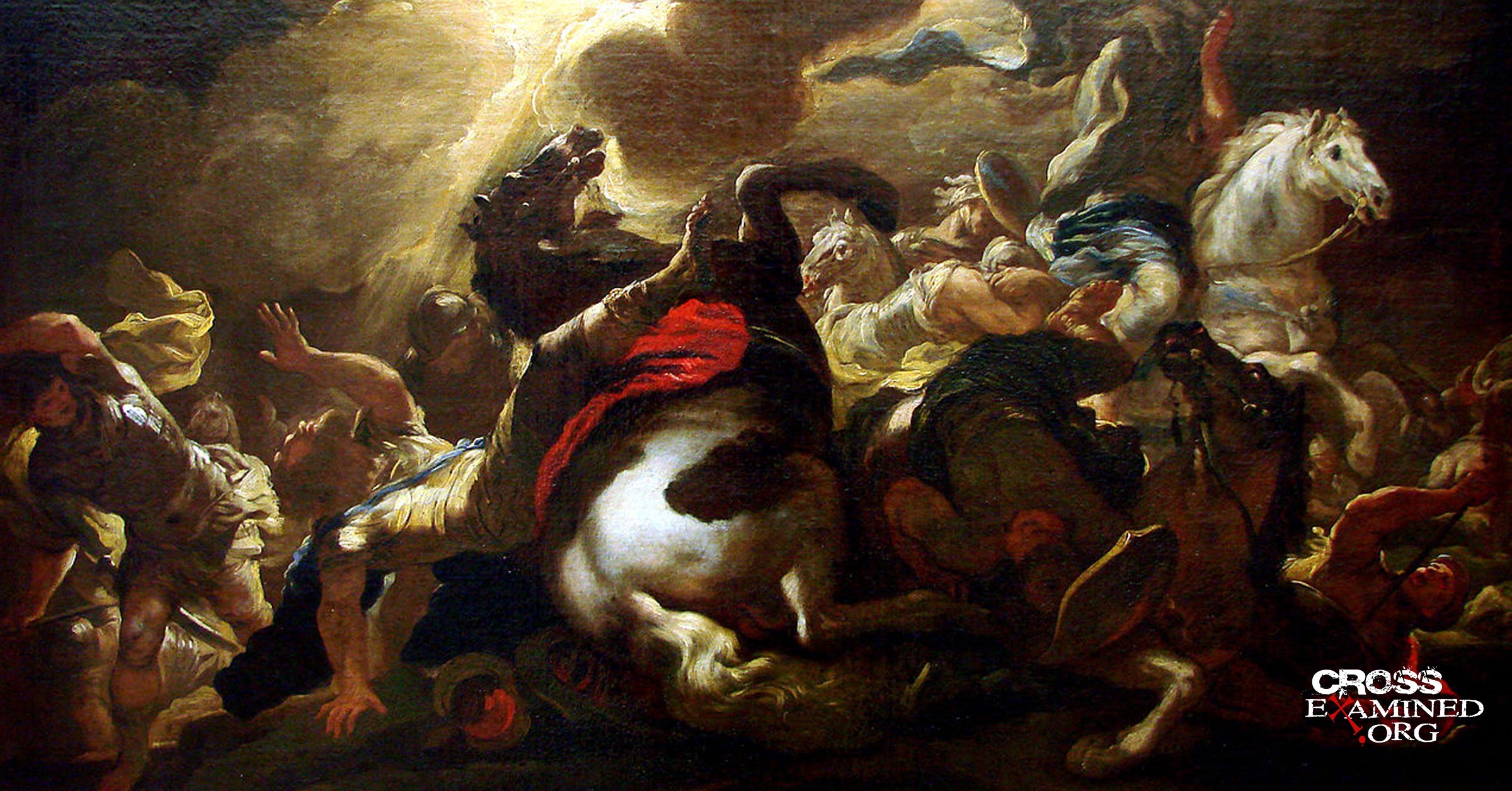
Here’s a very simple proof for Christianity. I’m warning you though, you’re going to be tempted to dismiss it because it’s sneakily uncomplicated. Are you ready for it? OK, here goes:

Premise 1: Paul converted.

Premise 2: Therefore Christianity is true.

OK, I’m kidding. Sort of. But I think that we sometimes fail to appreciate the evidential power of Paul’s conversion. Investigating Paul’s story is what turned a formerly self-proclaimed infidel into a believer and Christian apologist. His name is George Lyttleton.

Who was George Lyttleton? 

Born in the small-town of Hagley, England in 1709, George Lyttleton was a prolific poet, Oxford graduate, and statesman who served as a member of Parliament. He had a friend by the name of Gilbert West.

Living in the “Age of Reason” when deism was all the rage, West and Lyttleton were both critical of Christianity. (For those of you who don’t know, deism rejects divine revelation and miracle claims. God created the world but doesn’t intervene.)

Together the two set out to disprove Christianity. They both agreed that the two strongest proofs for the faith were the resurrection of Jesus Christ and the conversion of Paul. So Lyttleton offered to disprove Paul’s conversion, and West set out to discount the resurrection. After doing so, to their own shock, both became Christians.

West said, “As I have investigated the evidence for the resurrection of Jesus, I have come to believe that there is something to it, and I am going to write my book from that perspective.” Lyttleton wrote, “The same thing has happened to me. I have come to see that there was something to the conversion of Saint Paul, and I am going to write my book from that perspective.” So they did. Lyttleton’s book was titled The Observations on the Conversion and Apostleship of Saint Paul. 

Now obviously Lyttleton’s argument was a little more complicated than “Paul, therefore Christianity is true”. He looked at Paul’s life in Acts and his epistles and concluded that there were four possible explanations for his conversion:

  1. Either Paul was “an impostor who said what he knew to be false, with an intent to deceive;” or
  2. He was an enthusiast who imposed on himself by the force of “an overheated imagination;” or
  3. He was “deceived by the fraud of others;” or
  4. What he declared to be the cause of his conversion did all really happen; “and, therefore the Christian religion is a divine revelation.”

Lyttleton’s book is only about 70 or so pages, so it makes for some light reading. Let me give you a brief synopsis of his arguments.

Was Paul a deceiver?  

Virtually no critic today thinks that Paul’s faith wasn’t genuine for the reasons Lyttleton lays out in about 40 pages of the book. The evidence for Paul’s sincerity is overwhelming. Lyttleton runs through some possible motives that Paul could have had for deceiving the church and finds them wanting.

Wealth 

Paul wasn’t in it for the money. He worked with his own hands making tents in order to finance his missionary journeys. He said that while he had the right to financial support, he opted to forego this privilege so no one could question his motives.

We see plenty of evidence for this in Paul’s letters and in Acts. (Acts 18:320:33-351 Cor 4:11-129:6-142 Cor 11:71 Thess 4:112 Thess 3:8) If Paul was in it for the Benjamins he would’ve found a different line of work within his own tribe. (I’m sorry, I couldn’t resist making a lame pun.)

Honor of Men 

It’s hard to imagine that Paul was in it for his own personal reputation. Consider why he persecuted the church in the first place. A band of fishermen was saying that the Jewish Messiah was executed on a cross and that this Jesus was the Lord of all. He went from being schooled under Gamaliel and considered a reputable Pharisee to joining a band of illiterate preachers. (Acts 4:13) He said that the preaching of the cross was foolishness to the Greeks and a stumbling block to the Jews. (1 Cor. 1:23)

He was persecuted in public and treated like a criminal, being repeatedly imprisoned. Paul obviously wasn’t in it for praises of men.

Power  

What about power? Was Paul like so many modern-day “apostles”, lording over the churches? Nope. Paul said he wasn’t even worthy to be called an apostle because he persecuted the church. (1 Tim. 1:13-161 Cor. 15:9)

Even when people were proclaiming the gospel from wrong motives where he was imprisoned, he rejoiced. (Phil 1:18) And when the Corinthians were arguing over who their favorite preacher was, he drew attention off himself and put it onto Jesus (1 Cor. 1:13) When the people of Lystra tried to worship him as a god, he quickly put a stop to it. (Acts 14:11-16)

Passion 

Paul clearly didn’t convert to serve his own passions. He lived a celibate life. (1 Cor. 7:79:5) He appealed to his own conduct as an example of what a holy life looks like. (2 Cor 7:21 Thess 2:10) Cult leaders like Joseph Smith, Brigham Young, and Mohammed had power and married multiple wives. In comparison, Paul clearly wasn’t in it for sex or otherworldly passions.

Pious Lies 

Here Lyttleton appeals to the story of Paul’s conversion found in Acts. While no one else on the Road to Damascus saw Jesus, his traveling companions had some sensory experience of Paul’s encounter. Paul was also blinded and subsequently healed by the prayers of Ananias. (Acts 9:8-19) Before King Agrippa, Paul appealed to public facts that the king would be aware of. (Acts 26:23- 26)

Furthermore, if Paul was a liar then all of his miracles were tricks. Paul wrote of his own miracles to an audience that easily could have called him out. (Rom 15:192 Cor 12:121 Thess 1:51 Cor 2:4-5)

So for these five reasons, Lyttleton concludes that the weight of the evidence is that Paul wasn’t a liar.

Paul Wasn’t an Enthusiast (He wasn’t crazy) 

In modern times, this is where most critics land on Paul. He just must’ve had a moment and snapped somehow. But according to Lyttleton, Paul wasn’t ‘cuckoo for cocoa puffs’. Paul, by all accounts, was a pretty cool-tempered guy. Says Lyttleton:

“In indifferent matters be became “all things to all men;” to the Jews, he became a Jew, to them that are without law as without law, to the weak he became weak-all, that he might gain some (1 Cor. 9:19-23). His zeal was eager and warm, but tempered with prudence, and even with the civilities and decorums of life, as appears by his behavior to Agrippa, Festus and Felix; not the blind, inconsiderate, indecent zeal of an enthusiast.”

Paul also doesn’t seem to be depressed. Even when he despaired of life given the nature of his persecutions, he didn’t give up. 2 Cor 1:7-9Phil 1:21-23.  Lyttleton also points out that Paul obviously was a learned man, as we can tell just by reading his letters.

Moreover, Paul certainly wasn’t credulous. As someone who lived in Jerusalem for a time, there’s no way that Paul was a stranger to hearing about the miracles of Jesus. He had the facts of the resurrection and presumably would have heard the arguments against them. He had heard what happened at Pentecost and of all the miracles worked by Peter and the other apostles up until the death of Stephen. Far from being credulous, Paul had closed his mind against every proof and refused to believe. Says Lyttleton: “Nothing less than the irresistible evidence of his own senses, clear from all possibility of doubt, could have overcome his unbelief.”

Finally, Paul doesn’t fit the bill of someone who suffered some sort of guilt-induced conversion disorder. We have some access to the science of psychology that Lyttleton didn’t have.

According to the Diagnostic and Statistical Manual of Mental Disorders: DSM-IV, women are 5:1 more likely to experience conversion psychosis. Adolescents, military persons in battle, people of low economic status and those with a low IQ are also more likely prone to experience this phenomenon. Paul just doesn’t fit the bill.

Also, we see no evidence that Paul felt any guilt regarding his actions. He seemed more than content with his lifestyle. (Phil 3:5-6) Paul was a sane and rational person.

Paul Wasn’t Duped 

This third possible explanation Lyttelton dismisses in one page. The other apostles or early Christians couldn’t have deceived him. Why?

  1. It was impossible that the disciples of Christ could have thought of such a fraud given Paul’s persecution. They were against liars (note Ananias and Sapphira) and also were terrified of him.
  2. It was physically impossible for them to do it. Could they produce a light brighter than the noonday sun? Could they cause him to hear a voice speaking out of that light? Could they make him blind for three days and then return his sight with a word? These kinds of special effects didn’t exist yet.
  3. No fraud could have produced those subsequent miracles which Paul worked (Acts 14:7-919:11-1228:82 Cor 12:12Rom 15:19).

Paul’s conversion was legit and Christianity is a Divine Revelation 

Lyttleton concludes that unless we’re going to set aside the normal rules of evidence by which facts are determined, we should accept the whole story of Paul’s conversion as historically true. Therefore, the Christian faith is proved to be a revelation from God. Note that this argument is not dependent on the Gospels.

With that said, there is the dicey issue of arguing for the historical reliability of Acts. Lyttleton’s arguments assume it. He could be accused of begging the question, but proving Acts wasn’t his goal. One would surmise that his audience could find those arguments elsewhere.

For good modern arguments in favor of the historicity of Acts, I recommend Colin Hemer’s The Book of Acts in the Setting of Hellenistic History, Craig Keener’s commentaries on Acts and Lydia McGrew’s Hidden in Plain Sight.

For a good rundown of the arguments for and against Acts – both old and new- here’s an excellent discussion with Dr. Tim McGrew:

Caveats aside, I think Lyttleton’s points are on the money. Paul was either a liar, a lunatic, a dupe or a genuine eyewitness to the resurrected Jesus. The most reasonable option is #4.

YOU CAN READ LYTTLETON’S BOOK IN FULL HERE.

Recommended resources related to the topic:

Early Evidence for the Resurrection by Dr. Gary Habermas (DVD), (Mp3) and (Mp4)

Cold Case Resurrection Set by J. Warner Wallace (books)

Did Jesus Rise from the Dead? By Dr. Gary Habermas (book)

Jesus, You and the Essentials of Christianity – Episode 14 Video DOWNLOAD by Frank Turek (DVD)

The Footsteps of the Apostle Paul (mp4 Download), (DVD) by Dr. Frank Turek 


 is a Reasonable Faith Chapter Director located in Cedar Rapids, Iowa. He’s a former freelance baseball writer and the co-owner of vintage and handmade decor business with his wife, Dawn. He is passionate about the intersection of apologetics and evangelism.
Original Blog Source: http://bit.ly/2W7sBIp


By Erik Manning

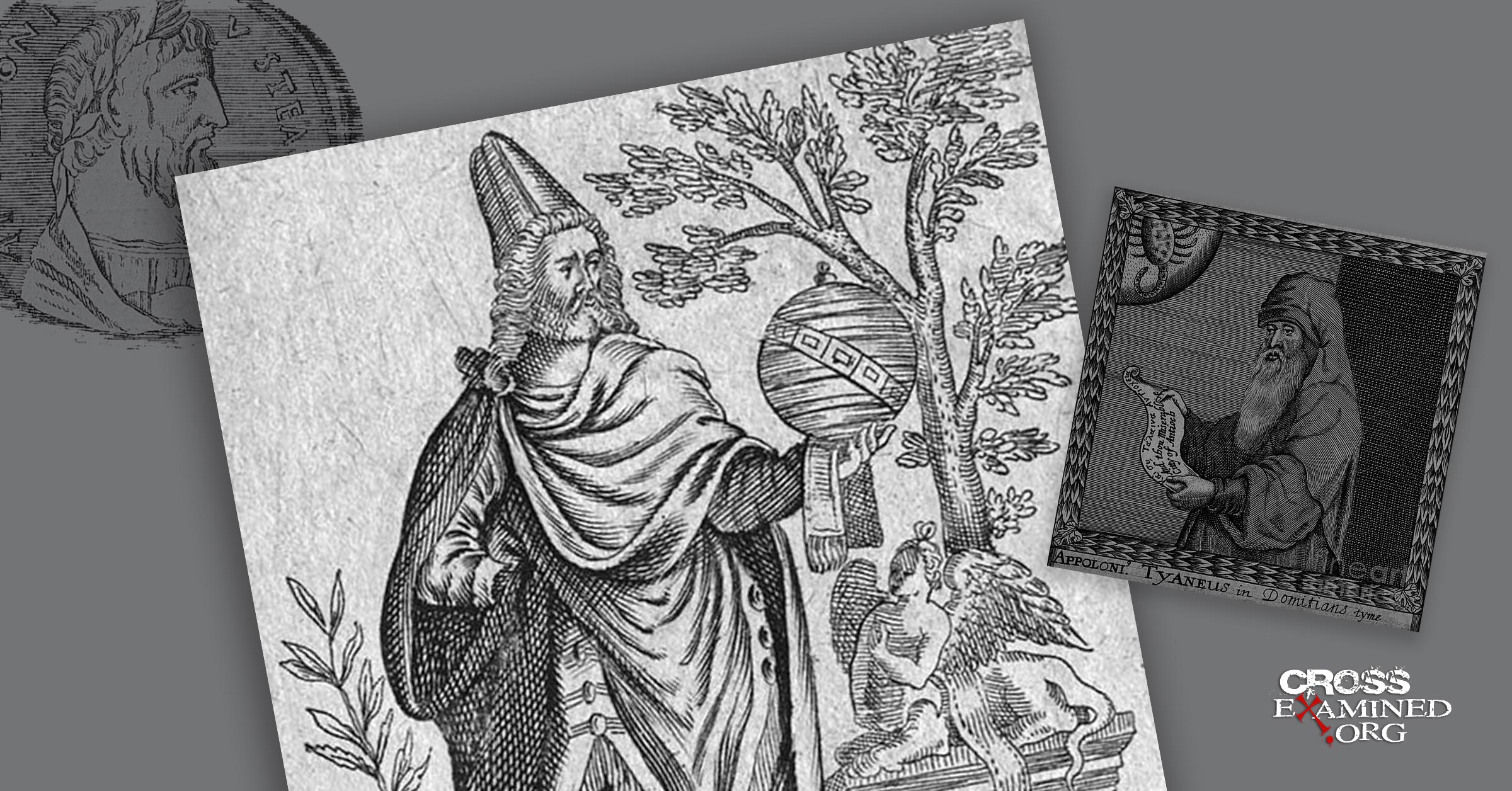
Skeptics like Bart Ehrman will use Apollonius of Tyana as a challenge to Jesus’ uniqueness. Apollonius lived in the first century. His birth was supernatural. He also performed miracles and appeared to people after his death. Sounds familiar, right? Critics will then conclude that the story of Jesus isn’t special.

Apologists will then retort that the Apollonius’ biography was written long after his death. It isn’t until about 100 years later that Philostratus wrote his biography. Therefore, the story we have about his life couldn’t be based on eyewitness testimony. But the Gospels are based on the accounts of witnesses.

And this is where critics will say “Oh really? The Gospels came long after Jesus’ death too!” For example, here’s Bart Ehrman:

“The very first surviving account of Jesus’ life was written thirty-five to forty years after his death. Our last canonical Gospel was written sixty to sixty-five years after his death. That’s obviously a lot of time.”

How Jesus Became God, pp 90

We know that Jesus died around 30-33 AD. But most contemporary scholars date Mark roughly around 70 AD. Matthew and Luke date to 80-90 AD. And John dates to 95-100 AD. We have this long chain of storytellers circulating stories about Jesus for decades. The tales grew in the telling. While the problem isn’t as bad as Philostratus’ bio of Apollonius, 40-75 years is a long enough time for legends to creep in.

The Main Reason Why Critics Give The Gospels A Later Date

So why do scholars date the gospels so late? There’s one big reason: Jesus predicted the destruction of the Temple and Jerusalem. That happened in 70 AD. And we know predictive prophecy isn’t a real thing, so the Gospel authors must have put these words like these in Jesus’ mouth:

as he came out of the temple, one of his disciples said to him, “Look, Teacher, what wonderful stones and what wonderful buildings!” And Jesus said to him, “Do you see these great buildings? There will not be left here one stone upon another that will not be thrown down.” (Mark 13:1-2)

“…when he drew near and saw the city, he wept over it, saying, “Would that you, even you, had known on this day the things that make for peace! But now they are hidden from your eyes. For the days will come upon you, when your enemies will set up a barricade around you and surround you and hem you in on every side and tear you down to the ground, you and your children within you. And they will not leave one stone upon another in you, because you did not know the time of your visitation.” (Luke 19:41-44)

Scholars call this ‘vaticinium ex eventu’. That means that the text is written so as to appear that the prophecy had taken place before the event, when in fact it was written after the events supposedly predicted.

Well, pardon me, Mr. Skeptic. It seems like your anti-supernatural bias is showing. While real examples of this exist in history, there are a few problems with this view in regard to the Olivet Discourse.

The Olivet Discourse Does Not = Late Dating

For starters, if the Gospels are late, why is there no emphasis on the fulfillment of Jesus’ predictions? Luke actually does this in Acts. Here’s a noteworthy example:

“Now in these days, prophets came down from Jerusalem to Antioch. And one of them named Agabus stood up and foretold by the Spirit that there would be a great famine over all the world (this took place in the days of Claudius).” (Acts 11:27-28)

It’s odd that Luke went out of his way to emphasize a prophecy by such an obscure figure. Why would Luke capitalize on that, but not highlight a fulfilled prophecy about the main character of his story?

Furthermore, several of Jesus’ warnings about the destruction of Jerusalem and the Temple make no sense if Jesus gave them after the event. This is true of all three synoptic gospels.

“But when you see the abomination of desolation standing where he ought not to be (let the reader understand), then let those who are in Judea flee to the mountains…Pray that it may not happen in winter.” (Mark 13:1418)

Matthew adds: “Pray that your flight may not be in winter or on a Sabbath.” (Mt. 24:10)

And Luke writes: “But when you see Jerusalem surrounded by armies, then know that its desolation has come near. Then let those who are in Judea flee to the mountains, and let those who are inside the city depart, and let not those who are out in the country enter it...” (Luke 21:21)

The Romans destroyed the Temple in the Summer of 70 AD. It makes no sense for Luke to add a warning about not entering into Jerusalem if the city was already destroyed.

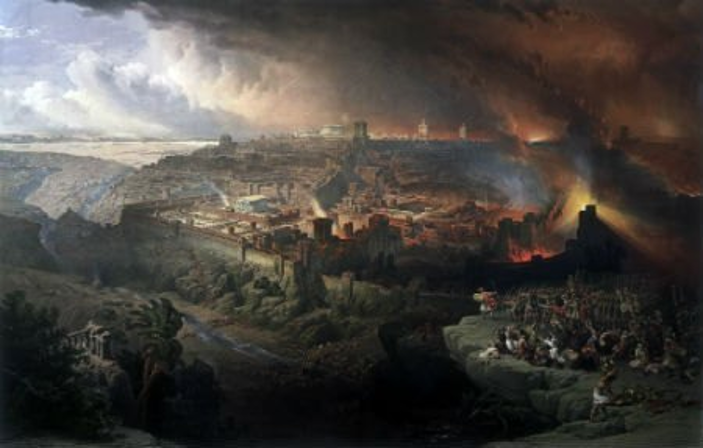
The Siege and Destruction of Jerusalem, by David Roberts (1850).

The Siege and Destruction of Jerusalem, by David Roberts (1850).

It is also baffling why Matthew or Mark would add commands to pray about something that didn’t take place at the particular time that it happened. New Testament scholar Dale Allison writes “What would be the point of inserting an imperative to pray about a past event, that does not take place at a particular time?”

13 Good Historical For The Early Dating Of The Gospels:

What about early dating? Are there any arguments that are in favor of it? Yep, there sure are. There’s a lot of things that are conspicuous by their absence when we look at Acts.

Luke was the first church historian. And Acts is the sequel to his own gospel, which he says he was careful to interview eyewitnesses about. (Luke 1:1-4) There’s a lot of interesting details we find out about life and (hard) times of the early church.

We read about the martyrdom of James the brother of John. (See Acts 12:1-3) We find out about the martyrdom of Stephen. (See Acts 7:56-60) We hear about the early church persecution of Peter and Paul. We follow Peter in the first half of the book, and then we get up close with Paul in the last half of the book.

There are some big events that are missing from Acts that you’d expect to find from such a thorough storyteller like Luke. We’ll now look at 13 reasons why scholars — even some non-conservative ones — date the Gospels earlier.

1. The Death Of Paul

At the end of Acts, Paul is under house arrest in Malta while having his own healing revival. Paul’s execution was in 62-64. After being Paul’s biographer for a huge portion of the book, this seems like a huge event for Luke to fail to mention. Luke has been keenly interested in what is going to happen to Paul. It’s unlikely that he’d cut his book’s narrative off without telling what happened in Paul’s hearing if he were writing much later.

Adolf von Harnack was a prominent German NT scholar who changed his mind on the late dating of the Gospels and Acts. His turnabout came precisely because of the ending of Acts and that Paul is still in Rome alive and preaching. Says Harnack: “we are accordingly left with the result: that the concluding verses of the Acts of the Apostles, taken in conjunction with the absence of any reference in the book to the result of the trial of St. Paul and to his martyrdom, make it to the highest degree possible that the work was written at a time when St. Paul’s trial had not yet come to an end.”

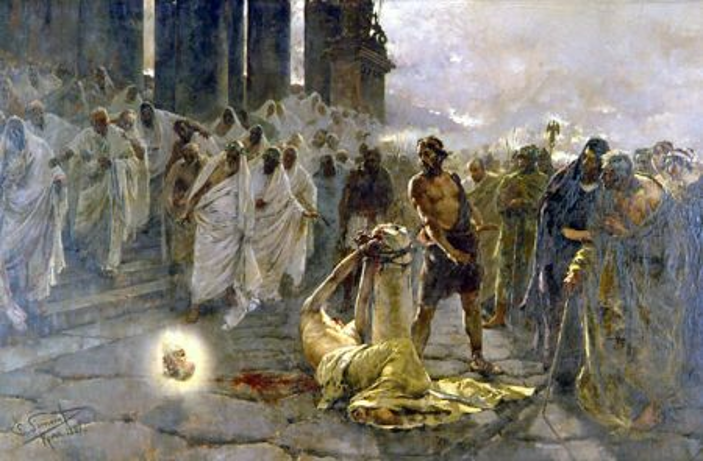
The Beheading of Saint Paul by Enrique Simonet, 1887

The Beheading of Saint Paul by Enrique Simonet, 1887

2. The Death Of Peter

Luke was also up close with Peter in Acts, so it’s also weird that he doesn’t mention Peter’s martyrdom in 65 AD. Again, we see Stephen and James the son of Zebedee’s deaths. Yet he fails to mention the death of the towering figure who preached on Pentecost and was such a pivotal figure in his gospel? It doesn’t add up.

3. The Death Of James The Brother Of Jesus

James was a huge figure in the church of Jerusalem. He looms large in Acts. He’s also Jesus’ brother. We know from the Jewish historian Josephus that James’ martyrdom took place in 62 AD. Josephus thought it was a big enough deal to describe this event, and he was no Christian.

4. The Severe Persecutions Of Nero

Nero himself was probably to blame for a large fire that broke out in Rome. What’s an emperor to do when his capital city is in flames and it’s his own fault? Blame those weird Christians, of course.

This happened around 64 AD. We can read about it in some detail in Tacitus. It’s a strange thing for Luke not to mention this. Luke mentions the church’s persecution in other places, like Jerusalem, Phillipi, Ephesus and more places. Luke also at length discusses relief efforts for the impoverished saints in Jerusalem during a famine.

But he doesn’t mention one of the more gruesome persecutions of the time?

5. The Destruction Of The Temple And The Second Coming

This might be the most convincing proof of them all. The passages in Matthew that describe the destruction of Jerusalem and Jesus’ second coming seemingly leave no time between the two events. Reading Mark and Luke, the interval between the two events is brief. Skeptics like Bertrand Russell and Bart Ehrman have been quick to pounce on this as if Jesus was a failed apocalyptic prophet.

I’m not here to give a theological explanation, although many have been offered throughout the centuries. The association of the destruction of Jerusalem with the return of Jesus wouldn’t exist if the composition of the Gospels was after the destruction of the Temple. Surely there would’ve been some explanation or indication that the two events were not to stand in so close juxtaposition.

6. Luke Was True To His Times

Luke has a lot to say about issues of the day that wouldn’t have been relevant after the destruction of Jerusalem. For instance, there was the brouhaha about how to deal with Gentiles now being members of the church. There’s also mention of the division between the Palestinian and Hellenistic Jews. These would not be relevant after Jerusalem’s destruction. Disputes like these are absent in the writings of early church fathers.

7. Paul Quotes Luke As Scripture

The letters to Timothy proceeded Paul’s death. Paul writes:

The elders who rule well are to be considered worthy of double honor, especially those who work hard at preaching and teaching. For the Scripture says, “You shall not muzzle the ox while he is threshing,” and “The laborer is worthy of his wages.” (1 Tim. 5:17–18)

Paul quotes Deuteronomy alongside Luke. This saying is in Luke 10:7. Scriptures refer to something written down, so this goes beyond oral tradition. This takes for granted that they had familiarity with what Scriptures Paul was talking about.

I understand some critics say Paul didn’t write 1 Timothy. But I’d humbly argue that they are incorrect in their assessment. The main reasons to reject Pauline authorship are thin, as I cover here.

8. Jesus Approves Of The Temple Tax

NT scholar Robert Gundry tells why this is so significant:

“The distinctive passage [of Matthew 17:24–27] teaches that Jewish Christians should not contribute to their fellow Jews’ rejection of the gospel by refusing to pay the Temple tax. This exhortation not only shows Matthew’s concern to win Jews. It specifically favors a date of writing before AD 70; for after the destruction of God’s temple in Jerusalem the Romans shifted the tax to the temple of Jupiter Capitolinus in Rome (Josephus J.W. 7.6.6 §218; Dio Cassius 65.7; Suetonius Dom. 12), and m. Šeqal. 8.8 says that the laws concerning “the Shekel dues…apply only such time as the Temple stands...

Surely Matthew does not include this passage to support the upkeep of a pagan temple, for then the argument implies that the disciples are sons of the pagan god! Nor can we suppose that Matthew is urging Jewish Christians to support the school of pharisaical rabbis that formed in Jamnia yet during the aftermath of the Jewish rebellion, for he excoriates the Pharisees throughout his Gospel. The argument from 17:24–27 for an early date gains further cogency from the evidence that Matthew himself composed the passage.

9. Swearing By The Temple

In Matthew 23:16-22, Jesus is excoriating the scribes and Pharisees. He says:

Woe to you, blind guides, who say, ‘If anyone swears by the temple, it is nothing, but if anyone swears by the gold of the temple, he is bound by his oath.’ You blind fools! For which is greater, the gold or the temple that has made the gold sacred? And you say, ‘If anyone swears by the altar, it is nothing, but if anyone swears by the gift that is on the altar, he is bound by his oath.’ You blind men! For which is greater, the gift or the altar that makes the gift sacred? So whoever swears by the altar swears by it and by everything on it. And whoever swears by the temple swears by it and by Him who dwells in it. And whoever swears by heaven swears by the throne of God and by Him who sits upon it.

This text makes as much sense as me talking to a Gen Z audience about slide projectors or phone booths. Unless the temple still stood, all of these practices would be antiquated.

10 Gift At The Altar 

In Matthew 5:23-24 we read “So if you are offering your gift at the altar and there remember that your brother has something against you, leave your gift there before the altar and go. First, be reconciled to your brother, and then come and offer your gift.”

It could be the case that Matthew was faithfully passing on a saying of Jesus, but it doesn’t make as much sense for Matthew to relay it for the very important reason that no one could obey it if the temple was no longer standing!

11. Jewish Persecution

If Matt 23:34 is reflecting current Jewish persecution of Christians by the synagogue, the verse implies an authority to punish that Jewish leaders did not likely have after the temple destruction.

12. Patristic Evidence

Irenaeus was a student of Polycarp. Polycarp was a student of John. Therefore Irenaeus was in a position to know about the composition of the Gospels. In his book Against Heresieshe writes“Matthew also issued a written Gospel among the Hebrews in their own dialect, while Peter and Paul were preaching at Rome, and laying the foundations of the Church.” (3.1)

That’s interesting. The internal evidence we have for the early dating of the Gospels now matches the external dating.

13. Who Was The Unnamed Disciple Who Was “Famous In The Gospel?”

2 Corinthians 8:18-19 speaks of a famous unnamed disciple that several church fathers (Origen, Jerome) and some commentators believe is referring to Luke.

“We have sent along with him the brother whose fame in the things of the gospel has spread through all the churches and not only this, but he has also been appointed by the churches to travel with us in this gracious work…”

The commentator Barnes observes

…Luke was the companion and intimate friend of Paul and attended him in his travels. From Acts 16:10-11, where Luke uses the term “we,” it appears that he was with Paul when he first went into Macedonia, and from Acts 16:15 it is clear that he went with Paul to Philippi. From Acts 17:1, where Luke alters his style and uses the term “they,” it is evident that he did not accompany Paul and Silas when they went to Thessalonica, but either remained at Philippi or departed to some other place.

He did not join them again until they went to Troas on the way to Jerusalem; Acts 20:5. In what manner Luke spent the interval is not known…it seems probable that Luke is the person referred to by the phrase “whose praise is in the gospel throughout all the churches.” This would be more likely to be applied to one who had written a gospel, or a life of the Redeemer that had been extensively circulated, than to any other person.

While this is admittedly speculative, it does make sense of Paul quoting Luke’s gospel.

The Gospels Were Written Early

NT scholar EP Sanders writes that “there is no material in Mark which must be dated after 70.” If that’s true of Mark, it’s true of Matthew and Luke as well. And if Acts was written before Paul’s death, that means the Gospel of Luke was written when Paul was still alive and kicking. We’ve seen that Paul quotes Luke as scripture. And history tells us Paul died in 62 AD.

There are also several indicators that Matthew’s Gospel was written before 70 AD as well. If both Gospel writers used Mark as a source, then Mark has to be dated even earlier than 62 AD. That means this alleged time-gap has been greatly shortened 40-60 years to 20-30 years. If Paul refers to Luke in 2 Corinthians, then his Gospel was being circulated before 55 AD.

Furthermore, if Paul quotes Luke’s Gospel as scripture, and Paul has met with Peter and James — who were living eyewitnesses to the life of Jesus — then it’s not difficult to imagine the other apostles were aware of the written Gospels as well. They could have policed and addressed necessary correctives if they were inaccurate, and they also could have been sources for the Gospels. We know that the church father Papias (125-130 AD) tells us that Mark’s Gospel was based on Peter’s preaching.

This doesn’t compare to the legend of Apollonius after all. They are close to the events.

Recommended resources related to the topic:

The New Testament: Too Embarrassing to Be False by Frank Turek (DVD, Mp3, and Mp4)

Why We Know the New Testament Writers Told the Truth by Frank Turek (DVD, Mp3 and Mp4)

The Top Ten Reasons We Know the NT Writers Told the Truth by Frank Turek (Mp3)


Erik Manning is a Reasonable Faith Chapter Director located in Cedar Rapids, Iowa. He’s a former freelance baseball writer and the co-owner of vintage and handmade decor business with his wife, Dawn. He is passionate about the intersection of apologetics and evangelism.

Original Blog Source: http://bit.ly/31NPx0d

By Ryan Leasure

Skeptics of all stripes vehemently deny the deity of Christ. Besides their a priori commitment to philosophical naturalism, a major argument they put forth is that the earliest Christians didn’t believe Jesus was divine. Rather, this belief in his deity was a legendary development, as evidenced by the four Gospels.

It’s the skeptics’ contention that the earliest Gospels (Matthew, Mark, and Luke) don’t teach a divine Jesus at all. Instead, they portray a very human Jesus. It’s not until the Gospel of John, written some sixty years after Jesus’ death, that we find a clear reference to Jesus’ divinity.

The argument goes; these Gospels reflect what the earliest communities believed about Jesus. Thus, the earlier Gospels, which don’t portray the deity of Christ, suggest that the earliest communities didn’t believe in the deity of Christ. Once we get to John, however, legends of Jesus’ divine nature have had time to spread throughout the Christian community, hence the high Christology in John.

Bart Erhman, Of Course, Agrees

Bart Ehrman sums up this view in this article:

The problem is that the only Gospel of the New Testament, where Jesus makes divine claims about himself is the Gospel of John. In the three earlier Gospels, you do not find Jesus saying things like “I and the Father are One,” or “Before Abraham was, I am,” or “If you have seen me, you have seen the Father.” These sayings are found only in the Fourth Gospel, as are all the other “I am” sayings, in which Jesus identifies himself as the one who has come from heaven to earth for the salvation of all who believe in him.

He goes on to say:

The most common way that scholars have explained this almost inexplicable omission in the Synoptic Gospels is simply that their authors did not think of Jesus as a divine being who was equal with God and pre-existed his birth, who became incarnate as the God-Man…

And the ultimate payoff is that this view of the Fourth Gospel is not the view of the historical Jesus himself.  It is a later view put on his lips by the author of John or his sources.

Is Ehrman right? Was the deity of Christ a legendary development as he suggests? I don’t think so for at least two reasons.

Paul Writes Earlier Than the Gospels

First, hardly anyone disputes the fact that Paul wrote his letters before the Synoptic Gospels. And interestingly enough, Paul has an incredibly high Christology. Consider these two texts:

Romans 9:5

To them (the Jews) belong the patriarchs, and from their race, according to the flesh, is the Christ, who is God over all, blessed forever. Amen.

Writing sometime in the mid-fifties, here’s a clear reference to the deity of Christ. The legendary hypothesis doesn’t seem to work here. Nor does it with the next text.

Philippians 2:5-11

Have this mind among yourselves, which is yours in Christ Jesus, who, though he was in the form of God, did not count equality with God a thing to be grasped, but emptied himself, by taking the form of a servant, being born in the likeness of men. And being found in human form, he humbled himself by becoming obedient to the point of death, even death on a cross. Therefore God has highly exalted him and bestowed on him the name that is above every name, so that at the name of Jesus every knee should bow, in heaven and on earth and under the earth, and every tongue confess that Jesus Christ is Lord, to the glory of God the Father.

There’s little doubt this text proclaims Jesus as the pre-existent God of the universe. Paul gives us at least two reasons for reaching this conclusion.

First, he states that Jesus was “in the form of God.” The word for “form” in the Greek is morphe, which denotes the exact substance or nature of something.

Second, Paul suggests that Jesus was equal with God when he wrote that Jesus “did not count equality with God something to be grasped.”

What is especially interesting is that even though Paul penned these words, scholars agree that this portion of Philippians was an early Christian hymn dating much earlier than Paul’s letter itself.

In other words, the pre-Pauline Christian community sang these words in their corporate gatherings and collectively worshipped Jesus as God.

Larry Hurtado highlights this truth:

The singing/chanting of such odes is one of several phenomena that demonstrate the remarkable and innovative nature of early Christian worship, in which Jesus was programmatically included in the “devotional pattern” of early Christian circles along with God, and in ways otherwise reserved for God.1

While Ehrman and other skeptics try to persuade the masses that nobody believed in the deity of Christ until the end of the first century, Paul’s writings seem to indicate otherwise.

The Synoptic Gospels Highlight the Deity Of Christ Too

The second reason we should reject the legendary hypothesis is that the Synoptics, though not as explicit as John, still portray a divine Jesus. Let me give you a few examples:

Matthew 1:23

Behold a virgin shall conceive and bear a son. And they shall call his name Immanuel, which means God with us.

From the very beginning, Matthew seems to indicate that this baby Jesus would be pretty special. Divine actually. His very name would mean “God with us” — a clear expression of the incarnation.

Mark 2:5-7

After the men had lowered the paralytic man down through the roof, Mark reports:

And when Jesus saw their faith, he said to the paralytic, “Son, your sins are forgiven.” Now some of the scribes were sitting there, questioning in their hearts, “Why does this man speak like that? He is blaspheming! Who can forgive sins but God alone?”

The scribes ask a crucial question. Who can forgive sins but God alone? Of course, the answer is no one. Yet, we have Jesus pronouncing forgiveness upon this paralytic man, and backing up his pronouncement with a healing miracle.

Luke 1:16-17

As the forerunner of Jesus, Luke speaks of John the Baptist:

And he will turn many of the children of Israel to the Lord their God, and he will go before him in the spirit and power of Elijah, to turn the hearts of the fathers to the children, and the disobedient to the wisdom of the just, to make ready for the Lord a people prepared.

John’s prophetic role was to prepare the people of Israel for the coming Lord. And we know, based on the rest of the text, that coming Lord was Jesus himself.

Matthew 28:18-19

Jesus proclaims in the famous Great Commission:

All authority in heaven and on earth has been given to me. Go, therefore, and make disciples of all nations, baptizing them in the name of the Father, and of the Son, and of the Holy Spirit.

Here at the end of Matthew’s Gospel, Jesus lumps himself in with the Trinity — God the Father, God the Son, and God the Holy Spirit. Notice he uses the singular for “name” not plural “names.” In other words, Jesus understood himself as one with the Father and Spirit.

Mark 14:62

As Jesus stood on trial, the Jewish leaders asked if he was the Son of God. He unashamedly affirmed:

“I am. And you will see the Son of Man sitting at the right hand of the Mighty One coming on the clouds of heaven”

It’s a common misconception to think that Jesus’ favorite title for himself — Son of Man — refers to his humanness. The exact opposite, however, is the case.

Jesus’ self-claim is actually a reference to a prophesy about a divine figure found in Daniel 7:13-14. That text reads:

In my vision at night I looked, and there before me was one like a son of man, coming with the clouds of heaven. He approached the Ancient of Days and was led into his presence. He was given authority, glory and sovereign power; all nations and peoples of every language worshiped him. His dominion is an everlasting dominion that will not pass away, and his kingdom is one that will never be destroyed.

It’s not hard to see the parallels between Jesus’ statement in Mark 14 and the prophesy in Daniel 7. Jesus claimed to be this apocalyptic figure who would come down from the clouds of heaven to judge the earth. He had all authority, glory, and power. All the nations would worship him, and his dominion would last forever. How could anyone think these qualities belonged to anyone other than God?

I could give several other examples, but this should suffice for now.

A Final Verdict

Skeptics have gotten a lot of mileage out of the claim that the deity of Christ was a legendary development. Yet, the data seems to suggest otherwise.

Despite not being as explicit as John, the synoptic Gospels still present a divine Jesus. They present him as the second person of the Trinity, the apocalyptic Son of Man from Daniel 7, and the one who has the authority to forgive sins.

Additionally, Paul — who wrote before any of the Gospels — presents an even higher Christology. Not only does he say things like Christ is God (Rom. 9:5), he quotes from pre-Pauline hymns that exalt the divinity of Jesus, demonstrating that the early Church believed in the deity of Christ from the very beginning.

It’s time we dispel the myth that the early Christians didn’t believe in the deity of Christ. As Richard Bauckham succinctly puts it, “The earliest Christology was already the highest Christology.”2 And who could argue based on the evidence?

Recommended resources related to the topic:

Jesus, You and the Essentials of Christianity – Episode 14 Video DOWNLOAD by Frank Turek (DVD)

How Can Jesus Be the Only Way? (mp4 Download) by Frank Turek

Cold Case Resurrection Set by J. Warner Wallace (books)

World Religions: What Makes Jesus Unique? mp3 by Ron Carlson

The Bodily Nature of Jesus’ Resurrection CD by Gary Habermas 

Historical Evidences for the Resurrection (Mp3) by Gary Habermas

The Jesus of the Old Testament in the Gospel of John mp3 by Thomas Howe


Ryan Leasure Holds a Master of Arts from Furman University and a Masters of Divinity from the Southern Baptist Theological Seminary. He currently serves as a pastor at Grace Bible Church in Moore, SC.

Original Blog Source: http://bit.ly/2E6IxAu

By Ryan Leasure

Bart Ehrman is the most popular skeptic in America today. Writing at super-sonic rates, his books seem to find their way on the New York Times Bestseller list about every other year. Because of his rapid output and wide popularity, his views are spreading like gangrene across the American landscape (and beyond).

Additionally, Ehrman is a professor of religion at UNC-Chapel Hill where he works to cripple the faith of every young Christian who enters his classroom. He shares one of his faith-crippling tactics in his book How Jesus Became God.

Ehrman tells the story of beginning his class by sharing this description of a famous man from the ancient world.

“Before he was born, his mother had a visitor from heaven who told her that her son would not be a mere mortal but in fact would be divine. His birth was accompanied by unusual divine signs in heaven. As an adult, he left his home to engage on an itinerant preaching ministry. He gathered a number of followers around him who became convinced that he was no ordinary human, but that he was the Son of God.

And he did miracles to confirm them in their beliefs: he could heal the sick, cast out demons, and raise the dead. At the end of his life, he aroused opposition among the ruling authorities of Rome and was put on trial. But they could not kill his soul. He ascended to heaven and continues to live there till this day.

To prove that he lived on after leaving his earthly orb, he appeared again to at least one of his doubting followers, who became convinced that in fact, he remains with us even now. Later, some of his followers wrote books about him, and we can still read about him today.1

Ehrman, of course, wants everyone in his class to thinks he’s talking about Jesus. But alas, he reveals the shocking news that he wasn’t talking about Jesus at all. Instead, he’s referring to Apollonius of Tyana.

This revelation is intended to rattle whatever remaining faith his Christian students might have. For if he can demonstrate that Jesus’ story isn’t any different from Apollonius of Tyana, well then Jesus must not be the unique Son of God after all.

Apollonius of Tyana — The Skeptics’ Best Parallel

As demonstrated in the story above, skeptics think that if they can show parallels of Jesus from the ancient world, they can prove that Jesus was just one more in a long line of myth stories.

And Ehrman isn’t the only skeptic using this tactic. In fact, if you listen to debates on the historical Jesus, Apollonius of Tyana is mentioned far more than any other ancient “parallel.” In other words, Apollonius is the best parallel the skeptic has to offer.

So, should Christians be worried? Does Christianity crumble in light of Apollonius of Tyana? Was Apollonius even remotely similar to Jesus? No, no, and no. Allow me to elaborate.

The Problem of Dating

Apollonius supposedly lived between AD 15-96. That is, his life comes shortly after the life of Jesus. Yet the only source we have for his life comes from Philostratus in the third century (AD 225). In other words, there is virtual silence about this man for about 150 years prior to Philostratus’ work.

If Apolonnius had been a Jesus-like figure, how come nothing is said about him for such a long period of time?

Sources for Jesus, on the other hand, all date within the first century when eye-witnesses to his ministry would have still been around. The Gospels come about 30-50 years after his life, and Paul writes his letters even earlier (20-30 years after Jesus). Moreover, Paul quotes or references traditional material that predates his work by decades. All that to say, Jesus’ fame understandably spread shortly after his death and resurrection.

Yet we have crickets with respect to Apollonius. This is hard to believe if he truly was the Son of God who performed miracles and rose again from the dead.

The Problem of Motive

What did Jesus’ followers have to gain for spreading the message of Christianity? Ostracism at best, and death at worst. In other words, they had no motive (money, sex, or power) to make up these stories in a hostile environment. In the end, most of them faced severe persecution for their faith.

What about Philostratus? Well, it just so happens that he was paid by the empress Julia Domna to write a laudatory account of Apollonius’ life in order to improve Apollonius’ reputation amongst the Romans and diminish Jesus’ importance.

Living during a time when Christianity was spreading rapidly across the Roman Empire, the pagan empress needed to do something to restore cultic worship amongst the citizens. Funding this project seems to be her attempt to minimize Jesus’ fame.

Philostratus Was Skeptical of Apollonius’ Miracles

Philostratus, though, couched miracle claims with phrases such as “it is reported that” or “some believe.” Case in point. Reporting on Apollonius of Tyana’s most famous miracle (raising a dead girl to life), Philostratus reports that the girl probably wasn’t dead at all, and even states that only some believed she was. He indicates that this girl had some kind of mist coming out of her mouth prior to Apollonius “healing” her.

The Gospels are nothing like this. They make no qualms about Jesus’ miraculous activity. Furthermore, non-Christian sources also indicate that Jesus was a miracle-worker.

The Problem of Historical Errors

The Gospels provide all kinds of evidence for their historical reliability. Non-Christian corroborating sources, eye-witness testimony, an understanding of local customs, and embarrassing material all suggest that these sources are trustworthy.

Since not many people will take the time to read through Philostratus’ five hundred page work on Apollonius, they will miss out on the fact that Philostratus made all sorts of historical errors — mostly anachronisms.

The blunders are so bad that historian H. C. Kee reports, “what Philostratus reports tells us a great deal about the author and his time — that is, at the turn of the third century — but provides no unassailable evidence about Apollonius and his epoch.”2

While Philostratus attempts to give us a biography, many scholars acknowledge that his work reads more like a romance novel. As Boyd and Eddy remark, “while few have gone so far as to reject a historical Apollonius altogether, most scholars are rather skeptical about the historicity of major aspects of the image offered by this one source written well over a century after the figure it depicts.”3

The Alleged Resurrection

Jesus’ resurrection is the single-most-important fact about Christianity. If he didn’t rise, Paul says, we’re still in our sins. Fortunately, Jesus did die and rise again as the Gospels report, and there’s ample evidence to back this up this claim.

But what about Apollonius of Tyana? Did he rise again as Ehrman suggests? Simply put, no he did not. The only hint in Philostratus’ work that gets remotely close to a resurrection is when one doubting disciple has a dream about the spirit of Apollonius after his death.

A Parallel? Really?

Scholars have systematically debunked every line from the Erhman quote above. At best, he’s misleading. At worst, he’s downright deceitful.

No heavenly messenger announced Apollonius’ birth and said he would be divine. That messenger actually came from Egypt and never said Apollonius would be divine. He wasn’t so much an itinerant preacher as he was a visitor of foreign sages. Furthermore, he took a vow of silence for several years as he began his journey. His miracles were dubious, and he wasn’t killed by Roman authorities. Nor did he rise from the dead and appear to his followers. And none of his followers wrote books about him either.

Be that as it may, what if Philostratus had reported exact parallels? What would that prove? For starters, Jesus predates Apollonius. So any parallel would be evidence against Apollonius of Tyana and not Jesus.

Additionally, even if these so-called parallels did exist, it wouldn’t do anything to diminish the historical Jesus.

Taking this line of thought, you could prove I’m a myth because of the parallels between my life and Bart Ehrman’s. Both of us went to Bible college and later seminary. We both write about the historical Jesus and teach others about the Bible. Both of us live in the Carolinas. We’re both white males. And on and on.

The point is you can find parallels anywhere. Many have shown parallels between Abraham Lincoln and John F. Kennedy. Does that mean Kennedy was a legend? Absolutely not.

In the end, it’s not the parallels that matter, but the differences. So while the story of Apollonius of Tyana is interesting, it does nothing to disprove the historicity of Jesus Christ.

Recommended resources related to the topic:

Early Evidence for the Resurrection by Dr. Gary Habermas (DVD), (Mp3) and (Mp4)

Cold Case Resurrection Set by J. Warner Wallace (books)

Did Jesus Rise from the Dead? By Dr. Gary Habermas (book)

Jesus, You and the Essentials of Christianity – Episode 14 Video DOWNLOAD by Frank Turek (DVD)

The New Testament: Too Embarrassing to Be False by Frank Turek (MP3) and (DVD)

Cold-Case Christianity: A Homicide Detective Investigates the Claims of the Gospels by J. Warner Wallace (Book)

The Top Ten Reasons We Know the NT Writers Told the Truth mp3 by Frank Turek


Ryan Leasure holds a Master of Arts from Furman University and a Masters of Divinity from the Southern Baptist Theological Seminary. He currently serves as a pastor at Grace Bible Church in Moore, SC.

Original Blog Source: http://bit.ly/33XD6Pq

By Mikel Del Rosario

Jesus: The Essential Works

What are the essential truths Christians believing about the things Jesus did? As defenders of the faith, we need to know which beliefs about Jesus’ deeds are essential and why we should believe them.

I had a conversation with my mentor Darrell Bock about this on an episode of the Table Podcast focusing on the works of Jesus mentioned in the Nicene Creed—a collaborative statement of essential Christian beliefs crafted in 325 AD. This creed was based on the Apostle’s Creed and various Scriptures. Early creeds are a good reminder that the essentials of the Christian faith were not just made up recently but actually go back to the earliest memories of Jesus and the teachings of his official spokespeople.

Let me share a couple of things we mentioned while talking about a line that that mentions Jesus’ historic death and burial:

“For our sake, he was crucified under Pontius Pilate; he suffered death and was buried.”

The Nicene Creed makes historical claims about Jesus but also includes theological interpretations of the facts. In this post, I’ll define what Christians mean when we say Jesus died “for us.” Then, I’ll touch on the historical evidence for Jesus’ crucifixion and burial. At the end of this post, you can check out the complete podcast to hear our full conversation on the works of Jesus described in the Nicene Creed. So what’s it means to say Jesus “was crucified for us?”

The Nicene Creed says Jesus was crucified for us

First, the Nicene Creed highlights a kind of substitution where Jesus bears the penalty for human sin. As Anselm of Canterbury explained, Jesus paid an infinite debt no mere human being could pay.

Second, understanding the Jewish context of the earliest Christian thought brings a couple of pictures to mind: The suffering servant of Isaiah 53 who “bears our reproach” and the way Jews understood an animal suffering in the place of a sinner. In some cases, Jews put their hands on the sacrifice to symbolize a transfer of responsibility in the sacrificial system. When you wonder about the significance of something Jesus said or did, remember that themes from the Hebrew Scriptures are often the background, and it pays to see Jesus in his cultural context.

So that’s a theological interpretation of Jesus’ death. But what about the event itself? The Nicene Creed mentions Jesus’ suffering on the cross. What’s the historical evidence for Jesus’ death on the cross?

The Nicene Creed says Jesus died on the cross

Jesus’ death by crucifixion is well-attested: It’s mentioned not only in the Gospels but in a snippet of something the Jewish historian Josephus wrote in his Antiquities, which verifies Jesus’ death under Pontius Pilate. The Roman historian Tacitus alludes to Jesus’ crucifixion as well in The Annals. As even a rather skeptical scholar like John Dominic Crossan recognizes, “That [Jesus] was crucified is as sure as anything historical can ever be.” [1]

“That [Jesus] was crucified is as sure as anything historical can ever be.”

But what happened to Jesus’ body? The Nicene Creed says Jesus was buried, just like we read about in Mark 15 and Luke 23. But what about this?

The Nicene Creed says Jesus was buried in a tomb

Some skeptics ask, “Weren’t crucifixion victims thrown into shallow graves? How do we know Jesus was put in a tomb?” First, we have reports of Jesus’ burial from the time when people who knew about it were still alive. Second, ancient Jewish sources never say Jesus’ body was thrown to the dogs in a shallow grave. There are good reasons to believe Jesus was really buried in a location that was known and that he was buried in a way that by sensitive to Jewish culture.

For example, convicted felons weren’t buried in family tombs. That’s why Jesus wasn’t buried in a family tomb. He was buried in the tomb of a fellow Jew: Joseph of Arimathea. So Jesus’ burial honored what Jewish tradition says about the way a Jewish crucifixion victim should be buried.

So Christian belief operates on two levels: The historical and the theological. As Christians, we believe historical things about Jesus—events you can actually look into like other events in ancient history. But Christians also believe theological things about Jesus—the stuff that makes historical things really matter in our lives.

Like many Christians, I affirm my belief in both the historical and theological truths of the Nicene Creed as I recite it along with my brothers and sisters in the church.

The Works of Jesus in the Nicene Creed

For us and for our salvation he came down from heaven,

was incarnate from the Holy Spirit and the Virgin Mary

and was made man.

For our sake he was crucified under Pontius Pilate;

he suffered death and was buried.

On the third day, he rose again

in accordance with the Scriptures;

he ascended into heaven

and is seated at the right hand of the Father.

He will come again in glory to judge the living and the dead,

and his kingdom will have no end.

Watch the Table Podcast

We cover a lot more about the works of Jesus in the Nicene Creed during our conversation. What are the essential Christian beliefs? Why should we believe this stuff? Check out the complete podcast:

Recommended resources related to the topic:

Jesus, You and the Essentials of Christianity – Episode 14 Video DOWNLOAD by Frank Turek (DVD)

Early Evidence for the Resurrection by Dr. Gary Habermas (DVD), (Mp3) and (Mp4)

Cold Case Resurrection Set by J. Warner Wallace (books)

Did Jesus Rise from the Dead? By Dr. Gary Habermas (book)


Mikel Del Rosario helps Christians explain their faith with courage and compassion. He is a doctoral student in the New Testament department at Dallas Theological Seminary. Mikel teaches Christian Apologetics and World Religion at William Jessup University. He is the author of Accessible Apologetics and has published over 20 journal articles on apologetics and cultural engagement with his mentor, Dr. Darrell Bock. Mikel holds an M.A. in Christian Apologetics with highest honors from Biola University and a Master of Theology (Th.M) from Dallas Theological Seminary, where he serves as Cultural Engagement Manager at the Hendricks Center and a host of the Table Podcast. Visit his Web site at ApologeticsGuy.com.

Original Blog Source: http://bit.ly/2WNb3zN

By Ryan Leasure

Most of what happened in the ancient world went unrecorded. Think about it. People from bygone eras didn’t have technology like YouTube, TV, or the internet — much less the printing press. It’s sad, really. We’ll never know about 99.99% of what happened back then. The less than 1% we do know is because a few literate historians covered the highlights.

We know about famous military commanders and epic battles. Emperors and politicians of powerful kingdoms also make the cut. But most events and people have vanished off the historical landscape.

With Jesus of Nazareth, though, we have four biographies on his life all dating within the lifetime of eye-witnesses. We also have a slew of letters by some of his other followers, making him one of the best-attested individuals in the history of the ancient world. It’s quite remarkable considering he came from a backwoods section of Galilee far removed from prominent Roman locations.

Historians normally gush over this amount of material. The amount and quality of sources towers just about everyone else. Yet some skeptics cry foul. They don’t accept the Gospels or New Testament letters for the reason that they’re Christian documents.

Well, as it turns out, we have other, non-Christian sources also testifying to Jesus. One such source comes from the pen of an early Roman historian named Tacitus. As you’ll see, Tacitus corroborates significant events from the New Testament.

Tacitus, the Greatest Roman Historian

Cornelius Tacitus (AD 55-120) is often called the “greatest historian” of ancient Rome. He authored two large works — the Annals and the Histories.

Much of what he wrote is now lost to us. Fortunately, there’s one remaining portion which is of interest to this discussion. The portion describes Nero blaming the Christians for the great fire of Rome (AD 64). It reports:

Therefore, to stop the rumor, Nero substituted as culprits and punished in the utmost refinements of cruelty, a class of men, loathed for their vices, whom the crowd styled Christians. Christus, the founder of the name, had undergone the death penalty in the reign of Tiberius, by sentence of the procurator Pontius Pilatus, and the pernicious superstition was checked for a moment, only to break out once more, not merely in Judea, the home of the disease, but in the capital itself, where all things horrible or shameful in the world collect and find a vogue.1

What do we learn from Tacitus’ work?

  1. Christians are named after their founder, Christus.
  2. Christus died by the death penalty during Emperor Tiberius’ reign (AD 14-37).
  3. Pontius Pilatus, procurator (AD 26-36), sentenced Christus to death.
  4. Christus’ death ended the “pernicious superstition” for only a short time.
  5. The “pernicious superstition” broke out once more in Judea, the “home of the disease.”
  6. The “disease” spread all the way to Rome and had a large enough following to receive blame for the great fire.

Doubting Tacitus?

As is abundantly obvious, Tacitus’ quote provides a significant amount of corroboration for the New Testament. Jesus died by crucifixion during the reign of Tiberius while Pilatus was procurator of Judea. Moreover, the movement was only “checked for a moment, only to break out once more.”

The implications for this last quote are massive, to say the least. As J.N.D. Anderson remarks:

It is scarcely fanciful to suggest that when he adds that “a most mischievous superstition, thus checked for the moment, again broke out” he is bearing indirect and unconscious testimony to the conviction of the early church that the Christ who had been crucified had risen from the grave.2

On the face of it, Tacitus makes massive claims in support of the New Testament, which is why skeptics try to dismiss it. And they usually give four reasons for doing so.

“It’s a Christian Interpolation”

Skeptics argue that Christians inserted this portion of the text at a later date, but there is no compelling reason for believing this. First and foremost, it’s difficult to imagine a Christian describing his movement as a “pernicious superstition” and a “disease.” As a general rule, people don’t usually label themselves this way.

Furthermore, if Christians really inserted this text into Tacitus’ work, they certainly could have been more clear about Jesus’ resurrection. While the claim that the “superstition broke out again in Judea” implies a resurrection, it’s not entirely clear.

It seems that if Christians had the opportunity to insert a paragraph here, they would have said something more explicit.

“It’s Anachronistic”

A second argument skeptics make against this quote is that it refers to Pilatus as “procurator” — the title during Tacitus’ day — instead of “prefect” — the title during Jesus’ day. That is, it’s anachronistic, and therefore, unreliable.

Again, as a reminder, Tacitus’ reputation as an accurate historian is without question.3 Be that as it may, what should we make of the skeptics’ claim?

First, we should note that Tacitus may have intentionally used the term his readers would have been familiar with for clarity sake. For example, I might write about a “bishop” from the second century, but call him a “pastor” for a contemporary audience because that’s a term readers are familiar with. There’s no reason why Tacitus couldn’t have employed this tactic.

Second, we should also note that other Jewish historians of the first century — Philo and Josephus — both refer to Pilate as a “procurator.” While the term “prefect” was legitimate, it appears that both “procurator” and “prefect” are used interchangeably.

“It’s Hearsay”

Third, skeptics reject this as an original source and claim that Tacitus was simply repeating hearsay from Christians. One line of evidence they suggest is that Tacitus uses Jesus’ title “Christus” rather than his legal name “Jesus.”

This argument doesn’t hold water either. In response, we need to remember that Tacitus was writing about Christians and the origin of their name, so his use of “Christus” instead of “Jesus” seems logical.

Second, it’s difficult to imagine that a great historian like Tacitus, who elsewhere carefully investigated sources, would simply jot down hearsay from a group of Christians. Moreover, I wonder why Tacitus would blindly trust this group he refers to as a “pernicious superstition” and a “disease” and include their fables about Jesus in his history if he didn’t have any other source to substantiate his claim.

While making a substantial claim about a Roman official condemning someone to death, Tacitus would have been especially motivated to get his facts straight.

“It’s Unofficial”

Finally, skeptics argue that Tacitus wouldn’t have had access to any official records that would record Jesus’ death. But I find this terribly unpersuasive.

For starters, Tacitus himself held high government positions (proconsul of Asia). Additionally, he had close connections with others in power, such as Pliny the Younger and his wife, who happened to be the daughter of Julius Agricola, the governor of Britain. It seems silly to suggest he wouldn’t have had access to government records.

Furthermore, we know he had access to the Acta Senatus (archives of the Roman Senate’s activities) as he cites it multiple times in his works. Jesus’ crucifixion may very well have appeared in these archives or in others similar to it.

Knowing the kind of historian Tacitus was, if he didn’t have iron-clad proof that Pontius Pilate sanctioned Jesus’ crucifixion, he would have couched his statement with “Christians report that…” rather than making an unequivocal claim.

Good Corroborating Evidence

In the end, the Tacitus text stands up to scrutiny and provides solid corroborating evidence for the New Testament. While he views Christians in a negative light, he proves to be a reliable non-Christian source for major events in Jesus’ life.

Recommended resources related to the topic:

Cold-Case Christianity: A Homicide Detective Investigates the Claims of the Gospels by J. Warner Wallace (Book)

The New Testament: Too Embarrassing to Be False by Frank Turek (MP3) and (DVD)

Why We Know the New Testament Writers Told the Truth by Frank Turek (mp4 Download)

The Top Ten Reasons We Know the NT Writers Told the Truth mp3 by Frank Turek


Ryan Leasure holds a Master of Arts from Furman University and a Masters of Divinity from the Southern Baptist Theological Seminary. He currently serves as a pastor at Grace Bible Church in Moore, SC.

Original Blog Source: http://bit.ly/2mHGbT0

By Wintery Knight  

Here is an interesting article from the Intercollegiate Studies Institute.

Intro:

The verdict seems unanimous. From presidential speeches to role-playing games, the crusades are depicted as a deplorably violent episode in which thuggish Westerners trundled off, unprovoked, to murder and pillage peace-loving, sophisticated Muslims, laying down patterns of outrageous oppression that would be repeated throughout subsequent history. In many corners of the Western world today, this view is too commonplace and apparently obvious even to be challenged.

But unanimity is not a guarantee of accuracy. What everyone “knows” about the crusades may not, in fact, be true. From the many popular notions about the crusades, let us pick four and see if they bear close examination.

The four myths:

  • Myth #1: The crusades represented an unprovoked attack by Western Christians on the Muslim world.
  • Myth #2: Western Christians went on crusade because their greed led them to plunder Muslims in order to get rich.
  • Myth #3: Crusaders were a cynical lot who did not really believe their own religious propaganda; rather, they had ulterior, materialistic motives.
  • Myth #4: The crusades taught Muslims to hate and attack Christians.

Here’s the most obvious thing you should know. The Crusades were defensive actions:

In a.d. 632, Egypt, Palestine, Syria, Asia Minor, North Africa, Spain, France, Italy, and the islands of Sicily, Sardinia, and Corsica were all Christian territories. Inside the boundaries of the Roman Empire, which was still fully functional in the eastern Mediterranean, orthodox Christianity was the official, and overwhelmingly majority, religion. Outside those boundaries were other large Christian communities—not necessarily orthodox and Catholic, but still Christian. Most of the Christian population of Persia, for example, was Nestorian. Certainly, there were many Christian communities in Arabia.

By a.d. 732, a century later, Christians had lost Egypt, Palestine, Syria, North Africa, Spain, most of Asia Minor, and southern France. Italy and her associated islands were under threat, and the islands would come under Muslim rule in the next century. The Christian communities of Arabia were entirely destroyed in or shortly after 633, when Jews and Christians alike were expelled from the peninsula.6 Those in Persia were under severe pressure. Two-thirds of the formerly Roman Christian world was now ruled by Muslims.

What had happened? Most people actually know the answer, if pressed—though for some reason they do not usually connect the answer with the crusades. The answer is the rise of Islam. Every one of the listed regions was taken, within the space of a hundred years, from Christian control by violence, in the course of military campaigns deliberately designed to expand Muslim territory at the expense of Islam’s neighbors. Nor did this conclude Islam’s program of conquest. The attacks continued, punctuated from time to time by Christian attempts to push back. Charlemagne blocked the Muslim advance in far western Europe in about a.d. 800, but Islamic forces simply shifted their focus and began to island-hop across from North Africa toward Italy and the French coast, attacking the Italian mainland by 837. A confused struggle for control of southern and central Italy continued for the rest of the ninth century and into the tenth. In the hundred years between 850 and 950, Benedictine monks were driven out of ancient monasteries, the Papal States were overrun, and Muslim pirate bases were established along the coast of northern Italy and southern France, from which attacks on the deep inland were launched. Desperate to protect victimized Christians, popes became involved in the tenth and early eleventh centuries in directing the defense of the territory around them.

If you asked me what are the two best books on the Crusades, I would answer God’s Battalions: The Case for the Crusades by Baylor professor Rodney Stark and The Concise History of the Crusades by Professor Thomas F. Madden. If you get this question a lot from atheists, then I recommend you pick these up. Anything by Rodney Stark is useful for Christians, in fact.

Recommended resources related to the topic:

Islamic Culture: Jihad or Jesus? by Dr. Frank Turek (Mp3)

Answering Islam by Dr. Frank Turek (DVD Set, Mp4 and Mp3)


Original Blog Source: http://bit.ly/2lWyLuT

There are two opposing ways to view the history of the canon. One would be to believe that the church, in its entirety, uniformly accepted all twenty-seven books of the New Testament as canonical from the very beginning. The other would be to suggest that the canon didn’t exist until an arbitrary church vote in the fourth or fifth century.

While either view might fit one’s preconceived agenda, the fact of the matter is that both views are terribly naive. The truth is, neither adequately deals with what history tells us.

I believe there’s a better, more balanced approach to the canon. It’s one that recognizes the canon’s development wasn’t as neat and tidy as some conservative scholars might think. Yet at the same time, it wasn’t a wild free-for-all like some other liberals suggest.

Instead, we find that the church affirmed a majority of the New Testament books at the beginning stages of Christianity. We might call these books the canonical core. Then as time progressed, the church, likewise, affirmed the peripheral books of the canon. To demonstrate this balanced approach, I want to highlight some of the early canonical lists from the first few centuries.

Irenaeus (AD 180)

While earlier church fathers quote New Testament books as Scripture, our first clear canon list comes from the Bishop of Lyons, Irenaeus. While he doesn’t include all twenty-seven books, Irenaeus gives us most of the New Testament. His canon includes:1Michael Kruger, The Canon Revisited, 228.

  • Matthew
  • Mark
  • Luke
  • John
  • Acts
  • Romans
  • 1 Corinthians
  • 2 Corinthians
  • Galatians
  • Ephesians
  • Philippians
  • Colossians
  • 1 Thessalonians
  • 2 Thessalonians
  • 1 Timothy
  • 2 Timothy
  • Titus
  • Hebrews
  • James
  • 1 Peter
  • 1 John
  • 2 John
  • Revelation

While Irenaeus’ list excludes four New Testament books (Philemon, 2 Peter, 3 John, and Jude), his list is impressive nonetheless. He’s clear on the Gospels as evidenced by his famous yet unscientific quote, “It is not possible that the gospels can be either more or fewer than the number they are. For, since there are four zones of the world in which we live and four principle winds.”2Irenaeus, Against Heresies, 3.11.8.

Moreover, his list contains the entire Pauline corpus (minus Philemon), Revelation, and about half of the shorter general epistles.

Muratorian Fragment (AD 180)

Named after its discoverer, Ludovico Antonio Muratori, this canonical list dating to the later part of the second century also confirms a core group of canonical books. The list includes:

  • Matthew
  • Mark
  • Luke
  • John
  • Acts
  • Romans
  • 1 Corinthians
  • 2 Corinthians
  • Galatians
  • Ephesians
  • Philippians
  • Colossians
  • 1 Thessalonians
  • 2 Thessalonians
  • 1 Timothy
  • 2 Timothy
  • Titus
  • Philemon
  • 1 John
  • 2 John
  • Jude
  • Revelation

Notice the similarity to Irenaeus’ list. Both include the four Gospels, Acts, and the entire Pauline corpus. It also includes 1 and 2 John and Revelation.

It’s worth noting that the Muratorian Canon includes the Apocalypse of Peter but with the caveat, “though some of us are not willing for the latter to be read in church.”3Muratorian Fragment, Line 72. Additionally, the fragment rejects the Shepherd of Hermas because it was written “quite recently, in our own times” and thus not backed by apostolic authority.4Muratorian Fragment, Line 74, 80.

There’s an important observation here. Both Irenaeus and the Muratorian Fragment indicate that the early church agreed on the core New Testament canon. And with that core agreement came an established theology.

Think about it. Almost all of Christian theology can be established using the four Gospels, Acts, Paul’s letters, 1 John, and Revelation. Not to downplay the importance of books like 3 John or Jude, but Christian theology doesn’t hang in the balance without them. This canonical list, then, should give us confidence that the early church agreed on key Christian doctrines (Trinity, creation, fall, salvation through Christ alone, the deity of Christ, etc.).

Eusebius (AD 320)

While much canonical development occurred over the next hundred years — especially with Clement of Alexandria and Origen — we now turn our attention to Eusebius of Caesarea. Known for writing the first church history, Eusebius gives us a canonical list recognized by the church. What’s interesting about his list is that he breaks it down into four distinct categories.5Eusebius, Church History, 3:25.

The Recognized Books

This list includes the books universally received by the church:

  • Matthew
  • Mark
  • Luke
  • John
  • Acts
  • Romans
  • 1 Corinthians
  • 2 Corinthians
  • Galatians
  • Ephesians
  • Philippians
  • Colossians
  • 1 Thessalonians
  • 2 Thessalonians
  • 1 Timothy
  • 2 Timothy
  • Titus
  • Philemon
  • Hebrews
  • 1 Peter
  • 1 John
  • Revelation

Disputed Books

Some disagreement surrounded the following books:

  • James
  • 2 Peter
  • 2 John
  • 3 John
  • Jude

While Eusebius included these books in his disputed list, he makes an important statement about their validity. He writes that these books “are disputed yet known to most.”6Eusebius, Church History, 3.25. In other words, Eusebius indicates that most regarded these books as canonical even if a few were doubtful. Therefore, we shouldn’t think that most were on the fence with respect to these books — just a small minority.

What we find here, then, is the complete New Testament canon when you combine both the recognized and disputed books. The recognized books are essentially the same canonical core from the second century, plus the disputed books which most recognized as canonical.

Spurious Books

These books were ones that early Christians found helpful, but not canonical. They included:

  • Acts of Paul
  • Shepherd of Hermas
  • Revelation of Peter
  • Epistle of Barnabas
  • Didache
  • Gospel of Hebrews

These books would have been considered orthodox in their theology (much like a modern book by an orthodox Christian writer), but they weren’t backed by apostolic authority, and thus not canonical.

Heretical Books

These books were universally rejected by the early church:

  • Gospel of Peter
  • Gospel of Thomas
  • Acts of Andrew
  • Acts of John
  • Gospel of Matthias

Eusebius goes so far to argue that these books “ought not be reckoned even among the spurious books but discarded as impious and absurd.”7Eusebius, Church History, 3:25. His sentiments seem to fly in the face of modern liberal scholars who argue that the Gospel of Thomas is just as credible and authoritative as our four Gospels.

The Canon and Beyond

Following Eusebius, Athanasius gives us our precise twenty-seven book New Testament in his Festal Letter (AD 367). Additionally, regional church Synods at Hippo (AD 393) and Carthage (AD 397) both affirm the twenty-seven book New Testament canon.

You might ask what took so long to get all twenty-seven books affirmed? There could be a couple of reasons for the delay.

First, the peripheral books were generally shorter and made less of an impact on the church than the core books. It’s not hard for us to see how the church read Romans or Luke more than 3 John. For this reason, peripheral books didn’t circulate around the Roman Empire with the same frequency as the core ones. The truth is, many in the early church probably never read Jude or 3 John.

Another possible reason for the peripheral book’s late acceptance is the persecution of the early church. For example, in AD 303, Emperor Diocletian ordered all Christians to sacrifice to the pagan gods and to hand over all their biblical texts to be burned. It’s easy to see how Christians couldn’t just circulate their books willy-nilly.

Once Constantine legalized Christianity (AD 313); however, Scripture circulation came much easier. And quickly after that, we start finding complete canon lists.

So, did the early church have a neat and tidy agreed-upon canon at the end of the first century? No. But was the canon like the wild-wild West? No again. Instead, the church recognized a core canon from the very early stages, and they came to recognize the peripheral books later once all the books had time to circulate the Empire.


Ryan Leasure Holds a Master of Arts from Furman University and a Masters of Divinity from the Southern Baptist Theological Seminary. He currently serves as a pastor at Grace Bible Church in Moore, SC.

Original Blog Source: http://bit.ly/2OsHxhX

By Wintery Knight

This post presents evidence against Mormonism/LDS in three main areas. The first is in the area of science. The second is in the area of philosophy. And the third is in the area of history.

The scientific evidence

First, let’s take a look at what the founder of Mormonism, Joseph Smith, believes about the origin of the universe:

“The elements are eternal. That which had a begginning will surely have an end; take a ring, it is without begginning or end – cut it for a begginning place and at the same time you have an ending place.” (“Scriptural Teachings of the Prophet Joseph Smith,” p. 205)

“Now, the word ‘create’ came from the word baurau which does not mean to create out of nothing; it means to organize; the same as a man would organize materials and build a ship. Hence, we infer that God had materials to organize the world out of chaos – chaotic matter, which is an element, and in which dwells all the glory. Element had an existence from the time he had. The pure principles of element are principles which can never be destroyed; they may be organized and re-organized, but not destroyed. They had no beggining, and can have no end.”
(“Scriptural Teachings of the Prophet Joseph Smith,” p. 395)

A Mormon scholar named Blake Ostler summarizes the Mormon view in a Mormon theological journal:

“In contrast to the self-sufficient and solitary absolute who creates ex nihilo (out of nothing), the Mormon God did not bring into being the ultimate constituents of the cosmos — neither its fundamental matter nor the space/time matrix which defines it. Hence, unlike the Necessary Being of classical theology who alone could not not exist and on which all else is contingent for existence, the personal God of Mormonism confronts uncreated realities which exist of metaphysical necessity. Such realities include inherently self-directing selves (intelligences), primordial elements (mass/energy), the natural laws which structure reality, and moral principles grounded in the intrinsic value of selves and the requirements for growth and happiness.” (Blake Ostler, “The Mormon Concept of God,” Dialogue: A Journal of Mormon Thought 17 (Summer 1984):65-93)

So, Mormons believe in an eternally existing universe, such that matter was never created out of nothing, and will never be destroyed. But this is at odds with modern cosmology.

The Big Bang cosmology is the most widely accepted cosmology of the day. It denies the past eternality of the universe. This peer-reviewed paper in an astrophysics journal explains. (full text here)

Excerpt:

The standard Big Bang model thus describes a universe which is not eternal in the past, but which came into being a finite time ago. Moreover,–and this deserves underscoring–the origin it posits is an absolute origin ex nihilo. For not only all matter and energy but space and time themselves come into being at the initial cosmological singularity. As Barrow and Tipler emphasize, “At this singularity, space and time came into existence; literally nothing existed before the singularity, so, if the Universe originated at such a singularity, we would truly have a creation ex nihilo.

[…] On such a model the universe originates ex nihilo in the sense that at the initial singularity it is true that There is no earlier space-time point or it is false that Something existed prior to the singularity.

Christian cosmology requires such a creation out of nothing, but this is clearly incompatible with what Mormons believe about the universe. The claims about the universe made by the two religions are in disagreement, and we can test empirically to see who is right, using science.

Philosophical problems

Always Have a Reason contrasts two concepts of God in Mormonism: Monarch theism and Polytheism. It turns out that Mormonism is actually a polytheistic religion, like Hinduism. In Mormonism, humans can become God and then be God of their own planet. So there are many Gods in Mormonism, not just one.

Excerpt:

[T]he notion that there is innumerable contingent “primal intelligences” is central to this Mormon concept of god (P+M, 201; Beckwith and Parrish, 101). That there is more than one god is attested in the Pearl of Great Price, particularly Abraham 4-5. This Mormon concept has the gods positioned to move “primal intelligences along the path to godhood” (Beckwith and Parrish, 114). Among these gods are other gods which were once humans, including God the Father. Brigham Young wrote, “our Father in Heaven was begotten on a previous heavenly world by His Father, and again, He was begotten by a still more ancient Father, and so on…” (Brigham Young, The Seer, 132, quoted in Beckwith and Parrish, 106).

[…] The logic of the Mormon polytheistic concept of God entails that there is an infinite number of gods. To see this, it must be noted that each god him/herself was helped on the path to godhood by another god. There is, therefore, an infinite regress of gods, each aided on his/her path to godhood by a previous god. There is no termination in this series. Now because this entails an actually infinite collection of gods, the Mormon polytheistic concept of deity must deal with all the paradoxes which come with actually existing infinities…

The idea of counting up to an actual infinite number of things by addition (it doesn’t matter what kind of thing it is) is problematic. See here.

More:

Finally, it seems polytheistic Mormonism has a difficulty at its heart–namely the infinite regress of deity.

[…] Each god relies upon a former god, which itself relies upon a former god, forever. Certainly, this is an incoherence at the core of this concept of deity, for it provides no explanation for the existence of the gods, nor does it explain the existence of the universe.

Now let’s see the historical evidence against Mormonism.

The historical evidence

J. Warner Wallace explains how the “Book of Abraham,” a part of the Mormon Scriptures, faces historical difficulties.

The Book of Abraham papyri are not as old as claimed:

Mormon prophets and teachers have always maintained that the papyri that was purchased by Joseph Smith was the actual papyri that was created and written by Abraham. In fact, early believers were told that the papyri were the writings of Abraham.

[…] There is little doubt that the earliest of leaders and witnesses believed and maintained that these papyri were, in fact, the very scrolls upon which Abraham and Joseph wrote. These papyri were considered to be the original scrolls until they were later recovered in 1966. After discovering the original papyri, scientists, linguists, archeologists and investigators (both Mormon and non-Mormon) examined them and came to agree that the papyri are far too young to have been written by Abraham. They are approximately 1500 to 2000 years too late, dating from anywhere between 500 B.C. (John A. Wilson, Dialogue: A Journal of Mormon Thought, Summer 1968, p. 70.) and 60 A.D. If they papyri had never been discovered, this truth would never have come to light. Today, however, we know the truth, and the truth contradicts the statements of the earliest Mormon leaders and witnesses.

The Book of Abraham papyri do not claim what Joseph Smith said:

In addition to this, the existing papyri simply don’t say anything that would place them in the era related to 2000BC in ancient Egypt. The content of the papyri would at least help verify the dating of the document, even if the content had been transcribed or copied from an earlier document. But the papyri simply tell us about an ancient burial ritual and prayers that are consistent with Egyptian culture in 500BC. Nothing in the papyri hints specifically or exclusively to a time in history in which Abraham would have lived.

So there is a clear difference hear between the Bible and Mormonism, when it comes to historical verification.

Further study

If you want a nice long PDF to print out and read at lunch (which is what I did with it), you can grab this PDF by Michael Licona, entitled “Behold, I Stand at the Door and Knock.“


Original Blog Source: http://bit.ly/324GEPv