Tag Archive for: history

By Luke Nix

Introduction

A couple of years ago the documentary “Is Genesis History?” was released. This documentary aims to defend the truth of the Christian worldview by defending the historicity of the early chapters of the Bible from a scientific perspective. The documentary attempts to accomplish this by demonstrating evidence in support of intelligent design and a young (~6000 years old) creation. As those who follow this blog know, I do not hold to the view that the universe is 6000 years old, as Del Tackett and the other contributors to “Is Genesis History?” do, yet I affirm the historicity and scientific accuracy of the Genesis accounts of origins.

Because many people (including those in this documentary) believe that the historicity of these early chapters and a young earth interpretation of them cannot be separated, a friend has asked me to offer some comments in the way of clarifying this common misunderstanding and some other concerns in the movie. There is much unnecessary confusion and heat in the Church concerning the debate over origins, so I am hoping to provide a charitable critique in the context of Christian unity and love.

Areas Of Agreement

Since this post will focus primarily on some points of disagreement, I do want to start with what I agree with that was presented in the documentary. First, obviously, we agree that the Christian worldview accurately describes reality (is true). That alone means that our agreements outnumber our disagreements dramatically; we are brothers and sisters in Christ, part of one Body, neither greater nor lesser in the Kingdom or more or less useful in the Kingdom (1 Corinthians 12).

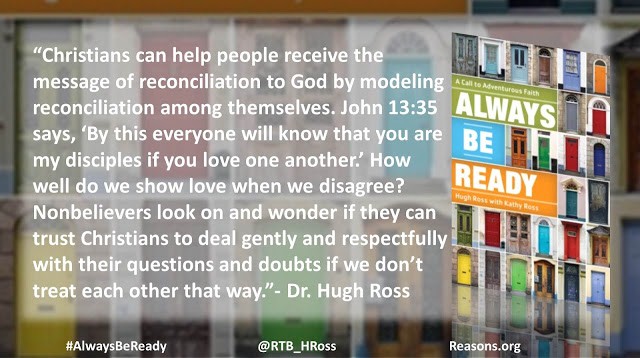
Second, there are actually numerous areas specifically related to origins that we do agree upon. A couple of years ago I wrote a post that lists out 40 of these points of agreement on origins: What Do Young Earth and Old Earth Creationists Agree Upon Regarding Origins? It is important to keep these points of agreement in mind so that as unbelievers view our behavior towards one another in the midst of disagreement, they will see love and reconciliation in Christ modeled. As Dr. Hugh Ross states in his latest book “Always Be Ready: A Call to Adventurous Faith“:

Is Genesis History 1

Third, we agree on the inerrancy of Scripture. It is God-breathed (2 Timothy 3:16-17); thus it is true in all that it affirms. We also agree upon the authority of Scripture. All disagreements are not regarding what Scripture is or its authority in our lives but rather on what it means in the particular areas of disagreement (disagreement on meaning in one area does not necessitate disagreement on meaning in another).

Is Genesis History 2

Fourth, there were many things explicitly said throughout the documentary that I also find strong agreement with. These agreements range from agreements about the failure of high criticism to the denial of common ancestry. As I was taking notes while watching, I kept a running list of these agreements, and here it is (with links to my reviews of books that dive deeper into a defense of the particular item):

Finally, as a computer technologist, I was excited to hear that Del Tackett’s formal training was as a computer scientist. I really was hoping that he was going to bring our field into the documentary in support of God as the Intelligent Creator (there are many areas where computer science can be appealed to argue for a beginner, a designer, free agency, and the validity of cumulative cases, just to name a few). Unfortunately, he did not, but I do hope that he does in a future documentary. Check out “The Programming of Life” for an example of one of these arguments.

Is Genesis History 3

Now, as I mentioned in the introduction, there are several areas regarding origins which I believe “Is Genesis History” got wrong. I am going to attempt to keep my explanations short in this post because there are quite a few, so the case that I present for each inaccuracy is not meant to be comprehensive, but it is still meant to be sound. I will include links to articles and/or books throughout for further investigation. I have categorized the disagreements into three different categories for easy location later if you want to refer to this post in the future. Let’s begin with the philosophical issues.

Philosophical Issues

False Dichotomy

At the very beginning of the documentary, it is proposed that only two options exist regarding origins: either naturalism or a young-earth creationist view. Because of the fact that they intend to investigate an important historical event, it is important that they do not preclude any options before their investigation even begins. If an investigation reveals that neither option is viable, then what is the Christian to do? Because of this drastic philosophical mistake from the beginning of the film, if a Christian is ever convinced that the universe is ancient, then it is implied (if not explicit) that the creators of the film believe that the logically consistent person must reject Christ as well. However, other views do exist, so when a Christian sees the compelling evidence from God’s creation that it testifies to an ancient universe, there is no need to jettison Christ or even the historicity of the early chapters of Genesis.

Old earth creationism as proposed by Reasons to Believe holds firmly to the historicity of the Gospels and the historicity of the early chapters of Genesis and does not fall by the fatal critiques against either naturalism or young earth creationism. Contrary to what is implied at the beginning of “Is Genesis History,” rejection of young-earth creationism does not logically necessitate rejection of the historicity of the life, death, and bodily Resurrection of Jesus Christ (see “Origin Science: A Proposal For The Creation/Evolution Controversy“), and a rejection of young-earth creationism is not a compromise of truth but a compromise of falsehood, which is precisely our goal- reject falsehood and follow the evidence from God’s creation exactly where it leads. If you are interested in the evidence for a historical reading of Genesis and the gospels, check out these awesome books:

Is Genesis History 4

Logical Fallacy- Hasty Generalization

In the documentary, Tackett and the contributors make the logical mistake of arguing that since quick processes created a few things (some geologic formations) that they created all things (all geologic formations). This is problematic for two reasons. First, it is a logical fallacy, so it invalidates their conclusion that the Flood of Noah is responsible for the formation of the Grand Canyon (and all other geological features). Second, in this argument, they assume that old earth creation models allow for only slow processes, when in fact they allow both slow and quick processes. If the young earth creationist finds solid evidence for a quick process, that evidence is perfectly compatible with an ancient earth. The task before the young earth creationist is to provide solid evidence that the other formations also came about by a geographically global flood. In fact, when the evidence of these long processes is examined in the context of each other, we see powerful evidence of a grand orchestrated project culminating in a home for humanity (see “Improbable Planet; How Earth Became Humanity’s Home“).

Logical Fallacy- Conflation

Perhaps the first issue described above is the result of the fallacy of conflation. Naturalism and an ancient universe are not the same. Naturalism is a philosophical position that denies the existence of anything outside this universe. An ancient universe simply is a measurement of the amount of time that has passed since the creation event. Through the use of this conflation, the argument is made that since naturalism is false so must any view that holds that the universe is ancient. Because the argument employs the use of a fallacy, its conclusion is invalid. Naturalism can be false while the universe is ancient, and the same evidence that has forced scientists to concede a finite (but ancient) universe is the same evidence that argues powerfully for God as Creator and Designer. See these three books:

Is Genesis History 5

Philosophy of Science- Investigating the Past

It is quite common for young-earth creationists to claim that the past cannot be known with any level of certainty like the present can be. According to “Is Genesis History” present processes cannot be used to figure out what happened in the past. If they affirm Jeremiah 33:25-26, then they affirm that the laws of physics are as unchanging as God is. This is important because the past can be known by observing the present and using this “principle of uniformity” (not uniformitarianism- they are different), we can deductively conclude what has happened in the past. By working our way backward in time, using God’s actions (current observations) and God’s words (Jeremiah 33:25-26), we discover that the universe did not reach its point of creation 6000 or even 10,000 years ago. Rather it goes all the way back to roughly 13.8 billion years ago. God’s creation testifies powerfully of its creation out of nothing (affirming the historicity of Genesis 1:1, and the rest of Genesis along the way). See these articles and book for more on this philosophy of science:

Philosophy of Science- Changed Laws of Physics

In the above section, I mentioned that the incorrect philosophy of science may be corrected by simply affirming Jeremiah 33:25-26 (unchanging laws of physics). However, several times throughout the film, changing laws of physics were affirmed (specifically at the Fall of Adam and Eve). This is problematic for numerous theological and philosophical reasons, the least of which is the unknowability of the past (thus they cannot even critique alternative views based on evidence from the creation) and possibly the worst of which is denying God’s unchanging nature that He explicitly compared to the laws of physics (and in turn, denying the doctrine of biblical inerrancy). For more on the details of this issue see the book “Peril in Paradise.”

Is Genesis History 6

Since that last issue addresses both a philosophical and a theological issue, it provides a good segue into the second category of issues.

Theological Issues

Nature Cannot Interpret Scripture

This issue can also be seen as both philosophical and theological. When it is restated, the theological implications become more apparent: “God’s actions cannot be used to interpret God’s words.” This is the result of denying Jeremiah 33:25-26 (affirming changed laws of physics). For changed laws of physics means that the creation does not reflect God’s actions. However, since God has told us that the current observations of the universe do reflect His original creation (Jeremiah 33:25-26, Psalm 19, and Romans 1), we cannot deny that God’s actions can be used to interpret His words. Affirming that God’s actions (the creation) can be used to interpret God’s words (Scripture) is not a matter of “man’s fallible ideas versus God’s infallible Word,” rather it is a matter of affirming that God’s infallible actions are necessarily consistent with God infallible Word. And when God’s actions unequivocally reveal an ancient universe, we need to change our interpretation of what God’s Word in Genesis means to reflect His actions and not our fallible ideas. See the following three articles that go deeper into the relationship between God’s Word and God’s actions:

Is Genesis History 7

Christians Who Disagree With Young-Earth Creationism Are Denying Genesis Is Historical

By using God’s creation to help us interpret His words (thus concluding an ancient universe), we are not denying the historicity of the Genesis account; we are affirming its historic and scientific accuracy and our own fallibility in interpreting the words and actions of an infallible God. In fact, when Genesis 1 is interpreted from the proper perspective (the surface of the planet, according to Genesis 1:2), we discover perfect alignment between the events described in Genesis 1 and what scientists have discovered about the history of our planet and life. This is far from denying historical accuracy; this is providing solid scientific evidence of the historical accuracy of the account. For more on this, see these books:

Is Genesis History 8

A Global Flood and the Judgment of Sin

In “Is Genesis History” the contributors asserted that the only way that God’s judgment (the whole purpose of Noah’s Flood) is that it be global in extent. The purpose was to judge humanity for its evil, so its geographical extent need only be to everywhere that humans had inhabited. The debate about the geographical extent of the flood comes down to the extent to which humans had migrated around the globe. If they had not migrated far from the place of Adam’s and Eve’s creation, then God could still accomplish His purpose 100% by merely flooding that geographical area. Given the strong evidence for the lack of migration of early humans (see Who Was Adam) and the fact that no geological evidence exists for a worldwide flood (see the Hasty Generalization above), the interpretation of the Flood as a universal event (affected all humanity but not the whole globe) affirms both the historicity of the Flood account (God’s words) and the accuracy of the record of nature (God’s actions). See “Navigating Genesis” for more on this.

Scientific Issues

Evolution Can Take Place in Billions of Years

The first scientific issue that I want to describe with is the idea that naturalistic evolution can produce the origin (and diversity) of life we see today in just billion years. As more and more research is conducted into the cosmic, galactic, planetary, geological, and chemical conditions required just for life to originate, 13.8 billion years is actually numerous orders of magnitude too young! This is one of the reasons why the big bang (establishes that the universe began merely 14 billion years ago) was so vociferously opposed. Since the evidence is so strong for the universe’s beginning (ex nihilo) in the finite past (see “Creator and the Cosmos“), naturalists have attempted to exponentially increase their chronological resources by positing a multiverse (which includes a near-infinite number of universes) to accommodate the necessity for amounts of time orders of magnitude more than 13.8 billion years.

Is Genesis History 9

Young earth creationists (including those in “Is Genesis History”) constantly accuse scientists and other Christians, who hold to an ancient universe, of needing 13.8 billion years to accommodate evolutionary processes. The reality is that that is simply not the reason. The evolutionary process is simply not that efficient by many orders of magnitude. It is not feasible by any stretch of the imagination! The only reason naturalists have accepted that the universe is only 13.8 billion years old is because the evidence from God’s creation (Romans 1) is so strong that they can no longer deny it logically or scientifically (again, see “Creator and the Cosmos“). If anyone tells you that the old earth creationist needs or is trying to force 13.8 billion years into the Bible to accommodate evolution, please understand that they really do not understand just how inefficient the evolutionary process is. See “A Matter of Days: Resolving A Creation Controversy” for more on this chronological impossibility for evolution.

Is Genesis History 10

Affirmation of Macro-Evolution

One of the major problems with the global flood hypothesis is Noah fitting all the different animals on the ark. The diversity we see today could not be represented if there was a one to one representation. Global flood proponents, including in “Is Genesis History” have posited that all animals descended from a collection of ancestral “kinds” that were on the ark. They believe this process was either fully naturalistic or could have been theistic (preloaded into the genes at original creation). Several problems exist.

First, “kind” can be roughly comparative to either “genus” or “family.” While creationists (old earth and young earth) believe that micro-evolution (adaptation within a species) does happen and speciation (evolution from one species to another) is possible, they believe that evolution beyond this level crosses into macro-evolution (evolution from genus to genus or family to family) and either does not happen or is impossible. Young earth creationists (including those in “Is Genesis History”) are quite critical of both naturalistic and theistic macro-evolutionary models for numerous reasons. These same reasons serve to falsify their own affirmation of macro-evolution.

Second, even naturalists and theistic evolutionists understand that the macro-evolutionary process would be slow and not as quick as the global flood proponent would need to explain today’s observed diversity. The global flood proponent would have to posit not just a mechanism that they already claim to have falsified but one that works at orders of magnitude more quickly. If a process is not possible, speeding it up does not make it more possible. It would also be akin to punctuated equilibrium- one of the evolutionary answers to sudden appearances of animals in the Cambrian and Avalon explosions. The proposed solution to the diversity problem will not work by any standard. See “Navigating Genesis” and “Peril in Paradise” for more on this issue with the necessity of global flood proponents to affirm macro-evolution.

Is Genesis History 11

Dinosaur Soft Tissue Affirm A Young Earth

In “Is Genesis History” one of the proposed evidences to defeat an ancient universe and earth (and cause doubt about other dating methods) is the discovery of dinosaur soft tissue. This is a really cool discovery that has been in the news for a few years now and has spurred on much more scientific inquiry. The idea behind this evidence is that, by current understandings of soft tissue degradation, the dinosaur soft tissue should have decayed a long time ago, if they had been dead for 60+ million years. The discovery of dinosaur soft tissue adds a huge question mark behind two beliefs: the date of the dinosaurs’ death and the current understanding of soft tissue decay processes. In “Is Genesis History,” they posit that the current understanding of soft tissue decay processes is complete and that scientists should rather doubt the ancient date for the death of the dinosaurs (and affirm a young earth).

The problem is that this is only one piece of evidence that seems inconsistent with current dating (among many pieces of evidence that falsify a young creation), so scientists have opened up more research into decay processes for soft tissue. These have been quite fruitful in producing discoveries of multiple conditions that would result in longer decay times. As biochemist Fazale Rana describes in his book “Dinosaur Blood and the Age of the Earth,” these newly discovered conditions defeat the claim that soft tissue is incompatible with an ancient date for the death of the dinosaurs. So, this evidence, contrary to what those in “Is Genesis History” claim, it does not provide evidence against an ancient universe or earth. But again, as described above, this does not mean that Genesis is not history; it just means that the young earth interpretation is not accurate.

Conclusion

So, is Genesis history? Yes! But the history recorded in Genesis does not teach that the universe is only 6000 years old. While the answer to the title question of the documentary is in the affirmative, one does not have to accept the scientific, biblical, theological, and philosophical inaccuracies in the “Is Genesis History” documentary to believe that Genesis is history. In fact, when investigated, we find that the historical record in Genesis is perfectly compatible with modern scientific discoveries of God’s creation. What secular scientists are discovering about God’s actions is revealing more details of the general events that Moses recorded thousands of years ago. Moses had no way to know such things (especially since he was in the middle of an ancient near eastern culture that held to the eternal past of the universe and its lack of design and purpose [see “The Bible Among The Myths“]). This provides powerful evidence that the Bible was inspired by the Creator of the universe, and consequently, such evidence points directly to the truth of biblical claims about our sinfulness and need for a Savior. The reality of the antiquity of the universe (and big bang cosmology, properly understood) does not undermine Christianity; it provides solid evidence, from God’s own actions (creation) for the truth of the Bible, that no Christian should fear or be reluctant to affirm.

If you are ready to explore God’s creation and see how, as Romans 1:20 proclaims, God’s attributes are so evident in His work that skeptical scientists cannot escape public acknowledgment of them, definitely pick up any of the many books linked to in this post or check out these excellent ministries:

Is Genesis History 12


Luke Nix holds a bachelor’s degree in Computer Science and works as a Desktop Support Manager for a local precious metal exchange company in Oklahoma.

Original Blog Source: http://bit.ly/2DTwnfz

By Terrell Clemmons

It’s Time to Remit Darwinian Storytelling to the Annals of History.

Stephen Meyer was a young geophysicist working in the oil industry in Dallas, Texas, in 1985 when he saw that an interesting science conference was coming to town and he decided to drop in. During a panel discussion on the origin of the first living things, Charles Thaxton, a highly credentialed chemist, noted that the information stored in DNA could not be explained by chemical evolutionary processes. This was generally known already and uncontroversial. But Thaxton ventured a step further by suggesting that the information could point to an intelligent cause. This was a reasonable inference, Thaxton said because, in our regular human experience, we know that information is typically attributable to intelligent causes.

This struck Meyer as both intuitive and plausible. But what really piqued his interest was the heated reaction of some of the other scientists at this suggestion. They got really personal. Some criticized Thaxton’s intellect; others, his motives, as if he’d broken some unwritten convention. What was with all this emotion? Meyer wondered. He’d always thought scientists were objective professionals who coolly looked at data and followed the evidence. This was an interesting problem.

The encounter led to some follow-up discussions with Thaxton and a burning new question, which Meyer would take with him to Cambridge University a year later: Could this idea of intelligence—or intelligent design—be made into a rigorous scientific argument?

But during his first year there, an after-lecture social gathering brought home a sobering reality. Everyone at Cambridge was openly atheistic. In fact, atheism was so preemptively the assumed worldview that theism was not even on the table. Meyer not only believed in God; he was a Christian. Clearly, this could be a lonely work environment, and the widespread atheism around him could present obstacles to collaborations on this question. But he took heart in remembering the great scientists of history whose science had been specifically driven by their Christian worldview.

The Closed Darwinian Circle

Science writer Tom Bethell, who had arrived at sister university Oxford about twenty-five years prior, experienced a similarly disappointing revelation. He’d arrived at Oxford “naively imagining that philosophy taught us the meaning of life.” It didn’t.

But Bethell later came to see its usefulness. Many problems in philosophy had flourished, he discovered, because the words used to formulate theories weren’t clearly defined. Sometimes, he further realized, the vagaries seemed to be intentional. Bethell would go on to a long career as a philosophically astute journalist, brilliantly clarifying and parsing some of the most crucial enigmas of public life and history.

Case in point: Charles Darwin’s central postulate said that the diversity of biological life on earth could be explained by natural selection operating on random variations. Herbert Spencer, a contemporary of Darwin, summarized this notion as “survival of the fittest.” The phrase stuck, and today, Darwin’s postulate reigns as the grand unifying theory of established science.

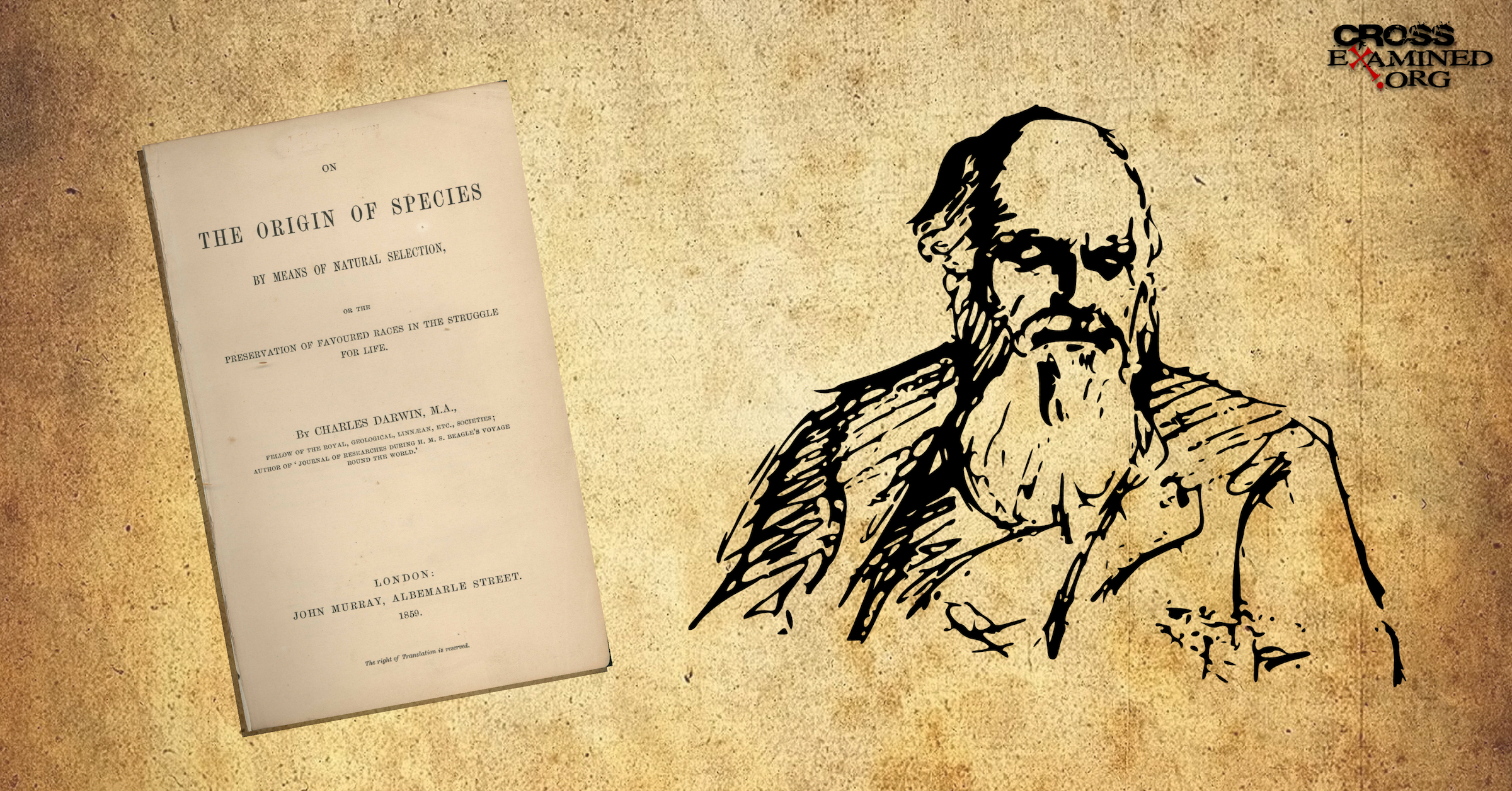
But was there an inherent problem with it, philosophically, from the very start? “Doubts about evolution first arose in my mind when I looked at the title page of The Origin of Species,” Bethell wrote.

I read, and then reread that page:

On the Origin of Species

by Means of Natural Selection

or the

preservation of favoured races

in the struggle for life

by Charles Darwin, M.A.

1859

The words ‘preservation’ and ‘favoured’ stood out. Was there any way of knowing what ‘races’ (meaning species, or individual variants) were favored other than by looking to see which ones were in fact preserved?

This was no pedantic quibble. For if there truly is no way of determining what is “fit” other than by seeing what survives, then Darwin was arguing in a self-confirming circle: the survival of the survivors. In rhetorical terms, this is what’s called a tautology—a statement that is true by definition, due to the construction of the language by which it is expressed. In effect, Darwin’s proposed mechanism—natural selection—rested on the observation that, “Survivors survive.” To which any clear-thinking middle-school student might say, “Well, duh.”

Curating History

Beginning with this observation, Bethell’s latest book examines the dialogue that has taken place among scientists since the publication of The Origin. But rather than giving us a chronological point-counterpoint synopsis of it, Bethell presents a kind of “tour” of the topics over which the debate has been hashed out—the “rooms,” if you will, of the 150-plus-year-old house of Darwin: common descent, natural selection, the fossil record, information theory, evolutionary psychology, artificial intelligence, the growing intelligent design movement, and more.

The upshot of it all is captured in his title: Darwin’s House of Cards: A Journalist’s Odyssey Through the Darwin Debates. Darwinism is an idea past its prime, he concludes, one whose collapse is inevitable and is in fact already demonstrably underway.

Examining a Theory and Its Theorist

He states that forthrightly, but also backs it up with characteristically sound logic—examining, like a museum curator, Darwin’s various claims in light of both mounting new evidence against them and the ongoing lack of evidence supporting them. Room by room, he shows how evolutionary theory today is being propped up by logical fallacies, bogus claims, and outdated empirical evidence that has all but disintegrated under the weight of new discoveries.

In addition to covering the high points of the scientific discussion, Bethell also delves into the man Darwin as he revealed himself through his personal writings. While Darwin was in his own right a legitimate scientist, his theorizing was influenced, inordinately as it turns out, by three ideas of his day: Malthusian economics, Progress, and philosophical materialism.

  • Malthusian Math: Political economist Thomas Malthus had speculated that when population growth outstrips food supply, then death by starvation would result in some sectors of society but not others. Darwin had read Malthus, and he simply transferred the calculus of overpopulation to the plant and animal kingdom. “It at once struck me that under these circumstances favorable variations would tend to be preserved, and unfavorable ones to be destroyed. The result would be the formation of new species.” Darwin had no evidence of the formation of any new species, though. That was pure extrapolation.
  • Progress: Capitalized to denote the philosophy as it existed in his day, “Progress” was the reigning metanarrative in post-Enlightenment England, the all-encompassing, assumed a trajectory of reality. It was “as difficult for him to escape as the air he breathed,” wrote Bethell, and Darwin was a confirmed believer. The word “evolution” doesn’t actually appear in The Origin. He referred rather to improvement, progress, and perfection, in the end, writing that “all corporeal and mental endowments will tend to progress toward perfection.”
  • Materialism: Darwin himself was a full-blown materialist, but he avoided outwardly confessing the extent of his belief. He’d worked out his theory by 1837, but didn’t go public with it for more than twenty years, partly because the 1830s climate of opinion was highly unfavorable to materialism. Even at publication in 1859, he still didn’t deploy it consistently in The Origin, but rather strategically and progressively invoked it over the course of six editions.

Darwin’s metaphysical outlook was not a deduction from his science, though, but was influenced by his theology. He raised theological issues in several of his writings, and Bethell devotes an entire chapter to his evolving religious views. Two points are worth mentioning here. In his autobiography, Darwin mentioned being “heartily laughed at” for quoting the Bible while on the H.M.S. Beagle. We can only speculate about the psychological effect of this incident, but it obviously affected him enough to write about it forty years later. Afterward, he reconsidered the Bible’s place in his view of the world and concluded it was “no more to be trusted than the sacred books of the Hindoos, or the beliefs of any barbarian.”

In addition, like many in insulated societies, he took issue with God over the problem of evil and suffering, ultimately deciding that the concept of an all-loving and all-powerful God could not be reconciled with the reality of misery in the world. “Thus disbelief crept over me at a very slow rate, but was at last complete.”

More a product of their theorist and the zeitgeist, then, than of science, Darwin’s postulates found easy acceptance among an elite intelligentsia predisposed to believe in materialism and Progress. Sadly, liberal clergy went along without objection or concern.

Straightening Out Bad Philosophy

Molecular biologist Jonathan Wells concurs with Bethell that Darwinian evolution is one long argument bolstering an a priori metaphysics. In Zombie Science: More Icons of Evolution, he gives three common definitions of science: (1) empirical science is the enterprise of seeking truth by formulating hypotheses and testing them against evidence; (2) technological science comprises the advances that have enriched modern life; and (3) establishment science consists of professionals conducting research. These can all be legitimate uses of the word.

In addition, though, he notes, some people have come to define science as (4) the enterprise of providing natural explanations for everything. But this would more accurately be called methodological naturalism. And while it is true that the methods of empirical science limit the causal explanations, it can confirm or disconfirm to the material realm, to go further and assume that only material causes exist is to assume an unstated claim about metaphysical reality. Furthermore, to do so and call it science constitutes fraud.

Metaphysical Storytelling & the Judgment of History

Fraud aside, it also compromises science. When priority is given to proposing and defending materialistic explanations over following the evidence, materialistic philosophy is running the show. Where this happens (and it does), Wells calls it zombie science. “Evolution is a materialistic story,” he writes, “and since the materialistic story trumps the evidence, it is zombie science.”

Listen to biologist-turned-filmmaker Randy Olsen’s explanation for why he knowingly passed off falsehood in his 2007 film Flock of Dodos: The Evolution-Intelligent Design Circus: “Scientists must realize that science is a narrative process, that narrative is story; therefore science needs story.” This is stunning! What Olson is saying here is that metaphysical storytelling should override accuracy in science reporting.

Returning to Meyer at Cambridge, during his first year, he was granted a second telling revelation when his supervisor offered some unsolicited advice. “Everyone here is bluffing,” the kindly old school don said. “And if you’re to succeed, you must learn to bluff too.”

Fortunately, Meyer opted for personal integrity and legitimate science over bluffing and storytelling and then left it to others to sort things out. Imagine the exhibit in some future Museum of Science and History: Everyone believed the Darwinists, boys, and girls until a few brave scientists concerned with data and following evidence came along and called their bluff.

That, ladies and gentlemen, is a science story worth telling.


Terrell Clemmons is a freelance writer and blogger on apologetics and matters of faith.

This article was originally published at salvomag.com: http://bit.ly/2z72XqW

By Mikel Del Rosario

Evidence That Demands a Verdict

Growing up, I had a lot of questions about the faith. So I went looking for answers.

One of the first apologetics books I discovered on my dad’s shelf was Josh McDowell’s classic work, Evidence that Demands a Verdict. My dad even arranged for me to meet Josh while I was transitioning to high school. But neither one of us knew I’d eventually meet his son, Sean, during our college days at Biola University.

Today, I’m helping get the word out about the newly expanded and updated Evidence That Demands a Verdict by Josh McDowell and Sean McDowell. I’m especially excited about the new additions to Josh’s classic work.

My Favorite Addition

Probably my favorite addition is an excellent chapter on the martyrdom of the apostles (Chapter 13), summarizing key findings from Sean’s doctoral dissertation at Southern Baptist Theological Seminary. His academic work, The Fate of the Apostles, assessed numerous claims and traditions about the martyrdom of the apostles and I’m happy to see his findings presented for a popular audience here.

The martyrdom of the apostles has been an overlooked, but important area in apologetics. Especially since many apologists, myself included, often make a case for the historicity of the resurrection using an argument based on the disciples’ belief that they saw the risen Jesus. Even I say things like, “The disciples wouldn’t die for a lie” and “Liars make poor martyrs.”

The Martyrdom of the Apostles

But how do we know that certain disciples really died as martyrs? What’s the evidence show? In this post, I’ll share Sean’s answers for four questions I asked him about the whole idea of martyrdom and the apostles:

  1. What’s a martyr?
  2. What makes the apostles different from modern martyrs?
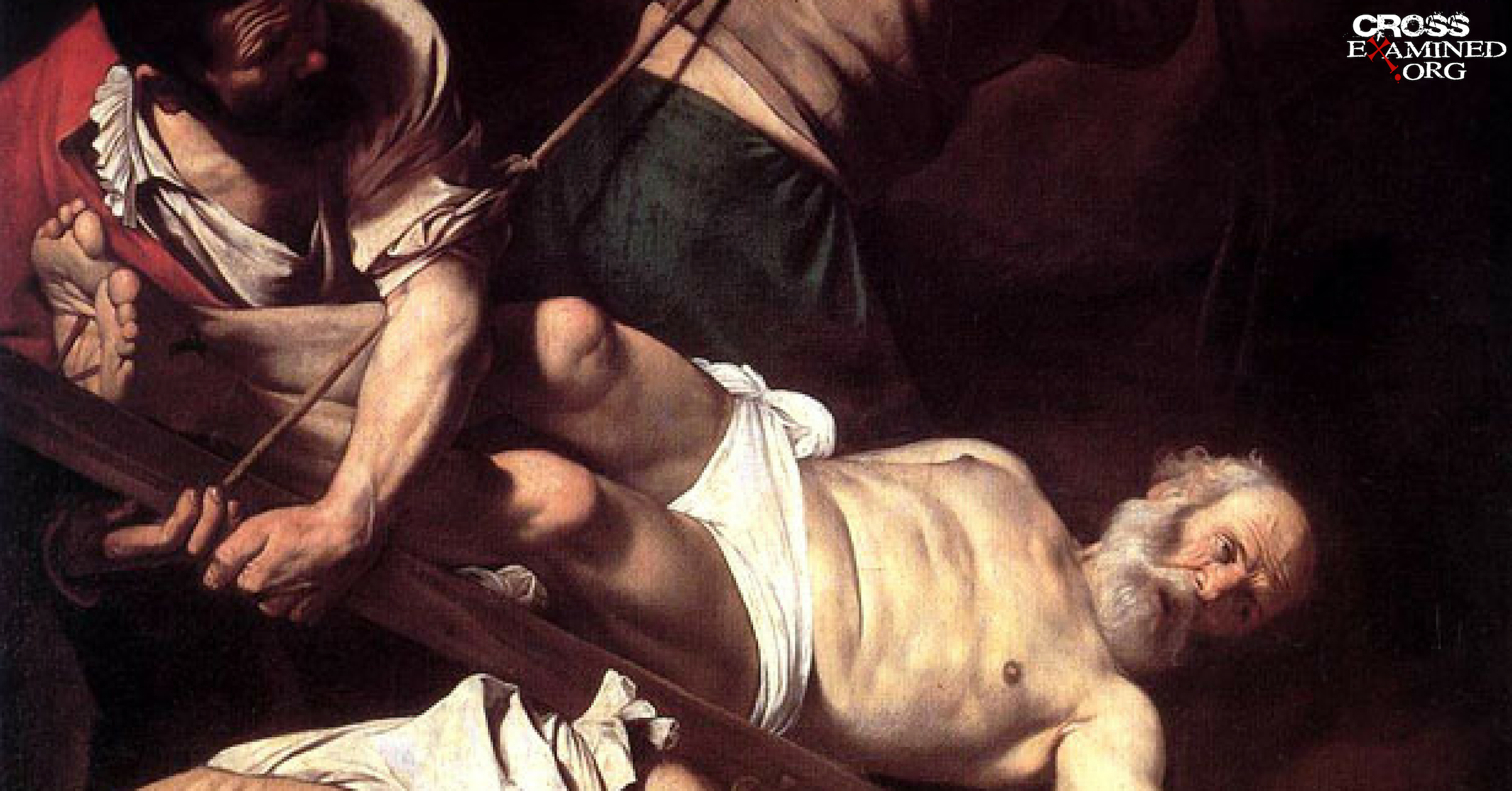
  3. Was the Apostle Peter really martyred by being crucified upside down?
  4. Was the Apostle Paul really martyred by being beheaded?

Before I get to the questions, listen to Sean explain why this chapter is his favorite addition to Evidence that Demands a Verdict as well:

Question 1: What makes the apostles different from modern martyrs?

Sean McDowell:

The apostles were eyewitnesses of the risen Jesus. In 1 Corinthians 15:3-7, we have the earliest account of apostolic belief. It was based on seeing the risen Jesus. That’s repeated in the writings of Paul…Read through Acts and just pay attention to how every single speech focuses on the resurrection.  The apostles say, “We saw the risen Jesus. We were there. We heard him, we touched him, we saw him.”  So their proclamation doesn’t prove that Christianity is true. But it does show they sincerely believe that Jesus rose from the grave. This doesn’t get us all the way to the resurrection, but it’s one pinnacle that shows that these first eyewitnesses really believed it…they all suffered and were willing to die for it. There’s no evidence that any of them recanted, and we have good evidence that some of them actually died as martyrs. That is a night and day difference from a so-called modern-day martyr [who dies for] for something he or she believes.

The apostles were eyewitnesses of the risen Jesus…they all suffered and were willing to die for [their belief].

Question 2: What is a martyr?

Sean McDowell:

A martyr is somebody who’s willing to die, and I would say does [die]…for their belief and proclamation of the Christian faith. When you hear popular arguments for martyrdom, you’ll hear things like, “The apostles refused to recant their belief in Jesus [at the point of death], therefore they really believed it.” Well, Mikel, can I tell you, there are no early sources where, say, Peter is told, “If you just stop proclaiming Jesus, we will not crucify you.”  Those kinds of accounts don’t exist…

[The Jewish historian] Josephus tells us James was put to death roughly in AD 62. Is James a martyr? I would argue that one, the political and the religious factors overlap. So partly James was put to death for political reasons, but it’s also religious reasons.  And we can’t separate those. But I think James qualifies as a martyr. Why?  He was publicly proclaiming a message that was offensive to the Jews, an insult to the Gentiles, about a martyred savior who’d come back from the dead.  He was the leader of the church in Jerusalem, publicly proclaiming this. So if he’s put to death by political and religious forces, you better believe that something tied to his public proclamation of the faith is related to why he put them to death. I think at least he gets the benefit of the doubt there, and thus would qualify at least broadly speaking as a martyr.

Question 3: Was the Apostle Peter really martyred by being crucified upside down?

Sean McDowell:

In John 21, Jesus says to him, “You’ll be taken where you do not want to go. Your hands will be tied, you’ll be dressed by another.” And then in parentheses, the writer of John says, “This is showing how he would die.” Even Bart Ehrman has written, “This was to indicate Peter would die a martyr’s death. If Jesus was the first shepherd, Peter’s the second shepherd who will also lay down his life.” …There’s debate about that. Larry Hurtado says [that] one thing we know for sure about crucifixion is that people were stripped naked for shame. Well, in John 21, “Jesus says to Peter, ‘Somebody else will clothe you.’” So that means, he probably wasn’t being taken to be crucified.  In fact, this author argues that he was burned in the time of Rome described by Tacitus, for the circus that Nero had.

I don’t think we can prove that [but] it doesn’t really matter how he died. What matters is, we have a first-century source, John 21, indicating [Peter] would die as a martyr.  Now, I think there’s good evidence he wasn’t crucified. The earliest record that he was crucified upside down shows up in a book called the Acts of Peter, [at the] end of the second century. Why will Christians say that Peter was crucified upside down?  “Because he didn’t want to be crucified the same way as Jesus.” [But] if you actually read the Acts of Peter, that has nothing to do with it.  It’s making a theological point: The world was turned upside down, and when Peter’s on the cross upside down, he can see the world upside correctly as it is, and his death will help to turn upside right, just as Jesus’s death did.  It’s not until the third and fourth century that church historians take the Acts of Peter as if it’s historical, and then say he was crucified upside down.  So I think at best, we can only say it’s possible. Because there is some precedent of people being crucified upside down. Martin Hengel records this in his book Crucifixion.  But I don’t think we’re historically warranted to say it’s likely or even probable.

Question 4: Was the Apostle Paul really martyred by being beheaded?

Sean McDowell:

For Paul, we have the passage in 2 Timothy that says, “I am being poured out as a drink offering. I fought the good fight, I ran the race.” …but then in 1 Clement 5, there’s a reference to the martyrdom of Paul and the martyrdom of Peter.  And then we have multiple documents in the second century and no contradictory evidence that Paul, in fact, died as a martyr.  Now was he beheaded?  The first explicit document shows up in the Acts of Peter [in the] late 2nd century.  But we know John the Baptist was beheaded.  We know James, son of Zebedee was beheaded.  We know he was a Roman citizen, and that was a common means of death.  So I think we’re very confident he died as a martyr and I would say…it’s reasonable that he was beheaded.

The Evidential Value of the Fate of the Apostles

Skeptics often say, “People die for religious ideas or political causes today. Just because you die for a belief, that doesn’t make it true.” I agree. But what it does mean is that you at least think your beliefs are actually true. As the McDowells observe on page 367:

The willingness of the apostles to suffer and die for their faith does not prove the resurrection is true…But it does show the depth of the apostles’ convictions. They were not liars.

It’s a strongly evidenced historical fact that Jesus’ disciples had real experiences they believed were experiences of the risen Jesus. And they didn’t die for something that somebody told them second or third-hand. They died for their personal testimony that they personally saw the risen Jesus. And they were the only ones to know if they really saw Jesus alive or not!

While there’s no conclusive historical evidence on the details of how exactly Paul or Peter died for their independent testimonies about seeing the risen Jesus, we can be confident that they died as martyrs. Their martyrdom should at least give a person pause and open the door to a fresh conversation on the reasons for the Christian belief in Jesus’ bodily resurrection.

THE TABLE PODCAST

In this episode, Mikel Del Rosario and Dr. Sean McDowell discuss the fate of the Apostles, focusing on the historical evidence of their martyrdom.


Original Blog Source: http://bit.ly/2NKMX2u

By Evan Minton

I don’t know why, but 99% of the atheists I talk to on the internet hold the ludicrous position that Jesus never existed. Now, they’re atheists. I expect them not to believe in the divinity of Jesus. How could they? If they did, they wouldn’t be atheists. They’d be Christians. No. I’m not here talking about belief in the divinity of Jesus; I’m talking about belief in Jesus as a historical individual. This is what I find so ridiculous. Those who deny the Christ Myth are holding on to a historical hypothesis that would get them laughed out of every university in the world. Hardly any scholar of ancient history holds this view, and those minority of a minority of a minority who do are rightly viewed as quacks. By the way, those who believe Jesus was a flesh and blood figure of history aren’t just Christians. Atheist and agnostic scholars also believe Jesus was a historical figure. Bart Ehrman, an agnostic and one of Christianity’s most outspoken critics, believes that Jesus was a historical flesh and blood person. He writes “I think the evidence is just so overwhelming that Jesus existed, that it’s silly to talk about him not existing. I don’t know anyone who is a responsible historian, who is actually trained in the historical method, or anybody who is a biblical scholar who does this for a living, who gives any credence at all to any of this.” 

Why is this the case? Why does nearly every scholar of ancient history believe that Jesus was flesh and blood figure of history? Is the evidence for Jesus’ historicity as overwhelming as the agnostic scholar Bart Ehrman says it is? Let’s take a look.

*Jesus’ Existence Is Multiply, Multiply, Multiply Attested in Secular Sources, Extra-Biblical Christian sources, and in the New Testament documents.

Jesus is mentioned in many, many sources from both the first and early second centuries. Because of this, it becomes absurd to assert that He never existed. What are those sources? Well, we have the gospels and the New Testament epistles. But everyone already knows about them so I won’t cite those. Instead, I’ll merely cite the extra-biblical non-Christian sources.

1: Flavius Josephus

Josephus mentions Jesus (and several other New Testament figures) in his writings. In “Antiquities Of The Jews” by Flavius Josephus (written in the year AD 90), Josephus writes

“Now there was about this time Jesus, a wise man, if it be lawful to call him a man, for he was a doer of wonderful works, a teacher of such men as receiving the truth with pleasure. He drew over to him both many of the Jews and many of the Gentiles. He was called the Christ, and when Pilate, at the suggestion of the principal men among us, had condemned him to the cross, those that loved him at the first did not forsake him; he appeared to them alive again the third day; as the divine prophets had foretold these and ten thousand other wonderful things concerning him. And the tribe of Christians so named from him are not extinct to this day.”

Jewish Antiquities 18.3.3

Second, in Book 20 there is what could be called a passing reference to Jesus in a paragraph describing the murder of Jesus’ brother, James, at the hands of Ananus, the High Priest.

“But the younger Ananus who, as we said, received the high priesthood, was of a bold disposition and exceptionally daring; he followed the party of the Sadducees, who are severe in judgment above all the Jews, as we have already shown. As therefore Ananus was of such a disposition, he thought he had now a good opportunity, as Festus was now dead, and Albinus was still on the road; so he assembled a council of judges, and brought before it the brother of Jesus the so-called Christ, whose name was James, together with some others, and having accused them as lawbreakers, he delivered them over to be stoned.”

Here we have an early secular source that mentions Jesus and a band of followers who clearly thought that He was the promised Messiah (or Christ) of their Jewish religion. It mentions Pontius Pilate and says that Jesus was crucified by Pontius Pilate at the suggestion of the Jewish Sanhedrin. This is a pretty good piece of non-Christian, non-biblical evidence affirming the existence of Jesus, the existence of Pontius Pilate, that Jesus had a band of followers who considered Him the Christ, and that the Sanhedrin brought Jesus to Pontius Pilate and had Him condemned to die on a cross. Josephus also states that Jesus had a brother named James and was killed by the Sanhedrin.

“BUT!” The Christ Mythicist will protest. This passage has obviously been interpolated by a Christian. Josephus was Jewish, not a Christian. And yet, he says things like “He was the Christ” and “he appeared to them alive again the third day;” So, therefore, we can’t include this passage of Josephus because it wasn’t a genuine passage written by him. It was likely written by a Christian scribe who included this passage in order to subliminally evangelize to people. But are the skeptics right? Is this passage really not good historical evidence for the existence of Jesus? There are a few things to consider.

First, very few scholars believe that the entire passage was made up by a Christian. Certainly, it’s indisputable that there have been interpolations in this passage, but that doesn’t mean that the whole thing was made up. Most scholars believe that there was an original passage about Jesus included in the testimonium flavianum but that it was slightly modified by a Christian scribe.

There are very good reasons why scholars have adopted the “Partial Authenticity” theory.

1: A good bit of the text is written Josephus’ typical grammatical style and vocabulary. That is to say; the parts believed to be original to Josephus reflect his typical style of writing.

Christopher Price wrote “Perhaps the most important factor leading most scholars to accept the partial-authenticity position is that a substantial part of the TF reflects Josephan language and style. Moreover, when the obvious Christian glosses — which are rich in New Testament terms and language not found in the core — are removed or restored to their original the remaining core passage is coherent and flows well. We can be confident that there was a minimal reference to Jesus… because once the clearly Christian sections are removed, the rest makes good grammatical and historical sense. The peculiarly Christian words are parenthetically connected to the narrative; hence they are grammatically free and could easily have been inserted by a Christian. These sections also are disruptive, and when they are removed the flow of thought is improved and smoother.”

Graham Stanton states “Once the obviously Christian additions are removed, the remaining comments are consistent with Josephus’s vocabulary and style.” (Stanton, The Gospels and Jesus, page 143).  The most recent and comprehensive study of the testimonium flavianum was done by John P. Meier in A Marginal Jew, Volume 1. As stated by Meier, “many keywords and phrases in the Testimonium are either absent from the NT or are used therein an entirely different sense; in contrast, almost every word in the core of the Testimonium is found elsewhere in Josephus–in fact, most of the vocabulary turns out to be characteristic of Josephus.” (Meier, op. cit., page 63).

  1. The Reference to James the Brother of Jesus Suggests an Earlier Reference to Jesus

The validity of Josephus’ reference to James’ Martyrdom increases the likelihood that the TF is also valid. In Josephus’ reference to James, he refers to Jesus as “the so-called Christ” without further explanation. That’s all he says. All he says about James is that he’s the brother of “Jesus, the so-called Christ.” Josephus does not go into any further explanation of who Jesus is, what He did, no claims of Him dying and rising from the dead, no mention of any miracles, or anything like that. All he says is that James is Jesus’ brother. The way the James passage reads, it seems like Josephus was presupposing that his readers already knew who he was talking about. This would make sense if the Testimonium Flavianum was a legitimate passage. Because in that passage, Josephus already briefly explained who this Jesus was and what He did, so that by the time his readers come across the James passage, no further explanation is needed. However, Josephus’ lack of elaboration on who Jesus is in the James passage would make no sense at all if there were not a prior explanation of who he was like we have in the testimonium flavianum. By the way, no one doubts that Josephus’ reference to James is authentic.

For these two reasons and several others, most scholars believe Josephus’ testimonium flavianum is a genuine passage, even though it’s obvious that some Christian scribe changed a few lines here and there. For more information on why the Josephus passage has only been partially interpolated rather than completely invented, click on the URL below.

“Did Josephus Refer To Jesus?” by Christopher Price — http://bede.org.uk/Josephus.htm

The Mona Lisa

This issue came up in a talk by Dr. Timothy MgGrew. The lecture was about the extra-biblical evidence that indicated the historical reliability of the New Testament. By the way, you can listen to his talk on Youtube. Anyway, Tim McGrew pulled up a photo of the Mona Lisa. The Mona Lisa had a mustache, and he compared the interpolations of the Josephus passage about Jesus to the mustached Mona Lisa. He said

“This is not a painting by Leonardo Divinchi and if the lightings not too bright, you may be able to see the reason why. It looks a bit like the Mona Lisa… but… it’s got a mustache and a little goatee beard. Should we conclude that there was no original painting? Or should we conclude that there was and that something has been added to it… by another hand? What should we do with a mustache on the Mona Lisa? Well, fortunately in 1971, Shlomo Pines published some work he had been doing some work on an Arabic manuscript that contains this passage.”

And here in this Arabic text is what we find; it’s the passage without the ham-handed bits that look like Christian interpolations.

“At this time there was a wise man called Jesus, and his conduct was good, and he was known to be virtuous. And many people from among the Jews and other nations became his disciples. Pilate condemned him to be crucified and to die, and those who were his disciples did not abandon their loyalty to him. THEY REPORTED that he had appeared to them 3 days after his crucifixion. Accordingly, they believed he was the Messiah as the prophets had told wonders” (emphasis mine)

Tim MgGrew then asked his audience “Do you see the difference? My guess is (and this view of the majority of scholars) is that the passage was originally written by Josephus much like we have in this Arabic text… and then some Christian scribe couldn’t resist the impulse to come put a mustache on the Mona Lona. He didn’t realize that he was doing would cause doubt over the authenticity of this report of this genuine passage and that of Josephus himself. Just as with the Mona Lisa, our inference is that there really was an original and it was not done by the person who added the mustache and the beard. Our best bet regarding the testimony is that Josephus really wrote it and that it was interpolated. And fortunately, we’ve discovered a text that shows us which most scholars think is more or less the way it originally was.”

2: Tacitus

Another secular document is called “Annals” by Cornelius Tacitus. From Annals 15.44. Tacitus is reporting on Rome burning to the ground and says that everyone blamed Nero for burning Rome to the ground. Nero tried to pin it on Christians, and he consequently persecuted them. The Annals of Tacitus dates to AD 115.

“But not all the relief that could come from man, not all the Bounties that the prince could bestow, nor all the atonements Which could be presented to the gods, availed to relieve Nero From the infamy of being believed to have ordered the Conflagration, the fire of Rome. Hence to suppress the rumor, he Falsely charged with the guilt, and punished Christians, who were Hated for their enormities. Christus, the founder of the name, was Put to death by Pontius Pilate, procurator of Judea in the reign Of Tiberius: but the pernicious superstition, repressed for a time Broke out again, not only through Judea, where the mischief Originated, but through the city of Rome also, where all things Hideous and shameful from every part of the world find their Center and become popular. Accordingly, an arrest was first Made of all who pleaded guilty; then, upon their information, an Immense multitude was convicted, not so much of the crime of Firing the city, as of hatred against mankind.”

Again, mention of Jesus and Pontius Pilate in secular documents. Tacitus affirms that Jesus existed and that He was crucified by Pontius Pilate. Then he says that the movement named after Jesus died out for a while, then it flared up again, originally in Judea, then spread to Rome. The New Testament says the same thing; Jesus existed, was crucified by Pilate, his followers stayed quite for 50 days after that, then after Pentecost, they started spreading the gospel across the ancient world. And unlike Josephus’ passage, this passage in Tacitus is NOT disputed by anyone. Everyone recognizes this passage is Tacitus’ Annals as being authentic.

3: Pliny The Younger

Pliny the Younger (62?-c.113) was Governor of Bithynia. His correspondence in 106 AD with the emperor Trajan included a report on proceedings against Christians. In an extended explanation to his supervisor, Pliny explained that he forced Christians to “curse Christ, which a genuine Christian cannot be induced to do.” He also described their actions and practices thusly:

“They affirmed, however, that the whole of their guilt, or their error, was, that they were in the habit of meeting on a certain fixed day before it was light, when they sang in alternate verse a hymn to Christ as to a god, and bound themselves to a solemn oath, not to any wicked deeds, but never to commit any fraud, theft, adultery, never to falsify their word, not to deny a trust when they should be called upon to deliver it up.”

Kyle Butt, an author of many articles on Apologetics Press, had this to say about the Pliny passage I just cited. This is what Kyle Butt of Apologetics Press wrote.

“Pliny used the term ‘Christian’ or ‘Christians’ seven times in his letter, thereby corroborating it as a generally accepted term that was recognized by both the Roman Empire and its emperor. Pliny also used the name “Christ” three times to refer to the originator of the “sect.” It is undeniably the case that Christians, with Christ as their founder, had multiplied in such a way as to draw the attention of the emperor and his magistrates by the time of Pliny’s letter to Trajan. In light of this evidence, it is impossible to deny the fact that Jesus Christ existed and was recognized by the highest officials within the Roman government as an actual, historical person.” – Kyle Butt, Apologetics Press, from the article titled “The Historical Christ–Fact or Fiction?”

4: Celcus

Celsus, a second-century pagan philosopher, produced a vehement attack upon Christianity by the title of True Discourse (in A.D. 178). Celsus argued that Christ owed his existence to the result of fornication between Mary and a Roman soldier named Panthera. As he Jesus got older, Jesus started to run around Palestine making extravagant claims to divinity. Celsus then tells us that due to Jesus’ wild claims about himself, he upset the Jewish authorities so badly that they had him killed. Celsus, though he severely ridiculed the Christian faith, never went so far as to suggest that Jesus did not exist.

5: Mara Bar Serapion

Mara Bar-Serapion was a Syrian who wrote about Jesus Christ sometime around A.D. 73. He left a legacy manuscript to his son Serapion.

“What advantage did the Athenians gain from putting Socrates to death? Famine and plague came upon them as a judgment for their crime. What advantage did the men of Samos gain from burning Pythagoras? In a moment their land was covered with sand. What advantage did the Jews gain from executing their wise King? It was just after that their Kingdom was abolished. God justly avenged these three wise men: the Athenians died of hunger; the Samians were overwhelmed by the sea; the Jews, ruined and driven from their land, live in complete dispersion. But Socrates did not die for good; he lived on in the teaching of Plato. Pythagoras did not die for good; he lived on in the statue of Hera. Nor did the wise King die for good; He lived on in the teaching which He had given.”

This reference reveals several key things:

1) Jesus was regarded as a wise king.

2) Jesus was murdered.

3) Jesus’ teachings lived on.

Several Christ Mythicists have tried to argue that the “wise king” Mara is referring to isn’t Jesus, but this is really a pathetic argument. For the sake of brevity, I cannot go into the objections to the Mara Bar Serapion passage in any depth, but James Patrick Holding addresses these arguments in the URL below.

http://tektonics.org/jesusexist/serapion.php

In Conclusion

For the sake of brevity, I couldn’t go into all of the secular sources mentioning Jesus. But here’s a list of all the historical sources mentioning Jesus.

Secular  sources — Josephus, Tacitus, Pliny The Younger, Lucian, Phelgon, Celus, Mara Bar Serapion, Suetonius, and Thallus

New Testament sources —   Matthew, Mark, Luke, John, Paul, Author of Hebrews, James, Peter, and Jude.

Non-Biblical Christian sources —  Clement of Rome, 2 Clement, Ignatius, Polycarp, Martyrdom of Polycarp, Didache, Barnabas, Shepherd of Hermas, Fragments of Papias, Justin Martyr, Aristides, Athenagoras, Theophilus of Antioch, Quadratus, Aristo of Pella, Melito of Sardis, Diognetus, Gospel of Peter, Apocalypse of Peter, and Epistula Apostolorum.

Heretical Writings — Gospel of Thomas, Gospel of Truth, Apocryphon of John, and Treatise on Resurrection.

We have an abundance of historical evidence for the existence of Jesus of Nazareth. In fact, the amount of historical evidence is SHOCKING considering how obscure a figure Jesus was. He had, at most, a 3 years public ministry. Yet He’s mentioned in more sources than the Roman emperor! If you count all the non-Christian sources that mention Jesus, Jesus is mentioned in one more source than the Roman emperor Tiberius Caesar! Counting the Christian sources (including the New Testament documents), Jesus beats Caesar 42 to 10! If you consider Jesus a mythological person in light of this historical evidence, you may as well believe the same thing about Tiberius Caesar, since we have more attestation to His existence than for Tiberius Caesar. To claim that Jesus is a myth and Tiberius Caesar was a real person is to be inconsistent.

Now, why is this important? Because when historians are examining history, they use certain tests of authenticity. If a passage in a history book passes one of these “tests,” then the historian concludes that it’s more likely than not that this recorded event is true than it is false. There are many of these tests, but the one I’m using in this blog post is known as “The Principle Of Multiple Attestation.” The principle of multiple attestations says that if an event is mentioned in more than one source, and if the sources don’t rely on each other, then it’s far more likely that that event really occurred. The more records an event is mentioned in, the more and more and more certainty we have that the event recorded in that document is true. Why? Because the more independent sources, you find something in, the less and less likely that ALL of these people would make up the exact same story.

I’m applying the principle of multiple attestations here to the existence of Jesus of Nazareth. Jesus is mentioned in so many early, independent sources, that it just becomes irrational to assert that ALL of these people made up the same fictional character…and the proceeded to talk as if he was real.

In addition to that, a few of these sources are hostile sources. They’re not only neutral to the claims of the Christian faith, but they actually ridicule Jesus. These would be sources like Tacitus and Pliny The Younger. This would make their accounts for historically certain due to the principle of enemy attestation.

Objection: But these aren’t contemporary sources. These are later, secondary sources! Show me contemporary sources or else I won’t believe Jesus existed!

Ahh, yes. The old worn out “There are no contemporary accounts of Jesus” argument. We actually do have contemporary accounts of Jesus; they’re called the gospels. As mentioned in two other blog posts, we have good reason to believe that the vast majority of the New Testament documents were written prior to A.D 60. But even if it were true that there were no contemporary accounts of Jesus, what would that prove? Would it prove Jesus never existed? Hardly. We don’t really have any contemporary historical evidence for lots of figures in history yet we can know they existed because the historical study can compensate with techniques such as “declarations against interest” and independent corroboration. We have 9 secular sources for Jesus’ existence (the works of Josephus, Tacitus, Pliny, etc.), that though they aren’t contemporary accounts are still reliable given that they’re not too far removed from the events they report, and as for the gospels which ARE contemporary accounts, they’re rejected a priori because they’re written by people who believed in Jesus and are supposedly biased (even though virtually everyone who writes history has some kind of bias). Moreover, the type of bias the New Testament writers had was a bias not to say anything at all about Jesus and all of the things he did because that ended up getting them excommunicated from their synagogues, tortured and killed.

For one thing, being a non-contemporaneous account does not mean it is not a reliable source. Secondary accounts, though not valued as highly by a historian as firsthand or eyewitness accounts, are not considered worthless. For some historical events and persons, all we have are secondary accounts. Would we, therefore, conclude that they never happened? Of course not. Yet that’s what Christ Mythicists do when it comes to the life and death of Jesus. They reject all secondary accounts (Josephus, Tacitus, Pliny) and they reject the contemporary accounts we DO have (i.e. the gospels). Aren’t they aware of the fact that historians don’t require contemporary accounts for accepted history? (If you think they do, then you’d have to rewrite much of history) They accept both first hand and secondary accounts, among other factors.

Moreover, the thing about Josephus and Tacitus is that even though they weren’t alive during Jesus’ lifetime, they were living within the lifetimes of those who DID know Jesus and could tell them about Him (Jesus, according to virtually all scholars was crucified in either 30 AD or 33 AD and Josephus was born in 37 AD) I have used the analogy of me reporting about Richard Feynman, an American physicist best known for his work in quantum mechanics and who assisted in the development of the atomic bomb. Even though I was born after he died (Feynman died in 1988, I was born in 1992), I’m still close enough to the events to be relevant. After all, I’m growing up in a time where adults who did know Richard Feynman are still around, and they could tell me about him (just pretend for the moment that I don’t have video recordings, Josephus didn’t have these to go on). Are you saying my testimony about Feynman would be invalidated because I wasn’t a contemporary of him, even though I have parents and grandparents and friends of my parents who were contemporaries of Feynman whom I could have gotten my information from? Absurd. My point is, they’re still close enough to the events to be relevant sources, and almost all scholars on the subject accept their testimony as valid evidence for Jesus’ historicity, including scholars who aren’t Christians (so we can be sure they have no theological ax to grind).

Objection: Why Aren’t There More Sources?

Some skeptics complain that there aren’t more historical sources mentioning Jesus. They argue; if Jesus was such an influential individual as the gospels make him out to be, there ought to be far more historical documents that mention Him than what we do have. Of the secular sources, we only have 9 that mention Jesus. From that, they argue that he either didn’t exist or wasn’t as influential as The Bible says.

For one thing, very few documents from ancient history have survived up to the present time. As Ryan Turner, author for CARM (Christian Apologetics and Research Ministry) wrote in an article on Carm.org: “There are a number of ancient writings that have been lost, including 50% of the Roman historian Tacitus’ works, all of the writings of Thallus and Asclepiades of Mendes.  In fact, Herod the Great’s secretary named Nicolas of Damascus wrote a Universal History of Roman history which comprised nearly 144 books, and none of them have survived. Based on the textual evidence, there is no reason to doubt the existence of Jesus of Nazareth.”

The fact of the matter is; there may have been more secular documents that spoke about Jesus for all we know. But they most likely decayed away, had been destroyed, or they haven’t been discovered yet by archeologists. If documents aren’t copied over and over again at a quick enough pace, they aren’t likely to survive for 2,000 years. Moreover, the evidence we have for Jesus is still pretty strong. His existence is multiply, multiply, multiply, multiply, multiply attested in 9 secular sources, 9 biblical sources, 20 non-biblical Christian sources, and 4 heretical sources.

Now, historians consider themselves extraordinarily lucky when they find 2 independent sources mentioning something, but with the existence of Jesus, we’ve got 42! Some of which are contemporary sources, others, secondary. We have to ask ourselves; is it really rational to believe that such an individual is a fictional character when so many historians wrote about him? The existence and crucifixion of Jesus are mentioned in numerous, independent and early sources. There may have been more for all we know, but they just eroded away due to the fact that that happens to documents which endure through thousands of years.

Objection: Jesus Is Just A Copy Of Pagan Myths

Another argument put forth by the Christ Mythers is that Jesus was just a copy of pagan gods. They’ll cite “similarities” between the two and claim that Christianity is just a plagiarized religion from these earlier pagan myths. Supposedly we’re supposed to believe that Jesus was just a myth and not a real, historical, flesh and blood individual. I’ve already written two different blog posts pointing out the absurdity of this argument, so I will not go into any of it here. Instead, I’ll just redirect you to those blog posts, and you can check them out whenever you have the time.

1: Is Jesus A Copy Of Pagan Myths?

2: Cartoons and Comics That Plagiarized Christianity (Satire)

In Conclusion: The Christ Myth is absurd. Jesus obviously existed as well as several other New Testament figures. You can believe that Jesus was just an ordinary man if you want to, but to claim He didn’t even exist is just ridiculous. The debate among scholars of ancient is history IS NOT “Did Jesus exist?” No. The debate is: “Was Jesus more than a man? Did He say what the gospels say He said? Did He rise from the dead?” These are questions that are debated among scholars. But Jesus’ historical existence is just taken for granted. And why shouldn’t it be? You’ve seen the evidence.

If you want to go into this topic in far more depth than I’ve covered here, check out James Patrick Holding’s book “Shattering The Christ Myth” as well as Bart Ehrman’s book titled “Did Jesus Exist?”.


Evan Minton is a Christian Apologist and blogger at Cerebral Faith (www.cerebralfaith.blogspot.com). He is the author of “Inference To The One True God” and “A Hellacious Doctrine”. He has engaged in several debates which can be viewed on Cerebral Faith’s “My Debates” section. Mr. Minton lives in South Carolina, USA.

Original Blog Source: http://bit.ly/2wDczb2

By Michael Sherrard 

A little while ago I was discussing a sonnet by Jon Donne with several high school students. (I know you discuss sonnets all the time.) The sonnet by Donne was one that mocked death, comparing it to a sleeping pill. Actually, it compared it to opium but said that opium was better. Anyway, the theme of the sonnet was that death was nothing more than a slave who was used to cause people to fall asleep only to waken unto eternity, and therefore, it should not be feared.

I asked the students if this was a good view of death. They concluded that it was provided there was life after death. So I asked, “Is there life after death?” Some said yes, and some said no. I asked them how they knew. No one had an answer. So I asked, “Do we just have to have faith one way or the other? Are we just left to wish and hope for an afterlife, or can we know?” This seems like an important question to answer. They agreed.

They then asked me what I thought. I told them that I think we can know if there is an afterlife because I think we can know if God exists. They, of course, asked me how. I, in turn, asked them if it was possible that God might exist. All of them said yes. Mind you, of this group of eleven, at least seven of them are not believers in Jesus; yet all of them agreed that it was possible that God might exist. This is what most people believe.

With an agreement that God might exist, I asked if this God could do unnatural things in this natural world. I asked if miracles would be possible. They all said yes, every one of them. I asked them why they thought miracles could be possible. They explained that if God existed and made the world, He could do what He wanted in it. They agreed that walking on the water you created is not really that hard to believe. I said they were smart. And then I asked, “So if God exists and could perform a miracle, could He not use a miracle to tell us who He is?” They all responded to my question with a yes. So I asked, “Has He?” They just looked at me, but I could tell that they wanted to know. So I told them about the resurrection of Jesus.

I told them that I think the resurrection both tells us that God exists and which religion is the right one. I then told them about the evidence. I explained that virtually all historians who have studied the resurrection believe three things: that Jesus died by crucifixion, that the disciples believed they saw Him risen, and that they died for preaching that He had risen. I then asked how they would explain these facts, how they could explain the rise of Christianity without the resurrection.

One student said, “Well, maybe Jesus didn’t actually die. Maybe He survived.” I said that is a fair idea, but let’s talk about it. A theory that Jesus survived the crucifixion would have to involve the following: before Jesus was crucified He was beaten, flogged, forced to carry a cross, and given a crown of thorns to be embedded in His head. We understand what a beating is. We can imagine a crown of thorns, regardless of the size of the thorns. But, let’s make sure we know what flogging is.

Flogging is when you are whipped by a device that has several leather straps with bone and metal and other sharp objects attached on the ends. Their purpose is to dig into the flesh and rip it off when it is pulled back. It tenderizes and defleshifies you. (They were repulsed at my made-up word “defleshify.”) I told them that many men die just from this type of torture alone.

After torturing Jesus, He was crucified. Many people are now familiar with the crucifixion. But just to be sure that my students had the facts straight, I explained to them that one often dies by suffocation on the cross and how it is excruciating. Hanging on a cross forces your lungs to stop working because the way you hang prevents you from breathing. The only way to breathe is to push up from your feet that have been nailed to the cross to relieve the pressure and take a breath. You live as long as you have energy, or until they break your legs to keep you from taking another breath.

Jesus’ legs were not broken, but this was the manner in which He died on a Roman cross. To ensure that He was dead, the trained Roman guards stuck a spear into Jesus’ side. After Jesus was taken off the cross, He was wrapped in seventy pounds of linen, placed in a dark and damp cave-like tomb, and there He remained for three days.

I told my students that to believe the theory that Jesus survived the cross you would have to believe that He woke up after three days, unwrapped himself, folded the linens, rolled away a stone, took out a couple of trained Roman guards, walked on nailed-pierced bloody feet, presented Himself to the disciples in this condition, and they said, “Oh my God! You have risen from the grave and are Lord!”

I asked my students, “Does this seem likely?” One responded and said, “More likely than a resurrection!” I said he was probably right in terms of probability but then asked if Jesus arriving in this condition would lead the disciples to think that He was God and perpetuate their preaching of His deity, forgiveness of sins by faith in Him, and a future hope of a resurrected body like His. First-century people were not idiots. They would have known the difference between a resurrection and a survival.

Many students agreed with this assessment. Some did not. One of those asked if it is possible if the disciples just hallucinated. I told them that was a fair question and many people hold that view. But, I asked him, “Do people share the same hallucination? If you and your friend were ‘tripping’ would you see the same thing?” He said, “No, and I know.” We laughed. Modern psychology agrees with him. Group hallucinations do not happen.

At this point, another student chimed in and said, “I think they just made it up!” So I asked, “You think that the disciples made up that Jesus rose from the grave and then died for their conspiracy for no reason? Why do you think this, do you have any evidence?”

He said, “No, but that’s just what I believe.”

I encouraged him to base his belief on something more substantial than his opinion because so much is at stake. He said, “Ahhh.” Not all stories end well, but hopefully, this is not the end of this student’s journey to Jesus.

Our group conversation ended with some believing, some being more open to Christianity, and some were exactly like they were before we talked. I encouraged them to have reasons for their beliefs. Much is at stake when it comes to God, and if He exists, you want to have settled that issue before you meet Him in the afterlife. I told them that I look forward to future conversations with them, and to this day, many more conversations have followed.

Opportunities to share the gospel abound if one is looking. In every situation with nonbelievers, ask yourself what about our immediate context and conversation points to God. Then be brave and steer your conversation to the cross.


Michael C. Sherrard is a pastor, a writer, and a speaker. Booking info and such can be found at michaelcsherrard.com.

Original Blog Source: http://bit.ly/2okR0rP

By Terrell Clemmons

Unfashionable History

A Review of How the West Won: The Neglected Story of the Triumph of Modernity by Rodney Stark

Americans are becoming increasingly ignorant of how the modern world came to be what it is, says Rodney Stark. A generation ago, most college curricula included a course in Western Civilization that covered Western achievements in art, music, literature, philosophy, and science. Today those courses have all but disappeared on the spurious grounds that the West is but one of many civilizations and that it is ethnocentric and arrogant for Westerners to study it. So Stark is out to educate us, its beneficiaries, in the “remarkably unfashionable” story of our own heritage.

The most important thing to know on this subject is that “modernity is entirely the product of Western Civilization.” By modernity, he means, “that fundamental store of scientific knowledge and procedures, powerful technologies, artistic achievements, political freedoms, economic arrangements, moral sensibilities, and improved standards of living.”

In How the West Won, the Distinguished Professor of Social Sciences at Baylor University goes beyond the old “Western Civ” courses, which usually merely described the rise of the West. Stark tells the neglected story of why these monumental contributions to human good grew out of the West, and not out of Asia or the Islamic world. To explore this prehistoric phenomenon – as a set of explicable effects produced by discernible causes – is not ethnocentric, but is rather, “the only way to develop an informed understanding of how and why the modern world emerged as it did.”In the process, Stark refutes much of the “received wisdom” about Western history. Here are a few examples:

  • Dramatic changes in climate, including a four-century-long warming trend followed by a “Little Ice Age”, played major beneficial roles in the rise of modernity.
  • There were no “Dark Ages.” The Dark Ages myth was made up by “eighteenth-century intellectuals determined to slander Christianity and to celebrate their own sagacity.” In reality, the entire era was one of remarkable progress and innovation.
  • The brilliant achievements of the “Scientific Revolution” (which is also a misnomer) were the culmination of centuries of step-by-step progress.
  • Europe did not grow rich by exploiting its colonies. Rather, the colonies drained European wealth – even as they became the beneficiaries of European advances.

Throughout, Stark gives primacy to ideas. He does so because it was certain, specific ideas that gave rise to all those desirable societal traits – democracy, science, free enterprise, etc. – that have characterized Western nations and that are now revolutionizing life in the rest of the world.

Ultimately, Stark says, those potent – and truly revolutionary – ideas are the product of Christianity. “The most fundamental key to the rise of Western Civilization has been the dedication of so many of its most brilliant minds to the pursuit of knowledge. Not to illumination. Not to enlightenment. Not to wisdom. But to knowledge. And the basis for this commitment to knowledge was the Christian commitment to theology” – the highly rational discipline of formal reasoning about God, with an emphasis on discovering his nature.

With lively, in-depth narratives, Stark demonstrates how Christian ideas drove everything that is good and desirable about Western modernity. Yes, Western Civilization has seen its failures, limitations, and discontents. Nevertheless, it far surpasses every known alternative, and is, in a very real sense, God’s gift to the world.


Original Blog Source: http://bit.ly/2v2a5SL

By J. Warner Wallace

I often wonder precisely when the disciples of Jesus realized their important role in Christian History. As these men sat at the feet of Jesus and listened to everything He had to say, did they realize they would someday testify to everything He said and did? Most eyewitnesses I’ve interviewed in my casework had no idea they would later be called into a jury trial to testify about what they heard or observed. As a result, they sometimes regret not paying better attention when they had the opportunity. But the disciples of Jesus had a distinct advantage over modern eyewitnesses in this regard. They were students of Jesus. Unlike spontaneous, unprepared witnesses of a crime, the disciples were desperately attentive to the words and actions of Jesus, and I imagine their attention to detail became even more focused with each miraculous event. For this reason, the authors of the gospels became excellent eyewitnesses and recognized the importance of their testimony very early.

While Jesus walked here on earth, His followers studied and learned from His actions and words. They were often mesmerized, confused and challenged by what they saw and heard. In spite of this, Jesus taught them and occasionally sent them out on their own. They memorized His teaching and relied on his wisdom when they weren’t with Him. We don’t know how much (if anything) these eyewitnesses wrote down during this time. Did the disciples take notes? Did they keep a journal? While Jesus was alive, the disciples likely felt no need to write down his words. The Word was witnessed in these incredible days, as men and women stood in awe of the Master, watching Him perform miracles and listening carefully to what He taught about God and eternal life.

During the first years following Jesus’s ascension, the apostles still may not have written immediately about Jesus. Why not? A careful reading of the Scripture will reveal a common theme: Many of the early authors of the New Testament expected Jesus to return before there would ever be a need for a multi-generational eyewitness record. They worked urgently to tell the world about Jesus, believing He would return to judge the living and the dead within their lifetime. In the days of the Apostles, the Word was heard, as the apostles preached to the world around them. But as the Apostles began to be martyred (and those who remained realized Jesus might not return in their lifetime), the need for a written account became clear. James, the brother of John, was killed in 44AD (Stephen was killed even earlier), and not long afterward, the gospels began to emerge. The eyewitness gospel authors wrote down what they had seen so the world would have a record.

Following the deaths of the apostles, the early believers and leaders received the apostolic eyewitness accounts and regarded them as sacred. They knew the original eyewitnesses had vanished from the scene and they wanted to retain a faithful record of their testimony. From the earliest of times, these Christians coveted the New Testament writings. In the days of the early Church Fathers, the Word was read, as the sacred Gospels and letters were carefully protected. The earliest believers accepted the gospels and letters of the New Testament as eyewitness accounts because the authors of these texts considered their own writing to be authoritative, eyewitness Scripture:

1 Peter 5:1

Therefore, I exhort the elders among you, as your fellow elder and witness of the sufferings of Christ, and a partaker also of the glory that is to be revealed…

2 Peter 1:16-17

For we did not follow cleverly devised tales when we made known to you the power and coming of our Lord Jesus Christ, but we were eyewitnesses of His majesty.

1 John 1:1-3

What was from the beginning, what we have heard, what we have seen with our eyes, what we have looked at and touched with our hands, concerning the Word of Life – and the life was manifested, and we have seen and testify and proclaim to you the eternal life, which was with the Father and was manifested to us – what we have seen and heard we proclaim to you also, so that you too may have fellowship with us…

The apostles understood their experiences as eyewitnesses were unique, and they called for these eyewitness accounts to be read by all believers. Paul recognized both the Old Testament writings and the New Testament writings were sacred and God-given. He considered both to be Scripture:

1 Timothy 5:17-18

The elders who direct the affairs of the church well are worthy of double honor, especially those whose work is preaching and teaching. For the Scripture says, ‘Do not muzzle the ox while it is treading out the grain,’ and ‘The worker deserves his wages.’

In this passage, Paul quoted both Deuteronomy 25:4 and Luke 10:7 (“The worker deserves his wages”). He referred to both passages as Scripture. It’s clear the New Testament Gospels were already in place at the time of this writing, and it’s also clear that believers were reading these Gospels as Scripture. Peter also attested to Paul’s writings as Scripture when writing his own letters to the early Church:

2 Peter 3:14-16

Bear in mind that our Lord’s patience means salvation, just as our dear brother Paul also wrote you with the wisdom that God gave him. He writes the same way in all his letters, speaking in them of these matters. His letters contain some things that are hard to understand, which ignorant and unstable people distort, as they do the other Scriptures, to their own destruction.

In addition to this, it is clear the New Testament letters were being read and circulated among the churches as authoritative eyewitness Scripture and revelation from God:

Colossians 4:16

After this letter has been read to you, see that it is also read in the church of the Laodiceans and that you, in turn, read the letter from Laodicea.

1 Thessalonians 5:27

I charge you before the Lord to have this letter read to all the brothers.

The eyewitness authors of the New Testament gospels and letters understood the power of their testimony. They witnessed the Word in the days when a written record was unnecessary, spoke the Word when they thought Jesus would return imminently, and wrote the Word when they realized their eyewitness record would become Scripture for those who followed them. That’s how the ancient eyewitness accounts became the New Testament Scripture we cherish today.


J. Warner Wallace is a Cold-Case DetectiveChristian Case Maker, Senior Fellow at the Colson Center for Christian Worldview, and the author of Cold-Case ChristianityCold-Case Christianity for KidsGod’s Crime SceneGod’s Crime Scene for Kids, and Forensic Faith.

Original Blog Source: http://bit.ly/2lSuplm

By Darrell L. Bock and Mikel Del Rosario

INTRODUCTION

Over the past few decades, some evangelicals have seen cultural engagement as fighting a culture war for Christ. But the landscape has changed in a way that most people who graduated from seminary forty years ago might never have imagined. Today, we as Christians find ourselves in the position of a cultural minority in the United States. How should we engage with a society that is increasingly hostile to the Christian faith?

This Table briefing explores what the New Testament teaches about honoring God through our message—and our tone—as we minister in a world that often pushes back against the gospel. This ethos of balancing invitation and challenge has been a key emphasis since the beginning of the Table Podcasts.

First, we consider how the example of the early church should inform our cultural engagement as a church today. Then we examine how the Apostle Paul’s example should inform our interpersonal interactions with unbelieving friends and neighbors. [Download the full-length article]


Original Blog Source: http://bit.ly/2tvEkl5

by Evan Minton

This is part 6 in a blog post series (and eventually, free Kindle book) on the evidence for Jesus’ resurrection. In parts 3, 4, 5, and 6 we saw that powerful historical evidence exists for the following 5 facts

1: Jesus died by Roman crucifixion.

2: His tomb was found empty by a group of His women followers the following Sunday Morning.

3: The 12 Disciples believed they saw Jesus alive shortly after His death.

4: A church persecutor named Paul converted to Christianity on the basis of what he perceived to be an appearance of the risen Jesus. 

5: A skeptic named James converted to Christianity on the basis of what he perceived to be an appearance of the risen Jesus. 

These are the 5 facts that are granted by nearly every historian and scholar who studies the subject, even the non-Christian ones (e.g., Ehrman, Ludemann, Sanders). These are the minimal facts. In part 1 of this series, I said that the case for Jesus’ resurrection involved two steps. The first step is figuring out what the facts are, and the second step is discerning what the best explanation of those facts are. We accomplished the first step in parts 3-6 of this blog series. Now we come to the second step; what is the best explanation for the 5 aforementioned facts. Did Jesus rise from the dead? Maybe. But let’s see if there’s any other explanation that can account for them first.

Over the two millennia, skeptics have proposed dozens of naturalistic theories to try to account for the resurrection of Jesus. Let’s look at them and see if any of them work. Keep in mind that any acceptable theory must be able to explain all of the evidence, all of the 5 minimal facts. If it fails to explain all 5 facts, then it will be rejected on the basis of lacking explanatory scope.

Theory 1: The Stolen Body Theory (Disciples Edition)

If you recall from part 4, the enemies of Christianity claimed that the disciples came in the middle of the night and stole Jesus’ body (Matthew 28). Then the disciples went out and proclaimed that Jesus rose from the dead. On this theory, the resurrection is nothing but a hoax, a sham. The disciples do a heckin’ bamboozle on the people.[1] Does this naturalistic theory adequately account for the evidence? I don’t think so.

In fact, this is the WEAKEST naturalistic theory there is. Recall from part 5 that church history is unanimous in that all 12 disciples died horrible, gruesome deaths for proclaiming that Jesus rose from the dead. James, the brother of John, was beheaded by decree of King Herod Agrippa, Peter was crucified upside down, Thomas was speared to death in India, Matthew died by being dragged by a horse, and Phillip was crucified on an X shaped cross.[2] They could have saved themselves simply by recanting, yet they proclaimed the resurrection of Jesus despite agonizing, brutal torture, despite forfeiting their lives. Why would they do that? Why would they die for a lie?

Now, again, when you bring this point up to skeptics, they’ll say “But that doesn’t prove the resurrection is true any more than Muslims giving up their lives in acts of Jihad proves that Islam is true.” And they’re right. I totally agree with them. But, they’re missing the point. I’m not saying the disciples’ martyrdoms prove that Jesus rose from the dead. I’m saying it proves that they believed he rose from the dead. Martyrdom doesn’t prove the disciples were right; it just proves they sincerely believed what they were saying. To put it another way: while people will die for a lie they think is true, no one will die for a lie they know is false.
And that is the fatal flaw is the Stolen Body Theory. It posits that the disciples stole Jesus’ body and deliberately tried to deceive the masses, and then they willingly endured beatings, torture, and executions for preaching what they consciously believed wasn’t true.

The late Charles Colson, who did prison time for being an accomplice in Watergate but who later became a Christian, wrote:

“Watergate involved a conspiracy to cover up, perpetuated by the closest aids to the President of the United States—the most powerful men in America, who were intensely loyal to their president. But one of them, John Dean, turned states evidence, that is, testified against Nixon, as he put it, “to save his own skin”—and he did so only two weeks after informing the president about what was really going on—two weeks! The real cover-up, the lie, could only be held together for two weeks, and then everybody else jumped ship in order to save themselves. Now, the fact is that all that those around the President were facing was an embarrassment, maybe prison. Nobody’s life was at stake. But what about the disciples? Twelve powerless men, peasants really, were facing not just embarrassment or political disgrace, but beatings, stonings, execution. Every single one of the disciples insisted, to their dying breaths, that they had physically seen Jesus bodily raised from the dead. Don’t you think that one of those apostles would have cracked before being beheaded or stoned? That one of them would have made a deal with the authorities? None did.”[3]

As if the unreasonableness of positing that the disciples willingly suffered and died for a lie wasn’t bad enough, this theory has other issues. For one, we’ve seen that Paul and James converted to Christianity because they believed they saw the risen Jesus. This theory cannot account for their conversion experiences.

This theory fails because

1: The disciples died for preaching the resurrection. Liars make poor martyrs.

2: It doesn’t explain why Paul believed he saw Jesus post-crucifixion.

3: It doesn’t explain why James believed he saw Jesus post-crucifixion.

Theory 2: Stolen Body Theory (Other Person Edition)

There’s a variation of the theory above which says while the disciples didn’t steal the body, perhaps someone else came along and stole the body. Then, when the disciples came and found that the tomb was empty, they concluded that Jesus rose from the dead. The disciples aren’t hoaxers; they were just as fooled as the people they preached to.

There are several problems with this theory. First of all, in part 5 of this series, we saw that the disciples believed that they had seen Jesus with their own eyes. They weren’t convinced on the basis of the empty tomb alone, but by seeing Jesus alive and well. Secondly, this theory doesn’t account for the conversion of Paul. Theft of the body is probably the first thing that would have come to Paul’s mind. We saw in chapter 4 that Paul went from Christian Persecutor to Christian Missionary because he, like the disciples, believed he saw Jesus appear to him. James likewise went from skepticism to belief on the basis of a postmortem appearance.

This variation of the stolen body theory cannot account for any of the postmortem appearances. The only minimal fact that it can adequately explain is the empty tomb, nothing else.

Finally, this theory is implausible on its face. Who exactly would have had a motivation to steal Jesus’ body anyway? The Pharisees wouldn’t have stolen Jesus’ body. They were well aware that removal of the body might create an appearance of resurrection, which is what they feared, which is why they had guards placed at the tomb (Matthew 27-28). The Romans don’t appear to have any motivation to take Jesus’ body out of the tomb. And we already know the disciples wouldn’t have stolen the body. If they did, they would have known the resurrection was a lie, and people don’t die for what they know is a lie. Who exactly is supposed to be the culprit here?

This theory fails because

1: The disciples were convinced on the basis of a postmortem appearance.

2: Paul was convinced on the basis of a postmortem appearance.

3: James was convinced on the basis of a postmortem appearance.

4: There’s no plausible candidate for corpse thievery.

Theory 3: Hallucination Theory

In parts 5 and 6, we saw that the disciples, Paul, and James, believed that they saw the risen Jesus. They truly believed the risen Jesus appeared to them. Skeptical scholars have tried to explain this belief in the appearances as a result of hallucination. Perhaps they all hallucinated the risen Jesus.

Ask any psychologist you come across and they’ll tell you that hallucinations are occurrences that happen in the minds of individuals. They’re like dreams in this way. Imagine a group of your friends came up to you one day and said: “Boy, we all had one nice dream last night, didn’t we?” You would probably think that they were pulling a practical joke on you. You would never take seriously their claim that they all simultaneously had the exact same dream. This is because dreams are individual occurrences. By the very nature of the case, they cannot be shared experiences. Hallucinations are the same way.

Now, the extremely early creed that I told you about in part 5 of this series tells us that Jesus appeared to several groups of people. He appeared to all of the original disciples, then to James, then 500 individuals at the same time, and finally to Paul. Do you honestly expect me to believe that they all hallucinated? They all had the exact same hallucination!? Impossible! It’s impossible for 500 individuals to have the same hallucination at exactly the same time. This would be just as likely as the entire city of New York having the same dream on the same night! But not only did Jesus appear to 500 people at the same time, but he also appeared to multiple groups on different occasions. Do you expect me to believe that multiple groups of people on multiple different occasions all had the exact same hallucination?
Lee Strobel, during his investigation of the historical evidence for Jesus’ resurrection, asked a medical expert on the possibility of 500 people hallucinating the risen Jesus. This expert said that for a group of 500 people to witness the exact same hallucination of a raised Jesus would “be a bigger miracle than the resurrection itself!”[4]

Moreover, not only are group hallucinations statistically impossible, but hallucinations of any kind are uncommon. Hallucinations are usually induced by sleep deprivation, drugs, a high fever, or mental instability. If none of these 3 factors are present, it’s highly unlikely that you’re going to have a hallucination. As far as we know, none of the disciples, Paul, or James were insomniacs, sick, or druggies.

In their book “The Case For The Resurrection Of Jesus”[5], Gary Habermas and Mike Licona tell of Navy Seals who were enduring through Hell week. At one point, the seals reported starting having hallucinations one night while they were paddling in a raft at night. They all hallucinated at the same time, BUT they did not have the same hallucination. They had different hallucinations. One of them said he saw an octopus come out of the water and wave at him. Another said he saw a train coming towards them on the water. Another said he saw a wall that they would crash into if they persisted in paddling. When the octopus, the train, and the wall were pointed out to the rest of the group, no one saw any of the things except the one who pointed the thing out. They were all hallucinating, but they were having different hallucinations. So, even if on the off chance, all of the disciples, Paul, and James were in the frame of mind to hallucinate, it’s still unlikely that they’d have the same hallucination. Like the Navy Seals, they’d likely all have different hallucinations, perhaps only one of them being Jesus.

Moreover, even if the impossible did occur, and the minds of all these different groups of people produced hallucinations of Jesus, that would still leave the empty tomb unaccounted for. What happened to Jesus’ body? Why is it gone?

This theory fails because

1: Jesus appeared to The Twelve Disciples, Paul, James, and 500 individuals. There were multiple group appearances. It is statistically impossible that all of these people would have the exact same hallucination, even if they were in the frame of mind to hallucinate.

2: It doesn’t account for the empty tomb.

Theory 4: Group Think 

Some skeptics have considered that perhaps the disciples were so in anticipation of Jesus’ return from the dead that they talked themselves into believing that He rose from the dead. One day they went to the tomb and John was like “Peter, I think I see Jesus, over there! Do you see him?” and Peter was like “Oh, yeah! I think I see him too!” and they kind of talked themselves into it. Well, this couldn’t be the case either. Why? Because you have to be in anticipation that you’re going to experience something like that. You have to be primed for it. They weren’t! There are four reasons why the groupthink theory is untenable.

1: Jesus died. Jews weren’t expecting a dying messiah, but a messiah who would be a conquering warrior king, one who would throw off the yoke of Rome.[6]

2: According to the Old Testament (which Jews call the “Tanakh”), anyone hung on a tree was under God’s curse. This is mentioned in Deuteronomy 21:23. Since Roman crosses were made out of wood, they were technically trees, so people would often times speak of the crucified as “being hung on a tree.” And since this was in the minds of Jews, the way in which Jesus died would have only served to convince the disciples that Caiaphas and the others were right in condemning Jesus as a blasphemer and a heretic.

3: Given what the Jews believed about the bodily resurrection, no one would have been anticipating Jesus’ return. Jews believed that all people would rise from the dead at the end of the world, but they never expected any isolated person to get out of their grave right smack dab in the middle of human history.

4: And if that weren’t enough, consider that some of the people who experienced a sighting of Jesus were skeptics… such as James the half-brother of Jesus. We know based on the historical evidence cited in the previous blog post that James did not believe in Jesus during Jesus’ lifetime Saul Of Tarsus was killing Christians because he considered them to be the worst of heretics! He experienced a sighting of Jesus risen from the dead, and he became The Apostle Paul. These former skeptics were not in any way living in anticipation of Jesus’ return.

As you can see, the disciples were not in the expectation that Jesus would rise from the dead. In fact, they had every predisposition to the contrary. And yet, they all believed they saw Jesus alive after His death!

Theory 5: The Swoon Theory 

Some skeptics have tried to adequately account for the 5 minimal facts by saying that maybe Jesus didn’t really die in the first place. Maybe he merely fainted on the cross and then the cool, damp air of the tomb sort of roused him around into consciousness. Jesus then left the tomb, came to his disciples and presented Himself to them. Since they presumed he was dead, it’s only natural that they should infer that Jesus came back to life, right? So, we don’t have a miraculous resurrection, simply a fortuitous resuscitation. This would explain the empty tomb and the postmortem appearances. This theory is known in the literature as “The Swoon Theory,” and there are several problems with it.

The following descriptions are very graphic; reader’s discretion is advised.

First of all, given the nature of pre-crucifixion scourging, and of the crucifixion itself, it is extremely unlikely that a crucifixion victim could walk away alive.

When a to-be-crucified person was scourged, they would be given 40 lashes. History tells us that the Roman 40 lashes were from a whip of braided leather thongs, with metal balls, broken pieces of sheep bone, broken glass, and basically anything sharp that would cut a person. These sharp pieces of sheep bone, metal, and broken glass were woven into the braided leather thongs. When the whip would strike the flesh, these would cause deep bruises, and the flesh would be cut severely. You can easily imagine how shredded a person’s back would be after being cut in 40 different places with multiple blades!

According to Dr. Alexander Methrell, the cuts and force of the beating could shred the back so much that the spine of the victim was sometimes exposed![7] The whipping would have gone all the way down the shoulders to the back, and the back of the legs. One physician who has studied Roman beatings said: “As the flogging continued the lacerations would tear into the underlying skeletal muscles and produce quivering ribbons of bleeding flesh.”[8]

Eusebius, a third-century historian, described scourging with the following words: “The sufferer’s veins were laid bare, and the very muscles, sinews, and bowels of the victim were open to exposure.”

The pre-crucifixion scourging was so horrific that the white of the spine was sometimes exposed (according to both Dr. Alexander Methrell and The Journal Of American Medical Association, March edition from 1986), and that the condemned victim’s veins, muscles, sinews, and bowels would become visible from the outside! This is the type of horrific beating that Jesus endured!

The result of such a hellish beating would mean that Jesus would very likely go into Hypovolemic shock.[9] Hypovolemic shock is caused by severe blood loss. It causes four symptoms to occur. First, the heart races in a desperate attempt to replace all the blood that was lost, second, the blood pressure plummets bringing about fainting or collapsing, third, urine production in the kidneys comes to an end to preserve what little liquid is left in the body, and fourth, the person has an overwhelming thirst come over them.

When you read the gospel accounts of Jesus’ execution, these symptoms are evident in Jesus. At one point, Jesus falls while carrying his cross, and Simon of Cyrene is forced to help Jesus carry his cross the rest of the way. Later, when Jesus was on the cross, He said “I thirst,” and then a Roman soldier dipped a sponge in vinegar and stuck it up to Jesus’ mouth for him to drink (see John 19:28-29). Jesus was in critical condition even before He was crucified!

Jesus then carried His cross to the site of the crucifixion, and the Romans nailed Him to it.

Now, how does crucifixion kill its victims? Scientific experiments have been done on volunteers to test what the effects of hanging on a cross would have. These were controlled circumstances, so there was no real danger of these people being harmed. While these volunteers were hanging on the cross, they would mention having difficulty breathing. They would have to push up and down in order to breathe. Eventually, they’d get too exhausted to push up and down anymore, so the scientist would take the person down off the cross at the volunteer’s request.

What these experiments showed was that crucifixion victim die from suffocation. Once Jesus was hanging vertically, the weight of his body and the position of his arms put great stress on the diaphragm, and would put his chest in an inhaled position. So in order to exhale, Jesus would have had to push up on his feet and take a breath, but each time he did this he’d be pushing on the nail in his feet tearing the muscle until it locked against the tarsal bones in his feet (not to mention he’d be scraping his back against the coarse wood of the cross). Finally, with the pressure on his chest eased he’d be able to exhale. He would push up to exhale and then come back down to inhale. Then go up to exhale, and then come back down to inhale. Over, and over, and over. But eventually, exhaustion would take over, and he could no longer push himself up to breathe. He would just sag there and die of asphyxiation. The Roman soldiers would have noticed when a person was dead once he stopped pushing up. And look, you can’t fake the inability to breathe for very long.

In fact, when the Romans wanted to speed up death, they’d break the legs of the people on the crosses with a massive club. Then they wouldn’t be able to push up to breathe, and death would come quickly. However, they didn’t do this to Jesus because they saw that He was already dead, but just to make sure, they drove a spear through him. It punctured both his heart and his lung. The gospel of John tells us that when he did that, blood and water gushed out (John 19:34). This single fact proves that not only was Jesus dead, but it also tells us what He died of; heart failure, due to shock and constriction of the heart detected by the presence of fluid in the pericardium. In this instance, the heart has ceased beating. This brought about an accumulation of fluid in Jesus’ heart, which is called “pericardial effusion.” In addition to this, it also brought about a collection of fluid in the lungs, which is called “pleural effusion.” These two fluids cannot be present if the person’s heart is still beating.

By the way, for those who want to doubt John’s description of the blood and water, I have this to say to you: we have excellent reason to believe that John is telling the truth here. For one thing, John was an uneducated fisherman. Do you think he would know about “pericardial effusion” and “pleural effusion”? Of course not! While anyone would expect to see a pierced body gush blood, not many even today would expect clear fluid to come out. Yet, that’s exactly what occurs in the case of heart failure due to shock and constriction of the heart. I didn’t even know about this phenomenon until I read about it in Lee Strobel’s The Case For Christ. Moreover, this isn’t something John is likely to make up either. Given his lack of medical knowledge, having water come out of Jesus’ side would make as much sense to him as having Skittles pour out. So, despite being mentioned in only one source, we still have reason to believe this description is true.

This theory fails because:

It was impossible for Jesus to survive this whole ordeal.

1: Jesus was in hypovolemic shock from the pre-crucifixion scourging alone! Jesus was in critical condition even on his way to the cross (hypovolemic shock), so he would have bled out quickly.

2: But if bleeding out didn’t kill him, He would have eventually died of suffocation.

3: If neither of those two things got him, we can be sure Jesus’ was dead because (A) you can’t survive a spear jab to the heart and (B) that spear jab revealed Jesus’ heart and lungs collected pericardial effusion and pleural effusion, which isn’t possible if the heart is still beating.

Theory 6: The Wrong Tomb Theory 

There’s another theory that states that on that first Easter morning, the women went down to the wrong tomb and concluded based on that that Jesus had risen from the dead. The whole thing was really a simple misunderstanding! Jesus’ tomb wasn’t empty! They just went to the wrong tomb. This tomb never had a body in it at all.

There are a quite a few problems with this view. First off, I think the burial story in the gospels is historically reliable. Number 1: It’s multiply attested in all four gospel sources plus the 1 Corinthians 15 creed. And number 2: It’s unlikely to be a Christian invention. The gospel authors were unlikely to make up a member of the very group who had Jesus killed and then portray him as the one to give Jesus an honorable burial while all of the disciples (except John) abandon Jesus in his final hours in order to cower in their homes for fear of the Jews. So by the principle of embarrassment, I conclude that the burial story is reliable, but in this case, that means that the tomb of Jesus was known to both Christian and non-Christian alike. As a result, it’s very unlikely that anybody would have accidentally gone to an unused tomb, thinking it was Jesus’ tomb.

The Wrong Tomb Theory expects us to believe that everyone who would have been interested in the tomb totally forgot where it was! Not only did the women go to the wrong tomb, but later John and Peter went to the wrong tomb, and then the Pharisees also went to the wrong tomb, followed by the Romans who also went to the wrong tomb, and of course Joseph of Arimathea went to the wrong tomb. He must have forgotten where the tomb that he himself owned was located.

This is beyond implausible. But even more, devastating to the theory is that it doesn’t explain the beliefs of the disciples, James, or Paul that they had seen the risen Jesus. We’ve already seen in parts 5 and 6 that there’s good evidence that the disciples, James, and Paul believed that they saw the risen Jesus appear to them!

This theory fails because;

1: Tomb’s location was well known. Extremely unlikely everyone interested in the tomb forgot where it was.

2: The disciples didn’t believe because the tomb was empty, but because they believed Jesus appeared to them.

3: Paul was convinced on the basis of an appearance.

4: James was convinced on the basis of an appearance.

Theory 7: The Legend Theory 

Could the resurrection have been a legend? No. Why? Because, as we saw in part 5 of this blog post series, we can trace the claims of the resurrection to the lips of the original disciples! In Paul’s letters, he says he had access to the original disciples and had fellowshipped with them. I’m sure Peter told Paul whether or not he had seen Jesus when he visited them in Galatians 1 and 2. And of course, the creedal tradition dates to within five years after the death of Jesus (as argued in part 5 of this series, it’s likely he got the creed from Peter and James when he visited them three years after his conversion), this is well within the lifetimes of the twelve disciples who could have corrected this oral tradition if He really hadn’t appeared to them. Moreover, the early church fathers Tertullian and Irenaeus attest that the church fathers Polycarp and Clement were students of the apostle John and that they knew several other apostles as well. This is significant because Polycarp and Clement said that the original disciples were claiming that Jesus rose from the dead and appeared to them. Since they knew and fellowshipped with Jesus’ twelve disciples, they would certainly be in the position to know what the disciples believed.

The above comprise nine ancient sources that attest to the original disciples’ claims to have seen Jesus. And with the seven independent sources that attest to their martyrdom, we can conclude that they didn’t just merely claim that Jesus appeared to them, they really believed it.

We saw earlier in this series that the 1 Corinthians 15 creed dates to within five years after the crucifixion! A.N Sherwin White of Oxford University did a study of the rates at which legend develops in the ancient world, and he discovered that two generations weren’t even enough time for legend to build up and eliminate a core of historical truth.[10] But we don’t have two generations of time here; we don’t even have an entire decade! We only have five years!

Theory 8: The Pauline Conversion Disorder Theory 

This theory is one I found out about in Habermas and Licona’s “The Case For The Resurrection Of Jesus,” and this theory argues that Paul’s conversion from skepticism was a result of conversion disorder. Conversion Disorder is a neurological malfunction that occurs whenever a major change comes into someone’s life. Habermas and Licona write: “Let us suppose that the year is 1968. A young American named Rick has been drafted into the U.S. Army for a tour in Vietnam. Shortly after he receives his letter from the Department of Defense, Rick begins to feel a sharp pain all the way down his right leg. The pain worsens, and by the time he goes for his military physical, he is limping severely. In this case, Rick is not faking the pain in order to get out of going to Vietnam. He may have conversion disorder. Typical symptoms of conversion disorder are blindness, paralysis, loss of voice, pain, uncontrolled vomiting, tics, and seizures.”[11]

All of these are temporary of course, as conversion disorder does not last forever. Could Paul have experienced something like this? He experienced temporary blindness at the moment he saw a bright light and thought he saw Jesus (see Acts 9). Could Paul have experienced a neurological malfunction?

This theory is plagued with problems. Not the least of which is that it only addresses Paul’s conversion and nothing else. It doesn’t explain the empty tomb, the appearance to the disciples, or the appearance to James. The resurrection hypothesis explains all of these.

But moreover, Paul is unlikely to have experienced conversion disorder anyway. According to the Diagnostic and Statistical Manual of Mental Disorders: DSM-IV,  women are more likely to have conversion disorder than men by as much as a 5-1 ratio. Adolescents, military combatants, and those with a low IQ are also more likely to experience the disorder. Paul doesn’t fall into any of these categories. Paul is not a woman, teenager, warrior, or dummy. This doesn’t mean he couldn’t have experienced the disorder. It just means it’s unlikely. However, when you look at the other problems associated with The Pauline Conversion Disorder theory, it makes it even more unlikely.

Not only must we employ conversion disorder to explain Paul’s experience, but we must also say that Paul experienced an auditory hallucination, as well as a Messiah Complex. Why? Because Paul not only saw a bright light and went blind, but he also heard a voice that told Him to spread the gospel message. Now, it is possible to find people who have experienced conversion disorder, people who have had auditory hallucinations, as well as people who have a messiah complex, but it’s extremely rare to find people who have simultaneously experienced all 3.

This theory fails because

1: It has an inadequate explanatory scope. At best, it gives a natural explanation for Paul’s conversion. But it doesn’t account for the postmortem appearances to the disciples or James.

2: Paul isn’t a likely candidate for conversion disorder.

3: It’s extremely rare to find someone who has conversion disorder, has experienced an audible hallucination and has a messiah complex all at the exact same moment.

Theory 9: The Twin Theory

This theory says that Jesus had an unknown identical twin brother who saw Jesus hanging on the cross one day and decided to prank the disciples by stealing the body, hiding it somewhere, and then appearing before the disciples telling them that He was the risen Lord.

This theory is kind of silly, to be frank… Turek. It’s obviously ad-hoc as there’s no reason to believe it other than a desire to avoid declaring with the Christians “He is risen!”. Aside from the blatant ad-hoc nature of this hypothesis, it has several problems.

For one thing, are we expected to believe that no one was smart enough to figure out that this person was not Jesus?  The twin would not have known the disciples very well. As a result of that, he would not have been able to copy Jesus’ mannerisms and personality. The disciples would very likely have gotten suspicious. “Jesus, you okay? You’re not acting like yourself”. Moreover, the twin would not have been able to walk through walls, nor could the twin have been able to ascend to Heaven.

Theory 10: The Alien Theory

And now for the alien theory. When I first heard of this theory, I literally burst out laughing. This theory simply shows the desperate lengths people will go to in order to avoid declaring Jesus Christ is Lord. The Alien Theory suggests that Jesus was really an alien from outer space and that Jesus was able to do things that were natural for him, but that seemed supernatural for everyone else around him. Jesus’ special alien powers are what caused him to heal from his crucifixion wounds and appear before the disciples.

1: We have absolutely no evidence that aliens even exist. 

Astronomers have not yet located a planet that can sustain life other than our own. Even if we did discover life forms on other planets, it’s still unlikely that they would have the exact same abilities that Jesus has in The Bible.

2: The amount of time spent by the Jesus alien convincing people that he was their Messiah is absurd. 

What alien would spend three years just to pull a prank on some unsuspecting Earthlings? Three years? This is like the longest episode of Punk’d ever! Do you honestly expect me to believe that this Jesus Alien would waste three years of his life fooling these Earthlings into thinking that He was their promised Messiah? Why not just put some whoopee cushions under peoples’ seats, or put some fake snakes in peoples’ cabinets? Why such a long-lasting prank? I know of no prankster who is that dedicated to his hoaxes.

3: There is no motivation for the Jesus alien to endure the suffering of being scourged and crucified.

Forget the fact that there’s absolutely no evidence to support this theory at all, what I’m wondering is why this alien would go through all the trouble in convincing a bunch of Earthlings that he was the messiah of their Jewish religion and then end up being tortured horribly for such a scam. Jesus is either the intelligent designer or a stupid alien. He had many chances to escape his horrible fate, such as when Caiaphas asked him point blank “Are you the messiah? Son of the living God?” By then he should have known he was in deep doo-doo. He should have said “Me? Messiah? No no no no no.” and then he would take off running, be beamed up to his spaceship and got the heck outta dodge. But no, instead, he dug his grave even further by saying “I am and you will see the Son of Man seated at the right hand of the Father and coming with the clouds of Heaven.” Again, liars make bad martyrs…even if that liar is an alien.

Part of me can’t help but wonder if this theory was posed as a joke. I only addressed it because I wanted to cover all the bases.

The Best Explanation: He Is Risen! 

In his book “Justifying Historical Descriptions,” CB McCullagh[12]  puts forth several criteria which historians use for assessing historical theories. These criteria are (1) explanatory scope, (2) explanatory power, (3) plausibility, (4) not being ad hoc/contrived, (5) being in agreement with established beliefs, and (6) outstripping its’ rival theories. The “He Is Risen” hypothesis passes every single one of these tests with flying colors. The same cannot be said about the various naturalistic theories we looked at.

Explanatory Scope: It explains why the body of Jesus was not in His tomb, why hundreds of people on different occasions believed they saw Jesus alive after His crucifixion, and it also explains the conversion of the church persecutor Saul Of Tarsus (i.e., Paul). It also explains the conversion of the skeptic James. It explains every single piece of data that requires an explanation. The best of the naturalistic theories explain only one minimal fact at most. But the majority don’t even explain that many.

Explanatory Power: It explains why the tomb of Jesus was vacant, why folks kept seeing Jesus alive on numerous occasions, in spite of the fact that He was killed days before on a Roman cross.

Plausibility: Given the background of Jesus’ life and claims, the resurrection is an authentication of those claims.

Ad Hoc: You know a theory is ad hoc if it requires the making of quite a few other theories to save itself from being proven to be erroneous. The resurrection hypothesis is not that kind of explanation. It only requires the subsequent declaration to be true: it is possible that God exists.

In accord with accepted beliefs: I can hear the voice of the skeptic now screaming “People who die stay dead, stupid! Science has proven that dead people don’t come back to life!”, This is not a valid objection. The hypothesis isn’t that Jesus rose from the dead by natural causes, but that God raised Jesus from the dead via a miracle. This does not conflict with the conventional belief that people cannot and do not rise from the dead, naturally.

Outstripping Rival Theories: We’ve seen that none of the naturalistic theories can adequately explain all of the data. Only the resurrection hypothesis succeeds in criteria 1-4 above, and should, therefore, be preferred.

The best explanation of the five minimal facts is that “He Is Risen”!

There are no naturalistic theories that can explain the 5 minimal facts. The only theory that can explain all of them is a supernaturalistic theory.

Notes 

[1] It appears that I’ve been looking at too many doggo and pupper memes.

[2] To see some of the sources reporting these, check out part 5 of this blog post series.

[3] Charles Colson, “An Unholy Hoax? The Authenticity of Christ,” BreakPoint syndicated column 020329, (29 March 2002).

[4] Strobel, Lee. 1997. God’s Outrageous Claims: Discover What They Mean for You. p. 215, Zondervan

[5] Gary Habermas, Michael Licona, “The Case For The Resurrection Of Jesus,” pages 105-106, Kregel

[6] The Jews of the first century got their prophecies mixed up. Jesus will indeed get rid of all the evil in the world, He will overthrow Israel’s oppressors, but He’ll do this in His second coming. In His first coming, He was to be an atoning sacrifice for our sins (1 John 2:2 cf. Isaiah 53).

[7]See Dr. Alexander Methrell’s interview with Lee Strobel in “The Case For Christ,” chapter 11, page 195, published by Zondervan

[8] Lumpkin R: The physical suffering of Christ. J Med. Assoc Ala 1978,47:8-10,47.

[9] No, I’m not a trained medical professional. I’m getting all of this information primarily from three sources; Doctor Alexander Methrell, from his interview with Lee Strobel in The Case For Christ, the 1986 edition of The Journal Of American Medical Assosiation, and the documentary “Crucifixion” which I saw on The History Channel a few Good Fridays ago. While I’m not an expert in this field, I’m drawing on the expertise of those who are, so don’t try to argue with me ad hominem. 

[10] A. N. Sherwin-White, Roman Society and Roman Law in the New Testament (Oxford: Clarendon Press, 1963), pp. 188-91.

[11] Habermas, Gary R.; Licona, Michael R.. The Case for the Resurrection of Jesus (p. 113). Kregel Publications. Kindle Edition.

[12] C. Behan McCullagh, Justifying Historical Descriptions (Cambridge: Cambridge University Press, 1984), p. 19.


Original Blog Source:  http://bit.ly/2KE8GHW

by Ryan Leasure

As a child, Batman held the ranks as my favorite superhero. Unlike other superheroes who could fly, see through walls, or turn into green giants, Batman fought crime in Gotham City by more conventional means. He was a great fighter, used cool gadgets, had a killer suit, and drove a sweet car. In this way, Batman was more realistic than his superhero counterparts. Now suppose I truly believed Batman was a real person. After all, I had seen him on the movie screen and at the occasional Halloween party. My friends, however, thought I was ridiculous and tried to dispel this notion from my brain. Yet, no matter what they said, I remained convinced of his existence.

Until one day, my friend suggested to me that we go visit Batman in Gotham City. This sounded like a grand plan to me. I wasted no time packing my bags — with all my Batman t-shirts — and began daydreaming about hanging out with Batman. One final step remained. I needed to purchase plane tickets to Gotham City. So I pulled out my laptop, and began searching for the next plane ticket to Gotham City, except, I couldn’t find any! I searched vigorously for hours, but alas I came up empty.

My friend, who was sneakier than I thought, used this opportunity to explain to me why I couldn’t find a plane ticket — Gotham City doesn’t exist. In order to prove him wrong, I quickly googled Gotham City’s location, only to find that it was nowhere to be found. After all these years of thinking Gotham City was where New York City is located, I became dejected. The writing was on the wall. If Gotham City isn’t real, then Batman probably isn’t real either.

IS NAZARETH A REAL PLACE?

For years, Jesus mythicists have argued that Nazareth — like Gotham City — was fictitious. The argument goes, if Nazareth didn’t exist, then Jesus didn’t exist either. After all, the gospels repeatedly claim that Jesus came from Nazareth (Mk 1:24Jn 1:45). Prove Nazareth didn’t exist, and you can prove Jesus didn’t exist either. Skeptics make this claim based on the fact that the Old Testament, Jewish historian Josephus, and the Jewish Talmud never mention Nazareth. Surely, the argument goes, these three major sources would have mentioned Nazareth if it was a real place. What are we to make of this claim? Was Nazareth a real place? Yes, and there’s proof.

ARCHAEOLOGY

In 1962, archaeologists discovered an Aramaic tablet in Israel which listed twenty-four different priest families and their locations. One priest family’s location was, you guessed it, Nazareth.1The traditional dating of this list goes back to the year AD 70, thus indicating that Nazareth was a real place in the first century.

Furthermore, more archaeological discoveries provide further evidence for Nazareth’s existence. Within the town itself, archaeologists excavated two houses in 2006 and 2009 — homes that match a typical home in first-century Rome. Inside the homes, they found doors, windows, a spindle, and cooking pottery.

Additionally, archaeologists uncovered first-century tombs right outside the town. This fits with Jewish customs which forbade burying dead bodies inside the town. Also, within the tombs, archaeologists discovered pottery which they date to the first century. The evidence is so conclusive, that expert archaeologist Jack Finegan states, “From the tombs… it can be concluded that Nazareth was a strongly Jewish settlement in the Roman period.”2

NAZARETH! CAN ANYTHING GOOD COME FROM THERE?

Based upon the digs, scholars suggest that ancient Nazareth was a small hillside village of about sixty acres, with a maximum population of  500 people. This fits nicely with Nathanael’s derogatory comment in John 1:46 when he asked, “Nazareth! Can anything good come from there?” One would think that if you were inventing a religious hero, you would give him a more prominent hometown. The gospel writers had no motivation to make up this detail about Jesus.

DECREE FROM CAESAR

Perhaps the most important discovery from ancient Nazareth is a marble slab measuring 24 inches by 15 inches. Archaeologists date this slab to the first half of the first century — probably during the reign of Emperor Claudius (AD 41-54). On this tablet is a decree from Caesar himself stating that if anyone steals a body from any of the tombs, they will suffer capital punishment. Bear in mind; we’re talking about Caesar, the most powerful man in the world, and a small rural village of 500 people thousands of miles away. What would compel Caesar to care about grave robbers in Nazareth? This would be the equivalent of the President of the United States addressing a grave robber in a small rural town in North Dakota.

It appears Caesar had heard stories about Jesus of Nazareth rising again from the dead. He had also probably heard that Jesus’ disciples stole his body from the tomb. Lost in the shuffle were the exact details that Jesus of Nazareth rose from the dead in Jerusalem.

We know for certain that Claudius was aware of Christianity because he expelled all Christians from Rome in AD 49. Suetonius — a second-century Roman historian —  writes that Claudius “expelled from Rome the Jews constantly making disturbances at the instigation of Chrestus.” Luke also reports this event in Acts 18:2. Apparently, the Christian preaching that Jesus was the promised Messiah caused an uproar among the Jewish community. Think of how this radical claim would have caused dissension. The Jews had held to a strict monotheistic faith for thousands of years, and now suddenly, some of their own were claiming that Jesus of Nazareth is Lord! Perhaps violence was involved. It’s difficult to know for certain, but it was significant enough to cause Claudius to remove them all from his city.

WHAT DOES THIS PROVE?

Unlike Gotham City, Nazareth was a real town in the region of Galilee in first-century Rome. Archaeology confirms its existence several times over. Not only have we found ancient homes, pottery, and tombs, we also know that Caesar wrote a special decree to the people of Nazareth not take bodies from tombs lest they be put to death. It’s probable that he wrote this proclamation in relation to the story that Jesus rose again from the dead.

These archeological finds don’t necessarily prove Jesus’ existence, but they corroborate the gospels’ claims that Jesus came from Nazareth. For more on how we know Jesus was a real person, you can check out an article I wrote here.

Skeptics continue to cast doubt on the gospels, and more specifically, Jesus of Nazareth. Yet, archaeology continues to confirm the accuracy of the biblical narrative. Based on the archaeological finds discussed above, I think we can confidently say that Jesus coming from Nazareth is not fake news.

Tell me what you think in the comments below.


Original Blog Source: http://bit.ly/2Iz7AjH