Tag Archive for: Gospel

If a person knows about God and knows about absolute truth, how does he come to accept it? How can I help that person care about that truth, not just know about it?

That is a good question. I’m so glad God brought this question my way because I’ve been struggling through this myself lately too. I don’t have all the answers, but I’ll share with you what He’s been teaching me.

I struggle with this question often because I’m a teacher at heart. I love to learn, assimilate, process, summarize, and pass it on to others. God has just built me to do that very thing. Granted, I’m not the best in the world at it, but I do the best I can for the glory of God. What frustrates me the most is when I do my job in helping someone understand something but then they don’t care about it. I feel like I’ve done all I can, and so it leaves me at a loss. I’m not sure if this is exactly the situation you’re facing, but it sounds similar.

There are three things I’ve been learning about this:

  1. Teaching facts by themselves is not enough. I understand this is trite, but I’ll say it anyway: people want to know how much you care before they care how much you know. This doesn’t mean we have to spend five years developing a relationship with a person first before we share the truth with them. This can simply play out in the attitude we take in our teaching/sharing. Are we truly doing it for their benefit or for ours? How can we share in a way that makes it crystal clear we’re doing it because we love them?
  2. The church is diverse for a reason. If you are into teaching like me, then you need to make sure you are functioning in a healthy, well-balanced church where all the spiritual gifts are allowed to be exercised. God wired me to teach, and forever that is who I’ll be. I can work on the relational side until I’m blue in the face, but that will never be my strength. This isn’t to say I can’t improve and get better at it, but teaching information is just what I do best. The reason God has gifted us differently is so that we would learn how to depend on each other. I’m better at the informational side of ministry, but others are better at the relational side. If you are going witnessing, it may be wise to go in pairs so that there is one of each type! Learn from those that are relationally oriented around you at your church. Allow them and encourage them to exercise their gifts – exhortation, service, helping, mercy, etc. The church really shines when everyone is exercising their own unique gift. It may be helpful for you to introduce this person to one of your friends at church who is more relational.
  3. Ultimately, it’s the work of the Holy Spirit. I’ve come to the humbling conclusion that my praying for someone is more powerful than my teaching someone. As much as I want to make my teaching and presentation as clear as possible, in the end the only way someone’s eyes are opened and the information actually gets to their heart is if the Holy Spirit is at work. So, I would encourage you to pray for this person over and over and over again. God wants us to be persistent in prayer.


[Adam’s unedited bio from his website: About Adam Lloyd Johnson – Convincing Proof] Adam Lloyd Johnson has served as the president of Convincing Proof Ministries since 2023. Prior to that, Adam was a university campus missionary with Ratio Christi at the University of Nebraska–Lincoln. He has also taught classes for Midwestern Baptist Theological Seminary and has spent time living and teaching at Rhineland Theological Seminary in Wölmersen, Germany. Adam received his PhD in Theological Studies with an emphasis in Philosophy of Religion from Southeastern Baptist Theological Seminary in 2020. Adam grew up in Nebraska and became a Christian as a teenager in 1994. He graduated from the University of Nebraska–Lincoln and then worked in the field of actuarial science for ten years in Lincoln, Nebraska. While in his twenties, he went through a crisis of faith: are there good reasons and evidence to believe God exists and that the Bible is really from Him? His search for answers led him to apologetics and propelled him into ministry with a passion to serve others by equipping Christians and encouraging non-Christians to trust in Christ. Adam served as a Southern Baptist pastor for eight years (2009-2017) but stepped down from the pastorate to serve others full-time in the area of apologetics. He’s been married to his wife Kristin since 1996, and they have four children – Caroline, Will, Xander, and Ray. Adam has presented his work at the National Apologetics Conference, the Society of Christian Philosophers, the Evangelical Philosophical Society, the International Society of Christian Apologetics, the Canadian Centre for Scholarship and the Christian Faith, the American Academy of Religion, and the Evangelical Theological Society. His work has been published in the Journal of the International Society of Christian ApologeticsPhilosophia Christi, the Westminster Theological Journal, the Canadian Journal for Scholarship and the Christian Faith, the journal Eleutheria, and the journal Religions. Adam has spoken at numerous churches and conferences in America and around the world – Los Angeles, Chicago, Charlotte, Boston, Orlando, Denver, San Antonio, Canada, Germany, the United Kingdom, and Switzerland. He is the editor and co-author of the book A Debate on God and Morality: What is the Best Account of Objective Moral Values and Duties? published in 2020 by Routledge and co-authored with William Lane Craig, Erik Wielenberg, J. P. Moreland, and others. He is most recently the author of the book Divine Love Theory: How the Trinity is the Source and Foundation of Morality published by Kregel Academic in 2023.

Originally posted at: https://bit.ly/46GbAcc

I couldn’t sleep last night.

I’ll never forget where I was when I first heard the news. I was at the dentist, sitting in the chair getting a cavity filled by my dentist—who, years ago, was in my youth group. After numbing me up, he left the room to let the medication set in. I pulled out my phone, opened Facebook, and saw Graham Allen’s post (seconds after he posted it) asking for prayers for Charlie Kirk. My heart sank.

I immediately googled “Charlie Kirk.” Nothing came up. I refreshed it twice, and finally one lone article came up simply noting that Kirk was shot in Utah. No other details were given. A few minutes later, my dentist walked back into the room. His face was pale and shaken. He told me he had just seen the video of Charlie getting shot. He showed it to me. I yelled, “Oh God!” Then we just sat together in silence—crying, stewing in anger and confusion. Then, right there in the exam room, he prayed for Charlie and his family.

When the prayer ended, I looked at him (my mouth still numb) and asked, “Do you feel like working on my teeth?” He shook his head. “Not really.” I said, “I don’t feel like it either.” I stood up, hugged him, and left. When I got to my Jeep, I yelled at the top of my lungs. Deep down, I knew Charlie wasn’t going to survive that gunshot.

I never met Charlie in person, but I feel like I’ve known him for years. I’m friends with some of his friends, I’ve listened to him speak countless times, usually in front of hostile crowds. Charlie did it better than anyone. He was one of the sharpest minds of our time. His extremely quick wit, his grasp of complex topics, and his courage to engage critics on any topic head-on were unmatched. He was afraid to discuss no topic and invited those who opposed his views to speak.

“If you disagree with me,” he often said, “come to the front of the line and let’s talk this out.”

That’s who Charlie Kirk was—a man unafraid of disagreement, committed to rational dialogue, and grounded in truth. He championed free speech, debate, and the respectful exchange of ideas. And it was his refusal to back down from those convictions that ultimately cost him his life.

As one of my friend’s said about the Leftist assassin:

“Tell me you’ve indisputably lost the debate without telling me you’ve indisputably lost the debate!”

But more than anything—more than politics, more than debate, more than the movement he built—Charlie Kirk loved Jesus. He made it clear over and over again: “It’s all about Jesus!” That wasn’t a mere slogan. That was the center of his life. His love for Christ defined him, fueled him, and gave shape to everything else.

And that is what we must remember as we mourn his loss: his life pointed to something bigger than himself. Evil may have celebrated his death, but Charlie pointed to the One who defeated evil once and for all.

Carrying on Charlie’s Legacy

Charlie Kirk’s murder is a gut-wrenching loss for his family, for his friends, and for all of us who cherished his voice. But we must not allow evil to win by silencing him. The best way to honor Charlie is to carry forward the message he lived and died for.

He believed in the power of persuasion over coercion. He believed in conversation over cancellation. He was proof that one person with conviction can inspire a massive movement. His debates on campus weren’t just about scoring points; they were about showing that truth can stand up to scrutiny. He showed young men and women that it’s possible to be bold, articulate, and respectful—even when surrounded by hostility.

That lesson will live on for generations!

But again, at the core of all this was not politics, not even free speech itself. At the core was Jesus Christ. Charlie’s confidence, his courage, and his commitment flowed out of his faith in Jesus. That’s why he could say without hesitation: “It’s all about Jesus!”

That must be our anthem, too. If we truly want to keep Charlie’s memory alive, we must keep pointing others to Christ. That means refusing to celebrate violence, refusing to dehumanize those we disagree with, and refusing to let anger eclipse the gospel. Make no mistake: I am angry, and righteously so! Evil wants us to sin in our anger. Evil wants us to despair, to divide, to lose heart. But the cross reminds us that God brings life out of death, victory out of suffering, hope out of heartbreak.

“What you meant for evil, God meant for good” (Genesis 50:20).

So let us grieve—but let us not grieve as those without hope. Let us pray for Erika, his wife, and their children. Let us stand boldly for Truth in our classrooms, workplaces, and communities. Let us vote against the woke Left until this evil mind-virus is extinguished. Let us persuade others as Charlie did, with love, logic, facts, and reason. Let us reject the voices celebrating this wickedness and instead choose to live out the gospel Charlie proclaimed.

Evil thought it could silence him. But Charlie Kirk’s message lives on.

Closing

Charlie Kirk may be gone from this world, but his words still echo: “If you disagree with me, come to the front of the line and let’s talk this out.” That posture—courageous, curious, Christ-centered—is exactly what we need today.

So let’s carry it forward. For Charlie. For truth. For Jesus.

I have fought the good fight, I have finished the race, I have kept the faith. Now there is in store for me the crown of righteousness, which the Lord, the righteous Judge, will award to me on that day—and not only to me, but also to all who have longed for his appearing (2 Timothy 4:7-8).

Recommended Resources:

Correct not Politically Correct: About Same-Sex Marriage and Transgenderism by Frank Turek (Book, MP4, )

Was Jesus Intolerant? (DVD) and (Mp4 Download) by Dr. Frank Turek 

Tactics: A Game Plan for Discussing Your Christian Convictions by Greg Koukl (Book)

Legislating Morality: Is it Wise? Is it Legal? Is it Possible? by Frank Turek (Book, DVD, Mp3, Mp4, PowerPoint download, PowerPoint CD)


Tim Stratton (The FreeThinking Theist) pursued his undergraduate studies at the University of Nebraska-Kearney (B.A. 1997) and after working in full-time ministry for several years went on to attain his graduate degree from Biola University (M.A. 2014). Tim was recently accepted at North West University to pursue his Ph.D. in systematic theology with a focus on metaphysics.

Originally posted at: https://bit.ly/47acHRv

When my book When Culture Hates You came out earlier this year, I got a lot of comments from both Christians and nonbelievers either laughing off the idea that the culture hates Christians or suggesting to me that writing a book of this nature was unnecessarily “divisive.” There are even some reviews from people who loved the book but still mention that you “just have to get past the title.”

Never mind the fact that Jesus Himself told his followers the world would hate them (John 15:18-19: “If the world hates you, keep in mind that it hated me first. If you belonged to the world, it would love you as its own. As it is, you do not belong to the world, but I have chosen you out of the world. That is why the world hates you”).

Other Christians commented that because Trump had just been elected (the book came out in February), we were starting to see that the culture was turning around and we’re actually NOT so hated.

Again, never mind the fact that Jesus Himself told his followers the world would hate them…and that when you understand the nature of the hate He spoke of and WHY it would exist, you know it’s not a function of the specific political environment at any given point in history.

Friends, I’m going to be honest. When Culture Hates You explains so much of what we’ve seen play out this week (in both the tragedy and responses to it). It provides so many answers I think Christians need and are seeking right now, but I haven’t wanted to say that because I didn’t want people to think I was using a tragedy to self-centeredly promote a book. I decided yesterday, however, that to not point people to content that is, I believe, so uniquely timely for what’s happening out of fear of people’s mistaken perceptions regarding my motivation is ironically what IS self-centered.

So, at the risk of anyone thinking that, I reached out to my publisher and got permission to share chapter 1 here (I also shared the audiobook version on my podcast this morning if you’d rather listen). This chapter alone explains:

  • Why Christians like Charlie Kirk are hated by the culture (keep in mind the culture doesn’t hate ALL Christians)
  • Why Christians are hated for some beliefs and actions but not others (you won’t be hated for serving in a soup kitchen!)
  • What, exactly, Jesus said about the world hating his followers
  • Why Christianity is necessarily a public faith

As I said in my podcast episode, if you want to read/listen to the rest of the book at some point, great…but if you have $13 dollars to spend today, donate it to the Kirk family or TP USA rather than buy the book. I put all of their suggested donation links in the show notes here.

In the meantime, I hope the following chapter helps bring clarity to much of what we’ve seen play out in front of our eyes this week. If you’d like to read my social media comments on this horrific murder, I’ve been posting all week on Facebook and X. And finally, please take the time to watch my friend Frank Turek’s video in honor of Charlie. Frank was a close friend of Charlie’s and was standing next to him when Charlie was killed. He was one of five people in the car with Charlie on the way to the hospital. His video is a touching and beautiful tribute.

CHAPTER 1: JESUS SAID IT WOULD HAPPEN

On March 26, 1997, sheriff’s deputies received an anonymous call to conduct a welfare check at a mansion in Rancho Santa Fe, California. When they responded, they found a shocking scene: Thirty-nine people were dead in what turned out to be the largest mass suicide in United States history.

But it wasn’t just the scale of the event that made headlines. The deceased were also mysteriously dressed in identical black tracksuits and brand new Nike shoes. Each person had the same cropped haircut, and a large purple cloth covered each of the bodies.

News of the bizarre scene spread quickly, and the media flooded in. It was eventually discovered that the group had ingested a fatal mix of applesauce, sedatives, and vodka in order to facilitate a collective suicide. Why? They thought they needed to shed their earthly bodies in order to board an alien spacecraft hidden behind an approaching comet—a spacecraft that would pass them through “Heaven’s Gate” and into a higher existence.

People were enthralled with the Heaven’s Gate cult. Despite the morbid nature of what happened, the group became the subject of endless jokes. Even Saturday Night Live made a parody about them. Culture clearly thought the people in this cult were delusional and outlandishly wrong.

But culture didn’t hate them.

When your doorbell rings and you discover two well-dressed people from a local church standing on your doorstep, there’s a good possibility that they’re Jehovah’s Witnesses. Well known to the world for their door-to-door preaching, Jehovah’s Witnesses reportedly send more than 8.5 million people into neighborhoods each year.

The internet abounds with humorous memes of people desperately searching for a way to escape from these evangelists on their doorstep. Apparently, if you’ve ever looked through your peephole and quietly tiptoed back into your house hoping your unsolicited church visitors won’t ring again, you’re not alone. Culture widely considers Jehovah’s Witnesses to be annoyingly persistent in their door-to-door activities.

But culture doesn’t hate them.

If you drive through parts of Lancaster County, Pennsylvania, you’ll probably have to slow down to accommodate horses and buggies driven by men dressed in black broad-brimmed or straw hats. As you pass through that rural countryside, it may look like a scene from another century. But it’s just everyday life for the local Amish community.

Lancaster County is home to the largest and most well-known settlement of Amish in America, though there are more than 350,000 Amish living in 32 states. Known for shunning modern conveniences like cars, the Amish form close-knit communities dedicated to simple living in pursuit of an undistracted devotion to God. Millions of people flock to Amish country each year to get a glimpse of their unique way of life. At the same time, the Amish are often criticized for being backward and isolated. Culture certainly thinks they’re a curiosity.

But culture doesn’t hate them.

There’s a reason culture doesn’t hate these three groups, even when it’s had an otherwise negative assessment of them: These groups haven’t attempted to influence the public square with their contrarian views.

The public square is anywhere views are shared for the purpose of shaping public opinion on how society should function. If contrarian groups keep to themselves such that culture can forge ahead in the absence of any perceived imposition of beliefs from those groups, they’re in the clear. Go ahead and don matching tracksuits with your friends in anticipation of an alien ship, spend your free time knocking on doors, or live like it’s 1750. Culture might think you’re pitiable, annoying, or weird, but it won’t hate you.

That level of bitter resentment is reserved for groups who believe they shouldn’t keep their contrarian views to themselves. Groups whose very purpose includes a charge to influence the culture around them based on beliefs starkly opposed to those cherished by that culture.

Groups…like Christians.

Who Is Culture?

When I say that culture does or does not hate certain groups, you probably have a general idea of what I mean by culture. But because that word can imply some very different things in different contexts, it’s important to clarify what I mean by it for the purposes of this book.

In the broadest sense, culture refers to the way of life for a society—the manners, dress, language, religion, arts, and customs generally shared by a group of people at a given time. That’s the kind of definition you’d find in a dictionary. But in everyday conversation, people typically use the word culture to mean something much more nuanced. Culture, in this colloquial sense, is personified. It refers to the people and institutions who hold the values considered to be in vogue for a given society.

For example, if someone says to you, “Today’s culture thinks that…,” you intuitively know how the sentence might end given what you observe around you. Any of the following statements would readily fit the presumed context: love means affirmation; it’s better to be spiritual than religious; happiness is the goal of life; you shouldn’t be judgmental; or any number of other prevalent ideas.

This zeitgeist, or “spirit of the times,” can be observed at both individual and institutional levels. Examples of key cultural institutions would include the media, entertainment, government, and academia. Individuals influence those institutions, and those institutions, in turn, influence more individuals. That cycle is ongoing and mutually reinforcing, leading over time to certain values becoming culturally acceptable or celebrated and others becoming anathema. Culture, then, is a snapshot of the current state of society’s values.

That said, it’s important to also emphasize some qualifications about what isn’t implied by my use of the term culture in this book.

First, saying culture thinks or does something is not making a statement about the thoughts or actions of all cultures at all times. For example, the Amish were persecuted by their culture in times past, but that cultural hatred no longer persists. The term culture necessarily implies a context of time and place.

Second, saying culture thinks or does something is not to suggest that every single person in a given society thinks or does the same. We can broadly say culture doesn’t hate the Amish, for example, while recognizing that there are surely some people who do (particularly if they’ve had a bad personal experience with the Amish community).

Third, saying culture thinks or does something is not making a claim about the percent of people in a given society who think or do the same; it’s impossible to broadly quantify the spirit of the times when that encompasses constantly shifting and diverse factors. But even if you could quantify it, sheer numbers wouldn’t necessarily tell the full story. When a statistical minority is more aggressive in influencing the public square with their values than a statistical majority that holds opposing views, it’s the minority’s values that will often come to define the culture.

In summary, for the purposes of this book, culture refers to the people and institutions who hold the values widely considered to be accepted and celebrated in the United States today.

Beyond the Soup Kitchen

The significance of culture to Christians cannot be overstated, because culture functions as a gatekeeper of the ideas that fashionable society deems admissible to the public square at any given time. And if you’re a group whose values have become anathema, the gatekeepers won’t merely roll a condescending eye at you and then let you in. They’ll funnel their hatred of your contrarian values into an active campaign to keep your influence out.

It’s probably not news to you that this is increasingly the relationship between culture and Christians today.

It’s worth noting, however, that culture doesn’t necessarily hate everything Christians might advocate for in the public square. For example, people with all kinds of different views about the world would agree that it’s a good thing to volunteer at or donate to local soup kitchens. If you’re part of a Christian group passionate about that form of service, you might decide to publicly advocate for the cause in some way. In doing so, it’s likely that no one will hate you, even if they disagree on the best way to approach the issue of food insecurity. Serving food to those in need is an action still widely considered to be a moral good.

But now let’s say you’re a group who believes humans in the womb have the same value and God-given right to life as humans who have already been born, and you decide to publicly advocate for a local pro-life pregnancy center.

I don’t have to tell you we’re out of soup kitchen territory now.

In today’s culture, the pro-life position is seen as a repulsive injustice to women. Consequently, culture doesn’t think that those who hold such a position are merely mistaken—a belief akin to thinking an alien ship is coming—it thinks they’re oppressors. If you speak or act publicly against abortion, you’ll be morally condemned and detested for being harmful, oppressive, cruel, toxic, violent, or misogynistic (more on that in chapter 8).

Loving your neighbor by publicly advocating for a soup kitchen and loving your neighbor by publicly advocating for the protection of life in the womb are both outworkings of a biblical worldview. But, as we just saw, there’s a major difference in how those two actions are perceived by culture. The former will likely draw ambivalence or approval, the latter serious condemnation. As Christians, therefore, we aren’t resented for everything we believe and do, but because we’re reviled for opposing some of the values most cherished by culture, we’re increasingly hated as a group.

The gatekeepers would love nothing more than for us to just keep serving soup while being silent about the issues on which we’re at odds with culture—and that’s a tempting proposition for many Christians. After all, if we did that, culture would like us (or at least like us more). Who wants to be hated?

But being hated is exactly what Jesus told us to expect if we’re going to follow His commands. Silence in exchange for cultural respect is a deal with the devil.

Jesus Said It Would Happen

Knowing what the Bible says about culture hating the followers of Jesus is the key to understanding the moment we’re in, so let’s go to Scripture.

Jesus called His 12 disciples together one day to prepare them to go out on a mission. He gave them the authority to cast out unclean spirits and to heal every disease and affliction (Matthew 10:1). He then instructed them at length on what to expect and do on their journey. It certainly wasn’t a talk designed to encourage the disciples with any idea that the mission field would warmly embrace them. Jesus warned that they’d be handed over to local councils and be flogged in the synagogues (Matthew 10:17), that family members would betray each other and have one another put to death (Matthew 10:21), and that He didn’t come to bring peace, but a sword (Matthew 10:34). It’s within that context that Jesus said the following: “You will be hated by all for my name’s sake. But the one who endures to the end will be saved” (Matthew 10:22). Later, in Matthew 24:9, Jesus repeated to His disciples, “You will be hated by all nations for my name’s sake.”

These verses should raise the question of why Jesus’s disciples would be hated. In the immediate context of these passages, Jesus doesn’t explicitly say why. But we get a more detailed picture of what He had in mind in His words from John 15:18-21:

If the world hates you, know that it has hated me before it hated you. If you were of the world, the world would love you as its own; but because you are not of the world, but I chose you out of the world, therefore the world hates you. Remember the word that I said to you: “A servant is not greater than his master.” If they persecuted me, they will also persecute you. If they kept my word, they will also keep yours. But all these things they will do to you on account of my name, because they do not know him who sent me.

Now we have the explanation: If the disciples were of the world, the world would have loved them as its own, but because they weren’t of the world, the world would hate them. Jesus similarly connected this explanation when He prayed, “I have given them your word, and the world has hated them because they are not of the world, just as I am not of the world” (John 17:14).

So what does it mean to be of the world? The Greek word translated “world” here is kosmosKosmos in this context refers to unbelieving mankind, which is governed by evil. To say that unbelievers are governed by evil isn’t a hyperbolic theological claim. Jesus bluntly said on multiple occasions that Satan is the ruler of the kosmos (John 12:31; 14:30; 16:11). In fact, He told a crowd of Jews who claimed to be children of God through their physical descent from Abraham that they were actually children of Satan (John 8:44)! Why? He said it was because their will was to do the devil’s desires.

That’s the pivotal distinction. People are either children of Satan or children of God. People who are “of the world” are children of Satan, and, under his influence, desire to go their own way rather than God’s way. In Ephesians 2:1-3, Paul says all of us have that desire for self-rule by nature:

You were dead in the trespasses and sins in which you once walked, following the course of this world, following the prince of the power of the air, the spirit that is now at work in the sons of disobedience—among whom we all once lived in the passions of our flesh, carrying out the desires of the body and the mind, and were by nature children of wrath, like the rest of mankind.

Those who remain of the world are slaves to sin because they remain in rebellion to their Creator; in following their own passions and desires, they do the will of Satan. Those who give their lives to Jesus, however, receive a new nature and are a new creation (2 Corinthians 5:17). They become children of God (John 1:12) and are now slaves to righteousness. Paul emphasizes this contrast in Romans 6:16-18:

Do you not know that if you present yourselves to anyone as obedient slaves, you are slaves of the one whom you obey, either of sin, which leads to death, or of obedience, which leads to righteousness? But thanks be to God, that you who were once slaves of sin have become obedient from the heart to the standard of teaching to which you were committed, and, having been set free from sin, have become slaves of righteousness.

So let’s recap. Jesus said the world would hate His disciples because they were not of the world; if they were of the world, the world would love them as its own. To be of the world means to be under the governing influence of Satan, resulting in being a slave to sin. Conversely, to be a child of God is to be a slave to righteousness.

That leads to our final question: Why do the children of Satan necessarily hate the children of God? John addresses this question directly in 1 John 3:9-13:

No one born of God makes a practice of sinning, for God’s seed abides in him; and he cannot keep on sinning, because he has been born of God. By this it is evident who are the children of God, and who are the children of the devil: whoever does not practice righteousness is not of God, nor is the one who does not love his brother. For this is the message that you have heard from the beginning, that we should love one another. We should not be like Cain, who was of the evil one and murdered his brother. And why did he murder him? Because his own deeds were evil and his brother’s righteous. Do not be surprised, brothers, that the world hates you.

In short, the children of God will be hated because they practice righteousness and the children of Satan practice evil.

Righteousness is despised by a fallen world.

When the children of God practice righteousness, they shine light on the works of the world, unveiling the truth of what they are: evil. Satan may masquerade as an angel of light (2 Corinthians 11:14), but that illusion is shattered by the true light that comes from the followers of Jesus. Of course those who are of the world will hate that. And they’ll hate you for making it happen.

Christianity Is a Public Faith

Given that this is why Jesus said the world would hate His disciples, it follows that He presumed they would be engaging with the world in some way; where evil continues in darkness, there’s no light to hate. Being a Christian, therefore, doesn’t end with a private profession of faith in Jesus as Lord and Savior. If we profess that Jesus is Lord over our lives, we’ll live in obedience to His commands (John 14:15)—commands that include the public engagement necessary to make disciples of all nations (Matthew 28:19-20) and to advocate for righteousness in our given cultures. Jesus spoke of this latter role in His famous Sermon on the Mount words about being salt and light (Matthew 5:13-16):

You are the salt of the earth, but if salt has lost its taste, how shall its saltiness be restored? It is no longer good for anything except to be thrown out and trampled under people’s feet.

You are the light of the world. A city set on a hill cannot be hidden. Nor do people light a lamp and put it under a basket, but on a stand, and it gives light to all in the house. In the same way, let your light shine before others, so that they may see your good works and give glory to your Father who is in heaven.

As salt, we preserve a world that would otherwise be entirely under the destructive rule of Satan and enslaved to sin. We preserve the world for enough time that God’s purposes can be worked out. As light, we expose the darkness for what it is and bring glory to God in the process (see also John 3:19-21; 8:12; Ephesians 5:11). These roles of preserving and exposing are inherently of a public nature. They require Christians to advocate for righteousness in the public square. We aren’t preserving or exposing anything by sitting passively in our living rooms.

It’s at this point that some Christians get squeamish. They agree that we’re to be salt and light, but they believe that should only include sharing the gospel and doing good works in one’s private life—not advocating for righteousness in how society functions. In response, four points should be made.

First, acknowledging the need to advocate for righteousness in how society functions doesn’t imply there isn’t also a need for Christians to share the gospel and do good works in their private lives. We can share the gospel, do good works in our private lives, and advocate for righteousness in how society functions. This should be a rather obvious point, but it warrants an explicit remark because it’s a common reason Christians give for avoiding the public square. The underlying sentiment is that our primary mission is to share the gospel and do good works, so time spent on social issues is a distraction from what we should really be doing. While it’s a worthwhile warning to not turn our mission into a purely earthly one, the possibility of Christians erring in that direction is not an argument for not caring about the righteous functioning of society at all. The laws passed by our society affect our ability to even preach the gospel in the first place.

Second, the gospel itself implies the need to care about how society functions and act accordingly. When Christians say we should “just” preach the gospel, it’s worth asking what they believe the gospel is. The gospel is the good news that God loved the world so much, He gave His only son to die as payment for our sins so we could be reconciled to Him and have everlasting life. When we respond to this gracious offer of salvation, we submit to Jesus as Lord and follow His commands out of our love for Him. Caring about the way in which society functions is just one part of following Jesus’s second greatest commandment, to “love your neighbor as yourself” (Matthew 22:36-40). Part of loving your neighbor is caring about the quality of their lives in the context of the society in which they live. Put simply, we should want God’s best for them.

Third, when we care about the quality of people’s lives in the context of the society in which they live, we should want God’s best for them regardless of how many people are responsive to the gospel message at any given time. Christians sometimes believe that the extent of societal transformation for which we’re responsible is preaching the gospel so that individual consciences will be transformed and more individuals will then make righteous choices. But when you apply that logic to specific cases in history, few people would maintain the same position consistently. For example, imagine someone saying the following: “I think Christians in the nineteenth century really messed up by working to abolish slavery. They should have just preached the gospel so that individual lives would be transformed, and over time, that would have changed society to the point it would no longer find slavery morally acceptable.” I’m guessing nearly every reader would instinctively disagree with this imaginary person, but take a moment to consider why. Four million enslaved people were set free by the Emancipation Proclamation in 1863. How many more years would people have had to suffer in slavery if Christians had simply waited for a critical mass of Americans to have their moral sensibilities transformed through personal salvation? What if that critical mass was never reached? Should slavery have continued? Of course not. Fortunately, there were Christians at the time who recognized the need to shine light on the deeds of darkness and advocate for righteousness—the end to a wicked institution. They preached the gospel, but they didn’t wait to see how many conversions would happen before working to bring an end to societal evil.

Finally, God’s concern for how society functions runs throughout the Bible. It’s clear that God cares both about individual relationships with Him and the moral health of the societies in which individuals live. The following are just a few notable examples where biblical people were exhorted to proactively shape societies that function in a righteous way:

  • In Isaiah chapter 1, God expresses his wrath toward the people of Judah for their sins and empty religious ceremonies. He presses them to cease doing evil and instead “learn to do good; seek justice, correct oppression; bring justice to the fatherless, plead the widow’s cause” (vv. 16-17; see also Zechariah 7:10). This, of course, would require public engagement and advocacy.
  • In the Jewish exile to pagan Babylon, the prophet Daniel was an official in King Nebuchadnezzar’s court. Daniel told the king, “Break off your sins by practicing righteousness, and your iniquities by showing mercy to the oppressed, that there may perhaps be a lengthening of your prosperity” (Daniel 4:27). Here we see that God expected even pagan societies to function in a righteous way (see also Amos 1–2 and Obadiah).
  • God told the Jewish exiles in Babylon, “Seek the welfare of the city where I have sent you into exile, and pray to the Lord on its behalf, for in its welfare you will find your welfare” (Jeremiah 29:7). God didn’t want the exiles to thumb their noses at the pagan culture in which they were forced to live. They were to seek what was best for the culture—which would be to everyone’s benefit, including their own.
  • John the Baptist was thrown into prison because he had rebuked the civil leader Herod Antipas for marrying his brother’s wife and “for all the evil things that Herod had done” (Luke 3:19-20). Presumably, those evil actions included what Herod had done in his governing capacity.

Being salt and light isn’t only about having a godly influence on culture, but biblical examples demonstrate it certainly includes that.

When Culture Hates You  

Something that’s easy to gloss over in Jesus’s words about being salt and light is how that passage ends: “Let your light shine before others, so that they may see your good works and give glory to your Father who is in heaven” (Matthew 5:16, emphasis added). This is a seemingly surprising conclusion given our earlier discussion about being hated for righteousness. In fact, it’s a jarring contrast even against Jesus’s immediately preceding words (Matthew 5:10-12):

Blessed are those who are persecuted for righteousness’ sake, for theirs is the kingdom of heaven.

Blessed are you when others revile you and persecute you and utter all kinds of evil against you falsely on my account. Rejoice and be glad, for your reward is great in heaven, for so they persecuted the prophets who were before you.

So which is it? Will the world hate us for shining light, or will it see our good works and glorify God?

The answer is both.

Sometimes when we as Christians testify to righteousness through our words and actions, people will have their eyes opened and glorify God as the source of all that is good and true. Praise the Lord for those times!

But in other circumstances, Christians will be reviled and even persecuted. Yes, Jesus said that we would be blessed when that happens, but that doesn’t mean it’s easy. The prophet Jeremiah spoke God’s truth to his culture, but he also lamented, “I have become a laughingstock all the day; everyone mocks me. For whenever I speak, I cry out, I shout, ‘Violence and destruction!’ For the word of the LORD has become for me a reproach and derision all day long” (Jeremiah 20:7-8). Jeremiah wasn’t an exception. The pattern of the Bible is that all the prophets suffered in some way (Acts 7:52). It’s never been popular to publicly advocate for righteousness in a fallen world.

No book is needed to equip and encourage Christians to persevere through cultural hatred when publicly advocating for something like a soup kitchen. As we discussed, no one will hate you for that.

But when culture hates you—when you’re reviled for promoting your views in the public square—it takes deep conviction and courage to nonetheless persevere for the common good. That requires biblical, cultural, and civic understanding that Christians don’t necessarily have by default. And therein lies the purpose of this book: to give Christ followers the crucial understanding required to confidently advocate for righteousness in today’s increasingly dark and hostile culture.

Part 1 will establish important foundational principles on the nature of Christian public influence. The purpose of this section is to provide readers with a framework for evaluating any common-good issue, whether it’s one we address specifically in part 2 or not. So don’t skip part 1! It functions as far more than a lead-in to part 2. It’s relevant to a plethora of issues Christians encounter beyond the specific ones we’ll consider in this book.

That said, in part 2, we’ll apply our understanding from part 1 to five issues that are of especially great significance for the common good today—issues on which Christians are also at great odds with culture and receive significant condemnation accordingly. These aren’t the only issues drawing resentment against Christians, but they represent a selection of those on which Christians most urgently need clarity.

I pray that When Culture Hates You will equip and encourage you to be the light God wants you to be in this world.

Recommended Resources:

If God, Why Evil? (DVD Set), (MP3 Set), and (mp4 Download Set) by Frank Turek 

The Case for Christian Activism (MP3 Set), (DVD Set), and (mp4 Download Set) by Frank Turek 

Why does God allow Bad Things to Happen to Good People? (DVD) and (mp4 Download) by Frank Turek 

Legislating Morality (mp4 download),  (DVD Set), (MP3 Set), (PowerPoint download), and (PowerPoint CD) by Frank Turek


Natasha Crain is a blogger, author, and national speaker who is passionate about equipping Christian parents to raise their kids with an understanding of how to make a case for and defend their faith in an increasingly secular world. She is the author of two apologetics books for parents: Talking with Your Kids about God (2017) and Keeping Your Kids on God’s Side (2016). Natasha has an MBA in marketing and statistics from UCLA and a certificate in Christian apologetics from Biola University. A former marketing executive and adjunct professor, she lives in Southern California with her husband and three children.

Originally posted at: https://bit.ly/4gQL6bm

“We destroy arguments and every lofty opinion raised against the knowledge of God, and take every thought captive to obey Christ.”
2 Corinthians 10:5

One of my goals as a Christian and as a tenured full professor of philosophy and religion at our nation’s largest research university (ASU) is to help Christian parents and students understand what to expect if they attend classes teaching radical ideologies—DEI, LGBTQ+, Antifa, decolonization, anti-settler, anti-white, and anti-heteronormativity theories. Christians know that such universities would never permit a Christian to use class time for evangelism. The radical Marxist professor seems to think that the First Amendment guarantees them a job as a professor, but it doesn’t guarantee them that anyone will attend their classes or programs.

So how did we get here, and what can parents and students do about it?

Three Steps that Led Us Here

1. The Myth of Neutrality – The first step is the myth of neutrality. Christians allowed public universities to be disconnected from Christian belief on the assumption that in a pluralistic society, public education cannot be shaped by one “perspective.” But this neutrality was a myth—and it was never practiced by the radical left.

Many on the left claim they are teaching “facts,” not religion, so they avoid the appearance of bias. Yet, for them, the Marxist dialectic is the fact of the matter. They look at who is in power and blame that power structure for realities like poverty and crime. In the modern era, white Christian males have been in power, so they become the objects of animosity.

This assessment has no nuance. These critics lump all Christians into the same narrative, ignoring that slavery, for example, was brought to an end largely by white Christian men, whereas it continues in other parts of the world today. But for the radicals, that too must somehow be blamed on colonization and, by extension, Christianity.  All problems in any nation today are due, they tell us, to Christianity. Christian missionaries are the special subject of their animosity.

  1. Twisting Christian Values –Second, they use Christian values to tie Christians up so they can’t engage in the intellectual battle. “Christians,” they say, “are supposed to be self-sacrificing and turn the other cheek. If you’re insulted, you shouldn’t reply. And don’t Christians care about the poor? Shouldn’t you help marginalized sexual groups?”

For many Christians, this strategy is powerful. They either bow out of the conflict with radicalism or even join it because they want to help those who suffer. Radicals will even quote the Bible to Christian students: “Didn’t Jesus say that when you help the least of these, you are helping Him?”

Students may be ready for a direct assault on the Bible, but they are often unprepared for scripture twisting. One radical I work with says she loves Jesus just not the other parts of the Bible made by men.  Which parts of what Jesus says does she like and which parts are made by men?  She likes the parts that accord with her own moral intuitions (two or three sayings about helping others) and all the rest, those that call for repentance for sin, those that tell the crowd to seek the bread of life, those that call us to love him by keeping his commandments, those she dismisses.

  1. The False Dilemma – Third, we need to prepare for the false dilemma. A false dilemma gives only two options when more are available. It says, “either A or B,” when there is also C, D, E, and so on.

In a false dilemma, each side may contain some truth. Rarely does a belief system teach only falsehoods. The Marxist is right to care about the poor and to point out that greedy people misuse the capitalist system to exploit others. But the Marxist’s ability to identify real sins does not validate the rest of their worldview.

The Horizontal Solutions          

Radical professors try to solve humanity’s problems on a merely human level—what I call the horizontal level. They believe crime and poverty result from private property. Eliminate private property, they argue, and we will create perfect humans.

But the other side of the false dilemma is no better. There we find godless capitalism, pushed by atheist technocrats who want to perfect humanity through technology and transhumanism built on capitalist innovation.

Both sides offer merely horizontal solutions.

The Need for a Vertical Perspective     

The real solution begins with recognizing that there is more to existence than the merely human or merely material. We must begin with God, who has existed from eternity. We are His creatures, made by Him and given moral direction by Him. Our chief end is to glorify Him and enjoy Him forever.

Our human problem is first and foremost our sin by which we lost communion with God.  Our sin destroys every aspect of our lives.  It makes us hate ourselves and have body dysmorphia, it makes us hate our neighbor and develop grievances and envy, and it makes us hate God.  Although God’s commands are good for us and are the path to life, in our sin we hate his law and find it a burden.

Jesus warned the crowds following Him that they sought only material bread when they should have been seeking the Bread of Life. Poverty is tragic, but there are far worse things—such as spiritual death. Jesus was clear that we should not be focused on “what shall I eat and what shall I wear” but on the kingdom of God (Matthew 6:24-26). He was clear that “Whoever does not obey the Son shall not see life, but the wrath of God remains on him” (John 3:36).

Why the Radical Turns to Marxism       

The desire to help the downtrodden is why many godless academics are drawn to some variation of Marxism. Created in the image of God, they still long for justice and righteousness, even after abandoning God. They suffer under the weight of sin that crushes individuals and entire systems.

But rather than repent, many will just harden their hearts, double down on hating God, and propose their materialist dialectic. The “spiritually minded” simply add New Age platitudes about “the universe,” “my soul,” “reincarnation,” or “the One.”

The False Dilemma Exposed     

The false dilemma appears because both perceived options—Marxism and materialistic capitalism—reject God.

  • Some forms of capitalism assert that the individual is the absolute owner.
  • Marxism asserts that the community is the absolute owner.

But the truth is that only God can absolutely own anything.

Capitalism has real virtues: personal responsibility, private property, fair wages, investment of capital, wise use of time. It has raised more people out of poverty and produced more innovation than any other system. But if it becomes mere human ownership for selfish indulgence, it is as ugly as Marxism.

We do not have to pick between two poisons. What happens in the university is that Marxists point out abuses in capitalism, and the unprepared Christian is caught and made captive to unbelief.

Preparing the Next Generation

We need to teach our children to see through these tactics. Help them anticipate the assaults of Marxist radicals so they are not caught off guard—and so they can raise questions exposing the folly of the materialist dialectic.

If they know the strategy in advance, they can counter it. Or better yet, they can choose alternative classes and professors. No one is required to take courses from Marxist radicals. Let them lecture to empty rooms.

Recommended Resources: 

Was Jesus Intolerant? (DVD) and (Mp4 Download) by Dr. Frank Turek 

Correct not Politically Correct: About Same-Sex Marriage and Transgenderism by Frank Turek (Book, MP4, )

How Philosophy Can Help Your Theology by Richard Howe (DVD Set, Mp3, and Mp4)   

Legislating Morality: Is it Wise? Is it Legal? Is it Possible? by Frank Turek (Book, DVD, Mp3, Mp4, PowerPoint download, PowerPoint CD)


​​Dr. Owen Anderson is a Professor of Philosophy and Religious Studies at Arizona State University, a pastor, and a certified jiu-jitsu instructor. He emphasizes the Christian belief in God, human sin, and redemption through Christ, and he explores these themes in his philosophical commentary on the Book of Job. His recent research addresses issues such as DEIB, antiracism, and academic freedom in secular universities, critiquing the influence of thinkers like Rousseau, Marx, and Freud. Dr. Anderson actively shares his insights through articles, books, online classes, and his Substack.

[Editor’s note: This article was originally posted in May 2025 at Is Christianity True?]
We are in the midst of graduation season and some of us either have a graduate or know a graduate who is going to be headed off to college in just a couple of months. How can we help prepare them to face some the challenges and opportunities that college offers. Here is a list of the top apologetic books to buy for a recent graduate that would be helpful:

  1. Welcome to College: A Christ-Follower’s Guide for the Journey, 2nd edition by Jonathan Morrow (Kregel Publishers, 2017)

Jonathan Morrow is the director of Impact360 which has a two-week Immersion worldview training and a Gap Year for college students. His book Welcome to College, newly published, is now in its second edition.  J. P. Moreland, professor of philosophy at Talbot School of Theology, states that “this is the book I’ve been waiting for the last forty years to give to college students.  It is the single best volume I have ever read for preparing students to follow Jesus and flourish as His disciples in college.”  Morrow covers issues ranging from ethics, apologetics, money management, and practical tips for navigating college.  Definitely worth giving a new (or even seasoned) college student.

  1. On Guard for Students: A thinker’s Guide to the Christian Faith by William Lane Craig (Cook, 2015)

William Lane Craig (double doctorate), of Reasonable Faith, has been establishing RF Chapters all over the U. S. and the world with several on campuses.  This book takes you on an exploration of life’s deepest questions: why anything at all exists, the origin and fine-tuning of the universe, the nature of moral values and the reality of evil, the historical person of Jesus of Nazareth, the resurrection of Jesus.

  1. Surviving Religion 101: Letters to a Christian Student on Keeping the Faith in College by Michael J. Kruger (Crossway, 2021)

Michael Kruger, president of Reformed Theological Seminary and professor of Early Christianity and New Testament, structures each chapter of the book as a “letter” to his daughter Emma who is now in college. This is to keep the book accessible and personal rather than a knowledge dump of information. Each “letter” (i.e., chapter) covers topics such as: (1) surviving as a Christian at a secular college, (2) since my professor is really smart isn’t it more likely that they are right and I am wrong, (3) hell seems barbaric and cruel, (4) the morality of homosexuality, (5) science seems to explain everything, and (6) the ancient scribes changed the wording of the New Testament, along with ten other letters covering hot topics that high school graduates will face in college.

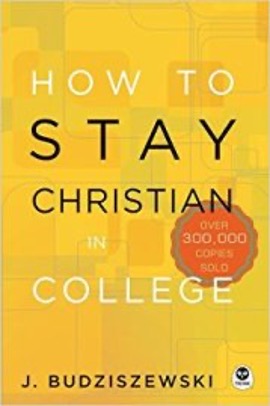
  1. How to Stay Christian in College by J. Budziszewski (TH1NK, 2014)Budziszewksi, professor of philosophy and politics at the University of Texas since 1981, blogs daily at The Underground Thomist.  In How to Stay Christian in CollegeBudziszewski “discusses the foundations of the Christian faith and directly addresses different worldviews and myths that students may encounter at college. Filled with quotes, statistics, resources, stories, and encouragement, this book will equip students to conquer the dangers that lie ahead.” Budziszewski divides the book into three sections: worldviews, campus myths, and how to cope with social, religious, and classroom issues.
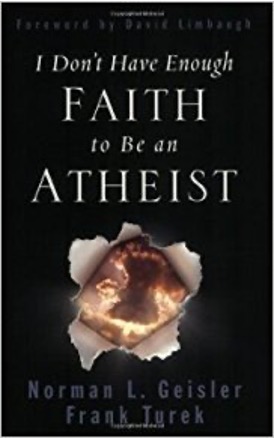
  2. I Don’t Have Enough Faith to be an Atheist by Norman Geisler and Frank Turek (Crossway, 2004)

Turek and Geisler make apologetics accessible and practical in the complete introduction to the topic. Frank Turek, who travels around the country giving presentations with the same title as the book on college campuses, is a dynamic presenter.  Starting with complete skepticism they build on the existence of truth, God’s existence, reliability of Bible, the divinity of Jesus, and his resurrection.  Includes great examples and stories to illustrate the points they make in the text. There is a wealth of resources readily available to guide students and assist them during their college years. Great graduation gift ideas.

Recommended Resources:

Stealing From God by Dr. Frank Turek (Book, 10-Part DVD Set, STUDENT Study Guide, TEACHER Study Guide)

Can All Religions Be True? mp3 by Frank Turek

Macro Evolution? I Don’t Have Enough Faith to be a Darwinist (DVD Set), (MP3 Set) and (mp4 Download Set) by Dr. Frank Turek

How Philosophy Can Help Your Theology by Richard Howe (DVD Set, Mp3, and Mp4)   


Steve Lee has taught Apologetics for over two and a half decades at Prestonwood Christian Academy.  He also has taught World Religions and Philosophy at Mountain View College in Dallas and Collin College in Plano.  With a degree in history and education from the University of North Texas, Steve continued his formal studies at Southwestern Baptist Theological Seminary with a M.A. in philosophy of religion and has pursued doctoral studies at the University of Texas at Dallas and is finishing his dissertation at South African Theological Seminary.  He has published several articles for the Apologetics Study Bible for Students as well as articles and book reviews in various periodicals including Philosophia Christi, Hope’s Reason: A Journal of Apologetics, and the Areopagus Journal.  Having an abiding love for fantasy fiction, Steve has contributed chapters to two books on literary criticism of Harry Potter: Harry Potter for Nerds and Teaching with Harry Potter.  He even appeared as a guest on the podcast MuggleNet Academia (“Lesson 23: There and Back Again-Chiasmus, Alchemy, and Ring Composition in Harry Potter”).  He is married to his lovely wife, Angela, and has two grown boys, Ethan and Josh.

Originally posted at: https://bit.ly/4nUpHR4

[Editor’s Note: This blog was originally a single article. For the purposes of reposting it at Crossexamined, it has been divided into two parts. Click here for part 1

[Excerpt from Part 1:] In this article [series], I . . . discuss the evidence that the apostles did in fact encounter hardships, dangers and persecutions on account of their Christian convictions. [In part 1] I survey the evidence for a general context of persecution (what may be called the indirect part of the case). [In Part 2] I will . . . proceed to argue that the apostles in particular voluntarily submitted themselves to danger, hardship and persecution on account of their conviction of the gospel’s truth.

The Persecution of the Apostles — Evidence from the Apostolic Fathers  

We now turn to what may be called the more direct evidence — that is, the sources which indicate that not only was there a general persecution (and thus a reasonable expectation of danger) but that the apostles themselves voluntarily underwent sufferings and hardships on account of the gospel. Our first evidence is Paul’s statement in his letter to the church in Corinth (dating to around 53 C.E.), that

I think God has exhibited us apostles as last of all, like men sentenced to death, because we have become a spectacle to the world, to angels, and to men. We are fools for Christ’s sake, but you are wise in Christ. We are weak, but you are strong. You are held in honor, but we in disrepute. To the present hour, we hunger and thirst, we are poorly dressed and buffeted and homeless, and we labor, working with our own hands. When reviled, we bless; when persecuted, we endure; when slandered, we entreat. We have become, and are still, like the scum of the world, the refuse of all things (1 Cor. 4:9-13).

This indicates the peril encountered by the original apostles as they labored for the gospel.

Our earliest source, which relates the martyrdom of Peter, is John 21:18: “Truly, truly, I say to you, when you were young, you used to dress yourself and walk wherever you wanted, but when you are old, you will stretch out your hands, and another will dress you and carry you where you do not want to go.” John adds, “This he said to show by what kind of death he was to glorify God,” (v. 19). Though it takes the form of a prophecy attributed to Jesus, it seems unlikely (whether we take this saying to be authentic or not) that John would have attributed such a prediction to Jesus if Peter had not, in fact, died as a martyr (the early church held that John’s gospel was the last to be written, and it was likely composed towards the end of the first century).[1]

Towards the end of the first century, Clement of Rome wrote a letter to the church in Corinth. He wrote (1 Clement 5),

But not to dwell upon ancient examples, let us come to the most recent spiritual heroes. Let us take the noble examples furnished in our own generation. Through envy and jealousy, the greatest and most righteous pillars [of the Church] have been persecuted and put to death. Let us set before our eyes the illustrious apostles. Peter, through unrighteous envy, endured not one or two, but numerous labors; and when he had at length suffered martyrdom, departed to the place of glory due to him. Owing to envy, Paul also obtained the reward of patient endurance, after being seven times thrown into captivity, compelled to flee, and stoned. After preaching both in the east and west, he gained the illustrious reputation due to his faith, having taught righteousness to the whole world, and come to the extreme limit of the west, and suffered martyrdom under the prefects. Thus was he removed from the world, and went into the holy place, having proved himself a striking example of patience.[2]

Irenaeus of Lyons writes concerning Clement,

This man, as he had seen the blessed apostles, and had been conversant with them, might be said to have the preaching of the apostles still echoing [in his ears], and their traditions before his eyes. Nor was he alone [in this], for there were many still remaining who had received instructions from the apostles (Against Heresies 3.3.3).[3]

Clement is plausibly alluded to by Paul himself in Philippians 4:3 (Paul wrote this epistle from Rome, and so there is a high likelihood this is the same Clement). Given Clement’s personal connection to the apostles, he was thus in an ideal position to know about their persecution and ultimate fate.

Another important source is Polycarp of Smyrna (69-155 C.E.). Like Clement, we have one surviving letter of Polycarp’s, which is his letter to the Philippians (dating to around 110 C.E.). In chapter 9 of this letter, we read,

I exhort you all, therefore, to yield obedience to the word of righteousness, and to exercise all patience, such as ye have seen [set] before your eyes, not only in the case of the blessed Ignatius, and Zosimus, and Rufus, but also in others among yourselves, and in Paul himself, and the rest of the apostles. [This do] in the assurance that all these have not run in vain, but in faith and righteousness, and that they are [now] in their due place in the presence of the Lord, with whom also they suffered. For they loved not this present world, but Him who died for us, and for our sakes was raised again by God from the dead.[4]

Like Clement, Polycarp was also personally connected to the apostles. Irenaeus, himself a disciple of Polycarp, informs us that

Polycarp also was not only instructed by apostles, and conversed with many who had seen Christ, but was also, by apostles in Asia, appointed bishop of the Church in Smyrna, whom I also saw in my early youth, for he tarried [on earth] a very long time, and, when a very old man, gloriously and most nobly suffering martyrdom, departed this life, having always taught the things which he had learned from the apostles, and which the Church has handed down, and which alone are true.[5]

Irenaeus, in a fragment preserved in an quotation by Eusebius from a now-lost work, even recalls “how he would speak of his familiar intercourse with John, and with the rest of those who had seen the Lord; and how he would call their words to remembrance.”[6] Polycarp, therefore, was likewise close up to the facts and in a position to be informed regarding the fate of the apostles.

The Persecution of Paul — The Value of the Epistles

We now turn to what may be deduced about the persecution experienced by the apostle Paul from his own letters. Consider Paul’s list of his experiences in 2 Corinthians 11:24-27:

Five times I received at the hands of the Jews the forty lashes less one. 25 Three times I was beaten with rods. Once I was stoned. Three times I was shipwrecked; a night and a day I was adrift at sea; 26 on frequent journeys, in danger from rivers, danger from robbers, danger from my own people, danger from Gentiles, danger in the city, danger in the wilderness, danger at sea, danger from false brothers; 27 in toil and hardship, through many a sleepless night, in hunger and thirst, often without food, in cold and exposure.

Paul also expresses in 1 Corinthians 4:9-13:

9 For I think that God has exhibited us apostles as last of all, like men sentenced to death, because we have become a spectacle to the world, to angels, and to men. 10 We are fools for Christ’s sake, but you are wise in Christ. We are weak, but you are strong. You are held in honor, but we in disrepute. 11 To the present hour we hunger and thirst, we are poorly dressed and buffeted and homeless, 12 and we labor, working with our own hands. When reviled, we bless; when persecuted, we endure; 13 when slandered, we entreat. We have become, and are still, like the scum of the world, the refuse of all things.

Paul, moreover, writes to the Thessalonians, “But though we had already suffered and been shamefully treated at Philippi, as you know, we had boldness in our God to declare to you the gospel of God in the midst of much conflict,” (1 Thess 2:2, emphasis added). This raises the question of how the Thessalonians knew about Paul’s shameful treatment in Philippi. When we compare Paul’s letter to the account in Acts, we learn that the shameful treatment to which he was referring is his imprisonment and public beating, uncondemned, despite being a Roman citizen (Acts 16:16-40). We read in Acts 16:35-40:

But when it was day, the magistrates sent the police, saying, “Let those men go.” 36 And the jailer reported these words to Paul, saying, “The magistrates have sent to let you go. Therefore come out now and go in peace.” 37 But Paul said to them, “They have beaten us publicly, uncondemned, men who are Roman citizens, and have thrown us into prison; and do they now throw us out secretly? No! Let them come themselves and take us out.” 38 The police reported these words to the magistrates, and they were afraid when they heard that they were Roman citizens. 39 So they came and apologized to them. And they took them out and asked them to leave the city. 40 So they went out of the prison and visited Lydia. And when they had seen the brothers, they encouraged them and departed.

According to Acts 17:1, Paul’s very next port of call, after passing through Amphipolis and Apollonia, was Thessalonica. This was in fact on a major Roman highway (the Via Egnatia) and Amphipolis and Apollonia were overnight stops along that highway. One can envision Paul coming from Philippi to Thessalonica, still full of indignation, and reporting about his shameful treatment to the converts in Thessalonica. This undesigned coincidence between Acts and 1 Thessalonians is all the more striking given that the book of Acts does not appear to be dependent upon 1 Thessalonians, nor vice versa. For example, according to 1 Thessalonians 1:9, Paul writes, “For they themselves report concerning us the kind of reception we had among you, and how you turned to God from idols to serve the living and true God…” Notice the emphasis in this text on the conversion of pagans from idolatry. Acts, on the other hand, emphasizes the conversion of Jews and gentile God-fearers (Acts 17:4). If the author of Acts were using 1 Thessalonians as a source, we might expect emphasis to be placed on the conversion of pagans. The accounts are, of course, not mutually exclusive. In fact, there are allusions in the epistle to concepts that would not make much sense to gentiles who lacked acquaintance with Jewish eschatological thought (1 Thess 4:14-17). Paul also distinguishes believers from gentiles, whose ways they ought not copy (1 Thess 4:4-5). It makes sense, therefore, to understand the “you” that turned to God from idols to be an exaggerated statement — referring to one portion of his audience rather than another. Nonetheless, the surface discrepancy between Acts and 1 Thessalonians points to the independence of these sources.

We also read in Acts 17 about the persecution endured by Paul from a mob of Jews who stirred up trouble for him. According to Acts 17:5-9:

5 But the Jews were jealous, and taking some wicked men of the rabble, they formed a mob, set the city in an uproar, and attacked the house of Jason, seeking to bring them out to the crowd. 6 And when they could not find them, they dragged Jason and some of the brothers before the city authorities, shouting, “These men who have turned the world upside down have come here also, 7 and Jason has received them, and they are all acting against the decrees of Caesar, saying that there is another king, Jesus.” 8 And the people and the city authorities were disturbed when they heard these things. 9 And when they had taken money as security from Jason and the rest, they let them go.

Paul thus had to leave in haste to go to Berea (Acts 17:10). We read in Acts 17:13 that “when the Jews from Thessalonica learned that the word of God was proclaimed by Paul at Berea also, they came there too, agitating and stirring up the crowds.” Paul thus, again, had to leave in haste to travel to Athens — “Then the brothers immediately sent Paul off on his way to the sea, but Silas and Timothy remained there. Those who conducted Paul brought him as far as Athens, and after receiving a command for Silas and Timothy to come to him as soon as possible, they departed.” Acts leaves unexplained why Paul left behind Silas and Timothy. This unexplained allusion is itself a hallmark of verisimilitude in the text. It is the texture of testimony — one does not typically leave loose ends like this in a fictitious work. Moreover, Silas and Timothy are instructed to rejoin Paul “as soon as possible.” Presumably, then, they did rejoin Paul in Athens (though the text does not indicate explicitly). Nonetheless, they are next reported to rejoin Paul not in Athens but in Corinth — and they arrived not from Athens but from Macedonia, where the cities of Thessalonica and Berea are (Acts 18:5). What accounts for this gap in the text? An explanation is provided by 1 Thessalonians 3:1-5:

Therefore when we could bear it no longer, we were willing to be left behind at Athens alone, 2 and we sent Timothy, our brother and God’s coworker in the gospel of Christ, to establish and exhort you in your faith, 3 that no one be moved by these afflictions. For you yourselves know that we are destined for this. 4 For when we were with you, we kept telling you beforehand that we were to suffer affliction, just as it has come to pass, and just as you know. 5 For this reason, when I could bear it no longer, I sent to learn about your faith, for fear that somehow the tempter had tempted you and our labor would be in vain.

Thus, Paul indicates, under the circumstances, he had been concerned for the wellbeing of the Christians in Thessalonica, and so he commissioned Timothy to go back from Athens to Thessalonica to check on the believers there. This explains the gap in the account in Acts, and thereby corroborates the account in Acts. This undesigned coincidence is, again, all the more striking given the independence (as I have shown) between Acts and 1 Thessalonians. Connected to this, there is another undesigned coincidence relating to Paul’s time in Corinth (Acts 18:1-5):

After this Paul left Athens and went to Corinth. 2 And he found a Jew named Aquila, a native of Pontus, recently come from Italy with his wife Priscilla, because Claudius had commanded all the Jews to leave Rome. And he went to see them, 3 and because he was of the same trade he stayed with them and worked, for they were tentmakers by trade. 4 And he reasoned in the synagogue every Sabbath, and tried to persuade Jews and Greeks. 5 When Silas and Timothy arrived from Macedonia, Paul was occupied with the word, testifying to the Jews that the Christ was Jesus.

Paul encounters Aquila and Priscilla in Corinth, who had been exiled from Rome at the instigation of the emperor Claudius. The Roman biographer Suetonius also mentions this episode: “He [Claudius] banished from Rome all the Jews, who were continually making disturbances at the instigation of one Chrestus,” (Life of Claudius 25). Our text in Acts indicates that Paul worked with them as a tentmaker to earn his keep during the week, and that he engaged in his evangelistic work on the Sabbath day, when he went into the synagogue and tried to persuade Jews and Greeks that Jesus is the Christ. However, in response to the arrival of Silas and Timothy from Macedonia, he changed his ministry model such that he devoted himself entirely to the work of the ministry. What prompted this change? Acts does not inform us. However, we read in 2 Corinthians 11:7-9:

Or did I commit a sin in humbling myself so that you might be exalted, because I preached God’s gospel to you free of charge? 8 I robbed other churches by accepting support from them in order to serve you. 9 And when I was with you and was in need, I did not burden anyone, for the brothers who came from Macedonia supplied my need. So I refrained and will refrain from burdening you in any way.

Apparently the brothers who came from Macedonia (whom we learn from Acts included Silas and Timothy) brought financial aid to Paul, which enabled him to devote himself entirely to the ministry. This detail, however, is not supplied by Acts. This is further corroborated by Philippians 4:14-16, in which we read (in a letter addressed to one of the churches in Macedonia),

14 Yet it was kind of you to share my trouble. 15 And you Philippians yourselves know that in the beginning of the gospel, when I left Macedonia, no church entered into partnership with me in giving and receiving, except you only. 16 Even in Thessalonica you sent me help for my needs once and again.

This, once again, serves to confirm the account in Acts — which reveals that Paul was willing to work for his keep as a tentmaker. In other words, he was evidently not in ministry for the purpose of extorting people for money. Moreover, the account in Acts continues with a note about another episode of opposition against Paul: “And when they opposed and reviled him, he shook out his garments and said to them, ‘Your blood be on your own heads! I am innocent. From now on I will go to the Gentiles,’” (Acts 18:6). This coincidence is all the more striking given the independence of Acts and 2 Corinthians, as demonstrated earlier in this article.

Another undesigned coincidence bearing on Paul’s sufferings relates to Paul’s statement in 2 Timothy 3:10-11:

10 You, however, have followed my teaching, my conduct, my aim in life, my faith, my patience, my love, my steadfastness, 11 my persecutions and sufferings that happened to me at Antioch, at Iconium, and at Lystra—which persecutions I endured; yet from them all the Lord rescued me.

The sufferings mentioned here are described in Acts 13:50-51 and 14:1-7, 19-21. Paul seems to imply, in his letter to Timothy, that Timothy had in fact witnessed the persecutions that he had endured in those cities. According to Acts, Paul embarked on a second missionary journey through the same country as the first journey. The purpose of his second missionary trip is given in Acts 15:36: “Let us return and visit the brothers in every city where we proclaimed the word of the Lord, and see how they are.” Thus, we learn, that the purpose of the journey was to check on those who had been converted during the first journey, to see how they were doing. In Acts 16;1-2, we further learn, “Paul came also to Derbe and to Lystra. A disciple was there, named Timothy, the son of a Jewish woman who was a believer, but his father was a Greek. 2 He was well spoken of by the brothers at Lystra and Iconium.” We are thereby informed that Timothy’s hometown was either Derbe or Lystra. And it is apparent from the text that Timothy had already been converted by this time. Paul himself refers to Timothy as “my true child in the faith” (1 Tim 1:2) and “my beloved child” (2 Tim 1:2). This implies that Timothy was probably Paul’s own convert. It then follows that Timothy was very likely converted during Paul’s preceding missionary journey through these cities, at the very time when Paul had undergone the persecutions referred to in the epistle. This supports both the historicity of Acts, as well as the genuineness of the pastoral epistles (which are among the disputed Pauline letters). For a more detailed discussion of the authenticity of the pastoral epistles, see my essay here.

There is also external evidence that corroborates the accounts in Acts concerning Paul’s suffering for the gospel. For example, Acts 22:25-29 describes Paul being before the Roman tribune:

But when they had stretched him out for the whips, Paul said to the centurion who was standing by, “Is it lawful for you to flog a man who is a Roman citizen and uncondemned?” 26 When the centurion heard this, he went to the tribune and said to him, “What are you about to do? For this man is a Roman citizen.” 27 So the tribune came and said to him, “Tell me, are you a Roman citizen?” And he said, “Yes.” 28 The tribune answered, “I bought this citizenship for a large sum.” Paul said, “But I am a citizen by birth.” 29 So those who were about to examine him withdrew from him immediately, and the tribune also was afraid, for he realized that Paul was a Roman citizen and that he had bound him. [emphasis added]

Note the tribune’s words to Paul, “I bought this citizenship for a large sum.” What is the historical background here? The second century Roman historian Cassius Dio informs us that, during the reign of Claudius it was introduced that one could purchase a Roman citizenship for a great sum. He writes (Historiae Romanae 60.17) [15],

For inasmuch as Romans had the advantage over foreigners in practically all respects, many sought the franchise by personal application to the emperor, and many bought it from Messalina and the imperial freedmen. For this reason, though the privilege was at first sold only for large sums, it later became so cheapened by the facility with which it could be obtained that it came to be a common saying, that a man could become a citizen by giving the right person some bits of broken glass.[7]

Thus, though the privilege of Roman citizenship sold at first for great sums of money, the price progressively came down, until it had become so cheapened that it came to be a common saying that one could become a Roman citizen by bringing the right person some pieces of broken glass. This adds color to the tribune’s words, “I bought this citizenship for a large sum,” insinuating that Paul was able to acquire his citizenship for much less. Paul, in turn, corrects the tribune that he was a citizen by birth. Acts does not explain, for the sake of his readers, this historical background. Cassius Dio, in providing this background, renders the narrative in Acts quite credible.

There is also a wealth of evidence for the authenticity of Paul’s voyage, as a prisoner bound for Rome, that ended in shipwreck (Acts 27). The report of that voyage notes, in verses 3-6, that,

3 The next day we put in at Sidon. And Julius treated Paul kindly and gave him leave to go to his friends and be cared for. 4 And putting out to sea from there we sailed under the lee of Cyprus, because the winds were against us. 5 And when we had sailed across the open sea along the coast of Cilicia and Pamphylia, we came to Myra in Lycia. 6 There the centurion found a ship of Alexandria sailing for Italy and put us on board.

Colin Hemer comments, “Myra, like Patara again, was a principal port for the Alexandrian corn-ships, and precisely the place where Julius would expect to find a ship sailing to Italy in the imperial service. Its official standing here is further illustrated by the Hadrianic granary. Myra was also the first of these ports to be reached by a ship arriving from the east, as Patara had been previously from the reverse direction.”[8]

Verses 13-14 indicate that they “…sailed along Crete, close to the shore. But soon a tempestuous wind, called the northeaster, struck down from the land.” In confirmation of Luke’s report, there is indeed a well confirmed wind that rides over Crete from the Northeast, and which is strongest at this exact time near the Day of Atonement in the Fall (Acts 27:9). Acts 27:16 describes how the ship was blown off course towards a small island called Cauda. What is impressive is that the island of Cauda is more than 20 miles west-southwest of where the storm likely struck the travelers in the Bay of Messara. This is precisely where the trajectory of a north-easterly wind should have carried them, and it is not the sort of information someone would have inferred without having been blown there. Ancients found it nearly impossible to properly locate islands this far out. Colin Hemer notes that,

As the implications of such details are further explored, it becomes increasingly difficult to believe that they could have been derived from any contemporary reference work. In the places where we can compare, Luke fares much better than the encyclopaedist Pliny, who might be regarded as the foremost first-century example of such a source. Pliny places Cauda (Gaudos) opposite Hierapytna, some ninety miles too far east (NH 4.12.61). Even Ptolemy, who offers a reckoning of latitude and longitude, makes a serious dislocation to the northwest, putting Cauda too near the western end of Crete, in a position which would not suit the unstudied narrative of our text (Ptol. Geog. 3.15.8).[9]

There are many other points at which Paul’s voyage and shipwreck may be confirmed. For a much more detailed discussion, I refer readers to James Smith’s book, The Voyage and Shipwreck of St. Paul.[10]

Paul rejoiced in his own sufferings for the name of Christ. He wrote to the Philippians, “Even if I am to be poured out as a drink offering upon the sacrificial offering of your faith, I am glad and rejoice with you all. Likewise you also should be glad and rejoice with me,” (Phil 2:17-18).

An additional point that bears mentioning is that Paul not only willingly endured hardships and persecutions himself, but he expected other believers to do the same. Consider the following texts:

  • Philippians 1:29-30: For it has been granted to you that for the sake of Christ you should not only believe in him but also suffer for his sake, engaged in the same conflict that you saw I had and now hear that I still have.
  • 1 Thessalonians 1:4-5: For when we were with you, we kept telling you beforehand that we were to suffer affliction, just as it has come to pass, and just as you know. For this reason, when I could bear it no longer, I sent to learn about your faith, for fear that somehow the tempter had tempted you and our labor would be in vain. This is evidence of the righteous judgment of God, that you may be considered worthy of the kingdom of God, for which you are also suffering.
  • 2 Thessalonians 1:4: Therefore we ourselves boast about you in the churches of God for your steadfastness and faith in all your persecutions and in the afflictions that you are enduring.
  • Romans 3:3-4: Not only that, but we rejoice in our sufferings, knowing that suffering produces endurance, and endurance produces character, and character produces hope.
  • Romans 8:35-36: Who shall separate us from the love of Christ? Shall tribulation, or distress, or persecution, or famine, or nakedness, or danger, or sword? As it is written, “For your sake we are being killed all the day long; we are regarded as sheep to be slaughtered.”
  • 2 Corinthians 6:4-10: but as servants of God we commend ourselves in every way: by great endurance, in afflictions, hardships, calamities, beatings, imprisonments, riots, labors, sleepless nights, hunger; by purity, knowledge, patience, kindness, the Holy Spirit, genuine love; by truthful speech, and the power of God; with the weapons of righteousness for the right hand and for the left; through honor and dishonor, through slander and praise. We are treated as impostors, and yet are true; as unknown, and yet well known; as dying, and behold, we live; as punished, and yet not killed; as sorrowful, yet always rejoicing; as poor, yet making many rich; as having nothing, yet possessing everything.

Sir George Lyttelton notes,

But at that time when St. Paul undertook the preaching of the Gospel to persuade any man to be a Christian, was to persuade him to expose himself to all the calumnies human nature could suffer. This St Paul knew; this he not only expected, but warned those he taught to look for it too… How much reason he had to say this, the hatred, the contempt, the torments, the deaths endured by the Christians in that age, and long afterwards, abundantly prove. Whoever professed the Gospel under these circumstances, without an entire conviction of its being a Divine revelation, must have been mad; and if he made others profess it by fraud or deceit, he must have been worse than mad; he must have been the most hardened wretch that ever breathed. Could any man who had in his nature the least spark of humanity, subject his fellow-creatures to so many miseries; or could one that had in his mind the least ray of reason, expose himself to share them with those he deceived, in order to advance a religion which he knew to be false, merely for the sake of its moral doctrines? Such an extravagance is too absurd to be supposed; and I dwell too long on a notion that upon a little reflection confutes itself.[11]

Short of being, as Lyttelton put it, the most hardened wretch that ever breathed, how could Paul expect his fellow believers to voluntarily undertake tremendous hardships and sufferings, even martyrdom, unless he had a sincere conviction of the gospel’s truth?

The Accounts in Acts 

We now turn to the accounts of persecution in the book of Acts. For economy of space, I shall not regurgitate here the extensive case that I and others have made elsewhere for the high reliability of the book of Acts (though the points of internal and external confirmation given above contribute to this case). This case, though, confirms the author to have been an individual who was very well informed, close up to the facts, and in the habit of being scrupulous. We must, therefore, take what he says concerning the context of persecution — and, in particular, about the persecution of the early apostles, and their resoluteness to continue preaching despite this danger — quite seriously.

The author of Acts (i.e., Luke) provides a list in his opening chapter of the eleven disciples (Acts 1:13), even though he already supplied a list of the Twelve in his gospel (Luke 6:12-16). Moreover, in Acts 1:15-26, we read about a replacement for Judas being elected, because there had to be no fewer than twelve men who could bear witness to Jesus’ resurrection (Matthias is elected out of two candidates, the other contender being Joseph called Barsabbas). This confirms that, even in this very early period following Jesus’ resurrection and ascension, the twelve were acting in leadership capacities in Jerusalem.

In Acts 2:14, we learn that Peter stood up “with the eleven” at Pentecost to address the Jews in Jerusalem. This includes a clear proclamation of Jesus’ resurrection (v. 24, 32). In verse 37, we read that “when they [the Jews in Jerusalem] heard this they were cut to the heart, and said to Peter and the rest of the apostles, ‘Brothers, what shall we do?’” Notice that this is addressed to Peter along with “the rest of the apostles.” In view of verse 14, this has to include all of the eleven. We may glean from this, then, that the twelve collectively declared the reality of Christ’s resurrection at Pentecost, and that they intended to have an ongoing leadership role that would be focused on proclaiming the resurrection. Even by this point, the twelve were taking upon themselves tremendous risks on account of the gospel. This was only six weeks since Jesus himself had been put to death at the instigation of the Jewish authorities. As Paley notes,

The ruling party at Jerusalem had just before crucified the Founder of the religion. That is a fact which will not be disputed. They, therefore, who stood forth to preach the religion must necessarily reproach these rulers with an execution, which they could not but represent as an unjust and cruel murder. This would not render their office more easy, or their situation more safe.[12]

And that they did. Peter’s speech, as reported in Acts, is very confrontational, repudiating the Jewish leaders for their rejection of their Messiah and their part in his execution. Consider the provocative nature of Peter’s statements:

This Jesus, delivered up according to the definite plan and foreknowledge of God, you crucified and killed by the hands of lawless men. God raised him up, loosing the pangs of death, because it was not possible for him to be held by it… Let all the house of Israel therefore know for certain that God has made him both Lord and Christ, this Jesus whom you crucified (Acts 2:23,36).

In verses 41-47, we learn that the apostles continued to minister publicly following Peter’s speech.

Acts 5:12 informs us that “many signs and wonders were regularly done among the people by the hands of the apostles. And they were all together in Solomon’s portico.” This indicates that Solomon’s Porch was a location where the apostles would commonly meet (as alluded to previously in Acts 3:11, and during Jesus’ own ministry according to John 10:23). According to Acts 5:17-18, the apostles were arrested and imprisoned by the high priest and Sadducees. That same night, they were liberated by an angel and they resumed their preaching work. In verse 28, the high priest cautions them, “We strictly charged you not to teach in this name, yet here you have filled Jerusalem with your teaching, and you intend to bring this man’s blood upon us.” Peter replies,

We must obey God rather than men. The God of our fathers raised Jesus, whom you killed by hanging him on a tree. God exalted him at his right hand as Leader and Savior, to give repentance to Israel and forgiveness of sins. And we are witnesses to these things, and so is the Holy Spirit, whom God has given to those who obey him (Acts 5:29-32).

Verse 40 indicates that “when they had called in the apostles, they beat them and charged them not to speak in the name of Jesus, and let them go.” However, in spite of this warning, “every day, in the temple and from house to house, they did not cease teaching and preaching that the Christ is Jesus,” (v. 42). We are even told that “they left the presence of the council, rejoicing that they were counted worthy to suffer dishonor for the name,” (v. 41).

In the following chapter we learn that “the twelve summoned the full number of the disciples and said, ‘It is not right that we should give up preaching the word of God to serve tables.” Seven individuals are selected to deal with this issue, for the reason that the chief focus of the twelve is preaching the word of God (v. 2) — prayer and the ministry of the word (v. 4).

Acts 7 recounts the stoning of Stephen, who was one of the appointed deacons. Though he was not himself one of the apostles (and was not, so far as we know, a witness to Jesus’ resurrection), his death by stoning would have served as a warning shot regarding the dangers that were associated with proclamation of the gospel in those early years. If the resurrection were a conspiracy, one would expect that some members of what must have been a relatively large conspiracy, would have cold feet about continuing. And yet, there is no record whatsoever about any of the apostles abandoning Christianity in those early years when we would most expect there to be some record of such a defection. Early Christian writers were not shy about calling out by name others who fell away. In 2 Timothy 4:10, Paul writes that “Demas, in love with this present world, has deserted me and gone to Thessalonica.” He further notes “You are aware that all who are in Asia turned away from me, among whom are Phygelus and Hermogenes,” (2 Tim 1:15). Nowhere is there a record rebuking one of the original apostles for falling away from the faith, though they had every incentive to do so if they knew Christianity to be false.

We read in the following chapter of Acts that “there arose on that day a great persecution against the church in Jerusalem, and they were all scattered throughout the regions of Judea and Samaria, except the apostles,” (Acts 8:1). The text therefore clearly distinguishes between those other believers who were “scattered throughout the regions of Judea and Samaria,” and the apostles who remained in Jerusalem amidst the context of persecution.

In Acts 12:1-3, we learn,

About that time Herod the king laid violent hands on some who belonged to the church. He killed James the brother of John with the sword, and when he saw that it pleased the Jews, he proceeded to arrest Peter also. This was during the days of Unleavened Bread. And when he had seized him, he put him in prison, delivering him over to four squads of soldiers to guard him, intending after the Passover to bring him out to the people. So Peter was kept in prison, but earnest prayer for him was made to God by the church.

The “Herod” referred to here is Herod Agrippa I, the son of Aristobulus and grandfather of Herod the Great. This account accords quite well with the character of Herod Agrippa I, as recorded by Josephus. In Antiquities 19.7.3, Josephus writes about Herod Agrippa’s character [21]:

But Agrippa’s temper was mild, and equally liberal to all men. He was humane to foreigners, and made them sensible of his liberality. He was in like manner rather of a gentle and compassionate temper. Accordingly, he loved to live continually at Jerusalem, and was exactly careful in the observance of the laws of his country. He therefore kept himself entirely pure: nor did any day pass over his head without its appointed sacrifice.[13]

Thus, Herod Agrippa I was particularly concerned about pleasing the Jews. This account of Agrippa’s character, therefore, dovetails with the account in Acts 12:3, which indicates that he proceeded to arrest Peter when he saw that it pleased the Jews.

The Martyrdom of James the Brother of Jesus        

Josephus also informs us about the martyrdom of the other James, i.e., the brother of Jesus. He writes (Antiquities 20.9.1):

Festus was now dead, and Albinus was but upon the road; so he assembled the Sanhedrin of judges, and brought before them the brother of Jesus, who was called Christ, whose name was James, and some others, [or, some of his companions]; and when he had formed an accusation against them as breakers of the law, he delivered them to be stoned.[14]

Craig Evans notes concerning this text that “There are no compelling reasons for rejecting this passage as inauthentic. There is nothing Christian, or positive, in the reference to James and Jesus. The whole point seems to be to explain why Ananus was deposed as High Priest. Furthermore, the designation, ‘brother of Jesus,’ contrasts with Christian practice of referring to James as the ‘brother of the Lord’ (cf. Gal 1:19; Eusebius, Hist. Eccl. 2.23.4).”[15] Evans concludes, “It is not surprising, therefore, that, in the words of Louis Feldman, ‘few have doubted the genuineness of this passage on James.’”[16]

Implications for Jesus’ Resurrection

What are the implications of all this for Jesus’ resurrection and the broader set of arguments for Christianity? The fact that the original apostles were willing to voluntarily undergo and endure hardships, dangers, and sufferings on account of the gospel goes a very long way towards establishing their sincerity. This drastically reduces the plausibility of one of three candidate explanations for the origins of early Christian belief in the resurrection — namely, that the apostles were lying about Jesus’ resurrection and other miracles with an intent to deceive. With this explanation off the table, the probabilities are redistributed between the two remaining options — i.e., that the apostles were somehow sincerely mistaken, or else the content of their testimony is true.

If it is the case (as I have argued in detail elsewhere) that the accounts that we have in the gospels and Acts in fact represent the testimony of eyewitnesses to Jesus’ ministry and, in particular, purported witnesses to Jesus’ resurrection, then this renders it quite implausible that the apostles were sincerely mistaken. The apostles are alleged to have encountered Jesus, alive after his death, at close quarters. They engaged with him in group conversations, were invited to touch him (Luke 24:39; John 20:27), handed Jesus a broiled fish which he ate in their presence (Luke 24:42), and ate and drank with Jesus (Acts 10:41). Moreover, Jesus is alleged to have even cooked breakfast for seven disciples on the shore of the Sea of Galilee (John 21). The experiences are also said to have been distributed over a forty day time period (Acts 1:3). The encounters with the risen Jesus occur in different settings — both indoors and outdoors, with and without prior appointment (see Matthew 28:16). These are not the sort of claims about which one can be plausibly sincerely mistaken.

I have also argued in detail elsewhere that the accounts of Paul’s conversion in Acts 9, 22 and 26 actually represent Paul’s own conversion testimony. This being the case, it is difficult to envision the apostle Paul being mistaken about the sort of claims he makes. His experience is multisensory (involving both a visual and auditory aspect) and intersubjective (affecting both Paul and those travelling with him, who are thrown to the ground). Paul is blinded by the experience and later healed on command by Ananias, who receives a vision concerning Paul, and Paul a vision concerning Ananias. Paul also writes about miracles that he had himself performed, which he describes as “the signs of a true apostle” that “were performed among you with utmost patience, with signs and wonders and mighty works,” (2 Cor 12:12; c.f. Rom 15:18-19). We also read of various of Paul’s miracles in the book of Acts. Given the strong case (as I and others have developed in detail elsewhere) that the book of Acts was written by a traveling companion of Paul, who was well informed and habitually scrupulous, Luke’s most likely source for this material is Paul himself. This is, therefore, part of the testimony that must be accounted for. To take one example, Luke describes a curse that Paul placed on the magician Elymas (who had opposed Paul and Barnabas, seeking to turn the Proconsul away from the faith). Luke writes in Acts 13:9-12,

9 But Saul, who was also called Paul, filled with the Holy Spirit, looked intently at him 10 and said, “You son of the devil, you enemy of all righteousness, full of all deceit and villainy, will you not stop making crooked the straight paths of the Lord? 11 And now, behold, the hand of the Lord is upon you, and you will be blind and unable to see the sun for a time.” Immediately mist and darkness fell upon him, and he went about seeking people to lead him by the hand. 12 Then the proconsul believed, when he saw what had occurred, for he was astonished at the teaching of the Lord.

Among Paul’s other miraculous signs, he healed a man who had been crippled since birth (Acts 14:8-10), was freed from prison by an earthquake (Acts 16:26); healed many sick (Acts 19:11-12), raised Eutychus from the dead after his fall from the third story of a building (Acts 20:9-12), and healed the father of Publius, who lay sick with fever and dysentery, on Malta (Acts 28:7-9). This set of claims is difficult to account for on the supposition that Paul was sincerely mistaken.

Besides miracles performed by the apostle Paul, there are also miracles that are alleged in Acts to have been performed by other individuals. For example, Philip the deacon is said to have performed signs, healings, and exorcisms in Samaria (Acts 8:6-7), and his miracles are said to have impressed Simon the Magician (Acts 8:13). The spirit of the Lord later snatched Philip from the road to Gaza and placed him instead in Azotus (Acts 8:39-40). There is also an occasion of special providence (though not a miracle per se) when Philip encounters the Ethiopian eunuch. Luke’s most probable source for these accounts is Philip himself, particularly given that he apparently stayed at the house of Philip (Acts 21:8). Luke also encountered the original apostles, in particular the Jerusalem leaders James the brother of Jesus, Simon Peter, and John the son of Zebedee (Acts 21:17-18) and was in relatively close proximity for a subsequent two years while in Caesarea Maritima (Acts 24:27). Given the numerous specific details that may be corroborated not only in Acts but also the gospel of Luke, we have every reason to think that not only did Luke have access to eyewitnesses (recall also that he has a stated interest in eyewitness testimony — see Luke 1:1-4) but that he extracted accurate information from those apostles.

Other miracles performed by the apostles in Acts include Peter’s healing of the cripple, which even forces the authorities to recognize a miraculous event (Acts 3:2-10; 4:16,22); various other healings as well as exorcisms attributed to the apostles (Acts 2:43, 5:12-16), Peter’s striking Ananias and Sapphira dead after they lied about the price obtained for their land (Acts 5:1-11); the rescue of the apostles from prison (Acts 5:18-20), Peter’s healing of Aeneas in Lydda (Acts 9:33-34). the raising of Tabitha / Dorcas from the dead (Acts 9:36-41), and the rescue of Peter from prison by an angel (Acts 12:6-11).

There are also various other miracles, aside from the resurrection, that are alleged in the gospel accounts. For example, the disciples are represented as being present for the raising of Lazarus from the dead in Bethany in John 11, and the subsequent dinner with Lazarus along with his sisters, Mary and Martha, in John 12:1-7. There are good reasons to believe the fourth gospel to be written by a disciple of Jesus, and more specifically by John the son of Zebedee — but we will not digress onto that subject here.

My purpose in this last section has not been to defend in detail the crucial premise that these accounts in fact represent the testimony of eyewitnesses (I have offered that defense in detail elsewhere). Rather, it has been simply to show how the case given above for the willingness of the Christians to undergo and endure hardships, dangers and sufferings on account of the gospel fits within the broader set of arguments for Christianity.

References: 

[1] Editor’s Note: John’s Gospel is often thought to have been written in the late 1st century, c. 90-95AD, but that view is not unanimous among scholars. An increasingly popular view, in biblical scholarship, proposes a date around 60-70AD, seeJonathan Bernier in Rethinking the Dates of the New Testament: The Evidence for Early Composition (Grand Rapids: Baker, 2022), 87-129, 277.

[2] Clement of Rome, “The First Epistle of Clement to the Corinthians,” in The Apostolic Fathers with Justin Martyr and Irenaeus, ed. Alexander Roberts, James Donaldson, and A. Cleveland Coxe, vol. 1, The Ante-Nicene Fathers (Buffalo, NY: Christian Literature Company, 1885), 6.

[3] Irenaeus of Lyons, “Irenæus against Heresies,” in The Apostolic Fathers with Justin Martyr and Irenaeus, ed. Alexander Roberts, James Donaldson, and A. Cleveland Coxe, vol. 1, The Ante-Nicene Fathers (Buffalo, NY: Christian Literature Company, 1885), 416.

[4] Polycarp of Smryna, “The Epistle of Polycarp to the Philippians,” in The Apostolic Fathers with Justin Martyr and Irenaeus, ed. Alexander Roberts, James Donaldson, and A. Cleveland Coxe, vol. 1, The Ante-Nicene Fathers (Buffalo, NY: Christian Literature Company, 1885), 35.

[5] Irenaeus of Lyons, “Irenæus against Heresies,” in The Apostolic Fathers with Justin Martyr and Irenaeus, ed. Alexander Roberts, James Donaldson, and A. Cleveland Coxe, vol. 1, The Ante-Nicene Fathers (Buffalo, NY: Christian Literature Company, 1885), 416.

[6]  Irenaeus of Lyons, “Fragments from the Lost Writings of Irenæus,” in The Apostolic Fathers with Justin Martyr and Irenaeus, ed. Alexander Roberts, James Donaldson, and A. Cleveland Coxe, vol. 1, The Ante-Nicene Fathers (Buffalo, NY: Christian Literature Company, 1885), 568.

[7] Cassius Dio, Dio’s Roman History, trans. Earnest Cary, vol. 7, The Loeb Classical Library (London; New York; Cambridge, MA: The Macmillan Co.; G. P. Putnam’s Sons; Harvard University Press; William Heinemann Ltd, 1914–1927), 411.

[8] Colin J. Hemer, The Book of Acts in the Setting of Hellenistic History, ed. Conrad H. Gempf (Winona Lake, IN: Eisenbrauns, 1990), 134.

[9] Ibid., 331.

[10] James Smith, The Voyage and Shipwreck of St. Paul: With Dissertations on the Life and Writings of St. Luke, and the Ships and Navigation of the Ancients, ed. Walter E. Smith, Fourth Edition, Revised and Corrected (London: Longmans, Green, and Co., 1880).

[11] George Lyttelton, Observations on the Conversion and Apostleship of St. Paul (The Institute Trust, 1747), 36-39.

[12] William Paley, A View of the Evidences of Christianity: Volume 1, Reissue Edition (Cambridge: Cambridge University Press, 2009).

[13] Flavius Josephus and William Whiston, The Works of Josephus: Complete and Unabridged (Peabody: Hendrickson, 1987), 522.

[14] Ibid., 538.

[15] Craig A. Evans, “Jesus in non-Christian sources” in The Historical Jesus, Vol. 4, ed. Craig A. Evans (London and New York: Routledge), 392.

[16] Ibid.

Recommended Resources: 

Why We Know the New Testament Writers Told the Truth by Frank Turek (mp4 Download)

The Top Ten Reasons We Know the NT Writers Told the Truth mp3 by Frank Turek

Counter Culture Christian: Is the Bible True? by Frank Turek (Mp3), (Mp4), and (DVD)

The New Testament: Too Embarrassing to Be False by Frank Turek (DVD, Mp3, and Mp4)


Dr. Jonathan McLatchie is a Christian writer, international speaker, and debater. He holds a Bachelor’s degree (with Honors) in forensic biology, a Masters’s (M.Res) degree in evolutionary biology, a second Master’s degree in medical and molecular bioscience, and a Ph.D. in evolutionary biology. Currently, he is an assistant professor of biology at Sattler College in Boston, Massachusetts. Dr. McLatchie is a contributor to various apologetics websites and is the founder of the Apologetics Academy (Apologetics-Academy.org), a ministry that seeks to equip and train Christians to persuasively defend the faith through regular online webinars, as well as assist Christians who are wrestling with doubts. Dr. McLatchie has participated in more than thirty moderated debates around the world with representatives of atheism, Islam, and other alternative worldview perspectives. He has spoken internationally in Europe, North America, and South Africa promoting an intelligent, reflective, and evidence-based Christian faith.

Originally posted at: https://bit.ly/41NinxW

What happened behind the scenes at the historic memorial service for Charlie Kirk and what was its central takeaway message? Frank shares what it was like to attend and speak at what could possibly be the biggest public event in human history, and also highlights the remarkable efforts of the TPUSA team who put it all together in only 7 days while also mourning the devastating loss of their fearless leader.

Tune in as Frank shares clips from some of the speakers and answers questions like:

  • Why did Charlie continue doing college events when he knew his life could be at risk?
  • How do you respond to someone if they accuse you of being a Christian Nationalist?
  • Was Charlie Kirk a fascist?
  • Why should Christians seek to legislate morality?
  • What does Christianity offer that no other religion does?
  • Why should more Christians and those in church leadership speak up on controversial cultural issues?
  • What good has come from this tragedy?
  • What gave Erika Kirk the strength to forgive the killer?

As we all continue to mourn the loss of Charlie, please join us in honoring his legacy by fearlessly sharing the Gospel and having respectful dialogue with those who oppose the Christian worldview. And stay tuned for Friday’s podcast where Alisa Childers and Natasha Crain join the program to share some practical steps that Christians can take to get engaged.

If you enjoyed this podcast episode PLEASE HELP US SPREAD THE TRUTH OF CHRISTIANITY BY SUPPORTING OUR MINISTRY HERE. 100% of your donation goes to ministry, 0% to buildings!

Resources mentioned during the episode:

Frank’s speech at Charlie Kirk’s memorial service
Podcast – The Greatness of Charlie Kirk: An Eyewitness Account of Life & Martydom
Charlie Kirk’s Memorial Service – 9/21/2025
Frank Turek with Tucker Carlson on the Charlie Kirk Show
Frank on the Megyn Kelly podcast
Frank on FOX and Friends
Frank on Hannity

Download Transcript

The argument from Christian persecution was developed most fully by William Paley, in his 1794 book, A View of the Evidences of Christianity.[1] Indeed, Paley devotes the first nine chapters of his book to defending the thesis

“that there is satisfactory evidence that many professing to be original witnesses of the Christian miracles, passed their lives in labours, dangers, and sufferings, voluntarily undergone in attestation of the accounts which they delivered, and solely in consequence of their belief of those accounts; and that they also submitted, from the same motives, to new rules of conduct.”[2]

This proposition, if true, goes a long way towards establishing that the early apostles — that is, those who were purportedly witnesses to Jesus’ resurrection — were sincere in their conviction that they had encountered the raised Christ. Indeed, people are unlikely to voluntarily endure hardship, dangers, and persecutions on account of a claim that they believe to be false. As Paley notes,

Then as to the kind and degree of exertion which was employed, and the mode of life to which these persons submitted, we reasonably suppose it to be like that which we observe in all others who voluntarily become missionaries of a new faith. Frequent, earnest, and laborious preaching, constantly conversing with religious persons upon religion, a sequestration from the common pleasures, engagements, and varieties of life, and an addiction to one serious object, compose the habits of such men. I do not say that this mode of life is without enjoyment, but I say that the enjoyment springs from sincerity. With a consciousness at the bottom of hollowness and falsehood, the fatigue and restraint would become insupportable. I am apt to believe that very few hypocrites engage in these undertakings; or, however, persist in them long. Ordinarily speaking, nothing can overcome the indolence of mankind, the love which is natural to most tempers of cheerful society and cheerful scenes, or the desire, which is common to all, of personal ease and freedom, but conviction.[3]

Of course, a successful demonstration of the sincerity of the apostles is not by itself sufficient to justify belief in the resurrection (though it is a significant step in that direction). If the apostles were sincere in their conviction that they had encountered the risen Christ and were witnesses to other miracles, it remains to be asked how they came to arrive at those beliefs. Having argued for the sincerity of the apostles, one can then proceed to mine details from the gospels & Acts (sources which, as I and others have argued in detail elsewhere, represent the testimony of the alleged witnesses of Jesus alive after his death) in an effort to evaluate whether the set of claims concerning his resurrection are the kind about which one may be plausibly sincerely mistaken. In this article, I will discuss the evidence that the apostles did in fact encounter hardships, dangers and persecutions on account of their Christian convictions. First, I shall survey the evidence for a general context of persecution (what may be called the indirect part of the case). I will then [insert link] [in part 2] proceed to argue that the apostles in particular voluntarily submitted themselves to danger, hardship and persecution on account of their conviction of the gospel’s truth.

The General Context of Persecution

There is abundant evidence of a general context of persecution in the first century, from both secular and Christian sources. There was also a reasonable expectation of persecution right from the very beginning. As William Paley explains,

Our books relate, that Jesus Christ, the founder of the religion, was, in consequence of his undertaking, put to death, as a malefactor, at Jerusalem. This point at least will be granted, because it is no more than what Tacitus has recorded. They then proceed to tell us, that the religion was, notwithstanding, set forth at this same city of Jerusalem, propagated thence throughout Judea, and afterwards preached in other parts of the Roman empire. These points also are fully confirmed by Tacitus, who informs us, that the religion, after a short check, broke out again in the country where it took its rise; that it not only spread throughout Judea, but had reached Rome, and that it had there great multitudes of converts: and all this within thirty years after its commencement. Now these facts afford a strong inference in behalf of the proposition which we maintain. What could the disciples of Christ expect for themselves when they saw their master put to death? Could they hope to escape the dangers in which he had perished? If they had persecuted me, they will also persecute you, was the warning of common sense. With this example before their eyes, they could not be without a full sense of the peril of their future enterprise.[4]

This reasonable expectation accords with reality, as historical records abundantly attest. Cornelius Tacitus (56-120 C.E), a member of the Roman senate and historian of Rome wrote about the first officially sanctioned state persecution of Christians under the emperor Nero. This ensued from a fire that broke out in Rome in 64 C.E. According to Tacitus, there was a circulating rumor among the populace that the conflagrations were the result of an order from Nero himself. Tacitus explains that “all human efforts, all the lavish gifts of the emperor, and the propitiations of the gods, did not banish the sinister belief that the conflagration was the result of an order,” (Annals 15:44). Thus, Nero needed a scapegoat in order to deflect the blame for the fire away from himself. Tacitus continues (Annals 15:44),

Consequently, to get rid of the report, Nero fastened the guilt and inflicted the most exquisite tortures on a class hated for their abominations, called Christians by the populace. Christus, from whom the name had its origin, suffered the extreme penalty during the reign of Tiberius at the hands of one of our procurators, Pontius Pilatus, and a most mischievous superstition, thus checked for the moment, again broke out not only in Judæa, the first source of the evil, but even in Rome, where all things hideous and shameful from every part of the world find their centre and become popular. Accordingly, an arrest was first made of all who pleaded guilty; then, upon their information, an immense multitude was convicted, not so much of the crime of firing the city, as of hatred against mankind. Mockery of every sort was added to their deaths. Covered with the skins of beasts, they were torn by dogs and perished, or were nailed to crosses, or were doomed to the flames and burnt, to serve as a nightly illumination, when daylight had expired.

Nero offered his gardens for the spectacle, and was exhibiting a show in the circus, while he mingled with the people in the dress of a charioteer or stood aloft on a car. Hence, even for criminals who deserved extreme and exemplary punishment, there arose a feeling of compassion; for it was not, as it seemed, for the public good, but to glut one man’s cruelty, that they were being destroyed.[5]

Suetonius (69 – after 122 C.E.), a biographer of the twelve Caesars, likewise writes that Nero “inflicted punishment on the Christians, a sort of people who held a new and impious superstition,” (Life of Nero, 16).[6] Notice that Tacitus indicates that Christians were already hated for their abominations, and were referred to as Christians by the populace — making them an easy scapegoat. William Paley notes,

These things, as has already been observed, took place within thirty-one years after Christ’s death, that is, according to the course of nature, in the lifetime, probably, of some of the apostles, and certainly in the lifetime of those who were converted by the apostles, or who were converted in their time. If then the founder of the religion was put to death in the execution of his design; if the first race of converts to the religion, many of them, suffered the greatest extremities for their profession; it is hardly credible, that those who came between the two, who were companions of the Author of the institution during his life, and the teachers and propagators of the institution after his death, could go about their undertaking with ease and safety.[7]

Confirming Paley’s inference, there are sources, dating prior to the persecution under Nero commencing in 64 C.E., which indicate a widespread persecution of Christians significantly before this time. The apostle Paul wrote a letter to the church in Philippi, a Macedonian city, during his first Roman imprisonment (60-62 C.E.). Therein, he writes, “For it has been granted to you that for the sake of Christ you should not only believe in him but also suffer for his sake, engaged in the same conflict that you saw I had and now hear that I still have,” (Phil 1:29-30). Paul’s letter to the Romans (dating to around 57-59 C.E.) likewise encourages his readers, “we rejoice in our sufferings, knowing that suffering produces endurance, and endurance produces character, and character produces hope,” (Rom 5:3-4) Further, “Who shall separate us from the love of Christ? Shall tribulation, or distress, or persecution, or famine, or nakedness, or danger, or sword? As it is written, ‘For your sake we are being killed all the day long; we are regarded as sheep to be slaughtered,” (Rom 8:35-36). Even prior to this period, Paul wrote a letter to the Christians in Corinth (a Greek city), around 55 or 56 C.E., in which he states,

We are afflicted in every way, but not crushed, perplexed, but not driven to despair, persecuted but not forsaken, struck down, but not destroyed, always carrying in the body the death of Jesus, so that the life of Jesus may also be manifested in our bodies. For we who live are always being given over to death for Jesus’ sake, so that the life of Jesus also may be manifested in our mortal flesh. So death is at work in us, but life in you” (2 Cor 4:8-12).

Even before this time, Paul addressed the Christians in Thessalonica (in Macedonia), in a letter composed around 51 or 52 C.E. — “Therefore we ourselves boast about you in the churches of God for your steadfastness and faith in all your persecutions and in the afflictions that you are enduring,” (2 Thess 1:4).

Outside of the letters of Paul, there are also other early Christian references to first century persecution against Christians. For example, the writer to the Hebrews (an epistle, or perhaps more appropriately a Homily, which is difficult to precisely date but very probably was composed prior to A.D. 70) notes,

But recall the former days when, after you were enlightened, you endured a hard struggle with sufferings, sometimes being publicly exposed to reproach and affliction, and sometimes being partners with those so treated. For you had compassion on those in prison, and you joyfully accepted the plundering of your property, since you know that you yourselves had a better possession and an abiding one (Heb 10:32-34).

The author further encourages these Jewish believers by reminding them of those Old Testament saints,

[W]ho through faith conquered kingdoms, enforced justice, obtained promises, stopped the mouths of lions, quenched the power of fire, escaped the edge of the sword, were made strong out of weakness, became mighty in war, put foreign armies to flight. Women received back their dead by resurrection. Some were tortured, refusing to accept release, so that they might rise again to a better life. Others suffered mocking and flogging, and even chains and imprisonment. They were stoned, they were sawn in two, they were killed with the sword. They went about in skins of sheep and goats, destitute, afflicted, mistreated — of whom the world was not worthy — wandering about in deserts and mountains, and in dens and caves of the earth (Heb 11:33-38).

The book of James likewise encourages persecuted believers,

As an example of suffering and patience, brothers, take the prophets who spoke in the name of the Lord. Behold, we consider those blessed who remained steadfast. You have heard of the steadfastness of Job, and you have seen the purpose of the Lord, how the Lord is compassionate and merciful. The letter of 1 Peter further instructs believers, “do not be surprised at the fiery trial when it comes upon you to test you, as though something strange were happening to you. But rejoice insofar as you share Christ’s sufferings, that you may also rejoice and be glad when his glory is revealed. If you are insulted for the name of Christ, you are blessed, because the Spirit of glory and of God rests upon you (1 Pet 4:12-14).

Thus, we have early Christian letters, addressing readers all around the Mediterranean, exhorting them to bear up in the midst of persecution. This is impossible to explain if there were no such context of early persecution against Christians to speak of. Though the first officially state sanctioned persecution began in 64 C.E., under the emperor Nero, there was a widespread disdain for, and persecution of, Christians long before this time. Paley notes,

What could all these texts mean, if there was nothing in the circumstances of the times which required patience,—which called for the exercise of constancy and resolution? Or will it be pretended, that these exhortations (which, let it be observed, come not from one author, but from many) were put in, merely to induce a belief in after-ages, that the Christians were exposed to dangers which they were not exposed to, or underwent sufferings which they did not undergo? If these books belong to the age to which they lay claim, and in which age, whether genuine or spurious, they certainly did appear, this supposition cannot be maintained for a moment; because I think it impossible to believe, that passages, which must be deemed, not only unintelligible, but false, by the persons into whose hands the books upon their publication were to come, should nevertheless be inserted, for the purpose of producing an effect upon remote generations. In forgeries which do not appear till many ages after that to which they pretend to belong, it is possible that some contrivance of that sort may take place; but in no others can it be attempted.[8]

Paul, of course, also speaks in his letters of his own persecution against the Christians in the early years prior to his conversion (Gal 1:13, 23; 1 Cor 15:9; Phil 3:6).

In addition to the aforementioned epistles, there are also references to the early context of persecution in the Olivet Discourse, recorded by the synoptic gospels. In Matthew 24:9, Jesus indicates that “they will deliver you up to tribulation and put you to death, and you will be hated by all nations for my name’s sake.” Mark 13:9-13 expands further:

But be on your guard. For they will deliver you over to councils, and you will be beaten in synagogues, and you will stand before governors and kings for my sake, to bear witness before them. And the gospel must first be proclaimed to all nations. And when they bring you to trial and deliver you over, do not be anxious beforehand what you are to say, but say whatever is given you in that hour, for it is not you who speak, but the Holy Spirit. And brother will deliver brother over to death, and the father his child, and children will rise against parents and have them put to death. And you will be hated by all for my name’s sake. But the one who endures to the end will be saved.

One does not need to assume the historicity of these sayings of Jesus in order to make the argument that this evinces persecution within the apostles’ own lifetimes. As Paley rightly comments,

I am not entitled to argue from these passages, that Christ actually did foretell these events, and that they did accordingly come to pass; because that would be at once to assume the truth of the religion: but I am entitled to contend, that one side or other of the following disjunction is true; either that the Evangelists have delivered what Christ really spoke, and that the event corresponded with the prediction; or that they put the prediction into Christ’s mouth, because, at the time of writing the history, the event had turned out so to be: for, the only two remaining suppositions appear in the highest degree incredible; which are, either that Christ filled the minds of his followers with fears and apprehensions, without any reason or authority for what he said, and contrary to the truth of the case; or that, although Christ had never foretold any such thing, and the event would have contradicted him if he had, yet historians who lived in the age when the event was known, falsely, as well as officiously, ascribed these words to him.[9]

In other words, if there were no such early persecution to speak of, it is unlikely that the evangelists would have attributed these words to Jesus, regardless of whether the historical Jesus actually uttered those sayings.

This general context of persecution against Christians implies that there would have been a reasonable expectation of danger that would accompany the proclamation of the gospel in the first century. This already suggests that those who boldly proclaimed the resurrection, the Messianic identity of Jesus of Nazareth, and the exclusivity of salvation through Christ, were sincere — they declared those truths despite a hostile context and with full awareness that their activities could well result in imprisonment, suffering, or death.

References: 

[1] William Paley, A View of the Evidences of Christianity: Volume 1, Reissue Edition (Cambridge: Cambridge University Press, 2009).

[2] Ibid.

[3] Ibid.

[4] Ibid.

[5] Tacitus, The Annals and The Histories, ed. Mortimer J. Adler, Second Edition, vol. 14, Great Books of the Western World (Chicago; Auckland; Geneva; London; Madrid; Manila; Paris; Rome; Seoul; Sydney; Tokyo; Toronto: Robert P. Gwinn; Encyclopædia Britannica, Inc., 1990), 168.

[6] C. Suetonius Tranquillus, Suetonius: The Lives of the Twelve Caesars; An English Translation, Augmented with the Biographies of Contemporary Statesmen, Orators, Poets, and Other Associates, ed. Alexander Thomson (Medford, MA: Gebbie & Co., 1889).

[7] William Paley, A View of the Evidences of Christianity: Volume 1, Reissue Edition (Cambridge: Cambridge University Press, 2009).

[8] Ibid.

[9] Ibid.

Recommended Resources: 

Why We Know the New Testament Writers Told the Truth by Frank Turek (mp4 Download)

The Top Ten Reasons We Know the NT Writers Told the Truth mp3 by Frank Turek

Counter Culture Christian: Is the Bible True? by Frank Turek (Mp3), (Mp4), and (DVD)  

The New Testament: Too Embarrassing to Be False by Frank Turek (DVD, Mp3, and Mp4)


Dr. Jonathan McLatchie is a Christian writer, international speaker, and debater. He holds a Bachelor’s degree (with Honors) in forensic biology, a Masters’s (M.Res) degree in evolutionary biology, a second Master’s degree in medical and molecular bioscience, and a Ph.D. in evolutionary biology. Currently, he is an assistant professor of biology at Sattler College in Boston, Massachusetts. Dr. McLatchie is a contributor to various apologetics websites and is the founder of the Apologetics Academy (Apologetics-Academy.org), a ministry that seeks to equip and train Christians to persuasively defend the faith through regular online webinars, as well as assist Christians who are wrestling with doubts. Dr. McLatchie has participated in more than thirty moderated debates around the world with representatives of atheism, Islam, and other alternative worldview perspectives. He has spoken internationally in Europe, North America, and South Africa promoting an intelligent, reflective, and evidence-based Christian faith.

Originally posted at: https://bit.ly/41NinxW

As students around the country get ready to go back to school, our universities are eagerly awaiting their next round of freshmen. If you’re a parent or student, you will need to know how to find classes that help you become wise and lead a virtuous life. As a professor, I can provide you with some ideas.

First, go to your university’s course schedule and see what is offered. If a class interests you, check out its syllabus. If the professor will not make their syllabus public, that is a bad sign. You can email and request it. What you want to see is the reading list and the kinds of lecture materials that are used. That will tell you if there is bias.

For example, take a look at your university’s Honors College or Gender Studies courses to see if there are classes on left-wing advocacy, left-wing border and immigration theory, LGBTQ+ sex philosophy, and even gender problems for transhumanists. Doesn’t all of that sound delightful! You just know that employers are waiting with bated breath to hire graduates who can discuss transhumanist sex philosophy on the border.

A few of these courses post the books they use, which is where you’ll see thought leaders like Angela Davis—so you know you’re in for some unbiased critical reflection.

Look at that list of accomplishments! Parents, aren’t you excited to pay thousands for your children to learn by reading a feminist Marxist who lived in East Berlin!

When they are accidentally honest about their reading list you see that they are self-described Marxists. Not many syllabi are offered publicly, however. And that is what we need to change. A public university funded by public tax dollars should be required to make the content of its classes public. I’m working on it with the Arizona State Legislature.

Second, ask the professor (in a respectful manner) about their own personal bias and how it affects the class content. Ask if they are aware of their own spin when they interpret a text. Then, ask [if, or] why other voices aren’t included—such as conservatives and Christians.

Third, take note when, during the semester, the professor inserts personal opinions or takes shots at conservatives and Christians. Report this to the state legislature. Or, you can contact me and I’ll give you the contact info. I help many students navigate the leftist bias they encounter.

Fourth, look for any proof that the professor is wise. If you were taking a course on business, you’d want proof that the professor understands business. And so, with a humanities class, do you have any proof that the professor is wise? There are a few ways to do this.

Observe how this professor lives. Does this professor worship and honor God? Does this professor confess their need for Christ? Or does this professor worship an idol, or even a demon—perhaps the gods Eros and Bacchus? If the professor cannot tell the difference between God the Lord and Eros, they won’t be able to help you learn to be wise.

Next, ask the professor which philosophers influenced them. If they say Marx, Freud, Heidegger, or Habermas, then they cannot be wiser than their teachers. Those figures offered self-contradictory philosophies to the secular world. Their philosophies are empty of transcendent meaning and have only led to despair and collapse.

If a professor can’t see that their own beliefs are self-contradictory, and if they haven’t been able to lead a good life directed toward our highest end, then they won’t be able to help you learn [very much]. It is worth your time to do your due diligence and avoid these kinds of classes.

I’ll have more soon as we see syllabi begin to be published for the public . . .

Recommended Resources:

Defending the Faith on Campus by Frank Turek (DVD Set, mp4 Download set, and Complete Package)

Was Jesus Intolerant? (DVD) and (Mp4 Download) by Dr. Frank Turek 

Jesus vs. The Culture by Dr. Frank Turek DVD, Mp4 Download, and Mp3

Counter Culture Christian: Is the Bible True? by Frank Turek (Mp3), (Mp4), and (DVD)        


​​Dr. Owen Anderson is a Professor of Philosophy and Religious Studies at Arizona State University, a pastor, and a certified jiu-jitsu instructor. He emphasizes the Christian belief in God, human sin, and redemption through Christ, and he explores these themes in his philosophical commentary on the Book of Job. His recent research addresses issues such as DEIB, antiracism, and academic freedom in secular universities, critiquing the influence of thinkers like Rousseau, Marx, and Freud. Dr. Anderson actively shares his insights through articles, books, online classes, and his Substack.

Originally posted at: https://bit.ly/4lQqtNs

A priori reasoning originates from a Latin word which means, “beforehand.” Knowledge gained from experience is called a posteriori, and knowledge that doesn’t require experience is called a priori.[1] Our primary concern here is with factual knowledge. For example, Little Italy is located in New York on the East Coast of the United States, Plato lived in Athens, Greece, and Seattle, Washington, is in the Pacific Northwest. This type of knowledge is often referred to as “knowledge that” or propositional knowledge because it involves statements or propositions that are [or can be] certain to be true.[2]

There are compelling reasons to consider a priori knowledge as a valid form of knowledge. For instance, the statement “bachelors are unmarried men” indicates that a certain level of experience is needed to grasp the meanings of the words “unmarried” and “bachelor.” This notion is referred to as the conceptual containment theory of truth, which asserts that the concept of the predicate is inherently contained within the concept of the subject. [3]

Is reason enough to give us true knowledge about God?   

A priori knowledge plays an important role in our understanding of truth. It is a type of knowledge that is independent of experience, meaning we can grasp its validity through reasoning alone. If a proposition can be known a priori, we can determine its truth merely by thinking about it.

Here are some examples of a priori knowledge:

  1. All unmarried men are bachelors.
  2. Two plus three equals five.
  3. All murder is wrong.[4]

These propositions rely on reasoning, and their truths are self-evident. We can recognize them as true because they are defined that way, with some, like the assertion that all murder is wrong, being particularly self-evident. [5]

The Ontological Argument   

A priori reasoning aids us in thinking and reasoning. For example, the ontological argument for the existence of God employs a priori reasoning. It can be structured as follows:

  1. It is possible that a maximally great being exists.
  2. If it is possible that a maximally great being exists, then a maximally great being exists in some possible world.
  3. If a maximally great being exists in some possible world, then it exists in every possible world.
  4. If a maximally great being exists in every possible world, then it exists in the actual world.

Given that it is rational to accept the central premise of this argument, it follows that it is also rational to accept the conclusion.[6]

The ontological argument has been defended by many philosophers, including Alvin Plantinga, who believes that it is a strong valid argument, and that this a priori argument can give us true knowledge [if it’s a sound argument].[7]

The role of a priori reasoning is important not only in philosophy but also in mathematics and science. Although philosophers such as John Locke have contended that a priori reasoning alone may be inadequate for attaining true belief or knowledge, it is significant that many contemporary philosophers, including William Lane Craig, have successfully defended the use of a priori reasoning in their arguments. Examples include the Kalam Cosmological Argument and the Ontological Argument. These arguments illustrate the essential function of logical reasoning in the exploration and understanding of fundamental truths.

The Laws of Logic      

The Laws of Logic are not based on a posteriori knowledge but rather on a priori knowledge; the laws of logic require the use of reason. For example: 1. If God did not exist, the laws of logic would be merely human conventions. 2. The laws of logic are not merely human conventions. 3. Therefore, God exists.[8] Some might argue that A priori being unavoidable is a contentious claim, but when you consider 10 + 10 = 20 this requires A priori reasoning, and you can know this independent of experience.

When it comes to gaining knowledge of God’s existence, I believe that we can know that God exists independent of experience (A priori), but I also believe that we can have knowledge of God experientially, meaning that God can be personally known.

References:

[1] Bruce Russell, A Priori Justification and Knowledge “Plato.Stanford.edu Accessed July 17th  2025

[2] Dan O’Brian, An Introduction to the Theory of Knowledge (Cambridge, UK: Polity Press, 2006), 4

[3] See, Brandon C. Cook, Plato.Stanford.edu/Subject Predicate Accessed April 29, 2025 [Editor’s Note: In a sentence, the “predicate” is the verb-phrase. It says something about the subject (noun/pronoun) of the sentence. For example, in the sentence “The cow jumped over the moon,” the phrase “the cow” is the subject, and “jumped over the moon” is the predicate.”

[4] [Editor’s note: The statement ‘All murder is wrong’ is a disputed example. Moral irrealists, a.k.a., moral relativists, are can argue that it’s only wrong sometimes, relative to the situation.]

[5] See DePaul, Hicks, in https://plato.stanford.edu/entries/epistemology/ [Editor’s note: Again, this is a disputed example. Moral theorists don’t have to grant a priori status to the statement “all murder is wrong.” It could be an intuition, strongly held belief, faith-claim, etc, and it could even be true moral knowledge for other reasons that are’t a priori.]

[6] Rasmussen J., 2018 in G. Oppy(ed), Ontological Arguments, Cambridge: Cambridge University Press, pp. 276 [Editor’s Note: The Ontological Argument, even in this “possible worlds” framing, remains a deeply disputed and unresolved line of argument. To my knowledge – Dr. John D. Ferrer – it’s not considered a sound argument by any atheistic, agnostic, deistic philosophers of religion, and it’s not even considered a sound argument by an strong majority of theistic philosophers. Nevertheless, it is an important part of the philosophy of religion, in part, because it demonstrate a potential application of a priori reasoning. If this argument is sound, then the definition of God is basically sufficient evidence, by itself, to conclude that God exists.]

[7] [Editor’s Note: An argument is “sound” if it is valid and it’s premises are true.]

[8] Craig, William Lane. “Do the Laws of Logic Provide Evidence for God?” The Good Book Blog – Biola University Blogs. Last modified May 3, 2024. Accessed May 3, 2024. https://www.biola.edu/blogs/good-book-blog/2017/do-the-laws-of-logic-provide-evidence-for-god.

Recommended Resources:

Your Most Important Thinking Skill by Dr. Frank Turek DVD, (mp4) download

How Philosophy Can Help Your Theology by Richard Howe (DVD Set, Mp3, and Mp4)   

When Reason Isn’t the Reason for Unbelief by Dr. Frank Turek DVD and Mp4

Counter Culture Christian: Is the Bible True? by Frank Turek (Mp3), (Mp4), and (DVD)     


As the newest member of Bellator Christi, Seattle native, Justin Angelos, brings a passion for evangelism and discipleship along with theology and apologetics.  He has studied at Biola University and Liberty University. Justin focuses on providing help for those who suffer from emotional and anxiety issues.

Originally posted at: https://bit.ly/4mNLiub