
Tag Archive for: cosmological argument

[Editor’s Note: this blog series was originally posted as a single blog. The section “Introduction to the Kalam” is repeated here in both entries, for context, for the reader.]

Introduction to the Kalam

The Kalam Cosmological Argument (KCA) is one of the most widely discussed arguments for the existence of God in contemporary philosophy and apologetics. It goes like this:

  1. Whatever begins to exist has a cause.
  2. The universe began to exist.
  3. Therefore, the universe has a cause.

Though it sounds simple, the implications are profound. If the universe had a beginning—and beginnings require causes—then something (or Someone) beyond time, space, and matter must have brought it into being. The Kalam has sparked conversations among scientists, philosophers, theologians, and skeptics alike, making it a cornerstone of modern theistic argumentation.

This post brings together over 80 carefully curated resources—from beginner-friendly explainers and historical texts to scholarly journal articles, courses, and public debates. Whether you’re a curious newcomer or a seasoned thinker in apologetics or philosophy, this guide will give you a comprehensive, well-organized entry point into one of the most powerful arguments for God’s existence. It’s also a valuable resource for influencers and educators looking to explore, share, or teach the Kalam with clarity and depth.

Books

This section features the most influential and insightful books on the Kalam Cosmological Argument—ranging from historical surveys and philosophical explorations to scientific defenses and academic volumes. Whether you’re a newcomer building your library or a thought leader looking for rigorous material, these books belong on your shelf.

Advanced Scholarship (Peer‑Reviewed)

This section features rigorous academic articles, journal exchanges, and scholarly critiques that shape the forefront of Kalam-related discourse. These works are best suited for readers with a background in philosophy, theology, or cosmology—or those looking to dive deep into technical and high-level debates.

William Lane Craig vs Wesley Morriston

These articles represent one of the most well-known scholarly back-and-forths on the Kalam:

William Lane Craig vs Graham Oppy

Graham Oppy has written some of the most sustained academic critiques of Kalam:

Other Peer-Reviewed & Academic Contributions

Beyond the headline debates, a wealth of rigorous scholarship continues to refine, expand, or critique the Kalam argument from diverse angles—metaphysics, cosmology, logic, and philosophy of time. These peer-reviewed papers and encyclopedia entries offer depth, nuance, and fresh perspectives for those looking to explore the broader academic conversation.

Practical Tools & Courses

If you want to take the next step—by teaching, debating, or studying the Kalam Cosmological Argument more systematically—this section is for you. These tools and courses range from structured learning environments to interactive platforms that help you map, test, and communicate your ideas more effectively.

  • Apologetics 201: The Kalam Cosmological Argument – Equip FREE Course
    A structured course that breaks down the logic and application of the Kalam in apologetics, including assignments and video lectures.
  • Kialo Edu (structured debate & argument mapping platform) FREE
    A powerful tool for visually mapping arguments and objections. Perfect for classroom use or personal exploration of Kalam’s structure.
  • HyperWrite Debate Assistant (AI argument generator) PAID
    An advanced writing assistant that helps generate and refine arguments from both sides of an issue. Can be used to simulate objections and test your responses to Kalam.

What to Do with All This

With over 80 curated resources, you now have everything you need to explore the Kalam Cosmological Argument from every angle—philosophical, scientific, theological, and practical. If this guide helped you, pass it on. Share it with your small group, your skeptical friend, your favorite apologist, or your online audience. Every click spreads clarity in a world full of noise Don’t keep it to yourself—someone out there is one good argument away from rethinking everything.

Did I miss something?

Know a blog post, video, paper, or podcast that should be on this list? Drop it in the comments—I might just add it.

References:

Why Science Needs God by Dr. Frank Turek (DVD and Mp4)

Science Doesn’t Say Anything, Scientists Do by Dr. Frank Turek (DVD, Mp3 and Mp4)

Oh, Why Didn’t I Say That? Does Science Disprove God? by Dr. Frank Turek (DVD and Mp4)

Stealing From God by Dr. Frank Turek (Book, 10-Part DVD Set, STUDENT Study Guide, TEACHER Study Guide)


Miguel Rodriguez is the founder of Smart Faith, a platform dedicated to helping Christians defend their faith with clarity and confidence. After experiencing a miraculous healing at 14, he developed a passion for knowing God through study and teaching. He now serves as the Director of Christian Education and a Bible teacher at his local church while also working as a freelance email marketer. Living in Orlando, Florida, with his wife and two daughters, Miguel seeks to equip believers with practical and intellectual tools to strengthen their faith. Through Smart Faith, he provides apologetics and self-improvement content to help Christians live with wisdom and integrity.

Originally posted at: https://bit.ly/3OUC2IM

Introduction to the Kalam    

The Kalam Cosmological Argument (KCA) is one of the most widely discussed arguments for the existence of God in contemporary philosophy and apologetics. It goes like this:

  1. Whatever begins to exist has a cause.
  2. The universe began to exist.
  3. Therefore, the universe has a cause.

Though it sounds simple, the implications are profound. If the universe had a beginning—and beginnings require causes—then something (or Someone) beyond time, space, and matter must have brought it into being. The Kalam has sparked conversations among scientists, philosophers, theologians, and skeptics alike, making it a cornerstone of modern theistic argumentation.

This post brings together over 80 carefully curated resources—from beginner-friendly explainers and historical texts to scholarly journal articles, courses, and public debates. Whether you’re a curious newcomer or a seasoned thinker in apologetics or philosophy, this guide will give you a comprehensive, well-organized entry point into one of the most powerful arguments for God’s existence. It’s also a valuable resource for influencers and educators looking to explore, share, or teach the Kalam with clarity and depth.

Foundational Overviews (General Primers)

This section includes easy-to-understand introductions to the Kalam Cosmological Argument. These resources are perfect for readers who are completely new to the argument and want a clear, jargon-free explanation of its structure and significance.

Most Common Objections Answered    

The Kalam argument has its critics—and rightly so. A good argument invites challenge. In this section, you’ll find accessible responses to the most frequent objections raised against the Kalam Cosmological Argument, including misunderstandings about causality, the multiverse, and the nature of God. Whether you’re sharpening your own understanding or preparing to teach or debate, these resources will help you engage with clarity and confidence.

Classic and Contemporary Debates 

Some of the most memorable moments in apologetics happen when world-class thinkers go head-to-head. This section collects major debates and responses surrounding the Kalam Cosmological Argument. These exchanges cover everything from cosmology and quantum mechanics to metaphysics and philosophy of time. Whether you’re a student, teacher, or influencer, these are essential for sharpening your understanding and seeing the argument tested under pressure.

Dialogues & Deep Dives

Not every idea needs a textbook—sometimes the best insights come from a good conversation. This section features interviews, discussions, conference panels, and informal debates that bring the Kalam Cosmological Argument to life. Whether it’s philosophers hashing out disagreements or apologists breaking down complex ideas in plain English, these dialogues make the argument more accessible—and more human.

FAQs

Even after understanding the core structure of the Kalam Cosmological Argument, many people still have tough follow-up questions. This section tackles the most common philosophical and scientific pushbacks—about time, causality, infinity, and the nature of God. Each entry provides a focused, accessible explanation or rebuttal that you can reference, share, or use to deepen your own understanding.

. . . . Did I miss something?   

Know a blog post, video, paper, or podcast that should be on this list? Drop it in the comments—I might just add it.

Recommended Resources: 

Why Science Needs God by Dr. Frank Turek (DVD and Mp4)

Science Doesn’t Say Anything, Scientists Do by Dr. Frank Turek (DVD, Mp3 and Mp4)

Oh, Why Didn’t I Say That? Does Science Disprove God? by Dr. Frank Turek (DVD and Mp4)

Stealing From God by Dr. Frank Turek (Book, 10-Part DVD Set, STUDENT Study Guide, TEACHER Study Guide)


Miguel Rodriguez is the founder of Smart Faith, a platform dedicated to helping Christians defend their faith with clarity and confidence. After experiencing a miraculous healing at 14, he developed a passion for knowing God through study and teaching. He now serves as the Director of Christian Education and a Bible teacher at his local church while also working as a freelance email marketer. Living in Orlando, Florida, with his wife and two daughters, Miguel seeks to equip believers with practical and intellectual tools to strengthen their faith. Through Smart Faith, he provides apologetics and self-improvement content to help Christians live with wisdom and integrity.

Originally posted at: https://bit.ly/4uy8C3w

What comes to mind when you hear the word “multiverse”? Do you (a) cringe, (b) hink of your kid’s favorite Marvel movie, or (c) do you cock your head like a confused (but very cute) puppy? In case you chose “c,” the term “multiverse” refers to a theory that we live in one of many (potentially even an infinite number) of universes. It makes for MARVELous movies (see what I did there?). But what happens when this theory makes its way into the minds of our kiddos as a plausible explanation of reality? Can this affect their view of God?

How a “Multiverse” Replaces God        

The mainstream scientific consensus is that the universe as we know it had an ultimate beginning at “The Big Bang.” This is a massive problem for someone wishing to maintain a naturalistic worldview (a worldview in which no God exists). Why? Because in nature, things don’t pop into existence out of nothing! Especially things that just happen to lead to unimaginably complex systems that produce life, irreducibly complex systems, and also advanced, rational, sentient beings. But even if one accepts mainstream science, the naturalist still has another card to play. What if our universe were just one of an infinite number of universes? What if there were some kind of natural, eternal universe-generating system, and we just happen to live in a lucky universe in which a planet that is ideal for hosting advanced human life exists? If it’s true, then belief in a creator is unnecessary because everything in existence has a natural explanation. Anything “super”-natural can be ruled out.

The multiverse theory is becoming more popularized, and it’s being introduced to us and our kiddos through entertainment like movies (for example: Spider-Man: Into the Spider-Verse) and even a spiritually dangerous social media trend called “reality shifting.”[1]

And, I’m not gonna lie, it’s fun to think about! It is the perfect setup for a fictional fantasy world. But it’s also an excellent opportunity to have conversations with our kids and teach them some good ol’ critical thinking.

Why The Multiverse Theory is Unreasonable: The Kalam Cosmological Argument         

In a previous blog post, [I] introduced “Classical Apologetics,” as a branch of apologetics in which we argue for the existence of God, but not specifically for the Christian God (those arguments come later). The Kalam cosmological argument (sounds confusing, I know, but stick with me) is a classical apologetic argument that, if true, rules out the possibility of a multiverse that emerges from pure naturalism (a God-less reality). It argues that God is necessary to explain the reality of our universe.

The argument is simple enough to teach to even young kids. It goes like this:

  1. Whatever begins to exist has a cause.
  2. The universe began to exist.
  3. Therefore, the universe has a cause.

If, after examination, this line of argumentation is determined to be sound, then the next step is to ask some questions about this “cause.” How do we get from a “cause” to God? Couldn’t the “cause” be an effect of another cause, which is an effect of ANOTHER cause forever and ever? Hold your horses, we’ll get there! We need to take a closer look at the first two premises.[2]

How do we get from a “cause” to God? Couldn’t the “cause” be an effect of another cause, which is an effect of ANOTHER cause forever and ever? #Kalam #apologeticsShare on X

FIRST PREMISE: Whatever begins to exist has a cause.  

For every effect, there must be a cause. If I find a $5 bill on the ground of a parking lot, it would be silly for me to assume that it accidentally assembled itself from the elements. I can reasonably infer that somebody dropped it. Why? Because nothing happens for no reason. This is the basis of science. We have to assume that whatever we are studying has a reason or cause for its properties in order to search for the reason or cause!

SECOND PREMISE: The universe began to exist.  

This premise relies on reason alone (as opposed to hard evidence), but can be supported with current scientific evidence.[3] If the universe may have existed eternally in the past, then this premise, and therefore the entire argument, fails. Likewise, if a multiverse-generating system can exist, then the argument fails. So, the goal is to show that it is logically impossible for the universe (or whatever system caused the universe) to be eternal. Whatever is not eternal has a beginning.

Now, let’s defend this premise. We’re going to get into the concept of infinity. You might want to grab a cup of coffee or a Bubbl’r . . .

If the universe does not have a beginning, then there would have been an infinite number of moments before this moment right now (called an infinite regress). But can there be an infinite number of past moments? Well, if so, it is difficult to see how we could ever arrive at this moment today since it would take an infinite number (an unending number) of moments to get here! Philosopher and professor Douglas Groothuis likens it to attempting to jump out of a bottomless pit.[4] An infinite past seems to be a logical absurdity.

That wasn’t too bad, was it? Keep sipping that coffee or energy drink because we need to dive a little deeper into infinity as we consider our conclusion.

CONCLUSION: Therefore, the universe has a cause.       

Thus far, we’ve established that anything that begins has a cause. We’ve also reasoned that the universe must have a beginning. At this point, we can conclude that the universe, therefore, has a cause.

Well, isn’t it a ginormous leap to immediately assume that this cause is God?! What if the multiverse theory is true? What if the cause of our universe is some kind of eternal multiverse-generating system? Here’s the problem: Even the multiverse theory would depend on an infinite number of past events. Remember that nothing happens for no reason. Every effect has a cause. So, there would need to be a cause for our particular universe to have emerged within that system. And that cause would need to have a cause, and so on. Anything that requires an infinite regress is arguably a logical absurdity that we can reasonably rule out, including a multiverse.

Further, the existence of an infinite number of universes also seems to lead to logical absurdities. Philosophers who defend the Kalam cosmological argument, like William Lane Craig, maintain that an actual infinite number of anything is impossible. Imagine an infinite number of Hot Wheels cars. Take away 100 Hot Wheels. How many do you have left? You still have the same number – infinity! Infinity minus 100 is still infinity. So, would it be possible for an infinite number of universes to exist? Some say “no way, Jose,” because it would lead to mathematical absurdities.

Got a little extra brain power? Check out this mind-bending video describing Hilbert’s paradox of the Grand Hotel, a classic example of how an actual infinite leads to absurdities.

Image from https://steemit.com/steemstem/@mcfarhat/hilbert-s-grand-hotel-paradox.

What (or Who) is this “Cause”?

So far, we have made a case that our universe needs to have an ultimate cause. And based on our discussions about the infinite, I think it is reasonable to assume that this cause cannot lead us to an “infinite regress” (an effect by a cause, which is itself an effect of another cause, on and on into the infinite past). In other words, the cause we are searching for cannot itself be caused. We are talking about an “uncaused cause.” Some would call this a “brute fact” about reality. It just “is,” and it always “is.” It was, and is, and is to come. . . Hmm. . . sounding familiar to anyone?

We can make some more inferences about this cause. We know that the cause cannot be bound by anything that is contained within the system of our universe, since it came before those things. Space, time, and matter are all contained within our universe. This means that the cause necessarily transcends space, time, and matter. Our cause is spaceless, timeless, and immaterial. Is this describing anyone you know? 😉

At least from our puny human perspective, anything that can bring our reality into existence from no prior physical reality must be insanely powerful. Not only that, but an impersonal power or system that is uncaused could never choose to do anything. (Choice requires some kind of agent with a mind.) So a personal agent makes more sense than an impersonal force that just happened to spit out an amazingly beautiful and intricate universe from nothing.

If our argument stands, this means that a powerful, uncaused, spaceless, timeless, immaterial, personal agent is responsible for causing our universe to exist. I think that’s a pretty good description of what many of us call “God,” don’t you?

Teaching the Kalam Cosmological Argument to Your Kids          

This might seem like a lot for your little ones. But keep this in mind: younger kiddos don’t need to understand ALL that we presented here to benefit from the argument. If they can grasp the idea that our reality must have a cause, you can talk with them about why God is the best explanation.

One way to teach this to younger kids is to have them make a painting. Then come back to the painting sometime later and exclaim, “No way! Look at this awesome painting – it created itself!” Your child will likely protest, “Silly mom, I made that painting!” Take that opportunity to go outside and recognize the beauty of creation. Could all of this have assembled itself? Or does it need a Creator?

For older kids, keep it simple to start. Talk about the main points of the argument:

  1. Everything that begins to exist has a cause.
  2. The universe began to exist.
  3. Therefore, the universe has a cause.

Ask them their thoughts. Let them ponder and ask questions. If your kid asks, “What caused God?” explain that God never began to exist. God is eternal, so He does not need a cause. We encourage you to give them the freedom to wrestle with this. If your child starts to sound like he believes in the multiverse, don’t panic. This isn’t a hill to die on. If we don’t allow kids to grapple with science, philosophy, and theology, they might grow up to feel as if they were indoctrinated rather than trained to think for themselves.

That being said, if the evidence truly does point to our universe having an absolute beginning, that is very compelling evidence for the existence of our Creator. So, let’s look at the Kalam cosmological argument as a way of removing a potential barrier to our kids’ faith, rather than as a way to force them into agreement that “Science proves God!”

If the evidence truly does point to our universe having an absolute beginning, that is very compelling evidence for the existence of our Creator. #apologetics #kalamShare on X

Resources for Digging Deeper

Mombrain-Friendly Level Resources

Brainy-But-Not-Bonkers Level Resources

Straight-Up-Nerd Level Resources

  • BOOK: Douglas Groothuis, Christian Apologetics: A Comprehensive Case for Biblical Faith, 2nd ed. (IVP Academic, 2022), 207-39.
  • BOOK: Norman L. Geisler, Christian Apologetics, 2nd ed. (Baker Books, 2013), 242-44, 265-79
  • VIDEO: Dr. Douglas Groothuis teaches the Kalam cosmological argument, https://youtu.be/AsqEznikq6c?si=udvR3StXiqMwEoCf 

References:

[1] “Reality shifting” is a practice in which people try to shift their consciousness to other realities in the multiverse. Read more here: https://www.wikihow.com/What-Is-Shifting-Explaineda

[2] A “premise” is a statement or proposition. A logical argument called a “syllogism” consists of two premises and a conclusion. If the two premises can both be proven true, then the conclusion must be true (so long as the conclusion necessarily follows the two premises).

[3] For scientific support for the cosmological argument, see Chapter 3 of Norman L. Geisler and Frank Turek’s book, I Don’t Have Enough Faith to Be an Atheist (Crossway, 2004), 73-94.

[4] Dr. Douglas Groothuis teaches the Kalam cosmological argument in this video: https://youtu.be/AsqEznikq6c?si=Xwz4HSiAwpVVDJRT

Recommended Resources: 

Why Science Needs God by Dr. Frank Turek (DVD and Mp4)

Science Doesn’t Say Anything, Scientists Do by Dr. Frank Turek (DVD, Mp3, and Mp4)

Oh, Why Didn’t I Say That? Does Science Disprove God? by Dr. Frank Turek (DVD and Mp4)

I Don’t Have Enough Faith to Be an Atheist (Paperback), and (Sermon) by Norman Geisler and Frank Turek


Alexa Cramer is a Blog and Podcast Contributor and Video Content Creator with MamaBearApologetics.com. She’s also a homeschool mom of two. She became obsessed with apologetics after a season of doubt that nearly stole her faith. Alexa has a background in film and video and will willingly fight anyone who doesn’t agree that DC Talk is the best band that ever graced the earth.

Originally posted at: https://bit.ly/4mfDVuD

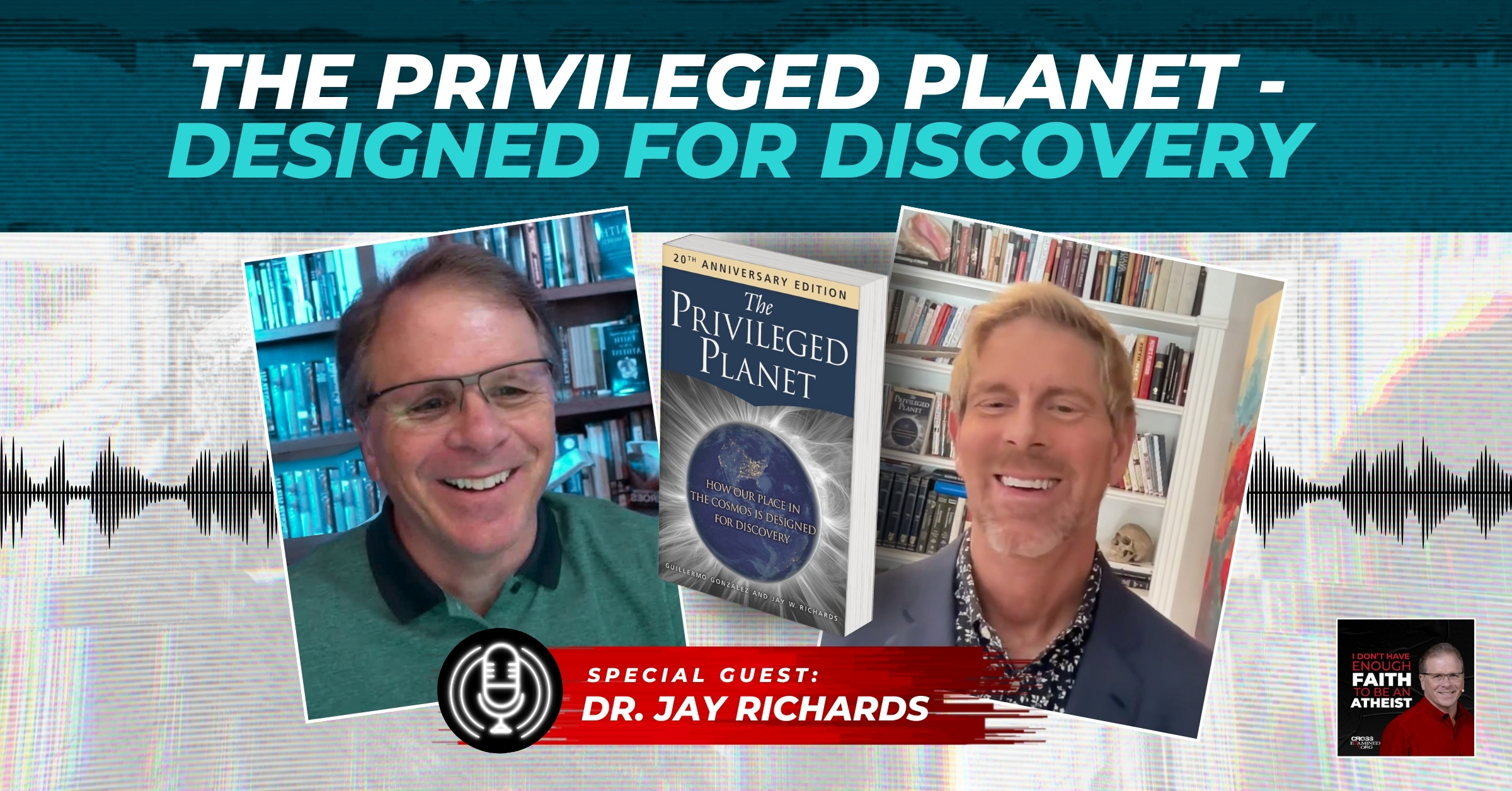
The fine-tuning of the universe is one of the most compelling arguments for Intelligent Design—so compelling that even atheists like Richard Dawkins and the late Christopher Hitchens have acknowledged its challenge to materialistic explanations. Why is the fine-tuning argument so extraordinary, and how have recent scientific discoveries made it even clearer that the universe points to a divine Creator?

This week, Dr. Jay Richards joins Frank to discuss the 20th anniversary edition of ‘The Privileged Planet: How Our Place in the Cosmos Is Designed for Discovery‘, the groundbreaking book he co-authored with Dr. Guillermo Gonzalez. Together, they explore the updated book and the remarkable new scientific discoveries that continue to affirm its hypothesis. During their conversation, they’ll address:

  • How did Guillermo’s career suffer when the book was first released in 2004?
  • What updates have been made to the 20th anniversary edition?
  • What is the likelihood that life exists on other planets?
  • How is materialism a self-defeating worldview?
  • What is the cosmological constant and what type of precision is required in order for a planet to be able to sustain life?
  • How probable is a multiverse?
  • What’s so special about “perfect” solar eclipses?
  • What are the most common atheist objections to fine-tuning and our privileged position in the Universe?

If you’re looking for a good stocking stuffer this Christmas, grab the 20th Anniversary Edition of ‘The Privileged Planet‘, a book and documentary film that continues to stand the test of time and compels readers to acknowledge how the complexity and fine-tuning of the universe couldn’t possibly be the result of a cosmic accident. And be sure to stay tuned for an update on the Kingdom AI Project that’s helping CrossExamined to place apologetics resources around the globe as a result of your continued support!

Did you enjoy this episode? HELP US SPREAD THE TRUTH OF CHRISTIANITY BY SUPPORTING THE PODCAST HERE.

Resources mentioned during the episode:

The Privileged Planet Website: https://privilegedplanet.com/

The Privileged Planet 20th Anniversary Book: https://www.discovery.org/b/privileged-planet/

The Privileged Planet Video on Demand: https://go2rpi.com/privileged-planet-vod/

Follow Dr. Jay Richards on X: https://x.com/DrJayRichards

By Brian Chilton

Recently, news agencies filled the airwaves and the internet with the news of Stephen Hawking’s last book to be published and released posthumously. The book released on October 16, 2018, is entitled Brief Answers to the Big Questions. Hawking argues through a series of essays why he didn’t think that God existed, did not think it was possible for God to exist, and did not believe in an afterlife. He appeals to quantum mechanics and the bizarre behavior of quantum particles which seemingly appear to pop into existence from nothing to argue his case. However, it should be noted that quantum particles do not really pop into existence from nothing as philosophically understood to be “no-thing.” Rather, quantum particles derive from a quantum vacuum—a very physical thing with very physical properties and processes. Thus, while admittedly I am not a physicist nor a physicist’s son, Hawking’s claim is not honest with the scientific data.

This causes one to ask, do we have good reasons to believe in God’s existence? I would like to propose ten reasons why we can believe that he does. To be forthright, there are many, many more. These represent some of the more popular reasons to believe that there really is a God who transcends reality and a few that I think stand to reason by the very nature of the way the world works.

  1. Necessity of a First Cause (Cosmological Argument). Physicists Borde, Guth, and Vilenkin discovered a mathematical theorem which dictates that all physical universes, including the theoretical multiverse, must have a required starting point. There was a time when physics (even quantum physics), time, and matter did not exist. How did it come to be? Atheists will argue that it just is. However, the data seems to suggest that an eternal, metaphysical (beyond the physical realm), Mind brought everything to be. That Mind would need to be omnipotent, omnipresent, and omniscient. That Mind is who we know to be God.
  2. Designed Creation (Teleological Argument). Hugh Ross has argued that there are over 180 cosmological constants in the universe so finely tuned that if they were to be changed by the nth degree, life and the universe itself would not exist. Even the theoretical multiverse would need to be designed to such a degree that it would require a designer. I believe wholeheartedly that physicists will eventually find design attributes and constants in the quantum realm if they haven’t already. Design argues for a Designer.
  3. Objective Morality (Moral Argument). Leaving the scientific realm for the philosophical and ethical, objective morality argues for an Objective Lawgiver. God is the best explanation for why objective morality exists. As Brian Manuel, a good friend of mine, said recently, “We can just know certain things to be right and wrong without even being taught.” He is absolutely right! People have an innate sense of morality. That comes from a Moral Lawgiver who we know to be God.
  4. Necessary Being (Ontological Argument). In the end, one only has two options. Either an eternal nothingness (meaning again, “no-thing,” not even quantum particles) brought forth something from absolute nothingness, or an eternal Being brought everything that exists into being. The latter makes far more sense and actually adheres more to the scientific method than the former.
  5. Explanation for Data (Information Argument). Why is there anything at all? Even though the quantum world is a strange place, it still behaves according to certain laws. Why are there quantum particles? Quantum fields? Why do physical processes and procedures exist? One explanation: God. For any data to exist, a programmer must exist. That Programmer must be God himself.
  6. Science and Mathematics. Ironically, the scientific method and mathematics appeal to God’s existence. Scientists hold that the universe operates according to certain laws on a regular basis. The ability to do science itself means that human beings have been given cognitive abilities to observe the universe and, interestingly, have been placed in a position where the universe is observable. One must inadvertently appeal to the divine to even do science and mathematics. To add to this point, the beauty one finds in nature would have no real aesthetic value unless God exists.
  7. Historicity of Jesus’s Resurrection. One of the most historically provable events of ancient history is Jesus’s crucifixion and resurrection. Jesus’s resurrection is quite intriguing because he continuously appealed to God the Father to raise him from the dead. For Jesus to have risen from the dead indicates that the one whom he mentioned did what Jesus claimed he would do. The resurrection of Jesus points to a transcendent reality we call God.
  8. Miracles and Spiritual Encounters. Craig Keener wrote a two-volume work describing the many documented miracles in modern times. While God may not always perform a miracle in every circumstance, a good deal of evidence suggests that God has performed miracles throughout history. Added with the many spiritual encounters people have had with the divine provides an added case that God does indeed exist.
  9. Near-Death Experiences and Consciousness. This is a fascinating area of study. Gary Habermas has noted that there are over 100 medically confirmed cases of near-death experiences where people have died and reported events that happened on this side of eternity which could be corroborated by others. The events described along with experiences of meeting God and the feelings of peace add to the case for God’s existence. Most certainly near-death experiences prove that materialism is a dead philosophy.
  10. Purpose and Meaning. For anything to have purpose and meaning, God must exist. If Hawking is right in that the universe is all there is and there is nothing else, nothing, including his research, has any meaning or value. Meaning, value, and purpose are found only because God exists.

I could certainly list other reasons to believe in God’s existence. But these will suffice for now. Hawking was a man of great intellect. Yet, despite his great mental prowess, it is quite odd that he could never quite see the evidence for God. While he could see, he was quite blind. Hawking said that “religion is a fairy tale for those afraid of the dark.” I believe John Lennox provided a stronger claim by noting that “atheism is a fairy tale for those afraid of the light.”


Brian G. Chilton is the founder of BellatorChristi.com and is the host of The Bellator Christi Podcast. He received his Master of Divinity in Theology from Liberty University (with high distinction); his Bachelor of Science in Religious Studies and Philosophy from Gardner-Webb University (with honors); and received certification in Christian Apologetics from Biola University. Brian is currently enrolled in the Ph.D. program in Theology and Apologetics at Liberty University and is a member of the Evangelical Theological Society and the Evangelical Philosophical Society. Brian has been in the ministry for over 15 years and serves as the Senior Pastor of Westfield Baptist Church in northwestern North Carolina.

Original Blog Source: http://bit.ly/2qcNP6q

By Wintery Knight

Prior to certain scientific discoveries, most people thought that the universe had always been here, and no need to ask who or what may have caused it. But today, that’s all changed. Today, the standard model of the origin of the universe is that all the matter and energy in the universe came into being in an event scientists call “The Big Bang.” At the creation event, space and time themselves began to exist, and there is no material reality that preceded them.

So a couple of quotes to show that.

An initial cosmological singularity… forms a past temporal extremity to the universe. We cannot continue physical reasoning, or even the concept of spacetime, through such an extremity… On this view, the big bang represents the creation event; the creation not only of all the matter and energy in the universe but also of spacetime itself.

Source: P. C. W. Davies, “Spacetime Singularities in Cosmology,” in The Study of Time III, ed. J. T. Fraser (Berlin: Springer Verlag).

And another quote:

[A]lmost everyone now believes that the universe, and time itself, had a beginning at the big bang.

Source: Stephen Hawking and Roger Penrose, The Nature of Space and Time, The Isaac Newton Institute Series of Lectures (Princeton, N. J.: Princeton University Press, 1996), p. 20.

So, there are several scientific discoveries that led scientists to accept the creation event, and one of the most interesting and famous is the discovery of the cosmic microwave background radiation.

Here’s the history of how that discovery happened, from the American Physical Society website:

Bell Labs radio astronomers Arno Penzias and Robert Wilson were using a large horn antenna in 1964 and 1965 to map signals from the Milky Way when they serendipitously discovered the CMB. As written in the citation, “This unexpected discovery, offering strong evidence that the universe began with the Big Bang, ushered in experimental cosmology.” Penzias and Wilson shared the Nobel Prize in Physics in 1978 in honor of their findings.

The CMB is “noise” leftover from the creation of the Universe. The microwave radiation is only 3 degrees above Absolute Zero or -270 degrees C,1 and is uniformly perceptible from all directions. Its presence demonstrates that our universe began in an extremely hot and violent explosion, called the Big Bang, 13.7 billion years ago.

In 1960, Bell Labs built a 20-foot horn-shaped antenna in Holmdel, NJ to be used with an early satellite system called Echo. The intention was to collect and amplify radio signals to send them across long distances, but within a few years, another satellite was launched, and Echo became obsolete.2

With the antenna no longer tied to commercial applications, it was now free for research. Penzias and Wilson jumped at the chance to use it to analyze radio signals from the spaces between galaxies.3 But when they began to employ it, they encountered a persistent “noise” of microwaves that came from every direction. If they were to conduct experiments with the antenna, they would have to find a way to remove the static.

Penzias and Wilson tested everything they could think of to rule out the source of the radiation racket. They knew it wasn’t radiation from the Milky Way or extraterrestrial radio sources. They pointed the antenna towards New York City to rule out “urban interference,” and did an analysis to dismiss possible military testing from their list.4

Then they found droppings of pigeons nesting in the antenna. They cleaned out the mess and tried removing the birds and discouraging them from roosting, but they kept flying back. “To get rid of them, we finally found the most humane thing was to get a shotgun…and at the very close range [we] just killed them instantly. It’s not something I’m happy about, but that seemed like the only way out of our dilemma,” said Penzias.5 “And so the pigeons left with a smaller bang, but the noise remained, coming from every direction.”6

At the same time, the two astronomers learned that Princeton University physicist Robert Dicke had predicted that if the Big Bang had occurred, there would be low-level radiation found throughout the universe. Dicke was about to design an experiment to test this hypothesis when he was contacted by Penzias. Upon hearing of Penzias’ and Wilson’s discovery, Dicke turned to his laboratory colleagues and said: “well boys, we’ve been scooped.”7

Although both groups published their results in Astrophysical Journal Letters, only Penzias and Wilson received the Nobel Prize for the discovery of the CMB.

The horn antenna was designated a National Historic Landmark in 1990. Its significance in fostering a new appreciation for the field of cosmology and a better understanding of our origins can be summed up by the following: “Scientists have labeled the discovery [of the CMB] the greatest scientific discovery of the 20th century.”8

It’s the greatest scientific discovery of the 20th century.

In the New York Times, Arno Penzias commented on his discovery – the greatest discovery of the 20th century – so:

The best data we have [concerning the Big Bang] are exactly what I would have predicted, had I nothing to go on but the five books of Moses, the Psalms, the Bible as a whole.

Just one problem with the greatest scientific discovery of the 20th century: atheists don’t accept it. Why not?

Here’s a statement from the Secular Humanist Manifesto, which explains what atheists believe about the universe:

Religious humanists regard the universe as self-existing and not created.

For a couple of examples of how atheistic scientists respond to the evidence for a cosmic beginning, you can check out this post, where we get responses from cosmologist Lawrence Krauss and physical chemist Peter Atkins.

You cannot have the creation of the universe be true, AND a self-existing, eternal universe ALSO be true. Someone has to be wrong. Either the science is wrong, or the atheist manifesto is wrong. I know where I stand.

Positive arguments for Christian theism


Original Blog Source: http://bit.ly/2OyLGNv

Richard Dawkins, the famous English evolutionary biologist and renowned atheist, revived an objection related to God’s existence in his book, The God Delusion. In the fourth chapter (Why There Almost Certainly Is No God), Dawkins wrote, “…the designer hypothesis immediately raises the larger problem of who designed the designer. The whole problem we started out with was the problem of explaining statistical improbability. It is obviously no solution to postulate something even more improbable.” In essence, Dawkins offered a restatement of the classic question, “Who created God?” On its face, this seems to be a reasonable question. Christians, after all, claim God created everything we see in our universe (all space, time and matter); He is the cause of our caused cosmos. Skeptics fail to see this as a satisfactory explanation, however, because it seems to beg the question, “If God, created the universe, who (or what) created God?”

Part of the problem lies in the nature of the question itself. If I were to ask you, “What sound does silence make?” you’d start to appreciate the problem. This latter question is nonsensical because silence is “soundless”; silence is, by definition, “the lack of sound”. There’s something equally irrational about the question, “Who created God?” God is, by definition, eternal and uncreated. It is, therefore, illogical to ask, “Who created the uncreated Being we call God?” And, if you really think about it, the existence of an uncreated “first cause” is not altogether unreasonable:

It’s Reasonable to Believe The Universe Was Caused
Famed astronomer Carl Sagan once said, “The Cosmos is everything that ever was, is and will be.” If this is true, we are living in an infinitely old, uncaused universe that requires no first cause to explain its existence. But there are good scientific and philosophical reasons to believe the universe did, in fact, begin to exist. The Second Law of Thermodynamics, the expansion of the universe, the Radiation Echo, and the problem of Infinite Regress cumulatively point to a universe with a beginning. In the classic formulation of the Kalam cosmological argument: (1) whatever begins to exist has a cause, (2) the universe began to exist, therefore, (3) it is reasonable to believe the universe has a cause.

It’s Reasonable to Accept the Existence of An Uncaused “First Cause”
This “first cause” of the universe accounts for the beginning of all space, time and matter. It must, therefore, be non-spatial, a temporal and immaterial. Even more importantly, the first cause must be uncaused. If this was not true, the cause of the universe would not be the “first” cause at all. Theists and atheists alike are looking for the uncaused, first cause of the cosmos in order to avoid the irrational problem of an infinite regress of past causes and effects. It is, therefore, reasonable to accept the existence of an uncaused, first cause.

It’s Reasonable to Believe God Is the Uncaused, “First Cause”
Rationality dictates the ultimate cause of the universe, (even if it isn’t God), must have certain characteristics. In addition to being non-spatial, a temporal, immaterial and eternal (uncaused), it must also be powerful enough to bring everything into existence from nothing. Finally, there is good reason to believe the cause of the universe is personal. Impersonal forces cannot cause (or refuse to cause) at will. The minute an impersonal force exists, its effect is experienced. When the impersonal force of gravity is introduced into an environment, for example, its effect (the gravitational attraction) is felt immediately. If the cause of the universe is simply an impersonal force, its effect (the beginning of the universe) would occur simultaneous with its existence. In other words, the cause of the universe would only be as old as the universe itself. Yet we accept the reasonable existence of an uncaused first cause (one that is not finite like the universe it caused). For this reason, a personal force, capable of willing the beginning of the universe, is the best explanation for the first cause of the cosmos. This cause can be reasonably described as non-spatial, a temporal, immaterial, eternal, all-powerful and personal: descriptive characteristics commonly reserved for the Being we identify as God.

All of us, whether we are atheists or theists, are trying to identify the first cause of the universe. The eternal nature of this non-spatial, a temporal, immaterial cause is required in order to avoid the problem of infinite regress. It is, therefore, irrational to ask “What caused the uncaused first cause?” It is far more reasonable to simply recognize the attributes of this cause as an accurate description of God.

J. Warner Wallace is a Cold-Case Detective, Christian Case Maker, Senior Fellow at the Colson Center for Christian Worldview, and the author of Cold-Case Christianity, Cold-Case Christianity for Kids, God’s Crime Scene, God’s Crime Scene for Kids, and Forensic Faith.

Comment or Subscribe to J. Warner’s Daily Email