Tag Archive for: Christianity

Atheist Richard Dawkins has declared, “The universe we observe has precisely the properties we should expect if there is at the bottom, no design, no purpose, no evil, and no good. Nothing but blind pitiless indifference… DNA neither knows nor cares. DNA just is, and we dance to its music.”

But Dawkins doesn’t act like he actually believes that. He recently affirmed a woman has the right to choose an abortion and asserted that it would be “immoral” to give birth to a baby with Down syndrome. According to Dawkins, the “right to choose” is a good thing and giving birth to Down syndrome children is a bad thing.

Well, which is it? Is there really good and evil, or are we just moist robots dancing to the music of our DNA?

Atheists like Dawkins are often ardent supporters of rights to abortion, same-sex marriage, taxpayer-provided healthcare, welfare, contraceptives, and several other entitlements. But who says those are rights? By what objective standard are abortion, same-sex marriage, same-sex adoption, taxpayer-provided healthcare, and the like, moral rights? There isn’t such a standard in the materialistic universe of atheism. So atheists must steal the grounds for objective moral rights from God while arguing that God doesn’t exist.

Now, I am not saying that you have to believe in God to be a good person or that atheists are immoral people. Some atheists live more moral lives than many Christians. I am also not saying that atheists don’t know morality. Everyone knows basic right and wrong whether they believe in God or not. In fact, that’s exactly what the Bible teaches (see Romans 2:14-15).

What I am saying is that atheists can’t justify morality. Atheists routinely confuse knowing what’s right with justifying what’s right. They say it’s right to love. I agree, but why is it right to love. Why are we obligated to do so? The issue isn’t how we know what’s Right, but why an authoritative standard of Rightness exists in the first place.

You may come to know about objective morality in many different ways: from parents, teachers, society, your conscience, etc. And you can know it while denying God exists. But that’s like saying you can know what a book says while denying there’s an author. Of course, you can do that, but there would be no book to know unless there was an author! In other words, atheists can know objective morality while denying God exists, but there would be no objective morality unless God exists.

If material nature is all that exists, which is what most atheist’s claim, then there is no such thing as an immaterial moral law.  Therefore, atheists must smuggle a moral standard into their materialistic system to get it to work, whether it’s “human flourishing,” the Golden Rule, doing what’s “best” for the most, etc. Such standards don’t exist in a materialistic universe where creatures just “dance” to the music of their DNA.

Atheists are caught in a dilemma. If God doesn’t exist, then everything is a matter of human opinion and objective moral rights don’t exist, including all those that atheists support. If God does exist, then objective moral rights exist. But those rights clearly don’t include cutting up babies in the womb, same-sex marriage, and their other invented absolutes contrary to every major religion and natural law.

Now, an atheist might say, “In our country, we have a constitution that the majority approved. We have no need to appeal to God.” True, you don’t have to appeal to God to write laws, but you do have to appeal to God if you want to ground them in anything other than human opinion. Otherwise, your “rights” are mere preferences that can be voted out of existence at the ballot box or at the whim of an activist judge or dictator. That’s why our Declaration of Independence grounds our rights in the Creator. It recognizes the fact that even if someone changes the constitution you still have certain rights because they come from God, not man-made law.

However, my point isn’t about how we should put objective God-given rights into human law. My point is, without God, there are no objective human rights. There is no right to abortion or same-sex marriage. Of course, without God, there is no right to life or natural marriage either!

In other words, no matter what side of the political aisle you’re on — no matter how passionate you believe in certain causes or rights — without God they aren’t really rights at all. Human rights amount to no more than your subjective preferences. So atheists can believe in and fight for rights to abortion, same-sex marriage, and taxpayer-provided entitlements, but they can’t justify them as truly being rights.

In fact, to be a consistent atheist — and this is going to sound outrageous, but it’s true — you can’t believe that anyone has ever actually changed the world for the better. Objectively good political or moral reform is impossibleif atheism is true. Which means you have to believe that everything Wilberforce, Lincoln, and Martin Luther King did to abolish slavery and racism wasn’t really good; it was just different. It means you have to believe that rescuing Jews from the ovens was not objectively better than murdering them. It means you have to believe that gay marriage is no better than gay bashing. (Since we’re all just “dancing to our DNA,” the gay basher was just born with the anti-gay gene. You can’t blame him!) It means you have to believe that loving people is no better than raping them.

You may be thinking, “That’s outrageous! Racism, murder, assault, and rape are objectively wrong, and people do have a right not to be harmed!” I agree. But that’s true only if God exists. In an atheistic universe, there is nothing objectively wrong with anything at any time. There are no limits. Anything goes. Which means to be a consistent atheist you have to believe in the outrageous.

If you are mad at me for these comments, then you agree with me in a very important sense. If you don’t like the behaviors and ideas I am advocating here, you are admitting that all behaviors and ideas are not equal — that some are closer to the real objective moral truth than others. But what is the source of that objective truth? It can’t be changeable, fallible human beings like you or me. It can only be God whose unchangeable nature is the ground of all moral value. That’s why atheists are unwittingly stealing from God whenever they claim a right to anything.

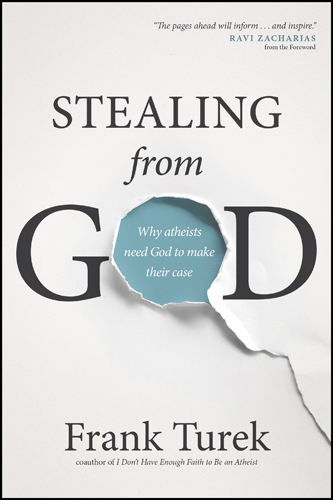
But how do we know that’s the Christian God? Doesn’t he do evil in the Old Testament? And what about the “separation of church and state”? Those are some of the many questions I address in my new book, Stealing from God: Why atheists need God to make their case, from which this column was adapted.
Atheists Steal Rights From God


Dr. Frank Turek (D.Min.) is an award-winning author and frequent college speaker who hosts a weekly TV show on DirectTV and a radio program that airs on 186 stations around the nation.  His books include I Don’t Have Enough Faith to be an Atheist and Stealing from God:  Why atheists need God to make their case

God has commanded us as women not only to share that we believe in Jesus Christ but also the reasons why. Here are some evidences in scripture that God has called women to learn and share the evidential reasons for believing in Christianity, which is the ministry of apologetics. Think of the five R’s:

1. We as women are created as rational beings who are called to love the Lord our God not only with our hearts, but also our souls, and minds (Matthew 22:37). Our trust in Christ is grounded not in blind emotion, but in an intellectual appraisal of evidence that has convinced us of the truth of Christianity and given rise to a reasonable faith. Luke 10:38-42 records Christ’s visit to the home of two women named Mary and Martha. When Martha complained that Mary was a slacker for not helping prepare the meal, Jesus praised Mary for listening to his teaching. Though he likely appreciated Martha’s efforts in the kitchen, we can reasonably infer that he affirmed Mary’s intellectual curiosity and commitment to pursuit of truth.

2. We as women are relational beings who are called to love our neighbors as ourselves (Matthew 22:39). Our neighbors include people in our spheres of influence, starting with immediate family members. For instance, God urges us to love and respect our husbands (see Ephesians 5). How can apologetics strengthen our marriage? If our husband is a believer, we can affirm the truths to build his faith as well as our own, and help him when he struggles with doubts. What about those of us who are married to unbelieving husbands? When we learn the evidence for our faith, even if our husband is hostile to Christian claims, we can love him while not being shaken in our own faith. We don’t use knowledge as a weapon against him. Instead, we are freed from defensiveness to practice 1 Peter 3:1-4, seeking to live out before our husband a life transformed by Christ so that he “may be won by [her] conduct.” Former atheist and author of The Case for Christ Lee Strobel said his wife became a believer, and the change in the way she treated him and the children was so appealing that he embarked on his own search and eventually trusted Christ.

Another relationship in which apologetics can be helpful is with our children. Titus 2: 5 describes women as “keepers” at home who teach their children. “Keeping” implies watching over or guarding. Apologetics knowledge equips us to watch over and influence our children’s worldviews. Before we can guard our children’s worldviews, we must first learn what a worldview is, the evidence that affirms the truth of the Christian worldview, the assertions of other worldviews, and how to respond to those assertions to show that  Christianity makes the most sense. That’s apologetics. Then, when our child comes home from school saying her friend is a Hindu, for instance, we can answer when she asks why Hindus have shrines in their homes and Christians don’t.

Our relationships with other women can also become redemptive and edifying, as we seek to introduce unbelieving friends to Christ and to mentor younger women in the faith to mature in their relationship with Christ. Titus 3:2-5 asks us as maturing women to be “teachers of good things” (NKJV) to women coming along behind us. We can’t opt out of this call. Younger women desperately need us to take them under our wings and encourage them to live for Christ in a culture becoming increasingly hostile to Christianity. Finally, women are uniquely equipped to engage unbelieving women in faith conversations. For some groups of women, our willingness to engage them is their only hope for hearing about Christ in an understandable way. For example, only Christian women can reach Muslim women who are not comfortable talking to men.

3. We as women are responsible to bear witness of what we have seen and heard regarding Christ’s identity and resurrection, and the numerous evidences for Christianity God has instilled within the created order. According to Mark 16:1-11, women first witnessed the empty tomb and were instructed to go tell others. If Jesus entrusted women with the responsibility for speaking the truth about the single most pivotal event in human history, then we, too, can bear witness. And we can share not only our personal experience with Jesus Christ as the women at the tomb did, but also the historical, scientific, and philosophical evidence provided for us by our loving God. In so doing, we as women fulfill his command to make disciples of all nations (Matthew 28:19-20).

4. We as women are called to be ready to give cogent reasons for our beliefs, even if we must suffer to do so. 1 Peter 3:15-17, a banner scripture for apologetics, tells us to “always be ready to give a defense to everyone who asks you a reason for the hope that is in you, with meekness and fear; having a good conscience, that when they defame you as evildoers, those who revile your good conduct in Christ may be ashamed. For it is better, if it is the will of God, to suffer for doing good than for doing evil” (NKJV). It is interesting that in the first seven verses of 1 Peter 3 he addresses first husbands and then wives. Then, in verse eight, which culminates in the command of verses 15-17, Peter says, “Finally, all of you,” including both men and women in his subsequent appeal. So, both men and women are called and honored to participate in Christ’s suffering in defense of the faith.

5. Finally, we as Christian women are to be renewed in the spirit of our minds (Ephesians 4:11-24). We do not have to remain babies in Christ, not understanding the basics of our faith, and being easily swayed. A friend once told me after reading The DaVinci Code that she wished she had never read it because it caused her to doubt. When we fail to renew the spirit of our minds with truth, we are tossed about with every new doctrine that arrives on the scene. Apologetics knowledge grounds our beliefs in strong evidence and makes our faith in Christ the most reasonable response to a God who has saturated the universe with witnesses to his presence and character.

So, when someone asks us why we think God wants women to do apologetics, we can share the five R’s. We can explain that God made women rational and relational beings, endowed us as responsible bearers of the truth, and provided the knowledge with which to ready ourselves and be renewed in our minds so that we share the overwhelming evidence that Christianity is true.

In my previous blog I defended the notion that it’s not stupid to believe in the creation of the universe by God. It seems fitting in this Christmas season to also look at another claim derided by skeptics – the possibility of miracles. Here is how Richard Dawkins puts it:

“The nineteenth century is the last time when it was possible for an educated person to admit to believing in miracles like the virgin birth without embarrassment. When pressed, many educated Christians are too loyal to deny the virgin birth and the resurrection. But it embarrasses them because their rational minds know that it is absurd, so they would much rather not be asked.[1]”

There certainly are educated, intelligent, science-respecting modern-day Christians who unashamedly believe in these miracles[2]. There is nothing irrational or anti-scientific about the possibility of miracles unless one can disprove the existence of anything supernatural which certainly has not been done. Contra Hume, I don’t see a non-question-begging in-principle argument against the mere possibility of miracles[3]. In previous blogs, I’ve argued that the origin of the universe and the fine-tuning of the laws and constants of nature to support life constitute evidence for God. There are many other philosophical arguments for a transcendent God capable of acting on nature – which is all I take a miracle to be. Miracles don’t break the laws of nature[4] but merely represent God acting in the universe. If we have evidence of intervention at such fundamental levels as creating a universe, setting up its initial conditions, and setting fundamental parameters to precise life-permitting values, then why think it irrational that God could create a sperm to fertilize Mary’s egg? The skeptic needs to interact with these and other arguments and should not merely dismiss the possibility of miracles by ridiculing believers – as Dawkins advocated when he said “Mock them. Ridicule them. In public.”

I’m not complaining about considering a miracle claim a priori unlikely – I actually encourage that since miracles should be expected to be rare if they occur at all. Rather, I argue against a dismissive attitude characterized by ridiculing the possibility of miracles without interacting with the evidence or arguments for God’s existence. Merely scoffing at the potential implications that miracles are possible if God exists does not disprove the hypothesis that God exists.

Even leading scientists and philosophers who are skeptical about God propose a number of speculative theories with some rather surprising implications. I likewise argue we should not dismiss the possibility that these theories are true merely because of even bizarre consequences, which in some cases are more radical than the possibility of God acting in the world. Consider the following theories:

Aliens seeded life on earth

  • Dawkins mentions this possibility in the movie Expelled.
  • Nobel Prize winner Francis Crick wrote a book that proposes this scenario to explain life’s origins on Earth.[5]
  • Implications: if this hypothesis were true, a form of Intelligent Design (ID) would be true – to some skeptics that is about as bizarre as you can get![6]

Our universe originated from a quantum fluctuation

  • Edward Tryon first proposed this and Lawrence Krauss has proposed a more recent version of this theory.
  • Implications: the entire universe would have originated from what appears to be “empty” spacetime – at least as empty as it can be made. Note that it’s more likely for a single sperm to fluctuate into existence to impregnate a virgin than it is for a huge, long-lived universe such as ours to fluctuate into existence.
  • Why I’m skeptical? I’m not skeptical because the emergence of matter from spacetime in its lowest energy state may be counterintuitive for this certainly does happen! Although virtual particles are known to emerge from rearrangements of the energy in the quantum vacuum, large fluctuations are exponentially less likely than small fluctuations – and we have quite a large universe! Likewise, the emergence of long-lasting fluctuations are exponentially less likely than short-lived fluctuations where the emergent matter is converted back to energy – and we have quite a long-lived universe! Thus this theory makes predictions inconsistent with our universe (even after applying a selection effect based on the universe permitting life). Here is my critique of Krauss’s proposal in more detail.

It is probable that we’re living in a simulation

  • Nick Bostrom proposed this argument in 2001.
  • Implications: everything is an illusion and The Matrix movie tells us more about reality than all science textbooks combined.
  • The Wikipedia article linked to above has some decent critiques of this proposal but here is a nice critique of this argument by a Stanford prof.

Eternal inflation

  • Eternal inflation is probably the leading multiverse theory. We have decent reasons for believing that there was an early rapid expansion phase in our universe which is dubbed cosmic inflation (although no physical mechanism has of yet been identified that could produce this inflaton field and only certain types of inflation would result in other universes). Certain theories for mechanisms of inflation could possibly create “bubble universes” with enormous fecundity – by some estimates about 12 million billion universes created per second. Many consider these implications to be absurd but I think we need to evaluate such proposals on the basis of the evidence for this flavor of inflation rather than on the implications of the theory.
  • Implications:
    • Vilenkin summarizes the radical implications by stating that “there are infinitely many O-regions where Al Gore is president and – yes! – Elvis is still alive.[7]”
    • There are identical copies of you (and everyone else) in other universes because there are more universes than there are possible events at the quantum level and thus materialist assumptions everything is repeated an infinite number of times in an infinite multiverse.
    • There are universes in which everything is identical except that you wrote this article and I’m reading it now.

Many Worlds Interpretation of Quantum Mechanics

There are many possible interpretations of quantum mechanics that are consistent with the math but in this radical interpretation reality branches out like a tree where every possible quantum outcome happens in one branch of the tree which constitutes a sort of parallel universe. The implications of this theory are basically just as radical as those described above for eternal inflation.

Everything that is mathematically possible is realized somewhere in the universe

  • MIT physicist Max Tegmark, who has done some important research validating various fine-tuning claims, adopts this radical viewpoint.
  • Implications: this is even more radical than the previous theories because it would entail not just that all physical possibilities but that all metaphysical possibilities are realized somewhere. There would be uncountable infinities of infinite multiverses of infinitely different types! Unicorns, fire-breathing dragons, and all science-fiction characters would certainly exist somewhere in this multiverse!
  • Why I’m skeptical: In this case perhaps the implications do lead to a reductio ad absurdum but one can also argue strongly against the theory itself. The overwhelming number of life-permitting universes within this overall universe would not have concise physical laws with minimal parameters since there are vastly more ways to have much more complex laws of nature that could still permit life – Occam ’s razor would not be a fruitful heuristic! You wouldn’t have Nobel Prize-winning physicists waxing eloquent about the beauty and simplicity of physics and how that is a guide to true theories.[8]

I am skeptical of all of these theories but I don’t think we should dismiss any of them merely because their radical implications seem implausible. In the same way, one shouldn’t dismiss the possibility of God even if miracles seem too implausible to you. One should examine the evidence for these theories relative to their predictions and relative to alternate theories – i.e. by employing abductive reasoning (an inference to the best explanation). I think that many of these speculative proposals are inferior alternatives to the hypothesis that God created the universe and finely-tuned the physics to support life and are actually posited to some degree as alternatives to evidence for design. Naturalistic presuppositions seem to play some role in motivating many of these speculative theories, with the probable exception of the Many Worlds Interpretation (which I think is by far the most likely of any of these to actually be true – which isn’t saying much though).

By unjustifiably endowing what is created with god-like powers, perhaps some skeptics are falling into a modern-day version of the trap that the apostle Paul warned about in Romans 1:25 where he talks about people who “worshiped and served the creature rather than the Creator.”

Agnostic physicist Paul Davies also warns about “the most general multiverse theories … At least some of these universes will feature miraculous events – water turning into wine, etc. They will contain thoroughly convincing religious experiences … [that would look like] … a direct revelation of a transcendent God. It follows that a general multiverse set must contain a subset that conforms to traditional religious notions of God and design.[9]” In trying to deny evidence for God, some skeptics have had to so broaden their ontology as to enable the possibility of miracles after all!

[1] Dawkins, The God Delusion, p. 187.

[2] Francis Collins, John Lennox, John Polkinghorne, Mike Strauss, Don Page, Henry Schaefer, James Tour, etc.

[3] I think Hume’s arguments failed if you disagree consider agnostic John Earman’s book entitled Hume’s Abject Failure.

[4] “Nothing can seem extraordinary until you have discovered what is ordinary. Belief in miracles, far from depending on an ignorance of the laws of nature, is only possible in so far as those laws are known.” C.S. Lewis, Miracles

[5] I think he later backed away from this proposal but at one time he thought it was plausible enough to make a focal point for a book he wrote.

[6] Parenthetically, note that this possibility also shows an example of what ID advocates point out – that intelligent design (at least in biology) doesn’t necessarily even require the supernatural and thus should not be precluded from scientific consideration.

[7] Vilenkin, Many Worlds in One, p. 113. This is actually a quote from an article Vilenkin wrote for a physics journal.

[8] See Eugene Wigner’s famous essay on The Unreasonable Effectiveness of Mathematics in the Natural Sciences. https://www.dartmouth.edu/~matc/MathDrama/reading/Wigner.html. Also, see how Weinberg regards beauty as a guide to finding the correct physical theories: http://www.pbs.org/wgbh/nova/elegant/view-weinberg.html. Or refer to this essay for a historical review: http://www.huffingtonpost.com/david-h-bailey/why-mathematics-matters_b_4794617.html

[9] Bernard Carr (ed.), Universe or Multiverse, p. 495.

Such was the name for a talk recently given at UT Dallas by Robert C. Koons, a philosophy professor from UT Austin. Actually, Koons is currently a visiting scholar at Princeton but took time out of his busy schedule to make a special trip to the Dallas area to speak on our campus.1  I was originally wondering whether or not Koon’s requested title might be over-stating the theistic case by claiming to be a “proof.” Wanting to be conservative in our claims, I added this footnote on our poster used for advertising the event:

“’Proof’ in the sense that the conclusion follows out of logical necessity if the premises are granted. Arguments are made for the truth of the premises but it is recognized that the premises cannot be proven with mathematical certainty.”

In retrospect perhaps this was probably unnecessary as everyone should know that even a valid proof is only as good as its premises. Even in math, axioms upon which proofs are based cannot themselves be proven. Gödel’s second incompleteness theorem shows that all but the most trivial mathematical systems cannot demonstrate their own consistency. But I think that Koon’s argument did rise to the level of what is meant by proof in philosophy. There are ways of resisting any proof, but the intellectual cost of denying a premise that nearly all people accept in other contexts is a high price to pay.

So what is this “new proof?” The overall argument Koons was making is actually one of the oldest around – a cosmological argument for God’s existence similar to that argued by ancient Greek and Roman philosophers, Jewish, Christian, Muslim thinkers, and even 10th-century Indian thinkers of the Nyaya School. However, Koons did present new arguments for the truth of the key premise of the argument.

Here is a video of Koon’s recent presentation on the UTD campus.

Summary

Here is my rough attempt to summarize Koons’ arguments but you really need to see the video for details. Koons started off by saying that if you can know that there is a hand with five fingers in front of you, then you can know that God exists. You know about your hand through empirical knowledge – by observation and memory, and the testimony of others. These are the same means that are necessary for scientific and historical reasoning. Anything that we know empirically is linked by a chain of causes. For example, sensory perception involves light being reflected into your eyes, stimulating your retina such that a message is sent through your optic nerve to the brain. Scientific reasoning infers causes from effects or effects from causes. If any of the steps involved in seeing your hand could occur without a cause, knowledge would be impossible.

Does everything have a cause?

Everything involved as a link in the chain of empirical knowledge must have a cause. If, for example, visual sensations could occur without any cause whatsoever, it would undermine our scientific inferences because such “uncaused” sensations would be completely unpredictable and would have a probability which could not be estimated. We would have good reason to think that we might be “Boltzmann brains” right now – with nothing but illusory sensations.

Empirical knowledge, such as knowing there is a hand in front of you with 5 fingers, is impossible unless we know that every step involved necessarily has a cause. We can’t know the principle that every step in a causal chain necessarily has a cause by empirical means (at least without vicious circularity). Thus, this type of minimal principle of sufficient reason must be a self-evident principle of reason. To doubt this is the unhealthy kind of doubt because it undermines all empirical knowledge.

However, surely there is one sort of thing that could fail to be caused without threatening empirical knowledge – things that are obviously uncausable. We here refer to things which are not just uncaused but self-evidently uncausable. If absolutely everything had a cause, then the network of causation would have to contain either loops (things that caused themselves) or infinite regresses. However, nothing can cause itself, since it would have to simultaneously both exist (in order to be the cause) and not exist (in order to be a potential effect). So if we can show the impossibility of an infinite regress of causes, then the contingent effects we see in the universe must ultimately trace back to an uncausable cause.

Analogies to Show the Impossibility of an Infinite Regress of Causes

Couldn’t there be an infinite regress of causes just extending back into the eternal past? Koon argues not and gives several examples of contradictions entailed by an infinite regress of causes:

1)      The Grim Reaper – this analogy was originally conceived by Jose Benardete in 1964 and modified slightly by Alexander Pruss.2  Consider a Grim Reaper (GR) who will kill Fred in 1 BC but if only if all other GRs failed to previously. Similarly, an additional GR will kill Fred in 2 BC if he is still alive in that year. There is a separate GR for each year prior to that with the same instructions going back into the infinite past. This story is possible if an infinite regress is possible. However, this scenario is not logically possible because it leads to a contradiction. At least one Grim Reaper has initiated a death warrant, since otherwise, all would have failed to do their duty. Suppose it was the N’th GR. But GR #N would have acted only if all earlier GR’s did not act. So both GR #(N+1) and GR #(N+2) did not act. But if GR #(N+2) and all earlier GRs did not act, then GR #(N+1) would have acted and thus a contradiction results. Thus we have a reductio ad absurdum, and an infinite regress is logically impossible.

2)      Even if an infinite regress was possible, an explanation would still be required according to a new argument by Alexander Pruss: http://alexanderpruss.blogspot.com/2013/06/cannonball-and-regress.html.

3)      Koons also provides a counter-example from considering an infinite fair lottery. See the video for details.

Koons then argued that the attributes that we can deduce for a first cause to the universe correspond to some of the key properties of God in classical theism. He also went on to cite some scientific evidence that points to a Creator from evidence for an origin to the universe and from the fine-tuning of the laws and constants of nature to be life-supporting.

Koons closes by saying that “my overall point here is [that] theistic metaphysics is not a competitor to empirical science. Quite the contrary, if you don’t buy into theistic metaphysics, you’re undermining empirical science. The two grew up together historically and are culturally and philosophically inter-dependent… If you say I just don’t buy this causality principle – that’s going to be a big big problem for empirical science.” This is a powerful argument for God’s existence – if you want to explore additional writings on this subject I recommend the following:

Powerpoint summary of a similar argument by Joshua Rasmussen

A paper by Alexander Pruss and Richard Gale published by Cambridge University Press

Notes

[1] He was coming from New Jersey anyway to Waco to participate in a philosophy conference at Baylor honoring Alvin Plantinga but made the special trip to Dallas.

[2] Jose Benardete’s Infinity: An Essay in Metaphysics (1964)

It’s been fashionable lately for atheists to claim that atheism is “a lack a belief in God.” So when a theist comes along and says that atheists can’t support their worldview, some atheists will say something like, “Oh, we really don’t have a worldview. We just lack a belief in God. Since we’re not making any positive claims about the world, we don’t have any burden of proof to support atheism. We just find the arguments for God to be lacking.”

What’s lacking are good reasons to believe this new definition.

First, if atheism is merely a lack of belief in God, then atheism is just a claim about the atheist’s state of mind, not a claim about God’s existence. The “atheist” is simply saying, “I’m not psychologically convinced that God exists.” So what? That offers no evidence for or against God. Most people lack a belief in unguided evolution, yet no atheist would say that shows evolution is false.

Second, if atheism is merely a lack of belief in God, then rocks, trees, and outhouses are all “atheists” because they too lack a belief in God. It doesn’t take any brains to “lack a belief” in something. A true atheist believes that there is no God.

Third, most atheists don’t merely “lack a belief in God because they are constantly trying to explain the world by offering supposed alternatives to God. Atheists write book after book insisting that God is out of a job because of quantum theory, multiple universes, and evolution. While none of those atheistic arguments succeed in proving there is no God, they do prove that atheists don’t merely lack a belief in God — they believe in certain theories to explain reality without God.

They believe in those theories because atheism is a worldview with beliefs just as much as theism is a worldview with beliefs. (A “worldview” is a set of beliefs about the big questions in life such as: What is an ultimate reality? Who are we? What’s the meaning of life? How should we live? What’s our destiny? etc.) To claim that atheism is not a worldview is like saying anarchy is not really a political position. As Bo Jinn observes, “An anarchist might say that he simply ‘rejects politics,’ but he is still confronted with the inescapable problem of how human society is to organize itself, whether he likes the idea of someone being in charge or not.”

Likewise, atheists can say they just “reject God” but they are still confronted with the inescapable problem of how to explain ultimate reality. Just as anarchists affirm the positive belief that anarchy is the best way to organize society, atheists affirm the positive belief that atheistic materialism is the best way to explain ultimate reality.

In other words, atheists don’t “lack a belief” in materialism. They are not skeptical of materialism — they think it’s true! As Phillip Johnson said, “He who is a skeptic in one set of beliefs is a true believer in another set of beliefs.” Lacking a belief in God doesn’t automatically establish materialism any more than lacking a belief in atheism automatically establishes Christianity. No atheist would say that a Christian has made a good case because he “lacks a belief” in materialism!

Everyone has the burden of proof to support his or her position. Atheists must make a positive case that only material things exist. That’s why instead of debating “Does God exist?” I prefer to debate the question “What better explains reality: atheism or theism?” Then it’s obvious that both debaters have the burden of proof to support their position. Atheists can’t just identify what they think are deficiencies in theism. They must make a compelling case that everything has been caused by materials and consists only of materials, including:

• The beginning of the universe
• The fine-tuning of the universe
• The laws of nature
• The laws of logic
• The laws of mathematics
• Information (genetic code)
• Life
• Mind and consciousness
• Free will
• Objective morality
• Evil

It’s rare to find an atheist attempting to explain more than one or two of these things materially. How could they? How can laws be materials? The new atheists must provide reasons to support their belief that materialism is true. Simply lacking a belief in God doesn’t prove their worldview.

Finally, the “I merely lack a belief in God” definition leads to a contradictory result. As Dr. Richard Howe points out, “This definition of atheism entails the quirky conclusion that atheism is logically compatible with theism.” Here’s why: If lacking a belief in God is the definition of “atheism” — and not “there is no God” — then “atheism” is true even if God really exists. How is that reasonable?

We shouldn’t allow atheists to hide behind that lacking definition. A true atheist is someone who believes there is no God. And atheists have the burden of proof to show how materialism is true and reality can be explained without God.


Dr. Frank Turek (D.Min.) is an award-winning author and frequent college speaker who hosts a weekly TV show on DirectTV and a radio program that airs on 186 stations around the nation.  His books include I Don’t Have Enough Faith to be an Atheist and Stealing from God:  Why atheists need God to make their case.

Some might say that science leaves no room for the supernatural and therefore it’s impossible for science to ever provide any evidence for God. Note that if such a claim is made then science could likewise never claim any evidence against God’s existence as it would be completely blind in that realm. There is actually a scientific effort underway to try to find intelligent life beyond earth. They’re looking for physical alien life forms but a search for supernatural intelligence shares much in common. Both types of searches seek to discover artifacts not produced by humans or natural processes.


Independent of how one defines science, however, science can support the truth of premises in philosophical arguments. That is what I would like to offer in this series – philosophical arguments for the existence of God where we have scientific support for the truth of key premises. We want to find the truth about origins without worrying about conventions concerning how to define science. As I previously blogged, science is not the only source of knowledge.

As another introductory blog in this series, I want to provide some background and lay down a foundation. Let’s start with the proper definition of evidence – evidence is not the same thing as proof. Science isn’t in the business of proving things and if you’re waiting for mathematical-type proofs before acting on evidence you’re going to be pretty idle because one almost never has such proof. Here is a fairly standard way of defining evidence: An observation is evidence for a hypothesis if the hypothesis is more likely given the observation than it would have otherwise been.

One can have some evidence for each of several different competing scientific explanations. In some cases, there is not yet enough evidence to determine which candidate hypothesis is true. Thus, evidence does not even necessarily make it more likely that the hypothesis is true than not. The combined evidence and prior probabilities can yield this assessment (from a Bayesian perspective). What I would like to do in this series is to present several different lines of evidence for God that together form a powerful cumulative case. Independent of one’s prior probability that God exists, each piece of evidence increases the likelihood that God exists. Each line of evidence can and should be assessed independently before combining all of the probability assessments. This is a standard Bayesian approach to probability. This series of blogs will be somewhat like a courtroom evaluation of some science-related evidence. I encourage you to interact with this evidence and the argument that it points to God.

There at least two general ways in which God might operate within the universe in detectable ways. First, God might directly intervene to do something beyond the laws of nature to bring about life or some intended feature of nature. This could be detected by finding some feature of nature that seems generally in accord with God’s purposes but which is very unlikely to be the product of natural processes. Secondly, God might setup the natural processes themselves and/or the initial conditions to bring about His purposes. This “fine-tuning” would be detectable evidence for God if these natural laws or initial conditions were constrained to a tiny range among possibilities. Some leading atheist thinkers agree that it’s possible to have this type of scientific evidence for God although they obviously resist the conclusion. Stephen Hawking admits in Brief History of Time that fine-tuning is possible evidence of “a divine purpose in Creation and the choice of the laws of science (by God)” Peter Millican, a prominent philosopher at Oxford, conceded in a debate with William Lane Craig that “if there is an inexplicable coincidence in the fundamental constants of nature whose values have to be precisely-tuned within a wide range of otherwise available possibilities that would make a complex universe possible then this constitutes a phenomenon that very naturally invites explanation in terms of a cosmic scale designer.”

I’ll discuss their responses to this evidence in a future blog but first I’d like to discuss a few possible pitfalls in the origins debate. Here are some problematic responses or arguments in this debate about God and design:

“Feature X is so complicated it must be designed”

This is not a good way to argue for design because it’s not really an argument at all. The theist needs to argue why natural processes would not be expected to account for feature X and why God would be expected to want such a feature.

“Science has no explanation for X, therefore God did it”

This is a “god of the gaps” argument, an argument from ignorance. Even in the Christian view, God has set up many natural processes and it’s highly inappropriate to assume by default that divine intervention is happening in every unknown situation.

Indiscriminately calling every argument for God a ‘god of the gaps’ argument

At the other extreme, the skeptic may reject any evidence that seems to point to God by appealing to a future but as of yet undiscovered natural explanation. Philosopher of science Karl Popper coined a term for this unsubstantiated hope in future evidence to sustain naturalism – “promissory naturalism.” Just as promissory notes promise to pay money in the future, some naturalists promise that evidence will be found to justify naturalism. Returning to our courtroom analogy, one cannot appeal to possible evidence that might be found in the future but rather a judge must examine only currently available evidence. If what is known about science indicates natural processes are highly unlikely to produce an effect that God would plausibly want to bring about, then this wouldn’t be a “god of the gaps” argument.

Using questionable theology to refute clear science

An atheist should not have overly narrow expectations of what a god would or wouldn’t do. If you don’t believe that any gods exist, why assume very particular expectations of how a god would act? Just as a SETI researcher should not refuse to recognize evidence of alien artifacts just because she is surprised at certain aspects of the artifacts relative to her narrowly preconceived expectations, so a truth-seeker shouldn’t dismiss evidence for God because of overly narrow expectations of what God would and wouldn’t do.

In the next blog, we’ll start off at the very beginning and see if we can find evidence for God based on the origin of the universe.

Suppose that there were no scientific evidence whatsoever for the existence of God, would that disprove God? Or would that necessarily make it irrational to believe in God?


I argue that it wouldn’t – such an overly-skeptical view reveals a flawed epistemology (theory of knowledge). One who makes such a claim is apparently adhering to a strong form of scientism, the view that science is the only source of knowledge. For, there are many non-scientific reasons for belief in God, such as:

The purpose of this blog is not to explore these non-scientific arguments but merely to point out that one cannot call belief in God irrational without also refuting these types of non-scientific arguments. Explore the hypertext links for sampling if you’re unfamiliar with these arguments. The claim that science is the only source of knowledge is self-refuting – it’s a philosophical claim that cannot be scientifically demonstrated so if science is the only source of knowledge one could not rationally affirm it. Dr. Turek’s Roadrunner Tactic (of applying a claim to itself) reveals this pretty clearly. Most philosophers have long since abandoned this overly narrow epistemology, but unfortunately, some scientists still hold to it.

Too often skeptics point to prominent scientists who are atheists as though that somehow shows that belief in God must be irrational. I confess that I myself, unfortunately,y went through a period of doubts in the late 1990’s in part because of this fear of how so many of these smart scientists could think that there is no evidence of God.

But is science really even the appropriate discipline for determining God’s existence?

I later came to realize the folly of assuming scientists are best-suited for evaluating evidence for God. Sure a disproportionate number of really intelligent people are scientists but are they really trained so as to be able to best evaluate potential evidence for God? Clearly, they are not trained to evaluate any of the non-scientific evidence I listed above. Many of the most vocal atheistic scientists such as Krauss, Dawkins, and Hawking make numerous philosophical mistakes.

Moreover, science is generally defined such that no appeal to the divine is even considered – this is known as methodological naturalism. Thus, both the nature of the knowledge taught to scientists as well as the methodology they learn for evaluating evidence are not well-suited for evaluating the breadth of evidence and arguments about God.

Dr. Ed Feser, who has been on the CrossExamined podcasts here and here, has an excellent rebuttal to scientism. He critiques Alex Rosenberg’s argument that science can show that God doesn’t exist. First, here is Feser’s summary of Rosenberg’s argument:

1. The predictive power and technological applications of physics are unparalleled by those of any other purported source of knowledge.

2. Therefore what physics reveals to us is all that is real.

Feser goes on to explain: “How bad is this argument?  About as bad as this one:

1. Metal detectors have had far greater success in finding coins and other metallic objects in more places than any other method has.

2. Therefore what metal detectors reveal to us (coins and other metallic objects) is all that is real.

Metal detectors are keyed to those aspects of the natural world susceptible of detection via electromagnetic means (or whatever).  But however well they perform this task — indeed, even if they succeeded on every single occasion they were deployed — it simply wouldn’t follow for a moment that there are no aspects of the natural world other than the ones they are sensitive to.  Similarly, what physics does — and there is no doubt that it does it brilliantly — is to capture those aspects of the natural world susceptible of the mathematical modeling that makes a precise prediction and technological application possible.  But here too, it simply doesn’t follow for a moment that there are no other aspects of the natural world.”

But there is also Scientific Evidence for God!

I don’t intend any disrespect for science in this blog – I should mention that I myself have a degree in physics and have worked in scientific/mathematical domains of software engineering for the past 27 years. I have great respect for science and actually, I think that God has also left plenty of scientific evidence for His existence. This blog is an introduction to a series making a case that what we have learned from science actually does support theism over atheism. It’s important, however, to keep things in perspective! Scientific knowledge is just one aspect of knowledge and a skeptic who hasn’t searched out the non-scientific forms of evidence is making a big mistake. Nevertheless, the church too often provides no response or a weak response to challenges to belief in God from atheistic scientists. I think, therefore, that it is important to look at whether or not there are theistic implications from origins science. Over the next few weeks I’ll be making a case in this blog that the following aspects of science provide evidence that God exists:

  • Origin of Universe
  • Origin of the Laws to Support Life
  • Fine-Tuning of the Initial Conditions of the Universe to Support Life
  • Fine-Tuning of the Constants of Nature
  • Origin of Life

Before we get into the evidence, in my next blog I’ll discuss what would constitute suitable evidence for God from science and some of the objections that invariably arise. A careful philosophical evaluation is in order before laying out the facts so that we can properly interpret them.

There has been a lot of debate against my recent articles that stems from a common mistake made by atheists. This article is a little more in depth, but if you can get this you will really have something good to chat about with your atheist friends.

Many of you who are Christians may struggle with the arguments made by atheists against our beliefs. You’ve heard it before that believing in God is the same as believing in Unicorns, Fairies, Santa Claus and the like. An opponent challenged me to prove that God wasn’t just another one of these superstitious characters.

Atheists will use these superstitious characters in one of two ways usually: 1) They will show the absurdity of believing in imaginary creatures and use that as an analogy for believing in God, or 2) They will ask you if you believe in Unicorns, Fairies, and Santa Claus and when you say, “no” they will try and turn the tables on you and say, “see, now you show me your evidence for not believing in those things.”

Another very popular argument was born in Stephen F. Robert’s statement made to Theists in 1995 (later popularized by Richard Dawkins) that, “I just believe in one fewer god than you do. When you understand why you dismiss all the other possible gods, you will understand why I dismiss yours.”

This is a common misunderstanding and conflation of 1st and 2nd order questions. Listen up. This will help you.

A first order question for our purposes explores the “what” of God. In other words, what is the general idea of a being that is God? An answer from Alvin Plantinga explains that this idea of God is something “having an unsurpassable degree of greatness—that is, having a degree of greatness such that it’s not possible that there exist a being having more.”

It is impossible to have two beings (or more) that possess an infinite degree of greatness. It is a metaphysical impossibility.  A universe with two or more omnipotent, or supreme, or infinite beings is absolutely impossible.

Now, a second-order question explores types or the “who” of God. The answer can be many possible conceptions of God.

A Theist rejects all other conceptions of God without being an “atheist” about Thor, Odin, etc. because what makes a person a Theist is not the “who” or type of God but the “what” or nature of God. Rejecting the Thor and Odin “who” type conceptions of god goes hand in hand with the positive acceptance of the Theist “what” type of God. I’m not just disbelieving in the others. I’m believing in One that eliminates the others altogether. It’s like killing a thousand birds with one stone.

So when you ask me to show that God is not a superstition or ask me to prove that Thor isn’t God, you are conflating the “what” is God and the “who” is God questions. The Christian God is outside of time, without matter, and is not confined by the material universe. Unicorns, fairies, Santa Claus, Thor, Odin, Wotan, Zeus, Ashara… are technically still possible in a logical sense, but since they are within time, composed of matter and confined by the universe, they are inferior.

Finally, most people who reject God are rejecting a figure that I would reject also. The “what” of God is often times assumed, as if we Christians believe in a Family Guy type god who sits on a cloud, wears a white toga, and smites people. If we can get on the same page about what God is, a lot of these common questions will answer themselves or just not be applicable.

If Dr. Richard Dawkins is the atheist’s rock star of biology, Dr. Lawrence Krauss is the atheist’s rock star of physics (maybe only second to Stephen Hawking).  An engaging speaker and winsome personality, Dr. Krauss is a theoretical physicist and professor at Arizona State University. In his book A Universe from Nothing, Krauss seeks to answer the age-old question, “Why is there something rather than nothing” without reference to God.

Dr. Krauss says the cause of the universe is not God—it is “nothing.”  He cites happenings at the quantum level to dispense with the need for God.  (The quantum level is the world of the extremely small, subatomic in size.)

“One of the things about quantum mechanics is not only can nothing become something, nothing always becomes something,” says Dr. Krauss. “Nothing is unstable. Nothing will always produce something in quantum mechanics.”[i]

Now, whenever you hear something that just doesn’t sound right, you ought to ask the person making the claim, “What do you mean by that?” In this case, the precise question to Dr. Krauss would be, “What do you mean by ‘nothing’?”

It turns out that Dr. Krauss’ definition of “nothing” is not the “nothing” from which the universe originated.  The initial starting point of the universe was not the quantum vacuum that Dr. Krauss keeps referring to in his book. The starting point was non-being– literally no thing.  Since no thing isn’t anything, there are no properties to work with.  Nothing is, as Aristotle put it, what rocks dream about.  Unless someone powerful intervenes, the ancient maxim still stands:  out of nothing, nothing comes.

A quantum vacuum, on the other hand, is something—it consists of fields of fluctuating energy from which particles appear to pop in and out of existence.  Whether these particles are uncaused, or are caused but are merely unpredictable to us, is unknown.  There are ten different models of the quantum level, and no one knows which is correct.  What we do know is that, whatever is happening there, it is not creation out of nothing.  Moreover, the vacuum itself had a beginning and therefore needs a cause.

Lest you think I am mad to question the physics of Dr. Krauss, please note that I am more questioning his logic, which is required to do science of any kind.  Dr. Krauss is committing the logical fallacy known as equivocation—that is using the same word in an argument but with two different definitions.  The “nothing” in the title of Dr. Krauss’ book is not the “nothing” from which the universe came.

This critical distinction was not lost on fellow atheist Dr. David Albert.  A Ph.D. in theoretical physics, Dr. Albert is a Professor at Columbia University and author of the book Quantum Mechanics and Experience.  In his scathing review of Krauss’ book in the New York Times, Dr. Albert questions both Krauss’ logic and his physics.  He pulls no punches and even uses his fist to illustrate.

Commenting on Krauss’ central claim that particles emerging from the quantum vacuum are like creation out of nothing, Dr. Albert writes:

But that’s just not right. Relativistic-quantum-field-theoretical vacuum states — no less than giraffes or refrigerators or solar systems — are particular arrangements of elementary physical stuff. The true relativistic-quantum-field-­theoretical equivalent to there not being any physical stuff at all isn’t this or that particular arrangement of the fields — what it is (obviously, and ineluctably, and on the contrary) is the simple absence of the fields! The fact that some arrangements of fields happen to correspond to the existence of particles and some don’t is not a whit more mysterious than the fact that some of the possible arrangements of my fingers happen to correspond to the existence of a fist and some don’t. And the fact that particles can pop in and out of existence, over time, as those fields rearrange themselves, is not a whit more mysterious than the fact that fists can pop in and out of existence, over time, as my fingers rearrange themselves. And none of these poppings — if you look at them aright — amount to anything even remotely in the neighborhood of a creation from nothing (emphasis in the original).[ii]

Speaking of fists, Dr. Albert lands the knockout blow to Krauss’ entire thesis this way, “But all there is to say about this, as far as I can see, is that Krauss is dead wrong and his religious and philosophical critics are absolutely right.” (It’s important to note that Dr. Albert and Columbia University are not known for Christian fundamentalism.)

Now Dr. Krauss didn’t take all this lying down.  He got up off the canvas and fought back by calling Dr. Albert “a moronic philosopher.”[iii]

Well, that solves that then.  If the guy’s a moron, the non-moron must be right. Right?  Actually, on several occasions in this book, Dr. Krauss confuses even non-moronic readers when he admits Dr. Albert’s point in advance—namely, that the “nothing” Krauss is talking about is not exactly the nothing from which the universe came.  Dr. Krauss even puts his “nothing” in quotation marks like I just did.

In an interview, Krauss acknowledges that no matter how one defines “nothing,” the laws of physics are not nothing (sorry to keep using the word nothing, but there’s nothing else to use!).  And although he’s clearly annoyed doing so, Dr. Krauss eventually gets around to admitting that his “nothing” is actually something.

“Even if you accept this argument that nothing is not nothing,” he says, “you have to acknowledge that nothing is being used in a philosophical sense. But I don’t really give a damn about what ‘nothing’ means to philosophers; I care about the ‘nothing’ of reality. And if the ‘nothing’ of reality is full of stuff, then I’ll go with that.”[iv]

So if Dr. Krauss admits all this, why the bait and switch title: “A Universe from Nothing:  Why there is something rather than nothing”?  Why smuggle in the laws of physics and the quantum vacuum and then call it “nothing”?  Why diss philosophers who are only trying to bring the book’s assertions back to reality?

Dr. Krauss seems to think that philosophers are not talking about reality, when in fact, that’s exactly what philosophy is—the study of ultimate reality.  The problem for Krauss is two-fold.

First, reality is not merely physical stuff.  Since nature and the laws of physics themselves had a beginning, ultimate reality is beyond nature or supernatural.  So despite claiming to explain how the universe came from nothing, Krauss has explained nothing.

The second problem is a far more serious intellectual disease that infects the thinking of Krauss and several other prominent atheists as well.  This disease is so severe that it threatens the accuracy of the very science they seek to promote.  Krauss, like Dawkins and Hawking, are dismissive of philosophy.

Now, having studied a lot of wacky philosophy myself, I sympathize with them.  But the existence of wacky philosophy doesn’t discredit the existence of good philosophy any more than the existence of wacky science discredits the existence of good science.  While it is true that one can use bad philosophy, it is impossible to use no philosophy.

In fact—and this is the essential point—Krauss, Dawkins and the like can’t do science without philosophy.  While scientists are usually seeking to understand physical cause and effect, science itself is built on philosophical principles that are not physical themselves—they are beyond the physical (metaphysical). Those principles help the scientist make precise definitions and clear distinctions and then interpret all the relevant data rationally.

What exactly is relevant?  What exactly is rational?  What exactly is the best interpretation of the data –including what exactly is or isn’t “nothing”?  Those questions are all answered through the use of philosophy.  (Perhaps that’s why the “Ph.” in Ph.D. stands for “philosophy.”  The originators of advanced degrees knew that philosophy is the foundation of every area of inquiry.)

Einstein had an observation about the man of science.  He said, “The man of science is a poor philosopher.”  Unfortunately, if you abandon good philosophy you end up with bad science. And if you disdain all philosophy, as Krauss and company tend to do, then you put yourself in the self-defeating position of holding a philosophy that disdains all philosophy.  You can’t get away from philosophy.  It’s like logic.  To deny it is to use it.

In the end, despite the lofty promises of his book’s title, Dr. Krauss explains nothing about the ultimate origin of the universe.

Notes

[i] Opening statement of Lawrence Krauss in his debate with Dr. William Lane Craig, http://www.reasonablefaith.org/the-craig-krauss-debate-at-north-carolina-state-university#ixzz2bwKlOhe1.  See also Dr. Krauss’ book, A Universe from Nothing: Why There Is Something Rather than Nothing, Atria Books, 2012,Chapter 10.

[ii] David Albert, “On the Origin of Everything ‘A Universe From Nothing,’ by Lawrence M. Krauss,” The New York Times, March 23, 2012, http://www.nytimes.com/2012/03/25/books/review/a-universe-from-nothing-by-lawrence-m-krauss.html?_r=0.

[iii] Ross Anderson, “Has Physics Made Philosophy and Religion Obsolete?”. The Atlantic, April 2012, http://www.theatlantic.com/technology/print/2012/04/has-physics-made-philosophy-and-religion-obsolete/256203/.

[iv] Ross Anderson, Ibid.

Recommended resources related to the topic:

God’s Crime Scene: Cold-Case…Evidence for a Divinely Created Universe (Paperback), (Mp4 Download), and (DVD Set) by J. Warner Wallace

God’s Crime Scene: The Case for God’s Existence from the Appearance of Design (mp4 Download Set) by J. Warner Wallace 

God’s Crime Scene: The Case for God’s Existence from the Appearance of Design in Biology DVD Set by J. Warner Wallace 

What is God Like? Look to the Heavens by Dr. Frank Turek (DVD and Mp4

I Don’t Have Enough Faith to Be an Atheist (Paperback), and (Sermon) by Norman Geisler 


Dr. Frank Turek (D.Min.) is an award-winning author and frequent college speaker who hosts a weekly TV show on DirectTV and a radio program that airs on 186 stations around the nation.  His books include I Don’t Have Enough Faith to be an Atheist and Stealing from God:  Why atheists need God to make their case

Much of the book of Acts — about 50% — is comprised of speeches, discourses and letters. Among them, a total of eight speeches are given by Peter; a total of nine speeches delivered by Paul; there is Stephen’s famous address before the Sanhedrin (Acts 7:2-53); a brief address at the Jerusalem Council by James (Acts 15:13-21); the advice given to Paul by James and the Jerusalem elders (Acts 21:20-25); in addition to the letter to the Gentile churches from the Jerusalem Council (Acts 15:23-29) and the letter to Governor Felix from Claudius Lysias (Acts 23:27-30).

An interesting question that we can investigate pertains to whether these speeches and other addresses are historically authentic, or whether they instead represent the invention of Luke, the author of Acts. It is this question with which this essay is concerned.

We have an indication that Luke himself accompanied Paul for a significant portion of his trip. This is implied by Luke’s use of the pronoun “we”, beginning in Acts 16. This means that Luke was present during Paul’s speech in Athens (Acts 17), his address to the elders of Ephesus (Acts 20), his speech in Jerusalem (Acts 22), and his defense before Felix, Festus, and Agrippa (Acts 24-25). Since Luke was a close companion of Paul, it is entirely plausible that Paul gave Luke the wording of his other sermons. He may have even given Luke information pertaining to Stephen’s address to the Sanhedrin, at which Paul was present (Acts 7:58). Luke likely received material from Peter regarding his speeches. James may also have provided material regarding the Jerusalem Council.

Now, it is clear that these speeches are presented by Luke only in summary form (see Acts 2:40). But the question that concerns us here is whether these speeches are truthfully represented by Luke or whether he falsely attributes those words to the speakers. For the sake of brevity, this article will focus on the speeches of Stephen, Peter, and Paul.

Stephen’s speech, given in Acts 7:2-53, makes extensive allusion to the Old Testament Scriptures, drawing out the history of the Jews from Abrahamic times to the time of Solomon’s temple. In all, the book of Acts quotes the Old Testament a total of 40 times. 15 of those quotations appear in Stephen’s speech. This repeated quotation of the Old Testament does not resemble Luke’s literary style but instead suggests that its origin lies with a theologian of Stephen’s caliber. Moreover, there are at least 23 words that are never to be found in the book of Acts (or for that matter throughout the rest of the New Testament) apart from Stephen’s speech. Stephen’s particular way of talking about the temple and Moses is also not found anywhere except in this speech of Stephen. Further, the words affliction and promise take on a special significance in this particular discourse that does not reflect the way in which these words are used throughout the rest of Acts.

Peter’s speeches in Acts utilize similar word choice and ideas to his epistles. For example, consider the following striking parallels (in terms of both word choice and concepts) between the speeches of Peter in Acts and Peter’s first epistle:

“…by God’s deliberate plan and foreknowledge…” (Acts 2:23) //  “…chosen according to the foreknowledge of God…” (1 Peter 1:2)

  • “Silver or gold I do not have…” (Acts 3:6) // “…it was not with perishable things such as silver or gold that you were redeemed…” (1 Peter 1:18)
  • “…the faith that comes through him…” (Acts 3:16) // “Through him you believe in God…” (1 Peter 1:21)
  • “Repent, then, and turn to God, so that your sins may be wiped out, that times of refreshing may come from the Lord, and that he may send the Messiah, who has been appointed for you—even Jesus. Heaven must receive him until the time comes for God to restore everything, as he promised long ago through his holy prophets.” (Acts 3:19-21) // “Since everything will be destroyed in this way, what kind of people ought you to be? You ought to live holy and godly lives as you look forward to the day of God and speed its coming.” (1 Peter 3:11-12)
  • “I now realize how true it is that God does not show favoritism…” (Acts 10:34) // “Since you call on a Father who judges each person’s work impartially…” (1 Peter 1:17)
  • “…whom God appointed as judge of the living and the dead…” (Acts 10:42) // “But they will have to give account to him who is ready to judge the living and the dead.” (1 Peter 4:5)

When taken as a cumulative case, the evidence points uniformly to the Petrian origin of the sermons attributed to him in Acts.

As for the sermons of Paul, there is also a clear connection between the speeches and epistles of Paul. For example, in Acts 13:39, when preaching in the synagogue in Antioch, Paul states, “Through him, everyone who believes is set free from every sin, a justification you were not able to obtain under the law of Moses.” This doctrine of justification is a common and characteristic theme throughout Paul’s epistles. In Paul’s sermon in Athens, he declares, “In the past, God overlooked such ignorance, but now he commands all people everywhere to repent,” (Acts 17:30). This sentence bears resemblance to the statement in Romans 3:5: “He did this to demonstrate his righteousness because in his forbearance he had left the sins committed beforehand unpunished.” Also in common with Paul’s Acts 17 sermon in Athens, Paul’s letter to the Romans indicates that God has revealed Himself through creation (Romans 1:19-21) and that there will come a “day when God judges people’s secrets through Jesus Christ,” (Acts 2:16).

Furthermore, consider the following parallels between Paul’s address to the Ephesian elders  and his epistles:

  • “I served the Lord with great humility…”  (Acts 20:19) // “Never be lacking in zeal, but keep your spiritual fervor, serving the Lord.” (Romans 12:11) // “…with great humility…” (Ephesians 4:2)
  • “I consider my life worth nothing to me; my only aim is to finish the race…” (Acts 20:24a) // “I have fought the good fight, I have finished the race, I have kept the faith.” (2 Timothy 4:7)
  • …and complete the task the Lord Jesus has given me…” (Acts 20:24b) // “See to it that you complete the ministry you have received in the Lord.” (Colossians 4:17)

In conclusion, although the speeches in Acts are presented in summary form, there is a good reason to think that the sermons recorded by Luke do not, in fact, originate with the pen of Luke but are indeed authentic sermons presented by the individuals to whom they are attributed. If this is so, then we have source material underlying the Acts of the Apostles that dates back exceedingly early and provides us with a unique insight into the primitive beliefs of the early Christian movement.