Tag Archive for: atheism

By Terrell Clemmons

Douglas Ell became an atheist as a youth because of misinformation handed down to him in the name of science. It took him thirty years “to climb out of the atheist hole.” Sadly, Cosmos: A Spacetime Odyssey, the 2014 series brought to you by Neil deGrasse Tyson, Family Guy’s Seth MacFarlane, and a host of like-minded celebrity atheists, served up thirteen dazzling episodes containing similar misinformation. The series mixed, quoting Jay W. Richards, “one-part illuminating discussion of scientific discoveries, one part fanciful, highly speculative narrative, and one-part rigid ideology disguised as the assured results of scientific research.”

If you like science—science done well, that is—you’ll find invaluable help making sense out of Cosmos with The Unofficial Guide to Cosmos: Fact and Fiction in Neil deGrasse Tyson’s Landmark Science Series, an easily readable volume co-authored by Ell, Richards, David Klinghoffer, and Casey Luskin. The Unofficial Guide to Cosmos sorts out, episode by episode, the legitimate science from the liberal doses of materialist philosophy, revised history, and brazen ideology the makers of the series have carelessly (or intentionally?) stirred into the mix. Here’s a sampling:

Materialist Philosophy. Without acknowledging it, Cosmos presupposes a priori the materialist worldview. This should come no surprise. But the makers deceive themselves if they think they’ve dispensed with the religious. Scientific thought, according to Tyson, is the “light” that has “set us free.” And discovering our “long lost cousins” (organisms with similar DNA sequences) can be a “spiritual experience.”

Science History. With respect to history, there are errors of commission, a deceptive retelling of the Giordano Bruno affair, for example, clearly designed to paint Christianity as a mortal enemy of science. And there are errors of omission, such as the utter desacralization of many revered fathers of science (Newton, Faraday, Maxwell, and more), who were men of open Christian piety.

Ideology. In later episodes, Tyson lectures viewers about a dire need to save the planet, and he casts climate dissenters, who are “in the grip of denial,” as either ignorant or evil—this against a backdrop of cheering Nazis, to round out the propaganda package.

An especially insidious error of omission involves the makers’ failure to even hint that a vigorous debate rages today among scientists. “Cosmos has done a wonderful job of recalling how old mistaken ideas were overturned—ideas about geocentrism, stellar composition, continental drift…and more,” writes Luskin. “However, these are all tales from the annals of scientific history. Cosmos presents current scientific thinking as if it were all correct, with everything figured out…Tyson never discusses evidence that challenges the prevailing evolutionary view.” This is inexcusable.

Even scientists sympathetic to the makers’ agenda have pointed out serious flaws. “Cosmos is a fantastic artifact of scientific myth making,” wrote science historian Joseph Martin of Michigan State University. Yet, he defends the series, including the myth making. Why? Luskin parses Martin’s defense: because Martin thinks it’s permissible to lie if the lie helps “promote greater public trust in science.” Martin calls this kind of useful lie a “taradiddle.”

Luskin furthermore puts his finger on the million-dollar question the thinking public should be asking: If the science academy is condoning telling us ‘taradiddles’ to curry our trust in science, why should we blindly trust them when they claim that only their “science” can explain the origin of life and the cosmos?

Recommended resources related to the topic:

Why Science Needs God by Dr. Frank Turek (DVD and Mp4)

Science Doesn’t Say Anything, Scientists Do by Dr. Frank Turek (DVD, Mp3 and Mp4)

Oh, Why Didn’t I Say That? Does Science Disprove God? by Dr. Frank Turek (DVD and Mp4)

Stealing From God by Dr. Frank Turek (Book)


Terrell Clemmons is a freelance writer and blogger on apologetics and matters of faith.

This article was originally published at salvomag.com: http://bit.ly/2ISmala

In recent presentations at Fresno State and the University of Arizona, atheists insisted that they just “lack a belief in God”, while at the same time rejecting God because they think He is immoral.  How should we respond to this?

  • Is “lacking a belief in God” the proper and helpful definition of atheism?
  • What questions can you ask atheists who say this?
  • By what moral standard are atheists judging God to be immoral?
  • Why atheists have a burden of proof just like Christians
  • Why Christianity is the best explanation of why reality is the way it is.

Frank also answers questions about “love” being a religion, and why do some OT laws apply to us today, but others don’t.

If you want to send us a question for the show, please email us at Hello@CrossExamined.org.

Subscribe on iTunes: http://bit.ly/CrossExamined_Podcast rate and review! Thanks!!!

Subscribe on Google Play: http://bit.ly/CE_Podcast_Google

Subscribe on Spotify: http://bit.ly/CrossExaminedOfficial_Podcast

Subscribe on Stitcher: http://bit.ly/CE_Podcast_Stitcher

By Terrell Clemmons

Don’t Be; That’s Just the New Atheists Masking Their Faith Choice

In the November 2006 cover story of Wired magazine, Gary Wolf thoughtfully gave ear to some of atheism’s most aggressive voices and labeled the movement that they lead “New Atheism.” Envisioning a brave new world in which science and reason overcome religious myth and superstition, New Atheists labor to purvey a comprehensive worldview that explains who we are and how we got here (Darwinian evolution), diagnoses our most urgent ill (ancient superstitions about God), and, most importantly, prescribes a cure for that ill (eradication of religion).

In the same month that Wired reported on New Atheism, Time magazine artfully depicted the science and religion quandary with a combination double helixÆrosary on its cover. The title, “God vs. Science,” might have led a casual reader to expect a story about a theologian opposing science, but the article actually covered a debate between two scientists. Geneticist Francis Collins, director of the Human Genome Project, and biologist Richard Dawkins of Oxford University weighed in on Time’s questions about science, belief in God, and whether the two can peaceably coexist in an intellectually sound world-view. Collins said they can; Dawkins said absolutely not.

Recent battles over textbooks in America lend credence to the notion of science and religion as perennial foes, and ABC News, reporting on a survey of atheism among scientists, casually commented that “the clash between science and religion is as old as science itself,” as if that’s what everybody with any gray matter already knows. But historians of science reveal a different story, one that is more in line with the view of Dr. Collins.

In his course Science and Religion, Lawrence Principe, professor of the History of Science and Technology at Johns Hopkins University, meticulously untangles the historical accounts of events commonly bandied about as proof that religion suppresses science, such as the trials of Galileo and John Scopes. Principe teaches that, contrary to irreligionist lore, the two disciplines were generally viewed as complementary until a little more than a century ago.

Principe identifies two late-19th-century publications as the origin of the idea of warfare between science and religion: A History of the Conflict Between Religion and Science, written by skeptic scientist John William Draper in 1874, and A History of the Warfare of Science with Theology in Christendom, published in 1896 by Andrew Dickson White, first president of Cornell University. It is noteworthy that both writers seemed to want the church to back off; Draper wrote at the request of a popular science publisher, and White in response to criticism that he had received for establishing Cornell as the first American university with no religious affiliation.

Principe reveals that the premise of both books—that science and religion have occupied separate camps throughout history, and that religion has always been the oppressor of science—is unfounded, calling Draper’s book “cranky,” “ahistorical,” and “one long, vitriolic, anti-Catholic diatribe,” while White’s is “scarcely better.” Still, he credits the two sub-scholarly works with crystallizing in the popular mind the image of ongoing, intractable warfare between science and religion. Today’s New Atheists echo and amplify their war cries.

Are We Talking Science or Faith?

Skeptics ardently defend their right to reject religious dogma and make up their own minds about ultimate reality. Certainly, atheists, scientific or not, are free to adopt whatever belief system they choose, but can they legitimately claim science as the basis for atheism? Put more simply, has science disproved God, as the irreligionists maintain?

A closer look at Richard Dawkins and Francis Collins sheds light on that question. The most significant difference between the two scientists is not that one believes in biblical creation and the other in Darwinian evolution. Both affirm Darwinism. The salient distinction is that Collins allows for the possibility of God, whereas Dawkins does not.

But it wasn’t always so. The fourth son of two freethinkers, Francis Collins, was homeschooled until age ten. His parents instilled in him a love for learning, but no faith, and the agnosticism of his youth gradually shifted into atheism as his education progressed. He was comfortable with it, discounting spiritual beliefs as outmoded superstition until he began to interact with seriously ill patients as a medical student. When one of them, a Christian, asked him what he believed, he faced a rationalist’s crisis. “It was a fair question,” he wrote in The Language of God: A Scientist Presents Evidence for Belief. “I felt my face flush as I stammered out the words ïI’m not really sure.’” At that point, Collins realized that he had never seriously considered the evidence for and against belief.

Determined to practice authentic, what-are-the-facts science, Collins set out to investigate the rational basis for faith. Reluctantly, he found himself feeling “forced to admit the plausibility of the God hypothesis. Agnosticism, which had seemed like a safe second-place haven, now loomed like the great cop-out it often is. Faith in God now seemed more rational than disbelief.”

In contrast to Collins’s rational inquiry and personal struggle over the question of God, Richard Dawkins, the de facto spokesman for scientific atheism (think Madalyn Murray O’Hair with a Ph.D.), lays out his case for unbelief without struggle or reservation. In chapter four of The God Delusion, titled “Why There Almost Certainly Is No God,” Dawkins introduces his “Argument from Improbability,” and though the chapter waxes long, its reasoning distills to something like this:

  1. The universe we observe is highly complex.
    2. Any creator of this complex universe would have to be even more complex than it.
    3. It is too improbable that such a God exists; therefore, there almost certainly is no God.

The first two statements qualify as acceptable premises, but the conclusion that Dawkins reaches simply does not follow from them. This isn’t legitimate reasoning. It’s rationalization—that is, finding some plausible-sounding explanation for arriving at a conclusion that he has already chosen.

Dr. Dawkins is certainly free to choose to disbelieve, but his conclusion was not derived through scientific or rational means. Rather, it hints at an underlying personal, philosophical faith choice to disbelieve. Ernst Mayr, one of the twentieth century’s leading evolutionary biologists, made a similar observation when he analyzed reasons for disbelief among his Harvard colleagues. “We were all atheists. I found that there were two sources,” he said. One group “just couldn’t believe all that supernatural stuff.” The other “couldn’t believe that there could be a God with all this evil in the world. Most atheists combine the two,” he summarized candidly. “The combination makes it impossible to believe in God.”

Former atheist and biophysicist Alister McGrath concurs, noting that most of the unbelieving scientists he is acquainted with are atheists on grounds other than their science. “They bring those assumptions to their science rather than basing them on their science.” Dawkins’s rationalization, as well as the observations of McGrath and Mayr, reveal the choice to disbelieve for what it is—a personal, philosophical choice made apart from reason or scientific inquiry. I call it a “faith choice” because it involves choosing a foundational presupposition concerning a realm about which we have incomplete (but not insufficient) knowledge.

A Choice of Faith

Francis Collins’s conclusion, that the God hypothesis is not only plausible but compellingly supported by evidence, flatly controverts New Atheism’s premise that faith constitutes an irrational belief without evidence. It also reveals that the real conflict isn’t one of science versus God. It’s a conflict between those who allow and those who disallow the possible reality of God.

Polemicists will continue to clamor for converts to their side on the question of God because between the poles live thoughtful, educated people—not necessarily working scientists, but people who value science. Some believe in a supreme being called God, and others haven’t made up their minds. It is these theological moderates that New Atheism seeks to recruit with pithy epigrams such as “God vs. Science” and “My beliefs are based on science, but yours are based on faith.” What believers need is a calm, judicious counter-strategy when New Atheism advances under the guise of science, one that can transform verbal sparring into illuminating dialogue. Let me give you an example of what I mean.

My friend Dana has known Sam for decades. Over the years, Sam has peppered her with questions about her faith. Despite feeling intimidated—Sam is a highly respected leader in their community—she has answered as best she could and maintained their friendship. One evening over dinner in her home, Sam turned his questions on her teenagers, essentially asking them, “Do you really believe all that stuff and why?” Dana allowed them to speak for themselves for a while before intervening.

“Sam,” she started agreeably, “you and I have discussed this many times. I’ve told you what I believe and why, and you’ve told me all of your reasons for not believing.” Then she posed a question that she had never put to him before. “What if there really is a God, but you just don’t know about him? Are you willing to consider that possibility? Are you willing to ask him if he’s out there? Something like ïGod, I’m not even sure if you’re there, but if you are, would you show yourself to me?‘”

Dana let her question hang in the air. The teenagers likewise waited for Sam to break the silence. “No,” he finally said. “I’m not willing to do that.” And he hasn’t brought the subject up since.

Dana gently—but powerfully—pierced the facade of scientific skepticism with one question: Are you willing? It is not a question of scientific reasoning, but a question of choosing, of making a personal faith choice that, once made, establishes the starting point for one’s reasoning. Atheism isn’t founded on science or reason any more than theism is based on faith devoid of reason. The atheist, too, has made a faith choice. He has just chosen differently.

The Eternal Conflict

The “eternal conflict,” as it’s called, is not really between religion and science; after all, the two got along quite amicably before the twentieth century. No, as the following quotations indicate, the real quarrel has always been between those who believe that science and religion are at odds and those who do not.

“A legitimate conflict between science and religion cannot exist. Science without religion is lame; religion without science is blind.”

—Albert Einstein

“It is… Idle to pretend, as many do, that there is no contradiction between religion and science. Science contradicts religion as surely as Judaism contradicts Islam—they are absolutely and irresolvably conflicting views. Unless that is, science is obliged to change its fundamental nature.”

—Brian Appleyard

“Science and religion are two windows that people look through, trying to understand the big universe outside, trying to understand why we are here. The two windows give different views, but both look out at the same universe. Both views are one-sided, neither is complete. Both leave out the essential features of the real world. And both are worthy of respect.”

—Freeman Dyson

“Science can purify religion from error and superstition; religion can purify science from idolatry and false absolutes. Each can draw the other into a wider world, a world in which both can flourish.”

—Pope John Paul II

“When religion was strong and science weak, men mistook magic for medicine; now, when science is strong and religion weak, men mistake medicine for magic.”

—Thomas Szasz

“Science is an effort to understand creation. Biblical religion involves our relation to the Creator. Since we can learn about the Creator from his creation, religion can learn from science.”

—PaulæH. Carr

“There is more religion in men’s science than there is science in their religion.”

—Henry David Thoreau

“Science makes major contributions to minor needs. Religion, however, small its successes, is at least at work on the things that matter most.”

—Oliver Wendell Holmes

Science as Religion

One needn’t speculate about whether science is a religion for Darwinists such as Richard Dawkins. In a 1997 essay published in The Humanist, Dawkins tackles this question directly, arguing that his onetime tendency to deny that science is a religion was a tactical error that he has since repudiated. Instead, he writes, scientists should “accept the charge gratefully and demand equal time for science in religious education classes.” The reason? Well, according to Dawkins, whereas science is a faith “based upon verifiable evidence,” religion “not only lacks evidence,” but “its independence from evidence is its pride and joy.” Thus, science is the only religion worth imparting to future generations.

Rather than delineate the evidence that makes science outclass “any of the mutually contradictory faiths and disappointingly recent traditions of the world’s religions,” however, Dawkins chooses instead to describe what science might someday do for a society that religion does today. Chiefly, this amounts to inspiring in people an awe for “the wonder and beauty” of the universe in the same way that God currently inspires awe in religious believers. Indeed, as far as Dawkins is concerned, “the merest glance through a microscope at the brain of an ant or through a telescope at a long-ago galaxy of a billion worlds is enough to render poky and parochial the very psalms of praise.”

But here is where the evolutionary biologist gets himself into trouble. Yes, science has given us access to astonishing truths about the hidden nature of the universe, and yes, all that it has definitively revealed is based on incontrovertible evidence. It is also true, however, that most religions in the world do not posit faith claims in opposition to such breathtaking factual findings. Rather, religion lacks evidence at precisely those points where science does as well.

The faith that is the “pride and joy” of religious believers is in an invisible God who created the world and still interacts with it. The faith of Darwinian scientists is in the power of evolution to create the world and then continue to adapt it. There is no conclusive evidence for either of these faith claims, which is why some have accused science of being a religion in the first place, as well as why Dawkins must hawk the replacement value of science instead of citing the “verifiable evidence” that makes science superior to conventional religion.

All this is to say that Dawkins is correct to concede that science is a religion for him, but wrong to contend that this particular religion accomplishes something that others do not. When it comes to the significant questions of life—Where did we come from? How did we get here? Why are we here? —Science’s answers prove to be as faith-based as those of even the most fundamentalist religious sect. That science might successfully fulfill the function of religion is thus hardly reason enough to warrant a switch.


Terrell Clemmons is a freelance writer and blogger on apologetics and matters of faith.

This article was originally published at salvomag.com: http://bit.ly/2J9O9vV

By Tim Stratton

What religion or worldview possesses the “Ring of Truth?” It is definitely not Islam or atheism!

To be sure, this is not a deductive argument like the Kalam, Freethinking, or Ontological Arguments. I am simply encouraging readers to pay attention to their intuition. Although we cannot always trust our intuition, I contend that it is a great place to start when searching for the truth. Moreover, when one’s intuition is supported by a cumulative case of data, there is a good reason to continue trusting intuition.

With this in mind, consider the “Ring of Truth” to be frosting on top of a metaphysical cake already baked to perfection by a cumulative case supported by logic, science, and historical data:

The Kalam Cosmological Argument

The Leibnizian Cosmological Argument

The Moral Argument

The Teleological Argument

The Ontological Argument

The Evolutionary Argument Against Naturalism

The Freethinking Argument Against Naturalism

The Historical Argument for the Resurrection of Jesus (The Facts)

The Historical Argument for the Resurrection of Jesus (The Explanation)

With the cumulative case of evidence in mind, now consider three of the most popular worldviews on the planet: Islam, atheism, and Christianity. Next, consider what logically follows from each of these worldviews and examine them through your intuitive lens:

— If Islam is true, it is objectively good to kill infidels (non-Muslims).

— If atheism is true, it is neither objectively good or objectively bad to kill anyone.

— If Christianity is true, then it is objectively wrong, bad, and evil not to love everyone from your neighbor to your enemies.

What seems most likely or probably true? Which worldview has the “Ring of Truth?”

If you are not sure, consider the Muslim man who murdered 49 people of the LGBT+ community at The Pulse nightclub the summer of 2016 in Orlando, Florida. According to the teachings of Muhammad (Islam), this mass murder of homosexuals was good and the right thing to do.

In fact, according to the final commands of Muhammad, Muslims ought to kill all infidels and non-Muslims (Quran 2:191; 9:5; 9:73; 9:123)! Nabeel Qureshi, a former devout Muslim, explains why Islam is not a peaceful religion in a short video (click here).

Is atheism any better? Not really. According to logically consistent atheism, since God does not exist, then humanity was not created on purpose or for a specific purpose — we are nothing but a “happy accident” — nothing more than dust in the wind. If this is true, then it follows that there is no objective purpose in which humans ought to approximate. Thus, if atheism is true, there is nothing really wrong with anything!

Does that “ring” true?

According to logically consistent atheism, there was nothing really good or bad with the mass murder of homosexuals at the Pulse nightclub. Nor was there anything objectively wrong with the recent mass murder of fifty Muslims in New Zealand while worshipping at their mosque.

Moreover, if naturalism is true (a view held by many atheists), then humans do nothing but deterministically “dance to the music of their DNA” as the famous atheist Richard Dawkins contends. Thus, the Muslim who shot up the gay nightclub and the man who shot up the New Zealand mosque each had no moral choice in the matter. Do not blame guns or the shooter — blame physics and chemistry (imagine a ban on physics and chemistry)! If naturalistic atheism is true, then nature determined the slaughter of those in the Pulse nightclub and the New Zealand mosque.

The Christian worldview, as opposed to Islam and atheism, “rings” true.

According to the Law of Christ (Christianity), as opposed to naturalistic atheism, we have a categorical ability to make real moral choices (Deuteronomy 30:10-20; 1 Corinthians 10:13). We possess the libertarian freedom to make objectively good choices… or objectively evil choices. Moreover, according to the teachings of Jesus, it is objectively wrong to murder or persecute homosexuals, Muslims, or anyone else!

The apostle Paul echoes the commands of Jesus in Romans 12:18:

18 If it is possible, as far as it depends on you, live at peace with everyone.

Paul was the first one to preach “COEXIST.” However, Muhammad disagrees, and consistent atheism/naturalism is not only neutral on the matter, but also implies that we have no choice in the matter (since all that exists is matter).

Pay attention to intuition. As Gandalf would say, what worldview has the “ring of truth?”

I assume that the vast majority of those who are willing to answer honestly admit that Christianity at least seems to ring true (even if they do not want it to be true for some reason)! However, for those who continue to reject their intuition, Christians still have a cumulative case of logically deductive arguments that cannot be ignored (see the above list to get you started).

Christians stand on solid ground. We do not have to ignore logic or what is intuitively obvious. We ought to wear the “Ring of TRUTH” for all to see!

Stay reasonable (Isaiah 1:18),

Tim Stratton


Tim Stratton (The FreeThinking Theist) Tim pursued his undergraduate studies at the University of Nebraska-Kearney (B.A. 1997) and after working in full-time ministry for several years went on to attain his graduate degree from Biola University (M.A. 2014). Tim was recently accepted at North West University to pursue his Ph.D. in systematic theology with a focus on metaphysics.

Original Blog Source: http://bit.ly/2X2YuCZ

By Evan Minton

I discovered a YouTuber called “Rationality Rules” very recently. One of his many videos is “The Kalam Cosmological Argument Debunked – (First Cause Argument Refuted)” which you can watch here. One of my patrons brought this video to my attention and requested that I respond to it, so here we go.

For the uninitiated, The Kalam Cosmological Argument is formulated as follows:

1: Whatever begins to exist has a cause.

2: The universe began to exist.

3: Therefore, the universe has a cause.

Let’s look at each of Rationality Rules’ rebuttals.

Objection 1: The Argument Doesn’t Support Theism 

Rationality Rules (RR) says “Even if the Cosmological Argument were accepted in its entirely, all it would prove is that there was a cause of the universe, and that’s it. It doesn’t even suggest, let alone prove that this cause was a being, and it certainly doesn’t suggest that that cause was a being that is eternal, omnipotent, omniscient, omnibenevolent, personal and moral. That is one hell of a leap. Hence, even if accepted, the argument doesn’t even remotely support theism.” 

I really couldn’t believe what I was hearing. Has RR even paid the slightest bit attention to apologists’ defenses of The Cosmological Argument? This is patently false. Given that everything that has a beginning has something that caused it to come into being, and since Big Bang cosmology, the second law of thermodynamics, and the two arguments against actual infinites establish that the universe came into being out of nothing a finite time ago, it follows that a cause transcendent to matter, energy, space, and time must have caused matter, energy, space, and time (i.e the universe) to come into existence. Now, granted, the syllogism doesn’t define this cause as “God”. It only asserts “Therefore, the universe has a cause”. However, in every defense of The Kalam Cosmological Argument I’ve ever heard given, this is not where the argument stops. Once it is established that the universe a transcendent cause, the apologist (William Lane Craig, Frank Turek, Lee Strobel, Myself) do a conceptual analysis of what it means to be a cause of the universe. The conceptual analysis part of the argument is being totally ignored by RR.

When you do a conceptual analysis of what attributes or properties the universe’s cause must have, you do indeed end up with a being heavily resembling God.

The cause must be

Spaceless – Because space came into being and did not exist until this cause brought it into existence, the cause cannot be a spatial being. It must be spaceless or non-spatial. You cannot be inside of something if you are that something’s cause. You cannot be inside of something if that something did not exist until you brought it into existence.

Timeless – Since time did not exist until The Big Bang, the cause cannot be inside of time. It must be a timeless being.

Immaterial – The cause’s non-spatiality entails immateriality. How so? Because material objects cannot exist unless space exists. Material objects have mass and ergo occupy spatial dimensions. If there is no space, matter cannot exist. This means that because the cause is non-spatial, it is therefore non-material.

Unimaginably Powerful (if not omnipotent) – Anything able to create all matter, energy, space, and time out of absolutely nothing must be extremely powerful, if not omnipotent.

Supernatural – “Nature” and “The universe” are synonyms. Nature did not begin to exist until The Big Bang. Therefore, a natural cause (a cause coming, by definition, from nature) cannot be responsible for the origin of nature. To say otherwise would be to spout incoherence. You’d basically be saying “Nature caused nature to come into being.”

Uncaused – Given that the cause of the universe is timeless, the cause cannot itself have a beginning. To have a beginning to one’s existence entails a before and after relationship. There’s a time before one existed and a time after one came into existence. But a before and after of anything is impossible without time. Since the cause existed sans time, the cause, therefore, cannot have a beginning. It’s beginningless.

Personal – This is an entailment of the cause’s immateriality. There are two types of things recognized by philosophers that are immaterial: abstract objects (such as numbers, sets, or other mathematical entities) or unembodied minds. Philosophers realize that abstract objects if they exist, they exist as non-physical entities. However, abstract objects cannot produce any effects. That’s part of what it means to be abstract. The number 3 isn’t going to be producing any effects anytime soon. Given that abstract objects are causally impotent, it, therefore, follows that an unembodied mind is the cause of the universe’ beginning. Two other arguments for the personhood of the universe’s cause can be given, and I’ve unpacked these in my book The Case For The One True God: A Scientific, Philosophical, and Historical Case For The God Of Christianity available on Amazon.com in both paperback and Kindle.

Whatever begins to exist has a cause, given that the universe began to exist, if follows that the universe has a cause of its existence. The cause of the universe must be a spaceless, timeless, immaterial, powerful, supernatural, uncaused, personal Creator.

This being that is demonstrated to exist by this argument is consistent with The Christian God. The Bible describes God as spaceless (see 1 Kings 8:27, 2 Chronicles 2:6), timeless (1 Corinthians 2:7, 2 Timothy 1:9, Titus 1:2), immaterial (John 4:24, 1 Timothy 1:17, 1 Timothy 6:16), powerful (Psalm 62:11-12, Job 9:14, Matthew 19:26), uncaused (Psalm 90:2, Isaiah 57:15, 1 Timothy 1:17, Revelation 1:8), supernatural, and is a personal being (John 1:12, James 4:8). Moreover, The Bible credits Him with being the Creator of all physical reality (John 1:1-3).

Additionally, as I point out in my book The Case For The One True God: A Scientific, Philosophical, and Historical Case For The God Of Christianity a study of comparative religions demonstrates that only 4 religions are consistent with the Cosmological argument’s conclusion: Judaism, Christianity, Islam (that’s why Ghazali defended it), and Deism. All other religions involve either an eternal cosmos that have God or gods bringing order out of the eternally existing matter, energy, space and time, or else their god is the universe itself (pantheism). Therefore, if you’re picking a view about God based on the cosmological argument alone, your list of options consistent with the evidence is limited to just 4 options, Christianity being among them. Only the Abrahamic religions (and Deism) teach that a God like the one described above brought all physical reality into existence from nothing.

Rationality Rules complains that the argument doesn’t demonstrate the omniscience, omnipresence, or the moral character of the universe’s cause, but the argument was never designed to get those qualities. Richard Dawkins made this same complaint about the argument. Dawkins said it like this “Even if we allow the dubious luxury of arbitrarily conjuring up a terminator to an infinite regress and giving it a name, there is absolutely no reason to endow that terminator with any of the properties normally ascribed to God: omnipotence, omniscience, goodness, creativity of design, to say nothing of such human attributes as listening to prayers, forgiving sins and reading innermost thoughts.”[1] and Dr. William Lane Craig responded to it thusly:

“Apart from the opening slur, this is an amazingly concessionary statement! Dawkins doesn’t dispute that the argument successfully proves the existence of an uncaused, beginningless, changeless, timeless, spaceless, and unimaginably powerful personal Creator of the universe. He merely complains that this cause hasn’t also been shown to be omnipotent, omniscient, good, creative of design, listening to prayers, forgiving sins, and reading innermost thoughts. So what? The argument isn’t intended to prove those things. It would be a bizarre form of atheism, indeed an atheism not worth the name, which admitted that there exists an uncaused, beginningless, changeless, timeless, immaterial, spaceless, unimaginably powerful, personal Creator of the universe who may (for all we know) also possess the properties listed by Dawkins. So we needn’t call the personal Creator of the universe “God” if Dawkins finds this unhelpful or misleading. But the point remains that such a being as described by this argument must exist”[2]

This is just a pitiful objection to The Kalam Cosmological Argument.

Objection 2: It Doesn’t Prove The Universe’s Cause Was The First Cause. 

I facepalmed even harder at this objection than I did the previous one. Rationality Rules said “A second problem that even we accepted the argument. It wouldn’t prove that the universe itself was without a cause. Or in another words, it wouldn’t prove that first cause existed, which for a first cause argument is pretty damn ridiculous. To be fair, the proponents of this argument do indeed offer additional arguments in an attempt to assert that the cause of the universe must be without a cause. But the point that I’m trying to make here and now is that The Kalam Cosmological Argument, by itself, is pretty damn trivial. And hence, the proponents of this argument almost always employ additional arguments to reach their conclusions including the likes of Craig” 

There are good reasons given as to why the cause of the universe must be uncaused. I’ve given one of them above. I wrote “Given that the cause of the universe is timeless, the cause cannot itself have a beginning. To have a beginning to one’s existence entails a before and after relationship. There’s a time before one existed and a time after one came into existence. But a before and after of anything is impossible without time. Since the cause existed sans time, the cause, therefore, cannot have a beginning. It’s beginningless.” Another reason is that if you do not allow for an uncreated Creator, if you insist that God must have a Creator, you get thrown into an infinite regression. For God to come into being, His creator must have come into being, and before that creator could come into being, the creator before him had to come into being, and before that creator could come into being, the creator before him had to come into being, and so on back into infinity. No creator could ever come into being because there would always have to be a creator before him to bring him into being. In fact, no creator in the entire infinite past series of creators could ever come into being because each would have to be preceded by a previously created creator. And since no creator could ever come into being, the specific creator that brought our universe into existence couldn’t have come into being. But obviously, here we are. This suggests that there wasn’t an infinite regression of creators begetting creators. But if there was no infinite regression of creators begetting creators, then that logically brings us to an uncreated Creator, a Creator without beginning.

Even Rationality Rules admits that Kalam proponents back up the assertion that the cause is uncaused by arguments, as you can see in the quotation above. However, he doesn’t dispute the arguments. He doesn’t even say what the arguments are. He seems to think that merely having to bolster the conclusion “the universe had a cause” with additional arguments is an invalid move. But why think a thing like that? Yes, the syllogism by itself only gets you to “The universe had a cause”, but why take Christian Apologists to task for unpacking the implications of that conclusion with additional arguments?

The question RR should be asking is not whether additional arguments are needed, but whether the additional arguments given are good. RR’s objection is pretty damn trivial.

Objection 3: It Commits The Fallacy Of Equivocation

Rationality Rules indicts The Kalam Cosmological Argument for committing the fallacy of equivocation. What is the fallacy of equivocation? The fallacy of equivocation is when an argument uses the exact same word, but employs two different definitions of the word. It would be like if someone argued “God made everything. Everything is made in China. Therefore, God is Chinese”. The word being equivocated on here is the word “everything”. In the first premise, it means literally everything that exists, whereas, in premise 2, it only refers to everything that American consumers purchase.

Rationality Rules says that in the second premise, what we mean by the term “Universe” is the scientific definition of universe (i.e all matter, energy, space, and time), whereas in the conclusion, we employ the colloquial usage of the term “Universe”, meaning literally everything that ever was, is, and ever will be. Thus, RR says that steps 2 and 3 of the argument employ the same words with different meanings.

This objection is just as underwhelming as the previous two. For one thing, why isn’t “all matter, energy, space, and time) not synonymous with “everything that ever was, is, or will be”? Perhaps RR is assuming The Mother Universe theory whereby The Big Bang was not the absolute origin of all material objects, but only the birth of one of many “baby” universes” that come into being inside of a much wider Mother Universe. In that case, the origin of our universe would indeed not be “everything that ever was, is, or will be”.

But as I argue in my blog posts “Does The Multi-Verse Explain Away The Need For A Creator?” and “Is The Universe A Computer Simulation?” not to mention chapter 1 of The Case For The One True God, this Mother Multiverse scenario cannot be extended into past eternity. The Borde-Guth-Velinken Theorem, as well as the impossibility of traversing actual infinites, bring us to an absolute beginning of literally everything at some point, whether that be the beginning of our universe, The Mother Universe, The Grandmother Universe, or whatever.

This leads to my next point; we do mean literally everything in both steps 2 and 3. We mean all matter, energy, space, and time that ever was, is or will be in both steps 2 and 3. Now, RR can dispute whether premise 2 is true, but if I, William Lane Craig, Lee Strobel, Frank Turek, Hugh Ross, etc. mean literally everything in both steps, then a charge of the fallacy of equivocation cannot stand. We mean the same thing by “universe” in both steps 2 and 3.

Objection 4: Nothing Has Ever Been Demonstrated To Come Into Being From Nothing 

RR says “And this brings us comfortably to another critical flaw with the Kalam Cosmological Argument. It asserts that something can indeed come from nothing – a concept in philosophy known as Creatio Ex Nihilo (creation out of nothing), when this has never been demonstrated to occur. In fact, to the contrary, everything we know about cause and effect overwhelmingly and unanimously tells us that when a new thing is created it is due to the rearrangement of energy and matter that already existed… that is, everything is the result of Creatio Ex Materia (creation out of material).”

Another underwhelming objection. Before I give my response, let me inform my readers that I distinguish causes via Aristotelian Causation. The ancient philosopher Aristotle recognized that there are different types of causes. A “material cause” is the stuff out of which something is made. For example, a chair’s material cause is the wood gathered from chopped down trees. An efficient cause of the chair would be the carpenter who fashioned the chair from the wood. Another type of cause Aristotle identified was Final Causality. This is the teleology, the purpose or end goal of bringing something into being. In the example of the chair, the final cause would be the purpose of sitting. But for this discussion, only efficient and material causes need to be distinguished.

The objection here is that the inductive evidence is overwhelmingly against the idea that things can come into being without a material cause. The conclusion of The Kalam Cosmological Argument is that the universe came into being via an efficient cause (God), but with no material cause. God didn’t use previously existing material to manufacture the universe.

Now, I would agree that our experience shows us that whenever something comes into being, it had a material cause as well as an efficient cause, thus rendering us with as much inductive evidence for material causation, but this inductive evidence can be overridden if we have powerful evidence that all physical reality came into being out of nothing a finite time ago. The Big Bang demonstrates just that. To look at the evidence, see my blog posts “The Kalam Cosmological Argument” and “Is The Big Bang The Origin Of The Universe?”

As I explain in the above blog posts, we do in fact have powerful scientific evidence as well as philosophical arguments which show us that the whole of physical reality (space, time, matter, and energy) had an absolute beginning.

Objection 5: Special Pleading Fallacy 

RR says that Kalam proponents commit the special pleading fallacy. What is that? The Special Pleading Fallacy occurs whenever you make an exception to an established rule without justification. RR says “they [Kalam proponents] assert that the cause of the universe didn’t begin to exist and therefore it didn’t have a cause, without adequately justifying why this cause is an exception.”

My face is hurting from all the facepalming I’ve been doing throughout watching this dude’s videos. First of all, there’s no exception to even be made! The argument is that “Whatever begins to exist has a cause.” The Kalam proponent would only be special pleading if he or she said that God began to exist, but made him the exception by saying he came into being uncaused. However, all proponents of The Kalam Cosmological Argument hold that (A) God is uncaused, uncreated. And (B) we give arguments for that. I’ve given arguments for that above.

Objection 6: Argument From Ignorance

Of course. The overused “God Of The Gaps” objection. This is not based on what we don’t know. It’s based on what we do know. As I explained in subheader 1, the cause of the universe must be spaceless, timeless, immaterial, powerful, uncaused, and personal. And I didn’t just arbitrarily assign these attribute’s to the universe’s cause, I gave positive arguments for why the universe’s cause must have these attributes. I, nor has any proponent of this argument ever said, “Scientists can’t explain how the universe came into being, so it must be God” or anything of that sort. One must suppose that atheists continue to illegitimately accuse the Kalam of committing this fallacy because they just don’t pay attention when it is explained to them. If you keep falling asleep in class, it’s no surprise that you don’t know what you’re talking about when it’s time to do your essay.

As for being the specific God I believe in, I’d recommend a look at The Case For The One True God. I admit that The Kalam doesn’t get you to the uniquely Christian conception of God, but it does get you to a conception of God that doesn’t match the majority of the ones most religions out there. Abrahamic religions and Deism are consistent with this argument, but polytheistic, animistic, and pantheistic religions are not. And atheism certainly is not consistent with the argument’s conclusion.

Conclusion 

When my patron Kevin Walker, asked me to make a response to this video, I was actually bracing myself for some pretty hard-hitting rebuttals, if not refutations. I was like “Boy, I hope I can handle these responses.” I never expected the pitiful, flimsy objections RR put forth.

Notes 

[1] Richard Dawkins, “The God Delusion” p. 158.

[2] William Lane Craig, “Deconstructing New Atheist Objections To The Arguments For God,” https://www.reasonablefaith.org/videos/short-videos/deconstructing-new-atheist-objections-to-the-arguments-for-god/


Evan Minton is a Christian Apologist and blogger at Cerebral Faith (www.cerebralfaith.blogspot.com). He is the author of “Inference to The One True God” and “A Hellacious Doctrine.” He has engaged in several debates which can be viewed on Cerebral Faith’s “My Debates” section. Mr. Minton lives in South Carolina, USA.

Original Blog Source:  http://bit.ly/2VrWpAg

By Nathan Howe

“Spiritual” people, specifically non-believers, can have some pretty comical explanations of the supernatural as they come out of Atheism. Coming from a perspective that attributes no part of existence by any Spiritual guidance or conscious force, is a horrible building block to start learning about spirituality. Truly, the case consists of individuals who fight tooth and nail to believe that existence is a freak accident, then turn right around and contribute omnipotent characteristics to things like, Nature, or create moral rebounds by a force known as “Karma.”

I’m reading an article someone wrote about the Law of Transcendence, Where the author correlates it to Second Law of Thermodynamics, which states that everything in existence is moving in one direction or another, completely incapable of remaining in the condition it was created in.

Well, that would make sense considering that since sin entered the world, we have lived in a constant state of Decay. But Non-believer’s don’t see the Second Law of Thermodynamics from the Bible’s perspective. They state that things can actually move forward, getting better by means of health or wealth. The issue with that is that wealth isn’t always applicable to the quality of life, this is made evident by the countless millionaires who met their end by their own hand, as well as commonly circulated phrases such as, “Money doesn’t buy happiness.”

The problem with this word, “Transcendence,” is that it’s incredibly vague by definition. The dictionary defines it as, “existence or experience beyond the normal or physical level.” By this definition, we experience transcendence just about every time we take a wrong turn on our way home from work, (Does anybody actually do that?)

However, the point where this reaches “Maximum Silliness,” is when the writer states: “This chain of events is put in place because nature’s desire is for all forms of existence to improve upon themselves.”

Did you catch it? See, this is something Atheism, as well as New Agers, do quite commonly. “There is no God; your God isn’t real. We are the higher power.” And in the same breath, will turn around and give conscious characteristics to “Nature,” describing it as a conscious force that has a will for existence.

This is literally a description of God, but at the same time, they’re dancing around the title “God,” for peer approval, all the while pursuing spirituality. This is a people who will embrace Satanism under whatever guise it comes to the world as.

Watch the author do it again here, where they write, “It is not nature’s desire for any form of existence to stand still, and therefore, no being is permitted by nature to remain in any one condition for very long.” That time, it should have been pretty easy to catch. Not only does Nature have a desire for all things in existence to move about altering their conditions for better or for worse, but that the force (in a sense) doesn’t leave people where it finds them. It comes into their lives and moves them towards transcendence… The author just described God and called him “Nature,” That’s all they did.

We started with calling it the “State of Decay” caused by Sin and death entering the world, then the secular scientists redefined it as “The Second Law of Thermodynamics,” and after it watered down peoples philosophical understanding of the world we live in, the New Agers come along only to call it, “The Law of Transcendence,” completely cutting God out of the picture and replacing it with a conscious all-powerful force of their own. Are people catching this sleight of hand? Or are we now being blown around by any doctrine we hear? Never grab hold of a doctrine that cuts God out of the picture and tries to replace him with an all-powerful force who doesn’t pay mind to wrongdoing. The Law of Transcendence ought to be packed away with Astrology, the New Age Movement, New Thought, and other forms of teachings that cut God out of the picture He created.


Nathan Howe is a 26-year-old Male from Seattle, WA. He is relocated to Phoenix, AZ over 2 years ago, and currently, participate in his church (Vineyard Church North Phoenix) by playing the Bass guitar in the 18-25 Small Group band. He currently works at Arizona Autism as an HCBS Coordinator overseeing the North Phoenix Area; they are pediatric therapy specialists providing Respite, Habilitation and Therapy Services for Children with Developmental Disabilities.

By Timothy Fox

You’ve probably seen the statistics and heard the concerns. Young people are leaving the church in greater numbers than ever. While the youth of every generation share many common characteristics, this generation – dubbed Generation Z – faces new and unique challenges thanks to the ubiquity of smartphones and easy access to the Internet. Young Christians are constantly bombarded with differing ideas and worldviews, all that are competing with the faith of their parents. It’s easy to give up and lose hope. But if you love this next generation, you can’t and you won’t. That’s why Sean McDowell and J. Warner Wallace have written So the Next Generation Will Know: Preparing Young Christians for a Challenging World. This book aims to help parents, teachers, and anyone else with a passion for young people to prepare the next generation for the unique challenges they will face.

Content

Next Gen consists of eight chapters divided into two sections. The first section provides a greater understanding of Gen Z and their specific needs. Chapter 1 gives general statistics about Gen Z and why they abandon Christianity. It also explains the critical ingredients to keeping young people connected to the church. Chapter 2 explores the unique characteristics of today’s youth – both positive and negative – and how to leverage them to form meaningful relationships with the young people in our lives.

Chapter 3 focuses on a recurring theme of the book, how imparting truth requires a genuine relationship. It examines obstacles that hinder Gen Z from connecting with others, like consumerism and social media, as well as how to counter them. The chapter ends with ten strategies for connecting with Gen Z, such as engaging in their world and setting appropriate boundaries. Chapter 4 provides ways to equip the next generation with a fully-formed Christian worldview, which includes strengthening your own theological and apologetic foundation first.

The second section of Next Gen offers practical steps to prepare Gen Z for their unique challenges. Young people are not content with simply being given information, but they want to know why it is true and why it is important. This is the main idea of chapter 5 and the principle “two ‘whys’ for every ‘what.’” Chapter 6 explains the difference between teaching and training young people, how training requires a purpose or a goal. And if we give them a challenge, they will rise to it.

Chapter 7 explores specific ways to challenge young people, like taking them on worldview missions trips and teaming with ministries such as Maven Truth (read Tim Stratton’s experience with Maven here). Once you have established a challenge, Chapter 8 outlines how to prepare your young people for it, using things they already encounter in their lives, like pop culture and current events. Finally, the Appendix contains lots of additional resources to help you to train young people.

Assessment

So the Next Generation Will Know is not just another apologetics answer book. Neither is it merely theoretical. Instead, it offers direct instructions to help you equip young people to internalize their Christian faith. While it is a short book – just under 200 pages – it contains plenty of research, statistics, and personal experiences from McDowell and Wallace, both having spent many years working with youth. If you are a parent, teacher, youth worker, or simply someone who has a passion to equip the next generation to stand strong in the Christian faith, So the Next Generation Will Know is the perfect resource for you.

So the Next Generation Will Know releases May 1, 2019. For more information about the book and exclusive pre-order offers, click here.


Original Blog Source: http://bit.ly/2GzFZvn

Mikel Del Rosario

Do you have to be absolutely certain about something like “God exists” before you can say that you actually know it? Christians who talk about the evidence for God sometimes get frustrated when skeptics challenge a basic premise like “everything that begins to exist has a cause,” by saying that we haven’t explored the entire universe to know if that’s true. Maybe you’ve heard a friend say you can’t actually know anything about God unless you’re absolutely sure about it.

But saying this is an either-or kind of thing is a false dilemma. In this post, I’ll explain why you don’t have to have 100% certainty before you can know that God is real.

No good reason for either-or-thinking

In Philosophy, saying you have certainty about something means it’s impossible for you to be wrong. So, maybe saying “I exist” is one of the few things that fall into that category. But some skeptics say you can’t really know much about anything at all. Others say your beliefs aren’t justified even if they turn out to be true. For them, we can know almost nothing about God and our world since nobody can be absolutely certain about most things. But the idea that knowing something is the same as being absolutely sure about it turns out to be self-defeating. In fact, even though they say we can’t know much about anything, many seem to think they know enough to correct you if you say you know God is real. [1]

Think about it. The hyper-skeptical view is that you can’t say you know that God exists unless it’s impossible for you to be wrong about it. But is there any good reason to say that knowledge is the same as certainty? No. For example, I know that I’m writing this post on my computer. But it’s possible that I’m just dreaming about it. Still, does the mere fact that it’s possible that I’m dreaming means that I can’t know that I’m using my computer? Of course not.

Skeptics think they know something you don’t when they say you’re wrong

The thing is, skeptics, do claim to know certain things. For example, “Since we can’t go back in time to watch the big bang, we can’t know that the universe had a beginning” or “since we haven’t yet discovered every possible naturalistic option, we can’t know that God caused the universe.” These are actually claims to know something. But how do they know that?

Some skeptics have told me that in order for you to know something, you have to be 100% sure that you know it. But can’t you know something even if you aren’t entirely sure that you know it? Sure you can. For example, imagine that you memorized all the correct answers to the review questions in your textbook for class. Even if you’re not sure what questions will be on the quiz, you have a pretty good guess that some of them will be. Unbeknownst to you, every single one of those questions you studied actually make up the entirety of next week’s quiz.

In this scenario, you would actually know all the answers to the questions on next week’s quiz. You’d know the answers to a quiz you haven’t taken yet—even if you don’t realize that you actually know the answers! Turns out, you don’t have to be 100% sure (or even aware) that you know something in order for you to actually know it.

If the evidence for God’s existence seems compelling to you, there’s no need to be shy or tentative about your beliefs. You don’t have to have 100% certainty before you can know that God is real. [2]


Mikel Del Rosario helps Christians explain their faith with courage and compassion. He is a doctoral student in the New Testament department at Dallas Theological Seminary. Mikel teaches Christian Apologetics and World Religion at William Jessup University. He is the author of Accessible Apologetics and has published over 20 journal articles on apologetics and cultural engagement with his mentor, Dr. Darrell Bock. Mikel holds an M.A. in Christian Apologetics with highest honors from Biola University and a Master of Theology (Th.M) from Dallas Theological Seminary where he serves as Cultural Engagement Manager at the Hendricks Center and a host of the Table Podcast. Visit his Web site at ApologeticsGuy.com.

Original Blog Source: http://bit.ly/2TOqFVg

By Daniel Merritt

Theologians and philosophers when engaged in explaining the mysteries of life, wrestle with two mysteries that challenge the mind and the soul. Those mysteries have to do with the problem of evil, which has two components: moral evil and natural evil. Of the two, moral evil poses the easiest solution, as we grasp that bad things happen as a result of man’s capacity to choose between good and evil. The choices one makes brings about consequences; bad choices bringing about consequence that can adversely affect the individual who made the choice and have a ripple effect that affects the lives of others.

It is a lot more difficult, though, to provide satisfactory answers in the face of natural evil. Natural evil would include “evil” or “acts” that is the result from natural events that would include floods, earthquakes, hurricanes, typhoons, tornadoes, disease and other “events” that occur which bring in our lives tragedy, pain, suffering, and even death. Devastating natural disasters in life often leave one pondering: “Where is God in the midst of all this suffering, loss of life, and destruction? It is not fair or just that these often disastrous acts occur (insurance companies call them ‘acts of God’)!”

The age-old dilemma was posed by Epicurus (341-270 BC): “Is God willing to prevent evil, but not able? Then he is not omnipotent. Is he able, but not willing? Then he is malevolent. Is he both able and willing? Then whence cometh evil, is he neither able nor willing? Then why call him God?” While simplistic answers are not forthcoming, approaching the subject from a Christian perspective does yield some thought-provoking insight. Six will be considered.

First insight, the Bible teaches that the sometimes “bipolar behavior” of nature is the result of The Fall. Natural evil is a result of man’s sin, the consequences of having a ripple affect which reverberates throughout creation. The Bible teaches that natural evil is a consequence of deliberate rebellion against his Creator, the result being that in addition to man being affected by sin, creation suffered negative consequences, as well. The present world is not the way it was created to be. As a result of man’s disobedience to God, pain, suffering and death entered the world. Paul tells us that all creation was affected by The Fall and that all creation groans and is in travail from the consequences of man’s sin and awaits the time when it is freed from the bondage of sin and death (Romans 8:20-22). The sometimes-unpredictable acts of nature were not present prior to sin entering the world. The world is broken as the result of man’s rebellion against his Creator. Creation has been subjected to the curse of man’s sin and as a result, the present world is functioning abnormally from God’s original design, bringing forth “acts” that are a distortion from the way God originally created the world and man.

Regarding the consequences of the curse of sin that affects man and creation, Francis Schaefer succinctly writes, “I do not think Christians take the Fall and the present abnormality of the world with practical comprehension and seriousness. I mean by this that although Bible-believing Christmas certainly do hold to a historical Fall and the present abnormality of the world as a theological truth, when it comes down to living, this is often forgotten. In other words, we forget that everything is abnormal today and that much of the sickness in the world and sorrows in other areas are a result of this abnormality. or to say it another way, there is so much in history that God did not mean to be there, in the way that He created the world and created

man” (Schaeffer, Letters, IL: Crossway Books, 1985, 157). Schaefer’s words are most insightful in regard to the “why?” of natural evil.

Second insight, God respects the freedom of man to choose, whose decisions can lead to dangerous acts of nature being destructive. It is understood there is natural evil/acts in nature that arise through no fault of man, but man’s choices, actions, and neglect can sometimes put people in harm’s way when nature turns dangerous. When man builds houses, and cities on fault lines in earthquake-prone areas the inevitable will happen. When homes are built on the side of mountains that are prone to mudslides the house will eventually disappear from the mountainside. When one builds businesses and homes near flood-prone areas or on the ocean front there is the risk that hurricanes will sooner or later bring devastation. Human freedom allows one to construct homes, businesses and cities being in places susceptible to earthquakes, floods, and hurricanes; however, when one does, acts of nature can result in grave damage and loss of life. Also, if corners are cut on building materials or construction in order to build quickly or cut expenses, the devastation can be even worse. The Lord respects our freedom to plan and create where we choose, even though eventual disaster may lurk in the future. We want the Lord to intervene in such cases, but for Him to do so, He would have to suspend our freedom to choose (John Hick, Evil and the God of Love, London: Saffron House, 1966, 12).

Third insight, God created the world to operate according to certain laws, and even though sin may have skewed some of nature’s laws as originally designed, there is a cause and effect in nature in regard to how the world works. These are more than impersonal forces; behind it all there lays the Creator God. Scientist-theologian John Polkinghorne advocates that God has created a universe with particular natural laws that make life on earth possible for the existence of humanity. Polkinghorne states that while our “knowledge of the physical world is patchy and incomplete,” the same weather systems that create F-5 tornadoes also creates rainstorms that bring water to the needed soil and plants. The same wind patterns that refresh us on a hot day can turn into destructive gale force winds. The same earthquakes that destroy buildings are part of the very dynamic in the regulation of soils and surface temperatures needed for human life. The same kinds of bacteria that can make one sick and even bring death also yields substances that are used to bring healing. As Creator, God has created the world to work in a certain way and even though creation has been affected by sin, what we assume to be inherently bad or unjust contains within its processes that which also brings about good and sustains life (Polkinghorne, Science and Providence: God’s Interaction with the World, Boston: New Science Library, 1989, 3-7). That our Creator God doesn’t change the laws of nature to coincide with our idea of what is good and just brings us to our fourth thought-provoking insight

Fourth insight, in addressing the problem of “natural evil” one must approach it from the perspective that the problem is not with God, but the problem begins with our assumptions about who we think God ought to be, what God ought to do, and how we determine what is just or unjust. We expect God to act in a certain way according to the way we perceive Him. We presuppose that if God is good and omnipotent then “bad” shouldn’t happen, that God should be and act in the way our mind conceives Him to be. However, we define just and unjust from a near-sighted, sin-tainted perspective. Basing whether something is good or bad, just or unjust on the premise of whether it fits into one’s own understanding what those terms mean is not the basis on which such a judgment should be made. One is not to affirm the goodness of God’s

character according to one’s own experience and presupposing. Surely God, who sees all thing from the beginning to the end, sees the bigger picture. His thoughts and ways are not our ways (Isaiah 55:8).

What appears to be unjust or bad from our rationale, experience and perspective could actually be something that is very good from a longer-range perspective, but we are only seeing from our short-sighted perspective. In our view of God, we tend to project our narrow-sighted view and experiential definitions of good and bad onto God and assume that if He is good, He must be good by our own limited standards of what constitutes good and just. When one says God needs to be “just,” most often one makes such a statement in terms of what one thinks justice ought to be or in relation to what one perceives to be just from one’s restricted viewpoint. In the process, one doesn’t grasp how justice for one might be an injustice to someone else in a different setting or vice-versa. After all, do we only want a God that fits into our box of understanding or One whose basis for what is just and unjust goes beyond one’s limited intellectual capacity?

We also impose within our narrow scope of God’s omnipotence, that He should use His power to conform to our understanding of how His power ought to work in the world and in individual lives. When we superimpose our concept of how God’s omnipotence should operate in the world, we have reduced Him to our level. God’s power is not subservient to our thinking or our whims of how we perceive He ought to operate in the world and in our lives. Our conception of God too often projects our preconceived assumptions onto God whose omnipotence we contend should be within the scope of our control. What we actually want is to manipulate God to fit into our parameters of how we think He ought to flex His powerful muscle over the forces of nature. How much better it is to come to terms with the understanding that God desires to work in us and with us in the world, and help us to better reflect the image of God He has stamped on each soul even when we encounter “acts” that from our perspective are deemed unfair, unjust, or bad (Dennis Bratcher, The Problem of Natural Evil, The Voice, www.crivoice.org, 2018).

Fifth insight, “Natural evil fulfills a higher divine purpose” (Augustine) (Robert Francis Allen, “St. Augustine’s Free Will Theodicy and Natural Evil,” Ars Disputandi, 3:1, 2003, 84-90). Pain, suffering, and disorder associated with natural evil providentially bring about a higher divine purpose in the larger plan of the Lord. Natural disasters often bring out in humanity the very best of human character, as neighbors and strangers aid one another in recovery. While natural disasters are often tragic, glimpses of the marred image of God within us is seen sparkling in the wreckage. As well, it is only after such natural disasters that some people actually have their hearts made tender enough to call on the Lord for help and strength in daily life. Many times only when one’s present situation is drastically changed does one find themselves thinking about the brevity of life, eternity and one’s accountability before the Lord. Further, it is in the aftermath of “acts of God” that one develops positive and strong character traits that would not have been formed if the disaster had not occurred. If difficult times one is prompted to grow stronger and become better human beings. So, even in the midst of disaster, the Lord can direct what appears to be bad or unjust to fulfill a higher divine purpose (Romans 8:28) (Barry L. Whitney, What are they Saying about Evil? Paulist Printing, 1989, 6, 25)

Sixth insight, one whose reasoned reaction to the calamitous effects of natural disasters, instead of disproving the existence of a benevolent and omnipotent God is in reality strong evidence for

His existence. In his book Mere Christianity, former atheist C.S. Lewis acknowledged he thought the injustice he perceived in the world was an ironclad argument against the truth of Christianity. But as he reflected on what he considered injustice in the world, he asked himself, “How had I gotten the idea that just and unjust existed?” How can one appeal to an objective standard of just and unjust, if there is not a standard outside of one’s self? For if there is no God and we are only the sum total of a collection of random atoms, one’s appeal to events or acts being declared just and unjust is no better or worse than that of anyone else. Such deducing resulted in C.S. Lewis becoming a Christian and one of the great Christian thinkers and writers of the twentieth century.

While we have sought to look at six insights in regard to the problem of natural evil, ultimately we must acknowledge our inability to answer every question posed. Our finite minds can only take us so far, and we will never be able to penetrate the infinite mind of our benevolent and omnipotent God. It is not a weakness to admit that we do not have all the answers, but this know…in the midst of disastrous acts of nature, God is able, willing and desirous to bring comfort, hope, and encouragement to the hurting heart. He is a God who walked among us in Jesus Christ and He is not oblivious to our pain. Having wept through human eyes (John 11:35), He comes to embrace us in our pain that in His divine providence will bring treasure out of a tragedy.


Daniel Merritt received his Ph.D. in Ministry from Luder-Wycliffe Seminary and a Th.D. from Northwestern Seminary. He also received his M.Div. from Southeastern Baptist Theological Seminary and studied philosophy and religion at Campbell University. Dr. Merritt has pastored six churches in North Carolina and is currently the Director of Missions for the Surry Baptist Association in Mount Airy, North Carolina. Dr. Merritt has written several books including A Sure Foundation: Eight Truths Affirming the Bible’s Divine Inspiration; Writings on the Ground: Eight Arguments for the Authenticity of John 7:53-8:11; and Bitter Tongues, Buried Treasures. 

Original Blog Source: http://bit.ly/2F5ftcx

By J. Brian Huffling

Introduction

Ever since humans have walked the earth, they have been plagued with many and various questions. Perhaps the most vexing question one can ask is, “How did we get here?” The question of origins, both of the universe and of life on Earth, is a question of great importance. Areas such as philosophy and theology seek to answer this question.  The theistic religions, viz., Judaism, Christianity, and Islam, teach that an infinite, all-powerful, all-knowing, all-good, immaterial, eternal being created the universe and life on this planet. This being is commonly called ‘God.’ The position that such a being exists is called ‘theism.’ Theism is an old position that has had many adherents. The denial of theism is called ‘atheism.’ Atheism (as the alpha privative suggests) is the denial of theism. In other words, atheism denies the existence of such a theistic being. [1]

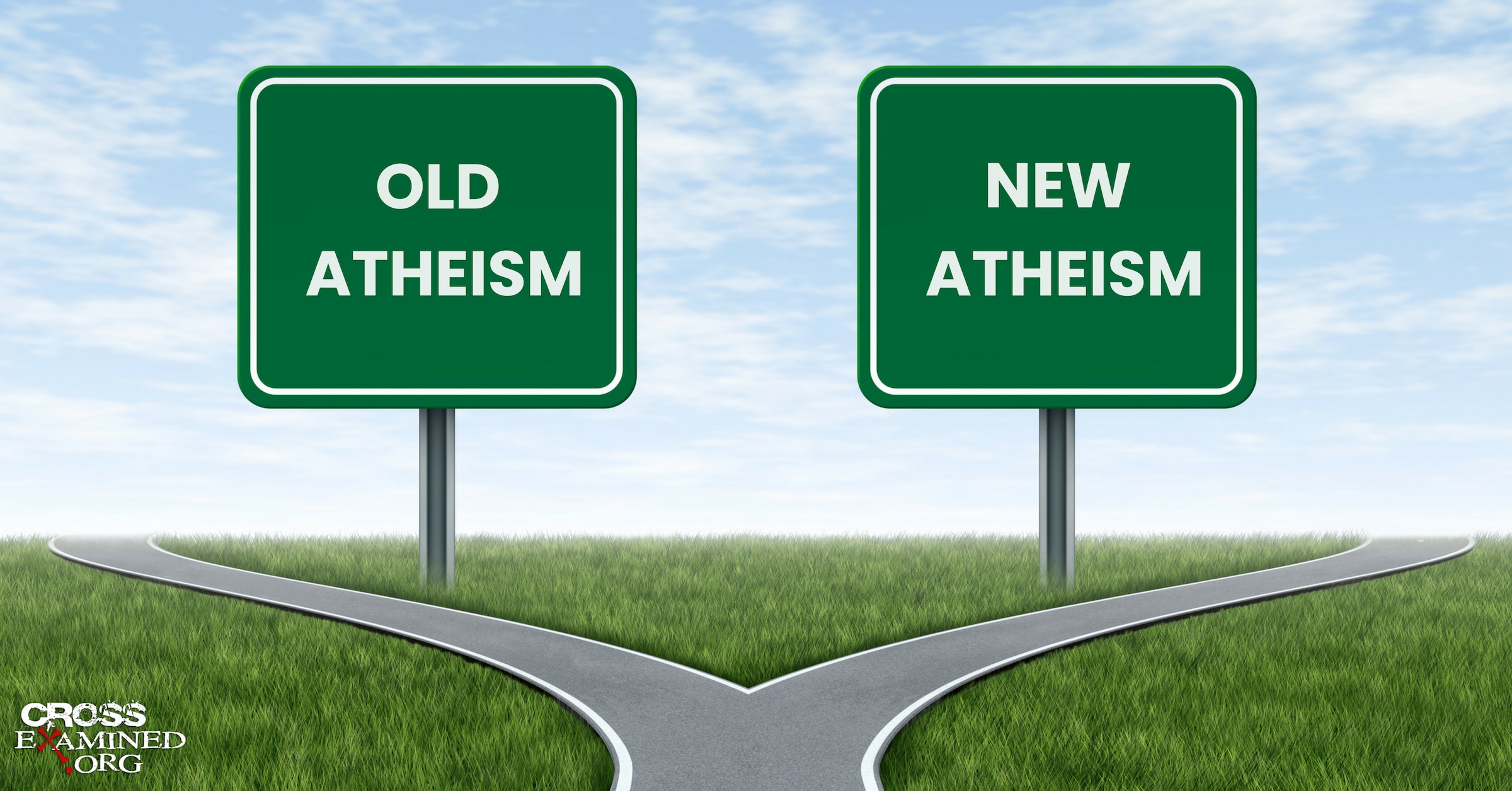
Theism has been argued for on two fronts: reason (philosophy) and revelation (sacred Scriptures, such as the Bible). In terms of the former, arguments are proffered to demonstrate the existence of God. [2] In arguing against God, atheists historically have attempted to disprove his existence at least in part by showing that theistic arguments fail. Thus, atheists have historically interacted with the claims of theists and have attempted to show that theism is logically untenable. However, the last few years has seen a different type of atheism. This new type of atheism, dubbed ‘the new atheism,’ is very different from the traditional form of atheism. In what remains, the author shall explicate the differences of the traditional, or ‘old atheism,’ and the new atheism. This is not an attempt to disprove either type of atheism, just to understand the differences between the two.

A Sketch of the New Atheism

The old atheism is based on logic, argumentation, counter-examples, and is primarily aimed at scholars. The new atheism is the opposite of this. Rather than being based on logical argumentation, sound reasoning, and dealing with typical theistic arguments, the new atheism is an assault of rhetoric aimed at a popular audience. Some of the more well-known new atheists are Richard Dawkins, Sam Harris, Daniel Dennett, and Christopher Hitchens. These four are known as the Four Horsemen (a play on the biblical four horsemen of the Book of Revelation).

Paul Copan says of the new atheists, “Rather than sticking to rational, carefully reasoned arguments, they have taken off the gloves to launch angry, sarcastic, and sloppily argued attacks.” [3] He adds, “They lob their rhetorical grenades in hopes of creating the (incorrect) impression that belief in God is for intellectual lightweights who believe ridiculous, incoherent doctrines and are opposed to all scientific endeavor and discovery. These objectors are writing books… that tend to be more bluster and emotion than substance.” [4] Elsewhere, Copan gives several earmarks of the new atheism. “First,” he says, “for all their emphasis on cool-headed, scientific rationality, they express themselves not just passionately, but angrily.[5] Perhaps the best example of such emotivism comes from Richard Dawkins. William Lane Craig calls Dawkins “the enfant terrible” of new atheism. [6] He continues, “His best-selling book The God Delusion has become the literary centerpiece of” the new atheism. [7] In this book Dawkins attempts to demonstrate that the existence of God is false, or, to pull from his title, a delusion.  Dawkins is a well-known biologist and staunch supporter of Darwinism. One can see Copan’s first point exemplified in the following excerpt from Dawkins’ book:

“The God of the Old Testament is arguable the most unpleasant character in all fiction: jealous and proud of it; a petty, unjust, unforgiving control-freak; a vindictive, bloodthirsty ethnic cleanser; a misogynistic, homophobic, racist, infanticidal, genocidal, filicidal, pestilential, megalomaniacal, sadomasochistic, capriciously malevolent bully.” [8]

Dawkins’s book is filled with such emotion. Christopher Hitchens is not unlike Dawkins in his appeal to emotion; however, he may be a little more tame. In his book, god is not Great: How Religion Poisons Everything, Hitchens argues, again, as the title suggests, that religion is at the root of many problems. He argues, “As I write these words, and as you read them, people of faith are in their different ways planning your and my destruction, and the destruction of all the hard-won human attainments that I have touched upon. Religion poisons everything.” [9]

The second point that Copan makes regarding the new atheists is that “the Neo-atheists’ arguments against God’s existence are surprisingly flimsy, often resembling the simplistic village atheist far more than the credentialed academician.[10] An example of this will be given in the next section concerning a traditional theistic argument and how the new atheists’ method compares with traditional atheism. In commenting on this type of reasoning that Copan addresses, William Lane Craig states:

“Several years ago my atheist colleague Quentin Smith unceremoniously crowned Stephen Hawking’s argument against God in A Brief History of Time as ‘the worst atheistic argument in the history of Western thought.’ [11] With the advent of The God Delusion the time has come to relieve Hawking of this weighty crown and to recognize Richard Dawkins’s accession to the throne.” [12]

Third,” Copan continues, “the New Atheists aren’t willing to own up to atrocities committed in the name of atheism by Stalin, Pol Pot, or Mao Zedong, yet they expect Christians to own up to all barbarous acts performed in Jesus’s name.” [13] Indeed, new atheists such as Hitchens and Dawkins do believe that religion is a source of inhumane acts. For example, both Hitchens and Dawkins deplore a morality that is based on the Bible or any type of religious dogma and do blame religion for many of the world’s atrocities. [14] Dawkins does discuss Hitler and Staling being atheists. He says that two points are normally brought up to him: “(1) [not only] were Stalin and Hitler atheists, but (2) they did their terrible deeds because they were atheists.” [15] However, Dawkins rejects the idea that their atheism caused their horrible deeds. He argues, “Assumption (1) is irrelevant anyway because assumption (2) is false. It is certainly illogical if it is thought to follow from (1).” [16] He thus denies that “atheism systematically influences people to do bad things,” whereas he believes that religion does. [17]

Thus, Copan has presented a few of the earmarks of the new atheism. In order to contrast the new atheism with traditional atheism, the author shall present a traditional theistic proof and give the evaluations of both types of atheism. The argument that is presented is a type of cosmological argument, viz., Thomas Aquinas’ second way.

The Cosmological Argument: A Test Case

There are many theistic arguments. One of the most popular, and perhaps the most powerful, is the cosmological argument. The cosmological argument takes many forms.  The one presented here is the second of Thomas Aquinas’ famous Five Ways. It states:

“The second way is from the nature of the efficient cause. In the world of sense, we find there is an order of efficient causes. There is no case known (neither is it, indeed, possible) in which a thing is found to be the efficient cause of itself; for so it would be prior to itself, which is impossible. Now in efficient causes, it is not possible to go on to infinity, because in all efficient causes following in order, the first is the cause of the intermediate cause, and the intermediate is the cause of the ultimate cause, whether the intermediate cause be several, or one only. Now to take away the cause is to take away the effect. Therefore, if there be no first cause among efficient causes, there will be no ultimate, nor any intermediate cause. But if in efficient causes it is possible to go on to infinity, there will be no first efficient cause, neither will there be an ultimate effect, nor any intermediate efficient causes; all of which is plainly false. Therefore, it is necessary to admit a first efficient cause, to which everyone gives the name of God.” [18]

It is important in a discussion of the second way for one to be clear about what is meant by ‘efficient causes.’ Maurice R. Holloway gives as a definition of efficient causes “an agent that exercises its influence over the existence of some other being, the effect, through an activity that is properly its own nature, its own form—an activity that is proportioned to the nature of the agent.” [19] To illustrate his point, he explains how efficient causality relates to his writing his book. There are many types of causes involved in its production, but the efficient cause is the man himself. “Thus the first characteristic of a proper [efficient] cause is this: it produces the effect by an activity that is proportioned to its own nature or being.” [20]

With this understanding of efficient causality in mind, what Aquinas is saying in his second way is that nothing can be the efficient cause of itself, because in order for this to happen the effect would have to exist “prior to itself,” which is a contradiction. Further, efficient causes cannot “go on to infinity,” for then there would be no first cause, and if there is no first cause then there is no effect. However, there is an effect. Therefore, it is necessary to posit a first efficient cause, which is understood to be God.

At this point, it will be instructive to explore what traditional atheists have to say about the above argument in contradistinction with what the new atheists say. Michael Martin and J. L. Mackie will represent the traditional atheism, while Christopher Hitchens and Richard Dawkins will represent the new atheism. The agnostic David Berlinski will also have something to say about the argument, especially in light of Dawkins’ comments.  This comparison will give the reader some idea of the differences between the two types of atheism.

A Traditional Response to the Second Way

Michael Martin considers the first three of the five ways “sophisticated versions” of more simple cosmological arguments.[21] Martin understands efficient causality in this context to mean “not a prior event but a substantial agent that brings about change.”[22] He further adds that “the priority of a cause need not be temporal; a cause is prior to its effects in the sense that the cause can exist without the effect but not conversely.”[23] Martin thinks it “important to realize that Aquinas’s argument purports to establish a first cause that maintains the universe here and now. His second way is not concerned with establishing a first cause of the universe in the distant past,” which Aquinas did not think could be done from the realm of reason alone.” [24] At this point, Martin gives two illustrations to make the argument more clear. “Consider,” he says, “a series of falling dominos. It is analogous to a temporal causal sequence. Aquinas does not deny on philosophical grounds that infinite sequences of this sort can exist. But now consider a chain in which one link supports the next. There is no temporal sequence here.” [25] This latter example, Martin notes, is analogous to Thomas’ understanding of efficient causality. This is Martin’s explanation and understanding of the second way.

In evaluating the argument, Martin explains that

“the first cause, even if established, need not be God; and Aquinas gives no non-question-begging reason why there could not be a nontemporal infinite regress of causes. This latter is an especially acute problem. Unless some relevant difference is shown between a temporal and a nontemporal infinite series, Aquinas’s claim that an infinite temporal sequence cannot be shown to be impossible by philosophical argument seems indirectly to cast doubt on his claim that philosophical argument can show the impossibility of a nontemporal causal series.” [26]

Thus, Martin explains and evaluates Aquinas’s second way.

J. L. Mackie gives the argument of the second way within the context of the third way. In other words, in examining the third way, he says that Aquinas uses the second way to show that an infinite regress of causes is not possible. After examining the second way to explicate the problem of infinite regresses in terms of efficient causes, he then pronounces the second way unsound. He goes on to say, “Although in a finite ordered series of causes the intermediat… is caused by the first item, this would not be so if there were an infinite series. In an infinite series, every item is caused by an earlier item. The way in which the first item is ‘removed’ if we go from a finite to an infinite series does not entail the removal of the later items.” [27] He then states that “Aquinas… has simply begged the question against an infinite regress of causes.  But is this a sheer mistake, or is there some coherent thought behind it?” [28] To illustrate the point, Mackie points out that if one was told about a watch without a spring, adding an infinite number of gears would not help the watch operate correctly. Also, one would not be satisfied to learn of an infinite number of boxcars in a train without an engine. The gears depend on a spring, and the boxcars depend on an engine. Thus, Mackie argues, “There is here an implicit appeal to the following general principle: Where items are ordered by a relation of dependence, the regress must end somewhere; it cannot be either infinite or circular.” [29] For Mackie, “this principle is at least highly plausible; the problem will be to decide when we have such a relation of dependence.” [30] Mackie thus rejects the second way in his overall discussion of the third way.

In summary, Martin and Mackie both interact with and evaluate Aquinas’ second way.  Whatever one’s opinion of their conclusions, they at least attempt to present the argument as Aquinas put it and try to allow their readers to feel its force. If one wanted to dismiss their conclusion, he would have to dismiss at least part of their argument. Thus, while one may disagree with Martin and Mackie, they put forth a logical argument as to why they believe the cosmological argument, in this form, to be invalid.  They have a philosophical and rational argument against it.

Now that the traditional atheistic responses have been given to the second way it is appropriate to examine what the new atheism has to say.

The New Atheism’s Response to the Second Way

Perhaps the most instructive critique from the new atheism regarding the cosmological arguments for God comes from Richard Dawkins. Before laying out the argument, Dawkins claims, “The five ‘proofs’ asserted by Thomas Aquinas in the thirteenth century don’t prove anything, and are easily—though I hesitate to say so, given his eminence—exposed as vacuous.” [31] After this unflattering introduction, Dawkins gives a very abbreviated synopsis of the first three ways.  He lays the argument out in these words: “Nothing is caused by itself. Every effect has a prior cause, and again we are pushed back into regress. This has to be terminated by a first cause, which we call God.” [32] After giving such summaries of the first three ways, Dawkins gives his response. He declares that each of these arguments

“make the entirely unwarranted assumption that God himself is immune to the regress. Even if we allow the dubious luxury of arbitrarily conjuring up a terminator to an infinite regress and giving it a name, simply because we need one, there is absolutely no reason to endow that terminator with any of the properties normally ascribed to God; omnipotence, omniscience, goodness, creativity of design, to say nothing of such human attributes as listening to prayers, forgiving sins and reading innermost thoughts.  Incidentally, it has not escaped the notice of logicians that omniscience and omnipotence are mutually incompatible. If God is omniscient, he must already know how he is going to intervene to change the course of history using his omnipotence. But that means he can’t change his mind about his intervention, which means he is not omnipotent.” [33]

Dawkins further rejects the notion that an infinite regress is impossible. He argues “some regresses do reach a natural terminator. Scientists used to wonder what would happen if you could dissect, say, gold into the smallest possible pieces.  Why shouldn’t you cut one of those pieces in half and produce an even smaller smidgen of gold?” [34] In fact, this is precisely what Dawkins says happens. According to him, “The regress, in this case, is decisively terminated by the atom. The smallest possible piece of gold is a nucleus consisting of exactly seventy-nine protons and a slightly larger number of neutrons, attended by a swarm of seventy-nine electrons.” [35] Thus, for Dawkins, “The atom provides a natural terminator to [this] type of regress. [Thus,] it is by no means clear that God provides a natural terminator to the regresses of Aquinas.” [36]

In Christopher Hitchens’ book, the fifth chapter is titled, “The Metaphysical Claims of Religion Are False.” Of all the chapters in his book, if one wanted to see how he handles such arguments as the cosmological argument, one should look here. In the opening sentence of this chapter he writes, “I wrote earlier that we would never again have to confront the impressive faith of an Aquinas or a Maimonides… This is for a simple reason. Faith of that sort—the sort that can stand up at least for a while in a confrontation with reason—is now plainly impossible.” [37] “The early fathers of faith,” he says, “were living in a time of abysmal ignorance and fear.” [38] To illustrate this alleged ignorance, Hitchens says that “Aquinas half believed in astrology, and was convinced that the fully formed nucleus… of a human being was contained inside each individual sperm. One can only mourn over the dismal and stupid lectures on sexual continence that we might have been spared if this nonsense had been exposed earlier than it was.” [39] Hitchens goes on to inform, “One must state it plainly. Religion comes from the period of human prehistory where nobody… had the smallest idea what was going on. It comes from the bawling and fearful infancy of our species, and is a babyish attempt to meet our inescapable demand for knowledge.” [40]

In a discussion on William of Occam (Aquinas does not appear again in this chapter), he argues that “even the first cause has its difficulties since a cause will itself need another cause.” [41] This is the closest to an actual metaphysical statement that occurs in the chapter (and the whole book). “Thus,” he asserts, “the postulate of a designer or creator only raises the unanswerable question of who designed the designer or created the creator. Religion and theology… have consistently failed to overcome this objection.” [42] This concludes the metaphysical chapter.

Even the casual reader can tell a vast difference between the traditional atheism and the new atheism in terms of how they handle the above argument. While the traditional atheists have a more cool, logical tone to their evaluation, the new atheists, who want to believe they have an unbiased, scientific position, are drenched in inflamed rhetoric. In the above quote, Dawkins uses words and phrases such as “unwarranted assumption” and “the dubious luxury of arbitrarily conjuring up” a termination to the regress “simply because we need one.” These types of words are designed to appeal to the emotions of the reader. There are times when “unwarranted assumptions” are made; however if one is going to make accusations of this sort, it would be appropriate to know what the assumptions are. Hitchens uses the same type of rhetoric. He talks about the early fathers “living in a time of abysmal ignorance,” about “dismal and stupid lectures,” and that religion originated from people who did not have “the smallest idea what was going on,” and that it came “from the bawling and fearful infancy of our species, and is a babyish attempt to meet our inescapable demand for knowledge.”

Such language is a smoke screen for people who have no logical arguments to offer. It sounds good to people who agree with their conclusions, but it is bankrupt of rational power. As such, this rhetoric is fallacious as it rests solely on emotion. It also commits the ad hominem fallacy as it is an attack on the persons making the arguments and not the arguments themselves. Further, the fact that Hitchens attacks Aquinas for having a particular belief (without a single reference) about biology is a straw man fallacy. Such quotations (which are not few in number) are cannon fodder for even the first-semester logic student.

Further, Dawkins seems unable to stay on track in attacking the second way. Such issues as the nature of the cause, such as omniscience and omnipotence, is a discussion for philosophical theology and is not part of Aquinas’ argument for a cause. Aquinas, here, simply says that the cause must be necessary. A discussion about the nature of the cause, while possibly implied by such arguments, are not germane to a discussion on the necessity of an uncaused cause. Such doctrines are debated among theists. There are theists on both sides of the debate. Thus, the nature of the cause does not negate the existence of the cause.

The new atheists do not offer clear arguments for their case. An argument where premises lead to a conclusion is wholly lacking in their works, at least on the level that they are found in the traditional atheism. Rather than offering logical arguments, they offer rhetoric, fallacious reasoning, and nonsense. David Berlinski, himself an agnostic, says of Aquinas’s argument, “This is a weak but not an absurd argument, and while Aquinas’s conclusion may not be true, objections to his argument are frequently inept.  Thus, Richard Dawkins writes that Aquinas ‘makes the entirely unwarranted assumption that God is immune to the regress.’  It is a commonly made criticism.” [43] He adds, “But Aquinas makes no such assumption, and thus none that could be unwarranted. It is the conclusion of his argument that causes in nature cannot form an infinite series. If [he is] prepared to reject this conclusion, Dawkins … must show that the argument on which it depends is either invalid or unsound. This [he has] not done.” [44]

Another hallmark of the new atheism is a complete misrepresentation of the arguments they are trying to attack. The above representation of the second way has been given, and the reader can see that Dawkins does not even attempt to seriously interact with it. He does the same thing with other arguments, and even worse. Aquinas gives his third way as follows:

“The third way is taken from possibility and necessity, and runs thus. We find in nature things that are possible to be and not to be, since they are found to be generated, and to corrupt, and consequently, they are possible to be and not to be. But it is impossible for these always to exist, for that which is possible not to be at some time is not. Therefore, if everything is possible not to be, then at one time there could have been nothing in existence. Now if this were true, even now there would be nothing in existence because that which does not exist only begins to exist by something already existing. Therefore, if at one time nothing was in existence, it would have been impossible for anything to have begun to exist; and thus even now nothing would be in existence—which is absurd. Therefore, not all beings are merely possible, but there must exist something the existence of which is necessary. But every necessary thing either has its necessity caused by another or not. Now it is impossible to go on to infinity in necessary things which have their necessity caused by another, as has been already proved in regard to efficient causes. Therefore, we cannot but postulate the existence of some being having of itself its own necessity, and not receiving it from another, but rather causing in others their necessity. This all men speak of as God.” [45]

However, Dawkins phrases it this way: “There must have been a time when no physical things existed. But, since physical things exist now, there must have been something non-physical to bring them into existence, and that something we call God.” [46] Now, it is one thing to summarize an argument. It is quite another to misrepresent it. Aquinas does not discuss ‘physical things.’ Rather, his argument is metaphysical in nature. Dawkins simply does not understand what he is attempting to refute.

The same is the case for the others as well. The fifth way is probably the most misunderstood.  Dawkins, as many do, misunderstand it for a design argument when it, in fact, is an argument from final causality. Here is the argument as Aquinas gives it:

“The fifth way is taken from the governance of the world. We see that things which lack intelligence, such as natural bodies, act for an end, and this is evident from their acting always, or nearly always, in the same way, so as to obtain the best result. Hence it is plain that not fortuitously, but designedly, do they achieve their end. Now whatever lacks intelligence cannot move towards an end, unless it be directed by some being endowed with knowledge and intelligence; as the arrow is shot to its mark by the archer. Therefore, some intelligent being exists by whom all natural things are directed to their end; and this being we call God.” [47]

Of this argument, Dawkins says, “The argument from design is the only one still in regular use today, and it still sounds to many like the ultimate knockdown argument.” [48] However, such is not the case. Rather than being an argument from design it is an argument from final causality. In other words, the argument does not say that since things are designed there must be a designer; rather, it says that such things as animals and “natural bodies” act in accordance with some goal. However, such things can only do so if they are directed. Therefore, some being must exist that directs them. One cannot fault Dawkins too much for this particular blunder since so many others make it as well; however, it is characteristic of the new atheists failure to understand the argument they are responding to and to deal with them fairly.

The point is not simply to show that the new atheists are wrong in their work; rather, the point is to show that they have nothing to contribute to the discussion other than heated rambling.

Before concluding, it will be instructive to give the best “argument” that Richard Dawkins, perhaps the champion of the new atheism, offers. In his book in a chapter titled, “Why There is Almost Certainly No God,” Dawkins offers what he considers to be “the central argument of [his] book.” [49] At the end of the chapter Dawkins gives a six-point summary of the argument. As David Berlinski does in his book, I shall only give the first three points, as they are the main concern.

  1.  One of the Greatest challenges to the human intellect, over the centuries, has been to explain how the complex, improbable appearance of design in the universe arises.
  2.  The natural temptation is to attribute the appearance of design to actual design itself. In the case of a man-made artifact such as a watch, the designer really was an intelligent engineer. It is tempting to apply the same logic to an eye or a wing, a spider or a person.
  3.  The temptation is a false one because the designer hypothesis immediately raises the larger problem of who designed the designer. The whole problem we started out with was the problem of explaining statistical improbability. It is obviously no solution to postulate something even more improbable. We need a ‘crane’, not a ‘skyhook’, for only a crane can do the business of working up gradually and plausibly from simplicity to otherwise improbable complexity. [50]

This is indeed not a logical argument, but more of a probabilistic argument.  In fact, it is not really an argument at all.  In referring to Dawkins’ argument, Berlinski retorts, “In all this, Dawkins has failed only to explain his reasoning, and I am left with the considerable inconvenience of establishing his argument before rejecting it.” [51]

The main problem with the above points is Dawkins assertion that “the designer hypothesis raises the larger problem of who designed the designer,” and that a designer would be even “more improbable.” Such objections as “who created the creator,” and “who designed the designer” are staples of the new atheism. Dawkins seems to miss the design argument, which states: Everything that has a design needs a designer. The universe is designed. Therefore, the universe needs a designer.

According to the argument which usually takes this form, only designs needs designers; designers do not need designers. [52] Everything does not need a designer, only things that are designed need a designer.

Further, Dawkins asserts that a designer or creator of the universe is even more improbable than the universe itself and would also be complex. However, this is patently false. Berlinski again brings clarity to the argument by saying, “We explain creation by appealing to creators, whether deities or the inflexible laws of nature. We explain what is chancy by appealing to chance. We cannot do both. If God did make the world, it is not improbable. If it is improbable, then God did not make it.” [53] He further notes, “The best we could say is that God made a world that would be improbable had it been produced by chance. But it wasn’t, and so He didn’t. This is a discouraging first step in an argument said to come close to proving that God does not exist.” [54]

Craig believes that Dawkins’ assertion that God would need explaining in the manner of the universe has many flaws. “First, in order to recognize an explanation as the best, one needn’t have an explanation of the explanation. This is an elementary point concerning inference to the best explanation as practiced in the philosophy of science.” [55] The second point concerns the assumption that “the designer is just as complex as the thing to be explained so that no explanatory advance is made.” [56] Here Craig argues that an explanation may be less simple than others but may still be true. However, I believe that there is a more fundamental problem with Dawkins’ point, and again, this is characteristic of the new atheism. Dawkins does not ever explain why it is the case that God would have to be just as complex, or more so, than the universe. In fact, in his own discipline, he teaches, per Darwinian theory, that simple organisms give rise to more complex organisms. [57] However, Dawkins’ assertion is false metaphysically. As Aquinas shows in the first way, the cause of all effects must be simple, i.e., having no parts. The first way argues:

“The first and more manifest way is the argument from motion. It is certain, and evident to our senses, that in the world some things are in motion. Now whatever is in motion is put in motion by another, for nothing can be in motion except it is in potentiality to that towards which it is in motion; whereas a thing moves inasmuch as it is in act. For motion is nothing else than the reduction of something from potentiality to actuality. But nothing can be reduced from potentiality to actuality, except by something in a state of actuality. Thus that which is actually hot, as fire, makes wood, which is potentially hot, to be actually hot, and thereby moves and changes it. Now it is not possible that the same thing should be at once in actuality and potentiality in the same respect, but only in different respects. For what is actually hot cannot simultaneously be potentially hot; but it is simultaneously potentially cold. It is therefore impossible that in the same respect and in the same way a thing should be both mover and moved, i.e. that it should move itself. Therefore, whatever is in motion must be put in motion by another. If that by which it is put in motion be itself put in motion, then this also must needs be put in motion by another, and that by another again. But this cannot go on to infinity, because then there would be no first mover, and, consequently, no other mover; seeing that subsequent movers move only inasmuch as they are put in motion by the first mover; as the staff moves only because it is put in motion by the hand. Therefore, it is necessary to arrive at a first mover, put in motion by no other; and this everyone understands to be God.” [58]

This argument shows that not only do causes have to be like their effects in complexity, but that the ultimate cause cannot be like its effects. While the effects are composed of act and potency, the cause is not so composed but is simple. Thus, Dawkins’ point fails.

Conclusion

The question of God’s existence is one that haunts all of humanity. Theists argue that he does in fact exist, while atheists argue that he does not. It has been shown that there are at least two types of atheism, the old, traditional atheism, and the new atheism. The old atheism gives theistic arguments their due, tries to understand and explain them, and evaluates them according to the canons of logical argumentation and reason. Such is not the case for the new atheism. The new atheism is marked by rhetoric, flawed or missing arguments, and appeal to emotion. This, of course, does not make the conclusions of the new atheism wrong; however, it does suggest that the new atheism is bankrupt in terms of its ability to deal honestly with theistic arguments and that the new atheist’s conclusions about such arguments do not follow logically. All of the new atheists have not been surveyed, and they do differ in their level of philosophical competence. However, the arguments presented here are typical for their camp. Christians should thus not be intimidated by them. Rather, Christians need to understand the principles of logic in order to evaluate their arguments and to extinguish the emotional hysteria associated with their work.

Notes

[1] Atheists sometimes like to redefine atheism to mean simply that they do not possess believe in a theistic God; however, the above definition of atheism shall be the one adopted for this work.

[2] The term ‘God’ shall be used in the classical sense throughout this article.

[3] Paul Copan and William Lane Craig, eds., Contending with Christianity’s Critics: Answering New Atheists and other Objectors (Nashville: B&H Academic, 2009), vii.

[4] Ibid.

[5] Paul Copan, Is God a Moral Monster?: Making Sense of the Old Testament God (Grand Rapids: Baker Books, 2011), 16 (emphasis in original).

[6] William Lane Craig, “Dawkins’s Delusion,” in Contending, 2 (emphasis in original).

[7] Ibid.

[8] Richard Dawkins, The God Delusion (Boston: First Mariner Books, 2008), 51.

[9] Christopher Hitchens, god is not Great: How Religion Poisons Everything (New York: Twelve, 2009), 13 (emphasis in original).

[10] Copan, God, 17 (emphasis in original).

[11] This reference is to Quentin Smith, “The Wave Function of a Godless Universe,” in Theism, Atheism, and Big Bang Cosmology (Oxford: Clarendon Press, 1993), 322.

[12] Craig, “Dawkins’s Delusion,” in Contending, 5.

[13] Copan, God, 18 (emphasis in original).

[14] Cf. especially chapters 7-8 in both god is not Great, and The God Delusion.

[15] Dawkins, 309 (emphasis in original).

[16] Ibid.

[17] Ibid. (emphasis in original).

[18] Thomas Aquinas, Summa Theological, trans. by Fathers of the English Dominican Province, 2ndand revised edition (Notre Dame: Ave Maria Press, Inc. 1920), Ia q. 2 a. 3.

[19] Maurice R. Holloway, Introduction to Natural Theology (Saint Louis: Saint Louis University Press, 1959), 61.

[20] Ibid.

[21] Michael Martin, Atheism: A Philosophical Justification (Philadelphia: Temple University Press, 1990), 97.

[22] Ibid., 98.

[23] Ibid.

[24] Ibid.

[25] Ibid.

[26] Ibid., 98-99.

[27] J. L. Mackie, The Miracle of Theism: Arguments for and Against the Existence of God (Oxford: Clarendon Press), 1982), 90 (emphasis in original).

[28] Ibid.

[29] Ibid.

[30] Ibid., 90-91.

[31] Dawkins, 100.

[32] Ibid.

[33] Ibid.

[34] Ibid., 102.

[35] Ibid.

[36] Ibid.

[37] Hitchens, 63.

[38] Ibid., 63-64.

[39] Ibid.

[40] Ibid.

[41] Ibid., 71.

[42] Ibid. During this discussion Hitchens quotes Occam as agreeing with his position.  However, he does not give a reference to Occam’s work. There is a reference to Frederick Copleston, History of Philosophy, vol 3 (Kent, England: Search Press, 1953). If this is what he is using for his work, then it would still not be a primary source from Occam.

[43] David Berlinski, The Devil’s Delusion: Atheism and Its Scientific Pretensions (New York: Crown Forum: 2008), 68 (emphasis in original).

[44] Ibid. (emphasis in original).

[45] Aquinas, Summa, Ia, q. 2, a. 3.

[46] Dawkins, 101.

[47] Aquinas, Summa Theologica, Ia q. 2 a. 3.

[48] Dawkins, 103.

[49] Dawkins, 187.

[50] Ibid., 188.

[51] Berlinski, 138.

[52] I am indebted to Richard G. Howe for this insight.

[53] Berlinski, 144.

[54] Ibid. (emphasis in original).

[55] Craig, “Dawkins’s Delusion,” in Contending, 4.

[56] Ibid.

[57] I am indebted to Greg Barrett for this understanding.

[58] Aquinas, Summa, Ia, q. 2, a. 3.

You can also see about this topic here:
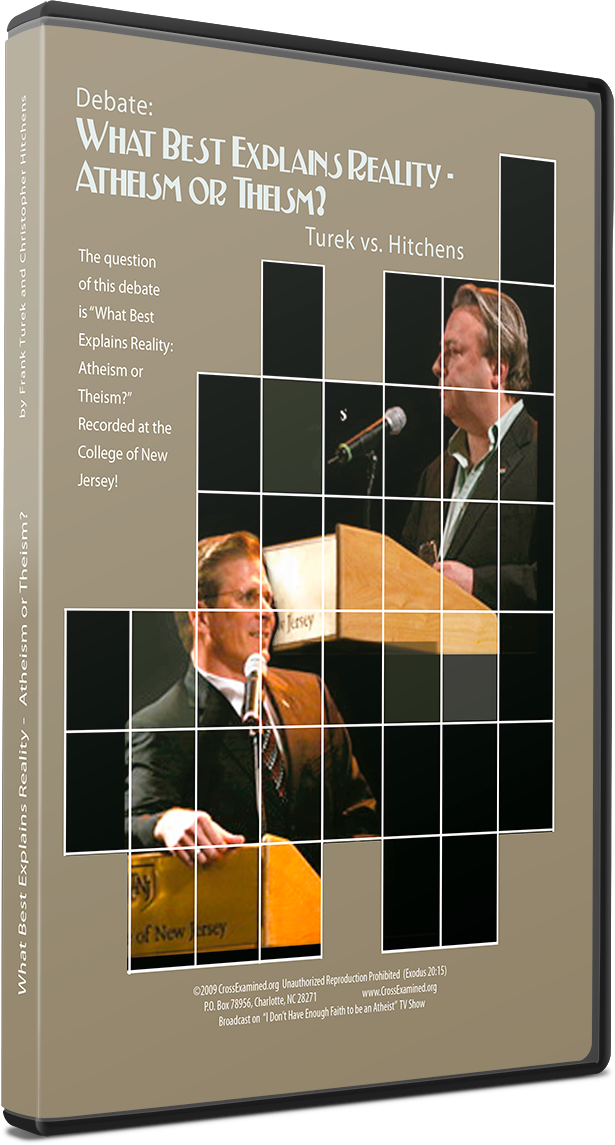
DVD WHAT BEST EXPLAINS REALITY: ATHEISM OR THEISM?


J. Brian Huffling, PH.D. have a BA in History from Lee University, an MA in (3 majors) Apologetics, Philosophy, and Biblical Studies from Southern Evangelical Seminary (SES), and a Ph.D. in Philosophy of Religion from SES. He is the Director of the Ph.D. Program and Associate Professor of Philosophy and Theology at SES. He also teaches courses for Apologia Online Academy. He has previously taught at The Art Institute of Charlotte. He has served in the Marines, Navy, and is currently a reserve chaplain in the Air Force at Maxwell Air Force Base. His hobbies include golf, backyard astronomy, martial arts, and guitar.

Original Blog Source: http://bit.ly/2GYUfAE