Tag Archive for: atheism

By Josh Klein

The Church of Satan was started by Anton Lavey in 1966[i] as an atheistic religious organization focused on hedonism and lawful citizenry. Adherents to the Church of Satan claim not to believe in Satan or worship him but to strive for what they call “ethical egoism.”  Ironically, Satan’s most effective tool against humanity is not convincing people to worship him, but to worship themselves in leu of the Almighty God.

Whether Lavey knew it or not, in effect, he did establish a church of Satan that worships the very thing Satan wishes it would.  It matters not to Satan what people think of him, but if he can get people to believe in themselves and scoff at the idea of God then his mission is accomplished.

In the garden, Satan never asks Eve to worship him, he simply seeks to destroy Eve’s relationship with her creator.

It is not this obvious satanic movement that threatens the church of America, but a different, more insidious and pernicious Church of Satan that has snuck into the mainstream religious institutions of the day. The true Church of Satan hides in plain sight. Satan’s real strategy against the Bride of Christ is the same as his strategy in the garden and we must call it out for what it is lest we stand idly by as Adam did and watch people be deceived.  You might think this overdramatic, but history and scripture indicate that it is not.  The gates of Hell will not prevail against the church (Matthew 16:18[ii]), but Satan is building a bride for himself within what people consider to be the church in the West and, save for a few, it is rarely challenged with courage.

The church in America is quickly falling into apostacy.  According to a recent study, 60% of self-described American Christians under the age of 40 believe that Jesus is not the only way of salvation.[iii]  Which, one would think, would disqualify them from calling themselves Christians, at least that’s what Jesus would seem to indicate when he said no one can come to the Father except through him (John 14:6[iv]).

In many cases these mainline Christian denominations are not merely getting sin wrong, they are perverting the gospel by glorifying sin, reveling in it, and using scripture to double down on a gospel of affirmation rather than repentance and belief in Christ.

In the 2000s the Episcopalian church in America ordained the first transgender Priest and in 2021 the ELCA ordained their first transgender bishop[v].

In May of 2022 a United Methodist Church in Madison, Wisconsin held a Pride celebration event.[vi]

In December of 2021 a Lutheran church in Chicago had a pastor deliver a message to children dressed in Drag.[vii]

In August of 2022 the First Christian Church in Austin, Texas hosted a “family friendly” Drag Show for the community.[viii]

Most recently though, a United Methodist Church in Florida hosted an Atheist Drag Queen Pastor[ix] (yes, you read that right)[x] for their service, and, particularly, to share his story with the children in the church.

To the Christian the most alarming part of this video should not be the drag queen standing in the church but the “Pastor’s” use of scripture to justify Ms. Penny Cost’s lifestyle as godly:

“Well one of the things that I think is great about miss Penny Cost is that she reminds us that we follow a god who calls us to not conform to the things of this world. That we’re supposed to be transformed by the renewal of our minds, and that means that what I think today may have to change tomorrow if I continue to renew my mind. And it’s so cool that we serve a god that calls us to continue to grow and to continue to change into something new and to not be bound by the ways that the world confines us sometimes. That we are supposed to live differently.”

If one merely read the words spoken by this “Pastor” one might not see anything wrong with this simple directive towards children.  He quotes scripture, directs them to live contrary to the world, and encourages them to live differently. That seems to be in line with historic Christian belief.  This is, however, the oldest trick in the Satanic book. That is not hyperbole.

To use scripture in a way that justifies the pride of life and licentious behavior is the very tactic Satan used with Eve in the garden, and the very tactic he used again in the temptation of Jesus. Satan is not afraid to use scripture to get what he most desires.  He prowls the sidelines waiting for an opportune moment to devour the weak, and he does just that with the misinterpretation and application of scripture (1 Peter 5:8[xi]). If the Devil can get people to believe they are saved through heretical use of scripture, only to embrace the wrong gospel, his digestion is complete and they are doomed.

Jesus hints at this reality himself when he says that not everyone who says to him, “Lord, Lord” will enter the kingdom of heaven (Matthew 7:21[xii]).  There are many that will engage in mercy missions, philanthropy, clothing and feeding the poor, that will have embraced a false gospel that does not save.  This false gospel is Satan’s go to weapon against the church.  Satan does not need Anton Lavey to establish his church. He simply needs to get those that call themselves the church to buy into a gospel of lies and self-fulfillment.

A tail as old as time.

In the garden, the serpent misquotes God to challenge Eve to think only of herself and find fulfillment and hope in creation rather than the Creator (Genesis 3[xiii], Romans 1[xiv]).  In Matthew 4:6[xv] we find Satan again using scripture to try to tempt Jesus in the wilderness.  Satan quotes Psalm 91:11-12[xvi] seemingly to get Jesus to misapply scripture to inflate his own ego above the Father’s plan. Jesus, of course, does not fall for it.

John Piper puts it this way:

“Note well! Satan does not always try to ruin faith by saying, ‘The Bible isn’t true.’ He often tries to destroy our faith by affirming some passage and using it to lead us into disobedience.”[xvii]

If Satan used scripture to entice Eve, and again to seek to derail the redemptive work of God through Jesus, would he not use scripture to create for himself a church of ineffectual sin laden imposters? This is the spirit of antichrist, and it is taking the American church by storm.

The spirit of the antichrist affirms sin, encourages debasement, and blasphemes the name of Jesus (1 John 1:7, 2:18-22, 4:3). The video above accomplishes all these things in the space of fifty seconds. The Devil’s plans to subvert the church are obvious, but his appeal to the nature and pride of mankind blinds many to it.  The misapplication and interpretation of Romans 12:1-2 gives away the Satanic game. We read in 1 John 2:15-24 just the opposite of what this pastor is speaking:

“15 Do not love the world nor the things in the world. If anyone loves the world, the love of the Father is not in him. 16 For all that is in the world, the lust of the flesh and the lust of the eyes and the boastful pride of life, is not from the Father, but is from the world. 17 The world is passing away, and also its lusts; but the one who does the will of God lives forever.

18 Children, it is the last hour; and just as you heard that antichrist is coming, even now many antichrists have appeared; from this we know that it is the last hour. 19 They went out from us, but they were not really of us; for if they had been of us, they would have remained with us; but they went out, so that it would be shown that they all are not of us.”

This is a sobering reminder that our battle is not against flesh and blood but against the dark forces of this world (Ephesians 6:12). It is no longer tenable to call this progressive movement in churches Christian.  These are not progressive Christians, they are progressive antichristians. They hold on to a form of godliness yet deny its power (2 Timothy 3:1-5), they are swayed by and leading people astray into empty, deceitful philosophies according to human traditions and the elemental spirits of the world (Colossians 2:8), and they love what is evil and hate what is good (Romans 12:9).

The Satanic church is all around us and claiming Christ as their own in order to obfuscate the gospel.  We must not acquiesce or give quarter to such blatant apostacy.  Paul says we should have nothing to do with them (2 Timothy 3:5) and Jesus indicates that such men, claiming to be agents of the Lord, will experience an even harsher judgment than others (Luke 17:2).

I want to be clear, my quibble is not against those attracted by this false gospel.  My heart breaks for them.  The reason the Christian church’s response to such heresy ought to be swift and decisive is for them. Filled with mercy, patience, and grace (Jude 1:22-24).  The question they are asking is a legitimate one: “How can I be happy, fulfilled, full of purpose?” The answer is there to be had and confused individuals must be met with love, understanding, encouragement, and most importantly, truth.

We must call these people to repentance; we must not allow them to glory in their sin and pervert the gospel.  Winsomeness is not a tool to tolerate blasphemy but to attract those seeking answers. It is winsome to call out error and preach repentance in Christ (Romans 2:4).

The true Church is to be salt and light (Matthew 5:13-16).  Salt preserves the godliness of the generations and light exposes the deeds of darkness (1 John 1).

We can give no quarter to those that would pervert the gospel of Jesus Christ. There is a time for boldness in the faith, and that time is now, and if we are ridiculed, persecuted, or derided for our faithfulness to the true gospel then we are in good company (Hebrews 11, Acts 5:42, 2 Timothy 3:11-12, Matthew 5:10-12).

We must start calling these types of progressive churches what they are, and we must not apologize, because it is true kindness to shed light on the deeds of darkness to beseech them to repent and return to the love they have lost (1 Corinthians 5:5, Revelation 2).

I think Kevin DeYoung put it well:

Stay strong. Fight the good fight, finish the course, and keep the faith.

(2 Timothy 4:7-8)

Footnotes

[i] https://www.britannica.com/biography/Anton-LaVey

[ii] https://www.biblegateway.com/passage/?search=Matthew+16%3A18&version=NET

[iii] https://www.christianpost.com/news/60-of-young-adults-say-jesus-isnt-the-only-way-to-salvation.html

[iv] https://www.biblegateway.com/passage/?search=John+14%3A6&version=NET

[v] https://en.wikipedia.org/wiki/Cameron_Partridge#:~:text=Cameron%20Partridge%20(born%201973)%20is,National%20Cathedral%20in%20Washington%2C%20D.C. –

 https://www.npr.org/2021/09/11/1036371531/evangelical-lutheran-church-first-transgender-bishop-megan-rohrer

[vi] https://madison365.com/sherman-church-to-celebrate-pride-month-with-pride-month-flag-raising-ceremony/

[vii] https://www.washingtonexaminer.com/news/lutheran-church-offers-drag-queen-prayer-time-to-children

[viii] https://www.houstonchronicle.com/neighborhood/katy/article/church-lgbtq-drag-shows-17395546.php

[ix] https://www.mspennycost.com/

[x] https://www.theblaze.com/news/drag-queen-pastor-god-is-nothing

[xi] https://www.biblegateway.com/passage/?search=1+Peter+5%3A8&version=NET

[xii] https://www.biblegateway.com/passage/?search=Matthew+7%3A21&version=NET

[xiii] https://www.biblegateway.com/passage/?search=Genesis+3&version=NET

[xiv] https://www.biblegateway.com/passage/?search=Romans+1&version=NET

[xv] https://www.biblegateway.com/passage/?search=Matthew+4%3A6&version=NET

[xvi] https://www.biblegateway.com/passage/?search=Psalm+91%3A11-12&version=NET

[xvii] https://www.desiringgod.org/articles/satans-bible-knowledge

Recommended resources related to the topic:

Is Morality Absolute or Relative? by Dr. Frank Turek DVD, Mp3 and Mp4

Another Gospel? by Alisa Childers (book)

_____________________________________________________________________________________________________________________________________________________

Josh Klein is a Pastor from Omaha, Nebraska with over a decade of ministry experience. He graduated with an MDiv from Sioux Falls Seminary and spends his spare time reading and engaging with current and past theological and cultural issues. He has been married for 12 years to Sharalee Klein and they have three young children.

Original Blog Source: https://bit.ly/3X2WW7X 

 

By Al Serrato

Many atheists claim that the God described in the Bible is not possible. They raise philosophical challenges meant to show that inherent in the very nature of God are contradictions which make belief in him foolish. One such challenge I encountered went like this:

“If God was all that existed back then, what disturbed the eternal equilibrium and compelled him to create? Was he bored? Was he lonely? God is supposed to be perfect. If something is perfect, it is complete–it needs nothing else. If God is perfect, there can be no disequilibrium. There is nothing he needs, nothing he desires, and nothing he must or will do. A God who is perfect does nothing except exist. Therefore, a perfect being that creates is impossible.”

Challenges like these can be daunting, especially for someone not interested in philosophy. On its face, the challenge appears to have validity, reasoning to a conclusion about God. But in fact what is at play here is the “straw man” fallacy. The challenger sets up a God whose attributes are not those of the true God, as described in the Bible, and then argues from this mistaken depiction that the God we worship could not exist.

Notice what is implicit in the challenge: the skeptic seems to be acknowledging God as an eternal being, but his questions assume that God has no power to control time. Time becomes a force over God, and not one that God created and controls. Consider: the challenger asks “what compelled God to create?” as if God is sitting around for eons wondering what to do. He uses words like “bored,” “lonely,” “needs,” and “desires.” Each of these concepts is temporally based: “boredom” means an awareness that one’s present circumstances lack sufficient stimulation and an anticipation of changing this condition by engaging in some future activity; “lonely” means an awareness of the lack of others to help bring meaning, activity or joy into one’s life; “desires” means an awareness of something lacking and the formation of a plan to acquire that thing in the future. Each of these concepts necessarily implies a limited being, a being who lacks something necessary for fulfillment and who is seeking to remedy this lack.

With each question, the skeptic betrays that he has not grasped the attributes of the God we worship. The God of the Bible describes himself as the “I am.” In the beginning, he created “the heavens and the Earth.” Interestingly, modern science has confirmed that in the distant past there was a singularity, a point at which both matter and, more importantly for this discussion, time came into existence from absolute nothingness. Though we cannot, in our limited present circumstances, ever fully grasp all this entails, it is apparent that God, as an eternal being who created time as we experience it, is not himself limited by time. All times, as we perceive them, are in an eternal “present” to him. He was never “alone.” Composed of three persons in one being, God is in an eternal loving relationship and has no needs, fulfills all desires and lacks no stimulation. In fact, these concepts are nonsensical to such a being, examples of a category error, because each of these concepts makes sense only if viewed from the perspective of a being that is limited or controlled or defined by time.

So, to specifically answer the questions: Nothing “disturbed” the eternal equilibrium. Time was not flowing “against” God and no force can disturb him. Nothing “compelled” him to create, because a compulsion would require a source greater than God and there is no such force. God created the universe and this timeline because he chose to for reasons of love. The love he exercised was in the agape sense, love for the sake of love and with the goal of seeking the good of the one loved. He was not seeking gain, nor was he motivated by desiring something in return. God was not bored or lonely and is and always was complete. There was no disequilibrium. How that plays out in God’s perception is something, again, we could not expect to fully grasp, just as the whale, if conscious, could not know what living on land would be like, even if he understood that it involved breathing air, living in houses, and walking. In other words, our lack of detailed and specific knowledge does not prevent us from drawing conclusions from what we do know.

The challenger might respond by saying that God somehow added to his distinctiveness when he created us. He went from a “before” to an “after.” In so doing, he “changed,” and because he changed, he cannot be “perfect.” But this challenge again fails to recognize that God is not trapped by time, but instead was the creator of time. There was no “before” and “after,” as those concepts apply only to temporal beings living within the flow of time. To an eternal being, all is eternally in the present. While we, as mortal and limited beings, cannot truly understand what an eternal present would be like, we can conclude that a being not bound by the movement of time would experience all events without having to resort to memory or wait for the future to arrive. Moreover, the challenge fails to fully consider what “infinity” involves. As an infinite being, God added nothing to himself by creating, for it is not possible to “add” to infinity. This concept was fleshed out by a mathematician named David Hilbert, who asked the reader to imagine a hotel with an infinite number of rooms, all of which are filled. An infinite number of new guests arrive seeking lodging. What does the innkeeper do? Is he not “full up?” No, actually, at least not when infinity is involved. The innkeeper simply moves everyone from the room he or she is in to the room whose number is two times the original room number. By so doing, the innkeeper opens up an infinite number of new rooms – all odd numbered – for his new guests. The point is that when you are dealing with infinity, limitations simply do not exist.

In the end, though, I would submit that the challenger’s most glaring error is the claim “A God who is perfect does nothing except exist.” This would seem to reduce God to nothing more than a jellyfish – alive, perhaps, but showing few signs of it and simply existing. This seeks to reduce God’s infinite perfection to a limitation, when it is quite literally the opposite of any limitation. This attribute of infinite perfection does not constrain God, and to suggest that it leaves him essentially powerless – he simply “exists” – is, in my view, to get things precisely backwards.

I have seen this challenge in various permutations, but they almost always stem from a misunderstanding – intentional or otherwise – of the actual attributes of the God worshipped by Christians. Next time you confront something similar, it’s worth taking a moment to tease out the unspoken assumptions that are leading the skeptic astray.

Recommended resources related to the topic:

Counter Culture Christian: Is the Bible True? by Frank Turek (Mp3), (Mp4), and (DVD) 

What is God Like? Look to the Heavens by Dr. Frank Turek (DVD and Mp4)

__________________________________________________________________________________________________________________________________________________

Al Serrato earned his law degree from the University of California at Berkeley in 1985. He began his career as an FBI special agent before becoming a prosecutor in California, where he worked for 33 years. An introduction to CS Lewis’ works sparked his interest in Apologetics, which he has pursued for the past three decades. He got his start writing Apologetics with J. Warner Wallace and Pleaseconvinceme.com.


By Ryan Leasure 

Do objective morals exist? That is to say, are certain actions right or wrong irrespective of what people think? Philosphers and moral scientists have wrestled over the question of objective morality for centuries. Prior to the Enlightenment, objective morality was a given. The foundation for which was the nature of God himself.

Since the Enlightenment, however, brilliant minds have sought to find other explanations for objective morals using only the natural world, and this pursuit has proven to be quite difficult. As a result, naturalism — the belief which denies any supernatural or spiritual realities — has bred scores of moral nihilists. Contemporary atheist Richard Dawkins sums up this view nicely when he writes, “The universe we observe has precisely the properties we should expect if there is, at bottom, no design, no purpose, no evil and no good, nothing but blind, pitiless indifference.”[i]

Many skeptics, on the other hand, wish to avoid such a depressing outlook. After all, human experience seems to suggest that some actions are objectively good or evil. Therefore, instead of adopting moral nihilism, other naturalists adopt the view known as moral realism seeking to maintain objective moral values and duties.[ii] But can this view hold up to scrutiny? Have philosophers and scientists been able to ground morality in some place other than God?

In this article, I will demonstrate that theism provides the only basis for objective morality. I will support this thesis in two ways. First, I will evaluate the different explanations naturalists have used to ground morality and show them to be wanting. Second, I will substantiate the claim that theism accounts for objective morals despite skeptics’ objections.

Naturalism and Morality

In Letter to a Christian Nation, Sam Harris remarks, “Questions of morality are questions about happiness and suffering… To the degree that our actions can affect the experience of other creatures positively or negatively, questions of morality apply.”[iii] A self-described atheist, Harris adopts a totalitarian approach which argues that we can ground morality in the pleasure or misery of individuals.

In his more critiqued book, The Moral Landscape, he defines the “good” as that which supports the well-being of “conscious creatures.”[iv] But why, given atheism, should we think that the flourishing of human beings is objectively good? Where, exactly, in the natural world do we learn this objective truth? Harris fails to provide an explanation for this assertion. He simply equates “good” with “human flourishing” without any justification in what amounts to equivocation and circular reasoning.

Is/Ought Fallacy

Harris’s attempt to ground morality in human flourishing fails on at least two additional fronts. First, Harris is guilty of committing the is/ought fallacy. Generally speaking, someone commits the is/ought fallacy when they attempt to make value judgments using science.[v] Science, after all, only explains what “is,” not how things “ought” to be. For example, science tells us how us how to make an atomic bomb. It cannot, however, tell us whether we ought to use it. Harris believes he can prove his point by demonstrating that science tells us how to make life more conducive. But what exactly does this prove?

Of course advancements in science have aided in human flourishing. Science also tells us how to make life more conducive for corn and rabbits. But that does not mean it is morally evil to prohibit the flourishing of corn. Because Harris cannot ground objective morality as the term is philosophically understood, his only recourse is a semantic sleight of hand in which he redifines the word “good” to mean human flourishing. Even still, though science tells us how to promote human flourishing, it does not tell us that we “ought” to promote human flourishing.

Naturalistic Determinism

The second fatal error to Harris’s argument is his commitment to naturalistic determinism. As someone who affirms objective morality, Harris affirms that we “ought” to act a certain way. Yet he rejects the notion of free will at the same time.[vi] He goes so far as to state that free will is merely an “illusion.”[vii] As a naturalistic determinist, Harris holds to the view that every event is the result of a chain reaction which has been causally determined by the laws of physics and chemistry. In essense, humans act in robotic fashion and possess no volitional control over of their actions.

This position is paramount to agreeing with Richard Dawkins when he states, “DNA neither knows nor cares. DNA just is. And we dance to its music.”[viii]  We expect Dawkins to make a statement like this since he denies objective morality. We would not, however, expect Harris to affirm determinism since it undercuts his moral argument. After all, he notoriously condemns religious people for their agregious actions. But given Harris’s determinism, can he really blame them? Does he not believe that their actions were spring loaded at the Big Bang and carried out by the inflexible laws of physics and chemistry?

Naturalistic Reasoning?

The problem for Harris’s determinism runs even deeper. For if naturalism is correct, and human beings are mere matter and nothing else, then rational thought becomes impossible. Rationality is, after all, the ability to adjudicate between arguments and evidence. But how do atoms, molecules, and physical laws make concious decisions? Years ago, C. S. Lewis recoginzed this fatal flaw. He remarks, “A theory which explained everything else in the whole universe but which made it impossible to believe our thinking was valid, would be utterly out of court. For that theory would itself have been reached by thinking, and if thinking is not valid, that theory would, of course, be itself demolished.”[ix] In other words, if Harris is right on naturalistic determinism, it follows that we have no grounds for even knowing if naturalism is true.[x]

In the end, while Harris’s desire to affirm objective morality is commendable, he simply has no rational basis for his claims. He not only commits the is/out fallacy, he also undercuts his position by categorically denying free will of any kind. For these reasons, Harris’s view has failed to attract many suitors. Naturalists, though, have not bailed on the enterprise altogether. Most naturalists aim to ground morality another way — through evolutionary biology.

Morality from Evolution?

Standard Darwinian evolution asserts descent with modification. This process of natural selection acting on random mutations has been the standard view among naturalists for quite some time. And on the surface, this model seems to contradict our modern understanding of morality. For if Darwin was right, then for millions of years, creatures scratched and clawed their way to the top, sometimes killing and eating each other. We can understand, then, how natural selection explains features such as sexual drive, hunger, and fear since these qualities aided in preservation. But how does natural selection explain the phenomenon of altruism? How does sacrificing one’s self for the good of others aid in survival?

Naturalists typically offer two explanations — kin selection and reciprocal altruism. Kin selection theory suggests that species behave altruistically in ways that benefit the rest of their families at their own expense. For example, a monkey might cry out a warning to her relatives if she sees a leapord coming. This cry results in the leapord focusing its attention on her, decreasing her survivability. This sacrifice, however, ensures that the family genes — the same genes shared by the altruistic monkey — will survive and pass on to the next generation.[xi]

Naturalists also argue that altruism arose through reciprical relationships. In what amounts to “you scratch my back and I will scratch yours,” reciprical altruism is similar to bartering where assymetrical species help each other out by providing services that the other cannot provide for themselves. Bees need nectar and flowers need polinating. Or in some cases, animals need bugs and dirt removed from their fur, so another animal will do it for them when they could be out searching for food or a mate. Natural selection, therefore, favors the species that provide services for other species.

Evolution’s Failure

Even if we granted that evolution explains the rise of altruism, that does not solve the naturalist’s problem for a few reasons. First, as one considers the evolutionary rise of altruism, it becomes clear that altruism — especially on the reciprical model — is performed for selfish reasons. In other words, the theory suggests that species do “nice” things for other creatures only because it benefits them in the long run. But now we are talking about self-centeredness — the exact opposite of altruism.

A second critique of the evolutionary model is that it makes morality arbitrary. That is to say, it reaches ad hoc conclusions about the value of human beings. For if Darwin’s theory is correct, all living species descended from a single-celled organism and now form the different branches on Darwin’s tree of life. With this model in mind, who is to say that humans should be treated differently than crickets, rats, or cows? William Lane Craig refers to this inconsistency as “specie-ism,” in that people are showing unjustified bias towards their own species.[xii]  Craig is right on this. Given naturalism and the Darwinian model, humans are just one branch of many. Nothing about Darwinism tells us that we ought to act differently from the other species in the animal kindgom.

Take the black widow, for example, who often eats her male counterpart during the mating process. Or consider male sharks who forcibly copulate with female sharks. Do either of these creatures commit moral evils? If not, why would these same actions be wrong for humans since we all belong to the same tree of life? We can certainly appreciate the secular humanists who wish to maintain that humans are intrinsically valuable, but they have no way of grounding this position given their naturalism. Atheist philosopher Michael Ruse admits as much when he writes, “I appreciate that when somebody says, ‘Love thy neighbor as thyself,’ they think they are referring above and beyond themselves… Nevertheless… such reference is truly without foundation.”[xiii]

Evolutionary morality is on even shakier ground when we consider that evolution is, by definition, the unguided process of natural selection. Meaning, if we were to rewind back the time to the very beginning and start over, morality could have evolved quite differently. Human morality could have evolved like black widows and sharks and we would not know any difference.

A third and most damning critique of the evolutiony model is that it cannot even begin to explain why anything is objectively right or wrong. Even if we granted that evolution adaquately explains how species began to act morally, it does not begin to explain why acting in those ways is objectively good. Similarly, naturalists also think that because they can discern morality means that they have solved the problem. Again, William Lane Craig points out this fatal flaw when he exclaims, “I have been astonished at the confusion of moral ontology with moral epistemology on the part of prominent moral philosophers.”[xiv]

In the end, naturalists who attempt to ground objective morals in the natural world fail in their attempt. They might be able to explain the origins of altruism. And they might even know objective morals. But they cannot account for the existence of the moral standard itself and why humans ought to follow it.

Based on the above observations, naturalism cannot ground objective morality. At the same time, however, humans experience a certain “oughtness.” They feel like they ought to love rather than hate, and that they ought to show courage rather than cowardice. These “oughts” are epistemically surprising given naturalism. Yet, they correspond nicely with another worldview.

Theism and Morality

The “oughtness” humans experience fits nicely with a theistic worldview. And while the argument does not hinge on which theistic worldview one embraces, this section will approach the argument from a Christian worldview.

Christians maintain that objective morality is grounded in God himself. Seeing the failings of naturalists to ground morality in the natural world further substantiates the Christian’s claim that the moral law must derive from a different source — namely, a supernatural one.

Dealing with Euthyphro

One popular objection to the Christian position is commonly referred to as the Euthyphro Dilemma. This dilemma was first raised in Plato’s dialogue and goes like this: either something is good because God willed it or else God wills something because it is good.

Notice the dilemma these alternatives raise for the theistic view. For if something is good because God willed it, then it follows that the whatever is good is arbitrary. On the other hand, if God wills something because it is good, then the moral standard exists independent of God.

The problem with this objection, however, is that the skeptic presents the theist with a false dilemma. Meaning, a third option exists which asserts that God wills because he is good. This view argues that far from God’s commands being arbitrary, they are rooted in his perfectly good nature. Or to put it another way, God’s commands are “necessary expressions of his just and loving nature.”[xv] C. S. Lewis was also insightful in this regard. He declared, “God’s will is determined by His wisdom which always perceives, and His goodness which always embraces, the intrinsically good.”[xvi] In the end, the Euthyphro Dilemma is not much of a dilemma after all.

Relativism

Another popular objection to the theist view is that moral truths are relative. Relativists agree that naturalism cannot ground objective morality, but they go one step farther by suggesting that objective morality does not exist at all. To support this claim, relativists point to what they perceive as different moral standards in different cultures. Yet the relativist position fails on multiple fronts.

First, relativists often confuse objective morality with changing behavior. For example, they argue that since Western culture used to think slavery was acceptable, but now it does not, morality then must have changed. This argument, though, is not too different from the is/out fallacy Sam Harris committed. Merely describing the change in human behavior in no way demonstrates that objective morality changed. This view is tantamount to suggesting that the laws of physics changed after Newton because we now have a more enlightened view.

A second objection revolves around moral disagreements. As the argument goes, if there is such a thing as a moral law, why is there so much disagreement on moral issues? Again, the relativists objection is weak here.

Consider the modern debate over abortion. One view believes it is a moral crime since it believes aborition is the murder of an innocent child. On the other hand, those who are pro-choice think abortion is acceptable if that is what the mother chooses. The pro-choice tactic, however, is to redefine what exists in the mother’s womb. They use euphemistic phrases such as “clump of cells” rather than “baby” to justify killing it. What this change in terminology suggests is that both sides agree on the basic moral principle that murder is wrong. One position, though, has changed terminology to justify their view.

This change in terminology is not so different from how the Nazis justified the Holocaust or how Colonial Americans justified slavery. In both cases, they convinced themselves that they were not dealing with human beings of equal value in an attempt to assuage their consciences. So, while on the surface it appears that wide moral disagreements exist among people and cultures, a closer examination shows that root moral issues are pretty similar. Lewis remarks, “If anyone will take the trouble to compare the moral teaching of, say, the ancient Egyptians, Babylonians, Hindus, Chinese, Greeks and Romans, what will really strike him will be how very like they are to each other and to our own.”[xvii] This common understood morality explains why legal codes and religious codes share much in common across all times and cultures.

Image Bearers and Free Will

Given the Christian position, how does one explain this common sense of morality? The answer is rooted in God’s creation of human beings. In the first chapter of the Bible, we read that God made human beings in his image as the peak of his creation (Gen 1:26-27). As image-bearers of God, humans share certain characteristics in common with the Divine. Since Classical Theism asserts that God is a maximally great being, and part of his maximal greatness is his perfect goodness, we are not surprised that humans desire to do good.

Additionally, the perpetual wrestling over ethical issues also coincides with theism. For example, if naturalism is true, humans would simply act upon their strongest impulse brought about by the laws of chemistry in their brain. But humans do not do act this way — or at least they know they should not. Even naturalists recognize we should not act on our strongest impulses when those impulses would lead us to murder, rape, or steal. Yet, this ability to refrain from acting on one’s strongest impulses would be impossible given naturalism. But if God made people as both material and immaterial, it follows that they could adjudicate between competing desires.

While contemplating this very issue, C. S. Lewis suggested, “If two instincts are in conflict, and there is nothing in a creature’s mind except those two instincts, obviously the stronger of the two must win. But at those moments when we are most conscious of the Moral Law, it usually seems to be telling us to side with the weaker of the two impulses. You probably want to be safe more than you want to help the man who is drowning: but the Moral Law tells you to help him all the same.”[xviii]

Lewis recognized that there is more to people than mere physical chemistry. People possess the ability to make volitional decisions contrary to their strongest impulses. And as Lewis suggests, people do so because they are inherantly aware of the moral law. For him, the feeling that we ought to behave a certain way along with the guilt that follows when we fail to meet that moral standard suggests that both a moral law exists, and we were hardwired to live in light of that law.[xix]

Moral Law

These feelings are shared by all people, because all people are made in the image of God, irrespective of their faith. The apostle Paul recognizes as much when he wrote, “For when Gentiles, who do not have the law, by nature do what the law requires, they are a law to themselves, even though they do not have the law. They show that the work of the law is written on their hearts, while their conscience also bears witness, and their conflicting thoughts accuse or even excuse them” (Rom 2:14-15).

According to Paul, Gentiles — those without the written law — are still accountable for their sin for two distinct reasons. First, God has implanted his moral law within them. And second, he has given everyone a conscience by which they can discern if they are living in accordance with that moral law. It is crucial to distinguish between the two. With respect to the moral law, New Testament scholar Douglas Moo contends, “Paul is almost certainly pressing into service a widespread Greek tradition to the effect that all human beings possess an ‘unwritten’ or ‘natural’ law — an innate moral sense of ‘right and wrong.’”[xx] In other words, the moral law is not a Christian invention, but a concept that was easily discernable by Greek philosophers.

Moo goes on to argue that the conscience is the “a reflective mechanism by which people can measure their conformity to a norm.”[xxi] Thomas Schreiner agrees with this assessment. He argues that to “identify the conscience and law, so that both are understood as the source of moral norms, is mistaken. The conscience is not the origin of moral norms but passes judgement on whether one has abided by those norms.”[xxii] Therefore, the reason people experience “oughtness” is twofold. First, God has implanted his moral law within all people. And second, he has instilled in everyone a conscience which either accuses or excuses their actions.

Therefore, theism gives us a sound foundation for objective moral values. It explains the objective moral standard which exists in our universe — rape is evil — and it explains why people feel as if they ought to act a certain way.

Conclusion

As this article demonstrates, theism provides the only basis for objective morality. Since naturalism fails to provide an objective foundation for morality, the only options remaining are moral nihilism or belief that God grounds morality. Atheists who wish to deny God’s existence, therefore, must resort to radical nihilistic positions, even denying the objective evil of events such as the Holocaust.

Experience tells us, though, that this perspective is unliveable. For if those same relativists had been forced into those gas chambers, they would quickly embrace objective morality. In fact, people can usually discern objective morals based on how others treat them. If someone rapes their daughter or burns down their house, they will say things like, “that’s not right” or “that’s not fair” without thinking through the worldview implications of those statements. While many skeptics assert that our perception of reality is merely an illusion, the best recourse is to adopt the worldview that best explains our experiences.

Footnotes

[i] Richard Dawkins, River Out of Eden (New York: Basic Boosk, 1995), 133.

[ii] J. P. Moreland and William Lane Craig, Philosophical Foundations for a Christian Worldview (Downers Grove, IL: IVP Press, 2003), 492.

[iii] Sam Harris, Letter to a Christian Nation (New York: Vintage Books, 2008), 8.

[iv] Sam Harris, The Moral Landscape: How Science Can Determine Human Values (New York: Free Press, 2010), 12.

[v] James Davison Hunter and Paul Nedelisky, Science and the Good: The Tragic Quest for the Foundations of Morality (New Haven, CT: Yale University Press, 2018), 18.

[vi] Sam Harris, The Moral Landscape, 104.

[vii] Sam Harris, The Moral Landscape, 112.

[viii] Richard Dawkins, River Out of Eden, 133

[ix] C. S. Lewis, Miracles (), 21-22.

[x] See a more recent development of this argument in Alvin Plantinga, Warranted Christian Belief (New York: Oxford University Press, 2000), 227-240.

[xi] Richard Dawkins, The God Delusion (New York: Mariner Books, 2008), 247.

[xii] William Lane Craig, Reasonable Faith: Christian Truth and Apologetics, 3rd ed. (Wheaton, IL: Crossway, 2008), 175.

[xiii] Michael Ruse, “Evolutionary Theory and Christian Ethics,” in The Darwin Paradigm (London: Routledge, 1989), 268-269.

[xiv] William Lane Craig, Reasonable Faith, 176.

[xv] William Lane Craig, Reasonable Faith, 182.

[xvi] C. S. Lewis, The Problem of Pain, 100.

[xvii] C. S. Lewis, Mere Christianity, 5-6.

[xviii] C. S. Lewis, Mere Christianity (New York: Harper One, 1952), 10.

[xix] C. S. Lewis, Mere Christianity, 8.

[xx] Moo, Douglas, The Epistle to the Romans: The New International Commentary on the New Testament (Grand Rapids: Eerdmans, 1996), 150.

[xxi] Moo, Douglas, The Epistle to the Romans, 152-153.

[xxii] Schreiner, Thomas R. Romans: Baker Exegetical Guide on the New Testament (Grand Rapids: Baker, 1998), 123.

Recommended resources related to the topic:

Is Morality Absolute or Relative? by Frank Turek (DVD/ Mp3/ Mp4)

Was Jesus Intolerant? (DVD) and (Mp4 Download) by Dr. Frank Turek 

Jesus vs. The Culture by Dr. Frank Turek DVD, Mp4 Download, and Mp3

_____________________________________________________________________________________________________________________________________________________

Ryan Leasure holds a Master of Arts from Furman University and a Masters of Divinity from the Southern Baptist Theological Seminary. Currently, he’s a Doctor of Ministry candidate at the Southern Baptist Theological Seminary. He also serves as a pastor at Grace Bible Church in Moore, SC.

Original Blog Source: https://bit.ly/3f7ToQE 


By Erik Manning

From working in public apologetics ministry for a few years now, one common mistake I see from Christians struggling with their faith is that they try and prematurely flex their apologetic muscles by spending tons of time listening to atheist YouTubers, podcasts or reading blogs but they don’t get the bulk of the Christian evidences strong under their belt first. When they come across a few things that stump them, they get troubled, anxious, or even set aside their faith altogether. This is falling prey to what the great English logician Richard Whately called “the fallacy of objections.”

Whately defined the fallacy of objections[i] as “showing that there are objections against some plan, theory, or system, and thence inferring that it should be rejected; when that which ought to have been proved is, that there are more, or stronger objections, against the receiving than the rejecting of it.”


I understand that you want to mitigate against your biases by listening to the other side. However, until you yourself can articulate a robust, positive case for Christianity, I don’t recommend that you do that. At all.

If the Bible is correct by describing faith as a “precious” thing (2 Peter 1:1[ii]) and you’re throwing your weak faith into the fires of criticism without understanding the shape of the argumentative landscape first, you’re not being “wise” by trying to minimize your biases, you’re being careless. And no, I’m not saying you should Pascal’s Wager yourself into faith or “lower the epistemic bar”, either. But I will say that you are not performing your duty of inquiry properly and you’re going to end up being another statistic, or worse, if you’re not cautious.

Regarding the Fallacy of Objections, Whately went on to write:

“This is the main, and almost universal Fallacy of anti-christians; and is that of which a young Christian should be first and principally warned. They find numerous ‘objections’ against various parts of Scripture; to some of which no satisfactory answer can be given; and the incautious hearer is apt, while his attention is fixed on these, to forget that there are infinitely more, and stronger objections against the supposition, that the Christian Religion is of human origin; and that where we cannot answer all objections, we are bound, in reason and in candour, to adopt the hypothesis which labours under the least. That the case is as I have stated, I am authorized to assume, from this circumstance,—that no complete and consistent account has ever been given of the manner in which the Christian Religion, supposing it a human contrivance, could have arisen and prevailed as it did. And yet this may obviously be demanded with the utmost fairness of those who deny its divine origin. The Religion exists; that is the phenomenon. Those who will not allow it to have come from God, are bound to solve the phenomenon on some other hypothesis less open to objections. They are not, indeed, called on to prove that it actually did arise in this or that way; but to suggest (consistently with acknowledged facts) some probable way in which it may have arisen, reconcilable with all the circumstances of the case. That infidels have never done this, though they have had 1800 years to try, amounts to a confession, that no such hypothesis can be devised, which will not be open to greater objections than lie against Christianity.”

Richard Whately, Elements of Logic, 9th ed.[iii] (London: Longmans, Green, Reader, & Dyer, 1870), pp. 144-45.

Whately is spot on. The reason why I can read Bart Ehrman books, listen to secular historical Jesus classes online, or watch YouTube counter-apologists and be untroubled isn’t simply because I’m just so biased towards Christianity but because I have, for the most part, firmly in place the bulk of the evidence on the subject. Furthermore, I’m aware that everything doesn’t depend on whether I can answer this or that objection when I happen to stumble on something novel.

For example, over and over again, I have seen arguments against the Gospels be based on an over-reading, an argument from silence, or ignoring the possibility of real, independent access to events etc. I also know that even if I don’t know why Jesus said X or Leviticus says Y, or how to resolve that apparent contradiction, it doesn’t mean that my entire edifice is collapsing. The evidence for Christianity is a lot tougher than that, as Whately indicates. The same kind of thing holds true for many well-established scientific theories. We don’t toss out a good theory based on some counter evidence we don’t quite understand yet.

If you are easily shaken and troubled by pop counter-apologists online (and I don’t care if they have a PhD and have published dozens of books), here’s my advice: Stop listening to them. At least for a season. Learn the positive case for Christianity first. And here I’m not talking about a handful of philosophical arguments for the existence of God and some minimal facts argument for the resurrection.

At this point, I’m sure the skeptics would say that I’m just circling the wagons and saying “indoctrinate” yourself first. But that’s just not true. What I’m saying is this: Don’t act like “if Christianity is true, it can take the heat.” Christianity can take the heat, but an unprepared mind can’t. And investigation of the evidence for Christianity does not mean digging into everything anyone has ever said about or against it and having to give an answer. Skeptics can confidently assert a ton of (ultimately unpersuasive) objections as though they were real problems. But think about your approach to other issues. According to some theories, Jesus was invented by the Romans to pacify the people into being OK with slavery. How thoroughly do you investigate the “hoax” side of that argument? Wouldn’t an good informed atheist who believes in the historicity of Jesus recommend someone uninformed and confused about this issue read a good book or two on the existence of Jesus first before they get too muddled? Of course they would.

Again, once you have the bulk of the Christian evidences in place and you understand what the general argumentative landscape looks like, you don’t need to waste your precious time looking into everything that every dude with an internet connection and some video editing software has said against it. And when you stumble across them, you should be able to see the predictable patterns their arguments fall into.

In this context the words of George Horne, another 18th apologist, has some sage advice:

In the thirty sections of their pamphlet, they have produced a list of difficulties to be met with in reading the Old and New Testament. Had I been aware of their design, I could have enriched the collection with many more, at least as good, if not a little better. But they have compiled, I dare say, what they deemed the best, and, in their own opinion, presented us with the essence of infidelity in a thumb-phial, the very fumes of which, on drawing the cork, are to strike the bench of bishops dead at once. Let not the unlearned Christian be alarmed, “as though some strange thing had happened to him,” and modern philosophy had discovered arguments to demolish religion, never heard of before. The old ornaments of deism have been “broken off” upon this occasion, “and cast into the fire, and there came out this calf.” These same difficulties have been again and again urged and discussed in public; again and again weighed and considered by learned and sensible men, of the laity as well as the clergy, who have by no means been induced by them to renounce their faith…Many and painful are the researches sometimes necessary to be made, for settling points of that kind. Pertness and ignorance may ask a question in three lines, which it will cost learning and ingenuity thirty pages to answer. When this is done, the same question shall be triumphantly asked again the next year, as if nothing had ever been written upon the subject.  And as people in general, for one reason or another, like short objections better than long answers, in this mode of disputation (if it can be styled such) the odds must ever be against us; and we must be content with those for our friends who have honesty and erudition, candor and patience, to study both sides of the question.—Be it so.

George Horne, Letters on Infidelity

As Horne implies, Christians have answered the same tired objections over and over, yet that won’t stop an “exvangelical” with a TikTok or YouTube account from saying it triumphantly as if no one has ever responded to it before. Furthermore, answering objections often takes a lot longer than a short statement of them, even if the objections themselves are based upon “pertness and ignorance.”

And finally, for goodness’ sakes, stop looking at all apologists as defense attorneys or God’s public relations firm doing “damage control.” This is what many counter-apologists have claimed, but it just poisons the well. Maybe consider that at least some apologists are defending their faith after scrutinizing it for years; they are not just trying to defend their predetermined conclusion and soothe their cognitive biases. Don’t fall for this bulveristic, pseudo-psychoanalytical trash. According to the website Logically Fallacious[iv], bulverism is “the assumption and assertion that an argument is flawed or false because of the arguer’s suspected motives, social identity, or other characteristic associated with the arguer’s identity.”

The more apt parallel for a good apologist is to an investigative journalist, reporting for popular consumption the results of a fair and balanced inquiry. These same skeptics often also seem to think that honesty in investigation requires that we start off in disbelief. In response to that, here’s one last awesome quote from another one of those amazing 18th-century apologists, John Leland:

It is not necessary to a just inquiry into doctrines or facts, that a man should be absolutely indifferent to them before he begins that inquiry, much less that he should actually disbelieve them; as if he must necessarily commence atheist, before he can fairly examine into the proofs of the existence of God. It is sufficient to a candid examination, that a man applieth himself to it with a mind open to conviction, and a disposition to embrace truth on which side soever it shall appear, and to receive the evidence that shall arise in the course of the trial. And if the inquiry relateth to principles in which we have been instructed, then, supposing those principles to be in themselves rational and well founded, it may well happen, that, in inquiring into the grounds of them, a fair examination may be carried on without seeing cause to disbelieve, or doubt of them through the whole course of the enquiry; which in that case will end in a fuller conviction of them than before.

A View of the Principal Deistical Writers, 1837 edition, p. 129

Leland hits the nail on the head. If you listen to many of the counter apologists, it’s as if they’re saying that the Christian is obligated, in the name of fairness and honest examination, to set aside their faith while looking into it and that the questioner should spend most of their time listening to their negative case. (And often they themselves cannot give you a steelman argument for Christianity upon request.) But honest inquiry and the acquisition of knowledge can continue while still following Jesus. Setting aside your faith while you are investigating it would be a crazy thing to do if Christianity is true. Consider that you might have a lot more evidence for Christianity than you may realize that you’re just not recognizing.

Finally, If you don’t know what the evidence looks like, ask me or others and I can recommend some resources. Avail yourself of talkaboutdoubts.com [v]and talk to some scholars and experts 1-on-1. Find a community of apologists more experienced than yourself.

Then you can consider diving into the counter apologists’ material, one resource at a time, one objection at a time, rather than overwhelming yourself. Otherwise, consider that you’re probably being like an overconfident fool who, after learning a few fighting moves, tries to jump in the ring with more experienced fighters. You’re going to look foolish and get hurt.

Now again, lest I be misunderstood, I am speaking to less experienced Christians. For the more seasoned believer, I think that we should let the critics speak. Often they are in a good place to discover flaws in our own reasoning, which may be invisible to us. We ignore them at our peril. I believe in that and practice that.

We should be able to identify who the best critics against our view are and regularly seek out what they have to say. It is wise to step outside your echo chamber and recognize that smart people can argue in good faith and yet disagree with you. But I wouldn’t throw a novice a Bart Ehrman or a Sam Harris book and say “sink or swim, dude.”  If one is going to read atheist apologists, one should read them with guidance from people who really do know how to answer them. But our highest priority should be showing the untrained believer how much good evidence there is for Christianity.

Footnotes

[i] https://historicalapologetics.org/richard-whately-the-fallacy-of-objections/

[ii] https://biblia.com/bible/nkjv/2%20Pet%201.1

[iii] http://books.google.com/books?id=eLgIAAAAQAAJ&pg=PA144

[iv] https://www.logicallyfallacious.com/logicalfallacies/Bulverism

[v] http://talkaboutdoubts.com/?fbclid=IwAR278dE8CFdCYKbsT-bLD3fsnOPHW6jTq0wyIaqDLqbvQ2Ewh658SaJxHYY

Recommended resources related to the topic:

Counter Culture Christian: Is There Truth in Religion? (DVD) by Frank Turek

When Reason Isn’t the Reason for Unbelief by Dr. Frank Turek DVD and Mp4


_____________________________________________________________________________________________________________________________________________________

Erik Manning is a Reasonable Faith Chapter Director located in Cedar Rapids, Iowa. He’s a former freelance baseball writer and the co-owner of a vintage and handmade decor business with his wife, Dawn. He is passionate about the intersection of apologetics and evangelism.

Original Blog Source: https://bit.ly/3smfZMp

By Tim Stratton 

Scott Clifton is a Hollywood actor who has gained fame as a soap opera star (One Life to Live, General Hospital, and The Bold and the Beautiful). He has also gained the respect of both sides of the aisle in the “God vs. atheism” debate.

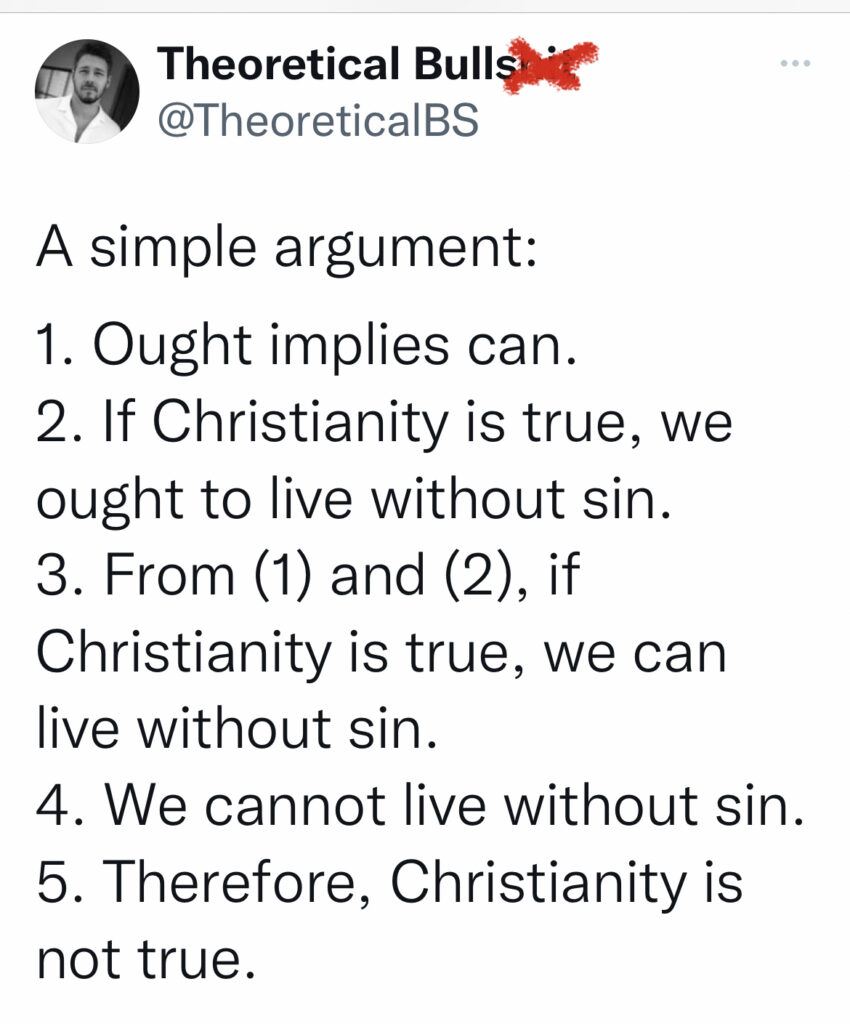
Clifton is an ardent, but philosophically inclined atheist who goes by the moniker “Theoretical BS” (TBS). He recently tweeted out an argument against Christianity that left the Church scrambling. Indeed, many Christians did not know how to respond to Clifton’s logically deductive argument. Moreover, and sadly, many Christians who did respond to his tweet, provided reason to place one’s face in one’s palm.

Consider TBS’s tweet raised against the knowledge of God:

I must admit, Clifton provided a good argument for all to consider. It is based upon premises that many Christians affirm. Indeed, Theoretical BS was on his A-game to craft this argument, which, at the least, exposes the inconsistency of many churchgoers.

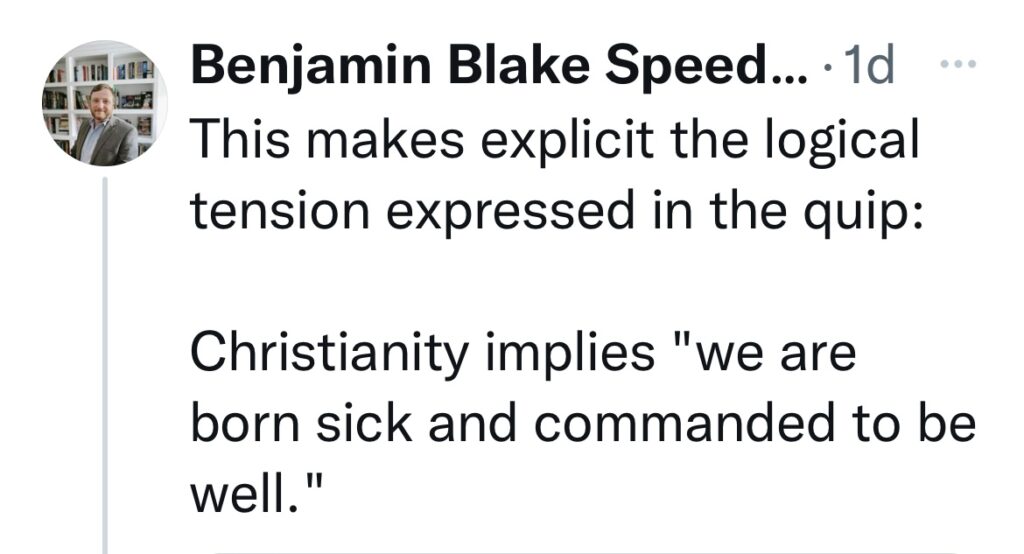
This led my friend Benjamin Watkins, who is also an avid atheist on Twitter, to Tweet the following:

To be clear, we are “born sick” and offered the cure. Each person is free to take the “red medicine” Christ offers, or to reject his love and grace. With that said, I was disheartened to see the lack of good responses from my fellow Christians on Twitter. I saw Calvinists suggesting that the first premise is false, and that “ought does NOT imply can.”

That’s a horrible move!

Discussing Premise (1)

Think about it: if someone says, “You really ought to fly like Superman and save the woman trapped on the 50th floor of a burning skyscraper.” You would look at him as if he were an idiot. Since you cannot fly like Superman, it makes no sense to say “you ought to fly like superman.” Now, if someone tells the trained lifeguard, “You ought to save the child struggling to keep her head above water in the 3-foot,” we know exactly why that makes sense — because the lifeguard has been trained and *CAN* help the child before she drowns.

Moreover, if you were in a boat and your wife said, “You really ought to walk on water,” you would not take her seriously because you can’t walk on water. However, if Jesus commanded you to get out of the boat and walk on water with Him, the reason why it would make sense for you to get out of the boat and run toward Him is because He would use His divine power to make it possible for you to walk on water. Thus, if Jesus says that you *ought* to walk on water, then it follows that you *can* walk on water.

Yes, the first premise of Clifton’s argument is intuitively obvious and true: “ought implies can.” To deny this premise makes Christians look foolish.

Discussing Premise (2)

Some Christians were trying to reject the second premise: “If Christianity is true, we ought to live without sin.”

Oh my! Whatever you do, do not reject premise (2). Think of all the commands to live a holy life and to avoid sin. Here is a small sampling:

Galatians 5:19-21
Now the deeds of the flesh are evident, which are: immorality, impurity, sensuality, idolatry, sorcery, enmities, strife, jealousy, outbursts of anger, disputes, dissensions, factions, envying, drunkenness, carousing, and things like these, of which I forewarn you, just as I have forewarned you, that those who practice such things will not inherit the kingdom of God.

Romans 13:14
But put on the Lord Jesus Christ, and make no provision for the flesh in regard to its lusts.

Hebrews 12:1
Therefore, since we have so great a cloud of witnesses surrounding us, let us also lay aside every encumbrance and the sin which so easily entangles us, and let us run with endurance the race that is set before us . . .

1 Thessalonians 5:22
abstain from every form of evil.

2 Corinthians 7:1
Therefore, since we have these promises, dear friends, let us purify ourselves from everything that contaminates body and spirit, perfecting holiness out of reverence for God.

1 Peter 1:15-16
But just as he who called you is holy, so be holy in all you do; for it is written: “Be holy, because I am holy.”

John 8:11
And Jesus said, “Neither do I condemn you; go, and from now on sin no more.”

This list could go on and on, but TBS’s second premise is supported via ample biblical data. Christians ought to avoid sin.

Discussing Premise (3)

Some might try to reject Premise (3) which reads: “From (1) and (2), if Christianity is true, we can live without sin.”

I agree with TBS. That is to say, regenerated Christ-followers can live without sin. Indeed, with the first two premises supported, it makes no sense to deny (3). We can avoid sin. That is to say, through God’s love, grace, and regenerating power, all Christians can live a holy life.

Discussing Premise (4)

This leaves only one premise remaining before we reach the dreaded death-blow of a deductive conclusion, “Therefore, Christianity is not true.” The fourth premise reads as follows:

“We cannot live without sin.”

I was shocked to see so many Christians in the Twitter-verse accept this premise. Indeed, many Calvinists (who affirm exhaustive divine determinism) advance this premise because if God determines all things, then when God determines a Calvinist to cheat on his wife (for example), it is impossible for the Calvinist to do otherwise. I was screaming at my iPhone as I was scrolling through the comments. Indeed, here’s a counter-factual:

Because of the lack of proper responses, IF I had hair, I WOULD have pulled it out!

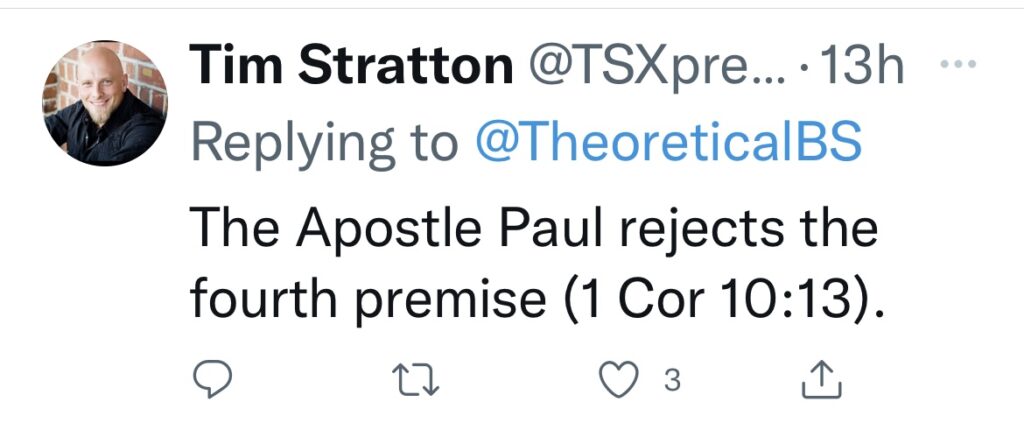
I could not take it any longer. So, finally, I tweeted my own reply:

Only three “likes”? What’s up with that?

Anyway, because the Apostle Paul rejects the fourth premise, so do I. Indeed, based upon Paul’s words in his first letter to the Corinthians, it is possible for a Christian to avoid any sin. Consider this important passage of Scripture:

1 Corinthians 10:13

No temptation has overtaken you that is not common to man. God is faithful, and he will not let you be tempted beyond your ability, but with the temptation he will also provide the way of escape, that you may be able to endure it.

Consider this awesome promise: every time you are tempted to sin, God provides a “way of escape” so that you do not have to sin. Thus, when you sin, do not say that “the devil made me do it,” and whatever you do, do not say that “God determined me to commit this sin.” No! That response is downright blasphemous. Instead, take responsibility for your actions. You chose to fall into temptation, but you did not have to. You could have done otherwise and taken the way of escape God provided.

This also means that you possess libertarian freedom.

Now, some might respond and say that no one has ever gone the rest of his life free from sin. Really? Is that true? What about the guy who only had five minutes left to live and he spent every remaining second of those five minutes praying and praising God? It seems that this person avoided sin for the “rest of his life.”

So, if it is possible for a Christian to resist temptation for five minutes, is it possible for ten minutes? If not, why not? Is it possible for 24 hours? If not, why not? Is it possible for for a week, a month, a year, or fifty years? If not, why not?

It seems that if one grants that a regenerate Christ follower does possess the power to “take the way of escape” for the last five minutes of his life, then asserting that it would be impossible to refrain from sin for any longer period of time is just plain arbitrary and ad hoc. Indeed, if Paul is right, and in every circumstance when we are tempted to sin God also provides a way of escape so that we do not have to sin, then it is possible (it is not impossible) that a Christian who has been transformed by God’s amazing grace can live the rest of his life always choosing the way of escape God provides (again, by His grace).

Discussing the Conclusion

In conclusion, TBS’s conclusion does not follow. This is the case because the fourth premise is false. Therefore, not only does the conclusion not follow, the cumulative case of arguments for the existence of God and the truth of Christianity suggest the exact opposite of what his failed argument concludes:

Therefore, Christianity is probably true! 

Thus, it makes great sense to choose to put your faith in Christ alone.

Stay reasonable (Isaiah 1:18),

Dr. Tim Stratton

Recommended resources related to the topic:

Stealing From God by Dr. Frank Turek (Book, 10-Part DVD Set, STUDENT Study Guide, TEACHER Study Guide)

I Don’t Have Enough Faith to Be an Atheist (Paperback), and (Sermon) by Norman Geisler and Frank Turek 

How Can Jesus be the Only Way? Mp4, Mp3, and DVD by Frank Turek

Jesus, You and the Essentials of Christianity by Frank Turek (INSTRUCTOR Study Guide), (STUDENT Study Guide), and (DVD)      

_____________________________________________________________________________________________________________________________________________________

Timothy A. Stratton (PhD, North-West University) is a professor at Trinity College of the Bible and Theological Seminary. As a former youth pastor, he is now devoted to answering deep theological and philosophical questions he first encountered from inquisitive teens in his church youth group. Stratton is founder and president of FreeThinking Ministries, a web-based apologetics ministry. Stratton speaks on church and college campuses around the country and offers regular videos on FreeThinking Ministries’ YouTube channel.

Original Blog Source: https://bit.ly/3gi0ann 


By Al Serrato

Christians believe that God is an infinite being who has always existed. But what “evidence” can the theist put forth in support of this claim? This is a common challenge raised by the skeptic.

When a person asks for “evidence,” the usual response is to look for things like witness statements, or documents or fingerprints left at a scene. Since no one has “evidence” relating to things outside our universe, or to a being who preceded the Big Bang, it’s a safe bet, they think, that the Christian apologist can’t come up with any “evidence.” Or is it?

Teasing out the unspoken premise in the question highlights what is at play: the challenger assumes that it is only through physical or testimonial “evidence” that we can know things. But this is simply not true. While evidence and inferences from evidence are valid ways of determining what is true, they are not the exclusive ways. For example, when I know that no circle is also a square, where is the evidence for that? Or that A = C, when told that A = B and B = C? Or that rape is always wrong. These types of knowledge – based on logic and reason or on a basic moral sense – are part of the normal functioning of every human mind. Like a computer running software, our minds come equipped with certain basic programs, such as the ability to acquire and use language. Similarly, we are born with an appreciation of game-playing and fairness. Watch a child develop and you will see these subprograms at work. You may teach them how to play the game and what’s considered fair or foul, but they already intuitively understand the importance of the game and the rules.

The mind has an additional “pre-loaded” capability that helps us better understand where we came from and who created us: the ability to conceptualize, to make sense of patterns by grouping things into categories. For example, we don’t need an exhaustive list of possible ”chairs” or ”tables” to know whether a particular item can serve in that capacity. To know if something new qualifies as ”food,” we needn’t refer to a list but can instead ask questions, such as whether the item is edible and able to provide nourishment. An exotic fruit will pass that test but an ashtray will not. When we reflect on these conceptions, we can derive actual knowledge, even in the absence of traditional “evidence.” By realizing what a square is, we “know” that a circle can never be one. By knowing that people have a right to the integrity of their bodies, we know that rape – which violates that right – is always wrong. By employing logic, we know that A = C when A and C are both equal to B.

What does this have to do with God’s origins? Just this: it is by conceptualizing what is meant by God that we can determine – that we can know – certain important things about him. When we think of God, what exactly are we thinking about? We may of course disagree on specifics, but to qualify as ”God,” we must be referring to that ultimate omnipotent being that possesses and embodies infinite perfection. Well, the skeptic protests, why does that require existence? I can imagine a unicorn but that doesn’t mean I could ever find one.

This objection helps focus the inquiry, because it requires us to think more deeply. When we think of a unicorn, we are thinking of a white horse-like animal with a horn protruding from its forehead. Such a being may once have existed or may exist sometime in the future or may never exist at all. There is nothing about the conception of a “unicorn” that requires it to actually exist; the only requirement is that if such an animal did exist, it would have the noted attributes.

But when we get back to the conception of God, what is it that we have in mind? How do we best put words to the concept of the ultimate being, a being so great that it is simply not possible to conceive of anything greater? God embodies infinite perfections. Such a being, to qualify as ”God” within our minds, must necessarily exist. If you are contemplating two beings with similar attributes and one possesses the attribute of necessary existence and the other does not, it is readily apparent that the former is the greater being. Unless we’re conceiving within our minds this image of God, we have not yet actually begun to think about God but are instead thinking of something lesser.

Anselm of Canterbury is credited with first developing this argument, the ontological argument, ten centuries ago. When you follow where reason leads in conceptualizing what God entails, you realize that he must be an infinite being who necessarily exists. He was not created. He never came into being, and will never cease existing. All that there is, or was, or ever will be is contingent him upon him for existence, while he is complete in and of himself, contingent upon nothing. This is the only rational conclusion that can be drawn from the creation of something from nothing; it is where the “evidence” leads.

That God is the source of this universe, and all that is in it, is a product of recognizing that all created things had a preceding cause, sufficient to bring them into existence. There are no known exceptions and no reason to suspect that there are any exceptions. Moving to the very beginning of the space/time continuum we occupy, there must be a source adequate to the task of creating it. Two possibilities exist: the creator of the universe was himself created, and therefore had a beginning; or he was infinite, having no beginning. If you choose the former, you haven’t gone far enough in your reasoning because the only way for a being to qualify as “God” is to possess infinite perfection. You need to keep moving back in time to frame in your mind that original being, the one who was not himself created.

The skeptic will usually persist in his challenge: why doesn’t your god need a cause? But again, to ask the question betrays the mistake in reasoning of the questioner. The error is in the premise: all things do not need a creator, only created things, or more specifically this universe and all that it encompasses. Something outside of the universe, something that is the source of all things, does not need to be created. In fact, reason leads us in the opposite direction. Since things don’t create themselves, there must be, at the very beginning, a being who always existed, who was never created and never in need of anything.

Seen in this light, the question becomes nonsensical, translating into: who created the uncreated being, or who caused the being which needed no cause? It is no different than asking what time it is on the moon. The time of day is a function of where on earth a person is; it is nonsensical when applied off planet.

Of course, none of this proves that God is the triune God of the Bible, who by the way does provide witness testimony of his eternal nature. But the skeptic will never begin to consider the truth claims of Christianity if he remains stuck doubting the existence of that God.

Recommended resources related to the topic:

Stealing From God by Dr. Frank Turek (Book, 10-Part DVD Set, STUDENT Study Guide, TEACHER Study Guide)

Oh, Why Didn’t I Say That? Does Science Disprove God? by Dr. Frank Turek (DVD and Mp4)

_____________________________________________________________________________________________________________________________________________________

Al Serrato earned his law degree from the University of California at Berkeley in 1985. He began his career as an FBI special agent before becoming a prosecutor in California, where he worked for 33 years. An introduction to CS Lewis’ works sparked his interest in Apologetics, which he has pursued for the past three decades. He got his start writing Apologetics with J. Warner Wallace and Pleaseconvinceme.com.


Por Levi Dade

Hace unos meses, me senté con un íntimo amigo mío en una de las cabinas de la cafetería de nuestra universidad. Mi amigo, al que llamaré Tom, es ateo. Tom es un auténtico buscador de la verdad, y sería cristiano si considerara que el cristianismo es “completamente cierto”. Durante nuestra conversación, terminamos discutiendo el tema de la fe. Después de averiguar sus perspectivas del mundo y sus justificaciones para ellas, dijo algo que me sorprendió.

“Al final del día, supongo que todos estamos obligados a tener fe en algo”.

Quería que me aclarara lo que quería decir con esa afirmación, así que le respondí: “¿Quieres decir fe ciega?”.

“Sí, supongo que es fe ciega”.

La diferencia entre la fe y la fe ciega

Presta atención a éstas breves líneas: hay una diferencia entre la fe y la fe ciega. Para ser claros, la fe ciega es creer algo sin razón alguna para creerlo. También puede decirse que es una creencia incuestionable en algo, aún cuando  es irracional o está equivocada.

Tom hizo una división entre fe y fe ciega. Esta división implica que la fe no siempre es ciega. Si la fe fuera inherentemente ciega, no tendría sentido hacer la división . Sin embargo, mientras lees esto, y aunque no te hayas dado cuenta, ya sabes que la fe no es inherentemente ciega.

Por ejemplo, cuando tenías siete años, ¿dudabas de que tus padres o tutores te protegieran? Probablemente no.

¿Por qué?

No sólo porque son tus padres, sino porque durante toda tu infancia, tus padres te demostraron que te protegerían. A partir de las experiencias pasadas con ellos donde siempre te dieron esta protección, te diste cuenta de que siempre tendrías fe en que constantemente te protegerían. Fíjate cómo inició: primero vino la prueba (o la razón) de que tus padres te protegerían. Después de la prueba llegó  tu fe en ellos.

Supongamos que conocerás a tus padres por primera vez al cumplir siete años. ¿Tendrías la fe para creer que te protegerán? Probablemente no. ¡Son unos desconocidos! No tendrías esa fe en ellos porque no te han demostrado que van a protegerte.

Piénsalo así: Un hombre le propone matrimonio a su novia después de que ella le ha demostrado que será una esposa buena y fiel. Al evidenciar esto, él  tendrá la fe necesaria para pedirle que sea su esposa.[1]

Cuando las pruebas (o evidencias) llevan a la persona a tener fe en algo o en alguien, se llama fe evidenciable/tangible (con “evidenciable” hacemos uso de la palabra entre paréntesis al inicio del párrafo, pero fe tangible pudiera servir de contraparte “natural” a fe ciega) (o fe informada). La fe evidenciable/tangible es lo opuesto de la fe ciega.

Como se puede ver en los ejemplos anteriores, la fe no siempre es ciega.

Esto plantea una pregunta interesante: ¿Los cristianos deben abrazar la fe ciega o la fe evidenciable/tangible?

Una mejor manera de plantear esta interrogante es preguntar: “¿Con qué tipo de fe la Escritura enseña a los cristianos a vivir?”.

La fe informada lleva a vivir en Jesús

En Juan 20:30-31, Juan explica el propósito de su Evangelio:

Y muchas otras señales hizo también Jesús en presencia de sus discípulos, que no están escritas en este libro; pero estas se han escrito para que creáis que Jesús es el Cristo, el Hijo de Dios; y para que al creer, tengáis vida en su nombre.

Juan 20:30-31 LBLA (énfasis añadido)

Las declaraciones de Juan como testigo sobre los milagros de Jesús tenían como objetivo servir de prueba de que Jesús es “el Mesías, el Hijo de Dios”. Que Jesús sea el Mesías implica que podemos poner nuestra fe en él y ” tener vida en Su nombre”.

Si debemos tener fe ciega, ¿por qué Jesús nos daría evidencias que demuestran que Él es el Mesías? Después de todo, la fe ciega afirma que la evidencia no es necesaria.

En otras palabras, Jesús no quería que la gente tuviera una fe ciega, así que proporcionó pruebas (milagros) para mostrarles quién es Él. La fe viene después de que Jesús nos muestra quién es Él. Romanos 10:17 LBLA comunica la misma idea: “Así que la fe viene del oír, y el oír, por la palabra de Cristo”.

Así como los niños desarrollan confianza en los padres que en el pasado han sido responsables dando protección y cariño, también otros pueden tener fe en Jesús después de que Él les ha mostrado quién es y además que también es el Mesías.

La fe informada nos permite compartir el por qué tenemos esperanza en Jesús

… sino santificad a Cristo como Señor en vuestros corazones, estando siempre preparados para presentar defensa ante todo el que os demande razón de la esperanza que hay en vosotros, pero hacedlo con mansedumbre y reverencia; teniendo buena conciencia, para que en aquello en que sois calumniados, sean avergonzados los que difaman vuestra buena conducta en Cristo…

1 Pedro 3:15-16 LBLA (énfasis añadido)

Aunque la fe no se menciona explícitamente en este pasaje, está claro que Pedro habla de nuestra fe cuando se refiere a la “esperanza que hay en vosotros”. El contenido nos da una idea del tipo de fe que debemos tener. No sólo sugiere tener una fe informada; ¡este versículo lo ordena!

Tenemos como encargo saber por qué tenemos fe en Jesús y de esa manera podremos compartir no sólo nuestra fe sino también la razón de nuestra fe.

Es como si Pedro sabía que decirle a alguien que “sólo tenga fe” no iba a responder mágicamente a sus preguntas o dudas, así que bajo la inspiración del Espíritu Santo, escribió el mandato de compartir la razón que hay detrás de nuestra fe. Esto supone que tenemos una razón. Así que saber por qué tenemos fe en Jesús no solo es “algo bueno”, sino que es un mandamiento el saberlo (¡incluso para propósitos prácticos y evangelísticos!).

La fe informada nos permite amar a Dios profundamente

Y amarás al Señor tu Dios con todo tu corazón, y con toda tu alma, y con toda tu mente, y con toda tu fuerza.

Marcos 12:30 LBLA (énfasis añadido)

Una vez más, se nos ordena utilizar nuestra mente como una forma de amar a Dios. Amar a Dios no sólo se origina en nuestro corazón; sino que proviene de todas las facetas de nuestra vida, incluyendo nuestra forma de pensar y razonar. Conocer a Dios intelectualmente te permite conocerlo a un nivel más profundo. Y cuando conoces a alguien con mayor profundidad, también puedes amarlo profundamente. (La traducción “deeper level” es correcta, pero repetir “nivel más profundo” tres veces en dos líneas hace que se escuche o se vea mal, así que intenté darle un sentido de progresión de “nivel más profundo” a “mayor profundidad” a “profundamente”.)

Cuando  sabemos  poco sobre Dios, ¿cómo podríamos amarle mucho? (Sé que no es lo que el autor escribió, pero intuyo que el autor busca dar un contraste, y en español los contrastes de ideas se expresan mejor con antónimos que con la negación de las palabras. En la pregunta, la traducción es correcta, pero dado que hay un contraste de ideas la palabra “expect” implica la probabilidad o certeza de algo que por el contexto es difícil que ocurra, así que usé el condicional simple para enfatizar la situación hipotética e improbable.)

En un artículo anterior titulado “Amar a Dios con la mente: cómo Dios quiere también tu cerebro”, lo explico de la siguiente forma:

En resumen, amar a Dios con la mente es permitir que la mente y el corazón trabajen juntos de manera que produzcan un conocimiento más profundo de Dios. Este conocimiento, a su vez, conduce a una relación más íntima con Dios, en la que  amamos a Dios tanto intelectual como emocionalmente.[2]

Usemos nuestro cerebro para la gloria de Dios

Basándonos sólo en estos pasajes, vemos claramente que una fe informada es bíblica. En pocas palabras, la fe bíblica es creer en algo que tiene buenas razones para proclamar/aseverar que es verdad.

Servimos a un Dios lógico (Isaías 1:18), y Él quiere que utilicemos tanto nuestro cerebro como nuestro corazón. Después de todo, Él nos creó y también a nuestro cerebro, (Quizás sería más acertado poner: Él nos creó con cerebro) así que ¿por qué no usarlo para Su gloria? Una fe (bíblica) evidenciable/tangible te permite saber por qué el cristianismo es verdadero. Conocer la verdad de nuestras creencias es importante en un mundo en el que tantas cosas intentan atraparte para que pongas tu identidad en ellas y no en Cristo.

En el libro,(No podemos hablar de “su” cuando no se ha nombrado a la persona, y como lo que a continuación se menciona es el título del libro entonces cambié “su” por “el”. Lo otro que podemos hacer es mover el nombre al inicio: J. P. Moreland en su libro […]) Love Your God with all Your Mind (Ama a tu Dios con toda tu mente), J. P. Moreland propone que las conexiones esenciales de la fe están en la razón: ” A diferencia del malentendido bíblico moderno, la fe es un poder o habilidad que actúa de acuerdo con la naturaleza del reino de Dios, una confianza en la que tenemos razones para creer que es verdad. Entendida así, vemos que la fe se construye sobre la razón”.[3]

Que todos abracemos esta fe bíblica e informada, la cual nos ayudará a permanecer firmes intelectual y espiritualmente, preservando nuestra identidad en Cristo, y manteniendo nuestros ojos fijos en Él para siempre.

Amén.

Notas

[1]  Adaptado de Frank Turek, ilustración de “creer que” en contraste con “creer en”.

[2] Levi Dade, “Loving God With Your Mind: How God Wants Your Brain Too,” The Rebelutionhttps://www.therebelution.com/blog/2021/06/loving-god-with-your-mind-how-god-wants-your-brain-too/

[3]  J. P. Moreland, Love Your God With all Your Mind (NavPress: Colorado Springs) 2012, 19.

Recursos recomendados en Español: 

Robándole a Dios (tapa blanda), (Guía de estudio para el profesor) y (Guía de estudio del estudiante) por el Dr. Frank Turek

Por qué no tengo suficiente fe para ser un ateo (serie de DVD completa), (Manual de trabajo del profesor) y (Manual del estudiante) del Dr. Frank Turek

_____________________________________________________________________________________________________________________________________________________

Levi Dade es del norte de Mississippi y cursa el tercer año de la carrera de Estudios Bíblicos y Teológicos en la Universidad Bautista Ouachita (Ouachita Baptist University). Levi escribe artículos de apología para el blog The Rebelution y para CORE Leadership, un ministerio en línea que da clases a distancia para adultos y jóvenes con el propósito de que tengan un profundo conocimiento y amor por Dios. Levi también es fotógrafo en su universidad, y emprendió un negocio de fotografía mientras estudiaba el bachillerato en el 2017 llamado Dade Photography, Es habitual encontrar a Levi leyendo algún libro, pescando en kayak, haciendo senderismo, escribiendo, tomando fotos para el libro anual escolar, o en plena disputa para decidir ¡cuál de éstas actividades debe realizar!

Fuente del blog original: https://bit.ly/3xhvoQl

Traducido por Daniela Checa Delgado

Editado por Gustavo Camarillo 


By Brian Huffling 

I first heard about Dr. Norman L. Geisler when I was in high school. I bought his When Skeptics Ask. I glossed over it but thought it was beyond me. During my senior year of college, my wife and I decided to move back to my native Charlotte after graduation and study apologetics under Dr. Geisler at Southern Evangelical Seminary. Before making the move, we visited the seminary. While sitting in the registrar’s office, Dr. Geisler walked by, and I was star struck. After the tour, Dr. Doug Potter introduced us to Dr. Geisler. I was so nervous. He asked if we had lunch plans. I got even more nervous. We said no, and he asked if we would have lunch with him. Of course, we said yes. On the way out of the building he asked if I would drive as his car was in the shop. Even more nervous.

We went to a place called Wolfgang Puck (which is no longer there). I asked what he recommended and he said the butternut squash soup. So, I got that. Let me tell you, it was awful! Between the nervousness and the bad taste, I just couldn’t eat. However, after a while my nerves calmed, and he noticed I wasn’t eating. He asked if I didn’t like the soup, and I replied no (feeling badly). “Here, have some of my sandwich,” he said. Norman Geisler gave me half of his sandwich! I felt so bad. However, that is the kind of man he was. To be such a rock star in the world of evangelical apologetics, philosophy, theology, and biblical studies, he was such a humble man. That was something that I would notice for years to come.

As a student I took several classes from him, including Intro to Apologetics, several theology courses, a philosophy course, and the Problem of Evil. Of course, everyone knows he was a scholarly man. With over 100 books to his name, and I don’t know how many articles and presentations, he had a profound impact on the evangelical community. In fact, his impact was felt in many more circles than that. I have heard several people outside of evangelicalism, such as Ed Feser, and even outside of Christianity, such as Michael Ruse, praise him for his scholarship and care.

I have learned many things from Dr. Geisler. Having read several of his books, taken several classes, and co-taught with him, several characteristics stick out to me.

First, he was as logical as Spock. He could take a complicated argument (or an incoherent mess), and explain it to anyone in the most logical fashion, removing all unnecessary emotion. This is extremely important in issues of philosophy and apologetics when an issue can be convoluted or overly emotional. Second, he was a wizard at debating. Having seen several of his debates and discussions with unbelievers, he was a force to be reckoned with. Third, he was very caring of his students. He went out of his way to help however he could. He didn’t just talk the talk, he walked the walk. I remember him taking time to help me with my application to be an Air Force chaplain. I had to answer questions that I didn’t even understand what was being asked, let alone how to answer. He was patient and helpful. My wife was always amazed at how he remembered her name with over 50 students in a class and often asked for updates since the last time he had chatted with her even if it had been months prior. Fourth, and this is possibly what he is known best for, he was a bulldog at safeguarding evangelical issues such as inerrancy, the classical view of God, and the bodily resurrection of Christ.

His grace as a teacher didn’t stop with him being my professor. I was fortunate and honored to be able to teach a few classes with him. He treated me with grace and respect, even though I was very much his weaker assistant professor. He was never too busy to stop and say hello and see how things were going.

We can take the following lessons from our fellow servant of Christ: Be knowledgeable Christians. We have to know what we believe and why, and be prepared to defend it. We have to understand our interlocutor’s argument if we want to evaluate it. We have to make the Bible and devotion to Christ our first and foremost goal in life. It is not simply about winning arguments; it is about winning people for Jesus. Last, we have to be willing to serve others. We must live the servant life, as Christ and Dr. Geisler did.

Recommended resources related to the topic:

I Don’t Have Enough Faith to Be an Atheist (Paperback), and (Sermon) by Norman Geisler and Frank Turek 

Counter Culture Christian: Is There Truth in Religion? (DVD) by Frank Turek

_____________________________________________________________________________________________________________________________________________________

Brian Huffling, PH.D. have a BA in History from Lee University, an MA in (3 majors) Apologetics, Philosophy, and Biblical Studies from Southern Evangelical Seminary (SES), and a Ph.D. in Philosophy of Religion from SES. He is the Director of the Ph.D. Program and Associate Professor of Philosophy and Theology at SES. He also teaches courses for Apologia Online Academy. He has previously taught at The Art Institute of Charlotte. He has served in the Marines, Navy, and is currently a reserve chaplain in the Air Force at Maxwell Air Force Base. His hobbies include golf, backyard astronomy, martial arts, and guitar.

Original blog: https://bit.ly/3xnkcTJ


By Erik Manning

Recently I stumbled across what I thought was a rather silly meme:

Jonah meme

Oof. Here’s the thing: No matter if you believe Jonah is historical or ahistorical (and some Christians, like C.S. Lewis, believed it was the latter), this meme misses the point. Science tells us what nature does when left to itself; miracles happen because nature is not left to itself. Whoever wrote the book of Jonah probably understood that human beings don’t normally get swallowed by whales, let alone survive if they did.

But did Jonah survive? No, and yes.  Let’s read Jonah’s parts of the prayer from the whale’s belly:

Then Jonah prayed to the Lord his God from the stomach of the fish, and he said, “I called out of my distress to the Lord, and he answered me. I cried for help from the depth of Sheol; you heard my voice…

…“Water encompassed me to the point of death. The great deep engulfed me, weeds were wrapped around my head. “I descended to the roots of the mountains. The earth with its bars was around me forever, but you have brought up my life from the pit, O Lord my God. “While I was fainting away, I remembered the Lord…“Then the Lord commanded the fish, and it vomited Jonah up onto the dry land. Now the word of the Lord came to Jonah the second time, saying, “Arise, go to Nineveh…”

Jonah 2:3-1

Did Jonah Survive?

Let’s consider these three key points from this text:

  • First, the phrases belly of Sheol and the Pit are Old Testament terms that refer to the realm of the dead. (See Job 7:933:18Psalm 40:249:14-1589:48)
  • Secondly, the Hebrew says that his soul or nephesh fainted, meaning he took his last breath like a dying man.
  • Lastly, when God says to Jonah “arise” this is the Hebrew word קוּם. This is the same word Jesus used when he raised Jairus’ daughter from the dead. Mark 5:41reads: “Taking the child by the hand, He said to her, “Talitha Kum!” (which translated means, “Little girl, I say to you, get up!“)

So actually, the atheist has a good point; Jonah probably did die in the belly of a great fish, or whale. God had mercy on him and raised him from the dead, and he was able to carry out his mission.

The Sign of Jonah

OK, so where am I going with this? Remember when Jesus refused to give the Pharisees a sign? What was his reply? He said:

“An evil and adulterous generation seeks for a sign, but no sign will be given to it except the sign of the prophet Jonah. For just as Jonah was three days and three nights in the belly of the great fish, so will the Son of Man be three days and three nights in the heart of the earth. The men of Nineveh will rise up at the judgment with this generation and condemn it, for they repented at the preaching of Jonah, and behold, something greater than Jonah is here.”

(Matthew 12:38-41)

To be honest, I’ve thought before that this was a pretty weak parallel, no offense to Jesus. But this story makes much more sense if Jonah really did give up the ghost only to be miraculously revived to preach to the Ninevites. And there is even more. Like, why are the Ninevites so significant?

Throughout Old Testament history, Nineveh was not a friend of Israel. In the late seventh century BC, Nineveh was the capital of the Assyrian empire. The city’s king, Sennacherib, laid siege to Jerusalem in 701 BC (2 Kings 18:13-19:37) and I’m sure the Jews never forgot.  When the Babylonians destroyed Nineveh in 612, Nahum the prophet practically rejoiced. He calls Nineveh the “city of bloodshed”. (Nah 3:1) Jonah probably fled because of these reasons. Like many Jews of his time, Jonah hated Nineveh.

The Sign of Jonah: More Than the Resurrection

By mentioning Jonah, Jesus was being purposely provocative. His death would lead not only to his resurrection but the repentance of the pagan nations that his audience would’ve despised. The sign of Jonah wasn’t just his resurrection but would lead to the repentance of those hated Gentiles.

Now think about this for a second: From Augustine to Aquinas, Christian apologists would point to the success of the church as evidence of the truth of the Gospel. When they argued for the messiahship, divinity, and resurrection of Jesus, they (generally) failed to mention the evidence for an empty tomb or the reliability of the eyewitnesses. They didn’t argue about historical probability and evidence, as important as I think that is.

Rather, they simply pointed out the crumbling pagan world around them; Gentile nations that had worshipped idols for millennia miraculously repented, turned, and began to worship the God of the Jews. Isaiah the Prophet also saw this when he said that the servant of the Lord will be “a light for the nations” (Isaiah 42:6-7) Many of the other Psalmists and Old Testament prophets predicted the same thing; that one day Israel would lead to the conversion of the nations.

The Sign of Jonah Has Been Fulfilled

Now look around: Since Jesus’ death and resurrection, a tiny band of Jewish vagabond fishermen turned the world upside down, and their effect has been felt for generations until now. In the first century, Christianity spread throughout Europe, North Africa, and Western Asia, and more recently has spread throughout Africa, South America, and even in communist China. Christianity still has a stronghold in North America as well as parts of Europe. Over the past two millennia, billions and billions of non-Jews have repented and worshiped the God of Israel.

So this atheist meme makes a good point. Of course, Jonah wouldn’t have survived. Jonah died, rose again 3 days later and his preaching converted the Ninevites. Jesus died, rose again 3 days later and his message through his apostles converted billions of Gentiles over the past 2000 years. The sign of Jonah has been fulfilled. We don’t believe that simply because a book says it’s true, we can just open our eyes and see the world around us.

Recommended resources related to the topic:

Miracles: The Evidence by Frank Turek DVD and Mp4

Oh, Why Didn’t I Say That? Does Science Disprove God? by Dr. Frank Turek (DVD and Mp4)

How to Interpret Your Bible by Dr. Frank Turek DVD Complete Series, INSTRUCTOR Study Guide, and STUDENT Study Guide

__________________________________________________________________________________________________________________________________________________

Erik Manning is a Reasonable Faith Chapter Director located in Cedar Rapids, Iowa. He’s a former freelance baseball writer and the co-owner of a vintage and handmade decor business with his wife, Dawn. He is passionate about the intersection of apologetics and evangelism.

Original Blog Source https://bit.ly/3mC3F7H


By Al Serrato

Many years ago, when I was younger and much less wise, I decided it would be a good father-son project to invest in an older car that I could restore. (Note to fathers: it’s a much better bonding idea to find something your kids like than the other way around). So, after some searching, and mindful of my meager budget, I ended up finding an ’87 Mustang convertible that was in pretty good shape overall. It wasn’t difficult for me to envision that with a little elbow grease, and a website that specializes in Mustang parts, I could make this car showroom quality in no time.

After the novelty wore off, and my kids’ interest waned from little to none, I found that I had a solitary project on my hands that had this very annoying habit of making negative progress. That’s right. No matter how many items I crossed off the to-do list, more kept getting added. And I found that things always went from good to bad, from working to broken, from clean to dirty. Window switches that were working one day stopped working the next. Motors that keep the windows moving smoothly up and down began to groan and then stopped. Fuses blew, over and over again. Amazingly, the process never worked the other way. No matter how long I waited, broken switches never fixed themselves. Cracked pieces of trim, or a broken taillight, never repaired themselves. Rust in the metal always appeared, where it wasn’t before, and never gave way to clean and shiny metal. Yes, the law of entropy was fully in effect, and the only way to reverse that process was to invest time, energy, and money.

This of course comes as no surprise to anyone who has ever owned anything. Nor is it a surprise to anyone who has considered the way nature operates. Scientists tell us that this law – entropy – is a characteristic of the universe. Entropy is, put simply, a measure of disorder, and it seems that a universal law is in operation moving everything from states of higher to states of lower order. In other words, nature has a particular direction to it, and that direction is down.

Christianity and atheism are competing worldviews. Each one claims to be able to make sense of the world so as to explain the way things really are. And despite the increasing popularity of atheism, and the increasing disdain for historic Christianity, the atheistic worldview is utterly incapable of making sense of the world. As it relates to entropy, atheism must explain why it is that the “evolution” of life has escaped this universal law. How is it that incredibly complex human beings evolved from lower life forms? When DNA is subjected to random change, the result is often lethal – it’s called cancer. But somehow, atheists insist, given enough time, a simple single-celled life form acquired the instructions necessary to produce a complete human life, instructions that must perfectly direct the assembly and interworking of dozens of systems. And if that were not hard enough, how can life have emerged from inert – lifeless – material? Leave a rock alone for a few millennia and you end up with, well, a rock.

The Christian worldview, by contrast, can provide that explanation. The Big Bang event that started this downward slide in progress is the result of a massively powerful and immensely intelligent being, who provided the laws we see in nature, and who wrote the instructions that scientists are beginning to decipher within DNA. The reason life “evolved” on earth is because an Intelligent Designer designed it to and provided the energy source to power the process. Recognizing the need for such a “first cause” is not unscientific. Indeed, modern science began with the presupposition that intelligent minds could untangle the mysteries of nature because these mysteries were not random but were themselves the product of an ordered mind, of intelligence.

Fighting the obvious, as atheists do, is even less successful than fighting entropy. They would be better off using their time in more productive pursuits.

Recommended resources related to the topic:

I Don’t Have Enough Faith to Be an Atheist (Paperback), and (Sermon) by Norman Geisler and Frank Turek 

Stealing From God by Dr. Frank Turek (Book)


__________________________________________________________________________________________________________________________________________________

Al Serrato earned his law degree from the University of California at Berkeley in 1985. He began his career as an FBI special agent before becoming a prosecutor in California, where he continues to work. An introduction to CS Lewis’ works sparked his interest in Apologetics, which he has pursued for the past three decades. He got his start writing Apologetics with J. Warner Wallace and Pleaseconvinceme.com.