Tag Archive for: apologetics

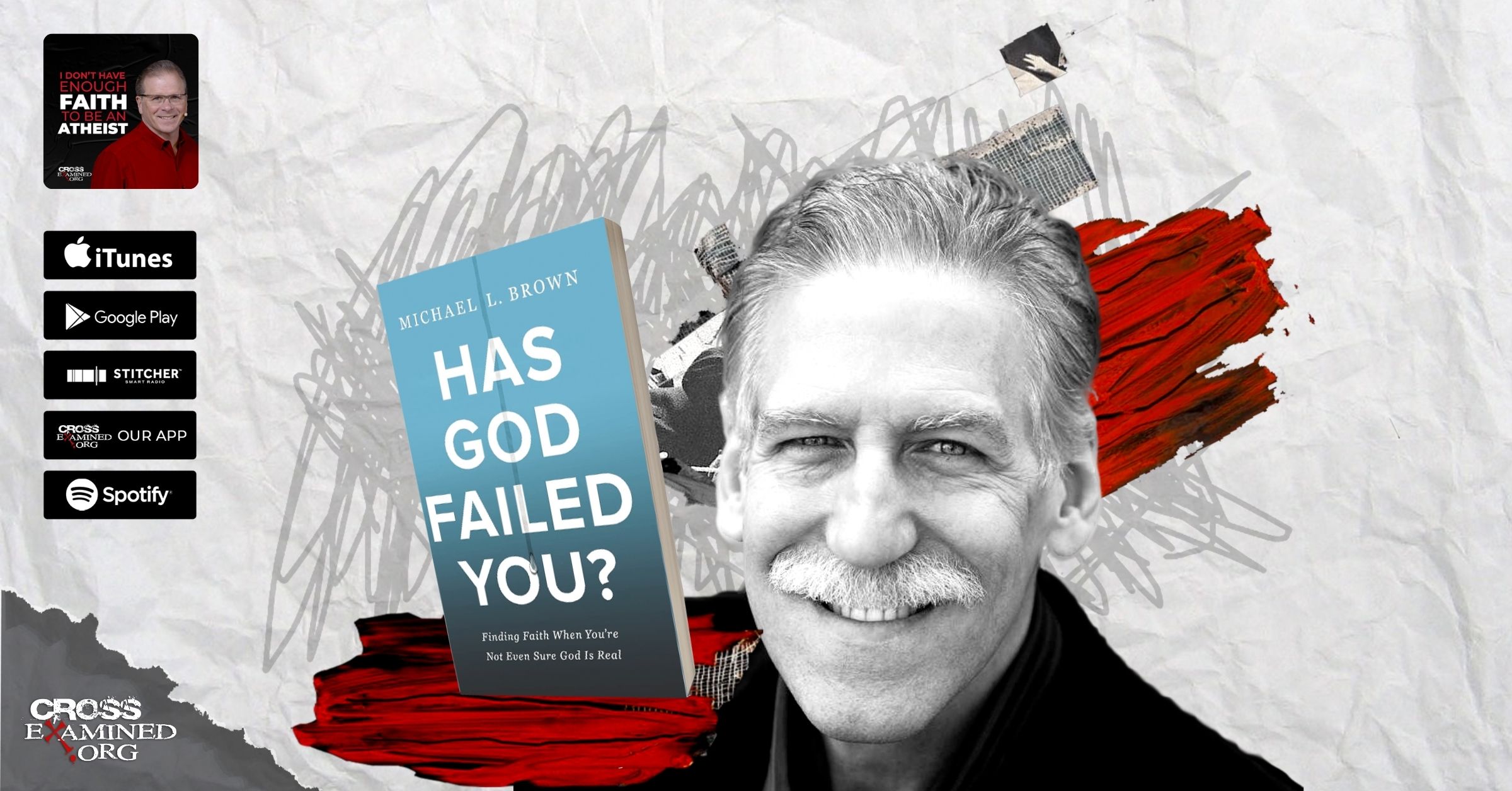
What kind of God would allow evil and suffering to good people? Didn’t God promise that your faith could move mountains? Then why haven’t your prayers been answered? And isn’t the Bible a bigoted and outdated book (just look at the transgender issue)?

To address those questions, Dr. Michael Brown joins Frank and cites insights from his new book, “Has God Failed You? Finding Faith When You’re Not Even Sure God is Real”. This honest look into some of the most vexing questions that Christians face is both helpful and encouraging.

Websites referenced include AskDrBrown.org and SexChangeRegret.com For more on Dr. Brown and his outstanding work on Messianic Prophecy see RealMessiah.com

If you want to send us a question for the show, please email us at Hello@CrossExamined.org.

Subscribe on iTunes: http://bit.ly/CrossExamined_Podcast Rate and review! Thanks!!!
Subscribe on Google Play: http://bit.ly/CE_Podcast_Google
Subscribe on Spotify: http://bit.ly/CrossExaminedOfficial_Podcast
Subscribe on Stitcher: http://bit.ly/CE_Podcast_Stitcher


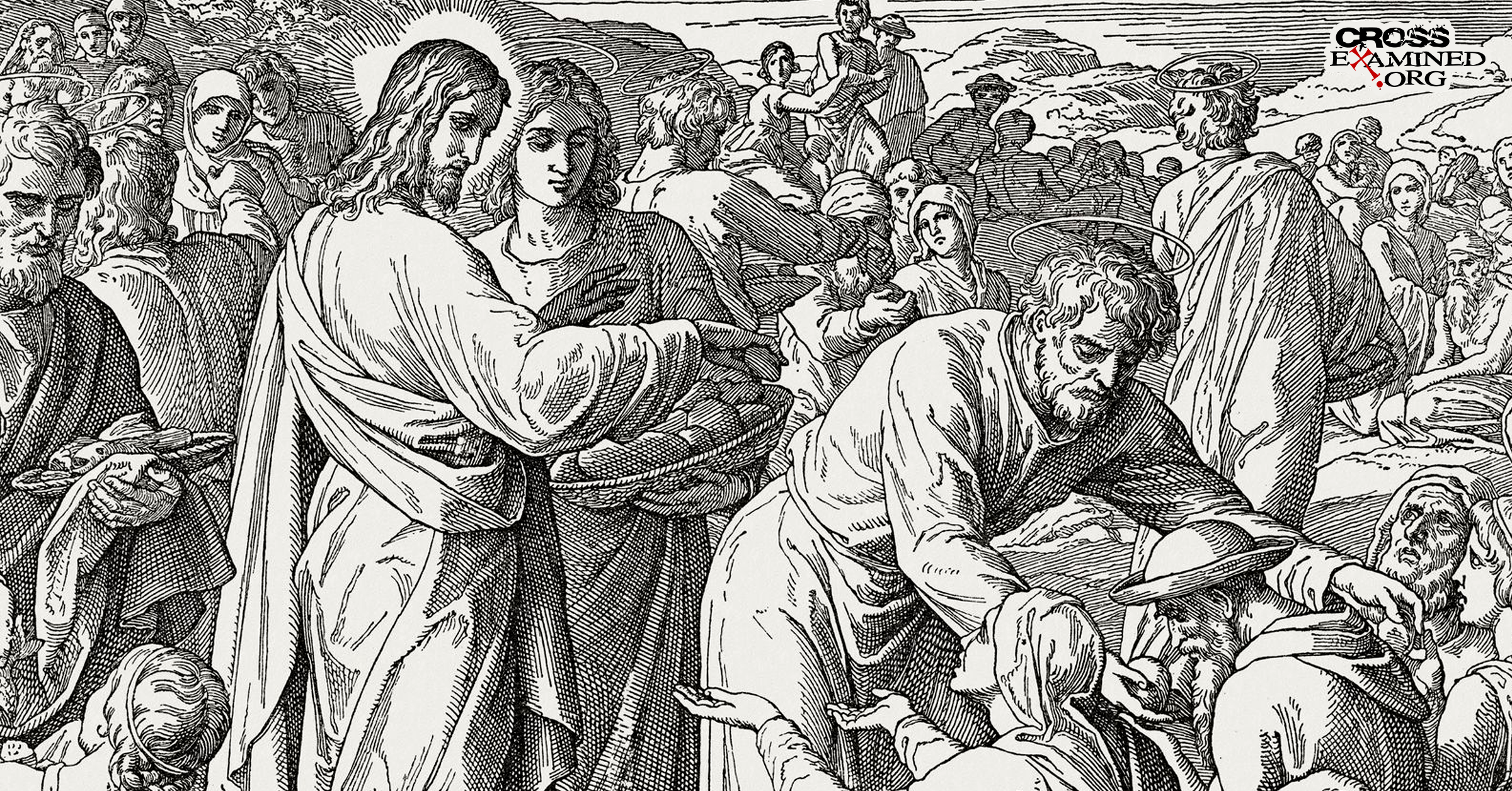
It is one of the most iconic incidents in Jesus’ life. We are all familiar with the famous story of Jesus miraculously feeding the five thousand from five loaves and two fish, with no fewer than twelve basketfuls of leftovers. The story is recounted by all four gospel writers: Matthew, Mark, Luke, and John. But just how historical is this story? In this article, I attempt to highlight several lines of evidence which, when taken as a cumulative whole, strongly suggest that these reports are rooted in a real historical event. I attempt to show this by virtue of appeal to undesigned coincidences, reconcilable variations, and other telltale markers of independence and verisimilitude. What I hope to demonstrate is that the feeding of the five thousand is the second-best attested New Testament miracle, after the resurrection of Jesus. For many of the insights that follow, I am indebted to my friend and colleague Dr. Lydia McGrew, both through her writing, and through her direction towards Christian authors from times past (such as Paley, Blunt, and Birks) who identified many of these hallmarks of verisimilitude in the gospel accounts.

Undesigned Coincidences Relating to the Feeding of the Five Thousand

An undesigned coincidence occurs when you have two or more accounts that casually interlock in a way that points to the truth of both. In its most classic form, one account of an event may raise a natural question that is answered incidentally and casually by the other. Much like a puzzle, it fits like a hand into a glove. This is not at all the type of pattern that one would expect to see in the event of some kind of conspiratorial manufacturing of the story. When taken as a cumulative argument — many instances considered collectively — one has a powerful argument for the overall general reliability and integrity of the gospel narratives. I will now offer a handful of examples pertaining to the feeding of the five thousand narratives.

The Role of Philip

In John 6:1-7, we are told:

Some time after this, Jesus crossed to the far shore of the Sea of Galilee (that is, the Sea of Tiberias), and a great crowd of people followed him because they saw the signs he had performed by healing the sick. Then Jesus went up on a mountainside and sat down with his disciples. The Jewish Passover Festival was near. When Jesus looked up and saw a great crowd coming toward him, he said to Philip, “Where shall we buy bread for these people to eat?” He asked this only to test him, for he already had in mind what he was going to do. Philip answered him, “It would take more than half a year’s wages to buy enough bread for each one to have a bite!”

Now, Philip is a fairly minor character in the New Testament. And one might, naturally, be inclined to wonder why Jesus hasn’t turned to someone a little higher in the pecking order (such as Peter or John). Perhaps even Judas Iscariot would have been a more suitable choice for this role in the account since John informs us elsewhere that he was responsible for the money bag (Jn 13:29).

A partial clue is provided in John 1:44: “Philip, like Andrew and Peter, was from the town of Bethsaida.” Likewise, John 12:21 refers to “Philip, who was from Bethsaida in Galilee.” What is so significant about Philip being from the town of Bethsaida? We don’t learn this until we read the parallel account in Luke’s gospel (9:10-17). At the opening of the account (verses 10-11), we are told,

“When the apostles returned, they reported to Jesus what they had done. Then he took them with him and they withdrew by themselves to a town called Bethsaida, but the crowds learned about it and followed him. He welcomed them and spoke to them about the kingdom of God, and healed those who needed healing.”

And so, we are informed by Luke (who does not mention Philip in this context at all) that the event was actually taking place in Bethsaida — the town from which Philip was from! Jesus thus turns to Philip, whom, he believed, would be familiar with the area. This also perhaps illuminates the involvement of Andrew (who was also from Bethsaida — Jn 1:44) in the reply. Andrew says to Jesus in John 6:9, “There is a boy here who has five barley loaves and two fish, but what are they for so many?” One may conjecture that Andrew, being from Bethsaida where this miracle took place, knew the boy, or perhaps Jesus had directed his question to Philip and Andrew, both of whom were locals.

The reason for Jesus addressing Philip in John 6:5 is never explicitly spelled out in the text. Instead, one has to do the detective work of piecing together the clues drawn from John 6:5; John 12:21 (and 1:44); and Luke 9:10-17. This is precisely the sort of casual connection between accounts that one might expect to see in historical reportage, though it is more surprising given the hypothesis of fictionalization.

The Green Grass, and the Coming and Going Crowds

Curiously, Mark’s narrative describes the people as sitting down in groups on “the green grass” (verse 39). This is significant, not because Mark mentions people sitting on the grass (Matthew 14:19 also records people sitting “down on the grass”, and Luke 9:15 reports that “everyone sat down”, and John 6:10 notes that “There was plenty of grass in that place, and they sat down.”). It is significant because Mark reports that the grass was “green”. This is particularly intriguing when one considers that, in Israel (particularly in Galilee) the grass is brown!

What makes this even more intriguing is that Mark’s gospel (6:30-42) also states, in verses 30-31 that,

The apostles gathered around Jesus and reported to him all they had done and taught. Then, because so many people were coming and going that they did not even have a chance to eat, he said to them, “Come with me by yourselves to a quiet place and get some rest.

Mark casually alludes to there being many people coming and going, indicating the hustle and bustle and general business of the area during this time. But why were there many coming and going? Mark does not tell us. In John’s account, however (6:4), we are told that “The Jewish Passover Festival was near.” This explains why many people were “coming and going.” Moreover, during the season of the Passover (i.e. in the springtime), there is a small window where the grass is indeed green in that area, due to elevated levels of rainfall. When this is coupled with the detail given to us by John that the Passover festival was at hand, this illuminates and makes sense of the casual (but surprising) statements in Mark that the grass was green and that people were coming and going.

Counting the Number of People

A question that arises when one reads the accounts of the feeding of the five thousand is how the evangelists knew the number of people. Matthew’s account emphasizes that this number specifically refers to men: “And those who ate were about five thousand men, besides women and children” (Mt 14:21). Mark 6:44, Luke 9:14, and John 6:10 also indicate that it was five thousand men who were fed (though the phrase “besides women and children” is unique to Matthew). But how was this number estimated? According to Mark 6:39-40, “Then he commanded them all to sit down in groups on the green grass. So they sat down in groups, by hundreds and by fifties.” Likewise, Luke 9:14-15 indicates that “he said to his disciples, ‘Have them sit down in groups of about fifty each.’ And they did so, and had them all sit down.’” Having the people organized into groups would have doubtless made it easier to distribute the food, and it would also provide a means of arriving at an estimate of their number.

How, though, were the evangelists able to determine that there were five thousand men specifically, besides women and children? John’s gospel, which omits mention of the organization of the people into groups, provides an important clue. In John 6:10-11, we are told, “Jesus said, ‘Have the people sit down.’ Now there was much grass in the place. So the men sat down, about five thousand in number. Jesus then took the loaves, and when he had given thanks, he distributed them to those who were seated. So also the fish, as much as they wanted.” Thus, like Mark and Luke, John informs us that Jesus told the disciples to have the people sit down in groups. However, John uniquely tells us that it was the men who in fact sat down. This, then, illuminates, in a casual and incidental way, how the number of men could be reliably estimated.

Denouncing the Unrepentant Cities

In Matthew 11:21, Jesus denounces the unrepentant cities, saying, “Woe to you, Chorazin! Woe to you, Bethsaida! For if the miracles that were performed in you had been performed in Tyre and Sidon, they would have repented long ago in sackcloth and ashes.” The reader is left wondering what miracles were performed in these cities. We are not told in Matthew’s gospel. It is only in light of Luke’s account of the feeding of the five thousand (chapter 9), in which we are told of the event’s occurrence in Bethsaida, that this statement begins to make sense. Although Matthew 14:13-21 does narrate the feeding of the five thousand, no mention is made of Bethsaida. Furthermore, Matthew, who often arranged his material thematically rather than chronologically, gives his account of the feeding of the five thousand some three chapters subsequent to the pronouncement of woe upon Bethsaida. Only by comparing the account in Luke do we discover that the feeding of the five thousand in fact transpired before the woes were pronounced by Jesus upon Bethsaida.

Strikingly, not only is Luke’s mention of Bethsaida as the location of the feeding found in a different context from the woes; it is found in an apparently unrelated context — that is, the pericope in which it occurs has absolutely nothing to do with the feeding of the five thousand. Jesus simply refers generally to the mighty deeds performed in Chorazin and Bethsaida. There is nothing in the immediate context to suggest that Jesus is making an allusion to the feeding of the five thousand. Indeed, the fact that Matthew contains no information about any miracle performed in Chorazin undermines the idea that the reason Luke mentions Bethsaida as the setting of the feeding of the five thousand miracle is to fill in the missing information in relation to Jesus’ statement in Matthew 11:21.

The Messianic Secret

Throughout the synoptic accounts, Jesus often sternly warns people not to publicly disclose His identity. In scholarly circles, this is known as the “messianic secret.” We also see Jesus frequently seeking to avoid large crowds. Those features of Jesus’ behavior are illuminated by John 6:15, which immediately follows the account of the feeding of the five thousand, in which we read, “Perceiving then that they were about to come and take him by force to make him king, Jesus withdrew again to the mountain by himself.” Given the popular Messianic expectation of an individual who would overthrow the Roman occupiers and re-establish a Davidic reign, Jesus naturally feared that public disclosure of His Messianic identity would result in misunderstandings and attempts by the crowds to make Him King by force. Thus, John 6:15 explains the Messianic secret in the Synoptics.

Eating Jesus’ Flesh and Drinking His Blood?

Another coincidence pertains to Jesus’ statements, prompted by the episode of the feeding of the five thousand, in John 6:51-58:

I am the living bread that came down from heaven. If anyone eats of this bread, he will live forever. And the bread that I will give for the life of the world is my flesh […] Truly, truly, I say to you, unless you eat the flesh of the Son of Man and drink his blood, you have no life in you. Whoever feeds on my flesh and drinks my blood has eternal life, and I will raise him up on the last day. For my flesh is true food, and my blood is true drink. Whoever feeds on my flesh and drinks my blood abides in me, and I in him. As the living Father sent me, and I live because of the Father, so whoever feeds on me, he also will live because of me. This is the bread that came down from heaven, not like the bread the fathers ate, and died. Whoever feeds on this bread will live forever.

These words of Jesus, in my judgment, are especially likely to be authentic for at least three different reasons. First, particularly given the Jewish context (recall that the fourth gospel, in which these sayings uniquely are found, was evidently authored by a Jew), this is an exceedingly unlikely thing for the author to make up out of whole cloth. In fact, many of Jesus’ followers, in verse 60, said “This is a hard saying; who can listen to it?” Verse 66 further indicates that “After this many of his disciples turned back and no longer walked with him.” Second, Jesus’ allusion to the loaves that the crowd had eaten (see verse 26), as the basis of his teaching is in keeping with Jesus’ consistent habit across all four gospels (and across diverse episodes) of drawing lessons from his surroundings and from the occasion (this is an instance of what I call “artless similarities”, which I have discussed in more detail in this article). Third, these sayings are supported by an undesigned coincidence. Jesus’ language in this passage (which is found only in John, and not in the Synoptics) is strikingly similar to His institution of the Lord’s supper (which is found in all three of the Synoptics, but not in John). Here are the words of institution, as given by Luke 22:19-20: “This is my body, which is given for you. Do this in remembrance of me…This cup that is poured out for you is the new covenant in my blood.” Lydia McGrew suggests that[1],

Jesus was speaking of the Lord’s supper in John 6, not in the sense that the crowds were expected to understand this at that time by his teaching, but in the sense that he was alluding cryptically to something that he would make clearer later to those who continued to follow him. This sort of veiled allusion would hardly be uncharacteristic of Jesus’ teaching as we find it elsewhere. For example, his words to Nicodemus about the Holy Spirit in John 3 would not have been clear to Nicodemus at the time but would have become much clearer in the light of Pentecost. The statement, “Destroy this Temple, and in three days I will raise it up” recorded in John 2:19 is glossed by John in hindsight, as referring to the resurrection, but Jesus himself apparently did not explain it at the time.

It is important to remember that the institution of the Lord’s supper is mentioned only in the Synoptics, and Jesus’ strange statements about eating His flesh and drinking His blood is found only in John. McGrew concludes that “he spoke this way in John 6 in anticipation of instituting the Lord’s Supper at the end of his ministry, expecting his followers to put it all together later if they persevered in discipleship (as contrasted with those who fell away in John 6.66-67).”[2]

Other Markers of Verisimilitude

John James Blunt notes the consistent distinction that is maintained between the number and kinds of leftover baskets that were collected in the two events[3]:

[T]here was, no doubt, a marked difference between these two vessels, whatever that difference might be, for κόφινος is invariably used when the miracle of the five thousand is spoken of; and σπυρίς is invariably used when the miracle of the four thousand is spoken of. Moreover, such distinction is clearly suggested to us in Matt. xvi. 9, 10, where our Savior cautions his disciples against the “leaven of the Pharisees and Sadducees” and in so doing, alludes to each of these miracles thus: “Do ye not understand, neither remember the five loaves of the five thousand, and how many baskets (κοφίνους) ye took up? Neither the seven loaves of the four thousand, and how many baskets (σπυρίδας) ye took up?” though here, again, the distinction is entirely lose in our translation, both [words] being still rendered “basket” alike.

This distinction between the words used for “basket” (κόφινος vs. σπυρίς) is also maintained in the parallel account of Jesus’ rebuke in Mark 8:19-20.

Blunt concludes[4],

[S]uch uniformity mark[s] very clearly the two miracles to be distinctly impressed on the minds of the Evangelists, as real events; the circumstantial peculiarities of each present to them, even to the shape of the baskets, as though they were themselves actual eyewitnesses; or at least had received their report from those who were so. It is next impossible that such coincidence in both cases, between the fragments and the receptacles, respectively, should have been preserved by chance; or by a teller of a tale at third or fourth hand; and accordingly we see that the coincidence is in fact entirely lost by our translators, who were not witnesses of the miracles; and whose attention did not happen to be drawn to the point.

Interestingly, the same word for basket that is used for the feeding of the four thousand (σπυρίς) is also used of the basket used to lower Saul over the wall in Damascus (Acts 9:25). This suggests that these baskets were quite large, which explains why there were fewer leftover baskets collected for this event (seven compared to the twelve baskets collected after the feeding of the five thousand).

Reconcilable Variations

Another category of evidence bearing on the case for the resurrection is the phenomenon of reconcilable variations, so-named by the nineteenth-century Anglican scholar Thomas Rawson Birks.[5] A reconcilable variation refers to when there exist two accounts of the same event or at least two accounts that appear to cross over the same territory at some point, and at first blush, they seem so divergent that it is almost awkward; but then, on further thought, they turn out to be reconcilable in some natural fashion after all. When two accounts appear at first so divergent that one is not sure they can be reconciled, that is significant evidence for their independence. When they turn out, upon closer inspection or upon learning more information, to be reconcilable without forcing, after all, one has almost certainly independent accounts that dovetail. A few examples pertain to the feeding of the five thousand accounts.

Is Mark Confused About the Location?

According to Luke 9:10, the event of the feeding of the five thousand took place in Bethsaida. However, according to Mark 6:45, following the feeding of the five thousand miracle, Mark tells us,

Immediately he made his disciples get into the boat and go before him to the other side, to Bethsaida, while he dismissed the crowd.

This presents an apparent discrepancy. If Jesus and the disciples were already in Bethsaida, why does he tell his disciples to get into the boat and go to the other side of the lake, to Bethsaida? At first blush, this certainly seems to be a clear-cut instance of a contradiction between the accounts. The first thing to note is that we have independent confirmation that the event occurred in a deserted area near Bethsaida, based on two of the undesigned coincidences noted above. Thus, there are good historical grounds for believing that the event in fact took place in Bethsaida.

There is yet further confirmation of the location of the miracle as being somewhere “across the top” of the Sea of Galilee from Capernaum. It is Mark himself who says that they didn’t even have leisure to eat before the feeding, because there were “many coming and going” (Mark 6:31), and that they got into the boat to get away from the crowds. That fits well with their being in the region of Capernaum prior to going away. There is still a further undesigned coincidence involved there which connects Mark and John, also discussed above. It was just before the Passover (John 6:4), and there would have been crowds coming through Capernaum, travelling down to Jerusalem. Thus, the picture is well-explained by their going from the Capernaum region (on the top west coat of the Sea of Galilee) across the top of the region around Bethsaida, and then, when they returned “to the other side”, returned to the northwest side. In fact, Mark explicitly says that they landed at Gennesaret when they had crossed over (Mark 6:53)! Thus, this actually, far from contradicting, confirms the idea of which direction they were going. If they were really crossing over “to Bethsaida” as if to land at or near Bethsaida, they couldn’t have landed at Gennesaret! Thus, πρὸς Βηθσαϊδάν, even within Mark itself, cannot be taken to mean that the feeding of the five thousand occurred in a radically different location from the region of Bethsaida named explicitly in Luke and otherwise confirmed by undesigned coincidences. Therefore, there is good reason to believe that the feeding of the five thousand miracle took place in Bethsaida.

This still leaves unanswered the question of what Mark means in 6:45. The Greek text says that the disciples were to enter into the boat and προάγειν εἰς τὸ πέραν πρὸς Βηθσαϊδάν. Lydia McGrew argues that the Greek preposition πρὸς can mean “over against” (or “across from”).[6] However, I am at this point unpersuaded by this translation. While one of the possible meanings of πρὸς is “against” (e.g. Mt 4:6; Mk 12:12; Lk 4:11; 20:19; Acts 6:1; 9:29; 19:38; 23:30; 24:19; 26:14), I have been unable to find any instances, in either the New Testament or the Greek Septuagint, where the preposition unequivocally means geographically “opposite to”, as would be required by McGrew’s interpretation.

Another possibility is that, in going over to the other side (to the Capernaum side) they were going to pass Bethsaida — that is, that the actual location of the feeding was slightly to the east of Bethsaida itself (recall that the event actually took place at a desolate area, in proximity to Bethsaida — Mt 14:13; Mk 6:32; Lk 9:12). Indeed, the stated location of Bethsaida, I would argue, is being used in a regional sense (in the same way that I might say I live in Boston even though technically I live in a suburb of Boston). Hence, when they left in Mark to go to the other side, they could have been going “toward” Bethsaida, which would be a legitimate understanding of the preposition πρὸς.

A yet further option, though incompatible with inerrancy (see my article here for those who are concerned about this), is that Mark’s source, quite plausibly the apostle Peter, misspoke a single word when reporting the event. This is not antecedently implausible. Misspeaking a single word on occasion is something that anyone experienced in public speaking is all too familiar with.

Whatever the actual explanation, this apparent discrepancy points to the literary independence of Mark and Luke.

Mark Goodacre has put forward a theory of “editorial fatigue” in the gospels.[7] Goodacre argues that editorial fatigue is “a phenomenon that will inevitably occur when a writer is heavily dependent on another’s work. In telling the same story as his predecessor, a writer makes changes in the early stages which he is unable to sustain throughout.” [3] Goodacre claims that the best example of this phenomenon pertains to the feeding of the five thousand accounts. He cites Mark 6:35-36 and the parallel in Luke 9:12.

  • Mark 6:35-36: And when it grew late, his disciples came to him and said, “This is a desolate place, and the hour is now late. Send them away to go into the surrounding countryside and villages and buy themselves something to eat.”
  • Luke 9:12: Now the day began to wear away, and the twelve came and said to him, “Send the crowd away to go into the surrounding villages and countryside to find lodging and get provisions, for we are here in a desolate place.”

Goodacre comments,

The adjective used by both Mark and Luke is ερημος, lonely, desolate, abandoned. Clearly it is nonsense to say ‘we are here in a desolate place’ when in the Lucan setting they are not. After all, if the crowd were in a city, they would not need to go to the surrounding villages and countryside to find food and lodging. Further, since in Bethsaida food and lodging ought to be close to hand, Luke’s comment that the day was drawing to a close lacks any relevance and, consequently, the feeding lacks the immediate motive that it has in Mark. In short, by relocating the Feeding of the Five Thousand, without being able to sustain the new setting with its fresh implications throughout, Luke has spoilt the story.

This argument, in my opinion, is exceedingly weak. Goodacre has succeeded in creating a problem where there isn’t one. The disciples’ statement concerning the surrounding places where the people could go to purchase food indicates that the “desolate place” was not far from those surrounding villages and countryside. As stated previously, the stated location of Bethsaida is being used in a regional sense. This is the most natural way of reading Luke’s account. Furthermore, Matthew — which most scholars agree was independent of Luke, though utilizing at times common source material — also indicates that they were in a desolate place (Mt 14:13,15). Furthermore, there is also the independent evidence, discussed above, that the location of the feeding of the five thousand as indicated by Luke is correct.

Where did Jesus first see the crowd?

In Mark’s account, the narrative concerning the feeding of the five thousand begins with the disciples returning from a preaching ministry to tell Jesus “all that they had done and taught” (Mk 6:30). Given the business of the place, Jesus told the disciples to “Come away by yourselves to a desolate place and rest a while.” (v. 31). However, “many saw them going and recognized them, and they ran there on food from all the towns and got there ahead of them,” (v. 33). That the people were able to run on ahead of Jesus on foot and arrive before him fits well with the size of the Sea of Galilee, which is only seven miles wide at its widest point. The people came and met Jesus as he was getting out of the boat. Mark tells us that “When he went ashore he saw a great crowd” (v. 34).

Compare this with the account in John 6. John doesn’t mention the disciples’ preaching ministry and their coming to report to Jesus what they had done and taught. Nor does John report Jesus’ instruction to “come away by yourselves to a desolate place and rest a while.” However, John does indicate that Jesus went to the other side of the Sea of Galilee, which John calls by its other name, the Sea of Tiberius (v. 1). According to John, there was a large crowd following Jesus “because they saw the signs that he was doing on the sick” (v. 2). Jesus went up on a mountain and lifted up his eyes and saw the crowd coming toward Him (v. 5). If one were to only read John’s account, one would get the impression that Jesus had gone up to the mountainside with His disciples, and it was only then that He saw the crowd that had been following Him. Note that all four gospels mention the mountain in this region (Mt 14:23; Mk 6:46; Lk 9:28; Jn 6:3). Mark, speaking of the crowd that had followed Jesus, says that Jesus “had compassion on them, because they were like sheep without a shepherd. And he began to teach them many things” (Mk 6:34). In Matthew’s account, we read that “he had compassion on them and healed their sick” (Mt 14:14). In Luke, it mentions both that Jesus “spoke to them of the kingdom of God” and that he “cured those who had need of healing” (Lk 6:11). Thus, we are to picture Jesus having been with the crowd for some time prior to the feeding event. In the synoptics, we are told that when it was getting late, they discussed where to find food for the crowd of people. John, however, does not mention the earlier part of the day. It seems, then, that the crowds converged on him while He had slipped away with His disciples. John’s emphasis, though, is on the feeding through the miraculous multiplication of loaves and fish. The fact that these accounts, which appear upon first blush to contradict one another, fit together so casually reveals the independence of the accounts.

Did Jesus go up the mountain before or after the disciples left in a boat?

A final apparent discrepancy concerns the question of whether Jesus went up into the mountain to escape the crowds and pray following the feeding of the five thousand before or after the disciples left in a boat. John 6:15-16 implies that it was before the disciples left in a boat, whereas Mark 6:45 says that “he made his disciples get into the boat and go before him to the other side, toward Bethsaida, while he dismissed the crowd.” The synoptics, however, do not state that Jesus escorted the disciples down to the boat and then went up the mountain. Rather, the gospels simply report that Jesus instructed them to get into the boat and go over to the other side. The instruction could have been given some distance from the shoreline. Indeed, it plausibly could have taken them some time to winnow their way through the crowd and reach the shoreline. Perhaps they could even hear Jesus dismissing the crowds, or Jesus could have informed them of His intentions.

John’s record of events does not in fact conflict with what we read in Mark, if one reads these events as occurring in a somewhat intertwined manner. It is quite conceivable that John’s mind was following the course of Jesus’ actions, and is picturing, as it got dark, the disciples approaching the shore and getting into the boat. That, however, does not entail that Jesus in fact went up the mountain first. Mark (or his source, plausibly Peter), on the other hand, may be thinking of the urgency of Jesus sending them away. If this is the case, then it is not particularly surprising to find the evangelists describing the events in a slightly different order.

Again, this is precisely what one might expect of independent eyewitness accounts.

Other Marks of Independence

In addition to the foregoing, there are also various other marks of independence. Only John mentions the boy, and that they were barley loaves (Jn 6:9), which fits with the time of year, being near the Passover. Only John mentions that it was Andrew who brought the boy forward (Jn 6:8). Only John mentions the other name of the Sea of Galilee (the Sea of Tiberius), a name that we can confirm from other sources (Jn 6:1). Only John records how far the disciples had rowed when they saw Jesus coming towards him, which is given as an imprecise measurement of twenty-five or thirty stadia, or about three or four miles (Jn 6:19). Matthew and Luke both mention that Jesus healed people (Mt 14:14; Lk 6:11), a detail not supplied by Mark. Only Mark mentions that the disciples landed at Gennesaret (Mk 6:53). This fits with the account in John, which says that they set off for Capernaum (Jn 6:17). One could even view this connection as an undesigned coincidence between Mark and John. Matthew alone mentions that the reason for Jesus leaving with His disciples was that Jesus heard about the death of John the Baptist (Mt 14:13). This is at variance, though compatible, with the statement in Mark 6:31 that it was to get away from the crowds that Jesus instructed the disciples to retreat to a desolate area. The disciples, who witnessed the event, would have been able to draw their own conclusions about what had triggered Jesus’ desire to leave for a desolate place. Finally, only Matthew includes the account of Peter’s request that Jesus ask him to walk toward Him on the water (Mt 14:28-31). This reflects Peter’s impulsive nature, a character trait that is consistent across all four gospels and across diverse episodes (see my article on artless similarities for further discussion of the evidential significance of this).

Conclusion

To conclude, I would argue that the feeding of the five thousand event is the second best attested New Testament miracle after the resurrection. This is, in part, because it is attested in all four gospels and the parallel texts show numerous indicators of independence and verisimilitude, including undesigned coincidences and reconcilable variations. Cumulatively, these indicators strongly suggest that the accounts of the feeding of the five thousand are grounded in a genuine historical event in the ministry of Jesus and contribute to the case for the gospels’ overall reliability.

Footnotes

[1] Lydia McGrew, Hidden in Plain View: Undesigned Coincidences in the Gospels and Acts (Tampa, FL: Deward Publishing Company, Ltd, 2017), 42.

[2] Ibid., 43.

[3] John James Blunt, Undesigned Coincidences in the Writings Both of the Old and New Testament: An Argument of Their Veracity (London: John Murray, 1863), 264.

[4] Ibid., 265.

[5] Thomas Rawson Birks, Horae Evangelicae, or The Internal Evidence of the Gospel History (London: Seeleys, 1852). See also Lydia McGrew, The Mirror or the Mask: Liberating the Gospels from Literary Devices (Tampa, FL: Deward Publishing Company, Ltd, 2019), 316–321.

[6] Lydia McGrew, Hidden in Plain View: Undesigned Coincidences in the Gospels and Acts (Tampa, FL: Deward Publishing Company, Ltd, 2017), 22.

[7] Mark Goodacre, “Fatigue in the Synoptics,” New Testament Studies 44 (1998), 45-58.

Recommended resources related to the topic:

Miracles: The Evidence by Frank Turek DVD and Mp4

Two Miracles You Take With You Everywhere You Go by Frank Turek DVD, Mp3 and Mp4


__________________________________________________________________________________________________________________________________________________

Dr. Jonathan McLatchie is a Christian writer, international speaker, and debater. He holds a Bachelor’s degree (with Honors) in forensic biology, a Masters’s (M.Res) degree in evolutionary biology, a second Master’s degree in medical and molecular bioscience, and a Ph.D. in evolutionary biology. Currently, he is an assistant professor of biology at Sattler College in Boston, Massachusetts. Dr. McLatchie is a contributor to various apologetics websites and is the founder of the Apologetics Academy (Apologetics-Academy.org), a ministry that seeks to equip and train Christians to persuasively defend the faith through regular online webinars, as well as assist Christians who are wrestling with doubts. Dr. McLatchie has participated in more than thirty moderated debates around the world with representatives of atheism, Islam, and other alternative worldview perspectives. He has spoken internationally in Europe, North America, and South Africa promoting an intelligent, reflective, and evidence-based Christian faith.

Original Blog Source: https://cutt.ly/RmXCRdC

 

Where do rights come from? Why are people claiming, “I have a right to live MY truth”? And why are they insisting that you have to live their truth? What can you say to such people? How can you show them that their truth might not be the truth? How can you love them the right way? To love them, do we have to approve of what they want to do?

These are some of the questions that Frank addresses in this very practical podcast that will help you successfully respond to the cultural issues of the day. Frank also provides a series of questions you should ask your woke boss. Unless people start responding rather than succumbing to the current totalitarian impulse sweeping our schools and corporations, things will only get worse. This show will help you respond intelligently.

If you want to send us a question for the show, please email us at Hello@CrossExamined.org.

Subscribe on iTunes: http://bit.ly/CrossExamined_Podcast Rate and review! Thanks!!!
Subscribe on Google Play: http://bit.ly/CE_Podcast_Google
Subscribe on Spotify: http://bit.ly/CrossExaminedOfficial_Podcast
Subscribe on Stitcher: http://bit.ly/CE_Podcast_Stitcher


Dr. Chip Bennett rejoins Frank for another fascinating and revealing look into the hidden themes of the Bible (if you haven’t heard the first show in this series, go back two weeks and listen to “Hidden Themes in the Bible”). This time Dr. Bennett further unpacks how we should interpret the Bible to discover some of its literary themes. They discuss one theme that begins in Genesis and ends in Revelation (the City of God); one in Acts 12, and the literary theme of the Book of Revelation that comes right out of the Old Testament. God’s tapestry is amazing! Go to www.reachnextgen.com to learn more!

If you want to send us a question for the show, please email us at Hello@CrossExamined.org.

Subscribe on iTunes: http://bit.ly/CrossExamined_Podcast Rate and review! Thanks!!!
Subscribe on Google Play: http://bit.ly/CE_Podcast_Google
Subscribe on Spotify: http://bit.ly/CrossExaminedOfficial_Podcast
Subscribe on Stitcher: http://bit.ly/CE_Podcast_Stitcher


By Brian Chilton

One of the most fascinating historical aspects of Jesus’s resurrection is the transformation it brought to individuals who claimed to have experienced the risen Jesus. Interestingly, these experiences occurred so early that Richard Bauckham contends that the “earliest Christology was already in nuce the highest Christology. All that remained was to work through consistently what it could mean for Jesus to belong integrally to the unique identity of the one God.”[1] Of the minimal facts accepted, Gary Habermas notes that the four “core” facts accepted about Jesus consist of Jesus’s death by crucifixion, the experiences the disciples had which led them to believe that Jesus had risen from the dead, the transformation of the disciples, and the conversion of Paul.[2] Thus, the transformation of the disciples occurred early in the history of the church and, thereby, holds tremendous value for the historical researcher. These experiences profoundly impacted the disciples’ theology—accepting that Jesus was now exalted to a “position of heavenly glory”[3]—and even emboldened them to the point that they were willing to die for what they knew to be true. The resurrection appearances of Jesus profoundly affected four men which will be the focus of this article.

Transformation of the Troubled Peter

While Peter was excited to see the risen Jesus to the point that he willingly jumped out of a boat and swam to shore just to see Jesus (John 21:7), he was dealing with his own inner turmoil. In the courtyard during Jesus’s trial, Peter had denied that he had known Jesus three times to a woman who served as the high priest’s maid (John 18:25-27). Jesus had already prognosticated Peter’s denial beforehand which led Peter to a time of great despair and agony (Luke 22:61). Peter must have thought that Jesus would never use him again for ministry. Why would Jesus ever trust him again? However, multiple pieces of evidence suggest that Jesus appeared to Peter privately (Mark 16:7; Luke 24:12; and 1 Cor. 15:5). Yet the story of Peter’s ministerial transformation comes from an encounter he had with the risen Jesus on the shores of the Sea of Galilee. While eating breakfast by a fire on the seashore, Jesus asked Peter three times if he loved him (John 21:15-19). Peter acknowledged that he did. The risen Jesus reinstated Peter back into the ministry. After his encounter with Jesus on the coast—the third time that Jesus had met exclusively with the disciples after his resurrection—Peter never again denied that he knew Jesus. Rather, he boldly proclaimed Jesus up until the time that he died for Christ. Church tradition holds that he was crucified upside down at Rome in c. AD 64 because he did not feel worthy to die in the same manner as Jesus. This was documented by historian Eusebius of Caesarea[4] and Origen of Alexandria.

Transformation of the Skeptical Thomas

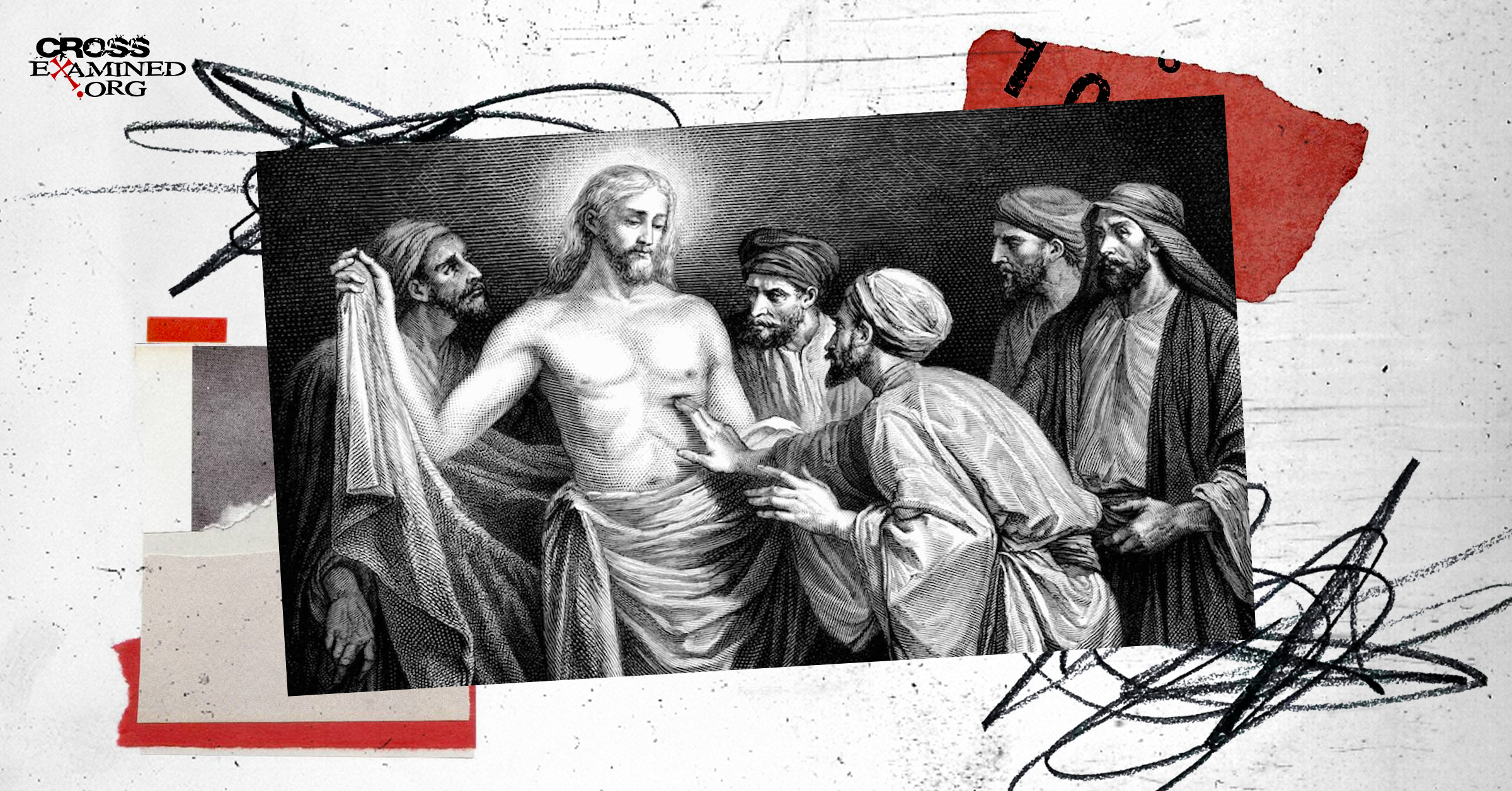
Thomas had followed Jesus from the very beginning of Jesus’s ministry. Oddly, he was not found with the disciples when Jesus first appeared to them (John 20:24-25). Where was Thomas when Jesus first appeared to the disciples? Had he given up on the ministry? Did he seek to reopen his old business, whatever that may have been? No one could not blame Thomas as he had just witnessed his leader crucified to a tree. His investment in Jesus died when Jesus’s corpse was placed in a tomb—or so he thought. Regardless of his activities, he doubted the validity of the disciples’ claim that Jesus had risen from the dead. Again, no one could blame Thomas for his skepticism. While different Jewish sects held divergent opinions concerning the Messiah, none of them anticipated that the Messiah would rise from the dead before the end of time. Additionally, dead people do not normally rise from the dead. Thomas was justified in his disbelief. However, everything changed when Thomas encountered the risen Jesus. Jesus challenged Thomas to place his fingers in the nail prints of his hands and to thrust his hand into Jesus’s side (John 20:27-29). Then, Jesus challenged Thomas by saying, “Because you have seen me, you have believed. Blessed are those who have not seen and yet believe” (John 20:29).

Thomas did not remain “doubting Thomas.” Rather, he became “believing Thomas.” According to tradition and the apocryphal Acts of Thomas, the church cast lots to see which part of the world each disciple would serve. Thomas’s lot would lead him to India. The disciple would encounter the kings of the region and would not have the best relationship with them. The wife of King Misdaeus converted to Christianity to the king’s disdain. The king’s wife disobeyed him and instead followed apostolic Christianity which enraged the king. Eventually, the king ordered Thomas’s execution in Madras, India. While not all the information about Thomas’s ministry in India can be verified, it does appear that there are good reasons to believe that Thomas died in some manner for his faith while in India.[5]

Transformation of the Envious James

“Envious James” is used for this section, but it is merely one possibility to describe why James did not believe in Jesus during his earthly ministry. The Gospels note that the brothers and sisters of Jesus did not initially believe in him (John 7:5). However, James later had a change of heart to the point that he served as the pastor of the Jerusalem Church. What happened? The 1 Corinthians 15 creed lists James as one of those who witnessed the risen Jesus. James’s life was radically transformed because of the resurrection. The Jewish historian Josephus records the later martyrdom of James the brother of Jesus. He writes,

“Festus was now dead, and Albinus was but upon the road; so he assembled the Sanhedrin of judges, and brought before them the brother of Jesus, who was called Christ, whose name was James, and some others … and when he had formed an accusation against them as breakers of the law, he delivered them to be stoned.”[6]

Like Peter and Thomas, the resurrection transformed James to the point that he was willing to give his life for the Jesus that he previously spurned. The resurrection changed James’s negative connotations about Jesus into worship. Quite an extraordinary thing, don’t you think?

Transformation of the Adversary Paul

Paul’s transformation is the most popular of the four. Paul, otherwise known as Saul, was a persecutor of the church. He was a Pharisee of Pharisees, a disciple of the famed Gamaliel (Acts 22:3), and on track to become a member of the Sanhedrin. Yet Paul was dramatically changed on a road trip to Damascus. Paul had hoped to imprison or even murder the disciples of Jesus (Acts 9:1). He had written permission by the Jewish authorities to imprison any disciple of Jesus in Damascus and bring them back to Jerusalem for trial (Acts 9:2). As Paul made his march to Damascus, the risen Jesus appeared to Paul in a dazzling array of power. The risen Jesus inquired, “Saul, Saul, why are you persecuting me?” (Acts 9:4). Jesus identified himself and instructed Paul to go into the city. From that moment, Paul became a disciple of Christ. The disciples were not overly keen on the idea of accepting Paul into their fold. They thought that Paul was staging a sabotage. But as the risen Jesus told Ananias, “This man is my chosen instrument to take my name to the Gentiles, kings, and Israelites” (Acts 9:15).

Paul would suffer for the cause of Christ as he endured many hardships throughout his lifetime. Nonetheless, he endured until the very end. Tradition holds that Paul was beheaded in Rome around the same time that Peter died by crucifixion. This is verified by Tertullian, implying that Paul was considered a martyr by the end of the second century at least in northern Africa.[7] In his seminal work, McDowell lists Paul’s death as “the highest possible probability”[8] and that the beheading of Paul is “more probable than not.”[9]

Conclusion

From the four individuals listed, it is evident that the resurrection of Jesus brought about a major transformation in the lives of those who encountered the risen Jesus. Furthermore, the loving compassion of Jesus is shown by the way he forgave Peter of his past indiscretions, his willingness to provide evidence to the skeptic, his willingness to bring in even those of his family who had hurt him in the past, and the powerful means by which he accepted even the repentance of his former enemies. The risen Jesus continues to transform lives even today. Only eternity will tell how many souls have been transformed by this mysterious, powerful, and loving Savior who continues to seek and save the lost.

Notes

[1] Richard Bauckham, Jesus and the God of Israel: God Crucified and Other Studies on the New Testament’s Christology of Divine Identity (Grand Rapids, MI: Eerdmans, 2009), 235.

[2] Gary R. Habermas, The Historical Jesus: Ancient Evidence for the Life of Christ (Joplin, MO: College Press, 1996), 162.

[3] Larry W. Hurtado, One God, One Lord: Early Christian Devotion and Ancient Jewish Monotheism, 3rd ed (London, UK: Bloomsbury, 2015), 93.

[4] Eusebius of Caesarea, Ecclesiastical History 5.3.1.

[5] Despite the difficulties surrounding the Thomas martyrdom tradition, McDowell argues that the martyrdom of Thomas is “more probable than not.” Sean McDowell, Fate of the Apostles: Examining the Martyrdom Accounts of the Closest Followers of Jesus (London, UK: Routledge, 2008), 173.

[6] Josephus, Antiquities of the Jews 20.200-203.

[7] Tertullian, The Prescription Against Heretics 36.

[8] McDowell, The Fate of the Apostles, 113.

[9] Ibid., 114.

Recommended resources related to the topic:

Early Evidence for the Resurrection by Dr. Gary Habermas (DVD), (Mp3) and (Mp4)

Cold Case Resurrection Set by J. Warner Wallace (books)

Jesus, You and the Essentials of Christianity by Frank Turek (INSTRUCTOR Study Guide), (STUDENT Study Guide), and (DVD)      

The Footsteps of the Apostle Paul (mp4 Download), (DVD) by Dr. Frank Turek 


__________________________________________________________________________________________________________________________________________________

Brian G. Chilton is the founder of BellatorChristi.com, the host of The Bellator Christi Podcast, the author of the Layman’s Manual on Christian Apologetics, and a Ph.D. Candidate of the Theology and Apologetics program at Liberty University. He received his Master of Divinity in Theology from Liberty University (with high distinction); his Bachelor of Science in Religious Studies and Philosophy from Gardner-Webb University (with honors); and received certification in Christian Apologetics from Biola University. Brian is enrolled in the Ph.D. program in Theology and Apologetics at Liberty University and is a member of the Evangelical Theological Society and the Evangelical Philosophical Society. Brian has served in pastoral ministry for nearly 20 years. He currently serves as a clinical chaplain.

Original Blog Source: https://cutt.ly/mmfnj9C


Christianity and other faiths are under attack around the world.  What is our government doing about it?  Pam Pryor was a high-ranking official within the United States State Department during the Trump Administration and joins Frank to reveal what goes on behind the scenes at State to support religious freedom around the world.  Pam shares some shocking stats and stories that will both be alarming and encouraging.  She is also organizing an international summit on religious freedom that meets in Washington July 13-15.  Go to www.IRFSummit.com for details.

If you want to send us a question for the show, please email us at Hello@CrossExamined.org.

Subscribe on iTunes: http://bit.ly/CrossExamined_Podcast Rate and review! Thanks!!!
Subscribe on Google Play: http://bit.ly/CE_Podcast_Google
Subscribe on Spotify: http://bit.ly/CrossExaminedOfficial_Podcast
Subscribe on Stitcher: http://bit.ly/CE_Podcast_Stitcher


By Alisa Childers

​”Do you understand what you’re reading?

This simple question is credited with carrying Christianity into Ethiopia. (1) Acts chapter 8 tells of Philip being led to the desert by an angel to meet an officer from the court of the Queen of Ethiopia. Philip finds him reading an Isaiah scroll containing prophecies about the Messiah. At this point, Philip could have walked up and boldly declared, “I have been sent to you today to proclaim the good news of Jesus the Messiah!” But he didn’t. He met this man right where he was at and asked a good question, which then led to an explanation of the gospel. This is apologetics at its best.

Apologetics is sometimes called “pre-evangelism” because it can help clear intellectual obstacles in the way of faith. The command to do apologetics is found in 1 Peter 3:15 which tells us to always be “prepared to make a defense to anyone who asks you for a reason for the hope that is in you.” The Greek word translated as “defense” is apologia, which is where we get our English word, “apologetics.” In the book of Acts, when the apostles did evangelism, they did apologetics.

They were constantly defending their faith—to religious leaders, political officers, secular philosophers, and average citizens. Here are 3 ways they used apologetics to defend their faith:

1. They defended the gospel, not themselves.

The apostles were no strangers to trials, councils, and prisons. In Acts 4, Peter and John were brought before the Jerusalem high council and were challenged to defend their right to preach the resurrection of Jesus. Peter wasn’t even one sentence into his defense when he began to proclaim the gospel. He didn’t spend his energy trying to clear his name, or avoid prison time—he preached the resurrection of Jesus to the very council that was questioning him.

This example was also followed by the martyr Stephen in chapters 6-7. Stephen was a Jewish Christian who was brought before the council and accused of blasphemy against Moses and God. In his famous speech, he addressed the council by recounting the history of the Jews, pointing out that God’s true prophets have always been rejected. He also stressed that God’s presence isn’t confined to one specific geographical area or temple.  On one level, Stephen answered the charges of blasphemy. But even more, he opened the door theologically for the church’s worldwide mission. It was a brilliant defense of the gospel. New Testament scholar F.F. Bruce commented on Stephen’s famous “defense”:

It is obviously not a speech for the defense in the forensic sense of the term. [It is] by no means calculated to secure an acquittal before the Sanhedrin. It is rather a defense of pure Christianity as God’s appointed way of worship. (2)

The great preacher Charles Spurgeon said this of Stephen:

We see him defending the faith against a synagogue of subtle philosophical deniers of the truth. Stephen the deacon became Stephen the preacher….he had a higher promotion yet—when he had thus become Stephen the wise apologist. (3)

When our faith is under fire, it can be tempting to become defensive. But we would be wise to follow the example of the apostles and defend the gospel, not ourselves.

2. They shared eyewitness evidence of Jesus’ resurrection, not their personal testimonies.

The personal testimonies of the apostles certainly intersected the eyewitness accounts of Jesus’ resurrection because they were the eyewitnesses. But their message was focused on Jesus, not themselves. In other words, when they shared the gospel, they didn’t talk about what Jesus did for them personally and then simply invite others to have a personal relationship with Him. They testified to the fact that He was crucified, buried, and resurrected, offering salvation to all who would repent and put their faith in Jesus the Messiah. This theme is consistent throughout the book of Acts.

Personal testimony can be a great way to build a relationship, but our testimonies should always point to something greater—the good news of the death and resurrection of Jesus.

3. They knew Scripture but sometimes didn’t use it right away.

The first Christians were Jews who were steeped in the Old Testament Scriptures. When Paul was converted in chapter 9, he immediately began preaching to the Jews in Damascus, “proving that Jesus was the Christ.” In chapter 13, he spoke in the synagogue in Antioch, referring to the Old Testament Scriptures to show the Jews that Jesus was the expected Messiah. In chapter 17, he went into the synagogue in Thessalonica and “reasoned with them from the Scriptures.”

Later in the same chapter, Paul was in Athens conversing with Epicurean and Stoic philosophers. These philosophers wouldn’t have accepted the Jewish Old Testament as authoritative, so Paul used a different tactic to get to the gospel. Rather than appeal to the Scriptures, he mentioned their own religious altar with the inscription, “To the unknown god.” He then proceeded to introduce them to the God they didn’t yet know, even quoting their own respected philosophical thinkers.  He used this as a tactic to testify to the resurrection of Jesus.

This does not mean that the Scriptures were unimportant or ignored. It just means that sometimes we need to meet people where they are at and start from there.

Conclusion:

The apostles used apologetics creatively, adapting their method to the situation they were in. The common theme among these three methods is that the gospel was always the main point.  The apostles kept the focus of their evangelism on the resurrection of Jesus and the hope of saving faith in Him—and we should too!

Recommended resources related to the topic:

I Don’t Have Enough Faith to Be an Atheist (Paperback), and (Sermon) by Norman Geisler and Frank Turek 

Stealing From God by Dr. Frank Turek (Book, 10-Part DVD Set, STUDENT Study Guide, TEACHER Study Guide)

Tactics: A Game Plan for Discussing Your Christian Convictions by Greg Koukl (Book)

Defending the Faith on Campus by Frank Turek (DVD Set, mp4 Download set, and Complete Package)

So the Next Generation will Know by J. Warner Wallace (Book and Participant’s Guide)

Fearless Faith by Mike Adams, Frank Turek, and J. Warner Wallace (Complete DVD Series)


__________________________________________________________________________________________________________________________________________________

Alisa Childers is an American singer and songwriter, best known for being in the all-female Christian music group ZOEgirl. She has had a string of top ten radio singles, four studio releases, and received the Dove Award during her time with ZOEgirl. In later years, Alisa found her life-long faith deeply challenged when she started attending what would later identify as a Progressive Christian church. This challenge pushed Alisa toward Christian Apologetics. Today you can read, listen and watch Alisa’s work online as well as purchase her recently published book on Progressive Christianity titled Another Gospel.

Original Blog Source: https://cutt.ly/fmwkNU8


By Al Serrato

Every year in America, thousands of crimes occur in which there are no witnesses and very little evidence. Sometimes, the perpetrator leaves behind a fingerprint impression – a latent print -somewhere at the crime scene. In the past, these prints possessed little value in identifying the offender; before a comparison could be conducted, the police would have to already have a known suspect.

Today, law enforcement officers have access to much better technology, in the form of AFIS – the Automated Fingerprint Identification System. Maintained by the FBI, it houses the data for millions of fingerprint impressions, allowing an unknown latent print to be compared to millions of known offenders. In a matter of minutes, the AFIS computer can spit out the top twenty possible matches to the unknown latent print. But this is only the beginning of the analysis because, with only one latent print at the scene, there is but one actual source for the print. A trained analyst must then spend the time examining in fine detail the patterns of each suspect – the whorls and arches and loops, the ridges and furrows – to determine whether an exact match can be made. The top twenty possible matches have much in common, but on further examination, differences will emerge in the ridge pattern and detail until the one actual source can be identified.

So, what does this have to do with the field of apologetics? Just this: living as we are in very pluralistic times, we often encounter people who believe that all religions are basically the same. Examining them superficially, they will see that religions share a number of features; for example, most teach the utility of treating others with respect, of being kind, of helping the poor. So, while acknowledging some differences in doctrines, people who hold this view believe they have arrived at a great truth: there is no one right religion, just people who mistakenly, and sometimes dangerously, think that they have the corner on truth. This leaves them feeling settled, for the moment, as they conclude that no further inquiry is required. Just be kind to others and follow your heart and all will be well. But on closer examination, all they have really done is stopped searching for the truth, for the “source” of the life that has been given to them and the universe that surrounds them.

Like fingerprints, religions can appear on the surface to be identical, or nearly so, when in fact they are not. And to determine where and how they differ requires a rigorous and close inspection. This of course is crucial in a fingerprint analysis because we know that for one print, there can only be one source. No analyst would stop when she narrowed the search to three possible sources because common sense and reason dictate that two of the three – or perhaps all three – must also be excludable on further inquiry. It is the nature of the thing examined.

So too with the knowledge of God. The major world religions make mutually exclusive truth claims about the nature and attributes of God. Do we live and die once, and then face judgment, as Christianity teaches? Or do we undergo a continuous cycle of life, death, and reincarnation?  Is there one God consisting of three persons, or are there instead of a single god or a multitude of deities? For one religion to be true, the others cannot be.

It is logically possible, of course, that all religions are false. It is not possible, by contrast, for religions holding contrary positions to all be true. Either Jesus Christ is the Son of God who rose from the dead and thereby provides salvation to a fallen world, as Christians claim, or he is not. He cannot be both savior and mere sage at the same time.

Critical and careful analysis of a latent fingerprint can lead to the discovery of the truth as to who left it behind. Making the effort is critical to the pursuit of justice, the importance of which we all intuitively recognize.

But critical and careful analysis can also lead to knowledge of the one God who brought us into existence. When we fail to investigate this question because we mistakenly believe that we already know all we need to know – that is, when we allow ourselves to be misled to believe that all religions are pretty much the same – we may not intuitively realize just how much we are giving up.

After all, what comes next – what awaits each of us at the end of our days here on Earth – is without a doubt the most important question that we must confront. And the sooner we begin that process, the sooner we will find that good and satisfying answers await.

Recommended resources related to the topic:

Can All Religions Be True? mp3 by Frank Turek

Counter Culture Christian: Is There Truth in Religion? (DVD) by Frank Turek: http://bit.ly/2zm2VLF

How Can Jesus be the Only Way? (mp4 Download) by Frank Turek

Jesus, You and the Essentials of Christianity by Frank Turek (INSTRUCTOR Study Guide), (STUDENT Study Guide), and (DVD)      


__________________________________________________________________________________________________________________________________________________

Al Serrato earned his law degree from the University of California at Berkeley in 1985. He began his career as an FBI special agent before becoming a prosecutor in California, where he continues to work. An introduction to CS Lewis’ works sparked his interest in Apologetics, which he has pursued for the past three decades. He got his start writing Apologetics with J. Warner Wallace and Pleaseconvinceme.com.


Have you ever had an “ah-ha” moment reading a Bible passage that you’ve read many times before? Have you ever noticed a pattern or a theme in the Bible that you didn’t see until someone showed it to you? Is the Bible a plain, one-dimensional text or a much richer revelation— a tapestry woven together by a Divine Mind?

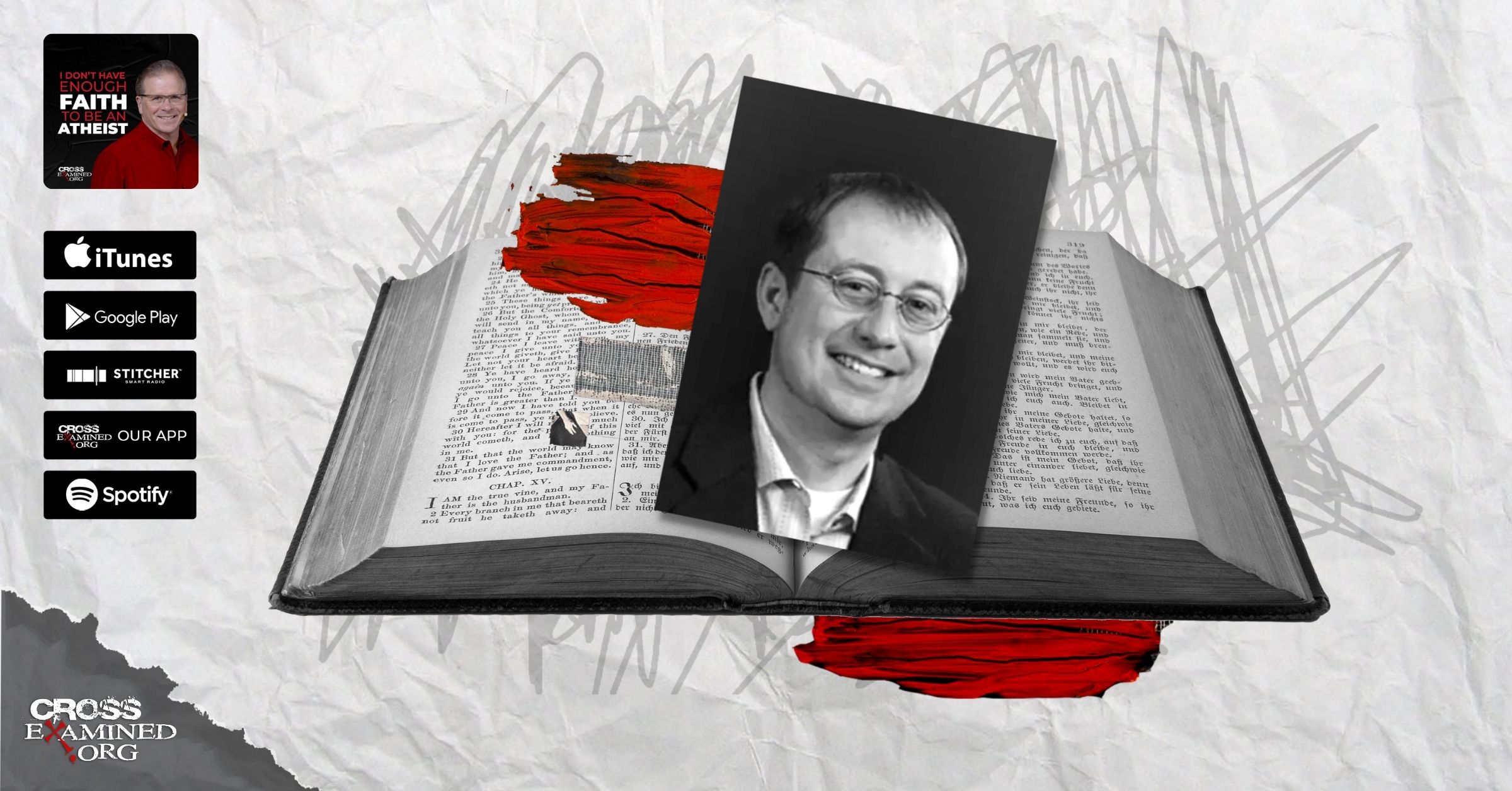
Dr. Chip Bennett, Pastor of Grace Community Church in Sarasota, Florida, joins Frank to reveal some of the amazing hidden themes of the Bible.  We say “hidden” because most people today don’t know about them.  But the early church fathers, taking cues from Jesus and Paul, discovered that the scriptures are an integrated tapestry that has common themes spread throughout.   Chip and Frank discuss themes related to the third day, the Bride, the Serpent, the calming of the sea, and others.  Not only will you look at the Bible differently, but you’ll also see another reason why the Bible— written by about 40 authors over 1,500 years— must have a Divine Mind behind it. Truly fascinating!

If you want to send us a question for the show, please email us at Hello@CrossExamined.org.

Subscribe on iTunes: http://bit.ly/CrossExamined_Podcast Rate and review! Thanks!!!
Subscribe on Google Play: http://bit.ly/CE_Podcast_Google
Subscribe on Spotify: http://bit.ly/CrossExaminedOfficial_Podcast
Subscribe on Stitcher: http://bit.ly/CE_Podcast_Stitcher


By Elliott Crozat

Introduction

Why the case against abortion is weak, ethically speaking is an engaging article on an issue often confined to academic journals.[1] I am grateful for the report, mainly because of Nobis’ and Dudley’s emphasis on personhood and because I agree with them on two significant points. First, our society needs a careful and respectful examination of challenging topics rather than sloganeering and ad hominem. As Schopenhauer put it, “one wants reasons and not empty phrases or abuse.”[2] Second, at the popular level, folks on both sides of the debate have largely ignored the relevance of moral reasoning.

Four-Fold Evaluation

Notwithstanding my gratitude, the article has weaknesses. What follows is a brief evaluation of the authors’ argument, not an attempt to defend the pro-life position.

Firstly, the tone strikes me as too quick and sure. I will return to this point, but for now, I note that generally, philosophers are less sure about solutions to philosophical problems than the authors seem to be about their position on abortion. However, I grant that a tone of crisp certainty is more acceptable in popular contexts than in academia.

Secondly, the article begins in a questionable manner: “Abortion rights are under attack… The Supreme Court now has a majority of justices who identify as “pro-life,” and will surely be more receptive to these attacks on abortion rights than previous courts have been.” Note that the authors are not clear about whether they are referring to moral or legal rights. Either way, a problem arises. If the former, they are begging the question at the start since it is debatable whether persons have the moral right to perform an abortion. If the latter, then “attack” is a question-begging epithet. After all, if a legal right is morally unacceptable, it is arguably permissible to repeal that right. Labeling such efforts with the emotionally-laden “attack” presupposes that the legal right in question is ethically acceptable.

Thirdly, the authors provide two analogies to argue that abortion is morally permissible. In each, they presuppose the like-cases principle: like cases should be treated alike unless there is a morally relevant reason to treat them differently. Good start: this is a venerable moral principle going back at least to Aristotle. Nevertheless, each analogy fails because of at least one morally significant difference.

The first comparison is between abortion and organ donation. This comparison fails in two crucial respects: (i) in typical cases of organ donation, the donor consents to undergo the process, and (ii) the process occurs after the donor is brain-dead. It hardly needs to be stated that in typical cases of abortion, the fetus does not consent and is not brain-dead.

The second analogy concerns abortion and the treatment of anencephalic infants. Here, the authors miss the difference between (a) actively killing and (b) passively allowing to die. This distinction is pivotal in the euthanasia debate and proves similarly important here. Abortion is the active killing of a fetus that would otherwise naturally continue to live and develop. However, in cases of anencephalic infants such as those noted by the authors, the infant is allowed to die, supported by palliative care.

Given these analogies, the authors construct something like the following argument:

  1. Abortion is relevantly similar to organ donation and anencephalic death.
  2. Cases of organ donation and anencephalic death are morally permissible.
  3. Like cases should be treated alike.
  4. Therefore, abortion is morally permissible.

The argument is an interesting application of the like-cases principle. However, since the analogies fail, the authors’ analogical reasoning is unconvincing.

Fourthly, the authors claim that fetuses during the first 12 weeks are not conscious. Perhaps they are correct, but they cannot be objectively certain. As many philosophers of mind have indicated, consciousness is a hard problem. A good way to discover if a being is conscious is to determine if it has qualia (i.e., subjective states of experience). One cannot accomplish this task with a brain scan. Hence, a reasonable concern arises that we cannot achieve certainty concerning whether a fetus has qualia. And since we lack such certainty, we should act with the utmost caution, given the moral seriousness of taking human life. The authors do not address this point.[3] Instead, they present what might strike the reader as an unjustified sense of certainty about the moral permissibility of killing fetuses during the first 12 weeks.

Moreover, the authors write that fetuses “lack consciousness-enabling brains.” But they are not lucid about what “consciousness-enabling brain” means, leaving the reader to ponder the matter. Now, there is evidence that the senses of taste and touch begin to develop around Week 8. According to Ventura and Worobey, the olfactory and gustatory systems also start to form during this period. These systems and their connections to the brain enable the fetus to develop tastes and preferences for specific flavors.[4] Touch, taste, and smell are sensations, which are states of consciousness. Preferences and other desires are also conscious states. Thus, the physical resources which support consciousness begin to develop before Week 12. Do these mechanisms enable any degree of consciousness during this period? I suggest that we do not know the answer to this question and that our ignorance indicates that we should tread carefully.

Furthermore, one is within one’s epistemic rights to doubt the authors’ claim that the present bearing of consciousness is necessary to possess the moral right to life. For example, the adult who temporarily loses consciousness because of, say, dehydration does not thereby lose this right. Instead, one might agree with Marquis that the primary concern at hand is that the fetus has a future like ours.[5] In other words, the human fetus, child, and adult share a comparable future, namely, one in which a conscious agent naturally possesses intrinsically valuable experiences. It is morally wrong to deprive a child or an adult of future experiences. Given the like-cases principle, abortion is morally wrong because it deprives the fetus of such experiences.

Conclusion

There are other concerns with the article, such as an apparent mishandling of important points about interests. But I want to end amicably. Nobis and Dudley close by stating that one should not wait to engage in moral philosophy until forced to because of a rescinded legal privilege. I wholly agree.

[1] Salon published the article on April 11, 2021. See https://www.salon.com/2021/04/11/why-the-case-against-abortion-is-weak-ethically-speaking/

[2] “On Suicide,” in Essays and Aphorisms, tr. R. J. Hollingdale, (London: Penguin Books, 2004), 78.

[3] They need not agree with it. But they should recognize it.

[4] “Early Influences on the Development of Food Preferences,” in Current Biology, Volume 23, Issue 9, May 2013. Moreover, Andreas Keller argues that olfaction is the paradigm sensation. See Philosophy of Olfactory Perception, Palgrave Macmillan, 2016.

[5] See “Why Abortion is Immoral,” Journal of Philosophy 86, 4 (April 1989): 183–202.

Recommended resources related to the topic:

The Case for Christian Activism (MP3 Set), (DVD Set), and (mp4 Download Set) by Frank Turek 

Legislating Morality (mp4 download),  (DVD Set), (MP3 Set), (PowerPoint download), and (PowerPoint CD) by Frank Turek

Legislating Morality: Is it Wise? Is it Legal? Is it Possible? by Frank Turek (Book)


__________________________________________________________________________________________________________________________________________________

Elliott R. Crozat (Ph.D., M.A.) is a full-time professor of philosophy and the humanities at Purdue University Global. His philosophical interests include metaphysics, epistemology, philosophy of religion, ethics, and the meaning of life. He lives in Sarasota, FL.

Original Blog Source: https://cutt.ly/FnA9awB