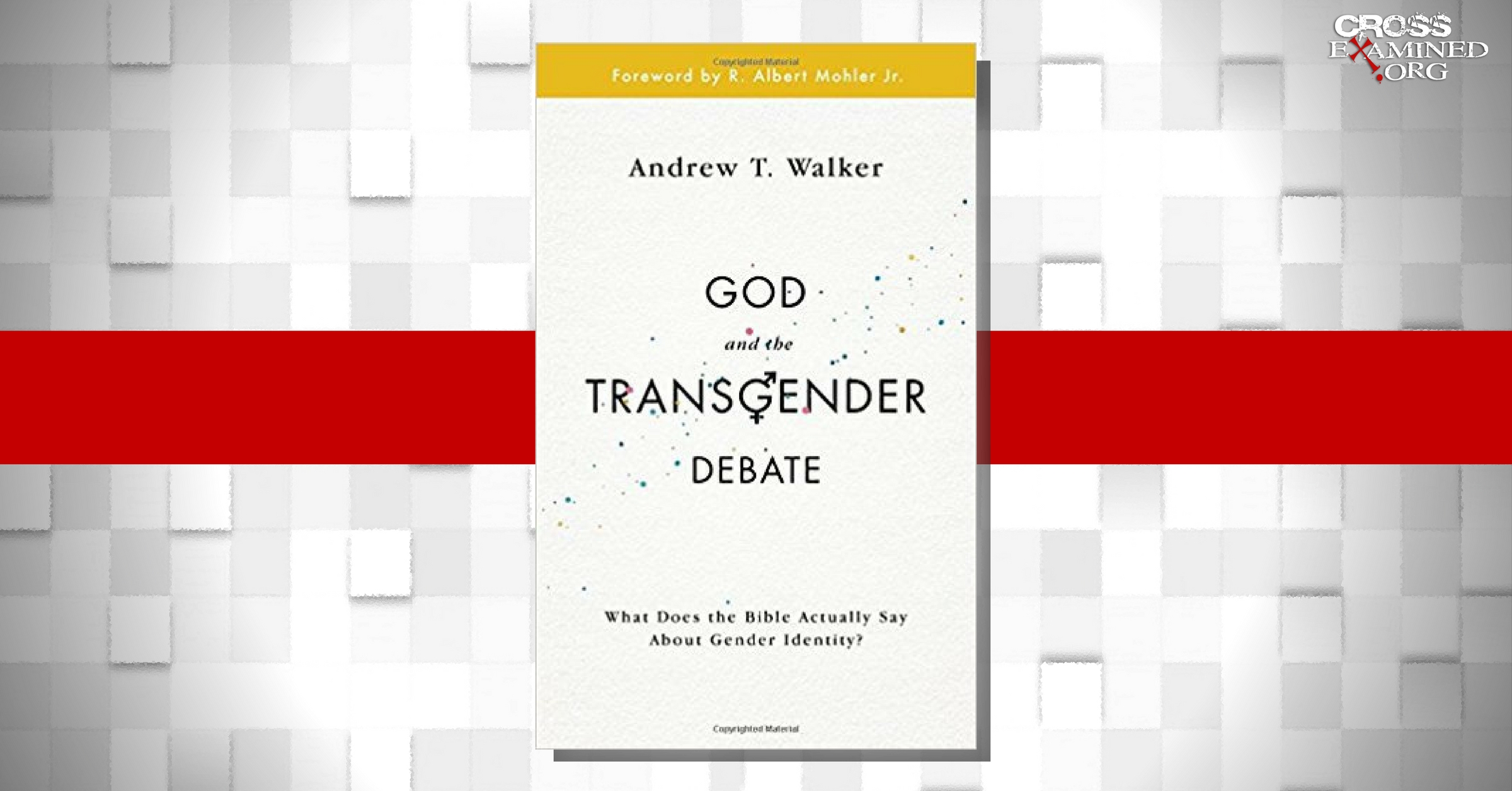
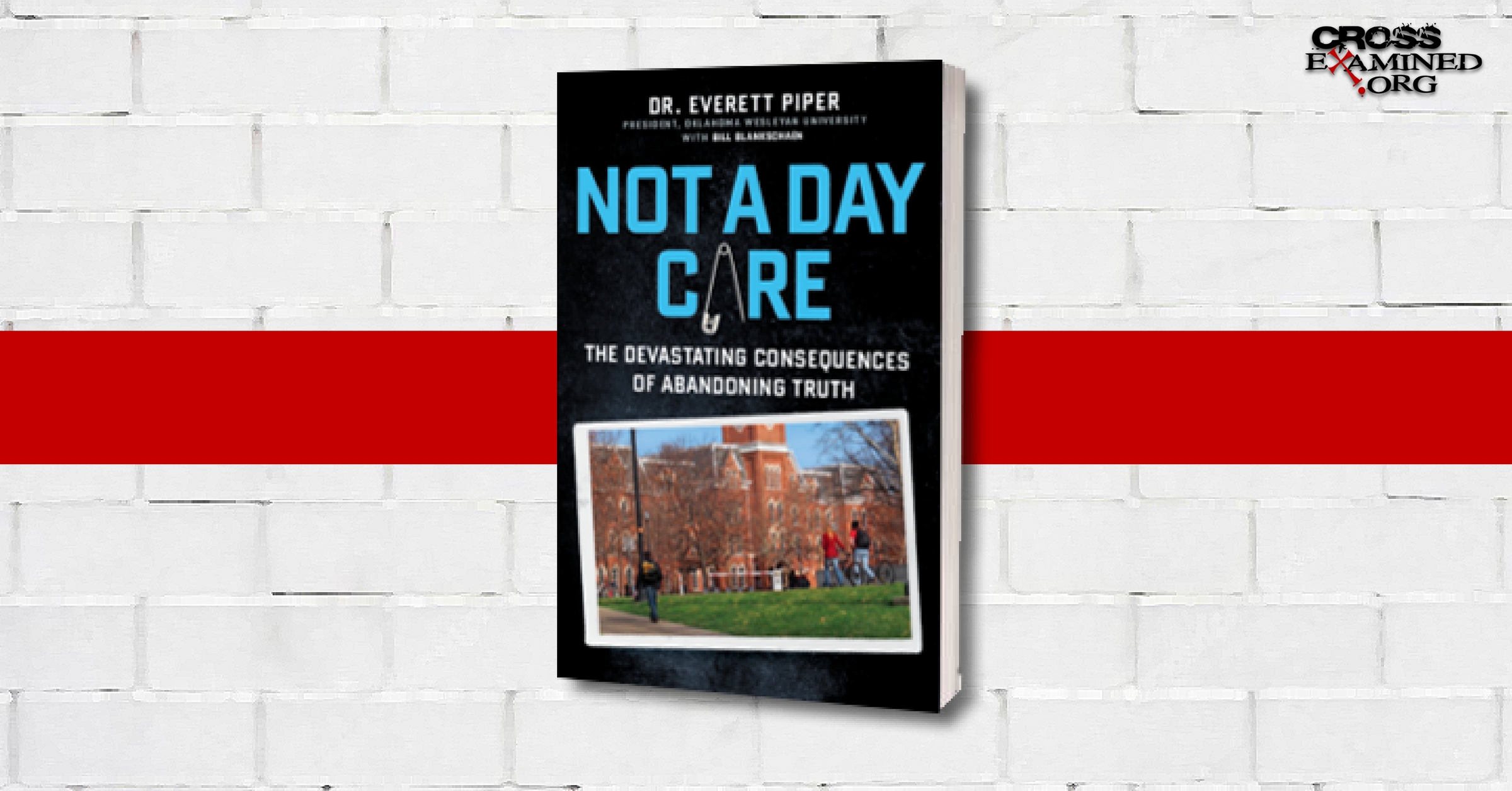
In 2015, Oklahoma Wesleyan University president Everett Piper wrote a provocative article entitled, “This is Not A Day Care. It’s A University!” The article was quoted in the Washington Post, the New York TimesNBC News, and more. Needless to say, he ruffled some feathers! The article was such a success that Dr. Piper followed up with a recent book entitled Not A Day Care. I had the privilege of endorsing the book and highly commend it to you. Even if you end up disagreeing with Dr. Piper, he has struck a significant nerve and advances an argument that merits serious consideration.

Check out this brief interview. Then I hope you will get a copy of his new excellent book and consider talking about it with a friend:

SEAN MCDOWELL: What do you think has caused the Snowflake rebellion on our campuses?

  1. EVERETT PIPER: When you teach self-absorption and narcissism in the classroom you shouldn’t be surprised to find self-absorbed and narcissistic students at our colleges. Richard Weaver told us that Ideas have consequences and the lousy ideas we have been teaching for decades are bearing themselves out in the lousy behavior we now see on the nightly news. Garbage in garbage out. What is taught today in the classroom will be practiced tomorrow in our culture, on our campuses, in our communities, in our corporations, and even in our churches.

MCDOWELL: You claim that Bethlehem, not Berkeley, is the birthplace of the free speech movement. How so?

PIPER: Chesterton told us that if you want freedom you have to build a fence. He also said that when you get rid of big laws you don’t get liberty but rather thousands of little laws that rush in to fill the vacuum. Jesus said you shall know the truth and the truth shall set you free. If you stop teaching truth it always leads to tyranny. There is no liberty without law and there is no freedom without fences. This message was born in Bethlehem not Berkeley. The proof is in the pudding. Just watch these college protests and ask yourself who is really more free. Who really believes in openness and debate? Who really believes in a robust exchange of ideas? Which worldview lends itself to intellectual freedom and which one seems shockingly close to ideological fascism? Berkeley or Bethlehem? You choose.

MCDOWELL: What about your chapter titled Pro-woman and Proud of It? Why do you think the biblical worldview is more pro-woman than any other?

PIPER: Because we believe women are real. We believe in science. We believe in the fact of the female. What could possibly be more misogynistic than to suggest that a woman is not a fact but rather merely a fantasy or a fabrication; nothing but a social construct. How is it possible to be a feminist while denying the empirical reality of the feminine? You can’t be pro-woman and yet deny that a female exists. You can’t be pro-woman while at the same time claiming that she is really is nothing more than a leprechaun or a unicorn – that she’s make believe – and that anyone who wants to pretend can raise his hand on a given day and take away her privacy, her dignity and her very identity.

MCDOWELL: You’re against “safe spaces.” Shouldn’t the college experience be safe?

PIPER: C.S. Lewis said of the great lion Aslan that he was not safe but that he was good. Let me paraphrase and suggest that the great lion of the liberal arts; the great lion of the academy; the great lion of the university – of the ivory tower – is not supposed to be safe but it is supposed to be good. There is a huge difference between goodness and safety. Safety implies comfort. Goodness implies confrontation. We don’t grow if we are always comfortable and safe. We only grow when there is dissonance and when we are challenged. Iron sharpens iron and the Lord disciplines those he loves. College should be about you growing closer to God’s standard of goodness not feeling safe and comfortable in your sin.

MCDOWELL: Why are “trigger warnings” and “micro-aggressions” bad ideas?

PIPER: Yes these are terrible ideas and the reason is because they have essentially become synonyms for simple disagreement. If I don’t like your ideas all I need to do is cry “micro-aggression.” If your political views make me feel uncomfortable I accuse of you violating my “safe space.” If I don’t want to even be exposed to an intellectual challenge I demand that you issue a “trigger warning” before you speak. All of this is predicated on the assumption that it is somehow good to avoid contrary ideas – ideas that are different from our own biases. This is terrible education and it is the exact opposite of what the classical liberal arts education was all about.

Sean McDowell, Ph.D. is a professor of Christian Apologetics at Biola University, best-selling author, popular speaker, part-time high school teacher, and the Resident Scholar for Summit Ministries, California. Follow him on Twitter: @sean_mcdowell and his blog: seanmcdowell.org.


By Brian Chilton

This past Saturday, I returned home from our church’s annual Vacation Bible School. The topic for this year’s VBS was on putting on the full armor of God. When I sat down in my office chair, I turned on my laptop to check the website and look over a few final details for Sunday’s message. As I perused my social media account, one of the headlines told of a tragedy that had occurred in Charlottesville, Virginia.

White supremacist groups, Neo-Nazis, among others gathered in the streets of Charlottesville to espouse their radical ideas. Amidst their demonstrations, counter-protestors made their voices heard. Eventually, the scene turned violent as a James Alex James, Jr., 20, of Maumee, Ohio plowed his car into the counter-protestors, killing Heather Heyer, 32, of Charlottesville and injuring many others.

As a pastor, a theologian, a pastor, and most importantly a Christian, I am appalled by the racist ideologies plaguing our society. Racism exhibited by any person of any race is incompatible with the Christian worldview for the following reasons.

Racism is incompatible with Jesus’s example. Jesus ministered to many people from different walks of life. While he challenged individuals in different ways, he never turned anyone away.[1] As Jesus said, “Everyone the Father gives me will come to me, and the one who comes to me I will never cast out” (John 6:37).[2]

Racism is incompatible with Jesus’s teachings. The Parable of the Good Samaritan was a radical story (Luke 10:25-37). In Jesus’s parable, the protagonist was a Samaritan. The nature of the story is lost until one realizes that Samaritans were hated by the Jews because they were a mixed race. Jesus teaches in this story, among many of his other messages, that the believer is to love his or her neighbor. Who is one’s neighbor? The parable shows that a person’s neighbor is each person encountered.

Racism is incompatible with God’s nature. Throughout Scripture, it is noted that God is love (1 John 4:8). In addition, God is shown to impartial to individuals regardless of race (Deut. 10:17; Lk. 20:21; Acts 10:34; Rom. 2:11). As a loving and impartial God, no one could justify that following God allows one to be racially motivated, an act that is unloving and partial.

Racism is incompatible with the Gospel’s mission. Jesus did not tell his disciples to go to only one race. Rather, they were to begin with their current location and then move towards the uttermost parts of the world (Acts 1:8). Jesus told the disciples to go and “make disciples of all nations, baptizing them in the name of the Father and of the Son and of the Holy Spirit” (Matt. 28:19).

Racism is incompatible with heaven’s populace. In John’s vision of heaven, he sees a “vast multitude from every nation, tribe, people, and language, which no one could number, standing before the throne and before the Lamb” (Rev. 7:9). The believer will associate with fellow Christians from all walks of life, from every race, and from every language in heaven. It seems to me that we had better learn how to get along with fellow believers from all walks of life. Because in heaven, we’ll be spending a long timetogether!

Racism is incompatible with the Christian faith. Let us shine God’s love and grace to every person we encounter whether they look like us or not. Let us impartially love others for the glory of God and of his Messiah.

Notes

[1] Some may contend, “Wait, what about the man healed of demon-possession in Gadara? Did Jesus not keep him from following him?” In that case, Jesus needed the man to minister to the community as the community itself did not desire Jesus’s company.

[2] Unless otherwise noted, all quoted Scripture comes from the Christian Standard Bible(Nashville: Holman, 2017).

 About the Author

Brian Chilton is the founder of BellatorChristi.com and is the host of The Bellator Christi Podcast. He received his Master of Divinity in Theology from Liberty University (with high distinction); his Bachelor of Science in Religious Studies and Philosophy from Gardner-Webb University (with honors); and received certification in Christian Apologetics from Biola University. Brian is in the Ph.D. program in Theology and Apologetics at Liberty University. Brian is full member of the International Society of Christian Apologetics and the Christian Apologetics Alliance. Brian has been in the ministry for over 14 years and serves as the pastor of Huntsville Baptist Church in Yadkinville, North Carolina.


Original Blog Source: http://bit.ly/2v1LsEm


As John Stonestreet and I argue in our book Same-Sex Marriagewe are currently undergoing one of the most sweeping social revolutions in world history. Until theObergefell v. Hodges SCOTUS decision in 2015, the definition of marriage as a union of a man and a woman was the understanding of virtually every civilization throughout history. But this has all changed.

Now that marriage has been redefined, the law, our educational system, and other social customs have begun to change as well. As a result, there is a great tension between belief in religious liberty and claims of discrimination. Can Catholic adoption agencies operate according to their convictions that marriage is the union of a man and a woman, or is this discriminatory towards gay couples who want to adopt? Should the law coerce people to use the preferred gender pronoun of people with gender dysphoria?

Is Liberty Worth Protecting?

At the heart of this debate is whether or not religious liberty is worth protecting. Does the state have interest in preserving religious liberty? In my experience, few people (including religious people) understand why religious liberty is so valuable for both the government and society.

I was recently reading Debating Religious Liberty and Discrimination, which is a thoughtful and respectful dialogue between Ryan T. Anderson/Sherif Girgis and John Corvino. In their opening remarks, Ryan T. Anderson and Sherif Girgis offer a brief case for the state’s interest in preserving religious freedom. It is the best I have heard.

A Simple Case for Religious Liberty

While this section certainly won’t end debate, it is the starting-point of an argument that must be heard. Many questions remain, but nevertheless, here is the beginning of a simple case for religious liberty:

For all their differences, this splendid range of people from every corner of every culture across thousands of years would [Hindus, Christians, Buddhists, Zoroastrians, Muslims, etc.] agree that much hangs on exploring religious questions and living by the answers. Even those who end up atheists or agnostic are compelled to search by a sense of the value of achieving harmony with whatever ultimate source of meaning there might be.

As a basic human good, religious consists of efforts to align your life with the truth about whatever transcendent source (or sources) of being, meaning, and value there might be. It’s about efforts to honor or find harmony with that source—call it “divine.” Relationship with the divine, like human friendship, must be freely chosen to be authentic. To coerce is to produce a counterfeit. So respect for your basic interest in religion demands respect for your freedom in pursuing it. For this basic good, religious liberty is a precondition.

And hence the state, which exists to protect the ability of people to pursue all the basic goods, must never directly attack this freedom. It must never require or forbid an act on religious grounds—for example, on the ground that its religious rationale is true or false, or that the associated religious community should shrink or grow. But the same basic good also requires the state to avoid needless incidental limits on religious freedom. These arise where your faith calls for you to shape your whole life by the divinity’s demands: in preaching and conversion, pilgrimage and prayer, building and worship, ritual, ascetical struggle, charitable work and Sabbath rest. All of these might conflict with legitimate laws. The state can’t avoid a conflict every time. It has to protect the wide range of basic goods for all of society, even at the expense of some instances of them, religion included. But because religion, like moral integrity, is itself one of the basic goods to be protected, the state should avoid imposition on wherever reasonably possible.[1]

Sean McDowell, Ph.D. is a professor of Christian Apologetics at Biola University, best-selling author, popular speaker, part-time high school teacher, and the Resident Scholar for Summit Ministries, California. Follow him on Twitter: @sean_mcdowell and his blog: seanmcdowell.org.

[1] Ryan T. Anderson, Sherif Girgis, & John Corvino, Debating Religious Liberty and Discrimination (New York: Oxford University Press, 2017), 130-131.


By Cole James

I took a philosophy class while I was in college. The topic of this class was on contemporary moral issues, so you know we got into some heated topics. I heard every objection under the sun to objective morality. Everything from it was not very “tolerant,” to different cultures act differently so therefore there cannot be objective morality. I was the minority in this class to say the least!

Objective morality means that moral statements like “murder is bad” is independent of the person saying it. Objective morality means that there is a standard of morality that transcends human opinions and judgements. Morals are not invented, they are discovered. Now that our society has seemingly transformed into a “post-truth” society, objective morals have come under attack. A “post-truth” society is a society which is not concerned with objective facts, but rather, right and wrong are based on personal subjective feelings, tastes, and personal belief.

As Christians, one of the best arguments we have for God is the moral argument. Of all the attacks on Christianity and God, a Christian will most likely hear the most attacks on this subject. Why? Because everyone can relate to this topic. Each one of us every day makes moral judgements and decisions every day, ranging from opening the door for someone to helping someone who just got in a car wreck. Just so we can have a basis for what the argument actually is, it goes as follows:

Premise 1: If objective moral values and duties exist then God exists
Premise 2: Objective morals values and duties do exist
Conclusion: Therefore, God exits

With the argument in mind, consider four objections:

  1. There are so many different cultures with different values, there can’t be objective morals! Look how different we are!

Off the bat, I agree with this objection. There are many different cultures appearing to be morally different on the surface. However, as one reads between the lines it becomes apparent that these different cultures are not really that different. It is important as we read between the lines to keep in mind that when looking at cultural diversity we need to determine whether differences are really about core morals or instead about application of that core moral truth. For example, what constitutes murder?

What my classmates did not realize is that these difference were in how morals were applied, not a difference in morals. Peter Kreeft says this,

“No culture has ever existed which believed and taught what Nietzsche called for: a transvaluation of all values. There have been differences in emphasis, for instance, our ancestors valued courage more than we do, while we value compassion more than they did. But there has never been anything like the relativism of opinions about values that the relativist teaches as factual history. Just imagine what that would be like. Try to imagine a society where justice, honesty, courage, wisdom, hope, and self-control were deemed morally evil. And unrestricted selfishness, cowardice, lying, betrayal, addiction, and despair were deemed morally good. Such a society is never found on Earth. If it exists anywhere, it is only in Hell and its colonies. Only Satan and his worshippers say ‘evil be thou my good.’”

It really comes down to a case-by-case basis. For instance, in the Hindu religion, they believe in reincarnation. Some of these people will starve themselves because they will not eat a cow. Why? Because they believe their great uncle died and reincarnated into a cow. Looking on the surface at this, it may look like there are differences in morals, but we need to read between the lines. As we read between the lines we see that the morals of our culture and their culture are the same. They think it is wrong to eat the cow because they believe that is their great uncle, we also believe it is wrong to eat our great uncle. As we can see, this really is not an objection, it is just a matter of not digging deeper.

  1. Objective morality is not very tolerant! Relativism is much more tolerant of people’s opinions and beliefs.

This objection is entirely problematic. First, it is a self-refuting statement! By someone telling a person that his/her beliefs are not very tolerant, they in turn are being intolerant of the other person’s views. Moreover, this objection assumes that tolerance is really objectively good.

A second answer to this objection is, if relativism were true, why not be intolerant? Why should I be tolerant? Do you see where I am going with this?

Relativism is the view that morality is culturally based, therefore being subject to a person’s individual choice. With this view, there is no objective standard that a relativist can point to, to say that someone should be tolerant.

At root, this is merely an emotional objection. The person who puts out this objection probably does not want objective morality to be true because it will change their lifestyle. So called, “tolerance” feels better to them, and indeed it is a good quality (Paul thought so), but again, just because it feels good does not mean I ought to be that way.

  1. There are so many different understanding of morals, there cannot be objective morality.

Just because there is widespread disagreement about a particular moral issue, does not mean that truth does not exist. Think of it this way, just because eight students have different answers to a math problem does not mean that a right answer does not exist. Philosopher Dave DeSonier says it best,

“Finally, even if one believes that morals (not just facts or practices) do actually differ between cultures, it does not logically follow that there must be no absolute, objective moral standards that transcend cultures. Just because five independent observers of an automobile accident give very different accounts of the event, it would be false to conclude that there is not an accurate, objective, and true description of what actually occurred.”

Even the skeptic David Hume understood this much. He points out,

“the fact that different cultures have different practices no more refutes ethical objectivism than the fact that water flows in different directions in different places refutes the law of gravity.”

So we can see, that even though common objective morals might sometimes be hard to find or discover, it does not logically follow that therefore, there are no common objective moral values and duties.

  1. I do not believe in God and I am a moral person. So you are saying that atheists cannot be moral people?

This is NOT at all what objective morality means! Of course, an atheist can be a good moral person. What’s ironic is that I know some atheists who are actually more moral than many Christians! A person does not have to believe in God to be a good person. This is more of an objection of epistemology, or how we know something. The atheist can know morality, but they cannot justify or provide logical grounds for it.

From the Christian worldview, we believe God fabricated a moral code into our DNA (Romans 2:15), other people think we know morality because of evolution. Again, this is a question of how we know something, notwhy I ought to do something. This objection confuses ontology (is there a moral reality) with epistemology (how do we know morality). On the naturalistic atheist worldview, they cannot justify why someone ought to be moral. There is no objective standard for the naturalistic atheist to point to. This objection is just a common misunderstanding of the argument. A simple clarification of what you mean by the moral argument will handle this objection.

As I mentioned earlier, in our “post-truth” society it is inevitable that a Christian will run into one of these objections. As Christians, we have to be prepared to answer these objections and to show that belief in God is rational and reasoned (1 Peter 3:15). What I have seen in dealing with the students in my class who opposed objective morality is that it is more of an emotional problem. As I mentioned in objection three, the students in my class did not want objective morality to exist because it would have to demand a change in their way if living. Hopefully, after reading this, you will be prepared to give a defense of one of the most relatable and fundamental arguments for the existence of God.


Original Blog Source: http://bit.ly/2tLqhF5


By Steve Williams

Many Christians believe that the first section of Romans 13 – verses 1-7 — forbids any form of resistance to government… even when it clearly goes tyrannical. If one analyzes this passage of the Bible carefully, however, as The USA’s founding fathers did, we can see that Paul was speaking in generalities in this passage, and that unlimited tolerance of government tyranny is a highly wooden, hyper-literalistic reading of his words which is impossible to reconcile with other words of Paul, the words of Christ, other parts of The Bible, and Israel’s history. Ironically, many people who hold this position (like John MacArthur) probably wouldn’t even be here if their ancestors held to that reading, as these ancestors would have been slaughtered centuries ago for not resisting tyrants of old!

First, let’s look at the actual verses in question:

“13 Every person is to be in subjection to the governing authorities. For there is no authority except from God, and those which exist are established by God. 2 Therefore whoever resists authority has opposed the ordinance of God; and they who have opposed will receive condemnation upon themselves. 3 For rulers are not a cause of fear for good behavior, but for evil. Do you want to have no fear of authority? Do what is good and you will have praise from the same; 4 for it is a minister of God to you for good. But if you do what is evil, be afraid; for it does not bear the sword for nothing; for it is a minister of God, an avenger who brings wrath on the one who practices evil. 5 Therefore it is necessary to be in subjection, not only because of wrath, but also for conscience’ sake. 6 For because of this you also pay taxes, for rulers are servants of God, devoting themselves to this very thing. 7 Render to all what is due them: tax to whom tax is due; custom to whom custom; fear to whom fear; honor to whom honor.”

Now having seen the section in its entirety, let’s examine the implications of taking each verse in the hyperliteral way some understand it, verse by verse:

“13 Every person is to be in subjection to the governing authorities. For there is no authority except from God, and those which exist are established by God.”

A wooden literal rendering of this would mean that Hitler, Stalin, Mao Tse Tung, and other mass murderers were “established by God” (clashing starkly with the principle that God does no evil), and that men like Niemoller and Bonhoeffer – who resisted them – were sinners for doing so.

“2 Therefore whoever resists authority has opposed the ordinance of God; and they who have opposed will receive condemnation upon themselves.”

A wooden literal rendering of this would mean that every genocidal action taken by a tyrant is tantamount to “an ordinance of God”, which again, clashes brutally with the principle that God does no wrong.

“3 For rulers are not a cause of fear for good behavior, but for evil. Do you want to have no fear of authority? Do what is good and you will have praise from the same;”

A wooden literal rendering of this would contradict a tremendous amount of human experience over the millennia, wherein millions of people who were minding their own business were slaughtered by/tormented by their own governments. Exhibit A: the executions of Christians – including the author Paul – by the Roman government.

“4 for it is a minister of God to you for good. But if you do what is evil, be afraid; for it does not bear the sword for nothing; for it is a minister of God, an avenger who brings wrath on the one who practices evil.”

A wooden literal rendering of this would contradict millennia of human experience wherein governments have not only winked at evil behavior of “the connected”, but helped to get the immoral goals of these guilty parties accomplished.

“5 Therefore it is necessary to be in subjection, not only because of wrath, but also for conscience’ sake. 6 For because of this you also pay taxes, for rulers are servants of God, devoting themselves to this very thing.”

A wooden literal rendering of this would contradict the fact that some rulers (such as the USSR, communist China and North Korea) have structured their entire governments on the premise that God does not exist.

“7 Render to all what is due them: tax to whom tax is due; custom to whom custom; fear to whom fear; honor to whom honor.”

A wooden literal rendering of this would mean that we’d need to withhold things like “honor” from many governments and rulers, because it would require schizophrenia to deduce that they are due such things in the face of their evil actions.

In terms of Israel’s historical record and The Book of Revelations, an absolute literal interpretation: clashes with (among other verses) Joshua 2: 3-21, Daniel 3: 16-18, Daniel 6: 10-13, Acts 4: 18-20, Revelations 14: 9-11 (in the non-violent category), and with (in the more violent category) Joshua 6: 16-21, Judges 3: 14-26, Judges 4: 10-24, Judges 7: 19-25, Judges 16: 28-30, and The Maccabean revolt, which precipitated Chanukkah (“The Festival of Lights”). In The Maccabean Revolt of 167-160 BC, the Jews violently revolted against the Seleucid Empire. Inasmuch as Jesus, Paul, and virtually every other significant New Testament Jew celebrated this holiday, what does that tell us? Were they celebrating “the ends” and disregarding “the means”?!

Or consider the events of Judges 3: 14-26, in which Ehud kicks off a violent revolt against the Moabites with a quite graphic assassination of King Eglon. Obviously we have some significant Bible contradictions on our hands if Romans 13 mandates that revolution is ALWAYS forbidden. It is a generally well-accepted principle of hermeneutics that if two verses seem to clash on a strictly literal reading, another reading in which the two are harmonized is probably lurking in the background. What if Paul was writing in generalities, and didn’t mean to be covering EVERY situation? Well, it seems to me that that understanding of it has far greater explanatory scope and power than the former.

The USA’s Founding Fathers (whom I have argued had Christianity in mind) engaged in some interesting discussion on this topic, and obviously didn’t hold to the MacArthur view. They put up with a ton of abuse for many years prior to The Revolution, and tried a variety of non-violent ways to end the abuse, but I think where they finally drew the line and said “enough!” was roughly correct.

In 1775, Rev. Jacob Duché argued from the Bible in favor of the American position in Philadelphia, explaining:

“Inasmuch as all rulers are in fact the servants of the public and appointed for no other purpose than to be ‘a terror to evil-doers and a praise to them that do well’ [c.f., Rom. 13:3], whenever this Divine order is inverted – whenever these rulers abuse their sacred trust by unrighteous attempts to injure, oppress, and enslave those very persons from whom alone, under God, their power is derived – does not humanity, does not reason, does not Scripture, call upon the man, the citizen, the Christian of such a community to ‘stand fast in that liberty wherewith Christ….hath made them free?!’ [Galatians 5:1] The Apostle enjoins us to ‘submit to every ordinance of man for the Lord’s sake,’ but surely a submission to the unrighteous ordinances of unrighteous men, cannot be ‘for the Lord’s sake,’ for ‘He loveth righteousness and His countenance beholds the things that are just.’” [The Duty of Standing Fast in our Spiritual and Temporal Liberties, A Sermon Preached in Christ Church, July 7, 1775. Before the First Battalion of the City and Liberties of Philadelphia (Philadelphia: James Humphreys, Jr., 1775), pp. 13-14.].

Of course The British accused the states of “anarchy”, but our Founders obviously disagreed with that characterization. In fact, while the states had been generally following the laws and rules they were under as colonies of Britain, The British had been systematically breaking their own laws and rules at the expense of the states for well over a decade. The “long train of abuses and usurpations, pursuing invariably the same Object evinc[ing] a design to reduce them under absolute Despotism” which are listed in our Declaration of Independence were not “light and transient” events which one might encounter (and suffer out of pragmatism) with any human institution. They were very serious offenses (including rape and murder), committed on a continuing basis, and attempts to resolve the issues “through the system” had resulted in nothing but insults and further abuses. England had racked up a great deal of debt during the French and Indian War (which ended in 1763), had significant numbers of (often abusive) troops on the continent, and had begun attempting to systematically extract as much revenue, goods and accommodations as it could milk from the colonists, and were apparently feeling very little restraint due to the massive distance of the states from the motherland. Under the legal theory of “Lex Rex” (“The Law is King”; ie: even Kings are subject to it) – which basically had been operative in England since at least 1688 (and arguably since the Magna Carta of 1215) – it was King George and his enforcers which were in a state of anarchy!

John Quincy Adams later described the situation as follows:

“[T]here was no anarchy. . . . [T]he people of the North American union and of its constituent states were associated bodies of civilized men and Christians in a state of nature but not of anarchy. They were bound by the laws of God (which they all) and by the laws of the Gospel (which they nearly all) acknowledged as the rules of their conduct.” (emphasis added). [An Address Delivered at the Request of the Committee of Arrangements for the Celebrating the Anniversary of Independence at the City of Washington on the Fourth of July 1821 upon the Occasion of Reading The Declaration of Independence (Cambridge: Hilliard and Metcalf, 1821), p. 28.].

As Declaration signer Francis Hopkinson (also a church musician and choir leader) put it:

“Q. It has often been said, that America is in a state of rebellion. Tell me, therefore, what is Rebellion?

  1. It is when a great number of people, headed by one or more factious leaders, aim at deposing their lawful prince without any just cause of complaint in order to place another on his throne.
  2. Is this the case of the Americans?
  3. Far otherwise.”

The truth is that The Revolutionary War was a defensive one. Great Britain had attacked America, not vice versa; the Americans had never fired the first shot – not in the Boston Massacre of 1770, the bombing of Boston and burning of Charlestown in 1774, or in the attacks on Williamsburg, Concord, or Lexington in 1775. “Don’t fire unless fired upon!” is a memorable command from this time, and reflects the prevailing mindset among our forefathers. Yet, having been fired upon without having broken any law, the Americans believed they had a Biblical right to self-defense. In fact, the Rev. Peter Powers, in a famous sermon he preached in front of the Vermont Legislature in 1778, specifically noted that America had “taken up arms in its own defense” – that she had not initiated the conflict but was only defending herself after being attacked. [The Rev. Peter Powers, Jesus Christ the true King and Head of Government; A Sermon Preached before the General Assembly of the State of Vermont, on the Day of Their First Election, March 12, 1778 at Windsor (Newbury-Port: Printed by John Michael, 1778).]

As Founding Father James Wilson (a signer of both the Declaration and the Constitution, and an original Justice on the U. S. Supreme Court) affirmed:

“The defense of one’s self . . . is not, nor can it be, abrogated by any regulation of municipal law. This principle of defense is not confined merely to the person; it extends to the liberty and the property of a man. It is not confined merely to his own person; it extends to the persons of all those to whom he bears a peculiar relation – of his wife, of his parent, of his child. . . . As a man is justified in defending, so he is justified in retaking his property. . . . Man does not exist for the sake of government, but government is instituted for the sake of man.”

So I think we can conclude that The USA’s founders viewed the key words in Romans 13: 1-7 to be “governing authorities”; with a particular emphasis on what it means to be “governing”. When the powers-that-be diverge from following their own laws and begin systematically pillaging and otherwise abusing their subjects, it’s hard to see how that remains a case of “governing”, rather than “ravaging” people vulnerable to them under the color of authority.

In fact, let’s consider how Romans 13 describes what “governing” should look like:

“…For rulers are not a cause of fear for good behavior, but for evil… Do what is good and you will have praise from the same, for it is a minister of God to you for good… for rulers are servants of God, devoting themselves to this very thing.”

The British failed miserably at fulfilling these descriptions in the years leading up to The Revolution. In contrast, consider the fact that The USA’s Founders could have easily put into place a monarchy or oligarchy once the Revolutionary War was won and accreted power to themselves, but instead pored over the successes and failures of various forms of government throughout history, racked their brains as to how sustainable, checked and balanced self-governance could be arranged, and prayerfully cemented it into place.

One objection I’ve heard from “pacifists” (which I should hit before I wrap this up) is that during Paul’s time, evil Romans like Nero were in power, and since Paul didn’t endorse revolution against Rome, that must show that revolution against tyranny of that kind (or less), is not warranted. I think this objection overlooks a key principle: BE REALISTIC!

There was no way a ragtag handful of revolutionaries were going to be able to mount a viable revolution against the most powerful empire the world had ever seen at that point in time. Jesus Himself affirmed this principle in Luke 14:

31 Or what king, when he sets out to meet another king in battle, will not first sit down and consider whether he is strong enough with ten thousand men to encounter the one coming against him with twenty thousand? 32 Or else, while the other is still far away, he sends a delegation and asks for terms of peace.”

Side note: A reminder that Jesus endorsed self-defense in Luke 22 is worthwhile:

“36 Then He said to them, “But now, whoever has a money-bag should take it, and also a traveling bag. And whoever doesn’t have a sword should sell his robe and buy one.”

Lest one asserts this verse is taken out of context, please read Tim Stratton’s article, Love Thy Neighbor & Pack Thy Heat.” 

In many (probably most) cases, the notion of revolution will simply be infeasible, as the powers-that-be will simply be too strong for a revolt. As Jefferson alluded to in The Declaration of Independence, actions like this are not to be taken “for light and transient causes”, and it’s better “to suffer, while evils are sufferable” than to engage in revolt, willy-nilly. In other cases, the notion will be dodgy because the populace will be morally questionable themselves. In the case of The USA’s Founders, however, they had the arms, numbers, terrain, intelligence, and most importantly, the morality, to pull it off and form something better. As a result, the most Christian country in the history of the world came into being, and inhabitants of the earth have been blessed in myriad ways as a result.

Yes, I’m well aware that we’ve drifted from the original blueprint. Anything administered by human beings will have its imperfections, but inasmuch as The USA has resembled Paul’s description of “government” substantially better than The British Empire (and most other governing entities that have existed), “the proof is in the pudding”.

Notes

I’ll be happy to open-mindedly consider the possibility I’ve gotten something wrong on this and consider a case for another viewpoint if one is presented to me, but I am highly doubtful that a more literal view of Romans 13 can survive its own self-refutation.

Original Blog Source: http://bit.ly/2uzs7L2


Earlier this year, an early-morning storm passed through our area, causing schools to open late. Some counties announced they would open schools one hour late. Others announced that school would begin at 9:30 am.

Our county? Officials announced that school would begin “after the storms were over.”

Imagine the confusion this created, as the storms dissipated in some areas, and continued in others! Parents and students wondered exactly when school would start. Instead of providing a definite starting time for county students, the officials based the starting time on, at a minimum, two variable factors: the weather conditions at the student’s home, and each person’s idea of what it means for a storm to be “over”. This, of course, varies widely; In my opinion, a storm is “over” when it no longer poses a serious threat of damage. My aunt, who was terrified of storms, would insist that a storm isn’t “over” until the sky is clear for at least an hour!

Imagine what would happen if our government wrote our laws like this! If tomorrow, our legislators declared that all speed limits were repealed, and law enforcement officers were empowered to arrest those who were driving “too fast”, chaos would reign! How fast is “too fast”? It’s a safe bet that your idea of “too fast” is not the same as mine… and neither of us are likely to agree with the cop that has just pulled us over! Without a legal fact… a clearly-written and duly-established law, all legal opinions are equally valid… and thus are completely useless for governing anyone other than the holder of that opinion!

For this reason, modern legislators and lawyers spend enormous amounts of time fretting over the exact phrasing of a document. Companies spend huge amounts of money to remove as much opinion as possible from the wording of a contract.  And even after adding all of the “legalese”, litigants still debate the meaning of even the smallest words. (After all, “It depends on what the meaning of the word ‘is’ is“!)  Our laws and regulations must be objective, based in external facts independent of any one person’s opinions, in order to be meaningful.

In the same way, subjective moral opinion, in the absence of objective moral facts, is effectively no morality at all!

Often at this point, the subjective moralist objects, saying “I can be just as moral as anyone who believes in objective morality.” However, this objection is illogical… if moral facts do not exist, then why would it be “better” or “worse” (which are themselves, morally-charged words) to be called immoral rather than moral? Why does it matter whether one breaks a non-existent standard of behavior?

Can a subjective moralist be a moral person? Well, yes…they can be moral and wrong about the existence of objective moral facts. Or they can be right in their belief, but neither moral nor immoral. What they cannot be is both right and moral. (Or, to be fair, right and immoral!)

To clarify,  consider this question: does a unicorn’s horn glow in the dark? The answer doesn’t really matter. Because the topic of the question doesn’t exist, no answer has any meaning in the real world. In the same way, one’s opinion of how we should treat others is meaningless… unless there actually exists a way that we should treat others! Subjective moral opinion with no undergirding objective moral fact is an opinion about something that does not exist. It has no more relevance to our lives than the destruction of Krypton. (That’s the homeworld of Superman and Supergirl, for those under 30!)

Subjective Moral Opinion Isn’t Sufficient

Moral opinion alone lacks the necessary scope of influence required of morality. An opinion is, by its nature, limited to one person. No two persons can share an opinion. You might describe your opinion to me, and we might hold similar opinions, but I cannot hold your opinion! Nor can you hold mine!

This means that the scope of influence of any opinion is exactly one person; but a standard of morality deals largely with relationships between two or more persons. Opinions simply have insufficient scope to address relational behavior. For this reason, the argument that morality is a product of people in society fails. Moral opinion can provide no binding reason that men should seek the good of others.

Indeed, we instinctively resist the moral opinions of others, often with the common objection, “who are you to force YOUR morality on me!” At best, subjective morality informs a person of how they believe people should treat others, but it cannot inform a person of how they actually should treat others!

Subjective Moral Opinion Cannot Explain Guilt

How often we make excuses for our actions!  The same actions that the subjective moralist claims cannot be objectively wrong, he attempts to justify to themselves and to others. This strongly indicates that at least some form of guilt is felt; one does not justify moral actions.

Subjective morality cannot provide a sound explanation for guilt. Occasionally, when my oldest daughter was a toddler, she would put herself in timeout when she felt that she had done something wrong. She tearfully walked to the corner, although she had broken no rule, and neither my wife nor I had any intention of disciplining her.

One day when this had happened, she looked over at me and asked, “May I get out of timeout now?”

I replied, “Honey… I didn’t put you there! YOU put yourself there.”

In a world where morality is not objective, subjective moral opinion is a lot like my daughter’s self-imposed timeout. With no higher authority to tell us to behave, or else “sit in the corner”, and no moral facts by which to judge our actions, we make up our own rules. Then we behave as if they were binding. (Even more illogically, we act as if our moral opinions should be binding on others!) When we fail to live up to the rules we’ve created, we “put ourselves in timeout” with feelings of guilt and shame. And then we turn and ask “can we get out of timeout now”… and are answered with silence.

The Problem that Should Not Exist

Dealing with guilt should be simple in such a world. Just as my daughter chose to put herself into timeout, she could also choose to leave her self-imposed punishment at any time. She had no obligation to stay there. Similarly, guilt for breaking a subjective moral code can only result in self-inflicted guilt. We are “free to leave” at any time. Yet, this doesn’t reflect our experience.

Every mentally-healthy person at one time or another feels guilty. Subjective moralists attempt to explain this away by asserting that the crushing weight of guilt is just an illusion. Yet these “illusions” lead some to spend thousands of dollars on counseling. Others resort to alcohol or drug abuse, and some to self-destruction. This “illusion” has a huge impact in the real world!

It is more intuitively obvious that feelings of guilt are real. We stand guilty of breaking objective moral facts, and we need a way to “get out of the corner”. Repeated insistence that guilt is an illusion cannot soothe the nagging misery. All of our own efforts to remove ourselves from the corner fail. We crave forgiveness for our offenses… forgiveness that is neither necessary nor available if no law has been broken. Our conscience knows the truth that we often suppress.

Subjective Moral Opinion Cannot Secure Rights

Rejection of an objective moral standard claims to bring freedom. Instead it brings slavery. The cost is simply too high. Freedom from a moral law may seem to allow one to live as they desire, but it also requires the forfeiture of any protections and rights provided by that law. Appeals to subjective morality as a replacement only provides an illusion with no substance. Claims that men should submit to such a code “for the sake of society”. But this begs the question; you cannot argue for subjective morality by appealing to subjective morality. Either denying oneself for the good of the group is an objective moral principle, or it is a subjective opinion with no authority.

Objective morality exists, and this fact is implicitly affirmed by the subjective moralist, many of whom live highly moral lives in spite of their denial of the standard that makes them moral.  Does our society oppress certain groups of people? Should we change some of our laws to be more “fair”? Are discrimination and intolerance wrong? All of these require an objective moral standard to be meaningful… and practically no one these days, regardless of political leanings, religion (or lack thereof), creed, or color would not agree with at least one of these statements. Similar to logic itself, the more someone argues against objective morality, the more they show that they actually believe in it! The inability to reason without it is strong evidence for both its reality and its importance.

By

INTRODUCTION

This is a short introductory essay to defend objective moral values. In philosophy, the term ‘objective,’ is defined as the existence of an object independent of human mind (mind-independency); “the object would “be there,” as it is, even if no subject perceived it.”1 In contrast, the term ‘relative’ refers to the perception of an object by the subject (mind-dependency).

‘Relativism’ espouses true or false moral judgments relative to language, culture or biological makeup.For instance, relativism need not consider polygamy as crime, for cultures or people can justify polygamy relative to their thought paradigm. Relativism denies objectivity and appeals to man’s mind.

Alternatively, ‘Objectivism’ espouses truth and falsity as independent of mind, so to claim and appeal to the reality of objective moral facts. Therefore, objectivism will rule polygamy to be a crime by appealing to the existence of objective moral laws (which is discovered and not invented by humans). This is similar to objectivism affirming the objective reality that sun is more massive than the earth.

THESIS

I – A Case for Objective Moral Values:

‘Objectivism’ or ‘we should not be moral relativists’ could be reasonably defended by positing the presence of ‘objective moral values.’ Moral relativism opposes ‘objectivism’ by negating the presence of objective realities.3 But if objective moral values can be postulated to exist, then moral relativism could be reasonably debunked.

 (1) Objective Reality is Factual

There are objective realities. The fact that sun is more massive than earth is an objective reality. This fact does not depend on anyone affirming or negating it.

(2) Objective Moral Values are a Reality

It’s morally wrong to not assist a person in need when we are able to. Similarly genocide is morally wrong; it is morally wrong to deliberately and systematically eliminate a group of people. These are universally affirmed objective moral values and do not depend on people’s mind (whether anyone believes or accepts, it is morally wrong to not assist a person and to commit genocide). Thus there are universally affirmed objective moral values.

(3) An Objective Basis is Necessary for Objective Moral Values to Exist

The “objectivism” proposed by Ayn Rand (1905-1982) posits man’s selfishness or man’s survival as the objective foundation to objective moral values.4 But human selfishness cannot be sustained as an objective foundation against an argument that a certain human subjectivity ought to be involved in deciding opposing values of human selfishness.

Would it be objectively true if the Nazi’s argued that it was morally right for them to eliminate the entire Jewish population because the Jews were an economic burden to Germany? The human selfishness of the Nazis was predicated upon the economic crisis in Germany, but in stark contrast, the human selfishness of the Jews was predicated on protecting their own life. So the Randian objectivism would crumble when two opposing cases of human selfishness collide with each other. Thus one ought to subjectively decide between the opposing objective moral values espoused by the two groups.

But ‘God’ can be reasonably posited as the sole objective source for moral values. God, as the greatest conceivable being, transcends humanity and the space-time coordinates. Hence God is an objective reality and the sole objective basis for objective moral laws.

However, proof of God’s existence ought to be reasonably provided, if not, God cannot be posited as the basis of mind-independent objective moral laws. Many arguments for God’s existence have been reasonably and plausibly posited, such as the Teleological Argument,5 Cosmological Argument,6 Moral Argument7 etc.

Since objectivity, objective moral values, and an objective moral value giver (God) can be posited, a reasonable conclusion is that there are objective moral values. Hence, we should not be moral relativists.

II – A Case for an Immoral World:

Moral relativism would stimulate an immoral world without any restraint whatsoever. When moral values are predicated on human mind, morality would be a slave of the dogma that controls that human mind. If one’s dogma is cannibalism, he would appeal to moral relativism to justify his devouring of his neighbor. Since moral relativism promotes an immoral world, we should not be moral relativists.

CONCLUSION

Two mutually contradicting statements cannot be true within the same context, at the same time and for all people. So objective and relative moral values cannot both be true for they contradict each other. The presence of objective moral values and the case for an immoral world portrays that moral relativism exists by ignoring or suppressing the truth of objective moral values. Therefore, we should not be moral relativists.

END NOTES:

1http://www.iep.utm.edu/objectiv/#SH2a

2http://plato.stanford.edu/entries/relativism/

3http://www.iep.utm.edu/moral-re/#H3

4http://plato.stanford.edu/entries/ayn-rand/

5 J.P Moreland, Scaling the Secular City – A Defense of Christianity, (Michigan: Baker Academic, 1987), p43-76.

6 Ibid, p15-42.

7http://www.reasonablefaith.org/moral-argument#ixzz2mPz3C86b

This article was posted at http://rajkumarrichard.blogspot.in/2013/12/should-we-be-moral-relativists_28.html

Original Blog Source: http://bit.ly/2th89GR


By Tim Stratton

It seems commonplace today for entire groups of people to be painted with a broad brushstroke and labeled as being afraid or fearful. The word “phobia” or “phobic” is often attached to the end of another word which is supposed to represent a group who is scared of other people.

So, what does it mean to be “phobic”? Consider Merriam Webster’s definition of phobia:

an exaggerated usually inexplicable and illogical fear of a particular object, class of objects, or situation

Oxford Dictionaries defines phobia as:

An extreme or irrational fear of or aversion to something.
‘she suffered from a phobia about birds’

Most have heard of certain types of fears. Here is a list of common phobias:Arachnophobia — Fear of spiders

Claustrophobia — Fear of being enclosed in a small space

Acrophobia — Fear of heights

Given these definitions, one whose fears do not follow logically or is an irrationally fearful person is “phobic.” Thus, this label can be used to communicate a psychological disorder with the person who was shot with the “label gun.”

Homophobia

We hear this quite often when Christians are typically labeled as “homophobes.” The one wielding the “label gun” is attempting to communicate to others (reading their labels), that Christians have an irrational fear of gay people. To be clear: as a Christian I am definitely not fearful or scared of homosexuals or anyone in the LGBT community. In fact, I do not know any Christians who are literally scared of gay people just because they are gay.

Christians do not hold an irrational fear of homosexuals; rather, most simply point out that the homosexual lifestyle is not intended by God — it is not the intended purpose of creation. Thus, the gay lifestyle “misses the mark,” and this is what it means to be sinful. These claims are not based in fear or hatred; they are grounded in love. Read my articles on this particular topic here, here, and here.

Logically demonstrating and pointing out that a person is living a sinful lifestyle should not be conflated with an irrational fear of the person. In fact, if anything is irrational, it is committing the logical fallacy of conflating a belief that a person is in sin, with fear of the person living in sin. This is unreasonable.

Islamaphobia

It is also quite popular today for Christians to be labeled as “Islamaphobes.” Is it irrational to fear Muslims? In one sense, perhaps, but in another sense, definitely not! The first thing we must realize is that it is vital to distinguish between irrational fears and healthy fears.

To be clear, although our world has been wrought with terror attacks from practicing Muslims since 9-11, the vast majority of Muslims are not violent extremists who wage jihad like those in ISIS. Thus, it seems irrational — in this sense — to fear all of those who are Muslim. After all, just because some Christians are mean to non-believers, it does not follow that all Christians act in a similar fashion.

There is a huge and vital difference, however, between these propositions. We are discussing ideologies. Specifically, we are discussing the teachings and commands of Mohammad and of Jesus — they differ drastically!

So, if one believes that Christianity it true, and they are not living consistently with the teachings of Jesus Christ (what Christianity is based on), if they come to think they should start living consistently with what they believe, then they will start loving all people from their neighbors to their enemies. The obedient Christ follower will make a daily attempt to not be mean and to love and respect all people as Jesus commanded. So, unless one fears being treated with love and respect, it would be nonsensical to fear a person who believes that Jesus’ commands correspond to reality and that our actions ought to correspond to reality too.

However, if one believes that Islam is true, then even if they were not living consistently with the teachings of Mohammad — and were not violent terrorists trying to kill all the infidels (they are peaceful) — it is still quite rational to have a healthy fear of this Muslim. Why is this? Because if he or she believes Islam is true and then starts to understand all that Mohammad actually commanded, and then decides to start living consistently with what they believe, then it follows that there is a good chance that they will harm you, or anyone else who is not a Muslim.

The Conflation of Ideas & Race

I will get back to that topic shortly. Before I expand on this, however, it is important to point out that many today seem to imply that if one is fearful of what Islam teaches, then you must be a racist (another label)! Those who assert this are once again guilty of the logical fallacy of conflation. Namely, conflating the beliefs of an individual with their DNA. These are two completely different issues that should not be conflated.

Allow me to make my point: regarding Islam — I am “Islamaphobic” (in a sense)! This is because I have an educated understanding of what Mohammad actually taught and commanded. Thus, all “good” Muslims (the ones who strive to live according to Muhammad’s teachings) should be feared because they want to convert or kill everyone who is not a Muslim.

Now, this has nothing to do with race (and to conflate this with race as mentioned above is a logical fallacy)! After all, if a white guy became a Muslim who believed he should “kill the infidel” as Mohammad commanded, then I would be just as “Islamaphobic” of that white guy because he wants to kill me. It is healthy and rational to fear those who want to kill you! This is about ideas — not race!

Thank God most Muslims are “bad Muslims” and do not follow all the teachings of Mohammad. However, as David Wood has shown, it does not take much to get an inconsistent Muslim (one who is peaceful) to become a consistent and “good muslim” (one who wants to kill you)! That is what scares me — but that is a healthy fear based on what Mohammad actually commanded.

The Jihadi Triangle

Consider the “Three Stages of Jihad” from David Wood:

As stated above, most Muslims are peaceful (thank God), but this is because they lack one of three essential ingredients that a seemingly “good” Muslim ought to possess:

1- Belief
2- Knowledge
3- Obedience

The foundation of the Triangle of Jihad is a simple belief that Islam is true. This belief does not have to be justified as one can hold this belief merely because their father told them that “there is no God but Allah.” This foundation is not sufficient for Jihad and terror, but it is a necessary condition.

The second part of this triangle is knowledge. That is, the individual believes that Islam is true and now they study the Qu’ran and the Hadith to understand exactly what Mohammad taught and commanded. Basically, this is an educated Islamic believer.

The final part of the triangle of jihad is obedience. An educated Islamic believer who has reached the decision that he ought to be obedient to Allah’s prophet is one who everyone should fear! This individual believes that Islam is true, understands that Mohammad commanded Muslims to kill everyone who is not a Muslim, and they believe they should obey Mohammad’s teachings, and thus, they want to kill you!

Conclusion

It is vital to note that Jihad all starts with one simply believing that Islam is true. So, even though it seems safe to say that Kareem Abdul Jabbar, Cat Stevens, Dave Chappelle, or Lindsay Lohan (the latest convert?) probably will not attempt murder, they do possess the first necessary condition that logically leads to the other two lines of the jihad triangle. Let’s hope these Muslims never gain an understanding of what consistent Islam entails.

Bottom line: it is not a phobia if a fear of something or someone is justified and thus, a rational fear. In fact, it seems irrational to not possess a healthy fear of a person whose worldview entails your demise.

Stay reasonable (Isaiah 1:18),

Tim Stratton

Original Blog Source: http://bit.ly/2qCjShn


By

The holocaust, masterminded by Adolf Hitler and his Nazi regime, devoured 11 million lives, among them were 6 million Jews, and the other 5 million comprising of people with mental and physical disabilities, communists, resistance fighters, Slavic people, homosexuals, priests, Jehovah’s Witnesses, and anarchists etc.

The antagonists of Historic Christianity argue that Adolf Hitler was a Christian, thereby accusing Historic Christianity as the primary cause for the holocaust. The defenders of Historic Christianity counter-argue to deny Hitler’s Christianity; instead suggesting that he may have been an atheist and that his non-Christian worldview was the primary cause of the holocaust.

If Hitler was a Christian, would Hitler’s Christianity hurt Historic Christianity? In order to think through this theme, let us consider the case for Hitler’s Christianity, the case for Hitler’s non-Christianity, and the interpretation of Hitler’s apparent Christianity.

Hitler Was A Christian

Richard Dawkins argues that Hitler was not an atheist but a Catholic Christian. Dawkins quoted Hitler’s 1922 speech wherein he referred to Jesus as “my Lord and Savior.”1

Popular atheist author Michael A. Sherlock in his article, “The Atheist Atrocities Fallacy – Hitler, Stalin & Pol Pot” argues for Hitler’s Christianity, “…Hitler was a Christian.  This undeniable fact couldn’t be made any clearer than by his own confessions…

To begin, here are just a few of Hitler’s Christian confessions:

“My feelings as a Christian points me to my Lord and Savior as a fighter.  It points me to the man who once in loneliness, surrounded by a few followers, recognized these Jews for what they were and summoned men to fight against them and who, God’s truth!  was greatest not as a sufferer but as a fighter.  In boundless love as a Christian and as a man I read through the passage which tells us how the Lord at last rose in His might and seized the scourge to drive out of the Temple the brood of vipers and adders.  How terrific was His fight for the world against the Jewish poison.  To-day, after two thousand years, with deepest emotion I recognize more profoundly than ever before the fact that it was for this that He had to shed His blood upon the Cross.  As a Christian I have no duty to allow myself to be cheated, but I have the duty to be a fighter for truth and justice…For as a Christian I have also a duty to my own people.” [3]

“The greatness of Christianity did not arise from attempts to make compromises with those philosophical opinions of the ancient world which had some resemblance to its own doctrine, but in the unrelenting and fanatical proclamation and defense of its own teaching.” [4]

“His [the Jew’s] life is of this world only and his mentality is as foreign to the true spirit of Christianity as is character was foreign to the great Founder of this new creed two thousand years ago. And the Founder of Christianity made no secret indeed of His estimation of the Jewish people. When He found it necessary He drove those enemies of the human race out of the Temple of God; because then, as always, they used religion as a means of advancing their commercial interests. But at that time Christ was nailed to the Cross for his attitude towards the Jews…” [5]

Over and above these solid testimonies, there are other equally strong pieces of evidence that indicate that Hitler was a Christian, like the fact that his soldiers all wore the slogan, ‘Gott Mit Uns’ (God with us) on their belts, that his birthday was “celebrated from the pulpits until his death,” as Hitchens so eloquently put it, and that the Nazis published their own slightly revised Christian bible. [6]…”2

Hitler Was Not A Christian

As much as the atheist argues for Hitler’s Christianity, there is enough evidence to argue that Hitler was not a Christian.

Hitler and his Nazi regime were much influenced by the ideology of German philosopher, Friedrich Nietzsche (1844-1900). Hitler was consumed by the idea of “Superman” (who has a great “will to power” and would reign over other humans) that was taken from Nietzsche’s work “Thus Spoke Zarathustra.”

Nietzsche’s sister, Elizabeth Förster-Nietzsche was married to Bernhard Förster, a prominent leader of the German anti-Semitic movement. Elizabeth was a friend of Hitler. Elizabeth influenced the Nazi regime to an extent that Hitler was influenced by the Nietzschean ideology.

Hitler was so fascinated by the Nietzschean ideology that he had copies of “Thus Spoke Zarathustra” given to all his soldiers between 1933 and 1945. Hitler often visited the Nietzsche museum in Weimar at the invite of Elizabeth and proudly posed for photographs of him staring at the bust of Nietzsche.

When Hitler began his career, Germany was mostly a Christian nation. So Hitler often referred to himself as a follower of Christ. However, Hitler either imprisoned or executed more than 6000 clergymen on the charge of treasonable activity.

Significantly, after establishing the “National Reich Church” that projected Hitler as superman / god, Hitler banned the Bible and the cross. Bibles were replaced with copies of Mein Kampf and the cross was replaced with swastika.

Hitler also printed his version of the Bible, wherein words such as Messiah and Hallelujah were altered. Ten Commandments were revised to 12 Commandments. Hitler demanded worship; the Lord’s Prayer was revised, “Adolf Hitler, you are our great Fuhrer. Thy name makes the enemy tremble. Thy Third Reich comes; thy will alone is law upon the earth. Let us hear daily thy voice, and order us by thy leadership, for we will obey to the end, even with our lives We praise thee; hail Hitler Fuhrer my Fuhrer, given me by God. Protect and preserve my life for long. You saved Germany in time of need; I thank you for my daily bread; be with me for a long time, do not leave me, Fuhrer my Fuhrer, my faith, my light – hail, my Fuhrer.”3 This was recited by the Hitler Youth.

Hitler systematically gained control over the Protestant churches in Germany to make them an instrument of the Nazi regime. In response, the “Confessing Church” movement gained momentum within the German Protestant Churches to resist Hitler’s attempt.

Dietrich Bonhoeffer was a German theologian, pastor and a founding member of the “Confessing Church.” Bonhoeffer and other leaders of the Confessing Church opposed the Nazi regime and sought to establish the true identity of the Church. Ultimately, Bonhoeffer was executed by hanging.

Think about this; had Hitler been a genuine Christian what was the necessity for a Christian rebellion against Hitler? Christians subscribing to Historic Christianity fervently opposed Hitler to an extent that they risked their own lives. They were either imprisoned or executed for their anti-Hitler rebellion.

Would Hitler’s Christianity Hurt Historic Christianity?

When our atheist friend argues that Hitler was a self proclaimed Christian, should the defenders of Historic Christianity negate that argument to begin a street fight with the atheist? Debunking Hitler’s Christianity need not be the one and the only option for us.

The other option is to ask a question, “If Hitler was a Christian, was he a genuine Christian?” The atheist primarily posits Hitler’s self proclamation as evidence to his Christianity. Self proclamation is inadequate to one’s identity as a Christian. A genuine Christian not only proclaims himself to be a Christian, but also obeys Christ through his deeds.

Genuine Christians do not kill as Hitler did. The very extermination of the 11 million people screams against Hitler’s so-called Christianity. Hitler’s execution of the leadership of the confessing church that included Dietrich Bonhoeffer, who actually sought to establish the true identity of the church, is most surely not a genuine Christian’s deed.

Friedrich Nietzsche was not a Christian; he constantly attacked the Christian ideals. A genuine Christian would not follow the Nietzschean ideology.

Significantly, a genuine Christian would not elevate himself into a position of “Superman” demanding worship of any form whatsoever. On the other hand, Hitler, so fascinated by Friedrich Nietzsche, and so desperate to be a superman, demanded that people revere him.

Therefore, however which way we may want to think, Hitler, even though he may have been a self-proclaimed Christian, was not a genuine Christian. So Hitler’s Christianity does not harm Historic Christianity, and any claim to Hitler’s Christianity can and should be ignored completely.

Endnotes:

Websites cited were last accessed on September 8, 2016.

1https://whydoyoubelieve.org/2016/09/01/hitlers-religion-christian-apologetics-faces-the-hitler-question/

2https://michaelsherlockauthor.wordpress.com/2014/10/21/the-atheist-atrocities-fallacy-hitler-stalin-pol-pot-in-memory-of-christopher-hitchens/

3http://www.cbn.com/700club/features/churchhistory/godandhitler/

Original Blog Source: http://bit.ly/2q8wBYJ


Once you have established that the unborn are human from fertilization, the next step is to ask when we should assign basic human rights to a human individual [1]. The right to life is the most fundamental of all rights since without it you can’t enjoy any other rights. It’s pretty difficult to enjoy freedom of speech if you’re not alive to speak in the first place.

As a Christian, I believe that all humans are valuable because we were made in God’s image. [2] God does not have a physical body, so we weren’t made in His physical image. We were made in the image of His likeness; in other words, God has a rational, moral nature, and made us with a similar rational, moral nature.

The pro-life view is that basic human rights should be established when the human comes into existence, that is, at fertilization. In fact, I hesitate to use the term “person” because it’s a legal term that has been used to legally discriminate against groups of people in the past (such as Africans when slavery was legal). So when I use “person” it’s usually synonymous with “entity with basic rights” (e.g. the right to life).

The view held by most pro-life advocates is the Substance View, which has its roots in the sixth century Christian philosopher, Boethius: “a person is an individual substance that has a rational nature.” [3] A substance is essentially something that maintains its identity through change. You are essentially the same being now as the embryo you were in the womb. You can cut off an arm and still be you. Since you are the same substance, if a morally justifiable reason is needed to kill you now, a morally justifiable reason is needed to kill you in the womb. So if anyone is going to support abortion, a reason must be given that could not also be applied to someone outside the womb, otherwise killing that person outside the womb would also be morally justifiable.

The only truly consistent position is the pro-life position, which holds that the unborn are human from fertilization. Basic human rights should be established as soon as the human comes into existence. By contrast, the pro-choice position establishes basic human rights at a certain arbitrary point in human development.

Furthermore, the pro-life view is the all-inclusive view, whereas the pro-choice view excludes certain humans based on their lack of some arbitrarily-decided-upon feature (or point in their development). But to the pro-life advocate, all humans are valuable based on their inherent capacity as rational, moral agents. The human is both a rational and a moral being. Without a moral nature there would be no true humanity, so those who would abolish the moral law would abolish humanity in the bargain. [4] As C.S. Lewis writes, “Either we are rational spirit obliged for ever to obey the absolute values of the Tao, or else we are mere nature to be kneaded and cut into new shapes for the pleasure masters who must, by hypothesis, have no motive but their own ‘natural’ impulses. Only the Tao provides a common human law of action which can over-arch rulers and ruled alike. A dogmatic belief in objective value is necessary to the very idea of a rule which is not tyranny or an obedience which is not slavery.” [5]

It often helps in discussions with pro-choice advocates to make sure you listen carefully and accurately understand what their actual argument is, rather than assuming it. It helps to make a distinction between the humanity of the unborn and their personhood. Sometimes when someone accuses the unborn of not being human, they really mean they don’t believe we should afford them basic human rights, or personhood. If they really mean the unborn isn’t alive or isn’t human, then you can refer to my previous article about how we know the unborn are unique, living, human organisms. But if they mean the unborn are not persons, then the conversation will most likely be led in the following direction.

Most pro-choice objections you will encounter will usually fall under one of four categories, and you can remember these by the acronym SLED, as conceived by philosopher Stephen Schwartz. [6] SLED stands for Size, Level of Development, Environment, and Degree of Dependency. An objection raised that falls under one of these categories argues that the unborn aren’t human, or aren’t a person. After looking at these objections we’ll analyze a few others which have to do with function and socioeconomic problems. There are other, more difficult objections which I’ll write about in a future post. For now, these are some of the more common objections you’ll encounter.

For each of these objections, it helps to affirm the difference. This establishes common ground with the pro-choice advocate. Yes, the unborn are smaller, less developed, etc. than we are. But then you’ll want to ask why it matters. Finally, point to someone outside the womb who has those same differences and ask if it would be okay to kill them for that same reason. [7]

Size — the unborn is certainly much smaller than we are, but two-year-old children are much smaller than adults. Women are generally much smaller than men. But does this mean that two-year-old children have less rights than adults, and women have less rights than men because they’re smaller? It would not be unfair for a basketball coach to choose Shaquille O’Neal for his team over Gary Coleman, but it would be equally wrong to kill either one of them.

Level of Development — the unborn are certainly less developed than we are. Two-year-olds are less developed than adults. Does this mean that two-year-olds have less rights as humans than adults do?

Environment — the unborn are in a different place than we are. They’re in the womb. Changing location doesn’t change your nature or your value. I flew to Italy three years ago but who I was didn’t change. So how does an eight-inch journey down the birth canal change one’s value or nature?

Degree of Dependency — the unborn are much more dependent than we are. But how does being more dependent make us less valuable? It seems to me that someone who is more vulnerable deserves that much more protection. Children can’t drive, so they are more dependent than their parents are, who have driver’s licenses. But does it follow that adults may kill their children because they’re more dependent? Some say that the fact that they are totally dependent on one person means that person has the right to kill them. But how does that follow?

First, it seems that only being dependent on one person makes you less of a burden than being dependent on many people. But second, as Justice for All’s Executive Director David Lee says, suppose you’re the last out of a public pool and you hear a splash from the deep end. You look in the water and a toddler has fallen in and is drowning. No one else is there but you. That child is completely dependent on you for its survival — are you morally justified in walking away and letting the child die?

Some say that it’s okay to kill the unborn because they can’t feel pain. I think when someone says this they really mean it’s better to kill someone as an embryo because they won’t be in pain. But still, the lack of feeling pain does not mean it’s morally justified to kill someone, otherwise you would be justified in killing someone in their sleep, or through a painless method.

Take the case of Gabby Gingras, born with congenital insensitivity to pain. [8] This would mean that it would be morally justifiable to kill someone with this condition for any reason that would be used for a similar abortion.

Some also say consciousness or self-awareness is what establishes value. The problem with self-awareness is that we’re not self-aware until sometime after birth. So this would justify infanticide (and some pro-choice philosophers, such as Michael Tooley and Peter Singer, support infanticide for this very reason). Plus, if the immediately exercisable capacity for consciousness is what establishes value, then we could kill anyone who loses consciousness. This would mean we would be morally justified in killing someone for any reason who falls asleep, enters a reversible coma, or goes under anesthesia before a major surgery.

Additionally, as Francis Beckwith and Patrick Lee note, if consciousness is required to bestow value on a human, then no humans are intrinsically valuable. Consciousness is intrinsically valuable. This would mean that the moral rule would be to maximize valuable states of functions. It would not be morally wrong to kill a child, no matter what age, if doing so enabled one to have two children in the future, and thus to bring it about that there were two vehicles of intrinsic value rather than one. [9]

The thing about pain, self-awareness, or consciousness (aside from the problems already mentioned) is that these are Level of Development problems. So point to a two-year-old, or another human outside the womb who also fails in that way, and ask if it’s morally justifiable to kill someone just because they’re less developed than we are.

Finally, there are certain objections that rely on socioeconomic problems. For example, they might say that a family can’t afford another child, or that overpopulation is an issue, etc. Someone making these arguments is simply assuming that the unborn aren’t human, so in an argument like this it helps to bring the argument back on topic (to what is the unborn?) by asking if these same reasons could be used to justify killing a two-year-old child. A family of six could not kill their two-year-old child to help feed their other children, so we can’t justify abortion for this reason. We can’t go around killing small children or homeless people to help with overpopulation, so we can’t justify abortion for this reason either. Trotting Out the Toddler is a powerful tool to help keep the discussion on what the actual issue is, the nature of the unborn [10].

Original Blog Source: http://bit.ly/2ncmmyd


[1] Note here that as a JFA mentor, we actually take a slightly different approach than the one presented here. The scope of this article is how to defend the position that personhood should be established at fertilization, but in JFA seminars we prefer to keep the focus on what the unborn is. I have used both approaches in my discussions with pro-choice advocates.
[2] Genesis 1:26
[3] Ancius Manlius Severinus Boethius, Liber de Persona et Duabus Naturis, ch. 3.
[4] Lewis, C.S., The Abolition of Man, p. 77.
[5] ibid., pp. 84-85. Note that when C.S. Lewis speaks of the Tao, he is referring to an objective moral law.
[6] Schwartz, Stephen D., The Moral Question of Abortion, Chicago: Loyola University Press, 1990, pp. 15-19.
[7] Credit goes to JFA for this approach to using the SLED tool in a dialogue.
[8] Note that this article is a little graphic.
[9] Paraphrased from Francis J. Beckwith, Defending Life: A Moral and Legal Case Against Abortion Choice, (Cambridge University Press: Cambridge, New York, 2007), p.50, and Patrick Lee, Abortion and Unborn Human Life, (Washington, DC: Catholic University of America Press, 1996), p. 55.
[10] Credit goes to Scott Klusendorf and Greg Koukl for the tool of Trotting Out the Toddler.