An article posted by the Biblical Archaeology Society cites a recent report published in BASOR (the Bulletin for the American Schools of Oriental Research) which calls into question the dating of the Siloam Tunnel which was supposedly excavated during the reign of the biblical king, Hezekiah. According to references in the Old Testament (specifically 2 Kings 20:20 & 2 Chronicles 32:30), the water tunnel was dug by Hezekiah in preparation of a siege to Jerusalem which was led by the Assyrian king Sennacherib in the late eighth century B.C..

Hezekiah's Tunnel

Hezekiah’s Tunnel

The significance of this new study by Israeli geologists, Amihai Sneh, Eyal Shalev and Ram Weinberge, is the re-dating of the tunnel to the time of Hezekiah’s son, Manasseh. According to these scholars, there simply wasn’t enough time for Hezekiah’s workers to have excavated such a long tunnel. The three geologists from the Geological Survey of Israel maintain that it would have taken about 4 years to dig the 533 meter (approx. 1748 ft.) tunnel. But as archaeologists, Aren Maeir and Jeffrey Chadwick rightfully point out:

“In marshaling evidence to support their model, however, the authors entirely ignore the only contemporaneous or near-contemporaneous textual sources that shed light on Jerusalem in the Iron Age II (and that specifically mention aspects of the city’s water system)—namely the narrative passages in Isaiah 7–8 and the historical allusions in Isaiah 36 and 2 Kings 18. The only reference to Biblical material in the article is the authors’ after-the-fact quotation of the single verse in 2 Chronicles 32:30, which recalls that Hezekiah stopped the upper watercourse of Gihon and brought it down to the west side of the City of David.”[1]

In addition to this oversight, another glaring omission of the geologists is information gleaned from Assyrian inscriptional sources.[2] According to a reconstruction of this period based on Assyrian records, Judah’s revolt against Assyria began at about 705 B.C., exactly four years before Sennacherib’s siege of Jerusalem – exactly the amount of time that the geologists said that Hezekiah’s workers needed to complete the tunnel!

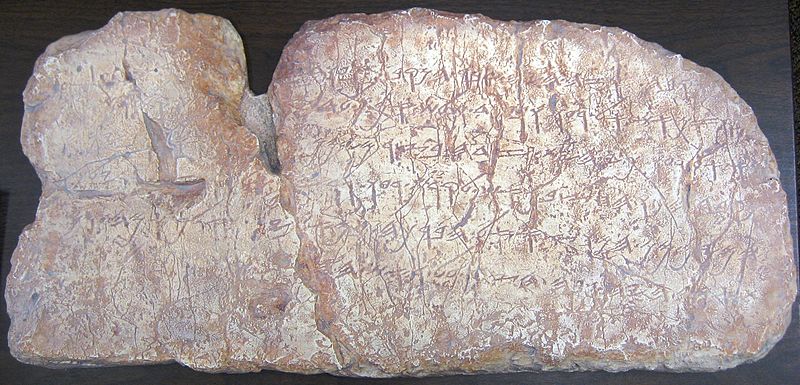
Siloam Tunnel inscription records when workers from the 8th Cent. B.C. met when digging from opposite directions. The inscription is now located in the Istanbul Archaeological Museum

Siloam Tunnel inscription records when workers from the 8th Cent. B.C. met when digging from opposite directions. The inscription is now located in the Istanbul Archaeological Museum

There are two observations I would like to make about this:

  1. As I have stated in my previous posts on archaeology – one of the major areas of debate in Old Testament archaeology is dating and not a lack of material evidence. We have seen this sort of thing crop up in other debates in the Old Testament such as the dating of the Exodus and the Conquest – specifically the debate over Tel es-Sultan (or ancient Jericho) between John Garstang and Kathleen Kenyon and the recent work of Dr. Bryant Wood.

Skeptics of the Bible and theological liberals complain that the stories in the Bible are mostly fabrications but when we do find archaeological corroboration then they move the goal-post back by re-dating the discovery to an earlier or later date.

  1. The second observation is that this episode highlights the prevalence of an extreme bias against the historical trustworthiness of the Biblical text in professional scholarly and archaeological circles (specifically ASOR – the American Schools of Oriental Research and their peer-reviewed publication BASOR – the Bulletin of the American Schools of Oriental Research).

If the article was “peer-reviewed” before it was published, then how could they have missed such an oversight of basic historical knowledge?

I suspect that there will be more dating debates in the days ahead, as ongoing research and excavations in Bible lands reveal even more corroboration and affirmation that the Biblical text is indeed trustworthy when it records events that happened in the past.

As the late novelist Michael Crichton once wrote, “If you don’t know history, then you don’t know anything. You are a leaf that doesn’t know it is part of a tree. ”

All of the “leaves” of the New Testament are connected to branches which reach down to the trunk and roots of the Old Testament. As Jesus taught, “…if they would not believe Moses and the prophets, neither will they be persuaded though one rise from the dead” (Lk. 16:31).


[1] http://www.biblicalarchaeology.org/daily/biblical-sites-places/jerusalem/regarding-recent-suggestions-redating-the-siloam-tunnel/?mqsc=E3610342&utm_source=WhatCountsEmail&utm_medium=BHDDailyNewsletter&utm_campaign=E3B827, (accessed August 30, 2013).

[2] See, A. Kirk Grayson and Jamie Novotny, The Royal Inscriptions of Sennacherib, King of Assyria (704-681 BC), Part 1 (Winona Lake, IN: Eisenbrauns, 2012).

Evolution vs. God

Ray Comfort has recently put out several provocative, informative and entertaining half hour videos.  His latest called Evolution vs. God asks some top evolutionists to offer evidence for their view (included in this production is P.Z. Myers, one of the more aggressive proponents of macro-evolution).  Their responses may surprise you!

It is certainly true that God could exist and macro-evolution also be true.  However, this film exposes the difficulty macro-evolutionists often have offering evidence for their view without assuming what they are trying to prove.  It seems to me that they have a lot faith.  Maybe given more time they could make a better case, but they certainly don’t do so in this film (and in nothing I’ve read either).

You can watch the trailer and download the complete production right now here (over 247,000 trailer views and 6,000 downloads in about a week).  For those of you that can wait, it will be available on You Tube on August 7.  However, downloading it helps pay for production costs for this and future videos.  Check it out.  I think you’ll find it enlightening and entertaining!

An old debate, featuring Dr. Kenneth Miller and Dr. Paul Nelson, has found its way onto YouTube. The debate took place at the time of the Kitzmiller v. Dover trial in Pennsylvania in 2005. Moderated by Sally Satel at the American Enterprise Institute, it focuses on the question of teaching evolutionary theory and intelligent design in science classrooms.

Ken Miller’s presentation is predictable: He talks about the type III secretion system and the fusion origin of chromosome 2; about how ID is allegedly nothing more than a negative argument against evolution and really a form of disguised creationism. His arguments have been so thoroughly responded to here at ENV and elsewhere that further discussion is unnecessary.

I do, however, want to draw attention to a particular moment in the debate, which you can view for yourself by playing the above video from 39 minutes in. Miller quotes Phil Johnson as stating:

The objective [of the Wedge Strategy] is to convince people that Darwinism is inherently atheistic, thus shifting the debate from creationism vs. evolution to the existence of God vs. the non-existence of God. From there people are introduced to “the truth” of the Bible and then “the question of sin” and finally “introduced to Jesus.”

On his PowerPoint slide, Ken Miller even provides a citation to Church & State magazine, and it turns out that this very article is available online.

You will find that the quote from Miller’s PowerPoint presentation is not from the pen of Phil Johnson at all. Rather, it is a paraphrase or (more accurately) a caricature of Johnson by Rob Boston, a critic of ID! Here’s the passage from the original article:

A second speaker itching to get his religious perspective into public schools is Phillip Johnson, a University of California at Berkeley law professor who has written several books attacking evolution. Asserting that Darwinism is “based on awful science, just terrible,” Johnson said the theory has “divided the people of God” and that means “the way is open for the agnostics to say, ‘We need to put all of this aside.'”Johnson calls his movement “The Wedge.” The objective, he said, is to convince people that Darwinism is inherently atheistic, thus shifting the debate from creationism vs. evolution to the existence of God vs. the non-existence of God. From there people are introduced to “the truth” of the Bible and then “the question of sin” and finally “introduced to Jesus.”

Surprisingly, this quotation is attributed to Johnson on several webpages (e.g. herehere, andhere), although Wikipedia does correctly attribute the statement.

This article was originally published at Evolution News & Views.

Abortion advocates don’t want you to see this one minute video. They would rather suppress the truth than conform to it.

Had or encouraged abortion? There is healing. Please visit the CaseforLife.com 

On this tragic anniversary of Roe vs. Wade, I would like to clear up a massive misunderstanding: overturning Roe vs. Wade will NOT make abortion illegal. The most likely result in a case overturning Roe would be that abortion would again become a state issue, the way it was prior to 1973. In other words, some states would vote to restrict or outlaw it, while others would vote to continue to keep it legal. Imagine actually being able to vote on an issue, rather that having unelected justices deciding the issue for you! That’s the way our representative republic is supposed to work! The current situation is undemocratic.

To those who say, “we don’t vote on rights!” Actually, we do. We voted on the Constitution and abortion is clearly not in the Constitution. However, there is a right to life in the Constitution, so why aren’t you advocating that? If you’d like abortion to be a Constitutionally protected right, then convince your fellow citizens to pass a Constitutional amendment. But don’t ask an unelected group of elites to impose it on everyone else. Such an unrepresentative process is precisely what let to our Founders to pledge their lives, fortunes and sacred honor to rectify.

The “god-of-the-gaps” objection to intelligent design is one that we have addressed numerous times at ENV and elsewhere (most recently, here). Yet even though the argument has been convincingly refuted time and again, it lives on in the popular literature.

My friend Jamie Franklin recently published a post on his website explaining why he has come to reject the claims of ID. His main concern is that ID presents a god-of-the-gaps argument, one that is based on what we don’t know, rather than what we do know, about life. Because Jamie’s thoughts are echoed in many other sources, they deserve a reply.

Click here to continue reading>>>

In a previous article, I gave a brief overview of the complex molecular mechanisms governing DNA replication. Now, I will focus specifically on the replication enzyme DNA polymerase.

DNA polymerase is the enzyme responsible for synthesizing new strands of DNA, complementary to the sequence of the template strand. The unidirectional DNA polymerase progresses along the template strand in a 3′-5′ direction, since it requires a pre-existing 3′-OH group for the adding of nucleotides. The daughter strand is, consequently, synthesized in a 5′-3′ direction (opposite to the direction of movement of the polymerase since the two strands have an anti-parallel orientation).

Click here to continue reading>>> 

Just recently a friend of mine notified me (Ted W.) of a blog written by biblical scholar, Dr. Peter Enns concerning archaeology and the Bible. The title of the blog post is “3 Things I Would Like to see Evangelical Leaders Stop Saying About Biblical Scholarship

Here are the three things Enns would like to see Evangelical leaders stop saying: That

1.    Historical Criticism is either dying or at least losing momentum in academia

2.    Source Criticism of the Pentateuch is in a state of chaos.

3.    Biblical archaeology basically supports the historical veracity of the Bible.

Obviously for those of us who believe in the inerrancy of Scripture all three of these is problematic. But point 3 was of particular interest to me, so this is what I responded to.

You can read Dr. Enns original post and my responses to him below here:

http://www.patheos.com/blogs/peterenns/2013/01/3-things-i-would-like-to-see-evangelical-leaders-stop-saying-about-biblical-scholarship/

Enns doesn’t even follow his own advice:Here is my partial response to Enns main point in number 3:

But, to your original post (point 3) in your Blog – Here you make a sweeping generalization (which I noticed you accused someone else in the post of committing) about archaeology and the Bible.

In the three things you would like to see Evangelical leaders Stop Saying about Biblical Scholarship – number 3 – is that “Biblical Archaeology Basically Supports the Historical Veracity of the Bible”

But the very first thing you say is – (and I quote) “Biblical archaeology has helped us understand a lot about the world of the Bible and clarified a considerable amount of what we find in the Bible” But this is the very thing you said that you would like to see evangelical leaders stop saying!

But then you say – (and again I quote) – “But the archaeological record has not been friendly for one vital issue, Israel’s origins: the period of slavery in Egypt, the mass departure of Israelite slaves from Egypt, and the violent conquest of the land of Canaan by the Israelites.”

Perhaps what you should have said in your original blog is that you would like to see Evangelical leaders stop claiming that “Archaeology supports the historicity of early Israel, The Exodus and Conquest.”

On that point I gave Enns several examples (in the response) from archaeology and history, but he dismissed the evidence citing that the “consensus of scholars and archaeologists” is that Israel’s early history is highly questionable.

We’ve heard this idea of “consensus ” before – especially when it comes to the anthropogenic global warming debate and the ID (Intelligent Design) debate. I think for a future blog, I am going to do a little background research on “consensus” in scholarship and what this means. One thing is fore sure, and it is that science, history and ethics is not voted on by “consensus.” The eugenics movement in late 19th century – early 20th century America is proof of this (although Eugenics is now making a comeback).

The writer of Ecclesiastes instructs his students “…of making many books there is no end.” (Eccl. 12:2) and this is certainly true. A similar thing could certainly be said in responding to the continual flow of misinformation and outright falsehoods about Christianity from popular books, media and television documentaries. This is the second blog-article I am writing in response to the History Channel’s recent documentary “Mankind: The Story of All of Us” which I had the opportunity to appear as a guest speaker. In Episode 3 titled “Empires” the producers present the advent of Christianity as essentially the invention of the Apostle Paul and the result of an historical stroke of luck in which early Christians used Roman infrastructure (cities, roads, etc..) to spread the Christian message.

To be fair, not everything in the episode was wrong or misleading. There were, however, several statements made by the commentators which need to be answered. First, were statements by Muslim writer Reza Aslan (prominently featured in the episode about the early Church) about Paul and early Christianity. Reza made statements that are flatly incorrect. The first statement he makes is that the Apostle Paul is “…the man who fundamentally defines, invents even, what we now call Christianity” (emphasis mine). Aslan further states “For Christianity in the Jerusalem church, Christianity is Judaism. For them, to become a follower of Jesus, you must be a Jew. Paul has a completely different view. He argues that Jesus obliterates the Law of Moses” (emphasis mine). Secondly, were statements made by historian Henry Lewis Gates Jr. that are somewhat misleading. He stated that Christianity was, “…a religion for the dispossessed, for the extremely poor, for the slaves, and for many women. Basically anyone who didn’t have a voice in Roman society could find a voice in the Christian movement.”

Paul of Tarsus and the Early Christian Message

            To say that Paul of Tarsus is an important figure in the Early Church is no understatement. Without him two-thirds of the New Testament would not be there. Perhaps it is for this reason that so many people believe that the Christian message is essentially his invention.  But, was the Christian message Paul’s invention or was he merely proclaiming the same message Jesus’ disciples first preached? Furthermore, did Paul preach and exhort the obliteration of the Law of Moses rather than its fulfillment and completion in the person of Christ? To answer these questions we must first note Paul’s background and conversion experience.

Before he was Paul, his name was Saul whose Jewish family settled in Tarsus the principle city of Cilicia in Asia Minor (a Roman provence). When he was of the proper age, his parents sent him to Jerusalem to learn the Torah under the famous tutelage of Gamaliel, who according to New Testament historian, F.F. Bruce, “…was the most distinguished disciple of Hillel, and succeeded him as head of the school which bore his name.”[1] In his Epistle to the Philippians (3:5) Paul described himself as “…a Hebrew among Hebrews.” As he advanced he eventually became a Pharisee. Reflecting back on that time, he writes of himself, “I advanced in Judaism beyond many of my own age among my people, so extremely zealous was I for the traditions of my fathers (Gal. 1:14).” No one could doubt Paul’s Jewish credentials or training. But as Henry Chadwick points out, “Judaism was not monolithic. There were differences between the Pharisees and Sadducees that could become sharp.”[2] Which raises the question as to which version of Judaism was Paul repudiating when he preached the Gospel of Jesus?

When Paul went through his conversion experience (recorded in Acts 9), he certainly understood the implications for his Jewish tradition and specifically for Judaism as it had been interpreted (or rather misinterpreted) by the Jewish leaders in Jerusalem. From the very beginning of his ministry Paul proclaimed the message that Jesus was the Son of God; that He was risen from the dead and that He was the promised Messiah of the Old Testament, fulfilling the Law of Moses rather than contradicting it, to the Jews specifically in synagogues (Acts 9:19-22). Bruce believes that after the risen Christ had appeared to Paul on the Damascus road, the man who went from persecuting Christians to becoming a Christian convert himself, probably reasoned this way:

The disciples had been right after all: the ‘hanged man’ had indeed risen from the dead, and must consequently be acknowledged as Lord and Messiah. The pronouncement of the divine curse on the hanged man still stood in the Law; it must therefore be accepted that the Messiah incurred this curse, but now this paradox had to be considered and explained. Sooner rather than later, Paul saw the solution to the problem in the argument which he expounds in Gal. 3:10-14, where he says that Christ, in accepting death by crucifixion, voluntarily submitted to the divine curse which the law pronounces on all who break it (Deut. 27:26) by ‘becoming a curse’ on their behalf.[3]

So Paul’s message – the Christian message – did not originate with Paul, it originated first in the Old Testament and then with the first disciples of Jesus who themselves, experienced their Master who had risen from the dead. In his first letter to the Christians in Corinth Paul reminds them, “For I delivered to you as of first importance what I also received: that Christ died for our sins in accordance with the Scriptures, that he was buried, that he was raised on the third day in accordance with the Scriptures, and that he appeared to Cephas [Peter], then to the twelve. Then he appeared to more than five hundred brothers at one time, most of whom are alive, though some have fallen asleep” (1 Cor. 15:3-6) (emphasis mine). If Paul received the message, then it wasn’t original to him. It came from those who were eyewitnesses and could approve or disapprove what he was teaching. As New Testament scholar Gary Habermas observes:

The fact that Paul’s message was checked and approved by the original Apostles (Gal. 2:1-10) reveals that he was not teaching a message contrary to Jesus’. Such official apostolic recognition was not only given to Paul’s original message but also to his epistles, which were written later and immediately recognized as Scripture (2 Pet. 3:15-16; See Clement of Rome, Ignatius and Polycarp in A,10 above).[4]

Paul never taught or preached the obliteration of the Law of Moses, but rather against its misuse and abuse. Later in his ministry, Paul addressed a sect that arose in the early church called the Judaizers. The Judaizers taught that in order to be a follower of Christ, one had to keep the Old Testament laws (which included circumcision) – even Gentile converts! Ouch! Imagine that gentlemen! On second thought – don’t imagine that! So, in Galatians Paul once again, clarifies the relationship of the Christian Gospel message to the Law of Moses. (Incidentally, to this day, there are still Christians who insist and burden other Christians with keeping Old Testament dietary and ceremonial laws!). But, in Galatians 2 Paul writes:

When Cephas [Peter] came to Antioch, I opposed him to his face, because he stood condemned. For before certain men came from James, he was eating with Gentiles; but when they came he drew back and separated himself, fearing the circumcision party… But when I saw their conduct was not in step with the truth of the gospel, I said to Cephas [Peter] before them all, “If you though a Jew, live like a Gentile, and not like a Jew, how can you force the Gentiles to live like Jews?” We ourselves are Jews by birth and not Gentile sinners; yet we know that a person is not justified by works of the law but through faith in Jesus Christ, so we also have believed in Christ Jesus, in order to be justified by faith in Christ and not by the works of the law, because by works of the law no one will be justified – (Galatians 2:11-16) ESV.

In summary, Paul did not invent Christianity, but he certainly influenced it perhaps like no other early follower of Christ. Paul’s relationship between early Christianity perhaps might be analogous to Thomas Jefferson and the founding of America. Jefferson was certainly a very well-read intellectual who, in essence wrote down and articulated what America was all about in the Declaration of Independence. But no historian would say that “America” was Jefferson’s invention. In the same way, Paul was the early church’s intellectual. Paul was the early church’s Jefferson. Paul’s epistles (Scripture) would be like what the Federalists Papers were to the U.S. Constitution. They provide clarification and elaboration on what the Gospel of Christ is and how Christians should live and conduct themselves because of it. When understood in its proper context, Paul’s theology is in perfect accord with the Law of Moses and the Old Testament, and not an obliteration of it.

The Social Strata of Early Christians

            Finally, in response to Henry Lewis Gate’s Jr.’s statement that early Christianity was [quote], “…a religion for the dispossessed, for the extremely poor, for the slaves, and for many women” misses the mark and is quite misleading. Certainly Jesus did come to preach the good news to the poor, not just the financially poor, but also the poor in spirit whatever their social status. In Luke 4:18 Jesus quotes the Old Testament prophet Isaiah 61:1 “The Spirit of the Sovereign LORD is on me, because the LORD has anointed me to preach good news to the poor. He has sent me to bind up the brokenhearted, to proclaim freedom for the captives and release from darkness for the prisoners.” One of the best works on the social makeup of Paul’s day is Yale professor Wayne A. Meek’s book, The First Urban Christians: The Social World of the Apostle Paul (Yale, 1983). As to the social strata of early Christians, Meeks writes:

The evidence we have surveyed is fragmentary, random, and often unclear. We cannot draw up a statistical profile of the constituency of the Pauline communities nor fully describe the social level of a single Pauline Christian. We have found a number of converging clues, however, that permit an impressionistic sketch of these groups. It is a picture in which people of several social levels are brought together. The extreme top and bottom of the Greco-Roman social scale are missing from the picture. It is hardly surprising that we meet no landed aristocrats, no senators, equites, nor (unless Erastus might qualify) decurions. But there is also no specific evidence of people who are destitute – such as hired menials and dependent handworkers; the poorest of the poor, peasants, agriculture slaves, and hired agriculture day laborers, are absent because of the urban setting of the Pauline groups. There may well have been members of the Pauline communities who lived at the subsistence level, but we hear nothing of them.[5]

What is not in dispute, is that the early Christian message did not resonate and find an audience with the meek and lowly of Greco-Roman society.  It certainly did. But that is not the complete picture. Paul and the other apostles often traveled on Roman roads; worked at odd jobs in Roman society (in carpentry and tent-making, etc…) and before Facebook or Twitter, they used the natural networks of Roman cities, friendships and families (the Roman Pater Familias) to spread the Christian message. Oftentimes there were wealthy patrons who helped Paul and his missionary endeavors. It was a message that resonated across all social levels.

But no matter how much we analyze the reasons, the how’s and the why’s of Christianity’s success in the Roman world and in Roman society, we must acknowledge the supernatural element in it. Without God’s supernatural help through the coming of the Holy Spirit (at Pentecost, Acts 1:8 & 2:1-13), the nascent Church would have died out long ago under the persecution of the Roman Caesars. The first two hundred years of the Church were some of the most violent and dangerous in her history, yet the church thrived and grew eventually becoming the official religion of Rome under Theodosius I (A.D. 379-395). As sociologists, historians and scholars continue to muse  and debate over Christianity’s rise, it will remain a fact of history that without God’s supernatural help, the Church would have never been established.


[1] F.F. Bruce, New Testament History (New York: Doubleday, 1971), 236.[2] Henry Chadwick, The Early Church, Revised Ed. (London: Penguin Books, 1993), 13.[3] Bruce, Ibid., p. 241.[4] Gary R. Habermas, The Historical Jesus: Ancient Evidence for the Life of Christ (Joplin, MO: College Press, 1996), see p.283 Appendix 2, An Apologetic Outline.[5] Wayne A. Meeks, The First Urban Christians: The Social World of the Apostle Paul (New Haven & London: Yale University Press, 1983), 72-3.

Have you ever wanted to see the Bible come alive by visiting actual biblical sites?  When I co-led a Footsteps of Paul cruise last year with my friend Bob Cornuke (the REAL Indiana Jones), the experience was even more enriching than I had anticipated.  So this year we are going to do it again.  Except in addition to following in the footsteps of Paul, we’re going to follow in the footsteps of Jesus as well!

We’ll start in Israel on May 27 and visit the major sites in the Holy Land for four days.  Then we’ll fly to Istanbul to board a beautiful 600 passenger ship– which just the right size for a comfortable trip– and see the places where Paul actually ministered:  places such as Ephesus, Troas, Athens, Corinth and Malta.  We’ll also stop at the breathtaking Island of Santorini as well.

Our group will be around 50.  Check the one minute video above and this site (LivingPassages.com) for all the details. I hope you can join us for this once in a lifetime trip!

Recently I have been reviewing some literature on the elegant molecular mechanisms by which DNA is replicated. As an undergraduate biology student, I recall being struck by their sheer complexity, sophistication, and intrinsic beauty. As I read about such a carefully orchestrated process, involving so many specific enzymes and protein complexes, and its extraordinary accuracy, it was almost as though the word “design” jumped off the pages of my textbook and slapped me in the face. The rate of DNA replication has been measured as a whopping 749 nucleotides per second (McCarthy et al., 1976) and the error rate for accurate polymerases is believed to be in the range of 10^-7 and 10^-8, based on studies of E. coli and bacteriophage DNA replication (Schaaper, 1993).

I want to provide here a brief overview of the central processes involved in DNA replication. In subsequent articles, I will examine the individual components in more detail.

Click here to continue reading>>>