

Tag Archive for: World Religions

By Al Serrato

Every year in America, thousands of crimes occur in which there are no witnesses and very little evidence. Sometimes, the perpetrator leaves behind a fingerprint impression – a latent print -somewhere at the crime scene. In the past, these prints possessed little value in identifying the offender; before a comparison could be conducted, the police would have to already have a known suspect.

Today, law enforcement officers have access to much better technology, in the form of AFIS – the Automated Fingerprint Identification System. Maintained by the FBI, it houses the data for millions of fingerprint impressions, allowing an unknown latent print to be compared to millions of known offenders. In a matter of minutes, the AFIS computer can spit out the top twenty possible matches to the unknown latent print. But this is only the beginning of the analysis because, with only one latent print at the scene, there is but one actual source for the print. A trained analyst must then spend the time examining in fine detail the patterns of each suspect – the whorls and arches and loops, the ridges and furrows – to determine whether an exact match can be made. The top twenty possible matches have much in common, but on further examination, differences will emerge in the ridge pattern and detail until the one actual source can be identified.

So, what does this have to do with the field of apologetics? Just this: living as we are in very pluralistic times, we often encounter people who believe that all religions are basically the same. Examining them superficially, they will see that religions share a number of features; for example, most teach the utility of treating others with respect, of being kind, of helping the poor. So, while acknowledging some differences in doctrines, people who hold this view believe they have arrived at a great truth: there is no one right religion, just people who mistakenly, and sometimes dangerously, think that they have the corner on truth. This leaves them feeling settled, for the moment, as they conclude that no further inquiry is required. Just be kind to others and follow your heart and all will be well. But on closer examination, all they have really done is stopped searching for the truth, for the “source” of the life that has been given to them and the universe that surrounds them.

Like fingerprints, religions can appear on the surface to be identical, or nearly so, when in fact they are not. And to determine where and how they differ requires a rigorous and close inspection. This of course is crucial in a fingerprint analysis because we know that for one print, there can only be one source. No analyst would stop when she narrowed the search to three possible sources because common sense and reason dictate that two of the three – or perhaps all three – must also be excludable on further inquiry. It is the nature of the thing examined.

So too with the knowledge of God. The major world religions make mutually exclusive truth claims about the nature and attributes of God. Do we live and die once, and then face judgment, as Christianity teaches? Or do we undergo a continuous cycle of life, death, and reincarnation?  Is there one God consisting of three persons, or are there instead of a single god or a multitude of deities? For one religion to be true, the others cannot be.

It is logically possible, of course, that all religions are false. It is not possible, by contrast, for religions holding contrary positions to all be true. Either Jesus Christ is the Son of God who rose from the dead and thereby provides salvation to a fallen world, as Christians claim, or he is not. He cannot be both savior and mere sage at the same time.

Critical and careful analysis of a latent fingerprint can lead to the discovery of the truth as to who left it behind. Making the effort is critical to the pursuit of justice, the importance of which we all intuitively recognize.

But critical and careful analysis can also lead to knowledge of the one God who brought us into existence. When we fail to investigate this question because we mistakenly believe that we already know all we need to know – that is, when we allow ourselves to be misled to believe that all religions are pretty much the same – we may not intuitively realize just how much we are giving up.

After all, what comes next – what awaits each of us at the end of our days here on Earth – is without a doubt the most important question that we must confront. And the sooner we begin that process, the sooner we will find that good and satisfying answers await.

Recommended resources related to the topic:

Can All Religions Be True? mp3 by Frank Turek

Counter Culture Christian: Is There Truth in Religion? (DVD) by Frank Turek: http://bit.ly/2zm2VLF

How Can Jesus be the Only Way? (mp4 Download) by Frank Turek

Jesus, You and the Essentials of Christianity by Frank Turek (INSTRUCTOR Study Guide), (STUDENT Study Guide), and (DVD)      


__________________________________________________________________________________________________________________________________________________

Al Serrato earned his law degree from the University of California at Berkeley in 1985. He began his career as an FBI special agent before becoming a prosecutor in California, where he continues to work. An introduction to CS Lewis’ works sparked his interest in Apologetics, which he has pursued for the past three decades. He got his start writing Apologetics with J. Warner Wallace and Pleaseconvinceme.com.

 

by Rajkumar Richard

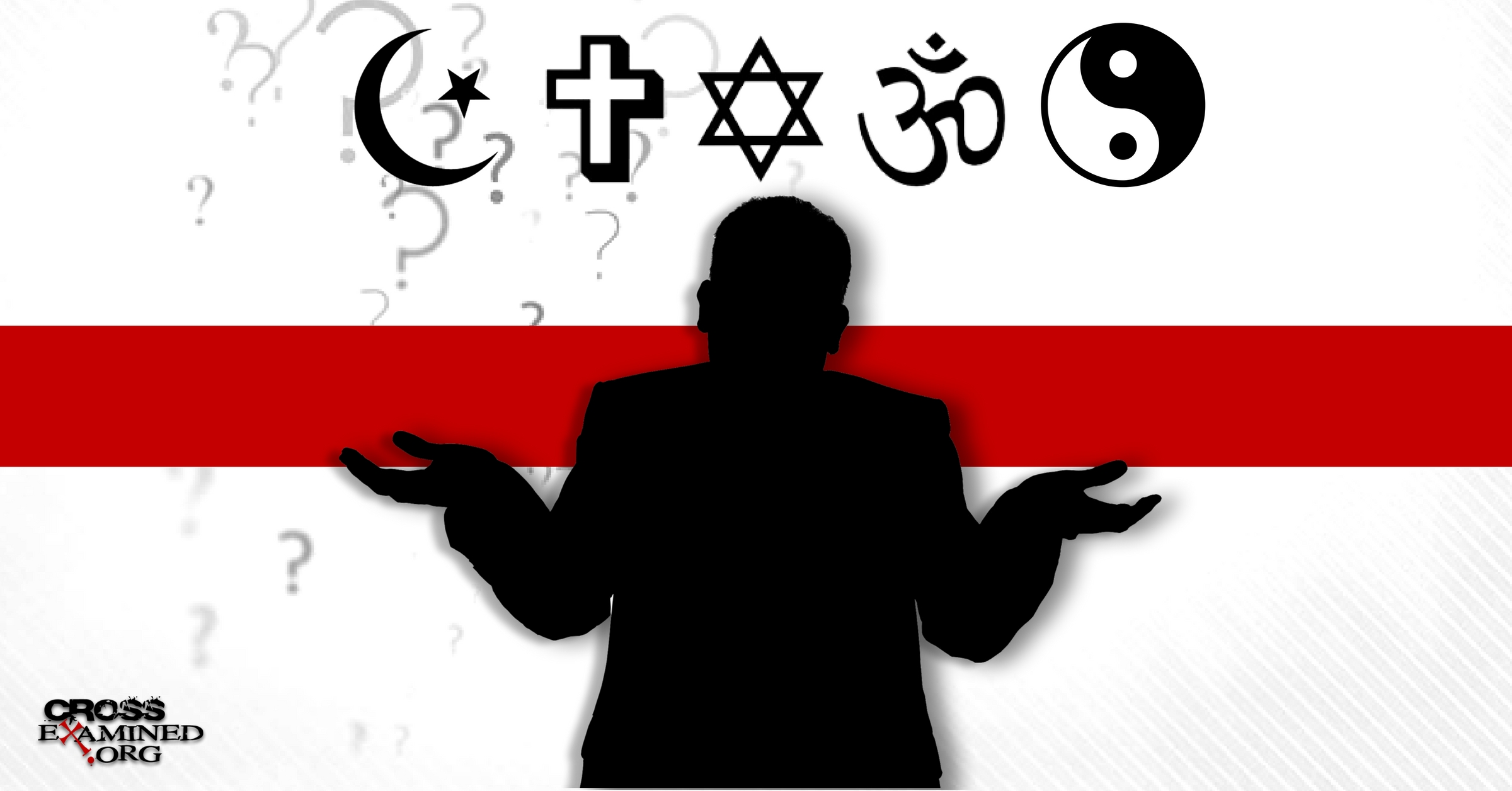
You may have encountered and engaged these claims, “Christianity is intolerant!” and “Christianity is exclusive!” The other religions are allegedly tolerant and hence, inclusive. Is it so? No! Every major religion claims exclusivity.

Within the theme of “Religious Diversity,” three relevant theories should be recognized.[1] The “Pluralist theory” believes that one religion is as truthful as another. The “Exclusivist theory” considers only one religion as uniquely valuable – the sole bearer of truth. The “Inclusivist theory” finds merit with both the pluralistic and exclusivistic religions by arguing that while the exclusivistic religion could hold most value, the others still have religious value, for there may be partial truth in the other religions.

A religion proclaims exclusivity if it absolutely contradicts an essential doctrine (Godhead, Sin, Salvation, etc.) of another religion. Since mutually contradictory statements cannot be true at the same time and in the same sense (Law of noncontradiction), the either-or logic (not the both-and) should be applied while determining the truth. When two religions mutually contradict each other, the truth remains with either religion A or religion B (both religion A and religion B cannot be true, in this instance). Therefore, only one religion could be true, but the fact remains that both religions claim exclusivity, for both these religions claim to bear the truth.

Every major religion in the world, either implicitly or explicitly, claims exclusivity. Ravi Zacharias states, “The truth is that every major religion in the world claims exclusivity, and every major religion in the world has a point of exclusion…”[2] Therefore, a preliminary study of the claims of exclusivity of the major world religions is in order.

Exclusivity of Hinduism

Hinduism, one of the world’s oldest religious systems, claims to be inclusive.[3] But it is not so.

Hinduism excludes other religions based on its core doctrines. Consider the doctrine of God in Hinduism. Brahman, the absolute God of Hinduism, is a mysterious being.[4]

Although Brahman is one God, he manifests in innumerable forms, “Hinduism is unique because it is essentially a monotheistic faith which acknowledges polytheism as reflective of the diversity in God’s creation. God is one, but also many. He manifests Himself in innumerable forms and shapes.”[5] But the God of Christianity does not manifest Himself in innumerable forms. Hence, Hinduism should exclude Christianity or Islam on the basis of the Godhead. The same holds true for doctrines such as karma and reincarnation, which absolutely contradict Christianity and other religions.

While Hinduism claims inclusivity, it excludes the exclusivists, “Hinduism does not recognize claims of exclusivity or a clergy. Anyone who claims to by [sic] the exclusive possessor of spiritual truth or the only ‘method’ of reaching God finds no place in Hinduism; a method or a message can only be one among many…Krishna, speaking as God in the Bhagavad-Gita, says, “All paths lead to me,” and also those who worship other gods with devotion worship me….Hinduism does not force itself on others through proselytization…”[6]

Existentially, Hinduism contradicts its own claims for inclusivity. If Hinduism is truly inclusive, it would not proselytize. But Hinduism, in India – the country of its origin, is actively converting people. The recent Ghar Wapsi (Home Coming) program in India is a classic case in point. Ghar Wapsi is, “a series of religious conversion activities, facilitated by Indian Hindu organizations Vishva Hindu Parishad and Rashtriya Swayamsevak Sangh, to facilitate the conversion of non-Hindus to Hinduism”[7]

Furthermore, Ravi Zacharias, who was born into a Hindu household, asserts the exclusivity of Hinduism, “Hinduism, for example, is often represented as being the most tolerant and accepting of other faiths. That is just not true. All Hindus believe in two fundamental, uncompromising doctrines—the Law of Karma, and the belief in reincarnation.”[8]

Therefore it is very reasonable to conclude that Hinduism is not an inclusive faith since it claims exclusivity.

Exclusivity of Buddhism

Rejection of Hinduism led to the birth of Buddhism, says Ravi Zacharias, “Buddhism was born out of the rejection of two other very dogmatic claims of Hinduism. Buddha rejected the authority of the vedas and the caste system of Hinduism.”[9]

There are several irreconcilable differences between Buddhism and Historic Christianity. Two such differences are found below:

First, Buddhism rejects the notion of a personal God, which is in stark contrast to Christianity, “There is no almighty God in Buddhism. There is no one to hand out rewards or punishments on a supposedly Judgement Day.”[10] However, Buddha is worshipped by some Buddhists.

Second, Buddhism excludes other religions that believe in sin, for there is no such thing as sin in Buddhism, “Buddhists do not regard man as sinful by nature of ‘in rebellion against god.’ Every human being is a person of great worth who has within himself a vast store of good as well as evil habits…According to Buddhism, there is no such thing as sin as explained by other religions.”[11]

There are many such points of exclusions in Buddhism. Hence, Buddhism is also an exclusive religion.

Exclusivity of Islam

Islam, being strictly monotheistic, rejects every contradicting worldview (Trinitarian monotheism, polytheism, pantheism, etc.). Moreover, Islam, by virtue of rejecting Christ’s divinity, excludes Christianity.

Islam is also a legalistic system. A Muslim must earn his salvation by holding to the “Articles of Faith” (belief in God, Angels, Scripture, Prophets, and Last Days) and following the “Pillars of Faith” (The Creed, Prayer, Almsgiving, Fasting, and Hajj Pilgrimage). This is in absolute contrast to Christianity, which believes that man is not saved by his good deeds but is saved by the grace of God through faith in the Lord Jesus Christ.

Therefore, Islam stakes claim to exclusivity by excluding the contradicting religions.

Exclusivity of Judaism

It may be an effortless task to prove Judaism’s claim to exclusivity vis-à-vis other religions that are not named Christianity. Judaism and Christianity have much in common. Josh McDowell and Don Stewart, in their work “Handbook of Today’s Religions,” state the fundamental similarity, “It is to historic Judaism, the Judaism of the Old Testament, that Christianity traces its roots. Christianity does not supplant Old Testament Judaism; it is the fruition of Old Testament Judaism. One cannot hold to the Bible, Old and New Testaments, as God’s one divine revelation without also recognizing and honoring the place God has given historic Judaism.”[12]

Given this relationship between Judaism and Christianity, the exclusivity of Judaism would be clearly emphasized if Judaism excludes Christianity. A couple of points of exclusion are highlighted below:

First, Judaism rejects the Christian belief that Jesus Christ is the Messiah, “While Christianity recognizes that the promise of a personal, spiritual savior is the core of biblical revelation, Judaism has long vacillated in the concept of messiahship. That Jesus Christ, the true Messiah predicted in God’s Word, would be rejected by the Jews of the first century shows that even at that time there was a divergence of opinion on the meaning and authority of messianic passages in Scripture. In the course of Jewish history, the meaning of the Messiah had undergone changes. Originally, it was believed that God would send His special messenger, delivering Israel from her oppressors and instituting peace and freedom. However, today any idea of a personal messiah has been all but abandoned by the majority of the Jews. It has been substituted with the hope of a messianic age characterized by truth and justice.”[13]

Second, the salvation of the Jews is predicated on sacrifices, penitence, good deeds and a little of God’s grace, since they reject the substitutionary atonement of the Lord Jesus Christ.[14] Salvation in Christianity is absolutely contingent on God’s grace, but not on the performance of good deeds.

Conclusion  

Every major religion of the world remains exclusive, for there are irreconcilable contradictions between these religions. The notion that Historic Christianity is the only religion that claims exclusivity is, therefore, incorrect.

Notes:

[1] http://www.iep.utm.edu/reli-div/

[2] http://rzim.org/a-slice-of-infinity/point-of-exclusion/

[3] http://indianexpress.com/article/india/india-news-india/hinduism-is-more-inclusive-and-not-exclusive-rss-chief-mohan-bhagwat-2947063/

[4] http://www.hinduwebsite.com/brahmanmain.asp

[5] http://www.hinduwebsite.com/onegod.asp

[6] M. G. Chitkara, Rashtriya Swayamsevak Sangh: National Upsurge, A.P.H Publishing Corporation, New Delhi, 2004, p61.

[7] https://en.wikipedia.org/wiki/Ghar_Wapsi

[8] http://rzim.org/a-slice-of-infinity/point-of-exclusion/

[9] Ibid.

[10] http://www.buddhanet.net/e-learning/snapshot01.htm

[11] http://www.budsas.org/ebud/whatbudbeliev/182.htm

[12] Josh McDowell and Don Stewart, “Handbook of Today’s Religions,” Thomas Nelson Publishers, Nashville, 1983, p364.

[13] Ibid. p372.

[14] Ibid. p373.


Rajkumar Richard is passionate to strengthen the faith of fellow Christians, especially the young Christians. He has a Masters in Religion (Southern Evangelical Seminary, NC, USA) and Masters in Biology (School of Biological Sciences, Madurai Kamaraj University, India). He is a Christian blogger, itinerant speaker, social evangelist, and a mentor to young Christians.

Original Blog Source: http://bit.ly/2l7HkPU

By Evan Minton

One common question atheists often ask Christians like me is why we believe in the God of The Bible as opposed to all of these other gods in all of these made up religions. They will ask “You believe in only one God? Why don’t you believe in Thor, or Zeus, or Athena? You claim all these gods don’t exist? Yet you say your god does? How do you tell the difference?”

Actually, this question is one of the first things that made me doubt my own Christian faith. Years ago, I pretty much had no way to tell between Christianity and other religions? How do I know Yahweh is the one true God? If these others are made up, how do I know my God isn’t? Fortunately, The Lord showed me Christian Apologetics and gave me a good way to discern between them. Now, I’m not going to go into all of the evidence for The God Of The Bible right now. If I did, this blog post would be extremely long, just incredibly wordy. Rather, I’m going to link to these arguments and evidence which demonstrate the truth of Christianity, and when you’re done reading this blog post you can click on those links and study the arguments individually if you’d like. The links will be highlighted in blue.

One way to know is The Big Bang itself. According to The Big Bang, the entire universe popped into being out of nothing! And according to people who have done exhaustive studies of the world’s religions (e.g Hugh Ross), the only beliefs that have God creating out of nothing are Judaism, Christianity, Islam, and Deism. All other religions have God or gods creating within space and time that have existed from eternity past. So, the very origin of the universe itself narrows it down to 4 possibilities. Moreover, the origin of the universe demonstrates that the existence of the universe must have been brought into being by a causal agent. A causal agent whose existence is spaceless, timeless, immaterial, powerful, uncaused, supernatural and personal (See The Kalam Cosmological Argument).

If the scientific evidence for Intelligent Design goes through (e.g The Fine Tuning Of The UniverseThe Local Fine Tuning, The DNA Evidence, Irreducible Complexity), you can rule out Deism. Because what arguments like the teleological arguments show is that this God is actively shaping the universe and life to make it’s inhabited by creatures. That rules out Deism and fits better with theism.

Moreover, I might add that the Ontological Argument demonstrates that there exists a being much like the God of The Bible. The Ontological Argument, if it goes through, would demonstrate that there exists a being who is Omniscient, Omnipresent, Omnipotent and Omnibenevolent. This contradicts many gods like Thor and Zeus. The only religions consistent with a being like this are the 3 monotheistic religions. Polytheistic gods like Thor are merely superhumans (Stan Lee took advantage of this fact). But they’re not omnipotent or omnipresent or anything like that. The beauty about the Ontological Argument is that it not only demonstrates that God exists but it puts forth all of his superlative qualities which you can’t derive from other arguments from natural theology.

In fact, arguments from natural theology can tell us not just that God exists, but it can demonstrate a lot of attributes about God. Attributes that The Bible describes Him as having. The Kalam Cosmological Argument shows that God is a spaceless, timeless, immaterial, powerful, supernatural and personal agent. The Fine Tuning Arguments (universal and local) demonstrate that God is incredibly intelligent, at least intelligent enough to know how to fabricate a universe suitable for creatures to inhabit. The other teleological arguments (DNA and Irreducible Complexity) do the same thing. The Moral Argument demonstrates that God is morally perfect since it demonstrates that God is the standard by which we measure people to determine just how good or just how evil they really are. It demonstrates that in the absence of God’s existence, there would be nothing we could objectively call good and evil because there would be nothing to compare it with. Who or what exactly are we comparing Hitler or Bin Ladin to when we call them evil?

The Ontological Argument demonstrates God’s superlative qualities (as I’ve already noted above). If it pulls through (that is, if it meets the 3 requirements for being a good argument, which are: The conclusion must follow from the premises by the laws of logic, all of the premises must be true, and we must have good reasons to think that they’re true), if this argument meets those 3 requirements, it demonstrates that there exists a being that is omnipotent, omnipresent, omniscient, omnibenevolent, and necessary in its existence (aseity).

These arguments from natural theology/general revelation, when put together, give us powerful reasons to believe in the existence of a Being that very, very closely resembles the being that The Bible describes as God. Moreover, the beautiful thing about natural theology is that you derive this Being’s existence without appealing to any scripture whatsoever. So the atheist can’t accuse you of circular reasoning (appealing to The Bible to prove The Bible). We can conclude that this being exists just from science, and logic alone.

But if you want to get to Christianity and eliminate the other 2 options, one may want to look at the evidence for Christ’s resurrection. For me, Christ’s resurrection settles everything,. If it can be historically established that Jesus made claims to be God, and then rose from the dead, then that is pretty good evidence that He was telling the truth. The resurrection means that God put His stamp of approval on everything Jesus said and did. It means that He is both Messiah and Lord. Therefore, anything contradictory to Christ’s teachings must be false. I happen to think that the historical evidence for Jesus Christ’s resurrection is very powerful. I admonish you to look at the Cerebral Faith blog posts I wrote on this topic. In PART 1, I give the evidence for the 5 minimal facts; (1) that Jesus died by crucifixion, (2), that Jesus’ tomb was found empty, (4) that the disciples believed they saw Jesus alive after his death, (4), that a persecutor named Paul converted on the basis of what he believed was an appearance of the risen Jesus, and (5) that a skeptic named James converted based on what he believed was an appearance of the risen Jesus. In PART 2, I examine which of the explanations best explains those hypotheses and show that only the hypothesis “God raised Jesus from the dead” best explains the 5 facts while naturalistic explanations fail.

But if you want to dive into studying this topic even deeper, I suggest the books “The Case For Christ” by Lee Strobel, “The Case For The Resurrection Of Jesus” by Gary Habermas and Mike Licona, and also “On Guard” by William Lane Craig (Craig’s book also delves into 4 of the natural theology arguments I’ve listed above, but it also has a chapter on Jesus’ claims to deity and a chapter on the evidence for his resurrection).

So there you have. Reasons why I believe in The Biblical God instead of any polytheistic or pantheistic gods. I hope that whether you’re a Christian like me or an atheist, that you will click on the links above and take the time to read those linked articles. If you’re an atheist, it might make a believer out of you. If you’re a Christian, it will likely strengthen your faith. God bless you.


For a fuller treatment on this, check out Evan’s book ‘Inference To The One True God: Why I Believe In Jesus Instead Of Other Gods’.

Original Blog Source: http://bit.ly/2qBOgI7