Tag Archive for: World Religions

In a previous article, I offered a simple reason why the Qur’an cannot possibly be the word of God, since the proposition that the Qur’an is the word of God entails a necessary contradiction. Here, I am going to present an equally compelling reason to reject the Qur’an as the word of God.

As I alluded to in my previous post, the Qur’an contends that the disciples of Jesus were Muslims. According to Surah 3:52,

“…when Isa [Jesus] sensed disbelief in them, he said: “Who are my helpers in the way of Allah?” The disciples said:“

If The Apostles were Muslim . . .

So according to the Qur’an, there is no question that the apostles were Muslims, under Jesus. But what if we could establish that the teaching of the apostles differed starkly from the teachings of Muhammad and the Qur’an? Here’s an argument to ponder:

Premise 1: If the original disciples of Jesus rejected core Islamic teachings, Islam is false.
Premise 2: The original disciples of Jesus rejected core Islamic teachings.
Conclusion: Therefore, Islam is false.

In order for a Muslim to escape the conclusion, he or she has to reject one of these two premises. What possible escape routes might be available? One escape route might be to say that the disciples of Jesus were fooled or somehow mistaken – or perhaps they corrupted the true message of Jesus sometime after this. Or maybe even the 12 disciples of Jesus are not even who is in mind here. This escape route, however, is blocked by Surah 61:14,

“O you who believe, be supporters of (the religion of) Allah, just as Isa, son of Maryam, said to the Disciples, ‘Who are my supporters towards Allah?’ The Disciples said, ‘We are the supporters of (the religion of) Allah.’ So a group from the children of Isra’il believed, and another group disbelieved. Then we supported those who believed against their enemy, and they became victors.”

Thus, such speculation runs into the following problem: Jesus’s apostles were victors who rose to dominance because of Allah’s support for them, indicating their message was approved by Allah. This becomes clear also when we read Surah 3:55:

“When Allah said: “O ‘Isa, I am to take you in full and to raise you towards Myself, and to cleanse you of those who disbelieve, and to place those who follow you above those who disbelieve up to the Day of Resurrection.”

In syllogistic form, the argument can be summarized as follows:

Premise 1: There were victors rising to dominance who Allah supported (Surah 3:55; 61:14).
Premise 2: The victors were either Jesus’s apostles or not Jesus’s apostles.
Premise 3: If they were not Jesus’s apostles, then we would see records of these non-apostle victors.
Premise 4: We do not see such records.
Premise 5: Therefore, it is false that the victors were non-apostles.
Conclusion: Therefore, the victors were Jesus’s apostles.

So, when we read Surah 3:52, we can be sure that it is referring to the disciples. Allah blessed these persons. It was the apostles whom Allah brought to dominance and vindicated. But now a Muslim might well ask, “How do you know the apostles rejected core Islamic teachings?” It is to this question that I now turn my attention.

Consider Paul the apostle. Now, I understand that the apostle Paul was not one of the original disciples of Jesus, but converted to Christianity following a vision of Jesus on the road to Damascus in Acts 9. But I am going to argue that Paul was approved by the original disciples of Jesus. This strongly suggests that his view about the nature of God and identity and mission of Christ matched that of the disciples. In any case, even in the absence of the evidence I am about to present, if we take Surah 3:55 and Surah 61:14 seriously, then Paul’s teaching must have been consistent with the disciples, because the Christianity that prevailed is what Muslim polemicists would consider to be Pauline Christianity – and the Qur’an tells us that the true followers of Jesus were the ones who achieved dominance and became the victors.

Commentators

Am I completely off-the-wall with this contention? No; In fact, I am in good company. Consider the following quotations from respected Quranic commentators:

Renowned thirteenth-century commentator Al-Qurtubi, says of Surah 61:14:

“It was said that this verse was revealed about the apostles of Jesus, may peace and blessing be upon him. Ibn Ishaq stated that of the apostles and disciples that Jesus sent (to preach) there were Peter and Paul who went to Rome; Andrew and Matthew who went to the land of the cannibals; Thomas who went to Babel in the eastern lands; Philip who went to Africa; John went to Dac-sos which is the tribe to whom the sleepers of the cave belonged; Jacob went to Jerusalem; Bartholomew went to the lands of Arabia, specifically Al-Hijaz; Simon who went to the Barbarians; Judas and Barthas who went to Alexandria and its surrounding regions. Allah supported them (the apostles) with evidence so that they prevailed (thahirin) meaning they became the party with the upper hand. Just as it is said, ‘An object appeared on the wall’ meaning it is clearly visible (alu-wat) on the wall. Allah, who is glorified and exalted, knows the truth better and to Him is the return and retreat.”

Ibn Ishaq’s Sirat Rasul Allah (English translation, page 653), the earliest extant biography of Muhammad, says the following:

“Those whom Jesus son of Mary sent, both disciples and those who came after them, in the land were: Peter the disciple and Paul with him, (Paul belonged to the followers and was not a disciple) to Rome. Andrew and Matthew to the land of the cannibals; Thomas to the land of Babel, which is in the land of the east; Philip to Carthage and Africa; John to Ephesus the city of the young men of the cave; James to Jerusalem which is Aelia the city of the sanctuary; Bartholomew to Arabia which is the land of Hijaz; Simon to the land of Berbers; Judah who was not one of the disciples was put in place of Judas.”

Or consider Al Tabari’s History (Volume IV, p. 123):

Among the apostles, and the followers who came after them were the Apostle Peter and Paul who was a follower and not an apostle; they went to Rome. Andrew and Matthew were sent to the country whose people are man-eaters, a land of blacks, we think; Thomas was sent to Babylonia in the east, Philip to Qayrawan (and) Carthage, that is, North Africa. John went to Ephesus, the city of the youths of the cave, and James to Jerusalem, that is, Aelia. Bartholomew was sent to Arabia, namely, the Hijaz; Simeon to the land of the Berbers in Africa. Judas was not then an apostle, so his place was taken by Ariobus. He filled in for Judas Iscariot after the latter had perpetrated his deed.

Thus, Al-Qurturbi, Al Tabari, and Ibn Ishaq all are led to praise the apostle Paul as a direct consequence of these verses.

Independent Reasons from History

There are several independent historiographical reasons for thinking that Paul’s teaching was approved by the original disciples of Jesus. Among them are the following:

Reason 1: Individuals in the early church, who are likely to be associated with the apostles (Polycarp, Clement, and Ignatius) speak approvingly of his letters.

Reason 2: Never do the early church show knowledge of a fundamental dissension between Paul and Peter on matters pertinent to Christology and the nature of God, even though they often mention him alongside the apostle Peter.

Reason 3: Paul tells us in Galatians 2 that he went up to Jerusalem with Barnabus to confirm that the gospel he was preaching to the gentiles was the same as theirs. It is unlikely that he made this story up in order to support his own apostolic authority – because in the same chapter he also mentions the dispute that happened between Paul and Peter regarding circumcision when Peter came to Antioch.

Reason 4: Paul makes a disinterested comment about the Apostle James in Galatians 1:18-19:

“Then after three years I went up to Jerusalem to visit Cephas and remained with him fifteen days. 19 But I saw none of the other apostles except James the Lord’s brother.”

Notice the disinterested off the cuff remark from Paul about James. If Paul was a false Apostle inventing stories we would not expect him to just mention James in passing without making a point. The fact that Paul merely mentions James in this off the cuff way persuades historians that Paul was recalling real events about his association with the early church and Apostles.

Reason 5: Paul writes in 1 Corinthians 15:9-11,

“For I am the least of the apostles, unworthy to be called an apostle, because I persecuted the church of God. 10 But by the grace of God I am what I am, and his grace toward me was not in vain. On the contrary, I worked harder than any of them, though it was not I, but the grace of God that is with me. 11 Whether then it was I or they, so we preach and so you believed.”

Paul thus appears to endorse the other apostles and even goes so far as to say that he considers himself less than the least of them. Paul seems to assume that the Corinthian Christians also believed his message to be consistent with the other apostles. This strongly suggests that Paul and the other apostles were generally in agreement on the core matters of the faith.

Paul’s theology was radically at odds with core Islamic teaching, since Paul affirmed not only the deity of Christ, but also the crucifixion and resurrection (all of which are expressly rejected by Islam).

Paul’s Words

For the purposes of argument, I will only appeal to the non-disputed works of Paul, works that all Christian and non-Christian historians unanimously grant were written by him.

In Philippians 2:5-11, Paul quotes what is likely an early Christian hymn:

“Have this mind among yourselves, which is yours in Christ Jesus, 6 who, though he was in the form of God, did not count equality with God a thing to be grasped, 7 but emptied himself, by taking the form of a servant, being born in the likeness of men. 8 And being found in human form, he humbled himself by becoming obedient to the point of death, even death on a cross. 9 Therefore God has highly exalted him and bestowed on him the name that is above every name, 10 so that at the name of Jesus every knee should bow, in heaven and on earth and under the earth, 11 and every tongue confess that Jesus Christ is Lord, to the glory of God the Father.”

The crucifixion of Jesus is already starkly at odds with Islamic theology (see Surah 4:157-158). Furthermore, there are at least three reasons why this text teaches the deity of Christ:

1. It says that Christ was “in the form of God” and then “took the form of a servant” – he is thus putting the two in the same category, since he uses the greek word morphé (meaning “form”) in both clauses.
2. The context of the passage instructs us to emulate the humility of Christ. But it is no act of humility on the part of a creature to not seek to be God.
3. Verses 10 and 11 link with Isaiah 45:23: “To me [i.e. Yahweh] every knee shall bow, every tongue shall swear allegiance.”

To take one further example, Paul appears to expand upon the shema (from Deuteronomy 6:4) in 1 Corinthians 8:6, identifying Jesus Christ as Lord of the shema:

“Yet for us there is one God, the Father, from whom are all things and for whom we exist, and one Lord, Jesus Christ, through whom are all things and through whom we exist.”

This suggests, by extension, that the disciples of Jesus likewise affirmed the deity of Christ. It also seems unlikely that they would have reached such a radical conclusion had Jesus not himself identified Himself in this way, especially given (1) the Jewish Messianic expectations; (2) The Jewish concept of God; and (3) the connotations of crucifixion to a Jew.

To conclude, there is no reason to think that Jesus’ disciples were Muslims as the Qur’an contends and every reason to think otherwise. This presents yet another formidable challenge to the Islamic religion and gives even more rational warrant for its rejection.

Recommended Resources:

How Can Jesus Be the Only Way? (mp4 Download) by Frank Turek

Can All Religions Be True? mp3 by Frank Turek

Jesus, You and the Essentials of Christianity by Frank Turek (INSTRUCTOR Study Guide), (STUDENT Study Guide), and (DVD)      

Person of Interest: Why Jesus Still Matters in a World that Rejects the Bible by J. Warner Wallace (Paperback), (Investigator’s Guide).


Dr. Jonathan McLatchie is a Christian writer, international speaker, and debater. He holds a Bachelor’s degree (with Honors) in forensic biology, a Masters’s (M.Res) degree in evolutionary biology, a second Master’s degree in medical and molecular bioscience, and a Ph.D. in evolutionary biology. Currently, he is an assistant professor of biology at Sattler College in Boston, Massachusetts. Dr. McLatchie is a contributor to various apologetics websites and is the founder of the Apologetics Academy (Apologetics-Academy.org), a ministry that seeks to equip and train Christians to persuasively defend the faith through regular online webinars, as well as assist Christians who are wrestling with doubts. Dr. McLatchie has participated in more than thirty moderated debates around the world with representatives of atheism, Islam, and other alternative worldview perspectives. He has spoken internationally in Europe, North America, and South Africa promoting an intelligent, reflective, and evidence-based Christian faith.

Originally posted at: https://bit.ly/450zGNI

The Islamic religion claims that the Qur’an, revealed allegedly by the angel Gabriel to the prophet Muhammad beginning in 610 A.D., is the inspired and inerrant word of God. Such an assertion, however, is highly problematic, and many, many arguments could be given to convincingly refute it. In this article, I am going to offer one of those reasons, which I perceive to be the most damning. My argument here can be summarized in syllogistic form as follows:

Premise 1: Either the Bible is the Word of God or it is not.

Premise 2: If the Bible is the Word of God, the Qur’an is not.

Premise 3: If the Bible is not the Word of God, the Qur’an is not.

Conclusion: Therefore, the Qur’an is not the Word of God.

First, a note of qualification. By “the Bible” I refer specifically to the Torah and the gospels as we possess them today and as possessed by Christians at the time of Muhammad in the seventh century. Granted, there are textual variants in the New Testament Greek manuscripts, but the core message of the New Testament remains the same — they are thus immaterial to what I’m attempting to establish here.

Premise 1 need not be defended, since it is self-evident that the two alternatives are mutually exclusive and exhaustive possibilities. Premise 2 is easy to establish, since the Qur’an and the Bible fundamentally contradict one another. The most obvious item of conflict relates to whether Jesus died by crucifixion, denied by the Qur’an (Surah An-Nisa 157-158) but affirmed throughout the New Testament and indeed a cornerstone of New Testament theology. The Qur’an also repeatedly denies the core Biblical concept that Christ is the incarnate eternal Son of God, affirming instead that He is only a messenger or prophet (e.g. Surah Al-Maeda 75). The Qur’an, on multiple occasions, denies the Trinity (e.g. Surah An-Nisa 171; Surah Al-Maeda 73). The Qur’an, of course, repeatedly misrepresents Christian theology on these matters, but this is immaterial to the issues that concern us here. If, then, the Christian Scriptures are indeed the inspired Word of God, the Muslim Scriptures cannot be, since the Qur’an so fundamentally disagrees with the theology of the Bible.

The Qur’an’s Affirmation of the Christian and Jewish Scriptures

For the Muslim to reject the conclusion of the argument, at least one of the three Premises must also be rejected. As I have shown, Premises 1 and 2 cannot be reasonably denied. What, then, of Premise 3? The Qur’an, over and over again, affirms the Christian Scriptures, claiming consistency with them, and asserting that the Torah and the Gospel (the “Injil”), and also the Psalms, are previous revelations from Allah. Consider, for example, the following verses.

  • Surah Al-E-Imran (3) 3: “He has revealed to you the Book with the truth [i.e. the Qur’an],confirming what has been before it, and has sent down the Torah and the Injil.”
  • Surah An-Nisa (4) 136: “O you who believe, do believe in Allah and His Messenger and in the Book He has revealed to His Messenger and in the Books He has revealed earlier. Whoever disbelieves in Allah and His angels and His Books and His Messengers and the Last Day has indeed gone far astray.”
  • Surah An-Nisa (4) 163: “Surely, We have revealed to you [i.e. Muhammad] as We have revealed to Nuh and to the prophets after him; and We have revealed to Ibrahim, Isma’il, Ishaq, Ya’qub and their children, and to Isa, Ayyub, Yunus, Harun, and Salaiman, and We have given Zabur [i.e. the psalms] to Dawud.”
  • Surah Al-Isra (17) 55-56: “Your Lord knows best about all those in the heavens and the earth, and We have certainly granted excellence to some prophets over some others, and We gave Dawud the Zabur (the Psalms). Say, ‘Call those who you assume (to be gods), besides Him, while they have no power to remove distress from you, nor to change it.’”
  • Surah Al-Anbiya (21) 105: “And We have written in Zabur (Psalms) after the advice that the land will be inherited by My righteous slaves.”

The Qur’an even goes so far as to assert that the prophet Muhammad is prophesied in both the Old and New Testaments. Consider the following verses.

  • Surah Al-Araf (7) 157: “Those who follow the Messenger, the Ummiyy (unlettered) prophet whom they find written with them in the Torah and the Injil and who bids the what is fair and forbids what is unfair, and makes lawful for the good things, and makes unlawful for the impure things, and relieves them of their burden, and of the shackles that were upon them. So, those who believe in him and support him, and help him and follow the light sent down with him, those are the ones who are successful.”
  • Surah As-Saff (61) 6: “Remember when Isa, son of Maryam, said, ‘O children of Isra’il, I am a messenger of Allah sent towards you, confirming the Torah that is (sent down) before me, and giving you the good news of a messenger who will come after me, whose name will be Ahmad.’ But when he came to them with manifest signs, they said, ‘This is a clear magic.’”

One will search in vain, however, to find any mention of Muhammad in any Biblical text. This has left Muslim apologists doing hermeneutical gymnastics to inject Muhammad somewhere into the Bible. All such attempts, however, have proven futile.

Confronted with this obvious Qur’anic error about the contents of the Christian Scriptures, Muslim apologists will often attempt to argue that the Christian Scriptures have been corrupted, or that the “Injil” (the Gospel) refers to a special book given only to Jesus (whom the Qur’an calls “Isa”) which has left no record in history. As we shall see, however, neither the historical record, nor the Qur’an, allows for that possibility.

Has the Message of the Injil and Torah Been Corrupted or Lost?

Muslims cannot consistently maintain that the Scriptures delivered previously have been corrupted or lost, since the Qur’an appears to assume that these Scriptures are still with the “people of the book” (Christians and Jews). The case here is strong and the implications difficult to escape. Let’s take a look at some of these texts in the order that they appear in the Qur’an.

  • Surah Al-Baqara (2) 91: “When it is said to them, ‘Believe in what Allah has revealed,’ they say, ‘We believe in what has been revealed to us’ — and they deny what is beyond it, whereas that is the truth which confirms what is with them. Say, ‘Why then have you been slaying the prophets of Allah earlier, if you were believers?’”

This verse contends that the Scriptures previously revealed by Allah (i.e. the Torah and Injil) are “with them” (i.e. the people of the Book) at the time of the revealing of the Qur’an in the seventh century. If the Jews and Christians that the Qur’an is addressing didn’t have access to these Scriptures, the verse makes no sense. Here is another example which further illustrates this point:

  • Surah Al-E-Imran (3) 70: “O people of the Book, why do you disbelieve in the verses of Allah while you are yourselves witnesses (to those verses)?”

Again, Christians and Jews are witnesses to the verses revealed in the previous Scriptures. The “you” of this verse clearly refers to the Christians and Jews of Muhammad’s day. Here’s another example from the same chapter:

  • Surah Al-E-Imran (3) 199: “Surely, among the people of the Book there are those who believe in Allah and in what has been sent down to you and what has been sent to them, humbling themselves before Allah. They do not barter away the verses of Allah for paltry (worldly) gains. They have their reward with their Lord. Surely, Allah is swift at reckoning.”

Notice in the above verse the use of the plural personal pronoun “them”. The revelation from Allah was apparently sent not only to Jesus but to them (meaning, the people of the Book). Why, then, do Muslims frequently claim that the Injil was revealed only to Jesus?

Perhaps the most frequently cited verse in connection with this topic is the following text from the fifth chapter of the Qur’an:

  • Surah Al-Maeda (5) 43-49: “How do they [i.e. the Jews] ask you to judge while the Torah is with them, having the ruling of Allah? Still, they turn away, after all that. They are no believers. Surely We have sent down the Torah, in which there was guidance and light by which the prophets, who submitted themselves to Allah, used to judge for the Jews, and (so did) the Men of Allah and the Men of knowledge, because they were ordained to protect the Book of Allah, and they stood guard over it. So, (O Jews of today,) do not fear people. Fear me, and do not take a paltry price for My verses. Those who do not judge according to what Allah has sent down are disbelievers. We prescribed for them therein: A life for a life, an eye for an eye, a nose for a nose, an ear for an ear and a tooth for a tooth; and for wounds, an equal retaliation. Then, if one forgives it, that will be expiation for him. Those who do not judge according to what Allah has sent down, they are the unjust. We sent Isa son of Maryam after those prophets, confirming the Torah that was (revealed) before him, and We gave him the Injil having guidance and light therein, and confirming the Torah that was (revealed) before it; a guidance and a lesson for the God-fearing. And the people of the Injil must judge according to what Allah has sent down therein. Those who do not judge according to what Allah has sent down, they are the sinners. We have sent down to you the Book with truth, confirming the Book before it, and a protector for it. So, judge between  them according to what Allah has sent down, and do not follow their desires against the truth that has come to you. For each of you We have made a law and a method. Had Allah willed, He would have made a single community of people, but (He did not), so that He may test you in what He has given to you. Strive, then to excel each other in good deeds. To Allah is the return for all of you. Then Allah shall tell you about that in which you disputed. We order you to judge between them according to what Allah has sent down. Do not follow their desires, and beware of them, lest they should turn away from some of what Allah has sent down to you. If they turn away, be assured that Allah intends to make them suffer for some of their sins. Surely, many of the people are sinners.”

How can Christians and Jews judge by what has been revealed in the Torah and Injil if they do not have access to those Scriptures? Again, the text assumes that the “people of the book” have access to the previously-revealed Scriptures. Some Muslims like to draw our attention to verse 48, which says that the Qur’an is Muhaimin (a guardian or overseer) of the previous Scriptures. The Qur’an, therefore, is to be used to determine which parts of previous Scriptures to accept or reject. There are at least three problems with this rejoinder, however:

  1. Why would Allah have Christians judge by a circular argument? In essence, Allah would be saying to Christians “Judge the Qur’an by the contents of your Scriptures but only insofar as they agree with the Qur’an.”
  2. Verse 48 is irrelevant to Christians since that text is directed to Muhammad and his followers, e.g., it is informing them that they are to use the Quran to analyze the previous revelations. Yet verse 47 is aimed at Christians, telling them that they should use their Gospel to judge and determine truth. Why would Allah have Christians judge by a corrupted source?
  3. Muhaimin in this context doesn’t mean the Quran exposes corruptions to the Bible. If you look over the context carefully, starting at v. 43, the text is talking about laws, specifically legislations. This is brought out by verse 48 where it says that Allah has given each group of people a way and a legislation. The point of the verse is simply that the Quran determines for the Muslims which part or commands of the previous legislations are still binding upon Muslims, and which have been rescinded, e.g., “is stoning is still applicable in sharia?”, “what about Sabbath observance?” etc. It has nothing to do with textual corruption of previous Scriptures.

We go on:

  • Surah Al-Maeda (5) 68: “Say, “O people of the Book, you have nothing to stand on, unless you uphold the Torah and the Injil and what has been sent down to you from your Lord.” What has been sent down to you from your Lord will certainly make many of the most persistent in rebellion and disbelief. So, do not grieve over the disbelieving people.”

Not only does this text command the “people of the Book” to uphold the Torah and the Injil (which they must have in their possession for the command to make sense), but they are told of the Scriptures that were previously “sent down to you“. Who does “you” refer to? In context, it can only refer to the people of the Book. This is difficult to square with the popular Islamic notion that the Injil was revealed only to Jesus and was quickly lost without leaving any trace in history. Again, this text assumes that the “people of the book” possess the Torah and the Injil and that they have been neither corrupted nor lost.

As if those weren’t enough, here’s one final example:

  • Surah Yunus (10) 94: “So, (O prophet,) even if you are in doubt about what We have sent down to you, ask those who read the Book (revealed) before you. Surely, truth has come to you from your Lord, so never be among those who are suspicious.”

This text again makes no sense unless the Christians and Jews have access to the Books revealed before Muhammad. The Muslim contention that the Christian and Jewish Scriptures have been corrupted beyond recognition is simply without support from the Qur’an.

Was Jesus A Successful Preacher of Islam According to the Qur’an?

Muslims typically maintain that Jesus preached Islam, but was apparently not very successful in winning converts, because His message became quickly corrupted. Such a notion, however, is contrary to the text of the Qur’an.  Let’s take a look at some more verses:

  • Surah Al-E-Imran (3) 50-52: “I [Jesus] have come to you confirming that (book) which is (sent down) prior to me, that is, the Torah, and to are [sic] permissible for you some of what was prohibited to you. I have come to you with a sign for your Lord. So, fear Allah and obey me. Allah is surely my Lord and your Lord. So, worship Him. This is the straight path. So, when Isa sensed disbelief in them, he said: ‘Who are my helpers in the way of Allah?’ The disciples said: ‘We are helpers of Allah We believe in Allah; so be our witness that we are Muslims.’”

According to this text, Jesus was at least somewhat successful as a preacher of Islam and his own disciples themselves, at least some of whom — Peter, Matthew, John — are contributors to the New Testament. If these disciples were Muslims, why is their theology so strongly at odds with the Qur’an?

  • Surah Al-E-Imran (3) 55: “When Allah said: “O Isa, I am to take you in full and to raise you towards myself, and to cleanse you of those who disbelieve, and to place those who follow you above those you disbelieve up to the Day of Doom. Then to Me is your return, whereupon I shall judge between you in that over which you have differed.”

In the above text, Allah promises Jesus that He will place those who follow him “above those who disbelieve up to the Day of Doom.” If barely anyone was a true follower of Jesus (i.e. a Muslim), then this text cannot be understood.

  • Surah Al-Maeda (5) 110-111: “Call to mind the time when Allah will say, ‘O Isa, son of Maryam, remember my blessing upon you and upon your mother; when I supported you with the Holy Spirit. You spoke to people while you were still in the cradle and when you grew to middle age. I taught you the Book and the Wisdom, the Torah and the Injil. You created from clay something in the shape of a bird, when you blew on it, and it became a bird by My leave. I kept the children of Isra’il away from you when you came to them with clear signs, and the disbelievers among them said, “This is a clear magic.” When I enjoined upon the disciples (of Jesus), “Believe in Me and in My Messenger,” they said, “We believed. Bear witness that we are the submitting ones.”’“

This text again attests that the disciples of Jesus were Muslims. Interestingly, the story recounted in the above passage does not appear anywhere in the Bible, but can be traced to the Arabic infancy Gospel (dated to the sixth century) which Muhammad would have had access to. Indeed, I would argue that there is a strong case to be made for literary dependence on this apocryphal book.  Here is the relevant text from the Arabic infancy Gospel 36:

“Now, when the Lord Jesus had completed seven years from His birth, on a certain day He was occupied with boys of His own age. For they were playing among clay, from which they were making images of asses, oxen, birds, and other animals; and each one boasting of his skill, was praising his own work. Then the Lord Jesus said to the boys: The images that I have made I will order to walk. The boys asked Him whether then he were the son of the Creator; and the Lord Jesus bade them walk. And they immediately began to leap; and then, when He had given them leave, they again stood still. And He had made figures of birds and sparrows, which flew when He told them to fly, and stood still when He told them to stand, and ate and drank when He handed them food and drink. After the boys had gone away and told this to their parents, their fathers said to them: My sons, take care not to keep company with him again, for he is a wizard: flee from him, therefore, and avoid him, and do not play with him again after this.”

Notice in particular how this passage ends. Jesus is accused of being a “wizard”. The Qur’an states that “the disbelievers among them said, ‘This is a clear magic.’” It seems probable that this source is where the author of the Qur’an is drawing from on this point.

We go on:

  • Surah Ash-Shura (42) 13-14: “He has ordained for you people the same religion as He has enjoined upon Nuh, and that which We have revealed to you (O prophet) and that which We had enjoined upon Ibrahim and Musa and Isa by saying, “Establish the religion, and be not divided therein.” Arduous for the mushriks (polytheists) is that to which you are inviting them. Allah chooses (and pulls) toward Himself anyone He wills, and guides to Himself anyone who turns to Him (to seek guidance). And they were not divided, in jealousy with each other, but after the knowledge had come to them. Had it not been for a word that had come forth earlier from your Lord (and was effective) until a specified time, the matter would have been decided between them. And those who were made to inherit the Book after them are in confounding doubt about it.”

Who are “those who were made to inherit the Book after them”? Isn’t this referring to those who inherited the books of Abraham and Moses and Jesus (the three prophets listed in the above text)?

  • Surah As-Saff (61) 14: “O you who believe, be supporters of (the religion of) Allah, just as Isa, son of Maryam, said to the Disciples, “Who are my supporters towards Allah?” The Disciples said, “We are the supporters of (the religion of) Allah.” So, a group from the children of Isra’il believed, and another group disbelieved. Then we supported those who believed against their enemy, and they became victors.”

This text implies that a group from among the Jews believed the Islamic teachings of Jesus. Why, then, did they leave no trace in history? The final sentence (“Then we supported those who believed against their enemy, and they became victors”) is typically interpreted by commentators as being in reference to Christianity becoming the religion of the Roman empire in the fourth century A.D. If this is the case, why does the Christian religion that gained victory over the Roman empire look so different from Islam? The Christianity that became the dominant religion in the Roman empire maintained the deity of Christ and his death by crucifixion, two propositions expressly denied by the Qur’an.

Can Anyone Change Allah’s Words?

The Qur’an states plainly on several occasions that no one can alter or change the words of Allah and that Allah preserves and protects His words. Here’s what the Qur’an says:

  • Surah Al-Anaam (6) 34: “Indeed, many messengers have been rejected before you [i.e. Muhammad], but they stood patient against their rejection, and they were persecuted until Our help came to them. No one can change the words of Allah, and of course, some accounts of the Messengers have already come to you.”
  • Surah Al-Anaam (6) 115: “The Word of Your Lord is perfect in truth and justice. None is there to change His words, and He is All-Hearing, All-Knowing.”
  • Surah Al-Hijr (15) 9: “We, Ourselves, have sent down the Dhikr (the Qur’an), and We are there to protect it.
  • Surah Al-Kahf (18) 27: “And recite what has been revealed to you of the Book of your Lord. There is no one to change His words, and you will never find a refuge beside Him.”

Muslims are frequently telling us about the miraculous textual preservation of the Qur’an. As an aside, the notion that the text of the Qur’an as we possess it today perfectly resembles the Qur’an of the seventh century is demonstrably untrue — but that’s a subject for another day. My question for Muslims is thus: If Allah was able to perfectly preserve the text of the Qur’an, why wasn’t he able to do the same with the Bible? Do the above verses not apply equally to the previous revelations of Allah?

What Does The Historical Record Say About Biblical Textual Preservation?

As far as ancient texts go, the New Testament is the best attested of antiquity, based on the sheer volume of manuscripts (between 5 and 6 thousand Greek manuscripts) and the earliness of those manuscripts. Moreover, the earliest manuscripts we have demonstrate the existence not of a single line of corrupt transmission, but multiple lines of transmission with varying levels of accuracy. Multiple lines of transmission defy the possibility of being under the control of any central editing process. The burden of proof lies with the skeptic who asserts corruption of the primitive New Testament texts since the extant manuscripts show multiple lines of independent transmission.

Conclusion

To conclude, the argument developed above represents a formidable challenge to the Islamic religion, and I challenge any Muslim to show me where I have erred. In order to maintain his Islamic faith, a Muslim must reject one or more of the premises of the syllogism given at the start of this article. If he cannot do so, the conclusion follows necessarily and inescapably.

Recommended Resources: 

Answering Islam by Dr. Frank Turek (DVD Set, Mp4 and Mp3)

The New Testament: Too Embarrassing to Be False by Frank Turek (DVD, Mp3, and Mp4)

Why We Know the New Testament Writers Told the Truth by Frank Turek (DVD, Mp3 and Mp4)

How Can Jesus Be the Only Way? (mp4 Download) by Frank Turek


Dr. Jonathan McLatchie is a Christian writer, international speaker, and debater. He holds a Bachelor’s degree (with Honors) in forensic biology, a Masters’s (M.Res) degree in evolutionary biology, a second Master’s degree in medical and molecular bioscience, and a Ph.D. in evolutionary biology. Currently, he is an assistant professor of biology at Sattler College in Boston, Massachusetts. Dr. McLatchie is a contributor to various apologetics websites and is the founder of the Apologetics Academy (Apologetics-Academy.org), a ministry that seeks to equip and train Christians to persuasively defend the faith through regular online webinars, as well as assist Christians who are wrestling with doubts. Dr. McLatchie has participated in more than thirty moderated debates around the world with representatives of atheism, Islam, and other alternative worldview perspectives. He has spoken internationally in Europe, North America, and South Africa promoting an intelligent, reflective, and evidence-based Christian faith.

Originally posted at: https://bit.ly/44AJqhu

Several years back my eldest son who was in fifth grade at the time was brushing his teeth and getting ready for bed. He stepped into the hall and yanked the toothbrush out of his mouth, slinging toothpaste against the wall, and asked, “Dad, dad! What about those people who have never heard about Jesus? Do they go to hell?”

First, what fifth grader thinks about such things when they are brushing their teeth (apparently mine). Second, this has been one of the formidable issues that I believe any reflective Christian can contemplate.
The issue at hand is that it seems unfair to us for God to not provide salvation to someone just because they did not get a chance (because of historical or geographical reasons) to hear the gospel when surely some of them would have accepted it if they had heard it.

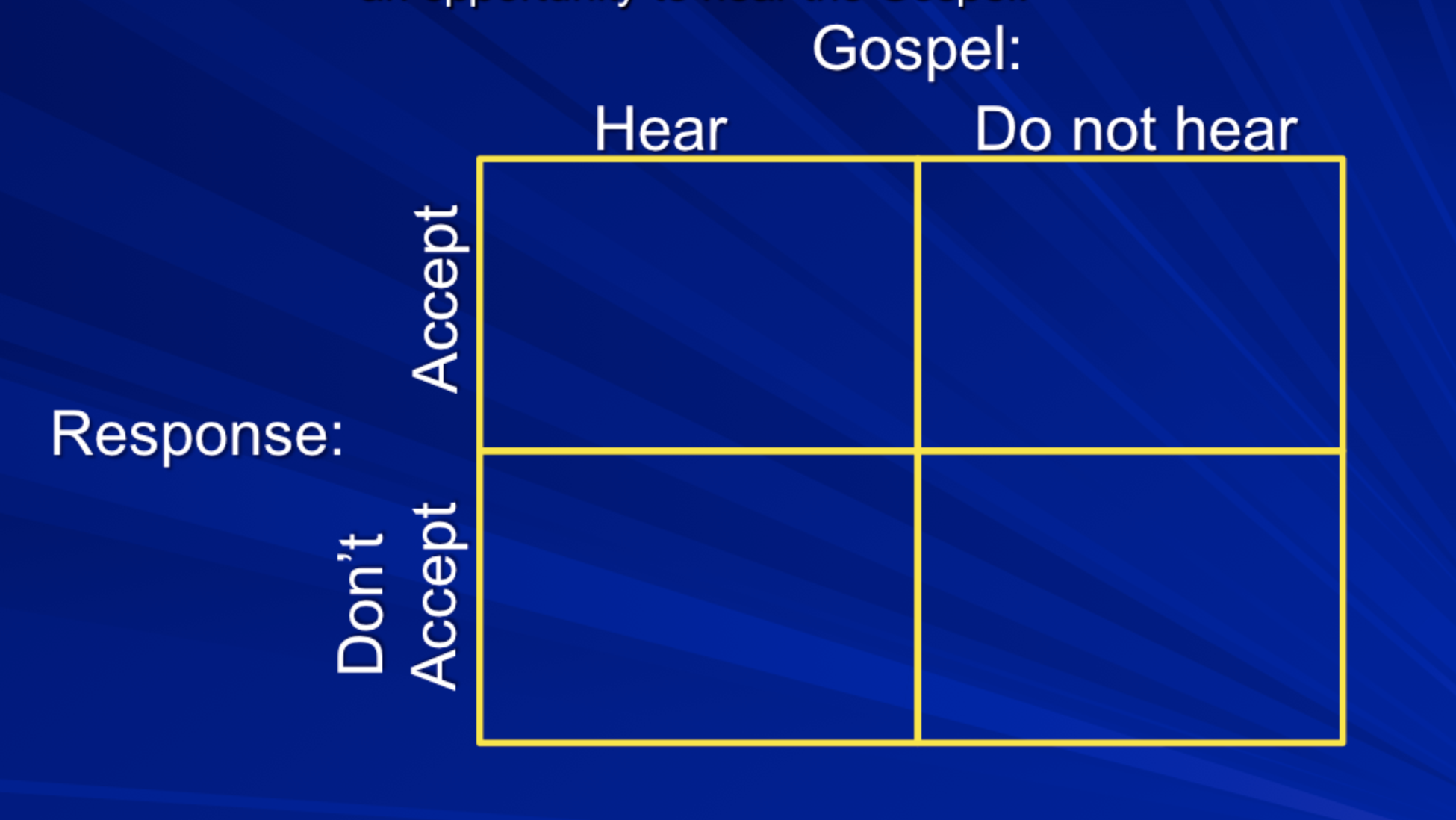
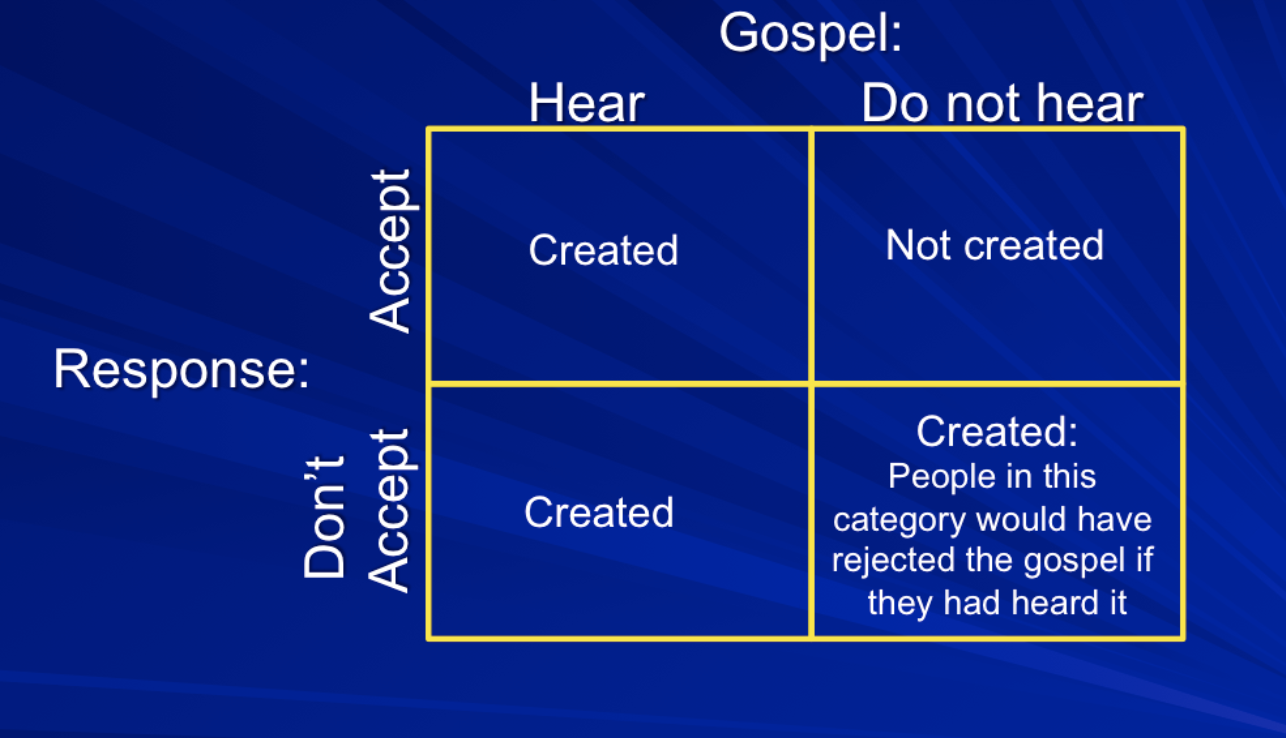
In helping reflect on this issue properly consider the graph below. The challenge is “it is unjust (i.e. – unfair) for God to condemn those who never had an opportunity to hear the Gospel.”


According to the graph there are four types of people in relation the gospel being heard or not heard crossed with people freely accepting or rejecting the gospel.

The top left quadrant are people who hear the gospel and freely accept it, the bottom left is people who hear the gospel and freely reject it, and the bottom right are people who don’t hear the gospel but if they did they would freely reject it. I contend that these three categories of people are created. When I say created, I don’t mean they are made to accept or reject, I mean they are brought into existence with free will and it is their own free choice in accepting and rejecting the gospel.

The bottom right category deserves come explanation. These people, who don’t hear the gospel, would have freely rejected the gospel but will never hear it. God is under no obligation to get the gospel to these people because they, under their own free will, would reject the gospel. Besides that, the charge of injustice is about the fourth category, the top right.

The top right category of people is where the issue resides. These people never hear the gospel, because of either historical or geographical accident. For example, the 2nd century inhabitants of North America had no opportunity to hear the gospel because of their location and time of existence. There is no way the gospel could have been delivered to them by evangelists or missionaries coming down from the disciples. These people seem to get a raw deal.

But possibly, given Gods infinite wisdom, knowledge, and power he doesn’t allow such people to be created. Now, if that is the case, which it surely seems possible (that is, there is no logical reason to think it is impossible), then there are no people who would have freely accepted the gospel, but never had a chance to hear it. This would ensure that anyone who would freely accept the gospel, God, being all-knowing and all-powerful, creates them in the time and place to ensure that they hear the gospel and freely accept it. This absolves God of any wrong because there are no people who would have freely accepted the gospel but did not get a chance to hear it.

It is just a model, it might be the way reality works it might not, but the point is, if a working model can be developed to absolve God then God, in his infinite wisdom and knowledge and power, should be capable of taking care of reality. And there seems to be some scriptural support for this model in Act 17:24-27,

“The God who made the world and everything in it, being Lord of heaven and earth, does not live in temples made by man, nor is he served by human hands, as though he needed anything, since he himself gives to all mankind life and breath and everything.  And he made from one man every nation of mankind to live on all the face of the earth, having determined allotted periods and the boundaries of their dwelling place, that they should seek God, and perhaps feel their way toward him and find him. Yet he is actually not far from each one of us.”


So, when my son asked several year ago “What about those people who have never heard about Jesus?  Do they go to hell?” I was able to honestly and confidentially answer, “Son, if they would freely accept the gospel, God knows that and he ensures that the gospel is delivered to them.”  He was satisfied with that answer and went to bed. Hopefully, you find this answer satisfying as well.

Here are a couple of useful resources on this topic:

Recommended Resources: 

Can All Religions Be True? mp3 by Frank Turek

Counter Culture Christian: Is the Bible True? by Frank Turek (Mp3), (Mp4), and (DVD)        

Jesus, You and the Essentials of Christianity by Frank Turek (INSTRUCTOR Study Guide), (STUDENT Study Guide), and (DVD)      

Was Jesus Intolerant? by Frank Turek (DVD and Mp4)


J. Steve Lee has taught Apologetics for over two and a half decades at Prestonwood Christian Academy.  He also has taught World Religions and Philosophy at Mountain View College in Dallas and Collin College in Plano.  With a degree in history and education from the University of North Texas, Steve continued his formal studies at Southwestern Baptist Theological Seminary with a M.A. in philosophy of religion and has pursued doctoral studies at the University of Texas at Dallas and is finishing his dissertation at South African Theological Seminary.  He has published several articles for the Apologetics Study Bible for Students as well as articles and book reviews in various periodicals including Philosophia Christi, Hope’s Reason: A Journal of Apologetics, and the Areopagus Journal.  Having an abiding love for fantasy fiction, Steve has contributed chapters to two books on literary criticism of Harry Potter: Harry Potter for Nerds and Teaching with Harry Potter.  He even appeared as a guest on the podcast MuggleNet Academia (“Lesson 23: There and Back Again-Chiasmus, Alchemy, and Ring Composition in Harry Potter”).  He is married to his lovely wife, Angela, and has two grown boys, Ethan and Josh.

Originally posted at: https://bit.ly/44oDZCD


How much do you know about the major world religions? Whether it’s atheism, Christianity, Judaism, Islam, or one of the many Eastern religions, humanity holds a wide array of beliefs about who God is and if He even exists at all. But what if more Christians dedicated time to learning about other religions? How could this strengthen our faith along with our ability to share the Gospel?

We’re kicking off December with renowned Christian apologist and philosopher, Dr. Doug Groothuis, professor at Cornerstone University in Grand Rapids, MI and the author of 20+ books, including his latest work, ‘World Religions in Seven Sentences: A Small Introduction to a Vast Topic‘. In this episode, Frank and Doug discuss the inspiration behind the book and unpack some of the core beliefs of today’s major world religions—one sentence at a time. Together, they’ll tackle questions like:

  • What are the seven sentences that represent each world religion and why did Doug choose them?
  • What makes Friedrich Nietzsche the “quintessential atheist”?
  • Should atheism be classified as a religion? And what typically happens when atheism and Marxism collide?
  • What are some of the key differences between Hinduism and Buddhism?
  • What’s the connection between Nietzsche, Pol Pot, Ted Bundy, and human depravity?
  • Why do some people choose to be atheists?
  • What happened when Doug encountered a Hinda guru at the age of 18?
  • How do Judaism and Islam differ in their relationship to Christianity?

If exploring diverse faith systems seems overwhelming, ‘World Religions in Seven Sentences‘ is the perfect guide to get started. Tune in as Frank and Doug reveal how false religions often lead to human suffering and why Christianity alone is the solution to the problem of evil in the world. Be sure to grab your copy of Doug’s book and subscribe to his Truth Tribe podcast for even more great content!

Did you enjoy this episode? HELP US SPREAD THE TRUTH OF CHRISTIANITY BY SUPPORTING THE PODCAST HERE.

Resources mentioned during the episode:

‘World Religions in 7 Sentences’: https://a.co/d/gExzxhz
Doug’s Website: https://www.douglasgroothuis.com/
Doug’s Podcast: https://www.douglasgroothuis.com/podcast-1


Download Transcript


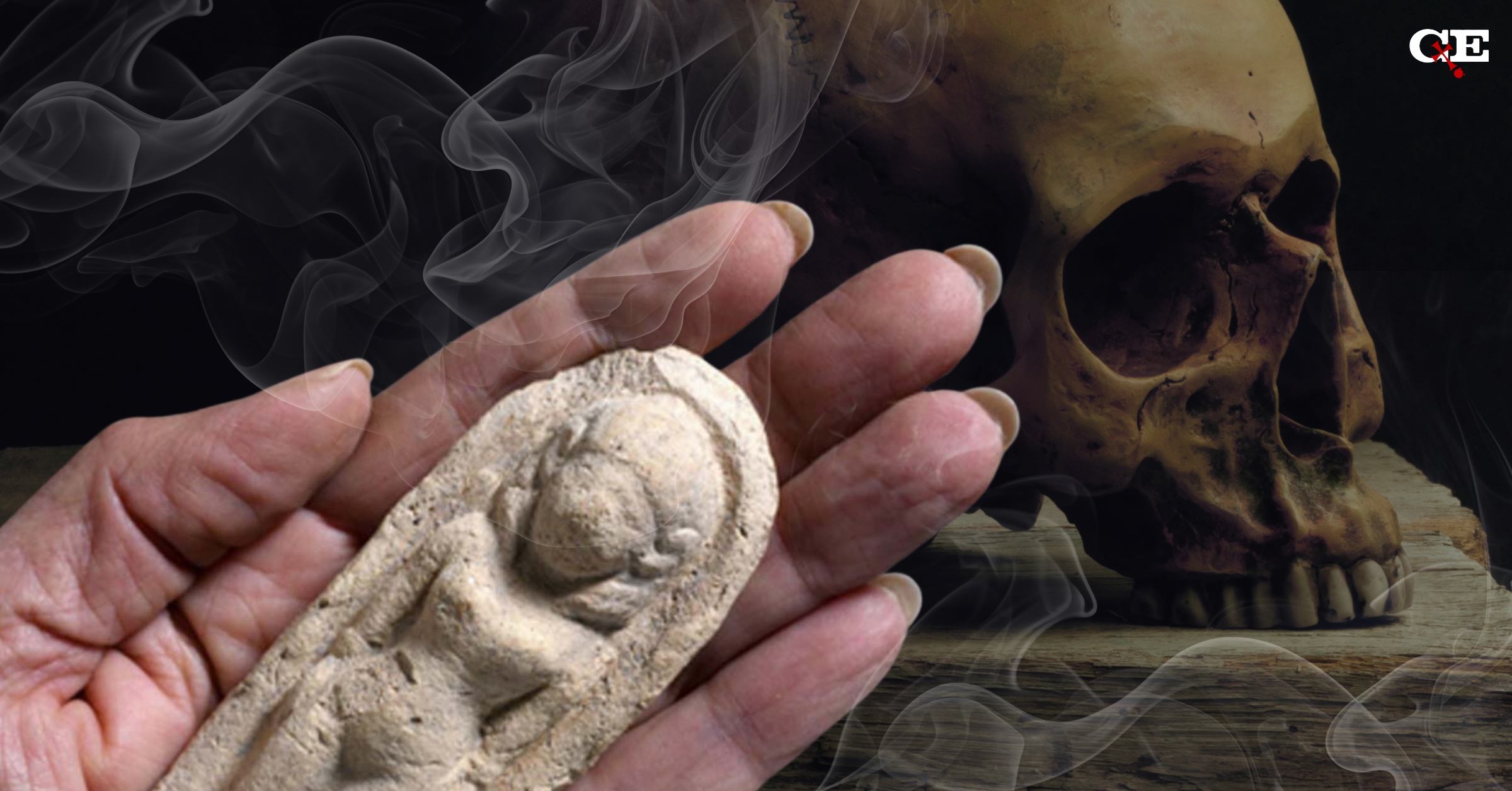
One of the questions that people ask when they read through the Old Testament is “did those little statues that people worshipped actually have any power behind them?” Many scholars agree that people believed that the idols themselves did not hold power but instead represented the pagan gods. The Old Testament itself has two major views on idolatry, one located in the prophets and another located in Deuteronomy.

Idolatry in the Prophets

The prophets identify idolatry as a major issue within both Israel and Judah during their time and argue that idolatry is worthless.[i] For example, in Isaiah 41, Isaiah 44, and Jeremiah 10, the prophets make it clear that idolatry is useless and meaningless. It holds no power because the idols themselves are created and the gods that they represent were also created by mankind. The gods cannot deliver the nations, cannot create, cannot predict the future, and therefore, should not be worshipped. Thus, if you only had the prophets, one would probably assume that there was no actual spiritual or supernatural power behind the idols or their gods.

Idolatry in Deuteronomy

The Book of Deuteronomy, however, lays out a different argument when it comes to idolatry. Deuteronomy 32:17 states, “They sacrificed to demons, not to God, to gods they did not know, to new gods, new arrivals that your fathers did not fear.” (NKJV) Paul similarly made this argument in 1 Corinthians 10:20 when he wrote, “Rather, that the things which the Gentiles sacrifice they sacrifice to demons and not to God, and I do not want you to have fellowship with demons.” (NKJV) From this perspective it seems that the idols and their gods were not simply worthless creations of mankind but were instead powered by demons and Satanic forces.

How Do We Reconcile These Two Views?

The question then becomes “Were the idols and their gods worthless creations of mankind or supernatural beings empowered by Satan and his demonic horde?” The answer seems to lie somewhere in the middle. It is true that the idols, at least to some extent, did have some type of supernatural force behind them. The people of the ancient world called these supernatural powers gods, whereas the Bible calls them instead demons. Indeed, it is unlikely that the ancients would have worshipped idols for generations if there was not some kind of supernatural power behind them, probably coming from the demonic realm to trick people into worshipping these gods as divine. A possible example of this can be seen in the story of the Exodus, when Pharaoh’s magicians can replicate some of the supernatural abilities of Moses and Aaron, at least with the first few plagues, even if their power was limited and they could not duplicate any of the plagues after the plague of frogs.

The prophets, however, were also correct in their arguments that these false gods were not equal to YHWH.[ii] Demons are created beings that are fallen angels. They are not co-equal to YHWH and therefore are inferior to Him. While the prophets may have downplayed the supernatural elements that the idols could have exhibited, they were correct in arguing that these pagan gods were not comparable to YHWH. Michael Heiser said it well when he wrote, “No. These ‘denial statements’ do not deny that other elohim exist. Rather, they deny that any elohim compares to Yahweh.” [iii]

Therefore, the answer to the question did the Old Testament gods have power is yes, they did seem to have some type of supernatural power through the power of Satan and his demons. Nonetheless, this does not mean that they were equal to YHWH and deserved to be worshipped and trusted as true gods. Only YHWH is the one true God, incomparable within creation. Isaiah 44:8 clarifies this well, “Do not fear, nor be afraid; Have I not told you from that time, and declared it? You are My witnesses. Is there a God besides Me? Indeed there is no other Rock; I know not one.”

References:

[i] [Editor’s Note: He’s referring to the divided Kingdom, when Israel split into two kingdoms – the 10 tribes of the Northern Kingdom (Israel). versus the 2 Tribes of the Southern Kingdom (Judah). This split began with Solomon’s successor Rehoboam.]

[ii] [Editor’s Note: Yahweh is infinitely superior to the false gods, of course. But, more than that, the idolatrous statues and superstitutious icons of those false religious are also totally impotent. So, as the Prophets say in Isaiah 41, Isaiah 44, and Jeremiah 10, those idols have no power to harm or help people, just like any other lump of wood, stone or metal would be a helpless and harmless inanimate object.]

[iii] Michael S. Heiser, “Does Divine Plurality in the Hebrew Bible Demonstrate an Evolution from Polytheism to Monotheism in Israelite Religion?,” Journal for the Evangelical Study of the Old Testament 1, no. 1 (2012): 8-9.

Recommended Resources: 

Counter Culture Christian: Is the Bible True? by Frank Turek (Mp3), (Mp4), and (DVD)        

Jesus, You and the Essentials of Christianity by Frank Turek (INSTRUCTOR Study Guide), (STUDENT Study Guide), and (DVD)     

Jesus vs. The Culture by Dr. Frank Turek DVD, Mp4 Download, and Mp3

Can All Religions Be True? mp3 by Frank Turek


Daniel Sloan is an Assistant Professor at Liberty University. He was mentored by the late Dr. Ed Hindson. After Dr. Hindson’s untimely passing, Dr. Sloan was allowed to teach some of Dr. Hindson’s classes. In addition to his teaching duties, Dr. Sloan serves as an Associate Pastor at Safe Harbor Community Church in Lynchburg, Virginia. Daniel graduated with his PhD in Theology and Apologetics from Liberty University. His research and expertise is in Old Testament studies. He and his wife, Natalie, live in Lynchburg, Virginia. Along with his extensive knowledge of the Bible, Daniel is an avid sports fan.

Originally posted at: https://bit.ly/3Aw0l9a

By Melissa Dougherty

You know something I never see? I never see the average person say that Buddha was made up from stories of ancient pagan gods. Or that Gandhi was actually a Jewish mystic who was misunderstood. Or that Mohammad was an atheist. There’s usually only one historical figure that is distorted more than any other to fit whatever modern agenda they need at the moment: Jesus Christ.

You can get the identity of Buddha, Gandhi, Mohammad, and even other historical figures such as Alexander the Great or Abraham Lincoln wrong, and it does not have any bearing on what that means to you spiritually. In a manner of speaking, who they are is meaningless in this regard. But people would correct you in a hot second if you made a false claim about who they are historically. This is because it’s verifiable to see who these people were, what they did, and what they stood for.

So why do people not hold this same standard to Jesus, the one Person who can affect their spiritual standing before God? I believe there are a few reasons.

1. People Don’t Want Jesus to Be What the Bible Says.

If Jesus is who He says He is, and the Bible is true, then this has consequences. Does it really matter if Buddha wasn’t who He claimed to be? Not really. People might feel a little jaded, but they would believe that their spirituality wouldn’t be in limbo. However, Christianity is different. Jesus’s claim to divinity and the exclusive way to be saved has consequences for humanity. And, quite simply, humans love to run after other gods. They have to turn away from idols and self-worship to turn to the One True God who has the power to save. But that means giving up certain aspects of their lifestyle that are sinful they have grown accustomed to. It brings them death and destruction and they are blinded by it. Jesus says in John 3:19-20 that “Light has come into the world, but people loved darkness instead of the light because their deeds are evil. Everyone who does evil hates the light, and will not come into the light for fear that their deeds will be exposed.”

So people make another Jesus that likes what they like, believes what they believe, and approves of what they do.

2. Spiritual Warfare

I don’t find it to be any coincidence at all that it’s specifically Jesus who has all the attention when it comes to the variety of identities. Satan doesn’t care if you say you believe in God. Even he believes that. He doesn’t even care if you believe in Jesus. As long as it’s a false Jesus, one that has no power to save you. This is one of the oldest rules in the devil’s playbook: distort Jesus. His energy goes into fighting truth, not lies. Jesus says Satan is the Father of Lies and that it would be foolish for Satan to cast himself out because then his kingdom wouldn’t stand. He perpetuates the lies and does what he can to distort the truth.

Who cares about the other spiritual figures because they aren’t really his target. If anything, they’re his allies.

3. People See Truth as Hate

We live in an odd time. People don’t want truth. They want affirmation. This is true even outside of religious circles but also exists in casual friendships, families, and work acquaintances. I’m sure people have witnessed other people’s complete lack of humility and perhaps even a complete disconnect from reality, all in the name of “their truth.” They want their voice to be heard. And they make it heard by shutting everyone else up. It’s a grand level of entitlement that is sweeping our nation with a vengeance. So, when you speak up about Jesus and who He really is, as described in the Bible, if it hurts them emotionally or is seen as unloving, then they discard it because it’s hateful. Our culture has a strong view of truth: if it’s not loving, then it’s not true. This is how the average postmodern New Ager sees truth, too, by the way.

So, their guard goes up if they perceive anything that you’re saying as hurtful to them. Ironically, what informs this way of thinking usually comes from a place of hurt. But instead of looking at it as an obstacle to overcome and grow from, people now expect others to cater to their emotional needs with no expectation of themselves to take any responsibility to grow.

False Christ, False Gospel

Ultimately, when people deny truth and who Jesus is, they are embracing a false version of Him who isn’t going to save anybody. They might have some comfort in their denial, but it’s only a comfort that leads to destruction. Stop running from Jesus. Run to Him. Go to the Scriptures and read about who Jesus is. Let the Holy Spirit guide and convict you and lead you to the Living Waters, the Bread of Life, who will give you what you’ve been yearning for.


Recommended resources related to the topic:

Was Jesus Intolerant? by Frank Turek (DVD and Mp4)

How Can Jesus be the Only Way? Mp4, Mp3, and DVD by Frank Turek

Cold Case Resurrection Set by J. Warner Wallace (books)  

Person of Interest: Why Jesus Still Matters in a World that Rejects the Bible by J. Warner Wallace (Paperback), (Investigator’s Guide).


__________________________________________________________________________________________________________________________

Melissa Dougherty is a Christian Apologist best known for her YouTube channel as an ex-new ager. She has two associate’s degrees, one in Early Childhood Multicultural Education, and the other in Liberal Arts. She also has a bachelor’s degree in Religious Studies at Southern Evangelical Seminary.


Most people believe in God. The question is, which God? Who is this God? Is He personal? Impersonal? An “it”? A vague source or amorphous energy? It’s important to think this through because if God exists, then there are spiritual ramifications for this.
Christians understand God to be personal. They’re not pantheists or panentheists where God is equal or a part of His creation, but that He’s separate yet still personal with His creation. In other words, the Christian God is above His creation, not equal to it. There’s a difference between God and what He has created. Many Christian theologians and philosophers believe this isn’t only biblical but logical. Let’s look at a few of these arguments.

It’s pronounced parh-MEN-i-deez

Let’s start with Parmenides, a 6th-century Greek philosopher who’s known for his view on monism, the belief that everything is one, and that there’s no duality or distinction between mind and matter. His argument went like this:

Premise 1:  There can only be one thing in the universe.
Premise 2:  If there were two things in the universe, they’d have to differ in some way.
Premise 3:  But there is only one way to differ: Either something exists (has being) or it does not (has non-being)
Premise 4:  Metaphysically speaking, all things that have being are united/“one” since they are made up from the same “stuff.”
Conclusion: Therefore, there is only one being, and monism is true.

This argument might be confusing, but it’s actually valid.[1] What he’s arguing for is the idea that there is no distinction between anything that exists on a level of transcendence. We see this argument surface different ways among New Age and New Thought teachers as they like to claim that there is no duality, there is only One. Therefore, the Universe is one big spiritual being. And we just need to recognize our connection with it.

Along came Aquinas

Parmenides’ argument actually stumped people for centuries until a Christian philosopher named Thomas Aquinas answered his challenge. Aquinas points out the flaw in Parmenides’s argument: his use of the word being. Aquinas argued that there are different meanings to being, not just one, as Parmenides used.

To explain Aquinas’s argument, let’s take a tree for example. You can look at a tree and ask the obvious, “does this tree exist (have being)?” The answer, of course, is “yes” since if it didn’t exist, you’d be staring at nothing. This is where Parmenides’ questioning stops but Aquinas takes the investigation further.

Once the tree’s being is confirmed, we must then ask, “why does it exist?” In other words, what’s causing the tree to exist? Rather than only focus on being (or existence) Aquinas used ‘potency’ to distinguish metaphysical categories. If something has potency, it has the potential to change. All things, including the tree, have potency. But there must be something immutable (unchanging) to cause the tree to first exist (to have being).

In other words, is the being that’s ultimately causing the tree something that’s also caused? That’s impossible because of infinite regresses, where everything is caused by something else, which is caused by something else, and so on for infinity. If everything is one, and yet everything changes, then what is causing everything to have its being? Eventually, you must arrive at something that philosophers call Pure Act, an uncaused, first cause. This is the one Being with no potential to change, it is immutable and uncreated, yet gives existence to everything else…. Sound familiar?

So, what’s the motivation here?

There’s an incentive to believe that we’re “one with the universe” as spiritual beings. People tend to spiritually elevate humanity, and predictably they end up demoting God to get there. This then, becomes a matter of Lordship. If God is the author of everything and separate from you, then you must submit to Him and His will as Lord. He’s in charge either way, whether you align with and submit Him or oppose and resist Him.

But, if God is within you as some sort of universal source or energy waiting to be awakened, then you only need to submit to yourself. The “God-is-the-universe” theology takes on a self-serving tone.

So, why can’t God be the universe?

To summarize, monism (the belief that all is one and equal to God) is illogical because it leads to an infinite regress of causes. If all things have the ability to change (potency), there must be something unchangeable. If all things are caused, there must be something uncaused. God is that something, He’s a separate unchangeable, and uncreated Being who gives existence to His creation.

Endnote

[1] When an argument is valid, that means that the premise are organized so that if each of the premises are true then the conclusion must be true. When an argument has both validity and true premises, that argument is “sound.”

Recommended Resources Related to this Topic

How Can Jesus Be the Only Way? (mp4 Download) by Frank Turek
Person of Interest: Why Jesus Still Matters by J. Warner Wallace (Paperback), (Investigator’s Guide).
Another Gospel? by Alisa Childers (book)
What is God Like? Look to the Heavens by Dr. Frank Turek (DVD and Mp4)
How Philosophy Can Help Your Theology by Richard Howe (DVD Set, Mp3, and Mp4)
Debate: Does God Exist? Turek vs. Hitchens (DVD), (mp4 Download) (MP3)

________________________________________________________________________________________________________________________________________________

Melissa Dougherty is a Christian Apologist best known for her YouTube channel as an ex-new ager. She has two associate’s degrees, one in Early Childhood Multicultural Education, and the other in Liberal Arts. She also has a bachelor’s degree in Religious Studies at Southern Evangelical Seminary.


When people hear the word “New Age,” they might think of the hippie generation of the ’60s. When people hear “New Thought,” however, most people have no idea what it means.

I believe New Thought has much more influence than New Age. Don’t be fooled by the names. Neither one of them are new. They’re as old as the garden. Many people use the terms interchangeably because the core belief is exactly the same: You are good, and You are God. “New Age” can be an umbrella term used for both New Thought and New Age, but they are actually different. And I believe it’s important to distinguish these terms. There are differences that I believe Christians specifically need to know about. Because New Thought can fool Christians before the New Age will.

First, let’s start with New Thought. If you remember anything about New Thought, remember this one thing: metaphysical Christianity. Literally, take any Christian doctrine and redefine it to put an allegorical metaphysical definition with it, and you have New Thought. It’s spiritual but not religious. This is particularly why I believe New Thought is much more sinister: it’s made to look Christian. Here are some brief terms to know:

Christ

This doesn’t mean the same thing within Christianity. In New Thought, “Christ” and “Jesus” are two different things. Jesus was a man, and Christ is the inner divinity that all mankind can awaken to. Jesus was the Way-shower to how this can be done. He obtained the “Christ Consciousness,” the awakening to his True Self, his inner divinity, and you can too. In this way, you are the I AM just as much as Jesus was.

God

An “It” not a “He.” This is a force or a spiritual source that pours out abundance and prosperity to those who know how to wield their power. New Thought isn’t pantheistic but pan-en-theistic, which is basically an attempt to fuse pantheism with theism. (See, “Panentheism”)

Sin

The only sin is your ignorance of your self-divinity and remaining in your False Self, or your Ego.

Atonement and Salvation

This means “At-One-Ment,” a mixing of the words to mean that you’re awakening to a higher level of consciousness. Salvation is found in your finding your True Self.

Evil/Hell/Satan/Heaven

None of these are literal, but states of mind or metaphorical. Anything that’s considered evil, such as someone flying into the Twin Towers, is because they are in their False Self. The reason for pain, suffering, and evil is because of humanity’s unawareness of their inner divinity, and therefore asleep to their True Self. In this way, they have created their own personal Hell or Heaven. New Thought also believes in an ambiguous Universalism. There is no judgment, only love.

Bible

The Bible is filled with metaphysical esoteric knowledge that those in the “spiritual know” can interpret. People that wrote the Bible only understood it in the time and place that they lived, but we understand more now because we have grown spiritually. This is why they can look at a Scripture and think, “what does this verse mean to me,” because their interpretation is subjective to their lived experience. Their view of the Bible is a higher spiritual view that depicts real Christianity.

Faith and Prosperity

New Thought might be best known through the popular concept of positive thinking that we see in the self-help section at your local bookstore. Faith is a power to make things happen. We can wield this power through our minds. Because New Thought teaches that God only allows good things to happen, if we have enough faith, we can proclaim health and wealth, and it must manifest itself in our lives. The Law of Attraction is probably the most popular New Thought belief that most would recognize. Your words have power and can create. God is a creative force. Since you’re a manifestation of God, you’re able to create with your words as well.

This list is by no means exhaustive. But these concepts are unique to New Thought dressed up as Christianity. New Age parts ways in its more occultic associations. New Thought might say that it frowns upon occultic practices, but that isn’t the case. They would say that truth can be found anywhere, including the occult. Both have gnostic leanings and a relativistic view of truth, but here are three specific differences between the New Age and New Thought:

Three Big Differences Between New Thought and New Age

  1. New Thought claims to be Christian in origin and uses Christian terms, but accepting of all beliefs. The New Age we know today was heavily influenced by theosophy, which does not claim to be Christian.
  2. New Age is more associated with Numerology, Astrology, Tarot, Crystal Energy, Yoga, Auras, Starseeds, Psychedelics, Psychics, Astral Projection, and Alienology.
  3. New Age might be more pantheistic in their worldview than the panentheistic view of New Thought.

Even though there are differences, the two almost always seem to overlap in beliefs on some level. For example, I have never met someone in the New Age who didn’t believe in Christ Consciousness or the law of attraction. I believe this is why the terms are used interchangeably, where most people would associate themselves with being caught up in the New Age when really they were more into New Thought (Myself included).

Both are alluring, and both are deceiving. Both elevate man and demote God. New Thought masquerades as true Christianity, and because of this, I’ve seen numerous Christians adopt New Thought beliefs and not know it. In my experience, Christians tend to be able to spot the New Age much better than they can New Thought. New Thought has been a shadow of a deception in the Church, and I want to shine a light on it so Christians can be equipped to know what they’re dealing with.

A constant companion to avoid deception: The Bible. Stay in it. Read it. Study it. You will be able to discern the metaphysical definitions that New Thought uses immediately if you know the real thing.

Recommended Resources Related to this Topic

How Can Jesus Be the Only Way? (mp4 Download) by Frank Turek
Person of Interest: Why Jesus Still Matters in a World that Rejects the Bible by J. Warner Wallace (Paperback), (Investigator’s Guide).
Another Gospel? by Alisa Childers (book)
Counter Culture Christian: Is the Bible True? by Frank Turek (Mp3), (Mp4), and (DVD)
Defending Absolutes in a Relativistic World (Mp3) by Frank Turek
Is Morality Absolute or Relative? (Mp3), (Mp4), and (DVD) by Frank Turek

____________________________________________________________________________________________________________________________________________________

Melissa Dougherty is a Christian Apologist best known for her YouTube channel as an ex-new ager. She has two associate’s degrees, one in Early Childhood Multicultural Education, and the other in Liberal Arts. She also has a bachelor’s degree in Religious Studies at Southern Evangelical Seminary.


I was scrolling through the Gram one day, and since I look up a lot of New Age things, the almighty algorithm put in front of my face something it thought I would enjoy. My eyes fell upon people rolling around, screaming, laughing hysterically, crying, convulsing, and rocking back and forth. I, no kidding, thought I was watching something from a Holy Spirit night at Bethel Church or something. It took me a hot second to realize that I was looking at a growing trend called Witality Breathwork.

Growing Trend

As time went on, I saw this strange practice pop up all over America, including in my own hometown. Immediately, I wanted to investigate, so I looked into actually going to the conference to observe, so I emailed them asking if this was possible, even saying I’d buy a ticket. They emailed me back and said that they would prefer that I participate instead of observe. And I was like…

Nah. That’s a dealbreaker. I have asked if they will make an exception for me to observe for research reasons, but I doubt they’ll allow it at this point. The apologist/journalist in me is pining to see this in person, but here’s what I do know at this point.

Witality Breathwork revolves around a man named Witalij Martynow, the Witality Breathwork website states:

Witality™ is an ever evolving complex of breathing, meditative, movement techniques, and philosophies that Witalij Martynow discovered on his healing journey that worked for him and that brought back the vitality to his own life. Witalij combines latest scientific research, eastern philosophies, indigenous teachings and his own ancestral ways of healing and maintaining wellbeing… Witalij believes that the majority of sickness both mental, physical and spiritual comes from the stuck and unprocessed energy that didn’t find an outlet out of our system. Whether it is unprocessed emotion, chronic pain, or childhood trauma, Witalij sees it all as energy. As he discovered on his journey, breathing in specific rhythms and intensities combined with a crafted guidance, allows that energy to move and to be released. During his process we alter our state of consciousness while gaining a different perspective on our life and connecting to our body’s own intellect that jumpstarts the healing process.

Basically, you’re performing intense breathing exercises that alter your consciousness. The goal is to suspend the mind to reach the spirit, where healing can take place. This, they say, is the reason why some people can act out like they do. The website is very straightforward that this is an intense practice, and isn’t shy about showing some extreme aspects of what goes on during these sessions. They reason that in order to die to your ego, your false self, and awaken your true self takes time and work.

First Reactions

Besides the startling images I saw of people manically laughing, rolling, and screaming, among other things, I couldn’t help noticing my first reaction. I thought this was in a church. I’ve seen this behavior more in hyper charismatic settings than I have anywhere else. I know many of the Christians involved in something like that would argue that what goes on in their churches is the authentic version of what Witality participants are experiencing, and I simply have to cry foul at this point. You can’t throw down the “this is actually Christian!” card and think that solves the problem and shuts down the conversation. This stuff is sus.

What’s more, is that these people that have experienced Witality breath work have claimed to have spiritual encounters with spiritual beings. I also wouldn’t be surprised a bit if people were speaking in tongues in these sessions especially considering this type of breathwork came out of ancient India in the form of energy-moving exercises called Pranayamas, which are known for speaking in “tongues.” The common denominator between the two is the emotional workup to have an experience that manifests in the videos and images we see on their website. And then just slap the label “spiritual healing” on it, and voila… the proof is the experience. That’s the standard for if it’s true or not.

Similar to Some Church Services

Many Christians who have attended a Holy Spirit crusade or something similar claim they have had spiritual breakthroughs by having their “spiritual blocks” removed. People go to Witality Breathwork to have their “spiritual blocks” removed. It’s uncanny how the results are indistinguishable from each other. What I’m seeing at a Witality Breathwork conference is no different than what I see at a hyper-charismatic Holy Spirit Healing conference. What concerns me is not only the damage this does theologically to people within the church, but that it always comes back to the Gospel that truly spiritually heals us.

The Witality site is clear that though this is a healing tool to work out energetic blockages, it’s not a quick fix: “Even though the work of release itself is a powerful healing tool, it is important to treat it as a catalyst for change, not a quick fix. Maintaining the vitality requires a lot of discipline on a daily basis, as the next stages of the work become daily practices of increasing our capacity and sensitivity to energy and building up our energetic structures.”

But wanna know the real kicker? It works.

People attending these conferences have had strong testimonies of this Witality Breathwork resulting in extraordinary results. And that’s the point! People do not keep investing in occultic practices if they do not produce results. So why would they be open to hearing anything about the Gospel of Jesus? Perhaps their rationale is that if they can achieve “spiritual healing” through breathwork, they may not feel the need for the Gospel. But breathwork, or anything like it, isn’t true healing. Like all New Age and Occultic practices, this will inevitably result in short-lived relief, and they will need something else to help ease them from what’s truly the issue: their need for a Savior. And it’s not them.

Recommended Resources Related to this Topic

How Can Jesus Be the Only Way? (mp4 Download) by Frank Turek
Person of Interest: Why Jesus Still Matters in a World that Rejects the Bible by J. Warner Wallace (Paperback), (Investigator’s Guide).
Another Gospel? by Alisa Childers (book)
Counter Culture Christian: Is the Bible True? by Frank Turek (Mp3), (Mp4), and (DVD)
Defending Absolutes in a Relativistic World (Mp3) by Frank Turek

____________________________________________________________________________________________________________________________________________________

Melissa Dougherty is a Christian Apologist best known for her YouTube channel as an ex-new ager. She has two associate’s degrees, one in Early Childhood Multicultural Education, and the other in Liberal Arts. She also has a bachelor’s degree in Religious Studies at Southern Evangelical Seminary.


By Bobby Conway

I’m often surprised to hear some of the beliefs that Christians contend are compatible with Christianity. One such belief is Scientology. As Christians we are expected to remain discerning about the various beliefs that come our way. That’s why it’s worth asking, “Is Scientology compatible with Christianity?” To all those Christians who’d say, “yes”, I’d respectfully disagree, and here’s why.

First, the Auditing Process Contradicts Scripture

Unlike scientologists, Christians don’t believe they existed as immaterial souls before their bodily existence on earth. Auditors hook adherents up to an E-meter, leading them through a process called auditing, which is supposed to connect them to their pre-existent lives by addressing the traumas they accumulated, which are now apparently blocking them from being CLEAR of these traumas called engrams. A Christian can’t go through auditing to come to terms with a life he never had to discover freedom. Scientologists assume the narrative the E-meter confirms through the auditing process reflect the reality of one’s past lives.

Second, Scientologists Require You to Purchase Your Salvation

Why pay potentially tens of thousands of dollars to get CLEAR from an existence you never had when grace awaits you for free at the table of Christianity?

Third, Scientologists Teach Reincarnation

Scientologists deny heaven and hell, rather teaching reincarnation, a concept foreign to the Bible. As Hebrews 9:27-28a says, “Just as people are destined to die once, and after that to face judgment, so Christ was sacrificed once to take away the sins of many” (NIV).

Fourth, Scientology Reveres L. Ron Hubbard Over the Biblical Jesus

The Church of Scientology denies the Bible and magnifies its founders works as the be all end all guide to truth. As Christians we can’t put the works of a science-fiction writer on par with Scripture unless we’re willing compromise the truth of God’s Word.

Fifth, Scientology rejects the Trinity and the Biblical Jesus

Scientologists deny the Triune God and reduce Jesus to a good moral teacher. For that reason alone, why would we want to tinker with an auditor on an E-meter to the tune of L. Ron Hubbard’s teachings?

Sixth, Scientologists Misrepresent Our Sin Nature

Scientologists deny human depravity, contending our real issue is we’re not clear of past traumas (engrams). While we may have trauma it’s not trauma collected from some past life. And our ultimate issue is not that we need to be saved from the trauma of a pre-existent life we never had, but from the trauma of sin.

Seventh, Scientologists Deny that Jesus Is the Only Way to Salvation

They reject John. 14:6 where Jesus says he is “the way and the truth and the life. No one comes to the Father except through me.” For Scientologists, freedom comes through being freed from the cycle of reincarnation. Jesus as the only way can be circumvented the L. Ron Hubbard way, so they think. Therefore, comparing the teachings of Scientology with the Bible, we see that the two have very little, if anything, in common. Scientology is a sure path to lead one away from the Gospel of Christ. Scientology, while sometimes disguising its beliefs in Christian-sounding language, is diametrically opposed to Christianity on every core doctrine. The only thing we need to be CLEAR about is this. Scientology is not Christian.

Recommended Resources Related to This Topic

How Can Jesus Be the Only Way? (mp4 Download) by Frank Turek
Is Original Sin Unfair? (DVD Set), (mp4 Download Set), and (MP3 Set) by Dr. Frank Turek
Jesus, You and the Essentials of Christianity by Frank Turek (INSTRUCTOR Study Guide), (STUDENT Study Guide), and (DVD)
Person of Interest: Why Jesus Still Matters in a World that Rejects the Bible by J. Warner Wallace (Paperback), (Investigator’s Guide).
Macro Evolution? I Don’t Have Enough Faith to be a Darwinist (DVD Set), (MP3 Set) and (mp4 Download Set) by Dr. Frank Turek
Early Evidence for the Resurrection by Dr. Gary Habermas (DVD), (Mp3) and (Mp4)

____________________________________________________________________________________________________________________________________________________

Bobby serves as lead pastor of Image Church in Charlotte, North Carolina, and is well known for his YouTube ministry called, One Minute Apologist, which now goes by the name Christianity Still Makes Sense. He also serves as the Co-Host of Pastors’ Perspective, a nationally syndicated call-in radio show on KWVE in Southern California. Bobby earned his Master of Theology degree from Dallas Theological Seminary, his Doctor of Ministry in Apologetics from Southern Evangelical Seminary, and his Ph.D. in Philosophy of Religion from the University of Birmingham (England) where he was supervised under David Cheetham and Yujin Nagasawa. Bobby’s also written several books including: The Fifth Gospel, Doubting Toward Faith, Does God Exist, and Fifty-One other Questions About God and the Bible and the forthcoming Christianity Still Makes Sense to be published by Tyndale in April 2024. He’s married to his lovely wife Heather and together they have two grown kids: Haley and Dawson.