Tag Archive for: theology

By RYAN LEASURE

At Grace Bible Church, we have a statement of faith that all members must affirm. It’s a fine statement of faith (though a little long if you ask me). And it provides a nice summary of basic Christian belief. That said, not all doctrines are created equal. Some doctrines are absolutely essential while others are less important. How, then, should Christians “contend for the faith that was once for all delivered to the saints” (Jude 3) without contending for too much or too little?

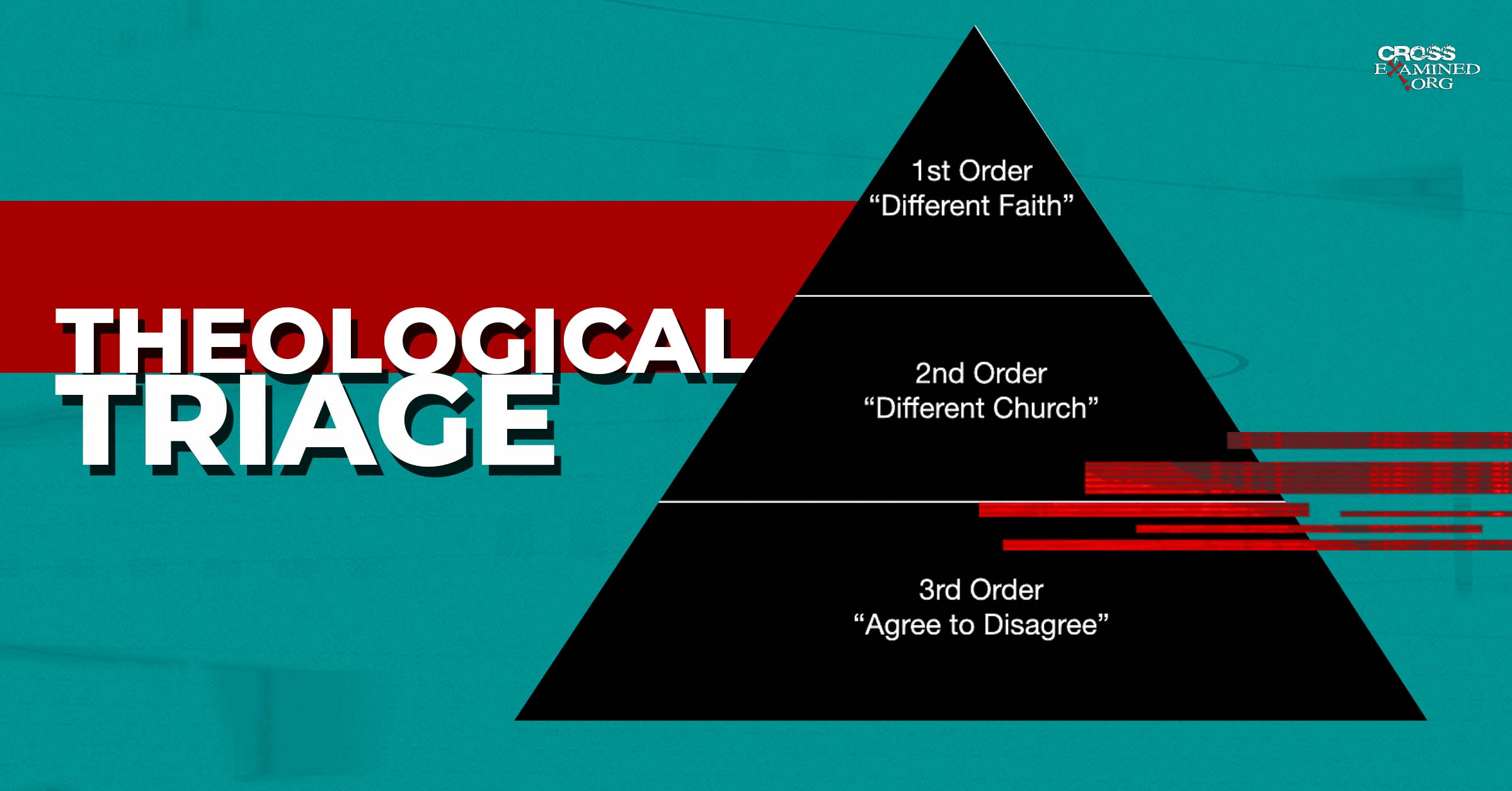
In other words, how do we know which doctrines are worth fighting for and which ones are not? To help with these matters, we have adopted what Al Mohler once dubbed a “Theological Triage.”

Theological Triage

The word “triage” comes from a French word which means “to sort.” And if you’ve ever been to an emergency room, you’re familiar with the sorting process that takes place. If someone shows up with the sniffles, they’re most likely put at the back of the line. If someone shows up holding their decapitated leg, they’re put up front.

Doing theological triage follows a similar principle. As Christians, we must think through doctrine and decide which doctrines get sorted to the front (first-order issues) and which ones get pushed to the back (third-order issues).

At every membership class, I explain this concept and teach newcomers which doctrines are essential and which ones we can agree to disagree on. Let’s consider the three categories in turn.

First-Order Doctrines

First-order doctrines are the absolute essential doctrines to the Christian faith. These are doctrines that every true believer should affirm without hesitation. These doctrines include:

  • God is a Trinity
  • God is the creator of all things
  • Jesus Christ is the Son of God
  • Jesus is both God and man
  • Humans are made in God’s image
  • All humans are sinners and they must repent of their sin
  • Jesus died on a cross for our sins and rose again from the dead
  • People are saved by grace alone through faith alone in Christ alone
  • The Bible is God’s inspired word
  • Jesus is coming back to judge the living and the dead

You get the idea. These beliefs are so fundamental to the faith that if someone were to deny them, we would say that person belongs to a different faith system altogether.

Second-Order Doctrines

Second-order doctrines are not essential doctrines of the Christian faith, but they are essential for church membership. That is to say, even though people may disagree with us on these issues, we would not call into question their standing with God. We may think they’re wrong and think they should reconsider their views. But we would not question their faith altogether. That said, if people are going to be part of the same church, they need to agree on these second-order issues:

  • The recipients of baptism
  • Women Pastors
  • Revelatory gifts (speaking in tongues or prophecy)

Our statement of faith is clear on the first two points. We baptize believers and believe God has ordained for qualified men to serve as pastors. Our statement of faith doesn’t speak to revelatory gifts in the same way. So one could technically classify it as a third-order doctrine. But I suspect if someone felt strongly about publicly prophesying or speaking in tongues before the church, they would feel compelled to go to a different church where those types of practices were more accepted.

Third-Order Doctrines

Third-order doctrines are not essential to the Christian faith, nor are they essential for church membership. That is to say, church members are free to disagree on these matters. This does not mean, however, that these doctrines are unimportant (we can think of less important beliefs). It does not mean that we should not study the Scriptures to try and make sense of them as best as we can. What it does mean is that we are not going to divide over these issues.

Now sadly, it’s these third-order issues that have led to more church splits than anything else. But at Grace Bible Church, we are committed to remaining unified around the main things while allowing charitable disagreement around the not-so-main things. These third-tier doctrines include:

  • Calvinism vs. Arminianism
  • Age of the Earth
  • Millennial or tribulation views

Our statement of faith does not take a hard stand on any of these issues. Therefore, one does not need to affirm Calvinism or Arminianism in order to be a member in good standing at Grace Bible Church. In fact, our church leadership has disagreements on these matters! The same goes for one’s understanding of the age of the earth and the millennium. Good faithful Christians throughout history have disagreed on these matters which leads us to believe the issues aren’t as clear as the first and second-order doctrines.

What we encourage, then, is for each member to act charitably towards others with whom they disagree. We should never ridicule someone or call their faith into question because they land in a different place on one of these third-tier issues. We can agree to disagree or even study the topic together with the hopes of learning from one another. Let’s remember, though we’re all trying to get it right, none of us are infallible.

Dividing Over Doctrine

Placing doctrines in their proper tiers allows the church “to contend for the faith that was once for all delivered to the saints” (Jude 3). It protects the church from contending too much or too little.

Liberals have historically contended for too little. They have tended to press first-tier doctrines down to the third tier. They’ve adopted an “agree to disagree” mentality when it comes to important matters such as Christ’s bodily resurrection from the dead! On the flip side, fundamentalists have historically contended for too much. They have pushed third-tier issues up to the first tier and have divided over less-than-critical matters.

Doing theological triage protects us from both of these errors.

Recommended resources related to the topic:

Legislating Morality (mp4 download),  (DVD Set), (MP3 Set), (PowerPoint download), and (PowerPoint CD) by Frank Turek

Legislating Morality: Is it Wise? Is it Legal? Is it Possible? by Frank Turek (Book)

____________________________________________________________________________________________________________________________________________________

Ryan Leasure holds a Master of Arts from Furman University and a Masters of Divinity from the Southern Baptist Theological Seminary. Currently, he’s a Doctor of Ministry candidate at the Southern Baptist Theological Seminary. He also serves as a pastor at Grace Bible Church in Moore, SC.


By (Josh Klein)

If God is so good, why did he command the Israelites to utterly destroy everyone and everything in the Old Testament?

Is God a moral monster?[i] Particularly in the conquest of the land of Canaan?  God calls for the complete and utter destruction of men, women, and children (as well as animals) multiple times[ii].  How could a moral God do this?  Is that not genocidal malevolence? Would we not condemn a national leader today if they said “God told me to do murder thousands of children and women in His name” as a lunatic and a monster?

I believe these are important questions.

The question is a thoughtful one.  When asked honestly, it takes seriously the biblical claims of God’s goodness, righteousness, love, and grace. The question, better asked, is like this:  If God is who the rest of scripture says he is then how could he act in such a manner here?  If God’s morality is inconsistent, then he really is not a god at all is he?

How we answer this question says a lot about who we believe God to be and what we believe scripture to be.

When I was in seminary, I took a class on Old Testament theology.  I enjoyed the class because it came from a different perspective than I was used to.  The professor in the class insisted that much of the narrative was mythological and/or allegorical in a way that was intended to set up Judaism’s religious structure and, ultimately, their need for a Messiah. He went so far as to say that Israel was likely a people that “emerged” from within the land of Canaan only to create a mythological origin story at a later date. In other words, the inerrancy of scripture is dubious at best.

One of the main issues brought to bear during the class was the violence in the Old Testament scriptures, particularly in the Israelite conquest of Canaan.  I remember responding to the question with this statement: “If God is the author of life and death can’t God remove life at his will, and it be just?  Especially considering man’s sin nature?”

This response alone fails to take the question seriously.  The question is not about God’s power or his creative authority. It is about God’s consistency and biblical inherency.  Why would God, out of one side of his mouth, condemn the Canaanite people to death, and then out of the other side of his mouth say things like “pray for those who persecute you?”

If God is not consistent then he is not moral.  If God is not moral then he is not good, and if God is not good then he is not God.

Another unhelpful response is to use Romans 9[iii] as a justification in and of itself to proclaim that God creates some people to be killed for something they had no choice in doing.  This sort of Exhaustive Divine Determinism[iv] unwittingly plays into the question’s premise.  If God is creating people merely to smite them with his chosen people, then God seems to be a sadist.  And while we can argue for God’s divine authority to do so until we are blue in the face, it does not, in fact, address the argument. Nor does it bring the skeptic closer to understanding God.

There are many responses to this question that are biblically and philosophically sound, and I cannot articulate all of them at length in this space.  However, I believe we can provide a short answer that both takes the question seriously and remains faithful the biblical text without having to become an expert on ancient middle eastern civilizations.

For more on this objection check these out: Tim Stratton,[v] John Piper,[vi] William Lane Craig[vii]

To be clear, this is not an argument for the existence of God.  The argument only follows once God’s existence has been established.  This is also not an answer to the Euthyphro[viii] or Epicurean[ix] dilemmas. Perhaps I will tackle those another time, but I find them pedantic and shallow and easily refuted.

This is an argument for the consistency of the Judeo-Christian God, and a defense of his ethical consistency relying on the very thing he used to reveal himself: scripture.

To understand why God is a good God even (and perhaps especially!) within the context of the conquest of Canaan we need to go back to the very beginning to understand God’s relationship with creation in a post-fall world. I do not endeavor to provide a comprehensive breakdown in the limited space available here.  Suffice it to say that entire books have been, and still could be, written on the topic and each line of thinking through the scriptures that I will provide could be expounded on ten-fold.

The foundation of God’s morality in this issue stems from a theology of sin that is introduced in the early part of Genesis.  We find the penalty for sin, in general, is death[x]. However, we also find that the judge of the matter is God[xi] not man.  The first human death recorded in scripture does not come from the hands of God, but from the hands of one brother to another. Cain feels slighted by Abel because his offerings to God are taken seriously while Cain’s are not.  Cain’s response is to murder his brother in a fit of jealous rage. What Cain thought was justice we find to be injustice, and thus, punishable.  The ethical keys to using death as discipline are only ever in the hands of God.  Unless God proclaims death as consequence, death ought not be a consequence.  We see this as well in God’s handling of Cain after the fact.  It is God’s choice to allow Cain to live, despite the murder of his brother, and to give him a mark to indicate that this judgement is final and cannot be undone by human hands. Divine justice, from the hands of God is wielded for specific reasons upon specific people and we find this to be true throughout the scriptures.

Fast forward to the story of Noah[xii] and we find that God’s declaration of death upon all creation is due to the fall in the beginning of Genesis. While many will focus on the unfathomable act of judgement that occurs with a global flood in Genesis 6-11, one aspect that is often overlooked is God’s patience in the matter.  A common theme throughout scripture is God’s patience with evil over time but swift rendering of justice when it reaches its fullness.  God waits until “every intent of the thoughts of their (humanity’s) hearts was only evil continually” before he enacts divine justice through death with the global flood.

In the first 11 chapters of the Bible, we are reminded that God is just, loving, gracious, and merciful with his creation and God’s character in that regard does not shift in the time of the conquest of Canaan.  Nor has it shifted since.  Someday, the Lord will return with the keys to the second death, the real penalty for sin[xiii], and his judgement will be swift, righteous, and eternal!

But what make’s God’s judgement of humankind just? Using scripture as the barometer we find that humanity is corrupt from birth.  We are not sinners because we sin, we sin because we are constituted sinners.[xiv] Thus, all of humanity is deserving of death from the moment we are born.  Living any part of life is a gift. God then, can take human life at his will because it is perfect and just for him to do so.  The beginning of Genesis teaches us this. Every person that dies is experiencing judgement from the first sin, and every person that lives experiences grace.

But what about when God uses other humans as his tool for judgement?  Up until now we have seen only instances of God’s divine intervention.  However, soon, in biblical history, we are introduced to God’s use of human vessels to enact his judgement on the sins of humanity.

God’s judgement is just when it comes to taking human life, and God can and will take human life by utilizing human actors.  Innocence cannot be claimed to the divine by a fallen being.  The taking of “innocent” human life then, must be ordained by God as judgement for a wicked and theocratic people.

As Cardinal Manning once remarked, “all human conflict is ultimately theological.”  So it is with biblical history between nations.  Starting with the nation of Egypt at the end of Genesis and into the opening chapters of Exodus, we find that nearly every nation God’s chosen people interact with is a theocratic nation.  Thus, God’s judgement on those nations reflects their devotion to a god that does not exist.  They must be punished as a group, not merely as individuals lest they lead the nation of Israel astray into a different theocracy. We find this to be true with the flood[xv], Sodom and Gomorrah[xvi] the plagues of Egypt[xvii],  and so it is with the conquest of Canaan. God waits until sin has reached its apex to blot it out and he erases demonic deities in the process.

We find this convergence between God’s divine patience and his need to exact justice on nations that worship non-deities in Genesis 15:16 when God says, “…the sin of the Amorites has not yet reached its full measure.”

God’s patience is such that he will note strike against an entire nation of people unless their wickedness has been made complete.  At this point in time, he will hand them over to their sin and punish them accordingly[xviii]. At the time that Israel is poised to enter the promised land we find that the wickedness of the Canaanite peoples in the land were at a fever pitch.

But God’s grace still abounds, prior to Israel’s arrival God promises to drive people from the land himself, “little by little” to make the conquest of Canaan easier for the Israelites but also because of his righteous judgement.[xix]

What constitutes completed wickedness? Why was God’s patience running out upon the entrance into the land of Canaan?  Believe it or not, God’s law, specifically in the books of Leviticus and Deuteronomy gives us an answer.

God is very clear in Deuteronomy 9 that he is using Israel as a vessel for judgement.  That the land is not a reward for Israel, but the conquest is a punishment for the wicked nations inhabiting the land.

We find that the nations in Canaan were engaged in all sorts of abhorrent, deviant, and evil behaviors. Incest, rape, child sacrifice, temple prostitution, homosexuality, bestiality, witchcraft, and profane violence to name only a few[xx].  After listing all of these behaviors as unlawful and worthy of the death penalty in Leviticus 18 God goes on to say this about the nations inhabiting Canaan at that time, “Do not defile yourselves by any of these things, for by all these the nations I am casting out before you have become defiled,” and again in Leviticus 20:23, “Moreover, you shall not follow the customs of the nation which I will drive out before you, for they did all these things, and therefore I have abhorred them.”

There are many extra-biblical accounts of the evil practices of the Canaanite theocratic city-states  as well.  Particularly found in the Archaeological record (Archaeology and the Old Testament)[xxi] (Moloch and Canaanite Worship).[xxii]

The judgement that God foretold in Genesis 15 came to fruition through the Israelites in the conquest of Canaan.  God’s judgement on a theocratic people was swift and severe lest the “gods” of the Canaanites be said to have “saved” select people to maintain the faith.  And we know that this happens because the Israelites ultimately fail to live up to the billing and allow Canaanite religions not only to remain, but to thrive in their midst. Likewise, the violent judgement of Israel foretold by Yahweh in Deuteronomy[xxiii] came true with the conquest of the Assyrians, Babylonians, and Persians.

We find that Joshua did all that he was told at the beginning of the book, but the Israelites failed to carry that mantle after his death.  There is a common misconception by some that this means either Joshua used hyperbole to indicate he accomplished his task or that God was using hyperbole when he commanded Joshua to utterly destroy certain Canaanite cities.  I believe neither viewpoint to be accurate.

It is clear from the beginning of the book of Joshua that he and the Israelites took very seriously God’s command. Otherwise Achan would not have been destroyed along with his family for violating the commandment after the Israelite defeat at Ai.[xxiv]

A careful reading of God’s rules for engagement in Deuteronomy 7 indicates that God anticipates survivors and even makes it clear to the Israelites that these survivors must not be allowed to prosper.[xxv] Elsewhere, in Deuteronomy 20, we find that there are other options for cities not placed under the “ban”.  Israel was to first offer terms of peace, and if peace was rejected then they were to only destroy the men.[xxvi] Thus, the conquest of Canaan was primarily a judgement upon the kings of Canaan for their wicked and perverse structures.

God’s character remains the same in each of these events, and will remain the same in the consummation of time when God deals once and for all with sin and death. What does this mean?  It means that the conquest of Canaan is no different than the flood story or the judgement of the world at the end of time.  God’s divine ethic remains unwavering, and while it can seem unsettling for us to engage, we must understand the curse of Genesis 3 is what leads to the conquest in Joshua and the seat of judgement in Revelation.

Finally, while the divine ethic does not change, how that ethic is accomplished on earth does shift as God’s sovereign story continues to unfold.  Just as God promised to never judge the world by a flood in Genesis[xxvii], he likewise shifts the focus of judgement from temporal to eternal through the establishment of his church through Jesus Christ. Could God still use nations to rain judgment down on each other?  Absolutely, the heart of every human conflict is theological and current wars are no different.  However, the time that God articulates a judgement on a people through the conquest of another people has long since passed.  Not because it was wrong for God to do so, but because his choice in displaying his justice to the world now simply looks different.

God has released his final Word in the world and judgement rests on what the world does with Him[xxviii]. Thus, the idea that a current nation could legitimately use the idea that God is using them as a tool for judgement is refuted in scripture itself.  But that’s another topic for another time.

In the end, the divine ethic survives severe scrutiny when placed within the framework of the biblical text. The Canaanite cultures were among the most abusive and evil cultures to have ever been established on the earth and God’s judgement of them was certainly just.  The conquest is certainly unpalatable to our western minds, and for good reason.  What matters most in this instance is not whether or not it makes us feel uneasy but whether or not this action is consistent with the character of God throughout history and scripture.  I believe, that even in this short treatment we have found this to be right and true.

Footnotes:

[i] https://www.christianbook.com/moral-monster-making-sense-old-testament/paul-copan/9780801072758/pd/072758?event=ERRCER1

[ii] Deuteronomy 2:34, 3:6, 20:17; Joshua 6:21, 8:26, 10:28

[iii] Romans 9

[iv] https://freethinkingministries.com/3-reasons-why-exhaustive-divine-determinism-edd-is-not-redundant/

[v] https://freethinkingministries.com/ten-problems-with-the-canaanite-objection/?fbclid=IwAR1exRdFZkfyooD9VdxxgClonAsPVnkcNZzBuBv2tY_TNZ1XFN37tlxD2MI

[vi] https://www.desiringgod.org/messages/the-conquest-of-canaan

[vii] https://www.reasonablefaith.org/writings/question-answer/slaughter-of-the-canaanites

[viii] https://www.rationalrealm.com/philosophy/ethics/morality-objective-without-god-page5.html

[ix] https://epicurus.today/the-epicurean-paradox/

[x] Genesis 3, Romans 3:23

[xi] Genesis 4:1-16

[xii] Genesis 6-9

[xiii] Romans 3-4

[xiv] Romans 5

[xv] Genesis 6-9

[xvi] Genesis 19

[xvii] Each plague refutes an Egyptian god including the taking of Pharoah’s son – Exodus 9

[xviii] Romans 1:23-30

[xix] Exodus 23:30; Deuteronomy 7:21-23

[xx]  Leviticus 18-20

[xxi] https://www.amazon.com/Archaeology-Old-Testament-Merrill-Unger/dp/0310333911

[xxii] https://allthatsinteresting.com/moloch

[xxiii] Deuteronomy 28-30

[xxiv] Joshua 7-8

[xxv] Deuteronomy 7:2-6

[xxvi] Deuteronomy 20:10-15

[xxvii] Genesis 9:11

[xxviii] Hebrews 1

Recommended resources related to the topic:

Legislating Morality: Is it Wise? Is it Legal? Is it Possible? by Frank Turek (Book, DVD, Mp3, Mp4, PowerPoint download, PowerPoint CD)

Is Morality Absolute or Relative? by Frank Turek (DVD/ Mp3/ Mp4)

____________________________________________________________________________________________________________________________________________________

Josh Klein is a Pastor from Omaha, Nebraska with over a decade of ministry experience. He graduated with an MDiv from Sioux Falls Seminary and spends his spare time reading and engaging with current and past theological and cultural issues. He has been married for 12 years to Sharalee Klein and they have three young children.

Original Blog Source: https://bit.ly/3G6x44M


By Al Serrato

Later this week, Christians throughout the world will celebrate the birth of the Savior. But to the growing number of atheists, this celebration makes little sense. Having accepted the materialist’s view of reality, they have limited themselves to thinking that nature is all there is, or was, or ever will be. Largely oblivious to the futility of such a barren worldview, they think they have the corner on reason as they insist that miracles like the Incarnation are simply not possible.

But the thinking underlying this worldview is circular: they begin with the assumption – the working hypothesis – that nature is all there is, and that all things and events must be explained by natural processes. Is it any wonder, then, that they end up where they began, with the conclusion that miracles do not occur? And without the possibility of miracles, they conclude Christianity must be false, without ever bothering to examine the historical evidence that supports it. But, of course, for a Creator powerful enough to create the universe from nothing -as the Big Bang corroborates occurred – and intelligent enough to create practically infinite varieties of life through the assembly of amino acids into DNA, entering this world as a flesh and blood creature isn’t really an obstacle. Insisting that this is impossible is roughly similar to a fish in an aquarium insisting that nothing exists beyond the tank. To the fish, the tank may seem to define the limits of reality, but that is simply because its frame of reference is so limited.

This Christmas season, it’s worth remembering that the real miracle of Christmas is not that God became man, but the manner in which He did it. When Jesus came into this world, Augustus Caesar ruled a Roman Empire that was making its might felt in all directions of the compass. But Jesus wasn’t born into wealth, power or privilege. Swaddled in rags, He drew his first breath in the lowliest of circumstances, welcomed by parents who could barely care for Him and who needed to flee the country in order to protect Him. He was born to a people that were themselves powerless. Defying expectations of a conquering messiah, He walked among men and women as a simple carpenter, seeking neither to form a church nor raise an army. Instead, He spoke of God’s great love for us, our need to repent and the consequence of remaining in our rebellion. The new “Adam,” he lay down his life to restore what was lost through the original Adam, to fix what was broken…to re-balance the scales of justice through an unmerited act of mercy.

In so doing, he showed us the meaning of real love – love that seeks neither reward nor return, love that is given selflessly and without limit – the kind of love we each long for but seek in the wrong places. He emptied himself so that he could fill us with the love that could restore the relationship broken when man chose to use his free will to defy God. Possessing infinite power, he chose to serve, rather than be served. Without ever putting quill to parchment, his teachings nonetheless reverberate down to us 2000 years later, with the same transformative power that rocked the Roman Empire, and then the world.

The Psalmist says:
“When I consider Your heavens, the work of Your fingers,
The moon and the stars, which You have ordained;
What is man that You take thought of him,
And the son of man that You care for him?”

What is man?

To the atheist, nothing more than an animal. An intelligent animal, to be sure, but nothing more.

But to the Creator of the universe, man holds a much-revered place. That he would bother with us, that he would express such love to us and for us, that, indeed, is the true Miracle of Christmas.

Recommended resources related to the topic:

Jesus, You and the Essentials of Christianity by Frank Turek (INSTRUCTOR Study Guide), (STUDENT Study Guide), and (DVD)     

How Can Jesus be the Only Way? Mp4, Mp3, and DVD by Frank Turek

_____________________________________________________________________________________________________________________________________________________

Al Serrato earned his law degree from the University of California at Berkeley in 1985. He began his career as an FBI special agent before becoming a prosecutor in California, where he worked for 33 years. An introduction to CS Lewis’ works sparked his interest in Apologetics, which he has pursued for the past three decades. He got his start writing Apologetics with J. Warner Wallace and Pleaseconvinceme.com


By Ryan Leasure

 “Away in a manger no crib for a bed, the little Lord Jesus laid down his sweet head. The stars in the sky looked down where he lay, the little Lord Jesus asleep on the hay. The cattle are lowing, the baby awakes. But little Lord Jesus no crying he makes. . .”

What a peaceful scene. It’s as every Christmas card portrays it. Sweet baby Jesus cooing softly in his manger with smiles all around. The only problem is that it doesn’t portray reality. Aside from the point that Jesus most certainly would have been crying as any normal baby would, Revelation 12 describes the Christmas story as a dangerous event, loaded with spiritual warfare.

The Dragon Fights

Chapter 12 is a prime example that Revelation does not record history chronologically. As I’ve argued previously,[i] Revelation provides several complementary, parallel visions. In this way, several of the visions recapitulate, or retell, the same story from slightly different angles. I made this point specifically with the seven seals, trumpets, and bowls.[ii]

Chapter 12 stands as a unique chapter in that it speaks of the incarnation. In verse 1, John describes a vision of a woman dressed in the sun, standing on the moon, and wearing a crown of twelve stars on her head. Scholars debate the identity of the woman. I think one can make a good case that she represents the people of God, though some argue for Mary. The cosmic images demonstrate the exalted status of this figure, especially the crown of twelve stars on her head. We read elsewhere in Revelation that God made his people rulers (Rev 1:6; 5:10; 20:6). And the number twelve symbolically represents the people of God (twelve tribes and twelve apostles).[iii]

Verse 2 notes that the woman was pregnant and in labor. Repeatedly throughout the OT, we read that Israel suffers labor pains before their Messianic salvation comes (Isa 26:17-18; 66:7-10; Mic 4:10). At the same time, a great red Dragon with seven heads, ten horns, and seven diadems on its heads swept down a third of the stars of heaven to the earth. The dragon is a clear reference to Satan (Rev 12:9; 20:2).

The dragon attempts to mimic Jesus who also has horns and diadems (Rev 5:6; 19:12). We read later in Revelation 17:12 that the ten horns represent ten earthly kings. In other words, the Dragon accomplishes his evil schemes through earthly kingdoms and rulers.[iv] And though many think the stars represent angels, most likely the stars represent people as they did in Daniel 8:10 when Antiochus Epiphanes also threw down “stars.” In other words, John appears to making the same point Daniel was making: the enemy will persecute God’s people.

Meanwhile, the woman gives birth to a son. And not just any son, but a son who will rule the nations with an iron staff. This language most certainly refers to Psalm 2:9: “You shall break them with a rod of iron.” This Psalm, which speaks of the Lord’s “anointed” (the Messiah), also says of the anointed, “You are my Son; today I have begotten you” (Ps 2:7). This son is none other Jesus of Nazareth who would bring blessing to the nations (Gen 12:3).

And how would he bring blessing? Verse 5 says that the child was “caught up to God and to his throne.” That is to say, even though the dragon sought to devour this male child, he would triumph over the dragon by means of his resurrection and ascension to the right hand of the Father.

And though Christ defeated Satan, the dragon continues to fight against God’s people while he still can. We read in verse 6 that the woman flees into the wilderness for 1,260 days (3.5 years). There in the wilderness, God nourishes his people, just as he did ancient Israel.

While scholars differ on their interpretation of the 1,260 days, I believe they represent the time span between Christ’s resurrection and eventual return. The time of 1,260 days most likely comes from Daniel 9:27 which prophesies that sacrifices will end for “half of a week.” A week in that context referred to seven years. So half of a week refers to forty-two months or 1,260 days.

Daniel, it seems, was prophesying that Christ’s future death would bring sacrifices to an end for the final 1,260 days which symbolically represents the time between Christ’s two comings. In chapter 11, we read that enemies will trample the people of God for forty-two months (1,260 days). And it’s during this 1,260 days that the two witnesses (the church) will prophesy to the world. Each of these texts supports the idea that 1,260 days refers to the present church age.

The Dragon Falls

While some want to locate the fall of Satan and his angels from heaven before the dawn of the human race, the context goes against this position. True to apocalyptic form, this vision pulls back the curtain to give us a glimpse of a cosmic battle between the dragon and Michael. Michael represents the people of God and overpowers the dragon, casting him down to the earth.

Verse 9 notes that “the great dragon was thrown down, that ancient serpent, who is called the devil and Satan, the deceiver of the whole world.” Certainly, these images allude back to the serpent in the garden (Gen 3), the Leviathan (Job 41:1; Isa 27:1), Rahab (Job 26:12), and the sea monster (Ps 74:13; Ezek 29:3). Each of these serpent creatures (snakes and sea monsters) represent Satan’s opposition to God’s people.

We read that the dragon and his angels are expelled from heaven because of “the blood of the Lamb and by the word of their testimony.” It seems, then, that Satan used to stand before God and accuse people of their sin (Job 1:9; Zech 3:1). But Christ’s substitutionary death silenced the accuser![v] Satan, therefore, is cast out of heaven, and is further defeated by the proclamation of the gospel. God’s people continue to proclaim the message, even though they suffer for it.

Though the dragon has been defeated, he doesn’t just lay down. He takes down as many as he can with him.

The Dragon Flails

Though Satan fell to earth, he continues to wage war on the woman and her “offspring.” While some may want to distinguish between these two, I think its best to read them as referring to the same entity—the people of God. If one wants to parse them out, one could possibly think of the woman as the church and the offspring as individuals of the church.

As the dragon seeks to attack the church, we read that God delivers them on the wings of eagles into the wilderness, just as he did at the exodus (Exod 19:4). Again, we read that God nourishes his people in the wilderness for “a time, times, and half a time.” This phrase is just another way of saying 3.5 years or 1,260 days. As I already stated earlier, this time frame represents the span of time from Jesus’ resurrection[vi] till his return. That is to say, it’s during this current church age that God is protecting his people from Satan’s attacks.

At the same time, Satan continues to attack the church. He continues to accuse, though he cannot accuse legitimately now that Christ has died. His only recourse is to lie. It’s imperative, therefore, that believers constantly remind themselves of the gospel as to fight off Satan’s accusations. Though Satan continues to wage war, God will ultimately protect his people and bring them safely home.

The Dragon-Slayer

The story of the Bible, then, proclaims that Jesus came as the seed of the woman to crush the head of the serpent.[vii] All throughout Scripture, we see hints of the dragon’s opposition through individuals like Pharaoh, Goliath, King Herod, and the Jewish leaders. But as we see here in Revelation 12, it was really the great serpent pulling the strings. And while this dragon may be a fierce enemy, he is no match for the great dragon-slayer Jesus.

We read of the dragon’s ultimate demise in Revelation 20:2-10, “And he seized the dragon, that ancient serpent, who is the devil and Satan, and bound him for a thousand years, and threw him into the pit, and shut it and sealed it over him so that he might not deceive the nations any longer, until the thousand years were ended. . . . And the devil who had deceived them was thrown into the lake of fire and sulfur where the beast and the false prophet were, and they will be tormented day and night forever and ever.”

Footnotes

[i] https://ryanleasure.com/reading-revelation/

[ii] https://ryanleasure.com/seals-trumpets-and-bowls-oh-my/

[iii] https://ryanleasure.com/who-are-the-144000-in-revelation/

[iv] https://ryanleasure.com/the-seven-churches-in-revelation/

[v] https://ryanleasure.com/what-did-the-cross-accomplish/

[vi] https://ryanleasure.com/jesus-brother-james-and-the-resurrection/

[vii] https://ryanleasure.com/serpents-dragons-and-the-bible/

Recommended resources related to the topic:

Early Evidence for the Resurrection by Dr. Gary Habermas (DVD), (Mp3) and (Mp4)

Cold Case Resurrection Set by J. Warner Wallace (books)  

_____________________________________________________________________________________________________________________________________________________

Ryan Leasure holds a Master of Arts from Furman University and a Masters of Divinity from the Southern Baptist Theological Seminary. Currently, he’s a Doctor of Ministry candidate at the Southern Baptist Theological Seminary. He also serves as a pastor at Grace Bible Church in Moore, SC.

Original Blog Source: https://bit.ly/3VKGTtY


By John D. Ferrer

Marriage is under fire… again.

The red wave in November might have helped put out the fire, but not when the wave is just a trickle. Unless something wild happens in Arizona and Georgia, the Democrats will retain the Senate majority. Republicans will gain a slight majority in the House of Representatives, but that doesn’t start till January. That leaves a one-month window for a democrat-majority House and Senate to cram everything they can into law before New Year’s. One of those cram jobs is the “Respect for Marriage Act.”[i]

Following Senate majority leader Chuck Shumer, Democrats are expected to pass the “Respect for Marriage Act.” The bill briefly mentions interracial marriages, which no one is disputing. that’s been legal in every state for decades now. That’s not the contentious part. This bill is written in direct opposition to the Clinton-era Defense of Marriage Act[ii] (1996), and intended to build on the momentum of the Obergfell decision (2015) which legalized same-sex marriage nationwide. Broadly speaking, the Respect for Marriage act would guarantee that any type of marriage recognized in one state must be recognized in every state. If you stop and think about that, it can get pretty absurd pretty quickly. Here’s the official summary of the bill.

Respect for Marriage Act
This bill provides statutory authority for same-sex and interracial marriages. Specifically, the bill repeals and replaces provisions that define, for purposes of federal law, marriage as between a man and a woman and spouse as a person of the opposite sex with provisions that recognize any marriage that is valid under state law. (The Supreme Court held that the current provisions were unconstitutional in United States v. Windsor in 2013.) The bill also repeals and replaces provisions that do not require states to recognize same-sex marriages from other states with provisions that prohibit the denial of full faith and credit or any right or claim relating to out-of-state marriages on the basis of sex, race, ethnicity, or national origin. (The Supreme Court held that state laws barring same-sex marriages were unconstitutional in Obergefell v. Hodges in 2015; the Court held that state laws barring interracial marriages were unconstitutional in Loving v. Virginia in 1967.) The bill allows the Department of Justice to bring a civil action and establishes a private right of action for violations.

117th Congress, H.R. 8404, 7/19/2022, Summary[iii]

Democrats seem to have a winning issue here though. The “marriage equality” rhetoric plays well to progressives, the LGBT lobby, and many libertarians. That means more publicity, votes, and money. As legislation, the bill already passed the House, and it has the votes to pass in the senate. It should have stalled out in the senate, for missing the 60 votes needed for cloture (ending debate/filibuster). But the 50 democrat votes are now joined by 12 Republicans supporting the bill.

  • Roy Blunt of Missouri
  • Richard Burr of North Carolina
  • Shelley Moore Capito of West Virginia
  • Susan Collins of Maine
  • Joni Ernst of Iowa
  • Cynthia Lummis of Wyoming
  • Lisa Murkowski of Alaska
  • Rob Portman of Ohio
  • Mitt Romney of Utah
  • Dan Sullivan of Alaska
  • Thom Tillis of North Carolina
  • Todd Young of Indiana

This means, the Respect for Marriage Act can be put to a final vote, passing with a simple majority (51 votes). It will become the law of the land unless something drastic happens like senate democrats changing their vote, or a state election being overturned.

WHAT ABOUT RELIGIOUS FREEDOM?

Those 12 republican votes are a little surprising, because republicans have mostly opposed redefining marriage. Plus, an earlier version of the bill raised concerns about religious freedom. The bill looked like it would force people to violate their conscience or their religion. Even the most liberal republicans and RINOs would have to reject that. Remember the cake-baker case[iv]? What about the flower-shop case[v]? Or the wedding-planner case[vi]? Without a doubt, there are left-wing legal teams determined to force Christians to violate their conscience and their religion (not to mention sacrifice free enterprise and freedom of speech). So, no matter what lobbyists may say, religious freedom is a live issue facing active threats.

That, however, was the old version of the bill. A new version[vii] was amended to protect religious freedom, at least for individuals and communities. With that revision in place, those 12 republicans were free to dissent from Republican ranks.

But does it protect religious freedom? A little, but not nearly as much as it may seem. It protects religious freedom at an individual and community level (like churches), but only generally, and only when it doesn’t include the state. It says:

“In General – Nothing in this Act, or any amendment made by this Act, shall be construed to diminish or abrogate a religious liberty or conscience protection otherwise available to an individual or organization under the [US] Constitution.”

117th Congress H.R. 8404, 7/19/2022, Sec., 6, line 22[viii].

“GENERALLY TRUE” MEANS “OFTEN FALSE.”

One big problem with this amendment is the squishy phrase: “In General.” It refers to a general principle, and since the principle applies only generally, that means many times it doesn’t apply. Simply put, “generally true” means “often false.” In legal terms, squishy words like that tend to become escape clauses. They’re loopholes, so litigious activists can get around basic rights.

Plus, you can’t build much on squishy words. They aren’t absolute, universal, or even easy to clarify. So, it’s not a strong foundation for legal protections. Anyone who’s life and livelihood is on the line (cake-bakers and wedding planners included), they have only a cold reassurance that “maybe federal law will respect your religious freedom.”

Another liability with squishy legal terms is they can squishify and dissolve whatever they touch. Whatever follows from “In General” is only generally true, so there can be exceptions. Would your case be an exception? Who knows? Instead of clear, firm, and absolute statements protecting people’s religious freedoms, this amendment offers only a generality, a great big “Maybe?!” That’s little reassurance for the next small-business owner facing a class-action lawsuit with the full-force of the LGBT-lobby against them. A squishy fortress is no fortress at all.

IT VIOLATES LARGE-SCALE FREEDOMS

Another big problem with the amendment is that there’s not a single word protecting people’s freedom of speech and freedom of conscience in the form of state laws and elections. Voting is free speech. You can’t be legally forced to vote against your conscience. If the people across the state were to vote in favor of a state constitutional amendment or a particular law, that’s an expression of free speech. The Respect for Marriage Act threatens to strike down any competing state-level constitutions or laws, never minding the voice and conscience of the people who voted that legislation into existence.

Suppose for example, Iowans were to pass a law, across the state of Iowa, reflecting their deeply held beliefs about adoption practices and gay couples. If that law ran head-on into the Respect for Marriage Act, then the federal law would have right of way in the collision. The federal law would be violating people’s freedom of speech (in voting) and freedom of religion (in voting their conscience).

IT DISRESPECTS MARRIAGE

Setting aside the shaky amendment, there’s a deeper problem with the Respect for Marriage Act. It’s a glaring misnomer. It’s not respecting marriage at all, not unless we abandon the standing institution of marriage from the start of human history till about five minutes ago. Al Mohler calls it “Orwellian” because it hides a profound disrespect for marriage behind a sneaky politispeak title: “Respect for Marriage Act” (see, Al Mohler, The Briefing[ix], Nov. 17, 2022 – 23:42)

This Act treats marriage as merely a social construct that people can define and redefine at will. It’s as if states can create a new category of marriage, at will. But that framing runs contrary to human history, natural law, not to mention Scripture. Marriage isn’t a social construct, it’s more like a natural law, or even a force-of-nature. It’s built-in. It’s something we discover as a facet of God’s creation. We didn’t create marriage. God did (Genesis 2:19-25; Matthew 19:4-6). It’s also a gracious gift from God. We’re in no place to take God’s gift of marriage and say, “God, you didn’t design it right; here let me fix it up for you.”

Ethically speaking, we’re playing God if we think we have the authority to redefine marriage according to trending fashions. It’s pretty disrespectful towards God and towards marriage, to invent other partnerships that history, nature, and God never called “marriage” and think we have somehow expanded the institution of marriage to include them. We can play around with words all we want, but the institution of marriage precedes us. It’s bigger than us. And it comes from God. So, it isn’t subject to our language games. We can’t redefine marriage any more than we can replace the wings of a plane mid-flight.

IT’S OPEN-ENDED

It’s been said that people should be careful they’re not so open minded that their brains fall out. The same applies to an open definition of marriage. The Respect for Marriage Act fortifies an open view of marriage to where any state can change their definition and all other states would have to accept it, no matter how ridiculous that redefinition may be. Imagine if Utah reinstated polygamy. Or, if Texas lowered the age of marital consent to 12 (no offense Texas). Or, if California approved bigamy (2+ marriages at once). Or New York granted marriage status to any two roommates seeking tax benefits. Or if Florida granted dolphins “person” status so people can marry them. Or if Oregon allowed twelve different people to “identify” as just two people in marriage – every other state would be forced to accept any or all of these arrangements.

Bear in mind, marriage is what it is, regardless of terminology. Every state would have to affirm a lie, accepting as “marriage” what, in reality, is not a marriage. Every state in the union would have to adjust their health codes, family laws, child-protective services, domestic abuse laws, employment ethics, tax codes, health insurance, medical standards, adoption laws, housing and real-estate categories, and everything else impacted by these alternative “marriages”. All that because a federal law is demanding that everyone in every state: “Obey, or else.” Even if we set aside the religious, and ethical problems with this legislation, it’s so monstrously impractical it’s a disaster waiting to happen.

WE ALREADY HAD MARRIAGE EQUALITY

To be clear here, I don’t think society should prevent two mentally-fit unmarried adults from marrying each other. Even if they’re gay, bi-, or trans, they have the same natural right to marry someone of the opposite sex if they want. No one is stopping gay people from participating in their equal right to marry; and marriage is with someone of the opposite sex. That’s what marriage has meant for thousands of years, across all cultures, and all established world religions, to where it’s been a cultural universal and a common-sense admission by everyone everywhere till about 5 minutes ago. It’s redundant to even call it “traditional marriage.” It’s just called marriage. We’ve had to clarify in recent years that we (Christian conservatives) mean the same thing by “marriage” that almost everyone across history has meant by “marriage.” We mean it in the traditional sense. We don’t mean it in the recently revised socially-constructed sense. We’re talking about the long-tested and well-proven institutional bedrock for societies across every remotely successful civilization in history. We’re talking about the sacred social institution whereby women are protected, men are disciplined, and children are raised more effectively than any other family model. Even polygamous cultures treated marriage as one-man plus one woman; they just allowed the wealthier citizens to have more than one marriage at a time.

We already had marriage equality before worldly forces began playing language games with the term “marriage,” and before subversives began launching an open assault on the nuclear family. Not only did we have marriage equality, we had civil protections and privileges for marriage, we had respect for marriage, we even had healthier marriages and stronger families before all this.

If we Christian conservatives were willing to do the hard-work to protect and preserve the better parts of family-friendly faith-based culture, we might not be in this predicament. But there’s no sense in bemoaning past mistakes. we can’t change them. We can however learn from our mistakes, so we don’t have to repeat them.

At this point, the Respect for Marriage act is Exhibit Z in a long line of evidence proving how worldly forces are dead-set on subverting institution marriage and with it the nuclear family. Fellow believers and social conservatives have an upward hill to climb here. But God is still sovereign. And there’s still time for your state representative to take courage and do the right thing. Pray hard folks. Get the word out. And maybe write your local representative and tell them to vote against this Disrespecting Marriage Act.

What follows is the text of the Respect for Marriage Act (HR 8404). Accessed 20 Nov 2022 at: https://www.congress.gov/bill/117th-congress/house-bill/8404/text?r=947&s=6

H. R. 8404

TO REPEAL THE DEFENSE OF MARRIAGE ACT AND ENSURE RESPECT FOR STATE REGULATION OF MARRIAGE, AND FOR OTHER PURPOSES.

IN THE SENATE OF THE UNITED STATE

July 20, 2022

Received; read the first time

July 21, 2022

Read the second time and placed on the calendar

AN ACT

To repeal the Defense of Marriage Act and ensure respect for State regulation of marriage, and for other purposes.

Be it enacted by the Senate and House of Representatives of the United States of America in Congress assembled,

SECTION 1. SHORT TITLE.

This Act may be cited as the “Respect for Marriage Act”.

SEC. 2. REPEAL OF SECTION ADDED TO TITLE 28, UNITED STATES CODE, BY SECTION 2 OF THE DEFENSE OF MARRIAGE ACT.

Section 1738C of title 28, United States Code, is repealed.

SEC. 3. FULL FAITH AND CREDIT GIVEN TO MARRIAGE EQUALITY.

Chapter 115[x] of title 28, United States Code, as amended by this Act, is further amended by inserting after section 1738B the following:

“§ 1738C. Certain acts, records, and proceedings and the effect thereof

“(a) In General.—No person acting under color of State law may deny—

“(1) full faith and credit to any public act, record, or judicial proceeding of any other State pertaining to a marriage between 2 individuals, on the basis of the sex, race, ethnicity, or national origin of those individuals; or

“(2) a right or claim arising from such a marriage on the basis that such marriage would not be recognized under the law of that State on the basis of the sex, race, ethnicity, or national origin of those individuals.

“(b) Enforcement By Attorney General.—The Attorney General may bring a civil action in the appropriate United States district court against any person who violates subsection (a) for declaratory and injunctive relief.

“(c) Private Right Of Action.—Any person who is harmed by a violation of subsection (a) may bring a civil action in the appropriate United States district court against the person who violated such subsection for declaratory and injunctive relief.

“(d) State Defined.—In this section, the term ‘State’ has the meaning given such term under section 7 of title 1.”.

SEC. 4. MARRIAGE RECOGNITION.

Section 7 of title 1, United States Code, is amended to read as follows:

“§ 7. Marriage

“(a) For the purposes of any Federal law, rule, or regulation in which marital status is a factor, an individual shall be considered married if that individual’s marriage is valid in the State where the marriage was entered into or, in the case of a marriage entered into outside any State, if the marriage is valid in the place where entered into and the marriage could have been entered into in a State.

“(b) In this section, the term ‘State’ means a State, the District of Columbia, the Commonwealth of Puerto Rico, or any other territory or possession of the United States.

“(c) For purposes of subsection (a), in determining whether a marriage is valid in a State or the place where entered into, if outside of any State, only the law of the jurisdiction applicable at the time the marriage was entered into may be considered.”.

SEC. 5. SEVERABILITY.

If any provision of this Act, or any amendment made by this Act, or the application of such provision to any person, entity, government, or circumstance, is held to be unconstitutional, the remainder of this Act, or any amendment made thereby, or the application of such provision to all other persons, entities, governments, or circumstances, shall not be affected thereby.

Passed the House of Representatives July 19, 2022.Attest:

Footnotes

[i] https://www.congress.gov/bill/117th-congress/house-bill/8404/text

[ii] https://www.congress.gov/bill/104th-congress/house-bill/3396/text

[iii] https://www.congress.gov/bill/117th-congress/house-bill/8404?r=947&s=6

[iv] https://www.oyez.org/cases/2017/16-111

[v] https://law.justia.com/cases/washington/supreme-court/2019/91615-2-0.html

[vi] https://www.cato.org/sites/cato.org/files/2021-10/303-Creative-cert-stage.pdf

[vii] https://www.baldwin.senate.gov/imo/media/doc/KIN22420_1114.pdf

[viii] https://www.baldwin.senate.gov/imo/media/doc/KIN22420_1114.pdf

[ix] https://open.spotify.com/episode/08Prpo2UN4zXtOTROWJBZY

[x] http://uscode.house.gov/view.xhtml?req=granuleid:USC-prelim-title28-chapter115-front&num=0&edition=prelim

Recommended resources related to the topic:

4 P’s & 4 Q’s: Quick Case FOR Natural Marriage & AGAINST Same-Sex Marriage (DVD) by Dr. Frank Turek 

Correct, NOT Politically Correct: How Same-Sex Marriage Hurts Everyone (Updated/Expanded) downloadable pdf, PowerPoint by Dr. Frank Turek

Does Love and Tolerance Equal Affirmation? (DVD) (Mp4)  by Dr. Frank Turek


_____________________________________________________________________________________________________________________________________________________

Dr. John D. Ferrer is an educator, writer, and graduate of CrossExamined Instructors Academy. Having earned degrees from Southern Evangelical Seminary and Southwestern Baptist Theological Seminary, he’s now active in the pro-life community and in his home church in Pella Iowa. When he’s not helping his wife Hillary Ferrer with her ministry Mama Bear Apologetics, you can usually find John writing, researching, and teaching cultural apologetics.

Original Blog Source: https://bit.ly/3EYkP9O 

By Ryan Leasure

This final post will consider the short-comings of the King James (KJV) Only Movement.

Nothing New Under The Sun

In many respects, the KJV Only Movement is hardly novel. People have been propping up certain Bible translations since the time of Jesus.

One early translation that received this exalted status was the Septuagint (LXX). After the Jewish people went into exile, many remained outside of Israel, even after they were granted permission to return and rebuild. Over the course of centuries, the Jewish people no longer had a grasp on the Hebrew language. Therefore, to make the Old Testament accessible to more people, Jewish scholars translated the Hebrew text into Greek. This translation happened sometime between the third and second centuries BC.

Legend has it that seventy-two scholars all translated the text independently. Yet when they convened to compare their translations, they discovered that they all created the exact same translation! It’s the stuff of legends. But the story stuck, and people revered it.

Therefore, when it came time for Jerome to create the Latin Vulgate, his friend St. Augustine scolded him for using the original Hebrew text and not the inspired LXX. Augustine complained that people had become so accustomed to the readings of the LXX, that Jerome’s text was causing too much controversy in places where the Hebrew did not agree with the Greek translation. In other words, tradition trumped accuracy.

Fast forward a thousand years, and Jerome’s Vulgate was now on the receiving end of being pushed out by a modern translation. The Greek scholar Erasmus created the first critical New Testament in 1516 and raised more than a few eye brows in the process. Fortunately for Erasmus, the Pope didn’t order his execution. Erasmus, after all, dedicated his new translation to Pope Leo X with the hopes of gaining his approval.

That said, many disliked Erasmus’ work because he “tampered” with God’s Word. Not only did he create a critical Greek New Testament, he used that Greek to update the Latin Bible! Erasmus’ desire to be as accurate to the original text as possible frustrated the churchmen because the original text differed from their beloved Latin Vulgate.

Now five hundred years later, those within the KJV Only Movement condemn others who prefer modern English translations for the same reasons that the church condemned Erasmus. Ironically, it was Erasmus’ text that was the base text for the King James Bible in 1611.

Not an Attack on the KJV Bible

Let me be clear. I am not attacking the King James Bible. I grew up using the KJV. The translation, as far as it goes, was a fine translation for a few hundred years. I believe that when people read the KJV, they are reading the Word of God.

Nor am I attacking those who prefer the KJV to other translations (though I think modern translations are superior).

Instead, this article critiques the position that the KJV translators were inspired, and that all other translations are corruptions of God’s Word.

The KJV Translators

It is my strong opinion, that if the KJV translators were alive today, they would reject the KJV Only Movement. None of the forty-seven Anglican scholars ever thought they were inspired by God as they created the translation. In the preface to the 1611 KJV, the translators defended their use of marginal notes when they wrote:

Doth not a margin do well to admonish the Reader to seek further, and not to conclude or dogmatize upon this or that peremptorily? . . . Therefore, as S. Augustine saith, that variety of Translations is profitable for the finding out of the sense of the Scriptures. So diversity of signification  and sense in the margin, where the text is not so clear, must needs do good, yeah, is necessary, as we are persuaded.

Of course, none of the modern KJV Bibles retain the over 8,000 marginal notes from the original KJV 1611. But the translators felt it necessary to include these marginal notes because they were less than certain of their translation in several places. In fact, they explicitly state that they weren’t perfect translators! Read carefully their own words in the preface:

To those who point out the defects in [the translators’ works], they answer that perfection is never attainable by man.

And if anyone needs proof that the KJV translators weren’t inspired, the original 1611 version underwent about 100,000 updates and changes before the 1769 edition—the edition people use today.

The KJV translators also wanted to give the people a Bible that was both faithful to the text but also readable at the same time. They say elsewhere in the preface:

Translation it is that openeth the window, to let in the light; . . . that putteth aside the curtain, that we may look into the most Holy place; . . . Indeed, without translation into the vulgar tongue, the unlearned are but like children at Jacob’s well without a bucket or something to draw with; . . . Now what can be more available thereto, than to deliver God’s book unto god’s people in a tongue which they can understand?

It was the goal of the KJV translators to give the people an understandable translation. Therefore, if they were alive today, they most certainly would encourage people to read a translation that doesn’t use words like “churl” (Isa 32:7), “cockatrice” (Isa 11:8), “sackbut” (Dan 3:5), or “crookbackt” (Lev 21:20). Those words made sense in 1611. In 2021, they’re gibberish.

The Greek Text

As previously mentioned, the KJV translators used Erasmus’ various editions of the Greek NT for their translation. Although, more technically, they relied heavily on William Tyndale’s English translation which they copied about 90% of the time.

That said, Erasmus’ Greek text was based on a handful (less than ten) of medieval texts. And none of these texts had the final section of Revelation. So Erasmus created his own Greek text for the ending of Revelation using the Latin text! Erasmus’ text has come to be known as the Textus Receptus (TR) and became the basis for the KJV.

Modern translations, however, make use of over 5,000 Greek NT manuscripts—many of which date to the second-fourth centuries. Modern scholars have access to P66 (2nd-3rd century text of John), P75 (2nd-3rd century text of Luke and John), P46 (2nd-3rd century text of Paul’s letters), Codex Sinaiticus (4th century complete NT), and Codex Vaticunus (4th century almost complete NT).

And Biblical scholars have discovered that while Erasmus’ text was quite good, his NT reflects later readings in several places that were not present in the earliest manuscripts.

Different Texts

Most modern Bibles are based off of the Nestle-Aland (NA) and the United Bible Societies (UBS). As mentioned previously, these critical texts are based off of thousands of Greek manuscripts—many of which date to the earliest centuries of the Christian Church. While there is strong uniformity between these texts and the TR, they diverge in several places. Allow me to share a few of them.

1 John 5:71

The KJV reads, “For there are three that bear record in heaven, the Father, the Word, and the Holy Ghost: and these three are one.” The ESV reads, “For there are three that testify.” KJV Only proponents believe the absence of this clear Trinitarian reference in modern translations is a weakness. The problem is that the words “the Father, the Word, and the Holy Ghost” are most certainly not original to John.

When Erasmus made his Greek text in 1516, he left out this phrase which is now dubbed the “Johannine comma.” This omission upset many because the Latin Vulgate contained it. Again, people get upset when changes are made to their precious Bible translations. Erasmus left out the phrase because he couldn’t find it in a single Greek manuscript. Erasmus took heat for trying to be as accurate as possible. He even promised that if he found it in a single Greek manuscript, he would include it in a later edition.

It just so “happened” that a Greek manuscript was produced that contained the phrase. Hardly anyone disputes that this manuscript was created by one of Erasmus’ contemporaries. And being true to his word, Erasmus included the phrase in his third edition in 1522. That said, no manuscript before the sixteenth century contains this phrase. For this reason, modern translations leave it out.

Mark 16:9-202

Another significant change between the TR and the NA and UBS is the ending of Mark. Modern translations bracket this text and indicate that earliest manuscripts do not include this section.

Why do modern translations bracket the text? First, both Codex Sinaiticus and Vaticanus omit it. These are the earliest manuscripts we have on Mark. Furthermore, the long ending is missing from other early Syriac, Coptic, Armenian, and Georgian translations.

Additionally, several manuscripts which do include the long ending place an asterisk beside it, indicating its suspect nature. It’s also worth noting that some manuscripts contain a different ending altogether. And this condensed ending is sometimes added to the longer ending, creating an even longer ending than verses 9-20.

And if that’s not enough, some manuscripts only include verses 9-11 as an ending, leaving off verses 12-20. And one manuscript adds an entire paragraph to the long ending between verses 14 and 15.

Why do the manuscripts have so many different endings to Mark?

It seems as if early Christian scribes thought that Mark ended rather abruptly, especially compared to the other Gospels. Over time, different endings were added on to Mark’s original work. Only if Mark originally ended at verse 8 can one explain the existence of all the different endings. In other words, if Mark truly did include verses 9-20, one has a difficult time explaining how the other shorter endings made their way into the manuscript tradition.

John 7:53-8:113

The woman caught in adultery was most likely not written by John. Early manuscripts such as P66, P75, Codex Sinaiticus, and Codex Sinaiticus each omit this story. Moreover, several early translations in Latin and Syriac omit the story as well. Some manuscripts which include it do with an asterisk demonstrating its questionable nature.

Another indicator that this text was not original is that while most manuscripts include the story following John 7:52, some manuscripts includes it after 7:36, others have it after 7:44, some have it at the end of the book after 21:25, and some put it in Luke’s Gospel!

Moreover, if these verses were removed from John’s Gospel, one would see that John 7:52 and John 8:12 fit together neatly. In other words, the story of the woman caught in adultery actually interrupts a larger story of Jesus in Jerusalem.

So how did this pericope make its way into the text? Probably, a scribe somewhere down the line included this story in the margins of the text and a later scribe thought the original scribe believed the story was part of the original text. While the story is most likely a true story about Jesus that was part of the oral tradition, it most definitely was not part of John’s Gospel.

Concluding Thoughts

Space permits me from looking at several other textual and linguistic issues (like the KJV saying that Jesus, instead of Joshua, failed to give people rest in Hebrews 4:8). That said, I believe I’ve provided enough evidence to refute the notion that the KJV translation is an inspired translation. It’s a fine translation. It was a great translation for its time. Modern translation, however, like the NIV, NASB, ESV, CSB, and NLT are based on a better Greek text and present the text in a more readable way

Footnotes

1. James White, The King James Only Controversy, 99-104.

2. James White, The King James Only Controversy, 316-320.

3. James White, The King James Only Controversy, 328-329.

Recommended resources related to the topic:

Counter Culture Christian: Is There Truth in Religion? (DVD) by Frank Turek

Defending the Faith on Campus by Frank Turek (DVD Set, mp4 Download set, and Complete Package)

_____________________________________________________________________________________________________________________________________________________

Ryan Leasure holds a Master of Arts from Furman University and a Masters of Divinity from the Southern Baptist Theological Seminary. Currently, he’s a Doctor of Ministry candidate at the Southern Baptist Theological Seminary. He also serves as a pastor at Grace Bible Church in Moore, SC.


By Brian Chilton

Recently, Curtis Evelo (Bellator Christi Podcast co-host) told me about a conversation he had with an individual about biblical interpretation. Apparently, the individual held that the wine that Jesus miraculously brought forth out of water in John 4 was merely unfermented grape juice. When asked why he held this view, he contended that to hold that the wine held fermented content was to argue that Jesus was a sinner because wine is said to be a mocker in Proverbs 20:1. Curtis asked him what this had to do with Jesus’s miraculous transformation of water into wine. The unnamed individual then said that he used the law of first mention. According to the law of first mention, the interpreter first examines the initial place where the term or doctrine is taught in the Scripture. Then, the initial usage of the term and/or doctrine serves as a guideline for interpreting other subsequent passages that teach on the issue.

Let me first say that in all my biblical hermeneutics courses, I have never heard of the law of first mention. I have had some world-class instructors who can read the Bible in its original languages without a translation in hand. To my knowledge, they never mentioned such a law of biblical interpretation. There is simply no good reason to follow the law of first mention for the following reasons. As an aside, the issue concerning the Christian’s use of alcohol is a highly controversial topic. We simply do not have space to deal with the ethical ramifications of alcohol use. For the purposes of this article, we are merely examining the efficacy of the law of first mention, or the lack thereof.

The Law of First Mention Fails to Engage the Individual Text

The first problem with the law of first mention is that the tactic fails to consider the literal interpretation of each biblical text. Considering the topic at hand, earlier texts really do nothing to assist the interpreter with engaging whether a historical event occurred or not. Earlier teachings may assist with understanding the thought process behind a text in question. But it cannot overrule other factors such as social practice and norms, extra-biblical historical events, word studies, and other social matters that come into play. Furthermore, the historical context of the first mention must also be an issue of investigation, as one must remember that the modern interpreter is separated from the biblical times by at least 2,000 years—more like 4–6,000 years from the Old Testament eras. Additionally, the writings of Scripture are not necessarily in chronological order. So, determining when something was first uttered may be far more complex than originally held.

The Law of First Mention Fails to Accommodate Theological Complexities

Second, the law of first mention does not consider the theological complexities found in Scripture. Without considering various theological issues, one may adopt all kinds of absurdities. For instance, the first two instances where wine is mentioned in the Bible come in the book of Genesis. The first reference is in Genesis 9:21, where it is said of Noah that “He drank some of the wine, became drunk, and uncovered himself inside the tent” (Gen. 9:21) [1]. Does this then imply that each believer should drink wine, become drunk, and uncover oneself? Certainly not! Obviously, this is not what Curtis’s friend was trying to imply.

The second mention is no better for his cause, for it says, “Melchizedek, king of Salem, brought out bread and wine; he was a priest to God Most High” (Gen. 14:18). This is of no help when trying to understand whether Jesus’s wine was fermented or not. Thus, as one can tell, the law of first mention fails to account for the theological complexities of the text. The first instance serves as a warning of a life that strayed from God, whereas the second shows the gift that Melchizedek gave to Abraham, which may have included fermented wine.

Does this then indicate that everyone should drink wine? Of course not! Because other texts serve as warnings, exhorting individuals to avoid drunkenness (i.e., Prov. 23:20; Isa. 5:22; Gal. 5:19–21; Eph. 5:18). Yet this shows the ineptitude of the law of first mention when used alone. The law of first mention would seem to indicate that everyone should drink wine and get drunk if the case of Noah is used; but as the specified texts suggest, this is not the case.

Finally, the law of first mention fails to account for the gradual betterment of each subsequent covenant. If one accepts the law of first mention, then the old covenants are inherently better than the newer covenants. However, the new covenant in Christ is superior to all previous covenants. The writer of Hebrews states, “By saying a new covenant, he has declared that the first is obsolete. And what is obsolete and growing old is about to pass away” (Heb. 8:13). Not only does the author note that the new covenant is better than the covenants of old, but he also proclaims that the new has made the old obsolete. Therefore, this poses a major difficulty for the law of first mention, as it shows that there may be times when the new supersedes the old. Yes, the new covenant is indeed built upon concepts found in previous covenants. However, the new covenant does not require animal sacrifices, rituals, or the keeping of certain holidays. Rather, it is built upon the sacrifice of Christ himself. The believer is no longer under the law of old. He or she is under the law of grace. The new covenant’s supersession of the old creates a cataclysmic problem for the law of first mention.

The Law of First Mention is Based on a Logical Fallacy

Finally, the law of first mention is seemingly built upon a logical fallacy known as the fallacy of antiquity or the fallacy of tradition. The fallacy of antiquity is a false belief that holds that something must be better if it is older. This is the opposite of what is known as the fallacy of novelty, which holds that something must be better if it is new.

Suppose a person argues that original video games are better than modern video games. If this were so in all cases, then the paddle game Pong would be better than recent sports games, since it is the very first video game developed. However, Pong can in no way match the complexities and graphics found in modern games. For instance, being a football fan, I love the Madden football series. There is no comparison between Pong and the Madden series, as Madden adds realistic graphics, color commentary, and the opportunity to call numerous plays. In contrast, Pong allows you to move a white bar on a black screen to toss a white ball to an opponent who repeats the process. It could be that some aspects of older games are better than newer games. [2] But it is a hard sale to claim that all older games are better than all newer ones.

Another misconception people hold is that times were always better in the 50s and 60s than in modern times. However, one often does not consider the racial tensions of the 50s. If a person was black and lived in some sectors of the South, then the 50s were exponentially worse than modern times. Thus, this view shows the difficulties associated with an appeal to antiquity. The reality is that such a claim is not always true. The law of first things appears to be guilty of the same fallacy. Accepting the first mention of an issue in the Bible as the linchpin for all future references is nothing more than adopting the fallacy of antiquity.

Conclusion

The law of first mention fails as a proper hermeneutic on several fronts. First, it does not adequately handle the hermeneutical complexities of each passage at hand. Second, it fails to examine the theological intricacies throughout the totality of Scripture, especially when concerned with the supremacy of the new covenant over the old. Finally, the law of first mention is built upon the logical fallacy known as the appeal to antiquity. With all this noted, one may still find some benefits in studying the first place where an idea or word is used in Scripture. Some have found it beneficial to examine the first time that the term “light” is used in Genesis. Nevertheless, such a practice should never be used in isolation. It should always accompany linguistic, historical, and theological depths to find authorial intent. The goal of biblical interpretation is to understand what the author is trying to communicate to his/her reader. As such, the law of first mention does not assist in this endeavor and can lead to absurdities if pressed too far.

Footnotes

[1] Unless otherwise noted, all quoted Scripture comes from the Christian Standard Bible (Nashville, TN: Holman, 2020).

[2] One case being where old hockey games would allow you to shove a player into his team’s bench and allowed you to shatter the glass if you were to hit the puck just right. But does this indicate that the overall game is better? Probably not.

Recommended resources related to the topic:

How to Interpret Your Bible by Dr. Frank Turek DVD Complete Series, INSTRUCTOR Study Guide, and STUDENT Study Guide

How Philosophy Can Help Your Theology by Richard Howe (MP3 Set), (mp4 Download Set), and (DVD Set

_____________________________________________________________________________________________________________________________________________________

Brian G. Chilton is the founder of BellatorChristi.com and is the host of The Bellator Christi Podcast. He received his Master of Divinity in Theology from Liberty University (with high distinction); his Bachelor of Science in Religious Studies and Philosophy from Gardner-Webb University (with honors); and received certification in Christian Apologetics from Biola University. Brian is currently enrolled in the Ph.D. program in Theology and Apologetics at Liberty University. Brian has been in the ministry for over 15 years and serves as a pastor in northwestern North Carolina.

Original Blog Source: https://bit.ly/3bo21og


By Adam Tucker

As I sit at my computer thinking about the incomprehensible evil of yet another mass shooting, this time in Uvalde, Texas, the floods of outrage, sadness, fear, and uncertainty grip me as I’m sure they do many of you. Ironically, news of the tragedy broke just minutes before attending the end-of-year ceremonies at my kids’ school. Tears filled my eyes as I watched the boys and girls sing and receive their awards knowing that so many parents will not get to experience such joys after this latest tragedy. I truly cannot imagine.

Yet, while the news coming out of Texas is very disturbing, there is something else I can’t get out of my mind. Just over a week ago, my family and I had the opportunity to take in some of the landmarks in our nation’s capital. As we navigated busy crosswalks and a drizzly day around the National Mall, we began hearing loud music and very angry people shouting over a PA system. Once we reached the front of the White House (the obligatory photo op), we could see the area just below the Washington Monument covered with thousands of people pouring into the streets holding signs and banging drums. Little did we know, this was one of nearly 400 “Bans Off Our Bodies” rallies organized across the country to protest the recently leaked documents from the Supreme Court that point to a possible overturn of Roe v. Wade.

The sadness I feel about the Uvalde school-shooting was equaled by the anger and heartbreak I felt seeing the narcissism, hedonism, and utter foolhardy reasoning occurring at that pro-choice rally.

What is wrong with this scenario? How can we (rightly) mourn the loss of “our most vulnerable” one day and cheer for the death of the unborn (those who are truly our most vulnerable) the next? More to the point, how can we pretend that these utterly contradictory attitudes are sane?

To be frank, we can’t, and we shouldn’t, because such attitudes demonstrate the literal insanity that has taken over modern moral sensibilities and outrage. We can demonstrate this insanity by asking three important questions.

What is a ‘Right’?

No doubt, in the days to come there will be vicious calls for more gun laws, and more debates will occur over the right to bear arms. Likewise, those from the “Bans Off Our Bodies” rally will continue to argue that they have a right to an abortion, and those opposing them will argue the unborn have their own right to life. We constantly hear about gay rights, trans rights, equal rights, etc. This language of “rights” gets thrown around all the time, but what exactly is a right? It will be most helpful to first determine what a right is not.

Rights can’t be merely subjective preferences. If that were the case, then no mass shooter, abortionist, protester, Supreme Court Justice, etc. could, in principle, do anything objectively wrong. At most, we could say their behavior is not our preferred behavior, but why should anyone care about your preferred behavior? In this case, we could not say that anything is actually wrong (or right for that matter). That certainly doesn’t seem correct.

Nor can we conclude that rights are the types of things that apply universally to everything. After all, we don’t put lions on trial for killing a gazelle or even another lion. Hence, there seems to be something specific to human beings regarding rights.

Similarly, rights can’t just be a matter of legislation from some government body. Things like slavery used to be perfectly legal, but we rightly concluded that such behavior is objectively wrong regardless of its legality. Governments are tasked with protecting rights, not granting them. This understanding was foundational to the formulation of America’s founding documents (even if it was inconsistently lived out). It was also understood when even governments themselves, like Nazi Germany for example, were charged with crimes against “humanity” despite the legal grounds in Nazi Germany for killing Jews.

So rights are the kinds of things that aren’t merely opinions. They are not simply based on what is legal, and they seem to apply specifically to human beings. We’re getting closer to understanding what a right is, but what exactly does it mean to be human, and why do humans have these things we call rights?

Why Do Humans Have Rights?

Classically understood, a thing is what it is according to its nature. In other words, all humans are humans because we instantiate a common human nature (in a moderate-realist sense) that makes us a human rather than, say, a dog or a cat. This seems rather obvious, but it is in fact something that has been abandoned in our modern rationale where anyone can “be” anything they want to “be.” In reality, however, we all know this simple fact about natures. No one intentionally goes to the veterinarian rather than a medical doctor when he’s sick. Why? Because he knows the difference between humans and dogs!

Because we can know the natures of things, we can know what constitutes a thing’s good. Correctly understood, “good” is that which fulfills the end or purpose of some thing according to that thing’s nature. To quote Thomas Aquinas, “Good has the nature of an end, and evil, the nature of a contrary.” For example, an eye that doesn’t hear well provides no useful information regarding whether the eye is good or not. An eye that doesn’t see well, however, is an objectively bad eye because it does not fulfill its purpose according to its nature as an eye. Such an understanding turns to moral goodness because humans have a rational nature. We are able both to know what is good for us and choose whether to pursue that good or not. Because the good of our intellects is knowing truth, and the good of our wills is pursuing what the intellect perceives as good, acting contrary to reason just is to act immorally. What does this have to do with rights? We’re getting there.

Notice that this is a completely objective standard of goodness. For example, no matter how much someone wants his eyes to hear, they are simply not the kinds of things meant for hearing. We discover such truths about reality because of our ability to know the natures of things. We do not invent these truths. This understanding of morality is called natural law (based on the good according to our nature as human beings), and it is broadly the basis for our Declaration of Independence and the civil rights movement. As Rev. Dr. Martin Luther King, Jr. famously wrote in his Letter from Birmingham Jail, “I would agree with St. Augustine that ‘an unjust law is no law at all.’ … To put it in the terms of St. Thomas Aquinas, an unjust law is a human law that is not rooted in eternal and natural law.”

This knowledge of natural law gives us the foundation to discover the objective and unchanging human rights to which we’re all entitled based on our shared objective and unchanging human nature. To see why, consider this. Because we are by nature social creatures, we rely on each other for our well-being in various ways (both positively and negatively). As Christian philosopher Dr. Edward Feser observes,

“… we are all obliged to refrain from interfering with others’ attempts to fulfill the various moral obligations placed on them by the natural law; the most basic natural right is the right to do what is good and not to be coerced into doing evil.”

From this understanding we can extrapolate, among other things, the basic rights to “life, liberty, and the pursuit of happiness.”

Of course, this does not mean that we are free to pursue our personal idea of “happiness” without limits. Quite the opposite. We are, after all, naturally directed to pursuing what is actually true and what is actually good. Much like my children having fun on the playground, they are free to play anywhere within the bounds of the playground (their “good” if you will), but they are not free to play in the street. As Feser goes on to say,

“While the very concept of a right entails a certain measure of liberty, that liberty cannot be absolute; for since the point of natural rights is to enable us to realize the ends set for us by nature [our actual good], there cannot, even in principle, be a natural right to do what is contrary to the realization of those ends. In short, there cannot be a natural right to do wrong.”

What are the Implications for Modern Moral Outrage?

Given the knowledge that human rights are based on the natural law thinking outlined above, we can ask our final question: what are the implications of this understanding for the modern moral outrage we see all around us?

While not all of our social ills can be blamed on any one thing, there is one issue that has contributed to societal downfall more than perhaps any other. That issue is sex. Let’s briefly examine this issue in light of our natural law reasoning. We can see that human sexual faculties are directed towards the dual purposes of procreation and emotional bonding with the opposite sex. Intercourse naturally results in children who require the long-term care of a mother and father. Adultery, pornography, promiscuity, homosexual behavior, and many other misdirected sexual behaviors are directly contrary to the good of our sexual faculties. Therefore, such behaviors are necessarily bad for us regardless of someone’s particular feelings or desires (after all, we all have desires on which we ought not act).

Recall the Aquinas quote above, “Good has the nature of an end, and evil, the nature of a contrary.” Since human rights are based in natural law, and natural law shows the necessarily evil nature of the modern sexual revolution, we can see that someone cannot rationally argue for sexual vice by claiming her “rights” are being violated. Why? Because no such rights exist (that is not to say that there needs to be government-enforced laws against every vice). Moreover, if someone wants to simply jettison this natural law reasoning all together, then she is also eliminating the very possibility of objective human rights, in which case, there is no rational argument to be made for keeping “bans off [your] bodies.” You can’t have it both ways.

Feser summarizes the situation well,

“Similarly, in a person or society dominated by sexual vice, it isn’t just moral understanding in matters of sex that would be undermined, but moral understanding in general. For the general idea of human faculties having natural purposes is unlikely to survive when the natural purposes of our sexual faculties, specifically (which are about as obvious as natural purposes can be), are obscured. … The infection is bound to leap from the individual, to the culture at large, to the political sphere. In the Republic, Plato suggests that egalitarian societies tend to become dominated by lust, and have a tendency to degenerate into tyrannies. For souls dominated by lust are least able to restrain their appetites or to tolerate disapproval of them, which leads to general moral breakdown and an increase in the number of individuals with especially disordered and ruthless temperaments.”

We are left with a culture whose moral reasoning is truly insane, having largely been blinded by decades of sexual vice masquerading as sexual freedom. This is how such a culture can in one breath rightly mourn the tragic loss of young lives, and use the next breath to hysterically shout about a “woman’s right to choose” to murder her unborn baby. It truly is a psychosis that must be countered with a generation of well-trained and sober-minded individuals who are prepared to tackle the insanity head-on.

In short, there can be no legitimate moral outrage apart from human rights. And there can be no actual human rights apart from natural law. But natural law shows that things like abortion, homosexual behavior, adultery, pornography, etc. are necessarily bad for us (i.e., evil). Thus, we have no “rights” to such things. These ideas stand or fall together.
The simple fact is, without moral sanity there can be no real social justice. To once more quote Feser’s summation of the issue,

“In reality, there cannot possibly be true social justice without sound sexual morals, because the family is the foundation of social order and the family cannot be healthy without sound sexual morals. The sexual revolution is the cause of millions of children being left fatherless, with the intergenerational poverty and social disorder that that entails. Nor is there any greater manifestation of the deep selfishness that makes social justice impossible than the callous willingness of millions to murder their own children in the womb. Talk about social injustice that ignores the fundamental role of the sexual revolution in fostering such injustice is mere chatter – unserious, sentimental, and prone to make modern people comfortable in their sins rather than telling them what they really need to hear.”

One Last Thought

The astute reader may notice that no Bible verses have been quoted thus far. That may seem like a slap in the face to some, but it is indicative of the common grace and general revelation God has given all of us. A strong case can be made for objective morality apart from any appeal to God or the Bible. On the flip side, the reality of objective morality, based on natural law, can serve as the basis for a strong argument for the existence of God. In turn, such an argument can then lead to a demonstration of the truthfulness of Christianity as a whole.

May wise Christ-followers use the reality of modern moral outrage as a springboard for pointing others to the truth of the Gospel. Ultimate healing of broken homes, broken lives, and evil hearts can only come through the hope and salvation found in the death and resurrection of Jesus Christ. As we live out the Christian life amidst the insanity around us, let us do so with 2 Tim. 2:24-26 in our minds,

“The Lord’s servant must not quarrel, but must be gentle to everyone, able to teach, and patient, instructing his opponents with gentleness. Perhaps God will grant them repentance leading them to the knowledge of the truth. Then they may come to their senses and escape the trap of the devil, who has taken them captive to do his will.”

Recommended resources related to the topic:

You Can’t NOT Legislate Morality mp3 by Frank Turek

Legislating Morality (DVD Set), (PowerPoint download), (PowerPoint CD), (MP3 Set) and (DVD mp4 Download Set

Correct, NOT Politically Correct: How Same-Sex Marriage Hurts Everyone (Updated/Expanded) downloadable pdf, Book, DVD Set, Mp4 Download by Frank Turek

_____________________________________________________________________________________________________________________________________________________

Adam Tucker is the Director of Recruiting & Admissions at Southern Evangelical Seminary. Ranked one of the Best Apologetics Graduate Programs by TheBestSchools.org, since 1992 Southern Evangelical Seminary has provided an integrated approach to theology, philosophy, and apologetics in order to equip Christians to persuasively proclaim the Gospel, engage the culture, and defend the Faith in a secular world.

Original Blog Source: https://bit.ly/3OxIJe9 


A significant point of contention in regard to the book of Hebrews is whether a genuine believer can lose their salvation, or whether falling away from the faith merely evidences the fact that one had never truly come to share in Christ. At the center of this controversy are the warning passages, which are found in Hebrews 2:1-4, 3:7-4:13, 5:11-6:12, 10:19-39, and 12:14-29. The purpose of this paper is to evaluate the Biblical evidence on whether a professing Christian who walks away from the faith forfeits their salvation, with a particular focus on the book of Hebrews.

A fundamental principle of Biblical hermeneutics is that the unclear passages should always be interpreted in light of clearer texts. This follows from the premise that the Biblical texts, being divinely inspired, though composed by different authors, are a unit. That is to say, they are internally consistent in all that they teach. When interpreting difficult and hotly debated texts in the book of Hebrews, therefore, we must ask ourselves first what the rest of the Scriptures teach about this topic. Ideally, we would particularly want to analyse any other books by the same author to provide illumination on his probable intended meaning in the book in which we are interested. Unfortunately, the authorship of Hebrews is widely debated among New Testament scholars and no clear consensus has been reached. However, irrespective of the actual author(s), the text does show evidence of reflecting Pauline thought, and was very likely composed by an associate of Paul, if not by Paul himself [1].  An examination of the Pauline corpus, therefore, can give us some insight into the broader theology of the author of Hebrews. We must then examine the book of Hebrews itself to determine whether other texts, beside the warning passages under investigation, provide illumination on the question before us. Finally, it is incumbent upon us to analyse the context of each of the five warning passages, and how they fit into the general argumentative flow of the book of Hebrews.

A Brief Survey of the New Testament as a Whole

Much could be written on what the New Testament has to say about eternal security. However, since the focus of this paper is the book of Hebrews, I will keep my comments brief. Various statements in the gospels seem to indicate strongly that one cannot lose one’s salvation. For example, Jesus stated that “All that the Father gives me will come to me, and whoever comes to me I will never cast out…And this is the will of him who sent me, that I should lose nothing of all that he has given me, but raise it up on the last day. For this is the will of my Father, that everyone who looks on the Son and believes in him should have eternal life, and I will raise him up on the last day,” (John 6:37-40). Thomas R. Schreiner observes that “the parallelism establishes that comes and believes are synonyms. Thus, to say that those given by the Father ‘will come’ to the Son also means that they ‘will believe’ in the Son.”[2]  Jesus further stated that “No one can come to me unless the Father who sent me draws him. And I will raise him up on the last day,” (John 6:44). The two references to “him” in this verse clearly allude to the same individual, namely, he who was drawn. The implication is that the one who is drawn will ultimately be raised up on the last day. Jesus later goes on to say, “My sheep hear my voice, and I know them, and they follow me. I give them eternal life, and they will never perish, and no one will snatch them out of my hand. My Father, who has given them to me, is greater than all, and no one is able to snatch them out of the Father’s hand,” (John 10:27-29). In Greek, the phrase denoting “they will never perish” is οὐ μὴ ἀπόλωνται εἰς τὸν αἰῶνα. The expression οὐ μὴ is a double negative, used in Greek for emphasis. It hence may be best translated “they will never ever perish.” Again, this supports the doctrine of eternal security.

One possible counter example that may be given to these texts in the gospels is the falling away of Judas, one of the Twelve. However, John 6:64-65 suggests that Judas was not a genuine believer even prior to his betrayal of Jesus: “‘But there are some of you who do not believe.’ (For Jesus knew from the beginning who those were who did not believe, and who it was who would betray him.) And he said, ‘This is why I told you that no one can come to me unless it is granted him by the Father.’” The use of the expression “Διὰ τοῦτο…” (“This is why…”) links verse 65 with verse 64, indicating that the reason Jesus foreknew who would forsake the faith is because he knew before time to whom the ability to come to Jesus had been granted by the Father. The foot washing episode at the last supper adds further support to the idea that Judas was not in fact a believer prior to the betrayal: “‘And you are clean, but not every one of you.’ For he knew who was to betray him; that was why he said, “Not all of you are clean,” (John 13:10).

Multiple texts outside of the gospels also support the doctrine of eternal security. In 1 John 2:19, the apostle John also speaks of false prophets, saying, “They went out from us, but they were not of us; for if they had been of us, they would have continued with us. But they went out, that it might become plain that they all are not of us.” This is consistent with the view that falling away is not a forfeiting of one’s salvation but rather an evidence that one has never truly walked with Christ. The only viable alternative interpretation of this text is to read it as saying that they “went out from us because they were no longer of us.”[3] However, this is special pleading, since the Greek word οὐκέτι (“no longer”) is completely absent from this passage.

Peter indicates that believers “by God’s power are being guarded through faith for a salvation ready to be revealed in the last time,” (1 Peter 1:5). The phrase “being guarded” (φρουρουμένους) expresses the concept that the inheritance of a believer is preserved by God. 2 Peter, however, also contains a warning passage against falling away that is not unlike those found in Hebrews (2 Peter 2:20-22): “For if, after they have escaped the defilements of the world through the knowledge of our Lord and Savior Jesus Christ, they are again entangled in them and overcome, the last state has become worse for them than the first. For it would have been better for them never to have known the way of righteousness than after knowing it to turn back from the holy commandment delivered to them. What the true proverb says has happened to them: ‘The dog returns to its own vomit, and the sow, after washing herself, returns to wallow in the mire.’” Peter, then, seems to uphold both that salvation is conditional upon remaining in the faith and that those who are saved will persevere to the end.

What about the Pauline corpus? Does it provide any additional support for eternal security? One helpful text here is Paul’s statement to the Christians in Philippi that “he who began a good work in you will bring it to completion at the day of Jesus Christ,” (Philippians 1:6). Similarly, Paul tells the Corinthian Christians that Christ “will sustain you to the end, guiltless in the day of our Lord Jesus Christ,” (1 Corinthians 1:8, cf. 1 Thessalonians 5:23-24). These affirmations would seem to point in the direction of perseverance in the faith being accomplished by God Himself. Paul also writes to the Romans that “those whom [God] foreknew he also predestined to be conformed to the image of his Son, in order that he might be the firstborn among many brothers. And those whom he predestined he also called, and those whom he called he also justified, and those whom he justified he also glorified,” (Romans 8:29-30). This text sets up an unbroken chain of redemption from God’s active foreknowledge to the calling of the believer, to their justification and ultimate glorification. In other words, everyone who is called and justified by God will certainly be glorified.

Of interest to the present study, however, there are also warning passages to be found in the Pauline corpus. For example, Paul writes “And you, who once were alienated and hostile in mind, doing evil deeds, he has now reconciled in his body of flesh by his death, in order to present you holy and blameless and above reproach before him, if indeed you continue in the faith, stable and steadfast, not shifting from the hope of the gospel that you heard, which has been proclaimed in all creation under heaven, and of which I, Paul, became a minister,” (Colossians 1:21-23). Paul also writes, “For I do not want you to be unaware, brothers, that our fathers were all under the cloud, and all passed through the sea, and all were baptized into Moses in the cloud and in the sea, and all ate the same spiritual food, and all drank the same spiritual drink. For they drank from the spiritual Rock that followed them, and the Rock was Christ. Nevertheless, with most of them God was not pleased, for they were overthrown in the wilderness,” (1 Corinthians 10:1-5). The affirmation of eternal security, together with an affirmation that salvation is conditional upon perseverance, is something also found in Hebrews, as we shall see. Paul, however, holds those two apparently conflicting ideas together. He writes of the gospel “by which you are being saved, if you hold fast to the word I preached to you – unless you believed in vain,” (1 Corinthians 15:2). In other words, while salvation is indeed conditional upon perseverance in the faith, a true believer will not fail to persevere. Of course, this raises a question about the purpose of the warning passages in Hebrews and the rest of the New Testament: Why does one need to be warned if there is no danger of falling away? I shall return to this question later in this paper.

An Analysis of Clear Texts in the Book of Hebrews

Having briefly surveyed Biblical books outside of the epistle to the Hebrews, we must turn our attention to analyse any clear texts within Hebrews itself that might provide illumination as to relevant beliefs the author holds relating to the subject. Indeed, while the unity of Scripture is a justified working assumption that falls out of the doctrine of inspiration, we must be open to the possibility of this methodological presupposition being falsified.

The author of Hebrews tells us that a necessary consequence of coming to share in Christ is holding “our original confidence firm to the end,” (Hebrews 3:14). The implication here is that if one does not persevere in the faith then that individual has not come to share in Christ – confirming the numerous statements in other New Testament literature and thereby supporting our working assumption of Scriptural unity. Indeed, “Careful attention to the wording shows that these lines do not cite what will be true if they hold on, but what is already true of them, if in fact they endure. Their endurance through temptation will be the evidence of their vital connection to Christ. The writer asserts that their continuance in faith will demonstrate that they are members of God’s household, not that it will make it so in the future. Holding on to their confidence will reveal the reality they already have come to share in Christ, not what they will share. By continuing in faith, they demonstrate the work Christ has already begun and will certainly accomplish in them.” [4]

Another relevant text in Hebrews is the author’s statement that “[Christ] is able to save to the uttermost those who draw near to God through him, since he always lives to make intercession for them,” (Hebrews 7:25). This presents a theological conundrum for the view that salvation may be forfeited by falling away, since if Christ is standing making intercession on behalf of those who are His and yet they are falling away, the conclusion seems inescapable that the intercession and prayers of the Son are being rejected by the Father, thereby implying a dissension within the godhead.

Any attempt to understand the soteriology of the book of Hebrews, therefore, must make sense of both the statements given above and the warning passages. It is to these warning passages that I now turn.

Are the Warning Passages Addressing Genuine Believers?

The first question we must address is whether the warning passages are addressed to genuine believers and speak of a falling away of someone who truly believed. Perhaps the most famous of the warning passages is that found in Hebrews 5:11-6:12. Verses 4-6 state that “it is impossible, in the case of those who have once been enlightened, who have tasted the heavenly gift, and have shared in the Holy Spirit, and have tasted the goodness of the word of God and the powers of the age to come, and then have fallen away, to restore them again to repentance, since they are crucifying once again the Son of God to their own harm and holding him up to contempt.” The contextual background of this text seems to be that the audience to whom the author was writing were failing to make spiritual progress and were in a state of spiritual infancy and lethargy (Hebrews 5:11; 6:12). The author thus warns them in the strongest of terms about the danger of falling away, a step they were on the verge of taking. Indeed, the author consistently refers to the potentiality of taking this next step rather than its actuality (Hebrews 2:1; 3:12-13; 4:11, 11, etc). Thus, he says in 6:9, “Though we speak in this way, yet in your case, beloved, we feel sure of better things – things that belong to salvation.”

Throughout the homily of Hebrews, the author alludes to the danger of his audience drifting away from or neglecting the gospel of salvation (Hebrews 2:1,3), of throwing away their confidence, and shrinking back from faith (Hebrews 10:35, 38-39). They were on the verge of unbelief and being hardened by the deceitfulness of sin (Hebrews 3:12-13,19), disobedience (3:18; 4:6, 11), and rejecting God (Hebrews 12:25). Verses 26-31 say, “For if we go on sinning deliberately after receiving the knowledge of the truth, there no longer remains a sacrifice for sins, but a fearful expectation of judgment, and a fury of fire that will consume the adversaries. Anyone who has set aside the law of Moses dies without mercy on the evidence of two or three witnesses. How much worse punishment, do you think, will be deserved by the one who has trampled underfoot the Son of God, and has profaned the blood of the covenant by which he was sanctified, and has outraged the Spirit of grace? For we know him who said, ‘Vengeance is mine; I will repay.’ And again, ‘The Lord will judge his people.’ It is a fearful thing to fall into the hands of the living God.” Verse 29 speaks of how the apostate has “profaned the blood of the covenant by which he was sanctified.” The interpretation of this text rests in large measure on the identification of the referent of the pronoun of this verse. If the pronoun refers to the individual who deliberately carries on sinning, then this would suggest that the text is speaking of a genuine believer, who had undergone sanctification by Christ’s blood, who has fallen into consistent rebellion against God. Alternatively, a minority of interpreters, in order to avoid the force of this text, have suggested instead that the pronoun of verse 29 may be referring to Christ who was sanctified, since Christ is said earlier in the homily to have “learned obedience through what he suffered” (Hebrews 5:8).[5] However, this seems to be an ad hoc interpretation. Randy Booth comments, “Some contend that the words ‘by which he was sanctified’ refer to Jesus (see John 17:19). Such an interpretation cannot be sufficiently supported. Moreover, even if they did refer to Jesus, it must be admitted that the word ‘sanctify’ is used in a different way than it is earlier in Heb. 10:14. Surely the sanctification experience of Jesus is far different from that which we experience.”[6]

Another interpretation, offered by Wayne Grudem, is that the sanctification being referred to here is outward and ceremonial, since it is found in a context where a comparison is being made to the Levitical sacrifices.[7] Thomas Schreiner points out, rightly in my view, two problems with this approach. One is that “a similar argument could be made regarding the cleansing of the conscience, for the author contrasts the cleansing of the conscience with that provided by the Levitical system. Thus, on Grudem’s own terms it is methodologically possible that the cleansing of the conscience is also external and not saving.”[8] Schreiner also points out that “the contrast with Levitical sanctification is intended to emphasize the superiority of Christ’s work. The contrast and comparison with the Levitical system does not indicate that the sanctification provided by Christ is merely external, for throughout Hebrews the old covenant outwardly symbolizes what is now an inward reality through Christ. Grudem, by relegating the sanctification in Hebrews 10:29 to ceremonial sanctification, actually contravenes one of the major themes of Hebrews, namely, what was anticipated in shadowy form in the Old Testament has now become a reality in and through the sacrifice of Christ.”[9]

The other three warning passages also appear to be addressed to believers. In Hebrews 2, the author cautions his readers against “drifting away from” (2:1) and “neglecting” (2:3) the “great salvation.” Given that a major theme of the book of Hebrews is the readers’ spiritual lethargy and disposition to return to the things of the old covenant (which were but shadows of the reality in Christ), the best way to interpret this text, in my judgment, is that it addresses genuine believers who are at risk of falling away. That this warning is addressed to believers is also suggested by the use of the inclusive pronoun ἡμᾶς (“we”) in Hebrews 2:1.

The warning passage in Hebrews 3:7-4:13 also appears to be directed towards believers, since 3:12 says “Take care, brothers, lest there be in any of you an evil, unbelieving heart, leading you to fall away from the living God.” The fact that the author addresses the audience of the warning as ἀδελφοί (“brothers”) suggests that his exhortation is directed towards fellow believers.

Finally, the warning in Hebrews 12:14-29 is best understood as being directed at believers. The author writes “But you have come to Mount Zion and to the city of the living God, the heavenly Jerusalem, and to innumerable angels in festal gathering, and to the assembly of the firstborn who are enrolled in heaven, and to God, the judge of all, and to the spirits of the righteous made perfect, and to Jesus, the mediator of a new covenant, and to the sprinkled blood that speaks a better word than the blood of Abel,” (Hebrews 12:22-24). This strongly suggests that the addressees are genuine believers. In the verse that immediately follows, the author says, “See that you do not refuse him who is speaking. For if they did not escape when they refused him who warned them on earth, much less will we escape if we reject him who warns from heaven,” (Hebrews 12:25). The second person plural pronoun (“you”) in this text refers to the same audience as that in verse 22, indicating strongly that the warning is given to individuals who are true believers.

For the reasons given above, it, therefore, seems most plausible to me that the “falling away” spoken of in Hebrews 6:4-6 and the other warning passages refers to genuine apostasy where a true believer forsakes the gospel of his salvation. If that is indeed the case, then it would appear that salvation is indeed conditional upon perseverance in the faith. What is not as clear, however, is whether this implies that a true believer can forfeit his or her salvation by falling away. It is to this question that I now turn.

Can a Christian Lose Their Salvation?

If, as I have argued, the warning passages of Hebrews are addressed to believers, does this imply that a Christian can lose their salvation? If so, we would be required either to re-evaluate our methodological presumption of the unity of Scripture, or to re-evaluate the numerous texts in the rest of the New Testament that I have argued support eternal security. Some interpreters have gone down this route and have argued that loss of salvation is indeed a possibility for the believer. For example, Scot McKnight has offered an analysis of all five of the warning texts, in which he argues that believers are indeed in view and that a Christian can forfeit his or her salvation by falling away.[10]  Howard Marshall likewise argues that a Christian can lose their salvation by falling away, since, he argues, the warning passages are robbed of their meaning if a believer cannot in fact stray from the faith and forfeit their salvation by so doing. [11]  Nonetheless, he argues that falling away is the exception rather than the rule, as revealed by the texts which speak of the preserving grace of God. According to Marshall, the relationship between God’s threats and promises is paradoxical and cannot be understood.[12]  Marshall also reinterprets texts outside of the book of Hebrews that appear to teach eternal security of the believer. For example, he suggests that the golden chain of redemption spoken of in Romans 8:29-30 can in fact be broken by the believer.[13]

Another approach that has been offered in an attempt to get around the implication that a believer can forfeit their salvation is argued by Charles Stanley[14], R.T Kendall[15], and Zane C. Hodges [16] [17]. These authors argue that the warning passages, though directed at believers, actually concern the loss of rewards, or the loss of a happy and fruitful Christian life. According to this perspective, everyone who ever confesses Jesus as Lord will be saved, no matter what fruit (or lack thereof) is borne in the life of the believer. Kendall, for example, suggests that the kingdom of God spoken of in warning texts such as 1 Corinthians 6:9-11 and Galatians 5:21 refers not to heaven but instead to God dwelling in the hearts of believers[18].  Likewise, when it comes to the warnings in Hebrews, Kendall argues that the texts are warning about the loss of rewards, not their eternal salvation. [19]  However, this approach errs in the divorcing of salvation from good works and perseverance in the faith. Numerous texts throughout the New Testament indicate that good works are a necessary accompaniment of saving faith and provide the grounds of assurance of one’s salvation. Indeed, “faith by itself, if it does not have works, is dead,” (James 2:17).

My own opinion is that, though the warning passages are indeed addressed to believers, and though the warning texts refer to a genuine apostasy, a Christian cannot lose their salvation. We have already seen that the apostle Paul upheld both the doctrine of eternal security and the doctrine that salvation is conditional upon perseverance in the faith. If those ideas can indeed be held in harmony, then there is no reason to think that the book of Hebrews teaches that a Christian can forfeit their salvation.

I would argue that the interpretive key is found in Hebrews 3:14, discussed earlier in this paper, which says “For we have come to share in Christ, if indeed we hold our original confidence firm to the end.” This is consistent with what is said in the Pauline corpus concerning apostasy. For example, he writes of the gospel “by which you are being saved, if you hold fast to the word I preached to you – unless you believed in vain,” (1 Corinthians 15:2). The soteriology of the book of Hebrews, therefore, does not appear to be different from that of Paul and Peter. All three uphold both eternal security and the requirement of perseverance for salvation. Both hold those two doctrines together by maintaining that the test of a true believer is that they will persevere in the faith. In numerous texts, Paul indicates that certain behaviours, including perseverance, necessarily accompany true salvation and warns believers to test themselves to ensure that they are indeed in the faith (e.g. 2 Corinthians 13:5-6).

The Purpose of the Warning Passages

This still, however, leaves unaddressed the question of why Paul and the author of Hebrews feel a need to include the warning passages. If true believers will not fail to persevere, what sense is there in warning them that they must persevere in the faith in order to inherit salvation? The answer I find most satisfying is what Thomas Schreiner has called “the means of salvation” view. [20] That is to say, observing and taking heed of the warning passages is the means by which we obtain salvation. This is not works-based salvation, since, in my view, perseverance is a necessary expression of true faith and anchored in the sustaining grace of God. While works are necessary for salvation, those works are not meritorious. Rather, works are a necessary accompaniment of saving faith. So powerful is God’s grace that it not only imparts to the believer salvation apart from any meritorious works on our part, but it also regenerates the believer. Indeed, “what is striking about the Scriptures is that the passages concerning the steadfastness of God’s faithfulness and the passages with admonitions are inseparable. We do not encounter a single passage that would allow anyone to take the immutability of the grace of God in Christ for granted.”[21]

A helpful illustration to convey the purpose of the warning passages is to be found in the shipwreck of Paul on route to Rome in Acts 27:13-44. Paul says to the sailors, “I urge you to take heart, for there will be no loss of life among you, but only of the ship,” (verse 22) since an angel had told Paul that “God has granted you all those who sail with you,” (verse 23). Nonetheless, “Paul said to the centurion and the soldiers, ‘Unless these men stay in the ship, you cannot be saved,’” (verse 31). Here, Paul has been guaranteed by God that all of those with him on the ship will be saved. However, Paul also candidly warns the sailors that to be saved they must remain with the ship. In other words, their salvation was conditional upon their perseverance with the ship, but God fulfilled the condition by causing them to persevere. God uses means to accomplish His ends, and in this case, God used Paul’s warning to those with him on the ship that they needed to remain with the doomed vessel in order to be saved. I would argue that God uses means to bring about the perseverance of those who are being saved. One of these means is through the warning passages in Hebrews and elsewhere in Scripture.

Some may be concerned that God guaranteeing that true believers will persevere in the faith – and, indeed, God’s sovereign election of His saints – conflicts with human free will. However, the compatibilist view is that God works through our free choices. So exhaustive is God’s knowledge of His creatures, even before they are born, that He knows how they will behave given different contingent counterfactuals. Thus, using this divine middle knowledge, God can create a world in which His purposes are accomplished (including the salvation and perseverance of His elect) without compromising human free will.[22]

The idea that salvation is conditional upon perseverance in the faith is further supported by the Olivet discourse, where Jesus says, “See that no one leads you astray (Mark 13:5). Jesus goes on to speak of the terrible persecution that Jesus’ followers are to endure. He says that “you will be hated by all for my name’s sake. But the one who endures to the end will be saved” (Mark 13:13). However, notice how Jesus indicates that God also uses means by which the endurance to the end is brought about. He goes on to say that “in those days there will be such tribulation as has not been from the beginning of the creation that God created until now, and never will be. And if the Lord had not cut short the days, no human being would be saved. But for the sake of the elect, whom he chose, he shortened the days,” (Mark 13:19-20). In other words, God would providentially shorten the days of persecution for the sake of His elect, so that they would indeed persevere to the end.

Conclusion

In summary, I have argued that while the warning passages in Hebrews and elsewhere in the New Testament are directed towards believers and concern the real danger of apostasy, the New Testament teaches that this condition is fulfilled by God Himself, who causes true believers to persevere in the faith. If, then, someone fails to persevere in the faith, that provides evidence that they were never truly saved. I have argued that the warning passages serve as part of the means through which God ensures the perseverance of His saints. The Lord’s sheep hear the voice of the shepherd, which warns and admonishes them, lest they should stray from the path of salvation and perish.

Footnotes

[1] David Alan Black, “Who Wrote Hebrews? The Internal and External Evidence Reexamined,” Faith & Mission 18, no. 2 (Spring 2001): 3-26.

[2] Thomas R. Schreiner, “Perseverance and Assurance: A Survey and a Proposal,” The Southern Baptist Journal of Theology 2, no. 1 (Spring 1998): 32-62.

[3] Dale Moody, The Word of Truth: A Summary of Christian Doctrine Based on Biblical Revelation (Grand Rapids, MI: Wm. B. Eerdmans-Lightning Source, 1981), 357.

[4] Buist M. Fanning, “A Classical Reformed View,” in Four Views on the Warning Passages in Hebrews, ed. H. W. Bateman IV (Grand Rapids, MI: Kregel Academic & Professional, 2007), 207.

[5] James R. White, “The Newness of the New Covenant: Better Covenant, Better Mediator, Better Sacrifice, Better Ministry, Better Hope, Better Promises (Part II),” Eamon Younis, March 30 2020, http://eamonyounis.blogspot.com/2020/03/the-newness-of-new-covenant-better_30.html.

[6] Randy Booth, “Covenant Transition,” in The Case for Covenantal Infant Baptism, ed. Gregg Strawbridge (Phillipsburg, NJ: P&R Publishing, 2003), 298.

[7] Wayne Grudem, “Perseverance of the Saints: A Case Study of Hebrews 6:4-6 and the Other Warning Passages in Hebrews,” in The Grace of God, The Bondage of the Will: Biblical and Practical Perspectives on Calvinism, Volume One, ed. Thomas R. Schreiner and Bruce A. Ware (Grand Rapids: Baker, 1995), 177-178.

[8] Thomas R. Schreiner, “Perseverance and Assurance: A Survey and a Proposal,” The Southern Baptist Journal of Theology 2, no. 1 (Spring 1998), 49-50.

[9] Ibid., 50.

[10] Scot McKnight, “The Warning Passages of Hebrews: A Formal Analysis and Theological Conclusions,” Trinity Journal 13 (1992) 21-59.

[11] Howard Marshall, Kept by the Power of God: A Study of Perseverance and Falling Away (Minneapolis: Bethany Fellowship, 1969), 196-216.

[12] Ibid., 210-211.

[13] Ibid., 103.

[14] Charles Stanley, Eternal Security: Can You Be Sure? (Nashville: Thomas Nelson, 1990).

[15] R.T. Kendall, Once Saved, Always Saved (Chicago: Moody Press, 1983).

[16] Zane C. Hodges, The Gospel Under Siege: A Study on Faith and Works (Dallas: Redencion Viva, 1981).

[17] Zane C. Hodges, Absolutely Free: A Biblical Reply to Lordship Salvation (Dallas: Redencion Viva, 1989 and Grand Rapids: Zondervan, 1989).

[18] R.T. Kendall, Once Saved, Always Saved (Chicago: Moody Press, 1983), 125-130, 159-184.

[19] Ibid., 177-178.

[20] Thomas R. Schreiner, “Perseverance and Assurance: A Survey and a Proposal,” The Southern Baptist Journal of Theology 2, no. 1 (Spring 1998), 32-62.

[21] Gerrit Cornelis Berkouwer, Faith and Perseverance, trans. R. D. Knudsen (Grand Rapids: Eerdmans, 1958), 116-117.

[22] Kenneth Keathley, Salvation and Sovereinty: A Molistinist Approach (Nashville, TN: B&H Academic, 2010).

Recommended resources related to the topic:

How to Interpret Your Bible by Dr. Frank Turek DVD Complete Series, INSTRUCTOR Study Guide, and STUDENT Study Guide

How Philosophy Can Help Your Theology by Richard Howe (MP3 Set), (mp4 Download Set), and (DVD Set

_____________________________________________________________________________________________________________________________________________________

Dr. Jonathan McLatchie is a Christian writer, international speaker, and debater. He holds a Bachelor’s degree (with Honors) in forensic biology, a Masters’s (M.Res) degree in evolutionary biology, a second Master’s degree in medical and molecular bioscience, and a Ph.D. in evolutionary biology. Currently, he is an assistant professor of biology at Sattler College in Boston, Massachusetts. Dr. McLatchie is a contributor to various apologetics websites and is the founder of the Apologetics Academy (Apologetics-Academy.org), a ministry that seeks to equip and train Christians to persuasively defend the faith through regular online webinars, as well as assist Christians who are wrestling with doubts. Dr. McLatchie has participated in more than thirty moderated debates around the world with representatives of atheism, Islam, and other alternative worldview perspectives. He has spoken internationally in Europe, North America, and South Africa promoting an intelligent, reflective, and evidence-based Christian faith.

Original Blog Source: https://bit.ly/3bo21og

 

 By Melissa Dougherty

We each go through unique difficulties whenever we leave the New Age.

Whenever I left the New Age, it was incredibly lonely. I felt like nobody understood what I had just gone through. At the time, it felt like no Christian around me understood what the New Age really was, and to be honest, I was somewhat embarrassed that I had fallen into such beliefs, even after going to church for so many years. I didn’t even understand what I believed was New Age. I had to sift through the theological mud. I also did a Pendulum swing where I just wanted to point out what was wrong with everybody’s beliefs, and I went through a brief phase where basically everything was “New Age,” and there was a demon under every rock. I had trouble trusting again and wasn’t sure how to get my footing. But I did. Scripture says that he gives wisdom to those who ask, and he rewards those who earnestly seek him. I want to share five helpful tips for those who have just left the New Age.

# 1.) Read Your Bible.

This sounds simple. But I think of the character of Christian in The Pilgrim’s Progress. He poured over the pages, and this fed his thirsty soul. Just the simple act of reading through the Gospels has been life-changing for so many people coming out of the New Age. This alone has undone so much theological damage done by the false beliefs of the New Age. Many people sometimes have trouble understanding the Bible at first. The simplest thing I’m going to tell you about that? Read it anyway. This is not just any book, but a spiritual book guided by the Holy Spirit, by God Himself to give to humanity. It’s applicable to all history. It’s perfectly normal not to understand everything in the Bible completely, but this is by far the greatest resource you have available to you when it comes to knowing who God is and basic Christian teachings.

# 2.) Pray and Spend Time with God.

This is arguably just as important as reading your Bible. Again, this sounds simple, but scripture is very clear that whenever we seek out God and draw close to Him, he draws close to us. He reveals Himself through his Word and prayer. These two things together are very powerful when it comes to giving you direction. When you pray, be very intentional about this. Purposely make time to spend throughout your day talking to God. Go in the closet if you need to and close the door and just spend time with, pray to, and worship Him. Also, keep in mind that just because you don’t feel God doesn’t mean he doesn’t hear you or isn’t there listening to you. The New Age is an extremely feelings-oriented belief system, and in many ways, our truth came surrounded by what we felt and where our emotions led. It can be a paradigm shift going into knowing God, but maybe not feeling Him all the time. What is also important for people to realize is that God is personal and is the source of wisdom and truth. For many people coming out of the New Age, knowing there is one place to go for truth and wisdom is very important because the New Age has many sources of truth. There’s a reason why Jesus says that He’s the Way, the Truth, and the Life.

# 3.) Find a Theologically Sound Church.

This is arguably the biggest challenge for some people. It’s a tall order for someone who doesn’t know what that looks like or might have had a negative church experience. Here are some tips. First, and this might be the most obvious, but is this church in line with what the Bible teaches? Is this church teaching sound doctrine? Is this church teaching what Christianity has taught and believed for the last 2000 years? You need to make sure that they’re solid on who Jesus is, the attributes of God, which is just a fancy way of understanding God’s complete character as revealed in Scripture, a Biblical understanding of the Trinity, heaven, and hell, the reliability of the Bible, and salvation, which again are all found very clearly within scripture. There’s a reason why number 1 is so crucial. The more that you read your Bible, the more you’ll be able to spot when things are off from the pulpit of any church. If the Pastor is just spouting off out-of-context life application principles from scripture like a walking talking self-help book with fancy gelled hair, a nice- and probably very expensive- polo shirt, and skinny jeans? Then that’s a big fat red flag, my friend. This is huge, but look out for if they downplay scripture reading and study and put experience and feelings first. Is inviting people to church and making it look attractive the focal point, or is discipleship and teaching sound theology? Do they resemble a lot of the New Age beliefs you just rejected? Are the Bible and Jesus alone sufficient? Is Scripture just used as an accessory for them, or is it the actual foundation for their faith? Is it the green beans your Mom has to put on the plate, or is it the real meat and potatoes? And yes— you do need to be around other believers. In my opinion, saying you’re a “lone sheep” and don’t think you need to meet regularly with other believers isn’t wise or spiritually mature. It can create unhealthy echo chambers.

# 4.) Beware of the ‘Pendulum Problem.’

Be careful about not becoming so extreme in your beliefs when coming out of the New Age. I have observed a constant correlation that there’s almost a sense of paranoia of deception, and it’s hard to shake. Sometimes “paranoia” can be confused with “discernment.”  People don’t want to be deceived again, so they come out arms swinging-guns blazing-hersey-hunters at everything and everyone that resembles the New Age. I think it’s essential for us to remember the grace that we were given when we were new believers and remember what it was like to be in the New Age. Some people have shared with me that they experience a sort of grief when they come out of the New Age because it feels like they’ve been duped. When your life changes drastically, we sometimes need to mourn what we’ve gone through, even if it was bad for us. I know I did. But it wasn’t because I missed what I believed in. It was mostly because I felt like I was so so confident in what I had believed, and it was a total shock to my pride. So in this mind frame, people can go through many changes. It would be wise to be aware of this and not over-condemn everything. Picking and choosing our battles can be a good start. It takes study of scripture, discipleship, maturity, prayer, time, and wisdom to do this.

# 5.) Remove Unhealthy Temptations.

Riding on the coattails of number four, I’m not saying to go to the extreme and get rid of everything in your house that reminds you of the New Age or your beliefs, but it is very wise to get rid of books or items that you might have owned that might be a source of temptation for you or could cause you or others to stumble. This would include throwing out all New Age clothing, books, idols, tools of the occult, and things like that. Also, sometimes this can mean distancing yourself from people that might be toxic. It can be hard to be around people heavily involved in the very lifestyle you’re trying to leave. I had a friend describe this along the lines of someone who perhaps has an addiction or experienced abuse that to overcome it, they had to rid their lives of all influence of that temptation or environment. In a way, the same is true for those fresh out of the New Age. There’s a reason why we see this same thing in Scripture. Throughout the Old Testament, God told the Israelites to pull down and destroy idols. There were many reasons for this, but He compared it to Spiritual adultery. For some people who leave the New age, it’s sometimes surprising that they want to keep a foot in the New Age and a foot in Christianity. We even see this in some churches! For those who might want to hold on to some New Age beliefs and mix it with their Christian beliefs, let me ask you this: if you were married to someone, would you find it okay if they were to wear a wedding ring from another person along with the wedding ring from you? This would be an offense to you, just like it would be an offense to God. We can’t mix New Age with Christianity or claim that the New Age can somehow be redeemed for the church. You can’t serve two masters.

Recommended resources related to the topic:

Jesus, You and the Essentials of Christianity – Episode 14 Video DOWNLOAD by Frank Turek (DVD)

How Philosophy Can Help Your Theology by Richard Howe (MP3 Set), (mp4 Download Set), and (DVD Set)

_____________________________________________________________________________________________________________________________________________________

Melissa Dougherty is a Christian Apologist best known for her YouTube channel as an ex-new ager. She has two associate’s degrees, one in Early Childhood Multicultural Education, and the other in Liberal Arts. She is currently pursuing her bachelor’s degree in Religious Studies at Southern Evangelical Seminary.