Tag Archive for: theology

How could a good God allow such evil, pain, and suffering to take place in this world? And why doesn’t He intervene to save good people or young children when disaster strikes? The aftermath and utter devastation caused by Hurricane Helene has many questioning, “Where is God when things go wrong”? What is the best way to address these questions and how can we find God and meaning for life in the midst of these tragic events?

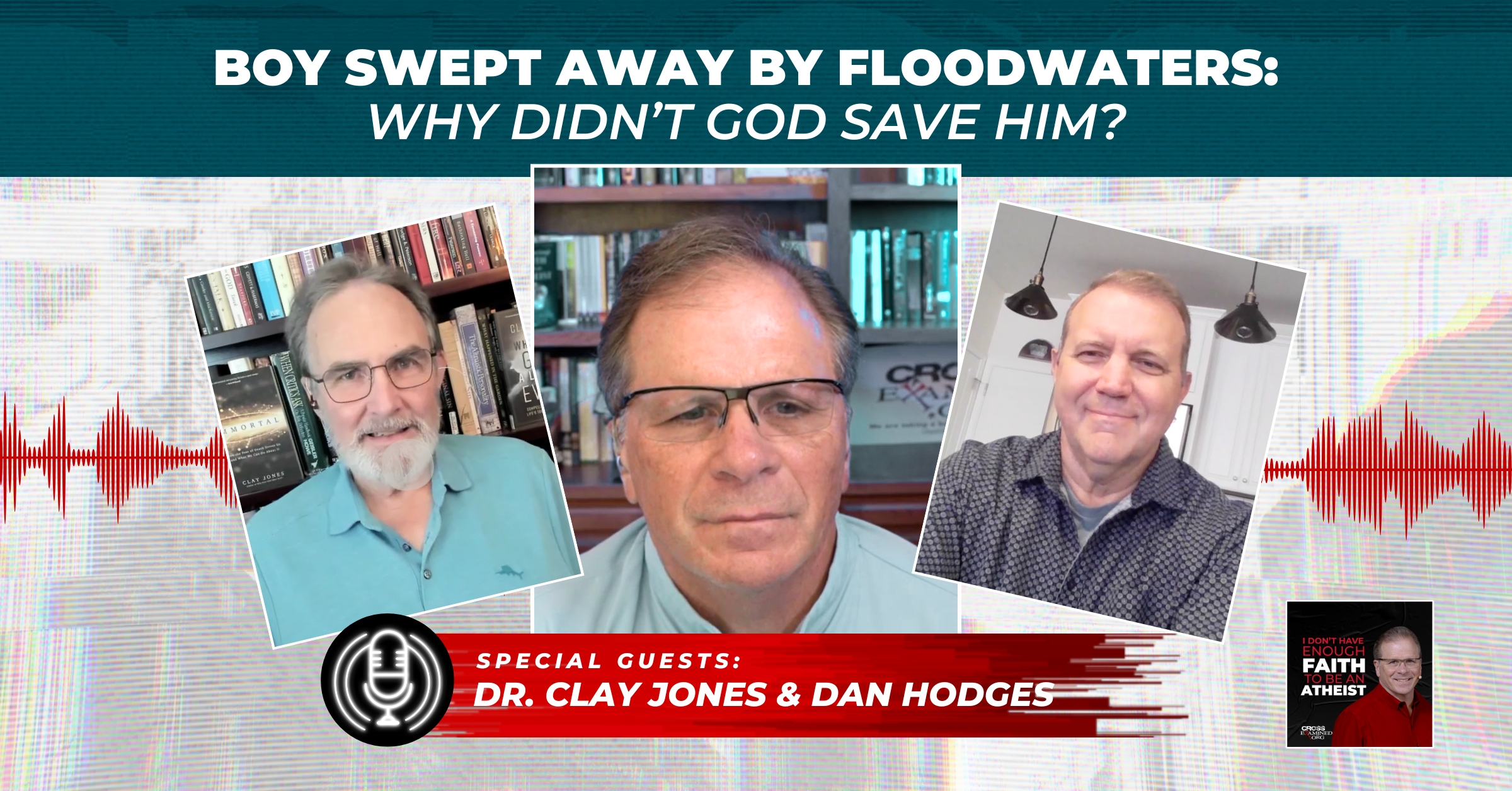
Life has been especially hard for those in the western part of North Carolina since Hurricane Helene struck last week, leaving residents without access to food and water, and claiming the lives of countless victims due to unprecedented flash flooding and fallen debris. During this week’s podcast episode, Frank sits down with Dr. Clay Jones (instructor of the upcoming OCC course ‘Why Does God Allow Evil?‘) and Dan Hodges (CrossExamined Board Director and Hurricane Helene survivor) to discuss the problem of evil and some of the heartbreaking stories emerging in light of the recent storm. Frank, Clay, and Dan will answer questions like:

  • What led Clay to write one of Frank’s all-time favorite books on evil, ‘Why Does God Allow Evil?
  • How can ordinary people commit extraordinary evil?
  • What’s the difference between being “good” and being “nice”?
  • Why do difficult times often bring out the best in people?
  • What did Dan see and experience after the storm in WNC and how can we help the survivors and volunteers?
  • Why didn’t Jesus save 7-year old Micah who was swept away by floodwaters? What did his aunt say about that?
  • How has Clay’s personal battle with cancer impacted his writing and teaching on this topic?
  • How can you help victims with physical and spiritual needs?


There will undoubtedly be tough days ahead for Helene survivors as they move forward and try to pick up the pieces. This is a sobering episode, but we trust that it will not only bring hope to those who are in a dark season right now, but also remind us of the good news of the Gospel when we inevitably encounter hardships in our own lives. We know you’ll benefit from hearing even more of Dr. Clay Jones’ insights on the problem of evil, so consider signing up for the PREMIUM online course ‘Why Does God Allow Evil?‘ which kicks off soon on 10/23!

Did you enjoy this episode? HELP US SPREAD THE TRUTH OF CHRISTIANITY BY SUPPORTING THE PODCAST HERE.

Resources mentioned during the episode:

Micah’s Story (New York Post article): https://bit.ly/3Yb4JU3

Clay’s Online Course: Why Does God Allow Evil?

Clay’s Book: Why Does God Allow Evil?

Give to Samaritan’s Purse: https://www.samaritanspurse.org/

Download Transcript

Are secular universities intentionally shaping a generation of Marxists? Parents and students need to be aware of the social and political atmosphere that awaits them when they step foot on a college campus. How should Christian students respond when they encounter professors and peers pushing views that are in high opposition with their faith?

Last week, Dr. Owen Anderson shared five key philosophical challenges Christian students will likely face during their college years. This week, he’s back with five more, breaking down the flaws in these worldviews, how they infiltrated universities, and how to defend Christianity against them.

  • Are some professors secretly promoting Marxist ideas?
  • Why is student activism at an all-time high and how are colleges preying on the 18-25 age group?
  • Is logic being dismissed as a “white” concept?
  • How are existentialism, Marxism, and LGBTQ+ ideologies working together to steer students away from truth?

Don’t miss this eye-opening conversation that will help Christian parents and students stay grounded in biblical truth and resist woke indoctrination!

Did you enjoy this episode? HELP US SPREAD THE TRUTH OF CHRISTIANITY BY SUPPORTING THE PODCAST HERE.

Resources mentioned during the episode:

Podcast: Part 1 with Dr. Owen Anderson
Blog post: Ten Philosophical Challenges Christian Students Face at Secular University
Owen’s Website: https://drowenanderson.com/
Owen’s Substack: https://drowenanderson.substack.com/


Download Transcript


Every college student faces difficult situations, but Christian students at secular universities often encounter unique challenges designed to dismantle their faith. How can these students (and Christians everywhere) stay strong and defend their beliefs in environments that are hostile to their worldview?

A few episodes ago, Frank sat down with Arizona State University Professor Dr. Owen Anderson, who is currently in litigation with the university due to discrimination against his Christian faith. This week, he’s back with an update and to share the 10 biggest philosophical challenges Christian students should prepare for in college. Together, Frank and Owen tackle questions like:

  • Are Christian students being targeted by their professors?
  • Is pragmatism the standard for truth?
  • How should Bible-believing Christians understand the concept of true happiness?
  • Why is it important for Christians to learn the law of non-contradiction?
  • Are college students paying BIG money to learn nothing?

Tune in as Dr. Anderson unpacks the first FIVE challenges with real-life examples from ASU and other secular campuses. And don’t miss the upcoming midweek podcast for the remaining five challenges along with even more insights on how to survive college as a Christian!

Did you enjoy this episode? HELP US SPREAD THE TRUTH OF CHRISTIANITY BY SUPPORTING THE PODCAST HERE.

Resources mentioned during the episode:

Blog post: Ten Philosophical Challenges Christian Students Face at Secular University
Owen’s Website: https://drowenanderson.com/
Owen’s Substack: https://drowenanderson.substack.com/

Download Transcript

All Christians should study apologetics. Christians should study apologetics may sound like a bold claim if you’ve barely even heard of apologetics, but I promise you apologetics has been the most important thing I’ve done for my faith besides reading my Bible regularly.

What is Apologetics?

Apologetics is a rational, organized defense of the Christian faith. It is the why behind the what we believe.

Apologetics has many different aspects. Some people study the timelines of events in the Bible. Astrophysicists study the universe and God’s hand in creation. Some apologists are philosophers who consider the rational reasoning behind having faith. Some are archaeologists who examine artifacts and geographical evidence that supports the Bible.

Apologetics has many different branches, but they all stem from the same tree of demonstrating the reasonableness of the Christian faith.

Reason 1 why all Christians should study apologetics – Because the Bible tells us to.

Most Christians know what we believe, but if someone were to ask why do you believe it, would you have an answer? Did you know the Bible tells us we should have an answer? “But in your hearts honor Christ the Lord as holy, always being prepared to make a defense to anyone who asks you for a reason for the hope that is in you; yet do it with gentleness and respect.” (1 Peter 3:15, ESV)

Christians have a hope within us that the rest of the world does not. We should be prepared to explain why we have this hope to anyone who asks. Studying apologetics helps us prepare this answer before we need to answer it.

Why should ALL Christians study apologetics? Because the world has never needed Jesus more than today. We need to be prepared to give an answer for the hope we have within us. #Apologetics CLICK TO TWEET

Reason 2 why all Christians should study apologetics is to shore up our own faith.

If we’re honest, most Christians have doubts occasionally. From time to time, we wonder is any of this real? Am I just hoping in something fictional? Like the father in Mark 9, I have cried out in the night for God to help my unbelief. “Immediately the father of the child cried out and said, “I believe; help my unbelief!” (Mark 9:24)

Most recently, when I was just feeling broken and despondent from the current cultural darkness, I begged God for help. I instantly felt I should call a friend I hadn’t talked to in almost a year. I kept pushing back that feeling, but that day she called me! She said she felt God telling her to call me.

Ok, God, I hear you! You see even those moments that I just need encouragement to keep fighting the darkness! But aren’t Christians supposed to have blind faith? Some Christians believe that our faith should be absolute and require no proof or it isn’t faith. Have you heard this argument before? I certainly had.

But “just believe!” rang horribly false when I heard atheist objections to the Bible’s accuracy or challenges to creation. I needed better answers than just blind faith!

I was so grateful to know that this isn’t the kind of faith God ever expected us to have. Faith was trusting in what we have reason to believe is true. If we look through the entirety of scriptures, we can see that God and Jesus used miracles at specific times to demonstrate their power and authority.

[below is a “click-to-tweet” link. If you can get it to work on the CE website then great – folks will be able to click it and directly tweet that quote from their own twitter account. If you can’t get it to work, then just convert it back into a blockquote]

Are Christians really supposed to have a Blind Faith? Read here to see what Jesus expected of those who followed Him. #Apologetics #ChristianApologetics #WomeninApologetics CLICK TO TWEET

In Luke 7, while John the Baptist is in jail awaiting his fate, he sends two of his followers to ask Jesus if He is the Messiah. John the Baptist was the first to recognize Jesus as the Messiah, and yet, he doubted. Does Jesus rebuke John? Tell him to just have faith? No. “In that hour he healed many people of diseases and plagues and evil spirits, and on many who were blind he bestowed sight.” (Luke 7:21)

He spends the next hour performing the exact types of miracles that the Old Testament prophets predicted the Messiah would do. And then commends John in front of the crowd, “I tell you, among those born of women none is greater than John.”

In John 10, some of the Jews listening to Jesus teach grow restless wanting to know if He is the Messiah. Jesus’s answer gives us hope today. Jesus answered them, “I told you, and you do not believe. The works that I do in my Father’s name bear witness about me” (John 10:25).

Jesus didn’t expect people to blindly hope in Him without cause. He expected His followers then and now to trust the signs and teachings that demonstrated His divine nature.

Reason 3 why all Christians should study Apologetics is to gain critical thinking skills.

We live in an internet age in which anyone can say anything. People make emotionally powerful statements or videos and the mobs cheer assent, often without thinking deeply about what they are cheering.

From studying apologetics, I have learned to think deeply about the meaning of words.

Challenging conversations have to start with some ground rules, like clear definitions of terms. If we are using the same words, but mean different things, conversations can go south quickly. For example, love is love sounds pithy and noble, but what is the definition of love here?

“Love is not affectionate feeling, but a steady wish for the loved person’s ultimate good as far as it can be obtained” ― C.S. Lewis

I doubt this is the kind of love meant by Love is Love. Studying apologetics made me more aware of linguistic theft (changing definitions of words to mean something new and often contradictory). Apologetics also taught me to think logically about the statements people make.

Listening to thousands of hours of apologetics podcasts, I’ve learned to see through logical fallacies and be able to make sound arguments for why I believe God exists and the Bible is truth.

Reason 4 why all Christians should study Apologetics is to learn sound doctrine.

While some aspects of apologetics strive to harmonize science with our faith or study the accuracy of the Bible, some apologists spend most of their time studying the doctrine of what we believe by studying the Bible.

I’ve learned to never read A Bible verse, but instead to study the context of a verse, look at the intended audience, consider the historical context, etc.

I’ve learned how to formulate answers for tough questions, like why do we believe Jesus had to die on the cross for our sins? Is it cosmic child abuse?

Through apologetics (and reading my Bible), I’ve learned to see how the thread of God’s redemptive promise flows through the entire Bible from the fall and the covenants with Abraham and Moses all the way to the End Times and Revelation. The requirements of the first passover in Egypt foreshadow Christ’s blood redeeming us from death. Christ’s death occurring on Passover during the ritual slaughter of lambs for the Jewish Passover meal was not an accident. It was God’s divine plan in His divine timing. I’ve learned to read my Bible better.

How do we know the will of God on an issue? We can study God’s response in similar situations, look for what He values, look at God’s definitions of love, justice, righteousness, etc.

If we find a verse that isn’t totally clear, how do we determine what it means? We look at other verses on the same topic that are clear. Always use the clearest verses to shore up our theology.

Learning to study the Bible for all it’s worth is one of the biggest joys I’ve gained from apologetics. One theologian/apologist/pastor, Mike Winger, has really taught me how to take an issue like marriage and research it through the entirety of scripture, not just the designated marriage passages.

I love feeling like I better understand the will and character of God. Living out my faith has become so much easier with sound theology.

[below is a “click-to-tweet” link. If you can get it to work on the CE website then great – folks will be able to click it and directly tweet that quote from their own twitter account. If you can’t get it to work, then just convert it back into a blockquote]

If you could share ideas or facts that help remove people’s objections to God and open their minds to belief, wouldn’t you want to??? Learn why and how here. #Evangelism #Apologetics #Christianity CLICK TO TWEET

Reason 5 why all Christians should study Apologetics is to share our faith.

Learning how to talk to people about God is the most important reason of all. If Jesus is the only way to salvation from sin and those who die in their sin will spend eternity separated from every grace of God, we need to be sharing our faith regularly.

Too many people in our lives are not living as saved children of God. We need to do our best to invite as many people as possible into a real saving relationship with God.

Some people will respond to the Gospel message alone, but most people will have questions. Apologetics will help you answer tough questions from friends and family.

  • Is there any evidence for God?
  • Why should I believe the Bible is accurate?
  • Was Jesus even real?
  • Why should I believe in the Resurrection?
  • How can you believe there is only one way to God?
  • Are other faiths true? What about Mormonism? Islam?

Having answers helps remove objections that prevent people from seeking Jesus. It can open their hearts and minds to faith in God.  All of which goes back to the first reason, Christians should study apologetics to be prepared to give an answer for the hope we have in Christ.

Recommended Resources:

Jesus, You and the Essentials of Christianity by Frank Turek (INSTRUCTOR Study Guide), (STUDENT Study Guide), and (DVD)    

I Don’t Have Enough Faith to Be an Atheist’ [FOUR unique curriculum levels for 2nd grade through to adult] by Frank Turek 

Can All Religions Be True? mp3 by Frank Turek

How Philosophy Can Help Your Theology by Richard Howe (DVD Set, Mp3, and Mp4)   


Jennifer DeFrates is a former English and Social Studies teacher turned homeschool mom and Christian blogger at Heavennotharvard.com and theMamapologist.com. Jennifer is a 2x CIA graduate (the Cross-Examined Instructors Academy) and volunteers with Mama Bear Apologetics. She has a passion for discipleship through apologetics. Her action figure would come with coffee and a stack of books. She is also the reluctant ringleader of a small menagerie in rural Alabama.

Originally Posted at: https://bit.ly/4cmcoTi

By Al Serrato

We all intuitively seek the best explanation for a set of facts or circumstances. It’s called abductive reasoning. Detectives make use of this method of reasoning when endeavoring to solve a crime; they put the pieces together so that a picture of what occurred emerges in sufficient detail to have confidence that it is true. Parents do it when they notice that a freshly baked pie has a piece missing and little Johnny has crumbs on his fingers and fruit staining his lips. Perfect knowledge is not required to know with sufficient certainty what occurred.

Abductive Reasoning in Christian Apologetics

As it relates to apologetics, abductive reasoning is a formal way of supporting the case for the validity of Christian truth claims. Though there are dozens of pieces of evidence to support the belief that the Resurrection took place, many apologists will make the case using a “minimal facts” approach. These generally undisputed facts include that Jesus lived, that he was put to death on a Roman cross, that his tomb was later found empty, and that his followers experienced encounters with him which were, simply put, life changing. These followers included skeptics who knew him well, such as his brother James; zealots who were persecuting his followers, such as Paul; and numerous men and women who had been following him during his earthly ministry.

A Cumulative Case

What best accounts for these well-established facts? Could it be they were all hallucinating? That makes little sense as we know that hallucinations do not occur in mass settings. Were they simply mistaken about who it was they were seeing? This too lacks explanatory appeal as mistaken identification is not plausible for family members and close friends and certainly not for many such people. Was it simply wishful thinking? While his followers no doubt missed him dearly, it is not reasonable to conclude that they would face death by insisting that he was still alive, when they knew he was not. Nor would wishful thinking explain the change in those who were initially persecuting Jesus’ followers, nor for those who only became followers after his death. Seeing that the cumulative case points to the fact of the Resurrection can be a powerful way to support the faith.

Losing the Case Before the Courtroom

But many remain unconvinced. When I have encountered such people, I have found that by and large they do not employ abductive reasoning as described above. They have not assessed and considered the piles of evidence from history to determine what other reasonable inference would better fit the known facts. Instead, they begin with the presupposition that miracles – which of course include resurrection from the dead – simply cannot occur. Consequently, any explanation of the historical facts and events which posit a miracle are to be rejected out of hand. The case is lost before it is even considered.

In short, many argue that relying on the possibility of a miracle is simply an admission of ignorance. If you cannot first explain how the miracle occurred, they argue, you should not be able to rely on it.

We can know THAT it happened without knowing HOW it happened.

This challenge to provide an explanation for the “best explanation of the facts” – that is, to explain the miracle – is clever but misplaced. There are many circumstances in which we can know something to be true, or to work, without knowing how it is that this is so. Take our ability to reason or our native sense of fair play: I make use of these things even though I have no way of explaining how reason works, or why I should be able to rely on it to reach true conclusions. I cannot explain how I know that “playing fair” is something that should matter to me. Consciousness is another example: in operating rooms around the world, anesthesiologists make use of drugs that can put people “under” and then restore them to consciousness without knowing how it is that this occurs. They understand the effect these drugs have on the cellular level, and they can measure differences in brain wave activity, but understanding how a grouping of brain cells goes from conscious to unconscious and back is still beyond scientific understanding. Though not usually considered as such, consciousness and reason are themselves “miraculous” – no sufficient naturalistic processes can account for them.

So, if the evidence that a man was put to death and then appeared again in a re-animated and enhanced body is sufficiently credible, then the fact that we cannot currently “explain” how it occurred does not prove that it did not occur. Consider for a moment the many medical “miracles” that have occurred. There are countless cases in which a disease process stops, or reverses, for reasons that are unclear, at least at present. As knowledge and technology advance, some of these miracles will be explained through naturalistic mechanisms. But how can the skeptic possibly know that this will always be the case? Would this not require perfect knowledge on his part, in order to know with certainty that departures from the laws of nature can never occur?

There is nothing wrong with wanting to know more, with seeking more knowledge and more information to get the “how” questions answered. There is nothing wrong with trying to rule out all naturalistic explanations before considering the supernatural. And it may be, in the end, that additional knowledge will modify, or perhaps even change, some of our views.

But refusing to go where the evidence leads because of a belief that supernatural events are “impossible” is a reflection of underlying bias, not an expression of enlightened thinking.

Recommended resources related to the topic:

Miracles: The Evidence by Frank Turek DVD and Mp4

Two Miracles You Take With You Everywhere You Go by Frank Turek DVD, Mp3 and Mp4

Early Evidence for the Resurrection by Dr. Gary Habermas (DVD), (Mp3) and (Mp4)

Debate: What Best Explains Reality: Atheism or Theism? by Frank Turek DVD, Mp4, and Mp3 


Al Serrato earned his law degree from the University of California at Berkeley in 1985. He began his career as an FBI special agent before becoming a prosecutor in California, where he worked for 33 years. An introduction to CS Lewis’ works sparked his interest in Apologetics, which he has pursued for the past three decades. He got his start writing Apologetics with J. Warner Wallace and Pleaseconvinceme.com.


The following question comes from one our Crossexamined Community members.

“Why did God allow the Bible to be written in a way that gives Christians an opportunity to misunderstand it?” – Vinnie B.

This question intrigues me because it’s a universal problem. Every human being who’s ever tried to dig into Scripture has found it difficult at times to understand what God is saying. And some passages are so difficult that theologians across Church history can’t agree on what they mean.

Of course we could all benefit from learning how to interpret the Bible correctly. Sometimes we struggle over a passage and it would easy to understand if we just knew a few basic principles for interpretation. But, even if you go to seminary, and you have years of practice interpreting and studying God’s word, if that’s you, then you know that there are still some passages that baffle you. No amount of classes and seminary courses will be enough. God’s word can still be difficult.

Moreover, this interpretive problem points to a theological problem. If God’s word is so easy to misinterpret and so hard to understand, then what does that say about God? Is God just playing games with us? Is this some big game of “keep-away” and He’s eluding us, refusing to let us understand what He’s saying? That sounds like a capricious, mischievous God. Not a good look.

Not ALL the Bible is Hard to Understand    

First, we should note that a lot of the Bible is straightforward, fairly easy to understand, and there’s no real challenge in figuring out how to rightly apply it. That’s important to remember, so we have a sense of balance between the easy and hard parts of the Bible. Jesus was able to translate the Gospel message so that an uneducated foreign woman – the woman at the well – was able to understand exactly what He meant (John 4). God can, and does, communicate in ways that anyone, with ears to hear, can understand Him.

But one chapter earlier, Jesus was confusing the well-educated Pharisee, Nicodemus (John 3). Pharisees were some of the most educated and biblically literate scholars in their day. To this day, we don’t know if Nicodemus ever grasped what Jesus meant by being “born again.” Sometimes, God communicates in ways that challenge and confound the most educated among us. Other times, God speaks clearly, His words cutting like a knife so that everyone understands what He’s saying.

Sometimes We’re the Problem       

We also should admit that often the problem isn’t in the Bible. It can be straightforward, easy-to-understand, yet if we don’t like what God is saying to us, we might play dumb, thinking that we aren’t responsible to follow directions that we don’t understand. But, playing dumb is a dangerous game. If you keep acting dumb, eventually you won’t acting. We’ll just be dumb. I call this “sin-stupid.” When people suppress God’s truth long enough, their conscience is seared (1 Timothy 4:2), their hearts become hard (Romans 2:5), their spiritual discernment numbed, till they can’t understand things that used to be obvious. Repeated unrepentant sin makes people stupid over time.

Or perhaps we aren’t rebelling against God, or suppressing His word. We might just be a little lazy, or distracted, and we aren’t paying close attention to see what God is saying to us. If God’s word were on billboard, we’d at least need to stop speeding, stop multitasking, and slow down enough to read what He’s telling us. God’s word might be easy enough to understand, but if we’re just sprinting past, paying little attention, then we’re liable to misinterpret Him. That’s not God’s fault. That’s ours           .

God Has Other Purposes Besides Clarity    

At the heart of this question is the assumption that God wants to be understood. And, yes, God relates with mankind in ways that invite us to know Him more, understanding who He is, how He works, and what He wants. But we cannot assume that God’s only purpose in communication is clarity.

Sometimes God speaks in riddles, or indirectly, or in downright incomprehensible ways. If God was aiming primarily at being clear, then He’s failed. But, we have no good reason to think that clarity is the God’s one and only aim here. Indeed, we have reason to believe he’s trying to murky and confusing to some people.

1. God Is Sorting Out the Followers from the Fans

Jesus famously explained his use of parables saying that they were not just to clarify kingdom principles among believers but also to confound non-believers (Matt 13:10-17).

“The disciples came to him and asked, ‘Why do you speak to the people in parables?’ 11He replied, ‘Because the knowledge of the secrets of the kingdom of heaven has been given to you, but not to them. 12Whoever has will be given more, and they will have an abundance. Whoever does not have, even what they have will be taken from them. 13 This is why I speak to them in parables: ‘Though seeing, they do not see; though hearing, they do not hear or understand.’” (Matthew 13:10-13; NIV)

Scripture has some passages for easy-reading and some for difficult-reading. And this is an intentional sifting method to bless those believers who have “ears to hear” without rewarding non-believers with kingdom insights that aren’t fit for them.

2. God is Beautiful, Not Basic

Another one reason for these difficult passages is that God isn’t a “bread-and-water” God. He’s not basic. He could have made a world without tastes, and colors, and smells, and experiences. But He included all that stuff because He’s an artist, an aesthete. Likewise, God’s word isn’t reducible simply to information, any more than food is reducible entirely to fuel. It’s designed for an an aesthetic interaction. It’s a beauty to be enjoyed. It’s an encountered to be experienced. Just as food is more than calories, so God’s word is more than information. It has flavor, and texture, and ambience so that there’s more to imbibe raw information. If Scripture were just about information transfer, then we could hurry through it – get the info and leave. But Scripture is to be experienced, and that means ruminating on it sometimes. Let the flavors simmer a bit.

3. God Promotes Wisdom   

Sometimes the difficulty we face in God’s word is a matter of wisdom. By that I mean, there’s supposed to be a bit of a wrestling match with the language and ideas in Scripture, a struggle to pry wisdom from those obtuse words. The struggle is part of the path to wisdom. Without the struggle one might gain some head-knowledge, but they’re liable to miss the deeper application of wisdom. Plus, as Jesus explained, not everyone will understand the hard-language sometimes. So, the challenging parts of the Bible can be a filtering mechanism that way, separating the wise and foolish, the sheep from the goats.

4. God Promotes Personal Growth 

Besides wisdom, and aesthetics, there’s also personal growth to be found as we struggle through God’s word. If everything was laid out for us easy-peasy, then we might never face the kind of resistance-training needed to get strong, so we’d never grow strong enough to live out the tasks God has for us.

In sum, there is more to God’s purposes than just being clearly understood. Sometimes God speaks in ways that keep his Kingdom truths out-of-reach, out of the “wrong hands” so to speak. For disciples, the difficult passages in Scripture slow us down so we can relish experiencing God’s word, chewing and savoring what He’s saying. The same passages can also lend a sense of mystery, so that in searching for the answers we can find wisdom along the way. And they can present obstacles for us to press into, and struggle over it. There we can gain strength and grow through the experience.

Yes, we can still learn what God has said through Scripture. But beyond mere head knowledge, God imparts character, wisdom, and beauty through His written word.

Thanks for the great question, Vinnie B.

If you want to find out more about our Crossexamined Community you can sign up here for your own free trial.

Recommended resources related to the topic:

Counter Culture Christian: Is the Bible True? by Frank Turek (Mp3), (Mp4), and (DVD)

The New Testament: Too Embarrassing to Be False by Frank Turek (DVD, Mp3, and Mp4)

Why We Know the New Testament Writers Told the Truth by Frank Turek (DVD, Mp3 and Mp4)

Oh, Why Didn’t I Say That? Is the Bible Historically Reliable? by Dr. Frank Turek DVD, Mp4, Mp3 Download.

How to Interpret Your Bible by Dr. Frank Turek DVD Complete Series, INSTRUCTOR Study Guide, and STUDENT Study Guide

How Philosophy Can Help Your Theology by Richard Howe (MP3 Set), (mp4 Download Set), and (DVD Set)


Dr. John D. Ferrer is an educator, writer, and graduate of CrossExamined Instructors Academy. Having earned degrees from Southern Evangelical Seminary and Southwestern Baptist Theological Seminary, he’s now active in the pro-life community and in his home church in Pella Iowa. When he’s not helping his wife Hillary Ferrer with her ministry Mama Bear Apologetics, you can usually find John writing, researching, and teaching cultural apologetics.

If we live long enough, grief is something that we will all experience at one point or another. Grief is difficult. Some have even said that “grief is a challenging beast.” It impacts each person differently. Grief is a sense of sorrow that one feels when a person experiences a form of loss. More frequently, this loss is associated with those who have had loved ones who passed away. However, grief can also include the loss of a job, friendship, hobby, or position.

As I have dealt with loss in my personal life, I have surprisingly found how beneficial apologetics is when going through times of sorrow. Apologetics—that is, the defense of the Christian faith—may seem like an unlikely ally of bereavement and psychospiritual care, as many associate it with the headier intellectual avenues of the Christian faith. Nonetheless, apologetics can assist one with their grief in three specific ways.

Apologetics Gives Stability Through Times of Grief.

First, apologetics can give stability through times of grief. When a person experiences loss, they may feel as if their world has irreparably changed. And in some ways, it has. The loss of a loved one evokes a sense of what some grief counselors call the “new normal.” That is, it speaks to the continuity of life without the physical presence of the loved one.

While it cannot repair the hurt one feels, apologetics can offer concrete proofs for the Christian faith, which remain intact regardless of the changes of life. For instance, resurrection studies and explorations into near-death experiences have intensified my belief in heaven. These studies assure me that Christ has defeated death and, thereby, assured that life continues into eternity. My theological studies point that the same God who brought victory over death remains the same “yesterday, today, and forever” (Heb. 13:8, CSB). When the world seems as if it has turned upside down, apologetics and theological studies can give a sense of security.

After getting sick on a boat in the Atlantic due to turbulent waters, it was seeing the Oak Island Lighthouse that eventually alleviated my nausea. The lighthouse was like a North Star, a fixed point amid the chaos of the moment. In like manner, apologetics can offer us an anchor in a sea of chaos.

Apologetics Grants Security Though Times of Grief.

Second, apologetics grants security through times of grief. Here, security implies increased faith. The field of apologetics is intended to bolster a person’s faith. The goal of the apologist should be to lead believers to deeper belief, while offering skeptics a reason to believe.

When we lose someone near and dear to us, our world is turned upside-down. We may wonder why God allowed such a thing to happen, thus entering the realm of theodicy (why a loving God allows evil in the world). If left unresolved, a person could suffer emotional doubt.

Even though apologetics cannot guarantee that a person will never suffer emotional doubt, apologetics can equip a person with better tools to deal with emotional doubt when it arises. Coupled with a solid systematic theology, a person can better trust God with the uncertainties of life.

Grief counselor David Kessler once said, “Human beings had rather feel guilty than helpless.” He goes on to say, “The guilt you feel during grief comes from the belief that you could have been there and stopped it from happening. Guilt can be released when you find the compassion for yourself to know that you’re not in control, and maybe never were.”[i] Helplessness is a difficult pill to swallow. I cannot tell you the number of times that I have felt overwhelmed by the helplessness while working in hospice.

Nonetheless, when we know the One in control and that that One is a benevolent, compassionate, and faith friend, then it makes the grief process much easier to process. That does not mean that apologetics affords a comprehensive understanding as to why certain things happen as they do. No one but God Himself could answer that question. But it will spur faith in the One who maintains such comprehensive knowledge.

Apologetics Gifts Serenity Through Times of Grief

Finally, apologetics gifts us with serenity through times of grief, especially for those who have lost loved ones through the passage of death. As previously noted, studies of the resurrection of Jesus assures us that death has been defeated and that an afterlife exists. Studies of near-death experiences highlights what that experience may be like in the intermediate state.[ii]

Coming into hospice with this knowledge opened the door to see certain things through an individual’s passage into eternity that I may have otherwise missed. Nonetheless, when a person loses someone near and dear to them, such studies offer the bereaved a serenity about the afterlife that cannot be obtained in any other fashion. If a person has an assurance of an eternal life in heaven with God through Christ, then even death loses its sting (1 Cor. 15:55).

Conclusion

Grief is a natural emotion that comes with loss. Everyone grieves differently. Some are tearful, whereas others are more Stoic. Some need time with a lot of people, while others need time alone. Grief is something that we will all experience at some point. Yet, as this article has shown, apologetics can assist us during our times of grief. It can give us something concrete to hold to, a North Star to direct us, or a lighthouse to ascertain a sense of security in a turbulent ocean of change. Most importantly, apologetics should bolster our faith in the One who created not only North Star and land upon which the lighthouse stands, but also the sky’s canvas and the ocean itself. In the end, our serenity, security, and stability are not in apologetics, but in the Triune God for whom apologetics encourages us to place our truth.


Footnotes:

[i] David Kessler, Grief.com.

[ii] The “intermediate state” refers to the time between a person’s death and the final resurrection that accompanies the return of Christ.

Recommended resources related to the topic:

If God, Why Evil? (DVD Set), (MP3 Set), and (mp4 Download Set) by Frank Turek

Why Doesn’t God Intervene More? (DVD Set), (MP3 Set), and (mp4 Download Set) by Frank Turek

Why does God allow Bad Things to Happen to Good People? (DVD) and (mp4 Download) by Frank Turek 

Relief From the Worst Pain You’ll Ever Experience (DVD) (MP3) (Mp4 Download) by Gary Habermas 


Brian G. Chilton earned his Ph.D. in the Theology and Apologetics at Liberty University (with high distinction). He is the host of The Bellator Christi Podcast and the founder of Bellator Christi. Brian received his Master of Divinity in Theology from Liberty University (with high distinction); his Bachelor of Science in Religious Studies and Philosophy from Gardner-Webb University (with honors); earned a Certificate in Christian Apologetics from Biola University, and plans to purse philosophical studies in the near future. He is also enrolled in Clinical Pastoral Education to better learn how to empower those around him. Brian is a member of the Evangelical Theological Society and the Evangelical Philosophical Society. Brian has served in ministry for over 20 years and currently serves as a clinical hospice chaplain as well as a pastor.

Original Blog Source: https://bit.ly/3KhC2gi


Human origin is a fascinating area of research today. With all the different models for the origins of humanity being proposed, I see an increase in the discussions, both scientific and theological. For everyone reading this post, this area of research should be of utmost interest for you as well. Two critical ideas about humanity are at stake depending on which model (or family of models) is true: intrinsic and equal human dignity and value, and the sinfulness of humanity.

The age-old debate about God’s existence has great implications on this area of the debate about human origins. The Judeo-Christian claim that all humans are created in God’s Image and that humans possess a sin nature that will cause them to tend toward the immoral. These paradoxical doctrines together explain both the greatness and wretchedness of humanity that we see every day, throughout history, and expect in the future.

The Image of God

If we are created in the image of God that means that all humans possess intrinsic and equal human dignity and value (Genesis 1:26-28).[i] If this is false, then humans are not valuable in virtue of their being human but in virtue of a myriad of other characteristics and statistics that change in fashion with the culture. One moment a human can be valuable and the next moment they are not. If humans do not have value at any point, that gives justification for their expendability (murder) at the hands of those who have power over them at that point. If humans are not created in the image of God, then there is nothing wrong with humans abusing their power against other humans. Any model of human origins that does not allow for the Image of God in humans places the very lives of every human at risk.

Human Sinfulness

Genesis also records that Adam and Eve sinned against God and with that action brought the sin nature into all future humans (Genesis 3). Humans are not born good or even neutral. This means that the abuse of power described above is not just possible but inevitable. Any model of human origins that does not allow for the Fall or for the transfer of the sin nature (whether through the biological, spiritual, or some combination) denies this element of human psychology, sociology, and history (Genesis 5:1-3; 9:6; James 3:9).

Denying Both?

Any model that does not allow for one or the other already makes human lives less worthy of protection because either it is not worth protecting or there is nothing to necessarily protect against. But if a model denies both, then that is a recipe for disaster. This means that the debate about human origins is not just a scientific question but also a philosophical one, even for the atheist or naturalist. An interesting analysis of the implications of these two characteristics is provided in Os Guinness’ book The Magna Carta of Humanity which I highly recommend, particularly for those involved in human origins discussions and debates. It provides a renewed urgency for the importance of the debate about human origins.

Should Theology Judge Science?

I often hear the claim that many Christians allow their theology to determine their interpretation (and maybe even rejection) of the scientific data. The implication is that we should not allow any knowledge discipline (or at least, theology) other than science in developing our model or that we should at least give precedence to science.

 It is important to recognize at this point the distinction between “science” and the “data of nature.” The discovered data is the raw information that must be accommodated in any model, whereas “science” is the interpretation of that data. That interpretation is fallible, but not necessarily false. There are many sources of truth about human nature, including philosophical, historical, and theological sources; and that information should be recognized and accommodated in any model of human origins if it’s to accurately reflect the natural history of human origins. That’s our best shot at identifying what really happened. Just as the data of nature can judge our interpretation of the data of history and Scripture, the data of history and of Scripture can judge our interpretation of the data of nature in virtue of their being true.

[Editor’s note: While many say science is the only way we can know anything about anything, they are endorsing scientism – which is not itself science, but philosophy. So, it’s self-defeating.] Therefore, we cannot responsibly allow scientism to prevent our discovery of the correct model of human origins. To do so, would be misinformed if not dangerous.

Conclusion

With the work in the field of human origins being done at numerous Christian organizations, the number of possible models and level of detail may seem confusing to many yet exciting to others. But they are important for all of us. I encourage these organizations to continue (or begin) working together to gather all the data that each emphasize in their respective models and adjust those models to reflect the data from others. We need to be careful and respectful of any accusations of heresy, ensuring that our accusations are demonstrably reflective of the model not the Christian, and that we address such accusations with or adjust our models based on the biblical data and logic. It is important that even though we may disagree on details that we present a united front that is based on the data and sound reasoning from that data, not only for the future of humanity, but as a demonstration of the unity and love that Christ prayed for and told us that unbelievers will see. We need to not only demonstrate the truth of these important Christian doctrines (ones that are often under attack and used as excuses to reject Christ) but we need to emphasize our love, respect, cooperation, and dedication to truth that unbelievers often overlook.

References:

[i] Editor’s note: There are at least four main theories in church history regarding the nature of the “imago dei” (Image of God). Some, follow the Socinian tradition, teaching that the Image of God refers to mankind’s dominion and authority over the rest of Creation. Others, including Thomas Aquinas, say it refers to human intellect in the sense of rationality, self-reflection, and reasoning abilities all of which set humanity apart from the rest of the animal world. Others follow Karl Barth’s theory that the imago dei refers to human relationships, where Adam and Eve, can have fellowship, friendship, marriage, family, and therein fulfull their cultural mandate to “be fruitful, multiply, and fill the earth” (Gen. 1:26-28). Still others affirm the reformation view, represented by John Calvin, which treats any combination of God’s shareable attributes – authority, relationship, intellect, etc. – as the “image of God” in man. See, John Ferrer, “Chapter 3: Creation and the Image of God,” in Body Ethic [Dissertation] (Fort Worth, TX: Southwestern Theological Seminary, 2013), 91-110.

While Nix doesn’t go into all this detail in his blog post here, these four theories illustrate different ways Nix’s assertion could hold true. He says, “all humans possess intrinsic and equal human dignity and value” – whether in their nature as relational beings, as rational creatures, as representative authorities, or all of the above. Our equal dignity can trace back to our inherent nature – an unchanging and grounded fact about all human beings, since every human being is in God’s image (Gen 1:26-28; 5:1-3; 9:6; James 3:9).

Recommended resources related to the topic:

Is Original Sin Unfair? by Frank Turek (DVD, Mp3, and Mp4)

Was Jesus Intolerant? by Frank Turek (DVD and Mp4)

Stealing From God by Dr. Frank Turek (Book, 10-Part DVD Set, STUDENT Study Guide, TEACHER Study Guide)

Is Morality Absolute or Relative? by Frank Turek (Mp3/ Mp4)


Luke Nix holds a bachelor’s degree in Computer Science and works as a Desktop Support Manager for a local precious metal exchange company in Oklahoma.

Original Blog Post: https://bit.ly/3xEkXud


“Avast yer jabberin, ya bunch a bilge rats!” The voice sounded strange as it reached into the hallway. The speaker was apparently trying to make a point. “Yer division a booty must be… “ he paused to consider his words, “more equitable if ye be wanting to sail with me.”

He had my attention. I was at a work conference in a hotel, wandering the halls during a break, when I happened across this conference room. I peeked inside. It could have been a scene from the latest Pirates movie. Men of various ages with lots of facial hair, many dressed in striped pants, with the occasional peg leg and hook hand. Yes, I had stumbled across a pirates’ convention, the 350th annual, it seemed, from the schedule which I found posted outside.

Pirate Ethics

The speaker’s topic was ethics. He went on to explain what an equitable share of booty amounted to, in his view, using a very modern looking PowerPoint presentation to punctuate his points.

I caught up with him at the break and asked if he had time for a few questions. He seemed a bit suspicious, what with my business casual attire, but nonetheless willing.

“Seriously,” I began. “Ethics for pirates? I mean, for centuries you guys have been boarding and capturing and enslaving people without much regard for ethics. You’ve been known to rape, pillage and plunder, and your personal hygiene is … not the best.” I quickly ended, seeing that I was crossing a line.

A hurt look crossed his face. “Yer words be stingin,” he began, but my words were nothing compared to his breath. I took a step back and tried not to stare at the parrot on his shoulder. “I don’t suppose ye know bout all the good that we do. Why ar ann’l ball raises thousands for the widows n’orphns fund, and we do lots of behind the scenes work ye never be aware of. Last year alone, we returned almost 30 percent of our captured booty to charitable organizations.”

“Is that a fact?” I asked. “I had no idea. But,” I persisted, “this is stuff that you’re stealing.”

Who’re the REAL Thieves?

“We make no excuses for that, m’lad. But we’ve been pretty transparent about that from the beginning, ain’t we? After all, ye had no trouble spotting us for who we are. If ye want the real thievin’ ones, it’s the bankers and lawyers ye want to be houndin…” He pointed down the hall to the lawyers’ convention I had been attending.

Yes, of course I’m making this up. But I think there is a valid point here to be made. Human beings have an amazing capacity to judge themselves on a curve. Pirates no doubt convince themselves that they are somehow justified in doing what they do. They may think of harm they suffered when younger, or may feel that life dealt them the hand that they play. And they no doubt have a set of ethics that they follow, however uncivilized it may seem to us. And many, if pressed, would seek to justify their behavior by reference to all the things they don’t do. “Sure, we kill on occasion. But only those who don’t surrender, or those who for whatever reason need killing.” This is the human condition, whether in a high school, at the office, on a pirate ship, or in a prison. We don’t seem to have the capacity to see ourselves for what we truly are.

I’m Good Enough to Go to Heaven, right?

What does any of this have to do with Christian apologetics? Just this: the number one response of nonbelievers as to why they don’t worry about the afterlife goes something like this. “I don’t know if there is a God, but if there is, he will see all the good that I do and accept me. So, I’m not worried. A good God will see that I am living a good life.”

But holding this view is not that different than the pirates in the analogy above. Compared to others of that ilk, an individual pirate might seem like a good guy. But that hardly would qualify him for life in a peaceful and civilized society. His problem isn’t how he compares to his fellows, but how he measures up to the place he’s trying to get to. He may think himself “good” when in an objective sense he is anything but. Similarly, many people today believe they have a proper sense of what “good” human behavior is, but how can they know for sure when they are mired in the corruption of their nature? And more importantly, have they given any thought to what “perfect” behavior requires? What a perfect being might use to measure admission to His realm?

We’re Not As Good As We Think We Are

It’s easy for us to pat ourselves on the back for our goodness. But perhaps we are a bit too smug. Our persistent feelings of guilt serve as a guide – a reminder – that all is not well. They serve to call us to account to the One who left us here, and who expects something of us if we are to be in relationship with Him. These feelings of guilt provide the backdrop of bad news, the kind of news from which we naturally shy away. The kind of bad news that sets the stage for the ultimate Good News of the gospel.

So, next time you encounter this response, you might suggest that the nonbeliever consider his frame of reference. Immersed in a sinful culture, inhabiting flesh and blood bodies whose weakness overcomes the willingness of the spirit, we may be as unable to see ourselves for what we truly are as the fictional pirates above would be. In short, we may not be in the best position to know if we are as “good” as we pretend.

We Need a Savior

Fortunately, there is a better answer, one that does not require us to earn our way back to God’s presence. But until we see our need for a Savior, we’re not likely to find the answer that is waiting to set us free.

The righteousness of God is through faith in Jesus Christ to all who believe, since there is no distinction. 23 For all have sinned and fall short of the glory of God; 24 they are justified freely by his grace through the redemption that is in Christ Jesus.
Romans 3:22-24 (HCSB)


Recommended resources related to the topic:

Is Morality Absolute or Relative? by Frank Turek (Mp3/ Mp4)

Jesus vs. The Culture by Dr. Frank Turek DVD, Mp4 Download, and Mp3

Hell? The Truth about Eternity (MP3 Set), (DVD Set), and (Mp4 Download Set) by Dr. Frank Turek 

Old Testament vs. New Testament God: Anger vs. Love? (MP3 Set) (DVD Set) (mp4 Download Set) by Dr. Frank Turek 


__________________________________________________________________________________________________________________________

Al Serrato earned his law degree from the University of California at Berkeley in 1985. He began his career as an FBI special agent before becoming a prosecutor in California, where he worked for 33 years. An introduction to CS Lewis’ works sparked his interest in apologetics, which he has pursued for the past three decades. He got his start writing Apologetics with J. Warner Wallace and Pleaseconvinceme.com

[/et_pb_text][/et_pb_column][/et_pb_row][/et_pb_section]

Because Paul crisscrossed paths with many folks, some repeatedly, it’s quite enlightening to compare how these people are portrayed in the book of Acts with what Paul hints at in his own letters. Among these characters, Timothy stands out as a particularly intriguing figure.

In 1 Corinthians 4:17, Paul mentions sending Timothy, his “beloved and faithful child in the Lord,” to jog the Corinthians’ memory about Paul’s ways in Christ. Now, from this passage alone, it’s a bit tricky to figure out if Timothy was sent before the letter or with it. In 1 Corinthians 16:10-11, though, Paul makes it clear that Timothy was dispatched before the letter was penned. He talks about Timothy’s impending arrival as something distinct from when the Corinthians would receive the letter itself – “When Timothy comes, …”

Contradictory Accounts?

Now, when you stack these two passages side by side, a puzzling question pops up. If Timothy was sent first, why didn’t he show up first? And if he did arrive first, why bother sending instructions afterward on how to welcome him?

The most sensible answer is that Timothy, even though sent ahead, must have taken a more roundabout route to Corinth. The quickest way from Ephesus, where Paul was writing, to Corinth would be by ship, covering the distance in a jiffy with a favorable wind. But, as we dig into Luke’s account in Acts 19:21-22, we discover that Timothy, when leaving Ephesus, opted for the overland route, traveling up through Macedonia.

We stumble upon these coincidences that weren’t orchestrated but fit together seamlessly. Paul’s letter doesn’t mention a word about Timothy’s trek through Macedonia, and Acts doesn’t bring up Paul’s letter. Yet, Acts offers the only sensible explanation for these offhand remarks Paul makes in his letter, creating this neat puzzle where the pieces just click into place.

How Did The Philippian Church Know Timothy?


But there’s more about Timothy. When Paul writes the church at Philippi, he says:

“I hope in the Lord Jesus to send Timothy to you soon, so that I too may be cheered by news of you. For I have no one like him, who will be genuinely concerned for your welfare. For they all seek their own interests, not those of Jesus Christ. But you know Timothy’s proven worth, how as a son with a father he has served with me in the gospel” (Philippians 2:19-21).

In this passage, it’s pretty clear that the Philippians knew Timothy and had seen him working alongside Paul. The nifty part is how there’s this subtle and smooth connection between what’s written in Philippians and the story in the book of Acts. So, in Acts 16, Paul starts traveling with Timothy, a convert from around Lystra and Iconium. After that, the Acts story gets into Paul’s travels across Asia Minor to Troas and then Macedonia.

When they hit Philippi, the story dives into Paul’s missionary adventures, detailing his struggles and hardships. Acts 17 continues the journey, covering Paul’s move from Philippi to Thessalonica, where things get pretty heated, and he has to leave. Then comes this sneaky part: the brothers secretly send Paul and Silas to Berea at night, and when they get there, they hit up the Jewish synagogue. That’s when Timothy pops back into the picture:

“Then the brothers immediately sent Paul off on his way to the sea, but Silas and Timothy remained there” (Acts 17:14).

So, even though Timothy wasn’t explicitly mentioned during the journey, Acts 17:10-15 shows that he was indeed rolling with Paul at Berea. Silas gets more spotlight in the story, but Acts hints that Paul had more buddies along, including the author himself. This revelation about Timothy being there in Berea fills in the gaps and explains how the Philippians knew about Timothy’s skills and saw him working hard with Paul, like a son with his father.

What’s interesting is that Acts doesn’t just say Timothy was in Philippi. You have to connect the dots by piecing together Timothy’s role from different mentions in Acts. It’s not like the author of Acts was trying to be all sneaky and create a link with Philippians. Instead, this connection adds weight to the idea that the author of Acts really knew Paul’s life inside out, including his friends and moves during that time.

Paul Alone In Athens

But wait, there’s another nice example of an undesigned coincidence in this same passage. So, in Thessalonica, Paul’s ministry gets interrupted by a rowdy bunch of Gentiles riled up by the local Jews, prompting a quick escape with Silas for Berea (Acts 17:10). When the troublemakers catch wind that Paul’s still preaching in Berea, they show up, causing a ruckus. Paul has to skedaddle to Athens in a hurry, leaving Silas and Timothy behind (Acts 17:14). Now, Acts doesn’t spill the tea on why Paul left Silas and Timothy hanging. But then, 1 Thessalonians 3:1-5 gives us the missing piece:

“Therefore when we could bear it no longer, we were willing to be left behind at Athens alone, and we sent Timothy, our brother and God’s coworker in the gospel of Christ, to establish and exhort you in your faith…”

Turns out, under the circumstances, Paul sent Timothy back to Thessalonica to check on the folks there and report back while Paul was busy in Athens. This neatly clears up the unexplained bit in Acts, making sense of the separation from Silas and Timothy.

Timothy’s Mixed Upbringing

Here’s another neat example of undesigned coincidences, from Paul’s second letter to Timothy, where describes Timothy rather than mentioning his travels:

“…and how from childhood you have been acquainted with the sacred writings, which are able to make you wise for salvation through faith in Christ Jesus.” (2 Timothy 3:15)

Clearly, Paul’s talking about the Jewish scriptures here, but he doesn’t give any hint as to how Timothy, who wasn’t circumcised until after his conversion as a young man (as mentioned in Acts 16:3), got to know them. The missing piece of information falls into place when we check out Acts 16:1:

“Paul came also to Derbe and to Lystra. A disciple was there, named Timothy, the son of a Jewish woman who was a believer, but his father was a Greek.”

Seems like Timothy’s Greek dad wasn’t on board with the whole circumcision thing. But his Jewish mother made sure he got schooled in the scriptures of her people. Paul even names his mother and grandmother in 2 Timothy 1:5.

Timothy’s Knowledge Of Paul’s Persecutions

But there’s more! In 2 Timothy 3:10-11, Paul talks about how Timothy followed his teachings, behavior, and experiences, especially the tough times in Antioch, Iconium, and Lystra. Now, the Antioch here isn’t the famous one in Syria, but a different one in Pisidia. Acts 13 in the Bible says that Paul and Barnabas got into trouble there, stirred up by the locals. They had to skip town and faced more problems in Iconium, so they moved on to Lystra and Derbe.

In Acts 14, it mentions Paul getting stoned and dragged out of the city by angry folks from Antioch and Iconium. This lines up perfectly with what Paul mentions in 2 Timothy 3:10-11 about the persecutions he faced in Antioch, Iconium, and Lystra. It matches not only in the cities but also in the order Paul talks about them.

Here’s another cool tidbit: In Acts, Lystra and Derbe are often mentioned together, just like in 2 Timothy. But, interestingly, Paul doesn’t face any troubles in Derbe, and sure enough, it’s not mentioned in the list of persecutions in 2 Timothy. So, there’s a perfect match between what Paul says and what happened in Acts.

Now, Paul also implies that Timothy saw or at least knows about these persecutions. Acts backs this up. In Acts 15:36, it says Paul went on a second journey to check on the folks he converted during the first trip. In Acts 16:1-2, we find out that Timothy, a disciple from Lystra, was well-regarded in the community. This suggests that Timothy might have been converted during Paul’s earlier visit when all the tough times were going down. So, it looks like Timothy was there, or at least very aware of what Paul went through in those cities.

What This All Means

Does the fact that these passages don’t match up exactly, and they’re scattered throughout without sounding alike, make you think someone’s trying to trick us? Or does each one just fit naturally where it is? If it’s the latter, it’s pretty unlikely that someone cooked up these connections on purpose. These accounts sound like what we would expect if different people, at different times and places, are sharing different parts of the same story.

Think about it this way: Imagine someone trying to copy an important document, but they change a few words here and there to make it seem original. We can see this happening with some writings from the second century, like the “Gospel of Peter,” where they use phrases almost identical to ones found in well-known Gospels to make their writing seem legit:

  • “And one of them brought a crown of thorns and put it on the head of the Lord.” (similar to Mark 15:17)
  • “And they brought two malefactors, and they crucified the Lord between them.” (similar to Luke 23:32-33)
  • “And in that hour the veil of the temple in Jerusalem was rent in twain.” (similar to Mark 15:38)
  • “But who shall roll away for us the stone …?” (similar to Mark 16:3)
  • “Whom seek ye? Him that was crucified? He is risen and gone.” (similar to Mark 16:6)

Here, the similarities are on purpose to make it seem real. But when we look at Acts and the Pauline letters, they’re not like that. They don’t match word for word, and they’re connected in more subtle ways. This makes it pretty impressive evidence that they’re telling us the truth about what really happened, without needing to fake anything.

Recommended resources related to the topic:

Why We Know the New Testament Writers Told the Truth by Frank Turek (mp4 Download)

The Top Ten Reasons We Know the NT Writers Told the Truth mp3 by Frank Turek

The New Testament: Too Embarrassing to Be False by Frank Turek (DVD, Mp3, and Mp4)


____________________________________________________________________________________________________________________________________________________

Erik Manning is the creative force behind the YouTube channel Testify, which is an educational channel built to help inspire people’s confidence in the text of the New Testament and the truth of the Christian faith. 

Originally published at: Is Jesus Alive?