You have seen it on social media or even books. Someone gambling his head that faith impedes the progression of science. Faith, they say, is believing something without evidence or in spite of, and science relies on evidence to reach at truth. This gives the false impression that the majority of scientist are atheist, or at least non theist. It’s even considered conventional wisdom for many (maybe you thought it too).
But in reality… this is just plain doodoo.
Faith vs. Science?
First, because it starts with a false definition of faith like the one mentioned above. Pistis, the Greek word for faith, means trust and is the word used in the Bible. Trust cannot be conceived without reasonable justification. The biblical faith doesn’t shy away from doubt. Doubt and faith aren’t mutually exclusive.
Second, if you start with scientism or naturalism as your worldview, by default you will reject any argument or evidence that points to the existence of the supernatural.[1] There is no objectivity there. It’s just closed minded.
Third, this is not just factually wrong. The opposite is factually true.
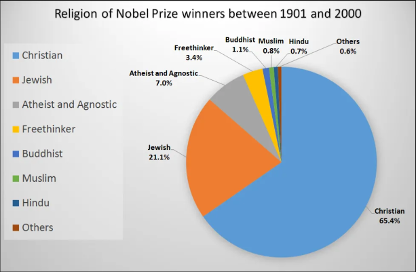
Pie Chart distributing the religion of nobel prize winners between 1901 and 2000.
Source: https://commons.wikimedia.org/wiki/File:Religion_of_Nobel_Prize_winners.png
[This Chart depicts the] “Distribution of Nobel Prizes by religion between 1901–2000, the data tooks [sic] from Baruch A. Shalev, 100 Years of Nobel Prizes (2003), Atlantic Publishers & Distributors, p.59 and p.57: between 1901 and 2000 reveals that 654 Laureates belong to 28 different religion. Most 65.4% have identified Christianity in its various forms as their religious preference. Overall, Christians have won a total of 78.3% of all the Nobel Prizes in Peace, 72.5% in Chemistry, 65.3% in Physics, 62% in Medicine, 54% in Economics and 49.5% of all Literature awards.
Atheists, agnostics, and freethinkers comprise 10.5% of total Nobel Prize winners; but in the category of Literature, these preferences rise sharply to about 35%. A striking fact involving religion is the high number of Laureates of the Jewish faith — over 20% of total Nobel Prizes (138); including: 17% in Chemistry, 26% in Medicine and Physics, 40% in Economics and 11% in Peace and Literature each. The numbers are especially startling in light of the fact that only some 14 million people (0.2% of the world’s population) are Jewish. By contrast, only 5 Nobel Laureates have been of the Muslim faith-0.8% of total number of Nobel prizes awarded — from a population base of about 1.2 billion (20% of the world‘s population).”[2]
Before We Proceed
Before getting into the cognitive-dissonance-inducing quotes, let me make some caveats.
- The experts quoted here have different religious beliefs and affiliations.
- This list does not prove the existence of any God or truthfulness of any particular religion any [given] scientist professes.
- This also does not disprove atheism or any non-theist worldview, since, as mentioned at the beginning, there is a small percentage of non-theists that were and are Nobel prize winners.
- This list does not prove the opposite, namely, that the majority of scientist in these fields are religious. It might be the case that religious people are a minority.
- Finally, it just disproves the false assumption that faith in God and the supernatural impedes the progression of science (when in fact, it gave birth to science, but that might be a future post) or that science and faith are incompatible.
The list will be divided by fields for easy search with their respective sources. The experts range from different nationalities and times with no specific order. This list only composes the fields of chemistry, physics and medicine. Literature, economics and peace are not included. Without further ado, enjoy the quotes.
Chemistry
- “God did create the universe about 13.7 billion years ago, and of necessity has involved Himself with His creation ever since. The purpose of this universe is something that only God knows for sure, but it is increasingly clear to modern science that the universe was exquisitely fine-tuned to enable human life. We are somehow critically involved in His purpose.”
— Richard Smalley. Chemist.
— Nobel Prize: For the discovery of fullerenes.
— Source: Remarks by Richard Smalley at 2005 Alumni Banquet, Hope College.
- “Well, we are supposed to love the Lord our God with all our heart with all our mind and with all our strength. But that is separate from loving our neighbor as ourselves. It means that nature is God’s creation. So we should love nature and understand nature the best we can in order to show our love for the creator.”
— John B. Goodenough. Materials scientist, a solid-state physicist.
— Nobel Prize: For the development of lithium-ion batteries
— Source: Transcript of an interview with John B. Goodenough.
- “God is Truth. There is no incompatibility between science and religion. Both are seeking the same truth. Science shows that God exists.”
— Dereck Barton. Organic chemist.
— Nobel Prize: For his contribution to the development of the conformational analysis as an essential part of organic chemistry.
— Source: Barton, as cited in Margenau and Varghese 1997, Cosmos, Bios, Theos: Scientists Reflect on Science, God, and the Origins of the Universe, Life, and Homo sapiens, 144.
- “I think only an idiot can be an atheist. We must admit that there exists an incomprehensible power or force with limitless foresight and knowledge that started the whole universe going in the first place.”
— Christian Anfinsen. Biochemist.
— Nobel Prize: For his work on ribonuclease, especially concerning the connection between the amino acid sequence and the biologically active conformation.
— Source: Anfinsen, as cited in Margenau and Varghese, ‘Cosmos, Bios, Theos’, 1997, 139.
- “Certainly science, especially physics and chemistry, is a very important part of my identity. But I also consider myself a religious person, and in two senses: one, based on my liberal Jewish upbringing which I have passed on to my children; the other, a kind of nondenominational deism which springs from my awe of the world of our experiences and is heightened by my identity as a scientist. It also includes a conviction that science alone is an insufficient guide to life, leaving many deep questions unanswered and needs unfulfilled.”
— Walter Kohn. Physicist.
— Nobel Prize: For his work on the development of the density functional theory.
— Source: Reflections of a Physicist after an Encounter with the Vatican and Pope John Paul II (April 20, 2001, University of California, Santa Barbara)
Physics
- “This much I can say with definiteness — namely, that there is no scientific basis for the denial of religion — nor is there in my judgment any excuse for a conflict between science and religion, for their fields are entirely different. Men who know very little of science and men who know very little of religion do indeed get to quarreling, and the onlookers imagine that there is a conflict between science and religion, whereas the conflict is only between two different species of ignorance.”
— Robert A. Millikan. Experimental physicist.
— Nobel prize: for his work on the elementary charge of electricity and on the photoelectric effect.
— Source: Autobiography (1950). Chapter 21: “The Two Supreme Elements in Human Progress”. p 279.
- “If we count the galaxies of the universe or demonstrate the existence of elementary particles, in an analog way we can’t probably have proof of the existence of God. But as a researcher, I’m deeply moved by the order and beauty I find in the cosmos and the interior of material things. As an observer of nature, I can’t help thinking there is a higher order. The idea that all this is the result of fortune or pure statistic diversity for me is completely unacceptable.”
— Carlo Rubbia. Physicist and director of the European Organization for Nuclear Research (CERN)
— Nobel Prize: For work leading to the discovery of the W and Z particles at CERN.
— Source: C. Rubbia, Neue Zürcher Zeitung, March 1993.
- “Science, with its experiments and logic, tries to understand the order or structure of the universe. Religion, with its theological inspiration and reflection, tries to understand the purpose or meaning of the universe. These two are cross-related. Purpose implies structure, and structure ought somehow to be interpretable in terms of purpose.”
— Charles H. Townes. Physicist.
— Nobel Prize: For fundamental work in the field of quantum electronics.
— Source: “Logic and Uncertainties in Science and Religion,” in Science and the Future of Mankind: Science for Man and Man for Science, pp. 296–309.
- “As we conquer peak after peak we see in front of us regions full of interest and beauty, but we do not see our goal, we do not see the horizon; in the distance tower still higher peaks, which will yield to those who ascend them still wider prospects, and deepen the feeling, the truth of which is emphasized by every advance in science, that ‘Great are the Works of the Lord’.”
— Joseph John Thomson. Physicist
— Nobel Prize: For the discovery of the electron.
— Source: Thomson 1909, Nature, vol. 81, p. 257
- “If there are a bunch of fruit trees, one can say that whoever created these fruit trees wanted some apples. In other words, by looking at the order in the world, we can infer purpose and from purpose we begin to get some knowledge of the Creator, the Planner of all this. This is, then, how I look at God. I look at God through the works of God’s hands and from those works imply intentions. From these intentions, I receive an impression of the Almighty.”
— Arno Penzias. Physics.
— Nobel Prize: For the discovery of the cosmic background radiation which substantiated Big Bang theory.
— Source: Penzias, as cited in ‘The God I Believe in’, Joshua O. Haberman editor, New York, Maxwell Macmillan International, 1994, 184
- “One way to learn the mind of the Creator is to study His creation. We must pay God the compliment of studying His work of art and this should apply to all realms of human thought. A refusal to use our intelligence honestly is an act of contempt for Him who gave us that intelligence.”
—Ernest Thomas Sinton Walton. Physicist.
— Nobel Prize: for his pioneering work on the transmutation of atomic nuclei by artificially accelerated atomic particles
— Source: V. J. McBrierty (2003): Ernest Thomas Sinton Walton, The Irish Scientist, 1903–1995, Trinity College Dublin Press.
- “Can a good scientist believe in God? I think the answer is: Yes. In the first place, a scientist, more than other scholars, spends his time observing nature. It is his task to help to unravel the mysteries of nature. He comes to marvel at these mysteries. Hence, it is not hard for a scientist to admire the greatness of the creator of nature. From this it is only a step to adore God.”
—Victor Franz Hess. Physicist
— Nobel Prize: For the discovery of cosmic rays.
— Source: The American Weekly. “My Faith”. November 3, 1946.
- “The book of nature which we have to read is written by the finger of God.”
—Michael Faraday. Scientist.
— Nobel Prize: For establishing the existence of the magnetic field, discovered electrolysis, diamagnetism, electromagnetic induction and benzene.
— Source: Seeger, Raymond. 1983. “Faraday, Sandemanian,” in The Journal of the American Scientific Affiliation, 35 (June 1983): 101.
- “Both religion and science require a belief in God. For believers, God is in the beginning, and for physicists He is at the end of all considerations… To the former He is the foundation, to the latter, the crown of the edifice of every generalized world view.”
—Max Planck. Physicist. Founder of quantum physics.
— Nobel Prize: In recognition of the services he rendered to the advancement of Physics by his discovery of energy quanta.
— Source: Scientific Autobiography and Other Papers as translated by F. Gaynor (1949), p. 184 — Religion and Natural Science (1937)
- “In view of such harmony in the cosmos which I, with my limited human mind, am able to recognize, there are yet people who say there is no God. But what makes me really angry is that they quote me for support of such views.”
—Albert Einstein. Physicist.
— Nobel Prize: for his services to Theoretical Physics, and especially for his discovery of the law of the photoelectric effect.
— Source: Statement to German anti-Nazi diplomat and author Prince Hubertus zu Lowenstein around 1941, as quoted in his book Towards the Further Shore : An Autobiography (1968) — Attributed in posthumous publications.
- “Overpoweringly strong proofs of intelligent and benevolent design lie all around us; and if ever perplexities, whether metaphysical or scientific, turn us away from them for a time, they come back upon us with irresistible force, showing to us through Nature the influence of a free will, and teaching us that all living things depend on one ever-acting Creator and Ruler.”
—William Lord Kelvin. Physicist and mathematician. Founder of Thermodynamics and Energetics
— Nobel Prize: his achievements in thermodynamics.
— Source: Address of Sir William Thomson, Knt., LL.D., F.R.S, President,” in Report of the Forty-First Meeting of the British Association for the Advancement of Science, held at Edinburgh in August 1871, pages lxxxiv-cv., 100–101.
- “I believe in God, who can respond to prayers, to whom we can give trust and without whom life on this earth would be without meaning (a tale told by an idiot). I believe that God has revealed Himself to us in many ways and through many men and women, and that for us here in the West the clearest revelation is through Jesus and those that have followed him.”
—Nevill Francis Mott. Physicist.
— Nobel Prize: For his work on the electronic structure of magnetic and disordered systems, especially amorphous semiconductors.
— Source: Mott, as cited in Nevill Mott: Reminiscences and Appreciations, E.A. Davis — editor, London, Taylor & Francis Ltd, 1998, 329.
- “I believe in God. In fact, I believe in a personal God who acts in and interacts with the creation. I believe that the observations about the orderliness of the physical universe, and the apparently exceptional fine-tuning of the conditions of the universe for the development of life suggest that an intelligent Creator is responsible. I believe in God because of a personal faith, a faith that is consistent with what I know about science.”
—William D. Phillips. Physicist.
— Nobel Prize: For development of methods to cool and trap atoms with laser light.
— Source: Phillips, William D. 2002b. A letter to the compiler T. Dimitrov. May 19.
- “Those who say that the study of science makes a man an atheist, must be rather silly people.”
—Max Born, Physicist.
— Nobel Prize: For his fundamental research in quantum mechanics, especially for his statistical interpretation of the wavefunction.
— Source: Frederick E. Trinklein, The God of Science (Grand Rapids, MI: Eerdmans, 1971), 64.
- [When asked if he believed in God as a natural scientist] “Naturally, yes. I grew up as a strict Catholic, and I think that I benefited from that.”
—Peter Grünberg. Physicist.
— Nobel Prize: For his discovery with Albert Fert of giant magnetoresistance.
— Source: Cicero: Magazin für Politische Kultur, December 2007.
- “For myself, faith begins with the realization that a supreme intelligence brought the universe into being and created man. It is not difficult for me to have this faith, for it is incontrovertible that where there is a plan there is intelligence. An orderly, unfolding universe testifies to the truth of the most majestic statement ever uttered: ‘In the beginning God. . . ”
— Arthur Compton. Physicist.
— Nobel Prize: for his discovery of the effect named after him.
— Source: “Why I Believe in Immortality,” This Week, (Sunday supplement to the New Orleans’ The Sunday Item-Tribune; April 12, 1936), 5 ff. Reprinted in Christian Science Sentinel, 62: 32, (August 6, 1960), 1411.
- “In the history of science, ever since the famous trial of Galileo, it has repeatedly been claimed that scientific truth cannot be reconciled with the religious interpretation of the world. Although I am now convinced that scientific truth is unassailable in its own field, I have never found it possible to dismiss the content of religious thinking as simply part of an outmoded phase in the consciousness of mankind, a part we shall have to give up from now on. Thus in the course of my life I have repeatedly been compelled to ponder on the relationship of these two regions of thought, for I have never been able to doubt the reality of that to which they point.”
— Werner Karl Heisenberg. Theoretical physicist.
— Nobel Prize: For the creation of quantum mechanics.
— Source: Heisenberg, Scientific and Religious Truth (1973)
- “It seems to me that when confronted with the marvels of life and the universe, one must ask why and not just how. The only possible answers are religious. . . I find a need for God in the universe and my own life.”
— Arthur L. Schawlo. Physicist.
— Nobel Prize: for their contribution to the development of laser spectroscopy.
— Source: H. Margenau, Cosmos, Bios, Theos: Scientist Reflect on Science, God, and the Origins of the Universe, Life, and Homo Sapiens (1992).
- “I think both science and religion are necessary to understand our relation to the Universe. In principle, Science tells us how everything works, although there are many unsolved problems and I guess there always will be. But science raises questions that it can never answer. Why did the big bang eventually lead to conscious beings who question the purpose of life and the existence of the Universe? This is where religion is necessary.”
— Antony Hewish. Radio astronomer
— Nobel Prize: For their pioneering research in radio astrophysics: Ryle for his observations and inventions, in particular of the aperture synthesis technique, and Hewish for his decisive role in the discovery of pulsars.
— Source: Antony Hewish, “A letter to the compiler T. Dimitrov. May 27” (2002).
Medicine
- “I have said for years that speculations about the origin of life lead to no useful purpose as even the simplest living system is far too complex to be understood in terms of the extremely primitive chemistry scientists have used in their attempts to explain the unexplainable that happened billions of years ago. God cannot be explained away by such naive thoughts.”
— Ernst Boris Chain. Biochemist.
— Nobel Prize: for the discovery of penicillin and its curative effect in various infectious diseases.
— Source: Chain, as cited in The Life of Ernst Chain: Penicillin and Beyond by Ronald W. Clark, London, Weidenfeld & Nicolson, 1985, 147–148.
- “Only the scientist manages to understand something of that mysterious language that God has written in Nature; and it has only been given to him to unravel the marvelous work of Creation in order to render to the Absolute the most pleasant and accepted cult, that of studying his portentous works, in order to know, admire and revere him in and through them.” [Translated by me from Spanish to English]
— Santiago Ramon y Cajal. Neuroscientist, pathologist, and histologist.
— Nobel Prize: In recognition of his work on the structure of the nervous system.
— Source: Reglas y consejos sobre la investigación científica. Los tónicos de la voluntad.
- “…[N]o scientific discovery was so fraught with significance as the revelation of the law of love by Jesus the Crucified. For this law is, in fact, that of the survival of human societies.”
— Alexis Carrell. Surgeon and biologist.
— Nobel Prize: For his work on vascular suture and the transplantation of blood vessels and organs
— Source: Reflections on Life, 1952, Chap. 3, Part 6
- “Science and religion are very much alike. Both are imaginative and creative aspects of the human mind. The appearance of a conflict is a result of ignorance. We come to exist through a divine act. That divine guidance is a theme throughout our life; at our death the brain goes, but that divine guidance and love continues. Each of us is a unique, conscious being, a divine creation. It is the religious view. It is the only view consistent with all the evidence.”
— Sir John Carew Eccles. Neurophysiologist and philosopher.
— Nobel Prize: For his discoveries concerning the ionic mechanisms involved in excitation and inhibition in the peripheral and central portions of the nerve cell membrane.
— Source: The Intellectuals Speak Out About God: A Handbook for the Christian Student in a Secular Society (1984). p 50.
- “Is the Church inimical to science? Growing up as a Catholic and a scientist — I don’t see it. One truth is revealed truth, the other is scientific truth. If you really believe that creation is good, there can be no harm in studying science. The more we learn about creation — the way it emerged — it just adds to the glory of God. Personally, I’ve never seen a conflict.”
— Joseph Murray. Professor of Surgery at Harvard Medical School; chief plastic surgeon at Children’s Hospital Medical Center, Boston.
— Nobel Prize: For work that “proved to a doubting world that it was possible to transplant organs to save the lives of dying patients.”
— Source: National Catholic Register (December 1–7, 1996) (Murray, as cited in Meyer 1996)
- “When it comes to the origin of life there are only two possibilities: creation or spontaneous generation. There is no third way. Spontaneous generation was disproved one hundred years ago, but that leads us to only one other conclusion, that of supernatural creation. We cannot accept that on philosophical grounds; therefore, we choose to believe the impossible: that life arose spontaneously by chance!”
— George Wald. Professor of Biology at Harvard University (1948–1977).
— Nobel Prize: For his work on the biochemistry of vision.
— Source: George Wald, 1954, “The Origin of Life,” Scientific American, 191 [2]: 48. [It should be noted he was an atheist when he said this. He later become a deist.]
- “This day relenting God Hath placed within my hand A wondrous thing; and God Be praised. At His command, Seeking His secret deeds With tears and toiling breath, I find thy cunning seeds, O million-murdering Death. I know this little thing A myriad men will save. O Death, where is thy sting? Thy victory, O Grave?”
— Ronald Ross. Professor of Tropical Medicine at Liverpool University (1902–1912); Vice President of the Royal Society (1911–1913).
—Nobel Prize: For his remarkable work on malaria. This poem was written on August 20, 1897, the same day he made his landmark discovery that malaria is transmitted to people by Anopheles mosquitoes.
— Source: Ronald Ross, Memoirs, London, John Murray, 1923, 226.
Hopefully, these quotes are sufficient to convince you that such conflict is nonexistent. Therefore, keep believing. Keep inquiring.
Am I missing someone? If you know any Lauret scientist in any of these categories that is not in the list, but you think it should, comment his/her name with title, why it was given the prize and a verified quote with source.
Some information presented in this list was collected form the free eBook 50 Nobel Laureates and Other Great Scientists Who Believe In God. This eBook includes the field of literature, economics and peace.
References:
[1] Editor’s Note: “Scientism” is the idea that science is the sole arbiter of knowledge, everything is else is subjective opinion, fiction, or foolishness. “Naturalism” is the idea that the only thing/s that exist is nature; there is no supernatural realm.
[2] https://commons.wikimedia.org/wiki/File:Religion_of_Nobel_Prize_winners.png
Recommended Resources:
Why Science Needs God by Dr. Frank Turek (DVD and Mp4)
Science Doesn’t Say Anything, Scientists Do by Dr. Frank Turek (DVD, Mp3, and Mp4)
Oh, Why Didn’t I Say That? Does Science Disprove God? by Dr. Frank Turek (DVD and Mp4)
I Don’t Have Enough Faith to Be an Atheist (Paperback), and (Sermon) by Norman Geisler and Frank Turek
Miguel Rodriguez is the founder of Smart Faith, a platform dedicated to helping Christians defend their faith with clarity and confidence. After experiencing a miraculous healing at 14, he developed a passion for knowing God through study and teaching. He now serves as the Director of Christian Education and a Bible teacher at his local church while also working as a freelance email marketer. Living in Orlando, Florida, with his wife and two daughters, Miguel seeks to equip believers with practical and intellectual tools to strengthen their faith. Through Smart Faith, he provides apologetics and self-improvement content to help Christians live with wisdom and integrity.
Originally posted at: https://bit.ly/3Zuhby7