Tag Archive for: Ryan Leasure

By Ryan Leasure

If you’ve ever spent time talking with skeptics about the Bible, they’ve more than likely brought up Old Testament laws that appear out of step with our “modern ideals.” For example, many suggest that the Bible treats women like chattel (property) and promotes misogyny. Then they’ll quote verses that appear, on the surface, to make women out to be second-class citizens.

But does the Bible really promote the idea that women are no better than chattel? Does Scripture declare women as the inferior gender? The truth is, it doesn’t, and I can explain why.

God’s Ideals Vs. Case Laws

Typically, those who reject Christianity rush to various case laws to make their point that Scripture is fundamentally against women. Looking to case laws, instead of God’s ideals, is a huge mistake, though. To be fair, the skeptic usually doesn’t know the difference, and you might not either. So allow me to distinguish between the two.

God’s Ideals

God’s ideals refer to his straight forward commands or principles he prescribes in Scripture. That is, these ideals reflect God’s heart on the matter and are universal in scope. Let me give you a few examples with respect to women:

God created man in his own image, in the image of God he created him; male and female he created them. — Genesis 1:27

For this reason a man shall leave his father and his mother, and be joined to his wife; and they shall become one flesh. — Genesis 2:24

Every one of you shall reverence his mother and his father. — Leviticus 19:3

He who finds a good wife finds a good thing and obtains favor from the LORD. — Proverbs 18:22

What do we learn about God’s attitude toward women? They are made in his image, should not share their husbands with any other women, deserve respect from their children, and are a sign of God’s favor to their husbands. In other words, God loves women and values them just as much as he values men.

Case Laws

Case laws are different from God’s ideals in that they only refer to specific situations and are not universal in scope. And in many instances, these case laws never assume that God’s ideals have been met. Instead, they assume that moral concessions have been made and then try to make the best out of that less than ideal situation. Let me give you an example of a case law:

If a man has two wives, the one loved and the other unloved, and both the loved and the unloved have born him sons, if the firstborn son belongs to the unloved, then it shall be in the day he wills what he has to his sons, he cannot make the son of the loved the firstborn before the son of the unloved, who is the firstborn. But he shall acknowledge the firstborn, the son of the unloved, by giving him a double portion of all that he has, for he is the beginning of his strength; to him belongs the right of the firstborn. — Deuteronomy 21:15-17

Notice that this case law refers to a polygamous situation (If the man has two wives). In other words, this man has disregarded God’s ideal for monogamous marriage (Gen. 2:24). Now that the deed is done, how should Israel make the best of this messy situation?

You might say he should divorce one of his wives to get back to monogamous marriage. But which one? And once she’s divorced, will anyone want to marry her since she’s no longer a virgin? Furthermore, how will she provide for herself? As you can see, it’s not so simple.

Instead, for the sake of the women’s protection, God says for everyone to stay put. And in this particular case law, God says that the firstborn child, regardless of whether he comes from the favorite wife or not, should receive the firstborn’s inheritance.

This is not ideal. Polygamy is always wrong (more on that in a minute). But now that the man already violated God’s ideals, the law attempts to make the best out of an already messy situation.

Prescription Vs. Description

Another reason people assume the Bible is misogynistic is because they don’t distinguish between descriptive and prescriptive texts. As with case laws, people will misunderstand God’s heart on the matter if they don’t understand what kind of text they’re reading.

Prescriptive

Prescriptive texts are ones where God gives a clear command — or prescribes — how people are to live in relation to him. With respect to polygamy, here are some examples of prescriptive texts:

For this reason a man shall leave his father and his mother, and be joined to his wife; and they shall become one flesh. — Genesis 2:24

[The king] must not take many wives, or his heart will be led astray. — Deuteronomy 17:17

And you shall not take a woman as a rival wife to her sister, uncovering her nakedness while her sister is still alive. — Leviticus 18:18

Again, God’s ideal that he clearly prescribes is that a man marry only one wife. This is not only true for the kings of Israel (Deut. 17:17); it is true for all men everywhere (Gen. 2:24).

Descriptive

Because the Bible contains so much historical content, many texts describe certain immoral actions. With respect to polygamy, we find several instances in the Old Testament, where men have multiple wives. This would seem to support the notion that Scripture promotes treating women like chattel, but that would be a mistake.

This would be a mistake because the Bible never prescribes polygamous relationships. It describes them. It describes Lamech (the first polygamist), who had no intention of obeying the Lord’s commands. Scripture describes Jacob, David, Solomon, and others, who disregarded God’s prescribed law (Gen. 2:24, Deut. 17:17, Lev. 18:18). All the while, in each case where men ignore God’s prescribed ideal, we witness disharmony, strife, and pain.

In short, just because we read about men treating women like chattel doesn’t mean that’s how God feels about them. God made women in his image and loves them as he loves men.

What About The Bride-Price?

When skeptics talk about the Old Testament bride-price, they make it sound equivalent to buying a mule (chattel) at a public auction. In reality, it reflected no such thing.

The bride-price was a payment that the groom’s father made to the wife’s father and signified that the groom had serious intentions to marry his bride. That is, he wasn’t entering this relationship lightly.

This payment not only strengthened the relations between the two families, but it also provided compensation for the work the woman would have otherwise contributed to her family. Additionally, the payment served as a safety net for the family if the husband ever died or lost his ability to provide financially.

Here is an example of a case law that speaks of the bride-price:

If a man seduces a virgin who is not engaged, and lies with her, he must pay a dowry for her to be his wife. If her father absolutely refuses to give her to him, he shall pay money equal to the dowry for virgins. — Exodus 22:16-17

Again, here is an example of a less than ideal situation (case law). But notice that this law blames the man, not the woman. The man seduced a virgin, and because of that, the law says he needs to pay up with the bride-price.

Skeptics argue that this act makes women out as chattel, but the intent of this law is actually for their protection. You see, women who weren’t virgins had a much harder time getting married in that culture, and therefore, their economic future would have been in jeopardy. Requiring the man to pay the bride-price and marry the woman actually protected her in the long run.

The father, however, had the right to refuse his daughter while at the same time collecting the bride-price since the man was guilty in the matter. Ultimately if the father and the daughter agreed to it (Gen. 24), she could marry the man and have financial security for the rest of her life.

Women As Chattel?

An elementary reading of the text might lead some to conclude that the Bible is misogynistic. When one understands a few basic hermeneutical principles, however, one discovers the Bible is actually for, not against women.

Recommended resources related to the topic:

LifeGivers Apologetics: Women Designed and Equipped to Share Reasons for the Hope Within (Book/ Study Guide – Teacher’s Version and Student’s Version) by Tricia Scribner

Major Truths from the Minor Prophets (Book) by Edna Ellison, Kimberly Sowell & Tricia Scribner

Woman to Woman: Preparing Yourself to Mentor (Book) by Edna Ellison & Tricia Scribner


Ryan Leasure holds a Master of Arts from Furman University and a Masters of Divinity from the Southern Baptist Theological Seminary. Currently, he’s a Doctor of Ministry candidate at the Southern Baptist Theological Seminary. He also serves as a pastor at Grace Bible Church in Moore, SC.

Original Blog Source: https://bit.ly/36XgtNo 

By Ryan Leasure

In The Origin of Species, Charles Darwin argued that “all the organic beings which have ever lived on this earth have descended from someone primordial form.”1 Darwin suggested that this primordial life form gradually developed into new life forms, which subsequently developed more life forms, eventually producing all the complex life forms we see today.

In short, Darwin asserted that all life descended from a common ancestor. And starting from that original ancestor, he believed nature selected the fittest species which would survive, reproduce, and last for generations. At the same time, nature would sift out the weaker species.

Darwin famously pictured the history of life as a tree. The first life form was the trunk, and all subsequent life forms are the branches. He was certain that the progression of life takes no sudden leaps, but evolves gradually with small-scale variations.

There was one small problem, though. When Darwin proposed his theory, some of the leading paleontologists rejected his theory based on the fossil record. More specifically, they didn’t believe Darwin’s theory could be reconciled with the Cambrian Explosion.

The Cambrian Explosion

The Cambrian Explosion refers to the abrupt appearance of animal life forms in the geological strata without any trace of prior transitional fossils. During this phenomenon, most of the major animal phyla appear in the strata in a geological blink of an eye.

Darwin was aware of the Cambrian Explosion. He noted, “If my theory be true, it is indisputable that before the lowest [Cambrian] stratum was deposited, long periods elapsed, as long as, or probably far longer than, the whole interval from the [Cambrian] age to the present day; and that during these vast, yet quite unknown, periods of time, the world swarmed with living creatures.”2 Meaning, if he’s right, we should find not just a few missing links, but innumerable links preceding the Cambrian era.

After all, Darwin adamantly declared that his theory could take no sudden leaps. He knew that large-scale variations inevitably resulted in deformity or death. Louis Agassiz, the leading paleontologist of Darwin’s day, put it this way: “It is a matter of fact that extreme variations finally degenerate or become sterile; like monstrosities, they die out.”3

Yet these Cambrian animals seemingly came out of nowhere. Of our twenty-seven different phyla — or macro-level animal classifications — at least twenty of them appear in the geological strata suddenly, not gradually as Darwin’s theory demands.4 Hence the name “Cambrian Explosion.”

So how did Darwin respond to this dilemma? He acknowledged, “To the question why we do not find rich fossiliferous deposits belonging to these assumed earliest periods prior to the Cambrian system, I can give no satisfactory answer… The case at present must maintain inexplicable, and may be truly urged as a valid argument against the views here entertained.”5

Darwin, however, was confident that future discoveries would vindicate his theory. Future geological discoveries have since come. Yet these discoveries continue to present fatal objections to his theory.

The Tree Turned Upside Down

Darwin’s tree of life suggests that small-scale differences among species would precede large-scale differences, eventually resulting in different phyla categories altogether. That is to say, as time progressed, and the branches formed, wholesale diversity would result among living species. Phyla categories would only emerge after lower classifications of animals — like species, orders, and families — evolved so much as to warrant macro-level distinctions.

Richard Dawkins put it this way: “What had been distinct species within one genus become, in the fullness of time, distinct genera within one family. Later, families will be found to have diverged to the point where taxonomists prefer to call them orders, then classes, then phyla.”6

Yet, the Cambrian Explosion turns this pattern on its head. Instead of species leading to families, orders, and eventually phyla, the Cambrian Explosion presents phyla first, followed by lower-level diversifications (microevolution).

The Burgess Shale, located along the Canadian Rockies and perhaps the most significant Cambrian dig in North America with more than a hundred thousand fossil discoveries, confirms this upside-down model. Stephen Meyer notes, “the large differences in form between the first animals appeared suddenly in the Burgess Shale, and the appearance of such disparity arose before, not after, the diversification of many representatives of lower taxonomic categories within each higher category, designating a new body plan.”7

Additionally, the Maotianshan Shale of southern China further confirms the upside-down model. Again, this site does not show the gradual emergence of species progressing toward the diversity of phyla. Rather, it shows full-scale diversity of phyla with subsequent diversification among the species.8

The Common Objection By Darwinists

Darwinists typically respond by suggesting that the older, Pre-Cambrian layers could not have preserved the transitional fossils. And they usually suggest one of two reasons. Either the fossils themselves were too small or soft to have fossilized, or the quality of the sedimentary rock was not conducive for preserving fossils.

Neither of these claims, though, holds muster. First, it has been repeatedly demonstrated that older sedimentary rocks have fossilized both small and soft organisms. In several places around the world, Pre-Cambrian rocks have fossilized single-celled algae and other eukaryotes.9 Further discoveries in Western Australia show Pre-Cambrian rocks preserved fossilized bacteria of various kinds.

The Maotianshan Shale also preserved a great variety of Pre-Cambrian soft-bodied organism. Archeologist J. Y. Chen found several animals lacking exoskeletons, including corals, sponges, jellyfish, and worms. Chen and his colleague Paul Chien even discovered sponge embryos.

If the sedimentary rock can preserve soft-celled embryos, surely it could preserve the ancestors of the Cambrian animals. It should also be noted that many paleontologists call into question the claim that the ancestors of these hard-shelled animals would have been soft since the hard parts are necessary to protect their soft parts. In other words, the ancestors of these hard-shelled animals would have required a hard-shell to survive in nature. So, the soft-bodied hypothesis is far from certain. Be that as it may, the data still suggests that soft-bodied animals should have fossilized.

Conclusions From The Cambrian Explosion

Darwinism still dominates the biological landscape. But I believe the Cambrian Explosion gives us reason to pump the breaks.

As I’ve studied the Darwinian model, it seems to me that the strongest argument in favor of it is the similarity of genetic information across all living species. Meaning, the closeness of DNA and RNA suggests we all share a common ancestor. While this could be true, it’s also true that similarities in genes could suggest a common designer. For example, when one purchases a set of pots and pans, they all look similar despite their different sizes and shapes. The similarities of the handles and types of metal demonstrate not that they evolved from a common ancestor but that they share a common designer.

Meaning, the genetic similarities among living species is up for interpretation. It’s speculation at best. But the fossil record — especially the Cambrian Explosion — presents us with hard data that is difficult to square with Darwinism. Instead of slow, gradual variations, we see sudden leaps of full-bodied animals without any trace of transitional fossils below.

Darwin knew the Cambrian Explosion didn’t support his theory. But he hoped that future geological discoveries would vindicate him. The Burgess and Maotianshan Shale discoveries, however, create an even larger problem than he realized. For these reasons, I believe we have good grounds to doubt Darwinian evolution.

Recommended resources related to the topic:

Science Doesn’t Say Anything, Scientists Do by Dr. Frank Turek (DVD, Mp3, and Mp4)

Oh, Why Didn’t I Say That? Does Science Disprove God? by Dr. Frank Turek (DVD and Mp4)

Stealing From God by Dr. Frank Turek (Book)

Defending Creation vs. Evolution (mp3) by  Richard Howe

Exposing Naturalistic Presuppositions of Evolution (mp3) by Phillip Johnson

Macro Evolution? I Don’t Have Enough Faith to be a Darwinist (DVD Set) (MP3 Set) and (mp4 Download Set) by Dr. Frank Turek.

Darwin’s Dilemma (DVD) by Stephen Meyer and others

Inroad into the Scientific Academic Community (mp3) by Phillip Johnson

Public Schools / Intelligent Design (mp3) by Francis Beckwith

Answering Stephen Hawking & Other Atheists MP3 and DVD by Dr. Frank Turek 


Ryan Leasure holds a Master of Arts from Furman University and a Masters of Divinity from the Southern Baptist Theological Seminary. Currently, he’s a Doctor of Ministry candidate at the Southern Baptist Theological Seminary. He also serves as a pastor at Grace Bible Church in Moore, SC.

Original Blog Source: https://bit.ly/2WtntOz

 Ryan Leasure 

In his book Pale Blue Dot, the late astronomer Carl Sagan had this to say about the above photograph taken aboard Voyager I:

Because of the reflection of sunlight… Earth seems to be sitting in a beam of light as if there were some special significance to this small world. But it’s just an accident of geometry and optics… Our posturings, our imagined self-importance, the delusion that we have some privileged position in the Universe, are challenged by this point of pale light. Our planet is a lonely speck in the great enveloping cosmic dark. In our obscurity, in all this vastness, there is no hint that help will come from elsewhere to save us from ourselves.

Sagan reiterates what is commonly known as the Copernican Principle, or the Principle of Mediocrity. It’s the idea that earth and by extension human beings aren’t significant in the grand scheme of things. We’re just a random speck of dust revolving around an average star in the corner of an average galaxy.

Sagan was so confident of his view that he predicted the Milky Way galaxy probably contains as many as a million advanced civilizations. But is this a reasonable conclusion? I think it’s unlikely. In fact, the more we learn about the requirements for habitability, the less probable life in other places becomes. To demonstrate this claim, I want to highlight seven different habitability requirements — or habitable zones — that are necessary for advanced life to exist in the universe. As far as we know, the earth is the only planet to meet all the requirements.

The Right Kind Of Galaxy

The Right Kind Of Galaxy

Astronomers have placed galaxies into three categories — spiral, elliptical, and irregular. Of these three, only spiral galaxies can support life. Elliptical galaxies contain mostly ancient stars that lack necessary resources — like heavy elements — that life needs. Additionally, because of the shape of elliptical galaxies, and the close proximity of the stars, stable planetary orbits are impossible.

Similarly, irregular galaxies lack the necessary qualities for habitability. For starters, their irregular shape leads to chaotic stellar and planetary orbits which result in planets colliding or brushing too closely to ultra-violet emitting stars. Additionally, large irregular galaxies possess active nuclei which spew too much deadly radiation for life to exist. Conversely, small irregular galaxies lack the necessary heavy elements for habitability.

Only spiral galaxies can support life. And not just any spiral galaxy, but one that possesses the right size and structure that can yield heavy elements and protect a host planet from deadly radiation and gravitational disruptions along the spiral arms. It just so happens that the Milky Way meets these necessary requirements.

The Right Location In That Galaxy

Not only is the right kind of spiral galaxy necessary for habitability, but the location inside that galaxy is also just as important. And that location is close to the mid-plane of the galaxy about halfway between the galactic nucleus and the external edge.

If the earth’s solar system was closer to the nucleus, it would face the onslaught of radiation and overwhelming gravitational force from the galactic black hole nucleus. Moreover, this territory inside the galactic habitable zone contains trillions of comets, which combined with the erratic gravitational forces would inevitably lead to several comet collisions and wipe out any existing population. Conversely, stars located towards the outer galactic edge can only host small terrestrial planets that are too small to retain an atmosphere or sustain plate tectonics.

This galactic habitable zone is usually represented by a thin ring that circles around the Milky Way galaxy. Only stars that land on this narrow ring can realistically sustain life. Furthermore, our solar system is located in a safe place between the Sagittarius and Perseus spiral arms. Spiral arms are dangerous places with fluctuating radiation and erratic orbits. And as many astronomers have pointed out, this relatively gas and dust free environment proves to be the ideal location for viewing the universe and making further discoveries.

The Right Kind Of Star

The Right Kind Of Star

In addition to being in the right location of the galaxy, the star must possess the right qualities to support life. Of the stars located in the galactic habitable zone, about 3 percent of them have the right qualities for any kind of life to survive. In fact, to emit a sufficient level of ultra-violet radiation, the host star must be virtually identical to the sun. Larger stars than our sun give off extreme variations of UV radiations, as do smaller stars than the sun. Our sun is also metal-rich compared to most stars making it possible to host planets like earth.

While it’s true that the sun is an average star (a yellow dwarf) as far as size goes, its average quality is essential for life. In addition to emitting erratic levels of UV radiation, larger stars burn their fuel faster and have shorter life spans — too short to host advanced life. On the other hand, smaller stars, like red dwarfs, give off such low levels of energy that a planet would have to orbit extremely close to it. This close proximity inevitably leads to tidal locking where one side of the planet bakes in unending misery while the opposite side remains frozen in perpetual darkness.

The Right Distance From The Star

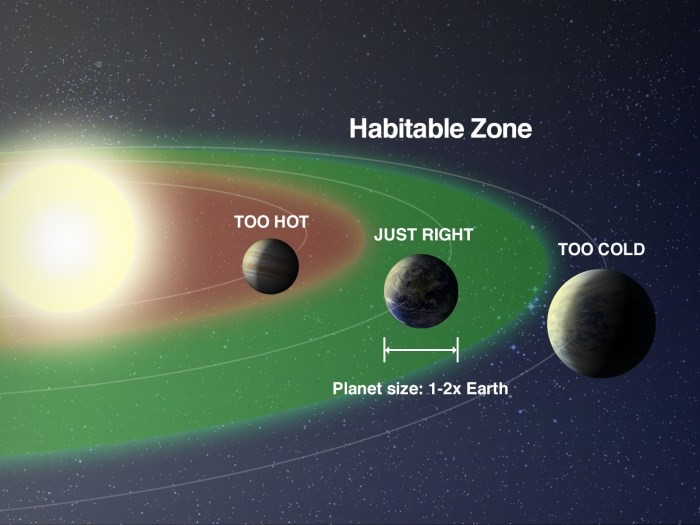
Next, for habitability to be possible, a planet must maintain liquid water. And this is only possible for planets that are the right distance from their host star. For example, if the earth were slightly closer to the sun, all water would evaporate. If it was slightly further away, all water would freeze. Furthermore, for water to remain, the planet must have the appropriate level of atmospheric pressure.

The planet must also receive the right amount of UV radiation, and much of this depends on its distance from that star. If it receives too little, vitamin D levels would be too low to produce strong bones, prevent cancer, and maintains healthy immune systems. On the flip side, if UV radiation were stronger, most if not all would suffer from skin cancer and bad eyesight.

Additionally, a planet must be the right distance from its host star for photosynthesis to occur. While some life-forms could exist without photosynthesis, large-bodied warm-blooded animals could not.

The proper distance also impacts its rotation rate. As I mentioned earlier, a planet that is close to its host star experiences tidal locking, meaning it does not rotate due to the intense gravitational force. This results in one side of the planet enduring an onslaught of heat and radiation while the opposite side remains perpetually in the cold dark. This kind of planet could not sustain life as it could not have liquid water. Conversely, if the earth rotated faster, we’d experience extreme temperatures and atmospheric winds that would make life virtually impossible.

The Right Kind Of Neighbors

While the other planets in our solar system aren’t suitable for life, they still serve a purpose in contributing to the earth’s own habitability. For starters, larger planets such as Jupiter and Saturn serve as earth’s bodyguards against comets or asteroid bombardments. Due to their size and relative force of gravity, these large gas giants act like giant vacuum cleaners for potentially dangerous collisions. Even smaller planets like Venus and Mars offer protection despite their limited gravity. Mars, for example, stands between us and an asteroid belt and has taken a few hits for us over the years.

Additionally, these other planets have contributed to important scientific discoveries. Johannes Kepler formulated his famous laws of planetary motion by observing these other planets. One of these discoveries was that planetary orbits are not circles but ellipses. And these discoveries served foundational for Newton’s laws of motion and gravity, which became the foundation for Einstein’s General Theory of Relativity.

The Right Kind Of Moon

Of the dozens of moons in our solar system, the moon if fifty times larger than any other moon compared to the mass of its host planet. Moreover, the moon orbits more closely to earth than any other large satellite yet discovered.

The size and proximity of the moon stabilize the earth’s rotation on its axis around 23.5 degrees. If the moon were smaller, like the Martian moons, the tilt would wobble about 30 degrees like Mars. The results of an unstable title would be catastrophic. If the North Pole, for example, were leaning more sunward during the summer, most of the Northern Hemisphere would experience months of scorching heat and perpetual daylight. Then in the winter months of the year, any survivors would experience extremely cold dark winters that would make Antarctica feel mild by comparison.

With no tilt, the earth would not experience seasons and rain distribution across the planet. The result would be large swaths of arid land uninhabitable for life.

It’s also worth noting that earth is the only place in our solar system where a perfect solar eclipse is possible. This phenomenon is possible because while the moon is four hundred times smaller than the sun, it is four hundred times closer making them both appear the exact same size from our vantage point. This phenomenon is highly coincidental if the earth is just a “pale blue dot.”

The Right Kind Of Planet

Finally, the right planet is also necessary for habitability. For example, life could not survive on a gas planet, but one made of rock. Additionally, this planet must have liquid water. But if the planet was perfectly smooth, the entire planet would be submerged in water. Fortunately, the earth has continents, mountain ranges, and valleys which allow for life to exist simultaneously with oceans and lakes. And this is made possible by plate tectonics. Yes, plate tectonics can be dangerous, but without them, life could not exist. And earth is the only planet in our solar system with plate tectonics.

A planet must also maintain a powerful, stable magnetic field. Without this protective fence, the earth’s atmosphere would eventually float away towards the sun making it impossible to sustain life. Of course, to maintain the right magnetic field requires the right internal composition of a rocky planet. Specifically, it requires a liquid iron outer core and a solid iron inner core.

Additionally, the planet must also have the right kind of atmosphere. In particular, the ozone shield is necessary for protecting a planet from receiving too much harmful radiation. Currently, earth’s ozone layer absorbs about 98 percent of the sun’s harmful UV radiation while allowing the beneficial radiation to pass through to earth’s surface. In this sense, the ozone layer acts as a shield or a type of sunscreen protecting us from too much of the sun’s radiation but allowing just enough beneficial for life.

Just A Pale Blue Dot?

So many are the requirements necessary for habitability that extraterrestrial life seems improbable. Back in the 1960s, when Sagan’s theory began to pick up steam, scientists launched the search for extraterrestrial intelligence (SETI). When the search began, scientists were convinced we would find advanced life on the moon or Mars. Now the search is more modest. They hope to find some kind of lower life form to an obscure moon orbiting Saturn that may or may not contain liquid water. In other words, the hundreds of millions of dollars invested in SETI have been spent to no avail.

Additionally, this search raises some important questions. If life really exists all over the universe, why haven’t they found us yet? After all, are we so conceited to think that we are the most advanced civilization? Surely, if millions of other civilizations exist, some of them would have greater capabilities than us.

Furthermore, good scientific theories are always falsifiable. But isn’t this theory unfalsifiable? At what point will those who say the universe is teeming with life say they were wrong? After sixty years of searching, they’re still saying, “Just give us more time. We’ll find it.” And they could keep saying it for a thousand years. In the end, the search for extraterrestrial life seems like a fools errand. So many are the conditions necessary for habitability. Earth appears to be pretty special after all.

Recommended resources related to the topic:

God’s Crime Scene: Cold-Case…Evidence for a Divinely Created Universe (Paperback), (Mp4 Download), and (DVD Set) by J. Warner Wallace

God’s Crime Scene: The Case for God’s Existence from the Appearance of Design (mp4 Download Set) by J. Warner Wallace 

God’s Crime Scene: The Case for God’s Existence from the Appearance of Design in Biology DVD Set by J. Warner Wallace 

What is God Like? Look to the Heavens by Dr. Frank Turek (DVD and Mp4

I Don’t Have Enough Faith to Be an Atheist (Paperback), and (Sermon) by Norman Geisler 


Ryan Leasure holds a Master of Arts from Furman University and a Masters of Divinity from the Southern Baptist Theological Seminary. Presently, he’s working on a Doctor of Ministry degree from the Southern Baptist Theological Seminary. He also serves as a pastor at Grace Bible Church in Moore, SC.

Original Blog Source: https://bit.ly/3e7HgtE

By Ryan Leasure

One of my favorite arguments for God’s existence is the Kalam Cosmological Argument. While this argument has historical roots, contemporary Christian philosopher William Lane Craig has popularized it more recently. The argument goes like this:

  1. Everything that begins to exist has a cause.
  2. The universe began to exist.
  3. Therefore, the universe has a cause.

This is a logically airtight argument. That is, if we can demonstrate that both premise (1) and (2) are true, the conclusion (3) necessarily follows as true. Let’s consider the premises in turn.

(1) Everything That Begins To Exist Has A Cause.

This first premise seems intuitively obvious. To reject it, one would have to posit that something can come from nothing. But that view has to be the height of absurdity. Nothing can’t produce anything. After all, our own experiences and scientific observations tell us that things just don’t pop into existence uncaused. None of us, for example, have ever experienced a new Corvette popping into existence in our driveways, as nice as that would be. Additionally, if things can pop into existence uncaused, then it remains inexplicable as to why this doesn’t happen all the time.

As one might imagine, most embrace this premise, although a few have sought to refute it over the years. Quentin Smith, for example, suggests that “the most reasonable belief is that we came from nothing, by nothing, and for nothing.”1 But I must confess, I’m not sure I understand how this is possible. How did we come from nothing? How did nothing have the capability of causing anything at all?

If prior to the existence of the universe, nothing existed – including space, time, matter, or God – how did the universe come to be? People, like Quentin Smith, must violate everything we know about the cause and effect relationship in our universe to adopt this position. Even the great skeptic David Hume once remarked, “I never asserted so absurd a proposition as that anything might arise without a cause.”2

To get around this metaphysical impossibility, skeptic Lawrence Krauss suggests that the universe came into being from nothing. But then he goes on to explain that “nothing” is really a quantum vacuum of fluctuating energy. And as many have already pointed out, Krauss equivocates on the word nothing. After all, a quantum vacuum of fluctuating energy isn’t no-thing. It’s something. One still needs to explain how this vacuum came to be.

Additionally, others have adopted the position that premise (1) is true for all things inside the universe, but it’s not necessarily true of the universe itself. The problem with this view is that it commits the taxicab fallacy. That is to say, it adopts the standard cause and effect principle when it’s convenient but then hops off — like one would a taxi — once it gets to its desired destination. Not only is this view logically inconsistent, it assumes that the causal principle is only true of the material world. But the cause and effect principle is a metaphysical principle, in that it’s true for all reality. Being cannot come from nonbeing.

Finally, the last objection to premise (1) usually comes in the form of a question: “Who caused God?” But this misunderstands the premise. The premise doesn’t state that “whatever exists has a cause.” Rather it states that “whatever begins to exist has a cause.” And theists have maintained that God has never had a beginning. He exists eternally by necessity. If he doesn’t, then he’s not God. This is what we mean when we say “God.” If he owes his existence to an external cause, that external cause would be God. So asking the question, “who caused God?” doesn’t help the skeptic get around premise (1). Theists have maintained for millennia now, that God is necessarily eternal. And to ask, “what caused him?” misunderstands our position.

(2) The Universe Began To Exist.

Since it’s difficult to disprove premise (1), many skeptics set their sights on premise (2) which asserts that the universe began to exist. In a previous post, I laid out scientific evidence which suggests the universe is not eternal. In this post, however, I want to focus on the philosophical reasons for rejecting a past-eternal universe.

To get around premise (2), the skeptic must maintain that the physical universe has existed for all eternity and has thus existed for an infinite number of moments. However, while we use infinity in mathematical or theoretical worlds, infinity, in reality, is impossible as it results in all sorts of logical absurdities.

Think, for example, about a meter stick that you divide in halves forever. Could you divide the meter stick in half an infinite number of times? How do you know the point at which you cross the threshold of a natural number to infinity? And if you reach infinity, isn’t it true that you could subdivide the meter stick one more time?

Perhaps the most famous example demonstrating the absurdity of infinity, in reality, is David Hilbert’s thought experiment — Hilbert’s Hotel. Hilbert told us to imagine a hotel with an infinite number of rooms. Additionally, he said to imagine that all the rooms are occupied so that not a single room is vacant. Now, suppose a guest comes to the check-in desk and asks for a room. The manager says, “yes, of course, you can have a room.” He then proceeds to move the person in room #1 to room #2, and the person in room #2 to room #3, and the person in room #3 to room #4, and so forth to infinity. He then takes the new guest and places them in the vacant room #1. But remember, before the guest showed up, the infinite number of rooms were already occupied.

Now, Hilbert says to suppose an infinite number of guests show up to a fully occupied hotel asking for a room. “Of course, the manager says.” He then proceeds to move the person in room #1 to room #2, and the person in room #2 to room #4, and the person in room #3 to room #6, and so forth to infinity, always putting the previous occupants in a room number twice their original one. Because all the former occupants now reside in even-numbered rooms, the infinite number of new guests all go into the odd-numbered rooms. Remember, though, before the infinite number of guests arrived, all the infinite number of rooms were occupied.

In the first example, we already had an infinite number of guests, but we were able to add one more. So, the equation would look something like this: infinity + 1 = infinity. In the second example, we had an infinite number of guests already staying in the hotel before adding another infinite number of guests. This equation would look like this: infinity + infinity = infinity. Despite adding a different amount to infinity in both equations, we still ended up with the same sum of infinity. The mathematical impossibility of such a hotel demonstrates the absurdity of an actual infinity in reality.

Consider another example. The medieval philosopher al-Ghazali asks us to imagine both Jupiter and Saturn orbiting the sun from eternity past. If for every time Saturn orbits the sun, Jupiter orbits it 2.5 times, which planet has orbited the sun more times? Well, if both planets have been orbiting from eternity past, the answer is that they’ve both orbited the sun the same amount — infinity. But doesn’t that seem absurd? In fact, we know that the higher the number of orbits, the greater the discrepancy that exists between the two. But if Saturn has orbited an infinite number of times, even though Jupiter has been orbiting 2.5 times for every Saturn orbit, they’ve both orbited the sun the same amount.

These illustrations help demonstrate that an actual infinite number, in reality, is impossible. And if an actual infinity is impossible, the universe could not exist for an infinite number of moments.

These absurdities raise another significant problem for the person who wants to reject premise (2). And that problem is that it’s impossible to traverse the infinite. Put another way; if the universe has existed for an infinite number of days, we could never arrive at today because that would mean infinity came to an end. But infinity can’t come to an end. That’s what it means to be infinity.

Or think about it another way. Before we can arrive at today, yesterday would have to occur, and the day before that, and the day before that, and so on to infinity. But how does one know when we’ve reached infinity in the past? There’s no point at which we could start counting the days backward to today. That would be like counting all the negative numbers from infinity back to zero.

Interestingly, many skeptics acknowledge our universe isn’t past eternal based on the scientific evidence. A lot of these same skeptics, however, attempt to get around this problem by suggesting an eternal multiverse. But the absurdity of infinity still applies to a multiverse. It’s impossible to traverse an infinite number of points in any physical universe, even one beyond our ability to detect. So, the skeptic still faces the same problem.

In sum, since it’s absurd to suggest that the universe has existed for an infinite number of moments, the universe must have begun to exist a finite time ago.

(3) Therefore, The Universe Has A Cause.

Since whatever begins to exist has a cause (1), and the universe began to exist (2), it follows necessarily that the universe has a cause (3). Based on this argument, what can we know about the nature of this cause?

First, whatever caused the universe must come from outside the universe itself. That is to say, it must transcend the natural world.

Meaning, this cause must be spaceless, timeless, and immaterial since space, time, and matter all came into existence at the beginning of the universe. Especially relevant to this argument is that the cause is timeless and, therefore, never had a beginning. Now, the skeptic might object that a past eternal cause faces the same dilemma of a past eternal universe. But he would be mistaken because the cause of the universe exists outside of, or independent of, time. That is to say, this cause existed in a timeless state and thus hasn’t traversed over an infinite number of points.

The cause must also be personal. We reach this conclusion based on the fact that there are only two possibilities for a spaceless, timeless, and immaterial entity — either an abstract object like a number or an unembodied mind. But abstract objects don’t possess causal power. They can’t do anything. This leaves a conscious mind who made a free will choice to create as the best explanation.

Finally, based on the size and complexity of our universe, this spaceless, timeless, immaterial, personal being must be all-powerful and extremely intelligent. And this being is what theists refer to as God.

Recommended resources related to the topic:

How Old is the Universe? (DVD), (Mp3), and (Mp4 Download) by Dr. Frank Turek 

God’s Crime Scene: Cold-Case…Evidence for a Divinely Created Universe (Paperback), (Mp4 Download), and (DVD Set) by J. Warner Wallace

God’s Crime Scene: The Case for God’s Existence from the Appearance of Design (mp4 Download Set) by J. Warner Wallace 

God’s Crime Scene: The Case for God’s Existence from the Appearance of Design in Biology DVD Set by J. Warner Wallace 

What is God Like? Look to the Heavens by Dr. Frank Turek (DVD and Mp4)


Ryan Leasure holds a Master of Arts from Furman University and a Masters of Divinity from the Southern Baptist Theological Seminary. Presently, he’s working on a Doctor of Ministry degree from the Southern Baptist Theological Seminary. He also serves as a pastor at Grace Bible Church in Moore, SC.

Original Blog Source: http://bit.ly/2SLyGqu

By Ryan Leasure

An untrained eye might miss it, but the Old Testament, properly read, points to Jesus. From Genesis forward, we see reference after reference to a coming Messiah who would one day crush the head of the serpent (Gen. 3:15).

Certainly the covenants with both Abraham (Gen. 12, 15, 17) and David (2 Sam. 7) point to a coming Messiah, but it’s another covenant mediator I want to draw our attention to — Moses. Outside of Abraham, Moses is probably the most significant figure in the Old Testament, because it was through Moses that God gave his Law to the nation of Israel.

As special as Moses was, though, God promised Israel that he would send another prophet who was going to be just as, if not more, significant than Moses himself.

The Promise of A Future Prophet Like Moses

As Israel approached the end of its forty years in the wilderness, God made a promise to them about a future prophet to come. We read Moses’ words in Deuteronomy 18:

The LORD your God will raise up for you a prophet like me from among you, from your fellow Israelites. You must listen to him… The LORD said to me: “I will raise up for them a prophet like you from among their fellow Israelites, and I will put my words in his mouth. He will tell them everything I command him” (v. 15-18).

I can only imagine that at this moment, Israel was fearful of what they were going to do after Moses departed. After all, the people relied on Moses to hear from God as they didn’t dare approach Him themselves. But what would a prophet like Moses look like? Numbers 12:6-8 gives us a clue. The text reads:

Listen to my words: “When there is a prophet among you, I, the LORD, reveal myself to them in visions, I speak to them in dreams. But this is not true of my servant Moses; he is faithful in all my house. With him, I speak face to face, clearly and not in riddles; he sees the form of the LORD.”

Notice the LORD’s words here in response to Miram and Aaron’s complaints about Moses. The LORD says that Moses is not only a prophet; he’s an exulted prophet. Other prophets only get dreams or visions from God. But Moses can see God and speak with him face to face.

Did the Future Prophet Come?

Before we can answer this question, I need to address Mosaic authorship briefly. I realize several folks reject that Moses wrote the Pentateuch, but I am not one of them. After all, it seems as if Jesus was persuaded of Mosaic authorship (Jn. 5:46-47; Mk. 10:3-5; 7:10; 12:26; Mt. 8:4; Lk. 16:29).

Nobody, however, disputes that someone else wrote the end of the Pentateuch which describes Moses’ death. While the dating of the end of the Pentateuch isn’t clear cut, most commentators lean toward the post-exilic era (between 500-400 BC). Meaning, whoever wrote the ending did so about 1,000 years after Moses. We know it wasn’t soon after Moses because the author tells us that no one even knows where Moses’ body is buried (Deuteronomy. 34:6).

I raise this authorship and dating issue because the person who penned Deuteronomy 34 wasn’t convinced that the prophet like Moses had come yet. Verses 10-12 state:

Since then (the time of Moses), no prophet has risen in Israel like Moses, whom the LORD knew face to face, who did all those signs and wonders the LORD sent him to do in Egypt — to Pharaoh and to all his officials and to his whole land. For no one has ever shown the mighty power or performed the awesome deeds that Moses did in the sight of Israel.

As far as the author of Deuteronomy 34 goes, the prophet promised in Deuteronomy 18 had yet to come. Even great prophets like Elijah, Elisha, or Isaiah didn’t make the cut. No, Israel still waited patiently for the prophet who would communicate with God face to face, speak the very words of God, and perform public miracles. Certain prophets had met some of the criteria, but none had met all of them.

Jesus: The Prophet Like Moses

It’s no wonder that so many first-century Jews expected the Messiah to be the great Prophet. After Jesus fed the 5,000, we read in John 6:14, “After the people saw the sign Jesus performed, they began to say, “Surely this is the Prophet who is to come into the world.” In other words, these people recognized that the author of Deuteronomy 34 was correct. A prophet like Moses had yet to come at that point. But he’s here now!

Peter makes the connection abundantly clear in Acts 3. While preaching to a crowd in Jerusalem, Peter proclaimed:

Now, fellow Israelites, I know that you acted in ignorance, as did your leaders. But this is how God fulfilled what he had foretold through all the prophets, saying that his Messiah would suffer. Repent, then, and turn to God so that your sins may be wiped out, that times of refreshing may come from the Lord…and that he may send the Messiah, who has been appointed for you—even Jesus. For Moses said, The Lord, your God will raise up for you a prophet like me from among your own people; you must listen to everything he tells you.

Of course, this Jewish audience would have been familiar with Deuteronomy 18. Peter emphatically tells the crowd that the great Prophet like Moses has finally come. It’s Jesus of Nazareth.

After all, Jesus meets all the criteria. As the Son of God, he’s the only one who had communicated with God face-to-face. As John 1:18 tells us, “No one has ever seen God, but the one and only Son, who is himself God and is in closest relationship to the Father.” Furthermore, he not only communicated the very words of God; he was the Word of God incarnate (Jn. 1). And, of course, his public miracles are well documented.

Similarities Between Jesus And Moses

The prophecy of Deuteronomy 18 states that the coming prophet would be like Moses. But in what sense? Consider some of the similarities now:

Both were born under death decree (Ex. 1-2; Mt. 2:16-18).

Both escape into the heart of Egypt (Ex. 2; Mt. 2:13-15).

Both are described in detail in four books, beginning with their births and ending with their deaths (Exodus—Deuteronomy; Matthew—John).

Both were covenant mediators (Moses of the Old, Jesus of the New).

Both gave or received instruction on a mountain (Ex. 20; Mt. 5-7)

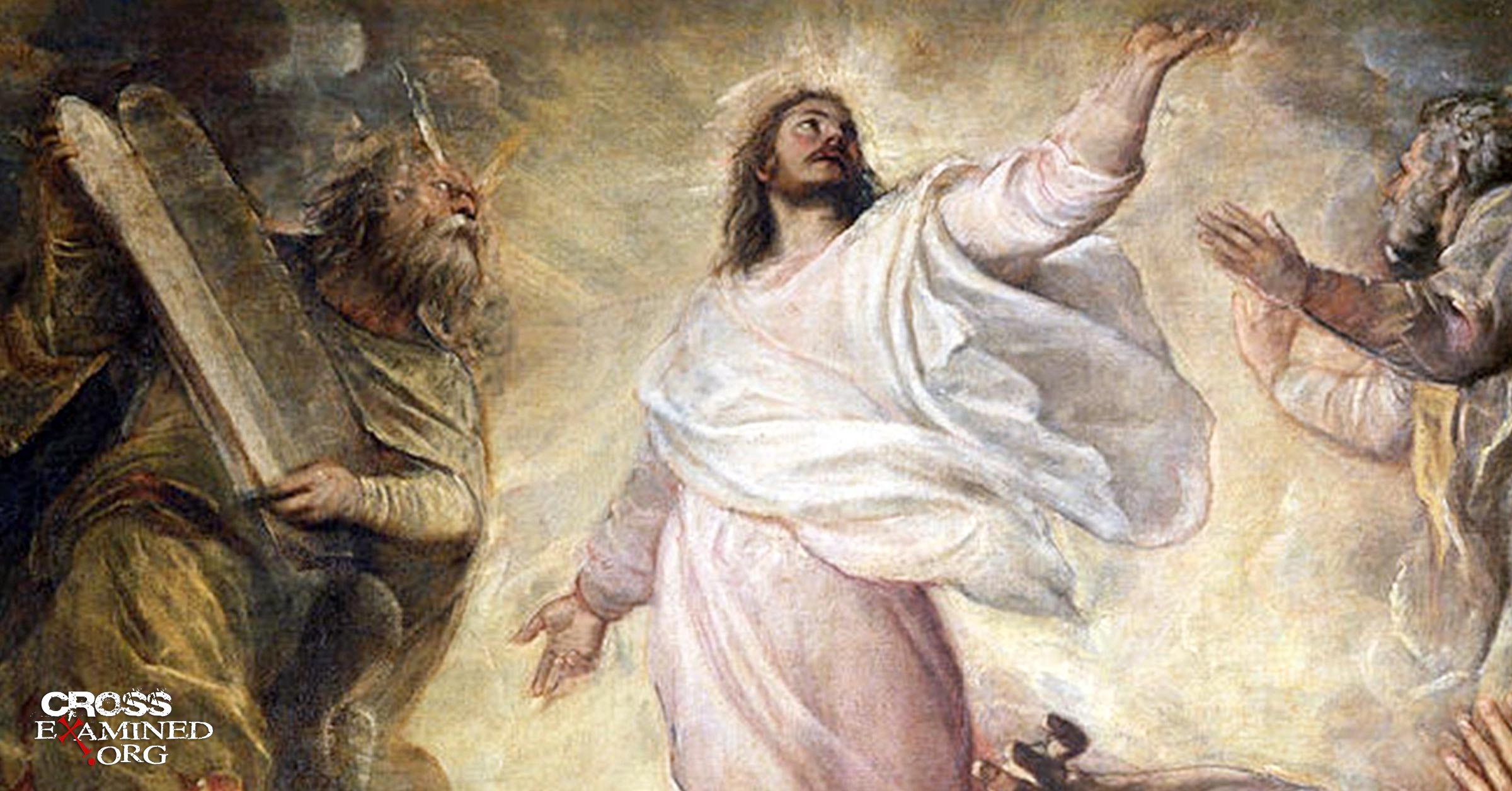
Both are transfigured on a mountain (Ex. 34:29-35; Mk. 9:2-13)

Both are isolated for 40 days without food or water (Ex. 34:28; Mt. 4:2)

Both are rebelled against by Israelites (Num. 16; Lk. 22-23).

Truly, Jesus was the prophet like Moses.

Differences Between Jesus And Moses

Despite their similarities, it’s their differences that matter the most. Consider these two:

First, like any prophet, Moses repeatedly said, “thus saith the LORD.” The LORD had communicated to him in some form or fashion, and he then communicated those same words to the people.

Jesus, on the other hand, never used the phrase “thus saith the LORD.” Instead, he said something radical — “truly, truly, I say unto you.” In other words, Jesus didn’t need to receive a word from the LORD because he was the LORD himself! Jesus spoke with authority, unlike any other prophet — including Moses.

Second, God accepted Jesus’ atoning sacrifice but not Moses’. In Exodus 32, after Israel sinned by worshipping the golden calf, God was going to consume them. Moses, however, sought to spare the people by offering up himself as an atoning sacrifice. We read in verses 30-33:

The next day Moses said to the people, You have sinned a great sin. And now I will go up to the LORD; perhaps I can make atonement for your sin. So Moses returned to the LORD and said, Alas, this people has sinned a great sin. They have made for themselves gods of gold. But now, if you will forgive their sin — but if not, please blot me out of your book that you have written. But the LORD said to Moses, Whoever has sinned against me, I will blot out of my book.

Even at this early stage, Moses recognized atonement must be made for Israel’s sins, and thus he offers up himself! But God rejected his offer. After all, Moses himself was just a man — a sinful one at that. He couldn’t possibly atone for the people’s sins.

But Jesus could. Being divine and sinless, Jesus could bear the sins of the world. And unlike Moses, God accepted Jesus’ sacrifice and demonstrated his acceptance by raising him from the dead.

So, while Jesus was a prophet like Moses, he was certainly greater.

Jesus Is Greater Than Moses

The author of Hebrews saw this comparison and didn’t hesitate to elevate Jesus above Moses. His words seem an appropriate ending to this article:

Therefore, holy brothers and sisters, who share in the heavenly calling, fix your thoughts on Jesus, whom we acknowledge as our apostle and high priest. He was faithful to the one who appointed him, just as Moses was faithful in all God’s house. Jesus has been found worthy of greater honor than Moses, just as the builder of a house has greater honor than the house itself. For every house is built by someone, but God is the builder of everything. “Moses was faithful as a servant in all God’s house,” bearing witness to what would be spoken by God in the future. But Christ is faithful as the Son over God’s house (Heb. 3:1-5).

Recommended resources related to the topic:

The Jesus of the Old Testament in the Gospel of John mp3 by Thomas Howe

Jesus, You and the Essentials of Christianity – Episode 14 Video DOWNLOAD by Frank Turek (DVD)

How Can Jesus be the Only Way? (mp4 Download) by Frank Turek

World Religions: What Makes Jesus Unique? mp3 by Ron Carlson

Historical Evidences for the Resurrection (Mp3) by Gary Habermas


Ryan Leasure holds a Master of Arts from Furman University and a Masters of Divinity from the Southern Baptist Theological Seminary. He currently serves as a pastor at Grace Bible Church in Moore, SC.

Original Blog Source: http://bit.ly/30b2ccw

By Ryan Leasure

Skeptics of all stripes vehemently deny the deity of Christ. Besides their a priori commitment to philosophical naturalism, a major argument they put forth is that the earliest Christians didn’t believe Jesus was divine. Rather, this belief in his deity was a legendary development, as evidenced by the four Gospels.

It’s the skeptics’ contention that the earliest Gospels (Matthew, Mark, and Luke) don’t teach a divine Jesus at all. Instead, they portray a very human Jesus. It’s not until the Gospel of John, written some sixty years after Jesus’ death, that we find a clear reference to Jesus’ divinity.

The argument goes; these Gospels reflect what the earliest communities believed about Jesus. Thus, the earlier Gospels, which don’t portray the deity of Christ, suggest that the earliest communities didn’t believe in the deity of Christ. Once we get to John, however, legends of Jesus’ divine nature have had time to spread throughout the Christian community, hence the high Christology in John.

Bart Erhman, Of Course, Agrees

Bart Ehrman sums up this view in this article:

The problem is that the only Gospel of the New Testament, where Jesus makes divine claims about himself is the Gospel of John. In the three earlier Gospels, you do not find Jesus saying things like “I and the Father are One,” or “Before Abraham was, I am,” or “If you have seen me, you have seen the Father.” These sayings are found only in the Fourth Gospel, as are all the other “I am” sayings, in which Jesus identifies himself as the one who has come from heaven to earth for the salvation of all who believe in him.

He goes on to say:

The most common way that scholars have explained this almost inexplicable omission in the Synoptic Gospels is simply that their authors did not think of Jesus as a divine being who was equal with God and pre-existed his birth, who became incarnate as the God-Man…

And the ultimate payoff is that this view of the Fourth Gospel is not the view of the historical Jesus himself.  It is a later view put on his lips by the author of John or his sources.

Is Ehrman right? Was the deity of Christ a legendary development as he suggests? I don’t think so for at least two reasons.

Paul Writes Earlier Than the Gospels

First, hardly anyone disputes the fact that Paul wrote his letters before the Synoptic Gospels. And interestingly enough, Paul has an incredibly high Christology. Consider these two texts:

Romans 9:5

To them (the Jews) belong the patriarchs, and from their race, according to the flesh, is the Christ, who is God over all, blessed forever. Amen.

Writing sometime in the mid-fifties, here’s a clear reference to the deity of Christ. The legendary hypothesis doesn’t seem to work here. Nor does it with the next text.

Philippians 2:5-11

Have this mind among yourselves, which is yours in Christ Jesus, who, though he was in the form of God, did not count equality with God a thing to be grasped, but emptied himself, by taking the form of a servant, being born in the likeness of men. And being found in human form, he humbled himself by becoming obedient to the point of death, even death on a cross. Therefore God has highly exalted him and bestowed on him the name that is above every name, so that at the name of Jesus every knee should bow, in heaven and on earth and under the earth, and every tongue confess that Jesus Christ is Lord, to the glory of God the Father.

There’s little doubt this text proclaims Jesus as the pre-existent God of the universe. Paul gives us at least two reasons for reaching this conclusion.

First, he states that Jesus was “in the form of God.” The word for “form” in the Greek is morphe, which denotes the exact substance or nature of something.

Second, Paul suggests that Jesus was equal with God when he wrote that Jesus “did not count equality with God something to be grasped.”

What is especially interesting is that even though Paul penned these words, scholars agree that this portion of Philippians was an early Christian hymn dating much earlier than Paul’s letter itself.

In other words, the pre-Pauline Christian community sang these words in their corporate gatherings and collectively worshipped Jesus as God.

Larry Hurtado highlights this truth:

The singing/chanting of such odes is one of several phenomena that demonstrate the remarkable and innovative nature of early Christian worship, in which Jesus was programmatically included in the “devotional pattern” of early Christian circles along with God, and in ways otherwise reserved for God.1

While Ehrman and other skeptics try to persuade the masses that nobody believed in the deity of Christ until the end of the first century, Paul’s writings seem to indicate otherwise.

The Synoptic Gospels Highlight the Deity Of Christ Too

The second reason we should reject the legendary hypothesis is that the Synoptics, though not as explicit as John, still portray a divine Jesus. Let me give you a few examples:

Matthew 1:23

Behold a virgin shall conceive and bear a son. And they shall call his name Immanuel, which means God with us.

From the very beginning, Matthew seems to indicate that this baby Jesus would be pretty special. Divine actually. His very name would mean “God with us” — a clear expression of the incarnation.

Mark 2:5-7

After the men had lowered the paralytic man down through the roof, Mark reports:

And when Jesus saw their faith, he said to the paralytic, “Son, your sins are forgiven.” Now some of the scribes were sitting there, questioning in their hearts, “Why does this man speak like that? He is blaspheming! Who can forgive sins but God alone?”

The scribes ask a crucial question. Who can forgive sins but God alone? Of course, the answer is no one. Yet, we have Jesus pronouncing forgiveness upon this paralytic man, and backing up his pronouncement with a healing miracle.

Luke 1:16-17

As the forerunner of Jesus, Luke speaks of John the Baptist:

And he will turn many of the children of Israel to the Lord their God, and he will go before him in the spirit and power of Elijah, to turn the hearts of the fathers to the children, and the disobedient to the wisdom of the just, to make ready for the Lord a people prepared.

John’s prophetic role was to prepare the people of Israel for the coming Lord. And we know, based on the rest of the text, that coming Lord was Jesus himself.

Matthew 28:18-19

Jesus proclaims in the famous Great Commission:

All authority in heaven and on earth has been given to me. Go, therefore, and make disciples of all nations, baptizing them in the name of the Father, and of the Son, and of the Holy Spirit.

Here at the end of Matthew’s Gospel, Jesus lumps himself in with the Trinity — God the Father, God the Son, and God the Holy Spirit. Notice he uses the singular for “name” not plural “names.” In other words, Jesus understood himself as one with the Father and Spirit.

Mark 14:62

As Jesus stood on trial, the Jewish leaders asked if he was the Son of God. He unashamedly affirmed:

“I am. And you will see the Son of Man sitting at the right hand of the Mighty One coming on the clouds of heaven”

It’s a common misconception to think that Jesus’ favorite title for himself — Son of Man — refers to his humanness. The exact opposite, however, is the case.

Jesus’ self-claim is actually a reference to a prophesy about a divine figure found in Daniel 7:13-14. That text reads:

In my vision at night I looked, and there before me was one like a son of man, coming with the clouds of heaven. He approached the Ancient of Days and was led into his presence. He was given authority, glory and sovereign power; all nations and peoples of every language worshiped him. His dominion is an everlasting dominion that will not pass away, and his kingdom is one that will never be destroyed.

It’s not hard to see the parallels between Jesus’ statement in Mark 14 and the prophesy in Daniel 7. Jesus claimed to be this apocalyptic figure who would come down from the clouds of heaven to judge the earth. He had all authority, glory, and power. All the nations would worship him, and his dominion would last forever. How could anyone think these qualities belonged to anyone other than God?

I could give several other examples, but this should suffice for now.

A Final Verdict

Skeptics have gotten a lot of mileage out of the claim that the deity of Christ was a legendary development. Yet, the data seems to suggest otherwise.

Despite not being as explicit as John, the synoptic Gospels still present a divine Jesus. They present him as the second person of the Trinity, the apocalyptic Son of Man from Daniel 7, and the one who has the authority to forgive sins.

Additionally, Paul — who wrote before any of the Gospels — presents an even higher Christology. Not only does he say things like Christ is God (Rom. 9:5), he quotes from pre-Pauline hymns that exalt the divinity of Jesus, demonstrating that the early Church believed in the deity of Christ from the very beginning.

It’s time we dispel the myth that the early Christians didn’t believe in the deity of Christ. As Richard Bauckham succinctly puts it, “The earliest Christology was already the highest Christology.”2 And who could argue based on the evidence?

Recommended resources related to the topic:

Jesus, You and the Essentials of Christianity – Episode 14 Video DOWNLOAD by Frank Turek (DVD)

How Can Jesus Be the Only Way? (mp4 Download) by Frank Turek

Cold Case Resurrection Set by J. Warner Wallace (books)

World Religions: What Makes Jesus Unique? mp3 by Ron Carlson

The Bodily Nature of Jesus’ Resurrection CD by Gary Habermas 

Historical Evidences for the Resurrection (Mp3) by Gary Habermas

The Jesus of the Old Testament in the Gospel of John mp3 by Thomas Howe


Ryan Leasure Holds a Master of Arts from Furman University and a Masters of Divinity from the Southern Baptist Theological Seminary. He currently serves as a pastor at Grace Bible Church in Moore, SC.

Original Blog Source: http://bit.ly/2E6IxAu

By Ryan Leasure

We’re told by skeptics that eye-witnesses didn’t write the Gospels. Not only that, they say the authors wrote from distant lands like Rome, Egypt, Asia Minor, or Greece. They merely heard the stories of Jesus from others who heard the stories of Jesus from others who heard the stories of Jesus — much like the game telephone.

And as so often happens in the game of telephone, the stories got mixed up along the way. So by the time the writers penned the Gospels, they had a distorted view of Jesus, and thus we can’t know what the real Jesus said or did. Or so the argument goes.

But is that really what happened? A little thought experiment might help us answer this question. Pretend you were given the task of writing a biography on a traveling woman from Bolivia named Carla. Yet you weren’t allowed to visit Bolivia. Furthermore, you couldn’t use the internet, encyclopedias, or maps for research. Your resources would be a couple of Americans who had never met Carla themselves but had heard stories about her travels.

As you undertake this project, how accurately do you think you could convey the geography and landscape of her travels? Would you really be able to give precise locations and distances? Would you know which towns had higher or lower elevations? How accurately could you describe the bodies of water she encountered? Chances are, you’d make a lot of mistakes with these details.

Well, as we think about these so-called authors from distant lands, they wouldn’t have had access to sources that could give them specific details of the Israeli landscape. So as they wrote their stories about Jesus, we would expect them to make lots of geographic blunders, much like your story on Carla. But this isn’t what we find.

Geography of Towns and Regions

The Gospel writers display an incredible familiarity with Palestinian geography. And they don’t just get most of the geography right; they get it all right. This would be truly remarkable if they lived in faraway regions and had only heard of Jesus through secondary sources. But it would be expected for eye-witnesses who followed Jesus from town to town.

Consider this list of towns the Gospel writers mention:1

Ryan blog 1

In total, the Gospel authors list twenty-six different towns. Some are prominent like Jerusalem, while others are obscure like Cana.

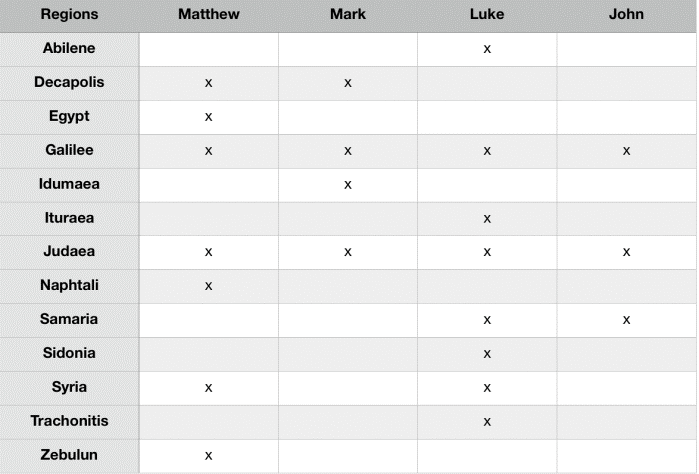
Not only do the Gospels include towns, they reference general regions as well. Consider this list:2

Ryan blog 2

In total, the Gospels list thirteen different regions. Compare these lists with some of the apocryphal Gospels, which give us almost no geographical details.

The Gospel of Thomas, for example, mentions Judaea once and no other locations. The Gospel of Judas doesn’t even list a single location, and The Gospel of Philip names just Jerusalem, Nazareth, and Jordan.

Of course, the lack of geographical detail is to be expected in these apocryphal works. After all, non-eye-witnesses wrote them from distant regions some 150 years after Jesus. Naturally, people would have heard of Jerusalem (the capital of Israel), Nazareth (Jesus’ hometown), and Jordan (the river where Jesus was baptized). One wouldn’t need to be an eye-witness to have knowledge of these regions. But Cana, Bethany, and Salim? One would have to have special knowledge to know about these places.

Geography of Bodies of Water

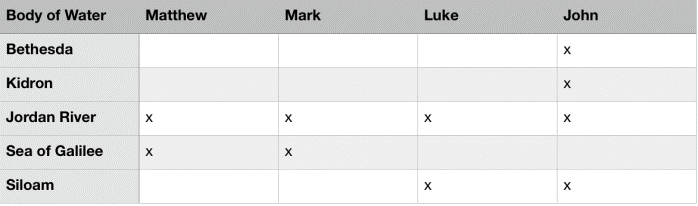
Since the writers had an in-depth knowledge of the towns and regions, it should come as no surprise to learn they also knew about the bodies of water. Consider this list:3

Ryan blog 3

It’s interesting to note the numerous references to “the Sea” of Galilee. For a body of water that’s a mere thirteen miles long, it’s odd that an Egyptian or Roman author would call it “the sea.” For them, the Mediterranean qualifies as a sea, not this tiny body of water that’s less than 1/300th the size of Lake Michigan.

Yet we would expect Galilean fishermen — who spent their entire careers on the body of water — to call it “the sea.” What’s even more interesting is that while the three Jewish authors of the Gospels refer to it as “the sea,” the one non-Jewish author (Luke) does not. Instead, he refers to it as “the lake” (Lk. 5:1, 2; 8:22, 23, 33). This makes sense because from a broader gentile perspective, “lake” was a more accurate description.

The authors also know that Bethsaida and Capernaum are close by the Sea of Galilee and that you can go directly from the Sea of Galilee into the hill country. Furthermore, John knew of a small stream called the Kidron and of two pools in Jerusalem. One pool he describes as having five colonnades, which has been verified by archeological evidence. Again, all of these details would be quite remarkable coming from non-eye-witnesses in distant regions.

Geography of Roads

In the parable of the Good Samaritan, Jesus tells the story of a man “going down” from Jerusalem (750 meters above sea level) to Jericho (250 meters below sea level). This was a descent of approximately one kilometer. The writer knew enough to know both Jerusalem and Jericho’s elevations. In fact, all four Gospels describe people “going up” to Jerusalem and “going down” as they left Jerusalem.

In John 2 and 4, leaving Cana (200 meters above sea level) for Capernaum (200 meters below sea level) is described as “going down.” Similarly, Luke describes the travel from Nazareth (350 meters above sea level) to Capernaum (200 meters below sea level) as “going down.”

More impressively, the authors knew the location of a tiny village called Chorazin. In Luke 10:13-15, Jesus chides Chorazin along with Bethsaida and Capernaum for their lack of belief. According to New Testament scholar Peter Williams,

The little-known village of Chorazin is, in fact, on the road to Bethsaida and just a couple of miles north of Capernaum. As far as we know, there was not a single literary source that could have provided this information to a Gospel author.4

The authors also knew that multiple routes existed between Judaea and Galilee — one to avoid Samaria and one right through it. Furthermore, they knew it was short travel from the small villages of Bethany and Bethphage to Jerusalem.

Who Could Know All These Geographical Details?

How could one get all of these obscure details correct? If it’s as the skeptics say, and non-eye-witnesses wrote these accounts from distant places, they got extremely lucky. A more reasonable conclusion, however, is that the writers received detailed information from eye-witnesses or were eye-witnesses themselves. As Peter Williams concludes,

No known sources hold together the particular set of information they (Gospel writers) have, and besides, we would have to suppose that they undertook a level of literary research quite unparalleled in ancient history. If these pieces of information result from hearing, then the reports they heard must have been fairly precise — concerned with stories not merely for their message but also for specific details. Thus it seems that the authors received the information either from their experience or from detailed hearing.5

*For more on this topic, check out Peter Williams’ book Can We Trust the Gospels?

Recommended resources related to the topic:

The New Testament: Too Embarrassing to Be False by Frank Turek (DVD, Mp3, and Mp4)

Why We Know the New Testament Writers Told the Truth by Frank Turek (DVD, Mp3 and Mp4)

The Top Ten Reasons We Know the NT Writers Told the Truth by Frank Turek (Mp3)

Counter Culture Christian: Is the Bible True? by Frank Turek (DVD)

Cold-Case Christianity: A Homicide Detective Investigates the Claims of the Gospels by J. Warner Wallace (Book)


Ryan Leasure holds a Master of Arts from Furman University and a Masters of Divinity from the Southern Baptist Theological Seminary. He currently serves as a pastor at Grace Bible Church in Moore, SC.

Original Blog Source: http://bit.ly/31MPuzV

By Ryan Leasure

Most of what happened in the ancient world went unrecorded. Think about it. People from bygone eras didn’t have technology like YouTube, TV, or the internet — much less the printing press. It’s sad, really. We’ll never know about 99.99% of what happened back then. The less than 1% we do know is because a few literate historians covered the highlights.

We know about famous military commanders and epic battles. Emperors and politicians of powerful kingdoms also make the cut. But most events and people have vanished off the historical landscape.

With Jesus of Nazareth, though, we have four biographies on his life all dating within the lifetime of eye-witnesses. We also have a slew of letters by some of his other followers, making him one of the best-attested individuals in the history of the ancient world. It’s quite remarkable considering he came from a backwoods section of Galilee far removed from prominent Roman locations.

Historians normally gush over this amount of material. The amount and quality of sources towers just about everyone else. Yet some skeptics cry foul. They don’t accept the Gospels or New Testament letters for the reason that they’re Christian documents.

Well, as it turns out, we have other, non-Christian sources also testifying to Jesus. One such source comes from the pen of an early Roman historian named Tacitus. As you’ll see, Tacitus corroborates significant events from the New Testament.

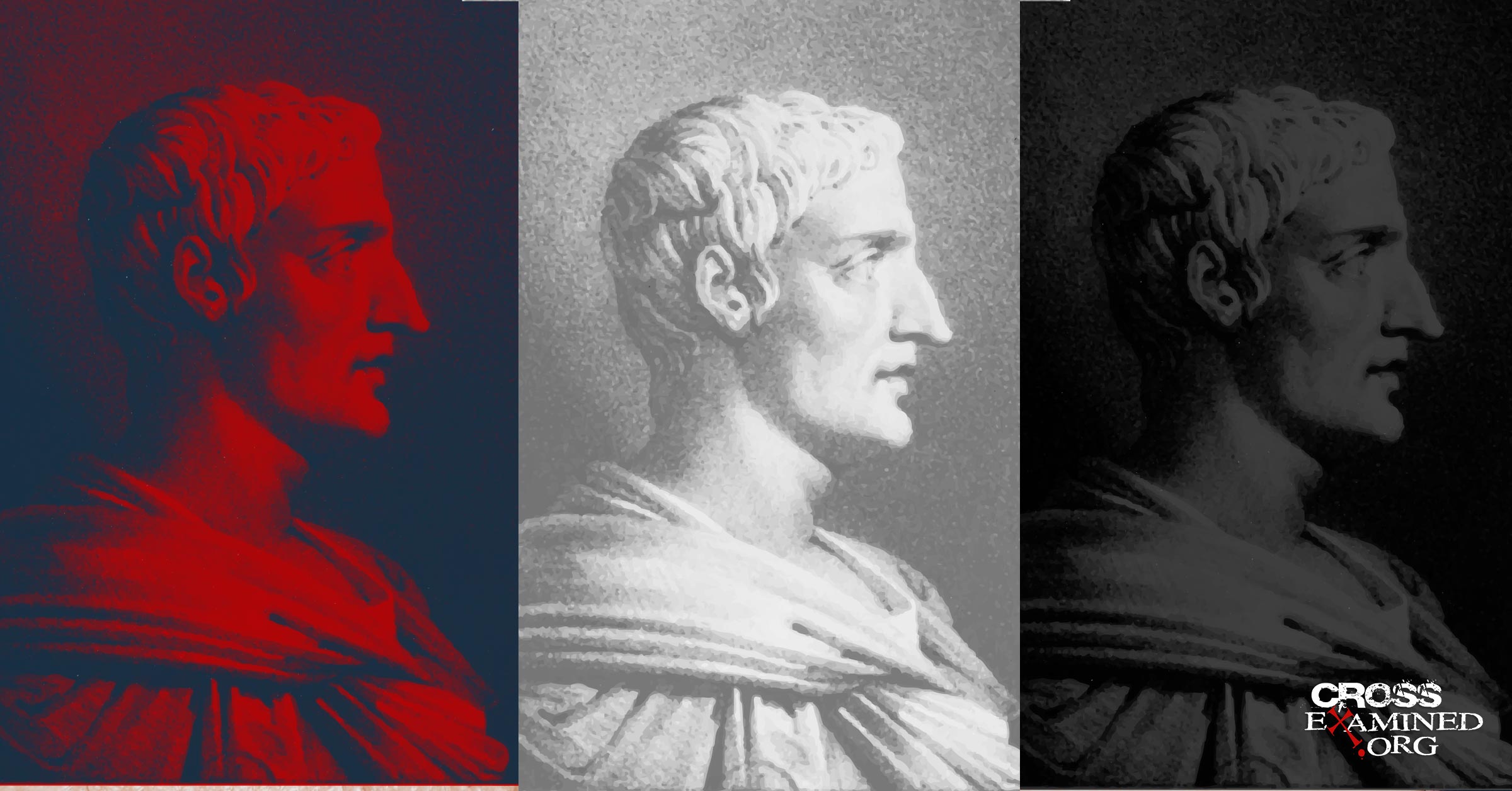
Tacitus, the Greatest Roman Historian

Cornelius Tacitus (AD 55-120) is often called the “greatest historian” of ancient Rome. He authored two large works — the Annals and the Histories.

Much of what he wrote is now lost to us. Fortunately, there’s one remaining portion which is of interest to this discussion. The portion describes Nero blaming the Christians for the great fire of Rome (AD 64). It reports:

Therefore, to stop the rumor, Nero substituted as culprits and punished in the utmost refinements of cruelty, a class of men, loathed for their vices, whom the crowd styled Christians. Christus, the founder of the name, had undergone the death penalty in the reign of Tiberius, by sentence of the procurator Pontius Pilatus, and the pernicious superstition was checked for a moment, only to break out once more, not merely in Judea, the home of the disease, but in the capital itself, where all things horrible or shameful in the world collect and find a vogue.1

What do we learn from Tacitus’ work?

  1. Christians are named after their founder, Christus.
  2. Christus died by the death penalty during Emperor Tiberius’ reign (AD 14-37).
  3. Pontius Pilatus, procurator (AD 26-36), sentenced Christus to death.
  4. Christus’ death ended the “pernicious superstition” for only a short time.
  5. The “pernicious superstition” broke out once more in Judea, the “home of the disease.”
  6. The “disease” spread all the way to Rome and had a large enough following to receive blame for the great fire.

Doubting Tacitus?

As is abundantly obvious, Tacitus’ quote provides a significant amount of corroboration for the New Testament. Jesus died by crucifixion during the reign of Tiberius while Pilatus was procurator of Judea. Moreover, the movement was only “checked for a moment, only to break out once more.”

The implications for this last quote are massive, to say the least. As J.N.D. Anderson remarks:

It is scarcely fanciful to suggest that when he adds that “a most mischievous superstition, thus checked for the moment, again broke out” he is bearing indirect and unconscious testimony to the conviction of the early church that the Christ who had been crucified had risen from the grave.2

On the face of it, Tacitus makes massive claims in support of the New Testament, which is why skeptics try to dismiss it. And they usually give four reasons for doing so.

“It’s a Christian Interpolation”

Skeptics argue that Christians inserted this portion of the text at a later date, but there is no compelling reason for believing this. First and foremost, it’s difficult to imagine a Christian describing his movement as a “pernicious superstition” and a “disease.” As a general rule, people don’t usually label themselves this way.

Furthermore, if Christians really inserted this text into Tacitus’ work, they certainly could have been more clear about Jesus’ resurrection. While the claim that the “superstition broke out again in Judea” implies a resurrection, it’s not entirely clear.

It seems that if Christians had the opportunity to insert a paragraph here, they would have said something more explicit.

“It’s Anachronistic”

A second argument skeptics make against this quote is that it refers to Pilatus as “procurator” — the title during Tacitus’ day — instead of “prefect” — the title during Jesus’ day. That is, it’s anachronistic, and therefore, unreliable.

Again, as a reminder, Tacitus’ reputation as an accurate historian is without question.3 Be that as it may, what should we make of the skeptics’ claim?

First, we should note that Tacitus may have intentionally used the term his readers would have been familiar with for clarity sake. For example, I might write about a “bishop” from the second century, but call him a “pastor” for a contemporary audience because that’s a term readers are familiar with. There’s no reason why Tacitus couldn’t have employed this tactic.

Second, we should also note that other Jewish historians of the first century — Philo and Josephus — both refer to Pilate as a “procurator.” While the term “prefect” was legitimate, it appears that both “procurator” and “prefect” are used interchangeably.

“It’s Hearsay”

Third, skeptics reject this as an original source and claim that Tacitus was simply repeating hearsay from Christians. One line of evidence they suggest is that Tacitus uses Jesus’ title “Christus” rather than his legal name “Jesus.”

This argument doesn’t hold water either. In response, we need to remember that Tacitus was writing about Christians and the origin of their name, so his use of “Christus” instead of “Jesus” seems logical.

Second, it’s difficult to imagine that a great historian like Tacitus, who elsewhere carefully investigated sources, would simply jot down hearsay from a group of Christians. Moreover, I wonder why Tacitus would blindly trust this group he refers to as a “pernicious superstition” and a “disease” and include their fables about Jesus in his history if he didn’t have any other source to substantiate his claim.

While making a substantial claim about a Roman official condemning someone to death, Tacitus would have been especially motivated to get his facts straight.

“It’s Unofficial”

Finally, skeptics argue that Tacitus wouldn’t have had access to any official records that would record Jesus’ death. But I find this terribly unpersuasive.

For starters, Tacitus himself held high government positions (proconsul of Asia). Additionally, he had close connections with others in power, such as Pliny the Younger and his wife, who happened to be the daughter of Julius Agricola, the governor of Britain. It seems silly to suggest he wouldn’t have had access to government records.

Furthermore, we know he had access to the Acta Senatus (archives of the Roman Senate’s activities) as he cites it multiple times in his works. Jesus’ crucifixion may very well have appeared in these archives or in others similar to it.

Knowing the kind of historian Tacitus was, if he didn’t have iron-clad proof that Pontius Pilate sanctioned Jesus’ crucifixion, he would have couched his statement with “Christians report that…” rather than making an unequivocal claim.

Good Corroborating Evidence

In the end, the Tacitus text stands up to scrutiny and provides solid corroborating evidence for the New Testament. While he views Christians in a negative light, he proves to be a reliable non-Christian source for major events in Jesus’ life.

Recommended resources related to the topic:

Cold-Case Christianity: A Homicide Detective Investigates the Claims of the Gospels by J. Warner Wallace (Book)

The New Testament: Too Embarrassing to Be False by Frank Turek (MP3) and (DVD)

Why We Know the New Testament Writers Told the Truth by Frank Turek (mp4 Download)

The Top Ten Reasons We Know the NT Writers Told the Truth mp3 by Frank Turek


Ryan Leasure holds a Master of Arts from Furman University and a Masters of Divinity from the Southern Baptist Theological Seminary. He currently serves as a pastor at Grace Bible Church in Moore, SC.

Original Blog Source: http://bit.ly/2mHGbT0

By Ryan Leasure

There’s a common refrain among liberal scholars that says the church suppressed dozens of Gospels. The reason they say? It’s because those books share scandalous information about Jesus that the church wanted to hide. They didn’t want the world to know sketchy details like Jesus tortured other kids as a child or that he had a wife.

Of all these “suppressed” Gospels, far and away the poster child is the Gospel of Thomas. Liberal scholars such as John Dominic Crossan and Elaine Pagels faun over this work. The Jesus Seminar even published a book titled The Five Gospels, which includes the canonical four-plus Thomas.

Yet there’s a bit of irony here. If these scholars would treat the canonical Gospels with half the amount of charity they give to Thomas, they’d all be Christians! Instead, they date Thomas very early and the canonical Gospels late. They claim Thomas’ view of Jesus is reliable, while the canonical Gospels contain myths and legends.

By contrast, I’m going to demonstrate, in the remaining pace, that the Gospel of Thomas is unreliable, was never considered as Scripture by the early church, and thus shouldn’t be included in our canon.

The Gospel of Thomas

In 1945, some farmers in Nag Hammadi Egypt were digging and came across an earthenware jar in the ground. The farmers, hoping to find treasure, were deeply disappointed when they found a bunch of texts instead. Little did they know those texts would be more valuable than any treasure they could hope to find.

Among the cache of texts was one that begins, “These are the secret sayings which the living Jesus spoke and which Didymos Judas Thomas wrote down,” and ends with “The Gospel According to Thomas.”

Unlike the canonical Gospels, Thomas doesn’t follow a narrative structure. It doesn’t report major parts of Jesus’ life — his birth, death, and resurrection. Instead, Thomas contains 114 esoteric sayings of Jesus, purporting to record the secrets Jesus taught to his disciples.

Canonical Attributes

Before we can answer why Thomas doesn’t belong in the canon, we need to know what the early church looked for in a canonical book. In sum, the church looked for three different attributes — apostolic authority, divine qualities, and corporate reception.1 These three attributes formed a type of canonical grid by which to test a book.

By apostolic authority, the church only received books that could be traced to apostolic eye-witness testimony. This would include books written by both apostles and their close associates. For example, the church obviously received John’s writings because he was one of the apostles. But they also received Mark, based on the fact that he was Peter’s close associate.

By divine qualities, the church looked for books that gave evidence of God’s fingerprints. One such piece of evidence was consistency with other authoritative books. Since Christians believe the Holy Spirit inspired all the biblical texts, they knew none of them would contradict each other.

By corporate reception, the church only received books that the universal church also received as authoritative. In other words, if only one pocket of Christianity affirmed the authority of a book, that book was rejected. The reception had to stretch across all of Christendom.

So does the Gospel of Thomas possess these canonical attributes? Let’s test it by putting it through the canonical grid.

Apostolic Authority?

Did an apostle or close associate write the Gospel of Thomas? In a word, no. In fact, the consensus among scholarship is that the book dates to the middle of the second century — long after the apostles had died out. That is to say, Jesus’ disciple Thomas did not write this book.

A few reasons exist for dating this work late into the second century. First, the text reflects a type of Gnosticism (more on that in a minute) that wasn’t prevalent until the middle second century.2

Additionally, the Gospel of Thomas demonstrates a deep dependance on large parts of the New Testament. It quotes or alludes to all four Gospels, Acts, most of Paul’s letters, and Revelation.3 Only someone who had access to all these works could pen this work, and we know that it took time for these works to circulate the Roman Empire.

Even more, some scholars suggest that Thomas relied heavily on the Diatessaron — a four Gospel harmony produced by Tatian around AD 170.4 If that’s the case, Thomas dates even later.

Even if Thomas is independent of the Diatessaron, it’s mid-second century dating would have ruled it out for canonical consideration. Take the Shepherd of Hermas — a mid-second century work — for example. The early church loved this book. But as the Muratorian Fragment states, the church rejected its canonical authority because it was written “quite recently, in our own times,” and thus not backed by apostolic authority.5

Strike one for Thomas.

Divine Qualities?

What about divine qualities? Does Thomas show God’s fingerprints and align with other authoritative books? Again, the answer is no. Thomas was one of several Gnostic texts in the Nag Hammadi discovery.

Gnosticism was polytheistic. It taught that the god who created the world was evil, and by extension, his entire creation was evil too. Salvation, then, was the liberation of the soul from the physical realm into a spiritual realm. One can achieve this salvation only through a secret knowledge (gnosis in Greek).

This secret knowledge, according to the Gnostics, comes from Jesus. Of course, Jesus was radically different from the god of the Old Testament. Jesus was a warm and inviting god while the one of the Old Testament was hostile and angry.

Furthermore, since everything physical is evil, Jesus didn’t really have a physical body. He only appeared to have a human body, and thus he didn’t die on the cross — a view known as Docetism.

The Gospel of Thomas makes no qualms about its Gnostic leanings with all its emphasis on learning the secrets of Jesus. The prologue begins, “These are the secret sayings that the living Jesus spoke.” Moreover, the first saying states, “Whoever discovers the interpretation of these sayings will not taste death.” Again, the Gnostic salvation came through obtaining a secret knowledge.

Of course, the early church rejected Gnosticism as heretical. Orthodoxy taught salvation by faith. Thomas taught salvation came through knowledge of secret information.

Thomas also veers away from orthodoxy in how it views women. At the close of the book, Jesus states, “Look, I will guide her (Mary) to make her male, so that she too may become a living spirit resembling you males. For every female who makes herself male will enter the kingdom of Heaven.”

This statement clearly contradicts how Jesus views women in the canonical Gospels. Furthermore, it contradicts Genesis 1, which declares that God made both men and women in his image. Thus, women are not inferior, as the Gospel of Thomas suggests.

Strike two for Thomas.

Corporate Reception?

Did the universal church affirm the authority of Thomas? There’s not a shred of evidence to suggest that it did. If you think about it, since Thomas lacks the first two attributes — apostolic authority and divine qualities — the early church had no motivation to think it was Scripture.

Their rejection of this book is evidenced in two ways. First, the early church never includes Thomas in any of its early canonical lists. In all the lists, we have four, and only four, Gospels.

Second, the church specifically rejected Thomas as heretical. Meaning, it didn’t even come close. This rejection is contrasted with other books, like the Shepherd of Hermas or the Didache, that at least gained a hearing. The church enjoyed these books as they promoted Christian orthodoxy, but as I alluded to earlier, the church didn’t receive them as Scripture because they lacked apostolic authority.

Thomas was so far out in left field that it wasn’t even up for discussion. Eusebius, for example, includes Thomas in the “heretical books” section and suggests that it “ought not to be reckoned even among the spurious books but discarded as impious and absurd.”6

Strike three for Thomas.

The Gospel of Thomas Rejected

Despite the best efforts of some, Thomas doesn’t even come close to Scripture. It wasn’t backed by apostolic authority. Its contents contradict the orthodox texts. And the church never even came close to considering it as authoritative.

Unlike the real Thomas, we have good reasons to doubt here.

Recommended resources related to the topic:

Cold-Case Christianity: A Homicide Detective Investigates the Claims of the Gospels by J. Warner Wallace (Book)

The New Testament: Too Embarrassing to Be False by Frank Turek (MP3) and (DVD)

Why We Know the New Testament Writers Told the Truth by Frank Turek (mp4 Download)

The Top Ten Reasons We Know the NT Writers Told the Truth mp3 by Frank Turek

Counter Culture Christian: Is the Bible True? by Frank Turek (DVD)


Ryan Leasure holds a Master of Arts from Furman University and a Masters of Divinity from the Southern Baptist Theological Seminary. He currently serves as a pastor at Grace Bible Church in Moore, SC.

Original Blog Source: 


By Ryan Leasure

This past weekend, two mass-scaled shootings transpired on American soil. El Paso, Texas, and Dayton, Ohio experienced unspeakable carnage. Two men, fueled by hatred for mankind, slaughtered dozens of innocent people in cold blood.

In response, people of all stripes spoke out against these atrocities. Men and women, democrat and republican, Christian and atheist, all condemned these crimes. In other words, the denunciation of these senseless and cowardly acts has been universal.

But doesn’t this universal agreement fly in the face of our relativistic cultural values? “Don’t force your morality on others” suddenly doesn’t sound so appealing in situations like this. Don’t we all want everyone else to adopt our same moral position on murder?

This, of course, raises important questions. Does objective morality exist? That is, were those two men objectively wrong in what they did over the weekend? And if so, where does this agreed-upon morality come from?

Objective Morality?

Relativists argue that there is no such thing as objective morality. Rather, morality is subjective — dependent on individual opinions. So in situations like these mass shootings, the relativist cannot say that the shooters were wrong. If so, that would imply that an objective standard exists that these two individuals missed.

Rather, the relativist can only say they didn’t care for these events. They found them distasteful. “Murder is wrong,” and “rape is evil” are just opinions on par with “pepperoni is better than sausage.”

But isn’t it self-evident that mass murder is in a different category than pizza toppings? The very fact that society has universally condemned these acts ought to tip us off that something more than mere opinion is at work here. When we all cry “foul” in unison, we’re implicitly affirming that “fair” exists.

C. S. Lewis made this argument years ago. He wrote:

[As an atheist] my argument against God was that the universe seemed so cruel and unjust. But how had I got this idea of just and unjust? A man does not call a line crooked unless he has some idea of a straight line. What was I comparing this universe to when I called it unjust?1

What Lewis and so many others have argued is that objective morality exists, and this is most evident when people don’t live up to that moral standard.

If we learn, for example, that a man raped a little girl, brutally murdered her, and dismembered her body, would we say that he committed evil? If yes, then we recognize an objective moral standard exists that was not met. Our senses tell us that acts such as abuse, rape, theft, deceit, murder, etc., all fail to measure up to a standard of some sort.

This moral standard seems so patently obvious; it’s odd when people try to deny it. A quick rule of thumb is that when a certain group can’t condemn the Holocaust as evil, we conclude that their views are absurd. Of course, if those same relativists had been in those concentration camps, they’d drop their relativism and recognize evil for what it is.

Even the most committed relativist will come around if you steal his wallet or spread false rumors about him. Phrases like “that’s not right” or “that’s not fair” will come spewing out faster than you can blink your eye.

Where Does Objective Morality Come from?

The reality of objective morality raises a significant question. Where does it come from? For the naturalists (those that believe only the natural world exists), these objective morals are mere illusory by-products of evolution and social conditioning.

For most naturalists, science is the only begetter of knowledge. But science itself is amoral. Science cannot tell us how things ought to be. It can only tell us how things are. That is, science can tell us how to make chemical weapons, but it cannot tell us whether we should use them.

Objective morals simply cannot derive from something morally neutral like science. And they certainly don’t arise from Darwinian evolution. According to Darwinists, people only do good because it aids in their survival. But if that’s the case, can we really call their actions morally good? Fundamentally, the motivation behind “good” acts is self-serving, and thus not worthy of praise.

Also, doesn’t Darwinism, on the whole, make morality arbitrary? Couldn’t the human race have found rape or killing each other for food acceptable if it would have evolved like other species from the animal kingdom? Sharks do this all the time, but are they immoral?

Darwinists who find this notion uncomfortable typically adopt humanism — the belief that humans are the center of the universe and morality is based on what helps them flourish. But again, isn’t humanism purely arbitrary in a Darwinian world?

Darwin, after all, taught that every living species descended from the same common ancestor in the primordial soup. Thus, humans are simply one small branch on his tree of life. Other branches include crickets, lions, fungus, and every other living species. Why should we think the human branch is the most valuable? Why are we more important than crickets? Doesn’t this make us guilty of speciesism?

Ultimately, atheism’s understanding of morality is purely arbitrary. It simply cannot account for objective morality.

In the end, God is the best explanation for objective morality. God’s very nature grounds morality so that anything done that goes against his character is wrong and/or evil. Furthermore, because God made humans in his image, each person possesses intrinsic value.

Answering the Skeptics’ Objections

Without a doubt, the first objection raised to the claim that objective morality doesn’t exist without God is that atheists do good without believing in God. But this misses the point. Of course, people can still do good things without believing in God. The question is not: do we have to believe in God to do good? Rather, the question is: if God doesn’t exist, is anything objectively good at all? As I’ve argued, moral categories are arbitrary in an atheistic world.

If we acknowledge, however, that the two mass-shooters committed evil, then objective moral categories exist. And if objective moral categories exist, then a transcendental lawgiver is the best explanation.

Which leads to the second objection — the Euthyphro Dilemma. The dilemma goes like this: Is something good because God wills it? Or does God will something because it is good? Skeptics raise this objection to put the theist between a rock and a hard place.

For if we say something is good because God wills it, then good is ultimately arbitrary. But if we say God wills something because it’s good, then the objective standard exists beyond God. But the skeptic presents us with a false dilemma here. A third option exists which states God wills something because he is good. That is to say; he is the standard by which we get all moral categories.

Another frequent objection is that we don’t need the Bible to know that we shouldn’t murder or steal. After all, other religious books tell us the same as do most legal codes. But again, this is not the argument theists make.

Nobody’s arguing you need to read the Bible to know right from wrong. Rather, we’re arguing that objective right and wrong don’t exist in a world without a transcendent moral law. But the very fact that every world religion and legal code agree on basic fundamental morals suggests that a moral law exists that transcends the human race.

The Apostle Paul tells us in Romans 2:14-15. He writes, “For when Gentiles, who do not have the law, by nature do what the law requires, they are a law to themselves, even though they do not have the law. They show that the work of the law is written on their hearts, while their conscience also bears witness, and their conflicting thoughts accuse or even excuse them.”

That is to say; people don’t need the Bible to know right from wrong. God has instilled this moral code in the hearts of all people.

Which raises a final objection. If a moral law exists, why is there so much disagreement on morality? Disagreements certainly exists around issues like abortion and sexuality. But does that imply no right view exists? Of course not. Which is why we strive to make our views the accepted ones. In fact, if culture adopts our views, we’ll say things like our culture is progressing. Progressing toward what? The moral standard we believe to be right.

Be that as it may, the human race generally agrees on several basic points. People have certain rights. We should treat others with respect. Love is better than hate. Honesty is better than deceit. Courage is better than cowardice. And so forth. As C. S. Lewis aptly states:

Think of a country where people were admired for running away in battle, or where a man felt proud of double-crossing all the people who had been kindest to him. You might just as well try to imagine a country where two and two made five.2

The universal agreement on the most basic moral categories suggests a transcendent moral law.

The Moral Argument for God

I believe that objective morality is one of the strongest arguments for God’s existence. Perhaps a more helpful way of looking at it would be this syllogism:

  1. If God does not exist, objective morality does not exist.
  2. Objective morality does exist.
  3. Therefore, God exists.

This argument is logically air tight. If premises 1 and 2 are true, then 3 necessarily follows. I’ve made a case for 1 and 2 in this article. It concludes then that God exists.

So can we be good without God? No, because if he doesn’t exist, nothing objectively good exists either.


Ryan Leasure Holds a Master of Arts from Furman University and a Masters of Divinity from the Southern Baptist Theological Seminary. He currently serves as a pastor at Grace Bible Church in Moore, SC.

Original Blog Source: http://bit.ly/2KJFXnY