Tag Archive for: religion

Por Terrell Clemmons

Probablemente no es lo que tú piensas.

Salvando la verdad sobre la sexualidad humana

“Perdonen si esto se sale del tema”, tartamudeó la joven por el micrófono, “pero he buscado respuestas y no encuentro ninguna, así que pensé en venir esta noche a preguntarles a ustedes. ¿En qué difiere el cristianismo, si es que lo hace, respecto a la homosexualidad en comparación con otras religiones, y si es así, cómo?” Sus labios estremecidos y sus manos temblorosas revelaron la magnitud de la lucha que le había costado expresar la pregunta.

El auditorio se quedó en silencio cuando todas las miradas se dirigieron a Abdu Murray, que acababa de participar en un foro abierto de la universidad sobre las principales religiones del mundo.

Abdu guardó silencio por un momento. Se dio cuenta de que ella no solo buscaba otra opinión. Necesitaba una respuesta que la validara como ser humano. ¿Qué podía decir que no comprometiera la sexualidad bíblica y que, al mismo tiempo, le mostrara que Dios se preocupaba por ella sin medida?

“Es solo que hay tantas cosmovisiones para elegir”, comenzó. Y ninguna de ellas podría dar una respuesta que validara incondicionalmente su humanidad. Es decir, ninguna, excepto una. Pero antes de llegar a esa, examinó las demás.

Consideremos el ateísmo naturalista, la cosmovisión que impulsa el secularismo progresista. Según el secularismo naturalista, el ser humano es un animal altamente evolucionado. Esta cosmovisión es doblemente deshumanizadora con respecto a la homosexualidad. En primer lugar, según la narrativa evolutiva darwiniana, no hay nada especialmente significativo en los seres humanos. “Una rata es un cerdo es un perro es un niño”, en palabras de Ingrid Newkirk, fundadora de People for the Ethical Treatment of Animals (PETA), de modo que lo único que nos distingue de las moscas de nuestra ventana es que estamos por encima de ellas en la cadena alimenticia. En segundo lugar, si, como se nos dice, la evolución darwiniana prosigue a través del proceso evolutivo, entonces la homosexualidad fracasa evolutivamente porque el sexo entre personas del mismo sexo no se reproduce. Por lo tanto, en una cosmovisión naturalista, las personas que practican el sexo entre personas del mismo sexo no son, al igual que todos los demás, nada especial, y además son fallas darwinianas.

¿Qué hay de los sistemas panteístas orientales, como el hinduismo o el budismo, o una espiritualidad al estilo de Deepak Chopra? Pues bien, los fundamentos éticos de estas cosmovisiones son, en el mejor de los casos, ambiguos, ya que enseñan que la moral es relativa. Por lo tanto, ninguna de ellas proporciona una base objetiva para el valor o la identidad humana. Y lo que es peor para el que busca respuestas sólidas, sostienen que el sufrimiento es una ilusión, lo que es un insulto a la persona que sufre. No ofrecen nada más allá de la charlatanería autorreferencial para quien lucha con su identidad.

¿Y el islam? Aunque ofrece solidez, con su fundamento monoteísta y sus claras normas que circunscriben el comportamiento sexual, el islam es abiertamente hostil a la homosexualidad. En algunos países islámicos, los actos homosexuales se castigan con la cárcel, la flagelación y, en algunos casos, la muerte.

Finalmente, entonces, Abdu entró en el cristianismo. Hizo dos observaciones al respecto. En primer lugar, todos sabemos intuitivamente que hay algo en el sexo que lo hace más que un simple acto físico. ¿Por qué se trata la agresión sexual de forma diferente a la mera agresión física? Porque, dijo, hay algo sagrado y frágil en la sexualidad, y las cosas sagradas son tan especiales que merecen ser protegidas. Dios quiere proteger el carácter sagrado de la sexualidad para que no se convierta en algo común, y los límites establecidos por la ética sexual bíblica protegen el carácter sagrado de la sexualidad.

Pero, admitió, eso no explica la proscripción que limita el sexo al matrimonio entre personas del sexo opuesto. Ese fue el tema de su segundo punto. Para abordar el principio del matrimonio entre hombres y mujeres, se refirió al relato bíblico de la creación en el Génesis, donde se nos dice que Dios creó al hombre y a la mujer a imagen de Dios. Que el hombre y la mujer hayan sido creados a imagen y semejanza de Dios es un concepto blasfemo para el islam, un concepto extraño en cualquier panteísmo y un absurdo en cualquier secularismo naturalista. Solo la cosmovisión bíblica, que sostiene que todos los hombres y todas las mujeres son portadores de la imagen divina de Dios, ofrece una base objetiva para la dignidad y el valor humanos inherentes.

Y esto nos lleva a la razón por la que vale la pena limitar la sexualidad humana al matrimonio hombre-mujer: Es porque el sexo es la forma en que la vida humana viene al mundo. “El sexo entre un hombre y una mujer es el único medio por el que viene al mundo un ser tan precioso”, dijo. “Y como un ser humano es el producto sagrado del sexo, el proceso sexual por el que esa persona se hace es también sagrado”. La ética bíblica limita la expresión sexual al matrimonio monógamo, hombre-mujer, porque “Dios está protegiendo algo sagrado y hermoso”. Al someternos a la guía de la creación, “Se nos concede el honor de reflejar un aspecto del esplendor divino”.

Concluyó su respuesta a la joven atribulada diciéndole que Dios ancla toda la dignidad humana, incluida la suya, y la sacralidad en su naturaleza inmutable y eterna. Se nos concede la altísima dignidad de reflejar la gloria de Dios en ese mundo.

Entonces, ¿en qué se diferencia el cristianismo de las demás religiones en lo que respecta a la homosexualidad? Resulta que difiere profundamente de todas las demás, pero no de la forma en que las voces culturales dominantes dicen que lo hace. Abdu relata esta escena en su libro recientemente publicado, Saving Truth: Finding Meaning and Clarity in a Post-Truth World. Aunque tiene mucho más que decir sobre la naturaleza singularmente sublime de la sexualidad dentro del matrimonio natural, Saving Truth no trata solo de la sexualidad. Ese es solo el tema de un capítulo, pero espero que te dé una idea de la belleza que la claridad bíblica puede aportar a un área llena de confusión.

Saving Truth examina todo un paisaje de confusión cultural, ofreciendo refrescantes dosis de claridad para que podamos dar sentido a muchas otras confusiones:

  • ¿Qué significa “posverdad”?
  • ¿Cuál es la diferencia entre autonomía y libertad liberadora?
  • ¿Cómo se atraviesa por el supuesto conflicto entre ciencia y fe?
  • ¿Y qué pasa con el  pluralismo religioso? ¿Pueden realmente coexistir todas las religiones?

Abdu nunca dio el nombre de la joven que hizo la profunda pregunta sobre la sexualidad, pero sí concluyó el relato señalando que, después de que él respondió a su pregunta, “ella pareció saber que era ‘comprendida’. Las lágrimas comenzaron a fluir, y me concedió el honor de orar con ella”. La verdad tiene una forma de calmar el clamor y provocar momentos profundos. Espero que le des un vistazo al nuevo libro de Abdu, Saving Truth, y aún más, espero que busques la verdad allí donde te encuentras. Te cueste lo que te cueste, las lágrimas que te provoque, busca la claridad, busca la verdad. Ahí es donde encontrarás tu propósito.

Recursos recomendados en Español:

Robándole a Dios (tapa blanda), (Guía de estudio para el profesor) y (Guía de estudio del estudiante) por el Dr. Frank Turek

Por qué no tengo suficiente fe para ser un ateo (serie de DVD completa), (Manual de trabajo del profesor) y (Manual del estudiante) del Dr. Frank Turek

_____________________________________________________________________________________________________________________________________________________

Terrell Clemmons es una escritora y bloguera independiente que escribe sobre apologética y asuntos de fe.

Fuente Original del blog: https://bit.ly/2LZrSFp

Traducido por Jennifer Chavez 

Editado por Monica Pirateque 

By Al Serrato

Atheists who feel certain that there is no God are staking out a rather interesting position. As a corollary of their position, they are of course also convinced that those who believe in God are engaging in a form of wishful thinking, that their desire to believe in a “cosmic judge” of good and evil clouds their thinking, preventing them from following where “the science” actually leads, as they believe they have done. Indeed, many believe that religion is no more than the opiate of the masses. But a bit of careful consideration will lead to quite the opposite conclusion. Holding to atheism may have some superficial appeal, as the theist must concede that it is not possible to directly see or experience God. But pretending to know with certainty that there is no God, no supreme and perfect being, is itself an act of wishful thinking. Granted, completely eliminating doubt as to God’s existence is not possible, nor can we know fully or with certainty God’s character or attributes. But being certain he’s not there? That’s a decisive conclusion to draw.

What reasons or evidence do atheists provide in support of their conclusion? Most no doubt rely on their belief in Darwinian evolution as a satisfactory alternative explanation for how life appeared on this planet. Others might point to the existence of evil in the world and contend that an all-powerful and all-loving God would not allow evil to exist. Since evil does exist, God doesn’t. Still, others will attack the claims of theists, arguing for instance what they take to be contradictions in the resurrection accounts and concluding that all religion is just so much wishful thinking. But “knowing” that there is no God requires much more than any of these rationales could provide. In order to be entirely certain that there is no God, that in other words nowhere in the universe can God be found, one would have to have access to, well, the entire universe. Given the size and scope of the visible universe, this is quite a task. Add to that any aspects or dimensions that may elude our senses and the task becomes even more insurmountable.

Here is the odd thing about such a quest. In order to really satisfy oneself that the universe is devoid of God, the searcher must attain complete knowledge of the universe, for any lack of knowledge could relate to the very place that God is present. Moreover, since an all-powerful God would theoretically precede and transcend this universe, one would have to have the capability to examine anything that exists beyond the universe, a task beyond the reach of science. In short, then, one must become omniscient – possess total and complete knowledge of all places and all things for only then could they know with the certainty atheism connotes that we are not in fact creatures of an intelligent and powerful creator but the products of mindless evolution.

Ironically, of course, at this point, the searcher would possess the very attributes of God. Proving the truth of atheism is, in the end, a futile quest, for one would need to be godlike to prove that God doesn’t exist.

Now to this conclusion some might object, arguing that by this reasoning, no one could be certain that unicorns or tooth fairies do not exist, since there is no way to prove these negatives either. But such a contention would miss the point. First, while there are no good reasons to believe in the existence of such mythical creatures, there are by contrast many logically compelling reasons to conclude that an uncaused first cause is necessary to explain that which we see around us. There are arguments from the design inherent in nature and the fine-tuning seen in the universe, as well as by the existence of evil. Each individual argument is logically sound and combined they are, to most who have considered them, sufficient warrant to believe that a Supreme Being must exist.

Moreover, the stakes involved are completely different. Being wrong about whether a unicorn can be found somewhere does not bring with it the same consequences as the question of whether there is a perfect being out there who created us. The former is simply a matter of intellectual curiosity. But the latter carries with it much weightier questions regarding who we are, why we are here, and most importantly, whether anything is expected of us by the One who brought us into being.

Weighty questions, worthy of our careful consideration.

Recommended resources related to the topic:

I Don’t Have Enough Faith to Be an Atheist (Paperback), and (Sermon) by Norman Geisler and Frank Turek 

Stealing From God by Dr. Frank Turek (Book, 10-Part DVD Set, STUDENT Study Guide, TEACHER Study Guide)

Tactics: A Game Plan for Discussing Your Christian Convictions by Greg Koukl (Book)

Fearless Faith by Mike Adams, Frank Turek, and J. Warner Wallace (Complete DVD Series)

Defending the Faith on Campus by Frank Turek (DVD Set, mp4 Download set, and Complete Package)

So the Next Generation will Know by J. Warner Wallace (Book and Participant’s Guide)

__________________________________________________________________________________________________________________________________________________

Al Serrato earned his law degree from the University of California at Berkeley in 1985. He began his career as an FBI special agent before becoming a prosecutor in California, where he continues to work. An introduction to CS Lewis’ works sparked his interest in Apologetics, which he has pursued for the past three decades. He got his start writing Apologetics with J. Warner Wallace and Pleaseconvinceme.com.


By Luke Nix

Who has not been exposed to or may be even involved in discussions of controversial topics these days?

It seems that talk of politics, race, religion, and a whole host of other controversial topics are swirling around us everywhere we go. Some topics we can ignore and avoid, and others we get sucked into. Some discussions we get reluctantly and others we get into too eagerly. There are numerous pitfalls to having these discussions that we all want to avoid, so today, I want to offer eight tips for discussing controversial topics that will hopefully help your discussions be more productive and respectful. Being that the USA is in an election year (2020), politics seems to be on everyone’s mind, so let’s start with this quote from a book that I reviewed a few years ago entitled “Before You Hit SEND: Avoiding Headache and Heartache” by Emerson Eggerichs to set the stage:

“Some people enter politics because they derive personal fulfillment from the ‘gotcha’ approach to issues. It isn’t about what is true but about the political chess game. The key is to put a better spin on a matter than the other candidate and to put the opposition in checkmate…In political circles the rule of thumb is never admit a mistake or that you don’t know something. Thus, keep talking in an interview to sound like an expert, all the while aware that you don’t know. Feeling on the hot seat, and determined never to be wrong, but fully cognizant that the information is insufficient or incorrect, keep moving your lips, weaving and ducking as best as your polemical skills permit.”

If this sounds all too familiar to you and you’re tired of it, keep on reading!

Controversial Topic Discussion Tip #1: You Could Be Wrong 

It is important to recognize that we could be wrong about what we believe about reality. Interestingly enough, a challenge could actually be a blessing in disguise. It could be an opportunity for us to let go of false beliefs and acquire true ones. Of course, challenges do not always result in a changed belief; they can also result in a more nuanced and more strongly defended belief. But regardless of the ultimate result of a challenge, when we see it as an opportunity, we give the other person a respect that is often missing from discussions today.

When we demonstrate that we can have a rational discussion where arguments are presented and granted when they are sound, we demonstrate that we are committed to truth. We demonstrate that we understand that we are not perfect and do not necessarily have everything figured out. We also demonstrate that we are willing to hear others out, understand the reasons that they hold the other view and carefully consider those reasons. Greg Koukl summarizes this quite well in his book “Tactics: A Game Plan For Discussing Your Christian Convictions“:

“A commitment to truth — as opposed to a commitment to an organization — means an openness to refining one’s own views. It means increasing the accuracy of one’s understanding and being open to correction in thinking. A challenger might turn out to be a blessing in disguise, an ally instead of an enemy. An evangelist who is convinced of her view, then, should be willing to engage the best arguments against it.”

Controversial Topic Discussion Tip #2: Find Common Ground 

This is so important. Regardless of who you are discussing a controversial subject with, you can find some sort of common ground with them. The very fact that we are all created in the Image of God provides a strong set of commonalities that we can begin with. If we hold to the same worldview, in general (this discussion just being one of working out the details), then it is important to recognize that up front. Even if you remain in disagreement at the end of the conversation and agree to pick up the conversation again later, it is important to affirm where agreement exists. Again, Greg Koukl offers wisdom here from “Tactics“:

“As a general rule, go out of your way to establish common ground. Whenever possible, affirm points of agreement. Take the most charitable read on the other person’s motives, not the most cynical. Treat them the way you would like others to treat you if you were the one in the hot seat.”

Controversial Topic Discussion Tip #3: Assume Good Will

Speaking of charitable motives, always assume this. No one likes to have their character attacked, particularly when they know that they are not deserving of such an attack. Even if we do not attack one’s character verbally in our discussion, we may still be doing so in our minds as the conversation progresses (or regresses). It is important that we focus on the person’s claims and arguments for the claims rather than their motives because their motives logically have no bearing on the truth of their claims.

Further, when we assume good will, we are more willing to understand where someone is coming from. When we understand where they are coming from, it gives us an opportunity to address a deeper concern that they have with our opposing view- we can offer them a logically, rationally, and evidentially supported alternative that takes into account their deeper commitment. When we understand that the other person ultimately has good intentions, it allows us to show kindness while we speak and defend truth. In his book “Before You Hit SEND: Preventing Headache and Heartache,” Emerson Eggerichs lists out the important reasons why kindness in controversial topic discussions is vital:

“Kindness eases others, which enables them to hear the substance of our concern. Kindness demonstrates and builds trust. Kindness affects the emotions, which is key when seeking to inform or persuade. Kindness maintains a relationship, and relationship determines response. My communication kindly demonstrates who God is.”

Controversial Topic Discussion Tip #4: Listen To Understand

Listening is vital to the discussion. If we are truly there to defend a position and, hopefully, convince the other person that our view more closely matches reality than the one they presently believe, we have to be able to properly understand their current view. It does us no good to argue against a view that the person does not hold. If we have soundly defeated a view and offered ours as an alternative, but the view that we have defeated is not what the other person holds, we have not given them a reason to abandon their view in favor of ours. We’ve given them reasons to not accept that other view, yes, but we have not given the reason to change from the view that they currently hold. Listening takes patience. We cannot always be eager to sneak in a rhetorical jab or present the next logical “gotcha!” We need to focus on what the other person is saying in order to understand to ensure that what we are about to present actually addresses and applies to their claims.

Controversial Topic Discussion Tip #5: Ask Honest Questions

One of the great ways to listen is not just being quiet and focusing but asking clarifying questions. Questions like “what do you mean by that,” or “how do you get from X to Y in your logical thinking” helps us to learn about other views and the reasons why people hold those views. Asking honest questions in order to learn demonstrates that we are willing to consider and engage other views (Tip #1) as they actually are rather caricatures of those views.
Some people may have even considered the views that they espouse more deeply. Foundations and implications may not have crossed their minds. This is also where asking honest questions can be helpful. Jonathan Morrow speaks to the wisdom of asking questions:

“People may not ask…questions of their own beliefs or think carefully about the way they view the world, but they still have a worldview. And it affects every area of their lives. Every person–knowingly or not– filters the information that enters their minds through their worldview. They then make sense of that information based on their worldview. This process is automatic and the filtered information shapes their beliefs and influences how they function in society, including the smallest decisions they make.”

Asking honest questions demonstrates to the other person respect and demonstrates a spirit of humility a heart of a student. Listen, understand, and appropriately critique in a loving and kind manner. I will refer you to both of the books already mentioned above for more on this tip.

Controversial Topic Discussion Tip #6: Get Your Facts Right

This cannot be emphasized enough. It is important that our claims match reality, meaning that we need to get our facts right. This affects the persuasiveness of our presentation in multiple ways. First, if we do not have our facts right, then any conclusions that we draw from those incorrect claims will be questionable. We simply cannot use false claims about reality to come to true conclusions about reality. It is not logical, and no one would be reasonable to accept a conclusion that is dependent upon something false for its truth.

Second, when we do not have our facts right, it appears that we do not value truth enough to verify claims. This could be because we are gullible, lazy, or simply just want to believe that our conclusion is true, so we’re looking for any confirmation of it. When we do not check the claims we make for truth before we use them to persuade someone to our view, it demonstrates that we are more committed to a view than to what is true.

Third, if we value a particular view over what is true, why should anyone trust us about anything else that we claim? Getting our facts right is not just an issue of making a sound argument, but an issue of personal character and trust. If we do not take the time to investigate our claims before using them, we should not be trusted. I’ll quote Eggerichs again, here:

“Perhaps in many cases we didn’t know it was untrue. No harm, no foul. Even so, an honest error in judgment does not make it okay, especially when we repeatedly make such mistakes. The real point here is to the lazy and neglectful individuals who keep making mistakes and claim they did not know the truth. They may be innocent, but one becomes guilty of carelessness and inattentiveness. We must aggressively get our facts straight to avoid a routine of ‘honest’ mistakes.”

Controversial Topic Discussion Tip #7: Avoid or Qualify Speculation

Part of getting our facts straight is to communicate the difference between what we understand to be facts and what we are speculating about what those facts mean for the future. Speculation can get quite emotional because it tends towards two extremes: either a “best-case scenario” or a “worst-case scenario.” The first gives people a utopianistic feeling and expectation. The second gives people a fearful feeling and expectation. Both of those are strong drivers of strong action and rhetoric, but they are only founded in speculation. We do not want to give someone a false impression and cause them to react according to that falsehood.

Speculations about all sorts of things take place in conversations, but it seems that speculations about future events and individuals’ motives tend to be the most damaging. Obviously, no one can see the future. We can certainly look to history and notice a pattern of certain conditions preceding or coinciding with certain events, but because we are not omniscient and may be overlooking an key condition that may change the whole outcome, speculating about the future needs to be done carefully and with qualification. Some people may choose to just avoid it altogether.

Obviously, too, no one can see the heart of another individual. When we speculate about the “pure evil” or “purely altruistic” motives someone may have for defending a particular political policy or view of the world, we tread on dangerous territory here, as well. We do not want to be guilty of encouraging character assassinations or character glorifications. The character of a person has no logical bearing on the truth of their claims, so we need to focus not on their character but on the claims being made to argue for or against their truth. It is wise to simply avoid speculating about motivations for holding a particular view.

Controversial Topic Discussion Tip #8: Learn to Use Reason Well

Communicating truth to those we wish to persuade is only part of the discussion. The other important part is using truths together to come to reasonable and true conclusions and to avoid using truths together to come to unreasonable and false conclusions. We may present a series of true statements, but if we present them together in such a way that they do not connect logically, then we run the risk of believing and promoting unreasonable or false conclusions. We also run the risk of being unable to identify where another’s reasoning has gone wrong even though we know that their conclusion is incorrect.

Norman Geisler describes logic like this:

“Logic is a way to think so that we can come to correct conclusions by understanding implications and the mistakes people often make in thinking.”

Going back to speculation for a moment: Speculation often results from the mistakes using of true claims to support implications that do not follow. The reciprocal error is made, as well: an implication (conclusion) that either necessarily follows from the true propositions and the valid reasoning or true propositions when taken together yield a high probability of or are all best explained by an implication are accused of being speculation. This error often results from the misunderstanding of logic and mistakes in thinking. But when true claims are used correctly, logic is understood correctly and we adjust our thinking to match both, both errors regarding the acceptance of speculations and rejection of implications can be avoided.

There are numerous fallacious ways to reason using true claims that will lead us and others to false conclusions. We need to learn not only how to use logic (connect true claims together) correctly, but we also need to learn how to avoid fallacies in our attempts to connect one true claim to another true claim. When we learn these, we not only can guard our communication, guide our discussion, and clearly present our case, but we can also analyze others’ claims and be able to respectfully and lovingly ask questions that will guide the other person to see the error that they are making.

As a bonus, learning to reason well gives the first tip I offered in this post (recognize that you could be wrong) a solid and reasonable foundation. The first tip is not a call to be malleable in your thinking simply because we don’t want to offend or we all want to get along; it is a call to recognize that we all hold wrong beliefs about this world and that those wrong beliefs can be positively identified, removed from our worldview, and replaced with true beliefs about the world. Learning to reason well gives us the tools to adjust our beliefs to match reality and to communicate that knowledge to others. Finally, if you want to learn how to reason well, I highly recommend the book “Come, Let Us Reason” by Norman Geisler for its introductory view of logic that is easy to follow for anyone who desires to learn.

Recommended resources related to the topic:

American Apocalypse MP3, and DVD by Frank Turek

Correct, NOT Politically Correct: How Same-Sex Marriage Hurts Everyone (Updated/Expanded) downloadable pdf, Book, DVD Set, Mp4 Download by Frank Turek

The Case for Christian Activism MP3 Set, DVD Set, mp4 Download Set by Frank Turek

You Can’t NOT Legislate Morality mp3 by Frank Turek

Fearless Generation – Complete DVD Series, Complete mp4 Series (download) by Mike Adams, Frank Turek, and J. Warner Wallace


Luke Nix holds a bachelor’s degree in Computer Science and works as a Desktop Support Manager for a local precious metal exchange company in Oklahoma.

Original Blog Source: https://bit.ly/2BkId3m 

By Terrell Clemmons

Don’t Be; That’s Just the New Atheists Masking Their Faith Choice

In the November 2006 cover story of Wired magazine, Gary Wolf thoughtfully gave ear to some of atheism’s most aggressive voices and labeled the movement that they lead “New Atheism.” Envisioning a brave new world in which science and reason overcome religious myth and superstition, New Atheists labor to purvey a comprehensive worldview that explains who we are and how we got here (Darwinian evolution), diagnoses our most urgent ill (ancient superstitions about God), and, most importantly, prescribes a cure for that ill (eradication of religion).

In the same month that Wired reported on New Atheism, Time magazine artfully depicted the science and religion quandary with a combination double helixÆrosary on its cover. The title, “God vs. Science,” might have led a casual reader to expect a story about a theologian opposing science, but the article actually covered a debate between two scientists. Geneticist Francis Collins, director of the Human Genome Project, and biologist Richard Dawkins of Oxford University weighed in on Time’s questions about science, belief in God, and whether the two can peaceably coexist in an intellectually sound world-view. Collins said they can; Dawkins said absolutely not.

Recent battles over textbooks in America lend credence to the notion of science and religion as perennial foes, and ABC News, reporting on a survey of atheism among scientists, casually commented that “the clash between science and religion is as old as science itself,” as if that’s what everybody with any gray matter already knows. But historians of science reveal a different story, one that is more in line with the view of Dr. Collins.

In his course Science and Religion, Lawrence Principe, professor of the History of Science and Technology at Johns Hopkins University, meticulously untangles the historical accounts of events commonly bandied about as proof that religion suppresses science, such as the trials of Galileo and John Scopes. Principe teaches that, contrary to irreligionist lore, the two disciplines were generally viewed as complementary until a little more than a century ago.

Principe identifies two late-19th-century publications as the origin of the idea of warfare between science and religion: A History of the Conflict Between Religion and Science, written by skeptic scientist John William Draper in 1874, and A History of the Warfare of Science with Theology in Christendom, published in 1896 by Andrew Dickson White, first president of Cornell University. It is noteworthy that both writers seemed to want the church to back off; Draper wrote at the request of a popular science publisher, and White in response to criticism that he had received for establishing Cornell as the first American university with no religious affiliation.

Principe reveals that the premise of both books—that science and religion have occupied separate camps throughout history, and that religion has always been the oppressor of science—is unfounded, calling Draper’s book “cranky,” “ahistorical,” and “one long, vitriolic, anti-Catholic diatribe,” while White’s is “scarcely better.” Still, he credits the two sub-scholarly works with crystallizing in the popular mind the image of ongoing, intractable warfare between science and religion. Today’s New Atheists echo and amplify their war cries.

Are We Talking Science or Faith?

Skeptics ardently defend their right to reject religious dogma and make up their own minds about ultimate reality. Certainly, atheists, scientific or not, are free to adopt whatever belief system they choose, but can they legitimately claim science as the basis for atheism? Put more simply, has science disproved God, as the irreligionists maintain?

A closer look at Richard Dawkins and Francis Collins sheds light on that question. The most significant difference between the two scientists is not that one believes in biblical creation and the other in Darwinian evolution. Both affirm Darwinism. The salient distinction is that Collins allows for the possibility of God, whereas Dawkins does not.

But it wasn’t always so. The fourth son of two freethinkers, Francis Collins, was homeschooled until age ten. His parents instilled in him a love for learning, but no faith, and the agnosticism of his youth gradually shifted into atheism as his education progressed. He was comfortable with it, discounting spiritual beliefs as outmoded superstition until he began to interact with seriously ill patients as a medical student. When one of them, a Christian, asked him what he believed, he faced a rationalist’s crisis. “It was a fair question,” he wrote in The Language of God: A Scientist Presents Evidence for Belief. “I felt my face flush as I stammered out the words ïI’m not really sure.’” At that point, Collins realized that he had never seriously considered the evidence for and against belief.

Determined to practice authentic, what-are-the-facts science, Collins set out to investigate the rational basis for faith. Reluctantly, he found himself feeling “forced to admit the plausibility of the God hypothesis. Agnosticism, which had seemed like a safe second-place haven, now loomed like the great cop-out it often is. Faith in God now seemed more rational than disbelief.”

In contrast to Collins’s rational inquiry and personal struggle over the question of God, Richard Dawkins, the de facto spokesman for scientific atheism (think Madalyn Murray O’Hair with a Ph.D.), lays out his case for unbelief without struggle or reservation. In chapter four of The God Delusion, titled “Why There Almost Certainly Is No God,” Dawkins introduces his “Argument from Improbability,” and though the chapter waxes long, its reasoning distills to something like this:

  1. The universe we observe is highly complex.
    2. Any creator of this complex universe would have to be even more complex than it.
    3. It is too improbable that such a God exists; therefore, there almost certainly is no God.

The first two statements qualify as acceptable premises, but the conclusion that Dawkins reaches simply does not follow from them. This isn’t legitimate reasoning. It’s rationalization—that is, finding some plausible-sounding explanation for arriving at a conclusion that he has already chosen.

Dr. Dawkins is certainly free to choose to disbelieve, but his conclusion was not derived through scientific or rational means. Rather, it hints at an underlying personal, philosophical faith choice to disbelieve. Ernst Mayr, one of the twentieth century’s leading evolutionary biologists, made a similar observation when he analyzed reasons for disbelief among his Harvard colleagues. “We were all atheists. I found that there were two sources,” he said. One group “just couldn’t believe all that supernatural stuff.” The other “couldn’t believe that there could be a God with all this evil in the world. Most atheists combine the two,” he summarized candidly. “The combination makes it impossible to believe in God.”

Former atheist and biophysicist Alister McGrath concurs, noting that most of the unbelieving scientists he is acquainted with are atheists on grounds other than their science. “They bring those assumptions to their science rather than basing them on their science.” Dawkins’s rationalization, as well as the observations of McGrath and Mayr, reveal the choice to disbelieve for what it is—a personal, philosophical choice made apart from reason or scientific inquiry. I call it a “faith choice” because it involves choosing a foundational presupposition concerning a realm about which we have incomplete (but not insufficient) knowledge.

A Choice of Faith

Francis Collins’s conclusion, that the God hypothesis is not only plausible but compellingly supported by evidence, flatly controverts New Atheism’s premise that faith constitutes an irrational belief without evidence. It also reveals that the real conflict isn’t one of science versus God. It’s a conflict between those who allow and those who disallow the possible reality of God.

Polemicists will continue to clamor for converts to their side on the question of God because between the poles live thoughtful, educated people—not necessarily working scientists, but people who value science. Some believe in a supreme being called God, and others haven’t made up their minds. It is these theological moderates that New Atheism seeks to recruit with pithy epigrams such as “God vs. Science” and “My beliefs are based on science, but yours are based on faith.” What believers need is a calm, judicious counter-strategy when New Atheism advances under the guise of science, one that can transform verbal sparring into illuminating dialogue. Let me give you an example of what I mean.

My friend Dana has known Sam for decades. Over the years, Sam has peppered her with questions about her faith. Despite feeling intimidated—Sam is a highly respected leader in their community—she has answered as best she could and maintained their friendship. One evening over dinner in her home, Sam turned his questions on her teenagers, essentially asking them, “Do you really believe all that stuff and why?” Dana allowed them to speak for themselves for a while before intervening.

“Sam,” she started agreeably, “you and I have discussed this many times. I’ve told you what I believe and why, and you’ve told me all of your reasons for not believing.” Then she posed a question that she had never put to him before. “What if there really is a God, but you just don’t know about him? Are you willing to consider that possibility? Are you willing to ask him if he’s out there? Something like ïGod, I’m not even sure if you’re there, but if you are, would you show yourself to me?‘”

Dana let her question hang in the air. The teenagers likewise waited for Sam to break the silence. “No,” he finally said. “I’m not willing to do that.” And he hasn’t brought the subject up since.

Dana gently—but powerfully—pierced the facade of scientific skepticism with one question: Are you willing? It is not a question of scientific reasoning, but a question of choosing, of making a personal faith choice that, once made, establishes the starting point for one’s reasoning. Atheism isn’t founded on science or reason any more than theism is based on faith devoid of reason. The atheist, too, has made a faith choice. He has just chosen differently.

The Eternal Conflict

The “eternal conflict,” as it’s called, is not really between religion and science; after all, the two got along quite amicably before the twentieth century. No, as the following quotations indicate, the real quarrel has always been between those who believe that science and religion are at odds and those who do not.

“A legitimate conflict between science and religion cannot exist. Science without religion is lame; religion without science is blind.”

—Albert Einstein

“It is… Idle to pretend, as many do, that there is no contradiction between religion and science. Science contradicts religion as surely as Judaism contradicts Islam—they are absolutely and irresolvably conflicting views. Unless that is, science is obliged to change its fundamental nature.”

—Brian Appleyard

“Science and religion are two windows that people look through, trying to understand the big universe outside, trying to understand why we are here. The two windows give different views, but both look out at the same universe. Both views are one-sided, neither is complete. Both leave out the essential features of the real world. And both are worthy of respect.”

—Freeman Dyson

“Science can purify religion from error and superstition; religion can purify science from idolatry and false absolutes. Each can draw the other into a wider world, a world in which both can flourish.”

—Pope John Paul II

“When religion was strong and science weak, men mistook magic for medicine; now, when science is strong and religion weak, men mistake medicine for magic.”

—Thomas Szasz

“Science is an effort to understand creation. Biblical religion involves our relation to the Creator. Since we can learn about the Creator from his creation, religion can learn from science.”

—PaulæH. Carr

“There is more religion in men’s science than there is science in their religion.”

—Henry David Thoreau

“Science makes major contributions to minor needs. Religion, however, small its successes, is at least at work on the things that matter most.”

—Oliver Wendell Holmes

Science as Religion

One needn’t speculate about whether science is a religion for Darwinists such as Richard Dawkins. In a 1997 essay published in The Humanist, Dawkins tackles this question directly, arguing that his onetime tendency to deny that science is a religion was a tactical error that he has since repudiated. Instead, he writes, scientists should “accept the charge gratefully and demand equal time for science in religious education classes.” The reason? Well, according to Dawkins, whereas science is a faith “based upon verifiable evidence,” religion “not only lacks evidence,” but “its independence from evidence is its pride and joy.” Thus, science is the only religion worth imparting to future generations.

Rather than delineate the evidence that makes science outclass “any of the mutually contradictory faiths and disappointingly recent traditions of the world’s religions,” however, Dawkins chooses instead to describe what science might someday do for a society that religion does today. Chiefly, this amounts to inspiring in people an awe for “the wonder and beauty” of the universe in the same way that God currently inspires awe in religious believers. Indeed, as far as Dawkins is concerned, “the merest glance through a microscope at the brain of an ant or through a telescope at a long-ago galaxy of a billion worlds is enough to render poky and parochial the very psalms of praise.”

But here is where the evolutionary biologist gets himself into trouble. Yes, science has given us access to astonishing truths about the hidden nature of the universe, and yes, all that it has definitively revealed is based on incontrovertible evidence. It is also true, however, that most religions in the world do not posit faith claims in opposition to such breathtaking factual findings. Rather, religion lacks evidence at precisely those points where science does as well.

The faith that is the “pride and joy” of religious believers is in an invisible God who created the world and still interacts with it. The faith of Darwinian scientists is in the power of evolution to create the world and then continue to adapt it. There is no conclusive evidence for either of these faith claims, which is why some have accused science of being a religion in the first place, as well as why Dawkins must hawk the replacement value of science instead of citing the “verifiable evidence” that makes science superior to conventional religion.

All this is to say that Dawkins is correct to concede that science is a religion for him, but wrong to contend that this particular religion accomplishes something that others do not. When it comes to the significant questions of life—Where did we come from? How did we get here? Why are we here? —Science’s answers prove to be as faith-based as those of even the most fundamentalist religious sect. That science might successfully fulfill the function of religion is thus hardly reason enough to warrant a switch.


Terrell Clemmons is a freelance writer and blogger on apologetics and matters of faith.

This article was originally published at salvomag.com: http://bit.ly/2J9O9vV

By J. Brian Huffling

Introduction

Ever since humans have walked the earth, they have been plagued with many and various questions. Perhaps the most vexing question one can ask is, “How did we get here?” The question of origins, both of the universe and of life on Earth, is a question of great importance. Areas such as philosophy and theology seek to answer this question.  The theistic religions, viz., Judaism, Christianity, and Islam, teach that an infinite, all-powerful, all-knowing, all-good, immaterial, eternal being created the universe and life on this planet. This being is commonly called ‘God.’ The position that such a being exists is called ‘theism.’ Theism is an old position that has had many adherents. The denial of theism is called ‘atheism.’ Atheism (as the alpha privative suggests) is the denial of theism. In other words, atheism denies the existence of such a theistic being. [1]

Theism has been argued for on two fronts: reason (philosophy) and revelation (sacred Scriptures, such as the Bible). In terms of the former, arguments are proffered to demonstrate the existence of God. [2] In arguing against God, atheists historically have attempted to disprove his existence at least in part by showing that theistic arguments fail. Thus, atheists have historically interacted with the claims of theists and have attempted to show that theism is logically untenable. However, the last few years has seen a different type of atheism. This new type of atheism, dubbed ‘the new atheism,’ is very different from the traditional form of atheism. In what remains, the author shall explicate the differences of the traditional, or ‘old atheism,’ and the new atheism. This is not an attempt to disprove either type of atheism, just to understand the differences between the two.

A Sketch of the New Atheism

The old atheism is based on logic, argumentation, counter-examples, and is primarily aimed at scholars. The new atheism is the opposite of this. Rather than being based on logical argumentation, sound reasoning, and dealing with typical theistic arguments, the new atheism is an assault of rhetoric aimed at a popular audience. Some of the more well-known new atheists are Richard Dawkins, Sam Harris, Daniel Dennett, and Christopher Hitchens. These four are known as the Four Horsemen (a play on the biblical four horsemen of the Book of Revelation).

Paul Copan says of the new atheists, “Rather than sticking to rational, carefully reasoned arguments, they have taken off the gloves to launch angry, sarcastic, and sloppily argued attacks.” [3] He adds, “They lob their rhetorical grenades in hopes of creating the (incorrect) impression that belief in God is for intellectual lightweights who believe ridiculous, incoherent doctrines and are opposed to all scientific endeavor and discovery. These objectors are writing books… that tend to be more bluster and emotion than substance.” [4] Elsewhere, Copan gives several earmarks of the new atheism. “First,” he says, “for all their emphasis on cool-headed, scientific rationality, they express themselves not just passionately, but angrily.[5] Perhaps the best example of such emotivism comes from Richard Dawkins. William Lane Craig calls Dawkins “the enfant terrible” of new atheism. [6] He continues, “His best-selling book The God Delusion has become the literary centerpiece of” the new atheism. [7] In this book Dawkins attempts to demonstrate that the existence of God is false, or, to pull from his title, a delusion.  Dawkins is a well-known biologist and staunch supporter of Darwinism. One can see Copan’s first point exemplified in the following excerpt from Dawkins’ book:

“The God of the Old Testament is arguable the most unpleasant character in all fiction: jealous and proud of it; a petty, unjust, unforgiving control-freak; a vindictive, bloodthirsty ethnic cleanser; a misogynistic, homophobic, racist, infanticidal, genocidal, filicidal, pestilential, megalomaniacal, sadomasochistic, capriciously malevolent bully.” [8]

Dawkins’s book is filled with such emotion. Christopher Hitchens is not unlike Dawkins in his appeal to emotion; however, he may be a little more tame. In his book, god is not Great: How Religion Poisons Everything, Hitchens argues, again, as the title suggests, that religion is at the root of many problems. He argues, “As I write these words, and as you read them, people of faith are in their different ways planning your and my destruction, and the destruction of all the hard-won human attainments that I have touched upon. Religion poisons everything.” [9]

The second point that Copan makes regarding the new atheists is that “the Neo-atheists’ arguments against God’s existence are surprisingly flimsy, often resembling the simplistic village atheist far more than the credentialed academician.[10] An example of this will be given in the next section concerning a traditional theistic argument and how the new atheists’ method compares with traditional atheism. In commenting on this type of reasoning that Copan addresses, William Lane Craig states:

“Several years ago my atheist colleague Quentin Smith unceremoniously crowned Stephen Hawking’s argument against God in A Brief History of Time as ‘the worst atheistic argument in the history of Western thought.’ [11] With the advent of The God Delusion the time has come to relieve Hawking of this weighty crown and to recognize Richard Dawkins’s accession to the throne.” [12]

Third,” Copan continues, “the New Atheists aren’t willing to own up to atrocities committed in the name of atheism by Stalin, Pol Pot, or Mao Zedong, yet they expect Christians to own up to all barbarous acts performed in Jesus’s name.” [13] Indeed, new atheists such as Hitchens and Dawkins do believe that religion is a source of inhumane acts. For example, both Hitchens and Dawkins deplore a morality that is based on the Bible or any type of religious dogma and do blame religion for many of the world’s atrocities. [14] Dawkins does discuss Hitler and Staling being atheists. He says that two points are normally brought up to him: “(1) [not only] were Stalin and Hitler atheists, but (2) they did their terrible deeds because they were atheists.” [15] However, Dawkins rejects the idea that their atheism caused their horrible deeds. He argues, “Assumption (1) is irrelevant anyway because assumption (2) is false. It is certainly illogical if it is thought to follow from (1).” [16] He thus denies that “atheism systematically influences people to do bad things,” whereas he believes that religion does. [17]

Thus, Copan has presented a few of the earmarks of the new atheism. In order to contrast the new atheism with traditional atheism, the author shall present a traditional theistic proof and give the evaluations of both types of atheism. The argument that is presented is a type of cosmological argument, viz., Thomas Aquinas’ second way.

The Cosmological Argument: A Test Case

There are many theistic arguments. One of the most popular, and perhaps the most powerful, is the cosmological argument. The cosmological argument takes many forms.  The one presented here is the second of Thomas Aquinas’ famous Five Ways. It states:

“The second way is from the nature of the efficient cause. In the world of sense, we find there is an order of efficient causes. There is no case known (neither is it, indeed, possible) in which a thing is found to be the efficient cause of itself; for so it would be prior to itself, which is impossible. Now in efficient causes, it is not possible to go on to infinity, because in all efficient causes following in order, the first is the cause of the intermediate cause, and the intermediate is the cause of the ultimate cause, whether the intermediate cause be several, or one only. Now to take away the cause is to take away the effect. Therefore, if there be no first cause among efficient causes, there will be no ultimate, nor any intermediate cause. But if in efficient causes it is possible to go on to infinity, there will be no first efficient cause, neither will there be an ultimate effect, nor any intermediate efficient causes; all of which is plainly false. Therefore, it is necessary to admit a first efficient cause, to which everyone gives the name of God.” [18]

It is important in a discussion of the second way for one to be clear about what is meant by ‘efficient causes.’ Maurice R. Holloway gives as a definition of efficient causes “an agent that exercises its influence over the existence of some other being, the effect, through an activity that is properly its own nature, its own form—an activity that is proportioned to the nature of the agent.” [19] To illustrate his point, he explains how efficient causality relates to his writing his book. There are many types of causes involved in its production, but the efficient cause is the man himself. “Thus the first characteristic of a proper [efficient] cause is this: it produces the effect by an activity that is proportioned to its own nature or being.” [20]

With this understanding of efficient causality in mind, what Aquinas is saying in his second way is that nothing can be the efficient cause of itself, because in order for this to happen the effect would have to exist “prior to itself,” which is a contradiction. Further, efficient causes cannot “go on to infinity,” for then there would be no first cause, and if there is no first cause then there is no effect. However, there is an effect. Therefore, it is necessary to posit a first efficient cause, which is understood to be God.

At this point, it will be instructive to explore what traditional atheists have to say about the above argument in contradistinction with what the new atheists say. Michael Martin and J. L. Mackie will represent the traditional atheism, while Christopher Hitchens and Richard Dawkins will represent the new atheism. The agnostic David Berlinski will also have something to say about the argument, especially in light of Dawkins’ comments.  This comparison will give the reader some idea of the differences between the two types of atheism.

A Traditional Response to the Second Way

Michael Martin considers the first three of the five ways “sophisticated versions” of more simple cosmological arguments.[21] Martin understands efficient causality in this context to mean “not a prior event but a substantial agent that brings about change.”[22] He further adds that “the priority of a cause need not be temporal; a cause is prior to its effects in the sense that the cause can exist without the effect but not conversely.”[23] Martin thinks it “important to realize that Aquinas’s argument purports to establish a first cause that maintains the universe here and now. His second way is not concerned with establishing a first cause of the universe in the distant past,” which Aquinas did not think could be done from the realm of reason alone.” [24] At this point, Martin gives two illustrations to make the argument more clear. “Consider,” he says, “a series of falling dominos. It is analogous to a temporal causal sequence. Aquinas does not deny on philosophical grounds that infinite sequences of this sort can exist. But now consider a chain in which one link supports the next. There is no temporal sequence here.” [25] This latter example, Martin notes, is analogous to Thomas’ understanding of efficient causality. This is Martin’s explanation and understanding of the second way.

In evaluating the argument, Martin explains that

“the first cause, even if established, need not be God; and Aquinas gives no non-question-begging reason why there could not be a nontemporal infinite regress of causes. This latter is an especially acute problem. Unless some relevant difference is shown between a temporal and a nontemporal infinite series, Aquinas’s claim that an infinite temporal sequence cannot be shown to be impossible by philosophical argument seems indirectly to cast doubt on his claim that philosophical argument can show the impossibility of a nontemporal causal series.” [26]

Thus, Martin explains and evaluates Aquinas’s second way.

J. L. Mackie gives the argument of the second way within the context of the third way. In other words, in examining the third way, he says that Aquinas uses the second way to show that an infinite regress of causes is not possible. After examining the second way to explicate the problem of infinite regresses in terms of efficient causes, he then pronounces the second way unsound. He goes on to say, “Although in a finite ordered series of causes the intermediat… is caused by the first item, this would not be so if there were an infinite series. In an infinite series, every item is caused by an earlier item. The way in which the first item is ‘removed’ if we go from a finite to an infinite series does not entail the removal of the later items.” [27] He then states that “Aquinas… has simply begged the question against an infinite regress of causes.  But is this a sheer mistake, or is there some coherent thought behind it?” [28] To illustrate the point, Mackie points out that if one was told about a watch without a spring, adding an infinite number of gears would not help the watch operate correctly. Also, one would not be satisfied to learn of an infinite number of boxcars in a train without an engine. The gears depend on a spring, and the boxcars depend on an engine. Thus, Mackie argues, “There is here an implicit appeal to the following general principle: Where items are ordered by a relation of dependence, the regress must end somewhere; it cannot be either infinite or circular.” [29] For Mackie, “this principle is at least highly plausible; the problem will be to decide when we have such a relation of dependence.” [30] Mackie thus rejects the second way in his overall discussion of the third way.

In summary, Martin and Mackie both interact with and evaluate Aquinas’ second way.  Whatever one’s opinion of their conclusions, they at least attempt to present the argument as Aquinas put it and try to allow their readers to feel its force. If one wanted to dismiss their conclusion, he would have to dismiss at least part of their argument. Thus, while one may disagree with Martin and Mackie, they put forth a logical argument as to why they believe the cosmological argument, in this form, to be invalid.  They have a philosophical and rational argument against it.

Now that the traditional atheistic responses have been given to the second way it is appropriate to examine what the new atheism has to say.

The New Atheism’s Response to the Second Way

Perhaps the most instructive critique from the new atheism regarding the cosmological arguments for God comes from Richard Dawkins. Before laying out the argument, Dawkins claims, “The five ‘proofs’ asserted by Thomas Aquinas in the thirteenth century don’t prove anything, and are easily—though I hesitate to say so, given his eminence—exposed as vacuous.” [31] After this unflattering introduction, Dawkins gives a very abbreviated synopsis of the first three ways.  He lays the argument out in these words: “Nothing is caused by itself. Every effect has a prior cause, and again we are pushed back into regress. This has to be terminated by a first cause, which we call God.” [32] After giving such summaries of the first three ways, Dawkins gives his response. He declares that each of these arguments

“make the entirely unwarranted assumption that God himself is immune to the regress. Even if we allow the dubious luxury of arbitrarily conjuring up a terminator to an infinite regress and giving it a name, simply because we need one, there is absolutely no reason to endow that terminator with any of the properties normally ascribed to God; omnipotence, omniscience, goodness, creativity of design, to say nothing of such human attributes as listening to prayers, forgiving sins and reading innermost thoughts.  Incidentally, it has not escaped the notice of logicians that omniscience and omnipotence are mutually incompatible. If God is omniscient, he must already know how he is going to intervene to change the course of history using his omnipotence. But that means he can’t change his mind about his intervention, which means he is not omnipotent.” [33]

Dawkins further rejects the notion that an infinite regress is impossible. He argues “some regresses do reach a natural terminator. Scientists used to wonder what would happen if you could dissect, say, gold into the smallest possible pieces.  Why shouldn’t you cut one of those pieces in half and produce an even smaller smidgen of gold?” [34] In fact, this is precisely what Dawkins says happens. According to him, “The regress, in this case, is decisively terminated by the atom. The smallest possible piece of gold is a nucleus consisting of exactly seventy-nine protons and a slightly larger number of neutrons, attended by a swarm of seventy-nine electrons.” [35] Thus, for Dawkins, “The atom provides a natural terminator to [this] type of regress. [Thus,] it is by no means clear that God provides a natural terminator to the regresses of Aquinas.” [36]

In Christopher Hitchens’ book, the fifth chapter is titled, “The Metaphysical Claims of Religion Are False.” Of all the chapters in his book, if one wanted to see how he handles such arguments as the cosmological argument, one should look here. In the opening sentence of this chapter he writes, “I wrote earlier that we would never again have to confront the impressive faith of an Aquinas or a Maimonides… This is for a simple reason. Faith of that sort—the sort that can stand up at least for a while in a confrontation with reason—is now plainly impossible.” [37] “The early fathers of faith,” he says, “were living in a time of abysmal ignorance and fear.” [38] To illustrate this alleged ignorance, Hitchens says that “Aquinas half believed in astrology, and was convinced that the fully formed nucleus… of a human being was contained inside each individual sperm. One can only mourn over the dismal and stupid lectures on sexual continence that we might have been spared if this nonsense had been exposed earlier than it was.” [39] Hitchens goes on to inform, “One must state it plainly. Religion comes from the period of human prehistory where nobody… had the smallest idea what was going on. It comes from the bawling and fearful infancy of our species, and is a babyish attempt to meet our inescapable demand for knowledge.” [40]

In a discussion on William of Occam (Aquinas does not appear again in this chapter), he argues that “even the first cause has its difficulties since a cause will itself need another cause.” [41] This is the closest to an actual metaphysical statement that occurs in the chapter (and the whole book). “Thus,” he asserts, “the postulate of a designer or creator only raises the unanswerable question of who designed the designer or created the creator. Religion and theology… have consistently failed to overcome this objection.” [42] This concludes the metaphysical chapter.

Even the casual reader can tell a vast difference between the traditional atheism and the new atheism in terms of how they handle the above argument. While the traditional atheists have a more cool, logical tone to their evaluation, the new atheists, who want to believe they have an unbiased, scientific position, are drenched in inflamed rhetoric. In the above quote, Dawkins uses words and phrases such as “unwarranted assumption” and “the dubious luxury of arbitrarily conjuring up” a termination to the regress “simply because we need one.” These types of words are designed to appeal to the emotions of the reader. There are times when “unwarranted assumptions” are made; however if one is going to make accusations of this sort, it would be appropriate to know what the assumptions are. Hitchens uses the same type of rhetoric. He talks about the early fathers “living in a time of abysmal ignorance,” about “dismal and stupid lectures,” and that religion originated from people who did not have “the smallest idea what was going on,” and that it came “from the bawling and fearful infancy of our species, and is a babyish attempt to meet our inescapable demand for knowledge.”

Such language is a smoke screen for people who have no logical arguments to offer. It sounds good to people who agree with their conclusions, but it is bankrupt of rational power. As such, this rhetoric is fallacious as it rests solely on emotion. It also commits the ad hominem fallacy as it is an attack on the persons making the arguments and not the arguments themselves. Further, the fact that Hitchens attacks Aquinas for having a particular belief (without a single reference) about biology is a straw man fallacy. Such quotations (which are not few in number) are cannon fodder for even the first-semester logic student.

Further, Dawkins seems unable to stay on track in attacking the second way. Such issues as the nature of the cause, such as omniscience and omnipotence, is a discussion for philosophical theology and is not part of Aquinas’ argument for a cause. Aquinas, here, simply says that the cause must be necessary. A discussion about the nature of the cause, while possibly implied by such arguments, are not germane to a discussion on the necessity of an uncaused cause. Such doctrines are debated among theists. There are theists on both sides of the debate. Thus, the nature of the cause does not negate the existence of the cause.

The new atheists do not offer clear arguments for their case. An argument where premises lead to a conclusion is wholly lacking in their works, at least on the level that they are found in the traditional atheism. Rather than offering logical arguments, they offer rhetoric, fallacious reasoning, and nonsense. David Berlinski, himself an agnostic, says of Aquinas’s argument, “This is a weak but not an absurd argument, and while Aquinas’s conclusion may not be true, objections to his argument are frequently inept.  Thus, Richard Dawkins writes that Aquinas ‘makes the entirely unwarranted assumption that God is immune to the regress.’  It is a commonly made criticism.” [43] He adds, “But Aquinas makes no such assumption, and thus none that could be unwarranted. It is the conclusion of his argument that causes in nature cannot form an infinite series. If [he is] prepared to reject this conclusion, Dawkins … must show that the argument on which it depends is either invalid or unsound. This [he has] not done.” [44]

Another hallmark of the new atheism is a complete misrepresentation of the arguments they are trying to attack. The above representation of the second way has been given, and the reader can see that Dawkins does not even attempt to seriously interact with it. He does the same thing with other arguments, and even worse. Aquinas gives his third way as follows:

“The third way is taken from possibility and necessity, and runs thus. We find in nature things that are possible to be and not to be, since they are found to be generated, and to corrupt, and consequently, they are possible to be and not to be. But it is impossible for these always to exist, for that which is possible not to be at some time is not. Therefore, if everything is possible not to be, then at one time there could have been nothing in existence. Now if this were true, even now there would be nothing in existence because that which does not exist only begins to exist by something already existing. Therefore, if at one time nothing was in existence, it would have been impossible for anything to have begun to exist; and thus even now nothing would be in existence—which is absurd. Therefore, not all beings are merely possible, but there must exist something the existence of which is necessary. But every necessary thing either has its necessity caused by another or not. Now it is impossible to go on to infinity in necessary things which have their necessity caused by another, as has been already proved in regard to efficient causes. Therefore, we cannot but postulate the existence of some being having of itself its own necessity, and not receiving it from another, but rather causing in others their necessity. This all men speak of as God.” [45]

However, Dawkins phrases it this way: “There must have been a time when no physical things existed. But, since physical things exist now, there must have been something non-physical to bring them into existence, and that something we call God.” [46] Now, it is one thing to summarize an argument. It is quite another to misrepresent it. Aquinas does not discuss ‘physical things.’ Rather, his argument is metaphysical in nature. Dawkins simply does not understand what he is attempting to refute.

The same is the case for the others as well. The fifth way is probably the most misunderstood.  Dawkins, as many do, misunderstand it for a design argument when it, in fact, is an argument from final causality. Here is the argument as Aquinas gives it:

“The fifth way is taken from the governance of the world. We see that things which lack intelligence, such as natural bodies, act for an end, and this is evident from their acting always, or nearly always, in the same way, so as to obtain the best result. Hence it is plain that not fortuitously, but designedly, do they achieve their end. Now whatever lacks intelligence cannot move towards an end, unless it be directed by some being endowed with knowledge and intelligence; as the arrow is shot to its mark by the archer. Therefore, some intelligent being exists by whom all natural things are directed to their end; and this being we call God.” [47]

Of this argument, Dawkins says, “The argument from design is the only one still in regular use today, and it still sounds to many like the ultimate knockdown argument.” [48] However, such is not the case. Rather than being an argument from design it is an argument from final causality. In other words, the argument does not say that since things are designed there must be a designer; rather, it says that such things as animals and “natural bodies” act in accordance with some goal. However, such things can only do so if they are directed. Therefore, some being must exist that directs them. One cannot fault Dawkins too much for this particular blunder since so many others make it as well; however, it is characteristic of the new atheists failure to understand the argument they are responding to and to deal with them fairly.

The point is not simply to show that the new atheists are wrong in their work; rather, the point is to show that they have nothing to contribute to the discussion other than heated rambling.

Before concluding, it will be instructive to give the best “argument” that Richard Dawkins, perhaps the champion of the new atheism, offers. In his book in a chapter titled, “Why There is Almost Certainly No God,” Dawkins offers what he considers to be “the central argument of [his] book.” [49] At the end of the chapter Dawkins gives a six-point summary of the argument. As David Berlinski does in his book, I shall only give the first three points, as they are the main concern.

  1.  One of the Greatest challenges to the human intellect, over the centuries, has been to explain how the complex, improbable appearance of design in the universe arises.
  2.  The natural temptation is to attribute the appearance of design to actual design itself. In the case of a man-made artifact such as a watch, the designer really was an intelligent engineer. It is tempting to apply the same logic to an eye or a wing, a spider or a person.
  3.  The temptation is a false one because the designer hypothesis immediately raises the larger problem of who designed the designer. The whole problem we started out with was the problem of explaining statistical improbability. It is obviously no solution to postulate something even more improbable. We need a ‘crane’, not a ‘skyhook’, for only a crane can do the business of working up gradually and plausibly from simplicity to otherwise improbable complexity. [50]

This is indeed not a logical argument, but more of a probabilistic argument.  In fact, it is not really an argument at all.  In referring to Dawkins’ argument, Berlinski retorts, “In all this, Dawkins has failed only to explain his reasoning, and I am left with the considerable inconvenience of establishing his argument before rejecting it.” [51]

The main problem with the above points is Dawkins assertion that “the designer hypothesis raises the larger problem of who designed the designer,” and that a designer would be even “more improbable.” Such objections as “who created the creator,” and “who designed the designer” are staples of the new atheism. Dawkins seems to miss the design argument, which states: Everything that has a design needs a designer. The universe is designed. Therefore, the universe needs a designer.

According to the argument which usually takes this form, only designs needs designers; designers do not need designers. [52] Everything does not need a designer, only things that are designed need a designer.

Further, Dawkins asserts that a designer or creator of the universe is even more improbable than the universe itself and would also be complex. However, this is patently false. Berlinski again brings clarity to the argument by saying, “We explain creation by appealing to creators, whether deities or the inflexible laws of nature. We explain what is chancy by appealing to chance. We cannot do both. If God did make the world, it is not improbable. If it is improbable, then God did not make it.” [53] He further notes, “The best we could say is that God made a world that would be improbable had it been produced by chance. But it wasn’t, and so He didn’t. This is a discouraging first step in an argument said to come close to proving that God does not exist.” [54]

Craig believes that Dawkins’ assertion that God would need explaining in the manner of the universe has many flaws. “First, in order to recognize an explanation as the best, one needn’t have an explanation of the explanation. This is an elementary point concerning inference to the best explanation as practiced in the philosophy of science.” [55] The second point concerns the assumption that “the designer is just as complex as the thing to be explained so that no explanatory advance is made.” [56] Here Craig argues that an explanation may be less simple than others but may still be true. However, I believe that there is a more fundamental problem with Dawkins’ point, and again, this is characteristic of the new atheism. Dawkins does not ever explain why it is the case that God would have to be just as complex, or more so, than the universe. In fact, in his own discipline, he teaches, per Darwinian theory, that simple organisms give rise to more complex organisms. [57] However, Dawkins’ assertion is false metaphysically. As Aquinas shows in the first way, the cause of all effects must be simple, i.e., having no parts. The first way argues:

“The first and more manifest way is the argument from motion. It is certain, and evident to our senses, that in the world some things are in motion. Now whatever is in motion is put in motion by another, for nothing can be in motion except it is in potentiality to that towards which it is in motion; whereas a thing moves inasmuch as it is in act. For motion is nothing else than the reduction of something from potentiality to actuality. But nothing can be reduced from potentiality to actuality, except by something in a state of actuality. Thus that which is actually hot, as fire, makes wood, which is potentially hot, to be actually hot, and thereby moves and changes it. Now it is not possible that the same thing should be at once in actuality and potentiality in the same respect, but only in different respects. For what is actually hot cannot simultaneously be potentially hot; but it is simultaneously potentially cold. It is therefore impossible that in the same respect and in the same way a thing should be both mover and moved, i.e. that it should move itself. Therefore, whatever is in motion must be put in motion by another. If that by which it is put in motion be itself put in motion, then this also must needs be put in motion by another, and that by another again. But this cannot go on to infinity, because then there would be no first mover, and, consequently, no other mover; seeing that subsequent movers move only inasmuch as they are put in motion by the first mover; as the staff moves only because it is put in motion by the hand. Therefore, it is necessary to arrive at a first mover, put in motion by no other; and this everyone understands to be God.” [58]

This argument shows that not only do causes have to be like their effects in complexity, but that the ultimate cause cannot be like its effects. While the effects are composed of act and potency, the cause is not so composed but is simple. Thus, Dawkins’ point fails.

Conclusion

The question of God’s existence is one that haunts all of humanity. Theists argue that he does in fact exist, while atheists argue that he does not. It has been shown that there are at least two types of atheism, the old, traditional atheism, and the new atheism. The old atheism gives theistic arguments their due, tries to understand and explain them, and evaluates them according to the canons of logical argumentation and reason. Such is not the case for the new atheism. The new atheism is marked by rhetoric, flawed or missing arguments, and appeal to emotion. This, of course, does not make the conclusions of the new atheism wrong; however, it does suggest that the new atheism is bankrupt in terms of its ability to deal honestly with theistic arguments and that the new atheist’s conclusions about such arguments do not follow logically. All of the new atheists have not been surveyed, and they do differ in their level of philosophical competence. However, the arguments presented here are typical for their camp. Christians should thus not be intimidated by them. Rather, Christians need to understand the principles of logic in order to evaluate their arguments and to extinguish the emotional hysteria associated with their work.

Notes

[1] Atheists sometimes like to redefine atheism to mean simply that they do not possess believe in a theistic God; however, the above definition of atheism shall be the one adopted for this work.

[2] The term ‘God’ shall be used in the classical sense throughout this article.

[3] Paul Copan and William Lane Craig, eds., Contending with Christianity’s Critics: Answering New Atheists and other Objectors (Nashville: B&H Academic, 2009), vii.

[4] Ibid.

[5] Paul Copan, Is God a Moral Monster?: Making Sense of the Old Testament God (Grand Rapids: Baker Books, 2011), 16 (emphasis in original).

[6] William Lane Craig, “Dawkins’s Delusion,” in Contending, 2 (emphasis in original).

[7] Ibid.

[8] Richard Dawkins, The God Delusion (Boston: First Mariner Books, 2008), 51.

[9] Christopher Hitchens, god is not Great: How Religion Poisons Everything (New York: Twelve, 2009), 13 (emphasis in original).

[10] Copan, God, 17 (emphasis in original).

[11] This reference is to Quentin Smith, “The Wave Function of a Godless Universe,” in Theism, Atheism, and Big Bang Cosmology (Oxford: Clarendon Press, 1993), 322.

[12] Craig, “Dawkins’s Delusion,” in Contending, 5.

[13] Copan, God, 18 (emphasis in original).

[14] Cf. especially chapters 7-8 in both god is not Great, and The God Delusion.

[15] Dawkins, 309 (emphasis in original).

[16] Ibid.

[17] Ibid. (emphasis in original).

[18] Thomas Aquinas, Summa Theological, trans. by Fathers of the English Dominican Province, 2ndand revised edition (Notre Dame: Ave Maria Press, Inc. 1920), Ia q. 2 a. 3.

[19] Maurice R. Holloway, Introduction to Natural Theology (Saint Louis: Saint Louis University Press, 1959), 61.

[20] Ibid.

[21] Michael Martin, Atheism: A Philosophical Justification (Philadelphia: Temple University Press, 1990), 97.

[22] Ibid., 98.

[23] Ibid.

[24] Ibid.

[25] Ibid.

[26] Ibid., 98-99.

[27] J. L. Mackie, The Miracle of Theism: Arguments for and Against the Existence of God (Oxford: Clarendon Press), 1982), 90 (emphasis in original).

[28] Ibid.

[29] Ibid.

[30] Ibid., 90-91.

[31] Dawkins, 100.

[32] Ibid.

[33] Ibid.

[34] Ibid., 102.

[35] Ibid.

[36] Ibid.

[37] Hitchens, 63.

[38] Ibid., 63-64.

[39] Ibid.

[40] Ibid.

[41] Ibid., 71.

[42] Ibid. During this discussion Hitchens quotes Occam as agreeing with his position.  However, he does not give a reference to Occam’s work. There is a reference to Frederick Copleston, History of Philosophy, vol 3 (Kent, England: Search Press, 1953). If this is what he is using for his work, then it would still not be a primary source from Occam.

[43] David Berlinski, The Devil’s Delusion: Atheism and Its Scientific Pretensions (New York: Crown Forum: 2008), 68 (emphasis in original).

[44] Ibid. (emphasis in original).

[45] Aquinas, Summa, Ia, q. 2, a. 3.

[46] Dawkins, 101.

[47] Aquinas, Summa Theologica, Ia q. 2 a. 3.

[48] Dawkins, 103.

[49] Dawkins, 187.

[50] Ibid., 188.

[51] Berlinski, 138.

[52] I am indebted to Richard G. Howe for this insight.

[53] Berlinski, 144.

[54] Ibid. (emphasis in original).

[55] Craig, “Dawkins’s Delusion,” in Contending, 4.

[56] Ibid.

[57] I am indebted to Greg Barrett for this understanding.

[58] Aquinas, Summa, Ia, q. 2, a. 3.

You can also see about this topic here:
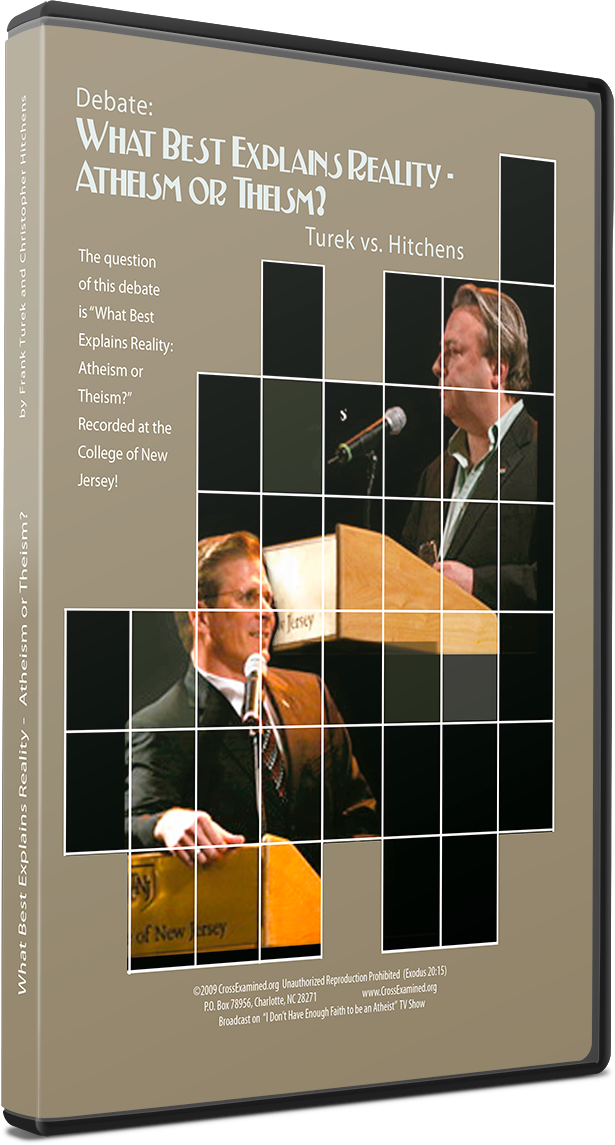
DVD WHAT BEST EXPLAINS REALITY: ATHEISM OR THEISM?


J. Brian Huffling, PH.D. have a BA in History from Lee University, an MA in (3 majors) Apologetics, Philosophy, and Biblical Studies from Southern Evangelical Seminary (SES), and a Ph.D. in Philosophy of Religion from SES. He is the Director of the Ph.D. Program and Associate Professor of Philosophy and Theology at SES. He also teaches courses for Apologia Online Academy. He has previously taught at The Art Institute of Charlotte. He has served in the Marines, Navy, and is currently a reserve chaplain in the Air Force at Maxwell Air Force Base. His hobbies include golf, backyard astronomy, martial arts, and guitar.

Original Blog Source: http://bit.ly/2GYUfAE

By Terrell Clemmons

A Framework for Mapping Reality & Engaging Ideological Confusion.

“Science is more than a body of knowledge. It’s a way of thinking,” said Carl Sagan in the last interview he gave before his death in 1996 at age 62. Sagan and Charlie Rose were discussing Sagan’s last book, The Demon-Haunted World: Science as a Candle in the Dark, and the danger that America’s deficiency in basic science posed for future generations. People in positions of power, they agreed, as well as the electorates who put them there must have a correct understanding of “the way the universe really is” and not be informed by doctrines that “make us feel good.” “If we are not able to ask skeptical questions, to interrogate those who tell us that something is true,” Sagan stressed, “then we’re up for grabs for the next charlatan, political or religious, who comes ambling along.” The upshot of it all was that science, rather than demons or doctrines, must be the “candle” that lights our way to the future.

Sagan is best known as the author and host of the 1980 PBS series Cosmos: A Personal Voyage, which was the most widely watched PBS series of the 1980s. His legacy lives on in the 2014 Cosmos: A Spacetime Odyssey, which aimed to capture for a new generation the “spirit of the original Cosmos,” according to host Neil deGrasse Tyson. Building on the popularity of the original, Tyson explained, the 21st-century remake would “present science in a way that has meaning to you, that could influence your conduct as a citizen of the nation and of the world—especially of the world.”

Salvo readers should be familiar with the concept of agenda-driven science, and to those who listen with an ear to discern it, it’s clear that Sagan, Rose, and Tyson are using science as they understand it to advance an agenda—to influence the way people think, with the aim of changing their behavior. This is the stuff of propaganda, and like most propaganda, Cosmos served up a slickly produced package of truths, half-truths, and subtle lies, skillfully laced with running undercurrents of moralistic appeals to emotion.

How does one respond to wholesale agendas like this without coming off as an abject contrarian? Try the worldview reset.

Worldview Reset

In How Now Shall We Live? (1999), Nancy Pearcey and Charles Colson laid out a framework for worldview analysis that can be applied to any narrative, idea, or agenda that comes ambling along. Here’s how it goes: Any worldview must provide an answer to three questions:

Who am I, and where did I come from? This is the question of origins.

What is wrong with the world? This is the question of the problem.

How can it be fixed? This is the question of the remedy.

Put through this filter, Christianity can answer each question in one word: Creationfall, and redemptionGodsin, and Christ or the cross would work equally well. The point is not to nail down precise terminology, but to sketch out the main points on the biblical map of reality. Christianity is not just a relationship with Jesus, or adherence to a set of doctrines or rules, or association with a religious institution. Those things may have their place, but it’s more than that. Christianity is a full-orbed, comprehensive worldview that puts forth testable truth claims about all of reality.

The same framework, then, can serve as a test for coolly analyzing alternative worldviews. All agendas operate according to some worldview, and our first objective in the face of one should be to identify it. In the case of Sagan and Tyson, this is straightforward. They’re scientific naturalists. But even if we didn’t know that, we could figure it out from the grandiose opening to the original Cosmos, where Sagan intoned, “The cosmos is all that is, or ever was, or ever will be.” From there, given the title of his book and his discussion with Rose, we can see that the problem they diagnose in the world stems from authorities and doctrines that are unscientific. Following through, the remedy they prescribe is for people to question those authorities, reject those doctrines, and think “scientifically,” just like they do.

Popularized through folksy celebrities like Tyson and Bill Nye “the Science Guy,” this materialistic narrative, along with its socio-moral dictates, is just one of the subliminal narratives that have become deeply entrenched in our culture.

First Things First: The Question of Origins

In practice, worldviews tend to bleed together, but the most prevalent ones in the developed world today are: scientific naturalism, which says that God is effectively nonexistent; postmodernism, which says that the question of God is unanswerable or irrelevant because cultures make up their own stories; pantheism, which identifies God with nature or the universe and then sees in nature a myriad of non-transcendent deities; and Judeo-Christianity, which says that there is one transcendent God who created the universe and everything in it.

It is supremely important to note that, of these, the Judeo-Christian worldview is the only one that is actually theistic. It alone, along with its offshoot Islam, answers the question of origins with a self-existing God. All the others are non-theistic. They amount to some form of philosophical naturalism and then try to explain all of reality, including human history, behavior, and culture, within those limits.

In 2016-2017 Morgan Freeman hosted a National Geographic series on religion called The Story of God, in which he traveled the world asking people of different faiths how they viewed death, evil, the afterlife, and other matters related to religion. The series was visually stunning, but its name is actually a misnomer. It was really a “story of a man”— a professed atheist attempting to explain the panoply of human experience within the confines of naturalism. Freeman’s worldview governed his interpretation of all the incoming data, and viewers who don’t understand that at the outset will likely find the series confusing.

Worldview and Ideologies

The concept of worldview is closely related to the concept of ideology, but the two are not quite the same thing. Every ideology is born of a worldview, but not every worldview is an ideology. Dictionary.com defines ideology as a body of doctrine, myth, or belief that guides an individual, group, or movement, together with a socio-political plan and devices for implementing it. In simpler terms, an ideology is an idea that has been elevated to worldview status and then activated into an agenda.

Let’s look at a few ideologies that are dominant today and identify the worldview behind them. Broadly speaking, environmentalism is an ideology that begins with philosophical naturalism, diagnoses the problem in the world as human mismanagement of the earth’s resources, and then prescribes changes to resource management, usually to be implemented by the government. Marxism, too, begins with naturalism, but it diagnoses the problem in terms of some kind of inequality between people groups. From there, it prescribes as the remedy some form of equalization, also usually to be implemented by the government.

Sexual ideologies grew out of Freud’s naturalism-based diagnosis that human problems stem from sexual repression, and they accordingly prescribe a remedy of casting off restraint. And, for an example of how ideologies bleed together, LGBT demands for “equality” effectively fuse the Freudian and Marxian diagnoses of the problem and then demand equalization for “sexual minorities” with respect to such social benefits as moral approval and state-endorsed marriage.

Interrogating the Disconnect

When one is confronted with a pre-assembled agenda masquerading as a good idea, applying the three-point worldview framework will facilitate dialogue in a way that clarifies, rather than clouds, the conflict. The framework does this by keeping attention on the incoming worldview and examining its truth claims. To use Sagan’s terminology, we interrogate it —Where is this idea coming from? What unstated presuppositions lie behind it?—with the goal of mapping the worldview disconnect and then peacefully shifting the discussion to the actual point of contention.

This can revolutionize a conflict in two ways. First, it draws all ideas out into the open. I was recently invited to participate in an informal roundtable discussion with Ben, a college student majoring in philosophy. When asked about my worldview, I answered within the three-point framework: GodsinChrist. He liked that structure and used it to articulate his worldview as well: evolutiondogmabetter science education—right in line with the Sagan-Tyson synthesis. Then he elaborated. Scientists aren’t doing enough to educate the public about what they know, he said, particularly with respect to the beginning of the universe and the origin of the first living things.

Now, if you’ve been reading Salvo for any length of time, you know why scientists aren’t providing these explanations. It’s because they don’t exist. And our discussion exposed this and other gaping holes in Ben’sworldview that are being filled with a materialistic version of faith.

Second, a worldview reset can reorient a potentially contentious dialogue. With most conflicts regarding secular ideologies, the disconnect is, at root, a clash between the theistic and non-theistic foundations. This can be the case even if both sides are invoking biblical imagery.

For example, sexual ideologies are often pushed with slogans like, “Jesus would accept gays and transgenders.” That may be true, but if Jesus is going to be invoked, then it’s fair and intellectually honest to redirect the discussion to the question of worldview foundation. If the Judeo-Christian God created humanity male and female and instituted marriage, then certain implications for sexuality follow from that. If not, then anything goes.

The relevant point for discussion would be, Which worldview foundation are we starting from? Is it Christian theism? Or is it some form of philosophical naturalism? If naturalism, then moral dictates based on what Jesus may or may not have done are irrelevant. Furthermore (and worse for the naturalist), in naturalism, morality is an ungrounded, arbitrary chimera. Whenever possible, then, ideologues, whether sexual, environmental or otherwise, should be pressed to grapple with the full implications of their worldview foundation. This is not rhetorical tit for tat. Wisely executed, it’s an act of Christian love.

Practical Peacemaking

Another entrenched narrative out there says that truth claims are the source of human conflict. But a worldview reset can actually be a move toward peace. Family counselor Beverly Buncher created a communication strategy for families of addicts called BALM—Be A Loving Mirror. It involves remaining calm in heated situations and, as lovingly as possible, reflecting back your opponent’s thoughts and emotions. The objective is to stay in the relationship, grounded in your own reasoned composure, in hopes of serving over time as a peacemaking, transformative presence for your loved one.

Both the worldview filter and the BALM approach are powerful aids for remapping ideological impasses and bridging relational divides. More important, they provide a setting for illuminating truth.


Terrell Clemmons is a freelance writer and blogger on apologetics and matters of faith.

This article was originally published at salvomag.com: http://bit.ly/2zJGiBe

By Tim Stratton

Complaint:

Dear Tim,

I love you man, but I don’t want my politics and my religion mixed. I look up to you for religious context and commentary because you are an expert in the field. Not politics. That’s just your opinions, and I can get that from every Tom, Dick, and Harry… but not Tim.

– Sean

Tim’s Response:

Thank you for your kind words, Sean. However, in addition to your pleasantries are statements that I encourage you to consider more deeply.

It would be absurd not to have one’s worldview (religion) influence their politics. In fact, one’s worldview ought to do that much (not the other way around). That is to say, if one truly believes that God exists, created humanity on purpose and for a specific purpose and that Jesus revealed how we ought to live, then the laws of politicians will either approximate to the “law above the law” (ultimate reality) or not.

If God does not exist, then humanity was not created on purpose or for a specific purpose. Thus, we would be mere accidents if atheism is true. If humanity is nothing but accidents, then politics are objectively meaningless (along with everything else) as there would be no objective purpose of the existence of humanity (say goodbye to human rights). Thus, on atheism, it would not really be wrong (objectively speaking) if Obama, Trump, Hitler, or Stalin is calling the shots. It is merely one’s irrelevant subjective opinion.

If God exists and Christianity is true, however, then one’s subjective political opinions can be objectively right or objectively wrong.

Politics & Gospel

Additionally, when a Christian claims they do not want their “politics and religion mixed” that is a good indicator that they probably do not understand their own religion for at least two reasons: 1- Jesus got involved in politics. 2- We are commanded to love all people and to share the gospel with the world.

First, consider the fact that Jesus constantly interacted with the Pharisees in the New Testament. The Pharisees were the religious and political rulers of Israel. Matthew 23: 23-24 provides a good example:

23 “Woe to you, teachers of the law and Pharisees, you hypocrites! You give a tenth of your spices—mint, dill, and cumin. But you have neglected the more important matters of the law—justice, mercy, and faithfulness. You should have practiced the latter, without neglecting the former. 24 You blind guides! You strain out a gnat but swallow a camel.”

Think about the “more important matters of the law” and modern-day America. Politicians today are more concerned about the consequences of using plastic drinking straws than placing restrictions on abortion (killing innocent human beings) and actually advocate for it in many cases. What do you think Jesus would say to these politicians? Based on His reaction to the political leaders of Israel, do you think Jesus would worry about hurting the feelings of modern-day politicians or those who vote for them? We must not disregard the “more important matters of the law.”

Second, if a Christian does not take politics seriously, then they probably do not take evangelism seriously. Frank Turek shows a satellite image of the Korean peninsula to make this point (See Why Christians Should Be Involved In Politics).

Notice the stark contrast between the north and south. South Korea is filled with light, activity, and productivity. According to Turek, “it is one of the most Christianized countries in the world.” North Korea, on the other hand, stands in polar contrast to their neighbors south of the border. North Korea is dark and seemingly “dead.” Turek accurately describes it as a big “concentration camp.” What is the difference between North and South Korea? One word: POLITICS!

Many South Koreans have heard the gospel of Jesus Christ because there is political freedom to share the gospel. The communistic government of North Korea, on the other hand, does not allow the gospel to be shared — it is a dictatorship. If you are a Christian, Sean, then you know that the gospel message is the most important information a person could ever have access to or possess. If you truly love all people — as Jesus commanded — then you must desire the people who have never heard the gospel to have access to this eternally vital information. Since politics is keeping millions of souls from hearing the gospel, if you truly love and care for all humans, then you should care about politics.

To not care about politics is to not care about people.

The Lesser of Two Evils

If you believe Christianity (your “religion”) is true, you must “mix” it with politics — at least if you are a consistent Christian and strive to love all people. After all, if Christianity corresponds to reality, then the politicians you support and vote for should strive to correspond to reality too. No politician will do this perfectly, but some political views approximate to reality more than others.

Unless Jesus Christ is running for office, all elections are a vote between the lesser of two evils. As Turek notes, if Billy Graham was running against Hitler, it would still be a vote between the lesser of two evils. Obviously, one who strives to be an objectively good person would do anything possible to keep Hitler and his politics out of office. That would include “mixing” politics with religion and sharing his or her views with as many voters as possible.

Bottom line: You kindly refer to me as an “expert” in my field (theology and metaphysics/ultimate reality). If that is true, then this expertise allows me to intelligently provide insight into things that fall under the umbrella of ultimate reality — like some political issues — as an expert too. That is to say, my political opinions are informed from my knowledge of reality. In fact, if one is trained how to think logically, then thinking logically applies to all aspects of life. This includes both religion and politics.

If one’s religion is true and their political view is also objectively good or right, then one’s religion and politics must be “mixed” . . . independent if they realize it or not.

Stay reasonable (Isaiah 1:18),

Tim Stratton


Tim pursued his undergraduate studies at the University of Nebraska-Kearney (B.A. 1997) and after working in full-time ministry for several years went on to attain his graduate degree from Biola University (M.A. 2014). Tim was recently accepted at North-West University to pursue his Ph.D. in systematic theology with a focus on metaphysics.

Original Blog Source: http://bit.ly/2JgVEkf

By Mikel Del Rosario

Engaging with Muslims

Respectful engagement takes courage and compassion

Let’s talk about respectfully engaging with Muslims. Being an ambassador for Christ means more than just defending what’s true. It also means loving people well. The more we engage with our neighbors, the more we see that religion is a core part of many people’s lives. And getting to know them means getting to know their religion. Beyond only focusing on critique or apologetics, we should also discover what makes each major religion attractive to adherents and converts.

How much do we know about Islam, the second-largest religion in the world? As part of my work with the Hendricks Center on respectfully engaging world religions, I invited Crescent Project founder Fouad Masri to talk about lessons he’s learned engaging with Muslims since 1979. In this post, I’ll share some of what I learned about what makes Islam attractive to Muslims, converts, and key points of connection Christians can use for respectful engagement.

What keeps Muslims faithful to Islam?

Before engaging with Muslims, it’s important to know that there’s a spectrum of practice and belief among Muslims in a variety of branches of Islam. So find out what your Muslim friend actually believes. Some Muslims don’t think much about the five pillars of Islam and may have never studied the teachings of Muhammad. Don’t automatically assume you know what any particular Muslim believes.

One thing that attracts people to Islam is a sense of order amidst chaos. For them, Islam answers questions like “How should I eat?” Answer: “With your right hand, not your left.” Also, many Muslim remain faithful to Islam to avoid feeling like a traitor. Your friend might agree with a point you made about the historicity of Jesus’ divine claim, crucifixion, or resurrection but they could think, “If I agree that Islam is wrong on this one, it might bring shame to my family.”

Many Christians think they understand Islam but need to do some homework to respectfully engage Muslims. Similarly, some Muslims think they understand Christian theology, but reason, “Christians are polytheists who worship three gods: God, Mary, and Jesus. Why should I believe that? Islam has to be right; There’s only one God.” Others come to America and don’t see Christians exhibit God’s love. Instead, they see crime, drunkenness, and drug addiction and think, “Christianity has failed America. I’m sticking with Islam instead of all this chaos.”

What draws converts to Islam?

While engaging with Muslims, you’ll find converts who say Islam is exotic. Many don’t connect with the contemporary worship styles they’ve seen in most evangelical churches. They’re seeking a more ancient, meditative sense of transcendence. But rather than looking into the ancient practices of historic Christianity, the ritualistic structure of Islam grabs their attention. Other converts find Islam’s structure brings them comfort in a diverse, pluralistic society.

But keep in mind, when you’re engaging with Muslims, some are seeking answers to tough questions about God. For example, many Muslims struggle with the problem of evil. They ask the same kinds of questions non-Muslims do: “Does God really exist?” “Does God care?” Some even wonder, “Are there other ways to know about God other than Islam?”

How to engage with Muslims

Masri has been engaging with Muslims for decades and he’s noticed that compassion ministries often open the door for respectful interfaith dialogue. He’s seen how Muslim refugees in Sicily, Greece, and America not only appreciate Christian ministries but directly ask, “Why are you helping us?” This gave them pause, especially since some were raised to see Christians as enemies. He says:

When they see love and kindness, they want to know more… Begin a conversation like, “Oh, you are a Muslim? Oh, you believe in one god?” Then, let them share. And then let the God of Abraham lead them to the knowledge of Christ the Messiah.

There are many ways to engage with Muslims and begin authentic relationships. But practicing hospitality is a great way to quickly create an openness to respectful, spiritual conversations. So compassion is key.

Still, pointing our Muslim friends to Jesus takes courage. Muslims reject the idea that Jesus is divine or ever claimed to be divine. How might a Christian respond to those who challenges the biblical conception of Jesus? I was surprised by Masri’s answer:

Let them read the words of Jesus. I know an imam. Somebody gave him a Bible. He read the words of Jesus: “From their fruit, you shall know them.” He got saved and baptized. The words of Jesus speak for who Jesus is. Many times, we try to explain this with our own power. Let the word speak for itself.

Interestingly, the imam linked his experience of Christian compassion ministries with Jesus’s teaching in Matthew 7:15-20: “Watch out for false prophets…You will recognize them by their fruit…a good tree is not able to bear bad fruit.” I would have never made this connection, but the Holy Spirit had already been at work in his life. While we must be prepared to defend the truth, sometimes people are one Bible verse away from finding a saving relationship with God. This is another thing to keep in mind when engaging with Muslims.

Jesus: A Point of Connection

I’ve found a great place to start when engaging with Muslims is with Jesus. Islam teaches that he is a prophet. Although many Muslims are told that the Bible’s been corrupted, the Qu’ran actually says “none can alter the words of Allah” (Surah 6:34). And Muslims seem to be commanded to accept the Christian Scriptures in Surah 29:46: “Do not argue with the People of the Scripture… Say, ‘We believe in that which has been revealed to us and revealed to you…’”

Interestingly, the Qur’an notes that Jesus performed healing miracles (Surah 3:49) but doesn’t include any narrative accounts of those healing miracles. You could ask your Muslim friend, “Do you want to see how Jesus performed healings? It’s in the Bible.” Show them Mark 2:1-12, where Jesus claimed to forgive sins in the context of a healing miracle. Here, Jesus is claiming the divine prerogative to forgive sins. Forgiving the paralytic was very different from anything Jews believed priests, prophets, or even angels could do. The scribal response show they knew that only God can forgive sins. Talk about that and you’re off and running in a conversation on the claims of Jesus.

Engage with Courage and Compassion

While some Muslims find the structure of Islam attractive, potential converts may be attracted to traditions they perceive as exotic. Still, others have spiritual questions that are not fully satisfied by Islam. Compassionate service can begin to create an openness to considering the teachings of Jesus in the Bible. Let’s ask the Lord to help us begin engaging with Muslims with both courage and compassion.


Mikel Del Rosario is a Ph.D. student in New Testament Studies at Dallas Theological Seminary, Cultural Engagement Manager at the Hendricks Center, and Adjunct Professor of Apologetics and World Religion at William Jessup University.

Original Blog Source: http://bit.ly/2OPsRVQ

By Natasha Crain

I grew up in a smallish town in Arizona (about 25,000 people at the time). Almost everyone I knew fit into one of four buckets: 1) committed Christians, 2) nominal Christians, 3) those who didn’t call themselves Christians but accepted “Judeo-Christian” values, and 4) Mormons.

In my view of the world at the time, believing in God—and being a Christian specifically—was the default for most people. There were certainly a few kids who fell into other buckets (atheist or New Age), but they were the exception; there was something different about them.

My beliefs were “normal.”

Oh, how things have changed.

According to Pew Forum research on the religious landscape of America, Christians statistically are still the majority. But those statistics are highly misleading because religious categorization is based on self-identification, and the “Christian” category includes a wide range of beliefs and commitment levels.

The Pew Forum, however, just released an eye-opening new method of categorizing America’s religious beliefs, and it reveals a more realistic picture:

  • Less than 40% of Americans are “highly religious” (seriously committed to their faith; this includes non-Christian religions such as Judaism and Islam).
  • About a quarter of the “highly religious” are what researchers call “diversely devout,” meaning they mostly believe in the God of the Bible but hold all kinds of views inconsistent with Christianity, such as reincarnation.

From the publicly available data, I don’t see a way to break down the remaining 30% of highly religious people into those who hold beliefs consistent with historic Christianity, so for our current purpose, we’ll just have to say that committed Christians represent some portion of that 30%.

In other words, a minority.

I’ve noticed lately that my subconscious assumption that this has become the case has had a number of implications for how I talk with my kids. For example, some phrases that have regularly worked their way into our daily conversations are “the world tells us,” or “the world would like us to think,” or “the way the world is.” In other words, I find myself constantly placing an emphasis on making sure my kids know that what they are learning to be true about reality is literally opposite of what the world around them—the majority—believes.

This is so different than how I—and many of you—grew up. We were part of a pack. We moved along without having to think much about our beliefs versus those of “the world.” Our parents didn’t have to coach us on why we were so very different… because we weren’t very different. Sure, there were probably some great differences between our homes in how prominently faith actually played out, but we didn’t readily see that on the playground. We didn’t have social media to make the differences abundantly clear. We didn’t have the internet to give us access to the many who are hostile toward our beliefs.

In a world where your beliefs will constantly rub up against opposing views, however, you need parents who will give it to you straight:

Our entire view of reality is unlike the view most others have. We. Are. Different. And that will affect your life in profound ways.

I don’t say this as a mere suggestion that this is a conversation we should have with our kids at some point. I say this believing it’s a critical part of how we approach our parenting every single day.

It has to become a way of life.

Here’s why. When you raise your kids to understand they have a minority worldview, it does three important things:

1. It sets expectations.

This is, perhaps, the most important function of all.

If kids expect that their views will be like those of others, they will be shocked when they consistently see how different they actually are.

If kids expect that holding a minority worldview won’t result in sometimes being treated poorly by others, they will be wounded by what they weren’t prepared for.

If kids expect that divergent worldviews won’t lead to heated debates about how our society should best function, they will be frustrated by lack of agreement between Christians and nonbelievers.

But when we consistently help them understand that their worldview will clash frequently with the world around them, they will begin to have very different expectations that lead to healthier outcomes.

They will expect to be different, and not be surprised when they don’t fit in.

They will expect that the world will hate them for their beliefs, and understand that has always been part of what it means to be a Christian (John 15:18).

They will expect that divergent worldviews will often affect their relationships with others, and be motivated to learn how to navigate those differences with both truth and love.

Action point: Find ways to regularly compare and contrast what others believe and what Christians believe. Make sure your kids understand how different their beliefs are, and, importantly, the implications of that—it affects how we see where we came from, why we’re here, how to live while we’re here, and where we’re going. It’s no small matter. You can point this out in movies, song lyrics, news stories, things that friends say, things that other parents say, signs you see, billboards, messages on clothing, and much more.

2. It allows us to emphasize that different isn’t (necessarily) wrong.

Humans have a tendency to assume that there is truth in numbers. My twins are in fourth grade and are getting to the age where they notice what their peers do a lot more. They tell me, for example, that everyone else has their own phone, that everyone else gets to go to sleepovers, and that everyone else plays Fortnite. They assume that if the majority gets to do something, then that must be what’s right.

Similarly, when kids eventually see that most people believe something very different about reality than what they do, it’s natural to wonder if their minority view must be wrong. Here’s the conversation we should be having with our kids from the time they are very little: different doesn’t mean wrong.

It doesn’t necessarily mean right, either.

The question we must plant firmly in our kids’ hearts and minds is, What is true? The truth about reality isn’t a popularity contest. It’s a question of which worldview is the best explanation for the world around us.

Action point:  Find ways to regularly compare and contrast why others believe what they do and why Christians believe what we do. If we don’t want our kids to assume that different is wrong, they need to have good reason to believe that their different view is right. They need to hear regularly from their parents that Christianity is a worldview based on evidence, and that faith is not blind. If you have kids in the 8-12 range, J. Warner Wallace has three kids books that are amazing for helping them start to think evidentially about their faith: Cold-Case Christianity for Kids,God’s Crime Scene for Kidsand Forensic Faith for Kids (this one JUST came out this month and is a perfect place to start). Even if your kids are a little younger, they can benefit tremendously from reading these with you. My 7-year-old is reading Forensic Faith for Kids and is super excited about doing the corresponding worksheets and watching the videos available for free at www.casemakersacademy.com/forensic-faith/. Honestly, these books should be required reading for every kid in this age range.

3. It fosters worldview vigilance.

Talking regularly about “the world” versus Christianity leads kids to constantly have a worldview radar up. Because they expect to constantly see ideas that clash with the Christian worldview, they become vigilant about sorting everything they see into “consistent with Christianity” or “inconsistent with Christianity.” This is extraordinarily important today, as kids so often quietly absorb secular views into their thinking without even realizing it. But the more they know that most of what they will see and hear will not fit with Christianity, the more they learn to vigilantly separate Christian ideas from others.

Action point:  Encourage your kids to spot the “secular wisdom” all around them. These examples are everywhere but they are, of course, never marked with worldview labels. The more you point out examples, the more kids learn to think critically. When this becomes a habit in your family, your kids will see it on their own and show you examples. We were at a store the other day and my 9-year-old son came around the aisle carrying this sign:

All you need is love

He looked at me with a big, disappointed sigh and said, “Mommy. Look. Love is all you need.”

He recognized this as bad secular wisdom as soon as he saw it. I asked him to explain what’s wrong with it, and he said, “there’s no moral setting.” As I pushed him to explain what he meant, he said there’s no context for making this statement. If God doesn’t exist, then what love means is just a matter of personal opinion—and no one has the authority to state that anything is all you need. I concurred and (gently) hit him on the head, saying, “I could claim that love means hitting people on the head in that case!” But if God exists, then He defines what love is. When we follow the greatest commandment—to love God—it informs what it means to follow the second commandment—to love others. It’s no longer up to us to define the word. This sign means nothing outside of a worldview context—a “moral setting” as my son put it.

It’s clear that being a Christian (or even holding Christian values) is no longer the default. Whether we like it or not, it’s the reality of the world in which we’re parenting. It’s our job to help our kids swim faithfully against the tide so they can be constantly aware of the waves around them and know how to respond.


Natasha Crain runs her Christian apologetics blog for parents, ChristianMomThoughts.com. She obtained her MBA in Marketing and Statistics from UCLA and obtained a Christian apologetic certificate from the University of Biola. She currently resides in California with her husband Bryan along with her three young children.

Original Blog Source: http://bit.ly/2PMb0PI