
Tag Archive for: Owen Anderson

​​Welcome to my new series on the belief system known as Antifa.

If you’re a parent or student, you might be wondering: What do the Antifa professors on my campus actually believe? Why are they pushing communism?

My goal in this first installment is to explain their ideological foundation—how they think the world works—so that you can recognize their framework, understand their appeal, and ultimately see why it collapses under its own weight. This helps you see that such professors, for all of their study, have failed to become wise and cannot explain the basics of reality.

In the next part, we’ll expose the rational incoherence of that foundation. The public refutation of any movement takes away its influence over the minds of its adherents and potential converts once it is exposed as incoherent—when it’s shown to make no sense whatsoever. Its initial appeal, grounded in teenage angst and sin, dissipates went the adult wants wisdom instead of folly.

One of the best resources for understanding the Antifa movement from its own perspective is the 2017 book Antifa: The Antifascist Handbook written by Mark Bray.[1]  In it, Bray says: “This book takes seriously the transhistorical terror of fascism and the power of conjuring the dead when fighting back.  It is an unabashedly partisan call to arms that aims to equip a new generation of anti-fascists with the history and theory necessary to defeat the resurgent Far Right.”[2]

1. The Organizing Idea: “Oppression”

Every worldview has a core idea that organizes its moral and political vision. For Antifa, that concept is oppression.

To understand their appeal, you have to see that there’s always some admixture of truth—a kernel of reality—that draws people in. This one especially appeals to our sin and natural desire to cry, “life’s not fair.” Because we are made in the image of God we have a natural desire for justice. But our sin corrupts this into a merely materialistic justice.

Here’s what Antifa affirms, in their own way:

  1. We are born into systems over which we have no control.
  2. Those systems are mixed with moral evil.
  3. In every system, there are groups who are “marginalized”—used by the system but denied its benefits.
  4. In every system, others are born into privilege they didn’t earn and use it to preserve their power.

Even Jim Morrison captured the mood:

“Into this world we’re thrown, into this house we’re born.”

It does seem unfair that some benefit from the lottery of birth while others suffer. These aren’t new insights—they’re ancient philosophical questions about justice, responsibility, and fate. They press us to think, “Are the economic advantages of life really our highest good, or is there something even better than money and status?” The problem isn’t the questions Antifa raises. It’s their answers.

The problem isn’t the questions Antifa raises. It’s their answers.

2. The Marxist “Solution”

Antifa’s answers are, quite simply, catastrophically incoherent. Generally speaking, theirs are the answers of the French and Communist Revolutions. Rousseau, the French philosopher who laid the philosophical groundwork for the revolutionary spirit, taught that humans are born good and crime is an invention of society due to private property. “Man is born free and everywhere he is in chains.”

Similarly, Antifa believes that through violent revolution they can overthrow the oppressive system and rebuild a materialistic utopia of communal living. Bray tells us, “Despite the various shades of interpretation, antifa should not be understood as a single-issue movement. Instead, it is simply one of a number of manifestations of revolutionary socialist politics (broadly construed).”[3] Anything that gets in the way of the socialist revolution, even small government constitutionalism, is “fascist.”

According to Antifa, anything that gets in the way of the socialist revolution, even small government constitutionalism, is “fascist.”

From their initial complaint about inequality, they leap into revolutionary nihilism by implementing old-fashioned Marxist materialism dressed up in radical chic:

  • Burn down the existing system—it cannot be reformed, only destroyed.
  • Replace it with the standard communist formula: redistribution of wealth and state control of production.

The modern twist is that their Marxism has become decentered and nihilistic, following the ideas of Michel Foucault rather than Joseph Stalin. They still want to overthrow all order, but they prefer to use chaos, bureaucracy, and “cultural revolution” instead of centralized Soviet power.[4]

Bray links the “anti-racism” movement championed by figures like the disgraced Ibram X. Kendi with the LGBTQ+ and decolonizing movements, and all under the umbrella of anti-racism.[5] In other words, all of the causes the radical university professors advocate in university classes across the nation.

That said, they’re always willing to use a government—when it suits their purposes—to impose their ideology on everyone else. This is why they are so sensitive to the appearance that someone else might do it. “The lady doth protest too much, me thinks.” In their view, there are only two options, communists and fascists, or international socialists and national socialists—both are radical leftist ideologies.

3. The Religious Core of a “Materialist” Movement


Despite claiming to be materialists, Antifa offers its adherents an unmistakably religious outlook. This can be seen in the zeal with which they pursue their goals and the strength of fideism by which they believe themselves to be justified. They are anarchists and decentralized but we can still define those terms to see what holds the group together even if it is in a loose sense.

“Antifa should not be understood as a single-issue movement. Instead, it is simply one of a number of manifestations of revolutionary socialist politics (broadly construed). Most of the anti-fascists I interviewed also spend a great deal of their time on other forms of politics (e.g., labor organizing, squatting, environmental activism, antiwar mobilization, or migrant solidarity work).”[6]

Like all cults, they are organized around an “us vs. them” mentality where the “them” are outsiders, followers, sheep, who cannot understand. And because “they” cannot understand, the focus for Antifa is not rational persuasion but “community organizing” to “resist.”

Marx borrowed heavily from Christianity.  He gave his own version of the fall and redemption.  The fall occurred when private property was introduced, the fallen system is the capitalist exploitation of workers, and redemption occurs (and the millennium is introduced) when the workers of the world unite to overflow that system and replace it with their own.

The materialism of the movement can be found in its often overt anti-Christian, anti-God rhetoric.  But it is also present in the absence of anything transcendent when the movement presents its utopian views. The human is a mere evolved animal that is to live in a materialist paradise where its material needs are met. The “revolution” is the only thing that gives the adherents of this religion any hope of a “cause” that transcends their lives and gives some appearance of meaning to their existence. This is why it has such a cult-like zealotry.

4. The “Authenticity” Creed


Their moral ideal is “authenticity.” They teach “existence precedes essence,” meaning you exist first and then define who you are. Echoing Sartre, Foucault said, “It’s my hypothesis that the individual is not a pre-given entity which is seized on by the exercise of power. The individual, with his identity and characteristics, is the product of a relation of power exercised over bodies, multiplicities, movements, desires, forces.”[7] That’s why they attach themselves to the LGBTQ+ movement—because both rest on the same principle: the will to power.

To be “authentic” means to exert your will, to define yourself, to reject all external authority. Again, Foucault said “The relationships we have to have with ourselves are not ones of identity, rather they must be relationships of differentiation, of creation, of innovation. To be the same is really boring.”[8]

This rejection of authority is also why the movement is anti-intellectual at its core. It abandons the authority of reason, dismisses logic as “oppressive” or “logocentric,” and replaces truth with the mantra: “Do what thou wilt.”

This is also applies to means/ends reasoning. All means are justifiable for the end sought by the radical. Saul Alinsky tells us, “If you actively opposed the Nazi occupation and joined the underground Resistance, then you adopted the means of assassination, terror, property destruction, the bombing of tunnels and trains, kidnapping, and the willingness to sacrifice innocent hostages to the end of defeating the Nazis.”[9] There are not “rules” for radicals; they are justified, in their own eyes, to do anything that achieves their goals.  If they label their opponent a “Nazi,” as we hear the radical left doing with Charlie Kirk and other conservatives, then they are justified to stop him at all costs.

5. The Luciferian Inspiration


Their own mentors don’t hide their allegiance. For example, in Rules for Radicals, Saul Alinsky’s handbook for modern activism, dedicates itself to the first radical—Lucifer. There, he says, “Lest we forget at least an over-the-shoulder acknowledgment to the very first radical: from all our legends, mythology, and history (and who is to know where mythology leaves off and history begins—or which is which), the first radical known to man who rebelled against the establishment and did it so effectively that he at least won his own kingdom—Lucifer.”[10]

That’s no metaphor. They admire the arch-rebel. Whether or not they think there is a being named “Lucifer,” they worship him as their “light-bearer.” They would rather, as Milton’s Satan put it, “rule in hell than serve in heaven.”

Their concept of being “oppressed” even includes living under God’s law—because to them, God’s authority itself is oppression. Saul Alinsky says, “The Revolutionary Force today has two targets, moral as well as material. Its young protagonists are one moment reminiscent of the idealistic early Christians, yet they also urge violence and cry, ‘Burn the system down!’ They have no illusions about the system, but plenty of illusions about the way to change our world.”[11] They are idealists but without Christ and therefore without any restraint.  They see the “system” as structurally racist and bigoted and not worth saving.

They would rather invent their own morality, even if it leads to ruin. The community organizer of Alinksy is to be a political relativist, and Machiavellian, who will use any means necessary to achieve his end. Nothing is off the table.[12]

The technical word for this is “heteronomy.” They opposed any law that originates outside of themselves. But their mistake is that God’s law is written on our hearts. It is a description of our being. God’s law describes the choices we must make to achieve what is best for us as humans. Seeing this, some are willing to take the step of denying their humanity and identifying as animals.

Alinksy goes on to teach about how to be a community organizer.  Here he is very clear about the radical’s intentions: “The organizer is in a true sense reaching for the highest level for which man can reach—to create, to be a ‘great creator,’ to play God.”[13] l think of Lucifer as the Phoenix who is cast from heavens, only to rise again in the flames and create his own reality.  These radicals are clear that this is their hero and their own aspiration.

6. Be Free in the U.S.A.

The sad irony is that those with communist leanings are nowhere more free to live that out than in the United States. Throughout our history, utopian groups have set up shop to show the rest of us how it is done.

In the United States, you’re free to voluntarily start a commune with others who are like-minded. Many have done this over the last few centuries. Such communes regularly fail disastrously, but you’ll still find groups that try again.

The keyword here is “voluntary.” In the United States, you can work together with others who voluntarily decide to do so. But the French and Marxist revolutionaries want to force everyone else to do it their way.

The United States is built on the idea of rational persuasion. That’s why we began our history with a Declaration of Independence where we presented an argument to the world. By comparison, the American revolution was far less bloody than any of the revolutions that followed. Our goal was not to destroy the British system, but to defend ourselves as having a right to our own system.

When a philosophy is essentially irrational, like that coming out of Marxism, it tends to hate the idea of rational arguments.[14] Instead, it seeks to force others to conform. That is why Antifa does not want to work within a system to change it, but wants to instead overthrow it.

7. What This Reveals

Once you understand these ideas, the Antifa professor’s worldview becomes predictable:

  • They see the world as an evil system that must be destroyed.
  • They justify rebellion as liberation.
  • And they redefine good and evil as power and weakness.

Their entire life’s work rests on shifting sand—a rebellion disguised as moral compassion. Their “system” is built on falsehoods and misunderstandings of reality.

It’s easy to convince people that they are oppressed and that life is unfair. That’s the seductive power of sin: the allure of rebellion.

What’s far more difficult—and far more valuable—is to pursue truth: to see the world as it really is, to understand our fallen condition, and to find redemption not in revolution, but in Christ.

Antifa has nothing lasting to offer its followers. It reduces human life to the material and promises a utopia it cannot deliver. To find meaning in life, we must come to know what is transcendent.

Next in the series:

In Part 2, we’ll examine the logical and moral contradictions in Antifa’s worldview—and show why their system not only fails philosophically but collapses under its own claim to justice.

Bibliography

  • Saul Alinsky, Rules for Radicals: A Pragmatic Primer for Realistic Radicals. New York: Vintage Books, 1971), at: https://ia801202.us.archive.org/28/items/RulesForRadicals/RulesForRadicals.pdf
  • Mark Bray, Antifa: The Anti-Fascist Handbook (Brooklyn, NY: Melville House, 2017),

at: https://files.libcom.org/files/Antifa%2C%20The%20Anti-Fascist%20Handbook.pdf


  • Center for Strategic and International Studies (CSIS), “Examining Extremism: Antifa,” (CSIS Briefs, 2021), at: Available at: https://www.csis.org/analysis/examining-extremism-antifa


  • George Washington University Program on Extremism, “Anarchist/Left-Wing Violent Extremism in America,” (Washington, D.C.: GWU, 2021), Available at: https://extremism.gwu.edu/


  • Ruth Kinna, “Heretical Constructions of Anarchist Utopianism,” Utopian Studies 15, no. 2 (2004), 97–121, at: https://www.jstor.org/stable/20718631


  • Sophie Scott-Brown, “Utopian Anti-Utopianism: Rethinking Cold War Liberalism through British Anarchism,” Intellectual History Review (2025), at: https://doi.org/10.1080/17496977.2025.xxxxxx


  • Murray Bookchin, “Anarchism: Past, Present, and Utopia,” in The Anarchist Papers, Dimitrios Roussopoulos, ed (Montréal: Black Rose Books, 1980), at: https://theanarchistlibrary.org/library/murray-bookchin-anarchism-past-present-and-utopia


  • Marty Tomszak, “Anti-Fascism as Constitutive of the Gospel Ethic,” Political Theology Symposium (Political Theology Network, 2024), at: https://politicaltheology.com/symposium/anti-fascism-as-constitutive-of-the-gospel-ethic


  • Acton Institute, “Five Facts about Antifa,” Acton Institute (Religion & Liberty Online, 2017), at: https://rlo.acton.org/archives/97805-5-facts-about-antifa.html


References:

[1] Mark Bray, Antifa: The Anti-Fascist Handbook (Brooklyn, NY: Melville House, 2017), xii.

[2] Bray, xii

[3] Bray, xvi

[4] Editor’s Note: In this way, Antifa is a decentralized, organized around different hubs of anarchist and marxist radicals, rather than a strict centralized hierarchy of power. In recent weeks, some voices on the left have argued that Antifa isn’t an “organization” but a leaderless ideology. But it’s naïve to think that a terrorist group cannot also be an ideology or that it would need a centralized power structure to exist. For an argument against antifa’s “terrorist group status,” see, Luke Baumgartner [interview], “What is Antifa and why Trump calls it a Terrorist Group?” [Video] Public Broadcasting System (23 September 2025) at: https://www.pbs.org/video/targeting-antifa-1758662072/

[5] Bray, xvi, xxii, 46-7, 93, et al.

[6] Ibid, xvii.

[7] Michel Foucault, “The Subject and Power” (1982), The Foucault Reader, edited by Paul Rabinow (New York: Pantheon Books, 1984), pg. 214.
in Michel Foucault: Beyond Structuralism and Hermeneutics, edited by Hubert L. Dreyfus and Paul Rabinow, 2nd ed. (University of Chicago Press, 1983), pages 208–226.

[8] Michel Foucault “Sex, Power and the Politics of Identity” [interview] (1982), in The Essential Works of Michel Foucault, Volume 1: Ethics, Subjectivity, and Truth, edited by Paul Rabinow, ed., Robert Hurley, trans., (New York: The New Press, 1997), 162.

[9] Saul Alinski, Rules for Radicals: A Pragmatic Primer for Realistic Radicals (New York: Vintage Books, 1971), 27.

[10] Alinski, ix.

[11]Ibid, xiv.

[12] Ibid, 79.

[13] Ibid, 61.

[14] Editor’s Note: Rather than treating reason as a principled methodology, with reality and truth being an objective judge between competing parties, Antifa – with it’s Marxist and Machiavellian roots – tends to treat truth as optional, and reason as disposable. Reason is, for them, a mere tool, to be used for pragmatic purposes when it suits one’s interests, but its readily discarded whenever it begins to work against antifascist aims. For antifa (and disciples of Alinski), power is the guiding principle, leaving reason/rationality is merely a pragmatic tool to be used, abused, and discarded, in service to the greater pursuit of power. Truth itself is seen as sophisticated tool of oppression under the current hegemony. This anti-realistic stance stems not from Antifa’s Marxist roots but rather from it’s postmodern influence, via critical theory, wherein reality itself is seen as a malleable social construct rather than an objective reference point for adjudicating between competing claims.

Recommended Resources:

Correct not Politically Correct: About Same-Sex Marriage and Transgenderism by Frank Turek (Book, MP4, )

You Can’t NOT Legislate Morality mp3 by Frank Turek

Legislating Morality: Is it Wise? Is it Legal? Is it Possible? by Frank Turek (Book, DVD, Mp3, Mp4, PowerPoint download, PowerPoint CD)

Does Jesus Trump Your Politics by Dr. Frank Turek (mp4 download and DVD)


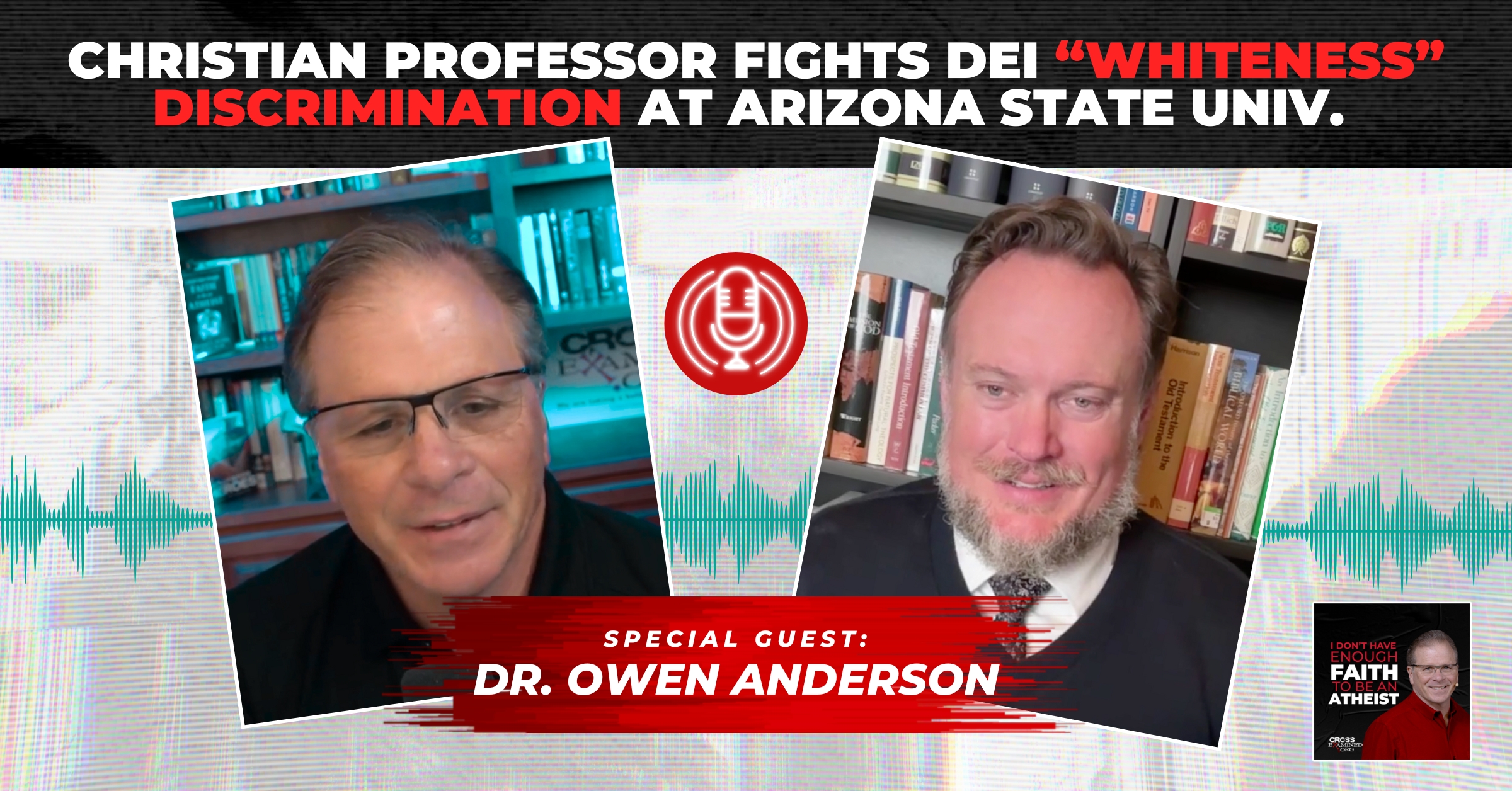
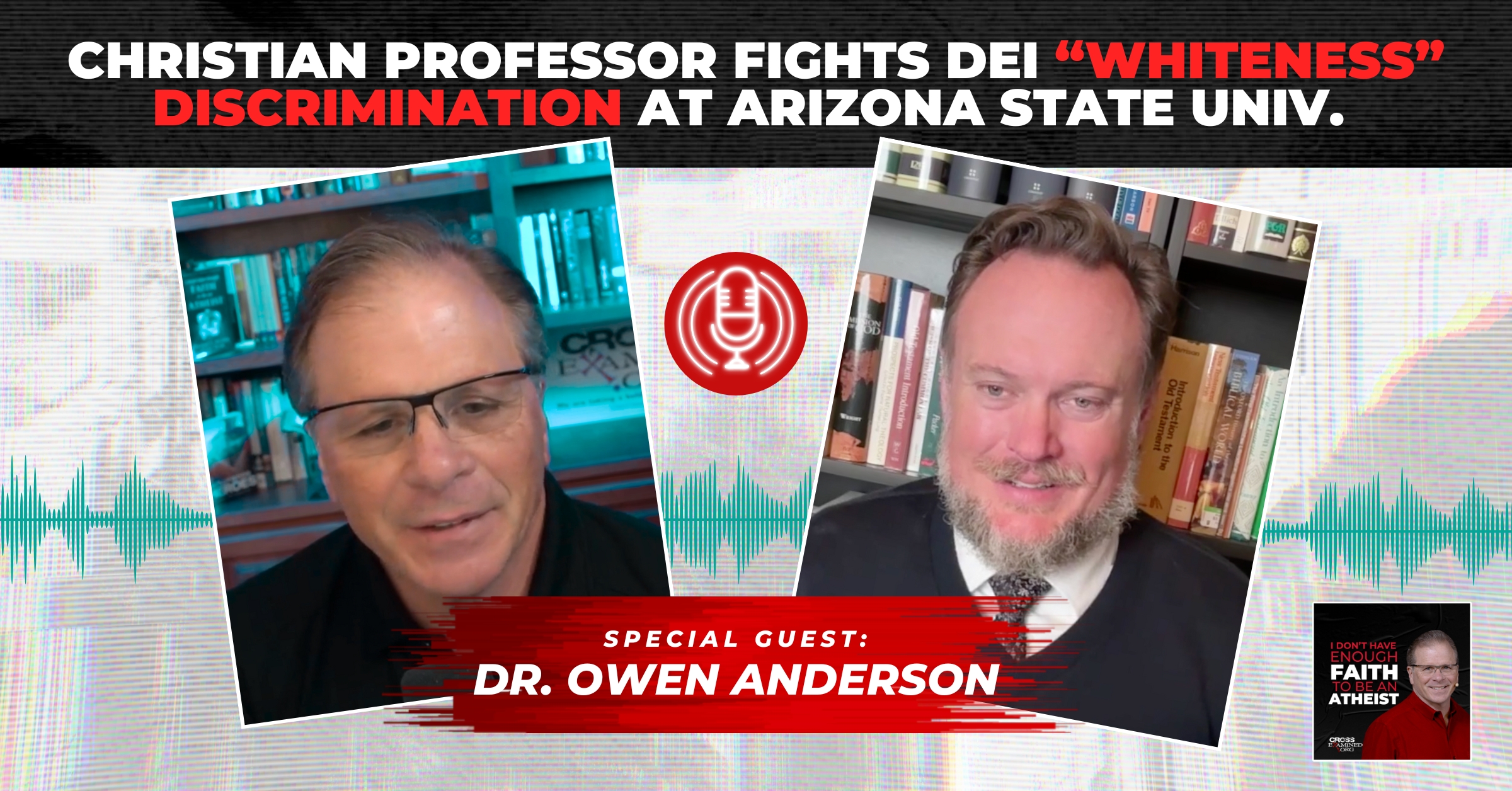
Dr. Owen Anderson is a Professor of Philosophy and Religious Studies at Arizona State University, a pastor, and a certified jiu-jitsu instructor. He emphasizes the Christian belief in God, human sin, and redemption through Christ, and he explores these themes in his philosophical commentary on the Book of Job. His recent research addresses issues such as DEIB, antiracism, and academic freedom in secular universities, critiquing the influence of thinkers like Rousseau, Marx, and Freud. Dr. Anderson actively shares his insights through articles, books, online classes, and his Substack.


A version of this blog was originally posted at: https://bit.ly/4hGcv08

“We destroy arguments and every lofty opinion raised against the knowledge of God, and take every thought captive to obey Christ.”
2 Corinthians 10:5

One of my goals as a Christian and as a tenured full professor of philosophy and religion at our nation’s largest research university (ASU) is to help Christian parents and students understand what to expect if they attend classes teaching radical ideologies—DEI, LGBTQ+, Antifa, decolonization, anti-settler, anti-white, and anti-heteronormativity theories. Christians know that such universities would never permit a Christian to use class time for evangelism. The radical Marxist professor seems to think that the First Amendment guarantees them a job as a professor, but it doesn’t guarantee them that anyone will attend their classes or programs.

So how did we get here, and what can parents and students do about it?

Three Steps that Led Us Here

1. The Myth of Neutrality – The first step is the myth of neutrality. Christians allowed public universities to be disconnected from Christian belief on the assumption that in a pluralistic society, public education cannot be shaped by one “perspective.” But this neutrality was a myth—and it was never practiced by the radical left.

Many on the left claim they are teaching “facts,” not religion, so they avoid the appearance of bias. Yet, for them, the Marxist dialectic is the fact of the matter. They look at who is in power and blame that power structure for realities like poverty and crime. In the modern era, white Christian males have been in power, so they become the objects of animosity.

This assessment has no nuance. These critics lump all Christians into the same narrative, ignoring that slavery, for example, was brought to an end largely by white Christian men, whereas it continues in other parts of the world today. But for the radicals, that too must somehow be blamed on colonization and, by extension, Christianity.  All problems in any nation today are due, they tell us, to Christianity. Christian missionaries are the special subject of their animosity.

  1. Twisting Christian Values –Second, they use Christian values to tie Christians up so they can’t engage in the intellectual battle. “Christians,” they say, “are supposed to be self-sacrificing and turn the other cheek. If you’re insulted, you shouldn’t reply. And don’t Christians care about the poor? Shouldn’t you help marginalized sexual groups?”

For many Christians, this strategy is powerful. They either bow out of the conflict with radicalism or even join it because they want to help those who suffer. Radicals will even quote the Bible to Christian students: “Didn’t Jesus say that when you help the least of these, you are helping Him?”

Students may be ready for a direct assault on the Bible, but they are often unprepared for scripture twisting. One radical I work with says she loves Jesus just not the other parts of the Bible made by men.  Which parts of what Jesus says does she like and which parts are made by men?  She likes the parts that accord with her own moral intuitions (two or three sayings about helping others) and all the rest, those that call for repentance for sin, those that tell the crowd to seek the bread of life, those that call us to love him by keeping his commandments, those she dismisses.

  1. The False Dilemma – Third, we need to prepare for the false dilemma. A false dilemma gives only two options when more are available. It says, “either A or B,” when there is also C, D, E, and so on.

In a false dilemma, each side may contain some truth. Rarely does a belief system teach only falsehoods. The Marxist is right to care about the poor and to point out that greedy people misuse the capitalist system to exploit others. But the Marxist’s ability to identify real sins does not validate the rest of their worldview.

The Horizontal Solutions          

Radical professors try to solve humanity’s problems on a merely human level—what I call the horizontal level. They believe crime and poverty result from private property. Eliminate private property, they argue, and we will create perfect humans.

But the other side of the false dilemma is no better. There we find godless capitalism, pushed by atheist technocrats who want to perfect humanity through technology and transhumanism built on capitalist innovation.

Both sides offer merely horizontal solutions.

The Need for a Vertical Perspective     

The real solution begins with recognizing that there is more to existence than the merely human or merely material. We must begin with God, who has existed from eternity. We are His creatures, made by Him and given moral direction by Him. Our chief end is to glorify Him and enjoy Him forever.

Our human problem is first and foremost our sin by which we lost communion with God.  Our sin destroys every aspect of our lives.  It makes us hate ourselves and have body dysmorphia, it makes us hate our neighbor and develop grievances and envy, and it makes us hate God.  Although God’s commands are good for us and are the path to life, in our sin we hate his law and find it a burden.

Jesus warned the crowds following Him that they sought only material bread when they should have been seeking the Bread of Life. Poverty is tragic, but there are far worse things—such as spiritual death. Jesus was clear that we should not be focused on “what shall I eat and what shall I wear” but on the kingdom of God (Matthew 6:24-26). He was clear that “Whoever does not obey the Son shall not see life, but the wrath of God remains on him” (John 3:36).

Why the Radical Turns to Marxism       

The desire to help the downtrodden is why many godless academics are drawn to some variation of Marxism. Created in the image of God, they still long for justice and righteousness, even after abandoning God. They suffer under the weight of sin that crushes individuals and entire systems.

But rather than repent, many will just harden their hearts, double down on hating God, and propose their materialist dialectic. The “spiritually minded” simply add New Age platitudes about “the universe,” “my soul,” “reincarnation,” or “the One.”

The False Dilemma Exposed     

The false dilemma appears because both perceived options—Marxism and materialistic capitalism—reject God.

  • Some forms of capitalism assert that the individual is the absolute owner.
  • Marxism asserts that the community is the absolute owner.

But the truth is that only God can absolutely own anything.

Capitalism has real virtues: personal responsibility, private property, fair wages, investment of capital, wise use of time. It has raised more people out of poverty and produced more innovation than any other system. But if it becomes mere human ownership for selfish indulgence, it is as ugly as Marxism.

We do not have to pick between two poisons. What happens in the university is that Marxists point out abuses in capitalism, and the unprepared Christian is caught and made captive to unbelief.

Preparing the Next Generation

We need to teach our children to see through these tactics. Help them anticipate the assaults of Marxist radicals so they are not caught off guard—and so they can raise questions exposing the folly of the materialist dialectic.

If they know the strategy in advance, they can counter it. Or better yet, they can choose alternative classes and professors. No one is required to take courses from Marxist radicals. Let them lecture to empty rooms.

Recommended Resources: 

Was Jesus Intolerant? (DVD) and (Mp4 Download) by Dr. Frank Turek 

Correct not Politically Correct: About Same-Sex Marriage and Transgenderism by Frank Turek (Book, MP4, )

How Philosophy Can Help Your Theology by Richard Howe (DVD Set, Mp3, and Mp4)   

Legislating Morality: Is it Wise? Is it Legal? Is it Possible? by Frank Turek (Book, DVD, Mp3, Mp4, PowerPoint download, PowerPoint CD)


​​Dr. Owen Anderson is a Professor of Philosophy and Religious Studies at Arizona State University, a pastor, and a certified jiu-jitsu instructor. He emphasizes the Christian belief in God, human sin, and redemption through Christ, and he explores these themes in his philosophical commentary on the Book of Job. His recent research addresses issues such as DEIB, antiracism, and academic freedom in secular universities, critiquing the influence of thinkers like Rousseau, Marx, and Freud. Dr. Anderson actively shares his insights through articles, books, online classes, and his Substack.

As students around the country get ready to go back to school, our universities are eagerly awaiting their next round of freshmen. If you’re a parent or student, you will need to know how to find classes that help you become wise and lead a virtuous life. As a professor, I can provide you with some ideas.

First, go to your university’s course schedule and see what is offered. If a class interests you, check out its syllabus. If the professor will not make their syllabus public, that is a bad sign. You can email and request it. What you want to see is the reading list and the kinds of lecture materials that are used. That will tell you if there is bias.

For example, take a look at your university’s Honors College or Gender Studies courses to see if there are classes on left-wing advocacy, left-wing border and immigration theory, LGBTQ+ sex philosophy, and even gender problems for transhumanists. Doesn’t all of that sound delightful! You just know that employers are waiting with bated breath to hire graduates who can discuss transhumanist sex philosophy on the border.

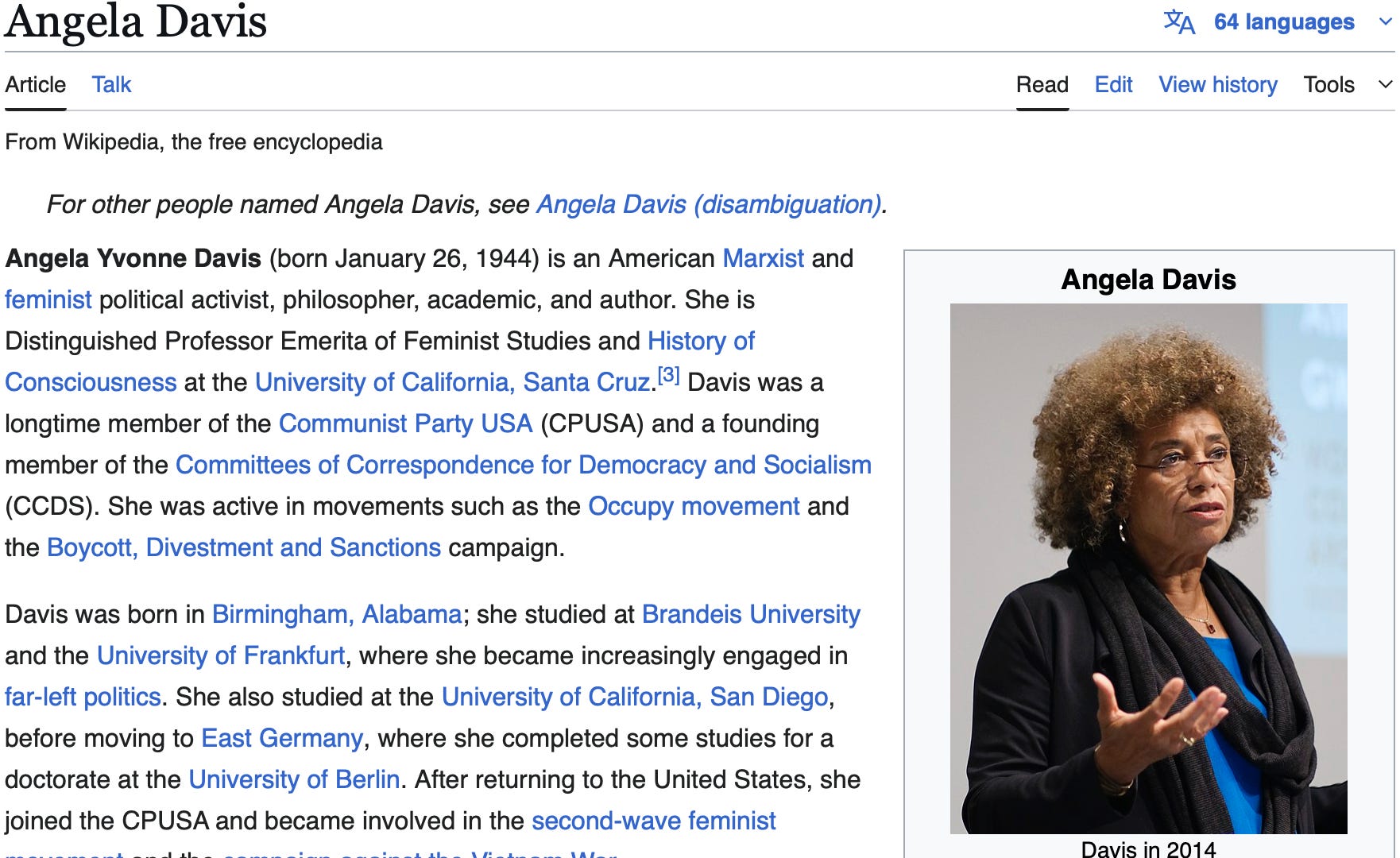
A few of these courses post the books they use, which is where you’ll see thought leaders like Angela Davis—so you know you’re in for some unbiased critical reflection.

Look at that list of accomplishments! Parents, aren’t you excited to pay thousands for your children to learn by reading a feminist Marxist who lived in East Berlin!

When they are accidentally honest about their reading list you see that they are self-described Marxists. Not many syllabi are offered publicly, however. And that is what we need to change. A public university funded by public tax dollars should be required to make the content of its classes public. I’m working on it with the Arizona State Legislature.

Second, ask the professor (in a respectful manner) about their own personal bias and how it affects the class content. Ask if they are aware of their own spin when they interpret a text. Then, ask [if, or] why other voices aren’t included—such as conservatives and Christians.

Third, take note when, during the semester, the professor inserts personal opinions or takes shots at conservatives and Christians. Report this to the state legislature. Or, you can contact me and I’ll give you the contact info. I help many students navigate the leftist bias they encounter.

Fourth, look for any proof that the professor is wise. If you were taking a course on business, you’d want proof that the professor understands business. And so, with a humanities class, do you have any proof that the professor is wise? There are a few ways to do this.

Observe how this professor lives. Does this professor worship and honor God? Does this professor confess their need for Christ? Or does this professor worship an idol, or even a demon—perhaps the gods Eros and Bacchus? If the professor cannot tell the difference between God the Lord and Eros, they won’t be able to help you learn to be wise.

Next, ask the professor which philosophers influenced them. If they say Marx, Freud, Heidegger, or Habermas, then they cannot be wiser than their teachers. Those figures offered self-contradictory philosophies to the secular world. Their philosophies are empty of transcendent meaning and have only led to despair and collapse.

If a professor can’t see that their own beliefs are self-contradictory, and if they haven’t been able to lead a good life directed toward our highest end, then they won’t be able to help you learn [very much]. It is worth your time to do your due diligence and avoid these kinds of classes.

I’ll have more soon as we see syllabi begin to be published for the public . . .

Recommended Resources:

Defending the Faith on Campus by Frank Turek (DVD Set, mp4 Download set, and Complete Package)

Was Jesus Intolerant? (DVD) and (Mp4 Download) by Dr. Frank Turek 

Jesus vs. The Culture by Dr. Frank Turek DVD, Mp4 Download, and Mp3

Counter Culture Christian: Is the Bible True? by Frank Turek (Mp3), (Mp4), and (DVD)        


​​Dr. Owen Anderson is a Professor of Philosophy and Religious Studies at Arizona State University, a pastor, and a certified jiu-jitsu instructor. He emphasizes the Christian belief in God, human sin, and redemption through Christ, and he explores these themes in his philosophical commentary on the Book of Job. His recent research addresses issues such as DEIB, antiracism, and academic freedom in secular universities, critiquing the influence of thinkers like Rousseau, Marx, and Freud. Dr. Anderson actively shares his insights through articles, books, online classes, and his Substack.

Originally posted at: https://bit.ly/4lQqtNs

My “Pride ‘Heroes’” series draws attention to the philosophy and individuals behind the LGBTQ+ Pride movement.[1] At Arizona State University, the campus library commands all who enter to “Celebrate Pride.” This is the only sexual philosophy granted a dedicated month in which the public is commanded to obey. Meanwhile, ASU’s Herberger Institute for Design and the Arts hosts an annual Drag Queen show as part of its ongoing promotion of gender ideology.


Why? Because the Herberger Institute for Design and the Arts also holds events for other ideologies and religions as well, such as Christianity. Oh wait—no, that’s not true. It doesn’t do that. It exclusively pushes a radical leftist agenda.

Question: How will that affect federal funding under Trump’s new executive order?

A hero is someone who protects children. Protecting children includes protecting them from blatant falsehoods and from those false teachers who want to confuse them and hinder them from understanding reality. Now let’s look at Drag Queens: are these heroes who simply want to read books to children?  What we find is that the philosophy of Drag cannot escape God’s world.  All humans are made in the image of God, desire a meaningful life, and cannot find that meaning without understanding the created order that God made.  Let’s see how the Drag philosophy defends itself.

What exactly is the “Drag Queen” philosophy?

Isn’t Drag Queen philosophy just people having fun and being their authentic self? No. There are many ways to have fun and be yourself. The Drag Queen philosophy is very explicit about its purpose: to subvert norms and to teach that gender is fluid. In other words, to teach that Christianity and the other theistic religions are false.[2] It denies that there is an objective reality that shapes how we live our lives.

The Drag Queen philosophy rejects God’s creation of male and female; it is purposely contrary to the nature of things. It’s not just harmless entertainment. They often joke, “We’re coming for your children,” but the joke loses its humor when they actually do try to enter libraries and schools to impose their views about gender on young minds.

What Defenders Say

Let’s begin by taking the defenders of Drag Queen Story Hour (DQSH) at their word—or at least, at their marketing brochure.

  1. Literacy and Engagement

We’re told drag queens are simply performers who make reading fun. The makeup, the wigs, the glitter? All part of the show to get kids excited about books. But here’s the problem: there are many other engaging ways to promote reading that are not tied to a false ideology. We don’t read for the sake of reading; we read to understand what is true. If we train children to associate reading with clearly false ideas about gender, we haven’t helped them overall—we’ve hindered them. We’ve taught them that fiction doesn’t just belong on the page, but in how we view reality.

  1. Inclusion and Diversity

DQSH events are promoted as celebrations of inclusion, where LGBTQ+ families can feel represented and children can learn to “tolerate” diverse expressions of identity. But here’s the irony: just as those families wouldn’t want a conservative Christian showing up to impose his beliefs on them, others have a right to be free from having Drag ideology imposed on their children. The First Amendment protects free expression, but it does not give anyone the right to indoctrinate other people’s children under the guise of public programming. That path doesn’t build a diverse society—it builds resentment and antagonism. The push for “inclusion” must still respect boundaries.

  1. Teaching Gender as a Social Construct

This is the most revealing justification of all. Drag queens, as avatars of gender fluidity, are used to teach kids that gender roles are flexible, performative, and non-binary. The message? There’s no “he” or “she”—only what you feel and how you present. There is no truth, only “my truth” which is to say “my feelings.”

This is the heart of it: the desire to inculcate children with a philosophy that denies nature, creation order, objective reality, and even basic reason itself. Drag isn’t just dress-up. It’s a worldview, and its aim is to deconstruct the categories that are essential for human flourishing. The Drag Queen philosophy is clear about opposing God and his created order. Here’s a truth about every human who has ever lived: they all had exactly one biological mother and one biological father.

The problem is, homosexual men cannot have children of their own. They can try to adopt someone else’s child. Or, they can pay a woman—often a disadvantaged woman who needs the money—to rent her womb so that one of them can use his sperm to fertilize an egg (meaning the child is unrelated to the other man). But together they cannot produce a child. And so, instead, they feel the need to teach other people’s children.

This is the self-contradiction in their philosophy. On the one hand, they deny that there are any essences. They insist on radical nominalism: there are only particulars, no universals. There is only the self-declared individual who proclaims, “I am a they/them,” and no such thing as human nature, male and female, mother and father.

And yet, they still have the natural desire to pass their worldview on to children.

Their childless philosophy still conforms—unwittingly—to the natural order they claim to reject.

They cannot escape the creational pattern established by God. No amount of thinking, feeling, “authenticity” or “identity expression” can make two men conceive a child. No amount of “I wish, I wish” can erase the basic fact that civilization depends on a man and a woman teaching the children that come from their union. We live in God’s world. And we cannot escape His reality.

We live in God’s world. And we cannot escape His reality.

But this philosophy openly tells us that they are working to subvert God’s creation and replace God with their own sexual desires.  They say “fight evil with love” but reverse the meaning of those words as they actively work to teach children to disobey God.

What’s the Harm?

Far from helping children, the drag philosophy introduces serious philosophical harms. Let’s consider just a few:

  1. Normalization of Gender Confusion

Drag, by definition, is an exaggerated parody of womanhood, often rooted in sexualized adult performance. It insults women by treating them as unreal, as if a man in flamboyant costume is just as much a woman as an actual woman. In fact, they deny that there are any “actual women;” a woman can be any man who thinks he is a woman.

Presenting this to children is not “tolerance.” It is the deliberate confusion of the categories God created—male and female. It teaches children that gender is not a given but a costume, not reality but performance. This is not education. It’s miseducation. It is incoherent thinking that believes “if I think it then it is true and the rest of society must conform to my inability to understand reality.”

  1. Undermining Parental and Religious Authority

Many of these events are marketed directly to children. Parents are sometimes invited—but often just bypassed. The unspoken message is clear: your parents and your pastor are outdated. Tune them out. Tune in instead to the man in heels reading Heather Has Two Mommies. But on what basis should Drag Queens get access to other people’s children? If they tell children not to listen to their parents, why would anyone ever listen to a Drag Queen who lives a life of confusion and denial of reality?

This philosophy has no great achievements to point to—no contributions to human flourishing on which it can stand. It is, at bottom, simply men in exaggerated costumes claiming that their greatest accomplishment is refusing to follow any moral norms and instead doing whatever they feel. That’s not authenticity—it’s the height of immaturity and a lack of personal discipline.

Drag ideology depends on gaining access to the children of others because it is fundamentally sterile—it cannot produce its own future. And yet, it wants to disciple a generation. To do that, it must undermine the family and the faith communities that stand in its way.

Drag ideology depends on gaining access to the children of others because it is fundamentally sterile—it cannot produce its own future.

  1. Boundary Testing

Drag has always been about pushing boundaries. Its adherents are quite open about this. It is rooted in burlesque, rebellion, and sexual subversion. Bringing it into children’s spaces may not always be criminal, but it is certainly corrosive to innocence. It introduces adult themes into tender minds. And that alone should be reason enough to keep it out of your public library’s children’s room. The Drag Queen has failed to understand the basics about reality, including what is and is not appropriate for children.[3]

  1. Neo-Gnosticism and Cultural Marxism

Now we’re getting to the philosophical roots. Drag fits seamlessly into a broader project to deconstruct creation order. At its core is a rejection of nature itself—a denial that reality has a given structure. In place of divinely revealed identity—male and female, made in God’s image—we’re offered expressive individualism: You are whatever you say you are. Reality must conform to your feelings. Biology is oppression. Nature is optional.

The drag queens can rage against God’s created order of male and female all they want, but each of them came from the union of a man and woman.

This is nothing new. It’s simply a remix of ancient Gnosticism and modern Marxism. Like Gnosticism, it treats the body as a problem—believing we are souls trapped in the wrong body, and that the solution is to cut, reshape, and mutilate the body to fit our desires. Like Marxism, it sees the family and the church as oppressive structures that must be overthrown. And like both, it cannot build anything—it can only tear down.

A Better Story Hour

Now imagine a different kind of story hour. Imagine a public university that doesn’t impose this sex philosophy on its students. One where children are told that they are not mistakes or blank slates, but created by a loving and wise God. That their bodies are good as they are. That the world is meaningful. That truth is not invented but discovered. Imagine a child learning not that gender is a costume, but that they are fearfully and wonderfully made. That sin is real—but so is grace. That the answer to confusion is not doubling down on meaningless and self-contradictory self-expression, but humbling oneself to seek wisdom. That would be a story worth telling. And it wouldn’t need glitter or wigs to hold a child’s attention—just truth, spoken clearly, in love.

Let the Drag Queen Story Hour promoters keep their costume parties. We’ll keep the real stories. The true ones. The ones that don’t melt under the heat of reality like a rhinestone wig on an August afternoon in Phoenix.

We live in God’s world, he has put eternity in our hearts, and we will never find lasting meaning until we look to him and his created order (Ecclesiastes 3:11).

References:

[1] Editor’s note: Dr. Anderson’s “Heroes of Pride Month” series includes, Intro to Pride Month,  features Michel Foucault, Judith Butler, Drag Queens, and the San Francisco Gay Men’s Chorus.

[2] Editor’s Note: Historic Christianity traditionally teaches that homosexual practice and crossdressing are  wrong, and that natural marriage and biblical sexual ethics are prescribed for society (Deuteronomy 22:5; Romans 1:26-28; Matthew 19:1-12). There are, however, schismatic churches and perhaps even whole denominations that identify as “Christian” in roughly the same way that trans people identify as a different gender from their natural sex. People can try to socially construct their identity just as they may try fabricate their own brand of Christianity, but if it contradicts what God has made – be it the Church or biological gender – then “trans” roughly translates as “fake.”

[3] Editor’s Note: Even some drag queens have been speaking out against Drag Queen Story Hour as it has “pedo-vibes” for putting crossdressing gender-bending burlesque dancers in close contact with elementary children, and that See here, https://www.youtube.com/watch?v=2jF7W3N1T7U

Recommended Resources:

Correct not Politically Correct: About Same-Sex Marriage and Transgenderism by Frank Turek (Book, MP4, )

4 P’s & 4 Q’s: Quick Case FOR Natural Marriage & AGAINST Same-Sex Marriage (DVD) by Dr. Frank Turek 

Legislating Morality: Is it Wise? Is it Legal? Is it Possible? by Frank Turek (Book, DVD, Mp3, Mp4, PowerPoint download, PowerPoint CD)

Does Love and Tolerance Equal Affirmation? (DVD) (Mp4)  by Dr. Frank Turek


​​Dr. Owen Anderson is a Professor of Philosophy and Religious Studies at Arizona State University, a pastor, and a certified jiu-jitsu instructor. He emphasizes the Christian belief in God, human sin, and redemption through Christ, and he explores these themes in his philosophical commentary on the Book of Job. His recent research addresses issues such as DEIB, antiracism, and academic freedom in secular universities, critiquing the influence of thinkers like Rousseau, Marx, and Freud. Dr. Anderson actively shares his insights through articles, books, online classes, and his Substack.

Originally posted at: https://bit.ly/3Ix1bpq

I have been writing a series about Pride Month to highlight the truth behind the lives of the LGBTQ+ figures we are commanded to celebrate.  Young Christians considering attending state universities should be aware of the kind of propaganda they will encounter and how to respond in a bold yet loving manner that affirms the free offer of salvation through Christ to all.  These so-called “heroes” lived lives of “activism” and “helping the marginalized.” They are held up as people whom the young should imitate. ASU’s library commands us to “Celebrate” them. ASU is currently the largest state university in the country, weighing in at 180,000 students, so it has a sizable impact for this sex philosophy. Yet when we take an honest look at their lives, we see that they were hypocrites who harmed the very marginalized they claimed to defend. They offer no ideas on how to receive a new heart or find redemption. They lead their followers with promises of liberation, only to march them straight into the utter meaninglessness of “do as I say, not as I do” and imprisonment to sin.


Judith Butler is one of the most celebrated intellectuals behind the modern LGBTQ+ movement. A philosopher by trade, Butler has been crowned the patron saint of gender fluidity. She is best known for teaching us that gender isn’t something we are—it’s something we perform. Like a Broadway show, but with less coherence and worse costumes.

But before she denied the existence of objective reality as a mere power relation, Butler was raised in a Jewish home in Cleveland. As a form of discipline, her parents sent her to Hebrew school, hoping, perhaps, that a little theology would straighten her out. It did the opposite. There, she began grilling rabbis with tough philosophical questions: Why can only men read the Torah in services? Who decides what the Torah means? Underneath these lay a deeper question, one that shaped her thinking for decades: Why does God permit evil—especially in light of Jewish suffering?

The Came Hegel

She didn’t find answers that satisfied her. So she turned, instead, to Hegel. From him, she learned that all is one, that distinctions are illusions, and that we are climbing a dialectical staircase toward divinization. Everything is performance (all is one). Even performance is performance. Followed consistently, only the ego and its ideas/desires exist; there is no material world by which to test ideas and define simple concepts like “man and woman.” The psychoanalytic process is no longer about integration into reality but about conforming reality into whatever the ego wants.

Why is there suffering? Suffering is due to social constructs that interfere with individual desires, constructs imposed upon the individual ego by a judgmental society seeking to defend its power structures (this is foreshadowing something to come). And if suffering is constructed, then it can be deconstructed. If reality is imposed, then it can be reimagined. Truth is no longer discovered; it is declared.

If you think you’re a they/them, then you are. That’s all it takes. Just think it—and it is so.

There is no objective reality by which to test this. No external world to provide correction. The scientific method—laughable! Biology—repressive! That old wives’ tale that all human babies come from one biological mother and one biological father—how quaint! Gone is the humility of science and the moral law of God; in their place stands the imagination of the self, armed with a self-contradiction and a moralistic platitude. She even asserts that believing in two sexes is fascism!

The Real Moral Test

But here’s where the rubber meets the road.

For all her public moralism about power, justice, and women’s rights, Butler was strangely silent—indeed, complicit—when it really mattered. When the #MeToo movement urged us to “believe victims,” Butler didn’t. In fact, she did the opposite. She wrote a private, behind-the-scenes letter to the president of NYU defending her close friend and fellow gender theorist, who had been accused by a graduate student of sexual abuse and manipulation.

Let that sink in: Butler, long-time critic of power abuse and patriarchal academia, used her own power to shield an alleged abuser from consequences. She didn’t rush to defend the vulnerable. She rushed to protect the powerful—because that powerful person was one of her own.

This is the same Judith Butler who has built a career decrying systems of oppression, who teaches entire generations that moral hierarchies are tools of domination. But when a real moral test arrived, she flunked it. Not because she misunderstood her theory—but because she lived it out.

She later expressed some regret that maybe she may have defended privilege. Weak. But here’s the thing: before you start thinking “hey, we all make mistakes,” you must remember that isn’t the standard she has imposed on others. She demanded works righteousness conformity to her intersectionality power structure activism. There is no grace and no redemption. She can say “whoops” all she wants, but what this exposes is that in old age, after a lifetime of gender activism, she committing heinous wrongs and has seen no personal transformation.

As the fool said to King Lear: you shouldn’t have grown old until you grew wise.

Sadly, there is no such thing as wisdom for Butler because that requires objective reality, and the ego must deny itself to pursue truth. Wisdow laughs at her claim that “all is performance.”

You see, Butler’s gender theory has no room for integrity, no path to repentance, and no standard of justice beyond power itself. The ego is the highest standard. Her entire worldview boils down to this: “Do what you think is true. Reality is what you say it is.”Which works just fine—until she has more power and decides that you are the problem. Then letters are written to defend her friends.

Are you starting to see a theme behind these heroes?

This is what makes her a hero of Pride Month. Not because she offered a path to redemption or renewal. She didn’t. But because she gave the movement a philosophical excuse (albeit a nonsensical one) to cast off all restraint—gender, biology, objectivity, morality—and replace them with the ego and its desires.

What’s the pattern in what these heroes taught and how they live?

  • “Whatever you desire, do that.”
  • “There is no objective moral standard; all is reducible to power.”
  • “And even if there is objective morality, I’ll violate it when it’s personally convenient.”
  • You can be as God, do what you want is the whole of the law.


This is an incoherent philosophy on which to build a life. And yet, in our sin, it is the philosophy we all start with. Judith Butler and the LGBTQ+ movement are no different than the rest of us on this point: we have all sinned and come short of the glory of God. And it is also true that while we were yet sinners Christ died for us. If any of us is to find redemption, fulfillment, and true authenticity, it is in Christ alone.

This is why Butler matters to the LGBTQ+ movement. She gave it its defining creed: “You are whatever you think you are.” It’s a childish idea dressed up in the language of liberation. But it leads not to freedom, only to hypocrisy from which she cannot escape even in old age—and not to justice, only to self-justification.

She is, in short, the perfect hero for a movement that celebrates “authenticity is however you feel now” without accountability, and identity without objective reality.  Pray with me that those who are caught up in captivity to this philosophy see their need for Christ and turn to him.

You can find the other posts in my Pride Month Heroes series on my Substack, which is drowenanderson.substack.com.

Recommendations: 

Correct not Politically Correct: About Same-Sex Marriage and Transgenderism by Frank Turek (Book, MP4, )

Does Jesus Trump Your Politics by Dr. Frank Turek (mp4 download and DVD)

Is Morality Absolute or Relative? by Dr. Frank Turek Mp3 and Mp4

Legislating Morality: Is it Wise? Is it Legal? Is it Possible? by Frank Turek (Book, DVD, Mp3, Mp4, PowerPoint download, PowerPoint CD)


​​Dr. Owen Anderson is a Professor of Philosophy and Religious Studies at Arizona State University, a pastor, and a certified jiu-jitsu instructor. He emphasizes the Christian belief in God, human sin, and redemption through Christ, and he explores these themes in his philosophical commentary on the Book of Job. His recent research addresses issues such as DEIB, antiracism, and academic freedom in secular universities, critiquing the influence of thinkers like Rousseau, Marx, and Freud. Dr. Anderson actively shares his insights through articles, books, online classes, and his Substack.

One of the ways you will find philosophy professors denying Christ is through an appeal to Kantian ethics. Kant’s ethical theory uses many positive-sounding words that appeal to our moral intuitions. Yet, when we examine the content, we find that Kant was opposed to Christ as revealed in Scripture. Instead, he sought to elevate the individual’s moral intuitions as the highest authority, and even above the Bible.


I know of professors who lure students in by claiming to be Christians, but then play a shell game: they subtly replace Christianity with Kantianism, and then argue that the Bible and Christianity are false because they contradict their moral intuitions.

Kant’s Ethics

Permit me to give you a brief overview of Kantianism. Immanuel Kant sought to ground ethics not in religion or divine revelation, but in human reason alone. His project was part of the broader Enlightenment goal of establishing a rational foundation for morality that could be universally valid, independent of theological commitments. By itself, that all sounds great. But once we begin to ask what Kant meant by terms like “reason” and “summum bonun,” we run into deep problems. Here’s how he approached it:

1. Moral Law from Within, Not from Above

Kant believed that morality must be autonomous, not heteronomous, that is, it must come from within the rational will of the individual, not from an external authority like God or the Church. By “reason,” Kant distinguished between pure reason (used in studying metaphysics) and practical reason (used to solve problems in means/ends reasoning). He was a skeptic about pure reason, arguing that it ends in contradictions. So, when he tells us to be rational or to use a rational will, he means to use reason to live according to the categorical imperative.
He famously wrote:

“Two things fill the mind with ever new and increasing admiration… the starry heavens above me and the moral law within me.”
Kant, Critique of Practical Reason (1788)

This “moral law within” was, for Kant, the source of true ethical obligation. He did not deny God’s existence, but he insisted that moral duties must be discoverable by reason, not dependent on divine command. He speaks like the Serpent from the Garden: he believes to be moral we must determine good and evil for ourselves.

2. The Categorical Imperative

Kant replaced divine law with a purely rational principle: the categorical imperative. This is a test for determining whether an action is morally permissible. His most famous formulation is:

“Act only according to that maxim whereby you can at the same time will that it should become a universal law.”
Immanuel Kant, Groundwork of the Metaphysics of Morals (1785)

This is an attempt to derive moral law from pure reason, without appeal to consequences, emotions, or divine will. For Kant, if a rule cannot be universalized, it is morally impermissible.

Yet, he bases this on “if you can universalize it.” Can you live with this rule being universal. This means it is a statement of subjective opinion and not objective reality. Nietzsche took this to its logical conclusion in his will to power. Because the Kantian rejects God’s law as heteronomy he has no appeal to anything objective by which to critique the will to power. And this is why professors in the Kantian tradition fell in so easily with philosophies of power like DEI and critical theory.

3. Human Dignity and Autonomy

Kant believed that each person possesses intrinsic worth because of their rational nature. Therefore, one should always treat humanity, whether in oneself or in others, never merely as a means, but always as an end. This principle grounds ethics in respect for persons, not in obedience to God.

The university Kantian combines this with the categorical imperative to make an appeal to abusive empathy. This is when you take advantage of the listener’s disposition to compassion and excuse the wrongdoing of the person who is pitied. How another person feels becomes their moral standard. If someone is poor, we do not consider the possibility of sloth; instead, we ask how they must feel and how good they would feel if they were simply given money and a house. This abusive empathy is used to bully the Christian into accepting the radical leftist morality that Kantianism has become.

Kantianism presupposes Rousseau’s claim that human beings are naturally good and only corrupted by the invention of private property. It rejects God’s providential rule of the world and instead insists that all injustice stems from the unequal distribution of material goods and resources. Kant rejects the biblical doctrines of the Fall and sin, and instead teaches that humans are perfectible through adherence to Kantian moral theory.

4. Religion as Morality’s Handmaid, Not Its Source

In his book Religion Within the Bounds of Bare Reason (1792), Kant argued that religion should support morality, not define it. He viewed Christianity as a helpful moral teaching only insofar as it agrees with his subjective reason. It is “subjective reason” because it relies on his moral intuitions about “how the world should be.” Christ was seen more as a moral example than a divine Savior.

And remember, for Kant, “reason” means: What can I universalize?, and then solving practical problems that arise as you live according to that principle. In other words, Kantian “reason” becomes subjective and denies the clear general revelation of God and His moral law.
Kant even called the concept of a divine command the “heteronomy of the will,” which is a failure of reason to guide itself. He wanted a moral law that any rational being, whether religious or not, could recognize and obey.

5. Postulates of Practical Reason

Although Kant did not ground morality in religion, he concluded that moral reasoning requires presupposing three things:

● God (as the guarantor of justice, otherwise unknowable)
● Immortality (so that perfect virtue is achievable)
● Freedom (to be morally responsible)

These are not proofs, but practical postulates, which are ideas we must assume if we are to take morality seriously. Still, they are subordinate to Kantian reason, not based on revelation or faith in Christ.

Kant attempts to get around God’s providence in this world, and the inherent connection of sin and death, by saying that what appears to be unfair in this life (the righteous suffer and the wicked live well) is made right in the next life. He defines the summum bonus, or highest good, this way: “The highest good is the complete unity of virtue and happiness” Critique of Practical Reason, 5:110).

In other words, the summum bonum is the state in which a person who is fully morally good (possessing a good will) also experiences the full happiness that such goodness deserves.
Kant teaches his followers to reject God’s law as heteronomy, to live according to their own subjective intuitions about what should be universal, and to be content with the idea that their self-defined virtue in this life will be rewarded with happiness in the next.

6. The Serpent and Kant

Think about how closely all of this resembles the teaching of the Serpent in Genesis 3. The Kantian is told to determine their own good and evil. God’s law is rejected as imposed, as a limitation on freedom, it is heteronomous and therefore illegitimate.

It is seen as an invasion of the human will by an outside source. But in Genesis 3, God imposed death as a call to repent of sin. Instead of repenting, the Kantian says, “Live by my philosophy, and you will be given happiness in the next life.” “God” becomes a mere postulate, which is a necessary idea to guarantee that promised happiness.

Yet Kant offers no explanation of how a sinner can be reconciled to a perfectly holy and good God. He teaches works righteousness. In his system, the human is not a sinner in need of grace, but someone who does wrong due to social circumstances, and who can be perfected and made virtuous by following Kantian philosophy.

7. Identify the Wolf

As a student, you should understand the philosophy your professors will be imposing on you. You can use Kantianism against them. Instead, insist on your own autonomy and reject their heteronomy. Then challenge their categorical imperative and ask how it escapes absolute subjectivity. And ask why God, who is holy, would ever grant happiness to an unrepentant sinner; someone who has spent a life rejecting God’s law and reducing Christ to a mere moral example rather than the Lamb of God who takes away the sin of the world.

Kant:
1. Couldn’t explain what has existed from eternity.
2. Denied that what is good for a being is based on their nature and therefore determined by their Creator.
3. Rested his entire philosophy on ultimate skepticism about God and providence.
4. Denied that the Bible is divinely inspired.
5. Denied we need to be reconciled to God by Christ.

The Kantian is no Christian.

Learn to expose your professor’s presuppositions and demolish their arguments. Or better yet, don’t even sign up for, or pay for, such classes. Exercise your autonomy to find a university and professors who recognize what is clearly revealed about God and the moral law through general revelation.

Recommended Resources:

Intellectual Predators: How Professors Prey on Christian Students (DVD) (mp3) (mp4 Download

Correct not Politically Correct: About Same-Sex Marriage and Transgenderism by Frank Turek (Book, MP4)

Legislating Morality: Is it Wise? Is it Legal? Is it Possible? by Frank Turek (Book, DVD, Mp3, Mp4, PowerPoint download, PowerPoint CD)

Letters to a Young Progressive by Mike Adams (Book)


​​Dr. Owen Anderson is a Professor of Philosophy and Religious Studies at Arizona State University, a pastor, and a certified jiu-jitsu instructor. He emphasizes the Christian belief in God, human sin, and redemption through Christ, and he explores these themes in his philosophical commentary on the Book of Job. His recent research addresses issues such as DEIB, antiracism, and academic freedom in secular universities, critiquing the influence of thinkers like Rousseau, Marx, and Freud. Dr. Anderson actively shares his insights through articles, books, online classes, and his Substack.

As a parent or student it will help you to know that in many cases your secular professors have a strategy. They have a goal. A strategy is the big-picture plan to win or achieve that goal. Tactics are the step-by-step methods used to carry it out. I’ve told you before that you can see their goal by how they live their own lives. But now let’s look at their classroom tactics.


If you’re a parent or a prospective student, you need to understand the tactics of the secular professor. For many of them, “winning” means leading students to adopt a radical leftist ideology—either by outright agreement or by slow, subtle influence. Agreement isn’t always demanded immediately. Sometimes, all they want is your gradual surrender of confidence in anything else.  The big win, however, is final deconversion from Christianity and acceptance of something like the LGBTQ+ “safe zone” philosophy pushed at ASU.

Undermining Christianity: The Real Strategy

The strategy of many secular professors is simple: undermine Christianity. Why? Because Christianity remains the major roadblock to their radical leftist ideology.  Without that, their goal is in sight.

If you had to guess a student’s religion, statistically, you’d guess Christian and be right more often than not. Christianity remains the default framework for morality, identity, and truth for many students, even if only in fragments.  Christian teaching is the main roadblock to the Marxism at the core of the radical left.

And that’s a problem—for them.

The teachings of Christianity are fundamentally incompatible with the radical left’s view of sex, gender, truth, power, and the good life. So, it’s not just about “dialogue” or “working together.” Before they can win a student to their worldview, they must first destabilize the student’s confidence in Christianity. Undermine the foundation, and the rest of the structure will fall. That’s the strategy. Their tactics follow.

How the Strategy Is Carried Out: Tactics You Should Know

This strategy to undermine Christianity is carried out through many identifiable tactics. For parents and students, it’s worth learning these—not only to recognize what’s happening, but also to see how poorly equipped many of these professors are for the intellectual life they claim to lead. Scripture puts it plainly: “Claiming to be wise, they became fools” (Romans 1:22). What we’re witnessing in many classrooms today is a real-time application of that verse. Let’s examine a few of their most common tactics. We’ll begin with three—but the list, sadly, is always growing.

Tactic #1: Undermine the Word of God

The first and most foundational tactic is to undermine the authority of Scripture. This can take the form of a direct assault—mocking the Bible as outdated, oppressive, or absurd—or a more subtle approach: cherry-picking verses to support radical leftist ideology.

For example, I have a colleague—openly anti-Christian—who claims that Matthew 25:40 (“Whatever you did for the least of these, you did for me”) is the best verse in the Bible. Why? Because she believes it proves her progressive social philosophy. On her reading, all you have to do is advocate for so-called sexual minorities, and you’re doing exactly what Jesus said. No need for sound doctrine. No need to understand the whole Bible. Just grab a single verse and weaponize it.  Incidentally, it is worth noting that in this specific verse, Jesus is speaking about believers.

But that’s only half the tactic. The next step is to accuse actual Christians of not living up to the verse. She’ll claim that conservative Christians don’t care for the poor or marginalized—never mind the fact (which students rarely hear) that conservative Christians out-give atheist professors by a staggering margin when it comes to charity, adoption, missions, disaster relief, and practical acts of compassion.

Still, students don’t know that. So the professor paints a picture: the Bible is on her side, and Christians are hypocrites who don’t live up to it.

You’ll notice she never mentions John 6, where Jesus rebukes the crowd for following Him only to get bread, rather than the Bread of Life. She’s not interested in the full counsel of God—only the verses that can be twisted to serve her ideological agenda.

There are other versions of this tactic. One common move is to deny that the Bible even teaches that homosexuality is a sin. “That’s just in Leviticus,” they’ll say, “and no Christian keeps that anymore.”

I call this the “Did God really say?” tactic. Just like the serpent in the garden, the secular professor begins by sowing doubt: Did God really say that?

Did He really say that homosexuality is a sin?
Did He really define male and female?
Did He really establish the moral order we find in Scripture?

If they can get the student to doubt the clarity, authority, or consistency of God’s Word, they’ve won the first battle.

Tactic #2: Vilify Christianity

The second tactic is to vilify Christianity—to paint it not as the source of civilization’s greatest moral and social advances, but as the root of all historical evil. This is straight out of the classical Marxist playbook, so anyone familiar with the last 150 years of ideology should see it coming a mile away.

Unfortunately, most parents assume we’ve moved past this kind of propaganda. And most students, born long after the fall of the USSR, have never heard a rebuttal. So here’s what they’ll be told:

Christianity invented slavery.
Christianity promoted poverty.
Christians fought to keep people oppressed.

Of course, if you dig long enough, you can always find someone—somewhere—who called themselves a Christian and said something foolish or sinful. That’s not hard. But that’s not the [larger] truth. The truth is this: Christianity gave birth to orphanages, hospitals, and universities. It introduced the rule of law, the dignity of the individual, and the foundation for economic growth and human rights. Christianity gave entire nations the hope of a better future in this life—and the next.

You won’t hear that in most classrooms. Instead, students will be told that Christianity supported slavery. But the historical reality is that slavery was universal in the ancient world. Christianity challenged and ultimately abolished it in Christianized nations—while it still exists today in non-Christian societies.

Why do professors hide this? Because the tactic is designed to make students (specifically white male Christian students) ashamed of their own heritage, their faith, and their families. That shame softens them. Once a student is ashamed of Christianity, they can be more easily reprogrammed and brainwashed. The Marxists knew this. And today’s professors are still using the same tactic with unnerving skill.

Tactic #3: Teach That It Doesn’t Matter Either Way

This tactic is all about misdirection. Unlike the first two, which confront Christianity directly, this one tries to bypass it entirely. The professor simply avoids mentioning the Bible at all. Why? Because attacking it outright might prompt a student to open it—and then the risk is that the student might actually be convinced by its truth. So, instead, the tactic is silence.

The professor communicates—both directly and indirectly—that the student can live a good, meaningful, moral life without ever knowing what the Bible says. If Scripture does come up, it’s brushed aside with a casual, dismissive remark: “Oh, the Bible? Sure, there are a few good things in there—for people who like that sort of thing.”

The message is clear: the Bible is irrelevant.
Not dangerous. Not sacred. Just… beside the point.
Outdated. Unnecessary. Background noise.

This is misdirection at its finest—because it leaves the student disarmed. There’s no battle to fight if the battlefield itself is ignored. The professor shifts the student’s focus to career, activism, self-expression—anything but divine truth. And over time, the student begins to believe the lie that neutrality is possible, and that the big questions of life—truth, meaning, morality, destiny—can be answered without reference to God. But that is not neutrality. That’s secularism in disguise.

Spot the Tactic: A Challenge for Students

Recognizing these tactics is the first step to seeing how certain professors use their class time—not to educate—but to advance a strategy of deconverting Christian students. In fact, you might even turn it into a bit of a game. Challenge your friends:

  • Who can spot the most tactics in a single class session?
  • Whose course schedule has the most ideologically driven professors?
  • Who can most clearly connect the tactics to the broader strategy?

Keep score. Compare notes. And when you’re ready, send me your tallies—I’ll make sure they’re seen by those with oversight at the university. Because let’s be clear: taxpayers aren’t funding this nonsense.[1] And it certainly doesn’t qualify as “education.”

References:

[1] [Editor’s note: At least, taxpayers shouldn’t have to fund any anti-religious bigotry or anti-Christian indoctrination or deconversion tactics.]

Recommended Resources:

Intellectual Predators: How Professors Prey on Christian Students (DVD) (mp3) (mp4 Download

Can All Religions Be True? mp3 by Frank Turek

Was Jesus Intolerant? by Frank Turek (DVD and Mp4)

Another Gospel? by Alisa Childers (book)


​​Dr. Owen Anderson is a Professor of Philosophy and Religious Studies at Arizona State University, a pastor, and a certified jiu-jitsu instructor. He emphasizes the Christian belief in God, human sin, and redemption through Christ, and he explores these themes in his philosophical commentary on the Book of Job. His recent research addresses issues such as DEIB, antiracism, and academic freedom in secular universities, critiquing the influence of thinkers like Rousseau, Marx, and Freud. Dr. Anderson actively shares his insights through articles, books, online classes, and his Substack.

The Christian student who attends a secular university will encounter very recognizable challenges to his/her Christian faith. As a professor who has taught in a secular university for 24 years, attended faculty meetings where professors discuss how to deconstruct the faith of Christian students, and seen firsthand the animosity administrators have toward Christianity, I am giving you an inside look at the workings of the secular university.

Did God Really Say . . . ?

I have outlined these ten challenges to illustrate the original temptation in order to show that they follow a similar strategy and that little has changed. “Did God really say? . . . You will not surely die” (Gen. 3:1). God knows the day you eat you will be as God knowing good and evil. The Tempter states a conclusion: you will not surely die (Gen. 3:5). This directly contradicts what God said.

Next, the Tempter gives an argument to support the conclusion. His argument besmirches the character of God (God knows you will be like him) and says you will not die because you will be like God. The specific way you will be like God is by knowing good and evil. God knows good and evil as the creator: he determines what is good for a human by creating them with a specific nature. Humans can never know good and evil that way. But, in order to believe God lied, they must put themselves in the place of God. This act of autonomy[1] makes them their own gods.

This same strategy is at work in each of these Ten Challenges that the Christian student will face at the secular university. They question what God said, besmirch God’s character, and teach the student to be autonomous.

The Enemy’s Strategy: Question what God said, insult God’s character, and teach the student to be a law to themselves.

In my CrossExamined podcast Frank and I discuss these steps. You will hear that we keep returning to the law of non-contradiction and self-referential absurdity. Sin is a contradiction. It doesn’t make any sense. How can the intellectuals of our age miss this?

An education should make you wise by teaching you to fear the Lord and shun evil.

Instead, current university education teaches students that sin has no consequences because they can determine what is good and evil. It presents self-contradictory philosophies as if they will bring us happiness and meaning. It tells us to go out and change the world with this nonsense.

It is a new dark age of the mind in which the secular intellectual’s only conceptual framework is “power” and they spend their time praising the basest and most perverted human behaviors. It perfectly follows the decline into debauchery outlined by the Apostle Paul in Romans 1.

Ten Challenges For Christians Going to Secular University

Number 10: Academic Skepticism.

Knowledge about the “big questions” is not possible. There are only different opinions. Each opinion is equal to every other. The biggest mistake is to think your opinion counts as knowledge, which is what Christianity does. With this comes Fideism, the teaching that faith just means “blind belief.” This is a denial that God is clearly revealed in all his works of creation and providence.

Number 9: Religious and worldview pluralism.

All religions are equal. The only problem is when one religion claims to be the only way. Comparative religion says that each religion was invented to preserve power. This can be deceptive in that it seems pro-religion, but it is only pro-religion to be anti-Christian. The student is taught to be tolerant of everything except not to tolerate exclusive truth claims. This is a denial that the only way to be restored to God is through the vicarious atonement of Christ.

Number 8: Scientism.

If knowledge is possible, it is due to naturalism that claims only material causes can explain the world. The creation does not reveal the creator. Humans are mere animals, advanced, but only animals. This is also coupled with climate change claims about the need for a centralized state to take away technology that pollutes. The student is told that the end of the world is near unless human civilization is stopped. Humans are viewed as evil and a cancer on the world. This is simple atheism. It is a denial of God the Creator, who sovereignly rules over the material world and created man in his own image to have dominion.

Number 7: Pragmatism.

What works is what is true. This is the same as saying, “What satisfies is what is true.” Universities often encourage their students to get involved in community outreach, which is reduced to having a pragmatic benefits for their community. “What satisfies” is a statement about what that person views as “good.” Pragmatism denies any “highest good.” It makes education about (1) being a contributor and not about (2) learning to fear God and develop in wisdom and godliness. This is a denial that the purpose of education is to increase our godliness.

Number 6: Higher Criticism.

The Bible was composed merely by men, re-edited through the centuries, with the purpose of preserving power and the patriarchy. This undermines the idea of sola scriptura by taking away the Bible. There is no “historical Jesus.” There are Gnostic Gospels that were kept out for political purposes. This is a denial that we need redemptive revelation and a denial of God’s work to preserve the Bible he inspired.

Number 5: Existentialism.

There is no essence or human nature. There are no universals. There is only personal experience. Each person makes their own meaning. This is used to promote infinite genders and “finding your own identity.” The world, in itself, is without meaning, and meaning is whatever we say it is. This is a denial that the world is full of meaning because it reveals God.

Number 4: Cultural Relativism.

Foucault has been cited 1.4 million times, 70% more than any other author in history.[2] He teaches that crime and insanity are culturally determined by the powerful to keep power. Students are told they only think the way they do because of how they were raised. This is used to promote political agendas like “Limits on immigration are immoral!” This is a denial that there is a moral law that applies to all humans at all times.

Number 3: Marxism of various kinds.

According to Marxism, all of history is a conflict between the oppressors and the oppressed. At first, the target is white men, but soon, you realize that the real enemy is Christianity. The last 500 years have been Christian oppression of women, slaves, the colonized, racial minorities, sexual minorities, and the list goes on. This view teaches envy as a virtue and uses the problem of evil to discredit Christians. This is a denial of the providential rule of God. This one relies on the problem of evil. All evil is due to private property and can be overcome by a centralized state that redistributes wealth.

Number 2: LGBTQ+.

The homosexual movement uses Freudian tactics to convert the student to believe that there are infinite genders, that gender is whatever you say it is, that God did not create humans as male and female, and that marriage is not between a man and a woman. The story is that the young person had to repress their sexual desires, which led to neurosis, anxiety, and depression, and it was only when they could freely express their sexual desires that they found freedom and self-love. It relies on “conversion” stories and “religious experiences” to imitate Christianity. You find your identity in your basest urges. This is a denial that gender and sex are determined by God the Creator.

Number 1: Activism.

Progress toward perfecting human nature through revolution. Oppressed groups and their allies should rise up and overthrow the systematically racist, unjust system built by Christianity. Professors teach their students that the world they live in was built by white Christian men to perpetuate inequity and that the students have been personally wronged by this system. The students are told that the noblest person is the activist who protests and, when needed, burns down the cities. The student is presented with heroes who did just that. This is a secular version of the Great Commission. It is a denial of the transformative power of the Gospel.

Be Prepared

What can a Christian student do? First, know this list and be prepared. Knowing the enemy’s strategy is half the battle. Second, the next half of the battle, is being able to show why these philosophies are in error. Here are some important ways to do that:

  1. Know Romans 1:18-21. Be able to show it is clear that God exists so that unbelief is without excuse.
  2. Know why the fear of God is the beginning of wisdom (Ecc 12;13-14).
  3. Know why sin leads to death.
  4. Know why the Bible is the inspired Word of God.
  5. Know the Biblical Worldview of Creation, Fall, and Redemption (Gen 1-3).
  6. Know why vicarious atonement through the death of Christ is necessary for redemption (John 1:29).
  7. Know what the historic Christian church has taught (for example, the Westminster Confession of Faith as a doctrinal statement of the Reformation). Man’s chief end is to glorify God and enjoy him forever.
  8. Be a member of a local Bible-believing Church.
  9. Be involved in campus ministry.
  10. Have friends and family with whom you can be accountable.


Footnotes:

[1] [Editor’s Note: “Autonomy” means “self-law” and refers to being self-governed. In this context, autonomy is also an implicit rejection of God’s law and governance; it is being “self-governed” in contrast to being governed by God and His laws].

[2] [Editors Note: As of 24 September 2024 Google Scholar reports 1,409,360 citations of Michel Foucault. See, https://scholar.google.com/citations?user=AKqYlxMAAAAJ&hl=en]

Recommended Resources:

How Philosophy Can Help Your Theology by Richard Howe (DVD SetMp3, and Mp4)
Stealing From God by Dr. Frank Turek (Book, 10-Part DVD Set, STUDENT Study Guide, TEACHER Study Guide)
I Don’t Have Enough Faith to Be an Atheist (Paperback), and (Sermon) by Norman Geisler and Frank Turek
Counter Culture Christian: Is the Bible True? by Frank Turek (Mp3), (Mp4), and (DVD)


Dr. Owen Anderson is a Professor of Philosophy and Religious Studies at Arizona State University, a pastor, and a certified jiu-jitsu instructor. He emphasizes the Christian belief in God, human sin, and redemption through Christ, and he explores these themes in his philosophical commentary on the Book of Job. His recent research addresses issues such as DEIB, antiracism, and academic freedom in secular universities, critiquing the influence of thinkers like Rousseau, Marx, and Freud. Dr. Anderson actively shares his insights through articles, books, online classes, and his Substack.

For this special edition midweek podcast episode, Dr. Owen Anderson returns to expose more of what’s going on at Arizona State University and how it’s specifically singling out Christian and conservative faculty members. Last week, they talked about how Owen became the target of ASU when he was ordered to accept their DEI training and change the course syllabus for his introduction to Christianity course. In this episode, they discuss the infiltration of Marxism (and witchcraft!) that Dr. Anderson has personally witnessed during his time at the largest state college in the United States.

How is the Honors College at ASU promoting witchcraft? How is Christianity the real enemy of people promoting this on campus? Why is cultural Marxism attractive to a lot of Christians and why is philosophy so important these days? Why doesn’t Dr. Anderson just quit his job and teach at a Christian school? What should students do to prepare to go to a secular university? All this and more will be discussed in this BONUS episode of the ‘I Don’t Have Enough Faith to Be an Atheist’ podcast!

Did you enjoy this episode? HELP US SPREAD THE TRUTH OF CHRISTIANITY BY SUPPORTING THE PODCAST HERE.

Resources mentioned during the episode:

Owen’s Website: https://drowenanderson.com/
Owen’s Substack: https://drowenanderson.substack.com/

Download Transcript

Are Christian professors being discriminated against at public universities because of their faith? And when did it become unacceptable for Christians to teach students about the historic Christian worldview from a biblical perspective on a secular campus? Something strange is happening behind the scenes at Arizona State University and a tenured (Christ-following) professor is now choosing to fight back and speak out against the corruption taking place!

This week, Dr. Owen Anderson, professor of philosophy and religious studies at Arizona State University, joins Frank on the podcast to share how he found himself at odds with the university, and what he’s doing to bring awareness to what appears to be a clear case of discrimination against Christians on campus. Does ASU have the right to enforce syllabus changes just because professor Anderson is a Christian, or have they violated his constitutional rights to speak (and teach) freely? Frank and Owen will dive deep into the answer as well as tackle questions like:

  • What types of changes did ASU want Owen to make to the course syllabus?
  • Should Christian professors be forced to teach about Christianity as if they were skeptics like Bart Ehrman?
  • What help is available for Christians who face workplace discrimination?
  • What is the philosophy of “whiteness” according to DEI training?
  • How has ASU specifically singled out Owen and other Christian (or conservative) professors on campus?
  • Are universities being used to push anti-Christian bias?

This episode is nothing less of a cautionary tale of what can happen when college campuses go woke! But stay tuned, because this conversation’s just getting started! Be sure to check back in early next week to hear Frank and Owen wrap up their discussion about what’s happening at ASU and other universities across the country.

Did you enjoy this episode? HELP US SPREAD THE TRUTH OF CHRISTIANITY BY SUPPORTING THE PODCAST HERE.

Resources mentioned during the episode:

Owen’s Website: https://drowenanderson.com/
Owen’s Substack: https://drowenanderson.substack.com/


Download Transcript