Tag Archive for: Old Testament

By Tim Stratton

“Then they devoted all in the city to destruction, both men and women, young and old, oxen, sheep, and donkeys, with the edge of the sword” (Joshua 6:21).

Why would God command the execution of all the Canaanites (along with the children) in the Old Testament? Many think this is one of the biggest objections to Christianity; however, when thinking logically, we can see that this is not an objection to Christian theism at all. We must recognize the real objection; at most, this is only an objection to Biblical inerrancy, as the “Canaanite objection” does absolutely nothing to disprove the existence of God or the resurrection of Jesus. These two things must be invalidated before “Mere Christianity” (as C.S. Lewis put it) is discredited.

With that said, however, is this even a good objection against Biblical inerrancy? I think not. Why? Perhaps God had perfectly good reasons for issuing these “divine commands” (if He really issued them at all).

A quick study of the Canaanite tribes reveals a totally wicked culture, that if existed today, the world would decry. The Canaanites would brutally torture and sacrifice their babies to idols by slowly burning them alive (this sounds worse than ISIS Muslims today)! Eric Lyons noted the following:

 Their “cultic practice was barbarous and thoroughly licentious” (Unger, 1954, p. 175). Their “deities…had no moral character whatever,” which “must have brought out the worst traits in their devotees and entailed many of the most demoralizing practices of the time,” including sensuous nudity, orgiastic nature-worship, snake worship, and even child sacrifice (Unger, p. 175; cf. Albright, 1940, p. 214). As Moses wrote, the inhabitants of Canaan would “burn even their sons and daughters in the fire to their gods” (Deuteronomy 12:30). The Canaanite nations were anything but “innocent.” In truth, “[t]hese Canaanite cults were utterly immoral, decadent, and corrupt, dangerously contaminating and thoroughly justifying the divine command to destroy their devotees” (Unger, 1988). They were so nefarious that God said they defiled the land and the land could stomach them no longer—“the land vomited out its inhabitants” (Leviticus 18:25).

These tribes inhabited the land that God gave to the Israelites. Therefore, not only were the Canaanites suffering God’s judgment for their wicked ways, the land was also restored to Israel. These tribes were to be utterly demolished as nation states! The Canaanites were ripe for God’s judgment, and justice would be served via the Israelites.

Here is what many skeptics miss: The Canaanites, seeing the advancing armies of Israel could have chosen to “get the heck out of Dodge,” and no one would have been killed! To underscore this point, we see no Bible verse in which God commands pursuing the Canaanites, or “hunting them down to the ends of the earth.”

Utterly Destroy?

Moreover, the Israelites did not literally “utterly destroy” all the Canaanites! Only the Canaanites who chose to stay and fight the Israelites were to be killed. In fact, it is quite possible that there were no Canaanite women or children killed at all. The Bible makes zero references to the actualkilling of Canaanite non-combatants, which supports the notion that it was only the Canaanite soldiers, who stayed to fight the Israelite armies, who were exterminated.

Speaking of Biblical affirmation, the Bible reports that Canaanite people were still alive after the conquest of the land in question:

“Thus Joshua struck all the land, the hill country and the Negev and the lowland and the slopes and all their kings. He left no survivor, but he utterly destroyed all who breathed, just as the LORD, the God of Israel, had commanded… Thus Joshua took all that land: the hill country and all the Negev, all that land of Goshen, the lowland, the Arabah, the hill country of Israel and its lowland” (Joshua 10:40; 11:16).

Joshua reports that God commanded “utter destruction,” and that he had followed that command “to the T” (Joshua 11:12, 15, 20); however, if we read the text further, we find that Joshua did not take all of the land (Joshua 13:1-5), and that many of the people who were supposedly either annihilated or removed from the land were, in fact, still living there (Joshua 13:13). The author is clear that the people of Anakim had been “utterly destroyed,” (Joshua 11:21-22); however, if we continue reading, we find Caleb asking for permission to drive out the people of Anakim (Joshua 14:12-15; 15:13-19).

Moreover, the book of Judges records that “the Canaanites persisted in living in that land” (Judg. 1:21) and “they did not drive [the Canaanites] out completely” (Judg. 1:28). This gives us good reason to conclude that modern readers might be making a hermeneutical error in trying to read ancient text through modern lenses. This is corroborated by the words of Moses regarding a future generation of Israelites, He says Israel “will be utterly destroyed” (Deut. 4:26). Now, the nation of Israel has experienced some great defeats in the past; however, the nation of Israel has not been “utterly destroyed” at all. In fact, the nation of Israel thrives today.

After considering all of the text and seeing that the Canaanites continued to survive, this either proves the Israelites disobeyed this supposed “command of genocide,” or this was likely figurative language not to be taken literally (i.e., I hope the Huskers KILL and wipe out the badgers and wolverines next year on the field), or, it proves my point – this battle was not about people; it was about taking control of the land.

What Does Evil Prove? 

Another problem the skeptic has when referencing the Canaanite Objection as evidence against God, is that it actually proves the existence of God! That is to say, if an atheist thinks the “Canaanite problem” is a good refutation of theism, they are actually refuting atheism. If they claim that the Israelites actions were really wrong (objectively), they are inadvertently providing evidence that God exists! Examine the Moral Argument:

1- If God does not exist, objective moral values and duties do not exist.

2- Objective moral values and duties do exist

3- Therefore, God exists.

If atheists object to the “Canaanite problem” and proclaim it was objectively wrong to drive the Canaanites from the land, they are offering evidence supporting premise (2) of the Moral Argument. Therefore, God exists! If they do not think it was really wrong, then they have no grounds to complain.

To Whom is God Accountable?

On the other hand, and for the sake of argument, what if the Bible is supposed to be taken literally in this passage in question and God did actually command the Israelites to kill all Canaanites? Would God be guilty of sin? This raises several questions. For instance: is it objectively wrong for God to issue commands to us, that we are obligated to follow, but that He is not?[1] Moreover, is it objectively wrong for God to issue a law that we ought to follow, and then, tell us to do something different in a specific situation?

When we stop to intellectually consider this (as opposed to emotionally) things become clear. For example, I live in the great state of Nebraska (Go Big Red!), and the lawmakers that govern this state have issued the command: “Thou shall not drive over 75 mph on the interstate!” Now, I have to be honest, I do not like this command (I wish the speed limit were at least 90 mph); however, I am obligated to drive according to the laws of the State of Nebraska, independent of whether I agree with them or not. If I do not drive according to these laws (which are issued to help Nebraskans flourish), I will suffer consequences that the lawmaking minds of Nebraska have issued as well.

The same lawmakers have the ability to issue commands to certain individuals in extreme circumstances. For instance, the Nebraska State Patrol is allowed to drive much faster than the speed limit, when they are in pursuit of those who have broken the law. Moreover, thankfully, those who drive ambulances and fire engines can drive much faster than the speed limit if they need to. Are Nebraska’s lawmakers morally wrong or evil for issuing different commands to different people in extreme situations? Not at all! In fact, I think they would be wrong to tell State Troopers that if they were chasing bad guys who were driving 100 mph, that they still had to drive 75 mph while in pursuit. It would be wrong and just plain silly.

When thinking this through, did God really do something wrong if He issued such commands to the Israelites to annihilate the Canaanites? God has the right (as the Ultimate Lawgiver) to give commands to certain individuals in extreme situations. We see this all the time in our government today.

I would ask those who think the supposed “Canaanite objection” is a problem for Christians, to please explain to me exactly who God sinned against if He did indeed issue these commands to the Israelites? If things are objectively wrong, they are wrong in reference to a higher standard. So, if God really did issue commands to kill people, what higher standard did God sin against? Is God accountable to someone? If this question is not answered, the objection has no teeth in its bite and does not make logical sense.

God’s Middle Knowledge

God, by definition, is omniscient. This means He knows the truth-value to any and all propositions. This includes counter-factual truths in the subjunctive mood and this means God possesses what theologians and philosophers refer to as “middle knowledge.” God is the standard of logic and rationality, and he is perfectly intelligent. Given this property, God makes the most intelligent decision in every scenario and situation. This means that God would know what would happen, if he did not issue the commands to destroy the Canaanites. Perhaps God knew that if they were not driven from the land and destroyed, Israel would not have become a nation, and Jesus would not have been born to save the world.

Moreover, God would have known how wicked the Canaanites were, and known with absolute certainty that none of them would have worshipped him, if given the opportunity. We could conduct thought experiment after thought experiment regarding an omniscient being (who would know the truth-value to counter-factual propositions) that would lead to Him knowing that issuing the commands to the Israelites to drive the wicked Canaanites from their land, and even kill them, would be the best thing to do in that specific situation.

Finite humans, who are not perfectly intelligent, are simply not in a position to know if the omniscient, divine command from God is the best decision or not because we have no idea what counter factual would have happened, if God did not issue these commands. An omniscient God, however, would be in such an epistemic position to know these things with perfect certainty and issue commands accordingly.

How We Know

According to Divine Command Morality, if God commands us to take the life of another, it would not be wrong. In the absence of this command, it is objectively wrong to murder other humans. How do we know this? God has revealed this to us through His commands and the Law of Christ — to love everyone from our neighbors (Mark 12:31) to our enemies (Matthew 5:44). This law and these commands have been historically validated via the resurrection of Jesus, as it is God’s seal of approval of everything Jesus said, taught, and exemplified.

God does not order Himself to do things. He acts in accords with his omniscient nature. He is what the laws of logic are grounded in (“The Logos”)and He is perfectly intelligent. A statement is true when it corresponds to reality. God is the ultimate standard of reality, as He exists necessarily and eternally with no beginning, and all other things are contingent upon God and depend upon Him for their existence (Colossians 1:15-20). Therefore, God is the ground of logic, the standard of truth, and we depend on Him for our existence. As William Lane Craig points out, “We ought to depend on the one who depends on no one.” That gives Him the right to tell us how to live, and to tell us what to do, even if we do not subjectively appreciate the commands (just like I don’t like the speed limit)!

It is important to remember that God is not obligated by his nature to extend human life. God is the author, giver, inventor, and creator of life. It is His to decide how we ought to live, and He has the right to issue commands that He knows are best (even if they don’t always make sense to us). God gives us life and He has the right to take it when He chooses and by whatever means He chooses. Be that as it may, some continue to object and claim that if God did command the Israelites to kill the Canaanite children, that it would have been objectively wrong for God to issue such commands no matter what. Is this really the case? My former professor, Dr. Clay Jones (who does not think these passages are hyperbole), made the following comments on the issue:

“One of the key issues that we need to point out regarding the killing of Canaanite children is that it isn’t always wrong to kill the innocent. Copan makes this point in his book (“Is God a Moral Monster?“) and uses the potential shooting down of Flight 93 as an example. . . . Also, God is every bit as just for allowing a child to be taken quickly by the sword as He is for allowing them to be taken slowly by cancer. Further, if God knew that these children, when they grew up, would commit similar sins, then He does no wrong by taking their lives early.”[2]

After contemplating these comments from Clay Jones, consider the atomic bombs the U.S. dropped on Japan to win WWII. We killed many innocent Japanese civilians, although millions of lives were saved in the process! With historical examples like these in mind, it is clear that sometimes — in extremely rare circumstances — it is actually good, and the right thing to do, for leaders to issue commands that will have collateral damage and take innocent life.

Conclusion

This essay provides several logical arguments against the “Canaanite objection.” I have answered this objection based on logic and critical thinking. One may have an emotional revulsion against these answers, but an emotional revulsion is not an intellectual objection and it does not logically lead to the conclusion that atheism is true, or that Christianity is false. The supposed “problems” of God committing genocide in the Old Testament are not insurmountable problems by any means, and ultimately, not a good reason to reject Christianity. In summary, remember theseTEN key points:

1- Objections like these do not refute Christian theism; this objection is simply an argument against Biblical inerrancy (a non-essential doctrine) nothing more.[3]

2- The Canaanites were wicked (on par with ISIS) and ripe for judgment.

3- The battle was primarily about the land as there was no command to “hunt the Canaanites down to the ends of the earth.”

4- The Bible is clear that all of the Canaanites were not executed.

5- These commands could well have been figurative speech (i.e., “our football team is going to kill your team!”)[4]

6- Objections like these support premise (2) of the moral argument for God’s existence (Therefore, God exists).

7- Lawmakers have the ability to issue different commands to certain individuals in extreme circumstances.

8- If God really did issue these commands to kill people, whom did God sin against? Who is He accountable to?

9- Given God’s property of omniscience and perfect intelligence, God makes the best decision in every scenario and situation. God would know what would happen if He did not issue the commands to destroy the Canaanites.

10- Flight 93 and WWII atomic bomb examples demonstrate that it is not always wrong to issue commands where innocent lives are taken.

Stay reasonable (Philippians 4:5),

Tim Stratton


NOTES

*Please read this related article from my colleague, Shannon Eugene Byrd, shining additional light on the subject of the Canaanite Objection.

[1] I call this the “Bedtime Fallacy,” as this is equivalent to saying parents are wrong to command their children to go to bed at 9 PM, but they retain the right to stay up past midnight.

[2] Clay Jones was my professor in my “God & Evil class” and I wrote a paper on the Canaanite Objection. Dr. Jones wrote this to me in response to my paper.

[3] Read more regarding this topic in my article, “An Ignorant Objection to the Moral Argument.”

[4] Trevor Ray Slone personally informed me that God’s curse on Canaan (Noah’s grandson) in Genesis 9:25-27 gives further credence to the view that God did not intend to “utterly destroy” all of Canaan’s decedents (the Canaanites). God, in that curse, repeatedly indicates that Canaan’s decedents would be servants of God’s people. It is therefore logically impossible for God to decree that all of the Canaanites be destroyed, for how could they be servants if they were “utterly destroyed?”
 

By Timothy Fox

Unbelievers rip its verses out of textual and historical context. Christians use expired laws as bludgeons and others’ promises as life-verses. Just admit it: You don’t understand the Old Testament.

And that’s okay. The OT writings are thousands of years old. They consist of various literary genres like history, poetry, and prophecy. And what about all of those weird laws? Why do Christians like to cite restrictions against homosexuality but ignore the ones against eating shellfish and wear polyester? (You’ve never heard that before, right?)

That is specifically what this article hopes to clear up: the OT rules. Maybe all of them are still kosher (see what I did there?). Maybe it’s all obsolete. Perhaps it’s somewhere in between. But then how do we know which rules are still valid and binding and which ones aren’t? Let’s get a quick primer on OT law (from now on referred to as the Law, with a capital L).

First, let me cut right to the chase: We are no longer bound to the Law. But that doesn’t mean it’s all useless. Read on and I’ll explain.

  1. What is the Law? The Law was a covenant, or treaty, between God and the Israelites after He freed them from Egypt. It marked them as His special people. He would continue to care for and bless them as long as they kept it and bad things would happen if they broke it. Which they did. A lot.
  2. Is the Law permanent? No, and it was never intended to be. The OT prophets made it clear that a new, better, eternal covenant was coming to replace the original one (Jer. 31:31-34; Ezek. 16:59-63; Hos. 2:18).
  3. When did the old covenant end? In Matthew 5:17-19, Jesus claims He did not come to abolish the Law but to fulfill it, that the least part of it would not disappear until “all is accomplished.” All of what is accomplished? His perfect life and sacrificial death. It puts His last words on the cross into greater perspective: “It is finished” (John 19:30). Paul confirms this in Romans 7:4, that we “died to the Law through the body of Christ” and 10:4, that “Christ is the end of the Law.” Christ’s death signaled the end of the old covenant.
  4. So we’re free from the Law now? Yes and no. We’re free from the Law as a set of rules and regulations but we are bound to Christ. Let me explain.
    • Bound to Christ. In his writings, Paul makes the point over and over again that we are no longer under the Law. For example in Romans 6:14-15 he says we are no longer “under Law but under grace.” In 1 Corinthians 9:21 he says he is “under the law of Christ.” So we are no longer under OT Law but we are bound to Christ. Now to the next question:
    • What is the law of Christ? When the Pharisees asked Jesus what the greatest commandment was, He responded to love God and your neighbor (Matt. 22:36-39). He followed with a significant statement that “all the Law and the Prophets hang on these two commandments” (v. 40). In Matthew 23:23, Jesus criticized the Pharisees for (among many other things) strict adherence to the letter of the Law while neglecting the “weightier matters of the law: justice and mercy and faithfulness.” From these two examples it is clear that beyond the specific rules of the Law were deeper, more important principles. So Jesus came to fulfill the particular rules and expose the universal principles within that apply to everyone at all times. This is the law of Christ.
  5. How do we fulfill the law of Christ? Note the specific word I used there: fulfill. In Galatians 6:2, Paul says “Bear one another’s burdens, and sofulfill the law of Christ.” He does not use words like do or follow, which are common to the Law, but instead says fulfill. Christ’s law is not a set of rules to follow but principles grounded in love. Hence, the law is fulfilled in Christ.
  6. Do any of the OT commands still apply? Yes, the universals. And how do we know these universals? The New Testament (NT) writers tell us. Many of them reapply portions of the OT in a new context, like when Paul reminds his readers that the entire law is fulfilled in loving your neighbor (Gal. 5:14). Nine of the Ten Commandments are reaffirmed. (And I know what you’re thinking: Which one isn’t? The command to honor the Sabbath. It was a specific sign of the old covenant that is no longer binding since it has been fulfilled.) Paul loves his lists showing what behaviors are sinful (Rom. 1:29-31; 1 Cor. 6:9-10; Gal. 5:19-21, and so on). So the principles for good, Christian living are all there for us to find in the NT.

Hopefully, the OT makes more sense now. When reading through all the various laws, look for the universals. Is there a deeper purpose for this law or section of laws? Now, some rules are just plain weird and we may never understand them through modern, Western eyes. But we have plenty of guidance through the NT to determine what the law of Christ is and what is sinful.

So please stop abusing the OT. Christians, I’m looking at you first. If you’re seeking evidence that something is wrong, start with the NT and go from there. And we can’t steal ancient Israel’s promises for ourselves (coughJeremiah 29:11). Non-Christians, if you haven’t studied the OT, please stop quoting it against us. There’s a lot going on literally, culturally, and historically. That’s why people go to seminary for years to study it. I’m not claiming to be an expert myself, just someone who has given it some thought and reflection. And I still have a lot to learn.

One thing that’s certain is that we all need to study our Bible more and be more careful when we use it. Because it isn’t just some book; it’s “living and active, sharper than any two-edged sword, piercing to the division of soul and of spirit, of joints and of marrow, and discerning the thoughts and intentions of the heart” (Hebrews 4:12). God’s word is powerful and not to be taken lightly. Please handle it with care.


Visit Tim’s site here: FreeThinking Ministries.

Click here to visit the original source of this article.

In a recent article published in the journal Tel Aviv, Drs. Erez Ben-Yosef and Lidar Sapir-Hen of Tel Aviv University’s Department of Archaeology and Near Eastern Cultures, believe that they have pin pointed the date of the domestication of camels in Israel.

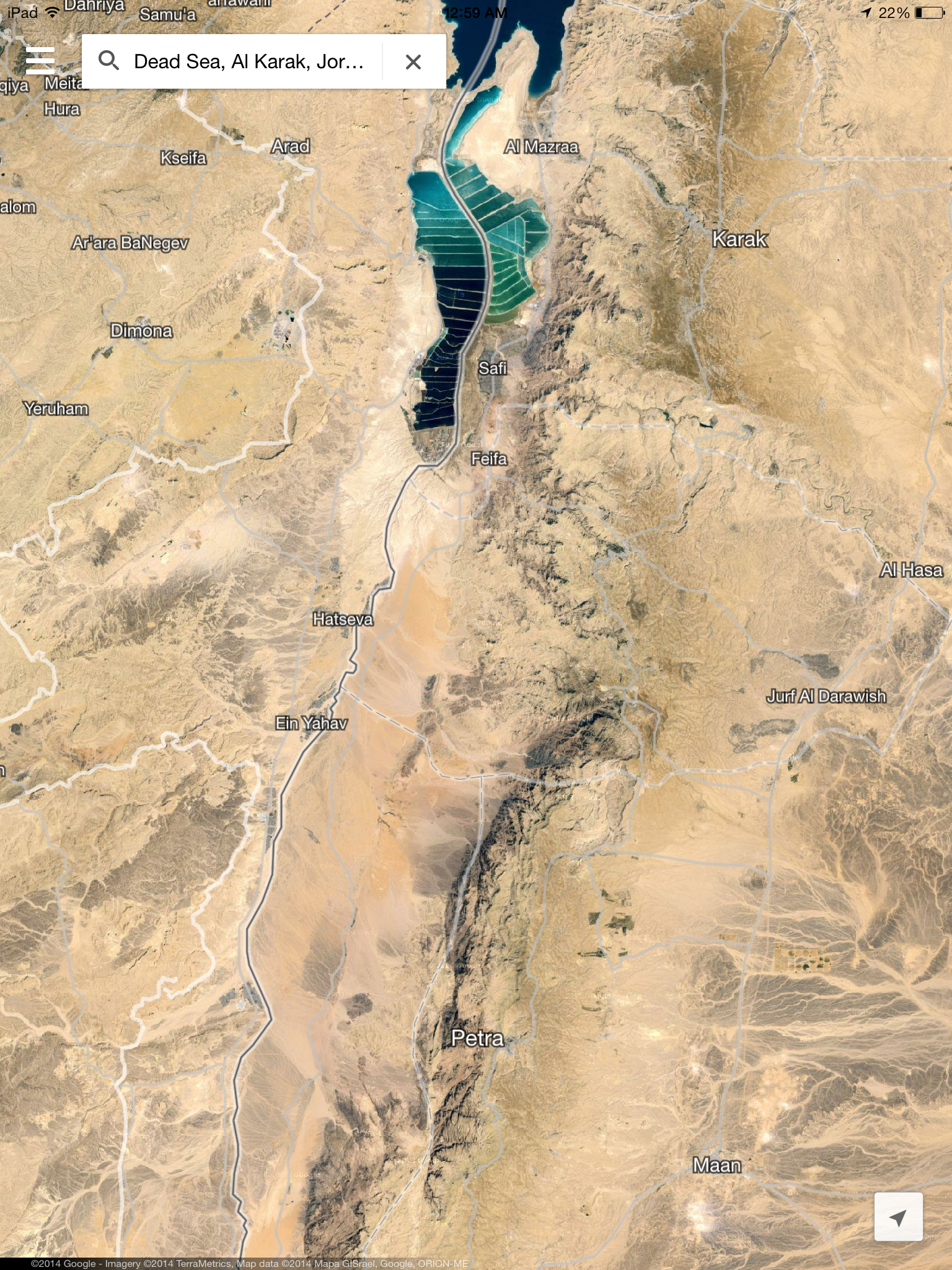
Their research is based primarily from data that they have collected from the Aravah (or Arabah) valley located in the southern Levant. The Arabah which is now desert, was a once verdant valley in antiquity. The Arabah is located just south of the Dead Sea and runs roughly north and south bordering Israel & Jordan (see image below)

The Arabah (from Google Earth)

The Arabah (from Google Earth)

The conclusion of their research indicates that camels were domesticated between the 9th – 12th century B.C.. An article which summarized the finding stated:

“In all the digs, they found that camel bones were unearthed almost exclusively in archaeological layers dating from the last third of the 10th century BCE or later — centuries after the patriarchs lived and decades after the Kingdom of David, according to the Bible.”[1]

The researchers seemed overly eager to point out the discrepancy with the Bible.

“Camels are mentioned as pack animals in the biblical stories of Abraham, Joseph, and Jacob. But archaeologists have shown that camels were not domesticated in the Land of Israel until centuries after the Age of the Patriarchs (2000-1500 BCE). In addition to challenging the Bible’s historicity, this anachronism is direct proof that the text was compiled well after the events it describes.[2]

But, is it really the case that the biblical narratives which mention the patriarchs, were written after the events they describe? Or, could there be another explanation?

Camels and the Biblical Patriarchs

As far back as the book of Genesis, camels are can be linked with such Old Testament patriarchs as Abraham, Jacob, Laban and Moses. Camels are also mentioned periodically on various other occasions throughout later Old Testament history.

Francisco Hayez - 1844 (Wikicommons)

Jacob meets Esau by Francisco Hayez – 1844 (Wikicommons)

In Genesis 12:16 & 24:10-67 camels were used for a trip to Syria; they were also included as a bride price, and when Abraham was in Egypt camels were a small part of larger herds of other animals.

In Genesis 30:43; 31:34; 32:15 Jacob’s flocks along with Laban included camels as herd animals for Esau in the Seir area. In the Joseph narrative (Gen. 37:25) camels were used by Midianite-Ishmaelite traders caravanning to Egypt. In Exodus 9:3 camels were among the animals which were plagued during Moses’ day in Egypt.

Resolving the Camel Anachronism

For those of us who hold that the Old Testament patriarchal narratives are historical in nature, how does one solve the dilemma that this new research seems to reveal? Does the lack of camel bones in southern Israel (in the Arabah) during the Patriarchal period reveal the biblical narrative to be the work of late writers?

There are four good reasons why I do not believe this recent “discovery” is fatal to the historicity of the Old Testament patriarchs.

First of all, one of the many things that the history of archaeology in the Levant has shown over the past several decades is that one report is certainly not the last word on any given subject on ancient or biblical history. New research continues to overthrow long-held assumptions and biases against the Bible.[3]

Secondly, the archaeologists primary research area was conducted (according to their own report) in copper mining sites in the southern Arabah. According to the Bible, the patriarchs (Abraham, Jacob, et. al.), were pastoralists and semi-nomads whose travel itinerary would not have left them in any one place for any length of time. It is not surprising why little camel remains are discovered in the southern Levant.

Third, as Egyptologist Kenneth Kitchen points out, camels don’t actually figure that large in the lives of the patriarchs in any significant sense anyway. He writes:

“A common claim is that mentions of camels are anachronistic before circa 1100. What are the facts? In biblical terms, between roughly 2000 and 1200 their role is minimal.”[4]

In other words – yes – the biblical patriarchs owned camels, but it is not as if they were camel traders or camel herders. Camels played a small part in their lives.

But even so, other research suggests that camels have been present on the Arabian peninsula since at least 6,000 B.C.. From 2200-1200 B.C. rock art in Southwest Arabia and possible camel remains from Bir Risisim in the Levant suggest that camels were used for their milk and for transport.[5]

Camels were definitely present in the geographical area, as well as during the time of the patriarchs, so merely because we don’t find their remains in one specific location or archaeological period, certainly doesn’t mean that there are none at all.

This leads me to the fourth and final reason – Absence of evidence is not evidence of absence – a phrase often attributed to the great American Biblical archaeologist, Dr. Edwin Yamauchi. In chaper IV of Dr. Yamauchi’s great book, The Stones and the Scriptures (written 42 years ago) he rightly asks:

“How much of the evidence has survived the ravages of time? How many ancient sites have archaeologists been able to excavate? When does the lack of evidence for a biblical statement prove that an error is involved? Does archaeology offset the negative appraisal of the Bible developed by higher criticism? …Historians of antiquity in using the archaeological evidence have very often failed to realize how slight is the evidence at our disposal. It would not be exaggerating to point out that what we have is but a fraction of the possible evidence.”[6]

For more information on the historicity of the Old Testament Patriarchs see my previous articles here


            [1]http://www.aftau.org/site/News2/2024116989?page=NewsArticle&id=19673&news_iv_ctrl=-1 (accessed, February 11, 14)

            [2]Ibid.

            [3] For example: the discovery of the “Tel-Dan inscription” in 1993-4 by Avraham Biram in Northern Israel, containing the extra-biblical name of David (in the Tel-Dan Stele)

            [4] Kenneth A. Kitchen, On the Reliability of the Old Testament (William B. Eerdmans Publishing Company, Cambridge, U.K.; 2003), 338-9.

            [5] See, Juris Zarins, “Camel,” in David Noel Freedman, Editor, The Anchor Bible Dictionary, Volume 1, A-C (New York, London: Anchor Doubleday, 1992), 824-6.

            [6] Edwin M. Yamauchi, The Stones and Scriptures (Philadelphia & New York: J.B. Lippincott Company, 1972), 146-62.

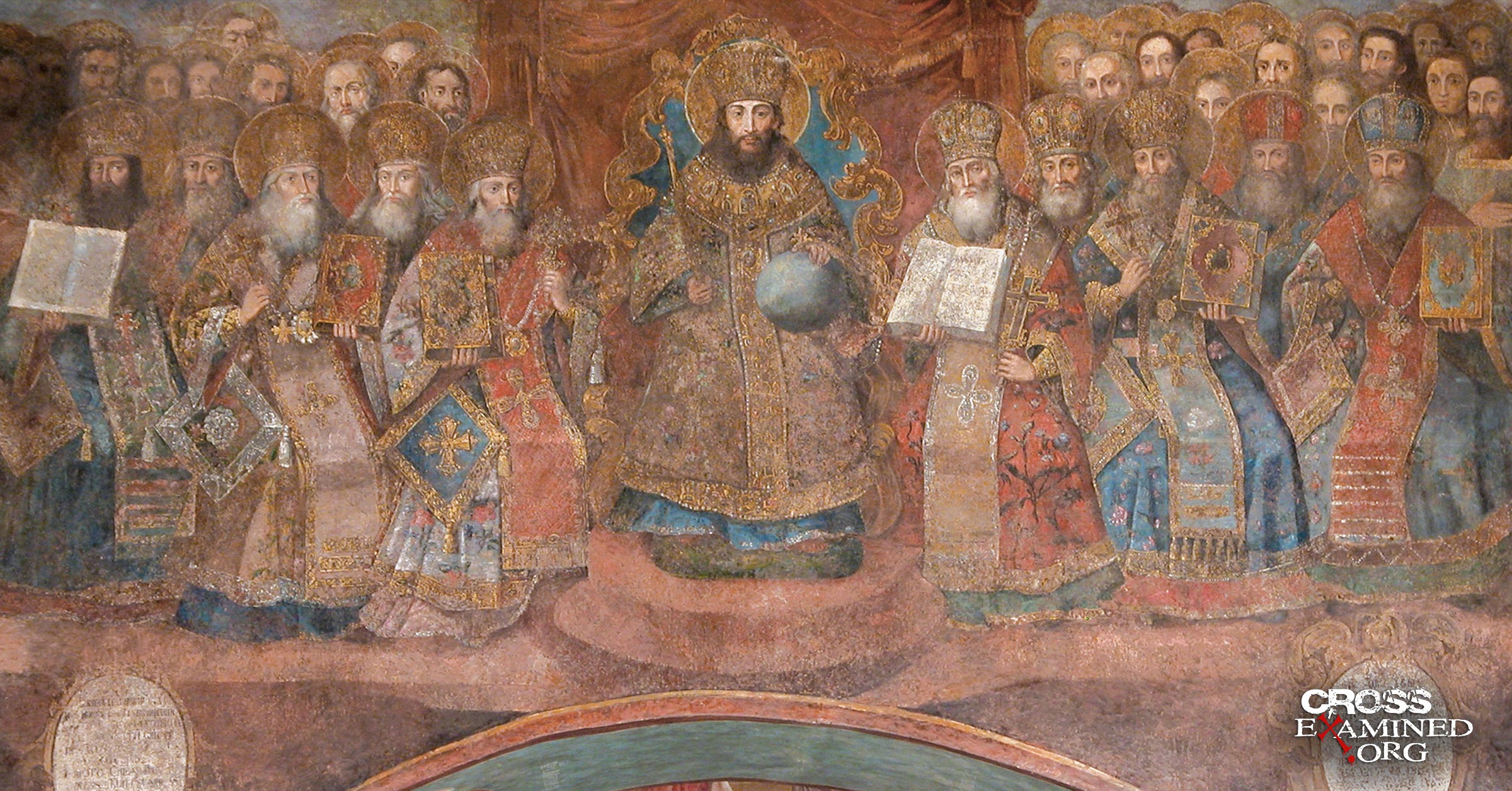
For many years, the council of Nicea has been the subject of much confusion among laypeople. The misapprehensions which have come to be associated with the council of Nicea have, in part, been fuelled by popular fiction novels such as Dan Brown’s notorious The Da Vinci Code. No matter what group you are dealing with in your apologetic exploits (including atheists, Muslims, Jehovah’s witnesses, and Unitarians), you are almost guaranteed to encounter some of these misconceptions. For this reason, it is important for Christians to study and learn church history so that they might correct common myths and falsehoods.

The council of Nicea was famously convened on May 20, 325 AD, at the request of Emperor Constantine. What did the council of bishops meet to discuss? Contrary to the common misconception (popularised particularly in Muslim circles) that has been widely circulated via the internet, the council of Nicea did not meet to discuss the canon of Scripture — that is, the decision about which books should make up the New Testament. In fact, there is not a shred of evidence that the canon of Scripture was even brought up at Nicea. Another misconception is that the council of Nicea, at the encouraging of Constantine, “invented” the deity of Christ or, at the very least, that the bishops in attendance at Nicea were significantly divided on the issue, the matter being decided with a vote. This too, however, is completely inaccurate. In 325 AD, when the bishops convened at Nicea, the deity of Christ had been affirmed almost unanimously by the Christian movement for close to three hundred years!

The bishops who met at Nicea had just come out of an extremely challenging time of intense persecution by the Romans, having lived through the cruelty of the Emperors Diocletian (ruling 284-305) and Maximian (ruling 286-305). One of the bishops present at Nicea, Paphnutius, had even lost his right eye and been given a limp in his left leg as a consequence of his profession of faith. According to one ancient writer, Theodoret (393-457),

“Paul, bishop of Neo-Cæsarea, a fortress situated on the banks of the Euphrates, had suffered from the frantic rage of Licinius. He had been deprived of the use of both hands by the application of a red-hot iron, by which the nerves which give motion to the muscles had been contracted and rendered dead. Some had had the right eye dug out, others had lost the right arm. Among these was Paphnutius of Egypt. In short, the Council looked like an assembled army of martyrs.”

It strikes me as odd, therefore, that one would suppose that the early Christian movement, has come out of such difficult times like those, would capitulate so easily to the emperor Constantine’s demands with respect to defining the very fundamentals of their faith!

The story of the Nicean council begins in Alexandria in northwest Egypt. The archbishop of Alexandria was a man by the name of Alexander. A member of his senior clergy, called Arius, took issue with Alexander’s view of Jesus’s divine nature, insisting that the Son is, in fact, himself a created being. In similar fashion to modern Jehovah’s Witnesses, Arius maintained that Jesus was like the Father inasmuch as they both existed before creation, played a role in the creation and were exalted above it. But the Son, according to the theology of Arius, was the first of God’s creations and was commissioned by the Father to create the world.

On this point, Alexander strongly disagreed, and publically challenged Arius’s heretical teachings. In 318 AD, Alexander called together a hundred or so bishops to talk over the matter and to defrock Arius. Arius, however, went to Nicomedia in Asia Minor and rallied his supporters, including Eusebius of Nicomedia, who was a relative by marriage to Constantine, the emperor, and a theologian in the imperial court. Eusebius and Arius wrote to many bishops who had not been involved in the defrocking of Arius. The effect was the creation of divisions among the bishops. Embarrassed by such bickering, the emperor Constantine convened the ecumenical council of Nicea in 325.

Constantine’s primary concern was imperial unity rather than theological accuracy, and he desired a decision that would be supported by the greatest number of bishops, regardless of what conclusion was reached. His theological advisor, Hosius, served to get the emperor up to speed before the arrival of the bishops. Since Arius was not a bishop, he was not invited to sit on the council. However, his supporter Eusebius of Nicomedia acted on Arius’s behalf and presented his point of view.

Arius’s position regarding the finite nature of the Son was not popular with the bishops. It became clear, however, that a formal statement concerning the nature of the Son and his relationship to the Father was needed. The real issue at the council of Nicea was thus how, and not if, Jesus was divine.

A formal statement was eventually put together and signed by the bishops. Those who declined to sign the statement were stripped of their rank of bishop. The few who supported Arius insisted that only language found in Scripture should feature in the statement, whereas Arius’s critics insisted that only non-Biblical language was adequate to fully unpack the implications of the language found in the Bible. It was Constantine who eventually suggested that the Father and Son be said to be of the “same substance” (homoousios in Greek). Although Constantine hoped that this statement would keep all parties happy (implying the complete deity of Jesus without going much further), the supporters of Arius insisted that this language suggested that the Father and Son were equal but didn’t explain how this was compatible with the central tenet of monotheism (i.e., the belief in only one deity).

Nonetheless, the Nicean creed did indeed incorporate this language. It stated,

“We believe in one God, the Father almighty, maker of all things, visible and invisible; And in one Lord Jesus Christ, the Son of God, begotten from the Father, only-begotten, that is, from the substance of the Father, God from God, light from light, true God from true God, begotten not made, of one substance with the Father, through Whom all things came into being, things in heaven and things on earth, Who because of us men and because of our salvation came down and became incarnate, becoming man, suffered and rose again on the third day, ascended to the heavens, and will come to judge the living and the dead; And in the Holy Spirit. But as for those who say, ‘There was when He was not, and, Before being born He was not, and that He came into existence out of nothing, or who assert that the Son of God is from a different hypostasis or substance, or is created, ir is subject to alteration or change — these the Catholic Church anathematizes.”

With the exception of two (Secundus of Ptolemais and Theonas of Marmarcia), the creed was signed by all the bishops, numbering more than 300. Arius’s supporters had been overwhelmingly defeated.

Arius’s supporters, however, managed to find some wiggle room. A single letter iota changes the meaning of homo (“same”) to “like” (homoi). The latter could be exploited by Arius and his followers to describe a created Christ. Moreover, it was argued, the creed could be interpreted as supporting Sabellianism, an ancient heresy which fails to discriminate between persons of the Godhead. It was this in-house squabbling between bishops that ultimately led to the council of Constantinople in 381.

A company of bishops started to campaign for the formal reinstatement of Arius as a presbyter in Alexandria. Constantine yielded to their petition and, in 332, re-instated Arius as a presbyter. Athanasius, who had recently succeeded his mentor Alexander as bishop of Alexandria, was instructed to accept Arius into the church once again. Needless to say, Athanasius did not comply with this order. The consequence was an exile. Constantine had little interest in the precision of his theology — rather, it was the struggle for imperial unity that was his motivation.

In conclusion, although popular misconceptions about the council of Nicea are rampant, the idea that the council of Nicea determined which books comprised the new testament or that it invented the deity of Christ to comply with the demands of Constantine are myths. Indeed, correct theology was of little concern to Constantine, who cared much more about imperial unity. Christians must make a serious effort to study and learn church history, so that when we encounter such claims in the media and in our personal evangelism, we may know how to present an accurate account of our history.