
Tag Archive for: New Testament

By Brian Huffling

Many people don’t know how to study the Bible, or even where to begin. The Bible is a long collection of books that contains much about ancient history, difficult concepts, and is very intimidating for people who want to read it but don’t know where to start. This article will describe some of the principles of interpreting the Bible (hermeneutics) that are taught in basic Bible college and seminary classes (but are easy enough for anyone to understand). This is not a 12-step method to anything, it is simply a sound method to examine the biblical text. Well, it is a 3-step method: observation, interpretation, and application.

OBSERVATION

When we read a passage, we typically want to ask, “What does it mean?” But there is a more basic question we should ask first: “What does it say?” It is easy to read into the text something that is not there (this is called eisegesis), often because we simply put words there that aren’t but think they should be. For example, John 20:19 says: “On the evening of that day, the first day of the week, the doors being locked where the disciples were for fear of the Jews, Jesus came and stood among them and said to them, ‘Peace be with you.’” It is often stated that Jesus walked through a wall or the door. However, the text doesn’t say that. It simply says the doors were locked and Jesus appeared to them. Maybe he walked through the door or wall, or maybe he just showed up. We have to observe the text carefully. There are various aspects of the text to observe.

One major area to observe is genre. For example, narrative is treated differently than poetry or didactic literature (such as the epistles). Narrative simply describes what happened, whereas didactic literature prescribes what should happen (in other words, it gives commands). Of course there can be narrative in epistolary literature (or vice versa), but the point is that one needs to be careful, for example, not to make an imperative out of a simple description.  It is also arguably the case that one should not use parables to base his theology. This is debated, but the point is that we should be aware of the type of genre we are reading when doing interpretation.

Another aspect of the text to observe is the historical and cultural context. For example, Revelation 3:15-16 says, “I know your works: you are neither cold nor hot. Would that you were either cold or hot! So, because you are lukewarm, and neither hot nor cold, I will spit you out of my mouth.” People often say that Jesus would rather you be completely dedicated to him or not dedicated at all. (Does the latter even make sense?) Actually, what we know from historical information is that the the area being referred to (Laodicea) had hot water pumped in from hot springs and cold water pumped in from cold springs. People went to the hot springs for healing (like being in a hot tub) and went to the cold springs for refreshment (something I would never do as I hate cold water), so the Laodiceans tried to get that water for themselves. However, by the time the water got to Laodicea, it was lukewarm and nasty and when people drank it it would make them vomit. Jesus is saying that he wanted the Laodiceans to be spiritually healing or refreshing. Rather, what the church there had to offer was spiritually nasty. Historical knowledge here clarifies the text for us.

It is also imperative to observe the textual and literary context, that is, what comes before and after the passage you are looking at. We get into trouble when we start looking at passages without understanding the context in which they are in. Sometimes we don’t have to go back to the beginning of the book, but we should at least start with he literary unit in which our passage is found. The chapters and verses don’t necessarily determine that, so pay attention to what the text is saying. Does the passage start with a conjunction such as “but” or “and?” Then it’s a good idea to see what preceded that conjunction.

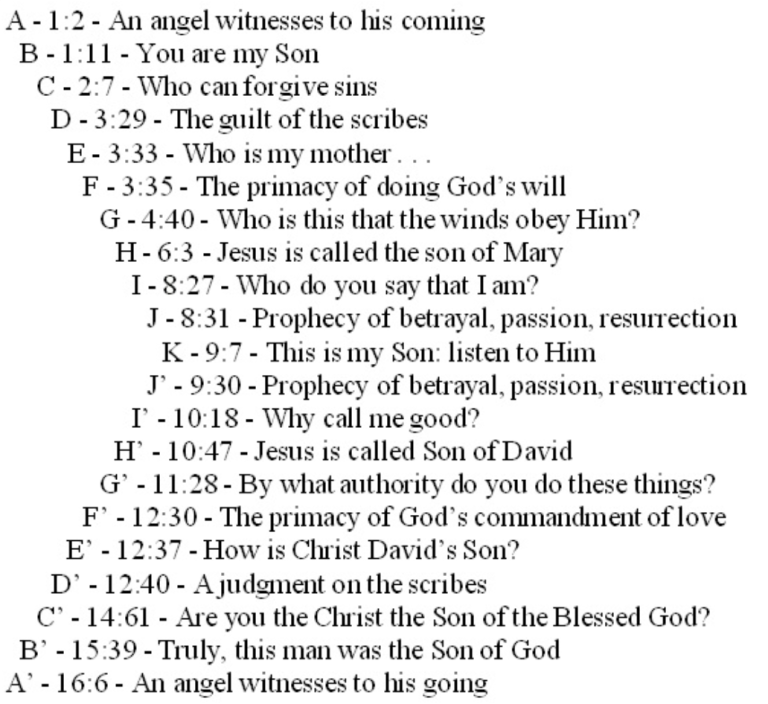
In looking at the textual and literary context we can observe the structure of the passage. Are words, phrases or sentences in a certain order or pattern? For example, we should be on the look out for chiasms. Chiasms are structures that have an ABCBA order. Sometimes it could have an ABBA order, such as in Romans 10:9-10, which says: “because, if you confess with your mouth that Jesus is Lord and believe in your heart that God raised him from the dead, you will be saved. For with the heart one believes and is justified, and with the mouth one confesses and is saved.” Notice the mouth/heart/heart/mouth structure. The middle part of the chiasm is meant to emphasize the author’s point. Look at the below chiasm from the flood story:
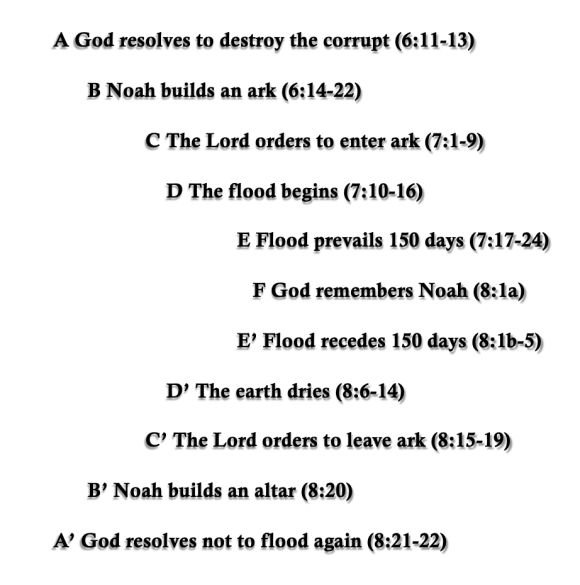
Such a long chiasm is hard to identify, but if we start to see patterns in the wording of the text and in a certain order, it can be found. While the story of the flood is typically thought to be about judgment, the focal point of the flood story is actually that God remembered Noah. The entire Book of Mark is actually a chiasm. The below image is taken from my Hermeneutics class notes by Dr. Tom Howe:
Another area to observe is terms. This particular area of observation is difficult not to blend with interpreting (asking about the meaning). However, we have to observe what terms are (and are not) used. As you probably know, the Bible was not written in English. Almost all of the Old Testament was written in Hebrew, with some areas being written in Aramaic (such as much of Daniel with the rest being Hebrew—something that itself needs to be observed), and the New Testament was written in Greek. Word studies are very popular, and many times all of Bible study is simply reduced to a word study, which it should not be. But it should be part of our study. It is important to know what underlying original word was used, if we can, when doing a Bible study. Some people are more trained at this than others, but it is a goal we should have.

When observing terms, we need to look for terms that are repeated. Such repetition of terms can show the structure of the book or passage. Such as the word “immediately” in Mark. The word “immediately” is used 5 times in Matthew, and fewer than that in Luke and John. But Mark uses it over 40 times. Why is that? It is obviously an important term for him. Let me put that into a graphic for you:

We should also observe terms that are difficult to understand, such as “predestination.” Figure of speech is also important to observe. Sometimes it is debatable as to whether a text is a figure of speech or not. There are some rules that can help discover if something should be taken as a figure of speech. For example, if something for whatever reason cannot be taken literally, then it should be taken as a figure of speech—such as when Jesus told his disciples at the Last Supper that the bread and wine was his body and blood. If something would be an immoral command from God, such as when Jesus said to eat and drink his body, that should be taken as a figure of speech. Of course, these examples are debatable between Catholics and Protestants, but the general rule holds true that when something cannot be taken literally, it needs to be taken as a figure of speech.

We also need to take note of words that are unfamiliar to us, such as “talent.” When we read, for example, in the parable of the unforgiving servant, that the servant owed ten thousand talents, we need to know what a talent is. (This gets blurry with our second step, interpretation.) Some translations, such as the NIV, translate “ten thousand talents” here as “ten thousand bags of gold.” One talent was about twenty years worth of wages. More on this in the next section, but the point is we need to be aware of these words—in other words, observe them.

INTERPRETATION

This is the step we generally start with but shouldn’t: what does the text mean? Back to the “talent” story. We observed that the word used in the parable of the unforgiving servant is “talent,” but the NIV says “bags of gold.” A talent was about 20 years worth of wages. If the average wage is around $45k, then that’s $900k. I don’t know how much a bag of gold is worth, but we’d have to multiply $900k by 10k for it to be accurate in talents. My iPhone calculator got an error when I did that. Ten thousand talents was more money than the known world had then, and ten thousand was the highest number in Greek. The point was actually that the amount of money the servant owed was unimaginable. Ten thousand bags of gold just doesn’t seem to be a good translation. This is an example of both the observation and the meaning of a word.

Another example is the word “power” in Romans 1:16: “For I am not ashamed of the gospel, for it is the power of God for salvation to everyone who believes, to the Jew first and also to the Greek.” The word for “power” in Greek is dynamis, from which we get the word “dynamite.” Some today, even popular commentators, say that the gospel, like dynamite, blows up sin. The problem with this view is that dynamite didn’t exist in the first century, so that can’t be what Paul meant. It simply means “power” or “ability.” This is a good example of what not to do in interpretation: import a later meaning into an earlier word. Remember, a text can’t mean what it never meant. This particular issue is called the fallacy of reverse etymology (etymology is the study of how words change over time) or anachronism.

Don’t know Greek? There are tools to help. Let me illustrate with a couple that I used before I studied Greek. I used to listen to a popular teacher and in one of his sermons he quoted Acts 2:24 to argue that Jesus went to hell. The text says this: “God raised him up, loosing the pangs of death, because it was not possible for him to be held by it” (the KJV from which he was using says “pains”). According to this teacher, since Jesus was in pain, then he must have been suffering, which wouldn’t have happened in heaven, so he must have been in hell. I was looking at that passage one day in my newly purchased Hebrew and Greek study Bible that used Strong’s Dictionary number system. The word “pain” had a number by it, so I looked it up. It said the word was “odin.” I also had just gotten the Theological Dictionary of the New Testament (this is not an endorsement of TDNT as it is said to be pretty liberal, but it can be helpful in some ways), and looked up the word there. Basically, TDNT said that the word referred to birth pain, and that Peter was making an analogy here between a woman not being able to hold her baby in, but at the right time she gives birth, and death not being able to hold Jesus, but at the right time was forced to let go of him. It does not mean Jesus was in pain. Lessons: look words up. Get some tools.

But, as mentioned, word studies are not the only aspect of Bible study. When doing interpretation, we have to not only examine the meaning of particular words, but how words relate to other words. The former is merely grammar and the latter is syntax. This requires a knowledge of grammar as well as parts of speech and how words relate to each other. This is why simple word studies, while obviously useful, is not the only part of the game. Words aren’t in isolation, but relate to other words. Let me give you an example of how it is important to see how words relate to each other.

Several years ago in a Ph.D. class on philosophy of history, my professor, Mike Licona, said that we should not take the saints being raised in Matthew 27 literally because if we did, it would result in a problem in the text (this issue has since become a hot issue for him and the issue of inerrancy). Here’s the text: “And behold, the curtain of the temple was torn in two, from top to bottom. And the earth shook, and the rocks were split. The tombs also were opened. And many bodies of the saints who had fallen asleep were raised, and coming out of the tombs after his resurrection they went into the holy city and appeared to many” (Matthew 27:51-53, ESV). Do you see the problem? I have read this passage for years and never noticed it. The context of the passage is Christ’s death. When was the curtain torn, and when did the earth shake? At his death—Friday. When did the tombs open and when were the saints raised? Friday. When does it say they came out of their tombs? After his resurrection—Sunday! That’s a natural reading of this translation. I haven’t seen any other English translations say it differently. The text seems to say that they were raised and the tombs were opened at the same time as the other events. But it seems to say that they didn’t come “out of their tombs until after his resurrection.”

I didn’t like this and was distracted by it. So, I stopped listening to the lecture (sorry Mike), and went to the Greek. Long story short, here was my solution: the word for “and” is kai in Greek and has several meanings, such as “even.” When it means “even” it tends to be emphatic/explanatory. In this case it could mean, “the saints were raised even coming out of their graves.” This seems to emphasize the physical nature of the event and that it wasn’t merely spiritual. Then, we could re-punctuate the sentence to read, “the saints who had fallen asleep were raised, even coming out of their tombs. After his resurrection, they went into the holy city and appeared to many.” I actually asked Mike if this was an acceptable answer as he knows Greek much better than me, and he said yes, as long as the word for “after” (meta) can start a new sentence. It can, an actually does a lot in narrative. Such a solution maintains proper Greek and English grammar and syntax. But it requires seeing how words relate to each other. It also requires observation and interpretation. (Some may object to such an answer as it appears to make the saints “resurrected” or first fruits before Jesus, but such is not necessary. The text does not imply they were raised immortal like Jesus. Remember, Jesus was not the first person raised from the dead. Elijah raised someone as did Jesus—Lazarus.)

I use this example to show a couple of things. One, don’t be married to any single English translation. Look at other translations (although I haven’t found an English translation that doesn’t have this particular problem here) and look, to whatever capacity you can, at the original languages. Two, the punctuation is not inspired (neither are the chapters and verses). In other words, read the text freshly and see if there are other ways to understand it and if the meaning changes.

One last note on interpretation and meaning. There can only be one meaning (although there can be many applications of that meaning: see below). While it is common for teachers to go around the room and ask their students, “What does this passage mean to you,” it is a bad question. It can’t mean to one person something that it doesn’t mean for all. It can have a different significance, but the actual meaning is fixed. (For a discussion on the issue argument the meaning is subjective or unattainable due to our biases, see my article on standard hermeneutics books as well as my article on historical objectivity.) While there are debates about what a given passage means, there can be only one right answer. It is up to studious interpreters to discover that meaning through the hermeneutical process. More could be said about interpretation, but let’s move on.

APPLICATION

Application is basically the “so what” part of the process. The question to ask here, after we have asked what does it say and what does it mean, is “how does this passage apply?” Unfortunately, sometimes people want to skip to this step first. Of course we have to know what the text says and means before we can ask how it applies to us. There are certain principles to keep in mind when trying to apply the text. Perhaps it is best up front to state that the text does not always have an application for us. Sometimes the text is informative for us and tells us about what happened, but it doesn’t always have an application. When the text says something like, “this king did this, and then this,” there really is no application, just information. In such instances, it is important not to try to wring out an application when there really isn’t one. Having said this, it is important to point out that even if there is no direct application, as Paul says in 2 Timothy 3:16, all Scripture is “profitable for teaching, for reproof, for correction, and for training in righteousness, that the man of God may be complete, equipped for every good work.”

It’s easy to apply commands: just do or don’t do something. Although, sometimes it’s hard to tell whether a command is meant to be for a certain culture and time or whether it’s mean to be universal. For example, is the issue of head coverings in 1 Corinthians 11 meant to be universal? What about men not having long hair in verse 14? Paul says in 1 Timothy 2:12-14, “I do not permit a woman to teach or to exercise authority over a man; rather, she is to remain quiet. For Adam was formed first, then Eve; and Adam was not deceived, but the woman was deceived and became a transgressor.” Is Paul saying women shouldn’t teach or exercise authority over a man always, or just in that culture and time? Whatever that text means, the reasoning behind it seems to be universal. Paul gives two reasons for what he said: (1) the order of creation, and (2) who was deceived. If the reasons are universal, then the prohibition would seem to be so as well.

Things aren’t as straightforward with narrative. We have to be careful to not make a description into a prescription. Narrative simply is a narration of what happened. Of course, it can contain other genres, but when we are looking at pure narrative and not a command to us, we have to be careful how we apply the text, if it can be applied. If it is simply a description of what happened, we can’t necessarily make it a prescription of what should happen. For example, the fact that Gideon put out a fleece to discern God’s will is not a command for us to. The fact that Elijah and other people in the OT were called supernaturally by God does not mean we can say that’s how God normally operates or “calls” people today. Here are some other pitfalls to avoid with application:

Analogizing: analogizing is what we just referred to with the call of Elijah. Just because God called Elijah does not mean that he calls us. This “call” is often analogized between Israel’s prophets and people today, but such an application is illicit. We simply can’t say that because God did something in ancient Israel that he does so today.

Allegorizing: Allegorizing is when we take a literal event and make the application allegorical. For example, we can talk about the person who “loosed his donkey for Jesus” when he entered Jerusalem. I once heard someone say he heard a pastor talk about “loosing your donkey for Jesus.” I guess that’s supposed to mean you are making what you have available for Jesus, but the text is talking about an event that actually happened. It is not a command.

Spiritualizing: Spiritualizing is similar to allegorizing. It takes literal events and gives a spiritual significance. A popular example of this is to present the story of Jesus calming the storm for the disciples and say “Jesus stills the storms of life.” There are a few problems with this. One is that this was a literal storm and was not meant to say that Jesus actually stills the storms of life. It isn’t talking about spiritual storms or tough times: it’s talking about a storm! Secondly, Jesus doesn’t still the storms of life if that means that he stops the storm like he did in the story. To say that he stills the storms of life is not only to state something that is false but to endanger someone’s faith who expects him to still his storms.

So what do we do to apply the text? One thing is to do what the text says to do if it is issuing a command. If it’s narrative, it’s to see what universal principle can be applied. In the story of David and Goliath, it is a spiritualization to say that we should go and slay the Goliaths in our lives. The biblical passage is talking about a literal person named Goliath. It is not giving a command, but describing something that actually happened. But we can glean universal principles. In this story that principle could be that God is faithful to the promises he makes and to his covenant. Here are some other principles from which to see how to apply the text:

  1. Is there an example for me to follow?
  2. Is there a sin to avoid?
  3. Is there a promise to claim?
  4. Is there a prayer to repeat?
  5. Is there a command to obey?
  6. Is there a condition to meet?
  7. Is there a verse to memorize?
  8. Is there an error [theological] to mark?
  9. Is there a challenge to face? (Howard Hendricks, Living by the Book, chapter 44)

The New International Application Commentary is an excellent commentary series to use to bridge the gap between the biblical times and ours to see if and how the text can be applied.

One last word about application: while the meaning is one, the application can be many since there are many situations in which to apply the text.

TOOLS FOR STUDY

If one is going to study the Bible, it is best to understand the tools that are available. Resources that this 3-step method is based on include Methodical Bible Study and Living by the Book (Living by the Book has a workbook).The most important tool is the Bible itself. There are hundreds of English translations of the Bible but there are generally 3 categories of translation philosophies: essentially literal (A.K.A. formal equivalence), dynamic equivalence (A.K.A. functional equivalence), and paraphrase. It is very important to use an essentially literal Bible for Bible study (see Translating Truth: The Case for Essentially Literal Bible Translation for a discussion on this), and I would argue for reading it too, but a good dynamic equivalent translation can be ok for reading. Paraphrases have even been recommended by good interpreters, but mainly to see the general sense of the passage. The front matter in your Bible should explain what translational philosophy it holds to. Essentially literal Bibles include the King James Version, The New King James Version, the New American Standard Bible, the English Standard Version, the Christian Standard Version, and the like. Dynamic equivalent translations include the New International Version, the Good News Bible, and the New English Translation. (The NET is worthwhile for its 60,000+ notes, and is available free at Bible.org.) Paraphrases include The MessageThe Living Bible, and as I like to point out to my students, the Cotton Patch Gospel, that tells the story of Jesus from the vantage point of southerners in the U. S. (he is born in Gainesville, GA and escapes to Mexico).

Then there are commentaries. Commentaries are useful in many ways, but ideally should be consulted after your own study so you aren’t biased in a certain direction. There are two basic types of commentaries: critical (technical) and non-critical (non-technical). A commentary is critical if it discusses textual issues such as variations between different manuscripts of the original languages, or discusses the original languages in general. Some commentaries go into a great deal of detail and others don’t. Sometimes you just need a brief overview of an issue. For that I recommend The Bible Knowledge Commentary,  The Expositor’s Bible Commentarythe Tyndale Old Testament Commentary and the Tyndale New Testament Commentary (as a set here)The NIV Application Commentary is another non-technical commentary. The New International Commentary on the Old Testament, and The New International Commentary on the Old Testament (as a set here) is also very good. It is non-technical in the text but has technical/critical information in the notes. The IVP Bible Background Commentary (separate for OT and NT) is good for giving . . . the background, as are the The Lexham Geographical Commentary on the GospelsThe Lexham Geographical Commentary on Acts through Revelation, and The New Testament in Antiquity. There are actually commentaries on commentaries. These are basically long annotated biographies but with more information on the pluses and minuses of each set. See for example the Old Testament Commentary Survey,the New Testament Commentary Survey, and Commentary and Reference Survey. For a free and very useful resource, see Daniel Akin’s “Building a Theological Library.” It is not necessary to buy a complete set. As the commentary surveys and and Akin’s site show, some commentaries in a set are better than others, thus, it might be more beneficial if cost is an issue to buy certain individual commentaries. It is also important to pick up a good Bible dictionary and encyclopedia. There are a number of those in each category.

I can’t have a section on study tools and not mention Logos. There are many electronic software programs for Bible study. I have used Logos since 2004 and don’t want to try to do Bible study without it. I have required Logos in a couple of my classes as well, and the students love it too. Not only does it offer original language tools, it has incredibly complex search capabilities for the Bible, as well as the other books in your Logos library. And it is just that: a library. They have tens of thousands of books and tools. Other programs are good and there are debates about which is best, but I have used and love Logos. Others programs are BibleWorksOlive Tree, or Accordance (only for Mac). Good free software is Blue Letter Bible and e-Sword.

CONCLUSION

What has been said hardly scratches the surface of biblical interpretation. It is certainly incomplete, but only mean to give some pointers and hopefully motivation for doing Bible study. This article is not meant to make Bible study seem hard, but to show that it takes work and offer some hopefully helpful tips. If you want to understand this system better, I encourage you to get Methodical Bible Study and/or Living by the Book. Thanks for reading, and please subscribe!

Recommended resources related to the topic:

Why We Know the New Testament Writers Told the Truth by Frank Turek (mp4 Download)

The Top Ten Reasons We Know the NT Writers Told the Truth mp3 by Frank Turek

Counter Culture Christian: Is the Bible True? by Frank Turek (Mp3), (Mp4), and (DVD)

_____________________________________________________________________________________________________________________________________________________

J. Brian Huffling, PH.D. have a BA in History from Lee University, an MA in (3 majors) Apologetics, Philosophy, and Biblical Studies from Southern Evangelical Seminary (SES), and a Ph.D. in Philosophy of Religion from SES. He is the Director of the Ph.D. Program and Associate Professor of Philosophy and Theology at SES. He also teaches courses for Apologia Online Academy. He has previously taught at The Art Institute of Charlotte. He has served in the Marines, Navy, and is currently a reserve chaplain in the Air Force at Maxwell Air Force Base. His hobbies include golf, backyard astronomy, martial arts, and guitar

Original blog: https://bit.ly/3xgtCia 

 

By Jason Jimenez

In a recent conversation with a Christian friend, he shared how several unexpected killjoys had sprung up in his life and dragged him down to a dark place. Since then, my friend has struggled to find joy in his life.

What about you? Are you finding it hard to be joyful in life?

The reality is, we could all use more joy in our lives. Which leads me to share with you the first of five steps to living a more joyful life.

The first step is to seek joy from God. 

Joy is a gift from God. It doesn’t come from people or objects in the world. You might get temporary relief or happiness. But the joy the Bible speaks of is so much more. As we read in the Bible, joy has to do with a deep state of gladness, cheer, and contentment. In the Lexham Bible Dictionary, “joy” is “closely related to gladness and happiness, although joy is more a state of being than an emotion; a result of choice.”

David declared that it’s in the presence of God that there is “fullness of joy” (Ps. 16:11). In Nehemiah 8:10, we read that we find strength in “the joy of the Lord.” In Galatians 5:22, Paul lists “joy” as a byproduct of the Holy Spirit.

If you want more joy in life—look no further. Look to God.

The second step is to acknowledge and cherish the eternal blessings you have as a child of God:

  • You are forgiven and have peace in Christ– “But now in Christ Jesus you who once were far off have been brought near by the blood of Christ. For he himself is our peace, who has made us both one and has broken down in his flesh the dividing wall of hostility by abolishing the law of commandments expressed in ordinances, that he might create in himself one new man in place of the two, so making peace, and might reconcile us both to God in one body through the cross, thereby killing the hostility. And he came and preached peace to you who were far off and peace to those who were near” (Ephesians 2:13-17).
  • You are sealed with the promised Holy Spirit – “In him you also, when you heard the word of truth, the gospel of your salvation, and believed in him, were sealed with the promised Holy Spirit, who is the guarantee of our inheritance until we acquire possession of it, to the praise of his glory” (Ephesians 1:13-14).
  • You have a living hope in Christ – “Blessed be the God and Father of our Lord Jesus Christ! According to his great mercy, he has caused us to be born again to a living hope through the resurrection of Jesus Christ from the dead, to an inheritance that is imperishable, undefiled, and unfading, kept in heaven for you, who by God’s power are being guarded through faith for a salvation ready to be revealed in the last time” (1 Peter 1:3-5).

The third step is bringing balance into your life.

You’ve heard the saying, don’t sweat the small stuff. It’s next to impossible to appreciate the joy you have as a Christian if you live a hurried-up life filled with stress. In the book of Philippians, Paul writes, “Do not be anxious about anything, but in everything by prayer and supplication with thanksgiving let your requests be made known to God. And the peace of God, which surpasses all understanding, will guard your hearts and your minds in Christ Jesus” (4:6-7).

We can’t overlook that Paul wrote the words “don’t be anxious” while in prison. Despite the various trials and the ups and downs, Paul still found joy amid some of his darkest hours. That, my friend, is joy!

It would be great that every time you feel worried or anxious, you simply pray for it to go away, and just like that, it’s gone! But, as you very well know, that’s not reality. We may not like it, but it’s in hardships and feeling depressed that God’s joy is made so much more real to us.

So, offer up prayers of thanksgiving to help eliminate any worry or stress that might be preventing you from living a life of joy.

The fourth step involves setting boundaries with certain people who suck the joy out of you.

Setting boundaries is a hard thing to implement for anyone. Starting with the fact that no one likes confrontation. And secondly, most of the “joy suckers” in our lives are people we have no choice but to be around. They can be a family member—a co-worker.

So, the obvious thing is not to overreact and pull away from everybody. What you want to do is assess your relationships and determine who is the most self-centered, critical, argumentative, and who tends to push your buttons. In a nutshell, who leaves you feeling drained and discouraged most of the time?

Once you’ve realized who the “joy suckers” are, the next challenge is to draw the necessary boundaries to protect you from allowing this person to steal your joy. As mentioned in step one, joy is a choice. You may not always have a choice who you are around. But you do have a choice how you interact with them and they with you. So, make sure you bathe your relationships in prayer and seek wise counsel before setting certain boundaries.

The fifth step is to enjoy life today!

It’s easy to take for granted what we have in our lives. I’ll admit that when I get impatient with people or with work-related stuff, I can miss out on enjoying life. Just the other night, I told my wife how I needed not to lose sight of enjoying the simple moments in life. Whether it be throwing the football with one of my kids or sipping a cup of coffee with a friend. I need to be more sensitive and aware of counting my blessings every day.

How about you? What are some blessings you’ve received from God that you need to appreciate more?

As you seek to implement these five steps to achieving a more joyful life, seek to add the prayer from Paul below to enrich your motivation.

“May the God of hope fill you with all joy and peace in believing, so that by the power of the Holy Spirit you may abound in hope.” Romans 15:13

Recommended resources related to the topic:

Jesus, You and the Essentials of Christianity by Frank Turek (INSTRUCTOR Study Guide), (STUDENT Study Guide), and (DVD)     

Counter Culture Christian: Is There Truth in Religion? (DVD) by Frank Turek

_____________________________________________________________________________________________________________________________________________________


Jason Jimenez is President of STAND STRONG Ministries and author of Challenging Conversations: A Practical Guide to Discuss Controversial Topics in the church. For more info, check out www.standstrongministries.org.

Original blog: https://bit.ly/3N574aM


By Ryan Leasure 

This article is part 6 in a nine-part series on how we got our Bible. Part 1 dealt with inspiration and inerrancy. Part 2  looked at Old Testament development. Part 3 investigate the Old Testament canon and the Apocrypha. Part 4 considered attributes of the New Testament Canon. And Part 5 inquired into the early church’s reception of the New Testament Canon. This post will consider the manuscript tradition and preservation of the New Testament text.

No Original Autographs

Sadly, none of the original autographs remain. Most likely, they wore out after constant usage and copying. Now, all that we possess are copies of copies of copies—a lot of them actually. Yet these copies differ in lots of different places. But do these differences render our Bible unreliable? Bart Ehrman thinks so. He asks:

How does it help us to say that the Bible is the inerrant Word of God if in fact we do not have the words that God inerrantly inspired, but only the words copied by scribes—sometimes correctly but sometimes(many times!) incorrectly?[1]

In response to Ehrman’s objection, I’d like to quote the Chicago Statement on Biblical Inerrancy. Article X reads:

We affirm that inspiration, strictly speaking, applies only to the autographic text of Scripture, which in the providence of God can be ascertained from available manuscripts with great accuracy. We affirm that copies and translations of Scripture are the Word of God to the extent that they faithfully represent the original.

In other words, through the manuscript tradition, we can recreate the original texts with a high degree of accuracy. The reason for this accuracy is that we have 5,000+ extant Greek NT manuscripts (and thousands more in other languages).

Important Early Manuscripts

While listing all the manuscripts would be an impossible task, allow me to highlight some of the more prominent ones:

P52

P stands for “papyri” taken from a reed-like plant in the marshes of Egypt. All the oldest NT manuscripts are on papyri. P52 is probably the oldest surviving manuscript and most likely dates to the second century. The manuscript is extremely small (about the size of a credit card), and contains portions of John 18:31-33, 37-38 on a two-sided fragment. It was discovered in 1934 and is currently housed in the John Rylands Library in Manchester, England.

P66

This manuscript contains almost a complete copy of John’s Gospel. The manuscript contains 104 in tact leaves and fragments from forty other leaves. This manuscript dates to somewhere between the late second and early third centuries. It is currently housed in the Bodmer Library in Cologny, just outside Geneva, Switzerland.

P75

This manuscript contains most of Luke and John’s Gospels and dates somewhere between the late second and early third centuries. Discovered in the 1950s, this manuscript made a significant splash in the text criticism world as it closely resembles the fourth century Codex Vaticanus, demonstrating that the copying of early scribes wasn’t as uncontrolled and inaccurate as many previously thought. This manuscript is housed in the Vatican Library.

P45

This manuscript is a highly fragmented portion of a four-Gospel and Acts codex (book with pages) and dates to somewhere between the late second and early third centuries. It was originally 220 pages, but only thirty survive. This codex, along with others like P46 demonstrate that the early church started collecting their canonical texts into single book forms. No early codex, for example, contains the canonical Gospels and the Gospel of Peter or Thomas. This manuscript was discovered in the 1930s and is housed in the Chester Beatty Museum in Dublin, Ireland.

P46

This manuscript contains eight of Paul’s letters and Hebrews. Many in the early church thought Hebrews was Pauline, so it was often lumped in with his other letters. This manuscript is very early and probably dates to the second century, though third century is a possibility. It was discovered in the 1920s in the ruins of an old monastery in Egypt. Fifty-six leaves are housed in the Chester Beatty Museum in Dublin, Ireland, and thirty are at the University of Michigan.

Codex Sinaiticus

Unlike the previous manuscripts, this one is on parchment (stretched and dried animal skins) and is extremely elegant. It dates to the fourth century. The manuscript includes about half of the OT, Apocryphal texts, the entire NT, the Shepherd of Hermes, and the Epistle of Barnabas. It contains over four hundred leaves of parchment measuring 13 x 14 inches in size. In 1844, Constantine Tischendorf supposedly discovered it in a waste basket that was set to be burned in a fire to keep the monks warm. Along with Vaticanus, this manuscript is the best one in our possession. It is currently housed in the British Library in London.

Codex Vaticanus

Similar to Sinaiticus, Vaticanus dates to around the middle of the fourth century. It contains almost the entire OT, Apocryphal texts, and almost the entire NT (parts of Hebrews and Revelation are missing). Most text scholars regard Vaticanus as the most trustworthy manuscript of the NT. As mentioned previously, it relates closely to P75. This manuscript has been housed in the Vatican Library since the 15th century.

Texual Variants

With thousands of manuscripts comes thousands of textual variants (about 500,000 in total). A variant is simply a different reading in the text. And as Bart Ehrman likes to point out, “There are more variations among our manuscripts than there are words in the New Testament.”[2] While there are only about 138,000 words in the New Testament, Ehrman’s quote is misleading. First off, we wouldn’t have any variants if we only had one manuscript. With 5,000+, we’re bound to have thousands upon thousands of variants. And second, Ehrman wrongly compares the total number of variants in ALL the manuscripts to the total number of words in only ONE complete manuscript.

Peter Gurry has calculated that when you add up all the words in the 5,000+ manuscripts, and divide it by the total number of variants, you come out to “just one distinct variant per 434 words copied.”[3] That’s a far cry from having far more variants than words in the NT.

Types of Variants[4]

With all the variants in the manuscript tradition, how do scholars determine which readings represent the original text? To help you make sense of this process, I think it will be helpful to place the types of variants into four different categories:

1. Neither Meaningful nor Viable

This category represent variants that don’t change the meaning of the text and obviously don’t reflect the original reading. For example spelling errors are easy to detect and aren’t original to the text. Or, occasionally a scribe got careless and repeated a word like the scribe who copied Galatians 1:11: “For I would have you know, brethren, that the gospel the gospel that was preached by me is not man’s gospel.” These types of variants make up about 75% of all variants (roughly 400,000 variants).

Even Ehrman admits, “To be sure, of all the hundreds of thousands of textual changes found among our manuscripts, most of them are completely insignificant, immaterial, of no real importance for anything other than showing that scribes could not spell or keep focused any better than the rest of us.”[5]

2. Viable but not Meaningful

These variants could reflect the original, but they don’t affect the meaning of the text. Variants of this sort include synonyms, different spellings, changes in word order, and the like. Allow me to offer you a few examples:

  • John 1:6 either reads, “There came a man sent from God.” Or it reads, “There came a man sent from the Lord.” Either could reflect the original, but meaning remains the same.
  • The movable nu is either present or absent in several instances. This variant is equivalent to the English use of the article “a” or “an.” No translation is affected.
  • Sometimes John has two n’s and sometimes it has one n. It can be spelled either way. This could be equivalent to spelling it “color” or “colour.” Technically, both are acceptable. But again, the spelling of Ἰωάννηςdoesn’t affect translation.
  • One popular group of synonyms are words translated as “and” (καὶ, δέ, τέ). The variants could reflect the original, but the translation and meaning are not affected.
  • Word order changes don’t affect meaning either because Greek is an inflected language. Meaning, the form of the word determines its place in the sentence. For example, I can write “God loves you” twelve different ways in Greek (θεός ἀγαπᾷ σε / θεός σε ἀγαπᾷ / σε ἀγαπᾷ θεός / σε θεός ἀγαπᾷ / ἀγαπᾷ θεός σε / ἀγαπᾷ σε θεός / ὁ θεός ἀγαπᾷ σε / ὁ θεός σε ἀγαπᾷ / σε ἀγαπᾷ ὁ θεός / σε ὁ θεός ἀγαπᾷ / ἀγαπᾷ ὁ θεός σε / ἀγαπᾷ σε ὁ θεός). That is to say, changes of word order don’t affect translation.

3. Meaningful but not Viable

These variants would change the meaning of the text, but they obviously don’t reflect the original. For example, most John 1:30 manuscripts reads, “after me comes a man.” One manuscript, however, reads, “after me comes air.” And I don’t think John the Baptist was talking about some bad locusts he ate. This variant would change the meaning, but it obviously does not reflect the original. The copyists simply left out a letter (ἀήρ vs. ἀνήρ).

Again, Erhman remarks, “Most of the changes found in our early Christian manuscripts have nothing to do with theology or ideology. Far and away the most changes are the results of mistakes, pure and simple — slips of the pen, accidental omissions, inadvertent additions, misspelled words, blunders of one sort or another.”[6]

Of all textual variants, 99% of them fall into these first three categories. The remaining 1% fall into the final category.

4. Meaningful and Viable

These variants would change the meaning of the text and they very possibly could reflect the original. Furthermore, most Bibles include these variants in their footnotes. Let me give you a few examples of what these variants look like and the process that textual scholars go through in making their decisions:

Mark 1:2

Either it reads: (A) “as it is written in Isaiah the prophet” or, (B) “as it is written in the prophets.”

Most of the early manuscripts (Sinaiticus, Vaticanus, Bezae) support reading A. Later Byzantine texts support B. This one seems pretty straight forward to me. A is the more difficult reading because the following quotation comes from both Isaiah and Micah. Therefore, it’s easy to see how a later scribe would try to smooth this out by changing “Isaiah” to “the prophets” because of a perceived mistake in the manuscript he was copying. Since it’s the more difficult reading, and since it is well represented among the earliest manuscripts, reading A is to be preferred.

Luke 22:43-44

Either: (A) it includes Jesus agonizing and sweating drops of blood in the garden, or (B) it omits it.

The manuscript evidence is somewhat divided on this issue. Good manuscripts support both A and B, although church father quotations support A. Moreover, its difficult to understand why a scribe would insert this scene if it wasn’t original to the text. On the flip side, it’s easier to make sense of why a scribe would omit the scene because it makes Jesus look weak compared to other Christian martyrs who boldly went to their deaths. Option A seems like the better reading in my opinion.

Romans 5:1

Either it reads: (A) “Therefore, since we have been justified by faith, we have peace with God through our Lord Jesus Christ” or, (B) “let us have peace with God through our Lord Jesus Christ.”

Most of the early and better manuscripts favor reading B. That said, the context of Romans 5 suggests that A would be a better reading. In other words, Paul doesn’t seem to be exhorting the believers to pursue peace with God, but declaring that they already have peace with God. The difference is one letter (ἔχομεν or ἔχωμεν), and they would have sounded almost identical as they were read aloud. It’s easy to see how a copyist mistakenly heard the wrong word as someone read it aloud to him as he copied the text. Therefore, A seems like the better reading.

A Reliable Text

I hope these examples give you a little idea of what the process of textual criticism looks like. I should also note that none of the meaningful and viable variants leave any Christian doctrine hanging in the balance. That is to say, the Trinity isn’t up in the air if a Bible translator chose the wrong variant. God’s word is redundant (in a good way) so that every major Christian belief is well-represented across a wide spectrum of texts. Thus, while biblical scholars are less than 100% certain in a few places, you can have confidence that God’s word has been reliably preserved.

The next post will look into the history of the English Bible.

Notes

[1] Bart Ehrman, Misquoting Jesus, 7.

[2] Bart Ehrman, Misquoting Jesus, 90.

[3] Peter Gurry, Myths and Mistakes, 196.

[4] These categories come from Dan Wallace.

[5] Bart Ehrman, Misquoting Jesus, 207.

[6] Bart Ehrman, Misquoting Jesus, 55.

Recommended resources related to the topic:

Why We Know the New Testament Writers Told the Truth by Frank Turek (DVD, Mp3 and Mp4)

The Footsteps of the Apostle Paul (mp4 Download), (DVD) by Dr. Frank Turek

Cold-Case Christianity: A Homicide Detective Investigates the Claims of the Gospels by J. Warner Wallace (Book)

_____________________________________________________________________________________________________________________________________________________

Ryan Leasure holds a Master of Arts from Furman University and a Masters of Divinity from the Southern Baptist Theological Seminary. Currently, he’s a Doctor of Ministry candidate at the Southern Baptist Theological Seminary. He also serves as a pastor at Grace Bible Church in Moore, SC

Original Blog Source: https://bit.ly/3KPYR8v


By Brian G. Chilton

For nearly ten years, I have been honored to bring you reasons for believing in the resurrection of Jesus. I now find myself at the end of a terminal degree in theological and apologetic studies.[1] For some, advanced education tends to cause one to doubt one’s position over time. However, that has not been the case for me and the resurrection of Jesus. Over the last few years, I have found five new compelling reasons for believing that the resurrection of Jesus was a legitimate historical event. These five arguments may or may not be new to the reader, but they became new to me through my research and are newer than some of the previous arguments given about the resurrection in previous articles. Without further ado, consider the following five new arguments for the resurrection of Jesus.

Unexpected Nature of the Resurrection

The first argument is one of the best pieces of evidence for the resurrection that I had never before considered. That is, no one in Jesus’s day expected the Messiah to rise from the dead. In Matthew’s Gospel, the Jewish leaders argue that the disciples stole the body of Jesus (Matt. 28:11–15). Of all the alternate theories of the resurrection, this is by far the most compelling. Regardless of whether one holds that the disciples stole the body of Jesus, invented the story, or feigned Jesus’s death, there is one aspect that skeptics fail to consider. No one in the first century anticipated the imminent resurrection of Jesus. This is evident in Jesus’s encounter with Martha at Lazarus’s tomb. Recall that when Jesus asked Mary if she believed that Lazarus would rise from the dead, she said, “I know that he will rise again in the resurrection at the last day” (Jn. 11:24). Martha’s response represented the typical position of the Pharisees and the Essenes. Josephus notes that the vast majority of the population in first-century Israel were Pharisees.[2]

N.T. Wright provides two reasons why the resurrection was unexpected in the first century. On the one hand, believers living in the times of Second Temple Judaism anticipated that the resurrection would bring about the “restoration of Israel … [and] the newly embodied life of all YHWH’s people.[3] On the other hand, no one in the period connected the Messiah with resurrection.[4] The concept of the Messiah resurrecting on the third day, though it may be reflected in the OT texts to a degree, was not in any way expected by believers at this time. Thus, the lack of anticipation for a resurrection delivers a fatal blow to any theory that projects the early Christians as being those who staged such an experience. Why stage something that they did not believe would happen in the first place?

Multiple Independent Sources

When it comes to any event of history, it is important for one to possess multiple source attestation. The more eyes one has on an event, the more accurate the truth can be preserved. When it comes to the resurrection, we have multiple sources pointing to the resurrection of Jesus being a historical event. First, we have the four independent sources found in the Gospels. Matthew, Mark, Luke, and John all provide unique accounts of Jesus’s resurrection appearances. Matthew reports Jesus’s post-resurrection meeting with the disciples in Galilee. Mark reports the women at the tomb and their mysterious encounter with the angels at the tomb. Luke provides multiple accounts that are not preserved in the other Gospels, including the two disciples’ encounter with Jesus on the road to Emmaus (Lk. 24:13–35). John affords multiple stories not included in the other Gospels, including Thomas’s encounter with Jesus (Jn. 20:24–29), Jesus’s encounter with the disciples on the Sea of Galilee, Jesus’s reinstatement of Peter (Jn. 21:15–19), and Peter asking Jesus about John’s ministry (Jn. 21:20–23).

In addition to the Gospels, a fifth source is found in the early creed of 1 Corinthians 15:3–9. The early creed provides additional information concerning the resurrection appearances of Jesus. It tells of Peter’s meeting with the risen Jesus (1 Cor. 15:5), the meeting between Jesus and James (1 Cor. 15:7), and his appearance to over 500 (1 Cor. 15:6). A sixth source is found in the sermon summaries of Peter in the book of Acts (Acts 2:14–41 and 3:12–26). A seventh source is found in the sermon summary of Stephen (especially in Acts 7:52 and 7:59–60). Finally, an eighth source is found in the sermon summaries of Paul. In the first sermon summary of Paul, he even speaks of Jesus’s empty tomb (Acts 13:29). Max Wilcox has convincingly found numerous Semitisms within the sermon summaries in Acts 1–15 that are largely not found in the remainder of the book.[5] Thus, the sermons of these chapters stem from earlier summaries that predate the composition of the book of Acts. Since a good estimate of the dating of Acts is the mid-60s, then it can be said that these summaries are much earlier. The fact that they speak of the resurrection of Jesus provides one more reason to adopt it as a genuine event of history.

Extremely Early Testimony

The study into the early creeds of the NT is gaining steam. Though he may claim otherwise, NT scholar and self-professed atheist-leaning-agnostic Bart Ehrman wrote that Paul received the creeds (e.g., 1 Cor. 15:3–9) while in Jerusalem in AD 35 or 36.[6] He goes on to say that “the traditions [Paul] inherited, of course, were older than that and so must date to just a couple of years or so after Jesus’s death.”[7] Since the early creeds wholeheartedly affirm Jesus’s literal bodily resurrection, then this provides firm evidence that the earliest disciples believed that Jesus had risen from the dead. Paul’s sermon summary also affirmed the belief that the tomb of Jesus was empty, as noted previously. With many, if not the majority, of the early creeds, we are talking about them circulating just a few months to a few years after Jesus’s crucifixion.[8] The creeds found in the Pauline epistles stemmed from the information Paul obtained from his interaction with the Jerusalem Church a couple of years after his conversion (Gal. 1:18). He spent two weeks with Peter and James learning about the teachings and doctrines of Christ. As C. H. Dodd notes, “we may presume they did not spend all the time talking about the weather.”[9] Thus, the proclamation that Jesus had risen from the dead came very early from the place where Jesus had been crucified. The details from the early sermon summaries of Acts and the creeds in Paul’s epistles make for a full and compelling case for the early preaching of the resurrection. When pieced with the first argument, it is difficult to find any other explanation outside of the fact that Jesus literally rose from the dead.

Unique Early Eschatological Christology

Finally, it has been observed that the earliest Christology is the highest Christology.[10] Additionally, early Jesus traditions endorse the idea that Jesus spoke of an eschatological figure who would usher in the kingdom of God. This eschatological figure is known as the Son of Man. The Son of Man arguably constructs the Christological core of Q—a theoretical Gospel that precedes the canonical Gospels.[11] Part of this early tradition includes Jesus’s comment that as “Jonah was in the belly of the huge fish three days and three nights, so the Son of Man will be in the heart of the earth three days and three nights” (Matt. 12:40).[12] The Son of Man figure is almost exclusively found in the teachings of Jesus. Thus, this was a unique teaching of Jesus. Not only does the Son of Man figure connect with Jesus being God’s regent who brings God’s kingdom to earth, but it also speaks of his glorification which relates to his resurrection. Therefore, early Jesus preaching of the resurrection was remembered and preserved by the early disciples because of Jesus’s literal fulfillment of this unique and unexpected promise.

Conclusion

Some of these arguments may be new to you and some may not. Some of these aspects will be further fleshed out in my pending dissertation. Nonetheless, the unique and unexpected nature of the resurrection, the early preaching of the resurrection, multiple sources, and Jesus’s early eschatological identification with the resurrection all speak strongly to the probability that Jesus literally rose from the dead on the first Easter Sunday. My hope is that these arguments for the resurrection of Jesus, in addition to the classic arguments, strengthen your faith and offer you hope that there is a life beyond this mere mortal existence.

Recommended resources related to the topic:

Early Evidence for the Resurrection by Dr. Gary Habermas (DVD), (Mp3) and (Mp4)

Jesus, You and the Essentials of Christianity by Frank Turek (INSTRUCTOR Study Guide), (STUDENT Study Guide), and (DVD)

Notes

[1] That is, providing I successfully defend my dissertation.

[2] Josephus contends that the Pharisees were so loved, and the Sadducees were so despised that the Sadducees would adopt certain notions from the Pharisees to find favor with the populace. Josephus, Antiq. 18.15–17.

[3] N. T. Wright, Resurrection of the Son of God (Minneapolis, MN: Fortress, 2003), 205.

[4] Ibid.

[5] Max Wilcox, The Semitisms of Acts (Oxford, UK: Clarendon, 1965), 171.

[6] Bart D. Ehrman, Did Jesus Exist? The Historical Argument for Jesus of Nazareth (New York, NY: HarperOne, 2012), 131.

[7] Ibid.

[8] Richard Bauckham, Jesus and the Eyewitnesses: The Gospels as Eyewitness Testimony, 2nd ed (Grand Rapids, MI: Eerdmans, 2017), 266.

[9] C. H. Dodd, The Apostolic Preaching and Its Developments, 2nd ed (London, UK: Hodder and Stoughton, 1944), 16.

[10] Richard Bauckham, Jesus and the God of Israel: God Crucified and Other Studies on the New Testament’s Christology of Divine Identity (Grand Rapids, MI: Eerdmans, 2009), x, 235.

[11] For a full discussion of the issues concerning this topic, see John S. Kloppenborg Verbin, Excavating Q: The History and Setting of the Sayings Gospel (Minneapolis, MN: Fortress, 2000), 388–395.

[12] Unless otherwise noted, all quoted Scriptures come from the Christian Standard Bible (Nashville, TN: Holman, 2020).

_____________________________________________________________________________________________________________________________________________________

Brian G. Chilton is the founder of BellatorChristi.com and is the host of The Bellator Christi Podcast. He received his Master of Divinity in Theology from Liberty University (with high distinction); his Bachelor of Science in Religious Studies and Philosophy from Gardner-Webb University (with honors); and received certification in Christian Apologetics from Biola University. Brian is currently enrolled in the Ph.D. program in Theology and Apologetics at Liberty University. Brian has been in the ministry for over 15 years and serves as a pastor in northwestern North Carolina.

Original blog: https://bit.ly/3Mwb6bS


By Frank Turek

Despite intense personal and political division, we all agree on one thing: something is terribly wrong with this world.  Pain, suffering, injustice, and death affect us all at some point because we live in a broken world.  And we live in a broken world because we are all personally broken.

Who hasn’t committed any moral wrongs? (If you claim you haven’t, you just committed a moral wrong—lying!)  The truth is we are all fallen.  While we hate the evil done by others, we rarely notice the evil we do. We may call our political opponents hypocrites, but we don’t even live up to our own standards much less God’s.  None of us are perfect.  We are all guilty of something.

It’s only when we admit our guilt can we fathom the liberating and eternal implications of Good Friday.  That’s when the innocent and perfect God-man took the punishment you and I deserve on Himself so we could be forgiven of our moral wrongs and reconciled to God.

“Why do we need to be forgiven and reconciled to God?” you ask.  “Can’t God just grade on a curve?”

No, because God is an infinitely just Being.  If He didn’t punish moral wrongs, then He wouldn’t be the infinite standard of justice.  We know this standard of justice exists because without it we couldn’t even recognize any of the injustice we complain about—anything wrong in our society or any evil that has been done to us personally.  Injustice can’t exist unless justice exists, but justice can’t exist unless God exists. Without God as the moral standard every behavior would just be a matter of opinion—even murder, rape and child abuse!

Thankfully, God is also the infinite standard of love which compels Him to find a way to allow unjust people like you and me to go unpunished.   He does that by punishing Jesus of Nazareth—who volunteers for the mission—in our place.

“The Son of Man did not come to be served but to serve and to give His live as ransom for many,” Jesus revealed (Mk. 10:45).  Just before he went to the cross, Jesus also declared that there’s no greater love than “to lay down one’s life for one’s friends” (John 15:13).

On the original Good Friday 1,989 years ago, Jesus suffered and died not to turn us into nice people but forgiven people.  Jesus isn’t merely a moral example like other religious leaders; Jesus is our substitute.  Since we’ve already committed moral crimes, we can’t work our way to God by being a “good person”.  Jesus was that perfectly good person in our place.  He’s done all the work for us and offers His life for ours as a gift.  When you accept His gift, you are not only forgiven but given the righteousness of Christ.  You are a new creation adopted into the family of God by grace, apart from works (2 Cor. 5:17-21, Eph. 2:8).

Without grace we will each get justice.  If you think about your life and every hidden thing you’ve ever done, do you really want justice from God?  Justice is getting what you deserve.  Grace is getting what you don’t deserve.  The only way to avoid justice is to accept the grace Jesus provides by putting your trust in Him.

Accepting the sacrifice Jesus made on Good Friday liberates you from your past, present and future wrongs by making forgiveness and eternal life possible (John 3:16).  That’s why Good Friday is truly “Good”.  In fact, it’s the best news ever.

Recommended resources related to the topic:

Jesus, You and the Essentials of Christianity by Frank Turek (INSTRUCTOR Study Guide), (STUDENT Study Guide), and (DVD)     

In a world obsessed with superhero movies, is there anything we can learn about God from watching the big screen? Stay tuned for the Hollywood Heroes book trailer–the latest by Dr. Frank Turek and his son Zach–COMING SOON!👉📱https://bit.ly/3LqDsn9

Heroes Book

_____________________________________________________________________________________________________________________________________________________

Dr. Frank Turek (D.Min.) is an award-winning author and frequent college speaker who hosts a weekly TV show on DirectTV and a radio program that airs on 186 stations around the nation.  His books include I Don’t Have Enough Faith to be an Atheist, Stealing from God:  Why atheists need God to make their case, and is co-author of the new book Hollywood Heroes: How Your Favorite Movies Reveal God.

Original blog: https://fxn.ws/37N4qa5 


By Alisa Childers

We are coming up on a time of year when the resurrection of a virgin-born child whose followers called the “Good Shepherd” and “Messiah” is celebrated. He had twelve disciples, performed miracles, and sacrificed himself for the peace of the world. He was buried in a tomb only to rise from the dead three days later. His followers went on to celebrate his resurrection every year, and this celebration eventually became what we call “Easter.

Think I’m talking about Jesus?

Nope. I’m talking about Mithras.

This is a common claim that is made by skeptics all over popular media, the internet, and even in some universities. The only problem—it’s simply not true. According to Mithraic tradition, Mithras was born out of solid rock (I guess it counts if the rock was a virgin?) His birth was celebrated on December 25th, but Christians already knew that wasn’t the real date of Christ’s birth. There is no evidence that he had twelve disciples, sacrificed himself for world peace, or that he was called “Good Shepherd” or “Messiah.” Many mythological characters were thought to be miracle workers (so maybe they can have that one), but there is no evidence he ever even died—which makes his “resurrection” a wee bit of a dilemma.

Church Father Tertullian wrote about Mithraic believers acting out resurrection stories, but this was well after the time of the New Testament. So, if there are a couple of similarities between Jesus and Mithras, it could be that Mithraic believers copied the Christians….rather than the other way around.

Mithras isn’t the only pagan myth that Christians are accused of copying. Although most scholars are agreed that no such “dying and rising gods” existed before Christ,[1] here are 5 reasons the resurrection of Jesus could NOT be a copycat. (These 5 points are my summary of this 5 part video series by Dr. Michael Licona.)

1. Ancient myths about dying and rising gods were usually tied to agricultural cycles.

When I was a little girl I remember asking someone why there are thunder and lightning. I was jokingly told thunder meant either that God was clapping his hands or maybe the angels were bowling in heaven. In the ancient world, people would describe things like the change of seasons, drought, and rain in a similar way…to their children.

Imagine an ancient Egyptian little boy asking his mom why it hadn’t rained in a while. The mom might tell him the story of the storm god Ba’al who was swallowed by his brother Mot, the god of death and the underworld. When the mother of the two gods was able to convince Mot to let his brother go, it would rain again—thus explaining the cycle of rain.

Unlike pagan myths, which were annual events going back to the distant past, the resurrection of Jesus was a one-time occurrence. It was reported as a recent event that happened within the lifetimes of the people who claimed to witness it—and it was not connected to agricultural cycles.

2. The earliest Christians were devout Jews who were highly sensitive to Jewish law and traditions.

First century Christians were constantly debating things related to the law. Should Jewish men maintain the temple purification rites? Should Gentile men be circumcised? Should Christians eat meat sacrificed to idols? These are the types of problems they took very seriously and went to great lengths to solve.

Bottom line—it’s absurd to conclude that people who were pious Jews, debating things as particular as whether or not Jewish and Gentile believers should even eat together—would borrow from pagan myths to create their own.

3. Correlation doesn’t equal causation.

During the course of human history, similarities in stories and parallels in experience are not going to be hard to find. For example, we are all familiar with a plane that took off from Massachusetts one morning and flew into one of the tallest skyscrapers in New York City between the 78th and 80th floors, killing everyone on the plane. You are probably thinking of the horrifying terrorist attack of 911 that forever changed our country. However, I’m actually referring to the B-52 that flew into the Empire State Building in 1945.

Although these two tragedies share some eerie similarities, there is no causal connection between them. Likewise, no causal connection has been shown between the resurrection of Jesus and pagan myths.

4. The comparisons are just not that impressive.

Much like the Mithras example given above, most of the pagan parallels are not that persuasive, once we get past the rhetoric and actually examine the evidence. The most comparable pagan myth that preceded the life of Jesus might be the story of a demi-god named Asclepius. Even so, the only thing that is really similar is that he, like Jesus, was known to be a healer, and according to the myth, raised someone from the dead.

Most of the pagan comparisons rely on taking bits and pieces from different ancient myths and figures that pre-dated Jesus and combine them with some real people who post-dated Him. The lengths one must go to in order to piece together a composite figure of Jesus is a bit of a stretch, and frankly, just not that impressive.

5. The abundance of myths doesn’t cancel out the evidence for the real resurrection of Jesus.

If you go to Barnes & Noble and take a look at the section for romance fiction, you will find cover after cover of helpless women trying to solve the biggest problem in their lives: which handsome and gallant hero will they choose? It’s a tired formula that borders on the ridiculous—but just because tons of romance fiction is out there—it doesn’t negate the idea that real romantic love exists.

The truth is that there are so many silly romantic novels because romance seems to be an insatiable desire of the human condition.

Life in the Roman Empire was brutal, with most people living in poverty, and given such a society, people were naturally looking for hope. They wanted to know that evil would be punished and goodness would be rewarded and that there would be life after death where justice would be done. Like the impetus behind modern romance fiction, this is a common desire of the human condition.

We should expect that stories would emerge that would satisfy this hope for immortality. This doesn’t mean that Jesus actually rising from the dead is fictitious or impossible. If we have good evidence for the resurrection of Jesus (which we do), there’s no reason to reject it simply because there may be some similarities in fictional stories.

This Easter, we don’t celebrate Mithras or some other impotent figure of an ancient fairy tale. We celebrate the true and living Savior who conquered death and the grave to save us and reconcile us to God. I pray this post helps you confidently agree with the angel at Jesus’ tomb by saying: He is risen!

Notes:

[1] Lund University Professor and Biblical Scholar T. N. D. Mettinger wrote, “The consensus among modern scholars—nearly universal—is that there were no dying and rising gods that preceded Christianity. They all post-dated the first century.” (Cited in Lee Strobel, The Case for the Real Jesus (Grand Rapids, MI: Zondervan, 2007, 160-61.)

Recommended resources related to the topic:

Early Evidence for the Resurrection by Dr. Gary Habermas (DVD), (Mp3) and (Mp4)

Jesus, You and the Essentials of Christianity by Frank Turek (INSTRUCTOR Study Guide), (STUDENT Study Guide), and (DVD)     

_____________________________________________________________________________________________________________________________________________________

Alisa Childers is an American singer and songwriter, best known for being in the all-female Christian music group ZOEgirl. She has had a string of top ten radio singles, four studio releases, and received the Dove Award during her time with ZOEgirl. In later years, Alisa found her life-long faith deeply challenged when she started attending what would later identify as a Progressive Christian church. This challenge pushed Alisa toward Christian Apologetics. Today you can read, listen and watch Alisa’s work online as well as purchase her recently published book on Progressive Christianity titled Another Gospel.

Original blog: https://bit.ly/3rvZYDR


By Erik Manning

When it comes to miracles, Christians are often accused of special pleading. We’re quick to accept Christian miracle claims, but we suddenly turn into Richard Dawkins when it comes to miracle claims made by other religions. Why should skeptics start investigating the resurrection of Jesus when we don’t give other miracles the time of day? The truth is that there are dozens of different religions and thousands of miraculous claims out there. So how can the Christian hope to use miracles as an argument for their faith?

But the fact that there are miracle claims in other religions doesn’t require us to dismiss all miracle claims out of hand. Nor is it necessary for us to be haplessly credulous about all historical miracle claims. There’s a middle way. Before examining miracle claims in detail, we can and should run them through a religiously-neutral evidential filter. Failure to pass through such a filter wouldn’t necessarily prove that the miracle didn’t occur, but it does give us reasons to doubt it. From there we can move on to more promising candidates and not waste our time.

So what filter do I have in mind? Dr. Tim McGrew proposed a 6-point DOUBTS filter in his debate with Zachary Moore. DOUBTS is a backronym because Dr. McGrew is a philosophy professor, and well, teachers can’t resist making backronyms. McGrew has co-written the chapter on The Argument from Miracles in the Blackwell Companion to Natural Theology, as well as the entry for Miracles in The Stanford Encyclopedia of Philosophy, so he’s a bit of a subject matter expert here. Let’s take a look at his filter.

D – DISTANT EVENTS

For starters, the D in DOUBTS stands for distant events. When the first report of a miracle is made only at a significant distance from the alleged event, we have reasons to doubt. So for example, a 2nd-century Greek writer named Philostratus reports that Apollonius of Tyana worked all kinds of wonders. The problem is that many of these wonders often allegedly happened in India, while Philostratus was writing in Greece some 3500 miles away. This is like that socially awkward guy who claims he’s dating a really hot girl who no one has seen from Canada. We have reason to be skeptical.

O – OPINIONS ALREADY ESTABLISHED

The O in DOUBTS stands for opinions already established. When miracles confirm or affirm established opinions and prejudices, we have some reasons to be skeptical. So for example, we have reason to doubt Brigham Young’s claim that Joseph Smith walked house-to-house healing a large group of his followers from malaria while living in Illinois. Young was Smith’s predecessor and had already recognized him as God’s special prophet. There are few details in the reports, and the people who preserved them weren’t initially suspicious. They might have credulously latched onto any flimsy claim made about Smith.

U – UNCERTAIN EVENTS

Next up is U – uncertain events. Granting that the event really happened, if it can be explained without implausibility that it was a natural event, we have reasons to be skeptical. If certain saints were said to levitate but clever illusionists can replicate this trick, chances are it wasn’t a miracle. Or for another example, the Talmud tells us about Honi the Circle Drawer. When rain did not come well into the winter, Honi drew a circle in the dust and sat inside it. He then told God that he would not move until it rained. And what do you know–it began to rain. Yet I think we’re all pretty experienced with rain and how it comes and passes. While this could be a miraculous answer to prayer, this also could’ve just been a coincidence and a fully natural occurrence. It’s an uncertain event and nothing on the same level as, say, someone being raised from the dead.

B – BELATED REPORTS

Moving on to B – belated reports. When the first report of a said miracle comes long after the event, we have some serious reasons to be skeptical. Let’s go back to our buddy Apollonius of Tyana. Philostratus wrote his biography 100 years after Apollonius was dead. That’s obviously a long time and any alleged eyewitnesses would’ve long been dead. Or we have the resurrection stories about St. Nicolas. Reportedly there was a horrible famine, an evil butcher lured three children into his house, killed them and pickled them. This baddy was planning to try and pass them off as cured ham. Gross stuff. Saint Nicolas saw through this scheme and allegedly resurrected the kids by making the sign of the cross. The problem is this story was first circulated in Medieval times, hundreds of years after St. Nick was dead.

T – TRIVIAL MIRACLES

Let’s now move on to the T in the DOUBTS filter – Trival miracles. These would be reports of miracles that are unconnected to any significant purpose. They make no real difference to our lives. The basic idea is captured by the Roman poet Horace when he wrote: “Let a god not intervene unless it’s a knot worthy of a god’s untying.” You’ll often hear skeptics ask crazy things like: “well, if I told you that I have a friend who flew around the room by flapping his arms, died, rose again and turned my sofa into a donkey all in one evening, would you believe me?” Well, why would God be behind something like that? What deep questions about our destiny does this answer, or what striking doctrines would this confirm? Even if such a story happened, what claim does this supposed miracle make on my life? At the most, this flying man might cause me to conclude that the world is a stranger place than I initially imagined. Such an event serves no significant purpose.

S – SELF-SERVING MIRACLES

Finally, we’ve reached the S in the DOUBTS filter. The S stands for self-serving miracle claims. When a supposed miracle serves obvious human motivations like sex, political power, greed, a lust for fame then there’s a huge reason to doubt such a miracle claim. Indian guru Sathya Sai Baba allegedly miraculously manifested clocks and watches but was accused of sexual abuse, money laundering, among other things. The Mormon founder Joseph Smith had ambitions to be the President of the United States and married over 40 different women. There are reasons to think there’s something fishy going on with his so-called revelations.

A PERSONAL CRITERION I’D ADD – V – VAGUENESS.

Granted, this takes away the coolness of the backronym but I’d add vague reports to the criteria. So for example, after apostatizing from the Mormon church and denying that Joseph Smith was a prophet, Fanny Stenhouse recorded an experience in which she said she saw Smith miraculously heal an old woman named Sister Armstrong who had been bedridden for years. In her account, Stenhouse says that this was not a fake healing. However, she attributes it to “animal magnetism” and not directly associated with God. But that’s all we have is something rather brief in her biography, there’s not a lot of details in the report. We’d have to know a lot more about what was wrong with the old woman, why she was bedridden, and what Smith did to believe it was a genuine miracle. It’s a vague report.

I think this is where we need to be careful as Christians, too. If we just rely on 1 Corinthians 15:3-7 to carry the load for our resurrection apologetic, we give vague evidence that isn’t detailed enough to warrant justified belief. Brief and confusing episodes are arguably compatible with 1 Corinthians 15:3-7 as I’ve argued here. We need the detailed, multisensory, time-extended experiences that we read about in the Gospels to make a strong case.

IS THE RESURRECTION OF JESUS WORTHY OF OUR INVESTIGATION?

Remember that any miracle claim that fails on one or more of these criteria might still be true, but these give us a reasonable basis to not investigate them. I’d argue that the resurrection of Jesus doesn’t run afoul of any of the criteria. Without the aid of a miracle, crucified and buried dead men tend to stay dead. It’s not an uncertain event. The resurrection was proclaimed in the streets of Jerusalem, within weeks after the crucifixion. The disciples stayed in Jerusalem, the very city where Jesus was crucified (Galatians 2:1,9) even when the church came under heavy persecution. (Acts 7, 12)

For the disciples to preach this so soon after Jesus’ execution that their religious leaders set up was to invite the same type of persecution. They could have waited until things calmed down. But they did not. Peter shifted from denying Jesus to boldly proclaiming his resurrection just 50 days after Jesus was murdered. (Acts 2:22-24). The enemies of Christianity had the means, motive, and opportunity to discredit the story. Jesus claimed that he was the Giver of eternal life, so there’s nothing trivial about this claim.

For more details, see this video:

THE TEXAS SHARPSHOOTER FALLACY?

The skeptic might then ask: aren’t these criteria then a bit self-serving for Christians? As a believer, Dr. McGrew obviously believes the resurrection passes this filter. So isn’t this an example of the Texas Sharpshooter fallacy? For those of you who don’t know, the Texas Sharpshooter fallacy is where one cherry-picks a data cluster to suit your argument, or finds a pattern to fit a presumption. I don’t believe that’s the case here.

For starters, this criteria cuts against miracle claims that I’d accept. Since I believe in the inspiration of Scripture, I accept that Balaam’s donkey spoke. But I am not asking a skeptic to start their historical investigation there and I think they’re not unreasonable if they’re skeptical that such an event happened. Remember that these criteria are religiously neutral. They’re obviously sensible and keep one from wasting their time chasing after unpromising claims. Each criteria reduces the probability that a genuine miracle occurred, so a skeptic should like them. If one wants to add to this criteria, I’m all ears. I’d personally add that in the case of modern miracles where the person is still alive, medical data would be something I’d like to see.

These criteria should be embraced by the skeptic because it gives them the opportunity to say that they’re not dogmatically rejecting all miracle claims out of hand. I hope this helps show that Christians aren’t necessarily guilty of special pleading. Maybe we reject miracle claims in other religions because they’re often poorly attested.

Recommended resources related to the topic:

Why We Know the New Testament Writers Told the Truth by Frank Turek (mp4 Download)

The Top Ten Reasons We Know the NT Writers Told the Truth mp3 by Frank Turek

_____________________________________________________________________________________________________________________________________________________

Erik is a Reasonable Faith Chapter Director located in Cedar Rapids, Iowa. He’s a former freelance baseball writer and the co-owner of a vintage and handmade decor business with his wife, Dawn. He is passionate about the intersection of apologetics and evangelism.

Original Link: https://bit.ly/3LHIEDk


By Ryan Leasure  

This article is part 5 in a nine-part series on how we got our Bible. Part 1 considered inspiration and inerrancy. Part 2 looked at the unfolding of the Old Testament. Part 3 examined the Old Testament canon and the Apocrypha. Part 4 considered the canonical attributes for New Testament books. This article will unpack how the early church received the New Testament canon.

Marcion (AD 85-160)

Before diving into the the corporate reception of the canon, it’s first necessary to say a brief word about Marcion. According to church historian Henry Chadwick, Marcion was “the most radical and to the church the most formidable of heretics.”[1] What was Marcion’s heresy? He promoted Gnosticism—the belief that the god who created the world was evil, and thus the OT was evil. This belief led Marcion to reject the entire OT and most parts of the NT which spoke positively of the OT.

Therefore, Marcion’s canon included a mutilated version of Luke which left out all positive references to the OT as well as any hints that Jesus might have actually been a physical human. Gnosticism, after all, taught that the physical world was evil. Jesus, then, only appeared to be human—a view known as Docetism.

The Church universally rejected Marcion. Not one church Father has anything remotely positive to say about him. In fact, after Marcion made a sizable donation to the church in Rome, they returned it to him after they learned of his heretical views.

When did the Church Receive the Canon?

Marcion’s so-called canon suggests that the church already had some kind of functional canon by the middle-part of the second century. Which raises a significant question: When did the Church receive the NT canon? One’s answer to this question depends largely on how they define the canon. Michael Kruger gives three definitions:[2]

Exclusive Canon — The church solidified the canonical boundaries in the fourth century.

Functional Canon — The core canonical texts were functioning authoritatively by the second century.

Ontological Canon — The texts were authoritative as soon the apostles finished writing them.

The rest of this post will focus mostly on the functional canon and a little on the exclusive canon. For more on the ontological canon, see the first post in this series on the inspiration of biblical texts. In that article, I draw attention to the fact that the biblical authors were aware that they were writing authoritative Scripture.

The Reception of the New Testament Canon

In the remaining space, I’m going to argue that the church recoginzed most of the NT as authoritative by the second century. The church later affirmed the fringes of the canon in the fourth century. To support this claim, I will consider four key points.

1. Statements by Church Fathers

Several statements from the church fathers suggest that they recognized certain texts as authoritative. Irenaeus (AD 180), for example, notes, “It is not possible that the gospels can be either more or fewer than the number they are. For since there are four zones of the world in which we live and four principle winds . . . [and] the cherubim, too were four-faced.”[3] While we may scratch our heads at Irenaeus’ logic, one thing is for certain: He believed that four and only four Gospels were authoritative.

Justin Martyr (AD 150) also recognized their authority when he mentioned that the church was reading these texts in corporate worship alongside the OT. He remarks, “And on the day called Sunday, all who live in cities or in the country gather together in one place, and the memoir of the apostles or the writings of the prophets are read, as long as time permits.”[4] No one questions whether the early church recognized the authority of the OT. The fact that they were reading NT texts alongside the OT suggests they believed both were Scripture.

Ignatius (AD 110) recognizes the apostles’ authority verses his own when he said, “I am not commanding you as Peter and Paul did. They were apostles, I am condemned.”[5] Ignatius was an influential church leader in the second century. But even he recognized that Peter and Paul’s writings were on a whole other level from his own.

As you peruse the early church fathers, you will find several quotes referencing the authority of the NT texts.

2. Appeals to Texts as Scripture

Not only do the early church fathers state that the New Testament texts were authoritative, they also appeal to them as divinely inspired Scripture. The Epistle of Barnabas (AD 130), for example, uses the formula “it is written” when it quotes from the Gospel of Matthew. It’s well-noted that the NT authors frequently employ this formula when they quote an OT text. The Epistle of Barnabas reads, “As it is written, ‘Many are called, but few are chosen.’”[6]

Polycarp (AD 110) makes an even more explicit reference. He notes, “As it is written in these Scriptures, ‘Be angry and do not sin and do not let the sun go down on your anger.”[7] Interestingly, Polycarp quotes two texts and refers to them both as “Scripture.” The first text was Psalm 4:5, and the second was Ephesians 4:26.

In fact, by the middle to end of the second century, a few well-known church fathers appeal to a core set of canonical books, indicating that they believed those books were in fact Scripture. Irenaeus appeals to the following books as Scripture:

Matthew, Mark, Luke, John, Acts, Romans, 1 Corinthians, 2 Corinthians, Galatians, Ephesians, Philippians, Colossians, 1 Thessalonians, 2 Thessalonians, 1 Timothy, 2 Timothy, Titus, Hebrews, James, 1 Peter, 1 John, 2 John, and Revelation.[8]

Only Philemon, 2 Peter, 3 John, and Jude are missing.

Similarly, Clement of Alexandria appeals to the following books as Scripture:

Matthew, Mark, Luke, John, Acts, Romans, 1 Corinthians, 2 Corinthians, Galatians, Ephesians, Philippians, Colossians, 1 Thesalonians, 2 Thessalonians, 1 Timothy, 2 Timothy, Titus, Philemon, Hebrews, 1 Peter, 1 John, 2 John, Jude, and Revelation.[9]

Only James, 2 Peter, and 3 John are missing.

Around AD 250, Origen gives us a complete canonical list in his homily on Joshua. Notice carefully all the books that he references:

But when our Lord Jesus Christ comes, whose arrival that prior son of Nun designated, he sends priests, his apostles, bearing “trumpets hammered thin,” the magnificent and heavenly instruction of proclamation. Matthew first sounded the priestly trumpet in his Gospel; Mark also; Luke and John each played their own priestly trumpets. Even Peter cries out with trumpets in two of his epistles; also James and Jude. In addition, John also sounds the trumpet through his epistles [and Revelation], and Luke, as he describes the Acts of the Apostles. And now that last one comes, the one who said, “I think God displays us apostles last,” and in fourteen of his epistles, thundering with trumpets, he casts down the walls of Jericho and all the devices of idolatry and dogmas of philosophers, all the way to the foundations.[10]

You’ll notice that Origen attributes fourteen letters to Paul instead of thirteen. The most likely explanation for this error is the common belief that Paul wrote the book of Hebrews.

3. Manuscript Evidence

One of the best indications that the NT books functioned authoritatively in the second and third century is the amount of extant manuscripts we have in our possession. As of right now, we have over sixty NT manuscripts from the second and third century. The Gospel of John has the most with eighteen. Matthew comes in second with twelve. By comparison, we have seventeen  second and third century manuscripts of all the apocryphal texts combined. In other words, we have more manuscripts of John than all the apocryphal books put together. The most manuscripts for any apocryphal text is the Gospel of Thomas which has three.

The amount of extant manuscripts indicates which books the church used most often. John and Matthew were apparently the two most popular books in the early church based on the number of extant manuscripts in our possession. The fact that we have hardly any apocryphal manuscripts indicates that the early church didn’t have much use for them.

Also of note is the fact that all of the second and third century New Testament manuscripts are in a codex format (precursor to modern books). None are on a scroll. That said, the scroll was the most popular book form of the second and third century. Over time, as Christianity grew, codex became the dominant book form in the ancient world.

While none of the New Testament texts are on a scroll, apocryphal texts are. Furthermore, because the codex allowed the church to conveniently place several books into a single codex, we have several codices with multiple Gospels and Paul’s letters. P46, for example, is a collection of nine of Paul’s letters. P75 contains Luke and John. P45 is a four Gospel codex. We don’t have a single codex which combines canonical and apocryphal gospels. In other words, no manuscript has Matthew, Mark, Luke, John, and Thomas. The manuscripts tell us all we need to know about which books the early church thought were authoritative.

4. Canonical Lists

In 1740, Lodovico Antonio Muratori published a Latin list of NT books known as the Muratorian Fragment. This fragment contains an early canonical list that most trace back to the second century church in Rome. The canon includes the following books:

Matthew, Mark, Luke, John, Acts, Romans, 1 Corinthians, 2 Corinthians, Galatians, Ephesians, Philippians, Colossians, 1 Thessalonians, 2 Thessalonians, 1 Timothy, 2 Timothy, Titus, Philemon, 1 John, 2 John, Jude, and Revelation.

Only Hebrews, James, 1 Peter, 2 Peter, and 3 John are missing. This list, along with the lists from the early church fathers, indicates that the second century church recognized a core group of canonical books by the middle to late second century. Only a few fringe books are missing. As time progressed, the church eventually affirmed the twenty-seven book canon that we have today.

Around AD 320, church historian Eusebius gave a canonical list that he subdivided into four categories:[11]

Recognized Books: Eusebius remarks that these books were universally accepted.

Matthew, Mark, Luke, John, Acts, Romans, 1 Corinthians, 2 Corinthians, Galatians, Ephesians, Philippians, Colossians, 1 Thessalonians, 2 Thessalonians, 1 Timothy, 2 Timothy, Titus, Philemon, Hebrews, 1 Peter, 1 John, and Revelation

Disputed Books: Eusebius remarked that these books were “disputed yet known by most.”

James, 2 Peter, 2 John, 3 John, and Jude

Spurious Books: Eusebius notes that these were books that the early church found helpful, but they weren’t Scripture.

Acts of Paul, Shepherd of Hermes, Revelation of Peter, Epistle of Barnabas, Didache, and Gospel of Hebrews

Heretical Books: Eusebius says these books have been universally rejected.

Gospel of Peter, Gospel of Thomas, Acts of Andrew, Acts of John, and Gospel of Matthias

Notice that between the recognized and disputed books which were “known by most,” the entire New Testament canon is present. Also worth noting is that Eusebius believed the heretical books were utterly repulsive. Consider his words:

we have felt compelled to give this catalogue in order that we might be able to know both these works and those that are cited by the heretics under the name of the apostles, including, for instance, such books as the Gospels of Peter, of Thomas, of Matthias, or of any others besides them, and the Acts of Andrew and John and the other apostles, which no one belonging to the succession of ecclesiastical writers has deemed worthy of mention in his writings. And further, the character of the style is at variance with apostolic usage, and both the thoughts and the purpose of the things that are related in them are so completely out of accord with true orthodoxy that they clearly show themselves to be the fictions of heretics. Wherefore they are not to be placed even among the rejected writings, but are all of them to be cast aside as absurd and impious.

In other words, these books didn’t “almost” make it into the canon. The canon didn’t come down to an arbitrary vote. The church rejected these books from a very early time due to their devilish nature.

Following Eusebius, Athanasius gave a complete canonical list with all twenty-seven books in AD 367. In AD 393 and 397, the Councils of Hippo and Carthage also affirmed the twenty-seven books in the canon.

Recognized Not Determined

In closing, I want to make an important point. The church did not grant authority to any NT text. It merely recognized which books were already authoritative in the church. As J. I. Packer helpfully states, “The Church no more gave us the New Testament canon than Sir Isaac Newton gave us the force of gravity. God gave us gravity . . . Newton did not create gravity but recognized it.”

In the next post, we will transition to the preservation of the NT text. Specifically, we will take a look at the manuscript tradition and textual criticism.

References

[1] Henry Chadwick, The Early Church, 39.

[2] Michael Kruger, The Question of Canon, 29-46.

[3] Irenaeus, Against Heresies, 3.11.8.

[4] Justin Martyr, First Apology, 67.3.

[5] Ignatius, Romans. 4:4.

[6] Epistle of Barnabas 4.14.

[7] Polycarp, Philippians, 12.1.

[8] Michael Kruger, Canon Revisited, 228.

[9] Michael Kruger, The Question of Canon, 168.

[10] Origen, Homily on Joshua 7.1.

[11] Eusebius, Church History, 3.25.1-7.

Recommended resources related to the topic:

Why We Know the New Testament Writers Told the Truth by Frank Turek (DVD, Mp3 and Mp4) Jesus, You and the Essentials of

Christianity by Frank Turek (INSTRUCTOR Study Guide), (STUDENT Study Guide), and (DVD)       Cold-Case Christianity: A Homicide

Detective Investigates the Claims of the Gospels by J. Warner Wallace (Book)

_____________________________________________________________________________________________________________________________________________________

Ryan Leasure holds a Master of Arts from Furman University and a Masters of Divinity from the Southern Baptist Theological Seminary. Currently, he’s a Doctor of Ministry candidate at the Southern Baptist Theological Seminary. He also serves as a pastor at Grace Bible Church in Moore, SC

Original Blog Source: https://bit.ly/3KTGEHP


By Ryan Leasure

This article is part four in a nine-part series on how we got the Bible. Part 1 looked at biblical inspiration and inerrancy. Part 2 considered the development of the Old Testament. And Part 3 investigated the Old Testament canon and the Apocrypha.

In this article, we transition to the New Testament canon. Specifically, I want to answer two questions. First, would the first-century Christians have expected new Scripture in addition to the Old Testament? And second, what attributes did the church look for in canonical texts?

Would the First-Century Church have Expected New Scripture?

Biblical scholar Harry Gamble once remarked, “There is no intimation at all that the early church entertained the idea of Christian scriptures… Therefore, the NT as we think of it was utterly remote from the minds of the first generation of Christian believers.”1. What are we to make of Gamble’s assertion? Was he right? Did the early church assume that God was done inspiring Scripture after the close of the Old Testament? I believe we have good reason to reject Gamble’s claims. Let me give you three reasons why.2

1. First-century Jews regarded the Old Testament story as Incomplete

Several texts from the Gospels and Acts demonstrate that first-century Jews expected God to do something in their generation. Not only were they on the look-out for the Messiah (Luke 2:38; 2:25; John 1:41; 4:25), they expected God to usher in his kingdom and overthrow their oppressors (Acts 1:6; see Dan 2:31-45). Second Temple period (intertestamental) texts also confirm this same expectation (Tob 14:5-7; Bar 3:6-8). As N. T. Wright notes, “The great story of the Hebrew scriptures was therefore inevitably read in the Second Temple period as a story in search of a conclusion.”3

The close of the Old Testament also gives the impression that the Jews expected a Davidic King to rise up among their ranks. Keep in mind, according to Jewish ordering, Chronicles was the final book of the Old Testament. And that book starts off with a lengthy genealogy centered around King David (1 Chron 1-3). It’s no coincidence that the start of the New Testament picks up right where the Old Testament left off with a genealogy focusing on the Son of David (Matt 1). It’s as if the Gospel of Matthew brings the story of the Old Testament to its necessary fulfillment.

2. God’s Pattern of Bringing New Word-Revelation after his Acts of Redemption

According to the Old Testament pattern, God typically gives revelation deposits after his redemptive acts. We see this sequential pattern most clearly in the Exodus. God redeemed his people out of Egypt. He then followed up that redemption with Scriptural installments at Sinai to interpret his saving acts. Given this history, it’s not inconceivable that the early church would have expected more written revelation following Jesus’ act of redemption.

3. The Old Testament Predicted that the Future Messianic Age would Include Verbal Communication

Not only did the Old Testament predict a future messianic age, it predicted that communication would accompany the Messiah. Deuteronomy 18:18 predicts “I will raise up for them a prophet like you from among their brothers. And I will put my words in his mouth, and he shall speak to them all that I command him.” Isaiah 61:1-2  says of the Messiah that “The Spirit of the LORD God . . . has anointed me to bring good news to the poor . . . to proclaim liberty to the captives . . . to proclaim the year of the Lord’s favor.” And of this Messianic age, we read, “out of Zion shall go the law, and the word of the LORD from Jerusalem” (Isa 2:2-3).

In sum, those living after the close of the Old Testament recognized that the story was incomplete, that God typically gave word-revelation following his redemptive acts, and that the Old Testament anticipated a verbal Messianic age.

What Attributes did the Early Church Look for in a Canonical Text?

Now that we’ve established the early church’s expectation for more biblical texts, we must now ask what attributes they would have looked for in those new biblical texts. In the remaining space, I will consider three of these attributes—apostolic authority, marks of inspiration, and universal reception.4 Let’s consider each canonical attribute in turn.

Apostolic Authority

Going back to the New Testament, the apostles recognized that they were “ministers of the New Covenant” (2 Cor 3:6), and that the church was “built on the foundation of the apostles and prophets (Eph 2:20). They also recognized that Jesus had sent them out as the guarantors and transmitters of his message to the world (John 20:21). For these reasons, the early church only received texts that could be traced back to an apostle.

Therefore, from an early time, the church received the four Gospels, Acts, and Paul’s letters. Of course, Paul makes his apostolic authority known in his letters, but the Gospels make no such claim. How then did they receive apostolic status at such an early stage in the church?

Critics argue that since the authors don’t mention their names in the body of the text, the Gospels must have been originally anonymous. It was only after some time that the church added titles to give these anonymous works some needed credibility. Yet, the critics’ assertions lack evidence. All the earliest manuscripts with titles list Matthew, Mark, Luke, and John as the authors. Additionally, numerous church fathers state unequivocally that Mark wrote his Gospel based on Peter’s eyewitness testimony, and that Matthew, Luke, and John all wrote their respective Gospels.

That said, why did the church receive Mark and Luke if they weren’t apostles themselves? It’s because of their close association with the apostles. That is to say, books with apostolic authority were not limited to books that were written by the apostles. Rather, books that came from apostolic circles also came with apostolic authority. Notice Tertullian’s comment about Gospel authorship: “Of the apostles, therefore, John and Matthew first install faith into us; whilst of apostolic men, Luke and Mark renew it afterwards.”5 Tertullian affirms that Mark and Luke were “apostolic men” by nature of their close association with the apostles Peter and Paul.

This close proximity to the apostles also explain why Hebrews made its way into the canon. The author indicates he knew Timothy (Heb 13:23) and that the Gospel message “was declared at first by the Lord, and it was attested to us by those who heard” (Heb 2:3). These two texts combined indicate that the author walked in apostolic circles (probably Pauline), and therefore, his book was apostolic.

Jesus’ family (James and Jude) also received quasi-apostolic status as well based on their relationship to the Lord. We don’t know as much about Jude, but we know James became a prominent leader in the Jerusalem church and later martyr for his Christian faith.

At the same time, the church rejected books from non-apostolic sources. Commenting on the so-called Gospel of Peter, church father Serapion declared, “We receive both Peter and the other apostles as Christ, but the writers which falsely bear their names we reject.6 Serapion asserted that the church should reject the heretical Gospel of Peter and all others that falsely bear the apostles’ names (Thomas, Philip, etc.).

The Muratorian Fragment makes a similar comment around AD 180. It notes, “There is said to be another letter in Paul’s name to the Laodiceans, and another to the Alexandrines, both forged in accordance with Marcion’s heresy, and many others which cannot be received into the catholic church, since it is not fitting that poison should be mixed with honey.”7 Again, the church rejected all forgeries. The fragment also notes that the beloved Shepherd of Hermes should not receive canonical status because it was written “quite recently, in our own times.” In other words, someone wrote this book after all the apostles had died out.

Marks of Inspiration

Second, the church looked for books that possessed marks of inspiration. If a book came from God, one would expect it to reflect God’s nature and other previously inspired texts. The text, therefore, should reflect the beauty and excellence of God (Psalm 19:7-10). As Jerome once remarked about a New Testament text, it is a “document which has in it so much the beauty of the Gospel,” which is the “mark of its inspiration.”8

Moreover, the text will be accompanied with transformative power. In other words, the text isn’t just words on a page. The text is “living and active” (Heb 4:12). Justin Martyr remarked, “For they possess a terrible power in themselves, and are sufficient to inspire those who turn aside from the path of rectitude with awe; while the sweetest rest is afforded to those who make a diligent practice of them.”9 Irenaeus also asserted that the Gospels are always “breathing out immortality on every side and vivifying men afresh.”10 That is to say, the early church recognized that certain texts brought about salvation and good works in the life of the church.

Not only will the text possess a certain beauty and power, it will be harmonious with other authoritative Scripture. For this reason, the church rejected books like 2 Maccabees which suggests we can offer sacrifices and prayers for the dead (2 Macc 12:43-46). They also rejected gnostic texts (Gospel of Philip, Gospel of Truth, Gospel of Peter, etc.) because they undermined the entire Old Testament altogether. And they rejected the Gospel of Thomas which has Jesus saying, “Look, I will guide her (Mary) to make her male, so that she too may become a living spirit resembling you males. For every female who makes herself male will enter the kingdom of Heaven”—a clear repudiation of Genesis 1-2.

Thus, as Irenaeus remarked, “All Scripture, which has been given to us by God, shall be found by us perfectly consistent.”11. And as Justin Martyr declared, “I am entirely convinced that no Scripture contradicts another.”12

In short, the church only received texts which bore the marks of divine inspiration. These marks included a certain beauty, power, and harmony, indicating that God was their ultimate author.

Universal Reception

Finally, only books that were universally received by the church obtained canonical status. This means that books like 1 Enoch, which only a few small churches received, did not receive authoritative status. After all, Jesus says, “My sheep hear my voice, and I know them, and they follow me” (John 10:27). Therefore, we could expect the universal church to come to some sort of consensus when it came to their Scriptural texts. And this is exactly what we find in the early church.

From as early as the second century, the church recognized a core group of canonical books which included the four Gospels, Acts, Paul’s letters, Hebrews, 1 John, 1 Peter, and Revelation. This consensus is reflected in several church Fathers (Irenaeus, Origen, Clement of Alexandria, Tertullian) as well as the Muratorian Canon. By the fourth century, the remaining fringes of the canon were universally recognizes as reflected in Eusebius (AD 325), Athanasius (AD 367), and the Councils of Hippo (AD 393) and Carthage (AD 397).

A Canonical Grid

As one considers the three canonical attributes, it becomes clear that the early church filtered books through a sort of canonical grid to help them recognize authoritative texts. Only books possessing all three attributes achieved canonical status. Consider the following chart. Notice how both Mark and Romans possess all three attributes while the Gospel of Thomas possesses none. Also notice that the Shepherd of Hermes partially possesses one of the attributes insofar that it is an orthodox text. That said, it lacks the other two attributes:

Recommended resources related to the topic:

Cold-Case Christianity: A Homicide Detective Investigates the Claims of the Gospels by J. Warner Wallace (Book)

Why We Know the New Testament Writers Told the Truth by Frank Turek (mp4 Download)

The Top Ten Reasons We Know the NT Writers Told the Truth mp3 by Frank Turek

Counter Culture Christian: Is the Bible True? by Frank Turek (Mp3), (Mp4), and (DVD)

______________________________________________________________________________________________________________________________________________

Ryan Leasure holds a Master of Arts from Furman University and a Masters of Divinity from the Southern Baptist Theological Seminary. Currently, he’s a Doctor of Ministry candidate at the Southern Baptist Theological Seminary. He also serves as a pastor at Grace Bible Church in Moore, SC.

Original Blog Source: https://cutt.ly/1Ouq929


By Ryan Leasure

This article is the first in a series of nine blog posts that will unpack the story of how we got our Bible. That is to say, the Bible didn’t just fall from heaven into our laps. Rather, the Bible is the result of a long process that starts from the mind of God and ends with to our modern English translations.

The process involves inspiration of texts, collecting certain booksrejecting other books, copying of manuscripts, evaluating thousands of manuscripts to recreate the originals as much as possibletranslating the Hebrew and Greek texts into English, and then creating translations that are readable in our modern vernacular.

As you may have guessed, this series will deal with some of the more crucial issues surrounding the Bible—issues such as canon, the apocryphathe Dead Sea Scrolls, pseudopigraphical Gospels, textual criticism, the King James only movement, and so much more. I hope you will follow along with me as we trace the fascinating history of the Bible. If you’re not already a subscriber, click subscribe so you can get updates on future posts.

That said, we begin with Inspiration.

Verbal-Plenary Inspiration

Paul writes, “All Scripture is breathed out by God and profitable for teaching, for reproof, for correction, and for training in righteousness, that the man of God may be complete, equipped for every good work” (2 Tim 3:16-17). A few concepts are worth noting here.

First, Paul says that Scripture is “breathed out by God” (from the Greek word “theopneustos“). Technically, God “exhales” rather than “inspires” the text. In other words, he is the source behind all Scripture.

Second, notice that God inspires Scripture, not the authors themselves. This necessary distinction means that God’s inspiration extends to the final product of Scripture itself, not the human author’s day-to-day life. Meaning, the authors were fallible while their God-breathed Scripture was not.

Third, Paul notes that ALL Scripture is inspired, not just parts of it. Some have erroneously taught that inspiration only extends to the parts that touch of faith and morals. But that is not what Paul writes. When Paul says “all,” he includes the Canaanite conquests, a talking donkey, and the Levitical Code.

Biblical Authors Affirmed Inspiration

Several times throughout the Old Testament, authors acknowledged that they were writing God’s words. Consider these examples:

“Then the LORD said to Moses, “Write this as a memorial in a book and recite it in the ears of Joshua”(Exod 17:14).

“Then the LORD put out his hand and touched my mouth. And the LORD said to me, “Behold I have put my words in your mouth” (Jer 1:9).

“The word of the LORD that came to Hosea, the son of Beeri, in the days of Uzziah” (Hos 1:1).

“On the fifth day of the month . . . the word of the LORD came to Ezekiel the priest, the son of Buzi . . . and the hand of the LORD was upon him there” (Ezek 1:2-3).

Furthermore, New Testament authors affirmed the Old Testament’s inspiration:

“And this took place to fulfill what the Lord had spoken by the prophet . . .” (Matt 1:22).

“Brothers, the Scripture had to be fulfilled, which the Holy Spirit spoke beforehand by the mouth of David concerning Judas” (Acts 1:16).

“But what God foretold by the mouth of all the prophets, that his Christ would suffer, he thus fulfilled.” (Acts 3:18).

“David himself, in the Holy Spirit, declared, The Lord said to my Lord, Sit at my right hand, until I put your enemies under your feet” (Mark 12:36).

This last quotation is from Jesus’ lips himself. That is to say, Jesus affirmed the Old Testament’s inspiration.

What About the New Testament?

When Paul writes that “All Scripture is breathed out by God,” he was most likely referring to the Old Testament since the word for Scripture (“graphe“) refers to the Old Testament when it’s used in the New Testament. We must also remember that when Paul wrote this letter, portions of the New Testament had yet to be written. Was inspiration, then, limited to the Old Testament? No it wasn’t.

Notice how Peter speaks of Paul’s letters in 2 Peter 3:15-16: “Just as our beloved brother Paul also wrote to you according to the wisdom given him, as he does in all his letters when he speaks in them of these matters. There are some things in them that are hard to understand, which the ignorant and unstable twist to their own destruction, as they do the other Scriptures.” Peter appears to be lumping in Paul’s letters with the Old Testament and granting them equal authority.

First Timothy 5:18 is another crucial text on this matter. Paul writes, “For the Scripture says, ‘You shall not muzzle an ox when it treads out the grain,’ and, ‘The laborer deserves his wages.’” Paul quotes two passages in this verse and refers to both of them as Scripture. The first text comes from Deuteronomy 25:4. The second comes from Luke 10:7. That is to say, Paul thought the Gospel of Luke was Scripture on par with the Old Testament.

We even have some clues that suggest the apostles knew they were writing God’s Word. Paul writes in 1 Corinthians 14:37, “If anyone thinks that he is a prophet, or spiritual, he should acknowledge that the things I am writing to you are a command of the Lord.” Additionally, Paul declares in 1 Thessalonians 2:13, “And we also thank God constantly for this, that when you received the word of God, which you heard from us, you accepted it not as the word of men but as what it really is, the word of God.”

Peter also remarks, “You should remember the predictions of the holy prophets and the commandment of the Lord and Savior through your apostles” (2 Peter 3:2). The apostles, then, believed that they spoke authoritatively from God. And they could do this because Jesus promised them that the Holy Spirit would guide them in the process (John 14:26; 16:13).

Mechanical Dictation?

Peter notes, “Knowing this first of all, that no prophecy of Scripture comes from someone’s own interpretation. For no prophecy was ever produced by the will of man, but men spoke from God as they were carried along by the Holy Spirit” (2 Pet 1:20-21). Some suggest that the Holy Spirit’s activity sounds an awful lot like mechanical dictation. But this would be a mistake. As I alluded to earlier, inspiration extends only to the final product of Scripture. Meaning, God worked within and through the human authors’ skills, personalities, and experiences as they wrote their various works. In short, the dozens of biblical authors produced their Scripture in different ways.

The author of Hebrews makes this point when he begins, “Long ago, at many times and in many ways, God spoke to our fathers by the prophets” (Heb 1:1). Notice how he affirms that the prophets spoke “in many ways.” And Scripture makes these different ways abundantly clear. Consider a few examples:

  • Investigation/Interpretation: “Concerning this salvation, the prophets who prophesied about the grace that was to be yours searched and inquired carefully, inquiring what person or time the Spirit of Christ in them was indicating when he predicted the sufferings of Christ and the subsequent glories” (1 Pet 1:10-11).
  • Dictation: “To the angel of the church in Ephesus write . . .” (Rev 2:1)
  • Research: “Inasmuch as many have undertaken to compile a narrative of the things that have been accomplished among us, just as those who from the beginning were eyewitnesses and ministers of the word have delivered them to us, it seemed good to me also, having followed all things closely for some time past, to write an orderly account for you, most excellent Theophilus” (Luke 1:1-3).

Additionally, biblical authors wrote poetry, wisdom literature, letters, and prophecy. And in doing so, God worked through them in such a way as to not override their unique perspective. At the same time, he superintended the process to guarantee that his exact message was communicated. As the Chicago Statement on Biblical Inerrancy remarks, “We affirm that God in His Work of inspiration utilized the distinctive personalities and literary styles of the writers whom He had chosen and prepared. We deny that God, in causing these writers to use the very words that He chose, overrode their personalities.”1

Evidence of Inspiration

Some argue that inspiration appeals to circular reasoning because we must appeal to Scripture itself to affirm inspiration. While that’s a fair critique, Christians are right to appeal to Scripture because it is our highest authority. If we appeal to, say human reasoning, then we elevate human reasoning to a higher authority than Scripture.

That said, we have good evidence for inspiration in fulfilled prophecy. I could list dozens of fulfilled prophecies, but I will only mention two briefly. First, Isaiah 53 correctly predicts Christ’s crucifixion. Of note is the fact that Isaiah says that he will “pierced for our transgression” (Isa 53:5). This method of death is significant because at the time, Jewish methods of execution were stoning or hanging. How could Isaiah rightly predict the kind of death Jesus would suffer seven hundred years in advance?

Another example is Daniel 9. While I won’t go into detail, Daniel predicts the exact timing of Christ’s arrival. More than that, Daniel says that the Messiah will be “cut off” (killed) just prior to the destruction of Jerusalem and the temple. Jesus was crucified in AD 30. The Romans destroyed Jerusalem and the temple in AD 70.

Inerrancy

Inerrancy naturally follows from inspiration. In other words, if God is the author behind the entire Bible, it must all be true because God always speaks truth. Consider the following texts

“It is impossible for God to lie” (Heb 6:18).

“You are God, and your words are true” (2 Sam 7:28).

“Every word of God proves true” (Prov 30:5).

“Sanctify them in the truth; your word is truth” (John 17:17).

Notice that Jesus doesn’t just say that God’s word is true, but it is TRUTH. It is the absolute standard of truth. And lest anyone thinks this idea of inerrancy is a modern invention, listen to a few of the church fathers:

“You have searched the Scriptures, which are true and given by the Holy Spirit. You know that nothing unrighteous or counterfeit is written in them.” — Clement of Rome, 1st century

“The statements of Holy Scripture will never contradict the truth.” — Tertullian, 3rd century

“It is the opinion of some that the Scriptures do not agree or that the God who gave them is false. But there is no disagreement at all. Far from it! The Father, who is truth, cannot lie.” — Athanasius, 4th century

In short, while Scripture does not give us exhaustive knowledge of all things (how to change a tire for example), it does not affirm anything that is contrary to fact.

The Next Post

The next post will consider how the Old Testament came to be. Specifically, it will address the unfolding nature of the Old Testament, its authors and editors, as well as its preservation.

Recommended resources related to the topic:

Why We Know the New Testament Writers Told the Truth by Frank Turek (DVD, Mp3 and Mp4)

Oh, Why Didn’t I Say That? Is the Bible Historically Reliable? by Dr. Frank Turek DVD, Mp4, Mp3 Download.

Cold-Case Christianity: A Homicide Detective Investigates the Claims of the Gospels by J. Warner Wallace (Book)

__________________________________________________________________________________________________________________________________________________

Ryan Leasure holds a Master of Arts from Furman University and a Masters of Divinity from the Southern Baptist Theological Seminary. Currently, he’s a Doctor of Ministry candidate at the Southern Baptist Theological Seminary. He also serves as a pastor at Grace Bible Church in Moore, SC.

Original Blog Source:  https://bit.ly/3BXULYy