Tag Archive for: Gospel

Do I HAVE to go to church to be a Christian? The weekend is finally here, but instead of resting, I hop on my to-do list and finish Saturday feeling accomplished and exhausted. But, as I set my alarm for the morning, sometimes, I’m tempted not to rise and shine. Can’t I give God the glory, glory from home?

Can I Worship from Home?

Is worshipping from home a legitimate choice? Am I still a Christian if I don’t go to church? Going to church is not a part of salvation. When we add requirements to salvation or Christianity that Jesus did not, we add burdens and weights to the light yoke of Jesus.

“Going to church doesn’t make you a Christian any more than going to a garage makes you an automobile.” – Billy Sunday

We become Christians by hearing the gospel message and trusting in Jesus for our salvation, not by going to church.

“Because, if you confess with your mouth that Jesus is Lord and believe in your heart that God raised him from the dead, you will be saved. For with the heart one believes and is justified, and with the mouth one confesses and is saved.”
Romans 10:9-10 (ESV)

Our works do not save us.

Salvation is a gift from God that we cannot earn. Thank Heavens! I can’t imagine ever being good enough in a single hour to deserve God’s holy righteousness.

For by grace you have been saved through faith. And this is not your own doing; it is the gift of God,”
Ephesians 2:8

But, that doesn’t mean you can sleep in on most Sundays and not go to church. That’s because being saved is more than praying some magical prayer. Repenting of your sins and surrendering your life to Christ isn’t something you do once. We all need to choose to carry our cross daily.

As Christians, we are living works of sanctification. Our lives and works on this earth reflect Christ to those who have not yet heard or believed. What we do matters.

“But someone will say, “You have faith and I have works.” Show me your faith apart from your works, and I will show you my faith by my works.”
James 2:18

You don’t need to go to church to be a Christian, but it’s still part of being a Christian.

Yet, our modern idea of church would seem very strange to the apostles. The Bible never tells us to go to a specific building for one hour a week, complain about the air conditioning or worship music, and go home.

The Apostolic Church was a body of believers who did life together. They lived and worked together in community. The early Christians shared their neighbors troubles and were generous with their blessings. They met in homes and were committed to each other as parts of the body of Christ.

We need to go to church as part of covenantal fellowship with a body of believers.

The early church was on mission. They were in the trenches reaching people with the gospel. We need a church body to be as effective as possible in sharing the love of Christ because we are gifted in different ways.

Additionally, we need to belong to a church. My church doesn’t have membership the way most churches used to, but I’ve chosen to commit to this group of people. The people who come to this building every week are family. We support each other and pray for each other.

We need to go to church for others as much as for ourselves.

Generally, western Christians drift in and out of buildings/groups too easily, often without asking ourselves if God has a purpose in my staying in a church that doesn’t perfectly meet my every need?

I’ve learned to be patient in the not perfect, to offer grace when I disagree, to pray for the spiritual growth of the body, and to love those who walk through the door, and love them more like Jesus does.

While I love our worship band, they don’t always play my favorite songs. The pastor’s message is always Biblical and moving, but isn’t always what I think I needed to hear. Yet, the people always are there. I can hug them, say a prayer, ask about their week, bring them a meal.

Do I have to go to church to be a Christian? I’m tired and don’t want to rise and shine. Can’t I give God the glory-glory from home? #Christianity #Church #ChristianLiving Share on X

I’ve seen God use my church body to change me the most when I was serving others through faithful attendance and fellowship.

Lastly, we go to church because it’s part of growing in our walk as Christians.

Through fellowship, we learn to be transformed by the renewing of our minds. Attending a church building, home church, or even a small fellowship group helps us strengthen our relationship with God and our understanding of His word and character. In these difficult times culturally, we need the church family to encourage us as believers to live righteously.

“And let us consider how to stir up one another to love and good works, not neglecting to meet together, as is the habit of some, but encouraging one another, and all the more as you see the Day drawing near.”
Hebrews 10:24-25

By attending church, we develop relationships that help refine us, with people who challenge us, to reject the sinful thoughts and beliefs of the world.

No, you don’t need to go to church to be a Christian, but we all should to grow as members of the body of Christ.

We all miss Sundays here and there. We don’t attend every pancake breakfast or women’s tea, but church attendance should be a priority. But the more I go, the more I seek God, the more I want to go. You will be blessed and be a blessing as part of a group of people pursuing the great commission of Christ.

Recommended Resources: 

Another Gospel? by Alisa Childers (book)

How Can Jesus Be the Only Way? (mp4 Download) by Frank Turek

Jesus, You and the Essentials of Christianity by Frank Turek (INSTRUCTOR Study Guide), (STUDENT Study Guide), and (DVD)     

Was Jesus Intolerant? by Frank Turek (DVD and Mp4)


Jennifer DeFrates is a former English and Social Studies teacher turned homeschool mom and Christian blogger at Heavennotharvard.com and theMamapologist.com. Jennifer is a 2x CIA graduate (the Cross-Examined Instructors Academy) and volunteers with Mama Bear Apologetics. She has a passion for discipleship through apologetics. Her action figure would come with coffee and a stack of books. She is also the reluctant ringleader of a small menagerie in rural Alabama.

Originally posted at: https://bit.ly/45HQtGa

An Age of Mirrors

Ours is an age of mirrors. Addicted to the thought of self, individuals of profound dignity and worth huddle together en masse as they shuffle along the broad road that leads them anywhere but towards life. The sides of the road are lined with mirrors, reflections of this act or that moment or those days. Deceptively effective, the mirrors keep the eyes of the people on themselves as they desperately seek to find deeper meaning in rituals and events made shallow by selfishness. The mirrors control the persons, reducing them to spectators of their own existence. Always primping, endlessly posturing, carefully portraying what they believe is the best face for others to see, the faces in the mirrors present a staged collage of a life that is more prop than substance, more acting than living.


Divine Purpose

The woman of God comes into this teeming gaggle of confused souls and, simply by not looking at her mirror but choosing, rather, to look at her Savior, becomes the means to helping others look away from themselves to find themselves. The man of God stands amid this cadre of insecure masculinity and, with a turn of his gaze away from an image that is not real toward the One in whose image he is made, leads others to see their worth in the maker of heaven and earth. This is the countercultural warrior that God calls each of us to be, women and men of God whose eyes are on eternity and whose hearts are filled with divine purpose—showing the world that they can look away from the mirrors and behold the God who is love. Only then will they find the meaning for which they so desperately long.

Hearing the Call

The call of the countercultural warriors sounds forth in the words of Jesus: “Love the LORD your God with all your heart, with all your soul, with all your mind, and with all your strength” and “love your neighbor as yourself” (Mark 12:30-31 NKJV). In a beautiful twist of holy irony, the countercultural warriors give themselves fully and without reservation—heart, soul, mind, and strength—to another. To the One and those made in His image. There is no room for self in the complete surrender and devotion of self to God and neighbor. As the Spirit’s refining fire burns ever brighter, the dross of selfishness is consumed as the holy coals of God-exalting selflessness glow white hot within the joyful wake of self-denial and sacrificial devotion.

Embodying Divine Love

It is only when such countercultural warriors arise in humble obedience that the world’s self-destructive inward bent and its vanity disguised as virtue are outed as the soul destroying lies that they are. It is only when countercultural warriors seek to embody divine love—with the courageous hearts of the meek and a towel girded waste with pitcher and bowl deployed in washing the feet of another—only then will they walk in the calling issued forth from the crucified Savior, the risen Lord, the coming King.

Will You Accept His Call?

Will you look away from the mirrors and look up in faith to the only One in whom is life? Will you close your ears to the siren call of selfishness that leads to making shipwreck of life, heeding instead the call of Jesus to find your life by losing it? Will you step into the fray of cultural chaos and become the countercultural warrior God calls you to be?

Recommended Resources:

Is Morality Absolute or Relative? by Frank Turek (Mp3/ Mp4)

Was Jesus Intolerant? (DVD) and (Mp4 Download) by Dr. Frank Turek 

Jesus vs. The Culture by Dr. Frank Turek DVD, Mp4 Download, and Mp3

Can All Religions Be True? mp3 by Frank Turek


T.J. Gentry, D.Min., Ph.D.: Senior Executive Vice President, Assistant Editor, Publisher, and Contributor serves as the Senior Pastor of First Christian Church of West Frankfort, Illinois, the Assistant Vice President of Publishing and Communications, and the Assistant Editor of Bellator Christi Ministries. He formerly served as the Executive Editor of MoralApologetics.com. Dr. Gentry earned his Ph.D. in Theology and Apologetics (Liberty University); Ph.D. in Theology with Missiology (North-West University, South Africa); and Ph.D. in Biblical Studies, Ph.D. in Leadership, and D.Min. in Pastoral Counseling (Carolina University). Additionally, he is the President of Illative House Press (illativehousepress.com), having previously published Pulpit Apologist: The Vital Link between Preaching and Apologetics(Wipf and Stock, 2020) and Absent from the Body, Present with the Lord: Biblical, Theological, and Rational Arguments against Purgatory(Wipf and Stock, 2019).

Dr. Gentry proudly served his country, both enlisted and officer, in the United States Army Chaplain Corps, and he has taught martial arts as a Christian ministry platform since the late 1990s. He is an adjunct professor at Carolina University (carolinau.edu) and Carolina College of Biblical Studies (https://ccbs.edu). He and his wife are blessed with five children and two grandchildren. His daily Bible teaching and devotions can be heard at tjgentry.net.

Originally posted at: https://bit.ly/3FlqbPz

One of the basic principles that atheistic scientists live by is that science is based on evidence and religion is based on faith. I scarcely have to provide examples of atheistic scientists telling us that for something to be scientific, it must be evidence-based, and it must rely on the time-honored methods of scientific inquiry. Nor do I need to provide examples of them telling us there is no scientific evidence for the existence of God or miracles, and that all religious doctrine is faith-based. Theism, we are told, is based on faith with no objective or valid (which, of course, means scientific) evidence to support it. Even a cursory reading of the publications of the [relevant] atheists will yield example after example of both of these claims.


Science, we are told, has found no evidence for the existence of God. The conclusion atheists have drawn from this is that science has discredited theism. If we theists would think scientifically, we would acquiesce to this line of thinking and abandon our belief in God. That we do not do so supposedly proves we aren’t committed to evidence-based ideology, but that we are instead committed to accepting vacuous assertions on blind faith.

I am, however, constrained to point out the following:

  1. There are numerous claims atheists make that are based on faith and faith alone.
  2. Many of the claims of the atheists are not scientific at all, but are purely philosophical, even though they are presented as profound scientific conclusions.

The Origin of Life

The first example of faith-based claims from the atheists is their belief in spontaneous abiogenesis. The truth is, we have no scientific evidence that spontaneous abiogenesis ever occurred.

Naturalist Karl Popper:

“What makes the origin of life and of the genetic code a disturbing riddle is this: the genetic code is without any biological function, unless it is translated; that is, unless it leads to the synthesis of the proteins whose structure is laid down by the code. But . . . the machinery by which the cell (at least the non-primitive cell, which is the only one we know) translates the code consists of at least fifty macromolecular components which are themselves coded in the DNA. Thus the code cannot be translated except by using certain products of its translation. This constitutes a baffling circle; a really vicious circle, it seems, for any attempt to form a model or theory of the genesis of the genetic code.”[1]

John Horgan:

[Stanley] Miller’s results seemed to provide stunning evidence that life could arise out of what the British chemist J.B.S. Haldane had called the ’primordial soup.’ Pundits speculated that scientists, like Mary Shelley’s Dr. Frankenstein, would shortly conjure up living organisms in their laboratories and thereby demonstrate in detail how genesis unfolded. It hasn’t worked out that way. In fact, almost 40 years after his original experiment, Miller told me that solving the riddle of the origin of life had turned out to be more difficult than he or anyone else had envisioned. He recalled one prediction, made shortly after his experiment, that within 25 years scientists would ‘surely’ know how life began. ‘Well, 25 years have come and gone,’ Miller said drily.”[2]

The tragically credulous among us who have become convinced that Stanley Miller solved the puzzle of how life began on this planet do not understand the reality of the situation.

When I studied paleontology at the University of Colorado, my professor stood up in front of the class one morning and declared the following: “We scientists believe in spontaneous abiogenesis by a leap of faith.” It is a working hypothesis atheists must subscribe to, or their entire ideology concerning the origin and evolution of life on this planet comes crashing down. There is an elephant in the room during every debate concerning evolution vs creation and atheism vs theism: without spontaneous abiogenesis, evolution occurring on its own in the natural world is meaningless and not worth talking about. It is the basis on which the subsequent process of gradual evolutionary transmutation through natural selection rests. If spontaneous abiogenesis never occurred, it’s all over for evolution. Yet atheistic evolutionists accept this bedrock proposition by blind faith without a shred of scientific evidence to support it. That means their entire evolutionary framework is built on a bedrock of faith.

Atheists have made numerous attempts to cope with this inescapable reality. They tell us that spontaneous abiogenesis occurred through natural processes guided by natural law. We just don’t know what those natural processes and laws are yet. But someday scientists will discover what they are, because that’s what science does.

It doesn’t take long to realize that this is nothing more than another article of faith being used in a desperate attempt to rescue the first article of faith from public humiliation. The idea that “science” often discovers what we were previously unaware of does not mean it will eventually discover principles that will explain everything we don’t currently know. Further, there is no scientific evidence to support the claim that science will someday discover these answers. This is a vast array of faith at work. It is faith in the gaps and nothing more.

Some atheists give us a principle they claim to follow and insists we must follow as well if we are to navigate the waters of reasons to invest in our beliefs about these matters, specifically about miracle claims: absence of evidence is evidence of absence. The idea is that there is supposedly no scientific evidence for the existence of God or miracles, therefore this should count as evidence that they don’t exist. If we accept that principle, the atheists should follow it as well, n’est-ce pas? So let’s apply it to both of the claims we examined above. There is no scientific evidence that spontaneous abiogenesis occurred. I’ve never heard an atheist scientist dispute this. If absence of evidence is evidence of absence, they should reject the entire idea of spontaneous abiogenesis on the grounds that there is no evidence that it ever occurred. But have they rejected it? Absolutely not.

What about the claim that science will eventually discover the natural laws that supposedly caused spontaneous abiogenesis to occur? There is no scientific evidence that science will ever uncover them either. If absence of evidence is evidence of absence, the atheists who believe this should reject it just like they should reject the idea that spontaneous abiogenesis ever occurred. Have they rejected this one? Not on your life. They still believe with steadfast optimism without a scrap of evidence that science will someday come through for them. I remind the reader that the mere fact that scientists have discovered the answers to numerous questions does not mean they will eventually discover all of them.

Beginning of the Universe

When theists broach the topic of the beginning of the universe, we point out with Leibniz that anything that has a beginning must have a cause. The universe has a beginning, and therefore has a cause. Since the universe is made up of space, time, matter, energy, and physical or natural laws, the cause of the beginning of the universe cannot be any of those things, and must therefore be spaceless, timeless, immaterial, and beyond the scope of natural law, since none of those things, especially natural law, existed prior to the beginning of the universe. The cause of the beginning of the universe must therefore be supernatural. But atheists tell us there is another possibility: the multiverse. The multiverse (the existence of multiple universes) can allegedly explain the cause of the beginning of our universe, and the multiverse is considered eternal or infinite, with multiple universes all causing the “creation” of more universes in an endless cycle making up a kind of universe factory. (I’ll save the atheists who believe in this idea the embarrassment of asking them what the cause of the multiverse was. It can’t be infinite or eternal for the same reasons our universe can’t.) This is what Lawrence Krauss believes.

When we had a real-time discussion with him during a book club session in mid-2021, he told us our universe had a beginning: “The universe didn’t exist, and then it did exist.” He dismisses any discussion of God by telling us he is not necessary for the explanation of the beginning of “our” universe, since the other universes can fill in that blank without having to resort to supernatural explanations. When we asked him if he had any evidence for the existence of other universes, or that they could be the cause of ours, his answer was “not yet, but I’m working on it.” In other words, he refuses to believe in God based on rational evidence, and rather accepts the existence of the multiverse on the basis of raw faith, and is confident he will find evidence for it sooner or later—again, an unqualified expression of blind faith. I use the word “blind” here because he has no idea whether such evidence will actually materialize. He simply hopes it will . . . by faith.

It appears the principle of “the absence of evidence is evidence of absence” applies only to theism and miracles, and doesn’t apply to the ideology of the atheists who promote it. If it did, they would have to reject their own fundamental assumptions. But if they did that, their whole atheistic evolutionary framework would tank. Yet atheistic scientists continue to blast theists for our alleged faith-based beliefs. Breathtaking.

The irony is that faith plays no role in theistic or Christian epistemology whatsoever. In my debates with atheists, I would never offer any proposition and ask that it be accepted on blind faith with no empirical or analytic evidence to support it. We don’t say, “just have faith, my child,” or “we know God exists and he created the world because the Bible says so.”

Defining Faith

I don’t know how many atheists or even theists realize that there are always two definitions of faith involved in the dialogue. It is typical for this equivocation to undermine the clarity of these discussions, and to render them fruitless. The modern definition of faith is believing in something with no evidence to support it. The biblical definition of faith is altogether different: putting your trust and confidence in something that has proven itself to be trustworthy. We all have faith in airline pilots and mechanics because they have a track record of safety we can all live with. We don’t step on board that plane simply because someone told us to believe we will be safe when we have no reason to trust them. Biblical faith is not even remotely similar to modern faith. Modern faith is a putative basis for knowledge. Biblical faith is the basis for a relationship, not knowledge.

The modern concept of faith is substantially grounded in existentialism. Science and reason led to despair, so if anyone wanted to believe in anything having meaning, they had to make a blind leap of faith into the upper story where love and hope had meaning but were devoid of reason. Francis Schaeffer showed us that Christianity offers a unified field of knowledge that encompasses both the lower story of science and reason, and the upper story of love and hope. It is not necessary to abandon reason, or to abandon hope. Both are upheld in a comprehensive worldview that tells us what we need to know in all areas of knowledge, and forms a solid basis for scientific inquiry as well as philosophy. Schaeffer’s booklet No Final Conflict is quite helpful in understanding that authentic faith and reason are not at odds with each other, but actually reinforce each other in a way that brings a refreshing optimism to intellectual pursuits. Christianity has nothing to fear from science, and vice versa.

Alvin Plantinga further underscores this point:

If my thesis is right, therefore—if there is deep concord between science and Christian or theistic belief, but deep conflict between science and naturalism—then there is a science/religion (or science/quasi-religion) conflict, all right, but it isn’t between science and theistic religion: it’s between science and naturalism. [3]

Even though serious theism and Christian ideology is evidence-based, unfortunately there are still many Christians who exercise blind faith that looks more like existentialism. And there are many atheistic scientists who rely on pure faith for some theories, but routinely rely on evidence for many of their scientific conclusions. So instead of saying science is purely evidence-based and religion is purely faith-based, the point needs to be revised to say the following: scientists embrace ideas that can be both evidence-based and faith-based, and the same can be said of pedestrian theism. Scholarly theism, however, does not rely on blind faith. But atheistic science relies on a foundation of faith, even though much of its study is also evidence-based. Embracing this more realistic assessment of the situation takes the extremism out of it and allows for a more fruitful dialogue.

We also need to recognize that scientists, and those who are atheists in particular, often make observations that are purely philosophical rather than scientific. The fundamental thesis that science is exclusively evidence-based is one of them. That is not a scientific statement, it’s a philosophical statement about science. It’s a second-order proposition rather than a first-order conclusion about their primary subject of study derived from scientific means and methods. There are more examples:

  • Science has disproved God.
  • The idea that the universe can come from and by nothing is a valid scientific idea.
  • If the non-material world existed, there would be scientific evidence for it.
  • Scientists are the new torch-bearers in the pursuit of knowledge.
  • Empirical science is the proper discipline to address questions of God’s existence.

There are numerous others. All of the above propositions are false. That atheistic scientists pretend they are speaking as scientists when they say these things should be strongly discouraged. Either that or they should make it clear to their readers and listeners that what they are saying is philosophical and not scientific. I have no objection to scientists speaking as philosophers. But I do object to doing so without admitting it, and worse, without realizing it.

Improbability: A Theistic Objection

There is a deeper issue here that we must address. The most common objection theists have against the occurrence of the evolutionary process in the absence of intelligence is that it is immensely improbable. This is a strong objection, to be sure. But it’s not the strongest. What do I mean?

If you demonstrate that something is possible, you haven’t demonstrated that it’s actual. But if you demonstrate that something is actual, you have automatically demonstrated that it’s possible. What atheists must show is not that evolution could have occurred. They must show that evolution did occur. Based on this principle, if you can show that evolution is possible, you haven’t provided a scrap of evidence that it happened. That’s a completely different matter. At the end of the day, who cares if evolution is possible? The only thing we should be interested in is whether or not it happened, not whether it could have.

So, there are two categories of evidence evolutionists are interested in: evidence that it might have occurred, and evidence that it did occur. The only evidence that matters is the evidence that it did occur. And the evidence we are given that it did occur is in the form of a series of predictions which evolutionary theory makes. That those predictions occur, however, is not evidence for evolution, unless they are unique to evolution, which they are not. Every prediction coming from evolutionary theory is also consistent with other theoretical models describing the origin of the life forms in question. Predictions that are shared by competing theories are of no value in deciding which theory is sound, and therefore must be discarded. Since these predictions are not evidence for evolution, but are all we are given, the uncomfortable truth is there is no empirical evidence for evolution.

This is why the problem of faith is so central to the discussion. Atheists not only have faith that macroevolution could have occurred, they have an even stronger faith that it actually did. The second case of blind faith is more problematic than the first. We hear from the four horsemen that evolution is a fact, not just a theory. In an article in the prestigious Scientific American, we are told the following: “In addition to the theory of evolution, meaning the idea of descent with modification, one may also speak of the fact of evolution.”[4]

Richard Dawkins himself has this to say about the matter: “One thing all real scientists agree upon is the fact of evolution itself. It is a fact that we are cousins of gorillas, kangaroos, starfish, and bacteria. Evolution is as much a fact as the heat of the sun.” [5]

Apparently if a scientist doesn’t think evolution is a proven “fact,” they are not a “real” scientist.

I have a lot more sympathy for someone who believes in a possibility by faith than I do for someone who believes in a concrete actual occurrence by faith. If faith is not a valid basis on which to form a scientific theory, letting it be the basis for a fact is more of a disaster than it being the basis for a mere possibility. [6]

Atheists Are Dependent on Evolution

We also must address the uncomfortable reality that atheists are desperately dependent on evolution and an old universe for their worldview to survive. Without evolution and an old universe, atheism dies a billion deaths. That atheists need evolution and the old universe to be scientific facts does not mean they are false. But we must not forget that they are both based on articles of faith for the atheistic scientist. This means that their need for these theories does in fact play a role in their ideology, whether it’s comfortable to admit that or not. For evolution to occur, there must be enormous periods of time to accommodate it. If that kind of time isn’t available, evolution is rubble. I always urge serious caution when one dogma is absolutely necessary to support another one. If there is no God, evolution is the only option, whether it’s true or not. Therefore, it has to survive all intellectual scrutiny whether there is evidence for it or not, and whether other theories do a better job of accounting for all the data or not. Another way to put this is that atheistic naturalism demands and requires these dual ideas: evolution and the old universe. If either one or both are discredited, the dual ideologies of atheism and naturalism are nonsense.

So, if you adopt the worldview of atheism, you automatically sign up for naturalism, and you have no choice but to sign up for both evolution and an old universe. The reality is, committed atheists would believe in evolution and the old universe whether there was scientific evidence for them or not. Their worldview demands it. Those who are trained in philosophy see this as a gigantic red flag. Suddenly, evidence has actually become superfluous and irrelevant. If an atheist who wants to hang on to his worldview will believe in these things even if there is no apparent evidence for them, he may as well not even concern himself with the evidence at all.

As usual, I am not the only one who has marshaled this observation. In his book Darwin on Trial, Philip Johnson relates a similar point:

“Darwinists who do not simply ignore the problem resort to bad philosophy to evade it. For example, Mark Ridley asserts that ‘All that is needed to prove [macro]evolution is observed microevolution added to the philosophical doctrine of uniformitarianism which (in the form that is needed here) underlies all science.’ But what sort of proof is this? If our philosophy demands that small changes add up to big ones, then the scientific evidence is irrelevant. ”[7]

When Johnson comments on Stephen Jay Gould’s theological musings, he describes the vacuity of such speculations:

“Gould here merely repeats Darwin’s explanation for the existence of natural groups—the theory for which we are seeking confirmation—and gives it a theological twist. A proper Creator should have designed each kind of organism from scratch to achieve maximum efficiency. This speculation is no substitute for scientific evidence establishing the reality of the common ancestors. It also does nothing to confirm the natural process by which the transformation from ancestral to descendent forms supposedly occurred.”[8]

This posture where philosophical commitments eclipse empiricism is as disturbing to the philosopher as it is embarrassing to the atheist, whose ideology is grounded more in the philosophy of evolution than the science of evolution. As uncomfortable as this is, it cannot be ignored by anyone involved. Not only is there no respectable evidence for evolution, the atheist scientist who believes in it would do so mainly on the basis of these philosophical presuppositions. Philosophy is primary; science is secondary, and only serves to induce the illusion of credibility. This is one of the main reasons atheistic evolutionists remain faithful to the Darwinian dogma even when empirical evidence and natural law fail to confirm it. That they are willing to wait indefinitely for new discoveries they hope will finally support what they have until now held by stubborn iron-clad faith tells us all we need to know about the status of evolutionary “science.” The evidence truly is lacking, and the situation has not improved since the time of Darwin. It has only become worse. [9]

Someone in the atheism school might object by saying it was the scientific evidence for evolution—among other things—that inspired him to abandon theism and not the other way around. But that ignores the fact we observed before: there is no scientific evidence that evolution actually occurred; it is an article of faith and not a conclusion derived from scientific evidence. The best that the evidence could ever do is show us that evolution could have occurred. Even that “evidence,” if it exists at all, is flimsy. If the alleged lack of evidence for the existence of God is what turned the former theist over, this is a faith-based maneuver as well: no amount of scientific evidence can show that God does not exist. So, all that the former theist who has abandoned theism for atheism has done is exchange one set of what he thought were faith-based beliefs for another set that actually is. He hasn’t traded in superstition for science. He’s done the opposite.

As for the old universe, it is necessary for atheism. But even though it’s necessary, it’s not sufficient, so it’s not relevant to the issue of abandoning any particular worldview. Theism is comfortable with an old universe or a young one. But a young one is fatal to atheism, which is one of the reasons why it is unthinkable for the atheist. This again renders the evidence superfluous. The real reason the committed atheist believes in an old universe is that he has no choice. If there is apparent evidence for it, it is secondary. If the evidence is valid, this is a matter of mere convenience, but it is not central to the discourse. What counts is the antecedent predisposition against the supernatural, and that’s a matter of philosophy, not science. Yet these philosophical considerations are nevertheless presented as hard science to audiences who are hardly capable of differentiating between the two. The atheists know full well that this works beautifully to their advantage.

Questioning Gould

When he visited Denver in the early 90s, I asked Harvard paleontologist Stephen J. Gould the following question: “How do you respond to the observation that the only evidence for punctuated equilibrium is the lack of evidence for gradualism?” His response was quite revealing: “I would respond by saying that it’s the only alternative. Well, there is another alternative, but that one is unthinkable. Hell, let’s just say there is no other alternative and leave it at that.” The audience erupts with thunderous laughter and enthusiastic applause. They looked at me as though my knuckles were dragging on the floor. But they were missing the elephant in the room: Gould didn’t correct me by saying there is positive evidence for punctuationism. His answer assumed there wasn’t, and that I was correct in pointing that out.

This illustrates what Gould has actually stated in his book Wonderful Life: The Burgess Shale and the Nature of History. Scientists are not completely objective in the sense that their worldview has a significant influence on their theories.

Consider the old universe ideology. That there is an enormous distance between celestial objects means it has to take untold millions of years for light to reach a potential observer far away from the source. This is considered scientific evidence for an old universe. But there are monstrous hidden assumptions beneath the surface here: that light has always traveled with the same velocity we observe today, and that the laws of physics (whether conventional or exotic) apply to the origin of the universe. In other words, there is an implicit adoption of uniformitarianism and naturalism involved. The idea that the origin of the universe could have been supernatural is verboten. That atheistic scientists rely on a naturalistic foundation scarcely needs to be questioned. But the old universe theory loses its footing if naturalism is abandoned. What we must understand here is that the ideology of an old universe is not ultimately grounded in science. Science may be involved, but it usually rests on naturalism, and naturalism is a philosophical disposition, not a scientific one. So, the old universe depends on philosophy at its core and not on science alone. The idea that there is scientific evidence for an old universe assumes the origin of the universe was naturalistic in nature and that naturalistic science has the last word on how it occurred. If naturalism is false, all bets are off. Strictly (and philosophically) speaking, natural law could not have caused the origin of the universe. As I state elsewhere, the origin of natural law cannot be natural law. This means the origin of the universe and natural law itself is by definition supernatural. If this is the case, we cannot necessarily trust our naturalistic assumptions in speculating on the age of the universe. Age is suddenly not even a coherent concept when it comes to measuring the nature and roots of the universe’s existence.

I want to avoid the confusion of thinking I’m talking about apparent age here. Even apparent age relies on some naturalistic assumptions, namely, that the speed of light is not subject to change as a result of the influence of supernatural forces. If naturalism is false, apparent age is extraneous. And the fact that the origin of natural law cannot be natural law proves that naturalism is false. What I am suggesting is not apparent age, but that the very concept of the “age” of the universe using conventional methods of measuring time may in fact be meaningless, especially as you approach the early stages of contingent existence. This does not mean the universe is ageless and had no beginning. But if God exists, and created the universe, we have no way of knowing when the supernatural forces ended and when the natural ones began, which means we may not be able to determine how long ago that beginning occurred. And there are no rules God would be obligated to obey in such a scenario—certainly none that we could invent.

That theism has nothing to fear from the outcome of the evolution debate or the old universe debate leaves the theist free to follow the evidence wherever it leads. It also leaves him free to follow evidence from a variety of intellectual disciplines without being confined to the physical sciences alone. This is made possible by the appropriate rejection of the self-contradictory sophistry of scientism. But the atheist has no such freedom if he is to remain an atheist. He is forced to accept evolution even if it’s false, and to reject some creation model even if it’s true. The same is true of the old universe.

Scientism

Once someone becomes an atheist, the most common sequel as far as I have seen is for him to adopt the ideology of scientism. Suddenly science becomes the only avenue through which to pursue truth. In fact, the adoption of scientism has sometimes even preceded the abandonment of theism and has led to it. It can occur in either order. But regardless, when you abandon theism, you seldom retain any confidence in theology or anything that would tend to support the possibility of miracles. So, the incipient atheist locks himself in a cage of truncated intellectual pursuits that render philosophy, certainly theology, and sometimes even history irrelevant. This dramatically decreases the chances the atheist will be swayed by the powerful philosophical arguments against atheism and thus bring him back from the abyss.

If there was a more serious consideration of the relevant and inescapable philosophical issues involved in this debate, more attention would be paid to the disparity between what we can observe in the present and what we can know of the past. The truth is, what has occurred in the past is more within the purview of history than science. I am not suggesting that science can’t address questions of what has occurred in the past. I’m saying only that theories about the remote past are a different kind of theory than theories about the present or the recent past. The former category has more to do with forensics than with experimentation or direct observation. Once you open the container marked forensics, you have broadened the scope of your investigation to include disciplines that are beyond conventional natural science.[10]

What is it that discourages this broader approach? The answer is simple: scientism. Another way of putting it is scientific arrogance, the kind that says science is the only source of truth, and that scientists are the torch-bearers of human knowledge—to the exclusion of historians, philosophers, and theologians. It used to be that the last two in the list enjoyed the respect of scientists. Historians still do to an extent, but even their discipline has been held in contempt in modern times for failing to be scientific enough.

An Engineering Problem for Atheism

To close, I want to briefly offer some insights on some scientific concepts for your consideration and to further illustrate the weight that philosophical considerations have on this discourse.

I would like to introduce an idea that we could properly call a cybernetic principle. The core ideas in this vein can be partly attributed to Dr. A. E. Wilder-Smith, author of The Natural Sciences Know Nothing of Evolution. It goes something like this: the more intelligence and energy an engineer has at his disposal, the less time it will take for him to complete a complex mechanical project. The inverse is obvious: the less intelligence and available energy (or power) the engineer has at his disposal, the longer it will take him to complete a complex mechanical project. So, if the engineer wants to build a teleonomic (e.g. von Neumann) machine, intelligence—i.e., knowledge of the principles of engineering—and a substantial power source will be his best friends.

Now let’s perform a thought experiment. Suppose we reduce the intelligence factor to zero. That would increase the length of time to complete the engineering project to infinity. In other words, it would never be completed. This would also be true if we reduce the available energy or power source to zero as well. The lack of intelligence and/or available rectified energy means that no machinery will be constructed—ever. This is an exact representation of the universe in the absence of a powerful intelligent creator. This means that nothing like the complex machinery we observe in nature such as the DNA molecule will ever emerge. It should be noted that this is exactly where Dawkins and company begin: a universe completely devoid of intelligence. Do the math.

But what if we increase the intelligence and specific available rectified energy to infinity? We would have an unlimited reservoir of intelligence and an unlimited usable power supply. What happens to the time required to complete the teleonomic project now? It reduces to zero. In other words, the idea that a powerful intelligent infinite being can create complex teleonomic forms instantaneously is hardly unscientific nonsense or superstition.

This is a valid scientific principle and it is properly supervised by concepts in the philosophy of science. There is one thing and one thing alone that can render this ideology absurd: naturalism. That’s it, and that’s all. Notice that it is not rendered absurd by science, but by philosophy, and as we have seen, philosophy that is intrinsically faulty and incoherent. I would recommend pointing this out the next time someone tells you that creationism is nothing more than ignorant superstition.

The typical atheist scientists would object to the above by saying we are invoking metaphysics in the explanation of these origins. My reply would be, “you’re catching on.” And the truth is, whether they know it or not, and whether they will admit it or not, so are they.

References: 

[1] Karl Popper, “Scientific Reduction and the Essential Incompleteness of All Science,” Studies in the Philosophy of Biology, Francisco Ayala and Theodosius Dobzhansky, eds. (Berkeley: University of California Press, 1974), 270.

[2] John Horgan, Stanley Miller and the Quest to Understand Life’s Beginning, Scientific American, July 29, 2012.

[3] Alvin Plantinga, Where the Real Conflict Lies, preface, emphasis in the original.

[4] https://www.scientificamerican.com/article/15-answers-to-creationist

[5] Richard Dawkins, The Illusion of Design, Natural History 114 (9), 35–37, emphasis mine.

[6] There are some scientists who reject this distinction between a fact and a theory. They will insist that a theory can be said to be as strong as a fact if there is enough support and consensus in favor of it. This is why we often hear an objection when someone points out that evolution is only a theory, and therefore does not need to be taken as seriously as it would if it was a more substantially grounded and reliable fact, and it therefore should not be the only explanation of origins taught in schools. The debate rages on. However, at the end of the day, we must be certain we recognize that the distinction between fact and theory is a philosophical debate, and not a scientific one. So the attitudes some scientists have concerning this issue are interesting, but they should be encouraged to make it clear that when they comment on this issue, they are speaking as philosophers, and therefore their credentials as scientists do not necessarily carry a great deal of weight on this question.

[7] Philip Johnson, Darwin on Trial, 92, emphasis mine.

[8] Ibid., 94, emphasis mine.

[9] See Stephen Meyer, Darwin’s Doubt (2013), Michael Denton, Evolution: Still A Theory In Crisis (2016), and Michael Behe, Darwin Devolves (2019).

[10] [Editor’s Note: The author seems to be distinguishing experimental science from historical science. This division separates fields like biology, chemistry, and physics, on one hand from all forms of historical study such as archaeology, history [proper], anthropology, and forensics. Both experimental and historical science are conventionally recognized as facets of natural science [i.e., the study of what has/does/will happen in nature, given natural causes]. The experimental sciences, however, involved controlled experimentation, and can involve rigorous methods of testing including repeatability. Historical sciences are inherently limited this way, since no past event can ever be repeated, strictly speaking (January 17, 1919 only happened once in all of human history). In that way, experimental science tends to carry more clout in certain naturalistic and anti-theistic circles. Informally speaking, experimental sciences are sometimes called “science” whereas historical sciences are called “history.” That seems to be how Blair is using the terms here, even if, strictly speaking historical science is still a legitimate field of science.]

Recommended Resources: 

How Philosophy Can Help Your Theology by Richard Howe (MP3 Set), (mp4 Download Set), and (DVD Set

When Reason Isn’t the Reason for Unbelief by Dr. Frank Turek DVD and Mp4

Why Science Needs God by Dr. Frank Turek (DVD and Mp4)

Stealing From God by Dr. Frank Turek (Book, 10-Part DVD Set, STUDENT Study Guide, TEACHER Study Guide)


Phil Bair studied philosophy, technology, earth sciences, and music theory at the University of Iowa, the University of Colorado, the National Institute of Technology, and Simpson College in Indianola Iowa. He has been dedicated to independent study and research for over thirty years in a variety of subject matter pertaining to the Christian world view. He has written several monographs on the relationship between theology and hope, being true to the Word of God, the creation/evolution controversy, and critiques of alternative spiritual doctrine and practices. He has written multiple books (all available on Amazon by searching “Phil Bair”. He has delivered lectures, seminars, and workshops to churches and educational institutions on apologetics, textual criticism, creation science, ethics, critical thinking, the philosophy of science, understanding new age thought, and the defense of Christian theism, as well as current religious, philosophical, cultural, and political trends, with an emphasis on formulating a meaningful and coherent Christian response in those areas. His roles include author, speaker, Bible study leader and video editor. He has served as philosophy consultant and speaker for Rivendell, a cultural apologetics organization founded in Denver, Colorado and headquartered in Santa Barbara, California.

Originally posted at: https://bit.ly/3SWqvqX

It’s Saturday morning, and as you’re getting some cleaning done (and by “cleaning,” I mean binge-watching The Great British Baking Show on Netflix in your pajamas), you hear the dreaded knock on your door and peer out. Judging from their conservative clothes and the Watchtower magazines in hand, you quickly conclude you’re about to engage with some Jehovah’s Witnesses (JWs). You now have two choices: you can either ignore the knocking and pretend you aren’t home (but really, what kind of message does that send to your kids?), or you can answer the door. My hope is that after you’ve read our [Mama Bear Apoloetics] articles on the Jehovah’s Witnesses (here and here), you will feel confident enough to engage in a conversation with them, but we also want to give you a bit more help in case you aren’t quite there yet. I know it can be daunting!

Why are we preparing for this conversation?

Did you know that Jehovah’s Witnesses prepare to talk to you? It’s true! They have classes at their weekly meetings to help develop their communication skills, and there is also written and online information available to them about how to engage with people about their faith. They also read a book called Reasoning from the Scriptures, which gives them answers to potential challenges like, “We are already Christians here,” “I’m not interested,” or even, “I’m a Muslim.”[1]

Isn’t that wonderful? Don’t you wish you had practical lessons like that available at your own church? (Awesome if you do! If you don’t, Mama Bear has got you covered!) Just think of this as the opportunity to be a missionary without having to leave your house! Moms are probably the busiest people on the planet, so we may not have time to quit everything and minister to a remote jungle tribe in Africa, but we can all be missionaries right where we are. As Hillary Short said in her Playground Apologetics series, “Wherever you are, that’s where God needs you!”

So, back to the JW classes…what do they learn at these classes? They are taught 1 Timothy 2:3-4Acts 20:20, and 1 Peter 2:21 to encourage their members towards meaningful conversations with others about their beliefs. We should, too! Knowing that they are prepared before they knock on our doors tells us that we need to be prepared before we answer the door. It’s no fun getting steamrolled, overwhelmed, or tongue-tied.

One of the tips I found on the JW Website was that “Once the conversation has started, look for an opportunity to introduce the good news, but do not be in a hurry. Allow the conversation to develop naturally.”[2] The first section of the JW book, Reasoning from the Scriptures, gives all sorts of recommendations for topics to talk about first, from the crime in your neighborhood to how we all want our children to be happy.[3] (Sounds like a great opportunity to get to know your JW neighbors!)

Getting Started

Jehovah’s Witnesses will ease themselves into the conversation by getting to know you. You should do the same thing! Just like Paul did in Acts 17, aim for common ground. Ask them how long they’ve been outside, and if it’s hot, offer them a glass of water. Take an interest in who they are. This will likely catch them off-guard since many times either no one answers the door or, if the door is answered, it’s quickly closed in their faces. Rude! Don’t be that person.

So, what should you say when they start presenting their “Good News?” Nothing . . . at first. The first thing you should do is listen closely to what they have to say. Take note of any Scripture they cite. If it seems like the conversation is going somewhere, offer them a chair and sit with them. This is your opportunity to show them that not all Christians are hostile toward JWs. They may have never met someone like that. This is your chance to be the light. If they give you a copy of The Watchtower Magazine or Awake!, it would be gracious to accept it (but you don’t have to keep it forever).

The number one thing NOT to do

Once you’ve heard what they have to say, you may want to take a moment to think about how you will respond. One thing you should NOT do is tell them that they belong to a cult or that their worldview is built on heresies. They will leave faster than you can say “Charles Taze Russell.”

Whatever you do, don’t just blurt out that they belong to a cult or that their worldview is built on heresies. They’ll leave faster than you can say ‘Charles Taze Russell.’ Click To Tweet

Not only will they leave, but your particular house will be basically “blacklisted” for the next several months or even years. While that might sound appealing to you, remember, we should not treat ministry like some people treat jury duty. This is not something we are trying to weasel out of (though I’m still not sure why some people don’t want to be on a jury!). Being a missionary to the people whom God has put in our lives is part of being a Christian! Your goal is for them to want to come back and talk further. Search your heart. If your goal is to “trigger” them so that they never want to come back, maybe talk to the Lord about that…

What SHOULD we do?

What I want to do here is give you some ideas about how to respond to a few of the key things they are likely to bring up. This way, you can practice a little beforehand, and you’ll be prepared when the conversation happens. (And, we’ll give you hints on things that will stop the conversation and get your house blacklisted, which again, is not the goal.)

This article really covers two different phases: the relationship-building stage and the established relationship stage.

Phase 1: JWs at your Front Door

During the first stage, you should be extra careful not to come on too strong or try to “evangelize” them too quickly. They won’t come back. Don’t start talking about the Trinity in your first conversation. My friend and former JW, Cynthia, said that the word “Trinity” actually signals something called “thought-stopping” for JWs, and they’ll just stop listening to everything you say. It triggers them to go silent. It also might cause your house to be effectively “blacklisted,” which means they won’t be coming back to your house any time soon. (That’s not to say they will never come back, but it will most certainly be months or even years before they do.) That’s not what you want if you’re going to try to reach them. Instead, save topics like the Trinity and deity of Christ for later conversations, when you have an established relationship.

Why is saying ‘Trinity’ not a good idea at the first meeting with a Jehovah’s Witness? Click To Tweet

Cynthia said that one thing they are taught is that they are the teachers, so if the person they are talking with seems to be trying to teach them, they are likely to walk away from the conversation and not come back. In other words, tread lightly, go slowly, be patient, and be a student.

So, what should you talk about at your doorstep? Cynthia suggested that front-door topics be something that gets the JW thinking. Here’s why. Have you ever had a pebble in your shoe? It’s subtle, and it might not even bother you enough to take your shoe off to get it out at first, but eventually, you’ve had enough, and you need to get it out. Be the pebble in their shoe. For example:

  • Ask them how they know that the Watch Tower Society teaches the truth.Ask them what steps they took to determine if the Watch Tower Society was telling the truth. Listen to what they say. They likely have not done any independent research into their own religion. This isn’t a question designed to trap them, but a question to get them thinking about why they believe what they believe, which I think all believers of anything should do.
  • You could also ask them what it means to call their organization “the truth.”You could then ask them to read John 14:6 where Jesus says that He is the way, the truth, and the life. Ask them what they think this verse means. If Jesus is truth, how could an organization created by a man (Charles Taze Russell) be truth?
  • Ask them when their church was founded. Ask them if God was without a witness before the start of their church because they claim that they are the only true witnesses of Jehovah. If He was without a witness for thousands of years, did God truly care for His people?

Front door conversations are likely going to be pretty short, so quick questions like the ones I mentioned above would be appropriate. Often, it is good to schedule a follow-up meeting, which will give you time to research anything that they said that made you go “hmmm…” But, what about when you have known the JW for a long time?

Phase 2: The Established Relationship

Once you have an established relationship with a Jehovah’s Witness (I’m not talking about just a few conversations, but several), you can start to venture into deeper territory. (Remember, if you start addressing the deity of Jesus and the Trinity too soon, you will lose them, and they won’t come back, and our goal as missionaries isn’t to scare them off!)

Think of it this way: you normally don’t talk about religion and politics on the first (or even second or third) time meeting someone, do you? Why do you think those topics come up so regularly at Thanksgiving dinner, when the family all gets together? It’s because relationship and (ideally) mutual love and respect are common prerequisites for those types of conversations. Those kinds of conversations are like the “deep end” of a pool. You wouldn’t throw a child into the deep end if they have never learned how to swim, right? No, first, you give them floaties and let them wade in the shallow end. Then, you guide them into the deeper end of the pool, slowly and cautiously. As they begin to understand how swimming works and have a healthy respect for water, they gain more confidence and trust. Then, and only then, will they begin to swim on their own.

So, when you have a JW at your door, it’s like your opportunity to give them floaties. Take it slow. Once you trust each other and have a solid relationship, then you can begin to talk about the topics below. If you’re there, and you’re ready, well, shoot… let’s dive in and talk about Jesus!

Jesus

Remember, not all concepts of “Jesus” are created equal. Do not assume that when you say “Jesus” and when they say “Jesus,” you are referring to the same person.

Remember, not all concepts of ‘Jesus’ are created equal. Do not assume that when you say ‘Jesus’ and when they say ‘Jesus,’ you are referring to the same person.Click To Tweet

The JW version of Jesus is very different from that of mainstream Christianity. This is where clarifying terms can be helpful. Make sure you know who they are talking about. Ask questions. You may remember this from my previous articles, but keep in mind that they do not believe in the Trinity, and they do not believe that Jesus is God. When you ask questions, be prepared for answers like these:

  • Jesus is just another created being (Michael the Archangel, to be more specific).Jehovah’s Witnesses might tell you that Jesus is not God. They may not directly come out and say that Jesus was Michael, so be prepared if they don’t. They will likely use Scripture to support their views (such as, Colossians 1:16 and John 14:28). Remember, JWs use their own version of the Bible, called the New World Translation. Be on the lookout for language that demotes Jesus from the Godhead. In my last article, we tackled Colossians 1:16, so I won’t address it here, but let’s talk about John 14:28John 14:28 says, “the Father is greater than I,” something that makes JWs believe that Jesus is less than the Father. Don’t fall for this!

Response: Ask them what they think the context is for Jesus making this statement. Ask them if you can read Philippians 2:2-6 together. In this passage, Jesus talks about how he took on the form of a servant but was also in the form of God. See if they understand the implications (i.e., He was God, but He was serving). Ask them if you could also read Hebrews 2:9 together. This passage describes how Christ was made lower than the angels but now crowned with glory so that He could usher in God’s grace through His death and resurrection. Discuss the implications of Hebrews 2:9 (i.e., Jesus is God who became flesh so that He could serve us by dying on the cross and rising again). Both of these passages should help explain that Jesus, God the Son, is not lower than God but is God.

  • Jesus only had “divine qualities” but was not himself divine.This is where it’s helpful to know what their Bible says (New World Translation or NWT) versus other Bible versions. Colossians 2:9 in the NWT says, “It is in him that all the fullness of the divine quality dwells bodily.” My Bible, which is the New American Standard, says, “For in Him all the fullness of the Deity dwells in bodily form.” See how those two verses say something different? In the NWT, “divine quality” replaces the word “Deity.” The text has been changed in the NWT because Jehovah’s Witnesses do not want it to appear like Jesus is God, but that he simply had “godlike qualities.”[4]
  • Jesus is only partially sufficient for salvation.According to JWs, salvation is only available through works and faith in Christ is not enough for salvation. They will agree that the Bible says eternal life is a gift from God through Jesus Christ (which is consistent with Ephesians 2:8-9). So how can it be both a free gift and based on works? It seems like they are speaking through two sides of their mouth. For JWs, salvation is a gift, but works are required, as well. Ron Rhodes explains, “Bordering on playing semantics games, Jehovah’s Witnesses affirm that while good works do not earn salvation, they are nevertheless prerequisites for salvation.”[5] One might think of it like applying for a scholarship. Applying for a scholarship doesn’t earn you a scholarship, but it is a prerequisite for the scholarship. The scholarship is a free gift, but to receive it, one must do certain things to become eligible.

Response: First, ask them what they believe. Tell them that almost 200 times in the New Testament, salvation is given through faith alone.[6] You could share Acts 16:31John 11:25Titus 3:5, and Galatians 2:16. After reading these verses with them, ask them if this sounds like what they know about salvation.

Response #2: Ask them if they know the difference between salvation and sanctification? Let them know that you believe that good works are a part of who we are as Christians, but that those works are not required for salvation. Rather, these works are part of sanctification, where we are made increasingly into God’s likeness. Yes, we should do good works because we are followers of Christ, but faith alone is what saves us. Our good works are an outpouring of who we are in Christ.

The Trinity

We talked extensively about what Christians believe about the Trinity here, and we briefly covered what JWs believe here. For this topic, it’s particularly important that you study up because Jehovah’s Witnesses are thoroughly trained on how to respond to this issue. Be warned, though—this topic can be exceptionally tough because it is difficult to explain, even for Christians. When we covered the Trinity in our article about Christianity, I wrote about all of the dangers of our attempts to illustrate the Trinity with analogies (which typically lead to heresies like modalism, which is what Jehovah’s Witnesses tend to think all Christians succumb to when teaching about the Trinity). In other words, you’ll want to be careful when tackling this tricky issue. And again, do not bring this up until you have sufficiently established a trusting relationship!

  • The word “Trinity” is not in the Bible.This one is a pretty common argument against the Trinity by Jehovah’s Witnesses. While this is technically true (the word is never mentioned), the concept of the trinity is well established, as we’ll explain below. The JW might bolster their argument by also noting that the word “Trinity” was developed gradually over centuries and first fully revealed in the 4th Century, and they’ll use the New Encyclopedia Britannica and other sources to support their claims.[7]

Response: If we are ignoring things that aren’t explicitly stated in the Bible, you can respond by mentioning that the word “Jehovah” is not in the original text, either. In fact, it doesn’t appear till the 16th century. It’s a made-up word because scribes were careful to never speak the name of the Lord. To prevent the accidental saying of God’s name (Yahweh – which looked like YHWH) out loud, they added the vowels from Adonai (the Hebrew word for “Lord”) in between the consonants of Yahweh, and . . . well, just watch this short little video. It’s probably easier to watch it rather than to have me try to explain it here.

Ask your JW friend if they know that the Encyclopedia also states that Jehovah is a made-up word. Citing the Oxford Dictionary of World Religions, the Encyclopedia says, “[The word Jehovah] is erroneous, since it took the vowels of adonai (‘my lord’) which were inserted into printed or written texts to prevent any attempt to pronounce the name of God.”

  • The Trinity is pagan.Jehovah’s Witnesses might also tell you that the Trinity is a pagan concept.

o  Response: It’s important to point out to them that the pagans were polytheists not monotheists, which means that they believed in several distinct gods.[8] Clarify that Christians believe in one God with three persons.

o  Counter-Objection: They will probably tell you, “That’s confusing, and God would not want to confuse anyone.”

Counter-Response #1: It is always preferred to use the JW’s own material to answer their objections. So, in this case, cite the Watch Tower Society’s material. According to Reasoning from the Scriptures, the incomprehensibility of God’s eternal nature is defended by saying, “Our minds cannot fully comprehend it. But that is not [a] sound reason for rejecting it” (emphasis added).[9] Ask them why the same logic shouldn’t be applied to the incomprehensibility of the Trinity? (You can further cite Romans 11:33Isaiah 55:8-9, and 1 Corinthians 13:12, which allude to the fact that we won’t understand everything all the time.)

Counter-Response #2: Ask them if we can reasonably expect to understand everything about God? If they say anything remotely close to a “yes,” again cite from Reasoning from the Scriptures: “Should we really expect to understand everything about a Person who is so great that He could bring into existence the universe, with all its intricate design and stupendous size?”[10] According to their own material, we should not expect to understand all the ways of God, and not understanding something is not grounds for rejecting it.

Eschatology [End Times]

JWs believe that only 144,000 people get to Heaven (the “anointed class” or “little flock”), and that those people were already determined by 1935.[11] Any other true believer (a JW) is part of the “great multitude” or “other flock,” and will live in earthly paradise for all of eternity.

  • The “anointed class” is limited to 144,000.When you talk about the anointed class, ask the Jehovah’s Witness if there is anywhere in the Bible where Heaven is explicitly limited to just 144,000. They will likely respond with Revelation 7 and 14 (which both talk about 144,000 people), but they won’t be able to show you a verse that specifically limits those who go to heaven to just 144,000.

Response #1: You could also read 1 John 5:1 to them, which says, “Everyone who believes that Jesus is the Christ has been born of God.” The word “everyone” would seem to include not just 144,000. Other verses that talk about all who believe (not just the 144,000) include Ephesians 2:19Galatians 3:29James 2:5, and John 12:26.

Response #2: Another interesting question you could ask is whether the anointed class (the 144,000) includes women. They will likely say yes, but then point out that Revelation 14:4 clearly states that the 144,000 are “men who have not been defiled by women.” That seems to indicate that women are not included in the 144,000 mentioned in Scripture.

Response #3: Ask them to read John 10:16. Jesus says, “I have other sheep that are not of this sheep pen. I must bring them also.” (Here, Jesus is referring to the Gentiles that he is going to bring into the fold.) He continues, “They too will listen to my voice, and there shall be one flock and one shepherd.” If we are one flock with one shepherd, why would we be divided in eternity?

New Light

New light is how Jehovah’s Witnesses explain changes in the Watch Tower Society’s views . . . claiming that the “light gets brighter” in order to justify the changes. There’s a pretty good explanation of it in this 16-minute video from Witness for Jesus, an organization created to help JWs and former-JWs think more deeply about the Bible.

Response: Ask the JWs at your door about John 8:12, which says, “When Jesus spoke again to the people, he said, ‘I am the light of the world. Whoever follows me will never walk in darkness but will have the light of life.’” Ask them how an organization can claim to have new light when Jesus is the light of the world. Truth doesn’t change.

So, what’s the bottom line?

If you choose to open the door when Jehovah’s Witnesses knock, here’s your list of priorities:

  1. Be kind. JWs are taught that Christians are hostile towards them and they interpret rudeness or hostility as proof that they are being persecuted for God. Find common ground, and don’t degrade or belittle them. Instead, find a way to share the truth with them with gentleness and respect (1 Peter 3:15).
  2. Be prepared. Keep any Watchtower or Reasoning from the Scriptures material available and highlighted for easy finding. In fact, why not have a copy of this article on a shelf next to the door, just in case? Understand a bit of their church’s history, as well as the basics of their beliefs. Even if you are using this knowledge to ask questions, it’s wise to know where they are coming from.
  3. Be patient. Don’t aim for a full exposé on JW heresy on the first visit. The goal is a second visit! Do not expect that every conversation you have will result in a conversion, either. My friend, Chris, once told me that we’re aiming to plant seeds, not weeds. What you say may have an impact, but you may not see it come to fruition during your time with them. That’s why it’s essential that you’re prepared to engage in a fruitful dialogue instead of a judgmental diatribe. You may only get one shot to plant a seed, and you really don’t want to miss out on that opportunity.

For further reading, I definitely recommend Reasoning from the Scriptures with the Jehovah’s Witnesses by Ron Rhodes (there’s a revised 2009 edition available). It’s a thorough book that walks through the key theological issues that may come up in your conversations with Jehovah’s Witnesses. It’s also accessible in the sense that you don’t have to have a theology degree to understand it.

You may also want to read the Watch Tower Society’s book, Reasoning from the Scriptures, to get a better idea of how Jehovah’s Witnesses prepare to engage in conversations and what they are taught. There is also detailed information about their beliefs on their Website at www.JW.org.

Thank you to former Jehovah’s Witness, Cynthia Velasco Hampton, for reading my JW articles to ensure that what they contained was accurate. Your insight has been invaluable.

References:

[1] Reasoning from the Scriptures (Brooklyn, NY: Watch Tower Bible and Tract Society of New York, Inc., 1985), 16-23.

[2] “Improving Our Skills in the Ministry—Initiating a Conversation in Order to Witness Informally,” https://wol.jw.org/en/wol/d/r1/lp-e/202014241 (last accessed August 29, 2018).

[3] Reasoning from the Scriptures (1985), 10-11.

[4] For an excellent and thorough discussion on this point, see Ron Rhodes, Reasoning from the Scriptures with the Jehovah’s Witnesses (Eugene, OR: Harvest House, 2009), 283. (Eugene, OR: Harvest House, 2009), 79-81.

[5] Rhodes 2009, 283.

[6] Ibid., 293.

[7] Watch Tower 1985, 405.

[8] Rhodes 2009, 222.

[9] Watch Tower 1985, 148

[10] Ibid., 149.

[11] “Have No Fear, Little Flock,” https://wol.jw.org/en/wol/d/r1/lp-e/1995124#h=1:0-12:1082 (last accessed Sept. 30, 2018). This is also a bit more complex than it seems. In 2007, the Watch Tower Society issued a response to a reader, noting, “As time has gone by, some Christians baptized after 1935 have had witness borne to them that they have the heavenly hope. (Romans 8:16, 17) Thus, it appears that we cannot set a specific date for when the calling of Christians to the heavenly hope ends.” [https://www.jw.org/en/publications/magazines/w20070501/Questions-From-Readers/] In other words, even though many in the church still hold to the 1935 cutoff date, there is an opening for others to be added to the “little flock.”

Recommended Resources: 

Counter Culture Christian: Is the Bible True? by Frank Turek (Mp3), (Mp4), and (DVD)        

Jesus, You and the Essentials of Christianity by Frank Turek (INSTRUCTOR Study Guide), (STUDENT Study Guide), and (DVD)      

How to Interpret Your Bible by Dr. Frank Turek DVD Complete Series, INSTRUCTOR Study Guide, and STUDENT Study Guide

Can All Religions Be True? mp3 by Frank Turek


Lindsey Medenwaldt is the Director of Ministry Operations at Mama Bear Apologetics, and she’s our resident worldview and world religion specialist. She has a master’s degree in apologetics and ethics from Denver Seminary, as well as a master’s in public administration and a law degree. She’s the author of Bridge-Building Apologetics (Harvest House, 2024). She’s an editor and author for the Christian Research Journal, an editor for Women in Apologetics, and a member of the Pelican Project. She has also contributed to various writing projects, including a chapter about the Jehovah’s Witnesses to the Popular Handbook of World Religions (Harvest House, 2021). Lindsey and her husband, Jay (who is also an apologist), have been married for 17 years. They live with their daughters in Iowa. In her spare time, Lindsey loves watching British reality television, especially The Great British Baking Show, and she’s an avid reader (Jay and Lindsey have an at-home library of more than 2,500 books!).

Originally posted at: https://bit.ly/3SougFu

You have seen it on social media or even books. Someone gambling his head that faith impedes the progression of science. Faith, they say, is believing something without evidence or in spite of, and science relies on evidence to reach at truth. This gives the false impression that the majority of scientist are atheist, or at least non theist. It’s even considered conventional wisdom for many (maybe you thought it too).


But in reality… this is just plain doodoo.

Faith vs. Science?

First, because it starts with a false definition of faith like the one mentioned above. Pistis, the Greek word for faith, means trust and is the word used in the Bible. Trust cannot be conceived without reasonable justification. The biblical faith doesn’t shy away from doubt. Doubt and faith aren’t mutually exclusive.

Second, if you start with scientism or naturalism as your worldview, by default you will reject any argument or evidence that points to the existence of the supernatural.[1] There is no objectivity there. It’s just closed minded.

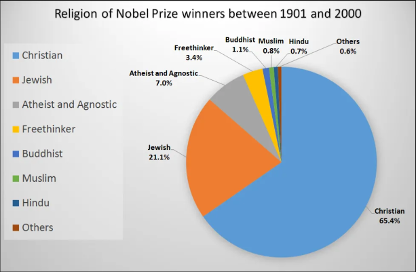
Third, this is not just factually wrong. The opposite is factually true.

Pie Chart distributing the religion of nobel prize winners between 1901 and 2000.

Source: https://commons.wikimedia.org/wiki/File:Religion_of_Nobel_Prize_winners.png

[This Chart depicts the] “Distribution of Nobel Prizes by religion between 1901–2000, the data tooks [sic] from Baruch A. Shalev, 100 Years of Nobel Prizes (2003), Atlantic Publishers & Distributors, p.59 and p.57: between 1901 and 2000 reveals that 654 Laureates belong to 28 different religion. Most 65.4% have identified Christianity in its various forms as their religious preference. Overall, Christians have won a total of 78.3% of all the Nobel Prizes in Peace, 72.5% in Chemistry, 65.3% in Physics, 62% in Medicine, 54% in Economics and 49.5% of all Literature awards.


Atheists, agnostics, and freethinkers comprise 10.5% of total Nobel Prize winners; but in the category of Literature, these preferences rise sharply to about 35%. A striking fact involving religion is the high number of Laureates of the Jewish faith — over 20% of total Nobel Prizes (138); including: 17% in Chemistry, 26% in Medicine and Physics, 40% in Economics and 11% in Peace and Literature each. The numbers are especially startling in light of the fact that only some 14 million people (0.2% of the world’s population) are Jewish. By contrast, only 5 Nobel Laureates have been of the Muslim faith-0.8% of total number of Nobel prizes awarded — from a population base of about 1.2 billion (20% of the world‘s population).”[2]

Before We Proceed

Before getting into the cognitive-dissonance-inducing quotes, let me make some caveats.

  • The experts quoted here have different religious beliefs and affiliations.
  • This list does not prove the existence of any God or truthfulness of any particular religion any [given] scientist professes.
  • This also does not disprove atheism or any non-theist worldview, since, as mentioned at the beginning, there is a small percentage of non-theists that were and are Nobel prize winners.
  • This list does not prove the opposite, namely, that the majority of scientist in these fields are religious. It might be the case that religious people are a minority.
  • Finally, it just disproves the false assumption that faith in God and the supernatural impedes the progression of science (when in fact, it gave birth to science, but that might be a future post) or that science and faith are incompatible.

The list will be divided by fields for easy search with their respective sources. The experts range from different nationalities and times with no specific order. This list only composes the fields of chemistry, physics and medicine. Literature, economics and peace are not included. Without further ado, enjoy the quotes.

Chemistry

  1. “God did create the universe about 13.7 billion years ago, and of necessity has involved Himself with His creation ever since. The purpose of this universe is something that only God knows for sure, but it is increasingly clear to modern science that the universe was exquisitely fine-tuned to enable human life. We are somehow critically involved in His purpose.”
    — Richard Smalley. Chemist.
    — Nobel Prize: For the discovery of fullerenes.
    — Source: Remarks by Richard Smalley at 2005 Alumni Banquet, Hope College.
  2. “Well, we are supposed to love the Lord our God with all our heart with all our mind and with all our strength. But that is separate from loving our neighbor as ourselves. It means that nature is God’s creation. So we should love nature and understand nature the best we can in order to show our love for the creator.”
    — John B. Goodenough. Materials scientist, a solid-state physicist.
    — Nobel Prize: For the development of lithium-ion batteries
    — Source: Transcript of an interview with John B. Goodenough.
  3. “God is Truth. There is no incompatibility between science and religion. Both are seeking the same truth. Science shows that God exists.”
    — Dereck Barton. Organic chemist.
    — Nobel Prize: For his contribution to the development of the conformational analysis as an essential part of organic chemistry.
    — Source: Barton, as cited in Margenau and Varghese 1997, Cosmos, Bios, Theos: Scientists Reflect on Science, God, and the Origins of the Universe, Life, and Homo sapiens, 144.
  4. “I think only an idiot can be an atheist. We must admit that there exists an incomprehensible power or force with limitless foresight and knowledge that started the whole universe going in the first place.”
    — Christian Anfinsen. Biochemist.
    — Nobel Prize: For his work on ribonuclease, especially concerning the connection between the amino acid sequence and the biologically active conformation.
    — Source: Anfinsen, as cited in Margenau and Varghese, ‘Cosmos, Bios, Theos’, 1997, 139.
  5. “Certainly science, especially physics and chemistry, is a very important part of my identity. But I also consider myself a religious person, and in two senses: one, based on my liberal Jewish upbringing which I have passed on to my children; the other, a kind of nondenominational deism which springs from my awe of the world of our experiences and is heightened by my identity as a scientist. It also includes a conviction that science alone is an insufficient guide to life, leaving many deep questions unanswered and needs unfulfilled.”
    — Walter Kohn. Physicist.
    — Nobel Prize: For his work on the development of the density functional theory.
    — Source: Reflections of a Physicist after an Encounter with the Vatican and Pope John Paul II (April 20, 2001, University of California, Santa Barbara)

Physics

  1. “This much I can say with definiteness — namely, that there is no scientific basis for the denial of religion — nor is there in my judgment any excuse for a conflict between science and religion, for their fields are entirely different. Men who know very little of science and men who know very little of religion do indeed get to quarreling, and the onlookers imagine that there is a conflict between science and religion, whereas the conflict is only between two different species of ignorance.”
    — Robert A. Millikan. Experimental physicist.
    — Nobel prize: for his work on the elementary charge of electricity and on the photoelectric effect.
    — Source: Autobiography (1950). Chapter 21: “The Two Supreme Elements in Human Progress”. p 279.
  2. “If we count the galaxies of the universe or demonstrate the existence of elementary particles, in an analog way we can’t probably have proof of the existence of God. But as a researcher, I’m deeply moved by the order and beauty I find in the cosmos and the interior of material things. As an observer of nature, I can’t help thinking there is a higher order. The idea that all this is the result of fortune or pure statistic diversity for me is completely unacceptable.”
    — Carlo Rubbia. Physicist and director of the European Organization for Nuclear Research (CERN)
    — Nobel Prize: For work leading to the discovery of the W and Z particles at CERN.
    — Source: C. Rubbia, Neue Zürcher Zeitung, March 1993.
  3. “Science, with its experiments and logic, tries to understand the order or structure of the universe. Religion, with its theological inspiration and reflection, tries to understand the purpose or meaning of the universe. These two are cross-related. Purpose implies structure, and structure ought somehow to be interpretable in terms of purpose.”
    — Charles H. Townes. Physicist.
    — Nobel Prize: 
    For fundamental work in the field of quantum electronics.
    — Source: “Logic and Uncertainties in Science and Religion,” in Science and the Future of Mankind: Science for Man and Man for Science, pp. 296–309.
  4. “As we conquer peak after peak we see in front of us regions full of interest and beauty, but we do not see our goal, we do not see the horizon; in the distance tower still higher peaks, which will yield to those who ascend them still wider prospects, and deepen the feeling, the truth of which is emphasized by every advance in science, that ‘Great are the Works of the Lord’.”
    — Joseph John Thomson. Physicist
    — Nobel Prize: For the discovery of the electron.
    — Source: Thomson 1909, Nature, vol. 81, p. 257
  5. “If there are a bunch of fruit trees, one can say that whoever created these fruit trees wanted some apples. In other words, by looking at the order in the world, we can infer purpose and from purpose we begin to get some knowledge of the Creator, the Planner of all this. This is, then, how I look at God. I look at God through the works of God’s hands and from those works imply intentions. From these intentions, I receive an impression of the Almighty.”
    — Arno Penzias. Physics.
    — Nobel Prize: For the discovery of the cosmic background radiation which substantiated Big Bang theory.
    — Source: Penzias, as cited in ‘The God I Believe in’, Joshua O. Haberman editor, New York, Maxwell Macmillan International, 1994, 184
  6. “One way to learn the mind of the Creator is to study His creation. We must pay God the compliment of studying His work of art and this should apply to all realms of human thought. A refusal to use our intelligence honestly is an act of contempt for Him who gave us that intelligence.”
    Ernest Thomas Sinton Walton. Physicist.
    — Nobel Prize: for his pioneering work on the transmutation of atomic nuclei by artificially accelerated atomic particles
    — Source: V. J. McBrierty (2003): Ernest Thomas Sinton Walton, The Irish Scientist, 1903–1995, Trinity College Dublin Press.
  7. “Can a good scientist believe in God? I think the answer is: Yes. In the first place, a scientist, more than other scholars, spends his time observing nature. It is his task to help to unravel the mysteries of nature. He comes to marvel at these mysteries. Hence, it is not hard for a scientist to admire the greatness of the creator of nature. From this it is only a step to adore God.”
    Victor Franz Hess. Physicist
    — Nobel Prize: 
    For the discovery of cosmic rays.
    — Source:
     The American Weekly. “My Faith”. November 3, 1946.
  8. “The book of nature which we have to read is written by the finger of God.”
    Michael Faraday. Scientist.
    — Nobel Prize: 
    For establishing the existence of the magnetic field, discovered electrolysis, diamagnetism, electromagnetic induction and benzene.
    — Source: Seeger, Raymond. 1983. “Faraday, Sandemanian,” in The Journal of the American Scientific Affiliation, 35 (June 1983): 101.
  9. “Both religion and science require a belief in God. For believers, God is in the beginning, and for physicists He is at the end of all considerations… To the former He is the foundation, to the latter, the crown of the edifice of every generalized world view.”
    Max Planck. Physicist. Founder of quantum physics.
    — Nobel Prize: In recognition of the services he rendered to the advancement of Physics by his discovery of energy quanta.
    — Source: Scientific Autobiography and Other Papers as translated by F. Gaynor (1949), p. 184 — Religion and Natural Science (1937)
  10. “In view of such harmony in the cosmos which I, with my limited human mind, am able to recognize, there are yet people who say there is no God. But what makes me really angry is that they quote me for support of such views.”
    Albert Einstein. Physicist.
    — Nobel Prize: for his services to Theoretical Physics, and especially for his discovery of the law of the photoelectric effect.
    — Source: Statement to German anti-Nazi diplomat and author Prince Hubertus zu Lowenstein around 1941, as quoted in his book Towards the Further Shore : An Autobiography (1968) — Attributed in posthumous publications.
  11. “Overpoweringly strong proofs of intelligent and benevolent design lie all around us; and if ever perplexities, whether metaphysical or scientific, turn us away from them for a time, they come back upon us with irresistible force, showing to us through Nature the influence of a free will, and teaching us that all living things depend on one ever-acting Creator and Ruler.”
    William Lord Kelvin. Physicist and mathematician. Founder of Thermodynamics and Energetics
    — Nobel Prize: his achievements in thermodynamics.
    — Source: Address of Sir William Thomson, Knt., LL.D., F.R.S, President,” in Report of the Forty-First Meeting of the British Association for the Advancement of Science, held at Edinburgh in August 1871, pages lxxxiv-cv., 100–101.
  12. “I believe in God, who can respond to prayers, to whom we can give trust and without whom life on this earth would be without meaning (a tale told by an idiot). I believe that God has revealed Himself to us in many ways and through many men and women, and that for us here in the West the clearest revelation is through Jesus and those that have followed him.”
    Nevill Francis Mott. Physicist.
    — Nobel Prize: For his work on the electronic structure of magnetic and disordered systems, especially amorphous semiconductors.
    — Source: Mott, as cited in Nevill Mott: Reminiscences and Appreciations, E.A. Davis — editor, London, Taylor & Francis Ltd, 1998, 329.
  13. “I believe in God. In fact, I believe in a personal God who acts in and interacts with the creation. I believe that the observations about the orderliness of the physical universe, and the apparently exceptional fine-tuning of the conditions of the universe for the development of life suggest that an intelligent Creator is responsible. I believe in God because of a personal faith, a faith that is consistent with what I know about science.”
    William D. Phillips. Physicist.
    — Nobel Prize: For development of methods to cool and trap atoms with laser light.
    — Source: Phillips, William D. 2002b. A letter to the compiler T. Dimitrov. May 19.
  14. “Those who say that the study of science makes a man an atheist, must be rather silly people.”
    Max Born, Physicist.
    — Nobel Prize: For his fundamental research in quantum mechanics, especially for his statistical interpretation of the wavefunction.
    — Source: Frederick E. Trinklein, The God of Science (Grand Rapids, MI: Eerdmans, 1971), 64.
  15. [When asked if he believed in God as a natural scientist] “Naturally, yes. I grew up as a strict Catholic, and I think that I benefited from that.”
    Peter Grünberg. Physicist.
    — Nobel Prize: For his discovery with Albert Fert of giant magnetoresistance.
    — Source: Cicero: Magazin für Politische Kultur, December 2007.
  16. “For myself, faith begins with the realization that a supreme intelligence brought the universe into being and created man. It is not difficult for me to have this faith, for it is incontrovertible that where there is a plan there is intelligence. An orderly, unfolding universe testifies to the truth of the most majestic statement ever uttered: ‘In the beginning God. . . ”
    — Arthur Compton. Physicist.
    — Nobel Prize: for his discovery of the effect named after him.
    — Source: “Why I Believe in Immortality,” This Week, (Sunday supplement to the New Orleans’ The Sunday Item-Tribune; April 12, 1936), 5 ff. Reprinted in Christian Science Sentinel, 62: 32, (August 6, 1960), 1411.
  17. “In the history of science, ever since the famous trial of Galileo, it has repeatedly been claimed that scientific truth cannot be reconciled with the religious interpretation of the world. Although I am now convinced that scientific truth is unassailable in its own field, I have never found it possible to dismiss the content of religious thinking as simply part of an outmoded phase in the consciousness of mankind, a part we shall have to give up from now on. Thus in the course of my life I have repeatedly been compelled to ponder on the relationship of these two regions of thought, for I have never been able to doubt the reality of that to which they point.”
    — Werner Karl Heisenberg. Theoretical physicist.
    — Nobel Prize: For the creation of quantum mechanics.
    — Source: Heisenberg, Scientific and Religious Truth (1973)
  18. “It seems to me that when confronted with the marvels of life and the universe, one must ask why and not just how. The only possible answers are religious. . . I find a need for God in the universe and my own life.”
    — Arthur L. Schawlo. Physicist.
    — Nobel Prize: for their contribution to the development of laser spectroscopy.
    — Source: H. Margenau, Cosmos, Bios, Theos: Scientist Reflect on Science, God, and the Origins of the Universe, Life, and Homo Sapiens (1992).
  19. “I think both science and religion are necessary to understand our relation to the Universe. In principle, Science tells us how everything works, although there are many unsolved problems and I guess there always will be. But science raises questions that it can never answer. Why did the big bang eventually lead to conscious beings who question the purpose of life and the existence of the Universe? This is where religion is necessary.”
    — Antony Hewish. Radio astronomer
    — Nobel Prize: For their pioneering research in radio astrophysics: Ryle for his observations and inventions, in particular of the aperture synthesis technique, and Hewish for his decisive role in the discovery of pulsars.
    — Source: Antony Hewish, “A letter to the compiler T. Dimitrov. May 27” (2002).

Medicine

  1. “I have said for years that speculations about the origin of life lead to no useful purpose as even the simplest living system is far too complex to be understood in terms of the extremely primitive chemistry scientists have used in their attempts to explain the unexplainable that happened billions of years ago. God cannot be explained away by such naive thoughts.”
    — Ernst Boris Chain. Biochemist.
    — Nobel Prize: for the discovery of penicillin and its curative effect in various infectious diseases.
    — Source: Chain, as cited in The Life of Ernst Chain: Penicillin and Beyond by Ronald W. Clark, London, Weidenfeld & Nicolson, 1985, 147–148.
  2. “Only the scientist manages to understand something of that mysterious language that God has written in Nature; and it has only been given to him to unravel the marvelous work of Creation in order to render to the Absolute the most pleasant and accepted cult, that of studying his portentous works, in order to know, admire and revere him in and through them.” [Translated by me from Spanish to English]
    — Santiago Ramon y Cajal. Neuroscientist, pathologist, and histologist.
    — Nobel Prize: In recognition of his work on the structure of the nervous system.
    — Source: Reglas y consejos sobre la investigación científica. Los tónicos de la voluntad.
  3. “…[N]o scientific discovery was so fraught with significance as the revelation of the law of love by Jesus the Crucified. For this law is, in fact, that of the survival of human societies.”
    — Alexis Carrell. Surgeon and biologist.
    — Nobel Prize: For his work on vascular suture and the transplantation of blood vessels and organs
    — Source: Reflections on Life, 1952, Chap. 3, Part 6
  4. “Science and religion are very much alike. Both are imaginative and creative aspects of the human mind. The appearance of a conflict is a result of ignorance. We come to exist through a divine act. That divine guidance is a theme throughout our life; at our death the brain goes, but that divine guidance and love continues. Each of us is a unique, conscious being, a divine creation. It is the religious view. It is the only view consistent with all the evidence.”
    — Sir John Carew Eccles. Neurophysiologist and philosopher.
    — Nobel Prize: For his discoveries concerning the ionic mechanisms involved in excitation and inhibition in the peripheral and central portions of the nerve cell membrane.
    — Source: The Intellectuals Speak Out About God: A Handbook for the Christian Student in a Secular Society (1984). p 50.
  5. “Is the Church inimical to science? Growing up as a Catholic and a scientist — I don’t see it. One truth is revealed truth, the other is scientific truth. If you really believe that creation is good, there can be no harm in studying science. The more we learn about creation — the way it emerged — it just adds to the glory of God. Personally, I’ve never seen a conflict.”
    — Joseph Murray. Professor of Surgery at Harvard Medical School; chief plastic surgeon at Children’s Hospital Medical Center, Boston.
    — Nobel Prize: For work that “proved to a doubting world that it was possible to transplant organs to save the lives of dying patients.”
    — Source: National Catholic Register (December 1–7, 1996) (Murray, as cited in Meyer 1996)
  6. “When it comes to the origin of life there are only two possibilities: creation or spontaneous generation. There is no third way. Spontaneous generation was disproved one hundred years ago, but that leads us to only one other conclusion, that of supernatural creation. We cannot accept that on philosophical grounds; therefore, we choose to believe the impossible: that life arose spontaneously by chance!”
    — George Wald. Professor of Biology at Harvard University (1948–1977).
    — Nobel Prize: For his work on the biochemistry of vision.
    — Source: George Wald, 1954, “The Origin of Life,” Scientific American, 191 [2]: 48. [It should be noted he was an atheist when he said this. He later become a deist.]
  7. “This day relenting God Hath placed within my hand A wondrous thing; and God Be praised. At His command, Seeking His secret deeds With tears and toiling breath, I find thy cunning seeds, O million-murdering Death. I know this little thing A myriad men will save. O Death, where is thy sting? Thy victory, O Grave?”
    — Ronald Ross. Professor of Tropical Medicine at Liverpool University (1902–1912); Vice President of the Royal Society (1911–1913).
    Nobel Prize: For his remarkable work on malaria. This poem was written on August 20, 1897, the same day he made his landmark discovery that malaria is transmitted to people by Anopheles mosquitoes.
    — Source: Ronald Ross, Memoirs, London, John Murray, 1923, 226.

Hopefully, these quotes are sufficient to convince you that such conflict is nonexistent. Therefore, keep believing. Keep inquiring.

Am I missing someone? If you know any Lauret scientist in any of these categories that is not in the list, but you think it should, comment his/her name with title, why it was given the prize and a verified quote with source.

Some information presented in this list was collected form the free eBook 50 Nobel Laureates and Other Great Scientists Who Believe In God. This eBook includes the field of literature, economics and peace.

References:

[1] Editor’s Note: “Scientism” is the idea that science is the sole arbiter of knowledge, everything is else is subjective opinion, fiction, or foolishness. “Naturalism” is the idea that the only thing/s that exist is nature; there is no supernatural realm.

[2] https://commons.wikimedia.org/wiki/File:Religion_of_Nobel_Prize_winners.png

Recommended Resources:

Why Science Needs God by Dr. Frank Turek (DVD and Mp4)

Science Doesn’t Say Anything, Scientists Do by Dr. Frank Turek (DVD, Mp3, and Mp4)

Oh, Why Didn’t I Say That? Does Science Disprove God? by Dr. Frank Turek (DVD and Mp4)

I Don’t Have Enough Faith to Be an Atheist (Paperback), and (Sermon) by Norman Geisler and Frank Turek 


Miguel Rodriguez is the founder of Smart Faith, a platform dedicated to helping Christians defend their faith with clarity and confidence. After experiencing a miraculous healing at 14, he developed a passion for knowing God through study and teaching. He now serves as the Director of Christian Education and a Bible teacher at his local church while also working as a freelance email marketer. Living in Orlando, Florida, with his wife and two daughters, Miguel seeks to equip believers with practical and intellectual tools to strengthen their faith. Through Smart Faith, he provides apologetics and self-improvement content to help Christians live with wisdom and integrity.

Originally posted at: https://bit.ly/3Zuhby7

One of the ways you will find philosophy professors denying Christ is through an appeal to Kantian ethics. Kant’s ethical theory uses many positive-sounding words that appeal to our moral intuitions. Yet, when we examine the content, we find that Kant was opposed to Christ as revealed in Scripture. Instead, he sought to elevate the individual’s moral intuitions as the highest authority, and even above the Bible.


I know of professors who lure students in by claiming to be Christians, but then play a shell game: they subtly replace Christianity with Kantianism, and then argue that the Bible and Christianity are false because they contradict their moral intuitions.

Kant’s Ethics

Permit me to give you a brief overview of Kantianism. Immanuel Kant sought to ground ethics not in religion or divine revelation, but in human reason alone. His project was part of the broader Enlightenment goal of establishing a rational foundation for morality that could be universally valid, independent of theological commitments. By itself, that all sounds great. But once we begin to ask what Kant meant by terms like “reason” and “summum bonun,” we run into deep problems. Here’s how he approached it:

1. Moral Law from Within, Not from Above

Kant believed that morality must be autonomous, not heteronomous, that is, it must come from within the rational will of the individual, not from an external authority like God or the Church. By “reason,” Kant distinguished between pure reason (used in studying metaphysics) and practical reason (used to solve problems in means/ends reasoning). He was a skeptic about pure reason, arguing that it ends in contradictions. So, when he tells us to be rational or to use a rational will, he means to use reason to live according to the categorical imperative.
He famously wrote:

“Two things fill the mind with ever new and increasing admiration… the starry heavens above me and the moral law within me.”
Kant, Critique of Practical Reason (1788)

This “moral law within” was, for Kant, the source of true ethical obligation. He did not deny God’s existence, but he insisted that moral duties must be discoverable by reason, not dependent on divine command. He speaks like the Serpent from the Garden: he believes to be moral we must determine good and evil for ourselves.

2. The Categorical Imperative

Kant replaced divine law with a purely rational principle: the categorical imperative. This is a test for determining whether an action is morally permissible. His most famous formulation is:

“Act only according to that maxim whereby you can at the same time will that it should become a universal law.”
Immanuel Kant, Groundwork of the Metaphysics of Morals (1785)

This is an attempt to derive moral law from pure reason, without appeal to consequences, emotions, or divine will. For Kant, if a rule cannot be universalized, it is morally impermissible.

Yet, he bases this on “if you can universalize it.” Can you live with this rule being universal. This means it is a statement of subjective opinion and not objective reality. Nietzsche took this to its logical conclusion in his will to power. Because the Kantian rejects God’s law as heteronomy he has no appeal to anything objective by which to critique the will to power. And this is why professors in the Kantian tradition fell in so easily with philosophies of power like DEI and critical theory.

3. Human Dignity and Autonomy

Kant believed that each person possesses intrinsic worth because of their rational nature. Therefore, one should always treat humanity, whether in oneself or in others, never merely as a means, but always as an end. This principle grounds ethics in respect for persons, not in obedience to God.

The university Kantian combines this with the categorical imperative to make an appeal to abusive empathy. This is when you take advantage of the listener’s disposition to compassion and excuse the wrongdoing of the person who is pitied. How another person feels becomes their moral standard. If someone is poor, we do not consider the possibility of sloth; instead, we ask how they must feel and how good they would feel if they were simply given money and a house. This abusive empathy is used to bully the Christian into accepting the radical leftist morality that Kantianism has become.

Kantianism presupposes Rousseau’s claim that human beings are naturally good and only corrupted by the invention of private property. It rejects God’s providential rule of the world and instead insists that all injustice stems from the unequal distribution of material goods and resources. Kant rejects the biblical doctrines of the Fall and sin, and instead teaches that humans are perfectible through adherence to Kantian moral theory.

4. Religion as Morality’s Handmaid, Not Its Source

In his book Religion Within the Bounds of Bare Reason (1792), Kant argued that religion should support morality, not define it. He viewed Christianity as a helpful moral teaching only insofar as it agrees with his subjective reason. It is “subjective reason” because it relies on his moral intuitions about “how the world should be.” Christ was seen more as a moral example than a divine Savior.

And remember, for Kant, “reason” means: What can I universalize?, and then solving practical problems that arise as you live according to that principle. In other words, Kantian “reason” becomes subjective and denies the clear general revelation of God and His moral law.
Kant even called the concept of a divine command the “heteronomy of the will,” which is a failure of reason to guide itself. He wanted a moral law that any rational being, whether religious or not, could recognize and obey.

5. Postulates of Practical Reason

Although Kant did not ground morality in religion, he concluded that moral reasoning requires presupposing three things:

● God (as the guarantor of justice, otherwise unknowable)
● Immortality (so that perfect virtue is achievable)
● Freedom (to be morally responsible)

These are not proofs, but practical postulates, which are ideas we must assume if we are to take morality seriously. Still, they are subordinate to Kantian reason, not based on revelation or faith in Christ.

Kant attempts to get around God’s providence in this world, and the inherent connection of sin and death, by saying that what appears to be unfair in this life (the righteous suffer and the wicked live well) is made right in the next life. He defines the summum bonus, or highest good, this way: “The highest good is the complete unity of virtue and happiness” Critique of Practical Reason, 5:110).

In other words, the summum bonum is the state in which a person who is fully morally good (possessing a good will) also experiences the full happiness that such goodness deserves.
Kant teaches his followers to reject God’s law as heteronomy, to live according to their own subjective intuitions about what should be universal, and to be content with the idea that their self-defined virtue in this life will be rewarded with happiness in the next.

6. The Serpent and Kant

Think about how closely all of this resembles the teaching of the Serpent in Genesis 3. The Kantian is told to determine their own good and evil. God’s law is rejected as imposed, as a limitation on freedom, it is heteronomous and therefore illegitimate.

It is seen as an invasion of the human will by an outside source. But in Genesis 3, God imposed death as a call to repent of sin. Instead of repenting, the Kantian says, “Live by my philosophy, and you will be given happiness in the next life.” “God” becomes a mere postulate, which is a necessary idea to guarantee that promised happiness.

Yet Kant offers no explanation of how a sinner can be reconciled to a perfectly holy and good God. He teaches works righteousness. In his system, the human is not a sinner in need of grace, but someone who does wrong due to social circumstances, and who can be perfected and made virtuous by following Kantian philosophy.

7. Identify the Wolf

As a student, you should understand the philosophy your professors will be imposing on you. You can use Kantianism against them. Instead, insist on your own autonomy and reject their heteronomy. Then challenge their categorical imperative and ask how it escapes absolute subjectivity. And ask why God, who is holy, would ever grant happiness to an unrepentant sinner; someone who has spent a life rejecting God’s law and reducing Christ to a mere moral example rather than the Lamb of God who takes away the sin of the world.

Kant:
1. Couldn’t explain what has existed from eternity.
2. Denied that what is good for a being is based on their nature and therefore determined by their Creator.
3. Rested his entire philosophy on ultimate skepticism about God and providence.
4. Denied that the Bible is divinely inspired.
5. Denied we need to be reconciled to God by Christ.

The Kantian is no Christian.

Learn to expose your professor’s presuppositions and demolish their arguments. Or better yet, don’t even sign up for, or pay for, such classes. Exercise your autonomy to find a university and professors who recognize what is clearly revealed about God and the moral law through general revelation.

Recommended Resources:

Intellectual Predators: How Professors Prey on Christian Students (DVD) (mp3) (mp4 Download

Correct not Politically Correct: About Same-Sex Marriage and Transgenderism by Frank Turek (Book, MP4)

Legislating Morality: Is it Wise? Is it Legal? Is it Possible? by Frank Turek (Book, DVD, Mp3, Mp4, PowerPoint download, PowerPoint CD)

Letters to a Young Progressive by Mike Adams (Book)


​​Dr. Owen Anderson is a Professor of Philosophy and Religious Studies at Arizona State University, a pastor, and a certified jiu-jitsu instructor. He emphasizes the Christian belief in God, human sin, and redemption through Christ, and he explores these themes in his philosophical commentary on the Book of Job. His recent research addresses issues such as DEIB, antiracism, and academic freedom in secular universities, critiquing the influence of thinkers like Rousseau, Marx, and Freud. Dr. Anderson actively shares his insights through articles, books, online classes, and his Substack.

Most non-believers will tell you that man is basically “good.” When he acts against that basic goodness, it’s the result of disease, such as alcoholism, drug addiction, or some form of mental illness. These, in turn, stem from a failure of society to reach out and provide the right kind of assistance and services. If only we as a society could do more, spend more, provide more, we could eventually create the kind of utopia that “good” people populate.


Christianity, by contrast, teaches a much different worldview. Long ago, the first man and woman exercised their free will to rebel against God, and in so doing created a rift between man and God that continues to this day. Though man has a certain inherent goodness, because he bears the image of God, he is at present broken, corrupted, and fallen, and he manifests that fallen nature in a way that we see quite starkly. Christians have a name for this manifestation – sin. It afflicts and motivates all of us, and no one can escape its pull. Not without divine help, anyway.

Worldviews Shape Our Response to the Gospel

These contrasting worldviews cannot both be correct. And depending on which view you accept, your response to the good news of the Gospel will be different. “Good” people who simply need more education and more refinement don’t need a Savior; they can do just fine on their own, and with a little help from society. But fallen and corrupted people, even well-intentioned ones, are not going to be able to pull themselves up by their bootstraps. Their nature, constantly at war with the good that is within them, needs to be recast – remade in the image of the God who made them and left them here.

Is there a way to “prove” which view is correct? How can we reliably determine what man is like in his natural state? First, we need to get our minds around what we mean by terms like “good” or “evil.” I would suggest a simple definition: what we recognize as “good” in other people is the product of an intentional effort at selflessness. Whether it’s sacrificial love, working for charity or simply a random act of kindness – what we experience as “good” is an act directed to the benefit of the other. By contrast, what we see as evil is an act directed at satisfying within oneself a base or selfish end. The quests for power, for recognition, for material wealth, for dominance – all these things drive people to ignore the harm inflicted as they climb over those who stand in their way.

But, What About the Babies?!

Now, with this basic concept in mind, what can we see from examining man in his most primitive state? I don’t mean primitive as in caveman, but as in newborn. Spend even a little time with infants and toddlers, and you’ll see some basic features emerge. Each views himself as the center of the universe and expects his parents and the other kids around him to treat him accordingly. With each passing month, the willfulness of the child’s behavior becomes increasingly apparent: from every fiber of his being, he is shouting, “I want things my way!” Whether it’s food or drink, when and how he wants it, his mother’s attention, or his playmate’s toys, a developing child’s “me-focus” is readily on display. And if his will is thwarted, there is no resort to reason – a temper tantrum is the predictable result.

Now, some might object that children are innocent and cannot be described as bad or broken, or worse yet, evil. They might point out that children are free from the biases and prejudices that sour many adult relationships. But this objection misses my point. I would not describe children as evil either, because evil implies a level of awareness of the harm one is doing, and a small child does not yet appreciate the consequences of his behavior. But the child’s behavior is reflective of the way his mind operates, and unless a parent applies discipline and training to bend the will to a proper orientation, a spoiled, self-centered adolescent will emerge.

Evil Comes Naturally

Consider: no parents ever have to train their child to give up his positive and sunny disposition and be more critical of others; they don’t need to punish their children for sharing too much and instead teach them to rip their toys out of the hands of their playmates; they don’t need to insist that a child stop thinking so much about what he can do for his parents – “Can’t I wash the dishes or sweep the deck? I really don’t have anything else to do?” No, for every child, the process of “civilizing” is a process of moving from a me-centered selfishness to an other-centered effort to get along.

Children don’t have the insight yet to seek to change their ways, to live more cooperatively and altruistically. Their parents’ job is to teach them – to help them move from their inherent fallenness to a state which is not quite natural to us, a state in which we are intentional about trying to do good. The non-believer can also do good. But by rejecting God as the source of true goodness, he remains in defiance to God. He refuses to see his need for a Savior to finish the job of making him good. He refuses to bend his will to God. It is no coincidence that the Bible speaks of becoming a “slave” to Christ. For in the end, it is only by bending to Him – by dying to ourselves as we look outward to others in order to better serve Him – that we can eventually find the solution to our problem.

Believing that we are basically good flies in the face of the reality of what we truly are. It stands in the way of our crying out for the Savior who alone has the power to restore us. Observing children in their natural condition can help give us a better picture of ours.

This is one of the few lessons that we should allow our children to teach us.

Recommended Resources:

If God, Why Evil? (DVD Set), (MP3 Set), and (mp4 Download Set) by Frank Turek 

Why Doesn’t God Intervene More? (DVD Set), (MP3 Set), and (mp4 Download Set) by Frank Turek

Why does God allow Bad Things to Happen to Good People? (DVD) and (mp4 Download) by Frank Turek 

Relief From the Worst Pain You’ll Ever Experience (DVD) (MP3) (Mp4 Download) by Gary Habermas 


Al Serrato earned his law degree from the University of California at Berkeley in 1985. He began his career as an FBI special agent before becoming a prosecutor in California, where he worked for 33 years. An introduction to CS Lewis’ works sparked his interest in Apologetics, which he has pursued for the past three decades. He got his start writing Apologetics with J. Warner Wallace and Pleaseconvinceme.com.

As a parent or student it will help you to know that in many cases your secular professors have a strategy. They have a goal. A strategy is the big-picture plan to win or achieve that goal. Tactics are the step-by-step methods used to carry it out. I’ve told you before that you can see their goal by how they live their own lives. But now let’s look at their classroom tactics.


If you’re a parent or a prospective student, you need to understand the tactics of the secular professor. For many of them, “winning” means leading students to adopt a radical leftist ideology—either by outright agreement or by slow, subtle influence. Agreement isn’t always demanded immediately. Sometimes, all they want is your gradual surrender of confidence in anything else.  The big win, however, is final deconversion from Christianity and acceptance of something like the LGBTQ+ “safe zone” philosophy pushed at ASU.

Undermining Christianity: The Real Strategy

The strategy of many secular professors is simple: undermine Christianity. Why? Because Christianity remains the major roadblock to their radical leftist ideology.  Without that, their goal is in sight.

If you had to guess a student’s religion, statistically, you’d guess Christian and be right more often than not. Christianity remains the default framework for morality, identity, and truth for many students, even if only in fragments.  Christian teaching is the main roadblock to the Marxism at the core of the radical left.

And that’s a problem—for them.

The teachings of Christianity are fundamentally incompatible with the radical left’s view of sex, gender, truth, power, and the good life. So, it’s not just about “dialogue” or “working together.” Before they can win a student to their worldview, they must first destabilize the student’s confidence in Christianity. Undermine the foundation, and the rest of the structure will fall. That’s the strategy. Their tactics follow.

How the Strategy Is Carried Out: Tactics You Should Know

This strategy to undermine Christianity is carried out through many identifiable tactics. For parents and students, it’s worth learning these—not only to recognize what’s happening, but also to see how poorly equipped many of these professors are for the intellectual life they claim to lead. Scripture puts it plainly: “Claiming to be wise, they became fools” (Romans 1:22). What we’re witnessing in many classrooms today is a real-time application of that verse. Let’s examine a few of their most common tactics. We’ll begin with three—but the list, sadly, is always growing.

Tactic #1: Undermine the Word of God

The first and most foundational tactic is to undermine the authority of Scripture. This can take the form of a direct assault—mocking the Bible as outdated, oppressive, or absurd—or a more subtle approach: cherry-picking verses to support radical leftist ideology.

For example, I have a colleague—openly anti-Christian—who claims that Matthew 25:40 (“Whatever you did for the least of these, you did for me”) is the best verse in the Bible. Why? Because she believes it proves her progressive social philosophy. On her reading, all you have to do is advocate for so-called sexual minorities, and you’re doing exactly what Jesus said. No need for sound doctrine. No need to understand the whole Bible. Just grab a single verse and weaponize it.  Incidentally, it is worth noting that in this specific verse, Jesus is speaking about believers.

But that’s only half the tactic. The next step is to accuse actual Christians of not living up to the verse. She’ll claim that conservative Christians don’t care for the poor or marginalized—never mind the fact (which students rarely hear) that conservative Christians out-give atheist professors by a staggering margin when it comes to charity, adoption, missions, disaster relief, and practical acts of compassion.

Still, students don’t know that. So the professor paints a picture: the Bible is on her side, and Christians are hypocrites who don’t live up to it.

You’ll notice she never mentions John 6, where Jesus rebukes the crowd for following Him only to get bread, rather than the Bread of Life. She’s not interested in the full counsel of God—only the verses that can be twisted to serve her ideological agenda.

There are other versions of this tactic. One common move is to deny that the Bible even teaches that homosexuality is a sin. “That’s just in Leviticus,” they’ll say, “and no Christian keeps that anymore.”

I call this the “Did God really say?” tactic. Just like the serpent in the garden, the secular professor begins by sowing doubt: Did God really say that?

Did He really say that homosexuality is a sin?
Did He really define male and female?
Did He really establish the moral order we find in Scripture?

If they can get the student to doubt the clarity, authority, or consistency of God’s Word, they’ve won the first battle.

Tactic #2: Vilify Christianity

The second tactic is to vilify Christianity—to paint it not as the source of civilization’s greatest moral and social advances, but as the root of all historical evil. This is straight out of the classical Marxist playbook, so anyone familiar with the last 150 years of ideology should see it coming a mile away.

Unfortunately, most parents assume we’ve moved past this kind of propaganda. And most students, born long after the fall of the USSR, have never heard a rebuttal. So here’s what they’ll be told:

Christianity invented slavery.
Christianity promoted poverty.
Christians fought to keep people oppressed.

Of course, if you dig long enough, you can always find someone—somewhere—who called themselves a Christian and said something foolish or sinful. That’s not hard. But that’s not the [larger] truth. The truth is this: Christianity gave birth to orphanages, hospitals, and universities. It introduced the rule of law, the dignity of the individual, and the foundation for economic growth and human rights. Christianity gave entire nations the hope of a better future in this life—and the next.

You won’t hear that in most classrooms. Instead, students will be told that Christianity supported slavery. But the historical reality is that slavery was universal in the ancient world. Christianity challenged and ultimately abolished it in Christianized nations—while it still exists today in non-Christian societies.

Why do professors hide this? Because the tactic is designed to make students (specifically white male Christian students) ashamed of their own heritage, their faith, and their families. That shame softens them. Once a student is ashamed of Christianity, they can be more easily reprogrammed and brainwashed. The Marxists knew this. And today’s professors are still using the same tactic with unnerving skill.

Tactic #3: Teach That It Doesn’t Matter Either Way

This tactic is all about misdirection. Unlike the first two, which confront Christianity directly, this one tries to bypass it entirely. The professor simply avoids mentioning the Bible at all. Why? Because attacking it outright might prompt a student to open it—and then the risk is that the student might actually be convinced by its truth. So, instead, the tactic is silence.

The professor communicates—both directly and indirectly—that the student can live a good, meaningful, moral life without ever knowing what the Bible says. If Scripture does come up, it’s brushed aside with a casual, dismissive remark: “Oh, the Bible? Sure, there are a few good things in there—for people who like that sort of thing.”

The message is clear: the Bible is irrelevant.
Not dangerous. Not sacred. Just… beside the point.
Outdated. Unnecessary. Background noise.

This is misdirection at its finest—because it leaves the student disarmed. There’s no battle to fight if the battlefield itself is ignored. The professor shifts the student’s focus to career, activism, self-expression—anything but divine truth. And over time, the student begins to believe the lie that neutrality is possible, and that the big questions of life—truth, meaning, morality, destiny—can be answered without reference to God. But that is not neutrality. That’s secularism in disguise.

Spot the Tactic: A Challenge for Students

Recognizing these tactics is the first step to seeing how certain professors use their class time—not to educate—but to advance a strategy of deconverting Christian students. In fact, you might even turn it into a bit of a game. Challenge your friends:

  • Who can spot the most tactics in a single class session?
  • Whose course schedule has the most ideologically driven professors?
  • Who can most clearly connect the tactics to the broader strategy?

Keep score. Compare notes. And when you’re ready, send me your tallies—I’ll make sure they’re seen by those with oversight at the university. Because let’s be clear: taxpayers aren’t funding this nonsense.[1] And it certainly doesn’t qualify as “education.”

References:

[1] [Editor’s note: At least, taxpayers shouldn’t have to fund any anti-religious bigotry or anti-Christian indoctrination or deconversion tactics.]

Recommended Resources:

Intellectual Predators: How Professors Prey on Christian Students (DVD) (mp3) (mp4 Download

Can All Religions Be True? mp3 by Frank Turek

Was Jesus Intolerant? by Frank Turek (DVD and Mp4)

Another Gospel? by Alisa Childers (book)


​​Dr. Owen Anderson is a Professor of Philosophy and Religious Studies at Arizona State University, a pastor, and a certified jiu-jitsu instructor. He emphasizes the Christian belief in God, human sin, and redemption through Christ, and he explores these themes in his philosophical commentary on the Book of Job. His recent research addresses issues such as DEIB, antiracism, and academic freedom in secular universities, critiquing the influence of thinkers like Rousseau, Marx, and Freud. Dr. Anderson actively shares his insights through articles, books, online classes, and his Substack.

“Beware of false prophets, who come to you in sheep’s clothing but inwardly are ravenous wolves.”
Matthew 7:15 (ESV)


The bathroom debate has resurrected some very old questions about women’s rights.[1] Once upon a time, women fought for separate bathrooms from men. The reasons were obvious. Privacy, modesty, prudence, and the unfortunate fact that men have a worse record for physical and sexual violence. It’s not in women’s best interests to get stuck in a bathroom with a strange man, if she can help it. But in recent years, the common-sense solution of “separate bathrooms” has come under fire. The Trump administration has introduced a new level of pushback, but the bathroom debate is still far from settled. I have to wonder, however, if we could let the air out of this inflated debate by asking one simple question.

The Question Trans-Activists Can’t Answer

If we ask the right question, we can show that trans-activists aren’t very serious in proposing trans-inclusive bathrooms. Of course, trans-activists probably think they’re serious. We don’t have to question their intentions here either. Good intentions can’t redeem bad policy anyway. So, for the sake of argument, we can grant good intentions – compassion for marginalized people, commitment to justice, loving your neighbor, human rights, etc. But when activists push for trans-inclusive bathrooms they have to answer this important question. Otherwise, they haven’t really thought through the issue. So  they aren’t very serious. That question is simply this:

How do you police against the predators?

When I say “predators” I’m not talking about all LGBTQ folks or “trans-women” generally. I’m talking about would-be sex criminals: the voyeurs, rapists, pedophiles, criminal opportunists, and even “autogynephilic” men (males who derive sexual arousal from imagining themselves as women). Predators really exist. We can expect some predators to trespass into women’s restrooms as long as naïve policy allows them to. Predators are liable to spawn as long as the systems in place give mischievous males unfettered access to potential victims. In this way, predators are a reliable “test case” for progressive bathroom policies.

Trans vs. Trans-Acting?

We cannot rationally assume that every man who would use a women’s bathroom is a “trans-woman” (biological male who ‘identifies’ as female). Sure, he might be a classic transgender case who poses no real threat to women. But, he could instead be a cross-dresser who likes to sneak a peek at the ladies. He could be a flasher or a sexual harasser he gets a kick out of exposing himself or behaving rudely with women in the restroom. He could be a pedophile, taking mental pics of naked girls, to fantasize about them later. Or he could be a rapist who’d gladly wear a dress if it means open access to women’s bathrooms and locker rooms. Or he could be a clinically sick teen boy using performative gender to corner his “girl crush”, alone, so  she can’t reject him if she tried. History, criminal psychology, and a healthy dose of realism, attest that these are all live possibilities as long as biological males are legally allowed in women’s restrooms.

Maintaining separate bathrooms has, traditionally, been the common-sense solution for reducing those threats. No solution is 100% perfect here. But, realistically, keeping biological males out of women’s restrooms and locker rooms is a good start for policing against perverts and predators. Dropping that wall of separation means reducing our practical ability to protect women from predators. Bear in mind, we still have active laws against flashers, sexual harassers, and peeping toms. But, if it’s legal to do all of that now, as long as you “trans-act”, then our bathroom policies have given perverts and predators an escape clause in our legal code.

Sheep, Goats and Wolves

It would be nice if every “trans-woman” was just an innocent, lost sheep. Maybe they just need a little care, understanding, and a little guidance, to bring them into the fold. Then God could redeem their own unique gender-expression and sexual identity however He sees fit. Perhaps if the church did a better job caring for “widows and orphans,” i.e., fatherlessness, we wouldn’t have as much transgenderism going around (James 1:27; Exod. 22:22; 1 Tim. 5:5). Undoubtedly, there are some lost sheep out there that fit this profile.

The debate over trans-inclusive bathrooms would be a lot simpler if we were only dealing with the proverbial lost sheep. But, realistically, our policies must also account for goats (fakes and frauds). And we especially need to watch out for the wolves (predators and criminal opportunists). We cannot reasonably assume every “trans-woman” is a “lost sheep.” Instead, we have every reason to expect some of them to be wolves in women’s clothing.

The next time someone offers a policy proposal where trans-women can use the women’s restroom, you can ask them how that policy will police against predators? It’s a fair question. We used to police against them by, first, separating bathrooms according to sex. But, if biological males are now allowed into women’s restrooms, how do we expect to replace that policing power now that the perimeter defenses are down?

Remember the Wisdom of Separate Bathrooms

The ugly answer seems to be that trans-inclusive bathroom policy was never intended for women’s safety, but rather for men’s convenience. Males who identify as female are the target audience here, even if biological women are left in the lurch because of it. When inclusive-bathroom policies unwittingly carry a pack of savvy predators, as stow-aways, then as soon as they’re dropped on women’s restrooms, that’s like airdropping a pack of wolves into the sheep pen. Women deserve better. Moreover, it doesn’t do trans-activists any favors when their own policy is readily hijacked by criminals and predators. We do well to preserve separate bathrooms.

References: 

[1] A “quick fix” solution here is to make only “single-stall” bathrooms. That option can work in some cases, but it’s often impractical for stadiums, locker rooms, health clubs, large businesses, and so forth. The bathroom debate isn’t that easily solved.

Recommended Resources: 

Correct, NOT Politically Correct: How Same-Sex Marriage Hurts Everyone (Updated/Expanded) Book, DVD Set, Mp4 Download by Frank Turek

Legislating Morality (DVD Set), (PowerPoint download), (PowerPoint CD), (MP3 Set) and (DVD mp4 Download Set

Does Jesus Trump Your Politics by Dr. Frank Turek (mp4 download and DVD)

Was Jesus Intolerant? (DVD) and (Mp4 Download) by Dr. Frank Turek 


Dr. John D. Ferrer is a speaker and content creator with Crossexamined. He’s also a graduate from the very first class of Crossexamined Instructors Academy. Having earned degrees from Southern Evangelical Seminary (MDiv) and Southwestern Baptist Theological Seminary (ThM, PhD), he’s now active in the pro-life community and in his home church in Pella Iowa. When he’s not helping his wife Hillary Ferrer with her ministry Mama Bear Apologetics, you can usually find John writing, researching, and teaching cultural apologetics.

A key argument in Alex O’Connor’s debate with David Wood is the distinction Alex draws (in his first rebuttal) between “proskuneo” (Gk: προσκυνέω) worship and “latreuo” (Gk: λατρεύω) worship.

Both proskuneo worship and latreuo worship are biblical terms used to describe worship or service to God, but they carry different shades of meaning. Proskuneo means to physically bow down, or prostrate oneself in order to show reverence. Latreuo means to serve or honour in a religious or sacrificial sense. In Romans 12:1 for example, Paul tells us to offer our bodies as a living sacrifice as latreuo to God).

The crux of Alex’s argument is that, on these two senses of worship, Jesus never receives latreuo worship in the way that only God does, and there is nothing special about the fact that the worship Jesus does receive is proskuneo; because other mortals also received proskuneo in the Greek Old Testament, or example, Esau from Jacob in Genesis 33, and Joseph from his brothers in Genesis 42.[1]

In his second rebuttal, Alex explains that this distinction argument is supported by James D.G Dunn, who writes:

It is noticeable that in each case the object of the verb [latreuo], the one who is (to be) served/worshipped, is God. Apart from one or two references to false worship (Acts 7:42; Rom 1:25), the reference is always to the cultic service/worship of God (Luke 1:74, 2:37; Acts 7:7, 42; 24:14; 26:7; 27:23; Rom. 1:9; Phil. 3:3; 2 Tim. 1:3; Heb. 8:5; 9:9; 9:14; 10:2 and 12:28, 13:10; Rev. 7:15; and 22:3). In no case in the New Testament is there talk of offering cultic worship [latreuo/λατρεύω] to Jesus.[2]

And so, Alex’s argument is that Jesus only receives the proskuneo kind of “worship” and not latreuo kind. This is a problem because proskuneo worship doesn’t determine whether Jesus thought of himself as God or whether he claimed to be God.

Two disclaimers

What Alex doesn’t mention in the debate is what Dunn writes in the same section: “more typically in the New Testament, [proskuneo] is used of the worship (prostration) due to God, and to God alone.”[3]

So at least according to Dunn, proskuneo as directed towards Jesus in the New Testament carries weight in determining whether Jesus thought of himself as God or whether he claimed to be God.

Further, it might be helpful to note that Dunn lists other Greek words for worship or reverence in the New Testament, which might be applied to either God alone, or to God as well as Jesus of Nazareth.[4] Proskuneo and Latreuo are not the only ones.

Two points in response to Alex

There are two points of response which show that Alex’s argument about the distinction between proskuneo and latreuo is underwhelming.

  1. It shouldn’t surprise us that Jesus of Nazareth received proskuneo (and not latreuo), because he was in physical form. Latreuo worship is sacrificially offered to the non-physical God, but Jesus of Nazareth was physically God-incarnate (as David argued in this debate!). With Jesus standing right before them, of course the disciples offered proskuneo When I finally see the God-man face-to-face one day, I already know that I’m going to fall before him in proskuneo worship.
  2. You’ve got to read in context. As Dunn states, proskuneo worship in the New Testament is typically “due to God, and to God alone.”[5] In fact, in Rev. 22:8, an angel rejects proskuneo worship from John and tells him to offer it to God. A simple, face-value reading of the New Testament, and even of the gospels alone, reveals that the authors thought that Jesus was God. Proskuneo worship of Jesus doesn’t detract from this, rather, it adds to it. Once again, as Dunn says, proskuneo is typically given to God alone in the New Testament (see Rev. 22:9; also see in the gospels in John 4:23-24 and Matt. 4:10/Luke 4:8). So, as Jesus of Nazareth receives proskuneo worship, the reader is drawn to see his ontology as more-than-human.

Review Alex O’Connor’s Argument

In summary, Alex’s leveraging of James Dunn’s argument has three faults. First, Alex cherry-picks from Dunn for his own purposes, and doesn’t expound on what Dunn says about proskuneo.

Second, it is of absolutely no surprise that the physical God-man receives proskuneo, because falling on your knees before Jesus is an appropriate act of worship.

Thirdly, the New Testament has a particular reverence for the word proskuneo, even if the Old Testament applies it more loosely. And so Jesus receiving the proskuneo of worship does not detract from his ontological divine nature, but rather points to it.

Let’s continue to pray that Alex would see Jesus for who he reality is. Pray that Alex would put Jesus in his rightful place.

References: 

[1] [Editor’s note: The Greek Old Testament is known as the Septuagint or LXX for short.]

[2] James D.G. Dunn, Did the First Christians Worship Jesus? The New Testament Evidence (Louisville, Kentucky: Westminster John Knox Press, 2010), 13.

[3] Ibid., 10.

[4] These additional words are Sebomai/σέβομαι and Epikaleo/ἐπικαλέω. See Dunn, 15-17.

[5] See footnote 2.

Recommended Resources: 

Early Evidence for the Resurrection by Dr. Gary Habermas (DVD), (Mp3) and (Mp4)

When Reason Isn’t the Reason for Unbelief by Dr. Frank Turek DVD and Mp4

Another Gospel? by Alisa Childers (book)

How Can Jesus Be the Only Way? (mp4 Download) by Frank Turek


Sean Redfearn is a former Community Youth Worker who now works for Christian Concern in Central London, UK. He completed an MA in Religion at King’s College London, is in the process of completing the MA Philosophy program at Southern Evangelical Seminary, and is a 2022 CrossExamined Instructor Academy graduate. Passionate about Jesus, he is grateful for the impact that apologetics has had on his faith.