Tag Archive for: fine-tuning

Does the scientific evidence fall short of proving the fine-tuning of the universe? Should Christians regularly “feel God’s presence”? And since there are minor differences in the Gospels, does that disprove biblical inerrancy? In this midweek podcast episode, Frank tackles three more BIG questions from our listening audience along with questions like:

  • What are the 3 levels of fine-tuning and does it only occur here on planet Earth?
  • Can the fine-tuning argument alone actually prove Christianity is true? And can all truth be explained through science?
  • Where exactly are Heaven and Hell?
  • What’s the true meaning of Christmas?
  • Is loving God an emotion, a feeling, or a decision?
  • If God chooses not to reveal Himself to us is that proof that He doesn’t exist?
  • What’s a great question to ask your skeptic friends?

Have a question you’d like Frank to address in a future episode? Send it to hello[at]crossexamined.org, and stay tuned for Friday’s podcast to hear more about his recent trip to Egypt and Saudi Arabia!

Did you enjoy this episode? HELP US SPREAD THE TRUTH OF CHRISTIANITY BY SUPPORTING THE PODCAST HERE.

Resources mentioned during the episode:

BOOK: Hollywood Heroes – https://bit.ly/3Or82Ax
BOOK: Stealing From God – https://bit.ly/41hLt91
BOOK: Decision Making and the Will of God – https://a.co/d/gQhMD3m
OCC Course: How to Interpret Your Bible – https://bit.ly/3BoEhxD
ARTICLE: Does God Whisper? Part 1 – https://bit.ly/3P0KW47
ARTICLE: Does God Whisper? Part 2 – https://bit.ly/3ZY3hVJ
ARTICLE: Does God Whisper? Part 3 – https://bit.ly/3ZzqOe8

By Mark McGee

I was comfortable as an atheist. I could do anything I wanted to do (or could get away with) and laugh at the masses of people stuck in the merry-go-round of belief in a “higher power.” I laughed at them privately, with friends, and publicly on my radio talk show. So, it came as quite a surprise when I heard that science might support creation of the heavens and the earth by “God.” That was stuff of my childhood, certainly nothing to concern myself as an informed adult, but there it was staring me in the face – creation science.

In the early 1970s people like Dr. John Meyer of the University of Louisville (Physiology and Biophysics), Dr. Malcolm Cutchins of Auburn University (Aerospace Engineering), Dr. Kenneth Cummings with the U.S. Consultants Fisheries Service in LaCrosse, Wisconsin (Research Biologist), Dr. Thomas Barnes of the University of Texas, El Paso (Physics), Dr. David Boylan of Iowa State University (Dean, College of Engineering), Dr. Arthur Wilder-Smith of the University of Illinois Medical School Center, University of Geneva School of Medicine, and University of Bergen School of Medicine (Doctorates in Physical Organic Chemistry and Pharmacological Sciences), and Dr. Edward Blick of the University of Oklahoma (Aerospace, Mechanical and Nuclear Engineering) were supporting creationism using science as evidence. I found that very interesting since my observation of Christians at the time was they were not educated nor informed in the “sciences.”

The man who introduced me to the fact that many scientists believed in creation had been a professor of Civil Engineering at Rice University in the 1940s and had received his Ph.D. in Hydraulic Engineering at the University of Minnesota. Dr. Henry Morris taught at several universities during the 1950s and 60s and helped start the Creation Research Society in the early 60s. He co-wrote The Genesis Flood with Dr. John Whitcomb, which included his belief in the literal interpretation of the world-wide cataclysmic flood that killed all life on earth except for those who rode out the flood in the Ark built by Noah and his sons. Thus, the reason for Dr. Morris’ visit to Florida as he prepared to search for the Ark on Mt. Ararat. All of this seemed ridiculous to me, so I invited Dr. Morris to appear on my radio show in a special two-hour edition where we would dig into the claims of a creator God who destroyed most life on the planet with water.

One of Dr. Morris’ evidences about creationism was the “fine-tuning” of the universe. By that he meant the earth was the only physical place in the universe capable of sustaining higher forms of life. Dr. Morris pointed to the earth’s unique hydrosphere, atmosphere, and lithosphere as some of the evidence for that, along with the position of the earth in its distance from the sun and how the earth’s moon and other planets and moons in our solar system orbited the sun in a way that benefited life on earth and served as a protective shield to most of the damaging elements hurtling through space.

Fine-Tuning of the Universe

One of the evidences presented by scientists who believe in creation is known as “fine-tuning.” Dr. Lawrence Henderson of Harvard College and Harvard Medical School wrote about the concept of fine-tuning a century ago in his book The Fitness of the Environment (1913). Other scientists who made scientific discoveries used in the development of the theory of fine-tuning (prior to 1971) included Dr. Hermann Weyl of ETH Zurich (where he was a colleague of Albert Einstein) and Princeton University (Mathematical Physics), Sir Arthur Eddington of the University of Cambridge (Astrophysics), Nobel Prize winner (Physics) Dr. Paul Dirac of the University of Cambridge, University of Miami, and Florida State University, Dr. Carl Brans of Princeton University and Loyola University (Mathematical Physics), and Dr. Robert Dicke of Princeton University (Physics, Astrophysics, Atomic Physics).

The idea of fine-tuning, as was explained to me, is that of the universe being fine-tuned for “life”. Could the universe be so highly tuned for life that the earth was the only place in the universe that could support it? What had we learned from our exploration of the universe through powerful telescopes straining to see as far as many miles and light years as possible? Did we see other planets supporting life? NASA had launched many rockets into space by 1971 looking for signs of life. Did we have “proof of life” in another part of our galaxy or the universe? Not to say that space exploration wouldn’t find life out there somewhere, someday, but it seemed at the time as if we were alone in the universe.

Some of the “large number coincidences” (also known as large numbers hypothesis) were extraordinary in the study of the universe. I traced it back to the early part of the 20th century to something Dr. Hermann Weyl wrote – “the ratio of the electron radius to the electron’s gravitational radius is of the order of 1040. The ratio of the electron radius to the world radius may be of similar proportions”  (H. Weyl. 1919. Ann. der Physik S9129). Eddington, Dirac, and Dicke built on Weyl’s idea of coincidences between extremely large numbers from different origins. Were those coincidences because of the slow change of evolution or something more purposeful?

As an atheist who gladly accepted evolution as the “truth,” I did not believe there was any purpose to life. Why would there be any purpose to billions of years of evolution with its slow process of “natural” selection? There wasn’t. I had no purpose. People I knew had no purpose. The world I lived in had no purpose. I was the product of a more highly evolved life form and could use lower life forms to my advantage. I could also take advantage of similar life forms, but at a certain risk of other life forms taking advantage of me. It was a bit tricky, but I was figuring it out as I went along.

But what if there was a life form that was much higher than humans? What if that higher life form existed in another dimension than the one we experienced? What if that higher life form made demands on humans even as humans made demands on lower life forms?  What if that higher life form had created lower life forms for a purpose? If so, what was the purpose? Was it to take advantage of us in the same way we took advantage of other life forms? Or something else?

I had never looked at life in that way before. Things were so simple in my world. Eat, grow, dominate, reproduce, lose strength and ability to dominate, die. Things only became difficult if something or someone tried to keep me from eating, growing, dominating, and reproducing. Get in my way and I’ll shut you down. That was my basic belief about life at the time. The possibility of something greater than the human race making demands on us got my attention in a big way.

The process of researching something in 1971 was different than today. There was no publicly-accessible Internet, no cable TV with hundreds of channels filled with information, no smart phones and tablets with apps, no personal computers with quick and easy access to the vast online libraries of the world, and no email. If you wanted to research something you spent hours at a library, or purchased books and other materials at bookstores or ordered them through catalogs. I spent a lot of time at libraries.

The more I read, the more I wondered if I had missed something – something big. What if I was wrong? What if the universe was so finely tuned that evolution could not have done it? What if a “higher life form” had designed and created the universe with a purpose? If so, how could I know the purpose? It was an important time in my life. I sensed I was at a crossroads. I didn’t know what it would mean for my life, but I needed to know the truth. Something was pulling me to figure it out.

Would the argument of a finely-tuned universe be enough to change my mind about the existence of God? If that was the only evidence for the existence of God, it might not have been enough. However, there were many more arguments to come. More about those next time.

Christian Apologetics Alliance BLOG BannerVisit the Christian Apologetics Alliance by clicking here.


I’d like to call attention to a couple of excellent blogs by Luke Barnes correcting some historical blunders that Neil deGrasse Tyson made. Tyson argued that Newton failed to discover the stability of the solar system due to blinders that resulted from his belief in God. Here are links to Part 1 and Part 2 of the blogs by Barnes, a cosmologist from Australia.

I had recognized historical misrepresentations by Tyson in the Cosmos series such as that Giordano Bruno was a martyr for science and that Galileo went to jail for his scientific beliefs[1] but I wasn’t aware of the broader story behind this famous interaction between Laplace and Napolean. You really need to read Barnes’s blogs for the details but, in a nutshell, the story is that Napolean upon reading physicist Pierre-Simon Laplace’s writings about the physics of the solar system asked why they never mentioned a Creator. Laplace replied that “Sir, I had no need of that hypothesis.” Also, as Barnes summarizes: “Tyson claims that Newton (1642-1727) should have discovered what Laplace (1749-1827) did – that the combined pull of the planets on each other do not destabilize their orbits – but was hamstrung by his theism.” Tyson wonders why Newton didn’t discover the stability of the solar system but inserted God as a means of intervening to keep things stable:

What concerns me is, even if you’re as brilliant as Newton, you reach a point where you start basking in the majesty of God, and then your discovery stops. It just stops. You’re no good anymore for advancing that frontier. You’re waiting for someone to come behind you who doesn’t have God on the brain and who says “that’s a really cool problem, I want to solve it.” And they come in and solve it.”

Barnes points out several problems with Tyson’s claims:

  • This story may have never actually happened – the case for its historicity is somewhat weak as Laplace himself denied it and the earliest reports about the meeting are relatively late.
  • It is simply false that Newton ceased from scientific exploration into this problem – he did develop a theory of perturbations. He failed to develop the proper theory primarily because he had the wrong tools – as one historian summarizes “success came for Newton’s successors only with a new approach, different from any he had envisaged: algorithmic and global.”
  • Laplace had lots of help – as Barnes explains: “note the mathematicians who worked on the problem of perturbations to planetary orbits before Laplace: Clairaut, Euler, d’Alembert, and Lagrange. These are the greatest mathematicians of their age; Leonard Euler is arguably the greatest mathematician of all time: “Read Euler, read Euler, he is the master of us all.” That quote, incidentally, is from Laplace. Euler was a devout Christian and a Lutheran Saint. Apparently, having “God on the brain” didn’t prevent him – as it didn’t prevent Newton – from working on this scientific problem.” “Newton, of course, was a mathematical genius. But we can hardly blame him for not being smarter than Clairaut, Euler, d’Alembert, Lagrange and Laplace combined.”
  • Laplace’s theory is not quite accurate either – “orbits of the Solar System are chaotic over timescales of a few billion years.”

I personally think it’s important to correct this type of misleading historical account because it is often used to argue against interpreting something like fine-tuning as evidence for a Creator – anyone that sees evidence for God is said to be a science-stopper.

Why does Tyson feel the need to inject historical misrepresentations at all into his otherwise excellent public lectures on the beauty majesty of nature and the scientific endeavor? I assume that Tyson didn’t know the broader story but we should expect more thorough research from a scientist and public spokesperson.

Here are some resources you might find helpful that discuss the relationship between science and religion historically:

https://ischristianitytrue.wordpress.com/2015/04/15/science-series-the-myth-that-the-church-hindered-the-development-of-science/

The Mythical Conflict Between Science and Religion” James Hannam, Medieval Science and Philosophy (website for the book The Genesis of Science: How the Christian Middle Ages Launched the Scientific Revolution)
_____________________________

[1] Both of these myths are debunked in Galileo Goes to Jail: and Other Myths About Science and Religion, ed. Ronald L. Numbers (Harvard UP, 2009)


Sometimes people ask about fine-tuning and I created this overview to just provide links to all of my fine-tuning blogs on CrossExamined.org. I’ll update this as I add to this. I defend this fine-tuning claim which is actually widely accepted in the physics community:

“In the set of possible physical laws, parameters and initial conditions, the subset that permits rational conscious life is very small.”

Of course whether that implies design is more controversial but I defend the case that it does:

Intro/Philosophical Background

If You Don’t Want God, You Better Have a Multiverse!

How Does Fine-Tuning Provide Evidence for God?

Evidence

Fine-Tuning of Initial Conditions to Support Life

Many Changes to the Laws of Physics Would be Life-Prohibiting

Fine-Tuning of the Force Strengths to Permit Life

Fine-Tuning of Particles to Support Life

Objections

Mistaken Objections that Seek to Trivialize Fine-Tuning

Important Objections in the Fine-Tuning Debate

But We Can’t Even Define Life

Coarse-Tuning vs. Fine-Tuning

For a more in-depth defense of the scientific case (and some excellent philosophical points), I highly recommend Cosmologist Luke Barnes:

In my previous blog I defended the notion that it’s not stupid to believe in the creation of the universe by God. It seems fitting in this Christmas season to also look at another claim derided by skeptics – the possibility of miracles. Here is how Richard Dawkins puts it:

“The nineteenth century is the last time when it was possible for an educated person to admit to believing in miracles like the virgin birth without embarrassment. When pressed, many educated Christians are too loyal to deny the virgin birth and the resurrection. But it embarrasses them because their rational minds know that it is absurd, so they would much rather not be asked.[1]”

There certainly are educated, intelligent, science-respecting modern-day Christians who unashamedly believe in these miracles[2]. There is nothing irrational or anti-scientific about the possibility of miracles unless one can disprove the existence of anything supernatural which certainly has not been done. Contra Hume, I don’t see a non-question-begging in-principle argument against the mere possibility of miracles[3]. In previous blogs, I’ve argued that the origin of the universe and the fine-tuning of the laws and constants of nature to support life constitute evidence for God. There are many other philosophical arguments for a transcendent God capable of acting on nature – which is all I take a miracle to be. Miracles don’t break the laws of nature[4] but merely represent God acting in the universe. If we have evidence of intervention at such fundamental levels as creating a universe, setting up its initial conditions, and setting fundamental parameters to precise life-permitting values, then why think it irrational that God could create a sperm to fertilize Mary’s egg? The skeptic needs to interact with these and other arguments and should not merely dismiss the possibility of miracles by ridiculing believers – as Dawkins advocated when he said “Mock them. Ridicule them. In public.”

I’m not complaining about considering a miracle claim a priori unlikely – I actually encourage that since miracles should be expected to be rare if they occur at all. Rather, I argue against a dismissive attitude characterized by ridiculing the possibility of miracles without interacting with the evidence or arguments for God’s existence. Merely scoffing at the potential implications that miracles are possible if God exists does not disprove the hypothesis that God exists.

Even leading scientists and philosophers who are skeptical about God propose a number of speculative theories with some rather surprising implications. I likewise argue we should not dismiss the possibility that these theories are true merely because of even bizarre consequences, which in some cases are more radical than the possibility of God acting in the world. Consider the following theories:

Aliens seeded life on earth

  • Dawkins mentions this possibility in the movie Expelled.
  • Nobel Prize winner Francis Crick wrote a book that proposes this scenario to explain life’s origins on Earth.[5]
  • Implications: if this hypothesis were true, a form of Intelligent Design (ID) would be true – to some skeptics that is about as bizarre as you can get![6]

Our universe originated from a quantum fluctuation

  • Edward Tryon first proposed this and Lawrence Krauss has proposed a more recent version of this theory.
  • Implications: the entire universe would have originated from what appears to be “empty” spacetime – at least as empty as it can be made. Note that it’s more likely for a single sperm to fluctuate into existence to impregnate a virgin than it is for a huge, long-lived universe such as ours to fluctuate into existence.
  • Why I’m skeptical? I’m not skeptical because the emergence of matter from spacetime in its lowest energy state may be counterintuitive for this certainly does happen! Although virtual particles are known to emerge from rearrangements of the energy in the quantum vacuum, large fluctuations are exponentially less likely than small fluctuations – and we have quite a large universe! Likewise, the emergence of long-lasting fluctuations are exponentially less likely than short-lived fluctuations where the emergent matter is converted back to energy – and we have quite a long-lived universe! Thus this theory makes predictions inconsistent with our universe (even after applying a selection effect based on the universe permitting life). Here is my critique of Krauss’s proposal in more detail.

It is probable that we’re living in a simulation

  • Nick Bostrom proposed this argument in 2001.
  • Implications: everything is an illusion and The Matrix movie tells us more about reality than all science textbooks combined.
  • The Wikipedia article linked to above has some decent critiques of this proposal but here is a nice critique of this argument by a Stanford prof.

Eternal inflation

  • Eternal inflation is probably the leading multiverse theory. We have decent reasons for believing that there was an early rapid expansion phase in our universe which is dubbed cosmic inflation (although no physical mechanism has of yet been identified that could produce this inflaton field and only certain types of inflation would result in other universes). Certain theories for mechanisms of inflation could possibly create “bubble universes” with enormous fecundity – by some estimates about 12 million billion universes created per second. Many consider these implications to be absurd but I think we need to evaluate such proposals on the basis of the evidence for this flavor of inflation rather than on the implications of the theory.
  • Implications:
    • Vilenkin summarizes the radical implications by stating that “there are infinitely many O-regions where Al Gore is president and – yes! – Elvis is still alive.[7]”
    • There are identical copies of you (and everyone else) in other universes because there are more universes than there are possible events at the quantum level and thus materialist assumptions everything is repeated an infinite number of times in an infinite multiverse.
    • There are universes in which everything is identical except that you wrote this article and I’m reading it now.

Many Worlds Interpretation of Quantum Mechanics

There are many possible interpretations of quantum mechanics that are consistent with the math but in this radical interpretation reality branches out like a tree where every possible quantum outcome happens in one branch of the tree which constitutes a sort of parallel universe. The implications of this theory are basically just as radical as those described above for eternal inflation.

Everything that is mathematically possible is realized somewhere in the universe

  • MIT physicist Max Tegmark, who has done some important research validating various fine-tuning claims, adopts this radical viewpoint.
  • Implications: this is even more radical than the previous theories because it would entail not just that all physical possibilities but that all metaphysical possibilities are realized somewhere. There would be uncountable infinities of infinite multiverses of infinitely different types! Unicorns, fire-breathing dragons, and all science-fiction characters would certainly exist somewhere in this multiverse!
  • Why I’m skeptical: In this case perhaps the implications do lead to a reductio ad absurdum but one can also argue strongly against the theory itself. The overwhelming number of life-permitting universes within this overall universe would not have concise physical laws with minimal parameters since there are vastly more ways to have much more complex laws of nature that could still permit life – Occam ’s razor would not be a fruitful heuristic! You wouldn’t have Nobel Prize-winning physicists waxing eloquent about the beauty and simplicity of physics and how that is a guide to true theories.[8]

I am skeptical of all of these theories but I don’t think we should dismiss any of them merely because their radical implications seem implausible. In the same way, one shouldn’t dismiss the possibility of God even if miracles seem too implausible to you. One should examine the evidence for these theories relative to their predictions and relative to alternate theories – i.e. by employing abductive reasoning (an inference to the best explanation). I think that many of these speculative proposals are inferior alternatives to the hypothesis that God created the universe and finely-tuned the physics to support life and are actually posited to some degree as alternatives to evidence for design. Naturalistic presuppositions seem to play some role in motivating many of these speculative theories, with the probable exception of the Many Worlds Interpretation (which I think is by far the most likely of any of these to actually be true – which isn’t saying much though).

By unjustifiably endowing what is created with god-like powers, perhaps some skeptics are falling into a modern-day version of the trap that the apostle Paul warned about in Romans 1:25 where he talks about people who “worshiped and served the creature rather than the Creator.”

Agnostic physicist Paul Davies also warns about “the most general multiverse theories … At least some of these universes will feature miraculous events – water turning into wine, etc. They will contain thoroughly convincing religious experiences … [that would look like] … a direct revelation of a transcendent God. It follows that a general multiverse set must contain a subset that conforms to traditional religious notions of God and design.[9]” In trying to deny evidence for God, some skeptics have had to so broaden their ontology as to enable the possibility of miracles after all!

[1] Dawkins, The God Delusion, p. 187.

[2] Francis Collins, John Lennox, John Polkinghorne, Mike Strauss, Don Page, Henry Schaefer, James Tour, etc.

[3] I think Hume’s arguments failed if you disagree consider agnostic John Earman’s book entitled Hume’s Abject Failure.

[4] “Nothing can seem extraordinary until you have discovered what is ordinary. Belief in miracles, far from depending on an ignorance of the laws of nature, is only possible in so far as those laws are known.” C.S. Lewis, Miracles

[5] I think he later backed away from this proposal but at one time he thought it was plausible enough to make a focal point for a book he wrote.

[6] Parenthetically, note that this possibility also shows an example of what ID advocates point out – that intelligent design (at least in biology) doesn’t necessarily even require the supernatural and thus should not be precluded from scientific consideration.

[7] Vilenkin, Many Worlds in One, p. 113. This is actually a quote from an article Vilenkin wrote for a physics journal.

[8] See Eugene Wigner’s famous essay on The Unreasonable Effectiveness of Mathematics in the Natural Sciences. https://www.dartmouth.edu/~matc/MathDrama/reading/Wigner.html. Also, see how Weinberg regards beauty as a guide to finding the correct physical theories: http://www.pbs.org/wgbh/nova/elegant/view-weinberg.html. Or refer to this essay for a historical review: http://www.huffingtonpost.com/david-h-bailey/why-mathematics-matters_b_4794617.html

[9] Bernard Carr (ed.), Universe or Multiverse, p. 495.

nebulosa_borboleta1I attended an interesting debate last Saturday night between Justin Schieber and Blake Giunta. Blake used the fine-tuning evidence as one argument for God’s existence and Justin countered by pointing to the Coarse-Tuning argument.

What is the Coarse-Tuning Argument?

Assuming that the various finely-tuned constants can take on any value up to infinity, then any finite life-permitting range (even a large one) would become an infinitesimal subset. Thus, even coarsely-tuned parameters could be considered improbable. This is often seen then as a reductio ad absurdum against fine-tuning – for then we should be equally surprised no matter how wide the range of life-permitting values is for a given constant (so long as it was finite).

Blake followed Robin Collins in arguing that coarse-tuning could still represent an improbable situation if indeed we knew that the possible values for the various constants could go to infinity. However, I don’t think many physicists would be persuaded of anything improbable if the universe only required coarse-tuning rather than fine-tuning to support life. In fact this was the expectation prior to the pioneering work of Hoyle, Barrow, Tipler, Carter, and others. No one that I’m aware of argued that physical constants being life-permitting pointed to design until the life-permitting range of constants was discovered to be exceedingly narrow.

Why coarse-tuning would not be accepted as improbable?

Most physicists did not accept a Coarse-Tuning Argument not because it might not be improbable if the possible range was infinite, but rather due to skepticism that the possible range of constants could be infinite. If David Hilbert was right, actual infinities are nowhere to be found in reality and it would be impossible for the constants to be infinite. See my previous blog for a discussion of some of the issues associated with actually infinite quantities. Even if Hilbert is incorrect, one could still argue that one can estimate probabilities by taking limits and that Hilbert’s Hotel shows simply the counter-intuitive nature of dealing with infinities. Even if the actually infinite is possible, physicists generally reject candidate theories that entail the actually infinite – at least if the equations cannot be renormalized to avoid the infinities.

Is the range of possible values for the constants infinite?

The key assumption in the Coarse-Tuning Argument is that the possible range of constants could be infinite. However as Luke Barnes has pointed out the concept of mass becomes incoherent if fundamental particles could exceed the Planck mass. Particles over a certain mass would form a black hole and therefore be impossible to create. Does it really seem physically possible that an electron could have a mass of a billion tons? Might it be prohibitively difficult to create particles with such a huge mass due to the energy or energy density requirements in making it? Would such a massive particle be stable? We could treat the case that the electron’s mass was greater than some huge value as corresponding to there being too few electrons after some small amount of time in which the universe expanded and cooled. This special case would obviously be life-prohibiting as electrons are necessary for chemistry, stellar fusion, and other processes critical for life.

What about force strengths?

Another class of parameters that have to be finely-tuned is force strengths. Most physicists think that at least 3 out of the 4 fundamental forces are unified at certain energy levels – and probably all 4. Thus, there is an underlying relationship between the forces that would constrain their relative strengths. Ratios of the force strengths would not be infinite. If a constant governing a force strength had a value of 0, that special case could also be evaluated with respect to its ability to support life. All 4 fundamental forces are thought to be necessary for life although there are ways to have life without the weak force – but only by compensating with additional fine-tuning in other aspects.

Robin Collins argues that once force strengths become too large we lose our ability to predict whether or not such a scenario would be life-permitting – there could be new physics at such large energy scales. This is not a problem for the fine-tuning argument as defined by leading advocates though because the argument only addresses the parameter ranges for which we can reliably evaluate suitability for life – we consider only the epistemically-illumined region. Here is how John Leslie explains it in his Universes book (which I highly recommend):

If a tiny group of flies is surrounded by a largish fly-free wall area then whether a bullet hits a fly in the group will be very sensitive to the direction in which the firer’s rifle points, even if other very different areas of the wall are thick with flies. So it is sufficient to consider a local area of possible universes, e.g., those produced by slight changes in gravity’s strength, . . . . It certainly needn’t be claimed that Life and Intelligence could exist only if certain force strengths, particle masses, etc. fell within certain narrow ranges . . . . All that need be claimed is that a lifeless universe would have resulted from fairly minor changes in the forces etc. with which we are familiar. (pages 138-9)

In other words, it still looks like the rifle was aimed if it hits a tiny group of flies surrounded by a vast wall without any flies – even though there might be other flies on parts of the wall we cannot see. A design inference can be justified even though we lack complete knowledge about the life-permitting status of all of the possible parameter space. We’re only evaluating the local, finite region for which a determination can be made.

A finite number of physically possible constants?

If one takes the fine-tuning argument based on physically possible parameter space rather than metaphysically possible parameter space, then it’s expected that the range of values for constants is finite. I’ve previously linked to this important article by John Barrow outlining different ways in which physics itself can drive constants to different values. For example, spontaneous symmetry breaking in the early universe affected various parameters related to electromagnetism and the weak force. The Weinberg angle could have taken on other values that would have resulted in alternate derived parameters. However, nothing in those equations allow any of the parameters to go to infinity.

Barrow also notes that unifying gravity and quantum mechanics is only possible if “the true constants of nature are defined in higher dimensions and the three-dimensional shadows we observe are no longer fundamental and do not need to be constant.” Because of quantization, the number of ways of compactifying these extra spatial dimensions would be finite. We can treat the case that quantization is not in effect as a special case that would not plausibly support life. Without quantization, atoms are not stable and would not have consistent properties permitting information to be stored. Even String Theory entails a finite number of possible sets of fundamental constants. Many theorists think it’s quite large, perhaps 10500, but all we need is for it to be finite to avoid the infinities required by the coarse-tuning argument. Refer to my previous blog for other reasons to expect a finite range for constants of nature.

Initial conditions

Cosmologist Luke Barnes also points to the fine-tuning associated with the initial conditions of our universe as an example immune from the problems of infinities. Unless one thinks that probabilistic statements cannot be made despite the reputation of statistical mechanics as a well-established physics discipline, one is able to conclude that our universe started out in an incredibly special, highly-ordered state. The number of life-permitting states is extraordinarily tiny compared to possibilities as Roger Penrose has computed – see my blog for details. Since the number of particles was finite and the volume of space in the early universe was quite small, there is no problem of infinities that prohibits a rough probability estimate.

Summary

More work should be done in assessing the possibilities of infinities and the potential impact on the fine-tuning argument. However, I see no reason that Coarse-Tuning would be a reductio ad absurdum against fine-tuning because if we knew for sure that the constants had an infinite range the finiteness of the life-permitting range should suffice for demonstrating that life-permitting universes are a tiny subset among possibilities. However, physicists are rightly skeptical that these constants could be infinite. I’ve listed several reasons for thinking that the constants couldn’t have an infinite range – which is why physicists were not astounded until they discovered that life-permitting ranges are tiny among possibilities that can be evaluated. We can compute that the universe would be lifeless if gravity were 40 orders of magnitude stronger even though we might have some slight uncertainty about what happens if it were 4000 orders of magnitude stronger and do not know a precise upper bound of what is physically possible.

The fine structure constant could easily be larger, the photon massive, quarks heavier, or even worse, electrons, photons, or quarks might not [exist] .. Any one of these would be enough to eliminate our presence.[1]” Physicist Leonard Susskind

This blog is yet another installment in a series on how the fine-tuning of the universe for life provides evidence for God. Here are other blogs in the series:

Intro/Philosophical Background

If You Don’t Want God, You Better Have a Multiverse!

How Does Fine-tuning Provide Evidence for God?

Objections

Mistaken Objections that Seek to Trivialize Fine-Tuning

Important Objections in the Fine-Tuning Debate

But We Can’t Even Define Life

Evidence

Fine-Tuning of Initial Conditions to Support Life

Many Changes to the Laws of Physics Would be Life-Prohibiting

Fine-Tuning of the Force Strengths to Permit Life

This blog examines how hard it is to get the right type of building blocks to support intelligent life. Not just any types of particles suffice – no scientist speculates about photon-based life or neutrino-based life since there would be no way to store or replicate information[2]. Consider that every second you have about 65 billion neutrinos passing through the tip of your finger, and at night solar neutrinos travel unaffected through the entire earth before going through your fingertip. The only plausible forms of advanced life that could originate anywhere in the universe are based on atoms. You might think that the mass of a particle doesn’t really matter that much. It’s easy to envision ourselves being composed of protons or electrons or quarks of a different mass. But this turns out to be quite mistaken. The mass of particles is very important in determining their longevity, their suitability in sustaining nuclear reactions in stars, and their suitability for chemistry. In this blog, I’ll once again be extensively utilizing Luke Barnes excellent fine-tuning article as a resource, but I’ll also refer to writings of leading physicists such as Leonard Susskind, Stephen Hawking and Nobel Prize winner Frank Wilczek.

In order to have evidence that life-permitting physics is a small subset among possibilities we must have some idea of the range of possibilities. In this context, we’re on pretty firm ground. There is a maximum mass for particles as set by the Planck scale. The current concept of mass would become incoherent if particles could exceed the so-called Planck mass. The Standard Model provides a means of computing quantum corrections that affect masses, resulting in a natural scale for particle masses. Let’s examine whether or not the mass of certain particles has to be finely-tuned to support life.

The Masses of the Electron and the Proton

If protons were 0.2 percent heavier, they would decay into neutrons, destabilizing atoms.[3]” Hawking in Grand Design

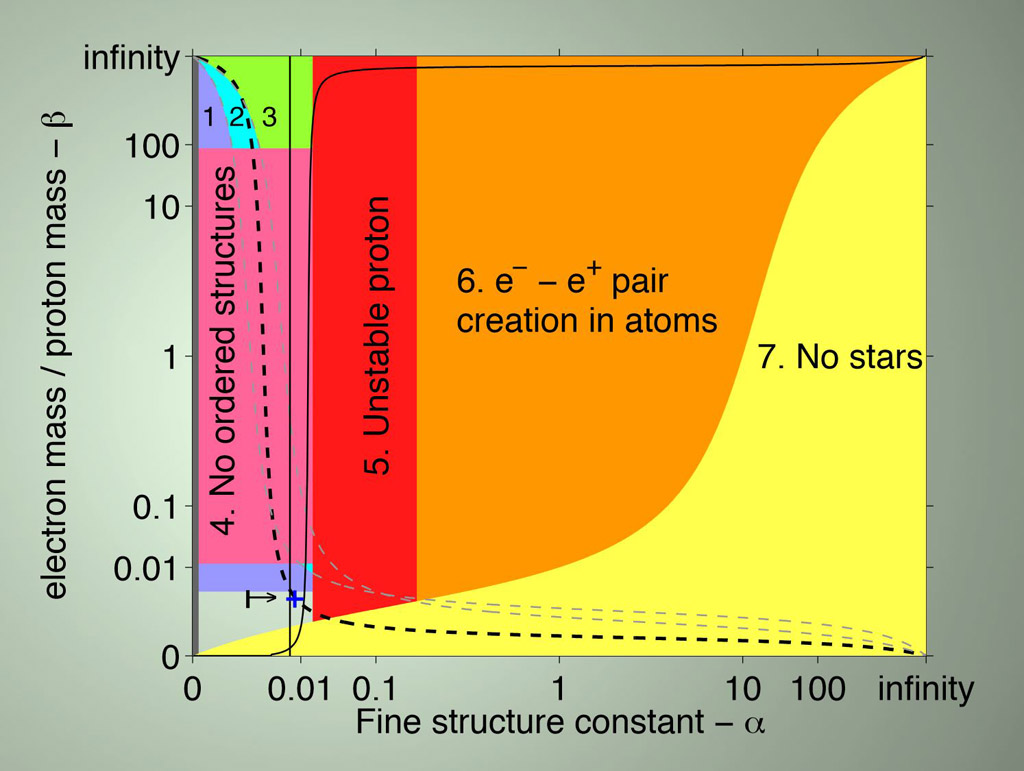
For this data, I’d like to show you a graph from Barnes’s review article[4] with notes about the various life-permitting constraints.

ParticleMassDiagram2

Credit: Luke Barnes Review Article

Notes About Diagram: The graph’s axes are scaled based on arctan(log10[x]) such that [0,∞] maps to a finite range. Refer to my previous blog for a more detailed explanation of coupling constants but basically these are just the dimensionless fundamental constants that convey the strength of the fundamental forces. Here is some notation used in the descriptions of the life-permitting criteria:

α – the electromagnetic coupling constant (also referred to as the fine-structure constant)

αs – the coupling constant for the strong nuclear force

β – the ratio of the mass of an electron to the mass of a proton

The tiny life-permitting region has to simultaneous satisfy each of the following life-permitting criteria and our universe’s values are at the ‘+’ sign near the lower left:

1) For hydrogen to exist the mass of an electron must be less than the difference in the masses of a neutron and a proton else the electron would be captured by the proton to form a neutron. Without hydrogen, there would be no water and no long-lived stars (e.g. Helium stars burn out 30 times faster).

2) Atoms are only stable if radius of an electron orbit is significantly greater than the size of the nucleus – this depends on the ratio of the electron and proton masses such that αβ/αs < 1/1000.

3) The energy scale for chemical reactions should be much smaller than that for nuclear reactions. Otherwise, information could not be stably stored because the type of elements in molecules would be changing because chemical identity would not be maintained. This requires the ratio of the electron and proton masses to be finely-tuned such that α2β/αs2 < 1/1000.

4) Unless the fourth root of β is less than about 1/3, molecular structures would be unstable. They would basically be continually melting and thus disrupting the ability to store information.

5) The stability of the proton requires the electromagnetic coupling constant to be less than the difference of the masses of the down quark and up quark divided by a constant. This enables the extra electromagnetic mass-energy of a proton relative to a neutron to be counter-balanced by the bare quark masses.

6) This fine-tuning is related to the electromagnetic coupling constant and was covered in my previous blog.

7) Stars will not be stable unless β > 0.01 α2

Note that life-permitting criteria 2-5 and 7 also depend on one or more coupling constants and thus reinforces my previous arguments about the difficulties in getting simultaneous solutions to so many independent equations. There are also some additional constraints on the masses of the proton and electron not necessarily shown in Barnes’s diagram:

  • A constraint on the main nuclear reaction in stars. This depends on a finely-tuned strong nuclear force strength as previously mentioned but also depends on a particular relationship of the masses of the up and down quarks and the electron.
  • The ratio of the mass of the electron to the proton also affects the ability of stars to output photons at energy levels that break chemical bonds (this was also referenced in my previous blog because it also depended on force strengths). The dashed line in the diagram represents that constraint.
  • The mass of the electron and proton also show up in the equation for the cosmological parameter Q as described in my previous blog.

These tight constraints on the life-permitting region for the mass of the electron are even more surprising because the values are deemed “unnaturally low” to begin with. Barnes elucidates this issue: “There are, then, two independent ways in which the masses of the basic constituents of matter are surprisingly small … the Hierarchy Problem … and the flavour problem. … The electron mass is unnaturally smaller than its (unnaturally small) natural scale set by the Higgs condensate.[5]” These are called problems simply because they require fine-tuning – the values they take on are quite different than the natural scale. It’s possible that new physics discoveries might minimize the unnaturalness somewhat but the life-permitting ranges are so tight that there is no basis for assuming that the fine-tuning will go away.

There is also a tight constraint on the charge of the electron. The electromagnetic coupling constant can be expressed in terms of a ratio involving the square of the charge of an electron. Thus, the numerous constraints referenced in my previous blog can also be viewed as a dependence on the charge of the electron. Thus, consider again the fine-tuning necessary for the production of carbon and oxygen in stars. This required fine-tuning of the electromagnetic coupling constant to 1 part in 10,000. Thus, another way of looking at this is that if the electron differed in charge by more than 1 part in 100,000,000 in either direction then the universe would basically be devoid of carbon or oxygen or both.

In order to understand more details about the mass of the proton, a little background will be helpful. A proton is comprised of 2 up quarks and a down quark and a neutron is comprised of 2 down quarks and an up quark. Most of the mass of these composite particles is derived not from the quarks but from the energy due to the strong force that is constraining them. This binding energy is equivalent to mass as per Einstein’s famous equation: E=mc2. Thus, we should also examine the sensitivity of the quark masses.

Quark Masses

“[T]he up- and down-quarks are absurdly light. The fact that they are roughly twenty thousand times lighter than particles like the Z-boson . . . needs an explanation. The Standard Model has not provided one. Thus, we can ask what the world would be like if the up- and down-quarks were much heavier than they are. Once again – disaster![6] Leonard Susskind

The mass of the quarks is derived from the Higgs boson but the other approximately 98% of the proton and neutron mass is based on the binding energy of the strong nuclear force. Quark masses vary from roughly 10 to 344,000 times the mass of the electron and thus if the masses of the up and down quarks only support life within narrow ranges relative to possible quark masses, this constitutes a high degree of fine-tuning. Research into the physics literature reveals very widespread agreement that these quark masses are finely-tuned. Barnes cites at least 7 physics articles arguing for this conclusion. Physicist Craig Hogan affirms this conclusion: “Changing the quark masses even a small amount has drastic consequences for which no amount of Darwinian selection can compensate.” Hogan reminds us that fine-tuning deals with what has to happen before any biological evolution could get started.

Barr and Khan’s article considers the 60+ orders of magnitude in the space of possible up and down quark masses and document 9 different life-permitting criteria that end up constraining the life-permitting region to a tiny subset in the space of possibilities. I conservatively measured the improbability off their graph as no more than 3 parts in 1036 – this makes it less likely than picking out one red grain of sand in a giant sand pile in Eurasia up to the height of the moon (to harken back to my analogy from a previous blog).

Most of these criteria are very clear cut disasters for life of any kind – for example there are constraints necessary to have stable protons, neutrons and atoms, and there are a couple of disasters where only one type of long-lived particle would exist with the chemistry of either hydrogen or helium.

Other particles

Atoms, molecules and life are entirely dependent on the curious fact that the photon has no mass.[7]” Susskind

Susskind goes on to explain that no life could exist if the photon had even a tiny mass because otherwise electromagnetic force acts at too limited of a range for chemistry to be operative. The Higgs Boson has been in the news lately since it was discovered recently at the LHC. Luke Barnes documents how, in natural Planck units, the vacuum expectation value of the Higgs Boson must be between 4e-17 and 2e-14. He cites 4 different articles and multiple finely-tuned criteria.[8]

Even the mass of neutrinos turns out to require fine-tuning to support life. Tegmark, Vilenking and Pogosian argue that if the sum of the mass of the 3 species exceeds just 1 electron volt then no galaxies would exist. They refer to this as an anthropic constraint so they seem convinced that life couldn’t form if there were no galaxies, presumably since galaxies are critical for star formation. This constraint is significant since neutrino masses are so tiny compared to other particles. For example, the top quark is 170 billion times more massive than this!

Will New Physics Rescue Us From the Need for All of These Fine-Tunings?

Physicist Craig Hogan argues that the “two light quark masses and one coupling constant are ultimately determined even in the `Final Theory’ by a choice from a large or continuous ensemble… the correct unification scheme will not allow calculation of [the masses of the proton and the up and down quarks] from first principles alone.” So these parameters have a large range of choices and a small life-permitting range and there is no good reason to expect a ‘Theory of Everything’ to force these masses to their current values. We should remember that even if this were the case, there would still be a fine-tuning argument based on what is metaphysically possible. Physicists would still be astounded at the coincidences: “Even if all apparently anthropic coincidences could be explained [in terms of a more fundamental theory], it would still be remarkable that the relationships dictated by physical theory happened also to be those propitious for life.[9]” Bernard Carr and Sir Martin Rees

Actually, grand unified field theories and other new more fundamental physics theories introduce new fine-tuning requirements. Most of these theories assume something called supersymmetry is true. However, if supersymmetry were true at our energy scales, there would be no life anywhere in the universe as Susskind has pointed out[10]. In this unconfirmed theory, every particle has a partner particle of the opposite type – bosons have partners that are fermions and vice versa. Thankfully, even if supersymmetry turns out to be true, it’s a broken symmetry at low-energies! Barnes also points out that the Grand Unified Theories provide “tightest anthropic bounds on the fine structure constant, associated with the decay of the proton into a positron and the requirement of grand unification below the Planck scale.[11]” So these new candidate theories do not eliminate fine-tuning.

If you’ve been following my fine-tuning blog series, I hope by now you see the incestuous nature of the inter-dependencies and inter-connections of finely-tuned parameters and how incredible it is that there is a solution to all of the concurrent equations that must satisfy multiple, entirely independent life-permitting constraints. Consider that if you have 10 linear equations and 10 “unknown” variables then there is usually at least 1 solution to all of the equations. This becomes increasingly unlikely is as you add non-linear terms or as you reduce the number of variables. Thus, if new physics reduces the number of variables (the fundamental constants) that makes it more surprising that a simultaneous solution exists to all of the life-permitting criteria!

Can the Multiverse Explain this Fine-Tuning?

Recall our discussion about how the multiverse, if it is to explain fine-tuning, predicts that the fine-tuning will be barely enough to be life-permitting. As physicist Paul Davies notes: “there is no a priori reason why the laws of physics should be more bio-friendly than is strictly necessary for observers to arise.” Davies also says that “the observed Universe is not minimally biophilic, and many scientists seem to think it is actually optimally biophilic.” I think he must be referring to the laws of physics and not necessarily all aspects of the universe being optimally biophilic.

Do we have indications from the fine-tuning of particle attributes that they are fine-tuned more than is strictly necessary to support life? Stephen Hawking seems to think so: “The summed quark masses seem roughly optimized for the existence of the largest number of stable nuclei.[12]” Many of these heavier elements are not essential to what would minimally count as a living observer but are important for technology and lead to a more bio-friendly universe. Multiverse theories generally entail new physics that predicts that protons decay. No one has yet seen such an event despite extensive attempts that allow us to compute a maximum possible proton decay rate. This decay rate turns out to be much greater than that predicted by the multiverse proposals. Nobel Prize-winner Frank Wilczek of MIT indicates that the lifetime of the proton is at least 10 orders of magnitude greater than necessary – this corresponds to a factor of ten billion.

Physicist Lee Smolin critiques multiverse theories because they fail to make predictions consistent with our universe. He notes that “there are constants that simply don’t have the values we would expect them to have if they were chosen by random distribution among a population of possibly true universes.[13]” Smolin points out the unexpected and unlikely relationship between quark and lepton masses. He further argues that under randomly varying laws, “some symmetries of elementary particles would be violated by the strong nuclear force much more than they are.[14]”

Another powerful example of fine-tuning that goes beyond what is strictly necessary for life can be seen in the properties of water. A 2011 article[15] from New Scientist highlighted research by scientists from Stanford and the Argonne National Lab:

“Water’s life-giving properties exist on a knife-edge. It turns out that life as we know it relies on a fortuitous, but incredibly delicate, balance of quantum forces. Water is one of the planet’s weirdest liquids, and many of its most bizarre features make it life-giving.” Consider just a few of the examples of the bio-friendly properties of water that are exceptional compared to other liquids:

  • Higher density as liquid than solid (ice floats)

– Prevents lakes from freezing bottom up

– Ice at top then acts as a much better insulator than water to minimize additional freezing

  • Very high heat capacity

–  Moderates temperatures at global and organismal levels

  • Latent heat of evaporation by far higher than other substances

– Increased ability to cool organisms

– Water’s unusually high thermal conductivity for a liquid also aids in cooling

  • Unusually high surface tension

– Maximizes capillary action

  • Low viscosity increase rate of diffusion, recycling of nutrients globally, and allows tiny capillaries (3 micron, single-cell thick wall) to nourish muscles
  • Non-Newtonian fluid

–  2x increase in pressure leads to 3x rate of (blood) flow

  • Viscosity of ice maximizes glacial activity
  • Near universal solvent – great for transport within cells or recycling nutrients within an ecosystem

The article explains that fine-tuning was needed for water to have such properties: “computer simulations show that quantum mechanics nearly robbed water of these life-giving features… Water fortuitously has two quantum effects which cancel each other out… ” The article concludes: “We are used to the idea that the cosmos’s physical constants are fine-tuned for life. Now it seems water’s quantum forces can be added to this ‘just right’ list’.” The parameter at the most fundamental level that is finely-tuned is simply Planck’s constant since that affects the magnitude of the effects of Heisenberg’s Uncertainty Principle. However, recall that I mentioned previously that all of the force strengths have a term for Planck’s constant in them. Thus, Planck’s constant is independently highly constrained based on force strengths and yet this just happens to also result in water having all of these amazing and unusual properties that benefit life in a manner beyond what is explicable by multiverse theories.

An example of additional fine-tuning required under multiverse theories relates to the number of spatial dimensions. Theories that entail multiverses with differing parameters per universe generally predict additional spatial dimensions that have to be compactified if life is to exist because otherwise there would be neither stable atoms nor stable planetary orbits. A much more significant example of an additional fine-tuning is required by what seems to be the most popular multiverse theory, eternal inflation. I mentioned in an earlier blog but it’s worth repeating that Sean Carroll[16] and others have calculated that “inflation only occurs in a negligibly small fraction of cosmological histories, less than 10-66,000,000.” Thus, the multiverse isn’t very successful at explaining these finely-tuned parameters and the multiverse itself requires fine-tuning. The hypothesis of design therefore better explains the totality of the physics data.


[1] Leonard Susskind. The Cosmic Landscape, p. 176.

[2] As I’ve previously pointed, John von Neumann proved that information storage and replication are necessary for any type of life since life is a self-replicating system.

[3] Stephen Hawking and Leonard Mlodinow. The Grand Design, p. 160

[4] Barnes, p. 42-44.

[5] Barnes, p.48.

[6]Susskind, p. 176.

[7] Susskind, p. 174-5.

[8] Barnes, p. 44.

[9] Carr and Rees, “The Anthropic Cosmological Principle and the Structure of the Physical World,” Nature 278 (1979): 612.

[10] Susskind, p. 250. (The partner of the electron, the so-called selectron, would ruin chemistry.)

[11] Barnes, Luke. The Fine-Tuning of the Universe for Intelligent Life. Publications of the Astronomical Society of Australia, p. 53. http://arxiv.org/abs/1112.4647

[12] Hawking and Mlodinow, p. 160.

[13] Lee Smolin. The Trouble with Physics: The Rise of String Theory, the Fall of a Science, and What Comes Next, p. 166.

[14] Smolin, p. 167

[15] Lisa Grossman. “Water’s quantum weirdness makes life possible.” New Scientist. 25 Oct, 2011. http://www.newscientist.com/article/mg21228354.900-waters-quantum-weirdness-makes-life-possible.html

[16]Carroll, Tam. Unitary Evolution and Cosmological Fine-Tuning. http://arxiv.org/abs/1007.1417v1

“As we look out into the Universe and identify the many accidents of physics and astronomy that have worked together to our benefit, it almost seems as if the Universe must in some sense have known that we were coming.[1]” Physicist Freeman Dyson

In my previous blog, I discussed how numerous changes to the laws of physics would have resulted in a lifeless universe. I admitted that this was relatively modest evidence for my fine-tuning claim:

“In the set of possible physical laws, parameters and initial conditions, the subset that permits rational conscious life is very small.”

I say relatively modest because the evidence I cite in my blog about the fine-tuning of initial conditions is so powerful and the same I argue applies to the evidence I present in this blog. This blog examines how the constants governing the four fundamental forces of physics must be finely-tuned to support life. Refer to my previous blog for the qualitative aspects of these forces and how they have to be just right to permit life. I now focus on the quantitative constraints on the strengths of these forces if intelligent life is to plausibly exist anywhere the universe. First some background – physicists typically refer to coupling constants for those dimensionless constants[2] which represent the strength of each force. The strength of these forces ranges over about 40 orders of magnitude – that is to say that the strongest force is 1040 times stronger than the weakest force. Thus, it would be surprising if the strengths of these forces must lie in narrow ranges to permit life – at least if the values were set at random such as would be the case in a universe without God. Let’s look at how sensitive these parameters are with respect to permitting life:

1)      Strong nuclear force

This force is important for the existence of stable atoms beyond hydrogen. If the strong force were 50% weaker, no elements used by life would exist because protons couldn’t be held together in the nucleus. The strong nuclear force must exceed the strength of the electromagnetic force sufficiently to overcome the electromagnetic repulsion of positively charged protons. While learning chemistry would be much easier if only the first few elements existed in the periodic table, there would be no physical creatures around to learn it! If the strong force were about 50% stronger no hydrogen would be left over from nuclear fusion processes occurring in the early universe. Hydrogen plays a critical life-supporting role not only as a constituent of water but hydrogen-burning stars last 30 times longer than alternatives. This particular constraint may not make intelligent life impossible but life would certainly be much harder to originate if the available time were so limited and if neither water nor hydrocarbons existed.

Also, hydrogen-bonding is very important in biology for many reasons: information storage in DNA, antibody-antigen interaction, and for the secondary structure of proteins. Remember that parameters that seem beneficial for life but are more fine-tuned than is strictly necessary counts against a multiverse explanation of the fine-tuning because multiverse scenarios predict only what is minimally necessary for life.[3] An even tighter constraint is that if the strong force were more than about 2% stronger protons wouldn’t form from quarks – in which case no chemical elements would exist![4] If the strong force were 9% weaker, stars would be unable to synthesize any elements heavier than deuterium (which is heavy hydrogen).

2)      Electromagnetic force

This force is responsible for chemistry and plays a critical role in stellar fusion which powers life. The electromagnetic force needs to be much weaker than the strong nuclear force for atoms to be stable – so that the radius of the electron orbit is much larger than the radius of the nucleus.[5] Unless the electromagnetic coupling constant (which represents its strength) is less than about 0.2, there would be no stable atoms because electrons orbiting the nucleus would have enough kinetic energetic to create electron-positron pairs which would then annihilate each other and produce photons. Additional examples of fine-tuning for this force strength will be described later in this blog.

3)      Weak nuclear force

The weak force controls proton-proton fusion, a reaction 1,000,000,000,000,000,000 times slower than the nuclear reaction based on the strong nuclear force. Without this, “essentially all the matter in the universe would have been burned to helium before the first galaxies” were formed. Because the weak nuclear force is so much weaker than the strong nuclear force, a star can “burn its hydrogen gently for billions of years instead of blowing up like a bomb.[6]” I’ve previously described the negative ramifications for life if there were no hydrogen in the universe.

John Leslie points out several other ways in which the weak nuclear force is finely-tuned. “Had the weak force been appreciably stronger then the Big Bang’s nuclear burning would have proceeded past helium and all the way to iron. Fusion-powered stars would then be impossible.[7]”

Neutrinos interact only via the weak force and are just powerful enough to blast off outer layers of exploding stars but and just weak enough to pass through parts of the star to get there. The weak force also plays a role in fusing electrons and protons into neutrons during the core collapse of stars to keep the collapse proceeding until it becomes an exploding star (supernova). UK Astronomer Royal Sir Martin Rees estimated that a change in the strength of the weak nuclear force by about 1 part in at least 10,000 relative to the strength of the strong force would have prevented supernova explosions which allow heavier elements to find their way to planets.[8] Without these supernova explosions key heavy elements would be unavailable for life.

4)      Gravitational force

Many physicists think that we’ll eventually discover a Grand Unified Theory, uniting gravity with the other 3 fundamental forces. For this reason Stanford physicist Leonard Susskind remarks that “the properties of gravity, especially its strength, could easily have been different. In fact, it is an unexplained miracle that gravity is as weak as it is.[9]” This probable underlying relationship leads to a natural expectation that gravity could be as strong as the strongest force. The strength of gravity is about 40 orders of magnitude weaker than the strong nuclear force. Based on this expectation that gravity can vary up to strong nuclear force strength, the level of fine-tuning required for life is pretty remarkable:

  • If gravity is weaker by 1 in 1036, stars are unstable to degeneracy pressure (for small stars) or unstable to radiative pressure just expelling huge chunks of the star (for larger stars).
  • If gravity is stronger by 1 in 1040, the universe is dominated by black holes not stars.
  • If gravity is weaker by 1 in 1030, the largest planet that would avoid crushing effects of gravity on any large-brained creatures would have a radius of about 50 meters – which is not a good candidate for an ecosystem and the development/sustenance of intelligent life.

These are huge numbers that may be hard for most readers to visualize.  Thus, consider the following analogy to help understand the improbability of 1 part in 1036. Suppose one could make a sand pile encompassing all of Europe and Asia and up to 5 times the height of the moon.[10] Suppose one grain of sand is painted red and randomly placed somewhere within this pile. A blind-folded person then randomly selects one grain of sand from the pile. The odds that she would select that one red grain of sand are slightly better than the 1 in 1036 odds of a life-permitting strength of the gravitational force based on just one of the above criteria.

Let’s explore a few more fine-tuning cases constraining multiple constants concurrently.

Long-Lived Stars

As I’ve discussed previously, stars play at least two key roles in making the universe life-permitting:

1) As a long-lived power source that helps life overcome the effects of the Second Law of Thermodynamics that would otherwise lead to an eventual state of disarray and equilibrium.

2) For synthesizing elements not created by the Big Bang (which is basically everything past beryllium).

We take the sun for granted as a long-lived stable source of power but note the lack of any comparable long-lived power source on earth as an indication that is not always the case. A star is basically a controlled nuclear explosion held together by gravity – that it can last so long requires a delicate balance of various physical parameters. Consider that the Sun outputs less energy per kilogram of its mass than a person does – without fine-tuning, stars would die out much sooner. Obviously the sun is still able to output enormous quantities of energy because it’s so huge! Another surprising aspect of the sun is that photons generally take at least several thousand years to travel from the sun‘s core to its surface through the ionized plasma.[11] There are significant constraints on the strength of gravity and electromagnetism if there are to be long-lived stars. Luke Barnes summarizes some of the key physics research in this arena:

“There is a window of opportunity for stars – too small and they won’t be able to ignite and sustain nuclear fusion at their cores, being supported against gravity by degeneracy rather than thermal pressure; too large and radiation pressure will dominate over thermal pressure, allowing unstable pulsations.[12]”

Barnes does some calculations based on the possibility that gravity could vary in strength up to the strength of the strong nuclear force and uses a uniform prior distribution of possible values for the gravitational coupling constant and the electromagnetic coupling constant. Using this approach, he computes that “the stable-star-permitting region occupies 1038 of parameter space.” This is even less probable than my previous sand analogy!

Production of Both Carbon and Oxygen in Stars

One of the earliest examples of fine-tuning was discovered by astronomer Fred Hoyle with regard to the fine-tuning required to make both carbon and oxygen in stars. Three distinct coincidences are required to abundantly make both types of elements in stars. These restrictions impose a constraint of about 1 part in 250 on the relative strength of the strong force and the electromagnetic force in both directions. Actually a more recent study by Ekström[13] in 2010 indicated that a change of just 1 part in 10,000 in the electromagnetic coupling constant would have resulted in the inability of stars to synthesize both carbon and oxygen. Despite being an atheist Hoyle conceded:

“Some super-calculating intellect must have designed the properties of the carbon atom, otherwise the chance of my finding such an atom through the blind forces of nature would be utterly minuscule. A common sense interpretation of the facts suggests that a superintellect has monkeyed with physics, as well as with chemistry and biology, and that there are no blind forces worth speaking about in nature. The numbers one calculates from the facts seem to me so overwhelming as to put this conclusion almost beyond question.[14]”

Other Constraints among Force Strengths

For a more comprehensive examination of fine-tuning constraints, refer to Luke Barnes excellent review article that I’ve previously referenced. This review article is an excellent summary of a hundred or so physics articles, and in many cases references multiple articles per fine-tuning constraint. Barnes lists several additional constraints I haven’t mentioned and provides additional details. Just among constraints involving powers of these coupling constants, Barnes lists a half dozen or more cases. Usually the power involves just a squared term but it’s important to note that there are linear, quadratic and inverse relationships among the coupling constants. For example, the electromagnetic force strength is constrained in one way based on a linear constraint and in another way based on a quadratic constraint and in another way based on the inverse of the force strength relative to some other constant. It is remarkable that there is a life-permitting region that simultaneously satisfied these multifaceted constraints.

Also, since each coupling constant can be expressed in terms of more fundamental parameters such as Planck’s constant and the speed of light there are very tight constraints on those parameters as well – especially because of the constraints across different powers of the coupling constant. Thus, Planck’s constant is constrained in one way and the square of this constant is constrained based on a different life-permitting criterion – and likewise for the speed of light.

Moreover, there is a finely-tuned cosmological parameter, known as Q, which can be expressed in terms of various other parameters including coupling constants. In an equation derived by Max Tegmark and Martin Rees[15], there are the following powers on various coupling constants: -1, 16/7, 4/7. Also, there is a natural log of the electromagnetic coupling constant to the -2 power that is taken to the -16/9 power. Without the various contributions of coupling constants taken to the various powers, the value for this parameter Q would not have been life-permitting. Q represents the magnitude of variations in energy density in the early universe. If Q was larger than 10-5 the universe would have consisted of too many black holes to be life-permitting. If Q were smaller than 10-6 there would be gravitationally bound structures in the universe – no stars, no planets and therefore no life. See Barnes’s article on page 32 for more details on the fine-tuning of Q and its relationship to coupling constants.

Finely-Tuned Output of Stellar Radiation

Brandon Carter first discovered a remarkable relationship among the gravitational and electromagnetic coupling constants. If the 12th power of the electromagnetic strength were not proportional to the gravitational coupling constant then the photons produced by stars would not be of the right energy level to interact with chemistry and thus to support photosynthesis. Note how sensitive a proportion has to be when it involves the 12th power – a doubling of the electromagnetic force strength would have required an increase in the gravitational strength by a factor of 4096 in order to maintain the right proportion. Harnessing light energy through chemical means seems to be possible only in universes where this condition holds. If this is not strictly necessary for life, it might enter into the evidence against the multiverse in that it points to our universe being more finely-tuned than is strictly necessary.

Closing Thoughts

It’s important to note how the values of these constants must lie within narrow ranges to be life-permitting based on multiple, independent criteria! My next blog will provide additional examples of this “coincidence.” This multiplicity makes my fine-tuning claim more robust because even if most of these peer-reviewed articles were wrong about fine-tuning claims, there would still be enough cases left to show that life-permitting physics is rare among possibilities.

Also, the question arises as to the likelihood there would exist any value for a constant that could satisfy multiple finely-tuned life-permitting criteria? Why would the life-permitting regions necessarily overlap at a single value that could then permit life relative to all of the constraints? UT Austin philosopher Robert C. Koons argues that this points to a higher-order fine-tuning and thus to design:

“When the value of a single constant is constrained in more than one way, it would be very likely that these independent constraints put contradictory demands on the value of the constraint. By way of analogy, if I consider several algebraic equations, each with a single unknown, it would be very surprising if a single value satisfied all of the equations. Thus, it is surprising that a single range of values satisfies the various anthropic constraints simultaneously. Leslie argues that this higher-order coincidence suggests that the basic form of the laws of nature has itself been designed to make anthropic fine-tuning possible. In other words, Leslie argues that there is evidence of a higher-order fine-tuning.[16]”

This coincidence grows even more surprising when one goes beyond the sheer multiplicity of constraints and also analyzes how differing powers on the constants appear in equations expressing independent and unrelated life-permitting constraints. Why is it that a given strength of electromagnetism turns out to be just right for long-lived stars, atomic stability, proton stability, electron stability, the synthesis of carbon and oxygen, the energy of photons output by stars, and the magnitude of density fluctuations in the early universe? Even speculative multiverse theories do not explain this type of coincidence.


[1] John Barrow and Frank Tipler. The Anthropic Cosmological Principle, p. 318

[2] Actually, these are constants at current densities but in the early universe the 3 non-gravitational forces are thought to have been unified in the sense that at those energy levels all of the forces behaved in the same manner. Once we get beyond the first 1/100th of a nanosecond of the universe though we can speak of these as being constants.

[3] For an explanation of this widely accepted principle, refer to my previous blog: http://crossexamined.org/god-or-multiverse.

[4] Walter Bradley. (He happened to be the head of an engineering department when I was at Texas A&M). http://www.leaderu.com/offices/bradley/docs/universe.html

[5] Luke Barnes. The Fine-Tuning of the Universe for Intelligent Life. Publications of the Astronomical Society of Australia, p. 42. (http://arxiv.org/abs/1112.4647)

[6] Freeman Dyson, Scientific American 225 (1971), p. 56.

[7] John Leslie. The Prerequisites of Life in Our Universe. http://www.leaderu.com/truth/3truth12.html

[8] Martin Rees, Phil. Trans. Roy. Soc. London A 310 (1983), p. 317.

[9] Leonard Susskind, Cosmic Landscape, p. 9.

[10] I know that this is physically unrealistic but this hypothetical analogy aids in visualizing the magnitude of the fine-tuning.

[11] NASA web site. http://image.gsfc.nasa.gov/poetry/ask/a11354.html

[12] Barnes, p. 30.

[13] Ekström S., et al., Astronomy and Astrophysics, p. 514.

[14] Fred Hoyle. Engineering and Science, 11/81, p8-12.

[15] Max Tegmark and Martin Rees The Astrophysical Journal (1998), p. 499, 526

[16] Robert C. Koons. Theism vs. the Many-Worlds Hypothesis. http://www.reasons.org/articles/theism-vs.-the-many-worlds-hypothesis

In my previous blog, I discussed how the initial conditions of our universe had to be extremely finely-tuned to support life of any kind anywhere in the universe. As part of my ongoing series on how fine-tuning provides evidence for the existence of God, I now turn to the laws of physics themselves. It turns out that life seems to require all 4 fundamental forces of physics. Let’s do a quick survey of some of the many ways that alternate physics could have been life-prohibiting:

1)      Gravity is essential in the formation of stars and planets. As I discussed in a previous blog, life needs something like stars as a long-lived stable energy source. Also, as cosmologist Luke Barnes has pointed out: “if gravity were repulsive rather than attractive, then matter wouldn’t clump into complex structures. Remember: your density, thank gravity, is 1030 times greater than the average density of the universe.”

2)      The strong nuclear force is necessary to hold together the protons and neutrons in the nucleus. Without this fundamental force, no atoms would exist beyond hydrogen and thus there would be no meaningful chemistry and thus no possibility for intelligent life. The positively charged protons in the nucleus repel each other but thankfully the strong nuclear force is sufficiently stronger than electromagnetic repulsion. If the strong force acted at long ranges like gravity or electromagnetism, then no atoms would exist because it would dominate over the other forces. Barnes notes that “any structures that formed would be uniform, spherical, undifferentiated lumps, of arbitrary size and incapable of complexity.[1]”

3)      The electromagnetic force accounts for chemical bonding and for why electrons orbit the nucleus of atoms. Without chemistry, there is no plausible way to store and replicate information such as would be necessary for life. Light supplied by stars is also of critical importance to life in overcoming the tendency towards disorder, as dictated by the Second Law of Thermodynamics. Barnes points out that without electromagnetism, “all matter would be like dark matter, which can only form large, diffuse, roughly spherical haloes.[2]” Suppose like charges attracted and opposites repelled (in contrast with the behavior in our universe), there would be no atoms.

4)      The weak nuclear force plays a key role during core-collapse supernova[3] in the expulsion of key heavier elements, making them available for life rather than just entombed forever in dying stars. Also, the weak force enables the key proton-proton reaction which powers stars in our universe. There is a clever paper by Harnik[4] that attempts to find a life-permitting universe without the weak force but only at the expense of a “judicious parameter adjustment.” See this discussion of the additional finely-tuned constants that were necessary to compensate for the lack of a weak force.[5] Also, some physicists think that the weak force is necessary for there to be matter in our universe.[6]

A region of star formation in a small nearby dwarf galaxy (N90) as captured by the Hubble telescope:
StarFormation

The existence of matter in our universe relies on some asymmetries in physics that are not yet precisely understood. Most physical reactions produce matter and antimatter in equal proportions and these products would simply annihilate each other upon contact, resulting in a matter-less (and therefore lifeless) universe consisting solely of radiation. We’re fortunate that the laws are such that this asymmetry produces a slight excess of matter over antimatter (about 1 part in ten billion)[7]! It would be premature to try to make a numerical claim that a constant has to be finely-tuned to permit this phenomenon but this unusual asymmetry provides yet another example of how different physics could have been catastrophic for life.

Another key physics principle that is critical for life is quantization. Values are defined as being ‘quantized’ if they can only take on discrete rather than continuous possibilities. Without quantized orbits electrons would be sucked into the nucleus and no chemistry would be possible. This quantization also leads to stable orbitals and consistent chemical properties. If electrons could orbit the nucleus anywhere such as is permissible for planets orbiting a star, then a given chemical element would have properties which are too variable for information storage of the type needed for intelligent life. Consider how the DNA in your genome would become cancerous within a day if its properties/information content were constantly varying. Also, consider how a breath of oxygen could conceivably become poisonous if its properties had no consistency.

Some other aspects of quantum mechanics are also very important to life. We need the Pauli Exclusion Principle so that all electrons don’t just reside in the lowest energy-level orbital. The multiple levels of orbitals contribute greatly to the richness and diversity of chemistry. Not all types of particles follow the Pauli Exclusion Principle – if electrons were bosons rather than fermions they wouldn’t be restricted by this principle. The Pauli Exclusion Principle coupled with the quantization of electron orbitals is responsible for giving matter its rigidity, which is important for the existence of stable structures. Moreover, without quantum mechanics, atoms would decay in about 10-13 seconds as Earnshaw’s theorem demonstrates based on classical mechanics.

Physicist Leonard Susskind points out yet another way that physics could have been life-prohibiting:

‘The photon is very exceptional. It is the only elementary particle, other than the graviton, that has no mass… Were the photon mass even a tiny fraction of the electron mass, instead of being a long-range force, electric interactions would become short-range “flypaper forces,” totally incapable of holding on to the distant valence electrons. Atoms, molecules and life are entirely dependent on the curious fact that the photon has no mass.[8]’

The trend in physics is that the number of cases of fine-tuning is growing over time. For example, physicist Joel Primack recently discovered an important link between the existence of dark matter and galaxy formation. Primack showed that “galaxies form only at high peaks of the dark matter density.“ Galaxies are generally thought to be necessary for life because they are critical for star formation. Thus, even aspects of physics which might seem pointless, such as dark matter, turn out to play an important role in making the universe more bio-friendly. I’ve also referenced an article in a previous blog that discusses how black holes “may actually account for Earth’s existence and habitability.[9]”

Any one of these facts by itself might just be seen as fortunate coincidences but there are enough of them to provide at least modest support for my fine-tuning claim:

“In the set of possible physical laws, parameters and initial conditions, the subset that permits rational conscious life is very small.”

The support is not as strong as what I documented based on our universe’s initial conditions nor as strong as what I will document concerning the fine-tuning of the constants of nature but it adds to the overall case. Moreover, this evidence has some bearing in the consideration of the multiverse[10] as an explanation of fine-tuning because it deals with physics at the level that most multiverse proposals cannot explain. In most multiverse scenarios the laws of physics are the same – what changes are the constants in the equations representing those laws. If you want to explore more about various multiverse alternatives, here is one useful perspective that was referenced in comments of a previous blog. Max Tegmark has proposed what he calls a level 4 multiverse in which all mathematical possibilities are realized somewhere in the multiverse. If we lived in such a multiverse, Occam’s Razor would not be a fruitful heuristic and we wouldn’t have Nobel laureates[11] talking about how simple, elegant theories led them to discoveries. There would be infinitely more equations with lots of complicated terms and expressions than there would be simple equations with minimal terms. Colombia professor Peter Woit provides a powerful critique of Tegmark’s highly speculative metaphysical proposal. These multiverse scenarios in which fundamental laws are different are not widely accepted among physicists.

In summary, life needs all of the 4 fundamental forces of nature and several principles from quantum mechanics. These facts about the laws support my fine-tuning claim that life-permitting physics is rare among possibilities. Standford physicist Leonard Susskind summarizes the physics well:

“It is gradually becoming accepted, by many theoretical physicists, that the Laws of Physics may not only be variable but are almost always deadly. In a sense the laws of nature are like East Coast weather: tremendously variable, almost always awful, but on rare occasions, perfectly lovely.[12]”


[1] Barnes, Luke. The Fine-Tuning of the Universe for Intelligent Life. Publications of the Astronomical Society of Australia, p. 18. http://arxiv.org/abs/1112.4647

[2] Ibid., p, 18.

[3] A supernova is an exploding star and is the key way heavy elements are distributed throughout the universe.

[4]Harnik R., Kribs G., Perez G., 2006, Physical Review D, 74, 035006

[5]Barnes, p. 46-7.

[6] Fermilab website. DOE. http://lbne.fnal.gov/why-neutrinos.shtml

[7] Here is a website if you want to explore this further: http://abyss.uoregon.edu/~js/cosmo/lectures/lec22.html

[8] Susskind, Leonard. The Cosmic Landscape, p. 174-5.

[9] http://www.scientificamerican.com/article/how-black-holes-shape-galaxies-stars-planets-around-them/

[10] If you missed my other blogs and are wondering what a ‘multiverse’ is, a multiverse is simply a collection of universes. If there is a vast ensemble of other universes with widely varying laws this might be a candidate explanation of the fine-tuning. Here was my blog on that topic: http://crossexamined.org/god-or-multiverse/

[11] For example, Eugene Wigner’s famous essay on The Unreasonable Effectiveness of Mathematics in the Natural Sciences. https://www.dartmouth.edu/~matc/MathDrama/reading/Wigner.html. Also, see how Weinberg regards beauty as a guide to finding the correct physical theories: http://www.pbs.org/wgbh/nova/elegant/view-weinberg.html. Or refer to this essay for a historical review: http://www.huffingtonpost.com/david-h-bailey/why-mathematics-matters_b_4794617.html

[12] Susskind, p. 90.

This is the sixth blog in my series on fine-tuning. Here are the previous blogs if you missed them:

Intro/Philosophical Background

If You Don’t Want God, You Better Have a Multiverse!

How Does Fine-Tuning Provide Evidence for God?

Objections

Mistaken Objections that Seek to Trivialize Fine-Tuning

Important Objections in the Fine-Tuning Debate

But We Can’t Even Define Life

We’re finally ready to start exploring the fine-tuning data itself. A logical starting point is the initial conditions of our universe – are those which permit life rare among possibilities?

1)      Energy-Density is Finely-Tuned

The amount of matter (or more precisely energy density) in our universe at the Big Bang turns out to be finely-tuned to about 1 part in 1055. In other words, to get a life-permitting universe the amount of mass would have to be set to a precision of 55 decimal places. This fine-tuning arises because of the sensitivity to the initial conditions of the universe – the life-permitting density now is certainly much more flexible! If the initial energy density would have been slightly larger, gravity would have quickly slowed the expansion and then caused the universe to collapse too quickly for life to form. Conversely if the density were a tad smaller, the universe would have expanded too quickly for galaxies, stars, or planets to form. I argued in my previous blog that it’s implausible to expect life to originate without a long-lived, stable energy source such as a star. Thus, life would not be possible unless the density were just right – if you added or subtracted even just your own mass[1] to that of the universe this would have been catastrophic!

There is, however, a potential dynamical solution to this problem based on a rapid early expansion of the universe known as cosmic inflation. In this blog, I’ll be relying primarily on the most comprehensive review article on fine-tuning in the peer-reviewed literature – this one by Luke Barnes. I’ve referenced it previously and I’m hoping if I reference it enough I’ll get tech-savvy readers to check it out! It may be too technical for some readers and my blog can be viewed as just an attempt at explaining some highlights to non-physicists and tying it into my metaphysical hypothesis that God is the best explanation of the fine-tuning. So let’s look at what Luke Barnes has to say about inflation as a solution to the energy density problem. He points out 6 aspects of inflation that would have to be properly setup, some of which turn out to require fine-tuning. One significant aspect is that the inflation must last for the proper amount of time – inflation is posited to have been an extremely brief but hyper-fast expansion of the early universe. If inflation had lasted a fraction of a nanosecond longer, the entire universe would have been merely a thin hydrogen soup, unsuitable for life. Barnes cites an article by Max Tegmark of MIT that indicates that in a best case scenario about 1 in 1000 inflationary universes would avoid lasting too long. The biggest issue though seems to be that for inflation to start, it needs a very special/rare state of an extremely smooth energy density. Several articles make this point – consider Sean Carroll’s article:

“It is therefore a necessary (although not sufficient) condition for inflation to occur that perturbations be small at early times. . . . the fraction of realistic cosmologies that are eligible for inflation is therefore … 10-66,000,000.”

Barnes also explains why, even if inflation solves this fine-tuning problem, one should not expect new physics discoveries to do away with other cases of fine-tuning: “Inflation thus represents a very special case… This is not true of the vast majority of fine-tuning cases. There is no known physical scale waiting in the life-permitting range of the quark masses, fundamental force strengths or the dimensionality of spacetime. There can be no inflation-like dynamical solution to these fine-tuning problems because dynamical processes are blind to the requirements of intelligent life. What if, unbeknownst to us, there was such a fundamental parameter? It would need to fall into the life-permitting range. As such, we would be solving a fine-tuning problem by creating at least one more. And we would also need to posit a physical process able to dynamically drive the value of the quantity in our universe toward the new physical parameter.”

2)      Initial Conditions in a Very Low Entropy State

Even if inflation somehow could solve the energy density problem and scientists are mistaken that inflation requires its own fine-tuning, inflation doesn’t solve the problem with this next type of fine-tuning which relates to the universe’s initial entropy. What is entropy? Entropy represents the amount of disorder in a system. Thus, a high entropy state is highly disordered – think of a messy teenager’s room. Our universe began in an incredibly low entropy state. A more precision definition of entropy is that it represents the number of microscopic states that are macroscopically indistinguishable. An egg has higher entropy once broken because you’re “opening” up many more ways to arrange the molecules. There are more ways of arranging molecules that would still be deemed an omelet than there are ways to arrange the particles in an unbroken egg in where certain molecules are confined to subsets of the space in the egg – such as a membrane or the yolk. Entropy is thus closely associated with probability. If one is randomly arranging molecules, it’s much more likely to choose a high entropy state than a low entropy state. Randomly arranged molecules in an egg would much more likely look like an omelet that an unbroken egg.

Entropy can also be thought of as the amount of usable energy. Over time the usable energy decreases. This principle is known as the Second Law of Thermodynamics, which says that in a closed system the entropy on average increases until a state of equilibrium is reached. Thus, the Second Law predicts that our universe will eventually reach such a state of equilibrium or “heat death” in which nothing interesting happens. All life will die off long before such a state is reached. Life relies on usable energy from the environment.

It turns out that nearly all arrangements of particles in the early universe would have resulted in a lifeless universe of black holes. Tiny inconsistences in the particle arrangements would be acted on by gravity to grow in size. A positive feedback results since the clumps of particles have an even greater gravitational force on nearby particles. Penrose’s analysis shows that in the incredibly dense early universe, most arrangements of particles would have resulted basically in nothing but black holes. Life certainly can’t exist in such a universe because there would be no way to have self-replicating information systems. Possibly the brightest objects in the universe are quasars, which release radiation as bright as some galaxies due to matter falling into a supermassive black hole. The rotation rates near black holes and the extremely high-energy photons would disrupt information storage, a prerequisite for life[2].

Artist's impression of a stellar-mass black hole.Artist’s conception of a black hole. Credit: European Space Agency, NASA, and Felix Mirabel (the French Atomic Energy Commission & the Institute for Astronomy and Space Physics/Conicet of Argentina)

Oxford physicist Roger Penrose is the first scientist to quantify the fine-tuning necessary to have a low entropy universe to avoid such catastrophes. “In order to produce a universe resembling the one in which we live, the Creator would have to aim for an absurdly tiny volume of the phase space of possible universes, about 1/1010123 [3].” This number is incomprehensibly small – it represents 1 chance in 10 to the power of (10 to the power of 123). Writing this number in ordinal notational would require more zeroes than the number of subatomic particles in the observable universe, 10123 zeroes vs. about 1092 particles. Under the assumption of atheism, the particles in our universe would have been arranged randomly or at least not with respect to future implications for intelligent life. Nearly all such arrangements would not have been life-permitting so this fine-tuning evidence favors theism over atheism. We have a large but finite number of possible original states and rely on well-established statistical mechanics to assess the relevant probability.[4]

In a comment on one of in my earlier blogs, someone suggested that perhaps the universe is fine-tuned for black holes rather than life. The incredibly low entropy state of the initial conditions shows, however, that the exact opposite is true – fine-tuning was required to avoid excessive black holes! This fact about the initial conditions also calls into question Smolin’s proposed scenario that universes with differing physical constants might be birthed out of black holes. Smolin suggests the possibility of an almost Darwinian concept in which universes that produce more black holes therefore more baby universes than those which don’t. But if our universe requires statistically miraculous initial conditions to be life-permitting by avoiding excessive black holes, universes evolving to maximize black hole production would be unlikely to lead to life! (Even if the evolution of universes were possible)

Furthermore, the skeptic who thinks that black holes suggest a purposeless universe should consider that black holes can, in moderation and kept at distance, be helpful for life. While a universe comprised of mostly black holes would be life-prohibiting, having a large black hole at the center of a galaxy is actually quite helpful for life. Here is a Scientific American article that documents the benefits of Black Holes for life – it summarizes: “the matter-eating beast at the center of the Milky Way may actually account for Earth’s existence and habitability.”

Does inflation explain the low entropy of the early universe?

Here is how Sean Carroll answers this question: “Not by itself, no. To get inflation to start requires even lower-entropy initial conditions than those implied by the conventional Big Bang model. Inflation just makes the problem harder[5].” Penrose also has harsh words for inflation as an explanation of the low entropy state of the initial universe[6].

Barnes calls inflation a “cane toad solution” for the entropy fine-tuning. Cane toads were brought into Australia from Hawaii starting in 1935 to eat beetles threatening the sugarcane fields. With no natural predators in Australia this strategy was disastrous as these poisonous toads multiplied greatly and wreaked havoc on native species and the ecosystem in general. Thus, Barnes is saying that inflation makes this fine-tuning problem worse. None of this is to say that some version of inflationary theory isn’t true just that it doesn’t help this fine-tuning issue.

How well could a multiverse explain this evidence?

This is a key question to consider as we explore the fine-tuning evidence. If some features seem overly fine-tuned, this would be unexpected if our universe was simply a life-permitting universe randomly selected from a vast ensemble of other universes with other constants or initial conditions. A multiverse explanation for the fine-tuning of the low entropy fails miserably because this universe does seem to be finely-tuned much more than would be minimally necessary. As Penrose says: “We can get the solar system and all inhabitants for much less odds: 1 in 101060 .. These world ensemble hypotheses are worse than useless in explaining the anthropic fine-tuning of the universe.” In other words, Penrose argues that it would be more likely to just have the particles arranged in initial conditions such that you already have pre-formed intelligent life in a single solar system than to have such a large universe as ours in a low-entropy state that could eventually lead to intelligent life.

Even atheist Sean Carroll admits[7] that a multiverse explanation fails for this fine-tuning. First, he agrees with the widely-accepted principle I referenced above: “anthropically-selected parameters should be of the same order of magnitude as the largest value compatible with the existence of life.” He then explicitly agrees that the multiverse cannot by itself explain this particular fine-tuning and quotes Penrose’s numbers. “An example of fine‐tuning well beyond anthropic constraints is the initial state of the universe, often characterized in terms of its extremely low entropy… The entropy didn’t need to be nearly that low in order for life to come into existence. One way of thinking about this is to note that we certainly don’t need a hundred billion other galaxies in the universe in order for life to arise here on Earth; our single galaxy would have been fine, or for that matter a single solar system.” As an atheist he doesn’t view this as an insuperable problem, holding out hope that new physics could somehow explain this low entropy. Carroll indicates that he can’t think of any reason why God would fine-tune the universe more than is necessary, apparently not giving thought to the possibility that God might want to leave evidence that He setup the physics of the universe – evidence of the type that even an infinite multiverse cannot plausibly explain!

Is this evidence for God?

Even if this evidence points to design, why think that God is necessarily the designer?

If this is your perspective, please help remove the stigma on intelligent design so this type of evidence can be fairly evaluated. Also, note that this perspective affirms the claim of leading Intelligent Design advocates that design by itself does not necessarily prove God.

For this particular design evidence, however, I argue that we have reasons for thinking that only a supernatural being could setup these initial conditions in this way. Is it in principle physically possible for a being limited by the laws of physics to setup the initial conditions of our Big Bang? The Heisenberg Uncertainty principle limits our ability to even have knowledge of both position and momentum of particles beyond a certain scale – and it’s even more challenging to think about how so many particles might have their locations and velocities adjusted. The early universe would have been so small that the limits imposed by this physical principle would seem to prevent any physically-limited agent from making the necessary adjustments to the particles or even having knowledge to determine necessary adjustments. Moreover, even those who advocate a naturalistic cause to the Big Bang often admit that the Big Bang represents a spacetime boundary. Many theorists consider our universe to be a causally disconnected region of spacetime – which would make it impossible for a physically limited being residing in a different physical region from affecting anything in this new region of spacetime.
Thus, a supernatural designer seems more plausible than a natural designer. Also, if fine-tuning is required to bring about intelligent life, how did the first natural designers arise?

Does God Have to be Fine-tuned?

To me this seems like asking: “does an uncreated being depend on rare events or rare settings of physical parameters for His existence?” By definition God doesn’t rely on anything for his existence – this is the concept of a necessary being. If the concept of a necessary being seems implausible, I warn you that you might already believe premises that by the rules of logic would entail the existence of a necessary being. I invite you to explore that possibility in this online quiz.


[1] The universe is estimated to contain at least 10^80 atoms – here is one estimate of 10^53 kg: http://en.wikipedia.org/wiki/Observable_universe Anyone old enough to read this blog must weigh at least say 10 kg so this seems to be a safe estimate even after accounting for other forms of matter energy not included in the above mass.

[2] Refer to my previous blog for further justification: http://crossexamined.org/cant-even-define-life/

[3] Penrose, The Emperor’s New Mind, p. 343. He also makes the same argument in Road to Reality on p. 730.

[4] In addition, the entropy equation for a black hole, first developed by Bekenstein and Hawking, is involved in these computations. This equation is widely accepted by the physics community and I’ve read articles by those who believe in string theory and those who believe in loop quantum gravity arguing for their theories by pointing to how they can derive this same equation in their flavor of quantum gravity.

[5] Sean Carroll, http://preposterousuniverse.com/eternitytohere/faq.html

[6] Penrose says in Road to Reality, p. 755: “Indeed, it is fundamentally misconceived to explain why the universe is special in any particular respect by appealing to a thermalization process [such as inflation]. For, if the thermalization is actually doing anything (such as making temperatures in different regions more equal than they were before), then it represents a definite increasing of entropy. Thus, the universe would have had to be more special before the thermalization than after. This only serves to increase whatever difficulty we might have had previously in trying to come to terms with the initial extraordinarily special nature of the universe. . . . invoking arguments from thermalization, to address this particular problem [of the specialness of the universe], is worse than useless!” A couple of pages later Penrose also writes that “the point is that whether or not we actually have inflation, the physical possibility of an inflationary period is of no use whatever in attempts to ensure that evolution from a generic singularity will lead to a uniform (or spatially flat) universe.”

[7] Carroll, Does the Universe Need God? The Blackwell Companion to Science and Christianity. A copy is available online at http://preposterousuniverse.com/writings/dtung/.