Tag Archive for: evidence for God

The book of Acts recounts various miracles performed by Paul and the other apostles, as well as the deacons Stephen and Philip. If it can be shown that these miracle reports substantially represent the testimony of these individuals, then this is an important aspect of the testimony that must be accounted for. For reasons I have discussed at length previously, there is strong reason to believe that the apostles sincerely believed what they claimed. As William Paley puts it,

“there is satisfactory evidence that many professing to be original witnesses of the Christian miracles, passed their lives in labours, dangers, and sufferings, voluntarily undergone in attestation of the accounts which they delivered, and solely in consequence of their belief of those accounts; and that they also submitted, from the same motives, to new rules of conduct.”[i]

Since these purported miracles are often not of a type about which one can plausibly be sincerely mistaken, a demonstration that these claimed miracles represent the testimony of those who allegedly performed or witnessed them is of significant evidential force in confirming the truth of Christianity.

The Miracles of Acts

What are the miracles of the apostles and deacons that are alleged by the book of Acts? Below is a comprehensive list:

  • The apostles perform “many wonders and signs” at Pentecost (Acts 2:43).
  • Peter heals a man lame from birth (Acts 3:2-10) — the Jewish authorities recognized that “a notable sign has been performed through them is evident to all the inhabitants of Jerusalem, and we cannot deny it” (Acts 4:16).
  • Peter strikes Ananias and Sapphira dead on command — as God’s judgment for lying about the price obtained for their land (Acts 5:1-11).
  • The apostles perform various healings and exorcisms (Acts 5:12-16).
  • The apostles are broken out of prison by an angel (Acts 5:18-19).
  • Signs and wonders were performed by Stephen, one of the appointed deacons (Acts 6:8).
  • Various signs, healings and exorcisms were performed by Philip, one of the appointed deacons, in Samaria — including healings of the paralyzed or lame (Acts 8:6-7).
  • Philip is snatched by the Holy Spirit from the road to Gaza and placed in Azotus (Acts 8:39).
  • Paul’s conversion on the road to Damascus (discussed in detail here), blindness, and healing after three days at the hands of Ananias — after Ananias has received a vision concerning Paul, and Paul a vision concerning Ananias (Acts 9:1-18; 22:6-13; 26:12-18).
  • Peter heals Aeneas, a paralytic for eight years, in Lydda, leading to the conversion of the residents of Lydda and Sharon (Acts 9:33-35).
  • Peter raises Tabitha/Dorcas from the dead, leading to many conversions (Acts 9:36-42).
  • An angel breaks Peter out of prison (Acts 12:6-11).
  • Paul strikes Bar-Jesus/Elymas (a Jewish false prophet who had opposed Paul and Barnabas and sought to turn the Proconsul, Sergius Paulus, away from the faith) blind on command, a feat so convincing that it results in the conversion of the Proconsul (Acts 13:9-12)
  • Paul and Barnabas perform miraculous signs in Phrygian Iconium (Acts 14:3)
  • Paul heals a man who has been lame from birth (Acts 14:8-10)
  • Paul and Barnabas speak at the Jerusalem council, about “what signs and wonders God had done through them among the Gentiles,” (Acts 15:12).
  • Paul exorcises a spirit of divination, meaning that a slave girl’s owners were no longer able to use her for fortune telling — leading to the imprisonment of Paul and Silas in Philippi (Acts 16:15-24).
  • Paul and Silas are freed from prison (where their feet had been fastened in stocks) by an earthquake (Acts 16:26).
  • God does “extraordinary miracles by the hands of Paul, so that even handkerchiefs or aprons that had touched his skin were carried away to the sick, and their diseases left them and the evil spirits came out of them,” (Acts 19:11-12).
  • Paul raises Eutychus from the dead, after he falls from a third-story window (Acts 20:9-10).
  • Paul survives being bitten by a viper (Acts 28:3-6).
  • Paul heals the father of Publius, who “lay sick with fever and dysentery,” as well as others, on the island of Malta (Acts 28:8-9).

These miracle reports are of varying evidential value. For example, no specific details are supplied regarding the miracles of Stephen. Moreover, there are, at least at the present time, no venomous snakes on the island of Malta, and it was a common ancient belief that all snakes were venomous — thus, I do not repose particularly much weight on Paul’s surviving a viper bite on Malta. Moreover, Paul’s healing of the father of Publius on Malta represents another case where one might postulate that those reporting the healing were sincerely mistaken. For example, It is possible that the father of Publius was already on the path to recovery when Paul prayed over him, leading to a mistaken belief that the healing was miraculous. Fever and dysentery can often resolve on their own. Nonetheless, the significant majority of the miracle reports listed above are extremely difficult to be sincerely mistaken about. I shall now turn to the task of arguing that these miracle reports, delivered to us by Acts, in fact represent the testimony of those who are alleged to have performed or witnessed these instances of special divine action.

The Miracles of Paul

Paul indicates in his letters that he performed miracles in attestation of his apostolic claims. For example, he wrote to the church in Corinth, “The signs of a true apostle were performed among you with utmost patience, with signs and wonders and mighty works,” (2 Cor 12:12). Note that this appeal is made to an audience who had in their midst individuals who doubted Paul’s apostolic credentials. It was risky to appeal to such miracles if there were no such convincing miracles to speak of that could be brought to the minds of his critics. There is a similar passage, indicating that Paul performed miracles, in his letter to the Romans:

“For I will not venture to speak of anything except what Christ has accomplished through me to bring the Gentiles to obedience—by word and deed, by the power of signs and wonders, by the power of the Spirit of God—so that from Jerusalem and all the way around to Illyricum I have fulfilled the ministry of the gospel of Christ,” (Rom 15:18-19; emphasis added).

Though Paul does not indicate what those signs purportedly involved, we read in Acts about the sort of miracles that Paul performed (see the list given above).

To what extent can we be confident that these miracle reports are representative of Paul’s own claims? Of course, there is the general case for the author of Acts being a travelling companion of Paul and someone who was in the habit of being scrupulous and one who received reliable information from Paul concerning his itinerary and activities (an argument which I and others have laid out extensively elsewhere). Luke appears to have been present with Paul, beginning in Acts 16:10, though the “we” passages trail off when Paul passes through Philippi (the last use of the “we” pronoun, ἡμῖν, being in Acts 16:16) and commence again when Paul passes back through Philippi some seven or eight years later (Acts 20:6), continuing through the remainder of the book. This suggests that the author remained behind at Philippi, and subsequently rejoined Paul later when Paul again passed through Philippi. Thus, we may infer that Luke’s primary source for the events for which he was not himself present was Paul himself. Moreover, I have argued previously, at some length, that there is more direct evidence that the report of Paul’s conversion on the road to Damascus (given in Acts 9, 22, and 26) represents Paul’s testimony, since various specific aspects of it are independently confirmed by Paul’s letters. This would presumably have included his three-day blindness and subsequent healing at the hands of Ananias, after Ananias and Paul both experienced a vision concerning each other (this event is mentioned in the account in Acts 9, as well as in Acts 22).

But what about other miracles are associated with Paul?

* Stay Tuned for Part 2 of “Miracles in Acts” by Jonathan McLatchie*

References

  1. William Paley, A View of the Evidences of Christianity, Reissue Edition (Cambridge: Cambridge University Press, 2009).
  2. Strabo, The Geography of Strabo. Literally Translated, with Notes, in Three Volumes., ed. H. C. Hamilton (Medford, MA: George Bell & Sons, 1903), 71–72.
  3. Ben Witherington III, The Acts of the Apostles: A Socio-Rhetorical Commentary(Grand Rapids, MI: Wm. B. Eerdmans Publishing Co., 1998), 399–400.
  4. Colin J. Hemer, The Book of Acts in the Setting of Hellenistic History, ed. Conrad H. Gempf (Winona Lake, IN: Eisenbrauns, 1990), 110.
  5. P. Ovidius Naso, Metamorphoses, ed. Arthur Golding (Medford, MA: W. Seres, 1567).

[i] William Paley, A View of the Evidences of Christianity, Reissue Edition (Cambridge: Cambridge University Press, 2009), proposition 1 (preface).

Recommended Resources: 

Miracles: The Evidence by Frank Turek DVD and Mp4

Two Miracles You Take With You Everywhere You Go by Frank Turek DVD, Mp3 and Mp4

Why We Know the New Testament Writers Told the Truth by Frank Turek (DVD, Mp3 and Mp4)

Can All Religions Be True? mp3 by Frank Turek


Dr. Jonathan McLatchie is a Christian writer, international speaker, and debater. He holds a Bachelor’s degree (with Honors) in forensic biology, a Masters’s (M.Res) degree in evolutionary biology, a second Master’s degree in medical and molecular bioscience, and a Ph.D. in evolutionary biology. Currently, he is an assistant professor of biology at Sattler College in Boston, Massachusetts. Dr. McLatchie is a contributor to various apologetics websites and is the founder of the Apologetics Academy (Apologetics-Academy.org), a ministry that seeks to equip and train Christians to persuasively defend the faith through regular online webinars, as well as assist Christians who are wrestling with doubts. Dr. McLatchie has participated in more than thirty moderated debates around the world with representatives of atheism, Islam, and other alternative worldview perspectives. He has spoken internationally in Europe, North America, and South Africa promoting an intelligent, reflective, and evidence-based Christian faith.

Originally posted at: https://bit.ly/443zf3W
You have seen it on social media or even books. Someone gambling his head that faith impedes the progression of science. Faith, they say, is believing something without evidence or in spite of, and science relies on evidence to reach at truth. This gives the false impression that the majority of scientist are atheist, or at least non theist. It’s even considered conventional wisdom for many (maybe you thought it too).


But in reality… this is just plain doodoo.

Faith vs. Science?

First, because it starts with a false definition of faith like the one mentioned above. Pistis, the Greek word for faith, means trust and is the word used in the Bible. Trust cannot be conceived without reasonable justification. The biblical faith doesn’t shy away from doubt. Doubt and faith aren’t mutually exclusive.

Second, if you start with scientism or naturalism as your worldview, by default you will reject any argument or evidence that points to the existence of the supernatural.[1] There is no objectivity there. It’s just closed minded.

Third, this is not just factually wrong. The opposite is factually true.

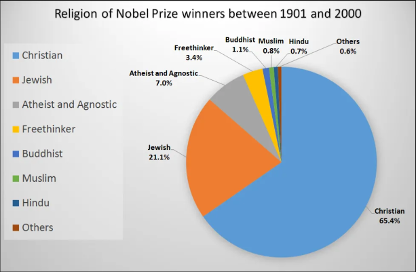
Pie Chart distributing the religion of nobel prize winners between 1901 and 2000.

Source: https://commons.wikimedia.org/wiki/File:Religion_of_Nobel_Prize_winners.png

[This Chart depicts the] “Distribution of Nobel Prizes by religion between 1901–2000, the data tooks [sic] from Baruch A. Shalev, 100 Years of Nobel Prizes (2003), Atlantic Publishers & Distributors, p.59 and p.57: between 1901 and 2000 reveals that 654 Laureates belong to 28 different religion. Most 65.4% have identified Christianity in its various forms as their religious preference. Overall, Christians have won a total of 78.3% of all the Nobel Prizes in Peace, 72.5% in Chemistry, 65.3% in Physics, 62% in Medicine, 54% in Economics and 49.5% of all Literature awards.


Atheists, agnostics, and freethinkers comprise 10.5% of total Nobel Prize winners; but in the category of Literature, these preferences rise sharply to about 35%. A striking fact involving religion is the high number of Laureates of the Jewish faith — over 20% of total Nobel Prizes (138); including: 17% in Chemistry, 26% in Medicine and Physics, 40% in Economics and 11% in Peace and Literature each. The numbers are especially startling in light of the fact that only some 14 million people (0.2% of the world’s population) are Jewish. By contrast, only 5 Nobel Laureates have been of the Muslim faith-0.8% of total number of Nobel prizes awarded — from a population base of about 1.2 billion (20% of the world‘s population).”[2]

Before We Proceed

Before getting into the cognitive-dissonance-inducing quotes, let me make some caveats.

  • The experts quoted here have different religious beliefs and affiliations.
  • This list does not prove the existence of any God or truthfulness of any particular religion any [given] scientist professes.
  • This also does not disprove atheism or any non-theist worldview, since, as mentioned at the beginning, there is a small percentage of non-theists that were and are Nobel prize winners.
  • This list does not prove the opposite, namely, that the majority of scientist in these fields are religious. It might be the case that religious people are a minority.
  • Finally, it just disproves the false assumption that faith in God and the supernatural impedes the progression of science (when in fact, it gave birth to science, but that might be a future post) or that science and faith are incompatible.

The list will be divided by fields for easy search with their respective sources. The experts range from different nationalities and times with no specific order. This list only composes the fields of chemistry, physics and medicine. Literature, economics and peace are not included. Without further ado, enjoy the quotes.

Chemistry

  1. “God did create the universe about 13.7 billion years ago, and of necessity has involved Himself with His creation ever since. The purpose of this universe is something that only God knows for sure, but it is increasingly clear to modern science that the universe was exquisitely fine-tuned to enable human life. We are somehow critically involved in His purpose.”
    — Richard Smalley. Chemist.
    — Nobel Prize: For the discovery of fullerenes.
    — Source: Remarks by Richard Smalley at 2005 Alumni Banquet, Hope College.
  2. “Well, we are supposed to love the Lord our God with all our heart with all our mind and with all our strength. But that is separate from loving our neighbor as ourselves. It means that nature is God’s creation. So we should love nature and understand nature the best we can in order to show our love for the creator.”
    — John B. Goodenough. Materials scientist, a solid-state physicist.
    — Nobel Prize: For the development of lithium-ion batteries
    — Source: Transcript of an interview with John B. Goodenough.
  3. “God is Truth. There is no incompatibility between science and religion. Both are seeking the same truth. Science shows that God exists.”
    — Dereck Barton. Organic chemist.
    — Nobel Prize: For his contribution to the development of the conformational analysis as an essential part of organic chemistry.
    — Source: Barton, as cited in Margenau and Varghese 1997, Cosmos, Bios, Theos: Scientists Reflect on Science, God, and the Origins of the Universe, Life, and Homo sapiens, 144.
  4. “I think only an idiot can be an atheist. We must admit that there exists an incomprehensible power or force with limitless foresight and knowledge that started the whole universe going in the first place.”
    — Christian Anfinsen. Biochemist.
    — Nobel Prize: For his work on ribonuclease, especially concerning the connection between the amino acid sequence and the biologically active conformation.
    — Source: Anfinsen, as cited in Margenau and Varghese, ‘Cosmos, Bios, Theos’, 1997, 139.
  5. “Certainly science, especially physics and chemistry, is a very important part of my identity. But I also consider myself a religious person, and in two senses: one, based on my liberal Jewish upbringing which I have passed on to my children; the other, a kind of nondenominational deism which springs from my awe of the world of our experiences and is heightened by my identity as a scientist. It also includes a conviction that science alone is an insufficient guide to life, leaving many deep questions unanswered and needs unfulfilled.”
    — Walter Kohn. Physicist.
    — Nobel Prize: For his work on the development of the density functional theory.
    — Source: Reflections of a Physicist after an Encounter with the Vatican and Pope John Paul II (April 20, 2001, University of California, Santa Barbara)

Physics

  1. “This much I can say with definiteness — namely, that there is no scientific basis for the denial of religion — nor is there in my judgment any excuse for a conflict between science and religion, for their fields are entirely different. Men who know very little of science and men who know very little of religion do indeed get to quarreling, and the onlookers imagine that there is a conflict between science and religion, whereas the conflict is only between two different species of ignorance.”
    — Robert A. Millikan. Experimental physicist.
    — Nobel prize: for his work on the elementary charge of electricity and on the photoelectric effect.
    — Source: Autobiography (1950). Chapter 21: “The Two Supreme Elements in Human Progress”. p 279.
  2. “If we count the galaxies of the universe or demonstrate the existence of elementary particles, in an analog way we can’t probably have proof of the existence of God. But as a researcher, I’m deeply moved by the order and beauty I find in the cosmos and the interior of material things. As an observer of nature, I can’t help thinking there is a higher order. The idea that all this is the result of fortune or pure statistic diversity for me is completely unacceptable.”
    — Carlo Rubbia. Physicist and director of the European Organization for Nuclear Research (CERN)
    — Nobel Prize: For work leading to the discovery of the W and Z particles at CERN.
    — Source: C. Rubbia, Neue Zürcher Zeitung, March 1993.
  3. “Science, with its experiments and logic, tries to understand the order or structure of the universe. Religion, with its theological inspiration and reflection, tries to understand the purpose or meaning of the universe. These two are cross-related. Purpose implies structure, and structure ought somehow to be interpretable in terms of purpose.”
    — Charles H. Townes. Physicist.
    — Nobel Prize: 
    For fundamental work in the field of quantum electronics.
    — Source: “Logic and Uncertainties in Science and Religion,” in Science and the Future of Mankind: Science for Man and Man for Science, pp. 296–309.
  4. “As we conquer peak after peak we see in front of us regions full of interest and beauty, but we do not see our goal, we do not see the horizon; in the distance tower still higher peaks, which will yield to those who ascend them still wider prospects, and deepen the feeling, the truth of which is emphasized by every advance in science, that ‘Great are the Works of the Lord’.”
    — Joseph John Thomson. Physicist
    — Nobel Prize: For the discovery of the electron.
    — Source: Thomson 1909, Nature, vol. 81, p. 257
  5. “If there are a bunch of fruit trees, one can say that whoever created these fruit trees wanted some apples. In other words, by looking at the order in the world, we can infer purpose and from purpose we begin to get some knowledge of the Creator, the Planner of all this. This is, then, how I look at God. I look at God through the works of God’s hands and from those works imply intentions. From these intentions, I receive an impression of the Almighty.”
    — Arno Penzias. Physics.
    — Nobel Prize: For the discovery of the cosmic background radiation which substantiated Big Bang theory.
    — Source: Penzias, as cited in ‘The God I Believe in’, Joshua O. Haberman editor, New York, Maxwell Macmillan International, 1994, 184
  6. “One way to learn the mind of the Creator is to study His creation. We must pay God the compliment of studying His work of art and this should apply to all realms of human thought. A refusal to use our intelligence honestly is an act of contempt for Him who gave us that intelligence.”
    Ernest Thomas Sinton Walton. Physicist.
    — Nobel Prize: for his pioneering work on the transmutation of atomic nuclei by artificially accelerated atomic particles
    — Source: V. J. McBrierty (2003): Ernest Thomas Sinton Walton, The Irish Scientist, 1903–1995, Trinity College Dublin Press.
  7. “Can a good scientist believe in God? I think the answer is: Yes. In the first place, a scientist, more than other scholars, spends his time observing nature. It is his task to help to unravel the mysteries of nature. He comes to marvel at these mysteries. Hence, it is not hard for a scientist to admire the greatness of the creator of nature. From this it is only a step to adore God.”
    Victor Franz Hess. Physicist
    — Nobel Prize: 
    For the discovery of cosmic rays.
    — Source:
     The American Weekly. “My Faith”. November 3, 1946.
  8. “The book of nature which we have to read is written by the finger of God.”
    Michael Faraday. Scientist.
    — Nobel Prize: 
    For establishing the existence of the magnetic field, discovered electrolysis, diamagnetism, electromagnetic induction and benzene.
    — Source: Seeger, Raymond. 1983. “Faraday, Sandemanian,” in The Journal of the American Scientific Affiliation, 35 (June 1983): 101.
  9. “Both religion and science require a belief in God. For believers, God is in the beginning, and for physicists He is at the end of all considerations… To the former He is the foundation, to the latter, the crown of the edifice of every generalized world view.”
    Max Planck. Physicist. Founder of quantum physics.
    — Nobel Prize: In recognition of the services he rendered to the advancement of Physics by his discovery of energy quanta.
    — Source: Scientific Autobiography and Other Papers as translated by F. Gaynor (1949), p. 184 — Religion and Natural Science (1937)
  10. “In view of such harmony in the cosmos which I, with my limited human mind, am able to recognize, there are yet people who say there is no God. But what makes me really angry is that they quote me for support of such views.”
    Albert Einstein. Physicist.
    — Nobel Prize: for his services to Theoretical Physics, and especially for his discovery of the law of the photoelectric effect.
    — Source: Statement to German anti-Nazi diplomat and author Prince Hubertus zu Lowenstein around 1941, as quoted in his book Towards the Further Shore : An Autobiography (1968) — Attributed in posthumous publications.
  11. “Overpoweringly strong proofs of intelligent and benevolent design lie all around us; and if ever perplexities, whether metaphysical or scientific, turn us away from them for a time, they come back upon us with irresistible force, showing to us through Nature the influence of a free will, and teaching us that all living things depend on one ever-acting Creator and Ruler.”
    William Lord Kelvin. Physicist and mathematician. Founder of Thermodynamics and Energetics
    — Nobel Prize: his achievements in thermodynamics.
    — Source: Address of Sir William Thomson, Knt., LL.D., F.R.S, President,” in Report of the Forty-First Meeting of the British Association for the Advancement of Science, held at Edinburgh in August 1871, pages lxxxiv-cv., 100–101.
  12. “I believe in God, who can respond to prayers, to whom we can give trust and without whom life on this earth would be without meaning (a tale told by an idiot). I believe that God has revealed Himself to us in many ways and through many men and women, and that for us here in the West the clearest revelation is through Jesus and those that have followed him.”
    Nevill Francis Mott. Physicist.
    — Nobel Prize: For his work on the electronic structure of magnetic and disordered systems, especially amorphous semiconductors.
    — Source: Mott, as cited in Nevill Mott: Reminiscences and Appreciations, E.A. Davis — editor, London, Taylor & Francis Ltd, 1998, 329.
  13. “I believe in God. In fact, I believe in a personal God who acts in and interacts with the creation. I believe that the observations about the orderliness of the physical universe, and the apparently exceptional fine-tuning of the conditions of the universe for the development of life suggest that an intelligent Creator is responsible. I believe in God because of a personal faith, a faith that is consistent with what I know about science.”
    William D. Phillips. Physicist.
    — Nobel Prize: For development of methods to cool and trap atoms with laser light.
    — Source: Phillips, William D. 2002b. A letter to the compiler T. Dimitrov. May 19.
  14. “Those who say that the study of science makes a man an atheist, must be rather silly people.”
    Max Born, Physicist.
    — Nobel Prize: For his fundamental research in quantum mechanics, especially for his statistical interpretation of the wavefunction.
    — Source: Frederick E. Trinklein, The God of Science (Grand Rapids, MI: Eerdmans, 1971), 64.
  15. [When asked if he believed in God as a natural scientist] “Naturally, yes. I grew up as a strict Catholic, and I think that I benefited from that.”
    Peter Grünberg. Physicist.
    — Nobel Prize: For his discovery with Albert Fert of giant magnetoresistance.
    — Source: Cicero: Magazin für Politische Kultur, December 2007.
  16. “For myself, faith begins with the realization that a supreme intelligence brought the universe into being and created man. It is not difficult for me to have this faith, for it is incontrovertible that where there is a plan there is intelligence. An orderly, unfolding universe testifies to the truth of the most majestic statement ever uttered: ‘In the beginning God. . . ”
    — Arthur Compton. Physicist.
    — Nobel Prize: for his discovery of the effect named after him.
    — Source: “Why I Believe in Immortality,” This Week, (Sunday supplement to the New Orleans’ The Sunday Item-Tribune; April 12, 1936), 5 ff. Reprinted in Christian Science Sentinel, 62: 32, (August 6, 1960), 1411.
  17. “In the history of science, ever since the famous trial of Galileo, it has repeatedly been claimed that scientific truth cannot be reconciled with the religious interpretation of the world. Although I am now convinced that scientific truth is unassailable in its own field, I have never found it possible to dismiss the content of religious thinking as simply part of an outmoded phase in the consciousness of mankind, a part we shall have to give up from now on. Thus in the course of my life I have repeatedly been compelled to ponder on the relationship of these two regions of thought, for I have never been able to doubt the reality of that to which they point.”
    — Werner Karl Heisenberg. Theoretical physicist.
    — Nobel Prize: For the creation of quantum mechanics.
    — Source: Heisenberg, Scientific and Religious Truth (1973)
  18. “It seems to me that when confronted with the marvels of life and the universe, one must ask why and not just how. The only possible answers are religious. . . I find a need for God in the universe and my own life.”
    — Arthur L. Schawlo. Physicist.
    — Nobel Prize: for their contribution to the development of laser spectroscopy.
    — Source: H. Margenau, Cosmos, Bios, Theos: Scientist Reflect on Science, God, and the Origins of the Universe, Life, and Homo Sapiens (1992).
  19. “I think both science and religion are necessary to understand our relation to the Universe. In principle, Science tells us how everything works, although there are many unsolved problems and I guess there always will be. But science raises questions that it can never answer. Why did the big bang eventually lead to conscious beings who question the purpose of life and the existence of the Universe? This is where religion is necessary.”
    — Antony Hewish. Radio astronomer
    — Nobel Prize: For their pioneering research in radio astrophysics: Ryle for his observations and inventions, in particular of the aperture synthesis technique, and Hewish for his decisive role in the discovery of pulsars.
    — Source: Antony Hewish, “A letter to the compiler T. Dimitrov. May 27” (2002).

Medicine

  1. “I have said for years that speculations about the origin of life lead to no useful purpose as even the simplest living system is far too complex to be understood in terms of the extremely primitive chemistry scientists have used in their attempts to explain the unexplainable that happened billions of years ago. God cannot be explained away by such naive thoughts.”
    — Ernst Boris Chain. Biochemist.
    — Nobel Prize: for the discovery of penicillin and its curative effect in various infectious diseases.
    — Source: Chain, as cited in The Life of Ernst Chain: Penicillin and Beyond by Ronald W. Clark, London, Weidenfeld & Nicolson, 1985, 147–148.
  2. “Only the scientist manages to understand something of that mysterious language that God has written in Nature; and it has only been given to him to unravel the marvelous work of Creation in order to render to the Absolute the most pleasant and accepted cult, that of studying his portentous works, in order to know, admire and revere him in and through them.” [Translated by me from Spanish to English]
    — Santiago Ramon y Cajal. Neuroscientist, pathologist, and histologist.
    — Nobel Prize: In recognition of his work on the structure of the nervous system.
    — Source: Reglas y consejos sobre la investigación científica. Los tónicos de la voluntad.
  3. “…[N]o scientific discovery was so fraught with significance as the revelation of the law of love by Jesus the Crucified. For this law is, in fact, that of the survival of human societies.”
    — Alexis Carrell. Surgeon and biologist.
    — Nobel Prize: For his work on vascular suture and the transplantation of blood vessels and organs
    — Source: Reflections on Life, 1952, Chap. 3, Part 6
  4. “Science and religion are very much alike. Both are imaginative and creative aspects of the human mind. The appearance of a conflict is a result of ignorance. We come to exist through a divine act. That divine guidance is a theme throughout our life; at our death the brain goes, but that divine guidance and love continues. Each of us is a unique, conscious being, a divine creation. It is the religious view. It is the only view consistent with all the evidence.”
    — Sir John Carew Eccles. Neurophysiologist and philosopher.
    — Nobel Prize: For his discoveries concerning the ionic mechanisms involved in excitation and inhibition in the peripheral and central portions of the nerve cell membrane.
    — Source: The Intellectuals Speak Out About God: A Handbook for the Christian Student in a Secular Society (1984). p 50.
  5. “Is the Church inimical to science? Growing up as a Catholic and a scientist — I don’t see it. One truth is revealed truth, the other is scientific truth. If you really believe that creation is good, there can be no harm in studying science. The more we learn about creation — the way it emerged — it just adds to the glory of God. Personally, I’ve never seen a conflict.”
    — Joseph Murray. Professor of Surgery at Harvard Medical School; chief plastic surgeon at Children’s Hospital Medical Center, Boston.
    — Nobel Prize: For work that “proved to a doubting world that it was possible to transplant organs to save the lives of dying patients.”
    — Source: National Catholic Register (December 1–7, 1996) (Murray, as cited in Meyer 1996)
  6. “When it comes to the origin of life there are only two possibilities: creation or spontaneous generation. There is no third way. Spontaneous generation was disproved one hundred years ago, but that leads us to only one other conclusion, that of supernatural creation. We cannot accept that on philosophical grounds; therefore, we choose to believe the impossible: that life arose spontaneously by chance!”
    — George Wald. Professor of Biology at Harvard University (1948–1977).
    — Nobel Prize: For his work on the biochemistry of vision.
    — Source: George Wald, 1954, “The Origin of Life,” Scientific American, 191 [2]: 48. [It should be noted he was an atheist when he said this. He later become a deist.]
  7. “This day relenting God Hath placed within my hand A wondrous thing; and God Be praised. At His command, Seeking His secret deeds With tears and toiling breath, I find thy cunning seeds, O million-murdering Death. I know this little thing A myriad men will save. O Death, where is thy sting? Thy victory, O Grave?”
    — Ronald Ross. Professor of Tropical Medicine at Liverpool University (1902–1912); Vice President of the Royal Society (1911–1913).
    Nobel Prize: For his remarkable work on malaria. This poem was written on August 20, 1897, the same day he made his landmark discovery that malaria is transmitted to people by Anopheles mosquitoes.
    — Source: Ronald Ross, Memoirs, London, John Murray, 1923, 226.

Hopefully, these quotes are sufficient to convince you that such conflict is nonexistent. Therefore, keep believing. Keep inquiring.

Am I missing someone? If you know any Lauret scientist in any of these categories that is not in the list, but you think it should, comment his/her name with title, why it was given the prize and a verified quote with source.

Some information presented in this list was collected form the free eBook 50 Nobel Laureates and Other Great Scientists Who Believe In God. This eBook includes the field of literature, economics and peace.

References:

[1] Editor’s Note: “Scientism” is the idea that science is the sole arbiter of knowledge, everything is else is subjective opinion, fiction, or foolishness. “Naturalism” is the idea that the only thing/s that exist is nature; there is no supernatural realm.

[2] https://commons.wikimedia.org/wiki/File:Religion_of_Nobel_Prize_winners.png

Recommended Resources:

Why Science Needs God by Dr. Frank Turek (DVD and Mp4)

Science Doesn’t Say Anything, Scientists Do by Dr. Frank Turek (DVD, Mp3, and Mp4)

Oh, Why Didn’t I Say That? Does Science Disprove God? by Dr. Frank Turek (DVD and Mp4)

I Don’t Have Enough Faith to Be an Atheist (Paperback), and (Sermon) by Norman Geisler and Frank Turek 


Miguel Rodriguez is the founder of Smart Faith, a platform dedicated to helping Christians defend their faith with clarity and confidence. After experiencing a miraculous healing at 14, he developed a passion for knowing God through study and teaching. He now serves as the Director of Christian Education and a Bible teacher at his local church while also working as a freelance email marketer. Living in Orlando, Florida, with his wife and two daughters, Miguel seeks to equip believers with practical and intellectual tools to strengthen their faith. Through Smart Faith, he provides apologetics and self-improvement content to help Christians live with wisdom and integrity.

Originally posted at: https://bit.ly/3Zuhby7

By Bob Perry

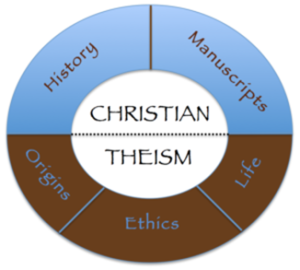
Being able to make the case for the truth of Christianity means you have to understand it yourself. There are plenty of resources out there that can help you do that. I always try to share the best ones I know about. But right now, I want to offer you a visual tool as a way to simplify the “big picture.” This diagram helps categorize the facts supporting Christian Theism. It’s a way to organize the evidence for Christianity in your mind’s eye. Diagram

Confident Christianity

Last year, I developed this model into a book-length summary of the evidence for Christian theism. It is available now in both paperback and Kindle formats. You can order it here:

Confident Christianity Book

This book doesn’t make any claims about the theological nuances that are required to understand Christianity in detail. And it doesn’t address denominational differences between Christians. It is a simple summary of the evidence for “Mere Christianity” that we find in the real world. It’s a challenge to skeptics who may have dismissed Christianity as just another blindly-followed religious myth. And it’s an easy-to-read distillation of that evidence for Christians who may never have been exposed to all of it in one place. My goal in writing this book was to provide a basic, “big picture” overview for those who may have never been exposed to apologetics.

What Is Theism?

There are many different views of God. But they fall into three basic categories:

  1. Pantheism— the idea that all of reality actually is Hinduism is an example of a pantheistic religion. Pantheism makes no distinction between God and nature. The entire physical universe is a manifestation of God. Rocks are god. Trees are god. You are god. God is not a person. God is everything.
  2. Deism— the idea that God is separate from the physical world but does not interact with it. God is like “The Force” in Star Wars — a powerful entity who creates the world and then steps back to watch his handiwork. There is no revelation from this God. There are no miracles. God has no further contact with his creation.
  3. Theism— this is a view that there is a creator God who not only forms the physical universe but also stays involved with it. Christianity, Judaism, and Islam are theistic religions.

Christianity is a theistic religion. That means we should have evidence for some kind of theistic God who is separate from, but involved in, the universe. This is a God who created, sustains, and interacts with the world. Our diagram is a summary of the evidence for that kind of God.

First Things First – God Exists

I’ve summarized the case for God’s existence into three basic categories: OriginsEthics, and Life. Here’s what I mean:

If this God exists, we must have evidence for the type of God who is a personal, moral agent. In order to create the physical universe, that God must exist outside of that universe. That means God can’t be part of the matter, energy, space, or time that makes up our world. He must be transcendent and non-physical. But it doesn’t stop there. Theism requires that God is also able to act within the universe he created.

These three foundational categories (origins, ethics, and life) contain all the evidence that explains things we know about our universe:

  • It is a universe in which we all recognize that real, moral truths exist and that they are constantly being violated
  • It is an actual, physical thing that came into existence sometime in the finite past
  • Whatever/whoever caused the beginning of the universe could not have been a part of the physical universe itself
  • It is designed to allow for, and to sustain, the existence of living things
  • Some of those living things are personal beings who have moral, mental, and physical attributes

Obviously, there is a lot to each of these topics and I will provide resources to support each of them, but the takeaway is simply that our claim to believe that there is a God is not based on some kind of wishful thinking or irrational hope. It is based on evidence — concrete evidence about the way the world actually is.

Since we have evidence that there is a God and that this God’s attributes must be consistent with the evidence listed above, it follows that one of the theistic religions must be true. In order to determine which of the theistic religions is true, we need more specific information.

Specific Evidence For Christianity

The blue categories at the top of the diagram are what allow us to differentiate Christianity from the other theistic religions. Here, we look at data from archaeology and history. We can also compare the manuscript evidence from each of those religions in order to identify which of them is true. This is where the strength of the case for Christianity shines. No other religion even comes close to having the amount of evidence to support it:

  • The existence of its primary historical figure — Jesus of Nazareth
  • The archaeological relics that correlate to its story from the very beginning
  • A world-changing event — the Resurrection — that is central to its claims
  • The number of manuscripts that verify Christianity’s authenticity and reliability

That’s the case for Christian Theism in a nutshell. We can be confident that our faith is justified, not because it makes us feel good about ourselves, or because it “works for us,” but because it is actually true!

Now for the hard part.

The Ultimate Apologetic

If you aren’t already familiar with the information above, it won’t seep into your brain through osmosis. You have to be dedicated to familiarizing yourself with it. In the posts that follow, I will give you resources — videos, articles, and books — to help fill in the details of each of these categories of evidence. But remember, you don’t have to become a biblical scholar and master every subject listed above in order to prepare yourself and those you love to use them. Remember, the purpose of True Horizon is to look at the world with a view from 35,000 feet.

You simply have to understand the basics and be willing to go find answers. In the meantime, here are some fundamental things to understand about what this all means and how to use it:

  1. Knowing “facts” gives you confidence to engage with others but, in the cultural climate we live in, citing facts will rarely convince others to change their minds.
  2. Your attitude may go further than your evidence in compelling others to consider what you’re saying.
  3. Asking questions is almost always more effective than making statements.
  4. Telling your story s vastly more interesting than regurgitating practiced arguments.

Finally, always remember that you are not meant to convince people to agree with you. That’s not your job. The Holy Spirit is the one who leads them to the truth. You are not the one who saves them. That’s Jesus’ job.

Your mission is simple: know and speak the truth. “Always be prepared to give a reason for the hope you have” (1 Peter 3:15). You are only meant to train those in your little corner of the world to be prepared to engage people in a winsome way.

That’s your “job.” And when you’ve done it, relax … and let God do His.

Recommended resources related to the topic:

I Don’t Have Enough Faith to Be an Atheist (Paperback), and (Sermon) by Norman Geisler and Frank Turek 

Stealing From God by Dr. Frank Turek (Book, 10-Part DVD Set, STUDENT Study Guide, TEACHER Study Guide)

Defending the Faith on Campus by Frank Turek (DVD Set, mp4 Download set, and Complete Package)

_____________________________________________________________________________________________________________________________________________________

Bob Perry is a Christian apologetics writer, teacher, and speaker who blogs about Christianity and the culture at truehorizon.org. He is a Contributing Writer for the Christian Research Journal and has also been published in Touchstone, and Salvo. Bob is a professional aviator with 37 years of military and commercial flying experience. He has a B.S., Aerospace Engineering from the U. S. Naval Academy, and an M.A., Christian Apologetics from Biola University. He has been married to his high school sweetheart since 1985. They have five grown sons.

Original Blog Source: https://bit.ly/3OvYYZk


By Natasha Crain

As Christians, we have all kinds of pithy sayings that make their way through churches and establish themselves as generally accepted truths. Some end up on bumper stickers, some on wall decals, and some just get repeated so many times that people think they’re actually in the Bible.

There’s a popular one among parents that I keep hearing lately, and each time I hear it, I cringe. Not only is it false, but it’s particularly damaging to the discipleship of the next generation.

It’s the idea that “Faith is caught, not taught.”

When people say this, they’re usually trying to emphasize that faith is a matter of the heart, not a cold belief in a set of facts that someone has taught them. And of course, there’s truth to that sentiment. But nine times out of ten that someone relays this saying to me, there’s an implication that our kids’ spiritual development has little to do with the “intellectual stuff” of apologetics, but rather everything to do with how well we live our faith in front of them (apologetics is the study of why there’s good reason to believe Christianity is true).

This belief is desperately wrong. At best, it results in a passive approach to discipleship. At worst, it’s an excuse for intellectual laziness.

Let’s look at why.

First, we have to clearly understand what faith is.

Faith, in its most basic sense, is trust.

A blind faith is a trust that has little or no justification. For example, imagine that I claimed there’s an invisible unicorn living outside my house. When you ask me what reasons I have for that belief, I tell you, “I don’t need reasons. I just have faith.” In this case, I would be acknowledging that I hold a blind faith in my invisible unicorn—it’s a faith without reason.

At the other end of the faith, spectrum is a person trusting in something they have good reason to believe is true. For example, I’m willing to get on an airplane because I have faith that it will safely get me to where I need to be. I can’t be certain, but I know there is a good reason to place my trust in the process.

Importantly, this means that faith is not a way of knowing something. It’s how you respond to what you know. This is such an important distinction. Atheists often suggest that faith is inferior to science as a way of knowing about the world, but faith isn’t a way of knowing about the world at all. It’s trust that we place in Jesus in response to what we know about the world (and that knowledge comes from many sources).

In short, biblical faith is not blind faith. Biblical faith is trusting in what we have good reason to believe is true, based on the extensive evidence God has given us.

Now that we’ve established an accurate understanding of what faith is, we can see two major problems with the idea that “faith is caught, not taught.”

  1. It emphasizes passing on our trust rather than the reasons for our trust.

If faith is trust, then what this saying effectively states is that our trust is something that should rub off on our kids as they see how we live our lives.

Our trust in Jesus may or may not rub off on our kids, but regardless, that shouldn’t be our primary goal in discipleship.

Instead, we need to pass on the good reasons that should lead to our kids’ trust in Jesus. Otherwise, they’re just borrowing our own trust without knowing the justification for it. That’s a faith that’s waiting to crumble as soon as it’s significantly challenged.

It’s worth a side note here that parents shouldn’t assume a well-lived Christian faith is even desirable to their kids. There are numerous kids who grow up in loving Christian homes, with parents who truly “walk the walk,” but abandon their faith. Why? Those kids might admire the sincerity of their parents’ convictions but feel no desire to “catch” that same faith because they don’t believe it’s built on good reason. Once again, this points back to the need to pass on the reasons for the hope we have (1 Peter 3:15), not simply our own trust.

  1. A deep understanding of the reasons for faith is not something that’s simply “caught.”

Even if we restate the saying as “Reasons for faith are caught, not taught,” it still doesn’t work.

Here are just a few major concepts that will never be passively caught based on how you live out your Christian faith:

What objective evidence is there for the existence of God?

Do science and God contradict one another?

Can all religions point to the same truth?

What historical evidence is there for the resurrection?

Was Christianity copied from pagan religions?

How do we know that the Gospels are based on reliable eye witness testimony?

How do we know that the Bible we have today hasn’t been corrupted in the copying process over hundreds of years?

How can a good God permit so much evil and suffering?

Between my two books, I cover 70 of these critical questions that kids need to understand today. My new book, coming in March, focuses on 30 more questions specifically about Jesus (Talking with Your Kids about Jesus: 30 Conversations Every Christian Parent Must Have). That’s one hundred important questions kids need to understand given the challenges today…and that’s one hundred important questions they won’t grasp deeply just by watching how you live your faith.

These things are taught.

And the need to proactively teach is woven throughout Scripture:

“Only be careful, and watch yourselves closely so that you do not forget the things your eyes have seen or let them fade from your heart as long as you live. Teach them to your children and to their children after them” (Deuteronomy 4:9).

“…he commanded our ancestors to teach their children, so the next generation would know them, even the children yet to be born, and they, in turn, would tell their children” (Psalm 78:5-6).

“Listen, my son, to your father’s instruction and do not forsake your mother’s teaching” (Proverbs 1:8).

“Fathers, do not exasperate your children; instead, bring them up in the training and instruction of the Lord” (Ephesians 6:4).

There’s good reason the Bible tells us to teach and train and not just keep walking with the Lord while kids look on. Those eyes can’t physically see all that needs to be mentally learned. And as long as Christian parents think all they need to do is model what it looks like to put their trust in Jesus, kids will keep struggling when challenged on the justification for such a life.

Does passing on an understanding of all the good reasons for faith means a child will necessarily follow Jesus? Not at all. But when we’re obedient in our calling to be teachers (not just walkers!), we can be confident that we have given our kids the opportunity to develop their own trust in Jesus and didn’t simply encourage them to borrow our convictions.

A borrowed faith is readily handed back.

Recommended resources related to the topic:

Talking with Your Kids about God: 30 Conversations Every Christian Parent Must Have by Natasha Crain (Book)

Keeping Your Kids on God’s Side: 40 Conversations to Help Them Build a Lasting Faith by Natasha Crain (Book)

Courageous Parenting by Jack and Deb Graham (Book)

Proverbs: Making Your Paths Straight Complete 9-part Series by Frank Turek DVD and Download

Forensic Faith for Kids by J. Warner Wallace and Susie Wallace (Book)

God’s Crime Scene for Kids by J. Warner Wallace and Susie Wallace (Book)


Natasha Crain is a blogger, author, and national speaker who is passionate about equipping Christian parents to raise their kids with an understanding of how to make a case for and defend their faith in an increasingly secular world. She is the author of two apologetics books for parents: Talking with Your Kids about God (2017) and Keeping Your Kids on God’s Side (2016). Natasha has an MBA in marketing and statistics from UCLA and a certificate in Christian apologetics from Biola University. A former marketing executive and adjunct professor, she lives in Southern California with her husband and three children.

Original Blog Source: http://bit.ly/35ASDpQ

By Evan Minton 

Sometimes, in conversations with atheists, they try to say that “Extraordinary Claims Require Extraordinary Evidence” Are they right?

One problem with this statement is that it could possibly be self-defeating. Think about it, the claim itself, to say that extraordinary claims require extraordinary evidence is to make an extraordinary assertion.  How does the person know that the statement is true?  Think about it.  It is a universal statement!  Isn’t that extraordinary?  Is it a universal principle?  If so, that is amazingly important.  So, please show us the extraordinary evidence that the statement is true. I’m not sure about this, but the claim could be self-defeating depending on whether the claim is itself an extraordinary claim.

ANY claim, whether they seem extraordinary or not, only requires SUFFICIENT evidence. The amount of proof or evidence needed to establish a fact only needs to be sufficient to warrant belief in it. What type of claim is extraordinary or not could possibly be arguably subjective. People vary on what they find unbelievable. Plus, no criteria are given for what counts as extraordinary evidence. Because no criteria are claimed for what would count as extraordinary evidence, no matter how much evidence and rational argumentation you give for your position, the one who holds the opposite view could just keep moving the bar up. He could just keep shaking his head saying “Nope, not enough evidence. You need to provide more.” So that you could never provide enough evidence to warrant support for the position you believe to be true. Do extraordinary claims require extraordinary evidence? No. They only require sufficient evidence for belief. Of course, you might ask “What counts as sufficient evidence?” To that, I do not know the answer. Although evidence is objective, how much evidence is enough to convince a person seems somewhat subjective. Now, I’m not saying that truth is subjective (opinion based) nor am I saying that evidence is subjective, but rather that what amount of objective evidence to convince someone of something differs from that another. Some people can come to believe something on less evidence than someone else. Although this seems to raise another issue. It seems the same problem arises from saying “Any Claim Requires Sufficient Evidence” as it would if one were to say “Extraordinary Claims Require Evidence.” Someone could just keep shaking their head, raising the bar higher and saying “Nope, this is not sufficient enough evidence required to believe your claim.” What do we do about this?

Well, for one thing, I think that when I provide evidence to back up my claim, if someone is still skeptical I should like to know why. For example, if I give The Kalam Cosmological Argument and provide evidence for the 2 premises of the argument, then why does the person I’m talking to continue to disagree with the conclusion, that “Therefore The Universe Has A Cause” and that the cause is a spaceless, timeless, immaterial, powerful, supernatural, personal cause? Is one of the premises of the argument false? If they’re both true, then the conclusion follows logically and necessarily by the laws of logic (in that specific case, modus ponens; if P then Q, P, therefore Q.) As William Lane Craig has said, “skepticism is not a refutation.” If you’re not convinced by my arguments, I’d like to know why. That’s how debate works. You tell me what’s wrong with the logic of the argument or WHY the evidence is not sufficient enough to warrent the belief of the premises of the syllogism. This is how we solve the problem. Someone could NOT just keep shaking their head, raising the bar higher and saying “Nope, this is not sufficient enough evidence required to believe your claim.” If someone did, we would rightfully ask “Why? How am I wrong? Is my logic flawed? Are my facts flawed? Or are both my logic and facts flawed?” Again, skepticism is not a refutation.

Another problem with the atheists using this slogan is that it can be thrown right back at them. The atheists sometimes tout “Extraordinary claims require extraordinary evidence.” But it seems to me that all physical reality popping into being, uncaused, out of absolutely nothing, having it’s laws of physics fine-tuned to a fantastic degree, and having an immensely complex factory (i.e. the cell) assemble together all by itself in a so-called primordial soup, to be a claim extremely extraordinary. Yet, the atheist tries to cast all the burden of proof on the theist by claiming a position of neutrality (Atheism is a lack of belief, not a belief that there is no God) and not give evidence and good reasons to believe his ridiculous view.

Don’t get me wrong, theists do bare the burden of proof when we claim that there is a God, but when atheists claim that there is no God, it is THEM that bare the burden of proof. Anyone who makes a positive truth claim bares the burden to provide reasons to believe that truth claim. Anyone who makes a positive assertion needs to provide reasons to believe that assertion if anyone is going to take him seriously. And if they (the atheists) really believed that “extraordinary claims require extraordinary evidence” one has to think on just which view is truly more extraordinary, is it harder to believe that outboard motors and codes can assemble by chance + some supposedly undiscovered natural laws, or is it harder to believe that things look designed because they really were designed? I think the latter is far easier to believe. If something looks, sounds, walks and quacks like a duck, shouldn’t at least part of the burden of proof be on those who are claiming that it isn’t a duck? If things appear to be designed, shouldn’t the atheist put forward some reasons to believe they weren’t designed? I think the answer to that question is; yes.

Of course, I would never use the “extraordinary claims require extraordinary evidence” slogan on the atheist anyway because I believe the view is false and the reasons I believe it is false are listed above. But it is true that if you make a certain claim, it’s not unreasonable for someone to ask you to back up that claim with reasons.


Original Blog Source: http://bit.ly/2phSfbF

Sometimes people ask about fine-tuning and I created this overview to just provide links to all of my fine-tuning blogs on CrossExamined.org. I’ll update this as I add to this. I defend this fine-tuning claim which is actually widely accepted in the physics community:

“In the set of possible physical laws, parameters and initial conditions, the subset that permits rational conscious life is very small.”

Of course whether that implies design is more controversial but I defend the case that it does:

Intro/Philosophical Background

If You Don’t Want God, You Better Have a Multiverse!

How Does Fine-Tuning Provide Evidence for God?

Evidence

Fine-Tuning of Initial Conditions to Support Life

Many Changes to the Laws of Physics Would be Life-Prohibiting

Fine-Tuning of the Force Strengths to Permit Life

Fine-Tuning of Particles to Support Life

Objections

Mistaken Objections that Seek to Trivialize Fine-Tuning

Important Objections in the Fine-Tuning Debate

But We Can’t Even Define Life

Coarse-Tuning vs. Fine-Tuning

For a more in-depth defense of the scientific case (and some excellent philosophical points), I highly recommend Cosmologist Luke Barnes:

nebulosa_borboleta1I attended an interesting debate last Saturday night between Justin Schieber and Blake Giunta. Blake used the fine-tuning evidence as one argument for God’s existence and Justin countered by pointing to the Coarse-Tuning argument.

What is the Coarse-Tuning Argument?

Assuming that the various finely-tuned constants can take on any value up to infinity, then any finite life-permitting range (even a large one) would become an infinitesimal subset. Thus, even coarsely-tuned parameters could be considered improbable. This is often seen then as a reductio ad absurdum against fine-tuning – for then we should be equally surprised no matter how wide the range of life-permitting values is for a given constant (so long as it was finite).

Blake followed Robin Collins in arguing that coarse-tuning could still represent an improbable situation if indeed we knew that the possible values for the various constants could go to infinity. However, I don’t think many physicists would be persuaded of anything improbable if the universe only required coarse-tuning rather than fine-tuning to support life. In fact this was the expectation prior to the pioneering work of Hoyle, Barrow, Tipler, Carter, and others. No one that I’m aware of argued that physical constants being life-permitting pointed to design until the life-permitting range of constants was discovered to be exceedingly narrow.

Why coarse-tuning would not be accepted as improbable?

Most physicists did not accept a Coarse-Tuning Argument not because it might not be improbable if the possible range was infinite, but rather due to skepticism that the possible range of constants could be infinite. If David Hilbert was right, actual infinities are nowhere to be found in reality and it would be impossible for the constants to be infinite. See my previous blog for a discussion of some of the issues associated with actually infinite quantities. Even if Hilbert is incorrect, one could still argue that one can estimate probabilities by taking limits and that Hilbert’s Hotel shows simply the counter-intuitive nature of dealing with infinities. Even if the actually infinite is possible, physicists generally reject candidate theories that entail the actually infinite – at least if the equations cannot be renormalized to avoid the infinities.

Is the range of possible values for the constants infinite?

The key assumption in the Coarse-Tuning Argument is that the possible range of constants could be infinite. However as Luke Barnes has pointed out the concept of mass becomes incoherent if fundamental particles could exceed the Planck mass. Particles over a certain mass would form a black hole and therefore be impossible to create. Does it really seem physically possible that an electron could have a mass of a billion tons? Might it be prohibitively difficult to create particles with such a huge mass due to the energy or energy density requirements in making it? Would such a massive particle be stable? We could treat the case that the electron’s mass was greater than some huge value as corresponding to there being too few electrons after some small amount of time in which the universe expanded and cooled. This special case would obviously be life-prohibiting as electrons are necessary for chemistry, stellar fusion, and other processes critical for life.

What about force strengths?

Another class of parameters that have to be finely-tuned is force strengths. Most physicists think that at least 3 out of the 4 fundamental forces are unified at certain energy levels – and probably all 4. Thus, there is an underlying relationship between the forces that would constrain their relative strengths. Ratios of the force strengths would not be infinite. If a constant governing a force strength had a value of 0, that special case could also be evaluated with respect to its ability to support life. All 4 fundamental forces are thought to be necessary for life although there are ways to have life without the weak force – but only by compensating with additional fine-tuning in other aspects.

Robin Collins argues that once force strengths become too large we lose our ability to predict whether or not such a scenario would be life-permitting – there could be new physics at such large energy scales. This is not a problem for the fine-tuning argument as defined by leading advocates though because the argument only addresses the parameter ranges for which we can reliably evaluate suitability for life – we consider only the epistemically-illumined region. Here is how John Leslie explains it in his Universes book (which I highly recommend):

If a tiny group of flies is surrounded by a largish fly-free wall area then whether a bullet hits a fly in the group will be very sensitive to the direction in which the firer’s rifle points, even if other very different areas of the wall are thick with flies. So it is sufficient to consider a local area of possible universes, e.g., those produced by slight changes in gravity’s strength, . . . . It certainly needn’t be claimed that Life and Intelligence could exist only if certain force strengths, particle masses, etc. fell within certain narrow ranges . . . . All that need be claimed is that a lifeless universe would have resulted from fairly minor changes in the forces etc. with which we are familiar. (pages 138-9)

In other words, it still looks like the rifle was aimed if it hits a tiny group of flies surrounded by a vast wall without any flies – even though there might be other flies on parts of the wall we cannot see. A design inference can be justified even though we lack complete knowledge about the life-permitting status of all of the possible parameter space. We’re only evaluating the local, finite region for which a determination can be made.

A finite number of physically possible constants?

If one takes the fine-tuning argument based on physically possible parameter space rather than metaphysically possible parameter space, then it’s expected that the range of values for constants is finite. I’ve previously linked to this important article by John Barrow outlining different ways in which physics itself can drive constants to different values. For example, spontaneous symmetry breaking in the early universe affected various parameters related to electromagnetism and the weak force. The Weinberg angle could have taken on other values that would have resulted in alternate derived parameters. However, nothing in those equations allow any of the parameters to go to infinity.

Barrow also notes that unifying gravity and quantum mechanics is only possible if “the true constants of nature are defined in higher dimensions and the three-dimensional shadows we observe are no longer fundamental and do not need to be constant.” Because of quantization, the number of ways of compactifying these extra spatial dimensions would be finite. We can treat the case that quantization is not in effect as a special case that would not plausibly support life. Without quantization, atoms are not stable and would not have consistent properties permitting information to be stored. Even String Theory entails a finite number of possible sets of fundamental constants. Many theorists think it’s quite large, perhaps 10500, but all we need is for it to be finite to avoid the infinities required by the coarse-tuning argument. Refer to my previous blog for other reasons to expect a finite range for constants of nature.

Initial conditions

Cosmologist Luke Barnes also points to the fine-tuning associated with the initial conditions of our universe as an example immune from the problems of infinities. Unless one thinks that probabilistic statements cannot be made despite the reputation of statistical mechanics as a well-established physics discipline, one is able to conclude that our universe started out in an incredibly special, highly-ordered state. The number of life-permitting states is extraordinarily tiny compared to possibilities as Roger Penrose has computed – see my blog for details. Since the number of particles was finite and the volume of space in the early universe was quite small, there is no problem of infinities that prohibits a rough probability estimate.

Summary

More work should be done in assessing the possibilities of infinities and the potential impact on the fine-tuning argument. However, I see no reason that Coarse-Tuning would be a reductio ad absurdum against fine-tuning because if we knew for sure that the constants had an infinite range the finiteness of the life-permitting range should suffice for demonstrating that life-permitting universes are a tiny subset among possibilities. However, physicists are rightly skeptical that these constants could be infinite. I’ve listed several reasons for thinking that the constants couldn’t have an infinite range – which is why physicists were not astounded until they discovered that life-permitting ranges are tiny among possibilities that can be evaluated. We can compute that the universe would be lifeless if gravity were 40 orders of magnitude stronger even though we might have some slight uncertainty about what happens if it were 4000 orders of magnitude stronger and do not know a precise upper bound of what is physically possible.

In my previous blog I addressed some important issues in making the case that fine-tuning supports theism over atheism. Today I want to look at the objection against fine-tuning that says we can’t assess fine-tuning claims because we can’t even define ‘life’ – or put another way: “fine-tuning claims don’t properly account for other possible life forms.” It has proven surprisingly hard for scientists to agree upon a definition for life. This uncertainty, however, hasn’t prevented biologists from making inferences about life nor has it kept physicists from writing numerous articles claiming that certain changes to physical constants would have resulted in a lifeless universe. In most cases, the inference to a lifeless universe is based upon severe catastrophes such as:

  • A very short-lived universe
  • No stable atoms
  • No chemistry
  • No long-lived sources of energy (such as stars)

It seems plausible that in these situations no life could arise of the kind that could evolve into intelligent, rational creatures. Many fine-tuning constraints involve multiple life-permitting criteria so that even if one of them was incorrect, there would still be other constraints on the life-permitting range of values based on different life-permitting criteria. John Leslie affirms that “many of the fundamental constants have to take the values they do for several independent reasons.” Moreover, even if half of the fine-tuning claims were mistaken there would still be a sufficient number of finely-tuned parameters to conclude that life-permitting universes are rare among possibilities. My fine-tuning claim is therefore robust since it doesn’t rely on all physicists’ claims being true – here it is again:

In the set of possible physical laws, parameters and initial conditions, the subset that permits rational conscious life is very small.

If some peer-reviewed articles are in error, there might be other articles defining other constraints or at least there would be enough remaining evidence to conclude that the life-permitting universes are rare among possibilities. But let’s look in detail at what is necessary for life according to scientists.

What are some essential attributes of any plausible life form?

Self-replicating

Any life form that could evolve to possess intelligence would have to include a self-replicating system. John von Neumann showed that any self-replicator requires certain features such as information storage and processing. Any information storage system would need to be comprised of reasonably stable entities. A star, for example, is a hot plasma of charged particles in rapidly changing configurations and thus is deemed implausible to store information needed to originate and sustain life. Also, in the near vacuum of space there are so few particles interacting that there is no plausible way to replicate enough information for complex life.

Non-trivial information content

As origin of life researcher Stuart Kauffman has noted: “all living things seem to have a minimal complexity below which it is impossible to go.” One theoretical estimate for the amount of information for the simplest possible life form is 113,000 base pairs.[1] Any life form is likely to require polymers of some type to serve as building blocks that can be replicated. There are multiple ways in which a lack of finely-tuned parameters could have prevented the formation of any atoms beyond hydrogen. In this scenario, there would be no polymers and indeed no chemical compounds except for H2. It is implausible to think that if only hydrogen ever existed in the universe that we would have intelligent life or so many physicists have argued.

Preservation of information content during replication

We also have some indications from our own planet of the importance of high fidelity information replication. The canonical genetic code that provides the mapping from RNA codons to amino acids used on our planet is highly optimized and arose early in life’s history[2] (else it wouldn’t be as universal.) Biologists interpret this as evidence of the importance of minimizing errors during translation and replication. The ability to preserve information is therefore recognized as being highly important for life.

Ability to harness energy from environment

Life must be able to harness energy from the environment or else the Second Law of Thermodynamics would pose an insurmountable hurdle. A long-lived stable energy source such as a star would therefore be required.

These same constraints and additional ones are described as prerequisites for life in an important article[3] in the Proceedings of the National Academy of Sciences (PNAS) that explains the attributes of alternate life forms that might eventually be found elsewhere in the universe. This article serves to confirm that the physics literature is making generous assumptions about what could be life-permitting. Here are some key points of the article with my comments provided after the quotations:

  1. “It is predictable that life, wherever we encounter it, will be composed of macromolecules.” I agree – information and storage would most likely require polymers of some type.
  2. “Only two of the natural atoms, carbon and silicon, are known to serve as the backbones of molecules sufficiently large to carry biological information.” I think that most physicists writing about fine-tuning are open to more alternatives than this article but the article raises some important points about the unique suitability of carbon:
    1. Carbon “unlike silicon … can readily engage in the formation of chemical bonds with many other atoms, thereby allowing for the chemical versatility required to conduct the reactions of biological metabolism and propagation. … Silicon, in contrast, interacts with only a few other atoms, and the large silicon molecules are monotonous compared with the combinatorial universe of organic macromolecules”
    2. “Life also must capture energy and transform that energy into the chemistry of replication. The electronic properties of carbon, unlike silicon, readily allow the formation of double or even triple bonds with other atoms.”
    3. “It is critical that organic reactions, in contrast to silicon-based reactions, are broadly amenable to aqueous conditions. Several of its properties indicate that water is likely to be the milieu for life anywhere in the universe.”
  3. “Life that depends only on chemical energy inevitably will fail as resources diminish and cannot be renewed.” This agrees with my point about needing a stable, long-term energy source to overcome the Second Law of Thermodynamics.
  4. “Temperature is a critical factor for life. Temperatures must be sufficiently high that reactions can occur, but not so high that that complex and relatively fragile biomolecules are destroyed. Moreover, because life probably depends universally on water, the temperature must be in a range for water to have the properties necessary for solute transfer.” Again I think that the physics literature is more open-minded in this aspect but certainly at some point it becomes too hot or too cold to either reliably store information or to have enough energy to replicate it.

But Does Life Have to be Carbon-Based Life?

My fine-tuning claim and that by prominent advocates such as Luke Barnes don’t presuppose that any life form would have to be carbon-based – it’s much more general than that. However, this PNAS article is one of many to claim that silicon is the best alternative to carbon as a basis for life. Silicon bears some similarities to carbon as expected from its position just below carbon on the periodic table. If we can understand why silicon-based life doesn’t appreciably increase the possibilities for life, then we can gain confidence in the generality of the fine-tuning claim.

As the PNAS article indicates, carbon is much more suitable for life than is silicon. Consider the specialness of carbon with regard to the number of types of molecules that can be formed with H (hydrogen) and the following elements[4]:

H – 1

He – 0

Li – 1

Be -1

B – 7

N- 7

O -2

Ne-0

C (carbon) – over 2300 known types of molecules just involving C and H

 Revisiting our dartboard analogy, consider how a life-permitting region is tiny among possibilities. As a reminder, just one finely-tuned parameter, the cosmological constant, has to be set in a narrow life-permitting region among possibilities that is comparable to hitting a bull’s-eye on a huge wall that is 376 million light-years per side. If the life-permitting region for carbon-based life is small, the region for silicon-based life should be smaller since silicon is less suitable for life than is carbon. Although there is one fine-tuning constraint that specifically references carbon, it turns out to also be applicable to silicon. Unless there was a nuclear resonance at just the right energy level, fusion in stars might have never produced carbon. However, without this resonance level there would be a bottleneck that would also inhibit silicon or elements heavier than carbon from being synthesized. Stars make carbon on the way to making silicon. (Most elements past beryllium were synthesized in stellar fusion from smaller atoms.) Thus, universes that produce silicon are no more likely than those that produce carbon – so the bull’s-eye for silicon-based life is smaller and basically just overlaps the carbon bull’s-eye.

Lessons Learned from Origin of Life Research

Consider how some origin of life researchers admit that the origin of the first life form from non-life is exceedingly improbable even with carbon and a diversity of other elements, long-lived stars, and other helpful attributes in our finely-tuned universe. For example, Christian Schwabe writes: “the formation of the first life is viewed as a chance process that occurred in spite of minuscule odds such as 1:10300 and which is accepted only because we are here.[5]“ Eugene Koonin appeals to the multiverse to overcome a horrendous improbability that he estimates at 10-1018 for a plausible first evolvable cell. Not all researchers are this pessimistic but the slow progress in the field should caution those who think that non-carbon life forms a large region in the space of possible parameters. If carbon is so clearly the best choice for life as most biologists believe and if the origin of life is somewhat of an unlikely event even utilizing organic (carbon-based) molecules such as RNA, how much more unlikely is a naturalistic origin of life without carbon.[6]

Fine-Tuning for Intelligent Life

Recall that my fine-tuning claim refers not to just any life form but to intelligent life. Since theism predicts that God would want some advanced life forms, this raises the bar for constraints on life-permitting universes. If merely primitive replicating cells could originate in somewhat less finely-tuned universe, this still would not count against my fine-tuning claim unless this life could also evolve to achieve intelligence and self-awareness. Clearly more fine-tuning is required for the universe to support rational conscious life than would be required for very primitive life forms.

Closing Thoughts

Most physicists writing about fine-tuning think that there are some very clear-cut cases of fine-tuning such as that for the cosmological constant. Consider, for example, how Nobel prize-winning physicist Steven Weinberg has argued for a multiverse explanation to the fine-tuning of the cosmological constant. He posits vast numbers of universes each with different values for the cosmological constant, the energy density of empty space. Weinberg’s argument for the value being consistent with multiverse predictions relies on a hard limit[7] for the life-permitting range so that our universe can be considered typical among life-permitting universes[8]. Smolin and others have critiqued his prediction as not being that close to what a multiverse would predict but that is irrelevant to my current point which is simply that Weinberg clearly believes that varying this constant by a tiny amount among the possibilities would result in no life of any kind living anywhere in that universe. Refer to my multiverse blog for why our universe would need to be typical among life-permitting universes for a plausible multiverse explanation.

Few physicists specializing in fine-tuning point to other possible forms of life as a supposed refutation to the fine-tuning argument but those who do should write rebuttals to the many peer-reviewed articles claiming life would not exist in certain scenarios involving different physical constants or initial conditions. Skeptics need to show why these authors were mistaken. Perhaps this is a good point of emphasis in urging physicists to be careful in their claims. If some of these fine-tuning claims are over-stated though this would actually provide evidence against a multiverse explanation to the fine-tuning because it would represent ways in which our universe is overly fine-tuned for life. A naturalistic multiverse predicts that our universe should not be more fine-tuned than is minimally necessary to support life.


[1] Forster A. C., et al. Nature Mol. Syst. Biol., 2 . doi:10.1038/msb4100090 (2006).

[2] Early Fixation of an Optimal Genetic Code. Molecular Biology and Evolution. Oxford Journals. Stephen J. Freeland2, et al.

[3] Pace, Norman. “The universal nature of biochemistry”. Proceedings of the National Academy of Sciences 98 (3) (2001): p. 805–8.

[4] This was presented by Luke Barnes at the Philosophy of Cosmology conference in 2013 in Santa Cruz, CA.

[5] Schwabe. Comparative Biochemistry and Physiology Part B: February 1994: (Volume 107, Issue 2) p. 167.

[6] In this blog, I have no intention of getting into discussions about whether or not we have evidence for divine intervention in the origin of life – that is a separate topic. Note that the origin of life and fine-tuning are separate issues. Fine-tuning deals with setting up an environment conducive to life – sort of like that biosphere they setup in Arizona. Conversely, origin of life relates to whether or not life forms were put into that biosphere or originated from non-living matter within it.

[7] By ‘hard limit’ I mean that no other life forms could exist anywhere in universes with cosmological constants whose absolute value exceeded a threshold that is about 120 orders of magnitude less than the natural values predicted by the Standard Model of Particle Physics. BTW, Weinberg first coined the term “Standard Model.”