Tag Archive for: Christianity

By Al Serrato

Don’t judge me” seems to be an increasingly uttered, and accepted, refrain in our society, reflecting what appears to be a universal and deep-seated human tendency. Even Christians, who should know better, seem to be jumping on board, believing somehow that Christian compassion requires us to be more understanding and more accepting of bad behavior.

But when you think about it, the phrase is not quite apt. Most people don’t really mean that they don’t want to be judged. In fact, they do. What they mean is that they want others to approve of their conduct or behavior. What they don’t want is to be judged and found wanting. Whether its sports or academics or work, again and again we see that people want to compete, want to be praised for their performance, and want to come out on top. It is losing – being told that they didn’t measure up or that they did something wrong, or bad – that they seek to avoid.

This inclination to seek praise and to avoid condemnation is apparent from a child’s earliest days: praise him and he smiles, admonish or scold him and he cries. He doesn’t need to be taught how to react; he simply knows it. And when he learns to express himself, one of the first things he will intuitively grasp is that there is this thing called “fairness” by which all behavior is judged. He will make use of this early and often, as he condemns actions that do not meet his expectations. “That’s not fair!” he will exclaim, without fully understanding the power of that phrase to influence others. And when he himself is accused of being unfair, he will not respond by saying that it’s okay to be unfair; instead, he will say that he is being fair, as he attempts to justify his conduct. It’s only as he gets older that he will learn the clever parry that is so popular today of claiming that judging itself is wrong.

What explanation does atheism have for this obvious human condition? Since the vast majority of people seem inclined to want to shake off judgment and be free to do what they wish, wouldn’t natural selection have eliminated this condition of feeling constrained to act a certain way long ago? In other words, when we seek to avoid judgment, what we are really saying is that we do not want to feel guilt. We don’t want that nagging sense that, as CS Lewis put it, we are aware of a law that is pressing down upon us, a law that we did not create and that we cannot evade, for it resides within our minds. But if there is no God, what evolutionary benefit would possibly derive from feeling guilty about not acting as we should? Would this not inhibit us from future acts that might benefit us in a direct and personal way at the expense of others? If natural selection operates as Darwinists suggest, then those early humans who lacked a sense of guilt would have been free to vigorously pursue their self-interest – to enhance their ability to survive and to procreate – as contrasted with their fellows who were inhibited because they did not want to feel the guilt that comes from hurting other people. With survival of the fittest as the rule, behaviors that limit our choices and prevent us from putting ourselves first make us weaker, not stronger. In a universe in which we are simply an accident of evolution, pursuit of self-interest would be the default setting.

The Christian worldview, by contrast, can and does make sense of guilt. We intuitively know that there is a right and wrong, that there is good and evil and fairness and unfairness, because the absolute standard for goodness made us in His image. He left within us – written upon our heart as it were – intuitive access to this standard and a desire – a need – to conform to it. Our fallen nature prevents us from ever fully achieving this, but the knowledge of this law, and of our need to yield to it, is part of the very fabric of our minds.

God left within us the desire to find our way back to Him, and an innate fear of condemnation for failing to meet His standard. Though we may not realize it, we long to hear Him welcome us home with words of praise, a hearty “well done my good and faithful servant.”

What we seem to have forgotten, however, is that we need not fear ultimate condemnation, for He also sent His Son to provide us the way home, the path to redemption. But we cannot make it there on our own and pretending otherwise by trying to avoid feelings of guilt does no one any good.

Recommended resources related to the topic:

Stealing From God by Dr. Frank Turek (Book, 10-Part DVD Set, STUDENT Study Guide, TEACHER Study Guide)

Legislating Morality: Is it Wise? Is it Legal? Is it Possible? by Frank Turek (Book, DVD, Mp3, Mp4, PowerPoint download, PowerPoint CD)

Is Morality Absolute or Relative? by Frank Turek (DVD/ Mp3/ Mp4)

Was Jesus Intolerant? (DVD) and (Mp4 Download) by Dr. Frank Turek 


__________________________________________________________________________________________________________________________________________________

Al Serrato earned his law degree from the University of California at Berkeley in 1985. He began his career as an FBI special agent before becoming a prosecutor in California, where he continues to work. An introduction to CS Lewis’ works sparked his interest in Apologetics, which he has pursued for the past three decades. He got his start writing Apologetics with J. Warner Wallace and Pleaseconvinceme.com.


By Ryan Leasure

It’s not uncommon for Christians to throw shade on the Old Testament. These Christians say they love Jesus, but they could do without those primitive Jewish texts. In fact, many Christians suggest that much of the Old Testament is ahistorical. Events such as the flood, Jonah being swallowed by a big fish, or the fiery judgment of Sodom and Gomorra never happened. And then there’s the infamous quote that Christians simply need to “unhitch themselves from the Old Testament” because much of it is embarrassing or difficult to understand. Why can’t we just focus on Jesus instead?

We can certainly sympathize with these sentiments. After all, the flood and Sodom’s judgment seem pretty incredible and kind of harsh to boot! Wouldn’t it just be easier to disregard this ancient corpus? This position seems reasonable until one realizes that the same Jesus these Christians adore also happens to hold the Old Testament in high regard. Not only does he affirm the Old Testament’s inspiration, he also affirms its historicity and authority.

The Old Testament is Inspired

Historically, Christians have affirmed the verbal plenary inspiration of the Bible. That is to say, they recognize that every word of Scripture is “God-breathed” (2 Tim 3:16-17). At the same time, God spoke through human agency. Therefore, Scripture not only has a divine author, it has human authors as well.

Jesus affirmed the human authors of the Old Testament. Repeatedly, he recognizes that Moses is the one who gave the Law (Matt 8:4; 19:8; Mark 1:44; 7:10; Luke 5:14; 20:37; John 5:46; 7:19). He’ll say things like “do what Moses commanded” (Mark 1:44). Or “Moses said, Honor your father and your mother” (Mark 7:10). With respect to other Old Testament authors, Jesus declares, “Well did Isaiah prophesy . . .” (Mark 7:6). Also, “David himself, in the Holy Spirit, declared . . .” (Mark 12:36). And “So when you see the abomination of desolation spoken of by the prophet Daniel . . .”(Matt 24:15). It’s worth noting that just about all critical scholars call into question the authorship of these individuals in clear contradiction to Jesus.

At the same time, Jesus affirms that these individuals wrote divinely inspired Scripture. As was just alluded to, Jesus noted in Mark 12:36, “David himself, in the Holy Spirit, declared, . . .” In other words, David wrote, but his writings were the result of the Holy Spirit’s work (2 Pet 1:20-21). He also declared “Well did Isaiah prophesy . . .” (Mark 7:6). The mere mention of prophecy suggests that Isaiah wrote from God. Prophecy, after all, is by definition “a word from God.” The same could be said for Matthew 24:15 when Jesus refers to Daniel as “the prophet.” Moreover, when speaking to the scribes and Pharisees, Jesus asserts, “You leave the commandment of God and hold to the tradition of men” (Mark 7:8). He then goes on to clarify that the commandment of God was what Moses wrote in Exodus 20.

As John Wenhan notes, “To [Jesus], Moses, the prophets, David and the other Scripture-writers were truly inspired men with a message given by the Spirit of God.”1

The Old Testament is Historically Accurate

While many are willing to grant the Old Testament’s inspiration, many of these same individuals deny that it’s historically accurate at every point. They might affirm its historical nature in general (God created the world, called Abraham and the Jewish people, the Jews were exiled, etc.), but they balk at some of the more challenging texts (the flood, Sodom, Jonah, etc.). That said, Jesus has no qualms about affirming the historical nature of the Old Testament—even the most difficult texts to believe. Here are a few examples:

He believed that Cain killed Abel (Luke 11:51), that God sent a flood but spared Noah in the ark (Matt 24:37-39), and that God destroyed Sodom because of their wickedness (Matt 11:23-24). He even adds, “Remember Lot’s wife” (Luke 17:32). Additionally, Jesus believed that God sent down manna from heaven (John 6:31), the Israelites were healed by looking at the serpent (John 3:14), and that Jonah was swallowed by a big fish only to be regurgitated three days later (Matt 12:39-41).

The last text about Jonah is especially significant because it demonstrates that Jesus didn’t simply view these events figuratively. For the end of the text reads, “The men of Nineveh will rise up at the judgment with this generation and condemn it, for they repented at the preaching of Jonah, and behold, something greater than Jonah is here” (Matt 12:41). It’s hard to imagine how Jesus could assert that Ninevah would rise up in the final judgment against the people who rejected him if they were make-believe. The same could be said for Jesus’ statement in Matthew 24:37: “For as were the days of Noah, so will be the coming of the Son of Man.” In other words, just as God’s judgment was poured out in the days of Noah, so it will be again in the final judgment.

Again, Wenham remarks, “It is evident that [Jesus] was familiar with most of our Old Testament and that he treated it all equally as history.”2

The Old Testament is Authoritative

Because Jesus believed the Old Testament was divinely-inspired, he also affirmed its full authority. He demonstrated this authority by appealing to the scriptures dozens of times.

When asked what were the greatest commandments, he declares that “You shall love the Lord your God with all your heart with all your soul and with all your mind. . . And the second is like it: You shall love your neighbor as yourself” (Matt 22:37-39). Jesus said that these two commands (Deut 6:4-6; Lev 19:18) sum up the totality of the Old Testament and are the guide to all ethical matters.

When facing temptation, Jesus appealed to the authority of Scripture to do battle against Satan. He repeatedly declares, “it is written, it is written, it is written” (Matt 4:1-11). Even as he was facing death, the final words on his lips were words from the Old Testament (Psalm 22:1; 31:5).

Jesus appeals to Genesis 1-2 when speaking about marriage and divorce. He asks, “Have you not read that he who created them from the beginning made them male and female, and said, ‘Therefore a man shall leave his father and his mother and hold fast to his wife, and the two shall become one flesh?’ So they are no longer two but one flesh. What therefore God has joined together, let no man separate” (Matt 19:4-6). By alluding to Genesis 1-2 here, Jesus asserts that his position on marriage and divorce is rooted in the authority of the Old Testament text. By contrast, Jesus’ opponents rooted their position in different Rabbis (Shammai and Hillel).

When disputing with the Sadducess about the resurrection, Jesus scolds them, “You are wrong, because you know neither the Scriptures nor the power of God” (Matt 22:29). In other words, the Scriptures give us the definitive, authoritative word about the resurrection. Jesus goes on to question them, “Have you not read what was said to you by God, I am the God of Abraham . . .?” (Matt 31-32) Again, Jesus appeals to the Old Testament text to assert God’s power over the resurrection.

Jesus goes so far as to state that “Scripture cannot be broken” (John 10:35). For Jesus, Scripture is so powerful, nothing can undo it.

Jesus and the Old Testament

All the evidence taken together suggests that Jesus held a high view of the Old Testament. Those who claim to hold Jesus in high regard but reject some of the Old Testament’s teachings are being inconsistent. If you hold Jesus in high regard, you must hold the Old Testament in high regard as well. As John Wenham notes:

“To Christ the Old Testament was true, authoritative, inspired. To him the God of the Old Testament was the living God, and the teaching of the Old Testament was the teaching of the living God. To him, what Scripture said, God said.” 3

*For more on this topic, see John Wenham’s book Christ and the Bible.

Recommended resources related to the topic:

Old Testament vs. New Testament God: Anger vs. Love? (MP3 Set) (DVD Set) (mp4 Download Set) by Dr. Frank Turek 

Jesus, You and the Essentials of Christianity by Frank Turek (INSTRUCTOR Study Guide), (STUDENT Study Guide), and (DVD)      


__________________________________________________________________________________________________________________________________________________

Ryan Leasure is a pastor at Grace Bible Church in Moore, SC. For more on his background and interests, click here.

Original Blog Source: https://cutt.ly/rQYMyUQ


By David Pallman

Circular reasoning is generally understood to be fallacious. The reason for this is that circular arguments assume what they purport to prove. At least one premise in a circular argument depends upon the truth of the conclusion, making the argument lose any justifying force. For in order to accept the relevant premise, one would have to already believe the conclusion. But if one already believes the conclusion then one has no need for the argument, and if one does not already believe the conclusion then the argument will not yield any grounds for belief.

Despite the seeming obviousness of what I have just said, it nonetheless remains startlingly popular to claim that circular reasoning is, in some cases, acceptable and — even worse — ultimately unavoidable. This claim is common among those Christian apologists known as presuppositionalists (although it is, by no means, limited to them). It is not my purpose here to critique circular reasoning in general or to offer a non-circular alternative, although I have done this elsewhere.[1] My purpose here is to critique one popular argument which purports to show that circular reasoning is unavoidable.

The argument is typically phrased something like this: “You must use reason in order to prove reason.” The thrust of the argument seems to be that since one cannot prove reason apart from reason, circularity is simply inescapable.[2] Although I don’t encounter this argument much in scholarly literature (at least not in this form) it is rather popular among internet presuppositionalists. And while I generally prefer to discuss scholarly issues, the pervasiveness of this argument coupled with the fact that I am not aware of any direct interaction with it moves me to write this article in reply.[3]

In this article, I intend to briefly explain my motivation for addressing this argument. After that, I will try to disambiguate the argument and clarify both what it means and how one might respond. After disambiguating the argument, I shall argue that it either assumes a theory of epistemic justification which can be rejected or else fails to recognize an important distinction between two types of usage. Either way, circular reasoning can be avoided.

Raising the Stakes

Before engaging the argument directly, it will be helpful to provide some motivation for examining it at all. After all, why should the argument concern us? Is it really a problem if all justification is circular in the end? Or perhaps we should not even try to justify the reliability of reasoning. Perhaps it is simply a fundamental assumption of all philosophical inquiry which needs no justification.

It would be an understatement to say that many philosophers are content to say that belief in the reliability of reason can only be justified in a circular way.[4] Still, others take the essential reliability of reason to be a fundamental axiom which is incapable of justification and needs none. But I have never found such answers to be satisfactory. I have never been content to suppose that I should require justification for my beliefs down to the bottom level but then give the foundational beliefs a free pass. Such a move seems completely arbitrary and even inconsistent. If our most foundational beliefs are unjustified, then I take this to entail that all beliefs which depend on them for their justification are likewise unjustified. I suspect that many readers feel the same way.

But this conviction forces those who hold it to face the original argument. For if there is no non-circular means of justifying foundational beliefs, then we may well have to face the conclusion that none of our beliefs are justified. For those wishing to avoid such a gloomy conclusion, there is a strong motivation for addressing the original argument.

Clarifying the Issue

Having provided some motivation, let’s turn to assess the merits of the argument. Roughly we are concerned with the claim that one must use reason to justify reasoning. Stated thusly, the claim is quite incoherent. Reasoning is a deliberative cognitive process. It is not a proposition. It is not the sort of thing which can be true or false. As such, reasoning itself needs no justification since it is an action rather than a belief. Imagine how absurd it would be to demand justification for walking, or for driving, or for swimming. Such activities need no justification precisely because they are activities rather than propositions. Once we have understood that only propositions require justification due to their potential to be false, it becomes evident that the act of reasoning does not need justification.

Sometimes the argument is phrased as a question: How do you know that your reasoning is valid? But stated in this way, the argument is guilty of a category error. Validity is not a property of reasoning but rather a property of arguments.[5] To say that one’s reasoning is valid makes as little sense as saying that one’s driving is valid. Validity simply doesn’t apply to activities.

But perhaps it will be objected that I have missed the point. After all, I am taking advantage of very poorly worded versions of the argument. And that is, of course, quite true. As I observed earlier, this argument is not as prominent among scholars as it is among those on the internet. But I do think that addressing these muddled versions of the argument is an important task because it helps us to clarify what is and what is not at issue. Moreover, it forces those who would use these problematic formulations of the argument to be more precise. Finally, pointing out the incoherence of these simplistic formulations of the argument can also serve to rob them of their rhetorical force.

Strengthening the Argument

So let me attempt to reconstruct a more sensible version of the argument. It seems to me that when someone says that we must use reason to justify reasoning, they mean that one must use their ability to reason in order to defend the proposition that reasoning is reliable. One must, in effect, assume that their ability to reason is reliable. Certainly, this is a much more robust argument. But to answer it, we must seek still greater clarification.

Before turning to answer the robust version of the argument, we must ask what is meant by the phrase “reason is reliable.” Taken quite literally it would mean that the cognitive process of reasoning itself somehow yields justification for beliefs by virtue of being reliable. Taken in this way, the argument is saying that one must assume that reasoning yields justification for beliefs by virtue of being reliable in order to reach the conclusion that reasoning yields justification for beliefs by virtue of being reliable.

Reliabilism vs. Evidentialism

Thus construed, the argument assumes a reliabilist epistemology. Reliabilism is a theory of epistemic justification according to which beliefs are justified if they have been produced by a reliable process. If this is what the proponent of the argument is claiming, then we may happily agree with him. It is not at all controversial that reliabilism is guilty of epistemic circularity. This is a well-known fact which is admitted by reliabilists and critics of reliabilism alike.

Notice, however, that if this is what the argument is trying to establish, then it assumes reliabilism and reaches the uncontroversial conclusion that reliabilism leads to circularity. However, not all philosophers are reliabilists. Reliabilism’s main contender is known as evidentialism. According to evidentialism, the justification that any subject has for a belief is always relative to the evidence which that subject possesses for that belief.[6] Evidentialism seeks justification in evidence – not in reliable processes. Hence, the argument considered above will simply not work against evidentialism because it assumes a theory of justification which the evidentialist rejects.[7] As such, one need only reject reliabilism in order for the argument to fail to establish that circularity is unavoidable.

Functional Usage vs. Justificatory Usage

Nevertheless, evidentialists still do use reason to arrive at justified beliefs. Does this indicate that there is still some circularity on the part of the evidentialist? In order to answer this, we will need to be clear on what is meant by using reason. There are two quite distinct ways in which we use things to justify our beliefs. We use things in a justificatory sense and we also use things in a functional sense. Something is used in a justificatory sense when it is offered as a rational justification for a belief. Something is used in a functional sense when it is employed as a tool in the process of offering rational justification. Crucially, nothing about a functional usage contributes to the rational justification for a belief. It is simply a means of helping a subject see that justification for what it is. The upshot is that functional usage doesn’t even have the potential to be circular because circularity can only apply to justification.

We can see the distinction more clearly through an illustration. Imagine that I am debating a friend over the existence of pencils. I am trying to convince him that pencils actually exist. Moreover, suppose that this debate is mediated by means of letters. In my attempt to convince my friend that pencils are real, I offer him numerous syllogistic arguments in support of the existence of pencils. Now let’s say that I use a pencil to write out these arguments for him. In this case, it would be quite correct to say that I used a pencil to justify my belief in the existence of pencils. But the usage was entirely functional. At no point did I use the proposition that pencils exist as a premise in an argument which concluded that pencils exist. The premises in my arguments are what I am using to justify my belief in pencils. Therefore, the justification of my belief in pencils is not circular even though I used a pencil to justify the belief. This is because the usage of the pencil was functional rather than justificatory.

This illustration is fairly analogous to what I have in mind when I say that evidentialists “use reason” to justify their beliefs. While it is true that we must think critically — we must reason — in order to justify our beliefs, we are not using reason as the rational basis for any of our beliefs. The evidence provides the justification for our beliefs and reason is just the process of evaluating it. At no point does the process of reasoning itself justify a belief. Reasoning without evidence from which to reason gets us nowhere. Reason is not some mystical ability which leads us to truth in and of itself. Reason requires to facts to work with. It is simply a necessary means for reaching justified beliefs. Critically, since we are not attributing justification to the reasoning process itself, our use of it is not justificatory. It is functional. As such, our use of reason when seeking to justify our beliefs is not circular.

Summary and Conclusion

In this article, I have assessed the claim that epistemic circularity is unavoidable since one must, in fact, use reason to justify their beliefs about the truth-finding nature of reasoning. I have determined that the argument is usually framed in an unclear and incoherent way. When it is made intelligible, it assumes epistemic reliabilism and, therefore, it is forceless against evidentialism. Any attempt to press the argument against evidentialism will beg the question against evidentialism. Moreover attempts to modify it to face evidentialism on the basis that evidentialists “use reason” fail to acknowledge the distinction between functional and justificatory usage. Since evidentialists only “use reason” in a functional sense, they are not guilty of epistemic circularity.

It has not been my purpose here to assess all arguments for epistemic circularity or to provide a detailed account of a non-circular theory of knowledge. Others more capable than myself have done this elsewhere.[8] My purpose has been minimal. I have merely attempted to show that a single popular argument for the inescapability of circular reasoning does not succeed as long as evidentialism is a viable option.

Notes

[1] See my video “Internalism Versus Externalism” available here https://www.youtube.com/watch?v=fxOg5zKUYmU&t=12s

[2] For a cluster of arguments along these lines see Sye Ten Bruggencate’s video “How To Answer The Fool (full film)” available here: https://www.youtube.com/watch?v=aQKjUzotw_Y&vl=en&t=329

[3] In particular conversations with Seth Bloomsburg and Tyler Vela convinced me of the need for such an article.

[4] Examples include William Alston, Alvin Plantinga, Michael Bergmann, and Andrew Moon

[5] To be sure, we sometimes speak of valid and invalid reasoning. But this sort of language refers not to cognitive processes, but rather to the validity of the logical inferences that the reasoning follows.

[6] Earl Conee and Richard Feldman, Evidentialism, Oxford University Press, 2004, Pg. 83

[7] See Berit Brogaard, “Phenomenal Dogmatism, Seeming Evidentialism and Inferential Justification,” in Believing in Accordance with the Evidence, Springer International Publishing, 2018, Kevin McCain editor, Pg. 55

[8] Examples include Richard Fumerton, Metaepistemology and Skepticism, Rowman & Littlefield, 1995; Timothy McGrew and Lydia McGrew, Internalism and Epistemology, Routledge, 2007; Paul K. Moser, Knowledge and Evidence, Cambridge University Press, 1989; Brie Gertler, Self-Knowledge, Routledge, 2011

Recommended resources related to the topic:

How Philosophy Can Help Your Theology by Richard Howe (DVD Set, Mp3, and Mp4)   

When Reason Isn’t the Reason for Unbelief by Dr. Frank Turek DVD and Mp4

Counter Culture Christian: Is There Truth in Religion? (DVD) by Frank Turek: http://bit.ly/2zm2VLF


__________________________________________________________________________________________________________________________________________________

David Pallmann is a student at Trinity College of the Bible and Theological Seminary. He is also a member of the Society of Evangelical Arminians and directs the YouTube Apologetics ministry Faith Because of Reason.

Original Blog Source: https://cutt.ly/0mhHTXY


By Erik Manning

If you want people to trust their leaders, you usually would try to paint them in the best light possible. You don’t go out of your way to undermine their authority. But that isn’t what we see at all in the Gospels. Those who would eventually lead the church often look impulsive, incompetent, boastful, and stupid. If the Gospels are supposed to be PR for the apostles, their propaganda team was a dismal failure.

This kind of information is what NT scholars call the criteria of embarrassment. In his book, Marginal Jew, Meier writes:

The point of the criterion is that the early church would hardly have gone out of its way to create material that only embarrassed its creator or weakened its position in arguments with opponents. 

Marginal Jew

Those Faithless Disciples

Let’s look at the Gospel of Mark since most believe it is the earliest Gospel. Mark tells us that the disciples were often faithless. When encountered by a storm when crossing a lake, the disciples panicked. (Mk 4:35-41) They brazenly accused Jesus of not caring about them, and Jesus rebuked them for not having any faith. They were also terrified to see Jesus walking on the water only two chapters later. (Mk 6:50)

When a man brought his demonized son to his followers, the disciples were too incompetent to give the boy any help. Jesus chided them for their lack of faith. (Mk 9:17-19) Mark also tells us that Jesus’ own family thought that he was nuts. (Mk 3:21) Later we read in Acts, 1 Corinthians, and Galatians that James and Jesus’ other siblings became leaders in the church. (Acts 15, 1 Cor 9:5, Galatians 1-2) So far, the future heads of Jesus’ church look like a sorry bunch.

The Disciples Were Slow 

Mark also tells us that the disciples were extremely slow on the uptake. They asked questions about Jesus’ parables that he expected them, of all people, to understand. His main points were often lost on them. (Mk 4:137:18)

Jesus had previously fed a crowd of 5000 and later 4000 with a few loaves and fish. Shortly afterward, Jesus said that they should beware of the leaven of the Pharisees. What did the disciples do in response? They fussed with each other because they forgot to pack bread for their boat trip across the lake. Jesus had to remind them that food was neither his point nor an issue. That should’ve been obvious by then. (Mk 8:14-21)

The Disciples Were Rude

The disciples were notoriously bad-mannered. As I mentioned earlier, they accused Jesus of not caring about them when he was sleeping during the storm. Peter had the genius idea of rebuking Jesus when he said he was going to sacrifice himself. Jesus called Peter Satan in response, so yeah, that didn’t go over big. (Mk 8:31-33)

When people brought small children to be blessed by Jesus, like ogres, his disciples tried to run them off. (Mk 10:13-14) When the woman anointed Jesus’ feet with costly perfume, Mark tells us that “they rebuked her harshly.”  Not a smooth move. Jesus emphatically told them to leave her alone. She had more value for Jesus than they all did put together. (Mk 14:4-9)

The disciples fought over who was the greatest, and John and James had the brass to ask Jesus if they could sit at his right and left hand when he came into his kingdom. (Mk 9:33-3410:35-37) They clearly didn’t understand the kind of servant-leadership that Jesus was modeling.

The Going Got Tough, The Disciples Ran

In Jesus’ darkest hour, they bragged about being willing to die before abandoning him. (Mk 14:31) While Jesus was praying they all fell asleep. (Mk 14:37-42) And when he was arrested, they all fled. (Mk 14:50) Peter ended up denying him three times when pressed by a servant girl (Mark 14:66-72), and they all were AWOL on the day of the resurrection. (Mk 16:1-9) Even though Jesus repeatedly told them he’d rise again three days later. (Mk 8:31-329:30-3210:32-3414:28) Even atheist scholars like Gerd Ludemann use the criteria of embarrassment when arguing for the historicity of Peter’s denial. (The Resurrection of Christ, p 162)

Finally, who actually showed up at the tomb? The women (Mk 16:1). They were the first eyewitnesses to the empty tomb. This is itself an embarrassing detail, as a woman’s testimony in the 1st-century context carried very little weight.

  • “But let not the testimony of women be admitted, on account of the levity and boldness of their sex” … (Josephus, Antiquities, 4.8.15).
  • “Any evidence which a woman [gives] is not valid (to offer)” … (Talmud, Rosh Hashanah 1.8c).

Luke tells us that the disciples thought the women’s testimony was “nonsense.” They didn’t believe them. (Luke 24:11) 100 years later Celsus would mock the Christians for believing the tales of a hysterical woman. (Contra Celsum 2.54)

Again, if this is supposed to be Christian propaganda to make their leaders look good, or make the resurrection story more plausible, the Gospel writers caused problems for themselves. In the words of scholar NT Wright:

“As historians, we are obliged to comment that if these stories had been made up five years later, let alone thirty, forty, or fifty years later, they would never have had Mary Magdalene in this role. To put Mary there is, from the point of view of Christian apologists wanting to explain to a skeptical audience that Jesus really did rise from the dead, like shooting themselves in the foot. But to us as historians, this kind of thing is gold dust. The early Christians would never, never have made this up.”

The Resurrection of the Son of God

Embarrassing Details In Acts

And it’s not like things are hunky-dory in the Book of Acts, either. You know, that book about the apostles taking over after Jesus. You would think Luke would make them look like they finally got their act together. Instead, we see that Paul and Barnabas got in a big tiff over bringing Mark (the future Gospel writer!) because Mark got homesick and left them in the middle of ministry earlier. (Acts 15:36-40) Mark is later mentioned in Paul’s letters, so apparently, things got patched up later. (Philemon 24)

There was also racist bickering going on in the infant church in Jerusalem because the Hellenized Jewish widows were being neglected in the daily distribution of food. (Acts 6:1)

And even though Jesus told them to take the Gospel to the entire world it took a special vision for Peter to finally understand that it was OK to preach to those unclean Gentiles seemingly years later. (Acts 10)

What Real Christian Propaganda Looks Like

Luke and Mark hardly make the apostles out to be saints. Now compare this to other Christian propaganda. Eusebius wrote a biography of Emperor Constantine that was very charitable, to say the least. He slyly omits that Constantine had his own son Crispus and his other wife Fausta killed. Eusebius instead makes Constantine out to be a super saint. Now that is what real propaganda looks like.

It is hard to imagine the early Christians inventing embarrassments for themselves when they already had enough problems from persecution! And yet, it is difficult to read the Gospel of Mark without getting a negative impression of the apostles. Again, this is the earliest of the Gospels according to most scholars. Eyewitnesses would still be around, including some of the apostles. These negative statements are strong indications that these things were really said. NT scholar C.E.B. Cranfield concludes:

“The fact that the perplexing and offensive material…was preserved at all and reached Mark says much for the general reliability of the sources used by him.”

These self-damaging materials are one more reason why we can trust the Gospels. This kind of evidence doesn’t by itself prove that the Gospels are reliable, but it does lend some support to that view. It’s one part of a much larger cumulative case.

Recommended resources related to the topic:

The New Testament: Too Embarrassing to Be False by Frank Turek (DVD, Mp3, and Mp4)

Why We Know the New Testament Writers Told the Truth by Frank Turek (DVD, Mp3 and Mp4)


__________________________________________________________________________________________________________________________________________________

Erik Manning is a Reasonable Faith Chapter Director located in Cedar Rapids, Iowa. He’s a former freelance baseball writer and the co-owner of the vintage and handmade decor business with his wife, Dawn. He is passionate about the intersection of apologetics and evangelism.

Original Blog Source: https://cutt.ly/MQacEd6


By Luke Nix

Introduction

The Christian Church is no stranger to hypocrisy. The Church is comprised of sinners who do not always practice what they preach, and sometimes such practice is in stark contradiction to what we preach. Some of the most heinous acts have been committed by Christians while they speak truth. It seems that sexual misconduct within the Church is always on the radar. Ever since I can remember being able to comprehend it, I have been made aware of numerous sexual scandals within the Church. Like just about any person, some have hit close to home and others further away. The ones that are closer to home tend to be particularly devastating- not just physically and emotionally, but spiritually and intellectually.

It is important for those who are affected to hold to a worldview that can objectively condemn such actions and provide healing for the victims. In these emotionally trying situations it is easy to entertain doubts of the truth of Christianity. Today, I want to take a few moments to show how such hypocrisy actually reveals the truth of the Christian worldview and how the Christian worldview offers the only possible answer to hypocrisy.

The Objectivity of Evil

First, a sexual predator’s actions must be called out as objectively evil, not merely something that a group of people do not like or prefer. The claim that what they did was evil is not just an opinion that can be dismissed by those who do not see anything wrong with the actions. That such actions are objectively evil is a feature of reality that must be faced, explained, and answered by every worldview.

No worldview can escape this obligation. No worldview that is missing an anchor for objective morality can provide any meaningful judgment of “evil”- those who hold to these worldviews can only render opinions, which is no more valid or true than the person, who may also hold to the same worldview, who says the actions were “good.” Any worldview that is missing such an anchor is demonstrably defeated by any sexual predator’s actions (whether they are members of a church or not).

The Scars Sin Leaves and The Cost of Moral Agnosticism and Relativism

Every single victim of sexual misconduct, molestation, rape, etc. is created in the Image of God, thus they are intrinsically valuable. Their violation is objectively evil, and justice must be served. The devastation of violations like these take years and even decades for healing to take place, if it even does. These men, women, boys, and girls will bear the scars for the rest of their lives. These scars will stand as a testimony to the truth that objective evil exists.

Any worldview that remains agnostic or ambivalent about the moral status of these actions makes the victims victims over and over again. Worldviews without an anchor for objective morality objectively devalues the violations and raises them to moral equivalency with love, honesty, and integrity. Worldviews that cannot call evil “evil” in any meaningful sense of the word (or for that matter, cannot call good “good” either) encourages the creation of more victims and compounds the suffering of those who are already victims.

Such sins in the life of a Christian demonstrates conclusively that no morally relativistic or agnostic worldview deserves to have a place in a culture, government, or even at the table of intellectual inquiry because it perpetually violates reality by violating the victims time and time again.

What If God Does Not Exist? 

Sexual sin is detestable, despicable, and heinous, and we all know that intuitively. The person who commits evil is ultimately, eternally damnable because they have violated the intrinsic worth of a human being created in God’s Image, and by doing so, they have violated the eternal, morally perfect God. God is the only source for morality that is independent of any and all human beings. He alone is the anchor that allows anyone to objectively identify such actions as morally “evil.”

Simply put, if God does not exist, then nothing that these Christians did is evil. Nothing that they do is worth condemnation or even discussion since they are merely dancing to their DNA- the victims will continue to be victims because they are not really “victims” of anything good or evil. This is not to say that someone has to believe that God exists to condemn a Christian’s sexual violations; rather this is to say that it is only because God does exist that even an atheist can accurately condemn such actions as objectively evil. If God does not exist, not even the theist can condemn sexual abuse as objectively evil.

The Cognitive and Emotional Dissonance of Evil

When the stories of a perpetrator’s heinous acts are recounted, the moral law that is written on all our hearts will emotionally and powerfully rise to the surface. The emotions we feel are not there merely because we feel that these actions are evil, but because they objectively are evil, and our outrage is a most appropriate reaction to such violations. The head and the heart, logic and emotion, converge in perfect harmony to reveal the truth of reality and the truth of God’s existence. Unless God exists, a person’s “evil” deeds bring nothing but cognitive and emotional dissonance.

Actions Speak Louder Than Words

If the grotesque moral failings of ministers of the Gospel are to serve any purpose, it is to attempt to shock our culture back from its moral and intellectual stupor and remind us of the contradiction in every Christian life. But in stark contrast to every Christian, in God there is no contradiction: not in His actions and not in His words. We all long for someone to be fully consistent with what they say and what they do. But this simply will not happen when we look to man, even Christian leaders. We should not be surprised when ministers of the Gospel morally fail. We should be surprised that despite the evidence all around us of humanity’s fallenness that we still try to look to humanity for perfect consistency.

Rather, we must look to the morally perfect Creator, against whom every human has sinned. This God loves us and desires an infinite, personal relationship with us so much that he became one of us to take upon Himself our sins and the wrath that we deserve because of our sin. Justice was served for every sin we could ever commit when Jesus Christ died on the cross. And in His bodily resurrection from the dead, we have forgiveness (1 Cor 15). The resurrection of Jesus provides us proof of the truth of His claim to be the Creator God of the universe- the Way, the Truth, the Life, without whom no one can come to the Father (John 14:6).

Conclusion- My Two Prayers

Sin, hypocrisy and betrayal in the life of any Christian minister does not demonstrate or even indicate that Christianity is false. Rather the opposite is the case: they provide severe tests of a worldview against reality, which Christianity alone passes. Christianity never makes the claim that Christians will be perfect; in fact, it makes the contradictory claim: that Christians can and still do heinously evil things. This is the reality that we live in, that we are a part of, and that Christianity uniquely, among all the worldviews of history, accurately describes. It is only through Christ that the sinner is healed, that the victim is healed, and that both can be reconciled to God.

It is my prayer that all victims will find understanding ears in today’s culture- people who recognize,  validate and anchor the objectivity of the evil and suffering they endure, people who recognize that full healing can only be found at the Cross.

It is also my prayer that as more revelations of moral failings within the Church come, that it will cause unbelievers to consider the foundations of their moral outrage, investigate the evidence, and realize that they too are in need of Christ’s atonement, forgiveness and Resurrection.

Finally, remember that it is not Christ who has failed us; it is members of His Church who have failed us. It is time that we stop misplacing our trust in people and start properly placing our trust where the evidence tells us it should have been in the first place: in Christ. I implore you to follow the moral, philosophical, historical, and scientific evidence where it leads: surrender your life fully and completely to Christ to find both healing and forgiveness.

Recommended resources related to the topic:

If God, Why Evil? (DVD Set), (MP3 Set), and (mp4 Download Set) by Frank Turek 

Is Original Sin Unfair? (DVD Set), (mp4 Download Set), and (MP3 Set) by Dr. Frank Turek

Jesus, You and the Essentials of Christianity by Frank Turek (INSTRUCTOR Study Guide), (STUDENT Study Guide), and (DVD)      


__________________________________________________________________________________________________________________________________________________

Luke Nix holds a bachelor’s degree in Computer Science and works as a Desktop Support Manager for a local precious metal exchange company in Oklahoma.

Original Blog Source: https://cutt.ly/Pm5hRad


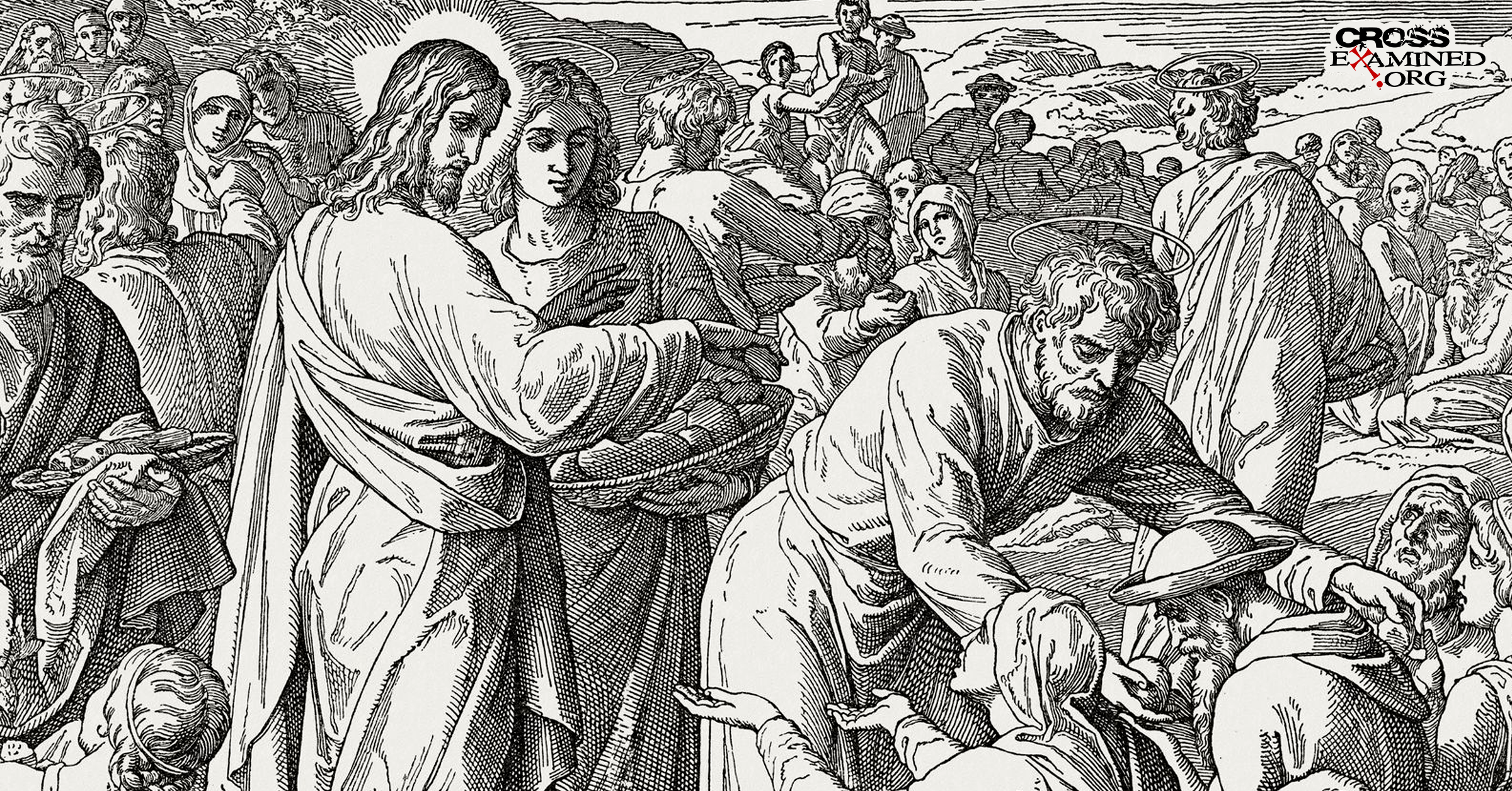
It is one of the most iconic incidents in Jesus’ life. We are all familiar with the famous story of Jesus miraculously feeding the five thousand from five loaves and two fish, with no fewer than twelve basketfuls of leftovers. The story is recounted by all four gospel writers: Matthew, Mark, Luke, and John. But just how historical is this story? In this article, I attempt to highlight several lines of evidence which, when taken as a cumulative whole, strongly suggest that these reports are rooted in a real historical event. I attempt to show this by virtue of appeal to undesigned coincidences, reconcilable variations, and other telltale markers of independence and verisimilitude. What I hope to demonstrate is that the feeding of the five thousand is the second-best attested New Testament miracle, after the resurrection of Jesus. For many of the insights that follow, I am indebted to my friend and colleague Dr. Lydia McGrew, both through her writing, and through her direction towards Christian authors from times past (such as Paley, Blunt, and Birks) who identified many of these hallmarks of verisimilitude in the gospel accounts.

Undesigned Coincidences Relating to the Feeding of the Five Thousand

An undesigned coincidence occurs when you have two or more accounts that casually interlock in a way that points to the truth of both. In its most classic form, one account of an event may raise a natural question that is answered incidentally and casually by the other. Much like a puzzle, it fits like a hand into a glove. This is not at all the type of pattern that one would expect to see in the event of some kind of conspiratorial manufacturing of the story. When taken as a cumulative argument — many instances considered collectively — one has a powerful argument for the overall general reliability and integrity of the gospel narratives. I will now offer a handful of examples pertaining to the feeding of the five thousand narratives.

The Role of Philip

In John 6:1-7, we are told:

Some time after this, Jesus crossed to the far shore of the Sea of Galilee (that is, the Sea of Tiberias), and a great crowd of people followed him because they saw the signs he had performed by healing the sick. Then Jesus went up on a mountainside and sat down with his disciples. The Jewish Passover Festival was near. When Jesus looked up and saw a great crowd coming toward him, he said to Philip, “Where shall we buy bread for these people to eat?” He asked this only to test him, for he already had in mind what he was going to do. Philip answered him, “It would take more than half a year’s wages to buy enough bread for each one to have a bite!”

Now, Philip is a fairly minor character in the New Testament. And one might, naturally, be inclined to wonder why Jesus hasn’t turned to someone a little higher in the pecking order (such as Peter or John). Perhaps even Judas Iscariot would have been a more suitable choice for this role in the account since John informs us elsewhere that he was responsible for the money bag (Jn 13:29).

A partial clue is provided in John 1:44: “Philip, like Andrew and Peter, was from the town of Bethsaida.” Likewise, John 12:21 refers to “Philip, who was from Bethsaida in Galilee.” What is so significant about Philip being from the town of Bethsaida? We don’t learn this until we read the parallel account in Luke’s gospel (9:10-17). At the opening of the account (verses 10-11), we are told,

“When the apostles returned, they reported to Jesus what they had done. Then he took them with him and they withdrew by themselves to a town called Bethsaida, but the crowds learned about it and followed him. He welcomed them and spoke to them about the kingdom of God, and healed those who needed healing.”

And so, we are informed by Luke (who does not mention Philip in this context at all) that the event was actually taking place in Bethsaida — the town from which Philip was from! Jesus thus turns to Philip, whom, he believed, would be familiar with the area. This also perhaps illuminates the involvement of Andrew (who was also from Bethsaida — Jn 1:44) in the reply. Andrew says to Jesus in John 6:9, “There is a boy here who has five barley loaves and two fish, but what are they for so many?” One may conjecture that Andrew, being from Bethsaida where this miracle took place, knew the boy, or perhaps Jesus had directed his question to Philip and Andrew, both of whom were locals.

The reason for Jesus addressing Philip in John 6:5 is never explicitly spelled out in the text. Instead, one has to do the detective work of piecing together the clues drawn from John 6:5; John 12:21 (and 1:44); and Luke 9:10-17. This is precisely the sort of casual connection between accounts that one might expect to see in historical reportage, though it is more surprising given the hypothesis of fictionalization.

The Green Grass, and the Coming and Going Crowds

Curiously, Mark’s narrative describes the people as sitting down in groups on “the green grass” (verse 39). This is significant, not because Mark mentions people sitting on the grass (Matthew 14:19 also records people sitting “down on the grass”, and Luke 9:15 reports that “everyone sat down”, and John 6:10 notes that “There was plenty of grass in that place, and they sat down.”). It is significant because Mark reports that the grass was “green”. This is particularly intriguing when one considers that, in Israel (particularly in Galilee) the grass is brown!

What makes this even more intriguing is that Mark’s gospel (6:30-42) also states, in verses 30-31 that,

The apostles gathered around Jesus and reported to him all they had done and taught. Then, because so many people were coming and going that they did not even have a chance to eat, he said to them, “Come with me by yourselves to a quiet place and get some rest.

Mark casually alludes to there being many people coming and going, indicating the hustle and bustle and general business of the area during this time. But why were there many coming and going? Mark does not tell us. In John’s account, however (6:4), we are told that “The Jewish Passover Festival was near.” This explains why many people were “coming and going.” Moreover, during the season of the Passover (i.e. in the springtime), there is a small window where the grass is indeed green in that area, due to elevated levels of rainfall. When this is coupled with the detail given to us by John that the Passover festival was at hand, this illuminates and makes sense of the casual (but surprising) statements in Mark that the grass was green and that people were coming and going.

Counting the Number of People

A question that arises when one reads the accounts of the feeding of the five thousand is how the evangelists knew the number of people. Matthew’s account emphasizes that this number specifically refers to men: “And those who ate were about five thousand men, besides women and children” (Mt 14:21). Mark 6:44, Luke 9:14, and John 6:10 also indicate that it was five thousand men who were fed (though the phrase “besides women and children” is unique to Matthew). But how was this number estimated? According to Mark 6:39-40, “Then he commanded them all to sit down in groups on the green grass. So they sat down in groups, by hundreds and by fifties.” Likewise, Luke 9:14-15 indicates that “he said to his disciples, ‘Have them sit down in groups of about fifty each.’ And they did so, and had them all sit down.’” Having the people organized into groups would have doubtless made it easier to distribute the food, and it would also provide a means of arriving at an estimate of their number.

How, though, were the evangelists able to determine that there were five thousand men specifically, besides women and children? John’s gospel, which omits mention of the organization of the people into groups, provides an important clue. In John 6:10-11, we are told, “Jesus said, ‘Have the people sit down.’ Now there was much grass in the place. So the men sat down, about five thousand in number. Jesus then took the loaves, and when he had given thanks, he distributed them to those who were seated. So also the fish, as much as they wanted.” Thus, like Mark and Luke, John informs us that Jesus told the disciples to have the people sit down in groups. However, John uniquely tells us that it was the men who in fact sat down. This, then, illuminates, in a casual and incidental way, how the number of men could be reliably estimated.

Denouncing the Unrepentant Cities

In Matthew 11:21, Jesus denounces the unrepentant cities, saying, “Woe to you, Chorazin! Woe to you, Bethsaida! For if the miracles that were performed in you had been performed in Tyre and Sidon, they would have repented long ago in sackcloth and ashes.” The reader is left wondering what miracles were performed in these cities. We are not told in Matthew’s gospel. It is only in light of Luke’s account of the feeding of the five thousand (chapter 9), in which we are told of the event’s occurrence in Bethsaida, that this statement begins to make sense. Although Matthew 14:13-21 does narrate the feeding of the five thousand, no mention is made of Bethsaida. Furthermore, Matthew, who often arranged his material thematically rather than chronologically, gives his account of the feeding of the five thousand some three chapters subsequent to the pronouncement of woe upon Bethsaida. Only by comparing the account in Luke do we discover that the feeding of the five thousand in fact transpired before the woes were pronounced by Jesus upon Bethsaida.

Strikingly, not only is Luke’s mention of Bethsaida as the location of the feeding found in a different context from the woes; it is found in an apparently unrelated context — that is, the pericope in which it occurs has absolutely nothing to do with the feeding of the five thousand. Jesus simply refers generally to the mighty deeds performed in Chorazin and Bethsaida. There is nothing in the immediate context to suggest that Jesus is making an allusion to the feeding of the five thousand. Indeed, the fact that Matthew contains no information about any miracle performed in Chorazin undermines the idea that the reason Luke mentions Bethsaida as the setting of the feeding of the five thousand miracle is to fill in the missing information in relation to Jesus’ statement in Matthew 11:21.

The Messianic Secret

Throughout the synoptic accounts, Jesus often sternly warns people not to publicly disclose His identity. In scholarly circles, this is known as the “messianic secret.” We also see Jesus frequently seeking to avoid large crowds. Those features of Jesus’ behavior are illuminated by John 6:15, which immediately follows the account of the feeding of the five thousand, in which we read, “Perceiving then that they were about to come and take him by force to make him king, Jesus withdrew again to the mountain by himself.” Given the popular Messianic expectation of an individual who would overthrow the Roman occupiers and re-establish a Davidic reign, Jesus naturally feared that public disclosure of His Messianic identity would result in misunderstandings and attempts by the crowds to make Him King by force. Thus, John 6:15 explains the Messianic secret in the Synoptics.

Eating Jesus’ Flesh and Drinking His Blood?

Another coincidence pertains to Jesus’ statements, prompted by the episode of the feeding of the five thousand, in John 6:51-58:

I am the living bread that came down from heaven. If anyone eats of this bread, he will live forever. And the bread that I will give for the life of the world is my flesh […] Truly, truly, I say to you, unless you eat the flesh of the Son of Man and drink his blood, you have no life in you. Whoever feeds on my flesh and drinks my blood has eternal life, and I will raise him up on the last day. For my flesh is true food, and my blood is true drink. Whoever feeds on my flesh and drinks my blood abides in me, and I in him. As the living Father sent me, and I live because of the Father, so whoever feeds on me, he also will live because of me. This is the bread that came down from heaven, not like the bread the fathers ate, and died. Whoever feeds on this bread will live forever.

These words of Jesus, in my judgment, are especially likely to be authentic for at least three different reasons. First, particularly given the Jewish context (recall that the fourth gospel, in which these sayings uniquely are found, was evidently authored by a Jew), this is an exceedingly unlikely thing for the author to make up out of whole cloth. In fact, many of Jesus’ followers, in verse 60, said “This is a hard saying; who can listen to it?” Verse 66 further indicates that “After this many of his disciples turned back and no longer walked with him.” Second, Jesus’ allusion to the loaves that the crowd had eaten (see verse 26), as the basis of his teaching is in keeping with Jesus’ consistent habit across all four gospels (and across diverse episodes) of drawing lessons from his surroundings and from the occasion (this is an instance of what I call “artless similarities”, which I have discussed in more detail in this article). Third, these sayings are supported by an undesigned coincidence. Jesus’ language in this passage (which is found only in John, and not in the Synoptics) is strikingly similar to His institution of the Lord’s supper (which is found in all three of the Synoptics, but not in John). Here are the words of institution, as given by Luke 22:19-20: “This is my body, which is given for you. Do this in remembrance of me…This cup that is poured out for you is the new covenant in my blood.” Lydia McGrew suggests that[1],

Jesus was speaking of the Lord’s supper in John 6, not in the sense that the crowds were expected to understand this at that time by his teaching, but in the sense that he was alluding cryptically to something that he would make clearer later to those who continued to follow him. This sort of veiled allusion would hardly be uncharacteristic of Jesus’ teaching as we find it elsewhere. For example, his words to Nicodemus about the Holy Spirit in John 3 would not have been clear to Nicodemus at the time but would have become much clearer in the light of Pentecost. The statement, “Destroy this Temple, and in three days I will raise it up” recorded in John 2:19 is glossed by John in hindsight, as referring to the resurrection, but Jesus himself apparently did not explain it at the time.

It is important to remember that the institution of the Lord’s supper is mentioned only in the Synoptics, and Jesus’ strange statements about eating His flesh and drinking His blood is found only in John. McGrew concludes that “he spoke this way in John 6 in anticipation of instituting the Lord’s Supper at the end of his ministry, expecting his followers to put it all together later if they persevered in discipleship (as contrasted with those who fell away in John 6.66-67).”[2]

Other Markers of Verisimilitude

John James Blunt notes the consistent distinction that is maintained between the number and kinds of leftover baskets that were collected in the two events[3]:

[T]here was, no doubt, a marked difference between these two vessels, whatever that difference might be, for κόφινος is invariably used when the miracle of the five thousand is spoken of; and σπυρίς is invariably used when the miracle of the four thousand is spoken of. Moreover, such distinction is clearly suggested to us in Matt. xvi. 9, 10, where our Savior cautions his disciples against the “leaven of the Pharisees and Sadducees” and in so doing, alludes to each of these miracles thus: “Do ye not understand, neither remember the five loaves of the five thousand, and how many baskets (κοφίνους) ye took up? Neither the seven loaves of the four thousand, and how many baskets (σπυρίδας) ye took up?” though here, again, the distinction is entirely lose in our translation, both [words] being still rendered “basket” alike.

This distinction between the words used for “basket” (κόφινος vs. σπυρίς) is also maintained in the parallel account of Jesus’ rebuke in Mark 8:19-20.

Blunt concludes[4],

[S]uch uniformity mark[s] very clearly the two miracles to be distinctly impressed on the minds of the Evangelists, as real events; the circumstantial peculiarities of each present to them, even to the shape of the baskets, as though they were themselves actual eyewitnesses; or at least had received their report from those who were so. It is next impossible that such coincidence in both cases, between the fragments and the receptacles, respectively, should have been preserved by chance; or by a teller of a tale at third or fourth hand; and accordingly we see that the coincidence is in fact entirely lost by our translators, who were not witnesses of the miracles; and whose attention did not happen to be drawn to the point.

Interestingly, the same word for basket that is used for the feeding of the four thousand (σπυρίς) is also used of the basket used to lower Saul over the wall in Damascus (Acts 9:25). This suggests that these baskets were quite large, which explains why there were fewer leftover baskets collected for this event (seven compared to the twelve baskets collected after the feeding of the five thousand).

Reconcilable Variations

Another category of evidence bearing on the case for the resurrection is the phenomenon of reconcilable variations, so-named by the nineteenth-century Anglican scholar Thomas Rawson Birks.[5] A reconcilable variation refers to when there exist two accounts of the same event or at least two accounts that appear to cross over the same territory at some point, and at first blush, they seem so divergent that it is almost awkward; but then, on further thought, they turn out to be reconcilable in some natural fashion after all. When two accounts appear at first so divergent that one is not sure they can be reconciled, that is significant evidence for their independence. When they turn out, upon closer inspection or upon learning more information, to be reconcilable without forcing, after all, one has almost certainly independent accounts that dovetail. A few examples pertain to the feeding of the five thousand accounts.

Is Mark Confused About the Location?

According to Luke 9:10, the event of the feeding of the five thousand took place in Bethsaida. However, according to Mark 6:45, following the feeding of the five thousand miracle, Mark tells us,

Immediately he made his disciples get into the boat and go before him to the other side, to Bethsaida, while he dismissed the crowd.

This presents an apparent discrepancy. If Jesus and the disciples were already in Bethsaida, why does he tell his disciples to get into the boat and go to the other side of the lake, to Bethsaida? At first blush, this certainly seems to be a clear-cut instance of a contradiction between the accounts. The first thing to note is that we have independent confirmation that the event occurred in a deserted area near Bethsaida, based on two of the undesigned coincidences noted above. Thus, there are good historical grounds for believing that the event in fact took place in Bethsaida.

There is yet further confirmation of the location of the miracle as being somewhere “across the top” of the Sea of Galilee from Capernaum. It is Mark himself who says that they didn’t even have leisure to eat before the feeding, because there were “many coming and going” (Mark 6:31), and that they got into the boat to get away from the crowds. That fits well with their being in the region of Capernaum prior to going away. There is still a further undesigned coincidence involved there which connects Mark and John, also discussed above. It was just before the Passover (John 6:4), and there would have been crowds coming through Capernaum, travelling down to Jerusalem. Thus, the picture is well-explained by their going from the Capernaum region (on the top west coat of the Sea of Galilee) across the top of the region around Bethsaida, and then, when they returned “to the other side”, returned to the northwest side. In fact, Mark explicitly says that they landed at Gennesaret when they had crossed over (Mark 6:53)! Thus, this actually, far from contradicting, confirms the idea of which direction they were going. If they were really crossing over “to Bethsaida” as if to land at or near Bethsaida, they couldn’t have landed at Gennesaret! Thus, πρὸς Βηθσαϊδάν, even within Mark itself, cannot be taken to mean that the feeding of the five thousand occurred in a radically different location from the region of Bethsaida named explicitly in Luke and otherwise confirmed by undesigned coincidences. Therefore, there is good reason to believe that the feeding of the five thousand miracle took place in Bethsaida.

This still leaves unanswered the question of what Mark means in 6:45. The Greek text says that the disciples were to enter into the boat and προάγειν εἰς τὸ πέραν πρὸς Βηθσαϊδάν. Lydia McGrew argues that the Greek preposition πρὸς can mean “over against” (or “across from”).[6] However, I am at this point unpersuaded by this translation. While one of the possible meanings of πρὸς is “against” (e.g. Mt 4:6; Mk 12:12; Lk 4:11; 20:19; Acts 6:1; 9:29; 19:38; 23:30; 24:19; 26:14), I have been unable to find any instances, in either the New Testament or the Greek Septuagint, where the preposition unequivocally means geographically “opposite to”, as would be required by McGrew’s interpretation.

Another possibility is that, in going over to the other side (to the Capernaum side) they were going to pass Bethsaida — that is, that the actual location of the feeding was slightly to the east of Bethsaida itself (recall that the event actually took place at a desolate area, in proximity to Bethsaida — Mt 14:13; Mk 6:32; Lk 9:12). Indeed, the stated location of Bethsaida, I would argue, is being used in a regional sense (in the same way that I might say I live in Boston even though technically I live in a suburb of Boston). Hence, when they left in Mark to go to the other side, they could have been going “toward” Bethsaida, which would be a legitimate understanding of the preposition πρὸς.

A yet further option, though incompatible with inerrancy (see my article here for those who are concerned about this), is that Mark’s source, quite plausibly the apostle Peter, misspoke a single word when reporting the event. This is not antecedently implausible. Misspeaking a single word on occasion is something that anyone experienced in public speaking is all too familiar with.

Whatever the actual explanation, this apparent discrepancy points to the literary independence of Mark and Luke.

Mark Goodacre has put forward a theory of “editorial fatigue” in the gospels.[7] Goodacre argues that editorial fatigue is “a phenomenon that will inevitably occur when a writer is heavily dependent on another’s work. In telling the same story as his predecessor, a writer makes changes in the early stages which he is unable to sustain throughout.” [3] Goodacre claims that the best example of this phenomenon pertains to the feeding of the five thousand accounts. He cites Mark 6:35-36 and the parallel in Luke 9:12.

  • Mark 6:35-36: And when it grew late, his disciples came to him and said, “This is a desolate place, and the hour is now late. Send them away to go into the surrounding countryside and villages and buy themselves something to eat.”
  • Luke 9:12: Now the day began to wear away, and the twelve came and said to him, “Send the crowd away to go into the surrounding villages and countryside to find lodging and get provisions, for we are here in a desolate place.”

Goodacre comments,

The adjective used by both Mark and Luke is ερημος, lonely, desolate, abandoned. Clearly it is nonsense to say ‘we are here in a desolate place’ when in the Lucan setting they are not. After all, if the crowd were in a city, they would not need to go to the surrounding villages and countryside to find food and lodging. Further, since in Bethsaida food and lodging ought to be close to hand, Luke’s comment that the day was drawing to a close lacks any relevance and, consequently, the feeding lacks the immediate motive that it has in Mark. In short, by relocating the Feeding of the Five Thousand, without being able to sustain the new setting with its fresh implications throughout, Luke has spoilt the story.

This argument, in my opinion, is exceedingly weak. Goodacre has succeeded in creating a problem where there isn’t one. The disciples’ statement concerning the surrounding places where the people could go to purchase food indicates that the “desolate place” was not far from those surrounding villages and countryside. As stated previously, the stated location of Bethsaida is being used in a regional sense. This is the most natural way of reading Luke’s account. Furthermore, Matthew — which most scholars agree was independent of Luke, though utilizing at times common source material — also indicates that they were in a desolate place (Mt 14:13,15). Furthermore, there is also the independent evidence, discussed above, that the location of the feeding of the five thousand as indicated by Luke is correct.

Where did Jesus first see the crowd?

In Mark’s account, the narrative concerning the feeding of the five thousand begins with the disciples returning from a preaching ministry to tell Jesus “all that they had done and taught” (Mk 6:30). Given the business of the place, Jesus told the disciples to “Come away by yourselves to a desolate place and rest a while.” (v. 31). However, “many saw them going and recognized them, and they ran there on food from all the towns and got there ahead of them,” (v. 33). That the people were able to run on ahead of Jesus on foot and arrive before him fits well with the size of the Sea of Galilee, which is only seven miles wide at its widest point. The people came and met Jesus as he was getting out of the boat. Mark tells us that “When he went ashore he saw a great crowd” (v. 34).

Compare this with the account in John 6. John doesn’t mention the disciples’ preaching ministry and their coming to report to Jesus what they had done and taught. Nor does John report Jesus’ instruction to “come away by yourselves to a desolate place and rest a while.” However, John does indicate that Jesus went to the other side of the Sea of Galilee, which John calls by its other name, the Sea of Tiberius (v. 1). According to John, there was a large crowd following Jesus “because they saw the signs that he was doing on the sick” (v. 2). Jesus went up on a mountain and lifted up his eyes and saw the crowd coming toward Him (v. 5). If one were to only read John’s account, one would get the impression that Jesus had gone up to the mountainside with His disciples, and it was only then that He saw the crowd that had been following Him. Note that all four gospels mention the mountain in this region (Mt 14:23; Mk 6:46; Lk 9:28; Jn 6:3). Mark, speaking of the crowd that had followed Jesus, says that Jesus “had compassion on them, because they were like sheep without a shepherd. And he began to teach them many things” (Mk 6:34). In Matthew’s account, we read that “he had compassion on them and healed their sick” (Mt 14:14). In Luke, it mentions both that Jesus “spoke to them of the kingdom of God” and that he “cured those who had need of healing” (Lk 6:11). Thus, we are to picture Jesus having been with the crowd for some time prior to the feeding event. In the synoptics, we are told that when it was getting late, they discussed where to find food for the crowd of people. John, however, does not mention the earlier part of the day. It seems, then, that the crowds converged on him while He had slipped away with His disciples. John’s emphasis, though, is on the feeding through the miraculous multiplication of loaves and fish. The fact that these accounts, which appear upon first blush to contradict one another, fit together so casually reveals the independence of the accounts.

Did Jesus go up the mountain before or after the disciples left in a boat?

A final apparent discrepancy concerns the question of whether Jesus went up into the mountain to escape the crowds and pray following the feeding of the five thousand before or after the disciples left in a boat. John 6:15-16 implies that it was before the disciples left in a boat, whereas Mark 6:45 says that “he made his disciples get into the boat and go before him to the other side, toward Bethsaida, while he dismissed the crowd.” The synoptics, however, do not state that Jesus escorted the disciples down to the boat and then went up the mountain. Rather, the gospels simply report that Jesus instructed them to get into the boat and go over to the other side. The instruction could have been given some distance from the shoreline. Indeed, it plausibly could have taken them some time to winnow their way through the crowd and reach the shoreline. Perhaps they could even hear Jesus dismissing the crowds, or Jesus could have informed them of His intentions.

John’s record of events does not in fact conflict with what we read in Mark, if one reads these events as occurring in a somewhat intertwined manner. It is quite conceivable that John’s mind was following the course of Jesus’ actions, and is picturing, as it got dark, the disciples approaching the shore and getting into the boat. That, however, does not entail that Jesus in fact went up the mountain first. Mark (or his source, plausibly Peter), on the other hand, may be thinking of the urgency of Jesus sending them away. If this is the case, then it is not particularly surprising to find the evangelists describing the events in a slightly different order.

Again, this is precisely what one might expect of independent eyewitness accounts.

Other Marks of Independence

In addition to the foregoing, there are also various other marks of independence. Only John mentions the boy, and that they were barley loaves (Jn 6:9), which fits with the time of year, being near the Passover. Only John mentions that it was Andrew who brought the boy forward (Jn 6:8). Only John mentions the other name of the Sea of Galilee (the Sea of Tiberius), a name that we can confirm from other sources (Jn 6:1). Only John records how far the disciples had rowed when they saw Jesus coming towards him, which is given as an imprecise measurement of twenty-five or thirty stadia, or about three or four miles (Jn 6:19). Matthew and Luke both mention that Jesus healed people (Mt 14:14; Lk 6:11), a detail not supplied by Mark. Only Mark mentions that the disciples landed at Gennesaret (Mk 6:53). This fits with the account in John, which says that they set off for Capernaum (Jn 6:17). One could even view this connection as an undesigned coincidence between Mark and John. Matthew alone mentions that the reason for Jesus leaving with His disciples was that Jesus heard about the death of John the Baptist (Mt 14:13). This is at variance, though compatible, with the statement in Mark 6:31 that it was to get away from the crowds that Jesus instructed the disciples to retreat to a desolate area. The disciples, who witnessed the event, would have been able to draw their own conclusions about what had triggered Jesus’ desire to leave for a desolate place. Finally, only Matthew includes the account of Peter’s request that Jesus ask him to walk toward Him on the water (Mt 14:28-31). This reflects Peter’s impulsive nature, a character trait that is consistent across all four gospels and across diverse episodes (see my article on artless similarities for further discussion of the evidential significance of this).

Conclusion

To conclude, I would argue that the feeding of the five thousand event is the second best attested New Testament miracle after the resurrection. This is, in part, because it is attested in all four gospels and the parallel texts show numerous indicators of independence and verisimilitude, including undesigned coincidences and reconcilable variations. Cumulatively, these indicators strongly suggest that the accounts of the feeding of the five thousand are grounded in a genuine historical event in the ministry of Jesus and contribute to the case for the gospels’ overall reliability.

Footnotes

[1] Lydia McGrew, Hidden in Plain View: Undesigned Coincidences in the Gospels and Acts (Tampa, FL: Deward Publishing Company, Ltd, 2017), 42.

[2] Ibid., 43.

[3] John James Blunt, Undesigned Coincidences in the Writings Both of the Old and New Testament: An Argument of Their Veracity (London: John Murray, 1863), 264.

[4] Ibid., 265.

[5] Thomas Rawson Birks, Horae Evangelicae, or The Internal Evidence of the Gospel History (London: Seeleys, 1852). See also Lydia McGrew, The Mirror or the Mask: Liberating the Gospels from Literary Devices (Tampa, FL: Deward Publishing Company, Ltd, 2019), 316–321.

[6] Lydia McGrew, Hidden in Plain View: Undesigned Coincidences in the Gospels and Acts (Tampa, FL: Deward Publishing Company, Ltd, 2017), 22.

[7] Mark Goodacre, “Fatigue in the Synoptics,” New Testament Studies 44 (1998), 45-58.

Recommended resources related to the topic:

Miracles: The Evidence by Frank Turek DVD and Mp4

Two Miracles You Take With You Everywhere You Go by Frank Turek DVD, Mp3 and Mp4


__________________________________________________________________________________________________________________________________________________

Dr. Jonathan McLatchie is a Christian writer, international speaker, and debater. He holds a Bachelor’s degree (with Honors) in forensic biology, a Masters’s (M.Res) degree in evolutionary biology, a second Master’s degree in medical and molecular bioscience, and a Ph.D. in evolutionary biology. Currently, he is an assistant professor of biology at Sattler College in Boston, Massachusetts. Dr. McLatchie is a contributor to various apologetics websites and is the founder of the Apologetics Academy (Apologetics-Academy.org), a ministry that seeks to equip and train Christians to persuasively defend the faith through regular online webinars, as well as assist Christians who are wrestling with doubts. Dr. McLatchie has participated in more than thirty moderated debates around the world with representatives of atheism, Islam, and other alternative worldview perspectives. He has spoken internationally in Europe, North America, and South Africa promoting an intelligent, reflective, and evidence-based Christian faith.

Original Blog Source: https://cutt.ly/RmXCRdC

 

By Brian Chilton

One of the most fascinating historical aspects of Jesus’s resurrection is the transformation it brought to individuals who claimed to have experienced the risen Jesus. Interestingly, these experiences occurred so early that Richard Bauckham contends that the “earliest Christology was already in nuce the highest Christology. All that remained was to work through consistently what it could mean for Jesus to belong integrally to the unique identity of the one God.”[1] Of the minimal facts accepted, Gary Habermas notes that the four “core” facts accepted about Jesus consist of Jesus’s death by crucifixion, the experiences the disciples had which led them to believe that Jesus had risen from the dead, the transformation of the disciples, and the conversion of Paul.[2] Thus, the transformation of the disciples occurred early in the history of the church and, thereby, holds tremendous value for the historical researcher. These experiences profoundly impacted the disciples’ theology—accepting that Jesus was now exalted to a “position of heavenly glory”[3]—and even emboldened them to the point that they were willing to die for what they knew to be true. The resurrection appearances of Jesus profoundly affected four men which will be the focus of this article.

Transformation of the Troubled Peter

While Peter was excited to see the risen Jesus to the point that he willingly jumped out of a boat and swam to shore just to see Jesus (John 21:7), he was dealing with his own inner turmoil. In the courtyard during Jesus’s trial, Peter had denied that he had known Jesus three times to a woman who served as the high priest’s maid (John 18:25-27). Jesus had already prognosticated Peter’s denial beforehand which led Peter to a time of great despair and agony (Luke 22:61). Peter must have thought that Jesus would never use him again for ministry. Why would Jesus ever trust him again? However, multiple pieces of evidence suggest that Jesus appeared to Peter privately (Mark 16:7; Luke 24:12; and 1 Cor. 15:5). Yet the story of Peter’s ministerial transformation comes from an encounter he had with the risen Jesus on the shores of the Sea of Galilee. While eating breakfast by a fire on the seashore, Jesus asked Peter three times if he loved him (John 21:15-19). Peter acknowledged that he did. The risen Jesus reinstated Peter back into the ministry. After his encounter with Jesus on the coast—the third time that Jesus had met exclusively with the disciples after his resurrection—Peter never again denied that he knew Jesus. Rather, he boldly proclaimed Jesus up until the time that he died for Christ. Church tradition holds that he was crucified upside down at Rome in c. AD 64 because he did not feel worthy to die in the same manner as Jesus. This was documented by historian Eusebius of Caesarea[4] and Origen of Alexandria.

Transformation of the Skeptical Thomas

Thomas had followed Jesus from the very beginning of Jesus’s ministry. Oddly, he was not found with the disciples when Jesus first appeared to them (John 20:24-25). Where was Thomas when Jesus first appeared to the disciples? Had he given up on the ministry? Did he seek to reopen his old business, whatever that may have been? No one could not blame Thomas as he had just witnessed his leader crucified to a tree. His investment in Jesus died when Jesus’s corpse was placed in a tomb—or so he thought. Regardless of his activities, he doubted the validity of the disciples’ claim that Jesus had risen from the dead. Again, no one could blame Thomas for his skepticism. While different Jewish sects held divergent opinions concerning the Messiah, none of them anticipated that the Messiah would rise from the dead before the end of time. Additionally, dead people do not normally rise from the dead. Thomas was justified in his disbelief. However, everything changed when Thomas encountered the risen Jesus. Jesus challenged Thomas to place his fingers in the nail prints of his hands and to thrust his hand into Jesus’s side (John 20:27-29). Then, Jesus challenged Thomas by saying, “Because you have seen me, you have believed. Blessed are those who have not seen and yet believe” (John 20:29).

Thomas did not remain “doubting Thomas.” Rather, he became “believing Thomas.” According to tradition and the apocryphal Acts of Thomas, the church cast lots to see which part of the world each disciple would serve. Thomas’s lot would lead him to India. The disciple would encounter the kings of the region and would not have the best relationship with them. The wife of King Misdaeus converted to Christianity to the king’s disdain. The king’s wife disobeyed him and instead followed apostolic Christianity which enraged the king. Eventually, the king ordered Thomas’s execution in Madras, India. While not all the information about Thomas’s ministry in India can be verified, it does appear that there are good reasons to believe that Thomas died in some manner for his faith while in India.[5]

Transformation of the Envious James

“Envious James” is used for this section, but it is merely one possibility to describe why James did not believe in Jesus during his earthly ministry. The Gospels note that the brothers and sisters of Jesus did not initially believe in him (John 7:5). However, James later had a change of heart to the point that he served as the pastor of the Jerusalem Church. What happened? The 1 Corinthians 15 creed lists James as one of those who witnessed the risen Jesus. James’s life was radically transformed because of the resurrection. The Jewish historian Josephus records the later martyrdom of James the brother of Jesus. He writes,

“Festus was now dead, and Albinus was but upon the road; so he assembled the Sanhedrin of judges, and brought before them the brother of Jesus, who was called Christ, whose name was James, and some others … and when he had formed an accusation against them as breakers of the law, he delivered them to be stoned.”[6]

Like Peter and Thomas, the resurrection transformed James to the point that he was willing to give his life for the Jesus that he previously spurned. The resurrection changed James’s negative connotations about Jesus into worship. Quite an extraordinary thing, don’t you think?

Transformation of the Adversary Paul

Paul’s transformation is the most popular of the four. Paul, otherwise known as Saul, was a persecutor of the church. He was a Pharisee of Pharisees, a disciple of the famed Gamaliel (Acts 22:3), and on track to become a member of the Sanhedrin. Yet Paul was dramatically changed on a road trip to Damascus. Paul had hoped to imprison or even murder the disciples of Jesus (Acts 9:1). He had written permission by the Jewish authorities to imprison any disciple of Jesus in Damascus and bring them back to Jerusalem for trial (Acts 9:2). As Paul made his march to Damascus, the risen Jesus appeared to Paul in a dazzling array of power. The risen Jesus inquired, “Saul, Saul, why are you persecuting me?” (Acts 9:4). Jesus identified himself and instructed Paul to go into the city. From that moment, Paul became a disciple of Christ. The disciples were not overly keen on the idea of accepting Paul into their fold. They thought that Paul was staging a sabotage. But as the risen Jesus told Ananias, “This man is my chosen instrument to take my name to the Gentiles, kings, and Israelites” (Acts 9:15).

Paul would suffer for the cause of Christ as he endured many hardships throughout his lifetime. Nonetheless, he endured until the very end. Tradition holds that Paul was beheaded in Rome around the same time that Peter died by crucifixion. This is verified by Tertullian, implying that Paul was considered a martyr by the end of the second century at least in northern Africa.[7] In his seminal work, McDowell lists Paul’s death as “the highest possible probability”[8] and that the beheading of Paul is “more probable than not.”[9]

Conclusion

From the four individuals listed, it is evident that the resurrection of Jesus brought about a major transformation in the lives of those who encountered the risen Jesus. Furthermore, the loving compassion of Jesus is shown by the way he forgave Peter of his past indiscretions, his willingness to provide evidence to the skeptic, his willingness to bring in even those of his family who had hurt him in the past, and the powerful means by which he accepted even the repentance of his former enemies. The risen Jesus continues to transform lives even today. Only eternity will tell how many souls have been transformed by this mysterious, powerful, and loving Savior who continues to seek and save the lost.

Notes

[1] Richard Bauckham, Jesus and the God of Israel: God Crucified and Other Studies on the New Testament’s Christology of Divine Identity (Grand Rapids, MI: Eerdmans, 2009), 235.

[2] Gary R. Habermas, The Historical Jesus: Ancient Evidence for the Life of Christ (Joplin, MO: College Press, 1996), 162.

[3] Larry W. Hurtado, One God, One Lord: Early Christian Devotion and Ancient Jewish Monotheism, 3rd ed (London, UK: Bloomsbury, 2015), 93.

[4] Eusebius of Caesarea, Ecclesiastical History 5.3.1.

[5] Despite the difficulties surrounding the Thomas martyrdom tradition, McDowell argues that the martyrdom of Thomas is “more probable than not.” Sean McDowell, Fate of the Apostles: Examining the Martyrdom Accounts of the Closest Followers of Jesus (London, UK: Routledge, 2008), 173.

[6] Josephus, Antiquities of the Jews 20.200-203.

[7] Tertullian, The Prescription Against Heretics 36.

[8] McDowell, The Fate of the Apostles, 113.

[9] Ibid., 114.

Recommended resources related to the topic:

Early Evidence for the Resurrection by Dr. Gary Habermas (DVD), (Mp3) and (Mp4)

Cold Case Resurrection Set by J. Warner Wallace (books)

Jesus, You and the Essentials of Christianity by Frank Turek (INSTRUCTOR Study Guide), (STUDENT Study Guide), and (DVD)      

The Footsteps of the Apostle Paul (mp4 Download), (DVD) by Dr. Frank Turek 


__________________________________________________________________________________________________________________________________________________

Brian G. Chilton is the founder of BellatorChristi.com, the host of The Bellator Christi Podcast, the author of the Layman’s Manual on Christian Apologetics, and a Ph.D. Candidate of the Theology and Apologetics program at Liberty University. He received his Master of Divinity in Theology from Liberty University (with high distinction); his Bachelor of Science in Religious Studies and Philosophy from Gardner-Webb University (with honors); and received certification in Christian Apologetics from Biola University. Brian is enrolled in the Ph.D. program in Theology and Apologetics at Liberty University and is a member of the Evangelical Theological Society and the Evangelical Philosophical Society. Brian has served in pastoral ministry for nearly 20 years. He currently serves as a clinical chaplain.

Original Blog Source: https://cutt.ly/mmfnj9C


By Alisa Childers

​”Do you understand what you’re reading?

This simple question is credited with carrying Christianity into Ethiopia. (1) Acts chapter 8 tells of Philip being led to the desert by an angel to meet an officer from the court of the Queen of Ethiopia. Philip finds him reading an Isaiah scroll containing prophecies about the Messiah. At this point, Philip could have walked up and boldly declared, “I have been sent to you today to proclaim the good news of Jesus the Messiah!” But he didn’t. He met this man right where he was at and asked a good question, which then led to an explanation of the gospel. This is apologetics at its best.

Apologetics is sometimes called “pre-evangelism” because it can help clear intellectual obstacles in the way of faith. The command to do apologetics is found in 1 Peter 3:15 which tells us to always be “prepared to make a defense to anyone who asks you for a reason for the hope that is in you.” The Greek word translated as “defense” is apologia, which is where we get our English word, “apologetics.” In the book of Acts, when the apostles did evangelism, they did apologetics.

They were constantly defending their faith—to religious leaders, political officers, secular philosophers, and average citizens. Here are 3 ways they used apologetics to defend their faith:

1. They defended the gospel, not themselves.

The apostles were no strangers to trials, councils, and prisons. In Acts 4, Peter and John were brought before the Jerusalem high council and were challenged to defend their right to preach the resurrection of Jesus. Peter wasn’t even one sentence into his defense when he began to proclaim the gospel. He didn’t spend his energy trying to clear his name, or avoid prison time—he preached the resurrection of Jesus to the very council that was questioning him.

This example was also followed by the martyr Stephen in chapters 6-7. Stephen was a Jewish Christian who was brought before the council and accused of blasphemy against Moses and God. In his famous speech, he addressed the council by recounting the history of the Jews, pointing out that God’s true prophets have always been rejected. He also stressed that God’s presence isn’t confined to one specific geographical area or temple.  On one level, Stephen answered the charges of blasphemy. But even more, he opened the door theologically for the church’s worldwide mission. It was a brilliant defense of the gospel. New Testament scholar F.F. Bruce commented on Stephen’s famous “defense”:

It is obviously not a speech for the defense in the forensic sense of the term. [It is] by no means calculated to secure an acquittal before the Sanhedrin. It is rather a defense of pure Christianity as God’s appointed way of worship. (2)

The great preacher Charles Spurgeon said this of Stephen:

We see him defending the faith against a synagogue of subtle philosophical deniers of the truth. Stephen the deacon became Stephen the preacher….he had a higher promotion yet—when he had thus become Stephen the wise apologist. (3)

When our faith is under fire, it can be tempting to become defensive. But we would be wise to follow the example of the apostles and defend the gospel, not ourselves.

2. They shared eyewitness evidence of Jesus’ resurrection, not their personal testimonies.

The personal testimonies of the apostles certainly intersected the eyewitness accounts of Jesus’ resurrection because they were the eyewitnesses. But their message was focused on Jesus, not themselves. In other words, when they shared the gospel, they didn’t talk about what Jesus did for them personally and then simply invite others to have a personal relationship with Him. They testified to the fact that He was crucified, buried, and resurrected, offering salvation to all who would repent and put their faith in Jesus the Messiah. This theme is consistent throughout the book of Acts.

Personal testimony can be a great way to build a relationship, but our testimonies should always point to something greater—the good news of the death and resurrection of Jesus.

3. They knew Scripture but sometimes didn’t use it right away.

The first Christians were Jews who were steeped in the Old Testament Scriptures. When Paul was converted in chapter 9, he immediately began preaching to the Jews in Damascus, “proving that Jesus was the Christ.” In chapter 13, he spoke in the synagogue in Antioch, referring to the Old Testament Scriptures to show the Jews that Jesus was the expected Messiah. In chapter 17, he went into the synagogue in Thessalonica and “reasoned with them from the Scriptures.”

Later in the same chapter, Paul was in Athens conversing with Epicurean and Stoic philosophers. These philosophers wouldn’t have accepted the Jewish Old Testament as authoritative, so Paul used a different tactic to get to the gospel. Rather than appeal to the Scriptures, he mentioned their own religious altar with the inscription, “To the unknown god.” He then proceeded to introduce them to the God they didn’t yet know, even quoting their own respected philosophical thinkers.  He used this as a tactic to testify to the resurrection of Jesus.

This does not mean that the Scriptures were unimportant or ignored. It just means that sometimes we need to meet people where they are at and start from there.

Conclusion:

The apostles used apologetics creatively, adapting their method to the situation they were in. The common theme among these three methods is that the gospel was always the main point.  The apostles kept the focus of their evangelism on the resurrection of Jesus and the hope of saving faith in Him—and we should too!

Recommended resources related to the topic:

I Don’t Have Enough Faith to Be an Atheist (Paperback), and (Sermon) by Norman Geisler and Frank Turek 

Stealing From God by Dr. Frank Turek (Book, 10-Part DVD Set, STUDENT Study Guide, TEACHER Study Guide)

Tactics: A Game Plan for Discussing Your Christian Convictions by Greg Koukl (Book)

Defending the Faith on Campus by Frank Turek (DVD Set, mp4 Download set, and Complete Package)

So the Next Generation will Know by J. Warner Wallace (Book and Participant’s Guide)

Fearless Faith by Mike Adams, Frank Turek, and J. Warner Wallace (Complete DVD Series)


__________________________________________________________________________________________________________________________________________________

Alisa Childers is an American singer and songwriter, best known for being in the all-female Christian music group ZOEgirl. She has had a string of top ten radio singles, four studio releases, and received the Dove Award during her time with ZOEgirl. In later years, Alisa found her life-long faith deeply challenged when she started attending what would later identify as a Progressive Christian church. This challenge pushed Alisa toward Christian Apologetics. Today you can read, listen and watch Alisa’s work online as well as purchase her recently published book on Progressive Christianity titled Another Gospel.

Original Blog Source: https://cutt.ly/fmwkNU8


By Wintery Knight

Dennis Prager features a lot of discussions about male-female relationships on his show, particularly during the male-female hour. I think this is one of the parts of his show that I really like best because he knows what he is talking about.

He did a two-part series a while back on 1) male sexuality and 2) what women should do about it within a marriage.

Part 1 is here.

Excerpt:

It is an axiom of contemporary marital life that if a wife is not in the mood, she need not have sex with her husband. Here are some arguments why a woman who loves her husband might want to rethink this axiom.

First, women need to recognize how a man understands a wife’s refusal to have sex with him: A husband knows that his wife loves him first and foremost by her willingness to give her body to him. This is rarely the case for women. Few women know their husband loves them because he gives her his body (the idea sounds almost funny). This is, therefore, usually a revelation to a woman. Many women think men’s natures are similar to theirs, and this is so different from a woman’s nature, that few women know this about men unless told about it.

This is a major reason many husbands clam up. A man whose wife frequently denies him sex will first be hurt, then sad, then angry, then quiet. And most men will never tell their wives why they have become quiet and distant. They are afraid to tell their wives. They are often made to feel ashamed of their male sexual nature, and they are humiliated (indeed emasculated) by feeling that they are reduced to having to beg for sex.

When first told this about men, women generally react in one or more of five ways…

He then explains the 5 ways that women respond to this.

Here’s one:

  1. You have to be kidding. That certainly isn’t my way of knowing if he loves me. There have to be deeper ways than sex for me to show my husband that I love him.

And this is the common mistake that some feminist women make because they think that men are just hairy women with no feelings and desires of their own that are distincly theirs. In the past, all women understood how men are different than women, but today almost no younger feminist women do. In fact, many younger women today struggle with the idea that there is anything different about men that they need to learn. The only thing that they need to know is what makes women happy, and that it is everyone else’s job to make women happy so that women can then behave nicely (whatever that means). Younger feminist women today often think that they only need to be in touch with their own feelings – and that men and children simply have to get used to the idea that they have no right to make any demands on a woman – she has no moral obligations in a marriage.

Here’s another from the list:

  1. You have it backwards. If he truly loved me, he wouldn’t expect sex when I’m not in the mood.

I think this whole problem of feminist women not understanding men, and of demeaning male feelings and values, is very serious. In my opinion, there is a whole lot of work that needs to be done by feminism-influenced women in order to fix this problem. The best place to learn about this is in Dr. Laura’s book “The Proper Care and Feeding of Husbands”. It’s like an application form for a serious relationship. Sex is one thing, but a serious man should insist that a woman take him seriously – and take marriage and children seriously. Pre-marital sex, having fun, getting drunk, and going out, etc. are not the right foundation for a relationship that is defined by the need for mutual self-sacrifice. There is no such thing as a “feminist” marriage – marriage is not about selfishness and playing the victim.

I actually had a conversation with a Christian woman once who said that women should not be obligated to do things that they didn’t feel like doing. I asked her if men were obligated to go to work when they didn’t feel like going. She said yes, and acted as though I were crazy for asking. I just laughed, because she didn’t even see the inconsistency. Many young feminist women today just don’t understand men, and they don’t want to understand them. They just want what they want and in the quickest way possible. Understand the needs of men and children, or how feminist-inspired laws discourage men from committing to marriage and parenting, are of no interest at all.

Part 2 is here.

Excerpt:

Here are eight reasons for a woman not to allow not being in the mood for sex to determine whether she denies her husband sex.

He then explains the eight reasons.

Here’s one of them:

  1. Many contemporary women have an almost exclusively romantic notion of sex: It should always be mutually desired and equally satisfying or one should not engage in it. Therefore, if a couple engages in sexual relations when he wants it and she does not, the act is “dehumanizing” and “mechanical.” Now, ideally, every time a husband and wife have sex, they would equally desire it and equally enjoy it. But, given the different sexual natures of men and women, this cannot always be the case. If it is romance a woman seeks — and she has every reason to seek it — it would help her to realize how much more romantic her husband and her marriage are likely to be if he is not regularly denied sex, even of the non-romantic variety.

This makes the point that many young feminist women today do not really understand that they are, in a sense, capable of changing their husband’s conduct by the way they act themselves. I think that younger feminist women seem to think that their role in the relationship is to sort of do nothing and wait for the man to serve them. But relationships take work, and they take work from both participants.

At the end of the article, Prager makes a general point about women that I think needs to be emphasized over and over and over:

That solution is for a wife who loves her husband — if she doesn’t love him, mood is not the problem — to be guided by her mind, not her mood, in deciding whether to deny her husband sex.

I think that is an excellent question to ask a woman. What does it mean to love a man? I was forwarded one amazing response from a Calvinist woman recently in which she explained several things that she wanted to do to meet a particular man’s needs and make his life easier, and what she was prepared to do now in order to show him that she really could do handle the role. I think that she said these things out of sympathy and understanding of that man, and that was very encouraging.

But I think that kind of seriousness about taking of someone else as they really are, self-sacrificially, is rare. And it makes me wonder what people think that marriage is when they get into the church and make vows that, ostensibly, will require self-sacrifice. What do women think that marriage is? What is the goal of it? What makes a marriage successful? Why do women think that men marry? What do men get out of marriage? What are the woman’s responsibilities to the man in a marriage? I think these are questions that men should ask women. And the should not be satisfied with glib answers. Men should demand that books be read, that essays be written, that skills be developed, and that the woman’s life experiences show that she has understood what will be expected from her and why.

I think that it’s a good idea for men to try to get married, but they should be careful to make sure that the woman they choose is sensitive to their needs, just as men ought to be sensitive to the needs of women.

Recommended resources related to the topic:

Counter Culture Christian: Is There Truth in Religion? (DVD) by Frank Turek: http://bit.ly/2zm2VLF

American Apocalypse MP3, and DVD by Frank Turek

Legislating Morality (DVD Set), (PowerPoint download), (PowerPoint CD), (MP3 Set) and (DVD mp4 Download Set

How to Interpret Your Bible by Dr. Frank Turek DVD Complete Series, INSTRUCTOR Study Guide, and STUDENT Study Guide


__________________________________________________________________________________________________________________________________________________

Original Blog Source: https://cutt.ly/ZmqTcHu


By Al Serrato

Every year in America, thousands of crimes occur in which there are no witnesses and very little evidence. Sometimes, the perpetrator leaves behind a fingerprint impression – a latent print -somewhere at the crime scene. In the past, these prints possessed little value in identifying the offender; before a comparison could be conducted, the police would have to already have a known suspect.

Today, law enforcement officers have access to much better technology, in the form of AFIS – the Automated Fingerprint Identification System. Maintained by the FBI, it houses the data for millions of fingerprint impressions, allowing an unknown latent print to be compared to millions of known offenders. In a matter of minutes, the AFIS computer can spit out the top twenty possible matches to the unknown latent print. But this is only the beginning of the analysis because, with only one latent print at the scene, there is but one actual source for the print. A trained analyst must then spend the time examining in fine detail the patterns of each suspect – the whorls and arches and loops, the ridges and furrows – to determine whether an exact match can be made. The top twenty possible matches have much in common, but on further examination, differences will emerge in the ridge pattern and detail until the one actual source can be identified.

So, what does this have to do with the field of apologetics? Just this: living as we are in very pluralistic times, we often encounter people who believe that all religions are basically the same. Examining them superficially, they will see that religions share a number of features; for example, most teach the utility of treating others with respect, of being kind, of helping the poor. So, while acknowledging some differences in doctrines, people who hold this view believe they have arrived at a great truth: there is no one right religion, just people who mistakenly, and sometimes dangerously, think that they have the corner on truth. This leaves them feeling settled, for the moment, as they conclude that no further inquiry is required. Just be kind to others and follow your heart and all will be well. But on closer examination, all they have really done is stopped searching for the truth, for the “source” of the life that has been given to them and the universe that surrounds them.

Like fingerprints, religions can appear on the surface to be identical, or nearly so, when in fact they are not. And to determine where and how they differ requires a rigorous and close inspection. This of course is crucial in a fingerprint analysis because we know that for one print, there can only be one source. No analyst would stop when she narrowed the search to three possible sources because common sense and reason dictate that two of the three – or perhaps all three – must also be excludable on further inquiry. It is the nature of the thing examined.

So too with the knowledge of God. The major world religions make mutually exclusive truth claims about the nature and attributes of God. Do we live and die once, and then face judgment, as Christianity teaches? Or do we undergo a continuous cycle of life, death, and reincarnation?  Is there one God consisting of three persons, or are there instead of a single god or a multitude of deities? For one religion to be true, the others cannot be.

It is logically possible, of course, that all religions are false. It is not possible, by contrast, for religions holding contrary positions to all be true. Either Jesus Christ is the Son of God who rose from the dead and thereby provides salvation to a fallen world, as Christians claim, or he is not. He cannot be both savior and mere sage at the same time.

Critical and careful analysis of a latent fingerprint can lead to the discovery of the truth as to who left it behind. Making the effort is critical to the pursuit of justice, the importance of which we all intuitively recognize.

But critical and careful analysis can also lead to knowledge of the one God who brought us into existence. When we fail to investigate this question because we mistakenly believe that we already know all we need to know – that is, when we allow ourselves to be misled to believe that all religions are pretty much the same – we may not intuitively realize just how much we are giving up.

After all, what comes next – what awaits each of us at the end of our days here on Earth – is without a doubt the most important question that we must confront. And the sooner we begin that process, the sooner we will find that good and satisfying answers await.

Recommended resources related to the topic:

Can All Religions Be True? mp3 by Frank Turek

Counter Culture Christian: Is There Truth in Religion? (DVD) by Frank Turek: http://bit.ly/2zm2VLF

How Can Jesus be the Only Way? (mp4 Download) by Frank Turek

Jesus, You and the Essentials of Christianity by Frank Turek (INSTRUCTOR Study Guide), (STUDENT Study Guide), and (DVD)      


__________________________________________________________________________________________________________________________________________________

Al Serrato earned his law degree from the University of California at Berkeley in 1985. He began his career as an FBI special agent before becoming a prosecutor in California, where he continues to work. An introduction to CS Lewis’ works sparked his interest in Apologetics, which he has pursued for the past three decades. He got his start writing Apologetics with J. Warner Wallace and Pleaseconvinceme.com.