
Tag Archive for: Brian Chilton

Recently, the Christian world was abuzz with the news that popular Christian star Kirk Cameron had considered switching his view of hell from the traditional view to annihilationism.[1] While I will not engage the specific comments made by Kirk Cameron on his podcast, I do think that it is important to discuss the topic of hell’s duration, annihilationism, and the traditional view known as eternal conscious torment (ECT). Also, we should note that Kirk is working through his beliefs about hell. Therefore, this article and series are not a response to Kirk Cameron or his beliefs. Rather, the series serves as a necessary engagement on a hotly contested issue.

This article is the first of a three-part series defending the traditional view of hell, otherwise known as ECT. The series will argue that ECT better understands hell from the perspective of Scripture, history, and theological and philosophical understandings of God. In other words, a better case can be made for ECT than other views of hell. I had initially planned to publish this case as a singular article. However, the data grew too large. I acknowledged that the reader would be better served by a series, so we do not get too overwhelmed. A series will help us better digest the material and offer a time of reflection. The first article will review the viewpoints of hell and offer a glimpse of the Scriptural data that supports the ECT view of hell. The second will examine early and major theologians who support the traditional view of hell. The third and final article in the series will review theological and philosophical objections to ECT and see whether they hold as much weight as many purport them to have. Some, not all, annihilationists claim that it is morally reprehensible for God to keep people alive in hell for all eternity.[2] Does the traditional view wreak havoc on the nature of God? Does the Bible suggest that annihilationism is true? While it is not a popular view in modernity, this article will argue that the traditional view of hell is correct and will make a case for the viewpoint by examining material from the Bible, some of the earliest Christian writers trained by the disciples, the four A’s of theology, and the theological and philosophical strength of ECT.

Before we make a case for the traditional viewpoint of hell, it is important to get a lay of the land as it pertains to three major viewpoints concerning the duration of hell. Additionally, it is also important to note that this issue is not what would be considered a matter of heresy. Though the doctrine of hell is extremely important, the doctrine of hell’s duration does not tamper with first-level doctrines that constitute the fundamentals of the Christian faith. Nonetheless, as some have noted, additional discernment may be needed with those who espouse viewpoints that differ from the traditional view, but not by necessity. This is certainly something that should be distinguished on a case-by-case basis. With that in mind, let’s now consider the three viewpoints of hell.

1. The Viewpoints of Hell’s Duration

As I often tell my students, a researcher must first seek to understand the viewpoints on the table before seeking to offer a defense for their own. The same holds true for this theological venture. At the time of this writing, three major viewpoints of hell’s duration have taken center stage: the traditional view, otherwise known as eternal conscious torment (ECT), the annihilationist view (sometimes called conditionalism), and the universalist view.

The Traditional View (ECT)

First, there is the traditional viewpoint called eternal conscious torment. This view holds that hell is an eternal place where the condemned spend an eternity. What this eternity looks like is an area that could be covered in a future article. Nonetheless, as Norman Geisler states, the “doctrine of hell, like the doctrine of the Trinity, was revealed progressively: more implied (implicit) in the Old Testament and more developed (explicit) in the New Testament.”[3]

The Annihilationist View (Conditionalism)

The second viewpoint that has gathered quite a large following, and one that Kirk Cameron now endorses, is called annihilationism or conditionalism. Annihilationism maintains that hell is a place of death for the condemned. That is, the condemned spend a temporary time in hell before being exterminated or non-existent. For the annihilationist, hell is a place where spiritual death occurs, where the condemned become non-existent. Interestingly, though I have not included annihilationism as heretical, it was condemned as such by a synod in Constantinople in 543, the Second Council of Constantinople in 553, and by the Fifth Lateran Council of 1513.[4]

The Universalist View (Universalism)     

The third viewpoint is called universalism. Universalism maintains that the condemned will spend a temporary period of time in hell before they are reformed and restored to a right relationship with God. For universalists, everything will be redeemed and restored back to God’s good graces in the end. Like annihilationism, universalism was also condemned as heretical at the Second Council of Constantinople in 553 and sparked intense debates between the patriarchs of Jerusalem and Antioch, thus showing that just because a view was held by some in antiquity does not mean that it was necessarily viewed as orthodox.[5]

2.Case from Biblical Texts

Since orthodox Christians hold to the inspiration, infallibility, and inerrancy of Scripture, it behooves us to begin making a case for ECT from the biblical text. Often, annihilationists will contend that words like “death” and “destruction” should be understood as the literal death or non-existence of a person or thing. While in their normal literal parlance, the terms mean just that, these terms can also be used as euphemisms pointing to something different.

For instance, Jesus used the word “sleep” when he spoke of the death of Lazarus (Jn. 11:11). However, he later confirms that the term “sleep” was symbolic for a physical death (Jn. 11:12-15). Likewise, Scripture may use terms like “death” and “destruction” to refer to something else, something eternal. Let’s examine a few biblical texts.

Daniel 12:2    

“At that time Michael, the great prince who stands watch over your people, will rise up. There will be a time of distress such as never has occurred since nations came into being until that time. But at that time all your people who are found written in the book will escape. Many who sleep in the dust of the earth will awake, some to eternal life, and some to disgrace and eternal contempt” (Dan. 12:1-2). Daniel envisions a time where the archangel Michael and his angelic forces engage Satan (a.k.a., the “Dragon”) and his angels in warfare. Israel will experience a time of great distress unlike anything the world has ever seen.

After the spiritual combat has concluded, a time of global resurrection will commence. There are good reasons to believe that two resurrection periods commence, one prior to the time of tribulation, and the other preceding the Great White Throne judgment. Nonetheless, Daniel reports seeing the resurrection of the redeemed and the condemned. Both are resurrected to an eternal life somewhere. The redeemed will “awake . . . to eternal life” (Dan. 12:2a) with God. The condemned will awake to “disgrace and eternal contempt” (Dan. 12:2b). In this text, “sleep” is used as a euphemism for physical death (e.g., Jn. 11:11-14; Acts 7:60; 1 Thess. 4:13; 1 Cor. 15:51). In this sense, sleep only refers to physical death. As noted by Stephen Miller and Joyce Baldwin, the text lends no support to the theories of soul sleep and annihilation.[6] Baldwin explains that “the reason for using ‘sleep’ here as a metaphor for ‘die’ is that sleep is a temporary state from which we normally awake, and so the reader is prepared for the thought of resurrection.”[7] The term “contempt” comes from the Hebrew term harapot, which designates a plural of “intensive fullness” of great shame.[8] The term dera’on refers to an “object of aversion” or “abhorrence.”[9] Interestingly, the only other occurrence of dera’on in the Old Testament is found in Isaiah 66:24, which depicts an eternal state, saying, “As they leave, they will see the dead bodies of those who have rebelled against me; for their worm will never die, their fire will never go out, and they will be a horror to all humanity” (Isa. 66:24).

Intertestamental Understanding of Hell      

Though not considered Scripture by Protestant Christians, the Apocrypha offers some insight into the understanding of hell’s nature. The writer of 4 Maccabees described hell as a place where “divine judgment delivers thee unto a more rapid and eternal fire and torments which shall not leave hold on thee to all eternity … A great struggle and peril of the soul awaits in eternal torment those who transgress the ordinance of God” (4 Maccabees 12:12; 13:5).

Matthew 22:13      

In a parable, Jesus parallels God the Father with a proverbial king who tells his attendants to “Tie him up hand and foot, and throw him into the outer darkness, where there will be weeping and gnashing of teeth” (Matt. 22:13).[10] The act of weeping and gnashing of teeth does not depict someone who has been burned up and no longer existent. Rather, these actions come from someone who remains metaphysically alive. Some will say, “But this may be at the initial moments of hell.” However, there is nothing in the text that suggests that the actions will not continue. Is fire a metaphor for God’s judgment? Or does it speak to an existence without the loving presence of God—a world of chaos and depravity? Those are some considerations for further research.

Matthew 25:41

In Jesus’s Olivet Discourse, Jesus taught that the angels would divide humanity into two sections: those on their right are individuals who had a right relationship with God, whereas those on the left are those who denied God and rejected his grace. After the gathering occurs, the command will be given to the condemned, “Depart from me, you who are cursed, into the eternal fire prepared for the devil and his angels!” (Matt. 25:41). We should note that hell was not planned for humanity. It is a place created for the devil and his minions. For someone to reject God’s grace, they essentially say, “I do not want God in my life.” Therefore, God grants them what they desire. That’s why people wind up in hell. More on that in a future article.

Jude 6, 12-13

Jude, likely a disciple and brother of Jesus, offered some strong teachings on hell. He notes that “the angels who did not keep their position but abandoned their proper dwelling, he has kept in eternal chains in deep darkness for the day of judgment on the great day … [and speaking of those who live in rebellion] These people are dangerous reefs at your love feasts as they eat with you without reverence. They are shepherds who only look after themselves. They are waterless clouds carried along by winds; trees in late autumn—fruitless, twice dead and uprooted. They are wild waves of the sea, foaming up their shameful deeds; wandering stars for whom the blackness of darkness is reserved forever” (Jude 6, 12). In vivid language, Jude acknowledges the darkness of hell and the conscious abiding nature of hell. He notes that hell is a dark place, likely noting that it does not hold the light of God’s glory there.

Revelation 14:10-11  

In Revelation, John notes that the beast will “also drink of the wine of God’s wrath, which is poured full strength into the cup of his anger. He will be tormented with fire and sulfur in the sight of the holy angels and in the sight of the Lamb, and the smoke of their torment will go up forever and ever. There is no rest, day or night for those who worship the beast and its image, or anyone who receives the mark of its name” (Rev. 14:10-11). Here again, the anguish of hell does not cease. Obviously, hell is not a place where anyone wants to be. But remember, God did not design hell for human beings. It is designed for the devil and his angels. To go to hell means that a person resists and rejects the goodness of God and willfully chooses to live their eternal existence away from their loving Creator, apart from God’s kingdom, and willfully rejecting God’s loving watch care. If you are blaming God at this point, let me evoke my best impression of R. C. Sproul and inquire, “WHAT’S WRONG WITH YOU PEOPLE?!?” Of course, I say this jokingly. But still, how can we blame God for something a person willfully chooses? To reject God is to choose Satan. If that’s the state you want, you cannot blame God for that.

Revelation 20:10, 13-15        

In what I call the judgment chapter of Revelation, Satan’s ultimate demise is shown as he will be “thrown into the lake of fire and sulfur where the beast and the false prophet are, and they will be tormented day and night forever and ever” (Rev. 20:10). The redeemed and condemned have been resurrected to a new eternal body by this point. Then, when judgment is meted out by God at the Great White Throne judgment, death and Hades gave up their dead” (Rev. 20:13). Note here that death is used to speak of those who are living, yet living without the graces of God. Each one of the dead are consciously judged, indicating that the term “death” is used metaphorically and not metaphysically.

After God delivers his judgment, “Death and Hades were thrown into the lake of fire. This is the second death, the lake of fire. And anyone whose name was not found written in the book of life was thrown into the lake of fire” (Rev. 20:14-15). Since God’s presence permeates the entire new creation, the judgment and Lake of Fire constitute another realm “outside the geography of the new universe,”[11] a place of utter darkness. This ultimate separation from God’s grace and presence is rightly called a second death, because the existence of its residents is without God’s protection, lovingkindness, and glory.

The writer of 2 Baruch of the intertestamental period teaches that righteous will enjoy rest and great blessings in the new creation for “to them shall be given the world to come, but the dwelling of the rest who are many shall be in the fire” (2 Baruch 44:15). In 4 Ezra, one pleads with God for forgiveness, and God told him, “I will show you that also, but do not include yourself with those who have shown scorn, or number yourself among those who are tormented” (4 Ezra 7:75).[12]

Conclusion

As has been shown, a strong case can be made for the traditional ECT viewpoint of hell. Not only do the writers of the New Testament hold this view, but it was also reflected in the writings of the Old Testament and the theologians of the intertestamental period. Granted, ECT is not the most comfortable position to hold. I found myself thanking God for his salvation as I wrote this piece. However, we must ask whether the traditional ECT view comports with the biblical data. Most assuredly, ECT does reflect the overarching theme of the biblical teaching on hell.

Even still, our case continues in our next article with an examination of the views of hell espoused by some of the most important theologians of history. We will look at the theology of those who were impacted by the disciples of Jesus before looking into the theological viewpoints of hell among those who are some of the most important theologians of Christian history.

References:

[1] Kirk Cameron and James Cameron, “Are We Wrong about Hell?,” Dangerous Conversations: The Kirk Camron Show, episode 86, YouTube.com (December 4, 2025), https://youtu.be/_RflbA8Vt_Y?si=asm4iytTdxkM_V9j

[2] Chris Date, “Chris Date’s Second Rebuttal to Jerry Shepherd,” Theologyinthe Raw.com (March 11, 2016), https://theologyintheraw.com/chris-dates-second-rebuttal-to-jerry-shepherd/ .

[3] Norman Geisler, Systematic Theology, Volume Four: Church, Last Things (Minneapolis: Bethany, 2005), 328.

[4] Geisler, Systematic Theology, Volume Four, 391; See also John Wenham, “The Case for Conditional Immortality,” in Universalism and the Doctrine of Hell, Nigel M. de S. Cameron, ed (Grand Rapids: Baker, 1992), 28; and F. L. Cross, Oxford Dictionary of the Christian Church, 2nd ed (London: Oxford University Press, 1978), 328.

[5] David Griffith, The Great Divide and the Salvation Paradox (Eugene, OR: Pickwick, 2022), Logos Bible Software.

[6] Stephen A. Miller, Daniel, vol. 18, New American Commentary (Nashville: B&H, 1994), 316; Joyce G. Baldwin, Daniel, vol. 23, Tyndale Old Testament Commentaries (Downers Grove, IL: IVP Academic, 1978), 204.

[7] Baldwin, Daniel, TOTC, 204.

[8] Keil, Daniel, 483.

[9] Miller, Daniel, NAC, 316.

[10] Unless otherwise noted, all quoted Scripture comes from the Christian Standard Bible (Nashville: Holman, 2020).

[11] G. K. Beale, The Book of Revelation: A Commentary on the Greek Text, New International Greek Testament Commentary (Grand Rapids: W. B. Eerdmans, 1999), 1061.

[12] The intertestamental texts are added to show the viewpoints of hell among those between the period of the Old Testament and the New Testament.

Recommended Resources: 

Another Gospel? by Alisa Childers (book)

If God, Why Evil? (DVD Set), (MP3 Set), and (mp4 Download Set) by Frank Turek 

Why Doesn’t God Intervene More? (DVD Set), (MP3 Set), and (mp4 Download Set) by Frank Turek

Why does God allow Bad Things to Happen to Good People? (DVD) and (mp4 Download) by Frank Turek


Dr. Brian G. Chilton (PhD, Liberty University) is the founder of Bellator Christi Ministries and the co-host of the Bellator Christi Podcast. He serves as a hospice chaplain and an Adjunct Professor of Apologetics for Carolina College of Biblical Studies, a Dissertation Mentor/Adjunct Professor for Liberty University in the PhD in Applied Apologetics program, and an Adjunct Professor/Dissertation Reader at Carolina University in the DMin program. Dr. Chilton’s primary area of research is on early Christianity, oral traditions, NT creeds, the blend of divine sovereignty and human freedom, and near-death experiences (NDEs).

Originally posted at: https://bit.ly/45X6yqO

Country singer Garth Brooks popularized the song, “Unanswered Prayers.” The song recounts how he prayed to have the love of a young woman earlier in his life. His prayer, however, was declined. While he didn’t understand why God did not allow him to have the love of this young woman when he was young, he later reflected on why God did not answer his prayer when he looked upon his wife and valued the love they had for one another. Brooks then sings, “One of God’s greatest gifts is unanswered prayer.”

In his book Luis de Molina: The Life and Theology of the Founder of Middle Knowledge, Kirk MacGregor recounts the life and belief system of Luis de Molina. Unfortunately, much of Molina’s works are still left untranslated. MacGregor, who is able to read the languages in which Molina wrote, digs into the writings of Molina. Of particular interest is the way Molina examines divine providence through the lens of middle knowledge. Middle knowledge is understood as “God’s knowledge of all things that would happen in every possible set of circumstances.”[1] Molina averred that middle knowledge helps to explain unanswered prayer in four different ways.

Some Prayers May Go Unanswered Because They are Logically Impossible         

Molina argues that some things for which people petition God are impossible for God to bring about.[2] As has been noted by numerous theologians and philosophers, certain things lie outside the realm of possibility for even God to answer. For instance, it is impossible for God to make a round square or a married bachelor. Such instances are logically impossible. MacGregor adds that prayers that an enemy was never born, for events such as the Holocaust to have never happened, or that God would commit some form of evil to avenge a person lies outside of possibility or the character of God. As such, some prayers may go unanswered because a person asks God to do something that lies outside his character to do. Remember, God is the absolute good and, thereby, does not commit evil acts.

Some Prayers May Go Unanswered Because They are Logically Infeasible          

Second, Molina holds that some prayers are logically infeasible for God to answer. [3] For instance, a person may pray that God changes another person’s life. While it would be possible for God to force his love and grace on another person, it would not be feasible to do if God grants individuals free will. As such, God will do everything possible to bring a soul to salvation without sacrificing the freedom of the will. If human free will is accepted, then it can be said that God’s desire is for all souls to be saved. Because of the essence of love itself, love must be freely given and freely received. Due to its inherent characteristics, prayers asking God to force a person into a divine relationship would inhibit the nature of love itself. If true, middle knowledge ensures that God will place each person in the best possible circumstance to receive God’s love, particularly those whom God knows would respond to his grace.

Some Prayers May Go Unanswered Because They are Individually Detrimental 

Molina argued that some prayers are unanswered by God because, if answered, they would be detrimental, if not disastrous, to the person requesting it. [4] MacGregor gives the illustration of a girl who prayed to marry a certain boy. God, however, did not answer the prayer. It may have been that if God had answered the prayer, the boy would have cheated on the girl, divorced her, causing her to question her faith. [5] The same may be said for prayers to win the lottery. Suppose that God answered a person’s prayer. It may be that if the person won the lottery that the individual’s children would become addicted to drugs, the person’s relationship with his/her spouse would become strained and that the person may leave their faith. What the person thought would have been a blessing would result in a disaster. Thus, God realizes that it would be better for the person if he or she doesn’t win the lottery rather than winning it. Therefore, the prayer goes unanswered.

Some Prayers May Go Unanswered Because They are Globally Destructive        

Molina also argues that God may not answer one’s prayer because the prayer would become disastrous to the world at large. [6] Suppose that a farmer prays for extra rain for his crops. But the rain does not come. Imagine that a dam was damaged, and the extra rain could have caused the dam to burst, causing devastation and the loss of lives to countless thousands. Perhaps God waits to answer the prayer until the time that he knows that a dam worker comes by to observe the defect and calls for the dam’s repair. Through God’s middle knowledge, he knows how the worker would respond in such an instance. In like manner, he also knows what the extra rain would do to the dam’s integrity. Some prayers may go unanswered because, unbeknownst to the petitioner, they could bring harm to others.

Conclusion

Middle knowledge has been called “the most fruitful theological ideas ever conceived.” [7] It has many beneficial applications even beyond the scope of balancing divine sovereignty and human freedom. As noted, middle knowledge can provide a means of understanding why God may not answer certain prayers at certain times. Since God knows every factual and counterfactual, God’s refusal to answer our prayers according to the way that we desire may actually turn out to our benefit. When we get to heaven, I imagine that all of us will sing along with Garth Brooks as we thank God for unanswered prayers.

Dive Deeper

Brian Chilton, Curtis Evelo, and Tim Stratton, “Human Freedom, Divine Knowledge, and Mere Molinism,” BellatorChristi.com (8/8/2021), https://bellatorchristi.com/2021/08/08/sis-s1-e7-human-freedom-divine-knowledge-and-mere-molinism-w-dr-tim-stratton/

Brian Chilton, “What is Molinism?,” BellatorChristi.com (5/15/2018), https://bellatorchristi.com/2018/05/15/what-is-molinism/ 

References: 

[1] Kirk R. MacGregor, Luis de Molina: The Life and Theology of the Founder of Middle Knowledge (Grand Rapids, MI: Zondervan, 2015), 11

[2] Luis de Molina, Concordia 2.14.13.26.14; Ludovici Molina, Commenteria in primam divi Thomae partem (Venice, 1602), 25.3.

[3] Molina, Concordia 7.23.4/5.1.13.6; Molina, Commentaria 25.4.

[4] Molina, Concordia 6.22.4.10; 7.23.4/5.1.14.8–10.

[5] MacGregor, Luis de Molina, 127–128.

[6] Molina, Concordia 7.23.4/5.1.6.23.

[7] William Lane Craig, The Only Wise God: The Compatibility of Divine Foreknowledge and Human Freedom (Grand Rapids, MI: Baker, 1987), 127. [Editor’s Note: While Molinism is popular in Christian philosophy and some academic circles, it is not the “consensus” view, nor established orthodoxy. It is an “option” within historic Christianity, but it’s worth noting that other historic Christian traditions, notably, Classical Theists, Scholastics, and Thomists, tend to reject Molinism and the concept of “middle knowledge.” They, instead, explain the content of middle knowledge in other ways, without granting any middle realm of “knowledge” distinct from God’s self-knowledge and his knowledge of creation. Nevertheless, that disagreement is a family feud between Christian brothers and sisters. The point is, even if William Lane Craig is impressed with middle knowledge thinking it is especially “fruitful,” that opinion isn’t necessarily heresy but neither does it represent the consensus or even the majority view across historic Christian orthodoxy.]

Recommended Resources:

Debate: What Best Explains Reality: Atheism or Theism? by Frank Turek DVD, Mp4, and Mp3 

The Great Book of Romans by Dr. Frank Turek (Mp4, Mp3, DVD Complete series, STUDENT & INSTRUCTOR Study Guide, COMPLETE Instructor Set)

Jesus, You and the Essentials of Christianity by Frank Turek (INSTRUCTOR Study Guide), (STUDENT Study Guide), and (DVD)      

How to Interpret Your Bible by Dr. Frank Turek DVD Complete Series, INSTRUCTOR Study Guide, and STUDENT Study Guide


Brian G. Chilton earned his Ph.D. in the Theology and Apologetics at Liberty University (with high distinction). He is the host of The Bellator Christi Podcast and the founder of Bellator Christi. Brian received his Master of Divinity in Theology from Liberty University (with high distinction); his Bachelor of Science in Religious Studies and Philosophy from Gardner-Webb University (with honors); earned a Certificate in Christian Apologetics from Biola University, and plans to purse philosophical studies in the near future. He is also enrolled in Clinical Pastoral Education to better learn how to empower those around him. Brian is a member of the Evangelical Theological Society and the Evangelical Philosophical Society. Brian has served in ministry for over 20 years and currently serves as a clinical hospice chaplain as well as a pastor.

Originally posted at: https://bit.ly/4mveUvO

[Editor’s Note: In part 1 of this series on the Resurrection, Brian Chilton laws out five lines of evidence for the resurrection in the Acronym: RISEN – Records of Jesus’s resurrection, Irritating details about the resurrection that show its truthfulness, Sightings of the risen Jesus, Early testimony about the risen Jesus, and the Newfound faith of the disciples. He then presents and explains how ancient records and irritating historical details point to the bodily resurrection of Jesus Christ. In Part 2 of this series, Chilton will explore how early testimony, resurrection sightings, and the newfound faith of key Christians point to that same resurrection event.]   


Sightings of the Risen Jesus

The biblical texts reports many witnesses who saw Jesus alive. The resurrection appearances of Jesus were a very public affair. This makes it even more difficult to dismiss.

(15) 500 Eyewitnesses of the Risen Jesus     

In the NT Creed of 1 Corinthians 15:3–9, 500 people were listed as eyewitnesses who saw the risen Jesus at the same time. Often, women were not included in public lists. If this continued with the early church, then only men were counted in this number. This would mean that possibly over 1,000 people saw the risen Jesus at the same moment in time.

(16) Women at the Tomb      

As previously noted, the female disciples of Jesus were the first to see him alive after he had risen from the dead. They are universally listed as the first eyewitnesses of the risen Jesus in all the Gospel narratives.

(17) Twelve Disciples 

After the betrayal of Judas and his suicide, the church replaced Judas with Matthias. Nonetheless, these disciples are either called the Twelve, or the Eleven in the resurrection reports due to their diminished number (Matt. 28:16; Lk. 24:9, 33). The grouping of the disciples into a singular number was done earlier in church history rather than later. Usages of “the Eleven” or “the Twelve” denote an earlier timeframe.

(18) Sighting Reported by James      

James the brother of Jesus is listed in the report of eyewitnesses in 1 Corinthians 15. He was not a believer in Jesus prior to the resurrection. Yet he is later identified as a follower and the first pastor of the Church of Jerusalem.

(19) Family of Jesus   

Mary and the family of Jesus are also listed among the list of those who witnessed the risen Jesus. The brothers and sisters of Jesus became believers after the resurrection, indicating that something big happened between the crucifixion and the advent of the church.

(20) Sighting Reported by Paul         

Paul was an enemy of the church and even persecuted early church members. However, Paul became a believer and an early apostle of the church after seeing the risen Jesus on the road to Damascus.

Early Testimony

Skeptics often claim that the resurrection of Jesus was a later invention of the church. However, data strongly suggests that the message of the resurrection was proclaimed early in the life of the church. The report emerged at the creation of the church. The church flowed out from the belief that Jesus had literally risen from the dead.

(21) New Testament Creeds  

NT creeds are early confessions, statements of belief, hymns, and other formulations that flowed out of the early church and were recorded throughout the NT epistles. NT creeds are found in 1 and 2 Corinthians, Romans, Colossians, Philippians, Ephesians, 1 and 2 Thessalonians, 1 Timothy, and various other documents. Some are even found in the Gospels and the book of Revelation. Among these formulations, one of the most important and most agreed-upon creeds is found in 1 Corinthians 15:3–9. The 1 Corinthians 15 creed lays out the fundamentals of the resurrection while also speaking of those who had encountered the risen Jesus. The creeds are strewn about the NT and date to no more than 5 years after the resurrection, with the 1 Corinthians 15 creed dating to within months of the resurrection itself.

(22) Oral Traditions of the Gospels  

The early church was founded in what was a largely oral culture. While I do believe that Jewish men had a higher literacy rate than the common Greco-Roman world at that time, the cost to publish materials was quite expensive. Dr. Craig Keener suggests that the publication of the Gospel of Mark or the book of Romans could have equaled around $2,000 to $3,000 in modern currency—twenty denarii in ancient currency. [1] A project like that would require group funding. Nonetheless, most material was passed along orally.

Now before you object, know that it has been shown that cultures can pass along volumes of information from one generation to another without changing any major detail. The Talmud is an example of that process. Even still, oral traditions, like the NT creeds, have certain traits that can be detected. Through my research, I discovered that the Gospel of Matthew contains many of these traits, especially with the teachings of Jesus. While I have not researched the resurrection traditions—but plan to do so—I did find that the statements referencing the resurrection itself found a strong root in early oral traditions. Thus, the statements referencing the resurrection arose prior to the writing of the book. The Matthean Great Commission statement offered by the risen Jesus holds all the traits of an NT creed, thus indicating its early nature.

(23) Sermon Summaries in Acts        

Oral traditions are not only found within the Gospels, they are also found in the sermon summaries of Paul and Peter in the book of Acts. Among these summaries include Paul and Peter’s proclamation that Jesus had indeed risen from the dead. The early nature of some of these proclamations places them in the 30s and 40s.

(24) Use of the Title “Lord” with Jesus         

NT scholar Richard Bauckham deduced that the “earliest Christology was the highest Christology.” By that, he meant that the early Christian movement held a high theological view of Jesus, equating him with the Father in some sense. This is evident with the thorough usage of the title “kurios,”—a Greek term meaning “Lord.” Gary Habermas has implied that this is one of the clearest examples that early Christians held Jesus to be in some part divine.

The title “Lord Jesus Christ” is often associated with the resurrection stories, including Thomas’s awe-struck response “My Lord and my God” when seeing the risen Jesus for himself. This title would not have been applied to one who was only crucified, seeing a person hung from a tree was believed to have been accursed. Something to the effect of a resurrection would have been necessary to show the divine nature of Jesus. In other words, a crucified man alone would never be elevated to the status of “Lord.”

(25) The Exclusive Use of “Son of Man” in the Gospels and Its Association with the Resurrection

Jesus almost exclusively uses the title “Son of man” about himself. The title is only used four times outside of the Gospels—once by Stephen the first martyr as he was being killed (Acts 7:56), a quotation of Ezekiel in Hebrews 2:6, and two references in the book of Revelation (Rev. 1:13; 14:14), both connecting Jesus to the Son of Man character in Daniel 7:13–14. In the Gospels, however, Jesus uses the title for himself 14 times in Mark, 10 times in Q, 7 times exclusively in Matthew, 7 times exclusively in Luke, and 13 times in John. Altogether, Jesus uses the title 51 times. [2]

Contrary to popular belief, the title does not refer to the humanity of Jesus. Rather, it speaks of a divine being who takes on a humanlike form as he approaches the Ancient of Days in Daniel 7:13–14. Furthermore, the title is connected to the idea that Jesus would rise from the dead (Lk. 11:30) and ascend to the right hand of his Father (Mk. 14:62). The title is so strongly connected with the teachings of Jesus that NT scholar Joachim Jeremias commented, “…the apocalyptic Son of Man sayings which we have recognized as the earliest stratum must in essentials go back to Jesus himself.”[3]

(26) Early Stratum in the Resurrection Record          

While many aspects of the resurrection report in the four Gospels may seem a bit confusing, a good chronology of events can be placed together. Nonetheless, there is a common stratum within all reports of the resurrection events that glues them together. The similarities between the reports include the puzzling and mysterious nature of the events, the eyes of people are opened to the identity of Jesus, beams of heavenly light sometimes accompany the divine presence, along with the mysterious appearance and disappearance of Jesus at will. Jeremias calls this stratum a chiaroscuro—a contrast between light and dark.[4] Additionally, these reports include Aramaisms, such as Mary Magdalene calling Jesus “rabboni” (Jn. 20:16) and the potential inclusion of Jesus’s historical name (“Jesus of Nazareth”) (Mk. 16:6).

(27) Early Belief that the Tomb was Empty  

In his magnum opus, Gary Habermas notes that around 75% of scholars maintain the historicity of the empty tomb, still clearly accepted by a vast majority of critical scholars. [5] Even still, a good deal of evidence suggests that the church proclaimed an empty tomb very early in its history. The empty tomb appears in three of the four Gospels. [6] Additionally, the acknowledgment of the empty tomb appears in one of the sermon summaries in Acts, which could quite well be an NT creed.

Paul states, “When they had carried out all that had been written about him, they took him down from the tree and put him in a tomb. But God raised him from the dead, and he appeared for many days to those who came up with him from Galilee to Jerusalem, who are now his witnesses to the people” (Acts 13:29–30, CSB). The sermon summaries in Acts are extremely early. Even if the summaries date to the 40s, we have very early testimony of an empty tomb. NT scholar James D.G. Dunn attests, “The story of the empty tomb was probably being told in Jerusalem shortly after the event.” [7]

(28) Church of the Holy Sepulchre    

Speaking of the empty tomb, this brings us to defense #28. Protestants often claim that the Garden Tomb in Jerusalem was the likely place of Jesus’s burial. But this simply cannot be true. The tomb is too old to have belonged to Joseph of Arimathea. Furthermore, it holds no historical grounding, contains no features of a first-century tomb, and was likely created in the 7th century BC. Remember that the tomb belonging to Joseph of Arimathea was newly cut (Lk. 23:53). Though the Garden Tomb does not match, the same cannot be said of the Church of the Holy Sepulchre.

Due to repair work, the stone slab covering the tomb had to be removed temporarily. Underneath, researchers found remnants of an earlier tomb, labeled with a cross amid first-century limestone. The tomb was said to have been discovered by Helena, the mother of Constantine, once Christianity became a legal religion in Rome. Local Christians had been worshiping at the tomb for centuries as they acknowledged that the tomb belonged to Jesus. Earlier Roman authorities placed a statue of Venus to desecrate the site. However, this act did not deter the Christians from their worship activities. Later, the tomb was cut out and a cathedral was built around it. Archaeologist Ted Wright once said that he was 98% certain that the tomb was the authentic burial site of Jesus. [8]

Newfound Faith

The last letter of our acronym denotes the newfound faith of the early believers. Picture yourself as one of the early disciples. You invested yourself fully in the cause of Jesus. Despite your good intentions and wholehearted investment, your beloved leader dies on a Roman cross. Everything you worked for is now lost. Quite honestly, most of the disciples probably thought about going back to their chosen occupation before following Jesus. However, due to the resurrection, they embraced a newfound truth that they had not expected nor anticipated. Jesus defeated death and ushered in a new mode of existence. Light replaced dark, life overcame death, and the goodness of God triumphed over the powers of evil.

(29) The Transformation of Paul      

The transformation of Paul was quite baffling. Paul had been a persecutor of the church. Yet after seeing the risen Jesus, he not only accepted the tenets of Christianity, but he was one of the hardest-working Christian evangelists of all time.

(30) The Transformation of James   

None of the family members of Jesus, outside of Mary the mother of Jesus, believed him to be the Messiah prior to his resurrection (Jn. 7:5). However, oddly, Jesus’s siblings became believers after his resurrection. James became such a strong believer in Jesus that he became the first pastor of the Church of Jerusalem.

(31) The Willingness of the Disciples to Die for What They Knew to Be True        

Even though some people will die for something they mistakenly believe to be true, no one will die for something they know to be a lie, especially if that condemnation includes an excruciating death. Yet the disciples of Jesus were willing to die for what they knew to be true. They never wavered, and they never changed their minds. They knew Jesus to be the risen Son of God.

(32) Change of the Day of Worship from Saturday to Sunday        

Perhaps one of the most astounding defenses for the resurrection was the early disciples’ decision to change their day of worship from the Sabbath day (Friday evening—Saturday) to early Sunday morning. They called this day the “Lord’s Day” (Rev. 1:10). The change in worship times was done to commemorate the resurrection of Jesus. N. T. Wright maintains that 1 Corinthians 16:2 implies that the church began keeping Sunday as the Lord’s Day as early as the mid-50s if not earlier. [9] In the early church, leaders often waited until early Easter Sunday to baptize everyone who had come to faith the previous year. Easter Sunday became one of the most important days of the year for the early Christians because of the resurrection of Jesus.

(33) Jesus’s Fulfillment of Messianic Prophecies     

Last, but certainly not least, the early Christians professed that Jesus had fulfilled numerous messianic prophecies predicted about the Messiah. And they were absolutely on point! Space does not permit us to elucidate every prophecy at this time. But it can be said that Jesus fulfilled so many prophecies about the Messiah through his life, death, and resurrection that it is mathematically impossible to leave to chance. It is assuredly impossible for anyone by mere human means to fulfill the prophecies written about the Messiah, particularly concerning his resurrection.

Admittedly, this article turned out much longer than I anticipated. And in full disclosure, I took a shotgun approach to the defenses for the resurrection as I laid out multiple lines of defense.[10] Some are assuredly stronger than others. Nevertheless, given these 33 data points, a person can build a cumulative case for the proposition that Jesus of Nazareth literally rose from the dead on the first Easter Sunday.

There is much more that could be offered, such as the inability of alternative theories to explain all the details, further studies into oral traditions and their trustworthiness, enemy attestation, the chronology of Easter events, and other factors concerning Jesus’s post-Easter appearances. Suffice it to say, we have every reason to believe that Jesus is the risen Son of God. So, what will you do with the data that has been given? It’s one thing to accept that Jesus arose from the dead, but it is quite another to accept him as the Lord of your life. What will you do with the risen Jesus?

References: 

[1] Craig S. Keener, IVP Bible Background Commentary: New Testament, 418.

[2] Joachim Jeremias, New Testament Theology, 259–260.

[3] Ibid., 266.

[4] Ibid., 303.

[5] Gary Habermas, On the Resurrection: Evidences, 141.

[6] Ibid., 47.

[7] James D. G. Dunn, Jesus Remembered, 836.

[8] Look for Bellator Christi’s interview with Ted Wright on earlier episodes.

[9] N. T. Wright, Resurrection of the Son of God, 297, 579, 594.

[10] [Editor’s note: Originally, this 2 part series was a single blog article at Bellator Christi – https://bellatorchristi.com/2024/03/29/33-defenses-for-the-resurrection-of-jesus/]

Recommended Resources:

Why We Know the New Testament Writers Told the Truth by Frank Turek (mp4 Download)

The Top Ten Reasons We Know the NT Writers Told the Truth mp3 by Frank Turek

Early Evidence for the Resurrection by Dr. Gary Habermas (DVD), (Mp3) and (Mp4)

Cold Case Resurrection Set by J. Warner Wallace (books)


Brian G. Chilton earned his Ph.D. in the Theology and Apologetics at Liberty University (with high distinction). He is the host of The Bellator Christi Podcast and the founder of Bellator Christi. Brian received his Master of Divinity in Theology from Liberty University (with high distinction); his Bachelor of Science in Religious Studies and Philosophy from Gardner-Webb University (with honors); earned a Certificate in Christian Apologetics from Biola University, and plans to purse philosophical studies in the near future. He is also enrolled in Clinical Pastoral Education to better learn how to empower those around him. Brian is a member of the Evangelical Theological Society and the Evangelical Philosophical Society. Brian has served in ministry for over 20 years and currently serves as a clinical hospice chaplain as well as a pastor.

Originally posted at: https://bit.ly/3RFTCOC

I told someone recently that Easter (aka., “Resurrection Sunday”) is my favorite holiday. It holds a greater prominence for the child of God than even Christmas. Up until the commercialization of Christmas, Easter was the central holiday for the Christian. One of my good friends recently stated that her pastor called Easter the “Super Bowl for Christianity,” and for good reason. Easter celebrates the resurrection of Jesus Christ.

Are there, however, good reasons for believing that Jesus of Nazareth literally arose from the dead on that first Resurrection Sunday? The historicity of the resurrection and the Gospels were a major sticking point for me in my time of doubt. If the resurrection was only wishful thinking, then believers have no genuine hope for their eternity. Yet if the resurrection is true and did occur, then the believer has a hope that nothing else could afford. But do we know that it did happen?

In my book The Layman’s Manual on Christian Apologetics, I used an acronym to lay out the core fundamental evidence for the resurrection. However, my doctoral studies revealed even deeper reasons to accept the resurrection of Christ as a real event of history. Using the acronym RISEN as a launch pad, we will consider 33 defenses for the resurrection of Jesus. For those who are unfamiliar with Layman’s Manual on Christian Apologetics, the RISEN acronym stands for the following:

Records of Jesus’s resurrection,

Irritating details about the resurrection that show its truthfulness,

Sightings of the risen Jesus,

Early testimony about the risen Jesus,

Newfound faith of the disciples.[1]

Records of Jesus’s Crucifixion and Resurrection

Jesus’s resurrection maintains a high level of credibility when considering the early records that speak of this event. For this section, five groups of independent sources will serve as the first five defenses for the resurrection.

(1) Five Independent Testimonies in the Gospels    

Now, you likely read the above statement and asked yourself, “Five independent sources in the Gospels? How can there be five independent sources when there are only four Gospels? Within the four Gospels, scholars recognize five independent sources behind the texts.

  1. Q, the initial for the German word quelle,meaning source, contains the independent sources shared by the Gospel of Matthew and the Gospel of Luke. Scholars maintain that Q may be among the earliest source material in the Gospels.[2]
  2. The pre-Markan material makes up the second independent source, and it could very well date to the 30s.
  3. The source material marked “M” represents the material that is exclusive to Matthew’s Gospel.
  4. The “L” material is source material that is only found in the Gospel of Luke.
  5. The independent source material found in John’s Gospel.

The Markan material briefly describes the resurrection of Jesus. Q may not explicitly reference the resurrection, but it does contain material where Jesus alludes to, if not boldly predict his resurrection. Additionally, M, L, and John’s material all speak of the resurrection of Jesus, even noting the risen appearances of Jesus. Altogether, these five sources alone offer a strong case for the resurrection of Jesus.

(2) Independent Testimonies in the Epistles

Like the Gospels, we must consider the individual epistles as singular documents of history. Paul discusses the resurrection of Jesus thoroughly in 1 Corinthians 15. James the brother of Jesus does not specifically discuss the resurrection. He does, however, call Jesus by the title “Lord,” indicating that he identified him with divinity. Only the resurrection could have convinced James of this association. Peter wrote two epistles. In those documents, he refers to Christ as the cornerstone (1 Pet. 2:6) and alludes to the resurrection with his teachings of God raising up those who had suffered. Likewise, John wrote three letters and identified Jesus with the Logos (wisdom) of God—a tremendously high theology that flowed from an understanding of the risen Jesus.

(3) Extra-biblical Christian Testimonies about the Resurrection     

Outside of the biblical texts, numerous Christian authors of the first and second-century, along with subsequent generations mentioned the death, burial, and resurrection of Jesus This present exercise will not permit us to list all of them at this time. Some of the more prominent writers include Clement of Rome, Ignatius, Irenaeus, Polycarp, and Justin Martyr.

(4) Extra-biblical Roman Testimonies about the Resurrection        

Early Roman historians make mention of Jesus of Nazareth and the early Christian’s belief that Jesus had appeared to them alive on the third day after Jesus’s crucifixion. These historians include Tacitus (AD 55–120), Josephus (c. AD 37–97), Suetonius (AD 69–122), Thallus (c. AD 52; who mentioned the darkness that surrounded the region and tried to rationalize it), Pliny the Younger (late first-century through early second-century). Pliny’s letters to both Emperor Trajan and Emperor Hadrian talk about how the Romans were to deal with the Christian movement, especially seeing that they refused to worship the gods of the Roman pantheon.

(5) Extra-biblical Jewish Testimonies about the Resurrection         

Additionally, it may surprise some to find that early Jewish rabbis included comments about Jesus in the Jewish Talmud, although their comments were not that flattering. Many referred to Jesus as a sorcerer (speaking to Jesus’s miracles), a deceiver (speaking of the resurrection), and a bastard (speaking to the Virgin Birth). Certainly, their portrayal of Jesus was not that kind.

Irritating Details

We now move on to the second letter of our RISEN acronym, which is the “I” that indicates irritating details of the resurrection that would be embarrassing for the early Christians to proclaim. For our present venture, these irritating details also speak to details surrounding the resurrection that skeptics may have a difficult time explaining.

(6) The Testimony of Women as the First Eyewitnesses      

Nearly every record of the resurrection begins with the testimony of women. Living in an egalitarian society as we do in the United States, many may look over this truth as inconsequential. However, that is far from the case. The testimony of women did not enjoy the same strength as a man’s in the first-century. Therefore, if a woman testified to seeing something as phenomenal as the resurrection, her report may not be taken seriously. Yet it was the faithful women of Jesus’s troupe that first saw Jesus risen from the dead and encounter the empty tomb. Even the disciples scoffed at this notion at first. The early church would simply not invent this detail if it were not true.

(7) Joseph of Arimathea Offering the Burial for Jesus         

Another embarrassing detail for the church was that they could not offer Jesus a proper burial. In fact, a member of the very Sanhedrin that condemned Jesus, named Joseph of Arimathea, offered the family and friends of Jesus his newly cut tomb to inter the body of Jesus. According to the tradition of the day, families would leave a body wrapped in cloth for a year. After a year, the body decayed in the dry, arid climate of Israel. The family then took the cloth and poured the bones into a family burial box called an ossuary. The early church would not have shown and exposed Joseph of Arimathea as the caregiver of Jesus if it were not in fact true.

(8) The Testimony of the Resurrection Beginning in Jerusalem      

Skeptics like to infer that the resurrection is a later invention of the church. Yet another detail that is irritating for the skeptic is that the report of the resurrection flowed out of Jerusalem, Israel in AD 33. If a person did not believe the report of the empty tomb, all one had to do was to travel to the tomb and see for themselves. Jerusalem was ground zero for the resurrection event.

(9) The Fact That No One Expected a Resurrection Before the End of Time           

Another irritating detail for the skeptic is yet another detail that is often overlooked. Many skeptics posit that the early church presented Jesus as the risen Son of God to fulfill some preconceived expectation they had for the Messiah. However, data suggests that the early church would not have done such a thing because they never expected the Messiah to rise from the dead in the first place! The Pharisees’ and Essenes’ understanding of the resurrection was that the dead would rise at the end of time, not three days after the Messiah’s death. The messianic anticipation was that the Messiah would lead a revolt like Judas Maccabeus did to redeem the people from Roman rule and usher in the end of days. That did not happen. Their concept of resurrection did not match the resurrection of Jesus.

(10) The Understanding that a Man Hung on a Tree Was Accursed            .

Deuteronomy 21:22-23 states that anyone who is hung upon a tree is cursed. As such, Jewish believers would have scoffed at the idea that their hero would have been nailed to a tree. Seeing that they did not have an understanding of a resurrection in the here and now, the idea of a crucified Messiah makes no sense unless it was accompanied by a resurrection. Early followers of Jesus would have abandoned him as an accursed man unless they had reasons to believe that he had overcome death itself. The resurrection was the answer.

(11) The Crucifixion Nail       

Archaeologists discovered a portion of a heel bone that dated to a first-century crucified man named Yehohannon. Most interestingly, the heel bone contained a nail that was bent around a piece of olive wood. The nail is one of the first physical examples of the crucifixion. It also shows the brutality of the practice, which highly dismisses any idea that a person could have merely passed out on the cross and reawakened in a normal state after spending three days in a tomb. Additionally, another example of a crucified ankle was found a few years ago in northern Italy.

(12) The Nazareth Decree

Archaeologists also discovered another artifact of great interest to resurrection studies. It is a decree offered by the emperor. Scholars typically agree that it was decreed by Claudius between AD 41–54.[3] The decree states the following:

“It is my decision [concerning] graves and tombs—whoever has made them for the religious observances of parents, or children, or household members—that these remain undisturbed forever. But if anyone legally charges that another person has destroyed, or has in any manner extracted those who have been buried, or has moved with wicked intent those who have been buried to other places, committing a crime against them, or has moved sepulcher-sealing stones, against such a person, I order that a judicial tribunal be created, just as [is done] concerning the gods in human religious observances, even more so will it be obligatory to treat with honor those who have been entombed. You are absolutely not to allow anyone to move [those who have been entombed]. But if [someone does], I wish that [violator] to suffer capital punishment under the title of tomb-breaker.”

The decree reveals that the news of Jesus’s resurrection likely reached the ears of the emperor at least by the 40s. The decree was posted in Nazareth, Jesus’s hometown. Coincidence? I think not.

(13) The Ossuary of James    

The thirteenth defense isn’t as strong as others on this list, but it is still worth mentioning. A few years ago, archaeologists discovered an ossuary (i.e., a burial box) that contained the remains of a man named “James son of Joseph brother of Yeshua.” This “James” is identified as the brother of Jesus. The ossuary dates to the first-century, leading many to deduce that the ossuary contained the bones of James the brother of Jesus. While the ossuary of James does not necessarily prove the resurrection, it does show that the burial practices presented in the Gospels match those of the times. If the burial box is legitimate and is connected to the holy family, then it does show that James’s identity was tied to being a brother of Jesus just as James was identified in the biblical narratives.

(14) The Shroud of Turin       

Space will not allow us to give all the reasons to believe that the Shroud of Turin is legitimate. However, we can say that new data more strongly than ever suggests that the Shroud is the authentic burial cloth of Jesus. For those who are unaware of the cloth, the Shroud of Turin is a herringbone cloth that contains a faint, hair-length image of a crucified man that matches the same kind of crucifixion that Jesus experienced. Recent data suggests that a similar image can be made if a cloth is exposed to high doses of X-ray radiation. For the image on the cloth to be made, it would require that a high dose of light radiation luminated from the body and that the body dematerialized, leading to the cloth collapsing on itself. These details match what one would expect with a resurrection event.

Stay tuned for part 2 in this series!

References:

[1] Brian G. Chilton, Layman’s Manual on Christian Apologetics, 96–99.

[2] [Editor’s Note: While much of the scholarship community has moved away from “Q-theory”, it has had a lot of support over the last 150 years, with some supporters still today.]

[3] Gary Habermas, The Historical Jesus: Ancient Evidence for the Life of Christ, 176.

Recommended Resources: 

Why We Know the New Testament Writers Told the Truth by Frank Turek (mp4 Download)

The Top Ten Reasons We Know the NT Writers Told the Truth mp3 by Frank Turek

Early Evidence for the Resurrection by Dr. Gary Habermas (DVD), (Mp3) and (Mp4)

Cold Case Resurrection Set by J. Warner Wallace (books)   


Brian G. Chilton earned his Ph.D. in the Theology and Apologetics at Liberty University (with high distinction). He is the host of The Bellator Christi Podcast and the founder of Bellator Christi. Brian received his Master of Divinity in Theology from Liberty University (with high distinction); his Bachelor of Science in Religious Studies and Philosophy from Gardner-Webb University (with honors); earned a Certificate in Christian Apologetics from Biola University, and plans to purse philosophical studies in the near future. He is also enrolled in Clinical Pastoral Education to better learn how to empower those around him. Brian is a member of the Evangelical Theological Society and the Evangelical Philosophical Society. Brian has served in ministry for over 20 years and currently serves as a clinical hospice chaplain as well as a pastor.

Originally posted at: https://bit.ly/3RFTCOC

The human body is a marvelous and complex system. Of special interest is the cellular mechanism of the body. Every 7-10 years, the cells of the body replace themselves, to the point that the body is essentially new every decade.[i]


While the DNA remains the same over the course of a person’s life, the cells change at varying rates. A person’s stomach lining replaces itself every few days. The skin’s epidermis replaces itself every 2 to 4 weeks. The body’s hair changes every 6 years for women and 3 years for men. Liver cells rejuvenate every 150 to 500 days. Bones take around 10 years to change.

Philosophically speaking, the materialist has a problem if he decides to claim that the body is all of human existence. If humans are only their bodies, then each person changes completely every decade. However, this poses severe challenges to personhood. The lack of permanence is not feasible for a person’s essence. Thus, an immaterial soul is required to explain the permanence of the human psyche for three reasons.

Defense of the Immaterial Soul from Personal Identity

First, the immaterial soul must exist to verify continued personal identity. Looking back at our lives, it is clear that we look different each decade. I remember looking back at photos from my high school days. Before wearing contact lenses, I donned thick glasses that automatically darkened when in daylight. With a thick bouffant hairstyle, thin moustache, and 80s-style glasses, I looked something like an officer or detective from a 70s television show. I was much like an officer from CHiPs, but without the cool motorcycle.

Though I may be embarrassed by my stylish choices in high school, never would I dare to say that I was not the same person that I am today. Yes, I have changed, grown, and matured over the years. But I maintain the same identity that I did back then. Permanence of personal identity with an ever-changing body is only possible if our identities are held together by an immaterial soul. Without it, there is no guarantee that we will retain our personal identity.

Defense of the Immaterial Soul from Personal Constancy

Second, the immaterial soul is imperative to explain personal constancy. Consider for a moment if the materialist is right in that the body is the only component of personal human identity. That would mean that the person completely changes every decade. Thus, a crime committed in 2015 could not be tried in 2025 because the person is not the same. Since the body has completely changed, the person must have also completely changed if the body is all there is to personal identity. Thus, no one could be held accountable for what was done over time. Additionally, no one could be rewarded for something they accomplished over time.

For some, this may sound absurd. However, the lack of personal constancy is the metaphysical deduction from materialism, when it is allowed to be taken to its ultimate conclusion. The immaterial reality is necessary to account for the constancy of personal identity.

Defense of the Immaterial Soul from Personal Growth

Lastly, if a person did not have an immaterial mind, will, and emotions found in the immaterial soul, then a person would not learn and grow over time. Even brain cells regenerate over time, at least to a degree.[ii] Granted, learning does interact with the brain. However, if personal identity was only found in chemicals and cellular changes, growth could not occur. Yet, a person learns, grows, and develops one’s character over time. This is something that occurs within the immaterial soul. Again, given the changes that occur, a person would always be in a constant state of flux with no consistency or permanence. The soul working with the body is what gives an individual personal identity. This mind-body connection is also known as hylomorphism.[iii]

Conclusion

Since the early days of philosophy, scholars have sought to understand the complex relationship between permanence and change. Materialists often accept change without any sense of permanence, whereas rationalists, such as Parmenides (510 BC) believed that reality is “just being, one single solitary unchanging being. Reality is the One.”[iv] The body is in a constant state of flux. Thus, the only way a person could have a permanent, constant identity is if a person has an immaterial soul, a soul that serves as the form of the body.

References: 

[i] Chris Opfer and Allison Troutner, “Does Your Body Really Renew Itself Every Seven Years?,” HowStuffWorks.com (Sept. 22, 2022), https://science.howstuffworks.com/life/cellular-microscopic/does-body-really-replace-seven-years.htm.

[ii] Tim Newman, “Brain cells keep growing well into our 70s,” MedicalNewsToday.com (April 7, 2018), https://www.medicalnewstoday.com/articles/321416.

[iii] Norman Geisler, Systematic Theology: In One Volume (Minneapolis, MN: Bethany House, 2011), 636-637, 1221-1222.

[iv] Daniel J. Sullivan, An Introduction to Philosophy: Perennial Principles of the Classical Realist Tradition (Charlotte, NC: TAN, 1957), 20.

Recommended Resources:

The Great Book of Romans by Dr. Frank Turek (Mp4, Mp3, DVD Complete series, STUDENT & INSTRUCTOR Study Guide, COMPLETE Instructor Set)

Jesus, You and the Essentials of Christianity by Frank Turek (INSTRUCTOR Study Guide), (STUDENT Study Guide), and (DVD)      

How to Interpret Your Bible by Dr. Frank Turek DVD Complete Series, INSTRUCTOR Study Guide, and STUDENT Study Guide

Debate: What Best Explains Reality: Atheism or Theism? by Frank Turek DVD, Mp4, and Mp3 


Brian G. Chilton earned his Ph.D. in the Theology and Apologetics at Liberty University (with high distinction). He is the host of The Bellator Christi Podcast and the founder of Bellator Christi. Brian received his Master of Divinity in Theology from Liberty University (with high distinction); his Bachelor of Science in Religious Studies and Philosophy from Gardner-Webb University (with honors); earned a Certificate in Christian Apologetics from Biola University, and plans to purse philosophical studies in the near future. He is also enrolled in Clinical Pastoral Education to better learn how to empower those around him. Brian is a member of the Evangelical Theological Society and the Evangelical Philosophical Society. Brian has served in ministry for over 20 years and currently serves as a clinical hospice chaplain as well as a pastor.

Originally posted at: https://bit.ly/4j530XP

By Brian Chilton

In a Patristic Exegesis class at Liberty University, Dr. Ken Cleaver was discussing the average-sized heights of individuals in first-century Israel. For the most part, the average height of most individuals was around 5’ 2”. It is quite likely that Jesus would have been much shorter than what most Americans would have expected. Even if Jesus were taller among the people of his day, he would have been around 5’ 8” or 5’ 10”. But he wouldn’t have been what most modern people would consider tall.

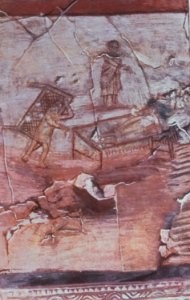
One of my classmates mentioned that the first painting of Jesus to date was found in a church in Syria. The portrait depicts Jesus healing a paralytic who was brought to him. Jesus is physically portrayed as a beardless, dark-skinned, short-haired man, who is also short in stature. The painting dates to around 235 and is among the earliest paintings of Jesus to date. The Shroud of Turin, if authentic, portrays Jesus as a long-haired, bearded man. Which depiction is accurate? Furthermore, does it really matter?

This exercise hBrianChilton261119as forced me to consider how much we seek to make Jesus into our own image. For a southern, Caucasian, American; one would feel comfortable seeing Jesus as a camouflage wearing, gun-toting, bandana adorning, Patriotic citizen. For a northern, black, American; one would feel comfortable a Jesus who was a civilized, pacifist, progressive defender of human rights. But the question is, do we make Jesus into our image ,or are we willing to be made into the image of Christ? Would we still love Jesus if he holds different perspectives than we do? Would we still love Jesus if he looked very different than us? As people, we like things that are like us.

The very nature of Jesus is far and away different from all of us. Remember, Jesus was perfect. We are not. No matter how he looked physically, he was the incarnate God and we are not. Paul notes that those whom God “foreknew he also predestined to be conformed into the image of his Son, so that he would be the firstborn among many brothers and sisters” (Rom. 8:29, CSB). Our goal is to be made into the image of Christ and not to make Christ into our image. No matter whether Jesus was over six feet tall and light-skinned or five feet tall and dark-skinned, he is the Logos incarnate—God who came in flesh. Athanasius of Alexandria (AD 296–373), a man who was named the “black dwarf,” noted that the Logos of God

“accommodated himself to our nature and showed himself empty of all [his divine qualities] in the face of the anxiety of the threatening onslaught of his trials … [Christ] became Man that we might be made God: and He manifested Himself through the body that we might take cognizance of the invisible Father: and He underwent insult at the hands of men that we might inherit immortality” (Athanasius of Alexandria, On the Incarnation of the Word of God 54).

Isaiah reminds us that the Messiah did not come with an impressive form. The Messiah did not possess any “majesty that we should look at him, no appearance that we should desire him” (Isa. 53:2, CSB). In other words, Jesus did not come as a fashion model or bodybuilder that you would be impressed with his physical form. What made Jesus special was that he was the incarnate God who came to save us from our plight of sin.

It makes no difference whether Jesus was light-skinned or dark-skinned, tall or short, bearded or beardless, short-haired or long-haired. What matters is that Jesus was thoroughly perfect in his morality, impeccable in his character, and powerful in his theology. He was God who came in flesh. Thus, we should seek to be made into Christ’s image rather than seeking to make Jesus into our own image. No one has a handle on Jesus. No one ever could. As such, Jesus is far more impressive and far more challenging than you ever thought him to be.

Recommended resources related to the topic:

What is God Really Like? A View from the Parables by Dr. Frank Turek (DVD, Mp3, and Mp4)

What is God Like? Look to the Heavens by Dr. Frank Turek (DVD and Mp4)

Jesus, You and the Essentials of Christianity – Episode 14 Video DOWNLOAD by Frank Turek (DVD)


Brian G. Chilton is the founder of BellatorChristi.com, the host of The Bellator Christi Podcast, and the author of the soon to be released book The Layman’s Manual on Christian Apologetics. He received his Master of Divinity in Theology from Liberty University (with high distinction); his Bachelor of Science in Religious Studies and Philosophy from Gardner-Webb University (with honors); and received certification in Christian Apologetics from Biola University. Brian is currently enrolled in the Ph.D. program in Theology and Apologetics at Liberty University and is a member of the Evangelical Theological Society and the Evangelical Philosophical Society. Brian has been in the ministry for nearly 20 years and serves as the Senior Pastor of Westfield Baptist Church in northwestern North Carolina.

Original Blog Source: http://bit.ly/37Bnunj

Some skepticism is warranted. None of us want to live within a paradigm of naivety. No one wants to blindly accept every foolish notion that comes down the pipeline. A quick glance at social media along with the acknowledgment of the tweaks and twists that artificial intelligence can bring to videos and audio files only intensifies our need for discernment.

Even still, as believers, we must differentiate between discernment and all-out skepticism. Discernment evaluates data to see whether the information is valid and trustworthy. In contrast, skepticism doubts or denies claims that seem to be grandiose or beyond the status quo. Even more to the point, skepticism can deny propositional claims. When left unrestrained, skepticism could lead to doubt, which in turn can lead to the denial of propositions (i.e., truth claims). At worst, unrestrained skepticism can lead to cynicism.

The Infiltration of Skepticism in Conservative Apologetics

I have been troubled by the extreme form of skepticism that has entered the apologetic and theological world, especially within what has been considered conservative evangelical Christianity. When I first entered the apologetic world in 2007 and formally in 2012, apologists and conservative theologians alike were fairly settled on certain issues regarding miracles, biblical fidelity, and creationism. The pillars of the apologetic world, however, seem to be crumbling, instead adopting extreme forms of skepticism that deny veritable biblical truth claims.

At the same time, modern Christianity has adopted a celebrity culture. So, these icons of the time often go unquestioned by their fanbase. We would be well advised, however, to remember that truth is truth and error is error regardless of who speaks it. With that in mind, let us consider three avenues where we should be skeptical of modern skepticism.

Becoming Skeptical of Modern Human Skepticism (Miraculous Skepticism) [i]

David Hume was an English skeptic of the 16th century. Hume maintained that miracles could not be proven as historical events. While a full explanation of his view is beyond the scope of this article, Hume defined a miracle as “a transgression of a law of nature by a particular volition of the Deity, or by the interposition of some invisible agent.”[ii] Part of the problem in Hume’s analysis is that a Deity and/or invisible agent may work through the laws of nature to bring about certain ends. Gary Habermas offers a better definition, claiming that miraculous interventions should be understood as “the manifestation or presence of divine actions that temporarily or momentarily overrule or supersede nature’s normally observed, lawful pattern of events, or that appear to do so.”[iii]

Hume’s Circular Reasoning

A bigger problem with Hume’s assessment is that his argument is largely circular. Hume does not believe miracles can be proven because he does not believe miracles occur. And, like a self-fulfilling prophecy, if you do not believe that miracles occur, then you will deny any claim that purports to be miraculous.

Modern Hume in the Apologetic World?

While nearly all Bible-believing Christians will accept that God does perform miracles, the level of scrutiny that some biblical events have received by Bible-believing scholars is somewhat suspect. With modern scholars, the idea of a talking serpent seems absurd, even though the Bible is riddled with numerous miraculous events. Furthermore, for some, the idea that God could raise numerous saints from the dead around the time of Christ’s crucifixion appears beyond rational belief, all the while the same scholars defend Jesus’s own resurrection and His resurrection of others from the dead. So then, why is it that some stories appear absurd, and others don’t?

At the end of the day, we must ask ourselves whether we actually believe that God can do anything within God’s moral limitations. Sure, even the Bible says that God cannot sin because of His moral holiness, and God cannot do something that goes against God’s character (e.g., Titus 1:2). But do we believe that God can part the Red Sea? Do we really believe that God can raise the dead? If so, why do we place limitations on what God can do?

Becoming Skeptical of Modern Bultmannian Skepticism (Biblical Skepticism) [iv]

Rudolf Bultmann was a German theologian of the 19th century who was highly skeptical of the biblical texts. Bultmann promoted the demythologization of the Bible. That is, Bultmann believed that the Bible must be stripped of all its mythological elements to make it more palatable for modern scientific minds. As such, Bultmann held an informal uncontrolled mindset when it came to the oral traditions undergirding the life of Jesus. The informal uncontrolled model means that, according to Bultmann, no one was concerned about preserving accurate information about Jesus, and no one was selected to authenticate the material. Thus, the Gospels tell us next to nothing about the historical Jesus and more about the church’s belief about Jesus. Therefore, no one can know anything about the life of Jesus.

Oral Traditions

In my dissertation work, not only did I discover that Bultmann’s theory on oral traditions was wrong, but the Gospels texts also indicate that something more controlled was at hand when it came to the preservation of Jesus traditions.[v] As such, the data suggests that the Gospels are based on eyewitness testimony. We have good reasons to believe that Jesus rose from the dead, as well as other events in Scripture.[vi] If the data suggests that we have reasons for believing in the fidelity of Scripture and the stories it contains, then why do we find it necessary to cast doubt on the authenticity of the traditions of Jesus?

Is Harmonization a Sin?

Why is it such a sin to harmonize the Gospels as Michael Licona suggests if the Gospels indeed contain eyewitness testimonies? It seems to me that attempts to diffuse the mystical and miraculous elements of Scripture are falling back into the unjustified skepticism of Bultmann and his desire to demythologize the pages of the Bible. But the greater question is, what are we left with if we remove the divine power of God from the testimonies of Scripture? We’ll discuss that in the conclusion.

Becoming Skeptical of Modern Darwinian Skepticism (Creationary Skepticism)

Lastly, it seems as if theistic evolution has become the fad of the day. Since William Lane Craig published his book In Quest of the Historical Adam, I have observed many young apologists and would-be scholars falling in line with endorsing theistic evolution, even though evolutionary theory still suffers from the same methodological flaws that it ever has.

What happened to the apologists’s endorsement of the work of Stephen Meyer and the Discovery Institute? Through the years, Meyer has given ample reason to question Darwinianism. His book Darwin’s Doubt is one such example. Do we now cast aside Darwin’s Doubt just because it is popular to now follow the idea that much of Genesis 1–11 is mythological? Do we now openly reject classic creationist concepts by scientists like Hugh Ross, the staff at Reasons to Believe, and Answers in Genesis just because a well-known philosopher says to do otherwise?

Conclusion

Most assuredly, I am not trying to lambast Craig, Licona, or any of their followers. I have been blessed by many of their works in time’s past and have many friends who follow along with the concepts presented by the two men. And it should be noted that many other scholars could be included in the three aforementioned categories. But I am troubled by the following question: At what point should we become skeptical of our own skepticism?

As I had the pleasure of editing the book Why Creationism Still Matters with my good friends and colleagues Dr. T. J. Gentry and Dr. Michelle Johnson, it struck me how strong the case can be made for creationism. And it further troubled me why others feel the need to reject such a defense when in fact numerous scientists are questioning evolutionary theory as well.[vii]

Additionally, consider that we have spent thousands of years trying to understand what it only took seconds for God to create. God spoke, and the universe came into existence with all its laws, physics, and numerical values. Thus, if God is God, and the Bible is God’s Word, wouldn’t it behoove us to believe what God said?

Final Analysis

As an apologist, I most assuredly believe that the resurrection and events of the Bible stand on their own merit. Thus, I am not a fideist. Have we, however, encountered God and known the power He holds? If so, at what point should we begin asking if our latent skepticism reflects our own doubt more than it does the evidence within the text?

So, to summarize, why should we become skeptical of our skepticism? When our skepticism begins to offer more reasons not to believe in God’s power and His revelation, that’s when our skepticism exposes latent doubt more than our faith. We must then ask ourselves if we really believe in what we are leading others to believe. If we don’t, then why encourage others to believe at all? But if we do believe, then what good is it when we continuously downgrade what God has given us in His Word? And if we do believe, then at some point, we must become skeptical of why we are so skeptical.

Furthermore, we must also question if our skepticism has caused an even greater naivety, wherein we blindly follow whatever our favored philosophers or scholars say without considering the validity of their claims. In a sense, our unrestrained skepticism could lead to greater gullibility. Just some things to consider from a fellow disciple as we journey this life together.

References: 

[i] Humean refers to the teachings of David Hume.

[ii] David Hume, An Enquiry Concerning Human Understanding, in the Essential Works of David Hume, Ralph Cohen, ed (New York: Bantham, 1965), 1:129n3.

[iii] Gary Habermas, On the Resurrection: Evidences, vol. 1 (Brentwood, TN: B&H Academic, 2024), 242.

[iv] Bultmannian refers to the teachings of Rudolph Bultmann.

[v] Brian G. Chilton, “Semitic Residue: Semitic Traits that Indicate Early Source Material Behind the Gospel of Matthew” (2022), Doctoral Dissertations and Projects, 3874, https://digitalcommons.liberty.edu/doctoral/3874.

[vi] See my contribution for an extensive defense of the resurrection in the upcoming book Thomas J. Gentry, ed., Strong Faith (West Frankfort, IL: IHP Practica, 2024).

[vii] For example, read “Scientists Dissent from Darwinian Theory,” Discovery.org (Feb. 12, 2019), https://www.discovery.org/v/darwin-dissenters-speak/. Also consider the mathematical problems related to Darwinianism, David Berlinski, Stephen C. Meyer, David H. Gelernter, “Mathematical Challenges to Darwin’s Theory of Evolution, With David Berlinksi, Stephen C. Meyer, and David Gelernter,” Interview, Hoover Institution, Hoover.org (July 22, 2019), https://www.hoover.org/research/mathematical-challenges-darwins-theory-evolution-david-berlinski-stephen-meyer-and-david.

Recommended Resources:

Debate: What Best Explains Reality: Atheism or Theism? by Frank Turek DVD, Mp4, and Mp3 

Oh, Why Didn’t I Say That? Does Science Disprove God? by Dr. Frank Turek (DVD and Mp4)

Stealing From God by Dr. Frank Turek (Book, 10-Part DVD Set, STUDENT Study Guide, TEACHER Study Guide)

I Don’t Have Enough Faith to Be an Atheist (Paperback), and (Sermon) by Norman Geisler and Frank Turek 


Brian G. Chilton earned his Ph.D. in the Theology and Apologetics at Liberty University (with high distinction). He is the host of The Bellator Christi Podcast and the founder of Bellator Christi. Brian received his Master of Divinity in Theology from Liberty University (with high distinction); his Bachelor of Science in Religious Studies and Philosophy from Gardner-Webb University (with honors); earned a Certificate in Christian Apologetics from Biola University, and plans to purse philosophical studies in the near future. He is also enrolled in Clinical Pastoral Education to better learn how to empower those around him. Brian is a member of the Evangelical Theological Society and the Evangelical Philosophical Society. Brian has served in ministry for over 20 years and currently serves as a clinical hospice chaplain as well as a pastor.

Originally posted at: https://bit.ly/4e4KBrE

I was in a Global Studies conference a few months ago when a retired minister asked me an interesting question. He told me, “I like to take Christian young men to the local mosques so they can learn about Islamic beliefs; however, I’m wondering what would be a good question to ask our Muslim friends in order to get to know them and let them know about Jesus.” I believe this is a very important question I would like to answer here.

Talk about Jesus Christ from A Christian Perspective

One of the sharp differences between Islam and Christianity is the nature of Jesus. Who he is and what he did. Christians can approach their Muslim neighbors and tell them about Jesus in two ways: 1) What do the Gospels say about Jesus? 2) What do the Qur’an and Hadiths say about Jesus? One of the stories that is not mentioned in the Qur’an and Hadiths about Jesus is how he dealt with nature. These stories might resonate well with Muslims and explain Jesus’s authority over nature and creation. The stories of Jesus calming the storm and resurrecting the widow’s son show the uniqueness of Christ and his supremacy over nature.

The texts that can be used for Jesus calming the storm are Matt 8:23-27; Mark 4:35-41; Luke 8:22-25 (ESV). The text that can be used for Jesus raising a widow’s son from the dead is Luke 7:11-15. After reading the Bible, a Christian can ask, “In your opinion, what is the significance of Jesus calming the storm?” or “What is the significance of Jesus raising the dead? The story of Jesus calming the storm is not mentioned in the Qur’an and asking this question will help Muslims think deeper about Jesus. However, the Qur’an mentions that Jesus raised dead people without mentioning who they are. Christians should emphasize that Jesus did these miracles in public, in front of many witnesses, and it was written down within the same generation of people who saw them. It was not collected hundreds of years later (like in the case of the miracles of Mohammad). These stories are more historically reliable because they are better witnessed, attested to, and written within a short period of time. There is no reason for Christians not to believe it and there are many reasons to think about their significance.

It is a good idea for Christians to read to their Muslim friends from the Bible these stories and not just recite a verse from memory or explain the story using their own words. In this way, Muslims will be able to differentiate between the words of the Bible and the words of the Christians. It also assures the Muslims that these stories are written in the Bible and no one is tricking them by creating imaginative stories about Jesus.

Talk about Jesus Christ from an Islamic Perspective

Christians need to learn what Islamic literature says about Jesus. According to the Qur’an, Jesus has a sinless nature, was of a virgin birth, was a creator, and will return to judge the world. Due to the limited space, I will write about the virgin birth of Jesus and if the reader would like to learn more about the other points, they can read my article “Does Islamic Literature Suggest Jesus is God?” In this paper, I discuss major themes about what Islamic literature says about Jesus and I compare these themes to other prophets to show the superiority of Christ.

Muslims believe that Jesus was born of a virgin. The Islamic narrative is mentioned in the Qur’an. Allah says,

“We sent to her Our Ruh [angel Jibril (Gabriel)], and he appeared before her in the form of a man in all respects … (the angel) said: ‘I am only a messenger from your Lord, (to announce) to you the gift of a righteous son.’ She said: ‘How can I have a son, when no man has touched me, nor am I unchaste?’ He said: ‘So (it will be), your Lord said: “That is easy for Me (Allah), and it is a matter (already) decreed, (by Allah)”’” (Surah 19:17-20 Al-Hilali and Khan).[i]

These verses record what Allah said and did with Mary. He sent his spirit to Mary, which appeared to her like a man. Islamic scholars added to the Qur’anic text that “Our Spirit” is the angel Gabriel, but the Qur’anic story does not say that the Spirit of God appeared in the resemblance of angel Gabriel.

Jesus’s virgin birth narrative is also mentioned in Surah 3:42-47 with a salient change. Notice verses 42 and 45. They mention a group of angels appearing to Mary to deliver the message to her. “When the angels said: ‘O Marium! surely Allah has chosen you, purified you… When the angels said: O Marium, surely Allah gives you good news with a Word from Him (of one) whose name is the Messiah…” (Shakir). It is unclear how Islamic scholars conclude that Gabriel is the one who told Mary the good news about Jesus; thus, this could serve as a good question to ask to help Muslims think deeply about the details of the Qur’anic story of Jesus’s birth.

Muslim scholars believe that the virgin birth of Jesus does not point to his deity. Here, Christians can ask the question, “What is the reason or the purpose that made God choose the virgin birth as a method to bring Jesus to earth?” The fact that Jesus came to this earth through a miracle (virgin birth) and left it through another miracle (ascending to God) raises a major question mark about his nature. These two events never happened to any other prophet, not even to Muhammad himself.

Usually, Muslims quote the Qur’an to show their Christian friends that there is nothing special about Jesus coming from a virgin. Mohammad states in Surah 3:59 “Verily, the likeness of ‘Isa (Jesus) before Allah is the likeness of Adam. He created him from dust, then (He) said to him: ‘Be!’—and he was.” So, “God created Adam from dirt, then said to him: be, and there He became, through no mediation of a father or a mother. God created Adam in a more glorious way than He created Jesus from a mother with no mediation of a father.”[ii] Creating Adam from dirt is indeed a very special act that only God can do; however, according to the Qur’an, Jesus did the same miracle when he created a bird from the dirt without the need for a mother and a father of birds (Surah 3: 49). In other words, if this act is extremely unique because it belongs to Allah only, then Jesus did what is extremely unique when he created the bird—how can a mere man do what only God can do?

In fact, according to Islamic logic, creating a person by using a virgin woman, without the need of a father, should be seen as more unique than creating a person from dirt because it has never occurred in human history, and no one else has done it except God himself. Allah solely used the virgin birth, but Allah and Jesus both created a lively being from dirt. Creating through virgin birth points to a greater and higher act of creation because it belongs to God only.

To reply to the idea of the likeness of Jesus and Adam from a Christian perspective, Christians can bring Paul’s argument in Romans 5:18 to the attention of the Muslims. Paul states, “Just as one trespass resulted in condemnation for all people, so also one righteous act resulted in justification and life for all people” (Rom. 5:18). This is the way that the likeness of Adam and Jesus should be regarded. Jesus should be considered more important than Adam or any other prophet, not only because of his virgin birth but because of the many additional attributes, events, and actions that Adam did not enjoy, have, or do. Their likeness is related to their roles regarding the human condition and salvation. There are, however, many additional aspects that Jesus enjoyed, and Adam did not (such as the virgin birth, performing miracles, and being pure/holy because he wasn’t touched by Satan …etc.). These actions help Christians think that Jesus’s nature is superior to the nature of Adam.

Asking questions helps Muslim brothers and sisters to think deeply about the stories that their Qur’an mentions. Therefore, Christians need to educate themselves on these stories by learning the differences between the Islamic and Christian versions and asking good questions that help others think critically and respectfully.

References:

[i] All the information and names that are between brackets and square brackets are added by Al-Hilali and Khan to help the readers understand the literal meaning of the verse.

[ii] Abdu Al-Rahman Al-Baghdadi, Al-Fariq bain Al-Khaliq wa Al-Makhlouq fi Dahid Aqidet and Tathleeth wa Ithbat Aqidet Al-Tawheed (Beirut, Lebanon: Dar Al-Kutub Al-Ilmiya, 1987), 49.

Recommended Resources:

Answering Islam by Dr. Frank Turek (DVD Set, Mp4 and Mp3)

Why We Know the New Testament Writers Told the Truth by Frank Turek (DVD, Mp3 and Mp4)

Can All Religions Be True? mp3 by Frank Turek

Another Gospel? by Alisa Childers (book)


Sherene Khouri was born into a religiously diverse family in Damascus, Syria. She became a believer when she was 11 years old. Sherene and her husband were missionaries in Saudi Arabia. Their house was open for meetings, and they were involved with the locals until the government knew about their ministry and gave them three days’ notice to leave the country. In 2006, they went back to Syria and started serving the Lord with RZIM International ministry. They traveled around the Middle Eastern region—Turkey, Jordan, Egypt, Lebanon, Syria, and United Arab Emirates. Sherene was also involved in her local church among the youth, young adults, and women’s ministry. In 2013, the civil war broke out in Syria. Sherene and her husband’s car was vandalized 3 times and they had to immigrate to the United States of America. In 2019, Sherene became an American citizen. Sherene is an assistant professor at Liberty University. She teaches Arabic, Religion, and Research classes. Sherene holds a Ph.D. in Theology and Apologetics, M.A. in Christian Apologetics from Liberty University, and B.S. in Biblical Studies from Moody Bible Institute. She is also working on a Master of Theology in Global Studies at Liberty University and a M.A in Arabic and Linguistics from PennWest University.

Originally published here: https://bit.ly/3yBR1PP

Do we have a genuine promise of immortality? This is a question that impacts all of us. When I was growing up as a kid, I wanted to be taken seriously. Therefore, I could not wait to grow up to have a seat at the intellectual table. It seemed like it took forever to get out of grade school and high school. My wise grandmother told me, “Don’t rush your life away. The older you get; the faster time passes.” She was absolutely right! Because it seems like life is passing by at light speed, especially the closer I get to 50.

As we age, we begin to contemplate our own mortality, and rightfully so. The older we get, the closer we get to the time of our death. Our mortality leads us to philosophical contemplation as we ask the big questions of life. Is there an afterlife? What happens when we die?

Nearly everyone asks these kinds of questions, even scientists and futurists. With the advent of artificial intelligence (AI), many pundits claim that AI could lengthen life, and potentially bring a sense of immortality. Michio Kaku notes that “immortality does not violate the law of physics. There is nothing in the Second Law that forbids a life-form from living forever, as long as energy flows in from the outside. In our case that energy is sunlight.”[i] Proponents of quantum computers and its integration with ChatGPT hold great hope for the advent of quantum computing. It seems to me, however, that there is a deeply flawed philosophical underpinning to this concept.

Promise of Genuine Immortality: Can Genuine Immortality Come to this World?

Let’s suppose for a moment that Kaku and physicist futurists are right in their assessments in that quantum computing, with its theoretical computational power, can bring scientific advancements that would greatly extend life on earth. Let’s go a step further and say that life could be extended to a near immortal status. Could a human exist forever in that state? The answer is simply no for at least a couple of reasons.

Eternal Life in the Present World is Not Sustainable.

Life in the present state is not eternally sustainable. Suppose for a moment that a human being could become immortal in the present state. The present state does not eliminate the reality that the world and the universe will eventually end. Granted, Kaku and others hold great hope that if enough information can be ascertained, then problems with the world’s ecosystem could be corrected. Nonetheless, that does not override the reality that the Sun will not last forever. Eventually, the Sun will run out of energy and will either explode as a supernova or implode to create a dwarf star or a black hole. Simply put, the Sun cannot burn for more than 100 billion years.[ii]

Astronomers estimate that the Sun only has about 5 billion years remaining.[iii] While 5 billion years is still a long time off, human life on the planet will come to an undeniable end by that time. But what if space travel is available by that time? Could we not travel to another planet? Granted, that is possible. However, even the universe’s timeline is limited. As the universe continues to expand at an increased rate, the production of proteins – essential for life – will cease. Ross declares that “all physical life must come to an end—not just on Earth but everywhere in the cosmos.”[iv] In other words, the extenuation of life induced by AI only delays the inevitable. Furthermore, what kind of existence would be found by an AI-induced eternal state?

The Present World Cannot Sustain a Population of Immortal, Reproductive Beings.

The present physical world cannot sustain immortal physical beings with continued population growth. Another problem needs to be considered. Earlier in his book, Kaku explained that cancer comes when a cell forgets how to die. In essence, it becomes immortal. The cancer cell’s immortality leads to the death of its host as the cells continue to reproduce but refuse to sacrifice themselves to permit the development of other cells.[v]

In a sense, Kaku’s description of cancer looms eerily reminiscent of his depiction of human immortality on earth. I get it. We love our lives. We love our planet. But we were never intended to live here forever. Our planet simply cannot sustain immortal physical humans who require food and drink for the continuity of life along with new life coming from reproduction. This will lead to overpopulation the likes of which has never been seen. Food supplies will deplete, leading to wars, crime, and hostile takeovers. While fanciful and fun to consider, AI and quantum computing cannot override the logic of Earthbound space, unless a way can be found to safely travel to another planet. Even then, there are no guarantees that life could be sustained in that state forever.

The Promise of Genuine Immortality: Where is Genuine Immortality Found?

In a panel discussion on AI, the panelists noted that at the root of the discussion behind AI and technological advancements is a deeply-rooted philosophy.

Materialistic Philosophy

On the one hand, the philosophy of materialism fervently desires to hang onto the present world with all its devices. Because for the materialist, the present world is all that exists and all that can be known for sure. This mindset, while not necessarily materialistic, can even be found in some of the contemplations of modern writers and theologians.[vi]

Heavenly Philosophy

Yet, on the other hand, believers throughout the ages have held that a better, more perfect realm, exists beyond the scope of the material world. That is not to say that the present world is not good, and it does not demean any effort to make the world a better place. Even still, the promised hope is not found in this world. It is not found in our possessions, accolades, or hobbies. Rather, our promised hope is found in the relationship we have with God and the eternity that only God can offer.

In my book Conversations about Heaven, I speak of the new body that we will receive at the return of Christ. Paul calls this body a pneumatikos soma—a spiritual body.[vii] Yes, the body will have some of the traits found in the present body. But it would be a mistake to think that the spiritual body is exactly like the physical one. Just like it would be a massive mistake to think that the new creation will be identical to the present locale. No, the glorified state will be far better and superior! All that being said, the genuine promised hope of immortality is not found in our gadgetry or human ingenuity. Rather, the promised hope of immortality is found in God, the Author of life.

Conclusion

Kaku said something profound about this in Quantum Supremacy. He asserted that it is possible for immortality to exist “as long as energy flows in from the outside.”[viii] The energy that currently keeps life flowing in the naturalistic state is sunlight.[ix] However, what if the energy flowing through the person came from the Eternal God rather than a mid-sized star? Then, in that case, immortality is a piece of cake. The writer of Hebrews is correct in that it is appointed once for all people to die in this present state (Heb. 9:27).

Hope Not Found in This World

Christian philosophy has always held that the promised hope is not of this world. As Paul teaches, “If in Christ we have hope in this life only, we are of all people to be pitied” (1 Cor. 15:19, ESV). Paul also acknowledges that:

“[we] do not lose heart. Though our outer self is wasting away, our inner self is being renewed day by day. For this light momentary affliction is preparing us for an eternal weight of glory beyond all comparison, as we look not to the things that are seen but to the things that are unseen. For the things that are seen are transient, but the things that are unseen are eternal” (2 Cor. 4:16-18, ESV).

Assuredly, incorporating quantum computing into AI will bring a great deal of benefits to humanity as it could offer solutions to many medical problems afflicting us, cancer and other medical afflictions being at the top of the list. On that, I wholeheartedly agree with Kaku and other contemporary pundits. Nonetheless, we cannot place our hope in technological advances to overcome what God has already accomplished through Christ. Death is scary. Even still, if near-death experiences are genuine – which I hold them to be – then, an eternity with God is greater than the present world.

Consider the Butterfly

The butterfly is much more advanced than the caterpillar from which it came. It is highly doubtful that the butterfly ever wishes that he could go back to his earlier state—a time when he could not fly, could not move very quickly, and was easy prey for predators. Likewise, I greatly doubt that any of us will wish for our current bodies once we are empowered by the resurrected, glorified bodies promised to us by God. Our hope is found in God, and God alone. Nothing and no one could ever assure us of immortality other than the One Who is Immortal and Eternal.

Footnotes:

[i] Michio Kaku, Quantum Supremacy: How the Quantum Computer Revolution Will Change Everything (New York: Doubleday, 2023), 203.

[ii] Hugh Ross, Why the Universe Is the Way It Is (Grand Rapids, MI: Baker, 2008), 99.

[iii] JoAnna Wendel, “When will the sun die?,” Space.com (March 6, 2024), https://www.space.com/14732-sun-burns-star-death.html, accessed on May 4, 2024.

[iv] Ross, Why the Universe Is the Way It Is, 102.

[v] Kaku, Quantum Supremacy, 162.

[vi] While an excellent book, author Karen Swallow Prior unfortunately adopts the anti-dispensational thinking of the present age in her book Evangelical Imagination. She conjectures that “being caught up” in 1 Thess. 4:16–17 suggests an immediate transformation of people on Earth instead of being carried away with Christ. Space does not permit us to consider the evidence for the term parousia and its indication that believers would be called away with Christ. Nonetheless, it is quite clear from the vernacular of Peter and John in Revelation that God will replace this world with a “New Heaven and a New Earth” (2 Pet. 3:10–13; Rev. 21:1–2; 22:1–21). Revelation guarantees that there would be a “new heaven and a new earth; for the first heaven and the first earth had passed away, and the sea was no more” (Rev. 21:1, CSB). See Karen Swallow Prior, The Evangelical Imagination: How Stories, Images & Metaphors Created a Culture in Crisis (Grand Rapids, MI: Brazos, 2023), 256; N. T. Wright, “Farewell to the Rapture,” Bible Review (August 2011), https://ntwrightpage.com/2016/07/12/farewell-to-the-rapture, accessed May 4, 2024. In all fairness, Wright later acknowledges that the NT envisions a recreation of heaven and earth. Nonetheless, the idea that the present world will continue ad infinitum is foreign to the pages of Scripture.

[vii] Brian G. Chilton, Conversations about Heaven: Difficult Questions about Our Eternal Home (Eugene, OR: Resource, 2023), 38–43.

[viii] Kaku, Quantum Supremacy, 203.

[ix] Ibid.


Recommended resources related to the topic:

Oh, Why Didn’t I Say That? Does Science Disprove God? by Dr. Frank Turek (DVD and Mp4)

The Great Book of Romans by Dr. Frank Turek (Mp4, Mp3, DVD Complete series, STUDENT & INSTRUCTOR Study Guide, COMPLETE Instructor Set)

Jesus, You and the Essentials of Christianity by Frank Turek (INSTRUCTOR Study Guide), (STUDENT Study Guide), and (DVD)      

Macro Evolution? I Don’t Have Enough Faith to be a Darwinist (DVD Set), (MP3 Set) and (mp4 Download Set) by Dr. Frank Turek


Brian G. Chilton earned his Ph.D. in the Theology and Apologetics at Liberty University (with high distinction). He is the host of The Bellator Christi Podcast and the founder of Bellator Christi. Brian received his Master of Divinity in Theology from Liberty University (with high distinction); his Bachelor of Science in Religious Studies and Philosophy from Gardner-Webb University (with honors); earned a Certificate in Christian Apologetics from Biola University, and plans to purse philosophical studies in the near future. He is also enrolled in Clinical Pastoral Education to better learn how to empower those around him. Brian is a member of the Evangelical Theological Society and the Evangelical Philosophical Society. Brian has served in ministry for over 20 years and currently serves as a clinical hospice chaplain as well as a pastor.

Originally posted at: https://bit.ly/46gNx1y

If we live long enough, grief is something that we will all experience at one point or another. Grief is difficult. Some have even said that “grief is a challenging beast.” It impacts each person differently. Grief is a sense of sorrow that one feels when a person experiences a form of loss. More frequently, this loss is associated with those who have had loved ones who passed away. However, grief can also include the loss of a job, friendship, hobby, or position.

As I have dealt with loss in my personal life, I have surprisingly found how beneficial apologetics is when going through times of sorrow. Apologetics—that is, the defense of the Christian faith—may seem like an unlikely ally of bereavement and psychospiritual care, as many associate it with the headier intellectual avenues of the Christian faith. Nonetheless, apologetics can assist one with their grief in three specific ways.

Apologetics Gives Stability Through Times of Grief.

First, apologetics can give stability through times of grief. When a person experiences loss, they may feel as if their world has irreparably changed. And in some ways, it has. The loss of a loved one evokes a sense of what some grief counselors call the “new normal.” That is, it speaks to the continuity of life without the physical presence of the loved one.

While it cannot repair the hurt one feels, apologetics can offer concrete proofs for the Christian faith, which remain intact regardless of the changes of life. For instance, resurrection studies and explorations into near-death experiences have intensified my belief in heaven. These studies assure me that Christ has defeated death and, thereby, assured that life continues into eternity. My theological studies point that the same God who brought victory over death remains the same “yesterday, today, and forever” (Heb. 13:8, CSB). When the world seems as if it has turned upside down, apologetics and theological studies can give a sense of security.

After getting sick on a boat in the Atlantic due to turbulent waters, it was seeing the Oak Island Lighthouse that eventually alleviated my nausea. The lighthouse was like a North Star, a fixed point amid the chaos of the moment. In like manner, apologetics can offer us an anchor in a sea of chaos.

Apologetics Grants Security Though Times of Grief.

Second, apologetics grants security through times of grief. Here, security implies increased faith. The field of apologetics is intended to bolster a person’s faith. The goal of the apologist should be to lead believers to deeper belief, while offering skeptics a reason to believe.

When we lose someone near and dear to us, our world is turned upside-down. We may wonder why God allowed such a thing to happen, thus entering the realm of theodicy (why a loving God allows evil in the world). If left unresolved, a person could suffer emotional doubt.

Even though apologetics cannot guarantee that a person will never suffer emotional doubt, apologetics can equip a person with better tools to deal with emotional doubt when it arises. Coupled with a solid systematic theology, a person can better trust God with the uncertainties of life.

Grief counselor David Kessler once said, “Human beings had rather feel guilty than helpless.” He goes on to say, “The guilt you feel during grief comes from the belief that you could have been there and stopped it from happening. Guilt can be released when you find the compassion for yourself to know that you’re not in control, and maybe never were.”[i] Helplessness is a difficult pill to swallow. I cannot tell you the number of times that I have felt overwhelmed by the helplessness while working in hospice.

Nonetheless, when we know the One in control and that that One is a benevolent, compassionate, and faith friend, then it makes the grief process much easier to process. That does not mean that apologetics affords a comprehensive understanding as to why certain things happen as they do. No one but God Himself could answer that question. But it will spur faith in the One who maintains such comprehensive knowledge.

Apologetics Gifts Serenity Through Times of Grief

Finally, apologetics gifts us with serenity through times of grief, especially for those who have lost loved ones through the passage of death. As previously noted, studies of the resurrection of Jesus assures us that death has been defeated and that an afterlife exists. Studies of near-death experiences highlights what that experience may be like in the intermediate state.[ii]

Coming into hospice with this knowledge opened the door to see certain things through an individual’s passage into eternity that I may have otherwise missed. Nonetheless, when a person loses someone near and dear to them, such studies offer the bereaved a serenity about the afterlife that cannot be obtained in any other fashion. If a person has an assurance of an eternal life in heaven with God through Christ, then even death loses its sting (1 Cor. 15:55).

Conclusion

Grief is a natural emotion that comes with loss. Everyone grieves differently. Some are tearful, whereas others are more Stoic. Some need time with a lot of people, while others need time alone. Grief is something that we will all experience at some point. Yet, as this article has shown, apologetics can assist us during our times of grief. It can give us something concrete to hold to, a North Star to direct us, or a lighthouse to ascertain a sense of security in a turbulent ocean of change. Most importantly, apologetics should bolster our faith in the One who created not only North Star and land upon which the lighthouse stands, but also the sky’s canvas and the ocean itself. In the end, our serenity, security, and stability are not in apologetics, but in the Triune God for whom apologetics encourages us to place our truth.


Footnotes:

[i] David Kessler, Grief.com.

[ii] The “intermediate state” refers to the time between a person’s death and the final resurrection that accompanies the return of Christ.

Recommended resources related to the topic:

If God, Why Evil? (DVD Set), (MP3 Set), and (mp4 Download Set) by Frank Turek

Why Doesn’t God Intervene More? (DVD Set), (MP3 Set), and (mp4 Download Set) by Frank Turek

Why does God allow Bad Things to Happen to Good People? (DVD) and (mp4 Download) by Frank Turek 

Relief From the Worst Pain You’ll Ever Experience (DVD) (MP3) (Mp4 Download) by Gary Habermas 


Brian G. Chilton earned his Ph.D. in the Theology and Apologetics at Liberty University (with high distinction). He is the host of The Bellator Christi Podcast and the founder of Bellator Christi. Brian received his Master of Divinity in Theology from Liberty University (with high distinction); his Bachelor of Science in Religious Studies and Philosophy from Gardner-Webb University (with honors); earned a Certificate in Christian Apologetics from Biola University, and plans to purse philosophical studies in the near future. He is also enrolled in Clinical Pastoral Education to better learn how to empower those around him. Brian is a member of the Evangelical Theological Society and the Evangelical Philosophical Society. Brian has served in ministry for over 20 years and currently serves as a clinical hospice chaplain as well as a pastor.

Original Blog Source: https://bit.ly/3KhC2gi