Tag Archive for: atheism

By Al Serrato

My seventh-grade nephew needed some help the other night on social studies. He was working on the Paleolithic Age – the Old Stone Age – a time when man first started working with stone and bone tools. That got me thinking about the greatest “tool” of all – the human hand. It’s something that most people take for granted, but I don’t think it’s an overstatement to say that modern civilization would never have arisen without it.

How can the atheist explain something as complex as the hand? Like the human reproductive system that I discussed in my last post, in his worldview, the hand is the product of a slow, random set of mutations occurring over a long period of time. We just happened to be lucky enough for everything to fall into place so that we – modern humans – are the beneficiaries of this entirely happenstance outcome. But think for a moment about the staggering complexity of the hand. Consider first the intricacy of the nerves that allow not just for feeling but for the fine sensitivity of feeling that exists in the fingertips. Consider the placement of the hand at the end of a flexible wrist on an arm that is also flexible. Five fingers provide the ability to grip and to manipulate objects, and the five can be used in unison or individually. Two matching hands are vastly superior to one, and the hands just happen to match in size, shape, and function. The opposable thumb may be its greatest feature, as it allows for tools to be gripped. There is a versatile muscular system that allows for objects to be firmly, or lightly, gripped, and a feedback mechanism in the nervous system that allows us to know whether we are gripping something so hard as to crush it or softly enough to caress it. All the while, it provides information on warmth and cold. On and on the list goes. It is truly a marvelous tool, and despite the best efforts of modern-day scientists, there is no way at present to even begin to replicate its complexities.

Yet we are to believe, according to the atheist, that this amazing feature of human beings is not the product of an intelligent designer, who foresaw and anticipated our use of tools to build and shape the world around us, but was instead the result of random processes occurring over time. By why should this be so? Well, the atheist will say, the hand is simply the descendent of more primitive appendages. Small, random changes conferred an advantage on some descendents, which allowed them to succeed and pass on this modification. Really? If this is so, then why haven’t monkeys, and these other more primitive forms, gone extinct, if their appendages were so unhelpful to their survival? Clearly, the development of a hand that could use tools, as opposed to one suited for climbing trees, was not needed by them in order to thrive and reproduce. Or conversely, why haven’t modern monkeys, which apparently predate humans, not yet evolved human hands, hands finely suited for using and manipulating tools?

More importantly, what happened before monkeys with primitive hands evolved? What was that earlier mammalian life form from which the arm and hand emerged? A squirrel? A rodent? What were these life forms doing, earlier still, when they had mere stumps on the ends of their limbs? Or no limbs at all? How did they survive? And why aren’t there other examples in nature of animals who randomly produced hands? Or animals that have partial hands that are somewhere on the road to evolving a complete hand?

To be fair, atheists probably think they are doing the believer a favor by arguing that science is the source of all knowledge, and that with enough time and study, answers to the questions I pose will someday be found. I suspect that most have not considered deeply the difficulty with this position. After all, the human hand is just one of dozens of fine-tuned systems in the body, each of which was constructed according to instructions embedded in the millions of lines of coded DNA information that directs the body to grow from a single cell to an adult person.

To conclude that the evolution of life forms happened randomly might have made sense in Darwin’s day, when those considering the question had no idea that information-rich DNA was directing the process of building and sustaining life. But today? Science can tell us many things about DNA and how it works. But the original source of the code, and the identity of the coder who wrote the language of DNA to provide for the life that is teeming on Planet Earth, is not something that science will find, certainly not if scientists insist on assuming that DNA assembled itself.

Recommended resources related to the topic:

I Don’t Have Enough Faith to Be an Atheist (Paperback), and (Sermon) by Norman Geisler and Frank Turek 

Answering Stephen Hawking & Other Atheists MP3 and DVD by Dr. Frank Turek 

Tactics: A Game Plan for Discussing Your Christian Convictions by Greg Koukl (Book)

Defending the Faith on Campus by Frank Turek (DVD Set, mp4 Download set and Complete Package)

So the Next Generation will Know by J. Warner Wallace (Book and Participant’s Guide)


__________________________________________________________________________________________________________________________________________________

Al Serrato earned his law degree from the University of California at Berkeley in 1985. He began his career as an FBI special agent before becoming a prosecutor in California, where he continues to work. An introduction to CS Lewis’ works sparked his interest in Apologetics, which he has pursued for the past three decades. He got his start writing Apologetics with J. Warner Wallace and Pleaseconvinceme.com.


As I was reviewing one of the many emails we received, one of them raised two objections against the Kalam cosmological argument, specifically the argument offered for God as the cause of the beginning of the universe. A version of the Kalam cosmological argument can be formulated as follows:

  1. Whatever begins to exist has a cause of its existence.
  2. The universe began to exist.
    2.1 Argument based on the impossibility of an actual infinite:
    2.1.1 An actual infinite cannot exist.
    2.1.2 An infinite temporal regress of events is an actual infinite.
    2.1.3 Therefore, an infinite temporal regress of events cannot exist.
    2.2 Argument based on the impossibility of the formation of an actual infinite by successive addition:
    2.2.1 A collection formed by successive addition cannot be actually infinite.
    2.2.2 The temporal series of past events is a collection formed by successive addition.
    2.2.3 Therefore, the temporal series of past events cannot be actually infinite.
    2.3 Confirmation based on the expansion of the universe.
    2.4 Confirmation based on the thermodynamic properties of the universe.
  3. Therefore, the universe has a cause of its existence.
  4. If the universe has a cause of its existence, then an uncaused, personal Creator of the universe exists, who sans creation is beginningless, changeless, immaterial, timeless, spaceless, and enormously powerful and intelligent.
    4.1 Argument that the cause of the universe is a personal Creator:
    4.1.1 The universe was brought into being either by a mechanically operating set of necessary and sufficient conditions or by a personal, free agent.
    4.1.2 The universe could not have been brought into being by a mechanically operating set of necessary and sufficient conditions.
    4.1.3 Therefore, the universe was brought into being by a personal, free agent.
    4.2 Argument that the Creator sans creation is uncaused, beginningless, changeless, immaterial, timeless, spaceless, and enormously powerful and intelligent:
    4.2.1 The Creator is uncaused.
    4.2.1.1 An infinite temporal regress of causes cannot exist. (2.13, 2.23)
    4.2.2 The Creator is beginningless.
    4.2.2.1 Whatever is uncaused does not begin to exist. (1)
    4.2.3 The Creator is changeless.
    4.2.3.1 An infinite temporal regress of changes cannot exist. (2.13, 2.23)
    4.2.4 The Creator is immaterial.
    4.2.4.1 Whatever is material involves change on the atomic and molecular levels, but the Creator is changeless. (4.23)
    4.2.5 The Creator is timeless.
    4.2.5.1 In the complete absence of change, time does not exist, and the Creator is changeless. (4.23)
    4.2.6 The Creator is spaceless.
    4.2.6.1 Whatever is immaterial and timeless cannot be spatial, and the Creator is immaterial and timeless (4.24, 4.25)
    4.2.7 The Creator is enormously powerful.
    4.2.7.1 He brought the universe into being out of nothing. (3)
    4.2.8 The Creator is enormously intelligent.
    4.2.8.1 The initial conditions of the universe involve incomprehensible fine-tuning that points to intelligent design.
  5. Therefore, an uncaused, personal Creator of the universe exists, who sans creation is “beginningless,” changeless, immaterial, timeless, spaceless, and enormously powerful and intelligent.

Now let’s look at the following objection to what I have called the Argument of Immutability Against a Personal Cause (AIAPC):

  1. If God is timeless, then He is immutable.
  2. If God is immutable, then God cannot act to bring the universe into existence.
  3. God is a personal being who without creation is timeless (given by the Kalam).
  4. God is unchangeable (from 1 and 3)
  5. Therefore, God cannot act to bring the universe into existence (from 2 and 4).

As you can see, the argument attacks the premises (4.1.3), (4.2.3), and (4.2.5) of this version of the Kalam by trying to demonstrate that there is an inconsistency between God’s properties of being personal, immutable, and timeless.

How solid is the argument? Well, not that good. First, the detractor seems to think that since there is no time without the universe, God is immutable, but this is not the case. What the argument says is this:

  1. In the total absence of change, time does not exist, and the Creator does not change. (4.2.5.1.)
  2. Therefore, God is timeless (4.2.5.)

Y

  • There cannot be an infinite temporal regression of changes. (4.2.3.1)
  • Therefore, God is changeless (4.2.3)

Note that the argument does not say that God’s immutability is inferred from His timelessness; rather, that immutability is inferred from the impossibility of an infinite regression of changes, and timelessness is inferred from His immutability. But what do we mean by the “absence of all change?” Simple, it is not doing something different. Some activities do not require either change or time, for example, knowing something (God can know all truths in that immutable state without time). And the same could be said about our intentions: as long as these do not change, we can sustain them timelessly. So, we can say that (1) of the AIAPC is false.

Second, (2) it is false too. The premise seems to assert that the immutability of God is equivalent to immobility, which would be true if we were talking about an impersonal cause, but we have seen that we can infer that the cause is personal, so that it has volition to simply decide to create the universe from eternity. As William Lane Craig explains when he uses the example of a man sitting from eternity

…my thought experiment serves to illustrate a point about free will. A person can exist unchangeably and then freely execute a certain intention because free will does not require some predetermined condition. The very nature of free will is the absence of causal determinants. So, a free action has the appearance of a purely spontaneous event. Man can simply and freely desire to get up. So, you can get a timeless effect from an immutable cause if that cause is a free agent. Now, in the case of God, God exists unchangeably without the universe. Creation is an act of free will which, when it occurs, brings time into existence along with the universe. Therefore, to say that “from a finite time a Creator endowed with free will could have wanted to bring the world into existence at that moment” does not imply that there was a time prior to that moment.[1]

Now, at this point, there is an objection that time then does not begin with the beginning of the universe, but at the moment when God decides to bring the universe into existence, which is contradictory to the implications of the beginning of the universe of the Big Bang. Now, even when Dr. Craig does not argue that God has to deliberate temporarily, he has responded to similar objections by making a distinction between physical time and metaphysical time:

Metaphysical time is independent of physical processes, for example, if God was counting down, he could say, “3, 2, 1, let there be light,” and in this case, we would have a sequence of mental events, we would have time prior to the beginning of the universe. What would begin at the beginning of the universe would be physical time, the time which is the subject of study in the field of physics.[2]

So, with all this, we can say that the AIAPC is not a solid argument after all.

Now let’s move on to the next argument which I have called the Argument of the Timelessness Against Causation (ATAC):

  1. If God is timeless without creation, time intervals do not exist (granted by the kalam).
  2. God is timeless without creation.
  3. Therefore, time intervals do not exist (from1 and 2).
  4. If the time intervals do not exist, the cause-effect relationship cannot occur without creation.
  5. The cause-effect relationship cannot occur without creation (from 3 and 4)

When one analyzes this argument, one will notice that in essence, it is similar to the first one, only the immutability is omitted, but the timelessness factor is still there, specifically, that it takes time intervals for a God-type cause and effect to exist by deciding to create the universe and then another time when the universe comes into existence. To this William Lane Craig has responded on another occasion that:

[…] it seems to me that this assumption is false. For under His omniscience, God’s choices are not events, since He does not temporarily deliberate nor does Him will move from a state of indecision to a decision. He simply has free will determinations to execute certain actions, and any deliberation can only be said to be explanatory, not temporary, before His decrees.[3]

Let us now return to the matter that the cause must precede the effect. I consider (4) to be false because it depends on the unjustified belief that cause-effect cannot be simultaneous and that the cause-effect relationship cannot exist without time. But Dr. Craig has already explained that there is no reason to accept these conditions and that it is possible to have cause and effect simultaneously[4] so that the creation of the universe is simultaneous with the origin of the universe[5]. Moreover, there is the possibility that every cause and effect relationship is ultimately simultaneous:

I do not see any conceptual inconsistency in thinking that a cause and effect can be simultaneous. Philosophers will often talk about how the direction of the causal influence between A and B is perceived when A and B are simultaneous. A and B may be at the same time, they may be simultaneous, but how do you draw the line of causal influence? Is A causing B, or is B causing A? Philosophers will argue about that. So, I don’t see any inconsistency in the notion of simultaneous causation. Some metaphysicists have argued that all causes are ultimately simultaneous because until the cause impacts some other object to produce an effect, there is no way that the causal influence can jump through time, from t2 to t1, to produce the effect in t1. That cause must last until the moment t1 and then produce its effect at that moment. But there is no way that a causal influence can travel through time and jump from t2 to t1 to produce the event. So many philosophers will say that all causation is ultimately simultaneous.

I think that’s a very persuasive argument. I can’t see how you can have a causal influence by jumping through time. It seems to me that effect will not occur until the cause impacts the thing to produce its effect; for example, the cue must hit the billiard ball to set it in motion. And until it does, there is no way that the causal influence of the cue’s movement will jump in time to make the ball move.[6]

Conclusion

We have seen that the AIAPC fails because of a misunderstanding of the meaning of immutability and how immutability is inferred. On the other hand, although the ATAC is a better argument, it is not entirely sound; since there are no good reasons to reject the simultaneity of cause and effect.

Notes

[1] William Lane Craig, “God and Time” on William Lane Craig: A Reasonable Response.

[2] An Explanation of Physical Time and Metaphysical Time.

[3] Timelessness and Creation.

[4] Causation and Spacetime.

[5] God, Time and Creation

[6] Misunderstandings About God and the Big Bang.

Recommended resources related to the topic:

God’s Crime Scene: Cold-Case…Evidence for a Divinely Created Universe (Paperback), (Mp4 Download), and (DVD Set) by J. Warner Wallace

God’s Crime Scene: The Case for God’s Existence from the Appearance of Design (mp4 Download Set) by J. Warner Wallace 

God’s Crime Scene: The Case for God’s Existence from the Appearance of Design in Biology DVD Set by J. Warner Wallace 

What is God Like? Look to the Heavens by Dr. Frank Turek (DVD and Mp4) I Don’t Have Enough Faith to Be an Atheist (Paperback), and (Sermon) by Norman Geisler and Frank Turek


Jairo Izquierdo is an author and Community Manager for the Christian organization Cross Examined. He studies philosophy and theology, his current focus of study being classical logic, epistemology and molinism. He is co-founder of Filósofo Cristiano and editor at World View Media. Jairo resides in Puebla, Mexico and is an active member of Cristo es la Respuesta Church.

By Al Serrato

In the beginning, was… not the Word …. but the singularity event occurring in absolute nothingness and timelessness that spontaneously created all we see in the universe around us.  So said physicist Stephen Hawking anyway, in his popular book The Grand Design, where he explained that spontaneous creation is the reason why there is something rather than nothing. It is not necessary to invoke God; he concluded, “to light the fuse to set the universe going.” “All it takes is gravity and the existence of, well, multiple other universes.” 

Soundbites like these can be disturbing for people of faith. More to the point, they can provide false comfort to those who prefer to suppress their innate knowledge of God. In a recent conversation with a skeptic who had heard of but not read the book, I was quickly confronted with a typical line of argument – reliance on the expert. “Look,” my friend said, “neither one of us can hold a candle to someone with the accomplishments and intellect of Hawking, so if it’s good enough for him….” The smile on his face told me the conversation was over before it began. After all, a response like this leaves little room for further discussion and no room for debate.

So what is the believer to do? Does recognition of one’s limitations, and a proper sense of humility, make it a fool’s errand to pit oneself against a world-renowned physicist such as Dr. Hawking? Or is there a way to appropriately examine and perhaps even challenge the reasoning of such an expert?

There is indeed a way. Thousands of times a year in courtrooms across America, expert witnesses take the stand to provide opinions to jurors on topics that are beyond the knowledge of the average person.  But these opinions and conclusions can be, and often times are, rejected. The first step is to carefully consider the assumptions underlying the opinion, which oftentimes are not well thought out or are perhaps just incorrect. For example, a psychiatrist may conclude that the defendant she examined is suffering from a particular mental illness, but that opinion may be based upon the untested assertions of the defendant which if false – if the defendant is malingering and trying to fool the examiner – could easily lead to a mistaken conclusion.  An accident reconstruction expert can conclude that one party was the cause of an accident by making incorrect assumptions about conditions he did not observe leading up to the accident. In short, despite being “qualified” to offer an opinion, even the impressive credentials of a physicist like Hawking do not give the expert a free pass. The expert’s opinions, like all evidence presented in court, must be carefully examined.

What is the mistaken assumption underlying Hawking’s approach?  Simply this: you cannot use science to prove what occurred prior to, and outside of, the universe.  Though many invoke the term “science” as a club, using it to convey that their position is somehow unassailable, science is not a book of wisdom. It does not contain the answer to all of life’s questions as if it were an encyclopedia of all there is, or was, or ever will be. It is instead a method for using our senses, and reason, to learn how and why things occur or why they are the way they are.  Implicit in science is testability. The scientist’s hypothesis must be subject to repetition and testing so that others can confirm that the methodology is sound and the conclusions logically justified.

When it comes to examining the origins of the universe, there is a starting point some 14.6 billion years ago before which there was neither time nor space. There was the complete absence of anything. Science cannot reach back beyond that point. If there are indeed a multitude of other pre-existing universes that in no way intersect with our own, which are therefore undetectable to us, how can a scientist simply assume they exist? If our universe needed a pre-existing “law” of gravity to light the fuse, how can one assume that such a law appeared without the need for a creator, for a “lawgiver?” For his conclusions to be testable, Hawking would have to first demonstrate what conditions existed “before” time and space came into existence. If we sprang from another universe, how can science prove that such a place, beyond the reach of any of our sensing equipment, exists? In short, if his conclusions are correct, there is no way for anyone to know. Hawking has moved from science to speculation at this point. He has moved from physics, wherein his expertise lies, to philosophy, where it does not.

Positing a multiverse or a pre-existing law of gravity may provide an alternative to God as the “uncaused cause,” but it also demonstrates that even skeptics share that powerful sense that most people have that you just can’t get something from nothing, that before a thing can exist there must exist before it an adequate source. Moreover, believing in a multiverse or law of gravity cannot explain the really interesting questions we also ponder, that have little to do with physical creation and impersonal laws: how did life emergence from nonlife? What is the source of the information coded into DNA that is capable of producing not just life but consciousness and intelligence? The physical world does not provide examples of intelligence and language, so what can explain the information-rich “blueprints” that we know of as DNA? Why are there “laws” of nature, and why are order and design built into things if there is no designer? Why do we all recognize concepts like beauty, truth, and morality?

There is a certain hubris in asserting that God is unnecessary. Consider an analogy: a programmer writes a computer simulation in which a virtual soldier is given artificial intelligence, and a set of missions to perform.  If the soldier uses its intelligence to begin inquiring as to the nature of the computer in which he is housed, what information would that provide him about the programmer? Only such information as the programmer wanted his creation to know. Regardless of how clever this soldier became, he could never know what the programmer wished to accomplish with the program, or what motivated him to write it unless the programmer gave him that information.  What stunning arrogance it would be for the soldier to nonetheless conclude from his inquiry that he self-assembled, that he knows the sum total of what occurred before he became conscious, and most strikingly that there was no programmer at all.

This, too, is Hawking’s problem.  As a scientist, he no doubts understood that theories must be tested in some fashion to give them scientific weight. How can a theory about multiple universes which do not intersect in any fashion with our own ever be tested? How can he demonstrate that gravity was not first created by someone immensely powerful and completely outside of our physical reality?

Why then write a “science” book that is itself a foray outside of science, setting out to prove something that science cannot prove? The Bible warns that the wisdom of the world is folly to God.  Perhaps this is what it means.

Recommended resources related to the topic:

How Old is the Universe? (DVD), (Mp3), and (Mp4 Download) by Dr. Frank Turek 

God’s Crime Scene: Cold-Case…Evidence for a Divinely Created Universe (Paperback), (Mp4 Download), and (DVD Set) by J. Warner Wallace

God’s Crime Scene: The Case for God’s Existence from the Appearance of Design (mp4 Download Set) by J. Warner Wallace 

God’s Crime Scene: The Case for God’s Existence from the Appearance of Design in Biology DVD Set by J. Warner Wallace 

What is God Like? Look to the Heavens by Dr. Frank Turek (DVD and Mp4

I Don’t Have Enough Faith to Be an Atheist (Paperback), and (Sermon) by Norman Geisler and Frank Turek 


Al Serrato earned his law degree from the University of California at Berkeley in 1985. He began his career as an FBI special agent before becoming a prosecutor in California, where he continues to work. An introduction to CS Lewis’ works sparked his interest in Apologetics, which he has pursued for the past three decades. He got his start writing Apologetics with J. Warner Wallace and Pleaseconvinceme.com.

By Erik Manning

Recently Jon Steingard made headlines after he announced over Instagram that he had lost his faith. Steingard was the lead vocalist of the Christian music group Hawk Nelson, which became popular in the early 2000s. Since they had so many fans, this obviously sent shockwaves over social media.

In the post, Steingard gives several reasons why he no longer believes. He does ask some challenging questions when he writes, “If God is all-loving and all-powerful, why is there evil in the world? Can he not do anything about it? Does he choose not to? Is the evil in the world a result of his desire to give us free will? OK then, what about famine and disease and floods and all the suffering that isn’t caused by humans and our free will?”

Philosophers call this the problem of natural evil, and I think it’s one of the bigger challenges out there. That said, I think it’s been addressed successfully. But I do get that not everyone is going to be convinced by every theodicy given for natural evil.

But what I want to address is another objection Jon brought up, because it raised a red flag. He wrote:

“Why does God seem so p***sed off in most of the Old Testament, and then all of a sudden he’s a loving father in the New Testament? Why does he say not to kill, but then instructs Israel to turn around and kill men, women, and children to take the promised land? Why does God lead Job to suffer horrible things just to win a bet with Satan?! Why does he tell Abraham to kill his son (more killing again), and then basically says, “Just kidding, that was a test”?” 

Why Is God Nice In The Old Testament, But Always Angry In The New Testament? 

So there’s inconsistency with the mean God of the OT and the nice, friendly Jesus of the New. Or is there? Let me run a similar argument to Steingard’s:

“Why is God always ticked in the New Testament, but a loving husband in the Old? Why does Jesus say not to kill, but then he turns around and says “I will throw her onto a sickbed, and those who commit adultery with her I will throw into great tribulation unless they repent of her works, and I will strike her children dead. And all the churches will know that I am he who searches mind and heart, and I will give to each of you according to your works.” 

And why does God kill Ananias and Sapphira, even though they gave away half of their property to the church?! Why does he allow Paul to turn a man over to Satan for “the destruction of his flesh” just because a man was in a relationship outside of marriage? (Is this some kind of sick bet?) And why does God allow the Corinthians to become sick and die young, (more killing again) because they took communion wrong?

Or why does Jesus call a Syrophoenician woman a dog? Or why does he curse an innocent fig tree? Or why does Jesus say he hasn’t come to bring peace, but a sword?

In the Old Testament God’s a loving husband, who even stays with Israel even though she’s accurately depicted as a faithless prostitute in Hosea. He says he’d tattoo her on the palms of his hands, and sing over her with joy. He even just forgives the Ninevites even though they had done terrible things in the book of Jonah. In the Old Testament, he’s a good shepherd who will follow Israel with goodness and mercy all the days of their life.“

How Could Steingard Not Know?

So you see, we can easily run this argument of Steingard’s in reverse and twist the texts. What is confusing to me because his father and father-in-law are both pastors. Steingard was a Christian his entire life. How can he not be aware of these verses?

I bring this up to say there’s no disconnect between Yahweh of the Old Testament and the Jesus of the New. The reason why God seems harsh under both covenants is that he doesn’t change, he always hates sin. But he still delights in showing mercy. He’s patient and kind in both testaments, not willing that any should perish. (2 Peter 3:9Ezekiel 18:41) As Paul writes in Romans 11:22, “Note then the kindness and the severity of God: severity toward those who have fallen, but God’s kindness to you, provided you continue in his kindness. Otherwise, you too will be cut off.”

A Cultural Recipe For Apostasy

I can’t say for sure, but judging from his statements, it’s as if Steingard previously only considered one side of God’s character. When you look at a lot of the seeker-friendly movement that is so prevalent in today’s western church, all you hear is the side of love. So perhaps reading these passages in the Old Testament came as a shock, but shouldn’t when you read the entire New Testament.

It also seems that in our Western-democratic culture, our belief and confidence in the powers of our intellect has increased to the point where we think we can play armchair God and assume we know and would do better. As the philosopher Charles Taylor has observed, it’s only in our modern era that we get “the certainty that we have all the elements we need to carry out a trial of God.” 

Steingard Is Sawing Off The Branch He’s Sitting On

But we can’t just assume that a God beyond our understanding can’t exist without begging the question. By abandoning faith in God, he’s put his faith instead in his ability to reason and judge God. But this isn’t a better foundation.

As Douglas Wilson has written, “If there is no God, then all that exists is time and chance acting on matter. If this is true then the difference between your thoughts and mine corresponds to the difference between shaking up a bottle of Mountain Dew and a bottle of Dr. Pepper. You simply fizz atheistically and I fizz theistically. This means that you do not hold to atheism because it is true, but rather because of a series of chemical reactions. Morality, tragedy, and sorrow are equally evanescent. They are all empty sensations created by the chemical reactions of the brain, in turn, created by too much pizza the night before. If there is no God, then all abstractions are chemical epiphenomena, like swamp gas over fetid water. This means that we have no reason for assigning truth and falsity to the chemical fizz we call reasoning or right and wrong to the irrational reaction we call morality. If no God, mankind is a set of bi-pedal carbon units of mostly water. And nothing else.”

In other words, Steingard has tragically sawn off the branch he was sitting on. According to many atheistic philosophers, naturalism spells trouble for reason, free will, and the morality that Steingard is judging God with. If atheism is true, we’re all dancing to the music of our DNA, as Richard Dawkins says.

That means all our beliefs are the product of non-rational, deterministic physical forces beyond our control, whether we’re theists or naturalists. In fact, if Steingard’s conclusions are right, it’s only by accident, not because he’s now more intellectually better than the believer. That is to say; the atheist would have a true accidental belief (which isn’t the same thing as knowledge) rather than warranted true belief (which is knowledge). I hope he scrutinizes his newfound unbelief at least as much as he scrutinized his faith.

The Church Needs To Do Better

As Christians, we can do better in several areas: We need to poke holes in atheism and show where the greater absurdities lie. Hint: Not with Christianity. Naturalism removes the foundation for reason and morality that secularists so greatly cherish. A book I’d highly recommend for this topic is Mitch Stokes’ How to Be An Atheist.

We also need to defend the character of God and not hide from difficult passages in both the Old and New Testament. While it’s good and right to study arguments for the existence of God and especially for the resurrection, we need to go a step further and be able to deal with difficult passages in both the OT and NT. On this topic, I highly recommend Paul Copan’s book Is God a Moral Monster?

It’s also notable that Steingard said nothing about the evidence for the resurrection. It doesn’t matter if we always like what we find in the Bible if Jesus rose from the dead. We have to teach on these bedrock truths of our faith.

And finally, pastors can no longer only preach 20-minute sermons on the love of God in hopes of attracting crowds. Don’t get me wrong. I think we should absolutely major on the love of God. After all, God is love. But even love gets angry at sin, and we need to stop minimizing God’s wrath. Otherwise, I’m afraid we’re going to create many more Jon Steingards.

Recommended resources related to the topic:

I Don’t Have Enough Faith to Be an Atheist (Paperback), and (Sermon) by Norman Geisler and Frank Turek 

Stealing From God by Dr. Frank Turek (Book)

Tactics: A Game Plan for Discussing Your Christian Convictions by Greg Koukl (Book)

Defending the Faith on Campus by Frank Turek (DVD Set, mp4 Download set and Complete Package)

So the Next Generation will Know by J. Warner Wallace (Book and Participant’s Guide)

Fearless Faith by Mike Adams, Frank Turek and J. Warner Wallace (Complete DVD Series)


Erik is the creative force behind the YouTube channel Testify, which is an educational channel built to help inspire people’s confidence in the text of the New Testament and the truth of the Christian faith.

Original Blog Source: https://bit.ly/3eevJbz

By Wintery Knight 

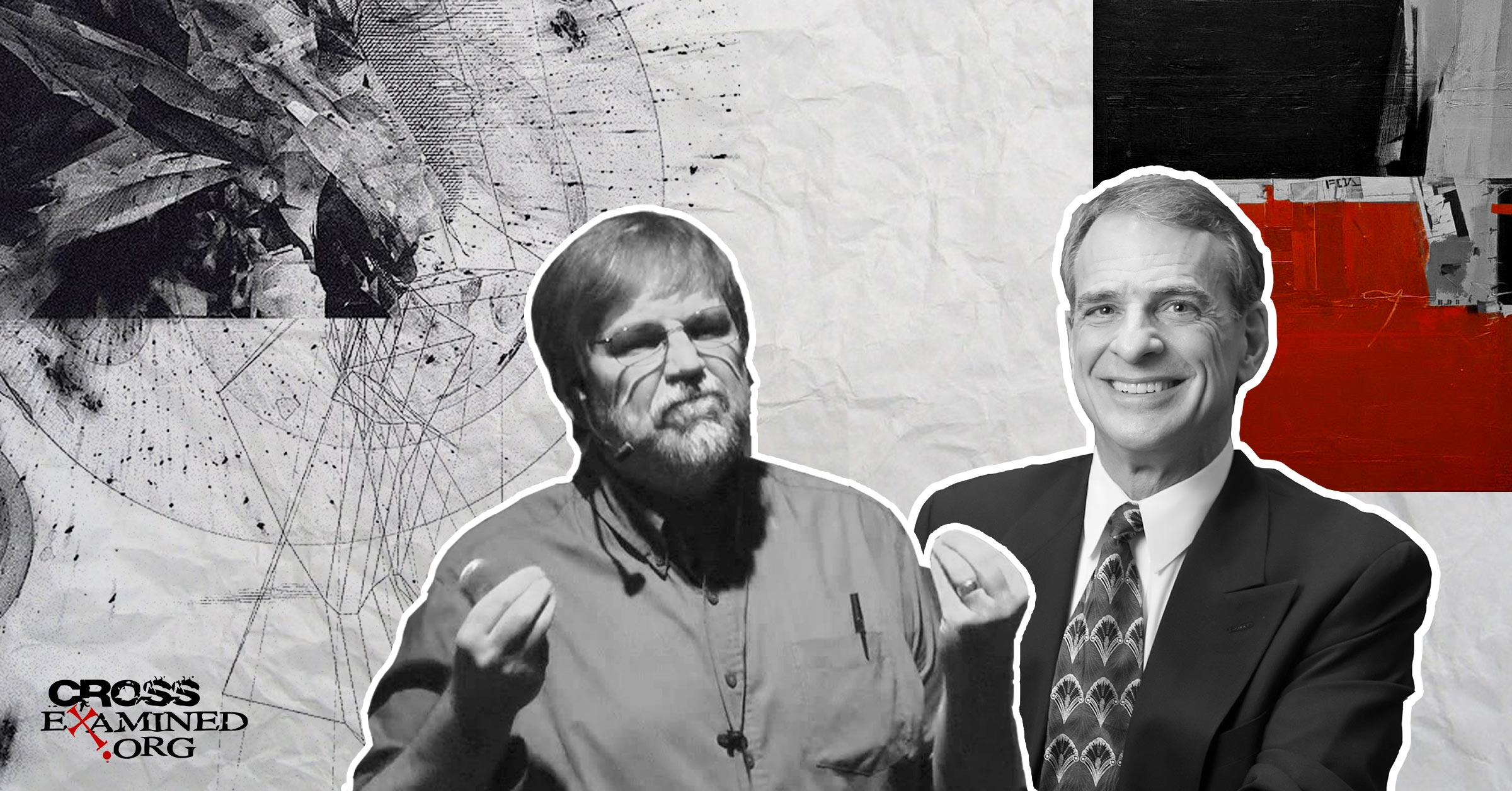
I was very excited to see a recent debate by Christian philosopher William Lane Craig against atheist astronomer Jeff Hester. When I summarize a debate, I do a fair, objective summary if the atheist is intelligent and informed, as with Peter Millican, Walter Sinnott-Armstrong, or Austin Dacey. But the following summary is rated VS for Very Snarky, and you’ll soon see why.

The debate itself starts at 29 minutes:

The audio is very poor.

Dr. Craig’s opening speech

Dr. Craig went first, and he presented four arguments, as well as the ontological argument, which I won’t summarize or discuss. He later added another argument for theism from the existence of the universe that does not require an origin of the universe.

A1. Counter-examples

Theists who are elite scientists cannot be “irrational,” for example Allan Sandage, Gustav Tammann, George Ellis, Don Page, Christopher Isham

A2. Kalam cosmological argument

  1. Whatever begins to exist requires a cause.
  2. The universe began to exist.
  3. Therefore, the universe requires a cause.

A3. Fine-tuning of the universe to permit complex, intelligent life

  1. The fine-tuning of the universe is due either to physical necessity, chance, or design.
  2. It is not due to physical necessity or chance.
  3. Therefore it is due to design.

A4. Moral argument

  1. If God does not exist, objective moral values and duties do not exist.
  2. Objective moral values and duties do exist.
  3. Therefore, God exists.

Dr. Hester’s opening speech

Dr. Hester went second and presented two arguments, which both committed the genetic fallacy, a logical fallacy that makes the arguments have no force.

Hester starts his opening speech by asserting that Albert Einstein was irrational because he denied quantum mechanics.

Hester explains that he became an atheist at 15. This would have been before the evidence for the origin of the universe became widespread before we had very many examples of fine-tuning before the discovery that the origin of life problem is a problem of the origin of complex, specified information, etc. What kind of reasons can a 15-year-old child have for becoming an atheist? It’s hard to say, but I would suspect that they were psychological. Children often desire autonomy from moral authorities. They want to be free to pursue pleasure. They don’t want to be thought of as superstitious and morally straight by their non-religious peers.

Later on in the debate, Hester volunteers that he hated his father because his father professed to be a Christian, but he was focused on his career and making money. In the absence of any arguments for atheism, it’s reasonable to speculate that Hester became an atheist for psychological reasons. And as we’ll see, just like the typical 15-year-old child, he has no rational basis for atheism. What’s astonishing is how he continues to hold to the atheism of his teens when it has been falsified over and over by scientific discoveries in the years since.

Dr. Craig’s deductive arguments do have premises that reach a conclusion through the laws of logic. On the contrary, he just asserts that God exists as his conclusion, and then says that this assertion is the best explanation of a gap in our scientific knowledge. Some of the gaps in our scientific knowledge he uses in his arguments are: 1) he doesn’t understand why the Sun moves through the sky, so God exists, 2) he doesn’t understand why the wind blows, so God exists.

What counts as “rational” are things that have not been disproved. The progress of science has shown that the universe did not need a cause in order to begin to exist, and also there is no cosmic fine-tuning.

A1. The success of evolution in the software industry proves that there is no God.

All hardware and software are developed using genetic algorithms that exactly match Darwinian processes. All the major computer companies like Google, Microsoft, Amazon, Apple, etc. are just generating products using mutation and selection to evolve products over long periods of time. If you look over a typical software engineering degree, it’s all about Darwinian evolution, and nothing about design patterns, object-oriented design, etc.

This widespread use of evolution in the software industry undermines all of the arguments for God’s existence. Evolution caused the origin of the universe. Evolution explains why the universe is fine-tuned for life. Evolution, which requires replication already be in place in order to work, explains the origin of the first self-replicating organism.

A2. Theist’s view of the world is just a result of peer pressure from their tribes.

All of Dr. Craig’s logical arguments supported by scientific evidence don’t matter, because he got them from a primitive tribe of Christians that existed 2000 years ago. Everyone gets their view of origins, morality, meaning in life, death, etc. from their tribes. Except for me, I’m getting my beliefs from reason and evidence because I’m a smart atheist. I don’t have an atheist tribe in the university that would sanction me if I disagreed with nonsense like homosexuality is 100% genetic, transgenderism, man-made catastrophic global warming, fully naturalistic evolution, aliens seeded the Earth with life, infanticide is moral, socialism works, overpopulation will cause mass starvation, nuclear winter, etc. Also, my argument isn’t the genetic fallacy at all, because smart atheists don’t commit elementary logical fallacies that even a first-year philosophy student would know.

A3. Our brains evolved, so our rational faculties are unreliable, so God does not exist.

The logical reasoning that Dr. Craig uses to argue for theism are all nonsense, because human minds just have an illusion of consciousness, an illusion of rationality, and an illusion of free will. Everything Dr. Craig says is just deluded nonsense caused by chemicals in his brain. He has cognitive biases the undermine all his logical arguments and scientific evidence. He just invented an imaginary friend with superpowers. Except me, I’m a smart atheist, so I actually have real consciousness, real reasoning powers, and no cognitive biases. Also, my argument isn’t the genetic fallacy at all, because my arguments would not get an F in a first-year philosophy course.

Discussion

I’m not going to summarize everything in the discussion, or the question and answer time. I’m just going to list out some of the more interesting points.

Dr. Craig asks him how it is that he has managed to escape these biases from tribalism, projection, etc. He talks about how brave and noble atheist rebels are. The moderator asks him the same question. He repeats how brave and noble atheist rebels are.

Dr. Hester is asked whether he affirms a causeless beginning of the universe or an eternal universe. He replies he states that the universe came into being without a cause because causality doesn’t apply to the beginning of the universe. He also asserts with the explanation that Borde, Guth, and Vilenkin have undermined the kalam cosmological argument, mentioning a web site.

Dr. Craig replied to this phantom argument after the debate on Facebook:

Speaking of which, although I haven’t had time to consult the website mentioned by Dr. Hester concerning Guth and Vilenkin on the kalam cosmological argument, I know the work of these two gentlemen well enough to predict what one will find there. Since neither one is yet a theist (so much, by the way, for the dreaded confirmation bias!), they have to reject at least one of the premises of the kalam cosmological argument.

Guth wants to deny premiss (2) The universe began to exist–for which Vilenkin has rebuked him. Guth would avoid the implications of their theorem by holding our hope for the Carroll-Chen model, which denies the single condition of the BGV theorem. This gambit is, however, unsuccessful, since the Carroll-Chen model does so only by positing a reversal of the arrow of time at some point in the finite past. This is not only highly non-physical but fails to avert the universe’s beginning since that time-reversed, mirror universe is no sense in our past. The model really postulates two different universes with a common beginning.

So Vilenkin is forced to deny premiss (1) Whatever begins to exists has a cause. He says that if the positive energy associated with matter exactly counterbalances the negative energy associated with gravity, then the net sum of the energy is zero, and so the conservation of energy is not violated if the universe pops into being from nothing! But this is like saying that if your assets exactly balance your debts, then your net worth is zero, and so there does not need to be a cause of your financial situation! As Christopher Isham points out, there still needs to be “ontic seeding” in order to create positive and negative energy in the first place, even if on balance, their sum is zero.

Dr. Hester is asked how he explains the evidence for fine-tuning. He literally says that “Life is fine-tuned for the Universe,” i.e., that evolution will create living beings regardless of the laws of physics, constants, etc. For example, he thinks that in a universe with a weaker strong force, which would have only hydrogen atoms, evolution would still evolve life. And in a universe that recollapses in a hot fireball, and never forms stars or planets, evolution would produce life. Physicist Luke Barnes, who was commenting on the YouTube chat for the video, said this:

“Life is fine-tuned for the Universe” – complete ignorance of the field. Read a book.

Hester tries to cite Jeremy England to try to argue for life appearing regardless of what the laws of physics are. Barnes comments:

Jeremy England’s work supports no such claim.

Hester appealed to the multiverse, which faces numerous theoretical and observational difficulties. For example, the multiverse models have to have some mechanism to spawn different universes, but these mechanisms themselves require fine-tuning, as Robin Collins argues. And the multiverse is falsified observationally by the Boltzmann brain problem. It was so ironic that Hester claimed to be so committed to testing theories. The multiverse theory cannot be tested experimentally and must be accepted on faith.

Dr. Hester is asked how he grounds morality on atheism. He says there are no objective moral values and duties. He instead lists off a bunch of Christian beliefs which he thinks are objectively wrong. Even his statements about these moral issues are misinformed. For example, he asserts that homosexuality is causally determined by biology, but this is contradicted by identical twin studies that have a rate of 20-40% where both twins are gay.

Dr. Hester is asked about free will, which is required in order to make moral choices. He denies the existence of a free will, which undermines his earlier statements about morality. Morality is only possible if humans can make free choices to act in accordance with a moral standard. So, he claims that Christians are immoral, then he claims that they have no freedom to act other than they do.

Dr. Hester also volunteered that his father believed in the prosperity gospel, and tithed in order to be rewarded with money by God. Dr. Craig immediately says, “no wonder you’re in rebellion against Christianity.” Indeed.

Dr. Hester is asked about his view that human beings are unable to unable to perceive the world objectively. How is he able to perceive the world objectively, when all of the rest of us are unable to? His response is that he is just smarter than everyone else because his ideas have never been falsified by testing.

Scoring the debate

Dr. Craig’s five arguments went unrefuted. Hester’s argument about genetic algorithms was ludicrous to anyone who understands software engineering. His arguments about tribalism and unreliable mental faculties were self-refuting and committed the genetic fallacy. At several points, Hester denied mainstream science in favor of untested and untestable speculations. It was the worst defeat of atheism I have ever witnessed. He was uninformed and arrogant. He didn’t know what he was talking about, and he tried to resort to speculative, mystical bullshit to cover up his failure to meet Dr. Craig’s challenge.

Recommended resources related to the topic:

I Don’t Have Enough Faith to Be an Atheist (Paperback), and (Sermon) by Norman Geisler  and Frank Turek

Why Science Needs God by Dr. Frank Turek (DVD and Mp4)

Science Doesn’t Say Anything, Scientists Do by Dr. Frank Turek (DVD, Mp3, and Mp4)

Oh, Why Didn’t I Say That? Does Science Disprove God? by Dr. Frank Turek (DVD and Mp4)

Stealing From God by Dr. Frank Turek (Book)

God’s Crime Scene: Cold-Case…Evidence for a Divinely Created Universe (Paperback), (Mp4 Download), and (DVD Set) by J. Warner Wallace

God’s Crime Scene: The Case for God’s Existence from the Appearance of Design (mp4 Download Set) by J. Warner Wallace 

God’s Crime Scene: The Case for God’s Existence from the Appearance of Design in Biology DVD Set by J. Warner Wallace 


Original Blog Source: https://bit.ly/2ySL4PM

By Luke Nix

Introduction: Science vs. Christianity?

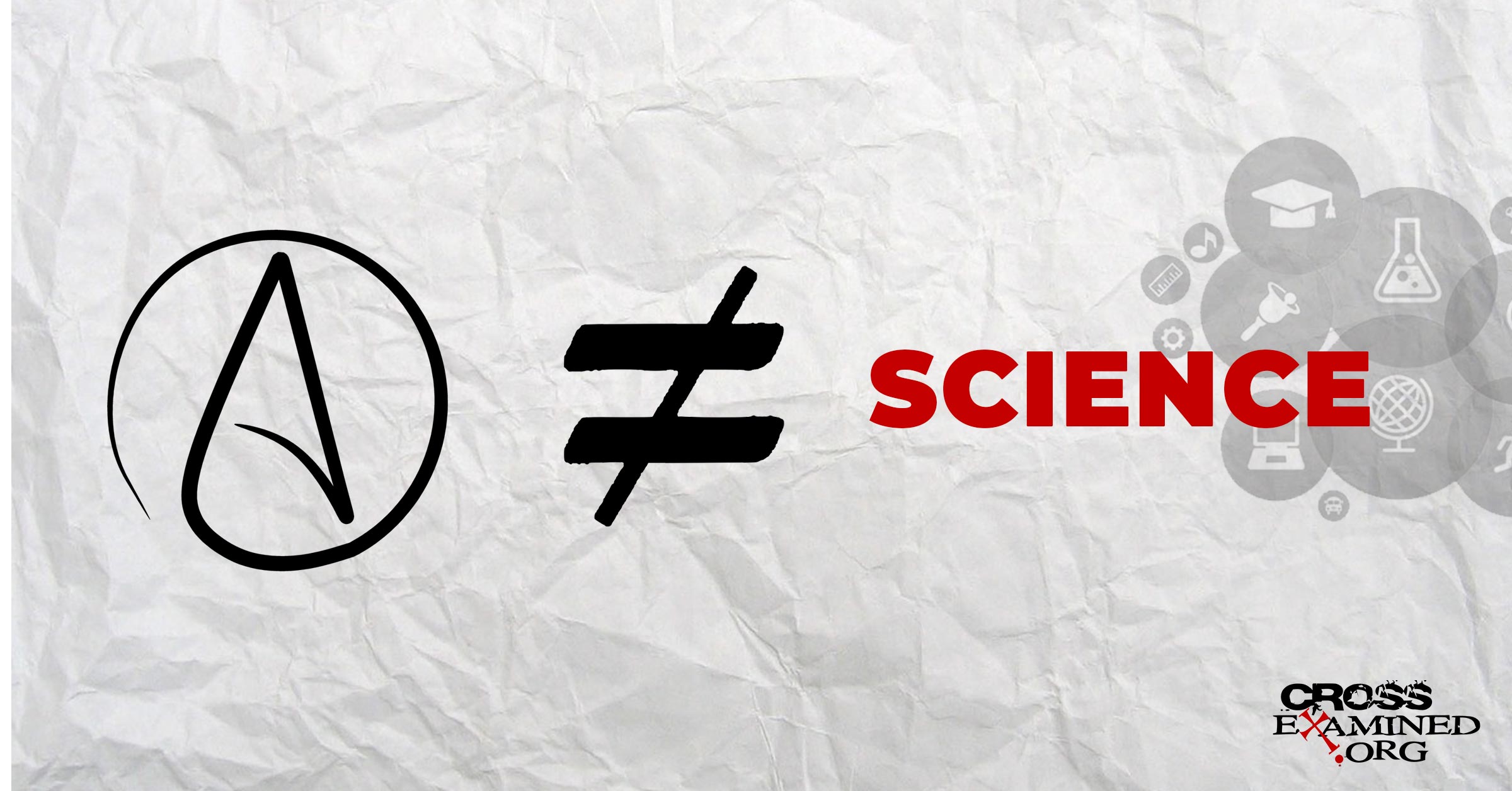
It is commonly claimed that Christianity is a science-stopper. What is usually put forth to justify this claim is that many Christians are content to look at nature and say, “God did it,” without looking further to discover how God did whatever “it” happens to be. For many Christians, questions about the origin and function of the natural world end with that answer. However, for many others, while they recognize that God did indeed do something, they seek diligently to discover how God did it. Christianity does not stop science, a lack of curiosity or concern (not necessarily a bad thing if those are not a person’s passion or pursuit) is what could stop science if no Christian exists who possesses that curiosity. Individual Christians can choose to stop scientific discovery for themselves, but because scientific discovery will continue for other individual Christians, scientific discovery will continue.

On the other hand, atheism actually does stop science. Not because an atheist is content to say “evolution did it” and cease exploratory research, but it is stopped rather for a few other reasons that the atheist cannot escape if their worldview is true. If atheism is true, scientific discovery does not cease just for the atheist whose curiosity and concern are satisfied by the answer “evolution did it,” but it ceases for everyone.

If you are a friend of science and an atheist, I implore you to take your thinking to the next level: think about how you can think about the discovery of the world around you. In today’s blog post, I will present six different ways that atheism mutually excludes science and stops all scientific discovery in its tracks.

Science vs. Atheism

The Laws of Mathematics vs. Atheism

A great deal of scientific research done today necessarily depends upon mathematics in its most advanced forms. It is used to describe chemical reactions, model the formation history of the universe, and even predict the spread of viruses. The reason that mathematics can be used in this way is because the universe is beholden to mathematics. This fact makes the universe describable, discoverable, and predictable (to some extent). If the universe produced mathematics, then there is no reason for the universe to adhere to mathematics, and its describability, discoverability, and predictability would not be possible.

This presents a serious problem for the atheist. For on the atheistic view, mathematics is a product of a feature within the universe (the human brain, to be exact), and the universe is not beholden to something it produced. On the atheistic view, mathematics is not objective, so there is no reason that we should expect the world around us to adhere to or be explainable by using mathematics. The present cannot be described; the past cannot be discovered, and future events cannot be predicted.

On the atheistic view, without a super-natural (outside this universe) foundation for mathematics that constrains this universe to its laws, this universe is nonsensical, and the entire scientific enterprise is ultimately doomed to being nothing more than a guessing game and unable to reveal knowledge about any point in time or space.

The Principle of Uniformity vs. Atheism

Similar to mathematics, the principle of uniformity is key to performing scientific research. This principle states that the past acted very much like the present, and the future will act very much like the present. This principle constrains the universe to a continuous connection across time that scientists can use to describe, discover, and predict. Based upon this principle, scientists understand that it is reasonable to extrapolate observations today into both the past and the future. Through this continuous connection, scientists can discover what happened in the past (historical science) with deductive certainty and make predictions about future events in the natural world (this is how different models of natural phenomena are tested- predictions of future discoveries are made based upon different understandings of the presently-observable data).

But also similar to mathematics, this principle cannot simply have come about with the appearance of human brains on the cosmic scene. If this principle is the product of a feature within the universe, then it necessarily cannot be governed by such a principle. Due to that necessary lack of governance, there is also no reason to think that the universe can be explained using the principle of uniformity.

Thus, if we are to continue scientific discovery using this principle and believe that anything discovered using it is true or meaningful, then it must have a foundation prior to this universe. This means that the principle of uniformity, like mathematics, has a transcendent (super-natural) foundation. Without such a foundation, scientific knowledge of the past and prediction of future events are impossible. On this second count, atheism renders scientific discovery dead on arrival.

For more on this, I highly recommend the book “Origin Science: A Proposal For The Creation/Evolution Controversy.”

The Laws of Logic vs. Atheism

Adding onto mathematics and the principle of uniformity are the laws of logic. It is through the laws of logic that we can connect the present to the past and discover the history of our planet, the solar system, the galaxy, the universe, and even the moments up to the creation event itself. But this level of scientific discovery is only possible if the universe is governed by transcendent laws of logic. Deductive reasoning and deductive certainty (mentioned above) are necessarily dependent upon the laws of logic. If the universe is not governed by laws that transcend its own existence, then there is no reason to act as if it is governed by such laws. These laws must have a foundation that exists outside of the natural universe; this means that they must exist super-naturally.

But according to atheism, nothing exists super-naturally, and laws of logic are no exception. Thus the universe is not required to and cannot be expected to follow any such laws on atheism. If we cannot expect the universe to necessarily follow such laws, then we cannot use such laws to make truth claims about the universe with any level of certainty, including its history or future. Without the laws of logic existing outside the universe, every scientific endeavor that attempts to expand our knowledge of the natural world beyond the present moment of observation in the immediate spacial vicinity is futile. Without a reason to believe that this universe is subject to the laws of logic, scientific discovery is impossible. Because atheism has no room for laws of logic that govern this universe, it has no room for claiming legitimate scientific discovery is part of its worldview.
For more on this, I highly recommend these two books:

Come, Let Us Reason

The Word of God and the Mind of Man

The Laws of Physics vs. Atheism

Atheism, without laws of mathematics and laws of logic, already cannot formulate or describe laws of physics. That is only one of the numerous implications of a worldview devoid of reality beyond this universe. But the problem for atheism regarding the laws of physics goes deeper than merely discovery and articulation. For lack of discovery and/or articulation do not necessarily imply a lack of existence. The lack of existence of laws of physics on the atheistic worldview is established independently, though similarly, to the lack of existence of laws of mathematics and laws of logic.

If there do not exist laws of physics that this universe is governed by, meaning that they are logically prior to or have a foundation outside of this universe, then there is no reason to use said laws of physics in any reasoning (using non-existent laws of logic) from present observations of this universe to the past history (using the non-existent principle of uniformity) of this universe. Again, without foundation outside this universe for laws of physics to govern the universe, this universe is under no constraint to follow any particular description (laws of physics). If atheism is true, science is, for yet another reason, dead on arrival.

Our Sense Organs And The Brain vs. Atheism

Of course, the applicability of the above features of reality does not come into play in scientific discovery until observations are made. While the above features of reality are observer-independent, this last feature is observer-dependent. Not only does atheism have no foundation for the observer-independent features of reality (and necessary features of the scientific enterprise) described above, but its explanation for one observer-dependent necessity of the scientific enterprise undercuts its own reliability.

Atheistic worldviews have only one possible explanation for the appearance of sense organs and the human brain: changes over time that are governed by (non-existent) laws of physics that govern natural selection. This is also known as “unguided evolution” or merely “evolution” in many circles. We must be careful to distinguish here between agent-guided and environment-guided. The “unguided” descriptor here refers to agent-guided. Evolutionists very much believe that evolution was guided, but that guidance was done by the environment and the (non-existent) laws of physics that governed the creation of and behavior of the environment.

With that in mind, this process that is ultimately guided by non-existent laws of physics results in the survival of populations, so features that serve for the survival of populations are what are passed down from generation to generation and remain in existence. In this view, a pragmatic advantage is the determining factor of a feature’s propagation, not truth-discovering abilities. The truth-discovering ability of a feature is purely accidental, and there is no way to independently test the truth-discovering abilities of such features that survived (especially since all the above features of reality, that may be used to independently test, have no foundation in reality if atheism is true). This means that our sense organs and brain have survived, not because of their truth-discovering abilities, but because they helped populations prior survive in their environment. The atheist cannot come around and say that we can independently test our sense organs scientifically via logic, mathematics, the principle of uniformity, or laws of physics because none of those have foundations in reality if atheism is true. If atheism is true, then even those “laws” are the product of our evolved brains, which, again, is the product of a process governed by non-existent laws of mathematics, logic, and physics.

For more on this, I recommend the book “Where The Conflict Really Lies.”

Conclusion

If something does not exist or is not true, it is not a valid launching point for any process of gaining knowledge. If the foundations are compromised, so are the results. If atheism is true…

…science cannot begin with laws of mathematics.

…science cannot begin with the principle of uniformity.

…science cannot begin with laws of logic.

…science cannot begin with laws of physics.

…science cannot begin with our own observations.

…science cannot begin with our own reasoning.

Science necessarily depends upon the reality and truth of these features of reality. If atheism is true, there is no foundation for any of these features of reality. If atheism is true, these are not features of reality, which means that they are neither true nor do they exist. Thus they cannot be launching points of any knowledge discipline, including science. If atheism is true, the scientific enterprise (among other knowledge disciplines) cannot legitimately claim to provide us with the truth about our world. If atheism is true (in whatever form), it is impossible to connect our subjective beliefs to objective reality.

Because atheism mutually excludes science, atheism is no friend of science; and science is no friend of atheism. If you are a friend of science, you know that these six concepts are features of reality and are true. I invite you to abandon the scientifically and philosophically naive worldview of atheism; embrace the reality of the Christian God, the One who provides a firm foundation for every one of these six realities that you already know exist and already depend upon for your scientific discoveries.

Recommended resources related to the topic:

Why Science Needs God by Dr. Frank Turek (DVD and Mp4)

Science Doesn’t Say Anything, Scientists Do by Dr. Frank Turek (DVD, Mp3, and Mp4)

Oh, Why Didn’t I Say That? Does Science Disprove God? by Dr. Frank Turek (DVD and Mp4)

Stealing From God by Dr. Frank Turek (Book)


Luke Nix holds a bachelor’s degree in Computer Science and works as a Desktop Support Manager for a local precious metal exchange company in Oklahoma.

Original Blog Source: https://bit.ly/2Kt7oBy

By Mikel Del Rosario

While I was driving from Sacramento to the Bay Area, I saw a huge billboard that read, “Are you good without God? Millions Are.” I also noticed a theistic tagger added the words, “Also Lost?” at the end of the message. At first, I wondered if the original question could mean something like, “Do you feel comfortable without a belief in God? Millions feel the same way.” Kind of like if you offer someone a drink, and they say, “No, thanks. I’m good.” But I don’t think that’s what the message is all about.

Are you good without God? Millions Are

Can’t People be Good Without God?

So, then it got me thinking, “Can’t people be good without God?” I mean, couldn’t an atheist do some really good things without God? I guess if we mean “doing the right thing while not believing in God,” then sure. An atheist could do the right thing. For example, they could honestly report their income to the government, be faithful to their spouse, and so forth. And why not? But maybe the better question is, “Why?” Why even care about being moral?

Why Do the Right Thing?

Think about it like this: If God’s not real, there’s no moral lawgiver and no such things as objective moral commands. If that’s true, then why not say, “I’ll do the right thing when it makes me feel good or gives me an advantage, and I’ll do the wrong thing when it makes me feel good or gives me an advantage.” Or why not say, “I hereby declare from this day forward that it’s always right to steal.”

If there’s no God and no objective moral standard, there’s no moral difference between abusing someone or taking care of them. Basically, good and evil are reduced to preference. All you could say is, “I don’t like terrorism,” or “I’m not into slavery.” “Human trafficking isn’t my thing.”  But who can really live like this? Some things are really wrong. For example, we all know by intuition that it’s better to give a little girl a loving hug than to hurt her for no reason.

Right, Wrong, and the Moral Law

Imagine my 6-year-old asked you who wrote this blog post. It’d be dumb to say “No one. And if you think I’m wrong, don’t forget I can read better than you!” The existence of this post implies an author. And it really doesn’t matter if you can read this post better than a kid. Here’s the point: Moral commands imply a moral lawgiver. They are a form of communication from one mind to another. And it doesn’t matter if a certain atheist happens to do more good deeds than a certain Christian or vice versa.

Interested in exploring this idea further? Check out these links:

Maybe people really can’t be good without God, after all. I mean, if there’s no God, there’s no standard of goodness. On top of that, when we compare ourselves to God’s standard, it turns out no one is good—no one’s lived up to the standard. That’s what Jesus said in Mark 10:18. Keep in mind that niceness isn’t goodness. Don’t you think the Neo-Nazi moms bake cookies for their kids or hand out cupcakes at their birthday parties? Sure they do. Jesus also said it’s no big deal if we’re nice to the people we like (Matt. 5:46-47). How do we treat everyone else?

Yes and No

If “Are you good without God?” just means, “Can you do good things without acknowledging God?” Then, sure. You could say, “Yes” to that. But the real answer to the question, “Are you good without God?” is “No. None of us are.” Without God, there is no objective standard of goodness. But we know such a standard exists. Why? Because while you could have good without evil, you can’t have evil without good.

Think about it: You could have a standard of goodness in a world where nothing falls short of that standard. But you can’t have something falling short of a standard of goodness without the standard itself. And when we recognize a standard greater than ourselves–GOd’s own nature–we can see we need forgiveness. We all for short before God. That’s another reason we need him. Millions and millions do.

Recommended resources related to the topic:

Stealing From God by Dr. Frank Turek (Book, 10-Part DVD Set, STUDENT Study Guide, TEACHER Study Guide)

Legislating Morality: Is it Wise? Is it Legal? Is it Possible? by Frank Turek (Book, DVD, Mp3, Mp4, PowerPoint download, PowerPoint CD)

Do Ethics Need God? by Francis Beckwith (Mp3


Mikel Del Rosario helps Christians explain their faith with courage and compassion. He is a doctoral student in the New Testament department at Dallas Theological Seminary. Mikel teaches Christian Apologetics and World Religion at William Jessup University. He is the author of Accessible Apologetics and has published over 20 journal articles on apologetics and cultural engagement with his mentor, Dr. Darrell Bock. Mikel holds an M.A. in Christian Apologetics with highest honors from Biola University and a Master of Theology (Th.M) from Dallas Theological Seminary, where he serves as Cultural Engagement Manager at the Hendricks Center and a host of the Table Podcast. Visit his Web site at ApologeticsGuy.com.

Original Blog Source: http://bit.ly/3cEE1cj

By Luke Nix

Introduction

It was brought to my attention a few weeks ago that the notorious atheist Richard Dawkins may be changing his tune regarding the necessity of belief in God in human society (click or tap text to see the article). I do recall hearing winds of this change a couple of years ago when he seemed to make a distinction between the religions of Islam (threatening) and Christianity (benign). It seems that Dawkins recognizes that without the belief that people will be held responsible to a higher power, those people who are in power (the State) will push society further and further into harmful and devastating behaviors, but he recognizes the dangers of certain theistic religions. Dawkins seems concerned that without the (false on his view) belief that the Christian God exists, then society will crumble, yet with the (also false on his view) belief that the Islamic god exists, then society will be destroyed. Dawkins seems to be now telling people to not be concerned with what is true, but be concerned with what is pragmatic. Unfortunately, this is nothing new and seems to have been the strategy of many States for quite some time. Allow me to explain.

Theism vs. The State

If God is the source of all moral duties and obligations, then the State can not be. Thus if a State wishes to legislate moral obligations (such as that people who offer a service are morally obligated to act against their moral conscience) or freedoms (such as pedophilia), then State must eradicate God from the conscience of those it governs. With God still in the cultural picture, there is an Authority to which the government is subject and is obligated to align laws with. However, if no God exists (or a State’s citizens do not recognize that God exists), then the State has no one and nothing to challenge its authority or the laws it legislates. Without any external source (God) for the citizens to hold the State accountable to, the State’s authority and legal commands will be understood as absolute.

Such a view is encouraged by the State through the promises of the legalization of many people’s sinful desires. Everything from autonomous sexual freedom to drug use is dangled in front of the populace to entice them to rid their worldview of a God that is a “party pooper.” For the State knows that with the eviction of God from the cultural mindset to allow people to explore their wildest and most debauched fantasies also goes the God that would place limitations on the State to control the masses.

No God, No Legitimate Reformations

While many atheists would have no problem with (even a belief in) God having no part in government (“separation of Church and State” and all), there are some serious consequences that some atheists (including Dawkins) have detected and are warning against. For instance, the reformer has nothing to appeal to in order to demand change in the government. Great reformers, such as those who challenged the government’s permitting the owning of slaves, would ironically be standing in the wrong and would have no objective grounding on which to stand against the government. In such a world, the State is a god; no one has any grounds to challenge it; it maintains absolute authority. If there is no external source for morality to hold the government accountable to, then no reformation should ever take place. If such a world truly existed (one without God), then Africans could still be enslaved in America today.

No God, No Legitimate Changes at All

If the State already legislates, executes, and adjudicates according to an individual atheist’s ideas of “right” and “wrong,” then things are okay with that particular atheist. However, if the State does not align with the atheist’s ideas of “right” and “wrong” 100%, it would be wrong (on the view that there is not God- that government is the absolute moral authority) for the atheist to attempt to change the State’s position on anything, for submitting to the absolute authority of the State is legally (not “morally” since morality is not objective on this view) obligatory. If the State is the absolute authority for how its citizens should act, then if the State is Christianized (or becomes a theocracy), then the atheist is legally obligated to act according to the laws and not attempt reform government. Again, to attempt to reform would be a violation of the legal obligation to submit to the absolute moral authority of the State.

Ironically, when a naturalist stands against the State today, they are in violation of this legal obligation. If the State were to criminalize abortion, the atheist would be legally obligated to comply. In a socialist country, the capitalist would be the criminal for standing against socialism, and in a capitalist country, the socialist would be the criminal for standing against capitalism.

A Godless Society

Yet Changes and Reformations Abound And More Are Attempted

This type of world is quite scary for both atheist and theist alike. Neither truly believes that the State is the ultimate authority of morality. This is evidenced by both sides’ reservation of the right to attempt to reform the State should a law be legislated that does not align with their idea of right or wrong. Ironically for the atheist (but consistent with the theist), God (as the objective standard of morality) must exist for the reservation of that right to be legitimately justified. I’m not saying that the atheist cannot exercise this right, but they have no foundation for it in their own worldview; they must borrow from the theistic worldview to justify any governmental change or reformation.

Politicians Are Already Steps Ahead of Us

We see almost daily how politicians throughout our government are working diligently to remove God from the culture. When they accomplish this, their citizens will have no choice but to submit and never attempt to change or reform the government.

This is nothing new. Politicians have been working at the grassroots level with our education system for decades. By trying to eradicate God, they not only take away any moral authority over the State, they also eliminate any ability to ground reasoning or to have knowledge. So, even if someone decided to challenge the State, they could never use reasoning or claim to have knowledge that the State’s position was objectively wrong. I go into more details of this in my post, “Is Education Overrated?

An Even More Dangerous Game

With the destruction of reasoning and knowledge, we will see another devastating and logical implication of eliminating God- the destruction of the academy. Without knowledge even being possible, all knowledge disciplines are ultimately useless. If a would-be reformer were to use the knowledge disciplines to evidentially challenge the State, it would be pointless, for the reformer could not lay claim to having knowledge from any discipline. Further, without a grounding for logic, they could not even reason from the evidence to the guilt of the State and the need for change or reformation.

When I see politicians trying to remove God from America, I see them setting up their dictatorship in my back yard. This should not just concern theists, but it should (and does) concern atheists alike. We have to remember that there is no single “atheistic” ethic or belief, so the chances that the views of the one who is in charge aligning with that of any other atheist in this country are slim. Most atheists will desire reform, but they not only have a legal obligation not to challenge the State, they would not have any moral, evidential or logical grounds on which to do so.

Conclusion

With atheists such as Richard Dawkins now telling us that while theism is false, we cannot remove it from society, there is a great deal of irony and even absurdity. They recognize that atheism is not a livable worldview for society, and they recognize that in order to survive, we must believe something that is false (theism, on their view). If, in order to survive, we must believe what is false about the world we live in, then how can they claim that what they have come to believe, in order to survive, is true? If atheism is true, then knowledge is an absurd concept, and no one can claim to know anything true about our world, and worse off, we have reason to doubt everything that someone else tells us is true!
Ironically, Richard Dawkins, by his own recognition that God is not just a “useful fiction” but a “necessary fiction” for the very survival of society, has given us every reason to toss his entire life’s work (everything from his scientific research to his philosophy of atheism) into the garbage can! At this point, if Richard Dawkins wants to salvage any portion of his life’s work, he needs to recognize the existence of God (and not just any god but the Christian God) and do what he can to reconcile God’s existence with his work in biology and biochemistry (maybe recognize that nature appears and measures to be designed because it is designed); but his atheism is a failed hypothesis no matter which way he goes. Interestingly enough, Richard Dawkins is making the case against his own atheism using the immorality of modern culture. To understand this argument better, check out this video from Reasonable Faith and the links to books below:

Recommended resources related to the topic:

Answering Stephen Hawking & Other Atheists MP3 and DVD by Dr. Frank Turek

Reaching Atheists for Christ by Greg Koukl (Mp3)

Macro Evolution? I Don’t Have Enough Faith to be a Darwinist (DVD Set), (MP3 Set) and (mp4 Download Set) by Dr. Frank Turek

Counter Culture Christian: Is There Truth in Religion? (DVD) by Frank Turek

Defending Absolutes in a Relativistic World (Mp3) by Frank Turek

Stealing From God by Dr. Frank Turek (Book)

Defending Creation vs. Evolution (mp3) by  Richard Howe

Exposing Naturalistic Presuppositions of Evolution (mp3) by Phillip Johnson

Inroad into the Scientific Academic Community (mp3) by Phillip Johnson


Luke Nix holds a bachelor’s degree in Computer Science and works as a Desktop Support Manager for a local precious metal exchange company in Oklahoma.

Original Blog Source: http://bit.ly/371TNds

By Alex McElroy

One of the most difficult issues to reconcile in life is the presence of evil. This is the case whether one has a theistic, agnostic or atheistic worldview. The existence of evil is undeniable both in our witness and experience but is evil objective in nature or merely an apparition. Even atheist J.L. Mackie recognized a dilemma. In one book, he writes, “There are no objective values.”[1] Elsewhere, he writes, “We might well argue…that objective, intrinsically prescriptive features, supervenient upon natural ones, constitute so odd a cluster of qualities and relations that they are most unlikely to have arisen in the ordinary course of events, without an all-powerful god to create them.”[2]

This poses a problem for the naturalist or the atheist because whatever evil does exist in people cannot be attributed to anything other than misfiring neurons. Well, known atheist Richard Dawkins has stated, “DNA neither cares nor knows. DNA just is. And we dance to its music.”[3] However, if we are just dancing to our DNA, then no one can ultimately be held responsible for any actions, and evil becomes a term without an ontic point of reference. Ravi Zacharias wrote, “Atheists often blunder into the right by borrowing from assumptions that are not logically deduced from their own worldview. But their opinion is so strong that they straddle the two worlds and make up a bridge because they have reached an unbridgeable chasm, given their starting point.”[4] That starting point of random, unguided natural processes is hardly the building blocks for a moral framework.

Sam Harris, an atheist who is both a philosopher and neuroscientist, has much to say on how humans can arrive at life-sustaining moral standards simply through biological evolution. He writes, “Many people imagine that the theory of evolution entails selfishness as a biological imperative. This popular misconception has been harmful to the reputation of science. In truth, human cooperation and its attendant moral emotions are fully compatible with biological evolution.”[5] First, it should be noted that many scientists, most notably Biochemist Michael Behe, have shown a flaw in the premise being proposed by Mr. Harris in regard to the selfishness of biological evolution. With regard to the underlying theory contained within Harris’ assertion, Behe writes, in Darwin Devolves, about two groups of extended evolutionary synthesis scientists who propose a similar theory:

The first speculates that once master genes and their regulatory networks of connections were in place, perhaps novel complex features could be developed mostly by random changes that accidentally form new signature sequences near various genes….The second group…emphasizes the ease of deploying an array of machinery to different locations, which, like ectopic fly eyes, would generate a lot of variation much more easily than Darwin might have imagined. Maybe that would give selection more to choose from. If all that sounds distressingly vague, I’m afraid that is the gist of the argument…The unanticipated discovery of layers of control – master switches and the stunningly sophisticated genetic regulatory networks they activate – does not make the putative undirected development of life any easier to explain, evo-devo (Evolutionary developmental biology) enthusiasts seem to imagine. It makes it harder. The need for a foreman and subcontractors to coordinate construction does not make it easier to explain how unintelligent processes could make a building out of bricks and wood and pipes and wiring. It shows it to be impossible.[6]

Behe is indicating that an external infusion of sorts, in fact, a number of external infusions would be required in order to advance biological evolution. Who or what could that provide that infusion? If not God, it seems unlikely that unintelligent and unguided natural forces could be responsible for natural evolution, not to mention moral evolution. Additionally, Sam Harris simply assumes that “human cooperation and its attendant moral emotions” would be natural outgrowths of a macroevolutionary process. But that’s a large assumption considering that one component of Darwinian evolutionary theory is survival of the fittest, not survival of the most cooperative.

Mr. Harris goes on to write, “The work of evolutionary biologist Robert Trivers on reciprocal altruism has gone a long way toward explaining cooperation among unrelated friends and strangers…Because moral virtue is attractive to both sexes, it might function as a kind of peacock’s tail: costly to produce and maintain, but beneficial to one’s genes in the end.”[7] Even if we accept Harris’ premise that moral virtue is attractive or beneficial, it still does not allow us to assign an objective value to what morality is in its essence. How are we to know if what we are attracted to in another is being accurately perceived as high moral character? What standard are we comparing their moral virtue to in order to determine where they measure up? How do we define what is most beneficial to us or to humanity at large? These are metaphysical questions that cannot simply be reduced to physical or naturalistic foundations.

In reviewing the works of C.S. Lewis, David Bagget noted, “Moral language today is so peculiar, in fact, that Lewis suggests that this is why many people try to explain it away. Some attempt to reduce moral impropriety to an instrumental matter – as we do with a tree, for our purposes, does not shade us well and is, for this reason, and in this sense, a ‘bad tree.’”[8] Terms such as good, bad, or evil simply lose all substantive value in a purely naturalistic worldview. This does not mean that an atheist cannot be a good person. Of course they can and most of them are morally upright. The issue is not that you cannot be good or do good things if you do not believe in God or the God of the Bible. The issue is that such a thing as good cannot objectively exist if God does not exist. If evil exists, good exists, and if good exists, God exists.

Notes

[1] J.L. Mackie, Ethics: Inventing Right and Wrong. (Middlesex, England: Penguin Books, 1977), 15.

[2] Ravi Zacharias & Vince Vitale, Why Suffering: Finding Meaning and Comfort When Life Doesn’t Make Sense. (New York, NY: Hatchette Book Group, 2014)142.

[3] Richard Dawkins, River Out of Eden: A Darwinian View of Life. (New York, NY: Basic Books, 1995)133.

[4] Turek, Stealing From God, ix.

[5] Sam Harris, The Moral Landscape: How Science Can Determine Human Values. (New York, NY: Free Press, 2010), 56.

[6] Michael Behe, Darwin Devolves: The New Science About DNA That Challenges Evolution. (New York, NY: Harper Collins, 2019)118.

[7] Harris, The Moral Landscape, 56.

[8] Gregory Bassham, C.S. Lewis’s Christian Apologetics: Pro and Con. (Leiden, Netherlands: Brill, 2015), 127-28.

Recommended resources related to the topic:

If God, Why Evil? (DVD Set), (MP3 Set), and (mp4 Download Set) by Frank Turek 

If God Why Evil. Why Natural Disasters (PowerPoint download) by Frank Turek

Why Doesn’t God Intervene More? (DVD Set), (MP3 Set), and (mp4 Download Set) by Frank Turek

Why does God allow Bad Things to Happen to Good People? (DVD) and (mp4 Download) by Frank Turek 


Alex McElroy is an international speaker, apologist, leadership advisor, author of the book “Blueprint for Bible Basics” and writer for the blog “Relentless Pursuit of Purpose.” He is one of the founding Pastor of at Engage Community Church and formerly the Pastor of Education at New Life Covenant Southeast Church, led by Pastor John F. Hannah with 20,000 members. For over 14 years, Alex has served in both youth and adult teaching ministries. Alex has also trained hundreds of teachers and ministers, so they are equipped to deliver lessons in Biblical study, purpose, leadership, and Apologetics in order to maximize their effectiveness in and for the Kingdom of God. He is a firm believer that everyone is born on purpose with a purpose. He teaches people all over the world to find the purpose God has placed inside of them and to deliver it to the world.

By Al Serrato

“I can’t believe in a God who would allow so much evil and suffering in the world.”

Have you encountered this challenge? Most anyone who has tried to defend the Christian worldview surely has. The person bringing this challenge will often claim to be atheist, but when you dig in a bit this challenger is more often someone who knows there is a creator but who is deeply offended by the world, and angry at the God who set all this – the carnage, the anguish, the pain – in motion.

In my last post, I restated the traditional Christian response to this problem of evil.  God did not create the evil that surrounds us because evil is not a thing.  Evil is a departure- a deviation- from the good which God did create, and which God defines.  This answer serves a particular purpose: it shows that the Christian belief system is internally coherent.  For if God did create evil, he could not be the God described in the Bible because an all-powerful, all-good, and all-loving God could not be the creator of evil.

But, the atheist insists, even if I grant that God did not create evil, He created this universe and everything in it.  Isn’t He, therefore, still responsible for all the evil that we see around us?  In other words, if God isn’t guilty of the crime of actually creating evil, is He not still liable as an aider and abettor?

C.S. Lewis wrote about those who put God “in the dock.” It seems a natural human tendency to find fault with the way others have acted or decisions they have made.  As a criminal prosecutor, I found that I would often slip into this kind of thinking too, silently building a case against God, accusing Him in my inner thoughts of not doing things the way He should have, the way I would have.  The created order is filled with so much beauty, so much elegance, so much to admire and to be awed by….yet, we know that something is also very much amiss.  Every beautiful thing God has created has been marred in some way.  Out of every good in the world, there springs forth, weed-like, much that is bad, much that is evil.  Why has God allowed this?

By satisfying the demands of logic, the traditional explanation of the nature of evil helps to make sense of our faith. But notice what it does not attempt to do: it does not seek to defend God, which is, in essence, what this challenge is asking us to take on. Nor does it provide an emotionally satisfying explanation to the one who is suffering, no easy answer to make it all quickly better.

What, then, can the Christian to say in response to this challenge?

Perhaps the answer should begin with the recognition that we need not – that indeed we cannot – defend God.  Yes, God is responsible, ultimately.  It is His creation, His universe, His set of rules to which both conform.  For reasons that make sense to Him, He endowed us with free will, knowing that we would use it in inappropriate ways, in ways that displeased Him and would cause harm to others. True, this answer is not satisfying emotionally. It is instead a logical answer, and while logic has its place, we are not strictly logical beings. We feel, and when we experience evil, we suffer. As beings who love, we grieve when we see those whom we love suffer.

The challenger may argue that a God who allows suffering cannot be loving but is it not the case that suffering may serve a purpose.  We grasp this intuitively: we know that hard work can often lead to much gain; we see that the cure of the physician or surgeon may at first be quite painful; we note the agony of labor that precedes the birth of a child.  Everywhere in nature, we see the source of the expression “no pain, no gain.”  We also know, at a more profound level, that none of this, neither the pain nor the glory, lasts forever. We are on the road to …somewhere…and there are indeed many obstacles, many pitfalls, along the way.

And yet, are we really in a place to put God on trial? With what arrogance would the pot stand in the well to accuse the potter of poor workmanship? How would the robot, constructed to complete a particular job, rightly complain that the tasks to which it is put are not just? That it should instead rule the world into which it was placed.

 At present, we see through darkened and distorted lenses. Free will and suffering. These concepts will never make complete sense to us. But as the created and not the creator, perhaps all we can do is remember that they make sense to Him.

Recommended resources related to the topic:

If God, Why Evil? (DVD Set), (MP3 Set), and (mp4 Download Set) by Frank Turek 

If God Why Evil. Why Natural Disasters (PowerPoint download) by Frank Turek

Why Doesn’t God Intervene More? (DVD Set), (MP3 Set), and (mp4 Download Set) by Frank Turek

Why does God allow Bad Things to Happen to Good People? (DVD) and (mp4 Download) by Frank Turek