Tag Archive for: atheism

By Timothy Fox

We at FreeThinking Ministries are dedicated to answering the biggest objections to Christianity. We respect sincere skeptics and seekers and understand that everyone has doubts. We do, too, at times. If there’s a certain obstacle that is keeping you from the faith, we want to help remove it. Responding to objections is mandatory to the Christ-follower: “always being prepared to make a defense to anyone who asks you for a reason for the hope that is in you, yet do it with gentleness and respect” (1 Peter 3:15). Many times, it’s that last part that makes all the difference: “do it with gentleness and respect.” We don’t ever want to come across as arrogant or disrespectful, but we do what we do because we think that Christianity is true and we want you to think so also.

But this series, Stuff Atheists Say, isn’t about the good objections; it’s about the bad ones. Things that need to go away for good. Many things skeptics and atheists say aren’t really arguments; they’re meant to mock and ridicule, to smugly derail a conversation and make you feel stupid in the process. You know, the kind of thing you find on social media or hear from a certain famous British comedian.

So we’re going through the worst of the worst and ending them once and for all. But enough talk. Let’s get started:

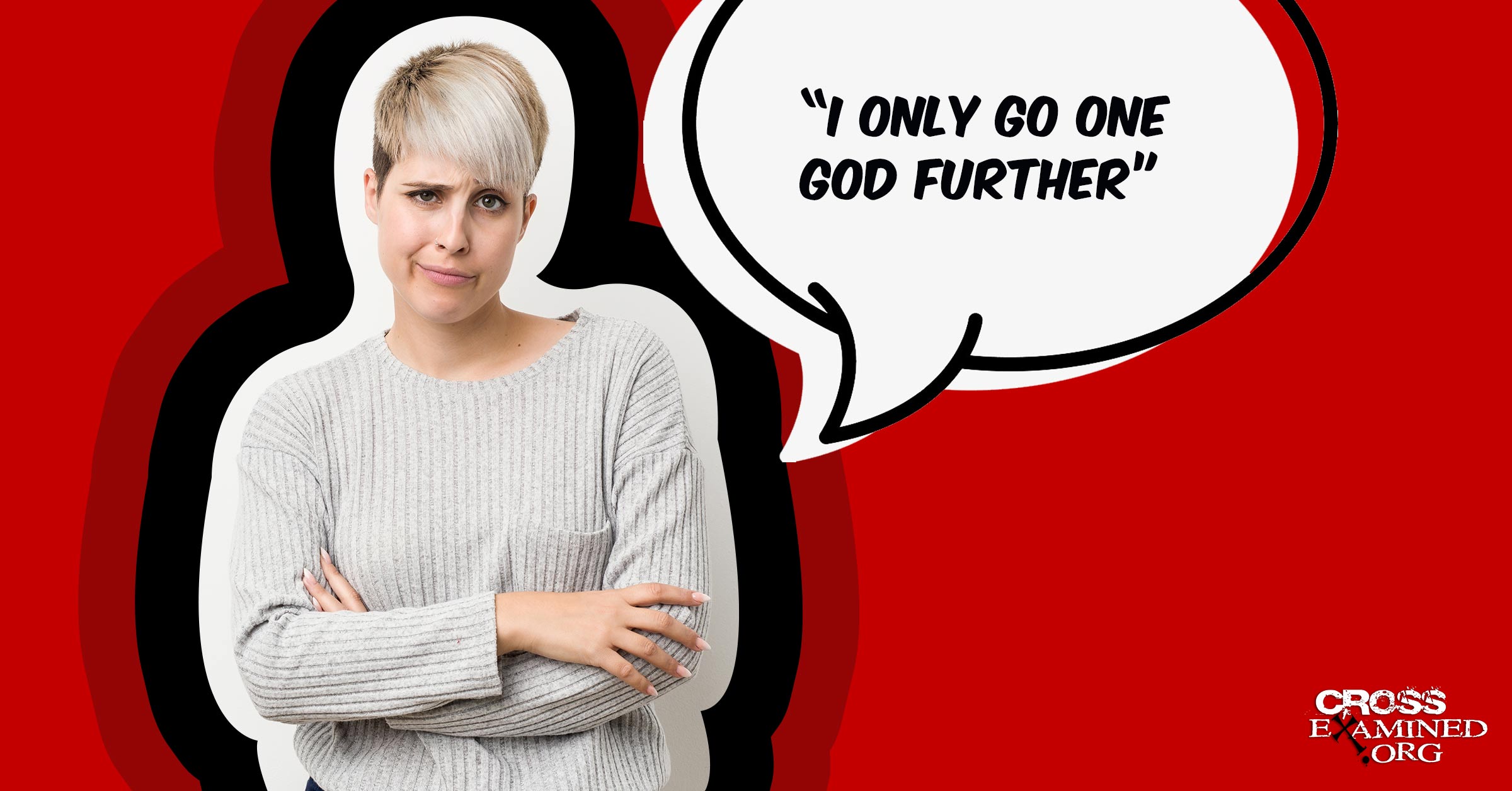
Bad “argument” #1: You’re almost an atheist

This “argument” goes like this: “You believe in one god and deny thousands of other gods. I just go one god further and deny the existence of all of them. So you’re almost an atheist.”

Or you may hear it worded like this: “You’re an atheist towards thousands of other gods; I’m an atheist towards all of them.”

The first thing you need to notice is that this is not an argument against the existence of God. It offers no evidence and puts forth no objection. This statement is about you. What you think and believe, how you label yourself. But it is not about God and whether or not He actually exists.

Second, theist and atheist are specific terms. Regarding the second phrasing of the slogan, you can’t be theist towards some gods and atheist towards others. That’s not how the words work. It’s like saying someone who doesn’t eat chicken is a vegetarian towards chicken. Ever heard anyone say that? Me neither.

To believe in at least one god makes you some form of a theist; to believe in no gods at all makes you an atheist. By definition. There are no degrees or percentages of theism, that if I believe in one god, I’m less theist than someone who believes in two. The difference isn’t between one or many; it’s between zero and one. Let’s look at an analogy that will further show how ridiculous this statement is:

How many women do you think there are in the world? Let’s just say one billion. Out of those one billion women, I’m only married to one of them. So does that mean I’m almost single? No, that’s stupid. Married is married and single is single. Whether I’m married to one or twenty women, it doesn’t matter. I’m married. It’s binary: 1 or 0. Sure, if it’s the night before my wedding, you could say I’m almost married if you mean that I will be married soon. But that’s in regard to time, not degrees of married-ness. And that’s not what the argument is trying to do. It’s making a fraction or a percentage of theism as if that’s meaningful in the discussion, which it isn’t. It’s ridiculous. So don’t fall for it.

Conclusion

Yes, I only believe in one God, but that’s because I think the God of the Bible is the one true God who exists. I’m not picking gods randomly from a hat, as if one is just as reasonable as another. I believe in a creator God, a personal First Cause who designed life, the universe, and everything and is the standard of objective morals and values. I believe Jesus of Nazareth rose from the dead, vindicating His claims to be God and placing his seal of approval on the Old Testament as well as the men who would go on and write the New.

In case you haven’t gotten it yet, let me make it perfectly clear: I am not almost an atheist. I am a Christian theist.

Please understand that I’m not calling atheists stupid. I’m saying some things atheists say are stupid, such as the “almost an atheist” slogan. It needs to die.

Visit Timothy Fox’s website: Free Thinking Ministries

By Natasha Crain

I suppose this a funny title for a post on a Christian parenting blog! But, as I often explain, we can no longer teach our kids about Christianity in a silo and expect them to automatically stand spiritually strong. The challenges today are too great. As I discussed in my last post, the atheist worldview in particular is a threat to the faith of young people.

In today’s post, I want to give you some very practical ideas for teaching your kids about atheism. The first seven are appropriate for kids of all ages, while the second seven are appropriate for middle school and older kids.

I should note that the first several ideas on this list are not necessarily for teaching the specifics of the atheist worldview. They do, however, lay an important foundation for future learning on the topic (e.g., with the last seven ideas on the list).

Without further ado, here are 14 ways to teach your kids about atheism.

1. Be intentional in pointing out that not everyone believes in God.

Depending on where you live and your kids’ educational setting, they may or may not have this basic fact fully on their radar. When I was growing up, I was very aware of different religions, but was hardly aware that there were people who didn’t believe in God until I was in high school!

The fact that God is invisible often comes up in our Bible study time with the kids (ages 5 and 3). I use it as an opportunity to acknowledge that it takes effort to understand a God we can’t see or touch, and that some people decide God must not exist if we can’t see him. I emphasize that God doesn’t just make us guess that He’s there, however; He has left us much evidence in what we can see. (See this post for discussion pointers.)

2. Discuss reasons why some people don’t believe in God.

One night per week, instead of our planned Bible study time, we let the kids ask any questions they want about God. This week, my daughter asked, “Why doesn’t everyone believe in God if the Bible tells us all about Him?” I was so happy she asked that question, and it led to a great introductory conversation about why some people reject God. At an age-appropriate level, we discussed how some people just don’t want to believe in God because they want to live without any (moral) rules; how some people see all the bad stuff happening in the world and decide a good God can’t possibly exist; how some people think the world has just always existed without a creator; how some people think the world would be very different if God existed; and so on.

This can lead to a great conversation about how the decision to accept or reject God (and Jesus) is the most important decision people must make in life.

3. When talking about stories from Jesus’ life, talk about the reactions he received from non-believers.

One of the stories that baffles me the most from Jesus’ life is when he healed a man with a withered hand on the Sabbath and the Pharisees who were present immediately set out “to destroy Him” for violating their rules (Mark 3:6). If I just saw a withered hand miraculously restored in front of my eyes, I think I’d be convinced that this person had authority from God and I’d chill out on the Sabbath rule enforcement. But, despite this evidence, they still did not believe Jesus was God’s Son and set out to kill Him.

Events like these from Jesus’ life provide a good opportunity to talk about belief and non-belief – that even when Jesus was walking this earth and doing amazing miracles in front of people, there were those who would not believe. The Pharisees were not atheists, so this isn’t a conversation about atheism per se, but it is a conversation that helps kids start thinking about the nature of belief and unbelief.

4. Discuss Jesus’ miracles in the context of proving his identity.

When I was growing up, my sole understanding of miracles was that Jesus did a lot of cool stuff when He was on earth – stuff I had to color pictures about. It never occurred to me that there was a reason He did miracles until I was an adult. What a huge point I had missed: Jesus performed miracles in large part to prove He really was God’s Son.

The reason this point is so important to make with kids is that it solidifies an understanding that God never asked us to have a blind faith, where we just have to guess about His existence. Jesus didn’t walk around on earth merely claiming a heavenly authority. He demonstrated his power with visible evidence. When kids get a bit older, they will be ready to start learning the specifics of the evidence we have today (e.g., the cosmological argument, the design argument, the moral argument and historical evidence for the resurrection).

5. Acknowledge the uniqueness of the resurrection.

I always think it’s funny when atheists leave comments on my blog to tell me they don’t believe in Jesus because we know from science that dead people don’t come back to life. Do they think this has never occurred to Christians? Do they think I will say, “Wow, he’s right! Why did I think Jesus was resurrected all this time? I totally forgot dead people stay dead!” Yet, this “argument” is repeated over and over on the internet as if it’s proof that can falsify all of Christianity in 1-2 sentences.

Lest my kids ever feel shamed when encountering such a statement, we spend a lot of time talking about how unique and “crazy” it is that Jesus came back to life. A sample conversation when talking about the resurrection goes something like this:

“Now, do dead people ever come back to life normally?” (No, never.)

“Who is the only person that could come back to life?” (Jesus)

“Why?” (Because Jesus is God’s Son, and only God would be able to make that happen – we would never believe a “regular” person could come back to life.)

Of course, this conversation doesn’t get you all the way to why we believe the resurrection actually happened (see The Case for the Resurrection of Jesus), but it plants the seeds that the resurrection is a totally unique event that we have reason to believe in – and not because we believe people naturally come back to life from the dead.

6. Ask what your kids have heard at school (or church!) from kids who don’t believe.

As I discussed in my last post, it’s likely that your kids are encountering peers and teachers who don’t believe in God and they’ve almost certainly heard things that you would want the opportunity to weigh in on. That said, it doesn’t mean they are automatically sharing all this with you. Ask them regularly what they hear about God from kids and teachers. This gives you the opportunity to address it head-on.

7. Read apologetics books for kids together.

Here is an excellent list of apologetics resources designed for kids of various ages.

For elementary-age kids, you’ll see there are very few apologetics resources available. There are two excellent books for this age group that are not on this list, however: How Do We Know God Is Really There? and How Do We Know God Created Life?, both by Melissa Cain Travis. These are the first two books in her “Young Defenders” series, and they teach the basic ideas of the cosmological and design arguments, respectively. Each book explains its subject through the telling of an entertaining story that captures children’s attention. They are appropriate for the 5- to 10-year-old range. Definitely check out these wonderful resources!

8. [Older Kids] Discuss relevant current events from newspaper articles.

If you get in the habit of periodically visiting Christian news sites like The Christian Post or Christianity Today, you’ll see all kinds of articles that are relevant to the discussion of Christianity and atheism (the Tim Lambesis story and the launch of Atheist TV are just two examples). Make it a point to print out one article a week to discuss with your kids. It’s an excellent opportunity to get them culturally savvy before they leave home.

9. [Older Kids] Introduce atheist memes for discussion.

Long before your kids encounter any kind of intellectually sophisticated atheist arguments, they’ll likely encounter bite-sized attacks on Christianity via social media (e.g., in memes). Now, to be fair, no side wants to be represented by their least sophisticated proponents. I’m sure any atheist that reads this would bristle at the notion of teaching your kids about atheism by using memes. But the unfortunate truth is that such memes have a lot of emotional impact and are likely to reach your kids before more sophisticated atheist arguments. Choose memes from a site like this one and discuss what is being said.

10. [Older Kids] Read stories of people who turned away from Christianity.

If you Google “ex-Christian stories,” you’ll find an array of sites where former Christians post their de-conversion stories. These can actually be great discussion starters. Having the opportunity to talk about these experiences before your kids leave home is ideal for minimizing the shock factor of hearing such stories later. Talk about the person’s rationale for leaving and ask your kids what they would say to that person. Ask if they’ve ever thought some of the same things, and encourage them to be open about any doubts – now is the time to address them!

Here is an example case study of a Christian-turned-theist.

11. [Older Kids] Challenge your kids with a role play.

Want to see how prepared your kids currently are to address challenges to their faith? Try a role play. You be the atheist. See how your kids respond. Here’s an example for you to say: “I don’t believe God exists. There’s no evidence! I believe in science. Why do you believe in a God you can’t prove exists?” This is the most basic of claims – see what your kids do with it. Keep pushing back on them after they respond. Use what happens as an opportunity to look for learning opportunities in the areas that come up.

12. [Older Kids] Watch debates between a Christian and an atheist.

There are many debates available to watch online (for free). Sit down as a family to watch one and encourage everyone to take notes on the points that were strongest and weakest for both sides. Use it as a springboard for discussion when the debate is done, and follow up with study on any new points. Here are a couple of examples to consider:

William Lane Craig vs. Christopher Hitchens – Does God Exist?

Mike Licona vs. Bart Ehrman – Can Historians Prove Jesus Rose from the Dead? (I should note Ehrman is an agnostic, not an atheist.)

13. [Older Kids] Read a book together by an atheist and then a rebuttal by a Christian (or vice versa).

I recommended before that parents read one or more books written by the influential “new atheists” – Richard Dawkins, Christopher Hitchens, Sam Harris or Daniel Dennett. Several parents emailed me and/or commented that they would be scared to introduce their kids to this material. While I understand it’s a challenge that forces us out of our comfort zones, it’s extraordinarily important to understand that your kids will hear the arguments of these writers  whether you introduce them or not. Why not take the opportunity you still have to discuss these challenges with your kids? You don’t have to have all the answers first. Study it together.

One example combination I would recommend is The God Delusion followed byAnswering the New Atheism: Dismantling Dawkins’ Case Against God (a fantastic response).

14. [Older Kids] Check out atheist websites together.

I came across a website this week that graphs all the “errors and contradictions” in the Bible (check it out here). Visually impressive sites like this can be very impactful for kids and adults alike. Knowing your kids will see this kind of site eventually, why not take the time to sit down and look at one together? As in these other ideas, use it as an opportunity for questions to arise and then discuss your kids’ thoughts.

Have you proactively talked to your kids about atheism? Why or why not? If so, how have you done it?


Natasha Crain is a blogger, author, and national speaker who is passionate about equipping Christian parents to raise their kids with an understanding of how to make a case for and defend their faith in an increasingly secular world. She is the author of two apologetics books for parents: Talking with Your Kids about God (2017) and Keeping Your Kids on God’s Side (2016). Natasha has an MBA in marketing and statistics from UCLA and a certificate in Christian apologetics from Biola University. A former marketing executive and adjunct professor, she lives in Southern California with her husband and three children.

Original Blog Source: http://bit.ly/2W6gh89

By Tim Stratton

Does objective truth apply to morality? This question has major ramifications depending on how you answer it, because it ultimately asks, “DOES GOD EXIST?” We can see this demonstrated through the use of logic in a deductive syllogism known as “The Moral Argument.”[1] Here it is:

1- If God does not exist, objective moral values and duties do not exist.

2- Objective moral values and duties exist.

3- Therefore, God exists.

To avoid this theistic conclusion, those committed to their atheistic presuppositions desperately seek to find a way to refute at least one of these premises. Many wind up stating that objective moral values and duties do not exist. By making this move, however, they affirm that there is nothing reallywrong with Hitler’s Holocaust, the molestation of young boys in the Penn State locker room by Jerry Sandusky, or the murderous actions of ISIS. Since rejecting premise (2) tacitly affirms the atrocities of these evil men, they feel the pressure to either find another way to ground objective morality, or become theists. Some atheists, such as Sam Harris, have attempted to find a logical way to ground objective morality in the “science of human flourishing,”[2] stating: “Whatever advances the flourishing of humanity is objectively good and whatever hinders human flourishing is objectively bad.”

Harris has failed on several accounts. For instance, even if (and that’s a very big “IF”) moral values could be grounded via this “science of human flourishing,” it would be powerless to explain why the flourishing of humans is objectively good. After all, in the movie, “The Matrix,” Agent Smith referred to the flourishing of humanity as a “virus,” and a “cancer of the planet.”[3] Is Agent Smith objectively wrong, or do we simply have differing subjective opinions? It would be circular reasoning to argue that the flourishing of humanity is objectively good because one assumes it is objectively good when humanity flourishes.

I’ve also heard it said that human flourishing is objectively bad for the earth and all other forms of life. A fellow human actually argued, “If all insects on earth disappeared, within fifty years all life on earth would end. If all human beings disappeared from the earth, within fifty years all (other) forms of life would flourish.”[4] So perhaps it is objectively bad for humans to flourish, at least from the perspective of “all other forms of life.” The question then becomes, why is it good for humanity to flourish, even if human flourishing hinders other forms of life?

Atheism cannot answer why the flourishing of humanity is objectively good. All the atheist can do is simply presuppose and assume it is. On the other hand, if God exists and created humanity on purpose and for the specific purpose to know, love, and enjoy a relationship with God for eternity, then it is objectively true (independent from human opinion) that it is objectively good (and right) for humanity to flourish.

Moreover, atheism is impotent to explain why we are obligated to fulfill or align our lives with any of these moral values that lead to human flourishing. If one were not to carry out any of these moral codes leading to human flourishing, and instead devoted their lives to kidnapping, rape, murder, etc., the worst they could be accused of is merely acting unfashionably, nothing more![5] The last time I checked, no one has made a case that it is objectively wrong to be considered “uncool,” or a “nerd” by the subjective opinion of the majority. Although it seems implausible that objective moral values can exist apart from God, it is logically impossible to ground objective moral duties if atheism is true.

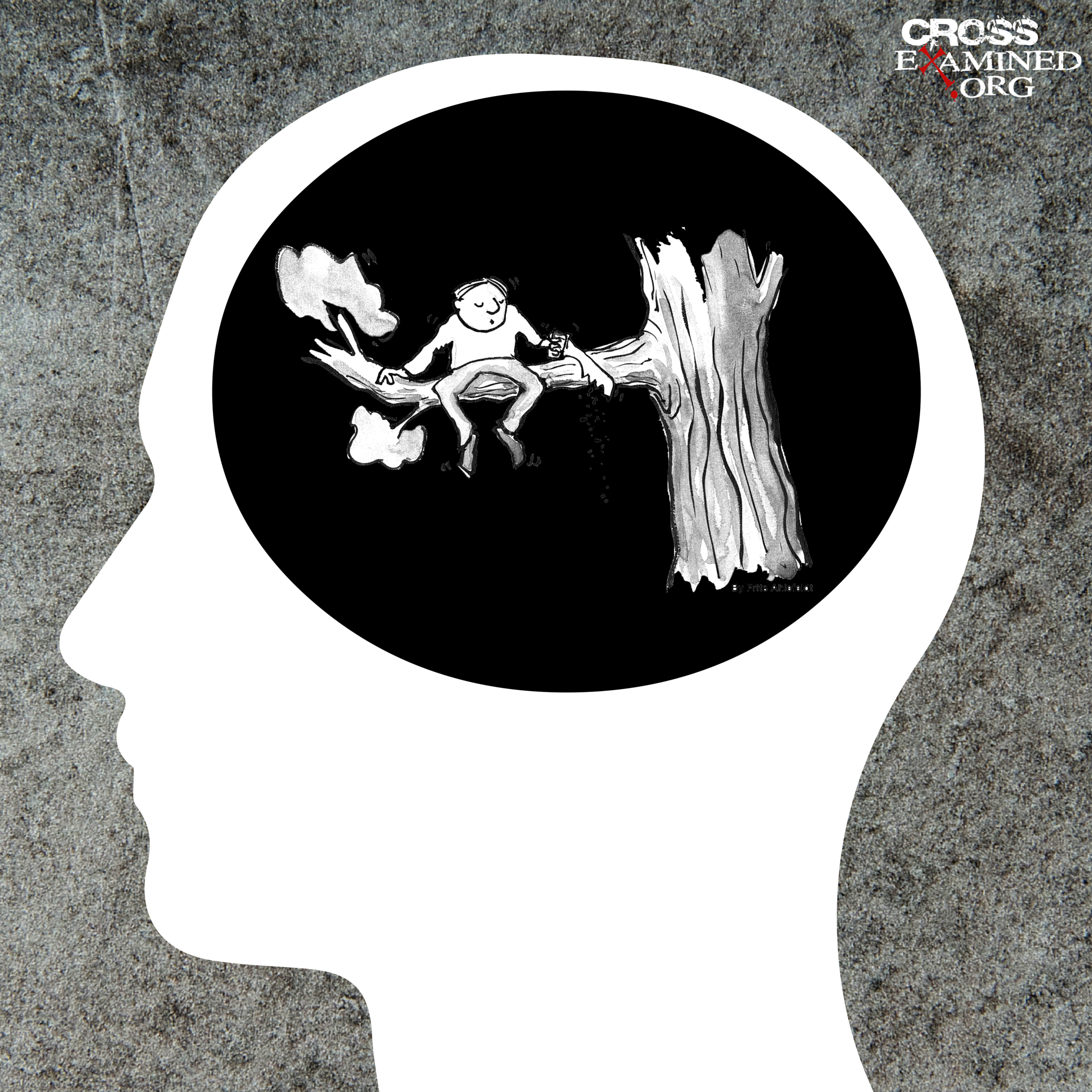
On top of all of this, to make matters worse, this atheistic philosophy is ultimately self-refuting! Harris, as a naturalist (the view that only nature exists), holds to “scientific determinism,” which means he believes our thoughts and actions are causally determined by natural forces like physics, chemistry, and the initial conditions of the big bang. All of these things are outside of human control. Harris makes his view clear:

Free will is an illusion. Our wills are simply not of our own making. Thoughts and intentions emerge from background causes of which we are unaware and over which we exert no conscious control. We do not have the freedom we think we have. Free will is actually more than an illusion (or less), in that it cannot be made conceptually coherent. Either our wills are determined by prior causes and we are not responsible for them, or they are the product of chance and we are not responsible for them.[6]

Therefore, humans could never freely choose any action, including actions with supposed moral properties. Given these objections to the idea of a scientific foundation for an epistemology of objective morality, we must come to the conclusion that science cannot derive an ought from an is, and therefore, cannot tell us anything about how we must conduct our lives in any ethical or moral sense. If naturalistic atheism is true, we have no logical grounds of objective moral values, no logical grounds of objective duty to align our lives with any set of subjective code of ethics, and no ability to do otherwise since all would be determined by outside causal forces. Since ought implies can, and there is no ability to do otherwise in a cause and effect/determined universe (on atheistic naturalism), it follows that it is completely nonsensical for the naturalist to talk about how we ought to think, act, or behave.

Bottom line: If moral values and duties are objective, God must exist!

Stay reasonable my friends (Phil 4:5 ESV),

Tim Stratton

Visit Tim’s Website: Free Thinking Ministries

Click here to see the source site of this article


Notes:
[1] The Moral Argument: http://www.reasonablefaith.org/moral

[2] Sam Harris vs. William Lane Craig debate: https://youtu.be/yqaHXKLRKzg

[3] The Matrix, https://youtu.be/L5foZIKuEWQ

[4] This quote was attributed to Jonas Salk; however, I cannot find the source. Be that as it may, some people actually believe it is better for insects to flourish than it is for humans to flourish.

[5] William Lane Craig, http://www.reasonablefaith.org/navigating-sam-harris-the-moral-landscape

[6] Sam Harris, Free Will, (Free Press, New York, 2012), Page 5

By Natasha Crain

Popular Christian rapper Jahaziel made the news when he released a statement renouncing his faith (you can read the full message here). As I read his statement, I was really struck by something…the utter predictability of every claim he made against Christianity.

If Your Kids Are Someday Shocked by the Claims of Skeptics, You Didn’t Do Your Job

His deconversion statement reads like a play-by-play from the “2015 Internet Guide to Why Christianity Isn’t True.” I have to admit that after I read it, my jaded side initially reacted with a mental shoulder shrug: “Nothing new here. Same tired set of claims.”

But then I realized that’s the same mental shoulder shrug I make at about 95% of blog comments I receive from skeptics of Christianity these days. That’s not because I’m somehow better than those comments, or because those comments aren’t raising important questions that should be answered.

It’s simply because I’ve spent the last few years making myself aware of the challenges to Christianity, reading what both Christians and skeptics say about those challenges, and concluding repeatedly that the case for the truth of Christianity is powerfully strong.

It occurred to me when reading Jahaziel’s statement that this is precisely the position we want our kids to be in by the time they leave home—where the challenges they hear from the world are nothing new, nothing shocking, nothing they haven’t heard some version of before…and nothing they haven’t had the opportunity to investigate with you.

That’s not as hard to accomplish as you might think.

The fact that these claims are so predictable means our job is both well-defined and achievable.

Jahaziel’s Predictable “Case Against Christianity”

A lot of parents are overwhelmed at the thought of helping their kids learn the case for Christianity and how to defend their faith against the seemingly ubiquitous challenges today.

Where do you start? Where do you end? How can you cover it all? How can kids ever really be sufficiently prepared? How can we even be prepared ourselves?

But here’s what you need to know: Helping your kids develop a faith that’s prepared for today’s challenges is not a nebulous, impossible task.

Rather, skeptics are making a predictable set of claims, so we have a pretty specific agenda we should be covering with our kids over time. Think of it like helping them study for a test. You might not be able to anticipate every conceivable question they’ll get, but you can make sure they know what major subject areas they’ll encounter and how to think through the most important questions in those areas. They’re not venturing out into a completely wild blue yonder. This test can be studied for.

To demonstrate what I mean, I want to walk you through the key parts of Jahaziel’s statement. There are all kinds of claims against Christianity embedded here. But they are so common—so predictable—that I can literally point to where I answered each one in my book. I don’t say that to suggest I’m particularly insightful or to advertise the book; I say it to show that Jahaziel’s many and varied claims are all common enough to have been addressed in a single book about today’s key faith challenges.

Let’s take a look.

“I have met some great people in church and learned some great principles from Christianity/the Bible. These principles, however, are not exclusive to any religion.”

Underlying this statement is the implied assertion that all religions are essentially the same because they boil down to “great principles.” Do all religions really point to the same truth? Absolutely not. A lot of people try to claim that (including Oprah, as one example), but it’s simply illogical. I explain why in chapter 10. Nothing surprising here.

“I have met many sincere Christians, both church goers and church leaders, and although I have not seen every one of the 40,000 Christian denominations currently in existence I think I have seen enough to personally make a general conclusion regarding Christianity in the broadest sense.”

Ah, yes, the 40,000 denomination claim. I can’t tell you how many times skeptics have commented on my blog about that number. That’s why my chapter 14 exists: “If Christianity is true, why are there so many denominations?” Nothing surprising here.

“Now, after 20 years of being vocal about the positives of Christian faith, I would like to take some time to be equally vocal about the negatives I have found, i.e., Christianity and its controlling dictatorship, its historic blood trail, its plagiarized Bible stories, characters and concepts, the many human errors of the Bible and its contradictions, the brutal nature of its God, its involvement in the slave trade, the crusades, the inquisition, the witch hunts… you get the drift.”

I’m not sure what he’s talking about specifically with “controlling dictatorship,” but the rest of this is, once again, standard fare.

  • Historic blood trail? Crusades? Inquisition? Witch Hunts? This is all part of the common claim that Christianity is responsible for millions of deaths in history… therefore Christianity is both false and evil. I address this in chapter 15. Nothing surprising here.
  • Plagiarized Bible stories, characters and concepts? This could refer to a lot of things, but he’s likely referring to the common claim that Christianity was borrowed from pagan myths. I address this in chapter 22, where I talk about various theories of the resurrection. Nothing surprising here.
  • The many human errors of the Bible and its contradictions? This is one of the most common blanket statements you hear today and it includes multiple layers of questions/challenges: How were the books of the Bible selected? Why were books left out of the Bible? How do we know we can trust the Bible’s authors? How do we know the Bible we have today says what the authors originally wrote? These aren’t shocking questions…once again, they’re par for the course and are the titles to chapters 25-29 in my book. Nothing surprising here.
  • The brutal nature of God? Involvement in the slave trade? No list of claims against Christianity would be complete without this one, targeted at the difficulties in parts of the Old Testament. I discuss the “genocide” of the Canaanites in chapter 3, and claims that the Bible supports slavery, rape, and human sacrifice in chapters 30, 31, and 32. Nothing surprising here.

It’s Not Just Jahaziel

I used Jahaziel’s statement as a “case study” to make the point of this post, but lest you think this is a one-off example, I want to leave you with one other quick and poignant (true) story.

A young Christian I know who’s an undergraduate student posted on Facebook recently about a humanities class he’s taking. He said that, so far in the semester, he’s “learned” the following: Jesus never claimed to be God in the synoptic Gospels (Matthew, Mark, and Luke), Christianity borrowed ideas from earlier pagan myths, and the church arbitrarily picked which books to include in the Bible according to its own biases.

He noted, “The reactions of other students are of shock and disbelief. Yesterday the professor asked a student how these facts made her feel. She said she was mad and couldn’t wait to go yell at her pastor and parents. The professor egged her on. It was like watching a commander rally up his troops to tear down his enemy.”

The girl in the class was presumably ready to throw out years of Christian upbringing after a couple of months in a single college class. All because she heard some standard claims against Christianity for the first time…

Jesus never claimed to be God? I cover that in chapter 18. Nothing surprising there.

Christianity borrowed ideas from earlier pagan myths? That was in Jahaziel’s list too. Again, I discuss that in chapter 22. Nothing surprising there.

The church arbitrarily picked books for the Bible? See chapters 25 and 26. Nothing surprising there.

This girl’s faith crisis was entirely unnecessary…if only her parents had taken the time to prepare her for this highly predictable “test.”

If our kids are eventually shocked by the claims of skeptics, we have failed to do our job.

As you consider your goals for 2016, I encourage you to ask yourself this: What specific subjects will I get equipped to cover with my kids this year, and how will I share that knowledge with them?

In my next post, I’ll provide a master list of my recommended resources to help you achieve those goals!


Natasha Crain is a blogger, author, and national speaker who is passionate about equipping Christian parents to raise their kids with an understanding of how to make a case for and defend their faith in an increasingly secular world. She is the author of two apologetics books for parents: Talking with Your Kids about God (2017) and Keeping Your Kids on God’s Side (2016). Natasha has an MBA in marketing and statistics from UCLA and a certificate in Christian apologetics from Biola University. A former marketing executive and adjunct professor, she lives in Southern California with her husband and three children.

Original Blog Source: http://bit.ly/2OEiS8Q

By Timothy Fox

It’s the zombie argument. The objection that won’t stay down: the Euthyphro dilemma. Skeptics just can’t accept the fact that Euthyphro has been dead for centuries and keep dragging him out of his grave.

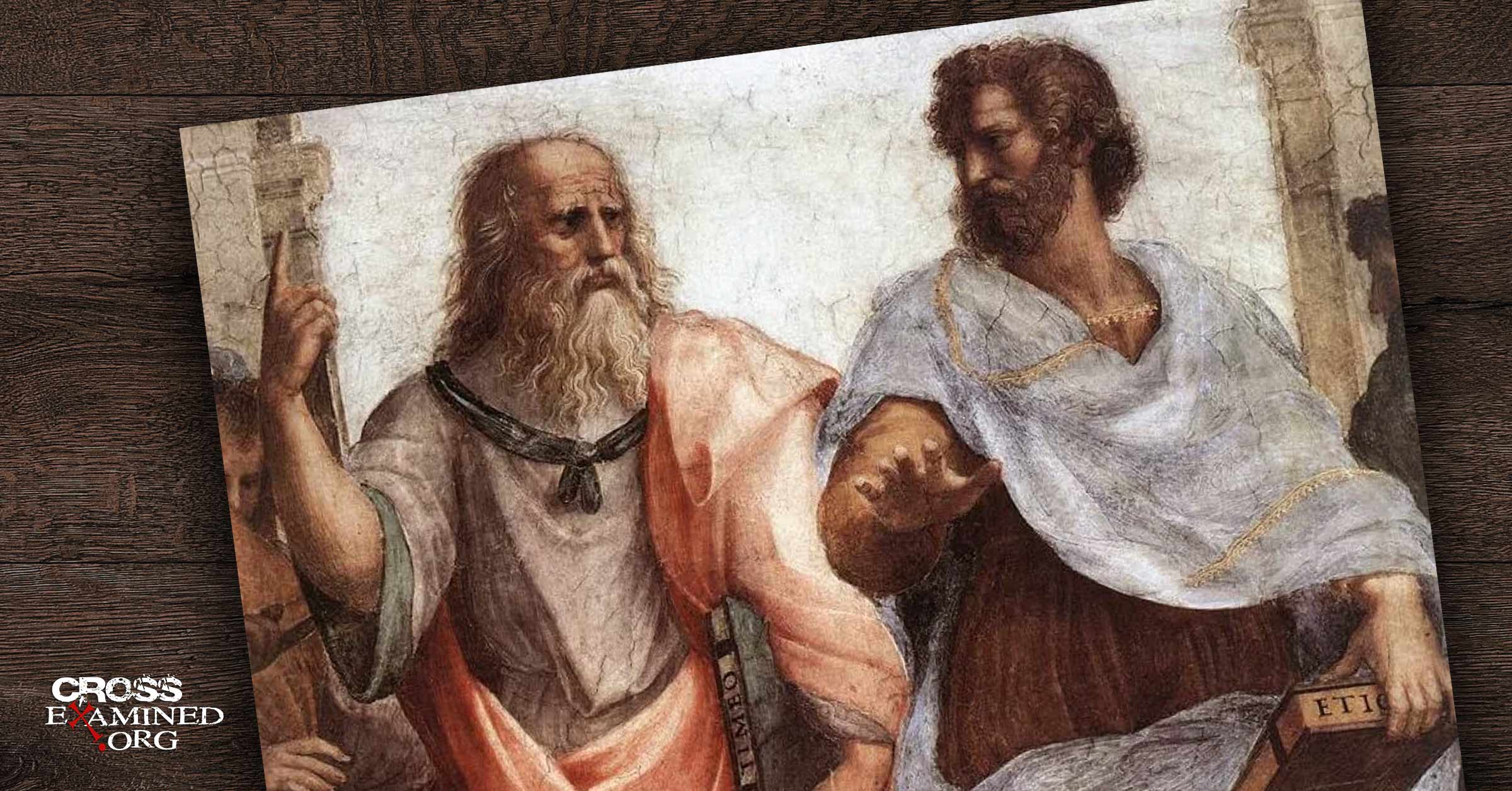
In case you don’t know who Euthyphro is, let me introduce you to him. Euthyphro is a character from one of Plato’s writings who has a discussion with Socrates about the gods and piety. His dilemma has been repurposed as an argument against the goodness of God and can be stated as follows:

Is something good because God commands it or does God command something because it is good? In the first option, God’s commands seem arbitrary, that he could have easily commanded murder and rape to be good and love and kindness to be evil. In the second option, God merely reports to us the commands of some other moral standard that even he is subject to. So we’re caught in a dilemma: either God’s commands are arbitrary or he is not the ultimate authority. This is the Euthyphro dilemma.

At first it seems like we’re stuck. Except, as mentioned earlier, this dilemma has been resolved for centuries: God is good. He is the source of goodness. Heis the moral standard. His commands are not arbitrary, nor do they come from some standard external to him. They are good because they flow from his innate goodness. Dilemma averted.

Euthyphro is dead.

Now I know this doesn’t settle the issue of God’s goodness. Since this article is only intended to discuss the Euthyphro dilemma, I’ll just briefly touch on two related objections:

1 – God is not good. This is typically in response to an action or command from God in the Old Testament. And I agree that there are some things that are hard to understand and need to be discussed. But generally speaking, if we question God’s goodness, what are we judging him against? Our own moral standard? Then it’s our opinion against God’s and, if he truly exists, I’m going to trust his judgment over any finite, fallible human’s.

2 – How do we know that God is good? This question completely misses the point of Euthyphro’s resolution: God is the standard of goodness. There is nothing to compare him against or judge him by. But let’s suppose there does exist some higher moral standard. By applying this objection’s logic, we should ask “How do we know that this standard is good?” See the problem? You’re forever asking “How do we know?” to any moral standard. But if there is an objective moral standard, that is the standard by which morality is measured. It simply is good.

The best you can do is try to find some kind of inconsistency in God’s moral character. But then you can still only judge him against himself, which would point you back to objection 1. And even if you feel that one (or both) of these objections has not been resolved, my broader point is that the Euthyphro dilemma fails as a dilemma since there’s a third possible option, whether you like it or not. Thus, it’s an invalid argument.

Euthyphro is dead.

Why do skeptics keep digging him up? You may as well as ask why zombies keeps coming back. Because they do. That’s what makes them zombies. Bad arguments will always come back into fashion. But you need to see Euthyphro for what he is: a dead, defeated argument. Yet unlike zombies from tv shows and movies, he has no bite. He doesn’t even have teeth. His dilemma has been resolved for centuries.

So if you’re looking for an argument against God’s goodness, Euthyphro is not your man.

Euthyphro is dead!


Original Blog Source: http://bit.ly/2IWKnqD

By Tim Stratton

J.P. Moreland, in his book, “Scaling the Secular City: A Defense of Christianity,” claims that physicalism (often referred to as “naturalism”) is self-refuting for many reasons, but mainly because physicalism seems to deny the possibility of rationality. In making his rational case for rationality, he demonstrates that at least five factors must be established if authentic rational agents are to exist, and can reflect accurately upon reality. I will focus on his final point. He says,

“The activity of rational thought seems to require an agent view of the self which, in turn, involves four theses: 1- I must be able to deliberate, to reflect about what I am going to do… 2- I must have free will; that is, given choices and b, I can genuinely do both. If I do a, I could have done otherwise… 3- I am an agent. My acts are self-caused… 4- Free will is incompatible with physical determinism. They cannot both be true at the same time.”

Moreland reaches the logical conclusion, and writes, “If one is to be rational, one must be free to choose his beliefs based on reasons.” He argues that if physicalism (the belief that all that exists is the physical universe) is true, then physical determinism logically follows. If physical determinism is true, then it follows that all things (including our thoughts and beliefs) are determined and “causally settled by the laws of chemistry and physics coupled with the boundary conditions of earlier states.” This view that nature is all that exists (and therefore, God or the soul does not exist) removes any possibility for human libertarian free will.

Therefore, Moreland concludes that it is “self-refuting to argue that one ought to choose physicalism because he should see that the evidence is good for physicalism.” In fact, on the view of physicalism, there are no “oughts!” On physicalism, there are only “physical states in the brain.” Physical states simply are; therefore, one cannot derive how one ought to behave or think if a person’s actions are determined by the structure of their physical brain. Only if humanity has an aspect of our existence that is non-physical or immaterial (like the Biblical view of the human soul) can we be held responsible for making any decision, including those with any moral or rational properties.

I think Moreland is exactly right, and it seems many of the world’s most influential naturalistic atheists agree as well! Sam Harris, Richard Dawkins, Stephen Hawking, Will Provine, Jerry Coyne, and Alex Rosenberg have all made the same case: that given their naturalistic worldview, free will does not exist! But here is the problem: did they freely and rationally come to that conclusion? Not on their view. In fact, if they are to be consistent naturalists, they should claim that they are forced to think naturalism is true due to the deterministic laws of nature, and not because of their intellect or reasoning skills. Therefore, a naturalist has no grounds to state naturalism is true. In fact, it is an utterly irrational statement (if naturalism is true or not)! If the atheist happens to be correct about naturalism, it seems that it is impossible for free will to exist, and it logically follows that rationality is lost as well.

If a naturalist claims that he has reached the view that physicalism is true based on reason, logic, and rationality, it seems that he is actually providing evidence that naturalism is false. Therefore, stating that one ought to be a naturalist is self-refuting. In fact, one ought not to listen to such irrational statements.

Moreland offers a perfect summary: “Physicalism cannot be offered as a rational theory because physicalism does away with the necessary preconditions for there to be such a thing as rationality.” If a naturalist wants to argue that rationality does not exist, they will be making two grave errors: 1- They would be claiming to be non-rational, and 2- they would be making a rational argument that rationality does not exist. It seems the rational decision one ought to come to is that naturalism is irrational, and therefore, false.

Stay reasonable my friends (Phil 4:5),

Tim Stratton

Click here to visit the source site for this article.

It’s about 2 a.m. on an August morning in 1979. A beautiful young nurse by the name of Lynne Knight is living in a bungalow behind a larger house in Torrance, California. As two police officers approach her door, they notice a chair overturned in the entryway and bloody footsteps leading back to the rear bedroom. Each officer has his gun drawn, not sure what to expect.

When they switch on the light, they witness the worst murder scene of their careers. Ms. Knight is lying on her bed, undressed. Her throat is deeply severed, and her lifeless body, which had been stabbed repeatedly, is covered in blood.

Under her body is 18 inches of twisted wire strung between two small pieces of wood that had been sawed off from an old broomstick. Although they’ve never seen one in person before, the officers immediately know it’s a garrote—a homemade weapon used to strangle someone in order to commit a murder quietly.

The killer tried to murder Lynne with the garrote, but couldn’t complete the evil act because she fought back. So the killer stabbed her to death and left the garrote behind in a panic.

Could the garrote lead the cops to this monster? Not soon enough. For nearly three decades, the case went cold until cold case homicide detectives J. Warner Wallace, and Rick Glass got involved in 2007. They dusted off the evidence left in a box at the Torrance PD, and Wallace made it his personal mission to analyze every aspect of the garrote. It turned out to be the key to the murder trial that took place last summer in the same LA courtroom where O.J. Simpson was tried. And there was a familiar face in this trial. The defendant, Doug Bradford, hired O.J. lawyer Robert Shapiro to be his defense attorney.

While Bradford was a former lover of Knight, there was no eyewitness or DNA evidence to link Bradford to the murder. And there were several other suspects in the case, some of whom had since died. Wallace, Glass, and LA District Attorney John Lewin had an uphill battle to convince a jury of twelve that Bradford had indeed committed the crime. There would be no conviction unless all twelve agreed.

But Wallace, Glass, and Lewin had been down this road before. They earned convictions on every cold case they had brought to trial so far. Three of those cases were so intriguing that NBC’s Dateline featured them. This case was no different: Keith Morrison and his Dateline crew were filming the case in an episode they called “The Wire.”

Although Dateline didn’t know it going in, their confidence was rewarded: on August 14, 2014, this LA jury returned a guilty verdict. Robert Shapiro, perhaps aware he had been out argued, didn’t even show up for the verdict. Doug Bradford is now serving a life sentence after being free for 35 years.

How did they get the conviction?

They began by asking the question, all detectives ask at a death scene: can this death be explained by staying inside the room, or does it require us to look outside the room? Obviously, this death was a murder and required a suspect outside the room. Had this been a suicide, natural death, or accidental death, the event could be explained by staying inside the room.

Then Detective Wallace used some very ingenious methods to link the garrote back to Bradford. (You can watch the entire Dateline explanation here.) He linked the effect (the garrote) back to the cause (Bradford).

Now Wallace is employing the same investigative principles he uses to solve cold case murders to eight of the greatest questions we ponder as human beings. He does this in his insightful new book, God’s Crime Scene. In the book Wallace seeks to discover if we can stay inside the room (the natural world) or must go outside the room (the supernatural world) for the causes of the following effects:

  • The origin of the universe
  • The fine-tuning of the universe
  • The origin of life
  • The origin of new life forms and biological machines
  • Consciousness
  • Free will
  • Objective Moral Values
  • Evil

Each of the eight chapters starts with the details of a real criminal case and then applies the principles to the question at hand (the Lynne Knight case is in Chapter 4).

Wallace was a committed atheist until age 35. Now he is a highly skilled author and speaker who presents a unique case for the Christian worldview across the country. Columnist Mike Adams and I have recently teamed with J. to equip Christian youth and their parents with the case for Christianity through a dynamic new College Prep program. I can tell you that audiences are captivated by the way he applies forensic principles to build the case for Christianity.

But don’t think Wallace just tows the party line. Since he is a cold-case homicide detective, Wallace presents you with the evidence pro and con, and then leaves you to draw your own conclusions. He does a masterful job of laying out the evidence and even illustrates that evidence with over one hundred of his own drawings, which clarify and summarize some potentially difficult subject matter. (Who said a serious book can’t have pictures?)

God’s Crime Scene is an engaging and very readable work that investigates some of life’s most important questions. I highly recommend you get it regardless of your religious viewpoint. I can’t guarantee you’ll be convicted, but your thinking will be challenged.


Dr. Frank Turek (D.Min.) is an award-winning author and frequent college speaker who hosts a weekly TV show on DirectTV and a radio program that airs on 186 stations around the nation.  His books include I Don’t Have Enough Faith to be an Atheist and Stealing from God:  Why atheists need God to make their case.

It’s been fashionable lately for atheists to claim that atheism is “a lack a belief in God.” So when a theist comes along and says that atheists can’t support their worldview, some atheists will say something like, “Oh, we really don’t have a worldview. We just lack a belief in God. Since we’re not making any positive claims about the world, we don’t have any burden of proof to support atheism. We just find the arguments for God to be lacking.”

What’s lacking are good reasons to believe this new definition.

First, if atheism is merely a lack of belief in God, then atheism is just a claim about the atheist’s state of mind, not a claim about God’s existence. The “atheist” is simply saying, “I’m not psychologically convinced that God exists.” So what? That offers no evidence for or against God. Most people lack a belief in unguided evolution, yet no atheist would say that shows evolution is false.

Second, if atheism is merely a lack of belief in God, then rocks, trees, and outhouses are all “atheists” because they too lack a belief in God. It doesn’t take any brains to “lack a belief” in something. A true atheist believes that there is no God.

Third, most atheists don’t merely “lack a belief in God because they are constantly trying to explain the world by offering supposed alternatives to God. Atheists write book after book insisting that God is out of a job because of quantum theory, multiple universes, and evolution. While none of those atheistic arguments succeed in proving there is no God, they do prove that atheists don’t merely lack a belief in God — they believe in certain theories to explain reality without God.

They believe in those theories because atheism is a worldview with beliefs just as much as theism is a worldview with beliefs. (A “worldview” is a set of beliefs about the big questions in life such as: What is an ultimate reality? Who are we? What’s the meaning of life? How should we live? What’s our destiny? etc.) To claim that atheism is not a worldview is like saying anarchy is not really a political position. As Bo Jinn observes, “An anarchist might say that he simply ‘rejects politics,’ but he is still confronted with the inescapable problem of how human society is to organize itself, whether he likes the idea of someone being in charge or not.”

Likewise, atheists can say they just “reject God” but they are still confronted with the inescapable problem of how to explain ultimate reality. Just as anarchists affirm the positive belief that anarchy is the best way to organize society, atheists affirm the positive belief that atheistic materialism is the best way to explain ultimate reality.

In other words, atheists don’t “lack a belief” in materialism. They are not skeptical of materialism — they think it’s true! As Phillip Johnson said, “He who is a skeptic in one set of beliefs is a true believer in another set of beliefs.” Lacking a belief in God doesn’t automatically establish materialism any more than lacking a belief in atheism automatically establishes Christianity. No atheist would say that a Christian has made a good case because he “lacks a belief” in materialism!

Everyone has the burden of proof to support his or her position. Atheists must make a positive case that only material things exist. That’s why instead of debating “Does God exist?” I prefer to debate the question “What better explains reality: atheism or theism?” Then it’s obvious that both debaters have the burden of proof to support their position. Atheists can’t just identify what they think are deficiencies in theism. They must make a compelling case that everything has been caused by materials and consists only of materials, including:

• The beginning of the universe
• The fine-tuning of the universe
• The laws of nature
• The laws of logic
• The laws of mathematics
• Information (genetic code)
• Life
• Mind and consciousness
• Free will
• Objective morality
• Evil

It’s rare to find an atheist attempting to explain more than one or two of these things materially. How could they? How can laws be materials? The new atheists must provide reasons to support their belief that materialism is true. Simply lacking a belief in God doesn’t prove their worldview.

Finally, the “I merely lack a belief in God” definition leads to a contradictory result. As Dr. Richard Howe points out, “This definition of atheism entails the quirky conclusion that atheism is logically compatible with theism.” Here’s why: If lacking a belief in God is the definition of “atheism” — and not “there is no God” — then “atheism” is true even if God really exists. How is that reasonable?

We shouldn’t allow atheists to hide behind that lacking definition. A true atheist is someone who believes there is no God. And atheists have the burden of proof to show how materialism is true and reality can be explained without God.


Dr. Frank Turek (D.Min.) is an award-winning author and frequent college speaker who hosts a weekly TV show on DirectTV and a radio program that airs on 186 stations around the nation.  His books include I Don’t Have Enough Faith to be an Atheist and Stealing from God:  Why atheists need God to make their case.

There has been a lot of debate against my recent articles that stems from a common mistake made by atheists. This article is a little more in depth, but if you can get this you will really have something good to chat about with your atheist friends.

Many of you who are Christians may struggle with the arguments made by atheists against our beliefs. You’ve heard it before that believing in God is the same as believing in Unicorns, Fairies, Santa Claus and the like. An opponent challenged me to prove that God wasn’t just another one of these superstitious characters.

Atheists will use these superstitious characters in one of two ways usually: 1) They will show the absurdity of believing in imaginary creatures and use that as an analogy for believing in God, or 2) They will ask you if you believe in Unicorns, Fairies, and Santa Claus and when you say, “no” they will try and turn the tables on you and say, “see, now you show me your evidence for not believing in those things.”

Another very popular argument was born in Stephen F. Robert’s statement made to Theists in 1995 (later popularized by Richard Dawkins) that, “I just believe in one fewer god than you do. When you understand why you dismiss all the other possible gods, you will understand why I dismiss yours.”

This is a common misunderstanding and conflation of 1st and 2nd order questions. Listen up. This will help you.

A first order question for our purposes explores the “what” of God. In other words, what is the general idea of a being that is God? An answer from Alvin Plantinga explains that this idea of God is something “having an unsurpassable degree of greatness—that is, having a degree of greatness such that it’s not possible that there exist a being having more.”

It is impossible to have two beings (or more) that possess an infinite degree of greatness. It is a metaphysical impossibility.  A universe with two or more omnipotent, or supreme, or infinite beings is absolutely impossible.

Now, a second-order question explores types or the “who” of God. The answer can be many possible conceptions of God.

A Theist rejects all other conceptions of God without being an “atheist” about Thor, Odin, etc. because what makes a person a Theist is not the “who” or type of God but the “what” or nature of God. Rejecting the Thor and Odin “who” type conceptions of god goes hand in hand with the positive acceptance of the Theist “what” type of God. I’m not just disbelieving in the others. I’m believing in One that eliminates the others altogether. It’s like killing a thousand birds with one stone.

So when you ask me to show that God is not a superstition or ask me to prove that Thor isn’t God, you are conflating the “what” is God and the “who” is God questions. The Christian God is outside of time, without matter, and is not confined by the material universe. Unicorns, fairies, Santa Claus, Thor, Odin, Wotan, Zeus, Ashara… are technically still possible in a logical sense, but since they are within time, composed of matter and confined by the universe, they are inferior.

Finally, most people who reject God are rejecting a figure that I would reject also. The “what” of God is often times assumed, as if we Christians believe in a Family Guy type god who sits on a cloud, wears a white toga, and smites people. If we can get on the same page about what God is, a lot of these common questions will answer themselves or just not be applicable.

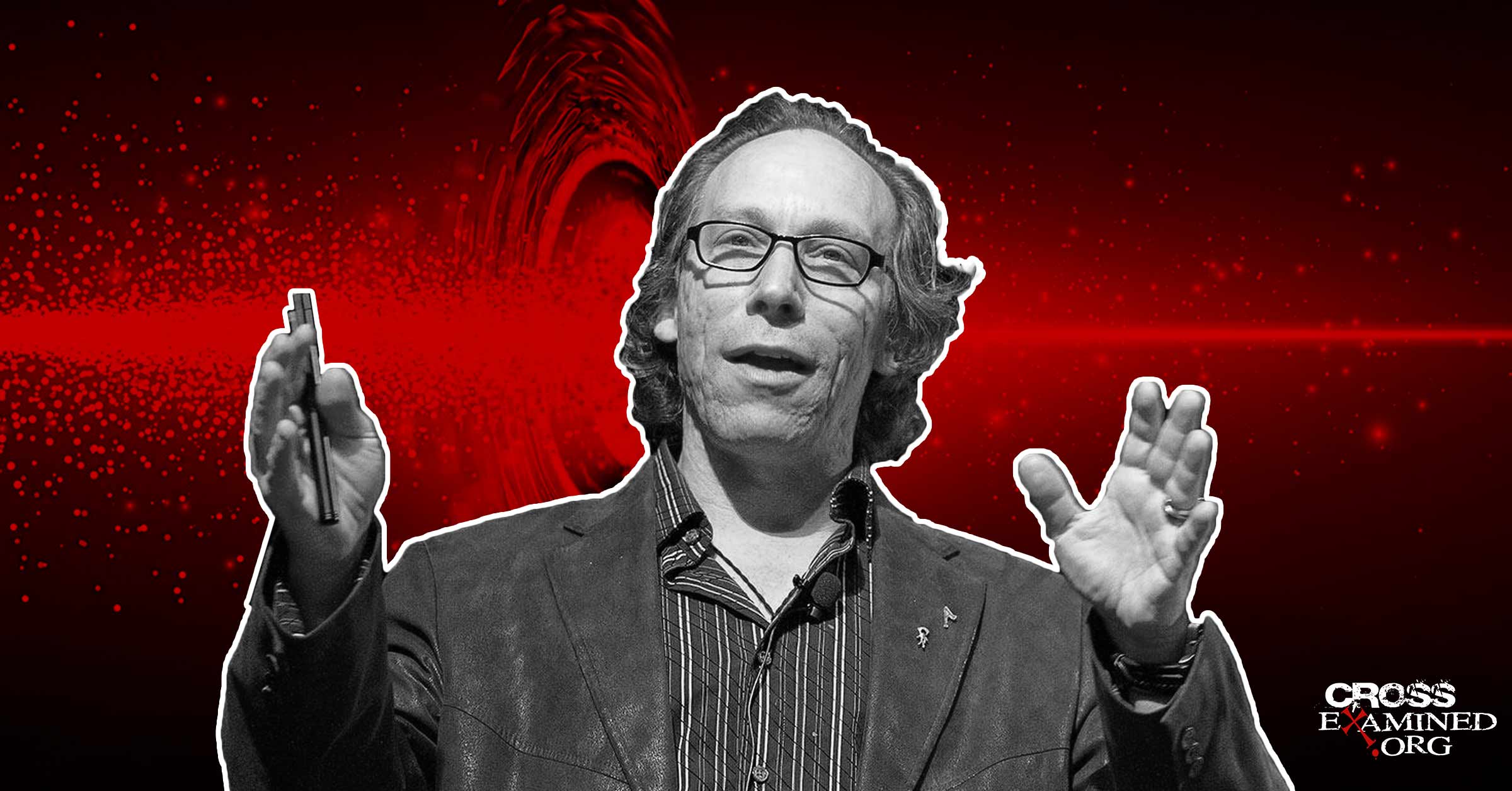
If Dr. Richard Dawkins is the atheist’s rock star of biology, Dr. Lawrence Krauss is the atheist’s rock star of physics (maybe only second to Stephen Hawking).  An engaging speaker and winsome personality, Dr. Krauss is a theoretical physicist and professor at Arizona State University. In his book A Universe from Nothing, Krauss seeks to answer the age-old question, “Why is there something rather than nothing” without reference to God.

Dr. Krauss says the cause of the universe is not God—it is “nothing.”  He cites happenings at the quantum level to dispense with the need for God.  (The quantum level is the world of the extremely small, subatomic in size.)

“One of the things about quantum mechanics is not only can nothing become something, nothing always becomes something,” says Dr. Krauss. “Nothing is unstable. Nothing will always produce something in quantum mechanics.”[i]

Now, whenever you hear something that just doesn’t sound right, you ought to ask the person making the claim, “What do you mean by that?” In this case, the precise question to Dr. Krauss would be, “What do you mean by ‘nothing’?”

It turns out that Dr. Krauss’ definition of “nothing” is not the “nothing” from which the universe originated.  The initial starting point of the universe was not the quantum vacuum that Dr. Krauss keeps referring to in his book. The starting point was non-being– literally no thing.  Since no thing isn’t anything, there are no properties to work with.  Nothing is, as Aristotle put it, what rocks dream about.  Unless someone powerful intervenes, the ancient maxim still stands:  out of nothing, nothing comes.

A quantum vacuum, on the other hand, is something—it consists of fields of fluctuating energy from which particles appear to pop in and out of existence.  Whether these particles are uncaused, or are caused but are merely unpredictable to us, is unknown.  There are ten different models of the quantum level, and no one knows which is correct.  What we do know is that, whatever is happening there, it is not creation out of nothing.  Moreover, the vacuum itself had a beginning and therefore needs a cause.

Lest you think I am mad to question the physics of Dr. Krauss, please note that I am more questioning his logic, which is required to do science of any kind.  Dr. Krauss is committing the logical fallacy known as equivocation—that is using the same word in an argument but with two different definitions.  The “nothing” in the title of Dr. Krauss’ book is not the “nothing” from which the universe came.

This critical distinction was not lost on fellow atheist Dr. David Albert.  A Ph.D. in theoretical physics, Dr. Albert is a Professor at Columbia University and author of the book Quantum Mechanics and Experience.  In his scathing review of Krauss’ book in the New York Times, Dr. Albert questions both Krauss’ logic and his physics.  He pulls no punches and even uses his fist to illustrate.

Commenting on Krauss’ central claim that particles emerging from the quantum vacuum are like creation out of nothing, Dr. Albert writes:

But that’s just not right. Relativistic-quantum-field-theoretical vacuum states — no less than giraffes or refrigerators or solar systems — are particular arrangements of elementary physical stuff. The true relativistic-quantum-field-­theoretical equivalent to there not being any physical stuff at all isn’t this or that particular arrangement of the fields — what it is (obviously, and ineluctably, and on the contrary) is the simple absence of the fields! The fact that some arrangements of fields happen to correspond to the existence of particles and some don’t is not a whit more mysterious than the fact that some of the possible arrangements of my fingers happen to correspond to the existence of a fist and some don’t. And the fact that particles can pop in and out of existence, over time, as those fields rearrange themselves, is not a whit more mysterious than the fact that fists can pop in and out of existence, over time, as my fingers rearrange themselves. And none of these poppings — if you look at them aright — amount to anything even remotely in the neighborhood of a creation from nothing (emphasis in the original).[ii]

Speaking of fists, Dr. Albert lands the knockout blow to Krauss’ entire thesis this way, “But all there is to say about this, as far as I can see, is that Krauss is dead wrong and his religious and philosophical critics are absolutely right.” (It’s important to note that Dr. Albert and Columbia University are not known for Christian fundamentalism.)

Now Dr. Krauss didn’t take all this lying down.  He got up off the canvas and fought back by calling Dr. Albert “a moronic philosopher.”[iii]

Well, that solves that then.  If the guy’s a moron, the non-moron must be right. Right?  Actually, on several occasions in this book, Dr. Krauss confuses even non-moronic readers when he admits Dr. Albert’s point in advance—namely, that the “nothing” Krauss is talking about is not exactly the nothing from which the universe came.  Dr. Krauss even puts his “nothing” in quotation marks like I just did.

In an interview, Krauss acknowledges that no matter how one defines “nothing,” the laws of physics are not nothing (sorry to keep using the word nothing, but there’s nothing else to use!).  And although he’s clearly annoyed doing so, Dr. Krauss eventually gets around to admitting that his “nothing” is actually something.

“Even if you accept this argument that nothing is not nothing,” he says, “you have to acknowledge that nothing is being used in a philosophical sense. But I don’t really give a damn about what ‘nothing’ means to philosophers; I care about the ‘nothing’ of reality. And if the ‘nothing’ of reality is full of stuff, then I’ll go with that.”[iv]

So if Dr. Krauss admits all this, why the bait and switch title: “A Universe from Nothing:  Why there is something rather than nothing”?  Why smuggle in the laws of physics and the quantum vacuum and then call it “nothing”?  Why diss philosophers who are only trying to bring the book’s assertions back to reality?

Dr. Krauss seems to think that philosophers are not talking about reality, when in fact, that’s exactly what philosophy is—the study of ultimate reality.  The problem for Krauss is two-fold.

First, reality is not merely physical stuff.  Since nature and the laws of physics themselves had a beginning, ultimate reality is beyond nature or supernatural.  So despite claiming to explain how the universe came from nothing, Krauss has explained nothing.

The second problem is a far more serious intellectual disease that infects the thinking of Krauss and several other prominent atheists as well.  This disease is so severe that it threatens the accuracy of the very science they seek to promote.  Krauss, like Dawkins and Hawking, are dismissive of philosophy.

Now, having studied a lot of wacky philosophy myself, I sympathize with them.  But the existence of wacky philosophy doesn’t discredit the existence of good philosophy any more than the existence of wacky science discredits the existence of good science.  While it is true that one can use bad philosophy, it is impossible to use no philosophy.

In fact—and this is the essential point—Krauss, Dawkins and the like can’t do science without philosophy.  While scientists are usually seeking to understand physical cause and effect, science itself is built on philosophical principles that are not physical themselves—they are beyond the physical (metaphysical). Those principles help the scientist make precise definitions and clear distinctions and then interpret all the relevant data rationally.

What exactly is relevant?  What exactly is rational?  What exactly is the best interpretation of the data –including what exactly is or isn’t “nothing”?  Those questions are all answered through the use of philosophy.  (Perhaps that’s why the “Ph.” in Ph.D. stands for “philosophy.”  The originators of advanced degrees knew that philosophy is the foundation of every area of inquiry.)

Einstein had an observation about the man of science.  He said, “The man of science is a poor philosopher.”  Unfortunately, if you abandon good philosophy you end up with bad science. And if you disdain all philosophy, as Krauss and company tend to do, then you put yourself in the self-defeating position of holding a philosophy that disdains all philosophy.  You can’t get away from philosophy.  It’s like logic.  To deny it is to use it.

In the end, despite the lofty promises of his book’s title, Dr. Krauss explains nothing about the ultimate origin of the universe.

Notes

[i] Opening statement of Lawrence Krauss in his debate with Dr. William Lane Craig, http://www.reasonablefaith.org/the-craig-krauss-debate-at-north-carolina-state-university#ixzz2bwKlOhe1.  See also Dr. Krauss’ book, A Universe from Nothing: Why There Is Something Rather than Nothing, Atria Books, 2012,Chapter 10.

[ii] David Albert, “On the Origin of Everything ‘A Universe From Nothing,’ by Lawrence M. Krauss,” The New York Times, March 23, 2012, http://www.nytimes.com/2012/03/25/books/review/a-universe-from-nothing-by-lawrence-m-krauss.html?_r=0.

[iii] Ross Anderson, “Has Physics Made Philosophy and Religion Obsolete?”. The Atlantic, April 2012, http://www.theatlantic.com/technology/print/2012/04/has-physics-made-philosophy-and-religion-obsolete/256203/.

[iv] Ross Anderson, Ibid.

Recommended resources related to the topic:

God’s Crime Scene: Cold-Case…Evidence for a Divinely Created Universe (Paperback), (Mp4 Download), and (DVD Set) by J. Warner Wallace

God’s Crime Scene: The Case for God’s Existence from the Appearance of Design (mp4 Download Set) by J. Warner Wallace 

God’s Crime Scene: The Case for God’s Existence from the Appearance of Design in Biology DVD Set by J. Warner Wallace 

What is God Like? Look to the Heavens by Dr. Frank Turek (DVD and Mp4

I Don’t Have Enough Faith to Be an Atheist (Paperback), and (Sermon) by Norman Geisler 


Dr. Frank Turek (D.Min.) is an award-winning author and frequent college speaker who hosts a weekly TV show on DirectTV and a radio program that airs on 186 stations around the nation.  His books include I Don’t Have Enough Faith to be an Atheist and Stealing from God:  Why atheists need God to make their case