Tag Archive for: apologetics

Suppose that there were no scientific evidence whatsoever for the existence of God, would that disprove God? Or would that necessarily make it irrational to believe in God?


I argue that it wouldn’t – such an overly-skeptical view reveals a flawed epistemology (theory of knowledge). One who makes such a claim is apparently adhering to a strong form of scientism, the view that science is the only source of knowledge. For, there are many non-scientific reasons for belief in God, such as:

The purpose of this blog is not to explore these non-scientific arguments but merely to point out that one cannot call belief in God irrational without also refuting these types of non-scientific arguments. Explore the hypertext links for sampling if you’re unfamiliar with these arguments. The claim that science is the only source of knowledge is self-refuting – it’s a philosophical claim that cannot be scientifically demonstrated so if science is the only source of knowledge one could not rationally affirm it. Dr. Turek’s Roadrunner Tactic (of applying a claim to itself) reveals this pretty clearly. Most philosophers have long since abandoned this overly narrow epistemology, but unfortunately, some scientists still hold to it.

Too often skeptics point to prominent scientists who are atheists as though that somehow shows that belief in God must be irrational. I confess that I myself, unfortunately,y went through a period of doubts in the late 1990’s in part because of this fear of how so many of these smart scientists could think that there is no evidence of God.

But is science really even the appropriate discipline for determining God’s existence?

I later came to realize the folly of assuming scientists are best-suited for evaluating evidence for God. Sure a disproportionate number of really intelligent people are scientists but are they really trained so as to be able to best evaluate potential evidence for God? Clearly, they are not trained to evaluate any of the non-scientific evidence I listed above. Many of the most vocal atheistic scientists such as Krauss, Dawkins, and Hawking make numerous philosophical mistakes.

Moreover, science is generally defined such that no appeal to the divine is even considered – this is known as methodological naturalism. Thus, both the nature of the knowledge taught to scientists as well as the methodology they learn for evaluating evidence are not well-suited for evaluating the breadth of evidence and arguments about God.

Dr. Ed Feser, who has been on the CrossExamined podcasts here and here, has an excellent rebuttal to scientism. He critiques Alex Rosenberg’s argument that science can show that God doesn’t exist. First, here is Feser’s summary of Rosenberg’s argument:

1. The predictive power and technological applications of physics are unparalleled by those of any other purported source of knowledge.

2. Therefore what physics reveals to us is all that is real.

Feser goes on to explain: “How bad is this argument?  About as bad as this one:

1. Metal detectors have had far greater success in finding coins and other metallic objects in more places than any other method has.

2. Therefore what metal detectors reveal to us (coins and other metallic objects) is all that is real.

Metal detectors are keyed to those aspects of the natural world susceptible of detection via electromagnetic means (or whatever).  But however well they perform this task — indeed, even if they succeeded on every single occasion they were deployed — it simply wouldn’t follow for a moment that there are no aspects of the natural world other than the ones they are sensitive to.  Similarly, what physics does — and there is no doubt that it does it brilliantly — is to capture those aspects of the natural world susceptible of the mathematical modeling that makes a precise prediction and technological application possible.  But here too, it simply doesn’t follow for a moment that there are no other aspects of the natural world.”

But there is also Scientific Evidence for God!

I don’t intend any disrespect for science in this blog – I should mention that I myself have a degree in physics and have worked in scientific/mathematical domains of software engineering for the past 27 years. I have great respect for science and actually, I think that God has also left plenty of scientific evidence for His existence. This blog is an introduction to a series making a case that what we have learned from science actually does support theism over atheism. It’s important, however, to keep things in perspective! Scientific knowledge is just one aspect of knowledge and a skeptic who hasn’t searched out the non-scientific forms of evidence is making a big mistake. Nevertheless, the church too often provides no response or a weak response to challenges to belief in God from atheistic scientists. I think, therefore, that it is important to look at whether or not there are theistic implications from origins science. Over the next few weeks I’ll be making a case in this blog that the following aspects of science provide evidence that God exists:

  • Origin of Universe
  • Origin of the Laws to Support Life
  • Fine-Tuning of the Initial Conditions of the Universe to Support Life
  • Fine-Tuning of the Constants of Nature
  • Origin of Life

Before we get into the evidence, in my next blog I’ll discuss what would constitute suitable evidence for God from science and some of the objections that invariably arise. A careful philosophical evaluation is in order before laying out the facts so that we can properly interpret them.
There has been a lot of debate against my recent articles that stems from a common mistake made by atheists. This article is a little more in depth, but if you can get this you will really have something good to chat about with your atheist friends.

Many of you who are Christians may struggle with the arguments made by atheists against our beliefs. You’ve heard it before that believing in God is the same as believing in Unicorns, Fairies, Santa Claus and the like. An opponent challenged me to prove that God wasn’t just another one of these superstitious characters.

Atheists will use these superstitious characters in one of two ways usually: 1) They will show the absurdity of believing in imaginary creatures and use that as an analogy for believing in God, or 2) They will ask you if you believe in Unicorns, Fairies, and Santa Claus and when you say, “no” they will try and turn the tables on you and say, “see, now you show me your evidence for not believing in those things.”

Another very popular argument was born in Stephen F. Robert’s statement made to Theists in 1995 (later popularized by Richard Dawkins) that, “I just believe in one fewer god than you do. When you understand why you dismiss all the other possible gods, you will understand why I dismiss yours.”

This is a common misunderstanding and conflation of 1st and 2nd order questions. Listen up. This will help you.

A first order question for our purposes explores the “what” of God. In other words, what is the general idea of a being that is God? An answer from Alvin Plantinga explains that this idea of God is something “having an unsurpassable degree of greatness—that is, having a degree of greatness such that it’s not possible that there exist a being having more.”

It is impossible to have two beings (or more) that possess an infinite degree of greatness. It is a metaphysical impossibility.  A universe with two or more omnipotent, or supreme, or infinite beings is absolutely impossible.

Now, a second-order question explores types or the “who” of God. The answer can be many possible conceptions of God.

A Theist rejects all other conceptions of God without being an “atheist” about Thor, Odin, etc. because what makes a person a Theist is not the “who” or type of God but the “what” or nature of God. Rejecting the Thor and Odin “who” type conceptions of god goes hand in hand with the positive acceptance of the Theist “what” type of God. I’m not just disbelieving in the others. I’m believing in One that eliminates the others altogether. It’s like killing a thousand birds with one stone.

So when you ask me to show that God is not a superstition or ask me to prove that Thor isn’t God, you are conflating the “what” is God and the “who” is God questions. The Christian God is outside of time, without matter, and is not confined by the material universe. Unicorns, fairies, Santa Claus, Thor, Odin, Wotan, Zeus, Ashara… are technically still possible in a logical sense, but since they are within time, composed of matter and confined by the universe, they are inferior.

Finally, most people who reject God are rejecting a figure that I would reject also. The “what” of God is often times assumed, as if we Christians believe in a Family Guy type god who sits on a cloud, wears a white toga, and smites people. If we can get on the same page about what God is, a lot of these common questions will answer themselves or just not be applicable.

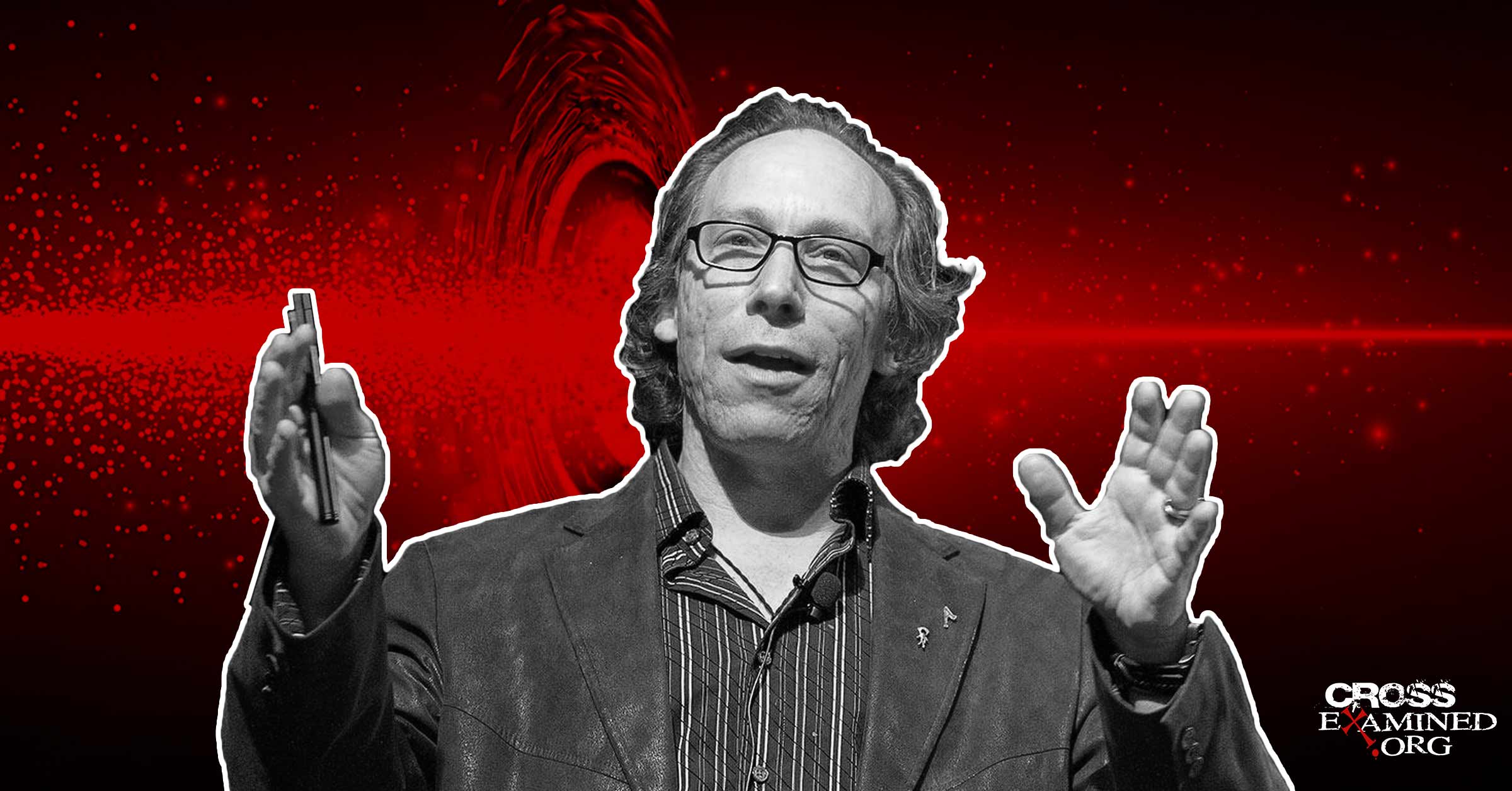
If Dr. Richard Dawkins is the atheist’s rock star of biology, Dr. Lawrence Krauss is the atheist’s rock star of physics (maybe only second to Stephen Hawking).  An engaging speaker and winsome personality, Dr. Krauss is a theoretical physicist and professor at Arizona State University. In his book A Universe from Nothing, Krauss seeks to answer the age-old question, “Why is there something rather than nothing” without reference to God.

Dr. Krauss says the cause of the universe is not God—it is “nothing.”  He cites happenings at the quantum level to dispense with the need for God.  (The quantum level is the world of the extremely small, subatomic in size.)

“One of the things about quantum mechanics is not only can nothing become something, nothing always becomes something,” says Dr. Krauss. “Nothing is unstable. Nothing will always produce something in quantum mechanics.”[i]

Now, whenever you hear something that just doesn’t sound right, you ought to ask the person making the claim, “What do you mean by that?” In this case, the precise question to Dr. Krauss would be, “What do you mean by ‘nothing’?”

It turns out that Dr. Krauss’ definition of “nothing” is not the “nothing” from which the universe originated.  The initial starting point of the universe was not the quantum vacuum that Dr. Krauss keeps referring to in his book. The starting point was non-being– literally no thing.  Since no thing isn’t anything, there are no properties to work with.  Nothing is, as Aristotle put it, what rocks dream about.  Unless someone powerful intervenes, the ancient maxim still stands:  out of nothing, nothing comes.

A quantum vacuum, on the other hand, is something—it consists of fields of fluctuating energy from which particles appear to pop in and out of existence.  Whether these particles are uncaused, or are caused but are merely unpredictable to us, is unknown.  There are ten different models of the quantum level, and no one knows which is correct.  What we do know is that, whatever is happening there, it is not creation out of nothing.  Moreover, the vacuum itself had a beginning and therefore needs a cause.

Lest you think I am mad to question the physics of Dr. Krauss, please note that I am more questioning his logic, which is required to do science of any kind.  Dr. Krauss is committing the logical fallacy known as equivocation—that is using the same word in an argument but with two different definitions.  The “nothing” in the title of Dr. Krauss’ book is not the “nothing” from which the universe came.

This critical distinction was not lost on fellow atheist Dr. David Albert.  A Ph.D. in theoretical physics, Dr. Albert is a Professor at Columbia University and author of the book Quantum Mechanics and Experience.  In his scathing review of Krauss’ book in the New York Times, Dr. Albert questions both Krauss’ logic and his physics.  He pulls no punches and even uses his fist to illustrate.

Commenting on Krauss’ central claim that particles emerging from the quantum vacuum are like creation out of nothing, Dr. Albert writes:

But that’s just not right. Relativistic-quantum-field-theoretical vacuum states — no less than giraffes or refrigerators or solar systems — are particular arrangements of elementary physical stuff. The true relativistic-quantum-field-­theoretical equivalent to there not being any physical stuff at all isn’t this or that particular arrangement of the fields — what it is (obviously, and ineluctably, and on the contrary) is the simple absence of the fields! The fact that some arrangements of fields happen to correspond to the existence of particles and some don’t is not a whit more mysterious than the fact that some of the possible arrangements of my fingers happen to correspond to the existence of a fist and some don’t. And the fact that particles can pop in and out of existence, over time, as those fields rearrange themselves, is not a whit more mysterious than the fact that fists can pop in and out of existence, over time, as my fingers rearrange themselves. And none of these poppings — if you look at them aright — amount to anything even remotely in the neighborhood of a creation from nothing (emphasis in the original).[ii]

Speaking of fists, Dr. Albert lands the knockout blow to Krauss’ entire thesis this way, “But all there is to say about this, as far as I can see, is that Krauss is dead wrong and his religious and philosophical critics are absolutely right.” (It’s important to note that Dr. Albert and Columbia University are not known for Christian fundamentalism.)

Now Dr. Krauss didn’t take all this lying down.  He got up off the canvas and fought back by calling Dr. Albert “a moronic philosopher.”[iii]

Well, that solves that then.  If the guy’s a moron, the non-moron must be right. Right?  Actually, on several occasions in this book, Dr. Krauss confuses even non-moronic readers when he admits Dr. Albert’s point in advance—namely, that the “nothing” Krauss is talking about is not exactly the nothing from which the universe came.  Dr. Krauss even puts his “nothing” in quotation marks like I just did.

In an interview, Krauss acknowledges that no matter how one defines “nothing,” the laws of physics are not nothing (sorry to keep using the word nothing, but there’s nothing else to use!).  And although he’s clearly annoyed doing so, Dr. Krauss eventually gets around to admitting that his “nothing” is actually something.

“Even if you accept this argument that nothing is not nothing,” he says, “you have to acknowledge that nothing is being used in a philosophical sense. But I don’t really give a damn about what ‘nothing’ means to philosophers; I care about the ‘nothing’ of reality. And if the ‘nothing’ of reality is full of stuff, then I’ll go with that.”[iv]

So if Dr. Krauss admits all this, why the bait and switch title: “A Universe from Nothing:  Why there is something rather than nothing”?  Why smuggle in the laws of physics and the quantum vacuum and then call it “nothing”?  Why diss philosophers who are only trying to bring the book’s assertions back to reality?

Dr. Krauss seems to think that philosophers are not talking about reality, when in fact, that’s exactly what philosophy is—the study of ultimate reality.  The problem for Krauss is two-fold.

First, reality is not merely physical stuff.  Since nature and the laws of physics themselves had a beginning, ultimate reality is beyond nature or supernatural.  So despite claiming to explain how the universe came from nothing, Krauss has explained nothing.

The second problem is a far more serious intellectual disease that infects the thinking of Krauss and several other prominent atheists as well.  This disease is so severe that it threatens the accuracy of the very science they seek to promote.  Krauss, like Dawkins and Hawking, are dismissive of philosophy.

Now, having studied a lot of wacky philosophy myself, I sympathize with them.  But the existence of wacky philosophy doesn’t discredit the existence of good philosophy any more than the existence of wacky science discredits the existence of good science.  While it is true that one can use bad philosophy, it is impossible to use no philosophy.

In fact—and this is the essential point—Krauss, Dawkins and the like can’t do science without philosophy.  While scientists are usually seeking to understand physical cause and effect, science itself is built on philosophical principles that are not physical themselves—they are beyond the physical (metaphysical). Those principles help the scientist make precise definitions and clear distinctions and then interpret all the relevant data rationally.

What exactly is relevant?  What exactly is rational?  What exactly is the best interpretation of the data –including what exactly is or isn’t “nothing”?  Those questions are all answered through the use of philosophy.  (Perhaps that’s why the “Ph.” in Ph.D. stands for “philosophy.”  The originators of advanced degrees knew that philosophy is the foundation of every area of inquiry.)

Einstein had an observation about the man of science.  He said, “The man of science is a poor philosopher.”  Unfortunately, if you abandon good philosophy you end up with bad science. And if you disdain all philosophy, as Krauss and company tend to do, then you put yourself in the self-defeating position of holding a philosophy that disdains all philosophy.  You can’t get away from philosophy.  It’s like logic.  To deny it is to use it.

In the end, despite the lofty promises of his book’s title, Dr. Krauss explains nothing about the ultimate origin of the universe.

Notes

[i] Opening statement of Lawrence Krauss in his debate with Dr. William Lane Craig, http://www.reasonablefaith.org/the-craig-krauss-debate-at-north-carolina-state-university#ixzz2bwKlOhe1.  See also Dr. Krauss’ book, A Universe from Nothing: Why There Is Something Rather than Nothing, Atria Books, 2012,Chapter 10.

[ii] David Albert, “On the Origin of Everything ‘A Universe From Nothing,’ by Lawrence M. Krauss,” The New York Times, March 23, 2012, http://www.nytimes.com/2012/03/25/books/review/a-universe-from-nothing-by-lawrence-m-krauss.html?_r=0.

[iii] Ross Anderson, “Has Physics Made Philosophy and Religion Obsolete?”. The Atlantic, April 2012, http://www.theatlantic.com/technology/print/2012/04/has-physics-made-philosophy-and-religion-obsolete/256203/.

[iv] Ross Anderson, Ibid.

Recommended resources related to the topic:

God’s Crime Scene: Cold-Case…Evidence for a Divinely Created Universe (Paperback), (Mp4 Download), and (DVD Set) by J. Warner Wallace

God’s Crime Scene: The Case for God’s Existence from the Appearance of Design (mp4 Download Set) by J. Warner Wallace 

God’s Crime Scene: The Case for God’s Existence from the Appearance of Design in Biology DVD Set by J. Warner Wallace 

What is God Like? Look to the Heavens by Dr. Frank Turek (DVD and Mp4

I Don’t Have Enough Faith to Be an Atheist (Paperback), and (Sermon) by Norman Geisler 


Dr. Frank Turek (D.Min.) is an award-winning author and frequent college speaker who hosts a weekly TV show on DirectTV and a radio program that airs on 186 stations around the nation.  His books include I Don’t Have Enough Faith to be an Atheist and Stealing from God:  Why atheists need God to make their case

Much of the book of Acts — about 50% — is comprised of speeches, discourses and letters. Among them, a total of eight speeches are given by Peter; a total of nine speeches delivered by Paul; there is Stephen’s famous address before the Sanhedrin (Acts 7:2-53); a brief address at the Jerusalem Council by James (Acts 15:13-21); the advice given to Paul by James and the Jerusalem elders (Acts 21:20-25); in addition to the letter to the Gentile churches from the Jerusalem Council (Acts 15:23-29) and the letter to Governor Felix from Claudius Lysias (Acts 23:27-30).

An interesting question that we can investigate pertains to whether these speeches and other addresses are historically authentic, or whether they instead represent the invention of Luke, the author of Acts. It is this question with which this essay is concerned.

We have an indication that Luke himself accompanied Paul for a significant portion of his trip. This is implied by Luke’s use of the pronoun “we”, beginning in Acts 16. This means that Luke was present during Paul’s speech in Athens (Acts 17), his address to the elders of Ephesus (Acts 20), his speech in Jerusalem (Acts 22), and his defense before Felix, Festus, and Agrippa (Acts 24-25). Since Luke was a close companion of Paul, it is entirely plausible that Paul gave Luke the wording of his other sermons. He may have even given Luke information pertaining to Stephen’s address to the Sanhedrin, at which Paul was present (Acts 7:58). Luke likely received material from Peter regarding his speeches. James may also have provided material regarding the Jerusalem Council.

Now, it is clear that these speeches are presented by Luke only in summary form (see Acts 2:40). But the question that concerns us here is whether these speeches are truthfully represented by Luke or whether he falsely attributes those words to the speakers. For the sake of brevity, this article will focus on the speeches of Stephen, Peter, and Paul.

Stephen’s speech, given in Acts 7:2-53, makes extensive allusion to the Old Testament Scriptures, drawing out the history of the Jews from Abrahamic times to the time of Solomon’s temple. In all, the book of Acts quotes the Old Testament a total of 40 times. 15 of those quotations appear in Stephen’s speech. This repeated quotation of the Old Testament does not resemble Luke’s literary style but instead suggests that its origin lies with a theologian of Stephen’s caliber. Moreover, there are at least 23 words that are never to be found in the book of Acts (or for that matter throughout the rest of the New Testament) apart from Stephen’s speech. Stephen’s particular way of talking about the temple and Moses is also not found anywhere except in this speech of Stephen. Further, the words affliction and promise take on a special significance in this particular discourse that does not reflect the way in which these words are used throughout the rest of Acts.

Peter’s speeches in Acts utilize similar word choice and ideas to his epistles. For example, consider the following striking parallels (in terms of both word choice and concepts) between the speeches of Peter in Acts and Peter’s first epistle:

“…by God’s deliberate plan and foreknowledge…” (Acts 2:23) //  “…chosen according to the foreknowledge of God…” (1 Peter 1:2)

  • “Silver or gold I do not have…” (Acts 3:6) // “…it was not with perishable things such as silver or gold that you were redeemed…” (1 Peter 1:18)
  • “…the faith that comes through him…” (Acts 3:16) // “Through him you believe in God…” (1 Peter 1:21)
  • “Repent, then, and turn to God, so that your sins may be wiped out, that times of refreshing may come from the Lord, and that he may send the Messiah, who has been appointed for you—even Jesus. Heaven must receive him until the time comes for God to restore everything, as he promised long ago through his holy prophets.” (Acts 3:19-21) // “Since everything will be destroyed in this way, what kind of people ought you to be? You ought to live holy and godly lives as you look forward to the day of God and speed its coming.” (1 Peter 3:11-12)
  • “I now realize how true it is that God does not show favoritism…” (Acts 10:34) // “Since you call on a Father who judges each person’s work impartially…” (1 Peter 1:17)
  • “…whom God appointed as judge of the living and the dead…” (Acts 10:42) // “But they will have to give account to him who is ready to judge the living and the dead.” (1 Peter 4:5)

When taken as a cumulative case, the evidence points uniformly to the Petrian origin of the sermons attributed to him in Acts.

As for the sermons of Paul, there is also a clear connection between the speeches and epistles of Paul. For example, in Acts 13:39, when preaching in the synagogue in Antioch, Paul states, “Through him, everyone who believes is set free from every sin, a justification you were not able to obtain under the law of Moses.” This doctrine of justification is a common and characteristic theme throughout Paul’s epistles. In Paul’s sermon in Athens, he declares, “In the past, God overlooked such ignorance, but now he commands all people everywhere to repent,” (Acts 17:30). This sentence bears resemblance to the statement in Romans 3:5: “He did this to demonstrate his righteousness because in his forbearance he had left the sins committed beforehand unpunished.” Also in common with Paul’s Acts 17 sermon in Athens, Paul’s letter to the Romans indicates that God has revealed Himself through creation (Romans 1:19-21) and that there will come a “day when God judges people’s secrets through Jesus Christ,” (Acts 2:16).

Furthermore, consider the following parallels between Paul’s address to the Ephesian elders  and his epistles:

  • “I served the Lord with great humility…”  (Acts 20:19) // “Never be lacking in zeal, but keep your spiritual fervor, serving the Lord.” (Romans 12:11) // “…with great humility…” (Ephesians 4:2)
  • “I consider my life worth nothing to me; my only aim is to finish the race…” (Acts 20:24a) // “I have fought the good fight, I have finished the race, I have kept the faith.” (2 Timothy 4:7)
  • …and complete the task the Lord Jesus has given me…” (Acts 20:24b) // “See to it that you complete the ministry you have received in the Lord.” (Colossians 4:17)

In conclusion, although the speeches in Acts are presented in summary form, there is a good reason to think that the sermons recorded by Luke do not, in fact, originate with the pen of Luke but are indeed authentic sermons presented by the individuals to whom they are attributed. If this is so, then we have source material underlying the Acts of the Apostles that dates back exceedingly early and provides us with a unique insight into the primitive beliefs of the early Christian movement.

The concept of cosmic fine tuning relates to a unique property of our universe whereby the physical constants and laws are observed to be balanced on a ‘razor’s edge’ for permitting the emergence of complex life. The degree to which the constants of physics must match precise criteria is such that a number of agnostic scientists have concluded that indeed there is some sort of transcendent purpose behind the cosmic arena. British astrophysicist Fred Hoyle writes: “A common sense interpretation of the facts suggests that a superintellect has monkeyed with physics, as well as with chemistry and biology and that there are no blind forces worth speaking about in nature. The numbers one calculates from the facts seem to me so overwhelming as to put this conclusion almost beyond question.”

Fundamental Constants

The ripples in the universe left over from the original ‘Big Bang’ singularity (often referred to as CMB, or cosmic background radiation) are detectable at one part in 10^5 (100,000). If this factor were even slightly smaller, the cosmos would exist exclusively as a collection of gas — stars, planets, and galaxies would not exist. Conversely, if this factor were increased slightly, the universe would consist only of large black holes. Either way, the universe would be uninhabitable.

Another finely tuned value is the strong nuclear force that holds atoms — and therefore matter — together. The sun derives its ‘fuel’ from fusing hydrogen atoms together. When two hydrogen atoms fuse, 0.7% of the mass of the hydrogen atoms is converted into energy. If the amount of matter converted were slightly smaller — say, 0.6% instead of 0.7% — a proton would not be able to bond to a neutron and the universe would consist only of hydrogen. Without the presence of heavy elements, planets would not form and hence no life would be possible. Conversely, if the amount of matter converted were increased to 0.8% instead of 0.7%, fusion would occur so rapidly that no hydrogen would remain. Again, the result would be no planets, no solar systems and hence no life.

The ratio of electrons to protons must be finely balanced to a degree of one part in 10^37. If this fundamental constant were to be any larger or smaller than this, the electromagnetism would dominate gravity — preventing the formation of galaxies, stars, and planets. Again, life would not be possible.

The ratio of the electromagnetic force to gravity must be finely balanced to a degree of one part in 10^40. If this value were to be increased slightly, all stars would be at least 40% more massive than our Sun. This would mean that stellar burning would be too brief and too uneven to support complex life. If this value were to be decreased slightly, all stars would be at least 20% less massive than the sun. This would render them incapable of producing heavy elements.

The rate at which the universe expands must be finely tuned to one part in 10^55. If the universe expanded too fast, the matter would expand too quickly for the formation of stars, planets, and galaxies. If the universe expanded too slowly, the universe would quickly collapse — before the formation of stars.

The mass density of the universe is finely balanced to permit life to a degree of one part in 10^59. If the universe were slightly more massive, an overabundance of deuterium from the big bang would cause stars to burn too rapidly for the formation of complex life. If the universe were slightly less massive, an insufficiency of helium would result in a shortage of the heavy elements — again, resulting in no life.

Mass of the Cosmos

The density of protons and neutrons in the cosmos relates to the cosmic mass density. That density determines just how much hydrogen fuses into heavier elements during the first few moments after the origin of the universe. In turn, the amount of heavier elements determines how much additional heavy-element production occurs later in the nuclear furnaces of stars.

What would be the consequence if the respective density of neutrons and protons were significantly lower? Firstly, nuclear fusion would occur with less efficiency. Consequently, the heavier elements such as carbon, nitrogen, oxygen, phosphorous, sodium and potassium — all of which are essential for the emergence of physical life — would not be formed. Moreover, assuming no additional cosmic density factors such as dark energy, a cosmos which possesses less mass density would prohibit the formation of stars and planets. Why? The expansion rate would be so big that matter would expand too quickly for gravity to pull together the gas and dust to allow their formation. If that were not enough, with only a little extra mass, the cosmos would expand so slowly that all stars in the cosmos would quickly turn into black holes and neutron stars. The density near the surface of such bodies would be so enormous that molecules would be impossible. Therefore, life would not be possible. The radiation from the formed black holes and neutron stars would also render physical life an impossibility at any point in a universe with such a high density.

Conversely, what would be the effect if the density of protons and neutrons in the cosmos were to be significantly higher? Nuclear fusion would be too productive, meaning that all the hydrogen in the universe would rapidly fuse into elements heavier than iron. The ultimate result is the same — the life-essential elements would not exist. Moreover, if the cosmic mass density were to be greater, gas and dust would condense so effectively under gravity’s influence that all stars would be much more massive than the Sun. Thus, planets would not be life-permitting because of the intensity of the radiation of their respective star, and additionally because of the rapid changes in the stars’ temperature and radiation.

The mass of the universe exhibits cosmic fine-tuning to simultaneously permit two features which are essential for permitting life: (1) the correct diversity and quantity of elements; and (2) the appropriate rate of cosmic expansion required to allow life. Such cosmic fine-tuning bespeaks foresight and planning — indicators of intelligent design.

Our Place in the Universe

There exist many physical factors that must be precisely set for any planet to be hospitable to life. Life must be in the right type of galaxy. There are three types of galaxies (elliptical, irregular and spiral). Elliptical galaxies lack the heavy elements needed to support life. Irregular galaxies have too many supernova explosions. Only spiral galaxies can foster life. The Milky Way is a spiral galaxy.

Life must also be in the right location in the galaxy. We are situated in the right place in the Milky Way. If we were too close to the center of the galaxy (closer to the black hole), harmful radiation would make life impossible. Conversely, if our planet was too far out in the periphery, not enough heavy elements would be available for the construction of habitable planets.

Life must also have the right type of star. Stars act as energy sources for life. Most stars are too large, too bright or too unstable to support life. The size and age of the sun enhance the earth’s hospitality. If the earth were moved 1% closer to the sun, bodies of water would vaporize, and life would not be possible. If the earth were as much as 2% farther from the sun, its waters would freeze. Earth has a nearly circular orbit, which ensures a nearly constant distance from the sun — ensuring that seasonal changes are not too severe.

The other planets in our solar system contribute greatly to the earth’s habitability. For example, the massive gas giant Jupiter acts as a cosmic vacuum cleaner, protecting the earth from incoming comets. Likewise, Mars protects the earth from incoming asteroids.

If the earth did not have a moon of the right shape and size, our planet would not be able to sustain life. The moon stabilizes the earth’s tilt, in turn preventing extreme temperatures and creating a stable, bio-friendly environment.

There are many other factors which influence the habitability of the earth. The few examples here detailed unequivocally demonstrate that indeed the earth is a privileged planet, another indicator of intelligent design.

Is the Universe Designed for Discovery?

In 2004, Guillermo Gonzalez and Jay Richards published their groundbreaking book, “The Privileged Planet”, in which they argued that the conditions most suited for life also provided the best overall setting for making scientific discoveries. In other words, our planet is not merely fine-tuned for life, but it is also finely-tuned for discovery.

One example is the phenomenon known as solar eclipses. People have witnessed solar eclipses for millennia, but only recently have we begun to notice a remarkable correlation: The only place in our solar system where a perfect solar eclipse can be observed happens to be the only place where there are observers. There are hundreds of moons in our solar system, but most moons cannot entirely eclipse the sun. Of all the places in our solar system, only on earth do the sun and moon appear the same size to observers. This is because the sun is approximately 400 times larger than the moon and roughly 400 times farther away. Solar eclipses have played a significant role in scientific discovery, having helped physicists to confirm Einstein’s general theory of relativity.

The Milky Way, as a spiral galaxy — in addition to being the only biofriendly kind of galaxy — is relatively flat. Consequently, it has less gas and dust than others, and fewer stars impede our view of the rest of the universe.

Earth is located not only in the galactic habitable zone but also in the right place where minimal light pollution and other visual obstructions might impede the view of our surroundings. Moreover, earth’s atmosphere — which is the only one we know of which can support life — is also the only one clear enough to allow us to observe the universe.

Such findings place naturalists (who see us and our place in the cosmos as nothing more than accidents) in an uncomfortable position. But it makes a lot of sense to theists, who see us and our place in the cosmos as fully intended by an intelligent creator.

Conclusion

To believe that the facts and figures here detailed amount to no more than happy coincidence, without doubt, constitutes a greater exercise of faith than that of the Christian who affirms the theistic design of the universe. Such scientific insights over the last several decades have led the late Robert Jastrow — a self-proclaimed agnostic — to write: “For the scientist who has lived by his faith in the power of reason, the story ends like a bad dream. He has scaled the mountains of ignorance; he is about to conquer the highest peak; as he pulls himself over the final rock, he is greeted by a band of theologians who have been sitting there for centuries.”

This blog post was adapted from a previous article published on AllAboutScience.org.

The historicity of Adam and Eve is a question which strikes at the heart of the Christian faith. If the primordial pair did not exist, then the historical and Biblical doctrine of the fall becomes extremely difficult to maintain. The apostle Paul clearly linked God’s redemptive plan and Christ’s atonement for sin with the fall described in Genesis (e.g., see Romans 5:12-21). We read in Romans 5:12-14,


12 Therefore, just as sin entered the world through one man, and death through sin, and in this way death came to all people, because all sinned— 13 To be sure, sin was in the world before the law was given, but sin is not charged against anyone’s account where there is no law. 14 Nevertheless, death reigned from the time of Adam to the time of Moses, even over those who did not sin by breaking a command, as did Adam, who is a pattern of the one to come.

In 1 Corinthians 15:20-22, we similarly read,

20 But Christ has indeed been raised from the dead, the firstfruits of those who have fallen asleep. 21 For since death came through a man, the resurrection of the dead comes also through a man. 22 For as in Adam all die, so in Christ all will be made alive.

Further evidence that Paul took Adam as a literal historical figure can be found in 1 Timothy 2:11-14 where he appeals to this doctrine in order to make an argument concerning the role of women in the church with respect to men. Paul writes,

11 A woman should learn in quietness and full submission. 12 I do not permit a woman to teach or to assume authority over a man; she must be quiet. 13 For Adam was formed first, then Eve. 14 And Adam was not the one deceived; it was the woman who was deceived and became a sinner.

Indeed, Jesus Himself clearly understood Adam and Eve to have been historical figures. In response to questioning from the Pharisees about marriage and divorce, Jesus declared (Matthew 19:4-6),

4 “Haven’t you read,” he replied, “that at the beginning the Creator ‘made them male and female,’ 5 and said, ‘For this reason a man will leave his father and mother and be united to his wife, and the two will become one flesh’? 6 So they are no longer two, but one flesh. Therefore what God has joined together, let no one separate.”

As if that wasn’t enough, the genealogies recorded in 1 Chronicles 1 and Luke 3 treat Adam as a historical figure. The literature associated with second temple Judaism also recognized Adam as a historical individual. The context and genre of the book of Genesis does not give any indication whatsoever that it is intended to be non-literal or ahistorical in the sense that much of apocalyptic literature (e.g., the book of Revelation) is. If we read the book of Genesis as metaphorical, at which point do we stop? The life of Abraham (to whom we are first introduced in Genesis 12) is clearly connected to the history that came before him, going all the way back to Adam. Those who discard Genesis 1-11 as metaphorical but understand Genesis 12 onwards to be historical are being inconsistent. The narrative simply does not allow for this interpretation.

Christians may have disagreements about peripheral matters such as the age of the earth. As I have discussed before, I don’t think that Genesis commits one to accepting a young earth position. However, the historical existence of Adam and Eve is another matter — it is a Gospel issue. Without a historical Adam and Eve, and without a historical fall, the doctrine of the atonement and redemption makes very little sense.

Having presented some Biblical reasons for thinking that Adam and Eve were literal historical individuals, I want to turn my attention to some of the common scientific arguments which are advanced against the notion of a historical Adam and Eve.

Minimum Effective Population Size

It is argued by many that coalescence theory and analysis of single nucleotide polymorphisms/linkage disequilibrium (SNP/LD) show that the mean effective population size for the hominid lineage is 100,000 individuals over the course of the last 30 million years. According to some theories, a genetic bottleneck occurred in the hominid lineage during the Middle Pleistocene with, according to one recent study, a mean effective population size of only 14,000 individuals. A range of values for the most recent common ancestor (TMRCA) is given as “450,000-2,400,000 years for the autosomes, and 380,000-2,000,000 for the X chromosome,” (Blum and Jakobsson, 2011).

The trouble with such attempts to estimate the effective population size and times of most recent common ancestors is the number of simplifying assumptions which are involved in the calculation. These include:

  • Fixed population size.
  • No migration.
  • Random mating.
  • Non-overlapping generations.
  • Constant mutation rates.
  • No selection.

The problem is that human populations change in size, migration in and out of the population does occur, humans selectively mate, mutation rates are often not constant, and selection does occur. Indeed, rates of recombination are also known to differ with respect to a location on the chromosome. Attempts at estimating effective population sizes and coalescent times, therefore, are rendered difficult by their high dependency on the assumptions made and the constancy of the pertinent variables. This makes it extremely hard to make dogmatic claims in this regard.

Let’s take an example to illustrate this point. One research paper examined 377 short tandem repeat (STR) loci pertinent to 1,056 individuals from 52 different populations (Zhivotovsky et al., 2003). The study inferred that modern humanity arose from a common ancestral population living between 71 and 142 thousand years ago from a relatively small population size (less than 2000 individuals). A previous study estimated this ancestral population size to be comprised roughly of 500 individuals (Zhivotovsky et al., 2000). This non-congruity was apparently resultant from the use of varying number of loci by the two studies as well as use of different sample sizes.

The Y-Chromosomal Adam Paradox

It is widely known that molecular dating based on the male-specific Y-chromosomal DNA tends to give somewhat more recent dates for the most recent common ancestors of modern humans than does molecular dating based on the maternally inherited mitochondrial DNA. This has been argued by some to show that Adam and Eve lived tends of thousands of years apart from one another. Though there are obviously alternative explanations for this phenomenon, one interesting hypothesis relates to the genetic bottleneck pertinent to the great flood described in Genesis. In that case, the most recent male common ancestor would be Noah (Noah’s three sons Shem, Ham, and Japheth, boarded the ark along with their respective wives). The most recent female common ancestor, however, would be Eve. This would quite readily account for the discrepancy between the data yielded from the Y-chromosomal and mitochondrial DNA sequences.

Where Did Cain Get His Wife?

The first thing to take notice of is that Adam and Eve had other sons and daughters besides Cain, Abel, and Seth. According to Genesis 5:4, “After Seth was born, Adam lived 800 years and had other sons and daughters.” It is also noteworthy that Genesis 5 records very long life spans, with people living up to an age of 900 years. Given this, Dr. Hugh Ross argues that “the possibility existed for a veritable population explosion. In fact, the world’s population could have approached a few billion by the time of Adam’s death at the age of 930.” There is some Biblical support for thinking that there was a reasonable population size following Cain’s murder of Abel. According to Genesis 4, Cain is given a mark “so that no one who found him would kill him.” This presupposes that there was a population size sufficient such that (a) there were people who might find Cain in the wilderness, and (b) Cain might be mistaken for someone else.

The possibility that Cain may have married his sister raises the old question of incest. It is not until the book of Leviticus, however, that laws are given against marriage between siblings. Adam and Eve were probably created genetically pure. It is, therefore, likely that the genetic defects resulting from the marriage between siblings would not present an issue for the first couple of dozen generations.

Summary and Conclusion

In conclusion, attempts to estimate coalescent times and effective population sizes are fraught with problems and require that we make a number of unrealistic assumptions. Perhaps it is possible that some of these estimates pertain to the human population sometime after the creation of Adam and Eve. The question of Cain’s wife is effectively resolved if we suppose that genetic defects resulting from the marriage between siblings was a later development. The existence of a historical Adam and Eve, however, is foundational to a full and proper understanding of the Gospel and Christ’s role as the “second Adam.” “For as in Adam all die, so in Christ, all will be made alive,” (1 Corinthians 15:22).

The purpose of this post is not to prove that Intelligent Design is true, nor that it is superior to naturalistic alternatives, but simply to raise awareness over some of the lines of evidence where Intelligent Design seems to be science. Let me also reject in advance those who dismiss ID with casual comments like, “There is no evidence whatsoever for ID,” “ID is creationism in a tuxedo, but still has no ticket for the party,” or “ID is no more scientific than astrology” or the like. These aren’t necessarily ridiculous positions to hold, but they require a lot more substance than most claimants (that I’ve encountered) are usually willing to muster. ID does not necessarily deserve credit or acceptance, but if satisfies the criteria for admission into scientific consideration, then one cannot in good-intellectual-honesty dismiss it out of hand and still claim to be science-minded.

First, ID employs a theory drawn from science, namely, information theory (see, Dembski’s The Design Inference)–information theory is a staple in SETI, Forensics, Archeology, Cryptology, Anthropology, etc.

Second, the problem with ID is not whether information theory is scientific, but whether astronomy, biology, and chemistry are valid fields of applying information theory. Properly casting the nature of this debate is key to understanding the lines of argumentation. Those rebuking ID for elaborating “information theory” should instead focus their argument on the illegitimacy of applying information theory to fields like astronomy, biology, and chemistry.

Third, ID does achieve claims that are, at least on a low level, falsifiable. For example, the Bacterial flagellum may be irreducibly complex if no more basic alternative-use formulations such as a (Type III secretory system [syringe type rod]) can be found which are constitutionally older than the flagellum. Applying ID theory to the flagellum renders a testable prediction, namely the falsifiable theory that if the flagellum is irreducibly complex, then there will never be discovered a simpler same-function form nor an older alternative-function form.

Fourth, neither naturalism nor materialism has been, historically, a necessary precondition for doing science, given the preponderance of religious scientists throughout history. It may be argued, weakly, that if one allows for supernatural causes, one is discouraged or distracted from the hard task of finding natural, reliable, or material causes for natural phenomenon. While that possibility makes sense, it has not been the reality. Despite there being many non-theists (i.e.: no kind of God-belief) in the sciences, there are still a host of theists who have little trouble employing a methodological naturalism for much of their work while suspending that assumption where it might bias the data (such as, dismissing evidence for a miracle claim simply because naturalism demands dismissing all miracle claims). Stephen Jay Gould’s Non-overlapping Magisterium is a nice theory to safely quarantine religion and science from effecting each other, but both make metaphysical claims on history, humanity, and the natural world. And many scientists exist in the overlap for, despite the claims of casual anti-ID theorist, these science-minded theists can readily admit the possibility of an active God without descending into a “magical” irrational view of nature.

Fifth, ID does bear fruit in further predictions and study. We can, for example, study and apply irreducible complexity theory anywhere in biology to see where it fits and where it does not. At a minimum, such applications of ID force evolutionary alternatives to mount a more comprehensive/compelling set of unintelligent mechanisms since the known unintelligent mechanisms fail pretty badly on many cases. Pure evolutionary theory, for example, has the difficulty of explaining the reality of “true belief” given the non-intelligent mechanical causes of Newtonian forces as it’s only physical forces, or, natural selection and genetic variations as it’s overriding biological forces. Sure one can appeal to conceptual models and thought experiments to argue for an evolutionary answer to this problem Plantinga calls “the Evolutionary Argument Against naturalism,” but that effort is bound to circularity, begging the question, since naturalistic answers ostensibly presuppose that intelligence arises from non-intelligence though that is precisely the premise needing defense.

For another example, ID predicts that the more irreducibly complex and higher specified complexity of something, the less capable we will be at demonstrating a viable evolutionary account. By testing evolutionary mechanisms against a given object–such as the Giraffe’s neck or the woodpecker’s tongue–we can see, according to the prediction, whether the known mechanisms of evolution easily explain it or not. If the Giraffe’s neck, which supposedly is irreducibly complex, then there would be no immediate and demonstrable explanation from naturalism for its appearance. If the Giraffe’s neck is slightly or greatly complex, and irreducible in either case, then evolutionary theory will have an easier or harder time, respectively, providing a viable account from natural causes that does not betray the kind of incrementalism espoused by Darwin nor, if one is okay with being in the scientific minority, the punctuated equilibrium espoused later. Remember though, that both sets of theories have their own burden of proof whereby they ought to exceed the (low) test of “explanatory” sufficiency and reach some kind of testability.

Still a third example of how ID is fruitful with testable predictions, ID predicts that high-information content within organisms can devolve, but does not greatly evolve. Hence, we can subject microorganisms to generations of forced mutations to see if any give rise to sustainable gains in specified complexity. Fourth, ID presents tremendous applications for the search for extra-terrestrials (i.e., non-human intelligences), and reapplication of information theory in forensics, cryptology, computer programming, Artificial Intelligence, and archeology. Fifth, and implied above, ID also presents a valuable frame of reference for critiquing the monopoly of evolutionary theory (such that many evolutionists are not aware of any explanatory gaps or weaknesses within evolutionary theory). And what is science if not a free-exchange of alternative theories and findings achieving the market-capitalism of ideas whereby poorly framed hypotheses can be honed and improved, or ground down into oblivion.

Sixth, it is not very scientific to put faith in evolutionary theory to IN THE FUTURE resolve present ignorance. Evolution-of-the-gaps is no less dogmatic and faith-based than is God of the gaps. And frankly, a great deal of force behind the rejection of ID is fueled by faith in evolutionary theory to explain aspects of nature that are yet unknown. Though evolution, according to typical evolutionists, has been well verified on many accounts, scientists pride themselves on respecting no authorities and refraining from all faith or dogma in place of their science. Where evolution has not been DEMONSTRATED to explain a certain phenomenon, it remains a theory, or, at best a hypothesis. But any use of said hypothesis prior to experimentation risks being philosophy or even theology. Scientists are more than allowed to do philosophy; they just have to sacrifice the authority and credibility of “Science-says-so-and-so” when they are philosophizing.

Seventh, NO scientific claim is DEDUCTIVELY verifiable–as that would entail the kind of certainty achieved only in logic and math. It would not be fair to demand of Intelligent Design a degree of certainty that the rest of science rarely if ever achieves. All scientific claims, even the strongest ones, are limited to INDUCTIVE probability never deductive certainty since they are fundamentally empirical (not rationalistic or formalistic in their metaphysics or epistemology).

Eighth, any theoretical streams within science are deemed “scientific” though they conceptually and practically defy testability (whether verification or falsification)–just as Theoretical Physics like String Theory.

Ninth, whatever else “science” means, there would seem to be something inherently unscientific about disqualifying what may be true and treat any related questions as uninteresting since they are not bound by naturalism. Science should not be too proud to investigate the mating habits of insects nor the possibility of non-human intelligence.

Tenth, science itself could not exist without philosophy of science to establish it’s nature and parameters. Truth be told, ID tests the demarcation problem for Science though many scientists themselves may have never known there was any problem demarcating Natural Science from other fields of study like theology or philosophy. Scientists hate to admit this, as there is a generally negative view of metaphysics entire even though every scientist is, by the nature of the field, a part-time metaphysician. To illustrate, it was the philosophy of science that gave birth to the scientific method which gave modern birth science. This point is relevant because the natural sciences rightly incorporate under the title of “science” things that were never purely “science. The scientific method was not hatched in a lab but in the mind of philosophical-theological-scientists. We would sacrifice too much if we cut off any “philosophy” or “theology” as non-science simply because it is not testable in a lab as that would forbid the scientific method itself–which is philosophy, and not itself testable within the parameters of science.

Eleventh, it is a genetic fallacy and a fallacy of association to fault ID for having young-Earthers, religious people (who are presumed “biased”), or otherwise unliked characters among its members. We should remember that early chemists are largely indistinguishable from alchemists–yet we would not want to dismiss their work as “unscientific” just because they were still dabbling in pseudoscience. We would not want to morally fault science for its association among Nazi experimenters in WWII. Abuse does not bar use. And if the ID is abused or genetically tainted by some of its practitioners, we still have the theory itself to deal with lest we mistakenly burn the message because of the messenger. Conversely, we cannot rightly fault the findings of atheistic humanists in science because they, perhaps, have an anti-theological bias or might be “swayed” by their irreligion or humanism or atheism. Biased people can still do good science provided; there’s is not an overriding bias.

In conclusion, a compelling case can be made that ID is indeed a science and therefore, it deserves a hearing among science-minded people.

Evangelical author Skye Jethani makes the insightful observation that some so-called Christians and some atheists have quite a bit in common when it comes to control.  While some atheists (like Hitchens and Dawkins) want control without God, some evangelicals want control over God.  He writes:

“The great irony is that while claiming submission to God, those advocating a life under God are actually seeking control over him through their religiosity. Pray X, sacrifice Y, avoid Z, and God’s blessings are guaranteed. They have reduced God to a predictable, controllable, even contemptible formula. Some evangelicals condemn the atheists for exalting themselves over God without realizing they are guilty of the same sin by other means.”

Tozer said the most important thought you have is the thought you have when you hear the word “God.”  Indeed, many people are worshiping or rejecting a God of their own making.  They have false notions of the one true God–He’s either a finite, moral monster who needs a cause (Dawkins and Hitchens) or a cosmic candyman who owes us if we behave a certain way (the “Word of Faith” believer).  They set up a straw God and then easily knock him over or loose their faith when he falls down and doesn’t come through.  That’s why I often ask people who don’t believe in God, or who are disappointed with God, “What kind of God don’t you believe in?” After they describe their God, the response is often, “I don’t believe in that God either.”

Jethani’s entire article is worth the read here.

Back in 1993, archaeologists found an inscription in the Israeli town of Dan bearing the name of the Hebrew King David.  This put to rest the theory that the David of the Bible was just a myth.  Now at least one archaeologist is claiming that Jerusalem was fortified at the time of David lending further credence to the Bible’s account that David was indeed a King. Here is the AP article explaining her findings with the obligatory opinion of someone who disagrees:


JERUSALEM – An Israeli archaeologist said Monday that ancient fortifications recently excavated in Jerusalem date back 3,000 years to the time of King Solomon and support the biblical narrative about the era.

If the age of the wall is correct, the finding would be an indication that Jerusalem was home to a strong central government that had the resources and manpower needed to build massive fortifications in the 10th century B.C.

That’s a key point of dispute among scholars, because it would match the Bible’s account that the Hebrew kings David and Solomon ruled from Jerusalem around that time.

While some Holy Land archaeologists support that version of history — including the archaeologist behind the dig, Eilat Mazar — others posit that David’s monarchy was largely mythical and that there was no strong government to speak of in that era.

Speaking to reporters at the site Monday, Mazar, from the Hebrew University of Jerusalem, called her find “the most significant construction we have from First Temple days in Israel.”

“It means that at that time, the 10th century, in Jerusalem there was a regime capable of carrying out such construction,” she said.

Based on what she believes to be the age of the fortifications and their location, she suggested it was built by Solomon, David’s son, and mentioned in the Book of Kings.

The fortifications, including a monumental gatehouse and a 77-yard (70-meter) long section of an ancient wall, are located just outside the present-day walls of Jerusalem’s Old City, next to the holy compound known to Jews as the Temple Mount and to Muslims as the Noble Sanctuary. According to the Old Testament, it was Solomon who built the first Jewish Temple on the site.

That temple was destroyed by Babylonians, rebuilt, renovated by King Herod 2,000 years ago and then destroyed again by Roman legions in 70 A.D. The compound now houses two important Islamic buildings, the golden-capped Dome of the Rock and the Al-Aqsa mosque.

Archaeologists have excavated the fortifications in the past, first in the 1860s and most recently in the 1980s. But Mazar claimed her dig was the first complete excavation and the first to turn up strong evidence for the wall’s age: a large number of pottery shards, which archaeologists often use to figure out the age of findings.

Aren Maeir, an archaeology professor at Bar Ilan University near Tel Aviv, said he has yet to see evidence that the fortifications are as old as Mazar claims. There are remains from the 10th century in Jerusalem, he said, but proof of a strong, centralized kingdom at that time remains “tenuous.”

While some see the biblical account of the kingdom of David and Solomon as accurate and others reject it entirely, Maeir said the truth was likely somewhere in the middle.

“There’s a kernel of historicity in the story of the kingdom of David,” he said.

You can’t put honesty in a test tube.

“Science” doesn’t say anything—scientists do.

Those are a couple of the illuminating conclusions we can draw from the global warming e-mail scandal.

“You mean science is not objective?” No, unless the scientists are, and too often they are not. I don’t want to impugn all scientists, but it is true that some of them are less than honest.  Sometimes they lie to get or keep their jobs.  Sometimes they lie to get grant money. Sometimes they lie to further their political beliefs. Sometimes they don’t intentionally lie, but they draw bad scientific conclusions because they only look for what they hope to find.

Misbehavior by scientists is more prevalent than you might think.  A survey conducted by University of Minnesota researchers found that 33% of scientists admitted to engaging in some kind of research misbehavior, including more than 20% of mid-career scientists who admitted to “changing the design, methodology or results of a study in response to pressure from a funding source.”  Think of how many more have done this but refuse to admit it!   (The researchers said as much in their findings.)

Outright lies and deception certainly seem to be the case with “Climate-gate.”  The exposed e-mails reveal cherry-picking; manipulating data; working behind the scenes to censor dissenting views; doubting what the measurements say because they don’t fit their pre-determined conclusion.   Matt Drudge headlined this yesterday as the “Greatest scandal in modern science.”

I actually think there is another great scientific scandal, but its misrepresentations are not quite as obvious.  In this scandal, instead of outright lies, scientific conclusions are smuggled in as philosophical presuppositions.  Such is the case with the controversy over the origin of life and new life forms.  Did natural forces working on non-living chemicals cause life, or is life the result of the intelligent activity?   Did new life forms evolve from lower life forms by natural forces or was intelligence needed?

Dr. Stephen Meyer has written a fabulous new best-selling book addressing those questions called Signature in the Cell.   Having earned his Ph.D. from the University of Cambridge in the philosophy of science, Dr. Meyer is at the top of the science food chain.  In our August 8th radio interview, he told me he’s been working on his 600+ page book—which isn’t short of technical detail—for more than a decade.

What qualifies a man who has a Ph. D. in the “philosophy of science” to write on the origin of life or macroevolution?  Everything.  What some scientists and many in the general public fail to understand is that science cannot be done without philosophy.  All data must be interpreted.  And much of the debate between Intelligent Design proponents (like Dr. Meyer) and the Darwinists (like Oxford Professor Richard Dawkins) is not a debate over evidence—everyone is looking at the same evidence.  It’s a debate over philosophy.   It’s a debate over what causes will be considered possible before we look at the evidence.

Scientists look for causes, and logically, there are only two possible types of causes—intelligent causes or non-intelligent causes (i.e. natural causes).   A natural cause can explain a geologic wonder like the Grand Canyon, but only an intelligent cause can explain a geologic wonder like the faces of the presidents on Mount Rushmore.  Likewise, natural laws can explain why ink adheres to the paper in Dr. Meyer’s book, but only an intelligent cause can explain the information in that book (i.e. Dr. Meyer!).

How does this apply to the question of the origin of life?  Long after Darwin, we discovered that “simple” single-celled life is comprised of massive volumes of DNA information called specified complexity—in everyday terms, a complicated software program or a really long message.  Richard Dawkins admits that the information content of the “unjustly called ‘primitive’ amoeba” would fill 1,000 volumes of an encyclopedia!

What’s the cause of this?  Here’s where the philosophy comes in.  Dr. Meyer is open to both types of causes.  Richard Dawkins is not.  Dr. Meyer’s book explains why natural forces do not appear to have the capacity to do the job, only intelligence does.  However, Dawkins and his Darwinist cohorts philosophically rule out intelligent causes before they look at the evidence.  So no matter how much the evidence they discover points to intelligence (as a long message surely does), they will always conclude it had to be some kind of natural cause.   In other words, their conclusion is the result of their philosophical presupposition.

While Dawkins has no viable natural explanation for life or the message contained therein, he says he knows it cannot be intelligence.  That philosophical presupposition leads to what appears to be an unbelievable conclusion:  To believe that 1,000 volumes of an encyclopedia resulted from blind natural forces is like believing that the Library of Congress resulted from an explosion in a printing shop.  I don’t have enough faith to believe that.

“This is a ‘God of the gaps’ argument!”  Dawkins might protest.  No it isn’t.  We don’t just lack a natural explanation for “simple” life—1,000 encyclopedias worth of information is positive empirically verifiable evidence for an intelligence cause.  Consider the cause of the book The God Delusion by Richard Dawkins, for example.  It’s not merely that we lack a natural explanation for the book (of course we know that the laws of ink and paper couldn’t have written the book).  It’s also the fact that we know that messages only come from minds.   Therefore, we rightly posit an intelligent author, not a blind natural process.

Why is it so hard for Dawkins and other Darwinists to see this?  Maybe they refuse to see it.  Maybe, like global warming “scientists,” they have their own political or moral reasons for denying the obvious.  Or maybe they’ve never realized that you cannot do science without philosophy.  As Einstein said, “The man of science is a poor philosopher.”   And poor philosophers of science may often arrive at false scientific conclusions.  That’s because science doesn’t say anything—scientists do.

This column appeared on Townhall.com on November 25.