
Tag Archive for: Al Serrato

By Al Serrato

The blood-curdling scream signaled that she had not yet given up. Hours of pushing and the baby had still not descended. The OB was weighing her options, while dad wiped mom’s forehead and encouraged her on. She screamed again, pushing and puffing and praying that this agony might soon draw to a close. The pain was so… intense, so utterly mind-numbing that she wondered, for the thousandth time, why she had wanted to have another child…

This is a scene that plays out day after day in hospitals all over the world – women experiencing extreme pain as they do their part to bring new life to – and into – the world. But what does this have to do with Christian apologetics?

Recently, I corresponded with a skeptic who posed some interesting questions about the Christian faith. She began by arguing that if indeed Christ rose from the dead, this would have been no sacrifice on his part, but a bargain, as he traded a normal body for a perfect one.

This, I responded, misses the point of what Jesus did: because his body was human, he experienced the pain and suffering that the crucifixion brought with it, in the way that any flesh and blood human would. There are many things that may result in the eventual gain that is exceedingly painful. You wouldn’t tell a mother who is about to deliver that her “sacrifice” and pain are any less real because she will be getting a healthy child “in return.” The mother’s suffering doesn’t “cause” the child to be born; it simply accompanies it, a feature as it were of the nature of things. But willingly enduring pain or suffering, in the service of others, is worthy of recognition and praise. What she endures still constitutes a sacrifice for her, even if she too gains in the process.

So too for Christ: though something better was in store, it nonetheless was a sacrifice for him to go through the steps necessary to complete his “substitutionary atonement.” And it wasn’t the pain that brought salvation; like the child birth referred to above, pain isn’t the point of the process; it is simply, and sadly, a byproduct of it.

Christianity does not teach that Christ’s suffering “caused” our salvation as if he needed to satisfy the whims of some sadist. The mistake implicit in the challenge is the assumption that God is some kind of monster, who measured the pain Jesus suffered until it reached some point where he was finally satisfied. No, it was not Jesus’ experience of agony that God was measuring. It was, instead, Jesus’ perfect life, while a man, that put him in a position to accept in our stead what we in fact deserved. Many people have suffered similar, or even worse, deaths, but they could not take on for others what they themselves deserved based on their own conduct. Since sin is something that we all do, and since sin results in separation from God, then a sinless man would be the only kind of man who could take, on our behalf, the consequences that we merited. This is why Jesus made a point of saying that no one took his life; he did what he did voluntarily, which is the only way it would, or could, have been accepted.

Had he been a sinner himself, this “sacrifice” would have been of no avail, as he would have had his own debt to pay. Had he been simply another man, chosen at random to be the scapegoat for God’s wrath, a colossal act of unfairness would have resulted. But God took the punishment upon himself. Since God the Father and God the Son are “consubstantial” – of the same essence – God’s infinite wrath is absorbed and balance by an infinite and all-powerful being.

Skeptics often claim that perfect justice and perfect mercy cannot coexist; one or the other must give way. But hasn’t God done just that? Has he not balanced perfect justice and perfect mercy through his perfect love – satisfied for eternity within the persons of the Godhead? Those who accept God’s gift receive forgiveness through Christ, while those who die in rebellion receive the just consequence of their choice.

In dying for our sins, Jesus did more than “sacrifice.” He demonstrated the sublime elegance that can solve even apparently insoluble problems, and open for us a path back to the Father.


Original Blog Source: http://bit.ly/2zbCw1v

By Al Serrato

Most atheists feel confident that they have “reason” on their side. As a result, many are surprised when a Christian apologist takes an evidentialist, or reason-based, approach to matters of “faith.” Not long ago, the issue arose in a conversation I was having with a skeptic. I had been laying out the basic philosophical arguments for the existence of a supreme, uncaused being.

Accepting the logic of these arguments, she shifted her challenge, saying: “You want me to use reason to get me to agree that God exists, but then stop using it as soon as I get to that point.” In other words, despite hearing rational arguments about the existence of God in general, she could not fathom that a belief in God in particular – the God of the Bible, for instance – could be based on anything other than wishful thinking. Faith, after all, was simply not rational.

My response went something like this: “Hopefully by now, you see that I am not asking you to abandon reason. The types of argument may vary, and the level of certainty about particular conclusions might also differ, but for everything that historic Christianity affirms, there are good reasons to believe what we believe.” She shook her head in, well, disbelief.

“As it applies to Christianity,” I persisted, “some of what we know about God can be inferred from observations. This is referred to as ‘general revelation.’ Consider what we see of the universe: it is spatially and temporally immense, beyond our ability to understand and grasp; it is well-ordered and predictable, with set laws such as logic and math, physics and chemistry, all operating flawlessly, consistently and seamlessly. It contains examples of breath-taking beauty, such as the inherent beauty of music and nature, and heart-pounding emotion, such as the joy of first love or the miracle of birth. But it is also quite deadly, or at the very least quite inhospitable to humans. Despite its immense size, it appears that we can live only in a sliver of air on a remote planet, and even there, most of the planet is exceedingly dangerous to us. You see, my ability to reason can lead me to some generalities: God must be immensely powerful and intelligent; he must be artistic and love order. He must be capable of great love. But is he … harsh? Uncaring? Why is this creation so dangerous? And, most importantly, what comes next? Reason cannot lead us to any answers here. We see a glimpse of God, but not the full picture.”

She wasn’t sure where I was going, and in a way, neither was I. The next step, to a rational reliance on the words of the Bible, is a big step; in fact, for many, it has been, and remains, too big a step for them to take.

I resumed. “To move to a personal relationship with God – in the specific, not general sense – requires more; it cannot be based completely and exclusively on reason. It does, in fact, depend also on faith, but it is a faith that stems from, and finds support in, reason.”

“You want it both ways,” she countered. “You want to call it reason when it is simply wishful thinking.”

I knew what she meant, and I acknowledged that I was struggling with putting these thoughts into words. “No, there is a difference that you’re not seeing. Believing in unicorns is a function of faith; there is no evidence for them, and no good reason to believe they exist. But if you had actual evidence – from trusted sources – that such animals existed, your “faith” in them might eventually become reasonable. The problem isn’t that believing in exotic animals is irrational; the problem is that believing in such animals when there is no evidence – no reason – to support that belief is irrational.”

I shifted gears a bit, wanting to get on to the point while there was time.

“Now, put yourself for a moment in the position of the creator-God. You want to give people true free will so that they are not mere automatons, and you want them to choose a relationship with you without forcing them to do so. Your problem is twofold: if you make your presence too intrusive, they will believe because they have no real choice, but if you reveal nothing of yourself, they will have no basis to know you. So, what you do is reveal enough of yourself so that they will see your presence. Then you choose a messenger who will convey your intentions. It must be fined tuned this way so that those who respond do so freely and not under coercion. Those who do respond freely will eventually be made perfect; he will work on them to free them from their fallen nature and to remove some of what separates them from him. Those who reject him get what they are seeking – separation from him.”

“Christianity affirms that God chose a particular people to convey this message. He used prophets to speak for him, then sent his son. Much of what I trust in about God comes from the words of that son, Jesus. If Jesus is a reliable source (i.e. that he has a basis to know what he claims to know and that he is honest), then I am justified in trusting what he says. If so, then he is a good source of information about God. If he says that God has offered us salvation and prepared a place for us to spend eternity, I can trust that information if I can trust Jesus. I acknowledge that my confidence that there is a heaven is pure faith – I believe it because Jesus says it. But my trust in Jesus is not based on faith. That would be mere wishful thinking. I believe that Jesus rose from the dead not because the Bible says it, but because the evidence of it is very strong, and the evidence against it is not. I don’t believe Jesus rose from the dead because I have faith, or because the Bible said it; I have faith that what Jesus said was true and that the Bible is trustworthy because I first had proof that Jesus did what he claimed he would do. He fulfilled the prophecies of centuries before, died for us and then rose from the dead.”

“But,” she began, again shaking her head ….

Enough for one day, I concluded. The next step would be to show why what we know about Jesus is reliable. But I had places to go, and she needed more time to think about what we had covered so far.


Original Blog Source: http://bit.ly/2z0YOHc

By Al Serrato

Many skeptics maintain unquestioned faith that science will solve the world’s problems. Seeing the evidence of chaos throughout the world, often the product of religiously-inspired violence, they conclude that religion is somehow the problem. Authors like Christopher Hitchens capitalize on such assumptions, writing best-selling books that explain how “God is not great” or how religion has “poisoned” everything. By contrast, science has provided “progress,” the sense that things are definitely getting better from a technological sense, as we continue to harness more and more power to make our lives increasingly prosperous and comfortable.

While this faith in science is certainly understandable, it does not survive close scrutiny. This is so because the problems that ail us, the questions we need answered, are questions that science simply cannot answer. After all, science is not philosophy. It does not provide meaning, however much it advances knowledge or power. Modern Americans, of all people, should recognize this limitation. We live in a culture that is deteriorating in many ways. Pleasure seems to be the principal pursuit of a large segment of the population, and despite intense efforts to find nirvana, and despite access to the best “toys” ever made, people seem to be increasingly stressed… and distressed. We seem to be experiencing a huge increase in depression and destructive behavior patterns; addictions to drugs and alcohol, gluttony leading to obesity, gambling, and pornography, to name a few. These pursuits may lessen the emotional pain for a while, but they leave the afflicted even more broken in their wake. What people lack, in increasing numbers, is a sense of belonging; some purpose or meaning to which they can devote their lives and that can make sense of the world.

Science cannot address what is lacking any more than a mechanic can tell me why I no longer enjoy driving my car. He can take measurements and tell me things about functionality and performance. He can modify the car with the latest gadgets to make it run faster, smoother, louder – to make it anything I want it to be. But these measurements and modifications, however important, cannot provide meaning. Because in the end, what I like, what I feel about certain things, persons, places, events – these are a reflection of me, and what is inside me, and not of the things around me.

Human life is exceedingly complex. From mitochondria powering the cells, to the mind that emerges from the gray matter in our skulls, the human body is a marvelously complex product of advanced engineering. But until we understand the purpose for which we are created, until we understand what we are meant to do with these wondrous “machines” that we inhabit, we are like cars driving straight off a cliff. Everything is functioning perfectly, but without a driver behind the wheel, it soon comes to a crashing, and painful, end.

Philosophy is needed to answer these most pressing questions. And a philosophy that has stood the test of time and that provides a robust explanation for life is a good place to start. In the pages of the Bible, the questions that matter most are addressed by the source of all that is. When its lessons are followed, life tends to flourish, not in the sense of a great wealth or fame – not in the sense of the “prosperity gospel” – but in the sense of a lasting joy. Joy in the knowledge of who you are and what you were created for; joy in the sense of homecoming when our days wind down, as they inevitably will. Joy in the prospect of reuniting with our true “soul-mate,” the one we have been seeking, the one for whom we were created and who is even now beckoning us home.


Original Blog Source: http://bit.ly/2zXEvdA

By Al Serrato

Is there a way to use the Bible to get someone interested in knowing more about the Bible? I’ve thought about this question for many years. As I learned more about the Word, and spoke more with people who called themselves Christian but knew little or nothing about what the Bible teaches, I wondered about the best approach to take. Here, in a nutshell, is one possible approach to make the case for studying the Bible from the Bible.

Most people who call themselves Christian will acknowledge that the Bible is the inspired word of God. What this means to them varies. Usually, they will insist that the Bible is not literal, leaving them free to add meaning as they choose, and to ignore passages that are difficult. But why do such people seem to have no interest in ever learning Scripture? After all, even if the Bible is not literal, it must mean something. Why think of it as “inspired” if its wisdom is largely ignored? There are many possible answers to this question, but the most likely seems to be that they don’t see the need to do the hard work of learning not just what the Bible says, but also its history and context.

So, I sometimes begin by asking such a person whom Jesus might have been referring to in Matthew 7:21-22, where He warned about false prophets and added that not all who “prophesied,” “cast out demons” and “performed miracles” in His name will enter the Kingdom of Heaven. Instead, it is “he who does the will of My Father.” In John 8:12, Jesus calls himself the light of the world; “he who follows Me will not walk in darkness, but will have the Light of life.” And then in verses 31-32: “If you continue in My word, then you are truly disciples of Mine; and you will know the truth, and the truth will make you free.” Finally in 1 John 2:3-6: “By this, we know that we have come to know Him if we keep His commandments. The one who says, “I have come to know Him,” and does not keep His commandments, is a liar, and the truth is not in him; but whoever keeps His word, in him the love of God has truly been perfected. By this we know that we are in Him: the one who says he abides in Him ought himself to walk in the same manner as He walked.

It seems pretty obvious that the Bible teaches – including the words of Jesus Himself – that there are those who know of Him, who may even invoke His name, who He will not recognize because they have not in truth followed Him. But if invoking His name, or calling oneself a believer, is not enough, what then must one do to follow Him? Scripture provides the answer: we must love God not just with our heart and soul and strength, but also with our mind. (Mark 12:30) We must study and know the Word of God. How else can we be “salt and light” to a fallen world (Matt. 5:13) or represent Christ as His ambassadors (2 Corinth. 5:17)?

The Bible tells us that we should “not be conformed to this world” but instead be “transformed” by the renewal of our minds, that by testing we can discern what is the will of God, “what is good and acceptable and perfect” (Rom. 12:2). We must “abhor what is evil and hold fast to what is good” (Rom. 12:9). God intends the Scripture to be this source of the knowledge of good, as it is “inspired by God and profitable for teaching, for reproof, for correction, for training in righteousness; so that the man of God may be adequate, equipped for every good work.” (2 Tim. 3:16-17).

In studying the Word, we are to “be diligent to present yourself approved to God as a workman who does not need to be ashamed, accurately handling the word of truth” (2 Tim. 2:15). Writing to the Thessalonians, the Apostle Paul thanked God that when they received the word of God which they heard from him, they “accepted it not as the word of men, but for what it really is, the word of God, which also performs its work in you who believe.” (1 Thess. 2:13). And to Timothy, Paul urges him “retain the standard of sound words which you have heard from me” and to “guard, through the Holy Spirit who dwells in us, the treasure which has been entrusted to you.” (2 Tim 5:13-14).

In short, as the Apostle Peter wrote, we are to always be ready to make a defense to everyone who asks you to give an account for the hope that is in you, doing so with gentleness and reverence. (1 Peter 3:15) It takes knowledge, and thoughtfulness, to do this. Studying and knowing the Bible is, necessarily, the first step.

Changing someone’s view of the importance of Scripture is easier said than done. This approach may be a start, but there are no doubt many other, and better, ones. If you’ve had some success in this endeavor, please take a moment to write to me at Al@pleaseconvinceme.com with the approach you took.


Original Blog Source: http://bit.ly/2zy0tUw

By Al Serrato

“Remember, a Jedi can feel the Force flowing through him.” Obi-Wan’s admonition to Luke Skywalker sums up what some skeptics probably think about Christianity. If it were real, they would be able to “feel it” in some tangible way, and perhaps also be able to manipulate its power. A skeptic I spoke with recently framed it this way:

“I don’t ‘feel’ God in my heart the way most theists claim to, I don’t see any external justification for his existence, and I simply see no good reason to believe. So why is it my fault that I don’t believe? God supposedly created me just the way I am, after all. So, I’m not ‘rejecting God’ since he never made himself known to me in any real way. So why is non-belief a crime at all? What is the effect of non-belief that is so horrible?”

These thoughts express, I suspect, what Americans are thinking in larger and larger numbers. Raised in a culture led in many areas by a secular – and in many instances anti-religious – elite, they feel increasingly confident that their view that nature is “all there is” comports with the way things actually are.

So, what is wrong with “non-belief”?

I suppose the first and quickest answer is that the thought itself is a bit incoherent. Consider what is being said. “Belief” is that state of mind in which one concludes that a fact is true. I believe that the car is red. I believe that John’s explanation regarding the accident is false. There is, of course, an issue of certainty. My belief regarding the car’s color may be mistaken, due to poor lighting; or my belief that John is lying may be wrong. But it makes little sense to say that, as to the car’s color, I have no belief. Or that I am hearing John’s explanation but believe nothing about it. Claiming to have “no belief” may seem high-minded and impartial, but it simply mistakes the way the human mind works. Whether we will it or not, our minds naturally move toward forming and reassessing beliefs. Indeed, at a basic level, we need to do so to stay alive. We must be constantly assessing our environment, our surroundings, to make prudent choices as to what to do next. Believing something about those choices and surroundings is indispensable.

As it relates to the question of ultimate things, one must acknowledge that complete certainty is not possible. So it’s fair for someone to say “I believe there probably isn’t a God, that the evidence I perceive of his existence is less compelling than the evidence which supports a conclusion that he does not exist.” But this begs the question: what is it that you are relying on forming this belief?

And this takes me to the second point, the one raised at the outset. If one approaches this assessment with the unspoken premise that God would cause himself to be “felt” in the manner suggested in Star Wars, then believing he is not there gains traction, since few, if any, people have such mystical experiences. Most committed believers I know never have such “feelings.” They conclude from the testimony of their senses, and the working of the reason of their minds, that a staggeringly complex and exquisitely organized creation requires a Creator. Though there are numerous logical proofs that support the belief in the existence of the immensely powerful and intelligent being behind all this, the common sense notion that something cannot be created by nothing has been more than sufficient for most people who ever walked this Earth.

As it relates to Jesus, and his divinity, the case is a historical one. The body of evidence relating to Jesus safeguarded and passed down through the centuries, establishes that he lived, that he was crucified and that he rose from the dead, leaving behind an empty tomb and galvanizing a following that changed the course of history. In so doing, he fulfilled numerous prophecies that predated his birth. The resurrection and the miracles he performed provide a solid foundation upon which one’s belief can rest. Numerous authors have detailed the evidence, but the PleaseConvinceMe website (here and here, for example) is as good a starting point as any for beginning to examine the logical proofs as well as the historical evidence.

So, is “non-belief” a crime? No more so that not believing in the power of medicine is the cause of someone’s death. A person with a fatal disease is not “punished” for refusing to get medical help; it is the disease, and not the lack of belief, that is causing the problem. So too with matters eternal. Christianity teaches that God’s law is written on our hearts so that we are all “without excuse.” Our own consciences will testify against us in the end. Christians do not believe God punishes us for “not believing.” He punishes us for rebellion – for the things we said and did which manifested this rebellion – by separating himself from us. Mercifully, he also provides the means for reuniting with him, through the work of Jesus.

Feelings are a wonderful part of human life. But in this galaxy, and in this time, they’re not particularly reliable in reaching sound conclusions or making wise decisions.


Original Blog Source: http://bit.ly/2gShhKx

By Al Serrato

I attended an awards assembly recently with my teenage son. He had written an essay on the value of military service, so the speeches and theme this night had to do with the traditions of service. And though this assembly was conducted at a Christian school, none of the comments made addressed the question of why people are willing to sacrifice in service to another. As I sat listening, a comment I had heard many years ago occurred to me: we are living on the fumes of past generations. Especially in the United States, many of us are living out the finest traditions of service, but few seem to remember what the generations that came before us – especially that first group of Patriots that set this great experiment in ordered liberty into motion – knew. Not only do our freedoms derive from the God that created us, but the idea of “service” makes the most sense within the context of a Christian worldview. Their vision of the benefits of service lingers with us, but many seem to be forgetting the reason – the value – behind service.

Consider: many people draw satisfaction and a sense of purpose from serving others. They may never wonder why this is so, but simply recognize the satisfaction it allows them to feel. Others seek out and enjoy – whether secretly or not – the recognition that service to others may entail. However worthy their efforts, they are being done not exclusively for the benefit of the other, but also for the benefit of the doer. This may seem an unfair criticism, especially when one considers that a growing number of people seem to have no interest in serving others, regardless of motivation. But this comment is an observation, not a judgment. It is simply the case that in serving others, we usually obtain some level of reward, whether purely psychological or not.

If, then, these efforts are but an approximation of something else – some purer sense of service that we approximate but never quite reach – just what is that something else? In the Christian tradition, it is referred to by the label agape love: the love of the other for the sake of love. It is a love freely given, a love that seeks no reward. In its highest forms, it manifests in acts of great self-sacrifice, such as when a person lays down his life for the safety of – for the sake of – the other.

And where do we learn about the value of such love? Where does such love find its grounding? Certainly not in the world of Darwinian evolution, a world characterized by random selection and the “survival of the fittest.” No, it is from Jesus’ own lips that we hear these stirring, yet challenging and troubling, words:

“This is my commandment, That ye love one another, as I have loved you. Greater love hath no man than this, that a man lay down his life for his friends. (John 15:12-13)

Consider also the Christian command to love one’s enemies:

“You have heard that it was said, ‘Love your neighbor and hate your enemy.’ But I tell you, love your enemies and pray for those who persecute you, that you may be children of your Father in heaven. He causes his sun to rise on the evil and the good, and sends rain on the righteous and the unrighteous. (Matt. 5:43-45)

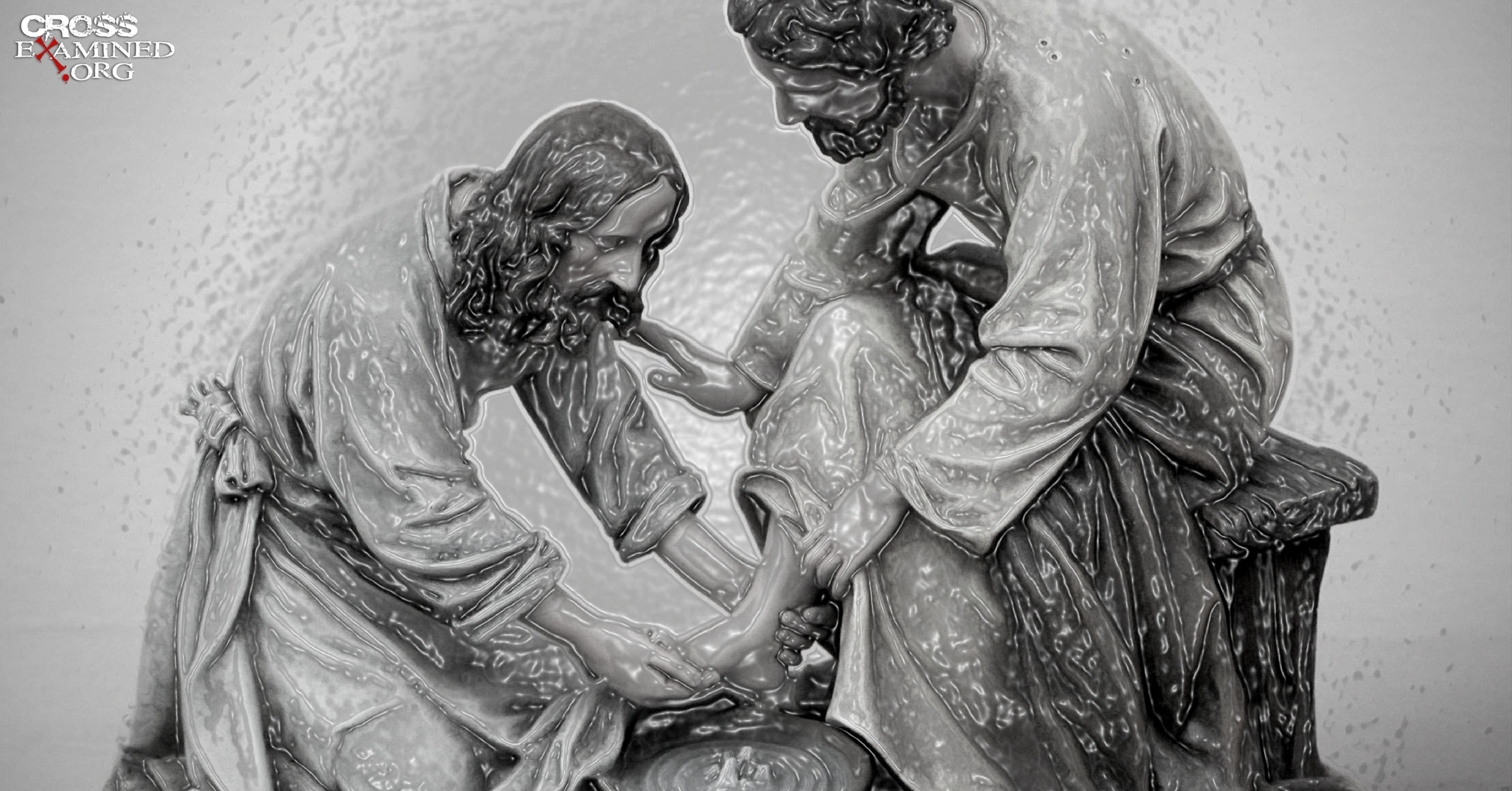
Finally, what example does Jesus give during his last hours on Earth? He could not have made the point clearer, as he washed the feet of his disciples, an act of profound humility and love (John 13).

The apostle John said that all things that have ever come into being have come through the Logos, the son of God. (John 1) So perhaps it is to be expected that we, the image-bearers of God, would have within us the seed of such great love. Perhaps there will always be something tugging at us, that God-shaped whole in our heart that draws us out of ourselves and toward others in acts of loving service. That draws us ultimately back to the One who created us.

But to an increasingly secular world that has forgotten its roots, the debt owed to Christianity for improving our world is worth noting. From the hospitals and other institutions that bear the names of Christian saints to the great universities that were founded to train up new generations to bring the message of Christianity to a fallen world; from the many people of faith who have fallen in the service of this great country to those faithful still among us serving unnoticed wherever there is need – we owe indeed a great debt of gratitude for a faith that inspired such selfless love.

Vigilance is said to be the price of freedom. But that vigilance cannot be directed solely outside the gates. We must look inward and return our hearts and our minds to faith in the One who emptied himself to become one of us and who took on our sins to restore us to right relationship with God.

And showed us the true meaning and value of service in the process.

Notes

Original Blog Source: http://bit.ly/2zDvHpQ


By Al Serrato

Many people today accuse God of unfairness.  Since God can foresee the future, they ask, why didn’t He simply never create all those he knows to be destined to spend eternity in Hell?   One skeptic I know put the question like this:

God supposedly knows everything that will happen before you are ever born, so if all your choices are set beforehand, how can they possibly matter? Furthermore, if God knows you will “choose” Hell before he creates you, why does he simply not create you? Personally, I would much prefer nonexistence to eternal torment. Is God deliberately creating people knowing they will end up in Hell? Then I would call him evil. Is he compelled to create people regardless of what he sees in their future? Then he doesn’t have free will, which would certainly be an interesting interpretation, but one I doubt many people share. Is there some other explanation? If so, I can’t think of it.

This challenge has a bit of intuitive appeal.  It seems to put God in a box, as it were, trapped between being “evil” for choosing to create rebellious creatures or lacking free will, by being unable to do otherwise.  Let’s take a closer look at the two horns of this apparent dilemma.

To the Christian, “evil” is the label we give to words, thoughts or actions that deviate from God’s perfect will.  If we were created robots, there would be no evil in the world; we would operate exactly in accordance with God’s desires.  But in creating man, God did something quite different. He gave us “free will,” the capacity to rebel against him in our thoughts, words, and actions. And rebel we did.  God “foresaw” this development, but only in a manner of speaking – a manner focused upon the waywe think.  This is because God is not bound by time. For him, there is no future to “foresee.”  There is only an eternal present.  All times – whether past, present or future – are accessible to him in this eternal present. Thus, at the moment of creation, God was aware that man would rebel, that he was rebelling, and that he had rebelled. He was aware of the acts and the consequences, the motivations, and the ultimate end, of everyone.  Consistent with his nature for perfect fairness, he created a means by which man – though in rebellion and deserving punishment – could nonetheless find reunification with him.  But in implementing this scheme, he did not force this choice upon us. He gives us the means to salvation but remains content in allowing us to choose which path we will follow.

Those who use their free will to turn toward him – more precisely, to accept his free gift of salvation – will find a welcoming father, ready to do the work needed to restore us. Those who use their free will to turn away from God – to reject his gift – will find that this choice too is honored.  Expecting God not to create those in this latter category would have two significant effects: it would show that God’s provision of free will is really a fiction, since only those who choose to do his will are actually created, and two, it would mean that Hell is a place of evil.  But Hell is a place – or perhaps more precisely a condition – which was created by God to serve a purpose. Since God does not create evil – i.e. he does not act against his own nature – then Hell cannot be a place of evil. Like a human prison, it may be inhabited by those bent on doing evil, but the place itself – and the confinement it effectuates – is actually a good, just as separating hardened criminals from society is a net positive for both the evil-doer and the society that is victimized.

Some will be tempted to argue that God should have forced this choice upon us anyway. Isn’t it better to be forced to love God than to spend eternity in Hell? Only, I suppose, if one believes it is better to be a robot than a thinking, self-aware and self-directed being.  There is no middle ground. Either free will is something real – with consequences attendant to the choices we make – or it’s a fiction.  One cannot have it both ways.

To recap: God is not trapped in an either/or dilemma. God is not “evil” for having created, because in the end, he treats his creation fairly, giving each what he or she deserves.  Since he values free will enough to have given it to us, he apparently intends to make that gift real by allowing some to reject him. Likewise, God is not lacking in free will, because he is not “compelled” to create against his will. Since Hell is not a place for eternal torture, but an appropriate destination for all rebellious human beings, God does not violate his own nature – does not engage in “evil” – when he separates himself from some of his creation.

What this challenge brings into focus is not some internal inconsistency in our conception of God. No, what it highlights is just how different our thinking is as compared to God’s. For like the skeptic, many would view the decision to create nothing all – neither good nor bad people – to be a better – a more noble – alternative.  Yet God sees things quite a bit differently, it seems.

In the end, that he views things differently should not really surprise us. Our judgment as to right and wrong, good and evil, has been corrupted by our rebellion. Since we all share this fallen nature,  we should realize that we are not in the best position to render judgment as to the way eternal things “ought to be.” We wouldn’t ask a group of incarcerated rapists for guidance on issues of sexual mores; nor would we consult death row inmates for advice on how best to treat one another. Perhaps, in the same way, God has little need to consult with us to determine what ultimate “fairness” demands.

No, the Creator of the universe may occupy a slightly better position to judge matters eternal. We might be wise to heed him, rather than try to ensnare him in a “logical” trap.


Original Blog Source: http://bit.ly/2yXda71

By Al Serrato

Christians are all hypocrites!

How often do apologists for the faith encounter that objection? Yes, there are hypocrites in the church, at least in the sense that none of us can actually and fully live up to what the Christian faith commands.  But more significantly, hypocrisy isn’t about simply failing to live up to the rules; it’s about being duplicitous about it. It’s about celebrating the things we shouldn’t do, about not properly regretting the sins that we commit.  This prevalence of hypocrisy – and the recognition that it is wrong – are actually more consistent with the existence of God than with atheism.

Hypocrisy is not a modern phenomenon. Jesus himself condemned it repeatedly in addressing the religious leaders of his day. They sought power and influence by using their elevated status to suppress and burden people. I would venture to say that every culture in the world, and throughout all periods of time, has recognized, and reviled, hypocrites.  The root of the word provides some explanation: the Greek word from which it derives meant a “stage actor,” a person who is not what he appears to be.  In modern usage it carries, of course, a very negative connotation: “a person who pretends to have virtues, moral or religious beliefs, principles, etc., that he or she does not actually possess, especially a person whose actions belie stated beliefs” or “a person who feigns some desirable or publicly approved attitude, especially one whose private life, opinions, or statements belie his or her public statements.”

So, hypocrisy is not simply failing to live up to a set of expectations; that is inherent in human nature. No, hypocrisy involves something more calculated: a desire to exploit this feigned persona in order to accomplish some other purpose. It is, at its core, deception.

If secular humanism is true, and man is simply an accidental product of evolution, then it stands to reason that those traits which provide the most survival potential would be favored. The basis of hypocrisy is not difficult to understand. Like any form of deception, it confers an advantage on the one who employs it. By promoting virtue, but secretly not bound by it, the hypocrite can – at least in the short run – profit by his behavior. Virtue, of course, involves self-discipline and often self-denial. It is the process of saying no to what I want at present because I recognize that simply wanting it is not a sufficient reason, that competing interests are at stake that must be considered.  But why must they be considered? If the man is the measure of all things, and I am a man, why can I not decide that what is in my immediate best interest is what I should pursue?  Over time, shouldn’t it be the case that we would simply recognize that we all act in our own self-interest? There is, therefore, nothing to revile about hypocrisy, just as we don’t condemn the lion for devouring its prey. It is simply in the “nature” of things.

But virtue persists, as does the recognition that it is a better way – a more noble way – in which to live.  Virtue manifests itself in acts of self-sacrifice, altruism, and concern for others.  While these things tend to benefit a society, they confer little, if any, immediate reward to the one who does them. This, of course, is what makes such conduct virtuous, and worthy of our admiration and respect.  They are difficult to do.

Over time, then, the survival advantage hypocrisy provides should make hypocrisy a staple in society. And since it confers an advantage, it would be valued… and accepted as something that everyone does.  But that is not how we view it. Deep down, we know that such behavior is wrong and worthy of condemnation.  It is wrong because it is inconsistent with truth and honesty, and the way things “ought” to be. And if we are impacted by a hypocrite, we feel it viscerally. It makes us angry.

To borrow from CS Lewis, when we consider hypocrisy, it is hard not to see that it appears to be a law of behavior.  It is not a descriptive law, as in the law of gravity, which describes how a rock will fall if released from a height. It is instead a moral law – a law that says we should not act that way, that acting that way is “wrong” on a very basic level.

But natural selection cannot explain moral laws.  It may explain the evolution of preferences and opinions, perhaps, but not laws that all cultures and all people seem to intuitively recognize.  But if there is a God, by contrast, it begins to make sense. Having left his law written into the fabric of our minds, we should expect to have some sense of right and wrong.  Because this eternal God grounds truth in a transcendental and unchanging way, it makes sense too that this love of virtue is itself timeless and without boundary.

So, the next time you encounter the challenge, it might be worth reminding the skeptic where the hypocrisy challenge actually leads.


Original Blog Source: http://bit.ly/2wwunD6