
Stranger Things: Was Vecna a Victim?
***This review of Stranger Things Season 5 contains major spoilers. Consider yourself warned.
It’s a new year, and the end of an era. Stranger Things, the wildly successful Netflix show, has officially concluded. I watched the show as a fan but also as one who is interested in the underlying worldview. No piece of media is completely neutral. In fact, the arts are meant to be an imaginative exploration of ideas. In story, you don’t just observe beliefs, you inhabit them as an “insider.” If you are not familiar with the show, I would warn that it contains language, violence, and at times depictions of what I determine to be demonic. Season 4 was particularly demonic, and I almost stopped watching. But I was a youth pastor at the time, and most of my students were watching it and needing to debrief. I kept going—and I suspect many other Christians are looking for a debrief as well.
C.S. Lewis draws from Alexander’s Space, Time, and Deity to discuss the difference between “enjoyment” and “contemplation.”[1] Enjoyment is experiencing something: the taste of a cookie, the feeling of the breeze across one’s face, the excitement of a live concert. It is something we experience and about which we have an insider perspective. But contemplation is its opposite. It is to look at something, to examine it, to understand it. Lewis discusses why native religious experiences look silly to outsiders. The reason is because outsiders are looking at the experiences, but the natives are looking along the experiences.[2] They possess a different kind of knowledge. In Stranger Things, I want to enter the experience (look along) a character that audiences were invited into: Henry Creel, also known as Vecna.
Vecna the Victim?
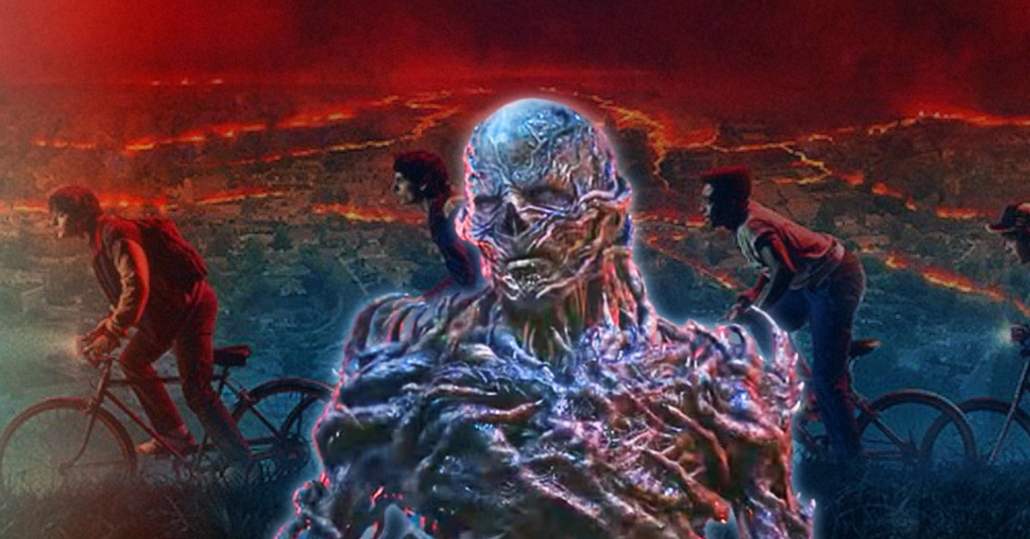
Hinted at during all of season 5 was that Vecna had childhood trauma he did not want to face. Max, as she was trapped in his mind, found shelter in one such memory. Toward the end of the season, Max and Holly Wheeler were trying to escape and found the entrance to a mineshaft. It was clear that this place was not meant to be found. In it was a traumatic memory playing on repeat: the moment Henry became Vecna.
We see a young Henry Creel attempting to rescue a man with a briefcase who was badly injured. But the man, out of his mind and deeply suspicious of Henry, attempted to kill Henry. One shot through Henry’s hand was enough for him to realize he needed to act in self-defense. The result was Henry killing the man with a rock. Henry, still in shock, then opened the briefcase. It was clear that the injured mystery man believed the contents of the briefcase was worth killing over. Curiosity was too much. Inside was a glowing asteroid, and upon touching it, created a connection to what the children called The Mind Flayer. Henry was never the same.
Trauma changes us. Pain is a teacher. Identity is often formed by what is done to us. Henry was forced into self-defense and stumbled upon the alluring power of The Mind Flayer. He did not choose this; it was done to him. This produced great shame, a memory that Henry did not want to face. He avoided that place in his memory until the finale, likely because of the pain it caused him. We all wish that the pain done to us never happened. We imagine what life would have looked like had such pain never occurred. For Henry, the mineshaft was the ultimate place of “what-ifs.” A childhood taken. Innocence corrupted. A new trajectory solidified.
But the showrunners did something unexpected. I thought, while watching it, that they would continue to push a well-established story trope that has become popular in the last decade or so: there are no villains, just victims. Some examples of this. Killmonger from Black Panther (2018) was not evil, he was just abandoned, experienced racial in justice and oppression. Second, Scarlet Witch from Doctor Strange in the Multiverse of Madness (2022) was merely a story of the loss of her family and unresolved grief. She was not portrayed as evil; she was simply wounded. I could go on about Elsa in Frozen or Kylo Ren in Disney’s version of Star Wars. The trope has become so engrained in our stories that we are expected to, at some point, empathize with these wounded villains. In the finale of Stranger Things, there was a moment where I thought the show was going to treat Henry (Vecna) the same way. He was not evil; he was just a victim. But to my surprise, Henry revealed to Holly that he could have resisted The Mind Flayer; he could have walked away.
Henry was the victim of a moment, but his identity as the antagonist was a choice. The mineshaft produced a wound in Henry, one that he acted out of from his pain. There are two responses to woundedness: be shaped by it or be healed from it. Henry was shaped; Jesus invites healing. One quick comment on woundedness. The church often mistakes sin with wounds. Victims, and their subsequent woundedness, are told to repent. But how do you repent of a wound? How do you turn from something that was done to you? This is the grave mistake between sin and wounds. You cannot repent of wounds – you repent of sin. But here is another important distinction. Sin often comes from wounds. Henry was deeply wounded, hurt, isolated from this event, yet he chose an identity of sin as a result. There was a moment where Henry was facing this memory, and Will was challenging Henry to (in essence) repent. But Henry was convinced that The Mind Flayer’s critique of humanity was correct: it was corrupt beyond saving. The only solution, to Henry, was to remake the world by destroying it.
Responding to Woundedness
The final battle was between two victims who chose different paths. Henry allowed his woundedness shape his life, whereas El did not. The show does a masterful job of showing Henry and El as two parallel victims – both with powers, both with childhood trauma, both with legitimate motives for revenge. But El healed; Henry did not. The difference? Relationships. Imagine if El was not found by Mike and the gang and she was not “fathered” by Hopper. El was slowly healed by her loving (yet imperfect) relationships. Henry, on the other hand, became filled with malice the longer he was isolated. We can see Henry’s perspective only when we understand who he was connected to: he chose to “abide” in The Mind Flayer, which led to his destruction.
The gospel invites us to both healing and repentance. All of us have things that were done to us, but we all must choose how we respond to such things. Henry responded with more corruption and evil, El responded by healing and, in the end, self-sacrifice. She was the “Christ-type” of the show insofar that she was the self-sacrificing “savior” who ended the cycle of child experimentation. This points to Christ, who experienced great suffering yet sacrificed himself for unworthy humanity. What will you choose? God is the only healer. Psalm 147:3 says, “He heals the brokenhearted and binds up their wounds.”
If you are broken, go to the one who has the power to heal. If you have made sinful choices because of woundedness, receive the gift of repentance and turn from your sins. John the Baptist exclaims,
“’The time has come,’ he said. ‘The kingdom of God has come near. Repent and believe the good news!’” (Mark 1:15)
Henry Creel was the victim who became the victimizer and villain. How will you respond to your own pain?
Choose healing and turn from any subsequent sins.
Choose Christ.
References:
[1] C. S. Lewis, Surprised by Joy: the Shape of My Early Life (San Francisco, CA: HarperOne, 2017), 265.
[2] C. S. Lewis, God in the Dock: Essays on Theology and Ethics, ed. Walter Hooper (Grand Rapids, MI: William B. Eerdmans Publishing Company, 2014), 232.
Recommended Resources:
If God, Why Evil? (DVD Set), (MP3 Set), and (mp4 Download Set) by Frank Turek
Why Doesn’t God Intervene More? (DVD Set), (MP3 Set), and (mp4 Download Set) by Frank Turek
Why does God allow Bad Things to Happen to Good People? (DVD) and (mp4 Download) by Frank Turek
Relief From the Worst Pain You’ll Ever Experience (DVD) (MP3) (Mp4 Download) by Gary Habermas
Richard Eng serves as the Lead Pastor at Bethel Evangelical Free church in Devils Lake, ND. He is the author of the illustrated children’s book “What Is Heaven Like?” (2022), and has written on faith and cultural issues for The Expository Times, FreeThinking Ministries, CrossExamined, and others. He received his M.A. in Cultural Apologetics from Houston Baptist University, and degrees Ministry and Bible from Grace University. He and his wife have three young children — who are most likely making a mess in the living room right now.