By Brian Huffling
Many people don’t know how to study the Bible, or even where to begin. The Bible is a long collection of books that contains much about ancient history, difficult concepts, and is very intimidating for people who want to read it but don’t know where to start. This article will describe some of the principles of interpreting the Bible (hermeneutics) that are taught in basic Bible college and seminary classes (but are easy enough for anyone to understand). This is not a 12-step method to anything, it is simply a sound method to examine the biblical text. Well, it is a 3-step method: observation, interpretation, and application.
OBSERVATION
When we read a passage, we typically want to ask, “What does it mean?” But there is a more basic question we should ask first: “What does it say?” It is easy to read into the text something that is not there (this is called eisegesis), often because we simply put words there that aren’t but think they should be. For example, John 20:19 says: “On the evening of that day, the first day of the week, the doors being locked where the disciples were for fear of the Jews, Jesus came and stood among them and said to them, ‘Peace be with you.’” It is often stated that Jesus walked through a wall or the door. However, the text doesn’t say that. It simply says the doors were locked and Jesus appeared to them. Maybe he walked through the door or wall, or maybe he just showed up. We have to observe the text carefully. There are various aspects of the text to observe.
One major area to observe is genre. For example, narrative is treated differently than poetry or didactic literature (such as the epistles). Narrative simply describes what happened, whereas didactic literature prescribes what should happen (in other words, it gives commands). Of course there can be narrative in epistolary literature (or vice versa), but the point is that one needs to be careful, for example, not to make an imperative out of a simple description. It is also arguably the case that one should not use parables to base his theology. This is debated, but the point is that we should be aware of the type of genre we are reading when doing interpretation.
Another aspect of the text to observe is the historical and cultural context. For example, Revelation 3:15-16 says, “I know your works: you are neither cold nor hot. Would that you were either cold or hot! So, because you are lukewarm, and neither hot nor cold, I will spit you out of my mouth.” People often say that Jesus would rather you be completely dedicated to him or not dedicated at all. (Does the latter even make sense?) Actually, what we know from historical information is that the the area being referred to (Laodicea) had hot water pumped in from hot springs and cold water pumped in from cold springs. People went to the hot springs for healing (like being in a hot tub) and went to the cold springs for refreshment (something I would never do as I hate cold water), so the Laodiceans tried to get that water for themselves. However, by the time the water got to Laodicea, it was lukewarm and nasty and when people drank it it would make them vomit. Jesus is saying that he wanted the Laodiceans to be spiritually healing or refreshing. Rather, what the church there had to offer was spiritually nasty. Historical knowledge here clarifies the text for us.
It is also imperative to observe the textual and literary context, that is, what comes before and after the passage you are looking at. We get into trouble when we start looking at passages without understanding the context in which they are in. Sometimes we don’t have to go back to the beginning of the book, but we should at least start with he literary unit in which our passage is found. The chapters and verses don’t necessarily determine that, so pay attention to what the text is saying. Does the passage start with a conjunction such as “but” or “and?” Then it’s a good idea to see what preceded that conjunction.
In looking at the textual and literary context we can observe the structure of the passage. Are words, phrases or sentences in a certain order or pattern? For example, we should be on the look out for chiasms. Chiasms are structures that have an ABCBA order. Sometimes it could have an ABBA order, such as in Romans 10:9-10, which says: “because, if you confess with your mouth that Jesus is Lord and believe in your heart that God raised him from the dead, you will be saved. For with the heart one believes and is justified, and with the mouth one confesses and is saved.” Notice the mouth/heart/heart/mouth structure. The middle part of the chiasm is meant to emphasize the author’s point. Look at the below chiasm from the flood story:
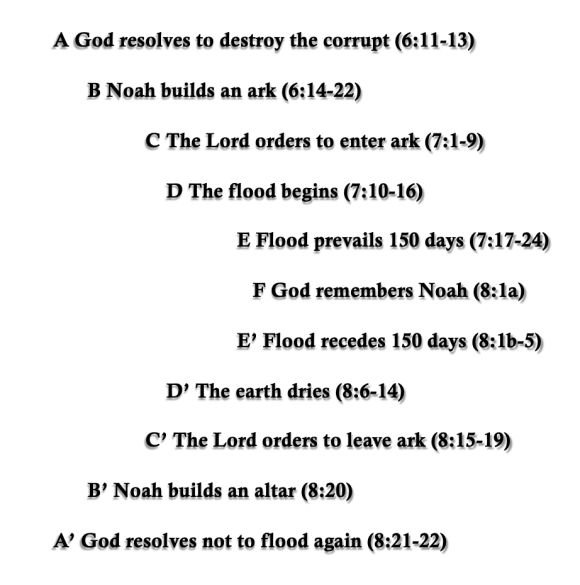
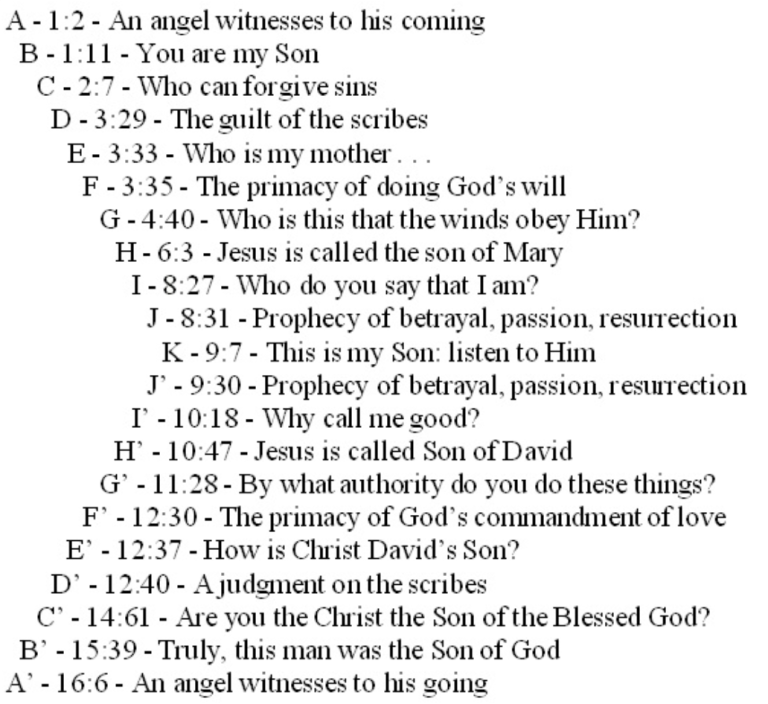
Such a long chiasm is hard to identify, but if we start to see patterns in the wording of the text and in a certain order, it can be found. While the story of the flood is typically thought to be about judgment, the focal point of the flood story is actually that God remembered Noah. The entire Book of Mark is actually a chiasm. The below image is taken from my Hermeneutics class notes by Dr. Tom Howe:
Another area to observe is terms. This particular area of observation is difficult not to blend with interpreting (asking about the meaning). However, we have to observe what terms are (and are not) used. As you probably know, the Bible was not written in English. Almost all of the Old Testament was written in Hebrew, with some areas being written in Aramaic (such as much of Daniel with the rest being Hebrew—something that itself needs to be observed), and the New Testament was written in Greek. Word studies are very popular, and many times all of Bible study is simply reduced to a word study, which it should not be. But it should be part of our study. It is important to know what underlying original word was used, if we can, when doing a Bible study. Some people are more trained at this than others, but it is a goal we should have.
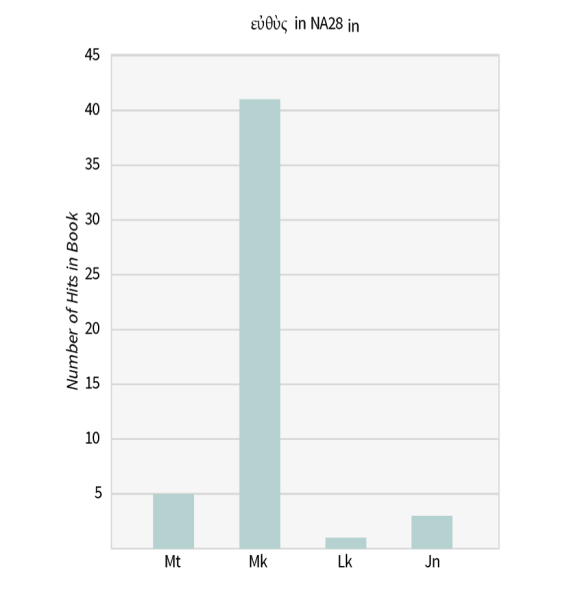
When observing terms, we need to look for terms that are repeated. Such repetition of terms can show the structure of the book or passage. Such as the word “immediately” in Mark. The word “immediately” is used 5 times in Matthew, and fewer than that in Luke and John. But Mark uses it over 40 times. Why is that? It is obviously an important term for him. Let me put that into a graphic for you:
We should also observe terms that are difficult to understand, such as “predestination.” Figure of speech is also important to observe. Sometimes it is debatable as to whether a text is a figure of speech or not. There are some rules that can help discover if something should be taken as a figure of speech. For example, if something for whatever reason cannot be taken literally, then it should be taken as a figure of speech—such as when Jesus told his disciples at the Last Supper that the bread and wine was his body and blood. If something would be an immoral command from God, such as when Jesus said to eat and drink his body, that should be taken as a figure of speech. Of course, these examples are debatable between Catholics and Protestants, but the general rule holds true that when something cannot be taken literally, it needs to be taken as a figure of speech.
We also need to take note of words that are unfamiliar to us, such as “talent.” When we read, for example, in the parable of the unforgiving servant, that the servant owed ten thousand talents, we need to know what a talent is. (This gets blurry with our second step, interpretation.) Some translations, such as the NIV, translate “ten thousand talents” here as “ten thousand bags of gold.” One talent was about twenty years worth of wages. More on this in the next section, but the point is we need to be aware of these words—in other words, observe them.
INTERPRETATION
This is the step we generally start with but shouldn’t: what does the text mean? Back to the “talent” story. We observed that the word used in the parable of the unforgiving servant is “talent,” but the NIV says “bags of gold.” A talent was about 20 years worth of wages. If the average wage is around $45k, then that’s $900k. I don’t know how much a bag of gold is worth, but we’d have to multiply $900k by 10k for it to be accurate in talents. My iPhone calculator got an error when I did that. Ten thousand talents was more money than the known world had then, and ten thousand was the highest number in Greek. The point was actually that the amount of money the servant owed was unimaginable. Ten thousand bags of gold just doesn’t seem to be a good translation. This is an example of both the observation and the meaning of a word.
Another example is the word “power” in Romans 1:16: “For I am not ashamed of the gospel, for it is the power of God for salvation to everyone who believes, to the Jew first and also to the Greek.” The word for “power” in Greek is dynamis, from which we get the word “dynamite.” Some today, even popular commentators, say that the gospel, like dynamite, blows up sin. The problem with this view is that dynamite didn’t exist in the first century, so that can’t be what Paul meant. It simply means “power” or “ability.” This is a good example of what not to do in interpretation: import a later meaning into an earlier word. Remember, a text can’t mean what it never meant. This particular issue is called the fallacy of reverse etymology (etymology is the study of how words change over time) or anachronism.
Don’t know Greek? There are tools to help. Let me illustrate with a couple that I used before I studied Greek. I used to listen to a popular teacher and in one of his sermons he quoted Acts 2:24 to argue that Jesus went to hell. The text says this: “God raised him up, loosing the pangs of death, because it was not possible for him to be held by it” (the KJV from which he was using says “pains”). According to this teacher, since Jesus was in pain, then he must have been suffering, which wouldn’t have happened in heaven, so he must have been in hell. I was looking at that passage one day in my newly purchased Hebrew and Greek study Bible that used Strong’s Dictionary number system. The word “pain” had a number by it, so I looked it up. It said the word was “odin.” I also had just gotten the Theological Dictionary of the New Testament (this is not an endorsement of TDNT as it is said to be pretty liberal, but it can be helpful in some ways), and looked up the word there. Basically, TDNT said that the word referred to birth pain, and that Peter was making an analogy here between a woman not being able to hold her baby in, but at the right time she gives birth, and death not being able to hold Jesus, but at the right time was forced to let go of him. It does not mean Jesus was in pain. Lessons: look words up. Get some tools.
But, as mentioned, word studies are not the only aspect of Bible study. When doing interpretation, we have to not only examine the meaning of particular words, but how words relate to other words. The former is merely grammar and the latter is syntax. This requires a knowledge of grammar as well as parts of speech and how words relate to each other. This is why simple word studies, while obviously useful, is not the only part of the game. Words aren’t in isolation, but relate to other words. Let me give you an example of how it is important to see how words relate to each other.
Several years ago in a Ph.D. class on philosophy of history, my professor, Mike Licona, said that we should not take the saints being raised in Matthew 27 literally because if we did, it would result in a problem in the text (this issue has since become a hot issue for him and the issue of inerrancy). Here’s the text: “And behold, the curtain of the temple was torn in two, from top to bottom. And the earth shook, and the rocks were split. The tombs also were opened. And many bodies of the saints who had fallen asleep were raised, and coming out of the tombs after his resurrection they went into the holy city and appeared to many” (Matthew 27:51-53, ESV). Do you see the problem? I have read this passage for years and never noticed it. The context of the passage is Christ’s death. When was the curtain torn, and when did the earth shake? At his death—Friday. When did the tombs open and when were the saints raised? Friday. When does it say they came out of their tombs? After his resurrection—Sunday! That’s a natural reading of this translation. I haven’t seen any other English translations say it differently. The text seems to say that they were raised and the tombs were opened at the same time as the other events. But it seems to say that they didn’t come “out of their tombs until after his resurrection.”
I didn’t like this and was distracted by it. So, I stopped listening to the lecture (sorry Mike), and went to the Greek. Long story short, here was my solution: the word for “and” is kai in Greek and has several meanings, such as “even.” When it means “even” it tends to be emphatic/explanatory. In this case it could mean, “the saints were raised even coming out of their graves.” This seems to emphasize the physical nature of the event and that it wasn’t merely spiritual. Then, we could re-punctuate the sentence to read, “the saints who had fallen asleep were raised, even coming out of their tombs. After his resurrection, they went into the holy city and appeared to many.” I actually asked Mike if this was an acceptable answer as he knows Greek much better than me, and he said yes, as long as the word for “after” (meta) can start a new sentence. It can, an actually does a lot in narrative. Such a solution maintains proper Greek and English grammar and syntax. But it requires seeing how words relate to each other. It also requires observation and interpretation. (Some may object to such an answer as it appears to make the saints “resurrected” or first fruits before Jesus, but such is not necessary. The text does not imply they were raised immortal like Jesus. Remember, Jesus was not the first person raised from the dead. Elijah raised someone as did Jesus—Lazarus.)
I use this example to show a couple of things. One, don’t be married to any single English translation. Look at other translations (although I haven’t found an English translation that doesn’t have this particular problem here) and look, to whatever capacity you can, at the original languages. Two, the punctuation is not inspired (neither are the chapters and verses). In other words, read the text freshly and see if there are other ways to understand it and if the meaning changes.
One last note on interpretation and meaning. There can only be one meaning (although there can be many applications of that meaning: see below). While it is common for teachers to go around the room and ask their students, “What does this passage mean to you,” it is a bad question. It can’t mean to one person something that it doesn’t mean for all. It can have a different significance, but the actual meaning is fixed. (For a discussion on the issue argument the meaning is subjective or unattainable due to our biases, see my article on standard hermeneutics books as well as my article on historical objectivity.) While there are debates about what a given passage means, there can be only one right answer. It is up to studious interpreters to discover that meaning through the hermeneutical process. More could be said about interpretation, but let’s move on.
APPLICATION
Application is basically the “so what” part of the process. The question to ask here, after we have asked what does it say and what does it mean, is “how does this passage apply?” Unfortunately, sometimes people want to skip to this step first. Of course we have to know what the text says and means before we can ask how it applies to us. There are certain principles to keep in mind when trying to apply the text. Perhaps it is best up front to state that the text does not always have an application for us. Sometimes the text is informative for us and tells us about what happened, but it doesn’t always have an application. When the text says something like, “this king did this, and then this,” there really is no application, just information. In such instances, it is important not to try to wring out an application when there really isn’t one. Having said this, it is important to point out that even if there is no direct application, as Paul says in 2 Timothy 3:16, all Scripture is “profitable for teaching, for reproof, for correction, and for training in righteousness, that the man of God may be complete, equipped for every good work.”
It’s easy to apply commands: just do or don’t do something. Although, sometimes it’s hard to tell whether a command is meant to be for a certain culture and time or whether it’s mean to be universal. For example, is the issue of head coverings in 1 Corinthians 11 meant to be universal? What about men not having long hair in verse 14? Paul says in 1 Timothy 2:12-14, “I do not permit a woman to teach or to exercise authority over a man; rather, she is to remain quiet. For Adam was formed first, then Eve; and Adam was not deceived, but the woman was deceived and became a transgressor.” Is Paul saying women shouldn’t teach or exercise authority over a man always, or just in that culture and time? Whatever that text means, the reasoning behind it seems to be universal. Paul gives two reasons for what he said: (1) the order of creation, and (2) who was deceived. If the reasons are universal, then the prohibition would seem to be so as well.
Things aren’t as straightforward with narrative. We have to be careful to not make a description into a prescription. Narrative simply is a narration of what happened. Of course, it can contain other genres, but when we are looking at pure narrative and not a command to us, we have to be careful how we apply the text, if it can be applied. If it is simply a description of what happened, we can’t necessarily make it a prescription of what should happen. For example, the fact that Gideon put out a fleece to discern God’s will is not a command for us to. The fact that Elijah and other people in the OT were called supernaturally by God does not mean we can say that’s how God normally operates or “calls” people today. Here are some other pitfalls to avoid with application:
Analogizing: analogizing is what we just referred to with the call of Elijah. Just because God called Elijah does not mean that he calls us. This “call” is often analogized between Israel’s prophets and people today, but such an application is illicit. We simply can’t say that because God did something in ancient Israel that he does so today.
Allegorizing: Allegorizing is when we take a literal event and make the application allegorical. For example, we can talk about the person who “loosed his donkey for Jesus” when he entered Jerusalem. I once heard someone say he heard a pastor talk about “loosing your donkey for Jesus.” I guess that’s supposed to mean you are making what you have available for Jesus, but the text is talking about an event that actually happened. It is not a command.
Spiritualizing: Spiritualizing is similar to allegorizing. It takes literal events and gives a spiritual significance. A popular example of this is to present the story of Jesus calming the storm for the disciples and say “Jesus stills the storms of life.” There are a few problems with this. One is that this was a literal storm and was not meant to say that Jesus actually stills the storms of life. It isn’t talking about spiritual storms or tough times: it’s talking about a storm! Secondly, Jesus doesn’t still the storms of life if that means that he stops the storm like he did in the story. To say that he stills the storms of life is not only to state something that is false but to endanger someone’s faith who expects him to still his storms.
So what do we do to apply the text? One thing is to do what the text says to do if it is issuing a command. If it’s narrative, it’s to see what universal principle can be applied. In the story of David and Goliath, it is a spiritualization to say that we should go and slay the Goliaths in our lives. The biblical passage is talking about a literal person named Goliath. It is not giving a command, but describing something that actually happened. But we can glean universal principles. In this story that principle could be that God is faithful to the promises he makes and to his covenant. Here are some other principles from which to see how to apply the text:
- Is there an example for me to follow?
- Is there a sin to avoid?
- Is there a promise to claim?
- Is there a prayer to repeat?
- Is there a command to obey?
- Is there a condition to meet?
- Is there a verse to memorize?
- Is there an error [theological] to mark?
- Is there a challenge to face? (Howard Hendricks, Living by the Book, chapter 44)
The New International Application Commentary is an excellent commentary series to use to bridge the gap between the biblical times and ours to see if and how the text can be applied.
One last word about application: while the meaning is one, the application can be many since there are many situations in which to apply the text.
TOOLS FOR STUDY
If one is going to study the Bible, it is best to understand the tools that are available. Resources that this 3-step method is based on include Methodical Bible Study and Living by the Book (Living by the Book has a workbook).The most important tool is the Bible itself. There are hundreds of English translations of the Bible but there are generally 3 categories of translation philosophies: essentially literal (A.K.A. formal equivalence), dynamic equivalence (A.K.A. functional equivalence), and paraphrase. It is very important to use an essentially literal Bible for Bible study (see Translating Truth: The Case for Essentially Literal Bible Translation for a discussion on this), and I would argue for reading it too, but a good dynamic equivalent translation can be ok for reading. Paraphrases have even been recommended by good interpreters, but mainly to see the general sense of the passage. The front matter in your Bible should explain what translational philosophy it holds to. Essentially literal Bibles include the King James Version, The New King James Version, the New American Standard Bible, the English Standard Version, the Christian Standard Version, and the like. Dynamic equivalent translations include the New International Version, the Good News Bible, and the New English Translation. (The NET is worthwhile for its 60,000+ notes, and is available free at Bible.org.) Paraphrases include The Message, The Living Bible, and as I like to point out to my students, the Cotton Patch Gospel, that tells the story of Jesus from the vantage point of southerners in the U. S. (he is born in Gainesville, GA and escapes to Mexico).
Then there are commentaries. Commentaries are useful in many ways, but ideally should be consulted after your own study so you aren’t biased in a certain direction. There are two basic types of commentaries: critical (technical) and non-critical (non-technical). A commentary is critical if it discusses textual issues such as variations between different manuscripts of the original languages, or discusses the original languages in general. Some commentaries go into a great deal of detail and others don’t. Sometimes you just need a brief overview of an issue. For that I recommend The Bible Knowledge Commentary, The Expositor’s Bible Commentary, the Tyndale Old Testament Commentary and the Tyndale New Testament Commentary (as a set here). The NIV Application Commentary is another non-technical commentary. The New International Commentary on the Old Testament, and The New International Commentary on the Old Testament (as a set here) is also very good. It is non-technical in the text but has technical/critical information in the notes. The IVP Bible Background Commentary (separate for OT and NT) is good for giving . . . the background, as are the The Lexham Geographical Commentary on the Gospels, The Lexham Geographical Commentary on Acts through Revelation, and The New Testament in Antiquity. There are actually commentaries on commentaries. These are basically long annotated biographies but with more information on the pluses and minuses of each set. See for example the Old Testament Commentary Survey,the New Testament Commentary Survey, and Commentary and Reference Survey. For a free and very useful resource, see Daniel Akin’s “Building a Theological Library.” It is not necessary to buy a complete set. As the commentary surveys and and Akin’s site show, some commentaries in a set are better than others, thus, it might be more beneficial if cost is an issue to buy certain individual commentaries. It is also important to pick up a good Bible dictionary and encyclopedia. There are a number of those in each category.
I can’t have a section on study tools and not mention Logos. There are many electronic software programs for Bible study. I have used Logos since 2004 and don’t want to try to do Bible study without it. I have required Logos in a couple of my classes as well, and the students love it too. Not only does it offer original language tools, it has incredibly complex search capabilities for the Bible, as well as the other books in your Logos library. And it is just that: a library. They have tens of thousands of books and tools. Other programs are good and there are debates about which is best, but I have used and love Logos. Others programs are BibleWorks, Olive Tree, or Accordance (only for Mac). Good free software is Blue Letter Bible and e-Sword.
CONCLUSION
What has been said hardly scratches the surface of biblical interpretation. It is certainly incomplete, but only mean to give some pointers and hopefully motivation for doing Bible study. This article is not meant to make Bible study seem hard, but to show that it takes work and offer some hopefully helpful tips. If you want to understand this system better, I encourage you to get Methodical Bible Study and/or Living by the Book. Thanks for reading, and please subscribe!
Recommended resources related to the topic:
Why We Know the New Testament Writers Told the Truth by Frank Turek (mp4 Download)
The Top Ten Reasons We Know the NT Writers Told the Truth mp3 by Frank Turek
Counter Culture Christian: Is the Bible True? by Frank Turek (Mp3), (Mp4), and (DVD)
_____________________________________________________________________________________________________________________________________________________
J. Brian Huffling, PH.D. have a BA in History from Lee University, an MA in (3 majors) Apologetics, Philosophy, and Biblical Studies from Southern Evangelical Seminary (SES), and a Ph.D. in Philosophy of Religion from SES. He is the Director of the Ph.D. Program and Associate Professor of Philosophy and Theology at SES. He also teaches courses for Apologia Online Academy. He has previously taught at The Art Institute of Charlotte. He has served in the Marines, Navy, and is currently a reserve chaplain in the Air Force at Maxwell Air Force Base. His hobbies include golf, backyard astronomy, martial arts, and guitar
Original blog: https://bit.ly/3xgtCia

Derribando una de las contradicciones bíblicas favoritas de Bart Ehrman
EspañolPor Erik Manning
Los escépticos dicen que los evangelios están plagados de contradicciones y que, por tanto, no son fuentes históricas fiables. Y estos mismos escépticos dicen que algunas de estas contradicciones son francamente absurdas. Por ejemplo, el erudito agnóstico del NT Bart Ehrman señala una de sus contradicciones bíblicas favoritas en su exitoso libro, Jesus, Interrupted (Jesús, interrumpido).
Así que ahí lo tienes. O Jesús o Juan estaban teniendo una “pifia cerebral”. Elija su opción.
¿Tenían Jesús o Juan un lapso de atención dolorosamente corto?
Si se mira la Biblia de forma mecánica, esta contradicción parece absurda a primera vista. Entonces, ¿cómo debemos entender esta supuesta discrepancia?
Me parece que el escritor de Juan está tratando con la reacción inmediata de los discípulos a las palabras de Jesús. La idea de su partida les llena de dolor, pero si hubieran preguntado a dónde iba y hubieran comprendido que era al Padre, habrían reconocido que era por el bien de Jesús y el suyo propio. Fíjate en el siguiente versículo: “Antes, porque os he dicho estas cosas, la tristeza ha llenado vuestro corazón. Pero yo os digo la verdad: Os conviene que yo me vaya; porque si no me fuera, el Consolador no vendría a vosotros; mas si me fuere, os lo enviaré.” (Jn 16,6-7 LBLA)
Si recordamos las veces anteriores en las que Jesús fue interrogado y que señala Ehrman, Pedro tenía un poco de complejo de guardaespaldas y no quería escuchar que Jesús se fuera solo. Así que cuando hace la pregunta en Juan 13:36 sobre a dónde va Jesús, no lo comprende.
Y en Juan 14:1-5, Jesús habla de ir a su Padre para prepararles lugar. Tomás hace una pregunta, pero es porque no capta lo que Jesús expone. No busca aclarar lo que quiere decir Jesús con estas cosas. Y sabemos que Tomás es un poco lento para entender, como descubrimos más adelante en el Evangelio de Juan. Tomás y Pedro pensaban con naturalidad.
El silencio de los discípulos se volvió ensordecedor
Vemos que en Juan 14, Jesús es interrumpido con otra pregunta, pero no se le hace otra pregunta en Juan 15. Hasta ahora, Jesús ha mencionado su partida, pero luego, en Juan 15:22-16:4, habla de la persecución que les espera. Ya sabes, algunas cosas pesadas. Ahora sus corazones están apenados. La tristeza los lleva a callar después de haber sido tan inquisitivos antes.
Es en 16:5 cuando Jesús dice: “chicos… todavía no lo entienden. Se quedaron callados con todas esas palabras duras de persecución y de que me iba. Pero no los voy a dejar solos. Estoy enviando al Espíritu en mi lugar. Ahora es el momento de volver a preguntar, pero esta vez seamos un poco más agudos y dejemos de lado el pesimismo sombrío”.
Después de esto, vuelven a interrumpir a Jesús dos veces más en Juan 16, demostrando que siguen sin entender de qué está hablando. Lee Juan 16:17-19:
Los discípulos por fin lo entienden, pero ¿lo entiende Ehrman?
Jesús responde entonces a sus preguntas, y termina diciendo “He venido del Padre y he venido al mundo, y ahora dejo el mundo y voy al Padre”.
La bombilla parece finalmente encenderse. Dejan de mirar las cosas terrenales y empiezan a ver las realidades espirituales de las que habla Jesús. En Juan 16:28-30 vemos: “Sus discípulos le dijeron: He aquí que ahora hablas claramente y no usas lenguaje figurado. Ahora entendemos que tú sabes todas las cosas, y no necesitas que nadie te pregunte; por esto creemos que tú viniste de Dios. Jesús les respondió: ¿Ahora creéis?” (LBLA).
Se acabaron las metáforas en sus mentes. Jesús habla ahora con claridad. Se quedaron callados después de algunas palabras duras de Jesús, pero ahora caen en cuenta después de que Jesús les incita a indagar más. Esta interpretación no viene sólo de mí, sino que también es apoyada por comentaristas y exegetas como CK Barrett, RCH Lenski, Craig Blomberg, John Gill, Christian Kuinoel y Hermann Olshausen.
Sólo si no dejamos espacio para el matiz conversacional tendríamos que concluir que Jesús tuvo un lapsus mental o que algo extraño está pasando con el escritor de Juan. Parece que la lectura de Bart es bastante rígida, y me atrevo a decir que fundamentalista. Hay más de sus ejemplos de supuestas discrepancias en Jesús, interrumpido, que son mucho más dignos de investigación y debate. Pero este no es un momento de oro para Ehrman aquí. Y por desgracia, hay más malos como éste. No hay nada tan extraño aquí.
Nota
[1] Libro: Jesus, Interrupted (Jesús, interrumpido).
Recursos recomendados en Español:
Robándole a Dios (tapa blanda), (Guía de estudio para el profesor) y (Guía de estudio del estudiante) por el Dr. Frank Turek
Por qué no tengo suficiente fe para ser un ateo (serie de DVD completa), (Manual de trabajo del profesor) y (Manual del estudiante) del Dr. Frank Turek
_____________________________________________________________________________________________________________________________________________________
Erik Manning es un director del capítulo de Reasonable Faith (Fe Razonable) situado en Cedar Rapids, Iowa. Es un antiguo escritor independiente de béisbol y copropietario de un negocio de decoración antigua y artesanal con su esposa, Dawn. Le apasiona la intersección entre la apologética y el evangelismo.
Fuente Original del Blog: https://bit.ly/3tEbLAT
Traducido por Yatniel Vega Garcia
Editador por Monica Pirateque
STEPS AND RESOURCES FOR SOUND BIBLICAL INTERPRETATION
4. Is the NT True?, CrossExamined, Theology and Christian ApologeticsBy Brian Huffling
Many people don’t know how to study the Bible, or even where to begin. The Bible is a long collection of books that contains much about ancient history, difficult concepts, and is very intimidating for people who want to read it but don’t know where to start. This article will describe some of the principles of interpreting the Bible (hermeneutics) that are taught in basic Bible college and seminary classes (but are easy enough for anyone to understand). This is not a 12-step method to anything, it is simply a sound method to examine the biblical text. Well, it is a 3-step method: observation, interpretation, and application.
OBSERVATION
When we read a passage, we typically want to ask, “What does it mean?” But there is a more basic question we should ask first: “What does it say?” It is easy to read into the text something that is not there (this is called eisegesis), often because we simply put words there that aren’t but think they should be. For example, John 20:19 says: “On the evening of that day, the first day of the week, the doors being locked where the disciples were for fear of the Jews, Jesus came and stood among them and said to them, ‘Peace be with you.’” It is often stated that Jesus walked through a wall or the door. However, the text doesn’t say that. It simply says the doors were locked and Jesus appeared to them. Maybe he walked through the door or wall, or maybe he just showed up. We have to observe the text carefully. There are various aspects of the text to observe.
One major area to observe is genre. For example, narrative is treated differently than poetry or didactic literature (such as the epistles). Narrative simply describes what happened, whereas didactic literature prescribes what should happen (in other words, it gives commands). Of course there can be narrative in epistolary literature (or vice versa), but the point is that one needs to be careful, for example, not to make an imperative out of a simple description. It is also arguably the case that one should not use parables to base his theology. This is debated, but the point is that we should be aware of the type of genre we are reading when doing interpretation.
Another aspect of the text to observe is the historical and cultural context. For example, Revelation 3:15-16 says, “I know your works: you are neither cold nor hot. Would that you were either cold or hot! So, because you are lukewarm, and neither hot nor cold, I will spit you out of my mouth.” People often say that Jesus would rather you be completely dedicated to him or not dedicated at all. (Does the latter even make sense?) Actually, what we know from historical information is that the the area being referred to (Laodicea) had hot water pumped in from hot springs and cold water pumped in from cold springs. People went to the hot springs for healing (like being in a hot tub) and went to the cold springs for refreshment (something I would never do as I hate cold water), so the Laodiceans tried to get that water for themselves. However, by the time the water got to Laodicea, it was lukewarm and nasty and when people drank it it would make them vomit. Jesus is saying that he wanted the Laodiceans to be spiritually healing or refreshing. Rather, what the church there had to offer was spiritually nasty. Historical knowledge here clarifies the text for us.
It is also imperative to observe the textual and literary context, that is, what comes before and after the passage you are looking at. We get into trouble when we start looking at passages without understanding the context in which they are in. Sometimes we don’t have to go back to the beginning of the book, but we should at least start with he literary unit in which our passage is found. The chapters and verses don’t necessarily determine that, so pay attention to what the text is saying. Does the passage start with a conjunction such as “but” or “and?” Then it’s a good idea to see what preceded that conjunction.
In looking at the textual and literary context we can observe the structure of the passage. Are words, phrases or sentences in a certain order or pattern? For example, we should be on the look out for chiasms. Chiasms are structures that have an ABCBA order. Sometimes it could have an ABBA order, such as in Romans 10:9-10, which says: “because, if you confess with your mouth that Jesus is Lord and believe in your heart that God raised him from the dead, you will be saved. For with the heart one believes and is justified, and with the mouth one confesses and is saved.” Notice the mouth/heart/heart/mouth structure. The middle part of the chiasm is meant to emphasize the author’s point. Look at the below chiasm from the flood story:
Such a long chiasm is hard to identify, but if we start to see patterns in the wording of the text and in a certain order, it can be found. While the story of the flood is typically thought to be about judgment, the focal point of the flood story is actually that God remembered Noah. The entire Book of Mark is actually a chiasm. The below image is taken from my Hermeneutics class notes by Dr. Tom Howe:
Another area to observe is terms. This particular area of observation is difficult not to blend with interpreting (asking about the meaning). However, we have to observe what terms are (and are not) used. As you probably know, the Bible was not written in English. Almost all of the Old Testament was written in Hebrew, with some areas being written in Aramaic (such as much of Daniel with the rest being Hebrew—something that itself needs to be observed), and the New Testament was written in Greek. Word studies are very popular, and many times all of Bible study is simply reduced to a word study, which it should not be. But it should be part of our study. It is important to know what underlying original word was used, if we can, when doing a Bible study. Some people are more trained at this than others, but it is a goal we should have.
When observing terms, we need to look for terms that are repeated. Such repetition of terms can show the structure of the book or passage. Such as the word “immediately” in Mark. The word “immediately” is used 5 times in Matthew, and fewer than that in Luke and John. But Mark uses it over 40 times. Why is that? It is obviously an important term for him. Let me put that into a graphic for you:
We should also observe terms that are difficult to understand, such as “predestination.” Figure of speech is also important to observe. Sometimes it is debatable as to whether a text is a figure of speech or not. There are some rules that can help discover if something should be taken as a figure of speech. For example, if something for whatever reason cannot be taken literally, then it should be taken as a figure of speech—such as when Jesus told his disciples at the Last Supper that the bread and wine was his body and blood. If something would be an immoral command from God, such as when Jesus said to eat and drink his body, that should be taken as a figure of speech. Of course, these examples are debatable between Catholics and Protestants, but the general rule holds true that when something cannot be taken literally, it needs to be taken as a figure of speech.
We also need to take note of words that are unfamiliar to us, such as “talent.” When we read, for example, in the parable of the unforgiving servant, that the servant owed ten thousand talents, we need to know what a talent is. (This gets blurry with our second step, interpretation.) Some translations, such as the NIV, translate “ten thousand talents” here as “ten thousand bags of gold.” One talent was about twenty years worth of wages. More on this in the next section, but the point is we need to be aware of these words—in other words, observe them.
INTERPRETATION
This is the step we generally start with but shouldn’t: what does the text mean? Back to the “talent” story. We observed that the word used in the parable of the unforgiving servant is “talent,” but the NIV says “bags of gold.” A talent was about 20 years worth of wages. If the average wage is around $45k, then that’s $900k. I don’t know how much a bag of gold is worth, but we’d have to multiply $900k by 10k for it to be accurate in talents. My iPhone calculator got an error when I did that. Ten thousand talents was more money than the known world had then, and ten thousand was the highest number in Greek. The point was actually that the amount of money the servant owed was unimaginable. Ten thousand bags of gold just doesn’t seem to be a good translation. This is an example of both the observation and the meaning of a word.
Another example is the word “power” in Romans 1:16: “For I am not ashamed of the gospel, for it is the power of God for salvation to everyone who believes, to the Jew first and also to the Greek.” The word for “power” in Greek is dynamis, from which we get the word “dynamite.” Some today, even popular commentators, say that the gospel, like dynamite, blows up sin. The problem with this view is that dynamite didn’t exist in the first century, so that can’t be what Paul meant. It simply means “power” or “ability.” This is a good example of what not to do in interpretation: import a later meaning into an earlier word. Remember, a text can’t mean what it never meant. This particular issue is called the fallacy of reverse etymology (etymology is the study of how words change over time) or anachronism.
Don’t know Greek? There are tools to help. Let me illustrate with a couple that I used before I studied Greek. I used to listen to a popular teacher and in one of his sermons he quoted Acts 2:24 to argue that Jesus went to hell. The text says this: “God raised him up, loosing the pangs of death, because it was not possible for him to be held by it” (the KJV from which he was using says “pains”). According to this teacher, since Jesus was in pain, then he must have been suffering, which wouldn’t have happened in heaven, so he must have been in hell. I was looking at that passage one day in my newly purchased Hebrew and Greek study Bible that used Strong’s Dictionary number system. The word “pain” had a number by it, so I looked it up. It said the word was “odin.” I also had just gotten the Theological Dictionary of the New Testament (this is not an endorsement of TDNT as it is said to be pretty liberal, but it can be helpful in some ways), and looked up the word there. Basically, TDNT said that the word referred to birth pain, and that Peter was making an analogy here between a woman not being able to hold her baby in, but at the right time she gives birth, and death not being able to hold Jesus, but at the right time was forced to let go of him. It does not mean Jesus was in pain. Lessons: look words up. Get some tools.
But, as mentioned, word studies are not the only aspect of Bible study. When doing interpretation, we have to not only examine the meaning of particular words, but how words relate to other words. The former is merely grammar and the latter is syntax. This requires a knowledge of grammar as well as parts of speech and how words relate to each other. This is why simple word studies, while obviously useful, is not the only part of the game. Words aren’t in isolation, but relate to other words. Let me give you an example of how it is important to see how words relate to each other.
Several years ago in a Ph.D. class on philosophy of history, my professor, Mike Licona, said that we should not take the saints being raised in Matthew 27 literally because if we did, it would result in a problem in the text (this issue has since become a hot issue for him and the issue of inerrancy). Here’s the text: “And behold, the curtain of the temple was torn in two, from top to bottom. And the earth shook, and the rocks were split. The tombs also were opened. And many bodies of the saints who had fallen asleep were raised, and coming out of the tombs after his resurrection they went into the holy city and appeared to many” (Matthew 27:51-53, ESV). Do you see the problem? I have read this passage for years and never noticed it. The context of the passage is Christ’s death. When was the curtain torn, and when did the earth shake? At his death—Friday. When did the tombs open and when were the saints raised? Friday. When does it say they came out of their tombs? After his resurrection—Sunday! That’s a natural reading of this translation. I haven’t seen any other English translations say it differently. The text seems to say that they were raised and the tombs were opened at the same time as the other events. But it seems to say that they didn’t come “out of their tombs until after his resurrection.”
I didn’t like this and was distracted by it. So, I stopped listening to the lecture (sorry Mike), and went to the Greek. Long story short, here was my solution: the word for “and” is kai in Greek and has several meanings, such as “even.” When it means “even” it tends to be emphatic/explanatory. In this case it could mean, “the saints were raised even coming out of their graves.” This seems to emphasize the physical nature of the event and that it wasn’t merely spiritual. Then, we could re-punctuate the sentence to read, “the saints who had fallen asleep were raised, even coming out of their tombs. After his resurrection, they went into the holy city and appeared to many.” I actually asked Mike if this was an acceptable answer as he knows Greek much better than me, and he said yes, as long as the word for “after” (meta) can start a new sentence. It can, an actually does a lot in narrative. Such a solution maintains proper Greek and English grammar and syntax. But it requires seeing how words relate to each other. It also requires observation and interpretation. (Some may object to such an answer as it appears to make the saints “resurrected” or first fruits before Jesus, but such is not necessary. The text does not imply they were raised immortal like Jesus. Remember, Jesus was not the first person raised from the dead. Elijah raised someone as did Jesus—Lazarus.)
I use this example to show a couple of things. One, don’t be married to any single English translation. Look at other translations (although I haven’t found an English translation that doesn’t have this particular problem here) and look, to whatever capacity you can, at the original languages. Two, the punctuation is not inspired (neither are the chapters and verses). In other words, read the text freshly and see if there are other ways to understand it and if the meaning changes.
One last note on interpretation and meaning. There can only be one meaning (although there can be many applications of that meaning: see below). While it is common for teachers to go around the room and ask their students, “What does this passage mean to you,” it is a bad question. It can’t mean to one person something that it doesn’t mean for all. It can have a different significance, but the actual meaning is fixed. (For a discussion on the issue argument the meaning is subjective or unattainable due to our biases, see my article on standard hermeneutics books as well as my article on historical objectivity.) While there are debates about what a given passage means, there can be only one right answer. It is up to studious interpreters to discover that meaning through the hermeneutical process. More could be said about interpretation, but let’s move on.
APPLICATION
Application is basically the “so what” part of the process. The question to ask here, after we have asked what does it say and what does it mean, is “how does this passage apply?” Unfortunately, sometimes people want to skip to this step first. Of course we have to know what the text says and means before we can ask how it applies to us. There are certain principles to keep in mind when trying to apply the text. Perhaps it is best up front to state that the text does not always have an application for us. Sometimes the text is informative for us and tells us about what happened, but it doesn’t always have an application. When the text says something like, “this king did this, and then this,” there really is no application, just information. In such instances, it is important not to try to wring out an application when there really isn’t one. Having said this, it is important to point out that even if there is no direct application, as Paul says in 2 Timothy 3:16, all Scripture is “profitable for teaching, for reproof, for correction, and for training in righteousness, that the man of God may be complete, equipped for every good work.”
It’s easy to apply commands: just do or don’t do something. Although, sometimes it’s hard to tell whether a command is meant to be for a certain culture and time or whether it’s mean to be universal. For example, is the issue of head coverings in 1 Corinthians 11 meant to be universal? What about men not having long hair in verse 14? Paul says in 1 Timothy 2:12-14, “I do not permit a woman to teach or to exercise authority over a man; rather, she is to remain quiet. For Adam was formed first, then Eve; and Adam was not deceived, but the woman was deceived and became a transgressor.” Is Paul saying women shouldn’t teach or exercise authority over a man always, or just in that culture and time? Whatever that text means, the reasoning behind it seems to be universal. Paul gives two reasons for what he said: (1) the order of creation, and (2) who was deceived. If the reasons are universal, then the prohibition would seem to be so as well.
Things aren’t as straightforward with narrative. We have to be careful to not make a description into a prescription. Narrative simply is a narration of what happened. Of course, it can contain other genres, but when we are looking at pure narrative and not a command to us, we have to be careful how we apply the text, if it can be applied. If it is simply a description of what happened, we can’t necessarily make it a prescription of what should happen. For example, the fact that Gideon put out a fleece to discern God’s will is not a command for us to. The fact that Elijah and other people in the OT were called supernaturally by God does not mean we can say that’s how God normally operates or “calls” people today. Here are some other pitfalls to avoid with application:
Analogizing: analogizing is what we just referred to with the call of Elijah. Just because God called Elijah does not mean that he calls us. This “call” is often analogized between Israel’s prophets and people today, but such an application is illicit. We simply can’t say that because God did something in ancient Israel that he does so today.
Allegorizing: Allegorizing is when we take a literal event and make the application allegorical. For example, we can talk about the person who “loosed his donkey for Jesus” when he entered Jerusalem. I once heard someone say he heard a pastor talk about “loosing your donkey for Jesus.” I guess that’s supposed to mean you are making what you have available for Jesus, but the text is talking about an event that actually happened. It is not a command.
Spiritualizing: Spiritualizing is similar to allegorizing. It takes literal events and gives a spiritual significance. A popular example of this is to present the story of Jesus calming the storm for the disciples and say “Jesus stills the storms of life.” There are a few problems with this. One is that this was a literal storm and was not meant to say that Jesus actually stills the storms of life. It isn’t talking about spiritual storms or tough times: it’s talking about a storm! Secondly, Jesus doesn’t still the storms of life if that means that he stops the storm like he did in the story. To say that he stills the storms of life is not only to state something that is false but to endanger someone’s faith who expects him to still his storms.
So what do we do to apply the text? One thing is to do what the text says to do if it is issuing a command. If it’s narrative, it’s to see what universal principle can be applied. In the story of David and Goliath, it is a spiritualization to say that we should go and slay the Goliaths in our lives. The biblical passage is talking about a literal person named Goliath. It is not giving a command, but describing something that actually happened. But we can glean universal principles. In this story that principle could be that God is faithful to the promises he makes and to his covenant. Here are some other principles from which to see how to apply the text:
The New International Application Commentary is an excellent commentary series to use to bridge the gap between the biblical times and ours to see if and how the text can be applied.
One last word about application: while the meaning is one, the application can be many since there are many situations in which to apply the text.
TOOLS FOR STUDY
If one is going to study the Bible, it is best to understand the tools that are available. Resources that this 3-step method is based on include Methodical Bible Study and Living by the Book (Living by the Book has a workbook).The most important tool is the Bible itself. There are hundreds of English translations of the Bible but there are generally 3 categories of translation philosophies: essentially literal (A.K.A. formal equivalence), dynamic equivalence (A.K.A. functional equivalence), and paraphrase. It is very important to use an essentially literal Bible for Bible study (see Translating Truth: The Case for Essentially Literal Bible Translation for a discussion on this), and I would argue for reading it too, but a good dynamic equivalent translation can be ok for reading. Paraphrases have even been recommended by good interpreters, but mainly to see the general sense of the passage. The front matter in your Bible should explain what translational philosophy it holds to. Essentially literal Bibles include the King James Version, The New King James Version, the New American Standard Bible, the English Standard Version, the Christian Standard Version, and the like. Dynamic equivalent translations include the New International Version, the Good News Bible, and the New English Translation. (The NET is worthwhile for its 60,000+ notes, and is available free at Bible.org.) Paraphrases include The Message, The Living Bible, and as I like to point out to my students, the Cotton Patch Gospel, that tells the story of Jesus from the vantage point of southerners in the U. S. (he is born in Gainesville, GA and escapes to Mexico).
Then there are commentaries. Commentaries are useful in many ways, but ideally should be consulted after your own study so you aren’t biased in a certain direction. There are two basic types of commentaries: critical (technical) and non-critical (non-technical). A commentary is critical if it discusses textual issues such as variations between different manuscripts of the original languages, or discusses the original languages in general. Some commentaries go into a great deal of detail and others don’t. Sometimes you just need a brief overview of an issue. For that I recommend The Bible Knowledge Commentary, The Expositor’s Bible Commentary, the Tyndale Old Testament Commentary and the Tyndale New Testament Commentary (as a set here). The NIV Application Commentary is another non-technical commentary. The New International Commentary on the Old Testament, and The New International Commentary on the Old Testament (as a set here) is also very good. It is non-technical in the text but has technical/critical information in the notes. The IVP Bible Background Commentary (separate for OT and NT) is good for giving . . . the background, as are the The Lexham Geographical Commentary on the Gospels, The Lexham Geographical Commentary on Acts through Revelation, and The New Testament in Antiquity. There are actually commentaries on commentaries. These are basically long annotated biographies but with more information on the pluses and minuses of each set. See for example the Old Testament Commentary Survey,the New Testament Commentary Survey, and Commentary and Reference Survey. For a free and very useful resource, see Daniel Akin’s “Building a Theological Library.” It is not necessary to buy a complete set. As the commentary surveys and and Akin’s site show, some commentaries in a set are better than others, thus, it might be more beneficial if cost is an issue to buy certain individual commentaries. It is also important to pick up a good Bible dictionary and encyclopedia. There are a number of those in each category.
I can’t have a section on study tools and not mention Logos. There are many electronic software programs for Bible study. I have used Logos since 2004 and don’t want to try to do Bible study without it. I have required Logos in a couple of my classes as well, and the students love it too. Not only does it offer original language tools, it has incredibly complex search capabilities for the Bible, as well as the other books in your Logos library. And it is just that: a library. They have tens of thousands of books and tools. Other programs are good and there are debates about which is best, but I have used and love Logos. Others programs are BibleWorks, Olive Tree, or Accordance (only for Mac). Good free software is Blue Letter Bible and e-Sword.
CONCLUSION
What has been said hardly scratches the surface of biblical interpretation. It is certainly incomplete, but only mean to give some pointers and hopefully motivation for doing Bible study. This article is not meant to make Bible study seem hard, but to show that it takes work and offer some hopefully helpful tips. If you want to understand this system better, I encourage you to get Methodical Bible Study and/or Living by the Book. Thanks for reading, and please subscribe!
Recommended resources related to the topic:
Why We Know the New Testament Writers Told the Truth by Frank Turek (mp4 Download)
The Top Ten Reasons We Know the NT Writers Told the Truth mp3 by Frank Turek
Counter Culture Christian: Is the Bible True? by Frank Turek (Mp3), (Mp4), and (DVD)
_____________________________________________________________________________________________________________________________________________________
J. Brian Huffling, PH.D. have a BA in History from Lee University, an MA in (3 majors) Apologetics, Philosophy, and Biblical Studies from Southern Evangelical Seminary (SES), and a Ph.D. in Philosophy of Religion from SES. He is the Director of the Ph.D. Program and Associate Professor of Philosophy and Theology at SES. He also teaches courses for Apologia Online Academy. He has previously taught at The Art Institute of Charlotte. He has served in the Marines, Navy, and is currently a reserve chaplain in the Air Force at Maxwell Air Force Base. His hobbies include golf, backyard astronomy, martial arts, and guitar
Original blog: https://bit.ly/3xgtCia
Why Doesn’t God Need a Creator
Philosophy of Science, Theology and Christian ApologeticsBy Al Serrato
Christians believe that God is an infinite being who has always existed. But what “evidence” can the theist put forth in support of this claim? This is a common challenge raised by the skeptic.
When a person asks for “evidence,” the usual response is to look for things like witness statements, or documents or fingerprints left at a scene. Since no one has “evidence” relating to things outside our universe, or to a being who preceded the Big Bang, it’s a safe bet, they think, that the Christian apologist can’t come up with any “evidence.” Or is it?
Teasing out the unspoken premise in the question highlights what is at play: the challenger assumes that it is only through physical or testimonial “evidence” that we can know things. But this is simply not true. While evidence and inferences from evidence are valid ways of determining what is true, they are not the exclusive ways. For example, when I know that no circle is also a square, where is the evidence for that? Or that A = C, when told that A = B and B = C? Or that rape is always wrong. These types of knowledge – based on logic and reason or on a basic moral sense – are part of the normal functioning of every human mind. Like a computer running software, our minds come equipped with certain basic programs, such as the ability to acquire and use language. Similarly, we are born with an appreciation of game-playing and fairness. Watch a child develop and you will see these subprograms at work. You may teach them how to play the game and what’s considered fair or foul, but they already intuitively understand the importance of the game and the rules.
The mind has an additional “pre-loaded” capability that helps us better understand where we came from and who created us: the ability to conceptualize, to make sense of patterns by grouping things into categories. For example, we don’t need an exhaustive list of possible ”chairs” or ”tables” to know whether a particular item can serve in that capacity. To know if something new qualifies as ”food,” we needn’t refer to a list but can instead ask questions, such as whether the item is edible and able to provide nourishment. An exotic fruit will pass that test but an ashtray will not. When we reflect on these conceptions, we can derive actual knowledge, even in the absence of traditional “evidence.” By realizing what a square is, we “know” that a circle can never be one. By knowing that people have a right to the integrity of their bodies, we know that rape – which violates that right – is always wrong. By employing logic, we know that A = C when A and C are both equal to B.
What does this have to do with God’s origins? Just this: it is by conceptualizing what is meant by God that we can determine – that we can know – certain important things about him. When we think of God, what exactly are we thinking about? We may of course disagree on specifics, but to qualify as ”God,” we must be referring to that ultimate omnipotent being that possesses and embodies infinite perfection. Well, the skeptic protests, why does that require existence? I can imagine a unicorn but that doesn’t mean I could ever find one.
This objection helps focus the inquiry, because it requires us to think more deeply. When we think of a unicorn, we are thinking of a white horse-like animal with a horn protruding from its forehead. Such a being may once have existed or may exist sometime in the future or may never exist at all. There is nothing about the conception of a “unicorn” that requires it to actually exist; the only requirement is that if such an animal did exist, it would have the noted attributes.
But when we get back to the conception of God, what is it that we have in mind? How do we best put words to the concept of the ultimate being, a being so great that it is simply not possible to conceive of anything greater? God embodies infinite perfections. Such a being, to qualify as ”God” within our minds, must necessarily exist. If you are contemplating two beings with similar attributes and one possesses the attribute of necessary existence and the other does not, it is readily apparent that the former is the greater being. Unless we’re conceiving within our minds this image of God, we have not yet actually begun to think about God but are instead thinking of something lesser.
Anselm of Canterbury is credited with first developing this argument, the ontological argument, ten centuries ago. When you follow where reason leads in conceptualizing what God entails, you realize that he must be an infinite being who necessarily exists. He was not created. He never came into being, and will never cease existing. All that there is, or was, or ever will be is contingent him upon him for existence, while he is complete in and of himself, contingent upon nothing. This is the only rational conclusion that can be drawn from the creation of something from nothing; it is where the “evidence” leads.
That God is the source of this universe, and all that is in it, is a product of recognizing that all created things had a preceding cause, sufficient to bring them into existence. There are no known exceptions and no reason to suspect that there are any exceptions. Moving to the very beginning of the space/time continuum we occupy, there must be a source adequate to the task of creating it. Two possibilities exist: the creator of the universe was himself created, and therefore had a beginning; or he was infinite, having no beginning. If you choose the former, you haven’t gone far enough in your reasoning because the only way for a being to qualify as “God” is to possess infinite perfection. You need to keep moving back in time to frame in your mind that original being, the one who was not himself created.
The skeptic will usually persist in his challenge: why doesn’t your god need a cause? But again, to ask the question betrays the mistake in reasoning of the questioner. The error is in the premise: all things do not need a creator, only created things, or more specifically this universe and all that it encompasses. Something outside of the universe, something that is the source of all things, does not need to be created. In fact, reason leads us in the opposite direction. Since things don’t create themselves, there must be, at the very beginning, a being who always existed, who was never created and never in need of anything.
Seen in this light, the question becomes nonsensical, translating into: who created the uncreated being, or who caused the being which needed no cause? It is no different than asking what time it is on the moon. The time of day is a function of where on earth a person is; it is nonsensical when applied off planet.
Of course, none of this proves that God is the triune God of the Bible, who by the way does provide witness testimony of his eternal nature. But the skeptic will never begin to consider the truth claims of Christianity if he remains stuck doubting the existence of that God.
Recommended resources related to the topic:
Stealing From God by Dr. Frank Turek (Book, 10-Part DVD Set, STUDENT Study Guide, TEACHER Study Guide)
Oh, Why Didn’t I Say That? Does Science Disprove God? by Dr. Frank Turek (DVD and Mp4)
_____________________________________________________________________________________________________________________________________________________
Al Serrato earned his law degree from the University of California at Berkeley in 1985. He began his career as an FBI special agent before becoming a prosecutor in California, where he worked for 33 years. An introduction to CS Lewis’ works sparked his interest in Apologetics, which he has pursued for the past three decades. He got his start writing Apologetics with J. Warner Wallace and Pleaseconvinceme.com.
¿Deben los cristianos tener fe ciega?
EspañolPor Levi Dade
Hace unos meses, me senté con un íntimo amigo mío en una de las cabinas de la cafetería de nuestra universidad. Mi amigo, al que llamaré Tom, es ateo. Tom es un auténtico buscador de la verdad, y sería cristiano si considerara que el cristianismo es “completamente cierto”. Durante nuestra conversación, terminamos discutiendo el tema de la fe. Después de averiguar sus perspectivas del mundo y sus justificaciones para ellas, dijo algo que me sorprendió.
“Al final del día, supongo que todos estamos obligados a tener fe en algo”.
Quería que me aclarara lo que quería decir con esa afirmación, así que le respondí: “¿Quieres decir fe ciega?”.
“Sí, supongo que es fe ciega”.
La diferencia entre la fe y la fe ciega
Presta atención a éstas breves líneas: hay una diferencia entre la fe y la fe ciega. Para ser claros, la fe ciega es creer algo sin razón alguna para creerlo. También puede decirse que es una creencia incuestionable en algo, aún cuando es irracional o está equivocada.
Tom hizo una división entre fe y fe ciega. Esta división implica que la fe no siempre es ciega. Si la fe fuera inherentemente ciega, no tendría sentido hacer la división . Sin embargo, mientras lees esto, y aunque no te hayas dado cuenta, ya sabes que la fe no es inherentemente ciega.
Por ejemplo, cuando tenías siete años, ¿dudabas de que tus padres o tutores te protegieran? Probablemente no.
¿Por qué?
No sólo porque son tus padres, sino porque durante toda tu infancia, tus padres te demostraron que te protegerían. A partir de las experiencias pasadas con ellos donde siempre te dieron esta protección, te diste cuenta de que siempre tendrías fe en que constantemente te protegerían. Fíjate cómo inició: primero vino la prueba (o la razón) de que tus padres te protegerían. Después de la prueba llegó tu fe en ellos.
Supongamos que conocerás a tus padres por primera vez al cumplir siete años. ¿Tendrías la fe para creer que te protegerán? Probablemente no. ¡Son unos desconocidos! No tendrías esa fe en ellos porque no te han demostrado que van a protegerte.
Piénsalo así: Un hombre le propone matrimonio a su novia después de que ella le ha demostrado que será una esposa buena y fiel. Al evidenciar esto, él tendrá la fe necesaria para pedirle que sea su esposa.[1]
Cuando las pruebas (o evidencias) llevan a la persona a tener fe en algo o en alguien, se llama fe evidenciable/tangible (con “evidenciable” hacemos uso de la palabra entre paréntesis al inicio del párrafo, pero fe tangible pudiera servir de contraparte “natural” a fe ciega) (o fe informada). La fe evidenciable/tangible es lo opuesto de la fe ciega.
Como se puede ver en los ejemplos anteriores, la fe no siempre es ciega.
Esto plantea una pregunta interesante: ¿Los cristianos deben abrazar la fe ciega o la fe evidenciable/tangible?
Una mejor manera de plantear esta interrogante es preguntar: “¿Con qué tipo de fe la Escritura enseña a los cristianos a vivir?”.
La fe informada lleva a vivir en Jesús
En Juan 20:30-31, Juan explica el propósito de su Evangelio:
Y muchas otras señales hizo también Jesús en presencia de sus discípulos, que no están escritas en este libro; pero estas se han escrito para que creáis que Jesús es el Cristo, el Hijo de Dios; y para que al creer, tengáis vida en su nombre.
Juan 20:30-31 LBLA (énfasis añadido)
Las declaraciones de Juan como testigo sobre los milagros de Jesús tenían como objetivo servir de prueba de que Jesús es “el Mesías, el Hijo de Dios”. Que Jesús sea el Mesías implica que podemos poner nuestra fe en él y ” tener vida en Su nombre”.
Si debemos tener fe ciega, ¿por qué Jesús nos daría evidencias que demuestran que Él es el Mesías? Después de todo, la fe ciega afirma que la evidencia no es necesaria.
En otras palabras, Jesús no quería que la gente tuviera una fe ciega, así que proporcionó pruebas (milagros) para mostrarles quién es Él. La fe viene después de que Jesús nos muestra quién es Él. Romanos 10:17 LBLA comunica la misma idea: “Así que la fe viene del oír, y el oír, por la palabra de Cristo”.
Así como los niños desarrollan confianza en los padres que en el pasado han sido responsables dando protección y cariño, también otros pueden tener fe en Jesús después de que Él les ha mostrado quién es y además que también es el Mesías.
La fe informada nos permite compartir el por qué tenemos esperanza en Jesús
… sino santificad a Cristo como Señor en vuestros corazones, estando siempre preparados para presentar defensa ante todo el que os demande razón de la esperanza que hay en vosotros, pero hacedlo con mansedumbre y reverencia; teniendo buena conciencia, para que en aquello en que sois calumniados, sean avergonzados los que difaman vuestra buena conducta en Cristo…
1 Pedro 3:15-16 LBLA (énfasis añadido)
Aunque la fe no se menciona explícitamente en este pasaje, está claro que Pedro habla de nuestra fe cuando se refiere a la “esperanza que hay en vosotros”. El contenido nos da una idea del tipo de fe que debemos tener. No sólo sugiere tener una fe informada; ¡este versículo lo ordena!
Tenemos como encargo saber por qué tenemos fe en Jesús y de esa manera podremos compartir no sólo nuestra fe sino también la razón de nuestra fe.
Es como si Pedro sabía que decirle a alguien que “sólo tenga fe” no iba a responder mágicamente a sus preguntas o dudas, así que bajo la inspiración del Espíritu Santo, escribió el mandato de compartir la razón que hay detrás de nuestra fe. Esto supone que tenemos una razón. Así que saber por qué tenemos fe en Jesús no solo es “algo bueno”, sino que es un mandamiento el saberlo (¡incluso para propósitos prácticos y evangelísticos!).
La fe informada nos permite amar a Dios profundamente
Y amarás al Señor tu Dios con todo tu corazón, y con toda tu alma, y con toda tu mente, y con toda tu fuerza.
Marcos 12:30 LBLA (énfasis añadido)
Una vez más, se nos ordena utilizar nuestra mente como una forma de amar a Dios. Amar a Dios no sólo se origina en nuestro corazón; sino que proviene de todas las facetas de nuestra vida, incluyendo nuestra forma de pensar y razonar. Conocer a Dios intelectualmente te permite conocerlo a un nivel más profundo. Y cuando conoces a alguien con mayor profundidad, también puedes amarlo profundamente. (La traducción “deeper level” es correcta, pero repetir “nivel más profundo” tres veces en dos líneas hace que se escuche o se vea mal, así que intenté darle un sentido de progresión de “nivel más profundo” a “mayor profundidad” a “profundamente”.)
Cuando sabemos poco sobre Dios, ¿cómo podríamos amarle mucho? (Sé que no es lo que el autor escribió, pero intuyo que el autor busca dar un contraste, y en español los contrastes de ideas se expresan mejor con antónimos que con la negación de las palabras. En la pregunta, la traducción es correcta, pero dado que hay un contraste de ideas la palabra “expect” implica la probabilidad o certeza de algo que por el contexto es difícil que ocurra, así que usé el condicional simple para enfatizar la situación hipotética e improbable.)
En un artículo anterior titulado “Amar a Dios con la mente: cómo Dios quiere también tu cerebro”, lo explico de la siguiente forma:
En resumen, amar a Dios con la mente es permitir que la mente y el corazón trabajen juntos de manera que produzcan un conocimiento más profundo de Dios. Este conocimiento, a su vez, conduce a una relación más íntima con Dios, en la que amamos a Dios tanto intelectual como emocionalmente.[2]
Usemos nuestro cerebro para la gloria de Dios
Basándonos sólo en estos pasajes, vemos claramente que una fe informada es bíblica. En pocas palabras, la fe bíblica es creer en algo que tiene buenas razones para proclamar/aseverar que es verdad.
Servimos a un Dios lógico (Isaías 1:18), y Él quiere que utilicemos tanto nuestro cerebro como nuestro corazón. Después de todo, Él nos creó y también a nuestro cerebro, (Quizás sería más acertado poner: Él nos creó con cerebro) así que ¿por qué no usarlo para Su gloria? Una fe (bíblica) evidenciable/tangible te permite saber por qué el cristianismo es verdadero. Conocer la verdad de nuestras creencias es importante en un mundo en el que tantas cosas intentan atraparte para que pongas tu identidad en ellas y no en Cristo.
En el libro,(No podemos hablar de “su” cuando no se ha nombrado a la persona, y como lo que a continuación se menciona es el título del libro entonces cambié “su” por “el”. Lo otro que podemos hacer es mover el nombre al inicio: J. P. Moreland en su libro […]) Love Your God with all Your Mind (Ama a tu Dios con toda tu mente), J. P. Moreland propone que las conexiones esenciales de la fe están en la razón: ” A diferencia del malentendido bíblico moderno, la fe es un poder o habilidad que actúa de acuerdo con la naturaleza del reino de Dios, una confianza en la que tenemos razones para creer que es verdad. Entendida así, vemos que la fe se construye sobre la razón”.[3]
Que todos abracemos esta fe bíblica e informada, la cual nos ayudará a permanecer firmes intelectual y espiritualmente, preservando nuestra identidad en Cristo, y manteniendo nuestros ojos fijos en Él para siempre.
Amén.
Notas
[1] Adaptado de Frank Turek, ilustración de “creer que” en contraste con “creer en”.
[2] Levi Dade, “Loving God With Your Mind: How God Wants Your Brain Too,” The Rebelution, https://www.therebelution.com/blog/2021/06/loving-god-with-your-mind-how-god-wants-your-brain-too/
[3] J. P. Moreland, Love Your God With all Your Mind (NavPress: Colorado Springs) 2012, 19.
Recursos recomendados en Español:
Robándole a Dios (tapa blanda), (Guía de estudio para el profesor) y (Guía de estudio del estudiante) por el Dr. Frank Turek
Por qué no tengo suficiente fe para ser un ateo (serie de DVD completa), (Manual de trabajo del profesor) y (Manual del estudiante) del Dr. Frank Turek
_____________________________________________________________________________________________________________________________________________________
Levi Dade es del norte de Mississippi y cursa el tercer año de la carrera de Estudios Bíblicos y Teológicos en la Universidad Bautista Ouachita (Ouachita Baptist University). Levi escribe artículos de apología para el blog The Rebelution y para CORE Leadership, un ministerio en línea que da clases a distancia para adultos y jóvenes con el propósito de que tengan un profundo conocimiento y amor por Dios. Levi también es fotógrafo en su universidad, y emprendió un negocio de fotografía mientras estudiaba el bachillerato en el 2017 llamado Dade Photography, Es habitual encontrar a Levi leyendo algún libro, pescando en kayak, haciendo senderismo, escribiendo, tomando fotos para el libro anual escolar, o en plena disputa para decidir ¡cuál de éstas actividades debe realizar!
Fuente del blog original: https://bit.ly/3xhvoQl
Traducido por Daniela Checa Delgado
Editado por Gustavo Camarillo
Is There Hope in a Godless Society? | with Todd Herman
PodcastAs the world continues to get darker, is there hope in a Godless society? What does it mean when a feminist liberal icon like Naomi Wolf starts talking about spiritual warfare and says “it’s time for intellectuals to talk about God“? Is the world starting to get so dark that even atheists and those on the extreme left are seeking out the light? Could it be that the REAL war doesn’t originate with Republicans and Democrats but spiritual dark forces?
Todd Herman was a dominant talk radio host in Seattle for eight years and was a regular fill-in for Rush Limbaugh (God rest him). In November of 2021, after being told he couldn’t say certain things on the air, Todd made the decision to take his show private to what is now ‘The Todd Herman Show‘. On this episode of ‘I Don’t Have Enough Faith To Be an Atheist’, he speaks candidly with Frank about many of his experiences as a conservative talk radio host living in Seattle and how God is using these dark times to bring people on all sides of the political spectrum closer to the truth of His Word. He also cautions us on making politics our idol (should churches even talk about politics?), and why today is one of the greatest times to be a Christian. If you know God and His Word, you know that ultimate hope doesn’t come from the government or the next election cycle. It can only come from the Creator Himself.
If you would like to submit a question to be answered on the show, please email your question to Hello@Crossexamined.org.
Subscribe on Apple Podcast: http://bit.ly/CrossExamined_Podcast Rate and review! Thanks!!!
Subscribe on Google Play: https://cutt.ly/0E2eua9
Subscribe on Spotify: http://bit.ly/CrossExaminedOfficial_Podcast
Subscribe on Stitcher: http://bit.ly/CE_Podcast_Stitcher
4 Ways Atheism Undermines the Scientific Enterprise
Philosophy of Science, Theology and Christian ApologeticsBy Luke Nix
Introduction
Have you ever wondered if atheism is compatible with science? Not many have. In today’s culture it is commonly assumed that they are best of buddies. Many people even believe that science has done away with God and provides powerful evidence for the truth of atheism. A couple years ago I posted an article that describes six ways that atheism defeats science as a knowledge discipline, thus anyone who accepts that science can give us knowledge about reality must reject atheism as true. Today I want to discuss the more practical side of science and provide four more ways that science and atheism are incompatible.
Before I start though, I want to make a couple things clear: First, I am referring to atheism as a claim about reality not merely a belief: the affirmative claim “God does not exist in reality.” Second, since I am not merely talking about a belief but a reality (one’s beliefs can be false), I affirm that one can certainly believe that God does not exist in reality and still be quite successful as a scientist and do great work. My claim here is very narrow, and it involves the dually claimed realities that God does not exist and that science is not as chaotic as it is about to be described.
Fatalistic Events
If atheism is true, then no agency exists. This means that our bodies are merely “moist robots” that act and react to stimuli with no free will, choice or intention behind any of the actions and reactions. The implication of that is that no scientist intentionally performs “good” science or “bad” science or really has a choice to perform science at all.
There are no deserved accolades due for “good” science because what was done was merely a determined sequence of actions based upon environmental factors that the scientist had no choice in performing. There also are no reprimands due for “bad” science because what was done was merely a determined sequence of actions based upon environmental factors that the scientist also had no choice in performing.
If atheism is true, fatalism is true, and there is no intentionality. People have no free will, no choice, and are fated to do what they do, and they merely watch everything happening to them and nothing happening by them. “Science” is just a series of events that happen without a choice by anyone behind the events. Logically on the atheistic, fatalistic view of reality scientists deserve no credit or responsibility for anything that they have “accomplished” or “perpetrated”. The blind, unintentional forces of “fate” determined or forced them to do everything. In such a world no one has the ability to do otherwise, thus the idea that they deserve credit or reprimand because they made the “right” choice has no ground in an atheistic world.
Subjective Morality
Speaking of “accomplished” and “perpetrated,” when a society discards any anchor for morality (a society based on atheism), they surrender all justification for calling anything evil or wrong. Scientists may “choose” to report their findings incorrectly due to need to survive in the scientific community or to make the data appear to support a preconceived conclusion. On the atheistic view, there is not anything morally wrong with misrepresenting data because there is no objective “right” or “wrong.”
Likewise, if a scientist “discovers” something completely new that helps people in the course of the research or down the road, their work cannot be seen as morally “good” because “good” does not even exist. The same goes for the scientist who “discovers” (or the engineer who “invents”) something completely new that harms people in the course of the research or down the road. Their work cannot be considered “evil” or “wrong” since neither exist.
Whether scientists incorrectly or correctly report data or their work leads to benefit or harm, they should neither be punished nor rewarded or even condemned or commended for their respective actions because without “good” or “evil”, “right” or “wrong” having a moral value, their work and actions cannot have any moral value either.
If someone decides to punish or reward or not to punish or reward (respectively or irrespectively), they have not acted rightly or wrongly either, since “right” and “wrong” do not exist. Punishing “good” science is just as “right” as rewarding “evil” science, and rewarding “good” science is just as “wrong” as punishing “evil” science.
Interestingly enough because morality does not exist on atheism, justice, which is a concept necessarily dependent upon the existence of morality, cannot be promoted and will never be realized in the sciences (or in any other area of life, but that is another blog post for another time).
If there is no morality, then it is up to the individuals to “choose” (see the section above for the reason for the use of the quotes) what is “right” or “wrong”. One person may “choose” to punish “good” science while another “chooses” to reward it; neither is truly “right” or “wrong”; and neither are themselves worthy of reward or punishment for their recognition and related actions.
No Design, No Engineering
As mentioned above, if atheism is true, then intentionality does not exist. One of the implications of such a view is that the very concept of “design” also does not exist. “Design” requires intentionality. This means that no scientific study is designed, no scientific experiment is designed, no sequence or series of anything in science is designed. If intentionality does not exist, then nothing is designed. But that is not where it ends. If intentionality does not exist, the very concept of design is impossible.
If the very concept of design is impossible, then we have an implication that reaches beyond the discipline of science into the discipline of engineering. The study of nature often results in the reverse-engineering of its features, which then leads to new innovations. But what of such a concept if what is being “studied” is not really designed? We cannot really claim to be “reverse-engineering” anything since “engineering” implies design necessarily, which does not exist. Nothing is being “reversed.” And since intentionality does not exist, it has the same implications for the discipline of engineering, so “engineering” is not actually taking place either.
If we insist that some DNA or other biological features are truly undesigned “junk” then why study it (science), much less, try to imitate it (engineering)? Notice that I asked “why” not “how.” If atheism is true, the answer to “how” is “because scientists and engineers are fated to.” That answer explains “how” (given fatalism) the actions and reactions that we are fated to call “science” and “engineering” take place if atheism is true. But it does not explain “why” scientists and engineers “should” study and invent or even “how” study and invention are intentionally conducted given the lack of intentionality in a fatalistic reality.
No Progress
Finally, if atheism is true, there is no objective goal or final purpose. Without an objective goal, the direction of science is not objectively established. The necessary implication of this is that multiple, divergent or even contradictory goals can be pursued (fatalistically, of course). Without an objective goal, there is no ultimate purpose in science and no way to accurately judge progress. In order to even claim that science as a knowledge discipline is making progress, we must have some objective goal by which to judge whether scientific discovery is moving towards the goal (progressing) or moving away from the goal (regressing).
Sure, a person can put forth a goal that they like (again, fatalistically), but so can multiple persons. Two persons can put forth two goals that are polar opposite of each other, but there is no concept to distinguish between which one is “progressive” or “regressive”, “good” or “evil.” Let’s also not forget that this is not limited to only one pair of polar opposite goals; numerous polar opposite pairs of goals can be in play simultaneously.
Further complicating the issue is that each goal may have multiple pathways to its accomplishment that are at odds with other pathways. There are no objective ends and there are no objective means. Alignment in purpose and in policy is impossible even in theory because there is no objective purposer if atheism is true.
This results in the necessity of “might makes right” in the sciences. If someone wants their purpose to be pursued, they must exercise their influence and power over those who either disagree or have purposes that redirect resources away from their purpose. Such an exercise is conducted fatalistically (as seen above), and objectively morality does not exist (as seen above). So it follows logically that judgment of such an exercise by a person, no matter how evil or good we are fated to feel that it is, cannot be judged nor resisted on any moral grounds. All reactions are fated, neither right nor wrong, neither good nor evil, neither progressive nor regressive…just things that happen to us, with no more significance than the event of a dust particle just now landing on my keyboard.
Conclusion
If atheism is true, the scientific enterprise is nothing more than a baseless, fatalistic, nihilistic chaos. But no one knows this because they are presupposing (in contradiction to atheism) EVERY thing that a grounded, intentional, and meaningful system requires.
The atheist scientist is borrowing from the theistic worldview at every level in order for their “chosen” profession to have any meaning whatsoever. Atheists often resist this idea and insist that they can intentionally do good, purposeful science without God. Sure, this can be done without believing in God, but it is because God exists that anyone can do so. If it were true that God does not exist, then it necessarily follows that science is chaotic, but the fact that science is not as chaotic as described above provides multiple lines of evidence that atheism is necessarily false (that, necessarily, God exists).
The very chosen profession of the atheistic scientist provides numerous foundational reasons for them to abandon their atheism. Ironically for the atheistic scientist, if the scientific enterprise is as reliable as they insist, then no results from it can be used against the knowledge of God. If God does not exist, then it necessarily follows that the scientific enterprise is an unreliable source of truth. The study of nature (science) at every level, from its foundations to its operations to its results, provides numerous evidences for the existence of God and the truth of Christianity.
Recommended resources related to the topic:
Why Science Needs God by Dr. Frank Turek (DVD and Mp4)
Science Doesn’t Say Anything, Scientists Do by Dr. Frank Turek (DVD, Mp3, and Mp4)
Oh, Why Didn’t I Say That? Does Science Disprove God? by Dr. Frank Turek (DVD and Mp4)
_____________________________________________________________________________________________________________________________________________________
Luke Nix holds a bachelor’s degree in Computer Science and works as a Desktop Support Manager for a local precious metal exchange company in Oklahoma.
Original blog: https://bit.ly/3MI5yuB
New Age and Christian Terms: Same Words Different Meanings. What’s the Difference?
Legislating Morality, Culture & Politics, Theology and Christian ApologeticsBy Melissa Dougherty
Energy. Universe. I AM. Manifesting. Meditation. Visualize. Source.
These are just a few words that were familiar to me in the New Age/Thought. These have different meanings in the Christian world and for the average person. Sandra Tanner, a well-known former Mormon, once said, “if you [as a Christian] find yourself agreeing with a Mormon, then someone hasn’t defined their terms.” This isn’t just true with Mormonism. Even though people use the same words, we must understand their definition of what they mean to understand when it departs from Orthodox Christianity. We need to make a distinction between beliefs.
I will attempt to list what I consider to be the top 5 New Age terms that need to be clarified. I will define what these words mean in the New Age vs. what they mean in Christianity. This is not an exhaustive definition but is a general understanding of each word. Because New Age is such a “salad bar” belief system, many people who consider themselves “spiritual” can define each of these slightly differently.
1. Energy- In the New Age, this can mean an invisible power or force that can change and affect things. I used to think of this as a sort of “magic.” We’re all made up of energy and can manipulate it with our thoughts, words, and feelings. It’s the all-encompassing power in the Universe that allows us to manipulate our surroundings and reality. Sometimes, people in their pursuit of mixed spirituality will mistake this for being the “Holy Spirit,” that God is really Universal energy.
In Christianity, when someone says “good vibes” or “bad energy,” it’s not the same thing. They’re trying to convey a bad or good feeling of sorts. Sometimes people innocently use this word to size up what we’re feeling in a room or with people. Scientifically speaking, of course, it’s the general energy our body gives us to move. In Biblical Christianity, we understand there’s a spiritual realm. Thoughts and feelings play a part in how God works, but they’re not the basis of truth. As Christians, we have the Bible and the guidance of the Holy Spirit, but a significant difference is that we recognize God’s sovereignty over our own.
2. Universe/Source- In the New Age, Universe and Source (with a capital “s” and “u”) are buzz words for a pantheistic type of “God”: all is God, and God is all. All are One, and all are united. It can be seen as an “it,” an impersonal force, perhaps a form of conscious ‘love’ fueling the cosmos, and it grants us our desires and guides us. This is where we receive our answers from.
In Christianity, these definitions are used quite literally. The universe is a creation of God. God does not equal the Universe. He holds the universe in His hands. God is personal. He has feelings and is our Creator. He’s not our genie that grants wishes. He’s not submissive to us.
3. I AM- In the New Age, this is a huge affirmation word. I AM has creative power in your life. You say it, believe it, speak it into the universe, and so it shall be. Like Christianity, I AM is another name for God in the New Age. However, the implications are startlingly different. This is a word used to tap into our personal divinity, being able to tell the Universe what we need from it. I AM well. I AM rich. I AM complete etc., are all examples of what I used to say to make it so. In other words, Jesus was claiming His divinity when He said He was the I AM. We all can claim this divinity just like He did because He is the “Way-shower.” The late Wayne Dyer, a popular New Thought teacher, was especially vocal about this teaching. He says:
“The words I AM are your sacred identification as God- your highest self. Take care how you use this term because saying anything after I AM that’s incongruent with God is really taking the Lord’s name in vain!… I AM God is not blasphemy. It’s your identity!”
Pretty cringe, right?
I AM in Christianity is so different! This is Jesus’ exclusive claim to be God, the one and only. In the Old Testament, God claimed to be the I AM. This was the Great I AM, the testimony of the identity of Yahweh, the Almighty God. In my opinion, no other word best describes the attributes of God than “I AM.”
He is the fullness of perfection and is all we need.
4. Manifesting/Visualize- These words are used a lot together in the new age. Whatever you think and feel, you manifest in your reality. The Law of Attraction, a New Thought teaching that says “like attracts like,” is probably one of the biggest examples of this practice. If you visualize it (whatever “it” is, good or bad) and send the energy out into the Universe, then it will mirror that and manifest in your world. This is why positive thinking and actions are paramount to the type of outcome you want to manifest in your life. Growing up, I was told that visualizing was a form of “prayer” to the universe.
In Christianity, in general, there’s nothing wrong with thinking ahead in life and having a mental image of the desired outcome in our lives. A lot of people do this with no metaphysical intentions. But the most significant difference is that we’re not our own sovereigns. We are under the will of the Father. His will be done, which is tough for some people to accept. This means voluntarily giving up control. In Christianity, whatever we have isn’t there because we manifested, visualized, or attracted it to us. God is the one who’s ultimately in control if we’ve given Him our lives.
5. Meditation- New Age meditation is a meditative state where we are all about our energies, chakras, one with the universe, visualizing, etc. It’s a mental state focused on finding inner peace and enlightenment of sorts. Many people will meditate in hopes of having a vision, meeting their spirit guide, or invoking inner peace or a spiritual awakening.
In Christianity, this word means something very different. Believe it or not, meditation itself isn’t unbiblical at all. It’s what we’re meditating on that makes the difference. Many scriptures point to meditating on God’s word and Him alone. An example of this is perhaps memorizing scripture and focusing on God’s will around a particular avenue we should go in life. Our focus is on God and His will.
Does anyone notice a theme of sorts here? In the New Age/New Thought, it’s all about us and our will.
In Christianity, it’s all about God and His will.
Recommended resources related to the topic:
Jesus, You and the Essentials of Christianity by Dr. Frank Turek (INSTRUCTOR Study Guide), (STUDENT Study Guide), and (DVD)
How to Interpret Your Bible by Dr. Frank Turek DVD Complete Series, INSTRUCTOR Study Guide, and STUDENT Study Guide
_____________________________________________________________________________________________________________________________________________________
Melissa Dougherty is a Christian Apologist best known for her YouTube channel as an ex-new ager. She has two associate’s degrees, one in Early Childhood Multicultural Education, and the other in Liberal Arts. She is currently pursuing her bachelor’s degree in Religious Studies at Southern Evangelical Seminary.
Hollywood Heroes That Reveal God: Wonder Woman, Captain America, and Star Wars (Part 2)
PodcastZach Turek rejoins Frank to show how your favorite movies reveal God, and how even the Apostle Paul used the stories of his day to communicate the Gospel to non-believers. Drawing on their new book Hollywood Heroes: How Your Favorite Movies Reveal God, Frank, and Zach discuss the fact that many movie characters reveal the characteristics that make Jesus our ultimate hero. In this episode, they do a deep dive on Wonder Woman, Captain America, and the Star Wars saga, and end with surprising insights about Jesus. If you missed the first episode, be sure to check out Part 1 where they discussed Iron Man, Harry Potter, Batman, and The Lord of the Rings.
Hollywood Heroes is a great book for anyone who likes movies and is especially helpful to parents and youth leaders looking to build a modern-day bridge to the gospel. The book is also filled with apologetics and Biblical life lessons, which are taken straight from the movies even those made by non-Christians.
You can get a signed copy by Frank and Zach when placing your order through ImpactApologetics.com (while supplies last)!
If you would like to submit a question to be answered on the show, please email your question to Hello@Crossexamined.org.
Subscribe on Apple Podcast: http://bit.ly/CrossExamined_Podcast Rate and review! Thanks!!!
Subscribe on Google Play: https://cutt.ly/0E2eua9
Subscribe on Spotify: http://bit.ly/CrossExaminedOfficial_Podcast
Subscribe on Stitcher: http://bit.ly/CE_Podcast_Stitcher
Cómo obtuvimos nuestra Biblia: tabla canónica del Nuevo Testamento
EspañolPor Ryan Leasure
Este artículo es la cuarta parte de una serie de nueve, que trata sobre cómo obtuvimos la Biblia. En la primera parte se analizó la inspiración bíblica y la inerrancia. En la segunda parte se analizó el desarrollo del Antiguo Testamento. Y la parte 3 investigó el canon del Antiguo Testamento y los apócrifos.
En este artículo, trataremos el canon del Nuevo Testamento. En concreto, quiero abordar dos preguntas. En primer lugar, ¿habrían esperado los cristianos del primer siglo nuevas Escrituras adicionales al Antiguo Testamento? Y, en segundo lugar, ¿qué atributos buscaba la Iglesia en los textos canónicos?
¿Habría esperado la Iglesia del primer siglo nuevas Escrituras?
El erudito bíblico Harry Gamble comentó en una ocasión: “No hay ningún indicio en absoluto de que la iglesia primitiva contempló la idea de las escrituras cristianas… Por lo tanto, el Nuevo Testamento tal como lo pensamos estaba completamente alejado de las mentes de la primera generación de creyentes cristianos.”[1] ¿Qué debemos hacer con la afirmación de Gamble? ¿Tenía razón? ¿Asumió la iglesia primitiva que Dios había terminado de inspirar las Escrituras tras el cierre del Antiguo Testamento? Creo que tenemos buenas razones para rechazar las afirmaciones de Gamble. Permítanme darles tres razones.[2]
1. Los judíos del primer siglo consideraban la historia del Antiguo Testamento como incompleta
Varios textos de los Evangelios y de Hechos de los Apostoles, demuestran que los judíos del siglo I esperaban que Dios hiciera algo en su generación. No sólo estaban pendientes del Mesías (Lucas 2:38; 2:25; Juan 1:41; 4:25), sino que esperaban que Dios introdujera su reino y derrocara a sus opresores (Hechos 1:6; véase Dan. 2:31-45).El segundo período del Templo (intertestamental) también confirma esta misma expectativa (Tob 14:5-7; Bar 3:6-8). Como N. T. Wright señala, “La gran historia de las escrituras hebreas fue leída inevitablemente en el período del Segundo Templo como una historia en busca de una conclusión.”[3]
El cierre del Antiguo Testamento también da la impresión de que los judíos esperaban que un rey davídico se levantara entre sus filas. Ten en cuenta que de acuerdo con el ordenamiento judío, Crónicas fue el último libro del Antiguo Testamento. Y precisamente ese libro comienza con una larga genealogía centrada en el rey David (1 Crónicas 1:3). No es una coincidencia que el comienzo del Nuevo Testamento continúe justo donde se dejó el Antiguo Testamento, con una genealogía enfocada en el Hijo de David (Mateo 1). Es como si el Evangelio de Mateo llevara la historia del Antiguo Testamento a su necesario cumplimiento.
2. El Patrón de Dios de traer nueva Palabra-Revelación después de sus actos de redención
Según el patrón del Antiguo Testamento, Dios suele dar depósitos de revelación después de sus actos redentores. Vemos este patrón consecutivo más claramente en el Éxodo. Dios redimió a su pueblo de Egipto y tras a esa redención hace entregas de las Escrituras en el Sinaí para interpretar sus actos de salvación. Dada esta historia, no es inconcebible que la iglesia primitiva esperara más revelación escrita tras el acto de redención de Jesús.
3. El Antiguo Testamento predijo que la futura era mesiánica incluiría la comunicación verbal
El Antiguo Testamento no sólo predijo una futura era mesiánica, sino que predijo que la comunicación acompañaría al Mesías. Deuteronomio 18:18 predice: “Un profeta como tú levantaré de entre sus hermanos, y pondré mis palabras en su boca, y él les hablará todo lo que yo le mande.” Isaías 61:1-2 dice del Mesías que: “El Espíritu del Señor Dios … me ha ungido el Señor para traer buenas nuevas a los afligidos… para proclamar libertad a los cautivos … para proclamar el año favorable del Señor.” Y de esta era mesiánica, leemos: “Porque de Sión saldrá la ley, y de Jerusalén la palabra del Señor” (Isaías 2:2-3).
En resumen, aquellos que vivieron después del cierre del Antiguo Testamento reconocieron que la historia estaba incompleta, que Dios normalmente daba palabra-revelación después de sus actos redentores, y que el Antiguo Testamento anticipaba una era mesiánica verbal.
¿Qué atributos buscaba la Iglesia primitiva en un texto canónico?
Ahora que hemos establecido la expectativa de la Iglesia primitiva de recibir más textos bíblicos, debemos preguntarnos qué atributos habrían buscado en esos nuevos textos bíblicos. En el espacio restante, consideraré tres de estos atributos: autoridad apostólica, marcas de inspiración y recepción universal.[4] Consideremos cada atributo canónico por separado.
Autoridad apostólica
Volviendo al Nuevo Testamento, los apóstoles reconocieron que eran “ministros de un nuevo pacto” (2 Cor 3:6), y que la iglesia estaba “edificada sobre el fundamento de los apóstoles y profetas” (Ef 2:20). También reconocieron que Jesús los había enviado como garantes y transmisores de su mensaje al mundo (Juan 20:21). Por estas razones, la Iglesia primitiva sólo recibía textos que pudieran remontarse a un apóstol.
Por lo tanto, desde muy temprano, la iglesia recibió los cuatro Evangelios, los Hechos y las cartas de Pablo. Por supuesto, Pablo da a conocer su autoridad apostólica en sus cartas, pero los Evangelios no hacen tal afirmación. ¿Cómo entonces recibieron el estatus apostólico en una etapa tan temprana de la iglesia?
Los críticos sostienen que, dado que los autores no mencionan sus nombres en el cuerpo del texto, los Evangelios deben haber sido originalmente anónimos. Sólo después de algún tiempo, la Iglesia añadió títulos para dar a estas obras anónimas la credibilidad necesaria. Sin embargo, las afirmaciones de los críticos carecen de pruebas. Todos los manuscritos más antiguos con títulos incluyen a Mateo, Marcos, Lucas y Juan como autores. Además, numerosos padres de la Iglesia afirman inequívocamente que Marcos escribió su Evangelio basándose en el testimonio ocular de Pedro, y que Mateo, Lucas y Juan escribieron sus respectivos Evangelios.
Dicho esto, ¿por qué la iglesia recibió a Marcos y Lucas si ellos no eran apóstoles? Es debido a su estrecha relación con los apóstoles. Es decir, los libros con autoridad apostólica no se limitaban solo a los libros escritos por los apóstoles, sino también a los que provenían de los círculos apostólicos. Observa el comentario de Tertuliano sobre la autoría de los Evangelios: “De los apóstoles, por lo tanto, Juan y Mateo primero nos inculcan la fe; mientras que los hombres apostólicos, Lucas y Marcos la renuevan después”.5[5] Tertuliano afirma que Marcos y Lucas eran “hombres apostólicos” por su estrecha relación con los apóstoles Pedro y Pablo.
Esta proximidad a los apóstoles explica también que Hebreos se haya incluido en el canon. El autor indica que conocía a Timoteo (Heb 13:23) y que el mensaje del Evangelio “La cual, después que fue anunciada primeramente por medio del Señor, nos fue confirmada por los que oyeron” (Heb 2:3). Estos dos textos combinados indican que el autor se movía en círculos apostólicos (probablemente paulinos) y, por tanto, su libro era apostólico.
La familia de Jesús (Santiago y Judas) también recibió un estatus cuasi-apostólico basado en su relación con el Señor. No sabemos mucho de Judas, pero sabemos que Santiago llegó a ser un líder prominente en la iglesia de Jerusalén y más tarde mártir por su fe cristiana.
Al mismo tiempo, la Iglesia rechazó los libros de fuentes no apostólicas. Comentando sobre el mal llamado Evangelio de Pedro, el padre de la iglesia Serapión declaró: “Recibimos tanto a Pedro como a los otros apóstoles como Cristo, pero los escritores que falsamente llevan sus nombres los rechazamos“.[6] Serapión afirmó que la iglesia debía rechazar el herético Evangelio de Pedro y todos los demás que falsamente llevan los nombres de los apóstoles (Tomás, Felipe, etc.).
El Fragmento de Muratori hace un comentario similar alrededor del año 180 d.C. Señala: “Se dice que hay otra carta en nombre de Pablo a los laodicenses, y otra dirigida a los alejandrinos, ambas forjadas de acuerdo con la herejía de Marción, y muchas otras que no pueden ser recibidas en la iglesia católica, ya que no conviene que el veneno se mezcle con la miel”.[7]
De nuevo, la Iglesia rechazó todas las falsificaciones. El fragmento también señala que el amado Pastor de Hermes no debe recibir estatus canónico porque fue escrito “muy recientemente, en nuestros tiempos”. En otras palabras, alguien escribió este libro después de que todos los apóstoles hubieran muerto.
Marcas de Inspiración
En segundo lugar, la Iglesia buscaba libros que tuvieran marcas de inspiración. Si un libro procedía de Dios, uno esperaría que reflejara la naturaleza de Dios y otros textos inspirados previamente. El texto, por tanto, debe reflejar la belleza y la excelencia de Dios (Salmo 19:7-10). Como comentó Jerónimo en una ocasión sobre un texto del Nuevo Testamento, se trata de un “documento que tiene en sí mismo toda la belleza del Evangelio”, que es la “marca de su inspiración”.[8]
Más aún, el texto irá acompañado de un poder transformador. En otras palabras, el texto no es sólo palabras en una página. El texto es “vivo y activo” (Heb 4:12). Justino Mártir comentó: “Porque poseen un tremendo poder en sí mismos, y son suficientes para inspirar temor a aquellos que se desvían del camino de la rectitud; mientras que el más dulce descanso se les da a quienes hacen una práctica diligente de ellos”.[9] Ireneo también afirmó que los Evangelios están siempre “exhalando inmortalidad por todos lados y vivificando a los hombres de nuevo.”[10] Es decir, la iglesia primitiva reconoció que ciertos textos trajeron salvación y buenas obras en la vida de la iglesia.
El texto no sólo poseerá cierta belleza y poder, sino que será armonioso con otras Escrituras autorizadas. Por esta razón, la iglesia rechazó libros como 2 Macabeos que sugiere que podemos ofrecer sacrificios y oraciones por los muertos (2 Macabeos 12:43-46). También rechazaron los textos gnósticos (Evangelio de Felipe, Evangelio de la Verdad, Evangelio de Pedro, etc.) porque socavaban todo el Antiguo Testamento. Además rechazaron el Evangelio de Tomás que tiene a Jesús diciendo: “Mira, yo la guiaré (María) para que sea masculina, para que ella también se convierta en un espíritu viviente parecido a los hombres. Porque toda mujer que se hace masculina entrará en el reino de los cielos” – un claro repudio de Génesis 1-2.
Así, como señaló Ireneo, “toda la Escritura, que nos ha sido dada por Dios, la encontraremos perfectamente consistente”.[11] Y como declaró Justino Mártir: “Estoy totalmente convencido de que ninguna Escritura se contradice con otra”.[12]
En resumen, la iglesia solo recibió textos que llevaban las marcas de la inspiración divina. Estas marcas incluían cierta belleza, poder y armonía, indicando que Dios era su autor definitivo.
Recepción Universal
Finalmente, solo los libros que fueron universalmente recibidos por la iglesia obtuvieron estatus canónico. Esto significa que los libros como Primero de Enoc, que solo unas pocas iglesias pequeñas recibieron, no recibieron estatus de autoridad. Después de todo, Jesús dice: “Mis ovejas oyen mi voz, y yo las conozco, y me siguen” (Juan 10:27). Por lo tanto, podríamos esperar que la iglesia universal llegara a algún tipo de consenso cuando se tratara de sus textos bíblicos. Y esto es exactamente lo que encontramos en la iglesia primitiva.
Desde el siglo II, la Iglesia reconoció un grupo básico de libros canónicos que incluía los cuatro Evangelios, los Hechos, las cartas de Pablo, Hebreos, 1 Juan, 1 Pedro y el Apocalipsis. Este consenso se refleja en varios Padres de la Iglesia (Ireneo, Orígenes, Clemente de Alejandría, Tertuliano), así como en el Canon Muratoriano. En el siglo IV, el resto del canon fue reconocido de forma universal, como se refleja en Eusebio (325 d. C.), Atanasio (367 d. C.) y los concilios de Hipona (393 d. C.) y Cartago (397 d. C.).
Una cuadrícula canónica
Al considerar los tres atributos canónicos, queda claro que la Iglesia primitiva filtró los libros a través de una especie de cuadrícula canónica para ayudarles a reconocer los textos autorizados. Solo los libros que poseen los tres atributos alcanzaron el estado canónico. Considera la siguiente tabla. Observa que tanto Marcos como Romanos poseen los tres atributos, mientras que el Evangelio de Tomás no posee ninguno. Obsérvese también que el Pastor de Hermes posee parcialmente uno de los atributos en la medida en que es un texto ortodoxo. Sin embargo, carece de los otros dos atributos:
Notas:
[1] Harry Y. Gamble, The New Testament Canon, 57.
[2] Tomado de Michael Kruger, Question of the Canon.
[3] N. T. Wright, New Testament and the People of God, 217.
[4] Estas están ligeramente modificados de la lista de Michael Kruger en Canon Revisited.
[5] Tertullian, Against Marcion, 4.2.
[6] Eusbebius, Hist. Eccl. 6.12.3.
[7] Muratorian Fragment, line 67.
[8] Jerome, Prologue to Commentary on Philemon.
[9] Justino Mártir, Dialogue with Trypho, 8.2.
[10] Irenaeus, Against Heresies, 3.11.8.
[11] Irenaeus, Against Heresies, 2.28.3.
[12] Justino Mártir, Dialogue with Trypho, 65.1.
Recursos recomendados en Español:
Robándole a Dios (tapa blanda), (Guía de estudio para el profesor) y (Guía de estudio del estudiante) por el Dr. Frank Turek
Por qué no tengo suficiente fe para ser un ateo (serie de DVD completa), (Manual de trabajo del profesor) y (Manual del estudiante) del Dr. Frank Turek
_____________________________________________________________________________________________________________________________________________________
Ryan Leasure tiene una maestría en Artes de la Universidad Furman y una maestría en Divinidades del Seminario Teológico Bautista del Sur. Actualmente es candidato a Doctor en Ministerio en el Seminario Teológico Bautista del Sur. También sirve como pastor en: Grace Bible Church en Moore, SC.
Blog Original: https://bit.ly/3tbnmat
Traducido por Mónica Pirateque
Editado por Jennifer Chávez
5 STEPS TO LIVING A JOY FILLED LIFE
Culture CrossExamined, Legislating Morality, Culture & Politics, Theology and Christian ApologeticsBy Jason Jimenez
In a recent conversation with a Christian friend, he shared how several unexpected killjoys had sprung up in his life and dragged him down to a dark place. Since then, my friend has struggled to find joy in his life.
What about you? Are you finding it hard to be joyful in life?
The reality is, we could all use more joy in our lives. Which leads me to share with you the first of five steps to living a more joyful life.
The first step is to seek joy from God.
Joy is a gift from God. It doesn’t come from people or objects in the world. You might get temporary relief or happiness. But the joy the Bible speaks of is so much more. As we read in the Bible, joy has to do with a deep state of gladness, cheer, and contentment. In the Lexham Bible Dictionary, “joy” is “closely related to gladness and happiness, although joy is more a state of being than an emotion; a result of choice.”
David declared that it’s in the presence of God that there is “fullness of joy” (Ps. 16:11). In Nehemiah 8:10, we read that we find strength in “the joy of the Lord.” In Galatians 5:22, Paul lists “joy” as a byproduct of the Holy Spirit.
If you want more joy in life—look no further. Look to God.
The second step is to acknowledge and cherish the eternal blessings you have as a child of God:
The third step is bringing balance into your life.
You’ve heard the saying, don’t sweat the small stuff. It’s next to impossible to appreciate the joy you have as a Christian if you live a hurried-up life filled with stress. In the book of Philippians, Paul writes, “Do not be anxious about anything, but in everything by prayer and supplication with thanksgiving let your requests be made known to God. And the peace of God, which surpasses all understanding, will guard your hearts and your minds in Christ Jesus” (4:6-7).
We can’t overlook that Paul wrote the words “don’t be anxious” while in prison. Despite the various trials and the ups and downs, Paul still found joy amid some of his darkest hours. That, my friend, is joy!
It would be great that every time you feel worried or anxious, you simply pray for it to go away, and just like that, it’s gone! But, as you very well know, that’s not reality. We may not like it, but it’s in hardships and feeling depressed that God’s joy is made so much more real to us.
So, offer up prayers of thanksgiving to help eliminate any worry or stress that might be preventing you from living a life of joy.
The fourth step involves setting boundaries with certain people who suck the joy out of you.
Setting boundaries is a hard thing to implement for anyone. Starting with the fact that no one likes confrontation. And secondly, most of the “joy suckers” in our lives are people we have no choice but to be around. They can be a family member—a co-worker.
So, the obvious thing is not to overreact and pull away from everybody. What you want to do is assess your relationships and determine who is the most self-centered, critical, argumentative, and who tends to push your buttons. In a nutshell, who leaves you feeling drained and discouraged most of the time?
Once you’ve realized who the “joy suckers” are, the next challenge is to draw the necessary boundaries to protect you from allowing this person to steal your joy. As mentioned in step one, joy is a choice. You may not always have a choice who you are around. But you do have a choice how you interact with them and they with you. So, make sure you bathe your relationships in prayer and seek wise counsel before setting certain boundaries.
The fifth step is to enjoy life today!
It’s easy to take for granted what we have in our lives. I’ll admit that when I get impatient with people or with work-related stuff, I can miss out on enjoying life. Just the other night, I told my wife how I needed not to lose sight of enjoying the simple moments in life. Whether it be throwing the football with one of my kids or sipping a cup of coffee with a friend. I need to be more sensitive and aware of counting my blessings every day.
How about you? What are some blessings you’ve received from God that you need to appreciate more?
As you seek to implement these five steps to achieving a more joyful life, seek to add the prayer from Paul below to enrich your motivation.
“May the God of hope fill you with all joy and peace in believing, so that by the power of the Holy Spirit you may abound in hope.” Romans 15:13
Recommended resources related to the topic:
Jesus, You and the Essentials of Christianity by Frank Turek (INSTRUCTOR Study Guide), (STUDENT Study Guide), and (DVD)
Counter Culture Christian: Is There Truth in Religion? (DVD) by Frank Turek
_____________________________________________________________________________________________________________________________________________________
Jason Jimenez is President of STAND STRONG Ministries and author of Challenging Conversations: A Practical Guide to Discuss Controversial Topics in the church. For more info, check out www.standstrongministries.org.
Original blog: https://bit.ly/3N574aM