Por Derrick Stokes
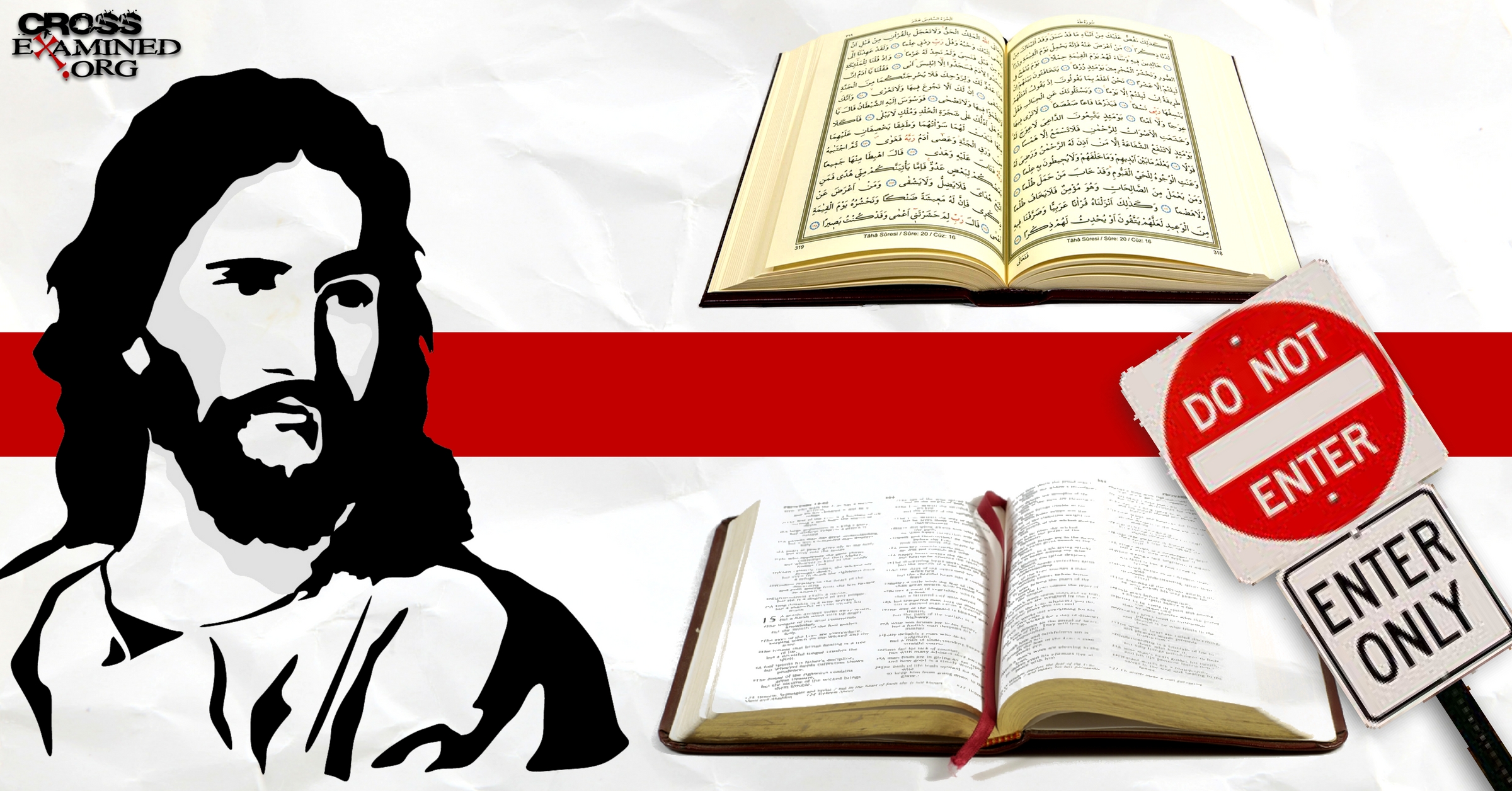
En el Corán, el Evangelio, o Injil, se considera que es de Dios y es incorruptible. La Biblia dice que la Escritura es inspirada por Dios. Sin embargo, contrastan lo que dicen sobre Jesús. Llega la Ley de la no contradicción.
La Ley de la no contradicción, o la ley del medio excluido, establece que
(A) no puede ser tanto (A) y (no-A) simultáneamente.
Es lógico tener diferentes aspectos de (A), pero no aspectos contradictorios. Ejemplo: Juan es un padre. Juan está en Nueva York. Estos son aspectos diferentes de la misma persona. Sin embargo, la lógica exige que Juan no pueda estar en Nueva York y no estar en Nueva York al mismo tiempo. Esto sería contradictorio. Esto va en contra de la lógica.
Según la Biblia, Jesús murió una muerte pública en la cruz y se levantó tres días después. Los cuatro Evangelios dan testimonio de la crucifixión a la que se hace referencia a continuación, pero por el bien del tiempo veremos específicamente a Juan:
Mateo 27: 45-60
Marcos 15: 33-39
Lucas 23: 44-49
Juan 19:16-33:
Entonces Pilato se lo entregó para que lo crucificaran, y los soldados se lo llevaron.
Jesús salió cargando su propia cruz hacia el lugar de la Calavera (que en arameo se llama Gólgota).
Allí lo crucificaron, y con él a otros dos, uno a cada lado y Jesús en medio.
Pilato mandó que se pusiera sobre la cruz un letrero en el que estuviera escrito: Jesús de Nazaret, el rey de los judíos.
Muchos de los judíos lo leyeron, porque el sitio en que crucificaron a Jesús estaba cerca de la ciudad. El letrero estaba escrito en arameo, latín y griego.
No escribas “Rey de los judíos” protestaron ante Pilato los jefes de los sacerdotes judíos. Era él quien decía ser rey de los judíos.
”Lo que he escrito, escrito queda” les contestó Pilato.
Cuando los soldados crucificaron a Jesús, tomaron su manto y lo partieron en cuatro partes, una para cada uno de ellos. Tomaron también la túnica, la cual no tenía costura, sino que era de una sola pieza, tejida de arriba abajo.
No la dividamos se dijeron unos a otros. Echemos suertes para ver a quién le toca. Y así lo hicieron los soldados. Esto sucedió para que se cumpliera la Escritura que dice: Se repartieron entre ellos mi manto, y sobre mi ropa echaron suertes.
Junto a la cruz de Jesús estaban su madre, la hermana de su madre, María la esposa de Cleofas, y María Magdalena.
Cuando Jesús vio a su madre, y a su lado al discípulo a quien él amaba, dijo a su madre: Mujer, ahí tienes a tu hijo.
Luego dijo al discípulo: Ahí tienes a tu madre. Y desde aquel momento ese discípulo la recibió en su casa.
Después de esto, como Jesús sabía que ya todo había terminado, y para que se cumpliera la Escritura, dijo: Tengo sed.
Había allí una vasija llena de vinagre; así que empaparon una esponja en el vinagre, la pusieron en una caña y se la acercaron a la boca.
Al probar Jesús el vinagre, dijo: Todo se ha cumplido. Luego inclinó la cabeza y entregó el espíritu.
Era el día de la preparación para la Pascua. Los judíos no querían que los cuerpos permanecieran en la cruz en sábado, por ser este un día muy solemne. Así que le pidieron a Pilato ordenar que les quebraran las piernas a los crucificados y bajaran sus cuerpos.
Fueron entonces los soldados y le quebraron las piernas al primer hombre que había sido crucificado con Jesús, y luego al otro.
Pero, cuando se acercaron a Jesús y vieron que ya estaba muerto, no le quebraron las piernas.
Como puede ver, según los Evangelios, Jesús murió. Además de esto, la Biblia es clara sobre la importancia de la muerte de Cristo, la resurrección y la ascensión al cielo:
1 Corintios 15 y 1 Timoteo 3: 16-17
En el Islam, el Corán menciona a Jesús más que cualquier otro Profeta. Afirma que nació de una virgen (Surah 19), tuvo discípulos (5: 111-115), ascendió al cielo (4: 158), y regresará como un signo del fin de los tiempos (43:61). Sin embargo, a diferencia de la Biblia, el Corán afirma que Jesús no murió:
Coran 4:157-158
Ellos decían (enorgulleciéndose), ‘Nosotros matamos un Jesucristo el hijo de María, el Mensajero de Alá –pero no lo mataron, ni lo crucificaron, sino también se hizo que pareciera ante ellos, Ningún conocimiento (cierto), sino tan solo siguen conjeturas, porque ciertamente no le mataron: –no, Alá le levantó a sí mismo.” Y Alá es exaltado en poder, sabio;
Ahora, volvemos a la lógica declarada al principio. (A) no puede ser tanto (A) y (no-A). Ambos no pueden ser verdad. Aquí, tenemos la Biblia (particularmente los Evangelios) Ahora, volvemos a la lógica declarada al principio. (A) no puede ser tanto (A) como (no A). Ambos no pueden ser verdad.
Pero espera, el Corán hace un par de otras afirmaciones muy importantes: -Dios envió los Evangelios
3: 3
Es Él quien os ha enviado (paso a paso), en verdad, el Libro, confirmando lo que ha sido; y Él envió la Ley (de Moisés) y el Evangelio (de Jesús) antes de esto, como una guía a la humanidad, y Él envió los criterios (o juicio entre el bien y el mal).
5:46
Y en sus pasos nosotros enviamos a Jesús el hijo de María, confirmando la Ley que ha venido ante él: enviamos el evangelio. Desde entonces es guía y una advertencia a aquellos que temen a Alá.
-La palabra que Dios envía no puede ser cambiada (corrompida)
6:34
Rechazaron los mensajeros delante de ti: con paciencia y constancia llevaron su rechazo y sus errores, hasta que nuestra ayuda llegó a ellos: no hay nadie que pueda alterar las palabras (y los decretos) de Alá. Ya has recibido algún relato de aquellos mensajeros,
Sin embargo, los musulmanes creen que los Evangelios han sido alterados para mostrar que Jesús murió.
¿Qué podemos decir entonces? El último de los cuatro evangelios, Juan, se puede fechar alrededor de 80 d.C. El Corán se fecha 570 años más tarde en torno a 650 d.C.
Jesús murió o no murió. Ambos libros no pueden tener razón en este tema. Sin embargo, mirando los Evangelios y lo que el Corán enseña sobre los Evangelios, la única conclusión lógica sobre el asunto es que Jesús fue crucificado. ¡Ambos textos lo afirman cuando se aplica la lógica!
Recuento la secuencia de los acontecimientos:
Lógica: (A) no puede ser ambos (A) Y (no-A) simultáneamente Los Evangelios atestiguan que Jesús murió en la cruz Mientras el Corán 4: 157-158 dice que Jesús no murió. Pero el Corán 3: 3 y 5:46 dice que Dios envió los Evangelios Y el Corán 6:34 declara que la palabra que Dios envía no puede ser cambiada (corrompida) Así que nos quedan dos conclusiones:
- Si el Corán tiene razón acerca de que Jesús no fue crucificado, esto significaría que está equivocado acerca de que la palabra de Dios es incorruptible, así que el Corán mismo pierde credibilidad ya que dice que los Evangelios y el Corán fueron enviados por Dios.
o
- El Corán, que fue escrito más de medio milenio después de los Evangelios, simplemente está equivocado acerca de que Jesús no murió porque cambió el relato de la muerte y resurrección de Cristo.
Si ambos textos confirman lógicamente los Evangelios; Y los Evangelios declaran que Jesús murió en público, fue sepultado y resucitado al tercer día, tenemos una razón más para creer en la autoridad de las Escrituras cristianas. ¡Tenemos más razones para poner nuestra fe en la obra expiatoria de Jesús, el Hijo de Dios!
En su libro, AT THE MASTER’S FEET (A Los Pies Del Maestro), Sadhu Sundar Singh, misionero cristiano, imagina una conversación entre un discípulo y Jesús en la que Jesús dice:
La cruz es la llave del cielo. En el momento en que por mi bautismo tomé la cruz sobre mis hombros por causa de los pecadores, el cielo se abrió, y por medio de mis treinta y tres años llevando de la cruz y por la muerte sobre ella, el cielo, que por razón del pecado estaba cerrado a los creyentes, se les abrió para siempre.
Blog Original: http://bit.ly/2LgEtnm
Traducido por Ruth HL

The Price of Denying Free Will
Theology and Christian ApologeticsBy Timothy Fox
Every time I turn around I find someone else denying that humans have free will. From scientists to philosophers to theologians, it’s the cool new trend. We aren’t actually making free choices. We have been programmed either by God or our DNA to act in a certain way and have no choice but to follow it.
To be perfectly clear, we deny all types of determinism, whether it’s physical or divine. Free will is what puts the free in Freethinking Ministries and our cornerstone is the Freethinking Argument. Yet many people still don’t understand the consequences of denying free will.
But first, what is determinism? Basically, it means there is no free will. All of our beliefs, thoughts, actions, etc. are “decided” for us, either by internal or external forces: our DNA, the laws of physics, or a deity. You’re a train on a fixed track with no control whatsoever. Even if you think that you really deliberated about what color socks you were going to wear this morning, you wore what you wore and you were completely unable to do otherwise.
So before you join all the cool kids, you need to know the price of admission. This is what it will cost you to deny free will:
No free will = no moral responsibility
If every one of our actions have been predetermined for us, how can we be held accountable for them? Or how can a divine puppet master condemn you for performing evil actions if he’s the one pulling your strings? The murderer has no choice but to murder. The rapist has no choice but to rape. Whether you are loving and kind or an intolerant, sexist, racist, bigot, you have no control over it. You were born that way, just like everyone else. Nothing you do is your fault.
But do we honestly believe that? Of course not. We hold criminals accountable for their crimes. We praise altruism and self-sacrifice. Only free will makes those things possible.
No free will = no meaning, purpose, or love
The most basic aspects of humanity hinge on the existence of free will: meaning, purpose, and love. True love cannot be coerced; it requires people freely and genuinely committing to each other’s well-being. One’s meaning in life is based on deep thought, reflection, and ultimately a desire to pursue it. But apart from free will, meaning, purpose, and love are void and empty words.
As Tim Stratton argues in his Freethinking Argument, in a deterministic world, there is no true thought or rationality. These things are based on the ability to analyze data, weigh evidence, and select the best conclusion.
After all, if you think free will is a lie, how did you come to that conclusion? Did you survey the evidence and freely choose to accept determinism? I hope you see how absurd that is. If there is no free will, you did not rationally come to believe that. You were determined to accept it, just like everything else you think and believe. You never came to freely believe in anything; you were merely determined to do so.
This ties into the next…
No free will = absolute uncertainty about everything
If all of your thoughts and beliefs have been predetermined for you, how do you know if any of them are actually true? You can’t freely test them or reflect on them. You’re stuck in complete uncertainty. If any of your beliefs actually match reality – which is the definition of truth – it’s a grand cosmic accident, and you would never know the difference. So if you reject free will, you must also reject justified true belief, meaning knowledge.
Yes, if you deny free will, you also reject all knowledge.
Other Nonsense
Think about how ridiculous it is to write a book, article, blog, or whatever against free will. Did the author freely write it? Did he actually think, reflect, and carefully choose his words to make the best argument possible? And does he expect you to freely read it and be persuaded to believe that free will does not exist?
You may also hear a free will denier say something like “There is no free will but we have to live as if there were.” That’s ridiculous. It assumes you have the ability to choose to live a certain way. The moment the determinist attempts to convince you to deny free will, he contradicts himself.
Conclusion
This is the price of denying free will. If you reject it, you must also discard moral responsibility, purpose, meaning, love, rationality, and knowledge. Are you really willing to give those things up by espousing determinism? Or look at it the other way. If you believe that you are a true freethinker, that humans have real moral obligations, and that we are free to find meaning in life, you must also affirm free will.
And then you need a worldview that accommodates free will. Naturalism won’t cut it. Neither will a religion where God exhaustively determines all things in the universe, including the actions of human beings. We think the best choice is a worldview with a God who is fully sovereign, yet has granted humans free will, including the ability to freely accept his offer of forgiveness or to reject him.
The choice is yours.
Original Blog Source: http://bit.ly/2scsTPZ
God, Evil and the London Attack
2. Does God Exist?, IslamIf you’d had the knowledge and power to stop the terrorist attack in London, would you have done so? Of course. In fact, if you could have stopped it but didn’t, we would call you morally deficient. We would partially blame you for the attacks!
What does this say about the supposedly all-loving, all-knowing, all powerful God? He didn’t stop it. Some say it’s because He doesn’t exist.
When the attack hit, I was in London to speak at several churches on my book I Don’t Have Enough Faith to be an Atheist. The morning after the attack I decided to change my topic to If God Exists, Why is There Evil in the World?
Evil Actually Shows God Is Real
While I can’t provide a complete answer to that question in this short column, the one thing the attacks cannot prove is that there is no God. In fact, if the attack was truly a grave injustice — if it was truly evil — it shows that God actually does exist.
How so? Because evil doesn’t exist on its own. It only exists as a lack or a deficiency in a good thing.
Evil is like rust in a car: If you take all of the rust out of a car, you have a better car; if you take the car out of the rust, you have nothing. Evil is like a wound in your body: If you take the wound out of your body, you have a better body; if you take the body out of your wound, you have nothing.
There Could Be No Evil Without Good
That’s why we often describe evil as negations of good things. For example, we say the attack on London was immoral, unjust, inhumane, not right, etc. In other words, there would be no such thing as evil unless good existed. But there would also be no such thing as good unless God existed.
C. S. Lewis was once an atheist who thought all the injustice in the world disproved God. He later realized he was stealing a moral standard from God in order to argue against Him. He wrote in Mere Christianity, “[As an atheist] my argument against God was that the universe seemed so cruel and unjust. But how had I got this idea of just and unjust? A man does not call a line crooked unless he has some idea of a straight line. What was I comparing this universe with when I called it unjust?”
As an atheist, Lewis compared this unjust universe to God’s perfectly just nature while claiming that God didn’t exist. In effect, Lewis was sitting in God’s lap to slap his face.
“There Must Be Something … for Them to be True About”
Later, while the Nazis were bombing London in WWII, the Christian Lewis was on the BBC saying things like,
Likewise, to rightfully condemn the London attacks, there must be an unchanging standard of goodness, righteousness and justice that is beyond us, and beyond the terrorists, too. That standard is, by definition, the essence of the greatest possible Being, which is what we call “God.”
Without God There Is No Objective Standard
Without God there would be no objective, authoritative, moral standard beyond humanity, which means human beings would have no moral obligations and every action or behavior would be merely a matter of human opinion. Do you think the London terrorist attack was wrong? Without God, that’s just your opinion against that of ISIS. The murder of six million Jews? It’s just your opinion against Hitler’s opinion. The sexual abuse of children? It’s only wrong if God exists.
If evil is real — as headlines from London plainly reveal — then God exists. The most evil can do is show there’s a devil out there, but it can’t disprove God. The very existence of evil boomerangs back to show that God exists.
But which God? The terrorists would claim that they were following the commands of Allah, particularly Suras 8 and 9 in the Qur’an. Ironically, though, Allah isn’t a viable candidate for the standard of Good because according to Islamic doctrine, Allah is arbitrary. Whatever Allah does is good. By contrast, the God of the Bible is revealed as the unchanging ground of all Goodness. He isn’t arbitrary — He is Goodness.
Evil Is a Problem For Every Worldview — But Christianity Can Handle It
Still, if the God of the Bible actually exists, why would He allow evil to occur? There are several revealed and philosophical answers to that question which I cited in my presentation that Sunday at Kensington Temple in London (and more completely in my book Stealing from God: Why atheists need God to make their case.).
Regardless of the reasons, evil is a problem for every worldview including atheism. Christianity is the only worldview equipped to handle it. In fact, the entire Christian story is an answer to the problem of evil. God Himself provides the ultimate solution — He takes evil on Himself. Jesus attaches humanity to His Divine Nature and allows the creatures who introduced evil into the world to torture and kill Him so we could be reconciled to Him. He takes the punishment for our evil deeds and offers forgiveness as a gift.
Christ’s gift isn’t the subject of a fictional story — there’s very good evidence that the story is actually true. That means you have the real opportunity to accept that gift right now. When Jesus comes back to finally quarantine evil in a place called Hell, the time for choosing will be over. The Being whose essence is Justice has to accomplish final Justice at some point.
John Lennox: If God, Why Evil?
Stealing Evil From God
Is Religion the Practice of Avoiding Truth?
Theology and Christian ApologeticsBy Luke Nix
Introduction
A month or so ago, I came across an interesting challenge to Christianity. A skeptic told me that religion was an exercise in avoiding truth- a willful delusion. He observed that many Christians (and religious people, in general) tend to believe the claims of their “holy” books over what has been discovered about nature, history, or the very nature of reality. He noticed that many religious people have a precommitment to a particular understanding of the world and no amount of evidence provided will persuade them otherwise. He, as an intellectual, does not want to make this same mistake. In this post, I want to explore the possibility that he is making the same mistake based upon the philosophical foundations of the claim he makes for rejecting religion, and Christianity specifically.
Missing Philosophical Foundations
While several things did strike me as dissonant about his claim, one of the first things that I noticed about the language the skeptic chose was that his naturalistic worldview could not provide any such grounding for the claim. I am specifically referring to his references to the will and ability to reason.
The Missing Will and Intentionality
First, if naturalism is true then any specific event is the cumulative result of the events prior to it, governed by laws of nature. Not only does this apply to any specific event, it applies to all events in the history of the universe all the way back to the big bang. On this view, ultimately, the laws of physics and the initial conditions of the universe fatalistically determined every event that would take place. This includes every “willful” “decision” that humans would make. Ultimately, there are no true decisions being made, no person is “willfully” denying anything; they are merely reacting to the events prior to their “decisions.” The claim that anyone is doing anything “willfully” does not make sense in a naturalistic world. So, the naturalist cannot actually claim an intentional anything and be speaking accurately about reality.
The Missing Ability to Reason Reliably
Second, an assumption of the claim is that it is possible for people to reason reliably and accurately (but have just chosen not to). If naturalism is true, then the brains responsible for reasoning and the senses responsible for sensing the environment are not focused on true inferences or true observations but on survival. Alvin Plantinga spends an entire book on this very topic that I have recently read and reviewed. However, I’d like to reinforce Plantinga’s conclusion, that if naturalism is true then we cannot trust our brains to reason towards truth, with some evidence from the real world. If naturalism is true, there is no such thing as free agency (see paragraph above). This means that everything that we believe about the intentionality of others is false. We intend to get up in the morning, to eat, to walk, to drive, to work, to organize, to engineer, to account, to create, to relate, to think, and numerous other things. If evolution has produced brains that believe that we actually do these things intentionally, then our brains survived for their ability to produce a majority of beliefs that are false yet highly practical in the environment.
The Over-Abundance of “Useful Fictions”
What makes this so powerful is that intentionality is merely one all-encompassing belief about reality that, if false, demonstrates that our brains are unreliable when it comes to inferring truth about reality, yet we have evidence that our brains have survived and that we do believe these false notions. With every additional false notion that is brought to the table of evidence (the concept of design, the concept of purpose, the concept of value, the concept of progress [all four require true intentionality, even value grounded in purpose], objective morality, moral and creative responsibility, reward and punishment, and even the existence of God- just to name a few more), the conclusion that Plantinga argued philosophically becomes even more certain evidentially.
But some naturalists attempt to escape this conclusion by saying that these are merely “useful fictions.” I find this to be an astounding concession. When we are discussing the ability to discover truth, “useful fictions” is actually an oxymoron. This becomes painfully apparent when one considers how deeply grounded in and encompassing of our beliefs about reality these fictions truly are. And yet, we still believe them because the fictions are useful. Useful for survival, but obviously not for their truth-value, for if it were for their truth-value, we would not believe them. Any naturalist who grants that “useful fictions” are believed fall prey to this devastating argument. And what is even more devastating than all our beliefs being based in fiction? The fact that we have near-certainty that no belief will ever be believed for its truth-value. For the naturalist, this brings annihilation to the only source they thought they had for truth: science. Science depends upon the reliability of our senses and our brains to infer true things about reality, and if they can never be reasonably expected to produce such, then science has no place to begin or go regarding the search for what is true. Science is merely another “useful fiction” that we falsely believe for its survival value.
Conclusion
The skeptic who raises such a challenge fundamentally contradicts their worldview when they claim that someone is “willfully avoiding truth.” And the evidence closely approaches 100% that they should be speaking that claim to a mirror: it is all-but-certain that they are the ones with the willful delusion, possessing faith despite the evidence–a blind faith. Based upon the weight of the evidence and the logical contradiction within the worldview, any skeptic, who raises this challenge out of concern for the pursuit of truth, should abandon their naturalism and the idea that our brains are the result of unguided processes otherwise they fall victim to the very evil they wish to escape.
For more information on this argument against naturalism I highly recommend:
Original Blog Source: http://bit.ly/2sc7V3P
Who Wrote the Gospel of Matthew?
4. Is the NT True?By Brian Chilton
Over the course of the new few weeks, we will discuss the reasons for accepting the traditional viewpoints for New Testament authorship. We will begin with the Gospel of Matthew today and will then move towards the other three Gospels before looking at some of the letters in Revelation.
The New Testament begins with the Gospel of Matthew. But, what do we know about the origin of the First Gospel? In a world where traditional scholarship is often questioned and too often disregarded, several theories exist as to whom the author of the First Gospel may be. Traditionally, the church has ascribed the First Gospel to the apostle known as Matthew. But, what evidence do we find about the author of the first book in the New Testament?
Internal Evidence
When we discuss internal evidence, we are speaking of the evidence that we find within the book in question. What clues do we find about the author of the First Gospel from the text? Like the other three Gospels, the First Gospel is anonymous.
First, we find that the author of the First Gospel is thoroughly entrenched in Judaism. The author often quotes the Hebrew Bible (otherwise known as the Old Testament). He parallels the life of Jesus with the great prophets of Judaism. Additionally, he makes every effort to show that Jesus is the fulfillment of messianic prophecy. In many ways, the author of the First Gospel focuses on the Jewish aspects of the faith, even describing some areas such as Jesus’s exclusion clause for divorce. The writer of the First Gospel also focuses quite a bit more on Jesus’s messages than do some of the other Gospel writers.
Second, the author focuses on Jesus’s work within Galilee and does not so much focus on Jesus’s work with Gentiles as does Luke. Thus, the evangelist is mostly concerned with Jesus’s ministry to the Jews.
Finally, the author of the First Gospel adds financial details only found in the First Gospel. For instance, only the First Gospel records the incidence where those who collected the temple tax “approached Peter and said, “Doesn’t your teacher pay the temple tax” (Matthew 17:24)?[1]
From all the details considered with the internal evidence (one who is thoroughly Jewish in scope of the messages presented by Jesus, one who focuses on the prophetic fulfillment of Jesus, one who focuses on the ministry of Jesus to Jews, and one who focuses on financial matters especially in the area of taxes), Matthew best fits as the author of the First Gospel. Matthew was a tax collector before accepting Jesus as Savior and his role as an apostle. Thus, Matthew’s knowledge of shorthand to take notes as well as finances would far excel most others.
External Evidence
When we speak of external evidence, we are addressing information we have about a document’s authorship from outside the document. What do others say about the author of the First Gospel?
The early church is unanimous in their acceptance of Matthew as the writer of the First Gospel. Papias, Irenaeus, Pantaenus, and Origen all report Matthew as the writer of the First Gospel. Papias (c. AD 60-130) writes, “Matthew put together the oracles [of the Lord] in the Hebrew language, and each one interpreted them as best he could.”[2] While we do not have a Hebrew or Aramaic edition of Matthew’s Gospel, there are reports that one may have existed in the early church.[3] Regardless, one should not be surprised that Matthew, who would need to have great knowledge of Greek in the business world, originally wrote his Gospel in Hebrew or Aramaic, only to revise the Gospel in Greek. Even if his Gospel were written in Greek by another, even say an amanuensis,[4] this would not negate Matthew’s authorship. Craig Evans recently recorded a video where he claims that Matthew may have come about in phases.[5]
Pantaenus also confirmed that Matthew was the author of the First Gospel. The great church historian, Eusebius of Caesarea, writes that Pantaenus, a church leader in the late 2nd to possibly early 3rd century, came across the Hebrew version of Matthew’s Gospel. Eusebius notes that Pantaenus was “a man highly distinguished for his learning, had charge of the school of the faithful in Alexandria.”[6] The following is Eusebius’s report of Pantaenus’s encounter with the Hebrew edition of Matthew’s Gospel:
With the addition of Origen and Irenaeus’s acceptance of Matthew writing the First Gospel, one is hard-pressed to dismiss their claims.
In addition, scholars acknowledge that Matthew’s name was associated with the First Gospel from the earliest times. The writers of the CSB Study Bible denote that “the title that ascribes this Gospel to Matthew appears in the earliest manuscripts and is possibly original. Titles became necessary to distinguish one Gospel from another when the four Gospels began to circulate as a single collection.”[8]
Date and Location of Writing
It is certainly reasonable to accept that Matthew was written in the 50s due to the reasonable assumption that Acts was finished before AD 64, with Luke coming before Acts, and Matthew writing his Gospel before Luke’s. Scholars generally hold that Matthew composed his Gospel in or around Antioch of Syria.
Conclusion
Some may argue that a disciple like Matthew would not borrow material from Mark, if in fact it is true that Matthew did borrow material from Mark’s Gospel. However, when one considers that Matthew followed Jesus long after most of the apostles, and that Matthew was not an inner-circle disciple, then it stands to reason that Matthew would borrow material from Mark’s Gospel if it is true that Mark relayed information from Simon Peter—who was both an early apostle and inner-circle disciple.
While some will still disagree, it seems strange to me to ascribe the First Gospel to Matthew of all people, especially when the First Gospel was used as a church manual in many cases. Matthew was a tax-collector. Tax-collectors were held in slightly higher esteem than pond scum…but not by much. So, why ascribe the First Gospel to a tax-collector unless there was at least some merit to the claim?
In my humble opinion, I believe the First Gospel came to us in three phases. First, the apostle Matthew wrote the teachings of Jesus in Aramaic. Then, Matthew added the miracles and deeds of Jesus to his Aramaic and/or Hebrew edition of his Gospel adding his eyewitness testimony and the testimony of Simon Peter as found in Mark’s Gospel. Finally, either Matthew himself or a highly trained scribe translated the Gospel in Greek.
Notes
[1] Unless otherwise noted, all quoted Scripture comes from the Christian Standard Bible (Nashville: Holman, 2017).
[2] Papias, “Fragments of Papias,” in The Apostolic Fathers with Justin Martyr and Irenaeus, ed. Alexander Roberts, James Donaldson, and A. Cleveland Coxe, vol. 1, The Ante-Nicene Fathers (Buffalo, NY: Christian Literature Company, 1885), 155.
[3] I believe it is Jerome who reports seeing a Hebraic Gospel of Matthew. But is this the same? We cannot know for sure.
[4] That is, a scribe who writes down the words that are dictated to oneself. Some amanuenses were given freedom to add their own expressions to a degree.
[5] Video recorded for Faith Life. I could not find the link. I will post the link if I am able to find it.
[6] Eusebius of Caesaria, “The Church History of Eusebius,” in Eusebius: Church History, Life of Constantine the Great, and Oration in Praise of Constantine, ed. Philip Schaff and Henry Wace, trans. Arthur Cushman McGiffert, vol. 1, A Select Library of the Nicene and Post-Nicene Fathers of the Christian Church, Second Series (New York: Christian Literature Company, 1890), 224.
[7] Eusebius of Caesaria, “The Church History of Eusebius,” in Eusebius: Church History, Life of Constantine the Great, and Oration in Praise of Constantine, ed. Philip Schaff and Henry Wace, trans. Arthur Cushman McGiffert, vol. 1, A Select Library of the Nicene and Post-Nicene Fathers of the Christian Church, Second Series (New York: Christian Literature Company, 1890), 225.
[8] “Introduction to Matthew,” CSB Study Bible (Nashville: Holman, 2017), 1494.
Original Blog Source: http://bit.ly/2rapy3W
Was Paul the Founder of Christianity?
Theology and Christian ApologeticsBy Brian Chilton
Skeptics, such as Gerd Ludemann, charged Paul for being the actual founder of Christianity. Such ideas come from either a belief that Jesus never addressed difficult topics, or a belief that Paul was too radical in his teachings for it to have come from Jesus. Both views are inherently wrong. A closer examination of the New Testament reveals that Jesus and Paul are found to be in close alignment in their theological moorings. Evidence suggests that Paul often quoted Jesus in his epistles. Craig Blomberg, in his book The Historical Reliability of the New Testament, reveals six areas where Jesus and Paul’s theology are closely aligned. So was Paul the founder of Christianity? Let’s examine the evidence.
Jesus and Paul express the same views on justification. The kingdom of God is central to the Synoptic Gospels appearing more than 100 times.[1] In contrast, the term only appears a mere 14 times in the letters of Paul. The central theme of Paul’s letters is on justification by faith. However, noting the misunderstanding that the Greco-Roman world would have with the kingdom of God and the close-alignment that Paul’s justification by faith has with the teachings of Jesus, then one begins to see a marvelous parallel. Jesus says four times that a person’s faith has saved, or healed them. For instance, at a dinner one evening, Jesus was approached by a woman who anointed him with expensive oil from an alabaster jar. The Pharisees were critical of Jesus’s allowance of this sinful woman to touch him. After angering the Pharisees by telling the woman that her sins were forgiven, Jesus said to the woman, “Your faith has saved you. Go in peace” (Luke 7:50).[2] The Jesus tradition predates the writing of Paul’s epistles, therefore, one can postulate that Paul learned his theology on justification from Jesus.
Jesus and Paul express the same views on the law. For full treatment on this issue, I would direct the reader to Blomberg’s work. Nevertheless, one should note that neither Jesus nor Paul called for the overthrow of the law (e.g., Jesus’s Sermon on the Mount in Matthew 5:17-20). Thus, neither advocated antinomianism.[3] Jesus noted that the greatest commandments were to love God with all one’s being and to love one’s neighbor as oneself (Matt. 22:36-40). Paul reiterated the second in Galatians 5:14.[4]
Jesus and Paul express the same views on concern for Gentiles. Paul emphasized the church’s ministry to Gentiles. It was Paul who wanted the church to rid its requirement of Gentile converts to perform circumcision. In Galatians 1-4, Paul charges the Judaizers with not promoting a true gospel. While Jesus’s ministry was largely to Jews, it must be remembered that his emphasis was due to his location and not his final focus. Like Paul, Jesus envisioned his church expanding past Israel. Jesus commended the Roman centurion for his amazing faith (Matt. 8:10-12) and took time to heal a Syrophoenician woman’s daughter, even with a tongue-in-cheek life lesson. Jesus’s feeding of the 4,000 was among a largely Gentile crowd. Also, Jesus’s Great Commission to the church commanded the church to take the message to all nations (Matt. 28:19). Thus, Paul is not inventing a new concept for the church to be pro-Gentile, but rather expounds upon the idea set forth by Jesus himself.
Jesus and Paul express the same views about women. Paul gives an extraordinary view of women in his letter to the Galatians. Paul writes, “There is no Jew or Greek, slave or free, male and female; since you are all one in Christ Jesus” (Gal. 3:28). Paul also allowed women to pray and prophesy in public (1 Cor. 11:2-16).[5] Jesus shared the same elevated status for women. Jesus commended Mary for receiving theological training as the men (Lk. 10:38-42). Blomberg notes that “Jesus affirmed the woman at the well to such a degree that she became an evangelist o her own people (John 4:4-42).”[6] Therefore, Paul did not invent a new doctrine in his acceptance of women. He continued what he had learned from Jesus and the early Jesus traditions.
Jesus and Paul express the same views on Christology. Some skeptics believe that Paul elevated the status of Jesus to a new level—the level of the divine. Shows such as PBS’s special From Jesus to Christ hold that Paul elevated the status of Jesus to a new level and one that Jesus himself did not accept. Is this true? Not at all! Again, Paul learned his Christology from Jesus and the early church. Two of the loftiest claims of Jesus’s divinity in Paul’s letters are found in Philippians 2:6-11 and Colossians 1:15-20. However, further investigation shows that the two passages are not original to Paul. They are in fact pre-New Testament hymns that most likely date to within 3-5 years of Jesus’s crucifixion and resurrection. Thus, Paul is relaying information that is original to the early church. Even still, one must note the examples of divine status that Jesus gave himself. The “I am” statements in John’s Gospel relate to the divine name of God (Yahweh means “I am what I am”). Jesus’s favorite title for himself is “Son of Man.” The Son of Man title holds a direct correlation to Daniel’s Son of Man who approaches the Ancient of Day. Thus, the name Son of Man relates Jesus to the divine. Paul is not inventing Jesus’s divine nature. Rather, he is continuing the teaching found in the earliest church—that which was found from Jesus himself.
Jesus and Paul express the same views on discipleship. Jesus often noted that discipleship was costly. Jesus taught that discipleship required one to die to oneself in order to find salvation in Christ (Matt. 10:39 and Lk. 17:33). Jesus taught that if one were to follow him, that person must take up their cross and follow him (Matt. 16:24). Paul, in like manner, teaches that the disciple is baptized into Christ’s death (Rom. 6:3-6), that sharing the cup of blessing was also to share the blood of Christ (1 Cor. 10:16-21), and that we die to the self as we live in Christ (Eph. 1-2). Again, Paul is not formulating a new doctrine, but promoting one that originated with Christ.
Conclusion
Was Paul the founder of Christianity? In a short answer, no. Paul was heavily influential with the development of the church. However, Paul did not create a movement. Neither did Paul change the church. Rather, Paul drew from the ideas of Jesus who was the true founder of Christianity. Craig Blomberg, the man who inspired this article, wrote quite succinctly, “Paul may have been the ‘second founder’ of Christianity but only by building on and in submission to the true founder—Jesus of Nazareth.”[7] A closer examination of the New Testament reveals that Paul certainly built upon the ideas of Jesus, but he did not invent them. Paul was a disciple of the true founder of Christianity—Jesus of Nazareth.
Notes
[1] Craig Blomberg, The Historical Reliability of the New Testament: Countering the Challenges to Evangelical Christian Beliefs (Nashville: B&H Academic, 2016), 440.
[2] Unless otherwise noted, all quoted Scripture comes from the Christian Standard Bible (Nashville: Holman, 2017).
[3] That is, the abolition of the law and moral principles.
[4] “For the whole law is fulfilled in one statement: Love your neighbor as yourself” (Galatians 5:14, CSB).
[5] The issue of head coverings was probably a cultural one. Thus, we do not have the space to cover the topic here.
[6] Blomberg, 449.
[7] Blomberg, 460.
Original Blog Source: http://bit.ly/2qJSICI
The Art of Raising Kids Who Will Not Bow to the Idol of Science
Apologetics for ParentsBy Natasha Crain
There’s a new hero in town. He’s thought to be all-powerful, always right, and everyone’s best friend. If anyone says something that could possibly be construed as being opposed to this hero, they are to be quickly shamed and put in their place. You see, if the world wants to move forward productively and intelligently—or so the story goes—they must get in line behind this hero.
He is today’s “way and truth.”
His name is science.
And tens of thousands of people marched for him last weekend in the “March for Science.”
If it sounds funny to give human attributes to the concept of science, don’t blame me. I’m only talking about science in the same kind of terms that the secular world effectively does.
To be sure, this hero isn’t actually new. He’s been promoted as such for a few centuries. But his popularity is skyrocketing today. He’s become a mainstream idol and he’s literally being paraded as a replacement for God.
In this post, we’ll look at how the secular world has turned science into an idol, and how we can teach kids not to bow to it.
To be clear: This post is about combating the idol of science…not science itself. In fact, if you read this and conclude that I’m opposed to science because I used the words combat and science in the same post, it’s a good sign you’ve fallen prey to the very mentality I’m describing.
Understanding How the Secular World Has Turned Science into an Idol
Before we can understand how to combat the idol of science, we have to understand how the secular world has created the idol in the first place. Here’s the basic strategy.
1. Proclaim that science is the only reliable way to determine what’s true about our world.
The Huffington Post featured an article with “19 of the Cutest and Funniest Kids from the March for Science.” One picture shows a boy holding up a sign that says, “Make America Think Again” and is wearing a shirt that says, “In Science We Trust.”
One man bluntly stated that science is truth:
Similar examples abound.
This idea—that science is the only trustworthy way of learning about our world—is the key philosophical starting point for those who want to replace God with an idol of science. (Note that this was exactly the thinking behind the ridiculous Scientific American article on the resurrection that I critiqued in my last blog post.)
If you can convince the masses that “science” is synonymous with truth, it’s quickly implied that no other sources of truth are necessary. Who needs the Bible when we can figure everything out in test tubes?
2. Promote a false dichotomy between “science” and theism so people feel they have to make a choice.
With point 1 firmly in place, people are ready to start believing that science and theism (belief in a personal God) are a trade-off. You pick one as your source of truth. But don’t think for a minute the choices are being hailed as equally viable. Those who pick God are to feel ashamed for being backward and unscientific. After all, it’s assumed they rejected science.
So choose science and join others who made the obvious choice for truth at the cool kids’ table.
That’s the message.
3. Use the word science in a such a variety of ways that people stop trying to clarify what exactly is meant by “science” in any particular context and accept whatever is claimed in its name.
March organizers said they were doing it to encourage “scientists, educators, and advocates, as well as social service workers, artists, trade workers, business people, our elderly population, and families to come together for science.”
Sounds pretty harmless, right? As one 8-year-old said, “Trees make oxygen. It helps us breathe. Who doesn’t like that?” Other kids held up similar non-controversial posters that said, “I love my microscope”; “Future scientist”; and “Science: Experiment, Learn, Fail, Repeat”; and “Science Matters.”
There’s basically no one who would have a problem with any of those statements. In fact, you might even begin feeling a wee bit silly for ever casting a skeptical eye on the March in the first place. But that’s precisely the problem. Non-controversial statements are a smokescreen for the myriad other pieces of secular worldview being promoted under the umbrella term “science.”
If the March was only about science as a field of study, as these examples would imply, no one would need to march at all.
People march because they want something.
They want you to believe something or do something. And if you take a survey of the statements made by marchers, it’s clear they are using the word science interchangeably to mean a variety of things:
It’s an effective strategy that you can see everywhere in media today. Establish that science is the only reliable way to gain knowledge about the world, convince people they need to choose science or God, then smuggle in whatever you want to put forward as truth under the generic label of “science” and make everyone think disagreement is for the uneducated fools who didn’t make the smart choice.
Don’t believe it for a minute.
The Art of Raising Kids Who Won’t Bow to the Science Idol
As Christian parents, we must help our kids understand science as nothing more and nothing less than what it is: an extremely important field of study that can give and has given us a wealth of knowledge about the workings of God’s creation.
We can modify the three points above to see what our kids really should know.
1. Scientific research is one (important) way to determine the truth about our world.
Scientific research reveals the mechanics of the universe at a level of detail far beyond what God has revealed to us in the Bible. There’s no verse in the Bible, for example, that states the force of gravity. Science complements our knowledge of God because it reveals the workings of the world He created. Christians need the field of science as much as those with any other beliefs.
But science can say nothing about the ultimate meaning or purpose of our universe, or where all those laws of nature came from in the first place. You can study how a marble maze works, and describe those actions and mechanisms fully, but that doesn’t answer the questions of how the maze came together, why it’s there, and what we should do with it.
To answer these kinds of questions about the universe, we need the input of the One who created it. In that way, the Bible complements science.
2. There need never be a choice between science and God.
Far from being polar opposites, science needs God.
The goal of science, broadly, is to discover the order of the universe. But the feasibility of that goal depends on the assumption that the workings of our natural world can be discovered. We often take that for granted, but we shouldn’t.
Our universe is both understandable and logical. These characteristics allow us to do science in the first place. If the universe was just a hodgepodge of chaotic events, ungoverned by structured laws, science would be a hopeless task.
But why is the world intelligible rather than chaotic?
If the universe is truly the product of unguided evolutionary forces, as atheists claim, there’s no reason to expect that an elegant ordering of nature would happen on its own. But if the universe is the product of intelligence, as Christians and other theists claim, we would expect it to be orderly—a reflection of its rational designer.
Much more could be said on this, but the bottom line is that there is no trade-off between science and God. It’s a false dichotomy. You can pretend you’re “choosing” science, but your choice has no legs to stand on its own. You need God and science.
3. Thoughtful conversations about “science” must be nuanced enough to determine which meaning of science we’re talking about.
Let’s revisit the various meanings of science to see just a few questions that could be asked about any statement like, “Science says X.”
“Science says X” is an authoritative statement built on a foundation of hundreds of assumed answers to questions like these. What happens when we get tricked into believing that anything labeled science is authoritative?
This.
This is from Bill Nye’s new Netflix show, Bill Nye Saves the World, in which he “educates” the public on science issues.
This is being promoted as science.
I apologize for posting something of such a graphic nature, but this needs to be seen to be believed.
Incredible.
So, to the little boy who said, “Trees make oxygen. It helps us breathe. Who doesn’t like that?” the answer is no one.
Absolutely no one.
But that’s not the science the secular world wants us all to “like.” That science is an idol made by hands of people who want God off His throne.
Do not bow down.
Original Blog Source: http://bit.ly/2rRhlAU
Did Long Distance Make Paul’s Witness List Unfalsifiable?
Theology and Christian ApologeticsBy Evan Minton
In chapter 8 of my book Inference To The One True God, in my blog post “The Minimal Facts Case For Jesus’ Resurrection PART 1” and in my blog post “A Quick Case For Jesus’ Resurrection”, I make the case that we know many people had experiences of the risen Jesus appearing to them because the creed cited in 1 Corinthians 15 dates back so early, well within the lifetimes of the eyewitnesses (i.e it dates to 5 years after Jesus’ death), that anyone curious about whether or not Paul was telling the truth could have traveled over to Jerusalem and interviewed the people mentioned in the creed to see if they really did believe Jesus appeared to them. If Paul were lying about these people and they really hadn’t seen Jesus, the cat would have been out of the bag and the resurrection would have been exposed as a falsehood. Given how fragile a faux resurrection would be in this case, the best explanation is that the twelve disciples, James, and 500 people actually did have postmortem Jesus experiences.
On two different occasions, people have read my argument for the historicity of the postmortem appearances and have responded with the following rebuttal: “Paul is writing his letters to churches far removed in distance from where the events are said to have occurred. It would be highly unlikely anyone from his church in Corinth would travel to Israel and seek out these apparent witnesses.” The argument is that Jerusalem and Corinth were so far that it would have been very difficult for Paul’s readers to trek all the way over to Jerusalem in order to interview the people Paul was talking about. It was too inconvenient for them, so most probably never did it and never would have done it. So the they-could-have-checked-it-out argument fails. Is this true? Was Paul’s resurrection eyewitness list really protected from falsification due to large travel distance?
I don’t think this is a successful argument. There are 3 reasons why the resurrection claims could have been checked out.
1: The Corinthians Had An Invested Interest In Knowing If It Was True
The reason why Paul was even mentioning the list of resurrection appearances in 1 Corinthians 15 is because we see in the context of the passage that there were people denying that Christ had risen from the dead, implicitly at least, because they were denying the bodily resurrection in general. They were denying that anyone would rise from the dead. Paul said if the dead are not raised then Christ isn’t raised either if Christ isn’t raised, our faith is useless and our sins remain unatoned for (1 Corinthians 15:12-14), but fortunately, Christ has been raised (verse 20). Paul argued for this by listing the various postmortem appearances of Christ in verses 3-8 via the creed he had received earlier. Now, given that the Corinthians were skeptical of the resurrection, wouldn’t they have an invested interest in knowing whether Paul was telling the truth? Of course! And given that they had an invested interest if they didn’t take Paul at his word, wouldn’t they have traveled to Jerusalem to talk to the people mentioned in the creed even if it was a rather long journey? While it might have indeed taken them a while to get there, it wasn’t impossible for them to arrive in Jerusalem. It’s not like they were traveling to New York or anything. It was certainly feasible for them to go to Jerusalem to interview the witnesses in the creed even if it wasn’t a hop, skip, and a jump from their church.
And given that this was a topic of immense interest to them, it would be difficult to argue that they wouldn’t have. Besides, we know that Paul traveled to Jerusalem to Corinth. Why wouldn’t the Corinthians travel from Corinth to Jerusalem?
2: The Resurrection Occurred During Festival Time
Moreover, the resurrection was during a festival time. The witnesses would have been from all over the place, seen the appearances, and gone back home. It’s very likely some of the 500 that Jesus appeared to were from the city of Corinth. It very well could have been the case that there were some Jewish eyewitnesses to the resurrection of Christ living in the very midst of Paul’s readers. In that case, the Corinthian resurrection doubters wouldn’t have had to travel very far at all. There were likely witnesses in their own backyard.
It was certainly the case that those reading Corinthians included Jews who may have traveled to Jerusalem for Passover. This would provide an opportunity to verify Paul’s assertion.
3: Mail From Snails
It is also the case that even if no one physically visited the twelve disciples and James, that they could have gotten verification via correspondence, i.e snail mail. The Corinthian resurrection doubters could have written letters to the disciples asking them “Hey yo, Pete mah BOIII! It’s ya boi Zechariah from Corinth. My homie Paul sent me a letter saying Jesus appeared to you after He died. This true, bro?” (first-century folks totally talked like this). And Peter, John, or whichever of the eyewitnesses received the letter, could have sent a reply saying either “He is risen! He is risen indeed!” or “What? Who told you this? I haven’t seen Jesus sent they crucified him.”
Conclusion
Given these 3 reasons, I think it is still the case that having the 1 Corinthians 15 creed dating within the lives of all the eyewitnesses provides good grounds for concluding that these postmortem sightings occurred. If they didn’t, the eyewitnesses could have talked to these people themselves, by either journeying over to Jerusalem despite it being a long journey, because they had a highly invested interest in knowing whether they occurred. Or they could have had postmortem witnesses in their own midst that they could have talked to, or they could have at least gotten verification or falsification via correspondence. Any of these scenarios would have either falsified the resurrection if it didn’t occur or vindicate it if it did occur.
Original Blog Source: http://bit.ly/2s3304I
God’s Love & the Euthyphro Dilemma
Theology and Christian ApologeticsDear Tim,In your article The Omnibenevolence of God you pointed out that on the Islamic view, Allah is quite similar to some Calvinistic views of God. Regarding this view, you said: “God is not all-loving, and whatever Allah does is simply called “good,” even if it is really hateful.”
I agree with you, but an atheist recently objected to your statement with the following:
He went on to claim that the ‘zombie argument’ dismissing the Euthryphro dilemma (I think referring to the article written by Timothy Fox) fails and thus the Euthyphro dilemma “isn’t actually so dead after all.” How would you respond to this atheist’s argument?
– Melissa
Tim’s Response
This is a good question and one that I have been considering for a while. Thank you for sending it my way, Melissa. I believe the atheist’s objection might be a problem for Calvinists to deal with (Check out Sakr’s “Calvinism and Euthyphro’s Horns”); however, the article I wrote was based on a Molinist perspective. The atheist failed to grasp this distinction and seems to conflate Christianity with Calvinism — a move I adamantly oppose! His response, unfortunately, missed the main point of the entire article, and thus, goes on to attack a straw man. This can be seen when we first understand what God is like.
God’s Nature is LOVE
The main thing to consider is that God’s nature is perfectly loving, just as He is perfectly powerful and perfectly knowledgeable. One is free to assert that these properties are not “good” (call these whatever you would like); however, if God does possess love for all people, then my argument stands.
Not only does the Bible specifically say that “God is love” (1 John 4:8), but the fact that God loves all persons is implied in verses such as John 3:16, 1 Timothy 2:4, and 2 Peter 3:9. Moreover, if Jesus’ commands reflect the nature of God, then it is rational to infer that God loves all people (even those who consider God to be an enemy). It would be quite odd for God to command humans to love all people (from our neighbors to our enemies) if God Himself did not possess this love for all people. In fact, this perfect love is specifically referred to in Matthew 5:48:
Jesus even provides the parable of the Good Samaritan (Luke 10:25-37) to demonstrate the love we ought to have for those who despise us. Jesus makes it clear that we ought to go out of our way — even if it inconveniences us — to make it possible for even our enemies to thrive and flourish. Scripture is replete with data affirming the perfect love of God. In fact, I have argued that we can infer God’s universal love and desire for all to be saved from the first book of the Bible. With this in mind, the main thing to grasp is that God is omni-loving! That is to say, God genuinely loves ALL people!
This raises another question…
What is love?
Besides the title of a catchy 90s pop song the Bible is clear what love is in 1 Corinthians 13:
The Bible goes on to clarify what maximal love is willing to do in John 15:
The Bible reveals that God loves all people and that all people are called to love all people too. In fact, we can surmise that this is the objective purpose of human existence given Christ’s greatest two commands! Consider Matthew 5:44; 22:37-39:
1- Love God first!
2- Everybody love everybody (from your neighbors to your enemies)!
Moreover, the Bible seems to describe genuine love as desiring the best for another person even if it comes at a cost to the one who loves the other person. Not only is this biblical — it is self-evident and intuitively obvious! With this in mind, we can summarize love as a genuine desire for the best of another person and a willingness to self-sacrifice (even one’s own life if need-be) to ensure this other person can flourish by achieving the best possible life.
It is important to note that my “omnibenevolent article” referenced in the objection was written primarily with certain Calvinistic theologians in mind, like Arthur Pink and Matt Slick, who deny that God loves and desires the best for all people. The objection above, however, is written from an atheistic perspective hoping that the Moral Argument for the existence of God will fall prey to one of the horns of the Euthyphro dilemma. Be that as it may, my point is immune to this objection as it stands strong by merely pointing out that God is essentially loving and is ALL-loving. One is free to argue that loving people is not a “good” thing or not. However, even if it is not good to love (as crazy as that sounds), the point remains: God loves all people — His nature is love!
Now that we have an understanding of God’s loving nature, and we know what love is, now we can contemplate the meaning of life.
The Objective Purpose of the Human Existence
Your life has objective meaning! You might not know this yet, or perhaps you subjectively disagree, but this changes nothing. The fact of the matter remains that God created humanity on purpose and for the specific purpose to know, love, and enjoy a relationship with Him and all people for eternity. This is why you exist. This is the objective purpose for which we were all created.
God created a world filled with creatures who can enjoy a true love relationship with Him (which is the ultimate eternal flourishing). This is the objective purpose of human life — to love and be loved by God and all people for eternity. It is vital to grasp this truth: God created each and every one of us on purpose and for the specific purpose to be in a full-flourishing/true-love relationship with Him for eternity.
If God desires to create a world in which true love can be attained, He must provide His creatures with genuine freedom (libertarian free will) so that it is possible for humanity to experience genuine love relationships with God and others. With this freedom in mind, humans are free to approximate to the objective purpose of life — LOVE — or not.
To help understand why God’s goal in creating humanity grounds objective purpose, consider the following argument:
1. If a truth corresponds to reality, it is objectively true [apart from human opinion].
2. If God created humanity for a purpose, then this purpose is a truth that corresponds to reality.
3. Therefore, if God created humanity for a purpose, then this purpose is objectively true.
4. God created humanity (on purpose and) for a purpose.
5. Therefore, God’s purpose for creating humanity is objectively true (apart from human opinion).
For a more detailed argument click here.
What is “Good”?
Once we grasp the objective purpose of human existence we can understand what it means for humans to be “good.” When we approximate to our objective purpose (which is true apart from human opinion) it is objectively “good.” To a degree that a thing approximates to its objective purpose, to that same degree it is “good.” To a degree that something misses the mark (the goal) of its objective purpose to that same degree it is sinful (“bad”). That is to say, something is objectively good when it helps to achieve or corresponds to the objective purpose of its existence.
Since God by His nature is love (even if love is not a “good”), He created a world where genuine love is possibly attained. God created humanity on purpose and for the specific purpose to love Him and to be loved by Him (and all people) perfectly into the eternal future. This also leads to ultimate and eternal human flourishing. One is free to call eternal human flourishing “good,” “shmigood,” or whatever they would like.
To do anything other than love all persons (from each person of the Trinity to all humans) is to miss the mark (sin). Since free will is required for love, and if free will is really free (and not some word game), it follows that one can freely choose to approximate to the objective purpose of his or her existence (what we call “good”) — or not.
Conclusion
God is all-loving by nature. It is irrelevant if one wants to argue if love is “good” or “bad.” I am not making a case that loving all people is “good” or “bad” so my case simply avoids Euthyphro’s horns. I am simply pointing out the way things are (the definition of reality). God is love!
God is “good” in the sense that He always freely acts consistently with His perfectly loving plan for humanity. God also sets the standard that we humans strive for as “the goal.” Humans are “good” when we freely choose to approximate to the objective purpose in which we were created. We are “bad” or morally sinful when we freely choose to “miss the mark” or fail to miss the goal we were created to attain.
The choice is up to you!
Stay reasonable (Philippians 4:5),
Tim Stratton
Original Blog Source: http://bit.ly/2snBRXz
Jesús, la Biblia, el Corán y la Ley de no contradicción
EspañolPor Derrick Stokes
En el Corán, el Evangelio, o Injil, se considera que es de Dios y es incorruptible. La Biblia dice que la Escritura es inspirada por Dios. Sin embargo, contrastan lo que dicen sobre Jesús. Llega la Ley de la no contradicción.
La Ley de la no contradicción, o la ley del medio excluido, establece que
(A) no puede ser tanto (A) y (no-A) simultáneamente.
Es lógico tener diferentes aspectos de (A), pero no aspectos contradictorios. Ejemplo: Juan es un padre. Juan está en Nueva York. Estos son aspectos diferentes de la misma persona. Sin embargo, la lógica exige que Juan no pueda estar en Nueva York y no estar en Nueva York al mismo tiempo. Esto sería contradictorio. Esto va en contra de la lógica.
Según la Biblia, Jesús murió una muerte pública en la cruz y se levantó tres días después. Los cuatro Evangelios dan testimonio de la crucifixión a la que se hace referencia a continuación, pero por el bien del tiempo veremos específicamente a Juan:
Mateo 27: 45-60
Marcos 15: 33-39
Lucas 23: 44-49
Juan 19:16-33:
Entonces Pilato se lo entregó para que lo crucificaran, y los soldados se lo llevaron.
Jesús salió cargando su propia cruz hacia el lugar de la Calavera (que en arameo se llama Gólgota).
Allí lo crucificaron, y con él a otros dos, uno a cada lado y Jesús en medio.
Pilato mandó que se pusiera sobre la cruz un letrero en el que estuviera escrito: Jesús de Nazaret, el rey de los judíos.
Muchos de los judíos lo leyeron, porque el sitio en que crucificaron a Jesús estaba cerca de la ciudad. El letrero estaba escrito en arameo, latín y griego.
No escribas “Rey de los judíos” protestaron ante Pilato los jefes de los sacerdotes judíos. Era él quien decía ser rey de los judíos.
”Lo que he escrito, escrito queda” les contestó Pilato.
Cuando los soldados crucificaron a Jesús, tomaron su manto y lo partieron en cuatro partes, una para cada uno de ellos. Tomaron también la túnica, la cual no tenía costura, sino que era de una sola pieza, tejida de arriba abajo.
No la dividamos se dijeron unos a otros. Echemos suertes para ver a quién le toca. Y así lo hicieron los soldados. Esto sucedió para que se cumpliera la Escritura que dice: Se repartieron entre ellos mi manto, y sobre mi ropa echaron suertes.
Junto a la cruz de Jesús estaban su madre, la hermana de su madre, María la esposa de Cleofas, y María Magdalena.
Cuando Jesús vio a su madre, y a su lado al discípulo a quien él amaba, dijo a su madre: Mujer, ahí tienes a tu hijo.
Luego dijo al discípulo: Ahí tienes a tu madre. Y desde aquel momento ese discípulo la recibió en su casa.
Después de esto, como Jesús sabía que ya todo había terminado, y para que se cumpliera la Escritura, dijo: Tengo sed.
Había allí una vasija llena de vinagre; así que empaparon una esponja en el vinagre, la pusieron en una caña y se la acercaron a la boca.
Al probar Jesús el vinagre, dijo: Todo se ha cumplido. Luego inclinó la cabeza y entregó el espíritu.
Era el día de la preparación para la Pascua. Los judíos no querían que los cuerpos permanecieran en la cruz en sábado, por ser este un día muy solemne. Así que le pidieron a Pilato ordenar que les quebraran las piernas a los crucificados y bajaran sus cuerpos.
Fueron entonces los soldados y le quebraron las piernas al primer hombre que había sido crucificado con Jesús, y luego al otro.
Pero, cuando se acercaron a Jesús y vieron que ya estaba muerto, no le quebraron las piernas.
Como puede ver, según los Evangelios, Jesús murió. Además de esto, la Biblia es clara sobre la importancia de la muerte de Cristo, la resurrección y la ascensión al cielo:
1 Corintios 15 y 1 Timoteo 3: 16-17
En el Islam, el Corán menciona a Jesús más que cualquier otro Profeta. Afirma que nació de una virgen (Surah 19), tuvo discípulos (5: 111-115), ascendió al cielo (4: 158), y regresará como un signo del fin de los tiempos (43:61). Sin embargo, a diferencia de la Biblia, el Corán afirma que Jesús no murió:
Coran 4:157-158
Ellos decían (enorgulleciéndose), ‘Nosotros matamos un Jesucristo el hijo de María, el Mensajero de Alá –pero no lo mataron, ni lo crucificaron, sino también se hizo que pareciera ante ellos, Ningún conocimiento (cierto), sino tan solo siguen conjeturas, porque ciertamente no le mataron: –no, Alá le levantó a sí mismo.” Y Alá es exaltado en poder, sabio;
Ahora, volvemos a la lógica declarada al principio. (A) no puede ser tanto (A) y (no-A). Ambos no pueden ser verdad. Aquí, tenemos la Biblia (particularmente los Evangelios) Ahora, volvemos a la lógica declarada al principio. (A) no puede ser tanto (A) como (no A). Ambos no pueden ser verdad.
Pero espera, el Corán hace un par de otras afirmaciones muy importantes: -Dios envió los Evangelios
3: 3
Es Él quien os ha enviado (paso a paso), en verdad, el Libro, confirmando lo que ha sido; y Él envió la Ley (de Moisés) y el Evangelio (de Jesús) antes de esto, como una guía a la humanidad, y Él envió los criterios (o juicio entre el bien y el mal).
5:46
Y en sus pasos nosotros enviamos a Jesús el hijo de María, confirmando la Ley que ha venido ante él: enviamos el evangelio. Desde entonces es guía y una advertencia a aquellos que temen a Alá.
-La palabra que Dios envía no puede ser cambiada (corrompida)
6:34
Rechazaron los mensajeros delante de ti: con paciencia y constancia llevaron su rechazo y sus errores, hasta que nuestra ayuda llegó a ellos: no hay nadie que pueda alterar las palabras (y los decretos) de Alá. Ya has recibido algún relato de aquellos mensajeros,
Sin embargo, los musulmanes creen que los Evangelios han sido alterados para mostrar que Jesús murió.
¿Qué podemos decir entonces? El último de los cuatro evangelios, Juan, se puede fechar alrededor de 80 d.C. El Corán se fecha 570 años más tarde en torno a 650 d.C.
Jesús murió o no murió. Ambos libros no pueden tener razón en este tema. Sin embargo, mirando los Evangelios y lo que el Corán enseña sobre los Evangelios, la única conclusión lógica sobre el asunto es que Jesús fue crucificado. ¡Ambos textos lo afirman cuando se aplica la lógica!
Recuento la secuencia de los acontecimientos:
Lógica: (A) no puede ser ambos (A) Y (no-A) simultáneamente Los Evangelios atestiguan que Jesús murió en la cruz Mientras el Corán 4: 157-158 dice que Jesús no murió. Pero el Corán 3: 3 y 5:46 dice que Dios envió los Evangelios Y el Corán 6:34 declara que la palabra que Dios envía no puede ser cambiada (corrompida) Así que nos quedan dos conclusiones:
o
Si ambos textos confirman lógicamente los Evangelios; Y los Evangelios declaran que Jesús murió en público, fue sepultado y resucitado al tercer día, tenemos una razón más para creer en la autoridad de las Escrituras cristianas. ¡Tenemos más razones para poner nuestra fe en la obra expiatoria de Jesús, el Hijo de Dios!
En su libro, AT THE MASTER’S FEET (A Los Pies Del Maestro), Sadhu Sundar Singh, misionero cristiano, imagina una conversación entre un discípulo y Jesús en la que Jesús dice:
La cruz es la llave del cielo. En el momento en que por mi bautismo tomé la cruz sobre mis hombros por causa de los pecadores, el cielo se abrió, y por medio de mis treinta y tres años llevando de la cruz y por la muerte sobre ella, el cielo, que por razón del pecado estaba cerrado a los creyentes, se les abrió para siempre.
Blog Original: http://bit.ly/2LgEtnm
Traducido por Ruth HL
Skeptics Can’t Have It Both Ways
Theology and Christian ApologeticsBy Brent Hardaway
Former L.A. County District Attorney and agnostic Vince Bugliosi believes that the problem of evil is fatal to believing in Christianity.
“I’m an agnostic only on the issue of whether there is a God, a supernatural being who created the universe. I’m not an agnostic on the Christian God… while God can be all-powerful or all-good, he cannot be both, since these are irreconcilable virtues in a world overflowing with the bloody crops of evil. Even eliminating all the other supposed attributes of God, if he is all-powerful, and hence capable of preventing evil, for him to cause, or do nothing to stop, the unbelievable suffering and horror in this world immediately tells one that God cannot be all-good, as Christianity believes its God to be.” ¹
But then, in a later chapter in his book he mentions numerous parts of the Bible where God actually does something to put a stop to evil, and he is furiously outraged at Him for doing so. Ok, technically, he doesn’t say it that way. But he argues, as skeptics increasingly have in recent years,
“So Christians and Jews call God all-good and all-perfect, but when they get around to printing their bibles that describe his conduct, they describe someone who would make history’s greatest villains look like very pale imitations by comparison. Would even Adolf Hitler, Josef Stalin, Mao Zedong, Pol Pot, Osama bin Laden, or Tomas de Torquemada do the things the God of Jewish and Christian scriptures did?” ²
Of course, he is referring here to events like The Flood and the destruction of Jericho, among others.
But let’s think about this a moment. What if God hadn’t sent the flood? No doubt, Bugliosi and other skeptics would cry out something like this –
“God created humans, and within a short time, the earth was filled with violence. Violence, violence everywhere! And where was God in all this? Why didn’t he do something about it?”
And if God hadn’t wiped out Jericho and other cities and kingdoms around Israel, we’d no doubt here the complaint that –
“The Caananites were sacrificing children to their gods generation after generation. It had gone on for 400 years at one point, but God just let it continue! How can God be considered all-loving and all-powerful at the same time?”
One might object that God has no right to take the life of innocent children who haven’t done anything wrong, as scripture records God doing in these cases. But what about the possibility that the children of the flood and of Jericho could easily have gone on to be as savage as their parents? I wonder what Bugliosi would say if Adolf Hitler had died in a house fire in Austria in 1890, when he was 1 years old. Probably something like this –
“An innocent baby named Adolf Hitler, who had done nothing wrong, nothing at all, was allowed by this supposedly merciful God to die in a fire. Why didn’t God stop it? Couldn’t He have easily stopped it with an impromptu rain shower?”
We have no way of knowing if a particular baby would have grown up to be a mass murderer or worse. But perhaps if Bugliosi was God, he would have let the child grow old enough until it had actually done something wrong, was no longer innocent, and then taken its life. But then, he’s just allowed evil to take place, and some skeptic would blast him because he could have stopped it. Oops!
But perhaps Bugliosi has a better idea on what to do with evil people. Instead of taking the life of those who will commit evil, perhaps he would keep them permanently suspended in a perpetual force field that keeps them from moving. But how long before this becomes sheer torture of boredom, if nothing else? How would Bugliosi respond to the skeptics who would no doubt complain that this is cruel and unusual punishment?
When all is said and done, God is merciful and has decided to withhold His wrath in many cases precisely because He isn’t the cruel, uncompassionate monster skeptics thinks He is. Yet, His goodness means that He won’t withhold it forever, and He does choose to intervene – even if skeptics call him a monster for doing so.
¹ Bugliosi, Vincent. Divinity of Doubt, pp. 25-26
² Bugliosi, Vincent. Divinity of Doubt, pp. 156
Original Blog Source: http://bit.ly/2qt3G3u